>Thanks for the os78 source site - thats awesome! How does one normally get
>these images onto a disk? I' not sure if the older PCs supported 8"FDD.
>I would need something like Teledisk as well.
>
With earlier 8's which you can manually load code into I have dump
and restore programs you can use. On the VT78 their is no way I
know of to get code into it without a special ROM on the back. Some older
PC's controllers will work with 8" disks. I tried it so I could format
but never got it working before I got a drive that could format itself.
Don't know if its the PC or drive I was trying to use.
PUTR looks like it should work http://www.dbit.com/pub/putr/. I have used
it for RX50 disks but not 8". I think the images I have are compatible
with it.
This may also work but I am not familiar with it.
http://www.dunfield.com/dave/dsktools.htm
If this doesn't seem practical email me, I can make you a disk. Won't
guarantee how prompt though.
I suppose there's little chance the person who just bought the pdp-8
paper tapes on ebay is on this list.
but if you are, could you read them make and them available on the web?
thanks,
-brad
----- Original Message -----
From: roman.frankowski
To: cctech at classiccmp.org
Sent: Thursday, March 13, 2008 5:27 PM
Subject: TI-74 S calculator
Hello !!! I've got a calculator TI-74 S, and I don't have a instruction of this calculator. So, can You sent in my mail all about TI-74 S???
A big part of my involvement in classic computers comes from a fascination
for antique machinery. For instance, I'm fascinated by old glass-domed
stock tickers. Now, I can buy an exacting reproduction for some $25,000
or $3,000 from the stocktickercompany.com. That's way too pricey for me,
so does anyone here know where I can get a fixer-upper?
--
David Griffith
dgriffi at cs.csubak.edu
A: Because it fouls the order in which people normally read text.
Q: Why is top-posting such a bad thing?
A: Top-posting.
Q: What is the most annoying thing in e-mail?
Hi,
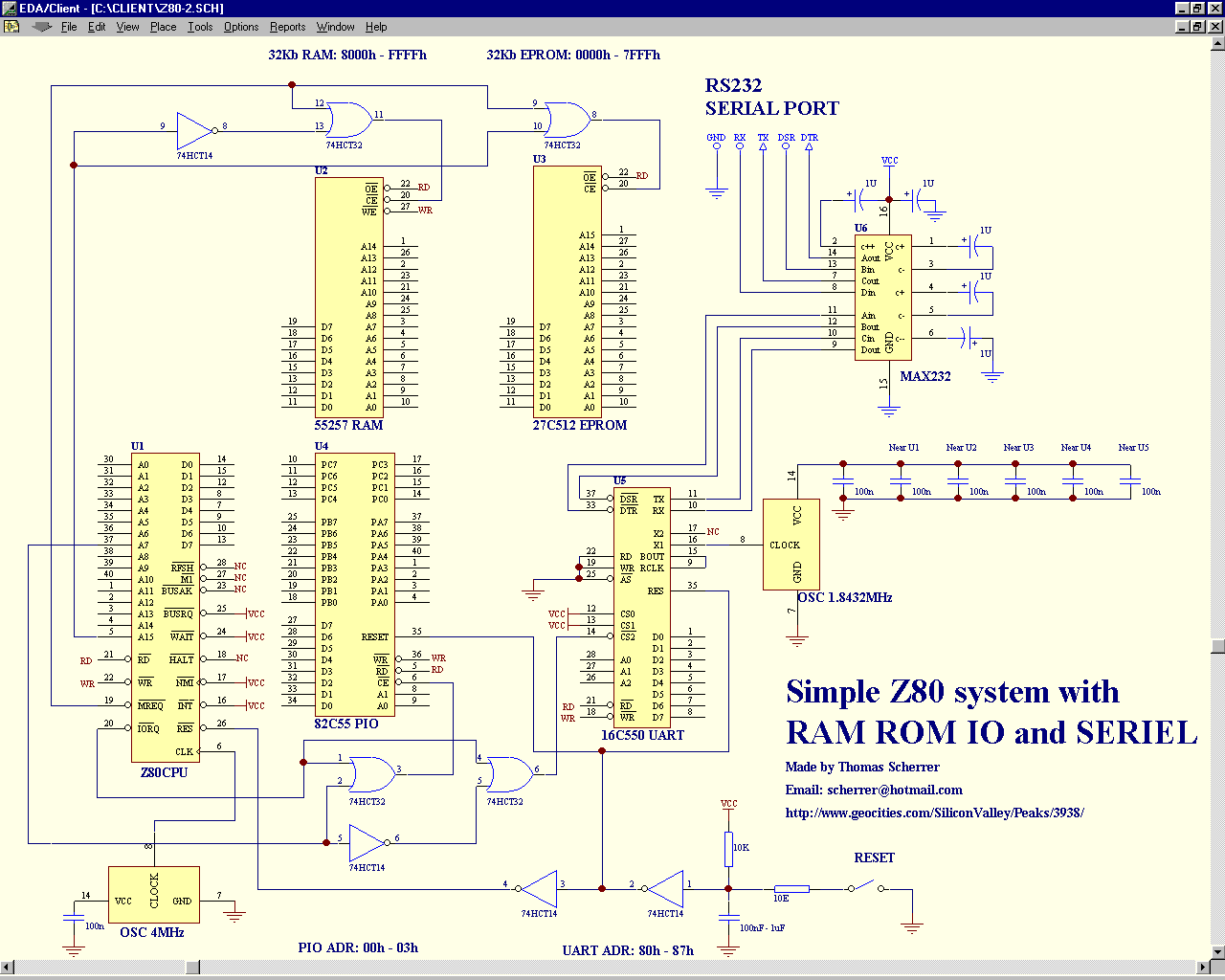
I am interested in making a simple Z80 computer. I would like to use a CAD
program, preferably one with autorouting, to design a PCB for it rather than
use prototype boards.
Eagle PCB CAD looks promising but I have no experience in using a PCB CAD
program. As this is a hobby, I'd like to keep the costs less than $200.
The hobbyist license costs $125 which would be ideal.
http://www.cadsoftusa.com/
I tried Kicad but it did not work very well for me. I was able to layout
the schematic but the PCB layout was very complex and many of the parts were
not supported correctly. I was not able to get the autorouting feature to
work well either.
Has any one use the Eagle CAD program to make a simple SBC and can offer
some advice on how to do make my own PCB for a Z80 SBC? I'd like to start
small so here is the circuit I have selected:
http://z80.info/gfx/z80test.gif
Has anyone done this and would be willing to advise and/or work on a Z80 SBC
project?
Thanks!
Andrew Lynch
PS, I think this is "on topic" since Z80 SBCs are definitely "classic
computers" like in NorthStar, KayPro, WaveMate, Zenith, Vector Graphic, etc.
---------Original Message:
Date: Sun, 16 Mar 2008 21:21:46 -0400
From: "Kelly Leavitt" <kelly at catcorner.org>
Subject: RE: S100 archive?
> Does anyone recognize this archive as a mirror of other spots?
>
> http://maben.homeip.net:8217/static//S100/index.html
>
> It seems to be connected to majzel.com, registered to a
> Agata Majzel, Flat 22, 27 Hereford Road, London W2 4TQ.
>
> - John
Seems like a case of
"My archive is bigger than your archive."
I see stuff in here from a lot of different archives and personal web sites.
Kelly
----------Reply:
Is this a problem or do you just like to belittle someone's hard work?
As a fellow Cromemco fan I happen to know Marcus, the person behind
that site (in Switzerland btw.) a little bit and I know for a fact that he has
spent an enormous amount of time and effort scanning and indexing material
that is not available elsewhere. Is there a problem with adding material that
*is* already available in order to make a section as complete as possible,
and to have it conveniently findable in an index? If any of the actual "owners"
of that material want to keep it to themselves and *THEIR* site, I'm sure
he would remove it.
I've also never known him to brag about it in any way, only to point to
his site on occasion when he runs across someone on a forum somewhere
looking for something that he has.
Since it's my own interest and in a very tiny part my contribution, I defy you to
find any one of many dozens of his 300+ Cromemco documents elsewhere,
unless they've been copied from his site. Compare it to bitsaver's Cromemco
collection for example (6 manuals at last count, although I don't in any way
mean to belittle Al's enormous effort), or even Harte's site which is one of the
better ones. That's not to mention the actual code and disk images which are
even rarer anywhere else, all a work constantly in progress.
It's comments like yours that make some people ask why the hell they
bother; I hope you don't have to grit your teeth one day and retrieve some
elusive boot disk or manual from his site...
And if you prefer to Google through the many fragmented and scattered
sources on the Internet, by all means do do.
m
On Tue, 18 Mar 2008, Andrew Lynch wrote:
> Hi,
>
> I am interested in making a simple Z80 computer. I would like to use a
CAD
> program, preferably one with autorouting, to design a PCB for it rather
than
> use prototype boards.
>
> Eagle PCB CAD looks promising but I have no experience in using a PCB CAD
> program. As this is a hobby, I'd like to keep the costs less than $200.
> The hobbyist license costs $125 which would be ideal.
Have you looked at gEDA?
--
David Griffith
dgriffi at cs.csubak.edu <http://www.classiccmp.org/mailman/listinfo/cctalk>
A: Because it fouls the order in which people normally read text.
Q: Why is top-posting such a bad thing?
A: Top-posting.
Q: What is the most annoying thing in e-mail?
________________________________
-----REPLY-----
Hi Dave,
I did try gEDA about a year ago and I recall having problems finding the
Zilog chips supported by the library. Maybe that has changed?
I downloaded the Eagle freeware version just to test drive it. I was able
to make a rough layout of the SBC with out the chips placed on the
schematic.
Of course, I would still have to connect all the wires and such but at least
the bare minimum components seem to be present and supported. It even gave
a crude layout of the PCB, again with no traces due to no connections.
Even with that simple Z80 SBC, it exceeded the capacity of the Eagle free
version PCB.
Has anyone used gEDA to make a simple Z80 SBC or something like it?
Thanks!
Andrew Lynch
>I am curious about the existence of PDP-8 games making use of a CRT
>display. Would be fun to have more than Spacewar...
>
I haven't found much. The Kaleidoscope was fun to play with.
Its in the 8E small computer handbook page 7-51 (page 53 of scan below)
http://www.pdp8online.com/pdp8cgi/query_docs/view.pl?id=126
Java version at http://www.scoundrelspoint.com/kaleidoscope/index.html for
people who don't have a VC8E.
I have a tape of PDP-12 games online that I though about porting but haven't.
They seem to be mostly 8 code (binary only).
>And: I found a SPCWR3.PA somewhere on the web. It has built in support
>for the LAB-8/e programmable real time clock. But... The clock doesn't
>generate interrupts, display is painted only on a key stroke. Anyone a clue?
>
Are you sure you set the defines correct when you built it to select
that clock? That your clock is working?
I would either manually check out the clock or run the diagnostics.
I have run it but using the 60hz clock.
http://www.pdp8online.com/pdp8cgi/query_docs/query.pl?Search=dk8e&stype=Par…
See dhdkaa.dg
http://www.pdp8.net/pdp8cgi/os8_html?act=dir;fn=images/os8/diagpack2.rk05;s…
>In order to support my classic computers I need a GOOD EPROM
>Programmer (that puts it on topic ... ).
>
>I've used and like the Data I/O 29B but don't know squat about
>the 29A. Are they about the same or is the 29A a POS ??
I have both the 29B and the 29A.
The 29B is more capable, more common and in my opinion a better choice. Physically they look almost
identical, but there are significant operational differences.
According to the manual, the 29A can have a maximum of 16K of buffer memory - this would limit you
to 16K or smaller devices (such as 27128), however my 29A came with 64K installed, and can do up to
64K devices (such as 27512).
My 29B has 256k of buffer memory, which I believe is the max it can have, and this is enough for
pretty much anything you are going to find in a classic computer.
I don't use the 29A much - I got it mainly as a spare... but IIRC it either doesn't do automatic
device identification, or does it in a more limited way... The 29B is quite good at it. This may be
more more a function of the device adapter than
the unit itself, which brings us to...
Equally important is the device adapter that you get with the unit - you probably want one of the
universal "unipak" adapters that supports many different devices.
My 29A has a "Unipak2" and the 29B has a "Unipak2B". The 29B/Unipak2B combination can program many
more devices. The family/pinout codes for the 29A/2 are only 2 digits where
they are 3 digits on the 29B/2B. It would be worthwhile for
you to get the device family/pinout code charts for the
programming adapters offered with the units and look at
the list of supported devices - this will give you an idea
of the capability of the unit in question.
You will also want to check the RAM installed in the unit,
as it may be difficult to add (manuals reference expansion
cards). The 29B shows the installed RAM at power-up. For the
29A you need to use the edit command to see how far up in
memory you can modify.
The 29B has more/better commands and functions as well,
although the 29A is still a capable unit.
>What would be a FAIR price for either ? Is it worth more to
>opt for the 29B ?? Thanks.
At the same/close price, I'd pick a 29B hands down. A 29A
could still be a good choice if you get it cheap enough, and
your needs don't require devices larger than it can do - be
sure to check the installed RAM and device programming adapter.
I have no idea what they are actually worth these days, but
FYI - I paid $70 for my 29B quite a few years ago - it came
with the Unipak2B and a Gangpak (lets you program up to 8
devices at once - I never use it). I picked up the 29A for
$25 a couple of years ago, it came with the Unipak2.
I've collected a fair bit of Data I/O documentation in PDF
format, including manuals for both units, the programming
adapters, and device family/pinout code charts for them.
Contact me if you need anything.
Dave
--
dave06a (at) Dave Dunfield
dunfield (dot) Firmware development services & tools: www.dunfield.com
com Collector of vintage computing equipment:
http://www.classiccmp.org/dunfield/index.html
>What size motor was typically used in a 14-in fixed drive, and what
>sort of mechanical interface did a disk pack have with the spindle or
>hub? I haven't been able to find any really clear pictures or
>diagrams of the mechanics of such units.
>
The RK05 is a single platter 14" drive with the platter magnetically held on
the spindle.
Pictures here.
http://www.pdp8online.com/rk05/rk05.shtml
|pichotjm wrote:
|> method? In France, collectors prefer to discuss in newsgroups
|> (fr.comp.ordinosaures)Have a nice day!JMP
|Sadly my ISP doesn't carry that newsgroup (fr.comp.os.* is
|all they seem to have!).
|Antonio
Hi, Be carefull! fr.comp.ordinosaures is in french.The best way for you,
would be to subscribe to the news server Astraweb.com. You will have to pay
a one time fee of about $9 (6 euros), and with that subscriptionyou are
authorized to download 25 GB of data. (valid for your life!)A second way is
to subscribe with Teranews or Bubbanews. The one time fee will be $3.95. And
you were able to download 50 MB/day. (valid for your life!) but i dont know
if you will have a problem at the first connection: the list of NG can be
very heavy (more than 50 MB).I subscribed to all three. Without any
problems. I do same subscriptions for friends (10 to 15 times)Just one small
problem with Teranews, they correct within 10 mn! (note I live in France and
they are in USA!)JMP
What size motor was typically used in a 14-in fixed drive, and what
sort of mechanical interface did a disk pack have with the spindle or
hub? I haven't been able to find any really clear pictures or
diagrams of the mechanics of such units.
-Bobby
---------Original Message:
Date: Mon, 17 Mar 2008 21:49:22 -0700
From: dwight elvey <dkelvey at hotmail.com>
Subject: RE: S100 archive?
> From: dm561 at torfree.net
>
> ---------Original Message:
> Date: Sun, 16 Mar 2008 21:21:46 -0400
> From: "Kelly Leavitt"
> Subject: RE: S100 archive?
>
>> Does anyone recognize this archive as a mirror of other spots?
>>
>> http://maben.homeip.net:8217/static//S100/index.html
>>
>> It seems to be connected to majzel.com, registered to a
>> Agata Majzel, Flat 22, 27 Hereford Road, London W2 4TQ.
>>
>> - John
>
> Seems like a case of
> "My archive is bigger than your archive."
>
> I see stuff in here from a lot of different archives and personal web sites.
>
> Kelly
>
> ----------Reply:
>
> Is this a problem or do you just like to belittle someone's hard work?
>
Hi
I think you miss the point. It is consider proper to credit the sources
of such information. The work he has done is great and he has done
it very well. There is just no mention of where he aquired much
of it.
Dwight
---------Reply:
Well, as usual I think _you_ missed _my_ point: ;-)
If you want to publicise the site here, fine.
If you think his lack of attribution is self-serving, dishonest, discourteous,
whatever, and it bothers you enough to write, then send an email to Marcus
or the person who you think deserves mention (if you can find him/her),
instead of bad-mouthing him here (since this is about courtesy, right?)
m
Date: Mon, 17 Mar 2008 15:25:57 -0600
From: John Foust <jfoust at threedee.com>
Subject: Re: S100 archive?
At 03:06 PM 3/17/2008, M H Stein wrote:
>>It's comments like yours that make some people ask why the hell they
>>bother; I hope you don't have to grit your teeth one day and retrieve some
>>elusive boot disk or manual from his site...
>I didn't criticize it, and neither did Kelly as far as I saw.
>I wanted to point it out to the group and determine whether it
>was indeed a new trove or not. The site itself doesn't tell me
>whether it's copied from elsewhere or not. That would make it
>more useful and descriptive, wouldn't it?
My mistake then; "Seems like a case of 'My archive is bigger than your archive.'
and "I see stuff in here from a lot of different archives and personal web sites."
struck me as critical and dismissive. Sorry if I misunderstood.
I'd have thought something like, "Hey folks, I just ran across a site, etc. with
lots of stuff, although some of it looks like unattributed copies from other sites;
anybody know anything about it?" would express what you say above a little
better. FWIW, it's been around for a few years and if this were the kind of
bragging that "mine's bigger than yours" implies, I'd have thought it'd be better
known by now.
I couldn't care less whether he puts my name on the stuff I've scanned or copied
and sent to him as long as it's out there and easy to find (and I'm a little PO'd
about stuff I've sent to folks who promised to make it publicly available but never
did AFAIK), and I don't see the need to put up yet another Web site of my own and
fragment the resource even more. It might be different if I had a site and he copied
it without my knowledge, but that'd be between him and me.
If having their name mentioned is important to someone, let him or her send him an
email. I don't see how attribution makes it any more useful or descriptive though;
does it matter to you whether he scanned something or I did? The only attribution
that matters to me is the "real" attribution, i.e. the name of the original company or
publisher.
Since some of the sites he copied from probably copied it from another site
themselves, tracking down who actually "did the work" could be a lot of fun and
extra work.
>The "World's Largest Ball of Saved Twine Bits" approach doesn't tell me much.
>If you take something from elsewhere, why not attribute? If you made
>something yourself, why not tell me it's unique?
>- John
Guess I just don't get why it's so important to *you* where it came from as long as
you can find it, unless it's material that you copied or scanned yourself.
If pigs ever fly and someone actually wanted to thank the person who did the work
after downloading something, they'd probably often have to sift through the various
sites with identical copies anyway.
Having said all that, although it'd be much extra work for thousands of files attribution
would indeed be a courtesy and is the custom in this community; if it keeps you
awake at night why not send Marcus an email instead of kvetching about it here,
behind his back as it were.
And thanks for the reminder; playing Al Y's "Biggest Ball of Twine in Minnesota"
on my iTunes as I write...
m
Sometimes the troglodyte approach to fixing keyboards works: just bang
on the bad key for a while, and it may start to work again. Bang
gently, of course -- don't take "troglodyte" too literally. :0)
Also, on some types of keyboard, you can get at the contacts just by
pulling off they keycap. I have no idea if any Model 4's used that
type, though. Quite likely not.
--
Tim Mann tim at tim-mann.orghttp://tim-mann.org/
Hi Kelly,
To answer your comments from cctalk/cctech ... and to put things into
context ...
As a passionate computer person I have (over the last 5 years) tried to do
something with my fond memories of the S100 days and in particular my
Cromemco restoration project.
I started to collect and scan my personal Cromemco documents and then some
of the other peripherals and disks I was using. Before I knew it I was
getting carried away and starting my own private archive. Things grew from
there and I started to add other publically available archives. I don't
store anything that I was not really involved or fascinated with. So for
example DEC VAX and PDP stuff .. really no, the IBM VM370 CMS command
guide ... really yes. The Cromemco RDOS 1.0 Instruction manual 1.0 .. I
get a little misty eyed.
The actual root of the S100 stuff is
http://maben.homeip.net/static/S100/index.html . Initially it was
broadcast solely on port 8217 but now also on port 80 since people kept
complaining about access (especially from behind corporate firewalls). Off
topic is the fact that anybody who works with AIX, Backup, TSM, Storage or
SAN should also be interested, since <cd ../computers > : your secret and
my daily reference to the very best documentation in these areas.
It's certainly not a bragging site and yes, some of the information is from
other places, but it's a good reference for me and believe me I have spent
hundreds of dollars and thousands of hours (yes really) producing high
quality, text searchable PDF scans. I'm probably doing something wrong but
uncle Google still does not index most of it correctly, but if you poke
around there is a lot there. There is a CREDITS directory so if it's
something that you'd like crediting or needs removing then you just have to
ask.
It seems the older I get the more nostalgia tugs harder and this is a good
way to for me to remember the "good old days" when you perhaps felt you
might understand it all from that TMS5501 on the TUART to the IOP Z80 code
running to support those tightly offloaded processes, to the output to port
FFH to switch the XPU from Z80 to 68010 mode or the rewiring and code
insertion needed to support Tandon 8 inch drives over Persci under CDOS and
CROMIX. Today I know too many software "experts" who never wrote a program
let alone a compiler or hardware experts who never even used a soldering
iron. It's shocking!
And for the record (Ann and Kelly) , we absolutely love cats
Kind regards,
Marcus Bennett (and agata)
> Do you think someone will make a list like:
>
> file.pdf 102941 bytes copied from bitsavers
> file2.pdf 102384 bytes copied from sellam ismail
no, what I would like to see is a file like:
path/foo1.file MD5 sum of the file
path/foo2.file MD5 sum of the file
so I can write a script to trivially tell what is new/unique
I can keep track of the provenance of the files just fine if
you have a unique identifier (like an MD5 sum) in a simple text
file at the top of the heirarchy.
I have a Micro-Term Ergo 201 that I'd like to use with my PDP-11. Just
one problem -- I can't figure out how to get this thing to save the
settings in the Set-Up menus, so I have to adjust the baud rate, etc.
every time I power it on. There doesn't seem to be any obvious way to
do it -- is this just supposed to happen automatically when I exit?
Thanks,
Josh
From: Robert Nansel <bnansel at bigpond.net.au>
>
> What size motor was typically used in a 14-in fixed drive, and what
> sort of mechanical interface did a disk pack have with the spindle or
> hub? I haven't been able to find any really clear pictures or
> diagrams of the mechanics of such units.
I don't know, but I do know that they run up to more than their rated
speed and then slow down so that they come online faster. There is a
problem if you load a disc, realise its the wrong one, run the drive
down, change the disc and power it up again. I did that once on an
80MB five high pack drive and burnt the motor out. It was on a GEC
4080 and I think the drive was a re-badged CDC one.
Hey folks,
I am curious about the existence of PDP-8 games making use of a CRT
display. Would be fun to have more than Spacewar...
And: I found a SPCWR3.PA somewhere on the web. It has built in support
for the LAB-8/e programmable real time clock. But... The clock doesn't
generate interrupts, display is painted only on a key stroke. Anyone a clue?
Best wishes,
Philipp :-)
> Date: Tue, 18 Mar 2008 17:55:13 +1030
> From: Robert Nansel
> What size motor was typically used in a 14-in fixed drive, and what sort
> of mechanical interface did a disk pack have with the spindle or hub? I
> haven't been able to find any really clear pictures or diagrams of the
> mechanics of such units.
Wait a sec--a "fixed disk" is just that--that medium is *not*
removable. So, something like a Shugart SA-4000 is a fixed 14" disk
drive.
A drive using disk packs is a "removeable media" drive.
Two birds of very different colors.
Have a look at
http://www.bitsavers.org/pdf/cdc/discs/40823100D_853_Maint_Feb69.pdf
for a manual on CDC's answer to the IBM 2311. There's a good
description of the threaded-spindle pack mounting there, as well as
the head-load mechanism.
For a fixed 14" drive, have a look at:
http://www.bitsavers.org/pdf/shugart/39005-1_SA4000_OEM_Apr79.pdf
Both use fractional-horsepower induction motors; the CDC drive uses a
3-phase motor that's probably somewhere around 1/3 hp (the specs
don't say, but the start/run current ratings give a clue). The
Shugart fixed drive uses a single-phase motor that's around 1/8 hp.
Assuming that the motor can overcome the frictional losses and
interia of the media assembly, the actual motor rating probably isn't
terribly critical. Both use belt-drive.
Cheers,
Chuck
> I?m in trouble with the system as the boot stops at :
* RSX-11M - Plus V4.3 BL66 2044.KW System "Pt/Ps"
* > RED DU:=SY:
> when loading from RD53 (RZ 28M-E)
> and stops at:
* RSX-11M/RSX-11M Plus Standalone Copy System V03
> when loading from RX33 (Brusys floppy)
> Do you have an idea why the boot does not go on?
Most common cause for those symptoms is that the LTC (Line Time Clock
aka "60 Hz" although probably "50 Hz" for you) clock is disabled.
On a 11/93 in a BA23 or BA123, it might be disabled because of the
little front panel DIP switches, or because the cable going to the front
panel selectors switches fell off, or in the setup firmware on the
processor board.
I think the 11/93 can be configured to provide its own fake LTC
interrupts from on-CPU-board crystal too (been a long time!)
Tim.
Hi folks,
I have two Omnibus printer interfaces, not from DEC. They could be
something german...
They are labeled "CSI printer interface" and have 20 pin Berg connector.
It seems to be a 7 bit interface.
Does anybody know anything or has any ideas? Docs?
Perhaps the card is a clone of a DEC standard card. So it would be
interesting to get information about the term "CSI printer"....
Thanks a lot,
Philipp
P.S.: I could also need a DEC parallel printer card (Centronics or Data
Products compatible) as well...