We have a thread for sightings of vintage computers
in film and TV right? I just spotted a nice IBM 360
installation in "The Girl Most Likely To...", a 1973
black comedy. Selectric console terminal, lots of
3420 tapes drives and a sorter painted blue. It's
the sorter that has a tiny (and technically inaccurate,
but who cares) role in the plot. It's a pretty fun
movie, written by Joan Rivers, and there are a whole
bunch of recognizable TV character actors of the era
in there. Got it on NetFlix.
I came across an application note and software on the Luminary Micro
site <http://www.luminarymicro.com/> implementing subject device. The
application note is the last one on the App Note page and the Software
Update page references the app note.
You can get a device with ethernet and three UARTS for a bit over US$
10 in singles - ARM Cortex processor.
CRC
----------Original Message:
Date: Mon, 19 May 2008 00:21:23 -0700
From: Josh Dersch <derschjo at msu.edu>
Subject: Capacitor values for original PET power supply?
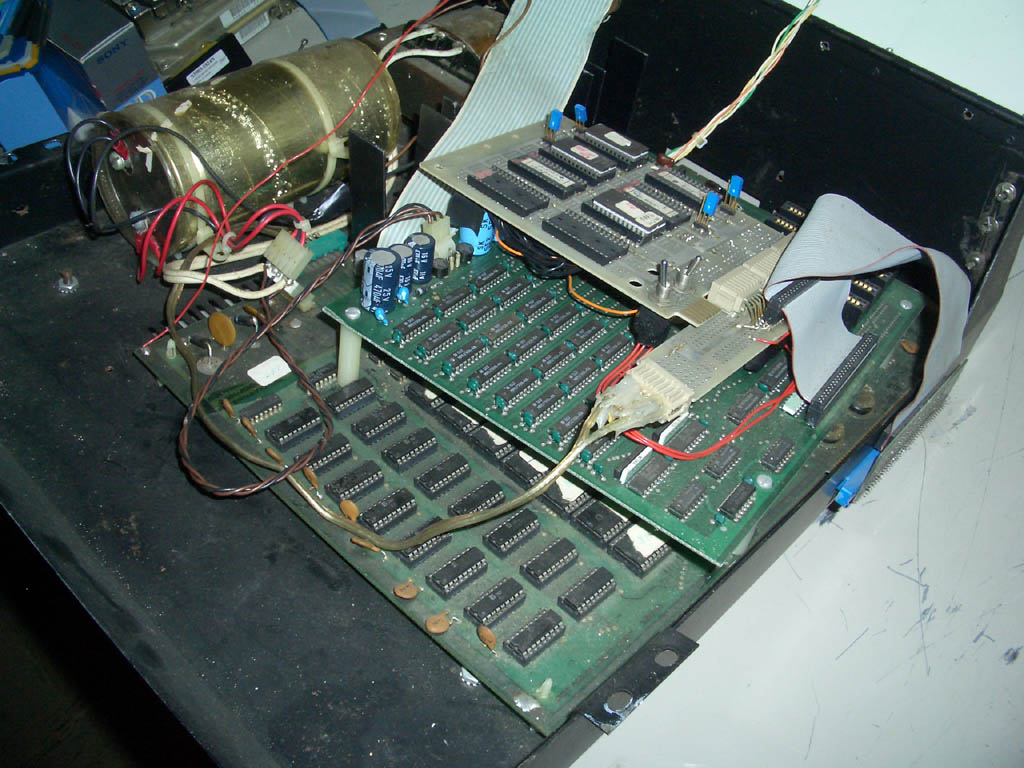
Picked up an original PET 2001-8 awhile back that's been heavily (and I
do mean heavily) modified at various points in its history by someone
with very odd design aesthetics. (See pic at
http://yahozna.dyndns.org/scratch/hackedpet.jpg &
http://yahozna.dyndns.org/scratch/hackedpet2.jpg).
Various parts were hacked in and hot glued (!!) in place or just left to
dangle. When I got it everything was loose inside. There's an
Expandamem board and some homebrew job with some eproms and some hackery
connected to the internal cassette port. There are various switches on
the front and back that do who knows what. The keyboard & tape drive
have been replaced with a different keyboard, alas. (I'll leave finding
those two items for a later date...)
And the power supply's capacitor has been replaced with some huge
Sprague monstrosity larger than a pop can. Haven't even attempted to
power it up since the power supply wiring's all hanging loose and taped
together, but I'm afraid of that capacitor and I'd rather just return
this thing to more or less "original spec" and remove all of this extra
stuff.
Anyone know what the original power supply capacitor was for this
thing? I've found parts lists & schematics for the main PCB, video &
voltage regulator but none of them appear to list this. (I'd also be
interested in knowing the transformer specs & wiring, since I'm probably
going to have to rewire that...)
Thanks,
Josh
----------Reply:
Well, if it were mine I'd clean it up and figure out what's what and how to use
it instead of returning it to the boring "original" spec.
Don't know why you need to replace the cap or rewire the transformer, but
FWIW the original cap is 23,000 at 15; presumably it was increased to deal
with the increased current required by the extra boards. Don't know specs
for the transformer but it and the wiring look stock as far as I can see aside
>from being heavier than the original so I don't see why you'd need the specs.
FWIW, there should be 5 secondary terminals: 7 & 8 are the AC supply for
the monitor, 5 is ground, and 4 & 6 are the two ends of the 8-0-8 secondary.
The EPROMS may be interesting; there were a number of monitors, utilities
etc. supplied in EPROMs, and some disk/tape software packages also used
EPROMs for extra memory and copy protection; at least some of those
switches will be for selecting the EPROM to use. Dump 'em if you can;
they may be rare/useful.
If the keyboard isn't an obvious hack, i.e. if it fits the case and has the PET
graphics characters, it may be original; only the early models had the chiclet
keys and integrated tape drive.
mike
m
A friend of mine - freewheelin at cix dot co dot uk - wants to dispose
of an old PET:
[[
I've got a Commodore PET 8296 (http://tinyurl.com/3totud) and separate
dual disk drive (model 4040 - http://tinyurl.com/3k87vr), both non-working,
which are gathering dust in a corner of my office - if he wants them.
P&P might be rather enormous though, unless there's someone heading from
Wiltshire (near Stonehenge) to Shropshire who can take them on-board?
]]
Anyone interested? Free for the collection.
--
Liam Proven ? Profile: http://www.linkedin.com/in/liamproven
Email: lproven at cix.co.uk ? GMail/GoogleTalk/Orkut: lproven at gmail.com
Tel: +44 20-8685-0498 ? Cell: +44 7939-087884 ? Fax: + 44 870-9151419
AOL/AIM/iChat: liamproven at aol.com ? MSN/Messenger: lproven at hotmail.com
Yahoo: liamproven at yahoo.co.uk ? Skype: liamproven ? ICQ: 73187508
Just came across an interesting nascent site that should be of
interest to the group: "AllPinouts is a Web-based free content project
to collect and list all know pinouts." found at <http://www.allpinouts.org
>.
CRC
> Have they all been scanned and are on line?
Not scanned, but I have the original DEC-Document sources
(like LaTeX) and resulting postscripts and PDF's for RT-11
V5.6 and V5.7 up, e.g.:
http://www.trailing-edge.com/~shoppa/rt56manuals/s1523_pro.pdf
I'm similarly mystified by the previous post to this list looking
for scanned VMS documentation... the original PDF's (not scanned
but again through the DEC-Document->PS->PDF chain) are out
there on the web already.
Tim.
Picked up an original PET 2001-8 awhile back that's been heavily (and I
do mean heavily) modified at various points in its history by someone
with very odd design aesthetics. (See pic at
http://yahozna.dyndns.org/scratch/hackedpet.jpg &
http://yahozna.dyndns.org/scratch/hackedpet2.jpg).
Various parts were hacked in and hot glued (!!) in place or just left to
dangle. When I got it everything was loose inside. There's an
Expandamem board and some homebrew job with some eproms and some hackery
connected to the internal cassette port. There are various switches on
the front and back that do who knows what. The keyboard & tape drive
have been replaced with a different keyboard, alas. (I'll leave finding
those two items for a later date...)
And the power supply's capacitor has been replaced with some huge
Sprague monstrosity larger than a pop can. Haven't even attempted to
power it up since the power supply wiring's all hanging loose and taped
together, but I'm afraid of that capacitor and I'd rather just return
this thing to more or less "original spec" and remove all of this extra
stuff.
Anyone know what the original power supply capacitor was for this
thing? I've found parts lists & schematics for the main PCB, video &
voltage regulator but none of them appear to list this. (I'd also be
interested in knowing the transformer specs & wiring, since I'm probably
going to have to rewire that...)
Thanks,
Josh
Andrew wrote:
> I am interested in PAL / GAL programming and would
> like to buy a book on the subject. Does anyone have
> any recommendation(s)? Alternatively, there may
> be websites with PAL / GAL programming how to
> guides. Those would be useful
> too. I have a rough idea using PALASM but it has been
> a long time since I have used anything like it.
Since you mentioned it... and since this IS classiccmp...
The first version of PALASM I used was back in 1984 or 1985,
and it ran on a VAX and a PDP-11. If I recall correctly, it came as Fortran
source code and was from MMI, the big seller (at the time)
of PAL's. The MMI databooks of the era were very good at
convincing old stuck-in-the-mud-types like me that PAL's were
a huge improvement over discrete logic, showing how logic
equations map into blowing diodes, and blowing diodes
in a PAL results in exactly the function you wanted to begin with.
If I google for pages with MMI, PALASM, and Fortran, I see
several pages that would help you go this route.
As a practical matter, for a modern board, you'd probably
use gate arrays for all but the most straightforward decoding
to do it really modern.
Tim.
>
>Subject: Re: Emulation vs. "the real thing" was: Re: Minimal CP-M SBC design
> From: "Chuck Guzis" <cclist at sydex.com>
> Date: Mon, 19 May 2008 10:00:33 -0700
> To: cctalk at classiccmp.org
>
>Allison wrote:
>
>> Where it works, I want to emulate a PDP1, or replace a PDP-11. Where
>> it doesn't work so well is when I want to run VMS on a MicroVAX with
>> performance in the NVAX realm.
>
>As you stated, it depends upon what you want to do.
>
>22Nice was written in response to those, who, back in 1986 still had
>x80 CP/M systems and were looking to migrate to the PC. It was the
>answer to the question "...But how do I get my old <fill in the
>application name> to work>?" The goal was not emulation of a Z80/8080
>per se, but finding a way to make the transition to the MS-DOS world
>as seamless as possible. We didn't care about the
>Osborne/Kaypro/whatever experience or the CP/M experience, only how
>to get people going on a new platform. By and large, it worked
>pretty well, with no drivers, TSRs or knowledge about CP/M. You
>renamed your .COM files, ran GENCOM on them and you were off and
>running. The SUBMIT capability, for example, was deeemd superflous,
>as the MS-DOS BAT capability was better in just about every way and
>simple enough to adapt to. (The first versions of 22Nice ran on a
>Compupro 85/88 S-100 machine, but that's another story).
>
>22Disk was written solely as a way to get files to 22Nice. We'd
>considered just making the package read-only, but "in for a penny, in
>for a pound" thinking produced that bit of creeping featurism.
>
>To a CP/M purist, this approach (not providing an isolated emulated
>Z80 that you could load CP/M into) was probably heresy, but it worked
>well enough and accomplished the goal. The rise of better PC
>software eventually relegated 22Nice to the back burner, as that was
>seen as the ultimate objective.
Well not a purist. I've been using myz80 since around 94ish on PCs
for appliactions coding and other stuff. Sicne then I've added
Dave Dunfields Altair/Horizon Em,ulator that has a few things I use.
Also 22nice as well. However I didnt' ened it to port old z80 apps
to the PC I found enough PC stuff to do the same or better that I
didn't need that.
>I'd be lost without uC emulators today--they provide a convenient
>quick code check without the labor of trying to figure out what the
>heck is going on in that little block of plastic. But my reason for
>using an emulator there is very different from that of using 22Nice--
>I'm not interested in getting rid of the uC, but getting *to* it.
;) Like Blackfin or PIC.
>I'll use an emulator to satisfy my curiosity for hard-to-get old
>hardware. I've used the SIMH 1620 emulator to scratch an itch in my
>brain about some code I wrote 40+ years ago, but I would never
>confuse that with the actual experience of using a 1620 with the
>blinkenlights, parity checks, clackety console typewriter and
>glacially slow execution. Nor do I have the will or resources to
>resurrect or construct my own CADET. Nor do I want one in my office.
;) In somce ases MYz80 is far mroe capable or SIMH or any of the
many others as I can besitting anywhere running the sim on a small
laptop that I'd have any way rather than dragging my PX8 along as well.
>Sometimes, I'll use an emulator to figure out how some old piece of
>software worked, such as WPS-I on an old DECStation. The emulator in
>this case is better than the real thing, because I can modify the
>emulator code to show me what's happening internally. This would be
>at least very difficult on the real hardware--even if I really had it
>at hand.
Yes, it's a debugger and tool.
>This gets back to why I questioned the lack of diskette drives on a
>"real" Z80 design running CP/M. It seemed to me that if one is after
>an "experience" and is willing to go to considerable lengths to get
>it, that it should be as accurate and complete as possible. While 3D
>computer simulation of skydiving can be made to be very accurate,
>there's nothing like jumping out of a real aircraft for realism.
>Having noiseless, crashproof RAM-drives just wouldn't do it for me.
;) Having had noisy crash prone drives ( and still having many)
if I want to build to explore some part/hack of CP/M it's usually
not writing yafd (yet another floppy driver). CF allows me to
build and pay attention to other things that might be more hardware
and software intensive. Examples over the years is low DC power
systems, page mappers and the memory management software. Both
hard to do in a sim but the sim can help in creating the code.
>It all depends upon what your objective is.
It always do. ;)
Allison
>Cheers,
>Chuck
> Date: Mon, 19 May 2008 13:27:51 +0000
> From: Ethan Dicks
> I still build a lot of hobby projects with GALs (like PALs, but
> with much more flexible input and output configurations) - I
> don't think I've built a Spare Time Gizmos product yet that didn't
> have at least one 16V8 or 22V10. Gate Arrays might be handy for
> larger projects, but you can still pack a *lot* into a 20 or 24-pin
> GAL.
If someone were just starting out with GAL/PALs, wouldn't PEEL be the
best choice rather than fuse-programmed devices? At least you'd get
a second chance if you flubbed your first try--and they're basically
the same packaging.
Cheers,
Chuck
Hi,
While looking at the service manual for the Tektronix 4010/4010-1 and
4014/4014-1 terminals, I came up with an idea for creating a screen
capture card for them using the principles from the Tektronix 4631 hard
copy unit for the terminals. This would give you the ability to capture
a pixel image from the Tektronix terminal's display tube.
How many people would be interested in such a project?
--
"The Direct3D Graphics Pipeline" -- DirectX 9 draft available for download
<http://www.xmission.com/~legalize/book/download/index.html>
Legalize Adulthood! <http://blogs.xmission.com/legalize/>
Hi
I have hard copies of V4 and V5 RT-11 manuals. I'd like to keep the V5
manuals but I'd like to get rid of the V4 manuals.
Have they all been scanned and are on line? I looked on manx and
bitsavers and I found a few v4 manuals but not everything.
Should I figure out what I have which is not on line and scan that? Or am
I wasting my time?
For instance, I just scanned (as a test of 2 sided) AA-5285F-TC, which
is already online, but I can't find AA-K724A-TC (BASIC-11/RT-11
Installation and release notes, for V4 RT-11) so I assume that is not
scanned.
I just don't want to pitch these if they are not available (which is
hard to believe, as I think what I have is very common)
-brad
Allison wrote:
> Where it works, I want to emulate a PDP1, or replace a PDP-11. Where
> it doesn't work so well is when I want to run VMS on a MicroVAX with
> performance in the NVAX realm.
As you stated, it depends upon what you want to do.
22Nice was written in response to those, who, back in 1986 still had
x80 CP/M systems and were looking to migrate to the PC. It was the
answer to the question "...But how do I get my old <fill in the
application name> to work>?" The goal was not emulation of a Z80/8080
per se, but finding a way to make the transition to the MS-DOS world
as seamless as possible. We didn't care about the
Osborne/Kaypro/whatever experience or the CP/M experience, only how
to get people going on a new platform. By and large, it worked
pretty well, with no drivers, TSRs or knowledge about CP/M. You
renamed your .COM files, ran GENCOM on them and you were off and
running. The SUBMIT capability, for example, was deeemd superflous,
as the MS-DOS BAT capability was better in just about every way and
simple enough to adapt to. (The first versions of 22Nice ran on a
Compupro 85/88 S-100 machine, but that's another story).
22Disk was written solely as a way to get files to 22Nice. We'd
considered just making the package read-only, but "in for a penny, in
for a pound" thinking produced that bit of creeping featurism.
To a CP/M purist, this approach (not providing an isolated emulated
Z80 that you could load CP/M into) was probably heresy, but it worked
well enough and accomplished the goal. The rise of better PC
software eventually relegated 22Nice to the back burner, as that was
seen as the ultimate objective.
I'd be lost without uC emulators today--they provide a convenient
quick code check without the labor of trying to figure out what the
heck is going on in that little block of plastic. But my reason for
using an emulator there is very different from that of using 22Nice--
I'm not interested in getting rid of the uC, but getting *to* it.
I'll use an emulator to satisfy my curiosity for hard-to-get old
hardware. I've used the SIMH 1620 emulator to scratch an itch in my
brain about some code I wrote 40+ years ago, but I would never
confuse that with the actual experience of using a 1620 with the
blinkenlights, parity checks, clackety console typewriter and
glacially slow execution. Nor do I have the will or resources to
resurrect or construct my own CADET. Nor do I want one in my office.
Sometimes, I'll use an emulator to figure out how some old piece of
software worked, such as WPS-I on an old DECStation. The emulator in
this case is better than the real thing, because I can modify the
emulator code to show me what's happening internally. This would be
at least very difficult on the real hardware--even if I really had it
at hand.
This gets back to why I questioned the lack of diskette drives on a
"real" Z80 design running CP/M. It seemed to me that if one is after
an "experience" and is willing to go to considerable lengths to get
it, that it should be as accurate and complete as possible. While 3D
computer simulation of skydiving can be made to be very accurate,
there's nothing like jumping out of a real aircraft for realism.
Having noiseless, crashproof RAM-drives just wouldn't do it for me.
It all depends upon what your objective is.
Cheers,
Chuck
Mac collectors,
I was contacted by Kathy or Rick, who are moving from Maine
to North Carolina and would like to find a good home for their
Macintosh LC III and printer. Included are:
>Macintosh LC III
>StyleWriter
>MouseStick II
>
>I have the original system disks & manuals as well as the following
>software/games:
>
>Stellar 7
>PGA Tour Golf
>Word Muchers
>Where in the World is Carmen San Diego
>Kings Quest V
>Casino Game Pack
>Math Blaster
>
>Also have some user manuals: Norton Utilities, Mac for Dummies, SAM
>User Manual, 1001 Hints/Tips for Macs
They are willing to ship.
They can be contacted at kreaton(at)roadrunner.com for a
while, but that address will likely change (and it may take a few
weeks for the new one to appear). If you can't contact them there,
try me at mtapley(at)swri.edu and I'll do my best to forward the
message.
--
- Mark, 210-379-4635
-----------------------------------------------------------------------
Large Asteroids headed toward planets
inhabited by beings that don't have
technology adequate to stop them:
Think of it as Evolution in Fast-Forward.
An old client has requested help with hardware and software support for
some very old
PDP-11 systems running RT-11. The best solution may be to use E11
rather than fixing
some of the old hardware.
Another reason that using E11 would probably be the best solution is
that there may be
reports that take up to a day to produce using real DEC hardware. Since
my estimate
with E11 for a current 3 GHz CPU is about 100 times the speed of a
PDP-11/93, these
reports would take less than 30 minutes.
An RT-11 license will also need to be purchased. Does anyone have an
e-mail address
for Mentec? I contacted John Wilson a few weeks ago, but have not had a
response.
Sincerely yours,
Jerome Fine
Kenn, I saw you advice regarding the HO4952A software and the LIF floppy
format and as a hp4952A owner, I'm wondering if you know anywhere I could
get a copy of the utilities floppy?
Gordon Oliver
Australia
>
>Subject: Re: Minimal CP-M SBC design
> From: "Chuck Guzis" <cclist at sydex.com>
> Date: Sun, 18 May 2008 10:31:45 -0700
> To: cctalk at classiccmp.org
>
>> Date: Sun, 18 May 2008 10:09:45 +0100
>> From: Gordon JC Pearce
>
>> Aha, I disagree. You can't get at the innards of the 6120 at all,
>> because it's a chip. If you want to get at the innards of an emulator
>> then you can, although how accurately the emulator models the logic of
>> the -8 might be an issue (my emulator doesn't model it at all, but
>> largely does its own thing).
>
>I was going to reply along the same lines, but I felt it might not
>have convinced my audience. Back in the old days of 22Nice, we added
>an emulator feature that allowed a user to write his own port-mapping
>code and include it with each program, allowing each individual
>program to have its own simulated peripherals, if desired.
>
>This was no accident or a "feature for feature's sake". A customer
>was replacing a controller on a large piece of CNC machine tooling
>(they made trailers for large trucks). Communication with the
>machine was largely RS-232, so that was no problem with the PC, but
>the controller application directly manipulated a UARTs registers.
>We rolled an emulator overlay for the UART that functionally mapped
>the program's accesses to the PC's 8250-type UART. It worked right
>on the first try and the customer was happy for many years--and we
>changed not a byte of code in the original program, nor our basic
>product.
>
>That's the beauty of emulation--if the original box uses a bizarre
>interface or unobtainium chip, you can emulate it. MUCH easier than
>trying to do the same in hardware. Modern PCs tend to have
>sufficient excess horsepower that you can emulate just about any 80's
>era device without impacting performance.
That is the exact reverse case I was refering to. For that case and many
others like it I agree heartily. One of the "sims" I use is VMware under
Linux So I can run them crufy MS OSs without havignto invest hardware
on a daily basis. Doesn't hurt that I can also use it run a sim in
a sim like MyZ80 inside W98se on the fast Linux machine.
>But, as I've said, I felt that I wasn't going to sway the hard-bitten
>hardware folks. As you pointed out, the line between hardware and
>software is getting very blurry indeed. Cheap, fast,
>microcontrollers now give a new spin to tasks that would have
>normally been accomplished with a pile of discrete logic and can now
>be done with little more than software.
It works for me where it fits. If I want Z80 hardware no amount fo sim
will make me happy but at the same time I may use a sim to build code
for that Z80. As I've done it that way and in reverse and also to solve
the problem of hardware that is unobtaimium.
Where it works, I want to emulate a PDP1, or replace a PDP-11. Where
it doesn't work so well is when I want to run VMS on a MicroVAX with
performance in the NVAX realm.
Maybe time to chance the topic??? This is clearly outside the discussion
of how to make a minimalist CP/M system ( maybe even SBC).
Allison
I have one of these here with out a Keyboard. any one know which keyboards
can be used on it with out seeing smoke. Has a DIN connector
Of coarse I'm open to offers from any one that many have a keyboard also.............
Thanks, Jerry
>until you find that they want $5 for a PDF of a
>datasheet.
I have three large databook collections (including most of what
was at Haltek). I had offered them to CHM, but they've changed their
mind about wanting them, and they want the storage space back,
so I'm going to chop a subset and scan them at 600dpi over the next
few months. The duplicates will probably go up on eBay in 20-book lots.
The big problem will be their size and postprocessing them. I don't
know if Jay is going to want something this big on bitsavers.
I have a pair of TRS-80 DT-1 terminals that I've had for awhile and that
I don't think I'm ever going to use. I believe they work but I have not
done much with them aside from powering them up. They come with
dust-covers! (fancy!)
Free to whomever wants 'em. They're kinda large (about TRS-80 Model
III-sized) so I'd prefer not to ship, but if that's what it takes...
If there's no interest I'll probably drop them off at RE-PC in Tukwila,
WA in a week or so, maybe they'll find a happy buyer for them there :).
Thanks,
Josh
> Date: Mon, 12 May 2008 11:04:15 -0500
> From: Jim Leonard
> What I would love to test is Central Point Backup (PC Backup?) prior to
> version 6, which is the only version I had available to test. Versions
> prior to 6 are supposed to contain code that supports the Option Board I
> have in my 5160 for additional speed -- however, I'm not sure how much
> speedup I could expect, since some of the faster programs in the
> shootout must have been operating at a 1:1 intereave (I was writing all
> 40 tracks both sides in less than 30 seconds per disk; can it get any
> faster than that?).
I'll dig out the old FastBack and see if I've got an older CP backup--
I may well have.
If you're formatting then writing, then an OB might be faster, but
probably not when simply writing to a formatted diskette, assuming
that the sector layout is skewed appropriately to allow for seek and
head settling times.
In the bad old days of WD 17xx diskette controllers, we had a copy
program that formatted and wrote backup data in one pass, as long as
the data didn't have any of the "special" bytes that the WD chip
interprets differently during a format operation.
Cheers,
Chuck
> Date: Sun, 18 May 2008 10:09:45 +0100
> From: Gordon JC Pearce
> Aha, I disagree. You can't get at the innards of the 6120 at all,
> because it's a chip. If you want to get at the innards of an emulator
> then you can, although how accurately the emulator models the logic of
> the -8 might be an issue (my emulator doesn't model it at all, but
> largely does its own thing).
I was going to reply along the same lines, but I felt it might not
have convinced my audience. Back in the old days of 22Nice, we added
an emulator feature that allowed a user to write his own port-mapping
code and include it with each program, allowing each individual
program to have its own simulated peripherals, if desired.
This was no accident or a "feature for feature's sake". A customer
was replacing a controller on a large piece of CNC machine tooling
(they made trailers for large trucks). Communication with the
machine was largely RS-232, so that was no problem with the PC, but
the controller application directly manipulated a UARTs registers.
We rolled an emulator overlay for the UART that functionally mapped
the program's accesses to the PC's 8250-type UART. It worked right
on the first try and the customer was happy for many years--and we
changed not a byte of code in the original program, nor our basic
product.
That's the beauty of emulation--if the original box uses a bizarre
interface or unobtainium chip, you can emulate it. MUCH easier than
trying to do the same in hardware. Modern PCs tend to have
sufficient excess horsepower that you can emulate just about any 80's
era device without impacting performance.
But, as I've said, I felt that I wasn't going to sway the hard-bitten
hardware folks. As you pointed out, the line between hardware and
software is getting very blurry indeed. Cheap, fast,
microcontrollers now give a new spin to tasks that would have
normally been accomplished with a pile of discrete logic and can now
be done with little more than software.
Cheers,
Chuck