> From: Steven Malikoff
> a Raytheon module from a Block 1 AGC
> ...
> I don't think the Block 1's were flown(?).
Yes, but not on manned flights. (Researching this is made more complex
because there were quite a few different AGC designs; AGC3, AGC4, AGC4B, AGC5
and AGC6, in addition to Block I and Block II.)
Sources differ a bit: "Journey to the Moon" (Eldon Hall) says (pg. 107) that
Apollo 6 was "the last flight with Block I guidance system equipment" - but
it's not clear if that refers to the AFC. "Digital Apollo" (David Mindell)
says (pg. 175) that Apollo 5 was "the first Block II computer flight".
So somewhere around there. (Apollo 7 was the first manned flight, and the
first Block II spacecraft, per Mindell, pg. 176 - note that Block II
spacecraft apparently != Block II AGC - very confusing!)
Both excellent books, BTW - highly recommend them both.
Noel
didn't they keep craft intact for display etc?
heh who stole the memory then!/
anything is FLOWN in space has a high value.
we collect a bit of that but most is stupidly out of the price range.
ed sharpe archivist for smecc
In a message dated 10/28/2015 12:32:03 P.M. US Mountain Standard Tim,
paulkoning at comcast.net writes:
Would anyone have a working EISA motherboard or smallish EISA machine
they'd part with for a reasonable price? I find myself in need of one
to resurrect some elderly kit I'd like to play with. Contact
off-list.
KJ
Anyone in the St. Paul / Mpls area need paper for a Teletype? I had to buy
half a dozen rolls to get a decent price, so I am making (3) spare rolls
available at my cost of $5/roll.
If you have interest, please send me a message off-list - thanks!
-Bill
Has anyone here ever used a Dowalert back in its heyday of the early
1980s?
For those who don't know, a Dowalert is a device that resembles a
tape-driven telephone answering machine. Dow Jones had an idea of
broadcasting stock information over FM radio to this device for later
perusal by subscribers. The device has a keypad upon which you'd enter
numbers for particular classes of information you want. The broadcast
would include a code detectable by the device. If the code on the
broadcast matched one of those selected by the subscriber, the tape
recorder would start recording. Then an alert light would turn on letting
the user know that some new information is available.
--
David Griffith
dave at 661.org
A: Because it fouls the order in which people normally read text.
Q: Why is top-posting such a bad thing?
A: Top-posting.
Q: What is the most annoying thing in e-mail?
> From: Ben Sinclair
> I think you had written something a while back that would test that
> interrupt. Was that correct, or is there another diagnostic I can use
> to test that?
Well, I'm sure there's a DEC diagnostic for the DLV11-J, but I have no idea
what it is.
I did have a little ~20-instruction program that tests the receive and
transmit interrupts, I'll send you the URLs for the source, and ODT script,
forms. (Not sure what forms of object formats you can load into the machine.)
> After changing those switches I accidentally put the M8014 above the
> M8013.
Luckily that didn't fry anything. (I'm not looking down in disdain, I've made
a few similar mistakes myself! I usually try and stop and check twice every
time I go to turn the power on after I've fiddled with the hardware, for
precisely that reason.)
> I've swapped them and now get slightly different results:
I wonder if that's because there's no drive? Is this test suppose to need
one, I forget (I think you said but I'm too lazy to look :-).
Noel
> From: Johnny Billquist
> I wonder if it really uses 18 bit addresses in the console.
Yes (if the question is 'for input'). What it puts out on the bus I haven't
checked, definitely BBS7 plus the low 13 bits (0-12), dunno about BDAL13-21.
> From: Ben Sinclair
> For 18 bit addresses, I assume I would look at 74400 instead?
No, that's only 15 bits. (In octal, each full digit is 3 bits. So an
18-bit address will range from 000000 to 777777; 16-bit from 000000
to 177777, etc.)
Noel
This is a representative auction by the vendor. Look at all of his
stuff for the whole story.
VINTAGE-COMPUTER-AT-T-3B2-500-600-1000-UNIX-SYSTEM-16MB-MEMORY-WESTERN-ELECTRIC
http://www.ebay.com/itm/321811268824
The buyer of his Lisp Machine is going to be sad. The vendor has broken
off good to have spares and software for a working machine into separate
auctions. Unlike the 3B2 stuff which is all parts. Not a nice thing to
do if you are asking $9500 for the machine and only a few hundred more
for the spares. Spares such as mice, keyboard, and software restore
tapes. Nice.
Thanks
Jim
Hello. I seem to be getting quite a big assortment of DEC equipment over
here as of late. Back in July I made a trip to Miami to pick up a PDP 11/34
with related equipment a while back and posted about it here on the list.
I'm still working on getting the power supply on the pdp 11 fixed but am
making good progress and learning a lot in the process. Recently a deal
popped up on a microvax 3800 that was too good to pass up so I jumped at
the chance to get it and it is on it's way to being shipped here.
I have never dealt with any Vax hardware before. The closest I've been to
one is running a simulation of a machine in the simh emulator. Is there any
special hardware I will need to get this up and running? I have a couple of
VT 100 terminals that go with the pdp 11 that should work nicely with the
Vax. Is there anything a beginner with such hardware should look out for? I
would like to try and disconnect the power supply and test it separately if
possible to save myself the headache I experienced with the PDP 11.
Any suggestions or other info much appreciated.
--Devin
> From: Ben Sinclair
> I'm trying to get my RLV11 working
Oh, I was going to mention this about the RLV11 - it's a Q18 device. So it
_probably_ won't work in a system with more than 256KB of memory (which you
don't, at this point, have, though). It would all depend on the OS, whether
it understood that it couldn't DMA to anywhere above 256KB. (The controller
should work OK in a Q22 system - it just won't drive the high address lines,
so they will go to 0 - but it just won't be able to DMA to high memory.)
> I have a PDP-11/23 in an H9273 backplane. I just got it working
> reliably without the RLV11 boards installed ...
> Here's my configuration:
> Down the left side: M8186, M8044, M8044, M8043, M8013, M8014, and
> M8012 (the BDV11) on the bottom.
Here's something to try (to make sure the 8013 is passing grants OK); put the
M8013/14 _before_ the M8043, and see if a test which uses interrupts on the
DLV11J works.
> I also looked at myself and get 005737, though I'm not sure what
> it should be.
I take it "17440" is a typo for '174400'? Anyway, neither would work: in
11/23 ODT, '174400' is the address of a word of memory, up near the 64K
boundary. To get to the device registers, you need to type '774400'. If that
doesn't work, the addressing on the RL11 board-set is wrong somehow.
Noel
PS: Speaking of typing addresses to ODT - My favourite pet 11/23 peeve: there
is no way, from ODT, to read/write memory above 256KB! That can only by done
by a program! (The 11/73 does not suffer this issue.)
Just to be pedantic, as this is the Internet after all :-), distilled
water is a pretty good insulator, but not a "perfect" one. Neutral
(pH 7.0) water always has a very small amount of the molecules
disassociated into H+ and OH- ions. However, as others have stated,
the effective value of the water resistor, compared to the load
resistor(s), will be negligible.
(pictures removed)
From: rdawson16 at hotmail.com
To: greenkeys at mailman.qth.net
Subject: The last fix for a "All Shook Up" 33
Date: Mon, 26 Oct 2015 23:14:45 -0700
Wayne (ttyparts.com) and I had a disaster of a shipment on a ASR33, Fed Ex Ground did us no favors.
In spite of a handcrafted wooden case, clearly marked UP arrows and FRAGILE, these guys tossed this thing around.
The printer shipping bolts were installed. I told Wayne, are you sure you put them in? because I could not find them.
There they were, in the bottom of the crate, sheared off. Obviously they dropped and tumbled his custom TTY wood crate, that he has used for years.
HERE IS key is stuck, the printer rammed into the keyboard and bent it horizontal and vertical, fixed that.
Wayne sent a test tape and we verify the printer is OK.
Keys still do not print the correct letters, and tonight I find an actuator wire on the keyboard is broken.
If anybody ships a TTY, I recommend this: Make the box a, 3x, 4x TTY sized double wall cardboard box, filled with peanuts, and the TTY nestled in the core of the surrounding peanut cushion. They are going to shake and drop it, and all that foam and peanut will give the printer a cushion and lower the G's the TTY and printer will experience. An 'UP ARROW' means nothing, nor does 'FRAGILE'
Wayne's idea of a strong wood crate may have worked in the past, but today, it means 'don't care' this thing is packed for rough handling, they will toss it, drop it, tumble it because it is heavy as shit, and this wood case looks like it is built for this abuse.
Wayne is a super guy, and I highly recommend anybody buying teletypes work thru him. he completely redid my machine, took it down for a total refurbrishment, and built it back up. Weeks of testing and alighnment too. This guy is the best - and I can attest to this on all the time he has spent recovering from the shipping guys to get me online
Randy
KF7CJW
All,
Also while cleaning I found a box of HP Vectra docs & a couple disks.
Docs:
Getting Started With the HP BASIC Controller
HP 24540B & HP 24541B - Installation Guide
35743 HP Enhanced Graphics Display Installation Guide
HP Enhanced Graphics Adapter User's Manual
Disks:
VECTRA PC UTILITIES AND DRIVERS
ENHANCED GRAPHICS ADAPTER - UTILITY DISC
All of this in a HP 82301A BASIC Language box.
Again, beer money & shipping from 53714.
-Jon
Hi All,
I ran across the following while cleaning:
A set of "draft" manuals for SCO Integra database software. It looks to be a complete manual set in 4 hardbound volumes.
Also in the pile are 4 sequentially labeled 5 1/4" floppy disks that have "Dewitt" written on them. I don't have the resources to check the contents of the disks.
There is a single page color promotional flyer for SCO Integra.
Are these of interest to anyone?
Here's a picture: https://www.flickr.com/photos/jja572/albums/72157660431177871
Available for beer money and shipping from 53714.
-Jon
Can anyone confirm whether a Mac IIsi spits out sync-on-green (and only
sync-on-green) or not? I've found mixed info on the 'net so far.
I've got a system here which makes encouraging startup noises, but isn't
outputting any video to a VGA screen (adapter cable OK with my other Macs).
If it's SoG-only, well, there's my problem :-) If it does output h/vsync
like my other Macs then I need to look elsewhere (most likely nonsense
NVRAM settings, I expect).
cheers
Jules
> From: Guy Sotomayor
> Peanuts do *nothing* .. The heavy item will "settle" and have nothing
> surrounding it. The peanuts act a fluid during shipping.
I can attest to this. I bought a largish disk drive, and it was shipped in
peanuts. It came out the box at 45 degrees to the sides - it had gone in
parallel to the sides. Luckily, no damage ensued, but it was pure luck.
Noel
Hi Guys
OK I'm open for orders for the choice of the following:
PDP-8/e (Type A)
PDP-8/e (Type B)
PDP-8/f
PDP-8/m
Existing orders price as pre-paid
New orders price will be advised based on batch sizes
/f and /m are going to be a few dollars more as they need an extra
screen for the logos.
There are_twenty slots_ of which _five_ have already gone
Ask for the file of designs if you don't have it.
New panels in design stage for the 11/40 up to 11/70.
Scans, Photos and "I want one" for the above to me please.
Rod Smallwood
I'm trying to get my RLV11 working to eventually run my RL02, and am
having some trouble.
I have a PDP-11/23 in an H9273 backplane. I just got it working
reliably without the RLV11 boards installed, so now I'm giving them a
try again.
Here's my configuration:
Down the left side: M8186, M8044, M8044, M8043, M8013, M8014, and
M8012 (the BDV11) on the bottom.
I don't have the drive connected and am just trying to run the VRLAC0
controller test, which I believe should work without any drives
connected.
The switches on M8014 are configured to the defaults, according to:
http://bitsavers.trailing-edge.com/pdf/dec/qbus/EK-RLV11-TD-001_RLV11_Contr…
That would be a vector address of 330 and a base address of 174400.
Unfortunately, VRLAC0 doesn't look like it can see anything, but I'm
not sure I'm reading its output correctly.
What follows is the VRLAC0 output. I also looked at 17440 myself and
get 005737, though I'm not sure what it should be.
This is new territory for me, so any help would be welcome. Thanks!
.R VRLAC0
VRLAC0.BIN
DRSSM-G2
CVRLA-C-0
CVRLAC RLV11 RL01 DSKLESS DIAGNOSTIC
UNIT IS RLV11
RSTRT ADR 145702
DR>START
CHANGE HW (L) ? Y
# UNITS (D) ? 1
UNIT 0
11/23 PROCESSOR (L) Y ?
BUS ADDRESS (O) 174400 ?
VECTOR (O) 160 ? 330
DRIVE (O) 0 ?
BR LEVEL (O) 5 ?
CHANGE SW (L) ? Y
DROP ON ERROR LIMIT (L) N ?
AUTOSIZE (L) N ?
CVRLA SYS FTL ERR 00000 ON UNIT 00 TST 001 SUB 000 PC: 017066
CAN NOT ADDRESS RLCS
CONTROLLER: 174400 DRIVE: 0
CVRLA SYS FTL ERR 00001 ON UNIT 00 TST 002 SUB 000 PC: 017164
CAN NOT ADDRESS RLBA
CONTROLLER: 174400 DRIVE: 0
CVRLA SYS FTL ERR 00002 ON UNIT 00 TST 003 SUB 000 PC: 017262
CAN NOT ADDRESS RLDA
CONTROLLER: 174400 DRIVE: 0
CVRLA SYS FTL ERR 00003 ON UNIT 00 TST 004 SUB 000 PC: 017360
CAN NOT ADDRESS RLMP
CONTROLLER: 174400 DRIVE: 0
CVRLA SYS FTL ERR 00100 ON UNIT 00 TST 005 SUB 000 PC: 017454
CAN NOT ADDRESS RLCS
CONTROLLER: 174400 DRIVE: 0
CVRLA SYS FTL ERR 00101 ON UNIT 00 TST 006 SUB 000 PC: 017550
CAN NOT ADDRESS RLBA
CONTROLLER: 174400 DRIVE: 0
CVRLA SYS FTL ERR 00102 ON UNIT 00 TST 007 SUB 000 PC: 017644
CAN NOT ADDRESS RLDA
CONTROLLER: 174400 DRIVE: 0
CVRLA SYS FTL ERR 00103 ON UNIT 00 TST 008 SUB 000 PC: 017740
CAN NOT ADDRESS RLMP
CONTROLLER: 174400 DRIVE: 0
ILL INTER 004
PC 017770 PS 000341
ILL INTER 004
PC 014460 PS 000005
DR>
--
Ben Sinclair
ben at bensinclair.com
For reasons too abstruse to explain in detail I'm on the lookout for
terminals that are, physically, really small - especially serial and
coax 3270, and possibly twinax 5250.
Yes you could do things with small laptops and PDAs with PCMCIA cards
and adapters and software - I know a guy who kept a Psion Organizer
configured especially for use as a terminal with SGI boxes. But that's
Not The Same, and NOT what I'm after; I want dedicated purpose-built
terminals; switch it on and It Works.
And both DEC and IBM made 'real' terminals in a 'small pizza box' form
factor, using a separate standard VGA monitor as a display; one could
use those with a small LCD screen and achieve a similar result, and I
might do just that - can anyone remember the model numbers of IBM 3270
and 5250 terminals that were built this way?
But really I'd prefer a compact all-in one solution; a one-piece
terminal. Any suggestions? I'm open to both LCDs and *small* CRTs.
Preferably colour!
Thanks
Mike
Hi Guys
I need to get some comments on the following.
1. Would a matt finish be better than the current glossy one?
2. Should the round holes be pre-drilled?
Regards
Rod
Hi folks,
ROM problems aside does anyone know of a way I can test the actual CRT?
Last night I borrowed the screen from another PET just to see if I get a
garbage pattern from the board I'm repairing, but this one stays similarly
dark so I need to sanity check both of them.
Back when I was fixing my broken TRS80s I could use the CRT from a B&W TV,
is there anything oddball about the PET CRT that would stop me going the
other way and putting the tube in one of my spare TVs?
Ta!
--
adrian/witchy
Owner of Binary Dinosaurs, the UK's biggest home computer collection?
www.binarydinosaurs.co.uk
I recently got hands on what is supposed to be a Sun 4/260. INcluded are
about 150 QIC tapes or so.
I've gotten the fifty or so with labels scanned (labels on the tapes) so
far and will make up a list soon.
A lot of them have broken rubber bands, but the few that I could move by
hand moved w/o indicating that the tape media was bad. I'm assuming all
the rubber bands are shot.
Anyway the labels make them seem worthwhile.
Highlights are Ciprico Rimfire 3500 and Interphase drivers. There seems
to be one set of Sunbin 3.0 tapes in the pile. So far the other release
sets are incomplete. The second tape has 3 out of 5 tapes, but at least
includes the boot tape.
Also a driver for TTI vme bus (not sure what that is). AnDaTaco Optical
disk drivers. Perfect Byte EXB-8200 SCSI driver.
There are also compilers for C (Mercury), and for Fortran (Sun) . Also
VXworks.
https://drive.google.com/folderview?id=0B4AXJXpUCE-hRS1sSGlUOFIyNnc&usp=sha…
Sorry for the bloated pdf. posted it for the impatient. You may have to
download it to view it at all, 54mb right now. I will transcribe a full
list of all of the tapes I have in ascii form in the next few days, but
wanted to get opinions on whether this already exists somewhere else.
Thanks
Jim
Hi All,
it seems that some of my messages do not get through to the list. Is
there a filter on this list of some sort?
--
Met vriendelijke Groet,
Simon Claessen
drukknop.nl
Hi folks,
PET4032 repair continues with all ROMs, video RAM and dodgy sockets removed
thanks to a hot air gun. Holes cleaned and I have new turned pin sockets for
everything I've removed which I'll be fitting this afternoon.
Since the ROMs came out OK I'm trying to dump them using my Pinmaster48
programmer, being from the 90s it doesn't read 2332/2532 PROMs but it WILL
read a lot of variants of 2732 so I've made an adapter as found thanks to
google and USENET:
2332 pin 18 to 2732 pin 21 (A11)
2332 pin 20 to 2732 pin 18 (Chip enable/Power Down)
2332 pin 21 to 2732 pins 20 and 24 via diodes with banding at the 2332 end
(2332 Vpp)
Wiring checks out and the diodes are aligned correctly so pins 20 and 24
don't interfere with each other, however the pinmaster continually gives me
"continuity error on pin 20"
Have I goofed somewhere?
Cheers,
--
Adrian/Witchy
Binary Dinosaurs creator/curator
Www.binarydinosaurs.co.uk - the UK's biggest private home computer
collection?
Hi,
After a few years I wanted to try my Cube with the soundbox/VGA splitter
configuration for the first time. (I have the fading phosphor N4000A so
have been keen to have an alternate video solution.)
However, all is not well. Using the keyboard power button, the machine
powers on for a couple of seconds, just long enough to see a NeXT logo
and grey desktop on the VGA (yay!) but then powers itself off again.
Any clues?
Thanks in advance
--Toby
(not having a good classic computing week)
Spotted on CL, not near it, no relation to seller, etc:
http://jackson.craigslist.org/sys/5246929532.html
AS/400 is a narrow niche in the hobby but a complete running system
can be hard to come by. Also, terminals are nice.
j
Chuck good to know we probably need some - I do not think we have
any good clean ones new here... will check....
Ed#
In a message dated 10/26/2015 9:50:44 A.M. US Mountain Standard Time,
cclist at sydex.com writes:
On 10/26/2015 01:04 AM, COURYHOUSE at aol.com wrote:
> and the first hp-150 drive set, the hp-9121, was single sided
> double density SS/DD discs (270Kb).
>
> sure was glad when the 9122 came out!
I supsect that the Sony SMC-70 may have been among the first systems to
come out with the things.
Fortunately, I still have several cartons (duplicator grade) of blank
DSDD 3.5" mdedia. A few months ago, I gave away (FFS) about 1,000 of
the things.
I suspect that the the world's supply is far from exhausted. Lots of
common word processors also used them (e.g. Brother).
--Chuck
and the first hp-150 drive set, the hp-9121, was single sided double
density SS/DD discs (270Kb).
sure was glad when the 9122 came out!
Always looking for more HP-150 stuff for our display... any one have a
monarch butterfly advertising poster?
Ed# _www.smecc.org_ (http://www.smecc.org)
In a message dated 10/26/2015 12:52:56 A.M. US Mountain Standard Tim,
cclist at sydex.com writes:
On 10/25/2015 11:12 PM, tony duell wrote:
> Not always! The original Sony full-height drives (the 600rm ones)
> have a disk-inserted sensor positioned exactly where that hole is. So
> if you insert an HD disk the drive doesn't detect it. It is rumoured
> this was deliberate (positioning of the HD hole) so that you couldn't
> use the wrong disks and have reliability problems.
Yes, the Sony OA-D32 drives. Single-sided 600 RPM. One *could* argue,
that, given the data rate, it's already "high density" (of a sort). I
worked out a BIOS for a Z80 CP/M system called a Preis around 1982, when
the drive was pretty new. It was a luggable and had a hard disk option
as well. I don't know whatever became of them--but I still have the
BIOS listing in my files.
I don't think that anyone had any thoughts about putting such a drive in
with a controller that would do 1Mbps. Sony never alluded to it in
their documentation.
The battle of the "pocket floppies", IIRC, hadn't yet been settled in
1982. We could just as well have wound up with the Shugart/Dysan 3.25"
floppy--or worse, the Hitachi 3" disks as used in the Amstrad machines.
I've still got a couple of 3.5" ED drives, along with blank media--there
was a trend that didn't last long...
--Chuck
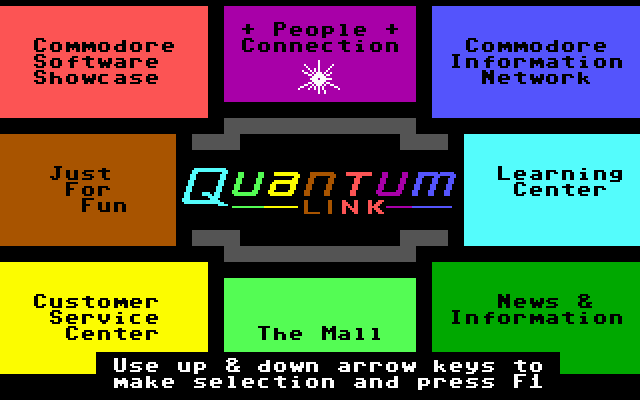
so this show is closer to reality than I thought??
not knowing quantum link none of the other services seemed to fit...
Ed#
In a message dated 10/26/2015 7:54:38 A.M. US Mountain Standard Time,
ethan at 757.org writes:
> Originally I thought it was basing it on Comnet or Compuserve but after
> reading these comments, I now think Quantum Link makes more sense. They
> are doing a good job portraying the various personalities, especially the
> disfunctional ones.
In the episode where there is a room full of people and it's up on a
projection screen -- I looked up the Quantum Link main page online and it
seemed to match.
http://toastytech.com/guis/c64gquantumlink.gif
That thing
--
Ethan O'Toole
>
> OK, so a couple years back, I wanted to have some chemistry fun with the kids.
> So, I got out the jump cables, clamped them onto some aluminum foil, stuffed
> the foil into test tubes, filled the tubes with water, inverted both of them
> in the same basin and sprinkled in a little salt, cranked up the car, and
> sure enough ? bubbles started evolving off the foil and collecting in the
> test tubes.
> Just as expected, one tube was filling with gas twice as fast as the other.
> Just as expected, when we held that tube over a candle, it went ?WHEEP? and
> got hot (the flame was barely visible).
>
> Um? the OP had a 12V supply, right? How *do* you keep from electrolyzing
> your coolant in this apparatus.
Firstly, don't add salt.
Secondly, the low resistance dummy load is going to soak up almost all of the
current, leaving very little to go through the much higher resistance water
resulting in very little gas production.
If the minute amount of gas produced is still a problem, you could electrically
insulate the dummy load from the water. However, this may also help to
thermally insulate from the water it which is not what you want.
>
> PS. this is a cool experiment but suitable cautions apply. The most subtle
> is: not too much salt, lest you start evolving chlorine gas instead of
> hydrogen. Flammable to explosive gasses, 12V sparks, etc. etc? be careful
> if you try to replicate this.
Also, beware of the danger of shorting the jump cables together, either
directly or via worn jewellery etc causing a large bang, melted terminals etc
and possible damage to kids, self and car. Consider using something like a
current limited bench power supply instead.
Regards,
Peter Coglan.
I received the email below, thought I'd pass it on...
-----
Dear J West,
I am writing to inform you about an article I have created about Quantum
Link, an online service that was available in the US & Canada from 1985 to
1994.
https://www.tinytickle.co.uk/quantum-link/
Quantum Link, originally available on the Commodore 64 computer, offered and
pioneered many of the features we are used to having on the modern internet,
such as e-mail, instant messagaing, shopping and chat rooms - to name a few.
Quantum Link also featured the ground breaking game Habitat by Lucasfilm's,
the first graphical massively multiplayer online game.
https://www.tinytickle.co.uk/quantum-link/#mmo
Q-Link was also made available on Apple & IBM compatible PCs from 1988.
I was wondering if you could add a link from your website (classiccmp.org)
to the piece to help spread knowledge of the influential, but now largely
forgotten, Quantum Link service. The article has proven popular on social
media, and I thought that it would be of interest to your readers. Any
mention you could make on social media would also be fantastic.
Any corrections, feedback or comments you may have on the piece would be
greatly appreciated, either by email or via the comments form on the webpage
itself.
Thanks for your time.
Kind Regards
David Wilding
(As previous post did not get through, again a repost)
Hi All,
I was contacted via the greenkeys list for my spare parts of the two
T100 telexes, but I think it should be possible to obtain them in the
states. Is there someone willing to part of their broken or otherwise
non/half functional T100 in the usa.
they need the parts for a movie.
--
Met vriendelijke Groet,
Simon Claessen
drukknop.nl
Greetings, all,
I have a contact in Erie, PA that has a piece of equipment that I need to get, but he is unwilling to ship it, and making a trip to his location to pick it up is pretty unlikely given time/expense.
If there is a ClassicCmp'er that lives nearby Erie, and would be willing to pick up, pack and ship (at my expense) this item to me, I would be willing to pay for time/effort expended in doing so.
The item is heavy, around 80 pounds. I could ship a very nice wooden crate to the packer who could use it to ship the item to me inside. All that would be necessary is to pick up the item, pack it securely in the crate, and take it to the closest UPS depot and drop it off to ship to me.
If there is anyone out there who might be willing, please contact me by private Email: rickb /at/ bensene /dot/ com
Thank you,
Rick Bensene
The Old Calculator Museum
http://oldcalculatormuseum.com
So I purchased what was told to me was an Eprom Programmer. It's called the Comstar Process Control Compiler.
With some digging, I am learning that this is a portable compiler that allows you to program larger industrial computers.
I found an article from 1975 that talks about the unit.
Development of a portable compiler for industrial microcomputer systems
http://www.computer.org/csdl/proceedings/afips/1975/5083/00/50830033.pdf
>From the article:
"THE PORTABLE PROCESS CONTROL COMPILER The process control compiler shown in Figure 6 is a small portable unit designed for programming the Comstar 4 Industrial Microcomputer System. The programming can be accomplished with high reliability even in field conditions. The PCL instructions are keyed in via the compiler keyboard, then converted into machine language and loaded into the PROM chip by the compiler. The input functions are displayed directly on a 32 character alpha-numeric plasma display, ensuring the user of a correct input. All keyed-in commands are stored in a buffer which can be verified with a key command. Up to 256 bytes of data or instructions can be entered. Data are compiled and can be dumped into a clean erased PROM chip. As an option, EIA or TTY outputs are available so the program can be printed out for future reference. A compiler can also edit, erase or program PROMS in machine language."
A company by the name of Warner & Swasey was an industrial machine company. They built all sorts of machines for industry. They had a sub division called Comstar which designed industrial computers The larger computers ran their own Process Control Language and so they developed this machine as a portable device to program the larger machines and then burn ROMs which then control the larger computers. The person I bought it from told me that the larger systems ran a chicken processing plant and that they used this system to program and troubleshot the system.
The unit runs on an Intel 4004 and is programmed using Comstar's Process Control Language.
I'm hoping someone would know more about this and can point me in the right direction..
I already checked Bit Savers
The only other article that seems to talk about this is "Micros can provide more flexibility for less money" Computerworld Sep 25, 1974, Page 28
(As previous post did not get through, again a repost)
Hi All,
I was contacted via the greenkeys list for my spare parts of the two
T100 telexes, but I think it should be possible to obtain them in the
states. Is there someone willing to part of their broken or otherwise
non/half functional T100 in the usa.
they need the parts for a movie.
--
Met vriendelijke Groet,
Simon Claessen
drukknop.nl
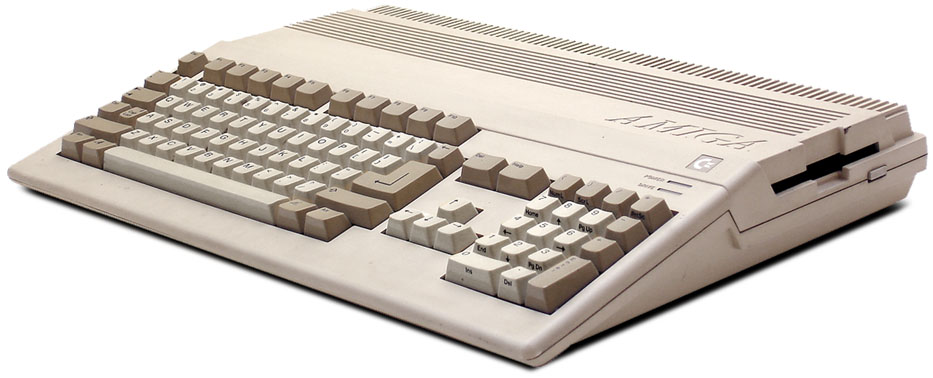
Is anyone interested in a Vic 20, Atari 800XL, or an Amiga? The Amiga
appears to be missing a couple of things. No AC adapters for any of them.
Complete key caps, no severe yellowing, no way to test. The Amiga resembles
this one: http://www.oldcomputers.net/pics/amiga500.jpg
Cindy
---
This email has been checked for viruses by Avast antivirus software.
https://www.avast.com/antivirus
I have a Sun machine with a 13W3 framebuffer output, which is connected
via a Monoprice VGA adapter to my LCD monitor. It works great, but the
ends of the standoff bolts without nuts come together where the VGA
cable meets the adapter; that is to say, the VGA cable's nuts are on the
far side of the shell from its male end, and the adapter's nuts are on
the far side of the shell from its female end.
I'm wondering what I can put between the two to keep the cable from
disconnecting from the adapter. Some searches seem to indicate I want
some 4x40 (or 4-40) female-female (coupling) nuts; does this seem
correct?
--
Eric Christopherson
> From: Rod Smallwood
> Just refresh my memory. C+K are the what I would call PDP8 type?
No, the C+K are the lever toggle switches, as used in the -11/05/40/45/70.
Only the /20 uses the slide switches like the -8.
> In an attempt to get ahead of the requests I have been trawling the web
> for pictures of anything DEC that has a front panel.
Well, if you're ready for more, I'll start sending you the info for the
UNIBUS disk controller indicator panels (RF11, RK11-C, RP11-C), then! :-)
> It would seem you are Mr Switches and I am Panel Man. !!
You're definitely panels; I'm probably only going to do the toggle switches
(if the ones I've found are the right ones). I think someone else has the
slide switches under control?
BTW, the terminology for the various display parts is a bit confusing, so let
me lay out what I gather to be the official DEC terminology.
For the "indicator panels" - which is the term for the complete assembly (for
the RF11, RK11-C and RP11-C), the flat sheet of plastic with all the light
captions silk-screened onto it on it seems to be the "inlay" (q.v. RF11
controller engineering drawings, pg. 187 of the PDF). The "bezel" is the thin
white rim that goes around the 'inlay'. The formal name for the light shield
(the piece of fibre-board with all the holes drilled in it) is 'Benelex'
(Benelex is "general use, word fibre board"). Alas, it's no longer available,
so any new light shields will have to use something else.
For the PDP-11 front consoles, BTW, the terms are "bezel", "console panel"
(the piece that is called the 'inlay' on the indicator panels), and "console
PC board" (all this per the 11/45, /50, /55 System Maintainence Manual,
EK-11045-MM-007, pp. 131-132 of the PDF).
Noel
From: Chuck Guzis <cclist at sydex.com>
>Early internet systems--I'm not sure where to draw the line between
>Usenet, ARPANet and Internet exactly often employed nothing more than
>POTS networking, using nothing more than UUCP or similar methods.
We were quite certain our Datakit X.25 network was on the Internet
(late-80s/early-90s AT&T). Email/Netnews/File transfer all worked,
though the addressing gyrations that were occasionally required were
fairly demented.
When we did NSFnet at Gatech, there was always some tweak to take into
account some "Internet" peer someone desperately needed to talk to
that was really a gateway into some baroque non-IP network. It was a
more diverse time, with BITNET, DECNet & other OSI-ish protos, and
SNA/APPN common. I became quite adept at sendmail ".cf" files. Good
times.
>I do miss the web-less Internet in some respects. >People were more polite back then--at least in their >written communication.
You apparently ran on a very different early Internet than I did.
KJ
> From: Rod Smallwood
> I'm in the drawing stage for 11/45 11/55 11/70 (common blank size)
I think the 11/40 uses that same blank, too (with less holes than the other
ones, as it doesn't have the two rotary switches); dunno about the location of
the power switch, someone who has an 11/40 will have to send you measurements.
> given a scan and measurements .. I can have a go at most types of panel.
The ones I personally would like (after the 11/45 :-) are the indicator panels
for the RF11, RK11-C and RP11. Guy will be using the RF11 panels too, not sure
if he has started on producing them yet.
> Now we need a ... switches source
Let me see if the C+K ones I have ordered fit. If so, if I buy a large group
directly from C+K, we might be able to get the price down to something
reasonable, which would save us the hassle of two different kinds of
toggles/actuators (one for the original panels, one for reproductions).
Noel
Hi all --
I acquired a Symbolics 3640 today and it came equipped with two "large"
capacity Maxtor MFM drives (an XT-1140 and an XT-2190). The 1140 spins
up fine and we were able to image it using Dave Gesswein's MFM emulator
(yay).
The 2190 does not, and it fails in precisely the same way I've
personally seen three or four other Maxtor drives of the same era fail:
It spins up fine, but when it goes to load the heads, it sounds like the
voice coil positioner for the heads is "screaming" -- it emits a
high-pitched, quite loud whine/buzz which persists until you power the
drive down. The drive is unresponsive during this time.
I'm fairly sure it's not a head crash or anything like that; having gone
through this a year or so ago with a similar drive that was scratch
anyway, I opened it up and verified that the heads weren't stuck, and I
see no evidence of a head crash after disassembly.
Further, the fault does not appear to be on the logic board -- we
swapped in a board from a working 2190 tonight and afterwards the drive
exhibited the same symptoms.
I've had this happen to other 2190s and 1140s and a few of the ESDI
drives in the same family, some of which were working in my possession
for weeks before failing -- has anyone else seen this? Any ideas? I'd
kind of like to recover the data off of the 2190 from the 3640... drat.
Thanks,
Josh
Anyone have any ideas? If not I guess the UK card is cheap enough to take a
chance anyway.
Regards
Rob
From: Robert Jarratt [mailto:robert.jarratt at ntlworld.com]
Sent: 24 October 2015 21:20
To: General Discussion: On-Topic and Off-Topic Posts (cctalk at classiccmp.org)
Subject: Olivetti M24 Bus Converter Card
I have an M24 which does not have the bus converter card P1050). There are a
couple of these cards on ebay in the USA, which makes it expensive for me,
and I am not sure which of the two would be best anyway.
There is another bus converter available in the UK, but it is PC1076 (IF
622), which my web searches suggest make it for the M280 (which was a 286
machine).
Does anyone have any idea if this latter card might work in my M24? It
certainly looks to be physically compatible.
Regards
Rob
AOL was a good model for general consumers. also remember many
people used AOL before the www was all the rage so... you stay with
something you have alreay learned.and AOL was accessible anywhere in the world
for the most part whereas podunk mom and pop ISPs had local phone
numbers. This was important if I was say going to UK or France for more
than a few days as dialing back to a podunk in phoenix would not only
be damn expensive but the quality of connection thru the long distance
would no doubt be horrible...
Aside from our AOL account we had a podunk that had two brothers
that seemed as stupid as Daryl and his other brother Daryl in the Bob Newhart
show that ran it. Eccch!
The game changer for local residents though was the cable companies
and telecoms offering Internet service... same bill as their telephone or
cable tv easy to sign up... and remember at first the hi speed
connects were though the telco for us and we had AOL but after I
quit travels just had a minimal AOL account... why? lots of people I
have known for eons can still contact me there.
Why do I still use it? because my friends know to reach me there.
Why will I always have an aol account forever? well until all my friends
pass on or I pass on it is a connection medium!
Ed #
Uptime seemed to be better on also than some of the podunks
In a message dated 10/25/2015 12:40:46 P.M. US Mountain Standard Tim,
cisin at xenosoft.com writes:
[AOL]
On Sun, 25 Oct 2015, ben wrote:
> I suspect the reason they failed was not service
> but a) PC's had games b) Ma Bell wanted a arm and a leg
> for long distance connections.
Some of their early efforts to COMPETE AGAINST the internet helped
establish outfits like Netcom, and were a boost to ISPs.
Perhaps Ed (still using AOL) would have some insight into what caused
their decline.
--
Grumpy Ol' Fred cisin at xenosoft.com
I wonder if - http://www.brielcomputers.com/wordpress/?cat=25
can be hacked to do Baudot at 60 wpm?
Ed#
In a message dated 10/25/2015 7:29:19 A.M. US Mountain Standard Time,
tmfdmike at gmail.com writes:
These are the best bet I've seen for serial terminals so far:
http://www.brielcomputers.com/wordpress/?cat=25
Just stick one to the back of a small LCD screen and I'm in business.
But on closer inspection the site shows "out of stock". I'll email;
maybe they'll do another batch. Or does anyone know someone who has
stock?
And I'm still left with the need for something for 3270...
Useful thread though; all kinds of interesting things coming out of
the woodwork :-)
Mike
Hi,
I have an Sun E450 with 4 cpus installed that ran fine for a few years
as a Solaris 10 box with ZFS boot. About 4 years ago I mothballed it and
pulled the two boot drives out to store (ZFS was in a mirror configuration).
This weekend I decided to see if it would come up again.
Predictably, the NVRAM is dead. "The IDPROM contents are invalid"
And it's forgotten its mfg-options. (I found info by Googling that this
should be set to 49 for E450.) I'll have to do something about that.
More surprising to me than the NVRAM failure though was that it produces
the same result when I try to boot from either drive:
ok boot disk
Boot device: /pci at 1f,4000/scsi at 3/disk at 0,0 File and args:
Bad magic number in disk label
Can't open disk label package
Can't open boot device
It seems unlikely to me that both disks have died. Does anyone have any
other ideas? Could it be related to the NVRAM failure?
Here's what I haven't tried yet:
- I haven't checked disk jumpers
- I haven't tried to mount the disks and check them on another machine.
This could be a bit of work, but I can get around to it.
It's a long time since I set up this Solaris/ZFS install. Maybe I've
forgotten some quirk of booting ZFS on old SPARC. Any suggestions welcome.
(also posted to Sun Rescue list)
--Toby
I started playing with something I haven't touched in ages; my Altair
8800. So far so good...
https://www.facebook.com/tmfdmike/videos/10207777256179225/?l=8958556876818…
One thing: I really need three or four new switches to replace bent or
broken ones: the lower ones with the large metal toggles for run/stop
examine/deposit etc.
Anyone got any or can suggest a source? Original preferred obviously,
precise replica OK. I almost never play with S-100 era equipment so
I'm pretty sketchy on Altairs!
Thanks
Mike
http://www.corestore.org
'No greater love hath a man than he lay down his life for his brother.
Not for millions, not for glory, not for fame.
For one person, in the dark, where no one will ever know or see.'
What tool does one use to install the metal pin into a plastic PCB
extractor, e.g., the Bivar CP-36 or Keystone 8642?
I don't yet have any uninstalled extractors on hand, but I'm going to
need some for a project. Looking at PCBs with extractors already
installed has not made it obvious to me how to install them.
Jorg,
>> I forgot to ask for your private email on VCFB, so I use this public channel.
Ah -- beg your pardon!
>>Can you sell me a PiDP8, so I can port my Blinkenlight Api Server to the
>> platform of the upcoming 11/70?
Absolutely not.
That would be ethically impossible.
I can, however, offer you a free PiDP if you can take care of the shipping cost :)
>> I'd like to have it as preassembled as possible, 'cause my schedule is very tight.
I'll send you the comfy kit, meaning no fussing with the switch bar!
Shipping cost is CHF 24/EUR21, just paypal to oscar.vermeulen at hotmail.com and I'll send it to you.
But - before you do, consider that I'm currently working on a new version of the PiDP with (hopefully) nice replica 8/I switches. So if you're not too much in a hurry, you may want to wait two months and get the cosmetic upgrade!
>> BTW, my photos of VCFB are here:
... you remember me shooting into your face while the street car rumbled
behind your back?
Cool! Thanks for the pictures link :)
Kind regards,
Oscar.
> From: Johnny Billquist
> Well, it is not correct when we then include that it is 43 years old...
> Internets using TCP/IP is a bit over 30 years old, but not over 40.
Good point! {Does a little math in his head...} 43 years, that gives us 1972.
The OP was clearly thinking of the ARPANET. Which as I have mentioned, was
_very_ different from TCP/IP, inside.
Don't get me wrong, we learned a _tremendous_ amount from the ARPANET, and it
was a key step, but it's about as similar to TCP/IP as the Wright brothers
airplanes (with their 'wing-warping' roll control system, etc) are to modern
airplanes. (And actually, that's slightly unfair to the Wright brothers;
their airplanes are, IMO, actually closer to modern airplanes than the
ARPANET is to TCP/IP!)
Noel
> From: Eric Smith
> One possible lesson to be learned: always pay cash when buying
> materials for inventory fraud.
Not to mention 'don't fire people who've been helping you commit fraud' (the
whole thing unravelled when they 'down-sized' some people in the shipping
department who'd been helping with the fraud - they promptly reported it).
A couple of other URL's someone sent me:
https://en.wikipedia.org/wiki/MiniScribehttps://blog.gillware.com/data-recovery-case/the-first-hard-drive-to-brick
Thanks!
Noel
> From: Pierre Gebhardt
> Haha, I guess you're alluding to the massive scam with the bricks,
> Miniscribe did back them to pretend stocks full of disk drives...
Never heard the story. Can someone oblige?
> BTW, are there any other similar stories from the disk drive buisiness
> back in these days?
I don't know about disk drives, but there are lot of scam stories. One
minicomputer manufacturer (sorry, don't remember who, but I think it was on
the 128 belt) was shipping empty cabinets, in order to meet projections (I
dunno if they couldn't afford the parts to build the guts, or if their
manufacturing division couldn't build the stuff, or what).
Noel
yes we have one line LED letter terminals used for Deaf and hard of
Hearing.
we will buy more of them too. do you have any of them?
ASCII or BAUDOT either for our Deaf Telecom diaplay.
Drop me a line offlist thanks Ed Sharpe archivist for SMECC
In a message dated 10/24/2015 8:44:59 P.M. US Mountain Standard Time,
charles.unix.pro at gmail.com writes:
On Sat, Oct 24, 2015 at 8:39 PM, Alexandre Souza <
alexandre.tabajara at gmail.com> wrote:
> 16 char x 1 line is small enough? :)
> Em 25/10/2015 01:34, "Chuck Guzis" <cclist at sydex.com> escreveu:
>
> > On 10/24/2015 08:10 PM, Cindy Croxton wrote:
> >
> >> How small is "really small"? IBM made a terminal with a 5" screen for
> >> the 4704 banking systems. http://frente-cajas.blogspot.com/
> >>
> >
> > I've got one with a 64 character 1-line LED display. Is that small
> enough?
> >
> > --Chuck
> >
> >
>
Set the baud rate really low and tie an LED to the xmit line.
-- Charles
> From: Rod Smallwood
> perhaps we can pool our knowledge and and allocate getting different
> parts sourced/made to different people.
Makes sense to me.
> 2. Lever keys (pdp8 type and PDP11 type )
For the PDP-11, there are three kinds of plastic toggle/actuator: one like the
ones used on the mid-age PDP-8's, used on the 11/20; one sui generis one used
on the 11/05; one for the 11/40/45/70. The latter two use the toggle switch
(the one we've just been discussing); the 11/20 one uses a slide switch.
ISTR that there's a CAD drawing for the first kind, and maybe the third too.
> I shall now go and hide behind my six foot / nineteen inch main rack in
> case of heavy flack
No, makes sense (to me, at least).
Noel
PS: I can see where this is going: first we're already making parts like front
panels; we're about to start making/selling new cards (I'm thinking MEM-11,
etc, here); soon someone will start reproducing some of the older boards that
are now rare, and command high prices (my suggestion for the first - the M792
diode ROM board); and then it will be cabinets like the H960 (ditto); and then
finally, somewhere down the line, you'll be able to buy a complete,
brand-spanking-new PDP-8 or PDP-11. Just like the vintage steam engine scene
in the UK; first they started making new parts to repair the old ones, and now
there are several groups building entire new engines entirely out of new
parts.
This unfortunate creature has seen ill-storage and a slight mouse
infestation and bears the rusty scars of time and moisture. But with
your kindness and patience, it will have the chance to bound joyfully
through fields of Greenbar once again, bringing joy and the printed
word/ASCII art to all who meet it.
Called LA120 by those that bred it, DECwriter III by those who loved
it, you can call it yours for the mere effort of picking it up from
the Chicago suburbs. Shipping will probably be impractical and,
sadly, its time is short as my shelter needs the space for other lost
souls. The man and his truck from the glue factory are already
hovering along my road.
Heart-rending photos available upon request.
-j
I have an M24 which does not have the bus converter card P1050). There are a
couple of these cards on ebay in the USA, which makes it expensive for me,
and I am not sure which of the two would be best anyway.
There is another bus converter available in the UK, but it is PC1076 (IF
622), which my web searches suggest make it for the M280 (which was a 286
machine).
Does anyone have any idea if this latter card might work in my M24? It
certainly looks to be physically compatible.
Regards
Rob
As my mail to cctech dod'nt came through, here a mail only to the cctalk
list.
sorry if it becomes a double post.
Hi All,
I was contacted via the greenkeys list for my spare parts of the two
T100 telexes, but I think it should be possible to obtain them in the
states. Is there someone willing to part of their broken or otherwise
non/half functional T100 in the usa.
they need the machines for a movie in the New York area.
--
Met vriendelijke Groet,
Simon Claessen
drukknop.nl
Someone on #classiccmp showed pictures of a DDR SDRAM module with
piggybacked TSOP memory chips. I've never heard of doing this with
surface-mounted devices.
http://imgur.com/a/CGk8h
--
David Griffith
dave at 661.org
A: Because it fouls the order in which people normally read text.
Q: Why is top-posting such a bad thing?
A: Top-posting.
Q: What is the most annoying thing in e-mail?
I was checking out the Altair 8800 kit online (really cool). But I am
hoping to one day find a kit or plans to build a Mark-8 replica, since I'm
so deep into Radio Electronics features. I know there was a kit out there
(Obtronix?). Was it any good? Do I need someone to make a new kit or is
the Mark 8 within the realm of the home hobbyist the way the TVT was? Ie.
were there ever foil patterns available for those boards or did the kit
maker reverse engineer from originals? Is there any likelihood of finding
one of the replica kits still out there (I remember seeing one offered for
$2000 on Fleabay once.. )
Brad
Hi Guys
Well my missive on reproductions seems to have generated some interest.
There seems to be a lot of will to keep the old systems going and to
reproduce parts for them
and indeed build complete systems from new parts.
The main areas of interest are front panels (Not just DEC), key switches
and bezels.
Panels I can handle. Who wants to be the focus for switches and who for
bezels?
More than one person for each category can only be a good thing. I'll
call them "The Makers"
Those who want the items I'll call "The Takers" from 'I'll take one /
some if they get made."
Thats my two cents on parts sourcing.
The other topic was less computer centric and can be defined as "They
don't make them any more"
The UK is full of small companies making and repairing all kinds of past
products.
For example the MGB GT (a much loved British sports car). The factory
stopped making them in the early 1980's
However a few guys bought the press tools and have been turning out two
or three body shells a day ever since.
Copy of a Shelby Cobra - no problem build from a kit. GT40 clone oh yes!
Now we are not in that league but with the various tasks taken on by
those with the knowledge and experience
we can make the difficult to parts available.
Rod Smallwood
Don't get me wrong... Emacs isn't a bad OS... Too bad there isn't a decent text editor for it.?
Sent from my Verizon Wireless 4G LTE smartphone
-------- Original message --------
From: Ethan Dicks <ethan.dicks at gmail.com>
Date: 10/23/2015 4:29 PM (GMT-05:00)
To: "General Discussion: On-Topic and Off-Topic Posts" <cctalk at classiccmp.org>
Subject: Re: The Internet & our hobby
On Fri, 23 Oct 2015, Bill Sudbrink wrote:
> Fred Cisin wrote:
>>
>> While I won't try to claim that the FIRST or SECOND
>> emails were flames, I'm inclined to think that they
>> started early.? 'course in our day, we were much more
>> polite in how we flamed
>
>
> Emacs?? You _MUST_ be kidding.
I'd expect wide-eyed stares from a vi user... ;-)
Q: What goes "beep beep beep"?
A: A Little Nash Rambler... and a vi novice.
-ethan
>> http://retrocmp.com/projects/pdp-11-70-panel-on-blinkenbone/243-simulated-p…
That's a work of art, together with the PDP-10 he did. I saw them running on a nice touch screen at VCF Berlin, and I wondered whether all this physical replication stuff makes sense when that's around at zero cost. Then I put my blinkers back on and went ahead anyway :)
>> You hit upon one of the key needs for these projects, a good replica bezel.
>> In my project I had to have a plexiglass bezel laser cut then used white plastic
>> to frame that bezel. It works but I would love to have a replica bezel.
Did you perchance make a CAD design for that, which could be reused? ;) I'm drafting a design at the moment, but far from perfect still.
I think of all the technologies available for making the bezel, vacuum forming seems to make the most sense. Injection molding is much better quality but just too expensive (tens of thousands USD). The other approaches, I think, work fine for small quantities. But I suspect there's a 'need' to make a few hundred.
Probably the best way is to make a very good open-source CAD model. Then make a low-cost vacuum forming mold, whilst anyone could still use the CAD file for higher-quality one-offs on a CNC router or, perhaps, 3D printer. The problem with vacuum forming is that you cannot make much more details other than the outer hull, which will look fine but need a lot of work on the inside to really mount in an original PDP-11.
Regards, Oscar.
> From: Johnny Billquist
> not going to try and contradict what you wrote.
Right, I wasn't meaning to imply what you said was incorrect, just giving a
little more detail on what was a murky and complicated process.
> I suspect it's because people now assume that "Internet" was always
> TCP/IP
Define "the Internet"! :-) If one describes it as 'the large collection of
interoperating networks speaking TCP/IP', then that statement _is_ correct!
If one instead uses a broader definition, something like 'computer networks
in general' (pulling in things like Usenet), then, no, it's not correct.
I'm _not_ trying to say that there is only one, correct, definition of 'the
Internet' - but various statements about 'the Internet' may or may not be
accurate, depending on which definition is used.
Noel
On Fri, 23 Oct 2015, Bill Sudbrink wrote:
> Fred Cisin wrote:
>> While I won't try to claim that the FIRST or SECOND
>> emails were flames, I'm inclined to think that they
>> started early. 'course in our day, we were much more
>> polite in how we flamed
>
> Emacs? You _MUST_ be kidding.
>
WordStar. Non-document mode.
g.
--
Proud owner of F-15C 80-0007
http://www.f15sim.com - The only one of its kind.
http://www.diy-cockpits.org/coll - Go Collimated or Go Home.
Some people collect things for a hobby. Geeks collect hobbies.
ScarletDME - The red hot Data Management Environment
A Multi-Value database for the masses, not the classes.
http://scarlet.deltasoft.com - Get it _today_!
43 years ago around this time the Internet we use to communicate with
was probably made possible because of TCP/IP, or Transmission Control
Protocol/Internet Protocol created at Stanford University. Today 3
billion people are on the net but really made it possible for this
extravagant number was the microcomputer created at around the same
time ? the Micral in France and 4004 processor machines in the U.S.
Our hobby supported through this web site keeps this history alive.
Hurrah!
Happy computing.
Murray :)
PS This week marks the 100th anniversary of Einstein?s Theory of
General Relativity though published in 1916 according to Wikipedia.
> From: Fred Cisin
> It was inevitable that eventually there would be movementS towards
> standardization of protocols on the arpanet.
Actually, TCP/IP grew out of the desire to interconnect two very different
kinds of network - the ARPANET, and something called the Packet Radio Network
(and also a thing called SatNet). The technical details of each were such
that it just wouldn't be feasible to extend the ARPANET protocols to work on
them too, they were fundamentally different (I'm not talking about low level
things like packet size, but higher-level concepts, like reliability, etc);
something new was required - and TCP/IP looks _very_ little like the
ARPANET's NCP.
> From: Chuck Guzis
> I do miss the web-less Internet in some respects. People were more
> polite back then--at least in their written communication.
I snorted and started coughing when I read that! :-) Usenet had massive flame
wars long before the Web existed!
Noel
never heard of it - Ed#
In a message dated 10/23/2015 10:08:44 A.M. US Mountain Standard Tim,
paulkoning at comcast.net writes:
How many people consider the Micral to be of that level of significance?
but! now that we have heard of it
SMECC museum wants one!
Ed#
In a message dated 10/23/2015 10:43:50 A.M. US Mountain Standard Tim,
rodsmallwood52 at btinternet.com writes:
Nope never heard of it either
Rod
On 23/10/15 18:29, COURYHOUSE at aol.com wrote:
> never heard of it - Ed#
>
>
> In a message dated 10/23/2015 10:08:44 A.M. US Mountain Standard Tim,
> paulkoning at comcast.net writes:
>
> How many people consider the Micral to be of that level of
significance?
> OK, I've cracked the part number code. The things we are looking for are:
> 7101J50 CxE
> 7108J50 CxE
> ...
> the C+K Web site showed two places (Electro-Sonic and
> Online-Components) stocking 7101J50 CQE2's .. investigating further now.
OK, so I've ordered 10 7101J50-CQE2's from Online (that was their minium
order, sigh). _Iff_ they fit into the old front panels, I'll let the list
know.
Nobody had the 7108J50C's (the momentary contact ones), but if the 7101J50C's
are the Right Thing, I'm prepared to order a batch of the 7108's from C+K;
the minium order looks like 40 or so (that's how many the distributors who
had the 7101J50-CQE2's had ordered), which I can do off the cuff (and resell
at cost to anyone who needs one); if the minimum is larger, we'll have to
reconsider how to proceed.
The ones from Online are like $5 each, which sounds a lot for a switch, but
if you're got a PDP-11 with a non-operable front pable because a switch is
busted, it's downright cheap! Also, that will of course include the
distributor's markup - if we bought a batch directly from C+K, we might be
able to get that down quite a bit.
Anyway, let's see if the 7101J50-C's fit, then we can discuss how to proceed.
Noel
Hey guys,
Further to our conversation - I was looking at this beast:
http://www.ebay.com/itm/Teletype-equipment-1-model-28-writer-1-reperforater-
1-50vdc-supply-etc-/121791042544?hash=item1c5b4fd3f0:g:UR8AAOSwnDZUJHWs
Wasn't sure if it was two units? The first couple of pics look different.
Anyway, if I understood correctly, it was possible (and possibly done in the
1970s by hobbyists) to convert one of these baudot teletypes to ASCII and
use with a computer? This one is out of my reach since the auction is pick
up only. But I kind of like the look of the Model 28 and I understand
they're pretty bulletproof once you have them working. I'm just not sure if
this would work, and if this particular one is ASR or what, because it
mentions a reperforator and from what I read 28s that came with that had a
tape reader also?
Brad
> From: Dave Wade
> What I found hard was obtaining centre off switches as it appear from
> this picture ... that PDP-11 Switches may be flipped up or down, or is
> that not true?
No, they are all 'standard' (except for the mounting) SPST switches; most
(e.g. the address/data bits) are normal two-position, although some (LOAD
ADDR, DEPOSIT, EXAM, START and CONTINUE, IIRC) are momentary-contact. The
'toggle' (the plastic part that fits over the switch) has an off-center shaft
that goes around the switch's metal actuating shaft, so that the toggle can be
level when the switch is in the 'un-set' position.
Some of the switches are installed 'the other way around', and they depress
instead of lift (typically the address-data switches lift, and the function
ones depress, although there are exceptions - e.g. DEPOSIT is a lift).
> I believe they were made by C&K who are still in business. I wonder if
> it is worth approaching them.
If they're not actually still availble - see below.
> The double pole version appears to be still "stocked", I see Farnell
> has some in the UK
That is _almost_ the exact switch (I just about had a heart attack when I saw
them, and started to order some until I realized they weren't quite it); it
has the right mounting mechanicals (note the two triangular side plates with
the holes through the tips - the toggle have pins which go into the holes,
and the toggle pivots on them).
Alas, it's DPDT, not SPST. And it's momentary contact (although each PDP-11
panel does contain some momentary-contact switches).
But if C+K is still making _these_, they should have no problems making the
SPST version - if, in fact, they are not still in production.
I tried looking through the catalog at that site, to see if I could find the
SPST version, but no luck. (Although maybe I'm just a klutz about that site -
it wasn't easy for me to use.) Maybe your parts-search-fu is better than mine?
Noel
> It's just a matter of working out what the part number would be!
OK, I've cracked the part number code. The things we are looking for are:
7101J50 CxE
7108J50 CxE
where x is a letter selecting the contact material (about 10 options,
including gold, silver, gold-over-silver, etc). The 7101's are the normal
permanent contact, the 7108's are the momentary contact used in a few
positions.
The ones Dave found are ZQE's, the 'Z' meaning they are solder lugs, not PCB
through-hole lugs, and the 'Q' meaning silver contacts.
A Google search didn't find any 7101J50 C's, only Z's. But the C+K Web site
showed two places (Electro-Sonic and Online-Components) stocking 7101J50
CQE2's (the trailing '2' means 'black actuator' - their name for what I've
been calling the toggle, the plastic part the finger touches); investigating
further now.
Noel
Hi Guys
We seem to have a bit of a rush on to do reproductions of
mainly digital front panels, bezels and switches.
Before we all run round and go through the same learning curve perhaps
we can pool our knowledge and
and allocate getting different parts sourced/made to different people.
I am now up to speed on the perspex panels for all models they were
actually used on, from pdp8 up to 11/70.
I also have a proven production system. No fancy machines just perspex
(plexiglas) blanks and silk screen process
as per the the originals.
So who wants to do
1. Bezels
2. Lever keys (pdp8 type and PDP11 type )
3. Key/lamp pcbs (connect as replacements to original systems
or to microprocessors)
4. Micro processor and custom software to drive the above.
( Suggest Rainbow Pi as Its low cost and is known to run
the right simulations)
I can quite understand somebody wanting to do the whole process themselves.
However not everybody who would like a nice full size 8 or 11
functional front panel has the time, knowledge
or access to the right resources to do it.
I shall now go and hide behind my six foot / nineteen inch main rack in
case of heavy flack
Rod Smallwood
> From: Alexandre Souza
> Easily done if I had the original part on hand
We have plenty of the original bezels, from which it would be easy to cast molds
(the same part is used on the 11/45 and 11/70, unlike the rest of the front
console).
The real issue in any front panel recreation is going to be the switches (not
the plastic toggles, the actual electrical device). Both the /45 and /70 used
the now-apparently-unobtainium version with the intergral metal plate to hold
the switch in place in a metal holder plate. So a recreation front panel is
going to have to have some new mechanical design, to allow use of standard
micro-switches - and that's probably going to mean a re-design of the plastic
toggles, as those attached to side-plates on the original toggle switches.
(That's all a bit difficult to describe in words; a picture will make it
obvious, if anyone wants to know more.)
I wonder how big an order of switches would be required before some
switch-making firm could be convinced to do a run? Maybe whoever made the
'back in the day' still has the tooling to do so gathering dust in an old
room....
> From: David C. Jenner
> How about making a version for a REAL PDP-11/70 front panel, and one
> for a REAL PDP-11/45 front panel, for those of us who have such stashed
> away waiting for the right simulator to come along...
To do that is going to require exactly emulating the interface to the CPU,
which is not going to be entirely trivial. Physically, the signals all come
over flat ribbon cables to standard Berg connectors, so that won't be hard,
but I doubt the interface is documented, someone will have to puzzle it out
by reading prints - and probably looking at a working one with a logic
analyzer.
Also, powering the front console requires an unusual AMP connector shell,
although that may still be available? And of course one could always bodge
the power connection...
Noel
> Alas, it's DPDT, not SPST.
Ooops; the ones in the PDP-11 front panels (/05, /45, /70 and almost
certainly the /40 too) are SPDT, not SPST (typing too fast, in my excitement
that these have finally been found :-).
I looked at the data sheet for the ones you found, and it's actually a sheet
for the whole series, from which it looks virtually certain that the right
ones (both pemanent and momentary contact) can be ordered from C+K. It's just
a matter of working out what the part number would be!
Noel
> From: Johnny Billquist
> the switch to TCP/IP only happened in 1982-1983. So while the
> "internet" (well, ARPANET actually) existed before then, it was not
> TCP/IP based.
The conversion of the _ARPANET_ from NCP to TCP/IP happened on 1 January,
1983. However, 'the Internet' (in the sense of a grouping of networks over
which TCP/IP packets flowed) had been around for some time before that, both
as i) a testbed for developing the TCP/IP protocols and software used for
that cutover, and ii) for network service to machines which couldn't get an
ARPANET port (remember that at that point in time, there were no personal
computers, just time-sharing systems).
The history of TCP/IP and the Internet up until that point is complicated (I
lived through it, so I should remember, but alas the memory dims :-), but the
first use for actual service (as opposed to testing software, demos, etc)
would have been a year or two before that - exactly when is somewhat lost in
in the mists of time.
Although the ARPANET pre-dated the Internet, it was used to carry TCP/IP
traffic (directly, not inside NCP - the protocol used between hosts on the
ARPANET before TCP/IP) long before the cutover; it was _the_ long-haul
network in the early Internet, and connected together all the various local
TCP/IP 'hot spots' (to use modern jargon).
'All' that happened on January 1, 1983 was that the ability of the ARPANET to
carry NCP packets was disabled. Of course, in the months prior to that, all
the ARPANET hosts which didn't _already_ have TCP/IP running (many did, to
speak to other machines locally which didn't have ARPANET ports) went through
a big thrash to get TCP/IP software, and get it installed, tested and running.
Noel
Hi,
>> Oscar is already working on another very promising product.
>> [..]He will
also pay a visit to my "museum" to take a few measurements.
Sorry, can't say more
>> I'll leave that up to Oscar. Perhaps he
want to stay "below the radar" until that project is finished ...
Thanks for the kind words on my strange replica mania! We all need to do silly things at some point in our lives.
No secret... I'd love to do an "Open Source Hardware" PDP-11/70 replica (or remake - whatever choice of words is preferred). Electronically, it would a simple variation on the PiDP-8 (i.e., simh brains on a Raspberry Pi, hiding behind a front panel PCB). It's just a different emulator from the simh stable with less LEDs.
But a 11/70 replica needs two physical 'cosmetic elements': proper switches, and the white bezel/frame. The switches *seem* to be feasible to produce cheaply (I will know in a month with PDP-8/I switches...). The white bezel though brings me into unknown territory. 3D CAD (based on Museum Measurements), then injection molding or vacuum forming. Or any technique to produce a plastic object in medium quantities. All I know so far is that it's very feasible - and much cheaper to do than just a few years ago.
If anyone here *does* have know-how in this field, I'd love any advice. I got some preliminary quotes and recommendations on making a case replica using vacuum forming. Which is relatively cheap. Not perfect, but low cost is very important for such a gadget.
Kind regards,
Oscar.
Has anyone heard from Terry Gulczynski (http://stack180.com/) since
October 12? I've been waiting for him to tell me it's okay to send him a
P112 kit for assembly and testing. Now I'm worrying that something may
have happened to him. He lives in Daytona Beach, Florida.
--
David Griffith
dave at 661.org
A: Because it fouls the order in which people normally read text.
Q: Why is top-posting such a bad thing?
A: Top-posting.
Q: What is the most annoying thing in e-mail?
I'm not sure if the author of this nice bit of work is on here, but I'm
looking at a board for this, the Altera DE-1. Unfortunately there are a
plethora of Altera DE-1 boards and much puzzlement by me as to whether
this is the right one. The page with the info is deficient in details
to tell.
The actual part which the author used is the key thing here, and not
just the name of the board. I'd appreciate opinions here as to whether
these will run PDP2011 or whether it will be a nice learning board for
my mistake pile.
http://pdp2011.sytse.net/wordpress/pdp-11/fpga-boards/de1/
There is currently what I think is a good specimen available if anyone
is interested.
http://www.ebay.com/itm/131621388597
It includes the software and docs. The current one I have was a student
version sans the documents and software.
I hope to get the thing going to play with sometime soon. There are so
many small boards out there for very little money once I get this done
and understand more about targeting this board and others I'd like to
see how cheap a board this could be made to run with give the current
boards.
There is currently an Arm/fpga Zilog chip board now made available that
would be a nifty board to make into a PDP11 if it comes out as cheap as
they promise it to be.
thanks
Jim
Hello,
I have been servicing an HP 85A and an HP 85B desktop computer (printer belts, tape drive capstan). While the key caps of the "A" model are plugged into yellow plungers (according to the service manual the manufacturer is "STACKPOLE") the "B" came with white plungers ("Hi TEK" according to the svc. manual).
The yellow plungers were all in good condition, while several of the white plungers are split along one or two edges. I understand that this is a common problem with these HiTek keys. The HP 85B suffers from this problem especially on the space bar which gets stuck when depressed.
So my question is: is there a way to repair (glue? melt?) these split plungers or are there replacement/alternative plungers available to replace the white HI TEK parts? I would need at least one (ideally more like 5) as the remaining broken plungers are still working. These keys seem to be used also in some VT100, DECWriter and even some Ti-99/4 keyboards.
If I cannot find a replacement, I would probably drill a lot of small holes into the plunger, glue it to the key cap, and then rework the outer dimensions so that it slides smoothly into the casing. But then I would probably not be able to remove the key caps later, after snapping it back into the casing - sort of one way fix with some risk.
Thank you for any recommendations,
Martin
--------------------------
Deutsches Zentrum f?r Luft- und Raumfahrt e.V. (DLR)
German Aerospace Center
Institute of Aerodynamics and Flow Technology | Lilienthalplatz 7 | 38108 Braunschweig | Germany
Dr.-Ing. Martin Hepperle | Aircraft Design and Configuration Aerodynamics
Telephone +49 531 295-3337 | Telefax +49 531 295-2320 |
E-Mail: Martin.Hepperle at dlr.de<mailto:Martin.Hepperle at dlr.de>
Internet: www.DLR.de<http://www.dlr.de/>
Oscar,
I am very excited to hear about your PiDP-11 project. I also would urge you to go to 1:1 scale for the PDP-11/70 panel and also utilize the classic Purple and Pink color scheme.
I saw Henk's PDP-11/70 reanimation and dreamed of doing one some day, and then saw Jorge Hoppe's work and contacted him when I finally was able to obtain a PDP-11/70 front panel. It was one of the later DECsystem 570 styles in Blue, light Blue and White. My project is detailed on Jorg's website as well as his projects which not only include a PDP-11/70 but also a KI-10!! Anyway interested is learning about these projects or just want to see a virtual PDP-11/70 running RSX11M+ on their Windows or Linux PCs should check out:
http://retrocmp.com/projects/pdp-11-70-panel-on-blinkenbone/243-simulated-p…http://retrocmp.com/projects/pdp-11-70-panel-on-blinkenbone/189-pdp-11-70-c…
You hit upon one of the key needs for these projects, a good replica bezel. In my project I had to have a plexiglass bezel laser cut then used white plastic to frame that bezel. It works but I would love to have a replica bezel.
So I have thought about two other approaches to thermoforming. One is to make a silicone mold which then can be used to make new bezels from polyurethane. A video about that approach uses a 3D printed part to create a silicone mold which is then cut in half and the silicone is now the mold for more rigid polyurethane which is poured into the mold sealed allowed to cure then the part is removed and a new part is cast. It's not extremely fast like injection molding, but it could be used to make a mold from an original part if necessary.
see https://www.youtube.com/watch?v=k7bNFT4Dcs4
The second approach is something I used many years ago to produce some solvent resistant two holed stoppers for a lab instrument. I found some PVC stoppers that worked very well but the lab supply house quit selling them. I have a M.S. in Polymer Chemistry and was familiar with PVC plastisol that when heated to about 180 C then cooled makes a tough somewhat flexible rubber like material. If you were a child in the 1960s you may have done this with a "Thingmaker"
https://en.wikipedia.org/wiki/Creepy_Crawlers
The "Plasticgoop" is the PVC plasticsol and it can be made with a wide range of hardnesses and pigmented to any color as the PVC plasticsol is clear (It is what Tygon tubing is made from). To use this approach you would need a metal mold but it would not need to hold pressure like an injection molding machine. The heating can be done on a hot plate and monitored with an IR thermometer. In the day we could get a part from the mold about every 8 to 10 minutes by quenching with cold water.
One other comment I would make is that it would be great to modified the SImh V4.0 to work with the PDP-11 front panel. Most of the code supporting the panels are either V3.8 or V3.9. These front panel reanimations should be part of the Simh development.
Also, thanks for your wonderful PiDP-8 !! i would never have been able to afford a real PDP-8 to learn about them
Mark
Hi,
>> Oscar is already working on another very promising product.
>> [..]He will
also pay a visit to my "museum" to take a few measurements.
Sorry, can't say more
>> I'll leave that up to Oscar. Perhaps he
want to stay "below the radar" until that project is finished ...
Thanks for the kind words on my strange replica mania! We all need to do silly things at some point in our lives.
No secret... I'd love to do an "Open Source Hardware" PDP-11/70 replica (or remake - whatever choice of words is preferred). Electronically, it would a simple variation on the PiDP-8 (i.e., simh brains on a Raspberry Pi, hiding behind a front panel PCB). It's just a different emulator from the simh stable with less LEDs.
But a 11/70 replica needs two physical 'cosmetic elements': proper switches, and the white bezel/frame. The switches *seem* to be feasible to produce cheaply (I will know in a month with PDP-8/I switches...). The white bezel though brings me into unknown territory. 3D CAD (based on Museum Measurements), then injection molding or vacuum forming. Or any technique to produce a plastic object in medium quantities. All I know so far is that it's very feasible - and much cheaper to do than just a few years ago.
If anyone here *does* have know-how in this field, I'd love any advice. I got some preliminary quotes and recommendations on making a case replica using vacuum forming. Which is relatively cheap. Not perfect, but low cost is very important for such a gadget.
Kind regards,
Oscar.
2 units one tape puncher thing the other table top ksr 28 other thing a
Powersupply
Ed Sharpe
In a message dated 10/22/2015 5:57:22 P.M. US Mountain Standard Time,
unclefalter at yahoo.ca writes:
http://www.ebay.com/itm/Teletype-equipment-1-model-28-writer-1-reperforater-
1-50vdc-supply-etc-/121791042544?hash=item1c5b4fd3f0:g:UR8AAOSwnDZUJHWs
On a sudden impulse, I put in a bid for an HP1663A logic analyzer for
$30 and won for $29. Just got the thing--it's essentially in like-new
condition--not even a scratch, no CRT burn and comes with the original
set of pods and grabbers. Not so much as a fingerprint anywhere--even
the line cord is clean. Must have come from a rental place.
I've got the user and programming manuals, but that keyboard jack in the
back has me befuddled. It's an RJ45 modular jack with the middle 4
positions populated. The manual only refers to it as a "standard"
keyboard and mouse connector. What does that mean, exactly? What kind
of signals does this "standard" keyboard use?
Thanks,
Chuck
Hello list,
i got hands on several VT100 and VT105 parts. It SEEMS (at least to me)
to be one complete terminal without a power supply and some additional
parts. I took pictures of everything, which can be seen here:
https://antares.krankikom.de/index.php/s/vcIZuHbpsn3lSoL
(sorry for the self-signed certificate)
I already found this interesting page:
https://github.com/bbenchoff/VT100Adapter, so i guess i have everything
to try to repair the VT100.
But i never tried something like that, and i fear to break something as
soon i connect anything to power.
How should i start? I especially don't know how to clean the boards,
check the eproms and i'm afraid that the CRT is broken, since it has a
sticky fluid on it.
Bye,
Lukas Kaminski
Hi All,
I was contacted via the greenkeys list for my spare parts of the two
T100 telexes, but I think it should be possible to obtain them in the
states. Is there someone willing to part of their broken or otherwise
non/half functional T100 in the usa.
they need the parts for a movie.
--
Met vriendelijke Groet,
Simon Claessen
drukknop.nl
Hello, all,
I have an otherwise good DECWriter II (LA-36) terminal that has a bad keyboard. A number of the keyswitches are messed up (the little gold contacts are mangled or the switch assembly itself is damaged), and the nature of the Cherry-made keyboard in this thing is that the keyswitch modules are not individually replaceable.
I'm querying the list to see if anyone out there may have a parts LA-36, or a spare keyboard assembly for same that I can get my hands on. I'd like to get this thing running again, but with a bad keyboard, even though it all works great (I can test that the keys that are messed up are scanned properly by shorting across the PCB traces and the terminal responds appropriately), it's pretty much useless.
Somewhere in the life of this machine something HEAVY fell/dropped on the keyboard, and about 1/3rd of the keyswitches ended up getting mangled as well as some of the keycaps. The only option appears to be to find a replacement for the whole keyboard assembly.
Thanks in advance,
-Rick
---
Rick Bensene
The Old Calculator Museum
http://oldcalculatormuseum.com
>
>
> -----Original Message-----
> From: "william degnan" <billdegnan at gmail.com>
> Sent: ?21/?10/?2015 12:51
> To: "General Discussion: On-Topic and Off-Topic Posts" <
> cctalk at classiccmp.org>
> Subject: Re: VT100 and/or VT105 rescued from scrap
>
> On Wed, Oct 21, 2015 at 6:19 AM, Rod Smallwood <
> rodsmallwood52 at btinternet.com> wrote:
>
> > VT 100's have one weak point. The monitor is a bought in part from Ball
> > Bros.
> > The Ball supplied drive board burns up a diode and cap. It will be
> > obvious on inspection of the board.
> > I have never been able to get a circuit diagram or I'd do a replacement
> > board.
> >
> > Needless to say the DEC parts are mde of sterner stuff
> >
> > Rod
> >
> >
> Is that true of the vt102 as well?
> Bill
>
> On Wed, Oct 21, 2015 at 8:10 AM, Robert Jarratt <
robert.jarratt at ntlworld.com> wrote:
> I had forgotten about that. There is a useful page on this somewhere, but
> I am away from home and can't get the link right now. Will try to send out
> the link later.
>
> Regards
>
> Rob
>
I have one of each, I use the VT102 for "every day" use and save the VT100
for holidays and leap year day, etc. Assuming the VT100 is more
fragile...needs to be run periodically but not too much.
Bill
--
Bill
I picked up the NOVA 4 last Thursday. I had help carrying all the stuff
(disassembled) downstairs from the attic. At home I had to unload the van
single-handed. Went well, although I felt my back that evening ...
Today, I cleaned the rack, as all boxes were still on the floor. There
was little dust, the machine was well taken care of.
After the cleaning I mounted the hard disk drive on the slides. The hard
drive is a model 6101-S2 (12.5 MB fixed disk). On the top plate of the
hard disk is an 8" Qume floppy disk drive mounted. The hard disk and
the floppy disk form one unit, never seen this construction before!
The colored twisted-pair flatcable from the floppy drive goes to the
hard disk and another colored twisted-pair flat cable goes to the
NOVA 4/C computer, connecting on a paddle board using an edge connector.
See my website: www.pdp-11.nl/dg/nova4/nova4.html
After everything was connected I applied mains. The fans start to run,
so far so good. Then I switch on the NOVA and then the hard disk unit.
The POWER LED on the NOVA and on the hard disk is lit. I can hear the
hard disk "hum", and when the humming sound stops after a few seconds
the READY LED is lit.
However, when I press RESET on the NOVA and then PR.LOAD, the READY LED
on the disk flashes momentarily (brief), but nothing further happens.
On the disk drive are (behind the panel) two small switches. One has
the text "NORM" and "PROT", the other has several texts (forgotten),
but with that switch you can set the hard disk as device 0 and the
floppy drive device 1, or the hard disk as device 1 and the floppy
disk as device 0. Basically you can set the boot device, as the machine
starts from device 0. I have this from the accompanying documentation.
When I put that switch in the other position and press RESET and then
PR.LOAD on the NOVA, the floppy disk LED is lit for a few seconds,
but I do not hear a head load ("clunk"), nor head stepping sounds.
Of course, the floppy drive is loaded with a floppy disk. The label
on the floppy says "opstart" (Dutch for start up). As the floppy disk
access LED turn on, I guess that I can say that the NOVA itself is OK.
As far as I know, I have the BERG connector put back on the pins
where it was before I did the disassembly. That cable connects to the
terminal. The question might be whether it was on the correct pins
for starters. I do not get any character(s) on the Dasher D200 terminal
that came with the system. For that reason, I assume that the terminal
settings match the settings for the NOVA.
One more remark. On the hard disk is a red label glued. The text on
it says "remove 2 shipping brackets before operating unit unlock
pivot arm (see over)". On the rear side of the label is a drawing
that shows the "front left corner". At the side is a screw (???) to
lock/unlock the head(s). However, I just don't understand the drawing
and cannot localize that screw.
I mailed the previous owner whether he remembers something ...
Anybody has info on the 6101-S2 disk drive? A drawing of those
shipping rackets, and more info about head locks?
Thanks,
- Henk
> From: Rick Murphy
> Lots and lots of fun like that. What an space optimizer would do if
> there was one. :)
Wow. You did all that by hand?
If so, with a program that big, wouldn't it have made sense to try and write
a separate post-processor to do all those optimizations? Surely it wouldn't
have been that much work, compared to going through the entire compiler
output!
Noel
As I gradually get my long stored collection out of boxes and onto benches
I'm starting to turn my attention to a lot of old dot matrix printers I
have.
I seem to recall reading or hearing a very long time ago that where a
printer has not been fired up for eons that the pins can be stuck in the
print head (e.g. by old ink drying out) and cause damage (e.g. bend pins)
when it tries to print.
I'd be most grateful for any advice on anything I need to do before hitting
the print command.
Thank you!!
++++++++++
Kevin Parker
++++++++++
As it turns out the ownership of the Ella tapes is uncertain so Imation/Memorex can't use them without a fight. But there were several other artists, along with the breaking glass that can be used.
Imation paid $300 million for the brand - shows the power of a brand.
tom
-----Original Message-----
From: Al Kossow [mailto:aek at bitsavers.org]
Sent: Monday, October 19, 2015 10:20 AM
To: cctalk at classiccmp.org
Subject: Re: Oddball floppies for trade - 8", HS (outer edge), weird cutout
On 10/18/15 6:00 PM, Chuck Guzis wrote:
> it's truly amazing that Memorex still exists--as a brand of Imation.
>
Thank Ella Fitzgerald
"Is it live, or is it Memorex"
http://www.totalmedia.com/content/trivia-and-tips/maxells-chair-man-hell-bl…