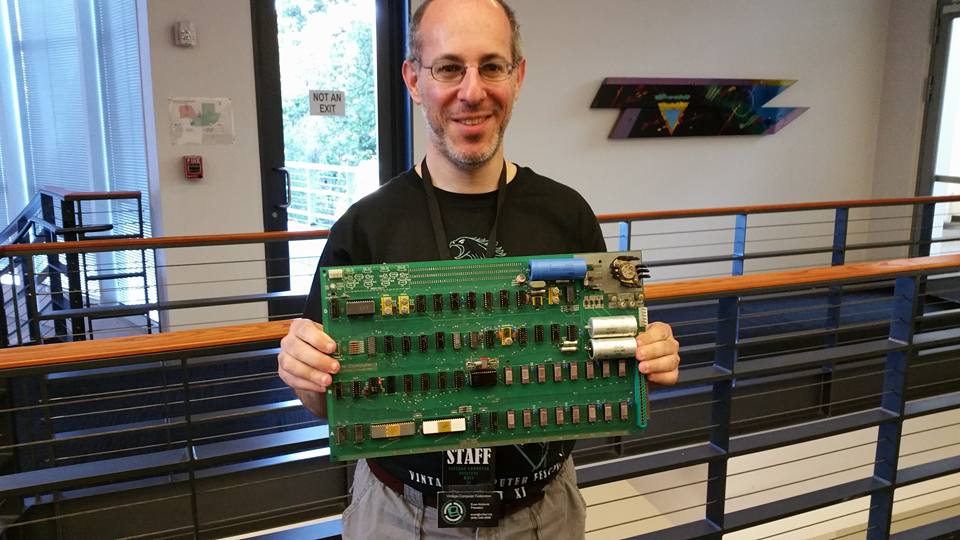
The pre-production Apple 1 auctioned via CharityBuzz and displayed at
VCF West closed just now for $1,210,000. Blows away the old record of
$900-something. Amazing!!!
I am looking for an RQDX3 compatible disk image for Dave Gesswein's
MFM disk emulator. I don't have a functional disk to image and the
ZRQCH0 won't cooperate.
Hi:
I'm looking for a PATA host bus adapter card (either ISA or PCI) and a PATA
drive preferably UDMA/33 but no later than UDMA/100. This would probably
come from a system built in the mid-1990s before the PATA interface got
embedded into the chip set. It might even be from an older system that was
upgraded by replacing an ST412 HBA and drive with and EIDE HBA and drive.
Will rent, buy or borrow as appropriate
Contact me off line
Tom Gardner
(650) 941-5324
t.gardner at computer.org
Hi,
I have written a PDP-8 VHDL model and I have it running in an FPGA
https://github.com/scottlbaker/PDP8-SOC
At this time it has passed a basic DEC diagnostic instruction test but
I found some interesting things when getting that instruction test to pass.
For example:
The following segment of code implies that IAC instruction affects the Link
bit
1797 /GROUP 1 OPERATE TEST 33
1798 02626 7300 CLA CLL /AC=0000 LINK=0
1799 02627 1053 TAD K2525 /AC=2525
1800 02630 7261 CLA CMA CML IAC /TEST COMBINATION
1801 02631 7420 SNL
1802 02632 7430 SZL
1803 02633 7402 HLT /CLA CMA CML IAC FAILED, AC SHOULD
1804 /BE 0000, LINK SHOULD BE ZERO
but the PDP-8 Handbook ; DEC copyright 1966; page 14
says nothing about the Link bit being affected by the IAC instruction.
The simh PDP-8 simulator also shows that L is affected by IAC.
If I change this test line from
1800 02630 7261 CLA CMA CML IAC /TEST COMBINATION << link=0
to:
1800 02630 7261 CLA CMA CML /TEST COMBINATION << link=1
Can anyone point me to:
1) DEC documentation which more fully describes all the instruction set (in
more detail than the PDP-8 handbook)
2) Some more instruction tests in assembler source code format. I have
found lots of binary files but I would prefer assembler source code format.
I am using a pal compatible cross assembler.
Thanks and Regards,
Scott
So, I'm hoping someone can help me with a minor mystery. At same point, I ran
across, and saved, this:
http://ana-3.lcs.mit.edu/~jnc/tech/pdp11/BSTJ_July-August_1978.htm
which is a very nice HTML recreation of the famous first BSTJ Unix issue.
Notice that it contains links to online HTMl versions of two of the papers;
the basic Unix paper (the one that was famously in CACM), and "UNIX
Implementation" by Ken Thompson.
Alas, I appear not to have downloaded and saved the 'Unix Implementation'
paper; I have searched high and low on my machines, and no sign of it. Double
alas, because it doesn't seem to be online anywhere either! I have found a PDF
version online, and also the NROFF source, but not this HTML version.
I just don't recall exactly where I found this, so I can look in the Wayback
Machine for the HTML. I _thought_ it might have been from Ken or DMR's Web
page, so I found both of them in the Wayback Machine, but in sampling them
both over the years, neither one seems to have had this. (And the Wayback machine
doesn't have a search function that I know of, to search for it directly.)
So does this page ring any bells for anyone, or alternatively, has anyone
saved the HTML version "Unix Implementation"? (Yes, I know it's no biggie,
with the PDF version available, I'm just being anal.... :-)
Noel
I'm looking for a copy of Turbo Pascal 3.01a for CP/M - specifically a
disk image. I know there's tons of copies in individual-files-in-a-zip
form, but I'd like to get an original disk image. (I've got a problem
with TINST on one of my machines and I want to ensure it's not bit rot on
the behalf of TINST or the data files it uses.)
Disk image format isn't that important as I can use various tools to
extract the files.
Zipping up the files from an original disk would work as well.
Thanks!
g.
--
Proud owner of F-15C 80-0007
http://www.f15sim.com - The only one of its kind.
http://www.diy-cockpits.org/coll - Go Collimated or Go Home.
Some people collect things for a hobby. Geeks collect hobbies.
ScarletDME - The red hot Data Management Environment
A Multi-Value database for the masses, not the classes.
http://scarlet.deltasoft.com - Get it _today_!
Hi Guys
I sent out a photo of the new PDP-8/i with a real one for
comparison to everybody who might be interested.
If you did not get the email and would like one please let me know
Rod (Panelman) Smallwood
> From: Paul Popelka
> I was wondering how much delay the KT-11B introduces.
That's a _very_ interesting question; AFAIK, the documentation doesn't say.
If there's a cache miss, of course, there's one memory cycle delay to load
it.
If the cache hits, though, there's still added gate delays going through the
KT11 - perhaps 20-30 or so (to make a complete guess) - at ~10nsec each, that
would be an extra 200 nsec per memory cycle. Not insignificant...
> There is still the actual implementation of the KA11 changes that can
> be reverse engineered if someone is so inclined.
Well, that might not be trivial - if the boards have ECOs, it may be hard to
tell them from the KT11 changes. The sheet which gives the wiring changes for
the KA11 backplane _is_ still there - although there are indications on it
that the actual machine differs from the prints! Wheee! :-(
Noel
Hi
I've been running and looking at the PDP-8/E INSTRUCTION TEST 1. And it
is supposed to write the BEL (07) character after each round of passed
tests. However the code loads and outputs the constant "0207", which is
07 with the eigth bit set. I think the 8/E serial interface outputs all
eight bits in this case?
I suppose a real ASR-33 would ignore the eight bit?
Why does the code not load 07?
Thank you,
Pontus.
> Oooh, thanks ever so much for turning that up!!!
OK, I have added them to the page - I lost a little resolution rotating them
to be level, but there's still more than enough to recogize them, and mostly
read them.
> So that mystery panel seems to be a general panel, more associated with
> the CPU than anything else; one line does seem to be the reader, but
> one quadrant is the KT15 memory management, one is the KA15 priority
> interrupt system, and there's general CPU/system stuff throughout
With that, I think we have most of the PDP-15 panels (although the VT15 image
is still pretty crummy). That leaves only these two:
http://www.simulogics.com/nostalgia/DEC/15_05.jpg
although that looks like early marketing material, so perhaps those panels neve
made it into production machines?
I wonder if one of them is a BD15 (whatever that might be) - or if that's
the name for the CPU panel (above)?
Noel
> From: Noel C.
> Was the Computer History Wiki thing of any use?
Yes. It answered a little of what I was wondering about. It mentioned that there is a cache of page table entries. I was wondering how much delay the KT-11B introduces.
> > Does anyone know if schematics for it were included in the auction?
> > If the schematics are available, are there plans to get onto bitsavers?
> The answers apparently are yes, and yes - although there are two parts to the prints (the KT11-B itself, and the KA11 changes), and it seems that unfortunately there's (at least) one page missing from the 'KA11 changes' part.
Oh well. There is still the actual implementation of the KA11 changes that can be reverse engineered if someone is so inclined. I'm just glad the winner of the auction is willing to make available the information they did get.
From: tony duell <ard at p850ug1.demon.co.uk>
> On Fri, Aug 19, 2016 at 5:56 PM, Steven M Jones <classiccmp at crash.com> wrote:
>>
>> Before anyone gets too excited about the blistering speed of the 60
>> MHz TMS34010, ... However, since it has a
>> graphics-optimized instruction set, it was still able to do some
>> things noticeably faster than the 16 MHz 80186 would have.
Price/performance for the tms34010 was terrible; it was somewhat
faster at graphics (bit-oriented) ops than an 80186 (or other
contemporary processor), but it was several times more expensive. TI
tried to sell around that by claiming it was a complete general
purpose processor in addition to graphics processor so you could build
a whole system using the tms34010 as the brains. Unfortunately, if
you actually did that, you found that it could manage kbd/mouse/net
*or* do graphics, but not really both.
It was also integer-only, and had a slow, 16-bit memory interface that
killed performance unless you used expensive VRAMs (this was before
VGA made VRAM cheap).
And TIGA never really took off.
Bonus: the development tools were pretty awful. One of the weirder C
compilers I've used.
Intel came up with the i82786 around the same time that was cheaper,
and it looked like you could cook up a cheap 80186+82786 X Term setup
that would be competitive. However, I never saw a product like that,
just a couple of PC/AT plugin cards (Belltech BLIT).
> Somewhere I have a thing badged 'Princeton Ultra-X'...It uses an 80188 for I/O
> (including 10Mbps ethernet). The Xserver is in EPROMs and appears to run on
> the TMS34010 graphics processor.
Yup...I worked for the company that designed those. Good times
(really...I learned a *lot* about a lot of things), but glad I was an
ops guy and not an engineer or developer. There were probably 20
other shops making X Terminals at the same time, 'cause that was the
future. I recall having stacks to play with because the market for
them evaporated far sooner than marketing predicted.
KJ
From: Zane Healy <healyzh at aracnet.com>
>
> I tend to think that X11 over serial would be nothing short of nightmarish.
>
I ran X over an ISDN 64K link with 19.2Kbps backup for years in the
late 80s/early 90s, and it was pleasantly usable enough to be my daily
remote work access. Admittedly, Framemaker was a bit of a pig over
it, and we weren't web browsing pages filled with 500KB of JS and
images.
KJ
On Sun, Aug 21, 2016 at 1:53 PM, Noel Chiappa <jnc at mercury.lcs.mit.edu> wrote:
> http://gunkies.org/wiki/KA11_CPU
Interesting stuff on the KT11, but tangentally, I've been going over
my pile of parts (that I've described a few times over the years) from
an 11/20 I pulled from the dumpster at work 30 years ago. I finally
got around to photographing the module handles and inventorying many
of the boards and I've learned a thing or two and have generated a
question or two.
First, the manufacture date for most of the parts is in 1972. The
front panel says "11/20", so that all jibes. I appear to have a CPU
(more below), an M7800 DL-11 console interface (not the older
multi-board KL-11), a lot of MM-11 4K core sets, and a happy surprise
(again, more below) and not much else from that extraction (no
bootstrap card, for example, or peripheral adapters).
Second, many/most of the CPU modules are -YA variants, and the "PDP-11
Field Guide" mentions that they would be part of a KH11-A. About the
only description I can find for what that is, is a single mention (in
PDP-11_PeripheralsHbk_1973.pdf) of the "large-system capability
option" related to the DT03-F Unibus switch requirements. Anyone know
what this is? I'm reasonably certain it doesn't matter for my needs,
but I'm curious.
Third, the happy surprise is a full set of boards for a KE11-A. I
have been sniffing around for a KE11-B (single-board version), and
now, I don't need to (as long as this one works or can be repaired).
This excellent for me since my goal all along has been to fire up
enough hardware for Warren Toomey's reconstruction of ~1972 UNIX (v1
kernal plus v2 utilities). Yes, I know I can run that on SIMH (I
have), even wrapped up in a Docker (I will), but I've wanted to run it
on the real hardware for 11 years and I'm one step closer. I have a
RK11-D that works, and an RK11-C that will likely require much
attention (never tried to use it), so the only thing I'm really
missing (besides enough time to repair/debug all of this) is something
to emulate an RF11 for the swap disk. I'm now doubly sad that I lost
my Diablo 30/RK03 in a flood 25 years ago, but I'll be functional with
an RK05 or two.
Fourth - I don't think I got the H720 power supplies with this (or the
fans) - that was what I think was removed prior to this unit hitting
the dumpster. I may have the G772 power cards (and then again, I may
not), but those wouldn't be hard to reproduce. I am entirely
satisfied with modernish switching supplies, but I see the H720 puts
out about 15A of +5V and -15V, plus -22V for the core and +8V for the
front panel bulbs. The bulb voltage is probably no big deal to come
up with, but -22V is a bit of an oddball. I'm also willing to forego
100% core in favor of MOS memory, including any modern repros that
come out in the next year or two. To start, finding even one H720 to
run the CPU box (I have 2 more boxes for the rest of the memory) would
be enough to get going.
So... for now, as I continue to pull the parts together, my real
question is, what is a KH11-A?
Thanks for any enlightenment.
-ethan
> I recall reading _somewhere_ about some early PDP-11 memory management
> thing used on early PDP-11 Unix that supported the KE11 ... by having a
> small window that allowed user code access to the KE11. ...
> Does this ring any bells for anyone?
Never mind - found it, it was in "Odd Comments and Strange Doings in Unix":
https://www.bell-labs.com/usr/dmr/www/odd.html
The memory management thing in question was the KS11; I looked, but could not
find anything about it. Does anyone know of anything?
Noel
> From: Ethan Dicks
> Second, many/most of the CPU modules are -YA variants, and the "PDP-11
> Field Guide" mentions that they would be part of a KH11-A. About the
> only description I can find for what that is, is a single mention ..
> of the "large-system capability option" related to the DT03-F Unibus
> switch requirements. Anyone know what this is?
I've been told that it's a revision to the CPU timings to reduce NPR latency,
although I have no details; I had previously looked online, and was not able
to locate anything about it.
> a full set of boards for a KE11-A. I have been sniffing around for a
> KE11-B (single-board version), and now, I don't need to (as long as
> this one works or can be repaired).
Doesn't it need a custom backplane too? Do you have that?
> my goal all along has been to fire up enough hardware for Warren
> Toomey's reconstruction of ~1972 UNIX
Maybe someone here can scratch a mental itch for me; I recall reading
_somewhere_ about some early PDP-11 memory management thing used on early
PDP-11 Unix that supported the KE11 (which is a memory-mapped device) by
having a small window that allowed user code access to the KE11. IIRC, it was
a DEC thing, not something home-rolled at Bell. Does this ring any bells for
anyone?
Noel
> From: Ethan Dicks
> Any updates on this?
I have a much-annotated copy of the list, and had reached out to Megan about
sending it to her, but I fell into a hole, and never got to it. Maybe I
should check out all my changes, and get moving on that.
One question: I was using the list to sort through all the stuff that showed
up on eBait, so I wound up adding a bunch of VAX M-series boards, on the
basis that if the listing didn't include a photo (so that one could see that
it was a so-called 'super hex' board (i.e. deeper than usual), it was
impossible to tell them from PDP-11 M-series boards. (And IIRC the /730
boards are the same length as PDP-11 boards?) Was that a good call, or should
I have left them out? (I left out all PDP-8 boards, since they are already in
another list.)
Noel
> From: Paul Popelka
> Thanks for posting that the KT-11B documentation is available.
Sure. Was the Computer History Wiki thing of any use?
> Does anyone know if schematics for it were included in the auction?
> ...
> If the schematics are available, are there plans to get onto bitsavers?
The answers apparently are yes, and yes - although there are two parts to the
prints (the KT11-B itself, and the KA11 changes), and it seems that
unfortunately there's (at least) one page missing from the 'KA11 changes'
part.
Noel
blockquote, div.yahoo_quoted { margin-left: 0 !important; border-left:1px #715FFA solid !important; padding-left:1ex !important; background-color:white !important; } I've been using Megan Gentry's copy at http://world.std.com/~mbg/ but that seems to have disappeared recently.There seem to be several other copies available with different update dates.
Which copy of this do other people use?Thanks,Paul
I've got a bunch of old stuff I want to get rid of. Much of it is
squarely on-topic here; most of the rest is tangentially on-topic, and
I hope the remainder can be forgiven.
All this stuff is in Ottawa, Ontario, Canada, and is yours if you come
pick it up. In theory, I could ship, but I suck at actually getting
stuff shipped. Except as noted, these are functionality unknown. I
don't _think_ any of these have been robbed for parts, but it's
possible (least unlikely for the vacuum-tube devices). Details may be
incorrect; at least two human-layer copies were involved in everything
here and I'm tired, so miscopying is not at all out of the question.
In no particular order:
Two TK50 tape drives. These are just the drives, no controller cards
or enclosures.
One mechanical (not even electromech) typewriter. Aside from generic
interest in such things, the major reason people here might care about
it is that it has the C= logo prominently visible on it. (Not just a
sticker; if this is an aftermarket addon, it is a very well-done one.)
One arc-welding helmet. It is made of fibreglass and is somewhat
cracked, but still entirely functional.
Four SparQ 1.0 tapes. Contents unknown.
A power supply. It is marked as a Sun 300-1047-05; it is
Zytec-branded, marked as a ZYRISE 925W unit, Zytec part number
22903110. It is marked as being limited to 150A on +5V, 15A each on
-5.2V and +12V, and 10A on -12V; the +12V is also marked "25A PK FOR 20
SEC". But it is marked as max total power 925W, and needing 60CFM
forced air cooling. The connector is nothing I recognize; it's the
kind of custom thing I'd expect for a PS that can push 150A....
One HP 211A, a SQUARE WAVE GENERATOR, serial #2707. This is test gear
>from the vacuum tube era.
Two HP 202A LOW FREQUENCY FUNCTION GENERATORs. Based on the controls,
these are capable of sine, triangle, and square waves from, IIRC, about
.01Hz to something like 1200Hz. These also date from the vacuum tube
era.
An "ALLEN B DUMONT LABORATORIES" oscilliscope, model 304 H, serial
5484.
An HP 400D vacuum-tube voltmeter.
A Beckman/Berkeley model 5230 "UNIVERSAL EPUT? AND TIMER", whatever
that is. The most visually notable feature is that it has four display
columns with ten digit positions in each one, presumably with a lamp
behind each position.
Various magnetic media. Figuring most prominently are QIC tapes,
TK50s, and 5?" floppies. Some of the "TK50"s might actually be some
other tape in the same form factor, but if I had to guess I would guess
not. Most/all of the tapes are in plastic cases; the floppies have
paper jackets and/or cardboard boxes around them. Contents unknown,
though at least some have labels.
For the labeled media, I hope to get the labels transcribed sometime
over the next week or so. If/when I do that I'll post the results.
/~\ The ASCII Mouse
\ / Ribbon Campaign
X Against HTML mouse at rodents-montreal.org
/ \ Email! 7D C8 61 52 5D E7 2D 39 4E F1 31 3E E8 B3 27 4B
Thanks for posting that the KT-11B documentation is available.
Does anyone know if schematics for it were included in the auction?
The flip chip board complement for it is in the posted document but nothing else.
If the schematics are available, are there plans to get onto bitsavers?
Paul
Sent from my iPad
Back in the day, did anyone produce an X11 server for DOS-based 8086/8088 systems, say with support for Hercules or CGA graphics? Or was that strictly a 286-or-better thing, given the overall constraints of the 8086 architecture?
(There were plenty of mouse-and-window systems for the PC/XT back then, I expect black & white X11 over a serial link would not be *that* bad?)
-- Chris
> I'm not sure how the KT11-B works, but my _suspicion_ ... is that it's
> not part of the CPU, but a UNIBUS device
So, I wuz wrong.
The Option Description (part User Manual, with a little bit of Technical
Manual thrown in) is now online:
http://bitsavers.trailing-edge.com/pdf/dec/pdp11/1120/KT11-B_OD_Apr71.pdf
Having looked through it, the KT11-B is a far more impressive beast than I
thought: there are -11/20 KA11 CPU processor mods to provide User and Exec
mode (i.e. real hardware time-sharing) - there is in fact another cable
between the CPU and KT11-B, it did not show up in the pictures, I guess - and
the memory mapping is paging, with page tables kept in core. (Just like a
junior KI10...)
Using the OD, I have prepared a page in the Computer History for it:
http://gunkies.org/wiki/KT11-B_Paging_Option
which gives (I modestly claim :-) a clear and concise overview of how the
whole thing works. (The details are all there in the DEC document, but
scattered throughout, in dribs and drabs.) The DEC thing will be a much
easier-to-grok read if you've read this first, I reckon.
The OD does contains some minor details that aren't in the Wiki page (e.g.
you apparently can't modify the CPU's priority in User mode), so if you're
really interested in the thing, read the OD too.
A couple of observations:
First, it does not contain anything like SSR1 in the standard PDP-11 memory
management, which records which registers have changed, and by how much, on
an instruction which gets a fault. It does record a couple of internal KA11
major state bits:
http://gunkies.org/wiki/KA11_CPU
which do allow one, after examinging the instruction which faulted (the
address of which is provided in a KT11-B register), to work that out (unlike
the -11/40, in which some instructions cannot be restarted because the CPU
just doesn't keep enough data around). Still, the code to handle faults is
going to involve parsing the instruction (like m40.s in V6 UNIX, if anyone
cares), to make use of those recorded CPU state bits.
Second, for some reason a TRAP instruction in user mode traps to user mode,
not kernel! This would be a massive PITA for Unix, which uses the TRAP
instruction, for details I won't bore you all with (unless someone cares).
Noel
I've brought up a MicroVax II and installed VMS 5.5-2 on a SCSI2SD disk
and it is fun to work with. (I also installed openvms 7.2 without much
drama)
The problem I am having is that is has a TK50 tape drive and controller,
but it never has shown up in the device list. I even swapped in a
different controller.
The DHV11 did show up initially but has now disappeared from the device
list. Did I do this by removing boards and putting them back in?
A RQDX2 board was put back in at a secondary CSR address and that shows
up (it is connected to an RX50 which shows up in the device list).
Does Autogen recognize new hardware?
Doug
Thanks Michael!?I did read through those but I'm still getting used to operating the 6800 and am still a bit confused. ?If I want to confine the program to a certain address range, say $0000 to $1111, is the most significant byte of $0000, 0? ?As well as least? ?And then 1 and 1 for the higher address? ?And I'm assuming I set that using the M (addr) command?
Thanks!!!
Sent from my Samsung device
-------- Original message --------
From: Michael Holley <swtpc6800 at comcast.net>
Date: 2016-08-20 9:12 PM (GMT-08:00)
To: "'General Discussion: On-Topic and Off-Topic Posts'" <cctalk at classiccmp.org>
Subject: RE: 6800 CDAT memory diag help
Here is the instructions for memory tests, CDAT is on page 3.
http://www.swtpc.com/mholley/swtbug/MemoryDiagnostic.pdf
The CDAT memory diagnostic can be used to help locate memory problems in a SWTPC 6800 computer system that MEMCON and ROBIT may miss. The program itself resides entirely within the 128 byte SWTBUG? RAM. The program must be loaded in two parts to avoid interfering with the systems push down stack. The contiguous section of memory to be tested is set by loading the most significant byte of the lower memory address into A002, the least significant byte into A003, the most significant byte of the upper memory address in A004 and its least significant byte in A005. The low address must be less than or equal to the upper address. The test starts from the low address and writes a 00 into all memory up to the high address. An FF is then written into the first address and all other locations are checked to be sure they contain 00. If all are OK the FF is replaced with a 00 and an FF is written in the next memory location. This pattern continues until all memory is checked or an error is found. If the computer returns to SWTBUG?, then no errors were found.
?????? NAM??? CDAT-2?
???? *MEM DIAGNOSTIC (JOHN CHRISTENSEN'S)
?????? *MODIFIED FOR MIKBUG AND SWTBUG OPERATION
E0E3?????????? CONTRL? EQU??? $E0E3
A002???????????????????????????? ORG??? $A002?
A002?????????? LOTEMP? RMB??? 2???????? STARTING ADDRESS?
A004?????????? HITEMP? RMB??? 2???????? ENDING ADDRESS
Michael Holley
-----Original Message-----
From: cctalk [mailto:cctalk-bounces at classiccmp.org] On Behalf Of Brad H
Sent: Saturday, August 20, 2016 12:49 PM
To: General Discussion: On-Topic and Off-Topic Posts
Subject: 6800 CDAT memory diag help
???
Hi there,
I'm still having some glitches with my 6800 system and would like to do a proper RAM diag.? From reading, it seems like CDAT is the most exhaustive.. but I cannot get it to run.? I can load and then run it.. but it immediately fails at address 8000.? Since I understand this is used for I/O I am wondering how I would adjust CDAT so it ignores that space and does everything else?? Any suggestions would be most appreciated.? I think you can alter the addresses with most and least significant bytes but don't understand quite how.
Brad
Sent from my Samsung device
Hi there,
I'm still having some glitches with my 6800 system and would like to do a proper RAM diag. ?From reading, it seems like CDAT is the most exhaustive.. but I cannot get it to run. ?I can load and then run it.. but it immediately fails at address 8000. ?Since I understand this is used for I/O I am wondering how I would adjust CDAT so it ignores that space and does everything else? ?Any suggestions would be most appreciated. ?I think you can alter the addresses with most and least significant bytes but don't understand quite how.
Brad
Sent from my Samsung device
I have same problem here
we have the large size calcomp early plotter that actually has an ibm
tag on it!
it came to us with a hp 3000 series 3 with a parallel interface board
for the 3000... I used to enjoy playing with it.
back in the days when museum was in a suite next to computer exchange
inc in phx things were really openly displayed and I suspect years ago some
early collector stole the pun box having little pens and the solenoid
head thing.
I used to have a spare solenoid only but do not know where it
ended up...
the little fitted wood box was cool though!
In a message dated 8/19/2016 9:51:37 P.M. US Mountain Standard Time,
pete at petelancashire.com writes:
Unless you are willing to make you own, they are very, very rare. Two have
shown up on Ebay in the past 3 maybe 4 years that I'm aware of. I was lucky
I got one that due to its description I was either the only bidder or close
to it. The one that sold recently went for a lot more, $500 or more. My
suggestion decide what your willing to pay and keep your eyes open, If you
in an area that would have been where the plotters would have been used,
start asking around. Someones grandfather took one home or something like
that and it will be in a garage sale for $1. So put some ad on Craigslist
with pretty much nothing other then some good photos, the owner will not
have a clue what your talking about. Start asking around, etc etc etc.
good luck
-pete
On Fri, Aug 19, 2016 at 7:13 PM, Jack Rubin <j at ckrubin.us> wrote:
> I returned from the recent VCF-West with one more item off my
ever-shorter
> "must have" list - I am the new owner of a very nice Calcomp 565 drum
> plotter. Even better, I was able to find the perfect shipping container
for
> it at Weird Stuff!
>
> Photos here - http://tinyurl.com/calcomp565 .
>
> The only problem, unfortunately a major one, is that it is completely
> lacking the pen mechanism. This is actually a multi-part assembly that
> threads into the carriage on the front rails of the plotter and lifts the
> pen up and down in response to z-axis commands from the controller. It
is a
> solenoid that uses the pen as the core and was thus supplied in many
> configurations depending on the kind of pen used. I'd be happy with any
> bits of any configuration if you might have an idea where to find such
> items.
>
> BTW, I'm well aware (and deeply envious!) of the fine work done by Tom
> Mikulic who recreated the entire mechanism from scratch -
> http://tomislavmikulic.com/proj-565.html .
>
> Thanks for any help you can provide,
> Jack
>
>
>
I returned from the recent VCF-West with one more item off my ever-shorter "must have" list - I am the new owner of a very nice Calcomp 565 drum plotter. Even better, I was able to find the perfect shipping container for it at Weird Stuff!
Photos here - http://tinyurl.com/calcomp565 .
The only problem, unfortunately a major one, is that it is completely lacking the pen mechanism. This is actually a multi-part assembly that threads into the carriage on the front rails of the plotter and lifts the pen up and down in response to z-axis commands from the controller. It is a solenoid that uses the pen as the core and was thus supplied in many configurations depending on the kind of pen used. I'd be happy with any bits of any configuration if you might have an idea where to find such items.
BTW, I'm well aware (and deeply envious!) of the fine work done by Tom Mikulic who recreated the entire mechanism from scratch - http://tomislavmikulic.com/proj-565.html .
Thanks for any help you can provide,
Jack
> From: Mike Ross
>> It seems to be always near the CPU ... there are only a few
>> possibilities: BA15 (paper tape controller), DW15A (bus converter),
>> KE15 (extended arithmetic), MM15-A and MK15-A (memory). It might also
>> be a BD15 ... since that was listed as having an insert for it.
It turns out the KE15 registers are available on the main console, with a
setting on the rotary 'select registers to display' switch.
> I'm not aware of any memory indicator panels associated with
> any pdp-15 configuration
I was just being complete/thorough... :-)
> Bingo!
> BA15 & TC15 (and many other pics)
Oooh, thanks ever so much for turning that up!!!
So that mystery panel seems to be a general panel, more associated with the
but one quadrant is the KT15 memory management, one is the KA15 priority
interrupt system, and there's general CPU/system stuff throughout (memory
parity, power fail, instruction register).
I'm not sure what it's formal name might be (I don't think it can be BA15,
given all the CPU stuff that's in it). Very odd that the User's Handbook
doesn't cover it when it covers the KT15, the KA15, etc, etc; the print set
might be informative (now that I can see what's on that panel).
Noel
> From: Paul Koning
> A lot of Unibus/Qbus devices have "floating CSRs" which means they
> don't have fixed address assignments. Instead, the correct address is
> based on a set of rules, which puts devices in an ordered list and
> assigns addresses in sequence. .. If you get the address wrong, the
> system will see the device as the wrong type
What about if you have a series of devices (A, B, C, D, E), assigned addresses
in the correct order, and then you remove C from the system; will the software
stop probing for more devices when it gets to C (ie. D and E, although still
plugged in, will not be seen)?
Noel
> From: Al Kossow
> we have one
> ...
> i'll request access to it to shoot the panel
Excellent! That's currently the worst image of all of the ones on the page,
so a good one will really count. Thanks!
(Although I am a bit curious at to why the Museum's Web site doesn't offer
the option of larger images? If so, that would have been all I needed - the
existing image is square on from the front, so if larger, that would have
been perfect.)
I anyone has a TC15, the existing picture of that one is also pretty bad,
(hint, hint :-).
> there's a cool picture of a PDP-15 here:
> http://www.chilton-computing.org.uk/gallery/ral/orig/r12588.jpg
Yeah, I think that image (definitely that machine) was discussed in a prior
message in this thread. That image shows the RF15 on the left, the VT15 on
the right, and that one in the middle is the unidentified mystery one we have
a bunch of images of.
Noel
Hi Guys
I'd like to catalog my growing list of panels etc. and
the data I have on them.
Some of course I may never make and others I will.
A number of you are connected to museums and would have come
across this issue.
Perhaps you could advise.
Rod (Panelman) Smallwood
Just posting this here in case it reaches different eyes than the forums. ?I had an epiphany yesterday and realized someone on ebay had a GT-6144 as part of an overpriced auction for a Digital Group system. ?They actually agreed to separate it and I will have it in my hands within a couple of weeks. ?I was wondering how rare these are? ?SWTPC stuff seems to be pretty scarce on ebay generally.
I'm wondering if any of you have ever used one of these, esp. in conjunction with a SWTPC system? ?Wondering how much grief I have to get into to hook one up and get it working. ?I know they require their own power supply.. I'm thinking I can use the spare P-97 I have or a spare 6800 PS. ?But I'm leery of modding my original CT1024 heavily. ?Might be time to build up my third one.
Getting pretty close to having this 6800 all kitted out.. just need the PR40 and AC30 and we are there I think. :)
Sent from my Samsung device
I've a question. ?I've now got my CT1024 working properly with my 6800.. is there an easy way to load txt loader files into it while it is still connected to the CT? ?Or do I have to load something in via PC first and then swap cables?
Sent from my Samsung device
-------- Original message --------
From: Pontus Pihlgren <pontus at Update.UU.SE>
Date: 2016-08-11 11:27 PM (GMT-08:00)
To: "General Discussion: On-Topic and Off-Topic Posts" <cctalk at classiccmp.org>
Subject: Re: SWTPC 6800
Very interresting read, thank you Ethan.
/P
On Tue, Aug 09, 2016 at 10:55:54AM -0400, Ethan Dicks wrote:
> On Fri, Aug 5, 2016 at 2:58 PM, Chris Elmquist <chrise at pobox.com> wrote:
> > On Friday (08/05/2016 at 06:50PM +0000), tony duell wrote:
> >>
> >> Am I the only person who rarely, if ever, has RS232 problems?
> >
> > No.? ;-)
>
> No, but I used to manufacture sync serial hardware and have deep
> knowledge of how async serial in general, and RS-232/EIA works in
> particular, and still have all the test gear from 30 years ago.? I get
> why people find serial comms frustrating and do not take my
> experiences as "typical".
>
> I pretty much don't hook up anything new that isn't on a "traffic
> light".? I have several - DE9-DE9 for modern stuff, and multiple
> DB25-DB25 for old and new stuff.? *Mostly*, if you plug everything in
> and you get at least TxD and RxD to light up, you at least have
> figured out where the primary gozintas and gozoutas go and can stop
> adding null-modem adapters.? Past that, you have to know if either end
> requires hardware handshaking and either plumb the right signals
> (vintage setup documentation is invaluable for this) or bridge the
> appropriate lines (documentation again) so that one or both sides
> _thinks_ there's hardware handshaking.? If you defeat it, you might
> run into overrun conditions, but at least you should be able to
> establish basic comms and pass a few characters.? To that end, you do
> have to match speeds on both sides, and the usual best place to start
> is 8-N-1 for data bits, parity, and stop bits.? I've run into multiple
> situations where 7-E-1 or 7-N-1 is the right answer.? With enough
> experience, the "baud barf" from mismatched speeds takes on an often
> recognizable pattern that can be used to quickly figure out what the
> speed ought to be, but lacking instrumentation like a serial analyzer
> or an oscilloscope, one can try "all the speeds" until cleartext comes
> through.? I also try the speeds in "most popular order", 9600, 1200,
> 300, 2400, 4800, 19200, 600... in the hopes of saving time.? Every
> once in a while, you run into some oddball stuff, like 9600/150, etc.,
> split speeds from the days of timesharing setups where the CPU wanted
> to get data to the users as fast as possible but wanted to minimize
> input interrupts and more closely match the input flow to (slow) human
> typing speeds.? This wasn't common with microcomputers, but I've seen
> it with PDP-11 and PDP-8 setups and isn't something to look for first,
> but it does exist and highlights how strange things can get if all
> you've ever done is plug a high speed modem into a PC for dial-up
> internet.
>
> One important tip about USB serial dongles (and some laptops DE9
> serial ports) - I've had problems with some of them and 1970s gear
> because the EIA/RS-232C (1969) level specification is +5V to +15V for
> space (0) and -15V to -5V for mark (1) (with +/-3V min sensitivity)
> and a lot of old gear is expecting +/-12V and not happy with
> lower-voltage lines and thin wires that don't help signal losses.? One
> case in particular was a 1977-era Bridgeport Series II CNC mill with a
> LSI-11/03 CPU and a lot of custom Bridgeport boards.? Everyone else
> who tried to talk to the Bridgeport before me had zero success.? I
> checked all the things on the list and finally pulled out the laptop
> and set up a Dell desktop which worked the first time.? When
> connecting to pre-1982 gear, I'd definitely try it from a desktop if a
> laptop is just not working.? Checking the lines with an oscilloscope
> could also help verify this what's giving the grief (I did not have
> one handy when we were trying to get that CNC mill working).
>
> In terms of serial analyzers, there are several types out there, and
> the ones that I've had the most time on are the HP 4951/4952 series.
> There are different models with different features, but if you are
> going to shop for one, ensure it comes with the "keyboard lid" because
> that's where the line drivers and serial connectors are.? The large
> connector on the back goes to a "pod" that happens to snap on the
> front of the unit when the keyboard is flipped up.? It's much easier
> to find the base units than loose pods, IME.? Check which pod.? I've
> seen many with DB25s, which is probably what you want, but I've also
> seen DC-37 connectors, and non-EIA (RS-232) level shifters.? The good
> news is that among these different models, the pods should be
> interchangable, so if you end up picking up 2 units (not unusual) with
> different base capabilities (some have DC-150 cassette tape, some have
> 3.5" floppy, plus some minor differences) and only one has a DB25 EIA
> pod, you can at least migrate it between the units.? I find the serial
> analyzers invaluable for snooping on the details of what's happening
> on the wire, but any analyzers I have seen have a handy "autoconfig"
> button to sniff traffic and configure the line for monitoring, so it's
> often a quick click to get all the parameters if you don't already
> know them.? Where they really shine is looking for troubles at the
> application layer, debugging Kermit or XMODEM traffic that isn't
> working for any obvious reason.? The advanced stuff you can do is to
> write programs for some analyzers to simulate a host or a client for
> software debugging or to reproduce a problem for deeper analysis -
> this is far beyond the usual "why can't I get this terminal working
> with this vintage machine" but when you need it, you need it.
>
> In summary, I start by scoping the line with an LED traffic light
> (swapping lines or making custom cables where necessary), then move on
> the speed and parity settings (and changing the easier-to-change end),
> then look deeper when the easy stuff doesn't work.? Easy problems take
> minutes or less.? Hard problems can take a long time to resolve.
>
> -ethan
Normally I manage to repair the SMPSU that I dive into. But this time I
must admit that I am defeated.
It is a VT100 PSU (H7831). I tested it with dummy loads and it worked fine.
But when used in the terminal with the Basic Video board and monitor board
it gives a jumpy picture. Both horizontally and vertically. First I thought
that it was related to the monitor board but soon recognised that the +12 V
had a most peculiar waveform on it:
http://i.imgur.com/d0z0NQS.jpghttp://i.imgur.com/gQqmSN5.jpghttp://i.imgur.com/P0dt5y1.jpg
This waveform is only present on the +12V, not the +5V, not the -12V or
-23V.
So I connected just the Basic video board and a variable dummy load instead
of the monitor board. I used a Variac on the input. It turned out that
there were no problems now with the +12V. Until I pulled out and reinserted
the keyboard. Then it was there. If I lowered the input voltage it was
impossible to provoke this problem and also if I increased the +12V load.
Further testing also gave that putting a few amps extra load on the +5V
also made it resistant to this type of failure mode.
The amplitude and frequency of this waveform is shifting by +12V loading
and AC input voltage.
The VT100 SMPSU is a primary switcher regulating the +5V. Then the +12V is
handled by a secondary switcher which is synchronised with the primary
switcher. The other voltages have linear regulators.
It looks to me that something in the regulation circuitry is not behaving,
thus oscillating. But what component has failed (or is out of spec)? I
checked transistors. I checked the waveform from the 555 chip and ramp
voltage input to the 555. But I cannot figure out what the problem is.
I checked the 560uF output capacitor but my LCR meter said it was in good
shape. Around 700 uF and very low ESR.
I was thinking of breaking up the feedback loop and see what happens, using
an external +12V as an input to the regulator rather than the generated
+12V. But hasn't got there yet.
Anyone seen this type of behaviour? Tony, do you have some piece of good
advice?
/Mattis
> From: Mattis Lind
>> To start with, there's this image:
>>
>> http://homepages.inf.ed.ac.uk/gdmr/Historical/Photos/1980.08-PDP1540.jpg
>>
>> That's clearly an FP15 on the lower left, and I have identified the
>> center one as a TC15, but what are the other two?
OK, I have identified the one on the far right as a VT15. (Crappy image from
DEC documentation added to the page - can someone provide a better one? I've
looked online but the ones I've found are either at a steep angle, or have
a corner missing, or something.)
(And I'm still hoping for an RK08 or RF11 image! ;-)
The other one seems to be the same as this one:
> http://www.hal1.se/Rolfs_web/Rolfs_images/1975_1/pages/7503%2003.htm
>
> The panel to the left is RF15 and the right is TC15. But what is the
> middle one?
which is in quite a few PDP-15 images, but still un-identified.
It seems to be always near the CPU, so perhaps it's a panel for the memory
management, or something like that? I've looked through some of the manuals
on BitSavers, and I've yet to turn it up, although the block diagram on page
2-3 of the PDP-15 Installation Manual shows an 'indicator [panel]' (no
further info on it, alas) in that location, which is probably it.
There aren't that many devices in that system, so there are only a few
possibilities: BA15 (paper tape controller), DW15A (bus converter), KE15
(extended arithmetic), MM15-A and MK15-A (memory). It might also be a BD15,
whatever that might be (seems to include a D/A, from what little I can find
on it online), since that was listed as having an insert for it.
Noel
$$ if you have an IBM 2501 or similar looking punchcard reader and would
like to rent it from sept 1-9th. I would expect you'd deliver it and set
up so it reads cards, and as a bonus can print cards that "say something on
them", understanding that was not how they were originally used. This is
for a SCI FI channel show.
Contact me vintagecomputer.net/contact.cfm if you can do this. $$ worth
the trouble. If it does not work, that's possibly ok, but they want a
working reader that at least reads in a stack of cards through the
mechanism.
Bill
I am looking for a ITT Cannon SK-19-21C connector to be able to connect a
Calcomp 565 (IBM1627) or a Houston DP-1.
Does anyone know of a cheaper source than PEI Genesis? They want 116
euros + 25 euros shipping + VAT.
/Mattis
Hi,
a new release of PDP11GUI is online, with lots of enhancements:
- new disk driver RK611 for RK06/RK07
- Support for Robotron A6402 PDP-11/23 clone
- Support for PDP-11/44 with console firmware v3.40C
- after loading of new machine description file,
show "Restart?" message. Default is now a PDP-11 with all peripherals
build in,
not the "minimal" machine.
- added 2K chip size and "single word" in memory tester.
- If windows font magification > 100 %, memory table form disturbed.
- Long running console access now with progress bar and "Abort" button
- serial format (8N1, 7E1 etc) selectable.
- Migration to GitHub, sources available.
Download from https://github.com/j-hoppe/PDP11GUI/releases
Enjoy!
Joerg
All --
Might be a long shot, but I'm looking for a Seattle Computer SCP-300 8086 Support Board for a project I'm working on. I have the memory and CPU, and a Cromemco floppy card but I'm looking for this to complete the set.
If anyone has one that works that they're willing to sell, please let me know. Thanks.
Rich
Sent from my iPhone
> From: Mike Ross
> Here's the FP15 you were looking for...
Oooh, thanks; I had that image, wasn't exactly sure what it was.
I hadn't done much with the PDP-15 panels, in part because it wasn't my focus
(the -11) panels, in part because it seemed like there were a ton of them, in
the -15 pictures I had.
I have now put a few cycles into them, and have identified the RF11 and TC11
as well, and added them to the page (crummy images from scanned manuals,
though).
There are still some other -15 panels showing up in pictures, which I have no
idea about. To start with, there's this image:
http://homepages.inf.ed.ac.uk/gdmr/Historical/Photos/1980.08-PDP1540.jpg
That's clearly an FP15 on the lower left, and I have identified the center one
as a TC15, but what are the other two?
And here's one with two _more_ different panels:
http://www.simulogics.com/nostalgia/DEC/15_01.jpg
The one on the right does _not_ seem to be a TC15...
And then there are:
http://www.chilton-computing.org.uk/gallery/ral/orig/r12600y.jpghttp://www.chilton-computing.org.uk/gallery/ral/orig/r12588.jpg
but those seem to be the same as in the first one.
Noel
Hi All,
The lease is up at the end of the month, and all of my Macintosh stuff has to go! Hundreds of Macs from the 1980s, 1990s, and Early 2000s to choose from! Also have tons of Keyboards, Mice, Monitors, and Peripherals, Expansion Cards, Hard Drives, and everything else. All CPUs $10/each! All Monitors $10/each! All Keyboards and Mice $5/each! Hard Drives, CD Drives, Floppy Drives, Expansion Cards, ect. $5/each!
I must liquidate this collection (which is probably one of the biggest in the country), or it goes to the recycler! Everything is sold AS IS WHERE IS, I will not ship any of this! CASH ONLY Contact me if you're interested in coming down! Sale will be from 10:00 AM - 2:00 PM on Saturday 8/20, and from 12:00 PM until 6:00 PM on Sunday 8/21!
You can see pictures of most of it on my Craigslist ad http://denver.craigslist.org/sys/5732303316.html
Thanks for the interest!
-Ted
Sent from my iPhone
Neat. ?Any thoughts as to model year? ?Are these ASCII?
Sent from my Samsung device
-------- Original message --------
From: Al Kossow <aek at bitsavers.org>
Date: 2016-08-16 5:42 PM (GMT-08:00)
To: cctalk at classiccmp.org
Subject: Re: can anyone identify this terminal keyboard and pcb?
On 8/15/16 9:52 AM, Brad H wrote:
> I've tried nailing down what terminal it came from looking at hundreds of pictures but no dice.
More research today. I'm pretty sure it was a Telex message preparation terminal. They did have a 202
datacomm service.
Still no clue who might have made it.
He did have more than one keyboard, so I did buy one. After staring at the code in the eproms there
is a setup mode (probably shift/A) which looks like it lets you set a clock.
Another clue is the cent symbol above the 6
Dear reader,
For a serious enthusiast or museum I have available:
* Olivetti Programma 101 calculator
* DEC GT40 grapic display terminal
* DEC VT05, first DEC terminal
* DEC PC04 paper tape reader/punch for PDP-8
* DEC TU60 DECassette dual tape drive with two tapes mounted
* DEC VR14 vector monitor; can be used directly with the VT11 below
* VT11 display processor backplane + boards + LK40 keyboard
+ original 375 light pen. Everything to turn any UNIBUS machine
into a "GT40" Moonlander capable system.
* 21" BA11 box used to mount an 11/40 or 11/45 for example
* Lots of smaller DEC parts like filler panels; please ask
Located in the Netherlands; local pickup much preferred. Would
consider a trade for pre-1975 DEC bits or a simple cash deal.
Thanks, Erik
http://www.ebay.com/itm/172299367709 (kb)
http://www.ebay.com/itm/172290512799 (pcb)
I think it may be a Courier. I bought the pcb, which has "C8080" on the sn label
so I'm guessing it's Courier. Quite unusual with build-in modem. Will be dumping
the eproms soon, hopefully some text strings in there. The seller ripped the terminals
apart years ago for the 8080s and didn't rember the make/model, only that the case was
two-tone.
He got a pretty penny for the crappy probably dead Keytronic foil/foam keyboard ($80)
Weird thing is it looks like a Lear-Sieger pcb design, with the Molex power connectors
and the color/font of the markings on the silk-screen.
Does anyone have any info on this video card? I wasn't able to find much.
https://imgur.com/a/TjIzL
The card came in a 5150, but whatever monitor they were using did not
come with the 5150. I'd like to see if it's possible to use this card
with a 5151.
Thanks,
Win
Hey friend,
Are you still lookinf for that stuff? I think I've just seen someething you may like, look <http://effect.strtgk.com/aegrtgm>
Very truly yours, cctalk-bounces at classiccmp.org
I have a MicroVax 4000 that I am trying to update the license PAKs on,
the last time I had valid PAKs on this machine was in 2002 (Hobbyist
Licenses).
I registered and have received the new Hobbyist License PAKs.
I connected a laptop and transferred the text file using C-Kermit on the
VAX and hyperterminal on the laptop.
When I go to execute the file, I get an error:
$(a)hobbyist-use-only-va.txt
%RMS-W-RTB 512 bye record to large for user buffer
It appears that when the file was transferred it showed up on the vax
with fixed length records of 512 bytes, not variable length.
Can I convert the file on the VAX?
Is there a setting for C-Kermit that I need to change?
Is Hyperterminal screwing things up?
Doug
Interestingly? The trading post area on the forum is login required.
-------- Original message --------From: John Ames <commodorejohn at gmail.com> Date: 8/15/16 9:29 PM (GMT-06:00) To: cctalk <cctalk at classiccmp.org> Subject: Large Mac liquidation in Denver, 8/21
https://68kmla.org/forums/index.php?/topic/28206-everything-must-go-denver-…
Not mine, but I wanted to spread the word about this since it's one of
those "take it or it goes to the dump" affairs...hopefully somebody
can make it out there for this.
>
> If you are importing files into VMS, you need to become familiar with the
> EXCHANGE command.
> (found via Google)
> http://h20565.www2.hpe.com/hpsc/doc/public/display?docId=emr_na-c04623262
> It can do stream and carriage control conversions on various RMS fixed formats.
>
I was a bit puzzled by this. I thought the main use of EXCHANGE was to
to copy files to or from disk or tape volumes which are not in a native
VMS format but are in a format native to some other DEC operating system.
(The url doesn't work for me - I get:
"Hewlett Packard Enterprise Support Center
The service or information you requested is not available at this time.
Please try again later.")
>
> When we first brought up DECnet-DOS network file transfer, we had
> some "discussions" with the VMS RMS
> engineers that didn't like us doing auto conversions. This was their
> "compromise".
>
I had a look at the online help for EXCHANGE on VMS and it looks like you
are probably referring to using EXCHANGE with the /NETWORK qualifier. I
can see how something like that would be needed in the case of DECnet-DOS
because there is no direct mapping that can be assumed between the types
of files you get on DOS and the types of files you get on VMS which will
work for every purpose in every case.
My guess is that you felt you could come with an automatic conversion
process that worked almost all of the time but the VMS people weren't
happy with that?
EXCHANGE /NETWORK does look like a bit of a kludge which could have been
made more user friendly but I find it hard to see how something like it
could be avoided altogether given the differences between the two
filesystems.
I have managed to get though a couple of decades of use of VMS without
ever having to resort to EXCHANGE /NETWORK, getting by instead using
the abilities of various file transfer utilites, archiving products
and networking packages to allow the user to specify either "text" or
"binary" files and in rare cases, making adjustments with
SET FILE /ATTRIBUTES or even more rarely, CONVERT.
>
> Oh and if you are doing serial transfers, yes, keeping the baud rate
> low is a good strategy.
> I had to spend some time working on the DECnet-DOS DDCMP driver
> developing better character overrun recovery strategies. Yes, you may
> be coming in via a terminal line, but that line can hiccup from time to time.
>
Additionally, I would suggest using any terminal line other than the
console line (OPA0:) to do any sort of serial file transfers, even for
cutting and pasting groups of lines into a terminal emulator running in
a window on some other system. It is very easy to overrun the console
and to end up getting it hung requiring a reboot or even a poweroff to
clear it. I suspect there is no flow control at all on the console
terminal line and error recover is poorer than on ordinary terminal lines.
If you can only log in on the console due to lack of licensing, I would
suggest manually typing in just the VAX-VMS hobbyist license (and maybe a
license for a networking product) on the console, then logging on using
another terminal or over the network to transfer the other licenses.
If you can't avoid cutting and pasting into a terminal emulator attached
to the console line, do no more than groups of one or two lines at a time.
> Dave.
>
> On 8/12/2016 01:00 PM, cctech-request at classiccmp.org wrote:
> >Date: Thu, 11 Aug 2016 16:08:39 -0400
> >From: Douglas Taylor <dj.taylor4 at comcast.net>
> >To: "General Discussion: On-Topic and Off-Topic Posts"
> > <cctalk at classiccmp.org>
> >Subject: VAX file format conversion
> >Message-ID: <d54db4aa-efc8-d332-971f-57250d5fd0f5 at comcast.net>
> >Content-Type: text/plain; charset=utf-8; format=flowed
> >
> >I have a MicroVax 4000 that I am trying to update the license PAKs on,
> >the last time I had valid PAKs on this machine was in 2002 (Hobbyist
> >Licenses).
> >
> >I registered and have received the new Hobbyist License PAKs.
> >
> >I connected a laptop and transferred the text file using C-Kermit on the
> >VAX and hyperterminal on the laptop.
> >
> >When I go to execute the file, I get an error:
> >
> >$(a)hobbyist-use-only-va.txt
> >
> >%RMS-W-RTB 512 bye record to large for user buffer
> >
> >It appears that when the file was transferred it showed up on the vax
> >with fixed length records of 512 bytes, not variable length.
> >
> >Can I convert the file on the VAX?
> >
Possibly but what you need to do depends on how exactly the file contents
ended up and what the file attributes are. My guess would be something
like:
$ SET FILE /ATTRIBUTES=(RFM=STM,RAT=CR) filename
This assumes that the file contents are text with a CR and LF at the end
of each line and it can be made legible to VMS by changing the file
attributes from fixed length 512 byte records with no carriage control to
stream format records with CR-LF record terminations and carriage return
carriage control.
(This command only works on versions of VMS later than about 6.something.
If you have a very old version of VAX/VMS like V5.5-2, it is not available)
> >
> >Is there a setting for C-Kermit that I need to change?
> >
At a guess, you probably need something like "SET FILE TYPE TEXT" but I
would have thought text would have been the default. Maybe you have a
CKERMIT.INI or other kermit initialisation file containing:
"SET FILE TYPE BINARY" ?
> >
> >Is Hyperterminal screwing things up?
> >
Hyperterminal and/or any of the so-called VT100 emulators bundled with
Windows are of little use to connect to anything that makes more than
the simplest use of a VT100 terminal or later generations of same. It
will work ok for entering line mode commands but if you start up an
editor or another fullscreen application of moderate complexity, it
will fail spectacularly and leave you with a garbled mess on the screen.
The problem is that Hyperterminal et al do not implement scrolling
regions correctly or maybe at all.
If Hyperterminal purports to provide kermit file transfer, there may be
an option somewhere to specify text rather than binary file transfer or
it may be that this is not required at that end.
> >Doug
>
Regards,
Peter Coghlan.
[Apologies in advance for this reply not appearing in the thread for this
subject - I read the digest form of cctalk]
> Date: Thu, 11 Aug 2016 16:08:39 -0400
> From: Douglas Taylor <dj.taylor4 at comcast.net>
> To: "General Discussion: On-Topic and Off-Topic Posts"
> <cctalk at classiccmp.org>
> Subject: VAX file format conversion
> Message-ID: <d54db4aa-efc8-d332-971f-57250d5fd0f5 at comcast.net>
> Content-Type: text/plain; charset=utf-8; format=flowed
>
> I have a MicroVax 4000 that I am trying to update the license PAKs on,
> the last time I had valid PAKs on this machine was in 2002 (Hobbyist
> Licenses).
>
> I registered and have received the new Hobbyist License PAKs.
>
> I connected a laptop and transferred the text file using C-Kermit on the
> VAX and hyperterminal on the laptop.
>
> When I go to execute the file, I get an error:
>
> $(a)hobbyist-use-only-va.txt
>
> %RMS-W-RTB 512 bye record to large for user buffer
>
> It appears that when the file was transferred it showed up on the vax
> with fixed length records of 512 bytes, not variable length.
>
> Can I convert the file on the VAX?
>
> Is there a setting for C-Kermit that I need to change?
>
> Is Hyperterminal screwing things up?
>
> Doug
When this happens to me, I make use of one of the quirks of the TECO text
editor on VMS which writes out text files (variable-length, carriage
return carriage
control).
VAX $ directory /full hobbyist*.txt
Directory D_0:[SYSTEM]
HOBBYIST-USE-ONLY-VA.TXT;1 File ID: (4986,7,0)
Size: 156/156 Owner: [SYSTEM]
Created: 16-AUG-2016 09:48:01.12
Revised: 16-AUG-2016 09:48:01.24 (1)
Expires: <None specified>
Backup: <No backup recorded>
File organization: Sequential
File attributes: Allocation: 156, Extend: 0, Global buffer count: 0
No version limit
Record format: Fixed length 512 byte records
Record attributes: None
RMS attributes: None
Journaling enabled: None
File protection: System:RWED, Owner:RWED, Group:RE, World:RE
Access Cntrl List: None
Total of 1 file, 156/156 blocks.
VAX $ edit/teco hobbyist-use-only-va.txt
*n[End of File]$l512kex$$
[ TECO prompts with an asterisk, the license file has a line with the
text "[End of File]"
at the end - so non-stop search "n" for it - $ is the <ESC> key or
<CTRL-[>, advance
to the next line (lowercase L "l"), then kill any remaining lines and
<NUL> characters
that pad the last block, and exit]
VAX $ directory /full hobbyist*.txt;
Directory D_0:[SYSTEM]
HOBBYIST-USE-ONLY-VA.TXT;2 File ID: (5006,105,0)
Size: 158/159 Owner: [SYSTEM]
Created: 16-AUG-2016 09:52:43.98
Revised: 16-AUG-2016 09:52:57.44 (1)
Expires: <None specified>
Backup: <No backup recorded>
File organization: Sequential
File attributes: Allocation: 159, Extend: 0, Global buffer count: 0
No version limit
Record format: Variable length, maximum 92 bytes
Record attributes: Carriage return carriage control
RMS attributes: None
Journaling enabled: None
File protection: System:RWED, Owner:RWED, Group:RE, World:RE
Access Cntrl List: None
Total of 1 file, 158/159 blocks.
--
Tony Nicholson <tony.nicholson at computer.org>
> > Indeed. Think 'PARRY meets Dissociated Press'.
>
> Thank you.
> That explained why the content looked ALMOST relevant.
>
> The word and phrase usage would seem likely to be able to fool a Salton
> style vector space (cosine) relevance ranking system!
>
>
> I still don't understand what his motivation is. If the nonsense were
> accompanied by a URL, then it would be obvious. But, I guess that just
> being disruptive was all that he was after.
>
It's possible that there was a URL in the HTML part of the mail. This
list apparantly strips off any HTML parts in emails posted so we would
not have seen it.
Regards,
Peter Coghlan.
I have a Rainbow 100+ with a working hard disk. I want to image the disk
before it fails and then emulate the Rainbow. The disk is an RD51 and
appears to have 4 partitions on it.
For imaging my first thought is to put the disk into a MicroVAX II, net boot
the MicroVAX into VMS and do a BACKUP/PHYSICAL, copying the image to a SIMH
tap file. There shouldn't be any issues with this I assume?
Second, I would like to find an emulator for the Rainbow. I did a quick
search of the web and it seems like MESS/MAME may be the only option. I have
never used MESS/MAME, has anyone ever emulated the Rainbow successfully with
this software?
Regards
Rob
Hi Folks,
Are there any hardware differences between a Xerox 6085 (Daybreak configured to run Viewpoint) and a Xerox 1186 (Daybreak configured to run Lisp), or can they run each other?s software?
In particular, is there anything preventing a 6085 from running the stuff on bitsavers in /bits/Xerox/1186?
Thanks,
Rob Ferguson
What's the application? Is this for a museum installation or for a current live production or post production? SGI's were used for high end work in the past, but have been replaced by more commodity hardware.
-Rich Torpey
-----Original Message-----
From: Matt Patoray mspproductions at gmail.com [OLDVTRS] [mailto:OLDVTRS at yahoogroups.com]
Sent: Monday, August 15, 2016 11:56 AM
To: OLDVTRS at yahoogroups.com, 'vcf-midatlantic', cctalk at classiccmp.org
Subject: [OLDVTRS] Real time video software for SGI computers
Hello all,
I know that SGI machines are well know for high end 3D graphics that are not real time (Jurassic Park, Forrest Gump and the like. But was there ever any real time 2D/3D graphics programs for title generation to replace a stand alone Chyron unit for making opening/closing titles and lower 1/3 graphics?
If so what system would be the best to use, I was thinking an O2 since it is small and has a low power consumption along with standard composite video output.
Thanks,
--
Matt Patoray
Owner, MSP Productions
KD8AMG
__._,_.___
------------------------------------------------------------
Posted by: Matt Patoray <mspproductions at gmail.com>
------------------------------------------------------------
Visit Your GroupNew Members1
? Privacy ? Unsubscribe ? Terms of Use
__,_._,___
Hello all,
I know that SGI machines are well know for high end 3D graphics that are
not real time (Jurassic Park, Forrest Gump and the like. But was there ever
any real time 2D/3D graphics programs for title generation to replace a
stand alone Chyron unit for making opening/closing titles and lower 1/3
graphics?
If so what system would be the best to use, I was thinking an O2 since it
is small and has a low power consumption along with standard composite
video output.
Thanks,
--
Matt Patoray
Owner, MSP Productions
KD8AMG
The tape drives are from a 3000 system.
I do have an original cdc 170 series console and it would be a big deal and a nice project to get the console and the tape drives connected to dtcyber, since I lost almost any hope to get a real cy17x or 18x.
I'll be back home tomorrow and have a detailed look at the peripheral controller.
Fortunately I do have a lot of spares.
-- Andreas
> Am 12.08.2016 um 15:59 schrieb Paul Koning <paulkoning at comcast.net>:
>
>
>> On Aug 11, 2016, at 10:27 PM, aswood at t-online.de wrote:
>>
>> I do have two original CDC 603 tape drives with controller, but to be honest it would be quite a challenge to hook them to a modern system.
>
> 603? My manuals don't go back that far. What kind of drive is that, and what does the controller connect to?
>
> If it's a 6000 series channel interface, then that's very easy to deal with. Channel to PCI-e interfaces have been built (out of FPGAs) and hooked up to DtCyber. If it's some other type of channel, the same sort of answer would apply; none of those old channels are all that complex.
>
> paul
>
>
I don't know about now, but SGI used to have a lot of Govt contracts
and a lot of oil companies as customers. HP buying that also means
they now have the ears of those customers when their solutions are old
and they need to migrate to new equipment.
I predict a lot of late model Irix equipment coming into the used market place.
sad when you think of all the cards that have been scrapped over the
last 20 years for early PC
Ed#
In a message dated 8/14/2016 10:55:54 P.M. Pacific Daylight Time,
cclist at sydex.com writes:
On 08/14/2016 10:15 PM, Fred Cisin wrote:
> why the unnecessary switches? (CGA does mode switching in software,
> and enables simultaneous composite and RGB, hence the IBM vetsion
> dorsn't need switches)
I think that the switches mostly relate to output configurations; that
is, they don't change the basic operation. For example, the "monochrome
composite" is probably just luminance, blank and sync (VBS), whereas
the "color composite" is the complete CVBS signal.
I suspect that setting either of the two composite modes probably
disables the output at the DE-9.
It would be interesting to see what other combinations of switches
produce something useful.
Of course, this is all wild-hare speculation on my part, as I don't have
anything like this card sitting in my hellbox.
FWIW,
Chuck
> From: Rod Smallwood
> Please register interest in ... PDP-11 panels
It will depend on price - will they be the same as the PDP-8 panels (since
they are so similar)? If so, can you remind us of the pricing, please? If
not, any estimate?
I assume you'll eventually be doing all of them (/35, /40, /45, /50, /55, /70
- both variants), but the order will depend on interest? Do you have a /20
panel scan/measurements, to do that one too? If there is any interest in
/05-/10 panels, I have one and can scan it.
I can't recall any other models with front panels? (Well, the /74, but IIRC
there are none of those extant outside museums - although people might want
some for simulators.)
Noel
"should work fine u got rca and vga on that card might not be colour but it
should work"
Nope. Looks like a CGA card. It may also run in monochrome mode if you set the correct dip switches. The composite output can be used w a std TV set.
Well the frogs never were usable as a async ASCII terminal..
for some reason I think they were intended for IBM... The white later
ones with detachable large keyboards definitely were for IBM and were
used with a cluster terminal controller if memory is correct...
if they were ASCII were sync not async? My memory escapes me at this
point except for the fact none of us could use them and we call scrapped
them!
In a message dated 8/14/2016 3:36:00 P.M. US Mountain Standard Time,
linimon at lonesome.com writes:
Heh, that sounds like the description of the Hazeltine terminals we
were forced to use on a long-ago project. The vertical hold ... didn't.
It was plus or minus 2. After using the monsters for an hour or so you
had to go walk outside until your own vertical hold settled down.
I imagine anyone who easily got seasick could never had used them at all.
mcl
Hi Al - if they are itt courier was after my days of buying scrap
there.
I am looking for the old green terminals we used to call green frogs and
would scap as fast as we ended up with them... now as a memento some of
wish we had saved one of the old evil things...
also looking for ITT asciiscope with the amber screen and the acoustic
coupler on the top.
Ed# _www.smecc.org_ (http://www.smecc.org)
In a message dated 8/14/2016 2:30:04 P.M. US Mountain Standard Time,
aek at bitsavers.org writes:
http://www.ebay.com/itm/172299367709 (kb)
http://www.ebay.com/itm/172290512799 (pcb)
I think it may be a Courier. I bought the pcb, which has "C8080" on the sn
label
so I'm guessing it's Courier. Quite unusual with build-in modem. Will be
dumping
the eproms soon, hopefully some text strings in there. The seller ripped
the terminals
apart years ago for the 8080s and didn't rember the make/model, only that
the case was
two-tone.
He got a pretty penny for the crappy probably dead Keytronic foil/foam
keyboard ($80)
Weird thing is it looks like a Lear-Sieger pcb design, with the Molex
power connectors
and the color/font of the markings on the silk-screen.
Yes Al, That is a green Frog! Cool! glad at least one still
exists... I am in hopes there is still in one of existing in one the aux
buildings here... I should display some Courier stuff.
the later model was all while and had a detachable keyboard.
We had a surplus electronics dealer would try to sell them to
unsuspecting college students as terminals to be used with DEC system on
campus... as I remember they were for use with IBM systems.
ITT ASCIISCOPE was a good old self contained ASCII terminal and modem
ALL UPPER CASE... in the early 80s sold them fast as we could get
them... I liked UPPER CASE TERMINALS ---- QUICKER ---LESS WORK WHEN YOU DO
NOT HAVE TO SHIFT!
All the electronics scrappers and the few of us that dealt in computer
stuff would go to the ITT sales...
One of my best things was the palate loads of power cord that were new .
I bid and got and sold to Bill Godbout... - ah the early 80s! I met
Bill at a computer show in san Jose as I remember run by John Craig that
had the 59 el Camino ( I think I have the name right? correct me!?))
I saved I think 100 figuring that was as many as we would need for
awhile...
Courier also had the contract to make the first McDonalds point of
order terminals all of us scrapped lots of those too.... did
anyone save one?
You never know what was going to be at a Courier scrap sale... tools,
pcbs terminals, cable on the wood reels...
This was an interesting era and the early 80s I think I hauled lots of
scrap... at the end of 79 started the business with 100 bucks and an
empty van. sold surplus dg and dec stuff piecemeal and some
interdata and what ever I could drag in..
Once I got the HP-2000 timeshare system that was the real game
changer... it put us in the hp parts biz to support our own system and then 83?
84 became HP PC dealers still sold 2000 and 1000 stuff and designed
boards for them.... got into the 3000 line ...
I suspect the board you have Al , if courier, with the plug in modem,
was surplused after I was going to sales... all I ever got there were
the while IBM ones and the green frogs.... the ASCIISCOPEs that were
floating around town may have come surplus into the market but just
slightly before i was going to auctions there or they were just some off
lease stuff from some of the lease companies that floated into consumer
circle and we would end up buying one every once in a while
In a message dated 8/14/2016 2:45:35 P.M. US Mountain Standard Time,
aek at bitsavers.org writes:
On 8/14/16 2:35 PM, COURYHOUSE at aol.com wrote:
> I am looking for the old green terminals we used to call green frogs
we got one a couple years ago
http://www.computerhistory.org/collections/catalog/102716411
>
> Date: Sat, 13 Aug 2016 09:20:13 -0400
> From: Christian Gauger-Cosgrove <captainkirk359 at gmail.com>
> Subject: Re: Front Panel - Update. - PDP=8/i and PDP-8/l - Bezels -
> PDP-11
>
> There's also different coloured versions for many of the panels too.
> E.g. there's a brown-and-white '70 panel used in OEM typesetting
> systems by CSI Systems (if I recall right).
>
> Cheers,
> Christian
>
The RICM has a brown CSI PDP-11/70 front panel.
--
Michael Thompson
> From: Jay West
> I had already offered to host the panels... I just didn't want to
> create full blow web content
I'd be happy to create some Web V0.1 content for it - similar to my other
simple Web pages, e.g.:
http://ana-3.lcs.mit.edu/~jnc/tech/DECIndicatorPanels.html
Let me know.
Noel
Multics 12.6 has a Kermit program; the history log in the source indicate
that it written circa 1984 and last modified circa 1990.
My local host runs CKermit 9.0, circa 2015.
They do not play nice; some Kermit protocol change is causing high packet
retry rates, timeouts and sometimes complete confusion.
Going back through the CKermit source archives, I find that once I can get
CKermit 5 to build, it works like a champ.
That isn't a good solution; for e.g. getting V5 to work under OS/X would
probably be a big issue.
CKermit has a ton of SET options; rather then trying them randomly to see
if I can make it compatible, I thought I'd inquire if anyone had the
misfortune to be so well versed in Kermit arcana that they would know what
settings would get CKermit V9 to behave like V5, or at least some ideas on
the best route to pursue.
Thanks,
-- Charles
Hi Guys
Well my panels made to VCF. I have had some feedback
and I expect more.
Currently I have stock of PDP-8/e (Types A and B) , PDP-8/f and PDP-8/m.
PDP-8/i should be out of manufacturing by now. Next up is PDP-8/L.
-++++++++++++++++++++++++++ Order the above now ++++++++++++++++++
Due to our house remodeling and holidays at the silk screen studio it
was quiet up until this week..
However now things have started up again. I'm about to revisit the PDP-8
bezel project.
The prototype had a few issues but nothing major. I should have a
painted example shortly.
Once the PDP-8/L batch are safely in the stock room it will be time to
start on PDP-11 panels.
+++++++++++++++++++++++ Please register interest in bezels and PDP-11
panels ++++++++++++++++
Rod (Panelman) Smallwood
I picked this early DG machine up and although it's awesome and complete, I
just don't think I'll get to restoring it.
I'd like to trade for anything Symbolics, or potentially other very early
graphical workstation hardware (PERQ, 68K SGI, etc.)
Located in Seattle, but I am no stranger to freight.
This is an early DG jumbo chassis with everything you need, tons of core,
and the removable pack drive.
Cheers,
- Ian
--
Ian Finder
(206) 395-MIPS
ian.finder at gmail.com
Hi List,
I've started looking at my SDK-85 after having it on the shelf for
years. I know the 8355 mask ROM on it isn't working but I haven't been
able to find a suitable replacement. I wired up a temporary solution
with a 2716 EPROM only to find the ROM image and source code aren't
available outside of dead-tree format. I'm not about ready to type out
48 pages of source code. Does anyone have a digital copy of the source,
or the assembled binary or, even better, a replacement ROM?
(I'm in Adelaide, Australia.)
Cheers,
Alexis.
> From: Christian Gauger-Cosgrove
> There's also different coloured versions for many of the panels too.
> ... There's a blue-and-red '40 panel sold by DEC in their
> "INDUSTRIAL-11" version.
Also for the /70; I announced a couple of weeks back that I'd added a scan of
one to my PDP-11 stuff page:
http://ana-3.lcs.mit.edu/~jnc/tech/pdp11/PDP-11_Stuff.html
> From: Don North north at alum.mit.edu
> I also have a complete DEC DataSystem-570 panel ... which is just a
> standard 11/70 panel, but recolored in light blue / dark blue / gray
> color scheme.
One of those on that page, too. (Well, the plexiglass part. :-)
> From: Christian Gauger-Cosgrove
> This might or might not be blasphemous to some, but I think the DDS-570
> colour scheme looks much nicer than the standard PDP-11 colour scheme.
I like them both... :-)
> I'm wondering how close of a match the "business system" blue PDP-11/7x
> models match up against DEC's other blue coloured systems; i.e. KL10s
> of the DECsystem-10xx flavour
They are different; the 570 includes a deep blue (a royal/Prussian kind of
blue), and on the KL10 both are lighter.
> it's front-end processor was a PDP-11/40 with an alternate colour
> scheme panel
Actually, that is the only 'front panel' (lights and switches) on the KL10;
the KL10 CPU itself doesn't have one (unlike the KA10 and KI10).
Noel
I'm reposting this because I set the time on the classiccmp server
incorrectly (forgot to add 12). Just in case the important post below showed
up earlier in folks inbox, I wanted to make sure it showed up.
I'm posting this on behalf of Cindy at Elecplus
I can't post to cctalk when I am away from home. I am in Atlanta, and the
owner of the warehouse hs agreed to let people come in tomorrow. Please can
you post the following for me?
First come first served, no shipping on the really cheap items. Model M
101/103 terminal keyboards $10 each, no cracked cases, may not have complete
caps. Hundreds of keyboards for other terminals starting at $30 each, tested
and complete. A full pallet of AEK 1 and 2 keyboards
More expensive items include a Burroughs keyboard, complete and in good
condition, a 1978 terminal in working condition, and the following
terminals/keyboards, tested, no screen burn, keyboards are complete. DEC
VT100 (no keyboards), 220, 320, 420.Wyse 50 and 60 with keyboards. Qume 62
and 101+ with keyboards.Link MC2 and 3 with keyboards. ADDS 4000 with
keyboards. HP 700/22, 700/43, 700/60, 700/90, 700/92, 700/94, 700/96 with
keyboards.
LOTS of working vintage test equip. Some pics are here:
<https://drive.google.com/open?id=0BxqLDyoLYuCKbkEwdmlST2lKaUU>
https://drive.google.com/open?id=0BxqLDyoLYuCKbkEwdmlST2lKaUU
Thank you!
Cindy
I can see that one day's notice did not do much good. I am sorry, but
Atlanta is over 1500 miles from home for me, and I usually do not get much
notice. Next time I will try to give at least a week notice.
There can be absolutely no viewing on the weekends. That is out of the
question for him.
It is MUCH easier for him if I am there when people want to come and
scrounge. He is so busy, and his warehouse manager is usually tied up with
orders, and for safety reasons they can't just turn people loose. I am
usually there every couple of months.
Now that we have established that people will be allowed to come and choose
things, he is having the warehouse guys sort things into categories. Things
he wants to keep, and those he is willing to part with. Right now they are
scrapping all the HP 700/96, and the Wyse 60s. I asked him to hold onto a
dozen or so working Wyse 60s with keyboards for about 30 days. He will ship
them. Tested and working with complete tested keyboard he wants $80 per set
plus shipping.
The Teletype keyboard and the small keyboard have been sold. The Lear
terminal and the Burroughs are for sale, but not cheap. The Lear has been
repaired and is working. The Burroughs keyboard he wants $250 for. He did
not specify a price for the Lear, but you can always make a good offer.
Cindy Croxton
Electronics Plus
500 Pershing Ave.
Kerrville, TX 78028
830-370-3239 cell
sales at elecplus.com
AOL IM elcpls
Thanks! ?I'm definitely enjoying my trips back to 1976. ?My house is early 70s and in the basement with an old table and the terminal, computer and monitor I'm pretty much in 1976. ?I really am hoping to learn how to program using the monitor... still don't completely understand how adding two digits to memory addresses makes it do something.
I'll probably leave the machine be.. it's a bit fragile. ?Might be fun to get the disk card working and get a working drive for it.. although I have no software on disk.
Re: EPROM programming.. wish I could do that with my MSI 6800.. and get it back to stock config. ?The homemade monitor it has is useless!
Sent from my Samsung device
-------- Original message --------
From: Brent Hilpert <hilpert at cs.ubc.ca>
Date: 2016-08-12 9:39 PM (GMT-08:00)
To: "General Discussion: On-Topic and Off-Topic Posts" <cctalk at classiccmp.org>
Subject: Re: SWTPC 6800
On 2016-Aug-12, at 7:39 PM, Brad H wrote:
> There's no way to have both the MP-C and MP-S cards in the same machine and
> have the computer connected to one at a faster rate of speed is there?
As far the hardware goes, yes, you can have both cards in there operating at different speeds.
Your problem is getting SWTBUG to use the alternative serial card (port) for the loader command, rather than the console port.
To my recollection it (SWTBUG) is not programmed to provide for that.
I have a vague recollection of some monitor that allowed one to redirect the I/O port for the subsequent command or something like that
but it was probably for some other machine (don't have the command list for SWTBUG at hand).
So you could modify SWTBUG (typically with hand-assembled patches) and add a new facility and
burn a new EPROM to give you a monitor tailored for your system config.
Welcome to the world of hobbyist computing, 1976.
If you are importing files into VMS, you need to become familiar with the
EXCHANGE command.
(found via
Google)
http://h20565.www2.hpe.com/hpsc/doc/public/display?docId=emr_na-c04623262
It can do stream and carriage control conversions on various RMS fixed formats.
When we first brought up DECnet-DOS network file transfer, we had
some "discussions" with the VMS RMS
engineers that didn't like us doing auto conversions. This was their
"compromise".
Oh and if you are doing serial transfers, yes, keeping the baud rate
low is a good strategy.
I had to spend some time working on the DECnet-DOS DDCMP driver
developing better character overrun recovery strategies. Yes, you may
be coming in via a terminal line, but that line can hiccup from time to time.
Dave.
On 8/12/2016 01:00 PM, cctech-request at classiccmp.org wrote:
>Date: Thu, 11 Aug 2016 16:08:39 -0400
>From: Douglas Taylor <dj.taylor4 at comcast.net>
>To: "General Discussion: On-Topic and Off-Topic Posts"
> <cctalk at classiccmp.org>
>Subject: VAX file format conversion
>Message-ID: <d54db4aa-efc8-d332-971f-57250d5fd0f5 at comcast.net>
>Content-Type: text/plain; charset=utf-8; format=flowed
>
>I have a MicroVax 4000 that I am trying to update the license PAKs on,
>the last time I had valid PAKs on this machine was in 2002 (Hobbyist
>Licenses).
>
>I registered and have received the new Hobbyist License PAKs.
>
>I connected a laptop and transferred the text file using C-Kermit on the
>VAX and hyperterminal on the laptop.
>
>When I go to execute the file, I get an error:
>
>$(a)hobbyist-use-only-va.txt
>
>%RMS-W-RTB 512 bye record to large for user buffer
>
>It appears that when the file was transferred it showed up on the vax
>with fixed length records of 512 bytes, not variable length.
>
>Can I convert the file on the VAX?
>
>Is there a setting for C-Kermit that I need to change?
>
>Is Hyperterminal screwing things up?
>
>Doug
---
This email has been checked for viruses by Avast antivirus software.
https://www.avast.com/antivirus
Interesting. ?I thought the CT-1024 was sort of the intended companion for the 6800 (It came out first, I think). ?I wonder what they expected people to do if they had just those two devices?
I'll probably try cable swap and see how onerous that is. ?I'm hoping to one day acquire an AC-30.. of course then I'd need to find tape files...
Do you know of any good repository for the kind of loader files you can load via serial? ?I've found a few here and there but not all of them.?
Sent from my Samsung device
-------- Original message --------
From: Chris Elmquist <chrise at pobox.com>
Date: 2016-08-12 4:01 PM (GMT-08:00)
To: "General Discussion: On-Topic and Off-Topic Posts" <cctalk at classiccmp.org>
Subject: Re: SWTPC 6800
On Friday (08/12/2016 at 07:33AM -0700), Brad H wrote:
>
>????
> I've a question. ?I've now got my CT1024 working properly with my 6800.. is there an easy way to load txt loader files into it while it is still connected to the CT? ?Or do I have to load something in via PC first and then swap cables?
The "usual" method in the day was that the paper tape reader on the
M33 teletype connected to the 6800 as the console was used to load your
s-records in through MIKBUG.? When you started the tape reader, it was
just like you were typing it on the TTY's keyboad.
Later, a cassette interface such as SWTPC AC-30 or the PERCOM CIS-30 was
used and it sat between the terminal's RS232 interface and the SWTPC's
console interface.?? When you were loading a tape, the terminal got
disconnected (electrically) and the data coming off the tape was sent
to the console input of the 6800.
So, in simple terms, the cassette interface was in series with the
terminal and could preempt the terminal when loading from tape.? To save
to tape, the output from the 6800 would essentially go to both the tape
and the terminal at the same time.
The modern equivalent is probably an RS232 A/B switch that either
connects your CT-1024 or a PC to the 6800's console.? When you want to
"load a tape" you flip the switch so that the PC connects to the 6800
and sends the s-records in.? After the load is complete, you flip the
switch back and the CT-1024 becomes the console.
You could also diode-OR the transmit data from the CT-1024 and a PC to
the 6800's receive data input and wire the transmit data from the 6800's
output to both the CT-1024 and the PC but this might be sketchy depending
on the PC's RS232 interface characteristics.??? But I have done this
successfully with other RS232 interfaces where I wanted two devices to
be able to send to one receiver without having to physically disconnect
or flip a switch.
Chris
> -------- Original message --------
> From: Pontus Pihlgren <pontus at Update.UU.SE>
> Date: 2016-08-11? 11:27 PM? (GMT-08:00)
> To: "General Discussion: On-Topic and Off-Topic Posts" <cctalk at classiccmp.org>
> Subject: Re: SWTPC 6800
>
> Very interresting read, thank you Ethan.
>
> /P
>
> On Tue, Aug 09, 2016 at 10:55:54AM -0400, Ethan Dicks wrote:
> > On Fri, Aug 5, 2016 at 2:58 PM, Chris Elmquist <chrise at pobox.com> wrote:
> > > On Friday (08/05/2016 at 06:50PM +0000), tony duell wrote:
> > >>
> > >> Am I the only person who rarely, if ever, has RS232 problems?
> > >
> > > No.? ;-)
> >
> > No, but I used to manufacture sync serial hardware and have deep
> > knowledge of how async serial in general, and RS-232/EIA works in
> > particular, and still have all the test gear from 30 years ago.? I get
> > why people find serial comms frustrating and do not take my
> > experiences as "typical".
> >
> > I pretty much don't hook up anything new that isn't on a "traffic
> > light".? I have several - DE9-DE9 for modern stuff, and multiple
> > DB25-DB25 for old and new stuff.? *Mostly*, if you plug everything in
> > and you get at least TxD and RxD to light up, you at least have
> > figured out where the primary gozintas and gozoutas go and can stop
> > adding null-modem adapters.? Past that, you have to know if either end
> > requires hardware handshaking and either plumb the right signals
> > (vintage setup documentation is invaluable for this) or bridge the
> > appropriate lines (documentation again) so that one or both sides
> > _thinks_ there's hardware handshaking.? If you defeat it, you might
> > run into overrun conditions, but at least you should be able to
> > establish basic comms and pass a few characters.? To that end, you do
> > have to match speeds on both sides, and the usual best place to start
> > is 8-N-1 for data bits, parity, and stop bits.? I've run into multiple
> > situations where 7-E-1 or 7-N-1 is the right answer.? With enough
> > experience, the "baud barf" from mismatched speeds takes on an often
> > recognizable pattern that can be used to quickly figure out what the
> > speed ought to be, but lacking instrumentation like a serial analyzer
> > or an oscilloscope, one can try "all the speeds" until cleartext comes
> > through.? I also try the speeds in "most popular order", 9600, 1200,
> > 300, 2400, 4800, 19200, 600... in the hopes of saving time.? Every
> > once in a while, you run into some oddball stuff, like 9600/150, etc.,
> > split speeds from the days of timesharing setups where the CPU wanted
> > to get data to the users as fast as possible but wanted to minimize
> > input interrupts and more closely match the input flow to (slow) human
> > typing speeds.? This wasn't common with microcomputers, but I've seen
> > it with PDP-11 and PDP-8 setups and isn't something to look for first,
> > but it does exist and highlights how strange things can get if all
> > you've ever done is plug a high speed modem into a PC for dial-up
> > internet.
> >
> > One important tip about USB serial dongles (and some laptops DE9
> > serial ports) - I've had problems with some of them and 1970s gear
> > because the EIA/RS-232C (1969) level specification is +5V to +15V for
> > space (0) and -15V to -5V for mark (1) (with +/-3V min sensitivity)
> > and a lot of old gear is expecting +/-12V and not happy with
> > lower-voltage lines and thin wires that don't help signal losses.? One
> > case in particular was a 1977-era Bridgeport Series II CNC mill with a
> > LSI-11/03 CPU and a lot of custom Bridgeport boards.? Everyone else
> > who tried to talk to the Bridgeport before me had zero success.? I
> > checked all the things on the list and finally pulled out the laptop
> > and set up a Dell desktop which worked the first time.? When
> > connecting to pre-1982 gear, I'd definitely try it from a desktop if a
> > laptop is just not working.? Checking the lines with an oscilloscope
> > could also help verify this what's giving the grief (I did not have
> > one handy when we were trying to get that CNC mill working).
> >
> > In terms of serial analyzers, there are several types out there, and
> > the ones that I've had the most time on are the HP 4951/4952 series.
> > There are different models with different features, but if you are
> > going to shop for one, ensure it comes with the "keyboard lid" because
> > that's where the line drivers and serial connectors are.? The large
> > connector on the back goes to a "pod" that happens to snap on the
> > front of the unit when the keyboard is flipped up.? It's much easier
> > to find the base units than loose pods, IME.? Check which pod.? I've
> > seen many with DB25s, which is probably what you want, but I've also
> > seen DC-37 connectors, and non-EIA (RS-232) level shifters.? The good
> > news is that among these different models, the pods should be
> > interchangable, so if you end up picking up 2 units (not unusual) with
> > different base capabilities (some have DC-150 cassette tape, some have
> > 3.5" floppy, plus some minor differences) and only one has a DB25 EIA
> > pod, you can at least migrate it between the units.? I find the serial
> > analyzers invaluable for snooping on the details of what's happening
> > on the wire, but any analyzers I have seen have a handy "autoconfig"
> > button to sniff traffic and configure the line for monitoring, so it's
> > often a quick click to get all the parameters if you don't already
> > know them.? Where they really shine is looking for troubles at the
> > application layer, debugging Kermit or XMODEM traffic that isn't
> > working for any obvious reason.? The advanced stuff you can do is to
> > write programs for some analyzers to simulate a host or a client for
> > software debugging or to reproduce a problem for deeper analysis -
> > this is far beyond the usual "why can't I get this terminal working
> > with this vintage machine" but when you need it, you need it.
> >
> > In summary, I start by scoping the line with an LED traffic light
> > (swapping lines or making custom cables where necessary), then move on
> > the speed and parity settings (and changing the easier-to-change end),
> > then look deeper when the easy stuff doesn't work.? Easy problems take
> > minutes or less.? Hard problems can take a long time to resolve.
> >
> > -ethan
--
Chris Elmquist
I successfully took a (factory new) DEC TSZ07 SCSI tape drive into operation using a Sun SS20 and a Linux box.
Now I do have a big pile of CDC, DEC, HP, Convex and IBM tapes and I'd like to create tape images to file to save the tapes content.
What is the to be preferred procedure to image the tapes, which software to use and which kind of format to store the images?
-- Andreas
Joining the list of "my format" posts ...
Mine also records retry information (because MPE on the HP 3000
optionally reports if a retry was done to get a successful tape read),
and setmarks (which differ from EOFs), as well as error information.
(That retry information is important ... it could indicate a silent loss
of information.)
But, I must admit...it didn't occur to me to store metadata like
a photo of the tape, etc. Nice!
When copying / archiving tapes ...
One important thing to do, depending upon your operating system
and tape drive characteristics of course, is to issue read requests
for a few bytes more than you expect ... because with some OSs and
some kinds of drives, if you ask for X bytes and the record has more than X,
you'll quietly get X and the rest will be discarded. (That came up in a
court case where I was an expert witness ... an alleged 'expert' had
copied a 9-track tape (badly) and lost data because the records were larger
than
he expected, and his copying tool didn't have that simple safeguard in it.)
A second thing is to be somewhat aggressive in reading the 'end' of the
tape.
The backup tapes I frequently encounter supposedly end with two EOFs
in a row ... except for a few that happen to have extra data past that
point :)
(Of course, with 9 track tapes, you run the risk of going off the end!)
(Yes, that begs the question...if you're archiving a tar tape ... do you
*want*
the data past the first EOF? (Which could be part of a prior (and longer)
tar,
or something else.)) (And then there are the people who put tar after tar
after tar on the same tape :)
Stan
>> Something I forgot to note was that this instrument (the 4261A) was
>> actually manufactured for HP by Yokogawa, I'm not too sure where the
>> HP part ends and the Yokogawa begins, maybe it was designed by HP and
>> built by Yokogawa, or maybe the whole thing was a contracted design
>> for HP by Yokogawa.
>
>Yokogawa is not on the list of HP acquisitions.
Well, hardly an acquisition if they (partially) owned it from the start.
http://www.hpmuseum.net/divisions.php?did=39
YEW is still around today, my dad has purchased scopes for the lab at work
>from them. YHP is separate from YEW, I guess.
>The y have used Fairchild for their source.
>
>If so, that explains the high rate of failure.
>
>Years ago when at Intel, we disqualified Fairchild
>
>as a source for parts because of the poor testing
>
>and high failure rates.
>
>Dwight
I seem to remember the 7474 that failed was actually a TI part, but
I'm not entirely sure now.
Something I forgot to note was that this instrument (the 4261A) was
actually manufactured for HP by Yokogawa, I'm not too sure where the
HP part ends and the Yokogawa begins, maybe it was designed by HP and
built by Yokogawa, or maybe the whole thing was a contracted design
for HP by Yokogawa.
>On Sunday, July 24th, 2016 at 22:17:24 -0700, Don North wrote:
> >On 7/24/2016 2:37 PM, Paul Koning wrote:
>
>>> >On Jul 24, 2016, at 11:06 AM, william degnan <billdegnan at gmail.com>
>>> wrote:
>>>
>>>> ...
>>>> Attempts to boot from RT11SJ.SYS under V04.00 of RT-11 with 24K
>>>> bytes of memory were successful. Attempts to boot with 16K bytes of
>>>> memory were also successful. An RK05 was used as the disk drive. The
>>>> error message "Insufficient memory" is displayed, but some useful work
>>>> might be done with just 16K bytes of memory. However, you did not
>>>> ask if useful work being done was one of the criteria?
>>>
>> FWIW, I used to run RT11SJ on an 11/20 with 8 kW (16 kB) of memory
>> and RC11 system disk, in college. That fit with no trouble, enough
>> room to run RT BASIC and a reasonably application program.
>>
>> paul
>
> And it still works today:
>
> PDP-11 simulator V4.0-0 Beta git commit id: 4065f47f
> sim> set cpu 11/05 16k
> sim> sho cpu
> CPU 11/05, idle disabled, autoconfiguration enabled
> 16KB
> sim> att rk0 rt11.dsk
> sim> boot rk0
>
> RT-11SJ V02C-02
>
> .
> .R PIP
> */L
>
> DTMNSJ.SYS 46 27-NOV-75
> DTMNFB.SYS 58 27-NOV-75
> DP .SYS 2 27-NOV-75
> RK .SYS 2 27-NOV-75
> RF .SYS 2 27-NOV-75
> TT .SYS 2 27-NOV-75
> LP .SYS 2 27-NOV-75
> BA .SYS 7 27-NOV-75
> SYSMAC.SML 18 27-NOV-75
> SYSMAC.8K 25 27-NOV-75
> BATCH .SAV 25 27-NOV-75
> EDIT .SAV 19 27-NOV-75
> MACRO .SAV 31 27-NOV-75
> ASEMBL.SAV 21 27-NOV-75
> EXPAND.SAV 12 27-NOV-75
> CREF .SAV 5 27-NOV-75
> LINK .SAV 25 27-NOV-75
> PIP .SAV 14 27-NOV-75
> PATCH .SAV 5 27-NOV-75
> ODT .OBJ 9 27-NOV-75
> VTHDLR.OBJ 8 27-NOV-75
> DEMOFG.MAC 5 27-NOV-75
> DEMOBG.MAC 4 27-NOV-75
> KB .MAC 33 27-NOV-75
> LIBR .SAV 15 27-NOV-75
> MONITR.SYS 46 27-NOV-75
> RKMNFB.SYS 58 27-NOV-75
> RFMNSJ.SYS 46 27-NOV-75
> RFMNFB.SYS 58 27-NOV-75
> DPMNSJ.SYS 46 27-NOV-75
> DPMNFB.SYS 58 27-NOV-75
> DXMNSJ.SYS 46 27-NOV-75
> DXMNFB.SYS 58 27-NOV-75
> DT .SYS 2 27-NOV-75
> DX .SYS 2 27-NOV-75
> CR .SYS 3 27-NOV-75
> MT .SYS 6 27-NOV-75
> MM .SYS 6 27-NOV-75
> PR .SYS 2 27-NOV-75
> PP .SYS 2 27-NOV-75
> CT .SYS 5 27-NOV-75
> DS .SYS 2 27-NOV-75
> FILEX .SAV 11 27-NOV-75
> SRCCOM.SAV 11 27-NOV-75
> DUMP .SAV 5 27-NOV-75
> PATCHO.SAV 33 27-NOV-75
> VTMAC .MAC 7 27-NOV-75
> SYSF4 .OBJ 33 27-NOV-75
> BASIC .SAV 36
> BAS8K .SAV 34
> DEMO .BAS 3
> 51 FILES, 1014 BLOCKS
> 3760 FREE BLOCKS
> *
> .
> .R BAS8K
>
> BASIC V01B-02
> *
>
> READY
>
> OLD
> OLD FILE NAME--DEMO
>
> READY
>
> LIST
>
> DEMO BASIC V01B-02
>
> 10 REM BASIC PROGRAM TO GENERATE N TERMS OF A FIBONACCI SERIES,
> 20 REM THE FIRST TWO TERMS OF WHICH ARE SPECIFIED BY THE USER.
> 30 REM
> 40 REM PRINT IDENTIFYING MESSAGE
> 50 PRINT "PROGRAM TO GENERATE A FIBONACCI SERIES"
> 60 REM
> 70 REM GET THE LENGTH AND FIRST TWO TERMS OF THE SERIES
> 80 PRINT "HOW MANY TERMS DO YOU WANT GENERATED";
> 90 INPUT L
> 100 IF L<>0 THEN 130
> 110 REM IF HE REQUESTS 0 TERMS,TERMINATE EXECUTION
> 120 STOP
> 130 PRINT "WHAT IS THE FIRST TERM";
> 140 INPUT T1
> 150 PRINT "WHAT IS THE SECOND TERM";
> 160 INPUT T2
> 170 REM MAKE SURE L IS NOT NEGATIVE OR TOO LARGE
> 180 IF L<3 THEN 200
> 190 IF L<50 THEN 220
> 200 PRINT L;"TERMS DOES NOT REALLY MAKE SENSE."
> 210 GO TO 80
> 220 REM PRINT THE FIRST TWO TERMS OF THE SERIES
> 230 PRINT "THE REQUESTED SERIES IS"
> 240 PRINT T1
> 250 PRINT T2
> 260 L=L-2
> 270 REM CALCULATE NEXT TERM AND PRINT IT
> 280 N=T1+T2
> 290 T1=T2
> 300 T2=N
> 310 PRINT N
> 320 REM DETERMINE IF SERIES IS FINISHED. IF SO,DO NEXT ONE.
> 330 L=L-1
> 340 IF L<=0 THEN 80
> 350 GO TO 280
> 360 END
>
> READY
>
> RUN
>
> DEMO BASIC V01B-02
>
> PROGRAM TO GENERATE A FIBONACCI SERIES
> HOW MANY TERMS DO YOU WANT GENERATED?4
> WHAT IS THE FIRST TERM?12
> WHAT IS THE SECOND TERM?5
> THE REQUESTED SERIES IS
> 12
> 5
> 17
> 22
> HOW MANY TERMS DO YOU WANT GENERATED?0
>
> STOP AT LINE 120
>
> READY
V02C-02 is just one of the versions (out of about 23 versions) that are
available on the CD image at classiccmp which is available for download.
The V02C-02 version of RT-11 on the CD has 58 files with 1212 blocks,
although the date on all of the files is November 20th, 1975 or a week
earlier.
It would be interesting to compare all of the common files to see if
they are
identical. I suspect that they probably are.
What I am curious about are the two files:
ASEMBL.SAV
EXPAND.SAV
Did these two files do anything special?
For historical purposes, it would also be interesting to also preserve
the files:
BASIC.SAV
BAS8K.SAV
DEMO.BAS
that you have along with the F4.SAV (or FORTRA.SAV) which DEC
released in 1975 - probably V2 of FORTRAN IV. The early versions
of FORTRAN IV are available elsewhere for download
Jerome Fine
8i I want one for my panel rebuild project
On Aug 12, 2016 3:49 AM, "Rod Smallwood" <rodsmallwood52 at btinternet.com>
wrote:
Hi Guys
Well my panels made to VCF. I have had some feedback and I
expect more.
Currently I have stock of PDP-8/e (Types A and B) , PDP-8/f and PDP-8/m.
PDP-8/i should be out of manufacturing by now. Next up is PDP-8/L.
-++++++++++++++++++++++++++ Order the above now ++++++++++++++++++
Due to our house remodeling and holidays at the silk screen studio it was
quiet up until this week..
However now things have started up again. I'm about to revisit the PDP-8
bezel project.
The prototype had a few issues but nothing major. I should have a painted
example shortly.
Once the PDP-8/L batch are safely in the stock room it will be time to
start on PDP-11 panels.
+++++++++++++++++++++++ Please register interest in bezels and PDP-11
panels ++++++++++++++++
Rod (Panelman) Smallwood
yep think 31 is right.
have RCA tr-5 quad unit looking for more quad recorders always can
swap some computer stuff!
Anyway the fellow I get the tr-5 from... he alsoscrapped a tr-4 and I
have bies of parts when I can access the parts will check for motors!
ed#
In a message dated 8/11/2016 10:58:56 P.M. Pacific Daylight Time,
cclist at sydex.com writes:
On 08/11/2016 10:07 PM, couryhouse wrote:
>
>
> Chuck we have tape.... we also have one of the 30 something track
> heads at smecc..... I guess won would have to build the motorized
> wingaxas... to pull the tape. ... the electronics can be recreated...
> We figure the head is the hard part..... ha! and a empty take up
> reel! Anyone habe one?Ed www.smecc.org
31 tracks if I read the manual right. The tape itself is a mylar
sandwich, so it should be plenty durable. Reel motors should be no
great deal--maybe you could scavenge them from an old Ampex Quadruplex
VTR...
--Chuck
Yes.. I tried 7 bits.. different parity settings, speeds etc. ?Couldn't quite nail it down. ?In every tutorial online for the 6800 being used with PC terminal, they go 8 N 1.. nobody mentions specifically if you are supposed to use hardware or xo/off or nothing though. ?So that's another thing. ?I'm also confused because some docs mention baud rate settings for the cpu board?
I'm also not sure if bad RAM or bad TTL etc could be contributing to just throwing out random junk too.
Sent from my Samsung device
-------- Original message --------
From: Dave Wade <dave.g4ugm at gmail.com>
Date: 2016-08-04 11:33 PM (GMT-08:00)
To: "'General Discussion: On-Topic and Off-Topic Posts'" <cctalk at classiccmp.org>
Subject: RE: SWTPC 6800
"Random Stuff" on serial ports can be a speed, data-bits, or even parity
mis-match.
I assume you have tried tweaking these?
Dave
> -----Original Message-----
> From: cctalk [mailto:cctalk-bounces at classiccmp.org] On Behalf Of Brad H
> Sent: 05 August 2016 06:58
> To: 'General Discussion: On-Topic and Off-Topic Posts'
> <cctalk at classiccmp.org>
> Subject: RE: SWTPC 6800
>
> I think this 6800 is live but I am being dogged by my inabilities when it
comes
> to cabling.? I'm going to purchase a 'proper' db25 female connector and
the
> molex pins for the MP-S connector and solder it up.? I tried sort of using
> jumper wires to make it go.? When I turn the 6800 on, the PC terminal I'm
> using reacts by producing single or strings of random characters.
> According to the SWTPC 'system checkout' stuff, if I get anything at all
> showing up on the terminal it usually means the 6800 is alive.? Based on
the
> notes written on the MP-S, I'm confident I have the correct baud rate and
bit
> (8) and parity (1) settings, but alas, doesn't seem to work.? When I ran
into
> this sort of thing with MSI 6800 it turned out the baud rate switch on the
> serial card wasn't correct, despite factory labelling.? That might be the
case
> here but not really sure how to sort it.
>
> -----Original Message-----
> From: cctalk [mailto:cctalk-bounces at classiccmp.org] On Behalf Of Paul
Birkel
> Sent: Thursday, August 4, 2016 12:29 PM
> To: 'General Discussion: On-Topic and Off-Topic Posts'
> <cctalk at classiccmp.org>
> Subject: RE: SWTPC 6800
>
Chuck we have tape.... we also have one of the 30 something track heads at smecc..... I guess ?won would have to build ?the ?motorized ?wingaxas... to pull the tape. ... the electronics can be recreated... ?We figure the head is the hard part..... ha! ?and a empty take up reel! Anyone habe one?Ed www.smecc.org
Sent from my Verizon, Samsung Galaxy smartphone
-------- Original message --------
From: Chuck Guzis <cclist at sydex.com>
Date: 8/11/16 21:21 (GMT-07:00)
To: "General Discussion: On-Topic and Off-Topic Posts" <cctalk at classiccmp.org>
Subject: Re: Tape imaging
On 08/11/2016 07:36 PM, Al Kossow wrote:
> One of the highest projects I have in the queue is getting one of
> John's M4 9914V drives with 18 track MR heads running in my new lab
> at CHM.
I've always wondered how far someone would go to retrieve data from
media that's really off the beaten path.? Suppose someone found a box of
tapes from an old Honeywell Datamatic mainframe.? Huge reels, 3 inches
wide with heaven knows how many channels...
--Chuck
>I really like my old test gear and yes, it just seems right to be restoring
>vintage computers with vintage instruments. HP scopes, logic analyzers,
>DVMs; function generator; Tek scope, frequency counter; as well as just
>'sundry'. But I did break down and buy a DDS frequency generator to work
>on my VHF/UHF ham gear.
>
>On Sat, Jul 30, 2016 at 6:07 PM, drlegendre . <drlegendre at gmail.com <http://www.classiccmp.org/mailman/listinfo/cctalk>> wrote:
>
>>* In fact, the value of old test gear varies tremendously..
*>>>>* Vacuum tube testers of certain makes & models are near the top
of the food
*>>* chain, with clean, working examples pulling $1500+ (USD) on a very regular
*>>* basis.
*>>>>* There's also a strong following for much 'classic' audio
analysis gear (HD
*>>* meters, ID meters, spectrum analyzers, etc.) some very fine multi-meters
*>>* and anything really hi-end like General Radio, Breull & Kejjr, HP, and so
*>>* forth.
*>>>>* Some very early examples from the 1910s to 30's also pull good
value simply
*>>* for visual appeal. Much of this gear is resplendent with embossed, enameled
*>>* panels, sculpted Bakelite knobs, large meter movements and an overall Art
*>>* Deco styling.
*>>>>* Seen a nice Supreme Diagnometer recently? Or any of the 40s-70s
era English
*>>* made tube testers, like the AVO? Hickok also made a series of bench VTVMs
*>>* with massive chromed meters, designed to be large enough that they can be
*>>* read from many feet away.. those are beautiful for display, and guess what
*>>* - they work great, too!
*>>>>* On Thu, Jul 28, 2016 at 5:24 PM, Dale H. Cook <radiotest at
juno.com <http://www.classiccmp.org/mailman/listinfo/cctalk>> wrote:
*>>>>* > At 03:52 PM 7/28/2016, Electronics Plus wrote:
*>>* >
*>>* > >... does as-is old test and repair equip that won't be particularly
*>>* cheap
*>>* > have interest to you guys?
*>>* >
*>>* > It depends entirely on the make and model of equipment. I always have a
*>>* > laundry list of stuff I am looking for - one of the reasons why I bring
*>>* my
*>>* > tablet to meets.
*>>* >
*>>* > Dale H. Cook, GR / HP Collector, Roanoke/Lynchburg, VA
*>>* > http://plymouthcolony.net/starcity/radios/index.html
<http://plymouthcolony.net/starcity/radios/index.html>
*>>* >
*>>* >
*>>>
>
>
>--
>Ian S. King, MSIS, MSCS, Ph.D. Candidate
>The Information School <http://ischool.uw.edu>
>Dissertation: "Why the Conversation Mattered: Constructing a Sociotechnical
>Narrative Through a Design Lens
>
>Archivist, Voices From the Rwanda Tribunal <http://tribunalvoices.org>
>Value Sensitive Design Research Lab <http://vsdesign.org>
>
>University of Washington
>
>There is an old Vulcan saying: "Only Nixon could go to China."
All this talk of older test equipment reminds me of the HP 4261A LCR
bridge I repaired a while back, last winter I think.
My dad found the 4261A in the garbage years ago, and it seemed to work
fine, until one day he powered it up and the display showed garbage.
He decided to open it up, and noticed some uncovered windowed EPROMs.
Knowing that EPROMs sometimes flip bits in their old age, we decided
that was the first place we would look. We were also able to locate
the full HP service manual in PDF form for the instrument which helped
tremendously. In typical HP fashion, it had full theory of operation,
schematics, state diagrams, etc.
Now, I have an EPROM burner that does your typical JEDEC pinout parts,
27 series and such. The issue is that these were Intel i1702A's from
the early 70's I think. Not only are 1702's a totally different
pinout, but they run on 14V (a +5V, and a -9V rail, with no connected
ground, this is how intel got TTL levels on a MOS chip at the time).
The 4261A has a total of 4 1702's, two of which form a finite state
machine which controls the instrument, while the other two perform
display decoding.
I had to pull out my dad's DeVry Console 80, which has adjustable
positive and negative supplies, and I manually clocked out the data
and compared the contents to a dump I found online. I started with the
state machine EPROMs, and compared the data. I did find a few
discrepancies, but there was too much difference to have been bit rot.
Given the sudden nature of the issue, I would have expected one, at
most a couple bit flips, or something much more drastic (like total
chip failure). Upon reading through the state diagrams in the HP
manual, I noticed that there was a change noted in the state diagram
between certain minor revisions of the 4261A. I looked at what the
changes were, and deduced that my ROMs were in fact correct for the
serial number prefix.
At a dead end with the EPROMs, I decided to see if the state machine
was even running at all. I used a DVM in DC mode, and measured perfect
TTL ones and zeroes on all the state number outputs, which means those
outputs weren't changing: the state machine was stuck. I wrote down
the state it was stuck in and referred to the state diagram. I noticed
something interesting. The state machine in the 4261A is able to
evaluate simple conditions and control flow based on those. The state
path to get to the state that the FSM was stuck on meant the FSM was
always taking one of the conditional paths (always true, or always
false, I don't remember which). At that point, I started looking into
the condition circuitry, tracing out the path, checking IC's as I
worked my way back, until I made it back to 1/2 of a 7474 which had a
set input that was stuck active (low). This pin went to a pullup
resistor, and nothing else in our unit (certain options used this pin,
but not ours). We desoldered the IC, and sure enough, that pin was
shorted to ground internal to the chip. We replaced it with a 74LS74,
and the 4261A has been working great ever since, even with the
original 40 year old 1702's.
Also, on the topic of interesting HP products, and perhaps my personal
favorite so far, is the HP dynamic signal analyzer 35670A. This
instrument can perform all sorts of cool measurements. It can produce
a test signal, and measure two different points in the circuit being
measured. The measurement input channels give you a complex number
phasor of the measured signal, which means you can do all sorts of
cool measurements of networks, especially since you can do complex
number math with the equation support of the instrument. The signal
generator will perform sweeps too, of course. This was very useful
determining whether the speaker crossovers my dad built were working
as intended (actually they weren't, and this instrument helped us
uncover a problem). We also used this to do inductor and capacitor
characterization. There are all sorts of applications this instrument
is good for.
Joe Zatarski
Hey guys,
In Don Lancaster's 'Low cost keyboard and ascii encoder' article (Apr 1974), he mentions in the parts list that the SWTPC keyboard mentioned in the article had foil patterns available, full size, free on request. ?I was wondering if anyone out there had them or knew where they might be found. ?I checked SWTPC and Tinaja but they only have the article. ?I've emailed Don in case he had them but probably doubtful.
Reason I ask is I was rather pleased with how my original TVT reproduction boards turned out, and I have a second CT1024 terminal here in need of a keyboard. ?Rather than rigging something up I thought maybe I could just recreate the PCB. ?I can already make the keycaps and the switches themselves are not beyond my ability either.
Many thanks in advance if anyone has these.
Brad
Sent from my Samsung device
Hello Andreas,
nice to see you here from time to time.
I too have two TSZ07, but both had problems with the PSU after some time
of good working condition.
The problem was always related, as indirect cause, to bad electrolytic
capacitors, however the effect was always bad.
The first one in the end became somehow over-stressed and had a
transistor burned to short circuit;
replaced the transistor, and all the capacitors, it was ok.
After the repair operation, one of the motors lost the magnet inside, so
I had to dismount it, open it carefully,
put the magnet in place with wood parts to keep it in the right
position, reglue the magnet with acrylic glue, remount.
Worked!
The second one began suddenly to oscillate badly, so on the 5V output
there were peaks from 0V to 15-20V...
It remained in the bad state for just 3-5 seconds, then I turned on 220V.
Too bad, a microprocessor on the control board was fried. As I didn't
find any schematic at the time (and not one so far),
it took me a life with the bare oscilloscope to understand which
component was defective, ordered it form the US,
desoldered with hot air, resoldered, et voila, it became to life again...
Worked, but I paid more for the repair / components than what I paid for
the drive...
I know also Holm has such a drive, again problems with the PSU...
overheating.
So be warned: replace all the relevant capacitors before operate the
drive, to avoid problems.
If you want and have some patience, I could take some pictures to show
you what parts are delicate and what not.
The PSU inside has two boards, one is high-voltage stage, the other has
the main transformer and the low-voltage stage.
It produces IIRC -12V, +5V (standby), +5V (high current), +12V, +37V.
To test the PSU alone, you need to connect a resistor between two pins
of a connector (I should double-check in case
you want to know), otherwise it will not power-up, only standby voltage
will be present, but it's not supplied by the switching high-power circuit.
I recommend a test of one hour or more with load resistors (or lamps)
and voltage monitoring to test the effective operation.
Let me know if you need some help.
(out of band data): do you have some information about trips to Munchen
or somewhere in Bayern or Osterreich?
Didn't heard of you anymore lately... We still have the drive swap to
organize! Please let me know.
Thanks
Andrea
Have the tape sets from the phx univac operations center that need to be imaged some day!Ed#
Sent from my Verizon, Samsung Galaxy smartphone
-------- Original message --------
From: Al Kossow <aek at bitsavers.org>
Date: 8/10/16 17:10 (GMT-07:00)
To: cctech at classiccmp.org, "General Discussion: On-Topic and Off-Topic Posts" <cctalk at classiccmp.org>
Subject: Re: Tape imaging
Related, since it hasn't been mentioned on this list.
Tom Hunter just got a release from CDC for the use of CDC software for non-commercial use,
so any CDC tapes out in the wild are going to be of great interest.
On 8/10/16 6:22 AM, aswood at t-online.de wrote:
> Now I do have a big pile of CDC, DEC, HP, Convex and IBM tapes and I'd like to create tape images to file to save the tapes content.
I ran across a manual from "Ram Drives" company that apparently made
hard drives. They were based in Goleta, CA (just north of Santa Barbara)
which is what really caught my attention.
My *guess* is they made/provided hard drives to Lobo Drives for their
hard drive/floppy disk combination. I *think* I have either two or three
of these units, but am unwilling to power them up without knowing a LOT
more about how to do it safely. Because I believe they came from Lobo
Drives, I suspect they may have a lot of interesting source
code/programs that Lobo dealt with.
Long way of asking, has anyone heard of "Ram Drives" company based in
Goleta, CA and have any more information on them?