I've been making a debugging ROM board to test out the various
parts of the KIM-1. It is based on taking over the KIM at reset
and running test.
So far I've got two test working. One is a basic, is it running test
that just blinks a light on the debug board.
The next is a test of the first 1K of RAM.
A little tricky to do without RAM.
I expect to write some more for the RRIOT ics.
If anyone has interest, they can follow me on the Vintage
Computer Forum or contact me here.
The board has 3 ttl ICs, a 2764/27128 EPROM, a couple
LEDs and a dip switch. Also a few pullup resistors and capacitors.
Dwight
From: Rico Pajarola <rp at servium.ch>
> Does no one have NCDWare 3.2.1 or earlier?
Nostalgia...I really liked the NCD 19 I used many moons ago.
Reasonably snappy at the time, nice mono screen, quiet. Funny enough
I recently resurrected an NCD Explora 701 (much later MIPS-based
xterminal). It's wildly faster than the 19 (with 10/100 enet instead
of just 10), but it's interesting to see how far modern X
implementation has diverged from NCDs time: 8-bit pseudo-color is a
showstopper for a lot of things, various desktops (Gnome, KDE, etc.)
break in strange ways if they run at all, lot's of contemporary code
has issues on 64-bit systems (like my old xview/olvwm code). TWM
still works fine, as does the butt-ugly built in NCD Motif-ish window
manager. Haven't had much time to work on it, but I'd like to get
something like i3 running. I bet Mouse can add more color commentary.
Reminds me...need to see if I can still get the Mouse terminal
emulator to run. Probably also need to get an SCO ODT or SVR4 VM
running for that old school feel.
I know I've got at least one 3.x release, but not sure which one or
what's in it. FWIW, I've also got some 4.x, a 5.0.x and 5.1.x;
running 5.1.140 on the 700. I'm in Dublin until next week so won't be
able to check until then. Ping me directly if you don't hear from me
by, say, Thursday.
P.S. - If anyone has an NCD 700-series or HMX (esp HMXpro24) they
don't want, let me know.
KJ
Just on the off-chance... does anyone have schematics for the Perq 1
portrait monitor? Mine is sick... and there are none on bitsavers. On
first power-up there was a faint raster pattern but that quickly
vanished and now there's no sign of life from the tube heaters...
Thanks
Mike
http://www.corestore.org
'No greater love hath a man than he lay down his life for his brother.
Not for millions, not for glory, not for fame.
For one person, in the dark, where no one will ever know or see.'
In a box of my old stuff, I found a copy of the Mt. Xinu calendar for
1993, the last year that they did a calendar, and scanned it. Some of
you may fondly remember the Mt. Xinu calendars so I am hosting what I
scanned so folks can download it. It can be found at:
http://wildwestrally.org/afp/IMG_20161110_0001.pdf.
Enjoy,
alan
Hi all
I'm trying to resurrect my NCD19 for vcfe.ch but I can't find the firmware
for it (I have half a dozen different versions of NCDware, but most don't
contain the boot images, and none have the binary for the ncd19, only
ncd15b, ncd19r, ncd19c etc. which don't work). And all links I find on the
internet are dead ;(
I appreciate any help tracking that down.
Rico
One of the DC filter capacitors has gone open circuit in my Tektronix 4051.
It is a SPRAGUE 9600 uF - 30VDC with a little bit unusual foot print.
It might be common for other Tek equipment.
Google turned up one Ebay-hit for a completed auction but that's it.
Anyone has a reliable source for this type of capacitor:
http://i.imgur.com/P0Nz5KW.jpg
The interest in video terminals has been awoken again, and I am again searching for one.
I like the look/size of the VT220s, very nice and compact!
Anybody have extra DEC or IBM terminals in Toronto (Canada) ? I?m probably somewhat interested!
-brian
seeing if 'x'x'x' is tripping the list profanity filter
-------- Forwarded Message --------
Subject: TSC UniFLEX 68xxx
Date: Sat, 12 Nov 2016 12:38:38 -0800
From: Al Kossow <aek at bitsavers.org>
To: General Discussion: On-Topic and Off-Topic Posts <cctalk at classiccmp.org>
I wanted to see if anyone has any more information or software distribution disks
than what I just put up on bitsavers under tsc and gimix. I have a hard disk image
for the GMX Micro-20 that I just bought on eBay, but no distribution floppies.
I didn't realize that the 68K version was so uncommon, since the 6809 version seems
to be everywhere.
The person working on Integral PC emulation in MAME asked for it, so it's up now under pdf/hp/hp150
Unfortunately, what he was looking for was info on the graphics ASIC, which isn't really talked about at all :-(
Talk of the MX-80 has reminded me of a couple of more obscure models...
The first is the TX80. This, I think is a little older. The mechanism
is strange,
it has one DC motor (and no steppers). The motor drives a dual-pitch scroll
thing (sort of a coarse leadscrew) that as it turns in one direction moves the
printhead left to right and then returns it more rapidly. On the return journey
it (mechanically) causes a linefeed. I have never seen a complete TX80, but
the mechanism turned up in an early Commodore printer (2023 or some such)
and I think I have a logic board from the Epson one somewhere.
The other is a bit later. The HI-80. This is a 4 (ballpoint) pen
plotter. No, not
the well-known Alps mechanism. This has the 4 pens on a sliding mechanism
on the carriage. It is moved by running the carriage into the end stops (!).
There are the obvious 2 stepper motors (one for carriage movement, one
to move the paper) and a solenoid to lower the pen.
The HI-80 certainly has the connector for optional interface boards. I think
the TX80 does as well.
Incidentally I am looking for any manuals for the HI-80. Documentation on the
TX80 would be interesting too.
-tony
Just FYI the VAX/VMS (and Alpha VMS) ADA, BASIC, C, Pascal and Fortran
compilers can be found on the relevant CD images on VaxHaven. I've
tested each, since licenses for all are still part of the hobbyist
package, and a modern hobbyist license will work with the older versions
found on VaxHaven from the mid 90s just fine.
So if anyone just wants the compilers themselves rather than a specific
older version, that should work quite well for you.
I found Alps key switches at a small Swedish electronic surplus seller. The
resembled some switches I have seen before so I took a chance and bought
some. The price was the equivalent of 2 USD for ten switches.
I took a few photos in case someone could identify them:
http://i.imgur.com/L5agnfc.jpg
Could be interesting to know if they are used in some known machine.
The part number might be 58990003 and 58990002 which was the number
mentioned in the catalogue.
The company selling them is Belganet Data Elektronik and their catalogue is
at:
http://www.bde.se/skat11_1.pdf
/Mattis
Hi*
>> Any chance it could be put into 'production'?
*I placed an order today for 3 RL02 emulator interface boards from OshPark.
I expect it will take 2 weeks to get the boards back from OshPark.
I am leveraging RL02 emulator work from Reinhard Heuberger, but I am
using a newer FPGA board than his current design (the FPGA board that
he is currently usingis not available), so there is some porting work
required which will also take some time.
Regards,
Scott
So last week there was some conversation about lisp compilers and an
expressed interest in old VAX lisp comilers. Co-incidently, I was rooting
through the morgue at work on semi legitimate business and found
VAXlisp 2.2 copyright 1987. Sadly, it is on a TK50 and is the Ultrix
version.
Since it sparked my interest, I went through the rest of the pile but
no VMS lisp compiler was unearthed. I found o-l-d VAX/VMS ADA, C, basic,
pascal, fortran compilers but no lisp compilers and all on moldering
TK50s lying in wait for any hapless tape drive that may accept them.
Oh yes, this is all VMS 5.5-1 stuff, there seems to be an entire distro
there plus a lot of layered products. These are reduntant, my employer's
last VAX is now sleeping in my basement.
--
Richard Loken VE6BSV, Systems Programmer - VMS : "...underneath those
Athabasca University : tuques we wear, our
Athabasca, Alberta Canada : heads are naked!"
** rlloken at telus.net ** : - Arthur Black
https://www.ebay.com/itm/272433760795
This Helios II has been "sold" multiple times for varying amounts and then suddenly hours later appears for sale again. I'm done bidding on this each time it appears, because if I won, who knows what I'd receive or if the seller would cancel the auction.
corey cohen
u??o? ???o?
_____
WTS the following items:
3
Used
DEC
DSP3107L
1.07GB 3.5IN 3H SCSI 50PIN
4
Used
DEC
RH20E-DB
510 Meg SCSI Drive -DSP 3201L RH31K-AW
_____
Jim Firlik
Excess Enterprises
(817) 267-9700
email: jim at 4excess.com
_____
I have no idea what he wants for them. Not affiliated with the seller. I
just know these are getting harder to find.
Cindy Croxton
Electronics Plus
> From: Christian Corti
> Seems the original must have been the XXDP TC11 DECtape formatter
> program by Robert J. Collins. I have no clue where I found the RT11
> version of this
So that made me wonder if the V6 Unix version of tcf.s really was related to
DTF.MAC. I checked out the two of them, and it seems they are likely
un-related; very different structure, etc.
BTW, I noticed a couple of places in DTF.MAC where error checking code was
commented out, e.g.:
;EHLT4: XX ;HALT WITH BLK#IN LIGHTS, CONTINUE
; MOV #257.,R0 ;TO FIND DATA WORD POSITION
; ADD TOG1,R0 ;DETERMINE WHICH WORD IS WRONG
;EHLT5: XX ;HALT WITH #OF WORD IN LIGHTS. 0=REV. CHKSUM
; MOV @TCDT,R0 ;CONTINUE TO FETCH BAD WORD
;EHLT6: XX ;HALT WITH BAD DATA IN LIGHTS. CONTINUE
Maybe it would be useful to un-comment them?
> On Nov 9, 2016, at 5:57 PM, Josh Dersch wrote:
> I believe S/B is the expected data
Yes, probably stands for 'should be'.
Noel
> From: Josh Dersch
>> The UNIX V6 distro includes a standalone program, tcf.s, to format
>> DECtapes.
> I could probably get a V6 distribution running if I need to, but if you
> have the means to do so easily, that would be handy so I can at least
> have another tool to try out.
I had a look at tcf.s, and it depends on having been loaded by the V6 disk
bootstrap - it uses the console driver in the bootstrap (the bootstrap leaves
a pointer to it in R5).
So it might be easier to use that DTF.MAC, which seems like it's mostly the
same program, and which you apparently already have working?
If you'd still like to use the V6 tcf, due to the teletype driver issue,
probably the easist thing is that I could make up a miniature disk image
(RK05, if you have that available), with both the V6 bootstap, and tcf on it.
Otherwise, I might be able to cobble something together; a hacked version of
tcf including the console driver, or something like that.
> Something that XXDP can load would be useful.
I know nothing of almost any DEC software, alas - I'm assuming it can handle
.LDA files, but I don't know which format it prefers.
> From: Christian Corti
> I enhanced DTF with some useful messages and error/status output. IIRC
> the "original" version produced no messages at all.
Having just looked at the original :-), it did have two messages:
"ready drive 0 and type y"
and
"tcf: error"
(Shades of 'ed'.... :-)
Noel
I get hit by that every couple of weeks. ?I still have no idea what a 'bounce' is or what I'm doing or not doing to cause it to drop me. ?Kind of frustrating because it just drops me and then I miss chunks of conversations I'm watching.
Sent from my Samsung device
-------- Original message --------
From: Curious Marc <curiousmarc3 at gmail.com>
Date: 2016-10-22 2:42 PM (GMT-08:00)
To: "General Discussion: On-Topic and Off-Topic Posts" <cctalk at classiccmp.org>
Subject: Re: OT: Excessive bounce notices?
Got the excess bounce warning and membership disabled too. Just clicked the link on the message to re-enable myself. Hopefully it worked, since I'm still here...
Marc
> On Oct 22, 2016, at 9:22 AM, Liam Proven <lproven at gmail.com> wrote:
>
>> On 22 October 2016 at 17:27, Adrian Graham <witchy at binarydinosaurs.co.uk> wrote:
>> Ditto, and ditto. I also thought it was due to the dyndns attack so just
>> resubbed after emailing Jay, but if everyone did that who got an excessive
>> bounce message the poor chap will have quite a full inbox.
>
> Yes, me too.
>
> --
> Liam Proven ? Profile: http://lproven.livejournal.com/profile
> Email: lproven at cix.co.uk ? GMail/Twitter/Facebook/Flickr: lproven
> Skype/MSN: lproven at hotmail.com ? LinkedIn/AIM/Yahoo: liamproven
> Cell/Mobiles: +44 7939-087884 (UK) ? +420 702 829 053 (?R)
I made some silly noise about a Sun-1 owner's manual recently (and I still
haven't sent it out). Today, while browsing in the morgue I found
an apparantly unused CDC Lark cartridge with a factory label declaring
it to be Unix 1.1 boot media.
Is there a functional CDC Lark surviving some place? Sure isn't one here.
--
Richard Loken VE6BSV, Systems Programmer - VMS : "...underneath those
Athabasca University : tuques we wear, our
Athabasca, Alberta Canada : heads are naked!"
** rlloken at telus.net ** : - Arthur Black
Cindy as in electronic plus?
-------- Original message --------From: "Tapley, Mark" <mtapley at swri.edu>
I'm trying to help Cindy find homes for some of what's left from her warehouse. I can hold them only temporarily ( :-) )
Hi,
my version of the MACRO11 cross-assembler for PDP-11 is now on
https://github.com/j-hoppe/MACRO11 .
Among others it fixes the "JMP Rn is illegal" error on "jmp (rx)" opcode.
Also I added the option "listhex" to produce a binary listing in hex
notation instead of octal.
I found this really necessary when analyzing test programs with a modern
logic analyzer.
Joerg
> From: Josh Dersch
> If I run them on SIMH configured as an 11/44, I see the same behavior.
> If I run them on SIMH configured as an 11/20, then I get the printout
> described in the documentation and listings. ... I haven't yet dug in
> to see what accounts for the difference -- any ideas?
The fact that the simulator produces identical results to the real hardware
would argue that it's not a bug in that particular hardware. So it must be
some real difference between the two.
There are subtle differences between the 11/20, and other 11's - e.g. on the
/20 SWAB does't clear the V bit - maybe it's one of them? It might be worth
trying setting the CPU type to other values, and see if it works on any other
machine type.
> 2) I'm looking for means to format DECtapes on the TC11. ... The
> maintenance manual only indicates "a special program supplied with the
> TC11 system," and I haven't managed to find it.
The UNIX V6 distro includes a standalone program, tcf.s, to format DECtapes.
I don't know if you have a running V6 system (real or emulated) to assemble
it one; if you want me to assemble it and provide it as binary (in a variety
of formats, e.g. .LDA format), let me know.
Noel
another rathole :-(
picked up some ST125 mfm drives and a multibus-ish floppy/mfm controller on ebay that came from a AR/Telenex
8600 Autoscope, which is a high-level protocol analyzer because it used an example of a hard disk controller
chip I had never seen used before (Signetics 68454)
http://www.ebay.com/itm/282236398895
found the manual for the 7000 series on line, and just bought a whole 8600 Turbo
http://www.ebay.com/itm/331829268184
so now I'm looking for software and manuals for that.
fortunately, it looks like the software is still on the hard disk in the one I bought.
Weirdstuff Warehouse has recently acquired a clean AS400 9406-170. It
was taken out of service where it was running. The lot includes
manuals, terminals, printers, cables, etc. I took a bunch of pictures
of the unit which are available via the link below:
https://drive.google.com/drive/folders/0B7RetVDiFv-qS0FtVzdSNmZxV0k?usp=sha…
If you are interested in acquiring the lot, contact "Jim" at Weirdstuff.
DISCLAIMER: I am posting this as a client of Weirdstuff Warehouse and
have no monetary interest in any transaction related to this unit.
Cheers,
Lyle
--
73 AF6WS
Bickley Consulting West Inc.
http://bickleywest.com
"Black holes are where God is dividing by zero"
Are there any Wang people on this list?
I came across a Wang 2243, which is an enclosure w/ 3 8-inch floppy
drives in it for $75 in the local surplus shop.
Is there a demand for something like this whole or is the value in the
drives?
I've been wanting to mess around with some 8-inch drives, but it seems a
crime to break this unit apart.
There's also a smaller Wang enclosure with dual 5-inch floppies in it,
but I wasn't able to get a model number off it. Also $75
There big to store, and cut into my retro computing budget a bit -- but
I'm tempted to grab them.. Is there any potential interest here in these
units before I go back for them?
--Jason
Looks like someone put in a high enough bid to hold onto the 11/20 that
went today. I guessed an amount around what it went for would be what
I'd pay, so don't know if I'd have gotten it or not, but didn't try
since that was around the 3500 dollar level. (it sold for $2961).
The fun thing is the buyer is also buying vintage clothing and the like
according to Epay's useless buyer history it gives out now.
There were three other bidders that doubled the price in the last 8 seconds.
It was a nice machine, though the seller said it had developed a problem
in the memory.
thanks
jim
http://www.ebay.com/itm/222300550527
now I know what ours is worth!
$ed
In a message dated 11/7/2016 5:55:19 P.M. US Mountain Standard Time,
jwsmail at jwsss.com writes:
Looks like someone put in a high enough bid to hold onto the 11/20 that
went today. I guessed an amount around what it went for would be what
I'd pay, so don't know if I'd have gotten it or not, but didn't try
since that was around the 3500 dollar level. (it sold for $2961).
The fun thing is the buyer is also buying vintage clothing and the like
according to Epay's useless buyer history it gives out now.
There were three other bidders that doubled the price in the last 8
seconds.
It was a nice machine, though the seller said it had developed a problem
in the memory.
thanks
jim
http://www.ebay.com/itm/222300550527
On Mon, Nov 7, 2016 at 11:44 AM, Ian S. King <isking at uw.edu> wrote:
> I love reading stories of component-level repair.
>
Assuming my notes and sketchy memory make any sense:
One of my PDP 8a CPU boards (the M8315) passed all the self tests I could
toggle in, EXCEPT, it would ignore HLT instructions. It'd just blow right
through them. That'll get you questioning your sanity real quick.
Several hours of squinting at schematics said I'm looking for the STOPL
signal - I found three or four places, one of which involved a ROM (at
least my notes say there is a ROM involved). Uh oh. Page 3-17 of the
microprocessor user manual lists when STOPL is asserted. Basically, front
panel or HLT. Page 4-39 has the logic for the front panel, and that was
enough to narrow it down to one instance of STOPL in the schematics, in the
middle of page H-9. E39 (an 8881 aka 7439) or E33 (a 7402). I swapped
those two out, repaired the trace that I busted, and viola! HLT now
works. I vaguely remember it was the 8881 at fault.
BTW, I'm open to suggestions as to how to even begin debugging an HP 1000 E
Series. There seems to be a case holding a power supply in the way of any
access to the motherboard. The machine fails to exit the 'counting' self
test right after power up. I plan on writing up a better description once
it gets cold and snowy out, so don't feel bad if you don't see this plea
for help.
Cheers!
b
I do a regular contest on RetroBattlestations called BASIC Week which is a sort of tribute to the days when it was common for programs to be published in books and magazines and people would type them into their computers. One of the neat things about distributing software through type-in listings is that there?s no need for working disk drives or tape drives, or to do complicated things like get a serial connection working and find a way to transfer files. If a computer has built-in BASIC just turn it on and start typing!
Past programs have displayed vector graphics, silly text screen animations, and a couple of games. This time around the program is called Winchester Drive and the concept is to explore a mansion to see what you can find. I decided this time around to try out true sprites and made a version for both the Apple II and Commodore 128.
I wanted to do a Commodore 64 version but couldn't find any line drawing routines written in assembly anywhere! I thought for sure in the last 33 years some book or magazine somewhere would have written a couple of simple routines to clear the graphics screen and draw some lines that you could POKE in and then call with SYS. Oh well, I will leave the C64 version to someone else. :-)
The challenge is more about honor and glory and getting an excuse to show off old computers and/or skills with porting, but I do give out vinyl decals & stickers for prizes (http://imgur.com/a/iAS5T).
I know that the TI-99/4A, Atari 400/800, Coleco Adam, MSX, and maybe some others also had sprites. Sprites aren?t really needed for porting to other systems, they?re just an easy way to move the player around the screen. The program could definitely be ported to systems that use simple character graphics or even plain text screens.
The complete source code has been posted to github, and you can see the full rules and check out other submissions here:
https://redd.it/3ko0nd
--
Follow me on twitter: @FozzTexx
Check out my blog: http://insentricity.com
Hi all,
finally found myself a SAGE II.
(no software)
Anybody could help me out with the floppies for it?
Was there a kermit version for it?
Cheers & thanks
Whoops, looks like I sent this to the wrong cct*** email, apologies!
My interest in video terminals has been awoken again, and I am again searching for one.
I like the look/size of the VT220s, very nice and compact!
Anybody have extra DEC or IBM terminals in Toronto (Canada) ? I?m probably somewhat interested!
-brian
So I'm working my way (more slowly than I probably should be) through my
systems, ditching ancient on-board batteries before they leak...
In the case of the Mac SE's, are there any critical settings which I should
make a note of before removing the on-board battery? Should I expect any
issues trying to run the machines without? (I'm not inclined to replace
batteries unless I have to, just so I don't have to worry about replacement
again in x years time)
cheers
Jules
>On 2014-10-26 3:07 PM, Toby Thain wrote:
>>* On 21/10/14 7:38 AM, Noel Chiappa wrote:
*>>>* > From: Toby Thain
*>>>>>>* > Looking to see what the internal self-test returns as an error
*>>>* code
*>>>* > (that can be done with console ODT, it doesn't need a program) is
*>>>* > probably the first step in diagnosing.
*>>>*...
*>>* OK, after powerup, the bits of the VAR register (e/w/p 2000192c) are
*>>* D800, i.e. the test result bits VAR12:10 are 1,1,0 - meaning RAM test
*>>* failed.
*>
>Hi all,
>
>As an update to this project, I can report that the DELQA has been
>repaired with four new static RAM chips, and now the MicroVAX II's
>network is fully working (including netboot).
>
>Credit due to Joe Zatarski (joe_z) who did a beautiful job of
>desoldering and putting sockets in for the four RAM chips.
>
>--Toby
Glad to have helped :)
Joe Zatarski
>>>>* I must be doing something wrong running the test manually, though -
*>>>>>>>* d/w/p 2000192c 2000
*>>>>* Just leaves 2000 in the VAR register, permanently.
*>>>>* --Toby
*>>>>>>>>>>* Noel
*>>>>>>>
A very interesting story.
Now we do need detailed information, schematics, maintenance procedures and software for C1,C2,C38 as well for SPP systems. My SPP1600XA, which I used e.g. to heat my cellar stopped operation due to breaking the voltage limit using psu_util.
@Camiel: would you like to swap one of your C1 for an X or S-Class? My S-Class is using 48 PA-Risc processors.
Andreas
> Am 07.11.2016 um 14:50 schrieb steve wallach <steve.wallach at gmail.com>:
>
> all correct
>
> actually the story goes as follows
>
> .he had his sabattical year coming. however, he would still go into his office to use the convex.
>
> .so i offered him a FREE return C1 (returned after an upgrade to a C2). he would have to pay for the maintenance and pay for the electrical system needed in his basement.
>
> .prof jameson is brilliant and people all over the world would come to visit him. during his sabattical they would come to his house and he delighted in showing them his OWN SUPERCOMPUTER in his basement. also after his sabbtaical finished.
>
> .we sold several systems based on his use of the convex.
>
> .when he presented papers, he always said, ?i ran these simulations on my own convex supercomputer in my basement?. we got an enormous amount of press and good will.
>
>
>
> ---
> + Ex-Convex Mailing List, list at ex-convex.org, http://www.ex-convex.org/
> + To unsubscribe, send an email to leave-ex-convex at ex-convex.org
> + To subscribe, send an email to join-ex-convex at ex-convex.org
Folks,
I think I know the answer to this before I even ask, and that answer will be
'got a schematic' to which the answer's 'no and I doubt one exists any more'
but...
My recent Executel addition has a 5" screen with associated analogue board
that seems to be powered from a display chip I can't find any info on, and
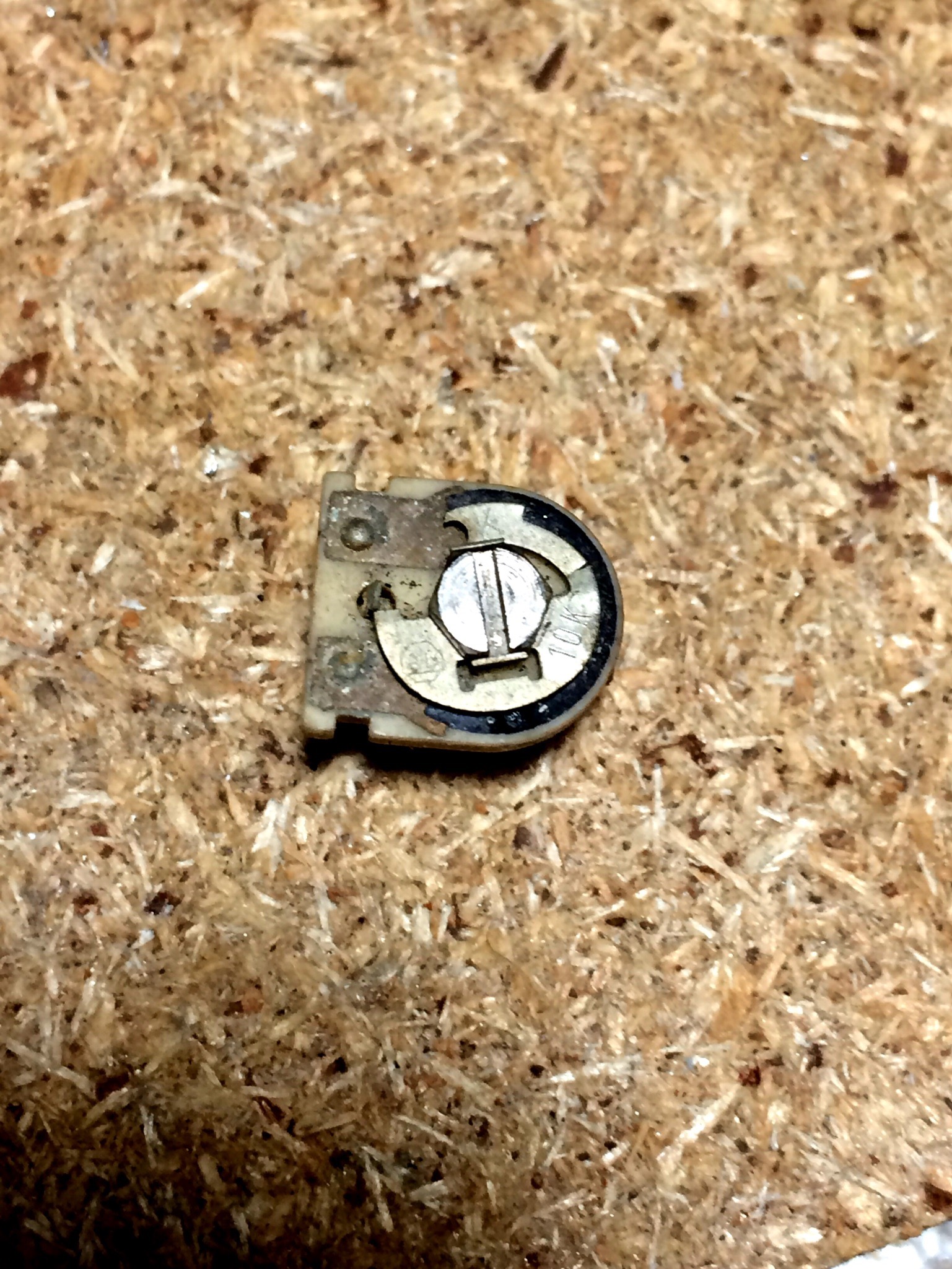
at least one of the adjustment potentiometers has suffered metal fatigue and
broken:
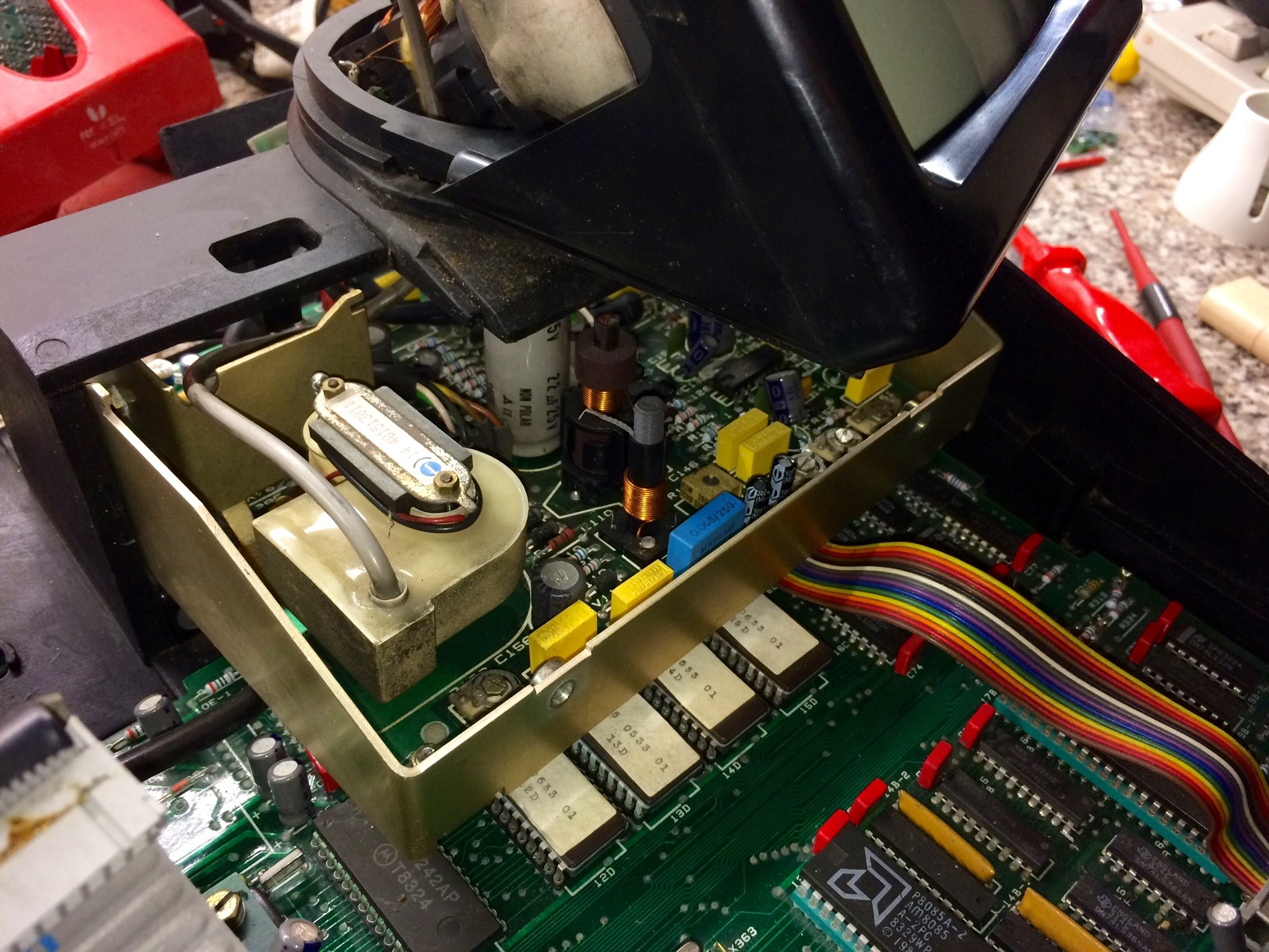
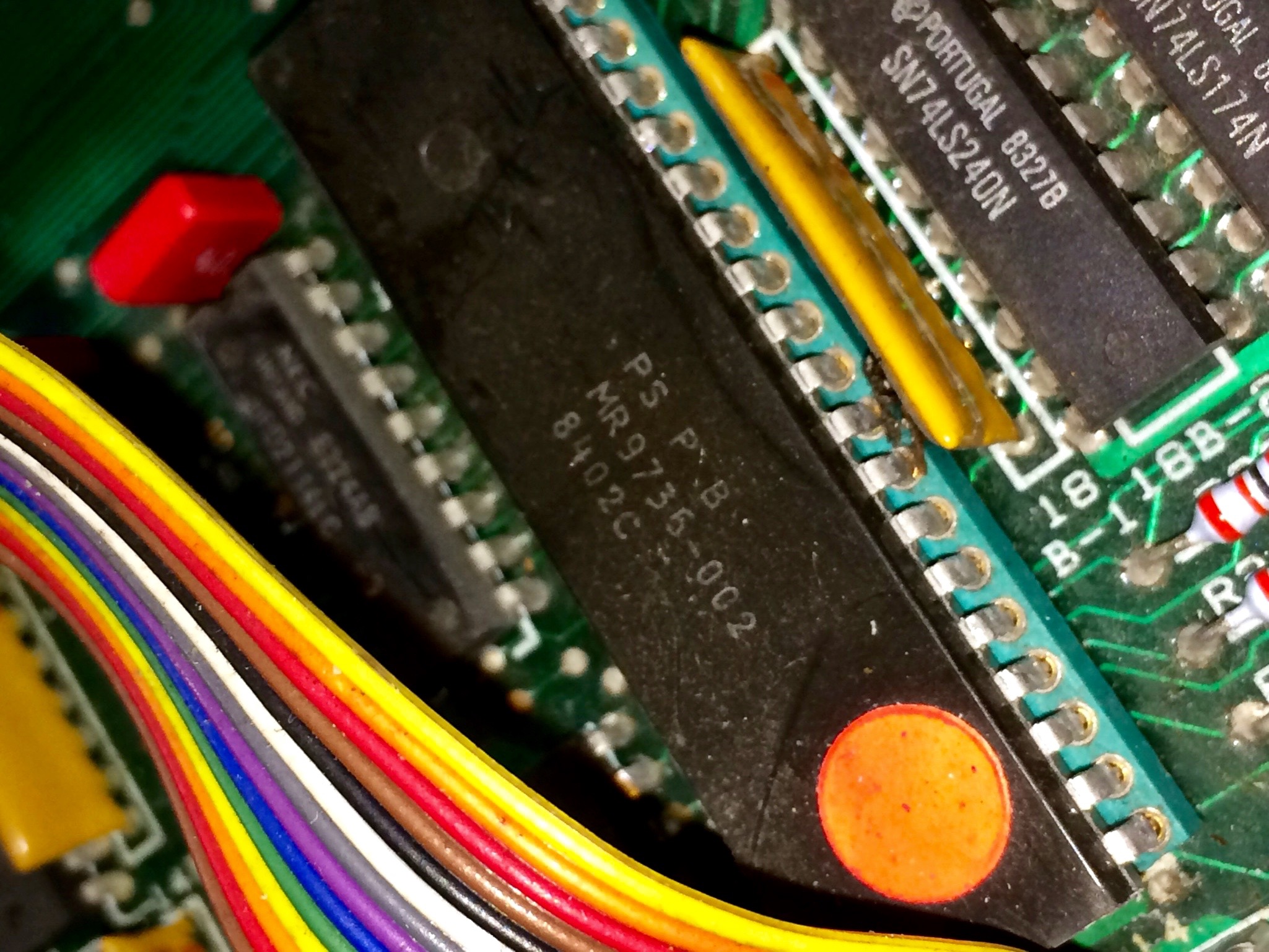
http://www.binarydinosaurs.co.uk/STCExecutelScreenPot.jpghttp://www.binarydinosaurs.co.uk/STCExecutelAnalogueBoard.jpghttp://www.binarydinosaurs.co.uk/STCExecutelDisplayChip.jpg
I've replaced it with a seemingly common 10K modern part that I had in my
spares box but it's unknown whether the display worked at all prior to it
being put in very damp storage, also the rating of the failed pot isn't
known but the capacitor next to it is 50V.
I've also removed, checked and replaced out of spec capacitors, one of them
was a 680nF 50V radial. I could only find a 63V PET version on cpc's website
and did much reading on differing capacitor types, concluding that it SHOULD
be OK.
Power supply is known good because it's one of my working ones, the original
is still dead.
Hence the question - am I wasting my time without a schematic for this
analogue board?
Cheers!
--
Adrian/Witchy
Binary Dinosaurs creator/curator
Www.binarydinosaurs.co.uk - the UK's biggest private home computer
collection?
On Mon, Oct 31, 2016 at 11:11 AM, emanuel stiebler <emu at e-bbes.com> wrote:
> On 2016-10-31 08:48, Ethan Dicks wrote:
>
>> One of the great recent updates was backporting the MSCP driver from
>> 2.11 to 2.9. That opens up KDF11 MicroPDP-11s to running 2.9 with an
>> RQDX3. Prior to that availability, one needed an RLV12 or other Qbus
>> disk controller for that platform.
>
> I missed that :(
About 15 years ago, Jonathan Engdahl backported the MSCP driver to 2.9BSD...
> more details?
First hit:
http://home.windstream.net/engdahl/2_9bsd-mscp.htm
-ethan
Out of curiosity and ignorance what's with the solder joints on the cards in the pictures? That orange color seems like it's everywhere around cold looking solder joints. ?Is that rust, some sort or protection, or acid corrosion?
-------- Original message --------From: Mark G Thomas <Mark at Misty.com> Date: 10/31/16?
I had the pleasure of visiting Rick yesterday. Please see below
additional information about remaining items, with links to photos.
Please contact Rick directly if interested.
Original posting here:
On Tue, Oct 18, 2016 at 08:44:39AM +0000, steven stengel wrote:
> ---------------------------------------------------------------
> *************? Contact Rick below if interested.? *************
> ---------------------------------------------------------------
> Name: Rick Bunker
> Contact: rick at bunker.us
> Location: Jenkintown, PA???
10/30/2016 Update:----------------------
> The Altair 8800, a very early one, 4-slot motherboard, 1K ram, ceramic CPU,
> you will see: https://goo.gl/photos/3C1pzfwFoZ3koPgt9
>
On 2014-10-26 3:07 PM, Toby Thain wrote:
> On 21/10/14 7:38 AM, Noel Chiappa wrote:
>> > From: Toby Thain
>>
>> > Looking to see what the internal self-test returns as an error
>> code
>> > (that can be done with console ODT, it doesn't need a program) is
>> > probably the first step in diagnosing.
>>...
> OK, after powerup, the bits of the VAR register (e/w/p 2000192c) are
> D800, i.e. the test result bits VAR12:10 are 1,1,0 - meaning RAM test
> failed.
Hi all,
As an update to this project, I can report that the DELQA has been
repaired with four new static RAM chips, and now the MicroVAX II's
network is fully working (including netboot).
Credit due to Joe Zatarski (joe_z) who did a beautiful job of
desoldering and putting sockets in for the four RAM chips.
--Toby
>
> I must be doing something wrong running the test manually, though -
>
>>>> d/w/p 2000192c 2000
>
> Just leaves 2000 in the VAR register, permanently.
>
> --Toby
>
>
>>
>> Noel
>>
>
>
My ISP (which I have used for 20-odd years) has decided to drop its e-mail
service....
My new address (at least for the moment) is :
ard.p850ug1 at gmail.com
If any of you mail me privately, please use that from now on....
-tony
Here is my daughter Gina, I thought you guys would like, Tek is still exciting.
Sure, we have lots of PC's around the house, but this is the first one that she is programming, and programming the 4051 creates a smile.
Randy
https://youtu.be/o0LiYkHG3iE
Noticed this on Nekochan:
http://forums.nekochan.net/viewtopic.php?f=4&t=16731198
No affiliation
-----
Hi,
I have an IBM 5360 with all of the manuals, cables, etc. The monitor
is missing. There are boxes and boxes of manuals, modems, cables, etc.
This is free for someone who wants to pickup in Milwaukee. This
posting will be active for a week. If I do not have any takers, it is
going to recycling.
Thanks!
Kevin - - remember HP did this...
using the MX-80 also...
(data from hpmuseum.com)
Name: 82905 Product Number: 82905 Introduced: 1981 Division:
_Corvallis_ (http://hpmuseum.net/divisions.php?did=18) Ad: _Click to see with
HP-87_
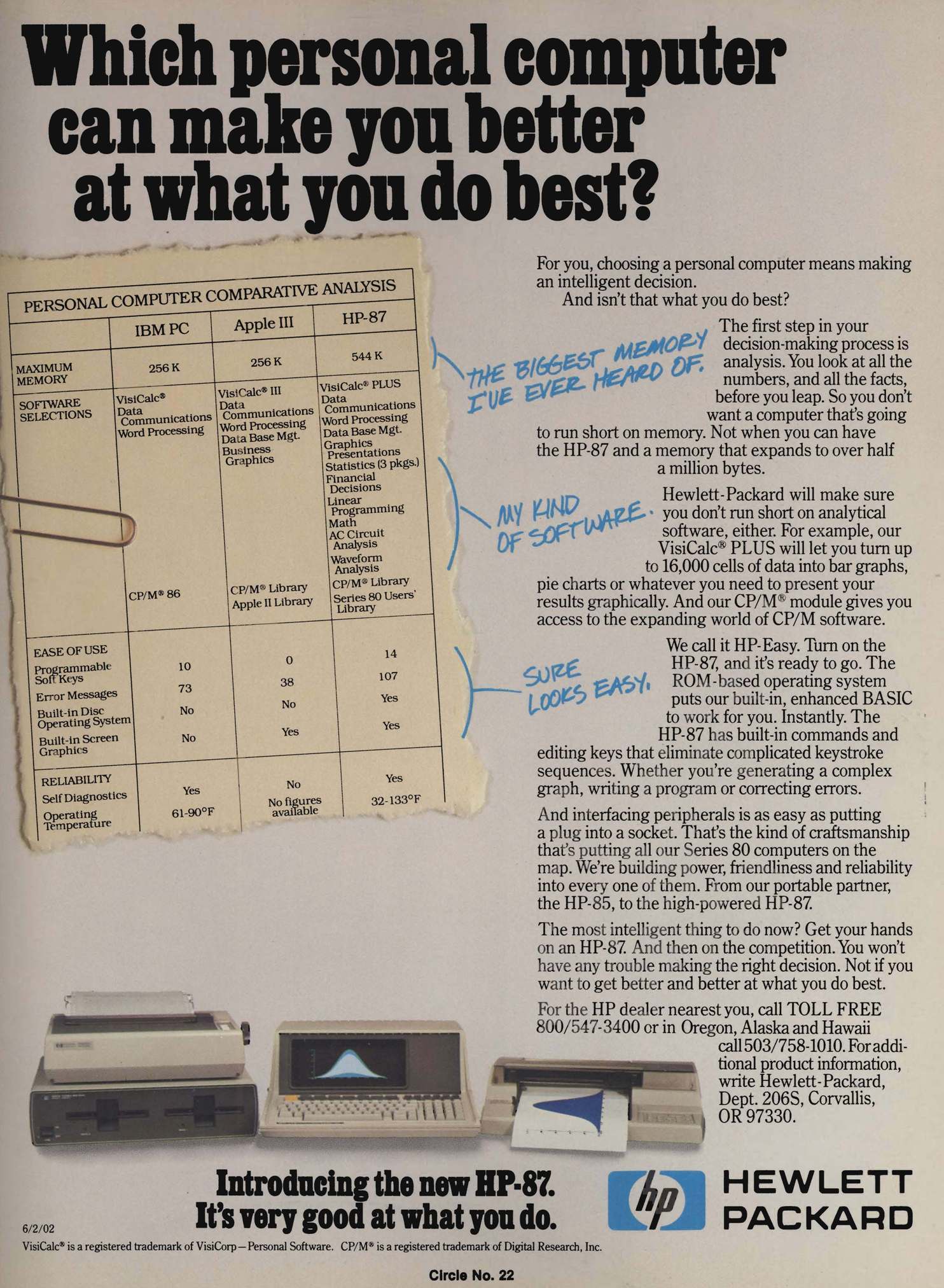
(http://hpmuseum.net/upload_htmlFile/PrintAds/Ad1982_May_HP-87_Spectrum-32.j…) Original Price: $945 Catalog Reference: 1982, page 655 Donated
by: Russell Warmington, HP Australia.
Description:
The 82905A was a low-end, narrow-carriadge dot matrix printer made by
Epson. HP obtained this printer primarily for use with the _80 Series_
(http://hpmuseum.net/exhibit.php?class=1&cat=9) computers. The 82905A had a print
speed of 80 characters per second. The dot character cell was 9 x 9 and
graphics printing resolution was possible up to 72 x 120 dots per inch. The
82905B, introduced in 1982 (at $795) offered an optional HP-IL interface.
The 82905A was OEM'ed from Epson by the Corvallis Division. The product
was transferred to the Vancouver Division in 1982.
and then with the FX 80!
Impact Selection:
Name: 82906 Product Number: 82906 Introduced: 1983 Division: _Personal
Computer Division_ (http://www.hpmuseum.net/divisions.php?did=18) Original
Price: $995 Catalog Reference: 1984, page 594
Description:
The 82906A, like the _82905A_
(http://hpmuseum.net/display_item.php?hw=321) was also OEM'd from Epson (model FX-80) by HP. It was faster (160
characters per second), with a higher resolution dot cell matrix (9 x 11).
Maximum resolution in graphics printing was 72 dots per inch.
In a message dated 11/5/2016 8:57:56 A.M. US Mountain Standard Time,
kevenm at reeltapetransfer.com writes:
I tried this link this morning (from Utah US) and got the manual.
So the link must have gotten fixed.
I've placed here just in case:
http://www.3kranger.com/download/epson_-_mx-80_dot_matrix_printer_-_technica
l_manual.pdf
Keven Miller
----- Original Message -----
From: "Scott Kevill" <scott at kevill.com>
To: "General Discussion: On-Topic and Off-Topic Posts"
<cctalk at classiccmp.org>
Sent: Sat 05 Nov 2016 01:24 AM
Subject: Re: Epson MX-80 Technical Manual?
On 05/11/2016, at 4:29 AM, Eric Smith <spacewar at gmail.com> wrote:
> Does anyone have a scan of the MX-80 Dot Matrix Printer Technical
Manual?
>
> It's apparently intended to be available here:
>
>
http://www.computinghistory.org.uk/det/39747/Epson-MX-80-Dot-Matrix-Printer…
> but I was unable to actually download it.
Hi,
Does anyone have any available? I don't need the paddles, just the
the ON-OFF-ON momentary switches.
I got good ON-OFF address/data ones from Herb Johnson, but the momentary
ON-OFF-ON ones I have are worn out and do not return to center properly.
Mark
--
Mark G. Thomas (Mark at Misty.com), KC3DRE
> I don't usually post here so if I am somehow posting wrong please tell
> me.
Nope, you're good.
Good luck with the machine! And thanks ever so much for posting all the
info that goes with it.
Noel
I have got TSS/8 running on SIMH (actually it is a ready-made image that I
got for the PiDP8). I have set up SIMH to enable TTIX for a secondary line
to connect another terminal, but when I try to login from another line (ie
not the console) I get a message along the lines of a local login not being
permitted. I have looked through the TSS/8 manuals on Manx, but I can't find
anything that tells me how to enable local logins. Can anyone tell me how
you do this?
Thanks
Rob
Hi,
I've had this box for a few years and wanted to see if it's interesting
to anyone on the list.
http://imgur.com/a/dm1vR
Apparently everything but the software itself. :/
If there is genuine interest I can list the contents of the box. It
won't be cheap to ship though. Located in Toronto, ON.
--Toby
I got booted from the list when the original post came out for this. ?He isn't willing to ship I guess? ?I wouldn't mind buying the SWTPC 6800 case he has.. I have almost everything save a cpu card to build another 6800 unit.
Sent from my Samsung device
-------- Original message --------
From: allison <ajp166 at verizon.net>
Date: 2016-11-04 3:50 PM (GMT-08:00)
To: cctech at classiccmp.org
Subject: Re: Altair, IMSAI, SWTPC, etc. for sale in Philly
That is from the first 2000 to 5000 units its a 8800 no suffix the
ribbon is either A or Bsuffix and
a different CPU board (uses 8224).
The orange is rosin flux that was not cleaned.?? Isopropanol would clean
that but it was built as a
kit (the K suffux on the serial number tag).? Its better to leave it
that way.? Authentic, never cleaned
mine either.
The PS looks to be the original version or the first update (higher
voltage transformer).
I'd expect power supply problems, suspect one-shots (front panel and CPU
clock) and
bus level noise issues.? Assuming the switches are still good.
Allison
On 11/04/2016 09:19 AM, Sam O'nella wrote:
> Out of curiosity and ignorance what's with the solder joints on the cards in the pictures? That orange color seems like it's everywhere around cold looking solder joints.? Is that rust, some sort or protection, or acid corrosion?
> -------- Original message --------From: Mark G Thomas <Mark at Misty.com> Date: 10/31/16
> I had the pleasure of visiting Rick yesterday. Please see below
> additional information about remaining items, with links to photos.
> Please contact Rick directly if interested.
>
> Original posting here:
> On Tue, Oct 18, 2016 at 08:44:39AM +0000, steven stengel wrote:
>> ---------------------------------------------------------------
>> *************? Contact Rick below if interested.? *************
>> ---------------------------------------------------------------
>> Name: Rick Bunker
>> Contact: rick at bunker.us
>> Location: Jenkintown, PA???
> 10/30/2016 Update:----------------------
>
>> The Altair 8800, a very early one, 4-slot motherboard, 1K ram, ceramic CPU,
>> you will see: https://goo.gl/photos/3C1pzfwFoZ3koPgt9
>>
Very cool. ?I love how that display works. ?It's just like something from an early 80s movie.
I want one badly but not $3000 badly.
Sent from my Samsung device
-------- Original message --------
From: Randy Dawson <rdawson16 at hotmail.com>
Date: 2016-11-04 5:03 PM (GMT-08:00)
To: "General Discussion: On-Topic and Off-Topic Posts" <cctalk at classiccmp.org>
Subject: Tek 4051 with a 10 year old at the helm
Here is my daughter Gina, I thought you guys would like, Tek is still exciting.
Sure, we have lots of PC's around the house, but this is the first one that she is programming, and programming the 4051 creates a smile.
Randy
https://youtu.be/o0LiYkHG3iE
I've been looking for it for a while as well, the only place I've seen
that has it in any form is actually on the 11/780 running at the LCM
(which you can of course access with a free account, if you just want to
use VCL). I assume it must still exist elsewhere but it was removed
>from the old software product libraries prior to any of the sets I've
found archived anywhere, sometime around 90-91 I believe?
There were several other CL and LISP implementations for VAX VMS but
they've all fallen into the great memory hole as well. KCL in
particular seems like it might be easier to find since it was freely
available, but I've had no luck.
> From: "Mike Stein" <mhs.stein at gmail.com>
> Subject: Re: Reasonable price for a complete SOL-20 system?
> Message-ID: <B1054C1D081C4DB9881083349D0D5B64 at 310e2>
> Content-Type: text/plain; charset="iso-8859-1"
>
>
> Any chance you still have a copy of that CP/M port buried somewhere?
> We're sort of collecting the various Cromemco ports and emulators.
>
Sorry Mike, I didn't think so but went through my diskettes anyway and no go
- all CDOS. I do believe that there was a Cromemco CP/M in the Don Maslim
archives and another in the classicmp Dave Dunfield archives here
http://www.classiccmp.org/dunfield/img54306/system.htm. If all else fails, I
have found a CROMCPM.TD0 file in my archives which is Teledisk format and is
607Kb but I don't have a functional Teledisk at the moment so can't tell
what it represents. I'm not sure of the source but would be happy to forward
it to someone with a functional Teledisk, or Dave Dunfield's converter from
TD0 to his IMD ImageDisk format.
James
Out of curiosity, since I've never done this either but have heard most folks suggest it. How do you seal the newly made jacket? Is it not necessary or folks using scotch tape??
> I suppose I should try and round up images of 19" x 5-1/4" PDP-10
> panels, too
So there are quite a few, although I'm not sure they are exactly the same as
the ones used in the PDP-11's, PDP-15's, etc. Those use a plastic bezel which
is the same as the blank panels in the H960 racks, into which the inlay is set
>from the front, and glued down to the lip inside the bezel. The PDP-10 ones,
>from the pictures, and my vague memory, use metal bezels which cover the
panels from the front, holding them on, so the shape of the inlay may be
subtly different.
Anyway, I found images (not great - all B+W illustrations in manuals) of the
following PDP-1 panels:
DF10
DA10
RC10
BA10
TD10
TM10
DS10
RM10B
DC10
RP10-C
MB10
MD10
I'll add them to the page at some point. If any has actual images of any of
these, they'd be appreciated. (And no, none of them is the mystery panel in
the RSTS manual.)
Noel
> I'm curious what the Systems 32/77 is..
>Wasn't Gould SEL? maybe an SEL system?
The 32/77-series was a 32-bit machine implemented in ECL, based on
earlier SEL designs, but is definitely Gould in design/manufacture.
Some of the machines in the series had a very powerful (for the time)
floating point unit (known as the IPU) that operated in tandem with the
main CPU that vastly increased the number-crunching power available
The machines were mainly intended for real-time control applications (as
used in the flight sim applications in the auction)
The machine ran a real-time executive called MPX-32.
More information: http://www.encore-support.com/htmls/32_77.htm
Years ago, I had some experience with these machines. They were quite
powerful for their time, and were also workhorses that just ran and ran.
Very robust design.
These are neat machines, and I hope that they end up in the hands of
someone that can care for them rather than ending up scrap.
--
Rick Bensene
The Old Calculator Museum
http://oldcalculatormuseum.com
I've heard Modula-3 (from DEC SRC and Olivetti Research Center) called
"the Ada regular programmers would adopt". They never did, of course,
because Olivetti decided research wasn't that important and DEC got
bought and a lot of other reasons that are documented elsewhere. Not
to get into a language pissing contest, but IMO it's an awfully nice
way to program, with threading built in, type safety, generics, a
reasonable GC, exceptions, etc. I really enjoyed it, but then I think
Ada brings a lot to the table.
What might have been, indeed.
Over the years I've played around with a few old CAMAC (*) modules, by
today's standard they pretty much have zero value, anyway that's another
story. Recently
I've been offered a CAMAC to Unibus board. A Kinetic 3912 Unibus Crate
Controller .
A Crate in CAMAC speak is just a chassis with a backplane.
The problem with CAMAC is there is almost no information out there,
Since I don't YET have a Unibus system, it more of a curiosity then
anything.
So .. anyone have the manual ?
(*) -
https://en.wikipedia.org/wiki/Computer_Automated_Measurement_and_Control
Hello, all,
Question of the day:
Will an Emulex MT-02 SCSI->QIC tape controller work with a Wangtek 5150EQ (QIC-150) Tape Drive?
I am trying to resurrect an old Tektronix 4132 Unix workstation. The 1/4" Wangtek 5099EQ drive that was in the machine was toast, something on the drive's electronics went POP when it powered on the first time, and it is no longer being recognized by the MT-02 controller. I have documentation on the drive, and will probably look into seeing if I can fix whatever fried, but in the short-term, I have a Wangtek 5150EQ with a good drive wheel, and was wondering if this drive would function with the MT-02 and be useful on the machine. I have a bunch of old (1980's) QIC-24 tapes written with the old 5099EQ drive that I want to look through and archive in a different form.
And yes...I know about the tension band issues with old 1/4" QIC media...I've got a bunch of new tension bands and have become quite adept at replacing them and assuring the proper tension on the tape.
Wishing all a peaceful day,
-Rick
--
Rick Bensene
The Old Calculator Museum
http://oldcalculatormuseum.com
I recently discovered the very excellent website
http://pascal.hansotten.com devoted to all things Wirth.
I sent a message to the author, as detailed below, but I would encourage
anyone to visit the website - you will surely learn something?
Greetings from Windermere in the Lake District, England!
I read with interest your interview with John Reagan. His efforts on the
VAX Pascal Compiler, and more recently (well, in the last few years or
so) my discovery of the very excellent Theo De Klerk book on VAX Pascal
and it's excellent integration with the VMS operating system have
rekindled my love of this excellent implementation of Pascal.
I am the organiser of declegacy.org.uk - a 'mostly' annual event here in
Windermere where collectors of DEC equipment and ex-employees gather to
immerse themselves once again in the excellence of product that was the
result of DEC Engineering. I have tried a couple of times to 'entice'
John to provide a video narrative of his time at DEC - but, thankfully,
he is still a very busy man.
At DEC Legacy this time around for example I was very fortunate to find
myself in the 'programming zone' for a couple of hours - sat at a VT
terminal, trying to determine why my VAX Macro-32 fractal generation
programme would not run successfully on a DEC Alpha via the VAX Macro
Compiler. For those precious moments I could have been sat at a piece of
DEC equipment anywhere in the world. For a programmer this is just
intoxicating and all too rare these days.
I have a long standing interest in the legacy of Wirth - and indeed DEC,
as could be expected. When I was considering a programming language for
my PhD efforts on a DEC 3000/600 AXP running Digital Unix 3.2C in 1994 I
would have been better using Modula-3 and ignoring the C-based Khoros
framework which was the path I eventual took (C was a 'better the devil
you know' option at that point).
On Tue, 11/1/16, Jon Elson <elson at pico-systems.com> wrote:
>? Also, some IBM publications (where I'm more
> familiar with their models) had some photos
> of machines that probably were in-house
> prototypes that were quite different than the
> production version.
Along the same lines, the picture in the original PDP-8
manual was of a machine that had a front panel that
looked more like the PDP-5 panel than the one shipped
on the 8s. Given how close the machines were in
architecture, it wouldn't be surprising for a prototype.
As it turns out, I saw the picture in the manual a few
years before I ever saw a real straight-8. To this day,
the real straight-8s look a little "wrong" to me.
BLS
> From: Don North
> Track 0 is not used by standard DEC software
I wonder why DEC did't use track 0. The thing is small enough (256KB in the
original single-density) that even 1% is a good chunk to throw away. Does
anyone know? (I had a look online, but couldn't turn anything up.)
If I had to _guess_, one possibility would be that track 0 is the innermost
track, where the media is moving the slowest, and as a result it's more
error-prone. Another is that IBM used track 0 for something special, and DEC
tried to conform with that. But those are pure guesses, I would love to know
for sure.
Noel
So, the CHM has an RSTS-11 brochure:
http://archive.computerhistory.org/resources/text/DEC/pdp-11/Digital.PDP-11…
which shows in a couple of places (front cover, page 6, 7, 10, 11) an
indicator panel which I haven't been able to identify: it's the one where
there are four full-length light rows on the left, and the lower right row
of lights is broken up in the three groups - small, large, small. (The other
indicator panel is known, it's an an RF11).
I have been searching for these panels for quite a while now, and have a page
for them:
http://ana-3.lcs.mit.edu/~jnc/tech/DECIndicatorPanels.html
_but_ ... I have never seen that panel.
I am quite sure that it is _NOT_ an RK11-C panel; although no image of such
has ever been found (I think because it was never produced - no DEC manual or
print set refers to it), the RK11-C prints show the wiring for the connector
to the indicator panel (which would presumably have been a standard DEC 19" x
5-1/4" panel of the kind documented on the page above), and from that it's
possible to predict what it would look like, as shown here:
http://ana-3.lcs.mit.edu/~jnc/tech/pdp11/RK11-C_inlay.txthttp://ana-3.lcs.mit.edu/~jnc/tech/pdp11/RK11-C_inlay.pdf
Can anyone shed any light (no pun intended :-) on what this is?
The RF11 engineering drawings list (on page 187/188) all the inserts
available (as of that date) for the standard 19" x 5-1/4" indicator panel,
and I don't have pictures of all of them, so it's possible this is one of
them. (It's clear from the brochure that this wasn't necessarily a working
system, since it appears in a number of different configurations. So maybe
they just grabbed up a random indicator panel and plugged it in to make the
system look cool.)
One possibility is that it's a prototype that was never produced - or perhaps
it was the indicator panel for an earlier RK11 controller (although I can't
find any mention of an RK11-B or RK11-A, and the list above doesn't contain
an RK11 entry).
Anyone have any ideas?
Noel
> From: Steven Malikoff
> I have been looking but not yet found a picture of the DEC-trimmed RC11
> ... If anyone could point me to a photo of the RC11/RS64 DECdisk panel
> to be honest I don't know if it even had one?
I'm not sure it did. The list of available inserts (in the Indicator Panel
Assembly drawings, available in the RF11 prints, pp. 186-190) doesn't list an
RC11 insert, and that list does include the RF11, which is a later controller
than the RC11.
I tried looking online for RC11 engineering drawings, to see if it included
an indicator panel connector (the way the RK11-C does), but I could not find
_anything_ substantial about the RC11 online.
> From: Jon Elson
> These look VERY posed, so don't be sure ANYTHING in the picture was a
> fully working system.
Yeah, I'd come to that conclusion...
> If those panels look like something off a KA10 controller
Well, I'm not sure. Most PDP-10 gear had rows of 36 lights, which is the full
width of these 19" indicator panels (i.e. every light in a row - like the top
row of the RP11 panel, see the page for an image), and I don't see that in
this one. But I suppose I should try and round up images of 19" x 5-1/4"
PDP-10 panels, too (ISTR that there are a few).
Noel
David Bunnell and Bill Machrone of PC Magazine have passed on. They
both were involved in promoting computers in its earliest day. Both
will sadly be missed.
Murray--
I've been wondering about that one myself. ?Very odd. ?That's not the first time I've seen that either. Along with stuff that 'sells' for absurd amounts of money.
At first I though the absurd sales were attempts to manipulate the market.. but it doesn't seem worth the effort or ebay fees. ?I almost kind of wonder with some of them if something more sinister is going on.. like money laundering. ?That'd be a fairly obscure way to do it..
Sent from my Samsung device
-------- Original message --------
From: Corey Cohen <AppleCorey at optonline.net>
Date: 2016-11-01 4:43 PM (GMT-08:00)
To: cctalk at classiccmp.org
Subject: What the heck is the deal with this eBay item
https://www.ebay.com/itm/272433760795
This Helios II has been "sold" multiple times for varying amounts and then suddenly hours later appears for sale again.? I'm done bidding on this each time it appears, because if I won, who knows what I'd receive or if the seller would cancel the auction.?
corey cohen
u??o? ???o?
> Date: Mon, 31 Oct 2016 10:48:56 -0400
> From: Paul Koning <paulkoning at comcast.net>
> To: "General Discussion: On-Topic and Off-Topic Posts"
> <cctalk at classiccmp.org>
> Subject: Re: For sale 128K Core RAM Industrial PDP 11/40 Massbus
> System
> Message-ID: <A0F4A035-0EAA-4343-87DC-86495173458F at comcast.net>
> Content-Type: text/plain; charset=us-ascii
>
>
>> On Oct 31, 2016, at 10:26 AM, william degnan <billdegnan at gmail.com> wrote:
>>
>> Given 128K core, wouldn't one be able to save the OS in core, no need to
>> load what would need to "get started" from a diskpak? The data would be on
>> the tape drives, and something on stand by to re-load the OS back into core.
>
> Only if the OS implements the ability to resume from a power failure without reloading from disk or tape. Few do. Perhaps some flavors of RSX, I don't know. RSTS V4A, when built with the power fail handling option, could do so. Later versions do not; they unconditionally reboot (from disk) at powerup.
>
> paul
RSX-11M and M+ did resume from power failures very robustly. I had a PDP-11/44 with batteries for the MOS RAM (and fans to cool it) with RK07 drives. I can remember testing it by pulling the power with a number of applications runnings including editors etc. The disks would yank the heads back and spin down, then when the power was restored and the drives spun up, it was like it never happened. I might see an entry or two in the error log file about a disk retry, and a user might loose a keystroke on the file they were editing but it absolutely was solid. I don't know of a single modern operating system that can do that today.
RSX-11M+ can run TCP/IP today with Johnny Billquist's BQTCP package but it dies require I/D space processors. M+ itself can run on a 11/23+ or 11/24 but it really needs more than 128KW and the lack of I/D space really limits its capabilities.
Mark
I bought one of these on eBay thinking it was the standard 37-pin
D-connector that connects to an ISA floppy controller. No, it's a 25-pin
D-connector. I can't find any references in Google aside from people
selling them. I'm wondering if it might be something like a
printer-port-connected device, in which case I'm probably out of luck
trying to find its driver.... -- Ian
--
Ian S. King, MSIS, MSCS, Ph.D. Candidate
The Information School <http://ischool.uw.edu>
Dissertation: "Why the Conversation Mattered: Constructing a Sociotechnical
Narrative Through a Design Lens
Archivist, Voices From the Rwanda Tribunal <http://tribunalvoices.org>
Value Sensitive Design Research Lab <http://vsdesign.org>
University of Washington
There is an old Vulcan saying: "Only Nixon could go to China."
Date: Tue, 1 Nov 2016 06:39:04 -0400
From: Peter Cetinski <pete at pski.net>
To: "General Discussion: On-Topic and Off-Topic Posts"
<cctalk at classiccmp.org>
Cc: "General Discussion: On-Topic Posts" <cctech at classiccmp.org>
Subject: Re: Imaging Old Disks Advice Needed
> Well, I made a number of these this weekend and I just left the end
open. The hub
> keeps the cookie in place. Thanks to everyone for the input.
>
> So, I was able to image half of the disks without issue. The others all
had a few
> bad tracks. On most of those I don't see any physical damage so I was
wondering
> if there were any other techniques to possibly recover those tracks?
Baking the
> cookie? Is there a good tool to merge tracks from multiple disks if I
find another
> copy of the software that has the missing tracks?
Pete:
I've had pretty good luck during a data restoration project by ensuring the
drive heads are clean and then also cleaning the cookie VERY GENTLY with
good quality rubbing alcohol (I'm using 91%, some say you should use better
stuff) on a cotton ball. My method has been to put the cookie on a clean,
dry, soft surface. The disks I'm working on are Apple ][, so flippy (if
the jacket is punched), otherwise I only need to concentrate on the
"bottom" side of the cookie. Essentially, the side without the hub ring.
I use a very fine-tipped needle top bottle (found it in the baking section
of a local big-name craft store) and apply a reasonable amount of rubbing
alcohol then use a fresh cotton swab and gently clean the surface.
Depending on how it goes, I'll clean it a second time.
Note, some of the disks look just fine, but still have some issue reading.
This cleaning process has been highly successful (maybe 85%?) for me even
with disks that looked clean.
Also, on a few prior attempts I've had inexplicable results in trying
different drives. I don't know if alignments, speeds, magnetic sensitivity
or other factors were at play but it's worth trying as another trick to
have in the collection. Sometimes it worked better, sometimes it was worse.
I am not 100% sure, but I thought the "baking" was for media that was
shedding or at some risk of having a physical issue with delamination, etc.
Also, I can't really help on the merging question. I'd think you could
just cut the resulting images together using a hex editor or similar.
Naturally, you'd have to know where the bad parts were in the file. Maybe
you could start with a 'fc /b filename.bin filename.bin' at a Windows
command prompt, note the offsets of differences between multiple reads and
visually compare those sections in a hex editor?
Good luck with the data restoration! See ya.
-Todd
> From: Philipp Hachtmann
> that one posting sounded a lot like that, sorry.
OK.
> Do you have a source where there are still 30k chips sitting and
> waiting?
It was ~30K a couple of months ago. I checked about a week ago, and it was
down to ~26K (IIRC).
Although, like I said, I doubt they have all 26K in stock themselves; based on
comments they made when we bought a large group, I think that's the total
number available to them across a number of suppliers, in a network which
shares inventory information.
Noel
> From: Don North <north at alum.mit.edu>
> .. the hardware bootstrap reads track 1 sectors 1, 3, 5, 7
Ah, thanks for that. Starting to look at the code, I had missed the
interleave.
So does DEC do anything with track 0, or is it always just empty?
Noel
In a message dated 10/31/2016 2:31:02 P.M. US Mountain Standard Time,
tmfdmike at gmail.com writes:
On Tue, Nov 1, 2016 at 10:15 AM, william degnan <billdegnan at gmail.com>
wrote:
>>
>> Find a copy of the PDP-11 systems handbook! Say 1978, 80 and 82
versions
>> and
>> see the difference. Never mind the Unibus, Qbus, PRO, and PDT flavors.
>>
>>
>> Allison
>>
>>> thanks Ed Sharpe _www.smecc.org_ (http://www.smecc.org)
>>>
>>>
>>>
>
> Here is a thread I posted on my site, with link to the first printing of
> the PDP 11 brochure. The first PDP 11 models had no "/nn" on the front
> panel.. see for yourself.
>
> http://vintagecomputer.net/browse_thread.cfm?id=593
Mine is a very early example - number 636 IIRC - and it just says
'pdp-11' on the front:
http://www.corestore.org/1120-1.jpg
Mike
http://www.corestore.org
'No greater love hath a man than he lay down his life for his brother.
Not for millions, not for glory, not for fame.
For one person, in the dark, where no one will ever know or see.'
Mike OK that is a great indicator!
serial# and date wise! Ed#
In a message dated 10/31/2016 6:36:17 A.M. US Mountain Standard Time,
jnc at mercury.lcs.mit.edu writes:
> From: Ed Sharpe
> was Unix or C the one developed on the 11/20?
Both. Unix Version 1 was written in PDP-11 assembler, for the -11/20;
although that was a re-write of an earlier version written in PDP-7
assembler. C was developed from B in good part because the word address
model
of B (inherited from its ancestor BCPL) wasn't a good match for the
PDP-11's
byte addressing model. More here:
https://www.bell-labs.com/usr/dmr/www/hist.htmlhttps://www.bell-labs.com/usr/dmr/www/chist.html
> From: Christian Corti
> I think the IP stack needs separate I/D and more memory
I read that the networking code in 2.x uses Supervisor mode (apparently it
needed more address space than was available with only kernel, even with
split I/D).
Noel
Great History Noel! Many Thanks!
...
I wonder if the pdp-11 was just called pdp-11 at t that point or
was a pdp-11/20 like we have..
I know they are essentially the same at this time point they got
their PDP 11 what did it say on the front panel I wonder?
(figuring all this stuff out for titling up the cards in the 11/20
display we are planning.)
thanks Ed Sharpe _www.smecc.org_ (http://www.smecc.org)
In a message dated 10/31/2016 1:41:28 P.M. US Mountain Standard Time,
jnc at mercury.lcs.mit.edu writes:
> From: Ed Sharpe
> I wonder if the pdp-11 was just called pdp-11 at t that point or was a
> pdp-11/20 like we have
Others have better info on this than me...
> at this time point they got their PDP 11 what did it say on the front
> panel I wonder?
I'm going to _guess_ that it was the earlier caption; I definitely recall
reading somewhere (maybe that history thing I already provided a link to)
that when the PDP-11/20 first arrived, DEC didn't have a disk drive for it,
and so it sat in a corner for some months (running some chess problem)
until
the disk arrived. So that argues that it was a very early production
machine.
Noel
Noel - OK that is what I also read.... so probably would have said
PDP-11 on the front panel not 11/20 if it was that early if we
subscribe to the theory that the ones labeled 11 only were before the 11/20
I do wonder if there are any photograph of the system they used at
the get go of the PDP-11 use? Need a photo that has definite date
info....
yes, the systems are the same but some of this is important as I
do the display cards for the 11/20 we have here at SMECC
Thx Ed# _www.smecc.org_ (http://www.smecc.org)
In a message dated 10/31/2016 1:58:29 P.M. US Mountain Standard Time,
ajp166 at verizon.net writes:
> ...
> I wonder if the pdp-11 was just called pdp-11 at t that point or
> was a pdp-11/20 like we have..
At that time PDP-11 was a general architecture name and 11/mumble was a
specific system.
Keep in mind that new versions of the -11 would evolve soon after
introduction and
continue over time for decades.
Add to that there were both processor naming and system configuration
naming
conventions.
> I know they are essentially the same at this time point they got
> their PDP 11 what did it say on the front panel I wonder?
> (figuring all this stuff out for titling up the cards in the 11/20
> display we are planning.)
Find a copy of the PDP-11 systems handbook! Say 1978, 80 and 82
versions and
see the difference. Never mind the Unibus, Qbus, PRO, and PDT flavors.
Allison
>
OK I have seen both on Panels pdp-11 and pdp 11/20
figured the first issuance would say pdp-11 only on panel
Ed#
> From: Ed Sharpe
> I wonder if the pdp-11 was just called pdp-11 at t that point or was a
> pdp-11/20 like we have
Others have better info on this than me...
> at this time point they got their PDP 11 what did it say on the front
> panel I wonder?
I'm going to _guess_ that it was the earlier caption; I definitely recall
reading somewhere (maybe that history thing I already provided a link to)
that when the PDP-11/20 first arrived, DEC didn't have a disk drive for it,
and so it sat in a corner for some months (running some chess problem) until
the disk arrived. So that argues that it was a very early production machine.
Noel
In a message dated 10/31/2016 12:36:35 P.M. US Mountain Standard Tim,
isking at uw.edu writes:
On Mon, Oct 31, 2016 at 12:29 PM, <COURYHOUSE at aol.com> wrote:
>
> ...
> I wonder if the pdp-11 was just called pdp-11 at t that point or
> was a pdp-11/20 like we have..
> I know they are essentially the same at this time point they got
> their PDP 11 what did it say on the front panel I wonder?
> (figuring all this stuff out for titling up the cards in the 11/20
> display we are planning.)
>
I think we had this discussion a while back, but I know that my 11/20 just
says 'PDP-11' on the front panel. I've also seen them with '11/20', which
is almost certainly a later naming as the -11 line grew.
--
Ian S. King, MSIS, MSCS, Ph.D. Candidate
The Information School <http://ischool.uw.edu>
Dissertation: "Why the Conversation Mattered: Constructing a Sociotechnical
Narrative Through a Design Lens
Archivist, Voices From the Rwanda Tribunal <http://tribunalvoices.org>
Value Sensitive Design Research Lab <http://vsdesign.org>
University of Washington
There is an old Vulcan saying: "Only Nixon could go to China."
ok just re-clarifing.... so then w would be safe in reading the unix
history - the 11 they had since when they got it a disk was not avail. (???
REALLY!!?? Hard to believe DEC would ship a processor without disc
i/o??? COMMENTS? ) would have just probably said PDP-11
Ed# _www.smecc.org_ (http://www.smecc.org/)
--------------------------------------------------------------------------------------------------------*************? Contact Rick below if interested.? *************--------------------------------------------------------------------------------------------------------
Name: Rick Bunker????Contact: rick at bunker.us ????Location: Jenkintown, PA???
I have a computer collection that I have to sell. My wife and I have separated, and the house is being sold, and I have no place to keep the computers in my new apartment.
It is a pretty nice collection. Altair 8800, two IMSAI 8080's, an Apple ][ (not ][+ or e or anything, the first one), a TRS-80 (the real first revision, with no numeric keypad, with the original cassette drive, monitor) an LSI monitor, a KIM-1, an original IBM PC (not an XT -- original 2-floppys, original bios), an SwTPC 6800 box, with no innards. Similarly, a Cromemco box with no innards. A Northstar Horizon.
Some 8-inch drives, a bunch of S-100 boards, a luggable Kaypro portable, an odd and an end or two.
Lots of documentation.
Some old disks which may have readable software on them. I don't power these things up, since they have power supplies that you can weld with, with 40-year-old capacitors on them.
Is there anybody in striking distance of Philadelphia suburbs, who would consider buying and picking up this collection?
--------------------------------------------------------------------------------------------------------
was Unix or C the one developed on the 11/20?
Ed#
In a message dated 10/30/2016 6:15:32 P.M. US Mountain Standard Time,
elson at pico-systems.com writes:
>>
>> Bill
> Unix? Probably a complete brain fart by me - but I thought Unix
> required a machine with separate I/D spaces and the 11/40 wasn't one
> of them?
>
> If I'm wrong that will be of some assistance to me actually :-)
>
> From: Allison
> Later versions like 2.9 and V7 do want I&D.
V7 is only distributed with pre-built loads for split I+D machines (so you
can't boot a V7 distribution tape on a non-split machine), but it includes
machine-language OS support files for non-split machines. (It's similar
enough to V6 that it makes sense that it runs on non-split machines.)
> From: William Degnan
> Given 128K core, wouldn't one be able to save the OS in core, no need
> to load what would need to "get started" from a diskpak?
To fork a process, Unix swaps the forking process out, and then fiddles
system tables so that one of the two copies (I forget which, without looking
at the code) becomes the child. This includes at startup, when the 'swapping'
process (0) splits and the child (1) is set up to run /etc/init. (I
found this out the hard way, when bringing up V6 under Ersatz-11. :-)
So Unix won't run without a swapping device.
Noel
> From: Philipp Hachtmann
> Very enlightening.
> You're hoarding interface ICs with commercial second thoughts
If you think either Guy, or Dave and I, expect to make much money selling the
QBUS/UNIBUS boards we are working on, you are seriously confused. None of us
are in this as a money-making exercise; there are easier ways to make a lot
more money.
And as to the hoarding, if you'd like to buy up a couple of thousand yourself,
>from that miniscule stockpile of 30K units that Guy and I have left out there
for you all, please let me know, and I'll expidite over a name, phone number,
and email for you to contact.
Noel
Guys,
there's a new release PDP11GUI 1.48.5
Some enhancements:
1. "Disk Image Read/Write":
- Now compression of 2word patterns (32 bit patterns), did reduce
download of a RSX-11 system disk from 40h to 6h.
- Fix for PDP-11/44 console firmware v 3.40: ignore "(Program)" output
after driver start.
2. Terminal windows now beeps on char, necessary for some endless XXDP
diags.
Download from https://github.com/j-hoppe/PDP11GUI/releases/tag/1.48.5
Web: http://retrocmp.com/tools/pdp11gui
Enjoy,
Joerg
> From: Ed Sharpe
> was Unix or C the one developed on the 11/20?
Both. Unix Version 1 was written in PDP-11 assembler, for the -11/20;
although that was a re-write of an earlier version written in PDP-7
assembler. C was developed from B in good part because the word address model
of B (inherited from its ancestor BCPL) wasn't a good match for the PDP-11's
byte addressing model. More here:
https://www.bell-labs.com/usr/dmr/www/hist.htmlhttps://www.bell-labs.com/usr/dmr/www/chist.html
> From: Christian Corti
> I think the IP stack needs separate I/D and more memory
I read that the networking code in 2.x uses Supervisor mode (apparently it
needed more address space than was available with only kernel, even with
split I/D).
Noel
I've pdf'd half a dozen pages of the 360/40 development manual from IBM British Labs at
Hursley UK, early/mid 60s. I wish I had more but these only survived because dad used
to bring home binders with these single-sided pages for us kids to draw on, and my
parents kept them. They may not even be from the same document, but it's just for
interest's sake.
http://web.aanet.com.au/~malikoff/misc/IBM_360-40_Development_Manual_fragme…
On Sun, 30 Oct 2016, Jon Elson wrote:
>> Thank you for the tips, i will see if i can open it up in someway, the fan
>> is kinda like a laptop blower style, but a bigger version of it :) I think
>> i will need to buy new bearings for it when i have read on google about the
>> fan.
You never know until you try.
Anyway, the Alphaserver 4100 has four midsize muffin fans and I found them
trivial to take apart and trivial to replace the bearings which were a
standard off the shelf part. It was easier to fix the fan than it was to
replace them since DEC had a custom fan with a speed sensor built in that
proved impossible for me to find.
It changes from model to model and generation to generation.
--
Richard Loken VE6BSV, Systems Programmer - VMS : "...underneath those
Athabasca University : tuques we wear, our
Athabasca, Alberta Canada : heads are naked!"
** rlloken at telus.net ** : - Arthur Black
Hey Jon!
Thank you for the tips, i will see if i can open it up in someway, the
fan is kinda like a laptop blower style, but a bigger version of it :) I
think i will need to buy new bearings for it when i have read on google
about the fan.
/Daniel
Don't be nasty Al!
I was willing to scan the addendum and covers if needed.
I also did not know if others with interest needed...I am glad the book
is scanned already as I do not care to blow mine apart... glue backing
gets pretty brittle on these things. The addendum is a loose pamphlet that
was just with the manual
In a message dated 10/30/2016 11:20:03 A.M. US Mountain Standard Tim,
aek at bitsavers.org writes:
BFD
On 10/30/16 11:03 AM, william degnan wrote:
>> I see bitsavers has manual but not pmphlet.Also there is no color
front
>> and back cover
I am sorry Bill...I have no idea what to do to authenticate
help? details? thanks Ed#
In a message dated 10/30/2016 11:03:41 A.M. US Mountain Standard Tim,
billdegnan at gmail.com writes:
Ed,
I have a little 703 and 706 in my library under Raytheon.
Clearing out my spam folder I see your recent messages to cctalk. Here is
why your emails are going into the spam box, see if you can authenticate
your email address.
Bill
*Why is this message in Spam?* It has a from address in aol.com but has
failed aol.com's required tests for authentication.
On Sun, Oct 9, 2016 at 11:45 PM, <COURYHOUSE at aol.com> wrote:
> We have in the library:
> "raytheon 706 computer users manual"
> at SMECC.
>
> Wanted to see if it was online somewhere.
>
> Nice shape tight binding with an additional errata and addendum
> pamphlet accompanying it.
>
> I see bitsavers has manual but not pmphlet.Also there is no color
front
> and back cover, which
> if you have the computer is cool artwork for a display. -
>
> Anyone with a 706 out there?
>
> Ed# _www.smecc.org_ (http://www.smecc.org)
>
>
We have in the library:
"raytheon 706 computer users manual"
at SMECC.
Wanted to see if it was online somewhere.
Nice shape tight binding with an additional errata and addendum
pamphlet accompanying it.
I see bitsavers has manual but not pmphlet.Also there is no color front
and back cover, which
if you have the computer is cool artwork for a display. -
Anyone with a 706 out there?
Ed# _www.smecc.org_ (http://www.smecc.org)
From: Al Kossow <aek at bitsavers.org>
>
> the will probably be 68000
>
> unisoft kernels i've used weren't 010 with the 451
>
Dumb question...did the '451 have a mechanism to work around the
instruction restart issue in the 68000? Or was there some other way
that was handled?
> i'll have to dig around for what bits of the 451 kernel i still
> have around. unisoft kept the mmu parts pretty well isolated since
> the did so many hw ports
I'd be grateful.
KJ