> -----Original Message-----
> From: Joe [mailto:rigdonj@cfl.rr.com]
> Well I've been trying to get either one to work for the
> last hour and I
> haven't had any luck. -$a: ties to create a .ZIP file by the
> name of -&sa:
> but that's illegal so it errors out. -rp, -rP, -Pr and -pr
> all do that
> same thing. It copies all the files including those in the
> subdirectories
> but when you use PKUNZIP all the files are placed in one directory
> therefore losing the directory structure and overwritng any
> files that have
> same names but that came from different subdirectories. I've
You did use pkunzip with the option (yes, it's optional) to make it
restore the directory tree, right? :) I think it's -d
Chris
Christopher Smith, Perl Developer
Amdocs - Champaign, IL
/usr/bin/perl -e '
print((~"\x95\xc4\xe3"^"Just Another Perl Hacker.")."\x08!\n");
'
Joe <rigdonj(a)cfl.rr.com> wrote:
> same thing. It copies all the files including those in the subdirectories
> but when you use PKUNZIP all the files are placed in one directory
> therefore losing the directory structure and overwritng any files that have
PKUNZIP -d
^^ this is important
-Frank McConnell
On January 29, Andreas Freiherr wrote:
> This is just about right for a PDP-11/34A, a PDP-11/23, and a
> Micro-PDP-11/23PLUS and their peripherals, such as LA36 and LA120
> printing terminals, and two-and-a-half 19" racks of diskette (8", of
> course, what'd you think? ;^), disk, and tape drives. Not much left to
> feed a MicroVAX, however - sigh...
Pictures! Pictures!!
-Dave
--
Dave McGuire
St. Petersburg, FL "Less talk. More synthohol." --Lt. Worf
Right site but clicking all download links produce "page not found" errors
here.
Rich
-----Original Message-----
From: Christopher Smith [mailto:csmith@amdocs.com]
Sent: Wednesday, January 30, 2002 10:15 AM
To: 'classiccmp(a)classiccmp.org'
Subject: RE: DesqView
> -----Original Message-----
> From: Zane H. Healy [mailto:healyzh@aracnet.com]
> Has anyone been able to access the site they claimed had it
> for download?
> I've wanted a copy of this since it came out! Does Symantec
> have their own
> download site?
Try this:
http://www.clarkson.edu/~vryhofab/wserv/freedv/
Chris
Christopher Smith, Perl Developer
Amdocs - Champaign, IL
/usr/bin/perl -e '
print((~"\x95\xc4\xe3"^"Just Another Perl Hacker.")."\x08!\n");
'
> -----Original Message-----
> From: Zane H. Healy [mailto:healyzh@aracnet.com]
> Has anyone been able to access the site they claimed had it
> for download?
> I've wanted a copy of this since it came out! Does Symantec
> have their own
> download site?
Try this:
http://www.clarkson.edu/~vryhofab/wserv/freedv/
Chris
Christopher Smith, Perl Developer
Amdocs - Champaign, IL
/usr/bin/perl -e '
print((~"\x95\xc4\xe3"^"Just Another Perl Hacker.")."\x08!\n");
'
Since the 95LX uses MS-DOS 3.22, it is limited to a flash disk of at most
32MB, so you would need to try either the 8MB, 20MB or 30MB packages. I
haven't tried any of them, so I don't know if they will work with the 95LX's
screen either.
The 95LX requires drivers to use flash cards. I can send you ones for
SunDisk (SanDisk) cards if you need them.
Bob
-----Original Message-----
From: Cameron Kaiser [mailto:spectre@stockholm.ptloma.edu]
Sent: Tuesday, January 29, 2002 7:36 PM
To: classiccmp(a)classiccmp.org
Subject: Re: Netscape (was Re: PayPal = payola?)
> Nah, you can put Minix on an HP LX palmtop, which is smaller and lighter
> than a Poqet (see http://www.technoir.nu/hplx/minix.html).
Any hope of this coming out for the 95LX?
--
----------------------------- personal page: http://www.armory.com/~spectre/
--
Cameron Kaiser, Point Loma Nazarene University *
ckaiser(a)stockholm.ptloma.edu
-- Mistakes are often the stepping stones to catastrophic failure.
------------
----- Original Message -----
From: "Jonathan Willis" <prodinfo(a)armoralarms.com>
To: <martys(a)sunday-blues.com>
Sent: Tuesday, January 29, 2002 11:10 PM
Subject: A Special Announcement From Dish Network and the Armor Security
Corporation
> Armor Alarms Promotion
>
> Click To Order
>
> This message is sent in compliance with the new email bill section
301. Under Bill S.1618 TITLE III passed by the 105th US Congress, this
message cannot be considered SPAM as long as we include the way to be
removed, Paragraph (a)(c) of S.1618, further transmissions to you by the
sender of this email may be stopped at no cost to you by sending a Reply
email with the words "Remove" written in the Subject line.
>
>
On January 29, Gareth Knight wrote:
> No wonder has mentioned this, so I thought I would throw it into the Classic
> mixer:
>
> http://slashdot.org/articles/02/01/27/1950244.shtml
> Quote:
> "It seems Symantec (purchasers of former company Quarterdeck) has release
> DeskView/X into public domain and can be downloaded now. DesqView/X was a
...
I wanted to grab this, but the web server mentioned in the article
is refusing connections on port 80. Anybody know what's going on, or
did anyone manage to grab it?
-Dave
--
Dave McGuire
St. Petersburg, FL "Less talk. More synthohol." --Lt. Worf
Looking for interface to ide from JVC Hard Drive Model JD3824R00-1.
Also looking for system setup files for Nixdorf 8810 M15
Iain Smith
mailto:ismith@quickvoice.co.za
> http://slashdot.org/articles/02/01/27/1950244.shtml
...
I wanted to grab this, but the web server mentioned in the article
is refusing connections on port 80. Anybody know what's going on,
or
did anyone manage to grab it?
Scroll further down the article to the comments, there's
an alternate link that seems to work.
Lee.
----------------------------------------------------------------------------
----
This email is intended only for the above named addressee(s). The
information contained in this email may contain information which is
confidential. The views expressed in this email are personal to the sender
and do not in any way reflect the views of the company.
If you have received this email and you are not a named addressee please
delete it from your system and contact Merlin Communications International
IT Department on +44 20 7344 5888.
________________________________________________________________________
This e-mail has been scanned for all viruses by Star Internet. The
service is powered by MessageLabs. For more information on a proactive
anti-virus service working around the clock, around the globe, visit:
http://www.star.net.uk
________________________________________________________________________
I started internal medicine rotation at the Loma Linda VA Hospital today
and noted that the entire place is crawling with WinTerms (by Wyse, no less),
running WinCE, connected via Citrix to a Win2K Advanced Server host. There
are only a few "real" PCs there -- in fact, I think the Macs might outnumber
them.
Before all of you cry off-topic, doesn't it seem odd to anyone we're now
full circle and back to low-power terminals connected to a "mainframe," now
that corporate America has gotten off its fat client kick?
Compared to the WinTerms, my old Wyse terminal looks so nice.
--
----------------------------- personal page: http://www.armory.com/~spectre/ --
Cameron Kaiser, Point Loma Nazarene University * ckaiser(a)stockholm.ptloma.edu
-- If your happiness depends on anyone else, you've got a problem. -- R. Bach -
On January 28, Tony Duell wrote:
> > listeners - Transmission Aborted". I assume this means it can't
> > directly address an arbitrary HPIB device, only something set to
> > "listen only"? This is the only time I've used HPIB and had things
>
> I think you're right,
>
> The bad news is that there's no way to set the 82169 to work like this.
> You might be able to configure it as a listener using another controller,
> and then get the 'scope to send data to it (without it being unlistened),
> but don't ask me how to do that. And that would require you to find
> another HPIB controller.
Ahh well. Thanks for the suggestions, though. The lucky thing is, I
found my HPIB ThinkJet. I thought it was up in Maryland in storage,
but it's actually here at my new place. So I'm happily printing IR
LED drive waveforms for the guy up in Maryland who's working on the
driver circuitry for my new work project but can't afford a real
scope. :-)
-Dave
--
Dave McGuire
St. Petersburg, FL "Less talk. More synthohol." --Lt. Worf
Hi,
A few of you might remember my Sharp CE-515P plotter. Well, my pens are
almost completely devoid of ink and I need more. I know All Electronics sell
a pack of 4x black pens, but I'm after the four coloured ones (blue, green,
red and black). I'd really like to keep this thing running, but if I can't
get the pens then I'm afraid I'm going to have to relegate it to the
cupboard...
Alternatively, if someone wants to donate a working flatbed (preferably
A3-size) plotter to my collection...
BTW, anyone got a Monitor ROM dump, memory map, schematic diagram, etc for
the Multitech MPF-IB or MPF-I (the one with the green starburst display)?
I'd like to have a go at rebuilding one. Just for the hell of it :-)
Later.
--
Phil.
philpem(a)bigfoot.com
http://www.philpem.btinternet.co.uk/
>
>I'm restoring some pre-TTL DEC stuff (R and W series logic) and I need
>a handful of front panel bulbs. Unlike the later bulbs with a plastic
>base and strong wires to solder to the PCB or to plug into socket pins,
>these are like a kernel of corn, with two fine wires coming out of the
>glass envelope at a slight angle with no supports of any kind.
>
>Some of the bulbs have burned-out filiaments. Many of the ones I need
>to replace have broken wires externally. I am going to attempt to
>solder new wires to the stub, but I don't expect the attempt to be an
>overwhelming success. I might try a harder solder so that when I put
>them back in the frontpanel PCB, they won't give way when I put enough
>heat on the other end to install them.
>
>About all I know about these bulbs is that they are fed a nominal 12VDC
>from the W-series driver boards. The front panel itself is literally
just
>a PCB and a bunch of bulbs; no active circuits (unlike, say, the front
>panel of a PDP-8/L). Testing should be easy - feed 12VDC at a few mA
>to each set of fingers and check the bulbs, one by one.
>
>If DEC was underfeeding these bulbs to extend their life, I would
expect
>that the bulb should be rated at 14V-16V. I measured slightly over
12VDC
>in circuit, but well within a 5% tolerance.
>
>I have checked the online manuals I could find, but no mention is made
>of the nature of the bulbs for 1966/1967-era DEC equipment. Any ideas?
>
I relamped the PDP-9 I am resoring for the Rhode Island Computer Museum
a little over a year ago, and what follows is my description of that
process. Given the time frame of the PDP-9, I suspect you're looking at
a similar situation. I bought my 1764 lamps off the shelf from Mouser
(www.mouser.com):
The PDP-9 lamp board on which I wasted so much time and solder today is,
I'm sorry to say, a nasty bit of work - not DEC's finest hour.
Consider, it's 60 (not 56 as I previously reported) type 1762 T-1 3/4
wire-terminated lamps soldered into a board with 60 driver transistors,
an electrolytic cap and a handful of connectors. It's buried deep
inside the front panel, accessible, and only with difficulty, by
climbing into the main system rack. Type 1762 lamps are very
interesting. They're roughly 3/16" in diameter by 3/8" long, domed at
the top (where they show through a masonite light blocker panel to the
laminated plastic front panel of the -9), and roughly conical at the
bottom. The wire leads protrude TO THE SIDES about 1/16" up from the
bottom, and the leads are bent down so that they can be soldered into
the board. I've seen oddball lamps before, but these are about as outr?
as little incandescent lamps get. The wires are hard-drawn (ie: very
brittle) copper, and they appear to poke through the glass without much
of a seal. Over time the copper has corroded at the glass interface
(Lots of green and blue ambergris. 'Looks good on an old roof, but is
very disconcerting to see in electronic circuitry.), and the lamps break
loose if you even think about looking at them. Also, enough tungsten
has boiled off the filaments over the years that the top domes of most
of the lamps are greatly darkened.
I didn't bother to use any of the old lamps (although I salvaged what I
could for posterity), but replaced all 60 of 'em with type 1764 lamps.
Type 1762 lamps are damned-near impossible to find anymore (and given
their construction I'm not surprised one bit); type 1764s are identical
electrically (28V, 40ma, 340mA max cold surge current, CF-2 filament
structure, 4000 hrs), and are the same size mechanically, but the wire
leads come out the bottom through a more-conventional, and far less
fragile, frit seal. Also, the leads appear to be tinned Kovar. They're
stiffer but more malleable than the copper leads, they appear to "wet"
where they seal with the glass, and they're magnetic. They also solder
quite well.
I dunno where DEC got those 1762s from. Maybe Ken got a good deal on
'em or something, and any insight from old DECies would be helpful here,
too. But they sure did suck.
In any event, all 60 lamps were removed. All 120 contacts (staked
eyelets, by the way, pressed into a single-sided non-plated-through-hole
tinned glass-epoxy board roughly 3" wide by 18" long) were cleaned - in
large part to remove the drek left on the board from previous
re-lampings. (I found evidence for at least one, and probably two,
re-lampings, as well as the replacement of at least one of the driver
transistors. One of the jobs was done by a tech whose training appears
to have been at Hormel. He or she didn't know the difference between
careful soldering and slaughtering hogs!) All 60 new lamps were
installed and aligned (And I carefully made sure to get all their
polarities right! <grin>), and the soldering job was inspected both
visually under a magnifier and with an Ohm meter. The visual inspection
found only one cold solder joint, and the meter found only one short
(from a "sailor joint": gobs of solder), both of which were corrected.
The driver transistors had previously been verified by junction
checking. We should be set to go.
I would recommend should a re-lamping ever again be required that LEDs
rather than incandescent lamps be used. The availability of suitable
lamps is questionable in the future (I just happened to find a stock of
300 at Mouser Electronics, now down to 250), and the ability of the lamp
circuit board to take too many more re-lampings is questionable. A
standard 20mA T-1 yellow LED (watch that polarity!) in series with a 680
Ohm 1/2W resistor to handle the roughly 15V drive voltage, "air-bridge"
constructed to fit into the hole in the masonite light blocker of the
front panel, would be a suitable permanent replacement for one of these
lamps.
> -----Original Message-----
> From: Sellam Ismail [mailto:foo@siconic.com]
> For instance, this message would get negative votes for being
> off-topic,
> my score would go down, and then some people might find it
> preferable to
> ignore future messages from me based on my score ;)
What happens when everyone votes each other down to 0? :)
Chris
Christopher Smith, Perl Developer
Amdocs - Champaign, IL
/usr/bin/perl -e '
print((~"\x95\xc4\xe3"^"Just Another Perl Hacker.")."\x08!\n");
'
> -----Original Message-----
> From: ard(a)p850ug1.demon.co.uk [mailto:ard@p850ug1.demon.co.uk]
> Do any of the wires show a low resistance to the frame? If
> so, then that
> one must be earth (or there's an insulation breakdown somewhere).
I'll check. Probably should have thought of that, myself. :)
Chris
Christopher Smith, Perl Developer
Amdocs - Champaign, IL
/usr/bin/perl -e '
print((~"\x95\xc4\xe3"^"Just Another Perl Hacker.")."\x08!\n");
'
Hey, based on what some folks were saying on list earlier in the month, I
grabbed a small quantity of RS/6000 cables, which I'm offering for my cost
($2) plus shipping.
FRU 74F3135
10-pin ("dual5") plug <-> miniDIN-8
I can't speculate as to what its original purpose might've been, but
perhaps some of you might find it useful for your older RS/6000s.
ok
r.
Hi
I'm trying to get a Molecular going. it has Bad disk controller. WD
1001 55
Does anyone have one of theses that they can spare.
I have 1000 series But there is a difference.
E-mail me at address below
Thanks, Jerry
Jerry Wright
JLC inc.
g-wright(a)worldnet.att.net (new)
On Jan 29, 10:14, Christopher Smith wrote:
> > -----Original Message-----
> > From: pete(a)dunnington.u-net.com [mailto:pete@dunnington.u-net.com]
>
> > "4", etc. If
> > only the keyboard test fails, the terminal should go online
> > in receive-only
> > mode (ie it's useful as a display).
>
> It does that... :) Would like to type things, though.
You seem to have the "look, don't touch option" favoured by some museums.
--
Pete Peter Turnbull
Network Manager
University of York
> -----Original Message-----
> From: Mike Ford [mailto:mikeford@socal.rr.com]
> How many people on this list still have their 1st computer?
> second? third?
> every computer you ever used/owned?
Well, the first computer I used was an apple II+, and a IIe
after that. I have one of each now, but not the same model.
My parents owned a TRS-80 color computer, then a Sperry PC
compatible machine, neither of which I have at this point.
They also had a "Leading Technology" 386, and a Compaq 486,
neither of which I would want, since I have my share of that
class of machine.
The first computer _I_ ever owned was an AT&T Unix PC, and
yes, I still have that. You could say that was my
introduction to collecting "classic computers." It was more
than 10 years old by the time I got it, and required some
work to get it running. It was rescued from the trash. Its
name is "Sprite" -- so called after the drink, since its
green screen contrasted sharply with all other computers I'd
seen recently (at that time). I was just working on it over
this last weekend.
Regards,
Chris
Christopher Smith, Perl Developer
Amdocs - Champaign, IL
/usr/bin/perl -e '
print((~"\x95\xc4\xe3"^"Just Another Perl Hacker.")."\x08!\n");
'
On Jan 29, 6:56, Ethan Dicks wrote:
>
> --- Russ Blakeman <rhblakeman(a)kih.net> wrote:
> > What jetdirect cards are you looking for - in other words for which HP
> > printers? I work in these things all the time and come across sources
of
> > various ones from time to time. Also which ethernet - 10baseT, 10/100?
> > With BNC or without?
>
> Personally, _I'm_ looking for an HP JetDirect card for my LJ-IIID. I'd
> prefer 10BaseT over 10Base2. I wouldn't say no to a 10/100 card, but I
> doubt there was one for this old printer.
I think some of the later cards do fit, probably ones for a LaserJet V.
> The card I'm looking for should have multi-protocol support - Unix,
> Apple and PeeCee. If I had a part number, I'd list it, but I know
> they made such things.
The normal interfaces were J2550A (10baseT only), J2552A
(10baseT/10base2/Localtalk), J2555A (Token Ring). You can upgrade the
firmware if it's very old, and it does support all the common protocols
(lpr, Novell, Applesquawk, ...). Whether the printer/interface supports
them all *at the same time* depends on the printer, not the interface.
Some printers, like the IIISi, LJ4/4M and most DesignJets are
single-protocol and can only be configured to handle one at a time; if you
want to use a different protocol you have to reconfigure the printer.
Others, like the 4Si and later, and my DeskJet 1600, can handle all at the
same time, and switch between them according to what arrives on the
interface(s).
--
Pete Peter Turnbull
Network Manager
University of York
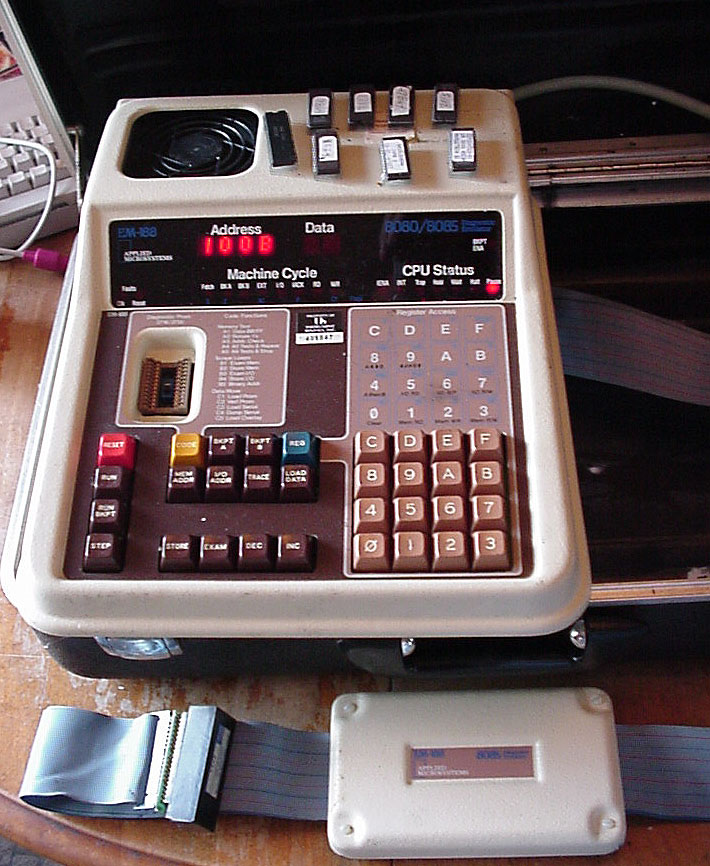
Does anyone know anything about the item above? I've seen these before
but this is the first one that I've found with the pod and this one seems
to work. I've posted a picture at
<http://www.classiccmp.org/hp/app-u-sy.jpg> . I know it's big but I wanted
to capture as much detail as possible.
joe
Has anyone been able to access the site they claimed had it for download?
I've wanted a copy of this since it came out! Does Symantec have their own
download site?
Zane
>
> No wonder has mentioned this, so I thought I would throw it into the Classic
> mixer:
>
> http://slashdot.org/articles/02/01/27/1950244.shtml
> Quote:
> "It seems Symantec (purchasers of former company Quarterdeck) has release
> DeskView/X into public domain and can be downloaded now. DesqView/X was a
Sellam Ismail <foo(a)siconic.com> wrote:
> Oh yeah? Well, I've got the original Hayes modem product: the DC Hayes
> modem for the S-100 bus :)
Hayes made two modems for the S-100 bus. The first (ca. 1978) was the
80-103A, the second was the Micromodem 100 (using the same
Microcoupler as the original Micromodem II for the Apple).
-Frank McConnell
Sellam Ismail <foo(a)siconic.com> wrote:
> I did recall that the Micromodel 100 used the Microcoupler but then I
> remembered the 80-103A didn't. The 80-103A used a device (which I'm now
> forgetting the name of--damn cold) that you had to get from the phone
> company in order to use it, back in the days of Ma Bell who was oh so
> strict and oh so paranoid about what you plugged into her.
DAA, short for Data Access Arrangement.
-Frank McConnell
Nah, you can put Minix on an HP LX palmtop, which is smaller and lighter
than a Poqet (see http://www.technoir.nu/hplx/minix.html).
BTW, Last year Thaddeus had a number (about 4000!) of 1.5MB SRAM cards on
sale (unadvertised) for 5 for $25. Check the message at
http://www.technoir.nu/hplx/hplx-l/0104/msg00231.html.
Bob
-----Original Message-----
From: Christopher Smith [mailto:csmith@amdocs.com]
Sent: Tuesday, January 29, 2002 10:59 AM
To: 'classiccmp(a)classiccmp.org'
Subject: RE: Netscape (was Re: PayPal = payola?)
> -----Original Message-----
> From: David Woyciesjes [mailto:DAW@yalepress3.unipress.yale.edu]
> Well, if I have my way, my Gateway Handbook will be a
> smaller Unix
> box... 10" x 6" x 1.5" ;-)
> And it just squeaks by 10 years old too ( I think, maybe 9...)
I have been thinking about putting Minix on my Poqet PC, which would
probably take the record. ;) I need a 2M SRAM card or two, though.
Chris
Christopher Smith, Perl Developer
Amdocs - Champaign, IL
/usr/bin/perl -e '
print((~"\x95\xc4\xe3"^"Just Another Perl Hacker.")."\x08!\n");
'
> -----Original Message-----
> From: Lawrence Walker [mailto:lgwalker@mts.net]
> On the other hand MY TRS80 5meg HD is bigger than your XT,
> and my pre-Sprint Qume power supply is known to dim lights in
> the neighborhood. And it don't use no steenking, cheating, 220V
> power source.
I read that as "TRS80 Smeg HD" :)
Are you sure you're not exaggerating? TRS-80s themselves wouldn't be that big without the monitor attached. :)
Regards,
Chris
Christopher Smith, Perl Developer
Amdocs - Champaign, IL
/usr/bin/perl -e '
print((~"\x95\xc4\xe3"^"Just Another Perl Hacker.")."\x08!\n");
'
I just picked up a *really cool* 9 track StorageTek drive on Saturday
(thanks Jon!). I'm having trouble trying to find docs for one to indicate
possible diagnostic routine #'s (I've entered all 256 combinations, and
not observed too much interesting). The model number seems to be
something like this (assuming it has a real model #):
4000002383-4
Also, does anyone have a QBus PERTEC card they would be willing to part
with? Or, does anyone know of a source for an ISA or PCI card that is
supported under some sane OS (Winders or Linux preferred)?
-- Pat
Does anyone here have a M200 card reader with the card weight? What I need is
a good picture of the card weight, so I can attempt to obtain one for my
card reader. Yes, there are people who have these card weights available,
but its extremely difficult to describe something I havent seen for 20 years
myself, just using words ;)
-Lawrence LeMay
What is the difference between a Rom 1 and a Rom 3 Apple IIgs?
I have 4 IIgs's sitting in my garage (law of aquisition... I wanted a
IIgs for years, finally bought one, then I get 4 given to me for free!).
It looks like I have two different styles (based on opening the lid and
looking inside), one has a two rom chips, one has one rom chip (among
other differences).
I would guess they are Rom 1 and Rom 3 machines (I can tell by booting
them right? the starting splash tells me? or how is it determined?).
But what is the difference between a Rom 1 and a Rom 3 machine (besides a
Rom 3 being newer I assume). Is one better than the other? What changes
were made to the machines? (from the looks of the logic board, one of the
two styles looks like it might have more ram on board... but maybe they
just used a different chip and needed more of them... I don't know).
Anywhere these details are listed out? I did a google seach, but didn't
see anything fantastically helpful. So I am turning to the logical
starting point to find this stuff out... the experts on classic computer
hardware.
Also, two of the four have a Ram upgrade board in it. All sockets are
filled with chips, so how much Ram is that? 1mb? Or does it depend on the
board and/or the chips (they are Apple branded boards). Are these upgrade
boards usable in any IIgs (rom 1 or rom 3), the slot for it is in both
style logic boards, so I would assume it works for both... but before I
go swapping them around and frying something, I figured I would ask.
TIA
-chris
<http://www.mythtech.net>
>BTW the modern method, which I do not have,
>is to get a digital camcorder with "firewire" and
>the same for your PC, and just download.
>Apparently the camcorder stores in MPEG.
The few times I have done it, I do similar to that. My camcorder has an
anolog to digital passthru. So I can play an analog source (like a VHS
tape), pass it into the camcorder, which passes it along to the firewire
port and into my iMac.
I then just use iMovie to capture it, and then export as Toast VCD
format.
Chews up a bit of space as iMovie only captures in DV format (which is
freaking huge because it is supposed to be lossless), and I also need the
additional space to store the VCD formated MPEG before burning, since I
can't export directly to the burner.
But it works for shorter clips (The longest I have tried is a 7 minute
Tex Avery cartoon... but I could probably do up to an hour or so on my 60
gig drive... not sure)
-chris
<http://www.mythtech.net>
> -----Original Message-----
> From: Christopher Smith
> Hear Hear. Though, I may listen when Athlons have casters
> and a respectable console firmware with "deposit" and
> "examine" commands, at least. Bonus points if you can't get
> them to run windows should your life depend on it.
Ehh -- I never actually had thought this may become necessary, but...
Since there was a somewhat nasty response to the original post which this was in reply, I should state clearly that I'm at least half-joking ;) On the other hand, I _would_ find any system which meets the above requirements more impressive than one that does not.
I'd also like to offer a sincere (and hopefully non-offensive *fingers crossed*) request to all the people on this list who've been having (occasionally personal) flame-wars recently to lighten up some.
Regards,
Chris
Christopher Smith, Perl Developer
Amdocs - Champaign, IL
/usr/bin/perl -e '
print((~"\x95\xc4\xe3"^"Just Another Perl Hacker.")."\x08!\n");
'
I personally get attached to these things, and I have had access to lots of storage space.
So I have every computer I ever owned, and they all work (last time I checked).
The first I ever used was a PDP8-L running FOCAL that someone donated to my high school in 1974.
When I went to another school, the Altair 8800 came out, and I got one right away.
During college and work, I had access to DECs and mainframes.
My next "personal" machine was a Fortune Systems 68000 based unix box.
Then an Apple Mac II
Powermac 6100
Now I am awash in various PCs and Macs.
-Rob
-----Original Message-----
From: Mike Ford [SMTP:mikeford@socal.rr.com]
Sent: Tuesday, January 29, 2002 12:29 PM
To: classiccmp(a)classiccmp.org
Subject: Packrat genome project questions
How many people on this list still have their 1st computer? second? third?
every computer you ever used/owned?
The first computer I ever used was a IBM 360 via punched cards in Fortran.
First I ever sat in front of and worked on directly was an IBM 1130 via
selectric console running a French version of APL.
First I ever owned was a Apple II, which I still have. Same for the next
five I owned/used; Mac Plus, Mac IIx, Mac 7200/90, Starmax 4160, and my
Athlon based PC.
I wonder if anyone can give me suggestions on the "best" way to get data (not
all that much) off of some old 9-track tapes I have. They are all written
with tar, on BSD 4.1-4.3 and BSD 2.8-2.9. If I was smart, the tapes are all
written at 800 or 1600 bpi; I may not have been, and one or more may be at
6250 (?) bpi.
I would be delighted to hear two types of offers: (1) someone in the Denver
area who has the proper hardware and software, and to whom I can bring the
tapes and some other medium (1.4/2.8 meg floppy; 100 meg zip) and extract the
files; (2) someone with the proper hardware and software who would be willing
for me to ship them the tapes, and make the data (tar files) available to me
via ftp. I would certainly entertain other reasonable possibilities, as well.
Thanks in advance. (This must not be a terribly uncommon "problem," right?)
PB Schechter
Got the Handbook all together, no extra parts or screws laying
around, wait a minute...
..except for the darned plastic/foil sleeve that the HDD is supposed to be
in!!! Grrr.....
--- David A Woyciesjes
--- C & IS Support Specialist
--- Yale University Press
--- mailto:david.woyciesjes@yale.edu
--- (203) 432-0953
--- ICQ # - 90581
Mac OS X 10.1.2 - Darwin Kernel Version 5.2: Fri Dec 7 21:39:35 PST 2001
Running since 01/22/2002 without a crash
On January 29, Joe wrote:
> > Hey...On your other auction, the one for the transmission test
> >set...In the leftmost rack in the background, at the top...Would that
> >happen to be a TrueTime GPS, WWVB, or GOES time standard? I think I
> >recognize the color and the rack handle. :)
>
> I have two GEOS time standards but I need antennas for them. Any idea
> where I can find some? cheap? It's a circularly polarized signal so it's
> not your typical antenna.
Nope, I'm looking for one myself. :-( I will let you know if I
find any, but I've all but given up.
-Dave
--
Dave McGuire
St. Petersburg, FL "Less talk. More synthohol." --Lt. Worf
>How many people on this list still have their 1st computer? second? third?
>every computer you ever used/owned?
The only computer I *owned* that I don't still have is my Lisa (it was a
2 I believe). All the others I still have, and are still operational
(although not in use). Although, with the exception of my personal Mac
SE, I can't say for 100% sure that the computers I have are the actual
computers that were at my house growing up. There was much swapping
between home and my father's company, so the ones I now have in my
custody may actually have been company purchased ones, and not the
"original" ones at my house (but they are all the same model... Apple
II+, 128k Mac, Mac Plus and up from there)
In addition, I still have in my custody at least one of every model/type
of computer I have used on a regular basis (I don't count things that I
sat down at somewhere, played with for 5 minutes, and then moved on).
That includes things like an IBM 5110, IBM System 23, IBM PC, XT, AT,
PCjr, Apple IIe, and up from there.
The only things I used on a regular basis that I do NOT own (or more
correctly, have in my custody, as technically I don't own things like the
IBM 5110), are a Commodore PET, a Northstar (Advantage ?), and a Kaypro
II. I doubt I will ever bother getting those (well, maybe a PET) because
I am out of room, and have had to start to narrow down what I
keep/collect... so things like a Commodore 64 was just passed on to
someone else (although, someplace I have two more of them, just not
complete systems like I just gave away... when I dig them up, I will pass
them on as well)
I also don't count things like the numurous, nameless, AT clones that
have passed thru my hands... I lump them all into the "type" catagory, so
my IBM AT counts for all the 286 and AT clones, and I have a 386, 486,
and so on... but like some of the machines I have had to dump do to
space, I will probably cease to worry about those, and narrow it down to
just the ones I consider to be "cool".
-chris
<http://www.mythtech.net>
First computer used: ??, fed it punchcards to do an analysis of Melanesian
blood groups at Harvard grad school, 1972.
First computer owned: Osborne 1, 1981. My wife wanted me to get rid of it,
so I stripped out the insides so my son could fiddle with the boards (he
hasn't, so I still have them intact), and tossed the case. BTW, if anyone
needs parts for an O1, DD, 80 column upgrade, contact me.
2nd computer owned: Otrona Attache 8:16 -- still have (and intend to keep
for a while).
1st PC: An XT-Turbo clone (1986), which I installed in a smaller than normal
cherry-stained plywood box, power supply uncased and hung over the
motherboard, expansion slots running side-to-side rather than front-to-back;
open frame 9" monitor, bare Cherry keyboard. Still have the CPU and
keyboard, tossed the monitor.
Latest computers acquired: Poqet PQ-0181, HP 95LX, HP 200LX (is there a
pattern here?).
Bob
-----Original Message-----
From: Mike Ford [mailto:mikeford@socal.rr.com]
Sent: Tuesday, January 29, 2002 12:29 PM
To: classiccmp(a)classiccmp.org
Subject: Packrat genome project questions
How many people on this list still have their 1st computer? second? third?
every computer you ever used/owned?
The first computer I ever used was a IBM 360 via punched cards in Fortran.
First I ever sat in front of and worked on directly was an IBM 1130 via
selectric console running a French version of APL.
First I ever owned was a Apple II, which I still have. Same for the next
five I owned/used; Mac Plus, Mac IIx, Mac 7200/90, Starmax 4160, and my
Athlon based PC.
Anybody got one for sale?
--- David A Woyciesjes
--- C & IS Support Specialist
--- Yale University Press
--- mailto:david.woyciesjes@yale.edu
--- (203) 432-0953
--- ICQ # - 90581
Mac OS X 10.1.2 - Darwin Kernel Version 5.2: Fri Dec 7 21:39:35 PST 2001
Running since 01/22/2002 without a crash
> ----------
> From: Passer, Michael W.
> Reply To: classiccmp(a)classiccmp.org
> Sent: Tuesday, January 29, 2002 2:10 PM
> To: classiccmp(a)classiccmp.org
> Subject: RE: TV tuner cards... [was: RE: hey"!]
>
> I've done it with an Atari 2600. Works great (this was with a Gateway
> OEM Bt848 card.)
>
> --Michael
>
> -----Original Message-----
> From: David Woyciesjes [mailto:DAW@yalepress3.unipress.yale.edu]
> Sent: Tuesday, January 29, 2002 12:41 PM
> To: 'classiccmp(a)classiccmp.org'
> Subject: TV tuner cards... [was: RE: hey"!]
>
>
> ! -----Original Message-----
> ! From: Gareth Knight [mailto:gknight@emugaming.com]
> !
> ! Simon wrote:
> ! > Please say me, how it works! I want to convert my VHS into
> ! > mpg-Files, but it
> ! > doesn't work, only the Convertion of mpg to VHS works.
> !
> ! For low-end conversion from VHS to MPG you can use a cheap TV
> ! card, such as
> ! those made by Pinaccle or Hauppage. This will allow you to
> ! view the analog
> ! signal of your video and record it as an AVI or MPG. I recommend !
> http://www.tv-cards.com/ for more information ! -- ! Gareth Knight
>
> You know, I should pick up one of those, so I can have a display
> for my C128 (and Atari800) on my Win98 box. Finally put it to something
> useful...
> Seriously, is anyone else doing that?
>
> --- David A Woyciesjes
> --- C & IS Support Specialist
> --- Yale University Press
> --- mailto:david.woyciesjes@yale.edu
> --- (203) 432-0953
> --- ICQ # - 905818
>
>
I wrote :
>There's a bunch of manuals up already at:
> http://208.190.133.201/decimages/moremanuals.htm
>
>I've already let them have a few more ... the install
And now that I look, it seems
that the latest stuff I sent popped
up today! So the HW UG, Diag guide
and one (of the many?) install guides
are now there.
(I should point out that all I
did was scan them - the credit
goes to Alain Nierveze who
photocopied them and posted
them my way).
Antonio
> On Tue, 29 Jan 2002, David Woyciesjes wrote:
> >
> > I wonder, what kind/size drive is in there? Can it be upgraded?
>
> ----------
> From: Doc
>
> AFAIK, standard 2.5" IDE. John ain't shy about disassembling his
> toys, and the last resort idea was to pull the hdd, put it in a
> desktop, install Linux, and put it back, so I bet it's IDE.
>
> ----------
> From: David Woyciesjes
>
> Hmmm, Probably could stick it into my Multia, which could run NT from a
> SCSI drive, stick stuff on that way. Hey, if it's a standard 2.5" IDE
> (a.k.a. laptop) drive, what's stopping us from sticking in something
> bigger capacity? I can't remember what the HDD size limit is in DOS 5.0...
>
> ----------
Well, I got curious and cracked mine open...
According to the User's Guide, it is IDE. And it is 2.5" size. Except one
neat difference. To take care of the height restriction inside the case,
they moved the drive controller board to _behind_ the drive, taken out from
under it...So now it's physical size is 2.75" x 0.375"(3/8") x 6". Looks
like just a special board, on a standard drive case. BTW, it's a JVC Model
JDF2042M10-1. I'll have to Google that later, and see if I can find more
info...
--- David A Woyciesjes
--- C & IS Support Specialist
--- Yale University Press
--- mailto:david.woyciesjes@yale.edu
--- (203) 432-0953
--- ICQ # - 90581
Mac OS X 10.1.2 - Darwin Kernel Version 5.2: Fri Dec 7 21:39:35 PST 2001
Running since 01/22/2002 without a crash
> -----Original Message-----
> From: ard(a)p850ug1.demon.co.uk [mailto:ard@p850ug1.demon.co.uk]
> OK, Neutral, Live (or Line) and Earth (or Ground).
Ok, thanks for the correction on this, by the way.
> What colour are the 3 loose wires ? Try one of the following
> colour sets
> :
> US Old UK New UK/European/International?
> Earth Green Green Green/Yellow
> Neutral White Black Blue
> Live Black Red Brown
I think it's actually blue, brown, and white. Blue being neutral,
brown live, and white earth, it seems. I could take the panel off
and check, but I'm not at home right now.
> Of course it might be something non-standard, but if those are the
> colours, it's a good bet that's how they're used.
Very close to the third option above, but not quite. Maybe it's a
really pale yellow ;)
> wrong term (again, no meaning for 'positive' with AC), but
> you've come to
> the right conclusion.
Well, I guess it's better to sound inexperienced than to make things
explode. :)
> That's how I'd wire it... Never seen one, though, so I can't
> be _certain_
Well, we're in nearly the same boat here. This is the only
one I've seen, and it has all the wires loose. ;)
Thanks again,
Chris
Christopher Smith, Perl Developer
Amdocs - Champaign, IL
/usr/bin/perl -e '
print((~"\x95\xc4\xe3"^"Just Another Perl Hacker.")."\x08!\n");
'
On January 29, Huw Davies wrote:
> > > There is something to be said for not just trying to
> > > run on everything under the sun - and that directly translates into
> > > stability of the OS.
> >
> >So, suddenly windows runs stable, just because they support x86 only ?
>
> Well NT on Alpha was significantly more stable than NT on Intel mainly
> because there were only a limited number of supported (or even available)
> configurations. What amazes me about Windows is not that it crashes often
> but that it runs at all given the mix of hardware that it attempts to support.
The BSDs and Linux support tons of hardware too...and they're more
stable than windows will ever be.
I think the simple fact remains...windows just sucks.
-Dave
--
Dave McGuire
St. Petersburg, FL "Less talk. More synthohol." --Lt. Worf
>"tatty polys"? It sounds British, but I have no idea what it is.
tatty (adj.) - in less than pristine condition
polys (n.) - white polystyrene inserts in the box
used to stop your tiny games console from
flying around an oversized box during transportation
Personally I'm more worried about working
contents rather than the MIB stuff.
HTH,
Antonio
> ----------
> From: Doc
>
> On Tue, 29 Jan 2002, David Woyciesjes wrote:
> >
> > I wonder, what kind/size drive is in there? Can it be upgraded?
>
> AFAIK, standard 2.5" IDE. John ain't shy about disassembling his
> toys, and the last resort idea was to pull the hdd, put it in a
> desktop, install Linux, and put it back, so I bet it's IDE.
>
Hmmm, Probably could stick it into my Multia, which could run NT from a SCSI
drive, stick stuff on that way. Hey, if it's a standard 2.5" IDE (a.k.a.
laptop) drive, what's stopping us from sticking in something bigger
capacity? I can't remember what the HDD size limit is in DOS 5.0...
> > It is a Neat Thing, isn' tit? Let me know if I can be of help. I have
> the
> > null modem cable, floppy drive, 2 power supplies...
>
> Didn't know there was a floppy option available.... But that would be
> cheating. The challenge that started the flame war (which, of course, I
> avoided completely... not) was how to make it boot a Linux kernel &
> pcmcia drivers without floppy drive or CD....
>
> Doc
>
Yep. The floppy plugs into the funny looking parallel port in the back of
the Handbook, and gives you a regular parallel port, and a second serial
port. I also have the battery pack that holds 6 AA batteries to power it. My
two NiCd battery packs for it are dead though... Can't hold a charge really
anymore. One shows a red light, instead of the amber "charging" or green
"charged" light.
--- David A Woyciesjes
--- C & IS Support Specialist
--- Yale University Press
--- mailto:david.woyciesjes@yale.edu
--- (203) 432-0953
--- ICQ # - 90581
Mac OS X 10.1.2 - Darwin Kernel Version 5.2: Fri Dec 7 21:39:35 PST 2001
Running since 01/22/2002 without a crash
On January 28, Bruce Lane wrote:
> Ok, I admit it's a shameless ad. I'm sending it here because I know some of you are into the older HP calculators.
>
> I've put the magnetic card reader (Can it write as well?) for an HP-41C up on Ebay. Link here if you're interested.
Yes, it can indeed write cards as well. I really like these little
buggers. An especially neat feature is the program translation trick
they can do whilst reading HP67/HP97 program cards. :-)
-Dave
--
Dave McGuire
St. Petersburg, FL "Less talk. More synthohol." --Lt. Worf
On January 27, Gary Hildebrand wrote:
> Wonder what the dimple is for? should be able to use a standard IEC
> connector cord with heay gauge wire. Can't believe that thing is that
> big of a juice hog. Electric heaters draw about that much power.
There are three "standard" IEC power connectors...there's the one
we're all used to, the one with the dimple (higher current) and a
larger square one (still higher current).
-Dave
--
Dave McGuire
St. Petersburg, FL "Less talk. More synthohol." --Lt. Worf
Sellam Ismail <foo(a)siconic.com> wrote:
> I skipped over this thread because I saw Richard's name all over it, but
> had I know this is what the argument was about, I could have pointed to
> maybe 3 or 4 S-100 machines circa the late 1970's in my collection that
> use BNC for video.
Yeah. If only folks would keep the subject line in sync with what
they're arguing about, scorefiles would work a whole lot better.
I'm certain I've seen Processor Technology SOLs with SO-259
connectors. I think I've seen at least one with a BNC connector (and
recall being surprised to find that it wasn't an adapter), but even if
I have I'm not sure what this proves, SOLs and other '70s micros being
purchasable as kits, and I'm sure at least some of the pre-assembled
ones were owned by people of soldering skill who would change the
connector if it suited them to do so.
-Frank McConnell
Hi
I am happy to announce my new baby: thanks to Jon Auringer of
Astronautics and Merle Pierce of RICM, I have now a VAX 11/780
in my garage. Nice cabinet, with UNIBUS extension and a TE16
drive (looks nice but will I ever sacrifice a 25A circuit just
for it?).
Inside the VAX are KA780, UBA, MS780 (8 MB) and 2 MBAs. In the
UNIBUS cabinet are two DZ-11, an INTERLAN BD-NI 1010, an
M8716 (general purpose parallel), and a "CBV inc" (?)
"MODEL-215 DMA Option" (two 4-wide boards with additional
cable between them, to a 3-row D connector that looks a
bit like my KLESI connector ... any idea what that might be?).
More UNIBUS stuff: Datasystems LP 11/32 (parallel printer)
a few grants (I need to learn UNIBUSology to understand how
this can work.) I have spare DZ-11, just in case someone is
in need.
The last board is a 919 UNIBUS connector with long cable
connecting into another drawer. That one is a backplane of
unknown nature. It has one card to play the UNIBUS adapter,
then a whole bunch of MEGATEK cards all together making up
a frame-buffer and digitizer assembly that was used for
a SCICARDS circuit layout system. Any shred of information
about this would be appreciated. I don't think its UNIBUS or
QBUS (no grants between the two clusters of cards.)
Now, since I want to use this VAX to upgrade to an 11/785,
I still need a KA785 CPU backplane. The worst beaten-up
machine that you see in your neighbor's dumpster will do
for screwing those pieces off. Unfortunately they are
all too often forgotten.
But I will first go with the 11/780 setup to gain the
feeling for this class of machine.
I have some documentation and probably a full set of
diagnostics floppies. If anyone needs, I'll be happy to
help out ... of course I first need to get the machine
going to read the floppies.
I am looking for info on the CI installation. I have the
CI boards but no clue about cab-kit stuff. Was hoping
to use parts of the CIBCA cab kit stuff to build one.
I am also looking for a source of FP780 boards, mine had
no floating poing option installed. I have the additional
PSU, but no cabling for the PSU to the backplane and of
course no FP780 cards. (I have FP785 cards, but they
don't mix.)
Finally I'm contemplating to build a dual processor machine
if I can gather the parts for it. All I need is a CPU
extension cabinet, a second KA780 or 785 CPU set and bits
and pieces from other VAX 11/78x backplanes (SBI cabling,
mounting stuff etc.) Apparently the Purdue guys have
done that very successfully in 1981, and the only reason
this wasn't an SMP setup appears to be that 4.1 BSD
didn't do SMP. I would imagine that one could hack
NetBSD to run a dual 11/78x. (That's not an 11/782 or /787,
DEC did that differently.) So, if you have a spare
extension cabinet, backplane, CPU boards, PSUs, card cage,
card rails, cables, even the meanest nag, let me know.
I am slowly switching from an ackquisition frenzie to
maintenance mode. I seem to have most of what I can
reasonably want and fit into my house. Now it's time to
get it all going well. If I have things running by
Summer, I'm thinking of throwing a VAX-Party. But it
may take me until next year.
I have given my 6000-520 and second SA600 and second
HSC90 to Merle from RICM. I still have a TU81PLUS and
a Dataproducts printer to give away. Probably
also two terminals (VT 420 or so).
regards,
-Gunther
--
Gunther Schadow, M.D., Ph.D. gschadow(a)regenstrief.org
Medical Information Scientist Regenstrief Institute for Health Care
Adjunct Assistant Professor Indiana University School of Medicine
tel:1(317)630-7960 http://aurora.regenstrief.org
! From: Doc [mailto:doc@mdrconsult.com]
!
!
! On Tue, 29 Jan 2002, David Woyciesjes wrote:
!
! > Doc ---
! > Well, if I have my way, my Gateway Handbook will be a
! > smaller Unix box... 10" x 6" x 1.5" ;-)
! > And it just squeaks by 10 years old too ( I think, maybe 9...)
!
! Funny you should mention that. I'm supposed to pick up a Handbook
! this weekend, to see about installing Linux without removing
! the drive....
I wonder, what kind/size drive is in there? Can it be upgraded?
! I'd *really* like to have a Handbook of my own. Classic or not,
! they're Way Too Cool (tm). Hopefully, by the time I'm done
! with John's, I'll be affluent again.
It is a Neat Thing, isn' tit? Let me know if I can be of help. I have the
null modem cable, floppy drive, 2 power supplies...
--- David A Woyciesjes
--- C & IS Support Specialist
--- Yale University Press
--- mailto:david.woyciesjes@yale.edu
--- (203) 432-0953
--- ICQ # - 905818
! -----Original Message-----
! From: Gareth Knight [mailto:gknight@emugaming.com]
!
! Simon wrote:
! > Please say me, how it works! I want to convert my VHS into
! > mpg-Files, but it
! > doesn't work, only the Convertion of mpg to VHS works.
!
! For low-end conversion from VHS to MPG you can use a cheap TV
! card, such as
! those made by Pinaccle or Hauppage. This will allow you to
! view the analog
! signal of your video and record it as an AVI or MPG. I recommend
! http://www.tv-cards.com/ for more information
! --
! Gareth Knight
You know, I should pick up one of those, so I can have a display for
my C128 (and Atari800) on my Win98 box. Finally put it to something
useful...
Seriously, is anyone else doing that?
--- David A Woyciesjes
--- C & IS Support Specialist
--- Yale University Press
--- mailto:david.woyciesjes@yale.edu
--- (203) 432-0953
--- ICQ # - 905818
-----Original Message-----
From: Darthsimon(a)aol.com [mailto:Darthsimon@aol.com]
> VHS to mpg, how does it work????
By converting the analog signal of the VHS recorder to a
digital interleaved audio/video signal, and applying one of
the MPEG compression algorithms. :)
Regards,
Chris
Christopher Smith, Perl Developer
Amdocs - Champaign, IL
/usr/bin/perl -e '
print((~"\x95\xc4\xe3"^"Just Another Perl Hacker.")."\x08!\n");
'
I've done it with an Atari 2600. Works great (this was with a Gateway
OEM Bt848 card.)
--Michael
-----Original Message-----
From: David Woyciesjes [mailto:DAW@yalepress3.unipress.yale.edu]
Sent: Tuesday, January 29, 2002 12:41 PM
To: 'classiccmp(a)classiccmp.org'
Subject: TV tuner cards... [was: RE: hey"!]
! -----Original Message-----
! From: Gareth Knight [mailto:gknight@emugaming.com]
!
! Simon wrote:
! > Please say me, how it works! I want to convert my VHS into
! > mpg-Files, but it
! > doesn't work, only the Convertion of mpg to VHS works.
!
! For low-end conversion from VHS to MPG you can use a cheap TV
! card, such as
! those made by Pinaccle or Hauppage. This will allow you to
! view the analog
! signal of your video and record it as an AVI or MPG. I recommend !
http://www.tv-cards.com/ for more information ! -- ! Gareth Knight
You know, I should pick up one of those, so I can have a display
for my C128 (and Atari800) on my Win98 box. Finally put it to something
useful...
Seriously, is anyone else doing that?
--- David A Woyciesjes
--- C & IS Support Specialist
--- Yale University Press
--- mailto:david.woyciesjes@yale.edu
--- (203) 432-0953
--- ICQ # - 905818
Please say me, how it works! I want to convert my VHS into mpg-Files, but it
doesn't work, only the Convertion of mpg to VHS works.
Thank you for your answer,
Roman
(please not so hard english because I'm from germany....)
> -----Original Message-----
> From: Cameron Kaiser [mailto:spectre@stockholm.ptloma.edu]
> running WinCE, connected via Citrix to a Win2K Advanced
> Server host. There
> are only a few "real" PCs there -- in fact, I think the Macs
> might outnumber
> them.
> Before all of you cry off-topic, doesn't it seem odd to
> anyone we're now
> full circle and back to low-power terminals connected to a
> "mainframe," now
Since when is a "Win2k Advanced Server host" a mainframe? :)
That aside, though, no, it doesn't seem odd at all. It's
certainly The Right Thing To Do, WRT administrative overhead,
and maintenance/repair cost.
Strange, possibly that corporate america is starting to do
the right thing. That's never happened before, to my knowledge.
> Compared to the WinTerms, my old Wyse terminal looks so nice.
Especially when you consider that it won't run windows. :)
Regards,
Chris
Christopher Smith, Perl Developer
Amdocs - Champaign, IL
/usr/bin/perl -e '
print((~"\x95\xc4\xe3"^"Just Another Perl Hacker.")."\x08!\n");
'
> -----Original Message-----
> From: Gunther Schadow [mailto:gunther@aurora.regenstrief.org]
> I am happy to announce my new baby: thanks to Jon Auringer of
> Astronautics and Merle Pierce of RICM, I have now a VAX 11/780
> in my garage. Nice cabinet, with UNIBUS extension and a TE16
> drive (looks nice but will I ever sacrifice a 25A circuit just
> for it?).
Congratulations. Remember to put the stabilizers down before you open the doors ;)
Regards,
Chris
Christopher Smith, Perl Developer
Amdocs - Champaign, IL
/usr/bin/perl -e '
print((~"\x95\xc4\xe3"^"Just Another Perl Hacker.")."\x08!\n");
'
> -----Original Message-----
> From: Tothwolf [mailto:tothwolf@concentric.net]
> White isn't a standard ground wire color. Maybe someone
> changed something
> in your machine at some point? Green is a standard ground
> wire color in
> the US, while Green with a yellow stripe meets international
> standards.
> I've seen blue/brown/white used for 240V ungrounded
> twist-lock connectors
> before, but I'm certain these machines require 120V at 20A.
Again, that's just from memory, and I could be way off...
> I'm going to attempt to uncover one of my machines today and snap some
> pics for you.
Great. Thanks.
Chris
Christopher Smith, Perl Developer
Amdocs - Champaign, IL
/usr/bin/perl -e '
print((~"\x95\xc4\xe3"^"Just Another Perl Hacker.")."\x08!\n");
'
> -----Original Message-----
> From: David Woyciesjes [mailto:DAW@yalepress3.unipress.yale.edu]
> Well, if I have my way, my Gateway Handbook will be a
> smaller Unix
> box... 10" x 6" x 1.5" ;-)
> And it just squeaks by 10 years old too ( I think, maybe 9...)
I have been thinking about putting Minix on my Poqet PC, which would
probably take the record. ;) I need a 2M SRAM card or two, though.
Chris
Christopher Smith, Perl Developer
Amdocs - Champaign, IL
/usr/bin/perl -e '
print((~"\x95\xc4\xe3"^"Just Another Perl Hacker.")."\x08!\n");
'
> -----Original Message-----
> From: Ethan Dicks [mailto:erd_6502@yahoo.com]
> I know it's not what you want to hear, but they really were
> disposable.
> Expensive, but disposable. I think people might have swapped switches
> if they were physically broken (keystems snapping off or the leaves in
> the switches getting bent from vigorous keytop insertion),
> but I do not
> have a single memory of anyone attempting electronic repair
> 20 years ago.
Not what I was hoping to hear, you're right, but it's what I was expecting.
Thanks again.
Chris
Christopher Smith, Perl Developer
Amdocs - Champaign, IL
/usr/bin/perl -e '
print((~"\x95\xc4\xe3"^"Just Another Perl Hacker.")."\x08!\n");
'
>way cool!! 780, wow thats a cool piece of hardware!
Indeed!
>i have the installation manuals for the CI780. I can mail them to you.
>Maybe when youre done if you send them on to whoever has been scanning
>stuff in and putting it online, that would be cool..
There's a bunch of manuals up already at:
http://208.190.133.201/decimages/moremanuals.htm
I've already let them have a few more ... the install
manual (or at least one version of it is in
on its way there now IIRC). I'll dig out the
numbers for 780 stuff in that pending batch -
save you scanning something that's already been
done!
Antonio
arcarlini(a)iee.org
> -----Original Message-----
> From: Lawrence Walker [mailto:lgwalker@mts.net]
> While passwords may be necessary in a business environment,
> they are a real pain to home-based single users or following owners.
They provide a little extra privacy from prying eyes. Of course, there
is no password that can't be circumvented somehow, given access to the
console, or, in a worst case, the system itself.
> I mean, really, I'm in the middle of nowhere in northern Manitoba,
> in a house where I live alone with a protective dog, and only hook up
> to my ISP when I want to access it. Do I need this ? But even my
You could turn it off. :)
> NEXT demands a password and I had to do an extensive search to find
> out how to re-do the original one. But of course the holy grail of
> computer makers is that BIG contract.
Any unix I've ever met will let you blank the password out... it will
still ask for it, but you can just hit return.
> complicate my life. I thought that that's one of the things
> that computers
> were for. To uncomplicate tasks and processes. On my computers
Certainly they make higher math and weather modeling much easier. ;)
> I DON"T NEED NO STEENKING PASSWORDS.
> Windblows is the least of the transgressors. The UNIX type
> are the worst
> since they grew up in a security-conscious business environment.
Lots of unixes even have an "auto-login" feature.
> Right now after going thru a difficult Linux Red-Hat install
> I can't find the
> slip I wrote the password it insists upon, and must do a
> fresh install.
Actually you may be able to boot in single user mode without a
password. Try it.
> Fuck it, I'll reformat and look at another OS.
> I believe that OS's or programs that don't provide
> non-password access
> should be boycotted.
Well, again, just because it asks for a password, doesn't mean you've
got to use one...
> Do these guys really think that passwords can protect their data if
> they don't have physical access protection ? We all know that even
> supposedly deleted files can be ressurected. This is SUIT mentality
> and they live in an imaginary world that they proclaim is the BOTTOM
> LINE, realistic view of things. As MS has learned to it's
> chagrin every
> man-made "security" feature can be end-run by some bright young
> hacker.
Um, well, certainly any MS security feature can be circumvented by a
blindfolded, dyslexic baboon. :)
You are also right that there is a way around any security control,
given physical access to the system. That really isn't the point of
software security, though.
I do realize that you are likely to be ranting due to frustration, but
if nothing else, try blanking out some of your passwords and
save yourself some of that trouble. :)
Regards,
Chris
Christopher Smith, Perl Developer
Amdocs - Champaign, IL
/usr/bin/perl -e '
print((~"\x95\xc4\xe3"^"Just Another Perl Hacker.")."\x08!\n");
'
Thanks--I have heard from 3 people in the general vicinity. The one who replied
first will also probably get my old Rainbow, just "thrown in."
I'm delighted with how "common" 9-track drives (and, presumably, ones connected
to UNIX machine) seem to be. I haven't seen one in years, although I haven't
hung out in computer rooms the way I used to, either....
--pb
> -----Original Message-----
> From: pete(a)dunnington.u-net.com [mailto:pete@dunnington.u-net.com]
> "4", etc. If
> only the keyboard test fails, the terminal should go online
> in receive-only
> mode (ie it's useful as a display).
It does that... :) Would like to type things, though.
Chris
Christopher Smith, Perl Developer
Amdocs - Champaign, IL
/usr/bin/perl -e '
print((~"\x95\xc4\xe3"^"Just Another Perl Hacker.")."\x08!\n");
'
> -----Original Message-----
> From: Lawrence Walker [mailto:lgwalker@mts.net]
> TRS80s. Mini and
> micro people would be all over each other. And I would be in
I don't imagine that would be the case. I think most people on
the list are diverse enough to appreciate both.
> a minus rating
> because of my non-industry ignorance. Then how would I get
> help in simple
> repair tasks for my collection ?
... and everyone's ignorant of some things. Life would be
boring if you had nothing left to learn.
On the other hand, you're right that it's probably a bad idea --
just not for those reasons ;)
Regards,
Chris
Christopher Smith, Perl Developer
Amdocs - Champaign, IL
/usr/bin/perl -e '
print((~"\x95\xc4\xe3"^"Just Another Perl Hacker.")."\x08!\n");
'
> -----Original Message-----
> From: Brian Chase [mailto:vaxzilla@jarai.org]
> On Mon, 28 Jan 2002, Christopher Smith wrote:
> > I'm pretty sure your RT counts on at least the point of having a
> > proper system monitor, though. :) Honestly, I don't have many
> > machines with wheels, myself.... I have two now, and a few that
> > _should_ have wheels, but don't, which may also count... Gotta get
> > one of those nice BA-123s for one of my MicroVAXen.
> Would that be with or without the naked woman option?
Well -- a fiancee could be... um... converted -- into a "naked woman
option..." She has her own VAX even, but it's a VAXStation 2000, which
doesn't have any wheels.
Right now, though, there are no nude women on my VAXen.
Regards,
Chris
Christopher Smith, Perl Developer
Amdocs - Champaign, IL
/usr/bin/perl -e '
print((~"\x95\xc4\xe3"^"Just Another Perl Hacker.")."\x08!\n");
'
An update on that HP system.
It seems the pinout I had for the console cable is completely
off. :) (Great!)
I did manage to find the send and receive pins and get those
plugged in, so I have a console connection.
Anyway, the point of this is -- nobody use that last pinout.
I got an offer before from somebody who has one of these, and
was willing to check how the cable works. I will try to obtain
a complete, corrected pinout. ;)
Regards,
Chris
Christopher Smith, Perl Developer
Amdocs - Champaign, IL
/usr/bin/perl -e '
print((~"\x95\xc4\xe3"^"Just Another Perl Hacker.")."\x08!\n");
'
On January 28, Bruce Lane wrote:
> Ok, I admit it's a shameless ad. I'm sending it here because I know some of you are into the older HP calculators.
>
> I've put the magnetic card reader (Can it write as well?) for an HP-41C up on Ebay. Link here if you're interested.
Hey...On your other auction, the one for the transmission test
set...In the leftmost rack in the background, at the top...Would that
happen to be a TrueTime GPS, WWVB, or GOES time standard? I think I
recognize the color and the rack handle. :)
-Dave
--
Dave McGuire
St. Petersburg, FL "Less talk. More synthohol." --Lt. Worf
>
> > IBM docs really are very good and complete - probably more so than
> > anyone else's. They are a pain in the neck to read, unless you can
> > speak the language.
Speaking of which...
I have a stack of /36 docs that I'd like to part with. I have not looked
through all the DOCs but believe the list is accurate. According to the list
on the box(s), these are the DOCS:
The system/36 Library
Using the Async Comm support
RPG II messages
Source Entry Utility guide
Utilities messages
Operating your system 5360, 5362
Communications and System Management Guide
System 36 Distributed Data management guide
Sort Guide
Data File utility Guide
Using system/36 Communications
Interactive Communications Feature: guide and Examples
System messages
Programming with RPG II
Interactive Communications Feature: Reference
System /34 to System /36 migration aid
Creating Displays: Screen Design aid and system Support program
Concepts and Programmers Guide
System /36 - system reference
Setting up your computer: 5360
Installing you new features: 5362
Performing first configuration: 5360
Operating your computer
System porblem determination 5362
Changing system configuration
Guide to Publications
Converting your /34 to /36
Procedures and Commands Summary.
Some of the DOCs are showing wear while others are in excellent condition.
Overall, I rate their condition as very good.
I'd guess the total weight of the DOCs is around 45 lbs.
Because of my curent financial situation, I cannot give them away. However,
I will consider REASONABLE offers on this library.
If anyone is interested, send me a message offline and we'll discuss.
See ya,
SteveRob
_________________________________________________________________
Get your FREE download of MSN Explorer at http://explorer.msn.com/intl.asp.
Check out Chicago Miniature Lamp. They seem to be
one of the only remaining manufacturers of tiny
incandescent lamps.
http://www.sli-lighting.com/cml/index.cfm
I've found it hard to find distributors
who'll sell fewer than 100 lamps, though.
Brian
=-=-=-=-=-=-=-=-=-=-=-=-=-=-=-=-=-=-=-=-=-=-=-=-=-
=-=-=-
_| _| _| Brian Knittel / Quarterbyte Systems,
Inc.
_| _| _| Tel: 1-510-559-7930 Fax: 1-510-525-
6889
_| _| _| Email: brian(a)quarterbyte.com
_| _| _| http://www.quarterbyte.com
At 05:53 AM 1/28/02 -0800, Ethan wrote:
> I'm restoring some pre-TTL DEC stuff (R and W series logic) and I need
> a handful of front panel bulbs. Unlike the later bulbs with a plastic
> base and strong wires to solder to the PCB or to plug into socket pins,
> these are like a kernel of corn, with two fine wires coming out of the
> glass envelope at a slight angle with no supports of any kind.
Sounds like a standard T1_1/2 (about 3/16" diameter) or T1_3/4 (about 1/4"
diameter) wire-ended bulb. There are still a few companies that make them.
> If DEC was underfeeding these bulbs to extend their life, I would expect
> that the bulb should be rated at 14V-16V. I measured slightly over 12VDC
> in circuit, but well within a 5% tolerance.
The Farnell catalogue lists a few that are 14V. The correct bulbs for my
RL02 drives are 14V, fed from a 12V supply, as you say.
> I have checked the online manuals I could find, but no mention is made
> of the nature of the bulbs for 1966/1967-era DEC equipment. Any ideas?
Take a look at Farnell's online catalogue, at
http://uk1.farnell.com/Search/search4-frame.jhtml?_DARGS=%2Fcommon%2Fprodse…
and search for part number 328900. That should get a page with a small
picture; click on the image to get a table showing the charcteristics of
that family and a bigger picture
(http://uk1.farnell.com/Search/level_5.jhtml?PRODID=37469&SKUID=35454).
Part number 3159346 will show you a different make (but only 12V). At
least you'll be able to see if that's the right shape/size and perhaps help
find a US manufacturer or supplier if you don't want to order from the UK.
BTW, if you try part number 316216 you'll find something like the bi-pin
ones for your PDP-8 panel.
--
Pete Peter Turnbull
Network Manager
University of York
I got a uPDP-11 today, but the white front cover and the brown
front panel bezel (the thing that says micro pdp-11), and the
foot are all broken...
Anybody got spares? Name your price...
Clint
On January 29, Gunther Schadow wrote:
> I am happy to announce my new baby: thanks to Jon Auringer of
> Astronautics and Merle Pierce of RICM, I have now a VAX 11/780
> in my garage. Nice cabinet, with UNIBUS extension and a TE16
> drive (looks nice but will I ever sacrifice a 25A circuit just
> for it?).
Oh My. I *really* like TE16 drives. They'll run on much less than
a 25A circuit, though...Years ago, I ran a TE16 and a PDP11/34a with
two RL01s on a 15A circuit. It was tight, but it ran.
-Dave
--
Dave McGuire
St. Petersburg, FL "Less talk. More synthohol." --Lt. Worf
On January 28, Tothwolf wrote:
> > Watch it - IBM still sells stuff like this, and might get angry.
> > Remember, the S/370 architecture is still very much in use today.
>
> Really? These seem to be ancient, and seem to have been well taken care
> of. I'll check them later and see what their dates were. I can't imagine
> them still being in print :)
Their current mainframe architecture is based on, and largely
compatible with, the S/370 architecture. And there are a LOT of very
old actual S/370s still in use.
-Dave
--
Dave McGuire
St. Petersburg, FL "Less talk. More synthohol." --Lt. Worf
Hi all
While cleaning up and tossing stuff I found a Micron Exceed video card for
MAC Se/30.
This was gonna go into garbage...but I looked it up and saw that it could be
considered rare (...) and perhaps I should not thrash it and get it to
someone who can appreciate it.
I am not a big ebay-er seller or buyer, so I am offering it here. Trade
offers, no $. I saw these going for $60 to $500 depending on model (!!???)
I am looking for SGI and SUN equip...
Its model no 306-48. Searching www says its for 640 x 480 external VGA on a
Se/30 also works on a IIsi (?).
I have the card only, not the cable or connector for the monitor but the
connector is a 6 X 2 pin common IDC connector and it would be easy to make a
cable...
Card is untested but it looks fine...I can send you a pic...I remember
sticking it a Se30 way back and computer worked but did not test card video
output...
Contact me by email.
Claude
http://computer_collector.tripod.com
> -----Original Message-----
> From: Brian Chase [mailto:vaxzilla@jarai.org]
> On Thu, 24 Jan 2002, Roger Merchberger wrote:
> > Hell, *everything* I do is fast -- Winders & Linux!
> [[ahem... I have a
> > dual-processor Athlon MP 1600+ -- dual SCSI, dual LAN,
> etc... so I realize
> > this isn't a fair fight... ;-) ]]
> You're not gonna impress anyone on this list with that candy-pants
> quiche-eating system. You can start to get our attention by get a
> computer that weighs more than you. Or barring that, we'll respect
> you more if your system doesn't have floating point instructions,
> or an integer divide, or even an integer multiply.
Hear Hear. Though, I may listen when Athlons have casters and a respectable console firmware with "deposit" and "examine" commands, at least. Bonus points if you can't get them to run windows should your life depend on it.
Regards,
Chris
Christopher Smith, Perl Developer
Amdocs - Champaign, IL
/usr/bin/perl -e '
print((~"\x95\xc4\xe3"^"Just Another Perl Hacker.")."\x08!\n");
'
Ok, I admit it's a shameless ad. I'm sending it here because I know some of you are into the older HP calculators.
I've put the magnetic card reader (Can it write as well?) for an HP-41C up on Ebay. Link here if you're interested.
http://cgi.ebay.com/aw-cgi/eBayISAPI.dll?ViewItem&item=1327909730
Thanks for putting up with my occasional ads.
-=-=-=-=-=-=-=-=-=-=-=-=-=-=-
Bruce Lane, Owner & Head Hardware Heavy,
Blue Feather Technologies -- http://www.bluefeathertech.com
ARS KC7GR (Formerly WD6EOS) since 12-77 -- kyrrin(a)bluefeathertech.com
"I'll get a life when someone demonstrates that it would be superior
to what I have now..." (Taki Kogoma, aka Gym Z. Quirk)
On January 28, Doc wrote:
> > > > > Yup, that's it! Anyone claimed it yet? I'd like it for my RT.
> > > > > I think, therefore I am dangerous
> >
> > > > Well, I fired off an email asking for it Saturday, and haven't heard
> > > > back. So, I hope *I* got first dibs....
> >
> > > Me too. We could all meet somewhere and fight for it. :)
> >
> > Can I put money on the fight so I can buy it from the winner?
>
> So that's 4 of us that have functional RT's but no meese, right? I
> have to assume you guys got keyboards, since the docs say the beast
> won't boot to a serial terminal.
Yup, I have a keyboard.
> The question, since I'm pretty ignorant of X11-pre-R6, is if I install
> the X11 & AIXWindows packages, will the RT speak XDMCP to a Linux or
> NetBSD X-terminal? Or heck, even my X-Station 150?
> Inquiring minds gotta know. I'm not loadin all that krap without
> either a mouse or remote access to the AIXWindows desktop. I'm
> *dreaming* of 5.25" floppies.
I'd be surprised if it didn't work. XDMCP has been around a
while...I don't remember what release of X it made its debut in, but I
was running XDMCP with X-terminals (Sun3/50s and XKernel) nearly ten
years ago...RTs weren't nearly so old then. I'll be at least some
useful X can be built on an RT, depending on the OS. Probably X11R4.
-Dave
--
Dave McGuire
St. Petersburg, FL "Less talk. More synthohol." --Lt. Worf
> I started internal medicine rotation at the Loma Linda VA Hospital today
> and noted that the entire place is crawling with WinTerms (by Wyse, no less),
> running WinCE, connected via Citrix to a Win2K Advanced Server host. There
> are only a few "real" PCs there -- in fact, I think the Macs might outnumber
> them.
On a slightly related note, has anyone seen a VNC Terminal yet? I got an
add for them a while back. While they're basically the same thing as a
WinTerm, they strike me as being more usable as VNC is better supported than
WinFrame.
> Before all of you cry off-topic, doesn't it seem odd to anyone we're now
> full circle and back to low-power terminals connected to a "mainframe," now
> that corporate America has gotten off its fat client kick?
Where I work PC's are basically used as X-Terminals that can run office
apps if needed. If I understand this .NET thing (doubtful), it sounds to me
like they're heading even closer to a Mainframe type style of computing.
Zane
> From: Tony Duell <ard(a)p850ug1.demon.co.uk>
> > 1st question -- found some info in the 2nd manual under "programming
data"
> > (I was looking for *hardware" data!):
>
> Well, I'd call it programming data. Hardware data would be the
> schematics, how the signals are used, and so on...
Okay, I'll grant you that bit of nomenclature ;>)
I also managed to learn (God bless the Google Usenet archives!): lowest
number (0E8 and 0EC) are the data ports, and the control ports are (data
port + 1).
> > 2661 Serial A (Printer Port) 0E8-0EB
> > 2661 Serial B (Modem Port) 0EC-0EF
> > Hey -- I'll bet Tony knows!
>
> Well, not off the top of my head I don't. But I do have a 2661
datasheet...
Why am I not surprised?
> OK, there are 4 8 bit locations in the chip. That's why it takes up 4 I/O
> addresses. I'll give the states of the pins on the chip to access all the
> internal registers, and you'll have to figure out how to use them.
> Conventionally, the A0 pin on the chip is connected to the lowest address
> line in the machine, and so on, but that's not definite. So you need to
> find schematics, and so on.
Got 'em!
>
> Anyway, the states are :
[snip]
> I am going to assume you're not going to be attempting to use synchronous
> modes
Correct assumption, it's asynch. You may recall that this project began
after I was (unsuccessfully) attacked by virii four times during December.
I want to use the Z-100 to send, retrieve, and read my email. Since my ISP
doesn't provide shell accounts, I have to write code to deal with PPP and
TCP/IP (also POP3 and SMTP, but those are cake), and all of this (including
the OS) has to fit in 192Kb RAM.
> That should get you started!
>
> -tony
Yes, it *will* get me started -- thanks a million!
Glen
0/0
> -----Original Message-----
> From: Doc [mailto:doc@mdrconsult.com]
> On Mon, 28 Jan 2002, Christopher Smith wrote:
> > Hear Hear. Though, I may listen when Athlons have casters and a
> > respectable console firmware with "deposit" and "examine" commands,
> > at least. Bonus points if you can't get them to run windows should
> > your life depend on it.
> Does it count if you can never remember your W2k password?
> Seems like
> I have to reinstall every time i boot to Windows. Wait.
> *Everybody* has
> to do that.
Heh -- No, but maybe you should get extra points for pointing out the
obvious, there ;)
I'm pretty sure your RT counts on at least the point of having a proper
system monitor, though. :) Honestly, I don't have many machines with
wheels, myself.... I have two now, and a few that _should_ have wheels,
but don't, which may also count... Gotta get one of those nice BA-123s
for one of my MicroVAXen.
Chris
Christopher Smith, Perl Developer
Amdocs - Champaign, IL
/usr/bin/perl -e '
print((~"\x95\xc4\xe3"^"Just Another Perl Hacker.")."\x08!\n");
'
On Jan 28, 13:28, Ram Meenakshisundaram wrote:
> Hi,
>
> I picked up a VFX1 virtual reality headset from ebay at a killer price.
> Now the problem with the VFX1 is that the interface card is limited to
> only 640x480x256 colors, whereas the VFX1 helmet can run in 16bit or
> truecolor. To get stereoscopic mode, the VFX1 uses interlaced video to
> send
> even lines to one LCD and odd lines to the other LCD. What would it
> take to
> tap the VGA output and somehow determine which lines are even and which
> lines
> are odd and feed it to the helment directly? This is similar to the way
> a TV works.
This is very similar to the way LCD shutter glasses like CrystalEyes work.
Try a web search for that?
--
Pete Peter Turnbull
Network Manager
University of York
On Jan 28, 16:27, Christopher Smith wrote:
> > From: Carlini, Antonio [mailto:Antonio.Carlini@riverstonenet.com]
>
> > That really is VT101 and not a typo (unless they
> > messed up in the manual) so it looks like
> > the VT131 is a modified VT100 series terminal.
>
> Indeed, I've been lead to believe that this was the case.
> I've been assuming that is correct for now.
It is. The VT131 has additional firmware.
In the meantime, I've found my VT100 manual. A flashing "4" means keyboard
faulty or nort present. For completeness, "2" means a memory fault, and
"8" means a data error. "6" is the logical OR of "2" and "4", etc. If
only the keyboard test fails, the terminal should go online in receive-only
mode (ie it's useful as a display).
--
Pete Peter Turnbull
Network Manager
University of York
On Jan 28, 17:16, Ram Meenakshisundaram wrote:
> Pete Turnbull wrote:
>
> >
> > This is very similar to the way LCD shutter glasses like CrystalEyes
work.
> > Try a web search for that?
> >
>
> LCD shutter glasses (which I also have), use page flipping to show the
left
> image
> on the full screen then the right image on the full screen. The LCD
glasses
> "shutters"
> between the two images so that the left eye sees the left image and the
right
> eye sees
> nothing (a shutter is put on the other eye) and it flips back and forth
> (sync'ed by the monitor).
> Interlaced works differently. The right image is on the even lines and
the
> left image is on the odd
> lines, so the resolution of the image is cut in half....
That's exactly how one of the modes on SGIs with CrystalEyes shutter
glasses works. Even lines are on one frame and odd lines on the next, if
the image is interlaced. The shutter glasses use the vsync pulses to
switch sides between frames. That's why I suggested looking for
information about CrystalEyes. The difference is simply that in the
shutter types, you shut out one eye on odd frames and shut out the other on
even frames, while on LCD displays you display one frame (eg, the odd
frame) on the left and the next frame (even) on the right. Either way,
interlaced or not, it's alternate frames to alternate eyes.
--
Pete Peter Turnbull
Network Manager
University of York
It's working guys. Thanks a lot for all of your help.
In the interest of public information:
The BNC connectors do, indeed, carry composite video.
These (at least the model I have) contain a "kill switch" in the little add-on that's bolted to the back of the machine. In order to get power to the internal power supply, you must have the switch depressed -- or the "cover lock" bolt in the locked position.
Thanks again guys.
Err -- anybody know a good way to run some diagnostics on the machine? :)
Chris
Christopher Smith, Perl Developer
Amdocs - Champaign, IL
/usr/bin/perl -e '
print((~"\x95\xc4\xe3"^"Just Another Perl Hacker.")."\x08!\n");
'
Hi everybody,
In preparation for my eventual booting of the IRIS Power Series
machine, I pulled the back off yesterday and inspected the power
supply, etc.
It appears that somebody disconnected several plugs and some
screw-posts when they pulled the unit out of service (!)...
Anyway, to make a long story short, I had to make several
assumptions in order to get the thing back together. Here they
are, and can anyone confirm or deny them?
The square-ish plugs should all be plugged in to the plug they
match. (I thought this one was pretty safe.)
The three loose post-screws go to the three wires that were just
floating around loose (coming directly (more or less) out of the
twist-lok plug. These screws are labeled N~, L~, and <earth
symbol>
The Earth pin on the twist-lok plug is the longer one. (made sense
to me, but I can't find anything to confirm it...)
The L~ probably stands "Live" or something like that (?)
The N~ probably means "Negative"
The positive lead on the twist-lok plug is the one that has the
breaker on it.
Given that logic:
The L~, being positive, should be attached to the wire with the
breaker in it.
The wire connected to the long pin on the plug should be connected
to the <earth symbol> connector.
The other wire should be connected to the only loose-screw left.
There is further evidence in the way the wires were bent, which
suggests that this is all correct.
Has anyone see these things before, and can possibly confirm this?
Chris
Christopher Smith, Perl Developer
Amdocs - Champaign, IL
/usr/bin/perl -e '
print((~"\x95\xc4\xe3"^"Just Another Perl Hacker.")."\x08!\n");
'
In a message dated 1/26/2002 7:28:44 PM Central Standard Time,
Innfogra(a)aol.com writes:
> Someone mentioned the RT mouse has two round buttons. I have had this mouse
> in my collection and have been wondering what it was for.
>
> Http://members.aol.com/innfogra/IBMMS1.JPG
>
>
Yup, that's it! Anyone claimed it yet? I'd like it for my RT.
I think, therefore I am dangerous
--
On January 28, Tony Duell wrote:
> I am going to assume that the 'scope addresses the printer (it doesn't
> require the printer to be set to Listen Always mode) and that it doesn't
> do anything too exotic (actually, I don't think the Thinkjet does
> anything that strange). OK....
>
> Set the DIP switch on the interface so that the leftmost switch is down
> (this sets it to 'translator' mode) and set a suitable HPIB address on
> the other switches (there's a table on the bottom of the 82169 if you get
> confused :-). Connect the Thinkjet to the 82169 with a couple of HPIL
> cables. Connect the HPIB cable to the other side of the 82169. Connect
> power to everything.
>
> Now configure the scope to expect a printer at an address 1 more than you
> set on the DIP switches (the _interface's_ address is set by the DIP
> switches -- that is to say that's the address you send commands to to
> configure the 82169. The HPIL peripherals are assigned subsequent addresses).
>
> Try printing something. If you're lucky it'll work...
I gave it a shot...I can't find any way to tell the scope what address
to use for the printer. When I tell it to print, it says "<HP-IB> No
listeners - Transmission Aborted". I assume this means it can't
directly address an arbitrary HPIB device, only something set to
"listen only"? This is the only time I've used HPIB and had things
not "just work". :)
I can set the scope to talk only, listen only, or talk/listen. In
talk/listen mode it allows me to set its HPIB address, but not in the
other modes.
Any suggestions?
Thanks,
-Dave
--
Dave McGuire
St. Petersburg, FL "Less talk. More synthohol." --Lt. Worf
> -----Original Message-----
> From: Carlini, Antonio [mailto:Antonio.Carlini@riverstonenet.com]
> That really is VT101 and not a typo (unless they
> messed up in the manual) so it looks like
> the VT131 is a modified VT100 series terminal.
Indeed, I've been lead to believe that this was the case.
I've been assuming that is correct for now.
> I've missed the rest of the thread ... is there
> a part number on the keyboard?
No identifying marks whatsoever, that I can see. :/
> There is a pocket service guide for the VT100 at:
Thanks for the links. I'll see what they can tell me.
Regards,
Chris
Christopher Smith, Perl Developer
Amdocs - Champaign, IL
/usr/bin/perl -e '
print((~"\x95\xc4\xe3"^"Just Another Perl Hacker.")."\x08!\n");
'
> Christopher Smith wrote:
>
>Yep. :) That's what I thought, anyway... So I'm assuming for now
the
>keyboard is bad, or incompatible. Perhaps I could modify it either
way,
>given the schematics for the keyboard...
If it helps, the VT131 manual lists the following for
the print set:
MP-01066 VT101 Family Field Maintenance Print Set
That really is VT101 and not a typo (unless they
messed up in the manual) so it looks like
the VT131 is a modified VT100 series terminal.
I've missed the rest of the thread ... is there
a part number on the keyboard?
There is a pocket service guide for the VT100 at:
http://208.190.133.201/decimages/moremanuals.htm
(I've since found an original, so I can probably do
a better scan at some stage).
There are also two directories worth of
VT100 stuff over at:
http://www.mainecoon.com/classiccmp/
Antonio
arcarlini(a)iee.org
RE: ROM1 vs ROM3.
Your best bet is ask in the apple // newsgroup where you could get a correct
answer very quickly. FAQs are posted there regularly as well.
I think, therefore I am dangerous
--
> -----Original Message-----
> From: pete(a)dunnington.u-net.com [mailto:pete@dunnington.u-net.com]
> > The reason I'm asking about the brand is that there was another
> > terminal at the junk yard, completely trashed, which looked like
> > a VT100, but had a completely different branding. I forget the
> > brand right off, but I'm afraid I may have picked up the keyboard
> > for the dead terminal, and that it may not be compatible at all.
> Maybe a Plessey terminal? I had two which looked just like a
> VT100 from
> the outside, but had different (Plessey-made) logic inside, and
> incompatible keyboards.
Possibly -- I don't remember the branding right off. The problem, though, is that this is the only vt100-looking keyboard they have. :/ So if it's not the right one, (my current assumption until I figure out something else), then I'm at a loss as to where to find one.
> I vaguely remember something like a flashing "4" in the top
> corner of my
> VT131 if the keyboard wasn't connected. Maybe not exactly that, but
> something of the sort.
Mine does that too -- the same flashing 4 I get when the keyboard _is_ plugged in. :)
Regards,
Chris
Christopher Smith, Perl Developer
Amdocs - Champaign, IL
/usr/bin/perl -e '
print((~"\x95\xc4\xe3"^"Just Another Perl Hacker.")."\x08!\n");
'
> -----Original Message-----
> From: Tothwolf [mailto:tothwolf@concentric.net]
> I've got three deskside single tower machines myself. If you
> can wait a
> few days, I'll pull the plates off of one and take a few digital pics.
Please do. I certainly won't be plugging it in that soon at any rate.
Chris
Christopher Smith, Perl Developer
Amdocs - Champaign, IL
/usr/bin/perl -e '
print((~"\x95\xc4\xe3"^"Just Another Perl Hacker.")."\x08!\n");
'
> -----Original Message-----
> From: pete(a)dunnington.u-net.com [mailto:pete@dunnington.u-net.com]
> Yes. The reasoning is that the earth connection should
> always be the first
> one made and the last one broken in normal connection/disconnection.
My assumption too. It seemed the sensible thing.
> Yes. The live wire is always the one with the switch,
> breaker and/or fuse,
> unless it's a two-pole breaker (one pole for live, one for neutral) of
> course.
Only one of the three prongs is ever broken, so it's likely safe to assume that it's the positive one.
Thanks. I feel somewhat better about it. :)
Chris
Christopher Smith, Perl Developer
Amdocs - Champaign, IL
/usr/bin/perl -e '
print((~"\x95\xc4\xe3"^"Just Another Perl Hacker.")."\x08!\n");
'
On Jan 28, 10:27, Fred Cisin (XenoSoft) wrote:
> I was under the impression that casters were only for very lightweight
> stuff that was intended to be movable by one person without a forklift,
or
> even a dolly.
York had a large Sequent machine on castors. It took eight people to move
it. Nine, actually. Eight to push, and one to collect up broken castors.
Leeds had an Ahmdahl which had all the cabinets on castors. I have some of
the castors (the only souvenir they let me keep), and they're rated for
250kg each. They're rather bigger than the ones on the Sequent :-)
Our present tape backup system, which weighs the best part of a ton, is on
four castors.
Actually, lots of large machines, old and new, are on castors, but they
tend to have jackscrews as well.
--
Pete Peter Turnbull
Network Manager
University of York