At 08:12 PM 2/5/2002 -0600, you wrote:
>On Tue, 5 Feb 2002, Douglas Taylor wrote:
>
> > My Vax 4000 has a TF85 DLT tape drive which works fine, but is missing
> > the plastic panel that has the lettering describing the function of
> > the various LEDs on the front of the drive. Could someone tell me
> > what the different LEDs mean? Once I know I can make a snazzy paper,
> > stick on version.... ( That's what hobby computing is about! )
>
>Are these the same drives that the MicroVax II use? If so, I can take a
>picture of the legend on my drive.
No, the TF85 is a DSSI drive. The MicroVax II used the TK50 and TK70
drives, which look quite similar.
Doug
Hi all.. First post to the list (been lurking for a month or so :-)
On Tue, 5 Feb 2002, Sellam Ismail wrote:
> Ok, now's your chance to discuss your specialty and get the attention
> of other folks who have stuff that you may want.
Hmm. I don't have a speciality yet 'cos I don't really have enough
equipment to constitute one, but if I ever accumulate enough it will be
Unix workstations and servers.
My main interest is in well designed kit that I can use to serve a
purpose - my home web server/DNS/MTA etc. is a Sparc Classic & my
workstation is an SGI Indy, for example. My next acquisition will be a
database server, and I'm thinking HP PA/RISC at the moment...
(My serial console is a 1989 Psion MC400 mobile computer.)
I'd dearly love a Vax (first 'real' computer I used, don't know which
model 'cos I only saw the serial terminal,) but fear my wife would
kill me if I tried to get one in the flat :-). As for the second 'real'
one I used - an Amdahl - I'm not even going to mention it to her :^).
In my parents' garage I do also have a PET 8096 + dual floppy, a C64 +
1541 + CBM printer, & an A2000. Soon as I have access to a car I'll
retrieve them, and start the long job of clearing out the spiders...
Once it's back and cleaned & serviceable I'll probably pass the PET on,
because I simply don't have the room, but the Miggy I'm _very_ fond of :-)
Cheers,
Tim.
--
Tim Walls at home in Croydon - Reply to tim(a)snowgoons.fsnet.co.uk
I thought I had one, but I don't. Someone out there have/know where to find
a cable with an RJ-45 plug on one side and a female DE-9 (DB-25 okay but
prefer DE-9) on the other? This is to plug my Commodore into the serial port
on my Lantronix EPS4+1 and attempt to get it on the network by reverse Telnet.
--
----------------------------- personal page: http://www.armory.com/~spectre/ --
Cameron Kaiser, Point Loma Nazarene University * ckaiser(a)stockholm.ptloma.edu
-- Justice is incidental to law and order. -- J. Edgar Hoover -----------------
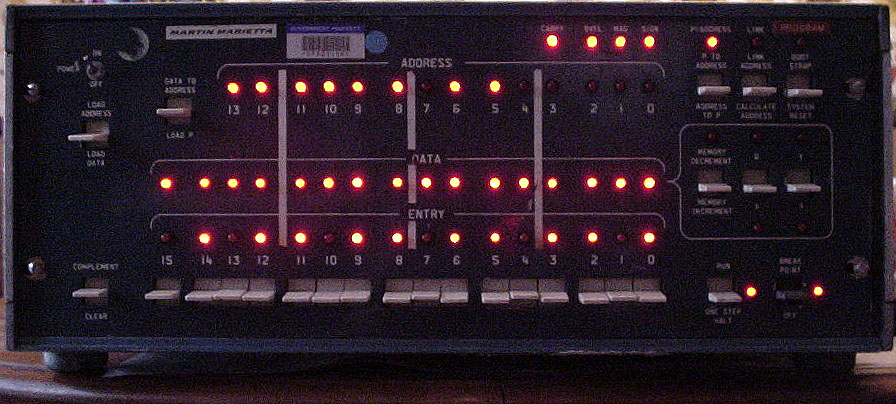
Does anyone have any idea what this
<http://www.classiccmp.org/hp/p-panel/front.jpg> is? The id tag
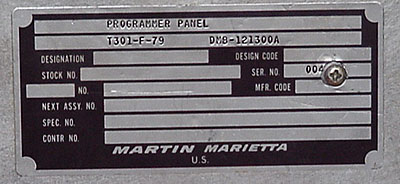
<http://www.classiccmp.org/hp/p-panel/idplate.jpg> on the back calls it a
Programmer's Panel. As you can see it was built by Martin marietta and is
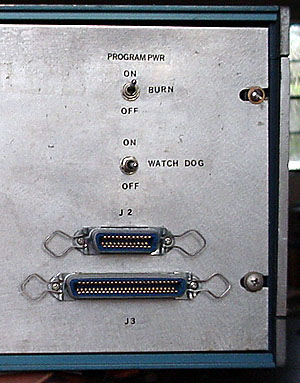
serial number 004. Most of the connections to it are made through two
connectors on the back panel
<http://www.classiccmp.org/hp/p-panel/conns.jpg>. There's also one
connector on the side (sorry no picture this time). The side connector is a
male D(mumble) size connector with three rows of pins similar to that used
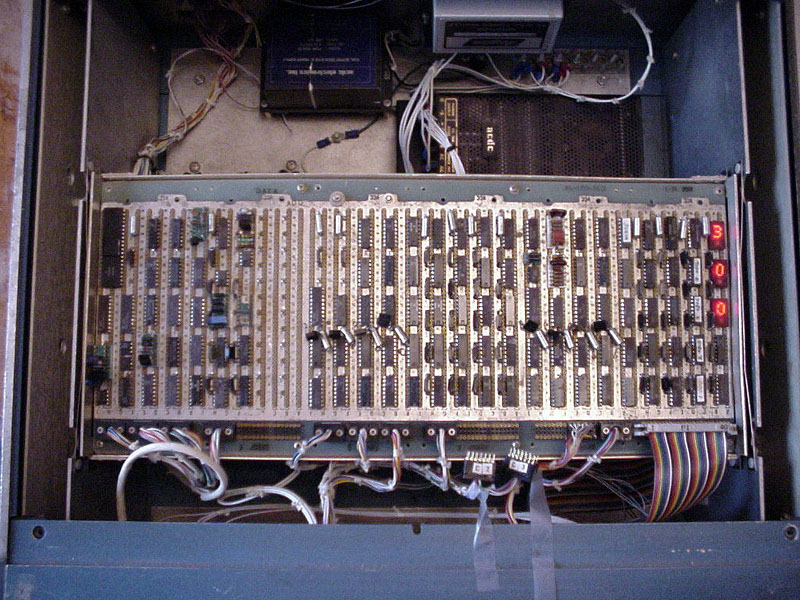
in the old SUN disk drives. It only uses a single card
<http://www.classiccmp.org/hp/p-panel/inside.jpg> inside but the card is
nearly as big as the case. The card is one of the expensive Augut brand
wire wrap cards with machine turned pins and sockets that have a heavy gold
plating. Everything appears to be SSI TTL logic. All the electrical
connections are made via DIP style plugs and one ribbon cable along the
front edge of the card. In the picture you can see where I left two of them
unplugged. There's also a three digit numeric display in the back RH
corner. It seems to always display "300". Inside the case there is one
Acopian power supply and two ACDC power supplies. The card is in a frame
that has a neat tilt up feature. Just press in two spring loaded buttons in
the back corners and tilt the card anywhere that you want it. It will tilt
forward about 140 degrees allowing access to the back of the card. There's
also extra holes in the frame so that you can lock the card at the 90
degree position. I've shown that in one of the other pictures. The front
hinges are made with the same style spring loaded pins, so you can press
them in and completely remove the circuit card.
The front panel is very interesting. First, the switches all have three
positions. Most of them have two functions plus an off position. The one in
the lower LH corner, for example, clears the Entry register or complements
the entry that's already in it. Second, the panel has controls for just
about anything you can imagine. Note that it uses 16 bit data but only a 14
bit address.
Sorry for the crummy picture. I got home late and there wasn't enough
light for a decent picture. The first TWO sets of pictures didn't turn out
so I said the hell with it and used these. I did try using the camaera
flash but it made too much glare. I'll retake the pictures sometime when I
get home earlier.
Anybody have an idea of what kind of computer this was made for? The
case and wire wrap card look very promising for potential use as a future
Altair style computer.
Joe
On February 6, Doc wrote:
> > Anyway, sorry for being a windbag...I first moved to the DC area in
> > the beginning of 1993 to "do that Digex thing" and now I've recently
> > moved away; kinda the "end of an era" for me and a major part of my
> > life.
>
> Don't apologize. That's the sort of windbaggage that makes this list
> worthwhile. The tech info & hardware sources are cool, but the
> "context" it all comes from is absolutely priceless.
Heh, thanks...of course, lingering from my last few months at Digex
back in 1997, I still have that slight anal burning sensation...
-Dave
--
Dave McGuire
St. Petersburg, FL "Less talk. More synthohol." --Lt. Worf
I can heartily attest to the run-away-collection syndrome. There is
indeed that imaginary 'line' (as somone recently said) between avocation
and pathology.. and I have crossed it several times.
The BIG problem for me was that the collection was amassed in
increments, but divested as a whole... yikes! I will *never* do that
again!! It took over my living space, and I ended up with crap I didn't
want, couldn't use, and nobody else really wanted, either. Of course,
there was a lot of 'good stuff' too.
Now, I want to have just one, fully fleshed-out, peripheral-rich DEC PDP
11/44 system, but I want it to be complete and pristine... completely
stock DEC, all manuals, doc, printsets... as if it had just come off the
truck from the Mill. Then, we'll see if expansion of the collection is in
order.
As an aside, the big problem I face is that classic computers are *not*
the only thing (heavy, big) that I am a fan of. I have an extensive
vintage electronic musical instrument collection, and I love boat-anchor
radio gear and teletype machinery... then there's the antique and classic
audio studio equipment Stuff I have, recorders and outboard gear and many,
many devices to reproduce the various ways humans have devised to record
sound... which I use as part of my hobby/business of audio restoration,
preservation, and archiving.
sigh... why couldn't it have been stamps?? Ten thousand stamps
could *all* fit in the chassis of one 11/44 CPU...
Cheers
John
On February 5, Doc wrote:
> Mostly, when they're decommissioned, somebody takes them home. They
> just don't come available much at all.
That's 'cause those little buggers are *fast*.
-Dave
--
Dave McGuire
St. Petersburg, FL "Less talk. More synthohol." --Lt. Worf
On February 6, Doc wrote:
> > Oh shit yes.
> >
> > -Dave
>
> <In his best "Simpsons" bully voice>
>
> Nyaahh-Haahh!!! I *wasn't* drinking coffee this time!
I'm on a mission to destroy Doc's keyboard, monitor, and mouse with
all manner of half-ingested beverage! Muahahhahaaaa!!
-Dave
--
Dave McGuire
St. Petersburg, FL "Less talk. More synthohol." --Lt. Worf
>I thought I had one, but I don't. Someone out there have/know where to find
>a cable with an RJ-45 plug on one side and a female DE-9 (DB-25 okay but
>prefer DE-9) on the other? This is to plug my Commodore into the serial port
>on my Lantronix EPS4+1 and attempt to get it on the network by reverse
>Telnet.
I have seen RJ45 to DE9 adaptors before. I have one someplace, it came
with my DSL router. But I have seen them for sale at computer shows
before, and would think they should be readily available at any decent
electronics or network parts dealer. I think Rat Shack sells a roll your
own pinout one that goes to a DB25 (I know they have an RJ14, 6 pin to
DB25).
-chris
<http://www.mythtech.net>
On February 6, Kris Kirby wrote:
> I have a few terminals with "20 ma" connectors on the back and have seen a
> PDP8 with such as well. Can these two be connected wire-for-wire and work,
> or do I need other hardware?
You don't need other hardware. I'd send you the pinouts but I don't
remember them offhand.
-Dave
--
Dave McGuire
St. Petersburg, FL "Less talk. More synthohol." --Lt. Worf
Oh shit yes.
-Dave
On February 5, Pat Finnegan wrote:
> He wants $50. Would you say it's worth that?
>
> -- Pat
>
> On Tue, 5 Feb 2002, Dave McGuire wrote:
>
> > On February 5, Pat Finnegan wrote:
> > > Over at Purdue Salvage, they have an RS/6000 Model 7013 'space heater'
> > > sized system. On the front it says 'Power Server 560(590?)' Any ideas on
> > > value, and is anyone interested?
> >
> > If it's a 590, I'm definitely interested. No idea what it'd be
> > worth though.
> >
> > -Dave
> >
> > --
> > Dave McGuire
> > St. Petersburg, FL "Less talk. More synthohol." --Lt. Worf
> >
>
>
--
Dave McGuire
St. Petersburg, FL "Less talk. More synthohol." --Lt. Worf
Oh shit yes.
-Dave
On February 5, Pat Finnegan wrote:
> He wants $50. Would you say it's worth that?
>
> -- Pat
>
> On Tue, 5 Feb 2002, Dave McGuire wrote:
>
> > On February 5, Pat Finnegan wrote:
> > > Over at Purdue Salvage, they have an RS/6000 Model 7013 'space heater'
> > > sized system. On the front it says 'Power Server 560(590?)' Any ideas on
> > > value, and is anyone interested?
> >
> > If it's a 590, I'm definitely interested. No idea what it'd be
> > worth though.
> >
> > -Dave
> >
> > --
> > Dave McGuire
> > St. Petersburg, FL "Less talk. More synthohol." --Lt. Worf
> >
>
>
--
Dave McGuire
St. Petersburg, FL "Less talk. More synthohol." --Lt. Worf
On Feb 5, 13:22, Bill Bradford wrote:
> YAY! Party time.
> > The quick answer is yes we are. We are at present proposing to release
a
> > Hobbyists License Agreement with CD-ROM containing the software for
the
> > various PDP-11 Operating Systems.
Great news! Now all I have to hope for is that it won't depend on a UK
DECUS membership (UK (ex-)members of DECUS will know what I mean; it's much
harder and more expensive to get a VMS hobbyist license in the UK than just
about anywhere else.)
--
Pete Peter Turnbull
Network Manager
University of York
Even tho' this topic has just got beat to death... if one steps back
and looks, the ratio of actual 'spam' to posts here is quite good,
compared to some others. I ain't saying it's welcome or tolerable, but
the S/N ratio is not bad. IMHO.
I am still publically volunteering to recieve all non-subscriber posts,
and delete the spam, adverts, etc, and forward the classiccmp-related
material to the list. I don't know how that could be arranged, but I'll
drop a line to El Admino and see what can be done.
Then Sellam can sleep at night, once again...
;}
Cheerz
XXX Bare-ly legal teen cheerleader dormcam dude XXX
In case you blinked, there was a WOZ signed Mac
on Antiques Roadshow (Tucson, AZ, Hour 3). It
was only on for about 20 seconds, but the appraiser
valued it at $6,000-$10,000!
Here's a link to the episode, but no mention of the
Mac. It shows up about halfway through the show.
http://www.pbs.org/wgbh/pages/roadshow/series/highlights/2002/tucson/tucson3
.html
In a message dated 2/5/2002 4:53:50 PM Eastern Standard Time,
vaxzilla(a)jarai.org writes:
> On Tue, 5 Feb 2002, Sellam Ismail wrote:
> > On Tue, 5 Feb 2002, Chad Fernandez wrote:
>
> > > Not likely, since most women won't like the setup you described :-) You
> > > LIVE here??? walks out door, never comes back :-(
> >
> > Sure, if you're into lame and materialistic women.
> >
> > A good woman will love you for who you are inside.
>
> Yeah, but don't expect her to be very good looking.
>
> -brian.
>
bzzzt,wrong! my wife to be is pretty and smart and more enlightened than
most. Plus she knows *everything* about me and loves it all! heh.
Ok, I really should have pulled it apart and looked before now,
and feel absolutely idiotic. :)
The reason that the battery backup wasn't working in my '9000
is that there are no batteries. (that would prevent it from
properly functioning, I'm sure...) I assume that the previous
owner found the batteries to have gone bad, and simply decided
to remove them.
I'll be attempting to contact HP about getting replacements
soon. Meanwhile, does anyone know of any other sources
(including price if possible) for these batteries?
Regards,
Chris
Christopher Smith, Perl Developer
Amdocs - Champaign, IL
/usr/bin/perl -e '
print((~"\x95\xc4\xe3"^"Just Another Perl Hacker.")."\x08!\n");
'
A friend who is at the Hanford Auction called and asked me if I knew anything
about a small white tower named IVAN and made by International Imaging
System. A Google search turned up nothing.
>From the Google hits I bet is a graphics engine of some kind. Any information
would help.
Paxton
Astoria, OR
My Vax 4000 has a TF85 DLT tape drive which works fine, but is missing the
plastic panel that has the lettering describing the function of the various
LEDs on the front of the drive. Could someone tell me what the different
LEDs mean? Once I know I can make a snazzy paper, stick on version.... (
That's what hobby computing is about! )
Also, I need to de-gauss some DLT III tapes to use with the TF85. Any
ideas on what it takes to properly de-gauss a cartridge?
Doug
> -----Original Message-----
> From: Bob Brown [mailto:bbrown@harper.cc.il.us]
> Physically, where is the case was the battery?
>
> I have a G40 downstairs in our datacenter.
Take the front plate off -- you'll need a torx bit. (Also note
that the faceplate slides straight up, then straight out. You
might damage something if you're really adamant about pulling
it off sideways, or straight out before you lift up on it.)
Each power supply has two screws holding it in (torx again).
You'll also need to remove the drive cage above the PSU before
you pull the power supply out. (two more torx screws, near the
top of the cage) I think they're probably both the same, so
only one should need removed.
Once you get a PSU out (you shouldn't even need to pull it out
all the way...), look right in the front of the PSU, to the
right. I think that's the battery compartment. Mine is just
empty with a two-prong plug that I assume should plug into the
battery.
Chris
Christopher Smith, Perl Developer
Amdocs - Champaign, IL
/usr/bin/perl -e '
print((~"\x95\xc4\xe3"^"Just Another Perl Hacker.")."\x08!\n");
'
> Jerome Fine wrote:
>
>Is there any way to check a CD?
The obvious way is to duplicate it to
an "image copy" on HD. If the copying
app manages to read all the sectors,
then it must be OK. For simple ISO9660
CDs, simply copying off the data may be
enough.
There are also programs (such as CDcheck,
http://www.elpros.si/CDCheck/) which will
test out your CDs for you.
> Also, how often do you recommend making
> a new copy?
Once, just before the old one goes bad :-)
Seriously, I've not actively gone back through
my stuff to check, but I have dragged stuff off CD
a few years after burning and so far I've only
hit one bad CD. And even that one may have been
burned badly - these days I do a check against
the source when writing a CD. It was that bad CD
that made me start doing that!
For *important* stuff, consider
making two copies.
OTOH, five years from now you will be
moving your CD-R (and CD) stuff
over to whatever the next high capacity
media happens to be (C3D,
http://www.c-3d.net/tech_frameset.html,
with 125*G*B per recordable disk,
looks to be adequate ...)
> Also, can CD software duplicate (make an exact copy of a) CDs?
CDRWin http://www.goldenhawk.com/ and
CloneCD http://www.elby.org/ can both do this
and both have free demo versions. There
are plenty of others (I just don't
remember which have freebie versions).
If your CDs have some for of copy
protection, then things may not be so
straightforward.
>And can anyone suggest a way to do the
>following on a W98 (Yeck) system:
>
>I want to set up some files in both ISO file structure
>(available under DOS/W95/W98)
>and under RT-11 as an RT-11 partition.
>Is there a way to copy the files to a specific
>block on the CD?
Tim Shoppa's RT-11 CD is set up this way (IIRC).
I don't know how he did it, but it's clearly possible.
The trick for this kind of stuff is usually to have
the non-ISO9660 filesystem set up to use the bits
of the CD not used by the ISO9660 system. For details
on how to do this for OpenVMS's ODS-2
see http://www.tmesis.com/cdrom/.
If you want to have the ISO9660 and ODS-2
filesystems share (some or all of) the same
data (i.e. you want maybe 600MB of data
visible to each fs) then see:
http://support.tditx.com/~odsiso/index.html.
Neither of these do exactly what you want,
but they illustrate the general principle.
Antonio
> pete(a)dunnington.u-net.com wrote:
>
>Agreed. Absolutely. Whenever I find old kit,
>I look around and ask around
>for any and all manuals, documents, whatever.
A useful rule of thumb, that I've learned
through hard experience, is that "X" and
"docs for X" (and "software for X" and "pretty
much anything else you might like if you had X")
almost never arrive at the same time. Usually
"X" turns up just after you've not bothered to pick
up one of the other items in the list.
>As for the suggestion someone made that you can get documentation
>from the
>web, well, that's sometimes true, but often the information is
incomplete,
>or in an unsuitable format, or disappears after a while.
The web is a cache - it's only there to hang on
to stuff while you burn it to CD :-)
Now there's an L2 cache to help out
at http://www.archive.org/index.html.
>I can't count
>the number of times I've been grateful that I downloaded a copy of
some
>document onto one of my own hard drives, because the original
online
>version has gone. Besides, a printed copy is often much more
useful,
>especially for circuit diagrams and large manuals.
Printed copies are great. Always assuming that
(a) you can get them and (b) you have the
room to store them!
Antonio
>Ok, now's your chance to discuss your specialty and get the attention of
>other folks who have stuff that you may want.
I want any items made by Apple Computer, but my forte is the Macintosh
-chris
<http://www.mythtech.net>
On Feb 5, 22:33, Paul Williams wrote:
> Pete Turnbull wrote:
> >
> > On a Windows system? Telnet to a Unix machine.
>
> Ha ha! Step 1 of so many solutions!
Yeah, but I did at least mention the Windows port of wget even if it was
buried in the middle where I hoped no-one would notice ;-)
--
Pete Peter Turnbull
Network Manager
University of York
On Feb 5, 15:52, Jerome Fine wrote:
> Is there any way to check a CD? Also, how often do you recommend making
> a new copy?
Just read it, or copy the entire CD to /dev/null and see if there are any
read errors reported.
> Also, can CD software duplicate (make an exact copy of a) CDs?
Most can. Some *only* do that!
> And can anyone suggest a way to do the following on a W98 (Yeck) system:
>
> I want to set up some files in both ISO file structure (available under
DOS/W95/W98)
> and under RT-11 as an RT-11 partition. Is there a way to copy the files
to a specific
> block on the CD?
If you make the RT-11 part as some sort of container file (LD: volume?),
you can use mkisofs to build an image consisting of everything else, and
work out its size. Then burn a CD which has two (or more) tracks: first
the ISO-9660 part (possibly with Rock Ridge and/or Joliet extensions), then
the container (or put some padding between to make the start of the
container where you want). Or start with the container, though I'm not
sure if that necessarily means it would start at a specific block. I'm
also not sure how many systems can read a multi-track data CD.
The way people usually do it for EFS disks for IRIX (EFS is the native
SGI/IRIX filesystem format used for bootable installation CDs) which have
to have partitions, is to build the image on a hard drive first, and burn a
raw copy of the entire hard drive (rather than the files/filesystem on it).
--
Pete Peter Turnbull
Network Manager
University of York
On Feb 5, 12:22, Lawrence LeMay wrote:
> >
> > See above. CD burners are wonderful.
> >
>
> Somewhat out of question, but does anyone know of any software that would
> download a web site, or a portion, to a local disk? IE, I would want to
be
> able to archive part of a web site onto a CDrom, without having to
manually
> save every image and web page, and manually edit the html links, etc.
>
> Ideally the software would understand that I was planning to burn
> 650 meg, or 700 meg, etc images, and would break the download into
> separate directories/images.
wget on a unix or Linux system. You'd want to pick your root point and
start wget with the -r (--recursive) and -k (or --convert-links) options
(to make any absolute links into relative ones, wherever possible) and the
-np (or --no-parent) so it doesn't follow links that go *up* the directory
tree rather than down (a good way to get lots more than you intended!).
There's also a -m (--mirror) option. You can refine things with other
options (such as those to avoid certain files or types, useful to exclude
those extra ?D=A indexes from directory listings) but I usually start with
-r -k -np. On a Windows system? Telnet to a Unix machine. There is a
Windows port, but I'm not sure how good it is.
wget can limit the total size of a download by setting a quota, but it's
not as useful as you might think. Better for you to decide yourself where
to split a collection over two or more CDs. Of course some sites make this
easy (like PUPS/TUHS, for which I run one of the official mirrors).
Another polite option is --wait, which waits between fetches to reduce the
bandwidth. Some sites might not like you hogging their connection. In
fact, recently I came across another site that had banned certain addresses
altogether for attempting to download a whole site without asking first.
The owner took the view that no-one could possibly want the whole site,
unless for a mirror, in which case it's best to ask.
Some sites have a megabytes-per-month limit imposed by their ISP, so again,
ask.
There are also programs for FTP (only) mirroring: the imaginatively-named
'mirror' and 'ftpmirror' come to mind, and pavuk too, but wget is a pretty
good all-rounder.
http://www.wget.org/http://www.gnu.org/software/wget/wget.htmlhttp://www.idata.sk/~ondrej/pavuk/http://noc.intec.co.jp/ftpmirror.htmlhttp://sunsite.org.uk/packages/mirror/
--
Pete Peter Turnbull
Network Manager
University of York
On Feb 5, 14:21, Bryan Pope wrote:
> And thusly Christopher Smith spake:
> >
> > > -----Original Message-----
> > > From: Fred Cisin (XenoSoft) [mailto:cisin@xenosoft.com]
> >
> > > > that they literally use it as a door stop (they have the
> > > monitor in use
> > > > proping a door open... makes me cringe every time I am over there).
> >
> > > Wrong machine for the job. Everybody knows that a
> > > Timex-Sinclair is the
> > > best doorstop.
> >
> > I don't know. Something heavier is probably better. Maybe a PET?
> > A small mini/deskside would certainly hold a door open well...
> > or anything in a BA23 enclosure with floor-stand.
> >
> > A commodore 128 also might have a chance of actually wedging into
> > the space between the door and the floor.
> >
>
> OK OK!!! This has gone a little too far!!!!! We've recently lost a PET
to a
> manical rampaging battlebot, we don't need to relegate them to door stop
> duty.
I agree. Anyway, you don't need a PET for that. An SBC like a KIM-1 is
much better; you can wedge it right into the gap under the door.
--
Pete Peter Turnbull
Network Manager
University of York
>Somewhat out of question, but does anyone know of any software that would
>download a web site, or a portion, to a local disk? IE, I would want to be
>able to archive part of a web site onto a CDrom, without having to manually
>save every image and web page, and manually edit the html links, etc.
>
>Ideally the software would understand that I was planning to burn
>650 meg, or 700 meg, etc images, and would break the download into
>separate directories/images.
On the Mac... iCab will let you pull down most of a site, it is limited
by the number of levels you tell it to follow links. It will place it all
in a folder, and keep the directory structure in tact (ie: subdirectories
go into sub folders), so that you can just start at the top, and follow
the links locally.
Other than that... I think the other app that I have heard recommended (I
use iCab myself), is called Site Sucker, or Web Sucker, one of those...
it too will pull everything down, retaining links as it goes.
-chris
<http://www.mythtech.net>
> Lastly, (to Chris, really) I seem to recall that a MacSE/30 (or
>Classic) that I had sold to someone had a Radius Full Page Display Card in
>it also.
Yup... I have that radius card I think. I have a video card that was in
the SE FDHD you sold me (well, really just tossed in the box along with
the Classic II). I can double check the card when I am at work tomorrow
(working from home today). Do you want the card back... or do you want to
give me the monitor when I am up there? :-D
>BTW, how is
>the GatorStar?
For the most part... still boxed... been busy writing CATI jobs. I think
I am going to skip copying the manuals... too darn big, too darn hard. If
I drop the manuals, the rest will just take me a day to organize and get
ready to bring to you.
What's a good weekend for me to make the drive? (Its looking like Sundays
are my only open weekend days until the 2nd weekend in March... after
that Sat or Sun is fine)
-chris
<http://www.mythtech.net>
On Feb 5, 0:11, Zane H. Healy wrote:
> >-Only 1 copy of a machine. Keep the best & cleanest. Trash, sell or
>
> Hmmm, there is the problem of spare parts for some of these systems....
>
> >-No books. Only one or 2 max complete reference per system. Or then it
gets
> >outta control.
>
> OK, this one I flat out disagree with!!!!
No, he wrote "one or 2 ... *complete* reference" (my emphasis). Per
system.
> Without documentation an old computer is worthless.
Agreed. Absolutely. Whenever I find old kit, I look around and ask around
for any and all manuals, documents, whatever.
As for complete, here's what I'd consider "complete", for, say, an 11/40
(like the one I got last year):
- complete printsets for all boards etc, a pile about 6" to 12" high.
- complete set of diagnostics (XXDP) listings, 12" - 18" wide on a shelf
- manuals for the CPU, bootstrap loader, DL11-W, etc etc, 6" wide
- technical manuals ditto for the RX02, RK05s, etc, 6" - 12"
- manual set for RT-11 or RSX-11 and languages etc, 20" - 40" of shelf
space
- IC and other components references, Texas Instrument TTL handbook, etc,
etc
- probably other things I've forgotten.
That 11/40 came with some of the original logbooks but not the invoices
etc. My 11/34 even had some of the original orders and invoices,
installation sheets, and the like.
As for the suggestion someone made that you can get documentation from the
web, well, that's sometimes true, but often the information is incomplete,
or in an unsuitable format, or disappears after a while. I can't count
the number of times I've been grateful that I downloaded a copy of some
document onto one of my own hard drives, because the original online
version has gone. Besides, a printed copy is often much more useful,
especially for circuit diagrams and large manuals.
--
Pete Peter Turnbull
Network Manager
University of York
Just got a pair of MicroPDP 11/73s - one of which is up and running
(RT-11) nicely, the othe seems to have a problem with the PSU. Anyone
know of a service manual/schematics for the PSU?
---
Tim Myers,
Protasis UK Ltd.,
Cheshire Innovation Park,
PO Box 1,
Chester,
CH1 3SH.
Tel : +44 151 355 4590
DDI : +44 151 355 4931
Fax : +44 151 355 4942
YAY! Party time.
----- Forwarded message from "Careena.Fitzpatrick" <Careena.Fitzpatrick(a)Mentec.com> -----
From: "Careena.Fitzpatrick" <Careena.Fitzpatrick(a)Mentec.com>
To: "'mrbill(a)mrbill.net'" <mrbill(a)mrbill.net>
Subject: RE: Hobbyist licenses for PDP-11 operating systems?
Date: Tue, 5 Feb 2002 14:19:11 -0500
> Dear Bill,
>
> The quick answer is yes we are. We are at present proposing to release a
> Hobbyists License Agreement with CD-ROM containing the software for the
> various PDP-11 Operating Systems. Our Website is been updated, the new
> website will have a Hobbyist page given all the relevant information on
> the Software, CD's,Licenses, and how to obtain them. There will be a total
> of 3 CD-ROM's covering all the Operating System available.
>
> If you have any please do not hesitate to contact.
>
> Careena.Fitzpatrick(a)mentec.com
> or 603 883 7711
>
> -----Original Message-----
> From: info
> Sent: Tuesday, February 05, 2002 1:53 PM
> To: Alex.Peirce; Rod.Hicks; Careena.Fitzpatrick
> Subject: FW: Hobbyist licenses for PDP-11 operating systems?
>
> ----------
> From: Bill Bradford[SMTP:MRBILL@MRBILL.NET]
> Sent: Tuesday, February 05, 2002 1:52:15 PM
> To: info(a)mentec.com
> Subject: Hobbyist licenses for PDP-11 operating systems?
> Auto forwarded by a Rule
>
> Have your plans for eventual hobbyist licenses for the
> various PDP11 operating systems been dropped?
>
> Bill
>
> --
> Bill Bradford
> mrbill(a)mrbill.net
> Austin, TX
----- End forwarded message -----
--
Bill Bradford
mrbill(a)mrbill.net
Austin, TX
> -----Original Message-----
> From: Fred Cisin (XenoSoft) [mailto:cisin@xenosoft.com]
> > that they literally use it as a door stop (they have the
> monitor in use
> > proping a door open... makes me cringe every time I am over there).
> Wrong machine for the job. Everybody knows that a
> Timex-Sinclair is the
> best doorstop.
I don't know. Something heavier is probably better. Maybe a PET?
A small mini/deskside would certainly hold a door open well...
or anything in a BA23 enclosure with floor-stand.
A commodore 128 also might have a chance of actually wedging into
the space between the door and the floor.
Chris
Christopher Smith, Perl Developer
Amdocs - Champaign, IL
/usr/bin/perl -e '
print((~"\x95\xc4\xe3"^"Just Another Perl Hacker.")."\x08!\n");
'
Someone contacted me about info on this Z80-based board. Not ever hading
heard of it I thought I'd pass it along here. If anyone can help this guy
out, please contact him separately.
Thanks.
Rich
-----Original Message-----
From: Robert Collier [mailto:rdcoll@hotmail.com]
Sent: Tuesday, February 05, 2002 2:57 PM
To: rcini(a)msn.com
Subject: Protec PRO-83 w/ Z80
Hello,
I am also interested in the classic computers and am currently researching
one now. I was wondering if you could tell me anything about the Protec
Microsystems PRO-83 Z80 Single-Board Computer. Specifically, where can I
find information about the power supply and compatible peripherals. I have
had difficulty finding any websites which mention this machine.
Thanks,
Rob
> Doc wrote:
>
> wget does a great job, and IIRC "mirror" does too.
Linux/GNU/*BSD
>tools. I dunno about Windows or Mac.
wget works well. I've used it under
Win2K and various Unix implementations.
Antonio
On Feb 4, 17:48, Jerome Fine wrote:
> (a) As far as I know, there are no hobby versions, as yet, for TSX-PLUS.
> However, if there is enough interest, perhaps we could inquire. I would
> certainly be willing to contact S&H to see if they might be interested.
> Since I was a sort of distributor for S&H at one point and I already have
> my own license, I would be able to support hobby users. SO!!!! Are
> there any potential TSX-PLUS hobby users out there who would like
> to have this software?
Yes!
Like Jerome's, one or two of my RT-11 systems are SYSGENed for
multi-terminal support. But it's not the same.
--
Pete Peter Turnbull
Network Manager
University of York
> ----------
>
> > > > that they literally use it as a door stop (they have the
> > > > monitor in use
> > > > proping a door open... makes me cringe every time I am over there).
>
> <<<<<clipped>>>>>
>
> > > Wrong machine for the job. Everybody knows that a
> > > Timex-Sinclair is the
> > > best doorstop.
>
<<<<<clipped>>>>>
> > A commodore 128 also might have a chance of actually wedging into
> > the space between the door and the floor.
> >
>
> From: Bryan Pope
> OK OK!!! This has gone a little too far!!!!! We've recently lost a PET
> to a
> manical rampaging battlebot, we don't need to relegate them to door stop
> duty.
>
Bryan - at least you could pull it from the door and still fire it up! :-)
--- David A Woyciesjes
--- C & IS Support Specialist
--- Yale University Press
--- mailto:david.woyciesjes@yale.edu
--- (203) 432-0953
--- ICQ # - 90581
Mac OS X 10.1.2 - Darwin Kernel Version 5.2: Fri Dec 7 21:39:35 PST 2001
Running since 01/22/2002 without a crash
I'm in the same predicament... Being unmarried, I haven't
had a significant other to rein me in, so as a result
I live in a 3000 sq. ft. house, most of which is used for
storage. I do manage to keep "paths" clear through each
room, though. When I first bought the house (~10 years ago),
I built an 800 sq ft. garage with the intention of using it as
a workshop. Unfortunately, I filled the garage within
less than a year (from scratch...). What's really frightening
is that when I bought the house, I was really starting
>from zero. My previous (much smaller) home had been
completely destroyed in a house fire (long story concerning
theft, home invasion and arson...), leaving me with
the clothes on my back and little else.
The problem is, I _like_ collecting odball systems. I truely
believe in preserving the history of the development of
computer architectures, and the accompanying enabling
technology, and (except for this group, and 1 or 2 private
computer museums/clubs) perceive of very little actually
being done in the public sector to achieve that goal.
I can't say that I actually specialize (although most of
my systems consist of SGI, Sun and DEC gear). I've always
justified my acquisitions to myself by convincing myself
that I was going to net everything together and use 'em
for software R&D (AI stuff). If I can ever manage to
get a broadband network hookup (another horror story)
the I'd like to begin work on an online systems archive.
I've finally reached the point, however, when I feel
as if I've stepped over an invisible line that separates
the rational from the irrational. I finally feel uncomfortable
in my home, and I am trying to exert some control over myself.
I recently turned down a SparcCenter 2000 (sans CPU boards).
I'm quite proud of that (although I don't know if I would
have been able to resist it if it had been a 2000E with
cpus :-)
My current approach is to try to thin out the mess by packing
the truck up with stuff I know I'll never get around to,
and taking it to a local computer surplus store. No, I'm not
selling it to them... I'm _giving_ it to them. They then
sort out the stuff they want (out of my sight, thank god)
and scrap what they consider useless. In return,
they will often cut me a deal on any items they get that
seem to be interesting.
I'm beginning to believe that the urge to "collect", left
unrestricted, can eventually be just as damaging to an
individual as an uncontrolled urge to gamble or drink.
Perhaps this is just another manifestation of a variant
of obsessive/compulsive disorder...
Or then again, it could be just plain, ole-fashioned fun :)
-al-
-acorda(a)1bigred.com
You know, I hit send too early on this message...
Anyway, the point is, is there any significance to the scribbled
date inside the lid of the Mac II? Can't remember the date exactly...
And why would FWB CD-ROM toolkit report the device name of the
Bernoulli as Beta150? Did Iomega release a testing device to someone?
Lastly, (to Chris, really) I seem to recall that a MacSE/30 (or
Classic) that I had sold to someone had a Radius Full Page Display Card in
it also. Or am I thinking of the Radius Pivot card in my SE/30? BTW, how is
the GatorStar?
--- David A Woyciesjes
--- C & IS Support Specialist
--- Yale University Press
--- mailto:david.woyciesjes@yale.edu
--- (203) 432-0953
--- ICQ # - 90581
Mac OS X 10.1.2 - Darwin Kernel Version 5.2: Fri Dec 7 21:39:35 PST 2001
Running since 01/22/2002 without a crash
> ----------
> From: David Woyciesjes
>
> Well, Dad is cleaning out his basement, and gave me a couple boxes of
> stuff. Here's what a quick glance in the boxes shows, so far...
>
> - Hayes SmartModem 1200
> - 2 other external modems
> - couple smaller HDDs
> - some random cables, including a 6" AUI cable (!)
> - couple Mac keyboards
> - 3.5" and 5.25" disk cases
> - 3 older external SCSI CD-ROMs
> ...and he best scores are...
> - Radius full page display
> - Iomega Bernoulli 150 external drive and 5 carts...
> - Macintosh II, with 800K and FDHD floppy drives, with Radius Mac II Full
> Page Display Card, and some docs...
>
> Now to see if it all works...
>
> --- David A Woyciesjes
>
> FWIW, I used the original N* single-density controller as well as the
> double-denisty controller on my original Sol back in the late '70's with
> no problems - not even when I overclocked the Sol to 2.5 MHz!
>
> Bob Stek
> Saver of Lost Sols
Hi,
Yea, I figured that eventually I would just go ahead and
give it a try. Do you have a format and/or write memory
block to disk routine handy? That's what I'm writing now,
along with a simple CBIOS, to get a CP/M boot disk built.
Thanks,
Bill
Well, Dad is cleaning out his basement, and gave me a couple boxes of stuff.
Here's what a quick glance in the boxes shows, so far...
- Hayes SmartModem 1200
- 2 other external modems
- couple smaller HDDs
- some random cables, including a 6" AUI cable (!)
- couple Mac keyboards
- 3.5" and 5.25" disk cases
- 3 older external SCSI CD-ROMs
...and he best scores are...
- Radius full page display
- Iomega Bernoulli 150 external drive and 5 carts...
- Macintosh II, with 800K and FDHD floppy drives, with Radius Mac II Full
Page Display Card, and some docs...
Now to see if it all works...
--- David A Woyciesjes
--- C & IS Support Specialist
--- Yale University Press
--- mailto:david.woyciesjes@yale.edu
--- (203) 432-0953
--- ICQ # - 90581
Mac OS X 10.1.2 - Darwin Kernel Version 5.2: Fri Dec 7 21:39:35 PST 2001
Running since 01/22/2002 without a crash
Due to my upcoming deployment, I regret to inform the group that I must bid
you all another temporary farewell. So, if I am unable to get to another
computer in about a month from now I wanted to let you guys know that I had
a great time & will be back again soon.
____________________________________________________________
David Vohs, Digital Archaeologist & Computer Historian.
Home page: http://www.geocities.com/netsurfer_x1/
Computer Collection:
"Triumph": Commodore 64C, 1802, 1541, FSD-1, GeoRAM 512, MPS-801.
"Leela": Macintosh 128 (Plus upgrade), Nova SCSI HDD, Imagewriter II.
"Delorean": TI-99/4A, TI Speech Synthesizer.
"Monolith": Apple Macintosh Portable.
"Spectrum": Tandy Color Computer 3, Disto 512K RAM board.
"Boombox": Sharp PC-7000.
"Butterfly": Tandy Model 200, PDD, CCR-82.
"Shapeshifter": Epson QX-10, Titan graphics & MS-DOS board, Comrex HDD.
"Scout": Otrona Attache.
____________________________________________________________
_________________________________________________________________
Join the world’s largest e-mail service with MSN Hotmail.
http://www.hotmail.com
> -----Original Message-----
> From: Zane H. Healy [mailto:healyzh@aracnet.com]
> >-No books. Only one or 2 max complete reference per system.
> Or then it gets
> >outta control.
> OK, this one I flat out disagree with!!!! Without
> documentation an old
> computer is worthless. (same goes for software) My DEC hardware
I agree, but I read that as "you should only have one or two
complete system references for any given machine."
More than reasonable, since you should only need one ;)
Chris
Christopher Smith, Perl Developer
Amdocs - Champaign, IL
/usr/bin/perl -e '
print((~"\x95\xc4\xe3"^"Just Another Perl Hacker.")."\x08!\n");
'
Hello Pete.
I have some machines running RT-11 and I am certainly interested in TSX.
For trade (?) I have one CD-ROM with some 200 Mb of TIFF files. They are
scans at 600 dpi of a binder of S&H that I have. The binder contains:
- System Manager's Guide
- TSX-Plus version 5.1 and 5.1C release notes
- TSX-Plus version 6.0, 6.01, 6.2, 6.3 and 6.31 release notes
- System Manager's Guide version 5 (14 files, total 37.4 Mb)
(contents, introduction, chapters 1-9, appendix A, B and index)
- Installation Guide version 5 (10 files, total 20.5 Mb)
(contents, introduction, chapters 1-5, appendix A, B and index)
- TSX-Plus Reference manual 5th edition, 1985
It is printed on Letter-sized paper, and the whole stack is approx 7 cm
thick.
If you are going to talk to S&H, ask if it is legal to put scans of
this documentation on-line. I will happily offer this CD to somebody who
can and will host the required web-space for us all to benefit.
Quality of the scans is good (IMHO). they are the same as those at
http://www.mainecoon.com/classiccmp
- Henk.
The Netherlands
BTW. I have quite a pile of FMPS from Kees Stravers waiting to be scanned.
My days seem to be a few hours too short lately...updating my StarShip site.
> -----Original Message-----
> From: Lawrence Walker [mailto:lgwalker@mts.net]
> How do YOU limit your collection when you aren't a Sellam, John Keys
> and others with warehouse space. Seriously. It must be a problem that
> many of you have made a decision on, even when it wasn't your S.O.
> giving an ultimatum. Any guidelines ? Be stern.
Give some stuff to other people -- before, or after fixing it up.
I try to do that with stuff I'm not as interested in, or won't
use much. (Things that I have more than one of, for instance...)
That way you at least know it's gone to a good home. :)
Chris
Christopher Smith, Perl Developer
Amdocs - Champaign, IL
/usr/bin/perl -e '
print((~"\x95\xc4\xe3"^"Just Another Perl Hacker.")."\x08!\n");
'
>but even so the calculator is small and
>I won't have any problems finding room for it.
Your in-laws let you keep these things? Lucky bastard.
My in-laws won't let me have their Apple IIc+ setup... despite the fact
that they literally use it as a door stop (they have the monitor in use
proping a door open... makes me cringe every time I am over there).
I've offered many times to trade it for a nice brandy spanking new,
safety orange, soft rubber door stop... but nope... they just won't let
me have it. Someday I'll convince my wife to put her foot down and take
it... technically it is her computer.
-chris
<http://www.mythtech.net>
Please contact Norman directly if you're interested.
Tnx.
g.
---------- Forwarded message ----------
Date: Mon, 4 Feb 2002 18:06:54 -0800
From: Norman Alcott <normanalcott(a)worldnet.att.net>
To: Gene Buckle <geneb(a)deltasoft.com>
Subject: Re: Digital Research stuff
Hi Gene,
Thanks for the tip. The product information is:
CP/M Related Products
StarLink: I have one unopened package of StarLink.
Information from the package:
" Introducing StarLink the computer expansion system. The system lets you
link four "dumb" terminals or microcomputers to a single IBM Personal
Computer, and function as if it's the only terminal connected to the
computer."
Features:
- Four operating ports
- Onboard 8088 Microprocessor and 64K RAM
- Concurrent PC=DOS
- Shared Data Files
- Intersystems Communications
CP/M Gold Card: I have two unopened packages of the Gold Card.
Information from the package:
"The CP/M Gold Card provides the option of running the Apple II, II Plus and
IIe with the speed and capability of a more powerful system due to the
high-performance, 6Mhz Z-80B microprocessor. At the same time, it gives
you instant access to thousands of CP/M compatible applications, languages
and programming utilities, in addition to standard Apple Software."
Features:
- The Z-80 Microprocessor with 64K RAM
- CP/M Plus Operating System
- CBASIC Language
- 80-Column Display
- 6Mhz CPU
- Menu Driven Utilities
- Documentation
- Hashed Directory Search
- Compatible with any slot
Norm
FWIW, I used the original N* single-density controller as well as the
double-denisty controller on my original Sol back in the late '70's with
no problems - not even when I overclocked the Sol to 2.5 MHz!
Bob Stek
Saver of Lost Sols
On February 5, Doc wrote:
> > Cant agree, lotta reference stuff can be looked up and printed from right of
> > the www when needed!!!
>
> Right up till the day the host goes down or decides the manuals
> to their 1985 models are no longer necessary.
> A good example is my IBM XStation 150. When I first got it, you could
> search IBM support and get full setup instructions and jumper layouts.
> About a year ago, IBM pulled all html pages concerning the 150 and
> stashed the docs on a very obscure ftp server.
At least they did *that*. Most companies just delete it all.
-Dave
--
Dave McGuire
St. Petersburg, FL "Less talk. More synthohol." --Lt. Worf
Does anyone know where I can get info on an Aspect 3039 serial
terminal?
It looks like a rebadged something-I've-seen-before. It does have
both MMJ-female and DB25 (male?) ports, one set marked Primary & one
marked Auxiliary, as well as a DB25 female "Printer" port. ~RJ11
keyboard connector at front bottom left side, looking at the CRT.
Thanks.
Doc
Just found a copy of the "IBM Personal System/2 Model 70/80 Reference
Diskette" v1.10 in some disks being tossed at work. Anyone want it? Reply to
robert_feldman(at)jdedwards.com.
Bob
On February 5, Claude.W wrote:
> > Full books but stay with families IE: VAX, PDP-11, CPM S100 as a
> > set covers many varients
>
> Cant agree, lotta reference stuff can be looked up and printed from right of
> the www when needed!!!
...until the person putting the stuff online decides "nobody needs
this old stuff anymore" and takes it down. And MANY companies are
famous for the "we don't want to SELL these anymore so we don't want
to tell anyone about them" bullshit. Having been involved with the
world-wide web from its beginning, it makes me sick to point this
out...but the WWW is primarily a SALES tool nowadays. The fact that
we get information from it that is actually useful is a pleasant
side-effect. What is driving it is SALES. Suits figuring out more
efficient ways of taking peoples' money. Nothing more.
If everyone takes the "someone else will maintain this information"
attitude, who will maintain the information? We ALL must take
responsibility for this. Every one of us who cares about it.
> > With care and appling to specific systems or technoligies, not
> > complete archives of say Byte.
>
> Fun to look at but apart from that...
And highly educational. I read a very interesting article in an issue
of BYTE from 1984 while eating dinner last night. It compared a whole
slew of 32-bit processors that were due to be introduced that year.
The specific information was interesting from a historical
perspective, but it was also very useful because understanding what
drove our technology to where it is now an often help understand
CURRENT stuff more completely.
> I have taught of getting a bigger house but is too many hobbies a reason for
> moving it all and getting a bigger house...?
What is life for if you can't enjoy it?
-Dave
--
Dave McGuire
St. Petersburg, FL "Less talk. More synthohol." --Lt. Worf
> -----Original Message-----
> From: Tothwolf [mailto:tothwolf@concentric.net]
> Well, if you could put up a few photos of the compartment and the
> connectors I could help you identify what kind of battery
> they use. If you
> can connect a DC voltmeter to the battery connectors, and measure the
> charge voltage, that will help narrow it down very quickly.
I might try that, but it will require pulling the PSUs (two) out and
carrying them downstairs. :) It may be several days before I can get
around to that.
Chris
Christopher Smith, Perl Developer
Amdocs - Champaign, IL
/usr/bin/perl -e '
print((~"\x95\xc4\xe3"^"Just Another Perl Hacker.")."\x08!\n");
'
I was wondering if you had and could send me a copy of the boot software for the Toshiba T1200, I have been given 1 to repair but that seem the only problem, also if you could tell me how to get into the Bios, I was told to press Esc when 1st turned on but this doesn't seem to work...
Confused
R. Auty
Hi all,
I have recently acquired an HP9000 C100 workstation. It came without any
memory in it. I hooked up a PS/2 keyboard and a multisync monitor. The
video board is in slot 3, which is were I believe it belongs in this
machine. When I power it up, there is no display of any sort. Is this
normal for not having any memory, or is something dead?
Thanks,
Jon
Jon Auringer
auringer(a)tds.net
> -----Original Message-----
> From: Sellam Ismail [mailto:foo@siconic.com]
> A good woman will love you for who you are inside.
... and possibly even become attached to some of your minis. ;)
Chris
Christopher Smith, Perl Developer
Amdocs - Champaign, IL
/usr/bin/perl -e '
print((~"\x95\xc4\xe3"^"Just Another Perl Hacker.")."\x08!\n");
'
I think I took a part-time job in Hell today. A non-profit corp who
funds its computers-for-children program by "salvaging" donated
equipment. That means selling most of it by the pound. I'll be working
for trade, for a while.
If anybody wants, there is, for its worth as scrap:
1 Sun 2/120 system unit. Looks intact.
2 AS/400 cabinets, I _think_ 9404 models. One intact, one missing
an expansion board (or bulkhead covers). Too dark to read the
badges & labels. More details tomorrow
1 IBM rack - Says it's part of a phone system. Behind a large
deteriorating box, so all I could see was an 8" floppy drive
unit, and what looked like a 3/4" tape drive.
2 Pallets PS/2 Model 77. Probably 40-60 machines
1 Pallet PS/2 full towers. Pallets were already shrinkwrapped, so
I couldn't further ID them.
Both lots of PS/2 equipment may already be gone.
Not headed for the crusher, 'cause "That's VINTAGE stuff!!"
2 Large (42"x42"x42") deteriorating cardboard boxes of Tandy &
Commodore equipment. Unsorted, and not well packed. OK, not
packed at all, in any real sense. He knows it's worth money,
but he ain't sure what it is.
The main problem is that I don't have the wherewithal to even ship
anything bigger than the model 77s. I can probably get the bigger stuff
put on hold, but if you want it, you'll need to arrange pickup &
shipping. His prices are literally by the pound.
On the Brighter Side:
*I* will be making out like the proverbial fat rat.
Doc
Excellent. Portoguese spam. O Spamo.
http://www.google.com/language_tools?hl=en
More and more spam comes. Nothing gets done about it. This list
represented the one sanctuary on the internet I could rely on not to have
spam. Now we have it. We could fix it really simply. Nobody cares.
On Tue, 5 Feb 2002, pceditorial wrote:
> – FÁCIL – FÁCIL – FÁCIL – FÁCIL – FÁCIL – FÁCIL – FÁCIL Neste livro o
> leitor irá encontrar uma forma mais clara de assimilar os conceitos da
> Matemática Financeira, dando destaque para as operações realizadas nas
> empresas e no mercado financeiro. Os exemplos são apresentados na
> elaboração das fórmulas e a sua utilização na calculadora HP 12C, já que,
> essa calculadora é a mais utilizada entre os profissionais da área
> financeira. O roteiro do livro está organizado desde os cálculos de juros
> simples até os mais complexos, como por exemplo, os que se referem à taxa
> interna de retorno e cálculo com operações de Swap. Esta obra pode ser
> utilizada nos cursos de graduação e pós-graduação das áreas de Economia,
> Administração de Empresas e Ciências Contábeis. PREÇO: R$ 18,00 mais
> despesas de envio. Você poderá adquirir este excelente livro, Pela
> internet: www.amx.com.br/pceditorial/ Por e-mail: pceditorial(a)ig.com.br
> Ou por telefone: (0xx11) 3683-3931 Em São Paulo pode ser encontrado
> somente na LIVRARIA CULTURA. http://www.livcultura.com.br/
Sellam Ismail Vintage Computer Festival
------------------------------------------------------------------------------
International Man of Intrigue and Danger http://www.vintage.org
* Old computing resources for business and academia at www.VintageTech.com *
I don?t have the time for this beast right now and it has to make room
for my Rackmount Onyx anyway, so...
I have an CISC AS/400 9406 something to give away, I do not know which
exact model, this was printed on the rack which I didn?t take due to
weight reasons (boy these AS/400 rackmount enclosures are _heavy_... we
needed four people just to move one _empty_ rack. They put in some really
thick lead plates in 'em so there was no chance a rack could tilt wherever
you put your stuff). Maybe someone recognizes the model from the pics
below. It comes with two #9336 disk modules, one 8" floppy drive #9331,
one Infowindow Terminal, several SCSI cables, a little bit Twinax stuff as
well as one meter of mixed documentation and then some more. I also have
the keys for the machine. No system console though, but I guess this ain?t
a big problem. No part numbers are printed on the two CPU modules. There
may be the option to get an AS/400 9 track (? - big, heavy, I can make a
photo if someone?s interested and it is still available) drive with it,
too. Now for the bad news: Neither is OS/400 included nor is it
installed. The disks have been completely wiped before disassembly. The
company I got this from is still searching for the original media, but I
doubt they still have them and so do they. The machine was in perfect
working order before disassembly last year and has been carefully
transported to my home, but of course, no warranty included. So, if you
don?t have access to OS/400 for such a machine (legal aspects aside ;-)
this thing is going to be your new boat anchor. Anyway, I don?t want to
put this thing on ebay, or worse, into the dumpster. Hopefully there?s
someone who has more use for this than me right now. Of course, it?s
free for local pickup (only!) - the machine is located in Bochum /
Germany. If interested, contact me at andreas(a)pisec.de - I will gladly
answer any question as far as I can, but please bear in mind that my
experience with AS/400 stuff is very limited. Ah yes, I will only give
this away complete.
Some pics:
http://62.27.34.226/pics/400_1.jpghttp://62.27.34.226/pics/400_2.jpghttp://62.27.34.226/pics/400_3.jpg
The S/36 next to the beast stays here ;)
BTW: I?m still looking for one of these top plastic parts (with the
nifty Motorola logo on it) for my Motorola MVME197LE, an SGI Indy power
supply (this one badly!) and 8" SSP disks for my 5362 S/36. Anyone?
Best
Andreas
--
/dev/earth is 98% full. Please delete anyone you can.
In a message dated 2/5/2002 1:14:26 AM Eastern Standard Time,
lgwalker(a)mts.net writes:
<< I have a connundrum. I want to thin out my collection of computer
artifacts
and I'm having problems on what to part with. I also could use the money. >>
I'm starting to reach the saturation point as well. I'm getting married in
June and Judy wanted me to move to her house. As a result all the computer
stuff (1.5 bedroom's worth+partial garage) all had to move to climate
controlled storage to join an existing collection already in storage. It took
several trips and due to time constraints, everything is in disarray and some
things got damaged in the process. PS/2 models stack well, apple ][ series do
not! My original plan was to keep 2 of every model, but I've many PS/2 models
in various configurations that it just doesnt work as well as 5 OSI C1Ps with
various unique mods. Right now, I sneaked a few IBM server 95s as well as an
Ultimedia unit to use. I do keep books and mags though for reference. I've
simplified a little through sales and ebay but there's still too mucn and
they dont build houses with basements around here.
--
Antique Computer Virtual Museum
www.nothingtodo.org
I was looking for a three-prong adapter at my in-laws house last
week so I could plug my laptop in to the socket (the laptop power
cord is grounded but all the wall outlets are two-prong). I found
the adapter, but I also found an old Commodore calculator, along
with the box. The packing material in the box is gone, but the
box is in pretty good shape. I haven't tried a battery to see
if the calculator works, but even so the calculator is small and
I won't have any problems finding room for it.
--
Eric Dittman
dittman(a)dittman.net
Check out the DEC Enthusiasts Club at http://www.dittman.net/
Hi there, I was wondering If some1 could possibly email me and LET ME KNOW WHAT KIND OF SOFTWARE INCLUDING os AND sYSTEM DISK A tOSHIBA t1200 RUNS and where to obtain it.
DarkawE
> -----Original Message-----
> From: Tothwolf [mailto:tothwolf@concentric.net]
> On Mon, 4 Feb 2002, Christopher Smith wrote:
> > I'll be attempting to contact HP about getting replacements soon.
> > Meanwhile, does anyone know of any other sources (including price if
> > possible) for these batteries?
> Well, if you know what type it needs, I might be able to help
> you locate a
> distributor. Do you have any photos of the battery
> holder/compartment and
> connections? Does anyone else have one of these and know what type of
> batteries it needs?
I don't know the power rating. The compartments look to me like they
might be for small-ish gel-cells of some sort. about 2"x2"x1" -- the
connector is a two prong square thing. :) They're supposed to be
rechargable (of course...) Beyond that, I have no idea.
Chris
Christopher Smith, Perl Developer
Amdocs - Champaign, IL
/usr/bin/perl -e '
print((~"\x95\xc4\xe3"^"Just Another Perl Hacker.")."\x08!\n");
'
"decsystem10 INTRODUCTION TO TECO (TEXT EDITOR AND CORRECTOR)"
manual now online. JPEGs, 100dpi; I'll be redoing it later with
TIFFs and 300dpi so you can reprint it if wanted. I also have the
"decsystem10 TECO" manual (about 3x as thick) here, that will be
scanned in the next couple of weeks, if nobody has it already.
http://www.mrbill.net/~mrbill/teco
(yes, I know the text is grey instead of black; working on fixing that
for the re-scan)
Bill
--
Bill Bradford
mrbill(a)mrbill.net
Austin, TX
On February 4, Julius Sridhar wrote:
> > I think I took a part-time job in Hell today. A non-profit corp who
> > funds its computers-for-children program by "salvaging" donated
> > equipment. That means selling most of it by the pound. I'll be working
> > for trade, for a while.
>
> I want:
>
> > 1 Sun 2/120 system unit. Looks intact.
Ya gotta be fast, man...FAST!
-Dave
--
Dave McGuire
St. Petersburg, FL "Less talk. More synthohol." --Lt. Worf
I haven't seen this here yet, so I am forwarding it. I expect at least
*someone* here will be interested.
PB Schechter
Standard Disclaimer: I am merely the messenger; I have no knowledge of,
nor interest (financial) in, this equipment.
Q-bus equipment up for bids, potentially free.
I have a moderately sized lot of Q-bus equipment up for grabs.
Before you get all excited, I have some statements to make up-front:
1.) This equipment is being offered as a LOT. It will not be pieced-out.
Equipment must be picked up in Las Vegas. I do NOT have time to box/ship
this stuff.
Boards, and small components are in boxes. Bigger items are not.
Since this is being offered as a lot, ALL the equipment must be removed.
There is enough equipment to fill a 10' U-Haul mover.
2.) It has been stored in a garage for the last 4 years.
Temperatures varied from 50 - 100 degrees,
with a humidity range of 10 to 25%.
Equipment has NOT been powered up during this time.
3.) All of the major equipment (drives, boards, etc.)
were working at some point, but there are no guarantees
as to their operability.
4.) I will accept bids on these items via e-mail, with a cut-off date of
02/22/02.
I will keep track of any interested parties, and if I don't receive any
bids,
the equipment will go to the first person that I can make arrangements
with,
to come out and pick everything up. In which case, all it will cost you
is
the time, and the truck rental.
Most of this list is from memory -- I'm sure there are things that I'm
forgetting.
Additionally, there are one or two boxes of miscellaneous pieces/parts.
Qty Item Notes
----- ---------------------------
----------------------------------------
2 6' racks, w/ PDP-11 logo No side panels, or back doors.
8" round fans on top.
2 BA23 chassis/power supply New-style internal power supply
cables, per ECO.
2 BA23 rack-mount kits
1 BA23 floor-standing enclosure Empty case only.
1 BA11 chassis/power supply 22-bit backplane. Don't know which
flavor;
could be 9275 or 9276.
1 BA11 rack-mount kit
1 Rack-mount RX50 chassis Don't remember the model number, or
which pieces/parts are actually
there.
I think the original power supply was
yanked, and a generic power supply
mounted
in the back.
1 LA180 printer. Might have the serial interface
inside,
but I'm not sure.
1 Cable for LA180 to LPV11
2 RL02 drives, w/ rails 10-meg removable pack drives. 19"
I have one set of unit number caps, 0
- 3.
I have about 5 or 6 RL cables, enough
to
daisy-chain 4 drives to controller.
2 RL01 drives, with rails 5-meg removable pack drives. 19"
1 Fujitsu Eagle 474 MB SMD drive, rack mount with
rails. 19"
1 Cipher F880 tape drive Front/auto loading 1/2" 9-track
magtape drive. 19"
2 Hitachi DK512-S drives 150MB 5.25" SMD drives.
1 Seagate 8" SMD drive Don't remember capacity; 800 meg,
maybe 1.2 gig.
In a home-brew chassis w/ power
supply.
1 Maxtor 130MB MFM drive Full height. Might be 150MB.
Unknown condition.
2 Quantum Q540 MFM drives 30MB Full height. Unknown condition.
2 Seagate ST-type drives. Half Height. At least one 10MB, one
20 or 40MB.
1 RX50 drive Full-height dual-floppy.
1 TK50 tape drive Full-height. Condition unknown.
1 TK70 tape drive Full-height. Condition unknown.
1 Generic chassis w/ 8" floppies Unknown condition. Probably not
RX02-compatible.
1 Centronics brand printer Wide carriage dot-matrix w/ lcd front
panel.
1 LA12 portable terminal Serial port works, not sure about the
modems.
2 VT220 terminals Possibly 3. . . w/ keyboards
1 IBM video terminal Unknown model (3150?) Does VT100
emulation.
1 VT50 terminal, w/ printer It's a classic. ;-)
Boards:
2 KDJ11 CPU's 11/73's, quad, w/ boot & serial
ports.
18Mhz crystals installed, if I
remember right.
1 KDF11 CPU 11/23, quad, w/ boot & serial ports.
2 Camminton CMV504 2-meg dual-height q-bus memory.
1 Camminton CMV4000 4-meg quad-height q-bus memory.
1 MSV11-PK (?) 512K quad-height q-bus memory.
2 DELQA Q-bus ethernet controllers.
1 LPV11 Probably 2. Q-bus line printer
controller(s).
1 Generic DLV11-J Possibly 2.
1 RQDX3 MFM controller.
1 RQDX2 MFM controller.
1 RQDXE Q-bus RQDX drive expander card.
1 QD32 Dual-height SMD controller.
1 DQ248 Quad-height, 4-drive SMD-E
controller.
1 Tape controller It's either a DQ132 or a TC03.
1 DEC Terminal server 200 or 200 MC -- requires MOP loader.
1 Emulex CS02 Multiplexer With 16-port panel and cables.
1 TQK50 controller For TK50 cartridge tape drive.
1 TQK70 controller For TK70 cartridge tape drive.
1 RLV21 controller Possibly 2. For RL01/RL02 drives.
This is all that pops to mind right now, but I know there's a bunch more
out there. I have covered all the important items, though.
I'm THINKING that I had a dual 11/73 board out there, as well as
an Emulex QD01/D MFM controller, but these might only exist in my imagination.
I know I have a few boxes of media out there (tapes, RL01/RL02 packs), but I
have
no idea what condition they're in at this point.
There are also a few boxes of DEC magazines, and a box of some sort of
UNIBUS hardware out there -- mostly DZ11 boards. There should be a set
of Q-bus extension/expansion cables, for daisy-chaining backplanes.
Interested parties can reply to: TiggerLasV (Thats on aol.com)
*** do NOT reply to this message, as it will bounce. ****
Thanks again!
Tim
On February 4, Ethan Dicks wrote:
> > I think he meant RLV11 or RLV12, but I would like to have one for my RL02
> > sitting in my bedroom. A cable to go from the drive to the controller
> > would also be nice, but not necessarily needed.
>
> If it's an RLV11, there's no big deal - it's a BC08 to the bracket,
> and a transition header, just like the ones on the back of the RL01/RL02
> drives. If you don't have one with the controller, you can get one
> from the back of a dead drive.
>
> ISTR the RLV12 has a custom cable from the Berg end to the RL01/RL02
> end. It _may_ be the same arrangement; it may not. It's been so long,
> I forget. I just remember using a custom cable from the back of our
> MicroVAX to the first drive, and an RL-11-style arrangement when I had
> an RLV12 at home.
I've used the same set of cables for an RL11, RLV11, and RLV12 with no
modifications. They involve a chunk of ribbon cable to the bracket
containing the transition header like the RLV11 setup that you
describe above.
-Dave
--
Dave McGuire
St. Petersburg, FL "Less talk. More synthohol." --Lt. Worf
1 Shugart SA801 8" floppy drive
1 IBM 5151 AT computer
10 Reels 9 track tape - used...
1 VOXPC ISA voice synth
Free for pickup in SF bay area...
Peter Wallace
On February 4, Pat Finnegan wrote:
> A piece of QBUS backplane would be nice, if availble, along with an
> extension cable (and terminator...) Especially necessary if the RLV11/12
> expects a Q/CD instead of a Q/Q backplane.
The RLV11 requires a Q/CD backplane. The RLV12 (which is only one
board, not two like the RLV11) does not.
-Dave
--
Dave McGuire
St. Petersburg, FL "Less talk. More synthohol." --Lt. Worf
>It can not run nicely, as long as there is no UNIX on it. ;-)
Once they're both running , putting Unix on one of them is the next step
- However, I only have 10Mb disks and 5.25" floppies - what's the best
way to go about this?
>What enclosure? BA23 (4? U 19" rackmount box or bigtower), BA123 (big
>deskside box), ...?
It's a 4U rack mount.
Fred Cisin wrote
> In place of current accepted sloppy terminology,
> how many remember what they were called THEN?
Most of the engineers I work with have never heard of Amphenol or Cannon,
let alone "blue range" or "red range" (popular Cannon connectors)
It's a classic chicken and egg thing. Ampenol connectors were adopted as
a "standard" connector for Centronics printer, IEEE-488 and SCSI interface,
but are often mis-named. As I don't have an Amphenol catalogue to hand,
I'm afraid I can't tell you what Amphenol's designation is for this connector.
On the subject of D-sub connectors I've sometimes come across some with
metric threaded jackscrews instead of the usual UNF thread, or is it UNC ?
Chris Leyson
Hi Guys,
I found some goodies this weekend. I went to a place that gets lots of
computer scrap and found them tearing apart a huge machine. It has three
separate chassis in it and one of them was Multibus!
I "rescued" nine Multibus cards. Four of them are Augut brand
prototyping cards. They're full of socketed ICs. These are the nice
expensive prototyping cards with the built-in IC sockets that use machined
pins and sockets. One of these even has four 2901 bit slice CPUs on it. I'd
sure like to have seen what this system was before it was scrapped.
The other five cards are Intel cards. Three of them are iSBC 286 single
board computers. One has at least four Mb of RAM and the others have at
least 1 Mb of RAM on daughterboards. They all also have iSBX cards marked
"Orbot I/O Channel (iSBX) CS". I haven't been able to find any listing of
them. They're not shown in my '86 OEM Boards Handbook. One also has an iSBX
344 Bit Bus card.
I also got one iSBC 214 Peripheral Controller Subsystem. Wahoo! NICE
card! It handles up to four SD or DD floppy drives, up to two ST 506 hard
drives and up to two QIC-02 tape drives. I'd sure like to get that on
working on one of my MDS machines! Side note: There was a 5 1/4" CDC hard
drive there. It may have worked with this controller. I'll have to go back
and pick it up too.
Finally I got one iSBC 534 Four Channel Communication Expansion Card.
Does anybody have docs for any of these cards??
I also found a NICE case with some kind of Motorola Exorbus cards in
it. I grabbed it and threw it into the car but I haven't had a chance to do
anything with it yet.
Then today, I went looking through some old catalogs and I found two
more Intel books. One is Memory Design Handbook dated 1977 and the other is
Intel System Data Catalog dated 1978. It shows the MDS 210, 220, 230 in
good detail and it has a good section about the uScope 820.
That's a pretty good haul if I do say so myself!
More later,
Joe
Yes well they ar labelled, but I don't know what it means.
What does PF(1) and PF(2) mean? And it also sais +12/24- and +12/15- ? And pin 13 and 14 dont' have a label, are they used or not?
Any help will be fine.
Roel
Thanks for the detailed instructions but I hope it won't come to trying to
repair the drive. Someone was kind enough to offer up a possible
replacement off list so I hope that does the trick.
Your guess about what happened sounds about right. I just got this IPC as
an "as-is" project and I'm not sure if the drive head was broken before it
was shipped, during shipping, or after I got it when I fought with the drive
a little to get a stuck disk out. At first I thought there was something
like a dead bumblebee stuck in the drive. Only after I disassembled the
machine enough to get the drive out and take a close look did I realize that
what I saw was the upper head broken off of the arm and dangling by the coil
wires.
-Glen
>From: ard(a)p850ug1.demon.co.uk (Tony Duell)
>Reply-To: classiccmp(a)classiccmp.org
>To: classiccmp(a)classiccmp.org
>Subject: Re: Sony OA-D32W Floppy
>Date: Sun, 3 Feb 2002 21:26:18 +0000 (GMT)
>
> >
> > Does anyone have any info on Sony OA-D32W 3.5" floppies? In particular
>the
>
>Enough to have repaired many of them....
>
> > one I have is a model OA-D32W-11 with a broken head. This was in an HP
>
>Let me guess. The grease on the disk holder/eject mechanism turned to
>glue and the upper head was ripped off when you ejected a disk. Seen it
>happen all too often.
_________________________________________________________________
MSN Photos is the easiest way to share and print your photos:
http://photos.msn.com/support/worldwide.aspx
On Feb 4, 18:51, Tim Myers wrote:
>
> >It can not run nicely, as long as there is no UNIX on it. ;-)
>
> Once they're both running , putting Unix on one of them is the next step
> - However, I only have 10Mb disks and 5.25" floppies - what's the best
> way to go about this?
>
> >What enclosure? BA23 (4? U 19" rackmount box or bigtower), BA123 (big
> >deskside box), ...?
>
> It's a 4U rack mount.
Sure it's 4U? BA11-N, BA11-S, and BA23 are all 3U. Of course, it could be
a non-DEC box.
--
Pete Peter Turnbull
Network Manager
University of York
Okay, A/UX users: how do I get the UFS filesystem mounted read-write from
A/UX Launch?
I was innocently trying to get my 8*24*GC card accelerated and stuck the
Control Panel in /mac/sys/System Folder/Control Panels, which causes a bus
error after the kernel loads. Fine; I reboot, go to the A/UX launch shell, and
try to rm -f the file, but it won't disappear. I try mv on it and the real
problem is revealed; the filesystem is read-only.
I cannot find a built-in or standalone mount command, and it won't run
/etc/mount. There has to be a way to do this.
--
----------------------------- personal page: http://www.armory.com/~spectre/ --
Cameron Kaiser, Point Loma Nazarene University * ckaiser(a)stockholm.ptloma.edu
-- Who are you going to believe, me or your own eyes? -- Groucho Marx ---------
These are the items that iam interested in selling..
Could you help me with some details on the goods, history, origin etc.
are these worth anything and if so who would i contact with regards to
selling them? and the best way to sell them ie auction etc
APOLOGISE IF YOU HAVE ALREADY RECEIVED THIS E-MAIL
JPEGS ARE AVAILABLE AT YOUR REQUEST
MANY THANX
return e-mail address krissrolo(a)aol.com
UK VEHICLE REG N 64 C0N
item 1
hand carved round table with metal chain link in the middle
item 2
magnum laurent perrier vintage 1988 champagne
item 3
miniture football on stand from euro96 signed by pele and bobby charlton
item 4
is a bit more interesting. its a protana minifon attache, as u will see
ive enclosed notes from a web site regarding this and you will see back in
the 50's it cost $340.00 so i could imagine this to be worth a bit. it
also has an original tape inside i do not know what is on this tape, but
judging by who made it and the cost of the machine, the tape could have
some important information on it. heres the note.....
The Minifon, developed in the early 1950s by Monske GMBH of Hanover(or by
Protona GMBH- I'm not certain), was an ultra-miniaturized, battery
operated magnetic recording device. It could not (initially at least)
record the full range of sounds and was thus limited to voice recording,
but it did offer easy portability in a very small package. The idea of
offering a pocket dictating machine was novel, since dictation had
previously been done in the office. However, it was thought that people
like salesmen could take the machine "on the road" with them. Once on the
market, the Minifon's promoters discovered that many people took advantage
of the recorder's small size to make secret recordings to be used as
evidence, as in court.<BR>
<BR>
The "legitimate" use of the Minifon, as a dictating machine, was somewhat
problematical. Recordings made on regular dictating equipment were usually
letters, and thus were normally sent almost immediately to a typist. The
Minifon offered no obvious advantages over standard dictation equipment
for office use, but its developers hoped to cultivate new uses for
dictation equipment, such as stock taking in warehouses, or the use of the
machine as a substitute for note-taking by reporters, insurance adjusters,
salesmen, and others.
In its original form, the Minifon was a wire recorder, using a type of
wire medium developed by the Armour Research Foundation of Chicago and
employed in many similar devices since the late 1940s. The machine at its
introduction in 1952 had a recording time of one hour, which was
remarkably long, and weighed only about 3 pounds at a time when a typical
office dictating machine weighed upwards of 10 pounds. It accomplished
this small size and light weight in part through the use of miniature
tubes and clever mechanical design. The basic machine cost $289.50-- a
price that sounds high today but was very much in line with competing
office dictating machines.
The parent company attempted to set up distribution, sales and service
networks in the United States. It established a business office called the
Minifon Export Corp in New York, and an existing company, Harvey Radio in
New York City became the main distributor. Although smaller tape recorders
appeared at about the same time, the main competition in the voice
recording field was from an American company, Mohawk, which made a small,
battery-operated cartridge tape recorder called the Migetape. Both
products sold less than 10,000 units per year in the U.S.<BR>
After a few years, the Minifon was modified to use transistors and
magnetic tape, further lowering its weight and cost. By 1962 the basic
machine weighed in at only 1.5 pounds. Competition by this time had helped
bring the cost down to $249.50.
The Minifon after about 1962 was distributed by the international
conglomerate ITT through its subsidiary in the U.S., Federal Electric
Corp. A little later, distribution was taken over by the ITT Distributor
Products Division in Lodi, New Jersey. (I don't know whether these were
the same company with different names)
By the time ITT became associated with this product, it had taken on the
name of Minifon "Attache," and a new line of models and options appeared.
These included a hi-fi model, the 978H, which sold for $330.50.Usinga
two-track, 1/4 inch tape cartridge operating at 1 7/8 inches per second,
the machine claimed a frequency response of up to 12,000 Hz, plus or minus
3db.
The coming of magnetic tape did not completely displace wire. The Model
240 series of recorders introduced in the early 1960s were probably the
last wire recorders in regular production. The 240L, at a price of $269.50
used a special long-playing wire cartridge that held 4 hours of wire.
Otherwise it looked like both the tape model and the 240S, which used a
2-hour wire cartridge and sold for $249.50.
Another innovation was the introduction of more conventional recorders.
After years of offering only "half" of a complete dictation system,
Minifon finally developed a restyled, non-portable "office" machine,
mainly for use by a transcriber, with pedal controls.
By the mid-1960s, Minifon was trying to market its machines as
multi-purpose devices suitable for nearly any recording need. In addition
to the hi-fi and long-playing machines, the company offered an astounding
variety of optional equipment such as foot controls, microphones, external
amplifiers and loudspeakers, headsets, external power supplies, telephone
recording attachments, conference recording adapters. One of the most
interesting options were the miniature microphones intended to allow users
to make "spy" recordings. In addition to a small tie-clip microphone, the
Minifon could be equipped with a microphone disguised as a wrist- watch.
> ----------
> From: pb(a)Colorado.EDU
> Reply To: classiccmp(a)classiccmp.org
> Sent: Monday, February 4, 2002 2:58 PM
> To: classiccmp(a)classiccmp.org
> Subject: A bunch of QBus stuff in Las Vegas
>
> I haven't seen this here yet, so I am forwarding it. I expect at least
> *someone* here will be interested.
>
> PB Schechter
>
> Standard Disclaimer: I am merely the messenger; I have no knowledge of,
> nor interest (financial) in, this equipment.
>
<<<<<clipped>>>>>
It's be a nice score, If only I had the time and space to grab it...
--- David A Woyciesjes
--- C & IS Support Specialist
--- Yale University Press
--- mailto:david.woyciesjes@yale.edu
--- (203) 432-0953
--- ICQ # - 90581
Mac OS X 10.1.2 - Darwin Kernel Version 5.2: Fri Dec 7 21:39:35 PST 2001
Running since 01/22/2002 without a crash
On Thu, 31 Jan 2002, Tothwolf wrote:
>But maybe there are devices or even companies specialized on scanning
> microfiche? - How would you load this information into an electronic
> archive on MO disks, for example?
>
> Some years ago, a friend of mine managed to get a couple of frames
> printed off these fiches, but the results weren't too good: poor
> contrast was the main problem. If you'd scan these prints, the results
> would certainly be unreadable.
I've researched it, but I found no affordable solution other than buying
a
fiche printer.
Actually, there are two somewhat-affordable solutions, if
I haven't missed too much of the discussion (Hotmail has
a habit of throwing away good stuff while keeping all the
junk mail).
I was faced with the same problem a couple of years ago:
digitizing for publication several hundred pages of journal
papers from the first quarter of the last century of the
previous millenium. All I had were dreadful xeroxes and
almost-as-dreadful microfiches.
I found that a local university (San Diego State) had a
gem - a microfiche/film viewer/printer/scanner which sat
unused 99% of the time. The value of course was that the
scan was sent to a PC, where it could be saved to floppy
disk. It lacked the ability to transfer by cable, the OCR
software was absent (wouldn't have made much difference in
my application, considering the age of the original documents),
and the staff knew next to nothing about the machine or its
abilities, and cared less. My offer of technical assistance
to bring it up to its capabilities were met with total
indifference.
However, I spent many agonizing hours scanning my fiche,
transferring to my laptop, proofing. Thank Dog for CD
players! The images cleaned up reasonably well with
Photoshop.
The other solution is a small device made by Anacomp
(www.anacomp.com). It is a small desktop scanner (footprint
about half a square foot) which will digitize fiche and
even microcards (those white opaque precursors to microfiche).
Anacomp has just exited Chapter 11, and a quick browse of
the website finds the ImageMouse still available with a
follow-on product. Not cheap, but you can likely find a
university or service bureau with the device.
Anacomp also provides a wide range of document services.
Details of these devices escape me at the moment. If of
interest, I can look them up.
Vern (who lurks for lack of time to participate)
vernon_wright(a)hotmail.com
_________________________________________________________________
Chat with friends online, try MSN Messenger: http://messenger.msn.com
> -----Original Message-----
> From: Ben Franchuk [mailto:bfranchuk@jetnet.ab.ca]
> I could also be the batteries had corroded and needed to be removed.
> Also remember never left lead-acid batteries freeze.
Actually, I checked around the connector, and the battery compartment.
There were no signs of corrosion, so if they did corrode, I'm grateful
to the previous owners for cleaning it up ;)
Chris
Christopher Smith, Perl Developer
Amdocs - Champaign, IL
/usr/bin/perl -e '
print((~"\x95\xc4\xe3"^"Just Another Perl Hacker.")."\x08!\n");
'
On Feb 4, 18:34, Roel Dirks wrote:
>
> [ Attachment (multipart/alternative): 1339 bytes ]
> Yes well they ar labelled, but I don't know what it means.
> What does PF(1) and PF(2) mean? And it also sais +12/24- and +12/15- ? =
> And pin 13 and 14 dont' have a label, are they used or not?=20
I don't have the diagrams for that specific model. However, most similar
Weir-Lambda SMPSUs have 4 or 5 outputs, so I expect that what you've got
has two separate +12V outputs, a single -15V output, and a single -24V
output. An odd combination, but possible. There should be two or more
terminals marked 0V, which ar the "common" terminals.
On Weir PSUs, there's usually a "Power Fail" output. It's an
open-collector (active-low) TTL-level output that goes active when the PSU
is operating normally, and INactive when the input power drops below a
level at which the PSU can regulate properly (eg becasue the mains has been
disconnected). Perhaps you have two of those.
--
Pete Peter Turnbull
Network Manager
University of York
> ----------
> From: Cameron Kaiser
>
>
> You can upgrade the IIci if you like (my NetBSD IIci has a Daystar '030
> 50MHz
> PDS accelerator + FPU) but not necessary. It runs fine as is.
>
> A/UX likes being on IIcis also. I'm going to try installing it next week
> sometime as soon as I build a boot CD and grab a spare HD from my shelf
> stock to slap it on. If people are interested, I'll make a report.
>
> --
Yes, keep me informed. I got one of those little suckers at home. I've been
wondering what to do with it...
--- David A Woyciesjes
--- C & IS Support Specialist
--- Yale University Press
--- mailto:david.woyciesjes@yale.edu
--- (203) 432-0953
--- ICQ # - 90581
Mac OS X 10.1.2 - Darwin Kernel Version 5.2: Fri Dec 7 21:39:35 PST 2001
Running since 01/22/2002 without a crash
I'm trying to copy one RX02 disk to another on my DSD-440 dual
RX02 unit, with a 4.0 RT11XM system running on an 11/23. I first
formatted the new floppy with FORMAT/VERIFY DY1:. It ran for a little
while, and then verified for a little while. Next, I tried to do an
INIT/BAD DY1:, hoping to write a directory the new disk. It reads my RT11
disk in DY0:, and then asks if I'm sure, and then exits, without ever
accessing DY1. If I do a DIR on DY1, it complains that the directory is
missing, which makes sense since it never appeared to write it in the
first place. I did notice that there is no INIT.SAV file on the OS disk,
but I assume its an internal command if it goes as far as asking me a
question.
What am I doing wrong?
Thanks,
Tom
> -----Original Message-----
> From: Chris [mailto:mythtech@Mac.com]
> I like this for the "teach them a lesson" factor... but if
> you are going
> to go thru the trouble of using custom patch cables... why
> not just use
> custom port connectors as well? Maybe something like the old 4 prong
> phone connectors (don't know the name... those 4 straight pin
> blocks old
> telco supplied phones used to have), or even something like a DIN
> connector.
Twist-lok ethernet? :)
Chris
Christopher Smith, Perl Developer
Amdocs - Champaign, IL
/usr/bin/perl -e '
print((~"\x95\xc4\xe3"^"Just Another Perl Hacker.")."\x08!\n");
'
Users of the HP LX palmtop computers (the oldest of which are on-topic)
might be aware of LXPIC, which is a picture viewer for MS-DOS computers
(XT/8086 and above). There is a new version of LXPIC available at
http://peichl.hplx.net/lxpic.zip. The previous version was only 16KB in size
while the new one is 19KB.
Highly recommended.
To quote from the doc file:
"LxPic is a very small, powerful and fast DOS picture viewer.
It has just 19 KB code and runs in 64 KB of memory on any 8086
compatible computer. It supports all screen modes from early
CGA up to the latest 2048x1536 QXGA True Color (32bit) screens.
This makes LxPic ideal for use on the HP Palmtops, for which
it was originally designed. On Windows systems, LxPic runs
perfectly in a full screen DOS box or in a DOS box window.
LxPic processes BMP, PCX, JPG and GIF files of any kind.
BMP and PCX files may have 2, 4, 256 or True Colors (16 Mio).
JPG files may have 256 gray scales or True Colors. GIF files
may have Version 87a or 89a (including multi images) with up
to 256 colors."
Bob
> I thought the IIci has a PDS slot. Isn't that what the "cache slot"
>really is?
I hadn't heard that before, but seeing as I don't have a IIci personally,
I can't say if that is right or wrong. Certainly bears some
investigation, as it wouldn't surprise me if the cache slot really was
just a PDS slot.
-chris
<http://www.mythtech.net>
This is sort of a sanity check. I'm putting the question here because
of the cumulative years of professional experience here, as well as an
"international" perspective.
How would you react to a guest in your (not normally open to the
public) building plugging a computer into a random ethernet port and
asking for a DHCP lease? Is there any non-emergency consideration that
would make that appropriate?
Doc
>My absolutely standard IIcx runs A/UX and as the main difference between a
>IIcx and a IIci is the number of Nubus slots, it'll just work
Actually, they both have 3 NuBus slots (only the ci has built in video,
so you don't loose a slot right off the bat to a video card). The main
difference between a IIx and a IIcx is the number of slots (the cx was a
baby x basically, but handles 4x the ram)
There are a number of differences between the ci and the cx. The ci was
more or less a replacement "next generation" for the cx. The ci is 32 bit
clean (cx is not), has built in video, a cache slot, and is a bit faster
(25 vs 16MHz).
-chris
<http://www.mythtech.net>
On Sunday, February 3, 2002, Cameron Kaiser
<spectre(a)stockholm.ptloma.edu> wrote:
>>> - all machines legitimately using the network are known as well as
>>> their ethernet addresses,
>>> - assign all those legitimate machines an (basically fixed) IP via
>>> DHCP,
>>> - for all unregistered machines, offer them IP addresses in the
>>> 127.0.0.0 range as well as themself as their default router and
>>> other
>>> stuff to make their network connection a notwork connection
>
>> I kind of like that! No! I *REALLY* like it! Have you tested this?
>
> We have something like this at PLNU. Unknown MAC addresses get dropped
> into
> a category where the network will only allow them to connect to the
> registration server -- it drops packets bound elsewhere. To register
> for a
> "fixed IP over DHCP" lease, they have to have their bills paid and their
> student ID, SSN, etc., and then they get the DHCP lease for the year
> wherever they go on campus. The system is now almost totally automated.
>
> So, an unauthorised laptop connecting on campus basically doesn't work;
> their packets end up in /dev/null. There are plenty of public terminals
> if
> surfin der Veb's all they want to do.
As a colleague of Pete Turnbull (80 miles or so south along the same
network) I can only agree with his comments so far... UK Universities
(and associates) are members of JANET and we have a responsibility to
"control" and "monitor" how our connections are used. If somebody
misuses our IP, we are *expected* to have some idea who might be
responsible. We (at Leicester University at least) don't deliver IP
addresses over RARP/BOOTP/DHCP to unknown MAC addresses.
Cameron's idea is OK but our students are smart enough to work to that
all they need to do is determine the IP address of a networked PC in a
student computing area, unplug the network connection and feed the
appropriate details in as a static address for his/her laptop. If a
student locates a "hot" outlet, it is always possible to enter a random
IP (for the campus network) and use that address to determine the
gateway and steal another IP address.
Blocking packets based on MAC address at switch level (if/when possible)
is not really practical. Teachers must be able to bring in their own
computers into public computer areas to lecture; we even provide a
mechanism for Windows 2000 (no snide comments, please) systems to have
IP in such areas. It is difficult enough to teach highly educated
lecturers that they can't just move one computer from one network outlet
to another *unless they use the mechanism to give them an IP address for
the new location*; requiring lecturers to register their MAC address in
advance just doesn't fit the academic world.
Phil
(not an expert in an IP but pretty clued in on how students misuse
networks)
On February 3, Clint Wolff (VAX collector) wrote:
> You seem kinda violent this weekend... Getting psyched for the big game???
I'm really irritated at the dickless schmuck with the machines on
eBay. REALLY irritated.
-Dave
--
Dave McGuire
St. Petersburg, FL "Less talk. More synthohol." --Lt. Worf
There are starting to be a few classic computer auctions on Yahoo!
auctions. Right now, there is some MITS stuff on there. I picked up a
Mits 680 Main Board and am very happy with it! The URL is:
http://list.auctions.shopping.yahoo.com/23341-category-leaf.html?
>Has anyone ever heard of Nuclear Data? I found this cool-assed computer
>today. It's an all-in-one unit (CRT/keyboard/diskdrive/CPU) and is fairly
>big (say, as big as an IBM Datamaster, bigger than a PET).
Yes. I saw one recently in a big pile of equipment SwRI was surplussing. I
couldn't divert it from the surplus stream. It was supposed to go to a
surlpus dealer around here, whose name is on a piece of paper on my desk,
which is bad news because I may never see it again. I can excavate if you
need it, no promises though.
Don't recall whether it was a '66. It seemed to have some o-scope or data
acquisition type functions on it as well as computer stuff - I did not look
closely.
- Mark
>On Sun, 3 Feb 2002, Mike wrote:
>
> > I have 2 CI's siting on the shelf with an SI labelled as spare parts. I
> > wasn't aware that the CI would run A/UX or BSD.
> >
> > With 32 Meg how well do these run?
> >
> > Does the CI equire any upgrades?
My absolutely standard IIcx runs A/UX and as the main difference between a
IIcx and a IIci is the number of Nubus slots, it'll just work. I've only
got 8Mb of memory in the IIcx (it used to cost lots of money) but plan to
upgrade real soon now seeing memory got cheaper in the last 15 years :-)
Huw Davies | e-mail: Huw.Davies(a)kerberos.davies.net.au
| "If God had wanted soccer played in the
| air, the sky would be painted green"
On February 3, Doc wrote:
> > > The laptop should have been confiscated until it could be verified no
> > > company proprietary information and been copied to it. If there are
> > > encrypted files, the owner should be willing to decrypt them, or face
> > > the complete wipe of his hard drive.
> >
> > ...and broken fingers.
>
> <Splurt!> There's coffee on my display. Now *I* hate you.
Teehee! ;)
-Dave
--
Dave McGuire
St. Petersburg, FL "Less talk. More synthohol." --Lt. Worf
On February 3, Bob Shannon wrote:
> If anyone wins the lot, I'd pay good cash for the 2114B!
Somehow I suspect this guy is going to have that hardware for a
while, now that the word has gotten out.
-Dave
--
Dave McGuire
St. Petersburg, FL "Less talk. More synthohol." --Lt. Worf
Hi folks. Some time ago, I found an online archive of scans of the
front covers of every issue of BYTE magazine. Now I'd very much like
to look at that again, but I can't seem to find it...searching BYTE's
web site, and a little googling, have turned up nothing. Does anyone
know where that might be found?
-Dave
--
Dave McGuire
St. Petersburg, FL "Less talk. More synthohol." --Lt. Worf
On February 3, Tothwolf wrote:
> > I'm really irritated at the dickless schmuck with the machines on
> > eBay. REALLY irritated.
>
> Maybe he doesn't even have those machines and just put up pics of machines
> owned by someone else?
It's certainly possible.
-Dave
--
Dave McGuire
St. Petersburg, FL "Less talk. More synthohol." --Lt. Worf
On February 3, Clint Wolff (VAX collector) wrote:
> The laptop should have been confiscated until it could be verified no
> company proprietary information and been copied to it. If there are
> encrypted files, the owner should be willing to decrypt them, or face
> the complete wipe of his hard drive.
...and broken fingers.
-Dave
--
Dave McGuire
St. Petersburg, FL "Less talk. More synthohol." --Lt. Worf