Interesting question ... brings back good and bad memories :)
Probably $5,800 for an HP 3000 Corporate Business System (a 12-processor HP
3000/997).
it was a million dollar machine when new.
I bought it for $300, paid about $500 for delivery, and $5000 to get the
three-phase power installed for it.
I reinstalled MPE/iX (the disks had been scrubbed), and discovered that MPE
wouldn't boot with more than 10 CPUs active ... due to licensing
constraints. All of the HP documentation I could find said that the 3000
version of the hardware was limited to 10 CPUs (the 9000 version, running
HP-UX, allowed up to 12).
Turns out HP had apparently done an under-the-table sale of a 12-CPU system
to someone, and patched (probably one byte of code change) the original
copy of the OS to disregard the 10 CPU limit. (Under the table sales, and
support, wasn't unusual with HP near the end of the HP 3000's lifetime.)
The machine was in a spare room at our office in Cupertino. When we had to
move, I donated it to Paul Allen's Living Computers Museum, in Seattle.
Stan
Alan! Neat! I like this arm you have!
I also have an articulating monster B & L arm and it is amazing....
but it takes up space on the desk with a monster base.
Ed#
In a message dated 1/14/2017 10:58:57 A.M. US Mountain Standard Time,
alan at alanlee.org writes:
I have high 5 figures invested into a home soldering lab. I use a
digital video scope now, however for 5-6 years before that, I used this
scope nearly every day for mostly 0402/.5 mm pitch soldering and repair:
http://www.amscope.com/3-5x-90x-simul-focal-articulating-zoom-stereo-microsc
ope-with-3mp-digital-camera.html?gclid=CI6Dxb_D4sECFc1Z7AodUx8AiQ
[1]
Along with these eye pieces:
http://www.amscope.com/pair-of-super-widefield-20x-microscope-eyepieces-30mm
.html?gclid=CNr-3bXD4sECFQ0Q7AodzjsAeQ
[2]
The combination with swing arm allows me to move the scope anywhere on
my work bench and gives a use-able work height of up to 18 inches
underneath.
I highly recommend it.
-Alan
P.S. Disregard the camera. I thought it would be useful when I bought
it, but never once used it.
On 2017-01-13 06:02, Alexandre Souza wrote:
> We've talked about the most expensive, the most rare, the less usual...
>
> Now lets talk about what you love most <3
>
> For me is the Apple IIe signed by Woz :D
>
> What is your most prized and loved possession? :)
Links:
------
[1]
http://www.amscope.com/3-5x-90x-simul-focal-articulating-zoom-stereo-microsc
ope-with-3mp-digital-camera.html?gclid=CI6Dxb_D4sECFc1Z7AodUx8AiQ
[2]
http://www.amscope.com/pair-of-super-widefield-20x-microscope-eyepieces-30mm
.html?gclid=CNr-3bXD4sECFQ0Q7AodzjsAeQ
That's a hard one. ?I feel like the answer should be 'my Mark-8 boards!', because they are so rare. ?But they're just boards.. they don't do anything. ?I find the computer I keep coming back to is my Digital Group z80. ?Digital Group just has that personality factor. ?
Be sure your stereo-zoom has a cover thing screwed into the front
of it.
always good to protect the active optics.
We have a rework station with a sliding X Y table on it.... and a scope
mounted on it... but... my hands are not steady as when young..( need to
find technology to assist with that!)
Ed# _www.smecc.org_ (http://www.smecc.org)
In a message dated 1/14/2017 9:20:05 A.M. US Mountain Standard Time,
cclist at sydex.com writes:
On 01/14/2017 12:48 AM, Rob Jarratt wrote:
> Has anyone had experience of using an item like this for soldering
> and PCB inspection work?
I use a B&L stereo zoom microscope for inspection, but have never used
it for soldering. That is, after soldering in, say, a TQFP, I'll use it
to examine for misregistration and solder bridges. But I can't imagine
soldering under it.
For that, where normal vision doesn't suffice, I use a head-mounted
binocular loupe. Seems to work just fine.
--Chuck
Mine is the HP-2000 ... it was a game changer for me in the used
computer business as it gave me a one company direction... from dealing in
parts to keep it alive to having HP-3000 systems being an indy new HP
dealer on PC products in the 80s into the 90s.
On a more personal level, the Classic PDP-8 with the plexi top covers
we have here in the SMECC museum project I have given them. I wanted
one ion 1965 and finally got one in the 80s!
Ed# _www.smecc.org_ (http://www.smecc.org)
In a message dated 1/13/2017 4:03:03 A.M. US Mountain Standard Time,
alexandre.tabajara at gmail.com writes:
We've talked about the most expensive, the most rare, the less usual...
Now lets talk about what you love most <3
For me is the Apple IIe signed by Woz :D
What is your most prized and loved possession? :)
> From: Lars Brinkhoff
> Is there a list? What's on it?
I think he meant the mailing list.
> I guess the PDP-11 operating system TRANTOR ... I recently found a copy
> and sent it to the original authors.
Oh, wow, neat. Where did you find it, if I may ask - I'm curious! Did a copy
go to bitsavers, too (I hope)?
Noel
Greetings all,
I always figured I'd order one of the compilations of Dr. Dobb's Journal
on CD/DVD One Of These Days... Then they went and stopped publication.
While a lot of DDJ content is still online at drdobbs.com, I'd still
like to pick up that DVD.
So like the Subject says, I'm looking to acquire a copy of this last
version of said compilation.
Thanks,
--Steve.
> From: Leif Johansson
> Me and peter recently discovered he saved the rest of the box.
Is that the one I saw in the 'MIT-MC in Sweden' pictures a while back?
> Paul Koning
> A listing of RSTS-11 V0
If that's not already online in machine-readable form, we should get it
scanned and OCR'd.
I have a _very_ soft spot for RSTS-11 - I learned to program on a PDP-11/20
running RSTS-11. (Actually, I learned to program from reading a BASIC-PLUS
language manual, borrowed from Matthew Weinstein, over my first weekend at
boarding school!)
Being able to run on it an actual PDP-11 (using Guy's MEM-11 card) would
be so far beyond super-cool that it would be below absolute zero...
Noel
Hello dear listmembers,
sorry for the off-topic request.
I have a chance to get two beautiful optomechanical Mettler lab scales from a gentleman in Cologne for a very nice price, but the seller states outright that he won't ship them (which probably wouldn't end nicely for the goods anyway!).
So I'm looking for someone able to collect those (approx. 20*40*40cm and <10kg each) in Cologne sometime soonish (payment would be effected independently by bank transfer, there is one externally accessible transport safety screw on each device which would have to be checked/tightened) and deliver (timing for this step is largely uncritical) to either my home near Nuremberg BY, hand them over at VCFe in Munich BY on April 29th to May 1st, or meet me at a field day near Offenburg BW on April 7th to 9th (additional opportunities may appear).
Compensation for fuel and time will be paid, please enclose your asking amount.
Thanks in advance,
yours sincerely
Arno Kletzander // DO 4 NAK
Hello Adrian,
not sure if 8085 is supported, but try to analyze your dump with IDA
Disassembler.
It's really amazing in analyzing the code, and reconstruct automatically,
or with small effort, a readable trace of functions jumps, strings,
symbols, etc
Andrea
-------- Original message --------
From: Rick Bensene <rickb at bensene.com>
Date: 2017-01-12 11:49 AM (GMT-08:00)
To: "General Discussion: On-Topic and Off-Topic Posts" <cctalk at classiccmp.org>
Subject: Re: What's the rarest or most unusual computer-related item do you
own?
A selection of some of my more unusual computer-related stuff:
- A Tektronix 4132 Unix workstation? using a National 32016 CPU and a 4.2bsd port called UTek
- A Digital Equipment PDP 8/e system with 2 RK05 drives, high speed paper tape reader/punch, RX01 Dual 8" floppy drives, 16K of DEC core memory(commonly runs with a 32K NVRAM board), 2 serial ports, EAE, RTC, Memory Extension/Timeshare board, Diode boot board (RK05 boot)
- Wang 300-series calculator field service parts kit (two wooden briefcases)
- Friden 6010 Computyper Diagnostic Console
- Friden Electronics Training Course manuals (1960s)
- Wyle Laboratories WS-02 punched card programmable electronic calculator (1964)
- Busicom 207 punched card programmable electronic calculator
- Altair 8800 with Altair dual 8" disk drives
- IMSAI 8080 kit built in high school as a school project in 1976/1977
- Televideo Personal Terminal
- GE transistorised current loop acoustic coupler modem (110 baud)
- Hewlett Packard 9100A and 9100B programmable electronic calculators
- Tektronix mini-Board Bucket computer and many boards for it (EPROM Blaster, TI TMS9918-Based Video Board w/RTC, SASI Interface, 6809 CPU, 6809 ICE CPU. 32K Static and 64K Dynamic RAM Boards, 300-Baud Modem Board, 5 1/4" Floppy Controller
- SWTPC TV Typewriter
- A large format (4'x5') Summagraphics digitizing tablet with GPIB interface
- A Tektronix 4052 desktop computer (bit-slice implementation of Motorola 6800 CPU) with very rare RAM Disk module installed under keyboard
- Wang Laboratories dual-cassette drive for 700 series calculator
- An old fluorescent-lighted, two sided sign advertising Denon electronic calculators
- Some original Digital Equipment System Modules (Used by DEC for making some of their early computers)
---
Rick Bensene
>The Old Calculator Museum
>http://oldcalculatormuseum.com
Nice! ?Rick is your TV Typewriter the Don Lancaster design or the CT1024?
EAI also made drum memories too I believe...
ANYTHING EAI is cool!
Ed# _www.smecc.org_ (http://www.smecc.org)
In a message dated 1/12/2017 2:26:08 P.M. US Mountain Standard Time,
cctalk at snarc.net writes:
> Given the topic, I have this rather *unique* punch card reader, if you
want
> to call it that. It is marked EAI but that's where the trail turns cold.
EAI is Electronic Associates Inc. based here on the NJ shore. They made
analog computers.
https://www.flickr.com/photos/85127208 at N05/7799377360/in/photostream
Not sure if this URL will share properly but this is one item I'd love to hear if anyone knows about. Definitely one of my most unusual prices however I bought it from a fellow collector and he got it from a friend's pawn shop find so not much on the true origin other than speculation.
I haven't had time to fix it, but even the molecular connectors for the power are a but unusual.
I brought it to our VCF South/Southwest a few times for showing early Portable computers.
From: Lyle Bickley
Sent: Wednesday, January 11, 2017 8:30 PM
> On Wed, 11 Jan 2017 17:34:51 -0800
> Al Kossow <aek at bitsavers.org> wrote:
>> On 1/11/17 4:45 PM, Brad H wrote:
>>> I wasn't even aware of the LCM until this thread
I'm hurt. :-) :-) :-) :-) :-)
>> You mean "Living Computer: Museum + Labs" ?
>> http://www.livingcomputers.org/
>> They just changed their name.
> Thanks - didn't know that...
> Good for them!!! Their website has really improved as well.
Thanks, Lyle! I've passed that comment on to the head of the internal team
that spearheaded the improvements as we worked on the rebranding, because
she knows who everyone involved was and I don't. (The previous sites, both
LCM and PDPplanet, were done by an expert team--they really are good--who
were external and also not answerable to us.)
This was part of expanding from a single floor of our three-story building
onto the 1st (ground) floor, where we have educational labs, exhibits on
modern developments from the vintage machines on the 2nd, a real gift shop
and book store, and a small cantina.
Rich
Rich Alderson
Vintage Computing Sr. Systems Engineer
Living Computers: Museum + Labs
2245 1st Avenue S
Seattle, WA 98134
mailto:RichA at LivingComputers.orghttp://www.LivingComputers.org/
From: Lars Brinkhoff
Sent: Wednesday, January 11, 2017 10:53 PM
> Rich Alderson wrote:
>> Eric's got a KL. If he had a KA, I would have tracked him down and
>> beaten him to a pulp to lay hands on it--and we're friends.
> This is the third time in a few weeks that I've seen people eagerly
> looking for a KA10.
The founder of LCM+L is Paul Allen. A KA-10 based PDP-10 is the Holy
Grail, since it's the kind of system on which he and his friends (not just
Bill Gates, but four others from the same school) all learned serious
programming. (They started, of course, with Dartmouth BASIC on a dialup
>from GE Information Systems.)
> Is someone pulling strings behind the scenes? CIA wants an upgrade for
> their PDP-3?
NSA, whose existence itself was classified Top Secret at the time of the
PDP-3 build.
Sent: Wednesday, January 11, 2017 11:00 PM
> Eric Smith wrote:
>> The only part of a KA that I have is the main console switch and light
>> panel. The leadperson for the film Swordfish wanted to rent it from me,
>> but we weren't able to reach an agreement. I have yet to see the film.
> I think there's only about ten seconds worth of PDP-10 goodness.
Some of the funniest dialog written, though. "Cal Tech", forsooth! :-)
> For a greater boost, check out the "Arpanet" episode of The Americans.
Hmm. I'll have to look for that.
Rich
Rich Alderson
Vintage Computing Sr. Systems Engineer
Living Computers: Museum + Labs
2245 1st Avenue S
Seattle, WA 98134
mailto:RichA at LivingComputers.orghttp://www.LivingComputers.org/
-------- Original message --------
From: Corey Cohen <AppleCorey at optonline.net>
Date: 2017-01-12 3:25 AM (GMT-08:00)
To: "General Discussion: On-Topic Posts" <cctech at classiccmp.org>
Cc: "General Discussion: On-Topic and Off-Topic Posts" <cctalk at classiccmp.org>
Subject: Re: Sol Terminal Color Photo, and PROMs
The keyboard looks like a variant of the keyboard on display at the Victoria and Albert Museum in London right now attached to the Apple-1.?? It was a giant pain to get it working correctly.? I didn't have good schematics so had to create a ton of notes and pseudo schematics using a ohm meter, scope and logic analyzer.? It was very satisfying to get it working :-)
The V&A keyboard is KTC-065-01466.
There is a story on the sol-20 prototype proms, if I recall correctly, in the book "Fire in the valley".???
Cheers,
Corey
corey cohen
u??o? ???o?
> On Jan 12, 2017, at 12:50 AM, Brad H <vintagecomputer at bettercomputing.net> wrote:
>
> Hey guys,
>
>
>
> Does anyone know if any color photos exist of the Sol 'Intelligent Terminal'
> that appeared on the cover of Popular Electronics, July 1976?? I just
> discovered that that Keytronics keyboard I bought on ebay (the one parted
> out from a mystery 8080 terminal of some sort) is the same one they used for
> the PE cover unit.? I found the artwork tonight on sol20.org for the
> original PCB.? If I could find a color photo it'd at least be possible to
> build a replica of that unit someday.
>
>
>
> I was curious too if anyone knew the story behind the four optional PROM ICs
> that could be installed on the board.? The article only says 'Optional,
> write in for details'.? Can't find any more info than that anywhere.? I
> understand Processor Technology sort of dodged around PE's reluctance to
> publish any more computer articles, and I'm wondering if the terminal could
> be turned into a full blown computer with the aid of those PROMs.
>
>
>
> To refresh - this is the keyboard I bought.
> https://drive.google.com/file/d/0B4pq0-BHd2x6eHNhTWVGZkhxRFk/view?usp=sharin
> g
>
>
>
> Definitely seems to be the same one - just different colors and legends on
> the keys themselves.
>
>
>
> Brad
>
Thanks Corey!
>From what I've read around about this terminal.. PE didn't want to do any more articles on computers so Processor Tech sort of stripped down what was to become their Terminal Computer, calling it just a terminal for the article, although apparently the motherboard design changed to what's in the Sol 20. ?I'll look for that book. ?It's interesting that this first terminal isn't better documented. ?Or that PE didn't take one color photo of the first unit.
Was the output on the keyboard you worked on ASCII at least?
We will dig around for come images...ok if you have any links to
good large scans let us know thx.... Ed#
In a message dated 1/12/2017 8:35:35 A.M. US Mountain Standard Time,
sbolton at bfree.on.ca writes:
> Syd! thanks,,.. is the Toaster Flyer a board inside the Amiga? it
> may be
> there...
>
> Did you save any promotional material etc? Thins like that look
> good in
> a display with the gear.
>
> We also need to scrounge a keyboard and a mouse
It was a card inside, yes.....but you didn't typically have a Toaster &
and Flyer in the same machine---you had one of each.
I have lots of material still from the day and there is of course good
examples of it online.
Keyboard & mouse are tougher....we have them at the museum, but not
really any extras. It is one of the most common requests I get from
people - there are adapters to use PC keyboards (and mice) on the Amiga
but of course that's not authentic :)
eBay may be the only route for getting that - at least if you need to
do so quickly.
Also you can try http://www.jppbm.com/ - he carries a lot of hard to
find Commodore stuff.
http://www.pcmuseum.ca
I found what I remember to be a DEC10 memory cable . It looks like a BC10K
in the 1980 cables handbook. It looks to be a 5 footer or so.
Any interest? Please contact me off list.
Thanks, Paul
Syd! thanks,,.. is the Toaster Flyer a board inside the Amiga? it may be
there...
Did you save any promotional material etc? Thins like that look good in
a display with the gear.
We also need to scrounge a keyboard and a mouse
.
thanks Ed# _www.smecc.org_ (http://www.smecc.org)
In a message dated 1/11/2017 7:38:46 P.M. US Mountain Standard Time,
sbolton at bfree.on.ca writes:
No, C64's were too limited (8-bit) to do anything video related.
However, video production was actually possible with the Amiga 1000 as
you could get the Amiga 1300 Genlock, and the Amiga itself always
natively produced composite video ....real true non-linear editing with
the computer itself however was really only done with the Toaster Flyer
unit (the Video Toaster itself just produced video effects/titling and
came bundled with LightWave 3D).
I used to be a Commodore dealer, and the NewTek (Video Toaster)
distributor in Canada, so if you need any info hit me up!
Syd Bolton
Personal Computer Museum
http://www.pcmuseum.ca
On Wed, 11 Jan 2017 16:14:19 -0500, COURYHOUSE at aol.com wrote:
> Were C64's used in editing video like the Amigas - also need Amiga
> keyboard?
>
> Were Commodore 64's used in editing video like the Amigas were to
> any
> extent?
>
> Looking to figure if there is an overlap area in yet another
> area of
> our displays we can do between computing and video production.
>
> We have a Amiga, 2000 desk top type, with a video toaster in it that
> needs a keyboard and factory mouse!
> Can anyone help?
> Thanks Ed# _www.smecc.org_ (http://www.smecc.org)
Were C64's used in editing video like the Amigas - also need Amiga
keyboard?
Were Commodore 64's used in editing video like the Amigas were to any
extent?
Looking to figure if there is an overlap area in yet another area of
our displays we can do between computing and video production.
We have a Amiga, 2000 desk top type, with a video toaster in it that
needs a keyboard and factory mouse!
Can anyone help?
Thanks Ed# _www.smecc.org_ (http://www.smecc.org)
Hi Guys
I have had a quick word with the girls down at the silk
screen shop.
Banner panels 18 1/2 by 3 5/16 silk screened on 1mm Aluminum look to be
doable
I don't know how many different types there were.
Regardless of if you need a replacement and you have not sent me picture
a head on shot would really help
Rod (Panelman) Smallwood
--
PDP-8/e PDP-8/f PDP-8/m PDP-8/i
Front Panels ex Stock - Order Now
Hey guys,
Does anyone know if any color photos exist of the Sol 'Intelligent Terminal'
that appeared on the cover of Popular Electronics, July 1976? I just
discovered that that Keytronics keyboard I bought on ebay (the one parted
out from a mystery 8080 terminal of some sort) is the same one they used for
the PE cover unit. I found the artwork tonight on sol20.org for the
original PCB. If I could find a color photo it'd at least be possible to
build a replica of that unit someday.
I was curious too if anyone knew the story behind the four optional PROM ICs
that could be installed on the board. The article only says 'Optional,
write in for details'. Can't find any more info than that anywhere. I
understand Processor Technology sort of dodged around PE's reluctance to
publish any more computer articles, and I'm wondering if the terminal could
be turned into a full blown computer with the aid of those PROMs.
To refresh - this is the keyboard I bought.
https://drive.google.com/file/d/0B4pq0-BHd2x6eHNhTWVGZkhxRFk/view?usp=sharin
g
Definitely seems to be the same one - just different colors and legends on
the keys themselves.
Brad
Hi folks,
Any 8085 assembler geeks in the house?
Official Intel docs don't seem to be helping with this one, I have 8085 and
D8741A peripheral controller dumps both containing several opcodes that two
disassemblers aren't recognising and any docs I've been looking through for
either 8085 instructions or the UPI instruction set don't seem to feature
them either.
The codes are 0x08, 0x10, 0x18, 0x28, 0x38,0xD9, 0xDD and 0xED.
0x08 nearly always follows a 0x01 LXI B instruction, the others don't seem
to have an obvious pattern.
I've pondered if 0x10 is INC @R0 because the binary for that is 0001 000x
where x is either 0 or 1.
By the same reasoning 0xD9 could be XRL A,R1 (opcode 11011xxx) and 0xDD
could be XRL A,R5 but can't match the others. Also the surrounding code
doesn't mention those registers.
Example 8085 code fragment:
3440 1792 09 DAD B
3441 1793 01 01 08 LXI B,0801H
3442 1796 08 UNRECOGNIZED
3443 1797 12 STAX D
3444 1798 0D DCR C
3445 1799 54 MOV D,H
3446 179A 65 MOV H,L
3447 179B 6C MOV L,H
3448 179C 65 MOV H,L
3449 179D 70 MOV M,B
3450 179E 68 MOV L,B
3451 179F 6F MOV L,A
3452 17A0 6E MOV L,M
3453 17A1 65 MOV H,L
3454 17A2 20 RIM
3455 17A3 44 MOV B,H
3456 17A4 65 MOV H,L
3457 17A5 74 MOV M,H
3458 17A6 61 MOV H,C
3459 17A7 69 MOV L,C
3460 17A8 6C MOV L,H
3461 17A9 73 MOV M,E
3462 17AA 01 04 05 LXI B,0504H
3463 17AD 08 UNRECOGNIZED
3464 17AE 17 RAL
3465 17AF 53 MOV D,E
3466 17B0 65 MOV H,L
3467 17B1 6C MOV L,H
3468 17B2 65 MOV H,L
3469 17B3 63 MOV H,E
3470 17B4 74 MOV M,H
3471 17B5 20 RIM
Cheers!
--
adrian/witchy
Owner of Binary Dinosaurs, the UK's biggest home computer collection?
www.binarydinosaurs.co.uk
> From: Brad H
> 4) Videobrain Family Computer
So this tickled a question I'd been meaning to ask. Circa 1975, there was an
MIT spinoff which designed and built a 'personal computer' (that's
effectively what it was, although it wasn't called that). The company had
gotten their start building digital (IIRC) capacitance meters (back when
capacitance meters were not common).
So they then decided that their next product would be a small computer. I
don't recall the exact name, but it was something like 'Micro-Brain'
(something with 'Brain' in it, IIRC). The computer was not a success
(technically), and IIRC, it sank the company.
Does this ring any bells for anyone?
Noel
> From: William Maddox
> ECD Micromind
That would be the one. Thanks! (A friend of mine worked there, as a tech,
but it was aeons ago, and I just could not remember the name!)
According to this blog:
http://ecdmicromind.blogspot.com/2006_09_01_archive.html
there is actually one still in existence, and it (sorta) works!
Noel
In a message dated 1/11/2017 2:01:05 P.M. US Mountain Standard Time,
RichA at livingcomputers.org writes:
From: Noel Chiappa
Sent: Wednesday, January 11, 2017 5:40 AM
>> From: Eric Smith
>> I have a computer of the type that Gates and Allen used for that early
>> development. :-)
>> I don't have it running, though.
> Really? Which model processor; KA, KI, KL?
Eric's got a KL. If he had a KA, I would have tracked him down and beaten
him to a pulp to lay hands on it--and we're friends.
> PS: Apparently Gates and Allen at one point rented time on a commercial
> service in Boston to do development; anyone know who that was, and what
> machine/OS is was?
Nope. They moved to Albuquerque as soon as the deal with MITS was done.
(Ed Roberts hired Paul as his VP of software development on the spot.)
They rented time from the Albuquerque school district, whose -10 had
unused capacity. (Development of the BASIC interpreter was famously done
using the Harvard KA-10.)
They went from renting time on others' systems to owning their own when
they moved from Albuquerque back to Seattle. Their first was a KS under
TOPS-20.
I have all this not merely from Paul's book, but from another friend who
was Microsoft employee #11 (who appears in the famous picture) and others
like David Bunnell at our grand opening.
Rich
Rich Alderson
Vintage Computing Sr. Systems Engineer
Living Computers: Museum + Labs
2245 1st Avenue S
Seattle, WA 98134
mailto:RichA at LivingComputers.orghttp://www.LivingComputers.org/
I had heard Altair code for the roms and stuff was developed on an
Intel Intellect 8 system?
Is this fact , Fiction or??
Ed# _www.smecc.org_ (http://www.smecc.org)
Yes, I was able to run the echo characters test from the solivant site
as well as a couple other small upload tests, so I'm thinking it's a
delay issue or a configuration problem with the 3P+S and MITS BASIC.
Digging back into this on my IMSAI, I'm now remembering the
peculiarities of loading MITS BASIC when I was doing it on the Altair.
That picture will help. I think I've already spotted something
without even having my actual card in front of me.
Thanks...Win
>Did you verify "echo characters" works? There is a test program in the
>solivant site that explains this. If so, then you very well may need to
>experiment with character delays when you download BASIC. You can watch
>the lights and see when the various loaders load, that might help give you
>a clue where the failure point is.
>The extra pointers I added were things I found useful, but I was using the
>2SIO card.
>b
I sent this out to some friends at the end of December
-------- Forwarded Message --------
Subject: Stinky screwdrivers
Date: Thu, 29 Dec 2016 08:51:02 -0800
From: Al Kossow <aek at bitsavers.org>
To: Eric Schlaepfer <schlae at gmail.com>, Kenneth Sumrall <ken at scrapheap.net>
CC: Hedley Rainnie <luvhed at gmail.com>, Alvaro <apg88zx at gmail.com>
http://www.garagejournal.com/forum/archive/index.php/t-153147.html
I've been buying a lot of Xcelite tools lately, and was wondering why some of the handles stunk.
Sadly, it looks like the good USA made hand tools will all have their plastic handles crumble eventually
though I have two Craftsmen nut drivers I bought in 1975 that are still perfect.
Xcelite isn't made in the US anymore. Bought a #0 Super-tru Tip (no longer says USA) and it is absolute crap.
--
as an addendum, I just bought a new "Made in USA" Xcelite pliers, and the build quality was an embarrassment.
now I understand all the interest in used hand tools on eBay
I am probably going to be flamed for this....
My VAX11/730 has an R80 disk drive as you might expect. I dismantled this many
years ago to move it and never reassembled it. Over the years (in
particular during
a house move), the smaller parts (screws, the brackets and clevis pins for the
gas struts, and ribbon cables) have got lost.
A friend of mine (Philip) was having a clearout and gave me an RA80
(SDI interface,
of course). I don't run SDI drives anywhere (I think I have a UDA50 somewhere),
but a lot of parts are the same as in the R80.
My first thought is to strip this RA80 (that's why I got it!). This
will provide me
with most of the missing parts (all that I would have to make is the
26 way ribbon
to the controller cable -- the 60 way one is still in the R80 chassis). So after
stripping I think I would be left with 4 classes of part :
1) Those I need for the R80 -- brackets, screws cables, etc
2) Those that could be useful spares for the R80 :
HDA
Spindle Motor
Belt
Belt Tensioner
PSU
R/W PCB
Servo PCB
Microprocessor PCB (the ROMs are different, of course, but the the
PCB is the same and could be a source of components. I don't swap boards
anyway)
AC and DC power harnesses
Fans
Motor capacitor
3) Those that are of no use in the R80, but are not too hard to store
Personality board
Control panel
SDI cabling
4) Those that I don't need and which are a pain to store
Cbassis parts.
Is there any reason to keep the bare, stripped, chassis, or should I let it go
as scrap metal?
Does anyone run an RA80 and think any of the bits in list 3 (certainly) or 2
(I may want to keep these, in particular the HDA if it's good) are useful to
them? Of course I don't know if the parts are still good.
Or should I preserve the RA80 as it is, and just use it as patterns for the
missing bits. Try to find a source of the UNC screws, make up the cables,
make up brackets, etc. I would only do that if there is a very good reason.
-tony
> On Jan 11, 2017, at 1:00 PM, cctech-request at classiccmp.org wrote:
>
> Message: 8
> Date: Tue, 10 Jan 2017 22:09:52 +0000
> From: Andy Cloud <r3trohub at gmail.com <mailto:r3trohub at gmail.com>>
> To: "cctalk at classiccmp.org <mailto:cctalk at classiccmp.org>" <cctalk at classiccmp.org <mailto:cctalk at classiccmp.org>>
> Subject: What's the rarest or most unusual computer-related item do
> you own?
> Message-ID:
> <CAGmukzzmPkTx0D98iSPK41=Y4utY1nxiyfhrGwek=v5VdpQz5A at mail.gmail.com <mailto:CAGmukzzmPkTx0D98iSPK41=Y4utY1nxiyfhrGwek=v5VdpQz5A at mail.gmail.com>>
> Content-Type: text/plain; charset=UTF-8
>
> Hi Everyone!
>
> I thought this would be an interesting question to ask around - What's the
> rarest or most unusual computer-related item do you own?
>
> For me, personally, I have a Altair 8800!
>
> Looking forward to hearing your answers
>
>> _Andy
I recently acquired my ?holy grail?: an Altair 680b.
And, with a bit of troubleshooting, I got it up and running, too.
smp
--
Stephen M. Pereira
Bedford, NH 03110
KB1SXE
> I've never heard of that '&o' bizzaro-stuff - where did you find that?
This one:
http://mdfs.net/Software/PDP11/Assembler/AsmPDP.txt
Reading more closely, the encoding has some relation back to BBC BASIC.
I was beginning to wonder if it was some html character-encoding screwup.
> From: Brent Hilpert
> This one:
> ...
> Reading more closely, the encoding has some relation back to BBC BASIC.
Given this (from the documentation):
Assembler directives
--------------------
#include <filename> Includes the specified file.
#ifndef <label> Continue assembling if <label> is undefined.
#ifdef <label> Continue assembling if <label> is defined.
#if <value> Continue assembling if <value> is non-zero.
#else Toggle assembly.
#endif Continue assembling.
which is clearly C-related, I wonder if there is some relationship there (the
'%o' looks rather printf()-ish).
Although I note the documentation says "any valid value recognised by BBC
BASIC" - does BBC basic use the leading '%' notation for constants?
Noel
I just gave away my pride and joy: an AT&T 3B2 1000 in perfect
condition with just about every accessory you could want and fully
configured. It was a dual processor system, and fully maxed out with
RAM and ports. It had an ethernet card and SCSI,
I collected boards and documentation for many years and had a complete
set of original docs, and many, many spares.
I was downsizing and ended up giving it away to another denizen of the
list along with a couple Sparc 20's and a bunch of other stuff. It
completely filled up a rental SUV and traveled from Virginia to a
state way out west. Many hundreds of pounds of stuff.
It's happily running now.
I miss it, but hopefully it's getting more use than I was giving it.
On Tue, Jan 10, 2017 at 5:09 PM, Andy Cloud <r3trohub at gmail.com> wrote:
> Hi Everyone!
>
> I thought this would be an interesting question to ask around - What's the
> rarest or most unusual computer-related item do you own?
>
> For me, personally, I have a Altair 8800!
>
> Looking forward to hearing your answers
>
>>_Andy
> I've never heard of that '&o' bizzaro-stuff - where did you find that?
This one:
http://mdfs.net/Software/PDP11/Assembler/AsmPDP.txt
Reading more closely, the encoding has some relation back to BBC BASIC.
I was beginning to wonder if it was some html character-encoding screwup.
-------- Original message --------
From: Chuck Guzis <cclist at sydex.com>
Date: 2017-01-10 11:24 PM (GMT-08:00)
To: "General Discussion: On-Topic and Off-Topic Posts" <cctalk at classiccmp.org>
Subject: Re: What's the rarest or most unusual computer-related item do you
own?
On 01/10/2017 09:58 PM, Brad H wrote:
> Am envying the Altair guys though.? I want one but they always come
> up at just the wrong time.
I've still got the 8800 I built (with all those crappy white stranded
wires) back in the day.? It's not that great, trust me.
I moved to an IMSAI box and finally to an Integrand box.? Don't have the
IMSAI any longer, but still have the Integrand.
Haven't powered any of them up in 30 years.?? One tends to forget about
>such stuff.
>--Chuck
For me it'd be purely about the history. ? ?Gates and Allen writing the interpreter without an actual Altair to work on. Allen writing the bootstrap on the plane he took to pitch to MITS. ?Gates' first written tirade about piracy. ?
An Altair isn't out of my reach.. just.. other stuff (like the Mark-8 boards) keeps coming up just as I've stored enough money to buy one.
> I've never heard of that '&o' bizzaro-stuff - where did you find that?
This one:
http://mdfs.net/Software/PDP11/Assembler/AsmPDP.txt
Reading more closely, the encoding has some relation back to BBC BASIC.
I was beginning to wonder if it was some html character-encoding screwup.
On 2017-Jan-10, at 5:03 AM, Noel Chiappa wrote:
>> From: Brent Hilpert
>>>>> One assembler doc uses a prefix of "&o"
>>
>> So the answer is, by modern expectations the old standard would be
>> ambiguous or misleading.
>
> Well, the ideas of 'assembler' and 'standard' don't really go together in my
> mind... :-)
>
> But seriously, I don't know how many different PDP-11 assemblers there were,
> but the two _main_ ones (DEC's, and Unix's) both use the same numeric
> convention (although they differed in other ways, probably because of the
> CTSS/Multics erase character convention): a sequence of digits is an octal
> number, unless there's a trailing '.', in which case it's decimal.
>
> (Well, technically, DEC had PAL-11 and MACRO-11, but PAL-11 was basically a
> subset of MACRO-11, and used the same number syntax.)
>
> I've never heard of that '&o' bizzaro-stuff - where did you find that?
>
> Noel
This one:
http://mdfs.net/Software/PDP11/Assembler/AsmPDP.txt
Reading more closely, the encoding has some relation back to BBC BASIC.
I was beginning to wonder if it was some html character-encoding screwup.
On 2017-Jan-10, at 5:03 AM, Noel Chiappa wrote:
>> From: Brent Hilpert
>>>>> One assembler doc uses a prefix of "&o"
>>
>> So the answer is, by modern expectations the old standard would be
>> ambiguous or misleading.
>
> Well, the ideas of 'assembler' and 'standard' don't really go together in my
> mind... :-)
>
> But seriously, I don't know how many different PDP-11 assemblers there were,
> but the two _main_ ones (DEC's, and Unix's) both use the same numeric
> convention (although they differed in other ways, probably because of the
> CTSS/Multics erase character convention): a sequence of digits is an octal
> number, unless there's a trailing '.', in which case it's decimal.
>
> (Well, technically, DEC had PAL-11 and MACRO-11, but PAL-11 was basically a
> subset of MACRO-11, and used the same number syntax.)
>
> I've never heard of that '&o' bizzaro-stuff - where did you find that?
>
> Noel
This one:
http://mdfs.net/Software/PDP11/Assembler/AsmPDP.txt
Reading more closely, the encoding has some relation back to BBC BASIC.
I was beginning to wonder if it was some html character-encoding screwup.
On 2017-Jan-10, at 5:03 AM, Noel Chiappa wrote:
>> From: Brent Hilpert
>>>>> One assembler doc uses a prefix of "&o"
>>
>> So the answer is, by modern expectations the old standard would be
>> ambiguous or misleading.
>
> Well, the ideas of 'assembler' and 'standard' don't really go together in my
> mind... :-)
>
> But seriously, I don't know how many different PDP-11 assemblers there were,
> but the two _main_ ones (DEC's, and Unix's) both use the same numeric
> convention (although they differed in other ways, probably because of the
> CTSS/Multics erase character convention): a sequence of digits is an octal
> number, unless there's a trailing '.', in which case it's decimal.
>
> (Well, technically, DEC had PAL-11 and MACRO-11, but PAL-11 was basically a
> subset of MACRO-11, and used the same number syntax.)
>
> I've never heard of that '&o' bizzaro-stuff - where did you find that?
>
> Noel
This one:
http://mdfs.net/Software/PDP11/Assembler/AsmPDP.txt
Reading more closely, the encoding has some relation back to BBC BASIC.
I was beginning to wonder if it was some html character-encoding screwup.
That is amazing Ian ! - Photo?
Wonder what the ticket was for that back in its new day...
Ed#
In a message dated 1/10/2017 4:27:44 P.M. US Mountain Standard Time,
isking at uw.edu writes:
I'd have to say my VAX 6000-600. It has six processors, and therefore is
alternatively known as the VAX 6660 - the Devil's VAX. :-) I've not been
able to boot it because I don't have three-phase power to my house.
However, I've been informed that the H405 can be rewired to run correctly
off dryer power, which I do have. That's one of the (many) projects on my
post-dissertation list.
With six processors and a half-gigabyte of RAM, I've been told this is
probably the most built-out VAX 6600 remaining. -- Ian
--
Ian S. King, MSIS, MSCS, Ph.D. Candidate
The Information School <http://ischool.uw.edu>
Dissertation: "Why the Conversation Mattered: Constructing a Sociotechnical
Narrative Through a Design Lens
Archivist, Voices From the Rwanda Tribunal <http://tribunalvoices.org>
Value Sensitive Design Research Lab <http://vsdesign.org>
University of Washington
There is an old Vulcan saying: "Only Nixon could go to China."
DIGITAL TRAINERS
TUBE TYPE - IBM Digital trainer - uses the earliest of IBM plug in tube
things that were in their commercial systytems
http://www.smecc.org/video/logic_5.gif
IF ANYONE CAN SHED LIGHT ON THIS IT WOULD BE FANTASTIC!
SOLID STATE - DEC COMPUTER LAB with the pdp-8 I toggles... not RARE
but is cool!
RELAY - - MINIVAC 601
COMPUTERS
for tube computer - - our sage stuff also.
for solid state - some of our GE Erma material.
for mechanical analog computer -- some kid of weird thing with gears
shafts , bellows and I think
this weird thing runs off compressed air. details pending
for electronic analog computer - Syston Donner with Tubes in it not that
RARE but we are proud of it!
for calculators - W.W. Salisbury's HP 35 that he used for Spiral
Fusion Calculations
ACTIVE DEVICES
Tubes- - single Plate early Deforest Spherical Audion
Transistors - - experimental and Pre-production prototypes ALL Bell
Transistors
DIGITAL TRAINERS
IBM Digital trainer - uses the earliest of IBM plug in tube things that
were in their commercial systems
http://www.smecc.org/video/logic_5.gif
IF ANYONE CAN SHED LIGHT ON THIS IT WOULD BE FANTASTIC!
Comes in a fitted wood case with lots of plugable modules with tubes and
other parts.
But we love all the stuff! Ed# _www.smecc.org_ (http://www.smecc.org)
In a message dated 1/10/2017 4:42:21 P.M. US Mountain Standard Time,
mloewen at cpumagic.scol.pa.us writes:
On Tue, 10 Jan 2017, Andy Cloud wrote:
> I thought this would be an interesting question to ask around - What's
the
> rarest or most unusual computer-related item do you own?
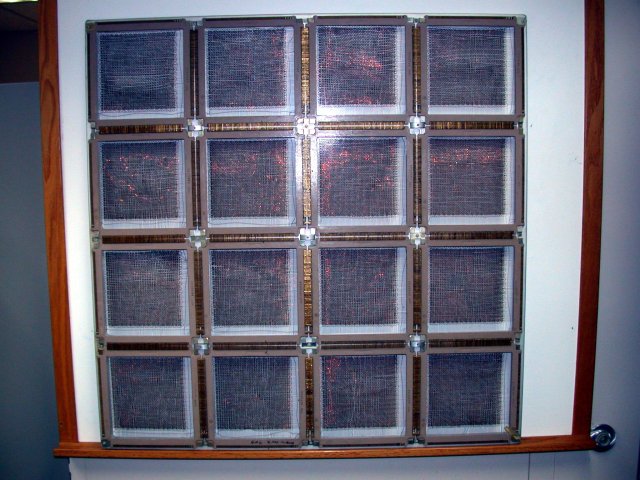
64Kbit core plane from an AN/FSQ-7 (SAGE) computer:
http://q7.neurotica.com/Oldtech/SAGE/Coreplane-1L.jpg
...along with other Q7 parts:
http://q7.neurotica.com/Oldtech/SAGE/
Mike Loewen mloewen at cpumagic.scol.pa.us
Old Technology http://q7.neurotica.com/Oldtech/
Took a little digging but I found the thread where you were talking
about port 20/21. I was able to configure the 3P+S card and run the
test from the solivant site successfully, but I'm not able to upload
basic. I have a couple more things to try, including setting a small
upload delay as Bill suggests on his page.
http://www.vintagecomputer.net/browse_thread.cfm?id=318
However, I'm thinking that I may still have a configuration issue on
the 3P+S card. But I think I'm getting close.
Win
--
>The manual pretty much has the exact config for that port 20 is all you
>have to remember
>Bill Degnan
>twitter: billdeg
>vintagecomputer.net
>On Jan 6, 2017 7:41 PM, "Win Heagy" <wheagy at gmail.com> wrote:
> I have an IMSAI that I am restoring. The basics appear to be working
> (front panel, CPU and RAM cards). I have a Processor Tech, 3P+S card
> that is next on the list for testing. I have the manual, but the card
> was not configured for RS-232...not sure what it was configured for
> but it doesn't match anything in the manual. I plan to reconfigure it
> for RS-232. I'm trying to locate boot loader code for that board to
> allow serial uploading of files from a PC to the IMSAI? I have boot
> loader code for a 2SIO board on an Altair that I restored awhile back,
> and would like to find something similar for the 3P+S. I want to be
> able to toggle in a boot loader routine and then initiate an upload
> from the PC to IMSAI -- something similar to this
> https://www.youtube.com/watch?v=YwC1T9oLK1U&t=212s
> (at 1:10s in) but with a 3P+S board on an IMSAI.
>
> Also, a picture of your RS-232 configured card and wiring of the edge
> connectors would be helpful to make sure I get things right. Any help
> is appreciated.
Ben Wrote:
>
> Where are the Female Computers?
> Hal
>To which Dave W. replied:
>Here they were ...
>http://farm4.static.flickr.com/3311/3214242023_ca5f2425a2_o.jpg
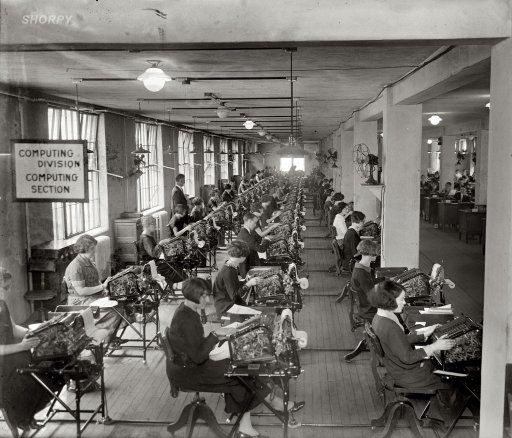
And, to this I say - BRILLIANT! These ladies were indeed called
computers back in those days!
-Rick
Compaq C series 2010c - aka series 2930a posters & Point of sale stuff
needed
We were given one - apparently not used in box the tab for the what
I assume is the config battery next to the main battery compartment never
even had its white paper pull tab pulled out to stat the battery up.
So anyway want to get other marketing stuff etc to help embellish a
display at SMECC project.
thanks ed# _www.smecc.org_ (http://www.smecc.org)
Here they were ...
http://farm4.static.flickr.com/3311/3214242023_ca5f2425a2_o.jpg
Dave
> -----Original Message-----
> From: cctalk [mailto:cctalk-bounces at classiccmp.org] On Behalf Of ben
> Sent: 10 January 2017 06:50
> To: cctalk at classiccmp.org
> Subject: Re: Contacting Jay West
>
> On 1/9/2017 3:13 PM, geneb wrote:
> > On Mon, 9 Jan 2017, Rob Jarratt wrote:
> >
> >>
> >> No HP-2000 problem, just wasn't HP-2000 sure if I had sent it to the
> >> right place HP-2000.
> >>
> > "Meet single HP-2000 in your area!"
> >
> > g.
> >
>
> Where are the Female Computers?
> Hal
> From: Phil Budne
> I've always assumed the P in PAL was for paper tape.
> The Wikipedia artile for PDP-8 says that PAL-8 assembled from paper
> tape into memory, so the A and L could have been for Assembler and
> Loader.
I have a number of different versions of the "PDP-11 Paper Tape Software"
manual, and the earliest one (DEC-11-GGPB-D, March '71) turns out to be for
PAL-11A, and it says it stands for "Program Assembly Language for the
PDP-11's Absolute Assembler" (pg. 3-1).
Amusing factoid: the manual says it takes about 45 minutes to re-assemble
PAL-11A from the source tape, and punch a new binary tape (this is using the
HSRP).
> ISTR PAL-11A was also an "absolute" assembler (did not output REL
> files), but there was also a PAL-11R.
Yup. PAL-11A took an input an ASCII tape with the program, and produced as
output "an absolute binary tape" (pg. 3-23).
A later version of the 'Paper Tape Software' manual (DEC-11-ASDB-D, May '71)
covers PAL11-R (although it does not, alas, decribe the relocatable output
format in detail - although I think it's documented elsewhere), and also
Link-11 and Libr-11. PAL11-R require DOS.
Noel
> From: Paul Koning
> Is that the Unix assembler convention?
Yup. From "Unix Assembler Reference Manual" (by DMR; no date, but the one I'm
looking at came with V6): "An octal constant consists of a sequence of digits
... A decimal constant consists of a sequence of digits terminated by a decimal
point '.'."
> It certainly isn't the one used by the GNU assemblers, which are modeled
> after the old Unix syntax.
Except when they gratuitously change things.
Noel
> From: Brent Hilpert
>>>> One assembler doc uses a prefix of "&o"
> So the answer is, by modern expectations the old standard would be
> ambiguous or misleading.
Well, the ideas of 'assembler' and 'standard' don't really go together in my
mind... :-)
But seriously, I don't know how many different PDP-11 assemblers there were,
but the two _main_ ones (DEC's, and Unix's) both use the same numeric
convention (although they differed in other ways, probably because of the
CTSS/Multics erase character convention): a sequence of digits is an octal
number, unless there's a trailing '.', in which case it's decimal.
(Well, technically, DEC had PAL-11 and MACRO-11, but PAL-11 was basically a
subset of MACRO-11, and used the same number syntax.)
I've never heard of that '&o' bizzaro-stuff - where did you find that?
Noel
In a message dated 1/9/2017 6:45:32 A.M. US Mountain Standard Time,
pontus at Update.UU.SE writes:
On Mon, Jan 09, 2017 at 01:31:28PM -0000, Rob Jarratt wrote:
> I sent a private email to Jay West a few days ago but I have not had a
> reply. He may be away or I may have the wrong address for him. What is
the
> best way to contact him?
>
A bit of patience I think. He seems quite busy sometimes.
/P
put hp-2000 in the title? <grin!>
> From: Lars Brinkhoff
> What's the difference between PAL-11 and MACRO-11?
Without going through the manuals at length, basically MACRO-11 supports
macros, and PAL-11 doesn't. The syntax is otherwise very similar.
> PALX is also the name for a cross assembler targeting PDP-11.
I know it was used on ITS (although the PALX source had assembly options for
all the main PDP-10 OS's, except TOPS-10), was that where it was written, do
you happen to know? It's in MIDAS, so probably...
Noel
An image gallery of cheesy -- and cheese-cakey -- magazine covers from
what were for me the golden days.
But the UK mags weren't ever like this.
Some of the names, and the typos, are highly amusing.
http://imgur.com/gallery/3Jlqh
--
Liam Proven ? Profile: https://about.me/liamproven
Email: lproven at cix.co.uk ? Google Mail/Talk/Plus: lproven at gmail.com
Twitter/Facebook/Flickr: lproven ? Skype/LinkedIn/AIM/Yahoo: liamproven
UK: +44 7939-087884 ? ?R/WhatsApp/Telegram/Signal: +420 702 829 053
OK, what was the standard (if there was one) number-base syntax for PDP-11 assembler?
Despite all the PDP-11 assembly info on web sites, this seems to be a buried bit of info.
One assembler doc uses a prefix of "&o", another specifies octal as default and prefix of zero for decimal (opposite of the common C-derived standard . . great).
Is this for example standard?:
BIT #&o200, @#&o177564 ; test 2^7 bit at address octal 177564
(I'm just trying to make some written commentary consistent with common policy.)
On Mon, Jan 9, 2017 at 3:30 PM, Ethan Dicks <ethan.dicks at gmail.com> wrote:
> I have some Xcelite tools from the early 1980s. They have been stinky
> for over 30 years.
Same experience. I have some in a drawer on my work work-bench that
were purchased in the early 80s and they still smell.
> Definitely a butyrate stink (I used to
> run chemistry shows at The Center of Science and Industry - one was on
> Esters... we mixed a variety of alcohols with a variety of fatty acids
> and let the audience smell the results... it was all fun and games
> until I spilled 200ml of Butyric Acid on myself... :-P )
In high school chemistry we did some experiments with that stuff. I
think the teacher just liked to stink up the school every year.
Now I also have a bunch of drawers filled with Allen-Bradley carbon
composition resistors from around 1970. All the leads have a whitish
film on them that has a peculiar odor. They've been in the electrical
lab at work, in an office environment since that time. I've always
been a little curious about what caused it.
-chuck
I'm looking at a sample of what I see as a directory of sorts and am
attempting to decode the file names from it. They're not anything as
elegant as Rad50, but the encoding has escaped my weary brain.
The system in question is a Lanier 103 word processor.
Here are some samples. Can anyone come up with the encoding scheme? It
can't be very complex as this was a comparatively brain-dead system:
(All values in hex)
c4 a3 75 6a ab 52 00 00
5c 25 15 1b 4c 40 00 00
cd 6d 15 7a a6 10 cb 82
a1 7a c1 c0 00 00 00 00
94 2f 38 40 00 00 00 00
d0 7f 9f 12 25 fd 53 28
The recurrence of these strings in what appears to be a block directory
in the same position tell me that they must be file names. The file
data itself is in ASCII, more or less (special formatting codes). The
distribution of values to me suggests some sort of bit-packing algorithm
is involved.
Thanks for any suggestions.
--Chuck
A few months ago I picked up some Polycorp Polys, a computer designed
specifically for the educational market in New Zealand. One worked and one
didn't. The latter is now fixed. As usual I've written it up with lots of
pictures. If anyone is interested you can read about it here.
http://www.classic-computers.org.nz/blog/2017-01-08-second-poly1-fix.htm
Cheers
Tez
Folks,
Why does this keep on happening? What is google doing to cause this to
happen? Is it doing greylisting and mailman ignoring the retry-after time?
Dave
-----Original Message-----
From: cctalk [mailto:cctalk-bounces at classiccmp.org] On Behalf Of
cctalk-request at classiccmp.org
Sent: 09 January 2017 04:11
To: dave.g4ugm at gmail.com
Subject: confirm 3a692ae231ea12a659548c4fb64ac8f80c8fe658
Your membership in the mailing list cctalk has been disabled due to
excessive bounces The last bounce received from you was dated 08-Jan-2017.
You will not get any more messages from this list until you re-enable your
membership. You will receive 3 more reminders like this before your
membership in the list is deleted.
To re-enable your membership, you can simply respond to this message
(leaving the Subject: line intact), or visit the confirmation page at
http://www.classiccmp.org/mailman/confirm/cctalk/
You can also visit your membership page at
http://www.classiccmp.org/mailman/options/cctalk/
On your membership page, you can change various delivery options such as
your email address and whether you get digests or not. As a reminder, your
membership password is
potter123
If you have any questions or problems, you can contact the list owner at
cctalk-owner at classiccmp.org
I sent a private email to Jay West a few days ago but I have not had a
reply. He may be away or I may have the wrong address for him. What is the
best way to contact him?
Regards
Rob
Yep - - Al I need to separate my Burroughs Xcelite tools somehow
form some of the other things.
Acetic acid will eat stuff... the Enigma had a green acitate filter in
the lid... with the case closed it ate all the metal keytops rings up. It
was ghastly! Ed#
In a message dated 1/8/2017 9:10:45 P.M. US Mountain Standard Time,
aek at bitsavers.org writes:
> I found this interesting wondering why some tool handles smelled odd.
Xcelite is notorious for this
Don't put certain tool handles in with artifacts... acetic acid and
butyric acid EATS!
I found this interesting wondering why some tool handles smelled odd. -
Ed Sharpe archivist for SMECC
"Tool handles made of Cellulose Acetate Butyrate. A thermoplastic, it
offers excellent UV and solvent resistance that cellulose acetate doesn't
offer. And it feels in the hand like a natural substance, something that is
almost intangible, like a tool that is made by craftsmen, a characteristic
that a polyethylene or polypropylene handle does not have. CAB also offers no
splinters like the older wood handles. It also can be very clear. And when
that plastic begins to degrade, it releases free acetic acid and butyric
acid."
Read much much more here->
http://dwarmstr.blogspot.com/2013/02/why-toolboxes-and-tool-handles-stink.ht
ml
Does anyone have an idea what this keyboard went to? The "here is" key
tells me it's likely a terminal, but the hex key pad is throwing me off.
Pictures here: http://imgur.com/a/zTgR2
Thanks,
Kyle
Hey, I saw your message to the ClassicCmp making list. I believe I have a
KIM-1 to sell you but I'd have to dig it out. Also, most of the machines
mentioned in this posting are still available:
http://www.vcfed.org/forum/showthread.php?51781-Mulitple-and-divers-compute…
Let me know if anything I have interests you. Thanks!
Sellam
Evening all,
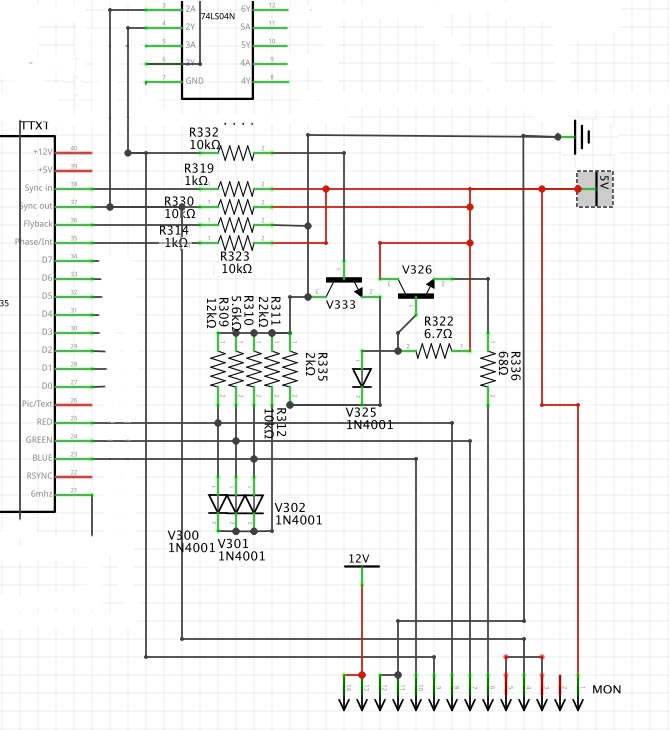
I wish I had the ability to take a board layout and turn it into a logically
laid out schematic but as yet I don't. Video sync on my Executel 3910 is
still running me round in circles so could one of you fine folk take a look
at this board layout drawn as best I can:
http://www.binarydinosaurs.co.uk/STCExecutelSyncCircuit.jpg
...and let me know what it does please? The chip on the left is a Plessey
MR9735 teletext video driver wired to run permanently in 'off hours' mode -
you can see 'Sync In' is just pulled high so the chip doesn't detect any
incoming sync and is supposed to generate its own, which it doesn't even
though all external clocks are present.
Resistor values are correct as far as measuring them with a DMM goes, the
diodes aren't actually 1N4001s but I can't read the printing on them. Both
transistors are BC548 NPN. The area labelled 'MON' is a 14-way ribbon cable
that goes off to the TV driver board.
I'm feeling pretty dumb at this point. Logic and truth tables are more my
thing, current flow is something I'm learning slowly.
Cheers!
--
Adrian/Witchy
Binary Dinosaurs creator/curator
Www.binarydinosaurs.co.uk - the UK's biggest private home computer
collection?
Allison wrote;
>I envy the chance to restore a LGP-30 or for that fact play with one.
>Many of the things I remember
>mid sixties on are now gone or were rare then. Like small desk sized drum computers using transistors or first generation IC (RTL and RDTL).
I so regret not having rescued an old computer that I played with through all four years of high school.
The machine was made by Minnesota Mining and Manufacturing (aka 3M Corporation). Today, there seems to be no record that 3M ever was in the computer business. But...it was. The system was designed expressly for process control. Kind of makes sense for 3M to develop a system like this, since most of the manufacturing they did needed process controls, and at the time, computers were getting to into that role in place of electromechanical systems.
The system was given to our high school by the local Natural Gas public utility that used the system from the mid-1960's through the early-1970's for monitoring and controlling gas flow in pipelines. It was replaced by more modern computer, a PDP-11 of some variety, IIRC.
This 3M machine was a dual processor system, with two identical CPUs that could communicate to each other through a common register located in an I/O rack. The original process control software was designed so that both CPUs would operate in tandem, each doing a different part of the job. One CPU mainly did all of the I/O interfacing and data normalization, and the other CPU did the number crunching and processing for the process control, feeding results back to the I/O CPU to control the physical stuff, and generating reports on an IBM typebar-type output typewriter. Operator interaction with the process control system was through a Teletype 33-ASR terminal.
The CPUs were transistorized. I recall that the cards were arranged in a U fashion looking at the CPU chassis from the top, some power supply circuitry and relays at the top of the U, the circuit cards making up the sides and bottom of the U, and the drum memory module in the middle.. Each CPU was something like 12RU height, and were in a small desk-high standard 19" equipment rack, with the CPUs stacked one above the other.
The CPUs were 24-bit word machines, with an 8K-word magnetic drum as main memory. Instructions had five bits for the opcode, and two address fields, one for operand location (drum address in block/track/sector format) or in the case of some instructions a short constant number), and also a next instruction address (again in block/track/sector format).
The I/O rack had the interprocessor communication register, along with registers for reading the time from a transistorized Parabam real-time clock (HH:MM:SS) in 24-hour time (The clock had those wonderful projection-type incandescent displays to show the current time), a Teletype current-loop interface at 110 baud, an interface for communication the IBM wide-carriage output typewriter (which we never we able to get working), and a whole slew of relay outputs, contact closure inputs, digital to analog converters with line drivers, and comparators with counters connected that could act as software-driven analog to digital converters, event counters, etc. One last output interface was a register that was write-only that could enable or disable an old Mallory Sonalert that would generate an ear-splitting shriek when turned on. There were also two banks of decimal thumbwheel switches, one with three digits, and another with 8 digits, that could be read from the CPU 4-bits at a time through an I/O register.
When I got to high school in 1974, the drum in one of the CPUs had suffered a bearing failure and crashed hard. The instructor of the computing curriculum looked into seeing if the drum could be repaired, but it would have been prohibitively expensive, so the drum was removed from this CPU and used as a prop for illustrating different types of memory technology to his students.
The other CPU ran fine through my years of high school, and I learned a great deal about programming at the machine level from the old 3M (I for the life of me can't remember the model number of the machine).
I fondly remember writing an "alarm clock" program where a time in HHMMSS form could be wheeled into the low six digits of the eight-digit thumbwheel register, and when the time there matched the time on the Parabam clock, it'd fire off the Sonalert, and print an arbitrary message on the teletype repeatedly until the program was halted by dialing a stop code read from the three digit thumbwheel switch bank when the program was started. Once the program was started, I'd scramble the three digit thumbwheels, so no one but me would know the code to stop the program. You might think that you could just press the "STOP" button on the console...but there was a Plexiglas cover with a small padlock lock on it that covered the console controls...and I had a key).
So, I'd set a time during one of the 1st year computer classes, start the program, and lock the cover over the console. In the middle of the class, the Sonalert would go off, and the teletype would rattle out "HELP, HELP!! I'M TRAPPED IN HERE!!! LET ME OUT!!!" with Control-G (ring the Teletype bell) interspersed amongst the characters). It would cause just a bit of a fuss. After watching the chaos for a few moments, I would calmly walk in and dial the code to stop the program.
Needless to say, after I did this a few times, I was kindly asked by the computer instructor not to do that anymore. It was great fun while it lasted.
The machine had no index registers. So, indexing meant writing self-modifying code. Never was bounds checking more important than when you were writing self-modifying code.
The machine had a hardware loader, which would accept block/track/sector addresses followed by a space, then the 8-digit octal representation of the word to be placed at that drum address. The loader was initiated by pressing a "LOAD" button on the console when the CPU was stopped. The loader was fast enough to be able to take in programs from the tape reader on the 33-ASR Teletype hooked up to the machine. There were four other controls on the console not counting the main power switch. "STOP" (halted the machine), "CLEAR" (initialized the program counter and two accumulators (A & B) to zero), and "START", which started the CPU executing at the current program counter location, which most of the time was 0/0/0 because you'd press CLEAR before START, and have a jump at 0/0/0 to branch to your program. The STOP and START buttons were lighted, so you could tell if the machine was running or halted. The last control was a momentary toggle switch, that would single-step one instruction when the machine was in STOP state. There were five neon lamp indicators on the console that showed the current instruction opcode to be executed. With such minimalistic controls, debugging was interesting, to say the least.
When powered up, the machine would have both the START and STOP lights turned off until the drum got up to speed and everything was synchronized, and then the lamp in the stop key would light up to tell you the machine was ready.
The machine was completely bit-serial in nature, minimizing the number of flip flops. I recall that the circuit boards in the machine were something like 5x7 inches (give or take), and were not densely packed with components. They were fiberglass boards, with traces only on one side, and jumper wires on the component side. I remember date codes on the transistors as being from the 1963 - 1964 timeframe. I recollect that there were something around 48 circuit boards in each CPU. We occasionally had to scrounge boards out of the decommissioned second CPU to fix faults that developed in the running machine...it was musical board swapping to troubleshoot because we didn't have any schematics or service documentation for the machine. The machine was quite slow, even if you wrote the code to use instruction timing to optimize placement of instructions and operands on the drum to minimize latency. I recall writing a program that I optimized as best as I possibly could, and the machine couldn't output to the Teletype at its full rated speed when typing out text from an arbitrarily located text buffer. It'd do about 9 characters per second. The machine had interrupt capability, but most of the interrupt processing logic was in the I/O rack, and something was amiss with the logic, and we were never able to get it to work properly. So, alll I/O was CPU polling, which explains part of why the I/O was slow.
I managed to write a minimal DEC FOCAL interpreter for the machine. IIt was really slow, but it worked. The floating point math routines were the most difficult. I had learned FOCAL on a DEC PDP 8 (straight 8) in a class I took when I was in 8th grade, and it seemed simple enough that I could make it work on the 3M machine. I had thought about trying to do BASIC for the machine, but I decided on FOCAL because it was a lot less complex. Glad I chose FOCAL, because It barely fit, even in somewhat minimalized form, on the 8K drum. It was very slow having to pack/unpack three ASCII characters into 24-bit words, but to make everything fit, I had to do it. And, with only two registers (accumulator A and B), and the interprocessor communication 24-bit register that was accessible through I/O instructions, it was quite a challenge.
Anyway, I graduated in 1977. I went back during the 1979 school year to visit, and the whole place had changed. The amazing computer curriculum teacher was gone, promoted to somewhere in the district administration, and some younger new guy was there whom I took a pretty immediate dislike to. This was his first year teaching at the school, and the first thing he did was call a scrap dealer to come take away the 3M machine, along with another old machine that was donated to the school...hardly a computer, more like an accounting machine, made by SCM, called a 7816 Typetronic. They were both gone, and I was really angry that they had gone off to scrap. Also, the IMSAI 8080 microcomputer that a small group of students including myself had built from kit form as a high school project during the end of Junior and first part of Senior year in high school was nowhere to be seen. In their place were a number of shiny new Apple II computers. These, to me, seemed mere toys compared to the "real" computer that had gone off to scrap. Had I known this was going to happen, I would have somehow come up with a way to rescue the 3M machine (it wasn't small, nor lightweight) to some kind of safe storage until I would have the resources to restore them. Fortunately, through pure luck, I did manage to find that old IMSAI that we built....and it is in my collection today, and works great. A story for another time.
So, even though I was born a bit late to have been "in the prime time" of the earlier computers, I did get the rare experience for a person my age of working with a machine that used magnetic drum memory as primary memory, and I wouldn't trade what I learned from that old beast for anything.
Rick Bensene
Allison wrote;
>I envy the chance to restore a LGP-30 or for that fact play with one.
>Many of the things I remember
>mid sixties on are now gone or were rare then. Like small desk sized drum
>computers using transistors or first generation IC (RTL and RDTL).
Rick Bensene wrote:
>I so regret not having rescued an old computer that I played with through
>all four years of high school.
>The machine was made by Minnesota Mining and Manufacturing (aka 3M
>Corporation). Today, there seems to be no record that 3M ever was in the
>computer business. But...it was.
I never saw one of those, but the computer center I worked at in college
dumped a Cincinnati Milachron small business computer system - *not* a
machine tool controller. I tried to grab it, but that was not to be. Same
thing - there's no record anywhere I could find that they were ever in that
business.
<...>
> along with another old machine that was donated to the school...hardly a
> computer, more like an accounting machine, made by SCM, called a 7816
> Typetronic.
I actually ended up with a complete SCM 7816 system, including:
- The I/O Printer, which was a hacked SCM electric typewriter, with
diode-matrix encoding for the keyboard, and relay decoding for the printer;
it used a row of washers to mechanically ensure that only one key could be
pressed at once. It also had a paper tape reader built into the back of the
carriage, so that some computation could be triggered by the carriage
position, or performed while the carriage was returning.
- The main 2816 control unit, with a plug-board "output panel" to route data
between the various peripherals; this also had the massive power supply,
which used a ferro-resonant transformer to regulate all of the voltages.
- The optional (!) 7816 arithmetic processor, which did bit-serial addition,
subtraction, or multiplication (no division, but this was simulated by using
reciprocal multiplication); there were nine 10-digit registers (no other
working memory), all implemented on a fixed-head disk, plus a buffer
implemented electronically. Add time was 17ms, multiplication 700ms; this
is why the ability to do calculations during the carriage return was
valuable.
- Two paper tape punches - these were re-branded CDC punches, and were very
nice units. 40 characters per second, with a built-in automatic
verification; they could also be used to punch on the side of cards, instead
of tape.
- Two paper tape readers. These were built by SCM, and were pretty nice
too; they were optical, would read at 30 characters per second, and could
stop from full speed on the next character.
- The custom desks, which included a recess for the I/O Printer to sit in,
and acted as chasses for the 2816 and 7816.
- All of the manuals and schematics for the whole thing. Some of the logic
was made using thick-film modules, but most was on the vintage single-sided
boards, with obviously hand-drawn traces and jumpers on the component side.
Somebody has uploaded some of the manuals and 2816 schematics to bitsavers,
but not the schematics for the 7816.
With the complete schematics, I was eventually able to get the thing to type
and read and punch tape, but I never got the arithmetic unit working. That
machine was *really* dumb... I carted the whole thing around for about 15
years, until the new wife decided that she was more important than the space
it consumed. That's OK, I guess - I eventually ended up dumping her, too...
~~
Mark Moulding
I guess I'm on a roll, trying to find out what some things are in the
collection. Any idea what this paper tape reader could've been connected
to?
http://imgur.com/a/DjRj7
Thanks,
Kyle
Some is not so vintage, but most of it is. https://elecshopper.com
Yes, I will ship internationally, but the value on the customs forms will
reflect the actual price paid, as do the invoices.
Look around, maybe find something interesting.
The RSS feeds are at https://elecshopper.com/RSS if you want to keep an eye
on new additions, sales, etc.
More products are usually added every day.
Cindy Croxton
Electronics Plus
1613 Water Street
Kerrville, TX 78028
830-370-3239 cell
sales at elecplus.com
AOL IM elcpls
Hey guys.. I bought this Homebrew Z80 machine from what I assume is the
early 80s (going by the chips). Pretty sure it's a Netronics keyboard but
wondering if any of you have seen a design like this one. I'm just curious
if it came from a magazine article or something as it goes beyond the
typical basic homebrew and even appears to have some ROMs. I'm not sure
what the TOS ROM is though.
I've put some pics of it here:
https://drive.google.com/drive/folders/0B4pq0-BHd2x6bjY3MTRZbGRCQmM?usp=shar
ing
Thoughts/opinions welcome.
Hi all!
Wishing you all a happy new year :)
I'm looking for a KIM-1 system and/or any other related hardware, the
earlier the better! If you have one you'd like to sell, please drop me a
line :)
-A
www.ebay.com/itm/302178528335
bought for the CHM collection.
This is the first one I've ever seen. I don't remember if the Morrow sons auctioned
one off when they were selling off George's shop.
It's essentially a MicroDecision III and MT-70 terminal according to the notes I scanned.
I have an IMSAI that I am restoring. The basics appear to be working
(front panel, CPU and RAM cards). I have a Processor Tech, 3P+S card
that is next on the list for testing. I have the manual, but the card
was not configured for RS-232...not sure what it was configured for
but it doesn't match anything in the manual. I plan to reconfigure it
for RS-232. I'm trying to locate boot loader code for that board to
allow serial uploading of files from a PC to the IMSAI? I have boot
loader code for a 2SIO board on an Altair that I restored awhile back,
and would like to find something similar for the 3P+S. I want to be
able to toggle in a boot loader routine and then initiate an upload
>from the PC to IMSAI -- something similar to this
https://www.youtube.com/watch?v=YwC1T9oLK1U&t=212s
(at 1:10s in) but with a 3P+S board on an IMSAI.
Also, a picture of your RS-232 configured card and wiring of the edge
connectors would be helpful to make sure I get things right. Any help
is appreciated.
Thanks, Win
wheagy at gmail.com?
Christian Corti had made available the German version of the LGP-30
Maintenance Manual, copied here:
http://ed-thelen.org/comp-hist/LGP-30MaintenanceManual-German.pdf
Ed Thelen had OCR?d and translated some of the pages, but I?m looking for a
copy of the complete English version if someone has it available. A search
of the CBI archives didn?t turn up anything, either.
If only paper copies exist, I would be glad to pay postage, scan, and send
back the manual if someone out there has it. Thanks- Cory
For what it's worth, xtrs (http://tim-mann.org/xtrs.html) emulates LD A,R
by putting an 8-bit random number in A. Of course that's cheesy and wrong
-- especially bit 7 being random instead of retaining a 0 from reset or the
last value written to it -- but at least it works OK with Ethan's
subroutine. The subroutine may loop a few times due to the value randomly
being negative or zero until it escapes the first time the value is
randomly positive.
xtrs sets the sign and zero flags according to the value, and does
something complicated with the other flags that I don't remember the reason
for -- but it might be correct; i think I got it from some reference on the
web last time I hacked on that instruction.
The pointer that someone posted to
http://www.worldofspectrum.org/faq/reference/z80reference.htm#RRegister may
inspire me to fix the emulation, though it looks like a bit of work to get
it exactly right...
On Thu, Dec 15, 2016 at 10:00 AM, <cctech-request at classiccmp.org> wrote:
> Message: 10
> Date: Wed, 14 Dec 2016 17:34:29 -0500
> From: Ethan Dicks <ethan.dicks at gmail.com>
> To: "General Discussion: On-Topic Posts" <cctech at classiccmp.org>
> Subject: Re: Z-80 code question about a loop that depends on the
> contents of the refresh register
> Message-ID:
> <CAALmimm07Bf=fjp70jzMKiV0m94aWxzggjeZuJg=ji
> LeLXT+gw at mail.gmail.com>
> Content-Type: text/plain; charset=UTF-8
>
> On Wed, Dec 14, 2016 at 4:26 PM, allison <ajp166 at verizon.net> wrote:
> >>> On 14/12/2016 09:19, Ethan Dicks wrote:
> >>>>
> >>>> So far, this loop hangs on all three emulators I've tried - simh's
> >>>> altairz80, simcpm010 for AmigaDOS, and EMUZ80 for Raspberry Pi. I'm
> >>>> guessing none of these environments emulate specific behavior of the
> >>>> Refresh register?
>
> > The first year of appearance for 64K DRAMS was mid to late 1980
> (expensive
> > and scarce) and mostly sampling to the big vendors. For regular users
> late 81
> > when the price started down.
>
> Right. I was a user of 8-bit micros in that exact era. My first
> hands-on experience as a user was the memory inside the Commodore 64.
> My first engineering experience was in 1984 on a product designed in
> 1983 (COMBOARD-II with 128K of 4164 chips and a 74S409 refresh
> controller).
>
> > There were three flavors, 8bit refresh, 7bit refresh, and
> > internal refresh came in a bit later by maybe mid 1982.
>
> I know there were different types but not those details. Thanks.
>
> > The Z80 could do 8bit refresh with hardware or software or the self
> refresh
> > (internal).
>
> I'm also a little fuzzy on this aspect of things because I was never a
> Z-80 user back in the day.
>
> Software Results considered a Z-80 COMBOARD very early on, but
> abandonded that approach because it would have likely required 2 hex
> Unibus modules and so opted to hold out a few months and go with a
> 68000 and SRAM design on a single hex card (my old boss still has an
> XC68000 with S/N 424 engraved on the lid).
>
> > Nominally the R register is a counter that increments from any value to
> 7bit
> > overflow.
>
> So I'm learning.
>
> > I believe most emulators actually do that.
>
> The first three emulators I tried (simcpm010, altairz80, and EMUZ80)
> on three different platforms (AmigaDOS, Linux, and ARM) do not. I now
> have a couple of names of DOS/Windows emulators that should. I will
> have to run them under Wine since I'm not a Windows user.
>
> It's funny because I would have tried this on simcpm010 25 years ago
> (it was on the Amiga disk I just extracted all these files from) and
> it would have failed then just as it fails today, and then, I had *no*
> idea why. I've learned a lot since then because it only took me a few
> hours of digging to uncover why.
>
> > Check MyZ80 Simon Crans work (32bit
> > dos/ pre-7-winders only or in a 32bit sim/VM).
>
> I will look that up.
>
> > Either that or lookup and assemble Grant Searle's low chip count Z80
> system.
>
> The worry is not running on real hardware. Once I get some time to
> clean up my XOR or dig out a Kaypro, I will run it on real hardware.
> I want to find/fix an emulator for modern machines so that other
> people can just grab and go. Also, this is not _just_ a Z-80 program,
> it's a CP/M program, with CP/M BDOS calls to open/close/read/write
> files and read-from/write-to the console (F_OPEN, F_CLOSE, F_READ,
> F_WRITE, C_READSTR, C_WRITE).
>
> Right now, I'm leaning towards fixing altairz80 first since that runs
> on "everything". I may also work with the author of EMUZ80 so it
> works on bare-metal Raspberry Pi (EMUZ80 is a Pascal app that runs in
> the Lazarus bare-metal framework, so you need Windows to rebuild the
> app). I don't mind putting known-working Windows-based emulators on
> a list of "verified environments", but I'm not going to push this to
> the public without a Mac and a Linux answer. Telling the world that
> they have to build a real Z-80 CP/M machine to play a game isn't going
> to hit a large audience.
>
> Thanks,
>
> -ethan
>
<<I happen to have a Atlantic Research Inc, serial datascope. It
contains <<several boards [std bus z80, rom/ram card, CRT5027 based crt
controller Card] <<however no manual. Someday I'll track down at least a
schematic and fix <<the CRT. The boards say T-Bar on them so the
instrument may even be from <<another company with the ACI label. It
would be fun to get it operational. I repaired the CRT and foudn it
generally less than useful and repurposed the CRT, Power supply and case
for a Embedded ELF system... with disk. So now I have the three STD
boards and 4 slot backplane... THey do have T-BAR on them and I can do
one of two things with them strip them for the CPU, SIO, RAM, EPROM,
SMC5027E CRTC. As is without manuals or other useful info they are junk
to be reused. Ideally with far more detailed info like schematics make a
dedicated z80 system. So I post it again... Allison
I'm looking for a PDF of "Introduction to DECSYSTEM-20 Assembly
Language Programming" by Ralph E. Gorin. It used to be hosted
on PDPPlanet (xkleten.paulallen.com), but that's been down for a while.
Does anyone else have a copy they could send me?
Best Wishes,
-Seth
--
Seth Morabito
seth at loomcom.com
On Tue, 1/3/17, Cory Heisterkamp <coryheisterkamp at gmail.com> wrote:
> What I?m wondering is if anyone is familiar with the setup/adjustment
> procedure for getting the heads set correctly. There *might* be a couple of
> unused tracks I can relocate heads to, but my thought is that if half a
> dozen heads were already in contact, then the rest may be perilously close
> as well (swelled drum?). My odds of setting 71 heads perfectly on a 50 year
> old worn drum is?well?not great.
A while back I read a procedure (probably in reference to the G-15).
Quite frankly, it scared me a little, but I'll pass it on. The idea is to
use sound. The tech would use a screwdriver as a sounding bar
between the casing and his ear. Then the head was tightened down
until you could just hear it start to brush. I don't remember for sure,
but I'd have to think that you would then back off just enough for
the brushing sound to stop. I don't recall whether the article said
that this was done with the motor running or the drum was being turned
by hand, but if it were my machine, I'd set the heads turning the drum
slowly by hand and then check for any brushing sound when the motor
comes up.
Whether or not the drum is restorable, I'd still plan on building a drum
simulator. That way you can get the rest of the machine up and
running without stressing or depending on the drum too much. Plus
if the drum does turn out to be unrestorable, you'll still be able to
run the rest of the machine. As to how to approach the simulator,
I would have to think a C.H.I.P. or a Pi would have plenty of horsepower,
especially if you drop Linux and either run on the bare metal or
as an in-kernel driver in something lighter weight.
BLS
I would also be interested in schematics. I have just started looking at this
board to try to use it with a ODEC/Data 100 chain printer.
> Looking at the LA180 manual's description of the LC8-P interface, it
> is pretty close to Centronics. I expect it is more than just a cable,
> though, because there is also an OMNIBUS Centronics printer interface
> board (LS8-E). That schematic is on bitsavers.
>
It looked to me the LA180 protocol is demand and busy high when ok
to send character then the data is strobed in with data strobe pulse.
Centronics is handshaked with strobe and busy so a little different.
The board is simple enough that tracing it out is feasible if needed.
Haven't plugged in the board yet to see how the signals behave.
Still working on the printer.
Hi,
I've an DEC QBUS multifunction module here.
Type is MXV11-B M7195.
It does not boot into its ROM menu, despite I compared all the jumpers
multiple time against documentation and a reference boards.
So it seems something in the ROM address logic is burnt.
Somebody has the FPMs schematics? I even can scan micro fiches.
Thanks,
Joerg
While waiting for the machine, I decided to investigate the stuck drum.
This unit has 71 read/write heads plus what appears to be an inductive
pickup for the system clock. Upon closer examination I discovered multiple
heads in contact with the drum surface preventing rotation. And in the
process of removing the mounting bars that secure the heads only then did
damage become visible on a couple of tracks (scored oxide under the heads).
What I?m wondering is if anyone is familiar with the setup/adjustment
procedure for getting the heads set correctly. There *might* be a couple of
unused tracks I can relocate heads to, but my thought is that if half a
dozen heads were already in contact, then the rest may be perilously close
as well (swelled drum?). My odds of setting 71 heads perfectly on a 50 year
old worn drum is?well?not great.
For kicks, I tried to use a piece of cheap (=thin) (0.004?) notebook paper
as a feeler gage to see if I could identify the offending heads prior to
support removal. This was a no-go as clearance was too tight. So, is it
true these ride 0.001? off the surface?
I suspect with temp and humidity changes, and given the age, I would be
better off building a solid state drum emulator for the 4KW mem, but
retaining the drum for the clock and possibly the 3 fast registers..if I
can get those (7) heads set correctly.
Any input is welcome. -C
I need some of these for making Diablo disk drive cables. Mouser/Digikey, etc. have a
minimum buy of 500 (at $9 ea).
Picture at http://multimedia.3m.com/mws/media/140452P/ts0005-pcb-connector.jpg
Anyone see any at any surplus places? Online searches are pretty much useless because
of the extremely common 40 pin male IDC plug, and my searches in the valley have come
up empty.
Hi,
after I remarked in November last year that the cctech archives have been `lost`
Jay West responded
> Walter....
>
> I think you need to ask a few questions before you toss that kind of nonsense out.
>
> For your info - this is a hobby. It is done in spare time. The time period you
> peak of - the archives have NOT been lost. Because unlike what you intone - we
> do care. Those archives are safe and sound, just not in a publicly accessible
> format. One of our kind list members has been working for eons to reconstruct
> the publicly viewable content from them.
>
> I will tell him that you are going to volunteer to help him.
Well, it is certainly true that the archives visible under
http://www.classiccmp.org/pipermail/cctech/
only go back to November 2014.
Thanks to the Internet Archive there is a full backup of the older
archive sections readily available online. Simply open
http://web.archive.org/web/20141025062159/http://www.classiccmp.org/piperma…
and one gets all archives from October 2014 back to February 2005.
There I found the postings I was looking for, and updated my links to use
http://web.archive.org/. That's all.
So in a wider sense nothing is lost, one has to search in the right place.
With best regards, Walter
> From: Josh Dersch
> Thought I'd share this fix with you all just in case someone in the
> future might make use of it.
To help disseminate it, I uploaded the fix to the Computer History wiki:
http://gunkies.org/wiki/CDU-710/M_disk_controller
> From: Lars Brinkhoff
> There's no central repository for fixes like these?
Well, the CH wiki would be a good place, but creating new accounts on it is
proving to be difficult.
I'm trying to get ahold of one of the two bureacrats, to make me an admin
(I've been one on Wikipedia since the Devonian), so I can create accounts for
people, but so far no luck.
Noel
-------- Original message --------
From: Raymond Wiker <rwiker at gmail.com>
Date: 2017-01-02 11:01 PM (GMT-08:00)
To: "General Discussion: On-Topic and Off-Topic Posts" <cctalk at classiccmp.org>
Subject: Re: National Semiconductor IMP mini
I see he also has an Apple II that he wants $2000 for --- it's listed as "NON
WORKING ELECTRICAL COMPONENTS FROM EXTREME AGE", and from date codes and
copyright markings it appears to be far from original. In fact, the
motherboard seems to be a Rev 7 RFI motherboard, and the processor is (I
think) from 1985. If that one is worth $2000, my Apple IIs must be worth at
least $6000 each :-)
On Tue, Jan 3, 2017 at 5:24 AM, jim stephens <jwsmail at jwsss.com> wrote:
>
>
> On 1/2/2017 8:08 PM, Josh Dersch wrote:
>
>> On 1/2/17 7:58 PM, Brad H wrote:
>>
>>
>>> -------- Original message --------
>>> From: Josh Dersch <derschjo at gmail.com>
>>> Date: 2017-01-02? 7:37 PM? (GMT-08:00)
>>> To: "General Discussion: On-Topic and Off-Topic Posts" <
>>> cctalk at classiccmp.org>
>>> Subject: Re: National Semiconductor IMP mini
>>>
>>>
>>> On 1/2/17 7:22 PM, jim stephens wrote:
>>>
>>>> This system looks pretty interesting, though pricey. I'm thinking it
>>>> is going to be a development machine as all the switches and display
>>>> would not probably have been on a production machine.
>>>>
>>>> I don't think National made many minicomputer format machines, in
>>>> their history, someone correct me.? That might make this pretty rare
>>>> on that front as well.
>>>>
>>>> thanks
>>>> Jim
>>>>
>>>> Beautiful-1974-NATIONAL-SEMICONDUCTOR-COMPUTER-model-imp-16p/
>>>> http://www.ebay.com/itm/252700755919
>>>>
>>>> Yeah, it's pretty cool but I don't think the seller has reasonable
>>> expectations for actually selling it -- the auction started (I believe)
>>> at $1500 (which may have been a reasonable price), then the seller
>>> raised it to $2500, now it's at $3500 (which is fairly outrageous, in my
>>>
>>>> opinion).? I'm not sure what his strategy is.
>>>> Bitsavers has manuals (of course...)
>>>> - Josh
>>>>
>>> I think he figured toggle switches and lights = $$$$.? He might be
>>> correct, given the obscene money I've seen laid out just for a PDP 8/e
>>> faceplate. You never know a) what will motivate a collector and b) when
>>> just the right collector for a given item will show up.? Every day I thank
>>> my lucky stars they didn't, for whatever reason, show up for my Mark-8
>>> boards.
>>>
>>
>> With the "No shipping cash on pickup" proviso the seller provides, I feel
>> fairly certain no one's biting.? But I've been surprised before...
>>
>> - Josh
>>
>
> I also passed on a PDP8/M he had, which was quite rangy then posted this
> auction.? I had not come across the listing from before.
>
> The "Oh it must be worth a fortune", even canceling an auction 2 weeks ago
> on me.? I didn't think to pay for it on auction closing, since I'd been
> sniping it, or I could have really reamed the seller.? I have not gotten a
> straight response from them since then.
>
> I would not have noted this other than what i think is a rarity. Sad that
> the guy is holding it hostage from someone who could get hold of it and run
> it.? I think there is one in the CHM collection from what i was told when I
> checked on it before sharing here, so there is one preserved.? However
> would be interesting to see one in such as Josh's or Ian's hands running.
> (or many others, just share a lot with them and they are lighting blink'n
> lights more than me right now).
>
> thanks
> Jim
>
>
I brought the RFI thing up with him. ?No response. ?There is a legit Rev 1 there too asking $3500. ?I don't find Apple IIs below Rev 0 that interesting anymore, personally. ?I think even the legit guy would struggle to get much above $1500.
-------- Original message --------
From: "drlegendre ." <drlegendre at gmail.com>
Date: 2017-01-03 8:03 PM (GMT-08:00)
To: "General Discussion: On-Topic and Off-Topic Posts" <cctalk at classiccmp.org>
Subject: Re: was: National Semi... is Apple ][ collectability (if any)
"Vent-less case" - LoL!!
Add some RAM, maybe a DISC-II card and those things overheated even +with+
the vents.. that's why the Cider fan became popular, among other things.
When I was in high school, we'd pop the case tops open, and run them that
way. Otherwise, they'd overheat and start screwing up after the first or
second class period.
On Tue, Jan 3, 2017 at 10:36 AM, Brad H <vintagecomputer at bettercomputing.net
> wrote:
> >On 1/2/2017 11:26 PM, Brad H wrote:
> > I brought the RFI thing up with him.? No response.? There is a legit Rev
> 1 there too asking $3500.? I don't find Apple IIs below Rev 0 that
> interesting anymore, personally.? I think even the legit guy would struggle
> to get much above $1500.
> >The vintagecomputer museum guy on epay is selling mounted and framed
> motherboards now for $1500 (might not >work noted).
>
> >I guess someone would care about low ref Apple 2's but I'm not sure why
> there would be any interest.? I've got one >I bought with the original
> packing box, which I have picked and moved twice, which is rare for my
> collecting, but I >don't know what makes any Apple 2 like that
> collectible.? As in why are they collectible with low serials / part
> >numbers.
>
> >is there any documentation as to when they were made with those numbers
> that would make them significant?? >The numbers made as Raymond said would
> make most of us with Apple 2's millionaires I'd think unless they have
> >some other significance.
>
> >just curious.
> >thanks
> >Jim
>
> When I got into collecting an original Apple II was as rare as hen's teeth
> on ebay, etc.? Those got huge bucks, regardless of rev.? Then sellers
> caught on and stuff started coming out of closets, basements, estate
> sales.? I actually track Apple II sales and prices have massively declined
> since 15 years ago.? I mean, there's 60000+ out there theoretically, and
> II+ shared the same components and production lines for a time.? Only diff
> was the ROMs.? Now Rev 0 is where it's at, especially a rare ventless
> case.? Oh, and late SNs in the 70000 range for some reason still get
> $700-800.? I don't know why.
>
> The one thing I can tell you is, if an 'expert' tells you something about
> original II production, there's a good chance they are wrong.? Some
> authoritative sources claimed no Rev 02 boards went into public hands, for
> example, but I have one in my SN 16000s machine.? Some would claim that
> can't be original, but it is.. the date code on it is the same as the
> keyboard and case, all right in the range of other 16000 series machines,
> which on either side of mine have Rev 03.? Apple didn't use the same rev
> consistently.. sometimes they just grabbed from the pile.? It's kind of a
> dogs breakfast after Rev 0.
>
> My Rev 02 operates no differently, other than Integer BASIC, than my RFI
> II+.? More and more I'm not finding IIs to be all that amazing or worth
> fighting over.? A Rev 0, just owing to the few truly unique design
> features, is the only one I might want now.
>
>
>
>
Yeah. ?We were on to IIes when I was in grade school and then Commodores and PCs after that.. original IIs and II+ were long gone. ?I have four units and never have any issue but come to think of it I do tend to run them case top off. ?I imagine other users might have run them with the monitor (another massive heat source) sitting right on top.
I think the ventless cases also were made of a weaker plastic that melted and warped just from the heat of the innards. ?The few examples I've seen are almost invariably somewhat concave. ?
Wishing all here a very Happy New Year!
Along with some other folks in 2017 I have decided I am going to ripple
through all of my vintage systems and warm their beautiful and friendly
caches.
I won't have a problem with my BBC Micro, Atari 1040ST, Amiga 500's, 2000's,
3000 and 4000 and the PowerMac's but what I really would like is to bring my
Cromemco back on line. I have the cards (DPU, 256KZ, 16FDC plus sundry
others e.g. Quadart, IOP) and drives (Tandon TM100 5" and dual TM848 8") but
although I have a naked Blitz Bus I lack a decent chassis. This is a plea
for any kind soul with a spare or unwanted chassis who is prepared to let
one go to help me out. Ideally a CS/3 chassis would be preferable however a
Z2D, Z2 or even a System 1 chassis would be gratefully given a loving and
permanent home.
Naturally, given the weight of same, I expect I would have to pick up or
arrange transport so regretfully any offers would have to be UK-based. The
CS/3, and the Z2/Z2D had power supplies designed to handle a fully loaded
bus of 21 S-100 cards (although I never handled one with more than 12 or so)
and were one of those rare systems which could pass Navy certification i.e.
survive being stood on by a rating in full gear and boots so were quite
substantial.
I would also be very interested in a 64FDC and any 5Mb or 20Mb IMI drives as
I have a WDI-II controller, alternatively an STDC controller.
James
----
James Attfield
West Midlands, UK
G8ZMP
In a message dated 1/3/2017 11:11:54 A.M. US Mountain Standard Time,
elson at pico-systems.com writes:
On 01/03/2017 10:58 AM, Cory Heisterkamp wrote:
> While waiting for the machine, I decided to investigate the stuck drum.
> This unit has 71 read/write heads plus what appears to be an inductive
> pickup for the system clock. Upon closer examination I discovered
multiple
> heads in contact with the drum surface preventing rotation. And in the
> process of removing the mounting bars that secure the heads only then did
> damage become visible on a couple of tracks (scored oxide under the
heads).
Most likely the same issue as the G-15 we had. Dust was
allowed to get into the drum area and pack under the heads.
Probably if you pull the heads and clean them, it will
restore clearance. Of course, the bearings may be bad, or
will have to be replaced anyway as the grease may have hardened.
>
>
> What I?m wondering is if anyone is familiar with the setup/adjustment
> procedure for getting the heads set correctly. There *might* be a couple
of
> unused tracks I can relocate heads to, but my thought is that if half a
> dozen heads were already in contact, then the rest may be perilously
close
> as well (swelled drum?). My odds of setting 71 heads perfectly on a 50
year
> old worn drum is?well?not great.
>
If the drum can be set up to run true again (may need
attention to bearings) then I think setting the heads up
won't be that tough. I suspect it is done with a feeler
gauge, this is low-resolution stuff with large gaps in the
heads, so the heads probably run with a gap of at least
.005" (~ 0.1mm) (I'd think, without actually knowing).
>
> For kicks, I tried to use a piece of cheap (=thin) (0.004?) notebook
paper
> as a feeler gage to see if I could identify the offending heads prior to
> support removal. This was a no-go as clearance was too tight. So, is it
> true these ride 0.001? off the surface?
Well, it could be. That sounds really close for the vintage
involved. So, maybe the drum or oxide has swelled. Anyway,
if there is much damage to the oxide, it may not make sense
to try to repair it. if the heads that jammed it left
divots in the drum, or the surface is uneven (likely if
swelling actually occurred) then it may require extreme
efforts to repair.
>
> I suspect with temp and humidity changes, and given the age, I would be
> better off building a solid state drum emulator for the 4KW mem, but
> retaining the drum for the clock and possibly the 3 fast registers..if I
> can get those (7) heads set correctly.
>
>
>
>
Why not just replace the whole works? If you are going to
replace the long lines with electronic memory, doing the
short lines and the clock track should be trivial. I think
a mid-sized FPGA could do it all quite easily.
My guess is that if the surface is uneven, it may not read
back data reliably. The high spots might be fine, the low
spots will have dropouts. This is all assuming swelling was
the culprit.
It is also possible that machined parts suffered stress
relief over the years. Wrought metal has stress imparted to
it when rolled, and then machining will partially relieve
the stresses, causing warpage. The warping continues over
time. To eliminate this, critical parts are machined close
to size, heat treated to relieve the stress, and then finish
ground to exact dimensions. It is possible some of the
stress wasn't relieved during manufacture.
And, nobody expected a 195x machine to be running in 2017,
especially as anybody in the computer business knew those
transistors were right around the corner, and would almost
certainly replace tubes.
Jon
Cory - then what holds the oxide to the drum? Horrible thoughts of what
happens to binder layers on mag tape... flaking, sticky shed....
ecccshhh!
I deal with this problem all the time on some of the historic video
tape we have done conversion on out of our media lab.....
Hi,
On Mon, Jan 02, 2017 at 10:32:28PM -0800, Richard Pope wrote:
> Walter,
> . . . . I appreciate all of this information. I have a revision 2.0
> board and my info shows U8 as a 96S02 multivibrator chip. I have tried
> to find a replacement for this and I have not been successful.
I believe this is a suitable replacement. I found it while getting the
parts together necessary to build my bare IA-1010 Z-80 board.
"AM26S02PC - Schottky Monostable Multivibrator ( 5 pcs ) - 16 Pin DIP Plastic"
http://www.ebay.com/itm/261370092245
Mark
--
Mark G. Thomas (Mark at Misty.com), KC3DRE
Pics of what I'm trying to find at
http://www.retrocomputing.net/parts/compugraphic/mcs_keyb/
Bought one w/o kb or monitor and managed to locate a few floppies for it. CP/M 86 was available from CG, but
I don't think there's much chance of ever finding that.
Even just a dump of the microcontroller in the kb would be helpful. I'm not quite sure who the contact
would be at retrocomputing.net to ask if they could dump the one in theirs.
I have the PALs dumped and disassembled, will have those up on bitsavers later this morning.
Sorry for posting the National machine w/o an Ebay warning.
Anyway anyone that has a home keypunch will possibly be interested in
this guy.
I have ordered up a pile, as I doubt they will show up this cheap unless
someone takes it on themselves to manufacture them as the earlier
discussions suggested. Not holding my breath for that.
I don't personally care that there is a lot of crap printed on them,
rather than the column indexes. The machines don't read that, and the
top band is clear for my keypunches to write there with whatever is on
the card.
thanks
Jim
Has cases of 2000 and also cases of 5 x 2000 = 10000 cards (look for the
5 case auction separately)
http://www.ebay.com/itm/272488557055