List FYI: correspond w/George directly concerning this wonderful haul
of TTY gear...
---------- Forwarded message ----------
Date: Fri, 21 Feb 2003 21:40:20 -0800
From: George B. Hutchison <w7ksj(a)attbi.com>
To: greenkeys(a)mailman.qth.net
Subject: [GreenKeys] Teletype Machine Availability
GreenKeyers - - -
This evening I received a telephone call from a gentleman advising me of
the availability of the following teletype equipment. It is free for the
taking.
It is located in the Seattle area.
He does not want the people at "The Source" to be rattled by a bunch of
telephone calls, so please e-mail me should you have an interest.
The list includes:
1 Ea Model 37 KSR
8 Ea Model 28 KSR
1 Ea Model 35 ASR
5 Ea Model 35 KSR
6 Ea Model 14 TD
1 Ea Model 14 RO Reperf
7 Ea Model 15 KSR
1 Ea Model 15 Perforator-Transmitter (Model 19 KBD)
1 Ea Model 43 RO
1 Ea Model 43 KSR
Fair quantity multi-copy paper.
The equipment must be removed fairly soon, as the space it is in has been
designated by the building owner for another purpose. If it is not wanted
by anyone, to the landfill it goes. I have no room for it.
73,
George, W7KSJ
_______________________________________________
GreenKeys mailing list
GreenKeys(a)mailman.qth.net
http://mailman.qth.net/mailman/listinfo/greenkeys
HI:
I am looking for a 5 1/4" floppy drive for a TRS-80. The cable would be
great too! Please let me know the cost. Thank you.
Sorry about my posting yesterday asking for a 1 1/4" drive. It was a typo.
[demime 1.01a removed an attachment of type application/ms-tnef which had a name of winmail.dat]
In a message dated 2/21/03 4:48:39 PM Pacific Standard Time,
tim.challenor(a)tcns.co.uk writes:
> So - can anyone point me in the
> direction of any complete (pref. working) DG Nova systems with Dasher
> terminals, LP/TP2 printer, gemini disks, 9 track tape, and paper tape
> reader/punch kit? Any-and-all offers considered! I am in London, UK
>
I wish you luck. I know where most of this is in Portland, Oregon, USA. We
have Finlay, a DG collector/scrapper here with some of the older stuff.
It is a long way from London though and Finlay has an unrealistic, IMHO, idea
of value.
I could arrange shipping.....and put you in contact if you are interested.
I think Lufthansa is flying PDX to Frankfurt, Germany. I should investigate
air freight.
Paxton
Astoria, Oregon
USA
I picked up some of a exerciser box made by Century Data Systems of Anaheim, Ca. It's marked T2000B Exerciser. I THINK it might for the old Marksman T-series DC-300 tape drives. Is anyone here familar with this box or with the T-series tape drives?
FWIW CDS was an early manufacturer of hard drives (1960s) and was later bought out by Calcomp.
Joe
Hi,
First off I want to thank all who contributed on using VHS tapes as
storage, I really appreciate your input. Now my problem is with my TI-99\A
home computer. I have noticed that the keyboard is dying. I have been
having to hit the keys harder and harder and now some don't work at all. I
took it apart and the keyboard seems to be one unit (not disassemble-able).
The keycaps don't seem to want to come off either. I was hoping to take the
keys apart and clean the contacts but I don't want to break them, if they
aren't so posed to come off. Does anyone have any experience cleaning these
keyboards? If they are a "toss and replace" component, does anyone know
where I could get one?
Thanks for any help you can provide.
Andrew Strouse
( kittstr(a)access-4-free.com )
ard(a)p850ug1.demon.co.uk (Tony Duell) wrote:
> > With my contemplation of purchasing a new Sony Picturebook, I was wondering:
> > [...]
> What about the HP65? [...]
Well I don't have an HP65, I only have an HP67 which still works.
On the other hand my brand new Sony Picturebook died on me after only a
couple of weeks. (while the machine was on battery power something
sorted inside, the machine died, and I smelled burnt insulation).
Great progress!
**vp
Hi George:
Most Model 32 machines seem to be Telex units; they have a rotary dialer
and four buttons at the front -- but the dialer is not for telephone
numbers (as it is on model 33 TWX machines which can have either a
rotary-dialer or touch-tone-dialer). Telex machines do not communicate
with modem frequencies, but use a speciallized DC signalling scheme,
described below. However, you can drive the unit with a standard current
loop interface. I can put you in touch with someone who has done this, if
you'd like.
If you do not have a dialer, but instead have a blank panel on the right
side (CCU), you have a "private-wire" machine, which is for a simple 20- or
60-mA current loop.
The M32 and M33 are based on the same crappy design, which was targeted for
low-use/low-cost applications, (as opposed to almost every other teletype
model, with bullet-proof parts for 24/7 operation). But I digress.
M32: 5-bit baudot (1-start/2-stop?), 50-baud, ~ $0 to $50
M33: 8-bit ascii (1-start/2-stop/even-parity), 110-baud, ~ $100 to $1200
According to my manual the telex CCU is for what they called
"Circuit-Switching-Service," and the buttons are labelled: START, DIAL,
LOCAL, and CONN(STOP), or possibly labelled: REQUEST, CONN, LCL, and
DISCONN. As I understand it, Telex is a dialup service that uses DC
signaling (no modem) and is 50-baud baudot. Telex was a service Western
Union brought to the US starting in 1958, after it had been used in Europe
for a long time -- the 50-baud was a European standard. I belive that Telex
machines had some sort of line-interface box (not a modem like an M33 twx)
in the stand.
Here's part of the manual description of the four-button
"Circuit-Switching" (Telex) CCU: "The dialer is a conventional telephone
type...contacts open and close to send dialing pulses...in the idle
condition, there is a positive current of 0.005 ampere in the telegraph
loop. When the calling station operator depresses the START button, it
causes the shunting of a major portion of the loop resistance, and the loop
current increases to 0.060 ampere. The START button must be held while
switching apparatus in the telegraph exchange is made available. When the
circuit is ready, the telegraph exchange interrupts the 0.060 ampere loop
current for about 0.025 second. This "proceed-to-dial" signal causes the
DIAL lamp to illuminate at the calling station, and it locks the shunt to
the loop resistance so that the operator may release the START button and
proceed to dial the number of the called station...When dialing is
complete, the exchange furnishes the connection and signifies this by
reversing the telegraph loop current from positive to negative, which
causes the typing unit motor to start and the CONN light to illuminate.
Message transmission can now be exchanged between the connected
teletypewriters. The line signals are 0.060 ampere marking and zero current
spacing."
gil
>From: "George R. Gonzalez" <grg2(a)attbi.com>
>
>Hi, I have just bought a nice clean TELEX machine, it's a TTY-32, 5-level
>coding,
>with what looks like a phone line hookup, dial-type phone.
>
>I wonder if anybody knows what the modem standard is for this, and/or any
>phone number I could call to test this thingy out!
>
>Thanks,
>
>George
;-----------------------------------------------------------
; vaux electronics, inc. 480-354-5556
; http://www.vauxelectronics.com (fax: 480-354-5558)
;-----------------------------------------------------------
Er, I don't think the modem was invented in late 50's.
Modems have been used to send data over phone lines (and over radio) since at
least 1940.
They may have been called "Terminal units", but they did the basic modem
things of mod/demodulating data onto an audio carrier.
cctech-request(a)classiccmp.org schrieb am 20.02.2003:
>----------<snip>-----------
>Message: 13
>Date: Wed, 19 Feb 2003 12:50:39 -0800 (PST)
>Subject: Re: FYI: 25th Anniversary of Ward Christensen's BBS
>From: "Eric Smith" <eric(a)brouhaha.com>
>To: <cctalk(a)classiccmp.org>
>Reply-To: cctech(a)classiccmp.org
>
>Stan Sieler asks:
>> but...does anyone know the first data of a binary (not ASCII)
>> file transmission via modem?
>
>I assume that was a typo, and you want the date, not the data?
>
>> (I know of some done in 1975, from an IBM
>> mainframe to a DG Nova.)
>
>At least as early as 1965 IBM sold equipment that could do this, so
>I rather imagine people probably did binary transfers even in those days,
>but I don't have any proof of it.
>----------<snip>-----------
Hi,
I found this:
http://www.smecc.org/sage_a_n_fsq-7.htm at photo 22 it claims:
22. Simplex.jpg. This console provided operation and maintenance of the Long
Range Inputs and Outputs. Simplex because there was no redundant hardware.
Each radar station fed digitized data to the DC over public telephone lines (a
first - they had to invent the modem!). The DC also sent data to the
neighboring DCs and to the Command Center (the AN-FSQ-8 computer).
From: Vintage Computer Festival <vcf(a)siconic.com>
Date: 02/20/2003 7:58 PM
> On Thu, 20 Feb 2003 acme(a)ao.net wrote:
>
> > > OR you can get a copy of MS-DOS 4.00 and patch it to run on the Z-100.
> >
> > Jeez, Joe, now I'm really gagging. MS-DOS on a Z-100? Yuck.
>
> The Z-100 was intended as a dual OS machine. You had the best
> (presumably) of both worlds: CP/M and MS-DOS.
Sure -- that's how I set mine up, but to me, running MS-DOS on it makes it too
much like a run-of-the-mill PC, whereas running CP/M-86 gives it more of a
"vintage" flavor. Make sense? (I'm not feeling very articulate today)
Later --
Glen
0/0
Anybody know what this is for? It's about 4 x 6" and has a 3 pin power connector, a 2 pin connector for a reset signal and ONE 7 segment display. There is no other connectors or I/O. It has the part number 64783-66502 on it but I can't find anything from HP with a 65783 model number.
Joe
you have opened up a can of worms now...or maybe I have because
of my comment... what is your definition of a computer? My first
thought was the HP65 that was programmable and that was 1974.
Early computers didn't have to have a language like BASIC. They
just needed to be able to run a program that a user could put
in.
Best regards, Steve Thatcher
>--- Original Message ---
>From: Roger Merchberger <zmerch(a)30below.com>
>To: cctalk(a)classiccmp.org
>Date: 2/20/03 9:08:43 PM
>
With my contemplation of purchasing a new Sony Picturebook, I
was wondering:
>
>What was the first portable computer that weighed less than
1Kg?
>[[I'm assuming that it'd be older than 10 years, so it should
be ontopic...]]
>Any pointers appreciated! :-)
>
>Thanks,
>Roger "Merch" Merchberger
I think there were larger platters.
On Thu, 20 Feb 2003, Murray McCullough wrote:
> Hi Jules,
> To my knowledge the largest hard drive platter was 24". IBM the inventor
may have produced
> an experimental platter of ~1 m as a demonstration project to management
and maybe these platters
> were 'sold' or distributed to IBM employees?
In about 1976 University of Missouri Bioengineering Program acquired an "IBM
surplus image system" from somebody "unknown" out west. They sent a couple
of graduate students to pick up the system in a U-Haul truck which was very
overloaded. When we rolled the PSU down the hall on castors it left grooves
in the floor tile because of the weight. There were 3 cabinet units each 6
feet high and 5 feet wide. One was the power supply, one was the disk
controller and the other was the disk. It had a "very large" disk platter
that ran vertically, if I remember correctly they were about 3-4 feet in
diameter. Interesting noise when they spun up, kind of like turbine engine.
There were two clamshell halves that were opened to access the platter, each
track had a fixed head over it. Stored on each track was the image on a
single display station. By switching between tracks you could access
different images. There was a vacuum pump to remove the air if you opened
the clamshells to adjust the heads. Each of the display stations had an
integrated keyboard and a proximity or optical pen to select menu items.
We wanted to investigate distributing medical images rapidly throughout a
hospital. It was a one of the kind and after a few head crashes that was
the end. We then bought a Ramtek display of 256 X 256 by 8 bits instead for
$50K.
It sat in a real compuer room with:
an Interdata 8/32
a PDP 11/50 running MUMPS with 2 RK05's
a PDP 11/20 running DOS-11 with 3 RK05's and a TU10.
The SEL, PDP 8 with ASR-33, IBM 026 and IBM 029 were next door.
Back in the punch card days of old.
Mike
I just bought this <http://cgi.ebay.com/ws/eBayISAPI.dll?ViewItem&category=25399&item=2507112537> off of E-bay. Obviously it's some kind of disk drive tester. I opened it up and the entire front panel is hand wired but I also found a commercail circuit board in it. On the board it says "MFD Checker II" "Sony" "Made in Japan". Does anyone know anything about a MFD checker? It looks as though the circuit board was once the major part of another machine and that they took the switches, displays and indicator lights off of it and rerouted them to the front panel. However there are a few things that they didn't put on the front panel; a 80 vs 70 track select (yeah 70 track), a drive select, a 300 vs 600 RPM select and a good number of test points such as the write gate. However on the front panel you can now select 2MHz, 1 MHz, 500kHz, 250kHz, 125kHz or 67.5kHz. Anybody know what that's about? I'm guessing that it controls the bit frequency that's written to the disk and that it's used to test the disk coercivity. On the original board you could only select 1F or 2F. I should add that a 2nd baord as also been added into the case. It's a handwrapped vector board with 20 SSI ICs. I'm sure that it's used to generate and select the extra frequencies and other as yet unknown functions.
Anybody care to speculate?
Joe
I'm trying to get Sparcstation 1 up and running with Redhat Linux, but I
don't have any sun mice.
I noticed as the install CD boots it looks for a mouse-systems mouse. I
have some other workstation mice around here somewhere, and I think at
least some of them were marked mouse-systems. Has anyone managed adapt any
other mice for use on a Sparc?
I know there are some commercial sun to ps/2 adapter, but $75 is a bit much
to spend on an adapter for a $5 computer.
I though about using a serial mouse, but porting the PC driver to Sparc is
way beyond my current skill level.
I could always just buy a sun mouse, but the shipping/currency conversion
charges are likely to be more than the cost of the mouse itself.
Any ideas appreciated...
Maybe it was a demo / tutorial tool for use with an HP 64700 set up for
emulating a 68040?
> Anybody know what this is for? It's about 4 x 6" and has a 3 pin power
>connector, a 2 pin connector for a reset signal and ONE 7 segment display.
>There is no other connectors or I/O. It has the part number 64783-66502 on
>it but I can't find anything from HP with a 65783 model number.
>
> Joe
_________________________________________________________________
Tired of spam? Get advanced junk mail protection with MSN 8.
http://join.msn.com/?page=features/junkmail
Guys. Stop. Topic. Nuf said.
> -----Original Message-----
> From: Mail List [mailto:mail.list@analog-and-digital-solutions.com]
> Sent: Friday, February 21, 2003 6:23 PM
> To: cctalk(a)classiccmp.org
> Subject: Re: Let the witch trials begin! Re: OT: Re: Going OT Re: (no
> subject)
>
>
> Hello Sellam,
>
> > "should probably"? It's embedded in the Constitution!!!
>
> Yes, but remember, the Constitution can be changed, if the people
> of the United States decided to change it. Hopefully that article will
> remain as it is.
>
>
> Best Regards
>
>
>
>
>
> At 08:06 AM 2/21/03 -0800, you wrote:
> >On Fri, 21 Feb 2003, Mail List wrote:
> >
> > > That's why separation of church and state is probably a
> very good idea.
> > > The people in this country have come here from every region of the
> > > world, and have brought their religious beliefs with
> them. Religion
> > > should probably remain a personal matter, and not be made
> part of the
> > ^^^^^^^^^^^^^^^
> > > government's areas of concern, other than to protect the
> peoples rights
> > > to practice what form of religion they choose.
> >
> >"should probably"? It's embedded in the Constitution!!!
> >
> >--
> >
> >Sellam Ismail Vintage
> Computer Festival
> >-------------------------------------------------------------
> -----------------
> >International Man of Intrigue and Danger
> http://www.vintage.org
> >
> > * Old computing resources for business and academia at
> > www.VintageTech.com *
Folks:
I am looking for a TRS-80 5.25" drive and cable. Anyone have one available
for purchase?
Thank you.
[demime 1.01a removed an attachment of type application/ms-tnef which had a name of winmail.dat]
Although we're veering off-topic pretty far, I'll add two items:
At 09:53 AM 2/21/03 -0500, you wrote:
>The mistake probably should have been caught first by whoever
>prepared the background material, then by those that prepared
>that into the display overlay, then by those who were doing the
>mixing, and then by someone else who actually might monitor
>the final output results.
>
>Did anyone, other than myself, see that?
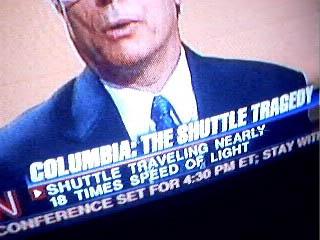
Yes. You can see a snapshot of the ridiculous graphic at
http://www.decodesystems.com/cnn-columbia.jpg
CNN used to have the motto "Live From Everywhere." After the
Oklahoma City bombing that changed. I'll leave it to the
reader to decide why.
Cheers,
Dan
John wrote:
> one, I can sell individual cords for this price no problem.
Damn! You should have ordered 250 or so! :)
> Fate: Having said this, someone on the list will now
> admit that they have a bunch for _$5.00_... <g>.
Well, probably some even had some for free (I got three with
one of the VAXen) but hey.. $6 is a decent price. Especially
if you *need* one to get the VAX powered :)
I guess I'll have to do some shopping here, too, 'cos I need
about 14 of them..
--f
(Did a little Googling yesterday)
Bob Scarborough
(http://www.pipechat.org/archives/2001/April/digest1990.html) says
<quote>
In the 1930s, the acronym "modem" came into use, a contraction of
"modulator/demodulator". This was used in FDM multiplexing, to denote an
analog/analog function, where voiceband signals were modulated up into
"channel group" spectra of 12 to 110 KHz along with 11 others by using
carrier tones and selected sideband energy.
</quote>
The timeline http://www.greatachievements.org/greatachievements/ga_9_3p.html
at has
<quote>
1955 Modem first described by Ken Krechmer, A. W. Morten, and H. E. Vaughn.
1958 AT&T introduces datasets (modems) for direct connection.
</quote>
Bob
-----Original Message-----
From: Frank Arnold [mailto:fm.arnold@gmx.net]
Sent: Friday, February 21, 2003 6:23 AM
To: cctech(a)classiccmp.org
Subject: Re: cctech digest, Vol 1 #379 - 30 msgs
cctech-request(a)classiccmp.org schrieb am 20.02.2003:
>----------<snip>-----------
>Message: 13
>Date: Wed, 19 Feb 2003 12:50:39 -0800 (PST)
>Subject: Re: FYI: 25th Anniversary of Ward Christensen's BBS
>From: "Eric Smith" <eric(a)brouhaha.com>
>To: <cctalk(a)classiccmp.org>
>Reply-To: cctech(a)classiccmp.org
>
>Stan Sieler asks:
>> but...does anyone know the first data of a binary (not ASCII)
>> file transmission via modem?
>
>I assume that was a typo, and you want the date, not the data?
>
>> (I know of some done in 1975, from an IBM
>> mainframe to a DG Nova.)
>
>At least as early as 1965 IBM sold equipment that could do this, so
>I rather imagine people probably did binary transfers even in those days,
>but I don't have any proof of it.
>----------<snip>-----------
Hi,
I found this:
http://www.smecc.org/sage_a_n_fsq-7.htm at photo 22 it claims:
22. Simplex.jpg. This console provided operation and maintenance of the Long
Range Inputs and Outputs. Simplex because there was no redundant hardware.
Each radar station fed digitized data to the DC over public telephone lines
(a
first - they had to invent the modem!). The DC also sent data to the
neighboring DCs and to the Command Center (the AN-FSQ-8 computer).
Does anyone have the docs for the HP 98630 Breadboard Interface card? This is a DIO size card that fits the HP 9000 series 200 and 300 computers. It has a large bread boarding area on it and some SSI ICs for interfacing to the host computer. I need to find out the pin out of the interface and any addresses, interrupts, etc that it uses.
Joe
Hi George.
Most likely this is a 45.45 Baud tty, often used by HAM radio amateurs.
Nowadays most amateurs have turned to PC solutions for RTTY reception.
We call that teletype a "carrot crusher" over here in Holland.
The 5-bit code is called Baudot, and allows for uppercase characters,
numbers and some punctuation.
When you say "wait a minute, how is that possible with 32 combinations?"
Simple, 2 characters are reserved to shift the whole mechanism from
"LETTER" to "DIGIT", so depending on the previous reception of such a
special character the characters that follow are readable or garbage.
Radio amateurs include something called UOS (Unshift on Space). When
the "LETTER" character is not properly received, the first space char
makes everything "normal" again.
So, to connect a 5-bit teletype to (any) computer you need a conversion
program to convert ASCII to Baudot, and at the correct transmission speed.
73
- Henk, PE1CKF Ham Radio amateur and PDP-11 addict.
> -----Original Message-----
> From: George R. Gonzalez [mailto:grg2@attbi.com]
> Sent: vrijdag 21 februari 2003 14:31
> To: cctalk(a)classiccmp.org
> Subject: TELEX machine, modems
>
>
> Hi, I have just bought a nice clean TELEX machine, it's a
> TTY-32, 5-level coding,
> with what looks like a phone line hookup, dial-type phone.
>
> I wonder if anybody knows what the modem standard is for
> this, and/or any
> phone number I could call to test this thingy out!
>
> Thanks,
>
> George
Hi all,
Is any of you (preferrably within driving distance of Holland ;-)
plagued with some DEC rodents they'd be willing to, uhh, exterminate
in a nice and painless [for the rodents] way?
Got some DECstations and VAXstations I'd like to play with in
graphics mode...
Also: does anyone have a spare VS2000 "console kit" ?
Cheers,
Fred
Christos,
> I would like to do a bad sector scan on a RD52 connected to a RQDX1
> controller (The machine is a pdp11/73 without OS) prior to installing
> BSD2.11.Is there a standalone program like zrqch0(standalone
> version of zrqc from the xxdp package - only for RQDX3) that can be
> downloaded directly to the pdp via vtserver and recognizes the RQDX1,
> i.e. a version of zrqb or something similar?
In "XXDP V2.5 Notes" (http://www.chd.dyndns.org/pdp11/xxdp25.notes.txt)
I read the following:
ZRQA RQDX or RUX50 RD/RX EXERCISER
ZRQB RD51/52 DISK FORMATTER RQDX1 DISK DRIVE SUBSYSTEM
ZRQC Formattable Winchester (RDnn) or Floppy (RX33) Drives RQDX3 Disk Formatter Utility
ZRQD RQDX or RUX50 RD/RX EXERCISER
ZRQE RQDX3 EXERCISER
ZRQF RQDX3 RX33 Format Utility
ZRQG RQDXn RD/RX Disk Summary Diagnostic
Now, although my knowledge of XXDP is minimal, the above would make me
believe that ZQRB works with the RQDX1 (only), and that the ZQRC is the
one that only works on the RQDX3.
Anyone know more about this?
--f
Any one to avoid? It'll end up in an Axil SS2 clone routing a broadband
connection into the FDDI backbone, unless someone can convince me that it's
a horrible idea.
Thanks!
Bob
>> To my knowledge the largest hard drive platter was 24".
>
> Platters of at least 36" diameter have been made; they were used
> on ILLIAC IV.
hmm, that's sounds about the right size. I remember the lecturer standing
behind the platter and it came up to around waist height, which is where I got
the 1m estimate from.
thanks to all for the thoughts!
Jules
Everything you'll ever need on one web page
>from News and Sport to Email and Music Charts
http://uk.my.yahoo.com
I picked up one of these today and it had multiple problems but I finally got it to boot but so far I can't get a display on the built in screen. I'm not sure but I'm wondering if the switch settings on it are correct. Does anyone have the switch settings for one of these?
Joe
Joe <rigdonj(a)cfl.rr.com> wrote:
> I just bought this
> <http://cgi.ebay.com/ws/eBayISAPI.dll?ViewItem&category=25399&item=2507112537>
> off of E-bay. Obviously it's some kind of disk drive tester. I
> opened it up and the entire front panel is hand wired but I also
> found a commercail circuit board in it. On the board it says "MFD
> Checker II" "Sony" "Made in Japan". Does anyone know anything about
> a MFD checker?
Um, I'm thinking Sony diskette drive part numbers start(ed?) with MFD.
Yep, it looks to me like you got yourself a drive tester.
That wouldn't get me so excited as to forget to hit return once in
a while, but I guess it means you have a new way to play with
the stiffy drives in all that HP gear. Congratulations!
-Frank McConnell
Hey guys!
You may want to check out the Computer News 80 website at
www.cnpublishing.com for information on software for the TRS80, as well
as TRS80 Model 4s for sale etc.
-- Frank
On Feb 20, 10:45am, Al Hartman wrote:
> Subject: Re: DosPlus for the Model IV
> > Does anyone have a copy of DOS-Plus for the TRS
> > model 4 that they can send me? I picked up a 4 last
> > weekend with no SW or docs and I already have
> > DOS-Plus SW and manuals for the model 1.
> >
> > Joe
>
> Joe,
>
> I don't have DosPlus for the Model IV that I know of
> (I might, somewhere..). But, I can recommend highly
> Multidos for the Model IV.
>
> I don't have the link handy, but if you search for it,
> you can find it.
>
> It's still availble for purchase in the $30.00 range
> last time I checked, and it is an Alternate OS for the
> TRS-80 that incorporates a lot of the strong points of
> DosPlus, including 80 Column support while in non CP/M
> mode.
>
> It's a nice OS, and the DISK BASIC is faster and
> smaller and more feature rich than most of the other
> ones available for the TRS-80.
>
> I remember porting my Copy of Connection-80 over to it
> (we renamed our custom version, Nybbles-80), and it
> was MUCH faster under Multidos than under Newdos/80,
> TRS-DOS or DosPlus, and I was able to take advantage
> of several MultiBASIC features to make it nicer...
>
> Boy, those were the days.
>
> I'm on the lookout for an LNW-80 Computer that works
> to set up a system again. I'm going to keep watch in
> April at the Trenton Computer Festival for a Model IV
> or Model III in the Flea Market.
>
> Regards,
> Al
>
>-- End of excerpt from Al Hartman
--
==== M O N T V A L E S O F T W A R E S E R V I C E S P. C. ====
Clayton Frank Helvey
President
Montvale Software Services, P. C.
P.O. Box 840
Blue Ridge, VA 24064-0840
United States of America
Phone 540.947.5364
===================================================================
In a message dated 2/20/03 8:35:48 PM Pacific Standard Time,
rigdonj(a)cfl.rr.com writes:
>
>
> Do you have a Sony checker? If so, what's this about *70* track drives?
> I already have a nice Brikon 723 drive tester made by Brian. I'm not sure
> if it handles the 600 RPM drives but it does handles 3", 3.5", 5 1/4" and
> 8" drives!
>
You are very lucky to get a Sony tester. IIRC the early Sony drives were very
nonstandard and there were several different kinds. I am sure the 70 track
goes back to the very earliest Sony floppies there are others on the list
that can address this better than I.
I can't remember who made the Hard drive tester that I have. I got several
>from Intel when they were getting rid of the 310 stuff. It covered most of
the early MFM hard drives and was built in a small blue box about 12" square.
A standalone process selected from a menu of drives, plug in the drive, after
a while a report was printed out. The name started with an A and was three
letters. IIRC. It is close to the surface in the storage locker so I will
note when I get there.
You got a nice find. Hang on to it.
Paxton
Astoria, OR
I need a power supply for an Atari 400 computer and have the following to
choose from. Does anyone know which if any to use with the 400:
Atari Power Supply Model CO 14319
IP 120vac 60hz 18.5w OP 9vac 15.3va
Atari Power Supply Part Number C010472
IP 120v 60hz 9w OP 9v dc 500ma
Atari Power Supply part number C016804
IP 120v 60hz OP 9vac 31VA
Atari Power Supply part number C017945
IP 120v 60hz 50w OP 9vac 31VA
Atari Power Supply part number CA14748
IP 120v 60hz 20w OP 15VA
Atari Power Supply part number C016353
IP 120v 60hz 11w OP 9v DC 500ma
for Atari 2600
Atari Plug In Power Supply - Part Number C061515
IP 120vac 60hz 7.5va OP 9vac 500ma
Atari Power Supply part number C018187
IP 120vac 60hz 38va OP9.3vdc at 1.95A
Just the thing needed to check out those sony drives in the old HP equipment.
Congratulations, Joe, you have a floppy drive tester for early Sony 3 1/2
inch floppys.
I have a similar hard drive tester.
Paxton
Astoria, OR
I've put together some pictures of parts of my collections of various
things that I figured I'd brag about^H^H^H^H^H^H^H^H^H^H share with
everyone on this list :-)
There are pictures of various DEC PDP's, tons of pictures of boards,
some antique test equipment, and some antique electronic calculators.
My question is, does anyone have schematics for any of the non-DEC
equipment? Specifically, GR1683, HP3440/3445, HP9100, and Tektronix 909?
If so, please let me know! I'd be happy to host PDFs or GIFs or
whatever form they might take...
Here are the URLs:
PDPs:
http://www.parse.com/~pdp8/
Other:
http://www.parse.com/~rk/collecting/
Enjoy!
Cheers,
-RK
--
Looking for Digital Equipment Corp. PDP-1 through PDP-15 minicomputers!
Robert Krten, PARSE Software Devices +1 613 599 8316.
Realtime Systems Architecture, Consulting and Training at www.parse.com
>I'm a U.S. citizen (well, I might not be after the SS, Shrubs Spooks,
>reads this... they might revoke my citizenship, even though my
>ancestors came over here several hundred years ago)
You know, I was just thinking about that myself. What would they do with
someone like me, who's ancestors predate the US being here?!? I can get
that someone who is a naturalized citizen they can kick back to whatever
country they came from... but what are they going to do to me? Kick me
back to Virginia? (one of my older ancestors was the given the Virginia
colony to run)
>The U.S. military had no right to do that, whether
>overseas or over here... anyone who lands on someone's _private
>property_ and then has the audacity to order the owners to leave, as
>well as ordering people living in neighboring properties to leave,
I don't know about Australia, but I suspect if you dig thru the laws,
there is some exclusion here in the US that does allow for this. I base
that on the fact that in the fire service we DO have the right to evict
people from an area in the name of safety. For instance, if we have a gas
main break, we can go house to house and forcably remove people in the
effected area if we feel that their life is in danger. They don't have to
consent, and we don't need a court order (although I suspect if we did it
without damn good reason, we could probably be sued later).
We can also keep custody of the property until we are "finished" with the
scene. Here in NJ that is defined as the reasonable amount of time to
handle the event and any followup investigation OR until the last EMS
person leaves the scene, whichever happens first.
-chris
<http://www.mythtech.net>
Does anyone have a copy of DOS-Plus for the TRS model 4 that they can send me? I picked up a 4 last weekend with no SW or docs and I already have DOS-Plus SW and manuals for the model 1.
Joe
The original IBM RAMAC disk platters were several feet across:
"The 350 Disk File consisted of a stack of fifty 24" discs that can be seen
to the left of the operator in the above picture. The capacity of the entire
disk file was 5 million 7-bit characters, which works out to about 4.4 MB in
modern parlance. This is about the same capacity as the first personal
computer hard drives that appeared in the early 1980's, but was an enormous
capacity for 1956. IBM leased the 350 Disk File for a $35,000 annual fee."
The Control Data 808 disk drive also used platters that were at least thet
large.
Anyone in Europe (or elsewhere) care to join us?
Later --
Glen
0/0
From: Peter Liebert-Adelt <P.Liebert(a)t-online.de>
To: Glen Goodwin <acme(a)ao.net>
Subject: [zx81] ZX81 users meeting in four weeks
Date: 02/20/2003 5:20 PM
> Hi ZX81 users
>
> May be it's a litte bit far away from you, but you should know:
>
> 7th ZX-TEAM-meeting will take place from friday, 21st of march 2003 at 18.oo
> pm)
> local time, until sunday 23rd of march 12.00 (noon) in the heart of Germany
> in a little village called Dietges, which is loacted near the town of Fulda.
> For more informations please mail or vistit our homepage: http://www.zx81.de
>
> Good by(t)e, "sinclairly" yours
>
> Peter
>
>
> ----------- ZX81 MAILSERVER INFO ------------------------------------
> To WRITE a new message, send your message to mailto:zx81@jarasoft.net
> To UNSUBSCRIBE send a message to mailto:listserv@jarasoft.net
> with "unsubscribe zx81" in the SUBJECT of your message.
> To SUBSCRIBE send a message to mailto:listserv@jarasoft.net
> with "subscribe zx81" in the SUBJECT of your message.
> ---------------------------------------------------------------------
Hey Joe (and listmembers) --
You and I discussed this on the phone today, but just for the general
edification of the listmembers:
If you need *any* kind of software for TRS-80s, check out www.trs-80.com.
All of the major OSes are there, as well as manuals, emulators, etc.
Later --
Glen
0/0
> Does anyone have a copy of DOS-Plus for the TRS model 4 that they can send
> ? I picked up a 4 last weekend with no SW or docs and I already have DOS-Plus
> and manuals for the model 1.
>
> Joe
We had several Victor 9000's. They ran CP/M and a proprietary MS-DOS. They
had built-in codec. They actually predated the IBM PC back in 1980. They
were the best available computers at the time, when the TRS-80 was
prevalent on the market. My dad still may have one on his closet shelf. I
threw mine away when I bought my first PC clone, a 4mhz, 4 mb ram 386SX.
I just randomly remembered the other day that when I was at uni one of the
computing lecturers one day rolled out an enormous disk platter to demonstrate
how hard disk technology has changed over the years.
The platter was pretty huge - around 1m in diameter. Any ideas as to what
system it may have come from?
Im just curious really - I've not seen much really old hardware up close, but
the impression I got from the pictures I've seen is that drive technology
didn't typically use platters *that* large.
(and hell, this beats talking about the war :)
cheers
Jules
Everything you'll ever need on one web page
>from News and Sport to Email and Music Charts
http://uk.my.yahoo.com
Owen: the RC25 are DEC's attempt at creating funny things.
They are MSCP disks (connect to UDA50 or KDA50) with an SDI
bus. They are actually two drives in a single coffin- one
winchester drive (13MByte) and a removable cartridge drive,
also 13MB. So, one could back on the winchester to the
removable, and so on.
I have one here.. just no cartridge.
--f
> -----Original Message-----
> From: Owen Robertson [mailto:univac2@earthlink.net]
> Sent: Wednesday, February 19, 2003 6:26 PM
> To: Classic Computer Mailing List
> Subject: DEC RC25 Drives
>
>
> A few weeks ago, I got a rather nice PDP-11/34 (34A, turnkey
> front panel)
> from a scrap yard. They had two identical systems being used
> in some sort of
> electronic testing devices. I only got one system because the
> other one
> looked like it had been hit by a forklift a couple times. It
> wasn't in great
> shape, so I salvaged some cards from it (CPU, memory, DELUA, drive
> controller, UNIBUS utility stuff...).
>
> My system is in very nice shape though. And along with the
> CPU, I also got
> two RC25 drives, along with controllers and cables. I've
> never seen these
> before. Can anyone tell me anything about them? They look
> like nice drives,
> but I've never really heard much about them.
>
> Anyway, this will be my third 11/34. Of the other two, I
> still have (and
> very much like) one, and one has been passed on to another
> list member.
> Anyway, more questions on recent acquisitions to come
> shortly, I'm sure.
>
> --
> Owen Robertson
But note that the Climet claim is qualified by "a box in which a phone
handset could be placed". How were the Bell modems interfaced?
-----Original Message-----
From: Eric Smith [mailto:eric@brouhaha.com]
Sent: Thursday, February 20, 2003 2:16 PM
To: cctalk(a)classiccmp.org
Cc: allain(a)panix.com
Subject: Re: FYI: 25th Anniversary of Ward Christensen's BBS
I wrote about (binary) data transfer by modem:
>> At least as early as 1965 IBM sold equipment that could do this,
John Allain wrote:
> Some more date/a:
> ""the first model of the first commercial modem," a box in which a phone
> handset could be placed, allowing a computer to say "beep beep" to
> another over long distances. Lee was almost right. He actually had the
> second model of the "magnetic/acoustic coupler," manufactured for
> Tymshare, Inc. by Climet Instruments about 1966"
> --
> http://membres.inforoots.org/dguardiola/Lee_Felsenstein/CMP-mails.htm
The Bell 103A modem was introduced in 1962. I suspect that it was the
first commercial modem.
The date that's harder to place is when the 103A was first used for
computer-to-computer data transfer, as opposed to teletype-to-teletype
or teletype-to-computer communication.
> Does anyone have a copy of DOS-Plus for the TRS
> model 4 that they can send me? I picked up a 4 last
> weekend with no SW or docs and I already have
> DOS-Plus SW and manuals for the model 1.
>
> Joe
Joe,
I don't have DosPlus for the Model IV that I know of
(I might, somewhere..). But, I can recommend highly
Multidos for the Model IV.
I don't have the link handy, but if you search for it,
you can find it.
It's still availble for purchase in the $30.00 range
last time I checked, and it is an Alternate OS for the
TRS-80 that incorporates a lot of the strong points of
DosPlus, including 80 Column support while in non CP/M
mode.
It's a nice OS, and the DISK BASIC is faster and
smaller and more feature rich than most of the other
ones available for the TRS-80.
I remember porting my Copy of Connection-80 over to it
(we renamed our custom version, Nybbles-80), and it
was MUCH faster under Multidos than under Newdos/80,
TRS-DOS or DosPlus, and I was able to take advantage
of several MultiBASIC features to make it nicer...
Boy, those were the days.
I'm on the lookout for an LNW-80 Computer that works
to set up a system again. I'm going to keep watch in
April at the Trenton Computer Festival for a Model IV
or Model III in the Flea Market.
Regards,
Al
I would like to do a bad sector scan on a RD52 connected to a RQDX1
controller (The machine is a pdp11/73 without OS) prior to installing
BSD2.11.Is there a standalone program like zrqch0(standalone version of
zrqc from the xxdp package - only for RQDX3) that can be downloaded
directly to the pdp via vtserver and recognizes the RQDX1 , i.e. a version
of zrqb or something similar?
Aw, come on, Joe! Enlighten the guy!
(I know too)
Glen
0/0
> At 09:57 AM 2/19/03 -0500, you wrote:
> >Hello,
> >
> > Do you know if it is possible to install a 1.44MB floppy drive in a Zenith
> >100?
> >
> > Thank you.
> >
> > Ken.
> >
>
> Yes I know.
>
> Joe
hi Folks...
i have an IBM PowerStation 530 free to a good home in the UK (Cheshire) if
anyone is interested in it.
It appears to be non-working... it powers up, but the status indicator seems
to show it's not booting properly. I dont have a monitor or keyboard to test
it.
I saved it from the skip about 18 months ago with the idea of resurecting
it, but the lack of manuals & software make it pretty hard.
http://homepage.ntlworld.com/mark.nias/images/power01.jpghttp://homepage.ntlworld.com/mark.nias/images/power02.jpghttp://homepage.ntlworld.com/mark.nias/images/power03.jpghttp://homepage.ntlworld.com/mark.nias/images/power04.jpghttp://homepage.ntlworld.com/mark.nias/images/power05.jpghttp://homepage.ntlworld.com/mark.nias/images/power06.jpg
if anyone is interested in it, drop me an email... if not it's heading for
the bin!
thanks
mark
Get the latest news on SurfControl and our products,
subscribe to our monthly e-newsletter, SurfAdvisory at:
http://surfcontrol.us-hosts.com/sc/subscribe
*********************************************************************
The information in this email is confidential and may be legally
privileged. It is intended solely for the addressee. Access to this
email by anyone else is unauthorized. If you are not the intended
recipient, any disclosure, copying, distribution or any action taken
or omitted to be taken in reliance on it, is prohibited and may be
unlawful. If you believe that you have received this email in error,
please contact the sender.
*********************************************************************
Fred N. van Kempen <Fred.van.Kempen(a)microwalt.nl> wrote:
> > Someone on the PUPS / TUHS list has ported 4.3BSD-Tahoe and / or
> > 4.3BSD-Reno to the VAX4000-7xx. AFAIK he had some porblems with
> > interrupts at autoconfig time, but got it running.
> Heh. This is not too hard, but *only* if he used the machine with
> a KFQSA (DSSI-to-MSCP) controller, rather than the onboard SHAC.
>
> It'd be a start, though. Michael, was this you?
Not me. My 4.3BSD suffix is Quasijarus, not Tahoe or Reno. But my opinion on
SHAC is radically different from yours. SHAC is a darling beauty. It is a
problem only for cheap OSes like NutBSD and Linsux. Since SHAC is a true CI
host adapter with the true Generic VAX Port (GVP) it is perfectly supported by
the SCA CI port driver present in every proper VAX OS with SCA such as Ultrix.
Although DEC killed VAX Ultrix before MicroVAXen with SHAC came about, source
examination shows that the Ultrix V4.20 CI port driver supports SHAC (on XMI).
Some day I will lift the SCA code wholesale from Ultrix and plop it into
4.3BSD-Quasijarus.
MS
I was contacted by a chap who spotted on my page that I had a 4/470, and
wanted to know did I want another one...
Unfortunately there's no way in heck I can afford to ship one from
California to Iowa, so I'm passing it onto you fine folks to take it off
his hands... His wife says to get rid of it, he's already tried to donate
it to a local college and even a surplus store, with no takers.
He lives in Salinas, CA, which is near Monterey, but he commutes evenings
to Santa Clara.
He can be contacted here:
"Dougherty, Paul" <Paul.Dougherty(a)idt.com>
JP
Tony Duell beat me to this when he wrote:
"There have been many devices which implemented the IEEE-488 bus (GPIB,
HPIB) using a standard parallel interface chip like the 6821 or 6522
together with buffers."
My Osborne 1 (Z80, 64K, CP/M, 5 1/4 floppies, tan case, '82) labeled their parallel port "IEEE-488" (aka HP-IB) and wrote low level routines for the eight basic HP-IB commands into the bios. They used a 6821 PIA to drive the port, an interesting mixing of chip families. My computer whiz high school son and I built some software around their stuff and I used the Osborne (personal) at work (DOD R&D) for several years to talk to, among other stuff, Nicolet digital scopes. I don't remember much about the details and don't know whether I can find anything useful, or readable, on the software, but the bios routines should be available in the Osborne tech literature. I still have the Oborne, but haven't tried to run it for several years, will have to see if it still lights.
My next laptop was a Toshiba T1200 (80C86, 1MB, 3.5 floppies only, MSDOS, '89) which had a bidirectional parallel port implemented in a custom gate array with eight additional control signals. I remember that we tried to do a klunge to run '488 on that but can't for the life of me remember whether we were ever successful. I'll have to dig around some more in the old stuff and see what I can find.
Good luck on the project Vassilis.
Dave Dykstra, Tucson
Vassilis Prevelakis wrote:
>I have been working for some time on a pet project to make a mass
>storage emulator for HP-IB systems.
and:
>So I looked hard at the HP-IB bus itself (using the schematics from the
>Series 80 adaptor) and it looks like a simple parallel bus. So why use
>a custom card, if the PC parallel port can be adapted to drive an HP-IB
>bus.
etc
Frank -
I found an old post at
http://www.classiccmp.org/pipermail/cctech/2002-July/000309.html
You list a VR201-C PRO monitor.
My neighbor (& landlord) runs a tractor repair business. He's an old
farmer who doesn't like to change much, and has been using the same DEC
inventory system since 1986. For 16 years, he's maintained a service
contract, but now that DEC was bought by Compaq, and Compaq has merged
with HP, he's facing an $800 annual bill for a service contract which
has only been used to replace burnt out monitors and printers (2 of each
in 16 years)
The monitor includes a 15-pin connector, which I'll gues is db-15, and
an RJ-11 keyboard jack.
Does your monitor include these connectors?
Would it work on a DEC Unix system?
If so, do you still have it and how much would it be to ship it to NJ -
08825?
Thanks
Alan Runfeldt
survey-admin(a)justASKthem.com
I heard tons of opinions being spewed,
not a fact in the bunch....followed by
genuine shock that not everyone has the
same opinions.
My opinion is that the best way to stop
this dribble is to put the whole cctalk
list on digest. That would make it much
harder to carry on an argument.
--Doug
P.S. When I'm tempted to reply to one of
these tirades, I think about it after I
finish the message. Thats why my drafts
folder is so full.
=========================================
Doug Coward
@ home in Poulsbo, WA
Analog Computer Online Museum and History Center
http://dcoward.best.vwh.net/analog
=========================================
Picked up six VT420 models today 1-C2; 1-A4; 3-A2's. None tested yet?
On Tuesday I got four VT510's none are tested yet.
Also got a TRS-80 Color Computer MiniDisk and Controller.
If your 486 is a DX, if you have 64Mb RAM, and if you had 20Mb of disk space
to spare (minimum requirements for W98, excepting W98SE), you can load W98
in its "lite" or laptop version from bootable disks. W95's another matter
though -- You'd need a copy of DOS 5.0 or better up and running to load it.
Either way, you'll also need to remember your formatting and partitioning:
98/85 run on FAT16, and are limited to 2GB partitions (98SE allows FAT32,
and can hand 4TB partitions). Is/are your drive(s) compatible?
Cheers!
Ed
San Antonio, TX USA
> -----Original Message-----
> From: cctalk-admin@classiccmp.org@PEUSA On Behalf Of "Douglas
> Wood" <dbwood(a)kc.rr.com>
> Sent: Friday, February 14, 2003 12:12 PM
> To: cctalk(a)classiccmp.org
> Subject: Gateway 2000 Handbook 486 question
>
> I have a Gateway 2000 Handbook 486. Does any one know if Windows 95/98
> will
> load on it?
>
> TIA.
>
> Douglas Wood
> Software Engineer
> dbwood(a)kc.rr.com
> ICQ#: 143841506
>
> Home of the EPICIS Development System for the PIC
> http://epicis.piclist.com
[demime 1.01a removed an attachment of type application/ms-tnef]
Sellam Babbled:
> > So, let's get back to discussing Classic
Computers...
>
> We'd better, since some of us seem too naive to
> seriously discuss politics.
I wouldn't call you naive, simply misinformed and
combative...
You'll come around once you go out into the real world
and get the data.
This is the best country in the world to live in.
Not perfect. Can't say we don't make mistakes, or
haven't in the past...
We are only human, after all...
But, I think we are doing the Human thing, and the
Nation thing better than any other country out there.
The fact that you like to promulgate left wing lies
and self abusive statements doesn't change the facts,
or reality.
You'd do better to keep your fantasys (disguised as
politics) off this list.
But, there are several lists devoted to Horror and
Fairy Tales that might find your posts in this vein
humorous. I know they gave me a HUGE laugh...
Why do even live in America if you think it's so evil?
Try living in Iraq, Iran, or ANY Muslim country and
check back with me... OK?
Al
As I am the "scanner" of all the docs at mainecoon, I have
the original CD's (and in the mean time some 3 more...)
I could investigate the conversion to PDF, but it is quicker
if Jay tells me what he did.
I might (if sufficient interest from CC) create some webpages
that helps to get to the PDF-part that contains the info you
need. Saves on downloading other parts that are less interesting.
Better filesnames (no spaces, e.g.) would also make life easier.
Ed will have a real fast Internet connection soon, and he has
many Gb's room. We meet several times a year, and Ed already
suggested to host all the data. So ...
- Henk.
> -----Original Message-----
> From: Jay West [mailto:jwest@kwcorp.com]
> Sent: maandag 17 februari 2003 21:06
> To: cctech(a)classiccmp.org
> Subject: RL02 docs in PDF (re:11/44)
>
>
> I noticed the docs on maincoon for the RL02 were all in tiff
> format. I got
> them all converted to pdf in case someone needs them in that
> format and
> doesn't have the tiff to pdf conversion utilities. If more
> than a few people
> ask I'll put them up on classiccmp.org.
>
> Jay West
More chip dredging revealed an MC6871B - a sort of oddball 1 MHz clock
driver/oscillator for the 6800. Interesting metal and ceramic package.
Anyone interested in this for postage? $2.00 in the U.S.?
William Donzelli
aw288(a)osfn.org
Hi,
First off I want to thank all who contributed on using VHS tapes as
storage, I really appreciate your input. Now my problem is with my TI-99\A
home computer. I have noticed that the keyboard is dying. I have been
having to hit the keys harder and harder and now some don't work at all. I
took it apart and the keyboard seems to be one unit (not disassemble-able).
The keycaps don't seem to want to come off either. I was hoping to take the
keys apart and clean the contacts but I don't want to break them, if they
aren't so posed to come off. Does anyone have any experience cleaning these
keyboards? If they are a "toss and replace" component, does anyone know
where I could get one?
Thanks for any help you can provide.
Andrew Strouse
( kittstr(a)access-4-free.com )
At 09:57 AM 2/19/03 -0500, you wrote:
>Hello,
>
> Do you know if it is possible to install a 1.44MB floppy drive in a Zenith
>100?
>
> Thank you.
>
> Ken.
>
Yes I know.
Joe
ALl,
Andreas writes:
> > I'm not sure if the MSDOS version of kermit (which is free)
> will work under NT, but it might be worth a try. The win95 version is
> the commercial version (which costs money).
>
> OK, so if the Win95 version is also commercial, then the DOS variant
> remains. And I believe, if MSKERMIT will not run on the WinNT PC
> (which I am afraid will be true), at least DOS will hopefully run on
> the PC to support MSKERMIT. Then, you need a disk partition formatted
> as FAT (not NTFS), and you can move the files in through MSKERMIT and
> out (after rebooting into NT) with "Windoze Exploder".
Hmm. I still use my (Classic ;-) MSKERMIT V3.0 on my PC's, when I need
to, and this always worked fine under NT (4.0), and it works fine, too,
under W2K Pro. Version info is:
------------------------------------------
MS-Kermit>vers
IBM-PC MS-Kermit: 3.00 16 Jan 1990
MS-Kermit>quit
------------------------------------------
If anyone wants it, contact me offlist and I'll email it.. its small.
Fred
Reply to the original author, please.
---------- Begin forwarded message ----------
From: timyen(a)semtronix.com
Date: Wednesday, February 19, 2003, 11:12:06 AM
Subject: PDP11 components
I am in need of components for PDP11 mini. Among these are: a 1 Gb or more
SCSI hard drive and the associated controller board. Hope you can help.
Tim
---------- End forwarded message ----------
--
Jeffrey Sharp
Not sure how I got the following e-mail (spam?), but in case anyone's
interested, perhaps there are some useful bits to be found. I wonder
if they're auctioning off any DEC inventory from Compaq... didn't have
a chance to look through all of the inventory. It looks like minimum
bids are $200. Lots of Sun equipment. In case anyone's interested,
here's the info:
IT EXCHANGE #22 AUCTION
http://www.dovebid.com/Auctions/AuctionDetail.asp?auctionID=1689&referralta…
DoveBid, Inc. is conducting the 22nd in a series of Major IT Equipment
Exchanges with a wide range of high-tech equipment. Auction will
include surplus assets to ongoing operations from Compaq, now part of
the new Hewlett-Packard, Teledesic and New Focus. Auction also
includes fixed assets of Napster, Inc., NextCard and others. This
auction features assets by Apple Computers, Compaq, Dell,
Hewlett-Packard, Foundry, IBM, and much more! Place your bids from the
comfort of your computer with DoveBid's Webcast technology!
--
Copyright (C) 2002 R. D. Davis The difference between humans & other animals:
All Rights Reserved an unnatural belief that we're above Nature &
rdd(a)rddavis.org 410-744-4900 her other creatures, using dogma to justify such
http://www.rddavis.org beliefs and to justify much human cruelty.
Oops! It might help if I added a Subject!
>
>Hi,
>
> Still sorting! Also found a Computer Systems Inc EXPANDABLE+ 64k S-100 memory card. I think it came out of the same system as the Computime cards. Does anyone have docs for this one?
>
> Joe
Hi,
Still sorting! Also found a Computer Systems Inc EXPANDABLE+ 64k S-100 memory card. I think it came out of the same system as the Computime cards. Does anyone have docs for this one?
Joe
Hi,
I've been sorting through some stuff and I came across a couple of Computime S-100 cards. One is SB880 CPU card with a Z-80 CPU and the other is a Computime UFDC-1 card (floppy drive controller with a 1795 FDC IC). Does anyone have docs for either of these?
Joe
Tandy 1000 up for grabs. See below. Reply to original sender.
Reply-to: trcatering(a)bmts.com
---------- Forwarded message ----------
Date: Wed, 19 Feb 2003 09:37:17 -0500
From: Tim Rodger <trcatering(a)bmts.com>
Subject: Tandy 1000
Good morning.
I have a Tandy 1000 from Radio Shack.
It does not have any dos. The dos has to be loaded in before the system
will work. There is no printer as well.
Would you be interested in this computer?
Best Regards,
Timothy J. Rodger.
C/O Tim Rodger Catering
P.O. Box 562 Stn. Main
Owen Sound, Ontario
N4K 5R1
519-373-7270
trcatering(a)bmts.com
--
Sellam Ismail Vintage Computer Festival
------------------------------------------------------------------------------
International Man of Intrigue and Danger http://www.vintage.org
* Old computing resources for business and academia at www.VintageTech.com *
cctech-request(a)classiccmp.org schrieb am 19.02.2003:
>Date: Tue, 18 Feb 2003 13:54:07 -0500 (EST)
>From: John Lawson <jpl15(a)panix.com>
>Subject: Re: Transfer of Files From RSX-11 (fwd)
>
<snip>
>The meta question is: what's he gonna do with the system once the data
>is mined??
>
>John
>
Well, knowing the degree of burocratism especialley in indian customs, I doubt
very much if it will ever pass the border of this country again....
>> Yes it is a complete system.
>
> Ah... this makes the process *much* easier! A bit of info now would
>be: what is the model of your DEC system? (ie PDP 11/23, VAX 11/750,
>PRO350... etc)
given the information that he has 8" diskettes, it will not be a PRO350.
>
>> I have checked Kermit but I could not find this S/W
>> there. Might be my process was wrong.
>
> Hmmm... a lot of RSX systems had Kermit as part of the Distribution
>Kit.. you can try:
>
> MCR> DIR kerm*.*,*
>
If he uses MCR on RSX, then shouldn't the command should be like:
>
>MCR
MCR>[1,54]pip [*,*]kerm*.*,* /li
MCR>
ofcourse, if a catchall is active, it would pass the dir command eventually to
DCL as well, but I don't think this will happen if you enter the comand to the
explicit MCR> prompt
(You are then talking to your own copy of MCR, just for you. And the catchall
is not installed by default as far as I remember...)
Frank
Thomas Dzubin wrote:
> [snip]
>
> I subscribe to the cctech list, but I end up deleting most of the
> email without even reading it. The only reason that I subscribe is
> so I can send email to the list.
> For the most part, I ignore the emails and read the list via web/http
> at http://www.classiccmp.org/pipermail/cctech/
>
> I wish there was a better way...
> (I'd like to be listed as a subscriber, get no emails, but still be
> allowed to send email to the cctech(a)classiccmp.org address)
in that case, go to the URL you referenced, and change your subscription
options so that you are set to 'nomail' - this will mean you do not receive
emails from the list, but as a list member you are still entitled to post to
it.
--
_ __/| ___ ___ __ _________ "When Microsoft Office is your only hammer,
\`O_o' / _ \/ -_) // / __/ _ \ pretty much everything begins to look like
=(_ _)=/_//_/\__/\_,_/_/ \___/ a nail. Or a thumb." -- Rob Pegoraro
U - Ack! Phttpt! Thhbbt! neuro at well dot com http://neuro.me.uk/
> If we lock down our country and hold everyone suspect, did not The
> Terrorists win?
How little we really change... Between these mythical
"terrorists," and our own present regime in D.C., we're doing to ourselves
exactly what Soviet Communism had in mind for us at the height of the "cold
war." Our citizenry is becoming isolated from the rest of the world, and is
also being fairly neutralized in the scheme of both national and
international events...
Cheers...
Ed
San Antonio, Tx, USA
[demime 1.01a removed an attachment of type application/ms-tnef]
> On Tue, 18 Feb 2003, TeoZ wrote:
>
>
> > There is a big difference between getting an OS to load and doing
> anything
> > usefull on the system you managed to barely load it on.
>
> Therefore, Windoze should NEVER be run on anything less than a 12GHz
> Pentium-9 with 4G RAM.
>
For the most part this is true. However, I did manage to get W2Kpro
to run on a pair of SCSI based mini towers with P75s, 64Mb RAM, and 2.3Gb
single hard drives. Had 'em running as DHCP clients with ICS through an AMD
Duron 450 server, also running W2Kpro. It was a trip, but they worked...
:)
Cheers!
Ed
San Antonio, Tx, USA
[demime 1.01a removed an attachment of type application/ms-tnef]
I would like to do a bad sector scan on a RD52 connected to a RQDX1 (The
machine is a pdp11/73 without OS) prior to installing BSD2.11.Is there a
standalone program like zrqch0(only for RQDX3) that can be downloaded directly
to the pdp via vtserver and recognizes the RQDX1 , i.e. a version of zrqb or
something similar?
I've managed to come across a 'Votrax Personal Speech System'. I've found
some information from google, but haven't found out some important things
like what the pinout is on the power connector (it's a DIN-5). While I
can just trace the traces back to chips on the circuit board, it's proven
hard to disassemble, so I'd rather not if I don't have to.
Does anyone have enough information about this thing to tell me how it
wants to be powered?
Oh, and another thing. I've recently picked up a few 2-4VUPS VAXstations
that I'm working on trying to turn into a VMS cluster. I'm hoping to
create a public-access system - I remember seeing an article about another
one on SlashDot a few months ago. Because of the terms of the hobbyist
license, I'll need to make it a non-commercial-use-only cluster, but I'd
like to make it available to list members or other people to mess around
with.
Pat
--
Purdue Universtiy ITAP/RCS
Information Technology at Purdue
Research Computing and Storage
http://www-rcd.cc.purdue.edu
Hello John
Thankyou very much for your kind reply.
Yes it is a complete system.
I have checked Kermit in this system but I could not
find this S/W there. Might be my process was wrong.
And if it is there how can I access Kermit(how to find
wheather Kermit is there or not).
Is there any command for Kermit. Please suggest me how
to find wheather Kermit is there or not.
/********
Incase if kermit will not be installed then how can I
transfer the data.
********/
Basically it is the text data which I want to transfer
to the winnt PC. This system is having 8" floopy drive
& I also wants to transfer files from 8" floopies to
PC.
These files are important for me & I want to make
backup for these files into the another PC having WIN
NT.
Please advice me I will be very thankful to you.
I am in India.
Best regards
Kishore
--- John Lawson <jpl15(a)panix.com> wrote:
>
>
> Hello Kishore. You do not give enough information
> to allow us to be of
> much help.
>
>
> Is this a complete system, or do you just have the
> diskdrive itself?
>
> If you have the whole machine, then most likely a
> program called 'Kermit'
> is installed - you need to also have the Windows
> version of Kermit on your
> PC, and then connect the serial ports together with
> a cable. OR, if you
> are lucky enough to have a newer DEC machine with
> Ethernet, you can just
> hook them up that way.
>
> If you have only the Drive - is it MFM? EDSI?
> SCSI?
>
> Is it just data you need? ASCII? HEX? Are there
> existing programs that
> you would need to execute after transferring? Are
> they MACRO11? FORTRAN?
> BASIC? Pascal? etc... would you need to run one
> of the PDP emulators on
> your PC? IS this for commercial use? Are you going
> to need to license the
> OS (from Mentec)?
>
> Also, where are you? If in the US or Canada, and
> you only have the drive
> (and the data is important or critical) I would
> suggest that you assemble
> a DEC system and install the Drive in it, then use
> Kermit. If you can't
> do that, perhaps you can send the drive to someone
> who would install it,
> extract the info, and return it to you. Just for
> example, I have a
> PDP-11/44 system with EDSI drives, 8" floppies, and
> a 14" removable-pack
> drive. It runs RSX 11M+ V5.03. If possible, you
> should know these details
> about your Drive, as all of this makes a large
> difference in just how to
> take the data off.
>
> You should write your message again to the
> classiccmp list, and give all
> the details you can think of. That way, we can
> steer you in the right
> direction.
>
>
> Cheers
>
> John
>
>
> REF:
>
> >Date: Mon, 17 Feb 2003 08:38:58 -0800 (PST)
> >From: nk badoni <badoni_nk(a)yahoo.com>
> >Reply-To: cctalk(a)classiccmp.org
> >To: classiccmp(a)classiccmp.org
> >Subject: Tranfer of Files From RSX-11
> >
> >Hello
> >
> >I am Kishore.
> >
> >Could you please tell me that how can I tranfer the
> >files from Winchester Disk having RSX-11/PDP format
> >into a PC having Win NT operating system.
> >
> >Kishore
Stan:
My CDs were created from ISO images. The files were something like
hpux_11_0_disk1.iso.gz and hpux_11_0_disk2.iso.gz
I labeled the disks accordingly, and have tried both.
Haven't gotten a chance to examine the sectors yet. Will do that now
since I'm up with a horrendous case of the flu anyway. :P
Thanks!
---
John Willis
Field Service Engineer
Ariel Technologies
505.524.6860 voice 505.524.6863 fax
jwillis(a)arielusa.com
-----Original Message-----
From: Stan Sieler
Sent: Tue 2/18/2003 12:26 PM
To: John Willis; cctalk(a)classiccmp.org
Cc:
Subject: RE: HP 9000 "Nova" I-class systems
Re:
> and I finally got a copy of HP-UX 11.0, but when I try
> to boot off the CD (boot 52.2.0.0), it says "Bad LIF magic."
I'm told
> this means the media is not
> bootable.
I can boot from CD ... if I use the right CD (I've had similar
problems when putting the wrong CD in).
What's your CD say on it?
Also, if you can read the first few sectors of the CD on another
system,
what do they look like? Byte 0 should be $80, and bytes 1..3
should
be readable ASCII.
--
Stan Sieler
sieler(a)allegro.com
www.allegro.com/sieler/wanted/index.html
[demime 1.01a removed an attachment of type application/ms-tnef which had a name of winmail.dat]
I have been working for some time on a pet project to make a mass
storage emulator for HP-IB systems. Given the massive improvement in
capacity that has taken place the past 10 years, most mass storage
devices from the 80s look pathetic.
For example, take the HP 9133H which is a massive unit that can store
about 5Mb. Even the compact flash cards that are bundled with popular
digital cameras can do better than that.
I started my project by trying to utilize the HP-IB drivers that are
part of the NetBSD Open Source Unix clone (which runs on the HP 300
series), but I have come to realize that the HP-IB cards are the
creating a new legacy issue.
Open Source drivers for HP-IB cards are very hard to find and thus any
solution that depends on them becomes de facto legacy (once the card
itself is no longer sold, finding the card becomes almost as difficult
as finding HP 9133H drives).
So I looked hard at the HP-IB bus itself (using the schematics from the
Series 80 adaptor) and it looks like a simple parallel bus. So why use
a custom card, if the PC parallel port can be adapted to drive an HP-IB
bus.
If the PC parallel port can be used, then I can port the NetBSD drivers
to use the parallel port, rather than the HP 300 HP-IB interface. The
NetBSD drivers also support SS-80 compatible mass storage devices,
which means that the implementation can be verified against a real
HP-IB mass storage device. If this works than the drivers will have to
be modified so that they become a mass storage "server" rather than a
"client" (i.e. a device that responds to mass storage requests, instead
of a computer that issues such requests).
Small i386 compatible single board computers are easily procurable and
embedded versions of *BSD and Linux systems run on these SBCs (they
even accept compact flash cards or more traditional hard disks). This
means that we can make a mass storage device that can physically fit
inside the cabinet of the main unit (e.g. Integral PC, or HP-87).
Anybody willing to provide assistance to this effort, is welcome to
contact me. However, I think that going through this list may be
more beneficial so that other people can contribute in the technical
discussion.
**vp
The system came with no hard drives, no media, and the 4mm tape and
CD-ROM were
disconnected from the SCSI chain. I was able to get the thing put back
together,
and I finally got a copy of HP-UX 11.0, but when I try
to boot off the CD (boot 52.2.0.0), it says "Bad LIF magic." I'm told
this means the media is not
bootable.
So my question is... how does one install HP-UX if the CD is not
bootable?
-----Original Message-----
From: Bob Brown
Sent: Fri 2/14/2003 9:56 AM
To: cctalk(a)classiccmp.org
Cc:
Subject: Re: HP 9000 "Nova" I-class systems
What's your question (I support several of these boxes..an 827,
a G40
and an H70).
-Bob
>Anyone out there have experience with HP 9000 "Nova" class
systems?
>Specifically the 9000/800 I40 especially, but any in the class.
>
>John
bbrown(a)harper.cc.il.us #### #### Bob Brown - KB9LFR
Harper Community College ## ## ## Systems Administrator
Palatine IL USA #### #### Saved by grace
[demime 1.01a removed an attachment of type application/ms-tnef which had a name of winmail.dat]
Sellam writes:
> As I mentioned to you privately, I am not responsible for
> flame wars being started over comments I make.
Try avoiding off-topic reactionist banter to begin with. You
KNOW people are going to bite the bait and start a flame war.
I have my opinions on all those events, too, and will share
them with whoever wants to hear them, but ON THE APPROPRIATE
CHANNELS, which means, not here.
--fred
> Yes, those damned dirty A-rabs. We all know for a
> fact that they use the profits to finance terrorism
> because Colin Powell showed us a pretty graphic
> that proved it. All those people who have doubts
> are just stupid.
I don't want to start a to-do on this list, but I
couldn't let this pass..
Colin Powell showed real evidence that some people who
happen to be from the Middle East (Not sure if Hussein
and his people are Arabs) are doing some bad stuff.
The discussion is about bad people who happen to be
Arab. Not that all Arabs are bad people.
And it so happens, that a lot of terrorists in the
world today are from the Middle East. Used to be,
terrorists were Northern Irish...
The fact that some of the worst incidents have been
perpetrated by people from the Middle East does not
make Americans, British or others wrong for noticing
it. If anything, it means that it calls for others in
the Middle East to speak up and use the social
pressures or peers to put a stop to their fellow
citizens (all these bad people must be SOMEONE'S
brothers, sisters, sons, daughters, cousins,
neighbors...) doing all this bad stuff.
The displeasure that is aimed towards Middle Eastern
people from people in the West is because this isn't
happening. People are being killed daily, and instead
of having Millions of people stand up and protest
that.... We have millions of people stand up and
protest somebody trying to put a stop to it.
Yes, I think that's stupid. And I think the people who
condemn the police instead of the criminals, are
stupid...
> We all know a good A-rab is a dead A-rab. Fuck
> them. Let's go in there and take their precious
> oil from them so they can never use the profits
> to finance terrorism anymore. That'll end all
> terrorism forever and ever and we can live happily
> ever after guzzling all the free oil we want.
Not all American's or Westerners believe this.
While I would like that Terrorists get no money at
all, from any source. And I'm pretty sure lots of
Saudi money does indeed go to support terrorism. Drug
money from Poppy sales also goes there, and other
money goes there also.
I would like to see the oil money stay in the Middle
East, but used to feed and care for the people there.
To provide water, sanitation, schooling, and good
lives for the people in Middle Eastern countries.
Rather than being spent on Terrorism, Weapons of Mass
Destruction or persecution of Non Muslim peoples.
That is VERY frustrating for Americans. I contribute
money to charities all the time, and just get sick
when I think of all the Billions of Dollars spent on
weapons and death that instead should have been spent
on life and making the lives of people better.
People who are Anti-American, and Anti-Bush just don't
know the truth about Americans or George Bush. They
buy all sorts of stories that aren't true. Make up
motivations that aren't real.
We liberated Kuwait, but if you notice did not take
the country over. We returned it to the rightful
rulers. We've done the same throughout history.
History shows that Americans aren't interested in
ruling the world, only liberating other people to be
free and happy.
So, let's get back to discussing Classic Computers...
Regards,
Al
Hi
There was some software multitasking done on 6502's, as well
as other machines. This was done in Forth ( both preemptive
and various round robin taskers ). Forth has the advantage
that a task state can be saved with just two pointers. You
do need to swap task at word boundaries. This can cause
a little latency if it is a interrupt driven tasker.
( "word" here refers to the minimum executable unit of the Forth
engine and not the address size ).
Dwight
>From: "Patrick Finnegan" <pat(a)purdueriots.com>
>
>On Sat, 8 Feb 2003, Jim Keohane wrote:
>
>> =====excerpt=2======================
>>
>> A 6502 task context
>> would therefore require moving about 1KB, which would take about 4,500
>> instructions (at one instruction per cycle.) On a circa-1980's machine,
>> with a 1MHz clock, that would take about 4.5 msec.
>
>This gives me awfully devious ideas... First, were there any 'multitasking
>machines' designed around the 6502? If you wanted to do multitasking, it
>seems like you could design a fairly simple MMU that would swap out the
>zero-page and stack (or all of the memory pages) for different ones,
>depending on the running task. Leaving only a few registers that need to
>be saved, it would leave a very small overhead for task swapping. You
>could even implement kernel and user mode into the MMU, making it swap
>pages automatically on an interrupt or 'memory write' to signal a syscall
>(and a swapping of pages, interrupt to the CPU and transition to 'kernel
>mode').
>
>I think I'm going to need to start playing with designing a 6502-based
>machine now... Or maybe I should just get back to working on putting
>machines into racks so I have some floorspace around here to work in.
>
>Pat
>--
>Purdue Universtiy ITAP/RCS
>Information Technology at Purdue
>Research Computing and Storage
>http://www-rcd.cc.purdue.edu
On Tuesday, February 18, 2003, chu(a)verizon.net wrote:
> Big success and then a new problem. I took out the top three levels of my
> cards and reseated them. There's a lot of corrosion on the contacts so it
> inserts only with difficulty.
Maybe you should clean the contacts!
--
Jeffrey Sharp
----- Original Message -----
From: "Don Sykes" <anonymous(a)pacbell.net>
Newsgroups: comp.os.vms
Sent: Monday, February 17, 2003 6:24 PM
Subject: FREE VAXstation 4000-60
>
> If anyone has an interest in the following old system, let me know ASAP.
> I have to be out of my office by EOM and have nowhere to put this.
>
> Hardware........: VAXstation 4000-60
> Operating System: VMS Ver.V6.1
> *Full License set*
> Main Memory (32.00Mb)
> 2-RZ56 (1299174 blocks each)
> 1-RZ55 (649040 blocks)
> 1-RZ24 (409792 blocks)
> 2-TK50Z
> 1-RD40
> 1-TLZ04
> 1-VRT19DA (VT200 style RGB sync)
>
> Includes All cables
>
>
> --
>
> Have VMS, Will Travel
> Wire paladin, San Francisco
>
> (paladinATalphaseDOTcom)
In honor of the recent slide rule discussion, I decided to throw a few
picks of mine up on the web for all to see. This is just a quick and
dirty page. Maybe I'll improve it at some later date. The URL is:
http://cmcnabb.cc.vt.edu/sliderulez.html
--
Christopher L McNabb
Operating Systems Analyst Email: cmcnabb(a)4mcnabb.net
Virginia Tech ICBM: 37.1356N 80.4272N
GMRS: WPSR255 ARS: N2UX Grid Sq: EM97SD
I am looking for the following, working or not:
KXT11
DRV11-J
KE11-B
MCV11
MRV11-D
VSV21
H780
RWZ01
RC25
RD53
RD54
KDJ11-A,
FPJ11
A6006
A1008
and others. We have a lot of equipment to trade. Please let us know what you
have.
Thank you,
Shannon Hoskins
pds3(a)ix.netcom.com
Hello
I am Kishore.
Could you please tell me that how can I tranfer the
files from Winchester Disk having RSX-11/PDP format
into a PC having Win NT operating system.
Kishore
Message: 9
Date: Mon, 17 Feb 2003 07:21:25 -0600
From: Jeffrey Sharp <jss(a)subatomix.com>
To: cctalk(a)classiccmp.org
Subject: Wanted: L5-30 Receptacle or Adapter in US
Reply-To: cctalk(a)classiccmp.org
I'm looking for someone in the US with a L5-30 receptacle or an adapter
so
that I can plug my L5-30-plugged DEC 861PC Power Controller into a
standard
wall outlet. Thanks!
--
Jeffrey Sharp
it is really simple to replace the l5-30 with a standard 5-15 or 5-20
for home use anf just keep the plug around "in case"
if you really must have a dongle, you should be able to get one from
MSC.com
Pavl_
Trying to clear out some more space, and I figure some people might want
some of this stuff.
* Macintosh Plus 1Mb. It starts up to a flashing disk "?" icon... I don't
have any floppies laying around to try booting it off of. No
keyboard/mouse. $10
* IBM RS/6000 Model 370 - 32MB or 64MB of ram, depending on what I can
scrounge together. Also has Gt3 or Gt4 (option 1-5) audio, network riser
card, floppy drive, 1G or so hard drive, AIX 3.1.5 (I think) installed.
$20
Pat
--
Purdue Universtiy ITAP/RCS
Information Technology at Purdue
Research Computing and Storage
http://www-rcd.cc.purdue.edu
southern New Mexico, USA
-----Original Message-----
From: SUPRDAVE(a)aol.com
Sent: Tue 2/18/2003 1:37 PM
To: cctalk(a)classiccmp.org
Cc:
Subject: Re: WANTED: IBM PS/2 Model 65 SX or Model 80 386
In a message dated 2/18/2003 2:53:40 PM Eastern Standard Time,
jwillis(a)arielusa.com writes:
<<
IBM PS/2 Model 65 SX
or
IBM PS/2 Model 80 386
these are the full-tower PS/2 systems >>
so were are you located?
[demime 1.01a removed an attachment of type application/ms-tnef which had a name of winmail.dat]
Andreas, someone wants to talk to you about V-Tel. If you wish to respond,
reply to the original author.
---------- Begin forwarded message ----------
From: Chris Kantarjiev <cak(a)dimebank.com>
Date: Wednesday, February 12, 2003, 11:48:44 PM
Subject: Rejected post
I'm trying to reach Andreas Freiherr. The list archives don't give *his*
email address, just the list email address.
Can you help me reach him?
---------- End forwarded message ----------
--
Jeffrey Sharp
I wasn't going to dig into my 11/44 system until I finished the 2000/Access
system, but due to circumstances beyond my control I had to dig into it
already. I have some really simple basic questions perhaps others can point
me in the right direction.
First:
It would appear the first 8 or so cards are required to be in certain slots.
Cpu set basically. If I don't have FPP or CIS stuff, those slots get left
blank? Do any grant or jumper type cards need to be there if FPP and CIS
cards aren't present? Do you need to change jumpers/switches on the other
cards that make up the cpu if there is no FPP or CIS?
After the cpu set comes memory. I know these need to be set for what area of
memory the card is for. But according to the cover on the lid, there is
about 4 slots for memory. Then there is a jumper card that joins the two
backplans, 9300 or 9200 I think. I have an 8 port mux card. I assume it
can't go in the memory slots. So do the empty memory slots (don't have
enough memory cards to fill all 4 slots) neet any kind of grant card? If I
recall correctly, after the memory is the jumper card that joins the two
backplanes... the 8 port mux could go next? And then next I'll put in a
RL01/02 controller. Then there is a buss termination card...I assume that
goes right after the RL01/02, are there any other jumper/termination/grant
cards that need to be in place?
Also, from what I recall of the Qbus stuff I have, the various peripheral
cards need to be set for where they appear in memory, the address of the
card, correct? So.. need to find docs on the 8 port mux and the RL01/02
controller.
Second:
Looking at the TU-58 drive, the rubber rollers in each drive appear to be
highly questionable - pretty gummy. What's the best way to fix those rubber
rollers? I was thinking of cleaning off the rubber, and maybe getting a
vacuum cleaner belt and building a new surface by cutting it to size and
wrapping it around the metal cylinder. Just how touchy is the parameter for
the diameter of that wheel if I'm off, making it slightly thinner or
thicker? Is there a better way?
Third:
I'm looking for just the top cover of the lowboy rack the 11/44 is in, and
another rack of the same exact style to put my two RL02's in. Don't know
what the rack is called, but it's the standard cream colored lowboy rack
that the 11/44 is typically seen in that has an opening in the front door
for the dual TU-58 drive.
Thanks in advance for any guidance!
Jay West
Hi listmates, some might be interested in this:
- Evan K.
=========================
Calculating Collector Scours Globe Hunting for Slide
Rules
By PUI-WING TAM
Staff Reporter of THE WALL STREET JOURNAL
KELOWNA, British Columbia -- Walter Shawlee opened a
wooden case and lovingly pulled out a 12-inch piece of
Lucite etched with numbers and symbols. "There are
only so many of these remaining," he said.
To virtually anyone old enough to remember the slide
rule, it's an ancient relic that was deservedly
consigned to the trash bin. Not so to Mr. Shawlee, 53,
who has launched an international hunt for these
mathematical instruments that use logarithmic scales
to multiply, divide and make more complex
calculations.
Mr. Shawlee taps his network of contacts from
Singapore to Venezuela to check out the back rooms of
musty stationery stores and bookshops. He has
recruited his wife, Susan, to track down old
slide-rule inventories. And he spends up to eight
hours a day restoring battered slide rules, and
combing the Internet, estate sales and flea markets.
He says he makes $125,000 a year reselling slide rules
he acquires.
"When we used slide rules every day back in the 1960s,
we were able to send people to the moon," says Mr.
Shawlee, who came of age when the device was still the
rule in trigonometry class.
Slide rules, which resemble either rulers or discs,
were a boon to the mathematically minded and a bane to
everyone else. To multiply two times two, for example,
the user moves the "zero" of one scale to the number
two on another scale. Then the user looks at the
number two on the first scale, and above that is the
number four.
Confused? So were many other people, which is why the
slide-rule industry took a big hit in 1972, when
Hewlett-Packard Co. launched its first scientific
hand-held calculator. Almost overnight, demand for
slide rules dried up, wiping out venerable
manufacturers such as Pickett Inc. and Keuffel & Esser
Co. and leaving boxes of unopened slide rules in
stores, warehouses and schools. In the ensuing
decades, a flicker of interest in the instruments was
kept alive by a small community of collectors. In
Emeryville, Calif., enthusiasts formed a society to
show off their collections. In Dallas, some collectors
still hold an annual competition to see who can make
the speediest calculations.
But slide rules are more than quirky bric-a-brac to
the true believers. Many engineers still swear by
them. Some teachers today are reintroducing the
devices into classrooms, arguing that they foster
more-complex thought processes than electronic
calculators do. At the University of California in San
Diego, Prof. Joe Pasquale launched a freshman seminar
on slide rules in January. "I always felt we lost
something when we stopped using slide rules," says Mr.
Pasquale. "They're so much more an extension of your
mind than a replacement to it."
A slide rule made by A.W. Faber Castell Vertrieb GmbH,
now discontinued, is one of the most popular models
among collectors.
The problem is slide rules are getting harder to find.
Of the few manufacturers that survived the
calculator tsunami, most produce only a few types of
slide rules and often in limited numbers. Concise Co.
in Japan still makes circular slide rules, for
example, but the quantity "has become much smaller,"
says spokeswoman Chiho Takayama. American Slide Chart
Corp. in Carol Stream, Ill., annually makes 25 million
cardboard slide-charts, which are similar to slide
rules, but they are "largely promotional," says Julie
Johnson, the company's president.
Thus, many would-be buyers turn to Mr. Shawlee. "He's
Mr. Slide Rule," says Ted Hume, a 64-year-old engineer
in San Angelo, Texas, who sold off part of his
slide-rule collection to Mr. Shawlee several years
ago. "Walter knows everybody in the slide-rule racket.
He does everyone lots of favors and he'll buy slide
rules from you or barter them."
Mr. Shawlee's impressive slide-rule stash was on
display one recent morning at his crammed office in
this Canadian resort and winery town, a 40-minute
flight inland from Vancouver. Several hundred slide
rules, most in mint condition and in their original
boxes, were stacked floor- to-ceiling in a room where
Mr. Shawlee also runs a business that repairs and
designs engineering equipment. At home, he has another
1,000 or so slide rules scattered across the dining
table, in his home office and in his sauna.
At any one time, Mr. Shawlee, a transplanted
Californian who emigrated to Canada three decades ago,
has 1,500 to 3,000 slide rules in stock. He says he
acquires about 10% of his inventory through eBay,
while the rest comes from private sales and through
his extensive network of slide-rule hunters. He
resells many of the slide rules for as little as $10.
Some models go for $600, depending on the rarity of
the rule, and he can sell a truly uncommon one for as
much as $3,000.
Mr. Shawlee fell into the slide-rule trade shortly
after he accidentally rediscovered his old high-school
slide rule in a desk drawer in 1992. "My eyeballs
snapped open," he says, recalling how he carried his
slide rule on his belt as a kid. "There's just
something magic about them." He started a collection,
setting up an informational Web site on the devices in
1997. He received dozens of inquiries from people
asking where they could buy the instruments.
TELL ME A STORY
Read selected excerpts from the anthology
"Floating Off the Page: The Best of The Wall Street
Journal's 'Middle Column.' "
That was when Mr. Shawlee started amassing stockpiles
of slide rules from other collectors. Over a few
months, he bought more than 300. "Are you trying to
corner the slide-rule market?" his wife nervously
asked him as the hoard continued to grow.
Mr. Shawlee always puts aside about $5,000 in cash to
be ready to wire for a purchase. One of his largest
hauls came several years ago from a contact in
Singapore, attorney Foo Cheow Ming, whom he met via an
e-mail correspondence. After one e-mail discussion
with Mr. Shawlee, Mr. Foo went to an old bookstore in
downtown Singapore and asked the owner whether he had
any slide rules. "How many crates do you want?" the
owner replied. In the back room, Mr. Foo discovered 40
unopened crates, containing more than 12,000 slide
rules of all types.
"I found the mother lode," says Mr. Foo, who had no
interest in setting up his own slide-rule dealership
and shipped most of the crates off to Mr. Shawlee, who
paid a bit more than $8,000 for the lot. "Since then,
I've never stopped hunting for Walter. I've gone to
Kuala Lumpur to look and still plan to go to Penang,
Bangkok and Shanghai to find some," Mr. Foo says.
"It's all in the thrill of the hunt."
In a message dated 2/18/2003 2:53:40 PM Eastern Standard Time,
jwillis(a)arielusa.com writes:
<<
IBM PS/2 Model 65 SX
or
IBM PS/2 Model 80 386
these are the full-tower PS/2 systems >>
so were are you located?
I wrote this gentleman off-list (as the S/N ratio is rather out of hand
just now) and asked some basic questions... mainly trying to find if he
had just a disk, or the who thing. Follows is my reply to his response;
if anyone can jump in with more or better info for him, please respond
directly and cc: the list.
The meta question is: what's he gonna do with the system once the data
is mined??
Cheers
John
---------- Forwarded message ----------
Date: Tue, 18 Feb 2003 13:47:25 -0500 (EST)
From: John Lawson <jpl15(a)panix.com>
To: nk badoni <badoni_nk(a)yahoo.com>
Subject: Re: Transfer of Files From RSX-11
On Tue, 18 Feb 2003, nk badoni wrote:
> Hello John
>
> Thank you very much for your kind reply.
>
> Yes it is a complete system.
Ah... this makes the process *much* easier! A bit of info now would
be: what is the model of your DEC system? (ie PDP 11/23, VAX 11/750,
PRO350... etc)
>
> I have checked Kermit but I could not find this S/W
> there. Might be my process was wrong.
Hmmm... a lot of RSX systems had Kermit as part of the Distribution
Kit.. you can try:
MCR> DIR kerm*.*,*
but if your disk is big and you CPU slow, this can take upto an hour to
complete.
OR, you can use a Terminal Emulating program on your Wintel machine (I
use VanDyke's CRT on my IBM Thinkpad running Win2K). Then, find the
file(s) you want, and use the RSK 'type' command to list them to the port
you are attached (logically and physically) to. Use your terminal
program's "logging" or "screen capture" function, and... there you are!
The files are safe on your PC. (This assumes you have a multi-port set of
serial terminal connectors attached to the computer. This procedure can
also be done using the PC terminal emulator attached to the DEC system
console port. The object is to list the files as an ASCII stream and
capture that listing on the PC's HD.
This will work with any storage media on your DEC computer, HDs or
Floppies, by the way.
Please write to the classiccmp list during this process, and we will all
try to help out as much as possible.
I will also forward this correspondence to the List.
Cheers
John
Well, my DEC LA120 is almost perfectly operational. Its only problem is a
set of keys that do not work when pressed. I'd like to fix that.
What I see when I remove the keycap is a square plastic housing that slides
vertically within a larger square plastic housing. The smaller housing
slides down when one presses a key. A spring below the smaller square
housing pushes the housing back up when the key is no longer pressed. Up
through the smaller housing shoot two electrical contacts. The contacts are
fixed and do not slide with the housing. When the key is up, a plastic bar
across the middle of the smaller housing holds the two contacts apart. When
the key moves down, the bar moves down and no longer holds the contacts
apart. The contacts touch and complete a circuit, and the LA120 senses a
keystroke.
Top view (key not pressed):
+-A------------------+
| +-B-----+-+------+ |
| | | | | |
| | | | | | | |
| | D |C| E | |
| | | | | | | |
| | | | | |
| +-------+-+------+ |
+--------------------+
Side view (key pressed):
| | /\ | |
A B / \ | |
| | D E | |
| | / +--+ \ | |
| | / |C | \ | |
| | / +--+ \ | |
| +----------------+ |
| /\/\/\/\F/\/\/\/\/ |
+--------------------+
A = Outer (fixed) housing
B = Inner (sliding) housing
C = Bar that holds contacts apart when not pressed
D = Electrical contact
E = Electrical contact
F = Spring
The problem is that the circuit isn't being closed when the key is pressed.
If I stick a screwdriver in there, bridge the gap between the contact, and
thus close it manually, a keypress is sensed. Actually, it senses several
keypresses very quickly, probably because of the noise caused by the
conductive screwdriver scraping across the contacts. When I press the
housing down, the contacts *appear* to touch, but no keystroke is sensed. So
I figure there are either or both of two possible things going on:
(1) Tiny space between the contacts
(2) Nonconductive material (corrosion? oxidation?) on the contacts
Two keys were fixed by using the screwdriver to bend the contacts toward
each other in the hopes of creating more force pushing them towards each
other. The ENTER key does not seem to be responding well to that treatment.
One thing is for sure. All this stuff is so tiny and hard to get to that it
is difficult to work on.
Any suggestions?
--
Jeffrey Sharp
Who was your contact on the east coast? I'm in New Mexico and
have a VAX 11/750 that I've been struggling to complete. If it was
$250 for shipping + $150 for the VAX, I'd be quite inclined to let
mine go for $250 and then spend the extra $150 to get a complete
one from the east coast person.
-----Original Message-----
From: pzachary
Sent: Tue 2/18/2003 11:13 AM
To: cctalk(a)classiccmp.org
Cc:
Subject: looking to get a VAX 11/750
It seemed to me before I called up someone out on the east coast
and
bought a VAX-11/750 for $150=/- then spent $250 or so shipping
it that I
should try the list. I want a VAX 11/750 for old times sake and
as a
peripheral for my pdp-11s... anyone have one for sale/trade/...?
Thought I'd rather a local had the money to buy inflated pdp-8
spares or
something than giving it all to a shipping company.
I'm located in santa Cruz CA and am willing to pick up within a
couple
hundred miles.
I would really like to get out of this for less than $400
(really $250
seems like a fair price(that's what they sold the one I ran out
from
under me when the funding ran out and I was on vacation for
(rant ends))
but I'll take what I can get)
further, I have much of a card set and a power supply or two, so
if I
get a incomplete one that's O.K.
thanks,
Pavl_
sorry about the joining in of the rant/flame thing RE:politics,
I can
usually restrain myself but sometimes when it goes on... and to
respond
to the digest-delayed list makes it worse I know(I've at least
changed
the last bit)
[demime 1.01a removed an attachment of type application/ms-tnef which had a name of winmail.dat]