Fred N. van Kempen <waltje(a)pdp11.nl> wrote:
> > Noone wants the boards ???
> Nope.
I do! Though I won't be able to do much with a VAX 7000 because of how DEC
mucked up its architecture unfortunately (using an Alpha bus in a VAX etc.), I
would be interested in any and all XMI and/or VAXBI boards.
MS
>On Jan 20, 14:23, Joe Abbott wrote:
>> Does anyone have images of Rom 0 and Rom 1 for
>>Cromemco SCC S100 single board Z80 computer?
after which, Pete wrote:
>I'm very disappointed to find my SCC's single EPROM
appears to be
>something the previous owner made for his own
purposes -- it only has
>36 bytes of code in it. Sorry, Joe. I guess this
one was bought
>without the monitor/BASIC ROMs, which were optional.
Just my luck! Thanks anyway, Pete. Hopefully someone
out there will be able to help.
I'd bet yours contains the code to disable the onboard
roms and jump to the floppy boot rom. My System Zero
manual mentions this and lists the asm code as well as
a hardware mod. Might be why there doesn't seem to be
many of these roms around.
Joe
__________________________________
Do you Yahoo!?
Yahoo! Hotjobs: Enter the "Signing Bonus" Sweepstakes
http://hotjobs.sweepstakes.yahoo.com/signingbonus
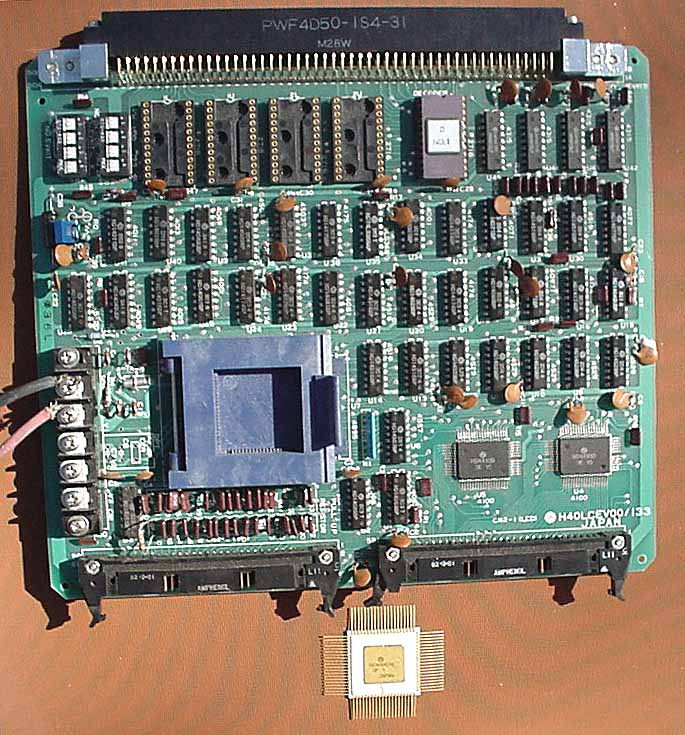
I found this in a pile of scrap boards the other day.
<http://www.classiccmp.org/hp/misc/hitachi.jpg>. It looks like it might be
some kind of evaluation board. Does anyone know exactly what it is? It has
the Hitachi logo on it along with the number H40LCEV00/133. The ZIF socket
contained the IC at the bottom. It's a Hitachi HD44857E. I haven't been
able to find out what it is either.
Joe
>
I don't have a reference for exactly "DT uL909759"
--
I'm in the process of scanning the 1969 f data book and have finished the
logic part. The scan will be up at www.bitsavers.org/pdf/fairchild/_dataBooks
later today.
Found this today. It's about 6 1/2" x 7" and has 8 30 pin SIMM sockets
and a 60 pin ribbon cable header on it. It's marked 701-2214-001. Does
anyone know which Data I/O machine it's for?
Joe
I have a SGI Indigo and Indigo II along with a pile of Sun stuff. I'm
wondering if I can replace all the funky monitors with one modern multisync
SVGA monitor. Anybody know of any reason that this won't work, or have any
recommendations about what kind of video adapter I need or where to get
one? (13W3 to SVGA).
Joe
Does anyone have a manual for an M7891 (128kx18 MOS memory)?
What at the switch settings? or more specifically, what do the 9 pos &
4 pos switches do? (address, no doubt)
I have one which shows a red light when I try to read/write from the
console odt. I just want to make sure the switches aren't set
incorrectly before I declare it broken.
And are their any prints on the net? (I couldn't find any)
thanks!
-brad
Hi
Actually the thought of a tube based computing isn't all
that far fetched. I read an article about creating tiny
tube circuits that use emission form a tiny nano wires
end to create free electrons that can then be used for things
like gates or flipflops. The voltages and power levels are
quite small.
Still, I find it hard to see how even a small tube can work
faster than a 90 nm transistor. The biggest speed issue
we have today is the external wiring and not the gate speeds.
Dwight
On Jan 20, 14:23, Joe Abbott wrote:
> Does anyone have images of Rom 0 and Rom 1 for
> Cromemco SCC S100 single board Z80 computer?
I'm very disappointed to find my SCC's single EPROM appears to be
something the previous owner made for his own purposes -- it only has
36 bytes of code in it. Sorry, Joe. I guess this one was bought
without the monitor/BASIC ROMs, which were optional.
So now we both want an MCB-416 EPROM set (or images).
On the plus side, I've found a 4FDC floppy controller manual (and a
couple of 16FDC manuals). I'd like to get the 4FDC manual scaneed.
Could anyone in the UK do this for us? It's 46 8.5" x 11" pages, plus
one double size schematic.
--
Pete Peter Turnbull
Network Manager
University of York
>From: "R. D. Davis" <rdd(a)rddavis.org>
>
>Quothe John Lawson, from writings of Tue, Jan 20, 2004 at 03:55:27PM -0500:
>> And no one has had the utter madness to suggest a replica of the Mark I
>> or II relay machine..... or the SSEC.... or any of the Bell System relay
>> computers....
>
>Relays don't normally glow, alas, but they do make nice sounds.
>
>My preference is for a digital computer using water instead of
>electricity, but no one's mentioned one of those yet.
>
Hi
Actually I've given quite a bit a thought about
making a computer that uses marbles instead of electricity
or water. You'd put a bucket of marbles at the top and
turn the crank. Gravity would bring the mrbles to the bottom
where one could scoop them up and recycle.
Dwight
forgive any inaccuracies to those who may know better (or can remember
better...)...
what you will be interested in finding out is the deflection per inch
voltage required for the beam deflection. I seem to remember ranges of
10-50 volts per inch. You will need to know the filament voltage of course
and its amperage. What I don't recall is what the necessary acceleration
element voltages were. The grid was used to control the beam brightness
with a greater negative voltage with regards to the other elements dimming
the beam (I think). The electrostatic plates should have the beam in center
with zero volts and then deflection is accomplished by positive and
negative voltages. If you can not find precise data then you can find the
full deflection voltage by experiment once you have a center beam. I
suspect that the long tube should give you a more sensitive tube in that
the deflection voltage may be on the low end of the range.
best regards, Steve Thatcher
Original Message:
-----------------
From: Tom Uban uban(a)ubanproductions.com
Date: Wed, 21 Jan 2004 09:50:46 -0600
To: cctalk(a)classiccmp.org
Subject: Advice on electrostatic deflection CRT ?
Hello,
I have what I believe is a custom CRT. It has a 12" round face, is
approximately 20" long, and uses electrostatic deflection. It was
manufactured by Thomas Electronics Inc. in Wayne NJ and is hand
marked as model number 12E35P31, 12-2-78.
I am hoping to put this CRT into service and need to come up with a
set of specifications which will likely work with it. What other
physical information do I need to take from the CRT in order to
help determine the specifications?
Any suggestions for creating the power supply and deflection drive
electronics are welcome.
Thanks!
--tom
--------------------------------------------------------------------
mail2web - Check your email from the web at
http://mail2web.com/ .
On Jan 21, 11:56, Brad Parker wrote:
>
> The end of the power cord is snipped off this 11/34a I have in front
of
> me...
>
> It has a blue wire, a brown wire and a green striped wire.
>
> I'm assuming the green striped is ground. Brown hot and blue
neutral?
>
> (I think this is a standard, but I shy away from voltages above 48vdc
:-)
That is indeed the standard in Europe.
--
Pete Peter Turnbull
Network Manager
University of York
Fred N. van Kempen <waltje(a)pdp11.nl> wrote:
> Nobody wanted the VAX 7000, so I'll try to take some pictures of it,
> before it visits the Evil Melter.
Well, if no one can take the whole machine, can you at least pull all XMI (and
VAXBI if any) cards out of it before it's melted down? I would want those, and
would even be willing to pay for them (depending on what it has, if any).
MS
Hi
He can most likely test it out by jumpering it into
an oscilliscope. Most use electrostatic deflection.
Dwight
>From: "melamy(a)earthlink.net" <melamy(a)earthlink.net>
>
>forgive any inaccuracies to those who may know better (or can remember
>better...)...
>
>what you will be interested in finding out is the deflection per inch
>voltage required for the beam deflection. I seem to remember ranges of
>10-50 volts per inch. You will need to know the filament voltage of course
>and its amperage. What I don't recall is what the necessary acceleration
>element voltages were. The grid was used to control the beam brightness
>with a greater negative voltage with regards to the other elements dimming
>the beam (I think). The electrostatic plates should have the beam in center
>with zero volts and then deflection is accomplished by positive and
>negative voltages. If you can not find precise data then you can find the
>full deflection voltage by experiment once you have a center beam. I
>suspect that the long tube should give you a more sensitive tube in that
>the deflection voltage may be on the low end of the range.
>
>best regards, Steve Thatcher
>
>
>Original Message:
>-----------------
>From: Tom Uban uban(a)ubanproductions.com
>Date: Wed, 21 Jan 2004 09:50:46 -0600
>To: cctalk(a)classiccmp.org
>Subject: Advice on electrostatic deflection CRT ?
>
>
>Hello,
>
>I have what I believe is a custom CRT. It has a 12" round face, is
>approximately 20" long, and uses electrostatic deflection. It was
>manufactured by Thomas Electronics Inc. in Wayne NJ and is hand
>marked as model number 12E35P31, 12-2-78.
>
>I am hoping to put this CRT into service and need to come up with a
>set of specifications which will likely work with it. What other
>physical information do I need to take from the CRT in order to
>help determine the specifications?
>
>Any suggestions for creating the power supply and deflection drive
>electronics are welcome.
>
>Thanks!
>
>--tom
>
>
>--------------------------------------------------------------------
>mail2web - Check your email from the web at
>http://mail2web.com/ .
>
>
>
>
From: "Pierre Gebhardt" <cheri-post(a)web.de>
>...but what interface describes the "p" at the end of the model >description ?
IPI? Lack of doco on the net makes me think it might be some sort of custom
OEM interface, however.
>Somewhere in the Internet it says that B stands for SCSI-4000, but what
>is SCSI-4000 exactly ?
Longshot: Perhaps that refers to the Adaptec ACB-4000 interface in some way.
It's an proto-SCSI to MFM adapter.
Ken
Hi Frank
Good to here from you. It sounds like I have a XIIIA even
though the silk screen doesn't say so, the switch configuration
matches. I'll see if this brings the boards to life.
Dwight
>From: "Frank McConnell" <fmc(a)reanimators.org>
>
>Dwight K. Elvey wrote:
>> Anyone have the switch specs for this board?
>
>XIII or XIIIA? In either case, yes.
>
---snip---
I have a clean vt-100 terminal and keyboard. I can try to scan it, but
you will have to live with the yellow numbers on the blank spot where
an Id is found, and the VAR sticky label on it. Let me know if you
don't find something else suitable
joe heck
I have located several vintage minicomputers that I would like to add to my
collection, being offered
for a quite reasonable price. Unfortunately, they are currently located in
the UK. Shipping for a CPU
that I estimate weighs between 25 and 30kg via UPS or Federal Express works
out to about US $250.
If I go that route, I'll be paying 3/4 of the total cost of the deal on
freight, for a one-week delivery time
via air. Let's say that I'm perfectly happy to wait a month or two for the
machines to arrive slowly on
a boat. What options are available? I'd be interested in hearing anyone's
experiences in getting large
heavy items shipped overseas as economically as possible.
Thanks,
--Bill
Hi guys,
on ebay Germany, a Fujitsu M2294p drive is being sold.
http://cgi.ebay.de/ws/eBayISAPI.dll?ViewItem&item=3268253232&category=42794…
The thing is that I can't figure out what interface it has.
E stands for ESDI
S(A) for SCSI
B for SCSI-4000
...but what interface describes the "p" at the end of the model description ?
By the way, a Fujitsu M2235B found his way into my collection.
Somewhere in the Internet it says that B stands for SCSI-4000, but what is SCSI-4000 exactly ?
Any kind of industrial SCSI-interface ?
I've never seen one before.
Thanks in advance for your hints.
Pierre
______________________________________________________________________________
Erdbeben im Iran: Zehntausende Kinder brauchen Hilfe. UNICEF hilft den
Kindern - helfen Sie mit! https://www.unicef.de/spe/spe_03.php
Hello,
I have what I believe is a custom CRT. It has a 12" round face, is
approximately 20" long, and uses electrostatic deflection. It was
manufactured by Thomas Electronics Inc. in Wayne NJ and is hand
marked as model number 12E35P31, 12-2-78.
I am hoping to put this CRT into service and need to come up with a
set of specifications which will likely work with it. What other
physical information do I need to take from the CRT in order to
help determine the specifications?
Any suggestions for creating the power supply and deflection drive
electronics are welcome.
Thanks!
--tom
I've got a TPC image, that was originally from a MM: drive, and I've written it back out to a MU: drive (4mm in this case). I'm just trying to read the tape, I'm not trying to do anything fancy like boot from it. Is there any reason that I should have trouble doing this?
Zane
--
--
| Zane H. Healy | UNIX Systems Administrator |
| healyzh(a)aracnet.com (primary) | OpenVMS Enthusiast |
| | Classic Computer Collector |
+----------------------------------+----------------------------+
| Empire of the Petal Throne and Traveller Role Playing, |
| PDP-10 Emulation and Zane's Computer Museum. |
| http://www.aracnet.com/~healyzh/ |
> Much more difficult to use? Yea, that DIR command is *complicated*.
You have to view it in the context of the standard Atari DOS commands of the time. CPM was loads more difficult than the standard Atari DOS command set -- if you could even call it a command set. :)
---
Damo
I have an AppleColor RGB monitor taking up space. This is the 12" (or so)
tube used with the IIgs, and connects to the machine with the Dmumble
cable (I can't remember how many pins - might be 15). This worked last
time I tried it out, about two months ago. Anyone need it (with the cable)
for a big five bucks? Shipping from 10512.
William Donzelli
aw288(a)osfn.org
Hi all,
I saw on eBay an auction for one TE16 tape drive capstan wheel.
I have two TE16's in my collection (www.pdp-11.nl) and when I
moved them to my new museum (check "The making of ..." link),
I noticed that one capstan is orange colored and has white mold
stips on it, and the other capstan is black colored and is very
sticky ... :-(
I have read about went-goo capstans of the TU58 recently.
Should I go for the auction?
The problem is that this is a short term solution, and just for
*one* of my tape drives. Is there an other option, preferably
a better one to solve the capstan problems?
tnx,
- Henk, PA8PDP
A bit ago there was some chat about ADF scanners, and cheap sources.
Just spotted a raft of second user HP ADF scanners at one of my occasional
suppliers. At prices from ?35 (+ Carriage + VAT, min order ?70 so you
could get a couple of PCs to go with it..) they seem fairly
reasonable. I've had good experiences with their after sales service
too. They mostly do ex-corporate stuff, so have lots of older PeeCee and
similar server kit available should you want anything along that line.
http://161.58.154.50/cgi-bin/osa/ViewPage.cgi?templateName=category.htx&cat…
(or if that's too long, www.concordeuk.com click "online auction" then
"online store")
no affiliation, just a customer.
Rob
On Jan 20, 14:23, Joe Abbott wrote:
> Does anyone have images of Rom 0 and Rom 1 for
> Cromemco SCC S100 single board Z80 computer? My
> manual states first half of Rom 0 contains monitor
> progrom and remaining Rom 0 and Rom 1 contain 3k Basic
> Interpreter. Source code or hex listing would be OK
> too. I believe Eproms were part no. MCB-416 and they
> are 2716s.
I have a Cromemco SCC, but I'm afraid mine only has the first EPROM
(yes, it's an NEC 2716). I can dump the data from that.
It seems I also want the second half. Anyone else got it?
--
Pete Peter Turnbull
Network Manager
University of York
the museum was just given a nice IBM PC that is a luggable... sort of like a compact!
have not seen many of these... are they scarce? would like to find any advertising material or manuals etc that would complement it in the IBM display... had not really planned on having each and every model on display but this is kinda cute... let us know if you have any related or scans of related stuff!
Thanks Ed Sharpe archivist for SMECC
Please check our web site at
http://www.smecc.org
to see other engineering fields, communications and computation stuff we
buy, and by all means when in Arizona drop in and see us.
address:
coury house / smecc
5802 w palmaire ave
glendale az 85301
see more at the home page www.smecc.org
In Memoriam...James M. Early
Jim was a friend of the museum and a mentor to me during the formation of it back in the days it occupied some shared space with Computer Exchange Inc. in the old industrial part on Desert Cove in Phoenix Arizona.
Jim wrote several articles and spent extensive time editing on Volume #2 and #3 of "VINTAGE ELECTRICS.
His background at Bell Laboratories proved invaluable when we cataloged some of the more obscure artifacts in the K. D. Smith Collection. K. D. Was his first supervisor at Bell Laboratories.
His words always possessed wisdom and humor, Jim we will miss hearing you...
-Ed Sharpe, Archivist for SMECC
Thanks Ed Sharpe archivist for SMECC
Please check our web site at
http://www.smecc.org
to see other engineering fields, communications and computation stuff we
buy, and by all means when in Arizona drop in and see us.
address:
coury house / smecc
5802 w palmaire ave
glendale az 85301
I'm watching this program called Mythbusters on the Discovery Channel
where they examine various contemporary myths or urban legends and either
debunk or confirm them. The first was various myths about microwave
ovens. They actually perform the various myths (putting in a spoon, fork,
aluminum/aluminium foil) on camera in a sort of scientific way.
The second myth is Lucille Ball recounting how the fillings in her teeth
caused her to pick up radio signals from a local radio studio. So to test
this, they needed to build a radio transmitter. They showed the team
heading over to Foothill College (local Silicon Valley college) for the
famous 2nd Saturday of the month ham swap. They even described it as
"legendary" (it is).
They showed various scenes of scrounging and some of the nerds there and
one was even someone I know(!) (It was Barry Tuttleman for you locals)
Kinda cool.
--
Sellam Ismail Vintage Computer Festival
------------------------------------------------------------------------------
International Man of Intrigue and Danger http://www.vintage.org
[ Old computing resources for business || Buy/Sell/Trade Vintage Computers ]
[ and academia at www.VintageTech.com || at http://marketplace.vintage.org ]
Hi,
I have an Commodore 128D that I have had for about 5 years or so, that I
have done absolutly nothing with, and I would love if there was some
one, who would like it.
the only issue is that it would be pickup only, and I am in Melbourne,
Australia.
Benjamin
Dear Dan Veeneman,
Do you have any old "ONTV" boxes (descramblers/receivers) that you'd like to
sell -- I'm a young collector of odd media from my youth and I'd really love
to get a hold of one of these things to put on top of my TV.
Thanks in advance!
Eric
www.langrafix.com
773.486.9673
I found you here from an "ONTV" search on google:
http://www.classiccmp.org/pipermail/cctalk/2002-June/002738.html
There's one of these puppies on eBay right now, I spotted it in my
wanderings, and out of curiousity I went to look it up on Google - and
didn't find much at all to explain WHAT the thing actually is.
I find "Hierach Storage Controller" and something about it being a "Mass
storage controller" - but not much more. It's a hell of a best for being
an overblown HBA... What is it really?
Whats this about a hierachy? :P
Thanks folks;
The ever curious JP
It looks like docs are for a MINC -11 to me , ....Docs match what I have.
JP Hindin
<jplist(a)kiwigeek.c To: Al Kossow <aek(a)spies.com>
om> cc: classiccmp(a)classiccmp.org
Sent by: Subject: Re: DEC MINC-11 question
cctech-bounces@cla
ssiccmp.org
01/19/2004 07:26
PM
Please respond to
"General
Discussion:
On-Topic Posts
Only"
On Mon, 19 Jan 2004, Al Kossow wrote:
> The engr drawings for the MINC are up now at
> www.bitsavers.org/pdf/dec/qbus/MP00652_MNC11engrDrw_1978.pdf
They are?
Sure looks like a 404 to me.
-JP
The doc's are very useful. Thanks. I have checked the power supply,it's OK.
The docs are for original MINC-11. I have one with different CPU and memory
( dual Qbus cards ).
Do you know where to find docs on KDF11-A (M8106)and MSV11-MB (M7506)?
Tomorrow I should start looking for clock activity on some of the cards. I
see a used KDF11-A at DCP in Melbourne, FL. for $66....if I go for the
shotgun method of troubleshooting.;-(((
>The engr drawings for the MINC are up now at
>www.bitsavers.org/pdf/dec/qbus/MP00652_MNC11engrDrw_1978.pdf
Hutch
On Jan 20, 20:18, Jules Richardson wrote:
> On Tue, 2004-01-20 at 19:42, meltie wrote:
> > On Tuesday 20 Jan 2004 12:40 pm, Jules Richardson wrote:
> > 17" Iiyama Vision Masters that'll multisync up to an SGI with BNCs?
>
> Never tried them with an SGI, but the spec on them is pretty good -
> 27-92KHz horizontal, 50-160Hz vertical, and a 160MHz bandwidth.
> check university newsgroups, or local usenet groups for your area.
I've
> seen several crop up around here (Cambridge) in the past.
A friend of mine at work has two spare SGI 17" monitors that were used
with Indigos, and coincidentally he asked me this afternoon if I wanted
them. He's going to chuck them if no-one does. Are these any good to
you?
--
Pete Peter Turnbull
Network Manager
University of York
On Jan 20, 10:02, Cynde Moya wrote:
> Can anyone tell me what the BC20K is used on?
According to one of my DEC optons and modules microfiche, it's a
PCL11-B Y Cable. Another one says it's a TDM Bus Node Cable, 10',
which fits. I'd guess it's a ribbon cable, since all the other BC20x
cables are.
--
Pete Peter Turnbull
Network Manager
University of York
Hi,
The 9122C was made by HP as a HP-IB floppy drive using the SS-80 protocol
(AFAIK). (I have a 9122D which I think has the same specs running on my
HP-85 / HP-87 set-up using the EMS ROM). Anyway, I came across the following
on Google:
http://www.isa-j.co.jp/NEW/english/HP-IB/p_hpib_b.html
Company claims to be making a compatible drive, but the rest of the site is
in Chinese writing so I couldn't find a price. Has anyone come across this
drive, or know of any other compatible drives? It's not that the 9122 series
is that rare, but a modern equivalent (especially one with a 1G hard drive!)
certainly is an attractive option for those still using Series 80 and other
HP-IB machines 'for real' rather than tinkering with them like me.
Regards,
John (UK)
I just found this whilst doing a mostly unrelated search:
http://www.4cheapparts.com/cgi-bin/checkitout/checkitout.cgi?networkpSTORE:…
If I'm reading this right, these guys have:
(1) PDP 11/23 @ US$695
(1) VAX 11/730 @ US$995
(3) VAX 11/750 @ US$295 each
(2) PDP 11/84 @ US$1,307.12 each
...and a plethora of other DEC gear. There's also some HP1000 series
peripherals and lots of other stuff. Might be worth looking into.
--
Sellam Ismail Vintage Computer Festival
------------------------------------------------------------------------------
International Man of Intrigue and Danger http://www.vintage.org
[ Old computing resources for business || Buy/Sell/Trade Vintage Computers ]
[ and academia at www.VintageTech.com || at http://marketplace.vintage.org ]
> I've been asked about a quarter-inch tape standard from 1976, called ECMA-46
0Bh X3.55-1982, X3.56-1986, ECMA-46, ISO 4057-1979
>from the scsi spec..
There is a copy of X3.56-1977 hiding in the back of a quantex tape drive manual
that I scanned this morning.
This is one of the original 1/4" tape formats, for a drive with a fixed position
four-track head stack (the norm prior to what became the QIC11 moving head 4 track
standard)
The scan is here:
www.bitsavers.org/pdf/quantex/TM1001_650_Jul81.pdf
the spec is appendix A
Does anyone have images of Rom 0 and Rom 1 for
Cromemco SCC S100 single board Z80 computer? My
manual states first half of Rom 0 contains monitor
progrom and remaining Rom 0 and Rom 1 contain 3k Basic
Interpreter. Source code or hex listing would be OK
too. I believe Eproms were part no. MCB-416 and they
are 2716s.
Thanks in advance,
Joe A
__________________________________
Do you Yahoo!?
Yahoo! Hotjobs: Enter the "Signing Bonus" Sweepstakes
http://hotjobs.sweepstakes.yahoo.com/signingbonus
We're lucky here in Austin, TX to have the Goodwill Computer
Store. They often get old classics from people and sell them
for non-ePay-like prices. I was just there today, and they
had 3 Kaypro II machines for $20 per machine. On a scale of
1 to 10, they were quality 5, 6, & 7 or so. Alas, no software...
but it beats $50-$100 deals on ePay.
der Mouse wrote:
...
>Once, years ago, I was involved in building a designed-on-the-spot Qbus
>board.
Which raises a question I've been meaning to ask.
Has anyone made their own unibus boards? Is this fool-hearty?
I have half a mind to look over the "IDE for Soviet unibus" zip file I
found and make my own uniboard board with a modern day CPLD and IDE
interface.
How crazy is that?
I have 4-8 layer PCB's fabricated regularly and have a reasonable CAD
setup to do that, so design, layout & fabrication is not a problem, nor
is TTL design (heh, especially at unibus speeds :-) And I write VHDL for
CPLD's all the time and program them.
Seems like a 4 layer board with gold fingers would work - the few boards
I've handled seemed pretty thick, however. I'm guessing the thickness
needs to be correct.
I have not (yet) looked at a unibus card schematic - would be it hard to
create a bus master IDE interface?
Is a unibus controller a relatively straight forward TTL design ?
I should probably ask on the PUP list also, but I thougth I'd see if
anyone here has opinions.
And, if I did manage to create a realiable IDE interface, would anyone
else want one?
(I realize cost would be the overriding factor - believe it or not on
small runs like I do the PCB is by far the most expensive part)
-brad
> For me, at least, the hard part of designing a modern Qbus and/or
> Unibus interface would be what to select for bus drivers.
Well, for Qbus...there's an appendix in the KA630 document that's
titled "Q22-Bus Specification". Based on that:
>From the looks of it, for a driver you can use almost any
open-collector TTL output - at least, a quick look at the specs doesn't
reveal anything that stands out as incompatible.
The receivers are a bit more interesting. The spec says that their
threshold must be between 1.3 and 1.7 volts and that their high-level
input current must be no greater than 80?A; it fails to give any limits
on how much current they source into a low-level input, though there
surely must be such a limit. Are there any bus receiver chips that
have a reference-voltage pin, which could be connected to (say) 1.5V?
Basically, a bunch of specialized voltage comparators?
Personally, I'd be tempted to just use TTL and see if it works (LSTTL,
probably, since that sources less current into low-level inputs). But
of course "it works for me" isn't good enough if you're designing for
other people's use.
/~\ The ASCII der Mouse
\ / Ribbon Campaign
X Against HTML mouse(a)rodents.montreal.qc.ca
/ \ Email! 7D C8 61 52 5D E7 2D 39 4E F1 31 3E E8 B3 27 4B
Ethan Dicks <dickset(a)amanda.spole.gov> wrote:
> Yes, but some devices are not so old and _do_ use ASICs. There are some
> peripherals that came out at the same time as the 11/20 (~1970) that
> they are made up of several square feet of TTL/Linear chips.
Well, what I meant was that UNIBUS and Q-bus were designed to be implementable
without ASICS using only discrete logic, and the simpler devices were
implemented that way.
> Unibus? 8640, 8641, 340, 8881, DC013 (custom DEC chip)
> Qbus? DC003, DC004, DC005, DC006, DC010, 74LS240, 8837, 8838
>
> In other words, with few exceptions, *not* ordinary TTL chips (though ISTR
> one of their busses used hand-selected 7438s chosen for low (1uA?) leakage.
Hmm, 74LS240 for Q-bus? It's just a standard three-state TTL inverting buffer,
isn't it? For driver, receiver, or both?
> designed-as-such bus drivers/receivers from companies like
> National Semiconductor.
Does NS still make them?
MS
Quick question,
What would folks here be prepared to pay for this machine, particularly as
it's boxed and never been used? It went into the workshop to have a hard
drive fitted shortly after being bought in 1992 or thereabouts and for
whatever reason it sat on a shelf forever thereafter.
Or is the general concensus 'oh it's just a 386SX PC running DOS 5'
Pix at http://www.binarydinosaurs.co.uk/ebay/ibm/ibm.php
cheers
--
Adrian/Witchy
www.binarydinosaurs.co.uk - possibly the UK's biggest online computer museum
www.snakebiteandblack.co.uk - ex-monthly gothic shenanigans :o(
Hello Friend,
I actually have an old Qube box in my closet. The weird thing is that it doesn't work on any other cable systems, except the old qube system.
My unit used to work when we had the qube system. Once they shut off Qube, the unit no longer works.
I remember these things from when I was a kid, that is why I have kept it.
You know much about how they work? I would like to get this one to work. I have opened the unit, but see nothing wrong that would cause it to power up and then the display goes dead.
Glad to see someone has the same interest in these old things
Can anyone tell me what the BC20K is used on?
Thanks
Cynde
Cynde Moya, MLIS
Archives Cataloguer
Vulcan Inc.
www.vulcan.com
Office Tel. 206-223-4901
Mobile Tel. 206.369.3205
Fax. 206-223-4207
Hmm,
well u know what, the system programmers i guess use
the right side of their brain, while the admins use
their left.
i guess, as an admin, u need to look at individual
problems and try to solve them with a more logical and
rational approach
while, a programmer would have to use his creativity,
and intuition to be able to "design" programs/SWs.
and,
i'm neither of them, so no bias here!!!
what do u think, curt???
>
>
>
>Message: 1
Date: Fri, 16 Jan 2004 22:17:33 -0800
From: Ernest <ernestls(a)comcast.net>
Subject: System programmers vs. administrators
To: "General Discussion: On-Topic and Off-Topic Posts"
<cctalk(a)classiccmp.org>
Message-ID: <1074320253.1586.16.camel@ernest>
Content-Type: text/plain
I was having a discussion with a friend earlier
tonight about
programming, and how I've never been the least bit
interested in
learning how to program -I'm convinced that I have a
mental block
against it, or something like that.
As the discussion progressed, we decided that there
are two types of
advanced computer users -system programmers and system
administrators.
That in itself is debatable but where our discussion
became bogged down
was when we tried to decide which user was left brain,
and which was
right brain.
We started by agreeing that programmers are artists,
while the
administrators are more scientific. But then, as we
talked, we decided
that you could make the same arguement for each side.
So, I thought I would throw the discussion out here,
and see what you
guys think. Assuming that there really are two types
of computer users
-programmers and administrators- which side is left
brain thinking, and
which is right brain thinking?
I pulled the following off some psycho-babble website:
Experimentation has shown that the two different
sides, or hemispheres,
of the brain are responsible for different manners of
thinking. The
following table illustrates the differences between
left-brain and
right-brain thinking:
Left Brain:
Logical
Sequential
Rational
Analytical
Objective
Looks at parts
Right Brain:
Random
Intuitive
Holistic
Synthesizing
Subjective
Looks at wholes
Most individuals have a distinct preference for one of
these styles of
thinking. Some, however, are more whole-brained and
equally adept at
both modes. In general, schools tend to favor
left-brain modes of
thinking, while downplaying the right-brain ones.
Left-brain scholastic
subjects focus on logical thinking, analysis, and
accuracy.
Right-brained subjects, on the other hand, focus on
aesthetics,
feeling,
and creativity.
------------------------------
Message: 2
Date: Sat, 17 Jan 2004 12:19:54 -0500
From: "Curt vendel" <curt(a)atarimuseum.com>
Subject: Re: Re: Apple 'Star Trek'?
To: <freddyboomboom(a)comcast.net>, "General Discussion:
On-Topic and
Off-Topic Posts" <cctalk(a)classiccmp.org>
Message-ID: <000601c3dd1e$211f6990$1a02a8c0@starship1>
Content-Type: text/plain; charset="iso-8859-1"
Hmmmm....
D/L'ing now... curious to check this out :-)
I have a Mac OS X 10.2 Server running in my office, so
I'm curious to
see
how these interact...
Curt
________________________________________________________________________
Yahoo! Messenger - Communicate instantly..."Ping"
your friends today! Download Messenger Now
http://uk.messenger.yahoo.com/download/index.html
Hi folks,
Has anyone got a spare 2.5mm 12V DC power socket that's PCB mounted? The one
I'm replacing looks exactly like these:
http://tinyurl.com/2mhkrhttp://tinyurl.com/3gtau
I can only get 'em in packs of 10 and I don't really want to buy 10!
Cheers all!
--
Adrian/Witchy
www.binarydinosaurs.co.uk - possibly the UK's biggest online computer museum
www.snakebiteandblack.co.uk - ex-monthly gothic shenanigans :o(
> The receivers are a bit more interesting. The spec says that their
> threshold must be between 1.3 and 1.7 volts and that their high-level
> input current must be no greater than 80?A;
> Are there any bus receiver chips that have a reference-voltage pin,
> which could be connected to (say) 1.5V?
You can use open drain CMOS buffers/inverters in this way by setting
the supply volts to give the desired ViH point (check the data sheet
but ViH * 2 is about right). The outputs are at least TTL volts
tolerant used like this.
Lee.
________________________________________________________________________
This e-mail has been scanned for all viruses by Star Internet. The
service is powered by MessageLabs. For more information on a proactive
anti-virus service working around the clock, around the globe, visit:
http://www.star.net.uk
________________________________________________________________________
> I also can't be the only Outlook 2000 user here, can I?
You're not, I'm stuck with it here at work.
Anyone want to check my message to see if the redundant
"Reply-To:" is there
> I wonder how.....
I don't, because fixing software here has become a summary
dismissal offence. 8^(=
Cheers,
Lee.
________________________________________________________________________
This e-mail has been scanned for all viruses by Star Internet. The
service is powered by MessageLabs. For more information on a proactive
anti-virus service working around the clock, around the globe, visit:
http://www.star.net.uk
________________________________________________________________________
On Jan 20, 0:54, Witchy wrote:
> Bearing in mind a lot of mailing software ignores the 'from' field
and
> instead uses the 'reply-to' field instead. Well, OK, for USENET
anyway :)
Well, anything that replies is *supposed* to ignore the "From:" field
*if* (and only if) there is a "Reply-To:". The "From:" is mandatory,
the "Reply-To:" is optional. There are some other headers that may be
involved but only for errors and control messages.
--
Pete Peter Turnbull
Network Manager
University of York
On Jan 20, 0:34, Jules Richardson wrote:
> Well hang on.. surely it's legal protocol-wise for witchy to put the
> reply-to field in the header for email that he sends, even though the
> from: field is also present and valid?
The "Reply-To:" field is supposed to override the "From:" field, and
although the standard doesn't expressly forbid setting both the same,
it makes it clear that there is no point unless they're different.
> Isn't it a little quirky for the list software to append to any
existing
> reply-to field rather than overwriting it? (which for a mailing list
> might seem more sensible).
Not really, the standard implies that appending is correct behaviour,
in case replies direct to the originator should not go to the
originator's address as given in the "From:" field (eg suppose Witchy
sent a message from somewhere other than his normal address, or a
machine that didn't have a valid address; the "From:" would show the
not-normal point of origin, the "Reply-to: would show his normal
address).
--
Pete Peter Turnbull
Network Manager
University of York
On Jan 19, 16:24, Brad Parker wrote:
>
> der Mouse wrote:
> ...
> >Once, years ago, I was involved in building a designed-on-the-spot
Qbus
> >board.
>
> Which raises a question I've been meaning to ask.
[...]
> Seems like a 4 layer board with gold fingers would work - the few
boards
> I've handled seemed pretty thick, however. I'm guessing the
thickness
> needs to be correct.
Small variations shouldn't matter. I've not noticed any Unibus boards
being abnormally thick.
> I have not (yet) looked at a unibus card schematic - would be it hard
to
> create a bus master IDE interface?
>
> Is a unibus controller a relatively straight forward TTL design ?
Dunno about the DMA -- probably not hard -- but the rest is
straightforward.
> And, if I did manage to create a realiable IDE interface, would
anyone
> else want one?
For low enough cost, yes, me!
--
Pete Peter Turnbull
Network Manager
University of York
On Jan 19, 23:03, Witchy wrote:
> > It *is* your mailer. It appears to be putting an unneccessary
> > "Reply-to:" header in, and when the list software sets its
"Reply-To:",
> > it gets concatenated to yours instead of replacing it:
>
> I know microsloth stuff has a mind of its own, but if I've not
changed
> anything since well before pre-upgrade days and both my 'from' and
> 'reply-to' addresses are the same what more can I do?
But you don't need a "Reply-to:" if it's the same as the "From:" and it
shouldn't really be there unless it's diifferent.
> I'll have a nose through the options, but I doubt 'include from AND
reply-to
> address when replying to mails' is in there. It's microsloth, what
more can
> I say :)
:-)
I'm fairly sure there's a way to tell it not to include the
"Reply-to:". I'll ask the M$ people at work.
--
Pete Peter Turnbull
Network Manager
University of York
I've listed (3) DEC VT520 terminals on the Vintage Computer Marketplace.
Search for items #372-374.
I'm asking $25 each. These are fantastic multi-purpose terminals. Check
out the listing descriptions for more information.
--
Sellam Ismail Vintage Computer Festival
------------------------------------------------------------------------------
International Man of Intrigue and Danger http://www.vintage.org
[ Old computing resources for business || Buy/Sell/Trade Vintage Computers ]
[ and academia at www.VintageTech.com || at http://marketplace.vintage.org ]
Looking for peoples estimate of the value of an ASR-33 with working paper
tape reader/punch (and of course keyboard/print), modem is quite optional.
I am starting to search for one to add to my collection and am not sure what
price range is reasonable these days....
Also if anyone has one that they want to sell (especially if located in
North East US), please contact me directly.
David Corbin
dvcorbin(a)optonline.net
If you need one for your collection, I thought someone might find this
listing of interest.
http://cgi.ebay.com/ws/eBayISAPI.dll?ViewItem&item=2781740056
If anyone has any other Berkeley Enterprise items for sale, please let me
know. I would also like to purchase a number of other early computer
artifacts. Any suggestions besides ebay? Can I submit a "want list" to this
group? Thank you for your time.
I was searching around the net for information on Datapoint the other day
and came across information on ARCNET. I never realized ARCNET was still
in wide use today. There is even a 100Mbit version of ARCNET over RG58(!)
Check out the links below for more interesting reading and history of
ARCNET:
http://www.tcpmag.com/archives/article.asp?EditorialsID=58http://www.arcnet.com/abtarc.htm
--
Sellam Ismail Vintage Computer Festival
------------------------------------------------------------------------------
International Man of Intrigue and Danger http://www.vintage.org
[ Old computing resources for business || Buy/Sell/Trade Vintage Computers ]
[ and academia at www.VintageTech.com || at http://marketplace.vintage.org ]
I have a working "no-name" laptop (it doesn't seem to have a brand
name, just "Notebook Computer" on the label) made around 1991.
It's a 486-66 with a whopping 8Mb RAM, 540 Mb hard drive, color
LCD screen, and a PCMCIA 33.6k modem card. It's running Win95
(albeit slowly). It works just fine for email and word processing
but bogs down trying to run Web browsers (not sure if more RAM can
be added or not). The battery pack won't hold a charge for more
than a day or so, and the CMOS battery is dead, but aside from
that everything works fine. I just bought a more modern Dell used
laptop so I no longer need this "classic" ;)
Is anyone interested in purchasing it cheap? Make me an offer...
thanks
Charles
Just a quickie folks,
Does anyone have the power cable pinouts for the Osborne 1 motherboard? Got
one here from Kevan that doesn't boot at all - consistent garbage on the
nice'n'bright screen. Before I start further messing with the beast I want
to make sure it's getting enough juice. Suppose I can always check the CPU
and RAM chips for +5V couldn't I - it's been powered up in this condition in
the past so I'm not going to do any more damage to it :)
Got to dig out my hot glue gun too - in their infinite wisdom they've glued
the mountings for one of the daughterboards onto the motherboard :-/
Cheers!
--
Adrian/Witchy
www.binarydinosaurs.co.uk - possibly the UK's biggest online computer museum
www.snakebiteandblack.co.uk - ex-monthly gothic shenanigans :o(
Finally cleaning out around the house, started with the PeeCee junk. It's in
a pile next to the trash, let me know if anyone needs any of this, quick, I
want it gone! Cost = Shipping (shipping included) :)
All these are ide hard drives, most all western digital caviars, a couple
quantum & fuji
five 2.0gb
two 2.1gb
three 2.5gb
five 1.6gb
(figured some might want these for SBC6120 projects, probably 95% of these
drives work, one or two may be bad)
CTS 212AH modem - didn't know if this might be old enough to be collectable
Mitsumi CD with non-ide interface card
Several quad speed ide cd's
a 5.25 1.2mb floppy drive
Many misc cards that go in 486 type systems - serial/parallel I/O cards,
sound cards, modems, etc.
On Jan 19, 9:14, Patrick Finnegan wrote:
> So, is there a document anywhere that explains the 'programmatic'
> interface to MSCP-type controllers (or for any particular
controllers)?
> And I'm looking for disk MSCP not TMSCP. Basically, I'd like
something
> that explains the registers, command packets, etc. for hardware like
a
> RQDX3 or KDA50 or...
>
> Any help is greatly appreciated. I tried with little luck on google
> last night to find thist kind of stuff.
What you need is the "UDA50 Prograsmmer's Doc. Kit", QP-905-GZ. It's
not really UDA50-specific; I last used it to figure out what was wrong
with the DU: driver in RT-11 5.01, such that it wouldn't work with an
RQDX3 (DEC didn't follow their own protocol properly, was the answer,
and the bug happened to get past an RQDX1 but not some other
controllers).
Mine is labelled "First Edition April 1982" and consists of:
AA-L619A-TK Ver.1.2 MSCP Basic Disk Functions Manual (approx 170pp)
AA-L620A-TK Storage System Diagnostics and Utility Protocol
( 46pp)
AA-L621A-TK Storage System Unibus Port Description (58pp)
The first deals with MSCP itself; gives an overview, a bit about the
comms side of it, algorithms, message formats, and a subset of commands
for disks. The second deals with DUP, which is what's used for
diagnostics and formatting. The last is about the port driver, which
you can think of as the layer under the class driver (MSCP/DUP).
Has the MSCP patent expired, or do you still need to license it?
And can you get copies from DEC/Compaq/HP, and if not, do they come
under the permission DEC gave to make copies?
--
Pete Peter Turnbull
Network Manager
University of York
Any thought been given to porting PUTR to FreeBSD/Linux/Unix??? Was hoping
to use it but really don't want to install a dos partition on my Unix PC.
Other solutions out there?
Jay
So, is there a document anywhere that explains the 'programmatic'
interface to MSCP-type controllers (or for any particular controllers)?
And I'm looking for disk MSCP not TMSCP. Basically, I'd like something
that explains the registers, command packets, etc. for hardware like a
RQDX3 or KDA50 or...
Any help is greatly appreciated. I tried with little luck on google
last night to find thist kind of stuff.
Pat
--
Purdue University ITAP/RCS
Information Technology at Purdue
Research Computing and Storage
http://www.itap.purdue.edu/rcs/
>From The Register: "Intel and HP find oldest working PC"
(http://www.theregister.com/content/67/34933.html)
"Dutch company PHI DATA yesterday received a € 18,000 prize from Intel, HP
and Dutch IT weekly Computable for still owning and operating a vintage IBM
5160 (Intel 8088) computer from 1983. PHI Data uses the IBM to test matrix
printers. It is now officialy the oldest obsolete-yet-active PC in the Low
Countries."
<snip>
"When Dell ran a contest in the USA back in 1999 for the oldest
small-business PC still in use, the winner was the Altair 8800b. Still
running a 1960 Digital PDP-1 to do your maths? Let us know."
I suspect that a number on this list can do better.
Bob
_________________________________________________________________
There are now three new levels of MSN Hotmail Extra Storage! Learn more.
http://join.msn.com/?pgmarket=en-us&page=hotmail/es2&ST=1
Message: 14
Date: Fri, 16 Jan 2004 22:15:27 -0700
From: ben franchuk <bfranchuk(a)jetnet.ab.ca>
Subject: Re: Emulators of Classic Computers
To: General Discussion: On-Topic and Off-Topic Posts
<cctalk(a)classiccmp.org>
Message-ID: <4008C4EF.10003(a)jetnet.ab.ca>
Content-Type: text/plain; charset=us-ascii;
format=flowed
Sean 'Captain Napalm' Conner wrote:
> It was thus said that the Great Tony Duell once
stated:
>
>>Steve Ciarcia's bomebrew computers (he did several
-- I remember an
8088
>>system in 5 chips, a sort-of PC compatible, a Z8
board without even
>>thinking about it) were based on microprocessors.
But I do remember a
>>Byte article on making a homebrew CPU (from TTL). I
think it was
called
>>'EGO', and hung off a Tandy 2000.
>
>
> I remember that. I still have the Byte magazines
the EGO appeared
in.
> Neat CPU, made for floating point operations if I
recall.
>
> -spc (Fondly remembers bytes from the mid 80s ...
)
But it was micro programed with EPROMS. Nice idea.
Ben.
hey, can u also fwd me a copy of the 'EGO' article ur
talking about. plss.......
i need it desperately...........
pls......
subs here
________________________________________________________________________
Yahoo! Messenger - Communicate instantly..."Ping"
your friends today! Download Messenger Now
http://uk.messenger.yahoo.com/download/index.html
If I remember correctly, the MINC-11 is just a Q-bus machine with extra
analog/digital I/O for laboratory work. The standard serial I/O on every
DEC machine I've used has been just 3-wire (recieve,transmit, ground),
XON/XOFF, 9600 baud, no parity, 8 bits. You can use Hyperterm IF you
set it up for software handshaking. If you forget to change it, then
the default is hardware handshaking and hyperterm will appear hung.
the m8012 (BDV-11) has two switches on the edge, halt enable and restart.
Halt enable is used to put it into ODT.
Lights: The green led is power ok. if all 4 red leds are on, then the
system is hung; halt switch or power up mode wrong. At least that is
the message in the interfaces handbook.
Make sure your VT102 is not in local mode, they like to switch to that
sometimes.
Joe Heck
Thanks, seems like when I turned the intensity up on the CIT-101 video
terminal the error was
"checksum error NVR 00" and the error was there, even with the MINC-23 off.
NVRAM in the terminal must be bad.
I replaced the C.ITOH model CIT-101 video terminal with a DIGITAL VT-102, I
get the flashing cursor in the upper left hand corner of the VT-102 with no
errors in NVRAM , but the terminal does not talk to the MINC-23. I am not
familiar with how the MINC communicates to the terminal. I have baud rate
on VT-102 set at 9600 for both RX and TX. I do not see even an echo on my
keystrokes on the VT-102. I have no docs on the terminal or the MINC. Can I
use a PC running hyperterm or procomm to talk with the MINC? The M8012 boot
card has 5 LEDs, red,green,red,red,red and all of them are continuously
illuminated. What are the functions assigned for these LEDs?
Hutch
ard(a)p850ug1.demon.
co.uk (Tony Duell) To: cctalk(a)classiccmp.org
Sent by: cc:
cctech-bounces@cla Subject: Re: DEC MINC-11 question
ssiccmp.org
01/16/2004 06:26
PM
Please respond to
"General
Discussion:
On-Topic Posts
Only"
>
>
>
>
>
> Classic comp lister's,
>
> I have MINC-11 ( seems to be a MINC-23 in a MINC-11 box) with the
The field upgrade from MINC-11 to MINC-23 was basically just swapping the
CPU card. Sounds like somebody (not DEC failed circus?) did this and
didn't change the nameplate.
> following:
> It only has these cards inside:
> M8186 CPU
> M7506 MEM
> M8029 RX02 DISK CONT
> M7954 IEEE CONT
> M8043 4510 MUX Card
> M8012 Boot Card
>
> This was a working unit until recently when I consistantly get
> "checksum error KVR 00" on bootup.
That doesn't sound like a DEC bootstrap message. Are you sure it's coming
>from the MINC and not from whatever you're using as a terminal?
-tony
>From: "John lambert" <cncmedic(a)sbcglobal.net>
>
>JACK --- CHEAP QUICK EPROM ERASER--
> SANYO DENKI GERMICIDAL ULTRAVIOLET LAMP
> NO. G6T5 WITH ADVANCE TRANSFORMER CO. NO. LC-4-8-C
>BALLAST 120 V. AN FS-4 FLOURESENT STARTER. A
>RECEPTACLE TIMER TO CONTROL LENGTH OF TIME LAMP IS ON.
>MOUNT LAMP 2.5 CM ABOVE PROMS LOCATION IN AN ENCLOSED
>LIFT LID BOX. A LIMIT SWITCH ON THE LID TO SHUT LAMP
>OFF WHEN LIFTED. SAFETY MEASURE THAT LAMP WILL BURN
>YOUR RETINA'S. JACK AT ESHOP.
Hi
Actually it doesn't hurt your retina, it damages your
cornea. This frequency of uv doesn't penetrate very far
into the eye. This means that extra care is needed
since it isn't just a matter of looking at the light.
Any direct path from the lamp to the surface of your
eye can cause damage. Most reflected uv light is attenuated
quite a bit and is not as dangerous but one should still
design their box to avoid reflective surfaces like
aluminum. Even though 90% or so is lost, these lights
are intense. Cardboard or conductive foam has about
0% reflections. One can get an idea of the reflected
quantity by placing a piece of 'T'shirt near. It will
glow if hit by the uv.
Dwight
Jay West <jwest(a)classiccmp.org> wrote:
> Also have a bunch of old pc monitors that will be hitting the trash,
> not gonna post those!
If there are any original IBM (not clone) VGA monitors or cards, I would be very
interested, so don't trash those please!
MS
Has anyone seen or do they HAVE the Wyse 9000 multiprocessor chassis? This was
a machine built by Wyse around 1990 that was based on Sequent's bus
technology that was a multi-processor system based on 386's or 486's running
Sys V?
Steve Wilson
OK, using a 1 million gate FPGA to replace a 7400 is
overkill, but it would work
--
Not if the FPGA isn't 5v tolerant.
It isn't very likely that a device produced in five years
will be useful as a replacement for 7400 series logic, much
less in 50.
We've left the days of logic level compatibility behind us
unfortunately. 3.3v logic is even disappearing pretty quickly
now, and that didn't last a decade.
Looking for peoples estimate of the value of an ASR-33 with working paper
tape reader/punch (and of course keyboard/print), modem is quite optional.
I am starting to search for one to add to my collection and am not sure what
price range is reasonable these days....
Also if anyone has one that they want to sell (especially if located in
North East US), please contact me directly.
David Corbin
dvcorbin(a)optonline.net
Looking for peoples estimate of the value of an ASR-33 with working paper
tape reader/punch (and of course keyboard/print), modem is quite optional.
I am starting to search for one to add to my collection and am not sure what
price range is reasonable these days....
Also if anyone has one that they want to sell (especially if located in
North East US), please contact me directly.
David Corbin
dvcorbin(a)optonline.net
I pulled out my Model 100 the other day and discovered that the foam in the
hard case has begun to disintegrate. The hard case is the Radio Shack
original-issue hard case, so the foam is a pretty big size.
I'm sure that others have experienced this already and I was searching for
replacement options that didn't involve gluing together small pieces of foam
to fit the case.
Any thoughts? Has anyone found a foam supplier that can do small quantities?
Rich
Rich Cini
Collector of classic computers
Build Master for the Altair32 Emulation Project
Web site: http://highgate.comm.sfu.ca/~rcini/classiccmp/
/************************************************************/
Ok, we took the HDA out of one of the RA81 drives yesterday. The
bearings seem good - no excessive play - and we think the motor
capacitor is fine. Some wear on the motor + HDA spindle pulleys, but the
drive belt has a huge amount of grip so I don't think there's any belt
slip problems.
The front panel lights just indicate a "spin error", whilst the logic
board status LEDs indicate a code of 01 - pointing at the spindle
sensor.
I made sure this was dust-free, but still no joy, so either it has gone
bad or there's a fault with the logic board bolted to the top of the HDA
itself (sensor seems more likely as we have two drives giving the same
symptoms)
The sensor appears to be optical in nature - with four wires (red,
black, yellow and white).
So:
1) Anyone know the connections to the device? If so we'll stick the
output side on a 'scope next weekend and see if it outputs anything (of
course we have no working unit to see what the waveform *should* look
like, grr)
2) There are a couple of unknown-status RL01 and RL02 drives in store.
Long shot, but anyone know if they use the same sensor in any part of
their mechanism so we can do a temporary part swap with a (hopefully
good) unit?
3) Anyone have a RA81 HDA in the UK that's suffered a head crash or
other destruction and may yield a working sensor for us? :-)
cheers
Jules
On Thu, 15 Jan 2004 "Zane H. Healy" <healyzh(a)aracnet.com> wrote:
> > I just decided to test a TLZ06 on my system, and it don't want to
> > work. I normally play with an Exabyte 8200, and that works just fine.
> > (This on a 11/84 with a CMD controller)
>
> I managed to dig up a TZ30 and a couple TK50's last night, though I didn't
> get a chance to try it. If an Exabyte 8200 works just fine, I think I might
> try the Exabyte 8500, as I can hook it up to my PDP-11/23+ fairly easy
> (hooking an external drive up to my /73 as I mentioned would require
> rewiring the SCSI Bus). I just wish I'd thought to dig out a couple 8mm
> tapes while I was digging.
The 8500 should work fine as well, according to documentation I have.
> BTW, what do you mean by "didn't want to work". Do you mean that it wouldn't
> work at all with your PDP-11/84 and CMD controller? The TLZ06 works just
> fine on my PDP-11/73 with Viking controller. It's just with RSTS/E ANSI
> tapes that I seem to be having a problem.
I just tried with RSX, using BRU, DMP and INI. With DMP I tried a tape I
wrote on another machine with tar.
I got some funny error. I can send you the RSX error log of the occasion,
if that makes you happy. Both BRU and INI will create small blocks.
Btw, I also created small blocks on the NetBSD machine I have a DDS drive
on, and it went just fine there.
But I did notice that someone else said that the TLZ06 will not like DDS2
tapes, which is what I had. The NetBSD box appearantly have a DDS2
drive... (since it works fine)
Johnny
Johnny Billquist || "I'm on a bus
|| on a psychedelic trip
email: bqt(a)update.uu.se || Reading murder books
pdp is alive! || tryin' to stay hip" - B. Idol
Hi folks,
Just thought I'd report in after an excellent couple of days on the vintage
trail! Yesterday gave me a genuine MicroVAX I with a fully stuffed backplane
I haven't investigated yet, though there's definitely the 2-card CPU,
memory, RQDX disk controller (for the RD52) installed and a 4-line serial
option which will probably be a DHV11. I'll find out tomorrow. The system
came with a Tektronix 4019 colour display which is the biggest monitor
(physically) I've ever laid eyes on I think, complete with keyboard and
drawing tablet. Not sure what I'm going to do with it as yet - it's got to
be a 19" screen! Apparently the RD52 has some sort of CAD package installed
so I'll find out hopefully once the machine's stabilised itself to the house
temperature.
Also in the bundle was a boxful of Tangerine Microtan 65 bits including the
machine itself (with TANEX expansion) in a lovely home-made wooden box, what
looks suspiciously like an Apple ][ keyboard, full documentation and the
first 30 or so issues of the Tangerine User Group magazine. More on that
later. There's a handful of DEC cards too:
M7944 x2 - 4K RAM
M7680/M7681 - RK05 control cards
M7258 - LP11 driver
M7860 - DR11 driver
as well as a 4-slot self-contained backplane containing:
M7270 - KD11-HA LSI 11/2 CPU
M7944 x2 - 4K RAM
M8027 - LPV11 driver.
Also several copies of the MicroVAX II diagnostic kit on RX50 and RX33
floppies as well as (I think) most of VMS V5 on RX50. I don't think there's
enough disks for it to be a complete set :-/
Today brought a couple of visits, one to see Nick Toop who some of you may
know was involved with many early UK home computing projects including the
Science of Cambridge MK14 (supporting hardware), Acorn Atom (designer) and
the should-have-been-venerable Enterprise 64 (graphics chip and supporting
hardware). Lovely bloke - he sorted out my 'suspect' Atom and brought it
back to life! Excellent.
Second visit was to help Kevan Heydon of this 'ere list empty some of his
garage with Jules Richardson, so new museum additions are a cased Ohio
Superboard II (with docs), Memotech RS128 with FDX floppy subsystem (yay!),
boxed NeXT Station (double yay!), 2nd Microtan 65 with extended backplane
and more cards, and a CST Thor - Sinclair QL that's been massively expanded
and recased. Thanks Kevan :)
Faaaaaaantastic! Now where is it all going to go....
--
Adrian/Witchy
www.binarydinosaurs.co.uk - possibly the UK's biggest online computer museum
www.snakebiteandblack.co.uk - ex-monthly gothic shenanigans :o(
Anyone know if this story is true?
http://www.phonehelp.com/p-1-50.htm
(story about bell labs experiment where handset cords are made shorter
and shorter and help desk calls are monitored to find 'knee' in help
call curve to use as optimal length of handset cords)
certainly a little off topic - if there is a better place/list someone can
suggest I'm all ears. (alt.bell-labs.stories? :-)
I'm pretty gullible, so I believed it the first time I read it. I ran
into it again recently at this URL...
-brad
All this talk about emulators has got my juices flowing again.
I use emulators alot, and have always been fascinated with machine
emulation.
It's always been a desire of mine to code up an emulator of my own for some
box but I've never been confident enough in either my coding chops or
understanding of really low-level machine details to think I could pull it
off (I am an application programmer by day and have done little serious
system-level and below coding).
Recently I've been toying with maybe trying to do something, but where to
start? I picked a candidate like the Visual 1050 because my first thought
was "there's alot of free existing, debugged code that can be utilized" i.e.
no need to write a Z80 or 6502 core as there are quality ones available.
Being a cpm machine would appear to be another plus in this area. And, I
like this machine and I don't believe there is an existing emulator for it.
Now the part that I'm hoping someone who has written an emulator can shed
some light on: how much machine docs/specs does one need to hope to have a
fair shot at pulling this off successfully? For example, I'm pretty sure
that there must be some 6502 ROM code somewhere in that box that provide
graphic routines services. If you had a listing of this I'm sure that you'd
be that further ahead towards your goal. Or even if you knew where it was
mapping into memory you could at least dump it and disassemble it. Thing
is, all the docs I have are user guide/usage type things which obviously do
not go into these sort of technical details. I'm sure there are those that
could reverse engineer the entire machine soup-to-nuts but it certainly
seems like that is trying to find the needle in the haystack (which is maybe
some of the fun?).
Comments?
Hello all,
I have the following items available. If you want one, send me an email
OFF-LIST, and include your ZIP code (for shipping quotes). I'll take emails
until Wednesday morning to be fair to all. I will use my patented
name-in-a-hat method to resolve multiple people wanting the same items. I
will contact all winners on Wednesday afternoon. Thanks!
- (*FREE* + shipping) Wilson SX-503 Disk Exerciser. Good photo at
http://www.wilsonlabs.com/testers/sx530p.htm. According to the website this
item tests SMD Interface Disk Drives. It's about the width of an IBM PC
case, but a little shorter, and a little thicker. I guesstimate somewhere
around 25lbs or so in weight. Lights up when plugged in, but I have no
manual, so I cannot test. Comes with all cables seen in the photo. As a
bonus, it has a "Property of U.S Gov't DOT/FAA" sticker on it :-)
- (*FREE* + shipping) - Paper trays for an HP LaserJet III (no idea if
they'll fit other LaserJets)... 3 Letter, 1 Envelope, 1 Legal. All are
working, but very worn and used.
- (*FREE* + shipping) - Tecmar expansion chassis for IBM PC. Adds 7 8-bit
slots. Comes with card and cables that go in the PC. Case has some
scratches and light surface rust. About the size and shape of a PC case,
and weighs a ton!! Never powered it up, so it's untested and as-is. No
manuals...
- (*FREE* + shipping) - Two font cartridges for HP LaserJet III (no idea if
they'll work in other LaserJets) "Persuasive Presentations" and "Polished
Worksheets"
- ($5.00 + shipping) - Pacific Page PE Postscript Emulation Cartridge for HP
LaserJet. Working condition. Label on back says "010570 REV G. VERSION
4.1" and "IIP Single Slot; IID/III/IIID Left Slot"
- ($20.00 + shipping) - Intel series 310 Multibus I chassis. Picture at
http://www.northwesttechnical.com/multibus/chassis/syp310.jpg No drives, no
cards. Just chassis, power supply, backplane. Powered up at last use,
about a year ago. About the size of an IBM PC case, and quite heavy.
That's it for now ... If nobody wants them, they get trashed...
Rich B.
On Jan 18, 10:01, Richard A. Cini wrote:
> I pulled out my Model 100 the other day and discovered that the foam
in the
> hard case has begun to disintegrate. The hard case is the Radio Shack
> original-issue hard case, so the foam is a pretty big size.
>
> I'm sure that others have experienced this already and I was
searching for
> replacement options that didn't involve gluing together small pieces
of foam
> to fit the case.
Is this foam for dust filtering? Or thin foam for holding boards in
place? Or thick foam for cushioning against shock?
For the first, I use the filter material sold for cooker
hoods/extractors. It's cheap, available in many hardware stores and
kitchen suppliers, and doesn't impede the air flow too much. It can
also be pulled apart to get a half-thickness.
For the other two, I go to the nearest upholstery shop, or any place
that repairs furniture or car seats. They sell various densities and
thicknesses, often cut to size, or in standard small quantities (like
15" or 18" square).
--
Pete Peter Turnbull
Network Manager
University of York
Hi,
There's a PDP11/34, three RK07s and 20+ platters on uk ebay right now.
I don't have the space or any way of transporting it so I won't be
bidding, but hopefully there's someone who'll appreciate it.
Starting bid is 500 gbp. 14 hrs left...no bids so far.
http://cgi.ebay.co.uk/ws/eBayISAPI.dll?ViewItem&item=3070793388&category=14…
--
Cheers,
Stan Barr stanb(a)dial.pipex.com
The future was never like this!
There is some hidden wisdom here! There are several plastics used for
making foam. One of these is polyurethane, others are polypropylene and
polyethylene. I have often thought that manufacturers who put high valued
goods in polyurethane should be responsible for the repairs even after 30
years; this stuff is often terrible, turning to either dust or paste,
neither of which is good for a camera or a computer. The paste variety is
very hard to completely remove.
Conversely, those camping mats can be made of PP or PE, which I have never
seen undergoing the transformation into a viscous liquid. You computer
should still be clean after you pass it on to the next generation.
Bob
Message: 5
Date: Sun, 18 Jan 2004 17:49:35 +0000 (GMT)
From: ard(a)p850ug1.demon.co.uk (Tony Duell)
Subject: Re: Foam replacement options
To: cctalk(a)classiccmp.org
Message-ID: <m1AiH3K-000J2AC@p850ug1>
Content-Type: text/plain
>
> I pulled out my Model 100 the other day and discovered that the foam in the
> hard case has begun to disintegrate. The hard case is the Radio Shack
> original-issue hard case, so the foam is a pretty big size.
A tip I got from Amateur Photographer magazine, relating to foam for
camera cases, was to use a camper's sleeping mat. They're fairly hard
foam, about 1cm thick, and are larger than any carrying case I've ever
seen :-). And they're not too expensive.
Dunno if this would work for the M100 case, but it might be worth a try.
-tony
.
Was at the local thrift tonight and there are 4 apparently intact
Kaypro II units there. They want $20 each, and do not dicker.
I'd be willing to schlep them and ship them for a modest honorarium.
I don't know anything at all about Kaypros, and really don't care to
learn, so ALL I'll check for is huge dings in the box, obviously hosed
keyboards, and cracked screen. The thrift doesn't allow testing, either.
Reply off-list, please.
Doc