Folks,
Left my IIfx with both batteries out for 3 1/2 days and I still get no signs
of life. I know the keyboard's OK as it powers up my IIci.
Any thoughts on what else might die over a couple of years non-use?
cheers
--
Adrian/Witchy
Owner & Webmaster, Binary Dinosaurs
www.binarydinosaurs.co.uk - possibly the UK's biggest online computer museum
www.snakebiteandblack.co.uk - ex-monthly gothic shenanigans :o(
Ethan,
You mentioned in a old post:
"I have abundance of VCB02s, so if anyone wants to turn a Qbus
MicroVAX into a VAXstation, I'm sure we can work something out
(no mice, monitor cables or cab kits, I'm afraid)."
>from Fri Jun 27 20:40:38 2003
I have a MV3800 with a 8 plane (256 color) VCB set, but I do not have the
bulkhead connector or QBUS faceplate type connector nor the external keyboard, mouse
and monitor cable. Do you have any of these?
Please let me know,
Dan
Hello All,
I have updated the "homebrew PDP-11" page on my website
and added a page called "Action!". You can download
the latest software and see the Real Console in action
in 4 mpeg files.
So far, I have received interest to make 10 sets ... if
you're not sure what you can do with these boards, here
are a few more possibilities.
- You can use one output port or, say 6 bits, to drive
an anlogue meter via an R/2R network (simple DAC).
- Same on the input side : connect a potentiometer via
a DAC.
- A substitute for defective logic!
One example : remove the (defective) boards from the
card reader (DEC aka Documation M200) and replace it
with a single Core and I/O board (+ software...)
- Interface a peripheral. One person was thinking of
connecting an IDE drive to in/out ports and access
it under program control (no DMA).
- anything you wanted to give simple intelligence !!!!
Updates to the hardware design are in progress, lifting
the design limit of a maximum of 2 I/O Boards to the
very comfortable (theoretical) 8 I/O boards. The limit
is the number of octal latches that you can connect to
the buffer IC -74245 in the datapath to the I/O Boards.
So, there is almost no limit to drive a large console,
for example the PDP-8i (over 80 lamps), the IBM S3 ....
I will keep the list posted!
- Henk, PA8PDP.
50 pin SCSI with disk. works fine, but I dont need it in the IBM model 85 I
got it from. Pay to ship and add enough for an ice cream cone and it's yours.
--
I am not willing to give up my liberties for the appearance of 'security'
Hello,
I was just wondering, if you know where I could find TU58 rubber
rollers. I know one VAX 11/730 in our university's cellar, that
could hardly boot because of worn rollers. I could perhaps repair
it' if I had the rollers.
/Antero
Does somebody want one? I found one in a warehouse
that is used in a big digital test bench. They ask
$299 for the whole bench (maybe 1000 LB) but I can ask
them whether I can pull the RK05j and buy that only. I
ask $10 handling fee only. Thank you!
vax, 3900
__________________________________
Do you Yahoo!?
Yahoo! Photos: High-quality 4x6 digital prints for 25¢
http://photos.yahoo.com/ph/print_splash
eColeco sells it for $30 without tape drive, keyboard, printer or
controllers.
R80 CPU with place for two Datadrive tape units to boot Tape Software and
SuperGames, and save or load files on blank Digital Datapack tapes. Play
Coleco Game Cartridges (virtually indestructible plastic plug-in software on
MicroChips) using Game Controllers (two 9 pin ports available). Separate
Game and Computer Reset Switches. Expandable console features three card
slots under the top access cover (internal Modem or serial card, Aux Dot
Matrix Printer Card, Expansion Memory Cards from 64K to 256K, and Hard Disk
Drive interface Cards), plus external card slot on the right end, and disk
drive port on the left end for a single cable connection to add a floppy
disk drive (320K to 1.44 Megabyte Capacity). Other connectors: RF (TV)
output, Monitor (Video) output, and combination Audio/Video output to a
composite input monitor or TV equipped with A/V inputs. 5% handling and
ground U.S.A. shipping is $14. 30 day warranty. # 182 LIMITED QUANTITIES
They also sell stand alone power supplies for the ADAM console.
-----Original Message-----
From: Dave Dunfield [mailto:dave04a@dunfield.com]
Sent: Monday, April 26, 2004 11:54 AM
To: cctalk(a)classiccmp.org
Subject: RE: Tapeless Adam ?
>>Found a Coleco Adam on the weekend.
>>It's a bit odd in that it has NO tape drives. It does not
>>look as if one was removed - there are filler plates in both
>>tape compartments which look original.
>>Anyone know if there were any variations of the Adam which were
>>sold without any tape units at all?
>Doubtful, looks like someone just pulled the drive and replaced it with a
>"dummy"
Thats kinda what I'm guessing, however it *looks* factory - no signs of
prying, scraping and other giveaways that tell you it was modified.
>eColeco sells ADAM units like this as just a game console.
Curious - are these "game consoles with a printer", or do they have some
other means of powering them (the Adam is powered by the printer).
Regards,
--
dave04a (at) Dave Dunfield
dunfield (dot) Firmware development services & tools: www.dunfield.com
com Vintage computing equipment collector.
http://www.parse.com/~ddunfield/museum/index.html
***************************************************************
This E-mail is confidential. It should not be read, copied, disclosed or
used by any person other than the intended recipient. Unauthorized use,
disclosure or copying by whatever medium is strictly prohibited and may be
unlawful. If you have received this E-mail in error, please contact the
sender immediately and delete the E-mail from your system.
***************************************************************
There was a report on a NYC audiotape archive just now.
Mentioned was a common problem of tape flaking and one
last ditch solution was to bake the tape in a convection oven
for 24 hours, presumably to re-seat the oxide into the plastic.
Sounds like the temperature has to be exactly right.
==
Google "Sticky Shed Syndrome"
Common problem with hydroscopic decomposition of the tape binder.
A temporary solution is to dry the tape out by baking.
Wow!
I used to own this program, but I can't think of the
name...
I used to know someone named Kalman Bergen who made
his own similar program called "Objcopy".
We used his program to make backups of yours, that we
used to make backups of Sargon..
LOL!!!
Thanks for a great program, worth EVERY penny back in
the day..
-Al
> From: "David V. Corbin" <dvcorbin(a)optonline.net>
> Subject: RE: Selectric Terminal
> To: "'General Discussion: On-Topic and Off-Topic
> Posts'"
> <cctalk(a)classiccmp.org>
ne.net>
>
> Content-Type: text/plain; charset=us-ascii
>
> It was right after the Model I came out, the
> expansion chassis (16K!) was
> announced but not shipping. Audio cassette recording
> was the only storage.
>
> My first "commercial" product was a universal tape
> duplicator [the only one that could "make backups"
of
> the popular Sargon Chess Game]! Of course it
contained
> code to prevent It duplicating itself!!!!
__________________________________
Do you Yahoo!?
Yahoo! Photos: High-quality 4x6 digital prints for 25¢
http://photos.yahoo.com/ph/print_splash
>>Found a Coleco Adam on the weekend.
>>It's a bit odd in that it has NO tape drives. It does not
>>look as if one was removed - there are filler plates in both
>>tape compartments which look original.
>>Anyone know if there were any variations of the Adam which were
>>sold without any tape units at all?
>Doubtful, looks like someone just pulled the drive and replaced it with a
>"dummy"
Thats kinda what I'm guessing, however it *looks* factory - no signs of
prying, scraping and other giveaways that tell you it was modified.
>eColeco sells ADAM units like this as just a game console.
Curious - are these "game consoles with a printer", or do they have some
other means of powering them (the Adam is powered by the printer).
Regards,
--
dave04a (at) Dave Dunfield
dunfield (dot) Firmware development services & tools: www.dunfield.com
com Vintage computing equipment collector.
http://www.parse.com/~ddunfield/museum/index.html
Hi there,
I have a Mac LC-II (with monitor), an SE-30, and every issue of
MacWorld/MacUser from the first issue through about 2002 sitting in my
basement in the Denver metro area.
I'm offering the computers to anybody who wants them Ffor the price of
shipping, if you want them sent) and whatever you think they're worth. First
come, first served...
As for the magazines, I tried to donate them to our library, but they say
they don't want them. If you want them AND can come pick them up (believe
me, you to NOT want to pay shipping costs!), they're yours.
Send me a message directly (not via this list) by Friday, 4/30/04. If nobody
replies, they're going to the recycle center on 5/1/04.
Steve
--
Steve Parker O- Steve ParkerPress com
(you know where the @ and the . go)
Disclaimer - These opiini^H^H damn!^H^H ^Q^[ .... :w :q :wq :wq! ^d X ^?
exit X Q ^C ^? :quitbye CtrlAltDel ~~q :~q logout save/quit :!QUIT
^[zz ^[ZZZZZZ ^H man vi ^ ^L ^[c ^# ^E^X^I^T ? help helpquit ^D ^d
man help ^C ^c help exit ?Quit?qCtrlAltDel"Hey, what's this button d..."
>No jerk, but I've already swapped the PSU with one from another Mac II and
>got similar results, though I guess it's entirely possible that one's toast
>as well. Nothing obviously physically wrong with the PSU though, no bulging
>caps etc. Was there a common cause of death for them?
It would seem odd that two supplies would be dead.
Another thought. Is the ROM simm installed? The IIfx requires it. IIRC,
when I had someone pull the ROM simm from a IIsi, the machine failed to
power on without the simm installed. So maybe the ROM simm is missing.
Also, if the simm is in place, there may be a jumper to tell the Mac to
look for the simm. Look for a jumper marked W1. If it is on, the Mac will
NOT look for a simm, if it is off, the mac WILL look for a simm. The IIfx
requires a ROM simm, so the jumper should be off and the simm installed.
(the jumper info is as per the macfaq.org web site, I've no personal
experience with the jumper issue, and I don't know if the person that
tested the IIsi for me knew about the jumper or not).
>That's helpful of them :)
Its a 2.7 MB PDF, I'd be happy to send it over to you so you can see for
yourself just how UN-helpful the thing is (some of the tech manuals are
great, others leave much to be desired) :-)
-chris
<http://www.mythtech.net>
Hi guys,
Does HP 64000 have a build in HD? If I don't have
the floppy disks, can I boot it? Also, where can I
find the softwhere for the 80186 emulator that comes
with it? Thanks. It is bulky.
vax, 3900
__________________________________
Do you Yahoo!?
Yahoo! Photos: High-quality 4x6 digital prints for 25¢
http://photos.yahoo.com/ph/print_splash
>Left my IIfx with both batteries out for 3 1/2 days and I still get no signs
>of life. I know the keyboard's OK as it powers up my IIci.
>
>Any thoughts on what else might die over a couple of years non-use?
Does the power supply show any signs of life when you try to turn it on?
Also, did you try the power switch directly on the computer.
-chris
<http://www.mythtech.net>
I wasn't sure when they met, but I did seem to recall that Jobs did get
Woz the Atari job. Wasn't that where Jobs was working, and they wanted to
design a handheld game, and Jobs got Woz to do it, and he did it so well,
Atari couldn't figure out exactly how he did it.
--
Woz never worked for Atari.
He built the first prototype for the game that became Breakout. At the
time, Bushnell would pay a bonus based on how few chips you could use
for building a game. Woz used HP custom ICs, which were unavalable to
the outside world to do it, so it had to be redesigned to take them
out to get the game into production.
Jobs was the Atari tech on the project (and was the one that got the
bonus, which he never told Woz about..)
This info was told to me by the VP of Engineering of Atari at the
time this all happened.
Dave-
Doubtful, looks like someone just pulled the drive and replaced it with a
"dummy"
eColeco sells ADAM units like this as just a game console.
-Ken V.
-----Original Message-----
From: Dave Dunfield [mailto:dave04a@dunfield.com]
Sent: Monday, April 26, 2004 8:59 AM
To: cctech(a)classiccmp.org
Subject: Tapeless Adam ?
Found a Coleco Adam on the weekend.
It's a bit odd in that it has NO tape drives. It does not
look as if one was removed - there are filler plates in both
tape compartments which look original.
System works - powers up in the Adam work processor, you can
enter text and print it, but obviously there's no way to save.
So it's essentially a storageless word processor.
Every other Adam I've seen has at least one Tape unit, and all
references I've located on the web list it as coming with one
tape unit as standard equipment.
Anyone know if there were any variations of the Adam which were
sold without any tape units at all?
Regards,
Dave
--
dave04a (at) Dave Dunfield
dunfield (dot) Firmware development services & tools: www.dunfield.com
com Vintage computing equipment collector.
http://www.parse.com/~ddunfield/museum/index.html
***************************************************************
This E-mail is confidential. It should not be read, copied, disclosed or
used by any person other than the intended recipient. Unauthorized use,
disclosure or copying by whatever medium is strictly prohibited and may be
unlawful. If you have received this E-mail in error, please contact the
sender immediately and delete the E-mail from your system.
***************************************************************
Found a Coleco Adam on the weekend.
It's a bit odd in that it has NO tape drives. It does not
look as if one was removed - there are filler plates in both
tape compartments which look original.
System works - powers up in the Adam work processor, you can
enter text and print it, but obviously there's no way to save.
So it's essentially a storageless word processor.
Every other Adam I've seen has at least one Tape unit, and all
references I've located on the web list it as coming with one
tape unit as standard equipment.
Anyone know if there were any variations of the Adam which were
sold without any tape units at all?
Regards,
Dave
--
dave04a (at) Dave Dunfield
dunfield (dot) Firmware development services & tools: www.dunfield.com
com Vintage computing equipment collector.
http://www.parse.com/~ddunfield/museum/index.html
Ok, now I'm looking for a manual (or actual hardware) for the Interand
3000, which was sold in the Japanese market as the Interand CT-2.
The full product name is the Interand 3000 Multi-Point Imaging Worksystem.
It allowed full color video-conferencing over a digital or two analog
phone lines and had features that enabled conference participants to
create and edit documents collaboratively, draw on the screen (allowing
the same image to be seen on both sides) and other nifty features. It's
similar to the Telestrator that John Madden "invented" (from what I know
the Telestrator was based on the Interand 3000).
This is related to the Koby Electronics HS300-01 power supply that I'm
trying to locate.
Anyone have any clues? Are there any museums around that might have one?
These are old enough and significant enough that they should qualify.
--
Sellam Ismail Vintage Computer Festival
------------------------------------------------------------------------------
International Man of Intrigue and Danger http://www.vintage.org
[ Old computing resources for business || Buy/Sell/Trade Vintage Computers ]
[ and academia at www.VintageTech.com || at http://marketplace.vintage.org ]
I'm wondering if anyone else has this problem.
For years and years, I've basically collected anything
non-Wintel old-ish (older than ten years) computer-related stuff.
I've got quite a few systems which aren't really "rare" like Commodore
64, Radio Shack Cocos & MC-10s, TI-99s, etc. etc.
I've also been amassing a collection of DEC PDP and VAX "stuff" which
I work on, use, and enjoy on a regular basis.
My basement is a mess and I'm starting to think about scaling back by
selling or giving away some of the non-DEC common stuff.
(I regularily see Commodore 64s on eBay for $20)
Is this specializing the right approach? Am I likely going to be kicking
myself in fifteen years because I *had* a working Radio Shaft Colour
Computer and I eBay-ed it for $10?
Also in my mind is the possible demise of analog TV and it may not be
possible to find a TV with a composite-input to plug my C64 into in
fifteen years if everything (including broadcast) is digital
Any thoughts, comments, or opinions?
Thomas Dzubin
> I've tried building a circuit to manually dump the PROM (it's
> only 32x8), but no success there - all the bits read '0',
You do know the 74S188 is open collector outputs? You'll need
pullups or the data will always read '0'
Lee.
________________________________________________________________________
This e-mail has been scanned for all viruses by Star Internet. The
service is powered by MessageLabs. For more information on a proactive
anti-virus service working around the clock, around the globe, visit:
http://www.star.net.uk
________________________________________________________________________
Someone contacted me and said they have an IBM PC that he was told was the
35th off the assembly line. The serial number he gave me off the unit is
0205544. He also gave me a number he found inside the chassic which is
IBM1800841. He said the motherboard has been upgraded to 64K. I don't
know if he meant it was upgraded to the 64-256K motherboard or if the RAM
sockets on the original 16-64K motherboard were populated.
Can anyone shed any light on the serial number(s)?
Sellam Ismail Vintage Computer Festival
------------------------------------------------------------------------------
International Man of Intrigue and Danger http://www.vintage.org
[ Old computing resources for business || Buy/Sell/Trade Vintage Computers ]
[ and academia at www.VintageTech.com || at http://marketplace.vintage.org ]
Does anyone here have any experience with the HP Viper or HyperViper
cards?
Now that I have a working HyperViper system I've been pulling out all
the Viper and HyperViper cards that I've has stashed away and testing them.
I found the the software on the working system works fine with the 82321C
Viper cards but not with the 82321B Viper cards. The device loader and
BASIC loader both work fine and they start what looks like a HP 9000 type
boot sequence that shows all the installed devices and does a memory test.
After that completes it SHOULD looks for a HP system file and boot HP
BASIC. The C cards work fine but the B cards never find the system.
Everything is EXACTLY indentical except the card revision. I'm using the
last version of the drivers and according to HP they should work for all
versions of the card but I've checked two HyperVipers and two C cards and
they all work and yet none of the four B cards work.
FWIW I have another system with an older version of the software. It used
to work but the hard drive in it has been slowly dying and now it won't can
find the system either. It has a B card in it and I think version C
software. The odd thing is that it looks exactly like a 9816 or 9836
booting up. It even displays a message saying that it's a 9816 or 9836C
(depending on which you select with the configuration utility). The later
system says that it's a PC 300 and the boot screen is somewhat different. I
think the difference in due to the newer software but I'm not sure. I need
to pull the card from the old system and try it in the newer one to be
sure. (There is a Boot ROM on the cards and in a real HP 9000 it controls
those messages but I don't think that's the case on these.)
I tracked down a new sealed package of the Viper software but wouldn't
you know it, it's missing disk 2!!!!
Does anyone have any original software for these or any experience is
getting them running? I'm also looking for some of the key combinations
that HP uses to emulate the HP keyboard for thing like the Stop and Reset
keys and how to get back to the User keyboard from the system keyboard.
Joe
Hello Bernd,
I'm still experimenting with the Viper system. The HyperViper is a real
pleasure to use! Today I hooked up a couple of different external HP-IB
hard drives and tested them. Two of them were untested and it turned out
that both were bad :-( The third one is an old reliable standby HP7958B
with HPL, three different configurations of HP BASIC 4, BASIC 5 and BASIC 6
installed on it. At first I couldn't see the drive when the HV started
looking for operating systems but I was able to CATalog the drive after it
booted the Rocky Mountain BASIC from the PC's hard drive. It took me a
while to figure out why I couldn't see the external drive when the HV
booted. I finally realized that it was booting so fast that I never saw the
list of OSs on the external drive! The funny thing is that it showed the OS
of the PC drive for several seconds before it booted but it booted
IMMEDIATELY after showing the OSs on the HP-IB drive. I found that I had to
press the space bar on the keyboard as soon as the Boot ROM kicked in and
started showing system devices. Pressing the space bar stops it from
booting after it shows the OSs. At that point you can boot any OS that you
choose (same as any HP 9000 200/300). Anyway I was able to do a SYSTEM
STORE of the RMB to the HP-IB drive and then boot it from that drive. It
appears to work exactly the same as the copy loaded from the PC's hard
drive. I could also boot BASIC 4 and BASIC 5 but the display was shrunken
vertically on all of them. One configuration of BASIC 4 worked ok but the
others of BASIC 4 and BASIC 5 all filled the blank areas of the screen with
various characters when you did a CAT. However they all did seem to run.
BASIC 6 was the real surprise. It definetly didn't like it! As soon as it
started to load, the machine would jump back to DOS. Under normal
conditions you CAN jump back to DOS but you should be able to go right back
to RMB and your OS and application will still be running as if nothing
happened. But in this case, you couldn't go back to RMB until you powered
down the system and powered it up again and rerun the device driver and
loader. The loader said that RMB was still running but you never could
access it again. HPL was just as bad, when I tried to load it the screen
cleared and the machine appeared to lock up. I couldn't switch back to DOS
and Control-Alt-Delete didn't have any effect. IIRC HPL has a similar
effect on the HP 9000 300s. HPL is only supposed to run on the 9826 and
9836. I think it will work on a 9816 but I don't think it will even run on
the other 9000 200s such as the 217 and 237.
I haven't tried Pascal yet. I have it on a drive but it's on another
system and it will be a pain to get to. But I'll probably dig it out
tomorrow and try it.
I found a long list of optional parameters in the loader program (BASIC)
including things like SELFTEST, MENU, SHORT, LONG and others but none of
them appears to do anything. Anybody know anything about them?
Joe
At 06:10 PM 4/22/04 +0200, you wrote:
>Hi Joe,
>does it run a version of HP Pascal too ?
I'm not sure but I believe it will. I think I remember reading that it
will boot an OS from an external HP-IB drive just like a regular 9000/200
will. I need to dig out a drive and try it.
Joe
>
>Thanks Bernd
>
>On Wed, 21 Apr 2004 19:24:23 -0400, Joe R. wrote:
>
>> Today I finally had a chance to check out a PC that I found a few weeks
>>ago. I had picked it up becuase it had an HP-IB connector on one of the
>>expansion cards. When I looked closer I saw that the card had a sticker
>>marked "HP 82324". Bingo! That's the part number of the souped-up
>>Measurement Coprocessor card that's commonly called a HyperViper! I have a
>>number of Viper cards with 68000 CPUs but I'd never even seen a HyperViper
>>card. The HyperViper uses a 16MHz 68030 CPU. The Vipers and HyperVipers are
>>HP 9000 series 200 or series 300 computers on a board. You install them in
>>a PC and run a driver and it switches over to the 680xx CPU and runs
>>(almost!) exactly like HP 9000 computer. It has a built-in HP-IB port and
>>supports additional HP-IB cards. It also mounts a HP 9000 file system in
>>one file on the PCs hard drive. It uses the PC's parallel and serial ports
>>and uses the PC's keybaord and monitor for user I/O. Anyway today I opened
>>it up and cleaned all the dirt and insects out and fired it up. It booted
>>to DOS then loaded the HP software then switched over to the HyperViper
>>card and booted HP BASIC version 6.2 (Rocky Mountain BASIC) without a
>>hitch. Wahoo! I'm in business now! It even has the last version (D.00.00)
>>of the HP divers.
>>
>> HP's Viper and HyperViper site >>
>><http://ftp.agilent.com/pub/mpusup/pc/old/vp_over.html#m5>
>>
>> Joe
>
>
>
>
As far as the design, Woz optimized it to such an extent (not letting any
gate on any TTL go unused) that the Atari engineers could not follow the
logic or the physical layout of the wirewrap...something like that.
--
sure...
and there's an Easter bunny too.
see my previous post for the truth.
OK...
This will probably be the last one from me on this unless I can dig up some
more info... I scanned the board to see if anyone recognizes it...
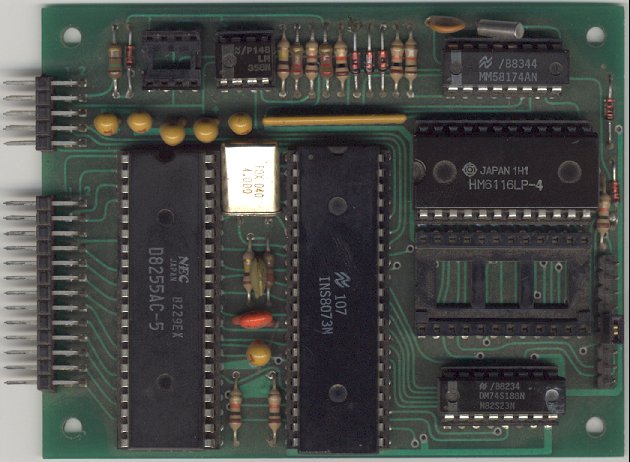
http://www.penguincentral.com/retrocomputing/pix/sbc/MC-1N/MC-1N.jpg
Might this be a Basicom MC-1N?
-ethan
--
Ethan Dicks, A-130-S Current South Pole Weather at 25-Apr-2004 10:50 Z
South Pole Station
PSC 468 Box 400 Temp -60.1 F (-51.2 C) Windchill -120.4 F (-84.7 C)
APO AP 96598 Wind 15.6 kts Grid 347 Barometer 685.6 mb (10416. ft)
Ethan.Dicks(a)amanda.spole.gov http://penguincentral.com/penguincentral.html
More digging later has revealed three Usenet articles from the same week
in 1997 of a product called the "BASICON MC-1N REV A" - there's no vendor
name on my INS8073 board, but the part number matches.
The Basicon, Inc. website says they are the victim of the current economic
times. I've written the repair service listed on their page, but we'll see
if they answer.
In the meantime, has anyone heard of Basicon? Might their "MC-1N" be the
same as what I have (INS8073, 2K SRAM, 8255...)? I've figured out most of
the circuit - what has me stumped is that the chip selects are all run
through a 74S188 burned as an adress PROM (its address lines are attached
to A15-A11 of the CPU, and its data lines go to various chip selects on
the board). I've tried building a circuit to manually dump the PROM (it's
only 32x8), but no success there - all the bits read '0', which means
"always selected" for all devices... clearly not correct. Once I figure
out where in memory the MM58174A and 8255 are, I can do more than enter
simple BASIC programs. I'd like to see if there's room in the memory map
to add more SRAM - there's stuff I'd like to port from my collection of
PET programs that would need more than 2K (especially since the 8073
doesn't appear to tokenize its BASIC code when it stores it in RAM or ROM).
I've tried writing a program to read every Nth location between the top
of RAM and the top of memory space (the RAM, I've already proven, is at
the standard address of $1000)... because of the way the INS8073 determines
its baud rate (110 bps in this case :-P), "empty" locations read back
"182" - no matter where I look, though, I can't get any locations outside
of RAM space to answer back with anything else.
I'd love to get a manual for this, but there just doesn't seem to be that
much information on the 'net about it (if I _have_ that particular product).
I'm hoping that it is one of these... it's a pretty neat board... 24 I/O
lines out the front, 2K of SRAM and either 2K or 4K (2716 or 2732) of ROM
and a clock/calendar. There's even optional battery-backup for the clock
chip and the SRAM (just add 3V-5V to a particular pin on the serial/power
connector).
Thanks for any leads.
-ethan
--
Ethan Dicks, A-130-S Current South Pole Weather at 25-Apr-2004 10:10 Z
South Pole Station
PSC 468 Box 400 Temp -60.3 F (-51.3 C) Windchill -114 F (-81.09 C)
APO AP 96598 Wind 13.3 kts Grid 004 Barometer 685.5 mb (10420. ft)
Ethan.Dicks(a)amanda.spole.gov http://penguincentral.com/penguincentral.html
At 03:10 PM 4/24/04 -0700, Don wrote:
>
>
>On Sat, 24 Apr 2004, Joe R. wrote:
>
>> At 11:05 PM 4/23/04 -0600, you wrote:
>> >There was a prototype of the 64000 with a 5MB
>> >hard drive, but I don't know if it was ever
>> >produced.
>> >
>> >The original 64000 benchtops had a tape drive
>> >(DC100? DC300?
>>
>> I want to say DC300 but I'm not sure, it's been a long time. However
>> it's the same tapes that are used in the HP-85s. Check the archives, they
>> have been plenty of discussions about HP-85 tapes and drives. Don't waste
>> your time or money on old HP tapes, they're ALL bad. Take my word for it!!!
>
>DC100! DC300s were the big suckers - about 4x6x.625 inches!
You're right. I should realized that. That what my Tektronix and IBM
5100 used.
Joe
On Sat, 2004-04-24 at 21:20, Bernd Kopriva wrote:
> Hi Jules,
> i got that one formTony Duell some times ago :
[snip]
thanks for that.
> Btw: do you have a spare power supply (or maybe some schematics) ? Mine
> is dead, so i never got my machine up and running :-(
The machine I've looked at so far has a good PSU, but the track on the
power distribution board that feeds +12V to the system board is totally
burned away, and someone had bypassed it with a piece of wire. Obviously
the system board has suffered some major short at some point - I'm yet
to find out if the bypass wire was added after they fixed the fault or
not!
In other words, it's possible one system board is completely dead, in
which case yes there could well be a spare PSU. Depends on what state
the system board is in this machine, and whether the PSU in the other
one works or not; idealy getting two machines working would be nice!
You could always use a standard PC PSU I expect. There's six different
lines running to the PSU in these Whitechapels; GND, +5V, +12V, power
fail are four of them. The purple wire I expect is -12V. That leaves a
red wire, which would seem a strange colour to choose for a negative
voltage. Maybe it's +15V or something odd, perhaps for driving the
display. I'll let you know when I work it out :-)
cheers
Jules
A few initial questions after a couple of these beasties turned up at
the museum:
Does anyone have OS install media for these? We've got the manuals, but
no floppies and I'm not sure what state the hard drives are in yet.
Don't suppose anybody has schematics / service information?
Predictably, the batteries inside the machines are toast and have taken
half the circuitry with them (grr!). I'll clean everything up and then
bypass the tracks which have been damaged / eaten away. Presumably
there's a trick to starting these things after battery failure by
feeding power straight to the internal relay - any ideas what voltage it
needs though? And once running will I still need to keep the relay
energised or will the PSU circuitry take over (even in the absence of
batteries - I'm just going to remove the damn things completely)?
I've got one hard drive to spin up and become ready after dumping half a
can of WD40 onto the bottom spindle bearing - it wouldn't even turn
before that. Now it just sounds like a sick cat. :-/
Hopefully it'll last long enough to get any useful data off it though.
I notice what seems to be a SCSI connector on the system board - can I
pull out the ST506 disks and just run a more modern (and hence reliable)
SCSI disk from here? Or is the SCSI connector (if that's what it even
is!) just designed to support a tape drive, and the machine always
expects the boot drive to be an ST506 disk?
cheers
Jules
Antonio Carlini <arcarlini(a)iee.org> wrote:
> There were, however, other machines
> called rtVAX <some-number>. I forget the exact details
> but at least one of them was based on the CVAX chip. I
> expect that there was something at the board-level that
> would have prevented them running OpenVMS but the chip
> was (I'm pretty sure) a standard CVAX.
Hmm, did they seek process page tables in physical or in system virtual memory?
If the latter, I don't see how can they be called rtVAX, as that by definition
means the former. If the former, how can you do that with a standard VAX chip?
Or does CVAX have an undocumented hack pin which when tied opposite to what
general specs say causes it to seek process page tables in physical memory?
> There's not a huge difference between STD 032 and the books.
> There are a few paragraphs missing here and there but I don't
> remember anything hugely significant [...]
> [...]
> [bug lists that were cut] But even these would not help you understand the
> architecture any better.
OK, I've already figured myself that all the really important "what is a VAX by
definition and how to build one" stuff *is* in the published VARMs, so my
project of building a new VAX is not stuck waiting for KGB to pry STD 032 out
of DEC. I fully understand the VAX Architecture (and have a solid rigorous
spec definition) based on the 3 VARMs I have (Rev 6.1, 1st ed. and 2nd ed.) and
I should have something exciting on the new VAX front hopefully not too long
>from now. It would still be nice to seize and free the full DEC STD 032 for
completeness, but this task can be left until later when we can raise a large
enough army (using human cloning, genetic eng. and neurolinguistic programming
to make perfect killing-machine soldiers) to invade and overrun USA including
ex-DEC facilities and archives.
> The only major omission is the Virtual VAX stuff (which was
> done for some three letter agency but never became a product
> - I heard that it just ran way too slowly to be useful).
> It has its own SID (09 IIRC, I guess(0)07 was already taken :-)).
Ahh, thanks for explaining that! One fewer mystery. I have known about VVAX
>from the Ultrix sources (which are on my FTP site), but I didn't know what it
was. Now I know. :-) Actually Ultrix was made to run on it too according to
comments in the source, though the actual VVAX-specific machine-dependent code
is not present in the source tree I have, it just has SID and misc. definitions
for it, pointers to VVAX code in the CPU type dispatch table (conditionalised
on #ifdef VVAX), and comments mentioning it. And yes, the SID code is 0x09.
Now that I know that VVAX was real (and not an Ultrix internal thing - Ultrix
does have some fake SID codes of its own that do not correspond to anything in
hardware), I now know what's in the gap between 78032 and CVAX SID codes. :-)
So they were upset at MicroVAX I for taking 007, huh?
So this only leaves SID codes 0x0C, 0x0D and 0x0F as unexplained gaps. I
suppose that perhaps 0x0F could have been truly skipped after 78R32 jumped to
0x10 (I guess 78032/78R32 liked power of 2 SIDs), but I can't explain how has
VAX 9000 got 0x0E unless 0x0C and 0x0D were reserved for something (that
apparently never saw the light of day). Any idea what 0x0C and 0x0D were
reserved for? Also what SID codes were assigned past 0x14 in the VAX's dying
gasp? NVAX+ (NVAX in Alpha 21064-mimicking pinout) was given 0x17, wasn't it?
And what about NVAX5 (NVAX in EV5-mimicking pinout)? Was it also 0x17 or was
it 0x18? And then I've heard rumours about there being a never-released
NVAX6... And why were 0x15 and 0x16 skipped?
One reason it's important to understand the complete history of SID code
assignments is that if we start building new VAXen, we'll need a new SID code
registry. I plan on calling it DANA, for DEC Assigned Number Authority, in
emulation of IANA (Internet Assigned Number Authority). But to make it proper,
the new registry will have to start assigning codes exactly where the old one
left off.
And DANA won't be just for SID codes - there are also VAXBI device types and all
sorts of ID codes used in MSCP/SCA, etc.
> I think I've said before, what you really want is not STD 032
> but AXE, the tool that runs on your new VAX and checks for
> correct operation of instructions.
I've never heard about AXE from you, but I have heard about it from other
sources. Yes, that would really be nice.
Interestingly, however, it appears that at some point there were diagnostic
programs available to the general public that, judging from the descriptions,
apparently do similar instruction testing, though they were presumably intended
for troubleshooting broken hardware rather than for validating new
implementations. The KA820 Technical Manual, for example, refers to these:
Table 7-2:
Program Code Program Name Run-time Environment Hardware Tested
EVKAA VAX-generic Level 4 (stand-alone, VAX instruction set
cluster boot and run from the used by VDS
exerciser: console)
hardcore
instruction
test
EVKAB VAX-generic Level 2 (on-line or Basic VAX instruction
cluster stand-alone) set, nonprivileged
exerciser:
basic
instruction
exerciser
EVKAC VAX-generic Level 2 (on-line or Floating-point VAX
cluster stand-alone) instruction set, non-
exerciser: privileged
floating-point
instruction
exerciser
EVKAE VAX-generic Level 3 (stand-alone) Privileged VAX
cluster instruction set
exerciser:
privileged
architecture
exercise
[descriptions of KA820-specific diags omitted]
The descriptions of these diagnostics sound very much like AXE. Any idea where
to find these diags?
MS
I just learned that a new book on computer and internet history has been
published that is written in Arabic. The author, Richard Hayek (based in
Lebanon), is an IT journalist for an Abu Dhabi based newspaper. It is
the first book (that is known) written in Arabic on the topic. I'm in
contact with the author and am in the process of ordering several copies.
As far as I know, the only way to get the book here in the States (or
anywhere outside the Middle East) is by ordering it through him. If
anyone else is by chance interested in a copy then let me know and I'll
order you a copy as well. They are US$8.25 each plus postage.
This of course has personal interest for me but I think it also indicates
how that part of the world is finally joining the computer revolution.
Computer and Internet penetration has taken a long time for most Middle
East nations, but some have adapted faster than others. Lebanon, for
instance, has some of the highest penetration of the Internet, with
Internet cages everywhere. I would imagine other more affluent nations
such as the United Arab Emirates and Bahrain probably have a higher per
capita penetration of personal computers but I don't know what the
controls over the Internet are. Many Middle East nations have internet
access of some kind though it is heavily censored usually.
Anyway, kinda neat.
--
Sellam Ismail Vintage Computer Festival
------------------------------------------------------------------------------
International Man of Intrigue and Danger http://www.vintage.org
[ Old computing resources for business || Buy/Sell/Trade Vintage Computers ]
[ and academia at www.VintageTech.com || at http://marketplace.vintage.org ]
At 19:57 -0500 4/22/04, Sellam wrote:
> The computer is now just
>hardware, and soon enough, with cool technology like keychain harddrives
>or what not, you'll bring in your own OS and software tools and modify the
>hardware to your purposes, leaving it as it was for the next user.
I think the NeXT Optical drives were intended to provide a
functionality like this. Carry your own OD media around, stuff it
into the NeXT you sit down at, and your entire (256Mbyte) environment
is right there with you. (I'm not sure I have a reference to support
this, though. Maybe NeXT sales materials? Anyone else?)
Performance didn't live up to the rapidly moving HD performance of
the day, and the idea got overtaken by network via ethernet. Sit
down, telnet into your machine back home.
That makes me think that the idea will only work where 1) the
portable medium has pretty good performance (speed-wise) relative to
current primary mass storage, and 2) The OS/environment startup
process is relatively short (say, maybe, < 20 seconds?)
--
- Mark
210-522-6025, page 888-733-0967
Does anyone have any experience reviving dead VT52 DecScopes?
I'm getting a couple in unknown condition. One "lights up" and the other one doesn't.
I haven't seen them yet. I've found good diagnostic info on vt100.net
I'll see what happens when I put them in offline mode and run some tests.
Ashley
Found a message from you from last year that indicated you have software
for a B&C Microsystems UP200. If it is any newer than the version 1.0i
DOS software I have for it, I'd certainly appreicate a copy.
Thanks!
Todd
Hi Ron - do you have an LSI11 Processor board type M7264 that needs a good
home?
Terry Parfett (UK)
********************************************************************
This email and any attachments are confidential to the intended
recipient and may also be privileged. If you are not the intended
recipient please delete it from your system and notify the sender.
You should not copy it or use it for any purpose nor disclose or
distribute its contents to any other person.
********************************************************************
Hello all!
I have been busy interfacing the "real console" to SIMH last week.
During last week Vince has drawn some Printed Circuit Boards (PCBs).
Vince and I had frequent e-mail contact working through the designs.
Basically, this e-mail is an inquiry to which extend people would
like to embark on this project.
So, let me know if you would like to participate in this project!!
But before you put the $$ on the table I will try to explain in more
detail what the status of my project is and what use it can have ...
In this e-mail I address the following topics:
1. Some ideas where this project can be used.
2. A small description of the hardware.
3. An introduction to the firmware.
4. The interfacing to SIMH, state of affairs.
5. An estimate on the building costs.
6. What the project participants can expect.
Allthough my primary design goal was a "blinkenlight" console based
on the PDP-11 and a PC running SIMH, the hardware is multi-functional
with the large amount of digital inputs and outputs. You can think of
several other applications to control with this harware, for example
a robot arm with some stepper motors ... just use your imagination!
During this weekend I will update my website with a few .mpg files to
show you a console in operation with SIMH, and a few samples of the
console running in stand-alone mode. So, check next Monday the site
http://www.pdp-11.nl/ and click on the link "homebrew PDP-11" in the
left pane. The latest software version will also be downloadable.
** 1 ** Ideas for use.
First, let me say that I do NOT support the idea of trashing a nicely
working real PDP-11 computer to get a console!
If you have a real PDP-11 console, this project will allow you
to use the computer that runs SIMH (PC) to be controlled with the
PDP-11 console as the real thing!
This hardware is an other option for people that do not have a
real PDP-11 with blinkenlight console or do not have the space for
such a big (UNIBUS) machine.
A third option for usage of this hardware is for people that
*have* a real PDP-11, but running that system is noticed on the
electrical bill! One could build a PC inside the real PDP-11, and
disconnect the flat cables from the real console and connect them to
this hardware. Running the PC/SIMH with the real console looks like
the REAL THING but without the big energy consumption. Of course, the
real disks and other peripherals are all "inside" the PC ... This
setup might be a solution for a museum. The system is exhibited in
a running state, and the changes made can simply be reverted to the
original state.
The fourth usage is for other computers that have a blinkenlight
console, and are emulated by SIMH. The PDP-11 file in SIMH shows how
to interface your favorite machine. You can run your favorite vintage
computer in SIMH with that sexy switches and light console!
** 2 ** The hardware.
We have two different design approaches.
The first is called the "combi-board". The combi-board is a single
PCB which contains the CPU etc. and *eight* 8-bit output ports and
*six* 8-bit input ports. This in/out configuration can support the
largest PDP-11 console, viz. PDP-11/70 full console!
The second design consists of *two* PCBs, one is called the Core
Board, the other the I/O Board. The Core board holds the CPU, etc.
and the I/O Board offers also 8 8-bit output and 6 8-bit input.
The combi-board is a little cheaper, but the two-PCB design offers
expandability if you need more outputs/inputs.
(who said this hardware design is for console interfacing only ?!)
The design efforts of Vince and I are focussed on the 2 PCB version.
Note.
If you checked my website and had a look at the schematic diagrams,
I must tell you that there are a few minor changes. For example, the
expensive Dallas RS-232 converter chip is replaced by the cheaper
MAXIM MAX232A chip. Further the 8kbytes firmware EPROM 2764 was full
up till the last 500 bytes, so there was little room for any future
development. The address decoder LS138 is substituted by one 74LS139
thus enabling the change from the 2764 to one 27128 16 kbytes EPROM.
That also eliminates the need for an optional 2nd 2764 EPROM socket,
which saves space on the PCB.
** 3 ** The firmware.
The firmware contains in approx. 8 kbytes a simple debugging monitor
and the console software. Which software (monitor or console) starts
is determined by a push-button at reset. Both talk to a terminal via
the RS-232 port at 9600 Bd. In the console mode, the RS-232 connects
to the interface software added to SIMH to control the console from
SIMH.
It is completely free to which input port and bit(s) you connect the
switches and the (momentary) toggles. Via the firmware you 'learn'
the console where the switches/toggles are connected. The firmware
handles the appropriate way of processing toggles and debouncing.
** 4 ** Interfacing to SIMH.
I added two extra files (one .c and .h), and made simple changes and
additions to the files scp.c and pdp11_cpu.c of the SIMH software.
Current state of affairs: ADDRESS and DATA LEDs are functional, also
the USER, VIRTUAL, CONS, and RUN LEDs. I have not yet spend time to
find a way to implement the control from SIMH for the BUS & PROC LED.
The toggles LOAD ADRS, EXAM, CONT, START, and DEP work as you would
expect on a real PDP-11/40 (aka PDP-11/35 OEM version).
The ENAB/HALT switch is operational too, HALTs the emulated software
when it runs, and changes CONT and START to STEP and RESET while in
the halted state, the switch in the position HALT.
While STEPping the software the ADDRESS & DATA LEDs are correctly
updated after every single instruction execution.
** 5 ** The costs of the project.
First, I need to know how many people would like to participate in
this project. The more people join, the cheaper the production costs
of professionally made PCBs become.
The (single) combi-board will be somewhere around $40 to $50, and the
two PCB design (Core and I/O) will be slightly more expensive, the 2
boards will cost approx $10 more than the combi-board. This solution
provides expandability for hobbyists, or use in other projects.
The required components to populate the PCB(s) can be seen in the
diagrams on my website. You can make an approximate calculation what
these components cost. Probably prices are lower in the USA compared
to The Netherlands where I live ...
** 6 ** What will you get if you join the project?
I will write a clear, well documented manual that describes the PCBs,
the protocol, and a step-by-step DIY building the PCB(s) with clear
*full color* pictures.
The firmware and the modified SIMH files can be downloaded from my
website. However, I will offer a pre-programmed 27128 for just the
cost of the IC (here in The Netherlands). You can also snail-mail me
an *empty* 27128, and I will program that one for you, but I doubt if
that option would be cheaper ...
REMARK.
If you would like to participate in this project, but are not sure to
successfully solder the PCB(s), I will offer a (payed) service that
delivers a working/tested PCB (or two PCBs).
The modifications required in SIMH are done for version 3.2.0. The
first work was done on version 2.4.0, and I found a few changes were
needed, as scp.c was changed. However, when a new version of SIMH is
available I will put the required changes on my website within, say
two weeks. So, unless SIMH changes drastically, continuity will be
guaranteed on short notice, else I will need a little more time!
If you join the project for the hardware, but do not intend to use
it for a console, but in some other project, you can ask me questions
too. I will give answers to the best I can as long as they involve
the design, or the software. I have good knowledge of MC6802 assembly
programming.
Please feel free to write an e-mail to me if you have any questions!
I will try to answer all questions in private e-mail, next week.
If the question is general I will post a follow-up in this thread.
regards,
- Henk, PA8PDP.
>"CUDA" doesn't mean anything by itself. It's not an
>Acronym.
>
>It is a shortening of "Barracuda".
>
>The main chip in the Mac that controls the
>Clock/Calendar, PRAM, and some of the I/O is called
>the Barracuda chip.
>
>It was a question on my Apple Certified Technician
>Test.
Wow... ok. I guess that is one of those things they throw in to make sure
you purchased their training guide. I've NEVER seen that info ANYWHERE
before. I 100% believe it, but I suspect the only place that tidbit is
available would be in the tech training.
Thanks for solving that mystery for me.
-chris
<http://www.mythtech.net>
At 19:57 -0500 4/22/04, Dave Dunfield wrote:
>I happen to have an August 1983 BYTE magazine in front of me, which
>has an artical entitled "Comparing C Compilers for CP/M-86" in which
>they use the Sieve as one of their main benchmarks. ...
Dave, thanks very much for the kind offer! I was mainly after two
aspects of the original article(s). 1) The listing of the program, in
many different languages (I seem to recall Forth, Basic, C, possibly
others) and 2) The extremely wide range of performances turned in by
different computer/language combinations, ranging from TRS-80 basic
up to (IIRC) Cray or something on that order. So the C benchmarks,
while interesting, aren't really what I'm after.
The whole discussion came up because I was trying to explain to the
kids what an "algorithm" is.
--
- Mark
210-522-6025, page 888-733-0967
Folks,
Discovered I had said old machine in storage the other day and I thought
it'd make a neat little webserver for when I'm away from home working and
will have nothing better to do than PHP hacking.
First time I powered up it sprang to life but locked up because the CMOS
battery (non-standard dammit) is obviously flat. Subsequent powerups with or
without battery installed (you can replace the floppy drive with a dedicated
AC input) result in a beep and pretty much nothing else.
Anyone come across these wee beasties before? Aside from when they were new,
obviously :o)
cheers
--
Adrian/Witchy
Owner & Webmaster, Binary Dinosaurs
www.binarydinosaurs.co.uk - possibly the UK's biggest online computer museum
www.snakebiteandblack.co.uk - ex-monthly gothic shenanigans :o(
At 19:57 -0500 4/22/04, Dave Dunfield wrote:
>I happen to have an August 1983 BYTE magazine in front of me, which
>has an artical entitled "Comparing C Compilers for CP/M-86" in which
>they use the Sieve as one of their main benchmarks. ...
Dave, thanks very much for the kind offer! I was mainly after two
aspects of the original article(s). 1) The listing of the program, in
many different languages (I seem to recall Forth, Basic, C, possibly
others) and 2) The extremely wide range of performances turned in by
different computer/language combinations, ranging from TRS-80 basic
up to (IIRC) Cray or something on that order. So the C benchmarks,
while interesting, aren't really what I'm after.
The whole discussion came up because I was trying to explain to the
kids what an "algorithm" is.
--
- Mark
210-522-6025, page 888-733-0967
> From: "Antonio Carlini" <arcarlini(a)iee.org>
> X-Mailer: Microsoft Outlook, Build 10.0.4024
> X-Mimeole: Produced By Microsoft MimeOLE V6.00.2800.1165
> > All Rights Reserved | My VAX | an unnatural belief that we're
> > above Nature &
> > www.rddavis.org | runs VMS & | her other creatures, using
> > dogma to justify such 410-744-4900 | doesn't crash!| beliefs
> > and to justify much human cruelty.
>
> Fractures sigs too :-)
No, Antonio, it's your fucking shitty M$ Outcrook that fractures sigs.
RDD's sig looks the way it's supposed to on my VT320 using a standard text mail
program that doesn't stick its nose where it doesn't belong distorting ARPA
Internet text mail messages.
MS
P.S. Sorry everyone for blowing my safety valve, and in particular no offense
intended to Antonio, you've done some incredibly wonderful things, but it just
pisses me off to no end when a presumed Classic computist uses M$ Outcrook for
ClassicCmp mail rather than a proper text mail client on a text terminal.
>Jobs met Wozniak when he was still in high school (introduced to each
>other by Bill Fernandez). Wasn't it Jobs who got the job for Woz at
>Atari?
I wasn't sure when they met, but I did seem to recall that Jobs did get
Woz the Atari job. Wasn't that where Jobs was working, and they wanted to
design a handheld game, and Jobs got Woz to do it, and he did it so well,
Atari couldn't figure out exactly how he did it.
Or am I mixing up another incident (or possibly even an urban legend)
-chris
<http://www.mythtech.net>
Hello, I have an Otrona with 5 1/4" disk drives. Problem is that I don't have the boot disks for the machine. I wondered if you send me a copy if you still have them. What would you charge for them? I would appreciate any help you could provide. Thank you, Don Radford, Cincinnati, Ohio
I saw the following posted on alt.sys.pdp11:
[from Jeff Davis <jdavisgoogle(a)soupwizard.com>]
Hi, I frequent the University of California - Santa
Barbara surplus
store and noticed they have the following PDP stuff
that is heading
for the scrap heap this week unless someone comes and
buys it (and
considering that the alternative is scrap prices,
it'll probably go
cheap):
(from memory, so it's probably 85% accurate):
- 4 waist-high 19" racks containing the PDP stuff.
- 2 each PDP-11/23 rackmounted
- 2 each PDP-11/73 rackmounted
- at least 4 RL02 drives
- a couple or more RC25 (I think) cartridge drives
- other random equipment that I can't identify
- 2 Decwriter line printers/consoles
- A big push cart full of (looks like unused) RL02
packs and RC25
carts.
- RSX manuals and a bunch of other documents
All this stuff came from an installation that was
finally turned off,
so it looks complete.
I'd get it for myself, but I just do not have room.
If you're in the
Santa Barbara / Los Angeles area and are going to pick
this stuff up
and need a hand, let me know.
CONTACT:
UCSB Central Stores
(805) 893-2732
jeff.goldmann (the at symbol) stores. ucsb. edu
"CUDA" doesn't mean anything by itself. It's not an
Acronym.
It is a shortening of "Barracuda".
The main chip in the Mac that controls the
Clock/Calendar, PRAM, and some of the I/O is called
the Barracuda chip.
It was a question on my Apple Certified Technician
Test.
- Al
__________________________________
Do you Yahoo!?
Yahoo! Photos: High-quality 4x6 digital prints for 25¢
http://photos.yahoo.com/ph/print_splash
I am liquidating a shelf full of early 80's -era microcomputer parts
and not fully functioning computers. I have posted a web page containing
a complete list. http://degnanco.net/vintage/ If you are in the
Philadelphia area and want some or all will sell or trade for low
price.
-- E N D --
I've heard John Oliger's stuff is quite good.
A friend had his TS-1000 all tricked out with a John
Oliger Disk Interface, Parallel Port, Color Graphics
Interface, Joystick Interface and more...
It cost more than an IBM XT did at that time.
We used to tease him about the "Tail Wagging the dog".
But, he was quite happy with it all.
When I worked for Zebra Systems, we were going to
carry John's stuff. We went out of the Timex Market
before that happened though.
Al
> From: "Glen Goodwin" <acme(a)gbronline.com>
> Subject: TS2068 disk interface (was Re: cctalk
>
> Hello Al --
>
> ----- Original Message -----
> From: "Al Hartman" <alhartman(a)yahoo.com>
>
> > What controller are you using on the TS2068?
>
> > Just curious...
>
> > - Al
>
> I use the John Oliger (JLO) interface. It supports
> two DSDD 5.25" and/or 3.5" drives in any
> combination and has proven to be very reliable. It
> also does *not* use the TS2068 cartridge port, so
> that port is still available for other circuitry.
>
> Additionally, the John Oliger Co. is still in
> business and still sells and supports this
> interface which was originally introduced in 1984.
>
> Glen
__________________________________
Do you Yahoo!?
Yahoo! Photos: High-quality 4x6 digital prints for 25¢
http://photos.yahoo.com/ph/print_splash
Has anyone got a Documation M600 or M1000 that they'd like to sell? I
have a potential buyer.
Let me know...
--
Sellam Ismail Vintage Computer Festival
------------------------------------------------------------------------------
International Man of Intrigue and Danger http://www.vintage.org
[ Old computing resources for business || Buy/Sell/Trade Vintage Computers ]
[ and academia at www.VintageTech.com || at http://marketplace.vintage.org ]
> My recollection may be off, but this is straight from Woz, Al.
Woz is a nice guy, but after his plane crash / amnesia there is
a lot that he doesn't remember. The story came from Al Alcorn
who had to fix the unshippable mess that Woz created.
I had wondered about the story about a year ago, while Al and I
were going through some of the old Atari documentation that he
still has, and I made a point of asking him EXACTLY why they
couldn't ship what Woz had built. The specific part of the circuit
is the on screen score circuit. There is a fairly complicated
glob of gates there around a seven segment decoder IC which
HP had reduced to a single IC. Woz had used that part in the proto
that he built. Atari had to replace it with conventional logic.
They knew EXACTLY what he had built, they just couldn't put it
into production using the parts they could buy.
At 12:31 22/04/2004 -0500, you wrote:
>All,
> A question: I wondered if results from the Byte Sieve of
>Eratosthenes "benchmark" are publicly available anywhere, or if I
>have to root out a copy of Byte Magazine? I googled for it, and found
>nice C and Forth versions at
>
>http://home.iae.nl/users/mhx/nsieve.html
>
>and *some* results, but I'd sort of like to re-read the original
>article and see what the results for all of the classic computers
>they tested were.
> The above URL cites Byte, Sept. 1981, pp. 180, and Jan. 1983,
>pp. 283. Copyright law being what it is, I assume the articles are
>still Byte magazine IP, but I'd think they could gain a fair amount
>of publicity from having that article posted somewhere as a "teaser",
>particularly if they link to some of the url's showing modern machine
>performance. Can't find such a pointer on their site,
>http://www.byte.com however. And the site itself is not encouraging.
>--
> - Mark
> 210-522-6025, page 888-733-0967
Hi Mark,
I happen to have an August 1983 BYTE magazine in front of me, which
has an artical entitled "Comparing C Compilers for CP/M-86" in which
they use the Sieve as one of their main benchmarks. They are testing
Williams, Desmet, Lattice, Computer Innovations and Digital Research
tools.
The artical is fairly long - about 13 pages. If this is of interest
to you, I could scan it and put it somewhere where you can get it.
Btw, this particular issue (Aug 83) is entitled "The C Language",
and has a lot of good material in it:
Theres also a comparison of 5 CPM/80 compilers which also uses the
Sieve as one of the main benchmarks, There's alse a comparison of 9
PC/DOS compilers, but I don't think (from cursory re-read) that they
use the Sieve in that one.
On top of that, there's an artical by Steve Johnston and Brian Kernighan
describing a lot of the design philosophy and early experiences, a couple
of general "into to C" type articals, and artical on C in unix systems,
A C bibliography, an artical on C compatibility issues between Unix and
CP/M and a bunch more - really a good issue (which is why it's one of
the few I've kept).
Don't think I want to scan the whole thing (unless you want to wait a
*LONG* time) - but I will do what I can to get any parts you are
interested in to you.
Regards,
--
dave04a (at) Dave Dunfield
dunfield (dot) Firmware development services & tools: www.dunfield.com
com Vintage computing equipment collector.
http://www.parse.com/~ddunfield/museum/index.html
Need a value for a NEC 9801/VX desktop computer a Japanese model with manual
and 250 floppy diskette (all in Japanese). Also has keyboard and box with a
new harddrive in it. Any help would be great and thanks for your time.
In a message dated 4/22/2004 1:00:38 PM Eastern Daylight Time, cctalk-request(a)classiccmp.org writes:
>
> Time Magazines calls him "the force behind the
> Macintosh"... I wonder what Jef Raskin would make of
> that comment.
Though it is true that Jef Raskin started the Macintosh project at Apple in 1979, his Macintosh was to be an 8-bit utilitarian machine. It would have had a bit-mapped screen, but no GUI or a mouse at all. Jef Raskin has always been very devout in user interface which promotes keeping your hands on the keyboard. His 1987 Canon Cat is more along the lines of what Raskin's Mac would have been.
Raskin simply gave Jobs an easy existing platform "vehicle" to take over, when Jobs was denied control of the much touted Lisa project. Raskin left Apple in 1982 after Jobs took over (but I think he still signed the Mac inside case - anyone?). Jobs wanted to out "Lisa" the Lisa project, and so the Macintosh quickly went from a $500 consumer computer, to $1000, to $1500 and finally to $1995 - that is before Sculley thought it should be $2500 minimally (thus was born Apple's outrageous profit margin on Macs).
Jobs certainly does deserve a huge amount of credit, however wrong he might have treated anyone, for his pure force of will in the creation of the Mac as we knew/know. He forced some design decisions which were wrong and Apple paid for (closed architecture, etc.), but he was 90% on overall (appliance design, one button mouse). His direction with Apple in the last 6 years has been mostly very good. Apple's stock is steadily rising now. The Mac consumer market remains at about 6% in the US, but their server (OS X) market is growing big-time. The Mac OS is excellent. I still love to set up my cube and run NeXTSTEP 3.3, which I now understand a lot better.
Here are some recent opinions of Jef Raskin's about the Mac: http://www.macminute.com/2004/02/11/jeffraskin
Best, David, classiccomputing.com
I can't find any reference to a Dumbkoff 1 orDumbkoff anything else
computer related, although I did find the word "Dumbkoff" used to mean
"idiot" or "someone stupid".
I did find reference to the Remington-Rand 256 bit tube. Check this out:
http://www.feb-patrimoine.com/Histoire/english/information_technology/inform
ation_technology_2.htm
- Ashley
> ----- Original Message -----
> From: "Vintage Computer Festival" <vcf(a)siconic.com>
> To: "Classic Computers Mailing List" <cctalk(a)classiccmp.org>
> Sent: Thursday, April 22, 2004 2:33 PM
> Subject: Weird items on VCM
>
>
> >
> > Someone just posted some odd items on the VCM. Anyone have any
> > information on the MIT "Dumbkoff 1"?
> >
> > http://marketplace.vintage.org/view.cfm?ad=608
> >
> > >From the same seller, a Remington-Rand Selectron 256 bit Memory Tube:
> >
> > http://marketplace.vintage.org/view.cfm?ad=607
> >
> > --
> >
> > Sellam Ismail Vintage Computer
> Festival
>
> --------------------------------------------------------------------------
> ----
> > International Man of Intrigue and Danger
> http://www.vintage.org
> >
> > [ Old computing resources for business || Buy/Sell/Trade Vintage
> mputers ]
> > [ and academia at www.VintageTech.com || at
> http://marketplace.vintage.org ]
> >
>
Just some useless info, FWIW.
All this recent talk of bubble memories got me to
remembering.... A company I worked for in Buffalo NY
around 1982 was putting bubble memories into a small
diskless machine that they sold (or rented?) to golf-course
pro shops. It was called a "handicaputer" - it kept track
of golfer's scores and handicaps and such. No idea how
many were made, but my impression is not very many. But
it might be something to watch for, for anyone into bubbles.
We also had, IIRC, an SS-30 card (SWTPC I/O bus) with a
bubble memory on it, for which I hacked Flex "disk" drivers.
(Somebody else had already written the lower-level bubble
read/write code.) At one point it booted into Flex. Might
have been called "disk-bub" or "flex-bub" or something
similar. Sold only a handful though. Really cool but
probably too expensive unless you really needed bubbles for
some reason. One went to some research station in Alaska
(or Antarctica?) - they said disk drives would have frozen
up.
Bill.
__________________________________
Do you Yahoo!?
Yahoo! Photos: High-quality 4x6 digital prints for 25¢
http://photos.yahoo.com/ph/print_splash
Dwight, I ran across your posting about the EC-1. I am afraid I go back to the EC-1 period and used hybrid analog-very early digital computers at North American in the early 60s. I wondered if you knew of a source for a fairly good condition EC-1? I just purchased one and am in the process of getting it to work again. But would like to have a second unit to share parts with, etc. Hope this gets to you. Thanks. Larry Royster.
I've still got a bounty out on the documentation for the following
products (circa 1990-1991):
Probe X (from the Strategic Software Group)
HP GlancePlus
HP PerfView
HP OpenView
IBM Tivoli
IBM Netview
Please contact me if you've got anything.
Thanks!
--
Sellam Ismail Vintage Computer Festival
------------------------------------------------------------------------------
International Man of Intrigue and Danger http://www.vintage.org
[ Old computing resources for business || Buy/Sell/Trade Vintage Computers ]
[ and academia at www.VintageTech.com || at http://marketplace.vintage.org ]
All,
A question: I wondered if results from the Byte Sieve of
Eratosthenes "benchmark" are publicly available anywhere, or if I
have to root out a copy of Byte Magazine? I googled for it, and found
nice C and Forth versions at
http://home.iae.nl/users/mhx/nsieve.html
and *some* results, but I'd sort of like to re-read the original
article and see what the results for all of the classic computers
they tested were.
The above URL cites Byte, Sept. 1981, pp. 180, and Jan. 1983,
pp. 283. Copyright law being what it is, I assume the articles are
still Byte magazine IP, but I'd think they could gain a fair amount
of publicity from having that article posted somewhere as a "teaser",
particularly if they link to some of the url's showing modern machine
performance. Can't find such a pointer on their site,
http://www.byte.com however. And the site itself is not encouraging.
--
- Mark
210-522-6025, page 888-733-0967
Today I finally had a chance to check out a PC that I found a few weeks
ago. I had picked it up becuase it had an HP-IB connector on one of the
expansion cards. When I looked closer I saw that the card had a sticker
marked "HP 82324". Bingo! That's the part number of the souped-up
Measurement Coprocessor card that's commonly called a HyperViper! I have a
number of Viper cards with 68000 CPUs but I'd never even seen a HyperViper
card. The HyperViper uses a 16MHz 68030 CPU. The Vipers and HyperVipers are
HP 9000 series 200 or series 300 computers on a board. You install them in
a PC and run a driver and it switches over to the 680xx CPU and runs
(almost!) exactly like HP 9000 computer. It has a built-in HP-IB port and
supports additional HP-IB cards. It also mounts a HP 9000 file system in
one file on the PCs hard drive. It uses the PC's parallel and serial ports
and uses the PC's keybaord and monitor for user I/O. Anyway today I opened
it up and cleaned all the dirt and insects out and fired it up. It booted
to DOS then loaded the HP software then switched over to the HyperViper
card and booted HP BASIC version 6.2 (Rocky Mountain BASIC) without a
hitch. Wahoo! I'm in business now! It even has the last version (D.00.00)
of the HP divers.
HP's Viper and HyperViper site >>
<http://ftp.agilent.com/pub/mpusup/pc/old/vp_over.html#m5>
Joe
I have one of the these too. They were standard IBM IO Selectrics, modified
electrically for what appears to be use on a military aircraft. I'm planning
on building
a serial or USB interface for it so I can use it as a remote terminal for my
IBM 1130
simulator. I've gathered a lot of information about it including the
connector, signals
etc. If you're interested, let me know and I'll send you what I have. These
machines
being sold on eBay, by the way, are in wonderful shape mechanically but most
likely
have a shorted or open control soleloid.
Brian
Thanks to all who sent me copies of that MM58174A app note. I'm not quite
to the stage of using the contents, but it's nice to have.
I do have scans of the board that I intend to put up on my website, in the
meantime, I have been tracing the board and have puzzled out the 10 pin
connector - it's power, gnd, battery-backup for the 6114 and MM58174A,
serial in/out, and three of the I/O bits (SB, F2, F3) on the CPU. I have
raided the local electronics scrap bin (we have to sort our waste into
numerous categories from "burnables" to "food waste" to "light metal",
etc., including "electronic scrap") for the connector off of a dead CD-R
drive, mounted the power connector and the audio/master-slave connector
to a piece of perfboard, and constructed a daughter card that gives me
easy-to-plug-into access to the signals that the board needs, and, ta-da,
I just got a '>' prompt from its Tiny Basic.
At the moment, I haven't puzzled enough out to enter programs (I get an
"ERROR 1" - Out of Memory), but I can write statements in immediate mode
and see the results (FOR loops, PRINTs, etc.). If I pull its 6116, I
don't get a prompt, so I don't think it's a problem with the SRAM, but
"PRINT TOP" gives me -32768 rather than an expected 4353 or similar
number.
So one thing I'm going to do with this is to change its baud rate from
110 bps to the max of 4800... After that, who knows. I could use an
enclosure for it.
For something out of my junk drawer, it's pretty cool. I'm going to write
to the guy who gave it to me to see if he knows what it was used for.
I used to have access to an RB5X when I worked at COSI. Now, at least, I
can play around in its environment. Somewhere at home, I have a backup
of our robot disk. I'll have to see if I've brought an image of that
in my C-64 directory.
Let me recommend the INS8073 for anyone who wants that late-70s/early-80s
BASIC experience in a bread-board computer. I think you could put one
together on a single (large) breadboard slab. You'd need 40 pins for
the CPU, another 24 to 32 pins for the SRAM, and some sort of RS-232
level shifter, like a MAX-232. The rest is all caps and resistors.
-ethan
--
Ethan Dicks, A-130-S Current South Pole Weather at 21-Apr-2004 23:40 Z
South Pole Station
PSC 468 Box 400 Temp -81.4 F (-63.0 C) Windchill -113.3 F (-80.7 C)
APO AP 96598 Wind 7.2 kts Grid 059 Barometer 687.1 mb (10361. ft)
Ethan.Dicks(a)amanda.spole.gov http://penguincentral.com/penguincentral.html
>I was SOL with Linux - I had to fire up a 68K Mac (there is no installer
>for PPC) _just_ to dump the camera and convert the QT-encoded PICTs to
>JPGs. I did use GC, but it wasn't my first choice - I'd rather use a
>Perl script.
First you should have been able to install on a PPC anyway. 2nd, I'm
pretty sure I have a PPC disk for the QT100 install. And even if I don't,
I have only ever used my 100 on a PPC, so I know the software installs
and runs just fine on a PPC running OS 9.1
If you want me to pull out my disks and check, and send to you anything I
have, just let me know. The 100 and 150 software I think is the same, as
the only real difference between them was the 150 has more memory and an
attachable macro lens (the 100 could even be upgraded to a 150 if you
wanted to pay Apple's price to do it)
-chris
<http://www.mythtech.net>
> For a rough test, set the switches on the back to 'Internal sync' and
> 'Terminated' (they'll be set like this if it was used on a 'Bow) and then
> feed a composite mono signal into the green BNC socket. 'Internal Sync'
> is sync-on-green, of coruse.
>
> If yoy get a green image on the screen, then the monitor is basically
> working. You could still have a problem with the red or blue video
> amplifiers, but theyr'e not hard to fix (unlike the horrible
> PSU/horizontal deflection system -- I still shudder when I remember that
> schematic!).
>
> -tony
Thanks alot for your hints Tony and Paul, I'll give it a try at home.
Pierre
_______________________________________________________________________
... and the winner is... WEB.DE FreeMail! - Deutschlands beste E-Mail
ist zum 39. Mal Testsieger (PC Praxis 03/04) http://f.web.de/?mc=021191
Hi folks,
After getting a nubus ethernet card and a radius 24bit accelerator I thought
I'd dig out my olde IIfx......trouble is it's refusing to power up even with
different keyboards/known good PRAM batteries. It worked when I got it a
couple of years ago; I even treated it to knew batteries, so anyone know of
any instant fixes for dead machines?
I'm going to steal the PSU from my other Mac II and see if it makes a
difference....I know they're the same apart from the IIfx one has a variable
speed fan.
Cheers,
--
Adrian/Witchy
Owner & Webmaster, Binary Dinosaurs
www.binarydinosaurs.co.uk - possibly the UK's biggest online computer museum
www.snakebiteandblack.co.uk - ex-monthly gothic shenanigans :o(
Looks to me that the guy has a high volume of scrap go through his place, or
he has access to a scrapper. A lot of his sales are chips that he sells
through the vintage listing. Looks like he completes less than 10 percent of his
sales. Mostly due to high prices.
I am surprised at the price of Gold Scrap though. He first started off trying
to sell 10 pounds of fingers. After a couple of times he dropped it to 2
pounds at a time. Sold one for $99. He seems to think scrap is worth $49 a pound.
Most scrappers have found that they should list it under Gold Bullion not
antiques. I sold off about 4 pounds of old pentium processors and, surprisingly,
got nearly $36 a pound, which I thought was higher than the scrap value????????
Paxton,
Astoria
Hi.
I am trying to install IRIX 3.3 on a PI 4D35. I have distribution tapes
and a 4D35 support tape as distcp(1M) images on disk. I created tapes
>from this images with distcp(1M) on IRIX 4.0.5. I can boot the
standalone tools from the 4D35 support tape. But I can't install
anything. I get allways:
Reading product descriptor from <where ever>:
Can't read product descriptor.
<where ever> is the tape device or the disk directory. When I had
problems with the tapes I mounted the IRIX 4.0.5 disk by hand and
pointed the install system to it with the "from" command. Same result:
"Can't read product descriptor."
Whats wrong here?
--
tsch??,
Jochen
Homepage: http://www.unixag-kl.fh-kl.de/~jkunz/
> You can't even view the
>pictures in their native format unless you've loaded the camera software;
>they are PICTs, but the data segment of the PICT file is compressed
>in a non-standard way, meaning that even Linux tools that know what
>a PICT is can only describe the contents of the picture file from a
>structural standpoint. Makes automating certain operations impossible.
I'll try to remember to play with my QT100 tomorrow, but I *think*
GraphicConverter can deal with the native format. I'm not sure if you
need the QT software installed (possibly, and then GC just uses the hooks
enabled via the QT extensions), but even if that is so, GC has some half
way decent automation abilities, so you may be able to use it to automate
your jobs.
If it can read them, you may be able to ask the author (Lemke Software)
how he did it and that may help with a Linux tool (unless he requires the
QT extensions, then you are just SOL for Linux)
-chris
<http://www.mythtech.net>
>I've been playing ZeroGravity, this System 6 game I played to death on my
>best friend's dad's Mac Plus, on this dual G4, and other than the fact the
>sound doesn't work (not too surprising), the game plays 100%. In fact,
>even though I played it on an 8MHz 68000, on twin 1.25GHz G4s, the game
>is still at a playable speed (a nice bonus, but seemingly paradoxical).
I tried Iggy Iggopolis the other day, ran WAY to fast to be usable. You
can't even control Iggy, he just gets stuck in the corner... and the
games timer runs out in about 10 seconds. I'd planned to try vMac to
emulate a Mac Plus and see if it was better. I don't know if vMac tries
to duplicate the speed of a 68k mac, or if it will try to run as fast as
it can.
I'd guess since ZeroGravity plays at the same speed, that's proof of
decent programming. The author didn't depend on the slowness of the
processor to regulate the game speed.
Capt Magneto is also still mostly playable (no MacInTalk speech, but
other sounds are all fine). The only problem with it is trying to fight
enemies... the attack power counter goes so fast you can't even hope to
use skill to get a high value, its just click and hope for a good number.
-chris
<http://www.mythtech.net>
>> On some Macs, there is a 'CUDA' switch (no idea what CUDA stands for...
>> anyone know?). Its a little tiny push buttin switch on the logic board.
>
>Actually, I don't think Cuda stands for anything -- I've only ever seen it
>written "Cuda" in Apple tech documentations (and all their other acronyms
>are usually capped, so I assume this isn't an acronym).
Humm... could very well be. I'll have to keep a better eye out for how
its written in Apple tech notes (I know I've never seen a definition for
it, but I can't say I've paid too much attention to it being CUDA, Cuda
or cuda)
-chris
<http://www.mythtech.net>
I'm moving and will only have room for one small system
so I need to give away some things. I have a bunch of stuff
that I got from a company that used to make Q-Bus cards.
Here some of the stuff I is going:
Boards Q-Bus and some U-Bus
Manuals VAX, PDP. Some print sets
Cables (Cabkits, Serial, drive, network, etc)
Media (Mag & Mini tape, disks)
Software (lots of dec stuff including several Distros)
TK & SCSI Drives
Various cabinet parts, rails, hardware, etc
Hard drives (5.25 ESDI & ST506)
Some Apple & Atari stuff
Nothing larger than a BA23, most of the stuff is in
boxes. Looking at about 15-20 boxes.
*** This is local pickup only ***
Preference give to someone that will take it all at once :-)
Kirk
>This is really nice to know. I tried bringing a few Mac II's to life to
>no avail a few months back. I figured there had to be a trick because
>they could not ALL have been dead.
Many Macs get stuck when the PRAM battery is dead or dying. Some won't do
anything, some will start but not boot (power on, spin up the drives, and
just hang at the grey self test screen), some will boot but you will get
no video... and some will just act plain wonky.
On some Macs, there is a 'CUDA' switch (no idea what CUDA stands for...
anyone know?). Its a little tiny push buttin switch on the logic board.
Pressing that switch will do a deap PRAM reset, which will usually cure
the dead battery issue (although if the battery doesn't get replaced, the
issue will come back eventually). This can be done in place of removing
the battery for 24 hours (but not all Macs have the CUDA switch, so some
you are just stuck pulling the battery).
-chris
<http://www.mythtech.net>
On Apr 21, 16:33, Torquil MacCorkle, III wrote:
> > True, and there's another factor: SGI's licence for the software on
> > those CDs prohibits them being passed on to another person except
when
> > transferred with a machine licensed to use them. SGI have
occasionally
> > been known to get shirty about that.
>
> I thought that since all SGI's originally came with IRIX, all of them
had
> the rights to use IRIX so transfer of media was okay? Seems I have
been
> mistaken, I guess I will keep the CDs afterall.
Not necessarily. Each machine has the right to use the latest version
that was supplied for that individual machine (ie, that serial number).
As far as I understand it, if you had, say, an Indy that originally
came with IRIX 5.3, and had a support contract that entitled you to
upgrades through IRIX 6.2 to IRIX 6.5, you could pass on the 6.5 CDs
you got, along with the Indy. But if you didn't have a support
contract, and SGI didn't supply you with 6.5 specifically for that
Indy, then that Indy would only be entitled to run 5.3. Ditto for an
O2 that originally came with 6.3 and never had a maintenance contract
that entitled it to an upgrade to 6.5. You could buy the upgrade
separately, and that would include a right-to-use, but the cheapest way
to buy 6.5 from SGI is to buy a support contract :-)
At least SGI's licences transfer with the machine, unlike DEC's.
--
Pete Peter Turnbull
Network Manager
University of York
Hello all !
If anyone needs a VR241-A monitor...I can get one for free.
It's located in Darmstadt (Germany).
The institute will throw it away if nobody is interested.
Unfortunately, I can't test it 'cause I do not have a DEC Rainbow.
Just send me an email: cheri-post at web.de
Cheers
Pierre
_____________________________________________________________________
Der WEB.DE Virenschutz schuetzt Ihr Postfach vor dem Wurm Netsky.A-P!
Kostenfrei fuer alle FreeMail Nutzer. http://f.web.de/?mc=021157
At 05:26 21/04/2004 +0100, you wrote:
>> Hi Tony,
>>
>> It would appear that you are correct. Once I removed the cover, I could clearly
>> tell that the "chirp" is coming from the switching power supply. There appears
>> to be no activity from the rest of the monitor, including the fact that even
>> with the lights off, I could not observe filaments lighting. The power LED does
>
>It's not unheard-of for the CRT heater to run off the flyback
>transformer. So if the horizontal output stage is dead, there will be no
>heater glow.
>
>> light, however it's fairly dim - I don't know how brightly it would normally
>> light.
>>
>> The final filter capacitor in the supply is rated at 180v DC. I powered the
>> supply briefly under no-load and the output rose to 140v. With all the
>> connections in place, it is producing about 55v - I have no idea what the
>> normal requirements of the monitor are.
>
>I would guess around twice that voltage at least. Does the PSU have one
>output or seceral ? Have you checked if any of them are stuck at 0V?
Hi Tony,
I've located a set of rather poor schematics (can't really read most of the
component values), but it did include 10 pages of troubleshooting information.
According to this, the filaments do run off a winding on the flyback.
The power supply has three outputs, a main one which is supposed to be 115v,
and two smaller (thin wires/connectors) which are supposed to be 12v and 14v.
Under no load, I'm measuring 140v, 15v and 17v, shich is probably about
right. With the monitor connected, I'm reading about 55v on the main supply,
I have not measured the other two as I'd have to remove the PSU board and
tack on wires, however since it's a single-switcher design, I'd guess that
they were proportinally lower as well.
I do not see any obvious physical signs of failure (discolored parts, smoke
etc). When I get a chance, I'll go thorugh the troubleshooting charts - they
list a number of voltage measurements, waveforms and components to check for
these symptoms.
I'm really hoping I can get it going, as I do not have another color monitor
for the ST's. (When I picked it up I thought it was another mono monitor as
there is no external adjustment/indication of color and it looks exactly like
my SM124 mono monitor - once I opened it I realised it was a color monitor - I
guess "SC" means "Color" (vs "SM"=Mono).
Regards,
--
dave04a (at) Dave Dunfield
dunfield (dot) Firmware development services & tools: www.dunfield.com
com Vintage computing equipment collector.
http://www.parse.com/~ddunfield/museum/index.html
On Apr 19, 23:36, Tony Duell wrote:
> I didn;t say that digital cameras have no uses, just that I have no
use
> for one. I take almost entirely static subjects, and I want high
> resolution (to be honest 3.1 M pixels is worse than 35mm (I estimate
that
> as being about 12M pixles), let alone medium or large format).
Hi-res 35mm is probably better than that. Kodachrome certainly is; it
can resolve a couple of thousand lines per *millimeter* under ideal
conditions. Even fairly conventional fine-grain black-and-white films
have been able to manage 1000 lines per mm since the 1940s. That means
if you take the full height of a 35mm image, and enough of the width to
match the typical aspect ratio of a digital camera (lets say 3:4), the
image could resolve the equivalent of 24000 x 32000 = 768M pixels!
It's not quite as simple or dramatic as that, of course. It's not just
the resolving power of the film that affects the image quality, there
are irradiation and halation effects to consider, as well as
graininess, lens quality ("the diameter of the circle of confusion" is
a phrase I will never forget). On the other hand, there are digital
artefacts like edge effects to think about too.
Even if you take a normal fine-grain silver halide image, under average
conditions, you'd have about 15M pixels (I found that in a few
references on the web). That's about 5 times more than a 3.1M pixel
digital image -- except they're analogue pixels, in a sense; the size
and colour are infinitely variable, not variable in discrete steps.
Moreover, 3.1M pixels in the camera aren't 3.1M pixels in the final
image. It depends how they're used, but in the camera, you typically
need three pixels, one for each of R, G, and B, to get one RGB pixel in
the image. Some techniques use even more (the Bayer algorithm uses 4).
--
Pete Peter Turnbull
Network Manager
University of York
Every once in a while you win, though...
I was at a 2-day hamfest last year and ran across
a gentleman selling vacuum tubes, old test gear, etc. for what I
considered outrageous prices. Under the table, he had a complete
PDP-11/05 sitting with some other stuff. I kinda figured it would
be also be overpriced, but when I asked him, his reply
(as well as I can remember it) went like this...
"Oh that? Thats part of an antique computer... If I had
the whole thing, I'd want around $1,200 for it. it's RARE ;-)
At this point, I was kind of curious, so I asked if I could
look inside. It appeared to be a complete 11/05 with core
memory, so I asked what he thought was missing.
"It's just the _control head_", he said, "The REAL computer
computer itself was MUCH larger that that!" At this point
he proceeded to inform me that all computers of this vintage
had to take up at least a full equipment rack. (all his companions
sitting on the tailgate of his truck nodded and mumbled things
like "Trust him, he's an EXPERT").
"Well, how much for just the _control head_?" I asked.
"I'll take $35.00, but understand that all sales are final!
And that's how I got a fully functional 11/05 for $35.00! 8-)
Yep, sometimes the hunt, and the satisfaction of getting
a good deal from a greedy self-appointed clueless expert
can be worth as much as the find itself!
-al-
-----Original Message-----
From: Joe R. [mailto:rigdonj@cfl.rr.com]
Sent: Wednesday, April 21, 2004 10:46 AM
To: dancohoe(a)oxford.net; General Discussion: On-Topic and Off-Topic
Posts
Subject: RE: Ebay Heartbreak (was: ebay shenanigans)
At 08:31 AM 4/21/04 -0400, you wrote:
>Yesterday I ran across three PDP11/84's in parts at a scrappers (one day
too
>late). I sorted through the pile of boards and made up a collection
>including a lot of heavy backplane sections. The chief arrived back from
>lunch and immediately found me to announce that his was prime material and
>I'd have to pay at least $5.00 lb.
>
>I re-organized my collection throwing back what turned out to be PMI memory
>boards :-( and a lot of unidentifiable third party items (made by Megadata,
>Bohemia NY) to reduce the hit but held onto the somewhat strange 11/84
>backplane with the combination Qbus / Unibus sections.
>
>When I got to the scales, he saw the backplanes and said they were full of
>palladium and for a little he'd take $5 lb, but for a larger quantity,
>they'd be more money per lb. I abandoned all of the backplanes at that
>point.
>
>He then pointed out two 11/44's that I'd missed in my search. "What's your
>offer", he said, "I was going to list them on Ebay and I expect $400 each".
>
>I suggested that probably wouldn't happen and offered that I'd bid if he
did
>put them up for auction rather than make an offer here that was far from
his
>dream. His response was that he'd scrap them for not much less than that.
>I'm not sure what will happen because there's clearly some serious
>bargaining going on, however, he's quite adamant about the scrap value and
>prepared to throw stuff in the scrap that I won't pay this price for. His
>claim is that he actually sends stuff out for custom refining and gets the
>recovery value of what he sends.
I found that most scrappers are real BS artists! I recently found a big
stack of Nova core memory boards. The scrapper swore that they were full of
gold and wanted $6/lb for them. The only gold on them was a trace in the
card edge connectors. Needless to say I passed on them. They're still
sitting there two years later (but they've been in the weather so they're
probably ruined by now).
Joe
>
>These valuations really scare me because it'll put the value beyond what
I'm
>interested in except for a few exceptional pieces.
>
>Dan
>
>
>
>
I don't take the opportunity enough to engage in much actual discussion on this list, but I would like to. I also rarely get a chance to actually "play" with my keeper collection of computers, which I have recently narrowed down to just "keepers." Anyway, with a busy job, three kids and a house, time is always short, but I do find time to enjoy a couple of other hobbies. I guess after twelve plus years of ravinously reading everything about computer history, and having owned more or less every important old computer at one time or another, my interests are shifting. This doesn't mean that I won't be playing with the collection, but in a more limited way. Gotta get the garage setup finally with some work areas.
As for other hobbies, I am mostly doing a lot of reading online, and reading physical books as well. I've recently added to my extensive computer history / collecting library some very nice books about Disney Imagineering, Disney history (Walt and the parks, movies, etc.), and some books on toy collecting. I'm also very interested in sceptical research and debunking of psuedoscience, bad MLM and so-called health related products. But toys have always been a soft-spot for me, which my first computer started off as (C64). My daughter has an Easy Bake oven, and I just got my son a Queasy Bake. We also enjoy the number of sets of Creepy Crawler ovens too, remember those anyone? Anyway, I'm intrigued with the history of cooking toys now and have been looking deeper into that, as well as checking out eBay for such items. My family loves to cook and we're big fans of the Food Network. I have started on the path of the history of cooking toys and the collecting of them. There are many interesting types too:
ovens of course (desert baking mostly)pizza oven (Pizza Hut, Dominoes and Chucky Cheese)slushie makersCotten candy makersice cream makersgummy makerschocolate candy makersdrink makers... geez, the journey begins.
So, anyone else like to expose any other collecting and/or strange behavior of their own? Ah, the kicker too . . . have their ever been a microcomputer controlled cooking toy? Could their be? Hmmmmm . . .
Best, David Greelish, classiccomputing.com
Hello all:
Take a moment to visit this place, please:
http://newdos.yginfo.net/msdos71/
I did it, downloaded it, installed it in one Pentium III, one
Pentium IV and under Bochs. Works. In the Pentium IV case,
I can access the NTFS partition.
Cheers
Sergio
> From: "Glen Goodwin" <acme(a)gbronline.com>
> Subject: Anyone have a spare RX23?
>
> A friend called recently and said he was going
> through some computer stuff and found a number of
> drive enclosures -- did I want any? Since I
> never seem to have enough to accomodate all of the\
> small machines I've patched drives into, I
> said "sure." When it arrived I was delighted to
> find thatthe enclosure was a TK50Z-FA with a couple
> of disreputable-looking 5.25" diskette drives in
> it. I yanked the drives and installed two
> known-good 5.25" DSDDs and now it's attached to my
> TS2068 so all is well.
Very cool!
What controller are you using on the TS2068?
Just curious...
- Al
__________________________________
Do you Yahoo!?
Yahoo! Photos: High-quality 4x6 digital prints for 25¢
http://photos.yahoo.com/ph/print_splash
>This may help a bit, not sure if it is for the IIc or not but it is for the
>II :
>
>http://www.oldskool.org/disk2fdi
>
>there is a trial version for which you need 2 drives and a pay version for 1
>drive. Also there are instructions for a cable you need.
I think there's a freeware program called ADT (Apple Disk Transfer?) which does
the job with the standard Apple serial card. When I was looking, there were two
versions for two different cards.
The only card I had at the time was a software bit-bashed card which was not
supported and ran at a max of 300bps (perhaps 1200) - obviously that was not
going to cut it, so I built my own card (not a standard apple card either :-(
... And wrote simple programs on each end to transfer the images - worked very
well.
Regards,
--
dave04a (at) Dave Dunfield
dunfield (dot) Firmware development services & tools: www.dunfield.com
com Vintage computing equipment collector.
Hi
I assume you already have a serial light/breakout box.
One can't even begin to deal with serial without one.
I know that Heathkit would do nasty things like invert the
status of handshake lines, for their printers.
Dwight
>From: Hal <hal(a)hal.demon.nl>
>
>Hello Folks,
>
>It's not that old, but i am searching for a Canon BJIF-3020 serial board
>manual. It's a serial board for in a Canon BJ-300/330 printer.
>
>Can't get it to work on my Alpha box, so i guess the serial settings of the
>printer are incorrect. But i cant find a manual anywhere (have the original
>BJ-330 user and programmer manual, but that doesn't provide any solution)
>
>Thanks!
>
>
>
Hey
I just found this post; what are the odds your friend still has a LAPC-1
card?
Thanks.
- - - -
MPU-401/LAPC-1
Hans Franke cctech(a)classiccmp.org
Thu Jan 9 12:52:45 2003
Previous message: MPU-401
Next message: H89, REMark, Sextant
Messages sorted by: [ date ] [ thread ] [ subject ] [ author ]
I just taked to my friend. The cards are LAPC-1s. He still
has two new units, and he'd be willing to part for 40 Euro
each (~42 USD), plus shipping. So if someone still wants to
build a early 90s game PC, just drop me a note.
Gruss
H.
On Apr 21, 12:08, Torquil MacCorkle, III wrote:
> > Dude, you don't own the disks. You have no right to sell them.
True, and there's another factor: SGI's licence for the software on
those CDs prohibits them being passed on to another person except when
transferred with a machine licensed to use them. SGI have occasionally
been known to get shirty about that.
> What am I supposed to do if it becomes obvious I am not going to be
able to
> track the guy down? (which it has, except for the new idea of trying
name
> lookup directories, I do know his name and his former city and
state.)
> I appreciate the advice (although it seems I have been
> misinterpreted) and hope everyone doesn't think I am some kind of
miserable
> lying bastard. This was an honest mistake.
I realised that from your post. I'd suggest that you take reasonable
steps to track down the owner, and if that fails, keep them. If the
owner were really desperate to have them back, he'd probably have
contacted you (assuming *he* has *your* contact info). Anyway, you
might need them yourself, if you get an SGI machine without CDs (like
the Octane you mentioned elsewhere).
--
Pete Peter Turnbull
Network Manager
University of York
>From: steve <gkicomputers(a)yahoo.com>
>
>--- Keys <jrkeys(a)concentric.net> wrote:
>> Can you believe this?
>>
>http://cgi.ebay.com/ws/eBayISAPI.dll?ViewItem&item=4123637908
>
>
>Thats probably a record high, but it did have an
>original box, was in great shape, and some good ad
>copy didn't hurt. Seems like there were Altairs on
>ebay every week for years, then nothing for several
>months, pent up demand I guess.
>
Hi
I wonder if the buyer thought that the words, "powers
up" means that it is fully functional? All it means
is that some LED's came on and there was no smoke.
Dwight
Hello, I have been searching for the system disks for the Otrona for a couple of years now. Do you still have these disks? I would appreciate any help you can provide. Regards, Don
One of the precision instrument companies in Kansas City just shipped in some old equipment to the computer surplus.
There was a HP64000 with a HP64203A for 8085 module
2 HP 9133 units
a Hazeltine 1420
a Tek 4025
Any interest, my garage is full
Thanks
Mike
On Apr 20, 23:53, John Allain wrote:
[ Pete wrote ]
> > Hi-res 35mm is probably better than that. Kodachrome certainly
> > is; it can resolve a couple of thousand lines per *millimeter*
under
> > ideal conditions.
>
> Can this be backed up with published information?
Good question.
I can't find any actual figures on Kodak's website. The figure I used
is one I saw in a couple of places on the web, and in some old notes
(see LP Clerc, Photography: Theory & Practice, sec.349). I used to be
really into photography, and about 30 years ago, and I did a 3-year HND
course which included a lot of theory.
I've seen references to about 1/10th or even 1/20th of that in various
places, too. That seems too low, but there could be several reasons
for that. Firstly, it used to be the case that only Kodak would
process Kodachrome -- one of the reasons professionals used to use it
only for special purposes, preferring Ektachrome because it could be
processed locally (and therefore quicker, and with "adjustments").
That's no longer the case, but I don't know if Kodak have changed the
process (quite likely) or just made it available to other processors.
I do know that professionals could get a different service from Kodak
than normal users (because I could, via the college I studied at) and
that could make a big difference to the results. We used to reckon a
35mm Kodachrome slide roughly comparable to a 6x6cm Ektachrome. Not
that Ektachrome's at all poor: want a good colour print? Take an
Ektachrome slide and make a Cibachrome print. Except I don't think you
can get Cibachrome any more.
The low figures I've seen for Kodachrome have been on pages where it's
compared to other colour films, and I think they're suspect, because I
don't think they're the result of optimal (or even close) conditions.
I'd be prepared to believe that 2000 lines/mm is a theoretical figure
based on grain size. If so, that won't be the true figure for a real
exposure in a real camera, so I'd take it with a pinch of salt. A
"good" lens on a 35mm camera typically has a resolving power no better
than 150-200 lines/mm (ref LP Clerc again, and MJ Langford, Advanced
Photography).
--
Pete Peter Turnbull
Network Manager
University of York
On Apr 21, 9:50, Jochen Kunz wrote:
> On Wed, 21 Apr 2004 00:03:36 +0100 (BST)
> ard(a)p850ug1.demon.co.uk (Tony Duell) wrote:
>
> > > Moreover, 3.1M pixels in the camera aren't 3.1M pixels in the
final
> > > image. It depends how they're used, but in the camera, you
> > > typically need three pixels, one for each of R, G, and B, to get
one
> > > RGB pixel in the image. Some techniques use even more (the Bayer
> > > algorithm uses 4).
> > Argh!. You mean they fiddle the figures? I'd assumed that a 'pixel'
> > was an RGB triad, not a third of one. So you mean you may only get
1
> > million points in the image from a 3.1M pixel camera?
> Yes. E.g. with Bayer you have four sub-pixel per color pixel:
> R G
> G B
> So you get 640 x 480 = ca. 0.3 M "true" color pixels with a 1280 x
960
> "Mega pixel" sesor. The image processing firmware of the camera
> interpolates this later to 1280 x 960 RGB pixels.
Exactly, and that's what my (nasty cheap) digital camera does. Looking
at the source for parts of gphoto suggests that's common, so I wouldn't
be at all surprised to find it's the norm, even for higher-end cameras.
If you were a camera manufacturer, and your competitors claimed
1.3Mpixels, would you be more honest and claim 0.4? But I don't
actually know.
--
Pete Peter Turnbull
Network Manager
University of York
> To: cctalk(a)classiccmp.org
> Message-ID: <20040420032322.648836B19(a)outbox.allstream.net>
> Content-Type: text/plain; charset="us-ascii"
> Re: Simple Apple Questions
>> I have the Apple][ reference manual and a whole pile of other Apple reference
>> books and material scanned ... I'd like to make this available, but I have
>> not
>> done so due to the copyright question - posting a published book which was
>> sold
>> on it's own merit seems less legit than manuals which came with hardware.
>
>> Anyone have any thoughts/experiences on this?
Seems to me that if the book is out of print and the machine a
long-discontinued one that you'd be on safe ground sharing scans of
reference material for free. Apple's lawyers, never a shy group, will
certainly let you know if they object. I've got a couple of hardbound Apple
reference manuals here too - for the ImageWriter LQ and for the LaserWriter
II and would be glad to scan portions for anyone needing such info.
Seth Lewin