I see that my RS232 lore needs a bit of brushing up!
As much work as I've done with serial data thingys, ya think I'dve
remembered something fundamental like that.
And I was so pompously positive, too..
Let the Lashing begin! ;{}
Cheers
John
PS: this certainly goes to the value of this List as educational tool -
>On my VT220, as connected to a VAXStation 3100, depressing the 'BREAK'
>key on the LK401 causes an immediate processor halt and the display of a
>monitor prompt... >>> . Since I have it hooked up using the RS232
>port, and since there is no such thing as a real interrupting 'break' in
>RS232 - it must be some other code... or, is it? The VT220 Programmer
>Pocket Guide just says that he first 5 top-row keys are "local function
>keys and do not generate codes."
>
> But it still doesn't tell me what the hardware does when pressing
>'BREAK'. IF no one knows, I'll have to get out the break-out box and
>see if I can trap it.
BREAK on typical RS-232 terminal simply sets the line to the SPACE condition
for a number of character intervals. This causes a framing error at the
receiver (no stop bit) and many system will time this and if it persists
long enough will interpret it as a system attention function.
Better terminals will generate a timed pulse when break is depressed, some
terminals simply send a space condition for as long as the key is held down.
Regards,
Dave Dunfield
--------------------------------------------------------------------
mail2web - Check your email from the web at
http://mail2web.com/ .
<< I had a Portable I. It had 256KB on the motherboard, but could be expanded to 640KB with an ISA memory card like (almost) any other XT. From memory there was a Portable Plus, a Portable I with a 10MB HDD. >>
Thanks to everyone for the discussion and answers; I will forward along the information to the woman. I actually did forward her e-mail to the list, but I guess the list server does not allow that and only submitted my e-mail "shell." Best, David, classiccomputing.com
I have 2 VT100 terminals plus a vt100 plastic shell that I'm parting out.
They are VERY yellowed cases, obviously a smoking environment. Definitely
some screen burnin too. On at least one of them the fasteners that hold the
top of the case to the bottom of the case are broken. I don't think they are
worth much more than the junk heap. They all power up and go into setup mode
just fine. They are all true VT100's, not 102's, etc. Some or all of the
keyboards are missing some keycaps. I think one keyboard may have all it's
keys.
In addition, I have a vt102 without the top or bottom case. It is in perfect
working order, clean, and no burnin with one major flaw. The metal band
around the front of the tube has slipped, meaning two of the L brackets that
are held down by that band have slipped back so the monitor is about 1/2
inch forward of where it should be. Thus it won't fit into a plastic case
quite right. The band is too tight to push the L brackets back into place,
and I'm not comfortable cutting that band and trying to put a new one in
place (something about working with a large glass object under pressure
scares me a bit).
So far my plan is to keep the vt102 chassis as spares, and ditch the 2.1
vt100's. If anyone wants me to scavenge parts (logic board, power supply
board, flyback, transformer, keycaps, crt tube, etc.) I would be happy to do
that. Total price for each shipment will be shipping cost + 5 bucks (unless
you just want a keycap or something)...negotiable. The only stipulation is
you must let me know in a day or two, I'm itching to get them out of the
house and gone.
Jay West
---
[This E-mail scanned for viruses by Declude Virus]
I finally heard back from the gentleman who responds to requests from the
e-mail address at Basicon's former site... he sent me scans of some paper
docs... JPGs, but quite legible. It fits the final pieces of the puzzle
together for me, including fixing an ambiguity I had with one of the
power/comms connector pins, and giving programming examples for talking
to the MM58154A clock/calendar chip.
If you ever happen to run across a 3"x4" board with an INS8073 and an 8255,
embedded in something, nab it - it's a cool little piece of the early 1980s.
Thanks to all for your input and help figuring this thing out.
-ethan
--
Ethan Dicks, A-130-S Current South Pole Weather at 04-May-2004 13:20 Z
South Pole Station
PSC 468 Box 400 Temp -87.2 F (-66.3 C) Windchill -145.1 F (-98.40 C)
APO AP 96598 Wind 12 kts Grid 024 Barometer 673.1 mb (10888. ft)
Ethan.Dicks(a)amanda.spole.gov http://penguincentral.com/penguincentral.html
At 23:57 03/05/2004 -0500, you wrote:
>> Hi everyone,
>> Can someone please help me find an RS232 serial interface converter for
>> the 64?
>> Cheers
>> Stu
>>
>Good luck, they weren't too common. You might have to bash together some
>1488-1489 chips and a 555 negative voltage circuit to get what you need.
Is this the RS-232 module valled "VIC 1011A" which connects to the C64 "User
port"? If so, I found one in a box of Commodore stuff I picked up this
weekend... (Sorry, I don't think I want to part with it just yet, and it
would be a long way to send it anyway).
If anyone has some info on this device, it would be appreciated.
I tried to look inside, however after removing the single screw from the bottom,
it still seemed to be glued together, and I didn't want to break it.
I'm guessing that it's just level converters for a "bit bash" serial port... If
so, it should not be hard to cook something up yourself. Here is a page giving
some information on rolling your own C64 serial port:
http://www.funet.fi/pub/cbm/documents/projects/rs232/
Regards,
--
dave04a (at) Dave Dunfield
dunfield (dot) Firmware development services & tools: www.dunfield.com
com Vintage computing equipment collector.
http://www.parse.com/~ddunfield/museum/index.html
Glen,
I found this link
http://www.classiccmp.org/pipermail/cctech/2002-September/002328.html
while searching for this manual. Do you still have a copy of it? And would you be willing to share? I have an HP 7946 tape drive I need to access and the manual is nowhere to be found.
Karen Reid
Sr. Test Engineer
DRS Optronics, Inc.
100 N. Babcock St.
Melbourne, FL 32935
321.309.1865
>I'm pretty sure the Compaq Portable III that I sold in February was an 8088 machine.
>Orange plasma display, small lunchbox configuration, etc. I just went back to the
>sales-photos for it and indeed it was badged a III. It had the standard 640K of RAM
>and no expansion slots. Did they possibly make this machine with different processor >configurations? Is it possible yours has a 3rd party processor upgrade? I definitely
>didn't have to run a Setup program to get it going and it had sat idle for a long time
>before I powered it up, so I'm fairly certain the one I had didn't have a setup
>battery or CMOS setup storage.
Lunchbox, Plasma, 640k and no-expansion all sound right, however it's definately
a 286, and according to the Compaq literature as well as several web sites I've just
checked, that's what's supposed to be in there...
Here's a guy on Ebay trying to sell one for $500 ... any takers? :-)
http://cgi.ebay.com/ws/eBayISAPI.dll?ViewItem&category=4193&item=4127904926
[I'd even let mine go at that price - found at garage sale for $5]
The setup software was a bootable diskette (like the original IBM-AT)... It definately
has a CMOS RAM and battery, because mine is dead and doesn't hold a charge, causing
the machine to fail it's startup disgnostics if you leave it for more than a day or
two.
Regards,
--
dave04a (at) Dave Dunfield
dunfield (dot) Firmware development services & tools: www.dunfield.com
com Vintage computing equipment collector.
http://www.parse.com/~ddunfield/museum/index.html
>> If anyone has the original setup disk for the Portable III, I would love to
>> get an image of it - the "generic" AT setup disks work in that you can configure
>> the drives and get it to boot, however Compaq apparently "rolled their own"
>> checksum algorithm, as once configured with any of the generic disks, it gets a
>> CMOS Checksum error.
>
>http://www.compaq.com/support/files/obsolete_diagnostics.html
>I THINK that it includes what you need, along with some other junk.
Thanks! - that was exactly what I wanted - works perfectly!
Regards,
--
dave04a (at) Dave Dunfield
dunfield (dot) Firmware development services & tools: www.dunfield.com
com Vintage computing equipment collector.
http://www.parse.com/~ddunfield/museum/index.html
Available for free (pick up only, I can't think of a viable way to ship
these) in the SE suburbs or Melbourne.
2 x PDP-11/04s
4 x RL01 drives
Misc. RL01 disk packs, cables, etc.
No racks
They're in rough condition. They've been sitting on the back verandah of
my house for some time now. Out of the rain, but exposed to the elements.
I removed them from a building that was being vandalized and eventually
demolished. A planned move that would have seen them more appropriately
housed fell through. I haven't attempted to power them up.
They used to be the character generator and animation system for a large
scoreboard. One of the RL01s is damaged. There are dents and scratches
>from where someone has hit it with something. The VT100s there didn't fare
so well. I doubt any of the disk packs will be salvageable, they've been
thrown around (I found this lot after tripping over a disk pack while I was
walking through the long grass).
Getting this stuff down from the 5th floor was hard work on my own. I was
hoping to get it up and running again one day, but probably should have
passed it on to someone else long ago.
I recall offering these to someone on this list sometime ago, but I lost
contact (my apologies, not his fault).
Thirdly, could anybody add more to the limited amount of technical info
available on the HP250 machines?
--
check out www.bitsavers.org/pdf/hp/250
I should have more information on the 300 soon.
AFAIK the 300 and 3000/S33 were pretty much the same hardware except for microcode.
I am almost certain it is basically an 11/35, or 11/40.
The /35 was the OEM version of the /40, hence they both
have the same 5-card CPU set with optional cards for
FIS, EIS and MMU. The MMU also required a small extra
board called stack limit register.
For more info on the /35 see www.pdp-11.nl
- Henk, PA8PDP.
> -----Original Message-----
> From: Joe R. [mailto:rigdonj@cfl.rr.com]
> Sent: maandag 3 mei 2004 23:29
> To: cctalk(a)classiccmp.org
> Subject: Tektronix CP-1160/DEC something
>
>
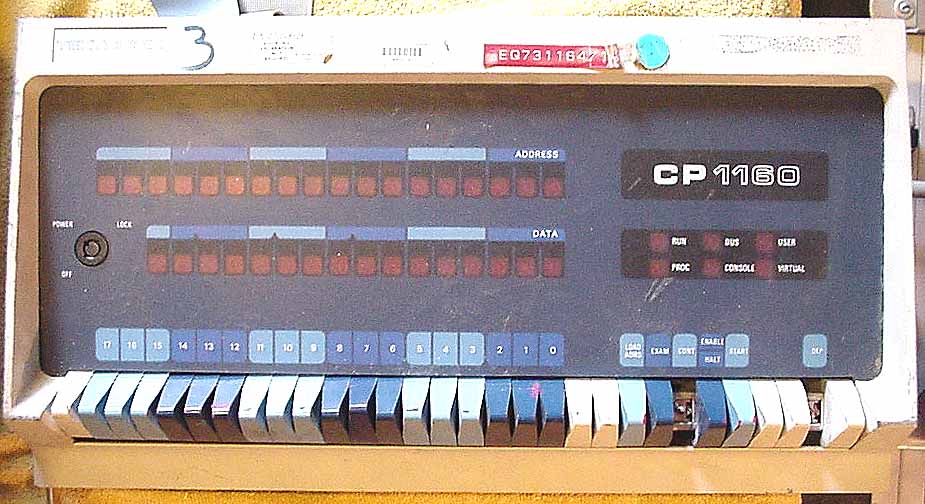
> A couple of months ago I found a DEC computer with a front
> panel. Then I
> found a second one a few weeks ago. The panels are painted in
> two tone blue
> Tekronix colors. I finally got around to photograghing one of
> the front
> panels today. I'm posting a picture of it at
> <http://www.classiccmp.org/hp/dec-k/cp1160.jpg>. Sorry but I haven't
> cleaned it up. It's also missing two switch handles. The first one was
> marked as being a 11/35FC but I don't remember seeing a model
> number on the
> 2nd one.
>
> Joe
>
I've got a set of DEC diagnostic floppies (RX50) and I don't have the
decoding scheme at hand to figure out the part number and therefore their
usage. I don't know which machine these run on -- Micro PDP-11 or MicroVAX.
I sort of suspect they *may* be for my uVAX II because they came with a
heap of other goodies, including a working uPDP-11/73, at the same time I
got said uVAX II.
Given the part numbers listed below could anyone tell me about them (other
than the obvious ;-) )?
BL-T540B-M1 CZUFDB1 USER TESTS
BL-T541B-M1 CZXD1B1 FIELD SERVICE TESTS 1
BL-T542B-MC CZXD2B0 FIELD SERVICE TESTS 2
BL-T565B-MC CZXD3B0 FIELD SERVICE TESTS 3
BL-T583B-MC CZXD4B0 FIELD SERVICE TESTS 4
Thanks for your help.
(BTW, should these be added to an archive or two (bitsavers for instance)?)
-Chris F.
NNNN
Christian Fandt, Electronic/Electrical Historian
Jamestown, NY USA cfandt(a)netsync.net
Member of Antique Wireless Association
URL: http://www.antiquewireless.org/
I have a small Apple grayscale tube (about 12"), probably from the Apple
IIc or IIgs days. Basically, baseband video. in fact, I was using it as a
video monitor until recently.
Pretty good shape. Anyone want this for $5.00? Shipping is from 10512. The
junkyard calls...
Reply off list.
William Donzelli
aw288(a)osfn.org
I have been recovering HP64000 files from floppies written by a 64000 that
no longer boots.
===
A scan of the 64000 floppy ref man that describes the LIF implemenation
can now be found at www.bitsavers.org/hp/64000/64941-90906_flpRef_Jan84.pdf
"McFadden, Mike" <mmcfadden(a)cmh.edu> wrote:
> VAX 6000-610
> VAX 6000-410
I'm salivating but just don't have a place to house a 6000 in a full cabinet
(unless it's the smaller version for space-constrained people, a smallish
rackmount XMI card cage, but those were rarer than hen's teeth), let alone two
of them.
Is it the kind of thing that's headed for death in a melter if no one takes it?
If someone else (with a warehouse for his computers) can take them, great, but
if no one does and they head for scrap, can you please take out all boards (I'm
interested in all XMI and all VAXBI boards, the TU58, and any other boards/parts
that may be there other than the huge cabinet that I unfortunately can't handle)
and let me (or other interested people) have them?
MS
these will probably go relal cheap as in > $5.00. The one on the left is a sun 390 upgradable to 690 SMP. The tall boy ob the lest is a sun 3/280. The later one may go for more just because the 7' rack is in nice condition.
http:w3.arizona.edu/~pacs/surplus/public/sale/pics/0504024.JPG
I have pulled several Intel Aboveboards out of Compaq Portable 1s & IIs. They
work well for memory expansion on the ISA 8 and 16 bit busses.
Paxton
Astoria
Dear Rich,
do you still have the Shugart 851 one? Or at least the user manual for it?
Thanks,
Zdravko Stefanov
--
_____________________________________________________________
Web-based SMS services available at http://www.operamail.com.
>From your mailbox to local or overseas cell phones.
Powered by Outblaze
Hi everyone
I'm looking for some kind soul to identify this machine for me
http://www.applefritter.com/node/view/1711
I see someone has replied on Applefritter and is talking about it being
some kind of giant transciever, but any extra details would be
appreciated.
-Michael Fincham
www.mfp.co.nz
Hello all,
Verne has some very early PC magazines available in Greenville, SC for
pickup or for shipping at your expense.
Please contact him directly at vern99t(a)charter.net to save these from a
landfill.
The usual disclaimers apply.
Best regards,
Erik Klein
www.vintage-computer.com <http://www.vintage-computer.com/>
www.vintage-computer.com/vcforum
The Vintage Computer Forum
---------------------------- Original Message
----------------------------
Subject: Old Computer Magazines
From: "Verne" <vern99t(a)charter.net>
Date: Fri, April 30, 2004 2:01 pm
To: webmasterNOSPAM(a)vintage-computer.com
------------------------------------------------------------------------
--
I'm about to trash an old collection of PC Mag, PC World, PC Tech
Journal
About 4 Boxes in very good condition ranging from 1984 to 1988
Any Interest ?? The boxes weigh a ton.. Unless they have some value
The shipping cost will be prohibitive
Greenville, SC
Verne
> Everything on it is TTL except for one LSI IC marked
> MCH-01. Anyone know what that might be?
Probably a character ROM.
Lee.
________________________________________________________________________
This e-mail has been scanned for all viruses by Star Internet. The
service is powered by MessageLabs. For more information on a proactive
anti-virus service working around the clock, around the globe, visit:
http://www.star.net.uk
________________________________________________________________________
>TCF (NJ annual Computer flea) http://www.tcf-nj.org report
Damn it!!!
I was just thinking about this the other day and meant to put it on my
calendar. I wanted to go, and today would have been better for me (now I
have to see if I can get there tomorrow or not).
DAMN!
-chris
<http://www.mythtech.net>
>I have a couple as well, and I thought it was quite descriptive of the
>processor's capabilities. I wonder what kind of neat logo we could come up
>with for the Hitachi 63C09... ;-)
You could make the circles '?'marks - for all the undocumented opcodes!
>>In hindsight, the 6809 while the best 8 processer it only has 64k of
>>memory space.
>
>So? Most (all?) 8-bit CPUs have that "limitation" -> which can be easily
>overcome with bankswitching and other techniques...
I agree that standard 16 bit 64k addressing should not have kept the processor
>from becoming more widespread than it did - look at the Z80 and 6502 - both
less capable processors, both with "only" 64k and both received much more
acceptance than the 6809.
I do think that a natural progression in the 6809 family (had it continued)
would have been an integrated segmented or bank switched memory manager -
this could have been worked quite nicely into the 09 architecture.
>> Also since the only
>>common 6809 system was by Radio Shack as games machine you never got the
>>good I/O like lower case letters and a real serial and floppy drives.
>>Ben.
>
>Game machine? Hardly... the Commodore & Atari were *much* better with games
>than the CoCo ever was. Floppy drives? RS drives were the best available
>for that class of market at the time.
I 1/2 agree (with each of you) - the original CoCo (and even the CoCo2) were
somewhat limited, and more importantly packaged (CoCo1) and marketed as a cheap
home console computer. Not so much a game console (although the cartridge slot
does suggest this), but as a cheap "toy" computer (that happened to play a bunch
of cartridge games). The CoCo3 was a marked improvement, however it was too
little/too late, and as no one else had really picked up the CPU, it got the
reputation as an "oddball".
I do agree on the RS drive - the drive cartridge used a standard floppy controller
chip (and you could use standard off-the-shelf drives) and interfaced directly to
the 09 bus through the cartridge slot - much better/faster then the custom serial
drive offerings by the "other guys". But, I also think that having to use a
cartridge for the drive seems a bit goofy - why not have implemented a drive
interface native to the machine?
I designed and built my own 6809 based workstations - both the homebrew ones shown
on my web page, and a couple of custom bus/racked limited production designs for a
couple of "big" companies as in-house test platforms - These "serious" systems were
remarkably powerful for their time, and gave a truer impression of the 6809's
potential than the CoCo which hid that power beneath a flimsy and toyish looking
case, an inadaquate keyboard (CoCo1) and artifically limiting system software (for
example, the CoCo ROM's required DP to be "Page Zero" - and hogged most of it).
>How does [[ Crappy graphics, crappy sound, great I/O speeds & Unix-class
>multitasking OSs ]] == "Game Machine"???
Speaking of multitasking, there's a really nice feature of the 6809 that is
often ignored, however I used this in a number of 6809 based products that
I designed to implement very fast simple multitasking.
This feature is the "Direct Page" register! - Unlike other CPU's which use
"zero page", the 6809 has DP which means that you can place your "zero page"
at any 256 byte boundary. This register is also saved and restored during a
full interrupt, meaning that in a multitasking system, each task can have it
own "zero page". This makes for compact code (many tasks never need to use
extended addressing for memory references).
Here's an example of a ultra simple task swapper in only 5 instruction, in
which each task runs in round-robin fashion, requiring only 3 bytes in each
tasks "page" - there is no system task control blocks/tables:
; Interrupt saves all registers (can be SWI for volentary swap)
INTHND: STS <MYSP ; Save current task stack pointer
LDA <TLINK ; Get next tasks DP
TFR A,DP ; Switch to new DP :-( can't load DP directly)
LDS <MYSP ; Restore new task SP
RTI ; Load new task registers & launch
Ah - such memories!
Regards,
Dave
--
dave04a (at) Dave Dunfield
dunfield (dot) Firmware development services & tools: www.dunfield.com
com Vintage computing equipment collector.
http://www.parse.com/~ddunfield/museum/index.html
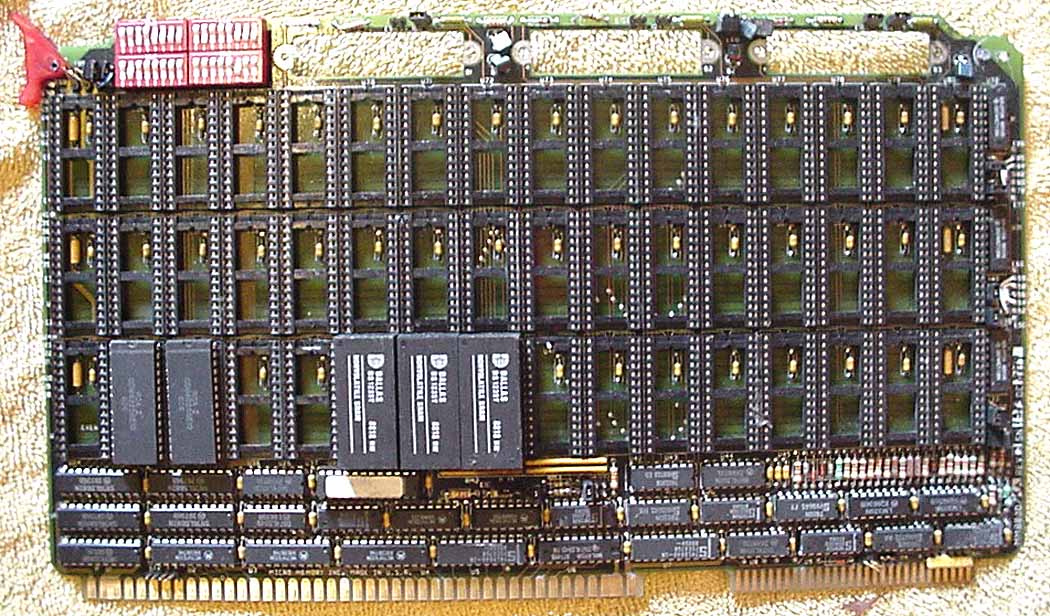
I found two "new" Multibus cards in the last couple of weeks. The first
was made by Monolithic Memories and appears to be a RAM/PROM card. The
intersting thing about it is that it has three Dallas battery backed NV
RAMs and two RCA 62256 SRAMS. Another oddity is that it has cutouts along
the top edge, probably for some type of I/O connectors.
<http://www.classiccmp.org/hp/multibus/mmi%20mm8800.jpg>
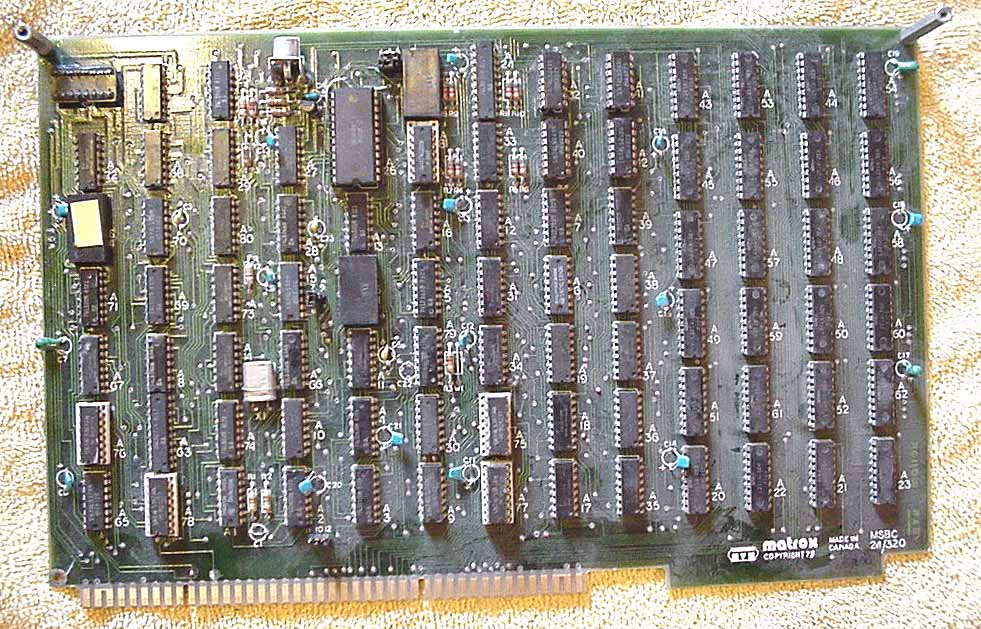
The other card is a video card made by Matrox. Everything on it is TTL
except for one LSI IC marked MCH-01. Anyone know what that might be? There
are four other blocks on it that appear to be LSI ICs but it turns out that
they're really DIP switches with covers on them. There is one in the top LH
corner with not cover.
<http://www.classiccmp.org/hp/multibus/matrox%20msbc%2024-320.jpg>
Does anyone have docs for either of these?
Joe
On May 1, 12:17, Joe R. wrote:
> At 10:02 AM 5/1/04 -0500, Pat wrote:
> >On Saturday 01 May 2004 03:50, Bert Thomas wrote:
> >> "Joe R." wrote:
> >> Fred, can I use that MFM controller in my 11/750?
> >
> >No. You need UNIBUS cards for an 11/750. That's an RQDX3, a QBUS
card.
> >
> >You can find out what cards are using module numbers with Megan
Gentry's
> >field guide:
> >
> >http://world.std.com/~mbg/pdp11-field-guide.txt
>
> That won't tell any more than the listings will since that's where
> the descriptions came from.
The third column contains "Q" for Qbus or "U" for Unibus.
--
Pete Peter Turnbull
Network Manager
University of York
I worked with many systems back in the middle to late 80s when the 386 was in vogue. I don't recall any of them using an older 287 math coprocessor though. Here is a link to a page full of mbs and DTK did indeed make a discrete chip 386 motherboard back then. The co-processor was a 387 though.
http://www.redhill.net.au/b-92.html
best regards, Steve Thatcher
-----Original Message-----
From: SHAUN RIPLEY <vax3900(a)yahoo.com>
Sent: Apr 30, 2004 6:15 AM
To: cctalk(a)classiccmp.org
Subject: 386 motherboard with discrete logic chips only?
I talked with my friend the other day and he claimed
that 386 motherboards all used this or that chip sets;
But I vaguely remember I might once have such a 386.
It had a 287 math coprocessor and some memory chips on
board. What I can remember is that it had many logic
chips on board but I can't recall whether it had chip
sets or not. Unluckly I dumped it years ago... Could
somebody give me an answer?
vax, 3900
__________________________________
Do you Yahoo!?
Win a $20,000 Career Makeover at Yahoo! HotJobs
http://hotjobs.sweepstakes.yahoo.com/careermakeover
I need two items to complete my omnibot 2000 robot. Missing are the tray and
the home base. I have searched google and eBay with no luck. The sites that
sell parts only have manuals, batteries, and chargers (from Radio Shack). It
took me a year to get a remote control for it. Anyone with an extra tray?
Thanks for your time.
Hi All,
While going through the *pile* of mail here at the office, I also
found a box filled with DEC cards. It was shipped by someone in
Wichita, KS, but no name.
I *do* remember buying this, but can't find a record of who I
bought it from. If this is you... please respond off-list, since
I can't remember whether I *paid* for it or not...
Thanks for the OT-ing,
Fred
--
Fred N. van Kempen, DEC (Digital Equipment Corporation) Collector/Archivist
Visit the VAXlab Project at http://VAXlab.pdp11.nl/
Visit the Archives at http://www.pdp11.nl/
Email: waltje(a)pdp11.nl BUSSUM, THE NETHERLANDS / Mountain View, CA, USA
>No signs of life from the PSU but there normally isn't until powerup and the
>LED lights up.
Usually the vent fan will start spinning right away. If the fan doesn't
even jerk, then the PS may not be doing anything. I've used that to track
problems in some macs before (Mac PSs tend to be "short resistant", at
least that is what I've found. If there is a short somewhere, the PS will
power itself back off rather than fry itself... in those cases, the fan
usually jerks as the PS comes on and cycles right back off)
It is starting to sound like the PS is dead.
There are no additional troubleshooting steps listed in the Apple tech
manual for the IIfx (actually, there are no troubleshooting steps at ALL
in that manual).
-chris
<http://www.mythtech.net>
I talked with my friend the other day and he claimed
that 386 motherboards all used this or that chip sets;
But I vaguely remember I might once have such a 386.
It had a 287 math coprocessor and some memory chips on
board. What I can remember is that it had many logic
chips on board but I can't recall whether it had chip
sets or not. Unluckly I dumped it years ago... Could
somebody give me an answer?
vax, 3900
__________________________________
Do you Yahoo!?
Win a $20,000 Career Makeover at Yahoo! HotJobs
http://hotjobs.sweepstakes.yahoo.com/careermakeover
>Well, if you're swapping in an identical unit, you'll not cure the
>problem. The replacement is just as marginal...
Yup... that's probably why I did LOTS of PSU swapping in the A2's :-)
-chris
<http://www.mythtech.net>
Hi everyone,
I have one of the newer plasma displays used in the IBM P70, labeled
MD480T640PG4.
I've found the pinout for the data connector, but i can't seem to find the
pinout of the power connector anywhere.
It's an 8 pins connector, with the center 3 pins missing.
Picture: http://twl.student.utwente.nl/display.jpg
As most of the caps around the connector are rated for 250V, I presume it
needs some high voltage.
There is also a small connector in the bottom left part of the board. Maybe
used for driving an indicator light?
Cheers,
Thomas
One of our number was kind enough to provide me with a copy of aztec C,
and now I and trying to
get it working. It was provided on 4 5.5" floppies, and I only have the
One 5.5" drive in
my apple, but I do have 2 3.25" drives (that each hold a little more)
Aztech seems to be stored on PRODOS volumes, so I am now trying to copy
>from all it's 5.5's to
3.25s
Is there a collection of Aztech C wisdom out on the net?
Can anyone provide a proper directory setup ?
Is it possible to compile the source C and have aztec save the assembly
it generates?
Thanks for the help.
ron.
>You mean 'at least 3rd time around'. The Apple ][ PSU is marginal, or at
>least mine was. The 5V line was rated (IIRC) at 2.5A. A mainboard,
>language card, disk controller, and 1 drive (i.e. not a very full
>machine) exceeded that on my meter. Perhaps I was just unlucky and had
>parts that took more current than normal, but I had a lot of trouble with
>the Apple ]['s PSU...
Yeah, come to think of it, I do seem to recall swapping a number of A2
PSU's back then. That was before I was willing to try component repairs,
so it was simple swaps of bad for good.
-chris
<http://www.mythtech.net>
Anyone know if Mike Green and/or Steve Porter are still alive and reachable?
I was hoping to approach them about jotting down some history of HP2000
TimeShared BASIC.
Any leads appreciated!
Jay West
---
[This E-mail scanned for viruses by Declude Virus]
Guys,
In case you haven't heard, this weekend VCF/Europe will be held in
Munich for the 5th year. If you live in Europe and have the chance to
go, I recommend it!
http://www.vcfe.org/E/
Spare Time Gizmos will be there with our "Build your own PDP-8 from a
kit!" kit, the SBC6120
http://sbc6120.SpareTimeGizmos.com
and in honor of VCF/Europe we'll be giving free shipping to anybody,
anywhere in the world, who orders any SBC6120 parts or kits this
weekend. Just place your order thru our online store,
http://store.SpareTimeGizmos.com
anytime Saturday or Sunday (May 1st/2nd) and pay via PayPal and you
won't be charged for shipping.
And be sure to send your thanks to Hans Franke and the other helpers
at VCF/Europe for putting on another great show.
Bob Armstrong
What I can remember is that it had many logic
chips on board but I can't recall whether it had chip
sets or not. Unluckly I dumped it years ago... Could
somebody give me an answer?
==
The earliest 386 designs were modifications to existing 286 ones
that did not use chip sets. Chips and Technologies was one of the
first companies to integrate the functions onto ASICs.
The design I remember was sold by Everex and also used by Novell
and was all DIP ICs which had the memory on a separate plugin
board with a very wide edge connector (DIPs, later SIMMs).
Has anyone got the original Windows 3.0 install disks? I have the
original package and everything but the disks are missing :(
Willing to pay a reasonable price plus shipping.
Thanks!
--
Sellam Ismail Vintage Computer Festival
------------------------------------------------------------------------------
International Man of Intrigue and Danger http://www.vintage.org
[ Old computing resources for business || Buy/Sell/Trade Vintage Computers ]
[ and academia at www.VintageTech.com || at http://marketplace.vintage.org ]
Hi,
I picked up a Microway Number Smasher-860 processing board (v1.1). I have
the Portland Group's i860 ANSI C Compiler (came with the transtech i860
vector processing tram), but no other i860 software. Would any of you guys
have any software/manual/drivers for this board. I wanted to get this board
for a looooong time ever since I saw those ads in Byte. I drooled over this
for years, but couldn't afford the hefty price for one....
Thanks,
Ram
I've got a spare board for a DEC LN03S laser printer,
condition unknown. You can see a couple of photos at
www.decodesystems.com/dec-ln03s.html
Drop me a note off-line if you're looking for one.
Cheers,
Dan
All,
I recently ran across a cool old video form 1978. It shows a concept for
using an internet based phone (VoIP???). It starts with some video of a
PDP11. It features cool 1978 fashions and haircuts. I found this video
rather fun to watch, the H/W in it really takes me back to the 70s and early
80s. It's a 60meg download from my home web server (250KBS uplink) so it
will take 30 minutes plus to get a copy. If someone wants to repost it
someplace with better bandwidth please feel free.
Hopefully everyone won't hit the server at once. :)
http://24.17.121.14/Movies/VoIP_1978.ZIP
-Neil
I just found this fairly detailed history of HP computing products and
operating systems. It filled in a LOT of gaps I was unaware of. Extremely
interesting reading for HP fans. Don't let the title fool you, it's not just
RTE, it's everything computing related :) There were a few "firsts" HP had
in the minicomputer market that I wasn't aware of some of them. VERY good
info! Example - I had no idea the 21MX/F was discontinued well before the
21MX/E.
http://www.interex.org/tech/csl/RTE/archive/poyner1.htm
Regards,
Jay West
>Date: Thu, 29 Apr 2004 22:40:20 -0400
>From: "Charles H. Dickman" <chd_1(a)nktelco.net>
>>
>Is there a source for new 8in floppy disks? New old stock is fine. I
>just would like a box of unused blank disks.
>
>Two reasons, first I have a STD bus computer with a Z80 CPU and dual 8in
>drives (one that does not work) that I might like to play with. Second I
>have an IBM S/34 that has an 8in drive and I need a box of disk for
>someone to copy some disks for me...
>
>-chuck
>
>
>
Hi Chuck
Look at comp.os.cpm. There is a fellow there that just
posted some for sale.
Dwight
On Apr 29, 13:01, Mark Tapley wrote:
> I have forgotten, did we ever have a discussion about whether
> scanners/photocopiers/etc. have enough UV content in their lights to
> erase UV-EPROMs, if the sticker has come off? I sort-of recall we
> did, but don't remember the outcome.
I don't remember that exact discussion, but if we had it, my input
would have been along the following lines.
Firstly, most scanners and photocopier use visible light and have very
little if any UV output. Secondly, EPROMs are only susceptible to
short wavelength UV, which doesn't go through glass very well. Lastly,
it takes about 20 minutes to erase an EPROM an inch away from a normal
eraser's tube, and a few minutes to begin to do much harm, so the
second or so it would be exposed in a scanner is inconsequential.
In other words, don't worry about it :-)
--
Pete Peter Turnbull
Network Manager
University of York
Terry,
I contacted Michel Bissonette regarding his post: his MS-DOS utility could
duplicate HP64000 floppies, but made no effort at extracting content. Since
I wanted to port the data to DOS, it wasn't what I needed.
I have been recovering HP64000 files from floppies written by a 64000 that
no longer boots. To save myself from too much low-level programming, I've
been using a Kaypro 4/84 to do the first stage: it has MFDISK, a
multi-format utility that reads HP-125 CP/M disks, which happen to have the
same track/sector/low level layout as the 64000 format.
With a quasi-compatible link to the low level, I use DUU (V8.7), a CP/M
utility that allows read/write/view access to the tracks and sectors. This
allows me to access the directory (completely incompatible with CP/M or
DOS), locate the files' start- and end-points, and trace their content along
the disk.
HP64000 data are in 2044-byte sectors, with an additional two byte pointer
to the previous sector at the start, and another two bytes at the end
pointing to the next sector (total 2048). DUU just copies sectors verbatim
to a native Kaypro CP/M disk via a RAM buffer (files bigger than 32K come
out in chunks due to the fact that DUU, CP/M and the buffer all share one
64K RAM space).
Kaypro CP/M disk files port to MS-DOS using the 22DSK utility
(incidentally, 22DSK's HP-125 emulation doesn't help on HP64000 disks,
because the first thing it looks for is the CP/M directory). I have
quick-and-dirty Turbo Pascal conversion programs that extract ASCII-format
text from editor files, and binary images from assembler objects: each
editor record ("line") of a file starts with a byte indicating the length of
the PREVIOUS record and a second byte indicating the length of the CURRENT
one.
Line lengths are measured in 16-bit words - the editor pads odd-length
lines with a space character. Lengths of zero mark beginning-of-file in the
previous-length byte, and end-of-file for the current-length byte. This
clever technique allows an editor to move quickly back and forth through a
file line-by-line, but would get seriously messed up if it lost
synchronization.
I have technical details of where I found directory entries, what I've
decoded and how the operating system refers to individual sectors and can
provide you with that, probably best if I do that off-list (unless somebody
REALLY wants it posted!). Now that I've detailed my less-than-direct
solution, I'm waiting for some enterprising person who's willing to do the
low-level floppy operations on a PC so one machine can do the whole thing in
a step...
Bob Maxwell
> -----Original Message-----
>
> From: Terry Barnaby <terry(a)beam.ltd.uk>
> Subject: Re. HP64000, aka offering help to duplicate HP64K disquettes
>
> Hi,
>
> I noticed a post you made some time ago about recovering files from
> old HP64000 5.25inch floppy disks.
> I have the same problem, some old HP64000 floppies which I would
> like to get the contents off.
> I would be gratefull for any information on the HP64000 disk format
> and any tools you found to do this.
>
> Cheers
>
> Terry
> --
> Dr Terry Barnaby BEAM Ltd
> Phone: +44 1454 324512 Northavon Business
> Center, Dean Rd
> Fax: +44 1454 313172 Yate, Bristol, BS37 5NH, UK
> Email: terry(a)beam.ltd.uk Web: www.beam.ltd.uk
> BEAM for: Visually Impaired X-Terminals, Parallel Processing, Software
> "Tandems are twice the fun !"
>
>
> ------------------------------
Brad,
Where were you able to find the TU 58 capstan rollers,
I have four TU 58 drives, and they all need new capstan rollers.
I would certainly appreciate any help or direction you can offer.
Thanking you in advance for your help.
Steve Faden
xnedaf(a)aol.com
Sounds like the barrel rectifier at position CR5 on the analog board is
going bad. Tech book I have here says its a MR824 rectifier. I had to
look up the position and the part number in a book I have (Dead Mac
Scrolls), but I have done this repair on a few Mac Pluses (same analog
board as the 128 and 512), and they had similar symptoms. They had the
Chirping noise, as well as the right side of the screen would move in and
out (which would appear that everything is shifted left like you
describe).
Notes from the book. Original rectifier is a GI854, R-SI, 600V, 3A... and
they recommend replacing it with a MR824, R-SI, 400V, 5A to avoid having
the problem come back. The rectifier is kind of top center of the analog
board.
The analog board from those Macs was notoriously flaky. Lots of under
rated parts that burned out easily. Probably Apple worst power supplies.
Ironically, the 2nd worst are the CRT iMacs that brought back that same
style computer. And ironically, the iMacs are bad for the same reason,
under rated components that burned out from normal use. You would think
Apple would have been more careful the 2nd time around :-)
BTW: While you are in there working on the analog board, check and
possibly resolder joint J4 on the main cable on the center of the board.
Its pin 1 on the cable. That joint was bad on I think EVERY Mac Plus I
worked on. So there is a pretty good bet that even if you aren't having
problems with yours now, you will in the future. The solder would split
off the board causing the cable to lose connection, causing the video to
blink out. Smacking the side of the case would cause it to restore
temporarily... its the only time I've had a computer company give me an
official "repair" of "whack the side of the case" =:-O
-chris
<http://www.mythtech.net>
All,
Two separate (?) issues with my Mac Plus.
1) Screen display is too far to the left.
2) System seems *very* sensitive to voltage setting.
What I've got:
Mac Plus (upgraded from 512k), original mouse/KB
Brainstorm 16MHz 68000 upgrade
Kensington System Saver Mac (switch, fan, and surge protector, mounts
on top of system).
La Cie external SCSI hard drive, 230 MBytes
Analog (Radio Shack, automatically suspect) VOM.
Mac OS 6.0.8, 7.0.1, 7.1 (chosen by System Picker utility) all on HD
Screen Display issue:
Everything (all pixels) is shifted uniformly to the left
about 5 mm. I found the "width" setting on the analog board (well
duh, read the label on the cardboard shield) and fooled with it
(system on, plastic tool). Works fine, image gets narrower and wider.
I can set it narrow enough that pixels are all on the phosphor, so
the system is usable - but it's aesthetically slightly annoying to
have everything to the left of where I expect it. I could not find a
setting to shift left/right.
Problem is present either with or without the Brainstorm
installed, so I don't think it's related to that. I *think* the
problem first appeared when I took out the "Elf Armor" mu-metal ELF
shield that I got back when that was hot psuedo-science, my wife used
the machine a lot, and we were expecting our first child (see the
connection? :-) ). Significance of that is I had to unplug the cable
>from the back of the CRT, so might I have knocked something askew?
Voltage sensitivity:
System started occasionally resetting itself. Opened it up,
stuck the VOM on ground (frame) and 5 V (using the pin in the middle
of the Analog -> Digital board connector, at the digital board) and
found it reading a *little* (maybe 0.05 V?) shy of 5 V. OK, (duh,
read the label on the cardboard analog board shield again) set the
voltage higher, with system running. I can set it quite a bit higher,
up to around 5.1 V. System keeps running. However, when I power-cycle
at that setting, it goes into an endless loop of "chirp, chirp,
chirp..." and the VOM stays near 0 V (wiggling at each chirp).
I assume that means there's an overshoot on 5V coming up
which triggers the crowbar, which sets up for a repeat.
Q1) Is that supposed to work that way? I'd expected the 5V rise to be
critically damped or better, so no overshoot. In other words, I'd
expect if it'll continue to run at a given Voltage setting, it'll
start at that setting. Have I got a latent problem forming?
OK, sooo... set the Voltage back down some, try the "reset"
button.. (repeat a few times) ... "Bong" ... starts up nicely ...
runs a while and then freezes. (Here and below, "freezes" means some
sort of bad instruction. Could result in lock-up, could mean drop
into MacsBug, unable to continue, could mean reset.) This behaviour
is not present unless the Brainstorm is installed (at least not
obviously. It could be true but with a longer time constant between
freezes). Sigh.
So try setting Voltage barely higher. Works, but freezes
*sooner*. Hmmm. Voltage lower. Works better. Voltage lower. Finally
found a setting very slightly below 5V, (mmmm..maybe 4.98 V?? But
remember the instrument I'm reading from here...probably about 1
significant figure) where it seems to run indefinitely ('til bedtime,
anyhow).
Q2) I thought that all digital stuff basically ran better until it
over-voltaged - which the crowbar was supposed to prevent. So I'm
surprised to see freezes/crashes at *higher* voltages (but still low
enough to avoid the start-up overshoot) but see them less frequently
at lower voltages.
Q3) I assume there is a minimum voltage at which I'll also start to
see freezes/lockups. True? Am I better off hunting for the lowest
possible voltage, or try to find a "happy medium"?
Q4) Have I got some incipient problem (dying isolation cap?) that is
closing my window of working voltages?
Warning: I'm on digest mode, the system is at home and I'm usually at
work while accessing email, so my response time is likely to be ~24
hours for anything that requires tests/measurements. And then there's
the kids' YMCA soccer (football) league ....
TIA and no urgency, as the system appears to be running at
the moment (raps forehead soundly) 'Knock on wood'. Kids are getting
hooked on "Sim City" while I'm at work. But the Brainstorm may cure
that...Sim City appears to run twice as fast with the 16MHz upgrade
as it did with just the original 8MHz processor.
Which reminds me: The Brainstorm is on a little daughterboard
with 2 other IC's. The daughterboard plugs into a socket which is
installed piggyback atop the original 8MHz 68000. There is also a
flying resistor that solders to one leg of another component a short
way away on the motherboard. If I pull the Brainstorm daughterboard
off, and desolder the resistor lead, the system works just as before,
with the 8 MHz CPU. If I plug the Brainstorm into the socket and
connect the resistor, the system runs (see above, sometimes) at 16MHz
(apparently). (FWIW, there are a couple of other modifications to the
motherboard. I *think* they are just IC replacements.)
I *think* this means that when the Brainstorm is plugged in,
both 8MHz and 16MHz processers are running simultaneously.
Bonus Q5) Is that right? Isn't that a recipe for thermal and
electrical disaster? (I guess not, it runs, but....)
--
- Mark
210-522-6025, page 888-733-0967
Chris, I was just looking through the net looking for a manual for a TOA
A-912 and saw you had one in 2002. You had posted a message indicating it
was up for grabs. I was wondering if you still had it or a copy. We have
one at our company and no manual. We are changing phone systems and have no
idea how thw A912 interfaces with the phone system we have now. Any info is
appreciated...
John E. Klopfenstein
Network Administrator
Ozarks Coca-Cola/Dr Pepper Bottling Co.
417-865-9900 ext 355
jeklopf(a)cocacolaozarks.com
----------------------------------------------------------------------------
----------
FIGHT BACK AGAINST SPAM!
Download Spam Inspector, the Award Winning Anti-Spam Filter
http://mail.giantcompany.com
Hi,
i got a small lot of HP9000 stuff, including amongst other things a HP9133 (that's the reason, why i took it),
and a HP 9000/300 and a HP35731A monitor. The HP9000 has a HP98456A included. Unfortunately,
there was no cable included.
What cable do i need for either the builtin video adapter or the HP98456A ?
Can a HP35741A monitor be used too ?
Thanks Bernd
>From: "Jay West" <jwest(a)classiccmp.org>
>
>Speaking of which....
>
>I have two TU58 drives, both have a bad set of rollers. One is built into
>the 11/44 cabinet, one is a standalone desktop version. I decided to follow
>the "tygon tubing solution", but haven't actually done it yet. I have two
>questions:
>
>1) What is the best way to cut the tubing to get nice clean round edges? I
>tried to make a slice, but the tube gets bent/flattened due to the pressing
>down of the blade so the resulting cut is "oval". Some kind of hot
>wire/knife maybe? Gently sawing would leave jagged edges... ideas?
Hi
Try rolling it with a blade. Don't try to cut all the way though
on each pass, just cut a little deeper.
>
>2) The old gummy roller comes off, but there is still some gunk left on the
>metal capstan center. I could put the tube over this, but it may slip a bit
>perhaps. Is there a good way to get the final remaining goo off the capstan?
>I'm afraid to scrub it or anything for fear of damaging the tachometer hub.
>
Clean it off! Try various solvents.
Dwight
>Oh, and also, anyone have a good source for blank media for the TU58?
>
>Thanks!
>
>Jay West
>
>---
>[This E-mail scanned for viruses by Declude Virus]
>
>
At 12:00 -0500 4/29/04, Teo Zenios wrote:
>I can toss the card onto my scanner and get a jpg of it (matrox card). I
>never seen one until it came up for sale on ebay, trying to find some vram
>to max it out at 4mb.
I have forgotten, did we ever have a discussion about whether
scanners/photocopiers/etc. have enough UV content in their lights to
erase UV-EPROMs, if the sticker has come off? I sort-of recall we
did, but don't remember the outcome.
--
- Mark
210-522-6025, page 888-733-0967
If anybody is interested
Surplus Exchange as multiple racks labeled
VAX 6000-610
VAX 6000-410
Multiple 9-track tape drives
One labeled TU58
They came from local engineering firm.
Contact is Dave at Surplus Exchange.
I can privately email you a phone number if you want to contact him.
Mike
Update:
I'm going over Monday morning and examining all of the systems and I
will attempt to make a list and post it.
I have to sign a donation letter otherwise the systems are mine.
Mike
>Subject: DEC VAX 785 and PDP11/70's in Kansas City
>I just got word from a friend that a company in Kansas City is planning
to >dispose of the following.
>
>DEC VAX 785 in three 6' cabinets
>DEC PDP 11/70 in ten 6' cabinets, this may be two computers
>4 RM03 disk drives
>2 TU80 tape drives
>Other disks for VAX
>That is what they remembered without actually having a list.
>
>I'm trying to set up a time to actually see them.
>
>Here is the other information I have received.
>
>There is a company from Topeka that will take them away if they are
paid to >remove them.
>
>The 785 was running 3 months ago when they erased all of the media.
>It has been about a year since the 11/70's were on.
>
>They are not currently running.
>
>They are checking on the legal requirements that they may have to go
through >to dispose of these units.
>They are worried about making sure they aren't legally libel if
somebody >dumps them improperly.
>
>Whoever takes them away may have to be a GE approved vender.
>
>I'll keep everybody informed.
>
>Thanks
>Mike
If anyone is interested, I just posted the following on VCM:
* Apple IIe Enhanced, 64K, two Disk II drives, one Unidisk 5.25" drive, one
Unidisk 3.5" drive, ProDOS, three disk controllers, three Super Serial
cards, one parallel interface card w/cable, and AppleColor Composite
Monitor.
* Commodore C64 in original carton, power supply, manual, composite video
cable and switchbox.
* Commodore 1541 disk drive with Zork I, II, III, Pinball Construction Set,
more.
Hi,
I noticed a post you made some time ago about recovering files from
old HP64000 5.25inch floppy disks.
I have the same problem, some old HP64000 floppies which I would
like to get the contents off.
I would be gratefull for any information on the HP64000 disk format
and any tools you found to do this.
Cheers
Terry
--
Dr Terry Barnaby BEAM Ltd
Phone: +44 1454 324512 Northavon Business Center, Dean Rd
Fax: +44 1454 313172 Yate, Bristol, BS37 5NH, UK
Email: terry(a)beam.ltd.uk Web: www.beam.ltd.uk
BEAM for: Visually Impaired X-Terminals, Parallel Processing, Software
"Tandems are twice the fun !"
>> I'm not as familiar with the 6809 as I am with the 6502... what differences
>> in architecture make it better? Larger stack frame? More (and larger)
>> registers?
> It also supports more addressing modes than the 6502 like position
>independant (indexed off PC) and indirect addressing (in C, this would be
>dereferencing a pointer). It also has a fairly orthogonal instruction set
>which also helps in compiler writing (in my opinion). Of all the 8bit CPUs,
>this happens to be my favorite.
One of the biggest advantages of the 6809 to a compiler is the fact that it does
all kinds of stack relative addressing. The 6502 can't even push/pop all of it's
registers let alone perform relative or indirect stack addressing with them...
This ability makes it very easy to deal with C's stack based local variables.
For example, you can access memory on the stack (or through any index register)
with a 0, 5, 8 or 16 bit offset, and you can use an 8 or 16 bit accumulator to
calculate an offset. You can also perform indirect operations using stack based
pointers, all in a single instruction. Plus, all index and stack registers on the
09 are 16 bits. The 6502's 8-bit index registers are somewhat at odds with C's
notion that a pointer can point 'anywhere'. So, on the 6502, you end up using
zero page 16 bit "registers" a lot, and these involve more overhead to manipulate.
The 6809 is also my favorite 8-bitter (perhaps that's why there's 6 CoCo's in my
collecion). The very first edition of my C compiler was targeted to the 6809. At
one point I even designed my own portable 6809 computer (hardware and software),
you can see it (and even try it out with a simulator) at my "old computers" page:
http://www.parse.com/~ddunfield/museum/index.html
Look for entry called "D6809". In addition to the OS, the system has a "bunch" of
utilities, several editors, an assembler and a simple implementation of APL. there's
even an 8080 emulator which allowed me to easily bring over code from my Altair which
was my main computing platform prior to this one.
It's disappointing that the 6809 never received as much acceptance or use as it should
have. It was truly in a class by itself. Motorola documents show two circles, one
containing the words "8-bit" and one containing the words "16-bit". A third circle,
linking the other two contains the word "M6809", and this is a good description of the
part. It was an 8-bit CPU with a great deal of 16 bit capability.
Btw, I have scanned the "Motorola M6809-M6809E Microprocessor Programming Manual" and
a fair bit of other 6809 reference material, which is all available on my site.
Regards,
--
dave04a (at) Dave Dunfield
dunfield (dot) Firmware development services & tools: www.dunfield.com
com Vintage computing equipment collector.
http://www.parse.com/~ddunfield/museum/index.html
Vintage Computer Festival <vcf(a)siconic.com> wrote:
> Has anyone got the original Windows 3.0 install disks?
I have 13 complete sets, each set being 7 3.5" DD (720 KB) floppies in a sealed
cellophane bag. They are old and the welds that held the bags sealed weren't
very strong, so some of them are coming apart, but they are basically
"unopened".
Seeing that there is interest, I'll try to find time to read them and put the
images on my FTP site.
For those who want the real original disks, rather than just images, since I
have 13 sets, I'm willing to sell them except one. If interested, make an
offer.
MS
A while ago I put together a 486/66 system to play around with all my windows 3.1 apps I have used in the past. I was wondering what the fastest VLB video card ever made for windows 3.1x was. I remember Diamond bragging about its Viper cards back in the day being the best, but who knows.
Google has allot of information about what the best DOS gaming card was, but not that much on windows 3.1 (which is what I am interested in).
Also what's the best video intensive benchmarking app to test out cards with?
I have the following cards (and others but they are slower):
Diamond Viper VLB 1mb VRAM
Diamond Viper VLB 2mb VRAM
(while both have the P9000 chip for windows acceleration they have 2
different chips for vga)
Diamond Video 3000 (Stealth 64 Video Vram VLB) 4mb (S3 968 Chipset)
Diamond Speedstar pro VLB 1mb DRAM
Hercules graphite 1mb VRAM (IIT chipset)
Matrox Plus 2mb VLB (early matrox chip and a very long card that has space
for another 2mb vram)
These cards are from the early 90's so it should be on-topic for the list.
At 23:59 28/04/2004 +0100, you wrote:
>> case, an inadaquate keyboard (CoCo1) and artifically limiting system software (for
>> example, the CoCo ROM's required DP to be "Page Zero" - and hogged most of it).
>
>But the ROM could be switched out and the machine run with a RAM-only
>memory map. If you had any sense you booted OS-9 which did this and which
>gave you a multi-tasking OS, the best I/O system I've ever come across,
>and some very nice languages (a decent C, ISO level 0 PASCAL, and the
>best BASIC I have ever used on a micro [1]).
Yes, absolutely - and I did run OS/9 on my CoCo sometimes when it was an "in use"
machine... however I do recall that when initially getting going with the machine
"out of the box" it was frustrating to figure out why they had done some of the
things they did - I guess the real problem is that the CoCo was designed "on the
cheap" and did not have things like a real serial port, and relied on a lot of ROM
software to make other devices work.
It's funny - in a way you've made my argument for me - That you needed to run a
completely separate third-party system in order to allow the CPU to be used anywhere
near it's potential is pretty much the point I was making.
Btw, I did not buy my first CoCo to run OS/9 - I wanted to put my own os (CUBIX) on
it, and I found it required much more learning/understanding to get to the point where
I could "take over" the machine than it did with other systems (Boot puts one sector
>from disk-0 here, here's the disk controller, here are serial ports to talk to terminal
- a bit of typeing and you are up and running...). Having the ability to make use of
existing ROM code for the devices - at least initially - would have helped.
All I'm saying is that this ROM heavy/limiting design was one factor (and only one
in a larger list) that prevented the machine from widespread acceptance/third party
support. This is consistant with the CoCo's design as a "cost is everything" home
"appliance" console, not a serious business/scientific machine which is what the 6809
CPU was worthy of.
And this is not necesarily a complaint - just an observation as to some of the reasons
a decent machine with an outstanding CPU didn't do better than it did. Unfortunately
it is the only common machine using the 09 that most people knew of, and this did not
help to win 09 supporters.
I believe SWTP made a nicer 6809 machine, however I never did get my hands on one :-(
--
dave04a (at) Dave Dunfield
dunfield (dot) Firmware development services & tools: www.dunfield.com
com Vintage computing equipment collector.
http://www.parse.com/~ddunfield/museum/index.html
Just to let you guys know, there were much larger 6809 systems. The 6809
was a great processor.
I worked for many years on a 6809 system with 4Mb ram, scsi disk interface
with hard drive and ms-dos 3.5 floppy, 68030 floating point co-processor.
This was in use from about 1980 until 1992, when superceeded by the new
system.
The 6809 was retained for so long due to the software investment.
Originally it had a custom disk interface to 5.25 floppy only, which was
upgraded to scsi and ms-dos fat file format around 1988. It also originally
had a smaller stack based floating point chip, but we needed faster float
speed for coordinate calculations. So we upgraded to using the floating
point co-processor that was used with the 68030. All of this and the
memory managment was custom hardware. It started out being a couple of
boards, but later was reduced to one board for all the cpu stuff.
These systems also had several other 6809's in them. Originally the pattern
rec vision system used one also. The material handling system, and motion
control axis used the smaller 6805s in them.
It was used on the Kulicke & Soffa wire bonders, used to manufacture
computer chips, including Motorola of course.
http://www.kns.com/prodserv/equipment/8060.asp
Chad Martin
I picked up two of these yesterday. I THINK they may be 80 TPI DD drives
but I cant the spcs anywhere. Does anyone have the specs and/or the DIP
switch settings for them? For some reason all the specs that I can find
only go back to the model 221.
Joe
I've 8 total, with backup data on them, but have no drive to read the disks.
In good shape with their cardboard slipcovers. $1.17 each plus whatever it
costs to ship. Prefer to sell the entire lot rather than individually.
>That extension would most likely be ClarisWorks on a MAC
Mac's don't use 3 letter extensions (well, not ClarisWorks era Macs at
least)... but you are right, it is ClarisWorks... just for Windows (yes,
amazingly, Apple wrote and sold Windows software)
-chris
<http://www.mythtech.net>
>He's gone now, and so is the computer the files were typed on, and I
>don't even know if it was CP/M, Mac, PC or what. They have extentions of
>"CWK" and simple 8-char filenames. I know that's CP/M or DOS like, but
>they may be exports.
CWK was used by Claris Works on windows
I can open and translate those to another program if you would like (MS
Word perhaps?). I may also have an old copy of Claris Works for windows I
can send you if you'd like to try to work on them directly (probably Win
3.x, maybe Win 95)
I just tested your test file and was successful in translating it to MS
Word.
-chris
<http://www.mythtech.net>
My brother interviewed two women who drove across the U.S. by themselves
back in 1920-something (a substantial feat, if you know anything about
U.S. culture then or 1920's roads and automobiles), published a little
500-copy book of it. It's long since disappeared, and never got the
attention it deserved. I want to put it on the web.
He's gone now, and so is the computer the files were typed on, and I
don't even know if it was CP/M, Mac, PC or what. They have extentions of
"CWK" and simple 8-char filenames. I know that's CP/M or DOS like, but
they may be exports.
I want to convert them to something "portable" (sic) and eventually
HTML. Luckily the images are all TIFFs, and load with GIMP with
ignorable errors. There's 41 MB of CWK files, about 40 of them.
Any suggestions? A sample file is at http://wps.com/temp/A01.CWK
List relevancy: they are > 10 years old and produced on a computer.
In Nov of 2002 you asked about a TI-1500. I have a need to
inspect one, and I'm wondering if you were able to find
anyone with an operational system.
Larry Miller
The Aerospace Corporation
310-336-5597
>> I would take everything out, memory, drives etc., use a known
>> good apple brand mouse and keyboard and see if some minimum
>> system doesn't get some kind of response. ADB, SCSI, and
>> memory can all look like this IIRC.
>
> I thought the fx required memory to be present to boot? So far my minimal
> system has been system ROM/memory/known good kb/rodent but I still don't get
> +5V on the ADB cable to the keyboard or anywhere on the motherboard
> connector.....it's looking very dead-PSU-ish now.
>
I had a somewhat similar experience with a Iici - there's something touchy
about the portion of the power supply circuitry that trickles a milliamp or
so of +5 to the logic board to enable startup. Also - does the fx PSU have
one of those push-and-lock-in power switches on the back? Iici's do and
sometimes fiddling with that will have a beneficial effect. Worth a try.
Seth Lewin
Here's a list of stuff to give away. Pay for shipping and whatever else you
feel if it's worth something to you. (if anything)
Turbo C++ 3.0 5 disks
HP laserjet print system 10 disks
IDEA assoc. idealink 5251+ 7 720k disks
ibid business series 6 disks
Kruse Control 1.2 6 disks
PC anywhere IV/LAN 4.03 2 720k disks
Norton PC anywhere 2.0 2 disks (2 copies)
Interbase 4.2 for NT 4 disk set (2 copies)
R&R report writer for paradox 4.1
paradox for DOS 4.5 2 disks
paradox for DOS 4.5 runtime 2 disks
paradox for Windows 1.0 4 disks
paradox 4.0 2 disk set (4 copies)
paradox 3.5 8 disk set 720k
REXX for DOS 3.0
summasketch II plus 2 disks
sage proedit for DOS 1.1 2 disks
win95 upgrade 13 disks
Win 3.1 6 disks
powerpoint 4.0 10 disks
winword 2.0 6 disks
MSDOS 6.21 3 disks
MS quick C compiler 5 720k disks
Borland C++ builder for 95 and NT on CD (6 copies)
Coreldraw 4 15 5.25 disks
I've got more stuff like this once I sort through it all.
Hi John,
Looking for a Sun 3 hardware manual for research project. I'm in US;
would have it picked up by courier. I send gift certificate or something
cool from Boston, US in appreciation.
Thanks,
Steve
At 2:58 -0500 4/28/04, (digest time), Ram wrote:
>Or you can read it online at:
>
>http://web.archive.org/web/20030207005349/www.pseudorandom.org/kandr/kandr.…
>
>Cheers,
well, I was able to read the table of contents, but not any of the
chapter links I tried. I suspect there may be copyright issues. 'sok
for me, I have both first and second editions.
--
- Mark
210-522-6025, page 888-733-0967
Not sure if this it OT or not! Anyone know if all SCSI disks support
spin-down under software control? Is it a SCSI-1 and above thing, SCSI-2
and above, or something which is only implemented by some manufacturers?
(Or maybe it only applies to modern disks with an SCA infterface even?)
I'm just thinking about putting some more drives in the home fileserver
- but it's noisy enough already, hence I'd like to be able to power-down
disks I'm not using except for when I need them. Possibly even hooking
into samba code to spin the disks down after x minutes of inactivity and
only spin them back up when a data request comes in...
As all my classic comp data will be on said drives I suppose that
sort-of makes it on topic :-)
cheers
Jules
In researching the INS8073 CPU, I ran across an ancient Usenet article
that mentions that the 22-Nov-1980 issue of "Electronic Design" has an
article that might be of interest.
a) might anyone on the list have that particular magazine, and...
b) would you be willing to scan the article? I can accept just about any
format you might want to throw (TIFF, GIF, PS, PDF...)
Thanks,
-ethan
--
Ethan Dicks, A-130-S Current South Pole Weather at 25-Apr-2004 10:00 Z
South Pole Station
PSC 468 Box 400 Temp -60.2 F (-51.3 C) Windchill -98.59 F (-72.59 C)
APO AP 96598 Wind 9.30 kts Grid 000 Barometer 685.4 mb (10424. ft)
Ethan.Dicks(a)amanda.spole.gov http://penguincentral.com/penguincentral.html
> Hi Ken
I haven't seen one lately. Been an ADAMITE for some 20 yrs. and they were available as
'modified' by experimenters to use without printer power supply and with a 5 1/4" drive. A
surprise to see this orphan mentioned anyplace!
Cheers.
Murray--
>
> Date: Mon, 26 Apr 2004 11:53:31 -0500
> From: "Van Mersbergen, Ken" <KVanMersbergen(a)RandMcNally.com>
> Subject: RE: Tapeless Adam ?
> To: "'General Discussion: On-Topic and Off-Topic Posts'"
> <cctalk(a)classiccmp.org>
> Message-ID:
> <C5A6EC0F4B8BD4119AFE00D0B7B9EF44081893F7(a)rmcmail01.corp.randmcnally.com>
>
> Content-Type: text/plain; charset="iso-8859-1"
>
> eColeco sells it for $30 without tape drive, keyboard, printer or
> controllers.
>
> R80 CPU with place for two Datadrive tape units to boot Tape Software and
> SuperGames, and save or load files on blank Digital Datapack tapes. Play
> Coleco Game Cartridges (virtually indestructible plastic plug-in software on
> MicroChips) using Game Controllers (two 9 pin ports available). Separate
> Game and Computer Reset Switches. Expandable console features three card
> slots under the top access cover (internal Modem or serial card, Aux Dot
> Matrix Printer Card, Expansion Memory Cards from 64K to 256K, and Hard Disk
> Drive interface Cards), plus external card slot on the right end, and disk
> drive port on the left end for a single cable connection to add a floppy
> disk drive (320K to 1.44 Megabyte Capacity). Other connectors: RF (TV)
> output, Monitor (Video) output, and combination Audio/Video output to a
> composite input monitor or TV equipped with A/V inputs. 5% handling and
> ground U.S.A. shipping is $14. 30 day warranty. # 182 LIMITED QUANTITIES
>
> They also sell stand alone power supplies for the ADAM console.
>
> -----Original Message-----
> From: Dave Dunfield [mailto:dave04a@dunfield.com]
> Sent: Monday, April 26, 2004 11:54 AM
> To: cctalk(a)classiccmp.org
> Subject: RE: Tapeless Adam ?
>
> >>Found a Coleco Adam on the weekend.
> >>It's a bit odd in that it has NO tape drives. It does not
> >>look as if one was removed - there are filler plates in both
> >>tape compartments which look original.
> >>Anyone know if there were any variations of the Adam which were
> >>sold without any tape units at all?
>
> >Doubtful, looks like someone just pulled the drive and replaced it with a
> >"dummy"
>
> Thats kinda what I'm guessing, however it *looks* factory - no signs of
> prying, scraping and other giveaways that tell you it was modified.
>
> >eColeco sells ADAM units like this as just a game console.
>
> Curious - are these "game consoles with a printer", or do they have some
> other means of powering them (the Adam is powered by the printer).
>
> Regards,
> --
> dave04a (at) Dave Dunfield
> dunfield (dot) Firmware development services & tools: www.dunfield.com
> com Vintage computing equipment collector.
> http://www.parse.com/~ddunfield/museum/index.html
>
> ***************************************************************
Or you can read it online at:
http://web.archive.org/web/20030207005349/www.pseudorandom.org/kandr/kandr.h
tml
Cheers,
Ram
-----Original Message-----
From: ard(a)p850ug1.demon.co.uk [mailto:ard@p850ug1.demon.co.uk]
Sent: Tuesday, April 27, 2004 5:20 PM
To: cctalk(a)classiccmp.org
Subject: Re: Anybody ever use Aztec C for APPLEII?
If you want to learn C, install one of the free unices and run gcc. Oh,
and buy K&R -- you'll be glad you did. I couldn't understand any of the
'learn C in 2 weeks' type of books, I thoguht C was well beyond me. Then
I bought K&R and was writing simple programs the same afternoon. K&R is
expensiver per page I guess (it's a thin book), but it's full of
information, and it's logically set out.
-tony
(c) 2004 OpenLink Financial
Copyright in this message and any attachments remains with us. It is
confidential and may be legally privileged. If this message is not
intended for you it must not be read, copied or used by you or
disclosed to anyone else. Please advise the sender immediately if
you have received this message in error.
Although this message and any attachments are believed to be free of
any virus or other defect that might affect any computer system into
which it is received and opened, it is the responsibility of the
recipient to ensure that it is virus free and no responsibility
is accepted by Open Link Financial, Inc. for any loss or damage in any
way arising from its use.
Is anyone in the Portland area interested in collecting a bunch of misc.
computer (as well as probably some electronics) stuff? It's for local
pickup only, and until I start digging it out, I don't know what all will be
in there. Definitely PC realated stuff (PCI era), and at least a little Sun
stuff. Probably some other cool stuff as well, especially if interest is
expressed, or cash offered.
If no one in the area is interested, it's probably going to get dumped on
BadWill. The classic stuff really isn't in much danger at the moment, I
just have to do something to free up some space (if someone interested in
picking stuff up is interested in classic stuff as well, some of it's
available). I'll probably be dumping the non-classic stuff this weekend if
I haven't heard from anyone.
Remember LOCAL PICKUP ONLY!
Zane
Please see:
http://www.classiccmp.org/pipermail/cctalk/2004-February/036938.html
I have promised this to several folks but I have not yet found the
8086 compiler manual to scan. I am still going through my storage
area. If anyone else wants a copy then please send me an email and I
will put you on the list.
--
Paul
Monroe, Michigan USA
paulrsm(a)buckeye-express.com
Here you go...
http://www.chsoft.com/dv.html
Cheers,
Ram
-----Original Message-----
From: Bryan Pope [mailto:bpope@wordstock.com]
Sent: Tuesday, April 27, 2004 2:15 PM
To: cctalk(a)classiccmp.org
Subject: Re: Old software available
And thusly SUPRDAVE(a)aol.com spake:
>
> MSDOS 6.21 3 disks
Is this the entire installation? Speaking of this, does anyone have or
know where I can get a copy of QEMM?
Cheers,
Bryan
(c) 2004 OpenLink Financial
Copyright in this message and any attachments remains with us. It is
confidential and may be legally privileged. If this message is not
intended for you it must not be read, copied or used by you or
disclosed to anyone else. Please advise the sender immediately if
you have received this message in error.
Although this message and any attachments are believed to be free of
any virus or other defect that might affect any computer system into
which it is received and opened, it is the responsibility of the
recipient to ensure that it is virus free and no responsibility
is accepted by Open Link Financial, Inc. for any loss or damage in any
way arising from its use.
My previous deal on a VAX 11/7xx fell through, so I'm back looking for one.
I would really like to get an 11/750, but would settle for a 730. Anyone
care to talk trade? Email me offlist if so! Most of my trading stock is HP
gear, but I have some DEC gear too. Guess there is always cash if you want
to go that route.
Regards,
Jay West
---
[This E-mail scanned for viruses by Declude Virus]
Anyone know where I can find one?
Bill
--
Bill Pechter
Systems Administrator
uReach Technologies
732-335-5432 Office
877-661-2126 Fax
877-661-2126 uNumber
I know there's other assemblers for the Apple II, but the "SC Assembler" is
what I used to use, and what I still have a quick reference card for. So can
anyone dump me a copy to DOS 3.3 floppy?
Jay West
---
[This E-mail scanned for viruses by Declude Virus]
Rich has some Sun stuff available. See below.
Reply-to: <rsk(a)gsp.org>
---------- Forwarded message ----------
Date: Tue, 27 Apr 2004 08:32:13 -0400
From: Rich Kulawiec <rsk(a)gsp.org>
To: Vintage Computer Festival <vcf(a)siconic.com>
Subject: Re: WTB: Speaker box for Sparc Station 1 ($$$)
On Mon, Dec 15, 2003 at 10:11:40AM -0800, Vintage Computer Festival wrote:
> Hi Rich.
>
> Yes, please send a list. I'm pretty sure I'd be interested in another
> audio dongle for the SparcStation 1 if indeed you do have some.
Hiya. This took a while, because I had to do quite a bit of digging,
and I'm still not done.
- But I have a Sparc 1 audio dongle still in the original plastic bag --
plus a few other ones that have actually been used a bit. I thought
that it was somewhere in the bottom of the pile, and I was right.
(Imagine that!)
- I also have a big pile of various SCSI cables that needs a home: these
are ones that I used with my Sparc 2 and various external devices, and
they're a mix of micro-SCSI (like the connector on the back of the Sparc),
DB-50, and Centronics-style. There's at least:
3 DB-50 to Centronics, ~4 ft
4 DB-50 to DB-50, 2-3 ft
2 DB-50 to DB-50, 1 ft
2 DB-50 terminators
2 DB-50 to Sun micro-SCSI connectors, 3 ft
1 bizarre IBM double Centronics...you tell me, it's in the box
plus: about 4 more Centronics-style cables I found yesterday
- I have an SBus expansion box. It's a pizza-box the same size and shape
as a Sparc 1/2, but designed to let me you plug in more cards. But: I
don't have the connector/card for it. I have seen those offered around
the 'net from time to time, but not for a while.
- I have a Sun 911 enclosure. This is about twice the height of a 411,
and it's designed to hold 4 SCSI disks. Caveat: while removing the disks
>from it ('cause I was still using it) I noticed one loose wire on the big
harness that connects everything. I don't know if it was (a) always loose
and thus not a source of any problems or (b) I knocked it loose while
pulling the disks. I'm just not inclined to mess with it.
- I have a couple of AUI-to-10BaseT transceivers with attached cables:
one end plugs into the AUI Ethernet port on a Sparc 1/2, the other end
(about 10 feet or so) has a 10baseT plug. Handy, but I don't need them
any more.
Cost for any of this? Make me an offer that's at least enough to cover
shipping. ;-) Really. If you can use it, and I can get it out of here
without losing money on the deal, it's yours. (I'm going to be moving
soon, so the less stuff I have to pack...)
There's other stuff as well but I haven't made a real list yet: old
SunOS distributions (at least three of the SunOS 4.1.3/4.1.4 era),
Solaris distributions (2.5, 2.5.1, 2.6., 2.7, and a still-stealed 2.8),
and so on. I'm making a list now and will send that too.
---Rsk
--
Sellam Ismail Vintage Computer Festival
------------------------------------------------------------------------------
International Man of Intrigue and Danger http://www.vintage.org
[ Old computing resources for business || Buy/Sell/Trade Vintage Computers ]
[ and academia at www.VintageTech.com || at http://marketplace.vintage.org ]
I have at least one. I am checking on the other one. Items i am looking for:\
DRV11-J
MRV11-D
KDJ11-AB
MSV11-MB
KXT11-AB
RQZX1-M
KE11-B
DRV1W-SA
IEQ11-M
DRQ11
KDF11-AA
M8017-AA
MCV11
Codar CT101
Thank you,
Shannon Hoskins
pds3(a)ix.netcom.com
-----Original Message-----
From: Jay West <jwest(a)classiccmp.org>
Sent: Apr 26, 2004 6:33 PM
To: "General Discussion: On-Topic and Off-Topic Posts" <cctalk(a)classiccmp.org>
Subject: Re: still looking for... (DEC) +model #
Specifically, M7891-D so you don't have to look :)
Jay
----- Original Message -----
From: "Jay West" <jwest(a)classiccmp.org>
To: <cctalk(a)classiccmp.org>
Sent: Monday, April 26, 2004 8:29 PM
Subject: still looking for... (DEC)
> Looking for a pair of 64kw memory boards for an 11/45. Anyone have some to
> trade?
>
> Jay
>
>
>
Does anyone have a PDF of "Designing Computer & Digital Systems", 1972? I
have number of 30-year-old DEC handbooks, but not that one.
-ethan
--
Ethan Dicks, A-130-S Current South Pole Weather at 27-Apr-2004 13:10 Z
South Pole Station
PSC 468 Box 400 Temp -72.2 F (-57.9 C) Windchill -103.2 F (-75.2 C)
APO AP 96598 Wind 7.4 kts Grid 069 Barometer 680.5 mb (10607. ft)
Ethan.Dicks(a)amanda.spole.gov http://penguincentral.com/penguincentral.html