Folks, I have the spring cleaning derwish on my back:
I have about 8 decstation 2000/x most of them loaded with ram! plus monitors plus cables, kbds, tapes, cdroms and networking and of course expansion boxen to get rid of plus 3 vlc4000 and manuals galore plus an infoserver vax and a vs3100...i think.
These are located in downtown Boston. All would fit in a Suburban, just about. better in a van.
the only rule: no cherry picking.
Any interest now that the MIT swap is back on?
Fred
617 723 5768 eves
fcfs
Alright, I am awake. Several of you are heading to bed ...
I will give a short description of my project, then you can decide
for yourself which way you want to go.
Warning! Sort of longish reply ahead!
My design consist of 2 boards, one is called "Core", the other "I/O".
Both boards are almost Eurocard size. Power supply: only +5 Volts.
Features of the Core board.
---------------------------
Chips: 6809, 6821, 6850, 6264, 27128 and 27256, in words: the CPU
is the 6809 which is a 8/16 bit quite powerful CPU which has good
high-level language support (think of C), and you can read more abt
the 6809 in an other recent thread. The 27128 is 16k EPROM at memory
C000-FFFF, of which half is filled with a debug monitor and software
to control the I/O board. The 27256 is 32k -optional- EPROM at 4000-
BFFF. The 6264 is 8k RAM at 2000-3FFF. The 6821 (2x8bit I/O) forms
the buffered interface to the I/O board(s). Last, the 6850 is the ACIA,
which makes the serial (9600 Bd) connection to *any* host computer.
On board level conversion makes it a true RS-232 port.
The ACIA and the PIA are mapped in $0080-$00FF, that is legacy from
the design around the 6802 (RealConsole Mk I).
The serial port can be connected to a terminal (e.g. VT220) and you
use the monitor to debug your own (assembler) programs. Or you connect
the serial port to a PC, SUN workstation or whatever and control the
"thing" via the serial port. My application for it is to control the
I/O that drives LEDs and read switches from a home-brew console.
I have made some patches in SIMH, and I can *boot* RT11 via my console
as if were the real thing. See www.pdp-11.nl , click in the left menu
on "homebrew PDP-11". On the opening page click in the top section on
"SIMH software", "new design" and "action!" for more ...
Features of the I/O board.
--------------------------
The I/O board has 3 LS138 (1 to 8 decode chips) and octal latches
(373 and 374). One I/O board can have up to *eight* 8-bit output
ports and *eight* 8-bit input ports, thus there is on one I/O board
64 outputs and 64 input available, enough to drive a full PDP-11/70
console. The I/O board is connected to the Core board with a simple
20-wire flat cable. If what you want to control is bigger, or perhaps
totally different, you can cascade (theoretically) up to 8 I/O boards
by just running that flatcable from I/O board to I/O board.
A single jumper on the I/O board settles the addressing issues.
The practical limit of I/O boards is six (due to fan-out load issues),
but if you insist and go outside specifications I guess you could get
away with 7 I/O boards.
Applications for the Core and I/O board.
- First, the mentioned console, but *NOT* limited to PDP-xx/xx consoles!
Think of the IBM S3; not a small one, but it can be connected.
The console can be home made, but if you have a *real* console laying
around, that can be connected too! (I'd prefer a real console to go
with a real machine tough ...)
- Why limit to "blinkenlights" consoles? You can just as easy connect
it to the more modern console like the 11/34 or 11/60 ! The control of
the 7-segment displays is of course in software not with hex to 7 segment
decoder chips!
- Use some I/O to make a parallel I/O port (if you need it). I am not sure
if the speed will be sufficient to connect an IDE drive (in PIO mode 1), but
that is something I intend to try ...
- Whatever project to wanted to do! There is enough I/O capability ...
The monitor software is described on the site mentioned. If you know
the Motorola Mikbug monitor, this will look familiar.
The RealConsole software controls the I/O ports. The input ports are
read periodically in an interrupt service routine. The *debounced* data
>from the switches is stored in memory locations, so your application can
read the switches from those memory locations. Several "hooks" (in fact
small subroutines) allow you to control any bit of any output port.
There are a few 'special' routines to handle the issues involved with
momentary push-buttons, toggles. A depressed toggle and then released
would mean that in memory that specific bit would be set for a brief
moment and then be reset. To solve that issue, you can specify via
a hook on which input port(*s*), which bit(*s*) are connected to toggles.
Those bits are processed differently. Once set (by pressing the toggle)
that bit remains set until you command (an other hook) to return to zero.
So, you can process each toggle when you want, and when that is actually
done you reset the "toggle".
Some "higher" level commands are e.g. "Axxxxx" where the "x" is a hex
number. This command will put xxxxx on the Address LEDs. Likewise, there
is a "Dxxxx" command. You figure out what it does :-)
Project status
--------------
The project was ready to go manufacture the lay-out PCB set prototype
tpo build it and check if it does not contain errors. This week I am
working on the "upgrade" from the 6802 to the 6809 CPU, because of its
better availability. Performance improvement etc. are a nice side effect
of this move.
When the prototype is checked (within one month), the board sets are
"mass produced" in the US. Silkscreened, solder mask, etc. - professional
quality. To keep those costs low, it takes 5 weeks to get them made.
(could be done in a few days, but don't ask what the compay charges!)
You can order the board set (or more I/O Boards than Core boards) either
bare, or together with the "difficult" chips, or as a complete kit
that contains all components. I am not going to make much profit on it,
but when more people join the bigger discount we can get on the parts!
For those who rather not solder the boards, I am prepared to do that
work and test them (for a fee though).
I will write a "manual" that described the software, give a step-by-step
DYI building the boards (with fotographs), connection diagrams, multiple
I/O Board configuration plus the fan-out load calculations.
>From my site you can download the software source code and the changes
made to the current version of SIMH.
Believe me, I am dedicated to this project!
As Vince said, he did the PCB design and solved the routing issues.
We try to buy the parts as cheap as possible, so those will probably
be bought in the US and not where I Live - The Netherlands. We are
working on how to ship it all. It is a little stupid to ship many
parts from US to Holland, assemble the kits, anmd the send back some
70% of it all to the US again ...
If you have any questions regarding this project, ask!
I will try to give an answer as good as I can, as soon as I can.
I will help thinking about your specific application. For example, one
guy asked for the possibility to connect an 8-bit input port directly
to an 8-bit output port and use the combination as a bi-directional
8-bit port. The final idea was building a setup to test M-boards!
(BTW, the answer is yes with a minor patch!)
kind regards,
- Henk, PA8PDP
gooi(a)oce.nl
> > > Cameron,
> > > Do you have any docs on the ICs used on this board?
> >
> > I'm not Cameron :-), but I have a 1983 Zilog Components Databook in
my
> > hand
> > that has datasheets for all of these parts.
>
> What he said. ^_^
Any chance that the data book has a datasheet for the Z8016. I got some
on ebay and I don't exactly know what they are. I think they are a some
form of DMA chip as they are labelled Z-DTC, which I have read somewhere
means DMA Transfer Controller.
David
>At the moment it's set to boot from the network - any idea how I can
>interrupt that and get into the boot monitor in order to switch that
>off? I think there's some key combination to do it from a keyboard, but
>of course I don't have one handy at the moment - just the console.
I don't know it it changed by the time of the Ultra, however I just "figured
this out" for a Sparc-1 ... You hold down STOP+A (Press STOP and 'A' at the
same time) while it powers up.
Regards,
--
dave04a (at) Dave Dunfield
dunfield (dot) Firmware development services & tools: www.dunfield.com
com Vintage computing equipment collector.
http://www.parse.com/~ddunfield/museum/index.html
I just saw a year old post where you were looking for a Morrow boot
disk. I still have m y old MD2 and all the manuals and applications. (it
doesn't run anymore--as I recall the drives gave out). If I can help you
(and this reaches you) let me know.
Don
D O N A L D W . R I C K E T T S
<http://home.socal.rr.com/scfarms/resume.html>Attorney at Law
28855 Kenroy Ave.
Santa Clarita, CA 91387-1721
Phone (661) 250-3091
Fax: (661) 250-1767
E-Mail: scfarms(a)socal.rr.com
----------
Privileged/Confidential Information may be contained in this message. If
you are not the addressee indicated in this message (or responsible for
delivery of the message to such person), you may not copy or deliver this
message to anyone. In such case, you should destroy this message and kindly
notify the sender by reply email. Please advise immediately if you or your
employer do not consent to Internet email for messages of this kind.
----------
David Bryan has scanned the data sheets for the following Z8000 parts;
CPU (1.1 MB), MMU (0.7 MB), SCC (0.9 MB), CIO (1.0 MB), CGC (0.3 MB). I've
posted them on my website at <http://www.classiccmp.org/hp/zilog/>.
Joe
Only a very minor detail, but I beleive that the certain Zilog chip
designations also indicate the max clock speed. For instance the
Z0800110PSC is a Z8001 (Z08001.. portion), with a max clock speed of
10MHz (..10.. portion), and the PSC indicates a palstic DIP package. So
I would guess that the CPU, clock generator, and MMUs are 10MHz, and the
Z-CIO is 6MHz. The Z-SCC is probably an older chip that predates the
current Zilog chip designation standard.
> Z0800110PCS CPU
Central Processing Unit, 4.0 MHz segmented version (8 MB addressing).
> Z08030AB1 Z-SCC
Serial Communications Controller (dual channel), 6.0 MHz.
> Z0803606PSC Z-CIO
Counter/Timer and Parallel I/O Unit, 4.0 MHz.
> Z0801010PSC Z-MMU
Memory Management Unit, 4.0 MHz.
> Z0858110PSC
Clock Generator and Controller, 6.0 MHz.
David
Ok, perhaps this is on-topic because I am writing a program for (at
first) an apple IIC+
I need names for 50 kinds of cargo for a SPACE TRADER game...
stuff like "Military Electronics", "Computer Software" , "Industrial
Gems"
"Metal Ore","Dangerous Plants" (what? man eating?)
My imagination gave out after the first 8-10 ...
I'm helping a neighbor who's helping a neighbor. He's trying to get a
Syquest SyJet IDE drive running under DOS (the neighbor->neighbor has a
bunch of DOS games she loves to play).
Does anyone have a Syquest SyJet IDE driver for MS-DOS? After a bit of
Googling, it would seem the file might be called SQATDRVR.SYS. It's
possible to set the BIOS parameters so the drive can be seen/read that way,
but cartridges can't be removed when it's done this way. Apparently the
driver facilitates that. If there's an accompanying utility that mounts
and/or dismounts the volume, I suppose it would be necessasry to have that
too.
TIA! --Patrick
Hi Gang,
Recently acquired an old Sun SPARCstation-1.
It boots! - but I don't know the root password - Guy who gave it do me
did so because he was moving, and I can't locate him now.
Got Solaris 2.6 CD/docs with it, so I figured I'd just reinstall a
fresh system.
Can't get it to boot from CD.
When I power on the system, hit STOP-A to get to the boot prompt,
then do:
boot sd(0,6,2)
It thinks a while, then I see one access to the CD, and I get the message:
(From memory so not exact quote but pretty close):
"The magic character in the label is incorrect. The file loaded, but it
does not appear to be executable".
Tried everything I can think of, but this is the only response I am able
to get which involves any CD activity at all.
Same procedure works perfectly on a Sparc-2 - boots right up off the CD.
I'm assuming that this CD works on the Sparc-1, because A) it came from the
same source at the same time (not a guarantee), and B) It's GOT Solaris 2.6
already booting on it (I just can't login) - I'm guessing that it was
installed from this CD.
Also tried a Solaris 2.7 CD that I have onhand - exactly the same result.
Anyone have any insight to offer?
Regards,
Dave Dunfield
--
dave04a (at) Dave Dunfield
dunfield (dot) Firmware development services & tools: www.dunfield.com
com Vintage computing equipment collector.
http://www.parse.com/~ddunfield/museum/index.html
Patrick,
Try DriverGuide:
http://www.driverguide.com
They fool you into registering (I always use fake info to avoid spam) but
they have one generic login/password for all users:
Login: drivers
Password: all
Keep this handy. I usually find what I need there.
--
Sellam Ismail Vintage Computer Festival
------------------------------------------------------------------------------
International Man of Intrigue and Danger http://www.vintage.org
[ Old computing resources for business || Buy/Sell/Trade Vintage Computers ]
[ and academia at www.VintageTech.com || at http://marketplace.vintage.org ]
When the bus master requests block mode DMA, it
inserts BS7 when inserting the first DIN. If the slave
is capable of block mod DMA, it inserts REF when
inserting RPLY. The master removes BS7 when inserting
the last DIN to finish the block mode DMA.
My question is, what will happen if the master
finishes the DMA cycle early? The same question is,
what will happen if the master keeps BS7 inserted when
inserting the last DIN? Will the slave malfunction?
It seems a small violation of the protocol. It seems
the bus master needs to predict the availability of
Data otherwise.
Thanks.
__________________________________
Do you Yahoo!?
SBC Yahoo! - Internet access at a great low price.
http://promo.yahoo.com/sbc/
Hi Joe,
>>Recently acquired an old Sun SPARCstation-1.
>>Can't get it to boot from CD.
> A lot of the older SGIs and Suns required that the CD drive DEFAULT to
>512 bytes/block or else they won't work. The newer systems issue a SCSI
>command to the drive to set it to 512 bytes/block but the older ones didn't
>issue the command and if the drive didn't default to that then you wouldn't
>work. On some drives like the Toshiba 3401s you could change the jumpers
>to control the number of bytes/block that it defaulted to. Just a quess
>but I could be completely wrong.
Thanks! That was exactly the problem. Dug around in my parts and found a
Toshiba 3401 and cut the required traces to make it default to 512 byte
blocks, and the machine booted right up - installing from the CD as I
type (and it looks like it going to take a while....)
Regards,
Dave
--
dave04a (at) Dave Dunfield
dunfield (dot) Firmware development services & tools: www.dunfield.com
com Vintage computing equipment collector.
http://www.parse.com/~ddunfield/museum/index.html
Today I found a big stack of computer cards with Z8000 CPUs on them. The
Z8000s are socketed and I planned on grabbing them. But I'm wondering if
it's worth the trouble to take the related parts off? They're all soldered
on so they'd take more work. Besides the Z0800110PCS CPU, the others are
Z08030AB1 Z-SCC, Z0803606PSC Z-CIO, Z0801010PSC Z-MMU and Z0858110PSC. Any
thoughts on this?
Joe
I have been using a Metcal soldering station for over a year. (Model PS2E)
My previous unit was a Weller WTCPN that I used for 20 years. The Weller is
OK but nothing like the Metcal.
The Metcal gets up to temperature fast (seconds), this means you can change
tips for one solder connection. There is a rubber pad for removing hot tips.
It also holds the temperature under heavy use.
Get a Metcal.
The Weller WTC series uses a magnetic tip to control temperature. When the
magnet heats up it loses strength and the heater switch opens, when the
magnet cools down the switch closes.. This works but it makes it difficult
to solder jumpers to restore cuts in PCB traces. Capacitor leads are often
made of steel. The lead wants to stick the tip.
Another thing is the WTC irons produce a lot of electrical line noise as the
heater power cycles. In the early 1980s we were designing a digital
instrument that would reset (lockup) when used on the same power circuit as
our soldering irons. Seeing as how most of our customers would have a
soldering iron next to our unit we had to fix this. We rigged a Weller WTC
soldering station with the iron replaced by a relay that cycled on and off
as a noise generator. A power line filter on our instrument fixed the
problem.
Michael Holley
www.swtpc.com/mholley
We have a usable RA81 drive for the PDP 11/84 now (whoo!) and stuck
Ultrix (3.1.1) on there earlier.
The machine has a DELUA Ethernet board in it - not the DEUNA or DEQNA
boards mentioned in any of the docs that we have.
Anyone know if the board is supported with that release of Ultrix? If
so, presumably a kernel rebuild is needed to enable support as it won't
be built into the installed kernel?
We added in the optional TCP/IP code during system install, but info on
the 'net as to how to get networking up and running on these machines
seems very thin on the ground. I found the 'netsetup' script but of
course that still doesn't give us an actual device in /dev for the
board.
Any ideas anyone?
cheers
Jules
Here's the list of stuff that I've got for sale.
I'm located in the Kansas City, Missouri area (USA).
If someone showed up with a truck & some cash, they could take it all for one price.
I don't really know what this stuff is worth now, however I do remember how hard I had to scrounge to get stuff like this back in the 80s.
So make me an offer. You pay all shipping costs. I'd rather not have to deal with international shipping, at least on any of the big stuff.
I'd prefer to sell the 8/e complete, & the 8/a complete with the RXs.
PDP8/e SN: 1654 date 7/26/71 Rack Mount
M8330 \
M8310 > KK8-E
M8300 /
M849 EMI Shield
G104 \
H619A > 4K Core Memory
G227 /
G104 \
H619A > 4K Core Memory
G227 /
M8320 Bus Loads
The 2nd backplane & the bus jumpers are missing.
All of the 8/e stuff above worked fine the last time I used it, however I haven't tested it lately.
I do have 2 M837 KM8-E Extended Memory options, however they are bad & I never got around to fixing them (see below).
The front panel is in very good condition, & the box is in good shape & complete, however the little plastic clips that hold the lid shut gave up long ago (typical), and the foam pieces inside the lid are somewhat rotted (also typical).
_____________________________________________________
PDP8/a SN 02709 (in a BA500 box) Rack Mount
M8315 KK8A CPU Board
M8317 KM8-AA Option2: Mem Extention, time share, boot, power fail
M8316 DKC8-AA Option1: front panel, serial I/O , parallel I/O, clock
M8417-AB MS8-C MOS memory (32K)
H219A \ MM8-AA 8K core memory (for the "core music")
G649 /
M8357 RX01 controller
RX01-BA Dual RX01 drives
The above PDP8/a & the RX01 drives worked fine the last time I used it. My VT52 died a few years ago, so it's been 10+ years since I've even powered it on. It has the simple front panel with the 3 switches. Hardware boots to the RX01.
I also have the KC88 Indicator Display option (missing the bezel), however it doesn't work & needs repair.
I have lots of RX01 disks, with OS/8, games, & a good selction of "core music". Maybe some diagnostics as well. Also a complete fortran set on 6 rx01s. (also have a nice selection of VAX 11/780 console floppies for use as blanks or scratch disks)
Currently, I have both the PDP/8s & the RX01 mounted in a standard DEC 50" cabinet (24u).
-----------------------------------
Documentation available:
(2) PDP8/a Miniprocessor Users Manual (big book)
PDP8/e Processor Maintenance Manual, Volume 1 (1976)
PDP8/e Processor Maintenance Manual, Volume 1 (1972)
(2) PDP8/e Internal Bus Options, Maint. Manual, Volume 2
PDP8/e External Bus Options, Maint. Manual, Volume 3
RK05 Disk Drive Maint. Manual
LAB8/e Maint. Manual
PC04/5 Maint. Manual
DF32-D,E Maint. Manual
DF32 Maint. Manual (for -8 & 8/I)
(2) PC04/5 Paper Tape Reader/Punch Maint. Manual
(2) OS/8 Handbook
OS/8 Pocket Reference Card
(3) PDP8/e Pocket Reference Card
PDP8/e Instruction List Card
(2)PDP8/e Small Computer Handbook
PDP8/a Engineering Drawings (8A500)
KC88 Indicator Display Engineering Drawings
PDP8/e Engineering Drawings
KM8E Memory Extention & Timeshare Engineering Drawings
PC8/C Engineering Drawings
KA8-E Positive I/O Bus Engineering Drawings
(2) KP8-E Power Fail/Auto Restart Engineering Drawings
KD8-E Data Break Engineering Drawings
PC04/5 Paper Tape Reader/Punch Engineering Drawings
LE8-O Line Printer Engineering Drawings
ASR/KSR Teletype Wiring Diagram Package
3 trays of paper tape diagnostics, plus paper docs
13 boxes of 'new' paper tape - DEC brand
--------------------------------------------
The following items are either "probably bad" or "definately bad" as they were removed from systems as bad during service calls over many years, & were later thrown away by the logistics guys. Most still have the red tags on them. (I worked for DEC Field Service '76 to '89). Field service repair was never an exact science, sometimes guesses were made, & some FEs liked the "shotgun approach" to repair, so some of these parts may be good. I don't have any way to test them, so they all have to be sold "as is."
BA500 box, including backplane & power supply (PDP8/a)
RX01 power supply - water damage
(2) RX01 drives - water damage
CMOS-8 WT78 motherboard, lightning damage.
M7726 RX01 logic board
M7727 RX01 r/w board - nasty brown spot
M860 part of Real Time clock
M866 DP8EA
(5) M8653 KL8M
(2) M837 KM8-E memory extention
(2) M833 Old style 8/e timing board
M832 old style 8/e Bus Loads
M8330 newer 8/e timing bd
(2) M849 PC8E
M865 20ma console board
M835 KA8-E Positive I/O bus
M868 TD8-E
M848 KP8-E Powerfail
M841 LE8-A
M8326 KD8E Data Break
M884 KG8-E parity generator dectector
H919 8/e backplane
H9194 8/a backplane
H219B/G650 16K core memory set
H212 8K core board
M8317 KM8-AA Option2: Mem Extention, time share, boot, power fail
VT52 (complete, but dead)
----- Original Message -----
From: tandem
To: cctalk(a)classiccmp.org
Sent: Wednesday, May 12, 2004 6:37 PM
Subject: Re: PDP8s for sale
I'm in the process of putting together a list of what I've got for sale.
I'm in the Kansas City, Missouri area (USA).
I've got a PDP8/e, and a PDP8/a with RX01s. Currently, all are rack mounted in a standard DEC 50" (24u) cabinet.
I'll get back with the list soon.
tm
----- Original Message -----
From: tandem
To: cctalk(a)classiccmp.org
Sent: Monday, May 10, 2004 7:13 PM
Subject: PDP8s for sale
I have 2 complete, working PDP8s for sale to a good home.
Is there a good place to list them?
tm
All,
It is with great sadness that I have to announce the sudden and very
untimely death of Sipke de Wal (the Xgistor) of Noordwijk, The
Netherlands.
After a brief period of dealing with an extremely malicious form of
cancer, his body decided to give up late yesterday afternoon, May 13th,
2004.
About 15 years ago, Sipke got me started in the PDP-11 collection "biz",
when I had to get rid of my 11/40's, /34's and associated periphs. My
uncle had a friend (Sipke) who'd probably take them, and, sure enough, he
took them in.
When I saw his place, filled with all sorts of old computers, I decided to
"do that too when I grow up". I still have the MicroPDP-11 he gave me
then.
Last week, I got forwarded a message of one of his friends, asking for a
new home for a (PDP-11) computer collection, because the owner had gotten
seriously ill and had to let go. I was the first to respond, and "got"
the collection.
Sometime later, I started to realize that the list of equipment sounded
familiar. When the intermediate friend told me that the owner lived in
Noordwijk, all alarms went off. Some checking (I called his number)
clarified things.. indeed, it was Sipke's collection, and he indeed was
very ill.
Still.. we hoped for some more time for goodbyes, a chat, and so on. I'll
be taking care of his systems, which, as he put it, with a smile, "were
kinda overdue in picking up, after 15 years!"
Rust zacht, dear Sipke, and watch your blinkenlights go!
Sipke's site is at http://xgistor.ath.cx/aboutme.htm.
Fred
--
Fred N. van Kempen, DEC (Digital Equipment Corporation) Collector/Archivist
Visit the VAXlab Project at http://VAXlab.pdp11.nl/
Visit the Archives at http://www.pdp11.nl/
Email: waltje(a)pdp11.nl BUSSUM, THE NETHERLANDS / Mountain View, CA, USA
Also got a SPARC-5 - indeterminate condition - no drives - no memory.
Can anyone tell me what I need for memory in a SPARC-5?
I know there are different versions of the S-5 - here is the info from the
label on the bottom:
Model number: 544, Service code; 55, PN: 600-3853-01 SN: 546F0085
The board has 8 168-pin DIMM sockets at the front lefthand side of the
board (looking from top/front), and running parallel to the front of
the machine.
Physically, PC 168-pin DIMMS can "almost fit", but the notches are just
slightly in the wrong place - I have no idea if they are electrically
compatible or not (I'd guess not - I tried this just for physical
comparison only).
Regards,
Dave
--
dave04a (at) Dave Dunfield
dunfield (dot) Firmware development services & tools: www.dunfield.com
com Vintage computing equipment collector.
http://www.parse.com/~ddunfield/museum/index.html
On 5/14/2004 12:01 PM -0500, cctech-request(a)classiccmp.org wrote:
>Date: Fri, 14 May 2004 09:04:48 -0400
>From: Brad Parker <brad(a)heeltoe.com>
>Subject: Re: DEC RK07 drive interface specs wanted
>
>
>Paul Koning wrote:
> >.... Again, a software emulation may not get there in time.
>
>Yes, agreed. My plan was to be able to have the cpld "hold off" the
>unibus cpu until the micro could "get there in time" in the cases where
>that was needed. This is the heart of the shared-register-file-interlock
>issue.
>
> >You might try to cheat by holding off SSYN on the Unibus read until
> >any pending CSR fixups are done, but then the microcontroller has a
> >rather tight time limit (20 microseconds or so).
>
>:-) as Homer Simpson says, "good idea, boss!"
>
>My plan is to try and make that work. 20us is not a huge amount of time
>but it is in the relm of the possible. Off the cuff I'd say it would be
>tight for a 40mhz pic; it might be easier on an ARM7 with an fiq
>interrupt. I plan to simulate the unibus hdl, figure out the window and
>plan the micro and it's code around that window.
>
>-brad
Another approach would be to wire the interface to address two different
registers; one for read, a different one for write. (use the R/W line to
select even/odd words) Still have latency issues, but less likely to show
bad bit combinations.
Dave.
If this is like my S8000 (model 30 I think) system, then yse, 1/4"
cartridges, DC300s IIRC. I believe the format is 4 track QIC11.
--
I don't think they had more than one kind of cart controller.
Have you archived the tapes, or the eproms from your system?
I know it's pointless to ask, since you don't have any way to
copy them, but do you have the hardware manuals for any of the
cards in the system other than the CPU (which I have scanned
already)
I have the following DEC board for sale (best offer) or trade. They
are all in reasonable shape, but are not guaranteed functional.
M7521 AA - ETHERNET L UNIBUS
(2) M7486 - UDA50 CONTROLLER MODULE
M7485-YA -M7485 W/ BLSTD RMS 4 LYR UDA50
(2) M8750-CJ- MEMORY
(2) M7199-AF- MS750-J 4 MB MEMORY, HEX
L0002-DATAPATH & MICROQUENCER
(2) ComDesign -#010231- (?)
Thanks Norm
>My 586 ran _Microsoft_ Xenix as indicated all through the binaries. It was a pretty
>impressive box, with support for five users on dumb terminals, with an 8086 processor
>and only 512K of RAM. Sometimes I wish I had held onto it just as concrete evidence
>that _Microsoft_ produced an authentic Unix port. So many people try to hand credit
>off to SCO. (deep hatred of Microsoft can lead to that kind of thing)
>
>Does your machine have a bunch of DB25 jacks on it for multiple terminals?
>
>I also once had an Altos 580, which was in a case identical in some respects to the
>586, except it was an 8080 machine with similar terminal ports, and ran CP/M.
I had several Nabu 1200's, a Canadian built machine which was also an 8086 with 512K
of RAM - 4 serial ports. Also ran Microsoft XENIX. Actually, you could run CP/M 86,
QNX (a Canadian nix-alike) or Xenix - Xenix was the only one of the three which
required an optional external (to the CPU) memory management unit board.
I still have 1/2 of a Nabu - the machine consisted of two parts, a DISK unit which
held the hard drive, WD controller and an 80-track floppy drive, and the CPU unit
which sat on top. I got one of my CPU units back, however the disk unit is remaining
elusive. If you are interested, you can view the CPU unit (inside and out) at my web
page (see sig).
Regards,
Dave--
dave04a (at) Dave Dunfield
dunfield (dot) Firmware development services & tools: www.dunfield.com
com Vintage computing equipment collector.
http://www.parse.com/~ddunfield/museum/index.html
I have some Vax 11-750 boards available for sale. They are all in
reasonable shape, but are not guaranteed functional. They are as
follows:
L0001
L0002
L0003
L0004 (2 each)
L0008 YA (2 each)
L0010
L0022 (2 each)
I would like $15 each or $125 for all of them + shipping
Let me know if you are interested.
Thanks Norm
On May 14, 15:48, Jay West wrote:
> > P.S. Ok, Brits and others, what's IANAS ?
> IANAL = I am not a lawyer
> IANAS = I am not a solicitor
>
> british("lawyer") = solicitor
Well, we have always used the term "lawyer" as well. A solicitor is a
particular kind of lawyer (and there's a difference between Scotland
and England). But in this context, yes, it would be a solicitor who
would handle wills and the like.
--
Pete Peter Turnbull
Network Manager
University of York
On May 14, 15:52, Brad Parker wrote:
>
> "vrs" wrote:
> >> > TQFP-144...I guess I could figure out how to attach
> >> > that to my homemade
> >> > PCB...something tells me you have way nicer tools
> >> > than I do.
> >> >
> >> http://www.seattlerobotics.org/encoder/200006/oven_art.htm
> >> It works, according to my own XC95144XL (TQ100)
> >> experience.
> >
> >I'd heard of that, but haven't had the need/guts to try it yet.
>
> I draw the line at 100 pins and use a hot air rework tool :-)
I don't have a proper SMD hot air fab/rework station (though I know a
man who does). I do have a thermostatically-controlled hot air gun,
and I've used that for a few jobs. One was almost on-topic: I removed
two DRAMs from a DIMM and put them on a special one for my 486 laptop,
which didn't have enough memory to even install an old Linux distro.
--
Pete Peter Turnbull
Network Manager
University of York
> I've got one. I'm not sure if it's working, but it's complete. I also
> have the install tapes (I believe). No manuals though...
I just put the S8000 CPU Board manual up at
www.bitsavers.org/pdf/zilog/S8000/03-3200-01_S8000cpuHw_Sep82.pdf
I'll work through some others that i've scanned in the next week
or two.
Getting the tapes read would be a good thing. 1/4" carts?
>From: "Fred N. van Kempen"
>It is with great sadness that I have to announce the sudden and very
>untimely death of Sipke de Wal (the Xgistor) of Noordwijk
I'm very sorry to read that Sipke is no longer with us.
About two years ago, he revived my interest in the old SC/MP processor.
He was very kind and patient when helping me to get his SC/MP emulator
running on my system.
Freek Heite.
I used to be quite disdainful / semi-scared-of SMD tech - until I
designed a project for work which needed to use it and Marvin Johnston
kicked my butt into working with the stuff.
In addition to all the other items - I use a fine-tipped Weller
adjustable iron, and I bought a nice binocular low-power microscope to
work under - my past-half-century eyes need a bit of help with the tiny
parts. I also use Eagle Cad for design and layout - such a long way from
the tape and cut days of Xacto knives and transfer letters.
All in all, I enjoy it very much, the things I'm building are
postage-stamp size, and a huge parts inventory can be kept in one small
set of plastic bin drawers...
Cheers
John
> I need names for 50 kinds of cargo for a SPACE TRADER game...
> My imagination gave out after the first 8-10 ...
AOL Subscription CD's.
--
- Mark
210-522-6025, page 888-733-0967
cctech-request(a)classiccmp.org schrieb am 12.05.2004:
>Message: 24
>Date: Wed, 12 May 2004 17:12:00 +0200
>From: Jochen Kunz <jkunz(a)unixag-kl.fh-kl.de>
>Subject: DEC RK07 drive interface specs wanted
>To: cctalk(a)classiccmp.org
>Message-ID: <20040512171200.274707e7.jkunz(a)unixag-kl.fh-kl.de>
>Content-Type: text/plain; charset=ISO-8859-1
>
>Hi.
>
>All this talk about frontpanel emulators...
They are exciting...
>
>So I have this (mostly) working PDP-11/34, my one and only UniBus
>machine. It came with a RK07 drive. But the system was stored under bad
>conditions for years. There is rust and corrosion _everywhere_. The
>machine works so far but the drive is quite rotten. I have no other
>UniBus disk drive interfaces so I need either a new RK07 (unlikely) or
>a replacement for the entire conroler / drive combination or:
>
>What about a RK07 drive emulating hardware?
>A microcontroler with some TTLs to interface to the RK611 controler on
>one side and a compact FLASH card on the other. Maybe cache RAM in front
>of the FLASH to reduce write cycles to the FLASH. 32 MB is enough for a
>RK07 disk, even if the emulator stores raw data including all sector
>headers / trailers.
>
>Problem: Exact and detaild specs of the RK611 <=> RK0[67] interface.
>I found some hints in the "RK06/RK07 Disk Drive User's Manual" but not
>enough to build a new drive from scratch. Any pointers?
>
>
>tsch??,
>Jochen
>
Hi Jochen,
A solid state disc would be a great solution, however, wouldn't it be a
better (more general) aproach to work right off the unibus? That would help
anyone that -like me- has a unibus-cpu with nothing else attached to it.
If you have (?) the scematics of the RK611, how much work would it be to
put this into a fpga-design and add connect this to a (better four) CF-card
socket(s) Then a cheap 32mb CF card would become a RK07+ media...
If you follow the RK611-design, there is no bothering about driver issues,
just a patch to the block-count to get those extra 4 megs of a 32m CF-card.
A project like this would be a perfect entry for the VCFE of next year,
isn't it? (Hurry up, only 50 weeks left! :-)) )
Greetings,
Frank
Has anyone on here ever thought about putting up a site that
documents the collector interest or areas of specialty for the
folks who visit here?
If this sounds like a good idea, I'll create a site and host it.
It could have things like a "wish list", "current inventory",
"items for trade/sale", etc.
I know some of this type of thing exists elsewhere, such as
on Sellam's VCM site, but I haven't seen a place where I can
go to find individuals who have specific computers, parts, wants,
etc.
Other ideas and opinions are welcome. If this kind of thing
already exists, just enlighten me as to where it is located.
Ashley
>> What type of mouse do you have?
> Yes, that was my first question too:
> "an optical pad for what kind of mouse?".
I had responded to Tom U. offline:
> Mouse Systems m4 (on a Sun)
John A.
Are there any hardcore PHP gurus out there that can help me with an
unusual PHP construct (converting an array into a list of elements to pass
as parameters into a function)?
Please e-mail me privately. Thanks!
--
Sellam Ismail Vintage Computer Festival
------------------------------------------------------------------------------
International Man of Intrigue and Danger http://www.vintage.org
[ Old computing resources for business || Buy/Sell/Trade Vintage Computers ]
[ and academia at www.VintageTech.com || at http://marketplace.vintage.org ]
Hi Hi i came across searching VMX 5.5-2. there i found your contact. I need these manuals.if you please can provide me these manuals i wll be thankful.Regards,Karamat Ali Khan. I came across these DEC VAX manuals while looking for something else.
Am not selling, but will provide information from these if needed
non-commercially.
DECserver 300
RF30 / RF71
R215F
KFQSA
BA46
RRD42
StorageWorks family user guide
VMS 5.5-2 release notes
VMS 5.5 upgrade
I'm looking for a manual and other info on this old 386 motherboard that
I am trying to build into a working DOS 6.22/WfW 3.11 system for playing
old games and to play around with DOS TCP/IP networking. The board,
according to the BIOS string, is from Wintac-Edom (The BIOS string is:
E0X3-1379-083090-K0 Beyond that, I can't seem to find any other info on
this, as there are no other identifying markings that I can find.
Here's a pic of the board...
http://webpages.charter.net/scarletdown/Geekworks/GKW-Edom-MB-0.JPG
Anyway, I currently have it set up with a VGA card, a 16-bit MIO card,
Adaptec AHA 1542CF SCSI adapter, Databook PCMCIA card reader, PnP
Soundblaster, 3Com EtherLink III 3c509 NIC, SCSI CD-ROM drive, 210MB
Hard drive as the master drive, 1.5GB hard drive set as slave (will put
EZ-BIOS on it shortly to make it useable on this old board), 386/DX-25
(or 33, I don't remember at the moment which) CPU, and 8MB of RAM in the
form of 8 1MB 30 Pin SIMMs).
So, when I boot up, she goes through the memory test, then the SCSI card
does its self-test. After that, I get an error about the hard drive
(this is because I haven't set either drive up yet), and am given the
option to hit F1 to go to setup.
Well, when I go into BIOS setup, everything freezes on me, no response
at all from the keyboard, and all I can do is hit reset or power down.
Odd thing is, though; I can boot up with a DOS floppy and access the C
drive just fine, though the D drive is not yet visible of course.
What would be causing this freezeup when I go to BIOS setup? And, where
can I find a manual for this board?
Thanks
Hi Everyone
I have some (3) PDP 11/60's that I'm trying to get running.
I did manage to get all of the Power supplies going, removed
all of the cards and cleaned them. check the cable routing
and power supply voltages. I have got the LA-01 and TE-10's
running. These systems have been setting since 1986.
I do have All zeros in the console display. No other console
lights come on ???? . no responce from any keyed input.
The Memory cards all have power LEDS turned on (m7984 Mos)
The Memory controller has a LED but it's off ?? (M7983)
These are from a large test system and each has 5 to 6 cabinets.
So in time I want to trim these down to the Base double wide corp.
cabinet only. It looks like the board label on top of each card
cage matches the cards. I believe the grant cards are all there
where needed. Most of the slots in the 2 main card cages are full.
The memory back plane does not have grant cards in the open slots
and from the manuals I have, this looks correct ??
The question for now is what do the LEDs on the M7878 (11/60 status card,
all on) and M7872 (11/60 micro word card, all but the top 3 are on)
stand for or tell you. I do not have any manuals on the cards and a
quick search did not turn up much.
I posted this yesterday and it did not show up so this is a second
post. so if you see 2 of these you know why.
Yes, I might need help with my power bill also.
Thanks, Jerry
Jerry Wright
JLC inc
g-wright(a)worldnet.att.net
If anyone can provide me with Dan Cohoe's phone number I would really
apprecate it. I need to give him a call about meeting up with him in
Dayton, but have managed to discard my copy of his phone number.
Thanks to anyone who can help,
Pat
--
Purdue University ITAP/RCS --- http://www.itap.purdue.edu/rcs/
The Computer Refuge --- http://computer-refuge.org
I found this little gem while excavating in the back warehouse of an
electronics surplus company while on vacation recently. I'm guessing that
it's pretty rare. Lots of blinky-lights and toggle switches! It looks
like it's almost brand new. Now I just have to dig up my 4004 CPU and
build something around it so I can try this thing out. Anybody have any
information about it? The closest I came was
http://www.rdrop.com/~jimw/j-boards.shtml, about the 5th entry up from the
very bottom. Looks almost identical, but is apparently for the 8080...
I'm in the process of putting together a list of what I've got for sale.
I'm in the Kansas City, Missouri area (USA).
I've got a PDP8/e, and a PDP8/a with RX01s. Currently, all are rack mounted in a standard DEC 50" (24u) cabinet.
I'll get back with the list soon.
tm
----- Original Message -----
From: tandem
To: cctalk(a)classiccmp.org
Sent: Monday, May 10, 2004 7:13 PM
Subject: PDP8s for sale
I have 2 complete, working PDP8s for sale to a good home.
Is there a good place to list them?
tm
>And dont forget all the beer and snacks you need to get your friends
>in order for them to come over and (help you) fix the damn things..!
I guess the amount of beer and snacks depends on which "things" they are
helping you fix. I'd think it will take more beer to get them to help you
fix the horse. :-)
-chris
<http://www.mythtech.net>
Very interesting to see RH32 in the swap meet. I worked some on
verification boards for RH32 in '93 and again in '95.
Sounds like the board you have was made after I left in '95, since it
includes Orca FPGAs which I don't think came about until after that time.
We mostly used Actel FPGAs when I was there.
It was a fault-tolerant design which was supposed to detect a fault, then
back up and start re-executing code prior to the fault. The boards I worked
on had only 1 CPU chip, 2 MMUs (for for instructions (IMMU) and 1 for
operands (OMMU)), and a connector for an SCU (I forget what that was ...
system control unit?) daughtercard, as well as an FPU (floating point unit)
daughtercard. I think it was designed to support multiprocessor configs,
but we only tested single-processor, as we were bringing it up for the 1st
time.
As I recall, RH32 was started around '88, supposed to complete around '91,
but was about 2 years late in '93 when I started working there. I think it
was finally announced in '98:
http://www.findarticles.com/cf_dls/m0EKF/n2232_v44/21034857/p1/article.jhtml
There were also efforts by IBM to make silicon-on-saphire versions of their
RISC System 6000 CPUs which supposedly did not need the explicit hardware
fault tolerance used in RH32, since the process was inherently resistant to
radiation induced faults. I don't know if it was ever shown to work well.
Seems to be a lot of info on the 'net about compiling code for RH32, and
even references to it in source files. I guess they ported Linux to the
thing long after I had left. I recall TRW contracted Green Hills Software
to make tools for it.
-Rob Hulvey
Has anyone else seen this?
http://cgi.ebay.com/ws/eBayISAPI.dll?ViewItem&rd=1&item=3814127711&sspagena…
A very interesting home-brew mechanical robot from the 1960s. Less than 9
hours left as of this writing. Perhaps someone local can purchase and
preserve it?
I'm trying to find a museum somewhere that can take it.
Perhaps Ed Sharpe can find a way to acquire it?
--
Sellam Ismail Vintage Computer Festival
------------------------------------------------------------------------------
International Man of Intrigue and Danger http://www.vintage.org
[ Old computing resources for business || Buy/Sell/Trade Vintage Computers ]
[ and academia at www.VintageTech.com || at http://marketplace.vintage.org ]
My 512K Mac has the squarer connector (although the Mac itself has
been upgraded to a Plus). But I don't think it has the little Mouse
icon on the connector - I'll have to check that.
I could also check mouse serial number, etc. if it will help. Not
sure I still have serial number for the computer, as that may have
gone with the original back part of the housing.
At 18:43 -0500 5/12/04, Marvin Johnston wrote:
>Date: Wed, 12 May 2004 09:56:46 -0700
>From: Marvin Johnston <marvin(a)rain.org>
>Subject: Re: Apple mouse
>
>
>Michael Fincham wrote:
>>
>> > Does anyone know when the change took place from the squarish to the
>> > rounded end on the early Apple Macintosh mice 9 pin connector?
>> >
>>
>> I believe the Mac Plus was the last model to have the D-SUB 9 for its mouse.
>
>The original Mac 128 had the 9 pin connector but it had a square shape
>as opposed to the later connectors. You can see the difference in this
>photo: http://www.rain.org/~marvin/ap-mouse.jpg. The connector at the
>right is the original Mac 128K and the one on the left is a later
>version. My question is how much later :).
>
--
- Mark
210-522-6025, page 888-733-0967
>> >Some of this is inspired by stuff around my office (guess which ones :)
>>
>> The sex toys?
>
>I don't know about you, but where I'm at, you never know when an orgy will
>break out in your office.
Oh for the love of god. You just put that image in my head... and with
the people I work with, I am now heating my soldering iron so I can jam
it into my ear and forever remove that thought!
Thanks for ruining my lunch break!
-chris
<http://www.mythtech.net>
Located in New Haven, CT area - 06517. Pick up only.
I don't want to break up either system.
Make me an offer by 5/21/2004
DEC 3000/400
2 mice
keyboard
17" color monitor (or is it 19?)
CD-ROM
2 GB HDD
64 MB RAM
Sun Ultra 1
1 optical mouse w/special pad
1 ball mouse
2 keyboards
17" color monitor
external CD-ROM
2 1 GB HDDs
maybe a 4 GB also...
floppy disk
128 MB RAM
Creator 3D video card
--
--- Dave Woyciesjes
--- ICQ# 905818
I just found out that the original message from Brian came from his
site at <http://www.geocities.com/computercollectors/index.htm> and not
>from this list. So if my message appeared out of the blue then that's why.
I expect that many of you are also on Brian's mail list. If you're not, you
should consider joining (use the link above).
Joe
FYI I went over and visited Ed today and bought the o'scope. He has a
nice old IBM PC XT if anyone is interested in one. He's the original owner
and thinks that he still has the original reciepts, etc for it. He bought
it WITHOUT a hard drive! It still has the two original HH floppy drives
with the * on them. He's installed a hard card and a 3 1/2" floppy drive.
It still has the original floppy drive controller in it. I think he has all
or most of the other original cards for it. He has several different video
cards for it including a Paradise CGA card that can drive a monochrome
monitor. He has a Amber Amdek monitor for it and I think he also has a VGA
monitor and video card for it. The machine is in very good condition. If
anyone wants a good original IBM computer they should give him a call.
Joe
At 07:09 PM 5/10/04 -0400, Brain wrote:
>
>This came in today for anyone in the southeast US. Doesn't sound that
>collectible but who knows.
>
>Brian
>
>>From: "Ed Elkes" <eelkes(a)cfl.rr.com>
>>To: <antiquecomputers(a)hotmail.com>
>>Subject: Lost enthusiasm
>>Date: Mon, 10 May 2004 17:16:04 -0400
>>
>>
>>I never thought I'd say this, but I've lost my enthusiasm for keeping the
>>old machines running. Original IBM PC-XT, Compaq 386-33, ALR Pentium-133.
>>Just not in the mood, anymore, I guess.
>>
>>I'm looking for anyone who is looking for, not only these PC's, but scads
>>of
>>boards, SCSI controllers and drives, server cases, Netware manuals, RAM,
>>etc. I've held on to enough parts to rebuild these machines several times,
>>and now I would like to find someone who needs or can use them for their
>>own
>>hobby machines. These machines all ran on my Netware network, which also
>>has gone away.
>>
>>I've placed a list of what I've sorted out, so far, on my Web page, so you
>>can see what there is and see if you, or anyone you know, might be
>>interested. The list will be updated as items have sold and more items
>>have
>>been added. I'm not through uncovering stuff. Everything is IBM PC-based,
>>8 and 16 bit. I never followed Apple or the earlier kit brands, although I
>>did have a few.
>>
>>The Web page is www.geocities.com/ed_9213. More detailed info for the
>>above
>>computers is listed there, as well as the miscellaneous items. Like, where
>>would you still find an 8-bit multi I/O card with 2FD 1S 1P 1G & clock, or
>>a
>>B/W VGA monitor? How about PC DOS 2.1, or a hard drive controller that will
>>handle 8 IDE drives at once? Just a sample.
>>
>>Thanks.
>>
>>Ed Elkes
>>Lake Mary, Florida (Orlando Area)
>>ed9213(a)cfl.rr.com
>>
I have a hazy memory saying that some time back, someone here on the
list was looking for an AUI multiport transceiver (ie, a device that
presents one host interface and several, usually 8, transceiver
interfaces, thus allowing one "real" transceiver to serve multiple
hosts). The memory says that I was going to send one I have and don't
expect to ever use again to this person, but something intervened and I
never sent it.
If this sounds like you, drop me a note and I'll see if I can't get it
sent off to you.
/~\ The ASCII der Mouse
\ / Ribbon Campaign
X Against HTML mouse(a)rodents.montreal.qc.ca
/ \ Email! 7D C8 61 52 5D E7 2D 39 4E F1 31 3E E8 B3 27 4B
Thanks for all the comments and suggestions.
Sound like most of you do business with Sellam Ismail, Erik Klein or Bruce
Lane.
I will talk with the other family members this week and educate myself a bit.
- - I am so glad I posted the message!
Answers to your questions:
Where in the Pacific NW?
Dad's stuff is in a few locations in the Tri-Cities (Richland, Pasco, and
Kennewick, WA). We are in the dry-desert side of the state. We are about 4 hours
>from either Seattle or Portland, 2.5hrs from Spokane, and about 6hrs from
Boise. US395 & I82 intersect here.
Do I have a list of items? How much is ?overwhelming??
There is a 60x40 shop, a 40x20 shop, and a 4 bedroom house.
I am unable to make a complete list, because of the ?mouse in a maze?
environment. We shuffle sideways down the halls, and follow paths through the living
and dining room. Two of the bedrooms are look-in, not step-in rooms. The
garage ? well it is a very careful adventure, and only a quarter of the way
ventured. Furniture consists of workbenches and shelves mostly. He collected, but
rarely parted with anything. Wish I could have hooked him up with you guys a
year ago. (Hindsight 20/20) He was very proud of some of his finds. He would have
enjoyed the treasure hunt.
Thanks Again.
Cathy
Patrick R. wrote >>>> So, we're getting there, and we're listening.
This week I bought an Apple Newton through the VCM. I noticed that the system
automatically moved the unit from the seller's "my collection" list into my own
list. That was pretty cool.
Hi
I see that you in October 2003 were looking for the Rockwell R6765
datasheet (Ref.:
http://www.classiccmp.org/pipermail/cctech/2003-October/021129.html). If
you by any means got hold of it, would there be a possibility that you
could share it with me?
Best Regards,
Jens Laland
Bryne, Norway
I have been curious all my life, about things: something to play with,
investigate or know more about. However, a challenging process is often
better than firm results which tend to leave you in the void between lesser
storage space and the constant urge for something new.
FYI I went over and visited Ed today and bought the o'scope. He has a
nice old IBM PC XT if anyone is interested in one. He's the original owner
and thinks that he still has the original reciepts, etc for it. He bought
it WITHOUT a hard drive! It still has the two original HH floppy drives
with the * on them. He's installed a hard card and a 3 1/2" floppy drive.
It still has the original floppy drive controller in it. I think he has all
or most of the other original cards for it. He has several different video
cards for it including a Paradise CGA card that can drive a monochrome
monitor. He has a Amber Amdek monitor for it and I think he also has a VGA
monitor and video card for it. The machine is in very good condition. If
anyone wants a good original IBM computer they should give him a call.
Joe
At 07:09 PM 5/10/04 -0400, you wrote:
>
>This came in today for anyone in the southeast US. Doesn't sound that
>collectible but who knows.
>
>Brian
>
>>From: "Ed Elkes" <eelkes(a)cfl.rr.com>
>>To: <antiquecomputers(a)hotmail.com>
>>Subject: Lost enthusiasm
>>Date: Mon, 10 May 2004 17:16:04 -0400
>>
>>
>>I never thought I'd say this, but I've lost my enthusiasm for keeping the
>>old machines running. Original IBM PC-XT, Compaq 386-33, ALR Pentium-133.
>>Just not in the mood, anymore, I guess.
>>
>>I'm looking for anyone who is looking for, not only these PC's, but scads
>>of
>>boards, SCSI controllers and drives, server cases, Netware manuals, RAM,
>>etc. I've held on to enough parts to rebuild these machines several times,
>>and now I would like to find someone who needs or can use them for their
>>own
>>hobby machines. These machines all ran on my Netware network, which also
>>has gone away.
>>
>>I've placed a list of what I've sorted out, so far, on my Web page, so you
>>can see what there is and see if you, or anyone you know, might be
>>interested. The list will be updated as items have sold and more items
>>have
>>been added. I'm not through uncovering stuff. Everything is IBM PC-based,
>>8 and 16 bit. I never followed Apple or the earlier kit brands, although I
>>did have a few.
>>
>>The Web page is www.geocities.com/ed_9213. More detailed info for the
>>above
>>computers is listed there, as well as the miscellaneous items. Like, where
>>would you still find an 8-bit multi I/O card with 2FD 1S 1P 1G & clock, or
>>a
>>B/W VGA monitor? How about PC DOS 2.1, or a hard drive controller that will
>>handle 8 IDE drives at once? Just a sample.
>>
>>Thanks.
>>
>>Ed Elkes
>>Lake Mary, Florida (Orlando Area)
>>ed9213(a)cfl.rr.com
>>
At 23:56 12/05/2004 +0100, you wrote:
>>
>> Hi
>>
>> I see that you in October 2003 were looking for the Rockwell R6765
>> datasheet (Ref.:
>
>Isn't this essentially the same thing as the NEC 765 or Intel 8227 floppy
>controller?
>
>-tony
Yes it is. The only real difference is that the Rockwell chip allows up to 255
step pulses when zeroing the head, while the Nec device will fail after 77.
Means you may have to do it twice with the NEC device if you have 80 track
drives).
You can grab the 765 datasheet from my "parse.com" page (see below), it's
available under the "Dunfield 6809" entry (I used it in the design of this
machine).
Regards,
--
dave04a (at) Dave Dunfield
dunfield (dot) Firmware development services & tools: www.dunfield.com
com Vintage computing equipment collector.
http://www.parse.com/~ddunfield/museum/index.html
I have seen documentation of three commercial Z8000 systems; the
Olivetti M20, the Zilog system 8000 (I think that was its name), and the
Ithica DPS-8000
==
Central Data in Champaign/Ubana made a Multibus Z8K board that they sold
with their OS and Xenix.
I'll get the docs up on bitsavers for it eventually. I also have some stuff
for the Zilog S8000
> (the wife calls it by another name that starts with the
> letter "s")
S.H.I.T.E. (rhymes with kite) - Second Hand Information
Technology Equipment.
No shame in that.
Lee.
________________________________________________________________________
This e-mail has been scanned for all viruses by Star Internet. The
service is powered by MessageLabs. For more information on a proactive
anti-virus service working around the clock, around the globe, visit:
http://www.star.net.uk
________________________________________________________________________
Does anyone know where I might be able to locate a plastic
front cover for a Tektronix 2465a scope? I tried Tektronix
and they say that they no longer stock parts for the older
equipment.
For reference, it is 12"x6".
--tnx
--tom
Hi
Isn't this just a uP765 floppy controller? I think this is
available from several sources. This is what was used on the
first PC's. I think Intel has a different number for this as well.
Dwight
>From: "Jens Laland" <laland(a)drillcon.no>
>
>Hi
>
>I see that you in October 2003 were looking for the Rockwell R6765
>datasheet (Ref.:
>http://www.classiccmp.org/pipermail/cctech/2003-October/021129.html). If
>you by any means got hold of it, would there be a possibility that you
>could share it with me?
>
>Best Regards,
>Jens Laland
>Bryne, Norway
>
>
>I have been curious all my life, about things: something to play with,
>investigate or know more about. However, a challenging process is often
>better than firm results which tend to leave you in the void between lesser
>storage space and the constant urge for something new.
>
>
> Date: Mon, 10 May 2004 16:35:48 -0700
> From: Marvin Johnston <marvin(a)rain.org>
> Subject: Apple Mouse
> To: ClassicCmp <cctalk(a)classiccmp.org>
>
> Does anyone know when the change took place from the squarish to the
> rounded end on the early Apple Macintosh mice 9 pin connector?
>
I believe the Mac Plus was the last model to have the D-SUB 9 for its mouse.
-Michael
Hello,
the system below has found a new owner,
thanks to this mailing list.
ken r.
-----Original Message-----
From: cctech-bounces(a)classiccmp.org [mailto:cctech-bounces@classiccmp.org]
On Behalf Of ken.rauhala(a)nokia.com
Sent: Wednesday, May 12, 2004 11:33 AM
To: cctalk(a)classiccmp.org
Subject: PDP-11/23 (free)
Hi,
This was my home PC before the days of IBM PC and Microsoft.
It goes back to late 1970's and early 1980's.
Comes with RT-11 operating system on RX02 floopies, manuals,
printer, and VT100 terminal.
Located in Merrimack NH.
I'm not on this mail list so reply to me directly or call.
Ken Rauhala +1 781 993 4626
I'm looking for a data sheet for an SSI-263 Speech Chip. Basically I'm
looking for information on how to program it.
-Ken V.
***************************************************************
This E-mail is confidential. It should not be read, copied, disclosed or
used by any person other than the intended recipient. Unauthorized use,
disclosure or copying by whatever medium is strictly prohibited and may be
unlawful. If you have received this E-mail in error, please contact the
sender immediately and delete the E-mail from your system.
***************************************************************
>> Does anyone know when the change took place from the squarish to the
>> rounded end on the early Apple Macintosh mice 9 pin connector?
>>
>
>I believe the Mac Plus was the last model to have the D-SUB 9 for its mouse.
Correct, the Plus was the last Mac with the D-9 connector. After that,
they moved to ADB and the mini-din 8.
However, I took the initial question as when did the D sub connector
change for that style mouse from the boxy style found in the 128 to the
more smooth curvy style found in the Mac Plus.
I didn't respond because I don't know.
-chris
<http://www.mythtech.net>
HI : I am looking for a bootable HDOS disk and Full source for same .
Also wanted diagram for H-8 and rom listing for H-8 if possible
I am looking to build emaulator for Mac for the H-8.
Subject: Heath HDOS
Date: Fri, 07 May 2004 14:33:25 -0500
HI : Legal --- The HDOS was released to Public Domain SEE
The Computer Journal #43 Page 14-16 .
I can send you a PDF if that article if you wish ?
I am looking the source to the Hdos myself I think this information
may in the archives on compuserv ?
_________________________________________________________________
Best Restaurant Giveaway Ever! Vote for your favorites for a chance to win
$1 million! http://local.msn.com/special/giveaway.asp
I got a call this morning from one of my favorite sources. I went out
there and found a HP 1000 F series and a Floating Point unit (along with
many lesser goodies). :-)
Joe
I just wanted to pass along a tip to everyone in the hobby. Beware of
this guy who goes around as "Erik B." (erikb(a)cyberspace.org) from the
Netherlands (at least that's where he says he's from). I've had a couple
very obnoxious experiences with him and in my opinion he's not to be
trusted. I don't know if he uses another e-mail address (my guess is
that he does) but I would be wary of anyone who goes by the name "Erik B."
and won't disclose his last name nor any other information necessary for a
useful transaction.
He's a lurker on the CC list and who knows where else.
This is only the second time I've felt it important enough to do this. I
don't like to, but in some cases I think it's necessary.
Just a friendly warning...
--
Sellam Ismail Vintage Computer Festival
------------------------------------------------------------------------------
International Man of Intrigue and Danger http://www.vintage.org
[ Old computing resources for business || Buy/Sell/Trade Vintage Computers ]
[ and academia at www.VintageTech.com || at http://marketplace.vintage.org ]
>Since I have no use for these cables, anyone need them? I'll go ahead
>and stick them up on VCM for $1.00 each plus shipping. Thanks again!!!
Try listing them on the Low End Mac swap list. These cables are essential
to being able to use the DOS card. Without the cable, the card is
useless. I know there are people out there that need a cable to get their
card working. (I don't. I have 3 cards, and 3 cables, plus 4 and 4 of the
later version)
-chris
<http://www.mythtech.net>
<snip> I did acquire the boot disks to one from a former owner on the
other side of the pond; alas, I have no unit to boot them on, but I'm
still working on that. ^^ I might image them at least.
I can feel an emulation coming on. However not from me at the moment,
damn that "not having all the time in the world" thing.
David
Hi Patrick
You might go with a larger 1Kx8 PROMs. I think these
are more easily found. You can waste the rest or add
jumpers to select options. It seems like I was able to
get some of these from Jameco or Anchor.
Just a though
Dwight
>From: "Patrick Rigney" <patrick(a)vintagecomputermarketplace.com>
>
>I'm trying to find a couple of 256x8 PROMs (unprogrammed of course) for
>replacements. The original part is an 82S135 (Phillips), but equivalents
>are apparently: NEC uPB421; AMD/MMI 6309, 63S09, 6309-1, 63S281; Texas
>Instruments 18S22 or 28L22. If anyone knows of a source for these, or has a
>couple you are willing to part with, please contact me off list. So far
>I've found a lot of sites advertising, but only one has actually had the
>parts and I'm hoping to do better than nearly $16 each. --Patrick
>
>
>
A friend and I have designed a front panel controller that connects to a
PC port and allows you to have up to 128 outputs (LEDs, lamps, etc.) and
64 inputs (switches, etc.) It is intended for use in functional
blinkenlights replicas (like the PDP-1 replcia I'm building). It connects
to a PC parallel port and is driven through software. It can be updated
hundreds of times a second, which for all intents and purposes will seem
continuous. We're going to write simple software drivers to control the
board. It's simple enough to be integrated into just about any PC-based
emulator and is designed to be scalable (up or down).
Would there be any other interest in purchasing this controller? Board
fab and parts in quantity 5 has the price at about $100 right now
(unassembled). If there's enough interest then I'll manufacture a large
batch to bring the price down and sell off kits to recoup the design and
manufacturing costs for myself.
E-mail me if you're interested.
--
Sellam Ismail Vintage Computer Festival
------------------------------------------------------------------------------
International Man of Intrigue and Danger http://www.vintage.org
[ Old computing resources for business || Buy/Sell/Trade Vintage Computers ]
[ and academia at www.VintageTech.com || at http://marketplace.vintage.org ]
<snip> Do you have any docs on the ICs used on this board?
Z0800110PCS CPU, the others are Z08030AB1 Z-SCC, Z0803606PSC Z-CIO,
Z0801010PSC Z-MMU and Z0858110PSC.
Zilog still CMOS versions of the Z-SCC and so there is doco on their
site for that chip. Jurjen Kranenborg (www.kranenborg.org/z8000) says he
has tech namuals for Z-MMU, Z-SCC, and Z-CIO, and a product spec for
the Z8581 clock generator chip. I also have hard copy (no scanner
thought) of the MMU so I could answer questions. I have collected
largeish PDFs from zilog's site of the Z-SCC and Z-CIO chips, and a big
PDF of the Z8000 tech manual (which is also at Jurjen's web site).
David
Hi Joe
I might have some of them. I'll not be able to check until
this weekend.
Dwight
>From: "Joe R." <rigdonj(a)cfl.rr.com>
>
>At 06:11 PM 5/11/04 -0700, Cameron wrote:
>>> > Who did make Z8000 computers? The Z8000 like several other
>>> > CPU's that never made it big and vanished out of sight.
>>>
>>> I think Commodore made a Unix machine at one point that used the Z8000.
>>> You'd have to ask Cameron for sure though. :)
>>
>>As others have said, the 900. This used the Z8001, and was released in
>>very small numbers. Recently, however, I did acquire the boot disks to
>>one from a former owner on the other side of the pond; alas, I have no
>>unit to boot them on, but I'm still working on that. ^^ I might image
>>them at least.
>>
>>http://www.floodgap.com/retrobits/ckb/secret/900.html
>
> Cameron,
>
> Do you have any docs on the ICs used on this board?
>
> Z0800110PCS CPU, the others are Z08030AB1 Z-SCC, Z0803606PSC Z-CIO,
>Z0801010PSC Z-MMU and Z0858110PSC.
>
> Perhaps I should add that the card has two MMUs.
>
> Joe
>
I'm trying to find a couple of 256x8 PROMs (unprogrammed of course) for
replacements. The original part is an 82S135 (Phillips), but equivalents
are apparently: NEC uPB421; AMD/MMI 6309, 63S09, 6309-1, 63S281; Texas
Instruments 18S22 or 28L22. If anyone knows of a source for these, or has a
couple you are willing to part with, please contact me off list. So far
I've found a lot of sites advertising, but only one has actually had the
parts and I'm hoping to do better than nearly $16 each. --Patrick
I have seen documentation of three commercial Z8000 systems; the
Olivetti M20, the Zilog system 8000 (I think that was its name), and the
Ithica DPS-8000 (I saw a Byte advert for it, not sure how well it sold).
And there were as Dwight stated numerous commercial Z8000 S-100,
multibus, STD bus processor cards (once again advertised in Byte).
Lastly the Commodore C900, which only made it to evaluation machine
stage. I believe that a few 100 were ever made, I just missed one on
ebay a few months ago. I asked the purchaser a couple of times (through
ebay) for his impressions and any information on it, but I got no reply.
David
>From: "ben franchuk" <bfranchuk(a)jetnet.ab.ca>
>
>Joe R. wrote:
>> Today I found a big stack of computer cards with Z8000 CPUs on them. The
>> Z8000s are socketed and I planned on grabbing them. But I'm wondering if
>> it's worth the trouble to take the related parts off? They're all soldered
>> on so they'd take more work. Besides the Z0800110PCS CPU, the others are
>> Z08030AB1 Z-SCC, Z0803606PSC Z-CIO, Z0801010PSC Z-MMU and Z0858110PSC. Any
>> thoughts on this?
>>
>> Joe
>>
>> .
>>
>
>I like my computers whole. :)
>Who did make Z8000 computers? The Z8000 like several other
>CPU's that never made it big and vanished out of sight.
>Ben.
>
>
>
Hi Ben
I think Olivetti was the only one I know of. The M20 ( I have
one of these working ) was the most common. The M20 was also
labled as L1 for some markets. I think there was a M30 and M40
that also had the Z8000 as well( not to be confused with the
M24 that most have seen ).
There were a number of custom applications and even some
Multibus boards made with Z8000's but in the desk top like world,
I think the M20 was it.
I've got both PCOS and CPM8000 running on my M20. The board,
Joe has, has the MMU so it would be a candidate for getting CPM8000
up on. I'd be a lot of work to trace out how things were
interconnected. Not an easy project without some board schematics.
I could assist anyone wanting to get CPM8000 running on a
Z8000 system but before starting to build one, contact me and
I can describe some of the design requirements.
Dwight
>From: "Vintage Computer Festival" <vcf(a)siconic.com>
>
>On Tue, 11 May 2004, Dwight K. Elvey wrote:
>
>>
>> >From: "Michael Kleinman" <mtkleinm(a)uci.edu>
>> >
>> >If you still have the Gould 2800, I would be interested in buying it.
>> >
>> >
>> >
>> >Mike Kleinman
>> >
>> >
>>
>> Hi
>> Maybe these are part of some class project. You send out
>> these strange request to see what kind of response you get.
>> There are just too many of these to be real. Many, resently,
>> seem to be using the same general format.
>
>Dwight,
>
>As was explained before, the off-list messages that are sent to the list
>are held up until someone moderates them and either deletes or approves
>them. That's why they come in spurts. Also, people are responding to old
>messages that are archived and come up in Google searches.
>
>--
>
>Sellam Ismail Vintage Computer Festival
>
Hi Sellam
This has all been discussed before. It just makes me wonder
because the messages are so alike. I understand the clustering
but not why the clusters should have so much similarity.
Dwight
At 10:48 PM 5/11/04 +0100, you wrote:
>
This would save a lot of work to
>get a working Z8000 syatem. Any pictures?
This is about 1/2 the actual of the card
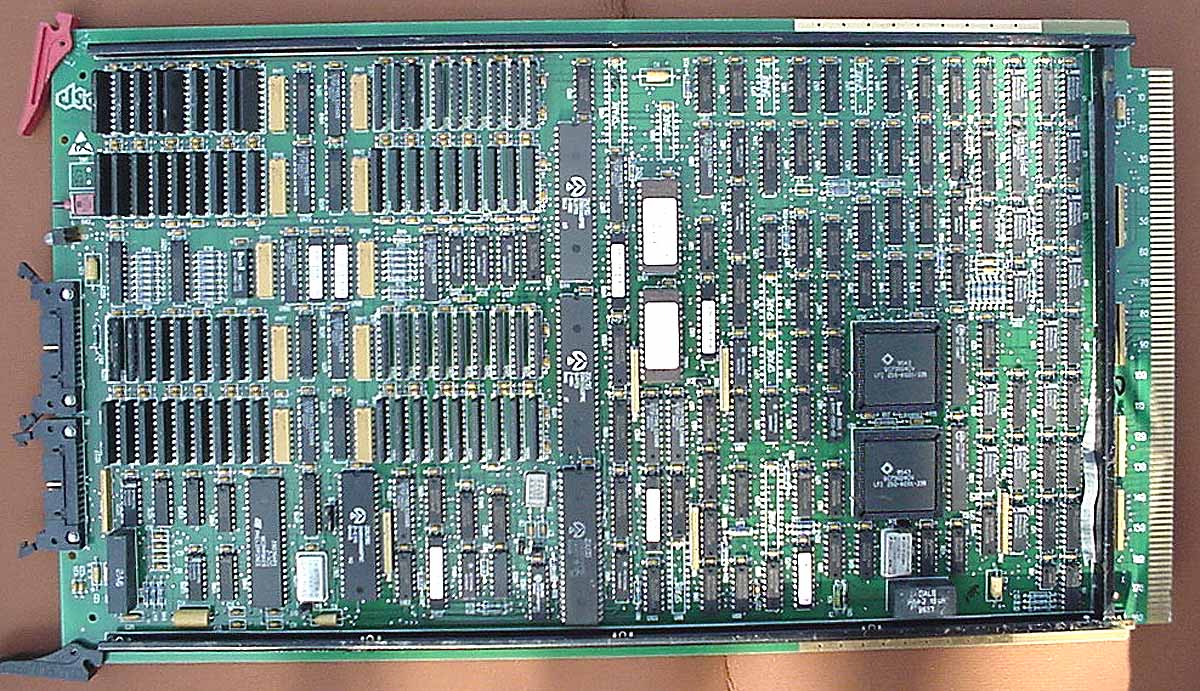
<http://www.classiccmp.org/hp/misc/dsc.jpg>
Joe
> Today I found a big stack of computer cards with Z8000 CPUs
> on them. The Z8000s are socketed and I planned on grabbing
> them. But I'm wondering if it's worth the trouble to take
> the related parts off?
Can the board be used as is? This would save a lot of work to
get a working Z8000 syatem. Any pictures?
Cheers,
Lee.
________________________________________________________________________
This e-mail has been scanned for all viruses by Star Internet. The
service is powered by MessageLabs. For more information on a proactive
anti-virus service working around the clock, around the globe, visit:
http://www.star.net.uk
________________________________________________________________________
>From: "Michael Kleinman" <mtkleinm(a)uci.edu>
>
>If you still have the Gould 2800, I would be interested in buying it.
>
>
>
>Mike Kleinman
>
>
Hi
Maybe these are part of some class project. You send out
these strange request to see what kind of response you get.
There are just too many of these to be real. Many, resently,
seem to be using the same general format.
Dwight
Sellam:
I certainly would be interested. And, if the interface is "easy"
enough I can integrate software support into the Altair32 Emulator.
Rich
-----Original Message-----
From: cctalk-bounces(a)classiccmp.org
[mailto:cctalk-bounces@classiccmp.org]On Behalf Of Vintage Computer
Festival
Sent: Tuesday, May 11, 2004 3:25 PM
To: Classic Computers Mailing List; Bay Area Computer Collector List
Subject: Front panel controller
A friend and I have designed a front panel controller that connects to a
PC port and allows you to have up to 128 outputs (LEDs, lamps, etc.) and
64 inputs (switches, etc.) It is intended for use in functional
blinkenlights replicas (like the PDP-1 replcia I'm building). It connects
to a PC parallel port and is driven through software. It can be updated
hundreds of times a second, which for all intents and purposes will seem
continuous. We're going to write simple software drivers to control the
board. It's simple enough to be integrated into just about any PC-based
emulator and is designed to be scalable (up or down).
Would there be any other interest in purchasing this controller? Board
fab and parts in quantity 5 has the price at about $100 right now
(unassembled). If there's enough interest then I'll manufacture a large
batch to bring the price down and sell off kits to recoup the design and
manufacturing costs for myself.
E-mail me if you're interested.
--
Sellam Ismail Vintage Computer
Festival
----------------------------------------------------------------------------
--
International Man of Intrigue and Danger
http://www.vintage.org
[ Old computing resources for business || Buy/Sell/Trade Vintage Computers
]
[ and academia at www.VintageTech.com || at http://marketplace.vintage.org
]
Hello everyone,
Recently, I met up with listmember Rick Murphy to take a beautiful
VAXstation 3500 (KA650, QBus, RX50, DEQNA)in BA123 enclosure, along with
VR290 monitor, puck mouse and keyboard, off his hands. (Allow me to commend
him for being a good sport, I was ~30 minutes late ;))
It is a near flawless machine, except both of its RD53s are dead as
doornails. The platter isn't stuck, but the opening up the drive tricks
have all been tried. It powers up and then powers right back down. (But is
at least detected, it seems)
In any case, I am looking to make this thing work again. :) I am looking
for any kind of Qbus goodies, specifically a SCSI card. If this is too rare
an item, I am looking for a DSSI card. If this isn't an option either, I am
looking for any RDxx drive.
I am also looking for an RX22 drive, so that I can load a kernel off it and
not have to worry with all that stuff, just simple, reliable NFS. :)
Lastly (and this is a long shot), does anyone have a spare backdoor to the
BA123 enclosure, or even just the hinge would do (mine is falling off).
Any replies are appreciated, I can't wait to get this thing up and running
as a full-time server. :)
--
Thanks,
Torquil MacCorkle, III
Lexington, Virginia
Anyone know what this cable is used for? It has two 15 pin female Apple
monitor connectors, one 15 pin male connector, and one 26 pin connector.
Thanks!
http://www.rain.org/~marvin/applecbl.jpg
Bought one of Ebay recently, but it comes without software. Was wondering if
anybody might be able to provide it to me in some form?
Thanks,
Christopher Ryan
Hiyas,
Does anyone have a manual for the DEC DFD242-CA (Scholar Plus)
modem, part number EK-DF2XD-UG ?
Thankee,
Fred
--
Fred N. van Kempen, DEC (Digital Equipment Corporation) Collector/Archivist
Visit the VAXlab Project at http://VAXlab.pdp11.nl/
Visit the Archives at http://www.pdp11.nl/
Email: waltje(a)pdp11.nl BUSSUM, THE NETHERLANDS / Mountain View, CA, USA
>Anyone know what this cable is used for? It has two 15 pin female Apple
>monitor connectors, one 15 pin male connector, and one 26 pin connector.
>Thanks!
>
>http://www.rain.org/~marvin/applecbl.jpg
It goes to the DOS Compatibility card for either a Quadra 610 or a
PowerMac 6100 (both used the same cable).
There is also a version for the later PC Compatibility card that worked
in a number of PCI PowerMacs. Slightly different cable was used for them.
The visual difference being the later one lacks the Joystick connector on
the cable (the PC Compatibility card had the joystick port on the card).
I do not believe the two styles of cable are interchangeable.
-chris
<http://www.mythtech.net>
Anyone out there know (or might be persuaded to part with >:-) any source
on the Toshiba IHC-8000 (aka Pasopia Mini)?
This was a small "pocket computer" circa 1983 with 4K of RAM and a 24x1
character LCD. Let me know if anyone remembers this unit, or better still,
has one (working or not).
--
---------------------------------- personal: http://www.armory.com/~spectre/ --
Cameron Kaiser, Floodgap Systems Ltd * So. Calif., USA * ckaiser(a)floodgap.com
-- His mind is like a steel trap -- full of mice. -- Foghorn Leghorn ----------
Is there a definitive document anywhere on the net on this? Or anywhere
else? This
http://www.dbit.com/pub/pdp11/info/pertec.txt
is good, but is there a formal definition document ?
I have the impression from the preamble to the above text that the answer is
negative.
Dave Brown
Christchurch, NZ
Here's a strange one... what is the difference (other than the names) between
the Sharp IQ-7000 and the Sharp OZ-7000?
I'm sitting here holding both in my hand. The IQ version has a label calling
it the "Electronic Organizer" while the OZ version has a label calling it the
more popular "Wizard." Otherwise they are identical twins (including the
instruction manuals.)
Unfortunately neither has batteries right now, so I can't boot them to check
for OS versions, etc.
Even if Sharp merely changed the name from Organizer to Wizard, why would they
bother drastically changing the model prefix from IQ- to OZ-?
Evan
I know very little about these machines, but one just turned up on the
doorstep for the museum. Power supply checks out, I get a white display
(so something useful looks to be happening in the video circuitry), but
I get no spin-up from the hard disk (A Seagate ST-157 SCSI drive) and a
steady floppy drive light.
I'm not sure if the hard disk is fixable yet - no idea if it's a head
crash or whatever. There seems to be little about these drives on the
web, but I did see one comment that they were famous for stiction - in
which case maybe I can give it a hand in spinning up...
Does anyone have install media if it comes to that though? I can always
drop a different SCSI drive in it (I think I have a spare 160MB drive
somewhere), but I don't have any floppies for this machine and I gather
they never were particularly common, sitting somewhere between the ST
and the Falcon...
cheers
Jules
Is there a company or private party in the Pacific Northwest that specializes
in liquidating computer estates? They date from the late 1970s to the mid
1990s in various conditions.
I really don't want to recycle them at scrap price if someone out there can
use them.
I figured ebay is a good place for anything unopened, but all the rest is
simply overwhelming.
Help, suggestions, ideas and warnings are welcomed.
Cathy