Sorry for the interruption...
I need some help from the folks who are planning to attend VCF 7.0 from
out of the area and will be staying in a hotel.
I'm currently negotiating with the Residence Inn (Marriott) for a room
block. These rooms should be every bit as good as the Marriott in
Burlington, if not better, as they are all "residence" rooms (studio
arrangement with internet access, full breakfast, etc.) The room rate
being proposed is $79 per night.
I need to get a very good idea of how many people plan to attend because
they are trying to get me to commit to a certain number of rooms that I
will be responsible for paying for if they don't get filled.
Please contact me directly <vcf(a)vintage.org>.
Thanks!
--
Sellam Ismail Vintage Computer Festival
------------------------------------------------------------------------------
International Man of Intrigue and Danger http://www.vintage.org
[ Old computing resources for business || Buy/Sell/Trade Vintage Computers ]
[ and academia at www.VintageTech.com || at http://marketplace.vintage.org ]
Hi,
I have one of the above available. It wont be free (given their
ePay-value) but for list members, I wont be charging quite as much
as I'd do on ePay.
Location: Holland - shipping probably wont be good for it...
Cheers,
Fred
--
Fred N. van Kempen, DEC (Digital Equipment Corporation) Collector/Archivist
Visit the VAXlab Project at http://VAXlab.pdp11.nl/
Visit the Archives at http://www.pdp11.nl/
Email: waltje(a)pdp11.nl BUSSUM, THE NETHERLANDS / Mountain View, CA, USA
Does anyone know anything about these?
Google brings up 1 site in the Netherlands.
The hard drives have been pulled and it is taking up space in my garage.
Does anyone want it?
--
Collector of vintage computers http://www.ncf.ca/~ba600
Looking for: PICMG backplane
Open Source Weekend http://www.osw.ca
>My ISP has just "upgraded" their email server to be completely incompatible
>with my client - basically the POP server cannot not be determined from
>the POP account name anymore, and since my ancient client "figures out"
>the server from the account name, it cannot connect.
I assume you already tried doing username@domain@pop.server and that
failed (it actually works on some clients, any that parse from the back
to the front it will work on).
The other thing to try is, many of the ISPs that require this kind of
setup (where the username is really username@domain) will accept an
alternate character in place of the @ sign. Commonly it is % but has also
been known to work with / or . or ? or any number of other symbols. Try
replacing the first @ (the one on the username pair) with some other
symbol and see if it accepts it.
-chris
<http://www.mythtech.net>
I cannot for the life of me find the pause switch for this mail list. Can
any one help??
Original Message:
-----------------
From: ghldbrd(a)ccp.com
Date: Thu, 30 Sep 2004 09:30:52 -0500 (CDT)
To: cctalk(a)classiccmp.org
Subject: Re: Anyone selling 5.25" blank Apple or Atari disks?
I got some NOS from a local computer dealer for nothing, but I'm hanging
on to them for dear life. You might try checking some of the smaller
office supply outfits and/or Goodwill/Salvaation Army stores. These are
turning into very rare items now.
Gary Hildebrand
St. Joseph, MO
> Looking for about 10 5.25" blank Apple II or Atari 800 compatible
> diskettes...just need something to play around with...
>
> Pete
> pbmain(a)wideopenwest.com
>
--------------------------------------------------------------------
mail2web - Check your email from the web at
http://mail2web.com/ .
Paul,
Thanks for your insights. I found some useful background info here:
http://keemiarelva.tehas.ee/asjad/telecomi%20plaat/Kompuuterelektroonika/
These docs are in English, written (or at least compiled) in the early 80's.
I'd be curious if anyone knows the original source for them. In any case,
see the top of page 9-11 in the file 14091_ch9.pdf.
It says "In addition to lateral parity, many units also use a longitudinal
parity check." That seems to imply that some didn't.
????
best regards,
Chris Muller
Muller Media Conversions
32 Broadway, suite 1214
New York, NY 10004
http://www.mullermedia.com
212-344-0474 or 800-OLD2NEW
Hi Guys,
I know this is a OT, but I could really use some help, and I figure
this group is the most likely to be using a setup similar to mine...
My ISP has just "upgraded" their email server to be completely incompatible
with my client - basically the POP server cannot not be determined from
the POP account name anymore, and since my ancient client "figures out"
the server from the account name, it cannot connect.
Can anyone recommend a decent/simple email program that runs under either
DOS or Window3 (NOT win32!!!) that has the ability to let you specify a
incoming mail server separate from the POP account?
Until I find something, I can only access this list (and all other email)
via a web based reader (very slow on dial-up and inpossible to do a decent
reply).
Please help!
Regards,
Dave
--------------------------------------------------------------------
mail2web - Check your email from the web at
http://mail2web.com/ .
Apologies if someone's mentioned this one before. Quite possibly the
coolest gadget I've seen in a long time, though:
http://www.cyberniklas.de/pongmechanik/indexen.html
cheers,
Jules
--
"We've had a lot of loonies around this place, but you're the first one
who thought the sunrise was made out of stale beer. Now are you going to
pick up your flute and leave, or shall I part your hair with this
crowbar?"
Jason McBrien wrote:
>Also, a full-length ISA card with a bunch
>of NCR chips, and the back half covered with a RF shield. The only connector
>was a F-type screw connector (CATV style) which leads me to belive it's an
>old TV tuner card, but I don't think NCR is known for multimedia chipsets,
>and the RF shielded area was at the back of the card instead of right next
>to the connector. Any ideas?
That sounds like an old NCR WaveLan card. The original was before the 802.11
standards. It operated in the 900MHz ISM band and was basicaly 2 Megabit wireless
network card, compatable only with others like it. NCR sold the product line to Lucent
at about the time the standards were adopted, as I recall.
Hope this helps,
Mike Gemeny
Hi Roger,
Are you talking about "Eudora Pro 3"? - if so, I have a legit copy, but I
didn't try it yet because the manual shows just a "POP3 account" field in
the host setup - I need a separate "incoming mail host" field, and the
POP3 username must be able to contain am "@xxx.yyy" which is DIFFERENT
>from the configured host (it gets sent as part of the login string
apparently).
Do you know if Eudora3 actually supports such a misconfigured server
setup?
Original Message:
-----------------
From: Roger Merchberger zmerch(a)30below.com
Date: Wed, 29 Sep 2004 19:06:44 -0400
To: dave04a(a)dunfield.com, cctalk(a)classiccmp.org
Subject: Re: Email client for older machines? (need help)
Rumor has it that dave04a(a)dunfield.com may have mentioned these words:
>Hi Guys,
>
>I know this is a OT, but I could really use some help, and I figure
>this group is the most likely to be using a setup similar to mine...
>
>My ISP has just "upgraded" their email server to be completely incompatible
>with my client - basically the POP server cannot not be determined from
>the POP account name anymore, and since my ancient client "figures out"
>the server from the account name, it cannot connect.
>
>Can anyone recommend a decent/simple email program that runs under either
>DOS or Window3 (NOT win32!!!) that has the ability to let you specify a
>incoming mail server separate from the POP account?
This one should do it:
http://www.eudora.com/email/archive/pro_email3/
If not, try here:
http://www.pmail.com/overviews/ovw_winpmail.htm
(you'll have to search thru all the 32-bit shiznit to get to the 16-bit
schtuff -- scroll down near the bottom...)
They still have a DOS version, as well.
Hope this helps,
Roger "Merch" Merchberger
--
Roger "Merch" Merchberger -- sysadmin, Iceberg Computers
zmerch(a)30below.com
What do you do when Life gives you lemons,
and you don't *like* lemonade?????????????
--------------------------------------------------------------------
mail2web - Check your email from the web at
http://mail2web.com/ .
We need more exhibitors at the upcoming VCF 7.0. If you are planning to
exhibit then now would be a good time to submit an entry ;)
http://www.vintage.org/2004/main/exhibit.php
--
Sellam Ismail Vintage Computer Festival
------------------------------------------------------------------------------
International Man of Intrigue and Danger http://www.vintage.org
[ Old computing resources for business || Buy/Sell/Trade Vintage Computers ]
[ and academia at www.VintageTech.com || at http://marketplace.vintage.org ]
Sorry for the delay, but without further ado:
http://www.vintage.org/gallery.php?grouptag=VCFEAST20
Thanks to all the great exhibitors that made the 2nd VCF East a real
blast!
--
Sellam Ismail Vintage Computer Festival
------------------------------------------------------------------------------
International Man of Intrigue and Danger http://www.vintage.org
[ Old computing resources for business || Buy/Sell/Trade Vintage Computers ]
[ and academia at www.VintageTech.com || at http://marketplace.vintage.org ]
A "guy" gave me an Altos 586 computer - no terminals.
I don't think I want it, do you?
It is a multi-user Xenix box(?) with an internal
10Meg(?) hard drive.
It powers-up and spins-up, but I didn't hook-up a
terminal to see if words come out.
It is very heavy at 35 pounds.
Currently near Santa Ana, CA.
Steve.
_______________________________
Do you Yahoo!?
Declare Yourself - Register online to vote today!
http://vote.yahoo.com
Does anyone have any information, drawings, pictures, prints, etc. relating
to the alpha-numeric oscilloscope interface for the SCELBI 8-H beyond what
is described in SCELBI's 1974 catalog? A copy of the page is on the web at
http://users.techline.com/cmlove/scelbi/pg16.htm . I'm also looking for any
info on other SCELBI peripherals - the same catalog describes a cassette
tape interface. What about SCELBI software (on paper tape or in electronic
form, I have the listings)?
-
Jack Rubin
Wilmette, Illinois
USA
Hi Michael,
Thanks - I'll take a look as soon as you have it posted - what is
the site address?
Regards,
Dave
Original Message:
-----------------
From: msokolov(a)ivan.harhan.org (Michael Sokolov)
Date: Wed, 29 Sep 04 22:58:54 GMT
To: cctalk(a)classiccmp.org
Subject: Re: Email client for older machines? (need help)
dave04a(a)dunfield.com wrote:
> Can anyone recommend a decent/simple email program that runs under either
> DOS or Window3 (NOT win32!!!) that has the ability to let you specify a
> incoming mail server separate from the POP account?
CWRU-PC/IP for DOS should do it. I have it on my old DOS machine, let me
put it up on my FTP site and I'll post the path.
MS
--------------------------------------------------------------------
mail2web - Check your email from the web at
http://mail2web.com/ .
Major bummer! I don;t have a source listing but I do have a couple of
working SB-180s. I can dump the EPROMs for you if need be.
Joe
At 03:55 PM 9/29/04 -0400, you wrote:
>Hello, all:
>
> Does anyone on the list have a source listing (either original or
>reconstructed) to the Circuit Cellar SB-180 monitor ROM? I did something
>stupid to it a while back and I think I blew something on the board. Now,
>when it boots up, instead of the banner I get what appears to be a
>diagnostic code in binary. The documentation package I have neither has a
>listing of the codes nor the ROM listing itself, and efforts to contact the
>original author to have failed.
>
> Thanks in advance.
>
>Rich
>
>
"Someone" gave me an Osborne 1 (tan version) computer.
It's very nice and in good condition, but it's 240VAC
and I can't (or won't) try to energize it.
Weighs about 25 pounds of course, and no, I won't ship
it to the UK.
Please pick it up if you can!
Near Santa Ana, CA.
Steve.
__________________________________
Do you Yahoo!?
New and Improved Yahoo! Mail - 100MB free storage!
http://promotions.yahoo.com/new_mail
> The pad on the print hammer has disintegrated and the underlying metal
> has been pounding on the print cylinder. This has caused some of the
> letters images to be deformed so that only the top half of the letter
> prints. A new print cylinder would be virtually impossible to fabricate,
> so I need to find a new or used one.
With the new available it may not be worth the trouble but as long as the
damage isn't too deep you can get it to print acceptably by filing the
letters flat again, try printing and file again on the part of the letter
that prints darkest until you get reasonably even printing.
People,
I have a 30 pound box which contains three boxes of:
" 9-1/2 X 11 stock smooth edge, 15 lb bond, 3000
count"
fan-fold paper from 1983. Each of the three smaller
boxes weigh 7 pounds, for 20 pounds total weight.
It is the original cardboard shipping box, shipped
>from CBM in PA, on 10/83 - cool.
Currently near Santa Ana, CA - it's yours if you want
it.
_______________________________
Do you Yahoo!?
Declare Yourself - Register online to vote today!
http://vote.yahoo.com
As warned in the subject line, this couldn't be more off-topic if I tried!
Having said that... I've got an extra ticket for Friday's "Vote for Change"
concert down in Philadelphia. I'm looking for the face value ($75) -- the
concert features Springsteen, REM, and John Fogarty.
Please do NOT reply with a political message or to say you'd love to go but
can't. And, please do not reply if MAYBE you can go but want to let me know
Friday afternoon, or if you want to show up late (it starts at 7) or leave
early or whatever -- I'm not about to get stuck with this ticket (and also
don't want it to go to some bandwagon lame-ass fan whose favorite Springsteen
song is "Secret Garden".)
Okay, the diatribe is now complete. If you're vaguely in my area (north
Jersey) and want to go, please reply OFF-LIST.
Now returning to the regularly scheduled discussion of vintage computers...
- Evan
=====
Tell your friends about the Computer Collector E-mail Newsletter!
-- It's free and we'll never send spam or share your email address
-- Publishing every Monday(-ish), ask about writing for us
-- Mainframes to videogames, hardware and software, we cover it all
Visit the museums directory and read about past events
at our web site: http://news.computercollector.com
Contact us at news(a)computercollector.com
550 readers and counting!
dave04a(a)dunfield.com wrote:
> Can anyone recommend a decent/simple email program that runs under either
> DOS or Window3 (NOT win32!!!) that has the ability to let you specify a
> incoming mail server separate from the POP account?
CWRU-PC/IP for DOS should do it. I have it on my old DOS machine, let me
put it up on my FTP site and I'll post the path.
MS
I thought that TIFF-within-PDF meant that PDF was essentially
a wrapper around the TIFFs, but I could be wrong.
--
You are correct. This is exactly how Eric Smith's tumble program
behaves. It is just a wrapper for jpgs and tiffs.
>from a self documenting sense, it makes no sense...
when someone can pick up a logic description and understand it WITHOUT having to figure out what each sytmbol means in the context of the usage, then it is simply more understandable. If I picked up something that had two binary numbers wiht a PLUS sign inbetween, I would not assume that it meant OR, only if you would dig further does the PLUS sign make sense. If you simply said OR, then there is no confusion and it is self documenting. I think Sellam was trying to make this point with regards to symbology.
I agree with Sellam about the insanity part... The symbols are arbitrary and WORK as long as you have your language description at hand.
-----Original Message-----
From: "Dwight K. Elvey" <dwight.elvey(a)amd.com>
Sent: Sep 28, 2004 3:07 PM
To: cctalk(a)classiccmp.org
Subject: Re: Relay computers - OR functionality
>From: "Vintage Computer Festival" <vcf(a)siconic.com>
---snip---
>
>None, I just felt like pointing out that whoever decided to use the plus
>sign for OR was most likely insane.
Hi
Actually from a mathematical sense, it does make sense. The
OR operation can be mapped to the plus operation and the
AND operation can be mapped to the multiply operation. One
finds that when doing this, many mathematical rules correlate
nicely. That is why it was done. Rules like associative and
communicative make sense. It wasn't just wild insane mad men.
When one understands the reasoning fully, one can except
the choices made. It is just that in your schooling, you
were never exposed to much Boolean algebra. That is too bad
because so much of what we do with computers requires a
level of understanding of how it works.
Dwight
Does anyone here use ImageMagick to produce their PDF files of old
documentation? I've got some scanned documentation here in TIFF format
which I need to munge into a PDF file using 'convert'.
Question is, will that result in loss of quality, or will the data for
each frame be stored in the resulting PDF file using exactly the same
colour depth and size of each input image? (I don't care if it uses a
different compression, providing it's non-lossy)
Last thing I want to do is store important data in a PDF file, only to
find that it drops the quality - and so at a future time I can't get
data of the input quality back out again!
cheers
Jules
On Sep 29 2004, 18:02, Michael Sokolov wrote:
> Pete Turnbull <pete(a)dunnington.u-net.com> wrote:
>
> > You're thinking of TIA 568,
> > where pair 1 is 4+5 (blue), pair 2 is 3+6 (green), pair 3 is 1+2
> > (orange) abnd pair 4 is 7+8 (brown)
>
> No, pair 2 is orange and pair 3 is green (always), but TIA 568A and
> 568B differ on whether orange pair 2 should go on 3+6 leaving 1+2
> for green pair 3 (568A) or vice-versa (568B). Everyone uses 568B.
Oops, yes, you're correct. Orange *is* always pair 2.
--
Pete Peter Turnbull
Network Manager
University of York
My SB-180 hasn't seen power in about 18 years. I could read the EPROM
for you if you need a copy. I don't think that I have a ROM listing.
This guy may have it:
http://scott.squidliver.net/sb180/sb180-software.html
--tom
At 03:55 PM 9/29/2004 -0400, Cini, Richard wrote:
>Hello, all:
>
> Does anyone on the list have a source listing (either original or
>reconstructed) to the Circuit Cellar SB-180 monitor ROM? I did something
>stupid to it a while back and I think I blew something on the board. Now,
>when it boots up, instead of the banner I get what appears to be a
>diagnostic code in binary. The documentation package I have neither has a
>listing of the codes nor the ROM listing itself, and efforts to contact the
>original author to have failed.
>
> Thanks in advance.
>
>Rich
Hello, all:
Does anyone on the list have a source listing (either original or
reconstructed) to the Circuit Cellar SB-180 monitor ROM? I did something
stupid to it a while back and I think I blew something on the board. Now,
when it boots up, instead of the banner I get what appears to be a
diagnostic code in binary. The documentation package I have neither has a
listing of the codes nor the ROM listing itself, and efforts to contact the
original author to have failed.
Thanks in advance.
Rich
>From: "David V. Corbin" <dvcorbin(a)optonline.net>
>>>> >>>
>>>> Can you create self modifying code in any high level
>>>> language, the kind of code where the application program
>>>> actually changes it's own instructions?
>>>>
>>>> I know in C it is possible to pass an address of a function
>>>> to a function, that's not really what I mean.
>>>>
>
>Actually this is (sort of) becoming more common. One exciting feature of a
>new platform by the software vendor who shall not be named, is that the
>compiler is actually part of the runtime. This means that any program can
>write source code to a string (or other structure) and compile and execute
>it!!!!!!
>
Hi
It was possible to do in early BASIC's that allowed a machine
code subroutine calls. One input the code as data and then called
it. Both LISP and Forth have the ability to, by program, compile
code and then execute it. It is done more often in LISP.
This is a different form of self modifying.
Dwight
On Sep 27 2004, 22:17, Tony Duell wrote:
> > Good news: You could even make an Ethernet/Twinax single jack, if
you're
> > not running faster than 100Mbps ethernet, as they run 1/2 & 3/6 for
their
> > pairs -- just use 4/5 for twinax.
> >
> > Bad news: *Most* pre-built cables don't follow the standard as to
where the
> > twisted pairs should be - most just go 1/2 - 3/4 - 5/6 - 7/8 - and
that's
> > bad for both Ethernet & twinax. You'll wanna punch down and/or
build your
> > own cables if you're going to do this.
>
> What?!?!?
>
> I've made the odd 10baseT patch lead, and I was always careful to get
1/2
> as a pair and 3/6 as another pair (I think the other 2 pairs were 4/5
and
> 7/8, but it;s been a long time..) Fiddling the wires into the RJ45
was a
> pain, but I assumed it was necessary....
>
> And you're telling me commercial cables get it wrong.
I've hardly ever seen a commercial standard Cat3 / Cat4 / Cat5 /Cat5e
cable that was miswired with split pairs. Telephone cables wired to
the old USOC standard are different[1], but not usually fitted with
RJ45 plugs, and flat cables are obviously not twisted pairs. Tony, I
wouldn't have any qualms about buying commercial cables. If you do
want to wire your own, the standard order (for TIA568B, which is the
most common scheme) is white+orange, orange, white+green, blue,
white+blue, green, white+brown, brown.
[1] They're not paired as 1+2, 3+4, etc either. The first pair is the
centre pins, the second pair is the two pins either side of centre, and
so on, working outwards.
--
Pete Peter Turnbull
Network Manager
University of York
p-code never compiled down to native calls... .NET does
-----Original Message-----
From: emanuel stiebler <emu(a)ecubics.com>
Sounds a hell like p-code, few years later ;-)
Pete Turnbull <pete(a)dunnington.u-net.com> wrote:
> You're thinking of TIA 568,
> where pair 1 is 4+5 (blue), pair 2 is 3+6 (green), pair 3 is 1+2
> (orange) abnd pair 4 is 7+8 (brown)
No, pair 2 is orange and pair 3 is green (always), but TIA 568A and
568B differ on whether orange pair 2 should go on 3+6 leaving 1+2
for green pair 3 (568A) or vice-versa (568B). Everyone uses 568B.
MS
Hi everybody.
This is something a computer geezer like me should know. But I don't.
I've read some things that seem to imply that *some* of the oldest
drive/formatters did NOT write a longitudinal parity frame at the end of a
block. (They did have horizontal parity, of course.)
If it's true then a drive reading such tapes would not have an easy way of
telling whether frames had been dropped during a read. Does this ring true
to anybody out there? Any observations welcome.
best regards,
Chris Muller
Muller Media Conversions
32 Broadway, suite 1214
New York, NY 10004
http://www.mullermedia.com
212-344-0474 or 800-OLD2NEW
The comment I made was based on another person's view that p-code was intrepreted and so was .NET - apples and apples sort of thing... I don't recall any Microsoft product that created p-code which could be executed without compiling and then you could compile the p-code and execute that too.
-----Original Message-----
From: Jim Battle <frustum(a)pacbell.net>
Sent: Sep 29, 2004 8:46 AM
To: General Discussion@null,
On-Topic and Off-Topic Posts <cctalk(a)classiccmp.org>, null@null
Subject: Re: Code Generation .NET
Steve Thatcher wrote:
> p-code never compiled down to native calls... .NET does
That sounded like an assertion waiting to be disproven. 15 seconds with
google produced this link:
http://www.threedee.com/jcm/psystem/
Heath Z-80 UCSD p-System, six 5 1/4" disks: "SYSTEM 1," "SYSTEM 2,"
"ZINT," "PASCAL," "UTILS," "Native code generator NZ84BP".
That was contemporaneous. Something more recent:
http://www.pascal-central.com/pcode.html
Spend a few more minute and find more links.
On Sep 29 2004, 8:23, John Foust wrote:
> At 02:02 AM 9/29/2004, you wrote:
> >I've hardly ever seen a commercial standard Cat3 / Cat4 / Cat5
/Cat5e
> >cable that was miswired with split pairs. Telephone cables wired to
> >the old USOC standard are different[1], but not usually fitted with
> >RJ45 plugs, and flat cables are obviously not twisted pairs.
>
> I agree, and I suspect any straight-through RJ-45 cable
> was for a telephone system, not networking. Perhaps
> Sellam knows examples.
ISDN S-bus sometimes uses flat cables for the last piece of flex
between wall and device (you shouldn't, because 1+2 and 7+8 are
sometimes used for phantom power, but many devices only use Tx and Rx
which are 4+5 and 3+6).
--
Pete Peter Turnbull
Network Manager
University of York
On Sep 29 2004, 9:48, Roger Merchberger wrote:
> Rumor has it that Pete Turnbull may have mentioned these words:
> >On Sep 28 2004, 15:52, Steve Thatcher wrote:
> >Do you expect to pick up a book on some
> >strange programming language or some new science and understand the
> >syntax without some explanation?
>
> If you do, this is the language for you:
>
> http://www.catb.org/~esr/intercal/
It's actually quite a popular and well-known language amongst the
systems programmers at York!
--
Pete Peter Turnbull
Network Manager
University of York
I recently acquired a DW08-B backplane. I am interested in reconditioning
it, but I can't find drawings for it online. (I found the drawings for the
DW08-A, thanks.) Does anyone have drawings for this lying around? (In a
pinch, even a module locator chart would help, because then I could trace
the wiring :-).)
Thanks,
Vince
>From: "Patrick/VCM SysOp" <patrick(a)vintagecomputermarketplace.com>
>
>> Why didn't they use * or X for AND then?
>
>The period is a convenient substitution for a dot that was used in math to
>indicate multiplication (the "real" symbol is usually represented as more
>vertically centered within the character cell). I have some books that also
>use "x", but that character is again a more (or sometimes less) stylized
>glyph than the simple upper- or lowercase "X".
>
>By the way, that plus (or) symbol in those same books is often a plus inside
>a circle. So I suspect the use of plain-old-plus is again a convenient
>substitution into ASCII.
>
>Patrick
Hi
Most times, a plus in a circle is to indicate an exclusive-or.
Dwight
actually, .NET is a platform where individual compilers (C#, J#, VB, Fortran, etc) generate an abstract code that is compiled and run in the .NET runtime. C# can not run and execute Cobol for example, but you can freely intermix classes that each could be written in any language. Any class no matter what language it is written in can be called by a class or call another class.
A class may not be compiled until runtime (JIT - just in time), but once it is compiled then it is available immediately.
best regards, Steve Thatcher
-----Original Message-----
From: Jules Richardson <julesrichardsonuk(a)yahoo.co.uk>
Hazy memory, but I thought .net was typically C# in a distributed
environment - in other words, Microsoft's rip-off of Java and JINI with
the added "benefit" of vendor lock-in :-)
I thought C# was *usually* interpreted, just with the option of
compilation if needs be (just as Java bytecode can be compiled to native
code if desired). Fair call on the compiler included with the OS though.
> Also the code generator is capable of supporting different .Net languages.
> This means that a C# program can write and excute Cobol code, or a Visual
> Basic program could write Fortran code and execute it.
Now that is interesting. A developer's nightmare, but interesting :-)
seeya,
Jules
On Sep 28 2004, 15:52, Steve Thatcher wrote:
> from a self documenting sense, it makes no sense...
>
> when someone can pick up a logic description and understand it
WITHOUT having to figure out what each sytmbol means in the context of
the usage, then it is simply more understandable. If I picked up
something that had two binary numbers wiht a PLUS sign inbetween, I
would not assume that it meant OR, only if you would dig further does
the PLUS sign make sense. If you simply said OR, then there is no
confusion and it is self documenting. I think Sellam was trying to make
this point with regards to symbology.
>
> I agree with Sellam about the insanity part... The symbols are
> arbitrary and WORK as long as you have your language description at
> hand.
I don't -- agreed the symbols are to *some* extent arbitrary, but I
agree with Dwight. If they're arbitrary, then +/. are just as good as
|/&. The symbols Dwight used are part of *the* standard for logic
expression in Boolean mathematics, and make good sense if you think
about it (or know a little about it). The overloading of multiple
context-sensitive meanings for things is common in mathematics,
programming, and lots of other places. You just have to learn to live
with it. If you learn a new discipline or language, you have to learn
the semantics (just as a physicist knows that stress and strain are two
different things while the man in the street, having read his OED,
"knows" they're the same). Do you expect to pick up a book on some
strange programming language or some new science and understand the
syntax without some explanation?
As for confusing addition and the logical OR function with binary
numbers, you don't normally perform logic on binary numbers, only on
bits representing truth values. Describing "1011 OR 0101" as part of a
logic equation is sloppy; it's actually four put together.
And lastly, AND and OR are just two binary logic functions. There are
fourteen more, if remember my first year maths, all with ASCII symbols,
all of which predate C.
I sympathise with those who've not seen it before. It can be hard to
understand at first; logic is not common sense. It is, however,
logical :-)
--
Pete Peter Turnbull
Network Manager
University of York
Rumor has it that David V. Corbin may have mentioned these words:
> >>> >>>
> >>> Can you create self modifying code in any high level
> >>> language, the kind of code where the application program
> >>> actually changes it's own instructions?
> >>>
> >>> I know in C it is possible to pass an address of a function
> >>> to a function, that's not really what I mean.
> >>>
>
>Actually this is (sort of) becoming more common. One exciting feature of a
>new platform by the software vendor who shall not be named,
Why not? Some of us aren't "in the trenches" so to speak WRT newer software
& languages.... I would be interested to know which platform that actually was!
> is that the compiler is actually part of the runtime.
So, in other words... it's an interpreter. Novel idea, that! ;-P
> This means that any program can
>write source code to a string (or other structure) and compile and execute
>it!!!!!!
Lots of languages have eval() nowadays... most people think the use of it
is as evil as self-modifying code.
Dunno, if you ask me -- it sounds like "yet another gaping security hole
waiting to happen" to me...
Laterz,
Roger "Merch" Merchberger
--
Roger "Merch" Merchberger --- sysadmin, Iceberg Computers
Recycling is good, right??? Randomization is better!!!
If at first you don't succeed, nuclear warhead
disarmament should *not* be your first career choice.
At 05:07 PM 9/28/2004, David V. Corbin wrote:
>To the best of my knowledge, the Microsoft .NET platform is the first
>run-time environment [not development environment] in which a compiler,
>linker and all of the associated capabilities are included. If you have a
>windows machine [XP, 2K] and have applied the windowsupdates, then all of
>these tools are already resident on your machines!
I guess that would explain why it's a 20 or 30 meg download,
once you've got the main system and the 11 meg patches.
And they're pushing it out as fast as they can - it's part
of WinXP SP2, no?
- John
On Sep 29 2004, 0:10, Vintage Computer Festival wrote:
> On Wed, 29 Sep 2004, Pete Turnbull wrote:
>
> > [1] They're not paired as 1+2, 3+4, etc either. The first pair is
the
> > centre pins, the second pair is the two pins either side of centre,
and
> > so on, working outwards.
>
> The third and fourth pairs would not be "so on". They'd be the pairs
on
> either side of the center, since Orange+White/Orange and
Brown+White/Brown
> are not split.
Er, no, in a USOC-wired RJ45 pair 1 is pins 4+5, pair 2 is pins 3+6,
pair 3 is pins 2+7, pair 4 is pins 1+8. You're thinking of TIA 568,
where pair 1 is 4+5 (blue), pair 2 is 3+6 (green), pair 3 is 1+2
(orange) abnd pair 4 is 7+8 (brown), as I wrote above the bit you
quoted.
--
Pete Peter Turnbull
Network Manager
University of York
IIRC from Bob's speech at VCFe2.0, he indicated that simulation speed is
effectively unregulated, because why would you want to waste the benefits of
a speedy host machine. However, I could imagine that with certain hardware
simulations, cycle-by-cycle emulation might be required.
On my Altair32 emulator, I have it set to run at the prototypical 2MHz speed
(8080A). But, I can unthrottle it and let it run at full speed, which on my
Pentium 4/2.8GHz would result in an 8080 running at about 80MHz (+/-). This
is accomplished by managing the number of prototypical CPU cycles executed
per 10ms timeslice.
Rich
-----Original Message-----
From: cctalk-bounces(a)classiccmp.org
[mailto:cctalk-bounces@classiccmp.org]On Behalf Of Tom Jennings
Sent: Monday, September 27, 2004 3:24 PM
To: General Discussion: On-Topic Posts Only
Subject: simh simulation speed
I haven't had a chance to get back and debug, but is it true that simh
does NOT simulate the target machine's execution speed? I wrote a simple
'sum all words in track N' program for the LGP and it completed as soon
as I hit return! It should have taken many seconds... I did RTFM, so no
reference to it, but I haven't had time to go look at the source. Got
lazy and decided to post instead of research (typical, huh :-)
spc(a)conman.org (Sean 'Captain Napalm' Conner) wrote:
> Okay, figured out why my code didn't work, and it's not due to writing to
> the wrong location (although I suspect that still is a problem) but that
> under Unix the code pages are marked read-only so of course it core dumped.
You do know about -N option to ld, right? That would make an OMAGIC
executable whose code is not protected.
MS
Can anyone use an old Marconi Instruments test equipment catalog? I have
an old edition here (NA7) that needs to go away. Inside are the usual
picures and descriptions of the gear (much like the big HP catalogs). Of
interest to those on this list are the ATE equipments - there are some
nice shots and data for their PDP-11 (the original) based test sets.
William Donzelli
aw288(a)osfn.org
I just finished putting some stuff on E-bay that this group might be
interested in including some single height DEC FLIP CHIP wirewrap cards, a
HP-12C calculator, a box and manual for the HP-11C calculator and a bunch
of ROM and RAM cartridges for the Tektronix 83x Communications Analyzers.
Those of you that are making your own cartridges for the Tektronix 124x
Logic Analyzers will be interested to know that these cartridges will also
fit the 124x LA if you trim the locator keys. See
<http://www.classiccmp.org/hp/tek-roms/case-keys.jpg>. I will be adding
some core memory boards as soon as I have a chance (probably a couple of
days).
<http://search.ebay.com/_W0QQgotopageZ1QQsassZrigdonjQQsosortorderZ1QQsosort
propertyZ1>
Joe
(not sold by me & cross-posted from another list)
"The entire Freeman PC Museum is offered for sale. David Freeman, founder of
ACP Superstore, has been collecting computers since 1976. As a pioneer in
computer retailing Mr. Freeman started early collecting. This collection
represents almost 30 years of collecting. To date over 280 computers have
been place online at www.thepcmuseum.net. There are approximately 600
computers, calculators, printers, video game consoles in the collection. Not
all of the computers have been placed on the website as of yet, but all are
included in this sale. Everything is included. Many items in this collection
are irreplaceable and no longer available. This collection includes
countless software titles, manuals, books, magazines and other computer
memorabiia. You could truly display a PC Museum in your place of business
with this collection...."
http://cgi.ebay.com/ws/eBayISAPI.dll?ViewItem&item=5125710949
>From: "Ron Hudson" <ron.hudson(a)sbcglobal.net>
>
>I had, at one point, sat down and tried to devise a JK flipflop out of
>relays..
>
>I can do a latch... where (in) pulls in the relay and a NO contact
>connects
>v+ to keep the relay in.. but everything I tried just vibrated... :^\
>
>In a relay computer wouldn't one need flipflops for memory?
>
I thought I'd take on the challenge. Doing a JK with relays.
First, define the clocking and, for Sellam, the state of the contacts.
I will define relays as numbers and there contacts as O for normally
open and C for normally closed. As an example R1C will be one of the
normally closed contacts. If this name is used multiple times, it
may indicate more than one set of contacts, depending on the optimization
used. There will be 4 clocks. It will look as:
One cycle of clock.
P0 C O C C C C ( Hold clock for R1 )
P1 O C C O O O ( evaluate clock for R1 )
P2 C C C C O C ( Hold clock for R2 )
P3 O O O O C C ( evaluate clock for R2 )
O means open contact at that time and C means closed during that time.
The JK flop is composed of two relays, R1 and R2. R2 contacts correspond
to the Q and Q* outputs( R2O and R2C ). R1 or R2 by itself would be
the coil. I also show the complete path from rail to return, even
if it is duplicated at some points. JO and KO are normally open
contacts of some other relay that when activated is the logical
signal corresponding to J and K.
Wiring:
Rail to R1O to P0 to R1 to return
Rail to R2O to KC to JC to P1 to R1 to return
Rail to JC to KO to P1 to R1 to return
Rail to R2C to JO to KO to P1 to R1 to return
Rail to R2O to P2 to R2 to return
Rail to R1O to P3 to R2 to return
I would not use a JK flop for a memory array, even if I was using
normal relays for the memory. The are too wasteful of contacts
and coils. There is some optimization that could be done with
diodes as well.
One can generate the clocks with relays or some kind of distributor,
similar to what is used on a teletype and a variable speed motor.
If done with relays, one would need some way to control the speed.
It might make sense to invert the signal between the two relays
so that regardless of the state, only one relay, on averagel would
be on at a time.
Dwight
>From: "Tom Peters" <tpeters(a)mixcom.com>
>
>I use a lot of self-modifying code: Perl scripts that generate HTML code!
>
>Maybe that doesn't count...
>
Hi Tom
Only counts if it then calls the HTML is generates.
Dwight
>From: "Vintage Computer Festival" <vcf(a)siconic.com>
>
>On Mon, 27 Sep 2004, Dwight K. Elvey wrote:
>
>> In my logic, 'A' would indicated the normally opened contact
>> an 'a' would be the normally closed contact for relay A.
>> I'll use + to indicate OR and . to indicate AND.
>
>You already lost me. You may as well have used ! and $ instead of A and
>a.
>
>:)
>
>P.S. C programming convention (which most people would relate to
>immediately) says that next time you should use & for AND and | for OR.
>
>--
Hi
I'm sorry, people doing logic have been using + and . a
lot longer than C has been using & and |. I specifically stated
what I would use. Look at most any pre-C math book and
you'll most likely see the + and . used for OR and AND.
These are just symbols until one applies meaning to them. I
don't see the issue. One should be able to adapt to different
conventions because that is the way things will be represented
>from different sources. I adapt and I hope others learn to
do it as well.
I don't see the issue with using upper and lower case to
indicate normally close or normally open? What difference
does it make how one represents it?
Dwight
>From: "Vintage Computer Festival" <vcf(a)siconic.com>
---snip---
>
>None, I just felt like pointing out that whoever decided to use the plus
>sign for OR was most likely insane.
Hi
Actually from a mathematical sense, it does make sense. The
OR operation can be mapped to the plus operation and the
AND operation can be mapped to the multiply operation. One
finds that when doing this, many mathematical rules correlate
nicely. That is why it was done. Rules like associative and
communicative make sense. It wasn't just wild insane mad men.
When one understands the reasoning fully, one can except
the choices made. It is just that in your schooling, you
were never exposed to much Boolean algebra. That is too bad
because so much of what we do with computers requires a
level of understanding of how it works.
Dwight
>From: "Steve Thatcher" <melamy(a)earthlink.net>
>
>you create your OR functionality with diodes - use two diodes (or as many
inputs as you need) such as the 1N4001 for your inputs. Tie the cathodes
together and attach that to the relay coil. Apply "logic high" (whatever voltage
your relays operate at) to either (or any) diode anode and the relay will turn
on. The relay can be the next stage and does not have to be there to implement
the OR.
>
>best regards, Steve Thatcher
>
Hi
You don't need the steering diodes if the lines that provide the
terms don't cross talk to other coils. This is pure relay logic
and works with AC relays as well as DC. The diodes are only
needed when you share complex terms that use the same stack of
contact terms but would otherwise cross talk. The diodes allow
one to optimize the number of contacts used by sharing common
terms.
Each relay contact can be used as a term in an equation. Normally
open contact can provide inverting function and normally closed
contact can provide isolation buffering ( needed for AC but can
be optimized with diodes in DC ).
Designing with relays takes a slightly different mindset than
with normal logic, like TTL. You have to think in terms of
inverters and transmission gates. There are no NAND or NOR
gates. The function of NAND and NOR is constructed by sharing
the contacts of several relays and then using that shared
stack to control the output ( that may be another coil of
a relay ).
Stacking contacts can provide AND like function and paralleling
contacts can provide OR like function. Choice of normally
open contacts provides OR and AND with inverted inputs,
the Boolean equivalent of NAND and NOR.
This takes a little more thinking of design because with double
throw relays, one has to think of the source as providing the
inverting and non-inverting signals. The contacts only provide
OR and AND, depending on how they are arranged.
Dwight
>
>Question: Wouldn't it be easier to implement an OR gate with no relays at
>all (just two wires joining together)? Or would you need to use the relays
>to keep the output voltage/amperage regulated?
>
>
>Cheers,
>Ade.
>
>
I was just recently given a good sized collection of early Byte
magazines. I've inventoried them, and it is a complete series from
Issue #2 (October 1975) all the way through to Volume 8, #8 (August
1983) - EXCEPT for Vol 6, #7 (July 1981).
.. So .. if anyone should happen to have a copy of Byte Vol 6, #7
(July 1981) that they would part with - please let me know.
I also wouldn't mind completing the 1983 year, so Sep, Oct,
Nov, Dec 1983 would be of interest as well.
[I'd *REALLY* like to get the one missing on the other end as well,
(Issue #1) however I expect it would be much harder to find!]
Regards,
Dave
--
dave04a (at) Dave Dunfield
dunfield (dot) Firmware development services & tools: www.dunfield.com
com Vintage computing equipment collector.
http://www.parse.com/~ddunfield/museum/index.html
>Part of the issue, for modern machines, is that the hardware gets in
>the way. If you change code, the I-cache doesn't change (in machines
>I'm familiar with) so the old instruction may still execute. This
>makes instruction modification a tricky business. Debuggers do it,
>operating systems do it -- and both have to pay attention to all the
>cache magic you have to perform for it to be right.
This reminds me of a point I wanted to make earlier and forgot - another
big issue us that SOFTWARE gets in the way! - todays computing world is
much more oriented toward sharing code, and many systems support multiple
execution threads of a single copy in core - it causes bad things to
happen when one of those threads changes the code :-)
Regards,
Dave
--
dave04a (at) Dave Dunfield
dunfield (dot) Firmware development services & tools: www.dunfield.com
com Vintage computing equipment collector.
http://www.parse.com/~ddunfield/museum/index.html
I used to use a lot more self-modifying code in my early days then I do now,
you could save precious bytes of memory by storing data values into the
immediate operand of instuctions which used them --- I recall a "turning point"
when one day I spent a fair bit of time debugging a problem which was related
to two level deep self-modifying code - ie: Modified an instruction so that
it would subsequently modify another instruction differently - I started to
believe some of the nay-sayers about the evils of SM code after that :-)
Case where I've *HAD* to use SM code: 8080 general purpose monitor - no way
to read/write arbitrary I/O ports - have implemented it both as directly SM
code in RAM based monitor, and as a "built" subroutine in RAM for ROM based
monitor. Same for 8051 (except you have to overlay CODE and DATA address
spaces obviously - this is fairly normal for a debugging environment).
Cheers,
Dave
--
dave04a (at) Dave Dunfield
dunfield (dot) Firmware development services & tools: www.dunfield.com
com Vintage computing equipment collector.
http://www.parse.com/~ddunfield/museum/index.html
if you have telephone relays, then buzzing is not an issue. The ones I used years ago would "always" make contact. I used the N.O. contact to apply power to the relay once it received a pulse. I can't tell you now how long the pulse had to be (too long ago). Even if you wired the relay as a buzzer, it still made complete contact before returning to the open position. It would "buzz" at around 10-20hz.
>I can do a latch... where (in) pulls in the relay and a NO contact
>connects
>v+ to keep the relay in.. but everything I tried just vibrated... :^\
>
>In a relay computer wouldn't one need flipflops for memory?
>
>
>
You just have to think about what happens while the relay is
actuating and all the contacts may be open ( break-before-make ).
Otherwise, you'll be making a lot of nice buzzers. More than
one phase of clock makes things easier.
Dwight
Hullo,
As a result of me taking over another (Dutch) collector's DEC systems,
I now have filled a major gap in my own collection: the Pro 3xx series
have been added. That is to say: I have a 350 in the US (a VAX console),
and this lot came with both a 325 and a 380. The 325 seems to be a
field-upgraded one, as it comes in the "usual" Pro box, not the smaller
one, and it was stuffed with RAM, options and a hard disk. So, I guess
I am still looking for the "small" 325 ;-)
Anyway. The lot also came with a truckload of boxes (binder boxes,
ya know) and floppies, so I am now Teledisking all those floppies for
later use. I'll add these to my Archive, under the Software>POS
section.
All manuals will be auto-feeder scanned later, and the results will
also be in the Archive, under Hardware>PRO300.
Is anything PRO-related online already, other than the update.se
archive with Venix and some P/OS images?
I seem to have:
- P/OS V1.5
- P/OS V2.0
- P/OS V3.0
- P/OS V3.2
- PRO/TK V3.0
- PRO/TK V3.2
- Cobol-81, Pascal, F77, Forth for TK
- DECnet/PRO V2.1 plus Toolkit
- PRO/Sight V1.0
- PRO/Synergy V1.0
- PRO/COMM V3.0
.. and more to unpack.
If anyone wants copies or a trade, lemme know off-list !
PRO-related hardware is always welcome, too... *hint*
Cheers,
Fred
--
Fred N. van Kempen, DEC (Digital Equipment Corporation) Collector/Archivist
Visit the VAXlab Project at http://VAXlab.pdp11.nl/
Visit the Archives at http://www.pdp11.nl/
Email: waltje(a)pdp11.nl BUSSUM, THE NETHERLANDS / Mountain View, CA, USA
>From: "Vintage Computer Festival" <vcf(a)siconic.com>
>
>On Tue, 28 Sep 2004, Steve Thatcher wrote:
>
>> when someone can pick up a logic description and understand it WITHOUT
>> having to figure out what each sytmbol means in the context of the
>> usage, then it is simply more understandable. If I picked up something
>> that had two binary numbers wiht a PLUS sign inbetween, I would not
>> assume that it meant OR, only if you would dig further does the PLUS
>> sign make sense. If you simply said OR, then there is no confusion and
>> it is self documenting. I think Sellam was trying to make this point
>> with regards to symbology.
>
>Right. What I was getting at is that there were plenty of other symbols
>on the typewriter or keypunch to choose from.
>
>Having gotten the explanation as to why those operations were chosen, it
>does make sense and is somewhat elegant (I'll reluctantly concede), but
>it's still stupid as far as I'm concerned. Why didn't they use * or X
>for AND then?
Hi Sellam
Some do use * or X. Would that have helped you? Although, others
seem to to describe things like set theory, I can show a simple
example of the practical use.
A.(B+C) = A.B + A.C ( just like ordinary math )
A+(B+C) = (A+B)+C ( again, just like ordinary math )
Other than that, I don't think there is a good reason.
Dwight
>From: "Ron Hudson" <ron.hudson(a)sbcglobal.net>
>
>I had, at one point, sat down and tried to devise a JK flipflop out of
>relays..
>
>I can do a latch... where (in) pulls in the relay and a NO contact
>connects
>v+ to keep the relay in.. but everything I tried just vibrated... :^\
>
>In a relay computer wouldn't one need flipflops for memory?
>
>
>
Hi
The problem you have is controlling delays. In designing things,
you need to consider things like setup and hold timing as well
as race conditions. In normal circuits, a flip-flop is composed
of two latches with opposite clocks. In normal design, one
needs to either make these two clocks non-overlapping or
if one clock slightly overlaps the other, the data path between
a previous flop and the next have sufficient delay that they
won't race.
Memories are normally composed of simple latches and not flipflops.
Most uP use mostly latch based design and not flop base. Most
ASIC's are still using flop based design but they don't have the
same speed requirements that uP's have.
Another problem you may have been having is that you didn't
consider the contacts as being break-before-make or make-before-
break types. As was mentioned earlier, some of the relays
have things like shunting coils ( loop of copper ) added
to allow the relay to hold longer. One can also do things
like add capacitors in parallel to the coils to hold a few
milliseconds.
It is easiest to just use some overlapping clocking system.
You just have to think about what happens while the relay is
actuating and all the contacts may be open ( break-before-make ).
Otherwise, you'll be making a lot of nice buzzers. More than
one phase of clock makes things easier.
Dwight
I told ya so!
http://story.news.yahoo.com/news?tmpl=story&u=/ap/20040906/ap_on_hi_te/flop…
ath_4
Mon Sep 6, 5:17 PM ET
By MARK NIESSE, Associated Press Writer
ATLANTA - Long the most common way to store letters, homework and other
computer files, the floppy disk is going the way of the horse upon the
arrival of the car: it'll hang around but never hold the same relevance
in everyday life.
And good riddance, say some home computer users. The march of technology
must go on.
Like the penny, the floppy drive is hardly worth the trouble, computer
makers say.
Dell Computer Corp. stopped including a floppy drive in new computers in
spring 2003, and Gateway Inc. has followed suit on some models. Floppies
are available on request for $10 to $20 extra.
"To some customers out there, it's like a security blanket," said Dell
spokesman Lionel Menchaca. "Every computer they've ever had has had a
floppy, so they still feel the need to order a floppy drive."
A few customers have complained when they found their new computers don't
have floppy drives, but it's becoming uncommon as they realize the
benefits of newer technologies, Menchaca said. Almost all new laptops
don't come with a floppy.
More and more people are willing to say goodbye to the venerable floppy,
said Gateway spokeswoman Lisa Emard.
"As long as we see customers request it, we'll continue to offer it," she
said. "We'll be happy to move off the floppy once our customers are ready
to make that move."
Some people may hesitate to abandon the floppy just because they're so
comfortable with it, said Tarun Bhakta, president of Vision Computers
outside Atlanta, one of the largest computer retailers in the South.
At his store, the basic computer model comes with all necessary
equipment, but no floppy.
"People say they want a floppy drive, and then I ask them, 'When was the
last time you used it?' A lot of the time, they say, 'Never,'" Bhakta
said.
But plenty of regular, everyday computer users don't want to let their
floppies go.
"For my children, they can work at school and at home. I think they're a
pretty good idea," said shopper Mark Ordway.
"I just want something simple for me and my husband to use," said Pat
Blaisdell.
The floppy disk has several replacements, including writeable compact
discs and keychain flash memory devices. Both can hold much more data and
are less likely to break.
Even so, floppies have been around since the late 1970s. People are used
to them. They were the oldest form of removable storage still around.
"There's always some nostalgia," said Scott Wills, an electrical and
computer engineering professor at Georgia Tech who has held on to an old
8-inch floppy disk. "It's a technology I'm glad to be rid of. I'd never
label them, and I never knew what any of them were until I put them in
and looked."
In a sense, it's amazing floppy disks have hung around for this long.
They only hold 1.44 megabytes of space — still enough for word
processing documents but little else. By comparison, CDs store upward of
700 megabytes, and the flash memory drives typically carry between 64 and
256 megabytes.
And it's been a long time since floppy disks were even floppy. They used
to come in a bendable plastic casing and were 5.25 inches wide, but Apple
Computer Inc. pioneered the smaller, higher density disks with its
Macintosh (news - web sites) computers in the mid-1980s.
Then Apple become the first mass-market computer manufacturer to stop
including floppy drives altogether with the release of their iMac model
in 1998.
"It's not officially dead, but there's no question it's a slow demise,"
said Tim Bajarin, principle analyst for Creative Strategies, a technology
consulting firm near San Jose, Calif. "You had a few people ... who were
screaming, but in a short time, they adjusted."
It may not be too many years before floppy disks are joined by DVDs.
Microsoft founder Bill Gates (news - web sites) recently predicted the
DVD would be obsolete within a decade.
--
Sellam Ismail Vintage Computer Festival
------------------------------------------------------------------------------
International Man of Intrigue and Danger http://www.vintage.org
[ Old computing resources for business || Buy/Sell/Trade Vintage Computers ]
[ and academia at www.VintageTech.com || at http://marketplace.vintage.org ]
Actually I feel sorry for people that want uniform weather and climate.
I also feel sorry for any classic computer that has to survive out in
the weather in Florida or the Midwest.
/fun on
What a bunch of wimps, a little wind and water and everyone wants to
leave town. 100 mile wide storm and you can see them coming for days.
Here in the Midwest we like our wind and storms a little more
concentrated, tornados are a lot more fun. You can see them coming and
do the "just barely missed me trick". The sneaky thing about tornados
is that they can come at night and you can't see them.
They have professional storm chasers for hurricanes with planes, for
tornados amateurs in cars.
On our lake we always are interested to check the wind speed meters to
see how bad it was. I've only retreated under the concrete porch once
and watched the neighbor's boat and boat dock flip up into the yard
upside down. Weather was clear in about 2 hours. Instant storm,
instant storm gone.
I keep some of the classic computers in the garage attic to keep the
house "down". My wife has only visited there once and made a comment
"what's all this stuff". I put it in the attic when the garage was
built.
There is a nice National Weather Service Doppler radar site very near
us, you can watch their web page and when the red storm zone is in the
center it's on top of us.
/fun off
Mike
Sorry I've been more unresponsive to email than usual lately. I've been
going through a rather gutwrenching job decision - right during the middle
of a major implementation for my current day-job employer. The counter
offers have been made and delt with and the dust has settled so things
should start to get back to "normal" very shortly. Well, actually, better
than normal.
The new job I'm taking is almost the same pay but only 3 days a week - work
>from home - with full benefits and total flex time (yes, it's a real IT job,
not an MLM *GRIN*). Needless to say, this will give me more time with my
collection, this list, etc. It will also allow me to spend much more time
growing my consulting practice and internet service (web hosting and
colocation), which is really what I want to do full time.
So needless to say - if anyone is aware of any consulting/support
opportunities in the areas of FreeBSD Unix, sendmail, Bind, apache, mysql,
etc. I'd love to hear it. My particular specialty is high availability
clustering of both apache and mysql. I'm targeting true consulting rather
than contracting. I'm not looking for long term contracts. Just ongoing
support, maybe a day onsite occasionally if need be. I can do most things
remotely but have no problem traveling either. I'm also a good C programmer
but I really prefer to keep that to the hobby side of things.
In addition, I'm definitely looking for companies who need a firm to host
their website or wish to colocate gear. I've been very pleasantly suprised
so far at just how quickly a lot of cheap web hosting customers can add up
to real dollars! I won't repeat my diatribe on my datacenter - suffice it to
say it's a world class datacenter with serious connectivity - not a couple
of servers in my basement.
Who knows... might even try to find some companies who still run 21MX gear
and want hardware support (lord knows I've got the excess inventory), or
maybe I can finally start real work on getting that computer museum off the
ground :)
Regards,
Jay West
---
[This E-mail scanned for viruses by Declude Virus]
I was thinking about going for the M series at govt. auction mentioned on the list previously. I noted the condition was F7, which means "broken, repairable" or "needs refurbishing".
I don't usually buy stuff there... can anyone advise me if F7 is likely to be something as serious as a dead mainboard? Or could it just be and I/O or memory PCA? Any thoughts?
Jay
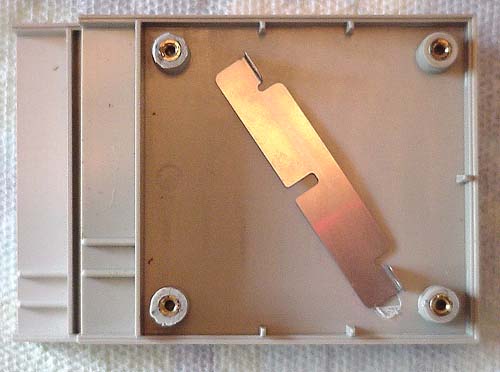
I found this this morning. Anybody know anything about it? I found an
Apple Disk II external full height 5 1/4 disk drive in the same lot and
this is the same style, size and color so I'm guessing that it might be
made for use with an Apple II. However it does have one important
difference, it uses a 34 pin ribbon cable instead of the 20 pin like the
Apple drive does so it definitely uses a different interface.
Joe
My bet from looking at the pictures is nothing is wrong with them. The one
pictured looks quite clean and the gaylord (big box) seems to have been
carefully packed.
Probably missing hookup cables, maybe missing some cards but probably not.
What it means is not everything is there to make it work but it looks like it
might (repairable).
If you can go look at them it is a good idea. It is a long time before the
sale ends. Looks like a good one to watch. My bet is they ran test equipment for
the F16 that was obsoleted and are pretty complete.
good luck.
Paxton
Astoria, OR
Would there be any interest in re-writing somthing like RSTS/E, ITS,
TWENEX or one of the other
legacy OS to work on x86 machines? The idea would be to do something
like Linux has done for unix but for one of the other OSs, I think all
the ones I mentioned ran on pdp machines, whatever we choose to write
could have once run on anything.
The new OS should be entirely self hosting. What would be the most
interesting old OS to do.
This would differ from the simh machines in that actual serial ports
would connect to serial devices and printers would connect via parallel
port.
Hi
I thought I'd show a case where one might want to
use diodes.
In my logic, 'A' would indicated the normally opened contact
an 'a' would be the normally closed contact for relay A.
I'll use + to indicate OR and . to indicate AND.
Lets say we wanted to create the equation:
X=(A.B)+(C.D)
We can stack the normally open contact of A in series
with a B contact. We can then parallel these with the series
of C and D. The output of these can be tied to the
coil of X.
Now say we also needed:
Y=(A.B)+(E.F)
We would have to used a new set of contacts for the A.B term
because the wires work both ways. If we were using DC relays,
we can add a pair of diodes in series with the two AND'd
terms used to drive each X and Y. This reuses the same contacts
to drive both X and Y.
So, as you can see, the diodes are not necessary but can
be used to save on the number of isolated contacts needed.
One can also play boolian games with these equations to
do things like reduce total power required. Since each relay
is assumed to have both inverting and non-inverting outputs,
one can change where things are inverted:
y=(a+b).(e+f)
If the case is that Y would be more likely to be active,
this second equation makes more sense for power.
You can see here that we have optimized the power without
doing anything other than change a few wires. We may
have also minimized the need for extra contacts and or diodes.
Like I said, designing with relays takes a different way
of looking at the problem. One can also see that the OR
function can be created by putting contacts in series or
in parallel, depending on the active state of the relay that
one is driving. The same goes for the AND function.
This adds another flavor to things because one can move which
side of the relay one places the term to optimize, power,
delay or number of contacts used.
Dwight
On Mon, 27 Sep 2004, Dwight K. Elvey wrote:
> >From: "K. Venkataramanan" <rvtechno(a)vsnl.net>
> >
> >Hi there
> >
> >I saw your posting. I think I know where I can pick up these
> >Regulators. Do you have the datasheets / pinouts so that I can test
> >them?
>
> Hi Venkat
> These sound like standard 78xx and 79xx series regulators. The 78xx
> stuff are positive output and the 79xx are negative output. The pinouts
> on these are relatively standard for each particular package. Note that
> the negative and positive use different leads in the same package. It
> would seem that these are 2 volt regulators but I don't recognize the
> MGT package type. Look on the Jameco web page under regulators and I'm
> sure you'll find data sheets for similar regulators.
I believe the email he was responding to was one I posted in 2002. The
regulators in question are Fairchild uA79MG and uA78MG. They are
4-terminal adjustable voltage regulators with a package style similar to a
typical TO-220. The actual Fairchild part number of the regulator that I'm
still hunting for is uA79MGU1C.
I have the Fairchild voltage regulator databook and responded to the
poster off-list. If someone has an electronic copy of the datasheet for
these regulators, speak up as it will save me the trouble of scanning the
relevant pages from the databook.
-Toth
>From: "K. Venkataramanan" <rvtechno(a)vsnl.net>
>
>Hi there
>
>I saw your posting. I think I know where I can pick up these
>Regulators. Do you have the datasheets / pinouts so that I can test them?
>
>Venkat VU2KV
>
>
Hi Venkat
These sound like standard 78xx and 79xx series regulators.
The 78xx stuff are positive output and the 79xx are negative
output. The pinouts on these are relatively standard for
each particular package. Note that the negative and
positive use different leads in the same package.
It would seem that these are 2 volt regulators but
I don't recognize the MGT package type. Look on the Jameco
web page under regulators and I'm sure you'll find data
sheets for similar regulators.
Dwight
>From: "Tom Jennings" <tomj(a)wps.com>
---snip---
>
>Though there's always selenium rectifiers, ugh. Besides being toxic,
>huge, hot, they are slow and terrible forward/reverse ratio, though
>likely faster than a relay. They've been around for a long time, I
>wonder how good they' be as a relay signal diode (shudder).
>
>
Hi
They should work. They even have a slight advantage
as diodes to absorb the flyback energy in DC relays.
The increased forward voltage drop means a quicker
release of the relay.
Also, I though I'd mention that most AC relays have
a small copper shunt coil to help delay the release
of the relay between cycles. This keeps the relay
>from chattering at 60Hz ( 50Hz for UK and Japan ).
I would guess the coil does the same thing for
a DC relay.
Dwight
>From: "Dwight K. Elvey" <dwight.elvey(a)amd.com>
>
>>From: "Steve Thatcher" <melamy(a)earthlink.net>
>>
>>you create your OR functionality with diodes - use two diodes (or as many
>inputs as you need) such as the 1N4001 for your inputs. Tie the cathodes
>together and attach that to the relay coil. Apply "logic high" (whatever
voltage
>your relays operate at) to either (or any) diode anode and the relay will turn
>on. The relay can be the next stage and does not have to be there to implement
>the OR.
>>
>>best regards, Steve Thatcher
>>
>
>Hi
> You don't need the steering diodes if the lines that provide the
>terms don't cross talk to other coils. This is pure relay logic
>and works with AC relays as well as DC. The diodes are only
>needed when you share complex terms that use the same stack of
>contact terms but would otherwise cross talk. The diodes allow
>one to optimize the number of contacts used by sharing common
>terms.
> Each relay contact can be used as a term in an equation. Normally
>open contact can provide inverting function and normally closed
>contact can provide isolation buffering ( needed for AC but can
>be optimized with diodes in DC ).
Oops!!
Should have said normally closed provide inverting and
normally open provide buffering.
> Designing with relays takes a slightly different mindset than
>with normal logic, like TTL. You have to think in terms of
>inverters and transmission gates. There are no NAND or NOR
>gates. The function of NAND and NOR is constructed by sharing
>the contacts of several relays and then using that shared
>stack to control the output ( that may be another coil of
>a relay ).
> Stacking contacts can provide AND like function and paralleling
>contacts can provide OR like function. Choice of normally
>open contacts provides OR and AND with inverted inputs,
>the Boolean equivalent of NAND and NOR.
> This takes a little more thinking of design because with double
>throw relays, one has to think of the source as providing the
>inverting and non-inverting signals. The contacts only provide
>OR and AND, depending on how they are arranged.
>Dwight
>
>
>>
>>Question: Wouldn't it be easier to implement an OR gate with no relays at
>>all (just two wires joining together)? Or would you need to use the relays
>>to keep the output voltage/amperage regulated?
>>
>>
>>Cheers,
>>Ade.
>>
>>
>
>
>
jos de waal <jos_dewaal(a)hotmail.com> wrote:
> I've asked my wife for her opinion on this and she said that she
> would instantly scrap and toss my stuff if she ever found herself in
> a similar situation. I can't blame her.
Have you instantly divorced her after hearing that in order to ensure
the safety of your collection?
I can't understand why everyone here is having so much difficulty with
their wives. Why did you marry them in the first place? Why in the
world would you want to marry someone who has no respect for your most
important Life's Work?
I would never even *date* a woman who does not share my most core beliefs,
and she must agree to protect our property with her life before there
can be any talk of marriage.
MS
Hiya
I found your email address while searching for information on Gemini
computers and Xebec controllers. I?ve recently acquired a Gemini Galaxy 3
with a hard drive but the version of CP/M it came with does not have the any
software for the hard drive. Basically do you have a any Gemini utility
software for the hard drive, and if so, can I please get a copy.
Many thanks
Richard
---
Outgoing mail is certified Virus Free.
Checked by AVG anti-virus system (http://www.grisoft.com).
Version: 6.0.769 / Virus Database: 516 - Release Date: 24/09/2004
"50 Service" on an HP printer means that the fuser is not working (not
reaching an acceptably high temperature within an acceptable time period,
or, rarely, it's stuck on and overheating).
In these particular models, the fuser is a heated roller system, there is a
pressure roller (silicone rubber with a special "oil" on it to prevent
sticking) and a heating roller, a hollow aluminum tube (also with a special
silicon coating) with a heating element inside it. The heating element is a
very high power cylindrical quartz lamp running the length of the center of
the aluminum tube. The most likely cause of your problem is that the lamp
has burned out, although there are other possibilities (rare, however).
These can be replaced, but it may not be economical to do so. Also, examine
the roller carefully, if any of the coating on the hollow aluminum tube has
worn off, the tube should be replaced also (at some point, bare aluminum
will literally leave brown scorch marks on the paper).
These parts are available, but expect to pay $30 to $50 each for a new lamp
and tube. The job is not that difficult if you know what you are doing, but
substantially more difficult if you don't (big surprise, right?).
You may be able to buy an entire working fuser assembly for less, but the
lamp may have thousands of hours on it and the roller may be well worn. If
you plan to keep the printers, a "true fix" with new parts really is the
best way to go.
Be careful working in this area, the lamp is AC line operated, and the
roller is heated to nearly 400 degrees F. There are both shock and burn
hazards.
I have an actual factory service manual for the Laserjet II, I may scan it
and make it into a PDF for the classic computer documentation effort.
However, unlike Imsai, Altair, etc., HP is very much still in business and
may take legal action if their copyrighted manuals are put on the web or
otherwise distributed. I have found Laserjet IV service manuals on the web,
and I have them downloaded.
Just a note on economic viability, you can buy entire working HP 4 printers
-- HP 4 Plus, the 12ppm version -- for well under $50, so putting in a $60
repair on a vastly inferior Laserjet II is of questionable economic
viability.
Just found this on James Willings old site:
http://www.rdrop.com/~jimw/jcgm-vcf.shtml
Scroll down near the bottom; there is a picture of a 'DECsystem 10 I/O
rack'.
Does anyone know who this belonged to?
If there's a -10 I/O rack running loose without a -10 to talk to, I have a
-10 that's been missing its I/O rack for many years, since it was destroyed
consequent to a flood. I think I should talk to the owner of that I/O rack,
and soon!!!!!
Thanks
Mike
(latest aquisition at the corestore: http://www.corestore.org/tc08.htm)
http://www.corestore.org
You know, this whole dust up has me thinking. I wonder the following:
(1) if each one on the list should create and publish for "internal" (i.e.,
list) use a general collections list. I don't mean a complete inventory, but
rather a high-level summary of our collections, so that all of us are aware
as to what each of us posesses so in the absence of specific intentions in a
will people with specific backgrounds can help disperse the collection.
Maybe this database functionality could be added to the classiccmp.org site
as part of a "member profile" section.
(2) if we should appoint several members of the list to a team of collection
evaluators/dispersers. This group could consist of maybe 5-10 people each
with backgrounds in specific collections (i.e., a DEC guy, a Commodore guy,
etc.) so that they can evaluate and manage the dispersal of a member's
collection. The #1 guy would be responsible for making contact, and each of
us would at least let our relatives/wives/SOs know who that person is so the
call does not seem out of the blue.
This whole setup may sound too formal for a group without formal
organization, but I think it could minimize any future conflicts or hurt
feelings.
Rich
Rich Cini
Collector of classic computers
Build Master for the Altair32 Emulation Project
Web site: http://highgate.comm.sfu.ca/~rcini/classiccmp/
/************************************************************/
-----Original Message-----
From: cctalk-bounces(a)classiccmp.org
[mailto:cctalk-bounces@classiccmp.org]On Behalf Of Fred Cisin
Sent: Sunday, September 26, 2004 9:14 PM
To: General Discussion: On-Topic and Off-Topic Posts
Subject: Re: Made first phone call
When I die, I hope that y'all contact my friends and relatives
immediately.
The executor of my will would prefer that you bring a big truck,
and/or provide dumpsters.
If you don't know me well enough to know who to contact,
write to deadguy(a)xenosoft.com
--
Grumpy Ol' Fred
Geoffrey Thomas <geoffreythomas(a)onetel.com> wrote:
> > I think a more apt comparison is the US allowing the museums of Baghdad to
> > be looted while they secured the oil fields.
> [...]
> That was possibly negligent and unthinking rather than deliberate , a case
> of tunnel vision.
It *WAS* deliberate. It was the actual reason for the whole war. The
war was not about oil: Iraq under Saddam was producing a lot more oil
than it does now, and They don't need that oil in the first place since
they have Zero Point Energy technology in Area 51. The war was about
Eden (Iraq's original ancient name), about the Navel of the Earth, and
about control over the entire planet and beyond, over the rest of the
solar system. They wanted Saddam out because he was trying to bring the
Anunnaki back to Earth. He was able to reestablish communication with
them by undigging and reactivating the interplanetary communication
equipment they left there. The entire war was about stopping the return
of the true original gods and goddesses and suppressing the ancient
advanced technologies and their technical documentation and historical
records, which is what they stole from the Baghdad Museum.
MS,
exopolitical loyalist and friend of Anunnaki, and by association of
Saddam Hussein. Long live Saddam!
http://ivan.Harhan.ORG/~msokolov/
I have an Emulex UC08 SCSI <-> QBus board I'm trying to make work.
It actually has 2 controllers on the board.
I can get into the firmware on both controllers fine -- when no drives are
connected.
However, when I connect a SCSI drive to a controller,
I can not get into the firmware for that controller.
It lights up the 3 error LEDS and puts a code "231" <octal> into the SA
register low byte.
Both controllers do this.
I've tried several disk drives and a tape drive.
A Zip100 SCSI drive did let me get into the firmware, but I couldn't but
System Can't See It.
Got the UC08 recently and have not got it working yet.
Does anyone know what UC08 error code "231" is?
The board firmware is Rev P.
The UC08 manual on bitsavers is current through Rev H and stops at octal
error code "121".
I'm thinking it's a cable problem since the firmware will run when no drive
is connected,
and won't run when one is.
One thing, the UC08 is the S handle flavor that has 2 HD50 male connectors.
It's made to go to a cabinet kit that converts the HD50 to 50 pin .1" header.
I'm using a known good SCSI HD50M to Centronics 50 pin cable.
But I had to get a HD50 F<->F gender bender to hook the cable to the UC08.
Any ideas?
Oops, not wanting to set Michael off again,
Any ideas that might help me solve the UC08 problem?
:-)
Ed K.
HI
I used this machine 1989-1991 in London at a company in London called
Electric Image.
Its major problem was the bottle kneck in the transferring of data from
the Sun, to the machine itself.
A ray traced render would indeed be quite fast, but passing any complex
data to it, just took forever.
Interesting machine tho..Nice images.
Simon
Got a call from Mark Wagner, a tech at George Washington University in DC.
He has 2 RX02 (dual drive rack mount 8" floppy units) available.
They are pretty much dead.
They are what's left over after getting one unit fully operational.
The power supplies are good, and he might keep one.
If they could be of any use to you, and you're nearby, drop him a line at:
qedqcd(a)gwu.edu
Ed K.
Cameron Kaiser <spectre(a)floodgap.com> wrote:
> And a babe and/or stud quotient, too.
Not sure about that, here is what I have at this early design stage
(the list of properties will definitely grow, these were just the
first that popped into my head):
StarMatch profile format:
First line: M for member, A for applicant, C for new E-mail address for a
member pending confirmation.
Followed by information lines, then a blank line, then the essay until EOF.
Each information line begins with a type letter followed immediately by data.
The first letter is A for internal administrative data like the password,
everything else is the user's input. All administrative lines must precede
the user's lines.
The following lines are defined:
ACcookie expire Indicates that E-mail confirmation is required. cookie
must be supplied in the E-mail, expire is time_t in
decimal.
AM If present, subscribe to starmatch-ml
AOoldemail Only in 'C' files, specifies the old E-mail address.
APpassword
BMJD x Birthdate as MJD (canonical)
BYYYY-MM-DD Gregorian birthdate allowed in input, converted to MJD
D (for date) single and looking if present, looking for
friends only otherwise.
Hurl Home page
Iurl Picture URL, may be on our site if we host it
Llat[NS]long[EW] Location, lat and long are atof-able floating point
latitude and longitude in degrees. Alternatively, in
input lat and long may be <num>d<num>'<num>" or
<num>d<num>m<num>s, converted to floating point.
NReal Name Real name
Pproperty=value Any properties one can think of
Pproperty (without value) flag properties
Scode Sex and orientation, code is M/F for straight, MB/FB
for bi, L for Lesbian, G for gay male.
Properties currently defined:
baue=<n> Been to Bay Area UFO Expo <n> times
baue=S Been a speaker at Bay Area UFO Expo
cbbw Is a proud CBBW
concon=<n> Been to Conspiracy Con <n> times
concon=S Been a speaker at Bay Area UFO Expo
courage Courageous freedom fighter, not afraid of the shadow
govt
exop active interest in exopolitics
height=<num>cm Canonical, num may be integer or float
height=<int>'<int>" allowed in input, converted to cm
iufoc=<n> Been to the International UFO Congress <n> times
iufoc=S Been a speaker at the International UFO Congress
mufon Member of
pagan self-explanatory
ufo active interest in UFOs
weight=<num>kg Canonical, num may be integer or float
weight=<num>{lb,lbs,#} allowed in input, converted to kg, num may be int or
float
wiccan self-explanatory
xconf=<n> Been to the X-Conference <n> times
xconf=S Been a speaker at the X-Conference
>> >>> I don't like the fact that you're supposed to pay for an ID
>> >>> (and have thr device 'certified') if you want to make your
>> >>> own stuff. Never had this problem with RS232 :-)
>> You need to pay for and get certified if you are going to make a legitimate
>> network appliance also [MAC ID]. Of course most products purchase a
> You didn't need to pay for anything if you wanted to make an RS232 device.
Nor do you for USB. Just use one of the existing USB/Paralell
or USB/Serial modules, add a serial EEPROM with the needed
device strings, and you have your custom USB device. Then
take their generic driver, add whatever funcionality your device
should support and you get all the bonuses of USB (easy use,
plug and Pray, and so on) plus no USB specific development.
>> >>> And the fact that you seem to need special drivers for many
>> >>> devices which you can bet are not available for any of my machines.
>> Although I can not find the link at presend, there is source code for low
>> level drivers. Since your environment (by choice) is the use of equipment
> Ah, sop now if I buy a product the first thing I have to do is write
> special drivers for it..... And hope that I can get enough of a spec on
> the product to allow me to do this.
??? Isn't that the same for any device? I mean, if I get me a camera
with a RS232 interface (if such thing is still arround, but I can just
use my old Olympus as example :) I still have to write my own drivers
(unless useung Wn/Mac) ... that's nothing new to USB or whatever.
On a closer look, doing a USB driver is even a bit more simple than
for any older infervace, since not only the electrical parameters, but
also all basic messages are described.
>> >>> And the fact that it's very assymmetric (there are 'masters' and
>> >>> 'slaves') is something I don't like either. RS232 was much
>> >>> more symmetrical.
>> RS-232 is an ELECTRICAL Specification. The protocols that are run on
>> This are independand. Lets keep it apple and apples.....
> OK, Asynchronous bit-serial data, sent LSB first, using the RS232 voltage
> and connector specifications :-)
*G* and USB is the same, plus a well defined protocoll for messages,
which allows software development on specific levels with a great speed.
>> >>> More modern palmtops have USB ports. They're slaves,
>> >>> designed to hang off a PC. You can't link them directly to
>> >>> a printer. It's interesting that some of my older handhelds
>> >>> have HPIL ports, but by default the handheld is the loop
>> >>> controller ('master'), so you can link them straight to a
>> >>> printer. But they can be 'slaves' if you want to link them
>> >>> to a larger machine. We've gone backwards (as usual)
>> To be honest, I have not looked into the electricals on this. I am NOT sure
>> that they are *REQUIRED* to be slaves.
> There is, of course, nothing rreally to stop you making a handheld
> 'master' (althoguh the master has to supply power to all devices on the
> USB chain), but the fact remains that AFAIK all handheld machines
> currently on sale are 'slaves'
That's where on-the-go comes into the play, an extension of the electrical
spec (so the device can see if the other end is a host or a device and select
the oposite role) and a protocoll extension, for negotiation if both sides
are able to act as host/device. It even allows switching roles while running
(of course after closeing all open transactions).
OTG makes the low level driver a bit more complicated, but these have
only to be made once for any new machine (and adds a little hardware for
switching the power on and off).
OTG is ment that a camera can be a device to a PC, and a host for a
printer ... and so on.
>> >>> All my PCs have ISA slots only. Other machines have Unibus,
>> >>> Qbus, BBC 1MHz bus/Torch X-bus, various custom I/O slots
>> >>> (like on th HP9830), HPIL, PERQlink, etc. Just about all of
>> >>> those have RS232 (or compatible) ports, I've nver seen USB
>> >>> for any of them
>> Again, development boards ARE out their that give you everything you need to
>> interface to nearly any host...
> Most of the developemnt boards I've looked at assume you're making a
> slave device. This is not what I need.
Shure, most ICs sold are slave controlers ... If you realy want to look
into that, I recomend the Transdimension UHC 124 controler. It handles
already the most nasty parts of the low level protocoll, so even the basic
drivers are easy to do. also it features an 8 Bit Interface, so it's great for
every computer arround. The only feature missing is OTG. It's a host only
controller, but has already a 4 port hub integrated (oh, and it's only good
for low/full speed, but 1 MB/s is more than most old computers can handle
anyway).
Transdimension offers a real neat Evaluation board
http://www.transdimension.com/products/semiconductors/uhc124/evalboard/inde…
But more important is their 'Exerciser' Board
http://www.transdimension.com/products/semiconductors/uhc124/exerciserboard…
a full figured USB training and Protocoll/Trafic analyzing tool.
All you need is a dumb terminal (or a PC) and you can dig deep into
USB.
My recomendation for anyone who realy wan't so know how USB ticks.
better than any Windows based tool I found (if you're able to handle a
classic text based UI - not necersarry true for everyone nowadays).
The TD243 is a nice upscale controler, but I haven't done anything with it.
Also it features a 32 Bit interface :( Theoreticaly the Atmel 370 (*G*) would
make an even better controller, since it freatures OTG and an even higer level
interface - just, I haven't had a chance to get the needed interface level decription,
and I don'T want to use their C libraries. they are worthless for the machines
I play with.
>> >>> > I also don't understand your statement that it is not a bus.....
>> >>> Electrically it's not a bus. If it was, I could just parallel up
>> >>> connectors and plug in several devices, there'd be no need
>> >>> to _always_
>> >>> have a hub (which, from what I've seen, contains a fair
>> >>> amount of logic).
>> By that argument (which has valid aspects), then ArcNet was not a bus
>> either, and RS-232 is DEFINITELY not a bus architecture (it is purely point
>> to point).
No argument there. But neither of those claim to be a bus.
Well, logicaly I considere USB a bus. from a host perspective all devices are
available in paralell, and you talk out of one port. that it'S bade up from point
to point connections is not realy a criteria - If you look arround, nowadays
Ethernet is also almost always a point to point with switches, still for each
connected computer it looks like a bus.
Hans
Ed Kelleher <Pres(a)macro-inc.com> wrote:
> The Iraqi's will receive a great deal more benefit from the oil than the
> museums.
Iraqis maybe, but not the humanity. The secret tablets and hi-tech
artifacts from Eden looted from that museum were this planet's greatest
treasure.
> Oh, and who was it that was looting the museums?
Special Ops who knew exactly what they were doing, who passed up very
beautiful and expensive golden statues and other very valuable artifacts
of the mundane kind and went straight for the ancient extraterrestrial
stuff in the basement. They also took the extra effort to destroy the
museum computers and CDs with catalogs so no one can figure out just what
they stole. They also had keys and codes to safes, office locks, etc.,
so they were pros with inside access.
MS
Gene Buckle <geneb(a)deltasoft.com> wrote:
> Let me guess, you're not exactly popular with the ladies, are you?
Only the ones who go to Bay Area UFO Expo and Conspiracy Con.
Those conferences draw a very good gender balance, but more work
is needed on making us ufologists match. I'm planning to create a new
and exciting matchmaking site (hosted at Harhan and powered by
4.3BSD-Quasijarus on a VAX of course) specifically catered to this
community. Instead of stupid useless questions like height, eye color,
etc. the member profile form will ask questions about UFOs,
conspiracies, psychic powers, alternative medicine, etc.
MS
Forwarded from Bob Supnik...
---------- Forwarded message ----------
Date: Mon, 27 Sep 2004 21:38:48 +0000
From: bsupnik(a)comcast.net
To: Vintage Computer Festival <vcf(a)siconic.com>
Subject: Re: simh simulation speed
Unless the simulator writer inserts timing (delay) code, as Phil did for
the PDP11, SIMH runs as fast as possible. In the case of the LGP30, this
is many, many times faster than the real machine.
/Bob
> On Mon, 27 Sep 2004, Tom Jennings wrote:
>
> > I haven't had a chance to get back and debug, but is it true that simh
> > does NOT simulate the target machine's execution speed? I wrote a simple
> > 'sum all words in track N' program for the LGP and it completed as soon
> > as I hit return! It should have taken many seconds... I did RTFM, so no
> > reference to it, but I haven't had time to go look at the source. Got
> > lazy and decided to post instead of research (typical, huh :-)
>
> I wondered that myself. SpaceWar! on the PDP-1 seems to run at its
> original speed.
>
> --
>
> Sellam Ismail Vintage Computer Festival
> ------------------------------------------------------------------------------
> International Man of Intrigue and Danger http://www.vintage.org
>
> [ Old computing resources for business || Buy/Sell/Trade Vintage Computers ]
> [ and academia at www.VintageTech.com || at http://marketplace.vintage.org ]
>
On 26/09/2004 Stephane Tsacas wrote:
>Jos, I think you missed the following email.
>Stephane
I think you're missing the point. I was merely pointing out that
contacting a family in mourning about such unimportant matters is,
in my opinion, pretty tasteless and could cause unwanted effects.
Greetings, Jos
_________________________________________________________________
Easily share your photos and music - get MSN Hotmail Plus!
http://join.msn.com/?pgmarket=en-xe
> I noticed all of you had nostalgic interest in the Synertek VIM-1. I have one, in its old
> yellowed box, postmarked July, 1978. While I had grandiose intentions when I
> originally got it, I never put it to use. If any of you have an interest in it, let me know.
Well, there's definite interest here, but without a return Address, it's hard to answer :)
Servus
Hans
you create your OR functionality with diodes - use two diodes (or as many inputs as you need) such as the 1N4001 for your inputs. Tie the cathodes together and attach that to the relay coil. Apply "logic high" (whatever voltage your relays operate at) to either (or any) diode anode and the relay will turn on. The relay can be the next stage and does not have to be there to implement the OR.
best regards, Steve Thatcher
Question: Wouldn't it be easier to implement an OR gate with no relays at
all (just two wires joining together)? Or would you need to use the relays
to keep the output voltage/amperage regulated?
Cheers,
Ade.
I have a duplicate copy of "The Computer Technician's Handbook",
by Brice Ward, TAB No. 554, 1971.
The first half of the book is a convetional treatment of basic
digital logic theory, logic families, and such, with an emphasis
on the 8200 series. The second half of the book is more interesting.
It is a "case study" of the Computer Automation PDC 808, complete
with a description of the architecture, logic diagrams, a detailed
walkthrough, timing diagrams, scope waveforms, etc. Much of it
looks like it was probably lifted from the manufacturer's service
manuals. The PDC 808 was an 8-bit minicomputer (yes, 8-bit)
introduced in 1968. It appears to have a family resemblance to the
16-bit PDC 816, and more closely resembles the traditional 16-bit
"stretched PDP-8" minicomputer style rather than most of the later
8-bit architectures seen in microprocessors.
The bookseller rated this book in "very good" condition. It is clean
with a tight binding, with some wear on the cover and a small crease.
I paid $7.00 for it. I'll sell it for that plus shipping.
--Bill
Hey,
I ran accross one of your newsgroup posts on the internet the other day. I
bought a northgate ZX off Ebay, and have found it difficult to find the A/C
Adapter, can you give me any advice to locate one for sale, or perhaps where
to buy the connector, so far, It seems nobody has anything compatible which
would power the computer.
Now I guess I know why the guy selling it was so eager to get rid of it,
lol....
Thanks for your help, Michael
_________________________________________________________________
Don’t just search. Find. Check out the new MSN Search!
http://search.msn.click-url.com/go/onm00200636ave/direct/01/
I think Sellam absolutely did the right thing!!! A number of people here
in Santa Barbara have passed away with significant classic computer
related items. For one example, many of the IBM 1130 and Burroughs
manuals that Al has scanned came from someone who had worked with these
things for close to 40 years. *ALL* of those manuals were destined for
the recycle bin. The only reason they got saved was a friend of mine
called me after he saw them when he was picking up other equipment
there. I called his wife and was invited to come over and take what I
wanted (I took everything!) When I saw her again a couple of months ago,
his wife was very happy to hear that they have proved useful to others.
A friend of mine passed away many years ago, and I was called to see if
I would help with the stuff. He had been involved with microcomputers
>from the first, and his father knew nothing of the value of this stuff.
Of course, at that point in time, a lot of classic stuff was still
deemed junk and went to that great storage space in the sky. Out of that
came an almost complete set of (can't remember the name right now)
cassette programs for the TRS-80 that were mailed out on a subscription
basis along with many of the docs and associated correspondence (he was
also an editor for a bit.) There were also boxes of documentation for
other now classic computers.
There are many such stories by myself and others on this list. I don't
know where you and your wife are coming from, but the main focus of most
of us on this list is saving classic computer related hardware,
software, docs, etc. And many of us have irreplaceable items as most
likely Don did. Again, Sellam did the right thing, and I am reasonably
sure it was also what Don would have wanted.
> On 19/09/2004 Sellam Ismail wrote:
> >I made an initial phone call to Don's number and got an answering machine
> >(presumably Don's voice is still on the OGM). I chose not to leave a
> >message. I'll try again later today.
>
> Sellam, I'm shocked by your lack of tact and respect. No matter how
> important Don's collection might be in your eyes, you shouldn't lose
> sight of the fact that his wife and family have just lost him. They
> probably couldn't care less about what happens to his stuff in the
> garage at this point.
>
> I've asked my wife for her opinion on this and she said that she
> would instantly scrap and toss my stuff if she ever found herself in
> a similar situation. I can't blame her.
>
> What do others think of this ?
>
> Greetings, Jos
Hi there
I saw your posting. I think I know where I can pick up these
Regulators. Do you have the datasheets / pinouts so that I can test them?
Venkat VU2KV