On Oct 21 2004, 8:50, Cameron Kaiser wrote:
> > Moisture has a habit of getting into funny places and going
unnoticed.
>
> This reminds me. Anyone in the States know a source for those silica
gel
> desiccators? Those might be a little insurance and they seem
inexpensive,
> but I need a source in bulk.
You can get silica gel in bulk from any laboratory or craft supply
house that caters for chemists, biologists, microscopists, mycologists
(mushroom collectors) or people who do flower arranging (and drying).
It's not always as cheap as you might think, though.
I get mine by asking our techs to throw each little bag that comes with
a PC/monitor/harddrive into a box at the end of their bench. Ask your
local PC shop to do the same?
Bear in mind that it works by absorbing (pedantically, adsorbing)
moisture from the atmosphere in the region you're trying to protect,
and there's a limit to what it will soak up. Some of it comes with an
indicator: usually cobalt chloride; pink when moist, blueish-purple
when dry. You can drive off the moisture by warming it in an oven at
130C for an hour or so (the time tends to depend somewhat on the
quantity and packaging).
--
Pete Peter Turnbull
Network Manager
University of York
Does anyone have any experience running MS-DOS 6.22 on VPC? I've
managed to get Win3.1 running in SVGA mode at 600x800, and I've got
some of my old DOS software copied over.
What I really want to know how to do is access the CD-ROM, Ethernet
Card, and if possible get video drivers for the S3 card that VPC
emulates. Oh, and I need a mouse driver for the PS/2 Mouse so I can
run a couple games :^)
In case anyone cares, so far I've gotten the following working:
AROS
BeOS 4.5
BeOS Max
MS-DOS 6.22/Win 3.1
Windows 98SE
Windows XP Pro SP2 (it came with this, so it had better work)
Obviously only Win98 and WinXP support the cooler features such as
mapping folders on the Mac as network drives, and printing to the Mac
printer.
Zane
--
--
| Zane H. Healy | UNIX Systems Administrator |
| healyzh(a)aracnet.com (primary) | OpenVMS Enthusiast |
| | Classic Computer Collector |
+----------------------------------+----------------------------+
| Empire of the Petal Throne and Traveller Role Playing, |
| PDP-10 Emulation and Zane's Computer Museum. |
| http://www.aracnet.com/~healyzh/ |
>http://www.uline.com/Browse_Listing_1004.asp
>
>Is that what you mean?
Yup, that's them. And that's about the prices I remember seeing. Not a
bad price if you need a large quantity, but I found them a little pricey
because I only wanted about 50 at the time.
-chris
<http://www.mythtech.net>
>Obviously only Win98 and WinXP support the cooler features such as
>mapping folders on the Mac as network drives, and printing to the Mac
>printer.
I'm sure I've mapped DOS in VPC to both shared folders and printers.
Although this would have been with much older versions of VPC (v1, 2 or
3). I do know for sure that I have run WIn95 with both.
But who knows, this is now MS VPC, so I'm sure they made any features
that might be useful work exclusively with whatever version of Windows
they want to make you use.
-chris
<http://www.mythtech.net>
Hi Lawrence,
I was just perusing the ClassicCMP archives and noticed a post you
made on Fri Nov 15 20:18:14 2002 about the Micom - a computer that was
very much ahead of its time - and wondering if its founder Stephen
Dorsey was still alive. He is very much alive and kicking: he's in
Montreal and now the president of BabyTEL, a major Voice-over-IP
company in Canada and subsidary of Voice & Data Systems. I met him
through a business connection - truly a fascinating man, and still
working in fields that are ahead of their time (he's been working at
VoIP since the early 90s!). Let's hope he get rich this time.
Geoff
>This reminds me. Anyone in the States know a source for those silica gel
>desiccators? Those might be a little insurance and they seem inexpensive,
>but I need a source in bulk.
ULine sells them. Although I seem to recall when I looked into them they
weren't super cheap. But that might have been because they make you buy
them by the case (per packet cost is probably dirt cheap, they just make
you buy 2000 packets at a time or something like that). Its been a while
since I looked at them.
-chris
<http://www.mythtech.net>
Just got a call from a PDP-11/05 customer in Cleveland OH. They are in a
crisis situation due to a dead 11/05. They suspect memory problems but
there may be power supply issues as well.
If there is anyone local to them with 11/05 parts and or expertise, can
you please call me right away?
Best number to reach me right now is 314-494-7338
This company is willing to pay for help as the 11/05 being down takes
their milling machine down.
Jay West
>As near as I can tell it came with Virtual PC 7 and WinXP Pro SP2,
>and that is it.
>
>I don't think my old copy of VPC3 (where I got the Win98SE from) had
>anything for DOS either.
<http://www.techadvice.com/tech/M/MSCDEX.htm>
<http://www.onecomputerguy.com/install/floppies.htm#generic>
Those two links should get you going. I've found the Oak CDROM driver
works with most IDE cd drives. I don't think it will work with SCSI
drives, so if your Mac CD drive is SCSI, it may fail to see it.
-chris
<http://www.mythtech.net>
I was planning to rescue the above this coming weekend. However personal
circumstances will be delaying (any possibly preventing) me doing this.
Anyone interested, please contact me off list.....
David
631-244-8487
<happy dance>
we're getting a drum store!
</happy dance>
Just been offered a late 1960's BCL Susie accounting machine - delay
line accumulator and all the usual suspects (card reader, tape reader /
writer etc.). Best thing being that it has a 64 track drum - as you know
I've been after a machine with a drum for the museum for some time now.
Sounds like it's been in a shed for the last ten years though so the
owner's checking what kind of state it's in. Experience is that machines
of that era survive moisture remarkably well though, so fingers
crossed.
Moving it's going to be interesting. :-)
cheers
Jules
--
"We've had a lot of loonies around this place, but you're the first one
who thought the sunrise was made out of stale beer. Now are you going to
pick up your flute and leave, or shall I part your hair with this
crowbar?"
I've used a copy of Ontrack Disk Manager (~version 4?) from Seagate and it
works with any brand drive. If you still need it, I can dig it out when
I'm home in a couple of weeks and image it. I believe it will work with
any settings in the BIOS, although it does recommend certain ones.
T.H.x.
Devon
--------Original Message---------
Date: Thu, 21 Oct 2004 09:52:29 +0200
From: Gooijen H <GOOI(a)oce.nl>
Subject: RE: access to BIOS of DECpc
I found the SET320P.EXE program on the COMPAQ site, and it allows
several items 'normally' found in a BIOS to be manipulated. Alas,
there is no field to change the hard drive parameters nor the type!
The disk manager was a good idea, I have one old 486 PC with a big
Western Digital drive, too big to be supported by the BIOS, and the
EZ-DRIVE disk manager works perfectly here.
However, EZ-DRIVE only accepts to work with Western Digital drives,
and the 2.5" hard disk that I have is from HP. The disk manager
also wants certain settings for the hard disk in the BIOS ...
Still not giving up / one more try: could somebody point me to a
site that has a non-commercial disk manager (for HP or not restricted
to specific HDDs) or even better e-mail a ZIP with such disk manager?
TIA,
- Henk, PA8PDP.
Of possible interest to UCSD Pascal fans...
--------------------------------------------------------------------------
>From Kelly Briggs (kbriggs(a)soe.ucsd.edu)
Subject: UCSD Pascal Reunion Symposium 10/22
Dozens of alumni will gather at UCSD on Friday, Oct. 22, to mark the 30th
anniversary of the computer language UCSD Pascal, one of the first
languages of the personal-computer era. The UCSD Pascal Reunion Symposium
will take place from 1 p.m. to 4:30 p.m. in the Price Center Ballroom, and
will be open to the public, free of charge. (To register, go to
http://www.jacobsschool.ucsd.edu/Pascal/registration.sfe.)
The UCSD Pascal symposium is organized by UCSD?s Jacobs School of
Engineering and its Computer Science and Engineering (CSE) department, and
is co-sponsored by the California Institute for Telecommunications and
Information Technology. The event will feature talks by several former
researchers on the project, including UCSD Pascal?s founding father,
professor emeritus Kenneth Bowles, who will speculate on "Pascal: What If?".
Other speakers include Richard Kaufmann, class of ?78, now a distinguished
technologist at Hewlett-Packard, who will reminisce on "What the Heck Was
UCSD Pascal?;" Roger Sumner, ?77, president of Beach Software Designs, who
will discuss Pascal?s far-reaching impact; and CSE professor Henrik Wann
Jensen, on ?Digital Illumination.?
Following those presentations, CSE professor Stefan Savage will moderate a
roundtable discussion among Kaufmann, Sumner and four other members of
Bowles? early research team: Mark Overgaard, '78, President, Pigeon Point
Systems; John Van Zandt, '76 '79 '86, President, CEO Consultancy, Inc.;
Keith Shillington, '78, Co-Owner, E Street Caf?, Encinitas, California; and
Lucia Yandell, '78 '80, JSF SW Process Lead, Northrop Grumman, ST Radio
Systems.
UCSD Pascal became both a programming language and an operating system for
some of the earliest personal computers. Its development not only put
computer science at UCSD on the map in a big way, but its innovations also
had a major impact on developers of other languages and operating systems at
Apple, Microsoft, and elsewhere.
Pascal was originally created by Swiss scientist Niklaus Wirth in 1969 for
use on mainframe computers. But starting in 1974, Bowles ? who at the time
directed UCSD?s computing center ? began to adapt Pascal for use on
so-called "microcomputers," precursors of today?s PCs. At one point or
another, more than 70 students were involved in the UCSD Pascal project, and
by 1983, UCSD Pascal had become an ISO standard language. The University of
California then sold the technology to SofTech Systems, which tried but
failed to convince IBM to adopt UCSD Pascal as the core operating system of
its first personal computers. (Microsoft's MS-DOS won the IBM contract.)
For a history of the UCSD Pascal program, including recollections from many
of the speakers who will attend the symposium, read ?UCSD Pascal and the PC
Revolution,? by Christine Foster, in the September 2004 issue of @UCSD. It
is available online at
http://www.alumni.ucsd.edu/magazine/vol1no3/features/pascal.htm . For the
complete program, go to
http://www.jacobsschool.ucsd.edu/Pascal/ .
We hope to see you there!
------- End of forwarded message -------
I ran across your email inquiry regarding Otrona Advanced Systems. I
worked there in quality assurance from 1982 until its untimely demise in
the fall (I believe October) of 1984. The company did not pursue Chapter
11, instead heading immediately into a liquidation. Kodak was a prominent
investor.
Let me know if you'd like any additional information.
Brian R. Balow
Dickinson Wright PLLC
38525 Woodward Avenue
Bloomfield Hills, MI 48304
248 433-7536
248 433-7274 (fax)
248 943-6953 (cell)
>> As for the 40-pin chip, unless it's something like a 6500/1 (a micro-
>> controller-like relative of the 6502, as found in the 1520 plotter),
>
>Unless there's some EPROM/ROM in there, it's unlikely to be a
>microprocessor. It might even be a gate array.
There is no ROM that I could see... Also, this chip is completely
unmarked - flat plack plastic DIP with no lettering.
>> > Other apparent power sources from the connector head off into a maze
>> > of op-amps and other analog circuitry, even with schematics it would
>> > take a bit of work to figure out what supplies it was designed for...
>>
>> Hmm... that makes it hard.
>
>Hard, but not impossible. It should be possible to trace the 5 pins of
>that DIN socket. I'll bet one of them is ground (which you must be able
>to find). You mention a regulator. Where does the output of that go
>(+5V line to the lgoic). And does the input come from a pin on the DIN
>socket (that should give you a good guess as to what goes in there). Now
>look at the power pins to the op-amps. Maybe they go straing to the DIN
>socket (in which case I'll go for +/-12V there). Maybe more regulators
>(if so, do the inputs come from the DIN sockets). And so on. I suspect it
>would be possible to come up with a supply that works.
Agreed that it's possible, and when I get the time I will go through it,
I was just explaining why it would be nice to have someone measure the
power supply pins so that I would have a starting place. I can basically
identify all of the pins on the power socket - but I heasitate to
assume +/-12 for the analog - It would be nice to at least have a no-load
measurement... If I can't find any information, it may come down to
doing what you suggest.
Regards,
Dave
--
dave04a (at) Dave Dunfield
dunfield (dot) Firmware development services & tools: www.dunfield.com
com Vintage computing equipment collector.
http://www.parse.com/~ddunfield/museum/index.html
it looks more like a silver topped potty...
you must have to "dump" the tape in...
-----Original Message-----
From: Ed Kelleher <Pres(a)macro-inc.com>
Sent: Oct 21, 2004 7:17 AM
To: cctalk <cctalk(a)classiccmp.org>
Subject: "Compact" tape drive?
And for the grand prize -- name the style of this tape drive!
http://cgi.ebay.com/ws/eBayISAPI.dll?ViewItem&rd=1&item=5132851939&ssPageNa…
My guess is, "Compact".
:-)
Ed K.
>That's unfortunate but not surprising... it's not a common thing. If
>I had one, I'm not even sure I could find a use for it.
I have to admit - I do not have a burning desire to connect to anything
at 300 bps --- But I do have a burning desire to see it work.
These are a questions that seems to have different answers from different
collectors:
- To use or not to use
- To fix or not to fix
- To power-up or not to power-up
I spend plenty of hours fixing things that I know I'll never really
use --- I like to know that the items in my collection actually work,
and will continue to work as long as I can maintain them. I guess my
idea of preserving this material means preserving it in working
condition. I also LIKE fixing this stuff... I like the challenge of
tracing a problem, and the insight that comes from figuring out how
a particular design works.
I know collectors who rake all the stuff up into a big pile and never
even try it - just "having" is enough.
I know collectors who check that it works, and then never turn it on
again, because "it might stop working".
I know collectors who focus on a very small area, and actually use the
equipment on a daily basis.
Personally, I cycle through the things in my collection frequently - I
try and run everything at least once or twice a year (usually several
times a year). I enjoy fooling with the different machines. I also
demonstrate them working at every opportunity - I've taken vintage machines
to local schools to let kids experience some of "how we got here", I
take them out to local clubs and meets, and I show them to anyone who
wants to drop by and see them. I often loan them out, although I do want
to satisfy myself that they will be reasonably well taken care of first.
Whats the point of storing all this stuff unless people can actually
experience it - otherwise, why not just keep a pile of pictures.
If a machine breaks - I fix it. IMHO, a machine that you can't use because
"it might break" is no more useful than a machine that doesn't work in the
first place.
So - most anything that comes in here I try and get working.
In this case, I think it would be "cool" to be able to demonstrate a PET
connected through the 8010 IEEE modem to my Hayes S-100 modem (also a 103 type)
in an Altair running a BBS system - This would show how it really worked!
- but I don't expect anyone to actually want to use such a setup for any
other purpose.
Curious to know what others do with the vintage equipment you have stashed
away in basement/garage etc.
Regards,
Dave--
dave04a (at) Dave Dunfield
dunfield (dot) Firmware development services & tools: www.dunfield.com
com Vintage computing equipment collector.
http://www.parse.com/~ddunfield/museum/index.html
I seem to recall people mentioning, here, typewriters - good old
non-computerized typing machines.
I know someone who is looking for one. Doesn't need to be fancy;
indeed, fancy is a disadvantage here, or I would have already set said
person up with a computer+printer solution. "Electric, but not
electronic." It does need to be functional, though; the idea is to use
it, not put it on display or suchlike.
Anyone got one and willing to let go of it for some reasonable amount?
I can write a cheque for the machine plus shipping and scare up a
shipping address, if there's reason to. (I phrase it that way because
the place it'd be going is in a very rural area of western Canada, and
I'm not sure what shipping methods would be workable - but I can find
out from the putative recipient.)
/~\ The ASCII der Mouse
\ / Ribbon Campaign
X Against HTML mouse(a)rodents.montreal.qc.ca
/ \ Email! 7D C8 61 52 5D E7 2D 39 4E F1 31 3E E8 B3 27 4B
> -----Original Message-----
> From: chris [mailto:cb@mythtech.net]
> Sent: Wednesday, October 20, 2004 11:11 PM
> To: General Discussion: On-Topic and Off-Topic Posts
> Subject: Re: Help MAC Quadra 600 OS
>
>
>
> I assume you are talking about a Quadra 800 not a 600. Try
> zapping the
> PRAM. Turn the Mac on, and hold Command-Option-P-R until you hear the
> startup bong again. Keep holding until it has cycled 3 times.
Yep, it is an 800, not 600. I just tried this and still NADA.
>
> If not, does this Mac have a CD Rom drive? I can send you a
> bootable CD
> with a System 7.5.5 installer.
Yes, it has a CD drive. I am located in northwest NJ. I can ftp the image if
you have a place to host it temporarily. What ever is easiest for you.
>
> -chris
> <http://www.mythtech.net>
>
Thanks,
Kelly
> From: Kelly Leavitt [mailto:CCTalk@catcorner.org]
> Sent: Wednesday, October 20, 2004 10:48 PM
> To: 'cctalk(a)classiccmp.org'
> Subject: Help MAC Quadra 600 OS
>
>
> OK. So I somehow hosed the boot drive on the Quadra I found
> the other day.
OK Everything else is the same, just that it is an 800, not a 600...
>OK. So I somehow hosed the boot drive on the Quadra I found the other day.
>All I did was unplug it to try and install A/UX on a new drive. I plugged
>the old drive back in after the A/UX install failed, and now I can't boot
>the quadra. There wasn't anything of great value on the disc, I would just
>like to be able to get the machine up and running System 7.5.3 (or whatever
>the latest free one was). Can anyone provide me with an ISO image of this?
>All I have available to create discs are PCs and they just aren't that easy
>to create a Mac image with (at least not yet).
>
>Any suggestions on what I could do to rescue the drive I killed somehow?
I assume you are talking about a Quadra 800 not a 600. Try zapping the
PRAM. Turn the Mac on, and hold Command-Option-P-R until you hear the
startup bong again. Keep holding until it has cycled 3 times.
See if it boots from the drive.
If not, does this Mac have a CD Rom drive? I can send you a bootable CD
with a System 7.5.5 installer.
-chris
<http://www.mythtech.net>
OK. So I somehow hosed the boot drive on the Quadra I found the other day.
All I did was unplug it to try and install A/UX on a new drive. I plugged
the old drive back in after the A/UX install failed, and now I can't boot
the quadra. There wasn't anything of great value on the disc, I would just
like to be able to get the machine up and running System 7.5.3 (or whatever
the latest free one was). Can anyone provide me with an ISO image of this?
All I have available to create discs are PCs and they just aren't that easy
to create a Mac image with (at least not yet).
Any suggestions on what I could do to rescue the drive I killed somehow?
Thanks,
Kelly
The first person, if not Jay, that wants a HP 2888A Disc File plastic
panel in very nice shape, can have it for postage.
William Donzelli
aw288(a)osfn.org
Hi Ethan,
>> I was recently given a Commmodore MODEM Model 8010 - this is
>> I am looking for:
>> - Information on the power supply - I did not get a power supply
>> with the modem - it has a 5-pin DIN type connector. Can anyone
>> give me the pinout and power requirements?
>
>Can't help there, but worst case, it shouldn't be difficult to
>reverse-engineer the power supply... if there is some kind of
>regulator, it might take a wide range of voltages. If not, then
>one of the pins is probably +5V. It's old enough that I wouldn't
>assume it uses a C-64 supply or even the voltages for the C-64
>(+5VDC, 9VAC), but it's worth looking at.
It's got a regulator, and some logic - a 6402 UART, and another
completely unmarked 40-pin chip - I'm guessing it's an PET-IEEE
controller of some sort.
Other apparent power sources from the connector head off into a maze
of op-amps and other analog circuitry, even with schematics it would
take a bit of work to figure out what supplies it was designed for...
I'm hopeing that I can find someone with this modem that can measure
the pins on the "wall wart" - at least then I have a starting point,
knowing the approximage no-load supply voltages. (It is a wall-wart,
I found a picture which shows the power-supply).
>> - Documentation? Anyone have a scan of the manual?
>
>Not me; sorry. Perhaps on funet?
>
>> - Information on how it is used ... What sort of IEEE device does it
>> show up as? Is there "special software" that is used with it? etc.?
>
>Worst case, you could write a quick BASIC program to try OPENing all the
>devices from 4 to 31 and see where it responds (once you get the power
>issue resolved). Without docs, it'll be hard to tell if there are any
>significant secondary addresses, though.
>
>As for special software, there should be at least a simple term program
>for it. It's possible to write one in BASIC - I did for the C-64 (with
>a VIC-MODEM). You'll have to do ASCII<->PETSCII conversion if you want
>to talk to a host expecting a VT100 or something similar. I used to
>use my simple term prog to talk to BBSes and CompuServe, c. 1982. It
>did everything I needed except download files (which wasn't how I was
>using the modem back in those days - I did mail, chat, online games,
>etc.)
>
>Again, check funet for anything related to the 8010.
Didn't find a thing on funet - I do have a local PET software expert who
can probably figure some of it out, but again, if I can find hard docs
or software it would save some head-scratching... Google didn't turn up
much except for a couple of pictures.
>Nice find. I've never seen one. Good luck on the hunt for docs.
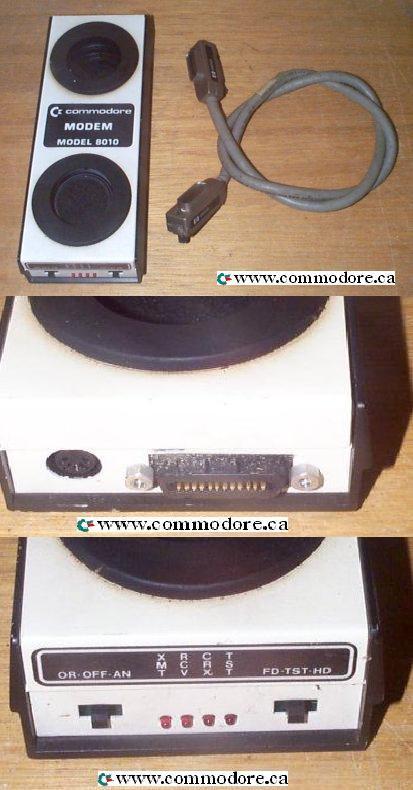
Thanks, I did find a few references to it, and here is a fairly decent
picture (shows front-on view as well as both ends):
http://www.commodore.ca/gallery/hardware/pet_acc_coupler1.JPG
Next time I update my site I will include my own pics, but I just updated
so that will be a little while.
I got it quite by accident - I talked my wife into a 2-hour detour on our
Thanksgiving getaway (would have been a 10-hour drive later) to pick up a
"small load" of equipment that had been promised to me - I also warned her
to "pack light" -- ha..ha.. I completely filled the back of my Jeep from
floor to ceiling (which we ended up hauling around all weekend). After I had
everything packed, the guy started digging out little bits of stuff from his
garage, which I kept stuffing into nooks and crannies, near the end he
offered me this acoustic coupler, and it was only because it said "Commodore"
on it that I decided to find room for it (by then it was getting pretty hard
to find ANY space) - it wasn't until several days after unpacking and going
through the stuff that I looked at it closely, and realized that it had the
PET-IEEE interface.
Regards,
Dave
--
dave04a (at) Dave Dunfield
dunfield (dot) Firmware development services & tools: www.dunfield.com
com Vintage computing equipment collector.
http://www.parse.com/~ddunfield/museum/index.html
So I'll be appearing tomorrow on The Screen Savers on G4TechTV (just about
everyone in the US should be able to catch it since the merger opened up
both collective channels to most major cable/satellite systems).
The live show airs at 4pm PST (California) and usually repeats a couple
times after that every 3 hours or so. Check your local listings for exact
air times.
I'll be demoing a PDP-1 front panel replica hooked to a laptop running the
PDP-1 emulator on SIMH, further running Spacewar! with Phil Budne's XY
simulator code. I've also constructed some Spacewar! controllers modeled
after the original MIT controllers that will be used to play the game.
The front panel will be blinking and all that. It should be interesting
(somewhat) to watch.
--
Sellam Ismail Vintage Computer Festival
------------------------------------------------------------------------------
International Man of Intrigue and Danger http://www.vintage.org
[ Old computing resources for business || Buy/Sell/Trade Vintage Computers ]
[ and academia at www.VintageTech.com || at http://marketplace.vintage.org ]
Hi,
I know very little about electronics and eproms so this question might be
really easy. I would like to know what the difference is between a 23512
eprom and a 27512 and if there are any differences if its possible to make
some sort of adapter. Had a look at some schematics and they looked the
same to me, data lines on the same pins etc.
Any help is welcome.
Ow the reason I want to know this is that I want to read some old roms in
my EPROM reader.
Cheers,
Stefan.
Folks,
Just collected a Mac XL (Lisa 2/10) that annoyingly was upgraded from a Lisa
1 then the back and top panels were stolen at a trade fair! This means I've
got Lisa 1 internals (R41 and R47 cut from the IO board, new ROMs etc),
keyboard, mouse but no twiggys or front panel, AND it has the screen kit
fitted. Oh, no widget either....the hard drive is a Seagate ST225 connected
to a parallel card in one of the 3 slots.
Anyone know if this kit is reversible? Anyone have any spare twiggys? :o)
This is as close as I'm going to get to a real Lisa 1 for the forseeable
future!
I also got Lisa 7/7 V3 docs and floppies, Macworks Plus box and floppies,
Lisa screws/fixings kit and a Stylewriter II with a Localtalk card fitted.
I haven't dared power it up yet! The Lisa is one of those beasts that's all
or nothing 'cos the PSU does more than convert 240V to 5 and 12 volts.
So, to recap, I'd like to get my paws on the following:
2 twiggys (possibly with the LisaLite board)
Lisa 1 front panel, top panel and back cover
Lisa 7/7 on twiggys (at least I know THAT's available)
the moon on a stick
a winning lottery ticket
:oD
--
Adrian/Witchy
Owner/Curator of Binary Dinosaurs, quite probably the UK's biggest private
home computer collection
www.binarydinosaurs.co.uk - the online museum
www.aaghverts.co.uk - *the* site for advert whinges!
www.snakebiteandblack.co.uk - former gothic shenanigans :(
Hi Guys,
I was recently given a Commmodore MODEM Model 8010 - this is
a Bell 103 (300 bps) acoustic coupler, which has an IEEE-488
connection for use with Commodore PET computers.
I am looking for:
- Information on the power supply - I did not get a power supply
with the modem - it has a 5-pin DIN type connector. Can anyone
give me the pinout and power requirements?
- Documentation? Anyone have a scan of the manual?
- Information on how it is used ... What sort of IEEE device does it
show up as? Is there "special software" that is used with it? etc.?
Regards,
Dave
--
dave04a (at) Dave Dunfield
dunfield (dot) Firmware development services & tools: www.dunfield.com
com Vintage computing equipment collector.
http://www.parse.com/~ddunfield/museum/index.html
Hope someone can help... I'd like to buy or trade 3 x BC08J DEC positive bus
cables... Berg connector one end, single-sided backplane plug card the other
end......... I'd like to hook my TC08 ( http://www.corestore.org/tc08.htm )
up to the positive bus / data break Omnibus cards in one of my pdp-8e boxes.
Takes five cables, I can only find two in my cable pile :-(
Thanks
Mike
http://www.corestore.org
I apologize again for cutting you off during our phone
conversation... I was expecting someone and they'd arrived.
And googling about my PC-1201 helped me remember that
it had two button batteries for backup of the memory...
and I remembered that I hadn't removed them in 15 years
or so. They were a bit corroded but no damage was done.
- John
>Date: Mon, 18 Oct 2004 09:37:57 -0500
>To: news(a)computercollector.com
>From: John Foust <jfoust(a)threedee.com>
>Subject: Re: museum phone number?
>
>At 08:39 PM 10/16/2004, you wrote:
>>What is the phone number for the Jefferson Computer Museum?
>>I'm the editor of Computer Collector Newsletter, a weekly(-ish) e-mail
>>publication for the hobby. In preparation for next month's Vintage Computer
>>Festival 7.0, I'm putting together a directory of computer museums across the
>>country.
>
>I'm at (920) 674-5200.
>
>The Jefferson Computer Museum isn't a real place for tourists.
>It's more of a virtual museum on the web.
>
>- John
I wonder how long it will be before some fool donates a PDP or some
other piece of kit we hold near and dear to our hearts, to these miscreants.
Sure, it's amusing when it's a 286 being pipe-bombed, but probably not
so much fun (for me, anyway) when they get their hands on an Amiga or a Sol.
It's all fun and games until someone loses an eye...
http://www.letsblowitup.com/default.shtml
Thanks Dan,
I feel a bit silly, but it was late last night is my excuse.
"DECpc 320P" in Google gave a link to floppy images on a COMPAQ site.
I will try them this evening, but it is good to know that the DECpc
"knows" a limited number of hard disks. If I can 'upgrade' to some
300 Mb of the 420 Mb capacity it is still better than the 40 Mb that
I have available at this point.
- Henk, PA8PDP.
> I know these machines only have 46 or so built in geometries of disk
> type. If your hard drive doesn't match these then I think your out of
> luck. But you still need the setup program. Have you tried
> ftp.digital.com ?
>
> Dan
Hi all,
I have this DECpc 320P which has a 40 Mb hard disk in it.
I installed a 420 Mb hard disk, but it keeps being recognized as 40 Mb.
I can not find a way to get into the BIOS, and those old PC's normally
had a "utility floppy" to get access to the BIOS ... fdisk says 40 Mb.
I guess it is OT as it is a PCP11-CA notebook computer from DIGITAL
with a 386 CPU and a sticker on it from DECcare (valid to Jun 1994),
so it must be at least 10 years old :-)
This beastie has a black&white screen (no colors), but the name is just
perfect (PCP*11*) and I would like to run E11/SIMH on it, but 40 Mb is
a little small and I have this 420 Mb disk ...
Who can tell me how to get into the BIOS (assuming that I can from there
change the hard disk drive parameters) ; a ZIP-file with the utility disk
would also be very welcome!
TIA,
- Henk, PA8PDP.
Hello,
I am the happy recipient of an Altos 586 system that was listed available
here a few weeks ago. I have the machine safe and up and running now. I
apparently was the only person who replied to the offer of the machine, but
am hoping there may be others here who have this system. Mine arrived with
Xenix 3.0 installed on the drive, but I have no installation media. I had
one of these systems years ago with the installation media but passed the
machine and diskettes on with the machine.
The Altos 586 is actually a rather interesting machine. It runs Microsoft
('pre SCO') Xenix, based on System 3 UNIX. This particular machine
supports five users on it's row of serial ports, all connected on dumb
terminals or terminal emulators. It's not a very robust UNIX but it is
interesting to note that Microsoft sold a UNIX capable of supporting 5
users on an 8086 processor in 512K of RAM (classic UNIX, of course, could
support many more on less RAM, but this is still a pretty cool machine).
Any help or leads people can offer for this machine would be greatly
appreciated.
Hi All
I didn't realize this was a group listing but that's OK. I would like to
let you all know that the PDP11 is gone. It went the following day.
I would like to clarify some things that seems to be the real issues with
the KSR33. I am located on the West Coast in Portland Oregon. My
mistake for not putting that in the original note. There has been concern
about the shipping costs and the actual packing of the TTY for shipment.
I have never had to pack up something like this or know what the costs
would be for shipping it to the East Coast. It seems like most of the
responses that I got were somewhere near the east coast.
I am really interested in getting rid of this TTY but I need some more
explicit help on how to prepare this for shipping.
Ken
Dear Sir, my name is Mauricio R. araujo, retired avionics instructor. I found your message concerning this subject surfing on internet. I?m interesting about 3400 floppy Drive . could you please send any informations ?(Sorry for my English...)
Mauricio
At 13:55 12/10/2004 -0500, you wrote:
>Hi Dave,
>
>You can still buy 1793s new from BGMicro for $4.49. Look on page 8 of
>their catalog:
>
>http://www.bgmicro.com/pdf/catalog.pdf
>
>Cheers!
Thanks - I don't know why they didn't turn up while I was googling,
but I downloaded their catalog, and looks like they have exactly what
I need so I have ordered a couple.
Regards,
Dave
--
dave04a (at) Dave Dunfield
dunfield (dot) Firmware development services & tools: www.dunfield.com
com Vintage computing equipment collector.
http://www.parse.com/~ddunfield/museum/index.html
>From: "ben franchuk" <bfranchuk(a)jetnet.ab.ca>
>
>A pdp-8/S is selling for $3,825. With prices like this who can afford
>computer collecting
>since all the 'kid you have free - if you carry it away' computers are
>long gone?
>
>
>
>
Hi
Although, I didn't bid on this item, what I hate the most
about eBay is that if I bid what I'm willing to pay and
I'm the second to highest bidder, I realize that the
other fellow would have gotten the unit for less, had I
not bid at all.
Somehow, I feel bad about that. If there were several
others out bidding me, then what the heck.
Dwight
Hello all,
I have two IBM PS/2 Model 30 computers in need of hard drives. The
IBM part number is 72X7568, and is a 20MB drive. This has IBM's
proprietary interface that includes power and data on the same cable.
If anyone has one or two of these drives available, let me know
off-list, and we may be able to come to a deal...
Thanks!
Rich B.
>
What is that, a TU-11?
--
UWM had a TU-56 drive and a TC08 controller, an RF08, and two RK05s
with mods that Bart and Sam did to the monitor to support it before
DEC supported them. It also had a high speed paper tape reader/punch.
>
Did you ever work with Dick Bartlein, or SaMilosovich?
--
Yes. Bart and Sam were still around when I started. I was one of the
people who dismantled the system when the 750 moved in. I still regret
giving the DECtapes away to Gary Coleman in Cleveland. There is a small
chance that Jeff Russ may have ended up with them when I bought Gary's
collection, but I've never been able to get a DECtape inventory from
him.
Any information on TSS-8 is always greatly appreciated [I have a
decent collection started] as well as hardware or actual software.
--
The version that John Wilson used and the one that I used at UW-M are
up at www.bitsavers.org/bits/dec/ascii (basic, johw, uwmMonitor)
Binary paper tape images from John are at bits/dec/pdp8/papertapeImages/set1
The LINCtapes from Lyle Bickley's PDP-12 should have a bunch of material as
well.
Various versions of the manuals are at www.bitsavers.org/pdf/dec/pdp8/tss8/
--
Finding hardware capable of running the monitor will be difficult. RF08's
were rare 20 years ago. All but the last versions of TSS/8 required either
DF32s or RF08s for swapping, but DF32s are only 32kwords. Bob Supnik has
TSS/8 running in simulation with SIMH.
O. Sharp <ohh(a)drizzle.com> wrote:
> [*] - Our house is much too small. We're working on moving to someplace
> larger where we can actually get our books and our hobby supplies and our
> shop equipment and our fine china and our bondage equipment _out_ of all
> the boxes we've had to put them in for the last few years.
Bondage equipment? Are you a BDSM couple? Is the wife ClassicCmp-friendly?
Who is the dom and who is the sub?
MS
> we added the KL8/E's and RK05's. Early RSTS (originally called Edusystem-
100) was
Which reminds me there used to be a series of "EduSystems" for the PDP-8 as I
recall. -25, -30, etc. The one I used was TU-55/-56 based, though one or more
might well have been disk-based. Have any of these been recovered?
John
Looks like I may be doing a rescue of the following in Eastern Conn....
It is a VAX 6000/610.
2 cabinets, approx 1000 lbs total weight.
2 CPU
CMD Technologies DSSI controller
ethernet capable
comes with up to a dozen 2 gig drives( formatted)
covers for the empty drive bays
pretty sure that it is 208 volt single phase, although the drive cabinet has
a 120v 30 amp twist lock connector on the cable. I dont know if this plugs
into the CPU cabinets PSU or what.
VMS docs and manuals
The bad news, if that I try to keep it, I will lose the wife. Without
debating the merits of this trade, let me just say that it will not be good
financially <grin>
So....What do I do?????
We've just been offered a Norsk Data ND100 (running Sintran), which
according to the 'offeree' is somewhat unusual in being a rack-mount
version rather than the more typical cabinet variety.
I doubt the museum can take it though as we're somewhat swamped in mini-
class machines at present, but it's destined for landfill otherwise.
Comes with full documentation and (likely) the controlling dumb terminal
and a Genicom dot-matrix printer. Was working when put into storage
apparently. The hard disk and floppy are also mounted in the rack (so no
seperate enormous cabinets! :-)
It sounds like the company may be hanging onto the rack it was put in
(which probably makes it a little easier to manage, at least for most UK
folks!) but that they may be disposing of the rack too.
The machine's currently in Reading, Berkshire.
There doesn't seem to be much info about these on the 'net - from what I
gather they're 16 bit minis with a bit-slice ALU, and microprogrammed
CPU.
Anyone able to save it? I can put you in touch if so.
cheers,
Jules
--
"We've had a lot of loonies around this place, but you're the first one
who thought the sunrise was made out of stale beer. Now are you going to
pick up your flute and leave, or shall I part your hair with this
crowbar?"
-----Original Message-----
From: Ron Hudson <ron.hudson(a)sbcglobal.net>
Sent: Oct 17, 2004 3:31 PM
To: simh(a)trailing-edge.com, Kevin Handy <kth(a)srv.net>,
Classic Computers <cctalk(a)classiccmp.org>
Subject: Re: [Simh] Gah! ascii don't work??!
On Oct 17, 2004, at 12:32 PM, Kevin Handy wrote:
> Ron Hudson wrote:
>
>> simh running rsts
>>
>> print chr$(27);"[2J"
>>
> Try
>
> print chr$(27+128);"[2J"
>
> RSTS plays odd games with the escape character (prints it as
> a dollar sign most of the time), and setting the parity bit helps.
> There are various "open" modes, and terminal settings that
> will bypass this, but this is easier.
>
>> prints
>>
Ready
10 print chr$(27+128);"[2J"
run
NEW 12:25 PM 17-Oct-84
?[2J
Ready
--------------
nope, that don't do it either. It's the same output on the terminal too.
What about +256? are they 8 bit chars? hmm no that would just be 27
again...
chr$ does a MODULO right?
----------------------
Ashley says:
Ron,
The way I always cleared the screen in Basic-Plus on RSTS on a VT50 or VT52
terminal was:
PRINT CHR$(155)+"H"+CHR$(155)+"J"
The CHR$(155)+"H" positions the cursor in the top left of the screen
Then, the CHR$(155)+"J" clears the screen.
This is all from memory. I haven't actually written that kind of code
since the late 1970s.
Ashley
Hi
I'm working on my PDP 11/60's and need info on the processor set.
The 1st board has LED's and thats a starting point if anyone knows
the status of the the LED's would be helpful. Or a source for
a on-line copy of the manual. ?? (kd11-k, m7872 1st board)
The second item is a maintiance manual on a TE-11 tape drive. These
look like a real challenge. ( Not sure if the TE-16 is close enough)
I don't have either manual.
Thanks, Jerry
Jerry Wright
JLC inc.
800-292-6370
Hi there,
Perhaps someone who is a little more familiar with the innards of the
PDP8/Ses can answer this...
Are the individual flip-flops arranged like a shift register or a set of
latches? In other words, when data is being clocked into a register,
does a bit get put into (say) AC0 then bumped along until it eventually
ends up in AC11, or are all the D lines of the flip-flops connected
together, with each one being clocked in turn?
Gordon.
In rummaging through classic computer stuff I haven't seen in a while, I
saw several things that are definitely a problem. What other things need
to be added to the list for collectors to watch out for?
* Leaky nicad batteries that will "eat" the circuit board traces
The early computers that come quickly to mind are the TRS-100, Lobo
Drives Max 80, NEC 8201A, 286 and later motherboards, and S-100
CompuWatch Clock/Calendar boards. Any others that should be added to
this list?
* Subterranean termites (eating manuals and other cardboard/paper
products)
Fortunately, they had only mostly started on the cardboard boxes, and
only damaged some of the manuals. I'm thinking that keeping the manuals
in ziplock bags might be a good idea for any manuals that need to be
packed away. This would also protect them from moisture if the boxes got
wet.
* Leaky storage areas leading to equipment and documentation being
ruined.
I've had quite a few books and manuals that had to be thrown away
(nothing really rare, hard to come by, or valuable) due to a leaky roof
where they were being stored.
It might be interesting to have a list of ways that the BIOS gets
accessed during startup. These are the ways that I know about; are there
others I've missed? I don't recall which keys work with what BIOS and
that might also be interesting information to have.
* Setup disk (IBM AT)
* Del key
* Cntl-Alt-Insert
* Cntl-Alt-S
* F1 key
* F2 key
* F10 key (Compaq)
On Oct 17 2004, 22:36, Fred N. van Kempen wrote:
> On Sun, 17 Oct 2004, William Donzelli wrote:
>
> > My objection is that there are probably hundreds of forums that
> > are better suited for Linux talk. Why post here, when it will annoy
some
> > people?
> Not just that, also include the highly political nature of those
> discussions; they're all much more suited for comp.os.linux.advocacy
> or the various Windows/Linux/xBSD technical groups/lists.
>
> NOT HERE.
I agree, if you want my vote.
--
Pete Peter Turnbull
Network Manager
University of York
Some of you folks who have been around long enough might remember Enrico
Tedeschi, the guy who got so frustrated by our collective inability to
understand his inarticulate premise that it was the human element, rather
than the computers, that was more important, that he threw up his hands in
disgust and left the mailing list for good.
Anyway, I heard him today on a BBC program about the 50th anniversary of
the transistor radio.
That's all.
--
Sellam Ismail Vintage Computer Festival
------------------------------------------------------------------------------
International Man of Intrigue and Danger http://www.vintage.org
[ Old computing resources for business || Buy/Sell/Trade Vintage Computers ]
[ and academia at www.VintageTech.com || at http://marketplace.vintage.org ]
Where are you located
++++++++++
Kevin Parker
Web Services Manager
WorkCover Corporation
p: 08 8233 2548
m: 0418 806 166
e: kparker(a)workcover.com
w: www.workcover.com
++++++++++
-----Original Message-----
From: cctech-bounces(a)classiccmp.org
[mailto:cctech-bounces@classiccmp.org]On Behalf Of Nico de Jong
Sent: Saturday, 16 October 2004 7:20 PM
To: General Discussion: On-Topic and Off-Topic Posts
Subject: Re: Serial Port Expanders
Are you thinking of adapters with e.g. 4 extra com ports ? I have some 8-bit
EISA cards (4 ports) and a PCI card from LAVA with 2 ports.
Nico
----- Original Message -----
From: "Parker, Kevin" <KParker(a)workcover.com>
To: <cctech(a)classiccmp.org>
Sent: Monday, October 11, 2004 7:28 AM
Subject: Serial Port Expanders
> I've got PC-MOS/386 and wonder if serial port expanders for a 386 or 486
can still be sourced. A hunt of the net opened a minefield of such devices -
hoping I can get some help from this list.
>
> TIA!!!!
>
>
> ++++++++++
> Kevin Parker
> Web Services Manager
> WorkCover Corporation
>
> p: 08 8233 2548
> m: 0418 806 166
> e: kparker(a)workcover.com
> w: www.workcover.com
>
> ++++++++++
>
> ************************************************************************
> This e-mail is intended for the use of the addressee only. It may
> contain information that is protected by legislated confidentiality
> and/or is legally privileged. If you are not the intended recipient you
> are prohibited from disseminating, distributing or copying this e-mail.
>
> Any opinion expressed in this e-mail may not necessarily be that of the
> WorkCover Corporation of South Australia. Although precautions have
> been taken, the sender cannot warrant that this e-mail or any files
> transmitted with it are free of viruses or any other defect.
>
> If you have received this e-mail in error, please notify the sender
> immediately by return e-mail and destroy the original e-mail and any
> copies.
> ************************************************************************
>
>
---
Outgoing mail is certified Virus Free.
Checked by AVG anti-virus system (http://www.grisoft.com).
Version: 6.0.774 / Virus Database: 521 - Release Date: 07-10-2004
************************************************************************
This e-mail is intended for the use of the addressee only. It may
contain information that is protected by legislated confidentiality
and/or is legally privileged. If you are not the intended recipient you
are prohibited from disseminating, distributing or copying this e-mail.
Any opinion expressed in this e-mail may not necessarily be that of the
WorkCover Corporation of South Australia. Although precautions have
been taken, the sender cannot warrant that this e-mail or any files
transmitted with it are free of viruses or any other defect.
If you have received this e-mail in error, please notify the sender
immediately by return e-mail and destroy the original e-mail and any
copies.
************************************************************************
Thanks Jay - let me know
++++++++++
Kevin Parker
Web Services Manager
WorkCover Corporation
p: 08 8233 2548
m: 0418 806 166
e: kparker(a)workcover.com
w: www.workcover.com
++++++++++
-----Original Message-----
From: cctech-bounces(a)classiccmp.org
[mailto:cctech-bounces@classiccmp.org]On Behalf Of Jay West
Sent: Saturday, 16 October 2004 11:45 PM
To: General Discussion: On-Topic and Off-Topic Posts
Subject: Re: Serial Port Expanders
I may have a spare Digiboard PC/8, isa board. It is only configured for 4
ports though. I will check this weekend and see if I still have it.
Jay
----- Original Message -----
From: "Parker, Kevin" <KParker(a)workcover.com>
To: <cctech(a)classiccmp.org>
Sent: Monday, October 11, 2004 12:28 AM
Subject: Serial Port Expanders
> I've got PC-MOS/386 and wonder if serial port expanders for a 386 or 486
> can still be sourced. A hunt of the net opened a minefield of such
> devices - hoping I can get some help from this list.
>
> TIA!!!!
>
>
> ++++++++++
> Kevin Parker
> Web Services Manager
> WorkCover Corporation
>
> p: 08 8233 2548
> m: 0418 806 166
> e: kparker(a)workcover.com
> w: www.workcover.com
>
> ++++++++++
>
> ************************************************************************
> This e-mail is intended for the use of the addressee only. It may
> contain information that is protected by legislated confidentiality
> and/or is legally privileged. If you are not the intended recipient you
> are prohibited from disseminating, distributing or copying this e-mail.
>
> Any opinion expressed in this e-mail may not necessarily be that of the
> WorkCover Corporation of South Australia. Although precautions have
> been taken, the sender cannot warrant that this e-mail or any files
> transmitted with it are free of viruses or any other defect.
>
> If you have received this e-mail in error, please notify the sender
> immediately by return e-mail and destroy the original e-mail and any
> copies.
> ************************************************************************
>
>
>
************************************************************************
This e-mail is intended for the use of the addressee only. It may
contain information that is protected by legislated confidentiality
and/or is legally privileged. If you are not the intended recipient you
are prohibited from disseminating, distributing or copying this e-mail.
Any opinion expressed in this e-mail may not necessarily be that of the
WorkCover Corporation of South Australia. Although precautions have
been taken, the sender cannot warrant that this e-mail or any files
transmitted with it are free of viruses or any other defect.
If you have received this e-mail in error, please notify the sender
immediately by return e-mail and destroy the original e-mail and any
copies.
************************************************************************
On Oct 17, 2004, at 12:32 PM, Kevin Handy wrote:
> Ron Hudson wrote:
>
>> simh running rsts
>>
>> print chr$(27);"[2J"
>>
> Try
>
> print chr$(27+128);"[2J"
>
> RSTS plays odd games with the escape character (prints it as
> a dollar sign most of the time), and setting the parity bit helps.
> There are various "open" modes, and terminal settings that
> will bypass this, but this is easier.
>
>> prints
>>
Ready
10 print chr$(27+128);"[2J"
run
NEW 12:25 PM 17-Oct-84
?[2J
Ready
--------------
nope, that don't do it either. It's the same output on the terminal too.
What about +256? are they 8 bit chars? hmm no that would just be 27
again...
chr$ does a MODULO right?
Well, Kermit did the same thing as the two terminal programs.. Even
though they say they are vt100 compatible, they still spew garbage and
don't make the proper screen with vt50dpy... however vt50dpy
running on a serial port on the host system works fine.. I just want to
work at that terminal.
what's funny is the terminal emulators work fine with teco/vt. I
suppose vt50dpy makes more use
of the terminal control codes..
Well, Thanks for the suggestions so far. :^)
On Oct 17 2004, 16:45, Michael Sokolov wrote:
> Is it the one that goes from the distribution board to the RX50?
> I don't have that one, but why can't you just make one yourself?
> It's just a 34-conductor flat ribbon cable with female header sockets
> on both ends, isn't it?
Yes, it is. I was about to suggest the same thing. An ex-PC floppy
cable will do, if you use the connectors without the twist (cut the
excess off if you want to be neat).
--
Pete Peter Turnbull
Network Manager
University of York
simh running rsts
print chr$(27);"[2J"
prints
$[2J
not clear the screen. VT100 sequence is ESC[2J as well as ansi
sequence! It does the same thing on the direct-serial-connected vt100
emulating HP terminal...
Gah!
Is it the one that goes from the distribution board to the RX50?
I don't have that one, but why can't you just make one yourself?
It's just a 34-conductor flat ribbon cable with female header sockets
on both ends, isn't it?
MS
Hi,
Does anyone (pref. in Holland) have one or two of the
17-00867-01 cables (BA123 RX50 cable) they'd like to
get rid of? I am in dire need for one, and could use
an extra one for spares..
Thanks,
Fred
Hi there:
I have a Vector Graphic MZ machine in nice condition except that the
Flashwriter II board seems to be broken, so using the Mindless Terminal
is out of the question. I understand that the version of the Monitor ROM
I have (either 3.1 or 4.0) does not support serial terminals so I'm dead
in the water unless I can dig up a 2.1 ROM or write my own (with two
young kids pretty doubtful I'll get to it real soon). Using a serial
terminal is fine with me until I can get a new FWII or fix the one I have.
So, I'm hoping someone out there has a Vector machine kicking around
with a 2.1 ROM - I'd love to simply drop a new ROM into the machine and
go, but a binary file will do or even a listing, I don't care. I'm happy
to reimburse you for your trouble and materials, of course.
Please reply or send me a note at gtulloch (at) shaw.ca if you can help
me track this animal down, I'd love to get this MZ back in action. Thanks!
Regards,
Gord
I seem to recall that the IBM setup disk would work on other computers
that required a setup disk.
Another useful piece of information would be the ways to access the HD
format routines on PCs. Somewhere I have a list that came from
ComputerLand that gives the debug entry addresses for a number of
controller cards. IIRC, the Xebex card required a sequence of debug
instructions to start the format routines.
> >> It might be interesting to have a list of ways that the BIOS gets
> >> accessed during startup. These are the ways that I know about; are there
> >> others I've missed? I don't recall which keys work with what BIOS and
> >> that might also be interesting information to have.
> >>
> >> * Setup disk (IBM AT)
> >> * Del key
> >> * Cntl-Alt-Insert
> >> * Cntl-Alt-S
> >> * F1 key
> >> * F2 key
> >> * F10 key (Compaq)
> >
> >It would be great if there was a database of all computer models that gave
> >this information, as well as other useful tidbits. It could be a Wiki
> >thing, or certainly an open, public thing that people could contribute
> >to.
>
> It would be nice if they could post the unique setup programs there too.
>
> Joe
I'm looking for a copy of the Motorola MC14500B Industrial Control
Unit Handbook. If anyone has a copy they'd like to part with (sell,
give), or loan for scanning, I'd be greatly appreciative (I'll cover
postage both ways).
--jc
Some of you may recall that back in early September I wrote about an HP
LaserJet IIISi that I disassembled and repaired after a capacitor
fried.
Well, even though I got the printer working again, I made a mistake.
Just about the time I got it working again, I left on a month-long trip
around the continent. (A few of you contacted me when I said I'd be
traveling around. I didn't actually end up rendezvousing with any of
you, and I apologize for it - I didn't realize how short of time I'd
end up being. A month-long trip sounds like a lot, but it ends up
being awfully short when there are five people/places to be visited,
and some of the trips in between are multi-day trips.)
Now, I want to put the printer back together, and there's the mistake:
I didn't leave notes to myself on how it came apart and thus how it
went back together. Would any of you happen to have a service manual
that could guide me? I could probably figure it out eventually, but if
I can save myself annoying mistakes, I'd like to.
/~\ The ASCII der Mouse
\ / Ribbon Campaign
X Against HTML mouse(a)rodents.montreal.qc.ca
/ \ Email! 7D C8 61 52 5D E7 2D 39 4E F1 31 3E E8 B3 27 4B
I have the following documentation available for the cost
of postage. The Remex manual is for a remex paper puncher/reader
interface card, the Dataram manuals (3) are for their core memory
box usable in PDP-11's.
Ex-Cell-O Corporation :
- Remex installation & checkout instructions PDP-11 interface
assembly model RIxxxxx/DE1/1xx/-000
card assembly 109831 and 113631
Dataram:
- Diagnostic Program BC-202/212 Bulk Core Memory System
- Core Mermory System DR-128
- Bulk Core Memory System BC-202
Does anynone here on the list have a Zenith Minisport that they want to
get rid of? If so, lets make a deal off list.
David M. Vohs
Digital Archaeologist & Computer Historian
Computer Collection:
"Triumph": Commodore 64, 1802, 1541, Indus GT, FDD-1, GeoRAM 512, MPS-801.
"Leela": Original Apple Macintosh, Imagewriter II.
"Delorean": TI-99/4A, TI Speech Synthesizer.
"Spectrum": Tandy Color Computer III.
"Monolith": Apple Macintosh Portable.
"Boombox": Sharp PC-7000.
"Butterfly": Tandy 200, PDD-2.
"Shapeshifter": Epson QX-10, Comrex HDD, Titan graphics/MS-DOS board.
"Scout": Otrona Attache.
(prospective) "Pioneer": Apple LISA II
(prospective) "Mercury": HP-85.
(prospective) "Evolver": Commodore Amiga 2000
"TMA-1": Atari Portfolio, Memory Expander +
Jim Isbell wrote:
>"Uncle Bill" has me by the balls until I find an OS that
>can either read or convert my existing files.
snip
>>creator, Adobe Photo Shop, Netscape, and particularly Easy Office 2001
>>which contains all my data in Easy Spreadsheet files that are not
>>compatible with Excel (even though they are supposed to be).
>>
Actually it sounds like Easy Office 2001 is the one crimping your
conversion. There are plenty of Linux tools that will do what Adobe
Photoshop does, if it doesn't run in the emulators. Same for PDF file
creation and manipulation.
The Netscape mail files will convert over pretty easily. I've done that
several times myself for various people.
However, if "Easy Office 2001" is your choice for spreadsheet and word
processing files, then talk to the people at www.e-press.com. And if you
only have the free version, then I wouldn't expect too much in the way of
support.
Just my $0.02...
Kelly
Sheesh, things just take so long to get around to...
THe flexo is running fine now, except for the punch. It was
of course just lubrication, the thing wasn't even dusty! The
belts are even OK, though I suspect they won't last that long
(old rubber).
The punch and reader are sticky; the punch hangs, repeating
the same character over and over (certain codes, "7", "A",
etc) so it needs a little more lube in those areas. I missed
a few linkages, hit those, and it improved. It punches fine,
the reader works, but some timing linkage isn't dropping out,
I'm sure it'll be fine.
Whale oil or whatever it wants is long unavailable (nothing
specified in the manual) so I'm using 0-weight synthetic motor
oil. Motor oil is generally UNrecommended in old gear, but the
new formulations (like synthetics) are pretty good and don't
gum up. I used synth grease for the open gears.
I've only got the offline Flexo cable, the one meant for the
second flexo for offline tape preparation. I had to leave the
second flexo behind, Ed wouldn't part with it (aargh). This
one seems fine though.
The cable is all cracked, like it's made of dried pasta. Slightly
scary, but that's what circuit breakers for.
There is a big electrolytic in this thing, a filter for the
relay supply, but I said hell with it, if it vents it vents,
but it seems just fine, lucky me. Of course it could be open
and relays will buzz, but I'll find that out later.
I was digging through some old papers and came across a 48-page
advertising brochure for the PDP-9, in great condition except it's
slightly "buckled" from sitting sideways in the box. It's called
"PDP-9, The Serious Computer" dated 11/67. I can email pictures.
Anyone interested? I have no idea if it's worth anything to anyone
but if so I'd at least like to break even on the postage ;)
thanks
Charles
On Oct 16 2004, 20:55, Stefan wrote:
> I am cleaning our my collection and am putting it all up for sale on
my
> website.
> List is growing weekly since I have to move in a while and a lot of
stuff
> has to go.
> You can find it under "For Sale" at
http://www.oldcomputercollection.com
I get a frame saying "This page uses frames, but your browser doesn't
support them." Well, it (Netscape) does. Your code is broken :-)
--
Pete Peter Turnbull
Network Manager
University of York
I have read on a message board, you have a schematic for the OMTI 5200 SCSI -> IDE/FLOPPY converter boards.
We are supporting an old Telecommunications system which uses this board in the Hard Drive controllers. We are searching for any information related to these boards, and would appreciate any information you could provide us.
We are also looking to purchase the boards complete, would you know of a source?
Thank you for your time.
Glenn McCarthy
Technician
Repair Group Limited
PH +64 7 850-4630
FAX +64 7 849-7722
E-Mail glenn.mccarthy(a)repairgroup.co.nz
Re:
> The 4032 and 8032 normally give a "beep series", which
> might be interpreted as "four beeps" - is it sort of one
> long continuous beep that warbles four times, or is it
> four distinct beeps?
The former.
> If the former, then it's normal, if the latter, then I
darn :)
> First, make sure the monitor is working (There's a
> brightness control on the back which may have been
We played with that control ... no change (i.e., nothing
visible of any kind on the monitor).
thanks, BTW!
(I picked this up at a local ham/computer swapmeet this weekend,
intending to pass it on to someone at the Vintage Computer Festival.)
Stan
------- End of forwarded message -------
--
Stan Sieler
sieler(a)allegro.com
www.allegro.com/sieler/wanted/index.html
Hi, Mike if you check with these people they have boot disk for the Osborne.
DYNACOMP,Inc.
4768 Route 89
Romulus, NY. 14541
Use this number (7103932193) on Ebay the you can get the phone number, mans
name is Fred. <A HREF="mailto:info@DynacompSoftware.com">info(a)DynacompSoftware.com</A> this is there link. Good luck, Al
DePermentier
They also have a lot of manuals on CD's.
Hi:
I was just given the following items for recycle/salvage and thought I would check with the board here to see if there was any interest in these items before they go to the great recycle bin in the sky.
1. One HP RZ24-S PC hard drive. It has 3200D on the label, plus some other numbers. I was given this unit, so I can't guarantee that it works, but it looks to be in excellent condition.
2. One Tandy memory board with 8-1MB 90ns memory sticks on it. It has several numbers on it and I'll list a few. 1700 361 Rev. D, 0508 LEIU 7V, 1990 (year of manufacture?), P/N 870-9838, 889-9216200. Again I was given this unit so don't know for sure if everything is OK with it, but it also looks to be in excellent condition.
Let me know is there is any interest in either of these items and for a few bucks plus shipping costs it can be yours. I will be glad to answer any questions on either of these items, just email me.
Bill Machacek
Colo. Springs, CO
I am cleaning our my collection and am putting it all up for sale on my
website.
List is growing weekly since I have to move in a while and a lot of stuff
has to go.
You can find it under "For Sale" at http://www.oldcomputercollection.com
Cheers,
Stefan.
Take a look on VCM (http://marketplace.vintage.org/) as I have Osbourne
software up for sale. I do have boot disks for it as well although they
are not up for sale.
On that note, has anyone looked into the boot disk archives that Don
Maslin kept?
> omg... i know you posted abot your ebay auction for your osborne 2 years ago, but you wouldn't happen to still have
> software for it would you?? i know this is a long shot, but ive been looking for software for this thing for years. i
> can't even boot it up because i have no disks for it. thanks for your reply!
>
> -Mike
Greetings. I have a Diversified Numeric Applications
MED16/Multiprocessor computer built in 1971, I think. It is a 16-bit
machine with 16k of core memory, a 64track magnetic drum, switch
console, analog input module, a serial MUX, paper tape reader. I used
to have a removeable disk pack unit and drum printer, but they are gone.
I do have an engineering manual with schematics, and a book of
diagnostic program listings. I've had to 'repackage' the major
components into a different 19" rack. The CPU, MUX, and DISC controller
bays are wire-wrapped 9000-series TTL logic. It's very cool. I'd be
interested in any information about this machine, and hopefully anyone
else who has one. fordms(a)gte.net
On Sat, 2004-10-09 at 22:47 +0200, Gooijen H wrote:
> I checked the wiring in my 11/70.
> On this M9312, TP1 and TP2 are connected to a small push button which is
> mounted on the bottom end of the front panel. Certainly not original,
> but that is how I got this 11/70.
> >From the MK11 MOS memory box above the 11/70 is indeed a small cable
> that connects to the M9312. This cable enters the 11/70 at the rear side
> and runs, over all the boards in the space where all the flat cables are,
> to the M9312. The white/black goes on TP3, and the blank one goes on TP4.
Thanks - just what I needed! :-)
> For its function, check the 11/70 manual :-)
Heh - I was staring at DEC engineering drawings for hours and it was
giving me a headache! I need to look at all the info for the memory
crate though as the CPU still isn't happy (the run lamp's permanently on
and we can't halt the CPU or toggle any data in from the front panel).
All cards look to be OK in the CPU though, but I suspect there may be a
problem with the memory...
> I do not use the battery for MOS memory backup in case of a power failure
> so I can not be of much help here.
No problem - we're not intending on using it either; I just wanted to
check that it should be OK without it. Time to do some reading this
week!
We did discover the limit of the power cabling in the museum room though
- with the 11/34, 11/44, HP T500 and a few assorted terminals running we
hit the 30A limit on the breaker and blew the power out to the room :-)
Luckily we've found a few power outlets that are on a different breaker,
so we can move some big stuff over onto that and spread the load. Still,
adding the Marconi machine, Elliott 803 and the Decsystem 570 with the
three massbus drives into the mix is going to make things interesting.
The startup sequence for everything is going to be pretty critical...
cheers
Jules
About twenty years ago I bought a dual tape drive "mass" storage
peripheral from a surplus outfit, United Products in Seattle. It was
for a long defunct personal computer of the '70s. The computer (which
I only ever saw in a few ca. 1978 ads in Byte) was an 8080-based
system, and I think it was billed as having color video graphics
capability. I don't remember the name of the company. Anyway, the
distinguishing characteristic of the system was the tape drive unit
used modified 8-track tape decks. That's right, 8-track *audio*
cartridges, the kind people make so much fun of these days.
The drive was housed in a blue metal enclosure with a black vacu-formed
plastic bezel for the two "drives." It had a DB-25 connector on the
back, though it definitely wasn't a standard RS232 interface. As I
recall, the tape head assembly in each drive had four read/write coils,
and it could move to one of two positions, up or down, thus giving
eight tracks total. Presumably this was to decrease the "seek" time.
I managed to trace through the circuit well enough to figure out how to
write and read back serial data on tape, at about 2400 bps, as I
recall. I had some fun hooking it up to a C64 in the lab to prove the
thing was actually working. I kept threatening a co-worker that I was
going to write a driver for the monstrosity to use on the lab's CP/M
machines. He had just built a Slicer, a 80186 SBC that was popular for
a few years in the mid-eighties, and the thought of such a kludge
horrified him. Heh.
I foolishly sold the dual tape drive and all my notes at a Seattle
Robotics Society auction sometime around 1989. I've done some poking
around on the web recently, but I have found zip about this machine.
Has anyone ever seen one of these tape drives? I actually have a
project that, perversely, requires something like this.
-RLN
Hello Tony,
I found a request on the internet today but the posting was made over a year
ago. I wish I would have seen it then
because I have this thing that I want to get rid of. It is a KSR33 Teletype
with the interface converted to RS-232.
It is still in working order but probably needs a new ribbon after sitting
for at least 20 Years.
I also have other vintage equipment that used to be connected to the
teletype. It is an old PDP11-05 (DEC).
Let me know if you are interested.
Ken
I've got PC-MOS/386 and wonder if serial port expanders for a 386 or 486 can still be sourced. A hunt of the net opened a minefield of such devices - hoping I can get some help from this list.
TIA!!!!
++++++++++
Kevin Parker
Web Services Manager
WorkCover Corporation
p: 08 8233 2548
m: 0418 806 166
e: kparker(a)workcover.com
w: www.workcover.com
++++++++++
************************************************************************
This e-mail is intended for the use of the addressee only. It may
contain information that is protected by legislated confidentiality
and/or is legally privileged. If you are not the intended recipient you
are prohibited from disseminating, distributing or copying this e-mail.
Any opinion expressed in this e-mail may not necessarily be that of the
WorkCover Corporation of South Australia. Although precautions have
been taken, the sender cannot warrant that this e-mail or any files
transmitted with it are free of viruses or any other defect.
If you have received this e-mail in error, please notify the sender
immediately by return e-mail and destroy the original e-mail and any
copies.
************************************************************************
I'm looking for a datasheet for an 8279 chip (Keyboard / LED controller), I
haven't found anything useful on the net. A PDF of the original Intel
datasheet would be preferred.
Thanks
-Neil
I have *five* Model 200s now, and not a single one
works, but I have just as many Model 100s, and every
single one works.
Is this just bad luck, or is there something defective
about the design?
Steve.
__________________________________
Do you Yahoo!?
Yahoo! Mail - You care about security. So do we.
http://promotions.yahoo.com/new_mail
Hi
I just saw a request for help in repairing
one of these on alt.folklore.computers. It seems
that this company was actually using this machine.
They are having problems with the printer ( no
wonder ). They are in the LA area. I would suspect
that after getting things printed out, they
might be interested in parting with it ( if they
had any sense ). It would be a good opportunity
for a local collector.
Dwight
Does anyone care to help this person? See below.
---------- Forwarded message ----------
Date: Fri, 15 Oct 2004 16:52:53 -0700
From: Robin Rae <freebace(a)fastmail.fm>
To: vcf(a)vintage.org
Subject: shot in the dark.
I've been ripping my hair out and was wondering if someone there could
help, I need to know how to access BIOS setup on a Philips P3230
(286/12.5) the only site i knew of that had manuals has disappeared. any
help would be greatly appreciated.
--
Sellam Ismail Vintage Computer Festival
------------------------------------------------------------------------------
International Man of Intrigue and Danger http://www.vintage.org
[ Old computing resources for business || Buy/Sell/Trade Vintage Computers ]
[ and academia at www.VintageTech.com || at http://marketplace.vintage.org ]
On Oct 15 2004, 18:30, Jules Richardson wrote:
> On Fri, 2004-10-15 at 10:36 -0700, Saddler, Chris wrote:
> > Returning to the original OT subject of this thread, where are the
rigid
> > rules of news group message format defined?
>
> Do you mean news (i.e. usenet), or email?
>
> Email seems to be covered by RFC822, and news (the message format) by
> RFC1036 - however a quick glance doesn't show either of them to
mention
> anything about signatures. I think it's just something of an unspoken
> standard that '--' on a line by itself is a signature separator - but
as
> far as I can tell there's nothing in the specs to say that, nor the
> actual purpose of the signature...
It's not "--" but "-- ", and must be immediately preceeded and followed
by a newline. It appears in RFC2646 as a "convention" -- but it's
worth remembering that RFCs are not (mostly) standards either -- just
conventions. There's a document called "son of RFC1036" which is the
basis that almost all modern newsreaders follow, anmd you'll find the
sig separator described in there. "son of RFC1036" was written, mainly
by Henry Spencer, one of the original authors of RFC1036, because there
are some errors/inconsistencies in RFC1036 which needed addressed;
there's also a widely-used document called the GNKSA (Good NetKeeping
Seal of Approval) where it appears as section 15. Both of these were
the result of much discussion on Usenet and appeared because although
the IETF produced many drafts of a successor to RFC1036, none were ever
finalised.
--
Pete Peter Turnbull
Network Manager
University of York
Email me off-list for details . . .
Jeff
________________________________________________________________
Speed up your surfing with Juno SpeedBand.
Now includes pop-up blocker!
Only $14.95/ month - visit http://www.juno.com/surf to sign up today!
Hi all,
Does anyone have (working ;-) contact information to get a hold
of Keith Bostic?
Thanks,
Fred
--
Fred N. van Kempen, DEC (Digital Equipment Corporation) Collector/Archivist
Visit the VAXlab Project at http://VAXlab.pdp11.nl/
Visit the Archives at http://www.pdp11.nl/
Email: waltje(a)pdp11.nl BUSSUM, THE NETHERLANDS / Mountain View, CA, USA
Ed> At 07:49 PM 10/14/2004, you wrote:
>>> Please pardon my ignorance here, I'm going out on a limb ...
>>>
>>> vt50dpy as in VT50/VT52?? VT100's were ANSI, VT50/VT52 were DEC
>>> specific. They used way different programming codes.
>> I suspect I misunderstood the manual when it said "Use VT50DPY for
>> vt50,vt52 and vt100 terminals."
>>
>> The manual also mentions command options like /24 (use 24 lines
>> instead of 12) and /DCA (use cursor control instead of spacing)
>> but I am not sure how to supply those via the run command as in
>> run $vt50dpy /24 /dca
>>
>> like that? It complains that it can't find some file, where run
>> $vt50dpy starts up fine.
>>
>> I suppose I need to make a CCL.. right? :^)
Ed> Ohhhhh RSTS! Light bulb goes off in head - light leaks out nose
Ed> and ears from empty skull.
Ed> Thought that sounded familiar, VT50DPY was the continuously
Ed> updating SYSTAT thing? The "bring the system to it's knees"
Ed> program (along with Plane)? Real VT100's had a hardware VT52
Ed> emulation mode, or you could NOT use DCA and it should run on a
Ed> VT100.
Ed> But, a 7 character program name?? Thought RSTS and the others
Ed> were 6.3?
The name was VT50PY, or DISPLY, or something like that.
In V10.1, that program would do ANSI escape sequences if the terminal
appeared to be a VT100 or above (i.e., a scope with XON support and no
fill). But, judging by the sources, that wasn't available before
V10.1. So you can change the code :-) or you can track down an xterm
with VT52 escape support, or you could add it to xterm (VT52 escapes
are pretty simple...)
paul
------------- Ashley's stuff below (pardon me for leaving the
large amount of the previous message up above. I know someone
will scold me for that)
I have VT50PY (yes that's the name) running on my PDP-11. And yes,
that's the program that used to bring the system to its knees on
weaker systems.
I am out of town right now, but in order to make the thing work, you
have to load the BASIC+ source for (I think) DISPLY.BAS and then
APPEND VT50.DPY (or something like that - I'm saying this from
memory and my memory is faulty). Then COMPILE it, and run it. If
you want to allow non-privileged users to run it, compile it to <232>.
It uses the VT50/VT52 escape sequences to clear and update the
screen, so you need to do VT50/VT52 emulation. It does have a
switch to allow you to use 24 line VT52 mode vs the standard 12
line VT50 mode.
I'll check on the details when I get back home. Sounds like you need
to make sure your terminal emulator is doing VT50 or VT52 emulation.
It runs fine on my real VT52s or on my telnet sessions with VT52
emulation.
Ashley
Vintage Computer Festival 7.0
Saturday, November 6 through Sunday, November 7
Computer History Museum
Mountain VIiew, California
Since the last VCF, the trials and tribulations of daily life made
their inevitability painfully attendant: bills came due, accidents
happened, bad days at the office were had, arguments broke out, and
the morning paper was thrown into the sprinklers yet again. Woe is
us! But lo, a bright and shining beacon of nerdilicious salvation is
on the horizon and draws nigh. The Vintage Computer Festival returns!
Vintage Computer Festival 7.0 is right around the corner, taking place
on November 6-7 at the Computer History Museum in Mountain View in
(still) sunny California. Flights are cheap and so is the admission,
so you have little excuse to stay home cramped behind your computer
trying in vain to craft that perfect Google search term. Just put all
that nonsense behind you and join us for some fanatical Festival
folly!
We are honored to once again have the Computer History Museum as our
sponsor!
And as always, we bring you yet another wonderful line-up of speakers,
exhibitors, and special events, including a 30th anniversary retro-
spective of Maze War, the original "first-person shooter" videogame,
plus so much more!
In fact, we're planning so much for this year's event, it might
possibly be even too much! Some of it we can't even mention yet
because we're still in the middle of planning it. So come on out and
watch us put on a gargantuan geek gala guaranteed to gasify your gall
bladder...either that or watch us crash and burn in spectacular style.
Either way, it's sure to be entertaining!
Exhibitors Wanted!!!
One of the best ways to enjoy the VCF is by participating directly.
Be an exhibitor! As an exhibitor, you get to be a part of all the
behind-the-scenes action. Plus you get a chance to show off your
favorite computer and perhaps even win an award for an outstanding
exhibit. The Best of Show award includes as a prize the Replica 1,
a software compatible re-creation of the legendary Apple-1 computer,
courtesy of its creator, Vince Briel. So don't delay, sign up today!
http://www.vintage.org/2004/main/exhibit.php
More information about Vince Briel's Replica 1 can be found on his
website:
http://home.comcast.net/~vbriel/
We've Got Lodging!
For out of town guests, the VCF has arranged a hotel room block at the
Residence Inn Palto Alto Mountain View, located within 3 miles of the
Computer History Museum and featuing, among other fine amenities, an
on-demand shuttle service between the Inn and the Computer History
Museum. The special VCF rate is US$79 per night. Reservations must
be made by October 15 to take advantange of this terrific rate so do
not delay! Full details are available here:
http://www.vintage.org/2004/main/lodging.php
Computer History Galore!
The VCF speaker schedule has moved back to a "track" style this year.
The talks are assembled into themes for the most part. We've got
another terrific line-up! Check it out:
Saturday, November 6
Track 01
Time Topic Speaker
------- ------------------------------------- -------------------
10:00am Using Vintage Computers in Forensics Fred Cohen
11:00am Documenting the BBS Jason Scott
12:00pm The Art of Textmode Christian Wirth
1:00pm History of FidoNet Tom Jennings
Track 10
Time Topic Speaker
------- ------------------------------------- -------------------
11:30am Confessions of an Entrepreneur Dr. Robert Suding
12:30pm VCF Ramblings Sellam Ismail
1:00pm Computer History Museum Update CHM Staff
Sunday, November 7
Track 01
Time Topic Speaker
------- ------------------------------------- ------------------
10:00am Early IBM History John Sailors
11:00am The IBM 360 Evolution and Revolution Jerome Svigals
12:00pm Early Microprocessor Design Nick Tredennick
1:00pm Maze War Retrospective Panel
Track 10
Time Topic Speaker
------- ------------------------------------- -------------------
10:30am Things You May Not Know... Evan Koblentz
11:30am Tipping Sacred Cows Tom Jennings
12:30am The Art of Vintage Computers Christine Finn
1:30pm Neo-Retro: The XGameStation Andre LaMothe
More information on the VCF 7.0 speakers can be found here:
http://www.vintage.org/2004/main/speaker.php
BBS Documentary Screening
Jason Scott, proprietor of textfiles.com--the Internet's largest
collection of historic textfiles--has completed work on his BBS
documentary. "BBS: The Documentary" spans across seven separate films
which cover every aspect of the world of bulletin board systems,
tracing the history of the BBS as well as the historic figures that
made it a distinctly unique mode of digital communication. This will
be the first public screening of the documentary, and audience input
>from VCF attendees will determine the final cut of the film series.
More information on the screening can be found here:
http://www.vintage.org/2004/main/screening.php
Computer History Museum Tours
As always, the Computer History Museum's terrific staff will be giving
VCF attendees tours of the Museum's fantastic collection. Tours are
held in the afternoon and run every half an hour. Tour information is
available here:
http://www.vintage.org/2004/main/tours.php
Buy, Sell and Trade at the VCF Marketplace
As always, one of the most exciting aspects of the VCF is the
Marketplace, where you can find a large and varied assortment of some
of the most fantastical old computer thingies anywhere. Find that odd
part you've been seeking out for your collection, then touch, smell,
even taste it if you like, before haggling out a deal. There is
simply no better place to buy and sell vintage computers than at the
VCF Marketplace. Vendor booths are still available. For more
information on selling at VCF 7.0, please visit:
http://www.vintage.org/2004/main/vendor.php
The VCF 7.0 BBS is Live!
Communicate with fellow VCF 7.0 attendees on the VCF 7.0 BBS! Set up
trades and carpools, talk about exhibiting, and discuss generally
anything about the upcoming Festival:
http://www.vintage.org/2004/main/bbs.php
So Much More!
Complete information about VCF 7.0, including the speaker schedule and
exhibit roster, as well as lodging information and driving directions,
can be found on the VCF 7.0 web pages:
http://www.vintage.org/2004/main/
Keep in mind that the VCF will from now on be held during the first
weekend in November.
;)
--
Sellam Ismail Vintage Computer Festival
------------------------------------------------------------------------------
International Man of Intrigue and Danger http://www.vintage.org
[ Old computing resources for business || Buy/Sell/Trade Vintage Computers ]
[ and academia at www.VintageTech.com || at http://marketplace.vintage.org ]