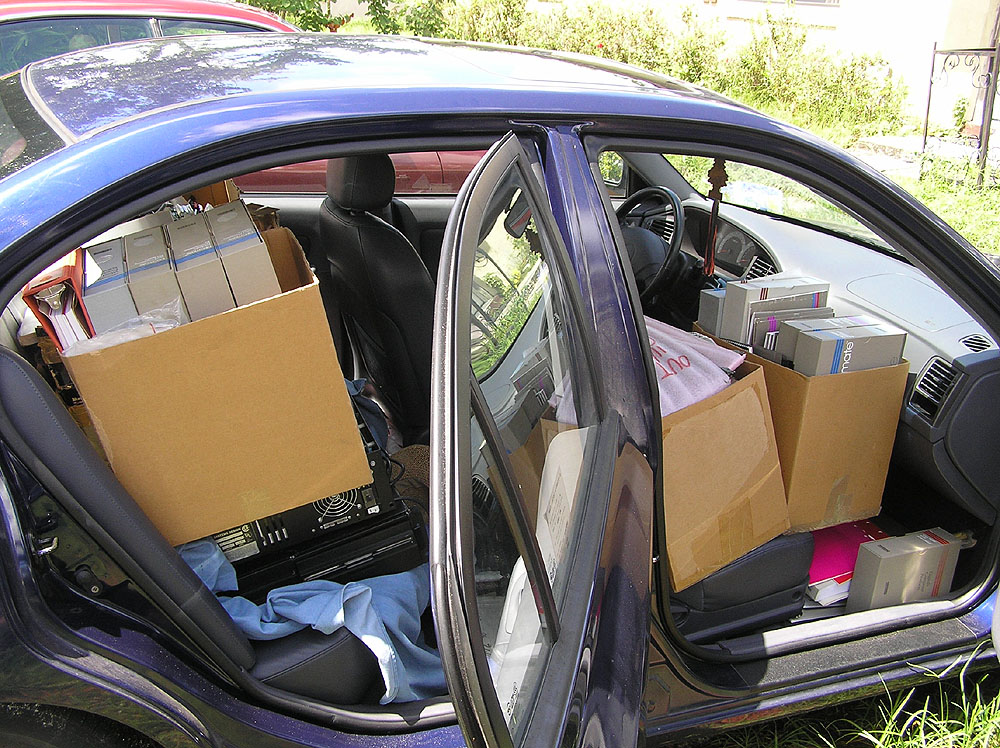
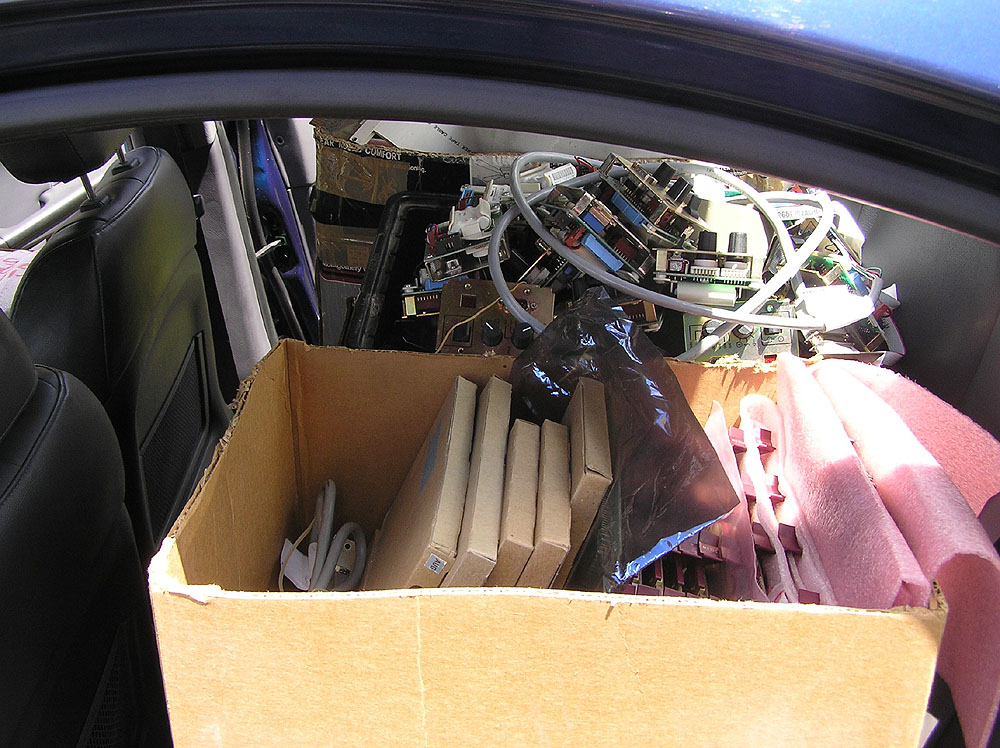
I visted Thom again yesterday and here's some of what I got.
<http://www.classiccmp.org/hp/PDP-8%20cards/carfull2.jpg> That's two boxs
of DECMate and Rainbow docs, a big pile of loose VAX docs, two DSD-440
drives and about five boxs of cards (mostly PDP-8). In other words, another
car full!
<http://www.classiccmp.org/hp/PDP-8%20cards/carfull2-l.jpg> Yes, that's
another box full of Cab kits in the middle! The cards in the boxs in the
near box are NIB prototyping cards! :-)
I brought home a car full last Monday but I already unloaded most of it
but here's a teaser showing some of it.
<http://www.classiccmp.org/hp/PDP-8%20cards/car%20full3.jpg>. These are
all PDP-8 cards.
Happy Collecting!
Joe
Can anyone id this card?
<http://www.classiccmp.org/hp/PDP-8%20cards/SMS-what.jpg> I can't find
anything that looks like a model number on it and it doesn't match the
drawings of the three SMS cards on Bitsavers. The most noticable difference
is that the other cards have lots of jumpers all over them and this one
only has a few (7) near the edge connector. The package that it was in only
says "Q-bus SMS Disk IO Bd". The markings on it are Prog Assy 1011939-0002G
(the G may be a 6), Assy No SMS 0003773-0001C, Fab 0003772-0001/c2, AW
0003771/B. Sorry for the crummy picture.
Joe
>From: "Randy McLaughlin" <cctalk at randy482.com>
>
>Manuals that I have scanned are being sold on CD's. At first it bothered me
>but after that I want my PDF's distributed and this is just another way.
>
>Randy
>www.s100-manuals.com
Hi
It is just rude to not ask.
Dwight
Hi folks,
We just got a brief note at ibm1130.org from a guy who spotted
an IBM 1130 "looking in a bad state in the street out the back
of the ibm edinburgh office."
I don't know yet if it's still there now -- this could have been in
1975 and he just got around to looking it up -- but is there anyone
in or near Edinburgh who might have the interest in rescuing it, if
it turns out not to be a false alarm? At the very least, it should be
inspected to see if any useful parts could be salvaged from it before
it gets hauled off by the garbage men.
Please let me know if you can help if it pans out. I'm trying to see
if I can get more details.
Brian
What programmer can I look for that has the ability to program a
2708?
--
The easiest ones to find will be Data I/0 29s with a Unipak or Unipak 2
INT 2708 EPROM DIP 21/27 VA A
Hi,
thank you all for the tips around my harddrive desaster. Next time I
will be wiser.
I have cleaned my removable disk's heads. Used isopropanol and a match.
Tried the crashed disk pack, crashed again immediately. Had to clean one
head again. Took another pack. No crash, no error display etc. Hope that
it stays ok.
Now I did:
> $dm4
.. And dm0,1,2,3 work same way....
Computer says:
>
> **THIS VOLUME DOES NOT CONTAIN A HARDWARE BOOTABLE SYSTEM ***
>
> 000034
> @
I would be glad if that is a message read from the disk partitions (like
the bootsector message on non-system disks in my pc).
When I boot dm5 (the Emulex controller configuration emulates 6 RK06
drives, don't know which one is the removable pack) the disk does
something (little seek operations), endlessly.
Busy light on the controller nearly always on and the disk seeks around
one position. Endlessly. No error indication. When I stop the CPU,
controller and disk activity also stop. When I let the CPU resume it
goes on and on and on. What's that? A strange program? I have waited for
nearly 10 minutes without any visible reaction. Seems to be reproducable.
What is the "modern way" to get software into the PDP11?
Is there anything like a RIM or BIN loader?
Has anybody a convenient solution - or do I have to start from scratch
writing my own tools?
Best regards,
Philipp :-)
I just realized what it is...
It's the exerciser for CDC 5440 fixed/removable discs (OEMed to TI as the DS10)
..of which I have several which need work.
Has anyone made a list of what is returned by the CS/80
'describe' command (opcode 53) on the different models
of discs?
I think someone asked this a while ago, but I never saw
anyone reply.
Before I e-bay the following items, I'm posting a list here in case
anyone's interested in making a reasonable offer or trade. Items
are located in western Baltimore County, Maryland.
*** Local pick-up only, unless someone makes it very worth my while ***
*** to ship these items. ***
- Tektronix 4014 terminal. I may have some additional Tektronix-terminal
goodies, such as manuals and tapes, but for a different terminal.
Shipping this isn't trivial or inexpensive... it cost me well over $100
to have this shipped here years ago.
- Over 100 Sun VME-bus boards
- Dual expansion chasis with power supply for a Q-bus PDP-11 or VAX
- *Possibly* a spare RL02 drive
- CRT from an old DuMont oscilloscope
- Large drawer for a 19" rack mount chasis... may need some additional
hardware, but I may have it all, will look.
- Parts of a PDP-11/34A (front panel, boards, power-supply bits)
- Umax flat-bed SCSI scanner... doesn't work, but should be good for
parts
- 17" older HP monitor... very heavy.
Notes:
Tektronix 4014 terminal: Appears to need an HV PSU repair. Caveat: I
began disassembling this several years ago for cleaning and lost some
screws that attach the power supply to the chassis. Also, I misplaced
my notes about what wires connect where.
Although that enormous power supply heat sink is looking very tempting
for an audio amplifier project, I'll try to avoid the temptation in the
interest of preservation.
Sun VME-bus boards: these include several possibly rare boards such as
fiber-optic network boards, cable modems, color printer board, etc.
Finally, all of these boards are accessible and I've cleaned them up, so
AFAIK, there are no spiders, etc. hiding on them. It's my preference to
have someone collect them all at once so that I don't have to ship one
here and there, etc. Of course, make it very worth my while and I'll
consider doing that. :-)
--
Copyright (C) 2005 R.D. Davis The difference between humans & other animals: an
All Rights Reserved unnatural belief that we're above Nature & her
www.rddavis.org 410-744-4900 other creatures, using dogma to justify such
Help to save the wild horses! beliefs and to justify much human cruelty.
I just ran across a Mindset RS-232-C module in some stuff that was
donated to our amateur radio club bazaar. A quick look didn't show the
computer it went with but if it is worth checking out, I can ask. Since
the bazaar is a fund raiser for our club, it is available for sale; any
thoughts on what it is worth ... and the computer if it should show up?
Our very own Chris Garcia has an interesting article on movie computers at:
http://efanzines.com/DrinkTank/DrinkTank29.pdf
For those who don't know what fanzines are, I will leave that up to Chris to
explain in some future issue.
Billy
So what would it take to kick off a CS/80 simulator
project for Linux or NetBSD - or even Solaris ?
--
It is creeping up on my interest list. This sort of started when
I won what turned out to be an incomplete HP PASCAL 2.0 source
document set on ebay a few weeks ago. There is ALMOST enough
information there to start on a simulation of the HP 9000/200
series, which is the most simple of the 68K machines that HP
built. So I've been digging around seeing what I can learn about
the 200 and 300 series over the past few weeks (DIO cards, et al)
and what software can be found (I picked up some 5" floppies with
BASIC and PASCAL a while ago)
I've picked up a couple of early 3xx boxes to take a look at (310,
320 and 340) and I just got a 9836 and 36C.
This was about the last of the machines that HP provided any sort
of technical detail on (schematics in the DIO card manuals, etc.)
Since the same cards were used on the HPUX workstations, there is
some information on them in the NetBSD code.
This also would be useful for a future classic HP3000 simulation
of the 4x series, which were CS/80 only.
I tried emailing Peter Brown about the work he was doing on raw
reads of CS/80 discs under WIN98 a few years ago to see what he
was able to learn, but haven't heard anything back yet.
Hi,
On a whim (hey, it's father's day :-) I decided to try and boot my
dormant 11/44 from the TU58 using the tu58 simulator.
Has anyone done this?
I'm being totally lazy and didn't look at the M7090 schematics (yet) and
assumed the TU58 20pin header is the same as the console 20pin header.
I also assumed it's RS-232 and not TTL. Further, I assumed it was
running at 38400 baud.
Naturally it didn't work right off the bat... :-)
I know my serial port and tu58 simulator are working since they boot my
11/730 just fine.
I'll look at the schematics but I thought I'd ask for any sage advice.
(luckily my spare UBI board had a DD boot rom on it)
-brad
Greetings, list(s).
First of all, let me say that I'm not in the habit
of making commercial posts; this isn't about that.
Also, this PSA is going out to several lists, so
if you see something severely OT please assume it
wasn't intended for you.
Having said that, the University of Oklahoma is
having a Surplus Property Auction tomorrow at 8am,
and I intend to attend. While doing the public
viewing today, I recorded some items of interest:
+--------+---------+---------+---------+---------+
| Lot - Description |
+--------+---------+---------+---------+---------+
| 818 - NextStation (slab) with video editing |
| equipment |
| 923 - HP 5328A 800MHz universal counter |
| 879 - AT&T 6300WGS |
| 870 - TexScan MSI CompuID |
| 996 - HP 3396A Integrator |
| 902 - HP 5085A Standby Power Supply |
| 924 - Digital Technology Inc. DTI-575-116600 |
| 830 - Box of 10sealed Carlisle Summit 1600 BPI |
| / 6250 CPI tapes |
| 730 - Panasonic TR-90T1G LKB Bromma Computer |
| Display |
| ??? - Assorted Rohde & Shwarz instruments |
| ??? - Assorted Fluke Scientific instruments |
| 861 - HP Visualize C200 (PA-RISC) |
| 862 - HP Visualize C200 (PA-RISC) |
| 863 - HP Visualize C200 (PA-RISC) |
| ??? - Compaq ProLiant ML530 PII Xeon 6x 36.4Gb |
| Ultra SCSI |
+--------+---------+---------+---------+---------+
IF YOU WANT ME TO BID FOR YOU:
- contact me no later than 2005.06.25.06.00GMt-6
(six am saturday morning)
- preference will be given to those who arrange
to get their funding to me BEFORE the auction
starts (paypal dhbarr at gmail dot com)
- you will need to arrange to get meatspace
contact details to me before bidding starts
- I -will- bid on things for you up to your
pre-arranged amount, within reason
- shipping and packaging will also be minimal
Regards,
dhbarr at sdf dot lonestar dot org
PS: In case someone else is in the OKC area:
2101 W. Tecumseh Road, Norman OK
www.ou.edu/property_control/index.htm
In particular I'd like to know what crt controller was
used in the Rainbow. Grassy arse
__________________________________
Yahoo! Mail Mobile
Take Yahoo! Mail with you! Check email on your mobile phone.
http://mobile.yahoo.com/learn/mail
On Sat, 18 Jun 2005 cctalk-request at classiccmp.org wrote:
> Message: 12
> Date: Sat, 18 Jun 2005 22:21:29 +0200
> From: Philipp Hachtmann <hachti at hachti.de>
> Subject: PDP11/23+ goes on
> To: General Discussion: On-Topic and Off-Topic Posts
> <cctalk at classiccmp.org>
> Message-ID: <42B48249.7070409 at hachti.de>
> Content-Type: text/plain; charset=us-ascii; format=flowed
>
> Hi,
>
> thank you all for the tips around my harddrive desaster. Next time I
> will be wiser.
> I have cleaned my removable disk's heads. Used isopropanol and a match.
> Tried the crashed disk pack, crashed again immediately. Had to clean one
> head again. Took another pack. No crash, no error display etc. Hope that
> it stays ok.
:-)
That was to be expected. A disk crash don't happen without a reason.
That said, I've very seldom ever have it happen, and several times, the
drive survived fine, but the pack was junk.
People around here are perhaps a bit paranoid on cleaning. :-)
But then again, it all boils down to how important it is for you to
succeed. Cleaning is never wrong, but personally I can't say that not
having cleaned that much stuff still haven't hurt me.
> Now I did:
> > $dm4
> .. And dm0,1,2,3 work same way....
>
> Computer says:
> >
> > **THIS VOLUME DOES NOT CONTAIN A HARDWARE BOOTABLE SYSTEM ***
> >
> > 000034
> > @
>
> I would be glad if that is a message read from the disk partitions (like
> the bootsector message on non-system disks in my pc).
Yes, that is something that is read from the disk.
RSX (don't know if the other OSes do the same) write a special boot block
on non-bootable disks. This boot block basically just prints the above
message, and halts. All that fits fine into 512 bytes.
I don't know if more modern hardware have any checks in the boot code in
the boot roms as well, which might say something. But the above message is
exactly the message in the boot block RSX creates on non-bootable disks
anyway.
> What is the "modern way" to get software into the PDP11?
Phew. Tape normally. Small, modern PDP11s usually have TK50, and software
is distributed on TK50.
Older PDP11s usually had/have large 1/2" tape drives. Software is also
distributed on that.
Tapes are bootable, and holds a system designed just for installing the
rest.
> Is there anything like a RIM or BIN loader?
Yes, but that is very old technology. People don't have paper tape on
PDP-11, and haven't for a very long time.
> Has anybody a convenient solution - or do I have to start from scratch
> writing my own tools?
If you're on a bare system, with only disk drives to play with, then your
options are limited. The best might actually be to pretend you have a
TU58, which speaks through a normal serial line, but is a block device,
which most PDP11 can boot from.
> Message: 22
> Date: Sat, 18 Jun 2005 23:24:38 +0200
> From: Philipp Hachtmann <hachti at hachti.de>
> Subject: Re: PDP11/23+ goes on
> To: General Discussion: On-Topic and Off-Topic Posts
> <cctalk at classiccmp.org>
> Message-ID: <42B49116.5050203 at hachti.de>
> Content-Type: text/plain; charset=us-ascii; format=flowed
>
>
> >>I use a ZIP drive and a Qbus MSCP disc controller.
>
> Sounds interesting. But where to get that MSCP controller??
MSCP SCSI controllers, to be exact. There are several different types of
MSCP controllers, and not all of the talk SCSI, nor can you hook a ZIP
drive to them.
That said, I believe Qbus MSCP SCSI controllers occasionally pop up on
ebay. Or you find someone tossing them out.
> >>A software-only solution (though much slower) is to use the
> >>TU58 simulation software that is around
>
> ... But with it I would be able to boot my machine. At the moment I have
> NOTHING to boot up my system, copy disks, transfer data from pc etc...
Yes. The TU58 is a cheap block device, for which the hardware on the
PDP-11 side actually is just a serial interface. Most boot roms know how
to boot from one, and an emulator for the actual TU58 exist.
> But I have a lot (perhaps more than 100) of these 8" disks.
>
> Can I boot RT11 or RSX11 from floppy???
Yes.
Oh, and I would probably try to align the drive correctly if I fooled
around with it. You never know when another pack shows up which you might
want to read.
Johnny
Johnny Billquist || "I'm on a bus
|| on a psychedelic trip
email: bqt at update.uu.se || Reading murder books
pdp is alive! || tryin' to stay hip" - B. Idol
Any of the CDC machines that were multiples of 6 bits also used tapes like
this. The 8th bit was start of a file or page of memory. The 7th bit
indicated the start of the word - 12, 18, 24, 36 or 60 bits.
Billy
Hi,
I was wondering if anyone could point me towards any assembly language documentation for a DG MV 9600C configuration.
Thanks in advance for any help.
john
Hi, I just acquired a few IBM POWERstation 370 in unknown condition. I can
probably make a couple good units out of the 4 I have - they have disks,
memory, etc, were decommissioned from a university environment.
I also have a diagnostics set of a cdrom labeled "POWERstation / POWERserver
Diagnostics v4.1.5" and a floppy labeled "POWERstation / POWERserver High
Capacity (2M byte) Diagnostics Test Diskette", and an external plextor cdrom
to use to install software.
Right now, since I don't have an AIX 4.3.3 (last supported) install cdrom set,
I just want to get a machine powered up and tested. I don't have a 13W3
monitor, nor keyboard or mouse (which I think are non-standard).
So, first question is: I plugged up a standard null modem cable to the first
serial port, took out the video card, powered up (with nothing in the drives)
and saw: nothing. Do I have to make a special cable, or reset the firmware,
or something?
Also, how does IBM deal with licensing AIX - is it tied to the machine, so if
I get a media kit I'm ok to install it? Or did I just buy some boat anchors?
Thanks for any info,
Jeff Davis
I am hoping there is some what to make it
do something other than act as an SRM server (since I have no more SRM
stuff...)
--
SRM coax cards are easy to find (there are a BUNCH on eBay right now for
$10 ea)
The hard thing to find is a stand-alone server (esp software)
Digging on the list, someone had one running as late as 2003. May be
a good thing to ping him to try to get the bits before they disappear.
On the other hand, just finding DIO enet cards would probably be more
useful.
>
>Subject: Re: PDP-8s and -10s
> From: Al Kossow <aek at bitsavers.org>
> Date: Tue, 14 Jun 2005 20:50:02 -0700
> To: classiccmp at classiccmp.org
>
>It seems to me that they could have made
>the -10 line real mainframes (no, IBM and the BUNCH did not consider the
>-10 line real) with just a little effort and not much money.
>
>--
>
>DEC through the 'golden age' didn't go after that market. They tried to
>target scientific rather than corporate computing.
One of the oddities is that the 36bit machines the 10s/20s were well
known for their timesharing with huge nubers of users.
>One of the things that isn't talked about much is how the PDP-6 just about
>killed DEC because of all of the resources it consumed to get it out the door.
The PDP-6 was the VAX-9000 of the 60s.
>
>They did eventually abandon their 'fan base' to go after the corporate
>market, and that was the beginning of DEC's downfall.
It was successful for the 80s but the growing PC price performance
numbers were hurting the backroom mainframe style systems. The
breakpoint was when 486 powered system with basic decent graphics
(640x480x8) hit the streets with Win3.11. We had the scientific
workstation wars of the late 80s this would be the business
workstation war. Several PCs for 2500$ each or less was cheaper
than a microvax of any flavor.
Allison
Has the on-tape format of 98xx HP85 or 264x carts been documented somewhere?
Did HP use different encoding schemes in their different product lines?
I dug through the stuff on the 264x terminals that I just put up, and they
don't mention anything in detail about the tape format itself.
If you REALLY wanted to try recovering a bad tape, you could digitize the
analog info from the read amp and reconstruct it with software (assuming
you knew what the format was)
It may not be too bad with the HP DC100 style tapes, since I beleive the
heads are fixed, like the DEC TU58s.
I had been looking for this info for over 10 years, and I finally found
it this morning while looking around hpmuseum.net for the manuals on the
9817. I looked at the service manuals for the 9153/9154, and found what
is probably the only useful bit of info in those manuals (I really don't
intend to use a torque wrench to tighten the top cover screws....)
The HP9154 (certainly the later versions) use an HP hard disk drive with
a single 40 pin power and data connector. It's a strange HP interface,
with raw data and an 8 bit control bus. And from what I remember, one
end goes to an ASIC on the 9154 cotnroller board, the other to an ASIC in
the drive, so it's hard to work out what all the signals are...
Anyway, from that manual, here's the pinout of the cable. Please save
this soemwhere, if you need it, you _really_ need it....
1 Rd Data
2 Gnd
3 Wr Data
4 Gnd
5 Wr Gate
6 Gnd
7 4MHz Clk
8 Gnd
9 Rd A-D converter
10 Gnd
11 +5V
12 Gnd
13 +5V
14 Gnd
15 +12V (Motor)
16 Gnd (Motor)
17 +12V (Motor)
18 Gnd (Motor)
19 Dr Sel 0
20 Dr Sel 1
21 Dr Sel 2
22 Dr Sel 3
23 Wr D-A Converter
24 NA/B
25 Sector Pulse
26 Index Pulse
27 Wr NIC Chip
28 Reset
29 +12V (Motor)
30 +12V (Motor)
31 Fault
32 +12V
33 Data Bus 7
34 Data Bus 0
35 Data Bus 6
36 Data Bus 1
37 Data Bus 5
38 Data Bus 2
39 Data Bus 4
40 Data Bus 3
-tony
Well, I was hooking up my KY11-LB front panel to the machine I have moved into a BA11-K, and after testing it several times, I saw a (not very big) flash from near the PSU and the machine quit working. I inspected the power supply modules (two H7441 regulators and one H745) and it wasn???t fuses, so I am baffled as to what happened.
I was SOOOO close too, I had got the front panel lights working, the RUN light flashed on power up like it should have, then I realized the power switch was on backwards, cause when you set it from DC OFF to POWER ON (or whatever, this is off the top of my head) it would turn off. I switched the leads, then that???s when it popped.
I had the leads connected to J3 on the power distribution portion of the power supply (the module that has the power cord attached to it)
I hope there???s someone on here who can help me, I???m good with computers, but I???m not an electrical engineer, so I???m lost!
Thanks!
Julian
>
>Subject: Re: DEC M8350 - KA8E posibus interface
> From: "vrs" <vrs at msn.com>
> Date: Mon, 20 Jun 2005 16:46:49 -0700
> To: "General Discussion: On-Topic and Off-Topic Posts" <cctalk at classiccmp.org>
>
>
>> Forgot to answer this - MSC-8 hex MOS memory cards are handy - if they
>> are 1/2 populated with 4Kbit chips, they are 16KW, fully populated
>> with 4Kbit chips they are 32KW. If you happen to find the same card
>> with 16Kbit (4116) chips, that's a whopping 128KW. You'll need a KT8A
>> to address it, another late model card of limited use - RTS/8 used it,
>> and I am pretty sure there was a RAM disk driver for OS/8 to use the
>> upper 96KW as storage.
Is there a schematic {printset} around for MSC-8?
As to boards other than memory and CPU a front pannel board either
the 8E style or 8A is very handy too. Then serial IO cards are useful.
I use my 8f with two serial cards, one for console and one to simulate
a high speed PTR/PTP.
Allison
If you recall there was a discussion about tape catridges that could
not be read because their coating was falling off.
I was thinking, what if we reverse the tape, so that the magnetic
head come in contact with the plastic backing and not the oxide.
Would it be possible to read the data then?
Obviously I am talking about a one-off operation, just to get the
stuff off the tape.
**vp
Any ideas as to what it is, and if it can be made to do something
interesting?
--
Sounds like some variant of the 9817 / 9000/210
http://hpmuseum.net/display_item.php?hw=7http://hpmuseum.net/display_item.php?hw=120
you'll find some field service manuals hiding under "Product Documentation"
there
googling 50960A turns up "200/SRM Server"
SRM is a 700kbit networking scheme which uses the 5096x DIO-I interfaces
So it was probably the server side box for an SRM network
>From: ard at p850ug1.demon.co.uk
>
>> Ok, use a magnetic fingerprinting powder on it ;) Actually, I've heard (and
>> seen) there IS a liquid solution that will let you visibly see the dots on
>> mag tape.
>
>There is. It generally goes under the name of 'Magnasee' and is a
>colloidal suspension of iron oxide in some suitable volatile liquid. I
>have no idea where you get it nowadays, though.
>
>-tony
>
>
Hi
Would the stuff used for magnaflex work. This is available
through most machine shop supply houses.
Another thought would be to stablize the media with something
like art spray ( acrylic ). A vary thin coat should only
reduce the highs a little but should stablize the coating.
I'd try it on a spare tape first.
Dwight
> Ethernet is another good way; DECnet is available on Linux.
That assumes a fair amount of software working on the 11 side.
Has anyone written something dumb that could squirt a block-level
mass storage image (dealing with bad blocks..) through a DELUA or
DELQA to a destination at the raw packet level?
I've been thinking of doing a ethernet nub debugger for Qbus
machines that would work that way (which I why I just picked
up a DELQA..)
jscheef at yahoo.com
--- cctech-bounces at classiccmp.org
<fauradon at frontiernet.net> wrote:
> Hi all,
> Thank you to all who showed some interest. I have
already received requests
> for specific machines. Unfortunately some of them
were already gone. I will
> try to make a list out of the ones I have on my site
and list only the ones
> that are still available.
> Right off the back the IBM 5110 and the SWTPC are
long gone (to list
> members).
> Here's the list.
> ACT_______Apricot F10
> Apple_______Apple ][
> Apple_______Apple //e
> Apple_______Apple //c
> Apple_______Apple IIgs
> Apple_______Apple ///
> Apple_______Mac Plus
> Apple_______Mac Classic
> Apple_______Mac SE
> Apple_______Mac SE/30
> Apple_______Mac II
> Apple_______Mac II cx
> Apple_______Mac II vx
> Apple_______Performa 631
> AT&T_______UNIX PC
> Atari_______1040 STF
> Commodore_______Amiga 1000
> Commodore_______PET 4016
> Commodore_______B128
> Compaq_______prolinea
> Epson_______QX10
> Franklin_______ACE 500
> Franklin_______ACE 1000
> Franklin_______ACE 2100
> Heath/Zenith_______ZT 1
> Heath/Zenith_______H100
> Heath/Zenith_______H89
> Heath/Zenith_______Z100
> Heath/Zenith_______Z90
> Heath/Zenith_______?286
> Hewlett Packard_______HP-85
> Hewlett Packard_______HP-87XM
> Hewlett Packard_______HP-150
> Hewlett Packard_______HP-150II
> IBM_______PC jr
> IBM_______PC XT
> IBM_______PS/2 Mod 60
> IBM_______PS/2 Mod 80
> Micron_______Pro Magnum Plus
> Sinclair_______Timex Sinclair 1000
> Sinclair_______Timex Sinclair 1500
> Tandy_______TRS80 Model III
> Tandy_______TRS80 Model 4
> Tandy_______Tandy 1000 PC EX
> Televideo_______?
> Vector Graphic_______Vector 3
> VTECH_______Laser 128
> Amstrad_______PPC 512
> Apple_______Mac Portable
> Commodore_______Commodore SX-64
> Compaq_______Compaq Portable
> Compaq_______Compaq Portable II
> Grid_______Gridcase 1520
> IBM_______Personal Portable Computer
> IBM_______PS/2 Mod 70P
> Jonos_______Jonos
> Kaypro_______Kaypro 1
> Kaypro_______Kaypro II
> Kaypro_______Kaypro 4
> Kaypro_______Kaypro 16
> Osborne_______Osborne 1
> Toshiba_______T3100
> Apple_______Powerbook duo 230
> Apple_______Powerbook duo 280c
> Compaq_______LTE Lite/20
> Compaq_______LTE Lite/25
> Compaq_______LTE Lite/25c
> Datavue_______Spark
> Epson_______HC 41
> Epson_______HX 20
> Epson_______HX 40
> Grid_______GridPad 1910
=== Message Truncated ===
__________________________________________________
Do You Yahoo!?
Tired of spam? Yahoo! Mail has the best spam protection around
http://mail.yahoo.com
> From: "Phil Spanner" <pspan at amerytel.net>
[Various snips...]
> I just received an email from a close friend that used to work for a memory
> manufacturer called Fabri Tek Inc. here in Amery WI.
> Manufacture Fabri Tek Inc. Date of manufacture circa 1970
Does your friend have any recollection of a Fabri Tek memory expansion
for a DEC PDP-11/20? This would have been a 19in rackmount with Unibus
interface. I ended up with complete memory unit, interface cables,
some documentation, etc, but unfortunately not the processor. Believe
the memory was removed from a PDP-11/20 but I don't have confirmation.
Regards,
Garry
This raises an interesting question: if you replaced a real PDP-11 that
people connected to online with an emulated one, would they be able to
know the difference?
--
If you were using SIMH you would, since it doesn't perform cycle
accurate simulation. Unless you ran it on fairly slow modern hardware
it would be faster than the original.
This wouldn't be the case for MESS, though, since it is based on
the cycle-accurate MAME processor cores.
I'd love to add this pac to the www.series80.org collection.
I live in Philadelphia, so please send me email with the
cost of shipping and I'll send you the money.
I can scan the listings as bitmaps, but I don't have the time
to make HP-85 programs out of them.
If you require the originals returned to you after I make copies
let me know and I will return them to you ASAP.
Thanks
**vp
I've been in contact with an individual representing a university who has a
metric butt-load of software and documentation for various systems.
Primarily DEC PDP-11/RT11, some vax, and possibly some DG. He seemed to key
in on RT11 software & Docs, as well as DEC handbooks, etc.
He is located in north east Alabama, east and slightly north of birmingham.
I would like to see Jerome Fine get first perusal of any RT11 images. The
donator's primary concern is that this load of stuff NOT hit E-bay, and
instead be scanned and archived for the public. Resting in private hands is
ok, as he'd like to see the stuff get use as well. He just doesn't want to
see someone turn a buck on ebay with it. I suspect most if not all of us
would agree to this.
So, anyone in north east alabama want to organize a pickup and distribution
(probably to Al at some point for archiving)?
Jay West
Going through the front of my container I found a Stride 440 that I
need to sell. Made in Reno, Nevada!
I believe it is a 68020 machine with 3 megs of ram and a 60 meg MFM
Fujitu hard drive and is a decendant of the Sage running p-system.
Looking at the cardset it appears it might have been upgraded from the
original 68010 to a 68020. It also looks to me that the modem chipset
was never installed.
It has a three board set with a smaller board in the middle of the
larger two boards. I think the small one is the 68020.
The case shows some damage however none is visible to the electronics
or drives. Missing a floppy drive cover, from the layout of the cables
a second was never installed.. I have not powered it up and am not
going to, I will leave that up to the new owner.
Pictures at
http://members.aol.com/innfosale/stride/front.jpghttp://members.aol.com/innfosale/stride/back.jpghttp://members.aol.com/innfosale/stride/inside.jpghttp://members.aol.com/innfosale/stride/label.jpghttp://members.aol.com/innfosale/stride/inside2.jpg
and two kind of panoramic photos with canon photostich.
http://members.aol.com/innfosale/stride/panfront.jpghttp://members.aol.com/innfosale/stride/panback.jpg
More and higher res pics avalable
Given it is unusual I thought I would offer it to the list first. From
my google search it is a fairly rare machine. I could find no pictures
at all.
I need to sell it so I am open to offers. Anyone interested?
Out of the dig is an original 5150 CPU, a 5 slot 2nd gen two floppy,
CGA, AST mem & I/O.
A Vector MZ5 S100 MF with 8 cards I have yet to inventory, no drives.
On ebay at the moment is the last Teletype model 43 I have, sale
number 5210816476 ending in a couple of days.
--
Paxton Hoag
Astoria, OR
USA
All:
I just received a parallel ASCII keyboard and I'm looking for pinout
data on the keyboard itself. There's a 2x20 card edge connector on the
right-hand side. Two power pins are identifyable on the foil side. The
keyboard contains a GI AY5-2376 chip for which the datasheet was kindly
supplied by various list members earlier in the week.
The keyboard is manufactured by Clare-Pendar. It has the following
numbers on the back "721017-K2" and "P/N SW1366". Before I start probing
with a meter I wanted to poll the list first for data.
Thanks in advance.
Rich
Rich Cini
Collector of classic computers
Build Master for the Altair32 Emulation Project
Web site: http://highgate.comm.sfu.ca/~rcini/classiccmp/
/************************************************************/
Those of you following this list for the last few years know about
my "giveaways". I've been getting rid of stuff that has sat in my
basement or garage for a number of years without getting touched.
In my hardware heyday, I would spend every moment of my free time
playing with Q-bus, Unibus, or S-100 hardware. I also had my foot
in the water w.r.t. PDP-11 OS releases (in some cases both feet
in the water) in the late 90's and got to do a lot of fun things
with very specialized classic hardware (CAT machine backprojectors
hooked to PDP-11's, for example).
But since I got a "steady job" in 2000 running a $10 Billion peripheral,
factored in with three young kids, I didn't have the time to treat
the hardware well. All of it has gone on to find good homes, and I want
to thank the volunteers who helped me get rid of it. There's still
a few items but they have owners allocated already :-).
I still do tinker with electronics, but my attention as of late
is on analog circuitry (often with microcontroller assistance) rather
than older bus-based computer systems. I've also acquired a few
R-390A's that I'm happy to say are on their way to being cleaned up
and restored. (OK, the R-390A has a digital display on the front,
but it's not digital electronics!).
And I will still endeavor to take care of the PDP-10 software
archives, the DECUS PDP-11 and PDP-10 collections, etc. It's been
years since any software was donated to those archives so I haven't
put a lot of effort into them. But it's good to know that there a
are a couple of PDP-10's around the world that are now usefully
"up" thanks to the archives.
I've made a few attempts to break into the professional archiving
world w.r.t. digital media, but so far I've been universally ignored.
Of course, those who ignore me would rather just talk about the
problem rather than solve it. So maybe that's why I don't register
on their radar. You have seen and probably will see me rant and
rave on this subject occasionally!
So that's my non-retirement. I hope to keep involved and do relevant
things into the future, and in the past few months I've been browsing
this list more than I did in the early 2000's.
Tim.
Does anyone know anything about a computer (I assume) called the
HP50960A, and how it relates to the HP9817A (if it does at all)?
While looking in my collection for something else, I came across one.
It's a box about the size of one of the later HP hard disk units (a
9133H, for example).
Inside, there's a SMPSU, a backplane (which has an 09817- part number),
and a mainboard flat in the bottom of the case. The backplane has 6 of
what I assume are DIO slots (as normal, every other one can take a card
with a connector bracked, the intermediate ones are for memory cards).
There's a row of 2 pin fuses along the top of the backplane, and what
looks like some kind of voltage regulator circuitry down the edge. The
mainboard connects to the backplane by a DIN41612 (96 pin) connector at
the bottom.
After remoing the cover, expansion cards, disconnectign the fan plug from
teg backplane and removing 2 more screws, the mainboard and rear panel
slide out. Onthe mainboard are an HPIB port and RS232 port
The mainboard contains : 68000 CPU. 68440 (DMA controller I think),
1TL1-0004 (HPIB controller), 68681 (serial chip), 2 ROMs, 512K DRAM, a
couple of PALs, TTL glue, etc. One corner of the mainboard is not
populated, it looks like it could have taken an ethernet interface, with
postiions for a DA15 and BNC connector.
There are no memory cards in my machine, but there are 3 expansion cards:
'Human Interface HPIB'. External connectors are 24 pin Blue Ribbon for
HPIB, a 3.5mm jack socket (mini phone jack) labeleld 'speaker
(8$\Omega$)' and a keyboard connector which I am sure is HP-HIL. The main
chips on the boardare a 9914 HPIB controller + buffers, a 1RD2-0001
HP-HIL interface, a microcontroller (8041?) a76494 sound chip (!), and
TTL glue.
'Composite video 98204A'. There's an unmarked BNC on the bracket, I am
sure that's the composite vidoe out. Also 2 unmarked screwdriver-set hex
switches. Main chips are a 6845 CRT controller, 6116 SRAM, a couple of
EPROMs, TTL glue. There's an unmarked 20 pin header inside, near the back
panel.
'SRM Coaz Interface'. Afain with a BNC connector on the bracket, and an
LED marked 'Transmit activity'. Clearly a network card. Stuck on (but
official) labels give the select code as 21 and the node address as 00.
There are labelled DIP switches on the board to set these. Main chips
include a Z80A, Z80A-CTC, Z80A-SIO, 6264 SRAM, ROM, an NatSemi analogue
part (from the number) which is not in the equivalents list, and which
seems to link to the BNC connector, a PAL, and TTL glue
Any ideas as to what it is, and if it can be made to do something
interesting?
-tony
>From: "Pete Turnbull" <pete at dunnington.u-net.com>
>
>On Jun 17 2005, 7:47, Cini, Richard wrote:
>
>> Rules-of-thumb like this are great to know. The fan, I'm sure,
>was
>> installed (like the IMSAI) blowing IN because the inside was caked
>with
>> dust. So, I made it an exhaust fan (no filter).
>>
>> As I work on the IMSAI, which has no filter either, I will swap
>it
>> around, too.
>
>Don't do that. If it's designed to blow in, changing the direction to
>blowing out will alter and probably reduce the cooling. Why? Because
>turbulent air is lots better at cooling than a laminar flow, and will
>reach more parts of the case. You get turbulent air from the "blow"
>side of a fan, but laminar flow towards the inlet side. You may also
>be directing the airflow away fom some component that previously was
>cooled, eg a PSU. Moreover, if you alter the flow direction so that
>air is being sucked in through all the other orifices, it will be
>entering via the fronts of disk drives etc (well, probably not on this
>machine but I'm thinking of the general case). That's the last place
>you want the dust. Far better it drops on the motherboard where you
>can vacuum it out. Better still, fit a filter.
>
Hi Pete
You have to remember, these machines were designed
by electrical engineers, not an air flow expert. Yes,
the original used in blowing air.
I did a quick check of the temperatures of the boards
in my IMSAI with the in blowing air and some boards
seemed to get no flow at all. Reversing the flow made
a big difference. The powersupply in the IMSAI, at least
is large enough to need little more than some air flow.
The only parts that might get uncomfortable are the
filter caps. Any additional heat here is harder on them.
Still, after many hours of use, with almost a full
boat of 8K boards, I find the caps to be mildly warm.
While not specifically schooled in air flow, I did
work for a company that made burnin ovens. I learned
a lot about air flow there. We would often get request
>from customers to fix the airflow in in-house designed
chambers that had really poor temperature distribution.
Mil spec states how uniform the chamber should be.
Like I said, many of these were designed by electrical
engineers.
Dwight
Hi
Do these boards come with the read and write circuits or
are they just core boards? One can check ebay for
typical core board values ( not that great ).
Dwight
>From: "Phil Spanner" <pspan at amerytel.net>
>Hi all,
>
>I just received an email from a close friend that used to work for a memory
>manufacturer called Fabri Tek Inc. here in Amery WI.
>He wants to sell some old core memory boards that came out of a drum memory
>from a power plant. Here is the info he sent to me.
>
>Manufacture Fabri Tek Inc. Date of manufacture circa
>1970
>
>Model 688
>
>Size 55 C/M X 38.5 C/M X 2.5 C/M
>
>Core 32k x 20 or 655,360 cores
>
>Core size 18 m/in ferrite lithium
>
>P/N 256-0234-00
>
>unit has 2ea 100 pin connectors .125 centers
>
>I am not sure how many he had, but I think he mentioned $ 30.00 each plus
>freight.
>
>
>
Hi list,
On a recent trip back to (that same) dumpster, I managed to rescue an
HP Waveform Analysis Pac for the Series 80 machines. It's a plastic
folder with white vacuum-formed compartments inside, and it contains
the following:
* one 5.25" floppy with a printed Waveform Analysis Pac label ((C)
Hewlett-Packard 1980)
* a transparent plastic bag containing a sheet of stickers, each of
which say "SELECT CODE n" where n goes from 1 to 9 (7 is missing)
* an HP-85 format tape with printed label "HP-85 WAVEFORM ANALYSIS PAC"
* another similar tape but with a handwritten label and a piece of
HP-85 printout inside the case with it showing the directory listing
* around 12 code fragments/pieces of program output printed out on the
HP-85 internal printer, one of which has some line graphs on it
* some photocopies of program listings from the HP-85 printer (one of
these is dated 6/2/81)
* an approx. 1/4" stack of code listings (not sure if these are for
user-written code or vendor-supplied code, but they appear to be for
waveform analysis)
These are available to anyone who would be able to place them in a
public archive available to the classic computing community (Vassilis?
Al?). If the long listings are user-written, someone has put a lot of
effort into this, and I'd like to see it live on.
Usual deal with shipping - I'll ship to anywhere, you pay shipping cost though.
Ed.
> He wants to sell some old core memory boards that came out of a drum
memory
If he still has it, the drum is a LOT more valuable than the core
planes.
Hi all,
I just received an email from a close friend that used to work for a memory
manufacturer called Fabri Tek Inc. here in Amery WI.
He wants to sell some old core memory boards that came out of a drum memory
>from a power plant. Here is the info he sent to me.
Manufacture Fabri Tek Inc. Date of manufacture circa
1970
Model 688
Size 55 C/M X 38.5 C/M X 2.5 C/M
Core 32k x 20 or 655,360 cores
Core size 18 m/in ferrite lithium
P/N 256-0234-00
unit has 2ea 100 pin connectors .125 centers
I am not sure how many he had, but I think he mentioned $ 30.00 each plus
freight.
I'm sure this has happened to other people here, but it never happened to me
before, and it ticks me off. Someone posted an eBay ad for this vintage
handheld and blatantly copied 680 words of my work into the "more
information" part of the item's description. Above that part, they also
stole extensively (some text and the top photo) from the site
www.datamath.org, but at least the jerk includes that link... There is no
credit for my work at all.
http://cgi.ebay.com/ws/eBayISAPI.dll?ViewItem&item=5783764229
Having said that, it's an excellent price. I would bid up to $50-$75 for
this if I didn't already have one.
-----------------------------------------
Evan Koblentz's personal homepage: http://www.snarc.net
Also see http://groups.yahoo.com/group/midatlanticretro/
*** Tell your friends about the (free!) Computer Collector Newsletter
- 750 readers and no spam / Publishes every Monday / Write for us!
- Mainframes to videogames, hardware and software, we cover it all
- W: http://news.computercollector.com E: news at computercollector.com
Hi Gary
You didn't say what the main issue is? The problem
could be most any thing. Have you listened to the
recordings to make sure you don't have dropouts?
Do you have an oscilloscope that you can use to
look at what the Z80 sees?
If you have dropouts caused by wrinkled tapes, wind
the tape backwards and let it sit for about a week.
If it is folded, you may have to do some more serious
recovery tricks. I've has to do this on Poly88 tapes.
It may also be a problem in the Sinclair. Sometimes
the ceramic capacitors become leaky. This can effect
the threshold of the input comparitor.
There are still more things to look at. Try to isolate
the problem. Things like, are you get partial reads?
And things like was meantioned about tape speeds.
If you are using a hi-fi unit, most line outs don't
provide enough signal level.
Dwight
>From: "Gary Sparkes" <mokuba at gmail.com>
>
>I'm having a hell of a time getting any program to load, so far I've been
>Totally unsuccessful.
>
>Anyone have any tips or advice they can throw at me?
>Would love to hear anything at all :)
>
>
>
This appeared in my twice daily feed of ABC News. My appreciation to ABC
news for the story
+++++++++++++++++++++++
*Inventor who kicked off computer revolution dies*
Jack Kilby, the inventor of the integrated circuit which provided the
basis of the computer chip revolution, has died of cancer.
Mr Kilby, 81, made the discovery 47 years ago, when, as a recently hired
engineer at Texas Instruments, he was left to work alone in a laboratory
while most of his 7,500 colleagues were taking a company-wide summer
holiday.
As a newly hired employee, Mr Kilby did not qualify to take a holiday in
August 1958.
"It was a very quiet time and he got a lot done," said Pat Weber, 65, a
long-time colleague and friend of Mr Kilby, who retired as vice chairman
of the Dallas-based Texas Instruments in 1998.
The company announced his death on Tuesday.
Mr Kilby, a seminal 20th century inventor whom many place in the same
league as Henry Ford and the Wright Brothers, won the Nobel Prize for
Physics in 2000 for his work.
By hand-wiring together multiple transistors, Mr Kilby's invention -
about half the size of a paper clip - spawned a revolution in
miniaturisation in which millions of circuits are now housed on tiny
pieces of silicon used in devices from computers to elevators to
pacemakers.
Working in parallel at pioneering Silicon Valley company Fairchild
Semiconductor, Mr Kilby's rival Bob Noyce sketched out his own ideas for
an integrated circuit in an engineering notebook - then forgot about it,
according to a new biography of Mr Noyce's life.
Mr Kilby, on the other hand, immediately recognised the value of his
invention and built a working prototype in a matter of days, according
to associates at Texas Instruments.
Mr Kilby and Texas Instruments were first to patent the integrated
circuit.
Mr Noyce, who later co-founded Intel Corp, and Fairchild Semiconductor
are credited with making the integrated circuit manufacturable on a mass
production basis.
While the competition sparked a 25-year patent battle between the
companies over royalties from the invention, the "Kilby patent"
weathered all legal challenges.
++++++++++
Kevin Parker
Web Services Consultant
WorkCover Corporation
p: 08 8233 2548
m: 0418 806 166
e: kparker at workcover.com
w: www.workcover.com
++++++++++
************************************************************************
This e-mail is intended for the use of the addressee only. It may
contain information that is protected by legislated confidentiality
and/or is legally privileged. If you are not the intended recipient you
are prohibited from disseminating, distributing or copying this e-mail.
Any opinion expressed in this e-mail may not necessarily be that of the
WorkCover Corporation of South Australia. Although precautions have
been taken, the sender cannot warrant that this e-mail or any files
transmitted with it are free of viruses or any other defect.
If you have received this e-mail in error, please notify the sender
immediately by return e-mail and destroy the original e-mail and any
copies.
************************************************************************
>
>Subject: Re: DEC M8350 - KA8E posibus interface
> From: der Mouse <mouse at rodents.montreal.qc.ca>
> Date: Wed, 22 Jun 2005 14:08:23 -0400 (EDT)
> To: "General Discussion: On-Topic and Off-Topic Posts" <cctalk at classiccmp.org>
>
>> Top posted for size reasons...
>
>I suppose actually bothering to take a few seconds to edit it down to
>the relevant bits is out of the question?! (In case you're wondering
>what I'm talking about, see below.)
>
>>>>> [...use 4164s instead of 4116s?...]
>>>> What you need to do is [...pinout hackery...]
>>> Do you have any info on which ones used 7 bit refresh and which ones
>>> used 8 bit refresh?
>
>/~\ The ASCII der Mouse
>\ / Ribbon Campaign
> X Against HTML mouse at rodents.montreal.qc.ca
>/ \ Email! 7D C8 61 52 5D E7 2D 39 4E F1 31 3E E8 B3 27 4B
Hi Mouse,
I didn't edit it for a very specific reason. I wanted the full
content repeated but I didn't bury it at the bottom for those
curious od the answer.
Nominally I do bottom post and snip!
Allison
>From: "der Mouse" <mouse at rodents.montreal.qc.ca>
>
>> Top posted for size reasons...
>
>I suppose actually bothering to take a few seconds to edit it down to
>the relevant bits is out of the question?! (In case you're wondering
>what I'm talking about, see below.)
>
>>>>> [...use 4164s instead of 4116s?...]
>>>> What you need to do is [...pinout hackery...]
>>> Do you have any info on which ones used 7 bit refresh and which ones
>>> used 8 bit refresh?
>
Hi
Most 4164's are 7 bit but look out for TI and some Samsung
chips that are labled as 4164's but are actually 8 bit refresh.
There is no easy way to tell by the part number. Even the Samsung
ones are only different by the date code and rev letters!!
The easiest way I've found to check is to put them in a
Z80 system that uses the Z80's refresh address generator.
If it holds data it is 7 bit.
Dwight
Top posted for size reasons...
I do not know for sure that 7bit refresh is required. It's likely
(not totally ceratin) that if you only using part of the array
you will require 8 bit refresh anyway.
known 7bit refresh 64k DRAMS, NEC, Mitsubushi, Hitachi HM4864
Known 8bit refresh TI, Moto(they also had hidden refresh).
There may be others.
Allison
>
>Subject: Re: DEC M8350 - KA8E posibus interface
> From: "Joe R." <rigdonj at cfl.rr.com>
> Date: Wed, 22 Jun 2005 08:50:05 -0400
> To: "General Discussion: On-Topic and Off-Topic Posts" <cctalk at classiccmp.org>
>
>At 11:58 PM 6/21/05 +0100, you wrote:
>>> Also... does anyone know about the differences between 4116 and 4164
>>> chips enough to answer the question if one could use 4164s as long as
>>> one a) prevents the non-TTL supplies from reaching the chips (modify
>>
>>What you need to do is isolate pins 1 and 8 from the board and reconnect
>>pin 8 to +5V IIRC
>>
>> 4116 4164
>>1 -5V N/C
>>8 +12V +5V
>>9 +5V A7
>>
>>That leaves the extra address line tied high, so you only use 1/4 of the chip
>>
>>> board, modify sockets, modify pins...) and b) possibly tie up or tie
>>> down the extra multiplexed address input. Can you refresh 1/4 of a
>>> 4164 and have just that part stay refreshed? I ask because I have a
>>
>>There were 2 types of 64K DRAM. One of them used 7 bit refresh (same as
>>the 4116, on the same pins), the other, older/rarer one need all 8
>>address lines to be used for the refresh (this was a royal pain on
>>Z80-based machines, where the CPU provides a 7 bit refresh only).
>
>
>Tony,
>
> This is good info. Someone should post it as a mini-FAQ.
>
> Do you have any info on which ones used 7 bit refresh and which ones used
>8 bit refresh?
>
> Joe
>
>
>>
>>I have personally replaced the odd 4116 with a 4164 as I've just
>>described and had no problems. Maybe I've been lucky in finding 7-bit
>>refresh chips (which are the more common type), maybe it works anyway.
>>
>>> serious wad of new 4164s from COMBOARD stock, but 128Kw of 4116s (8 x
>>> 12) is more than I have lying around.
>>>
>>
>>-tony
>>
In a message dated 6/22/2005 12:34:36 AM Eastern Standard Time,
news at computercollector.com writes:
I'm sure this has happened to other people here, but it never happened to me
before, and it ticks me off. Someone posted an eBay ad for this vintage
handheld and blatantly copied 680 words of my work into the "more
information" part of the item's description. Above that part, they also
stole extensively (some text and the top photo) from the site
www.datamath.org, but at least the jerk includes that link... There is no
credit for my work at all.
http://cgi.ebay.com/ws/eBayISAPI.dll?ViewItem&item=5783764229
Having said that, it's an excellent price. I would bid up to $50-$75 for
this if I didn't already have one.
-----------------------------------------
I had that happen to me. I was just looking at stuff, and noticed some
familiar sounding text related to a computer for sale, a PS/2 I think. I asked
the seller a question and told him I knew what he did and that I demand the
text either removed or attributed to me. He complied and said he would not do it
anymore. Never had any other issue beyond that.
>From: vp at cs.drexel.edu
>
>If you recall there was a discussion about tape catridges that could
>not be read because their coating was falling off.
>
>I was thinking, what if we reverse the tape, so that the magnetic
>head come in contact with the plastic backing and not the oxide.
>Would it be possible to read the data then?
>
>Obviously I am talking about a one-off operation, just to get the
>stuff off the tape.
>
>**vp
>
Hi
Maybe with a good analog recording and a lot of signal
processing. The high frequency loss will be quite high.
depending on the tape it self, the depth of recording
may make the difference. If it is recorded well through
the magnetic media, there may be enough signal.
The main issue is that you'd most likely need to make
several passes to be able to recover the high frequency
information above the noise level. This would require
maybe doing 180 degrees several times before unrolling
the next 180 degress of tape. One would also need to
keep track of how far each layer was because the
print through of the next layer would compete with the
one your trying to read.
One moght also go to one of the newer moer sensitive
magnetic sensing methods used in current hard disk
to increase the signal to noise.
It would be a lot of work but I think with a budget
of $250K I could read one. Additional reads would be
at $10K each.
Dwight
>From: "Philipp Hachtmann" <hachti at hachti.de>
>
>Hi,
>
>after several cleaning orgies, my SMD disk (AMPEX DFR-996, see other
>posting) seems to start working.
>Now I want to backup the data contained on the disks. These are RSX-11
>volumes. I cannot read them under RT11. And I don't know if I can make a
>diskette RSX-11 to inspect the data. Or is there a preogram which runs
>on rt11 and is able to understand rsx11 filesystem? That would be great!
>
>My first idea for the backup was "copy/device dm0: tt:" which works. But
>there is no error correction and still only 19200 baud.
>
>So tell me, what are the really cool methods to transfer data between a
>PC and a real PDP11 at a reasonable speed? SCSI controller and SCSI
>disk? Something else? Ethernet?
>
>Or is a backup over serial line a normal thing...?
>
>
>Regards,
>Philipp :-)
>
Hi
Serial is still the easiest. If the PDP11 has a parallel
printer port and your willing to write some code, sending
by parallel port can be quite fast. Most all current
day PC's still have a parallel printer port. The serial
port has gone the way of the dinosaur.
Dwight
I thought someone had located docs for the 2468 or 2469 terminals (HP), but
I don't see them over on bitsavers.
Need pinouts, suggested wiring diagrams for both ext baud and int baud.
I think there's some of this info in the BACI manual, I'll look there now.
But I'd like a copy of the terminal manual if it's still floating around.
Jay
Not a Schlage lock, Medeco (YUCK!! if security was this important, than
why'd they put the power switch out front??)
4.3.3 runs pretty well if you have memory. I ran it with 1 of my cards
(128M) and it was really slow. 256 ran pretty well. KB/M are standard
PS/2. the "official" RS/6000 keyboard has a speaker in it, but it isn't
necessary. Video is 3W3 or 13W3, seems pretty standard. If you need to
foil the lock, I can trace the switch positions later today for
kludging purposes. I wouldn't advise trying to go directly to IBM,
they seem to be the "snooty Maitre'd" that would rather not sell
anything than stoop to deal with the likes of an *individual* user.
E-Bay has AIX cheap, generally, your school sysadmin might be a help,
or you could ask around.
Quick check of the RS6ks- plug them in and make sure the # panel
doesn't flash 888.
If you want the switch pinouts/paths email me, or for other questions.
I don't think there of general enough interest for the group (but I
could be wrong)
I hope this e-mail address doesn't clog up the channels with HTML
sludge, even if it does sound a bit egoistical.
-Scott Quinn
When it happened to my PCjr web site I contacted eBay, referred them to
the original page, and asked them to kill the auction. eBay had a
specific email address for this type of complaint and they cancelled the
auction within a handful of hours.
Nobody can possibly think that when they go to a personal website and
lift the cover picture and text directly that they are just borrowing
something that is public domain. It does take a lot of time to put that
kind of information together, and I don't want it used for commerical
uses. You can rewrite or link to the content, but I learned it was
wrong to blatantly lift paragraphs back in 3rd grade. ;-0
Another seller asked me first before using the pictures and content. I
declined them, but did encourage them to link to the content so that the
next buyer would have a better idea of what they were buying and how to
get the most out of it.
Mike
> I have 3 working RK05 drives on my PDP-11/40 and have used them to
> successfully read and copy the data from RK05 packs that had not been
> spun up since the 1970s and early 1980s, but I guess I'm on the wrong
> side of the ocean.
Unfortunately so am I as I'm in Texas and the disk is in Scotland - that's
the main reason I'm looking for a UK site to help, as otherwise I'ld grab
it and hop on a plane to the Netherlands and take Fred up on his offer -
it would seem fitting to return the pack to .NL after all these years :-)
> Good luck with recovering the data. I know what it's like to finally recover
> data from a pack that has been lying dormant for nearly 30 years. It's
> quite an exciting feeling, especially if it's stuff that you or your associates
> developed and you had once written it off as "lost forever".
Yes it is. Our project (Edinburgh Computer History Project) has actually
recovered four or five otherwise lost OS's already and every one has been
a delight. We do have a few remaining which we're afraid really are
gone forever, but there's at least 2, maybe 3, for which we have paper
listings that we hope to get our hands on this year.
Meanwhile I'm holding off on saying yes to Fred in the hope that
someone within the UK has a working PDP11 that'll read the RK05.
> Ashley
By the way, while on the subject of PDP11's, is there anyone with
experience of simh who would like to try to boot a system off some
floppy images I have? I tried and failed. They're the 501Kb files
in this directory: http://history.dcs.ed.ac.uk/archive/os/deimos/disk-images/
O/S documentation and source is here:
http://history.dcs.ed.ac.uk/history/BrianGilmore
thanks to all who have responded; I'm replying off list to keep
the noise down.
Graham
>
>Subject: re:TU58 emulator
> From: Vintage Computer Festival <vcf at siconic.com>
> Date: Tue, 21 Jun 2005 15:31:43 -0700 (PDT)
> To: "General Discussion: On-Topic and Off-Topic Posts" <cctalk at classiccmp.org>
>
>On Tue, 21 Jun 2005, Jim Beacon wrote:
>
>> I've found that the TU58 emulator discussed above will not run under Windows
>> NT - it will not even extract! It does extract under Win 98, and runs (and
>> extracts) well under DOS 6.22
>
>I don't know why it wouldn't extract under NT, other than you have a bad
>tool. But at any rate, do NOT attempt to run this under Win 98, or for
>that matter NT. I'm not sure how NT handles the serial ports compared to
>Win 9x, but I wouldn't trust it anyway. Just run under real DOS so that
>your access to the serial ports is unhindered by POOR programming.
>
>--
>
>Sellam Ismail Vintage Computer Festival
NT being NT4 or win2000 is really fussy as it controls devices with
and iron fist. I've forced it but it wasn't fun. Your problem with
extracting is a local problem unrelated to the emulator. Also forget
XP.
It runs fine under win9x but make sure the systems is really fast
as there will be competeing things going on taking CPU time. The
effects of that range from apparent slow access to a lot of IO as
retrys due to overruns on the serial lines. Fortunately winders
in the win9x range is not a port hog. I havent tried 98ME with
this but for a lot of things it's really bad.
The BEST as many have said is DOS version 6.22 being a good choice.
I keep a 486/66 system running dos 6.22 and Win3.11 so that networking
is easy to do but when I need something more or less realtime its
available.
Allison
On Jun 22 2005, 0:34, Philipp Hachtmann wrote:
> Hi people,
>
> on my PDP11/23+ there is that key called "AUX POWER". But it doesn't
do
> anything on my machine. The only power switch is at the back of my
> machine. And there is an unused connector at the back of the front
> panel. From that little panel goes a cable to the back of the PDP
which
> ends in an unused connector, too.
>
> Somebody said something about a power bus?? I have not found the
posting...
>
> Does a fancy power switching (everything in the rack at once) system
> exist? If yes, what do I need to get my rack complete?
As Tony has already said, yes there's a power-switching bus, using
3-core cables terminated in 3-pin AMP Mate-N-Lock connectors. The
control part is in the 861 (or equivalent) power controller and
consists of a small circuit board that drives a contactor (like a
3-pole power relay). Those controllers are 19" wide rack-mount units,
usually 2U or 3U high.
The "AUX" switch on the front of your 11/23+ can be used for this, but
there are some jumpers on the panel that ought to be changed - or at
least checked - if you do, because that AUX switch is also used to
switch the LTC on and off.
You should be able to find the printset for the front panel and see
what the cables and jumpers do.
--
Pete Peter Turnbull
Network Manager
University of York
On Mon, 20 Jun 2005 "Fred N. van Kempen" <waltje at pdp11.nl> wrote:
> On Mon, 20 Jun 2005, Allison wrote:
>
> > >I'm not 100% sure if it's your problem, but 2.11BSD doesn't work on the
> > >F11 chipset (11/23) because it doesn't have split I&D space. You'll
> > >need to use 2.9BSD or earlier on it.
> > >
> >
> > There are two versions of 2.11 if memory serves one with split
> > I&D and one without.
> No. 2.11 **only** runs on SPlitID systems. For non-ID systems,
> use 2.8, 2.9 or (perhaps) 2.10. Ultrix-11 runs on all of these,
> by the way. AND is fully supported by VTserver, as I maintain
> both :P
Don't think 2.10 will run on non split-I/D machines either.
> > I have to check but fuzzy memory says 11/23 had I&D or was that later
> > with the J11? I distinctly remember the MMU of the 11/23 as being
> > software compatable with 11/34, 11/69 and 11/70 (to the limits of
> > Q18 or Q22).
> 11/23 is based on the F11, and therefore does *not* have SplitID
> (11/40,34,50,55,60,23). The /44, 45, 70, 53, 73 and up do.
Almost.
Non I/D: 11/03, 11/05, 11/10, 11/15, 11/20, 11/21, 11/23, 11/24, 11/34,
11/35, 11/40, 11/60.
Split I/D: 11/44, 11/45, 11/50, 11/53, 11/55, 11/70, 11/73, 11/74, 11/83,
11/84, 11/93, 11/94.
Did I forget any? :-)
Johnny
Johnny Billquist || "I'm on a bus
|| on a psychedelic trip
email: bqt at update.uu.se || Reading murder books
pdp is alive! || tryin' to stay hip" - B. Idol
I've just found two more copies for the 2648A so if Al doesn't have it
already, I'll send him one.
--
I have a bunch of hp terminal manuals scanned. will bump the 2648 up
in the queue.
To pre-answer one question: no, I didn't get any operator keys for the boxes.
Are they difficult / expensive to find? If so, I'll go back on thursday and
dig thru the storage bins I found the machines in and look for a key...
Jeff
>The "ORIGINAL" had an 8088 and two full height (Tandon TM100?) drives.
That would describe mine. I thought it was an 8086, but 8088 wouldn't
surprise me (I know it is NOT a 286).
I should also have the manuals and original software for it somewhere. It
should be a reasonably complete original machine provided I can dig up
all the parts (I just saw it this morning in storage, and it has the
keyboard/cover, which I thought I had lost on that one... so the physical
machine is complete)
-chris
<http://www.mythtech.net>
A good day at the auction!.
I picked up a 11/73 in a BA11-S chassis and a couple of IBM 5150's that
I mainly want for the MFM hard drives
I also picked up another M68K qbus cpu in a BA11-MA chassis. This one
also has the eprom for the MACSBUG firmware monitor.
Thanks to the IS pdf on AL Kossow's site I know, with the unix eproms,
these are capable of booting a M68K version of 4.3BSD. (providing of
course I could find a copy of the OS or even compile the source).
But what OS can these boards run with the MACSBUG firmware? I now have
two of these boards but I have yet to find out what OS they run? Anybody
know?? These machines were probably used for lab equipment as they also
have an Extrel sticker on the cpu and an unknown Extrel branded qbus
board with two 20 pin connectors, There is very little printed on the
Extrel Qbus board for identification, my guess is that they are some
sort of serial board, an i/o board or even a floppy disk controller, but
the lack of any identifiable controller chip make it hard..any guesses??
Cheers
Tom
I've found that the TU58 emulator discussed above will not run under Windows
NT - it will not even extract! It does extract under Win 98, and runs (and
extracts) well under DOS 6.22
I'll let you know if it works with my 11/23+ tomorrow, I should at least be
able to make an image of (part of) my XXDP disk, though it depends whether I
can configure SLU2 (on the CPU board) as the TU58 port.
Am I correct in thinking that XXDP(V2.3) will assign a DD drive number for
the TU58? (it calls my RL02 DL0).
Jim.
Please see our website the " Vintage Communication Pages" at WWW.G1JBG.CO.UK
Hi people,
on my PDP11/23+ there is that key called "AUX POWER". But it doesn't do
anything on my machine. The only power switch is at the back of my
machine. And there is an unused connector at the back of the front
panel. From that little panel goes a cable to the back of the PDP which
ends in an unused connector, too.
Somebody said something about a power bus?? I have not found the posting...
Does a fancy power switching (everything in the rack at once) system
exist? If yes, what do I need to get my rack complete?
Best regards,
Philipp :-)
>
>Subject: Re: VTSERVER booting
> From: Patrick Finnegan <pat at computer-refuge.org>
> Date: Mon, 20 Jun 2005 21:32:22 -0500
> To: "General Discussion: On-Topic and Off-Topic Posts" <cctalk at classiccmp.org>
>
>Tony Duell declared on Monday 20 June 2005 06:49 pm:
>> I suppose you could include the Pro 325 and 350 (no I/D, F11 chip) and
>> the Pro 380 (split I/D, J11 chip). But those will not run normal PDP11
>> software, the I/O is totally different I believe.
>
>I've booted RT-11 on my Pro380, so it can't be that far off. It doesn't
>have a QBUS/UNIBUS though, so there's not a whole lot of peripherals
>that you can use with it.
>
>Pat
Of the PDP-11 OSs RT-11 has the fewest requirements to run.
Allison
>Where are these? I'm in the market for a PC, PC/XT or PC/AT. Also
>looking for a Compaq Portable III.
Northern NJ (Ridgewood, 07450). I don't have a Compaq Portable III. I
have what I believe is the ORIGINAL Compaq. Their luggable suitcase sized
thing with dual floppies, and 5 in screen in a nice luggable case.
I'd suspect I can probably sell it on ebay, but at this point, I've been
thinking of doing that for a very long time, haven't gotten around to it,
and now just want to get rid of them. There is at least one, maybe two (I
think it is two Corona's, one complete, one missing the keyboard case/top
cover, and one complete compaq).
-chris
<http://www.mythtech.net>
I picked up a sack full of these
<http://www.classiccmp.org/hp/PDP-8%20cards/cab-kit.jpg> last week. Thom
says that they're valuable but I was just going to rob so parts out of
them. If they're worth much I'll use them for trading material or E-bay
them. if they're not worth much, I'll just pull the parts that I want and
pitch the rest.
Joe
Hi Rich
There is a separate mail group called sebhc that
is specifically early Heathkit. It has a ftp that
we have collected various images of HDOS and HUG disk
as well as some documentation. I'm sure it would be
great to have it sent there. There has been some
recent discussion with some of the other authors
of HDOS that also participate on that group that
none of them have saved any of the source code.
I am forwarding your message to that group as well.
Dwight
>From: "Richard Beaudry" <richard.beaudry at gmail.com>
>
>Hello all,
>
>I recently acquired a 4-volume set of Heathkit HDOS source listings.
>They are in assembly langage, printed out on May 16th, 1980. They
>have nicely printed cover pages from Heathkit, and the rest appear to
>be photocopies of greenbar paper listings. I haven't examined them
>completely, but they appear to be intact, readable, and complete. The
>command processor and BASIC interpreter are definitely there, and
>there is a lot more as well...
>
>I'll post more details if anyone is interested. Also, I don't know if
>these are archived anywhere. If not, is there interest in getting
>these scanned and posted? If so, I'll move it to the top of the list.
> Bear in mind it's at least a 6" high stack, double-side printed, so
>"top of the stack" may still take a while to do... :-)
>
>I found some comments by a "J.G. Letwin". Perchance the same Letwin
>of OS/2 fame?
>
>Thanks,
>Rich B.
>
>
Here is a collection of cards that I found in various DEC PDP-8 chassis
last week. Can anyone id them?
<http://www.classiccmp.org/hp/PDP-8%20cards/CESI%20LPC8.jpg> Marked CESI
and LPC8. I'm guessing that it's a line printer interface for the PDP-8. It
has a 40 pin ribbon cable header on it.
<http://www.classiccmp.org/hp/PDP-8%20cards/Emulex%20TU1110406.jpg> Made
by Emulex and marked TU1110406 2A. Looks like some kind of tape controller
to me. It has two 40 pin ribbon cable headers on it. The LH one is marked
To TC01 or TC11 and the RH one is marked To Tape Deck. The rotary knobs on
the lower RH edge select speeds of OFF, 125 ipc, 75 ips, 45 ips or 37.5/25
ips.
This one
<http://www.classiccmp.org/hp/PDP-8%20cards/PN%203021%206002.jpg> has a
symbol that looks like the National Semiconductor symbol but it has three
lightning bolts instead of two. It also has the number 3021 6002 on it. The
cables have been cut off so I have no idea what was on the other end of them.
The only marking on this one
<http://www.classiccmp.org/hp/PDP-8%20cards/PN%20140014.jpg> is the number
140014.
This card
<http://www.classiccmp.org/hp/PDP-8%20cards/XEBEC%2001-100968.jpg> was made
by XEBEC and has the number 01-100968 on it. It has two 50 pin ribbon cable
headers on it.
This card <http://www.classiccmp.org/hp/PDP-8%20cards/OTR%20120.jpg> was
made by Computer Idenitics Corp and says that it's an OTR-120 interface.
(Optical Tape Reader?)
The rest of the photo in the same directory are DEC cards for my PDP-8
with the exception of the Plessey RK-05 disk drive controller set (3 cards).
BTW Thom is cleaning up and found 198 various disk cartridges yesterday.
Many of them contain software, diagnostics and/or Operating Systems. If
anyone needs any cartridges he's looking to sell all of them so give him a
call. And yes, he does have some alignment packs, CE packs, etc but he'll
want real money for them!
Joe
On Tue, 21 Jun 2005 Paul Koning <pkoning at equallogic.com> wrote:
> >>>>> "Johnny" == Johnny Billquist <bqt at Update.UU.SE> writes:
>
> Johnny> Mentec implemented one additional instruction that really is
> Johnny> useful, and which atleast RSX will use, if it finds it, and
> Johnny> that is a block copy instruction. I don't even know if it has
> Johnny> a mnemonic. Moving large chunks of memory is something the
> Johnny> systems does a lot in I/O, so that really helps if it can be
> Johnny> done faster.
>
> Is that just the MOVC instruction (part of the CIS optional set) or
> something else? If CIS is present, RSTS will use MOVC for block move
> automatically.
No, it's not the MOVC, but the MOVC would probably also be acceptable.
RSX have a macro to define the instruction, called MOVR$
It takes three arguments, in the form of three registers. The opcode is
075abc
a is source
b is destination
c is length
all as registers. It copies the data according to this.
RSX detects wether this instruction exists at boot time, and patches the
system if it does, to take advantage of it.
Johnny
Johnny Billquist || "I'm on a bus
|| on a psychedelic trip
email: bqt at update.uu.se || Reading murder books
pdp is alive! || tryin' to stay hip" - B. Idol
On Tue, 21 Jun 2005 Paul Koning <pkoning at equallogic.com> wrote:
> >>>>> "Tony" == Tony Duell <ard at p850ug1.demon.co.uk> writes:
>
> Tony> I suppose you could include the Pro 325 and 350 (no I/D, F11
> Tony> chip) and the Pro 380 (split I/D, J11 chip). But those will not
> Tony> run normal PDP11 software, the I/O is totally different I
> Tony> believe.
>
> It certainly is -- different and very badly conceived. But then
> again, Unibus and Q-bus are also different (though not by the same
> magnitude). A number of OSs run on PROs -- RT, Unix, P/OS, perhaps
> stock RSX as well. And the RSTS standalone initialization module will
> boot on a PRO in V9.6, though OS support for it was never released...
No, stock RSX will not run. But P/OS is more or less built from the same
sources. There are some conditional stuff in the RSX sources for P/OS, and
then you need device drivers...
So yes, the PRO is different. Same CPU architecture, different I/O
architecture. The Q-bus is actually similar enough to Unibus that many
devices look same enough to share code between the buses.
A few things differ, but few enough that you can conditionalize them, or
even in some cases, let the OS hide that difference.
Johnny
Johnny Billquist || "I'm on a bus
|| on a psychedelic trip
email: bqt at update.uu.se || Reading murder books
pdp is alive! || tryin' to stay hip" - B. Idol
>From: "Joe R." <rigdonj at cfl.rr.com>
>
>At 09:48 AM 6/21/05 -0700, you wrote:
>>>From: "Tom Jennings" <tomj at wps.com>
>>>
>>>On Fri, 17 Jun 2005, Eric Smith wrote:
>>>
>>>> Tom wrote:
>>>>> Just a quick note on why I've been silent on my DG Nova 4, LGP-21,
>>>>> etc all summer...
>>>>
>>>> Since you're not in the southern hemisphere, I'm not sure what you
>>>> mean. Summer doesn't start here in the northern hemisphere for
>>>> another few days yet.
>>>
>>>Summer is when it's warm, winter when it's cold and/or rains.
>>>Those are the only two recognizable seasons in Los Angeles.
>>
>>Hi
>> I spent 4 years in Florida and they have two seasons there
>>but I'm not sure what you'd call them. During the normal winter
>>months, it is hot and muggy. During what we call the summer
>>months, it is hotter and muggier.
>>Dwight
>
> Winter = Warm and muggy
> Spring = HOT and sweltering
> Summer = Alternates between dowsings with scolding rain and solar inferno!
> Fall = only four more months of summer!
> yes four months, winter is only about 1 1/2 months long here!
>
> Joe
Yes, Joe. That is close to what I remember :)
In Florida, when they say there is a 50% chance of rain,
they mean that 50% of the people will be rained on.
It doesn't have the same meaning as elsewhere.
Dwight
Asking prices in euro's are between the (). If you have any questions dont
hesitate to ask.
- Apple IIc User's Guide by Lon Poole (5)
- IBM System/36 Procedures and Commands Summary (6)
- Analog Devices Databook Volume 1, Integrated Circuits (4)
- Sharp PC-7200 MS-DOS Manual (3)
- Programmer's Reference Guide to the TI-99/4A (4)
- MicroSolutions Backpack Floppy Drive User's Guide (3)
- Seikosha SP-180VC Owner's Manual (3)
- Seikosha SL-80AI Owner's Manual (3)
- Panasonic KX-P1081 Operating Instructions (3)
- OKI Microline 290 Series Printer Handbook (3)
- D-Link 10BASE-T Ethernet Installation Guide DE-100TP/DE-200TP/DE-300TP (2)
- Acorn Electron Plus1 Expansion Unit User Guide (3)
- Acorn Electron Brochure (3)
- HP Motif 1.1 Information Manual (3)
- HP Starbase Reference, HP9000 Computers (5)
- Overview of VMS Documentation, for VMS 5.0 (3)
- Installing and Using the VT320 Video Terminal, International Model (3)
- VT300-Family Supporting Products Guide (3)
- Apple Pascal Language Reference Manual (5)
- IBM System/36 5363 System Unit Maintenance Information Manual (10)
- IBM 7855 Modem Model 10 Guide to Operation (5)
- IBM PC 3270 Emulation Program, Entry Level User's Guide (3)
- IBM 5291 Models 1 and 2 Operator's Guide (4)
- IBM 5291 Model 2 Display Station Maintenance Library (5)
- HP 9144A User's Manual (4)
- HP 7475A Operation and Interconnection Manual (5)
- HP 7475A Interfacing and Programming Manual (4)
- Hewlett-Packard 2930 Series Printers Owner's Manual (5)
- HP 9144A Quick Reference Guide (2)
- Datatrieve For Users Computer-Based Instruction (4)
- The Century Computer Programming Course (4)
- Guide to Installation of Tallgrass External Units (3)
- Tallgrass BackTrack 2.xx User's Manual (3)
-
<http://www.oldcomputercollection.com/classifieds_1_3/index.php?method=showd…>CP+
User's Guide (5)
-
<http://www.oldcomputercollection.com/classifieds_1_3/index.php?method=showd…>Datapoint
8603 / 8605 Processor Manual (7)
- ASE User's Manual release 0.9 (5)
- Codex (Motorola) 2320/2340 Modem User's Manual (3)
Thats it for now.....
-------------------------------------------------------
http://www.oldcomputercollection.com/sale.htm
Where is Roger Merchberger? I still haven't received
my HHC BASIC ROMs which I paid for.
__________________________________
Discover Yahoo!
Stay in touch with email, IM, photo sharing and more. Check it out!
http://discover.yahoo.com/stayintouch.html
>From: "Tom Jennings" <tomj at wps.com>
>
>On Fri, 17 Jun 2005, Eric Smith wrote:
>
>> Tom wrote:
>>> Just a quick note on why I've been silent on my DG Nova 4, LGP-21,
>>> etc all summer...
>>
>> Since you're not in the southern hemisphere, I'm not sure what you
>> mean. Summer doesn't start here in the northern hemisphere for
>> another few days yet.
>
>Summer is when it's warm, winter when it's cold and/or rains.
>Those are the only two recognizable seasons in Los Angeles.
Hi
I spent 4 years in Florida and they have two seasons there
but I'm not sure what you'd call them. During the normal winter
months, it is hot and muggy. During what we call the summer
months, it is hotter and muggier.
Dwight
Yes, I have read that Gordon Letwin worked at Heath before coming to
Microsoft. He worked on OS/2 and Windows.
-----Original Message-----
From: cctalk-bounces at classiccmp.org [mailto:cctalk-bounces at classiccmp.org]
On Behalf Of Richard Beaudry
Sent: Tuesday, June 21, 2005 2:00 PM
To: cctalk at classiccmp.org
Subject: Heathkit HDOS source listings
Hello all,
I recently acquired a 4-volume set of Heathkit HDOS source listings.
They are in assembly langage, printed out on May 16th, 1980. They
have nicely printed cover pages from Heathkit, and the rest appear to
be photocopies of greenbar paper listings. I haven't examined them
completely, but they appear to be intact, readable, and complete. The
command processor and BASIC interpreter are definitely there, and
there is a lot more as well...
I'll post more details if anyone is interested. Also, I don't know if
these are archived anywhere. If not, is there interest in getting
these scanned and posted? If so, I'll move it to the top of the list.
Bear in mind it's at least a 6" high stack, double-side printed, so
"top of the stack" may still take a while to do... :-)
I found some comments by a "J.G. Letwin". Perchance the same Letwin
of OS/2 fame?
Thanks,
Rich B.
On 6/15/05, SP <spedraja at ono.com> wrote:
> In my manual of PICK it talks about the SYSPROG account. It comes by default
> without password, but of course someone could put one.
Sergio, and Jay, and all others,
Thanks!
SYSPROG did it. No password ... I think this was a "personal use
only" system, so no surprise at the lack of password.
I did some more targetted Google-ing and found a PDF book on Pick
BASIC, so I guess I'm on my way :-)
One concern is that I did NOT get any install disks or docs, and the
hard drive this is on is an ancient one, making funny noises....
Hopefully it'll last a little while....
Thanks all for the help!
Rich B.
>From: "Gary Sparkes" <mokuba at gmail.com>
>
>Well, it seems I've now got hosting space for said archive!
>
>Now, I need software to put up!
>
>Don't exactly have a holding place at the moment, so any
>Method to get me a few pieces to put up to start us off
>Would be REALLY appreciated!
Hi
As you get these images, always ask what controller
is being used for the disk and what I/O card is used
for the console. Many of the early machines OEM'd these
parts of the system and the boot image for one machine
may work for another. It would be great to also
index by these parameters as well.
I just thought, get the RAM size as well. It is good
to know if it is a 32K to 64K system. Can others think
of what else should be kept track of?
Dwight
>From: "Joe R." <rigdonj at cfl.rr.com>
>
>At 07:05 AM 6/21/05 -0700, you wrote:
>>Al,
>>
>> Are you listening?
>>
>> Joe
>>
>>At 11:43 PM 6/20/05 -0700, you wrote:
>> >> I visited Thom today and he gave me a stack of these. They're
>>short news
>> >>letters that list PDP-8 related issues such as software releases, bug
>> >>reports, training classes etc. The ones that I have cover the years
>>19176
>> >>through 1978. Are these already on-line somewhere or does someone
>>what to
>> >>scan them and post them? They're short, only about ten pages each.
>> >>
>> >> Joe
>> >
>> >If they're not already online, I should think Al would be the perfect
>> >candidate!
>>
>>--
>>
>>Just saw the msg. I should have them scanned, will try to get them on
>>line this
>>morning, along with the schems for the 8/A semiconductor memory
>>
>>
>
> Let me know when you get them on-line and I'll check and see if I have
>any different ones. FWIW I found one more this morming. Also dug a HUGE
>pile of -8 manuals about of the mountain of DEC manuals that I got last
>week. Even found a drawing set for a MINC 11!!
>
> Joe
Hi
For glossy surfaces, I've had some luck using Goof Off.
It seems to soak into the plastic and remove some stains.
I rub it, not soak it.
Dwight
it took a while to grind through all of the scans. looks like I
actually DON'T have the ones you have. I have 78-80 (about 900
pages) and early ones (pre '74)
198010_PDP8swNews_AA-K629A-BA
198008_PDP8swNews_AA-K357A-BA
198006_PDP8swNews_AA-K033A-BA
198004_PDP8swNews_AA-J871A-BA
198002_PDP8swNews_AA-J639A-BA
197912_PDP8swNews_AA-J442A-BA
197910_PDP8swNews_AA-J235A-BA
197908_PDP8swNews_AA-J115A-BA
197906_PDP8swNews_AA-H941A-BA
197904_PDP8swNews_AA-H820A-BA
197902_PDP8swNews_AA-H674A-BA
197901_PDP8swNews_AA-H554A-BA
197810_PDP8swNews_AA-H199A-BA
197808_PDP8swNews_AA-D977A-BA
197806_PDP8swNews_AA-D770A-BA
197804_PDP8swNews_aa-d604a-ba
197603_PDP8swNews_dec-08-xsmad-a-d
197710_OS8swRev_AA-0877I-BA
Al,
Are you listening?
Joe
At 11:43 PM 6/20/05 -0700, you wrote:
>> I visited Thom today and he gave me a stack of these. They're
short news
>>letters that list PDP-8 related issues such as software releases, bug
>>reports, training classes etc. The ones that I have cover the years
19176
>>through 1978. Are these already on-line somewhere or does someone
what to
>>scan them and post them? They're short, only about ten pages each.
>>
>> Joe
>
>If they're not already online, I should think Al would be the perfect
>candidate!
--
Just saw the msg. I should have them scanned, will try to get them on
line this
morning, along with the schems for the 8/A semiconductor memory
Sun-labeled ones are what you should watch for.
They all seem to have the 800bpi option, and are SE SCSI.
--
Spotted one over at Weird Stuff for $50 today.
Sun PN 596-1219
The 800bpi option (replacement R/W board) PCB
part number is 07980-66531
http://sunsolve.sun.com/handbook_pub/Systems/Sun4/RMVBL_OPT_680.html
for a parts breakdown
I visited Thom today and he gave me a stack of these. They're short news
letters that list PDP-8 related issues such as software releases, bug
reports, training classes etc. The ones that I have cover the years 176
through 1978. Are these already on-line somewhere or does someone what to
scan them and post them? They're short, only about ten pages each.
Joe
>
>Subject: Re: VTSERVER booting
> From: Paul Koning <pkoning at equallogic.com>
> Date: Tue, 21 Jun 2005 09:45:44 -0400
> To: cctalk at classiccmp.org
>
>>>>>> "Patrick" == Patrick Finnegan <pat at computer-refuge.org> writes:
>
> Patrick> On Monday 20 June 2005 12:12, Johnny Billquist wrote:
> >> Non I/D: 11/03, 11/05, 11/10, 11/15, 11/20, 11/21, 11/23, 11/24,
> >> 11/34, 11/35, 11/40, 11/60.
> >>
> >> Split I/D: 11/44, 11/45, 11/50, 11/53, 11/55, 11/70, 11/73, 11/74,
> >> 11/83, 11/84, 11/93, 11/94.
> >>
> >> Did I forget any? :-)
>
> Patrick> Pro 325 & 350 - Non-split I&D (F11) Pro 380 - Split I&D
> Patrick> (J11)
>
>Sure. And if you're going there, there are also the PDT110, 130 and
>150 (non/ID I assume, but I'm not sure what's inside).
>
> paul
PDT-11/xxx
The PDT series are essentialy the same, a 8085 to handle serial IO
plus a biderectional 8bit parallel port to either nothing (/110),
a parallel IO varient of the TU58 (/130) or a board with another
8085 and 1771 FDC to run two 8" RX01 compatable floppies (/150).
The chipset is KD11 (same as LSI-11 and 11/2) sans KEV11 FIS.
Runs RT11 and maybe other stuff. Programming the IO is a bit more
sane that PRO and some ports emulate DL interface and lines but,
it's still not standard unibus or Qbus 11.
Allison
(this is a copy of a message I just sent to the comp.os.cpm user group. I'm
relaying it here since these are the two pools of people who might have a line
on the information I seek -- sorry to those who lurk both here and there).
I was recently given a Data Science XOR computer system, the version with four
S-100 slots. There is precious little information on the web -- the one web
site with any real information gives credit to "dave coughlin" for the
information, but the email address is no longer good.
Anyway, here is what condition it is in:
The outside of the box is all gummed up and yellow from 20 year old cellophane
tape that was used to hold the case together (I'm not sure why the previous
owner didn't use screws). A 2"x4" window was put in the side of the case so
that the serial port baud rate dip switch could be accessed (why so big a
hole?). The insides are pretty dusty and grungy. There are three boards, all
Data Science designs it seems. One is the Z80 CPU (4 MHz), two serial ports,
one parallel port. The next is a 64 KB DRAM board. The last is the disk
controller, with connectors for 8" and 5.25" drives. There are two 8" half
height drives in the box. The 50 pin cable from the controller to the drives is
missing. The parallel port connector is missing.
Nevertheless, after slowly powering up the system with a variac and messing with
the baud rate settings, I get the monitor prompt.
XOR DATA SCIENCE
SYSTEM MONITOR
VERS 01.85
F800
I've figured out most of the commands from trial and error, but I'm not sure
what the H and X commands do even though I know the parameter syntax. I'm not
sure how to boot (if I am ever able to get a boot disk).
Unless somebody on this list remembers this monitor, I guess I'll disassemble it
(it is 2KB located at F800 to FFFF) and figure it out myself. Better yet, if
anybody has a pointer to documents or can and is willing to make a boot disk for
me, please reply.
In the mean time, I'll work on de-gunking everything.
Thanks.
Hi list,
I didn't succeed in getting rid of these last time, so I'm posting them again:
I have 2 sets of BA23 skins available. One is totally complete, the
other one is missing (IIRC) the velcro-on rear cover which hides all
the cables, and there is a chunk missing out of the base foot. I think
one (IIRC, the good one) still has its little transparent plastic
envelope stuck to it holding the DEC maintenance card.
If you want either/both, please make an offer by private mail. Offers
can be from "free" upwards :) Priority will be given to anyone who
will come and pick them up (West Yorkshire), but I will ship anywhere
as long as you're prepared to a) pay all costs, and b) wait for the
amount of time it'll take me to track down boxes big enough for them.
Ed.
On Tue, 21 Jun 2005 "Jerome H. Fine" <jhfinexgs2 at compsys.to> wrote:
> >Johnny Billquist wrote:
>
> >Sellam asked if anyone would be able to tell that Magica (a real PDP-11)
> >have been replaced by MIM (an emulated PDP-11).
> >
> >The answer is yes, and no.
> >The only telling thing is the speed. It is much faster than a real
> >PDP-11/93, which it emulates. But apart from that, I can't see how you
> >could tell.
> >
> Jerome Fine replies:
>
> It also depends on how much of E11 you decide to use.
Um, no. If you setup E11 to emulate an 11/93, it will emulate an 11/93,
and you won't be able to tell the difference apart from the speed.
> (a) It is possible to define and implement unused PDP-11
> instruction codes that NO real PDP-11 ever uses! My first
> preference would be 32 / 64 Bit Integer Add / Subtract
> Instructions.
That would probably be very low on my list, for several reasons.
1) Doing arbitrary length add/sub with the existing instruction set is so
easy it's silly, and with plenty of speed, there is nothing to bother
about from that view either.
2) You already have 32-bit integer add/sub in the FPP.
3) Since available opcodes are restricted, you'd have to either implement
a prefix opcode, or have severly restricted arguments for such
instructions.
Mentec implemented one additional instruction that really is useful, and
which atleast RSX will use, if it finds it, and that is a block copy
instruction. I don't even know if it has a mnemonic. Moving large chunks
of memory is something the systems does a lot in I/O, so that really helps
if it can be done faster.
> (b) John Wilson has a DLL which allows a PDP-11 user to
> directly access the PC RAM: via a "register" in the I/O
> page. The file is EMEM.DLL (Emulated Memory). Eventually
> I intend to replace the uses of the "hardware MMU" in the
> software with the EMEM.DLL so that I don't waste the whole
> 8,192 bytes of the PAR devoted to the use of the MMU. It
> will also be much faster and can be as large as the user
> wants - as much memory (100s of MBytes from PC RAM:) as
> the PC has available for E11 to use. This would be for
> VIRTUAL A(100000000) in FORTRAN, something impossible
> with a real PDP-11.
I don't really understand how this is related to the MMU, but anyway,
we're just talking of a device here, which interfaces to a larger storage.
No different than a number of other devices.
The MMU is a different deal, and handles virtual to physical address
translations.
> (c) The MTPS instruction could be modified to have a value
> that would specify E11 in addition to any other PDP-11.
Sure.
> At present, only (b) is actually available - although this
> could be done in hardware for a real PDP-11 so it would not
> really say it is not a PDP-11/93. But (a) and (c) could
> also be done very easily. Does anyone else have any other
> requests that they consider important?
Anything can be done (obviously), but not much makes much sense. The block
copy instruction is among them.
Personally, I'd like to see the full stuff of the 11/74 implemented.
I'd even be willing to do some work for it, just to see RSX running in MP.
Johnny
Johnny Billquist || "I'm on a bus
|| on a psychedelic trip
email: bqt at update.uu.se || Reading murder books
pdp is alive! || tryin' to stay hip" - B. Idol