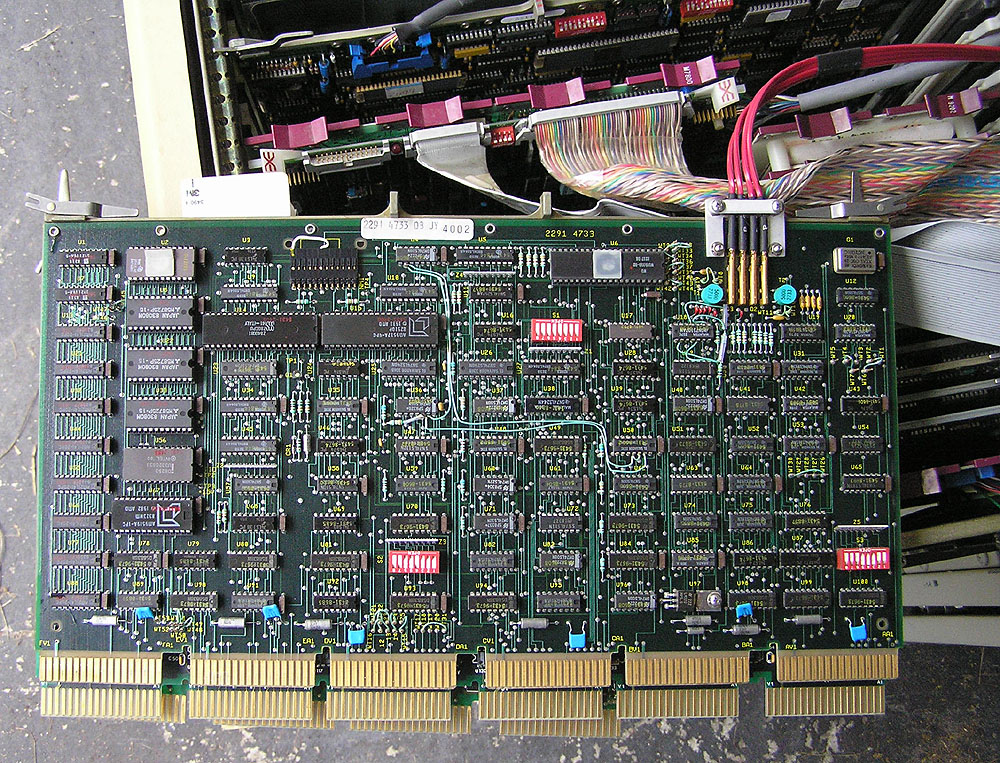
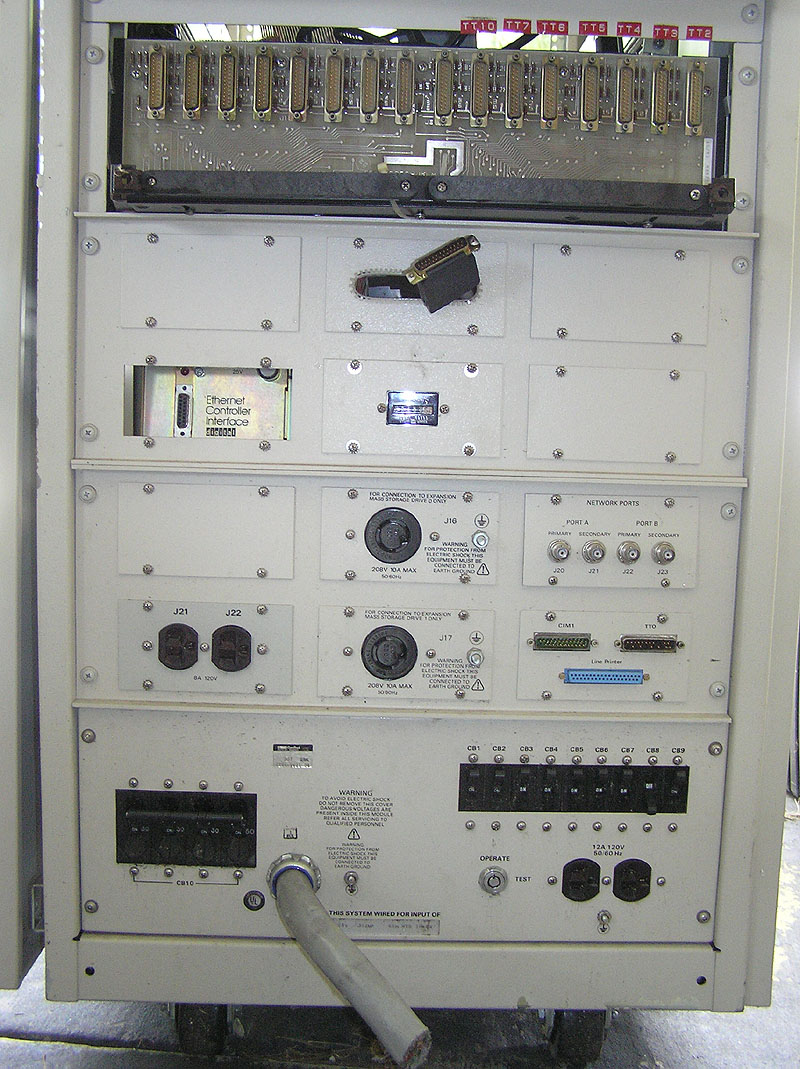
UPS delivered my Gavilan today, one day earlier than paid for.
I want to open it, clean it, etc., before attempting to power it on. Anyone
here worked one before?
-----------------------------------------
Evan Koblentz's personal homepage: http://www.snarc.net
Also see: http://groups.yahoo.com/group/midatlanticretro/
Where did PDAs come from? http://www.snarc.net/pda/pda-treatise.htm
*** Tell your friends about the (free!) Computer Collector Newsletter
- 775 readers and no spam / Publishes every Monday / Write for us!
- Mainframes to videogames, hardware and software, we cover it all
- W: http://news.computercollector.com E: news at computercollector.com
I've got loads of 8 inch disks. Tell me how many you'd like and where to ship
them. How about 10cents each? Fedex ground is the cheapest way to send if you
want many.
I had previously asked about a disk platter I was trying to identify. I have
a couple of more pictures of it as well as some items from another drive.
The latter is stamped "INFOMAG". By doing some www research I thought I had
identified one or more of the principals in the company but got no reply to
my emails. This is apparently a shortened version of Information Magnetics
Corp. According to "Corporate Affiliations", that name was later changed to
Computer & Communication Technology Corp. That name was later changed to
Sunward Technologies, Inc. That company was later merged with Read-Rite
Corporation. No other part numbers or IDs. If you recognize it I would
appreciate the identification.
Here's our web page with the pictures of the unknown items:
http://www.cse.uta.edu/TheMuseum at CSE/Whazat.html
TIA,
Gil
>From: "Allison" <ajp166 at bellatlantic.net>
>
---snip---
>
>The DSD880 and RX01/02 drives are of a similar design with a local
>CPU (crude TTL logic state hardware or 2901s) to do all the heavy
>lifiting at that floppy interface end with a trivial interface
>to the processor bus. Neither include boot logic.
>
>As to DMA on FDCs well SMC did one that had it but it was a PITA
>to use as every bus is differnt and timing plus control signals
>required a lot of work to integrate. Most FDCs were trying to be
>generic and to keep die size down (hence cost) things were not
>done that would make the chip system specific.
---snip---
Hi Allison
It is interesting that they didn't include this.
On my machine it isn't even more hardware. There
is just one instruction in the state machine to
load a sector count of 1. It then just does a normal
read. Every thing else is just default reset values
>from the reset line. I remember thinking how trivial
it was. I can understand that if the controller needed
to know things like density, this might require more
but it is a simple operation that could be easily
added to any that have a state machine to run
the controller operations. I can see why the FDC
chips don't do this. There is a lot to setup but
still, a default reset state could have easily
provided the needed inital values.
As I recall, the board has a jumper to not do the
auto boot. I think the auto boot is a cool thing.
Also, yes it is rare.
Dwight
Does anyone have the pinout for the Motorola MC6881 or MC3449 chip? (16
pin DIL package) (Those 2 devices are equivalents, the ones I have are
marked with both numbers.). From what I can tell, it's a triple
bidirectional bus switch.
They are used in the HP37201 HPIB extender, HP seem to have created
separate data buses for the memroy and I/O chips. I guess this device is
on-topic here, mine dates from 1979, a pair of them allow an HPIB bus to
be fed over various types of serial link, including asynchronous and
synchronous modems.
-tony
I guess for the Ultra 1. I couldn't do that with my Ultra 2. It just wound
not fit in there and believe me I tried.
Ram
> -----Original Message-----
> From: listmailgoeshere at gmail.com [mailto:listmailgoeshere at gmail.com]
> Sent: Monday, August 29, 2005 2:40 PM
> To: General Discussion: On-Topic and Off-Topic Posts
> Subject: Re: Help! Sun Ultra 1 HD replacement?
>
>
> On 8/29/05, Ram Meenakshisundaram <RMeenaks at olf.com> wrote:
> > Just grab any 80-pin ultra scsi drive. Just be careful about heat
> > dissipation though. I just bought two 73Gb scsi drives for
> my Ultra 2
> > on ebay for $150. Make sure whatever drive you buy that it is a 1"
> > height drive otherwise it will NOT fit in the drive cage.
>
> Incorrect. The U1 drive cage will in fact hold a 1.6" drive
> in the lower slot.
>
> I wouldn't want to run a 1.6" and a 1" together in there for
> heat dissipation reasons (they will fit, I've tried, but they
> end up *very* close together), however if the machine only
> has one disk in it, a 1.6" in the bottom slot will be fine.
>
> Ed.
>
I heard somewhere that even if you are only using one drive, you should
STILL add a dummy drive in the second slot so that airflow is better. I
currently have two 9.1GB drives on my Ultra 2 and Solaris 10 is a pig. I am
planning on using one of my new drives for Solaris and still leave one of
the 9.1GB drives as /export/home. The other drive is going into my PC as a
dual Linux/Solaris installation along side my IDE-based Windows
installation...
Ram
> -----Original Message-----
> From: Doc Shipley [mailto:doc at mdrconsult.com]
> Sent: Monday, August 29, 2005 2:47 PM
> To: General at mdrconsult.com; On-Topic and Off-Topic Posts
> Subject: Re: Help! Sun Ultra 1 HD replacement?
>
>
> listmailgoeshere at gmail.com wrote:
>
> > On 8/29/05, Ram Meenakshisundaram <RMeenaks at olf.com> wrote:
> >
> >>Just grab any 80-pin ultra scsi drive. Just be careful about heat
> >>dissipation though. I just bought two 73Gb scsi drives for
> my Ultra 2
> >>on ebay for $150. Make sure whatever drive you buy that it is a 1"
> >>height drive otherwise it will NOT fit in the drive cage.
> >
> >
> > Incorrect. The U1 drive cage will in fact hold a 1.6" drive in the
> > lower slot.
>
> Not necessarily. *Some* Ultra1 systems will accept a 1.6"
> disk, but
> some won't. That's a physical limitation of the backplane,
> rail guides
> and SCA connector, not a question of "supported configuration".
>
> > I wouldn't want to run a 1.6" and a 1" together in there for heat
> > dissipation reasons (they will fit, I've tried, but they
> end up *very*
> > close together), however if the machine only has one disk in it, a
> > 1.6" in the bottom slot will be fine.
>
> Heat is likely to be an issue with 2 high-RPM disks, even
> with a pair
> of 1" drives. Air flow is side-to-side, so making sure there's ample
> space on both sides of the system helps quite a lot.
>
>
> Doc
>
All,
one of those days.
comp.sys.next.marketplace contained the following, which I
forward FWIW. I can't get either the from: or the reply-to: address
to work. Not so surprised about the reply-to:, considering.
Anyone near Chicago that wants to spend some time tracing
Beverly down, good luck! If you are successful, I may be able to help
with a KB, I have lots of those to spare (dirty, can test for
functionality).
Thanks to lots of you for help on the Sun Ultra drive!
---
Path:
sn-us!sn-xit-10!sn-xit-06!sn-xit-07!supernews.com!newsfeed.news2me.com!nx01.iad01.newshosting.com!newshosting.com!news-feed01.roc.ny.frontiernet.net!nntp.frontiernet.net!newscon06.news.prodigy.com!prodigy.net!newsmst01b.news.prodigy.com!prodigy.com!postmaster.news.prodigy.com!newssvr19.news.prodigy.com.POSTED!22d5151e!not-for-mail
Newsgroups: comp.sys.next.marketplace,comp.unix.misc
From: "Bev A. Kupf" <bevakupf at myhome.net>
Subject: Want a piece of nostalgia? Giving my NeXT cube away
Organization: Bev's House of Pancakes
Reply-To: orinxhcs at foptybony.arg (ebg13)
Followup-To: comp.sys.next.marketplace
Message-ID: <slrndgs0m5.6jm.bevakupf at myhome.net>
Lines: 15
Date: Thu, 25 Aug 2005 17:41:25 GMT
I have a NeXT cube that hasn't been used in 6 years. 25 Mhz 68040,
64 Mb RAM, 2 GB drive (may not be functional). I no longer have
the monitor or keyboard or mouse.
If you'd like this, write back within a day to <bevakupf at sbcglobal.net>
I need to pass it on to someone, or toss it by Saturday or Sunday, and
it'll break my heart to toss it - my thesis was written on it ...
Be great if you could just pick it up - I'm in Chicago.
Beverly
--
Many a smale maketh a grate -- Geoffrey Chaucer
---
--
- Mark
210-522-6025, temporary cell 240-375-2995
>
>Subject: Re: Bit of CP/M trivia needed
> From: "Dwight K. Elvey" <dwight.elvey at amd.com>
> Date: Mon, 29 Aug 2005 10:59:55 -0700 (PDT)
> To: cctalk at classiccmp.org
>
>
>Hi Allison
> I did tell a slight fib, there is truly not ROMs or
>PROMs in my IMSAI. There is no ROM code that runs on the
>8080 that gets the machine started. The controller does
>have PROMs in it but not for the 8080.
> The controller for the drives exist in the drive box.
>There is a bus interface card in the IMSAI. The controller
>is all TTL based and has several small PROMs to control
>sequencing for read/write/format operations. Only
>small additional states are needed to do the bootstrap.
>Mainly resetting registers and then doing a single sector
>read. On the IMSAI, to boot, all I do is a STOP, RESET.
>The drive reads the first sector that has the code to
>load the rest. I then execute from address 0000 and
>it brings up the rest of CP/M. All of the 8080 code
>exist on the disk ( I know this because I built up this
>implementation of CP/M my self from scratch ).
> The drive has the typical sounding name of "Digital
>Systems" on it. I was told that this was a common
>drive setup before FDC chips came in to being. The
>controller part was common to other small computer systems
>that used this controller with different bus interface
>cards. I don't know the date of my machine but I can
>look it up, next time I'm with my machine. I was told
>the controller design existed before S-100 and was one
>of the earliest types of controllers used on S-100 systems
>since it only required the bus interface card that
>is mostly just buffers and some logic to handle
>unique S-100 bus protocol.
> The controller is quite large. It covers the area of
>two 8 inch drives laying flat plus supply. When I got the
>machine, I had not disk at all. I also noted that there was
>no ROM in the IMSAI. After asking around, I found a
>friend that had schematics for the controller and interface
>card but no software. He'd had an early machine and
>had replaced his controller with a newer floppy controller
>card. I hand decoded the PROMs on the controller to determined
>how the state machine did its control of the drive.
>I then wrote my own bootstrap to load onto the first
>sector. I got a copy of CP/M2.2 from Gaby's web page.
>Of course, like many of these old machines, it also
>needed several replacement parts to get it going.
> I have since been in contact with another fellow that
>has one of these controllers and he had a boot disk!
>The code on it was almost identical to mine :)
> I'll look at the date codes of my machine, the next time
>I have access to it.
> So, in a sense, you are correct that there needs to be
>code someplace but all the reset does is clears the registers
>and starts the state machine that is the controller. The
>8080 does nothing until the first sector is loaded. Seeing
>how simple this was, I'm surprised that early FDC
>chips didn't include this ability. I guess it was that
>most didn't expect to be in DMA setups.
>Dwight
>
Ah, you answer a question. Actually I'd only seen one of those
and indeed they were very expensive and rare then and now. The
typical micro system of the day didn't have DMA due to the hardware
and associated cost. Not to forget that state machine is a simple
processor with a fixed program so it's cheating and right fine
hardware too. ;)
The DSD880 and RX01/02 drives are of a similar design with a local
CPU (crude TTL logic state hardware or 2901s) to do all the heavy
lifiting at that floppy interface end with a trivial interface
to the processor bus. Neither include boot logic.
As to DMA on FDCs well SMC did one that had it but it was a PITA
to use as every bus is differnt and timing plus control signals
required a lot of work to integrate. Most FDCs were trying to be
generic and to keep die size down (hence cost) things were not
done that would make the chip system specific.
Also FDC development from 1975 to 1980 was like CPUs, RAM and
Eproms. A constant progression of increased capability and
speed. The first parts (pre WD1771) were barely a sync USART
with AM detection and required considerable CPU handholding.
There were a few controllers that faked DMA by using a second FDC
and their value was they could load memory even if the main cpu was
locked up assuming Ram and the bus worked ok. But the board obviously
was a temporary master and had some code.
But if you want typical then look no further than the intel MDS. That
was the default lauching platform for from what I'd seen for 1.3, 1.4
and later. More than a few Altair and IMSAI users had to toggle in
a relatively short boot to get going.
Allison
Just grab any 80-pin ultra scsi drive. Just be careful about heat
dissipation though. I just bought two 73Gb scsi drives for my Ultra 2 on
ebay for $150. Make sure whatever drive you buy that it is a 1" height
drive otherwise it will NOT fit in the drive cage. Remove the existing
sleds from the quantum drive and put it on the new drive and slip it in.
Very easy to do. IIRC, the SCSI connector is a ULTRA 160, but you can use
the higher rates as it is backward compatible. The model I bought are the
Seagate Cheetah ST373307LC (UlTRA 320 80-pin SCSI drives). Make sure it is
80-pin and NOT 68-pin!!!
Ram
> -----Original Message-----
> From: Mark Tapley [mailto:mtapley at swri.edu]
> Sent: Monday, August 29, 2005 12:52 PM
> To: cctalk at classiccmp.org
> Subject: OT: Help! Sun Ultra 1 HD replacement?
>
>
> All,
> Apologies, I'm probably at least 2 years off-topic.
>
> Have a Sun Ultra 1 with a non-functional Quantum hard drive,
> model number seems to be VK45JZF1. It's in a sled with a lever on the
> front, and the connector is a funky thing with a central ridge rather
> than pins. This is for a work project.
>
> Where can I find a replacement fairly quickly?
>
> How much should I expect to pay?
>
> What's with the strange interface?
>
> Replies here would be better, on-list OK.
>
> TIA!
>
> --
> - Mark
> 210-522-6025, temporary cell 240-375-2995
>
>From: "Allison" <ajp166 at bellatlantic.net>
>
>>
>>Subject: Re: Bit of CP/M trivia needed
>> From: "Dwight K. Elvey" <dwight.elvey at amd.com>
>> Date: Sat, 27 Aug 2005 14:40:18 -0700 (PDT)
>> To: cctalk at classiccmp.org
>>
>>>From: "Allison" <ajp166 at bellatlantic.net>
>>>
>>>>
>>>>Subject: Bit of CP/M trivia needed
>>>> From: "Brian Knittel" <brian at quarterbyte.com>
>>>> Date: Sat, 27 Aug 2005 00:58:01 -0700
>>>> To: cctalk at classiccmp.org
>>>>
>>>>Hi all,
>>>>
>>>>Does anybody out there know for certain when the
>>>>term BIOS was coined? I believe it was Gary Kildall,
>>>>and from what I can find, it was around 1978 that
>>>>he abstracted the I/O and localized it in what
>>>>he called the BIOS. Anyone know differently?
>>>
>>>The term BIOS is older, early '77. It came into use with
>>>V1.3 I think and for cetertain in V1.4.
>>>
>>>>Also -- was the BIOS stored on the CP/M
>>>>floppy, or was it in ROM/EPROM? If not, how
>>>>did CP/M machines boot? Was there a dedicated
>>>>boot ROM that was used just for startup, and
>>>>then the BIOS took over? I had one back in
>>>>the day, but I sure can't remember this detail.
>>>
>>>The easy answer is yes. Tranditional CP/M systems the
>>>CCP/BDOS and BIOS were on the first two reserved tracks
>>>of the floppy (8" SSSD) and those were loaded by a boot
>>>rom.
>>
>>Hi
>> My understanding was that the first ones had no ROM
>>and used a DMA controller that loaded bootstrapping
>>code from the first sector on reset. I have such a
>>controller on my machine. All RAM, no ROMs.
>>Dwight
>
>While possible even the DMA controller needed logic to get
>it going. The earliest machines (8080) used front pannels
>to manually enter a small boot into ram.
>
>Most of the Intel machines however had at least minimal
>rom if only there to boot a booter.
>
>As it would turn out a DMA controller before the 8257
>(LSI device) was a lot of electronics in itself. They
>were rare and not often seen in micros as it represents
>a lot of hardware even in minimal form.
>
>Identify that machine you have and it's vintage.
>
>Allison
>
Hi Allison
I did tell a slight fib, there is truly not ROMs or
PROMs in my IMSAI. There is no ROM code that runs on the
8080 that gets the machine started. The controller does
have PROMs in it but not for the 8080.
The controller for the drives exist in the drive box.
There is a bus interface card in the IMSAI. The controller
is all TTL based and has several small PROMs to control
sequencing for read/write/format operations. Only
small additional states are needed to do the bootstrap.
Mainly resetting registers and then doing a single sector
read. On the IMSAI, to boot, all I do is a STOP, RESET.
The drive reads the first sector that has the code to
load the rest. I then execute from address 0000 and
it brings up the rest of CP/M. All of the 8080 code
exist on the disk ( I know this because I built up this
implementation of CP/M my self from scratch ).
The drive has the typical sounding name of "Digital
Systems" on it. I was told that this was a common
drive setup before FDC chips came in to being. The
controller part was common to other small computer systems
that used this controller with different bus interface
cards. I don't know the date of my machine but I can
look it up, next time I'm with my machine. I was told
the controller design existed before S-100 and was one
of the earliest types of controllers used on S-100 systems
since it only required the bus interface card that
is mostly just buffers and some logic to handle
unique S-100 bus protocol.
The controller is quite large. It covers the area of
two 8 inch drives laying flat plus supply. When I got the
machine, I had not disk at all. I also noted that there was
no ROM in the IMSAI. After asking around, I found a
friend that had schematics for the controller and interface
card but no software. He'd had an early machine and
had replaced his controller with a newer floppy controller
card. I hand decoded the PROMs on the controller to determined
how the state machine did its control of the drive.
I then wrote my own bootstrap to load onto the first
sector. I got a copy of CP/M2.2 from Gaby's web page.
Of course, like many of these old machines, it also
needed several replacement parts to get it going.
I have since been in contact with another fellow that
has one of these controllers and he had a boot disk!
The code on it was almost identical to mine :)
I'll look at the date codes of my machine, the next time
I have access to it.
So, in a sense, you are correct that there needs to be
code someplace but all the reset does is clears the registers
and starts the state machine that is the controller. The
8080 does nothing until the first sector is loaded. Seeing
how simple this was, I'm surprised that early FDC
chips didn't include this ability. I guess it was that
most didn't expect to be in DMA setups.
Dwight
>
>Subject: RE: Portable Altair
> From: "'Computer Collector Newsletter'" <news at computercollector.com>
> Date: Mon, 29 Aug 2005 12:10:57 -0400
> To: "'General Discussion: On-Topic and Off-Topic Posts'" <cctalk at classiccmp.org>
>
>Thanks to all who sent me this link:
>http://www.virtualaltair.com/virtualaltair.com/vac_attache.asp ... I guess
>the definition of "portable" varies quite a bit! Even the text of this ad
>refers to it as a "desktop" computer.
In that era (pre 1981) portable was very difficult as power needs were very
high. The only CMOS cpus were 1802 and 6100(PDP-8) for the most part. So
portable was the same as color TV,IE: you can pick up by a provided handle
and move it a distance. Compared to a fully loaded NS* or altair8800B (at
some 60 pounds for the cpu box and another 60 for the disk box) the idea of
portable (transportable) is significant.
At that time I did build one machine with a dual floppy and a minimal PS
for 4 s100slots (Z80, 64k ram, VDM1, FDC) that was very light. Still
required carrying a keyboard, monitor, System box the the total package
was under 40 pounds. FYI: The bulk of the weight was the two Floppies
(SA400s diecast aluminum) and the power transformer. lightweight
switching supplies were rare then.
Allison
>
>-----Original Message-----
>From: cctalk-bounces at classiccmp.org [mailto:cctalk-bounces at classiccmp.org]
>On Behalf Of 'Computer Collector Newsletter'
>Sent: Sunday, August 28, 2005 10:58 PM
>To: 'General Discussion: On-Topic and Off-Topic Posts'
>Subject: Portable Altair
>
>Hi folks,
>
>I posted this message tonight to a couple of Altair sites, but might as well
>ask on the big list too: does anyone know about the existence of a portable
>Altair, which was designed as the "Altair 2"...? According to Steven Levy's
>book "Hackers" (p. 257), by mid-1976, Ed Roberts "had been designing an
>exciting new Altair 2 computer -- a high-powered, compact machine which
>could fit inside a briefcase" before selling the company to Pertec.
>
>I'm more interested in the computer's size / form factor than its technical
>abilities, since I mostly study the history of portable systems.
>
> - Evan
>
>-----------------------------------------
>Evan Koblentz's personal homepage: http://www.snarc.net Also see:
>http://groups.yahoo.com/group/midatlanticretro/
>Where did PDAs come from? http://www.snarc.net/pda/pda-treatise.htm
>
>*** Tell your friends about the (free!) Computer Collector Newsletter
>- 770 readers and no spam / Publishes every Monday / Write for us!
>- Mainframes to videogames, hardware and software, we cover it all
>- W: http://news.computercollector.com E: news at computercollector.com
From: "Ashley Carder" <wacarder at earthlink.net>
>> > I have a couple of copies of the "Computer Lab Workbook".
>> >
>> > Do either of yours have a complete set of patch cords?
>> >
>> > Vince
>>
>> They both have a number of different length patch cords with them, but
>> since I don't have the documentation for them, I'm not sure what
>> constitutes a complete set.
>
> Unfortunately, I can't find that information in the workbook, either.
> There is a picture of some patch cords on the cover, and I can count
> them, but that's not exactly authoritative. (There's only one green
> wire shown, for instance, and mine has four.)
>
> Vince
I will count mine tonight when I get home from work and let you know
how many of which types are included with my two Computer Labs.
Ashley
>> Does anyone have the manual or workbook for a DEC Computer Lab,
>> which is a classroom logic trainer that was made by DEC back in
>> the late 1960s? I recently acquired two of these interesting
>> little pieces of computing history, along with the patch cords.
>> I'd like to have the manual so I can learn more about it.
>
> I have a couple of copies of the "Computer Lab Workbook".
>
> Do either of yours have a complete set of patch cords?
>
> Vince
They both have a number of different length patch cords with them, but
since I don't have the documentation for them, I'm not sure what
constitutes a complete set.
Ashley
Hi folks,
I know this is a bit off topic, but I also know that a few classiccmp'ers
have fairly extensive test equipment manual "collections", so here goes...
My Solartron 7150plus bench DMM packed up this morning - one minute I was
checking a measurement, the next it started hissing and smoke poured out of
the back. I can't see anything obviously burned, but I want to take some
measurements with my spare DMM to make sure everything's OK before I power it
back up.
Catch: I don't know what readings I should be getting at the various test
points. It does have a selftest function, but the error code list in the ops
manual just says "Refer to service manual" for most of them.
If anyone here has a copy of the 7150plus service manual, I'd be willing to
pay for a photocopy or scan of the manual. I've been quoted ?100+P&P+VAT for
a manual from Solartron, and none of the T&M manual dealers I've checked have
got any of the 7150plus documents - either ops or service.
Thanks.
--
Phil. | Acorn RiscPC600 SA220 64MB+6GB 100baseT
philpem at philpem.me.uk | Athlon64 3200+ A8VDeluxe R2 512MB+100GB
http://www.philpem.me.uk/ | Panasonic CF-25 Mk.2 Toughbook
... He's dead, Jim ... Kick him if you don't believe me
>
>Subject: Bit of CP/M trivia needed
> From: "Barry Watzman" <Watzman at neo.rr.com>
> Date: Mon, 29 Aug 2005 08:30:35 -0400
> To: <cctech at classiccmp.org>
>
>
>I can't say for sure if Gary was the first to use the term BIOS, but it was
>being used by Gary in CP/M long before 1978 -- I'd say in late 1975,
>probably, and definitely by 1976. A friend bought a copy of CP/M in 1975 (I
>know it was 1975, because I was in Atlanta at the time with the friend (who
>happens to be Dale Heatherington, a partner in the modem firm of DC Hayes,
>for whom the "Heatherington patents" were named), and I moved from Atlanta
>to Charlotte in late 1975). In 1976, Imsai was offering CP/M version 1.3
>with the dual-Calcomp disk system. All of the documentation for all of
>these used the term BIOS, as did the source code for the BIOS' supplied with
>CP/M on disk (for the Intel development system). The BIOS resided on disk,
>as part of the system tracks, it was the last 7 sectors of the 2nd track
>(track 1).
I can say publicly in 1976 I'd heard it used by none other than. The event
was PCC'76 down on the NJ boardwalk.
Allison
>
>Subject: Re: CP/M 1.0? (was Re: Bit of CP/M trivia needed)
> From: shoppa_classiccmp at trailing-edge.com (Tim Shoppa)
> Date: Sun, 28 Aug 2005 19:57:16 -0400
> To: cctalk at classiccmp.org
>
>> Does anyone have a copy of CP/M 1.0 or know if such a version was ever
>> released? What about 1.1, 1.2, ... ?
>
>1.3 is the earliest I had. (And the original floppy is in Don Maslin's
>archives should they ever be recovered.) I think I remember Don saying
>it was the earliest he'd seen. He had lots of 2.2 of course for countless
>machines but only a handful of 1.4, 2.0, etc, (and most of those came from
>me too!)
>
>The ones I gave Don were official Digital Research distribution floppies,
>the oldest hand-labeled with a serial number.
>
>I am under the impression that earlier versions were not nearly so
>flexible as regards to customization to a wide variety of machines.
>
>Tim.
The earliest I've worked with was 1.3 and yes, before V2 it was a major task
to get it up and runnning on a new machine as the disk driver portion of the
code was not in the "bios". When I was at PCC'76 (in NJ) there was a
presentation on CP/M and the discussion was around moving it to new and
different hardware plus comments that V1.4 would be better in that the
basic terminal (CON:, LST,, PUN:, RDR:) would be an easily modified module.
I tried to move V1.4 to a Horizon and it was not a fun task nor was it
fully successful. It required many hours of dissassembly and plenty of
head scratching on how the disk was wired in.
Allison
Hi,
I was wondering if anyone might know where I can get the artwork on the
front panel restored for my Altair 680. This was an original computer my
late brother bought as a kit back in the 70's. I helped him build this
and we sure had some fun programming this. I'm finally getting around to
restore this. I dug it out from the last trip visiting them. All my
stuff was stored in their garage since we moved.. The logo silkscreen
has faded away. I was hoping there is some way to restore this, either
by replacing the front panel or getting this repainted(or silkscreened).
In the meantime, I can get the hardware cleaned up and hopefully get
this to run again.
thanks,
=Dan
--
~~~~~~~~~~~~~~~~~~~~~~~~~~~~~~~~~~~~~~~~~~~~~~~~~~~~~~~~~~~~~~~~~~~~~~~~~~~~~
[My Corner of Cyberspace http://ragooman.home.comcast.net/]
[Pittsburgh Robotics Society http://www.pghrobotics.org/]
[Pittsburgh Vintage Comp.Society http://groups.yahoo.com/group/pghvintagecomp/]
~~~~~~~~~~~~~~~~~~~~~~~~~~~~~~~~~~~~~~~~~~~~~~~~~~~~~~~~~~~~~~~~~~~~~~~~~~~~~
--
No virus found in this outgoing message.
Checked by AVG Anti-Virus.
Version: 7.0.344 / Virus Database: 267.10.15/81 - Release Date: 8/24/2005
Hi all,
Does anybody out there know for certain when the
term BIOS was coined? I believe it was Gary Kildall,
and from what I can find, it was around 1978 that
he abstracted the I/O and localized it in what
he called the BIOS. Anyone know differently?
Also -- was the BIOS stored on the CP/M
floppy, or was it in ROM/EPROM? If not, how
did CP/M machines boot? Was there a dedicated
boot ROM that was used just for startup, and
then the BIOS took over? I had one back in
the day, but I sure can't remember this detail.
This is for a writing project, so I'd like
to get it right,
Thanks!
Brian
=-=-=-=-=-=-=-=-=-=-=-=-=-=-=-=-=-=-=-
_| _| _| Brian Knittel
_| _| _| Quarterbyte Systems, Inc.
_| _| _| Tel: 1-510-559-7930
_| _| _| Fax: 1-510-525-6889
_| _| _| Email: brian at quarterbyte.com
_| _| _| http://www.quarterbyte.com
>
>Subject: Re: Bit of CP/M trivia needed
> From: Steve Thatcher <melamy at earthlink.net>
> Date: Sat, 27 Aug 2005 18:13:27 -0400
> To: "General Discussion: On-Topic and Off-Topic Posts" <cctalk at classiccmp.org>
>
>what machine and/or controller was this that had no ROM at all? I
>never have dealt with any system that at least didn't have some type
>of startup code somewhere other than a disk drive. DMA would need to
>be setup unless it was hardwired. The original Intel Intellec-8
>required that you enter a program jump into memory that pointed to
>the program monitor. Intel didn't call it a BIOS though.
>
>
>>Hi
>> My understanding was that the first ones had no ROM
>>and used a DMA controller that loaded bootstrapping
>>code from the first sector on reset. I have such a
>>controller on my machine. All RAM, no ROMs.
>>Dwight
There were a few later machines that used shadow boot rom
(it was a doide matrix) and one I know of that the hardware
dma was programmed to grab the first sector at reset but
the dma logic dwarfed the CPU. There was a slightly later
machine that could also do that but, the real trick was the
FDC was a second cpu with rom and it know that if it saw
reset it was to find the boot block and copy it to ram
@0000h so the main cpu ran on release from DMA hold and reset.
However early machines were ot so extravagant with hardware
as it was mostly SSI TTL and to do dma it nearly doubled
the total system package count (without counting ram). An
8080 system needed a lot of support components.
In the end it's irrelevent to the basic question asked.
The CPM system from at least V1.3 on generally depended
on some kind of program (however small) to boot the first
block or blocks the usual mode was to load the CP/M image
as a monolithic chunk of code and then execute it. In most
cases the amountof code needed to do that would fit in the
then available 256byte EProms/fuse roms ( either 1702 or bipolar).
Allison
I'm a fairly young collector of old computers in general, though it's
mostly home computers since they're the easiest to get a hold of. I
have a TRS-80 Model III, and in order to fix the keyboard, I had to
remove the case. This accidentally pulled off a test probe that was
clipped to a pin on a chip in the computer. The probe was from an add
on video card called "The Graphyx Solution"
Here is a picture of some of the probes:
http://img183.imageshack.us/img183/9986/graphyxsln3mt.jpg
A white probe is unattached, and every other time the computer was
turned on until I realized what happened, the screen was full of
garbage. Does anyone have installation instructions for this card?
"Joe R." <rigdonj at cfl.rr.com> wrote:
> I wonder if they used the "combining stand" to put them together?
> That's what they did with the (I think) 9830 and 9866 printer. I actually
> found one of the "combining stands". It's just a C-shapped metal frame like
> a printer stand except that it fits over the calculator and hold the
> printer. It's nothing real special but it is an interesting accessory.
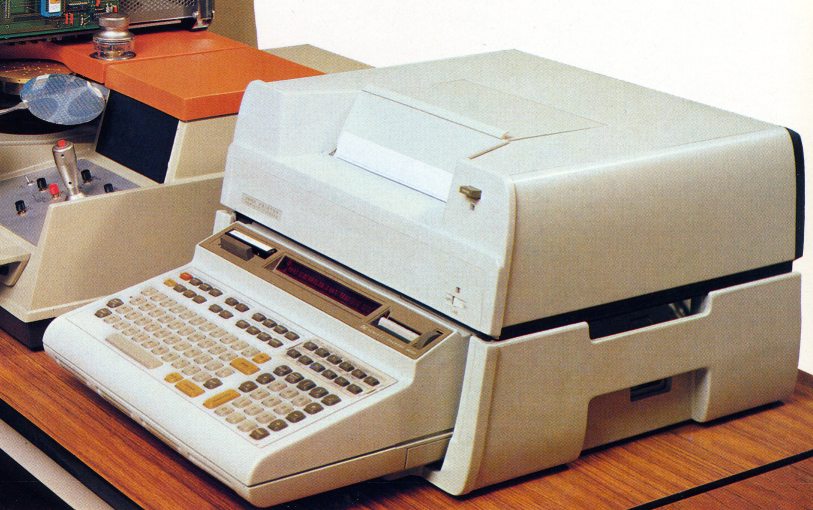
Here is a picture of the stand allowing an HP9866A printer to be
placed over an HP9825A.
http://www.series80.org/Misc/HP9825+9866printer.jpg
I haven't actually seen one close up, and for some reason I assumed
it was made from some sort of plastic (like the cases of the HP-85)
but in retrospect it was probably easier (from a tooling perspective)
to use a metal stand.
**vp
Anyone interested to swap these cards :
- 13037 INTF, 13037-80023
- Time Base Gen., 12539-60003
- BACI 12966 A, 12966-60001
- BACI 12966 A, 12966-60002 (the last 2 is hand written on the card)
- 7970 MAG TAPE 1, 13183-60012
- 7970 MAG TAPE 2, 13183-60013
- BUS I/O, 59310-60101
- Line Printer Interface, 12845-60005
- 8 Chan Mux, 663006
- Jumper, 02116-6110
I only know these cards come from a HP 21MX E-Series, they are untested.
If you're interested in buying these or swapping them let me know
what you have/would like to offer. Dont ask me what I have in mind
for an offer, just make me an offer and we'll continue from there.
Stefan.
-------------------------------------------------------
http://www.oldcomputercollection.com
>
>Subject: Re: Anyone got a plain ASCII Windows font?
> From: Scott Stevens <chenmel at earthlink.net>
> Date: Sun, 28 Aug 2005 13:37:23 -0500
> To: "General Discussion: On-Topic and Off-Topic Posts" <cctalk at classiccmp.org>
>
>On Sun, 28 Aug 2005 11:37:08 -0400
>Allison <ajp166 at bellatlantic.net> wrote:
>
>> >
>> >Subject: RE: Anyone got a plain ASCII Windows font?
>> > From: "Richard A. Cini" <rcini at optonline.net>
>> > Date: Sun, 28 Aug 2005 11:35:56 -0400
>> > To: "'General Discussion: On-Topic and Off-Topic Posts'"
>> > <cctalk at classiccmp.org>
>> >
>> >Hey, it was done with a smily-face, so it's OK.
>> >
>> >Personally, I prefer Procomm for my DOS needs and either Hyterterm or
>> >Tera Term for Windows needs.
>>
>> I prefer procom when I have to use a PC. When I don't have to use a
>> PC a real VT100, VT320, VT340 or even a H19 tend to be very handy.
>> However,
>> in the room here The VT320 or VT340 are allways at easy reach. I
>> find the
>> "REAL(tm) TERMINAL" allways beats the PC imitation.
>>
>> Allison
>
>I guess I only raised it as an issue because in 'modern times' I have
>found the terminal emulation features of Tera Term to be far superior to
>anything else. If you want to connect to a Linux or BSD box from a
>Windows terminal and run modern curses-based applications like Midnight
>Commander, Tera Term is great (in TTY or in Telnet or SSH modes).
Still use the copy of procom freeware from back '91ish, it's was the best
I'd seen for free and I find it works well. It was '91 that I finally broke
down and added a PCxt clone (leading edge model D) to the stable.
>Back in the BBS days with a modem, I discovered Telemate and never
>looked back at Procomm, although Procomm 2.4.2 was an excellent term for
>it's time. Procomm Plus sorta borrowed on 2.4.2's rep and I thought
>never delivered much more. And it wasn't shareware, to boot. (it was
>Bossware, the kind of software box you'd find on the shelf of 'the
>suits.')
;) Back in the BBS days I use either a PDP-11/RT-11 with TERM or
the CP/M crate with TERMITE. TERMITE was a homebrew package that did
terminal passthrough as the system had a real terminal and could also
do Xmodem transfers. IT's big feature and whay it wasn't portable
is the modem input buffer and the console input buffers were interrupt
driven large buffers so you could even type commands for the remote
system while recieving stuff at 1200 baud.
Allison
>
>Subject: RE: Anyone got a plain ASCII Windows font?
> From: "Richard A. Cini" <rcini at optonline.net>
> Date: Sun, 28 Aug 2005 11:35:56 -0400
> To: "'General Discussion: On-Topic and Off-Topic Posts'" <cctalk at classiccmp.org>
>
>Hey, it was done with a smily-face, so it's OK.
>
>Personally, I prefer Procomm for my DOS needs and either Hyterterm or Tera
>Term for Windows needs.
I prefer procom when I have to use a PC. When I don't have to use a PC
a real VT100, VT320, VT340 or even a H19 tend to be very handy. However,
in the room here The VT320 or VT340 are allways at easy reach. I find the
"REAL(tm) TERMINAL" allways beats the PC imitation.
Allison
Lately, a bunch of my cctalk messages got into my spam folder.
That never used to happen, and I didn't make any changes locally.
Anyone have some insight? Jay?
-----------------------------------------
Evan Koblentz's personal homepage: http://www.snarc.net
Also see: http://groups.yahoo.com/group/midatlanticretro/
Where did PDAs come from? http://www.snarc.net/pda/pda-treatise.htm
*** Tell your friends about the (free!) Computer Collector Newsletter
- 770 readers and no spam / Publishes every Monday / Write for us!
- Mainframes to videogames, hardware and software, we cover it all
- W: http://news.computercollector.com E: news at computercollector.com
Continuing with my own experience as I use it, and feedback from
others, I have once again updated ImageDisk.
1.05 = Fix to interleave logic (could mix up Cylinder/Head mapping).
Rename IMDAM to IMDU (IMageDisk Utility) and add capabilities:
- Handle larger tracks
- Remove specific tracks/sides
- Convert image to raw binary sector dump
- Translate data rates within image
- reGenerate tracks with new interleave factor
- Append, Replace and Extract comment record
The update is available on my site (see sig), in the "Disks/Software
imaegs" section - imd105.zip near the top of that page.
Dave
--
dave04a (at) Dave Dunfield
dunfield (dot) Firmware development services & tools: www.dunfield.com
com Vintage computing equipment collector.
http://www.parse.com/~ddunfield/museum/index.html
It sounds like my house is similar to others on this list....
Anyway, while extracting an off-topic device, I came across a ring
binder that I had labelled 'HP9831 Manual' Inside were the 2 volumes of
user documentation for that machine -- the Operating/Programming Manual
and the I/O Manual.
[The HP9831 has similar hardware to the 9825, but has BASIC, not HPL, in ROM]
A couple of things struck me from reading said documentation
1) There were 2 ROM modules made for the 9831 -- a Matrix/Plotter ROM
(which came in 2 versions to support either the 9862 or 9872 plotters)
and a Flexible Disk ROM. I have neither, alas. Has anyone ever seen them?
2) The I/O manual describes all the peripherals available for the machine
_including the 9877 External Tape Memory_. It appears that the 9831
firmware supports this device for loading/saving BASIC programs and data
files (although not for doing bit-level copies of tapes, etc).
Unfortunately it says nothing about the actually interface for the 9877
-- for all other peripherals (printers, card reader, paper tape punch,
paper tape reader), it says that the interface is a 98032 16 bit parallel
module with the approriate 'option' (cable and link settings). Does
anyone know if the 9877 _definietly_ connected via a 98032 as well? Even
better, does anyone know the wiring?
-tony
Does anyone know the pinout of the V25 interface (DB25 connector)? No,
this is not a typo for V24, which I know ot be much the same as RS232.
V25 seems ot be an interfce for autodiallers.
-tony
>
>Subject: Re: Bit of CP/M trivia needed
> From: "Dwight K. Elvey" <dwight.elvey at amd.com>
> Date: Sat, 27 Aug 2005 14:40:18 -0700 (PDT)
> To: cctalk at classiccmp.org
>
>>From: "Allison" <ajp166 at bellatlantic.net>
>>
>>>
>>>Subject: Bit of CP/M trivia needed
>>> From: "Brian Knittel" <brian at quarterbyte.com>
>>> Date: Sat, 27 Aug 2005 00:58:01 -0700
>>> To: cctalk at classiccmp.org
>>>
>>>Hi all,
>>>
>>>Does anybody out there know for certain when the
>>>term BIOS was coined? I believe it was Gary Kildall,
>>>and from what I can find, it was around 1978 that
>>>he abstracted the I/O and localized it in what
>>>he called the BIOS. Anyone know differently?
>>
>>The term BIOS is older, early '77. It came into use with
>>V1.3 I think and for cetertain in V1.4.
>>
>>>Also -- was the BIOS stored on the CP/M
>>>floppy, or was it in ROM/EPROM? If not, how
>>>did CP/M machines boot? Was there a dedicated
>>>boot ROM that was used just for startup, and
>>>then the BIOS took over? I had one back in
>>>the day, but I sure can't remember this detail.
>>
>>The easy answer is yes. Tranditional CP/M systems the
>>CCP/BDOS and BIOS were on the first two reserved tracks
>>of the floppy (8" SSSD) and those were loaded by a boot
>>rom.
>
>Hi
> My understanding was that the first ones had no ROM
>and used a DMA controller that loaded bootstrapping
>code from the first sector on reset. I have such a
>controller on my machine. All RAM, no ROMs.
>Dwight
While possible even the DMA controller needed logic to get
it going. The earliest machines (8080) used front pannels
to manually enter a small boot into ram.
Most of the Intel machines however had at least minimal
rom if only there to boot a booter.
As it would turn out a DMA controller before the 8257
(LSI device) was a lot of electronics in itself. They
were rare and not often seen in micros as it represents
a lot of hardware even in minimal form.
Identify that machine you have and it's vintage.
Allison
On Friday FedEx delivered a box containing a ROBOSAPIEN robot that was my
prize for entering photos of my HERO-Jr in a contest they ran back in June
and ended this month. You were to send pictures and a little write-up about
what your robot could do. Now if I could just win Publisher's Clearing
house.
On Thu, 25 Aug 2005 Simon Fryer <fryers at gmail.com> wrote:
> On Thu, 25 Aug 2005 12:16:22, Joe R. <rigdonj at cfl.rr.com> wrote:
> > Does anyone recognize this card?
> > <http://www.classiccmp.org/hp/Stuff%20Found%20at%20Rogers/network%20card.jpg
>
> Cabling looks like SDI.
Barely. It's true that SDI internally are four thin coax cables, but
neither connectors, nor much else looks like SDI here.
> > > I found it in a PDP-11/44 but I couldn't find a model number or
> > manufacturer's name on it. The other end of the four red cables connect to
> > four BNC connectors on the back of the cabinet and are marked Network
> > Ports. see
> > <http://www.classiccmp.org/hp/Stuff%20Found%20at%20Rogers/back3.jpg>
>
> The BNC connectors are a bit novel if it is SDI.
It's not SDI.
Hard to tell much from the information given, since the cards don't have
any identifiers.
But was the the DMP-11 or DMR-11 which used coax? It could be one of
those. Max 1 Mb/s interface, also for network.
Johnny
Johnny Billquist || "I'm on a bus
|| on a psychedelic trip
email: bqt at update.uu.se || Reading murder books
pdp is alive! || tryin' to stay hip" - B. Idol
At 11:55 27/08/2005 -0400, you wrote:
>My Altair is configured for 8N1 as is the terminal (a Windows PC). For some
>reason when I LIST a BASIC program I see >127 on some characters (mostly
>punctuation). Typing in produces the right screen characters.
>
>Maybe there's something else wrong?
Try configuring your PC to 7 bits, plus SPACE parity - this should always
TX a 0 in outgoing B7, and ignore incoming B7 ...
Regards,
Dave
--
dave04a (at) Dave Dunfield
dunfield (dot) Firmware development services & tools: www.dunfield.com
com Collector of vintage computing equipment:
http://www.parse.com/~ddunfield/museum/index.html
>
>Subject: RE: Anyone got a plain ASCII Windows font?
> From: "Richard A. Cini" <rcini at optonline.net>
> Date: Sat, 27 Aug 2005 11:55:15 -0400
> To: "'General Discussion: On-Topic and Off-Topic Posts'" <cctalk at classiccmp.org>
>
>My Altair is configured for 8N1 as is the terminal (a Windows PC). For some
>reason when I LIST a BASIC program I see >127 on some characters (mostly
>punctuation). Typing in produces the right screen characters.
>
>Maybe there's something else wrong?
I always used 7bit IO for terminals in that era. The base ASCII charset was
0-127 and bit 7 was often used by many programs to signal a format effector
or binary data. Some software actually translated the chars with bit 7 set
a set of control characters and reverse screen characters. The driver I used
for my VDM-1 did that (reverse or cursor required bit 7 to be set).
As a consequence all of my terminal drivers then and now for the 8bit world
(Altair basic and CP/M etal) mask bit 7 to Zero on recieve. If I needed a
8bit terminal IO I'd then use IObyte to select a different driver that
didn't mask.
Allison
During my cleanup, I found a Norsk Data Verification data pack.
It's the 80Mb CDC type, blue transparent plastic.
There is also a 2nd pack (smoke colored plastic), I don't know
what's on it, but it has a 'WANG" label on it.
Available for the cost of shipping.
Ed
Cleanup time again :
Anybody interested in 60 RX02 floppies? They are all XXDP+, and are a
mix of various revisions. It is not a complete set btw.
All but one are in sleeves.
Yours for the cost of shipping (from the Netherlands)
I have also a set of XXDP+ floppies on RX01's, this set contains 83
floppies and is near complete. I'm asking $25 + shipping for this.
Ed
>
>Subject: Bit of CP/M trivia needed
> From: "Brian Knittel" <brian at quarterbyte.com>
> Date: Sat, 27 Aug 2005 00:58:01 -0700
> To: cctalk at classiccmp.org
>
>Hi all,
>
>Does anybody out there know for certain when the
>term BIOS was coined? I believe it was Gary Kildall,
>and from what I can find, it was around 1978 that
>he abstracted the I/O and localized it in what
>he called the BIOS. Anyone know differently?
The term BIOS is older, early '77. It came into use with
V1.3 I think and for cetertain in V1.4.
>Also -- was the BIOS stored on the CP/M
>floppy, or was it in ROM/EPROM? If not, how
>did CP/M machines boot? Was there a dedicated
>boot ROM that was used just for startup, and
>then the BIOS took over? I had one back in
>the day, but I sure can't remember this detail.
The easy answer is yes. Tranditional CP/M systems the
CCP/BDOS and BIOS were on the first two reserved tracks
of the floppy (8" SSSD) and those were loaded by a boot
rom.
Other implmentations from V2 on it was easily to store
the BIOS in ROM and use that to boot the system.
>This is for a writing project, so I'd like
>to get it right,
>
>Thanks!
>Brian
Thre is much myth, and misinformation of old cpm. Much of
it was from people that had never used or never been there
(in time) and their sense of reference is the PC rather
than what came before.
Allison
Hi,
I was wondering if anyone might know where I can get the logo artwork
reproduced for the front on my Altair 680. This was an original computer
my late brother bought as a kit back in the 70's. I helped him build
this and we sure had some fun programming this. I'm finally getting
around to restoring this. I dug it out from the last trip visiting them.
All my stuff was stored in their garage since we moved. The logo
silkscreen has faded away alot there's nothing left that resembles a
logo. I was hoping there is some way to restore this, either by
replacing the front panel or getting this repainted(or silkscreened). In
the meantime, I can get the hardware cleaned up and hopefully get this
to run again.
thanks,
=Dan
--
~~~~~~~~~~~~~~~~~~~~~~~~~~~~~~~~~~~~~~~~~~~~~~~~~~~~~~~~~~~~~~~~~~~~~~~~~~~~~
[My Corner of Cyberspace http://ragooman.home.comcast.net/]
[Pittsburgh Robotics Society http://www.pghrobotics.org/]
[Pittsburgh Vintage Comp.Society http://groups.yahoo.com/group/pghvintagecomp/]
~~~~~~~~~~~~~~~~~~~~~~~~~~~~~~~~~~~~~~~~~~~~~~~~~~~~~~~~~~~~~~~~~~~~~~~~~~~~~
--
No virus found in this outgoing message.
Checked by AVG Anti-Virus.
Version: 7.0.344 / Virus Database: 267.10.16/83 - Release Date: 8/26/2005
All:
I just got another load of BYTE magazines, all of which are spares:
1982: full year
1984: 1-3, 7, 11
1985: 9, 10
1986: 12
1987: 3, 5, 6, 7, 8, 9
I need a few BYTEs to fill out my collection: 1/77, 6/80, 1/86,
3/86. Contact me off-list if interested.
Rich
Rich Cini
Collector of classic computers
Build Master for the Altair32 Emulation Project
Web site: http://highgate.comm.sfu.ca/~rcini/classiccmp/
/************************************************************/
>
>Subject: OT: Outlook 2000 woes & this list
> From: "Jules Richardson" <julesrichardsonuk at yahoo.co.uk>
> Date: Thu, 25 Aug 2005 14:54:33 +0100
> To: "xx_classiccmp" <cctalk at classiccmp.org>
>
>
>OK OK pretty OT even for me, but I figure some of you others must have
>wrestled with this abortion of a MUA and this list so have overcome the same
>problem I have right now...
>
>(I'm currently over in sunny MN on the laptop, otherwise I'd be snug at home
>with a decent OS and mail client :)
>
>All classiccmp messages appear in the message list with the correct sender
>name (or sender email address if the author's MUA didn't send a 'friendly'
>name along with the address). That much is fine. However in Outlook's
>preview pane the From: address always appears as
>'cctalk-bounces at classiccmp.org' rather than the sender (no other MUA I've
>ever used with this list has ever done that!)
>
>If I double-click on a list message to open in its own window, then I get
>something different yet again - in the From: field something like:
>"cctalk-bounces at classiccmp.org; on behalf of; Jules Richardson
>[julesrichardsonuk at yahoo.co.uk]"
>
Real simple go into your address book and find the "cctalk-bounces at classiccmp.org"
entry and delete it. Somehow you associated that with a CCTALK.
Solution two: install Thunderbird, works better, more virus resistant and NOT
>from mickyspooge.
Solution three: Popcorn, A really minimal text only emailer that is very tiny
and fast (even on a P90!). Very handy for reading headers then deleting
those not wanted off the server without downloading the content.
I use solution Two and Three. On my NT4 box I have fully removed
Outlookexpress(OE) and InternetExplorer (use Firefox and OFFBYone instead).
A side effect was no more Blue Screens of death while reading the mail.
Allison
I recently obtained a Qualstar 1260S tape drive. It looks like a wonderful
device, and ought to work under Linux (SCSI interface). I've got a couple of
questions:
1) Does anyone have a manual for this beast? Qualstar disavows all knowledge
of it. You would expect they MIGHT have a manual...
2) I opened it up to remove the SCSI terminator (sucessfully), and looked at
the SCSI to Pertec interface board (has buffers, etc..). It looks like
the board has options and indicators, and includes a very large pushbutton
intended for something. Any info on the options available here?
3) I hooked it up to my Linux box on a SCSI adapter. The driver identified
the drive as an "HP 7980S" of all things. Is this "normal"?
4) Lacking a manual, does anyone have setup information for running this
under Linux?
5) I've read that there exists someway to get 800 bpi NRZI tapes read with
this drive. Any clues here? Is a seperate board needed??
I may not need any information to get something operational, but I'd really
like to have some "background" information.
p.s. Sending the manual to bitsavers would be a nice gesture. Save postage
and all that.
Thanks.
--
Tom Watson
tsw at johana.com
____________________________________________________
Start your day with Yahoo! - make it your home page
http://www.yahoo.com/r/hs
What I'm wondering about is is this dolch lunchbox can take a
standard AT boards or not?
I saw this on ebay and I was wondering because google didn't turn up
photos of innards of these Dolch lunchboxes.
Was looking to outfit a lunchbox with my parts laying around.
(386DX, all the goodies.)
Eurocom did have a cached 386DX LCD semi-notebook that takes 3.5" 1"
height HD. I have seen one before and it's innards. Know of one of
those?
Cheers, Wizard
On Fri, 26 Aug 2005 "Rick Bensene" <rickb at bensene.com> wrote:
> > "Deccasette should be TU60, see:
> > http://www.iivs.de/home/fm.arnold/Fotoos/DEC/TU60/DSCN0870.JPG
> > http://www.iivs.de/home/fm.arnold/Fotoos/DEC/TU60/DSCN0871.JPG
> > http://www.iivs.de/home/fm.arnold/Fotoos/DEC/TU60/DSCN0872.JPG
> > http://www.iivs.de/home/fm.arnold/Fotoos/DEC/TU60/DSCN0874.JPG
> >
> > And yes I know this beast pretty well, more than I liked in
> > the old days.
> >
> > DEC made CAPS-11 "operating-system" especially arount this
> > peripheral, basically the papertape programming software on casettes.
> >
> > I'm not aware of any surviving copy of this..."
> >
> I've got one of these, but no interface board for 8e or 11/34.
> Anyone know where one might be found?
Same here. It would be fun to just have it.
> It'd be cool to try to bring it up. Probably no device driver support in
> any later OS's, but at least I could try writing some machine code to see if
> it works.
RSX have support. It's CT:.
> Would be cool if someone has a copy of CAPS out there. Does anyone know if
> you
> could boot off of these things?
Of course you could. How else do you think CAPS worked?
Johnny
Johnny Billquist || "I'm on a bus
|| on a psychedelic trip
email: bqt at update.uu.se || Reading murder books
pdp is alive! || tryin' to stay hip" - B. Idol
--- On Wed 08/24, Al Kossow < aek at bitsavers.org > wrote:
From: Al Kossow [mailto: aek at bitsavers.org]
To: classiccmp at classiccmp.org
Date: Tue, 23 Aug 2005 23:27:04 -0700
Subject: Fwd: pdp8 virtual memory disk system -pick up free, or will be junked!
<br><br>Begin forwarded message:<br><br>> From: Patrick Jankowiak <recycler at swbell.net><br>> Date: August 23, 2005 7:25:57 PM PDT<br>> To: General at robot.net, Discussion at robot.net:On-Topic and Off-Topic <br>> Posts <cctalk at classiccmp.org><br>> Cc: Al Kossow <aek at spies.com><br>> Subject: pdp8 virtual memory disk system -pick up free, or will be <br>> junked!<br>><br>> I hate to do this but someone please come get this, there is no space <br>> and it will have to be scrapped if not rescued. It's for a pdp8i and <br>> gives you about 700K more "RAM" memory on top of the 4 or 8K of core <br>> you already have.<br>><br>> This has to go this weekend or next at the latest, time is of the <br>> utmost!<br>><br>> Please follow the link and see<br>><br>> "1969 BSL model 7118 Disk-Based Core Memory Expansion for pdp8 "<br>><br>> http://rawfire.torche.com/~opcom/<br>><br>> contact 214-763-4764<br>><br>> thanks,<br>> Patrick<br>> Dallas Texas<br>><br><br>
Is there anyone in or near Dallas that can save this. Then there is
a chance someone on this list who might be able to use it could
arrange pickup or shipping. There does not seem to be much time, so
this is my best suggestion. If Dallas were a hop, skip, and jump
>from me I would drive down to get it myself. :(
_______________________________________________
Join Excite! - http://www.excite.com
The most personalized portal on the Web!
Southwest Technical Products and Datapoint were both San Antonio companies
so it would be natural to find some things in common.
Here is are some comments about how the SWTPC 6800 Computer (1975) was
influenced by the Datapoint 2200.
http://www.swtpc.com/mholley/History/Gary_Kay.htm
Another item is that the designer of the CT-1024 TV Typewriter II, Ed Colle,
had previously designed terminals for Datapoint.
http://www.swtpc.com/mholley/CT_1024/TV_Typewriter_II.htm
Michael Holley
I'm trying to reduce the clutter at my house, and would like to get
rid of some of the old junk I never expect to use:
Sun:
Sun 4/260 nonworking with 128 MB, cg9, cg3, etc.
Sparcstation 5
Sparcstation classic
Sparcstation 20
Sun 19" monitor
Type 4 keyboards
Frank Hogg Labs os9/68k systems:
one 68000 system, no hard drive
one 68020 system
Radio Shack Color Computer, modded with expantion stuff
Bits:
Exabyte 8200
50 pin scsi hard drives
Prime 2250 Power supply
Prime 2250 disk drives (14" sasi?)
aui trancivers
Local pickup only on the heavy stuff.
--
Blars Blarson blarson at blars.orghttp://www.blars.org/blars.html
With Microsoft, failure is not an option. It is a standard feature.
Does anyone have the pinout of the INTERNAL connector on the Apple Super
Serial ][ card? I found one without the cable. I know what the 25 pin
connector pinout is, but I need to get from one to the other.
I did google it, but I could not find the right pinout. Probably using a
wrong term or two.
Thanks,
Kelly
> Available for the cost of shipping (from the Netherlands)
I would like to get these from you to add to the archives
on bitsavers. I currently have nothing on Norsk Data.
Sellam wrote:
>Damn it. For years I have a box with this stuff in the same place and
then I go looking >for it and it's not there anymore. In the course of
looking, I happen upon a disk that >was a BIX (Byte Information
Exchange) simulation disk that was interesting and put it to >the side,
but in the course of moving more boxes around it too disappeared. I
seem to >have a Bermuda Triangle of sorts in that particular area of the
warehouse.
Maybe there is a "California Triangle" where all sorts of old computers
are lost. I'll bet the focus is somewhere near Sellam's warehouse.
An even better idea would be a "computer maze". In the Midwest they
have crop mazes where the farmer mows a path through the corn field to
entertain the city folks, who wander around.
Sellam could have a computer warehouse maze and we could all wander
around looking for lost computers!!
Mike
Just to let folks know that the QLink server re-implementation is going
well. At present, the following is working:
X.25 packet sequence simulation
Initial disk reset handshake
Read account and code off disk
If match, validate disk with new code and go to welcome text
If not, bring up dialog and ask user for screen name, with erro
checking. Add user, hook account code, and validate disk
Show welcome text and await F5 to go to Main Menu
Allow user to select any of the areas on the main menu
For People Connection, allow access to any public or private room,
ignore, de-ignore users, change rooms, change to another area, quit,
send or receive email.
For the other areas, show initial menu, and allow change to other areas,
email, or leave.
When a user gets mail, the "You've got mail" icon shows on their screen.
The server implements the required packet based sliding window protocol
and handles handshaking.
I'm working on adding online messages (IMs), and the Auditorium room,
then the file areas (will gateway to FTP/HTTP sites)
If there is interest, I can provide more details on-list or off-list.
Jim
--
Jim Brain, Brain Innovations
brain at jbrain.comhttp://www.jbrain.com
Dabbling in WWW, Embedded Systems, Old CBM computers, and Good Times!
[somehow this question makes me think of sex]
Does anyone have experience re-lubricating 9-track tapes?
I have some old 9-track 1/2" tapes which appear to be in good shape. I
baked them but they end up squeeking in the drive and eventually the
drive says "tape stuck".
After reading this
http://www.ukoln.ac.uk/services/elib/papers/supporting/pdf/p2.pdf
I think the tape needs to be re-lubricated. Once document I found made
a cavalier reference to using a silicone based libricant (which is what
made me think of astroglide :-) but it didn't give any details.
silicone = organosilicon polymer used in lubricants
http://www.wcaslab.com/tech/silicone.htm
astroglide = well, you figure it out
www.astroglide.com
anyone have any experience with this? it seems like something to be
done with great care...
-brad
ps: the astroglide reference is just there for humor sake. I'm sure there
is a more appropriate industrial grade lubricant used on tapes.
Needs to scan down to tv freqs (15.75khz) or close.
Would consider an early large EGA monitor also, if any
were made. BNC connections is ok. VGA is largely ruled
out because I'm looking to use it with digital
outputs.
__________________________________________________
Do You Yahoo!?
Tired of spam? Yahoo! Mail has the best spam protection around
http://mail.yahoo.com
I put some information I've accumulated up on my web space. It's at
<http://www.io.com/~trag> and look for the folder labeled
"Floppy_Circuits". It's uploading at this moment (11am CDT) so it
may be an hour or two from now before it's all up there.
There are data sheets for the WD37C65C, WD37C65+ and WD92C32 in PDF.
I also uploaded a scan of the National Semiconductor DP8473 datasheet
as a series of JPEGs. If someone has that one as a PDF I'd love to
get it in that more convenient format.
The most interesting bit is the "Floppy Disk Data Separator Design
Guide". This was included in the sales/information packet for the
DP8473. It's 28 pages of information on how to design a data
separator. Again, this is a collection of JPEGs.
It's a little inconvenient to read on screen because I scanned it at
150dpi (so a 100% image is quite large) but when I tried 72 dpi it
was too hard to read. The characters were chunky/incomplete at 72
dpi. The print in the actual booklet is rather small. 150 dpi was
the lowest resolution that led to readable characters without
eyestrain.
I've accumulated this stuff because I would like to clone the
external floppy drive for the Outbound Model 125 Laptop, but I'm not
actively working on this project yet, so don't have any questions for
the list at this time (unless someone knows an affordable source
(~$.50 ea.) of WD92C32s). I hope this information is helpful.
Jeff Walther
Re: "My problem with HP scanners isn't with the hardware -- it's usually
quite good -- but with the TWAIN driver and/or scanning software you have to
use. My preservation work involves scanning a lot of silkscreened material,
like software box covers and magazine ads, and I've found that the best way
to deal with that is to use the scanner software's built-in de-screening
process -- except, unless I'm missing something, HP's software doesn't have
any."
The software for the high-end HP scanners has descreening, although I'm not
sure about the low-end or all-in-one multifunction units.
On the 5470/5490 that I was discussing, the software is "HP PrecisionScan
Pro 3.1" and the descreen option is under "Advanced". Now as to how well it
works, that is a bit subjective, but the option is present.
Barry Watzman
I have one of the 4000/200s, and a single person (or married operating
separately) can move them if you pull the drives, power supply, and
possibly cards if there are many.
It helps to think of the 4200 as a very good BA-4xx MicroVAX rather
than a very wussy VAX, as it really has more in common with the Qbus
MicroVAX 3xxx machines.
Regarding the 4000/705A's- a picture of any BA440 VAX will look like
them, not much has changed. I believe the 705A was one of the "server"
model VAXen that only shipped with a 2-concurrent user license (maybe
single-user?) but close to a VAX 9000 in processor power (slow
perepheral interface, though [3.3 MB Qbus and 2 or 4x DSSI.] Would have
been nice if DEC had put a high-speed interface beside the Qbus, but
there's no point in worrying about it now. I don't think the current
hobbyist license enforces the machine-class limitations, so you could
use your 4k as a multiuser VMS installation. xBSD doesn't support DSSI
currently, and 4.4BSD-QJ doesn't support VAX 4k, so you're pretty much
stuck with VMS, but that's not a real limitation.
Haven't got mine working yet, but if you need drives investigate a HSC
system. Some interface the DSSI bus to SCSI disk arrays. HSD05 comes
often as a standalone StorageWorks SBB for the BA5x blocks, and I've
seen DEC documentation that indicates you could get an internal model
that would connect to the storage backplane. Throw one of those on the
middle, and do a DSSI cluster of the two machines, and you'd have one
hot system. Enjoy it and use it well.
I picked one of these up a while back and stumbled across it yesterday.
It's a model TU80 IIRC. Does anyone have anyexperience with them? I've
never seen or heard of one in actual use but I know it's supposed to be
useable on the PDP-8 so I may try to hand it on my -8 if they're any good
(and I can find the right interface card). What kind of cassette tapes do
they use and how hard are they to find and format?
Joe
On Thu, 25 Aug 2005 several wrote:
> From: Al Kossow <aek at bitsavers.org>
>
> > Does anyone recognize this card?
>
> probably MIL-1553B (1mbit network used in aircraft)
Good point. It could definitely be 1553B.
> Any vendor? Huntsville Microsystems made interfaces.
> Try googling for "1553B unibus"
> From: Sridhar Ayengar <ploopster at gmail.com>
> Joe R. wrote:
> > Does anyone recognize this card?
> > <http://www.classiccmp.org/hp/Stuff%20Found%20at%20Rogers/network%20card.jpg
> >
> >>I found it in a PDP-11/44 but I couldn't find a model number or
> >
> > manufacturer's name on it. The other end of the four red cables connect to
> > four BNC connectors on the back of the cabinet and are marked Network
> > Ports. see
> > <http://www.classiccmp.org/hp/Stuff%20Found%20at%20Rogers/back3.jpg>
>
> Looks like a CI, no? But I didn't know that you could put a Unibus CI
> in a PDP-11. I thought those were for just the VAX-11's.
Actually, there never was a Unibus CI. The CI controllers on old VAXen was
never on Unibus, but on SBI. The 11/750 had a whole separate cabinet for
the CI750, which I think hung off the CMI (or what the bus on the 750 was
called).
> From: Paul Koning <pkoning at equallogic.com>
> Subject: Re: DEC network card?
> To: cctalk at classiccmp.org
> Message-ID: <17165.65022.802145.195486 at gargle.gargle.HOWL>
> Content-Type: text/plain; charset=us-ascii
>
> >>>>> "Simon" == Simon Fryer <fryers at gmail.com> writes:
>
> Simon> On Thu, 25 Aug 2005 12:16:22, Joe R. <rigdonj at cfl.rr.com>
> Simon> wrote:
> >> Does anyone recognize this card?
> >> <http://www.classiccmp.org/hp/Stuff%20Found%20at%20Rogers/network%20card.jpg
>
> Simon> Cabling looks like SDI.
>
> Agreed.
Slightly, but I wouldn't draw that conclusion too far. :-)
> >> > I found it in a PDP-11/44 but I couldn't find a model number or
> >> manufacturer's name on it. The other end of the four red cables
> >> connect to four BNC connectors on the back of the cabinet and are
> >> marked Network Ports. see
> >> <http://www.classiccmp.org/hp/Stuff%20Found%20at%20Rogers/back3.jpg>
>
> Simon> The BNC connectors are a bit novel if it is SDI.
>
> If they were TNC (threaded not bayonet) I'd suspect it to be a CI
> interface card (from an HSC50 or the like).
Ummm. No dice. No HSC ever used Unibus, and since this a Unibus machine...
Also, the connectors are very oddly marked if it were CI.
> It doesn't look like a DEC board (unless the digital logo is on the
> other side). The cable attachment for those coax cables doesn't have
> a DEC look to it, either. And the picture of the back has a mil-spec
> look to it. I wonder if this is a military databus interface.
That would go well with the previous guess of MIL-1553B, which I think is
probably the right guess.
Johnny
Johnny Billquist || "I'm on a bus
|| on a psychedelic trip
email: bqt at update.uu.se || Reading murder books
pdp is alive! || tryin' to stay hip" - B. Idol
Hi ALL!
I had the good fortune to witness something truly extraordinary yeaterday.
I imagine there are some on this list that have stumbled on large
collections by
accident or by design, and marvel at thier good fortune and curse their
luck at
not being the owner.
Well, such a thing happened to me yestrday and I was truly awestruck.
I had met a retired engineer at the auction I attend religiously at the
University of Arizona. I have been attending these auctions for about 5
years, there
are some who have been attending for far longer, and also have been
collecting
>from other source even longer.
Roy is such a person. He lives alone in a very large red brick hacienda in a
very lush part of the San Pedro River valley in SE arizona, only a few miles
>from me.
Upon arrival at his home which is at the end of a very muddy and rutted dirt
road, I was greeted by a very large vulture sitting on a telephone pole
outside
the driveway to his house. An omen of things to come?
I proceeded down the driveway several hundred yard through a huge thicket of
willows and cottonwoods to come upon a HUGE graveyard of old computers,
electronics parts,equipment racks and large piles of junk moldering in
the humid
arizona sun.
Sitting upright in the mud/grass were the remains of a DG Eclipse,
next to a stack of DEC RL02 disks about three feet high. piles anf piles
of old
dot matrix printers were next to several equipment racks. An old school
bus stood
forlornly by. It was stuffed to the gills with equipment.A hazeltine
terminal/computer half buried in the mud. A Variax? 10KW
I was greeted by Roy and we entered his house. I should say warehouse,
as the
this house was crammed from floor to ceiling with computers, test
equipment and
electronics gear. The floors were concrete and suported industrial steel
racks
packed full of stuff..in every room save one!
Have you ever seen people who have collected books or papers and went
overboard..Well imagine this with computers.Not just computers, but old
computers and electronic gear.
On my hour tour of the premise, I spotted:
At least three Data General Nova 2 and Nova 3's, with a paper reader and
terminals. All in great condition. One was turned on for me!
At least two HP 1000 and at least one HP 2100 series.
Dozens of Tektronix terminals and the early 405xx series computers
Roomfulls of HP testing and analyzer equipment and so many of the early HP
computers they were too numerous to count.
Shelves and shelves full of old DG terminals (the oval ones) Ahmdahl
terminals
At least two ASR 33's and some teletypes that might be even older.
A rack full of a pre WW11 commercial radio transmitter.
WWII and later aviation instruments!
A TOW missle. (the warhead had been replaced with intrumentation and
there was
no fuel in the missle but the rocket engine was intact)
A very early laser!
A shelf crammed with DEC decpacks RK11/RK02 all with RT-11 inscribed on the
sides. A big amount a older DEC documentation!
Huge bookshelfs full of documentation forTektronics, HP, DEC most
pre-1990 some
pre-80! some pre 70!!!
A large file cabinet stuffed with new in the box 8" floppies., paper tapes
8" inch floppy drives of all makes and models.
Various disks from HP to DEC to DG.(dozens)
A room dedicated to electronic testing equipment, mainly HP but also
scores of
others. most pre-1980. dozens of Oscilliscopes.
A scanning electron microscope!
Dec VT52, VT100 terminals. It was said there is a VT05? hiding somewhere!
It was almost too much for me too comprehend.
I'll be heading over there soon to pick up an RX02 that I spied hiding
in a corner.
O yeah.. a parting gift included a LSI-11 that looked somewhat complete,
all the
cards.
There was a unibus pdp11 buried somewhere in the racks of equipment, behind
other racks of equipment.
There was more stuff that I probably missed or forgot than what I
remembered (I didn't take notes!)
This may take a while!
Cheers
Tom
Just a quick update for those interested:
People Connection is mostly implemented, lacking only LOCATE and ID
commands.
Auditorium mode is working as well. The original service had a special
version of the SW (called the emcee disk) that had extra code to do the
moderation for the auditorium, but I figured out a way to support
auditorium with just the std disk.
I implemented a few IRCisms (/me and /msg) to add some value.
Along the way, a QLinker posted that he had written a sniffer while on
QLink and had saved a complete Q-Link session. After he found the
binary logs, I wrote a util to condense them into a single file, traced
the commands, and then modified the utility to actually parse each
command. I was thus able to extract 105 text files that the user had
viewed that day, and 200 menu items they viewed. I then inserted those
into the database, so you can now visit all the areas that user visited
that day.
Along the way, I found out a few more things:
How to send multiple lines of bulletin text to cut down on packets
(concat lines with 0xff, upto 127 chars)
How to send a System IM (SYSOLM) The command is OT.
How to convince the client that there is a next/previous article in a
set (parms to KC command)
How the file system handed sending data (39 byte chunks for 1st 18
lines, then 117 byte chunks.
How to turn on the (+) time indicator on the client
A user also found out how to run QLink off of an emulator (VICE) and
connect to the server. So, a number of folks are connecting that way.
online message and email works, not sure if I stated that in my last
note. The server is pretty robust. A user can corrupt their session,
but logging out will clean up that session.
Jim
--
Jim Brain, Brain Innovations
brain at jbrain.comhttp://www.jbrain.com
Dabbling in WWW, Embedded Systems, Old CBM computers, and Good Times!
>Date: Tue, 23 Aug 2005 00:18:14 +0100
>From: Philip Pemberton <philpem at dsl.pipex.com>
>Speaking of the 765s, I still need to build an MFM data separator...
Is there any reason not to just track down some WD92C32 or WD92C16?
I think SMSC (FDC prefix) sold some similar chips too.
The only problem is, I've been looking for WD92C32s for a few years
and there seem to be plenty of them in the hands of the folks who
*always* come up on Google searches of electronic part numbers and
they all seem to want >$3.50 each and a hundred dollar minimum or
more. Sigh. When you're trying to build something that might be
worth $15, it's hard to spend $3.50 on one component.
I did see a nice lot of WD92C16s on Ebay a year or two ago. I think
that will work as long as you need to read 1.44MB floppies. But I
haven't seen any more of them since then.
Jeff Walther
Anyone who is interested in this (and would like my help collecting) can
I ask you to negotiate directly with the uni concerned and advise them
that if successful you MAY have someone in Australia who can assist with
collection (and then keep me in the loop).
I've had no response from then to my email and I suspect it might be an
old web page.
Has anyone else heard.
++++++++++
Kevin Parker
Web Services Consultant
WorkCover Corporation
p: 08 8233 2548
m: 0418 806 166
e: kparker at workcover.com
w: www.workcover.com
++++++++++
-----Original Message-----
From: cctech-bounces at classiccmp.org
[mailto:cctech-bounces at classiccmp.org] On Behalf Of Wai-Sun Chia
Sent: Tuesday, 23 August 2005 3:12 PM
To: General Discussion: On-Topic and Off-Topic Posts
Subject: Re: PDP11 stuff in OZ
Oops...pressed send too soon..
Might as well grab the 11/50 memories if possible
11/40/45/50 various core memory
11/50 fastbus memory
On 8/23/05, Wai-Sun Chia <waisun.chia at gmail.com> wrote:
> On 8/22/05, Parker, Kevin <KParker at workcover.com> wrote:
> > I am located in OZ but about a 10-12 hour trip away from where this
> > guy is - I've just fired off an email myself expressing some
> > interest. If I get what I am looking for I may have to make a trip
> > over there and may have some capacity to get other stuff.
> >
>
> Kevin,
> I'm located in KL, Malaysia, and am interested in the following stuff,
> but don't know whether you are able to ship it or not...but here goes
> any way:
>
> PDP8/e CPU
> PDP8/e memory
> PDP8/e various
> RK11-D
> RK11-D complete with backplane
> RL11 controller (2)
>
> PDP11/50 in rack (I wish but I can't take the rack, it'l cost me
> thousands of bucks to ship)
>
> RK05 absolute air filters (HEPA), unused (4) RK05J (3)
>
> See what you are able to ship, and we can take it from there..
> Thanks for the service offer, though.
>
> /wai-sun
>
************************************************************************
This e-mail is intended for the use of the addressee only. It may
contain information that is protected by legislated confidentiality
and/or is legally privileged. If you are not the intended recipient you
are prohibited from disseminating, distributing or copying this e-mail.
Any opinion expressed in this e-mail may not necessarily be that of the
WorkCover Corporation of South Australia. Although precautions have
been taken, the sender cannot warrant that this e-mail or any files
transmitted with it are free of viruses or any other defect.
If you have received this e-mail in error, please notify the sender
immediately by return e-mail and destroy the original e-mail and any
copies.
************************************************************************
All:
I received another three boxes of stuff for my IMSAI from my
benefactor in Arizona. With this load I got more BYTEs (all spares; a list
to follow), 4+ years of Interface Age (1977 - 1981; not a complete run I
don't think), and a dual-8" floppy drive unit from Synetic Designs.
So, I'm looking for some informational items. How many issues of IA
are there and when did the run start/end? Second, does anyone have the
manual for this floppy drive system? I downloaded the manual for the FD400
drives but I can't yet locate the manual for the drive cabinet and
controller.
As always, TIA.
Rich
Rich Cini
Collector of classic computers
Build Master for the Altair32 Emulation Project
Web site: http://highgate.comm.sfu.ca/~rcini/classiccmp/
/************************************************************/
Andrew,
This sounds amazingly familiar .. are you writing those diskettes in a
1.44MB drive?
Even with the correct double density media I've had trouble writing
double density diskettes using a 1.44MB drive. Try finding a genuine
DOS 3.3 diskette, not a copy made in a 1.44MB drive. Or cut your
diskette images to disk using a genuine 720K drive. That'll probably work.
(I had similar problems when trying to boot a PCjr using a 720KB
diskette drive. None of the diskettes I made using a 1.44MB drive
worked, even with the correct media. Only diskettes made on a 720KB
drive were bootable.)
Mike
up on
http://www.bitsavers.org/pdf/dec/decCassette
there was an "OS" called CAPS-11 for it. it was a dog.
the unibus interface pn is M7292
couple of bits of trivia:
The TU60 was designed by Tom Stockebrand, the same person
who invented LINC/DECtape
There is no capstan on the transports.
Another "in the way" item around these parts is a complete, not working
but very restorable, Teletype ASR 33. I would like to clear it out in a
hurry. Sorry, no shipping, I am in Carmel, NY, and could deliver within
reasonable distance in northern/central NJ, Hudson valley, or most points
between here and Providence, Rhode Island (I am headed that way this
weekend, so speak up NOW).
Make a reasonable offer off list. Remember, this machine needs some
help. Of course, I would not turn away an Ebay sized offer...
William Donzelli
aw288 at osfn.org
I just picked up a Heathkit ET-3400 that looks in pretty good
condition *except* no SRAM. From browsing the docs, it seems I need 2
(but could use 4) 2112 SRAMs. Unfortunately, in all of my kit, I've
never run across them. I have a tacklebox full of 2114s, and a small
box of 2102s, but no 2112s. Yes, I could make a socket adapter for,
say, 2101/5101/1822 SRAMs, but if anyone knows of a place I could get
2112s, that would be handy.
If they are semi-unobtanium, I might just have to hand-wire a modern
SRAM (and EPROM) socket up to the 40-pin expansion connector, but at
least being able to get to the "CPU UP" message would be nice.
Thanks for any pointers,
-ethan
Thw web page is a bit out of date. It's now in two racks,
cosmetically great, both tape drives 100% functional, still have
the WAIS and I/O expansion stuff, with docs and software.
I've decided my Nova 4 is too much of a distraction, and will be
looking for a new home for it. http://wps.com/NOVA4. Disk still
broken, but partly debugged, definitely repairable, the worst is
long over. I have full documentation plus some, software, etc.
Comes with multiple terminals (D410 plus others plus parts).
I will not be parting with the TP2 without GREAT inducement.
I would like to trade it for a desktop mini of some sort, with
some form of magnetic storage with software support. Meaning, tape
OK if there's a decent tape OS (like linctape/dectape or 1/2"
reel), modest memory, assembler, etc.
I don't need a valuable collectable machine. I don't need speed,
lots of memory, or even a disk. I do want magnetic storage, like
1/2" reel tape, or linctape/dectape (keep wishin') or equiv with
user interface software support (eg. OS or tape exec).
I want assembler, and maybe one compiler, Algol great, Fortran
fine, whatever.
70's vintage, repairable, documented. DEC, DG, GA, rebadged,
whatever. It needs to be "cute" and cosmetically decent, flaws
OK. I'll consider nice machines with curious "fatal flaws" if it
meets other criteria (mostly aesthetic).
A desktop box or no more than 24" rack. Weight under 100 lbs.
I'm open to suggestions.
I'm on the road until mid-Sept, so replies will be spotty until then.
OK OK pretty OT even for me, but I figure some of you others must have
wrestled with this abortion of a MUA and this list so have overcome the same
problem I have right now...
(I'm currently over in sunny MN on the laptop, otherwise I'd be snug at home
with a decent OS and mail client :)
All classiccmp messages appear in the message list with the correct sender
name (or sender email address if the author's MUA didn't send a 'friendly'
name along with the address). That much is fine. However in Outlook's
preview pane the From: address always appears as
'cctalk-bounces at classiccmp.org' rather than the sender (no other MUA I've
ever used with this list has ever done that!)
If I double-click on a list message to open in its own window, then I get
something different yet again - in the From: field something like:
"cctalk-bounces at classiccmp.org; on behalf of; Jules Richardson
[julesrichardsonuk at yahoo.co.uk]"
In other words Outlook seems confused as hell as to how to process mail
headers and 'loses' track of who sent the message, deciding instead to think
I want to see the fact that it was relayed via the list :(
It's particularly irritating if I forward a classiccmp message to anyone as
then it does something different *yet again* and includes in the forward
text as much as "cctalk-bounces at classiccmp.org; on behalf of; Jules
Richardson" but loses the actual originator's email address. Grrr!
I can't see anything obvious in the settings to fix this so it behaves like
any other MUA on the planet though, and Google was of little help. Hopefully
others on the list have been forced to use OL2000 too and have found a
workaround...
(OS is Windows 2k SP4, Outlook is v.9, and I'm not using any kind of
intermediate processing of traffic unlike back home, so messages are exaclty
as received from yahoo)
Suggestions of better Windows MUAs are of course welcome, but I'm *really*
tight on disk space so don't want something that comes bundled with a web
browser / whatever which I won't use anyway!
other than a useless mail client I'm having a ball out here though -
although not seen any classic comps yet ;)
cheers
Jules
>From: "Richard A. Cini" <rcini at optonline.net>
>
>All:
>
> I have to say that I'm nearly ready to throw this 8800b through a
>window. I purchased, yet again, another memory board in an effort to
>nail-down some stable memory for this system and reach 48k with the fewest
>boards possible. I've got the system booting BASIC with 16k, but I want
>more.
>
> This board is a 64k Central Data Systems DRAM card. I confirmed that
>it was strapped properly for an 8080-based system (sets refresh rate, etc.).
>This time I get problem I've never seen before.
>
> On RESET, the data LEDs show 0xff. If you toggle a value and DEPOSIT
>it, it will usually store but the LEDs will still show 0xff. If you EXAMINE
>the location, it will show the right value.
Hi
It sounds like a timing problem. It might be that the CPU isn't
recognizing the wait states or something. Still, it sounds like it
is excepting the value. You don't have similar problems with
other memory boards?
Does it still retain the value, if you go to another location
first and then return? If so, I'd say it was a working board.
It might be just a feature of the DRAM controller chip that it
doesn't allow access to a location just written on the next cycle.
If you toggle in a short piece of code does it execute the code
or does it just go off to never never land? It might also be
some type of buss contention.
As I recall, any time you are looking at a specific location, the
front panel generates a JMP xxxx, where the xxxx is the front panel
switches. As I recall, any examine next or deposit next operation
uses the NOP to point to the next location.
You might check to see how the address lines look right after
the deposit. As I recall, they should be static with the address
of the last location referenced by the front panel. I don't have
a schematic handy so I'm not sure. It might be that the front
panel is doing something funny with the deposit. It might
be doing a deposit next or something.
Anyway, gather some more symptoms?
Dwight
> Does anyone have any docs on this item
I have the drawings and maint manual for the TU60
scanned. Will bump it up in the queue and email
when it's on bitsavers.
> Does anyone recognize this card?
probably MIL-1553B (1mbit network used in aircraft)
Any vendor? Huntsville Microsystems made interfaces.
Try googling for "1553B unibus"
Haven't had to deal with that stuff in 25 years.
Please check if the multifunction board (M7096)
in the /44 for boot proms
that aren't on Jay's M9312 page.
The card looks like this:
http://cgi.ebay.com/ws/eBayISAPI.dll?ViewItem&item=5796306354
PN 23-E39A9 and 23-E22A9 are needed.
PS
Does anyone have any docs on this item or know what interface card it
requires? I'm also looking for pinouts, etc in order to make an interface
cable.
Joe
I picked one of these up a while back and stumbled across it yesterday.
It's a model TU80 IIRC. Does anyone have anyexperience with them? I've
never seen or heard of one in actual use but I know it's supposed to be
useable on the PDP-8 so I may try to hand it on my -8 if they're any good
(and I can find the right interface card). What kind of cassette tapes do
they use and how hard are they to find and format?
Joe
Hi Tony,
You could find the NEC FIP16A5R datasheet for this component?. If yes,
please can you send by e-mail this datasheet. Also I will like to buy 2 or
3 FIP16A5R. Can you tell me where I can find this one?.
Best regards,
Brice.
Subject: Re: Newbrain Display
From: ard(-at-)p850ug1.demon.co.uk (Tony Duell)
Id:<m1CvlRS-000JEXC at p850ug1>
Date: Mon, 31 Jan 2005 23:58:48 +0000 (GMT)
>
> Near to the Nec FIP display in the Newbrain computer there is a little
> circuit with a componet with 10 pins where you can read:
>
> 27
> CD-1867N
> TDK
> JAPAN
I haev the official Newbrain scheamtics here....
That component is probably a transformer. The module it's part of is a
DC-DC converter to run the display. It has, apparently, 7 connections :
1) +5V input
2, 5) linked together, seem to be a -ve output (22uF to ground
3) Output,also -ve (22uF togoround, also goes to Vbb on the DS8881, and
the pull-downs on the segment (anode) leads)
4,6 ) Heater outputs to the display
>
> Somebody know what is this component? I think it is used to control
voltage
> supplied to de display.
>
> Somebody have the NEC FIP16A5R datasheet? It is the 16 character display
in
> the Newbrain AD
I can at least tell you :
Heater : 1,37
Grids (digit select) : 3,5,7,9,14,16,18,20,22,24,27,29,31,33,35
Anodes (segments) : 4,6,8,10,13,15,17,21,23,25,28,30,32,34
-tony
Hi Tony,
You could find the NEC FIP16A5R datasheet for this component?. If yes,
please can you send by e-mail this datasheet. Also I will like to buy 2 or
3 FIP16A5R. Can you tell me where I can find this one?.
Best regards,
Brice.
>
>Subject: RE: More memory board problems
> From: "Cini, Richard" <Richard.Cini at wachovia.com>
> Date: Thu, 25 Aug 2005 10:59:32 -0400
> To: "'General Discussion: On-Topic and Off-Topic Posts'"
> <cctalk at classiccmp.org>
>
>All I can say is thank goodness for emulators. My kingdom for a stable
>memory board...
>
Try a Compupro Ram16 or 17 or any of the other 64k on one board using 2116
type memory. Then terminate the bus, you just have to. Speed is not an
issue and for altair backplanes ususally faster is a source of pain though
a good terminator board will really help.
Allison
>
>Subject: Re: More memory board problems
> From: John Foust <jfoust at threedee.com>
> Date: Thu, 25 Aug 2005 09:39:36 -0500
> To: <cctalk at classiccmp.org>
>
>At 08:52 PM 8/24/2005, Richard A. Cini wrote:
>>I have to say that I'm nearly ready to throw this 8800b through a window.
>
>Altogether a truly classic experience with the Altairs and IMSAIs,
>as I recall. :-)
>
>- John
Exactly why I have and Altair8800 and went to a NS*, I wanted to compute
not constantly troubleshoot. The altair was PITA!
Allison
All I can say is thank goodness for emulators. My kingdom for a stable
memory board...
-----Original Message-----
From: cctalk-bounces at classiccmp.org [mailto:cctalk-bounces at classiccmp.org]
On Behalf Of John Foust
Sent: Thursday, August 25, 2005 10:40 AM
To: cctalk at classiccmp.org
Subject: Re: More memory board problems
At 08:52 PM 8/24/2005, Richard A. Cini wrote:
>I have to say that I'm nearly ready to throw this 8800b through a window.
Altogether a truly classic experience with the Altairs and IMSAIs,
as I recall. :-)
- John
All:
I have to say that I'm nearly ready to throw this 8800b through a
window. I purchased, yet again, another memory board in an effort to
nail-down some stable memory for this system and reach 48k with the fewest
boards possible. I've got the system booting BASIC with 16k, but I want
more.
This board is a 64k Central Data Systems DRAM card. I confirmed that
it was strapped properly for an 8080-based system (sets refresh rate, etc.).
This time I get problem I've never seen before.
On RESET, the data LEDs show 0xff. If you toggle a value and DEPOSIT
it, it will usually store but the LEDs will still show 0xff. If you EXAMINE
the location, it will show the right value.
Any ideas? I'm going back to swapping boards around again.
Rich
Rich Cini
Collector of classic computers
Build Master for the Altair32 Emulation Project
Web site: http://highgate.comm.sfu.ca/~rcini/classiccmp/
/************************************************************/
I just received a IBM Convertible 5140 in what looks like great condition. It even had the little "cardboard floppies" in the drives. It didn't come with any disks, so I downloaded the starter disk from ibm's ftp site. When I try to boot the computer I get the message 'Disk Boot Error' I tried 3 different startup floppies (all made with the thing I downloaded from ibm) and then I even tried an old ms dos 5 disk I had lying around. Then I cleaned the disk heads and tried everything all over again. (3 fresh floppies and the old dos disk) Still no results, So I googled up disassembly instructions and switched drive A with drive B, Then I repeated as above. Still 'Disk Boot Failure'.
Does any one know what else I should try? Does any one have any extra known working drives sitting around?
Thanks in advance for any help anyone can provide.
Andrew Strouse
( kittstr at earthlink.net )
Begin forwarded message:
> From: Patrick Jankowiak <recycler at swbell.net>
> Date: August 23, 2005 7:25:57 PM PDT
> To: General at robot.net, Discussion at robot.net:On-Topic and Off-Topic
> Posts <cctalk at classiccmp.org>
> Cc: Al Kossow <aek at spies.com>
> Subject: pdp8 virtual memory disk system -pick up free, or will be
> junked!
>
> I hate to do this but someone please come get this, there is no space
> and it will have to be scrapped if not rescued. It's for a pdp8i and
> gives you about 700K more "RAM" memory on top of the 4 or 8K of core
> you already have.
>
> This has to go this weekend or next at the latest, time is of the
> utmost!
>
> Please follow the link and see
>
> "1969 BSL model 7118 Disk-Based Core Memory Expansion for pdp8 "
>
> http://rawfire.torche.com/~opcom/
>
> contact 214-763-4764
>
> thanks,
> Patrick
> Dallas Texas
>
Out of curiousity what are people on the lists experiences in dealing with
4mm and 8mm tapes? The 4mm tapes are about 12-13 years old and the 8mm 8-13
years old.
I've managed to keep a good selection of tape drives around, so we should
hopefully have drives (though cleaning tapes are a different matter). We
don't know what model DDS drive the 4mm tapes were written in, however, we do
have DDS3 and maybe DDS4 drives from RS/6k's, and are hoping they'll be able
to handle any funky formating issues. Interesting, someone here just came
up with the name "AP Unix" as a possible maker of the 4mm drives used back
then.
Zane
>
>Subject: Re: Floppy controller questions
> From: "Dwight K. Elvey" <dwight.elvey at amd.com>
> Date: Wed, 24 Aug 2005 14:11:36 -0700 (PDT)
> To: cctalk at classiccmp.org
>
>>From: "Allison" <ajp166 at bellatlantic.net>
>---snip---
>>
>>ugly 8080 flavor for transfers up to 1KB:
>>
>> ; HL is memory pointer
>> ; A is temp
>> ; B is transfer length *4
>> ; Zero flag affected by DCR B
>> DMAIO: IN DMAport ; wait if DMA is not asserted
>> mov M,A
>> INX H ; HL<-HL+1
>> IN DMAport ; wait if DMA is not asserted
>> mov M,A
>> INX H ; HL<-HL+1
>> IN DMAport ; wait if DMA is not asserted
>> mov M,A
>> INX H ; HL<-HL+1
>> IN DMAport ; wait if DMA is not asserted
>> mov M,A
>> INX H ; HL<-HL+1
>> DCR B ; B is dmatransfer down counter
>> JNZ DMAIO ; loop if not Zero, more to go.
>> ...
>>
>
>Hi
> As I recall, you could move the DCR B before the last
>IN DMAport. As I recall, INX H didn't effect the zero
>flag ( or was that the carry flag ? ). In any case,
>This kept the last time shorter.
>Dwight
>
Makes no difference in action. From the last IN DMAport
you have average 16uS to do whatever and get to the next
IN DMAport. Delay too long and you have a data overrun.
The INX H does not affect the flags the flags on 8080/8085/z80.
The DCR B does affect the zero flag.
It takes 10cycles to do the jump, 7 to not jump.
Z80 DJNZ is faster by 6 cycles as it would eliminate the
DCR B and also does the jump in 8 cycles. The only difference
is C would be your data counter.
None of this really helps of the CPU is 8088 or 6502.
Allison
aka: nostalgia right under our noses
This is one of those admissions like enjoying listening to Barry
Manilow or something...
So I'm making a computer for my car (freeBSD on a mini-ITX box)
and I'm hacking a "terminal" in an old AM radio chassis (a PIC,
two rotary encoders (VOLUME and TUNE), two momentary switches on
the shafts and a 4x20 LCD) to run a Perl script that drives
mpg321.
I need to borrow a simple (trivial!) cursor control scheme for the
LCD, so I decide to peruse /etc/termcap.
The comments in termcap are hilarious. There's a lot of obsolete
knowledge and funny comments in there, from when the unix world
was a lot smaller.
I assume the same ancient crud is lodged in linux also.
Check out the 'homemade' entries! You can know your bones are
foundation of the earth when your homemade terminal is documented
in distribution termcap!
# ^S is an arrow key! Boy is this guy in for a surprise on v7!
sol:\
...
# dmchat is like DM2500, but DOES need "all that padding" (jcm 1/31/82)
# also, has a meta-key (MT)
# from goldberger at su-csli.arpa
dmchat|dmchat version of datamedia 2500:\
...
# The Visual 200 beeps when you type a character in insert mode.
# This is a horribly obnoxious misfeature, and some of the entries
# below try to get around the problem by ignoring the feature or
# turning it off when inputting a character. They are said not to
# work well at 300 baud. (You could always cut the wire to the bell!)
# From mike at brl-vgr Mon Nov 14 08:34:29 1983
vi200|vis200|visual 200 with function keys:\
...
# From cbosg!teklabs!davem Wed Sep 16 21:11:41 1981
# Here's the command file that I use to get rogue to work on the 4025.
# It should work with any program using the old curses (e.g. it better
# not try to scroll, or cursor addressing won't work. Also, you can't
# see the cursor.)
# (This "learns" the arrow keys for rogue. I have adapted it for termcap - mrh)
4025-cr|tek 4025 for curses and rogue:\
...
# i: INFOTON (GENERAL TERMINAL)
#
# Infoton is now called General Terminal Corp. or some such thing.
# gt100 sounds like something DEC would come out with. Lets hope they don't.
i100|gt100|gt100a|General Terminal 100A (formerly Infoton 100):\
...
# l: LEAR SIEGLER (ADM)
#
# If the adm31 gives you trouble with standout mode, check the DIP switch
# in position 6, bank @c11, 25% from back end of pc. Should be OFF.
# If there is no such switch, you have an old adm31 and must use oadm31
adm2|lsi adm2:\
...
# q: HOME MADE TERMINALS
#
bill croft homebrew:\
:do=^J:am:le=^H:bs:cm=\E=%+ %+ :cl=^Z:co#96:ho=^^:li#72:\
:nd=^L:up=^K:vb=:
...
# This came from the comp ctr who got it from some user. Smart indeed!
sexidy|exidy smart:\
...
# Special "terminals". These are used to label tty lines when you don't
# know what kind of terminal is on it. The characteristics of an unknown
# terminal are the lowest common denominator - they look about like a ti 700.
# The last one, "other", is like unknown but it allows an escape from software
# that insists that a "real" unknown terminal is merely so far unspecified.
...
arpanet:\
:tc=unknown:
...
plugboard|patch|patchboard:\
:tc=unknown:
...
# "Teleray Arpa Special", officially designated as
# "Teleray Arpa network model 10" with "Special feature 720".
# This is the new (1981) fast microcode updating the older "arpa" proms
# (which gave meta-key and pgmmable-fxn keys). 720 is much much faster,
# converts the keypad to programmable function keys, and has other goodies.
# Standout mode is still broken (magic cookie, etc) so is suppressed as no
# programs handle such lossage properly.
# Note: this is NOT the old termcap's "t1061f with fast proms."
# From Univ of Utah, J.Lepreau Tue Feb 1 06:39:37 1983
# lepreau at utah-cs, harpo!utah-cs!lepreau
...
# New version from ee178aci%sdcc7 at SDCSVAX.ARPA Fri Oct 11 21:27:00 1985
apple-80|apple II with smarterm 80 col:\
:am:bs:bt=^R:bw:cd=10*^K:ce=10^]:cl=10*^L:cm=^^%r%+ %+ :\
:co#80:cr=10*^M:do=^J:ho=^Y:le=^H:li#24:nd=^\\:up=^_:
lisa|apple lisa console display, black on white:\
...
>From: "Allison" <ajp166 at bellatlantic.net>
---snip---
>
>ugly 8080 flavor for transfers up to 1KB:
>
> ; HL is memory pointer
> ; A is temp
> ; B is transfer length *4
> ; Zero flag affected by DCR B
> DMAIO: IN DMAport ; wait if DMA is not asserted
> mov M,A
> INX H ; HL<-HL+1
> IN DMAport ; wait if DMA is not asserted
> mov M,A
> INX H ; HL<-HL+1
> IN DMAport ; wait if DMA is not asserted
> mov M,A
> INX H ; HL<-HL+1
> IN DMAport ; wait if DMA is not asserted
> mov M,A
> INX H ; HL<-HL+1
> DCR B ; B is dmatransfer down counter
> JNZ DMAIO ; loop if not Zero, more to go.
> ...
>
Hi
As I recall, you could move the DCR B before the last
IN DMAport. As I recall, INX H didn't effect the zero
flag ( or was that the carry flag ? ). In any case,
This kept the last time shorter.
Dwight
>It's 35 cycles in z80 for the slowest part of the loop
>and 34 for 8080. Z80 IN port is 11cy!
>
>Why four bytes pwer transfer? one it makes doing 512 or
>1024 bytes per sector with a 8bit counter (lower overhead)
>and doing a 765 format only requires 4 bytes per sector
>(C, H, R and N)!
>
>A 2mhz 8080 will actually run this for 8" DD (13us case)
>successfuly even though the last leg of the loop is
>17.5us as you have 16us +13us worst case before an
>overrun occurs and the next step in the loop is not
>as slow. Note waits for refresh will blow the works
>and Z80s systems that use processor refresh are not
>likely to behave well if the FDC hangs (no disk or
>blank inserted) too long.
>
>A 6502 can easily do it.
>
>>From a system perspective I prefer DMA. I like to free
>up CPU cycles to do "stuff" and make hardware do repeatitive
>stuff like basic transfers. However the DMA does not have \
>to be complex or even a LSI (8257 or 8237). A simple gating
>logic plus an upcounter of sufficient length is enough and
>it can even be to a fixed address (host buffer in the case
>of CP/M deblocking). Things like background tasks are then
>easier to implement to utilize otherwise wasted IO loops
>(wait for keyboard!). The most obvious interrupt driven
>background tasks to implement are printer output buffering
>or modem input buffering.
>
>
>Allison
>
>
>
>
Oops!
Change all of the 20us to 16us. That is what I really
meant but had some brain rot.
Dwight
>From: "Dwight K. Elvey" <dwight.elvey at amd.com>
>
>>From: "Philip Pemberton" <philpem at dsl.pipex.com>
>>
>>In message <0ILP004N8EKHJER2 at vms040.mailsrvcs.net>
>> Allison <ajp166 at bellatlantic.net> wrote:
>>
>>> Unless you use a drive that spins faster then the 500khz rate is fine.
>>
>>If it doesn't, I'll speedhack it to run at 300.
>>The only drive I've got that runs at 360 is a Y-E Data YD-380B. It completely
>>ignores the speed select pin, even though it's wired to "something" on the
>>PCB...
>>There are no visible jumpers anywhere, besides DS0 and DS1.
>>
>>> Yep, remember the worst case for "fast is 13us! I'd plan for that.
>>> Also the slow rates will give you nominal 32us (27us worst case).
>>
>>Eek! Interrupt-mode it is then.
>
>---snip---
>
>Hi
> You might check the interrupt overhead. If you can't handle it
>in polled mode, it is unlikekly that interrupt mode will keep
>up. Although, the time between seeing the data available bit
>and transfering the data is 13us, at 500Khz the bytes will
>arrive at 20us rate. It changes what you need to do in which
^^^^
16us
>order. Also, like I said in another post, if you know how
>fast your processor is running, you may not need to check
>the data available status every byte. Remember, they are
>comming at 20 us each. You need to know the uncertainty of
^^^^
16us
>the first status( how long it takes to loop on the status).
> You also don't need to worry too much about the first data
>available. Remember, the controller has to read across the
>header and gaps before it needs to transfer any data.
>Dwight
>
>
>
>
>From: "Philip Pemberton" <philpem at dsl.pipex.com>
>
>In message <0ILP004N8EKHJER2 at vms040.mailsrvcs.net>
> Allison <ajp166 at bellatlantic.net> wrote:
>
>> Unless you use a drive that spins faster then the 500khz rate is fine.
>
>If it doesn't, I'll speedhack it to run at 300.
>The only drive I've got that runs at 360 is a Y-E Data YD-380B. It completely
>ignores the speed select pin, even though it's wired to "something" on the
>PCB...
>There are no visible jumpers anywhere, besides DS0 and DS1.
>
>> Yep, remember the worst case for "fast is 13us! I'd plan for that.
>> Also the slow rates will give you nominal 32us (27us worst case).
>
>Eek! Interrupt-mode it is then.
---snip---
Hi
You might check the interrupt overhead. If you can't handle it
in polled mode, it is unlikekly that interrupt mode will keep
up. Although, the time between seeing the data available bit
and transfering the data is 13us, at 500Khz the bytes will
arrive at 20us rate. It changes what you need to do in which
order. Also, like I said in another post, if you know how
fast your processor is running, you may not need to check
the data available status every byte. Remember, they are
comming at 20 us each. You need to know the uncertainty of
the first status( how long it takes to loop on the status).
You also don't need to worry too much about the first data
available. Remember, the controller has to read across the
header and gaps before it needs to transfer any data.
Dwight
There was a long discussion about creating an archive of 'em, but
it doesn't appear that anything ever happened. Jay offered to create
www.classiccmp.org/M9312, but that doesn't appear to exist. Pete
Turnbull has a list of part numbers, but no images.
--- On Wed 08/24, Ethan Dicks < ethan.dicks at gmail.com > wrote:
From: Ethan Dicks [mailto: ethan.dicks at gmail.com]
To: cctalk at classiccmp.org
Date: Wed, 24 Aug 2005 13:30:33 -0500
Subject: Re: pdp8 virtual memory disk system -pick up free, or will be junked!
On 8/24/05, vrs <vrs at msn.com> wrote:<br>> Cool! Unfortunately, I am nowhere near Dallas :-(.<br><br>Neither am I. :-(<br><br>-ethan<br><br>
Nor am I. My brother lives in Houston, but that's still a drive.
_______________________________________________
Join Excite! - http://www.excite.com
The most personalized portal on the Web!
I got a LSI-11 (11/03) the other day that is pretty much intact, but
will need some work.
Included with the chassis, backplane and power-supply, were the
following cards:
Top
LSI-11 CPU M7264 <----------><Quad>
M7940 <dual> | DSD 1140-AA floppy ctl <dual>
M7940 (aux1) | M7940 <dual> (aux 2)
M7941 <dual> | M7944 <dual> (5)
M7944 <dual> (1) | M7944 <dual> (2)
M7944 <dual> (3) | M7944 <dual> (4)
EMPTY | M7944 <dual> (bank)
<------------------<Quad> Mystery/Terminator??---->
Bottom
I do believe the mystery card at the bottom is in fact a
terminator/bootstrap?? (TEV11/REV11)
But there are no numbers on the handles or on the board.
The plastic handles are grey and are DEC branded. The board has a 40 pin
connector.
Having never seen a TEV11 or aa REV11 and finding little by googling,
I'm wonder if anybody out there
can enlighten me!!
I took a picture and excuse me for the size, but I wanted to include as
much detail as possible!
http://personal.riverusers.com/~dponsford/qbus.html
I also believe the DSD board is a floppy controller.However what looks
like the model # on the side of the board:
A/1140-6A a small ehite label on the 28 pin eeprom N82S 100I 7851. The
controller has a fifty pin connector.
Does this look familiar to anybody
Thanks in advance for any help!!
Tom
>
>Subject: Re: Floppy controller questions
> From: "Dwight K. Elvey" <dwight.elvey at amd.com>
> Date: Wed, 24 Aug 2005 09:36:49 -0700 (PDT)
> To: cctalk at classiccmp.org
>
>>Yep, remember the worst case for "fast is 13us! I'd plan for that.
>>Also the slow rates will give you nominal 32us (27us worst case).
>>
>>>Isn't learning fun?
>---snip---
>
>Hi
> One thing to consider is that you can unroll the loop and just
>fetch or write data and increment the pointer. Even on an
>8080, this is reasonably fast. If you know the speed of the
>processor and the speed of the controller, you don't have to
>check the data ready bit every time. You just need to do it
>often enough to resync things. Another trick, if you are
>using a loop, is that you can make the loop partially unrolled.
>You only modify the counter once every few data read or writes.
>You do, say, 4 bytes at a time. Any odd amounts needed can
>be unrolled.
> Using any one of these tricks will get you in the range.
>On a PC, the main issue is that you need to shut down all
>interrupts and be aware of refresh if it uses memory cycles.
> On a processor that I was playing with, I found that the
>processor was too fast for the FDC chip. It was only
>running a 4 MHz instruction speed.
>Dwight
You can do that with care.
One oddity is the 765 will assert DRQ (dma request) before the
data is in the buffer and a .5uS delay is needed on DRQ for ultra
fast DMA systems. I found this out with 4mhz z80 using processor
stall: read the DMA input port, IF DRQ not TRUE then assert CPU WAIT/
until true. Thsi is fast enough as it's waiting on an IN A,DMAport
and will grab the buffer as soon as DRQ is true. If you can have
the CPU wait on DRQ the loop is very tight. For Z80/8080:
ugly 8080 flavor for transfers up to 1KB:
; HL is memory pointer
; A is temp
; B is transfer length *4
; Zero flag affected by DCR B
DMAIO: IN DMAport ; wait if DMA is not asserted
mov M,A
INX H ; HL<-HL+1
IN DMAport ; wait if DMA is not asserted
mov M,A
INX H ; HL<-HL+1
IN DMAport ; wait if DMA is not asserted
mov M,A
INX H ; HL<-HL+1
IN DMAport ; wait if DMA is not asserted
mov M,A
INX H ; HL<-HL+1
DCR B ; B is dmatransfer down counter
JNZ DMAIO ; loop if not Zero, more to go.
...
It's 35 cycles in z80 for the slowest part of the loop
and 34 for 8080. Z80 IN port is 11cy!
Why four bytes pwer transfer? one it makes doing 512 or
1024 bytes per sector with a 8bit counter (lower overhead)
and doing a 765 format only requires 4 bytes per sector
(C, H, R and N)!
A 2mhz 8080 will actually run this for 8" DD (13us case)
successfuly even though the last leg of the loop is
17.5us as you have 16us +13us worst case before an
overrun occurs and the next step in the loop is not
as slow. Note waits for refresh will blow the works
and Z80s systems that use processor refresh are not
likely to behave well if the FDC hangs (no disk or
blank inserted) too long.
A 6502 can easily do it.
>From a system perspective I prefer DMA. I like to free
up CPU cycles to do "stuff" and make hardware do repeatitive
stuff like basic transfers. However the DMA does not have \
to be complex or even a LSI (8257 or 8237). A simple gating
logic plus an upcounter of sufficient length is enough and
it can even be to a fixed address (host buffer in the case
of CP/M deblocking). Things like background tasks are then
easier to implement to utilize otherwise wasted IO loops
(wait for keyboard!). The most obvious interrupt driven
background tasks to implement are printer output buffering
or modem input buffering.
Allison
Hi all
I got hold of a Microbox II (6809 single board computer)
a while ago and I'm slowly working on getting it working.
I need copies of the articles on this design, which appeared
in ETI from December 1985 to April 1986 -- I already have
the December and March issues but would like to get hold of
the other three.
So, who has old ETI's stashed somewhere? And facilities to
scan, ideally?
I also need a WD1770 Floppy controller and the only source
I know of is a BBC Model B. I have three BBCs in the container
somewhere, but I don't know whether they're the right thing,
and even if they were, I'd have to think long and hard before
stripping one.
And I need a WD2123 UART. These things are scare but I'm sure
someone has a few stashed somewhere :-)
W
>From: "Allison" <ajp166 at bellatlantic.net>
>
>>
>>Subject: Re: Floppy controller questions
>> From: Philip Pemberton <philpem at dsl.pipex.com>
>> Date: Wed, 24 Aug 2005 00:46:29 +0100
>> To: cctalk at classiccmp.org
>>
>>In message <m1E7h9n-000IyXC at p850ug1>
>> ard at p850ug1.demon.co.uk (Tony Duell) wrote:
>>
>>> Also be aware that many HD-capcable 5.25" drives turn at 360 rpm all the
>>> time. Which means the data rate if you put a DD (or for that matter an
>>> SD) disk in them is 6/5 times what you'd get with that disk in a DD drive
>>> (which turns at 300 rpm). You may well need to provide a suitable clock
>>> for 300 kbps, for example.
>>
>>Ick. Time to find a 24MHz crystal oscillator :-/
>>Divide by 3 gives 8MHz, div24 for 1MHz, div48 for 500kHz, div96 for 250kHz.
>>And none of those are powers of two. Yay. I think I'll just stick to 8MHz and
>>1M/500k write clocks.
>
>Unless you use a drive that spins faster then the 500khz rate is fine.
>
>>I still need to deal with the "only 16uS to grab a byte of data" issue.
>>That's going to be a major pain when the CPU is running at 2MHz... Thankfully
>>IDE/ATA is fairly speed independent.
>>I suppose I could use interrupt mode, and hijack the INT (or maybe the NMI)
>>vector whenever the FDD is being accessed.
>
>Yep, remember the worst case for "fast is 13us! I'd plan for that.
>Also the slow rates will give you nominal 32us (27us worst case).
>
>>Isn't learning fun?
---snip---
Hi
One thing to consider is that you can unroll the loop and just
fetch or write data and increment the pointer. Even on an
8080, this is reasonably fast. If you know the speed of the
processor and the speed of the controller, you don't have to
check the data ready bit every time. You just need to do it
often enough to resync things. Another trick, if you are
using a loop, is that you can make the loop partially unrolled.
You only modify the counter once every few data read or writes.
You do, say, 4 bytes at a time. Any odd amounts needed can
be unrolled.
Using any one of these tricks will get you in the range.
On a PC, the main issue is that you need to shut down all
interrupts and be aware of refresh if it uses memory cycles.
On a processor that I was playing with, I found that the
processor was too fast for the FDC chip. It was only
running a 4 MHz instruction speed.
Dwight