>
>Subject: Re: FPGA VAX update
> From: Scott Stevens <chenmel at earthlink.net>
> Date: Wed, 02 Nov 2005 18:16:11 -0500
> To: "General Discussion: On-Topic and Off-Topic Posts" <cctalk at classiccmp.org>
>
>> However the most interesting is the Block 1 AGC (apollo guidence computer).
>>
>
>Depending on how much 'from scratch' people feel is necessary, it's also interesting to roll your own computer using an off-the-shelf processor (or multiples). I have a simple 8088-based SBC design wired up and waiting for motivation to put together some test firmware. The main thing that has kept me from bringing it up is the difficulty in getting x86-based machine language development tools going. I'm used to little 4 and 8-bit assemblers where you can plop down a few ORG statements and have it all resident in a ROM, and almost all the x86 asm tools start from the assumption you are running on DOS and have no direct control of the memory map.
>
>Z80 designs are also fun and easy. And I still have those tubes of 6100 processors. . .
I have z80s, 8085s, 6100s and 6120s, 1802s, T11s(PDP-11), 9900s, 6800s, 6809s,
804x, 805x to name a few to play with. I tend to zero in on Z80, 1802, 6100
and 8039(8048) as being interesting. Each of those has some aspect of computing
that it handles elegantly and other parts that are plain dirty.
>Certainly using a micro is by no means as cool as making your own machine
>from small and medium-scale logic, though. I think it would be neat to
>build one using discrete transistors. Not as difficult as a valve-based
>design, but just as deep into the circuitry.
It is. Often it's really just trying to understand the genie with 40 pins.
For me it was started by my contact with the PDP-8I. It just seemed so
buildable. While I've not built one of TTL other have. So I've done 4bitters
and 8 bitter in TTL and one day I'd like to try something bigger.
Valves are harder due to power, heat and most importantly size. A few hundred
miniature duo-triodes will fill several racks.
Allison
Still working with the IRIS- the power supply seems to be working now (replaced 4 paper capacitors with polyester film), low ripple so I think I'm going to risk firing up the computer. On to the Cipher tape drive with a damaged drive roller (the goo problem).
I'd like to get the original drive working eventually, but for now I want to make sure I can back up the disks (if the stickers are to be believed, it has GL2-W 2.2 on one). The tape controller is the standard Multibus Data Systems Design integrated ST-506/floppy/QIC-02 controller, and I don't have much experience with QIC-02. I have Wangtek 1/2 ht QIC-24 and QIC- 150 drives, and the manual for the -24. Is it likely that one or the other will work with the DSD controller? What jumpers would I need to look at? Is there a better way to backup this machine (don't have any other ST-506 interfaces). I want to be able to do a backup first thing.
All
I have three SCSI 9-track tape drives that I'd like to make available
for free.
They're 6250/1600/800 capable, rackmountable ( but I don't have the
slides ), and all three I believe are working. I last used one of
them about 3 years ago. They are "front loaders" about 1 foot high,
about 36 inches deep... the tapes autothread and mount up, but it's
handy to be able to get to the top of the entire unit just in case
the autothreading feature doesn't quite work. SCSI interface uses
50pin Centronics connectors. These drives worked well on SGI and SUN
machines, I've never tried one on anything else.
In any event they're located in Tucson, AZ, and are yours for the
taking... I have no idea how much it would cost to ship these
fellows, they're pretty heavy.
Mike
>
>Subject: QIC-02 on IRIS questions
> From: compoobah at valleyimplants.com
> Date: Fri, 11 Nov 2005 15:48:36 -0600
> To: <cctalk at classiccmp.org>
>
>Still working with the IRIS- the power supply seems to be working now (replaced 4 paper capacitors with polyester film), low ripple so I think I'm going to risk firing up the computer. On to the Cipher tape drive with a damaged drive roller (the goo problem).=0D=0A I'd like to get the original drive working eventually, but for now I want to make sure I can back up the disks (if the stickers are to be believed, it has GL2-W 2.2 on one). The tape controller is the standard Multibus Data Systems Design integrated ST-506/floppy/QIC-02 controller, and I don't have much experience with QIC-02. I have Wangtek 1/2 ht QIC-24 and QIC- 150 drives, and the manual for the -24.. Is it likely that one or the other will work with the DSD controller? What jumpers would I need to look at? Is there a better way to backup this machine (don't have any other ST-506 interfaces). I want to be able to do a backup first thing.=0D=0A=0D=0A
Why not srape off the goo and slide (force) some thick wall vinyl tubing
over the new clean hub? I've done this with TU58s and PC QIC drives.
FYI: the real trick is after you get it on the hub it needs to be trimmed
to the right width.
Allison
On 11/11/05, Zane H. Healy <healyzh at aracnet.com> wrote:
> My point would be that you're more likely to have that DECstation on
> a network than someone is likely to have their PDP-11 running V6 Unix.
Nah. I won't put it on the net. I just want to feel/experience the
native OS which this machine came with. That's all.
>
> Besides, I have no desire to run old versions of Unix, I'd just as
> soon run a supported version (almost said new version, but I still
> use Solaris 8). Also, I don't run Unix on my PDP-11's, as there are
> plenty of interesting OS's that won't run on anything else.
Absolutely. I agree with you 100%.
Running Unix on PDPs would be so..anti-climax..
Hi everyone on this list!
My name is Dimitri Kokken and I live in Brussels, Belgium. I am the owner of an indoor go-kart centre and I am (was?) a passionate collector of home computers.
But...I decided to sell them all. Of course, I was looking for a way to "promote" the sale of my entire old home-computer collection, over 570 different ones, and one of the largest HOME-COMPUTER collections in the world (there are indeed larger COMPUTER collections, but not like this one I think). Anyway...while searching the net I found out about this mailing list and decided to "enlist" :)
About the sale of my collection...I thought it all over very carefully if I was going to do it or not, but there are more reasons I can think of to do it, than not. Some of the most important ones are :
* The passion I had collecting old home computers has kind of "faded away"...and when the passion's gone...
* I am now the proud father (since 15 months) of a daughter and our second saw the light of day a week ago and almost all of my spare time is spent playing with her (and once nr. 2 is old enough : them)...those with kids will understand what I mean.
* We (my wife and I) started building a house and that always costs a lot of money...so, if I can earn some extra with this sale that's nice, it's a bonus so to speak (sale or no sale, we have the funds to build the house, it's just nice to have "more than you need" for unforeseen circumstances, which occur quite often apparently when building)
* I also am the owner of an indoor go-kart centre and that also takes a lot of time...business is going very well, thus : more work (no, I'm not complaining). If you're a buyer and want to pick up the computers here in Brussels a free kart-ride is (of course) included.
How am I selling this lot?
Well...of course I thought about Ebay, but I just don't like to pay that many fees (who does?) Then I got the (very kind) offer from the webmaster of MO5.COM to make an auction site "? la" Ebay...he did this in a record time (3 days or so).
So now I have all 530+ comps (40+ were sold in one lot to a bidder) on sale at www.mo5.com/dimitrisales/ and some 140 people are already placing bids on the comps. The auctions will all end on Sunday the 4th of december, giving everyone plenty of time to bid and think about how much they're willing to spend on their "fave" computer.
There are some real "gems" in the collection, the one which received the highest bid untill now (and probably till the end) is the ORIGINAL GOLDEN C64 WITH COMMEMORATIVE PLAQUE!!! But that's just one of the many nice comps. up for grabs I'd say...it all depends on what you fancy, are you a CBM freak, an Atari lover or....???
If you want to see some pics of the collection you can go here : http://users.pandora.be/F-242/Computers/NewPics-25-10-05/http://users.pandora.be/F-242/Computers/Computer-List-Dimitri-with-picture-… or http://users.pandora.be/F-242/Computers/Computer-List-Dimitri-with-picture-… contain the entire list of my collection, direct links to many of the comps can be found there as well.
Well, that's about it...I have made a FAQ on how to bid/pay/get the comps and also lots of other questions are answered in there as well. This FAQ can be found at the www.mo5.com/dimitrisales/ site.
So, if you're curious about all this, or (even better for me) are looking for something in particular, go and check it out, you won't regret it.
Kind regards,
Dimitri Kokken
in Columbia, Maryland. Running Windows 3.1. Like new with original
box, etc. If interested, email me and I'll give you the guy's phone
number.
Bill Sudbrink
Allison wrote:
> RT-11 is an ideal OS for this.
Just what I thought! :-)
> >> I'd like to see PSK31 software for the -11.
> >
> >I have not looked into the details of all new digital transmission
> >modes that HAMs use (for example with MixW), but without any
> >knowledge, I wonder if a PDP-11 would be fast enough ...
> >any idea about that, Allison ?
>
>
> this is off topic and maybe outof band for this forum:
> The real problem is doing the base band audio processing
> currently it's done with PCs and sound cards. The modulation
> is narrow (200hz or less) band QPSK at around 31 baud or so.
> The usual reciever is SSB so the challenge is that the audio
> stream is 500-2500hz bandwidth and multiple converstaions can
> take place so digital filtering is done to seperate and
> detect the signals. Seems to require a P200 or faster. But I
> haven't dug deep enough. I have asked one question around
> but no one has answered and that is what if the reciever
> (radio) was narrow selectivity (say 300hz) so that only one
> data stream could be heard, would that simplify the
> filter/detect/decode process enough for a much slower processor?
>
> Allison
Yes, indeed going off topic, but it was sort-of relevant as it
dealt with the possibility in combination with a PDP-11 ... but
thanks Allison. Your last question calls for some investigation.
I hope nobody jumps on this bandwagon, but I guess one brief
reply will not hurt the list. Anyway, it is more on topic
than some recent threads I've seen here ... [pse no flames].
"Close all hailing frequencies, Uhura".
- Henk, PA8PDP.
This message and attachment(s) are intended solely for the use of the addressee and may contain information that is privileged, confidential or otherwise exempt from disclosure under applicable law.
If you are not the intended recipient or agent thereof responsible for delivering this message to the intended recipient, you are hereby notified that any dissemination, distribution, or copying of this communication is strictly prohibited.
If you have received this communication in error, please notify the sender immediately by telephone and with a "reply" message.
Thank you for your cooperation.
>
>Subject: RE: VCF 8.0 Pictures
> From: "Gooijen, Henk" <henk.gooijen at oce.com>
> Date: Fri, 11 Nov 2005 13:11:24 +0100
> To: "General Discussion: On-Topic and Off-Topic Posts" <cctalk at classiccmp.org>
>
>Allison wrote:
>
>> >> On display I can have:
>> >>
>> >> 2) Homebrew pdp8/e running (slow) OS/8 or DMS
>>
>> Howbout a 6120 homebrew running OS8? The trick was real DEC
>> style IO rather than PIEs and cruft that leads up to os78 and os278.
>
>I don't have a 6120. The heart of my homebrew pdp8/e is a 6809!
Ah, the 6120 is the PDP-8 on cmos core of the DECmate-III. Thats
different from an emulation.
>> >> 3) PDP-11/03, a real one for a change :-) decoding HAM radio RTTY
>>
>> I've used the -11 for RTTY display. You only need a modem to
>> decode the tones though having spilt screen, upper for
>> incomming and lower for outgoing text.
>
>That is exactly what I intend to write. Not too difficult, I will
>document this project on my website. I am combining the actual
>*use* of a PDP-11 for something, learn to write PDP-11 assembler,
>and program ESC sequences for a VT220. Not just simple "hello",
>but a project with a goal.
Should be fun. It's fairly straightforward. Think ring buffer
for incomming and long buffer for outgoing as the system tends
to be half duplex mostly recieve. RT-11 is an ideal OS for this.
>> I'd like to see PSK31 software for the -11.
>
>I have not looked into the details of all new digital transmission
>modes that HAMs use (for example with MixW), but without any
>knowledge, I wonder if a PDP-11 would be fast enough ...
>any idea about that, Allison ?
this is off topic and maybe outof band for this forum:
The real problem is doing the base band audio processing currently
it's done with PCs and sound cards. The modulation is narrow
(200hz or less) band QPSK at around 31 baud or so. The usual reciever
is SSB so the challenge is that the audio stream is 500-2500hz
bandwidth and multiple converstaions can take place so digital
filtering is done to seperate and detect the signals. Seems to
require a P200 or faster. But I haven't dug deep enough. I have
asked one question around but no one has answered and that is what
if the reciever (radio) was narrow selectivity (say 300hz) so that
only one data stream could be heard, would that simplify the
filter/detect/decode process enough for a much slower processor?
Allison
Allison wrote:
> >> On display I can have:
> >>
> >> 2) Homebrew pdp8/e running (slow) OS/8 or DMS
>
> Howbout a 6120 homebrew running OS8? The trick was real DEC
> style IO rather than PIEs and cruft that leads up to os78 and os278.
I don't have a 6120. The heart of my homebrew pdp8/e is a 6809!
> >> 3) PDP-11/03, a real one for a change :-) decoding HAM radio RTTY
>
> I've used the -11 for RTTY display. You only need a modem to
> decode the tones though having spilt screen, upper for
> incomming and lower for outgoing text.
That is exactly what I intend to write. Not too difficult, I will
document this project on my website. I am combining the actual
*use* of a PDP-11 for something, learn to write PDP-11 assembler,
and program ESC sequences for a VT220. Not just simple "hello",
but a project with a goal.
> I'd like to see PSK31 software for the -11.
I have not looked into the details of all new digital transmission
modes that HAMs use (for example with MixW), but without any
knowledge, I wonder if a PDP-11 would be fast enough ...
any idea about that, Allison ?
- Henk, PA8PDP.
This message and attachment(s) are intended solely for the use of the addressee and may contain information that is privileged, confidential or otherwise exempt from disclosure under applicable law.
If you are not the intended recipient or agent thereof responsible for delivering this message to the intended recipient, you are hereby notified that any dissemination, distribution, or copying of this communication is strictly prohibited.
If you have received this communication in error, please notify the sender immediately by telephone and with a "reply" message.
Thank you for your cooperation.
>
>Subject: Re: VCF 8.0 Pictures
> From: Ladyelec at aol.com
> Date: Fri, 11 Nov 2005 06:58:37 -0500 (EST)
> To: cctalk at classiccmp.org
>
>In a message dated 11/10/05 4:59:59 PM Central Standard Time,
>cctalk-request at classiccmp.org writes:
>
>> Ahem. Aging, bald, bespectacled, spreading geek men aren't beefcake
>> >enough for ya?
>> >
>> >
>> > Doc
>>
>> Well, you old farts look at the girls. What's ya think us girls are doin?
>>
>>
>> Allison
>
>Looking at the sons of Aging, bald, bespectacled, spreading geek men !
>Isa
Ah, it's been a while since I've heard that one.
Allison
Tony wrote:
> > Ok, so the CNTRL key behaviour analysis is a good point
> > to start with.
>
> Well, it's a definite fault. I would guess the firmware is
> doing the wrong thing (I can't see how a hardware fault in
> the keyboard or display could do this).
>
> > But I will first inspect the two RAM chips!
>
> What are the RAMs? From the description, they sound like the
> little TTL RAMs that DEC also used for register storage on
> some of the '11 CPUs
>
> -tony
If my eyes read it correct, the RAMs are DEC 85S68. A Google
search shows that it was made by National Semiconductor and
that it is a 64-bit static RAM. My eyes are still good :-)
I did not find a datasheet, unless you order and pay for it!
The schematic is clear enough to figure things out ...
- Henk, PA8PDP.
This message and attachment(s) are intended solely for the use of the addressee and may contain information that is privileged, confidential or otherwise exempt from disclosure under applicable law.
If you are not the intended recipient or agent thereof responsible for delivering this message to the intended recipient, you are hereby notified that any dissemination, distribution, or copying of this communication is strictly prohibited.
If you have received this communication in error, please notify the sender immediately by telephone and with a "reply" message.
Thank you for your cooperation.
In a message dated 11/10/05 4:59:59 PM Central Standard Time,
cctalk-request at classiccmp.org writes:
> Ahem. Aging, bald, bespectacled, spreading geek men aren't beefcake
> >enough for ya?
> >
> >
> > Doc
>
> Well, you old farts look at the girls. What's ya think us girls are doin?
>
>
> Allison
Looking at the sons of Aging, bald, bespectacled, spreading geek men !
Isa
On Nov 9 2005, 19:45, mike ingram wrote:
> It might just be weak power supplies. There was a recall issued by
> SGI about the Challenge XL power supply, I remember our SGI tech
> dropping by to replace the PS on our Challenge XL . The machine ran
> 24/7 on a UPS for years and we were always very worried about turning
> the darn thing off.
Interesting. I've just been offered a Challenge L, disfunctional due
to faulty PSU. AFAIK that's just a half-size version of the XL,
effectively. If I get it, where should I start?
--
Pete Peter Turnbull
Network Manager
University of York
Hi,
I have a large quantity of un-used 2 volt cells, used (but still working
well!) 12 volt batteries, and a selection of 12V, 24, and 48V battery back ups.
Some of this can be delivered in IL and IN, and WI. I use some of these items
with my work in solar and wind energy.
Thanks, Paul
Hello Gene,
that is exactly what I did a few days ago.
Note that the *new* address must be approved by admin,
and that takes time ... In my case half a day, so pretty fast.
I did it via the classiccmp website's links.
If you don't want to miss any posts, it is perhaps clever
to subscribe with the new address before you unsub the old one!
BTW, you are notified that your new e-mail address is pending
after you register the new address. IMHO it would have been
more clever to notify this pending approval some place else
than *after* you actually register for the new e-mail address.
- Henk, PA8PDP.
> -----Original Message-----
> From: cctalk-bounces at classiccmp.org
> [mailto:cctalk-bounces at classiccmp.org] On Behalf Of Gene Ehrich
> Sent: vrijdag 11 november 2005 10:06
> To: General Discussion: On-Topic and Off-Topic Posts
> Subject: how do I change e-mail address ???
>
> I would like to change my e-mail address for this Classic
> Computers list. I looked up the old faq.
>
> Are these the commands to use
>
> UNSUBSCRIBE CLASSICCMP OLD.Address
>
> SUBSCRIBE CLASSICCMP NEW.Address
>
> and do I send them to:
> cctalk at classiccmp.org
This message and attachment(s) are intended solely for the use of the addressee and may contain information that is privileged, confidential or otherwise exempt from disclosure under applicable law.
If you are not the intended recipient or agent thereof responsible for delivering this message to the intended recipient, you are hereby notified that any dissemination, distribution, or copying of this communication is strictly prohibited.
If you have received this communication in error, please notify the sender immediately by telephone and with a "reply" message.
Thank you for your cooperation.
I would like to change my e-mail address for this Classic Computers
list. I looked up the old faq.
Are these the commands to use
UNSUBSCRIBE CLASSICCMP OLD.Address
SUBSCRIBE CLASSICCMP NEW.Address
and do I send them to:
cctalk at classiccmp.org
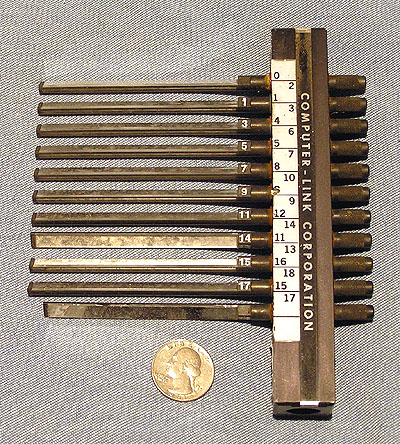
Does anyone have any idea what this is?
<http://www.classiccmp.org/hp/laser/computer%20link.jpg>. The "sticks"
sticking out to the left are long skinny mirrors. Each one can rotate +/-
45 degrees by means of the knobs on the right side. One side of the
rotating mirror shows a number such as "1", when you rotate it it shows
"2", etc etc. This is the second one of these that I've found but the first
was all busted up.
Joe
Looked at the manuals: systems with one or two cardcages ship with 2-phase 220v power supplies, 3 card-cage models ship with 3-phase 208v power supplies
On Nov 10 2005, 20:13, Tony Duell wrote:
> > So I guess it works. This thing seems to be made in the same way
that the
> > Sinclair LED wristwatch I once had was--CHEAP is the biggest
consideration.
>
> Exactly. And don't care if it works properly, or if it's convenient
to
> use. Remember Sinclair once sold a scientific calculator that gave
you 3
> accureate significant figures if you were lucky!
That would be the one that took longer to calculate the sine of an
angle than it took to open Chambers 6-figure tables and look it up, as
I was reminded at our recent Open Day (we had a few such things on
display along with real computers, micros, and calculators).
Having said that, I was quite upset when my Sinclair Cambridge Memory
calculator began to misbehave a couple of years ago, and eventually
died altogether. It was a nicer shape and size than any other simple
calculator I've owned, great for one-handed operation. I have an
"ordinary" Sinclair Cambridge, and a Scientific as well, but they're
not as nice to use. The memory version seems to be relatively rare,
and the last two I saw on eBay went for moe than I'd consider sensible.
--
Pete Peter Turnbull
Network Manager
University of York
>From: "Scott Stevens" <chenmel at earthlink.net>
>
---snip---
>
>Who's going to win the SYM-1 up for bid on eBay right now, BTW?
>
>
>> Cheers,
>> Chuck
>>
>>
>
Hi
A lot of SYM-1's seem to be showing up lately. Most
with only the 2 2114's so I'd suspect that these are
mostly unused or little used( most anyone would want
the full complement of RAM ). There are a number of
nice software things available for these on the web,
including the ROM based BASIC.
I'm off and on trying to restore an even rarer item
connected with the SYM-1. I have a board called the
FDC-1. This was a floppy controller card for the SYM-1
( not made by Synertek ). I still don't know if the
software I got for the original OS is correct or not.
On Dallas' web page, he has a updated OS that is nice
but I'd like the klunky original OS.
The other item that is a little rare for the SYM-1's
is the KTM-2 keyboards/monitor driver. These were a
nice addition to the SYM-1. The KTM-2 came in a 40 and
80 column version. If you have the newer 40, it can be
upgraded to the 80 column.
Both of these items are rarer than the SYM-1 itself
and I've not seen either show up on ebay ( but I may
have miss them ).
Last but not least is the SYM-2. This is an newer
but reduced SYM-1 with an onboard regulator for +5.
Dwight
>
>Subject: Re: Discharging a VT100 CRT
> From: ard at p850ug1.demon.co.uk (Tony Duell)
> Date: Thu, 10 Nov 2005 19:55:37 +0000 (GMT)
> To: cctalk at classiccmp.org
>
>> CR408 is a 1A 400V diode (1n4006 should do)
>
>Is there any reaosn not to use a 1N4007 here as well? I generally don't
>buy the other IN400x's as I've yet to find an application where too high
>a PIV is a problem.
>
>-tony
That is true but I gave him the spec for the diode that was there.
As is the 4006 is a 600V device.
Hey around here anytime I need a 1A diode it's a 1N4007 as I buy
them 100 at a time cheap. They make good varactors an passable
HF low VHF PIN diodes.
Allison
>
>Subject: RE: Discharging a VT100 CRT
> From: "Julian Wolfe" <fireflyst at earthlink.net>
> Date: Thu, 10 Nov 2005 15:39:26 -0600
> To: "'General Discussion: On-Topic and Off-Topic Posts'" <cctalk at classiccmp.org>
>
>Are these two parts something I can buy at RS? I don't want to have to
>drive 20 miles to the nearest real component store if possible.
>
Well a 1n4007 at RS may still be possible, likely 2 for 1.99. I buy
them 500 for $15 from JDRmicrodevices. Can never have enough spares.
The cap I'd likely hunt around for a junk radio or computer monitor
chassis and pull it from there.
Allison
>>> CR408 is a 1A 400V diode (1n4006 should do)
>>
>>Is there any reaosn not to use a 1N4007 here as well? I generally don't
>>buy the other IN400x's as I've yet to find an application where too high
>>a PIV is a problem.
>>
>>-tony
>
>That is true but I gave him the spec for the diode that was there.
>As is the 4006 is a 600V device.
>
>Hey around here anytime I need a 1A diode it's a 1N4007 as I buy
>them 100 at a time cheap. They make good varactors an passable
>HF low VHF PIN diodes.
>
>Allison
>
found one in the trash. Am sure it isn't working,
though I haven't quite gotten it to the power-on
stage. Looking for *reasonably priced* ST (and this
could mean anything in that series) stuff in general,
working or not. Come to think of it, ain't even got
the mouse (I believe this one had an internal p/s and
floppy drive).
__________________________________
Yahoo! FareChase: Search multiple travel sites in one click.
http://farechase.yahoo.com
I finally got a drive select plug for my RL01 drive and would like to
try connecting it to my 11/73 but I find that the cable that is
supposed to plug into the RLV12 controller isn't keyed so it can go
in either way. How do I tell what the correct orientation is for this
cable? I'm assuming that if I plug it in backwards I'll fry the
controller and/or drive. The only markings on the end of the cable
that connects to the controller are the manufacturers name "Berg" and
the letters A and B near one end and VV and UU near the other end.
How should this cable be inserted into the RLV12?
Also, assuming I get this straightened out, what should expect to
happen on power up? Should the 11/73 automatically boot from the
RL01? I have an MXV11A boot board installed. Or do I get a console
prompt and have to select the boot device on the console?
Thanks,
David
Does anyone have any use for some Fujitsu MB8107 DRAM chips? From what I
can determine, these are the same as the TI TMS4060 4Kx1 "midi size" 22-pin
DIPs.
I've also got some Intel 2111-4 SRAM.
Cheers,
Chuck
Hi David,
I don't type very well, but I can talk you through this on the phone. Is
there a good time to call you or would you prefer to call me? It won't matter to
my phone bill.
Thanks, Paul
>
>Subject: Re: VCF 8.0 Pictures
> From: Doc Shipley <doc at mdrconsult.com>
> Date: Thu, 10 Nov 2005 16:33:21 -0500
> To: General at mdrconsult.com, "Discussion at mdrconsult.com":On-Topic and Off-Topic
> Posts <cctalk at classiccmp.org>
>
>Allison wrote:
>
>> Well for one, I insist that you also have a supply of beefcake
>> for us geeky girls. Fair is fair! ;)
>
> Ahem. Aging, bald, bespectacled, spreading geek men aren't beefcake
>enough for ya?
>
>
> Doc
Well, you old farts look at the girls. What's ya think us girls are doin?
Allison
>From: ard at p850ug1.demon.co.uk
>
>> CR408 is a 1A 400V diode (1n4006 should do)
>
>Is there any reaosn not to use a 1N4007 here as well? I generally don't
>buy the other IN400x's as I've yet to find an application where too high
>a PIV is a problem.
>
>-tony
>
Hi
The only issue I know of is slightly slower
commutation time. Not even noticeable for 50Hz
or 60Hz.
Dwight
>
>Subject: RE: VCF 8.0 Pictures
> From: "Hans Franke" <Hans.Franke at siemens.com>
> Date: Thu, 10 Nov 2005 16:10:46 +0100
> To: "General Discussion: On-Topic and Off-Topic Posts" <cctalk at classiccmp.org>
>
>Am 10 Nov 2005 15:52 meinte Gooijen, Henk:
>> > Am 10 Nov 2005 9:09 meinte Gooijen, Henk:
>> > > There is a second picture of the "hot geeky blond girl"
>> > > which promotes her to "hot geeky blond 'nice legs' girl" :-)
>> > > If I ever go to a VCF (in Germany), I must hire one of those
>> > > girls you see on the bonnet at car shows. It will not matter
>> > > what old stuff I exhibit, *my* stand will be visited most! :-)
>
>> > I have to see that ... your booth at VCFe 6.0 is reserved :)
>
>> Yes, I am giving it serious thoughts!
>> Do you provide the girlz, Hans? Would be an BIG incentive! :-)
>
>Well, we usualy employ one official hootie for VCFe, although
>I'm not shure for next year.
Well for one, I insist that you also have a supply of beefcake
for us geeky girls. Fair is fair! ;)
>> On display I can have:
>> 2) Homebrew pdp8/e running (slow) OS/8 or DMS
Howbout a 6120 homebrew running OS8? The trick was real DEC style
IO rather than PIEs and cruft that leads up to os78 and os278.
>> 3) PDP-11/03, a real one for a change :-) decoding HAM radio RTTY
I've used the -11 for RTTY display. You only need a modem to decode
the tones though having spilt screen, upper for incomming and lower
for outgoing text.
I'd like to see PSK31 software for the -11.
Allison
>
>Subject: RE: Discharging a VT100 CRT
> From: "Julian Wolfe" <fireflyst at earthlink.net>
> Date: Thu, 10 Nov 2005 00:13:50 -0600
> To: "'General Discussion: On-Topic and Off-Topic Posts'" <cctalk at classiccmp.org>
>
>Well Well Well.
>
>On closer inspection, it is very clear that the cap is what blew (it's
>exploded and blackened on one end) is at C439, and the diode is CR408. The
>diode description in the maintenance print is aggravatingly overwritten by
>the entry above it as it ran over.
>
>The cap is a 75MFD, 6V, +75-10% Electrolytic cap
>
>Where should I go from here?
Well thats a horse of a differnt color.
CR408 is a 1A 400V diode (1n4006 should do)
the cap is what it is. and should be replaced.
The easy test is replace the diode and cap and see if it works.
if cr408 or R478 get hot (not warm) then other problems exist.
Allison
Tony wrote:
> > just a short question, I have seen so much that I start doubting
> > everything :-( After you pressed the CLR key on the 11/34
> > console (to get a clear start point), if you *only* press the
> > CNTRL key, nothing should happen, right?
>
> Right. The CNTRL key is a bit like a shift key, and should do
> nothing on its own.
>
>
> To answere one of your other posts, I would expect data to be
> written ot the display latch quite frequently (of the order of ms)
> _but_ the write pulse will be narrow (a few us at most), and if
> you've got the analyser set up to sample for long enough to display
> several display scans, you might well miss some of the write pulses
> because they occur between analyser samples. I think the K100D has
> 'gltich capture' for just this sort of problem, try selecting it for
> the input you use for the write pulse.
>
> -tony
Ok, so the CNTRL key behaviour analysis is a good point to start with.
Yesterday evening I checked the latch that gives the NUM 1-2-3
signals, and the buffer that is behind it. The in- and output signals
are OK, although it is *constantly* '110', which matches the display
value "666666". On the LA (set to sample at 1 msec) I did see *one*
pulse on the CLK pin of the latch. My guess yesterday evening was,
that is not correct as just *one* pulse in 1000 msec is way to low
for a good refresh rate, just as you say Tony. It did not occur to me
that the single pulse was "by luck" detected by the LA. If the LA sees
*one*, I should see more, I'd guess. I do remember that I had to turn
up the brightness control of the scope to see the thin CLK pulses ...
I will put a picture on the webpage tomorrow.
The battery of the camera is recharging.
Your initial remark about a failing RAM chip is still in the picture,
as the value to display is taken from the first 3 locations of the
RAM. BTW, the operator/maintenance manual has an error in the memory
allocation. It shows that the first byte is for the display, but it
is actually the first 3 bytes. So the rest of the picture can not be
correct either ... The assembler source listing proves this. Every
time a digit must be set on the output port, the 3 memory locations
are shifted 3 bits. That means with 6 digits, that at the end the
total shifted bit count is 18. The code corrects the value in the
3 memory locations by shifting 6 bit positions when the complete
6 digit number is sent to the output port.
I am getting tempted to install the totally dead M7859, and have a
look at it, with the new knowledge build up from this module. May be
its is just a defective 8008, but I am afraid that if I get the dead
M7859 working, this weird defective one will end up on the pile of
things "I must do, when I get the time" ...
But I will first inspect the two RAM chips! 4-bit data in, 4-bit data
out, 4 address bits, one select pin and one clock pin (the WE* pin
is tied to GND). Should be possible to see it all with the 16 channels
and make a conclusion of the RAM's condition. You might have been
correct from the beginning, Tony!
thanks,
- Henk, PA8PDP.
This message and attachment(s) are intended solely for the use of the addressee and may contain information that is privileged, confidential or otherwise exempt from disclosure under applicable law.
If you are not the intended recipient or agent thereof responsible for delivering this message to the intended recipient, you are hereby notified that any dissemination, distribution, or copying of this communication is strictly prohibited.
If you have received this communication in error, please notify the sender immediately by telephone and with a "reply" message.
Thank you for your cooperation.
>
>Subject: Re: Ultrix for DECstations
> From: Adrian Graham <witchy at binarydinosaurs.co.uk>
> Date: Thu, 10 Nov 2005 19:02:27 +0000
> To: "General Discussion: On-Topic and Off-Topic Posts" <cctalk at classiccmp.org>
>
>(The only load media on this big-iron VAX is a TZ887 tape library so I'm
>going to install VMS onto the boot disk by plugging it into a VAX 3100-90
>with a BA350 storage shelf then all I have to do is put that disk into the
>6660's HSJ50-powered storage array and boot it......try doing THAT on any
>other OS :oD VMS is VMS is VMS.....)
>
>A
I've done that for years using RD54s and then SCSI disks, easiest way to do
a VMS install for 20 systems. Do it once then clone the drive, doent matter
what the system varient was so long as it can interface to the drive.
Beat the tar or hackup out of using TK50.
Allison
>
>Subject: Re: Software find
> From: Adrian Graham <witchy at binarydinosaurs.co.uk>
> Date: Thu, 10 Nov 2005 19:14:10 +0000
> To: "General Discussion: On-Topic and Off-Topic Posts" <cctalk at classiccmp.org>
>
>On 9/11/05 23:04, "Dan Williams" <williams.dan at gmail.com> wrote:
>
>> For the 380z Sbas, bcpl (4 disks), txed, zasm, cp/m 2.2 and 1.4 and Wordstar.
>> For the Nimbus Windows 1.01 (Which I've never seen), write 2.0,
>> various version of RM basic and Msdos 3.05.
>> I'd like to see windows booted up the earliest version I've seen is
>> 2.x (can't remember).
>
>I've got 2 Nimbus' but no monitor for either of them, though there's another
>machine plus a monitor waiting for me in north wales if I can ever get over
>there to pick it up (or Lee D. can if I can get the address :o))
>
>Wouldn't mind seeing windows 101 myself, though it's just a glorified
>DOSSHELL running on top of DOS 5. 'ugly' doesn't do it justice!
>
>A
Then again so was V3.11. It was dos.
Allison
I've found an Ampex Megastore ISA card that interfaces via a 50-pin header.
I've got the software for it, but no manuals, so I don't know what it's
supposed to connect to--it doesn't seem to be SCSI.
Any ideas?
Cheers,
Chuck
>
>Subject: Re: help - 11/34 console problem -- CNTRL key behaviour
> From: woodelf <bfranchuk at jetnet.ab.ca>
> Date: Thu, 10 Nov 2005 10:22:23 -0700
> To: General Discussion: On-Topic and Off-Topic Posts <cctalk at classiccmp.org>
>
>>
>>
>Well if you are going to hack the 8008 you need the right tools.
>Check here for a 8008 link I just found yesterday.
>
>> http://www.jkearney.com/8008/
>
Haveing done two commercial designs with the part I have most of that
including a copy of the MARK-8 article. Never like the part it was just
on the cusp of 60 ICs for s system using it or 150 ICs or so to do it
>from the ground up. Much prefered the 8080 and better yet 8085 and Z80s.
Allison
>
>Subject: RE: VCF 8.0 Pictures
> From: "Hans Franke" <Hans.Franke at siemens.com>
> Date: Thu, 10 Nov 2005 17:54:15 +0100
> To: "General Discussion: On-Topic and Off-Topic Posts" <cctalk at classiccmp.org>
>
>> >Well, we usualy employ one official hootie for VCFe, although
>> >I'm not shure for next year.
>
>> Well for one, I insist that you also have a supply of beefcake
>> for us geeky girls. Fair is fair! ;)
>
>Beefkake? well, Leberk?s-sandwitches are available all
>day at the VCFe food court, and of course we can add
>some meatloaf for the traditional dinner if you want :)
>
>Gruss
>H.
Beefcake: young men with fine bodies. ;)
The sandwitches are for eating while watching. ;-)
Allison
>
>Subject: Re: Ultrix for DECstations
> From: Paul Koning <pkoning at equallogic.com>
> Date: Thu, 10 Nov 2005 13:17:36 -0500
> To: cctalk at classiccmp.org
>
>>>>>> "Patrick" == Patrick Finnegan <pat at computer-refuge.org> writes:
>
> Patrick> No, those were "DEC 3000"s. DECstations (3000/5000/etc)
> Patrick> were all MIPS.
>
> Patrick> And, from what I've heard, at least one reason that DEC made
> Patrick> Alpha, and didn't port VMS to the MIPS architecture, is
> Patrick> because they'd have to make a lot of changes to VMS, because
> Patrick> of its security model, in order to make it work with MIPS.
> Patrick> Aparently, MIPS just didn't work enough like a VAX CPU to
> Patrick> easily port VMS to it.
>
>Maybe. But I wonder what could be missing that Alpha has and MIPS
>doesn't that is so critical.
An advantage over VAX. At that point in time it was considered but
the forward planning people already had strong feeings that the VAX
killer machine was to be next generation and generally that meant
larger address (more than 32bits).
>Supposedly, the only reason MIPS has supervisor mode is that DEC
>insisted on having it added.
I'd heard that. Never able to verify it.
Allison
And why is the brunette girl in the background making 'steering wheel
- driving motions' that seems to make the much taller older gentleman
next to her seem very concerned? Hehe. Please let it not be one of
those 'hey, listen to this story about how I first came across
classic computers... so after the car went over the curb into the
store front...' Grin.
-John Boffemmyer IV
At 03:09 AM 11/10/2005, you wrote:
>There is a second picture of the "hot geeky blond girl" which
>promotes her to "hot geeky blond 'nice legs' girl" :-)
>If I ever go to a VCF (in Germany), I must hire one of those
>girls you see on the bonnet at car shows. It will not matter
>what old stuff I exhibit, *my* stand will be visited most! :-)
>
>- Henk, PA8PDP.
>
>BTW. Thanks for sharing the pictures! Nice to see.
>
>
> > -----Original Message-----
> > From: cctalk-bounces at classiccmp.org
> > [mailto:cctalk-bounces at classiccmp.org] On Behalf Of John Boffemmyer IV
> > Sent: donderdag 10 november 2005 2:16
> > To: General Discussion: On-Topic and Off-Topic Posts
> > Subject: Re: VCF 8.0 Pictures
> >
> > Simply just biased because of the following:
> > 1- hot geeky blonde girl (most would stop here)
> > 2- Ghirardelli chocolates (in picture)
> > 3- did I mention #1?
> > 4- a very, very nice Apple Lisa =)
> > -John Boffemmyer IV
> >
> > At 06:58 PM 11/9/2005, you wrote:
> >
> > >On 9/11/05 23:35, "Erik Klein"
> > <classiccmp at vintage-computer.com> wrote:
> > >
> > > > I've just finished putting up a quick page for my VCF 8.0
> > > > pictures.
> > > > There are no descriptions yet (any help would be
> > > > appreciated - let
> > > > me know if you recognize folks, items or whatnot) but
> > > > I'll hopefully get to them soon.
> > >
> > >I know this is subjective and opinion based, but....wow.....
> > >
> > >http://www.vintage-computer.com/images/vcf8/elisabeth.jpg
> > >
> > >Not that it's my favourite machine or anything :)
> > >
> > >A
>
>This message and attachment(s) are intended solely for the use of
>the addressee and may contain information that is privileged,
>confidential or otherwise exempt from disclosure under applicable law.
>If you are not the intended recipient or agent thereof responsible
>for delivering this message to the intended recipient, you are
>hereby notified that any dissemination, distribution, or copying of
>this communication is strictly prohibited.
>If you have received this communication in error, please notify the
>sender immediately by telephone and with a "reply" message.
>Thank you for your cooperation.
--
No virus found in this outgoing message.
Checked by AVG Anti-Virus.
Version: 7.1.362 / Virus Database: 267.12.8/165 - Release Date: 11/9/2005
Hi,
My name is Mark Brennan, I am a systems engineer with Fujitsu in Ireland and
I have a request I am looking for some help with.
My request is some what strange to say the least.
Since I joined Wang Computer in 1988 I have been collecting Product
Brochures on various computer systems it started of with Wang Vs server
systems.
For the last few years I have been trying to collect old
product/info/fact/marketing brochures on various computer systems with very
little luck, as in the future I hope to set-up a web site with details and
overviews of them. I have managed to collect some information on,
DG/HP/Wang/Netframe/NCR/Tandem/DEC/Sequent/SGI/Siemens-Fujitsu/Pyramid/Apoll
o/Cray/KSR/Ncube/ICL/Compaq etc, I was wondering whether or not you may
have or know where I maybe able to get my hands on any old product
brochures/fact sheets etc on any of the HP systems/servers, I know that my
request is at best strange but any help would be great.
Anything that is sent to me I will copy and return the originals it people
still need them that is.
Regard and thanks again markb.
Mark Brennan
System Engineer
System Services
FUJITSU
Fujitsu House, South County Business Park, Leopardstown, Dublin 18, Ireland
Tel: +353 (0) 1 2076900
Mobile: +353 (0) 87 2222326
Fax: +353 (0) 1 2161863
E-mail mark.brennan at ie.fujitsu.com
Web: <http://ie.fujitsu.com/> http://ie.fujitsu.com/
Fujitsu Services Limited, Registered in England no 96056, Registered Office
26, Finsbury Square, London, EC2A 1SL
This e-mail is only for the use of its intended recipient. Its contents are
subject to a duty of confidence and may be privileged. Fujitsu Services does
not guarantee that this e-mail has not been intercepted and amended or that
it is virus-free.
>
>Subject: RE: help - 11/34 console problem -- CNTRL key behaviour
> From: "Gooijen, Henk" <henk.gooijen at oce.com>
> Date: Thu, 10 Nov 2005 09:03:40 +0100
> To: "General Discussion: On-Topic and Off-Topic Posts" <cctalk at classiccmp.org>
>
>Tony wrote:
>
>> > just a short question, I have seen so much that I start doubting
>> > everything :-( After you pressed the CLR key on the 11/34
>> > console (to get a clear start point), if you *only* press the
>> > CNTRL key, nothing should happen, right?
>>
>> Right. The CNTRL key is a bit like a shift key, and should do
>> nothing on its own.
>>
>>
>> To answere one of your other posts, I would expect data to be
>> written ot the display latch quite frequently (of the order of ms)
>> _but_ the write pulse will be narrow (a few us at most), and if
>> you've got the analyser set up to sample for long enough to display
>> several display scans, you might well miss some of the write pulses
>> because they occur between analyser samples. I think the K100D has
>> 'gltich capture' for just this sort of problem, try selecting it for
>> the input you use for the write pulse.
>>
>> -tony
>
>Ok, so the CNTRL key behaviour analysis is a good point to start with.
>
>Yesterday evening I checked the latch that gives the NUM 1-2-3
>signals, and the buffer that is behind it. The in- and output signals
>are OK, although it is *constantly* '110', which matches the display
>value "666666". On the LA (set to sample at 1 msec) I did see *one*
>pulse on the CLK pin of the latch. My guess yesterday evening was,
>that is not correct as just *one* pulse in 1000 msec is way to low
>for a good refresh rate, just as you say Tony. It did not occur to me
>that the single pulse was "by luck" detected by the LA. If the LA sees
>*one*, I should see more, I'd guess. I do remember that I had to turn
>up the brightness control of the scope to see the thin CLK pulses ...
>I will put a picture on the webpage tomorrow.
>The battery of the camera is recharging.
>
>Your initial remark about a failing RAM chip is still in the picture,
>as the value to display is taken from the first 3 locations of the
>RAM. BTW, the operator/maintenance manual has an error in the memory
>allocation. It shows that the first byte is for the display, but it
>is actually the first 3 bytes. So the rest of the picture can not be
>correct either ... The assembler source listing proves this. Every
>time a digit must be set on the output port, the 3 memory locations
>are shifted 3 bits. That means with 6 digits, that at the end the
>total shifted bit count is 18. The code corrects the value in the
>3 memory locations by shifting 6 bit positions when the complete
>6 digit number is sent to the output port.
>
>I am getting tempted to install the totally dead M7859, and have a
>look at it, with the new knowledge build up from this module. May be
>its is just a defective 8008, but I am afraid that if I get the dead
>M7859 working, this weird defective one will end up on the pile of
>things "I must do, when I get the time" ...
>But I will first inspect the two RAM chips! 4-bit data in, 4-bit data
>out, 4 address bits, one select pin and one clock pin (the WE* pin
>is tied to GND). Should be possible to see it all with the 16 channels
>and make a conclusion of the RAM's condition. You might have been
>correct from the beginning, Tony!
Never seen a dead 8008. I thought I'd killed one (at $180 then!) by
installing it backward and then tossed it on the floor in the engineering
lab. some days later after pulling from the bottom of my shoe I tried
it again and it was still alive.
The ram however is definately suspect. But I've seen IO messups with 8008
and with scanned displays and keyboards are harder to look at.
It would be goof if you could run a different program and see it's results.
We used a set of ROMs all different to test. They were short programs that
would either loop or do something and halt. For example we had one that would
write (this was a time display) 00:00:00 then increment all the displays
without doing anything else. Another would write a 8 tot he last display
and halt. the most useful ones were those that would repeatedly loop input
or output to a port. Very handy as back (1973) then logic analysers were
not to be had and a 15mhz dual trace scope was the usual tool.
Allison
>
>Subject: Re: MSCP SCSI controller speed
> From: 9000 VAX <vax9000 at gmail.com>
> Date: Wed, 09 Nov 2005 00:23:01 -0500
> To: "General Discussion: On-Topic and Off-Topic Posts" <cctalk at classiccmp.org>
>
>You are right. Those two are not the bottleneck. I measured the actual
>execution time when run "dd if=syssrc.tar of=/dev/null" (photo
>attached). NetBSD 1.5.2 moves 16kB a time. The measured time is:
>
>4.75ms MSCP-pre-DMA overhead
>0.4ms SCSI overhead
>7ms DMA of 16kB
>4.2ms MSCP-post-DMA overhead
>31ms idle time
>
>What kills the speed is the 31ms idle time. I blame NetBSD for that.
You need a real time or single user os to get better results. Plain old
dos might do far better or maybe a custom kernal tuned for this use.
>> nor wished to program PCs. That and someone gave me a CMD SCSI adaptor. ;)
>>
>
>You are lucky. Nobody gives me CMD card. But from now on I probably
>will not need one any more.
It was a lot of years ago, pre epay inflation. That and I got a broken
BA123 microvax with it.
Allison
> Am 10 Nov 2005 9:09 meinte Gooijen, Henk:
>
> > There is a second picture of the "hot geeky blond girl"
> > which promotes her to "hot geeky blond 'nice legs' girl" :-)
> > If I ever go to a VCF (in Germany), I must hire one of those
> > girls you see on the bonnet at car shows. It will not matter
> > what old stuff I exhibit, *my* stand will be visited most! :-)
>
> I have to see that ... your booth at VCFe 6.0 is reserved :)
>
> Gruss
> H.
> --
> VCF Europa 7.0 am 29/30.April und 01.Mai 2006 in Muenchen
> http://www.vcfe.org/
Yes, I am giving it serious thoughts!
Do you provide the girlz, Hans? Would be an BIG incentive! :-)
On display I can have:
1) SIMH connected to homebrew PDP-11/40 console running RT11
2) Homebrew pdp8/e running (slow) OS/8 or DMS
3) PDP-11/03, a real one for a change :-) decoding HAM radio RTTY
4) SIMH connected to a *real* PDP-11/70 console
but items 3 and 4 are "under development" ...
- Henk, PA8PDP.
This message and attachment(s) are intended solely for the use of the addressee and may contain information that is privileged, confidential or otherwise exempt from disclosure under applicable law.
If you are not the intended recipient or agent thereof responsible for delivering this message to the intended recipient, you are hereby notified that any dissemination, distribution, or copying of this communication is strictly prohibited.
If you have received this communication in error, please notify the sender immediately by telephone and with a "reply" message.
Thank you for your cooperation.
There is a second picture of the "hot geeky blond girl" which
promotes her to "hot geeky blond 'nice legs' girl" :-)
If I ever go to a VCF (in Germany), I must hire one of those
girls you see on the bonnet at car shows. It will not matter
what old stuff I exhibit, *my* stand will be visited most! :-)
- Henk, PA8PDP.
BTW. Thanks for sharing the pictures! Nice to see.
> -----Original Message-----
> From: cctalk-bounces at classiccmp.org
> [mailto:cctalk-bounces at classiccmp.org] On Behalf Of John Boffemmyer IV
> Sent: donderdag 10 november 2005 2:16
> To: General Discussion: On-Topic and Off-Topic Posts
> Subject: Re: VCF 8.0 Pictures
>
> Simply just biased because of the following:
> 1- hot geeky blonde girl (most would stop here)
> 2- Ghirardelli chocolates (in picture)
> 3- did I mention #1?
> 4- a very, very nice Apple Lisa =)
> -John Boffemmyer IV
>
> At 06:58 PM 11/9/2005, you wrote:
>
> >On 9/11/05 23:35, "Erik Klein"
> <classiccmp at vintage-computer.com> wrote:
> >
> > > I've just finished putting up a quick page for my VCF 8.0
> > > pictures.
> > > There are no descriptions yet (any help would be
> > > appreciated - let
> > > me know if you recognize folks, items or whatnot) but
> > > I'll hopefully get to them soon.
> >
> >I know this is subjective and opinion based, but....wow.....
> >
> >http://www.vintage-computer.com/images/vcf8/elisabeth.jpg
> >
> >Not that it's my favourite machine or anything :)
> >
> >A
This message and attachment(s) are intended solely for the use of the addressee and may contain information that is privileged, confidential or otherwise exempt from disclosure under applicable law.
If you are not the intended recipient or agent thereof responsible for delivering this message to the intended recipient, you are hereby notified that any dissemination, distribution, or copying of this communication is strictly prohibited.
If you have received this communication in error, please notify the sender immediately by telephone and with a "reply" message.
Thank you for your cooperation.
>
>Subject: RE: help - 11/34 console problem -- CNTRL key behaviour
> From: "Gooijen, Henk" <henk.gooijen at oce.com>
> Date: Thu, 10 Nov 2005 14:44:52 +0100
> To: "General Discussion: On-Topic and Off-Topic Posts" <cctalk at classiccmp.org>
>
>Allison wrote:
>
>> Well it does not have to be a clock. It happend the product
>> I was working on was a time code display for video tape where
>> the display could be time or number of frames.
>>
>> Besides the display system for PDP-11 is likely OCTAL. ;)
>
>True, but the latch that outputs the 3 bits for the 7447 has
>a fourth output which could be used! Take that 4th output to
>the 7447 'D' input (which is now connected to GND) and you
>can display an "8" or a "9". But I am drifting off-topic --
>the console must work for starters :-)
>
>- Henk, PA8PDP.
The whole point of the clock thing is simple code to make a
repeated operation that traces esily with scope or logic
analyser.
Allison
Allison wrote:
> Well it does not have to be a clock. It happend the product
> I was working on was a time code display for video tape where
> the display could be time or number of frames.
>
> Besides the display system for PDP-11 is likely OCTAL. ;)
True, but the latch that outputs the 3 bits for the 7447 has
a fourth output which could be used! Take that 4th output to
the 7447 'D' input (which is now connected to GND) and you
can display an "8" or a "9". But I am drifting off-topic --
the console must work for starters :-)
- Henk, PA8PDP.
This message and attachment(s) are intended solely for the use of the addressee and may contain information that is privileged, confidential or otherwise exempt from disclosure under applicable law.
If you are not the intended recipient or agent thereof responsible for delivering this message to the intended recipient, you are hereby notified that any dissemination, distribution, or copying of this communication is strictly prohibited.
If you have received this communication in error, please notify the sender immediately by telephone and with a "reply" message.
Thank you for your cooperation.
>
>Subject: RE: help - 11/34 console problem -- CNTRL key behaviour
> From: "Gooijen, Henk" <henk.gooijen at oce.com>
> Date: Thu, 10 Nov 2005 13:25:03 +0100
> To: "General Discussion: On-Topic and Off-Topic Posts" <cctalk at classiccmp.org>
>
>Allison wrote:
>
>I checked the contents of the ROMs (from the listing). They are
>quite filled, there is no room to show a clock on the display.
>Would be fun, because once the 11/34 runs, the display is not
>very exciting any more ...
>Pity that the ROMs are soldered on the board. It would be quite
>a hack (but certainly possible!) to enable an other set of ROMs
>to run e.g. the clock software. But then there is also the
>difficulty to get the proper (blank) ROMs.
>But it is a fun idea to keep in mind ...
Well it does not have to be a clock. It happend the product
I was working on was a time code display for video tape where
the display could be time or number of frames.
Besides the display system for PDP-11 is likely OCTAL. ;)
>The RAM timing traces will be up on Monday!
Actually a common 2716 or later device is fine for that. Disable
the on board and use an adaptor. A fast 8008 was 10us instrcution
time so rom speed will not be an issue. If I were doing it now
I'd make an adaptor and use a 2816 (EEPROM) with a simple bit of
logic to load stuff. Not a lot of space is needed Small loops
to write to ram and display it are maybe 20-50 bytes.
Allison
Sorry for my ignorance -
Who runs the VCF events?
Do they have guest speakers?
I ask because I attended a presentation by Doug McIlroy, an early
computer pioneer with Bell Labs, and Thompson/Ritchie's manager. He's
made significant contributions to both Unix and Multics, among other
things and he has some great stories to tell about the early days and
the development of Unix. His presentation was focused on personal
experiences and the people he's known, but I believe he can also get
very technical (he is currently an adjunct professor at Dartmouth).
After the presentation I spoke for a time with Doug. He was amazed that
there exists a community interested in the preservation and restoration
of old computers and their software. I explained a few things about the
community and some of their projects and he was interested in the idea
of the VCF. He said he'd consider an opportunity to speak at the VCF or
similar venues in the North East and Mid Atlantic regions.
Would there be an interest in having Doug present, does the VCF have
space in their program for speakers?
Some info on Doug -
http://www.cs.dartmouth.edu/~doug/biographyhttp://en.wikipedia.org/wiki/Doug_McIlroyhttp://www.cs.dartmouth.edu/~doug/
-James
Allison wrote:
> Never seen a dead 8008. I thought I'd killed one (at $180 then!)
> by installing it backward and then tossed it on the floor in the
> engineering lab. some days later after pulling from the bottom
> of my shoe I tried it again and it was still alive.
Amazing, but I will not try to repeat it to test your story :-)
> The ram however is definately suspect. But I've seen IO
> messups with 8008 and with scanned displays and keyboards are
> harder to look at.
This weekend I will check the RAMs!
> It would be goof if you could run a different program and see
> it's results.
> We used a set of ROMs all different to test. They were short
> programs that would either loop or do something and halt. For
> example we had one that would write (this was a time display)
> 00:00:00 then increment all the displays without doing
> anything else. Another would write a 8 tot he last display
> and halt. the most useful ones were those that would
> repeatedly loop input or output to a port. Very handy as
> back (1973) then logic analysers were not to be had and a
> 15mhz dual trace scope was the usual tool.
I checked the contents of the ROMs (from the listing). They are
quite filled, there is no room to show a clock on the display.
Would be fun, because once the 11/34 runs, the display is not
very exciting any more ...
Pity that the ROMs are soldered on the board. It would be quite
a hack (but certainly possible!) to enable an other set of ROMs
to run e.g. the clock software. But then there is also the
difficulty to get the proper (blank) ROMs.
But it is a fun idea to keep in mind ...
The RAM timing traces will be up on Monday!
thanks,
- Henk, PA8PDP.
This message and attachment(s) are intended solely for the use of the addressee and may contain information that is privileged, confidential or otherwise exempt from disclosure under applicable law.
If you are not the intended recipient or agent thereof responsible for delivering this message to the intended recipient, you are hereby notified that any dissemination, distribution, or copying of this communication is strictly prohibited.
If you have received this communication in error, please notify the sender immediately by telephone and with a "reply" message.
Thank you for your cooperation.
I have arranged to buy a Quatech DAQ1602 card for the ISA bus. However, the
company no longer supports the card and as too often happens, the resellers
do not bother to deliver the software or handbooks. Is there anyone out
there who has DaqSuite, the normal CD supplied with the card? I would be
glad to cover your costs if you can help me to get this card running.
Incidentally, if you have ANY card which was delivered with DaqSuite, the CD
probably includes what I need. Quatech seems to have included their whole
product line on the same CD and the CD was supplied on request to owners of
the company's products. Unfortunately for me, the product line has been
sold to another company and that company does not supply the card I have.
Indeed, one other company continues to sell some products from the Quatech
product lineup, but not the 1602.
I would greatly appreciate help in obtaining a copy of the CD (even over the
Internet, if that is easier!)
Sincerely, Bob Mueller
>
>Subject: RE: Discharging a VT100 CRT
> From: "Julian Wolfe" <fireflyst at earthlink.net>
> Date: Wed, 09 Nov 2005 13:17:26 -0600
> To: "'General Discussion: On-Topic and Off-Topic Posts'" <cctalk at classiccmp.org>
>
>How much are you asking for the monitor board?
>
>-----Original Message-----
>From: cctalk-bounces at classiccmp.org [mailto:cctalk-bounces at classiccmp.org]
>On Behalf Of Useddec at aol.com
>Sent: Wednesday, November 09, 2005 1:14 PM
>To: cctalk at classiccmp.org
>Subject: Re: Discharging a VT100 CRT
>
>Hi,
>
>I have the logic board, power supply, and what we used to call the "monitor
>board" in stock. I worked on a lot of these when I worked for Digital. I
>now
>deal in DEC parts.
>
>Thanks, Paul
>
Make sure it's the correct one. There are three versions for the differing
monitors. The monitor portion were made for DEC to spec and could be
Ball brothers, Moto or I forgot.
Allison
I just noticed that Al (and occasionally a few others) send email to
'classiccmp at classiccmp.org' rather than the usual cctalk / cctech
addresses.
Is that a valid address? It's obviously working, I just don't filter on
it in my mail client and was wondering whether I should be or not! :-)
(IIRC that was the list address prior to the cctalk/cctech split a while
back, but I assume Jay might be ditching it one day if so)
cheers
Jules
Tony wrote:
> >
> > Making your own pod...! Again, points earned Tony! Chapeau! :-)
>
> Well, back when I got that instrument, _any_ LA was
> expensive. The only way I could afford one was to get one
> missing the pods. And I'd done a fair amount of ECL work for
> my Ph.D, so when I found the inputs were actually
> differential ECL signals, it didn;t worry me too much.
>
> -tony
Ah. Ok then. I never worked with ECL, so that is totally
unknown territory for me. You had a jump start then :-)
I continued working on the 11/34 console board. Made a few new
measurements (display and keypad). I am still figuring out what
I have seen. I am a bit reluctant to remove an IC from the board,
put in a socket and a new IC, just to find out that I overlooked
something and the replaced IC was not bad.
I have the impression that the strobe pulse to latch the 74175
that outputs the 3-bit code to the 7447 display driver is issued
at a way to low rate. I seldom see this pulse, but expect it to
see quite often as it must for multiplexing the display ...
To support this repair I will write up a webpage with the LA
pictures. I will mention the URL here. Very soon ...
thanks for all input so far,
- Henk, PA8PDP.
This message and attachment(s) are intended solely for the use of the addressee and may contain information that is privileged, confidential or otherwise exempt from disclosure under applicable law.
If you are not the intended recipient or agent thereof responsible for delivering this message to the intended recipient, you are hereby notified that any dissemination, distribution, or copying of this communication is strictly prohibited.
If you have received this communication in error, please notify the sender immediately by telephone and with a "reply" message.
Thank you for your cooperation.
>
>Subject: RE: Discharging a VT100 CRT
> From: "Julian Wolfe" <fireflyst at earthlink.net>
> Date: Wed, 09 Nov 2005 12:43:29 -0600
> To: "'General Discussion: On-Topic and Off-Topic Posts'" <cctalk at classiccmp.org>
>
>Well, you were right. Something did blow on the VT100 video board, and in a
>bad way. It looks very much like it was that diode you speak of, cause
>there's a huge burnmark on the board at the contact points of the diode. If
>that's not an "I died" indicator, I don't know what is.
>
>Can anyone tell me what diode to buy to replace it? I'm thinking of getting
>a replacement video board, and then replacing the diode on that, just in
>case it took something else with it. The whole "y" trace has a brownmark
>around it that the diode was connected to, and that has a big cap next to
>it.
Check the diode first as often they survive. If it didn't it may be
the 1A 1000V device (1n4007 will work) at CR102. The cap is correct value
(22uf) but about half the required working voltage so it shorts after a
long time. I forget if it was C102 or c103 and the working voltage should
be at least 100V but not more than 160V. or so memory says.
Allison
Hi all,
just a short question, I have seen so much that I start
doubting everything :-(
After you pressed the CLR key on the 11/34 console
(to get a clear start point), if you *only* press the
CNTRL key, nothing should happen, right?
[ on my 11/34, when I press CLR (release it), the press
the CNTRL key (only that one), the 7-segment displays go
all OFF, and when the are on again, they show the value
that was in them before I pressed CNTRL. Also, BUS ERR
goes on. ]
I checked the signals. That the displays go blank is logical,
because the DRIVE1 thru DRIVE6 signals remain '1' for 400 ms.
But that is the result ... what is the cause ...?
- Henk, PA8PDP.
This message and attachment(s) are intended solely for the use of the addressee and may contain information that is privileged, confidential or otherwise exempt from disclosure under applicable law.
If you are not the intended recipient or agent thereof responsible for delivering this message to the intended recipient, you are hereby notified that any dissemination, distribution, or copying of this communication is strictly prohibited.
If you have received this communication in error, please notify the sender immediately by telephone and with a "reply" message.
Thank you for your cooperation.
>
>Subject: RE: Discharging a VT100 CRT
> From: "Julian Wolfe" <fireflyst at earthlink.net>
> Date: Wed, 09 Nov 2005 18:12:10 -0600
> To: "'General Discussion: On-Topic and Off-Topic Posts'" <cctalk at classiccmp.org>
>
>The whole situation makes a lot of sense now too. I wonder if the cause of
>this wasn't a weak cap. They do "dry out" after sitting for a long time
>like that anyway, which I believe this one had.
Like I said DEC made a truckload of these with a 50V cap where a 75V or
higher cap should have been used. Most died in the first two years.
Those that werent used much lasted decades, but failure was enevitable
due to an undervoltage part.
>Usually with old monitors, I try to leave them on if possible, and just turn
>the brightness and/or contrast down so they don't burn in. That's what I've
>done with the VT220 I have and it seems to be much happier as a result...and
>bonus with the VT220, because it has its own built in screen saver.
There were s a few issues with those too, but they were overall good.
>I wish everything I owned was built like this.
DEC tried, often succeeded.
Allison
>
>-----Original Message-----
>From: cctalk-bounces at classiccmp.org [mailto:cctalk-bounces at classiccmp.org]
>On Behalf Of Allison
>Sent: Wednesday, November 09, 2005 5:23 PM
>To: cctalk at classiccmp.org
>Subject: RE: Discharging a VT100 CRT
>
>>
>>Subject: RE: Discharging a VT100 CRT
>> From: "Julian Wolfe" <fireflyst at earthlink.net>
>> Date: Wed, 09 Nov 2005 16:51:13 -0600
>> To: "'General Discussion: On-Topic and Off-Topic Posts'"
><cctalk at classiccmp.org>
>>
>>Yep, you know your stuff Allison. C102 and 103 are both 50v caps according
>>to the schematic. Should I replace them with equivalent electrolytic 100v
>>caps? I'm not an electrician, but I've built working stuff with a
>soldering
>>iron when given the right parts.
>
>Perfectly reasonable thing to do. Look for other stressed parts while
>there.
>
>>If I can build this into a better VT100 and not have to open it again for a
>>good long time, it'll be worth my time and trouble now.
>
>I've done a few of them and never seen them fail. Considering that the
>original lasted typically 2 years at 100% power on you can see it should
>last.
>FYI: the original problem was a 50V part in a circuit that had 70+ Volt
>spikes.
>Part was simply mis spec'ed. I remember seeing 5 refrigerator (large ones)
>boxes full of failed boards due to that error.
>
>
>Allison
>
>
>
>>-----Original Message-----
>>From: cctalk-bounces at classiccmp.org [mailto:cctalk-bounces at classiccmp.org]
>>On Behalf Of Allison
>>Sent: Wednesday, November 09, 2005 1:21 PM
>>To: cctalk at classiccmp.org
>>Subject: RE: Discharging a VT100 CRT
>>
>>>
>>>Subject: RE: Discharging a VT100 CRT
>>> From: "Julian Wolfe" <fireflyst at earthlink.net>
>>> Date: Wed, 09 Nov 2005 12:43:29 -0600
>>> To: "'General Discussion: On-Topic and Off-Topic Posts'"
>><cctalk at classiccmp.org>
>>>
>>>Well, you were right. Something did blow on the VT100 video board, and in
>>a
>>>bad way. It looks very much like it was that diode you speak of, cause
>>>there's a huge burnmark on the board at the contact points of the diode.
>>If
>>>that's not an "I died" indicator, I don't know what is.
>>>
>>>Can anyone tell me what diode to buy to replace it? I'm thinking of
>>getting
>>>a replacement video board, and then replacing the diode on that, just in
>>>case it took something else with it. The whole "y" trace has a brownmark
>>>around it that the diode was connected to, and that has a big cap next to
>>>it.
>>
>>Check the diode first as often they survive. If it didn't it may be
>>the 1A 1000V device (1n4007 will work) at CR102. The cap is correct value
>>(22uf) but about half the required working voltage so it shorts after a
>>long time. I forget if it was C102 or c103 and the working voltage should
>>be at least 100V but not more than 160V. or so memory says.
>>
>>Allison
>>
>>
>>
>>
>
>
>From: "Sebastian Br?ckner" <sb at thebackend.de>
>
>Sridhar Ayengar schrieb:
>> Sebastian Br?ckner wrote:
>>> I know that those machines are supposed to run continuously but it
>>> can't be quite normal that every other time I power it up one of the
>>> supplies dies. Any hints? Is there a way to fix those things or to
>>> prevent them from blowing up altogether?
>>
>> Are you sure that you've wired your premises electrics correctly? That
>> could cause power supplies to keep blowing.
>
>Well... that could be the cause. I'm running the machine off a 16A fuse
>although it is designed for 25A IIRC.
>Of course the fuse could blow on power up but I didn't expect that to do
>any damage to the power supplies... maybe that was a very bad idea(tm)?
>
>> Do you have enough power supplies for the boards and other options you
>> have installed in the system? That could be doing it too. Or if you
>> had a boardset with an unfused short in it or something, although I
>> would think there's probably fuses in the backplane or something.
>
>After losing supplies with the original configuration (24 CPUs, ~18 SCSI
>channels, 1.5GB RAM) I stripped the machine to a fairly minimal
>configuration (something like 4 cpus, 512mb ram, no extra scsi). The
>problem didn't go away.
>
>Once it boots (and doesn't blow as soon as I turn it on) it runs without
>problems. And since it worked in that exact configuration for years for
>the previous owner (continuously powered on though) I expect it to be
>fully working. He also said that he often had to replace the power
>supplies after power cuts, so it might just be normal...
>
>Sebastian
>
Hi
One thought. If it uses transformers anywhere, connected
to the AC ( even switchers often do this for initial voltages ),
you need to put a MOV on the input leads. The problem is
( and I've actually seen this ) that when you cut the AC,
the core holds some energy. Since it can't pass this to
the input leads ( you know, that 90 degree phase thing ),
it causes the voltage to spike on the secondaries. Many
negative regulators could not handle the spike.
Second thought. If it is using switchers, make sure you
are providing the right AC voltage. Many of the older
switchers would actually run on 120V when setup for 220V,
for a short time. They would eventually blow in a minute
or so. The problem is that with the lower voltage, the
switcher would be running too long a duty cycle. This
would smoke the transistor because there would either
be some overlap or the cores would saturate. In either
case, it would blow the supply.
Dwight
I've noticed that what passes for 3.5" blank media nowadays is downright
awful. I've got a "work diskette" that's a Verbatim Datalife with a date
code of sometime in 1997. Like the Energizer bunny, it just keeps going
and going. Newly-purchased media seems to last about 3 months of use,
tops.
Are there any sources for good reliable NEW media?
Cheers,
Chuck
>
>Subject: RE: Discharging a VT100 CRT
> From: "Julian Wolfe" <fireflyst at earthlink.net>
> Date: Wed, 09 Nov 2005 16:51:13 -0600
> To: "'General Discussion: On-Topic and Off-Topic Posts'" <cctalk at classiccmp.org>
>
>Yep, you know your stuff Allison. C102 and 103 are both 50v caps according
>to the schematic. Should I replace them with equivalent electrolytic 100v
>caps? I'm not an electrician, but I've built working stuff with a soldering
>iron when given the right parts.
Perfectly reasonable thing to do. Look for other stressed parts while there.
>If I can build this into a better VT100 and not have to open it again for a
>good long time, it'll be worth my time and trouble now.
I've done a few of them and never seen them fail. Considering that the
original lasted typically 2 years at 100% power on you can see it should last.
FYI: the original problem was a 50V part in a circuit that had 70+ Volt spikes.
Part was simply mis spec'ed. I remember seeing 5 refrigerator (large ones)
boxes full of failed boards due to that error.
Allison
>-----Original Message-----
>From: cctalk-bounces at classiccmp.org [mailto:cctalk-bounces at classiccmp.org]
>On Behalf Of Allison
>Sent: Wednesday, November 09, 2005 1:21 PM
>To: cctalk at classiccmp.org
>Subject: RE: Discharging a VT100 CRT
>
>>
>>Subject: RE: Discharging a VT100 CRT
>> From: "Julian Wolfe" <fireflyst at earthlink.net>
>> Date: Wed, 09 Nov 2005 12:43:29 -0600
>> To: "'General Discussion: On-Topic and Off-Topic Posts'"
><cctalk at classiccmp.org>
>>
>>Well, you were right. Something did blow on the VT100 video board, and in
>a
>>bad way. It looks very much like it was that diode you speak of, cause
>>there's a huge burnmark on the board at the contact points of the diode.
>If
>>that's not an "I died" indicator, I don't know what is.
>>
>>Can anyone tell me what diode to buy to replace it? I'm thinking of
>getting
>>a replacement video board, and then replacing the diode on that, just in
>>case it took something else with it. The whole "y" trace has a brownmark
>>around it that the diode was connected to, and that has a big cap next to
>>it.
>
>Check the diode first as often they survive. If it didn't it may be
>the 1A 1000V device (1n4007 will work) at CR102. The cap is correct value
>(22uf) but about half the required working voltage so it shorts after a
>long time. I forget if it was C102 or c103 and the working voltage should
>be at least 100V but not more than 160V. or so memory says.
>
>Allison
>
>
>
>
Hi David,
I don't have a store, just a LOT of DEC parts. Send me a list of what you
need and I'll check on it. I have one of the largest PDP8 selections around.
Where are you located? Feel free to call me at 217-586-5361 between 10 AM and 8:30
PM Chicago time.
Thanks, Paul
Hi David,
I Should have them both in stock, but will have to pull them out and test
them. I have two VT or Wt78's in stock, and possible a few Decmates. Maybe even
some software.
Thanks, Paul
On Nov 9 2005, 14:22, Sridhar Ayengar wrote:
> Zane H. Healy wrote:
> > I'd love to get a nice SGI Octane2 or Tezro, but I sure can't
justify
> > the expense!
> Why not get an Onyx2? They've come down in price a lot. I was
thinking
> of picking one up myself.
I suspect it's not the purchase price, but the electrickery costs.
Just one module out of my O2K -- which is essentially the same machine
as an Onyx2 but without the graphics pipelines -- eats more than a
typical PDP in my collection. They make excellent hair driers and
space heaters though.
--
Pete Peter Turnbull
Network Manager
University of York
On Nov 9 2005, 17:38, Jules Richardson wrote:
> Wow, that's pretty awesome. They did some very cool stuff - I was in
the
> game too late to see the earlier stuff and only worked with the
Origin
> 200 / 2000 hardware. At the museum we've gained a 4D/25, pair of
> Indigos, various Indys and an Indigo2 - but I'd love to get hold of
some
> of the larger / older systems. It's not much to show for a company
who's
> name lots of people have heard of.
Hmm... my Origin2000 *might* be looking for a home, and so might one
other at York. That would make a 32-CPU 2-rack machine (both have the
necessary router boards and I have the Craylink cables) plus some
peripherals. Interested?
Do you want an O2 or two? There might be some moderately large
Challenge machines available too.
> Lyle Bickley wrote:
> > The largest repository of SGI documentation outside of SGI itself
is:
> > http://futuretech.blinkenlights.nl/sgi.html
>
> Initial glance and that looks like a useful resource!
It's well known, and I can confirm that Ian is very helpful.
--
Pete Peter Turnbull
Network Manager
University of York
I've *finally* gotten to putting the stuff online, I just gave up on my
ideals of having a pretty design and actually started doing work :)
I've got disk images from two systems online now, and more to follow as
I find/receive them.
http://www.classiccmp.org/cpm/ should work for that
In a message dated 11/9/2005 1:20:38 PM Central Standard Time,
fireflyst at earthlink.net writes:
Hi,
$50, but I think there are two different vendors who made this part for DEC.
Thanks, Paul
Hi,
I have the logic board, power supply, and what we used to call the "monitor
board" in stock. I worked on a lot of these when I worked for Digital. I now
deal in DEC parts.
Thanks, Paul
Hi Julian,
I have a huge inventory of DEC parts, including VT100 parts if you need any.
Are you in Illinois? I'm in the Champaign area, and can give you some tech
info.
Thanks, Paul
>
>Subject: Re: FPGA VAX update, now DIY TTL computers
> From: Paul Koning <pkoning at equallogic.com>
> Date: Wed, 09 Nov 2005 09:58:19 -0500
> To: cctalk at classiccmp.org
>
>>>>>> "Chuck" == Chuck Guzis <cclist at sydex.com> writes:
>
> Chuck> ... the other was a low-voltage tube
> Chuck> used in automobile receivers that were specified for 12.6
> Chuck> volts on the plate (e.g. 12AE7 dual triode). These would be
> Chuck> coupled with a solid-state driver and power amplifier for a
> Chuck> auto radio with no vibrator supply.
>
> Chuck> ... the second would seem to substantially reduce
> Chuck> the power requirements. To anyone's knowledge were either of
> Chuck> these two components ever used in digital applications?
>
>I doubt it for the 12 volt tube case. For car radios they make sense,
>for the reasons you gave. (I built a radio for our camper using
>those, as a boy scout project. Tubes for the RF/IF stages, a very
>early (1971 or so) op amp as AF preamp, and totem pole transistor AF
>final amp.)
This is somewhat off topic. To directly answer it however...
The additional components of the power supply (vibrator or transistor driven)
are overhead and high drain even for auto use as efficientcy is at best 80%.
12V plate voltage car radio tubes were a considerable savings in drain by
deleting the HV supply. The heater power required for the 12V vs the more
usual high voltage cousins is the same or only slightly higher, some cases
it was lower depends on the specific tube. the real difference was
generating the HV had a standing 10W load that the tubes maybe used
less than 70% of.
>
>But I don't think the electrical parameters were all that good, given
>the unusually low anode voltage. And I don't see any reason for the
>power consumption to be less. Lower voltage, sure, but the current
>may go up in proportion. And the filaments were still the usual,
>which accounts for a fair chunk of the power.
Correct. The transconductance is lower and the lower max plate current
means lower power and overload thresholds. For computers that also
translates to slower switching speeds. For AM car radio use it's
acceptable but for higher performing radios it really is problematic.
The serious limitation for tubes has always been the heat and power
>from the filament rather than the heat and power used for functional
circuits. Computers suffered using them as heat removal and protecting
other components from that heat were the issues. Never minding even with
135A 6.3V filiments used in the subminis say two hundred of them is a
mere 27.A @ 6.3V or 162W of power and no small issue with bussing around
that kind of power. when you consider they may run at 100V on the plate
and maybe 2ma (.2W) and that same 200 (assuming all conducting the same)
is only 40W power dissapated. It's the heaters that are at issue.
Transistor systems removed the heater power and lowered the per device
dissapated power by a typical factor of 5 so 200 transistors were running
in the 8-10W range. The latter is important as now heat is less an issue
and power distribution simplified. With heat being less an issue more
compact and modular systems are easier to design and assemble.
After transistors the second evolution in computers was packaging.
Allison
Does anyone have a DEC VR201 monitor and/or LK201-AA keyboard they'd
like to sell? It would be great if I could find one in the NH/MA area
so that I can pick it up. The monitor could be kind of expensive to
ship. I need these for a DECmate III+. I don't need the word
processing keyboard as I expect to use this machine to run OS/278.
Thanks,
David Betz
>
>Subject: Re: FPGA VAX update, now DIY TTL computers
> From: "Chuck Guzis" <cclist at sydex.com>
> Date: Wed, 09 Nov 2005 09:46:07 -0800
> To: cctalk at classiccmp.org
>
>On 11/9/2005 at 10:46 AM Allison wrote:
>
>>The serious limitation for tubes has always been the heat and power
>>from the filament rather than the heat and power used for functional
>>circuits.
>
>So whatever happened to tunnel cathodes? It was a very hot topic in the
>60's.
Not much after that. An idea that came too late in the game.
If anything there were more unique designs in the gated beam, sheet beam
and segmented cathode (power tubes) that evolved.
Allison
>
>Subject: Re: FPGA VAX update, now DIY TTL computers
> From: "Chuck Guzis" <cclist at sydex.com>
> Date: Wed, 09 Nov 2005 09:37:02 -0800
> To: cctalk at classiccmp.org
>
>On 11/9/2005 at 11:49 AM Allison wrote:
>
>>True for later generations. However CDC6000 was more specialized
>>packaging where the PDP6 was a whole lot of flipchips and limited
>>specialized packaging.
>
>Automated wire-wrapping is less expensive than other methods, but doesn't
>give one the leve of control that other methods afford.
depends on what your trying to control. Costs would be one dimension. ;)
>It now seems incredible on what amounts to a 10 MHz mainframe, but wire
>length was a big part of the CDC 6600 design puzzle. I recall a friend
>telling me that his first assignment on his job at CDC was to take Cray's
>6600 prototype and measure each coil of twisted pair to which had been
>attached a tag that said "tune" in preparation for actually manufacturing
>the thing.
Not to confuse propagation delay with with clock rate. It's important
as any of those delays could be critical path. However areas like ALU
and memory were often the bottleneck.
> The old 6000-series taper-pin backplanes were a deep maze of wiring
>hanging here and there and the nanosecond-per-foot rule was an important
>part of the 6600 design. CDC continued to use taper-pin style backplanes
>long after other firms were using machine-wrapped backplanes, mostly, I
>suspect because of the ability to optimize propogation delays--and still
>retain the use of standardized "cordwood" logic modules.
>
>Cheers,
>Chuck
Every manufacturer seems to have their own favorite technology for
packaging and interconnecting. Even for packaging there are more
generations that appeared. Another example was DCC D112 a TTL
PDP-8 but with a very differnt form factor and packaging. It
however was not the first. I think it was CDC160(I should check)
that helped to start that many years before.
Allison
>
>Subject: Re: MSCP SCSI controller speed
> From: Paul Koning <pkoning at equallogic.com>
> Date: Wed, 09 Nov 2005 11:22:02 -0500
> To: cctalk at classiccmp.org
>
> Allison> You need a real time or single user os to get better
> Allison> results. Plain old dos might do far better or maybe a
> Allison> custom kernal tuned for this use.
>
>All you need is an application, or OS, that can queue up multiple
>transfers. I thought the buffered I/O in Unix would take care of
>that.
>
>Certainly if you do single I/Os and wait for the answer each time,
>things will be slow, but the OS isn't really at fault then.
>
> paul
True. However a RT OS has better known and predictable latency.
There is also the issue of OS overhead for process control.
Another way this could be improved even in the Netbsd case is to
implement LRU caching so that when the IO request appears the need
to hit the device for a transfer is defered. If the buffer is large
the likelyhood of a cache hit is high and the idel time process can
be writeback and read ahead.
Allison
>
>Subject: Re: FPGA VAX update, now DIY TTL computers
> From: woodelf <bfranchuk at jetnet.ab.ca>
> Date: Wed, 09 Nov 2005 09:12:28 -0700
> To: General Discussion: On-Topic and Off-Topic Posts <cctalk at classiccmp.org>
>
>Allison wrote:
>
>>After transistors the second evolution in computers was packaging.
>>
>>
>>
>No, I think Automatic wire wrapping was the big difference untill the 70's.
>Then it was the dip packaging of the transistors in the form of SSI and
>MSI.
They were later and significant however, Go back and study TX2 (Lincoln labs
Clark, Olsen, Best and Mitchell ca1956). Their inovation was packaging
into modules of standardized circuit (chips would shrink this) modules and
then integrating them into modular subsystems (ALU, memory and IO). There
were also logical enhancements on the archetecture level as well.
The lessons of the TX2 were applied directly to DEC logic modules that
would evolve to FlipChips.
Automatic wire wraping and IC were the next and nearly concurrent waves
and served to greatly lower cost. By then we were well into the 60s.
Allison
Ok. I might check ...
But is it possible that 2 years of non-use, and never any mechanical
change/adjustment can cause this misalignment?
Further, I never removed the PCB from the metal front, always removed
the whole panel from the chassis (1 screw at each side).
And the buttons all worked a week ago, I could enter any number and
every number button stroke showed in the display ... so, removing the
PCB now is perhaps not the first thing I would do right now.
But I will keep it in mind!
tnx,
- Henk, PA8PDP.
> -----Original Message-----
> From: cctalk-bounces at classiccmp.org
> [mailto:cctalk-bounces at classiccmp.org] On Behalf Of John Allain
> Sent: woensdag 9 november 2005 17:00
> To: General Discussion: On-Topic and Off-Topic Posts
> Subject: Re: help - 11/34 console problem -- CNTRL key behaviour
>
> > Any input is welcome!
>
> Don't ignore the possibility that the panel is mechanically
> misaligned.
> That is, that the keypad isn't causing the keyswitches to be
> depressed properly. It just takes ~8 phillips head screws to
> find out IIRC. I had two of these panels, one with this
> problem that was realignable.
>
> John A.
This message and attachment(s) are intended solely for the use of the addressee and may contain information that is privileged, confidential or otherwise exempt from disclosure under applicable law.
If you are not the intended recipient or agent thereof responsible for delivering this message to the intended recipient, you are hereby notified that any dissemination, distribution, or copying of this communication is strictly prohibited.
If you have received this communication in error, please notify the sender immediately by telephone and with a "reply" message.
Thank you for your cooperation.
I have made a webpage that shows the progress till now (little).
It has pictures of the signals seen on the logic analyser.
The first part describes the first developments, the last part
is sort-of where I am now ...
see www.pdp-11.nl/pdp11-34a/cpu/options/m7859/troubleshoot.html
Any input is welcome!
- Henk, PA8PDP.
This message and attachment(s) are intended solely for the use of the addressee and may contain information that is privileged, confidential or otherwise exempt from disclosure under applicable law.
If you are not the intended recipient or agent thereof responsible for delivering this message to the intended recipient, you are hereby notified that any dissemination, distribution, or copying of this communication is strictly prohibited.
If you have received this communication in error, please notify the sender immediately by telephone and with a "reply" message.
Thank you for your cooperation.
> with 768 points per line horizontal resolution (no idea of
> vertical, but as it's for TV type use I expect in the
> region of 500 - 600)
576 for a full frame, 288 per field.
Lee.
..
___________________________________________________________
How much free photo storage do you get? Store your holiday
snaps for FREE with Yahoo! Photos http://uk.photos.yahoo.com
A bit more info's arrived on the De Grafe system resold by Bell and
Howell which I mentioned on the list a few weeks back...
The machine's circa 1986 and is a large desktop system, comprising main
unit, small screen, tablet and keyboard. Cost 21,000 pounds when new.
Capable of 4096 colours at 16 transparency levels simultaneously from a
palette of 16M (in 1986!), with 768 points per line horizontal
resolution (no idea of vertical, but as it's for TV type use I expect in
the region of 500 - 600)
Capable of real time digitising from four mixable inputs. Genlock
capability with RGB input and PAL + NTSC output.
It sounds rather awesome - can't wait to get hold of the hardware and
see how it's constructed (I wonder if it's totally custom, or based
around something like an S100 chassis. Whatever, it must have some
serious silicon in there to be able to shunt that much data around at TV
quality)
cheers
Jules
Not to speak for Sellam or Evan, but the East Coast offshoot of the Vintage
Computer Festival is scheduled for Saturday, May 13. Unless something has
changed since the original announcement email, it is supposed to be held at
the InfoAge Learning Center in Wall, N.J.
Take a look at http://www.vintage.org. VCF does indeed have a speaker
program. I would say that the location of the event in NJ and the
"vintageness" of the speaker might make for a nice presentation...but that's
just me.
Rich
-----Original Message-----
From: cctalk-bounces at classiccmp.org [mailto:cctalk-bounces at classiccmp.org]
On Behalf Of James Fogg
Sent: Wednesday, November 09, 2005 8:59 AM
To: General Discussion: On-Topic and Off-Topic Posts
Subject: VCF questions
Sorry for my ignorance -
Who runs the VCF events?
Do they have guest speakers?
I ask because I attended a presentation by Doug McIlroy, an early
computer pioneer with Bell Labs, and Thompson/Ritchie's manager. He's
made significant contributions to both Unix and Multics, among other
things and he has some great stories to tell about the early days and
the development of Unix. His presentation was focused on personal
experiences and the people he's known, but I believe he can also get
very technical (he is currently an adjunct professor at Dartmouth).
After the presentation I spoke for a time with Doug. He was amazed that
there exists a community interested in the preservation and restoration
of old computers and their software. I explained a few things about the
community and some of their projects and he was interested in the idea
of the VCF. He said he'd consider an opportunity to speak at the VCF or
similar venues in the North East and Mid Atlantic regions.
Would there be an interest in having Doug present, does the VCF have
space in their program for speakers?
Some info on Doug -
http://www.cs.dartmouth.edu/~doug/biographyhttp://en.wikipedia.org/wiki/Doug_McIlroyhttp://www.cs.dartmouth.edu/~doug/
-James
>
>Subject: Re: Vax 4000 on VCM needs rescue in Philly
> From: Sridhar Ayengar <ploopster at gmail.com>
> Date: Wed, 09 Nov 2005 08:29:59 -0500
> To: General Discussion: On-Topic and Off-Topic Posts <cctalk at classiccmp.org>
>
>Curt @ Atari Museum wrote:
>> If anyone wants to chip in, I'd be willing to hire NA Vanlines to pickup
>> and transport the equipment here to my in Putnam, NY. I would love a
>> spare 4K and if anyone would be interested in some of the RA80's we
>> could definitely work something out. Let me know.
>
>I didn't know you were in Putnam. Whereabouts?
>
>I'm in Poughkeepsie.
>
Good grief! I'd been in the Putum and Patterson area a couple of times
this year to visit friends. It's only 3 hours from here.
Allison
>
>Subject: Re: Nicolet 4094 Digtial Storage Scope?
> From: "Joe R." <rigdonj at cfl.rr.com>
> Date: Wed, 09 Nov 2005 08:31:14 +0000
> To: "General Discussion: On-Topic and Off-Topic Posts" <cctalk at classiccmp.org>
>
>At 10:29 AM 11/8/05 -0800, Dwight wrote:
>>>From: "Joe R." <rigdonj at cfl.rr.com>
> FWIW I also found message on the net that indicatd that the probes for
>these need more capacitance compensation than most probes provide so a
>"standard" set of probes may not work perfectly on it. Some brands of
>probes and some older Tektronix probes do have adaquete adjustment and do
>work fine. Right now I'm using a set of probes from one of my other scopes
>and I don't want to mess with their adjustment so I'm just putting up with
>the distortion. I'll find an extra set of probes and try to adjust them and
>dedicate them to this scope.
>
> Joe
Probe compensation is a trivial thing and it's nominally done whenever
a probe is used with a scope when it's use was unknown. The range of
adjustment is usually enough that any proble works with any scope.
I've only had rare problems with this and usually with elcheapo probes.
Some probes have higher capacitance for example 1x and long cable 10x
probes. It's not a bad thing only something to be aware of as SOME
circuits and measurements are sensitive to the capacitance and results
may vary. Usually it's very high impedence or fast HF designs that are
most likely to show this.
Allison
>
>Subject: Re: FPGA VAX update, now DIY TTL computers
> From: 9000 VAX <vax9000 at gmail.com>
> Date: Wed, 09 Nov 2005 00:35:00 -0500
> To: "General Discussion: On-Topic and Off-Topic Posts" <cctalk at classiccmp.org>
>
>On 11/8/05, Chuck Guzis <cclist at sydex.com> wrote:
>> On 11/8/2005 at 5:36 PM woodelf wrote:
>>
>> > Well everybody likes 12 bits...
>> > http://www.cray-cyber.org/hardware/Hardware.php
>> > Forget TTL, go tubes!
>>
>> Wow, now that's ambitious!
>>
>> Makes me wonder, though. Around the time the transistor was in its
>> ascendancy, the vacuum-tube business came up with a couple of innovations.
>> One was the nuvistor--an almost transistor-sized tube; and the other was a
>> low-voltage tube used in automobile receivers that were specified for 12.6
>> volts on the plate (e.g. 12AE7 dual triode). These would be coupled with a
>> solid-state driver and power amplifier for a auto radio with no vibrator
>> supply.
>>
>> The first would seem to make the scale of a digital computer more
>> attractive; the second would seem to substantially reduce the power
>> requirements. To anyone's knowledge were either of these two components
>> ever used in digital applications?
>
>It is funny that I am a tube fan too.
>
>The 12.6 volt tubes won't save you any power; On the contrary, they
>sucks much more power than normal tubes. Because they need a lot of
>current to heat the cathode to emit more electrons; and they have a
>positive first grill to 'pull' electrons out from cathode.
Space charge tubes llike 12AD6, 12ek6 for automobile radio service.
I've run common tubes like 6u8 and 12at7 at 12V on the pate with good
results.
>Nuvistors are not good to use for homebrew computers either, because
>they are expensive. Months ago I saw a board with 10+ nuvistors. I
>didn't buy it ($9.99) because I was not small-tube fan. I checked the
>second hand price at that time and it was significantly higher than
>those sub $1 tubes.
Nuvisters were ceramic metal tubes developed for VHF and UHF recieving.
They are mostly triode designs though there were tetrodes. I have a
reciever I built that uses one for the RF amp and another in an osc.
Small, lower noise but there are glass tubes that are similar.
Allison
"Don S." is Don Senzig, one of the founding
members of the Wisconsin Computer Society,
which had its first meeting on a cold Saturday
afternoon in January, 1976. AFAIK, there are
still monthly meetings, though it is down to
a dozen or so folks that have known each other
now for over thirty years. I try to make it
to them when I'm out there.
Don was a close friend, and is missed.
He and Dorothy hosted the meetings at their
house for many, many years.
>From: "Joe R." <rigdonj at cfl.rr.com>
>
> I went scrounging again last weekend and came home with this. It looks
>like this one from an old Ebay auction.
><http://cgi.ebay.com/ws/eBayISAPI.dll?ViewItem&item=7530644273>.
>It has two HH floppy drives and it is DIGITAL storage so it's somewhat on
>topic. Does anyone know anything about these? I've figured out some
>controls but I don't have a clue what others do. I'm also trying to figure
>out how to use the disk storage and recall function. I inserted a 360k
>MS-DOS disk and it displays E7 and it also says ERR if I try to store or
>recall anything so I don't think it likes that format and it doesn't seem
>to be capable of formatting it's own disks. Does anyone have any idea what
>format it's looking for?
>
> Joe
>
>
Hi Joe
I've thought about getting one of those. They usually
go cheap on ebay.
One possible guess is that they use hard
sectored disk. I doubt they use any specific OS. If you
have a program that has access to the controller chip on
your PC, you might try formatting different sector sizes.
Of course, it might actually use FM or MFM. It might even
be 1.2M. Have you looked at the drives to see what they
are intented for?
Dwight
Hi Julian,
Ethan gave a very good description of the BR (4-5-6-7) and the NPR
wires. As he mentioned, try getting G7273's, and not just 2.
I have 10 of them, and currently (in the 11/34 with problems),
I removed all not needed boards in the CPU backplane. Then you
need 6 of those G7273 *if* you are not sure in which slot the NPR
wire is cut on the backplane.
If you are sure that the NPR wire is intact, you can put in a simple
G727, but you will find out soon why they are called knockle-busters.
So I prefer G7273's. BTW, the NPR wire runs from pin CA1 to pin CB1,
so that is position C. The G7273 goes into positions C-D, the small
G727 goes into position D.
If you need more info, ask. But there are a lot of people on this
list that sure know more than I do!
I have no experience with a core-based 11/34, but if the core is Ok,
that does not matter if it is core-based or DRAM-based memory.
One thing though, the core-11/34 has a different power supply brick
installed. +20V is my guess, but then again, no experience with
core-11/34's.
I see from you board description that youi have an M7800 installed
in the third slot. I assume that it is the console.
You must check (at least) 2 things.
1) the jumpers/DIPswitches. Is it configured for console?
2) check the components near the BERG connector. Do you see 1448/1449?
AFAIK, depending short loops on the BERG plug you make an RS-232 or
a 20 mA current loop connection ... needless to say that a standard
RS-232 connection on a term inal will not work with a 20 mA loop fromn
the M7800 ...
I have (at home) a note that uses the keypad to get a character on
the screen (via the console configured board) and read a character
on the 11/34 display when you hit a key on the keyboard of the terminal.
It is simple, you should be able to figure it out yourself :-)
- Henk, PA8PDP.
> -----Original Message-----
> From: cctalk-bounces at classiccmp.org
> [mailto:cctalk-bounces at classiccmp.org] On Behalf Of Julian Wolfe
> Sent: dinsdag 8 november 2005 23:19
> To: 'General Discussion: On-Topic and Off-Topic Posts'
> Subject: RE: 11/34a issues
>
> Is there any good way to test the unit piece by piece?
>
> Also, I noted in the manual, it says BUS ERR only denotes a
> bus error on the console, not on the processor, whatever that means.
>
> I have now confirmed that my grant cards are in correctly
> (facing the correct direction).
>
> When is it exactly that I need a grant card? Do I need them
> whenever position D isn't occupied? Or is there a
> stipulation to that?
>
> I'm thoroughly confused.
>
> Mind you, I have not yet connected a console to it. Maybe
> I'll do that tonight.
>
> Henk (or anyone else) if you can offer further assistance
> with this, I'd really appreciate it.
>
> TIA
> Julian
>
> -----Original Message-----
> From: cctalk-bounces at classiccmp.org
> [mailto:cctalk-bounces at classiccmp.org]
> On Behalf Of Gooijen, Henk
> Sent: Thursday, November 03, 2005 5:22 AM
> To: General Discussion: On-Topic and Off-Topic Posts
> Subject: RE: 11/34a issues
>
> Hi Julian,
>
> you have at least response from the console ... never mind
> :-) When you press EXAM (or DEP) the M7859 must do a UNIBUS access.
> Grant problems will turn on BUS ERR, so there lies you first
> point of interest to check out.
>
> You say "I get that BUS ERR no matter what I do".
> Please tell exactly what "no matter ..." actions are.
>
> I have no experience with core based 11/34's, so I can not
> tell anything more about your board placement. The manual will tell!
> However, (not sure), if you have some G7273's, replace the
> G727's and put the G7273 in position C-D.
>
> BTW, I am not sure of "All grant cards are installed where
> you could read FLIP CHIP from the processor side". I am not
> near my 11/34. If "FLIP CHIP" is in the etch on the side
> where the 4 BR contacts are, then they might be installed
> wrong in the slot!
> AFAIR, it should be like this (seen from above towards the
> backplane, I can check that this evening):
>
> slot X slot 2 slot 1 <[most right]
> __ M8265 M8266
> | | position | | | |
> | | D | | | |
> | | ........... | | | |
> | | | | | |
> ----> | | | | | |
> |_| G727 | | | |
> this side | | | |
> has the | | | |
> contact | | | |
> fingers
>
> - Henk, PA8PDP.
>
>
> > -----Original Message-----
> > From: cctalk-bounces at classiccmp.org
> > [mailto:cctalk-bounces at classiccmp.org] On Behalf Of Julian Wolfe
> > Sent: donderdag 3 november 2005 10:44
> > To: 'General Discussion: On-Topic and Off-Topic Posts'
> > Subject: 11/34a issues
> >
> > Okay, so I FINALLY worked out my BA11-K power supply issues and got
> > everything sorted out and installed again.
> >
> > However, I'm back to where I started when I got this thing (which I
> > never got past) - I turn it on, the display comes up at 173536.
> > However, whenever I try to EXAM anything, it displays
> 000000 and the
> > BUS ERR light comes on.
> > I can clear, but I get that BUS ERR no matter what I do. I haven't
> > got a serial console connected to it yet - I got this info by going
> > through the
> > 11/34 diagnostics in the manual.
> >
> > Here's my setup:
> >
> > BA11-K box
> > DD11-PK backplane
> >
> > UNIBUS layout:
> > A B C D E F
> >
> > M8266 M8266 M8266 M8266 M8266 M8266 1
> > M8265 M8265 M8265 M8265 M8265 M8265 2
> > M9301 M9301 M7800 M7800 M7800 M7800 3
> > H222A H222A H222A H222A H222A H222A 4
> > blank blank blank GRANT blank blank 5
> > H222A H222A H222A H222A H222A H222A 6
> > blank blank blank GRANT blank blank 7
> > M7850 M7850 M7859 M7859 M7859 M7859 8
> > M9302 blank blank GRANT blank blank 9
> >
> > I've tried switching some boards around, no help.
> >
> > All grant cards are installed where you could read FLIP
> CHIP from the
> > processor side.
> >
> > I have NO idea what's wrong. Is the memory possibly bad?
> > That's the only thing I could think of.
> >
> > Any help, as always, would be much appreciated.
> >
> > TIA
> > Julian
This message and attachment(s) are intended solely for the use of the addressee and may contain information that is privileged, confidential or otherwise exempt from disclosure under applicable law.
If you are not the intended recipient or agent thereof responsible for delivering this message to the intended recipient, you are hereby notified that any dissemination, distribution, or copying of this communication is strictly prohibited.
If you have received this communication in error, please notify the sender immediately by telephone and with a "reply" message.
Thank you for your cooperation.
Someone on this list mentioned that used LogicDart's are often missing the probes.
I just saw these on ebay.
# 7561285645 HP LogicDart Handheld Logic Analyzer Probes New E2310A
Brian
>
>Subject: Re: MSCP SCSI controller speed
> From: 9000 VAX <vax9000 at gmail.com>
> Date: Tue, 08 Nov 2005 10:14:14 -0500
> To: "General Discussion: On-Topic and Off-Topic Posts" <cctalk at classiccmp.org>
>
>On 11/8/05, Tim Shoppa <tshoppa at wmata.com> wrote:
>> >From a post I made to the PDP-11 newsgroups in the previous
>> millenium:
>>...
>> Here are the peak data rates measured for read and write 64
>> blocks-at-a-time:
>>
>>
>> Read Write
>> ---------- ----------
>> Andromeda SCDC 2.298 MB/s 1.131 MB/s
>> CMD CQD440 2.397 MB/s 1.525 MB/s
>> CMD CQD220 1.418 MB/s 0.882 MB/s
>> CMD CQD220A 2.088 MB/s 1.409 MB/s
>> DEC RQZX1 1.379 MB/s 1.097 MB/s
>> Viking QDT 0.846 MB/s 0.704 MB/s
>> DEC RQDX3 0.164 MB/s 0.161 MB/s
>>
>
>Thank you. After analyzing the Qbus activity diagram I conclude that
>my controller won't be fast. There are several reasons.
>1. The overhead of 53C90A chip is significant. I may try 53C94/96 later.
>2. The ISA DMA is slow for the getpkt(), putpkt(), getdesc() and
>putdesc() functions. 80188XL won't be faster.
>3. The 80386-16 is slow in executing the MSCP code written in C.
>80188XL won't be faster.
>
>To improve 1, I need a faster SCSI chip, or need to integrate it into
>the CPLD. To improve 2, I need a small cache to speed up the DMA, or
>need a faster microprocessor. To improve 3, I need a faster
>microprocessor, and I may need to rewrite the code in assembly
>language.
>
>So the conclusion is, with the corrent design, the controller won't be
>fast. I am reluctant to rewrite it in assembly language because I
>don't want to divert too much away from the SIMH code. I may improve
>the code to speed it up a little bit, maybe to 400kB/s. I am happy
>that it can beat RQDX3.
>
>vax, 9000
Considering the major Qbus SCSI controllers do not have near the speed of a
slow 386 cpu, speed is not the issue. I'd have to look but I think none used
anything faster than maybe a 10mhz 68000.
While the 53C90 does have large overhead it's also not quite the bottleneck.
I would look first at the code. First place I'd peek at is to see what the
code overhead is. Also Qbus transfers can be block mode DMA for best speed
but watch the length as memory says 4words per block were a maximum to avoid
bus timout errors. ISA does not have this problem but it's fairly slow for
8bit moves (1meg Byte/S).
As to beating a RQDX thats easy consider that the MFM drives are 5mbits/S
range(.625k bytes/S burst) rate and slow seeking combined with no local
caching more than a sector or two. Also the CPU was a T-11 at a mere 7.5mhz.
I've considered hacking a SCSI controller for Qbus once. The approach
on paper was a PCI PC system board with a Adaptec2900 series controller
with a parallel adaptor to Qbus. That was focused on building as little
hardware as possible becuase the real task was software. The item
worked out were software as in PC level code that didn't require a
bootable OS (rom resident would be a winner). However the Qbus side
was sorted down to a M7941 parallel line unit (PIO) or M7950 (DMA) with
a driver based on one of the removable non-MSCP cartridge disks (RK, RL
or RM). I quit after realizing that I didn't have a 290x SCSI board
nor wished to program PCs. That and someone gave me a CMD SCSI adaptor. ;)
Allison
Does anybody have one of these keyboards? It's a full sized extended
keyboard with separate cursor and numeric areas. (Dont' confuse it with
the 5150jr, which looks more like a PC keyboard.)
I'm interested because there apparently was a bug in the keyboard eprom
that caused confusion between the numeric keypad and the cursor keypad.
Keytronics shipped a fix, and I'd like to get a clone of the fixed eprom.
Mike
The first thing that you need to do is to check the tape drive wheel and
see if it's gummy! If you put a tape in with a gummy wheel you'll ruin it
because the gummy material will stick to the tape and then it will be wound
up between layers of the tape. Then the next time that you use the tape the
gummy material will rip the magnetic media off the tape! Usually they're so
far gone that the "rubber" is melting and running. If it's not obviously
bad then use your finger or the eraser end of a pencil and press it to see
if it's soft. You should not be able to leave a permanent dent in it. If
it's soft or runny then don't put a tape in it unless you're willing to
ruin it.
BTW the old 40Mb tapes for the early tape drives (like the Irwin drives)
for PCs will work in those drives. You can find those around the trift
stores, surplus stores and hamfests. You can format them on the HP-85 using
the INITIALIZE command. Oh! And DEC CompacTapes will work in it too.
Joe
At 02:20 PM 11/8/05 -0700, you wrote:
>Anyone have one or two tapes they'd be willing to part with, or let me
>borrow briefly? I've got two of these machines and no tapes to go
>with, so I don't have a way to test the drives.
>
>Contact me off-list if you can help out or suggest a source.
>
>Thanks.
>
>- Mike
>
>
Hi list,
After some non-sleeping nights the QBUS MSCP SCSI controller is now
usable except that it is still controlled by the PC. I installed
NetBSD 1.5.2 and ran "cp base.tgz /dev/null", and the speed tested was
840KB/s. I am wondering how fast those commercial controllers are. I
would appreciate it if those of you who own those boards could let me
know. The design goal is to approach the fastest.
Thank you.
http://www.mscpscsi.com
vax, 9000
Hi Julian,
you have at least response from the console ... never mind :-)
When you press EXAM (or DEP) the M7859 must do a UNIBUS access.
Grant problems will turn on BUS ERR, so there lies you first
point of interest to check out.
You say "I get that BUS ERR no matter what I do".
Please tell exactly what "no matter ..." actions are.
I have no experience with core based 11/34's, so I can not tell
anything more about your board placement. The manual will tell!
However, (not sure), if you have some G7273's, replace the G727's
and put the G7273 in position C-D.
BTW, I am not sure of "All grant cards are installed where you
could read FLIP CHIP from the processor side". I am not near my
11/34. If "FLIP CHIP" is in the etch on the side where the 4
BR contacts are, then they might be installed wrong in the slot!
AFAIR, it should be like this (seen from above towards the
backplane, I can check that this evening):
slot X slot 2 slot 1 <[most right]
__ M8265 M8266
| | position | | | |
| | D | | | |
| | ........... | | | |
| | | | | |
----> | | | | | |
|_| G727 | | | |
this side | | | |
has the | | | |
contact | | | |
fingers
- Henk, PA8PDP.
> -----Original Message-----
> From: cctalk-bounces at classiccmp.org
> [mailto:cctalk-bounces at classiccmp.org] On Behalf Of Julian Wolfe
> Sent: donderdag 3 november 2005 10:44
> To: 'General Discussion: On-Topic and Off-Topic Posts'
> Subject: 11/34a issues
>
> Okay, so I FINALLY worked out my BA11-K power supply issues
> and got everything sorted out and installed again.
>
> However, I'm back to where I started when I got this thing
> (which I never got past) - I turn it on, the display comes up
> at 173536. However, whenever I try to EXAM anything, it
> displays 000000 and the BUS ERR light comes on.
> I can clear, but I get that BUS ERR no matter what I do. I
> haven't got a serial console connected to it yet - I got this
> info by going through the
> 11/34 diagnostics in the manual.
>
> Here's my setup:
>
> BA11-K box
> DD11-PK backplane
>
> UNIBUS layout:
> A B C D E F
>
> M8266 M8266 M8266 M8266 M8266 M8266 1
> M8265 M8265 M8265 M8265 M8265 M8265 2
> M9301 M9301 M7800 M7800 M7800 M7800 3
> H222A H222A H222A H222A H222A H222A 4
> blank blank blank GRANT blank blank 5
> H222A H222A H222A H222A H222A H222A 6
> blank blank blank GRANT blank blank 7
> M7850 M7850 M7859 M7859 M7859 M7859 8
> M9302 blank blank GRANT blank blank 9
>
> I've tried switching some boards around, no help.
>
> All grant cards are installed where you could read FLIP CHIP
> from the processor side.
>
> I have NO idea what's wrong. Is the memory possibly bad?
> That's the only thing I could think of.
>
> Any help, as always, would be much appreciated.
>
> TIA
> Julian
This message and attachment(s) are intended solely for the use of the addressee and may contain information that is privileged, confidential or otherwise exempt from disclosure under applicable law.
If you are not the intended recipient or agent thereof responsible for delivering this message to the intended recipient, you are hereby notified that any dissemination, distribution, or copying of this communication is strictly prohibited.
If you have received this communication in error, please notify the sender immediately by telephone and with a "reply" message.
Thank you for your cooperation.
Well, I've run into an interesting problem with my PDP11/73. One of the
boot ROMs (the low byte) has gone phut - just reads back 0377 at all
addresses. I've proved it's the ROM that's at fault.
Is there a particular "favourite" boot ROM for the PDP11? I'm not sure
quite what mine was - it is used with a Baydel multifunction card (LTC,
console SLU and boot) and displayed a "COLLEGE OF AGRICULTURE" logo (the
machine originally came from Aberdeen College of Agriculture), and had
the option to boot a few different devices, including RL02, RX02 and MSCP.
I can get it to boot by typing in a loader in octal, after hitting BREAK.
Gordon.
Anyone have one or two tapes they'd be willing to part with, or let me
borrow briefly? I've got two of these machines and no tapes to go
with, so I don't have a way to test the drives.
Contact me off-list if you can help out or suggest a source.
Thanks.
- Mike