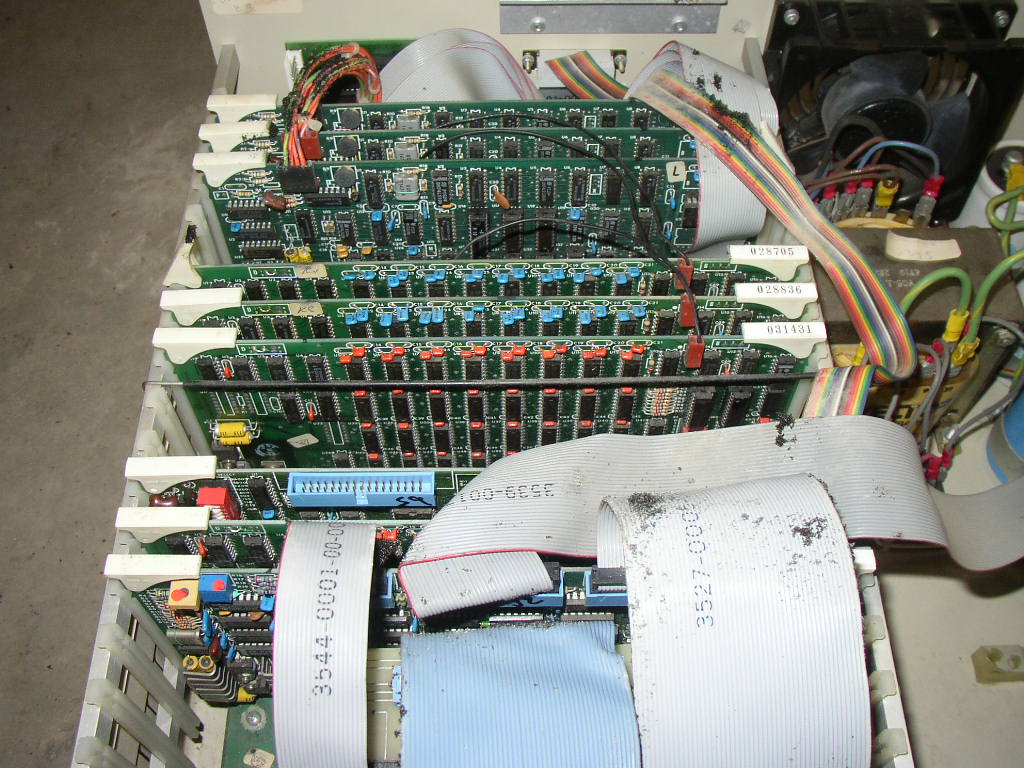
OK, while playing with my 11/03, I noticed that it seems to have a Y2K
issue in the date? I'm instructed in the docs to enter the date with
a two digit year. So... does this mean that the data command is just
stupid or that the whole system has a Y2K issue?
I never paid attention to any Y2K discussions on PDP-11s since I
haven't used one since 1981 prior to this :-).
Thanks!
--
"The Direct3D Graphics Pipeline"-- code samples, sample chapter, FAQ:
<http://www.xmission.com/~legalize/book/>
Pilgrimage: Utah's annual demoparty
<http://pilgrimage.scene.org>
>From: "Jim Battle" <frustum at pacbell.net>
---snip---
>
>Redundancy in DRAM, row and column, has been in use for 20 years at least. At
>the ASIC level, largish SRAMs typically also have redundant rows and columns
>(largish meaning more than a few kbits).
>
---snip---
Hi
I don't want to bust anyones bubble but many low end computers
sold as desk tops have partially bad chips. The term used
is "down graded". It is still standard practice in the industry.
Many of you may have a down graded part in your machine and
not even know it.
Manufactures stop down grading when the yield is high enough
that it is no longer economical to deal with the down graded
parts. The extra handling cost money as well.
It is simple economics.
Dwight
>From: "der Mouse" <mouse at rodents.montreal.qc.ca>
---snip---
>
>Everybody keeps saying this as though it somehow makes it all OK.
>
---snip---
Hi
That is the point. It is OK for him to do what ever
he pleases with his code.
IMHO
Dwight
I dont own any. But according to a recent Circuit
Cellar article, early ics can be easy to implement in
a FPGA. Dont have the issue in front of me, but the
guy needed to mimic if you will a crt controller.
Therefore could the chips used in the early HPs (maybe
up to and including the 41 series?) be readily
emulated by an FPGA?
__________________________________________________
Do You Yahoo!?
Tired of spam? Yahoo! Mail has the best spam protection around
http://mail.yahoo.com
Date: Tue, 20 Dec 2005 09:26:54 -0500
From: "Teo Zenios" <teoz at neo.rr.com>
Subject: Re: ImageDisk project is canceled
<snip>
>...it is easy for the developer to get a bruised ego because they take any criticism
>personally...>
<snip>
He didn't "take it personally," it _was_ personal; at least three messages mentioned
the words "lost respect for you." That's the real point, it's pretty childish to insult
someone like Dave, who's contributed a great deal, because he doesn't agree with
your idea of when and how FREE software should be released.
All that does is cause me and no doubt a few others to lose a little respect for the
people doing it, not because of their opinions and choices but because of their
character. Something they might think about; not only has the community
lost something as a result, but so have they personally (although I doubt that they
care).
As for Dave, I respect him for the work he's done and his offer to share it with the
rest of us. I also respect his choices, and he has my sympathy.
It's ironic that this sort of thing, like the attitude that anyone using Windows instead
of Linux is a "luzer" instead of a fellow computer enthusiast, is so prevalent in
this community which is made up for the most part of very creative people; one
would think we would be more open-minded.
>There are pitfalls to going public with a project, if being in the spotlight
>and everything associated with that is not your thing then think twice about
>going public in the first place.
And you think that's a good thing? Not that I have anything to contribute, but if
I ever do I won't even think once after this, and just share it quietly with people
who will appreciate it and whose criticism would actually be productive.
mike
First, I haven't used or tried ImageDisk. Second, it matters not since I
will almost always be on the side of supporting people who are *DOING*
as opposed to *TALKING*. I have a lot of Polymorphic and LOBO Drives 8"
and 5 1/4" floppy disks so I was watching the development of ImageDisk
with great interest. He has enough experience with software development
to know when a product/source code/etc. is ready for release but unless
Dave changes his mind, it is moot now and that is too bad.
BTW, I was most happy to see that Dave reconsidered his original request
when cancelling the project and will allow copies to exist on websites
using his format.
As one who has developed a classic-related program, I can say that I can
understand Dave's side. The Altair32 project generally receives mostly
positive feedback with a sprinkling of "wish list" items and a one-off rant.
I've also had only one person complain about the licensing (actually, the
lack thereof) which I largely ignored because after I investigated all of
the "open" licensing types and couldn't come up with one I liked and that
fit how the code has developed through outside contributions.
Feedback has even resulted in several contributors to the project, a few of
whom lurk on this list. I will say that the times I've received
well-intentioned criticism I do take it personally because I've poured so
much effort into the project. Then, I step back and say that it's not
personal, it's just comments on the product. Within the criticism there is a
different point of view and if it ultimately results in a better product,
then that's good. Do you think Bill Gates loses sleep at night because
people complain about Windows? No, but it drives Microsoft to at least
attempt to improve the product (even if they don't succeed).
The code I've written could be considered godawful ugly by an experienced
programmer, but it works. I felt that getting the program and the code out
there for people to use and modify was more important than how it looked.
Maybe that's a na?ve way to look at it; I don't know.
Rich
-----Original Message-----
From: cctalk-bounces at classiccmp.org [mailto:cctalk-bounces at classiccmp.org]
On Behalf Of Teo Zenios
Sent: Tuesday, December 20, 2005 9:27 AM
To: General Discussion: On-Topic and Off-Topic Posts
Subject: Re: ImageDisk project is canceled
This thread is like a soap opera.
If you offer to program a utility for the "comunity" you should expect a
decent amount of email in reply that runs from praise to ridicule. People
will be bugging you to add features you probably dont have time for. Others
will want to see the sourcecode because they want to see how it is done, to
take the guts and modify the interface, just to have it, or maybe even to
modify and sell. You should think about what you are getting into before
going public. The reason there are not alot of multi platform disk archivers
is because the person doing the programming on their own gets bored with the
project, or quits in the middle of it when somebody gets on their nerves.
The tools I use for backing up and restoring disk images are platform
dependant and that is fine with me. I find groups of programmers for
specific platforms tend to finish their utilities because they need them for
their hobby, and if one person loses motivation another takes his place. I
am not criticising anybody for attempting to go it alone, but it is easy for
the developer to get a bruised ego because they take any criticism
personally while a team of developers (with a smaller platform specific
project) tend to ignore the chatter and turn out a project they are happy
with.
There are pitfalls to going public with a project, if being in the spotlight
and everything associated with that is not your thing then think twice about
going public in the first place.
Date: Mon, 19 Dec 2005 17:53:26 -0800
From: "Chuck Guzis" <cclist at sydex.com>
Subject: Re: Oldest machine (was: Re: Good haul of old pc stuph)
>Does anyone still collect UR equipment? A 407 is darned near a computer.
Don't forget the 604, one of the few "electronic" UR machines; could heat a
fair sized room with its tubes.
I've still got the manual for the one I worked with back in those prehistoric days.
mike
Well, I've certainly learned a valuable lesson; now that I know that,
if I ever spend as much time as Dave has developing something
useful for the CC community, I will actually cause harm unless I
release the source code (whether I think it's ready for prime time or not),
I'll certainly keep it to myself.
By this "logic" every company or individual that releases a piece of
software without source code is causing harm by keeping someone
else from writing their own version. Perhaps it's time for a class-action
law suit or two...
Whoever was writing the other archiver was certainly free to use Dave's
well-documented format or, if he/she really had a better idea, implementing
it and presenting that to the community, with source of course.
Also, the person with that pile of "hard-to-find disks" is free to use any other
tool they like in whatever format they choose; if they choose not to because
they don't have Dave's source, that's hardly Dave's fault.
Then again, blaming someone else for your own choices seems to be pretty
popular these days.
It's unfortunate, but I don't blame Dave one bit. We do this sort of thing in order
to help other people and when we get more criticism (often unjustified)
than appreciation, it really isn't worth our while; I don't think he's B&Ming, he's
just saying hey, if you don't like it, by all means do it yourself; I don't need the
crap.
I've said it before: every time we discourage someone with the self-important
opinionating, criticism, sarcasm, OT rambling etc. that seems to be so common
on some computer lists, our community loses a potentially valuable resource.
I just hope there's some way without too much effort to salvage the archiving
that Jim (and others?) have done.
mike
<Shaking head & rolling eyes...>
----------------Original Message----------------
Date: Mon, 19 Dec 2005 23:43:39 -0500 (EST)
From: der Mouse <mouse at Rodents.Montreal.QC.CA>
Subject: Re: ImageDisk project is canceled
And not a word about how lovely and mature Dave is to take his marbles
and go home in a snit - reneging on his earlier statement (I'd even say
"commitment") that he'd make the source available when he was no longer
able or willing to maintain it himself, I might note - because someone
points out that he's _wrong_ in thinking that no harm is done by
ivory-tower "you'll get it when I think it's good and ready"
development?
I went back and reread the note that Dave is (apparently) reacting to:
< I am not sure you've done no harm by so doing... I know for a fact
< that at least one person was working on an open-source disk archiver,
< but has dropped that project, at least for the moment, because he
< doesn't want to create yet another incompatible file format, and
< would have wanted to see how you did things (not wasting time
< re-inventing the wheel and all that). We'd all better hope his pile
< of hard-to-find disks [...] remain[s] readable a little longer.
This hardly qualifies as bitching and moaning to me, with the
*possible* exception of the last sentence.
Of course, Dave's choice of reaction to this information is up to him.
But really, after rereading the full note I quoted from (there's a good
deal more to it, but I don't think the above is unrepresentative - I'd
call it all fair and polite criticism), and rereading Dave's reaction,
it's pretty clear to me which one is more "bitching and moaning".
Yes, I too hope Dave reconsiders. But I don't think stifling fair
criticism - and that's what I think it was - because its target reacts
badly to it is ever a good idea.
/~\ The ASCII der Mouse
\ / Ribbon Campaign
X Against HTML mouse at rodents.montreal.qc.ca
/ \ Email! 7D C8 61 52 5D E7 2D 39 4E F1 31 3E E8 B3 27 4B
I have my two RS/6000s where the property tags are an added bonus - Intel. Not much history there, but I enjoy indulging my computer elitism with a mental remark of "even Intel needs to use a real architecture to get things done".
>
>Subject: Re: Oldest serial number (was: Oldest machine (was: Re: Good haulofold pc stuph))
> From: Richard <legalize at xmission.com>
> Date: Mon, 19 Dec 2005 19:51:46 -0700
> To: "General Discussion: On-Topic and Off-Topic Posts" <cctalk at classiccmp.org>
>
>
>In article <Pine.SUN.4.20.0512192140490.7258-100000 at osfn.org>,
> William Donzelli <aw288 at osfn.org> writes:
>
>> > Lately I've been wondering if anyone attempts to collect
>> > mass-manufactured memorabilia by trying to get the lowest serial
>> > number.
>> >
>> > For instance, I have an Atari 800 serial #388801.
>> >
>> > Has anyone done a wiki/database type web page where everyone can enter
>> > the serial #s of their common computers?
>>
>> This is mostly a pointless excercise, sorry to report. Serial numbers are
>> notoriously non-sequential. [...]
>
>I'm not asserting that serial number #288801 would be "more valuable"
>than my serial number of 388801, but it can still be fun to try and
>get a lower serial number with mass-produced parts.
>
>As you say, there is no real correlation between the serial number and
>its provenance, but not everything in collecting has to do with
>provenance or market value....
>--
Nope missed one. One issue for me is how can I use it or incoperate
other systems parts. Think in terms or builing a period roadster
using exclusively period parts. To me a basic plain NS* is a fun box.
Then I start thinking but with a Compupro 85/88 dual cpu, and MPX1
slave cpu and M-drive ramdisk it's more interesting as that is what
would someone might have done then if they had a liberal budget back
then. I don't have the budgest but I have several boxes of S100
cards from then. So why not do now what I wished I could have done then.
Allison
>
>Subject: Re: Partially-bad chips; was: repairing early HP calcs
> From: "Chuck Guzis" <cclist at sydex.com>
> Date: Mon, 19 Dec 2005 17:52:21 -0800
> To: cctalk at classiccmp.org
>
>On 12/20/2005 at 12:15 AM ard at p850ug1.demon.co.uk wrote:
>
>>I remember a UK company called Bi-Pak. They bought up defective ICs,
>>tested them [1], and sold them. They did sell things like TTL quad-gate
>>packages with only 3 good gates. Problem was, as we all found, those 3
>>gates quickly failed in use.
Polypaks was the place here. No bargan as usually a package with one bad
gate developed other problems over time.
>Back in the days when DRAM was precious, Intel had some "8Kx1" DRAMs that
>were really "half good" 16K parts. You used the "-x" digit to determine
>which half to use. I don't know if these were in general circulation, but
>the sales engineers were passing them out to customers working on designs.
>I may still have one or two kicking around that I found actually had 16K
>worth of usable bits, providing they weren't run too fast.
I used to have a full set of half good 64ks, likely still do.
>And there was bubble memory with a flaw map.
That was normal. It had extra tracks for that reason. I must have 8
of the BMs and two working BPK72 boards. There was no such thing as
a flawless BM apparently.
>Aren't some (or all) high-density DRAMs now made with extra rows and colums
>to improve yields?
Used to be so, don't know about it now.
Allison
>
>Subject: Re: morphed to TTL part number history, was: IBM PLAYING CARDS
> From: "Chuck Guzis" <cclist at sydex.com>
> Date: Mon, 19 Dec 2005 17:56:55 -0800
> To: cctalk at classiccmp.org
>
>On 12/20/2005 at 12:10 AM ard at p850ug1.demon.co.uk wrote:
>
>>I recently bought a second-hand Philips 'upright' reel-to-reel tape
>>recorder, and found a schematic glued to the inside of the case. At one
>>time this was quite common on consumer electronic devices I believe.
>
>Not at all uncommon on radios and TVs using vacuum tubes (valves). Very
>useful. But then early PC's sometimes included schematics in their
>end-user documentation.
Two I know of at least, IBM XT and the Tandy HX1000. Very nice docs at that.
Allison
>
>Subject: Re: Fw: Deck of IBM PLAYING CARDS GOES FOR $325
> From: "Chuck Guzis" <cclist at sydex.com>
> Date: Sun, 18 Dec 2005 00:22:58 -0800
> To: cctalk at classiccmp.org
>
>On 12/17/2005 at 10:37 PM woodelf wrote:
>
>sites.
>>I downloaded some motorola application notes from bitsavers.
>>Wow they sure had a lot of different types of TTL. I wonder how only
>>the 74xx became the only TTL used today?
>
>I think the short answer is "second sources"--you had at least 4 big
>players, TI, National, Moto and Fairchild all producing 7400-series logic.
>Some of the earlier TTL (Moto 400/500-series) had mid-line (pins 4 and10)
>power supplies, which turned out to be not as convienient for PCB layout.
>And, although it's largely forgotten, 7400 TTL shares a fair number of
>pinouts with the older DTL circuits.
>
>By the time LSTTL was out, everyone had pretty much standardized on the
>74xx line.
>
I can still find 74h, 74F, 74S, 74hct, 74c, 74hc nevermining what I
have on hand.
It was interesting, useful and a PAIN. It sometimes made a huge differnce
if you subbed a S04 where there was an LS04.
Allison
I have in my possesion a Kenbak1 in good condition. Powers on, light up. Satnding offer is 8000. Would you happen to know of anyone interested in giving more for this item?
Thank You
John Ducommun
Peter
could you please contact me off list re your items for re-homing.
Regards
Jim Beacon.
Please see our website the " Vintage Communication Pages" at WWW.G1JBG.CO.UK
>From: "Jules Richardson" <julesrichardsonuk at yahoo.co.uk>
>
>Tony Duell wrote:
>> Most (if not all) of us here realise the value of proper technical
>> documentation, schematics, source listings, etc. It therefore surpises me
>> that people write programs to support classic computers and _don't_
>> release the source code. Ditto for stuff for amateur radio (which
>> according to my license is for 'self training in wireless telegraphy',
>> it's a lot easier to learn about how something works if you have the
>> sourc code for the programs involved....
>
>Yep, but I suppose it only needs for you to get burned once for it to put you
>off trying again.
>
>And given Dave's statement about NDAs, the source *is* there if someone wants
>to port it to another system or use it to enhance their own copy - it's just
>not publicly available to everyone via the website.
>
>
>cheers
>
>Jules
Hi
I usually release my source code but I still get
email requesting the source code. I even include readme's
at times telling one how to rebuild things ( often as
important as source code ). I still get messages asking
for my source code. Go figure!
Dwight
From: dave04a at dunfield.com
> I have a 6809 based STD card - not from Fujitsu... IIRC something beginning
> with 'D' - if anyone is interested, I'll dig it out and get the name.
I have a 6809 STD-Bus card as well; it's also packed up right now. I've also got an mc68010 card running, and have seen several mc68000 and at least one 68020 cards. It's reall not difficult to interface to STD-Bus...nothing more complicated than some TTL and a PAL or two.
Ken
its an all-in-one ms-dos (not pc) compatible, like a
Lisa but more square. Can anyone suggert a strategy
for finding something exceedingly dopey and uncommon?
Viewable on old-computers.com. Japanese computers in
general intrigue me, but many just werent sold here,
at least not to any great extent. The AS-100 was, but
apparently not too many.
__________________________________________________
Do You Yahoo!?
Tired of spam? Yahoo! Mail has the best spam protection around
http://mail.yahoo.com
>
>Subject: Re: Fw: Deck of IBM PLAYING CARDS GOES FOR $325
> From: Jules Richardson <julesrichardsonuk at yahoo.co.uk>
> Date: Mon, 19 Dec 2005 19:38:02 +0000
> To: General Discussion: On-Topic and Off-Topic Posts <cctalk at classiccmp.org>
>
>Chuck Guzis wrote:
>> On 12/19/2005 at 1:02 PM Roy J. Tellason wrote:
>>
>>> Costs more.
>>
>> Probably the reason
>
>Not sure that it's purely the cost of colour ink versus text. An IC typically
>has extra information other than the basic part - manufacturer logo, family,
>date code etc. which it would be hard to colour code completely. And if you're
>having to print some of the data as plain text, it probably makes sense to do
>it all that way.
>
>> All I'm talking about is paint
>
>that's OK until it falls off :-)
>
>cheers
>
>Jules
Paint likely signifies a special test or other qualification activities.
Allison
just a note... CPLDs are easier because the EEPROM config is inside the chip (no external hardware and an easy to use interface). The cost of this is available logic density though. You will always get more FGA logic space available then you will with a CPLD. Of course, you can always add more CPLDs, but one FPGA and a 8 pin dip eeprom is less PCB real estate.
best regards, Steve Thatcher
-----Original Message-----
>From: woodelf <bfranchuk at jetnet.ab.ca>
>Sent: Dec 19, 2005 2:26 AM
>To: General Discussion at null, On-Topic and Off-Topic Posts <cctalk at classiccmp.org>, null at null
>Subject: Re: repairing early HP calcs
>
>Chris M wrote:
>
>>I dont own any. But according to a recent Circuit
>>Cellar article, early ics can be easy to implement in
>>a FPGA. Dont have the issue in front of me, but the
>>guy needed to mimic if you will a crt controller.
>>Therefore could the chips used in the early HPs (maybe
>>up to and including the 41 series?) be readily
>>emulated by an FPGA?
>>
>>
>>
>CPLD's are a better part as most FPGA's require pre-load from rom.
>Still you need the original hardware and docs to create a FPGA design.
>Some designers played often some nasty tricks with hardware.
>I think for example in the TRS 80 /I a 7400 with a defective unused
>gate was used because it was cheaper than a working 7400.
Stan Barr <stanb at dial.pipex.com> wrote:
> (...) Open Firmware - a superset of ANS-Standard Forth used for
> detecting and setting up the hardware etc. on Sun, Apple and some
> IBM machines. It can be accessed from the console as well, allowing
> you to probe and set up hardware manually should you need to, or
> as a normal Forth of course...
This seems like a good time to tap into the collective knowledge on this
list once more...
I have a question regarding Sun OpenFirmware that's been bugging me for
some time now. I'm still struggling for a setup that allows a Sun to netboot
off a Windows 9x PC (just get a bootstrap, no fancy NFS exports required).
I'm making do with SuSE Linux 7.0 dual-boot right now, but that's not it.
What I'm imagining here is to have a look at the code that is responsible
for the netbooting operation of the Sun. Why does it have to obtain the
machine's IP, that of the tftp server and what else via rarp? I'm by no
means a Sun expert yet, but as I've understood it, you can define your own
FCode commands and store them in NVRAM, so one could modify the boot code to
use parameters stored in environment variables, either if a flag
"use-stored-IP?" is set or as a fallback if there's no rarp server around.
I've already got myself a Forth book and the FCode manuals from Sun, and I
had a look at some commands with "see". "see" however often spits out
hexadecimal codes in parenthesis amidst of Forth words and I've yet to
understand what they mean; the manual addresses the problem only far enough
to tell that this doesn't happen if words are defined with the "headers"
directive.
If somebody has been involved with FCode stuff far enough to give me some
initial guidance, please contact me. Thanks in Advance.
Yours sincerely,
--
Arno Kletzander
Stud. Hilfskraft Informatik Sammlung Erlangen
www.iser.uni-erlangen.de
Telefonieren Sie schon oder sparen Sie noch?
NEU: GMX Phone_Flat http://www.gmx.net/de/go/telefonie
On Dec 19 2005, 11:26, Jules Richardson wrote:
> That made we wonder... what's the oldest *operational* digital
machine owned
> by anyone on this list? Although I suppose it's hard to define
'machine' -
> something with RAM, I/O in some form, and at least one CPU (what the
heck do
> you call a CPU when it's no longer central?)
My PDP-8/E from about 1972 won't even be close to the oldest, but it is
running. Running right now, in fact, though I think it has an
interrupt problem, with an RX02 and an ASR33 (which is probably older
than the -8 is).
Apart from that I have a Motorola MK6800D2 from 1975, a PDP-11/03 from
1975 or '76, and a KIM-1 designed in 1975 but probably made about 1977.
--
Pete Peter Turnbull
Network Manager
University of York
As I was sitting here thinking, I remembered that the
Black versions of the TS-2068 had a different name
than the Timex/Sinclair Versions...
The Black unit with the Spectrum ROMS was the TC-2048.
The TS 2016 and 2048 were never made. I think the
savings in the RAM chips didn't make sense in the
additional costs of changing assembly lines, and
stocking different units.
There may have also been a TC-2068 that was the same
as the TS 2068 with the same ROM as the TS-2068. But,
the TC-2048 used a Spectrum ROM for sure...
Regards,
Al Hartman
__________________________________________________
Do You Yahoo!?
Tired of spam? Yahoo! Mail has the best spam protection around
http://mail.yahoo.com
I know this is an old message, but TS 2048 Computers
WERE made by Timex Portugal. Zebra Systems, Inc. had a
couple of them.
But, I don't think we ever sold them.
They also had black cases like the Spectrum, and I
think had Spectrum ROMS as well.
It's well over 15 years, so my memory is very fuzzy.
Regards,
Al Hartman
> From: Glen Goodwin <acme_ent at bellsouth.net>
>
> Sellam, I think you must be mistaken. The TS2048
was never
> produced.
__________________________________________________
Do You Yahoo!?
Tired of spam? Yahoo! Mail has the best spam protection around
http://mail.yahoo.com
>
>Subject: Re: Oldest machine (was: Re: Good haul of old pc stuph)
> From: Jules Richardson <julesrichardsonuk at yahoo.co.uk>
> Date: Mon, 19 Dec 2005 12:57:11 +0000
> To: General Discussion: On-Topic and Off-Topic Posts <cctalk at classiccmp.org>
>
>Allison wrote:
>>> Subject: Oldest machine (was: Re: Good haul of old pc stuph)
>>> From: Jules Richardson <julesrichardsonuk at yahoo.co.uk>
>>> Date: Mon, 19 Dec 2005 11:26:08 +0000
>>> To: General Discussion: On-Topic and Off-Topic Posts <cctalk at classiccmp.org>
>>>
>>
>> PDP-8F manufacture date 1973. Running!
>
>That's what we like to hear! :)
>
>> However will the owner of that nice looking PB250 step up.. he's back around 1961.
>
>Ahh, that's earlier than our Marconi TAC then (1963 IIRC, although designed in
>the late 50's).
>
>Not sure what we have that's earlier and qualifies. The Elliott 803 is late
>1950's (1958 I think) but has a core fault so doesn't count as working until
>someone finds the time to fix it! It's probably the earliest complete machine
>that we have though; prior to that we just have small bits of some of the
>earlier famous* machines.
Whirlwind, SAGE, IBM, Univac, SperryRand Frieden are names that come to mind.
>from the time orf Eniac to 1960 there were a great number of companies and
machines some quite unique other more functional. The IBM 500 and 700 series
are examples of the latter.
Allison
I'm rather bored, so I thought I might try and hack together a small project
OS compatable with at least DOS 1.x or similar, is there any decent resource
for information on dos compatability and how to achieve it, or is it left as
a reverse engineering exercise for 'the reader' ? :)
Hi Ethan,
Hope you're keeping yourself amused down there!
At any rate, the trick to finding information on the Intel USB chip is
knowing the shorthand used to talk about the darned things. Since they're
not in production, this is becoming a lost art, it seems.
Try googling on 8x930xx - you'll get a number of good hits, including the
complete schematics for the Intel USB prototyping kit.
If you want chip docs, try googling on 8x930ax and one of the hits will be:
http://www.suid0.net/fhtw/doc/specs/ic/bridge/i8x930ax.pdf
which is the user's manual for the chip, all 16 chapters and 4 appendices
of it.
Whatever you discover, let me know--I still have most of a case of these
things...
Cheers,
Chuck
I have acquired a KSR 43 and am looking for a manual. I've looked in the usual online archives (and printed-manual resellers too) Can anyone help?
Also I'm looking for a tape punch and the complete top cover assembly for an ASR 33.
thanks
Charles
...I tried to reply to your off-list email, but the "other" address you
gave me a while ago when I discovered that dunfield.com uses SORBS no
longer works:
<<< 550 <[snipped]>: Recipient address rejected: User unknown in local recipient table
Suggestions? The address in question is the one with MD5 hash
ce3697e25f0e9847577453bfb530cce5 (no trailing newline, domain all
lowercase) - I snipped it above because I don't know if you mind its
being distributed.
/~\ The ASCII der Mouse
\ / Ribbon Campaign
X Against HTML mouse at rodents.montreal.qc.ca
/ \ Email! 7D C8 61 52 5D E7 2D 39 4E F1 31 3E E8 B3 27 4B
>
>Subject: Funny TTL pinouts (was Deck of IBM PLAYING CARDS)
> From: shoppa_classiccmp at trailing-edge.com (Tim Shoppa)
> Date: Sun, 18 Dec 2005 10:06:47 -0500
> To: cctalk at classiccmp.org
>
>
>"Chuck Guzis" <cclist at sydex.com> wrote:
>> On 12/17/2005 at 10:37 PM woodelf wrote:
>> >I downloaded some motorola application notes from bitsavers.
>> >Wow they sure had a lot of different types of TTL. I wonder how only
>> >the 74xx became the only TTL used today?
>>
>> I think the short answer is "second sources"--you had at least 4 big
>> players, TI, National, Moto and Fairchild all producing 7400-series logic.
>> Some of the earlier TTL (Moto 400/500-series) had mid-line (pins 4 and10)
>> power supplies, which turned out to be not as convienient for PCB layout.
>> And, although it's largely forgotten, 7400 TTL shares a fair number of
>> pinouts with the older DTL circuits.
>>
>> By the time LSTTL was out, everyone had pretty much standardized on the
>> 74xx line.
>
>Don't forget, some of the "standard" 74xx line are actually National or
>Fairchild or Motorola parts that were not originally given
>74xx numbers (because they weren't TI parts) but they were eventually
>second-sourced by TI and given 74xx numbers. "Imitation is the
>truest form of flattery."
>
>The ones that come to my mind most immediately are the Fairchild
>9310 and 9316, later known as 74160 and 74161, all massively used
>synchronous counters. I also seem to recall part numbers like 40160
>as Motorola tried to back-incorporate them into their TTL lineup. (Am
>I confused as usual?)
>
>I think the funny Vcc/Gnd pinouts (often 4 and 10) were actually thought
>to be good for some reason in some specialized PCB designs - I think
>I see these show up on some early MSI quad latches (7475) and counters
>(7490, actually pins 5 and 10). I don't know if these were cross-incoprorated
>from parts that started out at Motorola or Fairchild or National or what.
The mid chip Vcc and ground went all the way back to the Moto and Fairchild
RTL (in dip) or opposing pins in the 8/10/12 leaded TO5 (can) varient.
However when it came to part numbers Moto is infamous for a plethora of
"house numbers" where the number is not EIA or ISO or anthing else and
was special for a project or customer. Most of the other vendors did
that as well but Motorola was wild. HeathKit was a common consumer of
house numberd parts from many vendors.
Allison
Hmmm, I thought that the need for an external utility to set up the CMOS
went away with the 286. IIRC, Cntl/Alt/Ins was used on the/some Phoenix
BIOS chipset(s) to gain access to the CMOS setup routines. There were
several other such keystroke sequences but the only other one that comes
to mind was Cntl/Alt/S. Also, I *think* that the IBM Diagnostics will
also work and might be enough to take away the boot error (excepting
that it doesn't support the 47 HD types used in most of the later
BIOSs.)
charset=ISO-8859-1; format=flowed
>
> It's a Vobis LCD-386:
>
> http://www.hknebel.org/Museum/Museum/Tragbare_PCs/Nicht_IBM_PCs/Vobis_LCD38…
>
> There was one on eBay early this month, too. Item # 8730903874
>
> Now I just need to find some docs on the board. There are several
> jumper sets on the motherboard, and none of them labeled, so I don't
> know how to zap the BIOS yet.
>
> And yes, I can even boot from hard disk. The generic Phoenix BIOS
> setup.com from the old www.firmware.com site lets me set floppy, HDD,
> and date settings, it's just not stopping the boottime error.
>
>
> Doc
>I think rcp is part of the root install. It was for 4.3 on the vax
>anyway. I could swear I did this for 2.11 also but I have used scsi.
I will check.
>Basically all you need to do is bring up the interface with
>ifconfig and then rcp the tar file
Where am I rcp'ing it from? The 11 is not connected to a network
at least not yet. The linux box is standalone too.
>Slightly more detail- make sure the ethernet is at a 'standard' >address; if it is the kernel will find it when it probes at boot >time- ifconfig the interface (i.e. ifconfig qe0 192.168.0.1).
I believe it is set for the standard addresses.
>Create the file system on the partition you want and mount it(this >may take a little study. Presuably you've got "/" created and >loaded.
Yes, I have "/". I believe "/usr" exists too, but is mostly empty or
is completely empty.
>Rcp the tar file to the mounted partition. This might take a little >linux goofying around, as you'll be root on the 11. So in /root on >the linux box you'll have to create a .rhosts.
I will look into this. Thanks.
Tim R
_______________________________________________
Join Excite! - http://www.excite.com
The most personalized portal on the Web!
Bryan,
Nice work, does your board clearly state in layer traces or in silkscreen (Apple-1 Recreation) so that as years go by, if the system is passed onto to new owners, they don't mistake yours for an actual original?
I'm all for have near exact stuff done, so long as any product clearly states on it that its not an original so as not to create confusion.
May I ask, what kind of keyboard are you using???
Curt
-----Original message-----
From: "Bryan K. Blackburn" oldcomp at cox.net
Date: Sat, 17 Dec 2005 21:36:28 -0500
To: General Discussion: On-Topic and Off-Topic Posts cctalk at classiccmp.org
Subject: Apple 1 on eBay - shameless self promotion
> I interrupt this list with a short commercial message...
>
> I just listed a working Apple 1 Computer on eBay, item #8739750233 at:
> http://cgi.ebay.com/ws/eBayISAPI.dll?ViewItem&item=8739750233
>
> This is a faithful recreation, nearly an exact replica, not an original.
> Really cool, just the same.
>
> -Bryan
>
>
>Subject: open source crap was Re: Archiving Software
> From: Cameron Kaiser <spectre at floodgap.com>
> Date: Sun, 18 Dec 2005 07:45:09 -0800 (PST)
> To: cctalk at classiccmp.org
My small waste of BW and all.
I write a lot of code. None for the most part appears in the public realm.
There are several reasons for this. One being my favorite language is solder.
Others include must of the code is crap, one off and quickies while useful
are not worth much. HOWEVER...
Once I went to great lenghts to put out a subsection of CP/M bios using
765 for general interest and no particular use. The result, one moaned
about the assembler used (plain ASM), another was disappointed I didn't
use Z80 instructions and Opcodes, A two tried to tell me it can't work
(it was from the system that used/assembled it!). My response was and
is still FREE IMPLIES: YOU GET WHAT YOU PAY FOR. Caps inteneded.. Often
rather than getting mad accept it for what it is.
Allison
If you can ethernet you can rcp the files. I've done that with bsd on a vax. Basically I mount a big partitionon the disk, rcp the file overand then untar it. I suspect you don't have a qbus ethernet card. Is that the case?
----------------
I do not have an QBus ethernet card, just a Unibus one. I doubt
I can access RCP as it's probably not part of the root install. But
I could be wrong. Why would it matter if I had a Qbus Ethernet card
or not?
_______________________________________________
Join Excite! - http://www.excite.com
The most personalized portal on the Web!
>
>Subject: Re: Funny TTL pinouts (was Deck of IBM PLAYING CARDS)
> From: "Roy J. Tellason" <rtellason at blazenet.net>
> Date: Sun, 18 Dec 2005 15:54:40 -0500
> To: "General Discussion: On-Topic and Off-Topic Posts" <cctalk at classiccmp.org>
>
>On Sunday 18 December 2005 10:21 am, Allison wrote:
>
>> However when it came to part numbers Moto is infamous for a plethora of
>> "house numbers" where the number is not EIA or ISO or anthing else and
>> was special for a project or customer. Most of the other vendors did
>> that as well but Motorola was wild. HeathKit was a common consumer of
>> house numberd parts from many vendors.
>
>Know of any good references for crossing some of this stuff?
>
None really as some dont cross "exist". TO cross most I use a NTE or other
parts sub manaul to find out what it is then work backward to a usuable number.
tedious but near the only way to get from a M9313 RF transistor to a 2N or
MRFxxxx part number.
Allison
On Dec 18 2005, 14:25, William Donzelli wrote:
> > Didn't National at one time (I'm too lazy to go riffling through my
data
> > books) have a IC family they called "Damn Fast"?
>
> They were actualyl LH series analog buffer amps - two grades of
"Fast" and
> "Damn Fast". These were marketted for several years before some
do-gooder
> religious type complained, and the National Semi people took it out.
Bob
> Pease has a story about it.
>
> The 'Damn Fast" datasheets exist - I have several editions in my
databook
> library.
>
> And for the time, those buffers were truely DAMN FAST.
Yes, they were. I have the "Damn Fast" datasheets, and at least one
databook which includes them. I have some of the parts too -- I once
built a scope probe out of them. I think it was one of the application
notes.
--
Pete Peter Turnbull
Network Manager
University of York
> > I have plenty of software that runs directly off CD. I'm not
> > making a copy of it to run it. Unless you're implying the
> > process of reading it into memory to execute is copying it. IMHO
> > that's a mighty fine line.
>
> Reading it into memory is copying it. Lawyers make a bunch of
> their money due to fine lines.
>
The statement that reading it into memory is copying it is generally
correct.
Re: Does this imply that software in ROM does not need to be copied (in the
legal sense) when it's run, but cashing the ROM would consitute a copy?
Or does copying each byte in turn into an internal processor register
count as a 'copy'.
If it runs from ROM, then it's not considered to be copied, but if ROM is
copied ("shadowed") to RAM (as BIOS' and video firmware often are), then it
would be considered to be copied.
"Chuck Guzis" <cclist at sydex.com> wrote:
> On 12/17/2005 at 10:37 PM woodelf wrote:
> >I downloaded some motorola application notes from bitsavers.
> >Wow they sure had a lot of different types of TTL. I wonder how only
> >the 74xx became the only TTL used today?
>
> I think the short answer is "second sources"--you had at least 4 big
> players, TI, National, Moto and Fairchild all producing 7400-series logic.
> Some of the earlier TTL (Moto 400/500-series) had mid-line (pins 4 and10)
> power supplies, which turned out to be not as convienient for PCB layout.
> And, although it's largely forgotten, 7400 TTL shares a fair number of
> pinouts with the older DTL circuits.
>
> By the time LSTTL was out, everyone had pretty much standardized on the
> 74xx line.
Don't forget, some of the "standard" 74xx line are actually National or
Fairchild or Motorola parts that were not originally given
74xx numbers (because they weren't TI parts) but they were eventually
second-sourced by TI and given 74xx numbers. "Imitation is the
truest form of flattery."
The ones that come to my mind most immediately are the Fairchild
9310 and 9316, later known as 74160 and 74161, all massively used
synchronous counters. I also seem to recall part numbers like 40160
as Motorola tried to back-incorporate them into their TTL lineup. (Am
I confused as usual?)
I think the funny Vcc/Gnd pinouts (often 4 and 10) were actually thought
to be good for some reason in some specialized PCB designs - I think
I see these show up on some early MSI quad latches (7475) and counters
(7490, actually pins 5 and 10). I don't know if these were cross-incoprorated
>from parts that started out at Motorola or Fairchild or National or what.
Tim.
Hi,
our museum recently got "some" (a dozen) HP 1000 with "some" spare parts
and "some" tapes. Currently we're building up some of the stuff to get a
running system. For now, I've put a 2100S, a 2117 (1000F), I/O extender,
two 7970B tape drives (one with the 200/556/800 bpi option), one 2748A
tape reader, one HP 8100 tape punch (basically a Facit 4070), a HP130C (?)
rackmount oscilloscope, and a 7905 disk drive with its 13037C controller
into the three racks we have.
Included are the original distribution tapes of RTE-II, RTE-III, RTE-IIIM,
RTE-4, RTE-4b and RTE-6/VM, DS/1000, Signal/1000, Fortran, etc., a huge
pile of paper tapes (original HP), and nearly all paper documents
(manuals, schematics). But some parts are missing, so here are my (first)
questions:
- Does someone have the schematics of the 12555 dual D/A converter card?
They are not on bitsavers yet. We've attached the D/A card to the scope
and ported the PDP-8 kaleidoscope program to the HP2100. There are a lot
of glitches in the analog signals and we want to find out where they
come from (it's not a software bug, all test programs on all D/A cards
we have show the same symptoms).
- My only diagnostic tape (24396-13501 rev. 1926) has read errors in file
7 and in the last files. There is (was) a file in the SIMH package
called hp2100_diag.txt that insinuates that there must be a TAP image of
the 24396-13601 rev. 2040 diagnostics tape. Is there a chance to find it
somewhere? I really need a working diagnostics tape.
Christian
I'm taking a stab at reverse-engineering a Toshiba "intouch" module
DT-1003. It's been
brought up here before (I got it from a list member). What is slowing
me down a bit is
the inability to find any data on the CPU... an Intel N82930A3. If I
understand things
correctly, it may be a variation of the 8051 microcontroller packaged
up with a USB core.
>From tracing leads so far, the USB connector does go right into the
CPU, supporting
the suspicion.
If I can't manage to unwind the protocol (it's about 10-11 years old
and not supported under any "modern" operating systems), I'm
contemplating removing the CPU and building my own thing to drive the
T6963-based display and read the buttons/IR port/rotary encoder.
Naturally, it makes sense to spend some time just trying to blow
packets at it first.
Thanks for any pointers.
-ethan
Massive Gains Alert For Monday December 16th
The Solvis Group
$10.6 Million in Revenues in Fourth Quarter Ended Sept. 30, 2005
OTC: SLVG
Price: .07
Huge PR Campaign For Mondays's Trading SLVG Is it Going to Explode Higher From Here? If You Think So, Climb On Board!!
RECENT NEWS: Go Read The Full Stories Right Now!!
1)The Solvis Group Announces $10.6 Million in Revenues in Fourth Quarter Ended Sept. 30, 2005
2)The Solvis Group Announces Plans to Distribute Global Food Technologies Stock to Its Shareholders
3)The Solvis Group Strategic Alliance Agreement With SSL Expected to Provide $25 Million in Additional Revenues in 90 Days
Watch This One Trade on Friday! Huge Revenues for a Little Stock, Right? Radar it Right Now...... Go SLVG.
Sorry to drag this out (and interrupt the dialogue between Dave
& Tony) but, while I appreciate the replies I have had, I still have
some questions.
As I said, I'm not too concerned with bootable system disks; in
the case of the Vector I'll settle for a disk copy and good old postal
service if anyone ever needs one (unless Dave D, who will inherit
my Vector anyway, decides to modify his NS* bootstrap program
to work on the Vector). Any other system disks I have in a format
that the PC can read & write I will image with Dave's program.
And thanks to Gord Tulloch, BTW, who sent me the Vector disks
in the first place - I haven't forgotten about you (or JP).
I'm in the process of getting rid of all 10 of my Cromemcos (except
for one, at least for the time being). Before I do (and for some time
after), I'm going through several hundred 5" and 8" diskettes and
about 200 MB of stuff on HDs to delete or at least remove any
confidential data and archive anything useful.
Since a lot of this stuff is more or less machine- and disk-size
independent (as long as it's a Z80 CP/M or CDOS system - not
sure about the 68000/10/20 stuff), it seems to make more sense
to archive actual file sets instead of imaging disks; that does indeed
seem to be what's been done for most of the CP/M stuff on the Web.
Also, it looks like I can dump some of it since most of the common
apps like dBase, Wordstar, Visicalc etc. are already available on the
Web. On the other hand, although Howard Harte and Herb Johnson
have a pretty comprehensive collection of manuals, I can't find the
corresponding software anywhere; is there a site somewhere that
already has stuff like the Cromemco languages (Fortran, Cobol, PL/I etc.)
and OSs archived?
There's no problem at my end; the Cromemco can read & write 5" PC
format disks, 8" SSSD (at least) CP/M disks, and of course 5" and 8"
CDOS and Cromix disks as well as DC600 tapes, and can transfer files
via RS-232.
But the question I still have is how to specifically (and easily) restore these
files to another system running CP/M or CDOS/Cromix without a means
of transferring files from the PC.
I ran across something called PIPMODEM which seems to be one
solution; I wonder if anyone here has ever installed/used it and its
companion programs?
Another way seems to be to convert binary <> ASCII, PIP to/from the
console and convert back; I looked around but couldn't find/figure out
what I need at both ends/directions.
Also, once you've got a primitive transfer method installed, do you then
need a full-blown comm program to routinely transfer files with
xmodem/kermit/whatever?
The reason I ask is that on the Cromemco there is just a small .bin
file (pckt.bin) which is automatically invoked from the terminal (PC) end
when transferring files; that is, you can be sitting at a prompt, select
up/download [filename] on the PC and away you go (as opposed to opening
a comm program on the host and putting it in send/receive mode).
Is there anything like that for CP/M?
And for the Unix gurus: if, as in Cromix, tar files are not ordinary files
(i.e. you ordinarily tar to a device, not a file name), how would one convert
a tar tape to a file in order to transfer it? I could of course restore the tar file
to the HD and then tar it again to a file but that seems awkward. Could
I just pipe the "un"tar back to tar (i.e. tar [device] - | tar - [filename])?
How do you folks do this sort of thing?
Again, sorry if in my ignorance I'm beating this subject to death.
m
Date: Sat, 17 Dec 2005 18:16:46 -0800
From: "Chuck Guzis" <cclist at sydex.com>
Subject: Toshiba T3100?
>Someone posted a question this past week about a Toshiba T3100. I may be
>able to answer--I've discovered that I have the Technical Reference Manual
>for the thing (and I can't remember how I came by it).
>Cheers,
>Chuck
-----------------------------------
I was (and still am) that someone; I'll contact you off list.
Thanks much,
mike
what sort of cpus do they have? Some specify ms-dos
file copatibility with their built in floppy. Ive been
seeing them all around the place at thrift stores and
wonder if theyd be the basis for some kind of hack.
__________________________________________________
Do You Yahoo!?
Tired of spam? Yahoo! Mail has the best spam protection around
http://mail.yahoo.com
>
>Subject: VAX 9000 (was: Re: Sun 386i available)
> From: Adrian Graham <witchy at binarydinosaurs.co.uk>
> Date: Fri, 16 Dec 2005 00:16:54 +0000
> To: "General Discussion: On-Topic and Off-Topic Posts" <cctalk at classiccmp.org>
>
>Your mail name reminded me of a conversation I had today with an ex-Digit
>with regard to the Vax 9000 and its reliability record which is less than
>good. Apologies if this question has been asked before and is in the
>archives, but did you work with VAX9000s back in the day?
>
>My reason for asking is that I believed the VAX9000 would be watercooled
>(its codename was Aquarius) but shipped machines were aircooled and I'm
>wondering why there was a change in policy?
Water was new to DEC required special people to fix it and some sites
didn't like the idea or could not support water for the system. NY some
of the older buildings took near a year to get adaquate power for smaller
machines. Water, forget about that.
Reminds me of a site in Salt Lake City, water flooded top floor and
sustem on second floor was crushed when the building pancaked from
the flood.
>All ex-digits can reply of course :)
It was a good machine that held up well in use. The bulk of them
succumed when installed (phase rotation had the blowers backward!)
and the usual field circus tricks.
>The person I was talking to today explained that their 9000s were removed
>and replaced with 7000s....must've been a hell of a drain on Digit
>resources......
Didn't want to support machine that was so unique parts and skills wise.
There was (may still be) a PDP1 in Yellowknife doing bookeeping for
a mill. Field service offered them all sorts of inducements during
the 80s to replace it. I believe they system cost over a half million
to replace with software and stuff tossed in. It was just too costly
to fix the PDP1 if it broke.
Allison
>On 15/12/05 23:39, "9000 VAX" <vax9000 at gmail.com> wrote:
>
>> On 12/15/05, Patrick Finnegan <pat at computer-refuge.org> wrote:
>>> On Thursday 15 December 2005 18:08, 9000 VAX wrote:
>>>> fedex rate a 30'x25'x25' box
>>>
>>> I'm assuming that was supposed to be private.. but I must say, that's
>>> one huge box! (Or did you mean inches ala " not feet ala '? :)
>>
>> Yes, private and yes, inches. I was thinking about a program I was
>> working on. Actually I thought twice before typed ', and still the
>> wrong one is chosen.
>>
>> vax, 9000
>>
>>>
>>> Pat
>>> --
>>> Purdue University Research Computing --- http://www.rcac.purdue.edu/
>>> The Computer Refuge --- http://computer-refuge.org
>>>
>>
>>
>
>--
>Adrian/Witchy
>Binary Dinosaurs creator/curator
>Www.binarydinosaurs.co.uk - the UK's biggest private home computer
>collection?
>
>
>Subject: Re: Archiving Software
> From: Jim Battle <frustum at pacbell.net>
> Date: Sat, 17 Dec 2005 21:11:58 -0600
> To: General Discussion: On-Topic and Off-Topic Posts <cctalk at classiccmp.org>
>
I tend to agree with your position Jim. Posturing or it's appearance is
a bad place to be.
As an aside if you've written any code for 765 then it's easy to understand
how image disk works down deep. If you haven't then reading the code is
likely only an exercise. There has been enough conversation about the chip
and it's heirs to make it clear that the hardware is sometimes more than
meets the eye. The ramification of hardware choices in PC implementations
be it XT TTL loaded board or chip version of it is compromized and it does
affect programming. When you add that lovely 8237 DMA it just gets more fun.
My hats off to anyone programming PC hardware and getting good code that
runs on all the muck and mire flavors of MS operating systems.
Allison
Okay, I've got a fresh install of RSTS/E 9.2-10 on my SCSI disk, along with
DECnet/E and DECmail-11.
#1, what do I have to do to set up the PDP-11 to work with the router? I
know nothing about DECnet at all, and this is to be my "initiation" so to
speak.
#2, I wget'd and extracted the bridge program from Johnny's site to my Sun
box. What options do I need to set in bridge.conf to make my system work?
Here's my network setup:
PDP11(BIGBOA)
[SLU 2 of KDF11-BA]
^
|
v
[SLU 2 of Sun]
Sun Netra T1 200(192.168.1.2) <-> *INTERNET*
TIA
Julian
>
>Subject: Re: VAX 9000 (was: Re: Sun 386i available)
> From: "Witchy" <witchy at binarydinosaurs.co.uk>
> Date: Sun, 18 Dec 2005 00:29:15 +0000 (GMT)
> To: "General Discussion: On-Topic and Off-Topic Posts" <cctalk at classiccmp.org>
>
>
>On Fri, December 16, 2005 12:55 am, Allison said:
>> didn't like the idea or could not support water for the system. NY some
>> of the older buildings took near a year to get adaquate power for smaller
>> machines. Water, forget about that.
>
>The naiive side of me decided that companies based in older buildings
>wouldn't need the power of a VAX 9000, but I've only been a tourist in NYC
>so I'm fully prepared to be scoffed at :)
As you should be. A lot of those builtings in NYC are older than dirt and
there nothing like getting high power up to the 14th floor of a building
that originally had gaslight.
>> It was a good machine that held up well in use. The bulk of them
>> succumed when installed (phase rotation had the blowers backward!)
>> and the usual field circus tricks.
>
>My contact had their uptime at 24 days max, but perhaps that was a UK bad
>machine!
Sounds unusual or maybe buggy software factors. Most I'd heard of were
running months at a time if not longer.
>> a mill. Field service offered them all sorts of inducements during
>> the 80s to replace it. I believe they system cost over a half million
>> to replace with software and stuff tossed in. It was just too costly
>> to fix the PDP1 if it broke.
>
>I'd love to know if that's still in use, they'd be surely in line for some
>sort of award!
I think FS won out by the late 80s, one of the few people that knew anything
about it retured and a few others were not up for trips to Yellowknife in
the cold season.
Allison
Someone posted a question this past week about a Toshiba T3100. I may be
able to answer--I've discovered that I have the Technical Reference Manual
for the thing (and I can't remember how I came by it).
Cheers,
Chuck
It looks like you can copy a ROM into RAM to run the program if it is an
essential step.
http://www.copyright.gov/title17/92chap1.html#117
? 117. Limitations on exclusive rights: Computer programs
(a) Making of Additional Copy or Adaptation by Owner of Copy. -
Notwithstanding the provisions of section 106, it is not an infringement for
the owner of a copy of a computer program to make or authorize the making of
another copy or adaptation of that computer program provided:
(1) that such a new copy or adaptation is created as an essential step in
the utilization of the computer program in conjunction with a machine and
that it is used in no other manner, or
(2) that such new copy or adaptation is for archival purposes only and that
all archival copies are destroyed in the event that continued possession of
the computer program should cease to be rightful.
Michael Holley
Hello,
I was looking at the same to purchase and saw what you were asking about
yours. How did you make out with it? Is it a good investment. Did you
find the docs for it? I am considering buying a used epp-80 too but
would like to know more about it first. Any help would be great &
Thanx........Rick.
What DEC OS's support DecNet? I do not have the ability to
run RSX-11. I am still trying to get a full install of BSD 2.11
onto my pdp-11/84. Will BSD support DecNet? My problem at this
point is getting the rest of the install over to the system.
I have the root install done, but have the 3 large tar files
with no easy way to get them to the host. I have used VTServer
but it does not support files over 32M and this image is much
larger than that. There is a Windows version of VTServer that
is supposed to fix this but it does not work right for me.
I even tried porting it to Linux, but had issues compiling it
and once I got it it still would not work as well as the version
I have before I tried that. I'd like to get my 11 up and running
fully and first see if I could connect it to my home network.
This DecNet thing sounds interesting too. Kind of like what
I had with a BBS and connected to neighbor nodes for e-mail and
such.
Tim Radde
--- On Thu 12/15, Robert Armstrong < bob at jfcl.com > wrote:
From: Robert Armstrong [mailto: bob at jfcl.com]
To: cctalk at classiccmp.org, hecnet at Update.UU.SE
Date: Thu, 15 Dec 2005 19:00:49 -0800
Subject: Hobbyist DECnet Network - Update
The hobbyist DECnet is actually working - we have now five distinctlocations connected and six or seven machines online 24x7 with a coupledozen more that are turned on occasionally. Here's a SHOW NETWORK -OpenVMS Network status for local node 2.1 LEGATO on 15-DEC-2005 18:40:09.95 Area Cost Hops Next Hop to Area 1 4 1 SVA-0 -> 1.13 MIM 2 0 0 (Local) -> 2.1 LEGATO 11 4 1 SVA-0 -> 11.1023 A11RTR 60 10 1 TCP-0-0 -> 60.664 PDXVAX Node Links Cost Hops Next Hop to Node 2.7 CODA 0 4 1 SVA-0 -> 2.7 CODA 2.100 PETEY 0 10 1 TCP-0-1 -> 2.100 PETEY Total of 2 nodes. You can see a full list of the nodes and descriptions here http://www.jfcl.com/Computers/dcn.pdfWe've been using Johnny's HECnet mailing list to communicate
http://www.update.uu.se/~bqt/hecnet.htmlIf you'd like to hook up we'd love to have more nodes!Bob Armstrong-----Original Message----->from: Robert Armstrong [mailto:bob at jfcl.com] >I'm interested in setting up a network of hobbyist DEC machines linked >together in a DECnet phase IV network. Why? I suppose there's no >really good reason, but it seems like it would be fun to be able to do >"SHOW NET" or "NCP SHOW ACTIVE NODES" and see a whole long list of >machines that aren't mine :-) Besides, it would be a good way to share>access to real, non-simulated, VMS/RSX/RSTS and even, maybe, TOPS-10 >or 20, machines.>> Does anyone else agree? Is anyone else interested in participating?>> I know I'm not the first to think of this; in particular, I've had a >few email discussions recently with Johnny Billquist about HECnet,>> http://www.update.uu.se/~bqt/hecnet.html>>At some point I'd like to link up with HECnet, but right now Johnny is >having ISP problems and it sounds like
HECnet is down to one or two >nodes.>> Are there any other hobbyist DECnet associations that are going > strong?>> As for technology, it seems like the best thing would be to use the >Internet as our communications medium. Nobody wants to pay for >point-to-point leased lines anymore, after all. Multinet, TCPware, and>even DECNet Phase V all have the ability to send DECnet traffic over IP. >Right now I'm leaning towards Multinet - they have a free hobbyist >license program, and Multinet can create point-to-point virtual DECnet >circuits using UDP packets that can be routed over the Internet. >They're simple to set up and administer.>> I have a fair amount of Internet bandwidth available at my location, >and I can set aside a VS4000 VLC or model 90 to serve as a dedicated PhaseIV >routing node.>>Bob Armstrong
_______________________________________________
Join Excite! - http://www.excite.com
The most personalized portal on the Web!
Now what fun would that be.? I'd like to make use of my real pdp-11 hardware. --- On Sat 12/17, Robert Armstrong < bob at jfcl.com > wrote:From: Robert Armstrong [mailto: bob at jfcl.com]To: cctalk at classiccmp.orgDate: Sat, 17 Dec 2005 13:48:38 -0800Subject: RE: Hobbyist DECnet Network - Update> Any options for software I can legally use? Run an emulated PDP or VAX on your Linux PC.Bob
_______________________________________________
Join Excite! - http://www.excite.com
The most personalized portal on the Web!
--- On Sat 12/17, Robert Armstrong < bob at jfcl.com > wrote:
From: Robert Armstrong [mailto: bob at jfcl.com]
To: cctalk at classiccmp.org
Date: Sat, 17 Dec 2005 09:31:59 -0800
Subject: RE: Hobbyist DECnet Network - Update
> What DEC OS's support DecNet? Pretty much all of them, although some better than others. VMS, RSX,TOPS-10, TOPS-20, RSTS/E all had DECnet, and even RT-11 had some limitedsupport. There was an experimental DECnet for OS/8 (really for RTS/8) but Idon't think it was ever finished.>Will BSD support DecNet? BSD is not a DEC OS. Sorry :-) Ultrix-32 had DECnet, but I don't know ifUltrix-11 ever did. Maybe somebody else knows? Linux even has DECnet, but of course that won't run on your -11. You can always get a VAX or Alpha workstation - many of them are prettycheap these days.
---------------------------
I have too many systems here as it is. I don't plan on adding
any more. :) I have a Linux box, but I would prefer to run something
like this on a real 11. Any options for software I can legally use?
Tim
_______________________________________________
Join Excite! - http://www.excite.com
The most personalized portal on the Web!
Date: Sat, 17 Dec 2005 00:20:19 +0000 (GMT)
From: ard at p850ug1.demon.co.uk (Tony Duell)
Subject: Re: Archiving Software
<snip>
>> ImageDisk seems like a definite step in the right direction - it's certainly
>> done a brilliant job when I've tried it.
>It's a pity the source code hasn't been released. I really don't like
>using programs that I've not read through...
Ahh, there's just no pleasing some people... ;-)
>> Getting the data off (and knowing you've captured it all) and onto modern
>> media is probably more important than what tools someone may use in the
>> future to interpret the data. Providing it's all captured of course!
>I would think that any archive format that is complete enough to allow a
>working version of the disk to be recreated for the original machine
>would also allow individual files to be extracted given the right tools
>(if only because recreating the a disk for the original machine, then
>using it on that machine would allow you to do just that).
>-tony
Well, that kind of misses the point of my original question. For a system-specific
bootable disk, imaging is probably the only answer since if you can't boot your
system you can't load the image into it (although Dave Dunfield has even done
this for several systems by loading the bootstrap & system file via the monitor
and console port). In the case of systems that can have both 5" and/or 8" FDDs,
it probably makes sense to image the 5" version since it's probably easier to
temporarily add a 5" drive to an 8" system than adding an 8" drive to the PC.
What I was looking for were answers to the following problems:
1 - I have some hard-sectored disks for my Vector MZ; how do I archive those?
2 - Assuming I do, how do I or you recreate them?
3 - I have a SSSD 8" CP/M Visicalc distribution disk; how do I send it to you in a
way that you can re-create a 5" disk for your SystemX (especially if you only
have one serial port)?
4 - I have a version of Cromix+ for Cromemco on DSDD 8" disks, consisting
of one bootable disk and a tar file spanning three more disks; again,
what do I put on my site or email you so that you can install it on your
System 1 with only a 5" FDD?
5 - And just to round out the list, I have a copy of Unix for the Cromemco, which
is on one bootable 5" disk and a tar file on a DC600 tape. What do I do
with that (serious replies only pls :)?
mike
I think I sent this originally from the wrong email address, and
it's disappeared into a black hole (or is just held up for
moderation.. My apologies if it turns up twice..)
OK, I've finally decided I'm never going to get a chance to play with this,
so it's looking for a new home where it can receive the love and
attention it deserves.
It's one of those black stacking motorola machines - just pile up
discs on top ... (and connect the scsi and control and power cables
on the back..)
Main unit. P/N 01-W2522D01A. Second bay P/N 01-W2519D01A.
Boards are labled MVME 187 and I/O. Latter has the scsi and control
on it, 4xserial and 10baseT and AUI ports.
And it's got a tape drive in it. No floppy.
My understanding is that this machine was only in service for a
matter of months, maybe even weeks, then the user reverted back to
their previous (accounts) system and this ended up under a desk for
the next several years, before I rescued it. It's therefore not been
powered up for about ten years ... I assume it's still loaded up with
whatever it ran (Possibly UNIX, SVR4 from memory, plus applications).
It comes with no cables, no documentation, no passwords... I believe
you can run NetBSD on it..
Free to loving home, for collection only from Salford, (near Manchester), UK.
Also available at the same time (take them, please!!!) two or three
Wyse dumb terminals (Wy-120 and Wy-30), at least one of another make,
multiple pentium-1 and 486 PCs in various conditions, couple of early
portable PCs (one compaq missing a keyboard, I think), some printers,
monitors, etc.
Interested parties please email me on robert at irrelevant dot com.
Rob.
"Zane H. Healy" <healyzh at aracnet.com> wrote:
> FYI, this is now live, anyone interested should probably head over to
> the HECnet mailing list.
Minor nitpick: it's been live for the last five years or so. But welcome
anyway.
Johnny
--
Johnny Billquist || "I'm on a bus
|| on a psychedelic trip
email: bqt at update.uu.se || Reading murder books
pdp is alive! || tryin' to stay hip" - B. Idol
>
>Subject: Archiving Software
> From: M H Stein <dm561 at torfree.net>
> Date: Fri, 16 Dec 2005 21:48:46 -0500
> To: "'cctalk at classiccmp.org'" <cctalk at classiccmp.org>
>
>Well, that kind of misses the point of my original question. For a system-specific
>bootable disk, imaging is probably the only answer since if you can't boot your
>system you can't load the image into it (although Dave Dunfield has even done
>this for several systems by loading the bootstrap & system file via the monitor
>and console port). In the case of systems that can have both 5" and/or 8" FDDs,
>it probably makes sense to image the 5" version since it's probably easier to
>temporarily add a 5" drive to an 8" system than adding an 8" drive to the PC.
Each case is an individual when the following are true:
*Hardsector or non PC producable media.
* No monitor or front pannel to interact with.
An example is the NS* Horizon system. The only rom is small and JUST
enough to boot the OS. The disk is hard sector. Without one of the
following as bootable, UCSD Psystem Pascal, NS*dos, CP/M for Horizon
your dead.
The fix, one of several really. You need about 1k of eprom in the system
with a very basic monitor that allows setting memory moving blocks
of memory and the like. the CPUB (STD NS* Z80 board) can be populated with
the bits needed to use a 2708. Or if available a SBC880 (has ram and rom
on it), Compupro CPUZ (with eprom installed). or use a Eprom/Rom card with
a monitor program installed to get software console. The basic theme here
is being able communicate with the base hardware. Having an IMSAI or
ALTAIR front pannel machine works too.
>
>What I was looking for were answers to the following problems:
>
>1 - I have some hard-sectored disks for my Vector MZ; how do I archive those?
Serial port to the serial port of a emulator.
Serial por tot PROCOMM on PC.
Once again if the machine is like the NS* you will have to use the native
OS to write a program to upload sectors for assembly as an archive.
If the native OS is LIKE CP/M or similar with and editor, assembler and
debugger your golden.
>2 - Assuming I do, how do I or you recreate them?
The reverse is harder and very system dependent. First you must have
enough rom with a program (See NS* case) to communicate at some level.
If you can do that it's possible to hand enter code to do whatever
is needed to assemble media. Painful, you bet but I've done it.
>3 - I have a SSSD 8" CP/M Visicalc distribution disk; how do I send it to you in a
> way that you can re-create a 5" disk for your SystemX (especially if you only
> have one serial port)?
Procom or other terminal emulator and a CPM program called unload to
make into an ASCII hexfile for upload and transport. This assumes
you have a system that can actually read it. If not it's just some
media and might as well be blank.
>4 - I have a version of Cromix+ for Cromemco on DSDD 8" disks, consisting
> of one bootable disk and a tar file spanning three more disks; again,
> what do I put on my site or email you so that you can install it on your
> System 1 with only a 5" FDD?
See above cases.
>5 - And just to round out the list, I have a copy of Unix for the Cromemco, which
> is on one bootable 5" disk and a tar file on a DC600 tape. What do I do
> with that (serious replies only pls :)?
IF you do not have the system and drive that wrote that tape the usefulness
is seriously in doubt. It really is close to finding a reel of magtape
on the side of the road maybe worse. You MUST have the drive or one of
the same type with similar interface or reading it may be just an exercise.
The bootable 5" disk you boot it and then write a utility to read it
serially to another box (PC whatever). The only one that can help is
someone thats in the same space and with similar or same hardware.
IF the media matches hardware you have running another OS then sending
sectors via serial line is doable ad my even be easy depending on OS.
Systems like that you have to know it inside out and side ways. Unless
some one can using a similar one write you disks all the code on the
internet is mostly meaningless if you can not enter it somehow and
execute it.
Generally speaking if I can talk to the hardware, and there is at
least one serial port the problem can be beaten but usualy as a
one off case.
Best example I can give is years ago. NEC PDA-80, one of 12 in the
country and I had 4 of them, two were operable. NO OS. Front
pannel machine with a disk controller for 5,25" floppy that with
a few commands could read or write a sector of data to/from it's
buffer. Task, put CP/M 2.2 up for the first time. The only
system available was intel MDS 8". Note this was before the PC
had IBM on the front. The transfer media was paper tape and
ASR33 TTY! A program was written and assembled on the MDS to
implement a simple bin loader, the loadeer was for hand entry
via the front pannel. That loader read the first tape that
had a hex loader to load the hex tape with CPM (6.5k of code!).
It took six tries to get the CP/M prompt for the first time and
two more to get a floppy written with boot tracks. Then I
had to get, PIP, STAT, ED, DDT, ASM, LOAD and an improved BIOS
source transfered all as hex format paper tape. Pip was first
as it is a file transfer program. It can be done, and it's
not always easy.
Allison
> From: Barry Watzman [mailto:Watzman at neo.rr.com]
> Sent: Thursday, December 15, 2005 7:40 PM
> To: cctech at classiccmp.org
> Subject: Re: Copyright
<SNIP>
> Second, a book can be
> used without also, in the process, making a copy of it, while use of
> software, by definition, also requires making a copy of the software.
Uh, not always so...
I have plenty of software that runs directly off CD. I'm not making a copy
of it to run it. Unless you're implying the process of reading it into
memory to execute is copying it. IMHO that's a mighty fine line.
Date: Thu, 15 Dec 2005 22:21:40 +0100
From: Anders Carlsson <anders.carlsson at sfks.se>
To: cbm-hackers at ling.gu.se
Message-ID: <Pine.WNT.4.64.0512152208170.-686657 at crashders.bredband2.com>
Reply-To: cbm-hackers at ling.gu.se
Subject: PET stuff to rescue
Hello.
While this is not a buy and sale list, I wish to make an exception.
Tonight, I visited a man who used to be a Commodore reseller as well as
having his own program development company, working towards Datatronic,
the Swedish Commodore agent during 197x-1985.
I went to his house in hunt for VIC-20 and perhaps C64 items, and found
a bunch of stuff, described more in detail on the Denial web forum.
However, his basement and garage are crowded with PET stuff. Computers
like 3032, 8032-SK, 600, 700 and perhaps more. He needed some space in
the garage, and has already thrown away a lot of CBM 600/700 series!
Disk drives like dual 3040, 8050, 8250, 8050LP and I don't know all the
model numbers, as I have never been much into the PET/IEEE series. Hard
disks like 9060 and 9090 (or did I misread?). Some 3rd party hard drives
called Corvux or something like that. No IEC based (1541 or newer) disk
drives though.
Printers. Monitors. Lots of business software, floppies a mass. Docs.
PET printer switches. Modems. Everything was so tightly piled, that I
don't even know what's behind all those PILES of disk drives. Most are
supposed to be OK too. He even has a small selection of motherboards
and loose chips, mainly 6502.
He also had a few C64 and slightly more loose VIC-20s with assorted
items.
So the question is, is this stuff worth buying? I realize the shipping
would be a lot of money, probably more than he is asking for the items
themselves as he said he is happy if they can come to use.
I don't have a complete inventory, partly because I didn't know if there
is any major interest in this kind of stuff, and because it was close to
impossible to inventory it all.
He has had this stored like this for 10+ years, and just recently begun
to clean out the garage and basement to have room for his new hobbies and
grandchildren. I suppose it is no immediate hurry to pick up the stuff,
but it shouldn't wait too long.
I suppose the best thing is if interested parties answer me privately.
At least when it comes to disk drives, I can almost guarantee there is
enough for everyone.
Best regards
--
Anders Carlsson, Sweden
Message was sent through the cbm-hackers mailing list
--
"The Direct3D Graphics Pipeline"-- code samples, sample chapter, FAQ:
<http://www.xmission.com/~legalize/book/>
Pilgrimage: Utah's annual demoparty
<http://pilgrimage.scene.org>
Folks,
I have an S-100 RAM board made by Measurement Systems and Controls,
Inc. Model No. DMB6400.
It came in the Cromemco system I'm cleaning up, so I ass-ume that the
DIP switches are correctly set for the Z-2D's current configuration, but
I'd still like to know more about it.
Does anyone have the manual for this thing?
Doc
>From: "Robert Armstrong" <bob at jfcl.com>
>>
>> The BIOS is written in Forth
>
> A BIOS written in Forth? I dunno - I don't want to start any flame wars,
>but I'm just not comfortable with that :-)
>
Hi Bob
This is done more often than one would realize for production
machines. Forth has the ability to abstract in most any
direction that one desires ( end encourages it ). This
means that ( if done properly ) a BIOS written in Forth
would have its coding done in such a way that reconfiguring
for different hardware and even often for different
processors can be done with minimum effort. I've seen
coding in such a form that the changes looked more
like copying the data specs than actual coding.
Of course, for someone that can't read or write in Forth,
it may look like a difficult project.
JMHO
Dwight
>From: "M H Stein" <dm561 at torfree.net>
>
>Well, I didn't get any replies to my question about how best to archive
>Cromemco software, so let me ask again in broader terms:
>
>Aside from bootable system disks, for which Dave Dunfield's imaging program
>seems to be a much better solution than Teledisk, what's the best way to
>archive software in a way that makes it as universally useable as possible and
>downloadable/emailable?
>
>For example, I have original distribution diskettes for CP/M Wordstar,
>Supercalc, etc. on 8" disks. Obviously images wouldn't be very useful for
>someone with only 5" drives or no 8" drive on the PC; on the other hand,
>a DOS ZIP file of the files on that disk would have to be copied/converted
>back to a CP/M format disk somehow.
>
>So, how are the rest of you dealing with this?
>
>
Hi
In the past when I've needed a file from an image,
I've thrown together a file extraction program to
get the file of the image. I usually also write something
to put an file back to an image. Often the write back
of a file is as simple as I can make it. I usually
write to an formatted image with no other files. This
makes allocation easy.
For CP/M I've only copied files from archives and not
images. I've then transferred the files serially to
my IMSAI. If it is a binary, I convert to HEX and then
use the debugger to write it to a file.
For CP/M-8000, I've written code to extract from a
8 inch image and then write these files to 5-1/4
images for the Olivetti M20. In this case, I've
always build a new image with complete files for that
image and not added files to a disk with files on it.
Again, this is the easiest way to handle these.
I've seen a few utilities on the web to read and write
files to images but I've never used or needed any of
these. I an usually interested in learning that
particular systems file format and find the best way
to learn it is to write something to transfer files.
Dwight
OK, I've finally decided I'm never going to get a chance to play with
this, so it's looking for a new home where it can receive the love
and attention it deserves.
It's one of those black stacking motorola machines - just pile up
discs on top ... (and connect the scsi and control and power cables
on the back..)
Main unit. P/N 01-W2522D01A. Second bay P/N 01-W2519D01A.
Boards are labled MVME 187 and I/O. Latter has the scsi and control
on it, 4xserial and 10baseT and AUI ports.
And it's got a tape drive in it. No floppy.
My understanding is that this machine was only in service for a
matter of months, maybe even weeks, then the user reverted back to
their previous (accounts) system and this ended up under a desk for
the next several years, before I rescued it. It's therefore not been
powered up for about ten years ... I assume it's still loaded up with
whatever it ran (Unix, SVR4 from memory, plus applications).
It comes with no cables, no documentation, no passwords... I believe
you can run NetBSD on it..
Free to loving home, for collection only from Salford, near Manchester, UK.
Also available at the same time (take them, please!!!) two or three
Wyse dumb terminals (Wy-120 and Wy-30), at least one of another make,
multiple pentium-1 and 486 PCs in various conditions, some printers,
monitors, etc.
Interested parties please email me on robert at irrelevant dot com.
Rob.
Greetings folks;
So last night during the tornado watch in Iowa I was muddling about in my
basement with my wife (Seated listening to the radio) and rediscovering
the treasure trove of Good Stuff I have stored down there.
I came across a Vector Graphics machine that I've had for a few years now
and not even poked a serious look at.
This Vector Graphics machine is not an all-in-one like the ones I seem to
have found online, but in two desktop style chassis', one containing the
S100 cardcage and cards, and the other a rather large MFM hard disk.
I am totally unfamaliar with this machine, and google seems to be
providing me with few well descriptive pages on what the machine is and
about the Vector Graphics company.
What I do know: The machine is Z80 based on a "ZCB" single board computer
which sits in the S100 bus. It also has a hard disk/floppy drive
controller board, what appear to be three memory boards and three
"FlashWriter II"s which, all share one wire in common with a memory board
(A big question mark over that one).
Alas some philistine couldn't be bothered unplugging the unit from
whatever it once hooked to, and snipped both the ribbon cables to the
drive chassis as well as a ribbon cable that lead to an unknown device
(possibly a specialised graphics display).
Replacing the cabling isn't a problem, of course, but whatever the blue
ribbon cable goes to definitely did not come included.
All information greatfully received;
Pictures of the poor thing (and copious asian beetles) here:
http://www.kiwigeek.com/misc/VectorGraphics-front.jpghttp://www.kiwigeek.com/misc/VectorGraphics-hdd.jpghttp://www.kiwigeek.com/misc/VectorGraphics-top.jpg
My thanks;
JP
From: "Robert Armstrong" <bob at jfcl.com>
> The hobbyist DECnet is actually working - we have now five distinct
> locations connected and six or seven machines online 24x7 with a couple
> dozen more that are turned on occasionally. Here's a SHOW NETWORK -
Actually, there are probably around 15 machines that are on 24x7. (Maybe
more.)
> You can see a full list of the nodes and descriptions here
>
> http://www.jfcl.com/Computers/dcn.pdf
And as I pointed out to Bob in another mail, that list is not a full
list of nodes... :-)
> We've been using Johnny's HECnet mailing list to communicate
>
> http://www.update.uu.se/~bqt/hecnet.html
>
> If you'd like to hook up we'd love to have more nodes!
Feel free.
As of now, we can connect new nodes and areas either with my bridge
program, or Bob can route DECnet over IP with Multiware.
Each as its points.
Johnny
--
Johnny Billquist || "I'm on a bus
|| on a psychedelic trip
email: bqt at update.uu.se || Reading murder books
pdp is alive! || tryin' to stay hip" - B. Idol
>
>Subject: RE: Archiving Software
> From: "Cini, Richard" <Richard.Cini at wachovia.com>
> Date: Fri, 16 Dec 2005 08:34:02 -0500
> To: "'General Discussion: On-Topic and Off-Topic Posts'" <cctalk at classiccmp.org>
>
>The method (using PIP and a COM port) works well for physical machines. We
>wrote these utilities for the Altair32 to talk directly to the host
>hardware.
>
>Point being that someone could write a generic CP/M utility which can dump a
>disk image over a COM port instead of only a file. I like ADT because it has
>the nifty ability to download the transfer program to the Apple using
>console redirection...ADT basically stuffs a monitor script into the Apple
>over the serial connection. CP/M probably has the same ability...I don't
>know.
How about MDM7? I've used that inside Dave's Horizon Sim with good success.
The MDM7 I used was allready setup for a NS* IO and the Sim maps NS* IO
to COM ports.
There are two different issues here:
* Transfering CP/M files and MDM7 (XMDM, Kermit ...) do that well.
The Sim side issues vary depening on how IO is simulated.
For example MyZ80 transfering CP/M files is trivial as there
is a utility inside the emulated CPM for reading and writing
outside to DOS filesystem. Others are not as flexible.
* booting a system that has a unique NON-PC compatable format.
This varies all over the map depending on target system.
Allison
>
>-----Original Message-----
>From: cctalk-bounces at classiccmp.org [mailto:cctalk-bounces at classiccmp.org]
>On Behalf Of Allison
>Sent: Friday, December 16, 2005 8:25 AM
>To: cctalk at classiccmp.org
>Subject: RE: Archiving Software
>
>>
>>Subject: RE: Archiving Software
>> From: "Cini, Richard" <Richard.Cini at wachovia.com>
>> Date: Fri, 16 Dec 2005 08:16:24 -0500
>> To: "'General Discussion: On-Topic and Off-Topic Posts'"
><cctalk at classiccmp.org>
>>
>>
>>For archiving MSDOS disks I use ZIP files unless the disk is bootable, in
>>which case I use readimg/writimg (Microsoft utilities).
>>
>>For cross-platform archiving, the only thing I've done so far is on the
>>Apple, using ADT.
>>
>>However, ADT brings-up an idea. In my Altair emulator, we have a CP/M
>>utility on one of the disk images which allows you to transfer files from
>>the host to the emulator space and back (read.com and write.com I think).
>>The program uses an invalid opcode trap to communicate with the host file
>>system. You would use a program to convert a CP/M COM program on the host
>to
>>an Intel HEX file which is then read into the CP/M environment through the
>>trap mechanism. The reverse would happen except that the "write" does not
>>convert it to Intel HEX -- it deposits it as a CP/M COM file.
>
>There are programs for CP/M to handel hexfiles:
>
>LOAD creates a com file from hex (CP/M standard tool)
>DDT/SID/ZSID can do the same.
>
>Unload is a PD program (small) that can create an intel hexfile from
>a .com file (the reverse of load).
>
>Those two with PIP file.foo=CON: [or rdr:] can move files in or out
>on a serial port.
>
>There are many ways of doing this.
>
>Allison
>
>>The source is on one of the disk images. There's no reason why it couldn't
>>be enhanced to move entire disk images instead of just files, and since
>it's
>>a CP/M utility it should work on any CP/M system. Unfortunately I don't
>have
>>enough experience in programming for CP/M, nor the time right now, to do
>it.
>>
>>Rich
>>
>>-----Original Message-----
>>From: cctalk-bounces at classiccmp.org [mailto:cctalk-bounces at classiccmp.org]
>>On Behalf Of Jules Richardson
>>Sent: Friday, December 16, 2005 7:02 AM
>>To: On-Topic and Off-Topic Posts
>>Subject: Re: Archiving Software
>>
>>M H Stein wrote:
>>> Aside from bootable system disks, for which Dave Dunfield's imaging
>>program
>>> seems to be a much better solution than Teledisk, what's the best way to
>>> archive software in a way that makes it as universally useable as
>possible
>>and
>>> downloadable/emailable?
>>
>>ImageDisk seems like a definite step in the right direction - it's
>certainly
>>
>>done a brilliant job when I've tried it.
>>
>>What it now needs IMHO is multi-platform support so that you don't *have*
>to
>>
>>use DOS and so that it can be used by more people. (Whether a Windows
>>version
>>is viable I don't know; certainly Linux seems to give you all sorts of ways
>>to
>>reach the bare hardware though - presumably *BSD would be the same)
>>
>>Other than that it seems a viable tool to use - the file format has a
>>comment
>>field of unlimited length for any useful metadata, and is able to record
>>where
>>bad spots were on the original disk.
>>
>>> For example, I have original distribution diskettes for CP/M Wordstar,
>>> Supercalc, etc. on 8" disks. Obviously images wouldn't be very useful for
>
>>> someone with only 5" drives or no 8" drive on the PC; on the other hand,
>>> a DOS ZIP file of the files on that disk would have to be
>copied/converted
>>
>>> back to a CP/M format disk somehow.
>>
>>Well the ImageDisk file format's public - I suppose there's nothing to stop
>
>>someone writing utilities to pull data out of an image at the file level,
>>then
>>spitting them across a serial link with a terminal app to the original
>>hardware. Or converting them back into a 5.25" image file, say.
>>
>>Getting the data off (and knowing you've captured it all) and onto modern
>>media is probably more important than what tools someone may use in the
>>future
>>to interpret the data. Providing it's all captured of course!
>>
>>> So, how are the rest of you dealing with this?
>>
>>Burying heads in sand I suspect :) I've finally got a PC that'll handle FM
>>data (I think it was the 7th one I tried!), so I can start imaging my own
>>collection. Luckily I just have soft-sectored MFM/FM disks here; no
>>hard-sectored stuff, GCR encoded media etc.
>>
>>I need to make the host machine dual-boot DOS/Linux so I can just use DOS
>to
>>
>>the actual reading/writing, then Linux for everything else (archival, any
>>processing of the files, taking advantage of being able to use longer
>>filenames etc.).
>>
>>I'll give DOSEMU a try under Linux to see if it'll run ImageDisk, but I
>>suspect it won't allow the necessary direct access to the hardware... but
>>I'm
>>happy to dedicate a box to disk imaging, so it doesn't really matter if the
>
>>Linux floppy subsystem gets clobbered in the process. I suspect that
>>ImageDisk
>>won't even run under DOSEMU though.
>>
>>
>>cheers
>>
>>Jules
>
>Subject: RE: Archiving Software
> From: "Cini, Richard" <Richard.Cini at wachovia.com>
> Date: Fri, 16 Dec 2005 08:16:24 -0500
> To: "'General Discussion: On-Topic and Off-Topic Posts'" <cctalk at classiccmp.org>
>
>
>For archiving MSDOS disks I use ZIP files unless the disk is bootable, in
>which case I use readimg/writimg (Microsoft utilities).
>
>For cross-platform archiving, the only thing I've done so far is on the
>Apple, using ADT.
>
>However, ADT brings-up an idea. In my Altair emulator, we have a CP/M
>utility on one of the disk images which allows you to transfer files from
>the host to the emulator space and back (read.com and write.com I think).
>The program uses an invalid opcode trap to communicate with the host file
>system. You would use a program to convert a CP/M COM program on the host to
>an Intel HEX file which is then read into the CP/M environment through the
>trap mechanism. The reverse would happen except that the "write" does not
>convert it to Intel HEX -- it deposits it as a CP/M COM file.
There are programs for CP/M to handel hexfiles:
LOAD creates a com file from hex (CP/M standard tool)
DDT/SID/ZSID can do the same.
Unload is a PD program (small) that can create an intel hexfile from
a .com file (the reverse of load).
Those two with PIP file.foo=CON: [or rdr:] can move files in or out
on a serial port.
There are many ways of doing this.
Allison
>The source is on one of the disk images. There's no reason why it couldn't
>be enhanced to move entire disk images instead of just files, and since it's
>a CP/M utility it should work on any CP/M system. Unfortunately I don't have
>enough experience in programming for CP/M, nor the time right now, to do it.
>
>Rich
>
>-----Original Message-----
>From: cctalk-bounces at classiccmp.org [mailto:cctalk-bounces at classiccmp.org]
>On Behalf Of Jules Richardson
>Sent: Friday, December 16, 2005 7:02 AM
>To: On-Topic and Off-Topic Posts
>Subject: Re: Archiving Software
>
>M H Stein wrote:
>> Aside from bootable system disks, for which Dave Dunfield's imaging
>program
>> seems to be a much better solution than Teledisk, what's the best way to
>> archive software in a way that makes it as universally useable as possible
>and
>> downloadable/emailable?
>
>ImageDisk seems like a definite step in the right direction - it's certainly
>
>done a brilliant job when I've tried it.
>
>What it now needs IMHO is multi-platform support so that you don't *have* to
>
>use DOS and so that it can be used by more people. (Whether a Windows
>version
>is viable I don't know; certainly Linux seems to give you all sorts of ways
>to
>reach the bare hardware though - presumably *BSD would be the same)
>
>Other than that it seems a viable tool to use - the file format has a
>comment
>field of unlimited length for any useful metadata, and is able to record
>where
>bad spots were on the original disk.
>
>> For example, I have original distribution diskettes for CP/M Wordstar,
>> Supercalc, etc. on 8" disks. Obviously images wouldn't be very useful for
>> someone with only 5" drives or no 8" drive on the PC; on the other hand,
>> a DOS ZIP file of the files on that disk would have to be copied/converted
>
>> back to a CP/M format disk somehow.
>
>Well the ImageDisk file format's public - I suppose there's nothing to stop
>someone writing utilities to pull data out of an image at the file level,
>then
>spitting them across a serial link with a terminal app to the original
>hardware. Or converting them back into a 5.25" image file, say.
>
>Getting the data off (and knowing you've captured it all) and onto modern
>media is probably more important than what tools someone may use in the
>future
>to interpret the data. Providing it's all captured of course!
>
>> So, how are the rest of you dealing with this?
>
>Burying heads in sand I suspect :) I've finally got a PC that'll handle FM
>data (I think it was the 7th one I tried!), so I can start imaging my own
>collection. Luckily I just have soft-sectored MFM/FM disks here; no
>hard-sectored stuff, GCR encoded media etc.
>
>I need to make the host machine dual-boot DOS/Linux so I can just use DOS to
>
>the actual reading/writing, then Linux for everything else (archival, any
>processing of the files, taking advantage of being able to use longer
>filenames etc.).
>
>I'll give DOSEMU a try under Linux to see if it'll run ImageDisk, but I
>suspect it won't allow the necessary direct access to the hardware... but
>I'm
>happy to dedicate a box to disk imaging, so it doesn't really matter if the
>Linux floppy subsystem gets clobbered in the process. I suspect that
>ImageDisk
>won't even run under DOSEMU though.
>
>
>cheers
>
>Jules
For archiving MSDOS disks I use ZIP files unless the disk is bootable, in
which case I use readimg/writimg (Microsoft utilities).
For cross-platform archiving, the only thing I've done so far is on the
Apple, using ADT.
However, ADT brings-up an idea. In my Altair emulator, we have a CP/M
utility on one of the disk images which allows you to transfer files from
the host to the emulator space and back (read.com and write.com I think).
The program uses an invalid opcode trap to communicate with the host file
system. You would use a program to convert a CP/M COM program on the host to
an Intel HEX file which is then read into the CP/M environment through the
trap mechanism. The reverse would happen except that the "write" does not
convert it to Intel HEX -- it deposits it as a CP/M COM file.
The source is on one of the disk images. There's no reason why it couldn't
be enhanced to move entire disk images instead of just files, and since it's
a CP/M utility it should work on any CP/M system. Unfortunately I don't have
enough experience in programming for CP/M, nor the time right now, to do it.
Rich
-----Original Message-----
From: cctalk-bounces at classiccmp.org [mailto:cctalk-bounces at classiccmp.org]
On Behalf Of Jules Richardson
Sent: Friday, December 16, 2005 7:02 AM
To: On-Topic and Off-Topic Posts
Subject: Re: Archiving Software
M H Stein wrote:
> Aside from bootable system disks, for which Dave Dunfield's imaging
program
> seems to be a much better solution than Teledisk, what's the best way to
> archive software in a way that makes it as universally useable as possible
and
> downloadable/emailable?
ImageDisk seems like a definite step in the right direction - it's certainly
done a brilliant job when I've tried it.
What it now needs IMHO is multi-platform support so that you don't *have* to
use DOS and so that it can be used by more people. (Whether a Windows
version
is viable I don't know; certainly Linux seems to give you all sorts of ways
to
reach the bare hardware though - presumably *BSD would be the same)
Other than that it seems a viable tool to use - the file format has a
comment
field of unlimited length for any useful metadata, and is able to record
where
bad spots were on the original disk.
> For example, I have original distribution diskettes for CP/M Wordstar,
> Supercalc, etc. on 8" disks. Obviously images wouldn't be very useful for
> someone with only 5" drives or no 8" drive on the PC; on the other hand,
> a DOS ZIP file of the files on that disk would have to be copied/converted
> back to a CP/M format disk somehow.
Well the ImageDisk file format's public - I suppose there's nothing to stop
someone writing utilities to pull data out of an image at the file level,
then
spitting them across a serial link with a terminal app to the original
hardware. Or converting them back into a 5.25" image file, say.
Getting the data off (and knowing you've captured it all) and onto modern
media is probably more important than what tools someone may use in the
future
to interpret the data. Providing it's all captured of course!
> So, how are the rest of you dealing with this?
Burying heads in sand I suspect :) I've finally got a PC that'll handle FM
data (I think it was the 7th one I tried!), so I can start imaging my own
collection. Luckily I just have soft-sectored MFM/FM disks here; no
hard-sectored stuff, GCR encoded media etc.
I need to make the host machine dual-boot DOS/Linux so I can just use DOS to
the actual reading/writing, then Linux for everything else (archival, any
processing of the files, taking advantage of being able to use longer
filenames etc.).
I'll give DOSEMU a try under Linux to see if it'll run ImageDisk, but I
suspect it won't allow the necessary direct access to the hardware... but
I'm
happy to dedicate a box to disk imaging, so it doesn't really matter if the
Linux floppy subsystem gets clobbered in the process. I suspect that
ImageDisk
won't even run under DOSEMU though.
cheers
Jules
>
>Subject: Re: Archiving Software
> From: Jules Richardson <julesrichardsonuk at yahoo.co.uk>
> Date: Fri, 16 Dec 2005 12:01:51 +0000
> To: General Discussion: On-Topic and Off-Topic Posts <cctalk at classiccmp.org>
>
>M H Stein wrote:
>> Aside from bootable system disks, for which Dave Dunfield's imaging program
>> seems to be a much better solution than Teledisk, what's the best way to
>> archive software in a way that makes it as universally useable as possible and
>> downloadable/emailable?
>
>ImageDisk seems like a definite step in the right direction - it's certainly
>done a brilliant job when I've tried it.
>
>What it now needs IMHO is multi-platform support so that you don't *have* to
>use DOS and so that it can be used by more people. (Whether a Windows version
>is viable I don't know; certainly Linux seems to give you all sorts of ways to
>reach the bare hardware though - presumably *BSD would be the same)
>
>Other than that it seems a viable tool to use - the file format has a comment
>field of unlimited length for any useful metadata, and is able to record where
>bad spots were on the original disk.
My solution for CP/M disk so I can work at the file level is to use one of
David's emulators and serial down/up load the content using xmodem to either
a copy of Procom running on the same box or to a real CP/M crate. The SIM
to Procom thing has caveats (I had to fire up a win98se box) as NT is to fussy
about touching the metal. However, once i had the w98se engine going I had to
loop com1 to com2 (real wire!) worked well using the Horizon Sim. The first
case was Sim to real CP/M machine and that neatly sidesteps the old two systems
common OS incompatable media.
>> For example, I have original distribution diskettes for CP/M Wordstar,
>> Supercalc, etc. on 8" disks. Obviously images wouldn't be very useful for
>> someone with only 5" drives or no 8" drive on the PC; on the other hand,
>> a DOS ZIP file of the files on that disk would have to be copied/converted
>> back to a CP/M format disk somehow.
>
>Well the ImageDisk file format's public - I suppose there's nothing to stop
>someone writing utilities to pull data out of an image at the file level, then
>spitting them across a serial link with a terminal app to the original
>hardware. Or converting them back into a 5.25" image file, say.
If you want to get/put files on CP/M disks the problem is one level more
complex. To do image manipulation of CP/M disks the utility must understand
CP/M filesystem AND know the know the internal format of the media imaged.
For example the internal format of a single density NS* CP/M disk is layed
out different from a Compupro CP/M image internally. Reason for that is CP/M
applies allocation blocks of differing granularity that is disk size dependent
and also sector skewing. So to read or write the internal file you need to run
the equivilent of a CP/M BDOS and disk portion of the BIOS. Not that difficult
but certainly more effort. The ugly part is getting the CP/M disk parameter
table and sector skew data into the tool for each imaged cp/m disk.
>Getting the data off (and knowing you've captured it all) and onto modern
>media is probably more important than what tools someone may use in the future
>to interpret the data. Providing it's all captured of course!
Without a doubt.
>> So, how are the rest of you dealing with this?
>
>Burying heads in sand I suspect :) I've finally got a PC that'll handle FM
>data (I think it was the 7th one I tried!), so I can start imaging my own
>collection. Luckily I just have soft-sectored MFM/FM disks here; no
>hard-sectored stuff, GCR encoded media etc.
For NS* hard sector a real NS* and the Sim work fine. For others I have
real systems and serial ports.
>I need to make the host machine dual-boot DOS/Linux so I can just use DOS to
>the actual reading/writing, then Linux for everything else (archival, any
>processing of the files, taking advantage of being able to use longer
>filenames etc.).
>
>I'll give DOSEMU a try under Linux to see if it'll run ImageDisk, but I
>suspect it won't allow the necessary direct access to the hardware... but I'm
>happy to dedicate a box to disk imaging, so it doesn't really matter if the
>Linux floppy subsystem gets clobbered in the process. I suspect that ImageDisk
>won't even run under DOSEMU though.
Dos is not as bothersome as full out winders. though I've found my W9x boxes
do this well enough and as demonstrated I can run sim to procom so sim to sim
may be possible on one box and with two boxes no question.
Allison
Hi Jim,
I read your message on the control of a Tek2712 via GPIB.
I have a Tek2712 myself with no serial interface, however I do have a GPIB.
I also have a Ethernet to GPIB interface and are able to control my HP 53131
counter via GPIB, so I know it all works fine. I am struggling to find
appropriate drivers or basic control s/w that allows me to connect the
Tek2712 to the GPIB I/F.
My aim is to simply print, however any additional features would help.
Are you able to provide more detail of how you went about controlling your
Tek2712 via GPIB?
Regards
Gerald Molenkamp
Melbourne Australia
The method (using PIP and a COM port) works well for physical machines. We
wrote these utilities for the Altair32 to talk directly to the host
hardware.
Point being that someone could write a generic CP/M utility which can dump a
disk image over a COM port instead of only a file. I like ADT because it has
the nifty ability to download the transfer program to the Apple using
console redirection...ADT basically stuffs a monitor script into the Apple
over the serial connection. CP/M probably has the same ability...I don't
know.
-----Original Message-----
From: cctalk-bounces at classiccmp.org [mailto:cctalk-bounces at classiccmp.org]
On Behalf Of Allison
Sent: Friday, December 16, 2005 8:25 AM
To: cctalk at classiccmp.org
Subject: RE: Archiving Software
>
>Subject: RE: Archiving Software
> From: "Cini, Richard" <Richard.Cini at wachovia.com>
> Date: Fri, 16 Dec 2005 08:16:24 -0500
> To: "'General Discussion: On-Topic and Off-Topic Posts'"
<cctalk at classiccmp.org>
>
>
>For archiving MSDOS disks I use ZIP files unless the disk is bootable, in
>which case I use readimg/writimg (Microsoft utilities).
>
>For cross-platform archiving, the only thing I've done so far is on the
>Apple, using ADT.
>
>However, ADT brings-up an idea. In my Altair emulator, we have a CP/M
>utility on one of the disk images which allows you to transfer files from
>the host to the emulator space and back (read.com and write.com I think).
>The program uses an invalid opcode trap to communicate with the host file
>system. You would use a program to convert a CP/M COM program on the host
to
>an Intel HEX file which is then read into the CP/M environment through the
>trap mechanism. The reverse would happen except that the "write" does not
>convert it to Intel HEX -- it deposits it as a CP/M COM file.
There are programs for CP/M to handel hexfiles:
LOAD creates a com file from hex (CP/M standard tool)
DDT/SID/ZSID can do the same.
Unload is a PD program (small) that can create an intel hexfile from
a .com file (the reverse of load).
Those two with PIP file.foo=CON: [or rdr:] can move files in or out
on a serial port.
There are many ways of doing this.
Allison
>The source is on one of the disk images. There's no reason why it couldn't
>be enhanced to move entire disk images instead of just files, and since
it's
>a CP/M utility it should work on any CP/M system. Unfortunately I don't
have
>enough experience in programming for CP/M, nor the time right now, to do
it.
>
>Rich
>
>-----Original Message-----
>From: cctalk-bounces at classiccmp.org [mailto:cctalk-bounces at classiccmp.org]
>On Behalf Of Jules Richardson
>Sent: Friday, December 16, 2005 7:02 AM
>To: On-Topic and Off-Topic Posts
>Subject: Re: Archiving Software
>
>M H Stein wrote:
>> Aside from bootable system disks, for which Dave Dunfield's imaging
>program
>> seems to be a much better solution than Teledisk, what's the best way to
>> archive software in a way that makes it as universally useable as
possible
>and
>> downloadable/emailable?
>
>ImageDisk seems like a definite step in the right direction - it's
certainly
>
>done a brilliant job when I've tried it.
>
>What it now needs IMHO is multi-platform support so that you don't *have*
to
>
>use DOS and so that it can be used by more people. (Whether a Windows
>version
>is viable I don't know; certainly Linux seems to give you all sorts of ways
>to
>reach the bare hardware though - presumably *BSD would be the same)
>
>Other than that it seems a viable tool to use - the file format has a
>comment
>field of unlimited length for any useful metadata, and is able to record
>where
>bad spots were on the original disk.
>
>> For example, I have original distribution diskettes for CP/M Wordstar,
>> Supercalc, etc. on 8" disks. Obviously images wouldn't be very useful for
>> someone with only 5" drives or no 8" drive on the PC; on the other hand,
>> a DOS ZIP file of the files on that disk would have to be
copied/converted
>
>> back to a CP/M format disk somehow.
>
>Well the ImageDisk file format's public - I suppose there's nothing to stop
>someone writing utilities to pull data out of an image at the file level,
>then
>spitting them across a serial link with a terminal app to the original
>hardware. Or converting them back into a 5.25" image file, say.
>
>Getting the data off (and knowing you've captured it all) and onto modern
>media is probably more important than what tools someone may use in the
>future
>to interpret the data. Providing it's all captured of course!
>
>> So, how are the rest of you dealing with this?
>
>Burying heads in sand I suspect :) I've finally got a PC that'll handle FM
>data (I think it was the 7th one I tried!), so I can start imaging my own
>collection. Luckily I just have soft-sectored MFM/FM disks here; no
>hard-sectored stuff, GCR encoded media etc.
>
>I need to make the host machine dual-boot DOS/Linux so I can just use DOS
to
>
>the actual reading/writing, then Linux for everything else (archival, any
>processing of the files, taking advantage of being able to use longer
>filenames etc.).
>
>I'll give DOSEMU a try under Linux to see if it'll run ImageDisk, but I
>suspect it won't allow the necessary direct access to the hardware... but
>I'm
>happy to dedicate a box to disk imaging, so it doesn't really matter if the
>Linux floppy subsystem gets clobbered in the process. I suspect that
>ImageDisk
>won't even run under DOSEMU though.
>
>
>cheers
>
>Jules
I was an authorized reseller/distributor of the entire SoftCraft line of
font products, including Fancy Font and Fancy Word. Yes, I've used it (it's
been a very long time), and in fact I still have all of it, both the
programs and a very large selection of fonts (probably over 1,000, counting
different point sizes as different fonts). In fact, although it's an
anachronism and I probably have not used it in almost 20 years, I have all
of that material right here on the hard drive of this computer (along with
Microsoft Word .... FOR MS-DOS). [I also have the original distribution
copies, in the complete retail packaging, with documentation.]
:)
__________________________________________________
Do You Yahoo!?
Tired of spam? Yahoo! Mail has the best spam protection around
http://mail.yahoo.com
The hobbyist DECnet is actually working - we have now five distinct
locations connected and six or seven machines online 24x7 with a couple
dozen more that are turned on occasionally. Here's a SHOW NETWORK -
OpenVMS Network status for local node 2.1 LEGATO on 15-DEC-2005 18:40:09.95
Area Cost Hops Next Hop to Area
1 4 1 SVA-0 -> 1.13 MIM
2 0 0 (Local) -> 2.1 LEGATO
11 4 1 SVA-0 -> 11.1023 A11RTR
60 10 1 TCP-0-0 -> 60.664 PDXVAX
Node Links Cost Hops Next Hop to Node
2.7 CODA 0 4 1 SVA-0 -> 2.7 CODA
2.100 PETEY 0 10 1 TCP-0-1 -> 2.100 PETEY
Total of 2 nodes.
You can see a full list of the nodes and descriptions here
http://www.jfcl.com/Computers/dcn.pdf
We've been using Johnny's HECnet mailing list to communicate
http://www.update.uu.se/~bqt/hecnet.html
If you'd like to hook up we'd love to have more nodes!
Bob Armstrong
-----Original Message-----
>from: Robert Armstrong [mailto:bob at jfcl.com]
>I'm interested in setting up a network of hobbyist DEC machines linked
>together in a DECnet phase IV network. Why? I suppose there's no
>really good reason, but it seems like it would be fun to be able to do
>"SHOW NET" or "NCP SHOW ACTIVE NODES" and see a whole long list of
>machines that aren't mine :-) Besides, it would be a good way to share
>access to real, non-simulated, VMS/RSX/RSTS and even, maybe, TOPS-10
>or 20, machines.
>
> Does anyone else agree? Is anyone else interested in participating?
>
> I know I'm not the first to think of this; in particular, I've had a
>few email discussions recently with Johnny Billquist about HECnet,
>
> http://www.update.uu.se/~bqt/hecnet.html
>
>At some point I'd like to link up with HECnet, but right now Johnny is
>having ISP problems and it sounds like HECnet is down to one or two
>nodes.
>
> Are there any other hobbyist DECnet associations that are going
> strong?
>
> As for technology, it seems like the best thing would be to use the
>Internet as our communications medium. Nobody wants to pay for
>point-to-point leased lines anymore, after all. Multinet, TCPware, and
>even DECNet Phase V all have the ability to send DECnet traffic over IP.
>Right now I'm leaning towards Multinet - they have a free hobbyist
>license program, and Multinet can create point-to-point virtual DECnet
>circuits using UDP packets that can be routed over the Internet.
>They're simple to set up and administer.
>
> I have a fair amount of Internet bandwidth available at my location,
>and I can set aside a VS4000 VLC or model 90 to serve as a dedicated Phase
IV
>routing node.
>
>Bob Armstrong
Frankly, I'm not sure how well this would end up working... Maybe I'm
just bitter because the last "alter-net" I participated in (the C-64
Q-Link and BBS revival) never really got very strong. Still, the DEC
community might be able to support a small network. You never know.
>
>Subject: Re: Early 3.5" Floppy Drives
> From: "Chuck Guzis" <cclist at sydex.com>
> Date: Thu, 15 Dec 2005 18:26:04 -0800
> To: cctalk at classiccmp.org
>
>On 12/15/2005 at 9:05 PM Allison wrote:
>
>>It's seriously incomplete. What data book is it?
>
>Rev 1. of the Datasheet, circa 1983--about 16 pages. The Intel 8272A from
>the Microprocessor and Peripherals 1983 databook looks to be a literal copy
>of it.
Oh, that one, I have it too. Yes, it's brief to the point of error.
Hint, Intel is the second source.
>Has anyone ever seen a uPD7265? I haven't.
>
I have two, and documentation.
Allison
>
>Subject: Re: Early 3.5" Floppy Drives
> From: "Chuck Guzis" <cclist at sydex.com>
> Date: Thu, 15 Dec 2005 17:43:09 -0800
> To: cctalk at classiccmp.org
>
>On 12/16/2005 at 12:49 AM ard at p850ug1.demon.co.uk wrote:
>
>>> Any PC controller that can do 720k 3.5" format can do
>>> 8" as it's the same data rate. it's not what chips was
>>
>>I don;'t think you mean that!. The 720K 3.5" format is the same data rate
>>as the 360K 5.25" format. You mean any controller that can do the 1.44M
>>3.5" format (or for that matter the 1.2M 5.25" format), surely. Those are
>>the same as the 8" data rate.
>
>Yeah, he did--sort of. This assumes that the data separator can be
>jiggered to deliver separated FM data at the same rate that it delivers
>3.5" separated MFM data. i.e., 8" FM has the same data rate as 720K 3.5"
>MFM.
>
>Although, I'm still puzzling over my databook's definition of pin 21, it
>says "500 KHz for FM and 1 MHz for MFM" but makes no mention of write data
>rate (i.e. mimifloppy vs. 8"). Could this be simply something left out?
It's seriously incomplete. What data book is it?
If anything it also forgets 250khz (older FM 5.25).
Look at the schematic from apnotes, the authors did make an effort to
unhide information. It's just a matter of following the logic. Having
more of the text would help but with slowpoke scanner 31 pages would
take at least 4 hours.
Allison
Of the one pie-tin of HHC chips I had in my office area (yea, it's a mess -
so sue me! ;-) there were 26 (of of approx 140+ total) of the 68766 flavor;
about 2/3 were unmarked as to speed, most that were marked were 350ns, and
I have a few (read maybe 2 or 3) 300ns. If you *need* 300ns parts, you'll
have to specify that speshul. ;-)
Digging through the attic last nite, I found where the boxes of the rest of
the chips are, (about 10Kg / 22 lbs worth) so given time, I can supply as
many as needed by hoards of geeks I'm sure just can't *live* without having
a few of these. ;-) I'm thinking of making some into Xmas ornaments! ;-)
OK, not really.
Anyway, here's the prices (All in US$):
Cleaned, Erased & programmed with your custom code:
First chip: $8.00
Each additional: $4.00.
[[ Order 2 of the above, and get 2 Cleaned & Erased chips free. ]]
Cleaned & Erased:
First chip: $3.00
Each additional: $1.50
[[ Order 2 of the above, and get 2 extra chips free. ]]
Straight outta da bag:
First chip: $1.50
Each additional: $0.75
Shipping & Handling: $3.50 US, $5.00 Western Europe,
Other areas: Ask.
This includes double-bubble-wrap bagging & static bag.
Items are shipped US Postal Service Priority Mail, so you can see I don't
make any money on the shipping.
By the way, I can still make Panasonic HHC Basic chips as well, same prices
as the "Custom Programmed" chips above.
Laterz,
Roger "Merch" Merchberger
--
Roger "Merch" Merchberger | A new truth in advertising slogan
SysAdmin, Iceberg Computers | for MicroSoft: "We're not the oxy...
zmerch at 30below.com | ...in oxymoron!"
>
>Subject: RE: Early 3.5" Floppy Drives
> From: Chris M <chrism3667 at yahoo.com>
> Date: Wed, 14 Dec 2005 16:02:06 -0800 (PST)
> To: "General Discussion: On-Topic Posts Only" <cctech at classiccmp.org>
>
>any clue who actually made 8" controllers for PC's?
> One of my APC's has a controller board and external
>5.25" drives made by Butler Flats Associates. Not sure
>what capacity the 8" drives have (haven't played with
>them much yet), but I believe the resident controller
>used a 765 chip. The Butler Flats boards used some
>Western Digital chip. Funny.
>
>--- Barry Watzman <Watzman at neo.rr.com> wrote:
>
>> ...And there were 8" controllers for
>> early PCs.
Any PC controller that can do 720k 3.5" format can do
8" as it's the same data rate. it's not what chips was
used it's how it was used.
Allison
>
>Subject: Re: Early 3.5" Floppy Drives
> From: ard at p850ug1.demon.co.uk (Tony Duell)
> Date: Fri, 16 Dec 2005 00:49:19 +0000 (GMT)
> To: cctalk at classiccmp.org
>
>> Any PC controller that can do 720k 3.5" format can do
>> 8" as it's the same data rate. it's not what chips was
>
>I don;'t think you mean that!. The 720K 3.5" format is the same data rate
>as the 360K 5.25" format. You mean any controller that can do the 1.44M
>3.5" format (or for that matter the 1.2M 5.25" format), surely. Those are
>the same as the 8" data rate.
>
>> used it's how it was used.
>
>-tony
We've been through this already Your two hours behind. ;)
Yes, the data rate for 360k 5.25 is 250kbS, same for 3.5" 720k
and ALSO 8" SINGLE DENSITY. I'll bet you read that assuming
double density. Look at the table I put up.
Really, I have many systems with floppies, most all with 765 based
controllers of my design. I've supported others in their design.
While my typing is subject to a coordination problem and crappy
PC keyboards my main fun is leaving out just enough to see someone
jump to say.. but but but..!
Allison
RE:
"In the US, the doctrine of first sale states that whether the EULA allows
transfer or not, the item may be transferred. "
That is not correct.
What people don't understand is that the EULA and copyright are independent
and provide different sets of rights and restrictions to the buyer
(licensee) and seller (copyright holder and licensor).
The buyer (of a copy of a program under copyright laws), who is also a
licensee (under the EULA) is bound by the most restrictive provisions of
BOTH the copyright laws and the EULA.
Thus, if the EULA prohibits resale, that prohibition indirectly but very
effectively over-rides the first sale doctrine of the copyright law.
Essentially, the buyer is subject to two separate sets of terms (those
imposed by the copyright laws, and those imposed by the EULA), and cannot
violate either of them.
Should the buyer resell his copy of the software in such a situation, he
indeed would not have directly violated the copyright law (because the first
sales doctrine permits resale), and he could not be prosecuted for any
violation of the copyright law.
However, if resale was prohibited by the EULA, then he has violated the
terms of the EULA, to which he [presumably] agreed and therefore became
bound by. Consequently, he could still be the subject of legal action
because he violated the EULA, even though he did not violate copyright laws.
The EULA is a contract between the buyer and seller, and it's violation is a
civil case between the buyer and the seller.
However, there is an interesting "catch" here that applies to software which
does not apply in the case of other copyrighted works like a book. Software
cannot be used without making a copy of the software (e.g. duplicating the
copy of the software which resides on the disk drive in the memory of the
computer). Such duplication is a violation of the copyright laws UNLESS the
person doing the copying has permission from the copyright holder. The EULA
***IS*** that permission. Thus, because software cannot be used without
also making a copy of it (unlike a book, which can be read without making a
copy of it), use of the software in violation of terms of the EULA (or
without agreement to the EULA) automatically becomes a violation of the
copyright laws.
What this means in practical terms is that if software is resold in
violation of the EULA, then the seller has violated the EULA. The seller is
therefore subject to legal action for violating the EULA, while the buyer
will be subject to violation of the copyright laws IF HE ACTUALLY USES THE
SOFTWARE (because use will require duplication of the software, and the
buyer will have no authorization to perform such duplication).
Copyrighted books differ from copyrighted software in not one but two
important ways: First, there normally is no EULA. Second, a book can be
used without also, in the process, making a copy of it, while use of
software, by definition, also requires making a copy of the software.
Hi Patrick
Please excuse the direct communication; I got your email address from posts on
the Classic Computers message board, hope you don't mind.
I am trying to locate ROM dumps for a couple of H88 / Z89 machines I have. In
the H88, the MTR-89 (444-62) ROM is dead. In the Z89 the MTR-90 ROM has been
removed (444-142).
Can you help me, or direct me to a place where I can obtain dumps of these ROMs?
I am also interested in CP/M resources for these machines. Currently both
machines have the hard-sectored controller and the disks I do have are HDOS
only. Do you know where I can obtain images for CP/M disks?
Once again, apologies for the direct contact and thanks for your time.
Regards,
Robin England
robin.england at dial.pipex.com
>
>Subject: RE: Early 3.5" Floppy Drives
> From: "Chuck Guzis" <cclist at sydex.com>
> Date: Thu, 15 Dec 2005 13:29:46 -0800
> To: cctalk at classiccmp.org
>
>n 12/15/2005 at 3:21 PM Allison wrote:
>
>>>
>>>Subject: RE: Early 3.5" Floppy Drives
>>> From: "Chuck Guzis" <cclist at sydex.com>
>>> Date: Thu, 15 Dec 2005 11:30:29 -0800
>>> To: cctalk at classiccmp.org
>>>
>>>On 12/15/2005 at 1:18 PM Allison wrote:
>>>
>>>>;) your assumption is double density. 8" SSSD is not that fast.
>>>>I never said formats were the same or even dive interface only that
>>>>the data rates fly.
>>>
>>>Nope. I'm just going by the 765 data sheet:
>>>
>>>"Pin 19 - CLK - Single-phase 8 MHz (or 4 MHz for mini-floppies)
>squarewave
>>>clock"
>>>
>>>IOW, if you supported 3.5 DD (or SD) floppies, you weren't going to be
>>>able to do an A1 8" floppy without changing the clock.
>>
>>;) You know not the part you speak of. Question, what it that clock used
>
>>for? Hint data rates are NOT tied to it.
>
>....unless you count WRITING :) -- or is it your contention that FDC's not
>be capable of writing data?. AFAIK, neither NEC nor its licensees has
>changed the relationship between the write clock and the 4 or 8 MHz clock
>input.
Save for wrtclk controls that pin21 not the clock on pin19
>>Could a 765 running off of a 4MHz clock, given the proper data separator
>read 8" A1 diskettes? Maybe, but there are some other things tied to the
>clock that might have an effect, such as the length of the VCO sync-up
>period. Could it write or format them? No way--it's just not built that
>way.
It is built that way as the clock supplied on Pin21 is the write clock
and the RDW pin22 is the read clock. I've done it, not by plan but by
error. Ran well enough but when playing with step rates and heal load
times the they were off by *2, oops!
The format is controlled by counting the writes. The VCOsync is timed off
of the pin19 clock most cases even at double the length it works as that
was the difference between the 765 and the 765A. Not an issue for 8",
sometimes a problem for dense formats on 5.25" (10sectors of 512bytes),
big issue for 3.5" though there was the 7265 tuned for that (no index gap
written on format).
>>Not even close 765 is a wholly differnt animal. The Read operation needs
>>RDW and the write must have WC. Both are independent of the chipclock.
>
>Where be this WC pin on the 765 you speak of? I don't see it. Heck, I
>don't see it on the 179x, either.
Look for PIN21, The current data sheet has WCK. Older ones have WC.
The 179x write is clocked off of main clock with a divisor selected by
fm or MFM so 179x pin24 not only drives the internal uengine its direct
control of the write shift logic.
there are some very distinct and fundemental differnce between the WD
177x, 179x and the 765. the most basic is that the 765 has both head
select and unit select logic and also handles Ready and Fault.
>IMOHO, I note that it's the newer smaller drives, not the 8" drives that
>step faster, so, using your logic, it'd be the 8" drives, not the 5.25"
>that needed the slower clock.
Some do. Some don't. Depends on the era, as 765 is now 25 years old.
A lot of drives have come and gone a few lasted a while. CDC 8"
drives were pretty happy with 4mS step rates but buzzed like a
banshee at 6mS.
I have the distinct advantave of having supported the part in the field
as "factory" for over two years and playing backup for the product
engineer reponseable for the part for another two years while at NEC.
Any question I didn't have answers to were likely propritory. So
between having all the docs and a tube of them it's been the FDC of
choice since 1980 for me. When I have the 6809 CUBIX system going
that will make the 8th unique design using the part (765A) never
minding having used the 9266, 37C65 and 37C665.
Allison
>Subject: RE: Early 3.5" Floppy Drives
> From: "Chuck Guzis" <cclist at sydex.com>
> Date: Thu, 15 Dec 2005 09:32:54 -0800
> To: cctalk at classiccmp.org
>
>On 12/15/2005 at 7:42 AM Allison wrote:
>
>>Any PC controller that can do 720k 3.5" format can do
>>8" as it's the same data rate. it's not what chips was
>>used it's how it was used.
>
>Whoa. Sorry, I couldn't let this one go by unanswered.
>
>8" drives use a 500K data clock rate, not 250K like the DS2D 720K 3.5". A
>controller that supports 1.44M DSHD 3.5" should do just fine on 8". While
>there were early 8" drives that used a lower clock rate, they were pretty
>much gone by the time of the dawn of the PC. FM support with a modern
>controller is a somewhat different kettle of fish. The nearest AT medium
>to the 8" drive would be the 5.25" high-density diskette, which also spins
>at the same rate--360 RPM.
;) your assumption is double density. 8" SSSD is not that fast.
I never said formats were the same or even dive interface only that
the data rates fly.
765A write clock rate by drive and density, bit rate is clock/2.
Size density format writeclock
-----------------------------------
8" DD MFM 1000khz
8" SD FM 500khz (8"SSSD 241k CP/M standard)
5.25 DD MFM 500khz (40track is 360k, 80track 720k)
5.25 SD FM 250khz
3.5" HD MFM 1000khz (1.44mb) (looks like 8" different CHS)
3.5" DD MFM 500khz (720k) (same rate as 5.25 DD and 8" SD)
3.5" ?? FM 250khz (not used obsolete)
None of this has anything to do with rotation rate of the media.
Actual data storage capability is format dependent.
One example that was known the to CP/M world was 5.25" 80track (FD55F)
two sided at either 720k or ~780k I was sometimes called QD as it
was really the same as the 360k but twice the tracks (48 tpi vs 96).
So happens that the 3.5" drive can be plugged in and used exactly
as if it were a FD55F for the same 720k as I do it all the time
>from a CP/M system to DOS and the CPM80 side has a utility that
read/writes DOS FAT files. I'd have used 1.44 but the WD1770 literally
cannot run at the required rate (not rated to either!).
I'll let you all in on a dirty trick. The 765(A) outputs a signal on
pin26 called FM, that is used to select data rates /2 ALWAYS. If you lift
the pin the data rates for FM mode are now twice as fast and suitable
for many other uses like 8" media. For the integrated flavors of 765
the same effect can be had by twiddling bits in the drive control register.
If all else fails, you can double the the 8 or 16 mhz clock source
used to 16/32 as needed. I have taked the 9.6mhz out and used higher
on one board 16mhz so that switching to AT 5.25HD got me 8"DD instead
without futzing with drivespeed (rotation rate) that means nothing to
most 3.5, 5.25 (including FD55GFR with the jumper pulled) and 8" drive.
>That was the beauty of the NEC APC line--from 8" right down to 3.5", the
>data format didn't vary one iota. The NEC 9801 floppies still record 1.3MB
>on a 3.5" drive spinning at 360 RPM.
>
>But the PC-XT 8" drive controllers were a special beast, honest.
Not really. I can take the stock IBM XT long board and with one change
make it do DSDD 8" (other than cable adaptor). Common parts cost 'bout
$1, acutally cheaper now than 20 years ago then it would have been 1.89.
Replace the 8mhz clock source with 16mhz.
Thats how it's done.
Allison
>
>Subject: Re: Good haul of old pc stuph
> From: "Curt @ Atari Museum" <curt at atarimuseum.com>
> Date: Thu, 15 Dec 2005 09:37:30 -0500
> To: General at smtp1.suscom.net, "Discussion at smtp1.suscom.net":On-Topic and
> Off-Topic Posts <cctalk at classiccmp.org>
>
>Hmmmm XT based IDE controllers??? Interesting, I only recall using
>the stock MFM's and using SCSI when larger space was needed.
>
>What is the manufacturer name on the adapters?
Cut from the posting you enclosed..
>>>The one I still have is made by Acculogic, called the
>>>sIDE/16 or something.
Mine also says that. I also had a PS2/30 which was an XT
in reality and could install a connor 420mb IDE.
All it took was a 8bit/16bit trnaslation usinga pair of latches
and some buffers. the only part of IDE thats actually 16bits
wide is data transfers, the registers are bytes. The MFM
controllers of the time had the same register layout. The
WD1003 was likely the best known ISA16 (WD1002 was the ISA8
version) controller for MFM and it's just like talking to
an IDE drive.
To prove the point once I took a spare WD1003 jammed a few address
bits and wired a IDE male connecotr to the needed pins and hooked
the controller, and a 31mb drive to the IDE port of a 486board
and then set the CHS in the bios and tada, it works. It's
possible as that board was the prototype for the IDE drives
on board logic and in itself was a standard.
Since then IDE (ATAPI) has evolved some and there are a few
twists added.
Allison
>
>
>Curt
>
>
>
>Allison wrote:
>
>>>Subject: re: Good haul of old pc stuph
>>> From: Chris M <chrism3667 at yahoo.com>
>>> Date: Mon, 12 Dec 2005 17:50:26 -0800 (PST)
>>> To: talk <cctalk at classiccmp.org>
>>>
>>>There were a few XT IDE controllers back in the day.
>>>The one I still have is made by Acculogic, called the
>>>sIDE/16 or something. People who have used them claim
>>>they work well. Either this one was blown to begin
>>>with or the drive was at fault. It's mostly discrete
>>>logic, the exception being a GAL or PAL as I recall.
>>>There wasn't any firmware on it from what I remember.
>>>What did I do with the thing?
>>>
>>>
>>
>>XT IDE adaptors are not uncommon and fairly simple devices.
>>I have one or two of them and could make one. They do work
>>well enough. The that drives usually connected to them
>>have usually died by age.
>>
>>Allison
>>
>>
>>
>>
>>
>
>
>--
>No virus found in this outgoing message.
>Checked by AVG Free Edition.
>Version: 7.1.371 / Virus Database: 267.13.13/200 - Release Date: 12/14/2005
>
>Subject: RE: Early 3.5" Floppy Drives
> From: Fred Cisin <cisin at xenosoft.com>
> Date: Thu, 15 Dec 2005 13:43:43 -0800 (PST)
> To: "General Discussion: On-Topic and Off-Topic Posts" <cctalk at classiccmp.org>
>
>On Thu, 15 Dec 2005, Allison wrote:
>> Any PC controller that can do 720k 3.5" format can do
>> 8" as it's the same data rate. it's not what chips was
>> used it's how it was used.
>
>It's rare enough that Allison (or Tony) make a mistake,
>that it is a rare opportunity to be able to disagree with
>any confidence.
>Any PC controller that can do "standard" 360K, can do 720K 3.5".
>Only difference is whether the OS and/or BIOS are happy with the
>trivial differences.
The software interface is a seperate issue. Very few media smaller
than 8" used 26 sectors per track FM or MFM.
>But unless we allow some "re-programming with solder and dead bugs",
>many of the 8 bit FDC boards are hardwired to MFM, yet have the data
>transfer rate that the 8" would want for FM.
>The original IBM FDC board for the 5150 could be modified for 8"
>(Flagstaff Engineering did so), but it's a lot of extra wires.
The IDE8 FDC were not hard wired for MFM. Amen. The selection
of FM/MFM is a bit in the command byte. It's bit 6. Write data
Fm is 05h and write data MFM is 45h. Now what the logic connected
to pin26 does with the signal is possibly unknown but the resulting
output to the drive always follows the command byte.
>On the other hand, most FDC boards that support 1.2M
>can do 8" DD. The ones that also support FM can usually
>handle 8" SD. 'course there are SOME that are designed so weird that
>they still can't.
>
>Boards for 5150 that support 8" include the popular Compaticard,
>Flagstaff Engineering, Maynard, Vista, J-Disk, MMF, etc.
Yes there are a few that pin26 goes nowhere and the resulting FM
data rate is then twice what you would expect. For some cases
that is an advantage. ;)
Allison
Speaking of Geoworks, anyone have a copy of the rare 8088 devkit for GEOS?
IMHO, it's lack of wide distribution of a devkit that killed GEOS the
deadest. That and flying toasters.... I probably would have used it for my
main desktop if I could have coded for it....
I'm also looking for a copy of the devkit for Windows 1.0X. Being able to
code for Windows 1 would kick a**.
Eric
On 12/12/05, Jim Leonard <trixter at oldskool.org> wrote:
>
> Allison wrote:
>
> If you used Geoworks, or
> Ghostscript (I used a retail package called "GOSCRIPT"), or Win 3.1, you
> could
> use any font you want and the print subsystem would just rasterize it as
> graphics.
> --
> Jim Leonard (trixter at oldskool.org)
> http://www.oldskool.org/
> Want to help an ambitious games project?
> http://www.mobygames.com/
> Or check out some trippy MindCandy at
> http://www.mindcandydvd.com/
>
>
>Subject: RE: Early 3.5" Floppy Drives
> From: "Chuck Guzis" <cclist at sydex.com>
> Date: Thu, 15 Dec 2005 11:30:29 -0800
> To: cctalk at classiccmp.org
>
>On 12/15/2005 at 1:18 PM Allison wrote:
>
>>;) your assumption is double density. 8" SSSD is not that fast.
>>I never said formats were the same or even dive interface only that
>>the data rates fly.
>
>Nope. I'm just going by the 765 data sheet:
>
>"Pin 19 - CLK - Single-phase 8 MHz (or 4 MHz for mini-floppies) squarewave
>clock"
>
>IOW, if you supported 3.5 DD (or SD) floppies, you weren't going to be
>able to do an A1 8" floppy without changing the clock.
;) You know not the part you speak of. Question, what it that clock used
for? Hint data rates are NOT tied to it.
The internal timers (HLT, HST, SR) are. So if you need real fast or real
slow step rates the chip clock is important.
You have to read the apnotes and there was a users manaual at one time.
there are many things that if you apply WD177x or 179x rules to will not
make sense. Such as the use of TC.
>Same thing obtains for the WD 179x - "Pin 24 - CLOCK - This input requires
>a free-running 50% duty cycle square wave clock for internal timing
>reference. 2 MHz +/- 1% for 8" drives, 1 MHz +/- 1% for mini-floppies."
Not even close 765 is a wholly differnt animal. The Read operation needs
RDW and the write must have WC. Both are independent of the chipclock.
(note: the 37C65 and later parts integrate a lot of logic that was
external to 765 but logically still are. so their behavour is rule driven.)
>The 279x has a clock divider that's programmed by pin 17 (5/8).
Again differnt animal and based on 179x.
>Look at the grandaddy of the 8" XT drive controllers, the CompatiCard I.
>It uses port 7F2H to change the 765 clock from 4 to 8 MHz for 8" support.
>MFM/FM doesn't enter into the equation--that's programmed into the read and
>write commands and the data separator.
Nope.
>But an old XT-era 720K 3.5"/5.25" controller couldn't do this
>clock-switching trick unless it could also support 1.2/1.44 media.
Nope not needed.
The serial logic of the 765 is decoupled from the control and status
logic. If you used 4mhz for chipclock and did 8" your fastest step rate
would be half as fast as if you used 8mhz. Same you be true for Head load
time and head unload time. Also when he chip is idle (not seen on PC hardware)
it scans all four drives for "Ready and Disk Change", the scan rate for that
would also be off by /2.
Allison
GEM was in fact developed by DR (Digita Research) and when DR got
bought by Caldera, it became free software. Not "open source for
non-commercial use" like CP/M or DR-DOS, but actual GPL software.
Consequently, it has been developed into just about the best GUI you
can throw onto a 286 and have work. See the latest version of the
leading distro here: http://gem.shaneland.co.uk/opengem5core.html
>
>Subject: Re: Scanned Data Separator Appnotes
> From: woodelf <bfranchuk at jetnet.ab.ca>
> Date: Thu, 15 Dec 2005 12:55:39 -0700
> To: General Discussion: On-Topic and Off-Topic Posts <cctalk at classiccmp.org>
>
>Roger Merchberger wrote:
>
>> Allison sent me the scans of the appnotes for the data separator /
>> floppy interface circuits, and I have put them on the web for anyone
>> who wants access to them.
>>
>> http://www.30below.com/~zmerch/classics/datasep/
>>
>Well I think one may have metastable problem with theTTL data seperators.
>You want a second flip/flop to buffer the edge detect flip/flop After
>that the
>dog's hair color will stay black unless you have a poodle, and all will
>be fine.
It was test and works well enough to find it self used on many PCs.
Was it the best, no, only ok. Though it was 100x better than the 1771
internal data sep.
Allison
Allison sent me the scans of the appnotes for the data separator / floppy
interface circuits, and I have put them on the web for anyone who wants
access to them.
http://www.30below.com/~zmerch/classics/datasep/
4 files, monochrome JPG, enter at your own risk, and I'm not to be held
responsible if your dog's hair turns blue because of it. ;-)
Laterz,
Roger "Merch" Merchberger
--
Roger "Merch" Merchberger -- SysAdmin, Iceberg Computers
_??_ zmerch at 30below.com
(?||?) If at first you don't succeed, nuclear warhead
_)(_ disarmament should *not* be your first career choice.
>
>Subject: RE: Early 3.5" Floppy Drives
> From: Roger Merchberger <zmerch at 30below.com>
> Date: Thu, 15 Dec 2005 13:40:44 -0500
> To: "General Discussion: On-Topic and Off-Topic Posts" <cctalk at classiccmp.org>
>
>Rumor has it that Allison may have mentioned these words:
>[snippety]
>
>>Size density format writeclock
>>-----------------------------------
>>8" DD MFM 1000khz
>>8" SD FM 500khz (8"SSSD 241k CP/M standard)
>>
>>5.25 DD MFM 500khz (40track is 360k, 80track 720k)
>>5.25 SD FM 250khz
>>
>>3.5" HD MFM 1000khz (1.44mb) (looks like 8" different CHS)
>>3.5" DD MFM 500khz (720k) (same rate as 5.25 DD and 8" SD)
>>3.5" ?? FM 250khz (not used obsolete)
>
>3.5" FM was used for microcomputers - the Tandy Portable Disk Drive (OEMmed
>by Brother, IIRC) was 40 tracks, 2SPT FM w/100K storage. Serial port
>driven, and worked with the Tandy Model 100/102/200 laptops. In my Service
>manual for the critter, it did mention the density, but I don't have that
>handy. DD disks worked just fine on it (read: data life at least into the
>10 year range), but HD didn't work so well, IIRC.
>
>The TPDD2 was also FM, but used an 80 track drive (set into 2 banks for
>compatibility with the TPDD1) for 200K storage.
>
>Laterz,
>Roger "Merch" Merchberger
;) it's obsolete. I know there were at least 20 formats not mentioned
that were "out of the mainstream" so more exceptions are known.
However looking at the clock rates mentioned I'd guess it can be done. ;)
Allison