Qume QVT100 terminal - no powerup - mint cosmetics
Hazeltime 1420 terminal - no powerup - mint cosmetics
Xerox Star? 8" floppy drive enclosure (may be HD too), Xerox keyboard
IBM Netfinity dual proc server M20 (one proc installed, bad SCSI HD)
IBM Netfinity 3000 single proc server (it's like a P3/350 or so)
I don't have any time to research anything about the above pieces. Just tell
me if you want it by 11pm tonight. If you want it, I'll put it in the car,
and when I get to VCFmw it's yours. You must take it, no room on return trip
:)
Jay West
>I'm glad you ignored the rest of what I had to say then. Is there a part
number on the drive?
> I'm finding a lot of conflicting information about the internal workings
of the 9153C.
> I have found several references to the 9133 being MFM (ST-412), but that
is NOT the
> 9153. How about a "long" part number on either unit? (4numbers - 4 or 5
numbers)?
Try 97500-85620. Actually I think there were a couple of different
versions, and I'm not really familiar with HP nomenclature. FWIW, HP also
sold this drive in some early PCs, for which is used a custom HP controller
card.
Thanks - I appreciate the help!
Bob
> No, Nighthawk. It's a 20 year old, 3-1/2" half height form factor hard
> disk, most commonly found in the HP 9153c. It's big enough, in cubic
> inches, for 100 Kittyhawk drives.
I'm glad you ignored the rest of what I had to say then. Is there a part number on the drive? I'm finding a lot of conflicting information about the internal workings of the 9153C. I have found several references to the 9133 being MFM (ST-412), but that is NOT the 9153. How about a "long" part number on either unit? (4numbers - 4 or 5 numbers)?
Kelly
>Do you mean the "kittyhawk"?
No, Nighthawk. It's a 20 year old, 3-1/2" half height form factor hard
disk, most commonly found in the HP 9153c. It's big enough, in cubic
inches, for 100 Kittyhawk drives.
Bob
Main unit (64 MB RAM, 2GB HD), external CD Drive. Would need a monitor, mouse, keyboard, scsi cable and CD caddy. Free if you pick it up in Northern New Jersey. I have the video adapter (3W13 to HD 15), but that would cost $15.
Located in Wantage, NJ Close to the PA and NY border.
Kelly
Great work !!
I own a HSD10, but never got these stupid external DSSI cables. When I opened the shelf once, I thought that such a work could be possible, but I never got into it.
But now, I'll try that out with the help of your guide below. The HSD10 is very similar to the HSD05 in terms of the PCB.
Regards,
Pierre
>
> It's installed and working with a 4 GB Seagate ST34371 on custom clear drive sleds.
> I don't have a webserver, so the pictures can't go anywhere, but VMS is being installed as we type.
>
> Installing a HSD05-AA SBB into a VAX BA4xx series chassis.
>
> Parts needed: HSD05-AA SBB (you don't need the trilink or a micro-ribbon terminator)
> 50-pin internal SCSI cables (2)
> Power splitters/sheet stock (or real sleds for ISEs)
> 2x 50-pin M PCB mount pin headers
> 1x 50 pin M IDC pin header
> 1x Molex-type 4 position power connector
> 1x DIN-96 Eurocard-style connector
> I found most of these supplies in my junk box/parts boards. An oven heated to 375 makes a good if smelly large--scale component removal device.
>
> If you can find the DIN-96 (VME type) and one of the 50-pin pin headers
> in wire-wrap, that would likely make life much easier.
>
> To start with: pull apart the HSD05 SBB and remove the PCB. Pull off the white sticker between the 68-pin HD connector and the terminator
> packs/sockets. Underneath this will be drilled holes for a 50-pin pin header. The board legend indicates pin 1. Clear the holes and solder in one
> of your PCB pin headers in this position. You're done making modifications to the PCB assembly.
>
> Now take your DIN-96, Molex, and other board-mount pin header. This will interface between the DIN SCSI out from the HSD and the 50-pin cable
> that you will use to carry the SCSI signals in the chassis. If you have RZ-ISE (SCSI) sleds, you can be really slick and feed the SCSI signal into
> the SCSI traces on the backplane, but we won't do that here.
>
> Wire up the Molex first. The signals are as follows (Narrow SCSI-1)
>
> Pins 1,2,3 on A,B,C +12v
> Pins 4,5 on A,B,C +5v
>
> DIN SCSI
>
> Row A Row B
>
> Pin 6 2
> Pin 7 4
> pin 8 6
> pin 9 8
> pin 10 10
> pin 11 12
> pin 12 14
> pin 13 16
> pin 14 18
> pin 15 GND
> pin 16 GND
> pin 17 GND
> pin 18 GND 25
> pin 19 NC GND
> pin 20 GND GND
> pin 21 32 GND
> pin 22 NC GND
> pin 23 36 GND
> pin 24 38 GND
> pin 25 40 GND
> pin 26 42 GND
> pin 27 44 GND
> pin 28 46 GND
> pin 29 48 GND
> pin 30 50 GND
> pin 31 NC GND
> pin 32 GND GND
>
> Now how to connect it . . . take one of your SCSI cables and put the IDC pin header in towards the end. In the top part of the BA4(3,4)0 chassis there will be a 50-pin
> plug that the bulkhead DSSI-0 channel connects to (trace the wires out, there is also the SCSI-IN bulkhead connector in the same area). Unplug this cable, plug in
> your new cable in the slot.
> Plug the HSD05 somewhere in the middle (or end), and plug the bulkhead connector in to the new IDC 50pin M connector on the cable - presto, your existing
> termination works, external DSSI disks/clusters can be set up, and your HSD-served disks can be shared over DSSI should you get another VAX. Of course,
> if you had the cables to do that, you'd probably have your HSD in a StorageWorks Shelf, but the dream can still live.
>
> Plug your other SCSI cable into the adaptor board, and connect up your SCSI disks. "SHOW DSSI" in the VMB should pop them up as RF72s.
> I have verified this with a RZ21 4GB drive.
> Note for setup: the HSD05 manual doesn't specifically discuss what the "format" command is, but it is necessary to run it, unlike
> IRIX or Solaris where it is only used when absolutely necessary.
>
>
>
______________________________________________________________
Verschicken Sie romantische, coole und witzige Bilder per SMS!
Jetzt bei WEB.DE FreeMail: http://f.web.de/?mc=021193
Hi.
Not sure if this is the right email address, but if your still looking for
the FIP16A5R Fluorescent display, I have a few NOS units on hand. Let me
know.
Thanks, Bink
Hi.
Not sure if this is the right email address, but if your still looking for
the FIP16A5R Fluorescent display, I have a few NOS units on hand. Let me
know.
Thanks, Bink
There are still a lot of 2nd hand VAX systems available, but depending
on what you want to spend, it might be hard to get a good working one,
because a lot of them are still used or spared for special programs.
If you would be looking for any manual I could be able to make you a
copy as we are working with VAX ALPHA-computers ourselves. We are
running on VMS version 6.1
Do any of you know how to run/learn/program new ethernet addresses of
other perhipherals into the ALPHA system?
Also we have the following for sale;
We have a lot of INTEL iRMX, Mulitbus II and iSBC manuals in which you
might be interested.
Currently they are all stored in 4 boxes with a total weight of around
100kg.
So we have enough info of these topics
Rgds Rinaldo
-----Original Message-----
From: cctalk-bounces at classiccmp.org
[mailto:cctalk-bounces at classiccmp.org] On Behalf Of Patrick Finnegan
Sent: donderdag 13 juli 2006 8:27
To: General Discussion: On-Topic and Off-Topic Posts
Subject: Re: looking for a vax
On Tuesday 11 July 2006 17:08, Edwin Rhodes wrote:
> hey guys i am looking for a vax to run vms on, any out there?
> ed.
Yes.
Perhaps it would help to say where you are, what you're gonna use it
for, what
version of VMS, what you're willing to spend, etc.
Pat
--
Purdue University ITAP/RCAC --- http://www.rcac.purdue.edu/
The Computer Refuge --- http://computer-refuge.org
--------------------------------------------------------------------------
DISCLAIMER:
This e-mail and any attachment(s) sent with it are intended exclusively for
the addressee(s), and may not be used by, opened by, passed on to, or made
available for use to, any person other than the addressee(s). Stork rules
out any and all liabilities resulting from any electronic transmission.
-------------- Original message ----------------------
From: "r.stricklin" <bear at typewritten.org>
>
> On Jul 12, 2006, at 6:16 PM, Bob Shannon wrote:
>
> > Early Apollo's with 8-inch drives can run Aegis SR9.7.2.
> >
> > Again, I have a working DN4500 with the old SAU's for these
> > machines.
> >
> > I also have a complete DN660 with spares, needs some work
> > reseating boards to get it to boot properly.
> >
> > I'd like to unload all my Apollo hardware and documentation.
> >
> > Anyone interested?
>
> Bob;
>
> I'm still interested, but I don't know how much (if at all) your
> situation regarding motor freight has changed since the last time we
> spoke. If nothing else I would be extremely interested in whether you
> still have Aegis on 8" floppies, as this would be singularly useful
> for my DN330.
>
> ok
> bear
>
> --
> http://www.typewritten.org
If you can't come up with the 8" Aegis disks let me know
I have them here. Just have to did them out and make copies.
- jerry
> The floppy drive appeared to be a standard PC style 5 1/4" drive.
It would be a good thing to try Imagedisk on these to try to get the
software archived.
I've had pretty good luck with reading 5" floppies. 8" is another story...
Quick check - does anyone have an earlier floppy-based release of Domain OS
for Apollo machines archived?
We've been offered an Apollo, but no idea yet of which model - all the details
say is that it dates from when Apollo were independent (which possibly still
means it's something like a 3000, I suspect - weren't HP not really involved
until the 400 series?)
Anyway, the machine has no OS, but it does have install floppies (that's
another thing; I thought Domain OS came on tape by the 3xxx machines -
floppies suggest it's much older).
I'm willing to bet that the floppies aren't in the best of health by now
though, so figured I'd check if someone has floppy-based install media
archived anywhere before I chase this one up! (last thing we want is yet
another machine with no software to run on it :-)
cheers
Jules
On Jul 12 2006, 18:44, Richard A. Cini wrote:
> Glen:
>
> I actually looked at these, and these are "real" games. What
I'm
> after is the Star Trek from the Apple II manual (I should have been
more
> specific). I found a BASIC listing but it seems that there was a
machine
> language overlay at the end that did something (sounds I think) so
I'm
> looking for a disk with the program on it. The BASIC listing did not
have
> the corresponding machine language program.
That sounds like the 1978 Apple ][ INTEGER version, from W Sander.
Bob Bishop's original 1976 "Apple Star-Trek" for INTEGER BASIC is
better known, and there's also an Applesoft version. They're all on my
web page: http://www.dunnington.u-net.com/public/startrek/ If that's
what you're looking for, check out
http://www.geocities.com/robertjamesbishop/softlist.html as well.
--
Pete Peter Turnbull
Network Manager
University of York
It's installed and working with a 4 GB Seagate ST34371 on custom clear drive sleds.
I don't have a webserver, so the pictures can't go anywhere, but VMS is being installed as we type.
Installing a HSD05-AA SBB into a VAX BA4xx series chassis.
Parts needed: HSD05-AA SBB (you don't need the trilink or a micro-ribbon terminator)
50-pin internal SCSI cables (2)
Power splitters/sheet stock (or real sleds for ISEs)
2x 50-pin M PCB mount pin headers
1x 50 pin M IDC pin header
1x Molex-type 4 position power connector
1x DIN-96 Eurocard-style connector
I found most of these supplies in my junk box/parts boards. An oven heated to 375 makes a good if smelly large--scale component removal device.
If you can find the DIN-96 (VME type) and one of the 50-pin pin headers
in wire-wrap, that would likely make life much easier.
To start with: pull apart the HSD05 SBB and remove the PCB. Pull off the white sticker between the 68-pin HD connector and the terminator
packs/sockets. Underneath this will be drilled holes for a 50-pin pin header. The board legend indicates pin 1. Clear the holes and solder in one
of your PCB pin headers in this position. You're done making modifications to the PCB assembly.
Now take your DIN-96, Molex, and other board-mount pin header. This will interface between the DIN SCSI out from the HSD and the 50-pin cable
that you will use to carry the SCSI signals in the chassis. If you have RZ-ISE (SCSI) sleds, you can be really slick and feed the SCSI signal into
the SCSI traces on the backplane, but we won't do that here.
Wire up the Molex first. The signals are as follows (Narrow SCSI-1)
Pins 1,2,3 on A,B,C +12v
Pins 4,5 on A,B,C +5v
DIN SCSI
Row A Row B
Pin 6 2
Pin 7 4
pin 8 6
pin 9 8
pin 10 10
pin 11 12
pin 12 14
pin 13 16
pin 14 18
pin 15 GND
pin 16 GND
pin 17 GND
pin 18 GND 25
pin 19 NC GND
pin 20 GND GND
pin 21 32 GND
pin 22 NC GND
pin 23 36 GND
pin 24 38 GND
pin 25 40 GND
pin 26 42 GND
pin 27 44 GND
pin 28 46 GND
pin 29 48 GND
pin 30 50 GND
pin 31 NC GND
pin 32 GND GND
Now how to connect it . . . take one of your SCSI cables and put the IDC pin header in towards the end. In the top part of the BA4(3,4)0 chassis there will be a 50-pin
plug that the bulkhead DSSI-0 channel connects to (trace the wires out, there is also the SCSI-IN bulkhead connector in the same area). Unplug this cable, plug in
your new cable in the slot.
Plug the HSD05 somewhere in the middle (or end), and plug the bulkhead connector in to the new IDC 50pin M connector on the cable - presto, your existing
termination works, external DSSI disks/clusters can be set up, and your HSD-served disks can be shared over DSSI should you get another VAX. Of course,
if you had the cables to do that, you'd probably have your HSD in a StorageWorks Shelf, but the dream can still live.
Plug your other SCSI cable into the adaptor board, and connect up your SCSI disks. "SHOW DSSI" in the VMB should pop them up as RF72s.
I have verified this with a RZ21 4GB drive.
Note for setup: the HSD05 manual doesn't specifically discuss what the "format" command is, but it is necessary to run it, unlike
IRIX or Solaris where it is only used when absolutely necessary.
Be there or be octagonal!
ATTN CCTALK FOLKS: If you're interested in giving a talk at the VCF this
weekend we could use a few interesting stories. Please inquire to either
myself or Patrick Finnegan if you'd like to try your hand at public
speaking :)
----------------------------------------------------
Vintage Computer Festival Midwest 2.0
Saturday, July 17, 10am to 6pm
Purdue University, West Lafayette, Indiana
http://www.vintage.org/2006/midwest/
----------------------------------------------------
The 2nd annual Vintage Computer Festival Midwest is happening THIS
WEEKEND! Come and join us to celebrate the history of the machines,
stories and people of the computer revolution.
VCF Midwest 2.0 is a one-day event taking place on Saturday, July 17th,
>from 10:00am until 6:00pm at Purdue University in West Lafayette,
Indiana.
For more information on VCF Midwest 2.0 including admission,
directions, etc., please visit the VCF Midwest 2.0 website:
http://www.vintage.org/2006/east/
Best regards,
Sellam Ismail
Producer
Vintage Computer Festival
--
Sellam Ismail Vintage Computer Festival
------------------------------------------------------------------------------
International Man of Intrigue and Danger http://www.vintage.org
[ Old computing resources for business || Buy/Sell/Trade Vintage Computers ]
[ and academia at www.VintageTech.com || at http://marketplace.vintage.org ]
Hey folks,
Anyone down Arizona way want to do some 800 bpi 9 track tape conversion?
I'm in over my head with another project and really can't take care of this
customer in any sort of timely manner.
I haven't quoted a rate to the customer, so no prices yet. If I haven't
made it clear, this is a money-for-work job, not a freebie.
Drop me a note off-line if you're interested and can handle this.
Cheers,
Chuck
I'm passing this on to cctech for those who may be able to help the
original poster from another list . . .
Of course, reply directly to Rich, not me!
Thanks, Chris F.
>Date: Tue, 11 Jul 2006 15:25:49 -0700
>From: Rich Oliver <Rich.Oliver at lowell.edu>
>Organization: Lowell Observatory
>To: hallicrafters at mailman.qth.net
>Cc: Rich.Oliver at lowell.edu
>Subject: [Hallicrafters] Way Off-Topic Request
[Not on cctech! -CRF]
>List-Id: Discussion of equipment manufactured by Hallicrafters
> <hallicrafters.mailman.qth.net>
>
>
>Attention antique computer geeks:
>
>We have a legacy device here at Lowell Observatory called the
>Solar-Stellar Spectrograph, built by NCAR to make direct measurements of
>the Sun and Sun-like stars. We hope to keep it running for several more
>years but a recent failure has it out of action.
>
>Can anybody help me locate a (dual) Q-Bus card made by ADAC? It is a type
>"1620 TTL". A "1620 DMA" might also work. I have checked Google and ePay
>with no luck. Any leads would be appreciated!
>
>Thanks, Rich
>
>______________________________________________________________
>Hallicrafters mailing list
>Home: http://mailman.qth.net/mailman/listinfo/hallicrafters
>Help: http://mailman.qth.net/mmfaq.html
>Post: mailto:Hallicrafters at mailman.qth.net
>----
>List Administrator: Duane Fischer, W8DBF **for assistance**
>dfischer at usol.com
>----
>Hallicrafters Collectors International: http://www.w9wze.org
NNNN
Christian Fandt, Electronic/Electrical Historian
Jamestown, NY USA cfandt at netsync.net
Member of Antique Wireless Association
URL: http://www.antiquewireless.org/
I'm asking this here as I've heard of it happening on all sorts of systems
before, as though it's a common fault and possibly with a common cause...
I've got a mono fixed-frequency display that'll often power up and display
fine for a few seconds, after which the vertical collapses and the horizontal
shrinks slightly, such that the picture vanishes to a single (squashed)
horizontal line in the middle of the screen. The "picture" goes rather dim at
the same time.
I would have thought that was a power supply problem of some description -
except that some initial checks show that the expected single +12V supply for
the display is at +11.8V, so only slightly down on what it should be.
Hmm, I suppose I could try feeding +12V in from a bench supply and rule that
one out...
cheers
Jules
> From: Jules Richardson <julesrichardsonuk at yahoo.co.uk>
> Subject: Re: *early* Domain OS available?
>
>
> Al Kossow wrote:
>
>>> The floppy drive appeared to be a standard PC style 5 1/4" drive.
>>>
>> It would be a good thing to try Imagedisk on these to try to get the
>> software archived.
>>
>> I've had pretty good luck with reading 5" floppies. 8" is another story...
>>
>
> Hmm, good point - I had 'floppy-based' stuck in my head and completely missed
> that the fax we've got says that they're 8". That suggests it's a pretty early
> Apollo and well before the 3000 or 4000 series.
>
> At least if they're 8" disks then the recording density is pretty low and so
> there's a good chance they're intact. OTOH, I've never tried hooking up an 8"
> drive to a modern machine (i.e. PC) and tried Imagedisk (for example) with it.
I've used a Shugart 801R with Imagedisk, and it works very nicely. I
laid out a small pcb to simplify the connections and could have more
made up if there were any interest.
Dave Dunfield was invaluable in helping me work thru issues getting
single density to work properly. I ended up with an Adaptec ISA scsi
adapter card for the floppy controller which works well (it's a 1522a).
- Gary
Anyone real knowledgeable with these units interested in helping somone out? I know a guy that has a bunch of records on model 16 disks that he can't access. A "consultant" has hosed every copy of the program he used to access them with.
Might be a real problem to fix. The guy is over 80 years old, and a little hard to converse with over the phone.
Kelly
>> Interesting, Al! Will your design work without a head change for 7 track
>> tape? If not, how have you decided to handle 7 track tape?
>
> 7 tracks will require a new head. I have combo 7/9 track heads, and I've
> verified that at least 7 of the 18 tracks of a 3480 stack land in 7 track
> widths. John claims he's read 9 tracks on a 3480 stack, but that may be
> marginal on some tracks, according to my measurements.
The SAXO USB/FPGA board arrived yesterday, and the designer didn't bother to
bring any of the USB chip's unused I/O out to vias, so the analog board will
have to have a PCA9555 16 bit I2C I/O chip on it to control the I2C chip
enables on the TZA1000s. The PCA9555 also provides 7 extra low speed I/Os
for bit fiddling on the analog board.
It occurred to me over the last day or two that it would be simple to also
make this a "USB Catweasel", so when I lay out the analog board, I'll put
buffering on it for a 50 and 34 pin floppy connector and run them over to
some of the unused pins on the FPGA. It might even be possible to take one
of the analog inputs and tap onto the preamp output of a floppy and bypass
the data separator on the drive, capturing analog flux transitions from the
head directly. This may make it possible to recover data from marginal media
that can't get through the drive's data separator.
---------------Original Messages:
From: Henry Ji <ying6926 at ureach.com>
Subject: Look for okidata 9pin dotmatrix printer with rs232 port
I am looking for okidata 9pin dotmatrix printer with rs232 port
or fujitsu equivalent. Any information would be appreciated.
Henry
------------------------------
From: Bert Thomas <bert at brothom.nl>
Subject: Re: Look for okidata 9pin dotmatrix printer with rs232 port
Henry Ji wrote:
> I am looking for okidata 9pin dotmatrix printer with rs232 port
> or fujitsu equivalent. Any information would be appreciated.
I may able to arrange one, or just the serial interface board.
Where are you located?
====================Reply:
I also have some printers & RS232 boards.
OKIs are pretty heavy to ship though; where are you and which
model(s) are you interested in?
mike
A quick question about the Mac G3, if you'll forgive it being not yet
on-topic. Feel free to reply off-list to avoid rampant topic drift...
Does anyone here know about the internals of the G3 line? I have a
motherboard in front of me that I'm attempting to see if it will work.
It came from a machine that had already been stripped, so there's no
guarantee the hardware is functional. With the Apple Reset/NMI board
installed, and RAM, and the Apple-enhanced ATI Rage 128 video card,
I've attempted to see if it works by plugging in a PC ATX power supply
and pressing the "power on" button on the motherboard and on the
Reset/NMI board. I get a brief green flash from several LEDs, but the
PSU doesn't kick on the fan, and the machine does not appear to be
starting.
Do I need an Apple ATX supply to test this? Could this be a battery
problem? (the battery was completely dead and I have no handy
replacement, so the battery compartment is empty)
Do I need to have a keyboard and mouse plugged in to get a response?
Thanks for any tips.
-ethan
> Note that the above drive is able to read 7-track and 9-track tapes
Brian should be able to verify that by looking at the head stack. I'm
skeptical, though.
> Interesting, Al! Will your design work without a head change for 7 track
> tape? If not, how have you decided to handle 7 track tape?
7 tracks will require a new head. I have combo 7/9 track heads, and I've
verified that at least 7 of the 18 tracks of a 3480 stack land in 7 track
widths. John claims he's read 9 tracks on a 3480 stack, but that may be
marginal on some tracks, according to my measurements.
After several years of frustration, here is the initial design document for
a magnetic tape reader with the explicit goal of being a completely open
design.
http://bitsavers.org/tools/USBTapeInterface2006.txt
Hi folks,
Norm Aleks and I have some big iron bits to give away, caveat is they
have to be picked up on or before Wednesday July 19. Location is
Oakland, CA. You'll need a truck w/liftgate (preferably), or we can
arrange for our storage facility's forklift to help move if you
can meet us on the morning of the 19th. Items are:
3 ea. IBM 3380-B4 DASD slave (must hook to -A4 to be used)
1 ea. IBM 3880-2 DASD controller
1 ea. IBM 3880-3 DASD controller
1 ea. IBM 3380-4 DASD controller
1 ea. IBM 3420-3 9-track tape drive, low density
2 ea. IBM 3420-8 9-track tape, high density
These are BIG and HEAVY and would look VERY COOL in your basement or
office. Or bedroom, if you're into that sort of thing. Some of the
3880 boxes are in the less common red color scheme. The DASD and
controllers can actually be put to practical use, by scrapping the
electronics and installing plywood shelves, wherein they become once
again useful storage devices. [Disclosures: Some of the cabinets are
in less than pristine physical condition. One of the 3420s is missing
its door].
Contact me off-list if interested. What's not picked up will go to
BDI for auction & most likely scrapping.
Regards
Brian
=-=-=-=-=-=-=-=-=-=-=-=-=-=-=-=-=-=-=-
_| _| _| Brian Knittel
_| _| _| Quarterbyte Systems, Inc.
_| _| _| Tel: 1-510-559-7930
_| _| _| Fax: 1-510-525-6889
_| _| _| Email: brian at quarterbyte.com
_| _| _| http://www.quarterbyte.com
>
>Subject: Re: OMTI parallel port interface hack
> From: ard at p850ug1.demon.co.uk (Tony Duell)
> Date: Sun, 09 Jul 2006 21:20:12 +0100 (BST)
> To: cctalk at classiccmp.org
>
>>
>> The typical application of most 8255's, I'm going to guess is that they're
>> initialized at the start of an application or when the computer is booted
>> and the mode is never fiddled with thereafter.
>
>As I mentioned in my reply to Allison, it's worse than that.
>
>On reset, the line is an input, so a TTL input connected to it will treat
>it as high (it would be good practice to add a pull-up resistor, sure)
>
>On writing to the mode register, that TTL input will be forced low
>
>Then you might make it high again.
>
>Your external circuit has to be happy with this (it can't assume the line
>will stay high as the chip is initialised). The other parallel chips
>(e.g. 68721, 6522) don't have this problem, with those, you can write to
>the output port register and make outputs effectively 1 _before_ writing
>to the direction register. Then if you have an exetrnal pull-up, or
>assume a TTL input floats high (naughty!), you will not get a momentary
>low glitch on the line.
The 6522 is sometimes nice but hard to find. and for many the 68721 is
even harder to find.
As someone said, 8255s, the roads paved with them. Also how often do
you have to turn a port around? Apps where I needed that I found that
there were other approaches that worked better.
>>
>> Does the 8251 USART also have some sort of strange initialization problem?
>> It's been a long time since I've used one, but I seem to recall a gotcha.
>
>IIRC, it's impossible in gnneral to force it into a known state. If
>you're setting it up for synchronous operation and forget how many of the
>initialisation bytes you've sent it, there's no software way to force it
>into a known state from where you can start the initialisation again (a
>hardware reset will do it, of course).
Most sync mode chip setups are a PITA!
If you forget how many init bytes you sent, your software is broken
or Alzhimers. Also issuing a reset command after a data port read
works. The 8251/9551/2651 and related varients are all annoying
about that. In general I dislike chips that need to be pumped with a
string of bytes to one address for init. However most behave and it's
not that hard to sort out. However since most of the S100 crates I have
and many systems I've built 8251s are familiar and used as I still
have tubes of them. However it's not my first choice for Sync ops
though for async its fine.
Allison
>
>-tony
Speaking of Superbrains...
I saved 2 superbrains from extinction many years ago, and never had a
chance to diddle with them; but I must say the zoo where they're caged is
under disrepair. They powered up & asked for a boot disk last time I tried,
but that was prolly 5 years ago - they've been kept in an unheated garage
since. They've been out of the rain & all, but it's a dusty, dirty garage,
so they'll need some cleaning, TLC & whatnot...
IIRC (but don't trust my memory) one's a SBII, the other might be an SB QB,
each has at least one floppy, but I don't remember if either has 2. Other
than that, I never really knew much about 'em.
I'll be at VCF-MW 2.0, so delivery could be free to Indiana this weekend.
Thanks,
Roger "Merch" Merchberger
--
Roger "Merch" Merchberger | "Profile, don't speculate."
SysAdmin, Iceberg Computers | Daniel J. Bernstein
zmerch at 30below.com |
I've been contacted by someone who has a whole pile of old teletype paper,
tape and related stuff that he needs to clear out.
"6 boxes (12ea) 8 7/16 white single roll; 50 black & 28 buff/canary rolls
teletype tape; 44 ink ribbon bobbins (empty) ; 2 boxes continuous flatfold
tabulating machine paper (single); 2 boxes tabulating paper 8 1/2 x11 (two
part) 2 boxes teletype ribbon (purple) 1 box teletype ribbon (black 1/2")
and a couple strays, and 8-9 boxes other ribbon (see photo)"
I'd like some of this stuff but there's no way I can ship or store all of
it. Would anyone else be interested in some?
As far as I can tell this is all NOS stuff. You can see some pictures at
http://www.vintage-computer.com/vcforum/showthread.php?p=23825#post23825
Please let me know if you're interested.
Erik Klein
www.vintage-computer.comwww.vintage-computer.com/vcforum
The Vintage Computer Forum
As I mentioned earlier, here is the rest of the list of things I will
have available at VCF/Midwest. Want one of these? Drop me an email
ahead of time and I'll hold an item for you, otherwise locate me at VCF.
Some of these are missing RAM or a hard drive, but should be runnable
with the missing bits installed (no toasty motherboards or anything
like that).
2x SPARCstation 5
1x SPARCstation 20
2x Javastation
1x HP 9000 715/64
1x HP 9000 300/345
1x HP 9000 C110
2x SGI Indigo2 (one XZ, one High Impact)
1x Macintosh IIci
1x Macintosh G3 (beige model)
3x NCD MCX
1x NCD MCX-L
1x Cisco IGS
2x ISA GPIB boards (one HP, one NI)
1x IdeaComm 5250/Remote
1x 3Com Wireless Bridge
1x Webpal
These are free for the taking, but if you've got some spare Alpha PWS
RAM, quiet 68-pin SCSI hard drives, or interesting RS/6000 gear, I would
be more than happy to help you "dispose" of it ;)
-Ryan
Seems like I am a couple 1.44 MB Mac 68k superdrives short for my machines (the old auto inject used in Mac II's and Quadras, not the black door manual inject variety), anybody have a couple they don't need? I recall somebody here had a stack a while back they were offering but I can't find the email in my archive.
Thanks,
TZ
> Anyone like to add their two cents?
Find an ISA board with an NCR 5380 scsi chip on it.
I'll run over to Weird Stuff tomorrow to look.
5380's are VERY simple minded, and will work with little programming on
older controllers like the Xebec 1403 in the picture.
>
>Subject: Re: OMTI parallel port interface hack
> From: ard at p850ug1.demon.co.uk (Tony Duell)
> Date: Sat, 08 Jul 2006 22:44:30 +0100 (BST)
> To: cctalk at classiccmp.org
>
>> > The problem is that the 8255 is fundamnetally broken as designed (well,
>> > I'd expect that from Intel, alas). Any write to the mode control register
>> > clears all outputs to 0's. Which means you can't reverse the direstion of
>> > one of the 8 bit ports without mucking up everything else.
>>
>> Oh really? I've never heard _that_ before about these parts... Do you know
>
>It is mentioned in the Intel 8255 data sheet.
>
>> offhand if that's the case for other brands as well? I believe I have some
>> NEC parts around somewhere.
It applies to ALL 8255s. For some uses this is not a problem, others just
plain annoying. All a side effect of putting 10# in a 5# bag if you ask me.
However of all the parallel devices it's widely available (even in CMOS)
and despite it's flaws it's still more versitile than any other PPI.
An alternate if the application can tolerate it's interface is the 8155
(22 IO lines and 8085/8088 muxed data/address interface).
>It certainly applies to the National Semiconductor version. I used one in
>my first Z80 homebrew, and one of the first programs I wrote once I'd
>added it simply configured all ports as outputs, wrote a suitable value
>to port A, then jumped back to the start. I then found the lines that
>should be high were, in fact, pulsing. Reading the data sheet showed why
>(I was re-loading the mode control register, thus clearing the output
>ports). Of course it was trivial to correct in this program, but it sure
>made life difficult later.
Once you know this it's less a problem. Hint: if you invert the outputs
and add pullups you can hide the problem for some cases.
For many apps it's not a problem. The upside is 24 IO lines. Or two
ports with full handshake and interrupt posting. No so bad really.
For some cases using the 8255 is way overkill and a LS273 was more
suitable but then I'm barking at the design of others.
Allison
>
>
>-tony
I'm posting this for Paul Anderson, as his mail server is apparently
currently blacklisted by spamhaus.
> I have the following list of booklets I am considering making copies of to
> take to VCF/Midwest next week. I'll be going to Kinko's or somewhere
> early
> next week and am trying to figure out the level of interest. These were
> made
> up for DEC field service only. I'm guessing $20 each, except for the PDP11
> which is about 100 pages. If anyone wants them mailed within the US, $5 or
> $6 should cover shipping for the entire set. Please contact me off list if
> you have any interest or questions about this, or if you want anything
> else
> brought to VCF/ Midwest.
>
>
>
> RK05/RK11 TECHTIPS
>
>
>
> RK8E HANDOUTS
>
>
>
> LP05 HANDOUTS
>
>
>
> 11/40 STUDENT HANDOUTS
>
>
>
> RX01 HANDOUTS
>
>
>
> PDP8E HANDOUTS
>
>
>
> PDP11 MAINFRAME TROUBLESHOOTING GUIDE INCLUDES FLOWS AND DECAIDS
>
>
>
> Thanks, Paul Anderson
>
> 217-586-5361
>
>Subject: Re: Intertec Super Brain question
> From: Fred Cisin <cisin at xenosoft.com>
> Date: Fri, 07 Jul 2006 19:14:51 -0700 (PDT)
> To: "General Discussion: On-Topic and Off-Topic Posts" <cctalk at classiccmp.org>
>
>On Fri, 7 Jul 2006, Chuck Guzis wrote:
>> I've got a load of Super Brain CP/M diskettes and find that for whatever
>> reason, the DAM (data address marks) seem to vary wildly on a disk-to-disk
>> sample.
>> What did the SB use for a diskette controller and why the varying DAM's
>> (sometimes it's just a single sector or group of sectors on a track)?
>
>I've been told (but can't personally verify), that it's 179x
1791 (they use inverted data and everything If memory serves).
Same as the 1793 only the data bus is inverted. They use the
inversion to make their files less readable. They were,
till everyone figured it out.
>They sure screwed up that format, didn't they?
>
>The data is inverted relative to the address marks,
>the index address mark is often too early for an NEC
>(I often have to disable the index pulse to read them),
>the head numbers on the second side are often wrong,
>and I have no idea why the data address marks are flaky.
>And they called DSDD 48tpi "quad" density, which meant
>that when they came out with DSDD 96tpi, they called
>that "Super Density", and abbreviated it "SD"!
>(what is the next larger size of olives?)
Classic case of the 179x could so they did. Didn't make it a good
idea or even comforms to any standard.
>
>The good news is that it usually doesn't object to a properly
>formatted diskette, so it's often possible to format a stack
>of diskettes; use the SB to copy the files to them, and then
>bring those diskettes back to read.
>
>
>I tried to talk to Intertec about their formats.
>At NCC '83, some of their suits told me that they could
>not imagine ANY possible reason to convert data between
>disk formats, other than to steal their "proprietary"
>software (CP/M?), and that they would file a lawsuit if
>I included any SB formats in XenoCopy!
>That night was the first time that I ever added formats
>to XenoCopy in a hotel room.
>They never kept that promise.
Yes there was the liklyhood that it meant more useful software
would be available for the 'brain. Likely took them longer than
a slow 8008 for that being a good thing to occur.
>They used to have a sizable hobbyist following!
Never seen that many though they were nice to use.
Allison
>
>--
>Grumpy Ol' Fred cisin at xenosoft.com
>
I know this is pretty far OT, but it might help someone with an I/O
Selectric too, so I'm posting it here.
At any rate, I've got a very nice Selectric II typewriter with a broken
drive belt. I've got a replacement, but I'm very wary about taking
screwdrivers and whatnot to the mechanical marvel.
Does anyone know how to do this who'd care to give me a step-by-step? I'd
hate to throw the thing out--it is/was a great machine.
Cheers,
Chuck
I've got a load of Super Brain CP/M diskettes and find that for whatever
reason, the DAM (data address marks) seem to vary wildly on a disk-to-disk
sample.
What did the SB use for a diskette controller and why the varying DAM's
(sometimes it's just a single sector or group of sectors on a track)?
Cheers,
Chuck
Someone wrote.....
> There is an old Televideo luggable being given away for free in Berkeley,
> California. It's at the street curb along with some other free junk in
> front of 1213 Channing Way. Unfortunately, I don't know the model number
> or operating condition, but it looked intact. It had evidently been kept
> by some kind of hobbyist (judging from the other junk), although not
> exactly a collector. Includes two built-in 5.25" floppy disk drives, if
> that helps in the least.
If someone is interested, contact me off-list immediately.
Jay West
Hi..
Do you still need a copy of the LA160 logic analyser software.
I have just bought an LA160 on e-bay, and it came with it but on a 51/2" disk.
You will need the upgrade EPROM's to go with it but I could copy these for you.
I should be able to transfer it to a CD.
Let me know....
Daniel.
Hi,
I'm just finishing up some ideas on a quick-and-dirty
parallel port (SPP)-to-OMTI interface (so Jules can
salvage his "bits" :> ). Anyone like to add their
two cents?
Note the operative word here is "quick-and-dirty".
If you want to build a monument to your own cleverness,
you can design/build it yourself :> Goal here is
something that can be built and debugged easily
(so I'm NOT using an FPGA, microcontroller, etc.)
If someone has access to a double sided PCB
facility (to save the hassle of wire-wrapping
the thing), I'll layout a 2 layer PCB (on the off
chance that someone else might want to tinker
with this stuff).
Note that I am not aiming for performance. Just
a way to coax bits off a disk drive so they can
be imaged properly (is that correct, Jules?)
Thanks!
--don
>> "What I want to do is use a modern 2.5" IDE drive
in a
>> legacy machine."
>>
>> How modern? What machine? XT or AT class?
>2.5" drives are more modern than damn near any
"legacy
>machine" :>
Umm, not really. I have several 20mb 2.5" drives in
my possession. I would have to say that the drive
itself qualifies as legacy. Regardless, there's a big
difference between any laptop drive that was around in
the late 80s and the 40gig unit in my inarguably
modern Toshiba laptop.
__________________________________________________
Do You Yahoo!?
Tired of spam? Yahoo! Mail has the best spam protection around
http://mail.yahoo.com
> Purely for the purposes of installing other software, I'd quite like to change
>the system to prompt for a login name at startup though - anyone recall how to
>do this?
Setting a password for 'me' is the easiest way. You can change it in the preferences panel, or using
the terminal (commands are almost exactly 4.3BSD, although strangely there is no 'uname')
I believe there was another way by setting something in NetInfo or similar, but the password is the easy way.
BTW root ships unpassworded (great security there - almost impossible to get at locally unless you know what
you're doing, but no prompt for a password - and it stayed that way until Rhapsody).
On another tangent - when in school I skimmed a book on NeXTs written very early on. For a while, anyway
(this book covered the '030 cube only) NeXTSTEP used a 'black hole' for a trashcan. When did this change to
the recycle arrows? (and why a recycle in NeXT and Windows? you're concieveably 'recycling' the disk space,
but very definitely trashing the file. OTOH, the 'shredder' in CDE is equally confusing - I have never heard that it
ever supported secure deletion, which is what a shredder implies).
Had a bit of a breakthrough on the quest to inexpensively get storage on the '4200 - if you take apart the HSD05 SBB and pull off the white
sticker on the PCB there are solder pads for a 50-pin header on the DSSI bus side - whoopee! After disassembling the PCB from a dead hard
drive (soaking them in an oven set at 375 is a great way to remove parts, but a bit smelly. For SMDs you can shake or scrape them off, a pair
of pliers takes care of reluctant through-hole components) for the SCSI header, I soldered it in place. Now for a trip to the electronics store for a
DIN-96 and a IDC 50-pin pin header (I'm going to wire up a SCSI cable with a F on one end to plug into the backplane, a F for the HSD, and a M to
plug the bulkhead cable into). Now all I need to do is figure out power, mounting, and SCSI signal issues.
For power, does anyone know about how much one ISE sled can source? I have one sled mounting the TK70, so I can wire up a multitap feed from there
as long as it doesn't overload the sled. I don't think that the HSD, TK70 and one or two 3.5" drives will overload a sled that can support a 5.25" full height
drive, but I'm not positive there yet.
The easiest way to do SCSI would be to have a direct ribbon cable from the HSD to the drives. The slickest would be to feed it into the backplane as per
the official instructions. If I did that, I'd have to pull the SCSI signals back off at the TK70 sled (it connects to the backplane SCSI instead of DSSI) and do a cable anyway,
so at this point I'm thinking that the realism is not strictly necessary (only have the one sled). Everything is reverseable, the HSD could even go back in its
SBB if necessary.
Mounting is the last issue - for the drives I think I'll use metal sheet stock with a few holes drilled in it. Undecided for the board. DEC did a BA400 integrated HSD05
that sat in the QBUS bay and pulled power from the bus. The qbus-supplied power is not hacker-friendly, and i'm not sure what to use as a support (would probably
use perfboard or acrylic, toyed with using stripped old PCBs). For convienience, I think I'll probably wind up mounting the HSD on the back side of one of the homebrew
drive sleds.
If it works (and is photogenic), I'll take pictures. Definitely more attainable than the $500 CMD SCSI cards.
I have an IBM 4019 printer, with postscript card (I'm told). Does anybody
know where I might find user or service manuals for this online?
Also, I've got several tubes of some Beckman resistors packs, marked
1899-258-0 and can't seem to find any data on these, can anybody point me to
where I might find some?
--
Member of the toughest, meanest, deadliest, most unrelenting -- and
ablest -- form of life in this section of space, a critter that can
be killed but can't be tamed. --Robert A. Heinlein, "The Puppet Masters"
-
Information is more dangerous than cannon to a society ruled by lies. --James
M Dakin
I'm just about to stick an OS on the newly-acquired NeXT Slab (thanks to local
Freecycle list for providing, and Witchy for picking it up!)
Questions:
CDROM - do I need a 2048 bytes/sector one or 512 bytes/sector? (I have both
available, but it just saves me guessing the type!)
SCSI bus - in order to hang a (terminated, obviously) CDROM off the external
SCSI connector, do I need to enable/disable termination on the system board
somewhere, and/or enable/disable termination on the internal drive? (I'm not
sure if the internal drive is one end of the SCSI bus, or just a short spur
off the bus)
Memory - Can these things take more than 32MB? Purely curious - I don't even
know if such a thing as an 8MB 30 pin SIMM exists (this Slab currently has 8 x
4MB modules in it)
(I did get manuals with this, but they're right at the bottom of everything
else that's in the car!)
cheers
Jules
> I have a couple but I don't completely understand them.
They are an edited version of the list maintained by Dick Best at DEC which
kept track of every part number DEC used.
The unedited version has the responisble engineer and a bunch of other
internal information as well.
>Message: 15
>Date: Fri, 7 Jul 2006 01:19:03 -0700 (PDT)
>From: steven stengel <tosteve at yahoo.com>
>Subject: Otrona Attache
>
>Hmm,
>
>Is it true that the Otrona Attache won't boot if the
>clock batteries are dead?
>
>Steve.
Yes. That is my experience with an 8:16 when trying to boot into MS-DOS with
an Autoexec.bat file to get the date and time. It's easy to open the case
and change the batteries, though. Takes two A-76 button cells, IIRC.
Bob
At 12:00 -0500 7/7/06, Jules wrote:
>Hmm, well this machine is an '040 @ 25MHz, but with the 30 pin sockets. I'm
>not sure if that's a Turbo or not? I always thought the Turbo was exclusively
>an '040 @ 33MHz - but quite possibly it's *any* '040 slab regardless of speed?
I don't believe there were ever any 68030 slabs. NeXT went to '040 in
the cube before the slab came out. So the "Turbo" distinction refers
to the chipset which accellerates memory access, etc. Most if not
quite all "Turbo" machines also had the CPU clocked at 33 MHz.
All of the official and unofficial documentation I've seen indicates
4 MB as the limit for 30-pin SIMMS, which limits your machine to 32MB
(which is plenty for NS3.2, 3.3). However there are many places where
NeXT did not officially support bigger SIMMS, but they worked fine.
NeXTDimension cards, many of the 33 MHz CPU boards, etc. So it may
well be worth a try if you can get a matched set of 4 bigger 30-pin
SIMMs. Particularly if your machine is a hybrid more or less oriented
to the 72-pin SIMM slots, it may expect greater depth per bank than
16 MByte.
Corrections welcome, if anyone has better knowledge than I.
--
- Mark
Cell Phone: 210-379-4635
office: 210-522-6025
Last year I bought a PDP-8 and a HUGE load of extra circuit cards,
drives, manuals and all kinds of extra items from a DEC dealer that was
going out of business. I've never had time to do anything with it and now I
have some serious family problems that are probably keep me pretty busy for
the forseeable future so I've decided to get rid of the -8 and all the
related items. If you're interested in the PDP-8s be sure to check my
auctions. <http://search.ebay.com/_W0QQsassZrigdonjQQhtZ-1> I have a LOT of
stuff so it will take some time to get it all listed so keep checking back.
Joe
> I struck out on the IBM 3480 heads, IBM took them back.
To give people some context, I bought 16 3480 drives in Chicago, and field
stripped them last week for the heads to use in a tape recovery project. I
had asked William when he was out in CA if he knew of any other drives
around.
More details on the drive conversion as it develops. There is a proof of
concept running in Canada, but I am unable to get details, so I'm having to
start from scratch (the same as I had to do for the DECtape interface).
Hmm,
Is it true that the Otrona Attache won't boot if the
clock batteries are dead?
Steve.
__________________________________________________
Do You Yahoo!?
Tired of spam? Yahoo! Mail has the best spam protection around
http://mail.yahoo.com
> (on the off chance that someone else might want to tinker
> with this stuff)
I might. I have a similar drive from a similar system that could do
with imaging. I've not tried it yet as it had a roll pin running
around loose inside when I got it.
See the images at the bottom of this page ..
http://www.themotionstore.com/leeedavison/68k/torch725/index.html
Lee.
Someone alerted me to this site tonight where they copied about 1,000 words
straight from my web page.
http://www.industryplayer.com/licenceinfo.php?licid=014060
In the "license research report" section, everything up to the Newton
paragraph is plagiarized from my site.
There is a link at the bottom of the page but there's no explanation to
visitors about which facts came from which sites. It's one thing to quote a
sentence or to set off a block paragraph, but blatantly copying 1,000 words
pisses me off so much. They took some pictures as well which aren't mine,
but which I had explicit permission from their owners to use.
Also at the bottom, it says "researched by..." -- they call a simple Google
search and cut-and-paste session "research" these days? That's pathetic.
I will try contacting the site owners with my complaint. Hopefully it wil
get rectified like last time.
Hello, after having had this system for almost 10 years, I decided I
can't really do it justice as a collector. I'm sure there's people
in the Montreal region (or of course further away if you're willing
to drive a bit - I'm looking at the Ottawa crowd here (Dave? Kirk?))
that are interested in this.
This is a Northstar Advantage System - working but drive problems.
The drives can probably be repaired with little effort, but I do not
have the time to play with it. It comes with this documentation:
Northstar Advantage Technical Manual (contains schematics)
Northstar Fortran-80 Manual (original blue binder)
GBASIC/GDOS documentation (Fat old binder)
MBASIC (Microsoft) documentation
Northstar Advantage User Manual (x2)
29 Hard-Sectored Floppies, including about 10 empties.
One of those is the original Advantage Demonstration/Diagnostic
Diskette (2.1.0 AQH)
5 are from the North Star Computer Society (PD software)
and the rest are various CP/M and NDOS format disks with software,
including F80, Small C, Turbo Pascal 1.0, dBaseII, Wordstar
Some of the disks may have been damaged by improper storage, and this
may have done in the drives as well - I suspect mold, the system
spent way too long in my parents damp basement. I'm hoping someone
can properly archive the data.
In exchange I'm kinda looking for Commodore stuff - ideally, I'd like
to get my hands on an Amiga 1200, a 1581 drive, or other uncommon C=
stuff. I am also always looking for synthesizer stuff, and HP calcs.
(BTW anyone got spare HP-IL cables????)
Or just convince me it's going to a good home :-)
Joe.
"What I want to do is use a modern 2.5" IDE drive in a
legacy
machine."
How modern? What machine? XT or AT class?
"the problems I am likely to face are
related to the sizes of the drives..."
Won't *any* drive work, but only to the point that
the BIOS supports it's size?
"It looks like the 8/16 bit issue could be a killer --
but I
*think* that won't be in this case..."
Why? Please enlighten me.
__________________________________________________
Do You Yahoo!?
Tired of spam? Yahoo! Mail has the best spam protection around
http://mail.yahoo.com
Most laptops/drives are compatible with traditional
IDE "desktop" drives (via an appropriate adapter cable).
Does anyone know how backward compatible these drives
are with legacy machines? Assuming I can hack the
BIOS to recognize the drive (since most laptop drives
are much larger than older BIOSes could support),
are there any other issues to be concerned with?
Thanks!
--don
Back in the late '70s and early '80s, I used a particular oscilloscope,
a "TYPE 304 H" "CATHODE-RAY OSCILLOGRAPH" from "ALLEN B. DUMONT
LABORATORIES, INC., PASSAIC, N.J., U.S.A." (all quotes come from the
front panel markings). It worked fine then.
After sitting idle for years - probably at least a decade - I've got my
hands back on this 'scope. It doesn't quiet work, but appears to be
close.
It's an entirely vacuum-tube design; even the power-supply rectifiers
are valves rather than semiconductors, and all the wiring is
point-to-point, with terminal strips used as necessary and most
components self-supported by their leads. (I mention this to give some
idea of its age.)
When I turn it on, it appears to power up. All the filaments light as
far as I can see (the one I can't see is the CRT, and since I get some
light on the screen under some circumstances, I infer its filament is
working too). But I can't find the beam. I've set both X and Y
selectors to "off", which (based on my past experience with this
'scope) should give me a single stationary dot. If I crank the
intensity all the way up, I get vague shadowy patterns of light on the
screen, but no matter how I play with the X and Y position controls, I
can't get anything definite. The Y position control does something;
the X position control does not, as far as I can tell from watching the
screen.
What memory I retain (which may be wrong) indicates that this display
syndrome is typical of a beam which is far off-screen in one direction
or another, but doesn't give any hints for what to do if the position
controls don't work.
Any thoughts? I googled, to no avail. Since the wiring is
point-to-point, I could trace out a schematic. I will if I have to,
but I'm hoping that the above symptoms is enough for someone to point
me in a useful direction to look for the problem.
Unfortunately I have only minimal test equipment available - a
moderately-decent electromech voltmeter is about it.
Since the X position knob does nothing, I speculate that that pot has
gone bad and is, in terms of the circuit it controls, always hard over
against one margin. Does this sound plausible? I may try to find the
deflection electrodes and apply the voltmeter to them, if it has a
suitably high range (I'd not try it unless it has a range of at least a
kilovolt). Yes, it'd load the driving circuit more than it's designed
for, but glassfets are mostly pretty resistant to that sort of thing,
and the loading alone may well bring the beam back on the screen if
that's what's wrong.
/~\ The ASCII der Mouse
\ / Ribbon Campaign
X Against HTML mouse at rodents.montreal.qc.ca
/ \ Email! 7D C8 61 52 5D E7 2D 39 4E F1 31 3E E8 B3 27 4B
I find it difficult to distinguish some cctalk messages from spam. The
From: could be anyone, and the Subject: is not always technical enough
to recognize. Could your mailer add '[cctalk]' to every subject, if it
is not already there? This would also enable a filter to send the
message to a cctalk folder. It's a technique that I have seen with
other e-mail lists, and I like it.
--
Dick Hadsell 914-259-6320 Fax: 914-259-6499
Reply-to: hadsell at blueskystudios.com
Blue Sky Studios http://www.blueskystudios.com
44 South Broadway, White Plains, NY 10601
Hi all
We frequently talked about a conversion service, where those having the
proper drives, could help amateurs / museums in preserving / conserving
their data.
Before I incorporate this page in my normal web site, I'd like to hear
comments, and where possible the names/websites of others who are
interesting in helping our community.
The way I see it, this page should only refer to relevant parties, who then
(on their own website) can have a description of what they can be of
assistance with.
Please take a look at http://www.farumdata.dk/uk/enmuseum.asp I would
appreciated your comments
Nico
After watching an 800MHz P3 system build Gnome (and its dependent packages)
on a NetBSD system, I got to wondering how usable NetBSD is on older slower
hardware, such as MicroVAX II.
If you want to build Perl or X or the kernel, what do you do? Start the
make and come back in a week?
Cheers,
Chuck
All:
I'm cleaning up the shop and I found a few Commodore manuals I
want to scan but before I do, I wanted to check and see if anyone's done
this already.
I have the service manual for the 2031LP floppy drive, the
user's manual for the 2040/3040/4040/8050 drive (I have an 8050) and the
service manual for the PET 4016/4032.
Let me know if these exist already. Thanks.
Rich
Rich Cini
Collector of classic computers
Lead engineer, Altair32 Emulator
Web site: <http://highgate.comm.sfu.ca/~rcini/classiccmp/>
http://highgate.comm.sfu.ca/~rcini/classiccmp/
Web site: http://www.altair32.com/
/***************************************************/
For those interested, I rescued an IBM 1800 computer
system last weekend. It appears to have been built in
1967 and has been maintained running until about two
years ago. It has a simulated 2311 hard drive (using
an
older PC) and a 1442 card read punch. Came with a full
set of documentation! Some photos can be seen at:
http://dvq.com/1800/1800.htm
I hope to put together a list of the manuals and
microfiche and the more than 1000 SLT modules that
came with it. Hopefully I can get it up and running
again.
Bob
Hello, ive found yours posts on some discussion board in internet.
http://archive.netbsd.se/?ml=cctech&a=2002-12&t=153839#
I need software (inverse assemblers, os etc.) for hp16500A could you send all you have to me ? Please.
regards
LB
The 1710 was an upgraded 1620. It had hardware to handle interrupt processing. There were features on the 1710 that were ordereable on the 1620 such as A/D conversion and rudimentary bit manipulations. I think that the 1710 could also handle a small number of terminals.
Best Regards,
Adrian Vickers.
-----Original Message-----
From: John Hauser [jhauser (at) jhauser.us]
Subject: please forward if of interest: free Televideo luggable, Berkeley,
CA
I'm not a subscriber of cctalk (nor do I want to be), which I believe means
I can't post to the list. However, the following might be of interest to
your subscribers:
There is an old Televideo luggable being given away for free in Berkeley,
California. It's at the street curb along with some other free junk in
front of 1213 Channing Way. Unfortunately, I don't know the model number or
operating condition, but it looked intact. It had evidently been kept by
some kind of hobbyist (judging from the other junk), although not exactly a
collector. Includes two built-in 5.25" floppy disk drives, if that helps in
the least.
Didn't want it to be thrown away if it might be gold to one of you.
- John Hauser
--
No virus found in this outgoing message.
Checked by AVG Free Edition.
Version: 7.1.394 / Virus Database: 268.9.9/382 - Release Date: 04/07/2006
> Hard to believe that under all of that, lurks the heart of an 1130!
Actually, it turns out that that's not quite true. We heard some of
the history of the 1800's development from Neil Hillier, this 1800's
former owner. He was on the design team. While the 1800 has the same
instruction set as the 1130, the CPU's hardware design was done by a
different team to meet different performance goals, and thus the
implementation is not the same. We're hoping to give Neil a formal
and thorough grilling, er, interview for ibm1130.org after he's
finished his move to Montana.
Brian
=-=-=-=-=-=-=-=-=-=-=-=-=-=-=-=-=-=-=-
_| _| _| Brian Knittel
_| _| _| Quarterbyte Systems, Inc.
_| _| _| Tel: 1-510-559-7930
_| _| _| Fax: 1-510-525-6889
_| _| _| Email: brian at quarterbyte.com
_| _| _| http://www.quarterbyte.com
All:
I got my hands on a couple of PC boards for what appears to be
the XT project motherboard (MBE-XT) that went by the name of "The Big Blue
Seed" by Ray Kosmic and NuScope Associates. The book I have is an assembly
manual only and has no BIOS source.
Does anyone have this? Interestingly, the assembly manual also
has assembly procedures for a disk controller, memory, video, "super I/O",
miscellaneous, and prototyping. All told, there are 35 cards (3-PC
motherboard, 8-XT motherboard, 6 disk controller, 4 memory, 4 video, 3
multifunction, 3 misc., and 4 proto) in the series. Also, the table of
contents alludes to another assembly book for Apple clone boards.
Any info greatly appreciated.
Rich
Rich Cini
Collector of classic computers
Lead engineer, Altair32 Emulator
Web site: <http://highgate.comm.sfu.ca/~rcini/classiccmp/>
http://highgate.comm.sfu.ca/~rcini/classiccmp/
Web site: http://www.altair32.com/
/***************************************************/
>
>Subject: Re: Vector Imagery
> From: "Ethan Dicks" <ethan.dicks at gmail.com>
> Date: Sun, 02 Jul 2006 18:49:18 +1200
> To: "General Discussion: On-Topic and Off-Topic Posts" <cctalk at classiccmp.org>
>
>On 7/2/06, Chuck Guzis <cclist at sydex.com> wrote:
>> > http://www.epanorama.net/circuits/dacs.html
>
>I've built that first simple ladder DAC (to hang a 1950s Triplett
>meter off of a parallel port for just random analog fun)... the
>problem is that it's difficult to tune the individual resistors to
>prevent the needle (or voltage) from going visibly *down* when
>transitioning the DAC from, say, 0x3F to 0x40 or 0x7F to 0x80. The
>cumulative errors of the low order bits can get to the point that you
>don't get a constant output increment by incrementing the digital
>value. The needle did deflect from 0 to full, but writing a ramping
>program showed very clearly that it wasn't a continuous progression.
First, the 1950s triplett meter is likely 20,000ohms/volt at will load
any ladder using resistors larger than 1000ohms in an R2R ladder.
The 5v range looks like a 100K resistor across the probes.
Second, The output port is TTL? CMOS? IF TTL the output swing is
not to 5V to with even light loads. IF CMOS output voltage will sag
if the load is too great.
For 8bit R2R ladders I use R=10k and 74HC244(or other high current
output CMOS) as a buffer. The load is usually very high impedence
(VTVM, FETVM, DVM, OPamp voltage follower).
Allison
>What I really would like to find is a formula for calculating R2R
>ladder values so that I could get a 0V-5V output from an 8-bit
>parallel port. Constructing it is easy, once one knows what resistors
>to pick.
>
>-ethan
> > The Petticoat 5 looks like it might have been built from the carcass of
> > an HP 9825 calculator/computer.
> Good spot! Now someone's going to get upset that it was maybe gutted to make
> a TV prop :)
actually it may be even worse, because the "petticoat" looks like the
even rarer 9835A (http://hpmuseum.net/image.php?file=992), which looks
very much like the 9825, but does not have the LED display or printer.
BTW although the monitor on top of the peticoat, looks like an HP
monitor (e.g. like the one used for the HP-86), the 9835A used a
totally different monitor.
**vp
"Al Kossow" wrote:
>
>> can you indentify this rack slide?
>
>Chassis-Trak
ok, but *which* chassic-trak? :-)
any idea which were most common? I'm guessing the C-649 is close.
-brad
Don't know if it'd work, but since you're ordering parts anyway
would a regulated charge pump work? I assume you're not using
the control lines; if you diode-or them together with maybe some
small resistors to limit & balance the load and set 'em high, they
oughta be good for 30-40ma, and if you're using a DAC it shouldn't
draw nearly as much power as an R-2R ladder...
It's often done with RS-232 gizmos, but I don't see why it wouldn't
work on the Parallel port as well.
Just a thought (and probably not a good one...)
mike
Original Message:
---------------------------
Date: Tue, 4 Jul 2006 18:35:37 +1200
From: "Ethan Dicks" <ethan.dicks at gmail.com>
Subject: Powering (or not) a parallel-port-attached DAC (was Re:
Vector Imagery)
On 7/4/06, Tony Duell <ard at p850ug1.demon.co.uk> wrote:
> Obviously you might well not be able to do this. In which case, you
> either have to buffer the port lines (to reduce the output impedance
> there) or add a buffer amplifier on the analogue output. Either solution
> involves active components that need power.
I know that the "right" way to do it involves active components...
given my 95% success with passive components, I was hoping to squeak
by. If I could get power and data from the same source (see below), I
wouldn't be quite so picky.
> The Lorenz equation is remarkable for it's conciseness. I recall that
>when I first learned about it (late 80's?) I was told that it was
>originally intended to model some sort of atmospheric or gas flow
>phenomena.
When I first heard of the Lorenz attractor, I read that Lorenz was trying to model
weather on a Royal-McBee computer (ontopic!), but due to processing constraints
was forced to drop everything but the wind (and perhaps temperature, but I'm not sure there)
The Lorenz Attractor came out of these equations.
Came out of a popular article, so, remember, "The Guide is definitive, reality is frequently inaccurate"
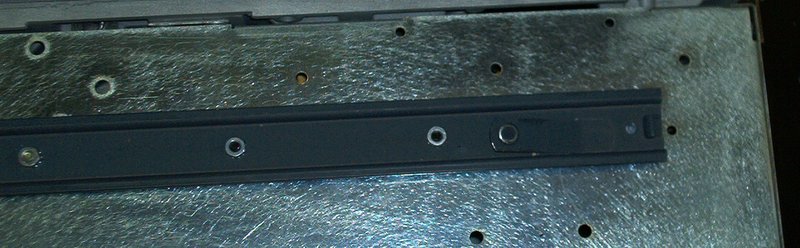
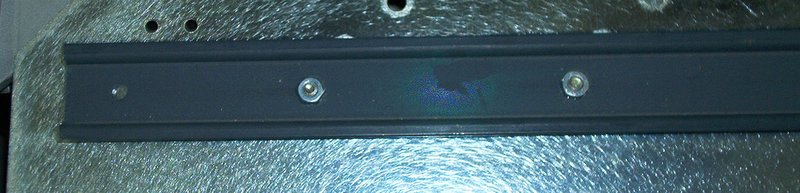
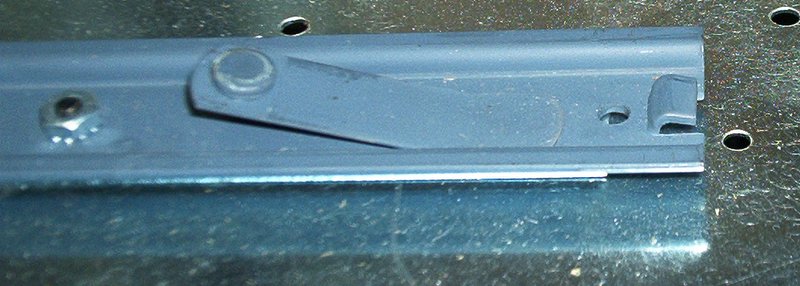
Hi -
can anyone identify the type of rack slide in these pictures?
http://www.heeltoe.com/images/IM001376.JPGhttp://www.heeltoe.com/images/IM001377.JPGhttp://www.heeltoe.com/images/IM001378.JPG
I have 4 different pieces of equipment which where pulled out of racks
and the "mates" to the slides where left behind. They're all the same
"u shapes with wings" slide.
I'd like to find the same type so I don't have to remount the slides
(color me lazy).
I think these are common on DEC equipment, but I don't know what they are...
thanks for any hints!
-brad
>
> Alright, I admit it. I'm stumped.
>
> BBC has a series, "Look Around You", a comedy
> program based on late
> 1970s and early 1980s educational programming.
> Season two included
> an episode called "Computers", and featured these
> two fake "home
> computers".
>
> The Bournemouth ("The most powerful computer in
> Britain"):
>
http://www.bbc.co.uk/comedy/lookaroundyou/wallpaper/images/1600/
>
> bournemouth.jpg
>
This looks to be made from an HP 64000 development
system. Like the one seen here:
http://72.14.203.104/search?q=cache:wmbqtorpWVMJ:www.gaby.de/e64000.htm+hp+…
I also believe the other is made from an HP 9825.
Bob
On 7/4/06, Tony Duell <ard at p850ug1.demon.co.uk> wrote:
> Obviously you might well not be able to do this. In which case, you
> either have to buffer the port lines (to reduce the output impedance
> there) or add a buffer amplifier on the analogue output. Either solution
> involves active components that need power.
I know that the "right" way to do it involves active components...
given my 95% success with passive components, I was hoping to squeak
by. If I could get power and data from the same source (see below), I
wouldn't be quite so picky.
> Can't you grab power from the computer? Obvious places would be either
> the keynoard connector or the joystick port.
Keyboard connector is a possibility. This (server-class) computer
doesn't have a joystick port. As I mentioned in another message, my
breadboard is extracting power for projects from the USB port (cable
came from a dead keyboard), but I really don't think the mechanical
arrangement is viable in a user environment. We've lost three of
these machines in 12 months by static discharge when plugging in USB
devices - you can see the resultant hole in the epoxy of the gate
array that does the USB... the machine is totally fried after a
spark... I'd prefer to glue the cover shut to keep users out; I
certainly don't want to leave a device behind that encourages them to
fiddle with the front USB ports. No... we don't have any powered USB
hubs here - the ports the vendor designs in are the ports we have to
work with.
I'd probably be best served by rigging up a back bracket with a custom
power cable - that way, at least, it'd be out of sight, out of mind
when installed.
> I have never forgivven IBM for not putting a +5V line on the parallel
> port. It would be so useful for homebrew add-ons. I have modified a few
> parallel cards (cut and jumper in the obvious way) so that pin 25 is a
> +5V output, the problem then is that any normal printer cable will short
> the 5V line to ground.
That's a nice hack, and one I might have done for myself back in the
ISA days, but as I mentioned in another message, an official +5V
output pin on the Amiga 1000 caused lots of people lots of grief and
C= relented with the A500 and A2000 and went with a totally
PC-printer-cable-compatible port after the A1000.
I've seen some goofy designs for getting power to an external device -
molded DB25s with integral coaxial power connector (for an early
powered mouse), and more than one design for a male/female keyboard
power connector (Xircom did one for their PE3 Pocket Ethernet
Adapters)... it would have been so much easier if there had been an
official way to tap power.
> > two, because I'm at the South Pole and I have to work with what I have
> > on hand - there won't be another plane for nearly 4 months.
>
> Ah, and you don't have any DACs in the junk box...
We have many, many parts in drawers (I probably have access to 20-25
parts bins), but DACs are not among them. I might be able to scrounge
something off of a dead board (we have some Vaisala weathersonde
boards and some UPS boards in the scrap pile - I did manage to score
16 IRF510s from a dead UPS a couple of months ago, perfect for a
thermo-controlled fan ;-)
> But do you have suitable resistors? I've not done the calculations, but intuitively, you
> need the R's and 2*R's all to agree to better than 0.5% for an 8 bit
> converter. 0.5% resistors are not common.
Ah... we have quantities of 1% resistors, but no 0.5% resistors that I know of.
As for my simple 8-value DAC, I used 5% resistors and hand-sorted them
for a (nearly) consistent 1:2 ratio up the line. We have a number of
the ancient Ohmite red drawers with a dozen values per tray (there are
lots of components here from the 1960s, including a bucket full of
tubes/valves).
-ethan
Hi all
I've heard rumors that an RK05 suitcase exercisor exists. Has anyone
ever seen one or used one? Does anyone have one?
I assume it would connect via the "unibus" connector and exercise the
drive (seek, read, write, etc...)
-brad
I need one plastic part to make this one complete.
E-mail me offlist please. Thankee.
__________________________________________________
Do You Yahoo!?
Tired of spam? Yahoo! Mail has the best spam protection around
http://mail.yahoo.com
I turned these up looking for something else this morning
http://www.wallash.com/publications
Related to Billy's postings a while back about ESD issues in disc drives and
why it is more of an issue in modern drives.
Hi,
I've been skimming the recent threads on microfiche scanning with some
interest. Just out of curiosity, has anyone tried scanning
microfilm/microfiche with a film scanner?
Just interested, because VueScan (free trial from www.hamrick.com, $50 for
the basic licence, $90 for the 'professional' licence) seems to have a setting
for microfilm scanning. Unfortunately I don't have any microfilm to try it
out, but my film scanner (a Minolta DiMAGE Scan Dual IV) only takes mounted
35mm slides and 35mm strip film, so anything I put in would have to meet those
size constraints...
I could (in theory at least) bodge up a cardboard carrier for my flatbed
scanner (an Epson Perfection 2400 Photo) and use that, but I don't rate its
optical quality for transparency film very highly.
I was just curious if anyone had considered trying it... I'd love to but
like I said, I haven't got any film to test with.
--
Phil. | Kitsune: Acorn RiscPC SA202 64M+6G ViewFinder
philpem at dsl.pipex.com | Cheetah: Athlon64 3200+ A8VDeluxeV2 512M+100G
http://www.philpem.me.uk/ | Tiger: Toshiba SatPro4600 Celeron700 256M+40G
I have this Kensington Expert Mouse here (c. 1995), and I'm wondering
if I'm missing an external adapter box... it has a Mac-style DIN-8 for
a connector, and inside, I see 3 chips - an LM358 near the DIN-8, an
LP339N (quad comparator?) and a 24-pin Motorola SC417907P with an
adjacent 4.00MHz crystal resonator, clearly some sort of
microcontroller being used as a mouse protocol encoder. One
mysterious part is the optical receiver, an SD6150... it's an
acrylic-housed device with a visible silicon die, and 5 leads. It's
positioned to catch the light off of the marked roller that catches
light from an IR diode, so it's got to be something like a
multiple-element photodiode (they are marked "DTC1" and "DTC2"), but
googling isn't not revealing any hard details on the part. I _think_
I can see 4 "panels" on the die, so it might be a Common lead and 4
light sensitive patches that the board would use to turn a strobed
light from the roller into both phases of the quadrature waveform.
I don't think the folks that once used this had old Macs (perhaps they
did 10 years ago), so my first thought is... what protocol might this
speak and am I missing an external adapter to, say, a PS/2-style mouse
cable? Another possibility I can think of is that it is designed to
hook to a Microsoft Bus Mouse board (probably have one of those
hanging around here somewhere).
I did some googling on it and can't find any internals info or any
"hack" articles. Honestly, I could use this even if I have to extract
raw quadrature and do something with that. It's a single-sided board,
so reverse-engineering it is not impossible, but I thought I'd ask
first and see if anyone knows some technical details on it.
Thanks,
-ethan
Very likely that it uses an adaptor box. Almost all Macs (exclusive of the Plus) with MiniDIN-8 serial also had MiniDIN-4 ADB interface, which would be what a mouse would use.
Even on a Plus I don't see why anyone would go to the trouble of rewriting enough drivers to use the serial ports for a mouse when the mouse port is available and SSW expects its use.
Could this be a NeXT trackball?