Picked something interesting up a few days ago, a graphical system which
used to be part of a spectrum analyzer.
It's a PDP-11/23+ with a graphics option, a monitor, joystick,
an interface box for the keyboard, an Ampex diskdrive which uses
packs and has a fixed disk inside and a Printronix lineprinter
with 4 spare ribbons ((these are big, abouth an inch or so wide)
It comes with XXDP+ (no idea which version yet), a library disk,
a disk with RSX11M+ V3.0D and a stack of 30 extra data disks.
Fortunately, the system docu is there, both for the machine, drive
and printer.
First thing to do is to hook up an RL02 to copy the sw over.
The drive is an SMD type disk, it is controlled by an Emulex SC02
interface. Im not going to use this drive a lot, so if there are
people who wants to take some of these data packs, you're welcome
to get some.
Ed
It looks clean and great, but it reports CDAL parity error (machine check
10) randomly if the panel head is installed in place, when it is processing
bulk of data. If the panal head is hanging there loosely, the chance of
getting a CDAL parity error is much much rarer.
What could cause this problem? A defective cache memory chip? supportive TTL
chip? capacitors?
Or is it better for me to unsolder the CPU and sell it to collectors?
Any idea?
vax, 9000
>The consensus was that we did "HEL" to login and that the accounts
>were <alpha><digit><digit><digit>, in particular X999 was the games
>account. (That rang a memory chord with me when it was mentioned.)
>It was also remembered that A000 was the "root" account on the
>machine.
The login was of the form HEL-XYYY,<password> for the earlier systems,
and later, HEL-XYYY,<password>,<terminal identifier>. The password was
usually a combination of non-printing control characters to avoid the
password showing up on the teletype printout.
X was a letter from A through Z. YYY was 000 through 999.
If the last two digits of YYY were 00, then the account was a "group"
account, which was available to all members of that group as a library
account, for shared files/programs. A000 was indeed the "root" account,
which did have access to a few extra commands. Z999 was also an
interesting account --- it was the "system overhead" account. All
available "free" disk space was available to this account. In 2000C and
C' systems, there was a "beature" (a cross between a bug and a feature)
where if the "NAM" (name a program) command was issued with an argument
of ",", e.g., "NAM-,", the user would get "dropped" into the Z999
account with no password request. It's unclear if this was a "back
door" for HP service personnel, or if it was a bug, but it was
explicitly noted in the user's manual for the system that "," was an
invalid argument to the NAM command.
"NAM-," would simply be acknowledged by the TSB system sending a
linefeed, indicating that the command had been processed. At this
point, it was possible for a user to "crash" the system by asking it to
create a file that was so large that it consumed the remainder of free
disk space. The timeshare system could also be "locked up" for varying
periods of time by creating large files.
In TSB, data files had to be pre-allocated to a given size, and all of
the blocks were "claimed" as part of the creation process. For example,
doing a
"CRE-FILE,10000" would create a 10,000 block file. Normal user accounts
were limited to perhaps 100 to 200 blocks of storage. Creating a 10,000
block file took the system quite a long time, and during that time, all
timesharing operations would cease while the system was locked in
"system state", creating the file. This was discovered by a friend and
myself in high school. It was quite interesting the first time we tried
"NAM-,", simply because the manual said it was invalid, and were quite
surprised when the system just accepted the command, but didn't appear
to do anything. We then typed "CAT" (shows disk catalog), and it showed
an empty directory, with a large number of available blocks. We tried
"CRE-FILE,1000" at first, and when we hit RETURN, we noted that there
was a period of time where the other three teletypes which were active
in our high school computer center stopped typing, or even echoing
input, until our command completed, then everything resumed where it
left off. We deleted FILE, and then tried CRE-FILE,10000, and the other
terminals stopped...dead in their tracks, for a few minutes (most people
thought the system had crashed, and turned off their teletypes) while
the system was creating this large file. We then did a PUR-FILE (PURge
- deleting the file), which again locked things up (for a period of less
time) while the system was deleting the file. We then did a
"CRE-FILE,1000000", which was in excess of the number of blocks that the
"CAT" (CATalog) command showed, and the system "went away", and the
computer math teacher soon got a call from the data center saying that
the system had crashed for unknown reasons, and that it would be some
time before it would come back.
We had quite a bit of fun writing little programs which would wait for a
specific time (during other people's classes), and then "crash" the
system at that time. Eventually, we got caught. We didn't get into
too much trouble. How they tracked us down, I'm not sure, but I believe
that through the crash dumps that the system generated when it crashed,
HP engineers were able to figure out which async mux line was causing
the problem, and then tracked it back to our school. A patch was put in
place that fixed the problem, resulting in an "ILLEGAL FORMAT" error if
NAM-, was entered. This fix was incorporated into all later releases of
HP 2000 TSB, including HP 2000F, HP 2000F', and HP 2000/Access.
I sure loved these systems. They were wonderful systems to learning the
basics of computing through. They weren't as fully featured or flexible
as competitor Digital Equipment's RSTS/E timeshare systems (I have other
fun stories to tell about finding bugs in RSTS/E), but they HP system
were really a lot of fun, especially 2000/Access, which added a lot of
neat functions. I'm really happy that Jay has managed to find the
various special bits (microcode and mux hardware) that makes it possible
to have an operational HP Timeshared BASIC system running as "the real
thing".
Rick Bensene
The Old Calculator Web Museum
http://oldcalculatormuseum.com
Can anyone help me with a simple link to an assembler / linker for a
Pentium III / Pentium 4?
I am attempting to use the EMEM.DLL (Emulated PDP-11 Memory)
under Ersatz-11, but I am basically a dummy when it comes to using
X86 code, especially finding a pair of suitable assembler / linker programs.
I downloaded the Watfor programs, wasm.exe and wlink.exe, but I am
not able to assemble the original file, EMEM.ASM at this point.
In case anyone is interested, the EMEM.DLL under E11 provides access
to PC RAM via emulated PDP-11 hardware registers. The current version
which I have been using allows up to 8 MBytes, but I want to increase that
to about 600 MBytes so that I can write a faster sieve program for Prime
Numbers which looks like it runs in a PDP-11. If I can get the test version
to run fast enough on a Pentium III, I will try it on a Pentium 4 with 4
GBytes
of memory and see if it is possible to sieve the primes up to 10**18
(essentially
a 64 bit sieve program) in a reasonable time (i.e. less than 1 year!).
Sincerely yours,
Jerome Fine
--
If you attempted to send a reply and the original e-mail
address has been discontinued due a high volume of junk
e-mail, then the semi-permanent e-mail address can be
obtained by replacing the four characters preceding the
'at' with the four digits of the current year.
The growing problem with SPAM, etc..
It was noted in one of the trade publications I looked at that a very effective
check on SPAM was to confirm that the stream opened up to you (on your port 25)
actually did a "conversation" with the remote player. It seems that the 'bots
just open up port 25 and send (spew), and ignore the responses. Kinda like
'typeahead'. If you can sense this, it quashes some stuff (so I've been told).
Another tact might be to see if the sender HAS a port 25 on their machine. I
suspect that the 'bot machines don't.
Just a couple of ideas.
Unfortunately fixes like these require a deep diving into the SMTP mailer at
the code level.
ob. on topic.. Sendmail is over 10 years old (maybe that is the problem!)
--
Tom Watson
tsw at johana.com
____________________________________________________________________________________
Have a burning question?
Go to www.Answers.yahoo.com and get answers from real people who know.
Hi. I could finally get some time to put in working state my
PDP-11/23-PLUS.
Once I could check the correct startup of the system, I should like to obtain
these items that detail below:
* Original rack for this system, with its 874 power controller, backpanels
and rack inner metal rails.
* Cable kit for one RLV12 (RL02 controller board), at least for two RL's
* TSV05 (Pertec) cable kit. I have the tape unit and the board but no cables
* -YA terminator for one BA11-S expansion box. I have the main BA11-S plus
another one to extend the system, plus both connection boards (plus cables)
for the boxes, but the PDP-11/23-PLUS manuals speak about another terminator
board. I only remember now the final part number letters (-YA).
Other items are welcome, but I suppose it would be more difficult their transport.
I am mostly interested in one or a couple of working RL02.
If someone can get rid of some of this, or even sell it for a reasonable
price, contact me off list. I live in Europe, by the way.
All indications and suggestions about these matters are welcome too.
Greetings
Sergio
A number of years ago I had some luck making rollers using two methods:
(1) Use a double punch to punch out thin doughnuts of rubber--too thick
deforms on punch. Stack them on the shaft tacking them with a very small
amount of silicon or urethane glue. Mount in chuck of drill press and turn
slowly against stones of different coarsenesses to smooth the surface. You
may need to fiddle with the speed to get a good finish. This method
usually requires that you can somehow cap the top and bottom of the roller,
especially if the doughnut is wide.
(2) Cast a new roller using urethane or silicon. Mount the shaft, or tube
that represents the inner diameter, in a drill press. Using an n-way
machining vise, center the outer tube with the inner shaft. Pour in goo,
lower inner shaft into goo using the press handle and fine tune the
positioning with the vise if needed. I turn the shaft a few times to get
the goo the settle and air to vacate. Let harden, remove with plunger, heat
or cold. Trim as needed. For outer casings, I've used pvc and copper
tubes, but the smoothest results are with a machined and polished steel
tube, open at the bottom to help push the roller out. For one roller that
would not stick to the shaft, I milled several grooves in the shaft and
repoured. This kept the rubber from turning.
-jim
My 88-ACR is currently "bare". Can anyone with an Altair try playing this
tape image?
I'm using a Sony stereo cassette deck with dc servo controlled motors. I'm
trying to get the best copy of these tapes that I can. I want to start a
free library of actual audio cassette recordings. I guess once these
recordings have been "verified", we can regenerate perfect sound images by
recording the direct output of the 88-ACR. Until then... :)
The only thing I am worried about is the Dolby NR (filter) was
enabled. I'm not sure if this is bad or not.
I have not adjusted any dynamics yet. You may have to turn up the volume...
If the MP3 is not good enough, I have the raw 32bit 44100Hz
available... (30MB RAR'd)
http://www.altairkit.com/software/
This is what is on the tape:
ALTAIR 8K BASIC
VERSION 4.0 MARCH 1977
COPYRIGHT 1976 BY MITS INC.
2400/1850 HZ
Grant
NOTE TO ARCHIVE: This file may not exist forever, it is a beta file. :
) Look for other posts. : )
I just picked up an interesting portable terminal from ebay for $0.99
I guess there aren't really any other terminal collectors out there!
Anyway, this is a nice little unit. 80x24 LCD screen, NiCad battery
pack for portable operation, wall wart for AC operation. However,
what's interesting about this puppy is that it has a docking station
that contains an inkjet printer and a numeric keypad for data entry.
The manufacturing label indicates manufacture in 1989. The terminal
is VT220 compatible. There is a handle on the docking station so that
you can carry the printer+terminal combination around. The whole
bundle comes in a special TI black cloth bag that lets you lug it
around to various locations.
I have another terminal that is similar to this, but isn't as fancy
with the printer dock: the Random Colleague. I purchased two Random
Colleagues in a dovebid auction. One had a damaged case and the other
had a damaged LCD screen. I've swapped the good screen into the good
case and now I just need a little digikey ordering to connect the
ribbon cable for the screen back up to the main board. The Random
Colleague has a hard briefcase like case that lets you take it to
various locations.
Anyone else out there have either of these?
--
"The Direct3D Graphics Pipeline" -- DirectX 9 draft available for download
<http://www.xmission.com/~legalize/book/download/index.html>
Legalize Adulthood! <http://blogs.xmission.com/legalize/>
Brent Hilpert wrote:
I have a web page (<http://www.cs.ubc.ca/~hilpert/e/gates/index.html>)
where I'm accumulating the diversity of symbols that have been used for
logic gates. If you have a scan or reference for the Cray/6600 symbols I'd
be
interested in adding them.
---------------------------
I'll be glad to if I can find one over Christmas. I'm flying to the Bay
area on Saturday, so I'll look next week. I know I have the plastic drawing
guides for the 1604, 3000 and 6000 logic symbols. And I think I have some
scans of the legends of several schematics I'll send you.
But my all time favorite was the logic drawings of the Bendix G-15. They
were drawn by an artist. Every page is clean, neat and easy to read. Lots
of comments. I still think they are the prettiest schematics ever produced
in the industry. Even if it was a valve (vacuum tube) machine.
The ugliest, hands down winner, are the IBM early machine drawing schematics
or logic manuals for the System 360. They were done by a badly timed line
printer with an exceptonally bad ribbon.
Billy
can someone please tell me how to unsubscribe from this list??
Help!!
________________________________
From: cctalk-bounces at classiccmp.org on behalf of James B. DiGriz
Sent: Tue 12/19/2006 7:59 PM
To: cctalk at classiccmp.org
Subject: Re: Storage Buildings
On Tue, 19 Dec 2006 12:14:34 -0800 (PST)
"Zane H. Healy" <healyzh at aracnet.com> wrote:
> Or there is always the option of getting old Freight containers (the
> type they use on cargo ships).
>
> Zane
>
They're cheap enough (as low as $200 or so), and the port is only 20
miles away. FOB only, though. You need to have a flatbed or hire one,
which adds to the expense. There is one unit right next door that might
conceivably become available. There is another problem, though, as
containers tend to receive undue attention from the vigilant eye of
code enforcement here, unlike some other enlightened areas of the
country, particularly if you attempt to build any kind of actual
structure out of them. In my case I would have to. Freight containers
are not really big enough for decent shop facilities.
jbdigriz
I'm in Sydney for the week, departing Christmas Day (Newtonsday ;-)
and was curious if there were any members of the list who are close
enough to the Sydney CBD to warrant getting together for a beer and
some classic computer conversation. I'm paying for wireless by the
hour here :-/ so it would probably be better to call my mobile at
0420755794 if interested.
I'm back to NZ for a few days next week, then finally back home to
Ohio where I can a) look for work, and b) spend some indoor time
getting various projects to a state of completion before the weather
turns nice, eventually.
Cheers,
-ethan
Jeff Walther wrote
Is there a guide somewhere to the different families of logic, such
as RTL, TTL, LSTTL (never heard of that one) and CMOS?
Try this one:
http://www.interfacebus.com/Design_Logic_Family_Selection.html
It's a little general but gives a good high level view.
Billy
On Sat, 2006-12-16 at 13:35 -0500, Dave McGuire wrote:
> On Dec 15, 2006, at 10:18 PM, Chris M wrote:
> > Is it a *recent* development of compilers that as an
> > intermediate step the source code will first be
> > reduced to assembler mnemonics, before being reduced
> > to object code?
>
> Absolutely not. The UNIX world, at least, has been doing it that
> way for decades.
Right. Also, from the micro world, two words: Small C. I love the
approach. Among other benefits, it allows one to write something in C
to get the algorithm correct, and then re-write and/or optimize the
generated assembly to speed up inner loops, and frequently executed
code, as needed.
Peace,
Warren E. Wolfe
----------------------------------------------------------------------------
--------------
Most of the early compilers at CDC worked this way. The intermediate
language was assembly and could be used to clean up the final code. It
could be saved as a separate file and also be used as sub-routines. It was
a very fast way to create a compiler.
Then there was another method called interpreters, where final machine code
never really exists. The compiler generates a list of psuedo ops that would
be executed by a series of macros. Was fast to write, but incredibly
ineffecient.
And there was a really fascinating one on the IBM 1401 that kept the high
level langauage in the core, and brought in sequential routines from the
tape unit. Each rountine would perform one process on the source. At the
end, what remained in core was the machine language program. It was a true
single pass compiler. But it worked in serial mode, bringing in each
routine in order (63 different ones, if I remember correctly) even if wasn't
needed.
It was probably the slowest compiler I ever worked with, but the concept was
interesting.
Billy
--- Tony Duell <ard at p850ug1.demon.co.uk> wrote:
**>> snip <<**
>
> Well, let's see...
>
> I can either spend $10 on a set of rubber parts an
d
> take an afternoon
> putting them in (at which point, said VCR will be
> good for another 2
> years) or I can spend $89 and take an afternoon
> going to the shop,
> bringing a new unit home, and figuring out how to
> connect it up and use
> it. At which point I have a device assembled with
> lead-free solder,
> soldered at too low a temperature, so it gets dry
> joints within a few
> months. With plastic mechanical parts made from th
e
> cheapest plastic
> imaginable that make a freebie toy look solid. I'd
> be lucky if that $89
> machine lasted for a couple of weeks after the
> warrenty period...
>
> Now guess which I am going to do...
>
> -tony
>
That's a very good point.
Just out of interest, my dad still has the first
VCR VHS recorder he bought around 1979 (no
typo). It's very heavy, largely due to the fact
that it's all mechanisms and levers inside.
(No I don't have the model name/number at
hand - I believe it's been put in the attic)
It was working fine up until around 1998/9
when it wouldn't record very well anymore. i
believe that's when we got our first modern
VHS recorder. The new one lasted 3 or 4 years
before it started playing up (won't rewind
tape without messing it up, but plays/records
fine!) and my parents got another one.
The one my brother bought around 2001 works
ok, but is hardly used.
Regards,
Andrew D. Burton
aliensrcooluk at yahoo.co.uk
Those interested in running Scelbal, the old Basic for the Scelbi-8 8008
based system, can download the following file :( windows executable, ca
6.5 M )
http://mypage.bluewin.ch/dreesen/I8008.zip
It is an emulation of a 8008 machine I might build, (Time
Permitting...), and comes with very a very terse help in the form of the
"scelbal.txt" file.
This tells you how to start Scelbal.
The emulator is rather crude, but was only intended as a proof of
concept. Some source code is provided.
Looking through the Scelbal source code really shows you how limited the
i8008 is. You need 8K to implement a Basic that is on a par with a 4K
TRS80 Basic... You are forever shuffling around pointers, incrementing
and decrementing them "by hand" .
Jos Dreesen
>Probably not a lot of help, but if that interface is the same physically
>as the DA15 connector on other Philips/LMS CD-ROMs, I have the service
>manual for the CDD462. It's little more than a schematic and an
>incomplete parts list (the CDD462 is based on an audio CD-player, and
>you're expected to have the service manual for that!), but it would
>contain the interface pinout. Let me know if you want me to dig it out.
Maybe - I don't suppose it describes any DIP switches on the back of the
drive? The actual drive in the RRD40 is a Laser Magnetics CM 201, so it's
unlikely that they'd be the same, but you never know.
I ask because I happened to find this article
http://h71000.www7.hp.com/wizard/wiz_3914.html
The wizard describes the RRD40-DC as a "slave drive" for use with an
existing KRQ50/RRD40 pair.
Question - what's the difference between a RRD40-DC and the RRD40-HC? Is
there a switch or jumper in the drive that makes it a "slave"?
Ah, if only I had a manual :-)
Bob
>>If you wanted to convert from WPS-8 to WordPerfect, then I
>>could offer my code at http://srv.net/~kth .
>
FYI: I got connection refused just now when trying to access your
site.
I modified your software to convert 8" WPS floppies dumped with my
dump/restore programs and should still work with 5 1/4 dumped with
putr.
The conversion to word actually worked the best. It really converts
to wordperfect but when going through the word converter it uses some
later version codes to do better formatting.
ftp://ftp.pdp8.net/software/wps/ftp://ftp.pdp8.net/software/dumprest/
Item #270070599391 on ebay
I've bought from this guy before and always been satisfied. He even
went out of his way to replace some items for me that were damaged
during shipment.
--
"The Direct3D Graphics Pipeline" -- DirectX 9 draft available for download
<http://www.xmission.com/~legalize/book/download/index.html>
Legalize Adulthood! <http://blogs.xmission.com/legalize/>
> About 1/4 into the tape something started vibrating, quickly
> escalating and before I could do anything, the tape stopped. Result:
> rubber goo on the plastic roller that drives the DC-600 cartridge
> drive belt, some on the tape itself, and the tape shows deformation
> (wavy) on the top half. I had to toss it.
This is the classic failure mode for the rollers. Pressure/Temperature
causing breakdown of the rubber.
> Any idea what could have caused this and how to prevent it?
There is no way to prevent it. The rubber had already decomposed, and
the elevated temperature caused what was left of the bonds to change
state.
> The other option is to remove the melted rubber roller and
> steal the one from the Archive drive.
They aren't interchangeable. The only option you have is to find a newer
drive with a roller that hasn't decomposed (yet..). I know of no
commercial source for just the rollers for either Archive or Wangtek.
Wangtek changed their roller design on later drives. Archive didn't, so
you may be able to find 150meg drives that are new enough to survive.
The most common source are Sun external 150meg shoeboxes, which have
been readily available in the past.
Around Mon, 18 Dec 2006 23:21:23 +0000 (GMT),
> ard at p850ug1.demon.co.uk (Tony Duell) wrote:
>> The drive itself: the rubber roller driving the aforementioned
>> plastic
>> roller had melted. Clearly visible is the area where the rubber meets
>
> [...]
> Baiscailly you have to replace the roller. Replacements that have been
> successfully used (depending on the machine, etc) include silcone
> rubber
> O-rings (possibly with a grobe machined in the original hub, or a
> new hub
> made), heatshrink sleeving, silicoe rubber tubing (fuel line for
> glow-plug engines, for example), etc.
>
> I've wondered if the 2-pack elastomer materials sold by e.g. Devcon
> would
> work. Make up a mould and cast a new roller. A lot of work, but if it
> does the job well it'd be worth it in some cases.
I've had extremely good luck using Plasti Dip <http://
www.plastidip.com/industrial/plastidip.html> to repair capstans. The
product lays up in layers of 2-8 mils (depending on dilution) and
produces an extremely uniform coating. I have repaired several HP
tape decks out of 30 year old test equipment which required a layer
of 70 mils. The worst runout was less than 1/2 mil. The material
appear to be sufficiently durable for the task. The only drawback is
the requirement for patience - each layer requires 30 min. minimum
drying time. After a bit of experimentation I found that floating a
bit of solvent on the surface maintained the coating consistency from
dip to dip.
>> For those of us with machine tools, I wonder if a roller can be "fine
>> tuned" to the proper diameter by fitting an oversize piece of
>> neoprene tubing to the roller, cooling the whole affair in dry ice,
>> then machining it (on a lathe) to the proper size. I can't recall
>>
>
> I believe it can, although cooling to liquid nitrogen temperatures is
> recomend (if only beacuase it takes longer to warm up again, so you
> have
> longer to take a cut).
>
> I've also heard you _can_ machine 'rubbers' at room temperature,
> but that
> the tools are totally different from those used for metal turning.
> May be
> worth investigarting.
>
> I've not tried either though.
>
> -tony
Cooling to LN2 temperatures has its drawbacks: the rubber either
separates from the mandrel or it shatters - or both... The rubber
becomes glass-like and you cannot use cutting tools to machine. A
number of years back back in grad school I attempted to repair a
roller for a Van de Graaff generator using LN2 and failed miserably.
An old machinist got his chuckles watching my many tries. He took a
CO2 fire extinquisher to cool the roller and used a grinder mounted
on the lathe to surface the beast. You have to warm the object up
every so often to find out what the dimensions really are.
I've since surfaced a laser printer's pickup roller using a Dremel
grinder mounted on my mini-lathe at room temperature with good
results (didn't help one bit in the printer - those rollers are not
just rough, but have a directional nap).
CRC
Check out:
http://cgi.ebay.com/70-22786-01_W0QQitemZ230064962734QQihZ013QQcategoryZ582…
I 'asked' a question on where he gets that kind of price, and that when
he comes down
off his drug induced high I might be interested....
This has to be the most unbelievable case of 'seller things he has
platinum' that I've
ever seen !
If anyone has one of these... I'd like to get one for my PDP-11/83.
Since mine
came with an expansion box, the panel I have is the height of the two
units and is
meant for mounting in a DEC rack... so finding one or two of the ones
like in the
auction link above would be ideal.
Thanks,
-- Curt
On 18 Dec 2006 at 0:14, Curt @ Atari Museum wrote:
> Anyone had success importing Vax WPS files into a modern
> wordprocessor? I had heard that older Wordperfect's could read in Vax
> WPS files, anyone know for a fact?
Are you talking about WPS I files a la DECStation?
Cheers,
Chuck
Hey All.
I'm looking to buy:
Moviesetter by Gold Disk
MainActor by MainConcept
Both of these are Amiga applications, and the versions I need must be
prior to 1995.
I'm interested in buying these outright, so if you've got them, please
contact me directly (I won't see replies to the list) and let's make a
deal.
Thanks!
--
Sellam Ismail Vintage Computer Festival
------------------------------------------------------------------------------
International Man of Intrigue and Danger http://www.vintage.org
[ Old computing resources for business || Buy/Sell/Trade Vintage Computers ]
[ and academia at www.VintageTech.com || at http://marketplace.vintage.org ]
> On 11 Dec 2006 at 11:59, 9000 VAX wrote:
>
> > It surely worth selling. The 3 gang air capacitor worths $10 at least.
> > I noticed another two air capacitors and numerous coils too.
More of the eBay mystery at work. It sold for $76.75--I almost
tossed it out as junk.
http://cgi.ebay.com/ws/eBayISAPI.dll?ViewItem&item=320061196753
Cheers,
Chuck
--- Adrian Graham <witchy at binarydinosaurs.co.uk> wr
ote:
> On 18/12/06 16:49, "Richard" <legalize at xmission.co
m>
> wrote:
>
> > :-). The problem is that the rubber tends to
> break down with age and
> > turns to goo no matter what. Sometimes on old
> equipment the part has
> > completely turned to a puddle of goo without eve
n
> attempting to use
> > it.
>
> Ya, the transport rollers in the tape drive for my
> Sharp MZ80B have wept all
> over the metalwork. 'Tis a bit of a mess and will
> take some undoing......
>
> --
> Adrian/Witchy
> Binary Dinosaurs creator/curator
> Www.binarydinosaurs.co.uk - the UK's biggest priva
te
> home computer
> collection?
>
Going slightly OT, I assume the same thing
would happen to any rubber rollers in VHS
players, and be the main (only?) reason why
VHS players start chewing VHS tapes?
(I have a DVD player and am considering
getting a cheap DVD recorder)
Regards,
Andrew B
aliensrcooluk at yahoo.co.uk
I've got a KRQ50 (M7552) and a RRD40-DC (the 15 pin LMSI version, not the
SCSI version!) drive in a MicroVAX-III, but I can't seem to get them
working. VMS sees the KRQ50 as PUB0, but it doesn't see any drives on the
controller. Any attempt to access DUB0 just gives device offline errors.
I read somewhere that the KRB50 had to have a particular firmware version
before it would work with the RRD40 - does anybody know the correct ROMs
that I should have on my board?
I didn't have a cable to connect the drive and controller, so I made one.
Is the cable just supposed to be a DB15M <-> DB15F with all pins wired
straight thru? Is there anything special about the cable?
Is there any significance to the A and B ports on the KRQ50 (i.e. does it
matter which one you use)?
Unfortunately this seems to be a really rare device, and online docs are
pretty much non-existent.
Thanks,
Bob Armstrong
I've got a pair of Diamond HomeFree wireless networking cards (one is
PCI, the other is ISA) as well as a pair of PCI "HomeFree Phoneline"
cards for anyone interested in paying UPS Ground or USPS Priority
shipping for them.
IIRC, they'll work on Win 9x, but not NT/2K/XP (no drivers). I don't
know if Linux drivers were ever produced for them. The Homefree uses
a 2.4GHz (?) link to get 1Mbps (if you're lucky) and the HomeFree
uses a telephone pair to get 10 Mbps. Neither scheme represented a
glowing success for DMMC.
Cheers,
Chuck
Ohhh - nice big power hungry ECL based Classic 3000! Really slow
compared to later PA-RISC cousins, but a nice machine. Pair this with a
2680 laser printer, a roomful of 793x washing machine size disc drives,
and some 7980 reel tape drives and you had a nice 1980s HP data center.
On a historic note one could argue that this was the machine that saved
HP from the same fate as DEC. In the late 1970s and early 1980s HP had
several competing 32-bit architectures(Wide Word, Bridge, Vision... All
pre-PA-RISC), none of which won out and made it to market. When HP Labs
pushed Spectrum (aka PA-RISC) we were waaaay behind DEC/VAX and
IBM/S38/AS400/mainframe, and in a very difficult market position. There
was talk about the lights going out for business computing line
(HP3000), which was a big profit center for HP. The HP3000-64 had been
released, then -68, and -70. If we had not had the -68 and -especially
the -70 to give us breathing room and keep many big customers needing
higher performance happy, HP could have found itself in a very
unpleasant business bind.
Spectrum was very successful and we made a good transition, and along
with help from printers and PCs HP vaulted from a minor player to a real
player in the server market.
Stan Seiler might have some additional color. I was working in the RTE
Lab then moved to MPE Lab on Spectrum, so never worked on MPE for
Classic.
My $0.02...
Cheers,
Lee Courtney
Product Line Manager - Linux for Consumer Devices
Wind River
500 Wind River Way
Alameda, California 94501
Office: 510-749-2763
Cell: 650-704-3934
Yahoo IM: charlesleecourtney
> -----Original Message-----
> From: cctalk-bounces at classiccmp.org
> [mailto:cctalk-bounces at classiccmp.org] On Behalf Of sp
> Sent: Monday, December 18, 2006 10:03 AM
> To: On-Topic and Off-Topic Posts
> Subject: HP3000 model 70 in Australia
>
> Well, someone asked for one 3000 some days ago. Yourself...
>
> http://cgi.ebay.com/ws/eBayISAPI.dll?ViewItem&item=19006244343
2&ru=http%3A%2F%2Fsearch.ebay.com%3A80%2Fsearch%2Fsearch.dll%>
3Ffrom%3DR40%26satitle%3D190062443432%2509%26fvi%3D1
>
>
> Greetings
> Sergio
>
>
Hello eveyone. I am new to the list and looking for info
for an old prom burner I have come across. It appears
to have been manufactured by B&C Microsystems,
and is a model 1409. Looking for any info regarding
this beast. Any info would be greatly appreciated.
Thanks,
Kevin Berlen
Hi List,
I have an R3000 Indigo with GR2-Elan graphics and a system disk with a
working copy of IRIX 4.0.5. The provenance of these 2 items is different,
which explains why the GR2-Elan doesn't seem to be supported by the
4.0.5kernel that's on the disk.
Does anyone know if any rev or patch of 4.0.5 ever supported GR2-Elan?
The hardware is definitely working as I have a 5.3 install working nicely.
Was 4.0.5 ever shipped on CD? I don't remember ever seeing it on anything
other than QIC tape.
64K ?/$/E question - does anyone have 4.0.5 in a form that can be made
available?
Cheers,
Pete
--
Pete Edwards
"Prediction is very difficult, especially if it's about the future" - Niels
Bohr
Is anyone aware of any video available on DVD/VHS of historic mini
computers? IMSAI, MITS, those types? What about larger
machines? Training or promotional videos? I'm looking for any video of
any older computers really, so if there are some good mainframe videos out
there I'd love to get those too. : )
I bought a video from ebay from seller vintech-history. It is great. I
wish it were longer. :)
http://cgi.ebay.com/ws/eBayISAPI.dll?ViewItem&item=180064876755
Grant
The thought occurred to me that it might be nice to have the
floating-point option in my PDP-11/73. Since I haven't got one, and
don't fancy paying the $500 or so that some online sellers seem to be
asking (do they really expect to sell *any*, never mind at that price?),
I was wondering how easy it would be to implement in an FPGA as was
discussed at length earlier in the week.
Feasible, or a complete waste of time? Presumably I'd need software
written to make use of the floating-point hardware anyway...
Gordon.
Ken Rother wrote:
> I am
> also looking for a cost effective printing solution but I might just buy a
> HPIB printer for that.
If you have a computer with a GPIB card you can make screenshots with
gpib-utils (http://gpib-utils.sourceforge.net/) and print those.
-- Adam
I'm getting double posts SOMETIMES from the list. Does anyone have any
idea why this would be happening? I was wondering if I was subscribed to
the list twice, but it doesn't occur to all messages. Does anyone else
experience this? I've included the headers from an example message up
until they differ. They are the same line for line except one has a blank
CC field.
=================
Date: Sun, 17 Dec 2006 12:49:10 -0800 (PST)
From: Fred Cisin <cisin at xenosoft.com>
X-X-Sender: cisin at shell.lmi.net
To: "General Discussion: On-Topic and Off-Topic Posts" <cctalk at classiccmp.org>
X-Scanned-By: MIMEDefang 2.37
X-Virus-Scanned: ClamAV version 0.86.2,
clamav-milter version 0.86 on keith.ezwind.net
X-Virus-Status: Clean
X-Spam-Status: No, score=0.0 required=4.0 tests=none autolearn=failed
version=3.0.2
X-Spam-Checker-Version: SpamAssassin 3.0.2 (2004-11-16) on keith.ezwind.net
Cc:
Subject: Re: classiccmp list (sort of) help requested
=================
Date: Sun, 17 Dec 2006 12:49:10 -0800 (PST)
From: Fred Cisin <cisin at xenosoft.com>
X-X-Sender: cisin at shell.lmi.net
To: "General Discussion: On-Topic and Off-Topic Posts" <cctalk at classiccmp.org>
X-Scanned-By: MIMEDefang 2.37
X-Virus-Scanned: ClamAV version 0.86.2,
clamav-milter version 0.86 on keith.ezwind.net
X-Virus-Status: Clean
X-Spam-Status: No, score=0.0 required=4.0 tests=none autolearn=failed
version=3.0.2
X-Spam-Checker-Version: SpamAssassin 3.0.2 (2004-11-16) on keith.ezwind.net
Subject: Re: classiccmp list (sort of) help requested
From: "Jay West" <jwest at classiccmp.org>
>
> What concerns me is that 99% of the new spam making it through is vaguely
> sensible english phrases (apparently automatically pulled from online books,
> or from usenet post archives, etc.).
>
Yup...you're seeing what I suppose can be described as an technological
escalation in the spam war. The spammers have evolved, as we will have to
wait for the good guys to adapt.
I'm more of a dspam guy personally, but it's the same issue with
Spamassassin. That, and I've been working through the issues with
commercial spam removal vendors serving my Very Large Telco client. Bottom
line is that the spammers have found a weak point in the current
state-of-the-art spam detection technology and are beating on it for all
it's worth. They're not st00pid, alas.
Perhaps more insidious is I've noticed an increasing amount of non-sense
spam with no discernible (to me) purpose (no links or dead links, no message
or hook) other than to poison Bayesian corpus (corpi?). This does not bode
well.
Ken
No problem; I've got the burner, manual & software.
Contact me off-list, pls
mike
-------------------------------------------------------------------------------------
Date: Sun, 17 Dec 2006 00:08:29 -0500
From: Kevin Berlen <kberlen at ticz.com>
Subject: B&C Microsystems 1409 Prom Burner
Hello eveyone. I am new to the list and looking for info
for an old prom burner I have come across. It appears
to have been manufactured by B&C Microsystems,
and is a model 1409. Looking for any info regarding
this beast. Any info would be greatly appreciated.
Thanks,
Kevin Berlen
--- Christian Corti <cc at corti-net.de> wrote:
> [
> Note to those who don't understand all the terms:
> FAB: Firmware Accessory Board
> FEM: Firmware Expansion Module
> DCPC: Dual Channel Port Controller
> TBG: Time Base Generator
> WCS: Writable Control Store
> SIS: Scientific Instruction Set
> VIS: Vector Instruction Set
> DMI: Dynamic Mapping Instuctions
> FFP: Fast Fortran Processor
> FPP: Floating Point Processor
> ]
>
Thanks.
There are a few terms from other discussions
that i don't know either, such as:
BOG (no, not the toilet!)
FGPA (I think that's right)
If there isn't already a definitions/terms list
on classiccmp.org could one be added?
Regards,
Andrew B
aliensrcooluk at yahoo.co.uk
I've been in contact on a fairly regular basis with the owners of the new
kits. Howard is waiting for Christmas, Mark (US) is working on his, John
is sick at the moment, and Mark (Netherlands) is still waiting for the mail
to come in.
I have uploaded the pictures he has sent me. They aren't too much
different than what I have on my web site, but they are from a kit
builder. :) I thought this might be interesting. Other than myself, I
doubt there has been too many Altairs constructed in the past 30 years. :)
http://www.stockly.com/forums/showthread.php?p=206
Mark mailed me a few pictures of his vintage computer collection, including
his Mark-8 kit provided by Steve Gabaly of Obtronix.
http://www.stockly.com/forums/showthread.php?p=207
Right now I am working on the silk screen and solder mask layer for the
88-PMC (2k 1702A PROM Board), ACR (Cassette Tape Board), 2SIO (Serial
Terminal Board), 88-4MCS (4k Static Ram board). With these items its
possible to have a completely vintage basic development environment.
I am beginning to work on other vintage computer equipment too! Expect
some interesting new things to come your way. :)
Grant
On 15 Dec 2006 at 19:18, Chris M wrote:
> Is it a *recent* development of compilers that as an
> intermediate step the source code will first be
> reduced to assembler mnemonics, before being reduced
> to object code?
Those mnemonics aren't used by the compiler in many cases--they're
for the compiler writers and maintainers (and curious users who'd
like to take a peek). While I suppose looking at a binary dump of
the object code might reveal something, it's the hard way to answer
the question "Am I really generating the right code?"
There are many compilers that will generate code that can be
assembled by the same assembler that the programmers use, but if you
have a single target, why parse ASCII text if you don't have to? It
just slows the compilation process down. On the other hand, if
you're writing a compiler to generate native code on multiple
platforms, then using the standard assembler makes some sense. Saves
you from having to know about object file layout and such.
Every compiler needs some sort of assembly pass, if for nothing more
than to satisfy forward references. Because the code being generated
is fairly restricted as to form, a pass-and-a-half assembly phase is
often more than enough.
As to mnemonics, it's interesting that even in P-code
implementations, the instruction mnemonics are often one of the first
things specified in the design process. After all, you have to have
some way to talk about the instructions you're making up. If it's
native code you're compiling to, well, those are already made up for
you.
Cheers,
Chuck
--- Kelly Leavitt <kelly at catcorner.org> wrote:
> > > Andrew wrote...
> > > > BOG (no, not the toilet!)
> > > Absolutely no clue.
> >
> >
> Isn't there an expression: Bog standard
>
> Which just means ordinary or stock configuration?
>
> Kelly
>
Yes, something like that.
Thanks to whoever posted the
www.acronymfinder.com link.
Regards,
Andrew B
aliensrcooluk at yahoo.co.uk
Has anyone purchased from this guy?
He has a lot of weird stuff, but the pricing seems like he took the
high number form suggested range in "Collectible Microcomputers" and
multiplied it by 10 or 20.
You'll also note that every item is marked "rare" even things like
Atari 800!
--
"The Direct3D Graphics Pipeline" -- DirectX 9 draft available for download
<http://www.xmission.com/~legalize/book/download/index.html>
Legalize Adulthood! <http://blogs.xmission.com/legalize/>
>I could imagine that some of the lubricants that they used on the
>surfaces could have contributed to stiction. Although, the heads do
fly >when at speed, they do have to drag on the surface. For this they
also >put a very thin layer of lub on the surfaces.
Billy Pettit has been surprisingly quiet about all of this...
The one case of lubricant stiction I know of for a fact is in Quantum
Q540. Apple had a huge field failure problem because of this in HD40s.
They modified the firmware to giggle the head on powerup to help prevent
landing zone lubricant accumulation.
> Westerb Dynex drives were the inspiration for the top loading 5 and 10
> mb 2314 type patter and head drives.
Top-loading single platter drives are descendants of the IBM 5440 series
used on the System 3, which were copied by most of the players in the
day (Pertec, Wanco, Western Dynex, Diablo, etc.). DEC used the case
design for the RL01/2 but added an embedded servo track.
2314s are 20 surface top loading 'washing machine' drives. End of the
line for the head technology started on the 1311 (10 surface).
Had the chance last week to talk to one of the guys at Memorex who did
their early 2314 clones in the late 60's (sold to DEC as the RP01 and RP02).
none of the disks I have are likely to work. I do have
the floppy and expansion units. And Land O Goshen the
mobo has test points! And no no signs of life...
__________________________________________________
Do You Yahoo!?
Tired of spam? Yahoo! Mail has the best spam protection around
http://mail.yahoo.com
I've read several replies indicating that the drive needs to be taken apart.
People have also advocated just "hitting" the drive to break the stiction.
Holding the drive and giving it a quick twist around the spindle axis has always
worked for me and avoids potential problems with disassembly or damage.
Has anyone seen stiction on the IDE or later drives? The only stiction I've seen
has always been on the 5 1/4" MFM/RLL type drives, and probably ESDI/SCSI/SASI
as well although my experience is limited on those drives.
Something else I've noticed is that if a drive has stiction, that stiction will
return after the drive sets for a while again. Anyone know what actually causes
stiction?
Hi all. I'm writing an article for MIT's Technology Review magazine about
vintage computer replica kits. I need someone to interview RIGHT AWAY.
It's currently 1:30AM here on the east coast but that is okay. So, if
you're awake and have any opinions about the various replica kits, or
especially if you've built one or plan to get one soon, then email me
OFF-LIST but RIGHT NOW. (Sorry for the late notice!!) I'm at
evan at snarc.net. Be sure to leave your phone number because I don't have
time for playing tag tonight.
Thanks! At least 15 minutes of fame gauranteed. :)
- Evan
--- Tony Duell <ard at p850ug1.demon.co.uk> wrote:
> >
> > Andrew wrote...
> > > BOG (no, not the toilet!)
> > Absolutely no clue.
>
> Could it be BOT, which is Begining Of Tape (one of
> the sensors in a tape
> drive, the other being EOT (End Of Tape).
>
> Or SOG, neaning Sync On Green, refering to an
> analogue RGB video monitor
> where the gree nvideo signal is in fact composite
> video and includes the
> sync signal.
>
> -tony
>
Hmmm.... I could have mis-read "SOG" as "BOG",
I guess.
I have been rather tired lately.
Regards,
Andrew B
aliensrcooluk at yahoo.co.uk
> > Andrew wrote...
> > > BOG (no, not the toilet!)
> > Absolutely no clue.
>
>
Isn't there an expression: Bog standard
Which just means ordinary or stock configuration?
Kelly
Hi there,
Been lurking (and learning) for a few weeks here.
Lots of interesting topics for sure.
Do any of you have inverse assemblers for the HP1631D logic analyzer ?
Specifically, I am looking for the files that go with the 10342B interface
(RS232/422 and HPIB capable) but I'd also be interested in inverse
assemblers for any CPU. I have one to date.
BTW, the 1631D is connected to my PC using an HP disk drive
emulator written by a fella from the Yahoo HP group. The files
are therefore loaded and saved right from my PC via HPIB. The code
is pretty new but already functional. This meant reverse engineering
the CRC being sent from the original HP driver over the HPIB link - no
small job in itself.
This is my second attempt at posting on the list - I apologize if this
ends up being a duplicate post.
Regards to all,
Benoit Robert
--- Jay West <jwest at classiccmp.org> wrote:
> Andrew wrote...
> > BOG (no, not the toilet!)
> Absolutely no clue.
>
> > FGPA (I think that's right)
> Probably FPGA, or Field Programmable Gate Array.
> Think of it as a prom that
> you can program to be a processor, not just data.
>
Ahhh.
> > If there isn't already a definitions/terms list
> > on classiccmp.org could one be added?
> On first blush, I would think this untenable.
> There's just too many terms,
> and most are probably already there in places like
> wikipedia. But should we
> add one to the classiccmp website perhaps? I
> dunno...
>
> Jay
>
You are probably right. Just to clarify my
idea, I was thinking of a table that would
say list:
FPGA = Field Programmable Gate Array
After a quick view on the table someone
could then go to Wikipedia, Google or some
other search engine and search for:
"Field Programmable Gate Array"
which would produce alot more relevant results
then just searching for:
"FPGA"
Anyone think it might be useful now??
Regards,
Andrew B
aliensrcooluk at yahoo.co.uk
From: Tom Watson <sdc695 at yahoo.com>
>
> Another tact might be to see if the sender HAS a port 25 on their
> machine. I suspect that the 'bot machines don't.
>
A number of very large mail providers split sending and receiving mail onto
different groups of machines, so you can't count on the sender listening for
mail.
Hi there,
Been lurking (and learning) for a few week here.
Lots of interesting topics for sure.
Do any of you have inverse assemblers for the HP1631D
logic analyzer ? Specifically, I am looking for the files that
go with the 10342B interface (RS232/422 and HPIB capable)
but I'd also be interested in inverse assemblers for any CPU.
BTW, the 1631D is connected to my PC using an HP disk drive
emulator written by a fella from the Yahoo HP group. The files
are therefore loaded and saved right from my PC via HPIB. The code
is pretty new but already functional. This meant reverse engineering
the CRC being sent from the original HP driver over the HPIB link - no
small job in itself.
Regards to all,
Benoit Robert
I thought I'd introduce myself. I'm Grant from Alaska. :) Any other
Alaskan's in here?
I'm new to the group, still a little new to "real" classic computers. I'm
the http://www.altairkit.com guy.
I really started getting into them back in 2004 when I wanted to build a
computer kit. I'd watched movies like "Pirates of Silicon Valley", read a
Bill Gates biography, built a few kits like a Veronica PLL/stereo coder,
but it still wasn't enough. I wanted to build a computer. Someone I knew
harassed me in a friendly way that all I was doing was assembling one from
a bag of parts. But it still meant something to me.
I started with the idea of using a Macintosh 128k as a building block. I
decapped a few of the PALs to read out the fusemap, but gave up the project
after reading about Apple going after people for providing copies of System
1.0-5.0 on their web sites. I then started on the Apple-1. I worked on
and off on that, until January 2006 when I found that a guy named Steve
Gabaly beat me to it. I was able to quickly give up the idea and move onto
an Altair - AND buy his Apple-1 kit. : ) What would make the Altair
easier is actually being able to buy and hold a working machine in my
hands. I didn't have access to an Apple-1 except for some high resolution
PCB scans.
I'm going to copy and paste a part of my web page into here for the sake of
indexing robots. If 50 years from now my web site is down someone might
want the full story. ;)
See the link below for the story wtih pictues, otherwise look for the
=========s for my intruduction to resume! : )
http://www.altairkit.com/creation_of_a_kit_story.html
--------------------------
So an Apple I kit is out of the question, it's been done! My next favorite
computer is the Altair, and it is actually obtainable! I found an Altair
for sale with quite a few extra memory and I/O boards. It was in fairly
good condition and had a few manuals, so I was happy. The D0 switch didn't
work so I couldn't actually toggle in any programs, and in fact I never
fixed that switch before completely disassembling the entire computer!
The best part about the Altair that I had just bought was that it had been
used by ARP Instruments as part of an experimental computerized music
synthesis project. Included with it was a bunch of documentation on synth
control, some disks containing the code, and some custom interface
cards. I love time capsules, but the ARP story is for another day...
http://www.altairkit.com/images/061118-ARP_unpacked_2597.jpg
The ARP Instruments Altair - its alive...sort of...
I began the project not wanting to "destroy" my Altair. I had after all
paid a lot of money for it! Todd Fischer replied to me in an e-mail "One
flag comes up that suggests that you're not as committed to this idea as
you seem. When you write "I'm not interested in the project enough to buy
a perfectly working Altair just to desolder all of the parts!", it tells me
that you are limited in your intent.". I stuck to the idea of not
desoldering the Altair for a good 5 months! In the mean time I had sent
away some pictures of the CPU board to several companies that offered "Raw
PCB to Gerber" conversion. That is where a raw PCB is placed on a
calibrated high resolution scanner. With the aide of a human, the computer
recreates the copper, drill, silkscreen, and solder mask (if present)
Gerber cad files. I received responses that ranged from $200 to
$1300. Since that was JUST for the CPU card and I had quite a few that
needed to be reproduced, I decided to try "scanning" myself. I attempted
to do this quite a few times using different software packages.
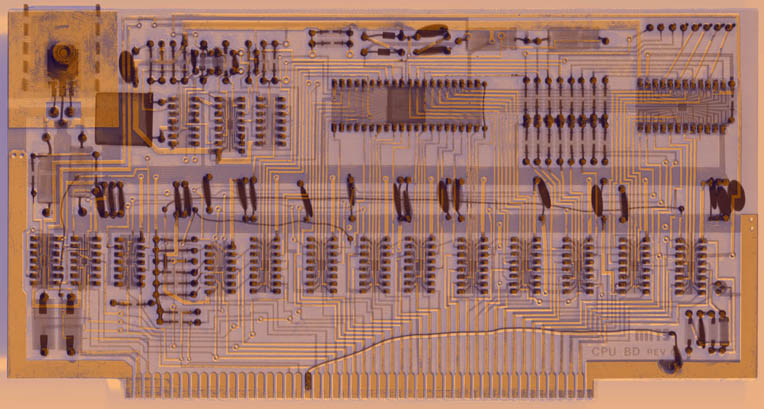
Just to show you how hard I tried to avoid disassembling my original Altair
boards... Since I work for a company that produces digital x-ray
equipment, it was easy to get x-rays of the MITS boards. I actually
scanned the bottom of the board, made that layer of the board translucent,
and then overlayed the x-ray. This looked pretty good, but it is a LOT of
work to "scan" a board by "tracing" the traces! It was pretty neat being
able to see the traces that were underneath the ICs...even the traces under
the dies! Quality is important to me, and I wanted boards that were as
close to the original MITS boards as possible. I finally decided to turn
to the PCB scanning outfits...
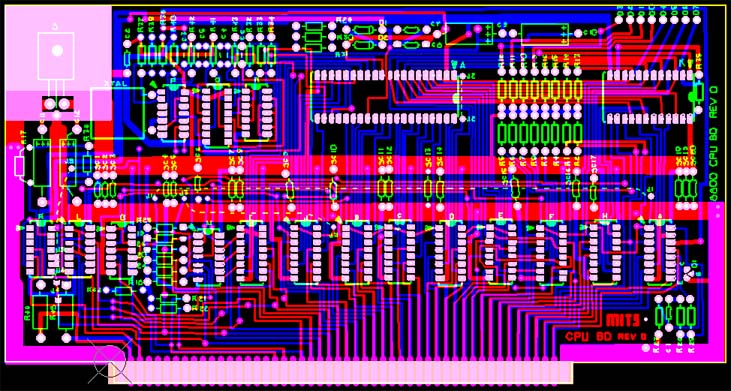
http://www.altairkit.com/images/061118-Altair_8800_CPU_BD_Rev0-Composite.jpg
The scanned/x-ray composite Altair CPU board. This is a scaled
version. The file I was using was 300dpi.
In the end, I decided to use <http://www.mhtest.com/>Mile High Testing
Services to scan my boards. They were second to the cheapest and their web
page made me feel confident. (If you contact them, tell Steven that Grant
says "Hi"!) This involved me desoldering every single part off of the
boards and then cleaning off all the solder/flux. See a pattern
here? Someone gives me good advice and I try to take a different
direction. ;) Advice from Steve Gabaly, creator of the Apple 1 kit, went
like this "...if I were going to make an Altair I'd have the boards
reproduced by a PCB scanning service and get a perfect set of boards in a
few weeks with no hassle..."
It wasn't QUITE "no hassle" because of the poor quality silkscreen on the
original MITS boards. After spending an average of 10 hours on each PCB
cleaning up and restoring the silkscreen, my cad screen looked something
like this:
http://www.altairkit.com/images/061118-CPUBD_Gerber.jpg
The Altair CPU board Gerber file including my solder mask layer, the fonts
don't seem to render very well on screen...
I went through each PCB with a fine tooth comb. I repositioned all of the
silkscreen elements to where I thought the original intent would have
been. I also created a solder mask for the PCBs to improve appearance and
to make it easier to assemble. Here are some sample before and after
pictures of the 1k memory card. These don't show the worst cases, but are
still good comparisons.
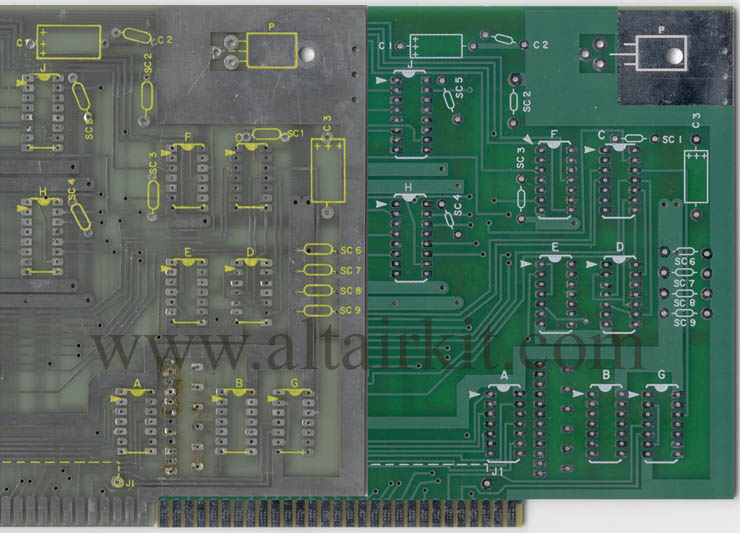
http://www.altairkit.com/images/061007-2-88-1MCS_Right.jpg
MITS board on the left and reproduction board on the right
The MITS silkscreen was used where ever possible. Sometimes I had to copy
and paste letters/numbers from other parts of the board. Quite a few times
the first letter was on top of a pad, etc. I also shrunk the symbols so
they would fit between the pads. The arrows now point to pin one instead
of being on top of pin 2, etc...
Before I found <http://www.pcbnet.com/>Imagineering Inc (they have
inexpensive boards!) I avoided getting PCBs with a solder mask/silkscreen
manufactured until the design was proven. There is the chance that the
scan could have an error. So a prototype Altair was made using copper only
boards. Here are a few pictures of the prototype:
===============================
That is where I stop the kit story for this post. There IS more on the
website if you're interested. So, in the end, what did I get? I WAS ABLE
TO MAKE MY KIT!!!!!!!!!! : ) Of course, I had to MAKE the kit first... ; )
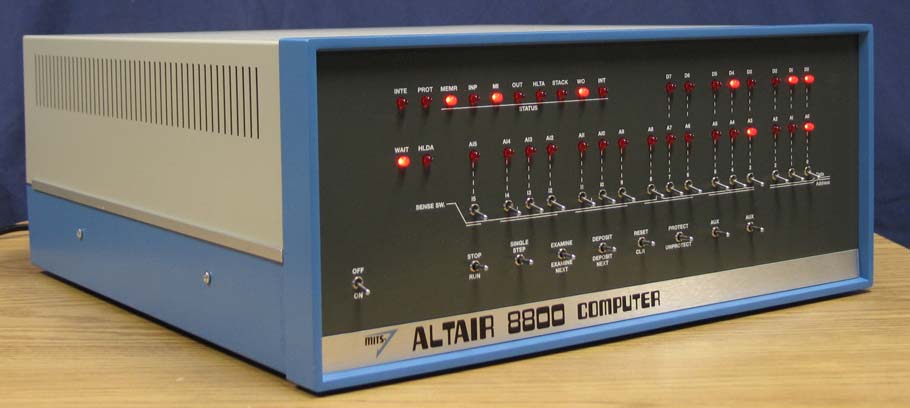
http://www.altairkit.com/images/061119-completed_altair_1974.jpg
I'm working on a few other vintage computer related projects. I hope that
I am able to provide other people with the same experience. : ) Hobby
electronics kits like this won't last forever, especially these old ones
with all of the old discontinued parts. Enjoy while it lasts!
Grant
Thanks for all of the comments guys. :) I had hard time getting on here
or I would have responded sooner. :) I'm glad that people who wrote about
it seemed to like it. I have ordered parts for 20 and will be selling them
again for a reduced price (compared to the ebay auctions).
I'm looking forward to making other kits of other systems. I also have a
few original projects, like a 19,008 LED bit mapped display. Blinkin'
light Pong anyone?
>The outside looks very cool and pretty accurate, though I'm not
>entirely sure if the number of connector punchouts on the rear panel
>is correct..
The case is mechanically identical. The rear panel is the same as my
221846K (that Altair was used as the source for the kit). I didn't even
know what the two 1/4" holes under the DB25s were for until after I had
received the first case. In fact, I didn't even remember noticing
them! They are for the cassette interface. :)
>But the solder-masked boards are wrong, at least for
>the vintage Altair that I own(no masking, just tinned traces).
I thought this too, and did it to make mine different...however I recently
saw an 8800 on ebay with a green mask! It might have been a rev1 or even
rev2 board. The source boards did not have a solder mask. I made the mask
because I thought it was an improvement (and because it makes things a
little different).
>OTOH, the crappy stranded white wire to connect the CPU board to the
>front panel is a nice "authentic" touch. I envied the guys with >Imsai
boxes...
Thats part of the experience that you're paying for when you get the kit! ;)
Grant
From: Gene Ehrich <ygehrich at yahoo.com>
>>With 12338 positives? Thats a 99.1 percent approval rating.
>>Quite respectable.
>
>If 108 people are unhappy enough to leave a negative I dont care what
>the percentages are he's a crook
So you're bad at human nature as well as math.
I have a client trying to sell me approx 6 working RL02 drives, a
variety of Q-bus items, and a Digidata tape drive.
I do not want to sit on the drives, if you have any interest please
contact me off list. I need to let them know by Friday afternoon.
Drives can be palletized and shipped or picked up in the midwest.
Thanks Paul
217-586-5361
I have a 3000/37 that I run on occasion. I did have a /42 before my big move last year. I didn't have enough room so, I had to let it go.
Both machines ran MPE/V which I got from HP during their great Y2K upgrade/giveaway.
I'd really like to find a machine that runs MPE/IX. I see them on Ebay occasionally but, they are either too much money on on the other side of the country.
See yas, SteveRob
----------
From: Richard
Sent: Thursday, December 14, 2006 1:07 PM
To: General Discussion: On-Topic and Off-Topic Posts
Subject: HP-3000 (was: HP HP-2117F on ebay)
Speaking of old HP minis, does anyone have an HP-3000 in their
collection? Not the newer ones, but the ones from the mid to late
70s.
I have MPE/V that ran on my /42. Is that what you're looking for?
SteveRob
----------
CHM has a Series II, Series III and a model 44. Finding MPE that will
run on these is the problem. There has been talk of a classic 3000
simulator for a while, but I've not been able to find early enough
software releases for the machines with good hardware documentation.
The 4x series machines have a console processor is a HP proprietary
microcontroller unlike those that came out of Fort Collins.
In the early '80s at ADP Network Services (old timesharing service), we
connected a couple of IBM and compatible mainframes (IBM 4381, Amdahl
470) to our packet switching network. It took our systems guys a bit of
work, but indeed, they did connect the 3725 to a PDP-8... and from that,
to the rest of the packet switching network. (The network was originally
designed and optimized for PDP-10's, which coexisted with the blue
boxes.) The IBM side ran under CICS. As I recall we eventually needed 4
PDP-8's (as network bridges) to carry all of the traffic from the 2 IBM
boxes-- supporting 400 or 500 simultaneous users. Ah, the old days...
Brad Pritts (now strictly an end user!) (We had several hundred PDP-8's
which we used as network nodes.) Eventua Message: 24 Date: Thu, 14 Dec
2006 11:35:42 -0500 From: Sridhar Ayengar <ploopster at gmail.com> Subject:
Re: IBM 3725 Communications Controller To: General Discussion: On-Topic
and Off-Topic Posts <cctalk at classiccmp.org> Message-ID:
<45817D5E.5000305 at gmail.com> Content-Type: text/plain;
charset=ISO-8859-1; format=flowed Patrick Finnegan wrote:
>>>>>> Imagine this hooked up to a PDP8! or an Imsai! now thats cookin.
>>>
>>>
>>>> The machines that this hooks to are a lot larger than the largest
>>>> PDP-8. 8-)
>>
>>
>>
>> There's no reason you couldn't hook this to, say, the P/370 that was just
>> on eBay (and had a bus and tag port). That's smaller than even an 8/e.
>
>
Except that (if memory serves) this kind of coprocessing communications
aggregator would be able to pass more data than the P/370 has I/O bandwidth.
Anyway, I've seen many P/390 installations that are bigger than a PDP-8.
Peace... Sridhar
--- Richard <legalize at xmission.com> wrote:
>
> In article
> <7.0.1.0.2.20061214162747.0602ec50 at yahoo.com>,
> Gene Ehrich <ygehrich at yahoo.com> writes:
*>> snip <<*
> > >With 12338 positives? Thats a 99.1 percent
> approval rating. Quite respectabl
> e.
> >
> > If 108 people are unhappy enough to leave a
> negative I dont care what
> > the percentages are he's a crook
>
> Just out of curiosity, have you ever run a busines
s
> where the
> customers are pulled from the general public?
>
> There's nothing you can do about people who are
> assholes all by
> themselves and expect you to burgle turds from the
ir
> ass and smile
> while doing it in the name of "customer service".
Exactly.
I am really only a buyer and have only ever
sold one item. I currently have a rating of 99
on there. Thats 101 positives and 2 negatives.
The first negative was added accidentally by
a buyer, long before the option to mutually
agree to remove feedback was added, and he
sent me an email to apologise for his mistake.
The 2nd one is, however, valid. I won too many
items at the same time and relied heavily on
my emails to check what was paid for etc.
I missed an item and didn't realise until it
was far too late (I had a seperate email
account specifically for it back then and only
checked it every 2-3 weeks).
You will always find someone with negative
feedback. If you didn't, then I'd be rather
suspicious - especially if they have more than
1,000 positives.
Regards,
Andrew B
aliensrcooluk at yahoo.co.uk
I'm looking for AAA-sized rechargeable batteries. Good capacity would
be nice, but the main thing I'm looking for is that it should be able to
supply a fairly high peaky current draw.
Any suggestions?
Peace... Sridhar
Listowners perogative to ask a question that is only halfway on topic.... ;)
I figure some people here may have some good suggestions - offlist please.
There is a SpamAssassin machine(s) filtering spam being sent to the list
that sits in front of the classiccmp server (we're also making use of Pyzor,
Razor, milter-ahead, and clamav). It's been doing a wonderful job, such that
most spam is kept out of the moderators faces. However, over the past few
months I've noticed that more and more is getting through (not to the list,
but to the moderators eyes who have to kill it all manually). Same goes for
many of my customers.
What concerns me is that 99% of the new spam making it through is vaguely
sensible english phrases (apparently automatically pulled from online books,
or from usenet post archives, etc.). If there was also an advertisement
text, Spamassassin could catch that. However, the text is all just english
phrases (I've noted them to be targeted phrases, like having to do with
computers, sometimes old ones) BUT... the advertisement is a graphic
attachment. Since SpamAssassin can't do OCR on the small gif or jpg
attachment that says "buy viagra here"... I am not sure what to do about
this. It comes from all over, not just a few servers, etc.
Before you say "just kill all emails with graphic attachments"... keep in
mind that these spamassassin machines do their job for thousands of domains
that I host, not just classiccmp.org. So just killing all emails with
graphic attachments is simply not an option. If anyone can give me a few
ideas that will work well for ISP/hosting-class environments, I'd love to
hear it. Off-list please! Thanks in advance for any advice.
Best regards,
Jay West
Hi Eric,
The Computer History Museum recently acquired a SDS 910, 920, and
accepted donation of a SDS 930 (940 predecessor) from History San Jose.
See pics at
http://www.flickr.com/photos/lee_courtney/sets/72157594391790915/ and
http://www.flickr.com/photos/lee_courtney/sets/72157594391722530/.
If your Dad is in the Bay Area would be happy to give him a tour at the
Museum. Just had one of the original SDS/XDS HW designers come thru over
Thanksgiving.
Cheers,
Lee Courtney
Product Line Manager - Linux for Consumer Devices
Wind River
500 Wind River Way
Alameda, California 94501
Office: 510-749-2763
Cell: 650-704-3934
Yahoo IM: charlesleecourtney
> -----Original Message-----
> From: cctalk-bounces at classiccmp.org
> [mailto:cctalk-bounces at classiccmp.org] On Behalf Of Eric Flanzbaum
> Sent: Monday, December 11, 2006 10:38 PM
> To: cctalk at classiccmp.org
> Subject: Re: PDP-11/70 Panel brought back to life
>
> > Well, it took a few years, but I finally brought my
> PDP-11/70 > panel back to life:
>
> > http://www.saccade.com/writing/projects/PDP11/PDP-11.html
>
> > I'm afraid I don't have the space or power (or noise
> tolerance!) > to have the real thing around. Has anybody
> else brought panels > back to life? I'm aware of the Spare
> Time Gizmos / Ersatz-11 > work, and of course the incredible
> "Gallery of Old Iron". Any > others?
>
>
> Very nice! I have an 11/70 panel sitting around -- and that
> looks like an intriguing project to try.
>
>
>
> I own XDS (SDS) Sigma 9 Panel and brought it back to life. It was
> quite an undertaking, as the panel consists of about 100 lamps -- and
> hand wiring all of them took quite a bit of labor.
>
> It now blinks -- in some sort of random "computing" fashion -- but is
> essentially a useless piece of eye-candy when it comes to being a
> useful computer (after all, I don't have anything else except the
> programming console). But I must admit, it is a pretty sight watching
> all those blinkenlights flicker on and off :-)
>
> I wired it up basically in tribute to my father for a present -- who
> was employee #9 (or maybe #10) at SDS way back in the early 1960s.
>
>
> I also own an SDS 940 programming console -- but I've chosen to leave
> that untouched (a dead soul, if you will).
>
>
> -Eric
>
>
> P.S. -- I'd post a video of it in action, but I don't own a video
> camera (I'll have to borrow one). I did take a bunch of snapshots in
> succession and piece them together -- kind of a kludge -- but you get
> an idea of what it looks like after watching it. Not nearly as nice
> if it were a smooth video though. If anyone is interested, and I can
> get around to it, I'll post a picture or two, and the "piecemeal"
> video on a website in the (maybe near) future.
>
>
Jay West wrote:
> J Blaser wrote....
> >I don't know anything about HP minis, so I don't know what to look for, but
> >for those on the list that have HPs and might be interested...
> >
> > The main unit: item # 320060663740
> > The FP unit: item # 320060663048
> >
> > No bids yet.
>
> And hopefully there won't be... unless you want parts - cause it's got
> issues.
>
> I noticed this system on ebay a night or two ago. I was going to post a
> warning here to people about it, but just didn't get a roundtuit.
>
> 1) The power supply for the cpu has been pulled (ie. is not present). That
> doesn't bode well ;)
> 2) The DCPC card (that's DMA to you and me) appears to be missing and the
> cable is dangling. This was standard on the 2117 (1000F aka 21MX/F) I think.
> 3) There is NO memory, nor a memory controller in the box, they appear to
> have been snagged.
> 4) Either the FEM board has been pulled, or they just used the wrong cable
> to connect the FAB to the cpu board. Given that slot 10 is empty and thus
> creates a break in the interrupt chain, I'm guessing the former. That means
> you're likely missing microcode. Could just be vendor microcode... or your
> base instruction set ;)
> 5) There appears to be something homebrew on the TBG board in slot 11. At
> least it's nothing I've ever seen. Given the RPL markings on the front this
> tends to make me think of process control. Maybe the cable was to allow some
> other device to generate the time based interrupts.
> 6) Third party board in slot 12. Who knows.
> 7) 13037 disk interface in slot 13, that matches the front panel markings as
> likely boot device.
> 8) Note the 8 channel mux card is not compatible with TSB. Note also the
> non-standard edge card connection. PSI board?
> 9) 7970 tape controller set, handy to have.
> 10) Two microcircuit boards. I happen to REALLY like these. If anyone buys
> this sytem, I'd be willing to pay for one or two of these cards :)
> 11) Missing board in slot 22... there goes your interrupts. Who knows, maybe
> this system ran something that was only polled.
> 12) Don't recognize the board in slot 23.
>
> On the plus side, it IS an F series... the FP unit is auctioned separately
> and they are calling it a power supply. Nope, it's a floating point unit.
> There IS no power supply - and there sure is supposed to be ;)
>
> I am not familiar enough with the F series to know if that FP unit includes
> all the necessary boards and/or connectors.
>
> Random thoughts....
>
> Jay
Jay, thanks for the rundown on this system. The closest I've ever come to an HP mini was when I saw a 6' rack that with one at the local university surplus 'store'. Unfortunately, they were only relocating the system to another part of campus, so would not sell it. Frankly, I was interested in it *because* it was fully racked with drives, etc., and had an ASR-33 with it. It was clearly a whole system. (BTW, I did convince them to sell me the ASR-33!)
But, this business with ebay is really starting to annoy me, since it's nearly impossible to find a whole system, these days. Everybody is just parting out the bits and pieces, like that whole series of the '11/40' unibus boards that end this evening. I'm becoming a bit disheartened with the 'chop shop' mentality. And, that's trouble for someone that is ignorant of what key components may or may not be required to get a system functional again. It sure is easier to 'shop' for parts that when you already have knowledge of the system in question.
On the other hand, I think that's what I like about this 'hobby'... the exploration and (re)discovery of what these old systems really were/are and how they are operated. I admit that it isn't just the operation of my little collection of qbus systems (PDP's and VAXen) that is the end all, but rather the discovery, in my case (versus re-discovery), of how these system were constructed, configured and operated. Truthfully, this is the fun part for me.
So, thanks to you, Jay -- and others on the list -- for keeping the fires burning, and helping us 'ameteurs' out from time to time.
J
I'm playing around with a VR241 - the colour monitor bit of the VT241 -
and trying to make it work as a standard video monitor. It has two pairs
of RGB+sync inputs, and an "INT/EXT" (presumably sync) toggle switch.
I have been unable to find any specifications for this monitor online. I
don't think the Monitor Database one is correct - if it is, I'm doing
something wrong.
Is it possible to hook this thing up to a PC? Is there anything I need
to bear in mind when configuring X?
TIA,
-Tore
> Speaking of old HP minis, does anyone have an HP-3000 in their
> collection?
CHM has a Series II, Series III and a model 44. Finding MPE that will
run on these is the problem. There has been talk of a classic 3000
simulator for a while, but I've not been able to find early enough
software releases for the machines with good hardware documentation.
The 4x series machines have a console processor is a HP proprietary
microcontroller unlike those that came out of Fort Collins.
>>10) Two microcircuit boards. I happen to REALLY like these. If anyone buys
this sytem, I'd be willing to pay for one or two of these cards :)
Jay,
I have 4 or 5 complete HP1000's and a bunch of spare boards. I wouldn't offer them to just "anyone" but, if you need a couple of microcircuit boards, I'd part with them for the cost of shipping. If there's any other boards that you "REALLY" need, I might be willing to part with some of them as well.
See Ya, SteveRob
>It's a normal TV rate (that is, 15.7kHz horizontal, 60Hz vertical) RGB
>analogue monitor.
>> Is it possible to hook this thing up to a PC? Is there anything I need
>> to bear in mind when configuring X?
>It will not sunc to nromal VGA frequencies. Period. I cna't think of a PC
>video adapter that will easily drive it, either.
Matrox cards (including 220, G100, G200 and G400) have a fully
programmable dot-clock, so they should be able to drive it. They'll drive
a Commodore 1080, which is also a TV-rate monitor -- I just tried it.
Of course, you won't get a valid display until the OS comes up and sets
the video mode. I believe there's a tool to flash the video BIOS so it'll
power up in the desired mode, but then you won't be able to use a
VGA monitor with that card any more, unless you flash it back.
-- Adam
To add a twopennyworth to the thread, I used a transient analysis
program (a bit like Spice for those who are familiar) around 1970 to
help in designing MOS integrated circuits. It was called TRIMOS, written
in Fortran for the PDP10 and also run on a local university's ICL4130. I
had a much-reduced version which I translated into Focal and ran (if
that's the right word) on a PDP-8/I around 1971 which was OK for working
out DC operating points. The same company had some layout tools again
for MOS ICs called IIRC Lady Jane which ran on the 10. This fell into
disuse when Calma brought out their DG Nova-based GDS1 system somewhere
around 1973. I wouldn't want to go back though.
Bob Adamson
I have a list of tapes of which I have little knowledge.
Currently I cannot (easily) read these tapes.
Is there anything of interest. I think they are all for RICS.
Here are texts from labels:
Text1 Text2 Text3 Copyright
AQ-FP14D-BN ME71826 DECNET MVMS V4 NET F/FUNC TK5 DEC 1987
AQ-FX23D-BN ME93124 DNET/SNA GTWY VMS V1.5 TK50 DEC 1989
AQ-ND04A-BE ME2821 DNET/SNA GWY DECSA V1.5 BIN TK50 MANDATORY UPDATE
TK50 DEC 1989
AQ-JE99A-BE ME103961 DNET/SNA GWY MGT V2.0 BINTK50 DEC 1988
AQ-JE86A-BK ME105813 DNET/SNA GWY-ST V1.0 BIN TK50 DEC 1988
AQ-FW79E-BE ME86562 MR VMSMAIL GTWY V3.1 BIN TK50 DEC 1988
AQ-JB02C-BE ME71381 MR X.400 GTWY V2.0 BIN TK50 DEC 1988
AQ-JB02D-BE ME84127 MR X.400 GTWY V2.1 BIN TK50 DEC 1988
AQ-FX44D-BN ME93622 SNA GWY MQT-DESCA V1.5 BNTK50 DEC 1989
AQ-GJ04B-BN ME71876 SNA VMS API V2.2 BIN TK50 DEC 1988
AQ-GJ04C-BE ME107116 SNA VMS API V2.3 BIN TK50 DEC 1989
AQ-FX37G-BE ME9002 VAX P.S.I. V4.0 BIN TK50 DEC 1988
AQ-FX37H-BE ME136049 VAX P.S.I. V4.3 BIN TK50 DEC 1990
AQ-FP58C-BN ME00028 VMS LIC KEY BIN TK50 DEC 1986
AQ-LX08C-BE 000MRB9823 VMS V5.1 BIN TK50 MAJOR
UPDATE DEC 1989
AQ-LX08D-BE ME101980 VMS V5.1-1 BIN TK50 MAINTENANCE UPDATE DEC
1989
AQ-NB26A-BE ME4010 VMS V5.1-B BIN TK50 BINARY DEC 1989
AQ-LX08F-BE ME608 VMS V5.3-1 BIN TK50 DEC 1990
AQ-JP22F-BE ME151440B VMS V5.4 BIN TK50 1/2 BINARY DEC
1990
AQ-LC99C-BE ME4020 VMS V5.4 BIN TK50 2/2 S/A BKUP -
DECWINDOWS DEC 1990
AQ-NJ58B-BE ME999A VMS V5.4 BIN TK50 WARRANTY MANDATORY UPDATE DEC 1990
AQ-FX08H-BE ME1008B VMS V5.4-1 BIN TK50 DEC 1990
AQ-PG7SA-BE ME27000C VMS V5.4-2 BIN TK50 1/1 DEC 1991
AQ-LQ18A-BE ME84679 VOTS V2.0 BIN TK50 DEC 1988
_________________________________________________________________
Nyt l?yd?t etsim?si tiedot nopeasti niin koneeltasi kuin netist?.
http://toolbar.msn.fi
>Did any model Silent 700 ever do "true" lower-case, with descenders and
>ascenders, as opposed to small-caps only?
On a printout from my TI terminal, the tails on the lowercase y and g do
extend below the baseline, but not into the line below. The uppercase O
is weird, though -- it's rectangular. According to my notes the terminal
is a Silent 700 Model 707. It's in storage so I can't look at it now.
It's one of the smaller ones with a direct connect modem. I can scan the
printout if you like.
-- Adam
> It is on the CPU side. It sounds like there is a high voltage leakage
> problem.
You turn it on, and it goes "squeak squeak squeak squeak"? Maybe
the LED on the supply is faintly blinking at the same rate?
This is the symptom if there isn't the required minimum power load
in the Q-bus backplane. The power supply begins to start up, doesn't
see enough load, and shuts down, and this repeats every second
or so.
For minimally configured systems there was a Q-bus card with
a bunch of resistors to suck up some current.
I think in the box, that one of the two power supplies does the
odd-numbered slots, and the other does the even numbered slots.
Loads must be distributed to cover both supplies and both supplies
need their minimum load met.
Sometimes even if you have the required minimum load the power
supply will not start up with this symptom. Adding more load
seems to help!
Tim.
Hello,
I read the Q22 specification (search "Q22 specification" on this page:
http://www.chd.dyndns.org/qbus_ide/ ) but the parity check function is still
not clear to me. My questions are,
1. Is there parity check when interrupt vector is read ?
2. Is there parity check if IO page is read?
3. What is the polarity of the parity bit?
Those questions are not answered from the specification. Any expert here?
Thanks
vax, 9000
I had a dead VT220 at some point (just the monitor, no keyboard). I
kept the enclosure with the idea of making something out of it
someday.
Has anyone taken 'classic' terminal enclosures and put a Mini-ITX PC
inside? I was thinking an appropriately sized LCD display and the ITX
mobo and possibly a CD-ROM drive.
See <http://www.mini-itx.com/projects.asp> for more on mini-itx projects.
--
"The Direct3D Graphics Pipeline" -- DirectX 9 draft available for download
<http://www.xmission.com/~legalize/book/download/index.html>
Legalize Adulthood! <http://blogs.xmission.com/legalize/>
> The downside, of course, is that as the hobbyist-end-user, you are
> somewhat out in the cold if you don't own a GAL programmer. They can
> easily run to hundreds of dollars for basic ones, and, unlike an old
> 4K EPROM, they are not trivial to make programmers for from scratch.
There are no excuses .. http://www.geocities.com/mwinterhoff/galblast.htm
Lee.
It is on the CPU side. It sounds like there is a high voltage leakage
problem. Before I open it for an investigation, could somebody with
experience give me directions about what is the usual cause of this problem,
which component to check, and how to fix the problem? I have experience with
analog circuits. Thank you!
vax, 9000
We have the chips produced from earlier eras, but what attempts have
been made to preserve the design tools from those earlier eras?
Schematic Capture
PCB Layout
Netlist Tools
IC transistor-level design
IC gate-level design
etc.
I know several of you out there have microprocessor development
environments from Intel and TI, IIRC. Ditto for things like PROM
programmers.
What about the design software? I imagine the first generation of EDA
software was created in-house by pioneers of VLSI design. But what
about when the tools started to become commodities? What about early
releases of software from a company like Mentor Graphics?
--
"The Direct3D Graphics Pipeline" -- DirectX 9 draft available for download
<http://www.xmission.com/~legalize/book/download/index.html>
Legalize Adulthood! <http://blogs.xmission.com/legalize/>
I have two TI Silent 700s, both claim to be model 743 KSRs. One of them
only produces upper case. The other does lower case with small caps.
Did any model Silent 700 ever do "true" lower-case, with descenders and
ascenders, as opposed to small-caps only?
-Seth
I've got a stack of DC300 and DC600 tapes which I'd like to get images,
for archiving. I'd like to find a SCSI drive which can read the tapes,
so I can archive them, and hopefully make images of some of them
available (they're install media for the Intel iPSC/860, and ETA-10
supercomputers).
Another option is to send tapes to someone to make images of, but I've
got well over 100 tapes, and I'm not quite sure if any of them have data
that shouldn't be made available (other than the source code tapes,
which I may not be able to make available).
After this, I'm hoping to make available whatever I can (I also have some
9-tracks of install media for the ETA-10 and CDC Cyber 205).
Pat
--
Purdue University ITAP/RCAC --- http://www.rcac.purdue.edu/
The Computer Refuge --- http://computer-refuge.org
Billy Pettit wrote:
>Many of the computer systems of the 1960's and and early 70's used the
IBM
>Selectric typewriter as a console device. A few even used it as a
>peripheral ...
Another source, although not exactly the same as a Selectric I/O, is the
Wang Model 611/711 Input/Output writer. This was a rather standard IBM
Selectric 72 modified by Wang with solenoids and various switches, which
interfaced with a Wang 600 or 700-Series calculator, and provided full
input/output capabilities. Like Selectric I/O's, these devices aren't
common, but they add to the search base.
The solenoids controlled the tilt/rotate action of the typeball, key
activation, index, carriage return, tab set, tab clear, tab, and
backspace.
The interface used Wang-proprietary character codes, but was a very
simple parallel interface.
Datasheet at http://oldcalculatormuseum.com/a-wang711.html
Rick Bensene
The Old Calculator Web Museum
http://oldcalculatormuseum.com
> Did anyone salvage any of the very expensive hardware simulators of
> the mid 80's?
Mentor and Valid both had systems which could integrate actual parts
into a software simulation (Valid's was called RealChip).
The largest of these sorts of things were seas of Xilix FPGAs that
attemtpted to simulate entire designs. The software wasn't very good,
and while they simulated the design a few orders of magnitude faster
than software simulators, they still were not very fast. One of these
showed up at BDI this past year, with absolutely no interest from bidders.
I worked on MacOS bootstrapping of both the G3 at Somerset and the
Exponential BiCMOS processors on those.
> Do you have a picture of it?
I picture would be useful. If it's from Dortmund, I don't seem to have a
picture of it. The 2311 drives I've been able to identify from the pics
were made by are CDC, Century Data, and Memorex.
> http://toresbe.at.ifi.uio.no/nd560-unproc.jpeg
The 9766 is the drive with the pack on top. There is a CDC FSD drive
directly below that.
Someone at CHM is currently writing a history of the SMD interface for
the mass storage SIG. The interface appears to originate with the 80mb
9762 and 40mb 9760 in 1973.
Formatted capacity can vary on a number of factors, including number of
sectors per track.
Many of the computer systems of the 1960's and and early 70's used the IBM
Selectric typewriter as a console device. A few even used it as a
peripheral (ex. IBM 2741).
The typewriters were not standard office machines. They had a series of
switches indicating status, key strike, end of line, etc. They also had
solenoids on the control bars, and a timing distributor.
I've been looking for one of these modified Selectrics for several months.
Does anyone in this group have one they would be willing to sell or trade?
Or knows where one is available?
Billy
> I own XDS (SDS) Sigma 9 Panel and brought it back to life.
> It was quite an undertaking, as the panel consists of about
> 100 lamps -- and hand wiring all of them took quite a bit of
> labor.
> It now blinks -- in some sort of random "computing" fashion
> -- but is essentially a useless piece of eye-candy when it
> comes to being a useful computer (after all, I don't have
> anything else except the programming console). But I must
> admit, it is a pretty sight watching all those blinkenlights
> flicker on and off :-)
> I also own an SDS 940 programming console -- but I've chosen
> to leave that untouched (a dead soul, if you will).
> -Eric
> P.S. -- I'd post a video of it in action, but I don't own
> a video camera (I'll have to borrow one). I did take a bunch
> of snapshots in succession and piece them together -- kind of
> a kludge -- but you get an idea of what it looks like after
> watching it. Not nearly as nice if it were a smooth video though.
> If anyone is interested, and I can get around to it, I'll post
> a picture or two, and the "piecemeal" video on a website in
> the (maybe near) future.
I put up a few snapshots of my XDS Sigma 9 Console in action, and a
snapshot of my XDS "dead" SDS 940 Console. I chose not to put up the
kludged "snapshot video" of the XDS Sigma 9 Console just because it
really doesn't do justice to what it looks like when it comes to life.
Anyway, if interested, see:
http://www.flickr.com/photos/27979878 at N00/
-Eric
Yes - both the consoles pictured were modified Selectrics used as
consoles for the 910 and 920. Which is interesting as SDS went to a
EBCDIC teletype for the Sigma series.
Lee Courtney
Product Line Manager - Linux for Consumer Devices
Wind River
500 Wind River Way
Alameda, California 94501
Office: 510-749-2763
Cell: 650-704-3934
Yahoo IM: charlesleecourtney
> -----Original Message-----
> From: cctalk-bounces at classiccmp.org
> [mailto:cctalk-bounces at classiccmp.org] On Behalf Of Richard
> Sent: Tuesday, December 12, 2006 2:07 PM
> To: General Discussion: On-Topic and Off-Topic Posts
> Cc: Eric Flanzbaum
> Subject: Re: PDP-11/70 Panel brought back to life
>
>
> In article
> <19F49A6EFCA3D849A4C1C46C3566EBF2010A1C00 at ALA-MAIL03.corp.ad.wrs.com>,
> "Courtney, Lee" <Lee.Courtney at windriver.com> writes:
>
> > The Computer History Museum recently acquired a SDS 910, 920, and
> > accepted donation of a SDS 930 (940 predecessor) from
> History San Jose.
> > See pics at
> >
> http://www.flickr.com/photos/lee_courtney/sets/72157594391790915/ and
> > http://www.flickr.com/photos/lee_courtney/sets/72157594391722530/.
>
> Interesting! Is the console typewriter (the red one) a
> modified IBM Selectric?
> --
> "The Direct3D Graphics Pipeline" -- DirectX 9 draft available
> for download
> <http://www.xmission.com/~legalize/book/download/index.html>
>
> Legalize Adulthood! <http://blogs.xmission.com/legalize/>
>