>I'm sure that there's service documentation or schematics online somewhere.
>
ftp://ftp.pdp8.net/misc/4010/
Tiff and PDF are identical so you only need to download one.
In a quick look I didn't see an adjustment in section 4 stated for the
problem. 6-48 says how it's supposed to work.
I did find out with mine that if you have some faint ghost image from
previous drawing that leaving it at the bright screen you get on power
on for a minute seems to get rid of it.
I've finally decided to go ahead and start making MMJ cables again
after all.
The seller who has been giving me trouble has given me several reasons to
go ahead and compete. First off, his last email to me was this:
> Ha Ha I didn't copy YOUR idea. You're so vain.
>
> Anyway, it doesn't matter what you say or think about me. I used to
> like Texans before this experience. Well, I like Bush.
>
> Well, good luck I wish you the best.
...he then bid on one of my adapter kits to try scare away other bidders.
I did cancel his bid and added his username to my BBL. Another bidder
bought the kit, so I didn't even lose a sale over that. I also suspect he
wanted to see how I had them wired, though I flat out old him to look up
the DEC pinout.
He bought a 1000ft spool of genuine decconnect cable off of eBay a month
or so back, and after he started emailing me and then bid on my adapter
kit, I've decided I'd like to compete with this guy head on. If someone
has a spool of such cable laying around and wants to part with it, please
let me know. I tried going after a lot of 10 50ft cables a few weeks ago
so I could use their cable to make shorter/more useful cables, but a DEC
reseller nabbed them ;P
Most recently the guy who started copying my adapter kits has changed his
listings for the MMJ cables he is making after my initial post/rant here
on classiccmp:
http://cgi.ebay.com/ws/eBayISAPI.dll?ViewItem&item=130075722308
> Digital Equipment Corporation DEC BC16E 10 feet long DECconnect Office
> Cable. Made from a spool of genuine, authentic, high quality DECconnect
> Office Cable and MMJ offset style plugs. The MMJ plugs are high quality
> and commercially available.
>
> The crimps are carefully made and thoroughly tested. I would never sell
> a cable that did not work.
>
> Note that once I purchased a crimping tool from an eBayer. That tool
> did not work properly and that eBayer later admitted that he sold me a
> cheap tool. That particular tool has not been used in making any of my
> cables sold on eBay. I now use a high quality crimping tool purchased
> from a reputable supplier!
>
> This cable has never been used before other than to test it to make sure
> it works. Tested on a DEC Alpha and VAX. Will work the same for any DEC
> machine.
>
> This is a high quality cable that is tested and working. It is made
> from DEC branded cable, not from a third party cable such as Graybar, etc.
Not like I believe him, especially as this only appeared after my posts...
-Toth
>
>Subject: Re: Humpty Dumpty
> From: "Ethan Dicks" <ethan.dicks at gmail.com>
> Date: Thu, 08 Feb 2007 14:50:16 -0500
> To: "General Discussion: On-Topic and Off-Topic Posts" <cctalk at classiccmp.org>
>
>On 2/8/07, Richard <legalize at xmission.com> wrote:
>> As near as I can tell, there are like 3 people who care about
>> terminals: myself, Paul Shuford (who is the only source of online
>> information about many kinds of terminals) and Paul Williams (who runs
>> and maintains vt100.net).
>
>4. I have a collection of terminals, 90% of which are various DEC
>models (VT-50 through about VT-320), but a couple of Tektronix, couple
>of Planar, Heathkit, CiTOH, etc.
I have VT100 series and VT320 and VT340 along with a VT1200.
>> Most terminals do not have graphics capability, just character
>> capability. Color graphics terminals are even scarcer.
>
>I'd have to check the stack, but the Tektronix terminals are color
>graphics + text (local printer port, etc.), and of course, the VT241
>is color graphics + text, as is the DEC GIGI. I agree - they are
>rare. Rarer are the applications to drive them. I don't know of many
>color Tek apps, but there were quite a few for the GIGI under TOPS-20.
Error! VT100 had sixel graphics as did VT220, 320 and 340 added color,
VT1200 as full graphics (xterm).
>> Terminals that have 3D graphics builtin are even scarcer than that.
>
>Indeed. I don't know if I've ever seen one.
>
>> The Visual
>> 500 therefore is of interest to me because it is older and has
>> graphics. (Not all Visual terminals have graphics, but the 500 does.)
>
>Interesting. Shame the seller was too cheap/ignorant to package
>things properly. I have to wonder how he got them to accept it - I've
>been to the UPS depot and seen them turn away customers with boxes
>that had heavy, shifting loads (improperly packaged computer bits).
The V500 and others postdate the VT220 and it was the VT100 and VT220
that were a strong influence on the high end ANSI compatable terminal
market. Even the Heath H19 has VT52/ANSI(VT100 subset) compatable modes.
Allison
First off, I'm new to cctalk so please be easy on me. :)
Anyways, I ahve always been facinated by those older pieces of history that
IBM made and distrubuted. About six months ago I got the idea to start
searching and find one to add to my collection of computers. After some hard
searching I found this one:
http://www.vintagecomputermarketplace.com/view.cfm?ad=2372
An IBM 5360 with quite a few extras and best of all, it was free!
The corestore also has one but it's less than complete.
http://www.corestore.org/36.htm
I thought it was perfect for a person who was starting in this new realm of
computing until I spotted something:
Location: Heartford, CT
Shipping: Pickup only
Great! the thing is all the way across the country. By the looks of it I am
going to have to give it up (I doubt anyone would hold it for me, you would
have to be crazy to even mention it to the wife). I'm just giving a heads up
that it's in existance and if anyone wants it (or help me) they can feel
free to get it.
_________________________________________________________________
Find out the restaurants participating in Winterlicious
http://local.live.com/default.aspx?v=2&cp=43.658648~-79.383962&style=r&lvl=…
>From January 26 to February 8, 2007
I'm kinda sorta half-way looking for some additional HP gear that is out of
the area I normally look for....
HP 1340A X-Y display
HP 1350A Graphics Translator
I may have to get another HP rack...... ;)
If anyone has a spare 1340A and/or 1350A they'd like to trade off, I'd be
happy to offer up some gear for 'em.
Jay
As many of you know, I am a member of HPCC (Handheld and Portable
Computer Club), a UK user group for HP calculators, etc. This group
publishes a magazine called 'Datafile'.
Anyway, I have been persuaded to write a few articles for said magazine.
The current issue contains one explaining how to cure that well-known
hardeneed grease problem in the Sony full-height 3.5" disk drive. I've
illustrated the article with a number of photos showning the stages in
dismantling said drirve.
As yoy also know, I don't haev a digital camera, but the company who
processed the film put scans of the photos onto a CD-ROM for me, I
believe as JPEG files, about 2.5Mpixels. Although the results printed in
the magazine were excellent, they were necessarily small, and both the
editor and I feel it would be a good idea to make the article(s)
available on the web with full-sized images.
The reason I put OT? im the subject line is that said articles may not be
classic _computing_. I think I'll only be writing about stuff more than
10 years old, mostly HP (but maybe the odd machine from Sharp, TI, etc).
And mostly calcualtors and handheld computers (the last bit is why you
might not consider it to be classic computing).
Can anyone help by suggesting a site that might host said articles? If
so, I'll put you in touch with the magazine editor.
Thanks in advance
-tony
Does anyone on the list have a CTX Panoview 630 (or similar, it was
sold under several names) LCD monitor that can verify the power brick
pinout? The connector looks like a 6-pin mini-DIN with one pin
removed for keying (so that you can't plug in a keyboard, I'd expect).
I picked up two of them from the Mansfield Hamfest, sans power brick,
with the expectation of being able to trace out the connectors easily.
I know the unit takes +5VDC and +12VDC, but since the power just seems
to go into the main board, through a couple of mini-fuses, then into
some DC-DC components, it's not obvious to me which would be +12 and
which would be +5, even once I trace them out from the power input
connector.
I've grubbed around on the 'net today a bit and only have managed to
verify that these were once sold as an Elo part # ELT121C TFT
(w/touchscreen), but with no specifics on the power brick. Elo lists
it as obsolete and replaced by a model with an integral mains power
supply, which is obviously of no help to me.
Thanks for any pointers,
-ethan
Fellow techies,
A brief shameless plug: I've just posted one of my Data I/O Unisite programming systems for sale on That Auction Site.
A seller search for the ID 'bftbell' will turn it up if you're interested.
Thanks much.
-=-=-=-=-=-=-=-=-=-=-=-
Bruce Lane, Owner & Head Hardware Heavy,
Blue Feather Technologies -- http://www.bluefeathertech.com
kyrrin (at) bluefeathertech do/t c=o=m
"If Salvador Dali had owned a computer, would it have been equipped with surreal ports?"
The State of Oregon surplus store has a tall HP rack with a HP 7980S
tape drive ( 1" front load SCSI) and a A3312A disk array mounted in it
for the tag price of $50. Since it is a govt. agency assume no disk
drives installed in the array cabinet.
It is in Salem Oregon, The store is open 1 pm to 4 pm Tue thru Friday.
The subject pretty much says it all.
I've been reading "From Whirlwind to MITRE: The R&D Story of the SAGE
Air Defense Computer", which is very similar in feel to "The Rocket
Team" (the story of the V2).
I was thinking that it would be really cool to have a complete 3D
model of the SAGE that you could move through DOOM style.
You'd start with coarse texture-mapped approximations until you could
model things in more detail.
Maybe there are some models already out there?
--
"The Direct3D Graphics Pipeline" -- DirectX 9 draft available for download
<http://www.xmission.com/~legalize/book/download/index.html>
Legalize Adulthood! <http://blogs.xmission.com/legalize/>
At 02:42 PM 2/8/2007, Ethan Dicks wrote:
>On 2/8/07, Richard <legalize at xmission.com> wrote:
>>I've not heard of Planar before, so I'd like to hear about that one.
>
>They are still around. They now make VGA and DVI LCD panels, but at
>one point, they made terminals and PCs. I have a Planar wall-mount
>486 (LCD, 2.5" disk, external CD-ROM...) and couple Planar ELT-320s.
Their Lake Mills, WI facility closed in 2002. It was perhaps the
last USA-based LCD manufacturing plant.
- John
Had a good day at the Mansfield Hamfest today. I now have some LCD
monitors that I need to scope out power for (+5 @ 2A, +12 @ 1A), a
nixie-tube panel DVM, and a couple of IBM modem frontpanels.
>From googling the IBM model number (7861-015), they appear to be from
a 9600bps 4-wire leased-line modem. I picked them up because they
have a 20-key keypad with double-shot hex letters (0-9, A-F) that look
really handy for attaching to an 1802 or similar, and a 1x16 char
"british flag" VFD. What I'd really like is to get my hands on a
schematic to skip the step of reverse-engineering the VFD drivers.
Does anyone on the list have any docs on IBM modems at that level of detail?
Thanks for any pointers,
-ethan
I've been listening in on this thread (though I skipped a few) and am
wondering how you can tell whether a CD or DVD has corruption which
is being corrected or whether it is pristine. If I can tell, then
maybe when
there is corruption I could re-record the data before it becomes
unreadable.
Of course I can also keep multiple copies on different sites.
>> Is everything you're 'backing up' checksummed?
>
> Yes. I regularly ( == when I remember!) backup my email
> by throwing it all into a zip archive and then that gets
> written (along with other stuff) to CD, along with an
> MD5SUM file.
Good for you!
Few people do backups. Those that do trust that the data
that was copied was done so CORRECTLY.
I have to implement a digital archiving mechanism for the
CHM software collection, so this is all VERY fresh in my
mind right now.
The trick is coming up with something that has verification
down to the individual archive commit that can be tracked
essentially forever.
From: "Zane H. Healy" <healyzh at aracnet.com>
>ELKS will run on a 286, right? IIRC, I've got a 286 S-100 Bus CPU
>card (I know I have a 80186 card).
There was a V6 port to the 286 for which at least some source is laying
around the net (I've never looked to see if it was remotely
complete/buildable). V7 should be doable, if anyone remembers enough about
it to try. There was Xenix & Venix as well, not that anyone wants to run
Xenix unless they have too...:-).
Wonder if 2BSD could be the basis of a port. Sorta similar constraints.
Ken
Does anybody have the maintenance prints for the H7868 (BA213) power
supply? Bitsavers and max appear to have nothing on this guy.
Thanks,
Bob Armstrong
>Looks like the 16R8 has 8 inputs, 8 D/Q outputs with feedback, 1 clock
>input, and 1 output enable input. Looks like there are 32 columns (8x
>input True/False plus 8x D/Q feedback True/False) and 64 rows (8x
>product terms into each D/Q output) for a total of 2048 fuses. So I
>think that would be 256x8, not 512x8.
1024 fuses is right. Talking about "looks", I just happen to have pictures
of the silicon on a MMI 16R8 HAL. A HAL is just a manufactured PAL.
http://www.stockly.com/forums/showthread.php?t=18
I have a 15-20 mega pixel picture of the entire fuse map.
I'd like to be able to say I finished reading it, but I barely got
started. There is a place in china that will do it for less than what it
cost me to get the chip decapped. :)
Grant
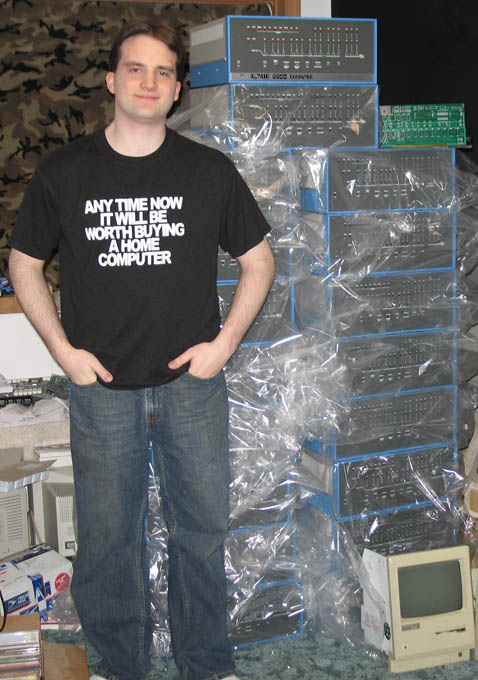
I thought you guys would get a kick out of this.
No, I am not attempting to build a beowulf cluster...
The ultimate Altair needs to run Linux. I spent the first few hours today
thinking up an S-100 card with a 386 processor. : ) Idle minds can be
dangerous... It will have to wait on that because I am still deep in the
hole with this crazy project...
http://www.altairkit.com/images/070210-AltairTower_2172.jpg
Grant
> am I the only one who sees the urgency in fixing those memory corruption and
> root privilege escalation exploits?
What possible good is posting this HERE going to do?
Why don't you raise this issue where someone who has any influence
over what Apple does participates?
--- Billy Pettit <Billy.Pettit at wdc.com> wrote:
>
**>> snip <<**
>
> Everybody else seems to have lots of horror storie
s
> about media. I don't.
> I want to again state that I have seen CD's burned
> in the 1976-77 time
> period that can still be read. And I've seen DVDs
> from the early 90's that
> can also still be read. Reliably.
>
**>> snip <<**
>
> Billy
>
Woah...
I thought CD's were invented in 1982?
I remember it easily as thats the year my
younger brother was born.
Or was that the year they first came to the
UK/Europe??
Regards,
Andrew D. Burton
aliensrcooluk at yahoo.co.uk
Christian wrote:
>Another unrelated question: The 4010 I got needs an awfully long time
>until it will fully erase the screen (at least 20 minutes). When it's
cold
>it will only erase the center in the shape of a (distorted) circle, the
>corners won't be erased. Is this a typical sign of a used CRT? I know
the
>main heater and cathode (for the writing beam) are fine, I suspect the
>collimation electrodes or the flood gun. Does anyone have experiences
with
>that problem, is there any cure (e.g. a longer flooding time) ?
I used a lot of 4010s and 4014s in my days at Tektronix, and saw this
type of problem on numerous occasions. The primary terminals for the
Control Data Cyber 73 (and later, an added Cyber 175), and Vax 11/780
(VMS during the day, BSD 4.x Unix at night (for the hacks to play with),
intermittently) were 4010s and 4014s. There were user areas with a
bunch of these terminals grouped together. These user area terminals
were very heavily used. Most people didn't have terminals at their desk
in those days. The flood system that erases the screen has a limited
lifetime. I know there was some adjustment inside both of the terminals
(but you'd need a service manual...perhaps bitsavers?) that would adjust
the flood current.
However, if adjusting this didn't work, they'd check a couple of test
points on one of the circuit boards, and if all the numbers came back
right, the factory service guys would not fuss with it anymore, and
start right away on replacing the tube. A good factory service person
could replace the tube in a 4010 (took longer for a 4014) in about 20
minutes.
My guess would be that, given the many, many years this terminal has
been around, that the tube is just plain worn out. It is a possibility
that some of the components in the flood drive circuitry have changed
characteristics over the many years...resistors and capacitors can do
this, as well as active components due to heat and power cycling. I'm
sure that there's service documentation or schematics online somewhere.
If bitsavers doesn't have it, I know that there is a website dedicated
to Tektronix equipment, and has scans of lots of manuals and such, but
can't recall the URL (don't have it bookmarked). Such material would at
least let you know if the tube is tired, or if perhaps something else in
the flood drive circuitry has gone astray that might be repairable.
Rick Bensene
The Old Calculator Web Museum
http://oldcalculatormuseum.com
http://cgi.ebay.com/1945-IBM-Computer-Engineer-s-Bible-
Antique-Manual_W0QQitemZ190079723533QQihZ009QQcategory
Z1247QQrdZ1QQcmdZViewItem
One can only wonder if an up to date translation would
be necessary :D
____________________________________________________________________________________
Do you Yahoo!?
Everyone is raving about the all-new Yahoo! Mail beta.
http://new.mail.yahoo.com
> > There also was a 'write through' mode,
> > again, not sure if it was a hack, or part of the production terminals,
> > that would (within the limitations of the RS-232 port) could do simple
> > dynamic (non-stored) vector graphics.
>It is also on the 4010. The 4010 and the 4014 have a card cage into
>which you can insert your own cards.
>
I have a 4010 and didn't see any mention of this in the manual. Do you
know if it took special cards?
>At the very least it would be interesting to
>add a USB port to the Tektronix this way to give it a higher serial
>transfer rate. The number and complexity of the dynamic vectors that
>you can draw is currently limited by the baud rate on the port.
>
On the 4010 you can exceed the draw rate for stored vectors when running
at 9600 baud and you don't sent the unchanged bytes in the coordinates.
I was trying reduce the draw time to make a better demo and found that
long vectors wouldn't line up properly at 9600 when several of the bytes
didn't need to be sent.
>Did anyone make S-100 SCSI? One could roll ones own, but that's a
>different level of expense.
The 5380, 3 resistor packs, a '138, couple latches, and about 10 square
inches of an S-100 breadboard card.
Grant
I wonder if you still have the printer and what is the price?
Dennis
Howell Mountain Retreat
Fonda and Dennis Bethke
PO Box 731
277 Luring Pines Drive
Angwin, CA 94508
Phone 707 965-3057
FAX?? 707 965-2835
dennisbethke at msn.comwww.vrbo.com/21031www.winecountrymall.biz
?
I have too many projects (including my 8/A and 11/23+) and not
enough time, and don't want to keep my 11/24 sitting until the
mice build nests in it. It seems to be alive (comes up to ODT on
the console port) but I haven't tested it otherwise.
1 M7133 KDF11-UA 11/24 CPU with line clock and 2 SLU
1 M7134 KT-24 Unibus map, extension to 22 bits
1 M8743 (ECC RAM, either 512 Kb or 1 Mbyte)
2 M8722 (ECC Memory either 128 Kb or 256 Kb each)
1 M8188 FPF11 floating point processor
1 M7762 RL11 disk controller RL01/02
1 M7258 LP11 printer controller
1 DSD A2130-6 disk controller
4 M7819 DZ11-A eight RS232 ports each
1 M920 Unibus connector
1 M7297 RH11 MASSBUS Parity Control
1 M7296 RH11 MASSBUS Control & Status Registers
1 M7295 RH11A MASSBUS Bus Controller
1 M7294 RH11 MASSBUS Data Buffer and Control
3 M5904 RH11 MASSBUS Control Transceivers
1 M9300 Unibus terminator
1 M9312 Bootstrap Terminator
Looking for a good home, please make a reasonable offer. Shipping
may be expensive (that chassis/power supply is *heavy*). Can email
pics. I'm in south central Missouri, zip 65775.
thanks
Charles
>>> There also was a 'write through' mode,
>>> again, not sure if it was a hack, or part of the production
terminals,
>>> that would (within the limitations of the RS-232 port) could do
simple
>>> dynamic (non-stored) vector graphics.
>>It is also on the 4010. The 4010 and the 4014 have a card cage into
>>which you can insert your own cards.
>I have a 4010 and didn't see any mention of this in the manual. Do you
>know if it took special cards?
I know that the 4010 did not provide write-through in "stock" form.
There were only two aspects of the 4010 that did write-through. One was
the "crosshairs" that would be drawn on the screen when the "GIN"
(Graphic In) escape sequence was received. When put into GIN mode,
write-through X&Y crosshairs would appear, and two thumbwheels could be
used to position the intersection of the crosshairs anywhere on the
screen, then any key could be pressed to send the coordinates, and the
key pressed, back to the host system. The other was a write-through
vertical line that scanned left-to-right when the optional dry-silver
paper hardcopy unit was connected to the 4010. The write-thru line
would "scan" the screen, and areas of the screen that had stored
points/vectors would cause voltage variations in a sense circuit, which
would cause a special CRT in the hardcopy unit to duplicate the screen
contents as dry-silver paper would pass by the CRT. Then, the paper was
passed through a heater (HOT!) that would develop the latent image in
the silver, and fix it.
There very well could have been options or hacks that provided the
ability to draw write-through vectors. I do know that there was a
PDP/11 DMA parallel option that was available for the 4010 that allowed
much higher speed operation than offered by the serial port, but there
were handshaking considerations that had to be taken into account,
because the PDP/11 could easily outpace the ability of the 4010 to keep
up. I do know that there were write current adjustments which you could
fiddle with which would turn down the energy of the beam enough that it
wouldn't cause storage. But then, the 4010 was write-through ONLY. It
became really difficult to read text on the screen, as it would have to
be continuously refreshed. Through the serial port, there just wasn't
enough speed to be able to refresh a whole screen's worth of text fast
enough to be readable.
I believe that the statement that was made that the 4014 (a large-screen
[19" diagonal, IIRC) version of the 4010, with faster vector draw rates,
and more features) is correct. I think that the 4014 did have a
programmable write-through mode but I recall that it was an option, and
didn't come standard.
I remember talking to someone in the CRT fab building (Tek built all of
their own DVST and oscilloscope tubes for many years -- the building no
longer exists on the campus though..it was demolished quite a number of
years ago) who was involved with the design of the DVST tube for the
4014. It was a major challenge. It was a large screen for the time,
and major challenges involved in structural stability, along with the
difficulties of fabricating the complex structures that made the storage
tube possible.
Tek's DVST terminals were mainstays of graphics display technology for
quite some time. It was much less expensive than the vector systems
made by folks like Sanders and others.
I remember a CAD system in the basement of building 50 that was
PDP-8-based, made by a company that I can't remember, unfortunately.
The company OEM'd Tek's storage tubes for the displays on the machine.
The system was used for circuit board layout. It didn't do routing or
anything like that...it only allowed a layout to be "drawn", and then
turned into a photoplotter tape that would generate the negative artwork
for the board. The storage tubes on this system definitely operated in
write-through mode most of the time, and were capable of having quite a
few vectors on the screen at once without too much flicker. I spent
quite a bit of spare time down there watching the artists (in those
days, circuit board layout folks were truly artists) designing the
various layers of Tek's famous multi-layer circuit boards used in their
oscilloscopes and other instrumentation. The PDP-8 was a transistorized
PDP 8 (not a straight-8 but one of the later ones before they started
using ICs), and had a couple of RK05 drives, along with a full rack that
was filled with the display subsystem electronics.
Tek later made a machine called the 4081. It used a similar DVST tube
as the used on the 4014 terminal. It was a computer workstaiton based
on an Interdata 8/16 CPU that Tektronix OEM'd from Interdata. The
machine had a Tek-designed custom display-list processor, and could do
some pretty fancy write-through graphics, along with storage graphics.
It was fast enough that even a reasonable amount of vector text could be
painted on the screen in write-through mode. Storage and write-through
could be mixed. The machine used what I believe were OEM'd from Diablo,
similar to RK05-F's, with one fixed platter, and one removable platter.
The machine also had a cartridge tape drive that could be used to "IPL"
the system. I spent a lot of time writing Pascal and machine-level code
on this machine. There were some really fun games that were written for
this machine. There was a disk operating system (I can't remember the
name) that was kind of OS/8-like, with similar commands, and
user-perceived filesystem structure. I wonder if any of these machines
are still around an in operation.
After the 4081, the move to raster graphics had gathered speed. Tek did
a lot of research internally on raster graphics. There was an
absolutely groundbreaking machine called the Magnolia (never marketed)
that had some kind of bit-slice processor, a highly capable bit-slice
raster BLIT graphics engine. The machine had a Micropolis 40MB 8" hard
disk in the base of the "terminal", and ran a Tek-developed window-based
multiprocessing (Unix-like) operating system, with the development
environment being Smalltalk. It had a monochrome display, but could do
gray-scale, which made shading, etc. possible. The biggest problem with
the design was that with the hard disk in the base, users tended to kick
and bump their feet on the bottom of the pedestal, which would cause
shocks to the hard disk, and cause head crashes. Those old drives were
pretty sensitive. The sad part of the whole thing was that Tektronix
never pursued these machines as a product - the machine never made it
past prototype stage. I believe that Xerox Parc had their early
machines (Star, etc.) out already, which the Tek machines were clearly
patterned after, but Tektronix' graphics expertise would have made these
machines into tremendous standalone graphics workstations long before
they became mainstream. An example of one of many of Tektronix' missed
market opportunities.
I ended up getting a number of those Micropolis 40MB drives (brand new
in the box, for something like $20) used in Magnolia from the Tek
Country Store (another whole article could be written on this wonderful
place) much later, and built a custom interface for a homebrew
6800-based computer that I'd built, and wrote drivers for the FLEX
operating system to talk to the drive. The drives ran quite hot, were
extremely noisy, and had essentially a simple parallel interface. It
was pretty cool having a computer system at home that had a whopping
40MB of hard disk space when everyone was running Apple II's and the
likes with floppies.
As always, a long diatribe that somewhat wanders off-topic, but it is
all definitely within the context of the list.
Rick Bensene
The Old Calculator Web Museum
http://oldcalculatormuseum.com
Well, old age is starting to catch up with me... While sitting and
waiting for the lot (item #170077516683) to get a little closer to
its end time last night, I fell asleep in front of the computer and
didn't bid. I'm not familiar with the ebay ID of the winner, if you
are on this list, I'll pay what you bid for copies of the documentation
that was "hinted at" in the lot listing. To everyone else, sorry for
the interruption.
Bill Sudbrink
--
No virus found in this outgoing message.
Checked by AVG Free Edition.
Version: 7.1.411 / Virus Database: 268.17.33/678 - Release Date: 2/9/2007
>
>Subject: Sixel graphics (was: Humpty Dumpty)
> From: Richard <legalize at xmission.com>
> Date: Fri, 09 Feb 2007 01:40:18 -0700
> To: "General Discussion: On-Topic and Off-Topic Posts" <cctalk at classiccmp.org>
>
>
>In article <0JD500346VGN4EW3 at vms040.mailsrvcs.net>,
> Allison <ajp166 at bellatlantic.net> writes:
>
>> Error! VT100 had sixel graphics as did VT220, 320 and 340 added color,
>> VT1200 as full graphics (xterm).
>
>Sorry, but I just don't think this is correct.
I meant Regis graphics, Sixel is a printer graphics protocal (As in LA75,
LA100 and others).
>VT100 docs (user guide and technical guide, both on bitsavers) do not
>mention sixel graphics at all. Paul Shuford's site has some
>discussion of what "sixel graphics" means and apparently different
>people use the term loosely to describe different things.
>
>The VT125 had ReGIS graphics capability, but this is not a VT100.
Totally incorrect as the Vt125 is a VT100 + the VT125 graphics plane.
So a VT125 is a vt100 but a VT100 is not a VT125 holds.
>The VT220 Programmer Reference Manual also does not mention sixel
>graphics, but you can download a font glyph definition and presumably
>with the right custom font you could display some sort of image, but
>its not "sixel graphics".
>
>The VT320, like the VT200 series, also had user-definable character
>sets. You can "fake" some graphics this way like you can with the
>VT220. See <http://vt100.net/dec/vt320/soft_characters>.
>
>I know all these DEC terminal models can become confusing, but trust
>me, I have been paying attention to which models support graphics.
><http://vt100.net/vt_history> gives these models as supporting
>graphics:
IT was VT105 I'd meant not the base VT100.
> VT55: primitive graphics capability
> VT105: VT100 + VT55 graphics capability
> <http://home.arcor.de/magnos/ccg/vt105/VT105.html>
> VT125: Graphics produced as a separate display from the text.
> (I am not sure what this means; a separate monitor
> required?)
It means the display was a two plane one for characters and one for
grpahics and they are displayed on the same tube. External monitor
is required for color though. My Vt125 and VT185 have this.
> VT240: B&W ReGIS graphics
> VT241: Color ReGIS graphics
> VT330: B&W ReGIS graphics
> VT340: Color ReGIS graphics
Read further the manual. Works fine on mine.
I prefer the DEC tubes as Real Terminals(tm) rather than PCs
running a poor emulation. I have used all of them in place AKA in
the terminal and printers engineering (in a former engineering life)
group makes it harder to remember all of them. It's also a problem
as I have a few one off firmware versions that were not produced.
Allison
Hello,
Some old PC terminal emulators emulate "ansi" color. They use a total
of 16 colors, which are really 8 colors with light/dark (bold/normal)
versions. The color modes are triggered by escape sequences. The
actual colors used in various emulators vary quite a bit.
I am interested in knowing which terminal actually originated these
colors (vt241? vt3xx series?).
Ideally, I'd love to see a color spec, or schematics of how the terminal
actually generated the colors, to try to get the most accurate
representation possible of the colors.
Thanks for any help,
Frank
Well... not literally "dropped"...
Someone handed me one at lunch today (he thought it was an ADM2 when
he mentioned it), so I brought it home and started googling around for
it. Didn't see anything on bitsavers, but I did find this...
http://www.classiccmp.org/dunfield/morrow/mdadm20.pdf
... on Dave Dunfield's pages, I presume. From what I can read, it's a
pre/non-ANSI terminal from 1983. I was going to use it as a console
for this Netra t 1125 (reboxed Sun Ultra 60 w/no holes for keyboard or
video), but the distinct lack of VT-100-compatibility makes me think
that I should dig something else out for a console to at least install
the OS. Once it's up, there _is_ an adm20 entry in the termcap.
To me, at least, the only thing remarkable about it is the company
that made it. At least there's a bit of lore attached to ADM3
terminals (and the historic places they used to be found in). A
non-ANSI terminal from 1983 just isn't that exciting, so if anyone on
the list is really gung-ho for Morrow Designs stuff, make inquiries
off-list, please.
Gotta go dig up that Planar ELT-320 - at least it's small and
low-power (as well as being ANSI-compatible in the terminal (not PC
character graphics) sense).
-ethan
> Message: 23
> Date: Thu, 8 Feb 2007 12:27:00 -0800 (PST)
> From: Fred Cisin <cisin at xenosoft.com>
> Subject: Re: Copying a Mac Disk with a Single Drive
> To: "General Discussion: On-Topic and Off-Topic Posts"
> <cctalk at classiccmp.org>
> Message-ID: <20070208122504.I35814 at shell.lmi.net>
> Content-Type: TEXT/PLAIN; charset=US-ASCII
>
> On Wed, 7 Feb 2007, Scott Quinn wrote:
>> with an external 400 or 800k floppy. The SuperDrive (original
>> SuperDrive, not the "new" CD/DVD one) [present on all Macs since the
>> IIx, many IIs and some SEs (SE FDHD)] has the smaller head size and
>> your older machine won't read it properly. WRT the swapping- can't
>
> There is a completely different recording method (MFM v Mac GCR).
>
> What are the dimensions of the different size heads?
>
Not sure about dimensions- the 800/400k drives I think share common
dimensions with the PC-esque 720k drives, and the 1.4 SuperDrive is
known to be the same dimension as the 1.44 MB PC mechanism.
It was big issue around the time System 7 came out- if you put a 800k
diskette in a System 7 machine with a SuperDrive the desktop file would
be rewritten unless the disk was locked. If you then put the disk in a
800k System 6 drive it would indicate it as corrupt (you could run it
through Disk First Aid to get it back) because of the head sizes
(similar to the problem with 5.25" DD floppies in the PC AT)
All the terminal chatter has reminded me, anyone got a good spare VT100
analog video board of the Elston variant? It's the last piece I need to
get my VT100 working again.
Julian
I just found 13 cases of HP paper tapes that I had forgotten about. Either I
have a large cluttered basement, or I found them a week ago and just have
really bad memory so I keep finding them again ;) Perhaps both.
In any case, they are mostly DOS III, DOS-M, and RJE related. I noted the
DOS stuff had system generation tapes too at the least. There's some BCS and
diag tapes too.
If anyone is desperately looking for tapes in that area of interest, let me
know and I'll make a list of what's there.
Jay West
--- Jules Richardson <julesrichardsonuk at yahoo.co.uk
> wrote:
> Chuck Guzis wrote:
> > On 5 Feb 2007 at 20:23, Jim Leonard wrote:
**>> snip <<**
> > I don't see the correlation. What good is bette
r
> error correction if
> > it's built on a less reliable technology?
>
> Well said :) If the optical media were enclosed in
a
> case (CD caddies,
> anyone?) then at least it would go some way toward
> preventing damage from
> scratches, fingerprints etc.
**>> snip <<**
>
> cheers
>
> Jules
>
I remember CD caddies :)
I recall back at secondary school in my first
year there (year 7 for UK'ers), in 1990/1, that
the new computer in the library used CD's
which were in see through plastic.
Essentially the "CD" of the time was like
floppy discs - the writable media (medium?)
was encased in protective plastic shell.
I haven't seen any like that ever since.
I don't suppose anyone on this list has any
like that?? If so, I'd love to see a picture of
it, please.
Regards,
Andrew D. Burton
aliensrcooluk at yahoo.co.uk
I have both 4.1.1 for Sun3/3x, and the 4.1.1_U1 update, on CD,
and could use CloneCD on those, if you would like.
Would not mind getting one of those fuse for my 3/60.
Michel
----- Original Message -----
From: silvercreekvalley <silvercreekvalley at yahoo.com>
Date: Friday, February 9, 2007 4:06 am
Subject: SunOs tapes
> Looking for any original SunOS tapes (any machine)
> or a 4.x era Sun 3 CD. Must be original tape/CD.
> Format etc doesnt matter as I can cope with just
> about anything.
>
> Also - if anyone is looking for the fairly difficult
> to find fuses that you get in Sun 3's I have a few
> spares available (no charge, just postage).
>
> I've blown a few of these fuses over the years,
> usually
> caused by the keyboard plug moving in the socket while
> the Sun is on - and I've found them awkward to find.
>
> Cheers
>
> Ian.
>
>
>
>
> ____________________________________________________________________________________
> 8:00? 8:25? 8:40? Find a flick in no time
> with the Yahoo! Search movie showtime shortcut.
> http://tools.search.yahoo.com/shortcuts/#news
>
Richard wrote:
> At the very least it would be interesting to
> add a USB port to the Tektronix this way to give it a higher serial
> transfer rate. The number and complexity of the dynamic vectors that
> you can draw is currently limited by the baud rate on the port, but I
> assume that if you get a faster communications channel, then there's
> probably a limit based on how fast they can slew the electron beam.
That was the impression I got at the time. Of course it's been *mumble*
years. (You know, it's really sad when you find yourself counting how
many decades something's been.) One of my college roommates did
his senior project setting up an LSI-11 as a front end for the 4014.
He didn't integrate into the card cage, but I seem to remember that
he didn't just hook it up to the RS-232 port either, but he may have.
That bit's rather fuzzy. I seem to remember that he found it really
didn't help much on the speed of drawing. But I think it was more
a matter of comm speed rather than what the terminal could do.
BLS
Jules Richardson wrote:
Tony Duell wrote:
>> Can't say the same for *some* players I've owned (thinks of Magnavox crap
>> in wastebasket about three months later just after the warranty expired).
>
> IIRC Magnavox are essentially Philips.
Interesting - I didn't know that. The Magnavox stuff I've seen in the US
seems
to have less build quality than similar Philips items from Europe, but
that's
possibly a reflection on US consumer electronic/electrical equipment in
general rather than any kind of corporate failing.
> In the UK, Philips CD players were
> knwon for developing dry joiuts. A complete re-solder would get them
> going again and then they'd essentially go for ever...
The soldering is awful in their Laserdisc players of old; sounds like things
didn't improve when they started making CD players...
cheers
Jules
---------------------------
Philips bought the Magnavox label seveeral years ago. Before that, they had
a terrible time getting name brand recognition in the US. Most of the sets
for both brands were made by Funai, so there was very little real change.
This is common technique for companies outside the US trying to crack the US
market. Philips also bought Sonic Care tooth brushes for the same reason.
Thomson bought the RCA brand name. And so on.
Billy
On Fri, 9 Feb 2007 12:03:37 -0600 (CST), you wrote:
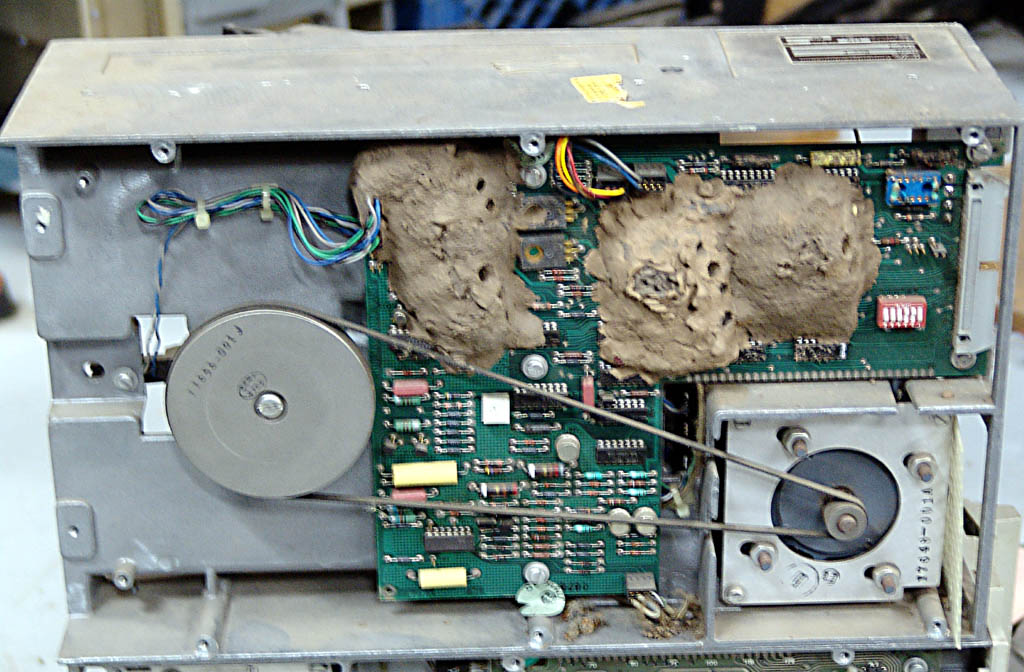
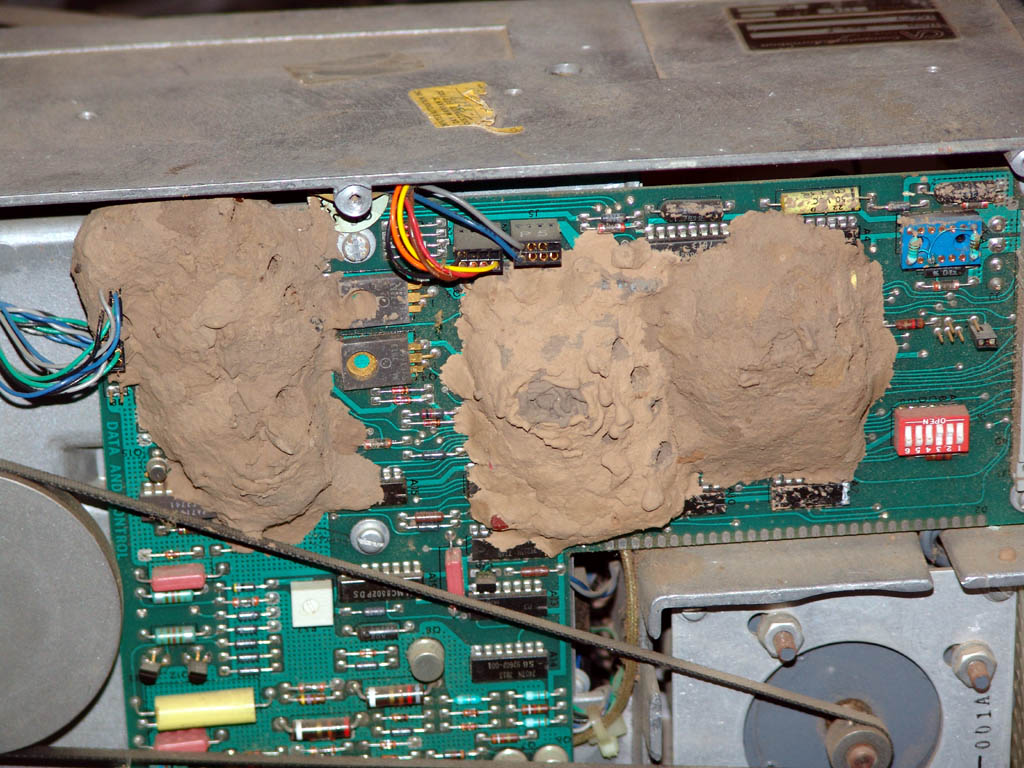
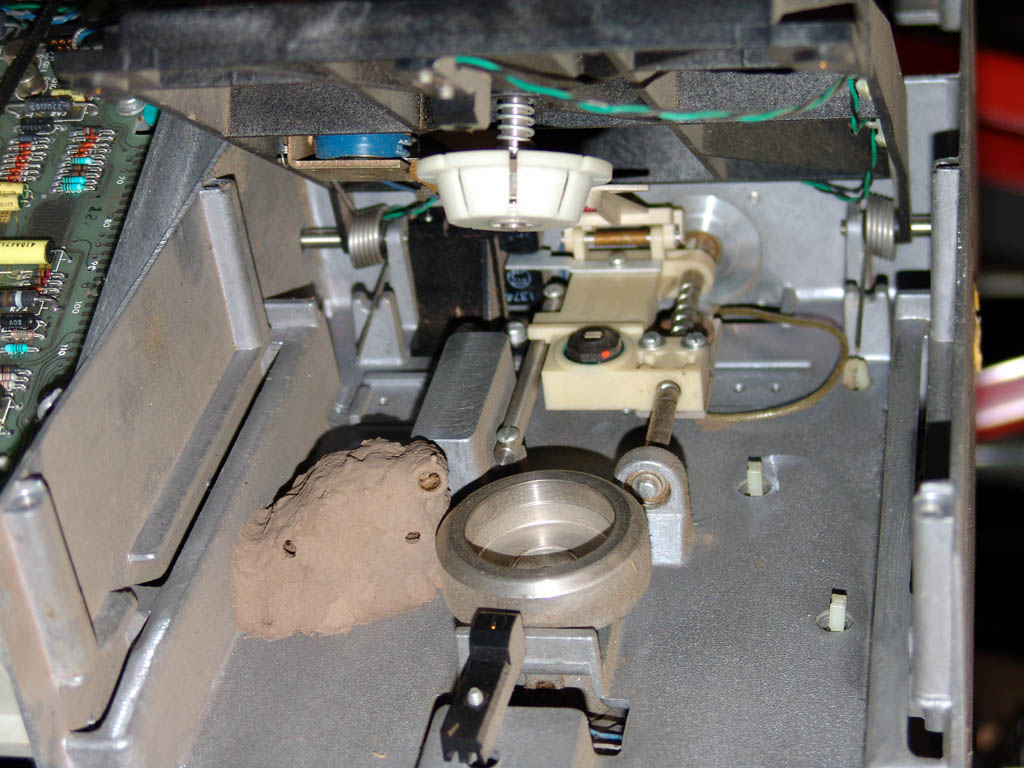
>On Feb 8, 2007, at 2:42 PM, Bob Rosenbloom wrote:
>> I have a dual floppy system from Computer Automation that
>> some kind of insect had made a nest in a long time ago. I'm not
>> sure how to remove the stuff. I tried water but it has no effect.
>> It's hard as concrete!
I looked at the pictures and those sure look a lot like mud dauber
wasp nests - they get into everything stored outdoors in Missouri
that has an opening big enough to admit a wasp. That mix of wasp
snot and dirt could be a replacement for structural concrete if
one could find a way to direct the placement :)
Unfortunately I don't know any magic way to get it off that won't
also destroy the electronics! I've actually had to use a hammer to
get rid of some of them, and steel-brush the remainder. Obviously
not practical in your floppy drive.
http://www.ent.iastate.edu/imagegal/hymenoptera/sphecidae/sphecinae/muddaub…
-Charles
John C. Ellingboe wrote:
Bob Rosenbloom wrote:
>
> I have a dual floppy system from Computer Automation that
> some kind of insect had made a nest in a long time ago. I'm not sure how
to remove the stuff. I tried water but it has no effect. It's hard as
concrete! I can chip it but it takes quite a bit of force and I don't want
to rip off any components under it. Any ideas? Here's some photos:
>
> <http://www.dvq.com/oldcomp/1kx768/cc_flpy2.JPG>
> <http://www.dvq.com/oldcomp/1kx768/cc_flpy3.JPG>
> <http://www.dvq.com/oldcomp/1kx768/cc_flpy4.JPG>
>
> Thanks,
>
> Bob
Dirt/mud dauber nest... They can be removed with water and a
brush but it will take a bit of work.. Chip away what you can
safely, use something a little stiff like an acid brush and add
a little detergent to the water. What ever they add to the dirt
is somewhat water resistant but it will wash away after a bit.
------------------------------------------------
What they add is saliva, which dries extremely hard, like a varnish. What
I've done with these nests which I find in the eaves occasionally, is just
simply water. If I'm worried about the finish (or in your case, the
components) I use a thin sponge taped over the nest. Keep it soaked by
watering every day. Usually a week is enough for the nest to fall off. It
leaves a ring that I take off with a white (no scratch) Scotch Brite pad and
warm water.
Billy
Rick Bensene wrote:
> The coolest Tektronix terminal, if you ask me, was the original Tek
> 4002.
> ...
> There also was a 'write through' mode,
> again, not sure if it was a hack, or part of the production terminals,
> that would (within the limitations of the RS-232 port) could do simple
> dynamic (non-stored) vector graphics.
Don't know about the 4002, but I'm pretty sure it was standard
on the 4014. We had one in college and I wrote a little thing
that drew a wireframe pyramid in writethrough mode. You gave
it a file of x, y, z rotations and it drew the animated pyramid. We
were running it on a VAX 11/780 running VMS. Of course, when
someone else got the CPU, the screen blanked. (If you didn't
rewrite the lines fast enough, they went away.) So this friend
of mine who was employed by the computing center (as was I)
as an operator got this "brilliant" idea. We had privileges to create
queues. So he created one with real-time priority so that it wouldn't
blank out. It worked in that the animation was quite smooth. But
>from the perspective of everyone else on the system, it had
locked solid. We did finally get logged in and killed the queue,
but as I recall it took about 30 to 45 minutes.
BLS
At 11:56 -0600 2/8/07, Scott wrote:
>but the default
>gives you lots of wrist exercise even on a 4MB Mac SE/800k.
My favorite sniglet for this is, "MacElbow".
--
Sorry - I know this is a bit OT, but I don't know many places to ask...
Does anyone here have technical information or experience with the HP54201D
Digitizing Storage Oscilloscope.
I'm specifically looking for information/help with the analog triggering circuits.
I've obtained the HP "service manual" for this scope, and it is absolutely useless,
no schematics, not technical descriptions... Basically, it says "Plug the scope
into your HP scope tester, press GO and replace any boards which are listed
as FAILED".
I've had this machine for a few months. It's always had problems with the
analog triggering. When I first got it, channel-1 would not trigger at all,
but channel-2 and external triggering worked most of the time. Channel-1
would fail the trigger Hysteresis & Level calibration, Channel-2 would
usually pass.
I've been using it with Channel-2 triggering, however within the past
week, I've noticed that it triggers continuously after power on (Doesn't
matter what trigger level etc. you program), but after a few minutes it
would settle down and work as before.
Thinking it might be a calibration issue, I re-ran self-calibration, and
surprisingly Channel-1 passed, after which I could use both channels with
full triggering, however both of them exhibited continuous triggering
after power-on, and the time taken to settle down has been increasing.
This morning, it's been on for over three hours and it's still triggering
continously, even with no signal inputs (leads disconnected). Triggering
calibrations fail consistantly for both channels. So I think it has finally
gone bye-bye.
When it works, this scope is awesome - I would really like to get it
working again - any information/help would be greatly apprecaited.
Regards,.
Dave
--
dave06a (at) Dave Dunfield
dunfield (dot) Firmware development services & tools: www.dunfield.com
com Collector of vintage computing equipment:
http://www.classiccmp.org/dunfield/index.html
Chuck Guzis wrote: While I'd like to believe that DVD-R media has the
same permanence, my problems with DVD players successfully reading
movies and such makes me suspicious. It could be that DVD is just
"pushing" the technology a bit.
Storage for CD-Rs in stlil in styrene jewel cases. We'll
occasionally use PVC cases as mailers (they survive the rigors of the
USPS better), but we advise customers to use traditional styrene
cases for storage. From what I've read on the archivists' list, some
PVC material has been found to outgas chlorine.
Cheers,
Chuck
--------------------------------------------------
I never quite know how to take all the disk bashing that seems to come up
periodically on this list. One point that seems to be missed is that the
DVD play back is influenced by the reliability of the laser diode. And that
diode is subjected to thermal stresses far beyond those of the CD-ROM laser
diodes. At the junction temperatures used in DVD burners, the life of the
diode is a small fraction of the CD-ROM diodes. It also deteriorates in
performance from the junction breaking down.
Consequently the playback life of the player is significantly reduced. Yet
it is always the media that takes the hit.
Everybody else seems to have lots of horror stories about media. I don't.
I want to again state that I have seen CD's burned in the 1976-77 time
period that can still be read. And I've seen DVDs from the early 90's that
can also still be read. Reliably.
But the moves to cut the cost of the players to sub-$50 means that many
companies are using substandard laser parts, or parts with shorter rated
life (which are a lot cheaper.)
Every study I have seen shows that CDs and DVDs have a much longer life span
than magnetic media, especially floppies.
Another point made that I do agree with - because of all the music CDs made,
the players will not go away. All the major players in CDs and DVDs have
tried for many years to force to another form factor. Those mostly empty
5.25" chasses are really offensive to design engineers trying to push the
state of the art. And how can you resell the same music again, if you don't
change form factor or format?
But the customer base won't budge. They don't want to render obsolete their
sizeable investment in CDs. (Last year I have data for shows annual
production of CDs in the billions world wide!) Legacy demands will keep the
5.25" form factor around for the rest of my life. Can't speak for you
youngsters. But say another 25 years minimum.
Shame really - I saw some lovely little Blu Ray 20mm disks that held as much
video as the current DVD. Gives you a DVD player that could be built into a
cell phone or toy. But every customer survey showed massive resistance to
change from 5.25".
PVC does outgas Chlorine - and other volatiles. Does nasty stuff to the
reflective films in DVDs. Most jewel cases are better. But oddly enough,
the self cleaning paper sleeves caused the least affects - except for shock
events.
Billy
Looking for any original SunOS tapes (any machine)
or a 4.x era Sun 3 CD. Must be original tape/CD.
Format etc doesnt matter as I can cope with just
about anything.
Also - if anyone is looking for the fairly difficult
to find fuses that you get in Sun 3's I have a few
spares available (no charge, just postage).
I've blown a few of these fuses over the years,
usually
caused by the keyboard plug moving in the socket while
the Sun is on - and I've found them awkward to find.
Cheers
Ian.
____________________________________________________________________________________
8:00? 8:25? 8:40? Find a flick in no time
with the Yahoo! Search movie showtime shortcut.
http://tools.search.yahoo.com/shortcuts/#news
>> I don't think Tektronix ever made a terminal that wasn't graphics
>> capable :-) and when they went to raster displays from storage
scopes,
>> I believe they were all color capable.
>I remember at least on counter-example, the 4025. It was a
>mono raster unit. We had a 4025 at the research lab of the
>first company I worked for out of college. It was connected to
>one of those electrostatic printers. We drove it from a VAX 11/750
>running BSD4.2 and later 4.3.
There was also a 4023 "non-graphic" terminal, significantly prior to the
4025. It used SSI and MSI TTL logic, early IC-RAM (don't know if it was
dynamic or static), and a MOS character generator. The CRT used a
rather slow-responding white phosphor that made it a little difficult to
read when it scrolled.
When I was a Systems Operator (as they were called in those days) of
Tektronix' Scientific Computer Center Control Data Cyber 73, a Tek 4023
terminal was situated next to the big dual vector CRT console. This
terminal was logged into KRONOS (the timesharing operating system that
ran on Tek's Cyber 73) as an administrative user that would pop up
messages with user requests to do things like mount tapes, and other
messages from users, and the operator could respond through this
terminal.
The 4025 came significantly later, and I believe, was microprocessor
controlled.
The coolest Tektronix terminal, if you ask me, was the original Tek
4002.
It did use Tek's famous DVST (Direct View Storage Tube) display that was
really made famous by the 4010. The 4002 (and slightly updated) 4002A
were big terminals, with a "drawer" packed full of electronics. The
coolest part was the "^G" (bell), which was a really nice tone
generator. I can't remember if it was a hack, or production, but there
was an escape sequence that you could send to change the frequency of
the tone emitted with control-G was received. With this, people had
written some programs on some a DEC PDP-8 (it may have been a PDP 8/I
IIRC) that could play music on the terminal, while drawing some graphics
on the screen at the same time. There also was a 'write through' mode,
again, not sure if it was a hack, or part of the production terminals,
that would (within the limitations of the RS-232 port) could do simple
dynamic (non-stored) vector graphics. There was a little game, again
hosted on the PDP-8 machine, that would play a game where two tanks
opposed each other with interposing landcape (hills or elevation
changes) and players would take turns aiming their gun, and shooting a
shell at the opposing tank. I also recall that for high-speed use,
there was a direct DMA parallel interface that would hook to a PDP-11
(Unibus) that allowed some actually fairly high-performance vector
graphics on the 4002.
Would love to find a 4002 or 4002A around somewhere. Would also love to
find one of those 4023's -- it really was a great old terminal. For a
time, I had one of them at home, hooked up to an acoustic coupler and I
could dial into the Cyber at 1200 baud, and do work from home.
Those were good old days!
Rick Bensene
The Old Calculator Web Museum
http://oldcalculatormuseum.com
From: Richard <legalize at xmission.com>
>
>> As an aside, INMHO E-bay feedback is seriously broken, in that you can
>> bet seller will give you negative feedback if you give him negative
>> feedback, no matter how poor the product, how misleading the discription,
>> how promptly you paid, etc.
>
>In fact this seller tried to blackmail me saying "if you remove your
>negative feedback, then I will remove mine,
>
I've not had this, but I've had a *lot* of sellers (almost always big ones)
who have sent me mails to the effect "I'll leave you positive feedback after
you leave me positive feedback". I don't leave any feedback for them.
As a slightly amusing aside, the only negative eBay feedback I have was from
this Canadian douchebag dentist-in-training who was pissed I left him
neutral (not negative) feedback that it took something like 3 weeks to ship
two small packages. Not only did he leave me negative feedback, as some
sort of juvenile "payback" attempt, he tried to subscribe me to a couple of
dozen random mailing lists. Of course, every one sent me a "reply to this
if you want to subscribe" email, which I ignored.
Now, as it happens, I was a principle information security architect for a
Very Large Telco at the time. There's a certain amount of pull associated
with the job.
Not being real bright, our eBay dork didn't notice some of the mailing lists
involved were hosted at .gov sites. They we're more than willing to supply
me with date/time/IP of the attempt to sign me up. Very easy to track back
to some jerk in Canada rather than me in sunny Atlanta, GA. This resulted
in a few personal calls to his school and ISP to the effect "I'm a senior
security guy at Very Large Telco, but I have a little personal issue I was
hoping you could help me out with...here's the issue, here's the evidence".
They apparently had a really good time dressing this little putz down.
Moral of the story...don't try to screw random strangers. You never know
what kind of pull they have.
Chuck Guzis wrote:
True, high-voltage (low current) DC is usually far less dangerous
than AC, but there can arise nasty side effects from the involuntary
muscle twitch.
When I was much younger, I was working on a 3KV transmitter power
supply. I *thought* that the bleeder had sufficiently discharged
things, but it wasn't so. I brushed the top of an oil capacitor and
got nailed.
Unfortunately, about 6 inches in back of me was a concrete block
wall. The muscle contraction proceeded to slam my elbow with great
force into said wall. It hurt like hell for days. I'm fortunate I
didn't fracture something.
It's truly amazing how many lessons you can learn in the space of a
millisecond or so:
1) Never trust a bleeder--they can and do open.
2) Leave plenty of working space around you.
3) Try to work with one hand in a back pocket.
Cheers,
Chuck
-------------------------------------------
In the Army in 1960, I took radar school at Fort Monmouth, New Jersy. After
Basic Electronics, we moved to the TPS-1D radar lab for orientation. 4 hour
safety class - what to wear, to do, not do, etc. For example, we all wore a
small florescent tube on our shirts. At the end was a tour and the
instructor pointed out the various systems and risks. We got to the
kylstron modulator and he pointed out with a wooden pencil where the high
voltage lead was. Of course the inevitable happened, the arc came up the
graphite, and his muscles convulsing threw him into wall. A few of us had
sense enough not to laugh. The MSgt in charge of the lab came running over
and helped him back on his feet. He asked the instructor what the hell
happened? This guy was still in a daze and answered, "I don't know. All I
did was touch this point with a pencil like this..." The next day he left
for Fort Dix for infantry training.
Billy
There is a Young Minds unit on Ebay right now, which was
similar to the first unit I saw at sunsoft in about 1995 or so.
This unit would have been from 13,000 to 50,000, depending
on when you got hold of it.
There was a kodak writer unit attached to this to do the
writing.
This particular unit seems to have a wide scsi under the
connector marked "writer" so would most likely not be
the same one as the one I encountered.
Sunsoft could master the data and drive this unit via
the SCSI port, and this in turn would write the cd.
Overall the process took probably over 3 hours, but
produced a cd which at the time was something that
was pretty new, at least to me.
I think there is was a Kodak unit recently, but I cannot
find it now. they were packaged in a unit almost as big
as this converted desktop.
Jim
190046817654
For removing labels and their adhesive gum, I use lighter fluid (the kind
made for old cigarette lighters) to remove labels. Zippo and Ronson are two
major brands. You can buy it at almost any grocery or drug store (it may be
behind the counter, ask). It's very effective and doesn't seem to leave a
residue or cause long-term plastic damage. I also use it for cleaning old
laptops, put some on a paper towel and it works great, it's just a good
solvent. [Do not use it on the screen ... I will use Windex on an LCD
screen, however. It's harsh and frequent use is definitely not recommended,
but very occasionally, it's ok and works very well.]
> The analog to digital transition is not significant at all, really.
> Once the audio is in those two RCA connectors or phono plugs, it does
> not really matter if it is coming or going to digital or analog
> source.
Absolutely false.
The reason early CDs sounded so bad was they often started with the
Master mixdown tapes from the LP, which had a lot of bad juju done
to them due to the limitations of the vinyl medium.
That's why so much work has been put into remastering from original
multitracks, when possible.
The problem is people EXPECT the music to sound like what they heard
on vinyl. Getting the remix to sound 'right' is tough to do.
> Pretty much all of
> this is mainstream, anyway, so the record companies do the
> conversions.
This won't happen, as people have said, for stuff out of the mainstream.
When it's done, it is often from vinyl, since the original tapes have
been lost.
.. getting this back to preservation, at least we work (mostly) with
digital saturation recording.
> I don't think Tektronix ever made a terminal that wasn't graphics
> capable :-) and when they went to raster displays from storage scopes,
> I believe they were all color capable.
I remember at least on counter-example, the 4025. It was a
mono raster unit. We had a 4025 at the research lab of the
first company I worked for out of college. It was connected to
one of those electrostatic printers. We drove it from a VAX 11/750
running BSD4.2 and later 4.3.
BLS
> If I am remembering correctly, older systems can't format during a
> copy, but later ones can. What I seem to think was the single-disk
> copying procedure is to eject the System disk (Flower-E or Flower-1?),
>
you want <COMMAND>-E for copying. the "1" thing (<COMMAND> <SHIFT> 1 if
I remember right) was the "force eject" for the first floppy drive at
startup if normal methods (drag-to-trash or eject command) failed.
> It's all quite tedious, but possible. If there's anyway you can
> borrow a second 400K floppy, you will find this somewhat trivial. You
> can also copy 400K disks in more modern Macs, so don't think you are
> limited to using a 128K Mac to copy single-sided MFS disks. I can't
> say for certain how new the gear can be, but at the very least, I'd be
> surprised if a Mac SE or SE/30 running System 6 couldn't still do it.
You want to use either a Mac II or earlier, or a SE/30 or IIcx/IIci
with an external 400 or 800k floppy. The SuperDrive (original
SuperDrive, not the "new" CD/DVD one) [present on all Macs since the
IIx, many IIs and some SEs (SE FDHD)] has the smaller head size and
your older machine won't read it properly. WRT the swapping- can't
recall at this point if changing the disk cache/RAM cache (depending on
your system version) setting makes any difference, but the default
gives you lots of wrist exercise even on a 4MB Mac SE/800k.
Hi Chuck,
If you know the name of the WP package that created the files, I can check
and see whether I have the manual that would explain the command formats
utilized.
Best Regards,
/Paul
--
Paul Tykodi
Principal Consultant
TCS - Tykodi Consulting Services LLC
E-mail: ptykodi at tykodi.com
> Date: Wed, 07 Feb 2007 16:25:20 -0800
> From: "Chuck Guzis" <cclist at sydex.com>
> Subject: ISO: A good explanation of EBCDIC control sequences
>
> Lately, I've been plowing through a bunch of EBCDIC-encoded WP
> documents. I don't have a problem finding EBCDIC charts with
> mnemonics, but I'd like some more detail on control character
> operation. For example, what's the difference between IT PT and HT?
> What sequence does CSP introduce and what are its variations?
>
> I've done some web searching but can't come up with anything
> definitive. Any pointers would be welcome.
>
> Cheers,
> Chuck
Lately, I've been plowing through a bunch of EBCDIC-encoded WP
documents. I don't have a problem finding EBCDIC charts with
mnemonics, but I'd like some more detail on control character
operation. For example, what's the difference between IT PT and HT?
What sequence does CSP introduce and what are its variations?
I've done some web searching but can't come up with anything
definitive. Any pointers would be welcome.
Cheers,
Chuck
Hi,
All of this HP 1000 talk got me going on mine. I have
most of the drives, paper tape punch and tape drives and
a real nice 2117F. But thats where it stops. No Cables
Does anyone have a stash of these. I have no cables and
cant seem to find anyone that does. It seems that most
of these are offered with out the cables. I would guess they
all go to bulhead connectors and are just easier to slip off the
connector on the cards.
Need these at minimum
- Console 12966a
- HPIB disk 12821a
- HPIB Mag tape 13183
Also Trying to figure out 2 cards
HP 12250 60001 and a FDS n612 4256-001
Thanks, Jerry
Jerry Wright
JLC inc
g-wright at att.net
How is it that a station that covers about 20 years, only
plays about 4-8 hours of music! I'm sick of the radio and how few songs
they actually play.
--
Terrestrial broadcast radio (and television) is in a death spiral.
Corporations want to move to the subscription model, and are putting
the least resources they can into traditional media. Most stations
are automated with feeds from satellites. They are programmed by
consultants looking for least common denominator programming for
the desired audience demographic by the advertisers.
Mean while, most people under 30 have abandoned radio for iPods or
webcasts.
There are a few eclectic non-comms left. I'm involved with KFJC in
the SF Bay area, and William is working on a program for WFMU.
Chuck Guzis wrote:
On 7 Feb 2007 at 11:08, jim wrote:
> any other observations on WW as far as clocking? I know that
> the more expensive stuff ran mini coax around the backplane
> to get much better signals, but we just used regular old 32 or
> whatever guage WW wires, sometimes 26 guage for high
> current.
How about ECL? Moto used to advertise that the 10,000 series was
"wire-wrappable", but the WW samples I've seen have lots of twisted
pairs on them. Looks like a real pain to do.
Cheers,
Chuck
----------------------------------------------
The Cyber 170 series from CDC used twisted pair wire-wrap. I still have a
bunch of it. The wires were color coded for length. The early back planes
were hand wired using a machine like Al described. Later machines were more
automated and wired from a reel. Proper nightmare to troubleshoot. You had
to feel a wire through the mat since all wires were the same color.
The logic was standard MECL 10K. The normal and complement outputs made it
a natural to use as a differential transmitter. So some of the signals were
single-ended, twisted with a ground wire. The longer signals and I/O lines
used the twisted pair as a differential line - no ground wire. If I
remember correctly, the standard single ended wire was 100 ohm impedance
terminated to 220 ohm resistors to -2.2v or 550 ohm resistors to -5.5v. The
differential lines used two resistors at each end.
Real pain doesn't do justice to working with these back planes. The wires
were 30 gauge single strand and brittle. When removing one, you had to
carefully trim off the bare wire end before pulling the wire out of the mat.
If you didn't, the ends would break off and fall down the vertical back
plane until they disappeared. Then you got to spend an hour trying to find
them. We used to call them "tingles".
If you didn't get them all out and applied power, they became "twinkles" as
they shorted out and vaporized. Which did wonders for the logic and gave
you a couple more hours of overtime trying to get the machine going again.
Of course this always happened late on a Saturday night, especially if you
had a date or tickets.
Putting ECOs in became a total complete nightmare. We calculated the size
of work by number of wires to change. If you were good, you could do 8-10
wires an hour.
4 years of twisted pair wire wrap experience is probably the best
explanation I can give for volunteering to move off main frames and on to
disk drives.
Billy
If anyone is interested in prime/cv software, check out ebay 190080793732
I know the seller, but don't know anything about the software. It's not
far from me however, so I could go check it out if anyone is seriously
interested and has questions.
-brad
Their latest release (for
charity (Red Nose day)) is a cover of Run DMC's
"Walk This Way".
Of course, you need to be old enough to
remember the originals though :)
--
ahem.. "Walk This Way" isn't a Run DMC song..
There's a wire-wrap machine of some sort on Ebay (#290079310287) just in
case someone in Colorado wants to redo their PDP-10 backplane.
--
David Griffith
dgriffi at cs.csubak.edu
A: Because it fouls the order in which people normally read text.
Q: Why is top-posting such a bad thing?
A: Top-posting.
Q: What is the most annoying thing in e-mail?
What does a unimplemented trap bomb error message mean? As in, what happened
to cause it? Thanks! :)
P.S. Tried googling and came up with nothing :eek: :( ...reason I'm asking
is because I've got a app I want to run on a 'ol SE of mine but when it
starts to open a unimplemented trap bomb error message is thrown (Mac OS 7.1)
and thus I'd like to know what exactly happens to cause that bomb...thanks!
:)
P.S.S The app that causes the bomb is speedometer (I believe it's version
1.0..not totally sure though)
* David Griffith wrote:
On Wed, 7 Feb 2007, Al Kossow wrote:
> > So, . . .
> > is there hope of eventually seeing the old classics on CD?
> > (such as "Nash Rambler", "Purple People Eater", "Witch Doctor")
>
> The Playmates "Beep, Beep"
> Sheb Wooley "Purple People Eater"
> David Seville "Witch Doctor"
>
> These are all charted singles, and are easy to find, though
> probably not on a single collection.
I've found all of those on Dr Demento CD sets.
--
David Griffith
--------------------------------------------
Ahh. You took the words out of my mouth. Dr Demento even goes further back
to "Please Mr Custer", "Surfin Bird" or "Transfusion". Nervous Norvous -
what a great name for a classic computer noid afraid to power up his
thousand dollar because of aging capacitors. (Have to stay OT.)
Billy
--- woodelf <bfranchuk at jetnet.ab.ca> wrote:
> aliensrcooluk at yahoo.co.uk wrote:
>
> > I thought CD's were invented in 1982?
> > I remember it easily as thats the year my
> > younger brother was born.
>
> I am still waiting for my CD's from UK/Europe.
> All the ones I want are out of print.
>
> > Or was that the year they first came to the
> > UK/Europe??
>
> I am still recovering from the Beatles invasion fr
om
> this side of the pond. Do you still have a wide
> selection
> of music CD's or have they like the USA only the N
EW
> fad music in stock?
>
Depends where you go.
I buy all my CD's from HMV (His Masters Voice
for those who don't know what it stands for)
or from online (usually Amazon).
HMV is often pricey, whereas smaller backstreet
shops have them cheaper. HMV has a huge
range of choice here in Cambridge, UK, but
I can't say what the choice is like in erm...
less popular cities!
HMV sells, as the name suggests, mainly music
so they have to have a wide variety.
I must admit I am fed up of all the covers/
remixs of old songs that keep being done by
new (younger) artists. Girls Aloud (although
beautiful) are a prime example - they won
a UK talent search thing like American Idol
and pretty much 95% of there stuff (certainly
all there singles that are released) are covers
of older music. Their latest release (for
charity (Red Nose day)) is a cover of Run DMC's
"Walk This Way".
Of course, you need to be old enough to
remember the originals though :)
Anyway, going well OT....
Regards,
Andrew D. Burton
aliensrcooluk at yahoo.co.uk
PS. I am looking to buy a laptop off eBay
, for reasons I won't explain as it will take
too long. Does anyone have any recommendations
of makes/models I should look for, or avoid?
Replies direct to me please (or Jay will shoot
me!) :)
> So, . . .
> is there hope of eventually seeing the old classics on CD?
> (such as "Nash Rambler", "Purple People Eater", "Witch Doctor")
The Playmates "Beep, Beep"
Sheb Wooley "Purple People Eater"
David Seville "Witch Doctor"
These are all charted singles, and are easy to find, though
probably not on a single collection.
--- Adrian Graham <witchy at binarydinosaurs.co.uk> wr
ote:
> On 7/2/07 00:34, "arcarlini at iee.org"
> <arcarlini at iee.org> wrote:
>
**>> snip <<**
>
> > In a school in 1990 I would guess that this is
> just the
> > standard "flip-top" lid caddy that many early
> CD-ROM units
>
> I thought that at first but Andrew said some of th
e
> caddy came back out
> again?
No, I never said that.
The person who replied to my email said that.
Regards,
Andrew D. Burton
aliensrcooluk at yahoo.co.uk
There are a couple listed from the same seller. Look in good condition.
# 170078807906
# 170078863271
Robert Borsuk
rborsuk at colourfull.com
--
(\__/)
(='.'=) This is Bunny. Copy and paste bunny into your
(")_(") signature to help him gain world domination.
Questions of copyright have come up here from time to time with much
discussion. I discovered a chart that might help to clear a few
things up about US copyright:
http://www.bromsun.com/practices/copyright-portfolio-
development/flowchart.htm
Cheers,
Chuck
> The problem with putting floppy images on a DVD is that if you lose
> or destroy that DVD you lose a ton of data
Well, rule #1 is never have a single copy of backup data.
Rule #2 is have an off-site copy.
That single DVD is going to be a heck of a lot easier to migrate
to the next generation of media than trying to re-read those floppies
again (if they are still even readable).
A single copy of something on aging media is a problem I face at CHM.
It's what I call a 'latent archive'. If you don't actually RECOVER the
data on an old tape or disk, you can't be assured that you actually
have anything other than the physical object.
The unit that seems most commonly available is branded "Ion" and
comes with a USB link built in.. specs for it sound like a fairly
good "consumer" grade turntable. There is also a device available
that takes a turntable preamp signal and converts it to digital audio
on a USB link. Thus allowing those of us with audiophile grade
units to continue using them....
steve shumaker
At 09:44 AM 2/7/2007, you wrote:
>Please, if you know a source of good stuff like this let us know.
>
>My wife's got a ton of LP's that haven't come out on CD... and they never
>will.
>Kind of be nice to play them instead of just collecting them.
>
>Bill
>
>On 2/7/07, Cameron Kaiser <spectre at floodgap.com> wrote:
>>
>> > Anyway, this is the big reason why you can, with looking, still buy a
>> > turntable to play your records.
>>
>>In fact, I just bought my folks a USB turntable (i.e., a turntable with a
>>built-in USB Audio output) so that they could start digitizing their old
>>LP catalogue. I imagine, though, with the way they care for their LPs that
>>they may outlast whatever CD-Rs they make of them.
>>
>>--
>>--------------------------------- personal:
>>http://www.armory.com/~spectre/ ---
>> Cameron Kaiser * Floodgap Systems * www.floodgap.com *
>>ckaiser at floodgap.com
>>-- Adore, v.: To venerate expectantly. -- Ambrose Bierce
>>----------------------
Christian Corti writes:
> I have some Synertek 2650-P-01 (date code 7720) that
> are definitely *not* 2650 CPUs, along with some
> AMI 1315-P-2 (seems to be some kind of keyboard
> encoder). They come from some old Courier 270
> display terminals. So what's a 2650-P-01 ?
Synertek made character generator chips (really mask ROM)
and LSI video scan generators that commonly appeared
in 70's devices. Doesn't help narrow down what was
in that terminal, but the point is they did a lot of stuff
for that market (including CPU's in the first microprocessor
terminals).
Didn't somebody from that era at Synertek talk at VCF
East last year?
Tim.
I hate to re-open a common thread, but I've tried both Goo-Gone and a
hair drier to remove old labels from diskettes, and it hasn't gone well:
Hair drier: I have to heat the disk so much that I warp the jacket if
I'm not careful. Way too much work (5+ minutes of low heat) per disk.
Goo-Gone: doesn't appear to penetrate the paper of the label! I mean,
it does, but I have to apply it twice (both times with my finger,
otherwise the cloth soaks up too much)... and only then does it
marginally work. But worse, what's left over is some petroleum-ish film
that I can't remove, even with soap and water. Check the following photo:
http://www.oldskool.org/misc/residue.jpg
So I wonder how well a new label will stick with that film on it...
So, are there any other alternatives? Or am I incredibly inept and
missing a step or botching a procedure?
--
Jim Leonard (trixter at oldskool.org) http://www.oldskool.org/
Help our electronic games project: http://www.mobygames.com/
Or check out some trippy MindCandy at http://www.mindcandydvd.com/
A child borne of the home computer wars: http://trixter.wordpress.com/
> There's a wire-wrap machine of some sort on Ebay
This is a semi-automatic unit.
A from-to list is generated on a computer with lengths
and the unit moves to the start-end points. The manual
wire-wrap gun sits in the slot that the table moves to.
Don't see the wire bins.. Normally a light would appear
next to the bin to pull the wire from.
arcarlini at iee.org wrote:
> It is rare that they fail completely (they usually slowly develop
> errors over time in heavy use until you have to replace them). But
> let me tell you, if you get the one rare one that does fail, it fails
> SPECTACULARLY. As in, it takes the drive with it!
I've had one CD-R shatter and the drive was indeed unusable after that.
I tried to repair it, but after an hour of clearing bits out and putting
the thing back together, testing, dismantling, rinse, lather, repeat
I decided it wasn't worth the hassle. I still have it in case I
magically
run out of CD drives in some far distant future ...
Antonio
-------------------------------------------------------
One of the last projects we did at Philips US, was a study to see how fast
we could spin the disk before it shattered. A friend of mine, a mechanical
engineer, did the testing. He had a blast. It was like a mini version of
Mythbusters. Even had the high speed television camera.
To accelerate the process he would often nick or chip the edge of the inner
hole. When they split - literally - it was right through the front door of
the drive. He finally got his own lab so the rest of us would feel safer.
But what a fun job he had! He loved his work.
Billy
aliensrcooluk at yahoo.co.uk wrote:
I remember CD caddies :)
I recall back at secondary school in my first
year there (year 7 for UK'ers), in 1990/1, that
the new computer in the library used CD's
which were in see through plastic.
Essentially the "CD" of the time was like
floppy discs - the writable media (medium?)
was encased in protective plastic shell.
I haven't seen any like that ever since.
I don't suppose anyone on this list has any
like that?? If so, I'd love to see a picture of
it, please.
Regards,
Andrew D. Burton
----------------------------------
I have a couple at home but can't get to them right now. If you want, I'll
write myself a tickler note and send you one the next time I come across
them. Also see them in the flea markets occasionally.
Billy
aliensrcooluk at yahoo.co.uk wrote:
Woah...
I thought CD's were invented in 1982?
I remember it easily as thats the year my
younger brother was born.
Or was that the year they first came to the
UK/Europe??
Regards,
Andrew D. Burton
--------------------------------------------
CDs were being developed for more than a decade before they became
commercial products. When I worked at Philips in the Optical Storage Group,
I made several trips to the Philips labs in Eindhoven. There, Philips has
displays of many of the original CD's and players, a few still working. It
also gave me a chance to talk to some of the original engineers, at least
the few who haven't retired by now.
Going commercial with the new technology was a hell of a battle for Philips
and later Sony. It was not instantly embraced.
Billy
Hi
The one I'm looking for was made at a similar time but about
a year later was made by Diehl and sold here in the US by
SCM. It was also transistors and it used two delay lines.
It booted from a metal tape with two rows of holes. I assume
clock and data.
It had a connector that was suppose to be able to read punch
cards. It could store a program of about 60 steps.
I used one of these years ago but I don't recall if it had
conditional flow. I think most people would consider conditional
flow to be the defining line between a calculator and a
computer. At least from the users point of view.
No one would dispute that the guts of these calculators were
computers.
Dwight
>From: Scott Austin <us21090 at yahoo.com>
>
>I like the looks of the Olivetti Underwood Programma 101. It even had two
>blinky lights: green (solid=ready, blinking=busy) and red (error)
>http://www.silab.it/frox/p101/boxbig.gif
>
>If I recall correctly it was the first computer(*) I programmed. Back in
>'72-73, while in Jr. High (btw, not "Middle School").
>
>Several interesting things about the P101:
>
>Introduced in 1965 (same year as PDP-8).
>
>No ICs; all discrete components. The boards were placed component side to
>component side, designed with one board's components fitting in the spaces
>between the components of the other board.
>
>Programs were stored on magnetic cards, which Olivetti received patents for
>(HP had to pay about $900K in royalties for the technology use in the
>HP9100)
>
>Its approximate 240 bytes of memory used acoustic delay line technology.
>
>Scott Austin
>
>(*) Computer? Programmable Calculator? I'll let someone else debate about
>this.
>
>
>
>
>
>
>
>____________________________________________________________________________________
>Looking for earth-friendly autos?
>Browse Top Cars by "Green Rating" at Yahoo! Autos' Green Center.
>http://autos.yahoo.com/green_center/
_________________________________________________________________
Search for grocery stores. Find gratitude. Turn a simple search into
something more.
http://click4thecause.live.com/search/charity/default.aspx?source=hmemtagli…
--- arcarlini at iee.org wrote:
> Jim Leonard wrote:
**>> snip <<**
>
> I'd like to read up on DVD technology too but I've
> not been able
> to locate much (I'd like to read the various
> standards that
> detail the physical layer and so on, not some
> non-technical
> overview - I can find plenty of those.)
**>> snip <<**
>
> Antonio
>
Yeah, me three.
I'd like to know what the difference is between
a writable (write/rewrite) CD/DVD and
ordinary ones.
How do you "write-protect" a CD/DVD??
This would be useful knowledge, especially
when I get a DVD-recorder (sometime this
year).
Regards,
Andrew D. Burton
aliensrcooluk at yahoo.co.uk
Right at the end of the latest Egg Money advert, is that a TRS Model 3 or
Model 4?
This link should be viewable for a while:
http://www.visit4info.com/preview-flash.cfm?vm=0&type=2&adid=41634
Also, a previous ad has featured a CBM PET shaped "mockuter" (mock
computer), with the tape deck replaced with an oversized trackball:
http://www.youtube.com/watch?v=M0nZwyua8Ao
Cheers,
Ade.
--
No virus found in this outgoing message.
Checked by AVG Free Edition.
Version: 7.1.411 / Virus Database: 268.17.25/669 - Release Date: 04/02/2007
--- Adrian Graham <witchy at binarydinosaurs.co.uk> wr
ote:
> On 6/2/07 21:55, "aliensrcooluk at yahoo.co.uk"
> <aliensrcooluk at yahoo.co.uk>
> wrote:
>
> > I remember CD caddies :)
> >
> > I recall back at secondary school in my first
> > year there (year 7 for UK'ers), in 1990/1, that
> > the new computer in the library used CD's
> > which were in see through plastic.
> > Essentially the "CD" of the time was like
> > floppy discs - the writable media (medium?)
> > was encased in protective plastic shell.
>
> Sounds like the Philips 1x speed CD that was used
by
> DEC as the RRD40. It
> took standard CD-ROMs but they were inserted in a
> plastic shell because the
> drive had no tray or any other means of supporting
> the CD.
>
> My own RRD40 caddies are 250 miles away but I've g
ot
> a drive at work :)
>
> In the meanwhile, look towards the bottom of this
> page:
>
> http://home.claranet.nl/users/pb0aia/cm/sroom.html
>
> --
> Adrian/Witchy
> Binary Dinosaurs creator/curator
> Www.binarydinosaurs.co.uk - the UK's biggest priva
te
> home computer
> collection?
>
Thanks.
Yeah, that looks about right. So why were the
caddies ditched?? Was it simply cost, or that
the CD drives themselves were improved?
Regards,
Andrew D. Burton
aliensrcooluk at yahoo.co.uk
--- arcarlini at iee.org wrote:
> aliensrcooluk at yahoo.co.uk wrote:
>
> > Yeah, me three.
> >
> > I'd like to know what the difference is between
> > a writable (write/rewrite) CD/DVD and
> > ordinary ones.
> > How do you "write-protect" a CD/DVD??
>
> The "ordinary" ones are pressed at a factory. A
> glass
> master (I _think_ it is glass) is produced and is
> used to press the CD. As long as it is assembled
> correctly (and especially, it seems, sealed around
> the
> edges) then that it likely to be the most stable
> form of CD. Unless something gets inside and start
s
> to eat the aluminium, then it should be fine.
> (Obviously
> I'm excluding physical damage, etc.)
>
> For +/-R media the laser burns a pit in a special
> layer
> in the disc to create a pit. For the +/-RW forms t
he
> laser causes a
> reversible phase change to create an optical pit
> (heating it
> up again causes the change to reverse, hence
> blanking the pit).
>
> >From the point of view of the user, the +/-R form
s
> cannot be
> erased once they are written, although you can wri
te
> a new
> table of contents (TOC), so that it looks like you
> have
> overwritten the old data, but in fact it is still
> there
> There are programs which will dig it out for you.
I
> supposed
> theoretically you could blank a CD-R by burning
> every possible
> pit, but if you are security conscious, just break
> it (or
> shred it). When you "finalise" a DVD-R it can no
> longer be
> written to. I _think_ that all that has happened i
s
> that
> some bits have been set on a reserved area of the
> medium
> to tell the drive not to write to it any more.
> Unless
> you have a rogue drive (or maybe rogue software)
> then this
> is probably as safe as a floppy write-protect tab.
>
> The +/-RW forms can be fully erased and reused
> (1000x is the
> claim, yeah right!). Regardless of whether these a
re
> more or
> less stable than -R, they are clearly of limited u
se
> for
> long term archiving, since there is always a risk
> that they
> will get blanked and reused for "something more
> important".
>
> There's also DVD-RAM, but I don't think that's ver
y
> important
> for our purposes.
>
> Then there is the whole +/- debate, but these days
> that has
> mostly died away. You ?20 (high-end :-)) DVD
> rewriter will
> write to
> CD-R,CD-RW,DVD-R,DVD+R,DVD-RW,DVD+RW,DVD-RAM
> and dual layer DVD-R (~8GB, but the disks are abou
t
> 5x the
> cost of a DVD-R).
>
> Antonio
>
Thanks for that.
Regards,
Andrew D. Burton
aliensrcooluk at yahoo.co.uk
While the subject of *removing* diskette labels has cropped up before
(for example,
http://www.classiccmp.org/pipermail/cctech/2002-October/003294.html), I
don't think I've seen any discussion on where to obtain *new* ones. I'm
setting up a PCjr system for a friend and would like to prepare a nice
set of software for him, but I have no labels. A while ago, I tried
generic Avery mailing labels that I thought would work, but after a few
months the adhesive dried up and they all fell off. Any suggestions?
Newly-created sources preferred; I tried some old labels in "new old
stock" I have but after 20 years they're dead on arrival; they don't
stick as soon as you pull them off their backing.
On a related note, what's the best adhesive to re-apply labels that have
fallen off? I have some commercial software (games, etc.) where the
label is historically relevant and I'd like to re-attach it.
--
Jim Leonard (trixter at oldskool.org) http://www.oldskool.org/
Help our electronic games project: http://www.mobygames.com/
Or check out some trippy MindCandy at http://www.mindcandydvd.com/
A child borne of the home computer wars: http://trixter.wordpress.com/
>
> Jay West wrote:
> > Al wrote...
> >> I have a HUGE softspot in my heart for the TRS-80
Model I, having
> >> purchased a 16k, Level I unit in December of
1978. A unit, I still own
> >> today,
> > That's the one system I don't have in my
collection that I'd really like
> > to - a TRS-80 model I with tandy monitor and
perhaps the expansion unit.
> > I never owned one, but a lot of my friends in the
late 70's timeframe
> > did and we always fought about if my Apple ][+ was
better than their
> > TRS80 :)
> >
> > Jay
>
> That must have been a short argument. I used both a
lot in high school.
> The model I was unreliable in the extreme. The
model III's were much
> better in that regard.
And for the counter-argument, I have a model 1 that
I've had from new,
and which has never failed me. COnversely I had
nothing but trouble with
the Apple ][, a design which i feel is marginal at
best!
-snip-
-tony
************************
Interesting. Most people seem to say nice things about
the Apple ]['s design. I'd love to hear some informed
bashing ;) . Could you elaborate some about the
machine's short comings from your perspective?
My biggest annoyance is being unable to determine what
state the softswitches are in at any given time. I
also understand the cassette interface left something
to be desired (I've always enjoyed the luxury of
floppies). Beyond that, the machine just oozes quirky
charm in my eyes.
- Liam Busey (an Apple ][/ ][+ fan)
____________________________________________________________________________________
Need a quick answer? Get one in minutes from people who know.
Ask your question on www.Answers.yahoo.com
I've got a CBM 8032 that powers up "fine", but the screen is filled with "!" on
every other character position. When some letters are repeated, they can change,
i.e. "nnnn" becomes "onon" which seems like (without checking the ASCII charts)
that the "n" and "!" are ORed to become the "o". Anyone have any ideas what the
problem might be? Most of the schematics I have are buried someplace, so I
thought I would start here.
>> "Personal papers" aren't on paper any more, if they exist
>> at all they are directories full of email.
> Why is this a "huge issue"? My father made xerox copies of his
> important papers; I make regular backups. What's changed?
The volatility of the preservation medium, future ability to recover
a document in obscure formats, and the sheer volume of digital content
vs saved paper.
Is everything you're 'backing up' checksummed? How do you KNOW
it hasn't already been corrupted?
> As strange as it seems, I think we lost a lot of personal
> correspondence when hard disks became the rule on PC systems.
This is a huge issue amongst archivists.
"Personal papers" aren't on paper any more, if they exist
at all they are directories full of email.
On the CBM 8032, I downloaded the schematics from
http://www.zimmers.net/anonftp/pub/cbm/pet/, and that helped a lot. Tony's
comment about odd and even made things start to make sense. My only question
there was did the count start at zero or one :). It appears that the count does
start at zero (even). I have some doubts about the schematics since D3 is the
one line (on a clear screen) that seems to be always high, and that doesn't
correspond to bit 0 always on. BUT it appears that the 4114 at C4 is bad, and
I'll scope it out before removing it and putting in a socket.
BTW, what is the difference (if any) between the 8032 with the wide plastic
label, and the 8032 with the two plastic logos? The one on the right says "CMB
Model 8032" and the one of the left says "Commodore". I have both models, but
this one is the one with the two plastic logos.
And many thanks for the help on copying a floppy on the Mac 128. That worked
like a champ. I did find that putting an icon into the trash didn't eject the
disk for some reason. However the flower E worked great.
Thanks!
I have a Mac 128 and I want to duplicate the system disk. Probably a stupid
question, but how do you make a copy of a disk on that computer (single internal
disk drive.) Needless to say, I am not a Mac person. Thanks!
some pcs didnt have dma. Tandy 1000...IBM
Peanut...Sanyo MBC-5xx too IIRC...
--- cctalk-bounces at classiccmp.org
<bfranchuk at jetnet.ab.ca> wrote:
> Tony Duell wrote:
>
> > I thought every PC (maaning IBM compatible) did
that. The floppy system
> > in the PC. XT and ZT has a DMA channel associated
with it. You ask it to
> > read some secotyors from the current track, it
does so and transfers the
> > data into memory, then gives you an iterrupt when
it's done.
> Well on some computers, like the COCO the IRQ only
is used
> to end the cpu polling loop for the floppy.Since the
default
> OS is CP/M err MSDOS I expect the hardware is not
used effectivly.
> >
> > I know for a fact that other tasks carry on
running on this (slow) linux
> > machine when it's doing floppy drive operations.
> >
> > -tony
>
____________________________________________________________________________________
Looking for earth-friendly autos?
Browse Top Cars by "Green Rating" at Yahoo! Autos' Green Center.
http://autos.yahoo.com/green_center/
I sent a longer email to Al off-list, but I wanted to let the rest of you
know about something the company I work for (Kristine Fallon Associates) is
doing. We did a study for the Art Institute of Chicago about how their
Department of Architecture and Design could collect and preserve the
"digital design data" (CAD files, images, Poiwerpoints, etc.) that
architects are using more and more. Our report is online at
http://www.artic.edu/aic/collections/dept_architecture/ddd.html. We are now
just about finished creating a working prototype archival system. I'm
programming a Web client for entering the metadata and a programmer for the
AIC is doing the back end. We are using the DSpace archive software
(developed by MIT and HP) as the storage mechanism.
Our approach is certainly not directly applicable to preserving software --
we suggest using PDF's as wrappers for a lot of data -- but I think the
report addresses a number of important, and common, issues.
Bob
+++++++++++++++++
Message: 18
Date: Mon, 5 Feb 2007 15:54:47 -0500
From: "William Donzelli" <wdonzelli at gmail.com>
Subject: Re: Preservation of correspondence
To: "General Discussion: On-Topic and Off-Topic Posts"
<cctalk at classiccmp.org>
Message-ID:
<e1d20d630702051254l6a6d3c01qdae2375b462c7c64 at mail.gmail.com>
Content-Type: text/plain; charset=ISO-8859-1; format=flowed
>One of the things I've been disturbed to discover is CHM appears to be one
>of the few institutions who are attempting to archive software.
CHM is a fairly unique institution, that is why. There are only a
handful of computer museums that are run like museums. Many "computer
museums" are just glorified users groups, informal circles of friends,
or just guys that like hoarding machines and docs.
--
Will
_________________________________________________________________
FREE online classifieds from Windows Live Expo ? buy and sell with people
you know
http://clk.atdmt.com/MSN/go/msnnkwex0010000001msn/direct/01/?href=http://ex…
Hi,
a friend would like to buy an AT&T 3B1 (7300) for her husband. She
asked me to help. Apparently he has fond memories of them.
I've seen these (long ago) and used one once but really have no clue.
Are they obtainable? Anyone have one they want to sell?
Any pointers or advice appreciated... thanks!
-brad
Brad Parker
Heeltoe Consulting
+1-781-483-3101
http://www.heeltoe.com
> What do government and corporate data archives do?
> Surely a long-lived company like IBM has already had to deal with this
> problem?
They deal with the problem by throwing things away. There are essentially
no corporate archives of software older than a few decades. This goes back
to the discussions here a while back about companies discarding software
after a product's life ends.
One of the things I've been disturbed to discover is CHM appears to be one
of the few institutions who are attempting to archive software.
Corporate archives today are essentially all paper or microform. Trying to
deal with digital content is not a solved problem there. If you look at the
literature, they are only thinking in terms of documents, not software, with
the exception of trying to preserve some subset of software needed for document
recovery.
Quoth Chuck:
> I just had a thought about another possible alternative for write-
> protect tabs.
>
> How about the foil tape used in the construction trades, such as 3M
> 425? I seem to recall that the adhesive on this stuff is pretty
> heavy-bodied and should stick well, but be easy to remove.
You could also use book tape if it's a mechanical sense system.
Very heavy, quite sticky plastic.
Take a look on VCM ... there is one on there now.
http://www.vintagecomputermarketplace.com/bid.cfm?ad=2707
> a friend would like to buy an AT&T 3B1 (7300) for her husband. She
> asked me to help. Apparently he has fond memories of them.
>
> I've seen these (long ago) and used one once but really have no clue.
> Are they obtainable? Anyone have one they want to sell?
>
> Any pointers or advice appreciated... thanks!
>
> -brad