Dave McGuire wrote:
> For the rest...*Someone* has to make the ruling, preferably
> leaning to the "not part of the OS" side more often than not, and the
> people who want everything handed to them on a platter will just need
> to bite the bullet and learn how to type "./configure;make;make
> install"...or go run another OS.
Hear, hear.
,xtG
tsooJ
Chuck Guzis wrote:
The "half good" memory dates back long before 256K chips--it goes all
the way back to 16K ones. I've got a batch of Intel 2109s that
differ from each other by a suffix -1 or -2. The idea is that the
suffix indicates which half is good; otherwise the chips are
electrically the same. I remember when the local Intel sales guy
dropped off a bag of the things on my desk and I sorted through them
and found a batch where all 16K worked in my application.
Cheers,
Chuck
------
Billy:
Actually it goes back further than that. Intersil offered the 6002 (a 2K
Dynamic RAM) with options of 1K good. I never saw it on smaller chips like
the 256 byte or the 1K. But it would not surprise me. This was the era
when a new state of the art memory chip was $15-20 each and in very short
supply. A half good part could be very useful in a terminal or small
system. By small, I mean 4K or 8K bytes, typical of many memory boards
available in the early 1970's.
Billy
On Wed Apr 11 00:44:13 CDT 2007 Ethan Dicks ethan.dicks at gmail.com wrote
>Are there any 'gotchas' with the ARS-2000IU?
> Max drive size?
> Strange SCSI packet issues?
> Will it work with really old SCSI implementations?
>Really new ones?
1. I haven't seen any gotchas yet, I've tried it with smaller 1gb-10 gb IDE drives no prob.
as I said before I needed the new bios to ecognize the CF card to IDE converter.
2. I haven't tried a big drive >128mb as I don't have any spare ones that big, but I'm getting
one in this weekend and I'll try it out and report.
3. No glitches with the SCSI at all (as far as I can tell)
4. I've tried it with several Adaptec cards right throiugh to some newer PCI ones and no glitches
so far.
I just got in an Acard AEC-7720U that I'm going to replace the bigger ARS-2000. I had one before
and it worked OK until I reversed the power supply and fried it. Yea, I know that shouldn't be possible
as it uses a standard floppy power connector, but I broke off the plastic tab and guessed wrong the next time.
It seems to have the same chipset so it should work the same as the ARS-2000. I'll be putting it into the
5155 in the next few days. If anything goes wrong, I'll post the results.
The AEC-7720U's are going for about $30 on eBay right now (two vendors seem to have a big
stock of them), they are the best deal IMO.
This was a message from Gary Fisher
I picked up one of the terminal units for the Computer Museum
and just took at look at whats inside. It is a repackaged Burroughs
B25, which is, as you noted, a Convergent 80186 system.
I'd be interested in seeing pics of the insides of the main
server unit.
Convergent OEMed this stuff to lots of people. I think the
Microdata 1000 may be one as well.
I found one of a five disc set today for what appears to be
CTOS rel 9.1-D for the 1000.
On 4/11/07, Jerome H. Fine <jhfinedp3k at compsys.to> wrote:
> But I once had a project that
> used a real DEC TU-58. Not the fastest "random"
> access device!!!!!!!!!!!!!!!!!!
They work better as "sequential" access devices - being long and thin
and travelling in one dimension, go figure. We used to optimize file
order on our console TU58s to speed up the boot times on our 11/725s
and 11/730s. Since the file order doesn't change, one just builds a
TU58 with EXCHANGE with each file following the other. The console's
8-bit-micro must cache the directory block, since the tape didn't whip
back to the start between each file.
Using unaltered console tapes from DEC resulted in, IIRC, about 15
minutes from turning the key to booting the hard disk. Replacing that
tape with one of our own devising shortened that pre-boot time to well
under 3 minutes.
I'd hate to rely on a TU-58 and no other block-addressable media on a
PDP-11, though. I survived a PDP-8 with a TD8E and TU56, but it was
somewhat tedious (cool to watch, though). TU-58s weren't as cool,
IMHO.
-ethan
I have no connection to the seller other than living in the same city
- and I don't collect Apple ][ computers, but I figured someone here
might appreciate the heads-up.
Looks like a IIc:
http://montreal.craigslist.org/sys/309660731.html
Though I am tempted to ask how much he wants just to play with it for
a few days and then pass it on to someone else... but I have other
things to keep me occupied (1581! Yay!) and I know nothing about Apple
8-bits...
Joe.
This email is short on questions; just a vintage computer putzing
report. I do have one question of opinion at the end.
I've had a northstar horizon 8/16 system for a year and a half now, but
I was able to finally get everything together and a bit of time to get
it running.
The 8/16 is a normal horizon (in the aluminum cabinet, not wooden), with
a beefier power supply. There may be some other mechanical differences,
such as many more punchouts in the back. The purpose of the system is
to host multiple CPUs running in a S-100 backplane, each with its own
local memory, using the Z80 down on the motherboard to act as a server
for the shared resources. As the 8/16 name implies, you can have 8b
(z80) or 16b (8086) CPUs, or a mix of them. Mine has two Z80 cards,
each with 64KB DRAM, in addition to the Z80 on the motherboard and 64KB
DRAM that is uses on the S-100 BUS.
The box has a single 5.25" floppy and a 30 MB Rodime hard drive (ST506
type interface). The way things are set up in the horizon, you can't
boot directly off the hard drive; the usual procedure is to boot the
floppy, and the floppy contains a bootstrap to load the OS from the hard
disk.
I first booted into HDOS from floppy, the hard disk version of NSDOS.
It has both non-destructive and destructive disk tests. "LI" shows that
there is no meaningful HDOS file system on the drive.
Next, I ran only the non-destructive test since one goal is to see what
is on the hard disk. HDOS, like NSDOS, has a command for reading
arbitrary absolute sectors from the floppy, but it isn't supported on
the hard drive -- instead you can load sectors relative to a named file,
which doesn't help me here.
Next I booted turbodos from floppy. "DIR" shows no meaningful file
system on either of the two partitions on the drive.
Finally, I'm at an impasse. I assume that this system had *something*
on the drive, although I suppose a previous owner did a FORMAT on the
drive before passing the system on. It would be easiest for me to just
format the drive and install either HDOS, or more likely, TurboDos and
get on with it. If I had more time I'd look into finding a mechanism to
read the hard drive sector by sector and make a copy, but the reality is
I have more projects than I have time for, so this seems unlikely.
Does anybody who has read this far have an idea what to do next? Format
and reinstall? Write my own driver to dump the disk first? Find an old
PC with a controller card that could interface to the drive?
>
>Subject: Re: Some progress with my PDP-11/73 system
> From: David Betz <dbetz at xlisper.com>
> Date: Tue, 10 Apr 2007 08:58:01 -0400
> To: "General Discussion: On-Topic and Off-Topic Posts" <cctalk at classiccmp.org>
>
>>> I soldered it back together but both drives still fail. At least
>>> one of the drives spins up but then back down again.
>>
>> That can happen if the heads are stuck against the end stop inside
>> the drive. There's a rubber bumper that goes sticky. Alison
>> posted more information about that just a few days ago.
>
>Yes, I saw those messages. At this point I'm not up for opening up
>the drive to attempt a fix though. I guess if one of my good ones
>stops working I may change my mind. Instead, I'm starting to look
>into what is necessary for a minimal RT-11 bootable RX50 diskette.
>Unfortunately, that's the only medium I have for moving things to the
>hard drive on the PDP-11.
To boot a floppy under RT-11 is fairly easy. You will need a bootable
disk, That is a copy of RT-11 with the bootdevice you plan to use configured.
It also must have the hard disk driver as well and basic utilities. RT-11
fits on small devices (even tu58 256kB).
FYI: an option is to use TU-58 emulator on a PC and a serial line to
a PDP-11 as a fairly straight forward way to get stuff on a an -11
with blank media. At the extreme the DD boot can be hand entered
into uODT as its something like 30 words long. I know I used to boot
a romless 11/23 that way.
Allison
> I have a feeling this thread has existed already, but
> searching the archives rendered no hits. What should
> be considered the first UNIX PC? Now there is some
> form of UNIX available for just about everything (even
> vintage ports), but what computer was made run UNIX
> from the getgo? And please let's not get into
> exhaustive definitions of UNIX, although frankly that
> might add delightfully to the conversation.
I did much of the port of V7 UNIX for the Fortune Systems 32:16 computer
in 1981.
It was a 6 MHz 68000 (not 68010!) designed specifically to run the UNIX
operating system with business applications on top of it. It could
run with 256KB of memory and two floppies (although it was really
a lot more useful with a 5MB hard drive). That was the sole operating
system intended for it.
The 68000 did not have proper instruction restart after taking a trap,
so we had to do some tricks to support traps due to stack growth.
It had a real (and simple) MMU that supported text, data/bss, stack,
and u_page, all built using MSI TTL and maybe a PAL -- no LSI MMU.
The box was still rock solid when I last had it powered on, probably about
10 years ago. Mine is maxed out with 1MB of memory and four 68MB disk
drives (if I am recalling the max supported disk size correctly).
James Markevitch
>
>Subject: Re: Dreaming of a lean installation method [was Re: *nix on
> From: Dave McGuire <mcguire at neurotica.com>
> Date: Wed, 11 Apr 2007 17:25:54 -0400
> To: "General Discussion: On-Topic Posts Only" <cctech at classiccmp.org>
>
>On Apr 11, 2007, at 1:45 PM, Angel Martin Alganza wrote:
>> What about smallX (formerly tinyX)? Has somebody used/looked at
>> it/made an opinion of it? What about of Microwindows? W? MGR?
>
> Wow, MGR, I haven't heard of that in a while. I ran it for a bit
>on an AT&T 3B1 back in the 80's. It was tiny and very fast!
>
> -Dave
Me I prefer anything small and MC (midnite commander) as a UI on 'nix.
and Norton Commander for dos.
Then again I do a very custom W98se using 98lite for the same reason.
Lighter is better.
I'd love to find a 'nix (other than 2.x or V5/6/7) for the PDP-11
that has a small core and networking.
Allison
I have just seen your message. Are you still having problems printing from your Microvax 2, if so how have you got your printer set up. Are you trying to print directly to the printer or have you set up a print queue.
Regards
Tony Brooke
Does this mean anything to anyone? It rings a few distant bells with me, but I
can't for the life of me think what system it is (and google's littered with
hits for software called mirage that runs on m68k ports of *nix-a-like OSes,
so I'm having trouble filtering out the irrelevance :)
We've just been offered one, but missing its disk controller, so it sounds
like a no-go* - but I'm curious as to what it actually is.
* Oh for infinite storage, where we could park incomplete systems in the hope
that the missing bits turned up one day! :-)
cheers
Jules
Hi everyone,
I saw a DEC alpha something or other at the UCSB central stores yesterday, but
have no interest in it. Many of these machines are stripped of HDs and memory,
but I didn't check it out except that I did see memory chips installed. I would
guess that it would sell for about $25.00 or less.
>> I am looking for information about this part; I have something of a
>> mystery on my hands.
>
>> At issue is a 512K IBM memory card that is part of the PC/XT 370
>> option (from 1984).
>> The card I have has 18 stacked chips comprising 512K of RAM; the top
>> chip of one of the pairs was broken off.
(Tony Duell):
>That's the first thing that puzzles me. It was my understanding that
>these were 128Kbit chips, so 18 of them would give you 256K bytes (+
>parity) of memory. Can you confirm, please, that 18 of them really are 512K
>> The top chips are stamped MCM66128L20; the bottom chips have no part number.
My mistake; I should have said there are two rows of 18 chips, 36 in all, comprising 512K. You can see pictures at:- www.xt370.net
Thanks for the suggestion -- removing both the old lower chip and the new upper chip and trying one of the new chips, on the assumption that the each of the new single-DIP parts replaces one of the old piggyback pairs, is the next logical step.
But the board is so rare that I don't have the courage to rework it experimentally; it has run 96 hours of memory / system board tests without failure, and so for now I guess I will leave well enough alone.
I suspect, as you do, that the bottom, unmarked part has a different select line; the chips are certainly soldered pin-to-pin. The lack of a part number on the bottom chip suggests the stacked pair was sold as a single part number (and the part number suggests a 128K DRAM); the fact that the new chips have the same part number and no piggybacked partner suggests that entire 128K eventually moved inside one DIP.
The Motorola books I have access to from back in the day don't list this part. I guess, based on the munitions docs I had to sign, that it was mil-spec.
Thanks,
Mike
Hi Guys,
Noticed some you talking about GNT paper tape readers and punches. 4600
4400 3600 7102 etc
These are still manufactured in the UK for Worldwide use. Spares and
repairs are also available.
1" wide industry standard paper tape rolls (and 5/8") are also available
in limited colours.
See our website at www.gnt.co.uk for contact details.
Regards,
Martin Griffiths
GNT Limited
W: www.gnt.co.uk <BLOCKED::BLOCKED::http://www.gnt.co.uk/> E:
martin.griffiths at gnt.co.uk
<BLOCKED::BLOCKED::mailto:martin.griffiths at gnt.co.uk>
T: 01384 236007 F: 01384 236929 M: 07921 222972
The information contained in this message (including any attachments) is confidential and may be legally privileged. If you are not the intended recipient, please notify the sender by reply email and then delete it from your system immediately - any disclosure, copying or distribution of the message or any action taken or omitted to be taken in reliance upon it is prohibited and may be unlawful and GNT Limited accepts no liability whatsoever for the accuracy of its content. Any opinions expressed in the message are entirely those of the author and do not necessarily reflect the opinions of GNT Limited.
Please note that this e-mail and any attachments have not been encrypted. They may therefore be liable to be compromised. Please also note that it is your responsibility to scan this e-mail and any attachments for viruses. Viruses and compromises of security are inherent risks in relation to e-mail.
We do not, to the extent of permitted by law, accept any liability (whether in contract, negligence or otherwise) for any virus infection and/or external compromise of security and/or confidentiality in relation to transmissions sent by e-mail.
Scanned by MailDefender - managed email security from intY - www.maildefender.net
I am looking for information about this part; I have something of a mystery on my hands.
At issue is a 512K IBM memory card that is part of the PC/XT 370 option (from 1984).
The card I have has 18 stacked chips comprising 512K of RAM; the top chip of one of the pairs was broken off.
The top chips are stamped MCM66128L20; the bottom chips have no part number.
I could only find the part through a broker (and I paid $25 for it). I can't find a spec sheet but expected to receive a stacked part (most likely, two 64K chips stacked to make a "128K" chip.
When the new chips arrived (after I signed munitions documents), they weren't stacked pairs. That left me to wonder whether the new parts are a later rev that incorporates all the circuits into one package or whether (more troublesome) the bottom chip of the pair is now a complete unmarked mystery.
The chips were soldered together, not welded. So . . . I soldered one of the new chips onto the top of the bottom chip.
I figured that if that action was a bust, I could still remove the bottom chip and replace both with one of my new ones.
Much to my surprise, the board now passes memory diagnostics.
Does anyone have a book with a spec sheet on this part number and possibly any insight into what is going on with the (unmarked) bottom one?
There are some pictures of the project at:- www.xt370.net including the board and the chips. On the second page (click on 'more restoration photos') you can see the missing top chip.
The code on the new chips is 8407BQD. The old chips say BQD8431.
Thanks,
Michael Ryan
> 1" wide industry standard paper tape rolls (and 5/8") are also available
> in limited colours.
Do you know of any sources for fan-fold paper tape instead of rolls?
I'm going to turn off the emergency moderation mode, as the list appears to
have settled down. I'm impressed with how things have been going - ontopic
and cordial - it is most appreciated. Only a few posts were rejected during
moderation time, and one person unsubscribed due to my "heavy-handedness".
I'm hoping we can keep up the trend without full-on moderation. Thanks a
bunch, and sorry for the slowness the past couple weeks! I'd humbly suggest
that before posting - think for a second. It may defuse things in the
future!
Jay West
I just want to take a moment to apologize for the
comment that was made a day or two ago. It was not my
intention to deride anyone of any particular
background (and for that reason an apology isn't
really necessary). Though I spend a good deal of time
"deriding" my own heritage (and others!), I sometimes
fail to understand that certain jests might not be
appreciated. As such I here open myself up to any and
all insults that any would deem appropriate, beginning
with jokes about the Irish, Germans, and last but not
least YUGOSLAVIANS! Do your worst knaves! :)
I used to work with a Mexican guy, did the right
thing, came here legally (also made a bundle, and
bought a business for himself back in Mexico). I
routinely would mimic his accent and manner of speech
(what was so funny was how his pronunciation of
Charmagne, the name of a Jamaican women who also
worked with us, sounded like Chow Mein LOL LOL LOL. He
never took any of it the wrong way though.
____________________________________________________________________________________
No need to miss a message. Get email on-the-go
with Yahoo! Mail for Mobile. Get started.
http://mobile.yahoo.com/mail
Unfortunately - my monitor wont scan down to 15KHz and
a
nice LCD monitor is out of the question (for the
moment
anyway).
The one place I've seen scan doublers used in a major
way seems to have been in the Amiga scene. I dont mind
having to make up cables/adapters if anyone has
anything.
Cheers
Ian.
____________________________________________________________________________________
We won't tell. Get more on shows you hate to love
(and love to hate): Yahoo! TV's Guilty Pleasures list.
http://tv.yahoo.com/collections/265
>
>Subject: Re: Underclocking m68k CPUs
> From: "Ethan Dicks" <ethan.dicks at gmail.com>
> Date: Wed, 11 Apr 2007 13:00:29 -0400
> To: "General Discussion: On-Topic and Off-Topic Posts" <cctalk at classiccmp.org>
>
>On 4/11/07, Jules Richardson <julesrichardsonuk at yahoo.co.uk> wrote:
>>
>> As subject... do 68k CPUs cope with being underclocked? I've got a surplus
>> 8-MHz part from an Amiga, and at the museum we've got a 68000 microprocessor
>> trainer which is short its CPU. I'm not sure what speed CPU the trainer
>> expects though (because I haven't looked in any detail :-) but it'll certainly
>> be 8Mhz or less.
>
>Section 10.7 of the Users Manual
>(http://iteso.mx/~temoc/micros/MC68000UM.pdf) indicates that 4MHz is
>the minimum clock speed for an 8MHz-rated part. I've seen 4MHz-badged
>parts, but it was in a 4MHz trainer from about 1982. I don't know
>where you'd find performance data on a part that old.
Motorola databook would have it and they weren't rare either.
I've run them down to 100khz, the timing of the signals moves a bit as
at those slow speeds the propagation delay is not significant anymore
relative to the cpu timing. I did that once with a 68k with apparent
normal (and very slow) behavour.
With rare expection most CPU underclock to the extreme and most will
overclock by some. The exceptions are any of the 8080/8085/z80 and
similar cpus that use dynamic memory cells and are NOT static. Though
I've taken them to very low clock speeds as well though not to full
stop. I'ts rare to see a data sheet specify a minimum clock that
isn't very slow or at least the vendors testing minima.
Allison
As subject... do 68k CPUs cope with being underclocked? I've got a surplus
8-MHz part from an Amiga, and at the museum we've got a 68000 microprocessor
trainer which is short its CPU. I'm not sure what speed CPU the trainer
expects though (because I haven't looked in any detail :-) but it'll certainly
be 8Mhz or less.
cheers
Jules
Ok, is there a known severe RFI problem with mounting a RX02 directly on top
of a RL02 in an H960???
I went back to look at the "RL02 faults when RX02 is on" problem. I had left
the rear top cover of the RL02 up in the service position (with the drive
extended from the rack). I retested without touching anything. Sure enough,
the problem was "gone". The RL02 wouldn't fault no matter what. So I put
that rear top cover back down and screwed in the 4 screws, then pushed the
RL02 back into the rack and voila - the problem reoccured. The RL02 will
fault just after spinup IF the RX02 (which is mounted directly above it) is
powered on. Aha... I was now thinking a cable problem! I figured pushing the
RL02 in and out of the rack seemed to be the causative factor, bending a
cable just right or something.
So I pulled the RL02 fully out front on the rails, and the problem went away
(with the RX02 turned on just above it, but back in the rack). So with this
configuration I figured that the problem occured when I pushed the RL02 back
into the rack as it must jiggle some cables. I decided to try THIS...
I extend the RL02 out the front and power up everything, including the RX02.
The RL02 spins up just fine, no fault. Once it is ready... I start pushing
the RL02 back in the rack, very slowly. After going back about 7 or 8
inches, the ready light starts to flash. I pull the drive outwards 1/2 inch
and the ready light stops flashing. Push the RL02 in 1/2 inch and it starts
flashing again. If I push the RL02 in another 2 or 3 inches after the ready
light starts flashing, the drive faults. This is not a freak occurance, it
is completely reproduceable. This makes me think bad cables.
However, if I go and look in back at the cables when the drive is right at
the point the ready light starts to flash, there are no cables being moved
even slightly. I can move the RL02 cables and RX02 cables by hand, the drive
doesn't fault. What is even MORE wierd... if I move the RL02 drive inward
until the ready light starts to flash, then unplug power to the RX02 (the
power cable for the RX02 is around the front, so I can unplug it without
disturbing any cables at all)... the RL02 ready light stops flashing. This
would make me think it is NOT cables, and it seems to be proxmity of the top
of the RL02 drive to the bottom of the RX02 drive.
I know everyone probably thinks I'm nuts, but has anyone heard of a reason
not to mount a RX02 directly over an RL02???
Jay
From: "Ensor" <classiccmp at memory-alpha.org.uk>
> Looking around I see that "NetBSD" in particular supports quite a few
> architectures including VAX, SGI, NeXT etc etc,
NetBSD is, right or wrong, noted as the run-on-anything Unix (for various
values of run). That said, since the people doing a lot of the paid
development are focused on highish-end embedded systems, they are less
interested in slavish devotion to ancient systems. Things like GCC also
have a huge impact.
A few ports have recently died (anything ns32000 (e.g. pc532) due to GCC
dropping support), some are discussed but never gestated (pdp10, pc-rt) and
some are more moribund than others (vax, though there has been significant
effort recently).
The 2.x and 3.x releases have bloated to obscene proportions, like needing
more than 8M of memory (;^}).
> So, can anyone point me at a website listing Linux ports to architectures
> other than PC's. And what modern *nix ports, if any, do other list members
> use on their classic iron?
You can browse the source code under "arch" and see what ports are
committed. For example: http://lxr.linux.no/source/arch/. This doesn't
tell the whole story, as there are at least a handful of wildcat ports that
never made mainline.
>PS: If anyone knows of any sources for the ADP50 or similarly functional
>8-bit ISA IDE adapters, that would be much appreciated as well. Thanks!
Sorry to be late in on the discussion but....
I recommend an Adaptec ST-02 or ST-01 as I'm souping up a IBM PC portable 5155 to
use a built-in CF card as a hard disk (look ma, no visible hard drives!)
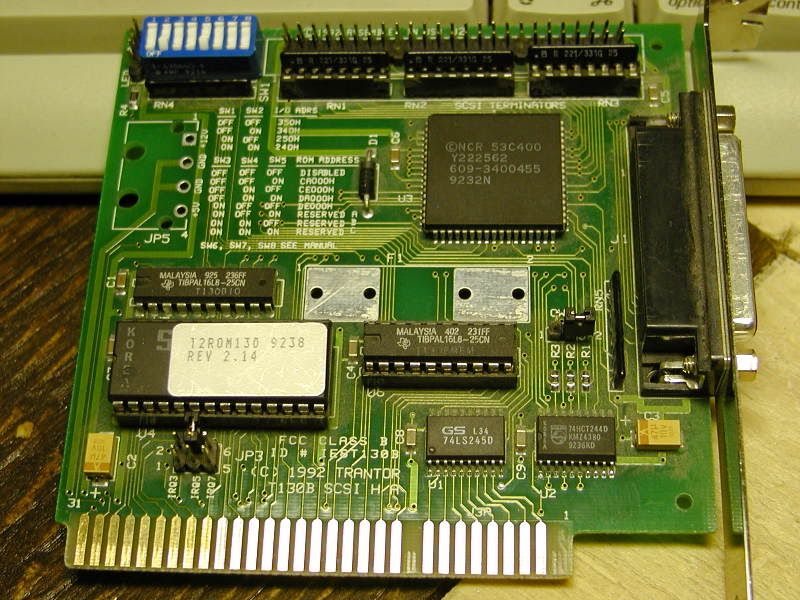
I tried an Trantor T-130 but it would read and not write to the drive (I tried it with a regular
SCSI 40mb drive first). From doing a search on the problem, one might have to do an
initialize by going into DOS debug and entering G=C800:0005 to start the utility program
on the BIOS.
But since I'm too lazy to try that, I got an ST-02 and put it in the 5155. No probs using
any drive (the 40MB was an old Quantum out of a Mac). with Dos 3.30A to get extra partitions.
The real fun was taking an ACARD 7720IU SCSI to IDE converter (AKA an ARS-2000IU),
updating the BIOS to the latest version (3.86) and popping on a cheapo eBay male IDE-CF
converter with a 64MB Sandisk CF card. The ST-02 and an ST-01 had no problems
seeing the CF card.
I had to fdisk the card on my Win 98 machine (Dos 3.30A fdisk saw extra non-dos partitions
which it couldn't get rid of), but then the Dos 3.30A had no problems formatting C & D. I'm
getting in a 128MB Sandisk to get some more 32MB paritions, but I think the Adaptecs are the
best as far as my experience goes. The ST-01 doesn't have a floppy controller so it is a bit
shorter and fits into the 5155 better. From what I can see from the labels the BIOS is the same
as the ST-02 but I haven't looked that closely.
This was a message from Gary Fisher
Hi,
Does anyone have a spare scan doubler - the little bit
of magic that converts old style EGA to VGA signals?
I'm trying to cut down on the number of monitors I've
currently got in the 'workshop' and this would
definitely
help.
Anything considered.
Regards
Ian.
____________________________________________________________________________________
TV dinner still cooling?
Check out "Tonight's Picks" on Yahoo! TV.
http://tv.yahoo.com/
All this talk about RD53s & RD54s has prompted me to ask again:
By any chance, does anyone have a Maxtor 1140, 2140, 1190 or 2190
with a failed HDA who might be willing to part with the PCB?
TIA,
mike
Hi,
> FBOFW, modern "free" *nix ports tend to use gcc, and gcc is
>such a resource hog for anything smaller than a VAX. Even on
>a VAX it's colossaly slow.
Augh....any idea how it fares on, say, Sun or SGI machines?
> Not on a VAX, but small and spritely, is Minix....
I remember it well, it was the first *nix I had any "long-term" exposure to
back around '88 (I'd dabbled with Ultrix at university).
I see they're up to "Minix 3" now!
>....The Amsterdam Compiler Kit wasn't free, though! The thought of
>a Unix without a compiler....
LOL, I knew there was a reason I didn't do very with it at the time....
>....even though I despise C compared to high level languages like
>SNOBOL and FOCAL.
You'll get no argument from me there, I learnt "C" in 1983 and hate it with
a passion even to this day; I'm an assembly language programmer by trade
(hence I'm currently out of a job) but I learnt quite a number of high level
languages at school/university/because I wanted to and "C" was the only one
I disliked....the way I look at it, it's little more than a "high level
macro assembler" and really isn't suited to the majority of uses it's put to
nowadays (writing embedded apps and device drivers in "C", sheer madness!).
TTFN - Pete.
Last year Woodelf posted a question wondering if a Z-machine could be
ported to the pdp8. Woodelf, did you get anywhere with that?
--
David Griffith
dgriffi at cs.csubak.edu
A: Because it fouls the order in which people normally read text.
Q: Why is top-posting such a bad thing?
A: Top-posting.
Q: What is the most annoying thing in e-mail?
Hi,
> Well, since you asked, I run NetBSD on everything. (If it won't run
>NetBSD, I mostly am not interested in keeping it....
>From all the suggestions here, I think that's probably going to be my route
"into" *nix.
As I said in an earlier message, initially at least, I don't want to be
messing around with different distributions.
Thanks.
TTFN - Pete.
Hi,
>....Why on earth should I waste a platform that will run an
>interesting non-Unix OS running Unix?
In my case at least, it's a case of curiosity (as in, could I run the same
version of *nix on an old PC, a VAX etc) and a lack of installation
media.... :-)
TTFN - Pete.
Another possibility is to just buy a professional clean bench. It has the
filters and blowers built in. I've seen them many times in Silicon Valley
for $50 to $100. I threw away several of them when we closed down the
Philips buildings in Sunnyvale. We couldn't even find a taker to haul them
away for nothing. That was only 3 years ago.
Last one I saw was at SV flea market. It was $50 and got no takers. That
was about 20 months ago.
Billy
Paxton Hoag wrote:
Personally I use a homebuilt Laminar Flow Hood with a 12 inch by 12
inch HEPA filter (came off a Fujitsu drive line) with a small
squirlcage blower that I can control the speed of. The goal is to
maintain about 1 pound of pressure above ambiant between the blower
and the intake of the filter. This generates the even flow through the
filter.
--
Paxton Hoag
Astoria, OR
USA
Billy wrote:
Ah - that brings back a lot of memories. I spent a lot of time in that
factory, even before it opened. Took part in the opening ceremonty,
including the Shinto blessing (the priest was flown over from Japan.) Was
sad to see it close. The Hillsboro factory was one of the last high volume
disk lines in the US. Only pilot lines left now.
Billy
> I suppose in an ideal world I'd assume that catastrophic failure of the media
> could happen very quickly - so priority is to get a snapshot of the disk onto
> modern storage before that happens.
The failure mode I've seen is oxide/binder coming off, clogging the head and
carving little concentric rings in the media :-(
Once the buildup starts, S/N ratio goes into the toilet, so the inner tracks
often have errors.
One of the techniques I've thought about to mitigate this is, as you say, just
snapshot all of the data without analysis, to avoid sitting on a track for a
minimal number of rotations, stagger-read tracks, or read them in inner to outer
track order.
There doesn't seem to be any obvious visual indication that the binder will strip
off a disc, oddly enough. You'd think there would be something like physical
discoloration when this was likely to happen.
Jules Richardson pondered:
... engage brain before posting :) I was thinking of lashing something up so
that the upper head wasn't in contact with the disk at all, reading the
bottom
surface, and only then reading the top. Thinking about it some more, the
loading of the head against the surface on both sides is almost certainly
critical, so this wouldn't work :(
Billy wrote:
The dual sided floppies offset the top head from the bottom to create a
tension path for the media. This kept the media snug against the heads -
critical because floppy media is based on contact with the head. Best way
to think of this an S shaped that is on its side. The lobs are the two
heads and the line drawing the S is the media. It is a very shallow bend
for the media. Any other method would create a pinch effect that could be
deadly of the coating.
When the heads are unloaded, the media would float between them. Loading
created the tension contour. A lot of work was done with air bearing type
of read/write but it was not reliable enough to go into production. The
media specs were too poor to give good snr with anything but contact
recording.
Contact recording was tried with hard drives a few times. These were the
famous "tail draggers". None of them ever achieved reliable enough
operation to survive long.
Billy
> Regarding Als idea of reading the disk backward - It would be a fairly
> simply matter to make up a version of ImageDisk which reads from the
> inside out.
> Why would reading from inside to outside (track 80 to track 0) help?
I have observed there is a higher rate of failure reading inside tracks.
If there is binder shed, it may help to start on the tracks that are more
difficult to read first (before the head starts to clog).
The bit about non-sequential track reading comes
mostly from trying to recover partially crashed 2315 media. You don't want
the ceramic of the flying head within 1/2" of the bad spot for very
long, or it will clog up and crash.
By moving the head on the floppy you knock the accumulating crud across
the surface of the disc as you seek, rather than having it pile up on the
leading edge of the head. Not great, but carving grooves in the floppy is
worse.
Sridhar Ayengar asks:
Well, I've seen how much dust a car air filter lets through, and I won't
use one on my car anymore. 8-/
Do the heads on older drives hover closer or farther from the data
surface than on newer drives?
Peace... Sridhar
Billy wrote:
All of the early cartridge drives used HEPA filters with no problems.
Provided you changed them when required by maintenance schedules.
Current drives still use a paper type filter but it is inside the drive and
not replaceable. Some of the higher speed drives (10-14K RPM) may have two
internal filters and a third over the pressure equalization hole.
Older drive heads of the ST412 era were in the 40-70 micro inch range. New
drives with Dynamic Flying Height ability are in the 1-3 micro inch range.
They also deliberately touch the media during the initial calibration
cycles. This is usually only once per head during the life of the drive.
There is no harm from this touch.
Billy
> I worked extensively in Dap16 in the 70's and still
> have a working H316 at home plus plenty of spares.
What software do you have for it? There are a few people
that have been looking for the disc operating system for
a while now
Jules Richardson wrote:
> I think I'd mentioned this privately to Chuck the other week, but I'm not sure
> if "playing back" raw data to a drive will even work, given that there will be
> slight differences in drive RPM between drives: a track buffered on a "slow"
> drive would run past the end of track on a "fast" drive by a few bits.
Besides that, there's the fact that the copy would have twice as much
peak shift and jitter as the original, and be unreadable or barely readable.
> It
> makes me wonder if the only way to do a 100% reliable write is to interpret
> the data that you're writing, lay down a format (which is guaranteed not to
> overflow available space), then lay down the actual data.
Right. And you also need to verify the CRCs, and reread any sectors that
failed, in case of dropout.
-- Adam
Hi guys,
I've just dug my not-even-a-tenth-finished floppy disc raw-reader out of
the cupboard, the plan being to finish it off. Problem is, I'm not seeing any
signals coming out of the floppy drive - all the outputs are stuck high.
What I've got is:
- All odd numbered pins on the IDC34 tied to ground
- All I/O lines from the floppy raised to +5V via two 4k7 resistor packs
- /MOTORA and /DS0 wired together, and grounded via a switch
- A Sony MPF520E floppy drive, HP badged, jumpered for automatic density
selection and DS0 (drive 0)
I can step the head in and out fine, and the motor seems to be spinning (the
drive's activity light is on at least). What I can't get is any form of output
>from the drive - even /INDEX is stuck floating high (FWICT it should pulse
once for every revolution of the disc, i.e. about once per half-second or so).
Am I violating some timing parameter or basic rule here? I honestly can't see
any reason why the drive would seek fine, but not return any data or index pulses.
Thanks.
--
Phil. | (\_/) This is Bunny. Copy and paste Bunny
classiccmp at philpem.me.uk | (='.'=) into your signature to help him gain
http://www.philpem.me.uk/ | (")_(") world domination.
> I am in the process of reading a couple of papers[1] on the effects of
> humidity on magnetic recording tape
There is a patent Ampex got on tape baking. Don't have my copy handy.
Dig around in the classiccmp archives, this has been discussed about
a year ago. The failure mode is reversable by removing the H2O in the
binder with heat/humidity reduction. For tape, I have been using a
heated dehydration chamber (modified 'dry box') 50degr C, <10% humidity
for about 24 hours.
The trick with tape is to have a LOT of air moving to get into the reels.
On 1/2" tape this is normally enough to prevent enough binder shed from
clogging the heads for a single pass over the tape w/o retries. You DO NOT
want the tape to stop! If it does, the built up binder will deposit itself
on the surface of the tape in a vertical stripe. If you are lucky and that
happens, it will occur in an inter-block gap, if not, you've just created
a permanent failure (you can't clean it from the surface of the tape).
There are some other tricks, like using magnetorestrictive transducers and
low tape pressures, but that requires extensive modifications to the tape
transport.
I just received a question from a fellow interested in the pricing of core memory:
"How much did this memory cost per bit, byte, or word? I am doing a
historical storyboard on the HP2100A used as the data processing system for
the HP5930A mass spectrometer and I would like to get some hard data on costs
of core memory."
Would someone (likely candidates: Jay, Bob :) ) have period price info for a
core memory module for the HP2100A?
I will pass on responses as well as suggest that he may wish to temporarily
join the list to ask other questions about the HP2100A.
I will also pass on the email addresses of responders (please indicate if you
don't wish me to do so) should he prefer to address questions directly to those
more knowledgeable about the HP2100 than I.
Hey All,
On 10/04/07, Philip Pemberton <classiccmp at philpem.me.uk> wrote:
> Al Kossow wrote:
> > The failure mode I've seen is oxide/binder coming off, clogging the head
> > and
> > carving little concentric rings in the media :-(
>
> If it's a case of the binder absorbing moisture and losing grip, it might be
> an idea to try baking the discs for a bit to dry out the binder. The only
> problem is, if you get the disc too hot (the words 'Curie temperature' spring
> to mind) then the data's toast...
I am in the process of reading a couple of papers[1] on the effects of
humidity on magnetic recording tape - primarily tape that has a
ployester urethane binder. Turns out that the problem is the binder
undergoing hydrolysis. The process is reversable but seems to take a
while - several weeks at least in low humidity conditions.
[...]
[1]
Kinetics of the humid aging of magnetic recording tape
Bertram, H.; Cuddihy, E.
Magnetics, IEEE Transactions on
Volume 18, Issue 5, Date: Sep 1982, Pages: 993 - 999
Aging of magnetic recording tape
Cuddihy, E.
Magnetics, IEEE Transactions on
Volume 16, Issue 4, Date: Jul 1980, Pages: 558 - 568
Simon
--
------------------------------------------------------------------------
"Well, an engineer is not concerned with the truth; that is left to
philosophers and theologians: the prime concern of an engineer is
the utility of the final product."
Lectures on the Electrical Properties of Materials, L.Solymar, D.Walsh
Ok, here's a nice one...
I've got a SCSI drive that was working fine in a test system the other day. I
came to plug it in to a system today via a known-working external SCSI box,
and when I hit the power the drive didn't spin up and sat there with the LED
constantly on.
"Uh oh" I thought. So I turned off the power, unplugged the drive cable, and
turned power on again - the drive span up fine.
That's a bit worrying, I figure, so I plug the drive cable back in, but unplug
it at the system end: I figure some fault with the system's SCSI bus is
upsetting the drive. Turn on the power to the cabinet and... constant LED, no
drive fault.
Must be the cabinet's terminator, right? Wrong - with the power applied and
the cable plugged in, but no terminator, I still get the constant LED and no
spin-up. With just power applied and no terminator or cable, the drive spins
up fine.
So... that's just a cable fault left - must be a short between a couple of
pins (however unlikely this seems). Wrong again - try a different known-good
cable, and the behaviour's the same: no spin up with a cable plugged in.
After a bit of experimenting, the drive will spin up fine with either no cable
or a cable of a few inches plugged into it. With a cable of a foot (or more),
it refuses to spin up and just sits there with the LED on permanently.
Remember there's nothing funky at the other end of these cables - they're just
stock 50-way IDC cable with 50-pin IDC connectors at either end.
The fault is consistently reproducible - drive orientation makes no
difference, power to the drive is good, cable-waggling has no effect. If I
turn on power with a cable plugged in, *then* unplug it, the drive will
suddenly spin up.
So... huh!? It's as though something's gone bad on the drive and it's using
the SCSI cable like and antenna and picking up interference which is confusing
the heck out of it. But then why it does the same when it *does* have
something at the other end of the cable, I don't know.
David, I couldn't reply to you. Your mail server for some reason don't
want anything to do with me, so I'm posting this here instead.
===============
Yes, I've seen the discussion.
My view is basically that it's not impossible at all. Just a question of
actually write the thing. Memory wise it will be just fine.
Large V5 games will probably require too much memory, but I think almost
all Infocom games will be fine. They have much more modest requirements.
Inform games both require lots of memory, and are extremely inefficient,
on a level that makes you not want to play them because of speed issues
anyway.
As someone noted in cctalk, a few issues to deal with is about the fact
that the z-machine is oriented towards 8-bit based architectures, so you
will get some extra work, and inefficiencies because of that. Not much
to do about it, except to live with it. It's nothing strange, just extra
code.
Any z-machine on a small computer needs to implement a virtual memory
scheme. I did that for ZEMU, and the same goes for one on the PDP-8. But
that's easy. You just have a paging scheme with an LRU algorithm. The
easiest there is. I stole the design from Frotz, I think, and then
improved some on it, and adopted it to my needs.
Also, I used Frotz as a debugging tool when I wrote Zemu. It helps to
have a working Z-machine around, which you can tinker with and add
printouts to, to compare with what is happening in your implementation.
Well, like I said. I don't see any real problems, except it will take
some work. ZEMU took me probably a couple of months atleast, in the end.
And then Megan did the work to port it to RT-11.
For the PDP-8 I would think that you'd want atleast 16K, by the way. I
think that the z-machine will need around 8K, and then you need atleast
4K for the dynamic memory, which would leave 4K for the game code. More
is always better, though. Larger games will need more dynamic memory,
but one 4K field for the game code is plenty enough. In ZEMU I think I
normally only use 10 pages of 512 bytes each for game code, but I can
play any game with just one page, and it gets slower, but not unbearably so.
The things that are tricky is really timers and screen handling. A lot
of code in ZEMU is to deal with this stuff. But you really don't need to
bother with either. Especially not if you're focused on V3 games.
Another big item in ZEMU is to deal with all different versions of the
z-machine. By focusing on just V3, that would become much simpler.
Actually, I think it's both realistic, and probably wise to focus on
just V3. It will be much less code if you ignore other versions, most
Infocom games will run just fine, and you can skip timers, and have a
simple screen handling. Memory requirements will not be bad.
I mean, basically, the z-machine consists of executing instructions,
which aren't that difficult. And then you need the memory handler and
the screen handler. A few instructions are very complicated, but that's
just a very few, like the parse instruction which converts an input line
into tokens.
And then you need to deal with the 8 vs 12 bit issues, and decide on how
to layout the virtual memory in the physical.
Johnny
David Griffith skrev:
> On the cctalk list, there's a thread on how to get a Z-Machine running on
> a pdp8. Since you did this on a pdp11, I thought you might have some
> insight on this tricky goal.
>
--
Johnny Billquist || "I'm on a bus
|| on a psychedelic trip
email: bqt at softjar.se || Reading murder books
pdp is alive! || tryin' to stay hip" - B. Idol
Tom Peters wrote:
SCSI drives often have a spin-up jumper, so that the machine can spin them
up one at a time to decrease inrush current caused by large arrays spinning
up all at the same time. Some drives also have a spin-up delay jumper-- 1,
2, 4 or 8 seconds. Others switch on the motor on first access.
On many drives, the jumper(s) are on the bottom.
I never heard that these lines are brought out to the interface, but also I
never heard that they're not brought out.
Perhaps that's something to do with it.
-------------------------------
Billy wrote:
In the early days of SCSI, spin delay was not standardized. There were
several versions. One used a fixed delay, like you mentioned. But the most
common delayed a fixed number of seconds multiplied by the drive ID number.
So unit 3 would be 3X delay, LUN 4 would be 4X delay, etc.
This was a holdover from the SMD days. SMD drives would delay until the
unit in front of them on the cable went ready. So a string of drives would
come up one at time. The unit number times a fixed delay was an attempt to
speed up the process. The problem only occurs on the initial inrush to the
motor. And that current drops rapidly once inertia is overcome. The
engineers realized that they didn't have to wait for ready, only until the
current dropped to a normal level, usually only 1 or 2 seconds.
Billy
In case anyone is interested, I have added a new
utility to the Imagedisk package called DMK2IMD which
converts a DMK format image into an ImageDisk compatible
image (.IMD). Let me know if you have any problems.
If there are other floppy disk archival formats that
anyone would like to see supported, please let me know
and I'll see what I can do.
Regards,
Dave
--
dave06a (at) Dave Dunfield
dunfield (dot) Firmware development services & tools: www.dunfield.com
com Collector of vintage computing equipment:
http://www.classiccmp.org/dunfield/index.html
now ain't that subject line an attention grabber. Not
exactly what you'd call a Mac related topic...at least
not so much to me. But simply an opportunity to
appreciate a particularly rare, exceedingly beautific
(arty?) piece of vintage crappola. I posted this in
the Tandy 2000 Yahoo group a few hours ago and thought
I'd share it with the remainder of my faithful
followers on this list. Yes your gratitude is well
received.
You can view the subject of the thread here:
http://groups.yahoo.com/group/Tandy2000/
you don't have to join, but what would be the reason
not to???
my gosh it's soo beautiful *snifful* I can barely
stand it ...
I'm referring to the picture of the Xerox 16/8 I
placed on the front page. I challenge ANYONE to find a
more luxurious looking vintij puter.In reality, that
box isn't the "puter" at all, but the drive expansion
unit. The computer logic is embedded in the monitor -
the
Xerox 16/8 proper. It has an 8086 and a Z80 for the
best of those worlds (but no it's not peecee
compatible, but that sure done didn't make a
difference back in them days. Nuh uh. We all bought
puters like
it, and lived to tell the tale...).
My particular 16/8 is in exceptionally good shape,
but I believe the hard drive is bad. When I had
learned of it's existence I guess 2 years ago (that
guy in N.Carolina, uh vintagemicros? had one up for
bidding, w/the caption "Insanely Great!", no doubt
trying to cast it as a Macintosh predecessor (cpu and
crt integral sparky)), I did a search, and found a guy
w/one in Maryland. The origins of the Mac are
not estranged from Xerox corp. I guess, but the
resemblance between a Mac and the 16/8 is somewhat
hard to define other than what I pointed out. I rather
suggest the caption should have read "Insanely
Stoopit!" LOL LOL LOL LOL LOL
A thoroughly beautific piece of vintage garbage
though wouldn't you say?
____________________________________________________________________________________
Food fight? Enjoy some healthy debate
in the Yahoo! Answers Food & Drink Q&A.
http://answers.yahoo.com/dir/?link=list&sid=396545367
I just discovered a flaw in my DMA setup sequence which exposes
a timing window during which bus noise can cause false dma
events (DMA enabled but FDC not driving it yet), leading to
ImageDisk not working correctly in some PCs.
I have corrected this (with the help of a couple of very knowlegeable
list members - thanks guys!), and released an updated ImageDisk 1.16
with the fix.
I have also updated the source code archive to include the new
TESTFDC and .TD0 conversion utilities.
Enjoy,
Dave
PS: I found this while fooling with and old 486 because I finally
decided to see if I could get my Central Point DEluxe Options Board
working - the TRANSCOPY that I had for it wouldn't run at all (froze
during the analyze phase), but I downloaded one from the net which
does, but I have been unsuccessful in actually recording and
recreating a plain-jane DOS DD 360k disk - I've gotten it to complete
the motions a couple of times but the result has errors in it.
This is a 486/25 (slowest I could make it) - does anyone know if
the CTP board will work reliably, or do I need to go slower...
Any other common causes of problems...?
Dave
--
dave06a (at) Dave Dunfield
dunfield (dot) Firmware development services & tools: www.dunfield.com
com Collector of vintage computing equipment:
http://www.classiccmp.org/dunfield/index.html
> And what modern *nix ports, if any, do other list members use on
> their classic iron?
I ran it on my VS3100, Alpha PC64-275, various MIPS & ARM gear, Sun 3 &
SS20, MVME 680[346]0, VME PPC, and Xen & x86 (not classic). I still have
1.5 on a PC532 and run current on Xen & x86, having gotten rid of everything
else (well...the VME stuff is in storage pending a decision on keeping it).
From: Sridhar Ayengar <ploopster at gmail.com>
> Where did you manage to dig up a PC532? Or did you build it yourself?
I purchased the original kit from Dave & George. However, this one isn't
it. My original, partially built kit got accidentally tossed in a breakup
something like 15 years ago. There was wailing and gnashing of teeth.
A couple of years ago, I mentioned that I was interested in ns32000 gear and
got an email to the effect "I've got some of that, make me an offer". A bit
of cash later I had the PC532, an ICM3216, a custom built ns32332 unit and a
Heurikon VME532, along with some doco and a bunch of extra parts.
Pretty decent haul.
Ken
> and what about the 68000 version of Windoze NT?
Not possible.
NT required a little-endian processor.
A PPC version existed. The processor was in little-endian mode to run it.
>Henk wrote:
>I still want to get my TC11-TU56 online, but my 11/84 is
>giving problems with the RL02 drives. Need to fix that first.
Is your 11/35 still alive and well? I thought you had the
TU56 hooked up to your 11/35 in that massive chain of
H960 racks.
I recently acquired an 11/35 in a rack with an RK05J and
an RK05F. It has some life in it, but is not behaving
correctly. Some bits seem to get stuck when I run tests
depositing and examining memory. I am in the process of
validating some of my spare 11/40 CPU modules. Hopefully
I have enough good spares to get the 11/35 up and running.
Ashley
>
>Subject: Re: Some progress with my PDP-11/73 system
> From: David Betz <dbetz at xlisper.com>
> Date: Tue, 10 Apr 2007 08:17:49 -0400
> To: "General Discussion: On-Topic and Off-Topic Posts" <cctalk at classiccmp.org>
>
>> RD53s are notoriously unreliable, but I'm surprised that four out
>> of five simply aren't detected. Are they genuine DEC RD53s? You
>> need to add a PCB link to an ordinary Micropolis 1325 or 1335 drive
>> to make it an RD53. Look on the PCB for the location marked R7
>> (remove two screws and carefully hinge it up) -- if there's nothing
>> there, solder a link in that position. Oh, and don't use a skid
>> plate with bare metal with an RD53, as it can short things out.
>
>Three of the four failing drives were official DEC RD53 drives as
>indicated by a sticker on the top. Interestingly, when Iooked at R7
>on the PCB, two of them had the resistor present but one end had been
>cut. I soldered it back together but both drives still fail. At least
>one of the drives spins up but then back down again. I'm reluctant to
>try swapping the PCB between my only working drive and one of the bad
>ones so I think I'll just count them as a loss.
The one that pinsup and then spins down has the head bumper sticking
problem. That is repairable and likely the HDA and logic is good.
Me I'd repair that drive and use it.
Allison
>Henk wrote:
>I still want to get my TC11-TU56 online, but my 11/84 is
>giving problems with the RL02 drives. Need to fix that first.
>
>Is the H720 the power supply inside the TU56 chassis?
>ISTR that you need an external power supply, +5 or +15 comes
>to mind, and there are two voltages possible, but only one
>must be connected ... I could be totally wrong.
>
>The first thing I must do is a check if all FlipChips in the
>TC11 are at their correct position, and if all are present...!
>
>Following this thread with argus eyes :-)
>
The H720 is a separate power supply and is not part of the
TU56 chassis. It has (IIRC) spade connectors to run the
various voltages to the TU56/TC11. I have hooked up the
TU56 to the H720 to test it out in standalone mode.
If I am able to escape from "she-who-must-be-obeyed" tonight,
I plan to make some progress on this project. I'll keep
you posted!
Ashley
I've made some progress on getting my PDP-11/73 system up and
running. I have successfully created an RX50 XXDP boot floppy and
have booted XXDP. My next step was to try to format the RD54 hard
drive. I did this by running the ZRQCH0 (where does this name come
>from anyway!) utility on the XXDP disk. I took all of the defaults
and got the following failure. Does this indicate that my RQDX3
controller is bad or is this likely to indicate a bad hard drive?
.R ZRQCH0
ZRQCH0.BIN
DRSSM-G2
ZRQC-H-0
RQDX3 Disk Formatter Utility
UNIT IS Formattable Winchester (RDnn) or Floppy (RX33) Drives
RSTRT ADR 145702
DR>START
CHANGE HW (L) ? Y
# UNITS (D) ? 1
UNIT 0
Enter controller IP Address (O) 172150 ?
What unit do you want to format [0-255] (D) 0 ?
Would you like to revector a single LBN only [Y/N] (L) N ?
Do you want to use the "AUTOFORMAT" Mode [Y/N] (L) Y ?
Enter unit serial number [1-32000] (D) 12345 ?
**** WARNING ****
ALL DATA ON SELECTED DRIVE WILL BE DESTROYED
Write protect all drives not being formatted.
Please verify that the selected drive is ON LINE
and NOT write protected.
If formatting RX33 media, insert media to be
formatted in the selected drive.
Do you wish to continue [Y/N] (L) Y ?
ZRQC SYS FTL ERR 00013 ON UNIT 00 TST 001 SUB 000 PC: 105742
Autosizer Failed.
Status: Controller Chip Never Interrupted.
ZRQC SYS FTL ERR 00006 ON UNIT 00 TST 001 SUB 002 PC: 105742
Fatal Controller Error During Initialization.
ZRQC EOP 1
2 TOTAL ERRS
DR>
>> Is this the correct way to add the TC11 to my current setup and properly
>> terminate the Unibus by moving the M9312 to the TC11?
>
>Yes, that's the correct way, although I have the M9312 in the CPU box
>(11/34) and a M9302 as the "outside" bus terminator.
I think I'll try to get my TC11, TU56, and H720 mounted in the rack
tonight, move the M9312, fire it up, and see what happens. It would
be nice to see those little DecTapes spinning based on the commands
I am typing on a terminal!
>Well, we have a 11/34 with TM11/TU10,RK11D/RK05,RL01,RL02,RA80,PC11/PC05
>and since at least two years TC11/TU56, everything is in working
>condition.
I might be checking with you again later. I also have a TU10 and a
PC05 that I want to hook up to my system. The TU10 needs to be
reassembled (it was dismantled when it was shipped), and the PC05
needs a good cleaning.
>> I also have a TU55 (single unit) DecTape drive. Are the TU55 drives
>> compatible with the TC11? Can a TU55 drive be added to the above
>> configuration and be configured as a 3rd DecTape drive? Or are the TU55
>> drives not compatible with the TC11? I have skimmed the TC11 manuals
>> and did not see mention of the older TU55 drives.
>
>I don't know, do you really mean TU55 (the old DECtape)? I ask because
>there was a single drive TU56 called TU56H (H for "half").
This is an actual TU55 that I'm referring to, not the single drive
version of the TU56.
Ashley
Hello, Kevin
I plan to travel to England by car, arriving next friday, April 21,
and to visit BP that weekend, to pick up the Teletype.
You have an Alpha-16, that you indicated I would be able to
borrow. Would you consider donating it? If not, is borrowing still OK?
Will it be possible to go through your storage areas, to see what
other CA equipment you may have? Last time we were unable to do that,
because you did not have the key.
I have not yet made definite plans for the weekend. Will both days be
convenient, or is one of the days out of the question?
Kind regards
/Lars Hamr?n
-------------------------------------------------------------------
Lars Hamr?n Tel...: +46( 46)189090
Svensk Datorutveckling Mobile: +46(705)189090
Vadm?llan 211 e-mail: hamren at sdu.se
S-225 94 Lund WWW...: www.sdu.se
Sweden
Found something rather oddish (for this place) at one of my usual junk
hunting grounds. Thought I'd post about it here and see if anyone had any
interest. More importantly, I was wondering if people might be able to fill
in background on what this system probably contained.
DEC H960 Rack with 861C power controller, both side panels present. Back
door present, but 8x10 hole cut in back. There is a DEC header panel at the
top which is shiny silver on the front with the text "VG DataSystem 2000"
screened on it. There is a chassistrak railset, looks like one would use for
an RX02 but it's inner rails only. The 861 power cable was cut on the plug
end. There was also the condor fan and cabling. This rack had a 1/2 height
dec filler panel and I snagged that myself, along with the two (and only
two) filler panel stud mounts. At the back of the rack was some custom
interconnect stuff, obviously used to connect the machine to the outside
world.
There was a rackmount box (removed from rack but available). I believe it to
be a disk controller of some sort. It had a tag on it saying "RKA1-3,
RKB1-3, SYS & DSK?" {the DSK was fuzzy, may not have that right). On the
rear is a 2 position toggle switch marked "NORMAL" and "FORMAT". The front
of the unit said System Industries, and on the back it said "Model
3040-3051". From the back of this box were about 4 or so long ribbon cables
that I was told went to the disk drives (can't verify this for sure).
Lastly there were two identical disk drives, obviously Western Dynex drives
even though they had "System Industries" on the front. I remember them from
microdata days. They were labled XDD-6222-TA45F, 2400RPM, 200TPI. Each drive
had a piece of removable media the media was visually the same as RL02 media
>from the top. One said "scratch disk, all data here will be lost". The other
had a lable that read "VG 2035 F/B Release 7.3 bootable". "UCC system before
converting to rel 8 in Jul 82". Both drives include mounting rails. One
drive appears to have had the fan on the rear removed. The drives appear to
be in fair condition, but probably are just good for parts.
If anyone is really interested in any of it, let me know and I'll put you in
touch with the shop. I may be interested in the dynex drives if they could
be used on my Microdata. If no one takes the rack I may see if he'll sell me
just the condor fan. I'm curious if anyone knows about VG datasystem 2000 or
System Industries.
Jay West
I am getting ready to hook up a TU56 and TC11 to a PDP-11/40 system. I was curious if anyone else here on this list has a working TC11. My TU56 seems to work fine in standalone mode (not connected to the TC11), connected to an H720 Power supply. The capacitors are not leaky and seem to be working fine, although I know I should re-form them or replace them at some point. All voltages are correct coming from the H720. The toggle switches and lights on the TU56 are all working properly and will run a loaded Dectape in forward or reverse.
My current 11/40 configuration has the full 11/40 CPU with all optional modules (EIS, MMU, FIS, M7237, M787), 128KW M7891 MOS memory, RL11 controller, RX01 controller, M7819 EIA DZ11, M7814 20mA DZ11, and an RK11 controller. I currently have an RL01, two RL02s, and a couple of RK05s, and an RX01, and they are all functional. In the last "Unibus Out" slot (which happens to be on the RK11 controller), I have an M9312 bootstrap terminator card. I have various working terminals (VT05, VT52, VT100, LA36, LA120, ASR33) connected via the EIA and 20mA DZ11s. This system works properly and I have used it to boot and run my custom configured RSTS/E V7 system, as well as RT11 and XXDP.
Can anyone with a working TC11 verify that the following will work:
I will remove the M9312 from the RK11 and replace it with a BC11-A Unibus cable, which will connect to the Unibus-In slot on the TC11. In the Unibus Out slot of the TC11, I will place the M9312 bootstrap terminator card. The TC11 will be connected to the TU56 with the M908 and W032 cables.
Is this the correct way to add the TC11 to my current setup and properly terminate the Unibus by moving the M9312 to the TC11?
Does anyone else out there have a working TC11/TU56 on a PDP-11? I am aware of numerous working TU56 / PDP-8 systems, but don't know of anyone who has a TU56 working on a PDP-11. I know people who have them sitting in a rack for "show and tell", but not connected and running.
I also have a TU55 (single unit) DecTape drive. Are the TU55 drives compatible with the TC11? Can a TU55 drive be added to the above configuration and be configured as a 3rd DecTape drive? Or are the TU55 drives not compatible with the TC11? I have skimmed the TC11 manuals and did not see mention of the older TU55 drives.
Thanks in advance for any advice!
Ashley Carder
http://www.woffordwitch.com
Fellow techies,
I have a SuperCartridge 3 font module, as used with the old HP LaserJet 3 printers. Before I remove and erase its EPROMs for recycling/re-use, does anyone have need of the module itself or the data in the EPROMs?
If I don't hear back by, oh... Thursday or so, I'll assume not.
Thanks much.
-=-=-=-=-=-=-=-=-=-=-=-
Bruce Lane, Owner & Head Hardware Heavy,
Blue Feather Technologies -- http://www.bluefeathertech.com
kyrrin (at) bluefeathertech do/t c=o=m
"If Salvador Dali had owned a computer, would it have been equipped with surreal ports?"
>
>Subject: Re: Buzzing 861C - anyone ever open one up?
> From: ard at p850ug1.demon.co.uk (Tony Duell)
> Date: Mon, 09 Apr 2007 19:26:53 +0100 (BST)
> To: cctalk at classiccmp.org
>
>>
>>
>> "Jay West" wrote:
>> ...
>> >DEC H960 Rack with 861C power controller
>> ...
>>
>> Which reminds me. I plugged in an 861C yesterday. The breaker seemed a
>> bit "dodgie" as they say, and didn't seem to want to stay on. I finally
>
>They normally ared a bit tricky to get to latch on.
I have three of them here and I've never had a "dodgy" breaker, they latch
quite firmly.
>
>> got it to stay on but when I plugged it in I got a loud buzzing sound
>> from inside the "box". The switch was set to "local".
>>
>> There was nothing else plugged in and the breaker didn't pop but I didn't
>> like the sound and unplugged it. I've never opened an 861C up - what's
>
>Well, you have one. Do you own a screwdriver :-)
>
>Seriously they come apart very easily (just a few screws holding the
>cover on). Obviously unplug it ffrom the mains before you start, but
>there's no serieosu stored charge inside (there are mains filter
>capacitors, but they're quite small).
>
>> inside? I would have thought it was just A/C distribution but I guess
>> there must be a relay come to think of it.
>
>I can't remember which the -C version is (there are at least 5 models,
>115V and 230V, single and 3 phase inputs, etc).
>
>The bnsic design is much the same for all of them. There's a breaker and
>mains filter, the output of that goes to the unswitched sockets, and also
>to a contactor (big relay). The output of the contactor goes to the
>swtiched sockets.
>
>There's a little control PCB inside as well. IIRC in the 861 it contains
>an unregulated supply and a reed relay with 2 coil windings, and some
>diodes.
>
>As you may know, the 3 pin mate-n-lock ocnnectors on the power
>controllers allow you to link up several such controllers so that turning
>on the CPU consople switch also turns on every other part of the system.
>The 3 pins on those conenctors are ground, ground-for-on, and
>ground-for-off, with the last taking priority. The sonsole switch is
>wirted between ground and ground-for-on, any overheating-detection themal
>swtiches are wired between ground and ground-for-off. That way, if any
>part of the system overheats, the whole lot gets turned off.
>
>IIRC, the reed relay has a differentially-wound coil. Grounding the
>ground-for-on line turns the relay on. Grounding the ground-fo-off line,
>if the ground-for-on line is also grounded, will cause both windings to
>be energinsed, the magnetic fields cancel, and the reed relay turns off.
>
>The contacts of the reed relay cotnrol the contactor. This is a problem
>in 230V models, the reed relay is really only rated for 115V, and tends
>to suffer from contact welding when used to switch the 230V contactor
>coil. I've had to thump my 861 to get it to turn off.
>
>Anyway, the contactor does buzz a bit anyway. if you're getting mains at
>the swithced outltes, it should be fine (if you don't get mains there,
>the contactor may not be pulling in properly. In that case it'll buzz
>like mad, and will also burn out fairly quickly.).
>
>A fault on the cotnrol buard is unlikely to cause buxxing. The control
>elemenets, the reed relay and the contactor, are too slow to repsond at
>60Hz. So even if there's ripple on the cotnrol board supply, it doesn't
>normally cause the thing to buzz.
The buss is nothing bad. Usually it's just the contactor mechanically
buzzing I have only one that does that and either cycling it or giving
it a sound rap (purcusive maintenace) makes it quiet down.
Allison
>
>Subject: Re: Some progress with my PDP-11/73 system
> From: David Betz <dbetz at xlisper.com>
> Date: Mon, 09 Apr 2007 15:44:04 -0400
> To: "General Discussion: On-Topic and Off-Topic Posts" <cctalk at classiccmp.org>
>
>>> utility on the XXDP disk. I took all of the defaults and got the
>>> following failure. Does this indicate that my RQDX3 controller is
>>> bad or is this likely to indicate a bad hard drive?
>>
>> Since the controller handles the RX50 OK, almost all of it must be
>> working. If the LED on the RQDX3 goes out a few seconds after
>> resetting, with the RD54 disconnected, the RQDX3 has passed its
>> self-test. From the error, I'd say possibly the RD54 has never
>> been formatted on an RQDX3, or more likely something is wrong with
>> the jumpers or connections.
>>
>> Double check that the drive select jumper is correct (normally it
>> should be DS3; does the drive's LED flash when you run ZRQC?), that
>> the little control board in the front of your BA23/BA123 with the
>> READY and WRT PROT buttons is properly connected and those switches
>> are set correctly, and that the cables from the distribution panel
>> are connected correctly (with both the RD54 cables connected to the
>> lower-numbered port). It's just possible you have too old a
>> version of the firmware on the RQDX3 (what are the EPROM numbers?)
>> or that its jumpers (eg W23) are set wrongly, but this is less
>> likely I think.
>
>You were right about needing to switch drive select to 3. That made
>it possible to format the RD54 drive. It formatted successfully with
>40 bad LBNs and 7 retired. I also tried formatting my five RD53s and
>one formatted successfully with 27 bad LBNs. The other four failed to
>even be detected as far as I can tell. Is there any point in playing
>with these or would I be better off just trashing them?
I'd explore swapping boards or rechecking jumpers first, the try ZRQC?
again. RD53s tend to have spindown disorder, spin up then spindown.
If they do that generally there is a fix. If they spin up and you can
hear the head mech load then something else likely on the boards is
bad or wrong.
>Also, how bad are 27-40 bad LBNs? I know that they can be mapped out
>but is this a sign that the drive is dying?
Thats common for MFM drives and the OS or controller will manage
it usually. However, if you see an increasing number of bad LBNs
or they are all on one head that can be an indicator of impending
failure.
Allison
Anyone have a 9 track SCSI (preferred) or pertect interface tape
drive in the Western NY area they want to part with?
thanks
David Barnes
davebarnes AT adelphia DOT net
OpenVMS , Tru64 , Solaris , Linux , OS X , SGI Irix
Another question....
Does a TU56 normally have rack-mount rails? I have two TU56 drives and neither of them have rails. How are these typically mounted?
Glen Slick Wrote:
M2441A Standalone, 100 IPS Streaming, 12.5 IPS Start/Stop
M2442A Rack mount, 100 IPS Streaming, 12.5 IPS Start/Stop
M2443A Standalone, 75 IPS Streaming, 25 IPS Streaming
M2444A Rack mount, 75 IPS Streaming, 25 IPS Streaming
M244xAC models have a 256KB buffer adapter installed.
M2441A / M2443A 110 kg , 242 lb.
M2442A / M2444A 90 kg, 198 lb.
-------------------------------
Billy responds:
I was the field service manager at Fujitsu America for 8 years (1986 on) and
supported all their US customers of tape and disks (plus scanners, printers
and MO devices.)
While cleaning out old manuals recently, I came across a market survey we
did in 1988. It includes detailed charts on every tape, and disk available
at that time, plus many that were obsolete but still being used. (Included a
lot of pricing data too.)
It would be ideal to answer questions like this or the running thread on
RLL, ST412 comparisons. I gave it to Al K. a couple of weeks ago. But he
has an incredible backlog; if we help him out somehow, maybe we can get him
to scan some sections of the survey. It also had some Fujitsu sales
brochures, but I don't remember if I included any tape brochures.
If Al doesn't have a manual you need on a Fujitsu product, let me know. I
gave all my manuals to one of the engineers who worked for me. I talked to
him recently, and he believes he still has them all in his garage. When I
move back to the Bay area in August, I'll go through them - compare to what
is on bitsavers and try to scan the delta to add to bitsavers.
At this point, there is so much to be scanned that I'm reluctant to give
anything to Al unless there is a demand for it. He already has backlogged
years of stuff ready for scanning today. It's well past time that the rest
of us interested in the hobby pitch in. This shouldn't be a one man effort.
We all benefit from saving this data.
Billy
> I was thinking the same thing with this concept of over-sampling the entire
> track into a buffer
If you are familiar with logic analyzers, this is the difference between state
and timing modes. The CW is like timing mode, and has a high clock resolution,
and is run-length encoded.
Oversampling requires you to transfer a LOT of samples, which are mostly the same.
Eric Smith and I built an oversampling reader about five years ago. It was impractical
because of the time it took to transfer all of the samples.
* info wrote:
________________________________
Does anyone know of a place to get a ST506 MFM drive? I have googled but
can't seem to located a new or pulled drive. I would one that is 40Meg
or larger. Thanks
Billy responds:
I see them all the time at the flea markets. And they show up on eBay and
Craig's list frequently. Wish I had known of your need. I gave one away
last weekend and put a couple more in the scrap barrel on Friday. I may
have a couple more at home but won't be going North for another 4 weeks.
Billy
Hi,
> Probably on a CHRP PPC box (Common Hardware Reference Platform)....
>....The same hardware was supposed to be able to run Mac OS, OS/2,
>AIX, and I think WinNT....
That's interesting, I came across mention of that architecture recently when
checking out what platforms one of the free BSD variants ran on.
Is there anywhere I can find out a bit more about CHRP?
BTW I was a big fan of OS/2 back in the day, wonders what the chances of
installing OS/2 Warp on an RS/6000 are....LMAO?
TTFN - Pete.
Hi,
Does anyone have a copy of Mathematica for OpenStep? I want to install it on
my Intel OpenStep 4.2 (via VMWare). I know I shouldn't be asking for this,
but I think they don't mind as it is quite old (version 3.0)
Thanks,
Ram
> No - but when I last trawled the web for info on the CW (about a year ago) I
> was getting the impression that what little "officially sanctioned"
> documentation and example code there was out there was squarely aimed at Windows.
>
At http://www.tim-mann.org/catweasel.html sources for both Dos/Windows
and Linux programs are available. Of course these are mainly for reading
and writing 1771/1793 FDC compatible floppies which contains most of
what 765 FDC can handle.
The origin of the Catweasel is reading/writing Commodore compatible
floppies.
> I'm not sure what work users have done with the board under DOS. I know I saw
> rumour of a Linux kernel driver - but for what board revision / firmware I
> don't know. It's a shame these sorts of things aren't (apparently) fed back
>
The drivers above are for the MK1, MK3, MK4 boards. The difference
between the MK3 and MK4 is only of interest of C64 emulation; real SID
or emulated SID (sound chip).
Fred Jan
>
>Subject: Re: ST506 WTB:Micropolis 1325
> From: "Andy Piercy" <andy.piercy at gmail.com>
> Date: Mon, 09 Apr 2007 09:17:47 +0000
> To: ajp166 at bellatlantic.net
> Cc: "General Discussion: On-Topic Posts Only" <cctech at classiccmp.org>
>
>Allison, All,
>
>I have a similar problem with two ESDI Micropolis 1355 drives both driver
>exhibit the same problem as you describe
>
>Fault
>====
>The drives power up but just seem to fail to load the heads
>i.e. You know that voice coil noise when a working drive loads, well it just
>does not happen on the faulty drives. The drives spins up but the drive
>access light just stays on. After a while the drives re-tries to load, the
>drive spins down the spins up again but still fails to load the head.
>
>I have two drives with this problem, however both were working but failed
>after a few hours of running (Not including all the years in service ;-),
>and one still intermittently still works.
>
>I had a quote to have the drive repaired but the UK firm wanted 380 UK
>Pounds!
>
>So anyway sorry to ramble, After you opened the drive, did you have any
>problems with dust and head crashes? Do you think that it would be possible
>to fabricate one of these bumpers? Do you have any pictures of this bumper
>within the drive?
That is the typical symptom. spinup no head load then spindown.
I plain removed the bumper. It makes a loud clack now but no ill effects.
The first time I jsut put some Teflon tape over it avoid the sticky
surface but it was harder to do. No pictures. I did it in a clean
work area but not a clean room. Fequires small tools inside (very small
area) and I demaged all my tools beforhand. The only prep I di was to
clean the unit outside well (dust removeal) then clean the workarea well
with a damp cloth to keep ESD and dust down.
It's been years (at least 8) since I've done this and the drives are still
working.
Allison
>
>
>
>
>
>On 08/04/07, Allison <ajp166 at bellatlantic.net> wrote:
>>
>> >
>> >Subject: Re: ST506 WTB:Micropolis 1325
>> > From: "Steven N. Hirsch" < shirsch at adelphia.net>
>> > Date: Sat, 07 Apr 2007 08:42:34 -0400 (EDT)
>> > To: "General Discussion: On-Topic Posts Only" <cctech at classiccmp.org
>> >
>> >
>> >On Thu, 5 Apr 2007, Sridhar Ayengar wrote:
>> >
>> >> John Kourafas wrote:
>> >>> Also looking for a Micropolis 1325 MFM Drive, 71/80MB , I've seen both
>> the
>> >>> ST506 and Mic. 1325 on eBay for like 600.00 which I think is crazy...
>> >>
>> >> What's the largest capacity 3.5" MFM HDD available?
>> >
>> >I have an extensive collection of MFM/RLL drives and have _never_ run
>> >across one with that interface in a 3.5" form-factor. Not sure that
>> >anything of this sort existed. 5.25" 1/2-ht. was about as sophisticated
>> >as they got.
>>
>> I have several miniscribe 20mb in all flavors of interface st412, SCSI
>> and IDE. I have some really old 3.5" WD 10mb. to name a few.
>>
>> They show up around the beginning of the IDE era but by time IDE hit 40mb
>> they seemed to have disappeared.
>>
>>
>> Allison
>>
>>
>>
I have a Windows 98SE system setup with a 1.2mb 5.25" floppy drive
for running putr to create disks to use on my PDP-11/73 system. I
seem to remember someone suggesting that it was best to bulk erase
the DSDD 5.25" floppies before attempting to format and use them with
putr. Is that correct? I've been having trouble with putr and I'm
wondering if it is due to my failure to bulk erase the floppies
before using them.
Also, is it necessary to start Win98SE in "DOS mode" to run putr or
can putr be run from the DOS prompt from within Win98SE?
Thanks,
David
Thanks to Dave McGuire and Julian Wolfe and helpful responses from
many people on this list, I now have a BA23 box with the following
configuration:
M8190 KDJ11-B CPU
M7551 MSV11-Q 4mb memory
M7555 RQDX3
M8043 DLV11-J
RX33 floppy (temporarily stolen from a DECmate III+)
RD54
The system starts up and passes the memory test and drops me into the
boot code so I think it is working correctly.
I also have an Emulex ESDI controller and some ESDI drives as well as
a Viking SCSI controller but I'm trying to get the system up with
just the RQDX3 first.
My question is, can anyone point me to an RX33 (or RX50) disk image I
can use with putr to create an XXDP boot floppy for this system so
that I can test and format the RD54?
Thanks!
David
I'm restoring a few more 5150s and realized that, although my MFM
hardware stores are being depleted, I'm just maggoty with SCSI drives,
>from 40MB to 18GB. Can anyone recommend any 8-bit ISA SCSI adapters by
model, name, or whatever I can use to search for them on ebay?
Also, do such 8-bit adapters have an onboard BIOS? It would be great if
I didn't have to boot off of a floppy disk just to access the hard
drive... I have a CorelSCSI card at home, but when I plug it in it
doesn't do anything at POST, and I don't have a driver or software to
test the card anyway :-/
PS: If anyone knows of any sources for the ADP50 or similarly functional
8-bit ISA IDE adapters, that would be much appreciated as well. Thanks!
--
Jim Leonard (trixter at oldskool.org) http://www.oldskool.org/
Help our electronic games project: http://www.mobygames.com/
Or check out some trippy MindCandy at http://www.mindcandydvd.com/
A child borne of the home computer wars: http://trixter.wordpress.com/
> I believe I have an 8088 compatible network client, but all my
> network cards are 16-bit etc.
Most 3Com ISA cards, such as 3C509B-TPO, will work in 8 bit slots.
Lee.
Is this online anywhere to anyone's knowledge? I assume it's in the techrefs
[1] (which I don't have, unfortunately), but I'm sure I've seen the schematic
online somewhere in the last few years.
IIRC it's only a handful of latches, buffers and address decoding - so not a
complex bit of hardware.
[1] The circuit on the MDA card is probably the same... if someone could
confirm that then I could at least trace it from a real MDA card here :)
cheers
Jules
>
>Subject: What is an HP1858-0054 transistor array?
> From: ard at p850ug1.demon.co.uk (Tony Duell)
> Date: Thu, 05 Apr 2007 18:38:14 +0100 (BST)
> To: cctalk at classiccmp.org
>
>I am working on the reset circuit of an HP9816 computer. The output side
>is rrlatively conventional, but it takes an input from a chip that I
>can't identify.
>
>The chip is a 16 pin DIL package marked with the HP house-number
>1858-0054. That's not in my equivalents list. The chip seems to have been
>made by RCA, and tracing the connections to it show that 2 of the pins
>are grounded, but none of them go to any power line. I susepct it's a
>transistor array, therefore (HP1585-xxxx numbers tend to be transistor
>arrays too).
>
>I've unsodered the chip, but trying to work out the internal arrangement
>is non-trivial, partly because there seem to be parasitic diodes, and
>secondly because I am not convinced it's just transistors brought out to
>the pins. There may be a long-tailed pair, for example. It doesn't match
>any of the arrays in my RCA databook.
>
>As I said, it's on the main processor board (the big board at the bottom)
>of an HP9816 computer. It's U115 on this board, at the front left corner,
>just behind the 16MHz clock oscillator can.
>
>Does anyone have any suggestions as to what it might be? Anyone have an
>HP9816 with this IC labelled with somethign other than an HP house number?
Search for RCA CA3080, 3081, 3082 and also look at 3046. RCA did a large
number of transistor arrays (and MOS transistor arrays).
The common layouts were 8 common transisters with emitter(grounded) base
and collectors brought to pins, 8 common collector (VCC) with emitter and
base brought to pins. Others include differential amps, darlington arrays
and some combination arrays. You have noticed there are a large number
of parasitic diodes as a side effect of forming the devices on one die.
FYI here is a sample of some of the devices:
The common collector and common emitter devices were handy for LED
segment and digit drivers but were not limited to those uses.
Ca3081, ca3082 are examples of this.
Diferential arrays like the ca3026, CA3028, ca3046, ca3049, ca3053, ca3054
were largely used for RF and analog applications but could be handy
for ECL interface to other logic.
The CA3018, ca3084 were a darlington pair and two uncommitted transistors.
CA3036 dual darlington array with all collectors common.
CA3019 and 3039 diode arrays, handy when one needs matched temperature
tracking diodes.
Just a few off the top of my head that I'd used never mind the more
appication specific Opamps and communications circuits blocks (mixers,
IF amps, Audio amps and TV chroma, sync, video processing). RCA had a
very extensive line of monolythic devices.
Allison
>
>-tony
Hello. I was wondering if you still have the DEC LG01 operators guide available? It is model: Ek-OLG01-IN-003
Thanks,
Ronnie Lane
CONFIDENTIALITY NOTICE: This transmission may contain confidential and proprietary information intended only for the use of the individual or entity to which it is addressed, and/or may contain information that is private, privileged, confidential, and disclosure of which is prohibited by applicable law (including, without limitation, the HIPAA Privacy Rule, 45 C.F.R parts 160 and 164.) If you have received this transmission in error, any disclosure, copying, distribution, downloading, uploading or the taking of any action in reliance on the contents of this information is strictly prohibited, and you are requested to immediately notify the above sender by the above telephone or email address. If you are a patient, and do not wish to receive similar transmissions in the future, please immediately notify the above sender by the above telephone or email address.
Hi,
>....I've run it on the IBM Sandalfoot (PowerPersonal, not exactly an
>RS/6000), ThinkPad PowerPC, and Motorola PowerStack. I think I've heard
>of it also running on the 7025-F50, but don't quote me on it.
Sounds like I'm out of luck then, my RS/6000 is a "Powerserver 7013"; AIX it
is then....
> It's a pointless exercise as there really isn't any software
>available for it.
Good point, though for what I had in mind just the stuff supplied with the
OS (NT4.0 Server) probably would have sufficed.
TTFN - Pete.
Date: Sun, 8 Apr 2007 07:12:15 -0500
From: "Dave Dunfield" <dave06a at dunfield.com>
Subject: Re: ImageDisk update
>> I was afraid of that - Getting a 5160 to network (to get the
>> images off) is a little painful - I believe I have an 8088 compatible
>> network client, but all my network cards are 16-bit etc.)
>Ok - I should have said "configured for 16-bit" - I'm sure that some of
>my network card will operate in 8-bit- I just have to figure out which
>ones, find the docs and/or configuration utility, finf the 8-bit client
>etc. etc. ... Doable - just more work than I'd like - thanks to all for
>all the card suggestions.
>Dave
---------------------
Interlink/Interserver? Laplink? PC-Anywhere/DOS?
Hardly any work at all...
m
Date: Sat, 7 Apr 2007 08:42:34 -0400 (EDT)
From: "Steven N. Hirsch" <shirsch at adelphia.net>
Subject: Re: ST506 WTB:Micropolis 1325
>I have an extensive collection of MFM/RLL drives and have _never_ run
>across one with that interface in a 3.5" form-factor. Not sure that
>anything of this sort existed. 5.25" 1/2-ht. was about as sophisticated
>as they got.
>Steve
----------------
Not a very extensive collection then ;-)
Almost everybody made 'em; Miniscribe 8425, Seagate ST125, etc. etc.
I've got a box full here.
mike
I picked up a very nice RT system the other day from a list member which
includes the 5085 graphics processor and 5081 colour display. We've just been
setting it up today (or trying to), and an obvious question arises...
The 5085 has some sort of comms input ability on a BNC connector (and output
on another BNC, but that's terminated). The RT has a little "breakout box"
which hooks up to the 5085 link card on one side and has four BNC outputs on
the other.
My *assumption* is that one of these outputs (and the breakout box came with a
coax cable already hooked up to BNC #1) links to the BNC input on the back of
the 5085, forming the comms channel between the 8085 and the RT.
However, it would be nice if someone can verify this! The RT documentation
doesn't cover the 5085 link option (so far as I've found yet, anyway). The
5085 documentation doesn't cover it either (as it only details how to hook the
5085 up to the peripherals and then boot the hardware).
Obviously I'm a little reluctant to go randomly plugging cables in,
particularly as the breakout box has four BNCs on board - although it could
well be that the RT 5085 link board was capable of driving up to four 5085
processors independently.
Google seems to know almost nothing about the 5085 option :-(
cheers
Jules
--
there's a carp in the tub
so nobody's taken a bath
>There are two unpopulated sockets on my two T130Bs. One is a 20-pin DIP,
>which I suspect is probably something like an LS374 and the other is the
>boot ROM. For yucks, I'd love a snapshot of the ROM and affirmation of
>what the other upopulated socket is. In return, I could verify that your
>setup's right.
The URL below links to a photograph
http://i11.photobucket.com/albums/a166/ballsandy/Computer%20related/T130B.j…
>Do you know it's a) working and b) low-level formatted to 512 bytes/sector?
A) yes B) no
>I suspect DOS might just query the fact that there's a drive there, without
any knowledge of whether it'd be capable of reading/writing data.
???
>I assume the ROM on the SCSI board is taking over control of the system
>boot - and probably has no knowledge that BASIC is actually lurking in the
>host system's ROM. If you get to the point of being able to boot DOS from a
>SCSI disk, I bet there's a way to hop into the system's on-board BASIC via
>the DOS debug program...
Well I gurss I have no choice but to get to basic through DOS. It means
lugging an extra disk but I'll do anything to get the onboard BASIC.
_________________________________________________________________
Check Out Our List Of Trendy Restaurants. You'll Eat It Up!
http://local.live.com/?mkt=en-ca/?v=2&cid=A6D6BDB4586E357F!378
Date: Sat, 7 Apr 2007 12:29:49 -0500
From: "Ethan Dicks" <ethan.dicks at gmail.com>
Subject: Re: ST506 WTB:Micropolis 1325
<snip>
>There were probabably a few others. I doubt there were any 3.5"
>drives over 40 MB, though.
<snip>
Seagate ST151 and 157R, just to name two...
>> The largest MFM drive ever made was _probably_ the Maxtor 2190 at 190MB
>> unformatted. ISTR that there was a logical limit to the number of
>> cylinders due to the control protocol (or perhaps limitations in the PC
>> BIOSes of the time) and physical limits to the number of sectors/cylinder
>> and the number of platters (the 2190 had 15 or 17?)
>That's certainly close to the largest, if not the absolute largest.
>DEC took the XT2190 and formatted it at 154MB as the RD54. I have a
>few in MicroVAXen. Much more solid than the RD53 (Micropolis 1325),
>and no jumper moving required (there's a single solderable jumper that
>must be installed to turn a generic 1325 into an RD53 so that the
>customer-runnable formatter recognizes it).
>-ethan
XT1240R: 196MB (RLL2,7) vs XT2190: 159MB (MFM)
m
I've seen a bunch of more or less generic, 8-bit capable, allegedly bootable
ISA cards based on the 53c80 & 53c90 over the years. It's a really
widespread family, and it supported by many OSes. The various c90 variants
were quite good for the time. I didn't spend that much time with 8-bit ISA
systems, so I can't be in any way authoritative on which ones would work.
The 53c400 is also 8-bit capable, and near as I can figure you can get cards
with them for a penny a pound, but I've never seen one with a boot rom, and
while there are claims that you can put a disk on one, I've never seen one
do anything more than drive a scanner.
I'm pretty sure the AIC-6260 & AIC-6360 can do 8-bit, but it's also one I've
never seen with a boot rom (which means little). In fact, I've only seen
one example that wasn't on a sound card.
Ken
>
>Subject: Re: IBM PC printer adapter schematic
> From: "Ethan Dicks" <ethan.dicks at gmail.com>
> Date: Sat, 07 Apr 2007 18:29:29 -0500
> To: "General Discussion: On-Topic and Off-Topic Posts" <cctalk at classiccmp.org>
>
>On 4/7/07, Tony Duell <ard at p850ug1.demon.co.uk> wrote:
>> I wrote:
>> > That's handy to know - every once in a while, I long for a machine
>> > with 2 or 3 parallel adapters, for things like old Connectix cameras,
>> > LCD displays and the like. I've never assembled an ISA machine with
>> > more than one printer adapter....
>>
>> Well, you can have as may printer adapters as yopu like if you can set
>> them all to different addresses and if you're writing your own software
>> to talk to them...
>
>Naturally. The problem I see is that only the older cards might let
>you set the printer port to respond to arbitrary addresses - the ones
>I have are almost (entirely?) all of the style where you move a single
>jumper for LPT1 vs LPT2 (primary vs secondary address).
>
>I wasn't as worried about the OS interpretation since I don't intend
>to *print* to my printer port.
The current system has three printer ports in it! No big deal and there
are standard addesses that the OS (win or nt) recognize with no difficulty.
I use three as one is dot matrix (LQ570), one Laser (HP4l) and the third
is inkjet(color). I happen to be using the a PCI, ISA and mainboard
based ports so where's the problem?
All the ISA cards I have allow for at least two if not many more possible
printer ports. And same for serial, though after two the IRQ assignments
can be weird.
Allison
> Your assumption is correct. You'll probably want the RT PC Options
> Installation manual off my site:
Dug around and found my hardware tech ref vol 1. Should I scan it?
> I'm still concerned about what documentation and resources there are out there
> for the cat though - I mean quite a few must have been sold, and owners must
> have thrown together quite a bit of code to drive them - but every time I've
> dug around on the 'net it's been unclear as to what kind of user community
> exists to actively share code and experiences.
This list would be a good place for it. I know of code that was done to read
a couple of different hard-sectored formats (DG and Processor Tech) I was just
looking at hacking that to read some Tektronix 8002A development system discs
(hard sectored 32/trk)
Intel M2FM would be very useful to read as well.
> I'm curious if anyone knows about VG datasystem 2000 or
> System Industries.
System Industries was a fairly well known manufacturer of third
party disk subsystems
I've seen VG Datasystems before, but I don't remember the context
Maybe I'm just thinking of Vector General, though.
After finding an IBM portable PC in the trash, I did the usual restoration
and now it's time to have fun.
I grabbed a Trantor T130B scsi card and set it as follows:
IRQ---5
I/O---340H
Bios address---CA00H
I then attached a seagate ST-296N 80+ meg hard drive, set it to ID 1 and
powered the system on.
The card detects the drive and the system addresses it as C: and then
because the drive is not formatted I have to floppy boot and patition and
format it.
This is where things got strange.
As the floppy loads, the drive works a bit and the activity lamp comes on
and stays on, then the floppy drive stops loading and I need to do the three
fingered salute. (ctrl+alt+del)
The hard drive lamp stas on and the second floppy boot is successful but
fdisk errors out with no fixed disks present. I thred several different dip
switch settings on the card, all go the same way except for a few when the
system can't even see the card. The boot floppy holds DOS 3.30 and came from
an ACER system since I did not receive any origional floppies with the
system, just two games and a damaged DOS 6.2 disk
What's going on? The termination and cables are fine and should I set zero
wait state to on or off? I currently have it set to off.
EDIT:
For some strange reason, the ROM on the card takes over the boot when no
scsi devices are installed.
Usually what happens is that if the system can't find anything to boot from,
it will dump you into the onboard BASIC. When the card is installed and
there is nothing to boot from, I instead get "looking for SCSI or floppy
devices to boot from". Is there anyway for me to stop it looking for
something to boot from and go to BASIC? To me it really limits me to using
basic off disks.
_________________________________________________________________
This Easter, Get Active With Live Maps!
http://local.live.com/?mkt=en-ca/?v=2&cid=A6D6BDB4586E357F!101
It's the fan. No doubt about it, it's the fan in the back of the RX02
causing the RL02 to fault.
I disconnected the fan and the RL02 no longer faults upon spinup. The moment
I put the molex back on the fan of the RX02 - the RL02 immediately faults.
I decided to take a closer look at this fan in the back of the RX02, so I
took out the 4 screws and pulled off the plastic "wedge shaped" housing. The
fan in there is one of those older odd-looking ones. Not sure how to
describe it. Instead of your "normal" muffin fan where the windings are hard
to see and they are around the hub... this is the kind where the fan hub
sits on one side of a large rectangular hunk of iron? Steel? I dunno... big
chunk of heavy metal :)
Betcha if I replace that fan with the more normal kind I don't have such a
problem. The current fan isn't noisy, works good... but I'm betting the huge
coil on it is a problem.
Jay
Just in case someone doesn't know this, you can look up any old HP part
(and now Agilent) at:
http://www.parts.agilent.com
In some cases they will show a picture. If you lookup said part, you
will find this:
Part Number: 1858-0054
Description: Mod and Ser Nbr Reqd TRANSISTOR ARRAY 16-PIN PLSTC DIP
Price: $10.25
Quantity on Hand:
Item Status: Limited Supply - Contact Agilent
Item Type: Agilent Qualified Part
And, they list all products where they know it to be found.
Following Jay's excellent lead, I bought the 'correct' rack slides for
my 11/34 a few months ago. Today I took some time and put the 11/34 in
the rack.
The best part was tilting it 90 degrees to get access to the backplane!
woo hoo! nerd heaven!
Oddly, when I rotated it I heard a strange metal tinlking/clinking.
hmmm... took bottom off and found a metal circular key wedged in the
bottom wires. now *that* could have caused some problems!
wonder what it's for. the 11/34 has no key.
anyway, thanks for the inspiration jay!
-brad
Hans, are you about on here still? One of our guys at the museum has been
trying to get hold of you without success - I said I'd put a message on here...
cheers!
Jules