At 09:49 PM 4/15/2007, you wrote:
>>Has anyone here successfully bid on and received anything from
>>govliquidation.com? Their site has every bit the ease-of-use I'd
>>expect from a government facility. The purchase and shipping process
>>looks equally intimidating.
>
>I purchased a number of IBM 2316 disk packs mentioned on the list a
>couple of months back. I am VERY HAPPY I drove to Norfolk to pick them
>up.
>
>Those lazy assholes driving the forklifts could not be bothered to
>actually LIFT the pallets off the floor when moving them - they just
>pushed them along the uneven warehouse floors. I was seen running
>across the warehouse when I saw one of the priceless packs bouncing
>and skittering almost off the pallet. While this was happening, one of
>the shippers had no problems about putting one loaded pallet on top of
>another and shrinkwrapping it, all to a delightful sound of crushing
>metal and cracking plastic.
>
>--
>Will
I also purchased something from Norfolk, the experience was good. I was
happy to get an expensive piece of laboratory equipment for $50.
However, the whole process is not set up for the middle-aged amateur
electronics hobbyist. I purchased a laboratory spectrometer that I picked
up myself. The auction description said it weighed 350 lbs, I thought I
could deal with that. It turned out that it wasn't lbs, it was kg!!!! I
had rented a minivan to haul this home, but I remember standing outside the
warehouse in the cold and mud wondering how in the hell I was going to get
this thing in the minivan, and if I did how was I going to get it out once
I got home....
The crew at the warehouse was not willing to help, they were pretty
worthless. They were there to run the fork lifts to load the bulk lots
onto tractor trailers that were coming to pick up.
There was one fellow there who was a shipper who helped though, he pointed
out the asian fellow who ran the warehouse and he was willing to come out
and use the fork lift and some muscle to help me get the instrument into
the minivan. I was very relieved.
The spectrometer is still on my car port, it will take some doing to get it
in the house. [Ramps, pulleys, dolleys, etc - lots of physics - simple
machines]
I was impressed with the efficiency of the paperwork handling, very well
organized.
Doug
>Date: Sun, 15 Apr 2007 17:57:13 +0200
>From: Joost van de Griek <jvdg at sparcpark.net>
>On 4/15/07 5:39 PM, Chuck Guzis wrote:
>
>> One of the Freecyclers here is having no luck giving away a Mac SE
>> (not the SE/30). Is this considered to be a collectible? With an
>> 8MHz 68000 and 1 MB of memory, I can't see that it'd actually be
>> useful for a lot these days.
>
>SE's are plentiful and I wouldn't consider them collectible. They're also
>uglier than the Mac 128K/512K/Plus, while lacking the SE/30's "incredible
>power in a small package" appeal (SE/30's make great servers when packed
>with RAM and *BSD).
>
>Unless you "gotta catch 'em all" or you want a compact Mac to play around
>with and there are no other models to be found, skip it.
However, except for the logic board, the SE is compatible/identical
with the SE/30. So, if you need parts for your SE/30, or have a
good SE/30 logic board and need a chassis, then a Mac SE is an
excellent and usually affordable sacrificial victim.
The one caveat to the above is that the first revision SEs came with
an 800K floppy drive while later models came with the 1.44 MB
"superdrive" and the SE/30s all came with the 1.44 MB floppy. So
some early SEs' chassis will differ from an SE/30 in the floppy drive.
Oh, and an aside which some may find useful. Most SE/30s have
leaking electrolytic capacitors by this time. So if one does decide
to collect an SE/30 (or if one has one sitting unused) it would be a
prudent move to desolder the SM electrolytic caps, clean the
motherboard, and install tantalum caps in their place. Many SE/30s
no longer have working sound or simply fail to boot up at all because
of leaking caps. Left untended the goo from the caps will/can
disolve important traces, pads, solder or pins on the logic board.
Jeff Walther
Out on eBay, a cabinet mount Hawk disk drive. This is the 5MB cartridge/
5MB fixed disk used by so many OEMS, especially in the early 70's. The
parts alone could be worth picking up if you are trying to keep one of these
drives going.
Billy
270110421676
I bid on it the first time. He canceled the auction because
the pics weren't supersizing.
It's close enough to relatives I'll ask him to deliver it
there (it's in Madison)
Al Kossow wrote:
CHM has an Amdahl 470 and a Siemens 4004 (RCA Spectra).
There were lots of people who built byte-oriented machines with instruction
sets similar to the 360 and I know there are people who have Interdata, and
Univac 9x00 machines. Memorex built a 16 bit 360 like machine, and I have
some
docs and software for that.
The artifacts of these sorts of machines haven't been preserved very well.
Same
for Burroughs, Univac and NCR (business as opposed to scientific computers).
----------
Billy:
Anything in the Museum on the CDC Omega series? These were true IBM 360/370
campatibles, ran IBM software. And of course there are the infamous systems
>from Hitachi that actually worked on stolen microcode from IBM.
Billy
Somewhat reluctantly, I'll be in Las Vegas most of next week. Are
there any on-topic sights to see within, say, 1/2 days drive? I'm
guessing probably not, but you never know...
--
Pete Edwards
"Prediction is very difficult, especially if it's about the future" - Niels Bohr
Hi,
I've been reading various threads in the archives about reading and writing
to old floppy disks, and the Compaticard has been metioned a few times.
I read the following on www.sydex.com:
" We do floppy conversion (diskette conversion), we can copy any diskette.
We have special hardware for reading non-PC floppies. We are the authors of
22Disk, 22Nice, CopyQM and TeleDisk. We still have a few CompatiCard
controllers for sale--please inquire about them. We can supply 5.25 inch and
8 inch drives. If it's on diskette, we can handle it. "
Personally I am still thinking about buying a Catweasel card, but am unsure
about software for reading and writing hard-sector floppies. I have a
Northstar Advantage and am happy to make copies of the system disks (for
cost of disks and postage), this uses 10-sector floppies. I also have a AES
Superplus IV which is a WP system that uses 16-sector floppies, however the
system doesn't allow copies of disks to be be made so once my disk fails /
wears out that's it. Having some means to copy disks and store an image file
for posterity would be nice, but I am eyeing up the AES for spare parts so
wouldn't be sad to give up on trying to copy the system disks (there only
seem to be a handful of these systems out there so no great loss there I
think). There are plenty of Northstar Advantage owners around, and as long
as just one system is working then there is a means of copying floppies for
the next guy.
Regards,
John
_________________________________________________________________
Could you be the guest MSN Movies presenter? Click Here to Audition
http://www.lightscameraaudition.co.uk
Hello, all.
Does anyone on the list know if anyone in our extended community has ever
come up with some sort of plug-compatible flash memory replacement for MFM
drives?
I've a vague idea that I've seen a commercial offering at some point in
the past, but obviously that'd be a fairly expensive move to make.
(Fairly? Oh, OK. Very.)
I've got a Northstar Horizon that I mentioned on here many, many years
ago and I've just started looking at it again; once I've got it up and
running it'd be nice to add some sort of permanent storage, but without
jettisoning one of the floppy drives. The SuperIO board is one option,
but I'd like to keep it as stock-Northstar as I can.
Anyway, I'd be interested to hear any thoughts on the topic!
Cheers,
Simon.
>
>Subject: Re: MFMulation? (Solid-state replacements for MFM drives)
> From: Jules Richardson <julesrichardsonuk at yahoo.co.uk>
> Date: Mon, 16 Apr 2007 06:56:56 -0500
> To: General Discussion: On-Topic and Off-Topic Posts <cctalk at classiccmp.org>
>
>Chuck Guzis wrote:
>> On 15 Apr 2007 at 19:36, David Comley wrote:
>>
>>> Exactly. My intended uses are primarily VAX/VMS-based.
>>
>> Since, as in floppies, you're dealing with raw (unseparated ) data at
>> 5MHz or thereabouts, recording bit transitions is out of the
>> question. So you'd need some circuitry to both interpret and to
>> synthesize not only bits but the various address headers and CRCs.
>> IIRC, there wasn't a huge amount of interchangeability between the
>> various controller vendors, so you'd need several (selectable)
>> routines to handle that. Then there's the matter of RLL and ARLL--
>> and synthesizing CRC or ECC results.
>
>I'm not sure - remember the task is to emulate a drive, not a controller.
>Isn't an MFM ST506/412 drive just a bucket of rotating bits and a track stepper?
>
>Or does the index pulse function more like that of a hard-sectored floppy -
>i.e. the number of sectors per track is fixed in hardware, and there's an
>index pulse at the start of each sector?
Index is once per revolution. Number of sectors is NOT fixed.
One problem is that many of the MFM controllers were into interchangeable.
For example a 5mb St506 formatted with my Teltek S100 controller is NOT
readable by any WD based controller or for that fact even with a Compupro
S100 st506 controller!!! Seems the underlying format (ID, gaps, Sync...)
is not standardized at all. Further In the DEC world there were RQDX1/2/3
controllers, the RQDX1/2 were compatable and used the same format as they
were the same board (ignoring firmware upgrades and some logic fixes).
The RQDX3 however was a differnt animal and required a reformat of the
drive (or a specificly RQDX3 formatted replacemen) to use it.
In the PC world the WD1003 was a common standard for MFM and the 1005
was a RLL so you alreay had the same drive and two possible formats.
Same was true for other systems I'm sure.
>Even if that is the case, I wouldn't have thought it makes much difference -
>it just means that buffer memory and permanent storage is organised a little
>differently. The device is still like a big floppy, just with more heads and
>the need to record faster timings between bit transitions: the principle's the
>same, it just needs someone with experience of working with fast logic to
>design the board layout and code for whatever CPU / DSP is used.
There is a notable differnce from say a hard sectord NS* floppy to a 1771
soft sectored TRSdos floppy from a floppy from a system using a 1791. Thats
a lot of distance to cover. Sure you can store it as a pattern of bits
and it's only possible as ram or some non-moving storage is now cheap.
Of course the problem of storage viability over time (longevity of media)
is still and issue.
Allison
Here are some pics of the TU56 and TC11 racked.
http://www.woffordwitch.com/TU56projectNum2.asp
I would like to hear from anybody who has ever used Dectapes on a PDP-11. This is new territory for me.
Ashley
>
>Subject: MFMulation? (Solid-state replacements for MFM drives)
> From: M H Stein <dm561 at torfree.net>
> Date: Mon, 16 Apr 2007 03:23:54 -0300
> To: "'cctalk at classiccmp.org'" <cctalk at classiccmp.org>
>
>Date: Sun, 15 Apr 2007 23:05:49 +0100 (BST)
>From: Entity <entity at nenevr.demon.co.uk>
>Subject: MFMulation? (Solid-state replacements for MFM drives)
>
><snip>
>>I've got a Northstar Horizon that I mentioned on here many, many years
>>ago and I've just started looking at it again; once I've got it up and
>>running it'd be nice to add some sort of permanent storage, but without
>>jettisoning one of the floppy drives. The SuperIO board is one option,
>>but I'd like to keep it as stock-Northstar as I can.
><snip>
>-------------
>If you mean Howard Harte's SuperIO board, apparently he's no longer
>making or supporting it; too bad.
>
>mike
Thats also a factor. One I'd point out is the only reason for stock
NS* Horizon is NSDos (and related NS* software) as the dos is locked
to the disk controller hardware. Once you use another disk interface
(ANY) NSDos is a non player and CP/M or one of the similar OSs becomes
the choice as you can create your own BIOS to match whatever IO
hardware you have.
An NS* horizon as a S100 crate is a good system and with a higher density
FDC or HDC added and CP/M it has a place as a retro system or as an
example of hobbiest systems of the time. It was not uncommon to
upgrade a NS* with denser disks or even add a hard disk of some form.
For the extreme user, since NSDos is on the net in assembly form it's
possible to rewrite it to use a differnt disk or disk equivilent. I've
played with that so it can be done.
Allison
> Do you recall anything about how they coded the machine ID to the
> software disks. I believe I have some add on programs that have not
> been installed. Most though have machine ID numbers written on the
> floppy disks.
> I have a couple of these machines here one has an bad Motherboard.
The copy protection was quite involved. If I recall, all or portions
of the software were encrypted using DES, even when it was stored on
the hard drive. Each system had a unique PAL device that was used as part
of the decryption process so no two systems could share the same encrypted
copy of the software.
James Markevitch
>
>Subject: Re: ST506 WTB:Micropolis 1325
> From: "Andy Piercy" <andy.piercy at gmail.com>
> Date: Tue, 10 Apr 2007 00:15:50 +0100
> To: "General Discussion: On-Topic and Off-Topic Posts" <cctalk at classiccmp.org>
>
>Alison, thanks for the info, I'll have a go at opening one of the driver, as
>currently they are only as much use as a large paper weight!
The basic problem is the head arm is stuck to the head park bumper.
One temporary fix reported was to freeze the drive rendering the bumper
unsticky.
Things to know:
Never move the heads on the platters if they are not rotating at speed.
Never touch platters.
Never use magnetic tools near platters (closer than 1"), that means tools
that may have remnant magnetism as well. demag them first!
You can spin the disk up (just apply power) with the cover off and watch
the head load action after bumper fix.
Once operational, the first thing I do with the drive is cover it up and
put it in a system where I back it up FIRST to another known good drive.
Just in case!!! The reason is to a know good drive is faster the copy
the less time the drive has if it's going to fail. I had one that failed
not for HDA reasons but once the HDA was working I found it would heat
up and quit (bad logic board).
One last item The RD53 and RD54 drives run hot (around 35W) and lots of
cooling was one way to insure they lasted longer. Heat is the enemy
of those older drives and it is not unusual to find a system there the
fans were dead or clogged and the drives failed..
Allison
>
>Sridhar,
>
>A clean box sounda a good idea, could you provide some detaile please?
>
>Thanks,
>
>Andy.
>
>
>
>
>On 09/04/07, Sridhar Ayengar <ploopster at gmail.com> wrote:
>>
>> Andy Piercy wrote:
>> > So anyway sorry to ramble, After you opened the drive, did you have any
>> > problems with dust and head crashes? Do you think that it would be
>> possible
>> > to fabricate one of these bumpers? Do you have any pictures of this
>> bumper
>> > within the drive?
>>
>> You could always make a cleanbox to do the work in. It isn't difficult.
>> There are plans available online, but if you have trouble finding
>> them, I'd be willing to describe how I did it.
>>
>> Peace... Sridhar
>>
>
>Subject: MFMulation? (Solid-state replacements for MFM drives)
> From: Entity <entity at nenevr.demon.co.uk>
> Date: Sun, 15 Apr 2007 23:05:49 +0100 (BST)
> To: cctalk at classiccmp.org
>
>
>Hello, all.
>
>Does anyone on the list know if anyone in our extended community has ever
>come up with some sort of plug-compatible flash memory replacement for MFM
>drives?
No. Flash has a write limit before failure. that makes it useless for
swap/page space. Also the number of CHS combinations of old disks were
numerous.
>I've a vague idea that I've seen a commercial offering at some point in
>the past, but obviously that'd be a fairly expensive move to make.
>(Fairly? Oh, OK. Very.)
>
>I've got a Northstar Horizon that I mentioned on here many, many years
>ago and I've just started looking at it again; once I've got it up and
>running it'd be nice to add some sort of permanent storage, but without
>jettisoning one of the floppy drives. The SuperIO board is one option,
>but I'd like to keep it as stock-Northstar as I can.
CF to s100 takes maybe 10 peices of generic ttl, It would require a
new (or argumented) bios for CP/M and NSdos never supported a hard disk
(or similar) without a rewrite (except on the Advantage).
I've done both IDE and CF for 8085 and z80 systems as a way to get bulk
storage for them. It's easy to do in hardware and a software project
as there is no direct support off the shelf (one of hardware).
Allison
Ensor wrote:
> > 1040ST lacked a floppy drive. 520STF and 1040STF had floppy drives
> >(hence the 'F').
>
> Here in the UK we got the "520STM" (no floppy, internal RF modulator) and
> "1040STF" initially, and later the "520STFM"; I don't recall if there was a
> "1040STFM".
There was. I have one. You are right, as the 'F' indicates the internal floppy drive, the 'M' indicates the modulator. I was wrong, earlier, though; there was no floppy-less 1040ST. The 1M ST was called the 520ST+. This was probably done to make things interesting.
,xtG
tsooJ
Date: Sun, 15 Apr 2007 23:05:49 +0100 (BST)
From: Entity <entity at nenevr.demon.co.uk>
Subject: MFMulation? (Solid-state replacements for MFM drives)
<snip>
>I've got a Northstar Horizon that I mentioned on here many, many years
>ago and I've just started looking at it again; once I've got it up and
>running it'd be nice to add some sort of permanent storage, but without
>jettisoning one of the floppy drives. The SuperIO board is one option,
>but I'd like to keep it as stock-Northstar as I can.
<snip>
-------------
If you mean Howard Harte's SuperIO board, apparently he's no longer
making or supporting it; too bad.
mike
>
>Subject: Re: MFMulation? (Solid-state replacements for MFM drives)
> From: "Ethan Dicks" <ethan.dicks at gmail.com>
> Date: Sun, 15 Apr 2007 21:22:33 -0500
> To: "General Discussion: On-Topic and Off-Topic Posts" <cctalk at classiccmp.org>
>
>On 4/15/07, Roger Merchberger <zmerch-cctalk at 30below.com> wrote:
>> Ah, but the beauty of this is, if you make it IDE compatible, you already
>> *have* flash compatibility - just slap a CompactFlash module of your
>> preferred size into a CF->IDE adapter, and Bob's your uncle!
>
>Since desktop drives are moving to SATA, compatibility with PATA (and
>thus easily attached Compact Flash drives) isn't the obvious goal is
>once was. Yes, there will be large amounts of PATA drives for a
>number of years, but I can see that in a small number of years, they
>just won't bother to make them anymore, whereas, Compact Flash is
>Compact Flash - they may stop making that, too, but they aren't as
>mechanically fragile, so they may be easier to track down 10+ years in
>the future.
>
>
>> I doubt there were MFM drives (read: ST506) available that hit the
>> gigglebyte size
>
>There's an understatement - with a practical maximum number of
>platters and heads and tracks and sectors with the techniques of the
>times, no... they never got close to 1GB. They came out at 5MB
>(ST506) and peaked under 200MB. ESDI was the interface of choice for
>a short time if you wanted "large" drives on the desktop, then IDE
>(PATA) swept in and here it is, sweeping back out like the tide. As
>an aside, I happen to have a pair of 600MB ESDI drives on an SDI
>controller on my VAX8200, so ESDI isn't just for large PCs, but they
>were seen there.
What made the jump possible was RLL. MFM drives could do RLL and
those Xt2190 (153mb) drives now exceeded 200mb and climbing.
IDE was simple pushing the RLL controller onto the literal back of
the drive making the path clear for yet higher data rates to the platter.
Cobalt replaced ferrite for the surface media, data rates went up.
Better heads, amps and the like made even higher data rates possible
so that 1Gb and higher was possible. By then GCR and other techniques
were being applied to the problem of getting more into less.
MFM was a starting point and had limited use because it didn't pack the
maximum number of bits possible.
Allison
Warning: this is a long post.
Today I racked my TU56 and TC11. I connected the TC11 to the TU56 with the two interface cables. I hooked up an AC power cord to the TU56. After turning on my H720 power supply and checking the voltages, I hooked up the +5, -15, and ground wires from the H720 power supply to the spade connectors on the TU56 and the TC11.
I then opened up my 11/40, removed my M9312 bootstrap terminator from the last unibus slot (on my RK11-D), moved the M9312 to the unibus-out slot on the TC11, and ran a unibus cable from the slot on the RK11D (where the M9312 previously was located) to the unibus in slot on the TC11.
I then powered everything up (11/40, RL02, RK05, TU56, VT100). This configuration has two RL02 drives, an RK05, and the newly added TU56. I have the appropriate bootstrap ROMs in the M9312. IIRC, the RK05 ROM also contains the dectape bootstrap code.
I put a "never-used" DecTape on both drives, wrapped it around the take up reel 4 or 5 times, set the TU56 in local mode and pressed the forward switch to wind the tape a little more.
I then loaded the address of the M9312 and pressed the start button. The @ prompt appeared on the console. This showed that the unibus signals and the M9312 are working in the TC11. I then decided to boot RT11 from the RK05 drive. It booted fine. The system seemed to be working normally and adding the TU56/TC11 did not adversely affect anything.
Then I decided to test out the DecTape drive to see if it would respond to RT11 commands. Although there was nothing on the Dectapes, I did a DIR DT0:. The drive 0 reel began spinning and spun back to the beginning and the tape came off the take up reel and kept spinning. I flipped the unit 0 toggle switch from the REMOTE position to the OFF position, then wrapped the dectape back on the reel a few turns, set the switch to LOCAL, and wound it using unit 0's forward/reverse switch.
I did the same thing with unit 1 (DIR DT1:). Exact same results. The tape winds and goes off the reel.
If I attempt to do an INIT DK0: or INIT DK1:, the tapes run in forward motion until they are totally wound on the take up reels and then keep spinning. When it runs off the reel and I turn the DT0 or DT1 unit's REMOTE/LOCAL switch to the OFF position, RT11 returns an error message to the VT100 console.
If I attempt to boot off a Dectape (entering DT, DT0, or DT1 at the M9312 @ prompt), the drives spin in forward direction until they wind the tape all the way onto the take up reel and then keep spinning.
The indicator lights on the right side of the TC11 panel seem to be working fine, and when the tapes wind off the reel and I flip the REMOTE/LOCAL switch to OFF, the error light with come on.
So it seems that the TC11 and TU56 are communicating with the 11/40 system, and the system can send commands to either dectape unit 0 or unit 1, and the TU56/TC11 will respond.
My question now is:
If I want to initialize a blank, never-used Dectape so I can use it under RT11, am I doing the right thing by typing INIT DT0: or INIT DT1: ?
How is the dectape unit supposed to respond when I issue an INIT DT0: command? I would assume that it should not wind the tape until it winds it all the way off the reel.
Where do I go from here? It seems that I'm mighty close to LIFT-OFF!!!
I'll post some pics of the racked TU56/TC11 on my web site soon.
Ashley
http://www.woffordwitch.com
>
>Subject: Re: TU-58s (was Re: Some progress with my PDP-11/73 system)
> From: "Jerome H. Fine" <jhfinedp3k at compsys.to>
> Date: Thu, 05 Apr 2007 16:35:21 -0400
> To: General Discussion: On-Topic and Off-Topic Posts <cctalk at classiccmp.org>
>
> >Allison wrote:
>
>>So happens one of my "small" pdp-11s uses a Tu58. the system is a BA-11V
>>with an 11/23 256k of ram, DLV11J and MRV11 rom(boot). Takes 10 minutes
>>to boot, setup VM: then copy key files to and reboot. After that it's
>>pretty decent even if I have to access a file on tape.
>>
>>Everytime I runs it with a bunch of kids of the current PC generations
>>they go gaga and comment on how slow then I explain the amount of ram and
>>storage then they are amazed it can be a functional machine with so little.
>>They can't imagine a useful machine with 32kW of ram and 256kb of storage.
>>
>>
>Jerome Fine replies:
>
>At some time or other, I saw a VT103 with dual TU-58
>drives in the bottom. As noted, it took about the
>lunch break to boot.
Files in wrong order. I learned how to make a pdt11/130
boot faster and thats a LSI-11 no extra ram.
One trick was to put bad blocks at the end of each track
to fource files to be sequential without wraping around
to the beginning. Saved a lot of long rewind/seek operations.
>However, a VT103 can actually support a PDP-11/73
>with all 4 MBytes of memory if the backplane is
>upgraded to 22 bits. The other 2 quad slots can
>have items like a TQK70, a DHQ11 and an RQD11-EC
>which allows up to 4 * EDSI hard drives. In the
>case of ESDI hard drives, I STRONGLY suggest
>used a separate power supply. Otherwise, an
>RQDX3 with an RD51 can also be used and it is
>then possible to place the RD51 under the tube.
A RX180 (VT180) disk box with a floppy and a
st225 and a VT103, a sweet system with a 11/23 or
faster CPU and 4mb ram (run VM:!)
>At that point, you can play games with those PC
>generation of kids and tell that that you don't
>even need a computer, just a monitor and keyboard!
>
>If you use a dual PDP-11/73 or PDP-11/23 with a
>DLV11-J (and no boot ROMs on the CPU), then
>the SIGMA controllers are very handy, either
>a dual MFM (or ESDI) version or the quad ESDI
>version. Again, with the dual MFM version,
>an RD51 (ST412) can be placed under the tube
>and use the internal power supply of the VT103.
>
>It must be about 20 years ago that I did this
>conversion of the RD51 hard drive under the
>tube. I think I still have the backup VT103,
>but without any boards or a suitable controller.
>
>With any ESDI drives, limit the use of the internal
>power supply of the VT103 to a single drive for less
>than 10 seconds which would probably be enough to
>boot and copy any needed files to the VM: device.
Sounds nice. I have a few BA-11VA (four dual width slots)
and it's a challange to put enough boards to make a bootable
viable sytem in that. An 11/23, 256k ram, DLV11J and a Rom
card was full house and for storage the only choice was TU58
or Tu58 emulation (requires bukly balky PC). Though at one
time Sparetime Gizmos offered a TU58 emulator in hardware
using ram with battery backup (total of 512k or DD0/DD1).
I have one of them and that is remarkably fast as there are
no seek dealys and at 31k baud you can move enough to
appear decently fast.
There was also a third party TU58 like system that also
used serial and instead of a tape it was rx50 compatable
floppy. I'd love to find one or at least drawings and rom
code.
Allison
>Sincerely yours,
>
>Jerome Fine
>--
>If you attempted to send a reply and the original e-mail
>address has been discontinued due a high volume of junk
>e-mail, then the semi-permanent e-mail address can be
>obtained by replacing the four characters preceding the
>'at' with the four digits of the current year.
the IBM AT used two 64K piggybacked chips for a total of 128K. I don't have the chips is front of me right now, so I can not tell you if they were MOT chips or not.
As for possibilities, all one has to do is approach a chip mfg and ask them to create the bond out of the chips so they can be piggybacked. Not all that hard when you have money to throw at a company. I am sure that is what IBM did. All that would need to be done is swap an unused pin with a chip select pin. One line goes to the top chip and the other goes to the bottom chip. Power, RAS, CAS, address and data can all be connected together.
best regards, Steve Thatcher
By the way, I did not read any of the other posts on this topic, so please forgive my intrusion if not helpful.
-----Original Message-----
>From: Alexandre Souza <alexandre-listas at e-secure.com.br>
>Sent: Apr 11, 2007 7:19 AM
>To: "General Discussion: On-Topic Posts Only" <cctech at classiccmp.org>
>Subject: Re: MCM66128L20
>
>>>That's the first thing that puzzles me. It was my understanding that
>>>these were 128Kbit chips, so 18 of them would give you 256K bytes (+
>>>parity) of memory. Can you confirm, please, that 18 of them really are
>>>512K
>>>> The top chips are stamped MCM66128L20; the bottom chips have no part
>>>> number.
>
> Maybe the bottom chips are just EMI filters/pull ups??? :oO
>
> There are NO possibilities that memory can be piggybacked this way. When
>you piggyback two memory chips, at least ONE of the pins must be routed
>separately. At least this is what logic tells me.
>
> I never seen a 128K *D*ram chip. SRAM exists. This is something that is
>driving me crazy here, I cannot find any datasheets/pinouts on this part
>number, nor any kind of info. Crazy.
>
> IF the memory was 16-bit-word, maybe you could be using 256K chips
>
> What was the replacement part you got?
>
> Greetings,
> Alexandre
>
Hi,
> Will a CGA monitor be able to handle 320x200 lo-res? I wonder if
>people have tried hooking them up to Commodore 1902s or 1084s.
I used to use my 520STM+ (a 520STM factory upgraded to 1MB RAM, a UK only
thing I believe) on a Philips CM8833 monitor, it would handle both low and
medium res without a problem. I know STs can also drive CBM 1701s without a
problem.
However, unless the monitor output of the STacy is different to the normal
ST, it won't drive a CGA monitor. CGA monitors expect TTL RGBI, whereas the
ST outputs analogue RGB (albeit at TTL levels, hence the reason for having
to install dropper resistors in the RGB lines when driving a normal,
non-Atari colour monitor).
TTFN - Pete.
Hi,
> I know of a 260ST, not a 540. There was also talk of a 130ST.
Ah, that explains a few things - I really should go take a look at a few
Atari sites, it's been a while.
TTFN - Pete.
The SE is about the most useful desktop 68000 Macintosh. It supports
ADB, some internal expansion options, internal HDD and 2 internal
floppies (both with the right kind of HDD), external floppy port, ADB
... the list goes on. It's a bit noisier than the Plus, and not as fast
as a Portable or PB100, but it has its plusses. Especially when you
want to run old Mac software that has "issues" with newer (32-bit)
equipment.
Is there somewhere a good summary of daisy wheel information?
Not information for the printers, but rather for the wheels
themselves. In particular, character sets and spoke ordering. It
seems to me for what was once a very popular printing technology,
information is very difficult to come by.
C. Itoh, Brother, Smith-Corona, Xerox, Diablo, IBM, Wang, etc. Even
the NEC "thimbles" would be welcome.
Cheers,
Chuck
Thanks for your quick replies, everyone who helped.
I was trying to remotely help someone install Cromix in MSDOS
format from a Linux box and didn't remember whether cat needs
a switch for binary files as DOS does.
Too many OSs addle the brain...
m
------------------
>A simple question for the Linux gurus from a WIN/DOS simpleton:
>How do you concatenate two binary files into one?
>m
From: der Mouse <mouse at Rodents.Montreal.QC.CA>
>
>> Does somebody know of a modern Unix system which truly focuses on
>> resources consumption, which is lean and fast?
>
>I'd like to hear if you find one.
It seems that you could take a fork of NetBSD 1.x and have something useful
to build on.
> Especially, I'd like to hear about an open-source C compiler that (a)
> supports at least sparc, i386, mips, and arm - those being the CPUs I
> care about at the moment - and (b) is not a resource pig.
Old GCC (1.x or 2.x)? Not a not-pig, but compared to 3.x or 4.x, it's
lightweight. Couldn't you build NetBSD 1.6 with 2.95.3?
> 1. The proper host interface board (this is the card that goes in the
> Model II/16/etc. cardcage)
The 8meg controller had large red heat sinks under the TTL chips.
>
> From the responses I've received I get the impression it's
> possible to
> substitute a hard drive controller for a 5mb TRS-80 hard
> drive for #2 --
I don't think the newer card will work in the older units.
please see:
http://nemesis.lonestar.org/computers/tandy/hardware/storage/mfm.html
for a very complete discussion.
Kelly
--
No virus found in this outgoing message.
Checked by AVG Free Edition.
Version: 7.5.446 / Virus Database: 269.4.0/762 - Release Date: 4/15/2007 4:22 PM
-------------- Original message from "James A. Markevitch" <jam at magic.com>: --------------
> I did much of the port of V7 UNIX for the Fortune Systems 32:16 computer
> in 1981.
>
> It was a 6 MHz 68000 (not 68010!) designed specifically to run the UNIX
> operating system with business applications on top of it. It could
> run with 256KB of memory and two floppies (although it was really
> a lot more useful with a 5MB hard drive). That was the sole operating
> system intended for it.
>
> The 68000 did not have proper instruction restart after taking a trap,
> so we had to do some tricks to support traps due to stack growth.
> It had a real (and simple) MMU that supported text, data/bss, stack,
> and u_page, all built using MSI TTL and maybe a PAL -- no LSI MMU.
>
> The box was still rock solid when I last had it powered on, probably about
> 10 years ago. Mine is maxed out with 1MB of memory and four 68MB disk
> drives (if I am recalling the max supported disk size correctly).
>
> James Markevitch
Jim
Do you recall anything about how they coded the machine ID to the
software disks. I believe I have some add on programs that have not
been installed. Most though have machine ID numbers written on the
floppy disks.
I have a couple of these machines here one has an bad Motherboard.
Thanks, Jerry
Jerry Wright
JLC inc
g-wright at att.net
-------------Original Message
Date: Sat, 14 Apr 2007 13:29:52 -0700
From: "Chuck Guzis" <cclist at sydex.com>
Subject: Re: HP "calculators" (was Re: World's first computer on
ebay!)
On 14 Apr 2007 at 15:59, M H Stein wrote:
> Maybe what's missing in my blathering is that when BASIC does a
> conditional test it's actually looking for a non-zero number in whatever
> its argument is, which could be a logical expression (which returns 0 or -1)
> or simply a variable.
>
> So instead of IF A <> 0 THEN... you can just say IF A THEN...,
> something you'll see throughout my sloppy code ;-).
I tried it again this afternoon and it works as you said. But last
night, I tried it over and over again in my GWBASIC and got the
results that I mentioned. No mistake--I'm certain of it--I had to
repeat it about 5 times to make sure that I wasn't imagining things.
Either that or I need to have my ginger ale tested for hallucinogens.
It DOES point out the obvious need for LET in some cases. LET X=Y=7
is different from X=Y=7.
Cheers,
Chuck
--------------Reply:
Well, Chuck, as one old geezer to another, either one of us needs
to be tested for Alzheimer's, you are indeed drinking or smoking
some funny stuff, or you're using some obscure beta version of
GWBASIC from the old days. AFAIK there is no difference whatsoever
whether you use LET or not; what do you get that makes you
believe otherwise? Perhaps there IS some particular set of
circumstances where what you say happens, but I doubt that
Bill would be interested in fixing it at this point in time...
-------
Tony:
>I beleive there was at least one BASIC where you could write A=B=0 (and
>it meant assinge 0 to A and to B, not set A to the boolean value of the
>compariston between B and 0, which it meant in some other BASICs)
We were talking about GWBASIC, but you're probably quite right, and thank
you for putting it more succinctly than my convoluted explanation.
>A lot of BASICs would take a line like IF X=0 THEN Y=SIN(D):Z=D*D+2
>and do both assingments iff X equalled 0
GWBASIC included; in fact, it's because of the way IF/THEN works that
the technique of avoiding it by using a boolean as a numeric variable is so
useful at times.
--------
Fred:
>So, apparently it is parsing it as x = (Y==7);
Exactly; thank you too for a much clearer explanation than mine.
>An alternative to LET is to have different symbols for assignment v
>comparison. == , .EQ. etc
>I always liked the APL X <- 3,
>which also avoids the beginner mistake of 3 = x
Makes much more sense to me too, but let's not get into one of those
BASIC-bashing language comparion threads; it's too easy a target... ;)
m
Steven wrote
>> SPARC is better, indeed for C++ or ANSI C on SunOS4 you will probably
>> have to
>> use gcc, since Sun's ANSI and C++ compilers are both hard to come by
>> and
>> nodelocked.
>
> Are you talking about the SUNWspro tools? Those are available for free
> download from Sun. I think they call it Studio 11, or something like
> that.
>
>
Sun Studio 11 has fairly high system requirements (Solaris 8+ and an
Ultra (listed as 450MHz U60 but probably will work with less). The
older compilers (for SunOS4.1 through Solaris 7) are nodelocked (and go
by many names: SPARCompilers, Forte, and WorkShop).
Pete writes:
>> FBOFW, modern "free" *nix ports tend to use gcc, and gcc is
>> such a resource hog for anything smaller than a VAX. Even on
>> a VAX it's colossaly slow.
>
> Augh....any idea how it fares on, say, Sun or SGI machines?
GCC runs OK on SGIs, provided that you have a version that coexists
with the version of IRIX that you're running (later (3.2+) versions
don't like pre-5 IRIXes. GCC will likely be quite unsatisfactory,
though, because the optimization on MIPS machines is not very good, and
especially bad with 2.x versions. Pre 3.4 versions don't play nicely
with MIPSpro/MIPSCC object code, either.
SPARC is better, indeed for C++ or ANSI C on SunOS4 you will probably
have to use gcc, since Sun's ANSI and C++ compilers are both hard to
come by and nodelocked.
POWER/PowerPC is probably the best of the RISCs as far as GCC support
goes. Apple's adoption of gcc for System 10 led to a number of
improvements in the code generator for PPC.
I looked through bitsavers and saw the articles you mentioned and I'm still
a little lost.
I'm looking over the jumper and dip switch settings and I'm not seeing any
solid matches.
I also don't trust going off other components that use the same design and
try their jumpers. I tried that with an MFM card and it turns out that there
were some changes between revisions and The card has never worked right
since.
Anyways, as for debugging, havn't used that command in years.
_________________________________________________________________
Check Out Our List Of Trendy Restaurants. You'll Eat It Up!
http://local.live.com/?mkt=en-ca/?v=2&cid=A6D6BDB4586E357F!378
------------Original Message:
From: "Chuck Guzis" <cclist at sydex.com>
Subject: Re: HP "calculators" (was Re: World's first computer on
ebay!)
On 14 Apr 2007 at 1:34, der Mouse wrote:
> Well, and, this is an expression rather than a statement; you could do
> things like R(X+(1->C))->A (somewhat akin to the way C lets you write
> a=r[x+(c=1)]) - did any BASICs do that?
AFAIK, none of the usual suspects permit multiple assignments in a
statement. The odd thing is that GWBASIC will pass a statement of
the form X=Y=7, but Y will be 0 and X will be -1 at the conclusion
of execution, regardless of the value of y or x at the beginning.
OTOH, LET X=Y=3 will set both X and Y to 0. GWBASIC is full of
stuff like this.
------------Reply:
Eh???? Did I miss something?
Those are not multiple assignments but very useful logical tests.
If a logical argument is true, it has the numeric value of -1, else 0,
thus, if Y=7 then x= -1 else x= 0, whether you LET it or not, at least
in the BASICs I work in (and even GWBASIC ;-). When you add and
multiply with it, it can be very handy in certain situations.
That's one of the reasons for LET, to avoid the ambiguity of X=Y being
either an assignment or a numeric value.
mike
Hi all --
Recently picked up a TRS-80 "Eight Meg Disk System" (model 26-4151) and
the associated interface board, with the intent of hooking this up to my
TRS-80 Model 16.
On further investigation, it appears that the 26-4151 is a Secondary
drive, which makes me curious as to whether this effort is going to be
ultimately fruitless. So, without further ado, here's the questions I have:
1. Is it possible to get this secondary drive working as a primary, or
am I up a creek without having a primary drive (or extra magic hardware
in the drive I have.)
2. If I can work around #1, I need to know the pinouts of the drive and
the controller board since I do not have a cable to connect the two.
The controller has a 50-pin edge connector and the drive has three
connectors -- 2 50-pin (labeled "Control") and one 20-pin (labeled "Data").
a. And as a follow on to #2, where would you suggest getting the
parts and tools necessary to build the aforementioned cable? I've never
constructed such a cable, and I'll have need to do so again in the
future (need to assemble some long-ish ESDI cables for my PDP 11/73...)
Thanks for any suggestions,
Josh
> Most hardware
> derived from the Everex design, whether it is a controller and
> drive with a qic-24 -> qic 2 card, and a simple bus interface
These all came from the Wangtek QIC-24 bridge board design, the
PC-36. I just noticed I have the OEM manual for the board, will
put it up under Wangtek in an hour or two.
-----------Original Message:
Date: Sat, 14 Apr 2007 07:51:58 -0700
From: "Chuck Guzis" <cclist at sydex.com>
Subject: Re: HP "calculators" (was Re: World's first computer on
ebay!)
Yes, it's true that BASIC doesn't differentiate lexically between the
assignment operator and equality test, but that seems to be unrelated
to the behavior of the two statements I gave. In fact, I don't know
what the operation performed by GWBASIC is in "X=Y=7".
Cheers,
Chuck
-------------Reply #2:
Maybe what's missing in my blathering is that when BASIC does a
conditional test it's actually looking for a non-zero number in whatever
its argument is, which could be a logical expression (which returns 0 or -1)
or simply a variable.
So instead of IF A <> 0 THEN... you can just say IF A THEN...,
something you'll see throughout my sloppy code ;-).
m
I've recently been looking at setting up an old HP Vectra P-90 to run Linux
(or some form of *nix) and started wondering what ports exist for "classic"
systems.
Looking around I see that "NetBSD" in particular supports quite a few
architectures including VAX, SGI, NeXT etc etc, but I've struck out
regarding Linux ports.
So, can anyone point me at a website listing Linux ports to architectures
other than PC's. And what modern *nix ports, if any, do other list members
use on their classic iron?
TTFN - Pete.
------------Original Message:
Date: Sat, 14 Apr 2007 07:51:58 -0700
From: "Chuck Guzis" <cclist at sydex.com>
Subject: Re: HP "calculators" (was Re: World's first computer on
ebay!)
I said "X=Y=7" in GWBASIC changes both X and Y the same way
regardless of their initial values. LET X=Y=7 changes them a
different way, regardless of their initial values. If there's a
conditional operator in either of those statements, I can't find it.
Yes, it's true that BASIC doesn't differentiate lexically between the
assignment operator and equality test, but that seems to be unrelated
to the behavior of the two statements I gave. In fact, I don't know
what the operation performed by GWBASIC is in "X=Y=7".
Cheers,
Chuck
----------Reply:
We can't be talking about the same thing here; I program a fair
bit in BASIC and use this technique quite often; (Y=7) is equivalent
to 0 or -1 (0000H or FFFFH, depending on Y, when it is in a place
where a numeric variable is expected. So if I read your examples
correctly, when Y is 7 then (Y=7) is -1; in essence TRUE has a
value of -1 and FALSE has a value of 0.
The conditional operator is implied, which is why it's useful when
an explicit IF/THEN is awkward; If Y=7 then (Y=7) is -1 else (Y=7) is 0.
Y never changes.
No?
Just try: Y=7:PRINT Y=7: Y=6: PRINT Y=7
or: Y=7:PRINT Y>6:Y=6:PRINT Y>6
or: A$="X":PRINT A$="X":A$="Y":PRINT A$="X"
or, to make it even more obscure:
INPUT "Guess a letter":A$:PRINT mid$("WRONGRIGHT",-(A$="Z")*5+1,5)
Admittedly, it's counterintuitive; X=Y=7 sure looks like a multiple assignment.
m
-------------Original Message:
Date: Sat, 14 Apr 2007 10:37:11 -0400 (EDT)
From: der Mouse <mouse at Rodents.Montreal.QC.CA>
Subject: Re: HP "calculators" (was Re: World's first computer on
ebay!)
>> The odd thing is that GWBASIC will pass a statement of the form
>> X=Y=7, but Y will be 0 and X will be -1 at the conclusion of
>> execution, regardless of the value of y or x at the beginning.
>> OTOH, LET X=Y=3 will set both X and Y to 0. GWBASIC is full of
>> stuff like this.
> Eh???? Did I miss something?
Yes, I think so.
> Those are not multiple assignments but very useful logical tests.
Then why do they change Y?
------------Reply:
They don't. That's why I think I must have missed something.
m
>
>Subject: Re: Dreaming of a lean installation method
> From: davis <davis at saw.net>
> Date: Sat, 14 Apr 2007 02:36:18 -0700
> To: General at saw.net, "Discussion at saw.net":On-Topic Posts Only
> <cctech at classiccmp.org>
>
>Ensor wrote:
>
>> Hi,
>>
>> > I bought the MINIX version for the Atari ST and installed it, but
>> >I used it as a toy, I don't remember recompiling the kernal. It had
>> >full kernal source, and all the tools to rebuild....
>>
>> It sure came with the sources, but I'm 99.999999999999% certain you
>> could not rebuild the kernal because no compiler was included in the
>> distribution.
>>
>> >....I think you're mistaken saying it was useless.
>>
>> It certainly fulfilled it's aim of being a platform to learn about
>> modern OS design and implementation, but without applications or a way
>> to develop them, it's usefulness is ultimately limited (by what is
>> included in the distribution).
>>
>> Don't forget, very few people had 'net access back then, those of us
>> who were on-line were mostly on FidoNet and there was nothing online
>> for Minix that I could find (and I tried pretty hard).
Minix is not up to V3.x and easily found on the net even old V1.5. It's
sources are available. It does not come with a compiler after all it's
an OS. It was expected that MINIX would be cross compiled on a platform
that supports a suitable compiler. there is nothing to say it's not
possibel to create a native MINIX compiler and then run/compile natively
assuming the platform is big enough to support it.
I might point out that CP/M was initially cross compiled on a PDP10
for the 8080 and in the later years rewritten in C and a VAX was used.
It's not unusual to have a OS that does not come supplied with
compilation tools.
Allison
> Subject: Dreaming of a lean installation method [was Re: *nix on
> "classic" systems]
I'll expand on my original suggestion: fork something from the NetBSD 1.x
line, call it ClassicBSD or OldSchoolBSD or whatever, pick a fairly fixed
set of hardware to support and commit to keeping things small and stable.
This includes the painful process of throwing things out (in the kernel and
in userland) that aren't essential to keeping old gear running or flat too
big to keep around. Something vaguely like the 4.3BSD-Quasijarus
philosophy, but with less....weirdness.
To be survivable, you'll need to make sure what you roll out is the most
conservative set of things that can actually be maintained. You need to
have the guts to put the foot down and say things like "Your favorite
program is too big, too slow and way too much work to keep current on the
kind of machines we support, so we won't even try to support it" and "even
though one of the machines we want to support theoretically could have a USB
card in it, almost all don't and we can save X amount of memory and Y amount
of support time by stripping the whole subsystem out, so that's what's going
to happen" or "SMP? No. Just no.".
ClassicBSD would need to be about 'have to have' functionality, not 'nice to
have' functionality. Just as long as we all agree NetHack stays.
Note that "fork" != "stagnate". You'd need to build a community, but for a
handful of committed folks folding security and other patches back in is
straightforward if very time consuming, especially if you've already
stripped out big, impractical stuff. Lots of projects do it with more or
less success.
BTW...if you aggressively avoid eye candy, even X11 can be relatively useful
on old hardware. Strip out all the bloaty modules and drivers (you probably
don't need OpenGL and font smoothing is a luxury you can't afford) turn off
all the fancy options (no, you can't have opaque moves...not yours) and keep
to a bare minimum WM.
There are even lighter choices...fork a "classic" X release (like 11.3...as
if your hardware supports any of the functionality added since then) or
someone could raise from the dead/port MGR or some such.
Ken
As I go through & clean up my unibus type stuff I have come across a few
things I know for sure I don't want or I have way more of than I thought....
RX01 drive (needs a lot of cleanup), two RX01 unibus controllers
a large stack of M7800's
DR11 dec and clones
A lot of dec corp cabs (white/beige) in various sizes
Items I'll need if anyone has available:
RX02 unibus controller
Cable that connects RL02 controller to backpanel bulkhead (and bulkhead
connector), or controller to drive cable
Cable and rackmount panel for DZ11
Top cable clamp for BAll-K
Misc. 861 power controller 3-pin molex cables
Console cable from M7856 to DB25
RL02 cable from controller to back of rack
I have a 3rd party 4 serial port unibus board - I'd love the cables that go
>from the card to the backpanel bulkhead & connector
Hello, Retrocomputing fans,
My first full-time job in the software field was at a company called
Systems Research, Inc, in Okemos, Michigan, in the U.S.A. Our company
made a front-end, based upon the HP-21MX machine, which could be used on
a Burroughs Medium System, and take the load of Burroughs' burdensome
TD-830 terminal protocol off of the main processor. They also produced
terminals which emulated the TD-830. These terminals were called the
SRI Century Terminal. The software engineers managed to fit the entire
code for the protocol into 7K of ROM memory. That left 1K on the ROM
open. Some of us were asked to write a TTY protocol for the same
machine, so it could be a dual-purpose terminal -- and to fit it into
the remaining 1K. To make a long, reasonably interesting story short,
we did. In the process, we wrote some of the UGLIEST code I've ever
seen, including a jump into string storage, just because, if one pushed
a register or two on the stack, it would get done what was needed, and
save almost ten bytes. <Shudder>
Anyway, I digress. I have a fondness for this example of jungle
coding, and would like to obtain one of these terminals. Realistically
speaking, the terminal was not a remarkable item; it was made on a
standard OEM frame. It does have sentimental value to me. I've located
some of my old cohorts, and none of them knows where to find one of
those terminals. Burroughs ended up buying SRI, causing me, and many
others, to leave, and they gave the Century their own name.
Unfortunately, I don't know what that name might be. And, whatever THAT
name might be, it could have been changed to another when the Unisys
name took over. If anyone has any information about this machine, I
would greatly appreciate it. Thanks!
Peace,
Warren E. Wolfe
wizard at voyager.net
Rumor has it that Ensor may have mentioned these words:
>LOL, the 6809 assembler I'm using at the moment is run from the command
>line (though I'm firing it up through a batch file and editing the source
>with "notepad" - who needs an IDE?).
Needs? Well... dunno about "needs" but Roger Taylor over at www.coco3.com
has written a beautimus IDE called "Rainbow" that you can interface your
favorite assembler into (It comes with CCASM, a very nice 6809 assembler)
and is interfaced right with M.E.S.S. so with several classic machine
emulations, click a button, all the assembling is done, if there's no
errors, it automagically creates/formats/writes the .dsk files & starts
M.E.S.S. with the disk already mounted & ready to go.
It makes writing & debugging code for the CoCo a dream, and he's expanding
it to include other machines & assemblers so you can write code for the
Commodore 64, Atari 800, etc. type machines.
The software is new, and technically you could use it to write code for an
offtopic machine, but it really is aimed at the ol' 8-bitters, so hopefully
this isn't too offtopic. IMHO, it's a lot closer than where the whole Linux
thread...[1]
I'm not affiliated with him other than being a very satisfied customer.
Laterz,
Roger "Merch" Merchberger
[1] Damn Small Linux (http://www.damnsmalllinux.org/). Whole distro's 50
Meg, boots from CD/USB/HD, runs in RAM, with X. Pretty slick. ;-)
--
Roger "Merch" Merchberger | "Profile, don't speculate."
SysAdmin, Iceberg Computers | Daniel J. Bernstein
zmerch at 30below.com |
I'm buttoning up the 11/45 as the machine is complete & running. I spent the
afternoon making my filler panels clean & a lighter shade (they were a bit
yellow). All I have to do is clean up the cable management inside the rack
and put the back doors on.
However, I find myself one 10.5" DEC H960 filler panel short. Would anyone
have a 10.5" filler panel available?
In trade, I can offer a non-dec H960 filler panel (or two) that is meant to
be attached with velcro. They are very white around the edges, black center.
They look new. Yes, I could use one of these in place of the DEC snap-on
kind but I'd rather not.
Now I just have to figure out exactly how H960 back doors mount on, what
hardware is required, find missing springs & such... :)
Jay
Built a number of wireless data apps in the 80s and 90s.
Interested in finding cards, code, APs and anything related from mfgs
like Moto, Windwave, WiLAN, NCR, Proxim, Telxon etc.
Any responses appreciated.
Thanks,
Steve
Hi,
> I beleive (although, like you I've not checked because, also like
>you, I have as little to do with Sinclair machines as possible)....
It's not that I don't appreciate the skilful design work which went into the
ZX-80/81/Spectrum (much of which seems to be cribbed from "The Cheap Video
Cookbook" BTW), it's just that the first machine I had at home was a ZX-80
and programming the thing was a nightmare.
You were constantly having to program "around the system" because of the
"tight" way the hardware and firmware were tied together. It really was a
never ending, uphill battle, to get the thing to do anything useful which
eventually just got plain annoying....
I've not actually touched a Sinclair machine since I got my first Atari in
1983; and I hope never to again.... ;-)
TTFN - Pete.
>
>Subject: BA11V
> From: ard at p850ug1.demon.co.uk (Tony Duell)
> Date: Fri, 13 Apr 2007 23:00:54 +0100 (BST)
> To: cctalk at classiccmp.org
>
>>
>> Sounds nice. I have a few BA-11VA (four dual width slots)
>> and it's a challange to put enough boards to make a bootable
>> viable sytem in that. An 11/23, 256k ram, DLV11J and a Rom
>
>As an aside, there was a thing in the UK called a 'York box' (I believe
>it was developed at the University of York) to link machines to the
>X25-based Janet (Joint Academic NETwork).
>
>It consisted of a BA11V box containing an SBC21 (Falcon) CPU, a 32KW RAM
>card, a RRV11 (parallel port) and a DPV11 (sync serial port). The
>DPV11 talked to the X25 network, the host system was connected either
>using the DRV11 (16 bit parallel interface) or using one of the
>asynchrononous serial interfaces on the SBC21.
>
>I belive it was used with VAX and certainly PERQ hosts (I think I have
>the EPRQ software for it somewhere, I do have a York box in the pile...)
Back here (and at DEC) we used them for RDC (remote diagnostic controller)
also a falcon, a MXV11 or two (serial, rom and ram).
Allison
Actually you were right the first time - Windows,
Icons, Mouse and Pull-down menu - or atleast according
to the guy demonstrating the Amiga (1000?) on BBC
Micro Live (from 1984/5). Find the video for it on
YouTube, or i will post the link to it tonight when im
on my laptop. - Andrew B (via mobile phone)
--- cctalk-bounces at classiccmp.org
<classiccmp at memory-alpha.org.uk> wrote:
> >...."WIMP" for Windows, Icons, Menus and Pulldowns
(or was it
> >"Pop-ups" or "Pointers"?)....
>
> "W"indows, "I"cons, "M"ouse, "P"ointer
>
>
> TTFN - Pete.
>
I'm told my mystery box was made by Olivetti. Remember
the unknown box with the "10 inch" drives.
____________________________________________________________________________________
Need Mail bonding?
Go to the Yahoo! Mail Q&A for great tips from Yahoo! Answers users.
http://answers.yahoo.com/dir/?link=list&sid=396546091
Hello all - I'm just starting to get my collection up online, but I
thought I'd post a pic of one of the more curious items to see if
anyone has ever seen one. I picked it up about ten years ago and was
never able to find anything about it. Now saying that, I just gave it
another Google before posting, and now find the manufacturer Xitron
still exists, and found one quoted passage about the XPT itself.
Perhaps I could contact them for more info. Anyway, here's the link.
Feel free to check out the pics there so far. More coming soon...
http://www.flickr.com/photos/chiclassiccomp/451709551/in/set-72157600033400…
--
Si.7k
On 13 Apr, 2007, at 11:58, cctalk-request at classiccmp.org wrote:
> Message: 24
> Date: Thu, 12 Apr 2007 22:18:46 -0400
> From: Robert Borsuk <irisworld at mac.com>
> Subject: Unlock Macintosh Harddrive
> To: "General Discussion: On-Topic and Off-Topic Posts"
> <cctalk at classiccmp.org>
> Message-ID: <B1797082-8A8F-43F5-AAEC-F7E0F9325085 at mac.com>
> Content-Type: text/plain; charset=US-ASCII; delsp=yes; format=flowed
>
> Does anyone remember how to unlock a Macintosh OS 8 Harddrive?
> I've got a Quadra 800 I'm working on but the harddrive is locked and
> doesn't allow for read or writes.
>
> (Aside from formatting)
>
> Thanks
> Rob
Could it be as simple as selecting the hard drive's icon, doing Get
Info and unchecking the locked flag?
Or maybe it has been locked at a lower level than that.
Roger Holmes
> > there is a noticable flicker in the display when
there is
> HD activity.
>
> Have you tried another monitor?
I havent tried another monitor - but its a good idea -
thanks.
Ian.
__________________________________________________
Do You Yahoo!?
Tired of spam? Yahoo! Mail has the best spam protection around
http://mail.yahoo.com
I have a nice Powerlite TurboSparc laptop, which in
general
works great. However - I've noticed that if I connect
an
external monitor, there is a noticable flicker in the
display
when there is HD activity.
I've tried a few things:
1) First I removed the internal 2.5" SCSI disk and
mounted
it in an external Sun shoebox. This made no
difference.
2) I tried an external 3.5" HD (with no internal
drive)
again no difference - so persumably the HD is OK.
3) I tried beefing up the original PSU (2.5Amp) to
5Amp. This
actually reduced the flicker a little, but not much.
Any other ideas? I'm wondering if there is some
suppressor
circuitry on here that is failing in some way?
Other than that, the unit peforms great, and because
of
its compact size - its a nice unit for running older
"vintage" software. The internal LCD panel works fine,
no
flicker is visible on that.
Thanks in advance.
Ian.
__________________________________________________
Do You Yahoo!?
Tired of spam? Yahoo! Mail has the best spam protection around
http://mail.yahoo.com
--------------Original Message:
Date: Fri, 13 Apr 2007 09:16:46 -0700
From: "Chuck Guzis" <cclist at sydex.com>
Subject: Re: PC-MOS?
<snip>
I think there are some simple ideas that are not amenable to
"improvment" by addition of extra functionality. I've still not
figured out all of the weird settings on my FM receiver, even though
it affords no more additional functionality than the receiver I
purchased in 1968. And, although it has a volume control knob, it
lacks a tuning knob, a shortcoming in my book.
<snip>
------------Reply:
Amen to that! I think replacing tuning etc. knobs with up and down
buttons is one of the worst examples of time-wasting "progress";
I love my ancient Pioneer receiver with a normal slide-rule dial
_and_ a digital frequency display.
If you add it all up, including the time we spend fiddling with
computers, VCRs, microwaves, etc. we may be living longer but
are probably actually living less, and with more stress caused
by the frustration.
BTW, back to the original subject: I've got a few multi-port RS232
cards if anyone wants one (no drivers though).
m
Could you put a date on that (along with some proof)?
- Andrew B (via mobile phone)
--- cctalk-bounces at classiccmp.org
<pete at dunnington.plus.com> wrote:
> On 13/04/2007 07:13, Andrew Burton wrote:
> > Actually you were right the first time - Windows,
> > Icons, Mouse and Pull-down menu - or atleast
according
> > to the guy demonstrating the Amiga (1000?) on BBC
> > Micro Live (from 1984/5).
>
> But you don't need a mouse, specifically; it could
be any pointing
> device. And many systems use context-sensitive
pop-up menus that are
> not pull-down. The original acronym was for Windows
Icons Menus and
> Pointer.
>
> --
>
> Pete Peter Turnbull
> Network Manager
> University of York
Hi folks,
I've got the first stage of my floppy disc reader working! Meaning, the
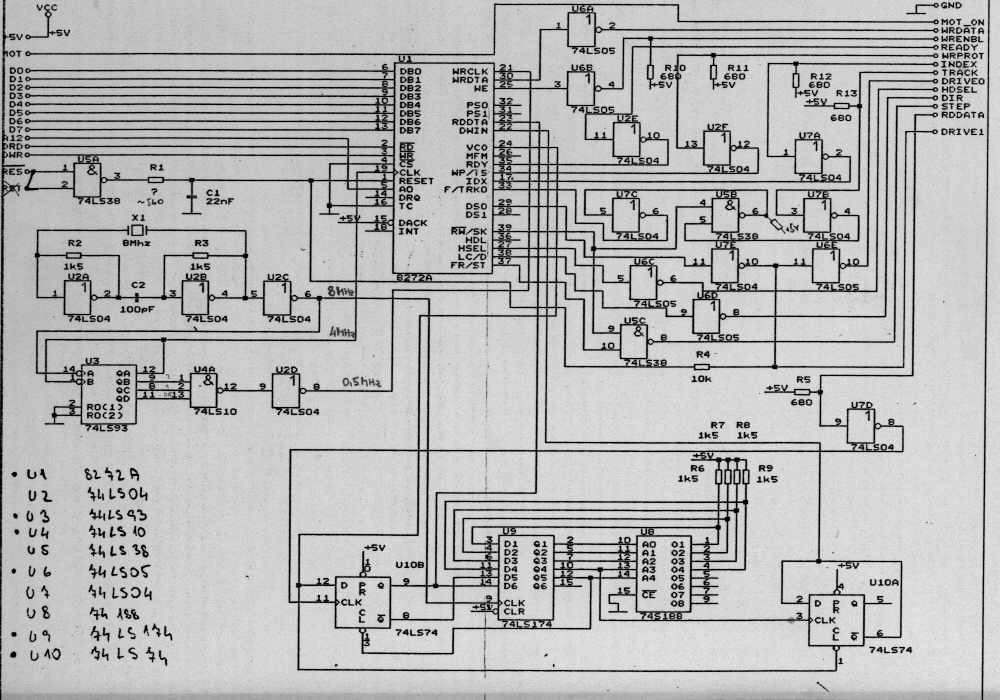
data separator and synchroniser works - I have a circuit that outputs a pulse
whenever the MFM 'magic sync sequence' (0x4489) is detected. In theory, I can
use that to sync the reader against sector boundaries on IBM-format discs, or
track boundaries on Amiga discs.
The data separator is an Verilog HDL reimplementation of the data separator
used in Petr Simandl's Sinclair Spectrum +2A floppy disc controller
(<http://www.simandl.cz/stranky/zxs/obrazky/zx_radic_89k.jpg>, but there's a
better quality schematic at <http://www.worldofspectrum.org/BackToThePlus3/>).
I'm driving the whole thing off a 32MHz TTL oscillator, divided down to 16MHz
for 3.5" DSHD, and 8MHz for 3.5" DSDD. I haven't tried FM encoded data yet,
though I have no reason to suspect it won't work, as long as I can figure out
what the clock divider needs to be set to.
I'm seriously miffed that I spent an afternoon trying to figure out why I
could get the separator to lock onto a DSDD disc but not a DSHD - seems most
of my DSHD discs are of marginal quality. The MPF920 in my desktop read them
fine, but the rather battered Panasonic JU-257A427P (complete with broken
drive door return spring) I was using with the FDR couldn't read them at all,
hence the huge number of SYNC pulses. Garbage in, garbage out.
I guess the next step is to do the RAM interface and bit timer, then the
MCU interface and firmware. The whole thing is currently squashed into a
Xilinx XC9572XL 3.3V CPLD, with a little room to spare for the acquisition
circuitry. The data-separator and sync detector are only using 29 of the 72
available logic macrocells, so I've probably got enough room for a 16-bit RAM
address latch, with space to spare. Can't really tell until I start
implementing it though.
Current power consumption is roughly 5V at 325mA while reading, according
to the display on my bench PSU.
For anyone who cares, I've thrown a couple of screenshots from my logic
analyser on my website:
Main blog entry:
<http://blog.philpem.me.uk/?p=129>
720k (250kbps) sync - with SYNC lagging by one DWIN transition:
<http://blog.philpem.me.uk/wp-content/uploads/2007/04/hpla-fdd-reader-syncin…>
1.44MB (500kbps) sync - revised sync logic - SYNC doesn't lag now:
<http://blog.philpem.me.uk/wp-content/uploads/2007/04/hpla-fdd-reader-syncin…>
If anyone wants to see the (messy) Verilog code I've got at the moment,
contact me off-list and I'll send you a copy. It's probably very badly
written, but it works.
The tool I used to grab the screenshots from the analyser (a HP 1651B) is
also due to go online 'at some point' (read: when I can be bothered to fix
some of the bugs)... It basically emulates a HP Thinkjet and converts the
graphics output into a .BMP file, which is then converted to a PNG with
Irfanview and PNGOUT.
If and when this project gets a bit further off the ground, I plan to set
up another mailing list to handle discussions related to the disc reader --
for now, though, I think it's probably best to keep the discussions on the
classiccmp list.
For anyone that cares, I'll be posting announcements on the 'floppy-reader'
mailing list on my server
(<http://mail.philpem.me.uk/mailman/listinfo/floppy-reader_philpem.me.uk>).
It's open-access, so anyone that feels like commenting is welcome to do so.
Thanks,
--
Phil. | (\_/) This is Bunny. Copy and paste Bunny
classiccmp at philpem.me.uk | (='.'=) into your signature to help him gain
http://www.philpem.me.uk/ | (")_(") world domination.
Hi folks,
does anyone have an extender card for the Honeywell H316 CPU boards?
My new H316R had that broken chip in the ASR interface and I replaced
it. But nothing works... So I will have to track down what's wrong with it.
I could use an extender card. That would help a lot.
If anyone has more than one, I would be very happy to get it.
And if someone has just one card, I would like to borrow it for some
time. I would pay all shipping costs, of course!
Thanks a lot,
Philipp
P.S.: What about the H316 posting above? I wrote some replies and a PM
to Tony Wardle - but nothing happened :-(
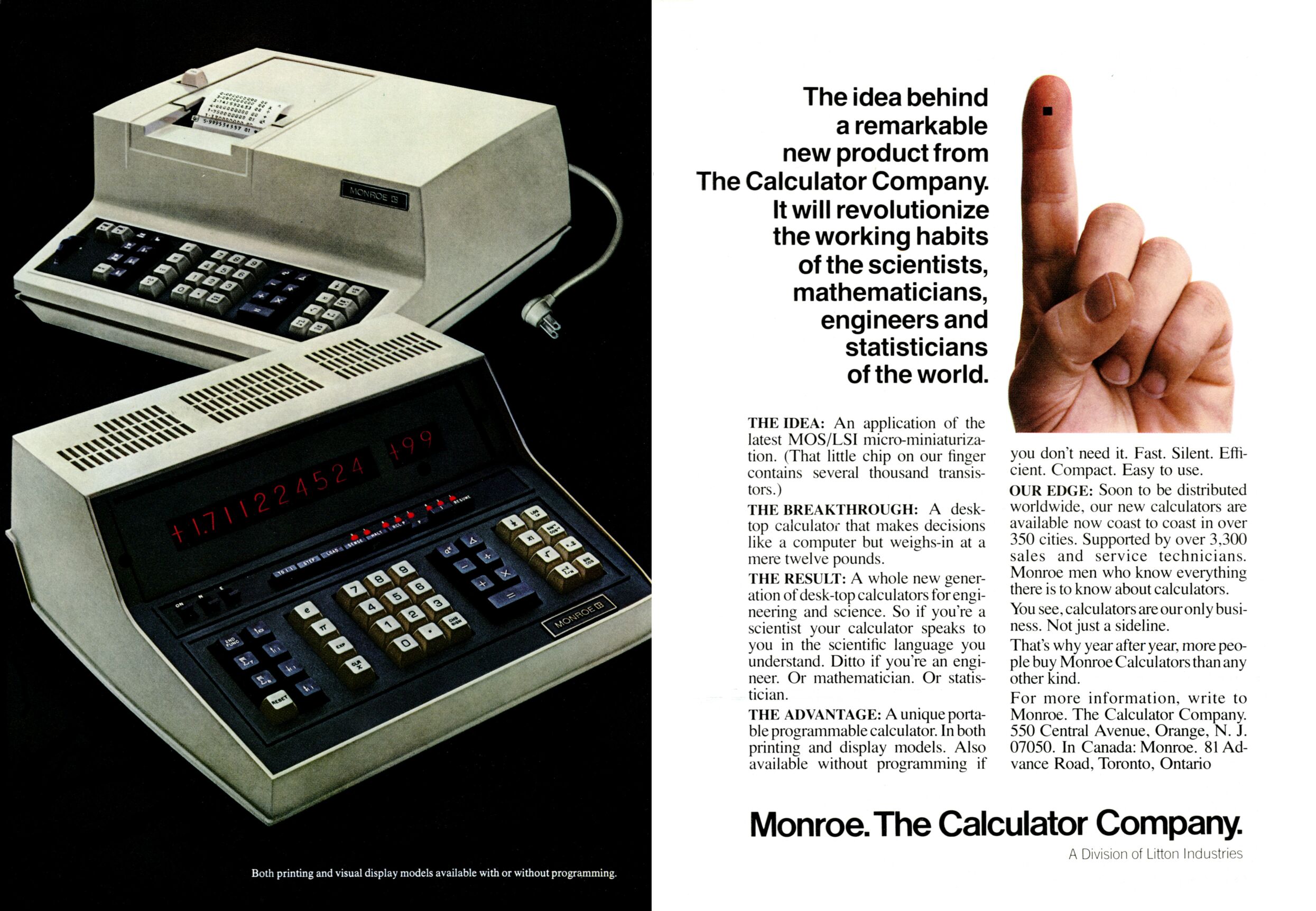
I have a desktop Monroe 1655 "calculator" that would also qualify then. I used it in 1971 at high school. It was built by Monroe.
http://www.dvq.com/ads/monroe_sa_6_70.jpg
I picked one up on eBay a few years ago complete with a card reader, cards, spare bulbs, etc (not shown in the picture).
The programming language had various conditional jumps, boolean functions, and would of course do all the math you wanted. The jumps probably let you "jump" to a specific program address. There wasn't much program space, but it was a great exposure for me back then.
best regards, Steve Thatcher
woodelf wrote:
> Patrick Finnegan wrote:
>
>> As I've learned before from this list, the only thing which that question
>> generates is a flamewar about what is a computer, and what's a "home
>> computer".
>
> I have yet to see a real HOME computer. Most game boxes I have seen
> - Coco, C-64 ect. where marketed as home computers but what do you need
> a home computer for?
To assist you in managing your household, or Course! A home computer would
be, I imagine, a computer installed somewhere in a closet or the basement,
and it'd have connections for thin clients all through the house. It'd
control your furnace, communications systems, lighting, heating, water
supply, you name it. You'd use it to determine at what level of ambient
light the room lighting switches on and at what times the curtains open
and close, or what temperature your bedroom needs to be a the time you
get up on workdays. It'd make sure your bath tub is filled at the right
time. and that your toast and coffee are ready in the kitchen when you
finish your bath, displaying your email on the kitchen's display while
you breakfast.
No, haven't seen many of them, yet. Only in a few proof-of-concept "home of
the future" type projects.
,xtG
tsooJ
> Does anyone on the list collect non-IBM S/360 or S/370 "clones"?
> there was a firm called Two-Pi that in the early 80's was successful
> enough to be purchased by Four Phase.
CHM has an Amdahl 470 and a Siemens 4004 (RCA Spectra).
There were lots of people who built byte-oriented machines with instruction
sets similar to the 360 and I know there are people who have Interdata, and
Univac 9x00 machines. Memorex built a 16 bit 360 like machine, and I have some
docs and software for that.
The artifacts of these sorts of machines haven't been preserved very well. Same
for Burroughs, Univac and NCR (business as opposed to scientific computers).
M H Stein wrote:
> ------------------Original Message:
>>So to be clear, I am agreeing with the position that one can have
>>Windows outside of a GUI (and that one can have a GUI that lacks
>>windows, such as a CAD program), but in the mind of the masses, GUIs
>>== windows.
>
> ------------------------------
>
> And of course the mouse is irrelevant to this tiresome argument as well,
> since it was quite commonly used in plain old text-mode single-tasking
> non-windowed DOS (which could of course also have windows, multi-task
> and display graphics, so I guess DOS WAS a GUI after all...)
>
> Sheesh!
>
> The OP said all we need to know with "I was going by the *popular* definition
> of GUI/Windowed environment, not the strict one."
That was me that said that, but I'm not the OP. I was assuming that this was
what the OP meant, though.
And I have come to accept, as I'm sure most of us have, that the nature of
this list's populace makes a higher-than-average level of nitpicking inevitable.
Oh well. I wouldn't change it for the world.
,xtG
tsooJ
Jules typed
> Cameron Kaiser wrote:
>>> I question Tog's "$50 million dollar study" just as much.
>>> That's a lot of lettuce.
>>
>> On the other hand, Apple doesn't exactly do cost-economical anything.
>
> Except mouse buttons :)
Apple's plenty happy to save money, it just never trickles down to the
end purchaser.
------------------Original Message:
>So to be clear, I am agreeing with the position that one can have
>Windows outside of a GUI (and that one can have a GUI that lacks
>windows, such as a CAD program), but in the mind of the masses, GUIs
>== windows.
>-ethan
------------------------------
And of course the mouse is irrelevant to this tiresome argument as well,
since it was quite commonly used in plain old text-mode single-tasking
non-windowed DOS (which could of course also have windows, multi-task
and display graphics, so I guess DOS WAS a GUI after all...)
Sheesh!
The OP said all we need to know with "I was going by the *popular* definition
of GUI/Windowed environment, not the strict one."
Speaking of CAD, I remember being blown away by an early demo of
AutoCAD running on an XT with two monitors; an MGA for the
commands, etc. and a CGA (or was it an EGA) for the drawing.
Of course there were $$$ boxes that could do this as well, but on
a lowly XT? I was impressed (didn't take much in those days).
m
Does anyone remember how to unlock a Macintosh OS 8 Harddrive?
I've got a Quadra 800 I'm working on but the harddrive is locked and
doesn't allow for read or writes.
(Aside from formatting)
Thanks
Rob
Robert Borsuk
irisworld at mac.com
--
(\__/)
(='.'=) This is Bunny. Copy and paste bunny into your
(")_(") signature to help him gain world domination.
Does anyone remember how to unlock a Macintosh OS 8 Harddrive?
I've got a Quadra 800 I'm working on but the harddrive is locked and
doesn't allow for read or writes.
(Aside from formatting)
Thanks
Rob
Robert Borsuk
irisworld at mac.com
--
(\__/)
(='.'=) This is Bunny. Copy and paste bunny into your
(")_(") signature to help him gain world domination.
>From: "Dave Dunfield" <dave06a at dunfield.com>
>
> >Thinking about it some more, the
> > loading of the head against the surface on both sides is almost
>certainly
> > critical, so this wouldn't work :(
>
>I've often wondered if one could make up a drive with less head pressure,
>possibly using some additional electronics to clean up the signal - I've
>had a few systems come in where people wanted the data recovered, and
>they've been suffering from the "circular rings of death". Never explored
>the idea further.
Hi
If you spin it fast enough, you could us a hard disk head. You might
need a way to keep it flat such as a porous surface with a vacuum.
Or maybe float it like the bernulli ( sp? ) drives did.
You couldn't run it that fast in the envelope.
Dwight
>
>Regarding Als idea of reading the disk backward - It would be a fairly
>simply matter to make up a version of ImageDisk which reads from the
>inside out.
>
>Dave
>
_________________________________________________________________
Mortgage refinance is Hot. *Terms. Get a 5.375%* fix rate. Check savings
https://www2.nextag.com/goto.jsp?product=100000035&url=%2fst.jsp&tm=y&searc…
Hi,
>> It will drive a 3.5" floppy as b:, wondering if it
>>can do it as the a: drive also.
>>
>
> No reason why not. The disk interface is pretty standard. It's
>the normal 34 pin conenctor, signals as you'd expect them....
I'm pretty certain I've seen more than one Einstein with the "A:" drive
replaced by a 3.5" unit (and definitely one with two 3.5" drives).
In fact, if I recall correctly, we had an Einstein in which the "A:" drive
had been replaced with a 3.5" unit (for compatability with Spectrum disc
units) at the software company I was working at in 1986; our "fearless
leader" (and yes that was meant to be sarcastic) used his Einstein to
cross-assemble code for the Spectrum.
TTFN - Pete.
>> This is an easy problem to solve. Resist the temptation to bundle
>> non-OS software with the OS.
>
>That doesn't really solve anything; all it does is shift the debates to
>the question of what counts as part of the OS.
>
>For exmaple, I consider a C compiler part of the OS. Others will
>doubtless disagree. Some would consider perl part of the OS; I don't.
For something like a C compiler, or, say, a web browser or a mail reader,
it's easy enough to leave that out and let the user install one if he
wants it.
But a developer can say, "if I put Perl in the base installation, then I
can write some of the package management tools, etc, in Perl". The same
argument also applies to regex libraries, etc, that the basic
system software can end up depending on. I'm not sure that there's anything
wrong with this thinking, it just happens to be a slippery slope that can
eventually leave you needing 4 terabytes to get to a shell prompt.
-- Adam
>
>Subject: Re: Dreaming of a lean installation method [was Re: *nix on"classic"systems]
> From: Sean Conner <spc at conman.org>
> Date: Thu, 12 Apr 2007 16:26:58 -0400
> To: "General Discussion: On-Topic and Off-Topic Posts" <cctalk at classiccmp.org>
>
>It was thus said that the Great Angel Martin Alganza once stated:
>>
>> Here it's when it (finally) comes my idea... I've been trying to get
>> some modern Unix variant on my 486 notebook (no CD, PCMCIA NIC) for
>> quite some time now hithout enough (to my likings) success. It's got
>> 16MB RAM, but, for some reason, it recognises only 12. And, of course,
>> 12MB is not enough to run any modern installer. I've ended up running a
>> Linux distribution called Small Linux on it, but again, it's an old,
>> poorly maintained distribution running an old Linux kernel.
My first stab at a server was using a 486DX/66 with 16mb though it did have a
NIC. the distro I used was slackware V2 something. It fit in 120mb with
space to spare and ran decently.
I also had it on a 486slc/25 with 8mb but a 360mb disk with only the usual
difficulties (less than steller installers back then).
What made the task resonable for both was CDrom drive. I did it once with
floppies (75 of them!!!) and that was painful.
Since I stopped messing with linux at caldara OpenlinuxV2.3 version level
I can't say what the latest distros are like but those older ones fit an
amazingly small machines if you took the custom path and didn't install
more than the needed packages. I got tired of all the versions and the ever
expanding size of the system required to just (barely) run it.
Allison
>
> You could do what I did to install Linux on a 4MB RAM 120M harddrive
>laptop computer---find a Linux distro that will boot (I used Tom's Root Boot
>disk and even then it barely ran). The steps I ran through went something
>like this:
>
> On the target computer, I could run a shell, fdisk, mkfs and dd.
> That was enough to get started.
>
> Run fdisk. On the machine I was working on, two partitions: 112M
> and 8M. Format the 8M as a filesystem and mount it.
>
> On a full Linux system, get some needed tools like tar, dd to a
> floppy. Move to target system, and dd tar off to 8M partition. So
> likewise with some other tools.
>
> On full system, I created a 112M file, and mounted it. Formatted
> it, and put kernel, init, and a small /bin. unmount it. tar
> the file and dd to floppy.
>
> On target tar xzcf /dev/fd0 | dd of=/dev/hda1
>
> reboot target. Once rebooted, reformat 8M for swap and enable it.
>
> Keep using the floppy to get stuff over.
>
> Took a few hours, but I got it done.
>
> -spc (Wasn't the hardest install I did though ... )
I was looking for something else and ran across a two-binder set of
something called "PC-MOS" by The Software Link, circa 1992. I opened
the shrinkwrap on the nstallation manual and the thing looks like
it's a multi-user version of MS-DOS, talking to terminals. I
appear to have a 5 user version.
Anyone familiar with this animal? The version is 4.2.
Cheers,
Chuck
In previous messages, Josh Dersch <derschjo at msu.edu> said:
> Hi all --
>
> Recently picked up a TRS-80 "Eight Meg Disk System" (model 26-4151) and
> the associated interface board, with the intent of hooking this up to my
> TRS-80 Model 16.
> On further investigation, it appears that the 26-4151 is a Secondary
> drive, which makes me curious as to whether this effort is going to be
> ultimately fruitless. So, without further ado, here's the questions I have:
>
> 1. Is it possible to get this secondary drive working as a primary, or
> am I up a creek without having a primary drive (or extra magic hardware
> in the drive I have.)
> 2. If I can work around #1, I need to know the pinouts of the drive and
> the controller board since I do not have a cable to connect the two.
> The controller has a 50-pin edge connector and the drive has three
> connectors -- 2 50-pin (labeled "Control") and one 20-pin (labeled "Data").
> a. And as a follow on to #2, where would you suggest getting the
> parts and tools necessary to build the aforementioned cable? I've never
> constructed such a cable, and I'll have need to do so again in the
> future (need to assemble some long-ish ESDI cables for my PDP 11/73...)
>
> Thanks for any suggestions,
> Josh
Josh...
The "secondary" drive is an 8 inch hard drive. It is VERY similar to the 5.25
MFM drives we have all used on various machines, but there are a couple of
differences:
1) The 'control' connector is 50 pins, not 34. This is the 'common' connector
that is connected to every drive.
2) The 'data' connector (both are 20 pins) uses positive and negative voltages
(a 10 volt swing) for the differential data. Some drives even decode the clock
>from the data stream, or use the clock to generate the data stream used on the
drive.
3) The 8 inch drives use +24 volts, +5 volts, and -5 volts, and some drives
use line voltage (120v/220v, etc.) for the motor drive.
4) The rotational speed of the disk is 3000 RPM, whereas the 5.25 drive is
3600 rpm. This means that the data rate for MFM is lower for the 8 inch drive
(usually the crystal is 8.666 MHz, not 10 MHz for the same rotational bit
density).
That being the case, adapters can be made, if you can re-clock the drive
controller.
Now back to the TRS-80 problem at hand. The box you have is just a container
for the drive proper. I doubt that much more is inside the box than the drive
and a power supply. The controller is in the "primary" drive box, and is
similar in function to a PC's controller at the register level (both were
designed by Western Digital). I don't remember if the TRS-80 used 256 byte
sectors, or 512 (what the PC uses) byte sectors. It needed an interface board
that plugged in the backplane of the Model 16.
I built up a "primary" disk box myself using the controller that works with the
5.25 inch drives, using my own 5.25 inch drives. The controller was limited to
no more than 8 heads due to the way it was designed (they hadn't made XT2190's
yet!). It worked OK. Later on in the Model 16/6000 time span, they built up a
single board that plugged into the backplane of the TRS-80 Model 16 (6000) that
was the full controller. By that time the only drives being produced were 5.25
inch ones, so that conformed to that interface (34 Pin control, 20 Pin data).
It is interesting to note that the drives used by Radio Shack had another
"feature" in that they connected a "drive selected" line on the Data connector.
This was used so that they didn't need to worry about where they were plugged
in. If the connector was "selected" (had the true signal), it had the data.
If you get a controller this may need to be taken into account.
Other than that, you have a "nice box". Good luck.
--
Tom Watson
tsw at johana.com
____________________________________________________________________________________
Finding fabulous fares is fun.
Let Yahoo! FareChase search your favorite travel sites to find flight and hotel bargains.
http://farechase.yahoo.com/promo-generic-14795097
Since we're still pontificating:
There's another aspect of the pros & cons of GUIs that I find particularly
frustrating: trying to write instruction manuals or doing phone support when
you have no idea or control over what the user's desktop looks like, which
menu bars, buttons, shortcuts etc. are enabled or disabled, where they are, etc.
Give me a "Press Control and Home; now Control, shift and end; now
Control and C" over a "Do you have a menu bar on the top of the window
you're in? The one that has the word EDIT in it? yes? Good; click on the
word edit and then click on the word select. Did the window change
colour? Good; now click on that word edit again, and this time click on
the word copy..." any day...
Particularly relevant right now since I just got off the phone after spending
about 5 minutes walking a user through a problem with a fairly complex
150+ module menu-driven DOS program and then more than an hour taking
them through a fairly simple routine Excel spreadsheet operation.
m
Hello all,
I have a Kaypro 10 that works pretty good. The hard drive is a Seagate ST212 10meg that is getting very noisy and gives read errors now and then. I have been playing with the Advent TurboROM and KayPLUS rom upgrades with no luck. All testing that I have done with both roms has been with the original ST212, an ST251, an ST277 and a Mitsubishi MR535, all with the same bad results. I have verified the eproms many times so they match the images that I've downloaded from the net. I got the KayPLUS rom from here: http://www.microcodeconsulting.com/z80/kayplus.htm and I've gotten the turbo rom from 3 sources that all match what you see here: ftp://ftp.mrynet.com/pub/os/Kaypro/Private-Images/TROM34/
When I use the KayPLUS rom with the prescribed boot disk etc. as per instructions, the machine boots but doesn't seem to see the hard drive. The led on the hd never even blinks. If I run HDCNFG.COM to setup the hard drive, the machine hangs. Another person has verified this also. So my first question is: Has anyone gotten this rom to work?
When I put the TurboROM in, I get some very different results. The screen has the initial Turbo welcome screen and the machine hangs there. The led on the hard drive is always on. The floppy never tries to boot. If I disconnect the data & signal cables from the hard drive, it boots from the floppy after 25 seconds just like the manual says. If I disconnect the 49 pin cable from J9 (the hard drive connector) on the motherboard, the machine boots almost instantly. It seems to be looking at the hd but doesn't like what it sees. Other people have said that this copy of the rom works. So my second question is: Has anyone else run into this problem or what can be done to fix this?
Her's a link to some pictures of the mess.
http://home.comcast.net/~redodd/turbo.zip
Thanks a lot.
Ralph
Jim Battle wrote:
>Are you sure about that? Nick Tredennick, the architect (or maybe co
>architect) of the 68000 left Motorola, went to work for IBM, and was the
>architect of the "micro 370". The design and its evolution were
>described in a book Tredennick wrote, Microprocessor Logic Design: The
>Flowchart Method.
The source for my information is the IBM Systems Journal, Vol 23, No 3 from 1984.
>From page 245:
"After studying several types of microprocessors to identify one architecturally suitable as a base for System/370, IBM selected the Motorola MC68000 microprocessor and began working with Motorola engineers to develop a customized microprocessor. At IBM's site in Endicott, New York, a group in the engineering organization wrote the internal microcode which allowed the device to directly execute a large subset of the commercial System/370 instructions."
Later in the article, they just call it the "custom" processor.
It sounds like the same part could be an MC68000 or the S/370 depending on microcode load; when they say 'the device,' I believe they are referring to the aforementioned MC68000.
Thanks,
Mike
I've noticed that 68kmla.net has been down for quite a while now and still
is. Does anyone know what happened? Will it be coming back? I certainly hope
it's not going to disappear... :-(
You (and your family) would be in trouble (if not in
danger) every time it froze or crashed. What about in
a power cut - batteries dont last forever? Would most
retro computers be able to do such a job? ( trying to
get this back on topic) - Andrew B (via mobile phone)
--- cctalk-bounces at classiccmp.org <jvdg at sparcpark.net>
wrote:
> woodelf wrote:
>
> > Patrick Finnegan wrote:
> >
> >> As I've learned before from this list, the only
thing which that question
> >> generates is a flamewar about what is a computer,
and what's a "home
> >> computer".
> >
> > I have yet to see a real HOME computer. Most game
boxes I have seen
> > - Coco, C-64 ect. where marketed as home computers
but what do you need
> > a home computer for?
>
> To assist you in managing your household, or Course!
A home computer would
> be, I imagine, a computer installed somewhere in a
closet or the basement,
> and it'd have connections for thin clients all
through the house. It'd
> control your furnace, communications systems,
lighting, heating, water
> supply, you name it. You'd use it to determine at
what level of ambient
> light the room lighting switches on and at what
times the curtains open
> and close, or what temperature your bedroom needs to
be a the time you
> get up on workdays. It'd make sure your bath tub is
filled at the right
> time. and that your toast and coffee are ready in
the kitchen when you
> finish your bath, displaying your email on the
kitchen's display while
> you breakfast.
>
> No, haven't seen many of them, yet. Only in a few
proof-of-concept "home of
> the future" type projects.
>
> ,xtG
> tsooJ
>
>
> I was looking for something else and ran across a two-binder
> set of something called "PC-MOS" by The Software Link, circa
> 1992. I opened the shrinkwrap on the nstallation manual and
> the thing looks like
> it's a multi-user version of MS-DOS, talking to terminals. I
> appear to have a 5 user version.
>
> Anyone familiar with this animal? The version is 4.2.
I remember this!
It was a multi user MS-DOS. It supported a number of 8 port serial cards
of the same generation (Starcomm or something like that). You'd attach
terminals to the serial board and run software that was written to run
under PC-MOS. Medical office software was what I mostly saw on these
systems.
At 11:41 AM 4/12/2007, Ethan Dicks wrote:
>Hmm... sounds like what the Amiga did out of the box with a "newcli
><AUX:" I used to hang a VT220 off of my Amiga and read e-mail and
>NetNews (aquired via UUCP and read off-line) while my flatmate played
>"Silent Service".
I seem to remember doing it in both directions between PC and Amiga,
with Pro-YAM delivering a good command line over the serial port.
On the Amiga side, wasn't there a better alternative than 'newcli'?
I also remember having either the PC or the Amiga answer the modem,
then let me into the command line on either machine when I was
on the road. When I was debugging PC programs, I'd use a debugging
printf() that spit out the serial port, which I'd watch on the
adjacent Amiga screen.
- John
> I have heard of a lot of m68k variants (including XC-series parts),
> but I've never heard of an MC68000R
PGA package. Not commonly used on the 68000.
The version I worked with for a client was circa late 1980's. Basically it was
software that would support multi-tasking on one CPU. It was installed on an
original IBM 6 MHz AT and was fairly slow but did save the expense of another
computer by using a terminal instead. They also sold some hardware that was
basically a four-port serial card/connectors for attaching to the terminals thus
allowing multiple operations. As I said, the whole things was fairly slow then,
but worked well for something like word processing.
> I was looking for something else and ran across a two-binder set of
> something called "PC-MOS" by The Software Link, circa 1992. I opened
> the shrinkwrap on the nstallation manual and the thing looks like
> it's a multi-user version of MS-DOS, talking to terminals. I
> appear to have a 5 user version.
>
> Anyone familiar with this animal? The version is 4.2.
>
> Cheers,
> Chuck
Jim Battle <frustum at pacbell.net> wrote:
> Mike, your web page says:
>
> "The System/370 processor is implemented in three microprocessors --
> two Motorola 68000 processors and a custom 8087."
>
> Are you sure about that? Nick Tredennick, the architect (or maybe co
> architect) of the 68000 left Motorola, went to work for IBM, and was the
> architect of the "micro 370". [...]
>
> I know nothing of the machine you have there, but I suspect it is really
> using redundant copies of the micro 370 described in the book. [...]
This quote from the article "System/370 capability in a desktop Computer"
(IBM System Journal Vol 23, No 2, 1984), may help resolve this issue:
As previously mentioned, three microprocessors are used to implement
System/370 processing functions. A custom-developed System/370
Subset microprocessor performs most of the System/370 commercial
instructions. Floating point, including extended precision, instructions
are executed by a custom developed Floating point microprocessor
which works in close conjuction with the System/370 Subset processor.
The remaining instructions are emulated by an MC68000R microprocessor
which also performs other tasks such as exception handling.
Having said that, I also remember reading somewhere about the 68000
with modified microcode somewhere (maybe Byte magazine?)
**vp
Andrew Burton wrote:
> You (and your family) would be in trouble (if not in
> danger) every time it froze or crashed. What about in
> a power cut - batteries dont last forever?
Manual override. A bit of a nuisance that your tub isn't filled and the tea isn't ready, but we're getting by, now, so why wouldn't we get by then?
> Would most retro computers be able to do such a job?
> (trying to get this back on topic)
I would think so. Thermostats and phone systems are embedded computer systems, have been for ages. So are dedicated routers. No huge amounts of processing power necessary.
,xtG
tsooJ
> Does a TU56 normally have rack-mount rails? I have two TU56 drives and
> neither of them have rails. How are these typically mounted?
>
Like others have said with the normal rail screws. To make it easy
to get in and out I got some angle iron from the hardware store and
bolted it between the front and back rails below the drive so I could
slide the drive in then put a couple of screws in. Most items that
will be below it are narrow enough that they will clear the angle iron.
Not correct but since I was taking it for display that made the disassembly
and reassembly much easier.
Der Mouse wrote:
>> A windowed environment is a GUI, yes?
>
> Not necessarily. NetBSD - and presumably others - ships with
> window(1), which provides a text-mode windowing environment. Nothing
> graphical about it any more than any text "terminal" necessarily is.
Fair enough.
>> What's meant here is that the Chris M has a point: you *do* cheat
>> yourself of some functionality when using a non-windowed environment
>> "these days".
>
> I'm not sure "cheat" is really an appropriate word, but yes, you lose
> some functionality when you drop windowing.
Just going with the way things were phrased in the original post.
> Sometimes that functionality is irrelevant, or worth losing to get some
> other benefit. Sometimes it's not.
Exactly my point.
>> However, you also cheat yourself of functionality exactly by using a
>> windows environment. There are things that are much more efficient
>> if you don't have to wrestle the point-and-click interface.
>
> Windowing environments don't necessarily mean point-and-click. In my
> own X-based environment, for example, I can work productively for hours
> - and not just all in the same window, either - without touching the
> mouse. As you yourself said,
>
>> Look at *real* power users, even on windowed systems. They hardly
>> touch the mouse.
>
> It's not GUI environments that lose the functionality you're talking
> about; it's about a particular subclass of GUI environments that are
> designed - misdesigned, arguably - so as to compel their users to
> switch between keyboard and mouse comparatively frequently (on a
> timescale of seconds to minutes).
As I assumed was meant by the OP.
>> It's all keyboard shortcuts, and it's *way* faster. The downside is
>> having to master all those cryptic gestures and key combinations.
>
> Sounds to me as though you're talking about primarily point-and-click
> windowing environments with keyboard "shortcuts" grafted on, rather
> than environments designed from the ground up to be keyboard-driven.
> (That one particularly dominant windowing environment is an especially
> egregious example of this doesn't help....)
Yes, I was going by the *popular* definition of GUI/Windowed environment, not the strict one.
,xtG
tsooJ
>
>Subject: Re: ST506 WTB:Micropolis 1325
> From: "Steven N. Hirsch" <shirsch at adelphia.net>
> Date: Sat, 07 Apr 2007 08:42:34 -0400 (EDT)
> To: "General Discussion: On-Topic Posts Only" <cctech at classiccmp.org>
>
>On Thu, 5 Apr 2007, Sridhar Ayengar wrote:
>
>> John Kourafas wrote:
>>> Also looking for a Micropolis 1325 MFM Drive, 71/80MB , I've seen both the
>>> ST506 and Mic. 1325 on eBay for like 600.00 which I think is crazy...
>>
>> What's the largest capacity 3.5" MFM HDD available?
>
>I have an extensive collection of MFM/RLL drives and have _never_ run
>across one with that interface in a 3.5" form-factor. Not sure that
>anything of this sort existed. 5.25" 1/2-ht. was about as sophisticated
>as they got.
I have several miniscribe 20mb in all flavors of interface st412, SCSI
and IDE. I have some really old 3.5" WD 10mb. to name a few.
They show up around the beginning of the IDE era but by time IDE hit 40mb
they seemed to have disappeared.
Allison