That's most kind of you.
I do go up to Coventry and Birmingham from time to time.
So could collect.
Rod
-----Original Message-----
From: cctech-bounces at classiccmp.org
[mailto:cctech-bounces at classiccmp.org] On Behalf Of Dave Caroline
Sent: 26 April 2007 11:04
To: General Discussion: On-Topic and Off-Topic Posts
Subject: Re: VAX 4000-200 and DECserver terminal server.
I have some stuff stored in the protacabin outside will check later
today or tommorow, in the east midlands free for collection
Dave Caroline
On 4/25/07, Rod Smallwood <RodSmallwood at mail.ediconsulting.co.uk> wrote:
> Hi
> A while back I aquired a VAX4000-200 (made circa 1990) via the DEC
> 'Old boy' network.
> Some list members were kind enough to help me get the system password
> reset.
> It booted, ran and the icing on the cake was it was loaded with VMS
> 6.2 and TCPWARE.
> That made it compatible with current networks.
> A BNC cable and cheap hub got me to 10baseT and with it a connection
> to my office network.
>
> Recently I was given a pile of terminals and printers. I managed to
> salvage two VT420's one HP700 and two LA75 Printers.
> That brought my system up to three VT420's and an LA75 + Spares.
>
> As some of you will know I worked for DEC for 10 Years +. The
> system I'm building up represents my idea of the 'Golden Age' of DEC
> (1980-1990)
>
> I want to use all DEC kit therefore the HP 700 is surplus. What I need
> is a DECServer with four or more DECconnect or RS232 ports on it.
> Most of them are BNC 50Ohm thin ethernet or AUI in and DECconnect or
> 25Way D out. They look a bit like a hub with a BNC connector in a
> depression in the top.
>
> Rod Smallwood
>
>
>
>
Date: Tue, 24 Apr 2007 17:25:44 -0400
From: Allison <ajp166 at bellatlantic.net>
Subject: Re: Hand-rolling a CP/M machine
<snip>
>>> 8085 (Also makes for simple systems)
>>
>>Those are somewhat common if you hang around DEC equipment.
>As I am.
<snip>
>Allison
------------
Oh no, Allison, you're not common at all ;-) Quite unique, in fact.
m
On 4/26/07, Jules Richardson <julesrichardsonuk at yahoo.co.uk> wrote:
> Ethan Dicks wrote:
> >> It does have a SCSI connector within the A590 I think, but I'm
> >> not sure how picky it is about what drives it'll work with.
> >
> > Not very picky.
>
> Ok... so it doesn't need a SCSI drive that's happy with being low level
> formatted to something other than a 512 byte sector size, for instance?
Nope. You do want 512 bytes per sector. Bog standard. I've attached
everything from 20MB up to 4GB drives onto my Amigas from the A1000 up
through my A4000, and the only time things were ever fiddly was with
pre-capacity-reporting drives or non-SCSI controllers like the A2090.
If you have something as modern as an A590 and any embedded SCSI
drive, it should work as described in the A590 docs. There's probably
a copy of the A590 prep disk running around. I think you might need
that for Kickstart/AmigaDOS 1.3, but by 2.0, ISTR, the OS knew about
the A590/A2091 from the get-go. If you happen to have a Kickstart 1.2
ROM in your A500, you won't be able to autoboot the hard disk, but you
will be able to access it after booting with a boot floppy.
> I think many of them are still in service which is why they haven't turned up
> used - plus there's more paranoia these days about data security, so I wonder
> if more are going to the shredders without being recycled as working units.
Perhaps. They could also be left running until they die. We were
losing an average of one Seagate 72GB UltraSCSI drive per month at the
Pole. All of the 9GB drives through 146GB drives failed at a combined
rate of less than one every two months, except for the 73GB drives.
It wasn't just that we had more 73GB drives than any anything else -
on a per-unit basis, the failure rate was dramatically higher in the
same environment.
They won't be of much use in your Amiga anyway. ;-)
-ethan
With all of this recent 8-bit and CP/M talk, it's prompted me to do a
little digging on what it would take to put together a CP/'M machine
on my own. I already have a couple of commercially-produced boxes.
This is about taking a Z-80, some RAM, some ROM and a storage unit and
making it run CP/M.
I've been reading the various threads, so I have a general idea of
what has to happen, but I'm still fuzzy on a few specifics, no doubt
due to my lack of deep experience with the Z-80.
The point of ROM vs RAM at $0000 has been gone over a few times. Do
"standard" CP/M machines use a shadow-ROM technique, or what, to
cold-start? We used to use a trick with the 68000 that would map ROM
at $000000, _and_ at some higher address, with the first few
instructions jumping to the higher ROM image, , and either an I/O pin
that toggled the address mapping for the lower ROM image, or just
watching for the first pulse from A23, such that the act of jumping up
to the higher ROM address itself would remove ROM from the bottom of
the memory map, revealing RAM.
How did CP/M systems handle 64K of RAM? Was there one primary way it
was done, or did every hardware vendor do it differently? I should
probably just confine my efforts to 48K of RAM and use the upper 16K
for a boot ROM, but if it's easy to support 64K of RAM, why not?
To confirm, the minimal I/O system is some flavor of serial interface
for console I/O (presumably piped to a display smart enough to handle
ANSI codes), and some form of block-addressable storage with a CP/M
filesystem, right? (I'm ignoring handy I/O like parallel printer
ports and 8255-type GPIO and the like, for the moment) Is it required
that the storage unit be writable? Is there a minimum size for the
display? That wouldn't matter for hanging a VT100-equivalent off of
the console port, but if I were to use some flavor of textual LCD, it
would very much matter. To find another way to ask, would the body of
extant CP/M apps freak out if you try to run them on a display that's
under 40 chars wide or under 24 chars tall? Do they expect 64 chars
wide or 80 chars wide? I don't think the OS itself actually cares how
wide or tall the display is, but perhaps some of the CUSPs, like DIR,
might.
Rather than taking a bare Z80, wiring on a Z8530, an SRAM or two and
an EPROM, I was contemplating beefing up my 1976 SDS Z-80 Starter Kit
to the point where it could run CP/M. I've written about it here
before, when I first got it, to remind those that don't know or don't
remember what it is, it has a ~2MHz Z80, 1K of 21L02 SRAM, room for
one more K, one 2716 with "ZBUG", two empty 2716 sockets (one attached
to an EPROM programming circuit), a keypad and 7-segment LEDs, a
largish wire-wrap area, and two S-100 slots. Presuming I wire the
SRAM, a larger-capacity EPROM, and some serial device into the
wire-wrap area, is there anything I should look for in an S-100 card
that would be interesting to install? A video card (rather than a
serial console), perhaps? I think I have one or two S-100 video
cards, but I was never clear on how one attaches a keyboard to that
rig - is there an ASCII keyboard port typically provided on an S-100
video card, or is that a separate peripheral?
Thanks for any and all answers to my noobish CP/M questions,
-ethan
On 4/26/07, Jules Richardson <julesrichardsonuk at yahoo.co.uk> wrote:
> Hmm, I think that's what's in my Amiga A590 enclosure. It's certainly not
> SCSI, but I'm sure the connector's not proper IDE either.
The A590 (and A2091 ZorroII card) support SCSI on the 50-pin
connector, and XT IDE (only) on the 40 pin connector. The 40-pin
connector is unpopulated on the A2091, but it's the same controller
chip on both, and has the same features in both.
I've used it with a WD 40 MB XT IDE drive from a Commodore x86 PC. It works.
> > And they were bl**dy unreliable too! :-(
>
> That worries me about the Amiga one. It does have a SCSI connector within the
> A590 I think, but I'm not sure how picky it is about what drives it'll work with.
Not very picky. You'll find that with the Kickstart version in your
machine, you are limited to 4GB or less for drive size, but other than
that, as long the drive answers the packet for drive capacity (ACB4000
MFM bridge wouldn't answer, for example, but every embedded SCSI drive
I know of will), the AmigaDOS drivers will be happy.
> [1] I don't buy new stuff, not for PCs - not when the price drops so much for
> "previous generation". Unfortunately SCSI drives of 36GB and up don't seem to
> be readily available.
I got a few in 2003, cheap, but I'm not seeing server drives as
abundantly as I used to. The ones behind me are loaded with "SAS"
(Serial-attached-SCSI, AFAIK), so perhaps the days of SCA-connector
UltraWIDE SCSI drives are waning at last.
-ethan
Hi
A while back I aquired a VAX4000-200 (made circa 1990) via the DEC
'Old boy' network.
Some list members were kind enough to help me get the system password
reset.
It booted, ran and the icing on the cake was it was loaded with VMS 6.2
and TCPWARE.
That made it compatible with current networks.
A BNC cable and cheap hub got me to 10baseT and with it a connection to
my office network.
Recently I was given a pile of terminals and printers. I managed to
salvage two VT420's one HP700 and two LA75 Printers.
That brought my system up to three VT420's and an LA75 + Spares.
As some of you will know I worked for DEC for 10 Years +. The system
I'm building up represents my idea of the 'Golden Age' of DEC
(1980-1990)
I want to use all DEC kit therefore the HP 700 is surplus. What I need
is a DECServer with four or more DECconnect or RS232 ports on it.
Most of them are BNC 50Ohm thin ethernet or AUI in and DECconnect or
25Way D out. They look a bit like a hub with a BNC connector in a
depression in the top.
Rod Smallwood
Hi,
> Repair was usually a new floppy, new FDC and new sound chip. Why
>the sound chip? Well... no, someone else can tell it.
I dimly recall that Atari used one or two signals from the I/O port on the
sound chip as part of the disc interface - drive/side select?
TTFN - Pete.
All:
In my research on this Hawthorne SBC I got (I contributed the disk
images to Dave?s efforts), I discovered that it was covered in various forms
in The Computer Journal (TCJ). I have many issues in the series but not all.
So, I was wondering if anyone had the complete series and whether it was
worth scanning and posting.
Rich
--
Rich Cini
Collector of Classic Computers
Build Master and lead engineer, Altair32 Emulator
http://www.altair32.comhttp://highgate.comm.sfu.ca/~rcini/classiccmp
> I'm assuming that a couple of hours of heating the base plate to
> about 130F (about 55C) will do as much good as anything will.
There was a posting in the HP tape thread about using a lamp to heat
the tensioning belt here within the past six months. Can't find it
right now, though.
I've observed the same thing with blue-labeled DC300s and 450s
>
>Subject: Re: Hand-rolling a CP/M machine
> From: "Ethan Dicks" <ethan.dicks at gmail.com>
> Date: Wed, 25 Apr 2007 14:40:08 -0400
> To: "General Discussion: On-Topic and Off-Topic Posts" <cctalk at classiccmp.org>
>
>On 4/25/07, woodelf <bfranchuk at jetnet.ab.ca> wrote:
>> >> You can copy the screen logic for TRS80 as that is a basic 64x16 as well.
>> > Good thing to keep in mind.
>>
>> Well if anybody is doing VDM-1's the big problem is that you can't find
>> the Character ROM any more. I like the idea of TTL display like VDM-1
>> but since this is not the late 70's a 80x24 screen is reasonable
>> and the data out is a simple VGA format, since the monitors are easy to
>> come by.
>
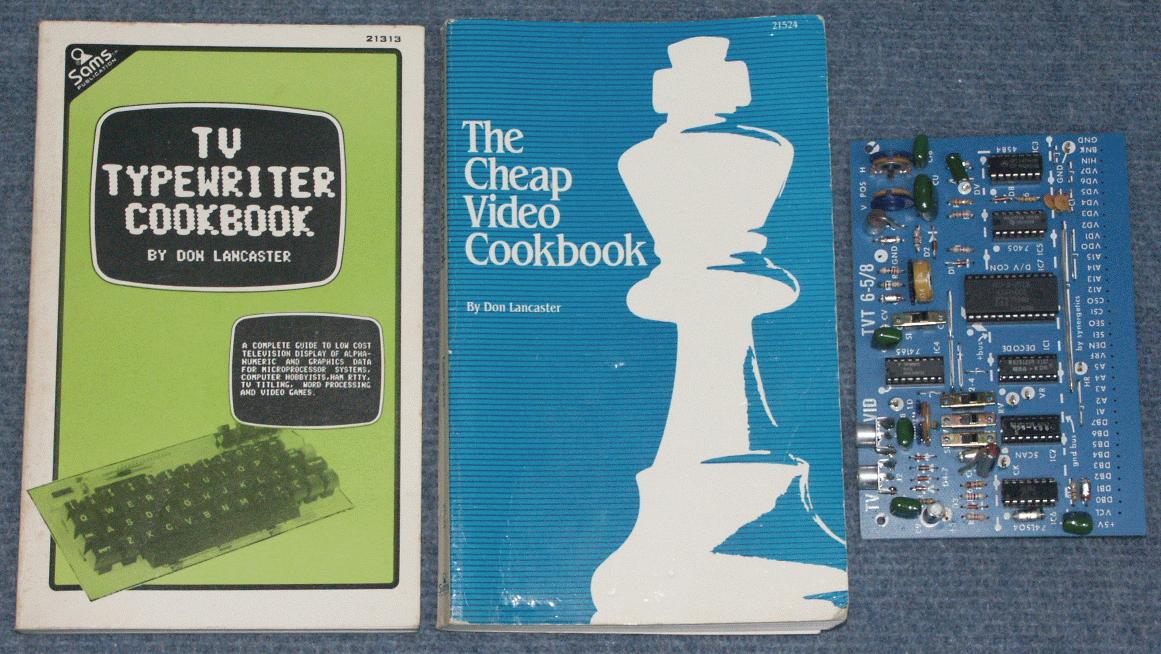
>As in the old Chargen ROMs like on this board?
>
>http://www.classiccmp.org/dunfield/d/h/tvt.jpg
>
>(I have one that I bought new and has yet to be attached to a KIM-1).
>
>With as fast as CMOS ROMs are today, why not use a 27C64 and burn your
>own charset to it? It's not tough to do, but is there a technical
>reason it wouldn't work?
It works very well and it's easy to find a pattern like 2513 (5x7) or
a 6674 (7x9) and burn an Eprom. Compared to the parts of that day
even 2716 is both big enough and plenty fast. I like to use 27C64s
as I have a bunch of pulls and it's no big deal building up a pattern
as a copy or custom.
FYI: to do it by hand all one needs is a sheet or a few of grid paper
and a #2 graphite thingie. The order you enter the data is row for
the low address lines (usualy 4 address lines) and the high address
lines are the ascii value (0-127) that corosponds with the char.
Allison
>
>Subject: Re: Hand-rolling a CP/M machine
> From: "Chuck Guzis" <cclist at sydex.com>
> Date: Wed, 25 Apr 2007 11:49:49 -0700
> To: "General Discussion: On-Topic and Off-Topic Posts" <cctalk at classiccmp.org>
>
>On 25 Apr 2007 at 13:24, woodelf wrote:
>
>> Well if anybody is doing VDM-1's the big problem is that you can't find
>> the Character ROM any more. I like the idea of TTL display like VDM-1
>> but since this is not the late 70's a 80x24 screen is reasonable
>> and the data out is a simple VGA format, since the monitors are easy to
>> come by.
>
>At the expense of getting booed off the topic, if you need simple
>80x24 and are using something like an 8085, the 8275/8276 CRT
>controller with an 8257 DMA controller (in auto-initialize mode)
>doesn't take a lot of extra glue. The gotcha is that "special
>effects" like bolding and underlining take up space on the display
>(Doesn't the Wyse 50 do that?). There is a "transparent" mode, but
>management of the screen buffer becomes a real headache. I've never
>tried to interface an 8257 to a Z80, so I don't know if the timing
>works there.
Perfectly reasonable, though at first it was a simple system.
The Z80 and 8257 (or 8237) coexist fairly well. There are some signal
differences for the glue TTL but it works. Back in the day it was also
popular to do that becase 8257 was cheaper and faster then Z80 DMA and
didn't have to be clocked synchronous like the Z80 DMA.
Allison
See below. Please reply to Jamie direckly.
--
Sellam Ismail Vintage Computer Festival
------------------------------------------------------------------------------
International Man of Intrigue and Danger http://www.vintage.org
[ Old computing resources for business || Buy/Sell/Trade Vintage Computers ]
[ and academia at www.VintageTech.com || at http://marketplace.vintage.org ]
---------- Forwarded message ----------
Date: Tue, 24 Apr 2007 15:04:51 -0500
From: "Malernee, Jamie" <JMalernee at sun-sentinel.com>
To: vcf at vintage.org
Subject: florida members?
Hi,
I'm a writer with the South Florida Sun-Sentinel, working on an article
about local people who collect vintage computers as a hobby/passion. Do
you have any members in the Florida area, or more specifically the South
Florida area, who I might be able to contact for my article?
Many thanks,
Jamie Malernee
Staff Writer
South Florida Sun-Sentinel
(954) 356-4849
200 E. Las Olas Blvd.
Fort Lauderdale, FL 33301
----- Original Message -----
From: "Keys" <jrkeys at concentric.net>
To: "General Discussion: On-Topic and Off-Topic Posts"
<cctalk at classiccmp.org>
Sent: Wednesday, April 25, 2007 6:20 PM
Subject: Re: Reporter in south Florida wants to talk to computer collectorin
same
>
> ----- Original Message -----
> From: "Jay West" <jwest at classiccmp.org>
> To: "General Discussion: On-Topic and Off-Topic Posts"
> <cctalk at classiccmp.org>
> Sent: Wednesday, April 25, 2007 7:27 AM
> Subject: Re: Reporter in south Florida wants to talk to computer
> collectorin same
>
>
>> Sellam wrote....
>>> See below. Please reply to Jamie direckly.
>>
>> This is the same one that contacted me two days ago and that I posted to
>> the list yesterday. Looks like the same reporter contacted Sellam the day
>> after me. I wasn't going to post her phone number to the list but... The
>> contact info is all the same, so to those who responded to my post
>> already - contact her directly.
>>
>> Jay West
>>
> Anyone have the first post I missed it. Thanks JK
Forrest M. Mims III was one of the founders of MITS in 1969. He developed
various model rocketry kits and left MITS a year or two later. MITS later
on contracted with him to write the Altair Operators Manual in exchange for
an Altair computer. That Altair has been on display at the Smithsonian for
over 17 years.
He later on wrote a book called "Getting Started in Electronics" for
RadioShack which was given to me in 1997. This book "got me started in
electronics" and led me to eventually reproduce the Altair.
So last week I received an unsolicited e-mail from Mims congratulating me
on the work. : )
I'm probably a "youngster" compared to many here, but anyone else have an
experience like this? Meet someone from the past through unrelated
projects that all tie togther?
http://www.sunandsky.org/MITS_History.phphttp://www.sunandsky.org/http://www.forrestmims.org/http://www.forrestmims.com/
Grant
Dear friends,
Anyone knows where can I find a hardware or software emulator for the
TMP68301 microcontroller from Texas? I want to do some messing with an old
processor board.
Thanks
Alexandre Souza
-------------- Original message ----------------------
From: cctalk-request at classiccmp.org
> 3. Re: Lack of 8-bit threads (was Re: Linux question) (Chuck Guzis)
> Message: 3
> Date: Sun, 22 Apr 2007 08:50:00 -0700
> From: "Chuck Guzis" <cclist at sydex.com>
> Subject: Re: Lack of 8-bit threads (was Re: Linux question)
> One other fairly popular "nearly compatible" that I recall is the
> Mitsubishi PC. Like the Convergent-designed 6300 It was a headache
> for a lot of applications. Not really inferior to the 5150, but
> different enough to be frustrating.
The 6300 (and 6300 Plus) were designed and built by Olivetti, probably by the same engineers who used to keep Mussolini's trains running on time. Their DB-25 video connector is the only reliable way ever discovered to break a Radio Shack Daisy Wheel Printer II (aside from tossing the beast into a smelter). Convergent did the 7300 and 3B1 Unix PCs (vastly superior machines in my arrogant opinion, but I'm partial to just about any MC68k series systems that didn't come from Cupertino).
--
Ward Griffiths wdg3rd at comcast.net
The reason folks don't think of installing Windows as a painful experience is roughly the same reason men don't think of childbirth as a painful experience. Mike, http://www.theregister.co.uk/2007/03/30/letters_3003/
Sridhar Ayengar wrote:
That's really strange, because 3M and Scotch are the same company.
Peace... Sridhar
-----------
Billy:
3M manufactured for dozens of companies. They would make bulk tape (usually
18" wide) for almost anyone, including the 3M and the Scotch brand name.
Many companies would supply the formula for the binder, oxide slurry, and
suface coating.
So even though the tape came from the same production line on the same day,
it could be radically different.
3M was excellent about controlling the IP. So even though they made tape to
spec for a competitor, the detailed data would not reach their brand name
group.
At one time in the late 60's I visited their production line. They claimed
that they were making 90% of all the .5" tape on the market at that time.
Billy
>
>Subject: Re: Hand-rolling a CP/M machine
> From: woodelf <bfranchuk at jetnet.ab.ca>
> Date: Wed, 25 Apr 2007 15:23:36 -0600
> To: General Discussion: On-Topic and Off-Topic Posts <cctalk at classiccmp.org>
>
>Ethan Dicks wrote:
>
>> With as fast as CMOS ROMs are today, why not use a 27C64 and burn your
>> own charset to it? It's not tough to do, but is there a technical
>> reason it wouldn't work?
>
>That works but to find the PROM data you have to look at some very old
>memory data books. I have yet to find any nice 8x11? fonts that fit
>in a 9x12 character block could be copied.
>
>> -ethan
Motorola, Signetics or SMC databooks from the 80s.
Or do what I did back in the hazeltine days, graph paper and a book of fonts.
Allison
>
>Subject: Re: Hand-rolling a CP/M machine
> From: Warren Wolfe <wizard at voyager.net>
> Date: Tue, 24 Apr 2007 15:36:14 -0400
> To: "General Discussion: On-Topic and Off-Topic Posts" <cctalk at classiccmp.org>
>
>On Tue, 2007-04-24 at 12:01 -0400, Ethan Dicks wrote:
>
>
>> Right. That much I get... so once CP/M is running, it's ordinary not
>> to refer to the boot ROMs? There's typically not a requirement to
>> keep some low-level BIOSy stuff in ROM?
>
>
> No, there is no requirement to keep ANY ROM available after boot.
>It is preferable, in most cases, to have the entire address space made
>up of RAM once the system is actually running, as opposed to booting.
>Some cases involve copying the ROM contents to RAM during boot, and then
>disabling ROM. Again, as has been implied, EVERYBODY chose their own
>method -- some were better than others, naturally enough. As a matter
>of fact, for those systems which implement ROM at 0000 for booting, the
>ROM *MUST* be disabled for any even half-way normal CP/M system to run.
>(See the previous discussions on CP/M for Radio Shack Models)
Basically I like to call it this way.
CP/M doesn't care how it gets there, only that it does.
>> Right. I know that there are *many* CP/M hardware configurations; I
>> am trying to get down the nub of as minimal a hardware design as
>> possible.
>
>
> CPU, 64k RAM, disk(ette) controller, ROM able to be disabled (could
>be on controller), serial port. Anything else is gravy.
>
I'd simplify diskette controller to mass storage (any form).
>> Sure. For the minimal system I have in mind, I'm planning on a VT100
>> or some modern machine running a terminal emulator (Kermit, et al.) to
>> handle screen formatting.
>
>
> Perfect.
Yep. Works well enough.
>> > A video card will chew up valuable RAM, and many of them are only 16x64,
>> > but it does let you do real-time screen updates, games etc.
>>
>> Ah... now we are onto something - games... are there many games for
>> CP/M that require a video card, or were most happy with whatever sort
>> of TTY-type device (ANSI codes or not) was out there?
>
> Video card manufacturers often produced games. Probably the most
>common target video card was the VDM-1 card, as in the Sol-20 by
>Processor Technology. I have one of those cards in my IMSAI. 16x64,
>and takes up 1 K of memory. I've seen boots that involve a VDM-1, and
>one 2708 (1K EPROM) that leaves 62K for RAM, and uses the VDM-1 memory
>for stack during boot, IIRC. Ugly, but it works. VDM-1 cards require
>S-100 bus, or massive hacking. That makes them, probably, outside the
>parameters of the "quickest and cheapest" setup you've set.
the logic for rolling your own VDM1 equivilent is 1K of ram in the
address space and a screen refresh (H and V timing, line counters)
are about 10 or so TTL peices. It's actiully simple if you do not
have to build a S100 bus interface. You can copy the screen logic
for TRS80 as that is a basic 64x16 as well.
Real time updates are possible as the refresh/scan logic keep the video
going and the CPU does the memory updates for games.
Allison
This message has been processed by Symantec's AntiVirus Technology.
Unknown00000000.data was not scanned for viruses because too many nested levels of files were found.
For more information on antivirus tips and technology, visit
http://ses.symantec.com/
Time to kill of the CP/M thread !
( just kidding, I am still wanting to build a junkbox CP/M system ..)
Our IT department has been cleaning out :
Next to stuff I do not find interesting ( Sparcstation 20, ultrasparc
5, DEC 3000) there was a uvax 3800, with 2 expansion cabinets.
I first saved the QBUS scsi controller (cqd-223/tmj)
Then common sense went down the drain and I set aside the uvax itself.
Now which disks would be worth saving ?
(Many RZ-28 in their own cabinet ,and 2 each of RF31, RF71, RF72 )
Should I bother at all with the RF-drives, or just go SCSI only ?
Jos
( stuff located in Zurich, Switzerland )
This is just a quick reminder that VCF Midwest 3.0 is scheduled for July
14-15 at Purdue University in West Lafayette, Indiana. Our esteemed Pat
Finnegan is again the prime mover and shaker behind the largest
extravaganza Indiana has seen since Farmer Ted in Baxton pulled a plow
clear across his cornfield with his teeth.
There is a possibility of having a working IBM 129 punch and 082 sorter
combination at the event. They are currently located in St. Louis, MO. I
am starting to investigate the logistics of hauling them the 272 miles
>from St. Louis to West Lafayette. Is anyone willing to participate in
this utter folly? If so, you get to punch the first card at VCF East 3.0!
Please e-mail me directly if you want to help with this. After the event
they'll be heading out to California to join the VCF Archives.
Upcoming VCF events worldwide:
VCF Europa 8.0 - Munich, Germany THIS WEEKEND!
VCF East 4.0 - Wall, NJ June 9-10
VCF Midwest 3.0 - Purdue University, Indiana July 14-15
VCF 10.0 - THE BIGGIE: you won't want to miss this one... November 3-4
For a complete schedule of upcoming VCF Events:
http://www.vintage.org/events.php
Thanks!
--
Sellam Ismail Vintage Computer Festival
------------------------------------------------------------------------------
International Man of Intrigue and Danger http://www.vintage.org
[ Old computing resources for business || Buy/Sell/Trade Vintage Computers ]
[ and academia at www.VintageTech.com || at http://marketplace.vintage.org ]
Someone in Colorado Springs is offering up a nice Heathkit H89 system with
dual floppies and a printer and probably some manuals and software for the
cost of shipping.
First responder gets the contact info.
--
Sellam Ismail Vintage Computer Festival
------------------------------------------------------------------------------
International Man of Intrigue and Danger http://www.vintage.org
[ Old computing resources for business || Buy/Sell/Trade Vintage Computers ]
[ and academia at www.VintageTech.com || at http://marketplace.vintage.org ]
Does anyone have or know where I can get schematics for the Gridcase 1535?
Please reply directly if you can help.
Thanks!
--
Sellam Ismail Vintage Computer Festival
------------------------------------------------------------------------------
International Man of Intrigue and Danger http://www.vintage.org
[ Old computing resources for business || Buy/Sell/Trade Vintage Computers ]
[ and academia at www.VintageTech.com || at http://marketplace.vintage.org ]
I've read the reviews of the HP 16C online for a long time, and people
are always singing their praises.
When I'm writing assembler, I always have my HP 28S within arm's reach,
and I definitely see its value. Does anyone have information regarding
features present in the 16C that aren't present in the 28S?
(I already know about the features that are present in the 28S and not
in the 16C.)
Thanks.
Peace... Sridhar
>
>Subject: Re: Hand-rolling a CP/M machine
> From: Warren Wolfe <wizard at voyager.net>
> Date: Tue, 24 Apr 2007 15:13:32 -0400
> To: "General Discussion: On-Topic and Off-Topic Posts" <cctalk at classiccmp.org>
>
>On Tue, 2007-04-24 at 12:21 -0400, Allison wrote:
>
>
>> Another equally sneeky/sleezy trick was to force NOPs (00h) on the buss
>> till you hit the rom address where you disable the force nop logic.
>> That's slow (takes 61.4mS at 4mhz) though.
>
>
> Only to a computer... That is .0614 seconds, considerably less than
>a tenth of a second. Studies have shown that most people cannot even
>detect intervals of less than a tenth of a second. Methinks thou dost
>protest too much...
>
>
Gee I really didn't think that needed a smiley.
Allison
Date: Fri, 6 Apr 2007 20:20:24 -0700 (PDT)
From: Mr Ian Primus <ian_primus at yahoo.com>
Subject: Re: ST506 / ST412 - never see any 3 1/2"?
> >Any idea why? I'd love to have a handful of 20mb 3
> 1/2" drives to use
> >for various things but I never see them.
> >
> >I'm talking about drives from Rodime, Seagate,
> Lapine, etc... cerca 1985.
>
> Most were unreliable, Miniscribe comes to mind.
Hehe - Don't forget the wonderful Kalok Octa-gone...
Octa-went.
-Ian
----------------
Ah, yes, Kalok; a name that evokes many memories, none pleasant...
(although in my experience the Miniscribes weren't _too_ bad)
m
>
>Subject: Re: Hand-rolling a CP/M machine
> From: "Ethan Dicks" <ethan.dicks at gmail.com>
> Date: Tue, 24 Apr 2007 14:29:35 -0400
> To: "General Discussion: On-Topic and Off-Topic Posts" <cctalk at classiccmp.org>
>
>On 4/24/07, Allison <ajp166 at bellatlantic.net> wrote:
>> One other thing.. CPUs..
>>
>> I've only mentioned Z80s.
>
>So far.
>
>> Others from the junkbox would be:
>>
>> 8080 (for the three voltage masochist).
>
>Indeed. But the last 8080 I saw in the field was in a 1970s B&W video game.
>
>> 8085 (Also makes for simple systems)
>
>Those are somewhat common if you hang around DEC equipment.
As I am.
>
>> NSC800 run it if you got one.
>
>Don't know that one - what makes it special?
National did a odd mix of z80 archetecture and 8085 interface.
It's a Z80 for the programmer and 8085 like for the hardware
hack.
>> Z180
>> Z280
>> ez80 (in Z80 mode)
>
>These all look like Z80 descendents to me - I'd probably rarely, if
>ever, run across one to harvest.
Z180s do end up in the stragest of places.
>> 8085s are common and makes a fair CP/M system. One caveat is that some
>> (far from all) applicaions software expects a Z80 though, most run on 8080
>> and above.
>
>Since the Z80 was rather prolific, and should still be easy to obtain,
>either from junked equipment or just new for a couple of bucks from a
>place like BG Micro, what would be the appeal of an 8085? Just a
>variant on the theme, or is there something neat about it that
>warrants investigation?
Z80s are easy to find/get as are 8085s.
>Since a bit of the requirements of such a system turn on the
>applications' needs more than the operating system's needs, I can
>throw into the mix that the things I'd probably most likely try to run
>would be some flavor of BASIC, Wordstar, an Infocom engine, and most
>likely a Scott Adams/Adventure International engine - pretty much the
>sort of stuff I would have run in the late 1970s through the mid-1980s
>if I'd had a CP/M system of my own. I'd say that a few hundred K of
>removable storage and a 64 or 80-char-wide screen should take care of
>all of those.
Infocom games are 80x24 for best results. For storage i'd advise at
least a 360k floppy (if you r doing floppy) as anything smaller is cramped.
CP/M programs and stuff bit larger (around 512k) storage systems easier.
the best example I give for that is:
Basic system, PIP ED,STAT, ASM, DDT, LOAD plus the CP/M BDOS assemble
and edit on one drive and between the .bak, Hex, OBJ, PRN you can easily
fill a 360k disk and then some.
So for storage (floppy) I always advise TEAC55F (or GFR strapped for 300rpm)
to get two side 80tracks and about 720/780k formatted. Or a 720K 3.5" floppy.
IDE disk makes the space issue go away as 8mb is a large drive for CP/M.
Allison
On 4/24/07, John A. Dundas III <dundas at caltech.edu> wrote:
>
> Henk,
>
> At 9:56 AM +0200 4/24/07, Gooijen, Henk wrote:
> > Hi,
> >
> >I feel like a fool ... I just can't get an RX01 drive
> >configured and attached in SIMH.
>
> As Joe mentioned, make sure only one device is using the CSR and
> vector in SIMH before booting RT-11. Then attach the device to the
> container file.
>
> >If I boot RT11 from a virtual RL02, and do .SH DEV,
> >the DX driver is listed as "Not installed".
>
> Right. It needs to be installed before you use it. For example,
>
> .INS DX:
>
> .LOAD DX:
>
> Now try .SHOW DEVICES and see what happens.
>
> John
>
IIRC you could give the RX02 a different CSR and Vector and tell the DY
driver the vector and csr at load time to get both in.
bill
--
d|i|g|i|t|a|l had it THEN. Don't you wish you could still buy it now!
pechter-at-gmail.com
--------------------Original Message:
Date: Tue, 24 Apr 2007 09:20:33 -0400
From: Allison <ajp166 at bellatlantic.net>
Subject: Re: Junkbox parts...
>
>Subject: Junkbox parts...
> From: M H Stein <dm561 at torfree.net>
> Date: Tue, 24 Apr 2007 03:41:05 -0300
> To: "'cctalk at classiccmp.org'" <cctalk at classiccmp.org>
>
>A couple of relevant sites:
>
>http://www.csd.uoc.gr/~hy325/spring-2006/docs/8042.pdf
>
>http://www.beyondlogic.org/keyboard/keybrd.htm
>
>mike
Thanks for the info. After years of using nicely encoded
keyboards the AT/PS2 deal is a mess.
Allison
---------------------------------- REPLY:
Well, you could always replace the encoder in the keyboard, although
I think the matrix has a few more lines than were used in the old days.
I've got a bunch of index-card-size SBC terminals (both colour and m/c)
that you could use as a kbd>RS232 encoder, but alas, they all use XT
type keyboards AFAIK.
There are of course commercial PS/2 or matrix<>RS232 encoders, but
the ones I use are a little expensive ($100, Hagstrom KE24).
Finally, here's more good info re reading a PS/2 keyboard:
http://www.computer-engineering.org/ps2keyboard/
mike
>
>Subject: Re: Hand-rolling a CP/M machine
> From: "Ethan Dicks" <ethan.dicks at gmail.com>
> Date: Tue, 24 Apr 2007 12:01:24 -0400
> To: "General Discussion: On-Topic and Off-Topic Posts" <cctalk at classiccmp.org>
>
>On 4/24/07, Dave Dunfield <dave06a at dunfield.com> wrote:
>> > The point of ROM vs RAM at $0000 has been gone over a few times. Do
>> > "standard" CP/M machines use a shadow-ROM technique, or what, to
>> > cold-start?
>>
>> There are many ways to accomplish getting RAM at 0, even though the CPU
>> has to boot from there.
>
>I'm with you there.
>
>> Some systems force a JMP instruction onto the BUS during the first three
>> fetches, which transfers control to a ROM at a higher location.
>
>That seems like it would take a bit of extra circuitry to do.
Not bad at all, Three states and one is always 00h. Doesn't take much
to do that. The sequency you want is say "JMP FOOOH" or C3h, 00h, F0h
I think a pair of 74157s could encode that.
Another equally sneeky/sleezy trick was to force NOPs (00h) on the buss
till you hit the rom address where you disable the force nop logic.
That's slow (takes 61.4mS at 4mhz) though.
Allison
Allison
Hi,
I feel like a fool ... I just can't get an RX01 drive
configured and attached in SIMH.
If I boot RT11 from a virtual RL02, and do .SH DEV,
the DX driver is listed as "Not installed".
On SY: is DX.SYS and DXX.SYS, and since RT11 answered
to the command ".set rx0 locked"
"?KMON-F-File not found SY:RXX.SYS", I copied DXX.SYS
to RXX.SYS ... and reboot of course.
When I enter ".set rx0 locked" the response is now
"?KMON-F-Invalid set parameter".
I break to SIMH and enter "att rx0 simrx01.dat" and the
SIMH response is
RX: creating new file
RX: buffering file in memory
When I continue, and enter .SH DEV, DX is "Not installed".
The CSR for DX is in SIMH 177174, the default 177170 is
assigned to DY. I know that both drivers normally have the
same CSR, I don't see a problem here.
So, how do I attached and access (!) a virtual RX01 floppy?
Has anybody used RX01 in SIMH before?
thanks,
- Henk.
This message and attachment(s) are intended solely for use by the addressee and may contain information that is privileged, confidential or otherwise exempt from disclosure under applicable law.
If you are not the intended recipient or agent thereof responsible for delivering this message to the intended recipient, you are hereby notified that any dissemination, distribution or copying of this communication is strictly prohibited.
If you have received this communication in error, please notify the sender immediately by telephone and with a 'reply' message.
Thank you for your co-operation.
>
>Subject: Re: Hand-rolling a CP/M machine
> From: "Ethan Dicks" <ethan.dicks at gmail.com>
> Date: Tue, 24 Apr 2007 12:01:24 -0400
> To: "General Discussion: On-Topic and Off-Topic Posts" <cctalk at classiccmp.org>
One other thing.. CPUs..
I've only mentioned Z80s.
Others from the junkbox would be:
8080 (for the three voltage masochist).
8085 (Also makes for simple systems)
NSC800 run it if you got one.
Z180
Z280
ez80 (in Z80 mode)
8085s are common and makes a fair CP/M system. One caveat is that some
(far from all) applicaions software expects a Z80 though, most run on 8080
and above.
Allison
>
>Subject: Re: Junkbox CP/M system?
> From: "Chuck Guzis" <cclist at sydex.com>
> Date: Tue, 24 Apr 2007 11:07:20 -0700
> To: "General Discussion: On-Topic and Off-Topic Posts" <cctalk at classiccmp.org>
>
>On 24 Apr 2007 at 10:12, Allison wrote:
>
>> At a minimum. FDC interfaces are more involved as the interface has to
>> include data and drive interfaces unless one can find a chip like 2793
>> or 37C65.
>
>My personal favorite is the WD1770/1772 series. It doesn't do
>500Kbps drives (no big deal for CP/M); interface logic is very
>minimal. Very simple to program; a 4MHz Z80 should be able to keep
>up with the data transfer without breaking a sweat. And it fits in a
>reasonably small (28 pin) DIP package.
>
>But a minimal system might incorporate nothing more than a PIIO or
>SIO and simply pass mass-storage requests and console I/O over the
>same path to a PC using a formatted message scheme. Makes the CBIOS
>coding a walk in the park.
If the system is 32k eprom with shadow, 1770/72 SIO, CTC and 64k of ram
it's called a AmproLB. ;) Great little system on a board. the LB+ adds a
5830 SCSI interface and that makes SCSI hard disk possible.
>Or, one could build the Z80 onto a PC prototype board with its own
>local memory as a coprocessor and conduct mass storage and console
>I/O over a pair of I/O ports. For many, that may be the best of all
>worlds as it relieves one of the problem of terminal and disk
>interfacing, power supply and enclosure. Of course, the folks who
>want to put their project into a mahogany case with glass front may
>not be taken with this idea. :)
That would be identical to the DecmateII (and III) CP/M APU board.
the board is a Z80, 64k of ram and two ports. The DECmate does disk
and display work for it. The Z80 APU for the PRO350/380 is similar.
It's been done more than once on the ISA bus (PC).
As to the wood and glass case. Anything fits inside that! ;)
Allison
Rumor has it that Ethan Dicks may have mentioned these words:
>On 4/24/07, Allison <ajp166 at bellatlantic.net> wrote:
>>One other thing.. CPUs..
>>
>>I've only mentioned Z80s....
>
>>8085 (Also makes for simple systems)
>
>Those are somewhat common if you hang around DEC equipment.
Or early Tandy laptops... ;-)
>>Z180
>>Z280
>>ez80 (in Z80 mode)
>
>These all look like Z80 descendents to me - I'd probably rarely, if
>ever, run across one to harvest.
Harvest, shmarvest - Mouser/Digikey carries 'em in stock - wanna 33Mhz Z80
compatible, with access to MMU & whatnot if you choose? $13.
Just like everything else computerwise, slower is cheaper...
Laterz,
Roger "Merch" Merchberger
--
Roger "Merch" Merchberger | A new truth in advertising slogan
SysAdmin, Iceberg Computers | for MicroSoft: "We're not the oxy...
zmerch at 30below.com | ...in oxymoron!"
This message has been processed by Symantec's AntiVirus Technology.
Unknown00000000.data was not scanned for viruses because too many nested levels of files were found.
For more information on antivirus tips and technology, visit
http://ses.symantec.com/
I know of an Argus 700 that has been scrapped. Does anyone need any parts?
(no processor cards - they've gone to keep another one going).
Please contact me off list
Jim.
Please see our website: www.g1jbg.co.uk
>
>Subject: Re: Hand-rolling a CP/M machine
> From: "Chuck Guzis" <cclist at sydex.com>
> Date: Tue, 24 Apr 2007 09:35:02 -0700
> To: "General Discussion: On-Topic and Off-Topic Posts" <cctalk at classiccmp.org>
>
>On 24 Apr 2007 at 12:01, Ethan Dicks wrote:
>
>> Right. That much I get... so once CP/M is running, it's ordinary not
>> to refer to the boot ROMs? There's typically not a requirement to
>> keep some low-level BIOSy stuff in ROM?
>
>Nope. CP/M installations are typically self-contained, though there
>are a few systems that keep ROM around for I/O servicing. Since
>you'll be writing your own boot code, you can do ROM mapping however
>you'd like. A simple way is to keep your boot code and monitor at
>0000 and have the boot routine from diskette simply unmap the ROM.
>Note that the CBIOS code (which not only provides I/O, but also loads
>the rest of the operating system is located in high memory and
>doesn't require anything in low memory to get going.
True, most (traditional) CP/M system load the whole show in high ram
and rom is either in the way or turned off.
Non-traditional CP/M approach: rom (and ram) if paged in and out can be a
way to park code for the BIOS to keep it out of main ram area. Also
non-traditional is putting the entire CP/M+ bios image in Eprom rather
than on Disk or floppy system tracks.
>One caution here. If you need interrupt service (say, if you're
>interfacing a PC keyboard), do not give in to the temptation to use
>the Z80 NMI line. NMI vectors to 0066H, which happens to be right in
>the middle of FCB2. There are some very messy workarounds for this
>for some systems, but the best thing to do is to avoid it. Use a
>"regular" interrupt if you need one.
I've seen more than a few get bitten by that beastie. My favorite is
use mode 2 (Z80 vectord) by adding a LS244 to the bus that is activated
by MI/*IRQ/ (interupt ack) to push in a fixed vector or just 00h. In
that mode the IV (interrupt vector) register supplies the high byte
making it easy to put interrupt routines at the beginning of any
256byte page in ram.
>I think that the old Tarbell disk controller used a 82S23 bipolar ROM
>to read one sector from disk. That's only 32 bytes, but it was
>enough.
Just enough!
Allison
I located the FE manual for the 2870 in the CHM archives, and it
appears to match. I'll get scans of that and the 2860 manuals up
in the next couple of days.
>
>Subject: Re: Quick survey on equipment
> From: ard at p850ug1.demon.co.uk (Tony Duell)
> Date: Mon, 23 Apr 2007 23:30:04 +0100 (BST)
> To: cctalk at classiccmp.org
>
>> > The problem was that CP/M needs RAM starting at location 0, the
>> >TRS-80 has the BASIC ROMs there and starts RAM at, IIRC, 0x4000.
>>
>> Hmm, same problem as the Model III then (ISTR that had its ROM located at
>> $0000 too, hence the reason for the Model IV).
>
>Exactly. The Model 1 and Model 3 are actually quite similar machines
>internally, to the extent that a Model 3 ROM set will run on a Model 1
>(if sutiably addressed). Admittedly the Model 3 makes more use of the Z80
>I/O ports (almost all I/O on the M1 is memory-mapped for some unknwon
>reason), but the memory nap, video, etc, are the same.
Maybe because the IO instructions are slow compared to something like
(8080 neumonics) Mov M,A. Also since they used a Memory mapped video
that ate 1k of space along with the 12k of rom why not do the keyboard
that way.
Actually there are quite a few IO mapped ports on the M1 but the
keyboard and Video are in the memory map.
Allison
>
>The M4 has quite a few changes over the M3. It has the
>software-selectable memory maps, allowing RAM at location 0 for CP/M. And
>a much improvded video section with a 6845 CRTC chip (and not a
>fixed-configuration row of TTL of the older 2 machines) thus giving am 80
>column text display, etc.
>
>> >....The second solution was an add-on circuit board....
>>
>> Hmm, sounds like these are probably going to be as easy to get hold of now
>> as hen's teeth...?
>
>I don't recall there being any published schematics for them either, so
>if you want to build one you'll have to design it yourself.
>
>>
>> Think I'll just get a Z80 Second Processor for my Beeb instead (far less
>> hassle).
>
>I didn't think those were _that_ common...
>
>-tony
>
>Subject: Re: Junkbox CP/M system?
> From: Holger Veit <holger.veit at iais.fraunhofer.de>
> Date: Tue, 24 Apr 2007 15:35:10 +0200
> To: General Discussion: On-Topic Posts Only <cctech at classiccmp.org>
>
>Allison schrieb:
>>> On CF, IOCS16- is honored--but it's not on any IDE hard drive you're
>>> going to buy today.
>>>
>>
>> I've heard that was true of any drive over 500mb and have not seen anything
>> over 80mb that does.
>>
>> Me I keep saying if you really need the simplicity of 8b transfers and
>> the low cost that comes from a surplus IDE drive just ignore the high 8bits
>> and enjoy it. There's no harm from that. So what if half the storage
>> is unused, likely the drive is large anyway.
>>
>You are going to lose the error flags from the status register which a
>transferred on D8-15, IIRC.
>Also the drive identify command will return only half of the data.
>It is not an issue with pure data blocks; you'll then just have 256 byte
>blocks rather than 512.
Both are minor issues. CP/M cannot use the identify and a bios that uses it
to configure is going to grow far to fast. The error bits are a minor problem,
sufficient to say if you get an error (low 8bits signal generic error) whats
one to do? Answer, not much as something big happened. CP/M doesn't handle
errors the bios does. It's simplistic but 99.999% of the time unless there's
a programming error where the host and drive are out if sync, errors mean
it's time for a new drive.
Allison
>
>--
>Holger
>
Back on 2007-04-11, people asked me about my X software. At the time
the FTP area was..rather insufficiently populated. I wrote
> I clearly need to push a lot more stuff to the FTP area. Probably
> won't happen until after work today, though.
I finally got around to this. ftp.rodents.montreal.qc.ca:/mouse/X/ is
a bit more populated now.
/~\ The ASCII der Mouse
\ / Ribbon Campaign
X Against HTML mouse at rodents.montreal.qc.ca
/ \ Email! 7D C8 61 52 5D E7 2D 39 4E F1 31 3E E8 B3 27 4B
>
>Subject: Re: Junkbox CP/M system?
> From: Holger Veit <holger.veit at iais.fraunhofer.de>
> Date: Tue, 24 Apr 2007 10:04:49 +0200
> To: General Discussion: On-Topic Posts Only <cctech at classiccmp.org>
>>>>snippage of lCD stuff (worthy of its own topic)>>>>>.
>
>You might infact look for embedded systems with a Z180 or better Z280
>CPU (PLCC84) they have most of the stuff like MMU and DMA already built
>in which one needs to make a system with more than 64k. There are
>already SRAMs with 128kByte
>available, so no longer needs to build complex DRAM refresh schemes.
SRAMS to 512k are current. Reality for CP/M applications is that none
I know of use more than the base 60K(max!). So any extra ram interfaced
either ends up as ramdisk or buffer space for BIOS.
>>> Just buffer some data and address lines off for a floppy or IDE
>> > interface
>>
>> From a programming point of view, how easy is accessing IDE compared
>> to a typical FDC ('765 or similar)? I did write some assembler to
>> access an IDE drive about 12 years ago, but have long since forgotten
>> details! :-)
>Effectively, the software logic is the same. You have some registers
>where you put in head/track/sector information, wait for
>some ready status flag and read the data out or feed a block of data in.
>Differences exist between the layout of the registers, but are actually
>no stumbling block for any Z80 programmer.
FDC has one differce from IDE, it is not buffered and if there is no
DMA the cpu does PIO and it has to do it fast. So the programming
has to be a bit more carefully crafted to grab a byte every 16uS.
IDE is buffered so you have all day to transfer the data.
>IDE is a little bit more comfortable as you don't have to deal with
>low-level disk formatting and bad-block handling. Blocking/beblocking to
>convert between 128 byte sectors and 512 byte disk sectors is still
>required, unless you leave this to CP/M+ (CP/M 2.2 IIRC didn't have this
>directly). OTOH, one could program an FDC to use 128 byte blocks on disk
CP/MV2.x does not do deblocking for you but it does provide the software
flags and hooks to do it and the code is supplied (on line and
in the Alteration Guide).
>easily; which then will cause trouble with data exchange to a PC,
>however. OTTH, the logic for an FDC is typically more complex than for
>an IDE interface, usually because of some monoflop-based data separator,
>including some adjustment of resistors/capacitors.
At a minimum. FDC interfaces are more involved as the interface has to
include data and drive interfaces unless one can find a chip like 2793
or 37C65.
>From a practical standpoint I advise people building CP/M systems the
following. Don't bother with floppy, it's a complex system and you
have many things(including the drive) that may have to be debugged.
The idea of using floppy to transfer to PC is quaint and practical but
most PCs also have serial lines and that is both easier to do and
if done right fast enough, plus it's portable to PC systems that don't
have floppy at all. I do suggest Flash or EEprom as ROmdisk and
even ramdisk using static ram as one way to have storage but IDE is
a viable and generally cheap way to go. IDE drives are easily tested
(any old PC can do that) and drive under 1G are usually found in both
good condition and near free(or cheap).
A good base CP/M system:
1 Z80 (any speed)
2 61256 (64k ram)
1 27256(or28256) 32k eprom (startup)
1 CTC or 8253 (baud clock)
1 Z80 SIO or DART (two serial channels)
about 12pcs TTL glue (maybe less)
1 IDE drive
This can be hand wired (wirewrap or point to point) and with that few
parts it will be small. Parts are available no SMT or unobtainium.
Can be done using scrap and salvage. All parts will be through hole.
Performance will be good if the Z80 is 4mhz or faster. With a 4mhz
Z80 and IDE drive of at least 8mb useable space it will perform as well
or better than most S100 and SBC systems discussed. With a 8mhz z80
it will be fast. It will run all the CP/M software and with a larger
disk (say 40mb usable or larger) you can download extensive amounts
of software to the hard disk.
If done right the 32k Eprom can hold a debug monitor, hard disk formatter
and also an image of CP/M (with room to spare) so that startup is eased.
>
>Personally, I tend to use CF<->IDE adapters and build the common three
>circuit TTL-IDE interface.
I do not have CF is my junkbox(yet). I do have a boatload of old but
known good IDE drives. Once I got over my personal dislike for wasting
half the drive and stopped using D8-15 the interface is both simple and
qualifies as "junkbox".
Allison
I think anyone who disputes that epay hasn't taken over hamfests is
delusional. That being said, there are still vendors who show up
at the bigger ones (like Dayton and Timonium) and they make the occasional
bargain worthwhile.
As far as classic computing is concerned, I don't see Vax 11/750s
anymore at hamfests: it's all peecees. That doesn't eliminate the
possibility of a mysterious discovery. If the weather is fine (always
a chancy proposition at Dayton), then what is finer than digging
through boxes of junk for the occasional fine item?
Peripherals seem to be in greater supply than processors and cables
abound. So, take the good with the bad.
well, it's not a 2860 selector channel panel, though the design is contemporary
with what you have
http://www.thegalleryofoldiron.com/2860.HTM
it may be a 2870 multiplexer channel. haven't been able to locate a picture of
its CE panel, though.
>
>Subject: Hand-rolling a CP/M machine
> From: "Ethan Dicks" <ethan.dicks at gmail.com>
> Date: Tue, 24 Apr 2007 11:02:52 -0400
> To: "General Discussion: On-Topic and Off-Topic Posts" <cctalk at classiccmp.org>
>
>With all of this recent 8-bit and CP/M talk, it's prompted me to do a
>little digging on what it would take to put together a CP/'M machine
>on my own. I already have a couple of commercially-produced boxes.
>This is about taking a Z-80, some RAM, some ROM and a storage unit and
>making it run CP/M.
>
>I've been reading the various threads, so I have a general idea of
>what has to happen, but I'm still fuzzy on a few specifics, no doubt
>due to my lack of deep experience with the Z-80.
>
>The point of ROM vs RAM at $0000 has been gone over a few times. Do
>"standard" CP/M machines use a shadow-ROM technique, or what, to
>cold-start? We used to use a trick with the 68000 that would map ROM
>at $000000, _and_ at some higher address, with the first few
>instructions jumping to the higher ROM image, , and either an I/O pin
>that toggled the address mapping for the lower ROM image, or just
>watching for the first pulse from A23, such that the act of jumping up
>to the higher ROM address itself would remove ROM from the bottom of
>the memory map, revealing RAM.
there are two ways to do this. One is ROM at 0000h with a latch and
logic to make it appear at reset (boot) and disappear when some
specific event or port is activated.
The other is to OR in a 1 to A15 so that Rom at F000h block also appears
at 0000h and the logic can take that "ORing" out when not needed. The rom
can then be disabled if desired.
>>How did CP/M systems handle 64K of RAM? Was there one primary way it
>was done, or did every hardware vendor do it differently? I should
>probably just confine my efforts to 48K of RAM and use the upper 16K
>for a boot ROM, but if it's easy to support 64K of RAM, why not?
I'd say for practical running of the many CP/M applications 48K of ram
is reasonable. CP/M can run in as little as 20K but, CP/M with ASM
running leaves about 3k for symbol table and buffers in that case.
I'd limit the minimal system then to maybe 32k (one 61256 32kx8 sram).
There are so many different ways to do it that ones imagination can
be taxed! And most ahve been used.
Myself I prefer 8k, 16k or 32k Eprom at 0000h as then I can use that to
launch CP/M and then disable it. CP/M is 5.5K for itself and the BIOS
can add typically 1.5k to 3.5K. So a 8K can hold all of CP/M and BIOS
image. Boot for such a system is simple, copy the image to the last
8k of ram jump to the BIOS coldboot vector ther code will disable rom
and init low ram (page 0 the first 256 bytes) and your off and running.
This saves the need to have system tracks and preparing them with some
system prior to bring up. With 16k or more you can also have monitor
code and utilities i the ROM.
>To confirm, the minimal I/O system is some flavor of serial interface
>for console I/O (presumably piped to a display smart enough to handle
>ANSI codes), and some form of block-addressable storage with a CP/M
>filesystem, right?
Thats one way and by far the most common. Basically CP/M requires a
console that can be any form of keyboard (BIOS makes it look like ASCII
if needed) and a display (the most minimal I've done was 2 lines of
32char LCD!). However, for display I'd advise staying with 64x16 or
better as many apps like BASIC, MUltiplan, Editors want a full 80x24
screen.
>(I'm ignoring handy I/O like parallel printer ports and 8255-type
GPIO and the like, for the moment).
Definatly optional but useful.
> Is it required that the storage unit be writable?
No. CP/M does not swap or page. However, it's less than useful
without some writeable storage but that can be drive B.
I've built systems wher drive A: is 512k of Eprom (EEprom) as WOROM
(write once for bringup) and runs as romdisk and a second "device"
that is 512k of ram as ramdisk. With CMOS ram it can be battery
backed up and for CP/M 512K is a useful working space.
FYI: the core CP/M programs (ED, PIP, STAT, ASM, DDT and LOAD) fit
in somthing like 40K. So a small romdisk of say 128k (27C010) can
hold a lot.
> Is there a minimum size for the display?
CP/M itself doesn't care those anything less than 32char wide
and 4 lines is hard to work with. Applications like editors rarely
work acceptably (to the user) with less tha 64 character lines
and 16of them. One system epson PX-8 is 480x64 pixels and runs
in character mode as 80x8. I'd consider that usable from experiece
with it.
>That wouldn't matter for hanging a VT100-equivalent off of
>the console port, but if I were to use some flavor of textual LCD, it
>would very much matter. To find another way to ask, would the body of
>extant CP/M apps freak out if you try to run them on a display that's
>under 40 chars wide or under 24 chars tall? Do they expect 64 chars
>wide or 80 chars wide? I don't think the OS itself actually cares how
>wide or tall the display is, but perhaps some of the CUSPs, like DIR,
>might.
See comments already made. I'm currently playing with a small pannel
of 240x64 (32x8). Works but hard for reading lots of long text.
Reminder Epson had the an earlier system with a smaller screen, Tandy
M100 was 40x4, Osborne-1 was 50char by 16 lines (might have been 20)
so it's been done.
>Rather than taking a bare Z80, wiring on a Z8530, an SRAM or two and
>an EPROM, I was contemplating beefing up my 1976 SDS Z-80 Starter Kit
>to the point where it could run CP/M. I've written about it here
>before, when I first got it, to remind those that don't know or don't
>remember what it is, it has a ~2MHz Z80, 1K of 21L02 SRAM, room for
>one more K, one 2716 with "ZBUG", two empty 2716 sockets (one attached
>to an EPROM programming circuit), a keypad and 7-segment LEDs, a
>largish wire-wrap area, and two S-100 slots. Presuming I wire the
>SRAM, a larger-capacity EPROM, and some serial device into the
>wire-wrap area, is there anything I should look for in an S-100 card
>that would be interesting to install? A video card (rather than a
>serial console), perhaps? I think I have one or two S-100 video
>cards, but I was never clear on how one attaches a keyboard to that
>rig - is there an ASCII keyboard port typically provided on an S-100
>video card, or is that a separate peripheral?
How you get there is fairly unlimited. If the SDS is S100 it's likely
easier to find a S100 RAM board (Compupro Ram16, ram17 and many others
are 6116 or 6164 srams for 64k).
For exmple I have a Computime SBC-880 S100 card. Thats a Z80, 1K of ram,
2716 Eprom, 8251 serial, 8253 timer (baud rate and free timers) plus
parallel IO on a S100 card. That with a RAM16, VDM1 (64x16 video),
a DEC LK02 keyboard (ASCII parallel) plus one HomeBrew card that
has a IDE drive (100mb) and a s100 interface for 16bit IDE. That's
4 boards and give me a 64k Z80 system that runs CP/M. A 5th board is
a Computime 4 serial port card for excess IO..
S100, My $0.02 is leave those boards for the S100 bus as the signals needed
were devolved from z80 to look like 8080 and to talk to those boards
and it eats TTL when talking from bare Z80. If you have a z80 for S100
and Memory, serial IO the only thing needed (if the Z80 does not have rom
provisions) is a ROM and storage card. Much easier than trying to
interface a non S100 Z80 board to S100. What makes S100 nasty is the
split data bus, one for read path one for write path , that makes for a
lot of redundant buffers and steering logic.
>Thanks for any and all answers to my noobish CP/M questions,
Many have no idea what the hardware can be under CP/M.
Allison
Hello,
Those terminals are based on the IBM Selectric typewriter.
I have used them +- 1975 and must have the IBMmanual of it but d'not ask me where.
If you should need it I can search for it and copy.
Groetjes,
Old-Hans
tsg53939 at scarlet.be
---
Scarlet ADSL Unlimited - Only 24,95 euro per month.
Max download Speed up to 6 Mbps, download volume of 30 GB. Order now...
>
>Subject: Re: Junkbox CP/M system?
> From: "Chuck Guzis" <cclist at sydex.com>
> Date: Mon, 23 Apr 2007 17:32:21 -0700
> To: "General Discussion: On-Topic and Off-Topic Posts" <cctalk at classiccmp.org>
>
>On 23 Apr 2007 at 18:47, Jules Richardson wrote:
>
>
>> From a programming point of view, how easy is accessing IDE compared to a
>> typical FDC ('765 or similar)? I did write some assembler to access an IDE
>> drive about 12 years ago, but have long since forgotten details! :-)
>
>CF IDE is easy--it's 8 bit. HD IDE uses a 16-bit data path for
>sector data transfer, so that makes things a bit more involved.
>Otherwise, the register set looks pretty much like a WD1003 PC-AT
>type disk controller.
>
>Cheers,
>Chuck
One thing, you do not have to use D8-15! Sur you give up half the data
in a sector but you also eliminate a lot of hardware. That and even an
old 100MB drive will yeild 50mb which by CP/M standards is the world in
a bottle.
Allison
The question on junkbox z80 systems made me remember that
old 386 and 486 system besides providing a raft of 32kx8 SRAMS
also had a keyboard interface chip..
I have a few salvaged 8742(smae as 8242) from PC hardware
of the AT class 80386-486 level.
Without resorting to eraseing the Eproms (8742) and reprogramming
them I've wondered if..
Can these parts (PC AT keyboard interface) can they be used for
small system as a interface from AT or PS2 keyboard to a 8bit micro.
Right off I suspect yes. However is there any information on how
to "talk" software wise to them as to what kind of results and
commands they take?
Allison
>
>Subject: Re: Junkbox CP/M system?
> From: "Chuck Guzis" <cclist at sydex.com>
> Date: Mon, 23 Apr 2007 22:16:08 -0700
> To: "General Discussion: On-Topic and Off-Topic Posts" <cctalk at classiccmp.org>
>
>On 24 Apr 2007 at 5:16, Ensor wrote:
>
>> The original IDE drives used 8-bit transfers (I had one in my first XT),
>> even to this day there is still be a signal on the IDE interface to force
>> the use of 8-bit mode.
>
>It's safe to say that there hasn't been an IDE drive manufactured
>within the last 10 years that supports 8 bit data transfer mode.
>Even many of those that claim to support it don't (probably just
>vestigal "cut and paste" text). I once went through my stack of
>320MB and up 3.5" IDE drives and couldn't find a single one that
>actually supported 8 bit PIO
Same here and I have IDE drives all the way down to 10mb. A few like
the WD TIDBIT80 seem to do it and none of my 2.5" drives from 160mb up
do it. All of my Connor 21/40/60/80mb drives do not, nor do any of the
collection of Seagates from 80mb through 500mb. I also have a potload
of WD drives and I suspect a few smaller ones (20mb) but have
found nothing documented that says they do and haven't tried them
> Mostly, IOCS16- is ignored on most
>drives. There was a considerable amount of debate in X3T10 when ATA-
>2 was being hammered out as to whether IOCS16- should even be
>included in the list of signals (it was removed when X3T10 defined
>ATA-3). It was reinstated in ATA-5 on request from the CF group.
All the vendor docs I've seen seem to make IO16 an output as a notification
that the current transfer is 16bit.
>On CF, IOCS16- is honored--but it's not on any IDE hard drive you're
>going to buy today.
I've heard that was true of any drive over 500mb and have not seen anything
over 80mb that does.
Me I keep saying if you really need the simplicity of 8b transfers and
the low cost that comes from a surplus IDE drive just ignore the high 8bits
and enjoy it. There's no harm from that. So what if half the storage
is unused, likely the drive is large anyway.
Allison
>
>Subject: Junkbox parts...
> From: M H Stein <dm561 at torfree.net>
> Date: Tue, 24 Apr 2007 03:41:05 -0300
> To: "'cctalk at classiccmp.org'" <cctalk at classiccmp.org>
>
>A couple of relevant sites:
>
>http://www.csd.uoc.gr/~hy325/spring-2006/docs/8042.pdf
>
>http://www.beyondlogic.org/keyboard/keybrd.htm
>
>mike
Thanks for the info. After years of using nicely encoded
keyboards the AT/PS2 deal is a mess.
Allison
>
>********************************
>Date: Mon, 23 Apr 2007 15:19:55 -0700
>From: "Chuck Guzis" <cclist at sydex.com>
>Subject: Re: Junkbox parts...
>
>On 23 Apr 2007 at 11:29, Allison wrote:
>
>
>> Can these parts (PC AT keyboard interface) can they be used for
>> small system as a interface from AT or PS2 keyboard to a 8bit micro.
>> Right off I suspect yes. However is there any information on how
>> to "talk" software wise to them as to what kind of results and
>> commands they take?
>
>It's all described in pretty decent detail in the PC AT Techref.
>Look in the "System Board" section. When I first saw it, I wondered
>why the IBM writers had wasted so much paper on it.
>
>Cheers,
>Chuck
This is my annual looking for item.
I am serching for the schematic or manual supplied with
the IMSAI IMP-48. The IMP48 is a single board computer
that used 8035, eprom(1k), ram(1k) and 8279 keyboard display
contrller to drive an 8 digit led display and a keypad.
Allison
>
>Subject: Re: Junkbox parts...
> From: "Chuck Guzis" <cclist at sydex.com>
> Date: Mon, 23 Apr 2007 15:19:55 -0700
> To: "General Discussion: On-Topic and Off-Topic Posts" <cctalk at classiccmp.org>
>
>On 23 Apr 2007 at 11:29, Allison wrote:
>
>
>> Can these parts (PC AT keyboard interface) can they be used for
>> small system as a interface from AT or PS2 keyboard to a 8bit micro.
>> Right off I suspect yes. However is there any information on how
>> to "talk" software wise to them as to what kind of results and
>> commands they take?
>
>It's all described in pretty decent detail in the PC AT Techref.
>Look in the "System Board" section. When I first saw it, I wondered
>why the IBM writers had wasted so much paper on it.
I don't have the PC AT Techref, any hope for that on line?
Also are the later versions (the AT version used a 8041A and the
386 and later versions use 8042 [more ram, more rom and faster])
the same as that spec?
Allison
>
>Subject: Re: Junkbox CP/M system?
> From: Jules Richardson <julesrichardsonuk at yahoo.co.uk>
> Date: Mon, 23 Apr 2007 18:47:34 -0500
> To: General Discussion: On-Topic and Off-Topic Posts <cctalk at classiccmp.org>
>
>Chuck Guzis wrote:
>> Just buffer some data and address lines off for a floppy or IDE
> > interface
>
> From a programming point of view, how easy is accessing IDE compared to a
>typical FDC ('765 or similar)? I did write some assembler to access an IDE
>drive about 12 years ago, but have long since forgotten details! :-)
IDE (or CF) is easier than floppy. First, it's buffered so you do not
have the tight timing problem of FDC data transfer rates. Second, the
the interface is around the same as for an PPI or serial port more or less.
Allison
I could swear there was a discussion recently (like in the last week)
about 11/34 consoles and KY11 documentation. Or maybe I dreamed that
up.
Anyway, it prompted me to try and figure out why my 11/34 console was
blank. The serial monitor works fine, as does the cpu, but the "digits"
in front are blank and only the run and dc-ok lights are on.
(this is a symptom described in the ky11 documenation - thank you very much
to whomever scanned that in)
Has anyone debugged a dead KY11 ? Any hints?
I looked at the docs and schematics and followed the wise words on page 8-2
titles "M7859 FAILURES"
I have +5 and -9 on the 8008 as well as clock(s). But the "INTR" line
(pin 18) is stuck high. I assume this is the problem.
[aside - I plugged one of the cables (J3) in backward and got the display to
show all zeros', but the scan rate was *very* slow, light 10hz; I found
that interesting]
STOP L and TS1 L are inactive, as are all the S0,S1 & S2 on the 8008.
Interestingly ping 14 is wiggling. I don't have a databook with with
an 8008 in it and that pin is not labeled.
I have only just started, but I'd thought I'd ask if anyone has done
this recently. It's fun debugging ttl. It's all so *slow* and manageable ;-)
-brad
Hi,
> A European PC with a CGA card will output 60Hz NTSC video....
Whilst this is perfectly true, IIRC the IBM CGA monitor takes the "RGBI"
signal produced by the card, not the composite one.
I believe that the composite output was intended primarily for driving a
modulator to allow the use of an ordinary TV with the system.
Almost none of the "clone" CGA cards I've come across over the years support
the composite video output.
TTFN - Pete.
A couple of relevant sites:
http://www.csd.uoc.gr/~hy325/spring-2006/docs/8042.pdfhttp://www.beyondlogic.org/keyboard/keybrd.htm
mike
********************************
Date: Mon, 23 Apr 2007 15:19:55 -0700
From: "Chuck Guzis" <cclist at sydex.com>
Subject: Re: Junkbox parts...
On 23 Apr 2007 at 11:29, Allison wrote:
> Can these parts (PC AT keyboard interface) can they be used for
> small system as a interface from AT or PS2 keyboard to a 8bit micro.
> Right off I suspect yes. However is there any information on how
> to "talk" software wise to them as to what kind of results and
> commands they take?
It's all described in pretty decent detail in the PC AT Techref.
Look in the "System Board" section. When I first saw it, I wondered
why the IBM writers had wasted so much paper on it.
Cheers,
Chuck
Hi,
>(....I'm partial to just about any MC68k series systems that didn't
>come from Cupertino).
Personally, I'm partial to just about any machine which isn't hamstrung by
being based around the lousy, prehistoric x86 architecture.... ;-)
TTFN - Pete.
Does anyone have the pinouts (schematics) for cable to connect HP 9000 E25
with MUX (MDP)? E25 has a strange four-row socket (called DB78, afaik),
and MDP has normal DB9. I'd like to get this machine to work, and it's the
only way to get a console. Thank you :-)
--
If you cut off my head, what would I say? Me and my head, or me and my body?
Sellam;
If you find him, let me know, as he screwed me out of $670, and quite a few others as well. I've tracked down his father in law, who claims to not be responsible for all the people he has screwed.
Mark
Time to trim the excess. Wish I had time & space for it. It's in the
New Haven CT. area. I'd prefer not to ship, but I will... Make me an
offer. IIRC, floppy, external SCSI riser, 64MB (I think) RAM, no HDD,
slide-cover over the floppy disk. Also, I do believe I have a spare chip
for the one that tends to fry. Dead tree documentation in binders
included...
--
--- Dave Woyciesjes
--- ICQ# 905818
--- AIM - woyciesjes
"...Talking to you is like clapping with one hand."
Anthrax, "Caught in a mosh"
With my recent dovebid purchase, I got the usual form letter from CTS
telling me that I should use them.
I responded that based on my past experience with them, I would never
use them again and I would never recommend them to anyone else.
Then they replied that there were no "comments" on my previous order
with them indicating that they had fucked up. My response was:
That's capitalism, baby. You lose, someone else wins.
Then I got a snarky reply from them telling me to "remember that when
they trash your stuff". How could I forget that it was CTS who
trashed my stuff, while Craters & Freighters did awesome work?
What a bunch of fuckwits. I know y'all like these people, but this
kind of attitude is exactly why I had problems with them and will
never recommend them or use them again.
--
"The Direct3D Graphics Pipeline" -- DirectX 9 draft available for download
<http://www.xmission.com/~legalize/book/download/index.html>
Legalize Adulthood! <http://blogs.xmission.com/legalize/>
Hi,
>> BTW Can TRS-80 Model 1's or Memotech's run CP/M (I had an
>>"SDX" disc pack....
>
> No idea on the MEmotech (I don';t have one yet)....
I just did a bit of "Googling"; seems the Memotechs could run CP/M when
fitted with the "FDX" expansion "chassis".
I never did manage to track one of those units down. They were pretty nifty
gizmos which could house 2 floppy drives, a hard drive and Memotech's own
"Silicon Discs" (aka ramdiscs) amongst other things. They also came with an
internal 80 column video card to make CP/M usable. :-)
The really odd thing is that I can find no mention whatsoever of the "SDX"
disc unit which I had...?
The SDX was a very simple unit, consisting of a single half height FD in a
case with PSU and the interface which took the form of a "cartridge" which
was the same shape as the computer and plugged in on the right hand side of
the machine (you had to have a couple of internal expansion cards fitted to
extend the expansion bus out to the edge of the case).
This was most definitely a genuine Memotech product, but information on it
was thin on the ground even "back in the day".
> The problem was that CP/M needs RAM starting at location 0, the
>TRS-80 has the BASIC ROMs there and starts RAM at, IIRC, 0x4000.
Hmm, same problem as the Model III then (ISTR that had its ROM located at
$0000 too, hence the reason for the Model IV).
> The first solution was a modifed CP/M _and modified application
>programs_ relocated to run in RAM starting at 0x4000....
Ouch....I can see that being somewhat "problematical". ;-)
>....The second solution was an add-on circuit board....
Hmm, sounds like these are probably going to be as easy to get hold of now
as hen's teeth...?
Think I'll just get a Z80 Second Processor for my Beeb instead (far less
hassle).
TTFN - Pete.
Some have questioned the number of people on the list who have CP/M systems.
Lets do a quick survey - I'll start first!
Pulsar Little Big Board - z80 CP/M 2.2
Bondewll 2 - z80 - CP/M 2.2
On the list of non CP/M systems:
3 x Apple II 5.25" disk systems
7 x Apple Mac systems (various)
TRS-80 Model 1, 4, 4P
2 x Disk Smith System 80
1 Exidy Sourcerer
1 Energy Control Rockwell 65F11 (forth) system
1 Homebrew 65F12 system
Amstrad CPC464
TI99/4A - No disk system though :-(
Bucketloads of HP & TI Calculators
No DEC Equipment - So can't help there (But I do have a SBC6120 PDP8
emulator.)
Doug
Jules Richardson wrote:
jim wrote:
[CA floppies]
> Any thoughts on the list as to how to archive the data? I know
> that Lars H. is going to do his thing, and owns them, but more
> ideas would be welcome.
Lars said something to me at the weekend about the disks that he has being a
bit weird; the first track's laid down using FM density with the rest being
MFM - and for some reason Imagedisk wasn't making sense of them even in
"full
analysis" mode. I'm not sure though if that was *all* CA disks, or just some
of the ones he happened to have.
------------
Billy responds:
I saw this a lot on the early 8" single sided drives. The transition to
double density was FM to MFM. The first track was preserved as FM so older
drives could still read the boot track and then check for double density
hardware.
I thought it had died out when the first double sided units came along, but
obviously not. Some of the early LSI could handle this so it was invisible
to the end user.
All of our 8" test systems at Magnetic Peripherals used this format on the
double density disks.
Billy
Hi list,
I'd like to delve into the collective knowledge of those out there,
with the following questions:
(apologies if the TZ875N isn't quite 15 years old and is as such OT)
1) This changer currently has a 10/20GB (DLT2000) drive in it. Tapes
for this (DLT 3) are hard to find on ePay. However, the 15/30GB DLT
3XT tapes are plentiful. What would happen if I tried using those?
2) Can I remove the DLT2000 drive and fit say a DLT4000 and will the
changer still work?
2a) ISTR some discussion a while ago about the drives having to be a
certain specific type (marked "Changer Only" or somesuch) to be
useable in a changer. Is this right, or can I just slap any old
DLT4000 I find in there?
Sorry this is a bit vague - I haven't taken the thing to bits yet.
Looking at its construction, it's going to be quite a challenge to do
so.
TIA,
Ed.
Found the following in an old usenet post. Seems on-topic. :)
De
> The Modified Julian Day was adopted by the Smithsonian Astrophysical
> Obser- vatory (SAO) in 1957 for satellite tracking. SAO started
> tracking satellites with an 8K (non-virtual) 36-bit IBM 704 computer
> in 1957, when Sputnik was launched. The Julian day was 2,435,839 on
> January 1, 1957. This is 11,225,377 in octal notation, which was too
> big to fit into an 18-bit field (half of its standard 36-bit word).
> And, with only 8K of memory, no one wanted to waste the 14 bits left
> over by keeping the Julian Day in its own 36-bit word. However, they
> also needed to track hours and minutes, for which 18 bits gave enough
> accuracy. So, they decided to keep the number of days in the left 18
> bits and the hours and minutes in the right 18 bits of a word.
> Eighteen bits would allow the Modified Julian Day (the SAO day) to
> grow as large as 262,143 ((2 ** 18) - 1). From Nov. 17, 1858, this
> allowed for seven centuries. Using only 17 bits, the date could
> possibly grow only as large as 131,071, but this still covers 3
> centuries, as well as leaving the possibility of representing
> negative time. The year 1858 preceded the oldest star catalog in use
> at SAO, which also avoided having to use negative time in any of the
> satellite tracking calculations.
> This base time of Nov. 17, 1858 has since been used by TOPS-10,
> TOPS-20, and VAX/VMS. Given this base date, the 100 nanosecond
> granularity implemented within VAX/VMS, and the 63-bit absolute time
> representation (the sign bit must be clear), VMS should have no
> trouble with time until:
Dear folks,
I'd give a lot to get these, but unfortunately it requires
dmil for certain reasons I do not know and I am in Germany
:-(((
There is a Rolm 1602B in Mechanicsburg (2850/3217):
http://cgi.govliquidation.com/auction/view?id=1197257&categoryId=1004
Simultaneously there is the ULTRA-RARE operators console for
this beast in Richmond (2856/2017):
http://cgi.govliquidation.com/auction/view?id=1203684&categoryId=e2856
So these two together would make a very nice rugged nova!
I really hope, that these find a good home and maybe meet
each other...
Regards,
Erik.
(Primarily a bit of advanced warning for those overseas who may be interested!)
The BCS is 50 years old this year, and to celebrate the Computer Conservation
Society are organising an event at both Bletchley Park and in London, running
>from July 12th to the 14th.
Lots more details, including booking info, available at:
http://www.bcsat50.org
cheers,
Jules
I wonder if anyone has the boot disk for this system?
I have them buried and can't find them and need to boot
the system for a project sooner than I'll find them.
Thanks
Jim
If anyone within striking distance of Birmingham (UK) wants an AS/400, I've
got one which you can have for the cost of coming over and taking it away
(strictly pick-up only, it's far too bulky to post).
I believe it's a model 9404, with an expansion cabinet - each cabinet is
similar in size to a DEC BA123 cabinet, IE not massive, but big enough....
And that's all I know about it, I've never even plugged it in!
Contact me off list if interested. Thanks.
Alternatively, does anyone have an address/phone number of a UK based IBM
dealer/scrapper who'd come and haul this machine away (there's currently a
skip located two houses down from where I live, I'm resisting the temptation
for now....)?
TTFN - Pete.
>Date: Sat, 21 Apr 2007 20:51:30 -0400
>From: Robert Borsuk <rborsuk at colourfull.com>
>On Apr 21, 2007, at 2:46 AM, Jeff Walther wrote:
>
>> Rob,
>>
>> Amongst the SE/30 collection crowd there is near fanatical interest
>> in the old Xceed Color 30, Color 30HR, and MacroColor 30 -- the
>> cards which install in an SE/30 and are compatible with the
>> Grayscale board.
>>
>> I've been slowly working my way around to designing a new card to
>> do the same function. FPGAs are fast and affordable and SRAM or
>> fast SDRAM is also affordable in the quantities needed.
> I designed the hardware upgrades and wrote the drivers for the Color
>30HR and the MacroColor30HR. I should have all the original source,
>schematics, and the Layout of the original FPGA (icky) for that card
>also. I should also (somewhere) have the schematic and stuff for the
>grayscale adapter. Let me see what I can do.
Wow, Rob. That would be fantastic. Thank you. Please let me know
if there are any expenses related to duplication for which I can
reimburse you.
Jeff
>Date: Sat, 21 Apr 2007 22:55:55 +0100
>From: Roger Holmes <roger.holmes at microspot.co.uk>
>On 21 Apr, 2007, at 09:24, cctalk-request at classiccmp.org wrote:
>
>> Message: 23
>> Date: Sat, 21 Apr 2007 01:46:53 -0500
>> From: Jeff Walther <trag at io.com>
>
>> If any of your documentation is related to hardware design as opposed
>> to user guides and user manuals I would be very grateful if I could
>> get a look at it.
>
>You probably need 'Designing Cards and Drivers', part of the Inside
>Macintosh series.
You are correct and I have that. But thank you, because I might not
have been aware of it. You had no way of knowing.
I also have "Guide to the Macintosh Family Hardware", and the Inside
Macintosh series. If I was an experienced video card designer, that
is all that I would need. They explain the interfaces, more or less.
But I would also like some materials that would teach me something
about the art. For example, there are a number of different ways
to handle updating the frame buffer so that one avoids artifacts on
the display. What are the pros and cons of each and how do they
apply in this particular situation?
I could try to build cards for each of them and test it out. But I
probably can't afford that many proto-types. On the other hand, I
might be able to get several designs out of one or two prototypes by
making good use of the flexibility of FPGAs.
Still, I'd love to read about some designs that worked and see what
choices other folks made.
>> One specific thing I've been wondering about is how one implements
>> quickdraw acceleration. Was there an Apple guide to doing this in
>> some of the developer materials, or was it something which each
>> company worked out on their own -- deciding which Quickdraw calls to
>> trap and send to the video card?
>
>Though I've never done it for hardware acceleration purposes, I would
>think you just need to override some of the standard routines in the
>QuickDraw bottleneck. StdLine, StdRect, StrRRect, StdOval, StdPoly,
>StdBits, StdRegion and StdText. The ones you don't need are for
>reading/writing pictures and picture comments. I have used these to
>capture data for pen plotters, raster printers and into applications.
>Alas on OS-X we now need to be able to read PDF - a much more
>complicated format and proprietary to Adobe, though with the great
>benefit of platform independence for files.
Cool. Thank you for the ideas. I will look at those commands and
develop ideas on trapping and accelerating them.
Jeff Walther
>
>Subject: Junkbox CP/M system?
> From: Jos Dreesen <jos.dreesen at bluewin.ch>
> Date: Sun, 22 Apr 2007 22:13:35 +0200
> To: General Discussion: On-Topic and Off-Topic Posts <cctalk at classiccmp.org>
>
>
>
>Anyone knows of websites discussing true junkbox CP/M systems ?
>
>The P112 might be nice, but my junkbox contains only the standard Z80...
>
> Jos Dreessen
Lookup ALPACA on Yahoo groups.com. There are several Z80 systems on the net.
Allison
All:
I just got a complete working Hawthorne Technologies 68000-based SBC.
It?s a 5.25? form factor computer based on the 68000 CPU. It has two serial
ports in addition to a floppy controller which is PC-compatible - it uses
360k diskettes and PC drives and the disks can be read-written on a PC.
Among the disks provided was an editor, debugger, assembler, and Forth.
What it doesn?t have (that I can see) is a C-compiler. Does anyone have this
SBC with a C-compiler?
BTW, I made disk images so if anyone needs them, I got ?em.
TIA.
Rich
--
Rich Cini
Collector of Classic Computers
Build Master and lead engineer, Altair32 Emulator
http://www.altair32.comhttp://highgate.comm.sfu.ca/~rcini/classiccmp
Hello all,
Just been sorting through all my junk as part of a spring clean.
One ?sort of on-topic? item that seemed too good to throw away is a MIDIman
Winman 4x4 MIDI interface on an EISA card.
Pictured here (warning 4MP image):
http://ozpass.co.uk/files/Winman-4X4.jpg
The card offers 4 in/out MIDI channels and was pulled (a long time ago) from
a system running Cubase VST on Windows ?98. Functional to the best of my
knowledge.
If anybody wants the card it?s yours free-of-charge (excluding cost of
delivery).
Let me know off-list.
Regards,
Austin.
P.S. Based in Manchester, UK.
I'm building up a demo S100 system for VCF. I'm considering using a
modern switching power supply for regulated power and abandoning the
onboard voltage regulators on each card. I know the last CompuPro boxes
took this route so it must be feasible. What is the general
wisdom/experience with this approach?
Thanks!
No virus found in this outgoing message.
Checked by AVG Free Edition.
Version: 7.5.463 / Virus Database: 269.5.6/770 - Release Date: 4/20/2007
6:43 PM
> Date: Tue, 17 Apr 2007 10:09:32 -0500
> From: "Jay West" <jwest at classiccmp.org>
> Subject: Re: Linux question
> To: "General Discussion: On-Topic and Off-Topic Posts"
> <cctalk at classiccmp.org>
> Message-ID: <002a01c78102$69f9e150$6500a8c0 at BILLING>
> Content-Type: text/plain; format=flowed; charset="iso-8859-1";
> reply-type=response
>
> Someone wrote...
> >> At one point in time I would have ventured that 70-90% of the list
> >> had some sort of CP/M machine, but I bet that number is now well
> >> south of 50%.
> I will make my own generalization - that the above is
> probably not correct
> ;)
>
> Doc wrote...
> > The response to any query on this list depends on the
> rarity of the
> > hardware, the level of past experience with that hardware (a lot of
> > listers have worked with systems they don't currently own),
> the clarity
> > and amount of detail in the question, whether there's a
> tasty flame war
> > ongoing, and the positions of the moon, Mars, and Uranus.
> Actually, that's a very good synopsis.
>
> > I've asked questions here and gotten dead silence; asked the same
> > question again in a few weeks and gotten lots of response
> and several
> > solutions.
> And completely correct here too - I have had the exact same
> thing occur on
> quite a few occasions. Sometime peoples minds are just
> elsewhere, and that's
> ok.
>
> > Trying to make something of that or draw some conclusion
> from it is Not
> > Right.
> Well, I'll go as far as "incorrect" :D
>
> Jay
>
I have been on this list for around 10 years and can say with pretty
fair certainty that the mix of posts has changed substantially during
that time. Jay, perhaps you don't notice this because the type of
things you're most interested in - old HP and DEC gear - are still
actively discussed. But discussions of the small stuff: 8-bit micros,
CP/M machines, Apple Lisa's, HP Series 80, etc., have all but
disappeared. There used to be a pretty active discussion about these
sort of machines on the list, and a lot of resources to draw on, but no
longer. Posts about those sorts of hardware are few and far between and
are, when they do occur, usually generate no threads.
As I previously said, that's an observation/conclusion, and other are
entitled to agree, disagree or vituperate, but I think it's backed by
empirical evidence. Some may not like the conclusion, or claim it's
incorrect, but this is something I've observed for at least a few years
and I have a lot of archived posts that seem to bear me out. I thought
it was pretty obvious that I was using an example - in this case the
relative response to the Linux post vs. the Kaypro post - as an example
of a general trend. Naturally, the naysayers, serial disagreers and
chronic debunkers conveniently ignore the obvious and pretend that I am
trying to draw a broad conclusion from a single occurrence, even though
they know (or damn well should know) that's not the case.
Sun has (on the Ultras) prtdiag from Solaris, can't recall what IBM has
under AIX but it isn't as instructive. Linux has stuff in /proc that
lists everything.
BTW the Onyx2/Origin2(something) sleds are the same as the Octane sleds.
>Date: Fri, 20 Apr 2007 16:12:10 -0400
>From: Robert Borsuk <rborsuk at colourfull.com>
>On Apr 20, 2007, at 3:51 PM, Teo Zenios wrote:
>
>> I hope you did not throw away anything too rare (if you have more
>> to junk
>> let me know). The cards I listed were just the DSP cards I have,
>> probably
>> have 50+ Nubus cards by now.
>>
>> The 8*24GC is a nice card for an 030 (I don't have one yet). Has 2
>> slots for
>> Gworld RAM (it uses IIfx RAM, wish I could find GWORLD for my
>> Thunder/24
>> cards). I hear the AMD GPU on the GC gets toasty.
>>
>> TZ
>Teo,
> A bunch of storm cards, Xceed video cards, etc. I think I might
>have kept one or two of each. I would have to see.
>Are you in the states? I have a box on documentation that I've been
>looking for a home.
>I wanted someone who might have an interest in Nubus cards, like
>yourself. If you are, send me your address off list.
>
>Rob
Rob,
Amongst the SE/30 collection crowd there is near fanatical interest
in the old Xceed Color 30, Color 30HR, and MacroColor 30 -- the cards
which install in an SE/30 and are compatible with the Grayscale board.
I've been slowly working my way around to designing a new card to do
the same function. FPGAs are fast and affordable and SRAM or fast
SDRAM is also affordable in the quantities needed.
If any of your documentation is related to hardware design as opposed
to user guides and user manuals I would be very grateful if I could
get a look at it.
One specific thing I've been wondering about is how one implements
quickdraw acceleration. Was there an Apple guide to doing this in
some of the developer materials, or was it something which each
company worked out on their own -- deciding which Quickdraw calls to
trap and send to the video card?
Jeff Walther
Anybody have a WAMECO floppy disk controller for sale or trade? Please
reply offlist.
Jack
No virus found in this outgoing message.
Checked by AVG Free Edition.
Version: 7.5.463 / Virus Database: 269.5.6/770 - Release Date: 4/20/2007
6:43 PM
The TRS-80 Model I CAN run CP/M. There were several add-on boards that
allowed for the swapping in of RAM into the ROM address space.
One was called "The Omikron Mapper". And I'm sure there were others.
My CP/M Capable list is:
LNW-80 Model I
Apple IIgs w/CP/M card
IBM 5150 XT with CP/M Card
Atari-ST (CP/M 68000)
Timex/Sinclair 2068 with Timex Portugal Disk System
That's it!
Al
Phila, PA
> From: Dave McGuire <mcguire at neurotica.com>
> I'm pretty sure the TRS-80 Model I is incapable of running
> unmodified CP/M because it has ROM in low memory that cannot be
> remapped...is this correct?
>
> -Dave
>
>
I HAVE A BUNCH OF CADO COMPUTERS.
IF YOU WANT THEM, EMAIL BRAD STONE AT _COMPORT at AOL.COM_
(mailto:COMPORT at AOL.COM)
************************************** See what's free at http://www.aol.com.
current e-mail flyer states so. Don't know if they're
pre- or post ADB. If yer lucky enough to live nearby,
go look :)
__________________________________________________
Do You Yahoo!?
Tired of spam? Yahoo! Mail has the best spam protection around
http://mail.yahoo.com
>
>Subject: Re: Quick survey on equipment
> From: Dave McGuire <mcguire at neurotica.com>
> Date: Sat, 21 Apr 2007 12:00:55 -0400
> To: "General Discussion: On-Topic Posts Only" <cctech at classiccmp.org>
>
>On Apr 21, 2007, at 12:38 AM, Ensor wrote:
>> BTW Can TRS-80 Model 1's or Memotech's run CP/M (I had an "SDX"
>> disc pack for my Memotech at one time, but that didn't run CP/M;
>> rather it had a basic "disc filing system" in ROM)?
>
> I'm pretty sure the TRS-80 Model I is incapable of running
>unmodified CP/M because it has ROM in low memory that cannot be
>remapped...is this correct?
>
Correct as standard CP/M. there was a version that allowed for that ROM.
It was not standard and dur to that and the small TPA it would not run
most appications available. If you had source you could reassemble/compile
as needed and then run it for the new 4200h start adresss (nominal is 100H).
Allison
On 21 Apr, 2007, at 09:24, cctalk-request at classiccmp.org wrote:
> Message: 23
> Date: Sat, 21 Apr 2007 01:46:53 -0500
> From: Jeff Walther <trag at io.com>
> If any of your documentation is related to hardware design as opposed
> to user guides and user manuals I would be very grateful if I could
> get a look at it.
You probably need 'Designing Cards and Drivers', part of the Inside
Macintosh series.
> One specific thing I've been wondering about is how one implements
> quickdraw acceleration. Was there an Apple guide to doing this in
> some of the developer materials, or was it something which each
> company worked out on their own -- deciding which Quickdraw calls to
> trap and send to the video card?
Though I've never done it for hardware acceleration purposes, I would
think you just need to override some of the standard routines in the
QuickDraw bottleneck. StdLine, StdRect, StrRRect, StdOval, StdPoly,
StdBits, StdRegion and StdText. The ones you don't need are for
reading/writing pictures and picture comments. I have used these to
capture data for pen plotters, raster printers and into applications.
Alas on OS-X we now need to be able to read PDF - a much more
complicated format and proprietary to Adobe, though with the great
benefit of platform independence for files.
Roger Holmes
Author/Part Author/Maintainer of MacPlot, MacPalette, MacDraft,
MacInteriors, Graphic pack, XRip, 3DWorld, Microspot Interiors,
Microspot Modeller etc.
ANNOUNCEMENT: for immediate release
The third annual Vintage Computer Festival Midwest will be held again
this year at Purdue University in West Lafayette, Indiana, USA. The
VCF is an event celebrating computing history with speakers and
exhibits, and is supported almost entirely by hobbyists. As before,
there will be a small vendor section, including consignment sales.
The event will be a two-day event for the first time, this year, and
will be from 10am until 6pm on Saturday and Sunday, July 14th and 15th.
Ticket prices will be $5/day, with children 17 and under having free
admission.
For more details, including how to be an exhibitor, vendor, attendee,
speaker, etc, please see the following URL, or contact me (Patrick
Finnegan) @ vcfmw at computer-refuge.org.
We are currently looking for speakers for this year's event, so if
you're interested in talking about a vintage computing subject, please
let me know!
http://www.vintage.org/2007/midwest/
Thanks go to the Purdue University Rosen Center for Advanced Computing
for their support of the show. Please come and help make this show a
success!
Pat
--
Purdue University ITAP/RCAC --- http://www.rcac.purdue.edu/
The Computer Refuge --- http://computer-refuge.org
I will be in the Bay Area from the 7th thru 9th of May, part of my
annual working vacation. If anyone wants to show off their collections
of Big Iron - well I would't complain! Or if not, maybe just a pizza
dinner rag chew jam session...
I leave this Tuesday, but will be able to pick up email in Boulder in
about a week.
--
Will
I think last month someone here asked for a link to
an article they had seen where X-Y waveforms
were generated for CRT character generation.
I believe the link they want is this:
http://www.nixiebunny.com/crtgen/crtgen.html
Also on David's web site, and by my accounting
completely classiccmp-worthy is this picture (from a
70's National Geographic magazine!) of the proprieter
of American Used Computer, standing between
H960's filled with lots of DEC Mini's and peripherals:
http://www.nixiebunny.com/sonny.jpg
Tim.