All:
I?m trying to build this 32-bit debugger program (using MASM on MSDOS 6)
and it doesn?t build anything past the first obj file. I?ve spent a while
playing around with this and I can?t readily see what?s wrong ? probably my
unfamiliarity with manual MAK files.
Can someone take a quick look at this and let me know what?s wrong?
Thanks!
#make file for the debugger
OBJ1=dbisr.obj dbinit.obj dbvid.obj dbcmd.obj dbedit.obj dbdbreg.obj
dbmain.obj dbsupt.obj dbint9.obj
AINC=dbequ.inc dbstruc.inc dbdat.inc dbpdat.inc dbmac.inc
.asm.obj:
masm $*;
# ASM Sources
dbisr.obj: $*.asm $(AINC)
dbinit.obj: $*.asm $(AINC)
dbvid.obj: $*.asm $(AINC)
dbcmd.obj: $*.asm $(AINC)
dbedit.obj: $*.asm $(AINC)
dbdbreg.obj: $*.asm $(AINC)
dbmain.obj: $*.asm $(AINC)
dbsupt.obj: $*.asm $(AINC)
dbint9.obj: $*.asm $(AINC)
# Executable
db.exe: $(OBJ1)
link @db.lnk
Rich
--
Rich Cini
Collector of Classic Computers
Build Master and lead engineer, Altair32 Emulator
http://www.altair32.comhttp://highgate.comm.sfu.ca/~rcini/classiccmp
Charles <charlesmorris at hughes.net> skrev:
> Now that OS/8 is running on my 8/A, RL02 system, I find I'm in
> need of some more detailed help. Although I'm wading through the
> 900+ pages of the "OS/8 Handbook" (and the Device Extensions
> document which at least addresses RL01's), I'm having a problem
> adding device handlers as follows.
>
> When I built the OS/8 image, it looks like I added only one RL02
> partition (here is the current BUILD printout):
>
>> sim> bo rl
>>
>> .SET SYS NOINIT
>>
>> .RUN SYS BUILD
>>
>> $PR
>>
>> BAT : *BAT
>> KL8E: *TTY
>> LPSV: *LPT
>> RK05: *RKA0 *RKB0 *RKA1 *RKB1 RKA2 RKB2 RKA3 RKB3
>> RX02: *RXA0 *RXA1
>> TD8A: *DTA0 *DTA1
>> R2SY: *SYS *R20A
>>
>> DSK=R2SY:R20A
>> $
>
> Doing a DIR shows "118 Files in 2517 Blocks - 1515 Free Blocks",
> or ~4000 total blocks on the disk, which is also consistent with
> one RL02 partition (A=40%,B=40%,C=20%) of the total 10000 free
> blocks.
>
> The RKB0: Diagnostic Pack has several handlers including:
> RL2SY.BH (which is what I am using), and also RL20.BH, RL21.BH,
> and RL2E.BH (not sure what that one is).
>
> But any attempt to LOAD RKB0:RL20.BH (for example) causes SIMH to
> stop with a "HALT instruction, PC: 20100 (ISZ 122)" message. I
> tried removing R2SY: entirely (after setting SYS to RKA0:) and
> still it won't work when trying to install other RL handlers.
>
> Also when reloading it will only allow n=1 (platter) which I
> suppose is correct. This may be why I only have one partition. I
> did this over a year ago and don't remember all the details.
> ANY ideas how to install the next partitions (R20B and C)?
>
> Also, since I am planning on adding a second RL02 drive, I will
> need (I think) R21A, B, C to appear in the active list. Is it even
> possible to add a second RL02 under OS/8?
>
> The C partitions aren't really necessary and are slow. I doubt I
> will ever get close to filling up even the A and B's (8 Mb per
> pack)....
They way you talk about this makes it sound like you're thinking of RL01
drives here. Are you aware of the fact that the RL02 will appear as five
drives to OS/8?
RLnA to RLnE?
Apart from that, I can't help you at the moment. My PDP8 systems are all
offline, and have been for a couple of years now. Although I have a real
8/A with RL02 drives, which do work.
Too long for my memory to be fresh on this one. Build have always been a
bit magical... :-)
Johnny
--
Johnny Billquist || "I'm on a bus
|| on a psychedelic trip
email: bqt at softjar.se || Reading murder books
pdp is alive! || tryin' to stay hip" - B. Idol
Hi,
> On the buying side, I also have a good suggestion - so much of the
>buying on eBay these days is facilitated through PayPal (50 % or
>better?). As a result, eBay knows when a seller has been paid. So
>why not give automatic positive feedback. I mean, what really would
>a seller have to say after the buyer pays?
I can tell you what a seller might have to say....
I had a case of a US buyer paying immediately for an auction he'd won, but
the postage specified was for UK delivery and there was a clear instruction
for international buyers to contact me prior to sending payment for postage
costs.
Needless to say, he refused to pay the extra few pounds for postage. But
instead of emailing me to arrange to back out of the deal so I could offer
it to the next bidder, he contacts eBay and PayPal and has PayPal freeze my
account because I'd allegedly ripped HIM off and didn't have the item I'd
auctioned!
I got the last laugh though. To get PayPal to reinstate my account I had to
provide them with a tracking number for the parcel....the amount I'd charged
for postage just barely covered surface mail to his location, which would
take 12 weeks to get there....!!!! LMAO!
Outside of a couple of non-paying bidders, that was the only time I've been
forced to leave negative feedback. But unfortunately, there are some real
aholes out there. :-(
TTFN - Pete.
Just north of the border. 3+ hours from Seattle with
good traffic and border lines. Just loading that much
stuff would be a major under taking. I did talk to a
local scraper here in Seattle but so far, He is not
interested.
I also have a complete Canon AS-100 that works.
- Jerry
-------------- Original message ----------------------
From: Chris M <chrism3667 at yahoo.com>
>
> > > > Are there any listers in Seattle that'd be
> > willing to take a drive up
> > > > to the warehouse and give us a better look-see
> > at the contents?
>
> How close is this place to Seattle? (<<too lazy to
> map it). Transportation is one thing - where are
> *y'all* gonna bloody well store all the stuff? He
> really should allow people to come in and cherry pick
> what they want, he'd make more money that way
> undoubtedly. And what's a 1000+ lot of that old stuff
> worth anyway? As a bulk deal a few grand...
> BUT...if anyone finds a Canon AS-100 in the_pile,
> consider it claimed :). My up and coming baby is going
> to need some company before too long ;). Man it's been
> too long a wait, but the day is approaching...
> Oh by the way I could be in Seattle in 5-7 weeks...
>
>
>
> ________________________________________________________________________________
> ____
> Don't pick lemons.
> See all the new 2007 cars at Yahoo! Autos.
> http://autos.yahoo.com/new_cars.html
Mark Wickens wrote:
> Jonathan,
>
> This is what an LK201 supplied with VT220 terminals looks like on the inside:
>
> http://www.wickensonline.co.uk/public-gallery/LK201
>
> Each key has a 'leafspring' mechanism. Not what I was expecting anyway...
>
> Mark.
>
Looking at those pictures, it seems the CIT-220+ keyboard is not all
that dissimilar in electrical design from the DEC one. It uses the same
kind of leaf switches but mounted in a completely different way, and the
leaves themselves don't act as electrical contacts on the CIT one, just
as secondary springs to push the thin contact plates.
If I remember correctly, the CIT keys look sort of like this if chopped
in half down the middle:
II-||-II
ICLKK I
ICLKK I
_CLSS _
|C LS |
--------
D
where C is the contact plate assembly
S is the main spring
K is the bottom of the key plunger
L is the leaf spring
_ is the place where the key plastic comes into two halves
I is the tab which holds the bottom half onto the top half
- is the bottom of the key
D is the solder tabs for the contact plate
| are the walls of the bottom part of the key
The leaf springs look like this if zoomed in, if I remember right:
side:
|
|
<
\
\
front:
_______
|_ _|
| |
| |
|_._|
/ _ \
|_/ \_|
I also worked out the complete key matrix for the CIT keyboard at one
point, I'll see if I can find it.
Jonathan Gevaryahu
jzg22 at drexel.edu
Now that OS/8 is running on my 8/A, RL02 system, I find I'm in
need of some more detailed help. Although I'm wading through the
900+ pages of the "OS/8 Handbook" (and the Device Extensions
document which at least addresses RL01's), I'm having a problem
adding device handlers as follows.
When I built the OS/8 image, it looks like I added only one RL02
partition (here is the current BUILD printout):
>sim> bo rl
>
>.SET SYS NOINIT
>
>.RUN SYS BUILD
>
>$PR
>
>BAT : *BAT
>KL8E: *TTY
>LPSV: *LPT
>RK05: *RKA0 *RKB0 *RKA1 *RKB1 RKA2 RKB2 RKA3 RKB3
>RX02: *RXA0 *RXA1
>TD8A: *DTA0 *DTA1
>R2SY: *SYS *R20A
>
>DSK=R2SY:R20A
>$
Doing a DIR shows "118 Files in 2517 Blocks - 1515 Free Blocks",
or ~4000 total blocks on the disk, which is also consistent with
one RL02 partition (A=40%,B=40%,C=20%) of the total 10000 free
blocks.
The RKB0: Diagnostic Pack has several handlers including:
RL2SY.BH (which is what I am using), and also RL20.BH, RL21.BH,
and RL2E.BH (not sure what that one is).
But any attempt to LOAD RKB0:RL20.BH (for example) causes SIMH to
stop with a "HALT instruction, PC: 20100 (ISZ 122)" message. I
tried removing R2SY: entirely (after setting SYS to RKA0:) and
still it won't work when trying to install other RL handlers.
Also when reloading it will only allow n=1 (platter) which I
suppose is correct. This may be why I only have one partition. I
did this over a year ago and don't remember all the details.
ANY ideas how to install the next partitions (R20B and C)?
Also, since I am planning on adding a second RL02 drive, I will
need (I think) R21A, B, C to appear in the active list. Is it even
possible to add a second RL02 under OS/8?
The C partitions aren't really necessary and are slow. I doubt I
will ever get close to filling up even the A and B's (8 Mb per
pack)....
Thanks for any help.
-Charles
Have you looked at something like Digikey.com?
They list a bunch of pigtailed power connectors with ID and ODs
specified. largest seems to be 2.5mm ID and 5.5mm OD. Page 409 of
the online Digikey catalog.
s shumaker
you wrote:
>On 5/24/07, Gordon JC Pearce <gordon at gjcp.net> wrote:
>>On Thu, 2007-05-24 at 09:22 -0400, Ethan Dicks wrote:
>> > On 5/24/07, Gordon JC Pearce <gordon at gjcp.net> wrote:
>> > > Maplin do these, but they're just described as "Power Connector". Is it
>> > > the same size as the ones used on Toshiba laptops?
>> >
>> > I think it's larger than that. I have what I thought was a large-bore
>> > power connector, but it doesn't come close to fitting. I'm just
>>
>>The centre pin on Toshiba laptop power connectors is about 3mm, way
>>bigger than the normal "fat" power connectors. The outside is the same.
>
>Hmm... I could believe it's a full 3mm. I'll do some digging on that.
>If Toshiba's have a 19V 3A brick, that'd probably do the trick.
>Targus sells various laptop adapter kits, but they cost more than the
>laptop (as do just Dolch drive bays, but fortunately, mine has one).
>
>Thanks,
>
>-ethan
I'm compelled to comment on the eBay topic.
First, I have to say that while it isn't bits and bytes, it is
relevant to the group. A lot of collectors of classic gear actually
get that gear from eBay. Every one of my 20 or so classic systems
came from eBay...
Anyway, I recently bought an item and received this in a form e-mail
>from the seller:
3)Am I going to receive a feedback from you since I paid immediately.
Due to overwhelming feedback request(we are all feedback junkies), I set
my system to Automatically leave POSITIVE feedback to buyer when the
following
TWO conditions are met:
i) item is paid. AND
ii) Buyer left me a positive feedback.
Of course, I was steamed about this. It's just not in the spirit of
how eBay is supposed to work.
I actually went to eBay to try to find a policy about this, stumbled
into the discussion forums and quickly realized that eBay, like Chuck
said, has all the integrity of "open-air bazaar in Marrakesh".
Tony's suggestion of keeping feedback private until both parties
submit feedback seems like a workable idea.
On the buying side, I also have a good suggestion - so much of the
buying on eBay these days is facilitated through PayPal (50 % or
better?). As a result, eBay knows when a seller has been paid. So
why not give automatic positive feedback. I mean, what really would
a seller have to say after the buyer pays?
It's amazing that in their recent revamp of the feedback system, what
they delivered is the best they could do.
-Matt
They now let you grade description, email responsiveness of seller,
etc. Hopefully this will improve the feedback score to a more
meaningful metric, but it will probably take a while to accumulate.
Particularly since the fine-grained feedback is optional.
--
"The Direct3D Graphics Pipeline" -- DirectX 9 draft available for download
<http://www.xmission.com/~legalize/book/download/index.html>
Legalize Adulthood! <http://blogs.xmission.com/legalize/>
I have found, by scoping the data lines in and out of the laptop,
that the endless loop on the laptop is only an internal display
glitch - i.e. even though when I type characters they echo
endlessly on the screen until another key is pressed, only the one
(correct) character is sent to the PDP-11 at each keypress.
Similarly, when ODT sends a single "@", continuous "@@@@@@@..."
echoes on the display. Who knows why. It's annoying but apparently
does not affect the functioning of VTserver.
Then there was some more learning to interpret the cryptic
messages for input and output devices. Although I thought the
program was supposed to send my OS/8 image automatically from the
"virtual tape" (and its name is in the .vtrc file with 0 = copy
bootstrap, 1 = image file), I eventually learned that entering
"vt(1,0,0)" (or maybe it was "0,0,1") would accept the OS/8 image
file for input.
Not sure if my output device command is correct though. I'm trying
to write to my second RL02 drive (RL1: on the PDP-11/23+ with a
"1" key) and the only output device string that would work is
rl(0,1,0). The program does not explain the significance of the
(n,n,n) fields, although it does prompt for a string in that
format. It did display a confirmation each 100Kb, and did write
the entire 2.5 Mb file to the RL drive!
Although it's anyone's guess as to whether I did this correctly.
When I put the pack in the RL02 attached to my 8/A and press Load,
the "Ready" light does not come on, which I believe means the
heads have not locked on the servo track. Which is strange because
even if I wrote to the wrong places on the disk, it still should
be able to sync up. AFAIK it is not possible to overwrite the
servo tracks by writing blocks to the disk through a controller
card? Or maybe the light is burnt out... or the pack I used is
bad...
Please also explain to me the limitation for the size of each
partition under OS/8 again? 2500 Kb is less than 2 Mw at 12 bits
per word?
thanks
-Charles
On Thu, 24 May 2007 08:15:14 -0700, you wrote:
>On 5/24/07, Charles <charlesmorris at hughes.net> wrote:
>> yep, Win XP Pro.
>> I don't want to go backwards to 98 though :)
>> Anything else you could recommend?
>>
>> -Charles
>>
>
>I wouldn't want to install Windows 98 on a system I was currently
>using either. I just happened to have an old Windows 98 system around
>that I could use.
>
>I didn't spend any time trying to figure out what the problem might be
>on Windows XP. That would probably be a good thing to do if it might
>help other people in the future. I had the VTServer source code and
>could try working on it. Maybe I can find some time this weekend to
>take a look again.
>
>-Glen
While $89.93 is quite an oddball price, I wouldn't say its outrageous.
This graphics card is for sale in an eBay store, not on an auction, so it
will just site there until someone buys it. Its conceivable that there is
a Rainbow or two left somewhere in some forgotten industrial application
where replacement is not an option without some extreme costs related to
it. I've seen Rainbow parts on sale for much higher, mostly from DEC
resellers.
I still use a Rainbow, and there was a time when my stock of parts was
much lower that I may have considered purchasing this card at this price.
You have to remember that there is some cost to maintaining a stock of
obscure parts that probably only a handful of people in the world would
even ever consider purchasing.
If he sells it for that price, though, then I think i'll consider getting
into the used Rainbow parts business ;-).
Jeff Armstrong
jba at sdf.lonestar.org
SDF Public Access UNIX System - http://sdf.lonestar.org
On 5/22/07, Mr Ian Primus <ian_primus at yahoo.com> wrote:
>
> > The 101 is the model shaped and colored much like a
> > VT100. The keyboard looks similar... but
> > its protocol is _not_ compatible with the VT100.
>
> Good thing I didn't buy the one on eBay a couple
> months ago. There was a 101 there, and cheap too, but
> it had no keyboard.
I may haev a few CiTOH terminals to drag to VCFmw if there's any
interest. Closer to the event, I'll inventory what I have and see if
I kept any spare keyboards "just in case", if anyone out there already
has a terminal, but can't figure out why their VT100 keyboard doesn't
work with it.
I remember back in the day, since we had dozens of CiTOH and DEC
terminals, looking over the available schematics for both and not
being able to figure out how the keyboard works. I think it was a
matter of inadequate/fuzzy docs more than anything else. Does anyone
know of a good printset to pore over to see the nuts-and-bolts of a
VT100-era keyboard? ISTR the crux of it was a 6402-type UART
squeezing out the keystrokes at some slow baud rate, but I can't
recall any essential details right now. I'm just curious if it's
possible to swap a crystal or make a simple, switched change to allow
one keyboard to work across both vendor's product lines.
We used to have lots of dead keyboard when there was one or two
terminals on everyone's desk. Since the company was shrinking at that
stage, we never bothered fixing them - we just pulled one off a vacant
desk and kept working. The number of working keyboards never shrank
below the steadily decreasing size of the staff, so economically, it
made sense. I think I only saved working keyboards in that set of 4
van loads, but it's entirely possible I picked up one or two dead
ones. Right now, I have to search the pile for a VT100 keyboard to
get my DECmate I back up and running so I can press it into service as
an RX01/RX02 image archiver and finally whittle down my cartons of
floppies.
-ethan
um, I've had this thing for a while now. It's pretty
shabby. The front plastic bezel thing fell off (prolly
cause SOMEONE keeps pushing the Honda against it).
Other parts and pieces are strewn around the yard. I
resisted the urge to send all that crap out for the
metal pickup (oh anyone want a rusty 1914 Dalton lathe
- only $75 if you pick it up. Real nice babbitt
spindle bearings ;). So what to do? Should I actually
turn it on? Some board fell out of it not long after I
pulled in the driveway 2 winters ago. What's it good
for anyway? I hate to just chuck it. At one time these
things were going for a G+ on duh bay. Not this puppy
though. I'm totally open to suggestions.
If anyone has a clean doner (or parts) I could very
well be interested. I can't say I have much in the way
for a trade though...
____________________________________________________________________________________You snooze, you lose. Get messages ASAP with AutoCheck
in the all-new Yahoo! Mail Beta.
http://advision.webevents.yahoo.com/mailbeta/newmail_html.html
--- ard at p850ug1.demon.co.uk (Tony Duell) wrote:
> Yes, but most of the 'IBM incompatibles' had 1 bit per pixel, just
on/off
>monochrome grpahics. The 'Bow had a CLUT and up to 4 bits per pixel I
think.
The Rainbow could do 4 colors from a pallette of 4096 in hi-res (800x240)
and 16 from a pallette of 4096 in low-res (384x240). The fact that the
pallette was not fixed was a major selling point with some because, in
low-res, properly dithered photographic pictures would look far better
than on the fixed-pallete IBM PC modes (CGA, EGA).
What's a CLUT, by the way? Not familiar with that acronym...
-Jeff Armstrong
jba at sdf.lonestar.org
SDF Public Access UNIX System - http://sdf.lonestar.org
Here goes another guessing game. I'm aware of the PC
1512 (8086), but something tells me this is an earlier
unit w/o an integrated monitor and such. Could be a
1512 though cuz the dude has "1000 games".
____________________________________________________________________________________
Now that's room service! Choose from over 150,000 hotels
in 45,000 destinations on Yahoo! Travel to find your fit.
http://farechase.yahoo.com/promo-generic-14795097
Hi there!
In Norfolk there are quite often Rolms 1666B for
auction, which can readily be exported to Germany
since they do not require demil.
Is there any vintage compunter freak out there
who would pick up such a lot and send them to me?
A commercial carrier charges wants $750 to $1200
for this task. I am not willing to pay that
much money since this is only a hobby for me.
Maybe one of you is there by occasion???
Does anyone know a cheaper way for shipping of
govliq lots?
Best regards,
Erik.
ahh sorry... definitely drawing a blank at 4 sources for anything over 2.5.
s shumaker
At 09:19 AM 5/24/2007, you wrote:
>On 5/24/07, Steve Shumaker <shumaker at att.net> wrote:
>>Have you looked at something like Digikey.com?
>>
>>They list a bunch of pigtailed power connectors with ID and ODs
>>specified. largest seems to be 2.5mm ID and 5.5mm OD. Page 409 of
>>the online Digikey catalog.
>
>That is assuredly too small. I have plenty of 2.5mm ID plugs. This
>is much larger.
>
>Thanks,
>
>-ethan
do you by chance have some TIL308 left? I would need about 10 ea.
306 or 311 would also do fine.
Or do you know a replacemant for those TI-Displays?
Thank you
mit freundlichem Gru?
Eberhard Hewicker
Germany
dk3he at web.de
__________________________________________________________________________________________________
I have made electronic copies of the Univac 1219 Miltary Computer (mid
60's) sales brochure, and posted on my web site vintagecomputer.net. Also
included is a short narrative / interview from a system programmer of the
era. Not included on my site is what I believe to be the bi-octal program
that will type out the 1478 addresses that are loaded by bootstrap, should
someone have a working 1219 in their living room and need a copy.
-Bill D
Hi,
I'm currently building a MicroVAX I (slowest VAX ever) from parts.
I've already got the BA23 box, CPU (2 boards), memory, disk and ethernet controllers.
But unfortunately the MicroVAX I console patch panel is missing.
Has anyone got a spare one to give away or swap?
Or does anyone know the pinout for the console port on the M7135 MicroVAX I DAP module?
There are two connectors which look like this:
|-----------|
| o o o o o |
| o o o o |
|-----------|
The connectors are identical to e.g. those on a DLV11-J serial interface.
I guess one is for the console connection and the other one for the baud rate selection.
Another interesting question is: What are the two switch blocks on the M7135 DAP module good for?
Anyone who knows about that?
Any help is very much appreciated!
Regards
Ulli
Revise to:
KDJ11-BF (M8190-AE) Goes in slot 1
KDJ11-Bx
MSV11-JE M8637-EA Slot 2
Slot 2
MSV11-JE M8637-EA Slot 3
Rod
-----Original Message-----
From: cctech-bounces at classiccmp.org
[mailto:cctech-bounces at classiccmp.org] On Behalf Of Pete Turnbull
Sent: 23 May 2007 22:58
To: On-Topic and Off-Topic Posts
Subject: Re: PDP-11/84, PMI and Q-bus
On 23/05/2007 21:21, Rod Smallwood wrote:
> So in order of preference:
> KDJ11-BF (M8190-AE) Goes in slot 1
> KDJ11-Bx
>
>
> MSV11-JD Slot 2
> MSV11-JD Slot 3
Oops! I'm sorry, but -JD was a typo on my part. I meant to write
MSV11-JE, M8637-EA, which is the higher-capacity version: a pair would
give you the full 4MB that a PDP-11 can address. The -JD is half the
size.
--
Pete Peter Turnbull
Network Manager
University of York
I'm continually thinning this accumulation of mine.
Anyone have anything to trade for a Tandy 2000 sans
monitor (but all of mine have the color graphics option).
____________________________________________________________________________________Need a vacation? Get great deals
to amazing places on Yahoo! Travel.
http://travel.yahoo.com/
>
> Does anyone out there have a G401 11/45 bipolar mem they are willing to
> > sell? Or maybe repair one? I'm also looking for some RA70 drives.
>
>
>
> Thanks, Paul
>
>
>
I actually have to locate the thing. In pretty good
shape AFAIR. I'll trade it for something kewell, or
will entertain offers...
____________________________________________________________________________________
Get your own web address.
Have a HUGE year through Yahoo! Small Business.
http://smallbusiness.yahoo.com/domains/?p=BESTDEAL
At 02:04 PM 5/23/2007 Dave Caroline wrote:
>do you want GMAIL 2.8gig of space?
I have it now thanx
Gen
>Dave Caroline
>
>On 5/23/07, Gene Ehrich <ygehrich at yahoo.com> wrote:
>>I have been trying for a few weeks to change to the digest mode. I
>>tried what it said on the FAQ with no success.
>>
>>I tried the couple of suggestions that Jules made also with no success.
>>
>>Is there somebody who can make the change for me? If I cannot get to
>>digest mode I'll have to unsubscribe. The mailbox will fill up too
>>quickly while I am away.
>>
>>Help please
>>
>>
So in order of preference:
KDJ11-BF (M8190-AE) Goes in slot 1
KDJ11-Bx
MSV11-JD Slot 2
MSV11-JD Slot 3
Right so that's the answer. Good I shall now look for those.
Thanks
Rod
-----Original Message-----
From: cctech-bounces at classiccmp.org
[mailto:cctech-bounces at classiccmp.org] On Behalf Of Pete Turnbull
Sent: 23 May 2007 16:24
To: On-Topic and Off-Topic Posts
Subject: Re: PDP-11/84, PMI and Q-bus
On 23/05/2007 08:44, Rod Smallwood wrote:
> Hi Jerome,
> Sorry I did not pose the question very well.
> I am trying to get back to the original issue.
>
> Which is:
>
> 1. I have an 11/94 with a missing cpu board.
> 2. The correct CPU board as you know is too expensive.
> 3. Please will somebody give me a low cost alterative in a form
I can
> understad.
>
> 4. So all I want is for somebody to say is something like:
>
> " Put CPU board type KDJ11-xx (M????-??) in slot 1."
Practically speaking, if you can't get a KDJ11-E M8981 PDP-11/94 or /93
board, the next best is a KDJ11-BF M8190-AE which is the 18MHz board
with floating point accelerator used in an 11/84 or 11/83. But any
KDJ11-B would do, the permutations being 18MHz or 15MHz, and with or
without FPA. The plain M8190 (no suffix) KDJ11-BC can't have an FPA
added.
The other common flavour of KDJ11 is the MM7554 used in the 11/53 but
that can't use PMI (which you need).
All the above are quad-height boards. You do not want the dual-height
KDJ11-A.
> " Put a memory card type MSV11-xx (M????-??) in slot2."
MSV11-J, M8637, or failing that, MSV11-RA, M7458. Look in
http://www.dunnington.u-net.com/public/PDP-11/QBus_memory to see how
much memory the various versions have. One or two MSV11-JD would be
best.
> " Put another (optional) memory card type MSV11-xx (M????-??)
> in slot3."
See above. And that is the correct order. If you only get one memory
board you may also need a Minimum Load Module for slot 3.
--
Pete Peter Turnbull
Network Manager
University of York
On Wed, 23 May 2007 12:04:18 -0500 (CDT), you wrote:
>If one has papertape, which I don't expect Charles does. A 2MB OS/8
>device will fill a lot of papertape ;-)
Actually I do have an ASR33. Now consider how long 2 Mb would take
to punch or read at 10 characters per second :P
>I directed him to the list because I am aware of what VTserver does,
>but I haven't used it myself and thought that there would be some
>experienced hands to show him the ropes.
Anyone?
I'm having a problem since I think VTserver was originally
intended to work with hardware flow control (handshaking) and 11's
console port is a simple three-line with no flow control. This is
the version I'm using, that runs on Windows machines:
http://home.alltel.net/engdahl/vtserver.zip
Max SLU speed on the -11 is 19200 so that's what I'm running. I
tied pins 1,4,6 together on the DE-9 connector to COM1: (to "fake"
a handshake).
After starting ODT on the 11/23+, and "VTserver 19200" in the
laptop's cmd window, I see more or less continuous strings of "@"
until I hit ^B and then ^A to download the bootstrap. The "copy"
file then downloads successfully, but when prompted for the input
device (RL), when I hit the R key, it echoes continuously at high
speed (RRRRRRRRRRRRRR....) until I press the L, then
LLLLLLLLLLLL... etc. and when hitting return, of course it's a
"bad device" message.
Is there anything I can do about this? Is it possible to use
XON/XOFF flow control (I don't think the "copy" program
does, though?) What did I do wrong?
thanks
Charles
>
>Anyone?
>
>I'm having a problem since I think VTserver was originally
>intended to work with hardware flow control (handshaking) and 11's
>console port is a simple three-line with no flow control. This is
>the version I'm using, that runs on Windows machines:
>http://home.alltel.net/engdahl/vtserver.zip
>
I have used VTServer quite a bit to copy RK05, RL01, and RL02 packs from my PDP-11/40 to a Windows-based PC, and vice versa. I have not used it in a couple years, but it is my recollection that when you start the VTServer executable, and assuming that your INI file is set up properly, it opens the COM port, which is connected via (I think) a null modem cable to the console serial line on the PDP-11. It then copies an ULTRIX OS to the PDP-11 and boots Ultrix. It seems like it took a few minutes to copy the Ultrix shell to the PDP-11. Once Ultrix is up and running, you can copy files to and from the PDP-11 disk packs. I have pulled images of many packs to my PC this way, and I have also copied disk images from my PC to an actual PDP-11 RL01, RL02, and RK05. It always worked fine for me except when a pack had bad blocks.
I think that my version of VTServer is more current than the one that Johnathan Engdahl has on his site. When I was working with VTServer, I encountered some bugs. Fred Van Kempen fixed these for me and sent me an updated VTServer system.
It sounds like you could use a PDP-11 to create RL01 or RL02 packs for use on the PDP-8. However, as someone mentioned in an earlier post, you could not do the same with RK05 packs because the sectoring is different. I think the metal hub that is mounted on the platter is different as well and has a different number of grooves in the hub.
If you want my version of VTServer, let me know. I may stick in out on my web site so it can be downloaded.
Ashley
http://www.woffordwitch.com
Hi Jerome,
Sorry I did not pose the question very well.
I am trying to get back to the original issue.
Which is:
1. I have an 11/94 with a missing cpu board.
2. The correct CPU board as you know is too expensive.
3. Please will somebody give me a low cost alterative in a form
I can understad.
4. So all I want is for somebody to say is something like:
" Put CPU board type KDJ11-xx (M????-??) in slot 1."
" Put a memory card type MSV11-xx (M????-??) in slot2."
" Put another (optional) memory card type MSV11-xx (M????-??)
in slot3."
or what ever order is correct and will run in a
PDP-11/94.
(xx = please supply correct suffix)
(M????-??) please supply correct module number)
5. So far I know a lot about what won't work but not a lot about
what will!!
Rod Smallwood
-----Original Message-----
From: cctech-bounces at classiccmp.org
[mailto:cctech-bounces at classiccmp.org] On Behalf Of Jerome H. Fine
Sent: 23 May 2007 03:02
To: On-Topic and Off-Topic Posts
Subject: Re: PDP-11/84, PMI and Q-bus
>Rod Smallwood wrote:
>Well that's seems to define the 11/84.
>How does this all apply to the 11/94
>(which is the real problem)
>
Jerome Fine replies:
Since the PDP-11/94 CPU will be the ONLY board you use in those first
few slots, if you have a 4 MB version, there can't be any questions left
(as far as I understand).
So the answer will be found in the early replies:
MONEY!!
If I remember correctly, the PDP-11/93 CPU is still much more expensive
than the PDP-11/83 CPU when combined with PMI memory.
Now if you have an RT-11 question, that I can probably answer.
Sincerely yours,
Jerome Fine
--
If you attempted to send a reply and the original e-mail address has
been discontinued due a high volume of junk e-mail, then the
semi-permanent e-mail address can be obtained by replacing the four
characters preceding the 'at' with the four digits of the current year.
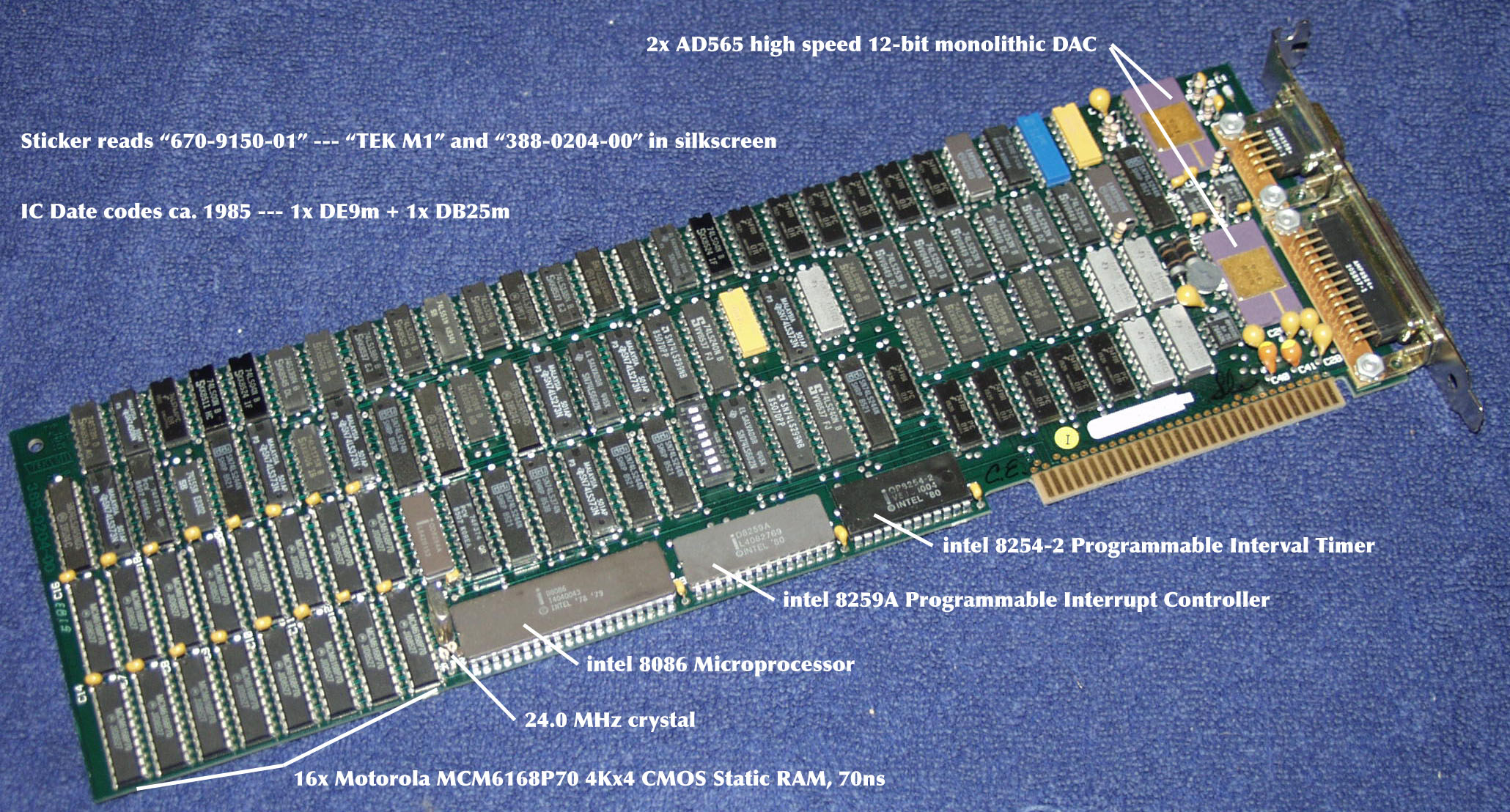
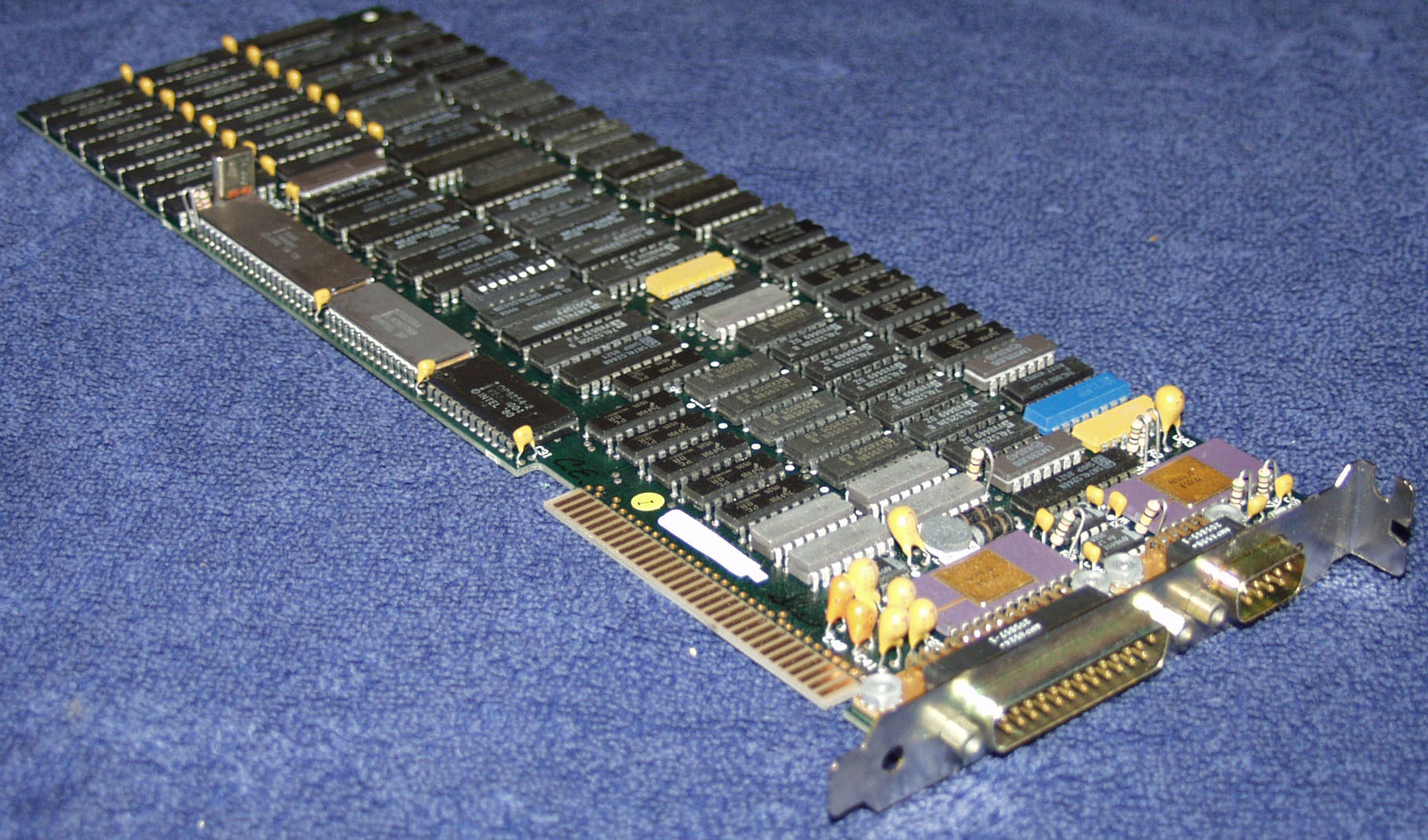
Came across one of these the other day when rummaging through the
parts bin. I don't know anything much about it, but it allows, I
believe, dual-head displays on an ISA bus machine.
Anyone want it? Free for postage from London, UK...
--
Liam Proven ? Blog, homepage &c: http://lproven.livejournal.com/profile
Email: lproven at cix.co.uk ? GMail/GoogleTalk/Orkut: lproven at gmail.com
Tel: +44 20-8685-0498 ? Cell: +44 7939-087884 ? Fax: + 44 870-9151419
AOL/AIM/iChat: liamproven at aol.com ? MSN/Messenger: lproven at hotmail.com
Yahoo: liamproven at yahoo.co.uk ? Skype: liamproven ? ICQ: 73187508
>
> these?
>
> - http://www.znode51.de/fog/filelist.htm
nope. Those are the CP/M and Language discs
FOG started supporting DOS later. The master
discs that were donated to the Computer History
Museum start around 1986 and go to 1990 (vol 408).
There were also specialty collections for various
CP/M boxes, but unfortunately they are water/mold
damaged are are unreadable (the discs are glued
to the inner sleeve).
I'm grinding through FOG_DOS today, and will put them
up under http://bitsavers.org/bits/Users_Groups/FOG
later today when I've finished reading them.
Thanks to a creative suggestion from Ethan, I want to use VTserver
to transfer a bootable OS/8 RL02 image from my laptop (which works
fine under SIMH PDP-8) to an RL02 pack on my 11/23+. Then I will
remove that disk from the drive on the -11, place it in the 8/A's
RL02 drive, and voila - it should boot OS/8! (The disks are
identical format regardless of system, only the programs
themselves differ).
Meanwhile I am confused about VTserver's use and terminology of
serial ports. I got a PC-executable version here:
http://home.alltel.net/engdahl/vtserver.zip
and modified the .vtrc file (as recommended in the embedded
comments) to send only two tape records, "copy" and the RL02
image. I realize a null modem cable will need to be made. So far
so good?
But I don't understand the difference between, say, "ttyd1" and
"ttyp9"... those are Unix terms, not DOS... will one of these be
correct to enable the serial port connector on the back (one of
the COM ports)? If not, how do I patch this?
I was a hardware designer and 8/16 bit assembly language writer
(and that was over 20 years ago) and definitely never a C, Unix or
Windows programmer, so please bear with me. Any helpful hints
appreciated :)
-Charles
--- Chris M <chrism3667 at yahoo.com> wrote:
> take no offense at my previous comment. It's just
>that I'd have needed better graphics (and clockspeed,
>and...) to brave the wilds of dos incompatibility in
>order to commit to such a system back when they were
>current. All of the other pseudo compatibles have much
>more to offer, and the Rainbow seemed to drift into
>obscurity not long after it's inception (there was a
>measure of solidarity among those who did buy it
>though, which is to be commended). I do consider it an
>interesting collectible piece though, and am eager to
>add to it functionally. BUT NOT AT THOSE PRICES!!! OI!
No offense taken :). The Rainbow does tend to be frustrating due
to its "MS-DOS compatability." I think you really have to love it to use
it sometimes...
If you want to see some more outrageous prices from ebay stores, do a
search for "dec rainbow" in Computers & Networking on eBay. The eBay
Store prices are comically high. My favorite is $89.93 for a "Fan
Assembly." Let me just get out my wallet...
-Jeff
jba at sdf.lonestar.org
SDF Public Access UNIX System - http://sdf.lonestar.org
Patrick Finnegan <pat at computer-refuge.org> skrev:
> On Saturday 19 May 2007 06:35, Johnny Billquist wrote:
> > > "Glen Slick" <glen.slick at gmail.com> skrev:
> > > > On 5/17/07, Rod Smallwood <RodSmallwood at mail.ediconsulting.co.uk>
wrote:
> > > >> > OK we have a change
> > > >> >
> > > >>> > >PMI memory goes in slots 1 and 2, CPU goes in 3
> > > >>> > >joe lang
> > > >> >
> > > >> > Rod
> > > >
> > > > From my understanding of this after looking at various manuals
this
> > > > is true for an 11/73 or 11/83 with an H9872 backplane in a BA23
> > > > box, but not for an 11/84.
> > >
> > > Correct. So if people could stop assuming that an 11/84 have a q-bus,
> > > we would get a long way towards clearing this up.
> > > If people don't know about the 11/84 or 11/94, don't write answers
> > > based on your knowledge of the q-bus based KDJ11 setups.
>
> My "11/94" (which was an upgraded 11/84, and which I got CPU-less)
> actually does have a QBUS... it's got an Able Qniverter to hook the
> UNIBUS in the chassis to the QBUS from the CPU, and both QBUS and UNIBUS
> peripherals.
>
> Does anyone know how common that was? I don't see any evidence pointing
> towards it not being designed that way by DEC. The chassis is DEC
> badged, with a label on the side indicating that it was upgraded from an
> 11/84 to be an 11/94 at some point.
Pat, what you have is what I would describe as an 11/93 with an
Qniverter. That will not be exactly the same thing as an 11/94.
The KTJ11-B, which is DECs Unibus adapter, have some special signals to
the CPU telling it that the KTJ11 is there, and that changes the
behaviour of the Qbus, according to the manuals.
I haven't said that the wiring of the memory slots in an 11/84 (or
11/94) isn't the same as in a Q/CD backplane. It must (by default) be
atleast very similar to a Q/CD backplane. However, there are some
special signals, and also some signals that change behaviour in an 11/84
and 11/94, according to the manuals. And that will only happen if you
have a KTJ11-B in there.
Johnny
--
Johnny Billquist || "I'm on a bus
|| on a psychedelic trip
email: bqt at softjar.se || Reading murder books
pdp is alive! || tryin' to stay hip" - B. Idol
"Rod Smallwood" <RodSmallwood at mail.ediconsulting.co.uk> skrev:
> Hi
>
> Well that's seems to define the 11/84.
> How does this all apply to the 11/94
> (which is the real problem)
Well, the UBA is the same, so the same PMI Unibus signals are originated
at that end.
No memory can exist in an 11/94 though, since all the memory are on
board. However, the communication between the CPU and UBA is using the
PMI protocol, still.
However, the dealings with interrupts and so on must still be done in
the same way as for the 11/84 as well.
So I would say that the 11/94 behaves exactly like the 11/84.
(Do anyone know if an 11/94 with 2 megs on board could use an external 2
megs?)
Johnny
--
Johnny Billquist || "I'm on a bus
|| on a psychedelic trip
email: bqt at softjar.se || Reading murder books
pdp is alive! || tryin' to stay hip" - B. Idol
Hi
Well that's seems to define the 11/84.
How does this all apply to the 11/94
(which is the real problem)
Rod
-----Original Message-----
From: cctech-bounces at classiccmp.org
[mailto:cctech-bounces at classiccmp.org] On Behalf Of Johnny Billquist
Sent: 21 May 2007 21:41
To: On-Topic and Off-Topic Posts; Pete Turnbull
Subject: PDP-11/84, PMI and Q-bus
Okay, since this topic have become a subject of much discussion and some
diverse opinions, I decided to really read the manuals to try to find
the bottom of this all.
My main source of information here have been the "KDJ11-B CPU Module
Users's Guide". EK-KDJ1B-UG-001
Now, to start with the position of the CPU card in an 11/84.
Chapter 7, section 7.2. Page 7-1:
"7.2 PMI INTERFACE
The PMI interface signals are defined as the PMI bus master signals, the
PMI slave signals and the PMI Unibus adapter signals. These interface
signals are assigned to the C and D rows of the backplane and are
defined as the interconnect bus. The PMI interface signals on the C/D
bus are normally assigned two pins to provide an interconnection between
the slots. The KDJ11-B module is only assigned one pin and therefore its
position in the backplane is critical. The LSI bus signals that are used
with the PMI protocol use the A and B rows of the backplane defined as
the LSI bus."
Now, if Pete is correct in that the PMI bus on the 11/84 really goes to
both pins on all slots, then it should be okay to place the CPU in any
slot. I haven't tried that, but I might when I have the time. I suspect
he's right since otherwise I would have expected the CPU to be in slot
3. But DEC could be doing some fancy wiring... :-)
The fact that the placement is critical is obvious if we talk about
Q-bus systems, and I suspect the comment is written from that point of
view.
As for wether Q-bus memory (or any other Q-bus peripherial) will work,
I'll quote some signal descriptions.
Chapter 7, page 7-4. Table 7-3 PMI Unibus Adapter Signals
"Pin: CF1 Mnemonic: PUBSYS L PMI Unibus System
In a Unibus system, PUBSYS L is asserted by the UBA to direct the
KDJ11-B to follow PMI protocol for all data transfers, wether the PSSEL
L is asserted or not. LSI-11 bus protocol is disabled for all PMI
devices when PUBSYS L is asserted.
In an LSI-11 system, PUBSYS L is always negated. If PSSEL L is negated,
the KDJ11-B follows LSI-11 protocol and the PMI memory then responds to
the LSI-11 protocol by the LSI DMA devices."
Chapter 7, page 7-5. Table 7-4 LSI Bus Signals
"Pin: AF2 Mnemonic: BRPLY L Reply
During PMI cycles, BRPLY L is asserted by the KDJ11-B and the PMI slave
to prevent the next bus master from gaining control of the bus too soon.
In a Unibus system, BRPLY L is asserted by the UBA as a slave response
during the PMI DATOB cycle and interrupt DATI cycle.
*** NOTE ***
The PMI memory slave modules in a Unibus system must have BRPLY L
disabled at all times.
Pin: AH2 Mnemonic: BDIN L Data Input
The BDIN L signal is only used in PMI Unibus systems during interrupt
grant cycles. The KDJ11-B asserts BDIN L after it gates the interrupt
priority, BDAL bits <3:0>, onto the bus. The UBA then latches the
interrupt priority data using the leading edge of BDIN L.
Pin: AM2 Mnemonic: BIAKI L Interrupt Acknowledge In
Pin: AN2 Mnemonic: BIAKO L Interrupt Acknowledge Out
These signals are only used in PMI Unibus systems during the interrupt
grant cycles. The KDJ11-B asserts the BIAKI L signal, and the UBDA
acknowledges it by asserting one of the Unibus bus grant signals.
Pin: BB1 Mnemonic: BPOK H Power OK
This signal is only used in PMI Unibus systems for the Unibus
power-up/power-down protocol. This signal is asserted and negated by the
UBA in response to the Unibus AC LO signal. The assertion of AC LO may
be prolonged by the Unibus devices or the PMI memory during power-up."
I could go on describing more details on how these signals are used,
since it's all described in the manual. Suffice to day that the KDJ11-B
*knows* when it's in a Unibus system (i.e 11/84) and will not behave
like a normal Qbus. First of all, it will always use PMI protocol to
access memory, no matter what the memory might claim. Second, interrupt
handling is done differently, since all interrupts are expected to be
dealt with via the UBA.
There are also schematics for different signals in the manual, and you
can clearly find the PUBSYS L signal included in some decoder path as a
way to force a specific behaviour independent of other signals that
might exist.
Now, can we now accept that it's not a Q-bus in the 11/84? :-)
Johnny
--
Johnny Billquist || "I'm on a bus
|| on a psychedelic trip
email: bqt at softjar.se || Reading murder books
pdp is alive! || tryin' to stay hip" - B. Idol
Has anyone come upon a source of preferably NOS 7220's?
____________________________________________________________________________________
Finding fabulous fares is fun.
Let Yahoo! FareChase search your favorite travel sites to find flight and hotel bargains.
http://farechase.yahoo.com/promo-generic-14795097
Hey, all,
I've got mail from somebody with an original IBM PC from the first batch
to be sold by IBM to its own employees. Apparently they selected employees
>from a list by lottery to determine what order to deliver them, this was
in the middle of the list, delivered in October 1982. (Isn't that a little
late for first batch? Was the production rate not up to demand at first?)
Anyway, there are several pieces: system unit, keyboard, monitor, etc.;
mostly (or all?) in original cartons with docs & software & such, some
still in shrink wrap.
There is also some amount of PS/1 stuff, available together with the PC
stuff or separately, depending on who wants what, the order in which
responses arrive, and the phase of the moon.
This stuff is all in Colorado, but the owner is willing to pay shipping
(presumably assuming domestic!) so the location doesn't much matter.
I'll collect responses and forward them in a batch, and the owner will
decide who to contact and so on.
Cheers,
Bill.
____________________________________________________________________________________Get the free Yahoo! toolbar and rest assured with the added security of spyware protection.
http://new.toolbar.yahoo.com/toolbar/features/norton/index.php
> I wonder if there is
> some sort of soaking that could be done to loosen the floppy from its
> jacket
The floppies were in VERY bad condition. Years of mosture, black mold on
the labels, softening and general destruction of the oxide and binder including
mold on the disk itself.
Since there are thousands of discs to go through, the data may appear on
later backups. I also have personally had problems with nasal infections
>from working with contaminated material like this in the past, so I made
the decision to discard them.
Okay, since this topic have become a subject of much discussion and some
diverse opinions, I decided to really read the manuals to try to find
the bottom of this all.
My main source of information here have been the "KDJ11-B CPU Module
Users's Guide". EK-KDJ1B-UG-001
Now, to start with the position of the CPU card in an 11/84.
Chapter 7, section 7.2. Page 7-1:
"7.2 PMI INTERFACE
The PMI interface signals are defined as the PMI bus master signals, the
PMI slave signals and the PMI Unibus adapter signals. These interface
signals are assigned to the C and D rows of the backplane and are
defined as the interconnect bus. The PMI interface signals on the C/D
bus are normally assigned two pins to provide an interconnection between
the slots. The KDJ11-B module is only assigned one pin and therefore its
position in the backplane is critical. The LSI bus signals that are used
with the PMI protocol use the A and B rows of the backplane defined as
the LSI bus."
Now, if Pete is correct in that the PMI bus on the 11/84 really goes to
both pins on all slots, then it should be okay to place the CPU in any
slot. I haven't tried that, but I might when I have the time. I suspect
he's right since otherwise I would have expected the CPU to be in slot
3. But DEC could be doing some fancy wiring... :-)
The fact that the placement is critical is obvious if we talk about
Q-bus systems, and I suspect the comment is written from that point of view.
As for wether Q-bus memory (or any other Q-bus peripherial) will work,
I'll quote some signal descriptions.
Chapter 7, page 7-4. Table 7-3 PMI Unibus Adapter Signals
"Pin: CF1 Mnemonic: PUBSYS L PMI Unibus System
In a Unibus system, PUBSYS L is asserted by the UBA to direct the
KDJ11-B to follow PMI protocol for all data transfers, wether the PSSEL
L is asserted or not. LSI-11 bus protocol is disabled for all PMI
devices when PUBSYS L is asserted.
In an LSI-11 system, PUBSYS L is always negated. If PSSEL L is negated,
the KDJ11-B follows LSI-11 protocol and the PMI memory then responds to
the LSI-11 protocol by the LSI DMA devices."
Chapter 7, page 7-5. Table 7-4 LSI Bus Signals
"Pin: AF2 Mnemonic: BRPLY L Reply
During PMI cycles, BRPLY L is asserted by the KDJ11-B and the PMI slave
to prevent the next bus master from gaining control of the bus too soon.
In a Unibus system, BRPLY L is asserted by the UBA as a slave response
during the PMI DATOB cycle and interrupt DATI cycle.
*** NOTE ***
The PMI memory slave modules in a Unibus system must have BRPLY L
disabled at all times.
Pin: AH2 Mnemonic: BDIN L Data Input
The BDIN L signal is only used in PMI Unibus systems during interrupt
grant cycles. The KDJ11-B asserts BDIN L after it gates the interrupt
priority, BDAL bits <3:0>, onto the bus. The UBA then latches the
interrupt priority data using the leading edge of BDIN L.
Pin: AM2 Mnemonic: BIAKI L Interrupt Acknowledge In
Pin: AN2 Mnemonic: BIAKO L Interrupt Acknowledge Out
These signals are only used in PMI Unibus systems during the interrupt
grant cycles. The KDJ11-B asserts the BIAKI L signal, and the UBDA
acknowledges it by asserting one of the Unibus bus grant signals.
Pin: BB1 Mnemonic: BPOK H Power OK
This signal is only used in PMI Unibus systems for the Unibus
power-up/power-down protocol. This signal is asserted and negated by the
UBA in response to the Unibus AC LO signal. The assertion of AC LO may
be prolonged by the Unibus devices or the PMI memory during power-up."
I could go on describing more details on how these signals are used,
since it's all described in the manual. Suffice to day that the KDJ11-B
*knows* when it's in a Unibus system (i.e 11/84) and will not behave
like a normal Qbus. First of all, it will always use PMI protocol to
access memory, no matter what the memory might claim. Second, interrupt
handling is done differently, since all interrupts are expected to be
dealt with via the UBA.
There are also schematics for different signals in the manual, and you
can clearly find the PUBSYS L signal included in some decoder path as a
way to force a specific behaviour independent of other signals that
might exist.
Now, can we now accept that it's not a Q-bus in the 11/84? :-)
Johnny
--
Johnny Billquist || "I'm on a bus
|| on a psychedelic trip
email: bqt at softjar.se || Reading murder books
pdp is alive! || tryin' to stay hip" - B. Idol
Hi
I have just remembered how the later version keyboards worked.
It was still a counter sytem but the values where fully decoded.
It worked on a matrix system.
Each key on the keyboard sat across the junction of one of the matrix
points.
The columns, say 16. Would be the output of a 4 in 16 out decoder and
the rows were the
inputs of a say 16 in four out encoder. Stopping the clock by pressing a
key gave you an 8 bit keycode.
Serialize in the usual way.
Finally dedicated chips appeared. But same old matrix system.
Rod Smallwood
-----Original Message-----
From: cctech-bounces at classiccmp.org
[mailto:cctech-bounces at classiccmp.org] On Behalf Of Ethan Dicks
Sent: 22 May 2007 13:58
To: General Discussion: On-Topic and Off-Topic Posts
Subject: CiTOH terminals (was Re: Well,now I've gone and done it...
Dragged home more big(ish) iron...)
On 5/22/07, Mr Ian Primus <ian_primus at yahoo.com> wrote:
>
> > The 101 is the model shaped and colored much like a VT100. The
> > keyboard looks similar... but its protocol is _not_ compatible with
> > the VT100.
>
> Good thing I didn't buy the one on eBay a couple months ago. There was
> a 101 there, and cheap too, but it had no keyboard.
I may haev a few CiTOH terminals to drag to VCFmw if there's any
interest. Closer to the event, I'll inventory what I have and see if I
kept any spare keyboards "just in case", if anyone out there already has
a terminal, but can't figure out why their VT100 keyboard doesn't work
with it.
I remember back in the day, since we had dozens of CiTOH and DEC
terminals, looking over the available schematics for both and not being
able to figure out how the keyboard works. I think it was a matter of
inadequate/fuzzy docs more than anything else. Does anyone know of a
good printset to pore over to see the nuts-and-bolts of a VT100-era
keyboard? ISTR the crux of it was a 6402-type UART squeezing out the
keystrokes at some slow baud rate, but I can't recall any essential
details right now. I'm just curious if it's possible to swap a crystal
or make a simple, switched change to allow one keyboard to work across
both vendor's product lines.
We used to have lots of dead keyboard when there was one or two
terminals on everyone's desk. Since the company was shrinking at that
stage, we never bothered fixing them - we just pulled one off a vacant
desk and kept working. The number of working keyboards never shrank
below the steadily decreasing size of the staff, so economically, it
made sense. I think I only saved working keyboards in that set of 4 van
loads, but it's entirely possible I picked up one or two dead ones.
Right now, I have to search the pile for a VT100 keyboard to get my
DECmate I back up and running so I can press it into service as an
RX01/RX02 image archiver and finally whittle down my cartons of
floppies.
-ethan
Eh... another in a series of things _not_ to put into
a Chevy Venture, this time featuring... A Vax 11/750
and a Vax 6210.
Fortunately, this isn't going to be as bad to remove
>from the van as those CDC drives were. I just need to
talk some friends into helping me.
But, I do want to try and get this 750 running soon.
The TU58 has a bad roller (suprise, suprise) so I'll
have to get some of that tubing I saw mentioned in the
archives. But, I have no cartridges, so it does me
little good to fix it... Any source of boot images for
this critter so I can boot it with a tu58 simulator on
a PC?
Also, what do I really need in order to boot and
install an OS, say, NetBSD? At the moment, I have no
disks (anyone have a Unibus SMD controller?), or for
that matter, a working, compatible tape drive (no
pertec controller...). I assume that the machine needs
to boot initally from TU58 every time, and then after
that, it can bootstrap from disk or tape. I found the
11/750 FAQ, but it doesn't have a section for "I
dragged home a big heavy Vax, now what?".
Thanks!
-Ian
I'm getting a bit short on space.
So for who wants it, a have a Norsk Data ND-110 compact including manuals an
software (Sintran) with a Tandberg terminal.
It's only for pickup or DIY-shipment I'm not packing or posting this one.
Gr. Rik
contact me at :
dr.emiel at xs4all dot nl
I followed the FAQ to set to digest mode and it does not work.
I then changed the destination to list at classiccmp.org and that does not work
how do I change to digest mode
I don't know if it helps but I did work on terminals in the early
1970's.
Before my days at DEC I did work on keyboards. The usual design was a
counter going up to 127 or 255.
Pressing a key pulled down the data lines for the number representing
the value of the key.
This was compared with the output of the counter and when they where the
same the counter stopped.
Thus at this point the counter held the value of the key.
Some counters could be shifted (clocked) out serially or you transferred
the value to a shift register and serialized the code that way.
UARTS could be used like a shift register. (Parallel in serial out.)
Rod Smallwood
-----Original Message-----
From: cctech-bounces at classiccmp.org
[mailto:cctech-bounces at classiccmp.org] On Behalf Of Ethan Dicks
Sent: 22 May 2007 13:58
To: General Discussion: On-Topic and Off-Topic Posts
Subject: CiTOH terminals (was Re: Well,now I've gone and done it...
Dragged home more big(ish) iron...)
On 5/22/07, Mr Ian Primus <ian_primus at yahoo.com> wrote:
>
> > The 101 is the model shaped and colored much like a VT100. The
> > keyboard looks similar... but its protocol is _not_ compatible with
> > the VT100.
>
> Good thing I didn't buy the one on eBay a couple months ago. There was
> a 101 there, and cheap too, but it had no keyboard.
I may haev a few CiTOH terminals to drag to VCFmw if there's any
interest. Closer to the event, I'll inventory what I have and see if I
kept any spare keyboards "just in case", if anyone out there already has
a terminal, but can't figure out why their VT100 keyboard doesn't work
with it.
I remember back in the day, since we had dozens of CiTOH and DEC
terminals, looking over the available schematics for both and not being
able to figure out how the keyboard works. I think it was a matter of
inadequate/fuzzy docs more than anything else. Does anyone know of a
good printset to pore over to see the nuts-and-bolts of a VT100-era
keyboard? ISTR the crux of it was a 6402-type UART squeezing out the
keystrokes at some slow baud rate, but I can't recall any essential
details right now. I'm just curious if it's possible to swap a crystal
or make a simple, switched change to allow one keyboard to work across
both vendor's product lines.
We used to have lots of dead keyboard when there was one or two
terminals on everyone's desk. Since the company was shrinking at that
stage, we never bothered fixing them - we just pulled one off a vacant
desk and kept working. The number of working keyboards never shrank
below the steadily decreasing size of the staff, so economically, it
made sense. I think I only saved working keyboards in that set of 4 van
loads, but it's entirely possible I picked up one or two dead ones.
Right now, I have to search the pile for a VT100 keyboard to get my
DECmate I back up and running so I can press it into service as an
RX01/RX02 image archiver and finally whittle down my cartons of
floppies.
-ethan
Via the Dayton Hamvention and Dan C., I now have a nice "new"
corporate cabinet for my 11/23+ and two RL02's, installed and
working. It came with an 874-D Remote Power Controller which I
would like to use as intended (i.e. turn everything on by flipping
the BA-11SA front panel power switch). That switch connects
directly to a 3-pin male Molex connector on the rear of the BA
chassis. The 874-D has several 3-pin female Molex connectors
labeled "DEC Power Bus".
Am I correct in assuming that I just need a 3-wire extension cable
between the BA chassis and one of those Power Bus connectors?
If so, is there a DEC part I should be looking for? If not, any
ideas which mating connectors to order (it's not critical that I
use factory original pieces)? The two connectors are not identical
families (the BA-11SA's connector is flat on one side and rounded
on the other; on the 874-D they are rectangular).
Thanks for any help.
-Charles
Hi,
I have been dusting off some old Palm Pilots (III and V, mostly) and
am running into "decayed link" syndrome on most of my searches. I'm
finding fragmentary web pages and links to abandoned projects from 7-8
years ago, and only a few things that encompass what I'm working with.
I joined the Palm Developers Network, but they don't make older SDK
files available for download. I'm really looking for the kit they
used to have available that allows one to develop PalmOS 3.3-era stuff
- so around 1999 or so, I think. Does anyone on the list have
something that sounds like that? If so, please reply to me directly
rather than clutter the list with stuff about Palms.
To tie this search into recent events, I did see a few, very few,
Palms at Dayton. The best price I ran across was a Palm V w/cradle
and wall wart for $10 (and another for $15 with box). Unfortunately,
that's more than they go for elsewhere. I got home and ran across a
Palm Vx at the nearby thrift for $6.99 w/cradle and wall wart (along
with a Garmin 12 GPS for $1.91!)
Since the DragonBall is essentially a dressed up MC68000, I've always
appreciated the PalmPilot innards, but I've never had a need to build
my own apps. These days, everyone wants to support the Tungstens and
Treos, etc., and have left monochrome Palms in the dust.
Thanks for any assistance in locating ancient development tools.
-ethan
There are around 400 MSDOS group discs produced by FOG.
There were only a couple on the FOG cdrom, does anyone
know if these have already been archived?
They appear to span 1986-1990
Hi,
Is there an easy way to save a image of the Lotus 123
system disk for a rainbow.
Not sure what they used for copy protection but image disk
does not like it.
- Jerry
All,
I have the chance to get an inexpensive "HP DLT40" drive or two...
>from my googling, it seems that these drives can read/write DLT III
(10GB), DLT IIIxt (15GB) or DLT IV (20GB) tapes. Are DLT IV tapes
(20GB uncompressed) worth the effort of tracking down and shipping?
We pitched out several hundred new-in-box DLT IV tapes from South Pole
over six months ago, partially because we hadn't unwrapped one in over
4 years (we had moved up to SDLT @ 110GB each, some time prior to 1
Jan 2003). Old though they are, I'd consider an inexpensive SDLT
drive and a stack of tapes to be a somewhat useful density to use for
backup on any system I have lying around. What's not as clear,
though, is if tapes that hold less than 20% of that are worth more
than the cost of shipping. At the moment, I can get a couple of
drives for essentially free (under $5, and, no, not at Dayton). What
concerns me is the expense of the tapes, and more from a shipping
standpoint than an actual per-tape cost. If we were throwing out
these tapes last year, I can't imagine that I can't find someone else
doing the same this year - it's just a matter of how much it costs to
receive them.
Given the things I'd like to back up (laptop, main Solaris file
server), I'd want to be able to rotate tapes in a sensible scheme so
as not to write to the tapes too often, but I have enough stuff to
cover that one 20GB tape per month just isn't enough; I'd need several
tapes per month at that density. Over the course of a year, I'd
probably need tens of tapes, but perhaps with a higher density (SDLT,
say), I could get away with a dozen or so tapes per year, but the
drive and tapes wouldn't be as close to free as DLT IV (I've seen eBay
prices on SDLT drives in the $20-$50 range). We stopped using SDLT at
Pole last year (2006 data was written to SDLT and Ultrium tapes), so,
again, I can see that the modern world isn't going to be as interested
in them as some of the newer, multi-hundred-GB-per-tape schemes.
I guess another way to phrase this might be, does anyone on the list
know of a source of extremely inexpensive piles of DLT IV or SDLT
tapes - either density media quickly adds up to more than the present
cost of drives, so in the end, it's the weight of the tapes that's the
limiting factor.
Thanks,
-ethan
http://cgi.ebay.com/Digital-Rainbow-100-pc_
W0QQitemZ180115684124QQihZ008QQcategory
Z4193QQrdZ1QQcmdZViewItem
nicely equipped. In Canaduh LOL LOL
I am still looking for the color card and a monitor.
Canada is too far for me to ship.
____________________________________________________________________________________
The fish are biting.
Get more visitors on your site using Yahoo! Search Marketing.
http://searchmarketing.yahoo.com/arp/sponsoredsearch_v2.php
>
>Subject: Re: DEC Pro380 disk drives
> From: "Ethan Dicks" <ethan.dicks at gmail.com>
> Date: Wed, 09 May 2007 08:44:20 -0400
> To: "General Discussion: On-Topic and Off-Topic Posts" <cctalk at classiccmp.org>
>
>On 5/8/07, Allison <ajp166 at bellatlantic.net> wrote:
>> The RQDX1/2 are the same board and mostly interchageable depending on
>> firmware rev. It's a Quad width board.
>
>What are the essential differences between an RQDX1 and RQDX2?
>AFAICR, the RQDX1 doesn't pass grant below it so it *must* be the last
>board on the bus, but the RQDX2 doesn't have that limitation; and, the
>RQDX2, I think, knows about one or two more drives than the RQDX1. a)
>is that correct? and b) is that all?
>
>I have at least one RQDX1, several RQDX3, and I don't think I have any
>RQDX2, but one never knows what one will stumble across.
>
>-ethan
They looks the same but the handle has a different rev. The real differences
are bug fixes. Essentially the RQDX2 is a bugfixed RQDX1 with later firmware
that is aware of a larger (at that time) assortment of drives. In the real
world of MSPC controllers RQDX3 is most desireable and RQDX1 the least.
FYI: some flavors of RQDX1/2 didn't pass interrupt grant and MUST be the last
card in the chain.
Allison
Rainbow graphics card only $89.63! Give me 10!!!
http://cgi.ebay.com/DEC-54-15688-RAINBOW-GRAPHICS-CARD-5415688_W0QQitemZ120…
Honestly, who would be using such a pig these days?
The price this guy is asking is indicative of his
belief that someone actually NEEDS a card for his
lousy 'bow. I ran into a guy in Kentucky who wanted
extra TI PC's, being that the software he used for
some geological surveys he made a living off of ran on
them. But that's a highly unusual application. Anyone
know of someone still using a Rainbow?
____________________________________________________________________________________Shape Yahoo! in your own image. Join our Network Research Panel today! http://surveylink.yahoo.com/gmrs/yahoo_panel_invite.asp?a=7
Well, this is either the stupidest thing I've ever done, or a really
cool find that will fill me with joy.
I just won a Friden Flexowriter on eBay (Item #180115571829). I've
been looking for one of these for almost ten years, and up popped
this one, with no bids but mine. It's almost local, so I'll be
picking it up in person to avoid shipping. It'll cost more in
gasoline, but it should protect against the danger of shipping damage.
I'd love to hear from anyone else who has one, or who has worked on
one. I've downloaded the MIT memos regarding the operation of the
PDP-1 and TX-0 Flexowriters from Bitsavers, but that's literally all
the documentation I have. I'm not even sure what character set this
one has -- it is lacking the upper-case symbols on the number keys,
for instance, and the "1" key seems to be on the right ("2, 3, 4, 5,
6, 7, 8, 9, 0, 1"). I understand they were frequently customized
with their own character codes, as well.
The Flexowriter in question is "not working", although it looks like
it's in excellent shape physically. I've become quite handy with
typewriter mechanisms recently (don't ask), so I'm hoping that
whatever the problem is is fixable without terrible difficulty. If
not, I'm close to Los Altos Typewriter, who (I believe? I'm not sure
on this) repaired the Soroban console for the Computer History
Museum's PDP-1.
Wish me luck with this potential white elephant.
-Seth
OK, its really a CP/M box with some PLATO software, but it *does* have
the PLATO specific keyboard. Maybe I could write something in Tutor!
After investigating all the options, UPS still was the cheapest to get
it out of the UK though. Unless someone wants to check it as baggage
when flying back from the UK to the US for me?
--
"The Direct3D Graphics Pipeline" -- DirectX 9 draft available for download
<http://www.xmission.com/~legalize/book/download/index.html>
Legalize Adulthood! <http://blogs.xmission.com/legalize/>
Pete Turnbull <pete at dunnington.plus.com> skrev:
> On 19/05/2007 11:35, Johnny Billquist wrote:
> > > "Glen Slick" <glen.slick at gmail.com> skrev:
>
> > > >>> > >PMI memory goes in slots 1 and 2, CPU goes in 3
>
> > > > From my understanding of this after looking at various manuals
this is
> > > > true for an 11/73 or 11/83 with an H9872 backplane in a BA23
box, but
> > > > not for an 11/84.
>
> BA23 is H9278, actually.
Doh! The numbers keep getting twisted around. :-)
> > > Correct. So if people could stop assuming that an 11/84 have a
q-bus, we
> > > would get a long way towards clearing this up.
>
> Except that it does have a (short) QBus :-)
Wire-wise, yes. Protocol wise the manuals imply that some signals don't
behave the same, even though they are named the same.
I haven't had time to really analyze this to see what signals actually
change, and in which way, so I'm mostly quoting the manual on this.
> OK, we're agreed that the standard config for an 11/83 puts the memeory
> before the processor, and the standard config for an 11/84 puts the
> memory after the processor :-)
Yes. That we agree on, and that is probably the most important piece.
> The P-series 11/84 which I've found described in one of the later 11/84
> manuals used an MSV11-R, which is a normal QBus memory, not PMI.
Well, according to the field guide, that *is* PMI memory. :-) But not
ECC memory like the MSV11-J.
Johnny
--
Johnny Billquist || "I'm on a bus
|| on a psychedelic trip
email: bqt at softjar.se || Reading murder books
pdp is alive! || tryin' to stay hip" - B. Idol
Did you ever find a service manual or schematic? I am looking for the
same thing.
Philip "Scott" Haun
Senior Instrumentation Specialist
Indyne (KICS) Photo & Media Services KICS-700
Phone 321.853.7842
Fax 321.853.7750
http://kics.ksc.nasa.gov/services/video/index_photo.cfm
*** Please reply to me directly. I'm way behind on my ClassicCMP reading...
For various reasons, none of them good, I have a couple of computers,
and some cables & parts, that _must_ disappear from my house ASAP. At
this point, I'm not worried if I get anything for them. But I won't turn
it down cash (or good beer) in return. I'd rather not have to ship them,
having lack of time.
Here's a quick list of the machines. IIRC, they don't have HDDs. More
info available upon request.
- Mac SE/30, with network card not installed.
- Cardinal PC10. 386 CPU, looks like a Mac SE, with a 10"(?) color screen.
- Digital Multia.
- Digital Alpha 200MHz? with plans on how to adapt an ATX power supply
for it. IIRC, there might even be a ready made adapter.
- Dell Optiplex P4 1GHz, 512MB RAM. Spare MB w/CPU, PCI riser & power
suppply.
- Compaq PIII 600(?) small desktop, 256MB RAM (?)
- SuperMicro P4DP6 server class system, 1GB RAM, 2GHz Xeon (can take 2).
Full tower case, power supply.
- Box o cables - power, SCSI, serial, paralell.
- random parts.
--
--- Dave Woyciesjes
--- ICQ# 905818
--- AIM - woyciesjes
"From there to here,
From here to there,
Funny things
are everywhere."
--- Dr. Seuss
> RARE EXTERNAL HARD DRIVE & 8" FLOPPY SYSTEM RARE (#330121685672)
Chrislin OEMed AED Qbus disc/floppy controllers.
You need an AED card to make this work (with the correct configuration prom).
There is a breakout board in the back to take the 50 pin cable that comes in
and fans it out to the 34/20 and 50 pin cables needed by the drives.
I just verified that M8637-Ex cards works fine in both 11/83 and 11/84
systems. The same goes for M8637-Dx cards.
I don't think I have any M8637-Bx or -Cx cards, so I can't try that.
So to make it clear: MSV11-JD and MSV11-JE works fine in both Q-bus and
Unibus systems.
Johnny
--
Johnny Billquist || "I'm on a bus
|| on a psychedelic trip
email: bqt at softjar.se || Reading murder books
pdp is alive! || tryin' to stay hip" - B. Idol
It's in decent shape, but far from perfect. That hinge
things has probably seen better days, but it's still
holding on. I hate to throw this thing out, but I'm a
gonna if no one claims it.
____________________________________________________________________________________
Bored stiff? Loosen up...
Download and play hundreds of games for free on Yahoo! Games.
http://games.yahoo.com/games/front
> On 19 May 2007 at 21:52, r.stricklin wrote:
>
> > I wondered if anybody could help me identify what it might be. Parts
> > have date codes in 1985; chips of note are 32k in 70ns 4Kx4 SRAM;
> > intel 8086, 8259, and 8254; and a pair of 12-bit monolithic DACs. I/O
> > is by one DE9m and one DB25m.
>
> There's a possibility that this is a Wavepak Data Acquisition board
> from Computational Systems, Inc. (CSI). It came out around 1984 and
> was very popular for those needing FFT-type data acquisition. It
> could also be a similar unit from Data Physics--both CSI and DPC were
> early players in PC FFT data acquisition. Their boards were
> freakishly expensive, if memory serves--in excess of $5K.
If it were a data acquisition board surely it would have ADC's not DAC's?
The use of DAC's surely implies an output board of some kind. The use of
standard DB type connectors and lack of trim-pots etc. would seem to support
this.
Jim
>From: ard at p850ug1.demon.co.uk (Tony Duell)
>
> >
> > You know, with a 8086 onboard, that thing has to have a ROM/PROM on
> > it somewhere with firmware for the 8086. Why not dump it and see if
>
>Why?
>
>It would be entirely possible to have the software for the 8086 in the
>RAM that's on that board. Load the RAM from the ISA bus, then enable the
>8086 (say by de-assertign the reset pin) and let it run.
>
>I have at least one DSP card for the ISA bus that had no ROM on it. Just
>the (ROMless, I hasetn to add) DSP, a lot of high-speed RAM, the analogue
>interface chip and buffer amplifiers and an ISA interface circuit.
>
Hi
I have a Modem board with a DSP that has no ROM. It loads from
the system. If there is a ROM it would most likely have such a name.
Do remember that the 8086 was a full 16 bit bus. There would most likely
be 2 ROMs and the ascii may be split across the two to read as on contiguous
text from the bus.
Dwight
_________________________________________________________________
Make every IM count. Download Messenger and join the i?m Initiative now.
It?s free. http://im.live.com/messenger/im/home/?source=TAGHM_MAY07
Pete Turnbull <pete at dunnington.plus.com> skrev:
On 20/05/2007 03:22, Jerome H. Fine wrote:
>> > I have also read that the MSV11-JD and MSV11-JE boards should NEVER
>> > be used together. Can anyone else confirm or deny this?
>
> No reason not to, except that you'd end up with an unusual amount of
> memory (3Mbytes). It certainly won't hurt anything, though of course
> you would need to set the start address of the lower board to the
> correct value. It's settable to any 16KB (8KW) boundary.
What do you mean "unusual amount"? I've been running one 11/83 like that
for the last two years until today actually, when I upgraded to 4 megs. :-)
I used to run my 11/84 like that as well. Currently it's shut down.
Haven't had time to organize my computer room after I moved, so it just
sits there...
>> > I suspect that 3 * MSV11-JD boards may be used in a BA123 box with 4
>> > ABCD slots, but since I don't have any MSV11-JD boards, let alone 3
>> > of them, I can't verify this.
>
> I don't recall ever trying *that*, but it too would work, so long as you
> set the start address of each board correctly, and again you'd end up
> with 3Mbytes, which is an unusual amount. The manual just says you can
> use "one or more MSV11-J memory modules", without mentioning size or
> maximum number.
3 megs "unusual"? Hah! ;-)
Johnny
--
Johnny Billquist || "I'm on a bus
|| on a psychedelic trip
email: bqt at softjar.se || Reading murder books
pdp is alive! || tryin' to stay hip" - B. Idol
> If it were a data acquisition board surely it would have ADC's not
> DAC's? The use of DAC's surely implies an output board of some kind.
A DAC along with a comparator, of which there appear to be a couple on
the board, can easily be used for A to D conversion.
Lee.
Ok, it's not a computer, but it's certainly computer related...
i have an MGE systems 50KVA UPS available that we just removed from
service yesterday.
Unit has been running for 10 years ( we moved up to a newer unit )
under maintenance from MGE.
This is a 480VAC 3phase input, charging a string of 40 batteries at
about 512 volts, and providing an output of 220 3phase through a step
down transformer.
It's a big heavy thing, approx 1700 lbs for the UPS and same for the
battery box, in a stage of partial disassembly now ( to get it out of
the room it was in ).
Best part is it's free... just come by and pick up ( liftgate truck
is required... its heavy and we don't have a loading dock )
We're located in Tucson AZ. It should be a matter of nuts and
bolts and having a good electrician to reassemble this fellow if you
wanted to bring the whole thing up or.. if you have one of these,
it's a great source of spare parts ( since they aren't made any longer )
Mike
Howdy, guys.
I've got an 8-bit ISA card here that I pulled out of an IBM PC/AT
5170 machine (which apparently was a VM/PC development machine at one
point, and contains program code for the PC3277/GA).
I wondered if anybody could help me identify what it might be. Parts
have date codes in 1985; chips of note are 32k in 70ns 4Kx4 SRAM;
intel 8086, 8259, and 8254; and a pair of 12-bit monolithic DACs. I/O
is by one DE9m and one DB25m.
Pictures here:
http://www.typewritten.org/~bear/junk/unknown-card-annot.jpghttp://www.typewritten.org/~bear/junk/unknown-card-obl.jpg
Ideas?
ok
bear
I came across a good looking 551 and not so good looking 555 and some carts
and plug ins. I have no interest in them. If anyone has any interest,
contact me off list and I'll submit offers for you. The current owner does
not ship, but I can try to.
Paul Anderson
"Rod Smallwood" <RodSmallwood at mail.ediconsulting.co.uk> skrev:
>> The 11/94 backplane shown in figure 1-2 in EK-PDP94-MG-001_Sep90.pdf
>> shows a KDJ11-E M8981 in slot 1, an APS module M7914 >in slot 2, and
>> slot 3 empty. Does anyone know for certain that this backplane it
>> compatible with MSV11-J modules, and if >so in which slots they would
>> go?
>
> We seem to have come down to one fudamental question.
> That is to say whats the differnce between the backplane in an 11/84 and
> that in an 11/94?
>
> I can confirm the actual systems were as stated above ie
> KDJ11-E M8981 in slot 1
> APS module M7914 in slot 2
> Nothing in slot 3
>
> So how can we tell if the first three slots in each type are compatible?
Easy. By listening to me. :-)
I have an 11/94 box, with an 11/84 CPU and PMI memory in it here, and
running.
It's the same backplanes, and the same Unibus map.
Johnny
--
Johnny Billquist || "I'm on a bus
|| on a psychedelic trip
email: bqt at softjar.se || Reading murder books
pdp is alive! || tryin' to stay hip" - B. Idol
"Glen Slick" <glen.slick at gmail.com> skrev:
> On 5/17/07, Rod Smallwood <RodSmallwood at mail.ediconsulting.co.uk> wrote:
>> > OK we have a change
>> >
>>> > >PMI memory goes in slots 1 and 2, CPU goes in 3
>>> > >joe lang
>> >
>> > Rod
>> >
>
> From my understanding of this after looking at various manuals this is
> true for an 11/73 or 11/83 with an H9872 backplane in a BA23 box, but
> not for an 11/84.
Correct. So if people could stop assuming that an 11/84 have a q-bus, we
would get a long way towards clearing this up.
If people don't know about the 11/84 or 11/94, don't write answers based
on your knowledge of the q-bus based KDJ11 setups.
> Figure 8-6 in EK-PDP94-MG-001_Sep90.pdf shows a PDP-11/84-A backplane
> with the MDM M7677 in the MDM slot, the KDJ11-BF M8190 in slot 1, a
> MSV11-JB/JC M8637-BA/CA in slot 2, and a MLM load module M7556 in slot
> 3. Not clear to me if the MLM in this case could be replaced by a
> second MSV11-J.
Yes. The MLM isn't really neccesary if you have one memory card in there
either, if I remember right. But if you have two memory cards, you don't
have any space left for the load module anyhow.
> The 11/94 backplane shown in figure 1-2 in EK-PDP94-MG-001_Sep90.pdf
> shows a KDJ11-E M8981 in slot 1, an APS module M7914 in slot 2, and
> slot 3 empty. Does anyone know for certain that this backplane it
> compatible with MSV11-J modules, and if so in which slots they would
> go?
It's the same backplane. I have an 11/94 box here with an 11/84 cpu and
memory. Works just fine.
Just wish I could land an 11/9x cpu as well. :-)
Johnny
--
Johnny Billquist || "I'm on a bus
|| on a psychedelic trip
email: bqt at softjar.se || Reading murder books
pdp is alive! || tryin' to stay hip" - B. Idol
"Jerome H. Fine" <jhfinedp3k at compsys.to> skrev:
>>Rod Smallwood wrote:
>> >Now that makes a lot more sense.
>> >
>> >So PMI memory choice is: (2 Max)
>> >
>> >MSV11-JD M8637-D 1 MB ECC PDP-11/84 or PDP-11/83
>> >MSV11-JE M8637-E 2 MB ECC PDP-11/84 or PDP-11/83
>> >
> Jerome Fine replies:
>
> I am not absolutely positive, BUT the probability is VERY
> high that the above two PMI memory boards are ONLY for the
> Qbus. I believe that you must use either the MSV11-JB or
> the MSV11-JC within the PDP-11/84 system.
Good catch! I didn't think of that one. Yes, you're right. In fact the
-JD and -JE don't even claim to be PMI memory, but just plain Q-bus
memory (according to the field guide). That's definitely not useful. You
need the -JB or -JC.
> It is probably confusing, but the CPU is the KDJ11-BF which
> is used in BOTH the PDP-11/83 (which I have and the memory
> used is the MSV11-JD or the MSV11-JE) and the PDP-11/84
> which you have. If you can find a KDJ11-BF along with two
> MSV11-JC PMI memory boards, the cost will likely be much
> less than a PDP-11/94 CPU.
That is probably correct as well. The 11/9x cpu boards are scarce and
expensive. The 11/8x cpu boards are more common and reasonably priced.
Johnny
--
Johnny Billquist || "I'm on a bus
|| on a psychedelic trip
email: bqt at softjar.se || Reading murder books
pdp is alive! || tryin' to stay hip" - B. Idol
Now that makes a lot more sense.
So PMI memory choice is: (2 Max)
MSV11-JD M8637-D 1 MB ECC PDP-11/84 or PDP-11/83
MSV11-JE M8637-E 2 MB ECC PDP-11/84 or PDP-11/83
The CPU choice is:
Module Type Speed RAM ROM LTC SLU
------ ---- ----- --- --- --- ---
M8190 KDJ11-B
M8190-AD KDJ11-BA 18
M8190-AB KDJ11-BB 15 0 Y Yes
2
M8190-AC KDJ11-BD
M8190-AZ KDJ11-BF 18 0 Y Yes
2
So.....
1. Plug in one or two memory cards.
2. Plug in a CPU card
3. Insert Bus Grant cards (Which end of the slot?)
4. Insert in Slot nine a M9302 UNIBUS TERMINATOR and a M9713 MIN. LOAD
MODULE
5. Now we would have:
Slot 1 M8190-Ax KDJ11-Bx 11/83 - 11/84 CPU Card
Slot 2 M8637-X MSV11-Jx PMI Memory
Slot 3 M8637-X MSV11-Jx PMI Memory
Slot 4 M8191 KTJ11-B Unibus controller
Slot 5 M7547 TUK50-BB Tape controller (Bus grant as
well?)
Slot 7 G7273 NPG and BUS Grant
/ Double Grant
Slot 8 G7273 NPG and BUS Grant
/ Double Grant
Slot 9 M9302 UNIBUS TERMINATOR
Slot 9 M9713 MIN. LOAD MODULE
6. Connect up a terminal (I have several 420's) to the SLU connector.
7. Connect a TK50 drive (Which I have) to its controller.
8. Check for correct boot proms on the CPU card.
9. Switch on. Wait for smoke to clear. Look for output on the terminal.
10. Insert a bootable tape. (Which I don't have yet)
All those in favor of this config say Aye!
All those against email me quick, before I do anything dangerous!!
Rod Smallwood
-----Original Message-----
From: cctech-bounces at classiccmp.org
[mailto:cctech-bounces at classiccmp.org] On Behalf Of Johnny Billquist
Sent: 17 May 2007 10:07
To: cctalk at classiccmp.org
Cc: Rod Smallwood
Subject: Re: The Last of The Line
"Rod Smallwood" <RodSmallwood at mail.ediconsulting.co.uk> skrev:
> Well I think I understand the list.
> But for clarity's sake here's the problem again.
>
> 1. I have a number of PDP-11/94's
> 2. The first three slots are Quad Qbus 3. The missing KDJ11-EB would
> have been in slot one 4. Slot two has a M9714 ALT PWR FOR KDJ11-E in
> it.
> 5 Slot three is empty.
> 6. Slot four is a Unibus slot and has a M8191 KTJ11-B Unibus
> controller in it
> 7 Slot five has a M7547 TUK50-BB Tape controller in it.
> 8. Slot's Six,seven and eight are empty 9. Slot nine has a M9302
> (UNIBUS TERMINATOR) at one end and a M9713 (MIN. LOAD MODULE) at the
> other.
>
> "Your mission Mr Phelps (Should you accept it) is to replace the
> missing KDJ11-EB with the lowest cost plug in alternative that will
run"
>
> The winner gets (for the cost of the shipping) a 11/94 system unit box
> as described above.
Sorry, but your options are very few.
The first three slots of that backplane are not Q-bus, but a special
adaptation of it for the PMI memory and nothing else. You cannot use
Q-bus memory on it, and no other Q-bus options either (atleast according
to the manuals, I haven't tried in real life. I could check out if any
signals differ, if it were real important).
Second, the Unibus adapter required some special signals from the
CPU-board as well.
Your options are basically the 11/8x and 11/9x CPU boards. No others
will originate the signals for the Unibus adapter required. Memory wise
only PMI memory boards will do.
For an 11/94, all memory are on the CPU board, so for those, the two PMI
slots should always be empty.
To make the power supply happy, you normally have some bus loads on
them.
If you go for the 11/84 instead, you also need to find PMI memory
boards.
That's the CPU/memory part of your system. You then need to configure
the Unibus correctly, which means you need unibus grant cards in
theright place of all empty slots. You probably also want some disk
controller in that system.
Johnny
--
Johnny Billquist || "I'm on a bus
|| on a psychedelic trip
email: bqt at softjar.se || Reading murder books
pdp is alive! || tryin' to stay hip" - B. Idol
Thanks to Johnny Billquist our intrepid Swedish pdp-11 collector we now
have an answer to the 11/94 problem.
The answer is any M8190 CPU and any M8637 memory.
CPU in Slot 1 Memory in Slot 2 and 3.
So CPU's
M8190 KDJ11-B
M8190-AD KDJ11-BA
M8190-AB KDJ11-BB
M8190-AC KDJ11-BD
M8190-AZ KDJ11
Memory
MSV11-JD M8637-D 1 MB ECC PDP-11/84 or PDP-11/83
MSV11-JE M8637-E 2 MB ECC PDP-11/84 or PDP-11/83
Before I go to the dealers does anybody have any of these?
Rod
Hi
The Elliott core stores I worked on must have been the next
generation. The electronics were in the two spaces either side of the
core box. The boards were about a half to three quarters the size of
those shown.
The power supply was in the bottom of the cabinet and physically the
same size as the store module. There was no monitor panel. The cabinet
was full when there were four store modules and the psu present. I think
the cabinets I knew were wider than those shown.
Rod
-----Original Message-----
From: cctech-bounces at classiccmp.org
[mailto:cctech-bounces at classiccmp.org] On Behalf Of Dave Caroline
Sent: 19 May 2007 22:23
To: General Discussion: On-Topic and Off-Topic Posts
Subject: Re: Computer stuff 1970's ish at Lucas Birmingham Gt King St ?
>
> http://www.patooie.com/temp/elliott_803_fixing_sm.jpg
That looks fun, I wish the petrol wasnt so expensive at the moment or
I'd be down there!
>
> ... and one of the two core cabs:
>
> http://www.patooie.com/temp/elliott_803_memory_cab_sm.jpg
>
> I believe our resident Elliott guy (and ex-Elliott engineer) said that
> he used to service that very machine at Lucas which you linked to!
Ah perhaps he could tell me more as all I have is that pic and some
manuals
803 computer library of programmes volume 2 Programming the Elliott 402E
electronic digital computer (did they have a 402E as well) TRM250 tape
reader
Cant remember if the manuals are from the same source (Lucas Archive
when Gt King street was demolished)
There were a number of early computing books that I got from there as
well
Dave Caroline
Two running IBM sys/34 boxes, all peripherals, terminals, and docs included.
Contact me off-list if there's interest. If no takers soon they will be
scrapped.
Jay West
Is there anybody on the list who knows the proper chant to appease a
System/36 "IPL SIGN-ON" panel?
I have zero experience with this, but I take it as a good sign that
maybe security is disabled, as there's a user name field and no
password field.
I'm not too proud to accept a lot of handholding on this project. (@:
FWIW it's a 5364 (the S/36 PC).
Thanks!
ok
bear
Richard,
I've dealt with containerized shipping if that's a help. You can
ping me off list and I can give you some pointers. But the level of effort
is probably absurd for what you're attempting to achieve. Basically you
just want to get quotes from ANC Express (now owned by FedEx) and
ParcelPost, from the UK websites. They both do a roaring domestic surface
trade, and have international shipping capabilities of course. Given the
exchange rate, I hope you got a good deal, because the shipping is likely
to seem expensive because we've gone from $1.70=?1 over the last two years
to $2=?1. Best of luck anyway.
Colin Eby
ceby2 at csc.com
I want to purchase this item from ebay 130113266639 and the seller
quoted me this for shipping:
"The total weight is 45kg! The cheapest freight I have found costs
approx #200.00 (approx $400) with UPS. It would need to be
shipped in 2 boxes. If you can find a cheaper shipping quote from
London, UK, N10 3AB then you are welcome to arrange your own
pickup by a delivery company from here if you win the auction."
Any suggestions on a more cost effective way to ship this? I suspect
the person got an air shipping quote and not something slower but less
expensive.
Any suggestions (URLs would be ideal) for better alternatives appreciated!
--
"The Direct3D Graphics Pipeline" -- DirectX 9 draft available for download
<http://www.xmission.com/~legalize/book/download/index.html>
Legalize Adulthood! <http://blogs.xmission.com/legalize/>
Try an actual shipping company, the kind that load big wooden
pallettes onto ships. I used one when I emigrated to the US 12 years
ago and was surprised how reasonable it was, and I had *many* times
more than just 45Kg...
Only drawback, you often have to pick up from their docks yourself or
you'll be charged a disproportionate delivery fee for the last 10
miles, with the driver expecting a serious tip for carrying the goods
in.
G
Not sure whether a 10-year-old quad Xeon is OT here or not - it's
very late by the standards of many machines here, but I found it to
have some "interestingness" value. Anyway this machine died on me
recently and I don't have the heart to figure out what's wrong with
it & get it going again.
I offer it here first in case anyone local could use it (or the
spares it constitutes), otherwise it'll go on the local freecycle.
Stroller.
Pete Turnbull <pete at dunnington.plus.com> skrev:
> On 17/05/2007 21:51, Johnny Billquist wrote:
>> > "Rod Smallwood" <RodSmallwood at mail.ediconsulting.co.uk> skrev:
>
>>> >> Module Type Speed RAM ROM LTC SLU
>>> >> ------ ---- ----- --- --- --- ---
>>> >> M8190 KDJ11-B
>>> >> M8190-AD KDJ11-BA 18
>>> >> M8190-AB KDJ11-BB 15 0 Y Yes
>>> >> 2
>>> >> M8190-AC KDJ11-BD
>>> >> M8190-AZ KDJ11-BF 18 0 Y Yes
>>> >> 2
>> >
>> > You need to check out if all of these really works in an 11/84. I
don't
>> > think they all do. Some had hardware bugs that meant they only
work in
>> > the 11/83 configuration.
>
> Are you sure about that? Early ones had hardware bugs that prevent them
> working with an FPJ11 but I never heard of one not working in an 11/84.
> In fact the buggy ones were often found in 11/84s. On the other hand
> there are some PMI memories that only work in one machine flavour, but
> the opposite way round to what you wrote: the MSV11-JB and -JC only work
> in 11/84s; their ASICs aren't compatible with QBus systems.
Not entirely sure. I got that from the field guide. If you look at the
M8190 there, you'll see that the KDJ11-B is only used in the 11/84
(unibus only). The KDJ11-BA, -BB and -BD is marked as Q-bus only, and
only 11/83. The KDJ11-BF is the final version, and is marked as working
in both 11/83 and 11/84 (both Q-bus and Unibus).
Of course there are other problems as well, such as the FPJ-11 socket on
some versions, as well as speed.
Johnny
--
Johnny Billquist || "I'm on a bus
|| on a psychedelic trip
email: bqt at softjar.se || Reading murder books
pdp is alive! || tryin' to stay hip" - B. Idol
joe lang <jclang at notms.net> skrev:
> PMI memory goes in slots 1 and 2, CPU goes in 3
No. That's when you are on a q-bus. This is a Unibus box. Then the CPU
goes into slot 1 and the memory cards goes into slots 2 and 3.
Johnny
--
Johnny Billquist || "I'm on a bus
|| on a psychedelic trip
email: bqt at softjar.se || Reading murder books
pdp is alive! || tryin' to stay hip" - B. Idol
I have a 7300. I've come to learn a bit about the 3B1,
which could be considered the same thing (?).
I have a load of disks and docs for the 7300?.
Unfortunately they were all stored improperly and are
worthless. Being I already have the media (and can
prove it) I'd like to have working images of these
disks. Anyone have a clue?
My hard drive does work, but is a bit flakey maybe :(
The thing is a pitn to open up :{
I'd be very interested to hear from humans who are
knowledgeable of these units, and more so by those who
are currently playing with them.
____________________________________________________________________________________Luggage? GPS? Comic books?
Check out fitting gifts for grads at Yahoo! Search
http://search.yahoo.com/search?fr=oni_on_mail&p=graduation+gifts&cs=bz
>The 11/94 backplane shown in figure 1-2 in EK-PDP94-MG-001_Sep90.pdf
shows a KDJ11-E M8981 in slot 1, an APS module M7914 >in slot 2, and
slot 3 empty. Does anyone know for certain that this backplane it
compatible with MSV11-J modules, and if >so in which slots they would
go?
We seem to have come down to one fudamental question.
That is to say whats the differnce between the backplane in an 11/84 and
that in an 11/94?
I can confirm the actual systems were as stated above ie
KDJ11-E M8981 in slot 1
APS module M7914 in slot 2
Nothing in slot 3
So how can we tell if the first three slots in each type are compatible?
Rod
-----Original Message-----
From: cctech-bounces at classiccmp.org
[mailto:cctech-bounces at classiccmp.org] On Behalf Of Glen Slick
Sent: 18 May 2007 20:43
To: General Discussion: On-Topic Posts Only
Subject: Re: The Last of The Line
On 5/17/07, Rod Smallwood <RodSmallwood at mail.ediconsulting.co.uk> wrote:
> OK we have a change
>
> >PMI memory goes in slots 1 and 2, CPU goes in 3 joe lang
>
> Rod
>
>From my understanding of this after looking at various manuals this is
true for an 11/73 or 11/83 with an H9872 backplane in a BA23 box, but
not for an 11/84.
Figure 8-6 in EK-PDP94-MG-001_Sep90.pdf shows a PDP-11/84-A backplane
with the MDM M7677 in the MDM slot, the KDJ11-BF M8190 in slot 1, a
MSV11-JB/JC M8637-BA/CA in slot 2, and a MLM load module M7556 in slot
3. Not clear to me if the MLM in this case could be replaced by a
second MSV11-J.
The 11/94 backplane shown in figure 1-2 in EK-PDP94-MG-001_Sep90.pdf
shows a KDJ11-E M8981 in slot 1, an APS module M7914 in slot 2, and slot
3 empty. Does anyone know for certain that this backplane it compatible
with MSV11-J modules, and if so in which slots they would go?
...you tell me. It's not in the greatest cosmetic
condition, but it worked (the last time I checked).
It's very heavy. Shipping would be catastrophic...
____________________________________________________________________________________
Be a PS3 game guru.
Get your game face on with the latest PS3 news and previews at Yahoo! Games.
http://videogames.yahoo.com/platform?platform=120121
OK we have a change
>PMI memory goes in slots 1 and 2, CPU goes in 3
>joe lang
Rod
-----Original Message-----
From: cctech-bounces at classiccmp.org
[mailto:cctech-bounces at classiccmp.org] On Behalf Of joe lang
Sent: 17 May 2007 21:35
To: On-Topic Posts Only
Subject: Re: The Last of The Line
Rod Smallwood wrote:
>Now that makes a lot more sense.
>
>So PMI memory choice is: (2 Max)
>
>MSV11-JD M8637-D 1 MB ECC PDP-11/84 or PDP-11/83
>MSV11-JE M8637-E 2 MB ECC PDP-11/84 or PDP-11/83
>
>
>The CPU choice is:
>
>Module Type Speed RAM ROM LTC SLU
>------ ---- ----- --- --- --- ---
>M8190 KDJ11-B
>M8190-AD KDJ11-BA 18
>M8190-AB KDJ11-BB 15 0 Y Yes
>2
>M8190-AC KDJ11-BD
>M8190-AZ KDJ11-BF 18 0 Y Yes
>2
>
>So.....
>
>1. Plug in one or two memory cards.
>
>2. Plug in a CPU card
>
>3. Insert Bus Grant cards (Which end of the slot?)
>
>4. Insert in Slot nine a M9302 UNIBUS TERMINATOR and a M9713 MIN. LOAD
>MODULE
>
>5. Now we would have:
>
> Slot 1 M8190-Ax KDJ11-Bx 11/83 - 11/84 CPU Card
> Slot 2 M8637-X MSV11-Jx PMI Memory
> Slot 3 M8637-X MSV11-Jx PMI Memory
> Slot 4 M8191 KTJ11-B Unibus controller
> Slot 5 M7547 TUK50-BB Tape controller (Bus grant as
>well?)
> Slot 7 G7273 NPG and BUS Grant
>/ Double Grant
> Slot 8 G7273 NPG and BUS Grant
>/ Double Grant
> Slot 9 M9302 UNIBUS TERMINATOR
> Slot 9 M9713 MIN. LOAD MODULE
>
>
>6. Connect up a terminal (I have several 420's) to the SLU connector.
>
>7. Connect a TK50 drive (Which I have) to its controller.
>
>8. Check for correct boot proms on the CPU card.
>
>9. Switch on. Wait for smoke to clear. Look for output on the terminal.
>
>10. Insert a bootable tape. (Which I don't have yet)
>
>
>All those in favor of this config say Aye!
>All those against email me quick, before I do anything dangerous!!
>
>Rod Smallwood
>
>
>
>
>
>-----Original Message-----
>From: cctech-bounces at classiccmp.org
>[mailto:cctech-bounces at classiccmp.org] On Behalf Of Johnny Billquist
>Sent: 17 May 2007 10:07
>To: cctalk at classiccmp.org
>Cc: Rod Smallwood
>Subject: Re: The Last of The Line
>
>"Rod Smallwood" <RodSmallwood at mail.ediconsulting.co.uk> skrev:
>
>
>
>>Well I think I understand the list.
>>But for clarity's sake here's the problem again.
>>
>>1. I have a number of PDP-11/94's
>>2. The first three slots are Quad Qbus 3. The missing KDJ11-EB would
>>have been in slot one 4. Slot two has a M9714 ALT PWR FOR KDJ11-E in
>>it.
>>5 Slot three is empty.
>>6. Slot four is a Unibus slot and has a M8191 KTJ11-B Unibus
>>controller in it
>>7 Slot five has a M7547 TUK50-BB Tape controller in it.
>>8. Slot's Six,seven and eight are empty 9. Slot nine has a M9302
>>(UNIBUS TERMINATOR) at one end and a M9713 (MIN. LOAD MODULE) at the
>>other.
>>
>>"Your mission Mr Phelps (Should you accept it) is to replace the
>>missing KDJ11-EB with the lowest cost plug in alternative that will
>>
>>
>run"
>
>
>>The winner gets (for the cost of the shipping) a 11/94 system unit box
>>
>>
>
>
>
>>as described above.
>>
>>
>
>Sorry, but your options are very few.
>
>The first three slots of that backplane are not Q-bus, but a special
>adaptation of it for the PMI memory and nothing else. You cannot use
>Q-bus memory on it, and no other Q-bus options either (atleast
>according to the manuals, I haven't tried in real life. I could check
>out if any signals differ, if it were real important).
>
>Second, the Unibus adapter required some special signals from the
>CPU-board as well.
>
>Your options are basically the 11/8x and 11/9x CPU boards. No others
>will originate the signals for the Unibus adapter required. Memory wise
>only PMI memory boards will do.
>
>For an 11/94, all memory are on the CPU board, so for those, the two
>PMI slots should always be empty.
>To make the power supply happy, you normally have some bus loads on
>them.
>
>If you go for the 11/84 instead, you also need to find PMI memory
>boards.
>
>That's the CPU/memory part of your system. You then need to configure
>the Unibus correctly, which means you need unibus grant cards in
>theright place of all empty slots. You probably also want some disk
>controller in that system.
>
> Johnny
>
>
>
PMI memory goes in slots 1 and 2, CPU goes in 3
joe lang
> I have a 7300. I've come to learn a bit about the 3B1,
> which could be considered the same thing (?).
Pretty much. Architecturally, they're the same. The usual
distinction is the 3b1 has a "hump" to accomodate a
physically larger disk drive. There has been a suggestion,
though debated, that the 3b1 also has a beefier PS.
> I have a load of disks and docs for the 7300?.
> Unfortunately they were all stored improperly and are
> worthless. Being I already have the media (and can
> prove it) I'd like to have working images of these
> disks. Anyone have a clue?
That's a good question. Because they contained
UNIX SYS V R2, most everyone was pretty careful
about throwing around copies. So I don't know of
any online images of them. Your best bet might
be to find someone who has a set they'll send
you, or perhaps a set they've backed up.
In general, the first place to look is Peter da Silva's
page: http://unixpc/taronga.com
> My hard drive does work, but is a bit flakey maybe :(
There's a classic issue of corrosion on the PS
connector. That might be part of your problem.
> The thing is a pitn to open up :{
It gets easier with practice.
> I'd be very interested to hear from humans who are
> knowledgeable of these units, and more so by those who
> are currently playing with them.
I used to do quite a lot with them, but haven't fired one
up in probably 5 years. I used to maintain the archive
that Peter maintains now.
BLS
Hi folks,
I'm going down to the Citro?n Car Club rally in Wetherby this weekend.
I wondered if any classiccmpers fancied meeting up at some point. ISTR
there's a few in that part of the world...
Gordon