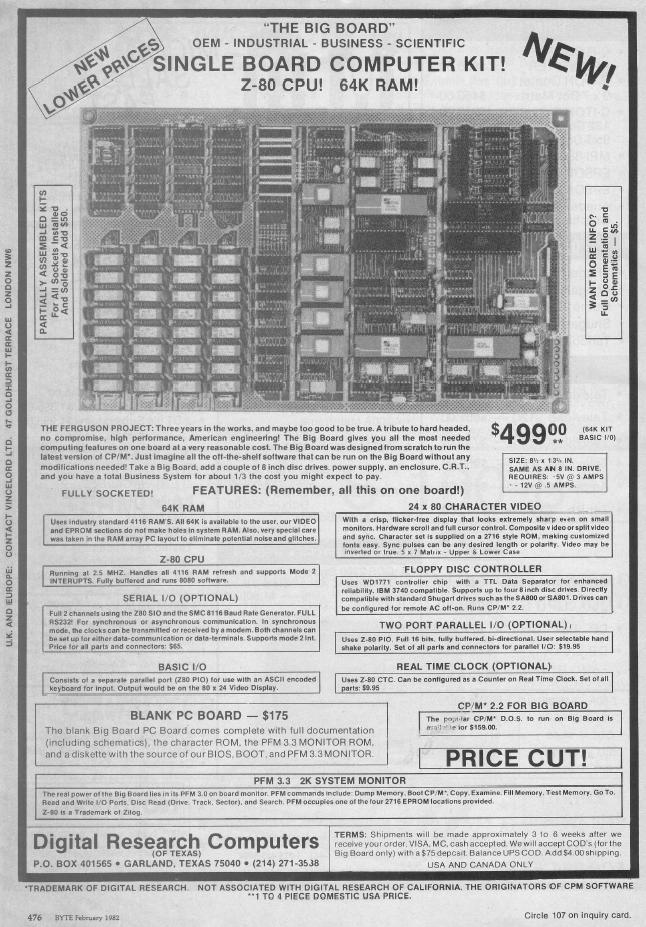
>
>Subject: Re: Keyboard PS/2 to Parallel converter
> From: "Dave Dunfield" <dave06a at dunfield.com>
> Date: Mon, 07 Jan 2008 19:51:21 -0500
> To: "General Discussion: On-Topic and Off-Topic Posts" <cctalk at classiccmp.org>
>
>> > Date: Mon, 7 Jan 2008 08:54:38 -0800 (PST)
>> > From: Fred Cisin <cisin at xenosoft.com>
>>
>> > It would seem that the cheapest way to do it is a discardable PC.
>> >
>> > Input character
>> > print it
>> > loop
Not cheap and noisy. You could yank the 8042 used in 386 through
early P1 boards as the first level interface. But that does not
translate the scan code to ASCII serial or parallel wich is what
most people would like.
>> Only barely possibly the cheapest. A $2 PIC or AVR or even 8051-
>> family chip can do the same job for a fraction of the power and space
>> and noise. And the code is out there--I've seen code for getting
>> PS/2 keyboard data into both PICs and AVRs. The output side would be
>> a piece of soup.
Absolutely. Even an 8048 (8035 or 8748) pull from a older keyboard
is more than enough CPU for the job. The DEC LK20X (30x/40x) series keyboards used an 8051, pull the EA line high and it's a 8031 (add a
latch and external rom).
>>
>> And a PIC could be considered "retro"; certainly an 8051 would be.
>> Both are descended from mid-70's chip designs.
>>
>> But to answer an earlier question--no, a simple serial-in, parallel-
>> out shift register won't do the job with a PS/2 keyboard--the
>> interface has a bidirectional protocol--it just doesn't blindly send
>> out scan codes.
>
>If anyone is interested, I have a very small bit of 8051 code which reads an attached PC keyboard,
>providing the scan codes over an RS-232 link. It also supports commands to set LEDs on/off etc.
I'd be interested. PS2 in and ASCII serial (or parallel with strobe,
output only) out is most useful in vintage designs. Most vintage
machines do not need bidirectional control but the local CPU (8051)
would have to echo the state of the NUM and shiftlock keys to the LEDs
and do code conversion accordingly.
Allison
>
>I specifically avoided using the P1 line in my design (full 8-bits
>parallel I/O available even on an 8031), so these are free, making it very trivial to modify this
>to output parallel instead of serial - it
>would also be very easy to add a translate table and recognition of
>shift/ctrl modifiers so that it would output fully decided ASCII.
>
>
>Dave
>
>
>--
>dave06a (at) Dave Dunfield
>dunfield (dot) Firmware development services & tools: www.dunfield.com
>com Collector of vintage computing equipment:
> http://www.classiccmp.org/dunfield/index.html
>
>Subject: Re: Keyboard PS/2 to Parallel converter
> From: "Roy J. Tellason" <rtellason at verizon.net>
> Date: Mon, 07 Jan 2008 18:51:24 -0500
> To: "General Discussion: On-Topic and Off-Topic Posts" <cctalk at classiccmp.org>
>
>On Monday 07 January 2008 11:54, Fred Cisin wrote:
>> It would seem that the cheapest way to do it is a discardable PC.
>>
>> Input character
>> print it
>> loop
>
>There was some project article in Byte way back when, by Steve Ciarcia,
>which provided a peecee-type keyboard input (AT rather than PS/2 but that
>shouldn't make that much difference). The circuit to deal with this was very
>simple and elegant, though I can't remember any more just how it was done.
It used a Z80 and a PPI rom and ram. At the time that was a easy small
design but still far more cpu than needed. The task is PIC or 8048 sized.
Fornm the At days to current the PS2 keyboard is handled with an 8042
(discrete or embedded) which is a slave bus verion of the 8048..
There are PIC designs for this out there as well as Atmel ATmega. Check
their sites.
>He didn't use a UART or similar, though, just a couple of MSI chips. And I
>remember thinking then how it wouldn't be all that hard to stuff an eprom
>between the output of that circuit (which gave you keycodes rather than
>characters) and have it spit out ASCII.
Ah, you do you handle the key down codes and the key up codes?
>
>Perhaps one of these days I'll run across the article again.
I have it burried somewhere. It does not translate well to an PS2
keyboard as the XT keyboard used for that has slower IO rate and
different keyscan. It would be a pain to do in simple logic as you
need at least a state machine.
Allison
>--
>Member of the toughest, meanest, deadliest, most unrelenting -- and
>ablest -- form of life in this section of space, ?a critter that can
>be killed but can't be tamed. ?--Robert A. Heinlein, "The Puppet Masters"
>-
>Information is more dangerous than cannon to a society ruled by lies. --James
>M Dakin
On the right, is it a computer, or just a dumb terminal?
There's a printer and possibly floppies in the background, but where do they go?
http://oldcomputers.net/temp/1980something.jpg
Thanks-
Steve.
---------------------------------
Be a better friend, newshound, and know-it-all with Yahoo! Mobile. Try it now.
> Date: Mon, 7 Jan 2008 08:54:38 -0800 (PST)
> From: Fred Cisin <cisin at xenosoft.com>
> It would seem that the cheapest way to do it is a discardable PC.
>
> Input character
> print it
> loop
Only barely possibly the cheapest. A $2 PIC or AVR or even 8051-
family chip can do the same job for a fraction of the power and space
and noise. And the code is out there--I've seen code for getting
PS/2 keyboard data into both PICs and AVRs. The output side would be
a piece of soup.
And a PIC could be considered "retro"; certainly an 8051 would be.
Both are descended from mid-70's chip designs.
But to answer an earlier question--no, a simple serial-in, parallel-
out shift register won't do the job with a PS/2 keyboard--the
interface has a bidirectional protocol--it just doesn't blindly send
out scan codes.
Cheers,
Chuck
I just pulled my GridPad 2050SL out of the garage, fired it up, and it
worked fine, for about 15 minutes. Then the screen started to fade,
adjusted contrast and brightness, worked for a few minutes then nothing,
just the backlight. Let it set for a few minutes, it fired up, but
quickly back to the blank screen, with a quicker fade.
Any suggestions on what to check? It has been in storage for the past 4
years, no climate control, so anything is possible. Probably heat
related component failure or solder joint, but where to look. Nothing
found on the web.
But to answer an earlier question--no, a simple serial-in, parallel-
out shift register won't do the job with a PS/2 keyboard--the
interface has a bidirectional protocol--it just doesn't blindly send
out scan codes.
Cheers,
Chuck
And then anybody has suggestion for a READY to USE black box?
Input PS/2
Output D0 to D7 + Strobe signals
Thank to all that will have all useful suggestions.
Enrico
Jason wrote:
> So since mine says "Server" yet has a 13W3 gfx board (haven't opened
> it up to ID it yet, and can't get into the OS to do a gfxinfo) it was
> probably a field-upgrade? I do have the "Elan" badge as well, and the
> owner only had one Crimson, so I'm assuming that's where it came from.
>
Most likely. 13W3 outputs do indicate either Entry or Express graphics,
and the badge indicates "Elan" (though Crimsons did have an Extreme
option).
> I got an internal cdrom recogzined last night. The only Irix distro I
> have now is 6.5. Will the Crimson at least load fx from that? It was
> acting like it couldn't even find the file, though, giving some scsi
> errors if I booted into the hdd's fx and tried 'ls dksc(....)" on the
> CD. I tried an Apple CD600i and a Toshiba model which was listed in
> the SGI cdrom survey. Of course, they could be bad drives, who knows.
> Too many variables!
>
> Next method will be to attach the boot drive to another SGI and edit
> /etc/passwd from there.
>
> Thanks for all the helps
>
No go- IRIX support for IP17 stopped at 6.2 (it's substantially
different from the later ARCS-derived systems, and has more in common
with the R3000/R2000 based systems than the later ones). IRIX 5.3 or
IRIX 6.2 are your best bets, though IRIX 4.0.5 (hard to find software
for), IRIX 5.1 (yuck!), and 5.2 (much better, but still not as good as
5.3) will also run on it. The SCSI errors don't sound good- check your
setup there. You might see file not found errors, but they won't be
SCSI errors.
On Jan 5, 2008 10:46 AM, Scott Quinn <compoobah at valleyimplants.com> wrote:
> Servers (S) didn't come with graphics. Later SGI separated out their
> server lines even more with a different base name (Challenge/Origin),
> but during the late '80s the base model was the same.
So since mine says "Server" yet has a 13W3 gfx board (haven't opened
it up to ID it yet, and can't get into the OS to do a gfxinfo) it was
probably a field-upgrade? I do have the "Elan" badge as well, and the
owner only had one Crimson, so I'm assuming that's where it came from.
> You can, but SGI never wrote a good OpenGL implementation for the
> PowerVision VGX/VGXTgraphics hardware, so much of the work is done by
> the main CPU (IRIS GL is fully supported). So, it depends on what you
> want to do with it...
"Pimp my SGI," I guess, and just make use of the nicer gfx board
before the dead Iris gets scrapped.
> One possible gotcha- IRIX 6.2 fx for the Crimson is broken, so you'll
> need to fx with either an earlier IRIX (4.0.5-5.3) or fx on a different
> SGI.
I got an internal cdrom recogzined last night. The only Irix distro I
have now is 6.5. Will the Crimson at least load fx from that? It was
acting like it couldn't even find the file, though, giving some scsi
errors if I booted into the hdd's fx and tried 'ls dksc(....)" on the
CD. I tried an Apple CD600i and a Toshiba model which was listed in
the SGI cdrom survey. Of course, they could be bad drives, who knows.
Too many variables!
Next method will be to attach the boot drive to another SGI and edit
/etc/passwd from there.
Thanks for all the helps
--
j
Date: Sun, 6 Jan 2008 13:31:52 -0800 (PST)
From: Chris M <chrism3667 at yahoo.com>
> you thanks
>
> what's a grid?
A company in Fremont, CA that manufactured laptops, acquired by Tandy
and utterly destroyed by their incompetence.
http://pages.total.net/~hrothgar/museum/Compass/
Cheers,
Chuck
Hi at all,
please excuse me for my not correct english, i'm writing from Pisa (Italy).
Is there anyone that have any copies of this old magazine already scannered?
This could help me to understand better all about around this board.
Thanks so much to all that would help me giving all kind of info, links and
news.
Enrico
Did/does such a thing exist?
I've got a CP/M .COM file which I believe is BASCOM generated -- running 'strings' over it reveals the line "ALREADY MODIFIED MBASIC 5.21 INTERPRETER" and the initial output when you run it includes what appears to be the original BASIC source file name and the string "COMPILED VERSION".
Is there a tool to recover a reasonable facsimile of the original BASIC source?
Thanks.
_________________________________________________________________
Put your friends on the big screen with Windows Vista? + Windows Live?.
http://www.microsoft.com/windows/shop/specialoffers.mspx?ocid=TXT_TAGLM_CPC…
Date: Sun, 06 Jan 2008 10:33:16 -0800
From: "Chuck Guzis" <cclist at sydex.com>
Scratch the request, please. After a little more looking, it seems
that the application used to create these documents was Wang PC IWP,
not an old WordPerfect. I got a hint that something was wrong when
they wouldn't open with my WP 4.1.
I can handle IWP.
Thanks,
Chuck
Hi at all,
please excuse me for my not correct english, i'm writing from Pisa (Italy).
I have a old Ferguson BigBoard1. I played with it almost 20 years ago then I
lost its schematic.
Here its references:
http://www.classiccmp.org/dunfield/miscpm/fbbfeb82.jpg
<http://en.wikipedia.org/wiki/Bigboard>
http://en.wikipedia.org/wiki/Bigboardhttp://www.stevenjohnson.com/big-board.htm
At this moment :
a) I got all doc from here: <http://www.dtweed.com/docs/index.html>
http://www.dtweed.com/docs/index.html
b) I pulled away all chips and I matched the PCB with that schematic
checking all differences.
On the board there is not the Z80 DART so I'll can't try to use
Hyperterminal to connect me to the board.
I think to put the chips asap almost when I'll have:
1) a parallel keyboard: is it anybody could help me to transform a PS/2 or
AT keyboard in a parallel one? Even using the only internal matrix and using
a new keyboard encoder (I prefer less this way cause my limited free time).
In 1983 I used KR-2376 to create the correct character codes.
2) a composite monitor : I have a monochromatic monitor "hantarex boxer 12"
like this
<http://cgi.ebay.it/Monitor-HANTAREX-BOXER-12-RARISSIM-retro-jamma-SuperGun_
W0QQitemZ130182617194QQcmdZViewItem>
http://cgi.ebay.it/Monitor-HANTAREX-BOXER-12-RARISSIM-retro-jamma-SuperGun_W
0QQitemZ130182617194QQcmdZViewItem, but i have not its schematic. Is there
anybody who could help me?
With this working I HOPE to can make the board alive to get its "System
Prompt" . Wow!
3) The second step if it will go fine will be to connect my Mitsubishi
M2896-63 8inc Internal Floppy Drive to it. I have two drives but I have not
its manual. So is there anybody who has its manual?
4) If I will can format a 8inc diskette I will need to rebuild the CP/M 2.2
Operating System: So is there anybody who has info to give me to how to do
this?
Thanks so much to all that would help me giving all kind of info, links and
news.
Enrico Lazzerini
I have a high quality CP-A schematic as a 600 DPI JPEG. I'd prefer to send
it to someone who can host it, but I'll honor a FEW individual requests for
it.
Barry Watzman
Watzman at neo.rr.com
>>Most of the older PROM style systems had an issue booting from a cd drive. You can't just use any with them. >>Many people report that Plextor drives are some of the best and Toshiba drive are right behind. Don't forget >>also that the cd drive must be ID 4 and be set for 512 byte sectors (not 1024 or 2048). I personally have never >>tried booting my crimson with my 6.5 cd's but if you just use FX from an Irix 5.3 cd you should be fine.
>>
>>Is ID 4 essential? I've read conflicting info re: required device IDs
>>for booting. What is the expected behavior using a different ID?
ID 4 is not really essential but it is a preferred address. Just don't forget to set the drive for 512 byte sectors. That is a must.
>
>Here there is a schematic already suggested
>http://eece.ksu.edu/~eece696/beta/digital/A/stop.htm but could it works?
>
>What could be the exact schematic and hardware to use? And at the last is
>there anything "ready-to-use" cause I have not much time to spend to build
>it?
I don't think that circuit will work.
This microcontroller encoder might work
http://www.brielcomputers.com/superencoder.html
Grant
Jochen Kunz <jkunz at unixag-kl.fh-kl.de> wrote:
> "Arno Kletzander" <Arno_1983 at gmx.de> wrote:
> > As I don't have a TGX/TGX+ in any of my easily accessible machines,
>
> Arno, this is quite easy to fix. I'll snail mail you one or two
> GX/TGX/TGX+ later this week. :-)
To Jochen, der Mouse and anybody else eager to help out:
Thanks a bunch, but please, don't bother to! If you have Sun stuff to shed, I'll happily discuss that in private mail, but it's not immediately needed.
I apologize that my message was a bit prone to misunderstand, but I actually meant to say that I *know* I have one of those things buried somewhere in my clutter and my interest is not sufficient at that stage to make me dig for it. If at all possible, I'd like to make do with the onboard cg3 of the SPARCclassic anyway. No, I've got no idea why people always think I'm into pain...
So long,
Arno.
--
Der GMX SmartSurfer hilft bis zu 70% Ihrer Onlinekosten zu sparen!
Ideal f?r Modem und ISDN: http://www.gmx.net/de/go/smartsurfer
I stumbled on "Inside the EISA Computers" by Tony Dowden (ISBN
0-201-52397-3) and AT&T's "SCSI (Small Computer Systems Interface)
Definition" book, both circa 1987. If anyone has any interest in these,
you can have them for the cost of media mail shipping. The SCSI book is
incredibly detailed.
--
Jim Leonard (trixter at oldskool.org) http://www.oldskool.org/
Help our electronic games project: http://www.mobygames.com/
Or check out some trippy MindCandy at http://www.mindcandydvd.com/
A child borne of the home computer wars: http://trixter.wordpress.com/
All:
I have a working Northstar Horizon that I might be looking to sell to
make room for other things. I forget the exact configuration, but it has
somewhere between 32k and 48k of RAM and a dual-floppy drive system. I know
I have a bunch of disks for it (including blanks, maybe 30 or so), and I
think I may even have a version of CP/M for it. The body is in fine shape
but the wood top is original and in just OK condition. I planned on making a
new cover but I never got to it.
How much would something like this go for?
Rich
--
Rich Cini
Collector of Classic Computers
Build Master and lead engineer, Altair32 Emulator
http://www.altair32.comhttp://highgate.comm.sfu.ca/~rcini/classiccmp
> Date: Wed, 02 Jan 2008 08:50:57 -0600
> From: "Michael B. Brutman" <mbbrutman-cctalk at brutman.com>
> I'm confused about this whole thread. I really thought that there was
> another entire OS/2 operating system (not from IBM) that people were
> talking about.
Sure--and OS X is the 10th version of that system. ;)
I'm thinking that there's probably some confusion over the labeling
with this PDP-11 thingie, whatever it is. There would be no good
reason to produce an -11 version of OS/2 at the time as the platform
was obsolete (or at least obsolescent). My guess is that's someone's
OS, but not IBM nor M$. I used DOS on an S/360, but it doesn't
resemble anything called "DOS" nowadays (there was also an S/360 TOS;
Sytos called their product for the PC a "Tape Operating System",
which I found to be very confusing, as it required DOS to run).
I do recall (more vividly than I care to, as it still makes my blood
boil) one aspect of the OS/2-NT charade. Microsoft solicited and
accepted pre-release subscriptions (about $3K each) from OS/2
developers for the "new" OS/2 that was going to be released Real Soon
Now. After they had everyone's money, M$ turned around and said that
they weren't going to do OS/2, but rather Something Better and that
they would be supplying that instead (NT 3.1). IIRC, they nearly had
a lynch mob headed toward Redmond screaming for BillG's corpse. M$
did relent and refunded the advance payment to those who screamed
loudest. Doubtless, quite a number of people got stuck with a dog of
an operating system that they didn't ask for an didn't want. I
don't think NT really caught on until about 3.51.
One thing that I had to hand IBM was that their developer's
documentation was superb for OS/2. The same could not be said for
Windows 3.0. I still have both on my bookshelf. In those pre-CD
days, you could estimate the quality of the documentation simply by
putting the boxes of developer's material on the bathroom scale.
I don't know about Vista, but 2K and XP still host the OS/2 subsystem
as well as HPFS. I've got a couple of 16-bit OS/2 applications that
I still use on 2K.
Cheers,
Chuck
> Date: Sun, 6 Jan 2008 09:25:44 +0100
> From: "Nico de Jong" <nico at farumdata.dk>
> I have a WP 4.3. Would that be useful?
I honestly don't know--it might be and I'd be willing to try to see
if it will import older versions. If I can convert to WP 4.x, I can
take it from there.
Thanks!
Chuck
> Date: Sun, 6 Jan 2008 02:31:02 -0500
> From: "John Floren" <slawmaster at gmail.com>
> It's best if you can work under a microscope; we had binocular
> microscopes that were perfect under low magnifications.
I long ago took a tip from my dentist and use a binocular loupe. Not
cheap, but you can move your head and not the work. Some even have
built-in light sources (mine doesn't).
> Next, I'd take my rather fine-tipped soldering iron, get a blob of
> solder on the tip, and quickly swipe it down the pins along one side.
> Inspection would reveal that almost all the pins now had very nice fills
> and very few were bridged.
Ah, the web sources seem to say "use the biggest tip you've got to
hold the most solder". I'll try the next one with a fine tip.
Thanks,
Chuck
Hi,
winter holidays left me with too much time at my hands and I'm currently trying out some more arcane (or is that "sick"?) stuff with my Sun workstations. According to the Sun Framebuffer FAQ, the TGX/TGX+ framebuffer is quite universally programmable - some OBP Forth magic allows you to select one of several possible dot clock frequencies, adjust front porch/sync/back porch widths in multiples of pixel duration and so on.
(Before anyone asks, this is all just idle experimental proof-of-concept stuff and not intended to work with any off-the-shelf software. If all goes extremely well, it might turn into a sort of SPARC-based videogame console somewhere in time, as I'm looking for TV rate RGB output.)
As I don't have a TGX/TGX+ in any of my easily accessible machines, I'd like to know just how "versatile" other framebuffers (mainly the cg3 built into the SPARCclassic) are in this respect.
I've already extracted some of the corresponding FCode(attributes and words from /iommu/sbus/cgthree) but it doesn't give me much of an idea where to start yet. Has anybody been involved with that stuff far enough to tell me - or just give me some pointers towards figuring out - which lever does what?
Btw, I do have a datasheet of the RAMDAC but could not find any useable information on the LSI L1A4946 chip which obviously, amongst other things, has to generate the video timing. If necessary, I'd even consider replacing the video clock crystal - SPARCclassics are abundant enough here.
Thanks in Advance,
Arno
--
Psssst! Schon vom neuen GMX MultiMessenger geh?rt?
Der kann`s mit allen: http://www.gmx.net/de/go/multimessenger?did=10
Found during cleanup.
1 Microvax maintenance CDrom, contains the diagnostic software.
Complete in caddy and grey storage case.
(Dec partno AG-PCUSE-RE)
I would like to have $15 for it.
>
> Found during cleanup.
>
> 1 Microvax maintenance CDrom, contains the diagnostic software.
> Complete in caddy and grey storage case.
> (Dec partno AG-PCUSE-RE)
>
> I would like to have $15 for it.
>
>
I found a few more things which are related to the cdrom,
a diagnostics manual and a set (11) of 5.25 floppies in plastic
case.
All 3 items together for $25 + postage.
I've got some document files from 1984 that were created on a PC.
Although I'm not certain about the program used to create them, they
certainly look internally like Word Perfect (256 bytes of 00, a few
binary bits and then a block of FFs, followed by text blocks). My
conversion packages (RDocX and WordPort) only go back to WP 4.1 and
while they accept the files as Word Perfect, don't convert them
properly.
Does anyone have a suitable vintage copy of WP for DOS that might
handle these things?
Thanks,
Chuck
I tried my hand at soldering a 68 pin TQFP using the "push the blob
down" method described on a YouTube video. It worked pretty well,
but for one side of the QFP, where there were several solder bridges.
The bridges were easy to clean up using a bit of solder wick. About
the only thing I'd do differently is to tack down two corners rather
than one--it's easy with just one corner tacked to displace the
package slightly with just the pressure of the soldering tip.
I didn't try the "flood and suck" method.
I used the largest chisel tip on my old Weller TC201 iron, a PTC6--a
blunt tip suited to soldering #14 wire, but it holds a lot a solder.
Thanks all for the suggestions,
Chuck
Got my SGI Crimson up and running on serial console, and I've got an
old SGI monitor sitting around, but I guess I gave away all my cables.
Anyone have such a cable in their junk bins? Only ones on ebay now
are from the dealer-gougers.
> You can get the license for free, but for some reason HP has decided
> not to provide downloads. You can buy hobbyist media for $30, but
> that's way more than I've spent getting the system itself and I don't
> want to wait for the thing to arrive, so I'm hoping somebody has it up
> on FTP somewhere.
>
AFAIK the DEC/CPQ/HP license never allowed that officially. The big
unfortunate bit about the hobbyist program is that HP has not approved
a v4 hobbyist release with OpenVMS 8.2 yet (been years). There are
differences between V7.3-2 and V8.x that make some software unusable.
On the good side, the licenses are valid for any version of OVMS you
can get your hands on, <OfT>Itanium support has been added to the
hobbyist PAKGEN</OfT>, and the program is still alive!
On Jan 5, 2008, at 5:53 PM, cctalk-request at classiccmp.org wrote:
> Is ID 4 essential? I've read conflicting info re: required device IDs
> for booting. What is the expected behavior using a different ID?
>
No- OpenBoot Suns alias the "boot cdrom" command to a specific ID, but
SGIs don't. Don't use ID0- that's the HBA on SGIs, other than that
anything goes. Default systemdisk is ID1, though, respecting that makes
it easier. For a different ID you have to change your "boot" command,
that's the only difference.
I've recently been searching for a VMS-capable machine or two in the
East Bay area of San Francisco, CA and have been directed to this
list. Besides catering to my interest in classic computing, I'm hoping
it will also have a few subscribers in my area (Livermore) with a VAX,
Alpha, or Itanium to get rid of cheap. If you have one, please drop me
a note off-list.
I guess I'll also need CDs or CD images of VMS for Alpha if I end up
getting one of those... I have VAX images but no Alpha.
Oh, one more thing--I have already run VMS on SIMH's VAX emulator,
thank you, but I'd like to try it on real hardware.
Thanks
John
--
Ph'nglui mglw'nafh Cthulhu R'lyeh wgah'nagl fhtagn
Does anyone know where I can find the schematic for the IMSAI CP-A
(operators panel)? Every source I have looked at just has the
assembly and operations manual for the CP-A, but not the actual
schematic. I'm trying to bring back an old one from the grave, and
having an actual schematic would help a lot!
Thanks,
-Mardy
>
>Subject: Re: Looking for IMSAI 8080 CP-A Schematic
> From: "Marden P. Marshall" <mardy at voysys.com>
> Date: Sat, 05 Jan 2008 17:02:40 -0500
> To: "General Discussion: On-Topic and Off-Topic Posts" <cctalk at classiccmp.org>
>
>
>On Jan 5, 2008, at 12:39 PM, Roy J. Tellason wrote:
>
>> On Saturday 05 January 2008 03:50, David Griffith wrote:
>>> On Fri, 4 Jan 2008, Marden P. Marshall wrote:
>>>> Does anyone know where I can find the schematic for the IMSAI CP-A
>>>> (operators panel)? Every source I have looked at just has the
>>>> assembly and operations manual for the CP-A, but not the actual
>>>> schematic. I'm trying to bring back an old one from the grave, and
>>>> having an actual schematic would help a lot!
>>>
>>> I have an original documentation binder that I'll check out and
>>> photocopy
>>> if it has the schematics.
>>
>> I do too, someplace. It's hiding though. I don't recall if it
>> includes that
>> information or not. If you end up making that info available in
>> electronic
>> form, I'd be interested in having a copy as well.
>>
>> And while we're on the subject of Imsai, does anybody have part
>> numbers handy
>> for those switches? I have several that are broken to replace.
>
>They are made by C & K. The 2-position ones are P/N 7101 and the
>momentary are P/N 7105. You can order them from www.IMSAI.net for
>between $11.00 and 12.00 a piece.
That's anywhere from $3-5 more than Digikey and they are an expensive
source! I usually get them for under $7 in unit lots.
NOTE: the suffix for those switches is important as they come in
differnt mountings and with differing solder posts.
Allison
>
>>
>>
>> --
>> Member of the toughest, meanest, deadliest, most unrelenting -- and
>> ablest -- form of life in this section of space, a critter that can
>> be killed but can't be tamed. --Robert A. Heinlein, "The Puppet
>> Masters"
>> -
>> Information is more dangerous than cannon to a society ruled by
>> lies. --James
>> M Dakin
>>
>>
I have a strongarm (sa1100) development board I'm about to pitch and I
thought maybe someone here would want it. It's an "Assabet" board I
think. It once booted linux. I have some of the original cdrom's also
and the serial cable and power supply. The devel board has ethernet,
usb, lcd and sound.
It seems like it's 10 years old anyway :-) I believe the part has been
EOL'd.
If you want it, send me you address and paypal postage. The box weighs
5lbs (.3 stone? :-)
-brad
Brad Parker
Heeltoe Consulting
+1-781-483-3101
http://www.heeltoe.com
Fellow Listmembers;
I've procrastinated ad-nauseam on this till it's way past time to address
the issue.... the Classiccmp server is in need of a hardware upgrade and/or
replacement. The main (but not only) issue: disc space and thus chassis
space. This produces a cascading set of dependencies :)
I realize the upgrade is not entirely due to the classiccmp list, some of it
is due to all the classiccmp related websites & ftp sites I have agreed to
host gratis for listmembers. I feel these provide a service to our community
and are worth providing the facilities for - but I want to make sure that is
all clear to everyone. As a side note, we're looking to do a substantial
bandwidth upgrade at the datacenter too - no doubt that will help traffic
matters on the classiccmp server.
I do not want to clutter up the normal list traffic with discussion of this
topic. Some here won't care about it and/or will be annoyed by all the
PeeCee hardware talk. Others will no doubt pull it into other unrelated
topics ;) As a result, I've created a new temporary list
(newserver at classiccmp.org) for this discussion. If anyone is interested in
participating in the hardware discussion about what to upgrade to, how best
to do it, etc. please join that list as soon as possible.
Yes, I'm completely capable of coming up with a configuration and putting it
into production without input... but there are various subjective things I'd
like others advice on besides just my own. Not to mention these upgrades
have usually been mostly funded through member donations so it's certainly
appropriate to get input from as many as possible who wish to talk about it.
My plan is to wait a week for anyone interested to get on the newserver
list. After that time, I will start the discussion by posting a detailed
list of exactly what is in the server, what issues I see with it, what I was
thinking as to solutions, etc. Then we can all discuss there. Once we come
down to how to proceed, perhaps we will post back to the main list for
everyone to be aware of - or should we just assume the interested parties
participated in the other list and just go with it? Don't answer that here,
it's a question for the other list traffic :)
Once a decision is reached, the temporary list will be decomissioned. I very
sincerely appreciate the input anyone may have there with regards to server
upgrade choices.
Best regards,
Jay West
Message: 8
Date: Sat, 5 Jan 2008 11:25:29 -0600
From: "Jason T" <silent700 at gmail.com>
Subject: SGI Crimson (was:13W3-3BNC cable)
To: "General Discussion: On-Topic and Off-Topic Posts"
<cctalk at classiccmp.org>
Message-ID:
<51ea77730801050925n2a68cd01wcbfb2a0bd2af23c5 at mail.gmail.com>
Content-Type: text/plain; charset=ISO-8859-1
On Jan 5, 2008 10:46 AM, Scott Quinn <compoobah at valleyimplants.com> wrote:
>So since mine says "Server" yet has a 13W3 gfx board (haven't opened
>it up to ID it yet, and can't get into the OS to do a gfxinfo) it was
>probably a field-upgrade? I do have the "Elan" badge as well, and the
>owner only had one Crimson, so I'm assuming that's where it came from.
The only way to be positive is if you open the case. the 13W3 connection was the standard monitor connector for SGI's for almost a decade.
>"Pimp my SGI," I guess, and just make use of the nicer gfx board
>before the dead Iris gets scrapped.
Just part it out and sell it on nekochan.net if you are going to scrap it.
>I got an internal cdrom recogzined last night. The only Irix distro I
>have now is 6.5. Will the Crimson at least load fx from that? It was
>acting like it couldn't even find the file, though, giving some scsi
>errors if I booted into the hdd's fx and tried 'ls dksc(....)" on the
>CD. I tried an Apple CD600i and a Toshiba model which was listed in
>the SGI cdrom survey. Of course, they could be bad drives, who knows.
> Too many variables!
>
>Next method will be to attach the boot drive to another SGI and edit
>/etc/passwd from there.
>
>Thanks for all the helps
Most of the older PROM style systems had an issue booting from a cd drive. You can't just use any with them. Many people report that Plextor drives are some of the best and Toshiba drive are right behind. Don't forget also that the cd drive must be ID 4 and be set for 512 byte sectors (not 1024 or 2048). I personally have never tried booting my crimson with my 6.5 cd's but if you just use FX from an Irix 5.3 cd you should be fine.
Well since I see someone else here is chatting about their red box it
might be nice to ask questions too.
My Crimson was given to me by a person who originally got several
desksides at a Boeing sale. When I got the system it had a ruined RM4
(raster manager) board and was missing it's GE8 (Geometry Engine) board.
Turns out that the GE8 was accidentally sold and the RM4...well....I
guess that is what you get when you grab a random RM4 off a pile of
boards and install it before inspecting it.
The system is otherwise fine (aside from the lower side skirts missing,
no drive sleds, a dead fan tray and not much ram) however it would be
nice to find another GE8 board and see the Reality Engine, the best
graphics option for the system, come back to life with another RM4.
Who here has some spare trays and/or a GE8 board they are not using? It
might also be nice to get more ram also.
Chris,
I know this is an old thread I am looking at, but if you still have a copy of Realistic MPA-100 owners manual, I would appreciate it.
Thanks,
Kenny
I'm assuming that this is on-topic as the equipment I wish to use this
in is microprocessor controlled (68000) piece of test equipment - the
Fluke 9100 series of microprocessor test fixtures.
What my group of friends (Tech Tools Mail List) are looking for is a
cost effective replacement for the ancient SCSI drives with flash being
an optimum solution, but trying to find the most cost effective solution...
I've only found one solution (Adtron S35FA) on line with a bit of
hunting, but not reading the current magazines I'm probably overlooking
a number of possibilities.
Anyone have suggestions?
Thanks,
John :-#)#
--
John's Jukes Ltd. 2343 Main St., Vancouver, BC, Canada V5T 3C9
Call (604)872-5757 or Fax 872-2010 (Pinballs, Jukes, VideoGames)
www.flippers.com
"Old pinballers never die, they just flip out"
On Jan 5, 2008, at 8:20 AM, Jochen wrote:
> May it be possible that the Crimson uses High Voltage Differential SCSI
> for its disks like some HP9000 server class machines? In that case a
> Single Ended device will look up the bus completely. Check the model
> designator on the disks if they are SE or HVD...
> --
The base I/O on 4D-series (including Crimson) machines was SE SCSI-I
(WD 33c93) on the IO3B. HVD can be installed through VME options, but
was not standard (as it was in the later Onyx/Challenge).
The OP may want to look at Gerhard's page about the Crimson
(http://sgistuff.g-lenerz.de/hardware/machines/crimson.php), which
gives more details about the SCSI configuration.
On Jan 5, 2008, at 8:20 AM, cctalk-request at classiccmp.org Richard wrote:
> Oh, a VGXT. I've wanted one of those in my collection as its the
> first SGI machine with hardware texture. I'm still fuzzy on what the
> difference is between a Crimson and a VGXT, aside from the graphics
> bits.
Crimson is the base machine, VGXT is the graphics set - similar to what
you get with smaller boxes (i.e. you can have an Indigo2 in XL,
EXtreme, IMPACT, etc.). VGXT is the 3rd generation high end SGI
graphics (1st - IRIS graphics, 2nd - GTX, 3rd - VGX(T), 4th - Reality)
Jason T wrote:
> I believe the
> Server had no gfx at all? Now inside the door I also found an "Elan"
> tag with the glue worn off, so I'm guessing it may have gotten a field
> upgrade, video card and label.
>
> I've got a dead Iris 410/VGXT downstairs. Wonder if I can transplant
> the gfx board from that into the Crimson?
Servers (S) didn't come with graphics. Later SGI separated out their
server lines even more with a different base name (Challenge/Origin),
but during the late '80s the base model was the same.
Regarding the gfx upgrade:
You can, but SGI never wrote a good OpenGL implementation for the
PowerVision VGX/VGXTgraphics hardware, so much of the work is done by
the main CPU (IRIS GL is fully supported). So, it depends on what you
want to do with it...
>
> Anyone tried to use external SCSI on a Crimson (or Iris?) Mine has
> all the drive bays full (3 HDD and a 150mb tape) and I'm trying to get
> a CDROM hooked up temporarily so I can reset the root pw on the drive.
> There are two external SCSI connectors. If I attach to the left
> one, I lose my hard drives (and still no cdrom seen in 'hinv.') If I
> attach to the right one, nothing.
It should be the one on the cardcage (make sure termination is good).
If that doesn't work, you can loop it in the two connectors on the
bottom right (one cable from lower connector to CD-ROM, one cable from
CD-ROM to top connector). Is the jumper present? There should be a
short cable between the two, and you might have oddities if this isn't
there (such as the cardcage connector not functioning).
One possible gotcha- IRIX 6.2 fx for the Crimson is broken, so you'll
need to fx with either an earlier IRIX (4.0.5-5.3) or fx on a different
SGI.
All of this is per the SGI hardware developer's handbook, I don't have
a Crimson.
On Jan 5, 2008, at 8:20 AM, Jason T. wrote:
> I did see the Sun cable with the 4 BNC on US ebay and thought the
> same. I'm not sure if that fourth lead is relevant.
>
Nope - unconnected it's just floating, the same as if it wasn't there.
SGI 4Ds have always used sync-on-green, so connect your x BNC -> 13W3
up and connect the RGB leads, ignoring the other ones. You do need to
have a SOG-capable monitor.
A few years ago I picked up a DEC TSZ07 and would like to access it
>from my PC.
The DEC TSZ07 is a tabletop 9-track tape drive with a SCSI-1
interface. Apparently it was originally manufactured by Cipher Data,
model 955-S.
I'd just like to write some files out to tape and then read them back.
I don't have to recover/restore any data from an old tape. Ideally
>from a Windows machine.
Has anyone tried this? Is there any software available?
Matt
Roswell, Georgia
> Date: Fri, 4 Jan 2008 12:27:57 +0000
> From: Stroller <classiccmp.org at stellar.eclipse.co.uk>
>
> On 3 Jan 2008, at 18:35, John Robertson wrote:
>> ...
>> What my group of friends (Tech Tools Mail List) are looking for is
>> a cost effective replacement for the ancient SCSI drives with flash
>> being an optimum solution, but trying to find the most cost
>> effective solution...
>>
>> I've only found one solution (Adtron S35FA) on line ...
>
> I'm not immediately able to find pricing on the Adtron product, but
> IDE-SCSI adaptors - to allow you to connact an (E)IDE hard-drive to a
> SCSI bus are readily available. CF flash memory cards "talk EIDE" and
> again simple pin-out convertors are readily available - and also very
> cheap - or you can make your own.
To get specific with part numbers...
Acard makes the Acard 7720 in a few varieties. In this case you'd want
the 7720U probably for its narrow interface (7720UW has 68 pin interface
and there are LVDS flavors as well). This has a narrow (50 pin) single
ended SCSI interface on the upstream side and a regular 3.5" IDE (as
opposed to notebook drive) interface on the downstream side.
It retails for about $70, but there's a fellow selling a boat-load of used
ones on Ebay for $30 each. I have some new ones I'm selling for $39
which include the little power splitter/adapter and a nice instruction
sheet. :-)
Once you have the 7720U, you have two directions you can go. Go as you
planned and get any of the inexpensive IDE<=>CF Card adapters, which
typically cost well under $10. Geeks.com has an assortment for $5 each
with a dual CF card adapter for $7.50 in their "controllers/adapters"
section.
The other direction you could go is to get a 2.5" to 3.5" drive adapter
for about $5 (again at geeks.com, there's a cheaper one, but the $5 one
comes with rails as well as circuit board) and add any of the 2.5" IDE
hard drives you can find littering the ground.
There can be gotchas depending on your equipment. One resourceful fellow
in Australia used an IDE to CF card adapter in the PowerBook 150, IIRC,
only to find that the IDE in the PB150 interpreted the device ID of CF
improperly (built before or around time spec was finalized) and would not
recognize it. His solution was to build an adapter board to recognize and
intercept the ID transaction and then let all other transactions pass.
As I mentioned, a resourceful fellow.
The point being, there are possible compatibility problems depending on
the equipment being used.
Jeff Walther
On Jan 4, 2008 4:47 PM, Richard <legalize at xmission.com> wrote:
> Is yours marked "Jurassic Classic"? Mine is :-)
Nope :( This one was meant to be a no-gfx server, I guess. Even the
hostname on the installed Irix 6.2 is "webserver."
> Is it possible that the SCSI device IDs are fixed and that's why
> connecting an external device makes your HD disappear?
The hdd sleds all have external pushbutton-selectable IDs. Not sure
about the tape drive. My next step is to take one of the non-boot
drives out of its sled and put a (hopefully compatable) CD-Rom drive
in there. I want to see what's on these drives!
Tom:
In reference to problems listed below...if you can fax or email complete
LED-decoding, it would be GREATLY appreciated...
Dominic
281-320-7525FAX
On Mon, 11 Mar 2002, Jos Dreesen wrote:
> 6 and 8 on : "indeterminate density" .
> Maybe the floppydisc itself is marginal ?
There's nothing in the drive when this is happening. Maybe when it tries
to move, its checking for density?
> 5, 6 and 8 : "invalid drive status during seek"
>
> Give me a fax number off-list and I'll fax you the complete LED-decoding
> list.
Cool, thanks!
-Tom
{\rtf1\mac\ansicpg10000\cocoartf824\cocoasubrtf420
{\fonttbl\f0\fswiss\fcharset77 Helvetica;}
{\colortbl;\red255\green255\blue255;}
\margl1440\margr1440\vieww13240\viewh11000\viewkind0
\pard\tx720\tx1440\tx2160\tx2880\tx3600\tx4320\tx5040\tx5760\tx6480\tx7200\tx7920\tx8640\ql\qnatural\pardirnatural
\f0\fs24 \cf0 ________________________________________________________________________________\
\
LeTigre Solutions, Inc.\
\
This message, as well as any attached document, contains information\
>from LeTigre Solutions, Inc. that is confidential and/or privileged. The\
information is intended only for the use of the addressee named above.\
\
If you are not the intended recipient, you are hereby notified that any\
disclosure, copying, distribution or the taking of any action in\
reliance on the contents of this message or its attachments is strictly\
prohibited, and may be unlawful. If you have received this message in\
error, please delete all electronic copies of this message and its\
attachments, if any, destroy any hard copies you may have created,\
without disclosing the contents, and notify the sender immediately.\
\
Unless expressly stated otherwise, nothing contained in this message\
should be construed as a digital or electronic signature, nor is it\
intended to reflect an intention to make an agreement by electronic\
means. \
\
\
}
Hi,
Due to lack of space, I've got to part with my VAX 4000/500 cluster. It
consists of a pair of VAX 4000/500 servers, and a third identical-looking
DSSI BA disk cabinet. I was last using this as a single system, and had
moved a memory board from one node to the other, but as far as I know all
works. I'm including the DSSI cables. This includes quite a few DSSI disks.
This also includes a KZQSA SCSI card, external SCSI cdrom drive, and
OpenVMS VAX media. This also includes several HSD30 DSSI RAID controllers,
for connecting SCSI disks, though I have neither the SCSI cables nor disks
to go with these.
I don't think this is worth a lot, but was hoping for something
useful but smaller in trade. Of interest would be an IBM p Series
server, *recent* Sun or Cisco gear, or possibly PDP8/e printed
service manuals and/or spare cards.
This is available for local pickup only, near Plymouth Meeting, PA, USA.
Please e-mail me if interested.
Mark
--
Mark G. Thomas (Mark at Misty.com)
voice: 215-591-3695
http://mail-cleaner.com/
Sandy's Electronics here in Reno has a bunch $1.00 each, these are the
vellman boards and some telecom boards. 20 slot backplanes to match too.
www.sandyselectronicparts.com
Randy
> From: mcguire at neurotica.com
<http://www.classiccmp.org/mailman/listinfo/cctalk>
> Date: Fri, 4 Jan 2008 10:44:20 -0500
> To: cctech at classiccmp.org
<http://www.classiccmp.org/mailman/listinfo/cctalk>
> CC:
> Subject: Re: inexpensive prototype boards with 22/44 pin edge connector
>
> On Jan 4, 2008, at 6:51 AM, Roy J. Tellason wrote:
> >> Does anyone know where to get some inexpensive prototype boards with
> >> the
> >> 22/44 pin edge connectors?
> >>
> >> I am looking for something like DATAK or VELLEMAN boards preferably
> >> under
> >> $10 a piece.
> >>
> >> I have looked but have not been able to find any. Any hints would be
> >> much
> >> appreciated.
> >
> > I too would be interested in these. They used to be really common,
> > and
> > could even be found at radio shack for a while, but not these days...
> >
> > Small prototyping boards in general are of interest to me, with or
> > without
> > the edge connector for that matter.
>
> Same here; if anyone finds a good source for decent prototyping
> boards, please post it.
>
> -Dave
>
> --
> Dave McGuire
> Port Charlotte, FL
>
-----REPLY-----
Thanks Randy!
Andrew Lynch
Hi,
Some kind soul took mercy on me and sent me the 2MB ZIP file. If anyone
wants it please contact me offline.
Thanks!
Andrew Lynch
> -----Original Message-----
> From: Andrew Lynch [mailto:lynchaj at yahoo.com]
> Sent: Thursday, January 03, 2008 10:17 PM
> To: 'cctalk at classiccmp.org'
> Subject: S-44 8085 homebrew computer
>
> Hi,
>
> Did anyone get a chance to save the "The Simple Computer II Project"
> homebrew computer pages before they went away?
>
> It used to be here:
>
> http://www.interparse.com/microcomputer/simpleii.html
>
> for some reason it has disappeared.
>
> I tried the internet archive and it found a copy but it is missing
> graphics.
>
> http://web.archive.org/web/20070702182520/http://www.interparse.com/microc
> omputer/simpleii.html
>
> If anyone has a copy, please send me one or post a link.
>
> Thanks!
>
> Andrew Lynch
> Date: Thu, 3 Jan 2008 21:07:02 +0000 (GMT)
> From: ard at p850ug1.demon.co.uk (Tony Duell)
> If by 'commodity solutions' you mean the WD1010 or whatever, then I have
> to disagree with you. Plenty of manufactuers used their own ASICs in the
> hard idsk controller, and admittedly most of them did do a fairly normal
> MFM or RLL2,7 encoidng. But I'll bet at least one didn't!
The latter is what I said--and meant. "Unique" encoding schemes,
such as one finds on floppies (zoned recording, CLV, various flavors
of GCR, FM, whatever you want to call the Apple II flavor of GCR,
"mixed" formats, such as the RX02, etc.) were comparitively rare.
MFM and RLL 2,7 were overwhelmingly the rule on the ST506 and ST412
class drives. I mentioned the Perstor with ARLL, but it was hardly
the rule.
> And I've got machiens that use a 8x305 in the hard disk controller.
And there are plenty of systems that use the 8x30x and the WD1000
series chipsets (the WD1001 being one of the boards). Still MFM.
> A kludgeoard was added (and the CPU microcode device diivers changed)
> to talk to a Micropolis 1203, and finally a different kludgeboard and
> CPU microcode were used to talk to ST412 drives. I would not want to
> bet that the encoding on that was normal, at least not without doing a
> lot of tests.
I'd be willing to wager that it was MFM or M2FM of some flavor,
however. I've got an SA4000 and controller that's implemented in TTL
with nothing more complex than a few 74LS181s and a few ROMs. It's
still MFM recording.
My point was that with a decent data separator for the common
modulation methods and a simple deserializer, you'd have all you'd
need to cover the overwhelming majority of ST412-type drives. No
need for fancy transition-time recording as in the Catweasel (where
one often can spend a great amount time staring at a histogram and
pulse-time list trying to figure out how clever the designers of a
particular floppy format were.)
Cheers,
Chuck
> Date: Thu, 03 Jan 2008 12:31:03 -0500
> From: "Roy J. Tellason" <rtellason at verizon.net>
> I ran a perstor card with a pair of ST251 drives up until I got my first
> 540M ATA drive, 24/7, for a few years, and they proved quite reliable.
> The bearing noise of those drives got to be a bit much by the time I shut
> them down, though.
Was this the ARLL (2x MFM capacity) Perstor controller? If that's
the case, I'm doubly surprised. On the first count that you got
ST251s to perform reliably with it and, on the second count, that you
didn't have to use ST251R drives.
I seem to recall that the difference between the ST251 and the ST251R
was how individual specimens behaved on final QA. They both started
off as the same drive, but some performed better than others and so
were labeled with the "R" designation.
I don't know if it was the bearing noise of the 251s that was more
objectionable or the resonance from the copper spring clip at the end
of the spindle. On some drives, the spindle brake would fail leading
to some really awful squealing noises from the brake pad. My usual
solution was to remove the culprit, whichever it was.
Cheers,
Chuck
Date: Thu, 3 Jan 2008 18:59:10 -0800 (PST)
From: Fred Cisin <cisin at xenosoft.com>
> It may depend on how we define "reliably".
>
> Remember when Steve Gibson's Spinrite (not the current edition, now)
> would, by default return to use tracks that were on the manufacturer's bad
> track list, if they passed Spinrite's "tests".
He wasn't the only one to try that nonsense. I recall a fellow
proudly proclaiming that he didn't bother with the flaw map printed
on each drive as "most of those flaws are fake anyway".
Cheers,
Chuck
If it hasn't been mentioned yet, I'd start by unsoldering the DC-DC
converter that supplies -12 and temporarily replace it with a 9v
battery to see if the converter was at fault. Check for a dead short
before you hook the battery in...
FWIW, I've blown 1488/89s by dragging my feet across a carpet to
generate sufficient potential to cause a small arc when I plugged in
the comms cable (the far end wasn't yet connected).
Cheers,
Chuck
someone posted something about DEC racks. I'm not
exactly sure what a rack is in this context - didn't
read the posts nor do I intend to, but I have a DEC
cabinet thing that's presently sitting out in the
yard. If this is what was meant by a *rack*, a
cabinet/battleship on casters type things, then
there's one sitting out in the yard. In good shape I
would think. If anyone's interested, give me a hollur.
O and MERRY CHRISTMAS and HAPPY NEW YEARS all you
psyk vintij gewrooze you! LOL LOL!
____________________________________________________________________________________
Be a better friend, newshound, and
know-it-all with Yahoo! Mobile. Try it now. http://mobile.yahoo.com/;_ylt=Ahu06i62sR8HDtDypao8Wcj9tAcJ
> From: Jules Richardson <jules.richardson99 at gmail.com>
> Hmm, I thought I read once that you could throw pretty much anything you
> wanted at a ST506 drive so long as it was within the various tolerances -
> is that not true of ST412-type drives?
While that may be true in theory, I'm going to guesstimate that 99
and 44/100 percent of the applications of the ST506/412 out there
used either MFM, MMFM (maybe) or 2,7 RLL for recording. While anyone
could throw together a bunch of TTL chips to record any old way on a
floppy (and did), implementing a hard disk controller with random
logic wasn't a simple matter and almost all manufacturers, by the
time of the ST506 used commodity solutions.
That's not to say that there aren't any bizarre recording schemes out
there for ST506s; just that I've never run into one.
For example, I've got a few mutually incompatible 2,7 RLL PC-AT style
controllers, but they differ more in logical details (address marks,
header layout, ECC codes) than they do in modulation methods or clock
rate. While it may have been possible to, say, employ FM recording
on a ST412, I've never seen it done in practice. There *were* some
RLL variants that attempted to push things past 2,7 (Perstor?) on a
412 interface, but they were never very reliable or popular.
Did any application of a 506 even use zoned recording (i.e. using a
faster data clock on the outer cylinders)?
Cheers,
Chuck
I have never gotten it to work. I have tried a couple times
over some reasonable long (month?) time and it always says no
matches found. Is it just me?
http://www.classiccmp.org/pipermail/cctalk/
No matches were found for '(digital or digitally)'
Dear Bruce,
I have a Cushman 6-A service monitor. The 5 MHZ crystal oven assembly has
died. Do you have a source for the 10 MHZ crystal and how did you provide
both the TTL and sine 5 MHZ for the Cushman instrument.
I am retired and I would like to keep the 6-A working without spending a lot
f dollars.
Thanks for your help!!
Ron Raspet N3JLF
No virus found in this outgoing message.
Checked by AVG Free Edition.
Version: 7.5.516 / Virus Database: 269.17.13/1208 - Release Date: 1/3/2008
3:52 PM
ggs said:
> Folks, there was *no* OS/2 for anything other than the x86 and the PPC.
Awww, injecting REALITY into typical classiccmp nonsense.
Also, there was NO NT for the 68K, as it REQUIRES little-endian support in
the CPU.
> Date: Wed, 02 Jan 2008 14:28:23 -0600
> From: Jules Richardson <jules.richardson99 at gmail.com>
> Andrew Lynch wrote:
> > Hi,
> > Just out of curiosity, is there a technique or device which can do raw
> > reads of tracks on ST506/ST412 style hard disk drives similar to how a
> > Catweasel can with a floppy disk drive?
>
> To the best of my knowledge, no - and I've been keeping an ear to the
> ground for such things for a while (plus it's a discussion which crops up
> here every once in a while, but I don't believe anyone's produced any
> working hardware yet).
>
> The speeds involved (particularly if over-sampling the data) are
> reasonably high - enough that it'd be tricky[1] to throw something
> together out of OTS TTL parts. That puts such a project more within the
> realm of people who know all about interfacing to high speed
> microcontrollers, and the pool of available carbon units with the time,
> skills and inclination to make such a device is pretty darn small.
I'll assume that we're talking about (surviving--and that's a real
gotcha) ST506/ST412 interface drives here. Why would a Catweasel-
type interface (i.e. pulse time sampling) be even desirable? All the
drives used to store digital data that I'm aware of were recorded as
MFM, M2FM or some flavor of RLL (2,7 probably being the most common).
Controllers differ in small details such as address marks which
renders them mutually incompatible, but the data stream has far less
variation in encoding than the floppy world.
Just give me a programmable data separator and a way to capture that
output--I'll figure out what the bits mean.
The rated speeds of old ST412-type drives were pretty modest; about
5MHz for MFM and 7.5MHz for RLL, IIRC.
Cheers,
Chuck
Hi Guys,
I've just posted an updated PC100 to my site - excepting for bug fixes
(please send reports), this should be the last version for a while, as
it has reached the point where it does everything I need (and more).
Updates in this version:
- Implemented slow-scroll as a substitute for smooth-scroll
- Improved key mapping function so you can more easily see the
existing mappings.
- Added a BREAK key (finally) - and programmable break timing.
(Removed the BREAK function from the menu)
- Programmable ^G and Margin BELL fequency and bell length.
- Programmable VT-100 DA response value (mainly so that you.
can decide if the terminal indicates AVO present or not).
PC100 is a PC based VT-100 emulator which:
Runs under DOS, so you can use any old PC as a VT-100
Is more complete than any other DOS VT-100 emulator I've seen,
supports everything from the DEC VT-100 documentation (including
VT-52 functions) except for:
- Double Wide/High characters.
- Smooth scroll is implemented as "slow scroll".
Supports all VT-100 attributes correctly (VGA).
Supports full VT-100 graphics character set (VGA).
Keyboard is fully mappable, including Shift, Control, NoScroll,
Break, and all other VT-100 key functions. You can use ANY key
on the PC keyboard for any VT-100 key. Default layout replicates
the DEC keypad to the extent allowed by the physical differences.
Additional (non-VT-100 features):
Powerful script language lets you automate sessions.
File transfers - ASCII is built in, and can link to external
programs for other protocols. I include a XMODEM/YMODEM module.
30 programmable function keys with status line labels and up to 64
character transmit strings (I use them for commonly issued commands
during debug sessions).
Enjoy,
Dave
--
dave06a (at) Dave Dunfield
dunfield (dot) Firmware development services & tools: www.dunfield.com
com Collector of vintage computing equipment:
http://www.classiccmp.org/dunfield/index.html
For some modifications on a classic computer I need 1, preferably 3 74s124 ( TTL VCO's)
Cannot seem to locate them locally (Zurich, switzerland ) and would rather not pay the 30 UKP each quoted for them by some UK based shop...
Anyone with a well stocked spare parts store ?
(I tought I had one, but no '124 among the several 1000 IC's I stocked )
Jos Dreesen
On Jan 2, 2008, at 6:31 PM, Zane wrote:
> I believe the first version or two of Windows NT shipped with x86,
> Alpha,
> PPC, and MIPS hardware support (at least I think those were the 4
> listed
> architectures). Somewhere I should have a box that says it supports
> all 4.
NT4.0 definitely does - I put it on an AlphaServer once for the novelty
(booted it up, said "why bother?" and installed something more
DIGITesque and appropriate).
Somebody wrote (sorry--I lost the original digest:)
> Many will disagree with me, but I feel that a floppy based OS that can't
> handle non-contiguous files is the worst product ever marked as being an
> OS.
They're more common than you'd think, particularly in OS for
industrial machinery, such as CAD equipment and embroidery machines.
Typically, the diskette is written only once for a particular job
(usually as a paper tape substitute) and read over and over again. In
those cases, it makes perfect sense.
Non-contiguous floppy files can be a real drag on the older floppy-
based systems that used drives with very slow positioners (now, why
does "Micropolis" immediately come to mind?). A scheme that involves
contiguous allocation with a fixed number of shots at extending (in
case you mis-estimated the size) works well on slow floppy systems.
For many single-user applications, it's possible to employ an
"allocate the remainder of the disk and truncate on close" scheme.
It's also a piece of soup/duck cake to recover files from a floppy
using contiguous allocation where the directory and allocation
information has been destroyed. (Even better to incorporate recovery
information throughout the diskette instead of one track that gets
hit over and over again, but that's another story). (Have you ever
had to recover a "work" floppy full of Lotus 1-2-3 spreadsheet data
without a directory or FAT?)
More related to the topic is that DEC VMS FILES11 had an incredibly
complicated floppy file system. Maybe BTOS was worse...
Cheers,
Chuck
The fellow who sent me the attached message has a fully functional VT50 and VT52 terminal available.
Please contact him directly if interested.
Thanks.
*********** BEGIN FORWARDED MESSAGE ***********
On 31-Dec-07 at 12:33 Robert D. Houk <rdh10 at comcast.net> wrote:
> From an old URL I had stashed away some years ago:
>
> > If you, your company, or your employer is getting ready to dispose
> > of old hardware, and before you decide to send ANY such equipment to
> > the landfill, please drop me an E-mail and let me know what you have
> > and where you are! This holds especially true for military surplus
> > radio and electronic equipment or test gear.
>
>Is this still "active"?
>
>Are you interested in (to start with) a DEC VT50 and VT52 (both fully
>functional the last time I used them) CRT terminals ("glass TTY")?
>Free to anyone who wants to come by and pick them up . . . (Nashua,
>NH)
>
>Just wondering (more to the point, cleaning up lots of old email,
>URLs, and other notes I've left myself over the ages).
>
>-RDH
*********** END FORWARDED MESSAGE ***********
-=-=-=-=-=-=-=-=-=-=-=-
Bruce Lane, Owner & Head Hardware Heavy,
Blue Feather Technologies -- http://www.bluefeathertech.com
kyrrin (at) bluefeathertech do/t c=o=m
"If Salvador Dali had owned a computer, would it have been equipped with surreal ports?"
Hi,
Just out of curiosity, is there a technique or device which can do raw reads
of tracks on ST506/ST412 style hard disk drives similar to how a Catweasel
can with a floppy disk drive?
Thanks!
Andrew Lynch
This is pretty boring and only borderline "classic", but for sentimental
reasons, I'm looking for a beige box-ish "PC Brand" computer. Anyone
happen to know of, or anything about them or the company? Figured by
some chance, somewhere here knows something and may even have one
stashed away still.
They were sold mail order early 1990. The ones I know of were a desktop
style, 386 or 486. The system itself was not a standard common AT, but
a "PC Brand" laid out chassis and motherboard as far as I can tell.
Also, looking for an Internal ISA "Best Data" 2400 modem. A generic
POS, but still I'd like to just get my hands on one.
Something is definitely amiss. . .
Take a peek at Henk's last posting, dated Sat Dec 29 05:08:15 CST 2007
The first line is quoted text in response to one of my postings.
It looks like the carriage returns were stripped out somehow.
Still other postings (where Ethan reported problems)
looked fine when I read them.?? There might be TWO
different symptoms being displayed.
Of course, I noticed that in at least one of my postings,
there are some extraneous characters that came across,
that weren't in the body of my text.
This might be due to the way A-oh-well (AOL) formats their e-mails.
Tim
________________________________________________________________________
More new features than ever. Check out the new AIM(R) Mail ! - http://webmail.aim.com
> Date: Mon, 31 Dec 2007 18:07:38 -0500
> From: "Andrew Lynch" <lynchaj at yahoo.com>
> The different signal is called a "constant index" signal. Apparently, it
> is similar to an /INDEX signal from a floppy drive interface but the
> signal tells the HD controller everytime sector 0 passes around. The HD
> controller requires it for setting up the PLL.
>
> Here is an excerpt on the subject from the VG engineer:
Well, the ST506 knows nothing from sectors--it's about as "bare" and
interface as they come. I wonder if by "constant index" it's meant
that there's always an INDEX/ signal present; not just when the drive
is selected. At least that would make sense from this:
> All hard drives working with a Vector FD/HD must have constant
> index. There is a phase locked loop that is controlled by U20 which
> is CMOS 4040 chip and unless you have constant index the PLL never...
Maybe? What happens if the drive is jumpereed so as to be
permanently selected?
Cheers,
Chuck
Hi
If anyone has any Vector Graphic computers they would like to restore I
would like to offer some help if they would like it. Vector Graphic
computers can be challenging to restore because of the unusual hardware
requirements (100tpi floppy disk drives, 16 sector floppy disks, etc) and a
relative scarcity of applicable software and/or boot disks available on the
internet.
The friendly people on the Vector Graphic mailing list have made a lot of
progress lately on various VG projects like the VG simulator, disk imaging
project, a disk image library, ROM image library, more comprehensive
documentation, etc.
Even some hardware related issues like make and burn ROM images, how to boot
your VG using 96tpi floppy disk drives, how to make or buy your own 16
sector floppy disks, etc.
Check out http://vector-archive.org for some of the new resources available.
Thanks!
Andrew Lynch
Yeah, I've tried the commodore forums, for sale, craigslist, etc. no luck
I thought I'd try my luck here, no harm I think.
I'm looking for something very rare on the commodore 64 (c64 or 64c) line of computers,
it was called "drive mirror" for the 1541 disk drives
it was basically an LCD display built into the drive that showed the track and sector values.
it also had a half-track indicator and a "density" indicator as well.
I read a magazine article (or online) once that showed how to do the track and sector displays, but never had any info about the more interesting parts - the half-track and the density display.
if anyone has one or knows how they worked, or how to make one, please let me know.
I'm also looking for a software copy of "Trackmimic" it was part of a hardware copier for the systems.
I can make the cables myself (learned how a long time ago), but lost the software somehow.
I'm also looking for a software program called "Di-Sector" specifically version 4 of that program.
there are a LOT of fakes out there that claim to be version 4, but they're all spyware or trojans. which is sad.
I've seen the "real" thing back in the day, so I know it's out there, or was.
Any of this, for sale, trade, or just to give to a good home, or to put my out of my misery would help!
greatly appreciated
Dan.
_________________________________________________________________
Discover new ways to stay in touch with Windows Live! Visit the City @ Live today!
http://getyourliveid.ca/?icid=LIVEIDENCA006
Just Wondering..
Did you ever find the 3380 maintenance manuals.
I wrote the installation section of the manuals, and I don't have a personal
copy.
Any help?
Ray Smith
> Date: Mon, 31 Dec 2007 18:07:38 -0500
> From: "Andrew Lynch" <lynchaj at yahoo.com
<http://www.classiccmp.org/mailman/listinfo/cctalk> >
> The different signal is called a "constant index" signal. Apparently, it
> is similar to an /INDEX signal from a floppy drive interface but the
> signal tells the HD controller everytime sector 0 passes around. The HD
> controller requires it for setting up the PLL.
>
> Here is an excerpt on the subject from the VG engineer:
Well, the ST506 knows nothing from sectors--it's about as "bare" and
interface as they come. I wonder if by "constant index" it's meant
that there's always an INDEX/ signal present; not just when the drive
is selected. At least that would make sense from this:
> All hard drives working with a Vector FD/HD must have constant
> index. There is a phase locked loop that is controlled by U20 which
> is CMOS 4040 chip and unless you have constant index the PLL never...
Maybe? What happens if the drive is jumpereed so as to be
permanently selected?
Cheers,
Chuck
-----REPLY-----
Hi Chuck,
Yes you are correct. I spoke with the VG engineer to get more details on
"constant index" and you described it exactly.
Apparently there is a cut and jumper modification which can be made to the
ST506 circuit board to bring the /INDEX signal to the interface constantly
even when the drive is not selected.
Once I get a ST506 drive I will find and make the modification. Assuming I
can get the ST506 to work, I will try making modifications to ST225's or
other more common hard drives.
I'd like to get the standard case working to establish if my VEDMCS is
working properly before adding in other variables of different drives etc.
Thanks!
Andrew Lynch
> Date: Tue, 1 Jan 2008 09:24:54 -0500
> From: "Andrew Lynch" <lynchaj at yahoo.com>
> Yes you are correct. I spoke with the VG engineer to get more details on
> "constant index" and you described it exactly.
>
> Apparently there is a cut and jumper modification which can be made to the
> ST506 circuit board to bring the /INDEX signal to the interface constantly
> even when the drive is not selected.
I grabbed my ST506 off the shelf--it looks to be a very simple
change. The control outputs are driven by 7438s and the cut and
jumper on IC 6D looks to be easy to do. If you were loathe to modify
the PCB on the 506, the index signal is also available on TP4
FWIW, there's a schematic of the ST506 on Bitsavers also.
Cheers,
Chuck
Do you have any interest in adding an HP 9000 Series 400t Workstation (HP/UX), complete with VRX Graphics and 19" 98754A monitor, to your collection?
Regards,
Paul Bartlett.
London
Save a tree... Please don't print this email unless you really need to.
The content of this email is confidential and for the
addressee only. If you are not the addressee of this
email (or responsible for the delivery of this message
to such person) you may not copy, forward, disclose
or otherwise use it or any part of it in any form
whatsoever. If you have received this email in error
please email the sender by replying to this message
and delete this message thereafter.
Opinions, conclusions and other information in this
message that do not relate to the official business
of our Company shall be understood as neither
given nor endorsed by it.
Axon Solutions Limited
Registered Office: Axon Centre, Church Road, Egham, Surrey, TW20 9QB, UK
Registered in England & Wales under Company No. 2976395
Axon Solutions Limited is a limited company.
Axon Group plc
Registered Office: Axon Centre, Church Road, Egham, Surrey, TW20 9QB, UK
Registered in England & Wales under Company No. 3419641
I use a Cipher M995S 9 track on a 486PC w/ DOS and Adaptec
controller ...using either Central Point Backup v.9, or John Wilson's
(dBit) Scsi Tape utility.
~ J
> I have the same question. The ST506 and ST412 were different
> in the WrPrecomp signal being changed to a head select for
> the ST412. I think he is looking at documents that state that he
> needs a ST506/412 interface. This would be compatable with
> just about any MFM drive made after the ST412.
>
> There was a signal on some drives that came on the data cable.
> I think it may have been a write protect but I don't recall
> exactly what it was. The ST506 may have used this signal.
> I'm not sure if this is what he is talking about.
Some, if not most, ST506/ST412 interface drives output a signal on the
data cable when that drive is selected. The idea was you could plug the
data cables into the controller in any order, and the controller could
determine which data connector to use, which receivers to enable, etc.
It's a pity few controllers made use of that!
I'm not aware of any write-protect signal on the data connector of any
such drive.
-tony
I'm not sure how the name was spelled, so I put both here.
basically it was a vax in a notebook type arrangement.
I once located one in London ontario, but I've lost contact with the person who had it :(
so if anyone has one, I've been looking for a very long time, and it'd be appreciated.
thanks!
Dan.
_________________________________________________________________
Read what Santa`s been up to! For all the latest, visit asksantaclaus.spaces.live.com!
http://asksantaclaus.spaces.live.com/
>From a digest article I must comment on...
> Is it possible to connect two modems (eg: Hayes 2400 to Hayes 2400)
> using a 'dead' or isolated pair of copper wire and have them be able
> to communicate?
As said before, just get one modem in Originate mode, and the other in Answer
mode and go from there. Most "modern" modems (that have some Part 68
certification) can do this quite easily as long as you have access to the
command stream on each side. The more difficult is when you don't (usually on
one side). Then you attempt to get the "answering" modem in answer mode
sending its carrier before he "originating" modem asks for it, and will sense
it when it wants to. The part that is touchy is making the timeout on the
"answer" side long enough.
Ob ClassicComp: I should really try this with my Bell 103A modem (I got one,
don't ask!) to see if I can get it to "connect". It might need some DC voltage
>from tip to ring (green wire to red wire) to trip some relay (it was before
optical couplers!). What an experiment to do!
If you want to make two "500" sets talk to each other, a nice 6 Volt battery
works quite well placed in series with the two sets. It won't make them ring,
but you CAN talk. Use a lantern battery (or 4 D cells) and unless you are
making DTMF (touch-tone) on a polarity sensitive set (older 2500 sets) polarity
makes little difference.
--
Sorry,
No signature at the moment.
____________________________________________________________________________________
Never miss a thing. Make Yahoo your home page.
http://www.yahoo.com/r/hs
> From: pete at dunnington.plus.com
<http://www.classiccmp.org/mailman/listinfo/cctalk>
---snip---
>>
>> There was a signal on some drives that came on the data cable.
>> I think it may have been a write protect but I don't recall
>> exactly what it was. The ST506 may have used this signal.
>> I'm not sure if this is what he is talking about.
>
> There's a "drive selected" signal, but I think most drives have that.
> It's there because the 34-way control cable is daisy-chained but the
> 20-way data cable is radial, one per drive.
Yes, that may have been it. If he is using just one drive,
this shouldn't be an issue.
>
>> I'd suspect things like step rate and number of heads would
>> be more important to him than anything else.
>
> The other important difference between the ST506 signals and the ST412
> was that the ST506 didn't support buffered seek; the timing of the step
> signals had to be slow enough that the stepper motor could keep up. The
> ST412 was the first drive that buffered the step signals, so they could
> be sent rapidly, and virtually every hard drive after that did too.
>
This is important because many drives that had the auto step, were
really slow using the fixed rate step. I had this problem getting
a ST251 to run on my Olivetti M20. The original drive had a fast step
rate of something like 6 ms. The ST251 wouldn't work faster than
10ms as I recall but the auto rate was much faster.
I think we need to hear from Andrew to see just what it is he
is talking about. From his original post, I still think he has something
confused.
Dwight
_________________________________________________________________
The best games are on Xbox 360. Click here for a special offer on an Xbox
360 Console.
http://www.xbox.com/en-US/hardware/wheretobuy/
________________________________
-----REPLY-----
Hi,
Yes, I'll admit this can be a bit confusing and I am bit puzzled by it as
well. I had not heard of anything like it either but I have to believe the
VG engineer to know what he is talking about.
However, I have heard from a former Vector Graphic engineer who is
intimately familiar with the VEDMCS (aka, the integrated FD/HD controller)
and he tells me that the ST506's used for the VEDMCS are different than the
generic "off the shelf" ST506 hard drives. I believe the stock ST506 is
modified or configured to provide the signal in some manner.
The different signal is called a "constant index" signal. Apparently, it is
similar to an /INDEX signal from a floppy drive interface but the signal
tells the HD controller everytime sector 0 passes around. The HD controller
requires it for setting up the PLL.
Here is an excerpt on the subject from the VG engineer:
"
All hard drives working with a Vector FD/HD must have constant
index. There is a phase locked loop that is controlled by U20 which
is CMOS 4040 chip and unless you have constant index the PLL never
has time to sync up and gives read errors.
"
I have seen the VEDMCS driver source code and it specifically lists the
ST506 and the ST412 as its only two supported drives. I'd like to start
witho one of those and see if I can get it work.
Maybe I could convince it to accept a ST225 instead of a ST412 but so far I
haven't had any luck. I keep getting "drive not ready" errors.
I hope this helps explain this situation.
Thanks!
Andrew Lynch
So on the 24th I trucked up to Milwaukee (from Chicago) for a $100 SGI
haul, the star of which was a working Crimson with three hard drives.
Brought back the Crimson and some Indigo 2s (which will be for
sale/trade/free as soon as I inventory them.) There was supposed to
be an O2 as well, but it went missing. So for the pre-arranged price
I asked to hunt around the shop for a replacement item, which turned
out to be the back-breaking HP 88780B 9-Track Tape Drive! A fair
trade-up, I'd say.
So I've got it home and onto a table. This may be old-hat to some,
but having never used a 9-track before I have to say the air-powered
self-threading mechanism is the coolest thing I've seen all month. I
loaded a blank tape for the self-test, which passes. Now to get it to
write some real data, and eventually use it to rescue some old tapes
I've had for years as well as the one I bought at VCF.
I'm guessing that any modern *nix machine should recognize it and be
able to read it. I planned on using a Sparc IPX or something
similarly portable when I get one formatted and loaded. In the
meantime, I have my laptop. Is there any chance of getting WinXP to
use this beast? I have a SCSI PCMCIA card on the laptop which I've
used to read old hard drives, but drivers will be the issue here. I
know in most cases the backup software needs to be able to handle the
drive as well as the OS - anyone tried to use Backup Exec or any of
the other big commercial s/w with one of these?
Thanks in advance...
--
jht
A greatly updated history of Alpha Micro, including their use of alternative
operating systems such as UNIMOS/Unix and Pick, and the invasion of the clone
systems, is now up on the Alpha Micro Phun Machine. In addition, the models
page is tremendously expanded with corrected chronology and more information
on loadouts. This is all with the help of Bob Fowler, who graciously
allowed me to raid his AMUS document archive and take images.
He also put a lot of his software onto a QIC tape for me, but naturally my
AM-626 streamer has decided to be recalcitrant, so this will wait for the
next update until I can fix it.
Also, I recently acquired an AM-1200, and there will be a model page for that
as soon as I get it operational.
http://ampm.floodgap.com/
--
------------------------------------ personal: http://www.cameronkaiser.com/ --
Cameron Kaiser * Floodgap Systems * www.floodgap.com * ckaiser at floodgap.com
-- The son becomes the father, the father becomes the son, the uncle has a beer.
> Failing that, if you have bootable Linux CD, it should deal with the
> drive just fine.
Apparently, modern Linux distros have depreciated the 'mt' command. You have
to install the 'mt-st' package to get it. Eric Smith's tapecopy program seems
to work ok, other than the known quirks like an endless stream of -1 length
blocks if the tape stalls.
> > From: pete at dunnington.plus.com
> ---snip---
> >>
> >> There was a signal on some drives that came on the data cable.
> >> I think it may have been a write protect but I don't recall
> >> exactly what it was. The ST506 may have used this signal.
> >> I'm not sure if this is what he is talking about.
> >
> > There's a "drive selected" signal, but I think most drives have that.
> > It's there because the 34-way control cable is daisy-chained but the
> > 20-way data cable is radial, one per drive.
>
> Yes, that may have been it. If he is using just one drive,
> this shouldn't be an issue.
Actually it would be if the controller depends on it, even if you only
have one drive. If that drive doesn't output the 'drive_selected_ signal,
then the contorller might not enable any data receivers.
>
> >
> >> I'd suspect things like step rate and number of heads would
> >> be more important to him than anything else.
> >
> > The other important difference between the ST506 signals and the ST412
> > was that the ST506 didn't support buffered seek; the timing of the step
> > signals had to be slow enough that the stepper motor could keep up. The
> > ST412 was the first drive that buffered the step signals, so they could
> > be sent rapidly, and virtually every hard drive after that did too.
> >
> >
> This is important because many drives that had the auto step, were
> really slow using the fixed rate step. I had this problem getting
The really strange lone (not the same interface, of course, but similar
in concept) is the SA4000 (14" Winchester). On that drive, you eitehr
have to send pulses so slowly that the the head movement it completed
for each one (that is, the head gets to the next track before you send
the next pulse) or fast enough that you've sent all of them before the
heads start to move. An intermediate rate will end up with the darn thing
mis-stepping. This is docuemtned in the manaul and the reason for it
(one up/down counter with a common clock input to record the head offset)
is clear from the schematics.
-tony
> First, I'm not sure what you mean by ST506 and ST412. I thought
> these were different in that one had a signal used for write precompensation
> while the other used the same line for a head select.
Weren't both of those 4 head drives? THe ST412 is part of a family
(ST406, ST412, ST419) which were 2, 4, 6 head drives from what I can see.
I thought the ST506 was 4 heads but fewer cylinders.
I also thought the main difference between the ST506 and ST412 interface
was that the latter alloewed buffered seeks, the former didn't
I am still curious as to what the 'speacial' signal is.
-tony
> The current is used for the carbon mike and to tell the
> phone system that the phone is off the hook. Line connected
> modems don't have any use for the current and only have
> a load resistor there to keep the line connected.
Something I forgot about earlier :
I think the GPO Modem 13A (A plinth mounted under a normal dial-type
phone) could be strapped to draw its power from the line. I don't know
the full deatails, I do have one of these modems (300 baud CCITT
oriignate only), but I have no diagrams other than the connection lable
stuck inside. But there's certainly a transformer-isolated PSU circuit on
the board, and one setting of the straps seems to connect the input of
this to the line
-tony
All:
I?m in the process of getting a floppy system running on my IMSAI (I
should have CP/M running on it tomorrow; a separate book report to follow
since I polled this group a few times for info on the topic) and I?ve been
burning/erasing a lot of EPROMs to get it done. I have an EPROM emulator
somewhere but I can?t find it.
Anyway, my programmer can also handle 28C16 EEPROMs. I located some at
Jameco ($4@) and at JDR ($4.50@) but I was looking for a cheaper source if
possible. Googling produces tons of sites with either data sheets or
industrial recovery companies that want to sell 100 of them at a shot. At
most I?d probably buy a tube (15 or 20) of them.
Any pointers would be appreciated. Thanks again, and Happy New Year to
all.
Rich
--
Rich Cini
Collector of Classic Computers
Build Master and lead engineer, Altair32 Emulator
http://www.altair32.comhttp://highgate.comm.sfu.ca/~rcini/classiccmp
________________________________
-----REPLY-----
Try Unicorn Electronics. I have bought some 28C16's from them before and
they are OK.
http://unicornelectronics.comhttp://unicornelectronics.com/IC/EEPROM.html
Thanks!
Andrew Lynch
All:
I?m in the process of getting a floppy system running on my IMSAI (I
should have CP/M running on it tomorrow; a separate book report to follow
since I polled this group a few times for info on the topic) and I?ve been
burning/erasing a lot of EPROMs to get it done. I have an EPROM emulator
somewhere but I can?t find it.
Anyway, my programmer can also handle 28C16 EEPROMs. I located some at
Jameco ($4@) and at JDR ($4.50@) but I was looking for a cheaper source if
possible. Googling produces tons of sites with either data sheets or
industrial recovery companies that want to sell 100 of them at a shot. At
most I?d probably buy a tube (15 or 20) of them.
Any pointers would be appreciated. Thanks again, and Happy New Year to
all.
Rich
--
Rich Cini
Collector of Classic Computers
Build Master and lead engineer, Altair32 Emulator
http://www.altair32.comhttp://highgate.comm.sfu.ca/~rcini/classiccmp
> Date: Mon, 31 Dec 2007 09:41:58 -0600
> From: John Foust <jfoust at threedee.com>
> >I beleive the original intention was that 0x7F would be _ignored_. The
> >point being you could overpunch any characeter on paper tape to turn it
> >into 0x7F (all holes), and thus you could effectively delete that
> >character from the tape
>
> Wasn't it used to indicate that the previous character could
> be ignored?
No--the use is "Rubout"--erase an erroneous character by overpunching
all holes. Deleting characters from punched paper tape is otherwise
very difficult without a pair of scissors.
Back on topic, one thing that seems to be confused here is the
*function* of the newline/carriage return/whatever. One function is
as a format effector (i.e. print control; the other is as a record
delimiter. Confusing the two roles leads to problems.
For example, if CR is used as a record delimiter, then there's no
easy way to indicate that the next line on a printing device should
overprint the next line on the current one. By the same token, using
linefeed as a record delimiter forces the next record to insert
spaces in the next record to simulate a vertical motion of the
printing position without a corresponding return to the beginning of
line.
If one is to have character-delimited records, better to use a
character whose function is to delimit records rather than control
printing behavior.
I believe that the Beehive SuperBee sent 1/15 as an end-of-line
character rather than CR, at least in screen editing mode.
By the same token, 0/8 BS does not imply that a character is to be
erased when the printing position is moved back; the implication is
that the next character will overprint the previous one. CRT
terminals and their simple-minded mode of operation pretty much
forced this behavior and it's curious that with our GUI displays that
we still mimic the faulty behavior. I recall that this was an issue
in the original Videotex spec--IIRC, certain characters could be
combined using BS.
Cheers,
Chuck
Doing some cleaning here at work, and have located
several boxes of new, sealed ribbons from old Chain
Train printers made by Data Printer Corp. These are
some seriously unusual ribbons - about 14" wide rolls.
We also have some parts for these machines.
Anyone have one of these beasts?
-Ian
>
> Hi,
>
> I am restoring a Vector Graphic computer and would like to add a hard
> disk drive. The controller only supports two kinds of hard disk
> drives, the ST506 and ST412. The HD controller is hard coded to
> support these DRIVES not just a compatible interface and relies on a
> special signal present only in these actual drives.
What signal is that? I've looked at the schematics for thsoe (although
not recently) and I can't remember any extra signals on the connector.
Can this signal, if it exiasts, not be 'faked' on some other drive?
-tony
> > One of the recurring issues of ASCII is:
> > "What is the ASCII code for newline?"
>
> What I've heard---there is no one character that returns the carriage to
> the start of the line (CR) and advances down one line (LF). MS-DOS seems to
That, indeed, is how the Teletype 33 behaves. And 5-level teleprinters
normally had separate CR and LF codes that acted in that way.
> think both are required, whereas Unix went with one (LF) and add both if
> required in the driver code. The older versions of Mac OS (prior to being
> Unix under the hood) used CR. And while I wrote code to handle CR, LF,
TRS-80s used CR only IIRC. In fact they _sent_ CR only to the printer as
standard, which could be a a problem if you had a non-Radio-Shack
printer, or if you wanted to use an Radio Shack printer on some other
machine. There were 'filters' for some TRS-80 OSes to add the LF.
Most older printers had an internal DIP switch to set an 'Autofeed' --
that is to do a linefeed (as well as returning the carriage). There was
also a pin on the Centronics connector to enable/disable this feature.
IIRC the BBC micro has a operating system call to set the 'printer ignore
character'. At power-on this was set to 0x0A (LF). I think the OS would
try to send CR LF, the printer driver routine would then delete the LF so
that only the CR got through (requring a printer that did an autofeed),
then you could change the 'ignore' character to something else if the
printer neeeded both CR and LF.
The HP9866 is a thermal line printer (prinhead the full width of the
paper, but only one dot high). From what I can deduce from the
scehamtics, it ignroes CRs totally, when it gets an LF it springs into
life and prints the contents of its buffer.
> CRLF, LFCR, I never did see LFCR in the wild.
I think I did, once. Really confuesed a bit of software I was using too...
>
> Another recurring issue for ASCII: what is baskspace supposed to do?
> I'm used to systems that use $08 [1] to move the cursor left one column and
> overwrite the character there with a space. But Linux (maybe because Linus
> was secretly a DEChead?) decided that $7F would move the cursor left one
> column and overwrite the character there with a space, but X Windows (which
> I use on Linux) seems to want to use $08 for that.
I beleive the original intention was that 0x7F would be _ignored_. The
point being you could overpunch any characeter on paper tape to turn it
into 0x7F (all holes), and thus you could effectively delete that
character from the tape
-tony
> Hi,
>
> I'm looking for Software & Manuals for any of the MUMPS
implementations
> for the PDP-11,
> e.g. MUMPS-11, DSM-11 or M/11+.
>
> Can anybody help?
Intersystems in Cambridge Massachusetts, USA was the last company to
own/publish this software. They may still support it. My older brother
used to maintain their Data General and UNIX versions.
>
>
> This question is bugging me from another forum.
>
> Is it possible to connect two modems (eg: Hayes 2400 to Hayes 2400)
> using a 'dead' or isolated pair of copper wire and have them be able to
> communicate?
>
> I always thought that this can not work because the line that the modems
> are connected to has to have some current. The phone system works
> because an action on one end of the phone (talking into the carbon
> microphone) causes a reaction on the other end. Without some sort of
> current on the line, how can this work? Hence the need for 'line
> simulator' circuits
Most direct-connect modems do not require any power from the telephone
line -- in fact the modem circuitry is coupled to the line through an
isolating transformer, which is iteself capacitor-coupled to the line. So
the DC conditions on the line have no effect on the modem circuit
Of course such modems do 'loop the line' (provide a DC path between the 2
line wires) when off-hook. But that's to tell the telephone exchange that
the modem is indeed off-hook, not for any particular requirement of the modem
So if you can get onee modem to ignore the lack of dial tone/rigning tone,
andthe other one to answer without seeing a rining voltage on teh line,
then just connecting them together should work.
I think there have been a few -- a very few -- modems that do requeire a
DC voltage on the line for correct operation. Foe those, you can often
fake it by connecting a suitable DC supply in series with a suitable
limiting resistor between the line wires.
>
> Some people are claiming that it works without the line simulator. I'd
> like to understand why.
>
> (I could get out the multimeter if things get really desperate, but
> maybe somebody can tell me that the line current thing only applies to
> acoustically connected modems, not direct connect. Or the direct
> connect modems put enough juice on the line to make it work. Or
> something else that might make sense.)
Telephones, of course, do draw power from the line, which means
accoustically-coupled modems need line power for the asscoicated telephone.
-tony
Hi list,
I have two "Compaq Enhanced II Keyboard"s here (they look old enough
to be on-topic) - PS/2 connector, but they don't work on any PC I've
tried them with.
Are these specific to one machine? If so, is there any interest before
I dumpster them?
Thanks,
Ed.