Does anyone have any experience with this? It is an 8 bit ISA interface card for 16-bit IDE drives.
I have one running on my 1000tx. It is configured at address c8000 and irq2 (the tx can use either 2 or 5 depending on a switch).
Using this, nothing quite runs. I think it is due to the strange video of the 1000tx (it is the Tandy "CGA", and gets its memory from the top of system RAM).
With this card installed, and using a CP 3104 hard drive and Tandy's Dos for this computer, I have 2 32 Meg partitions. However, just about every piece of software causes the machine to lock up.
If I install a WDXT-GEN board everything runs fine. However, I don't have any working st-506 interface drives.
Any tips or suggestions?
Kelly
No virus found in this outgoing message.
Checked by AVG.
Version: 7.5.519 / Virus Database: 269.21.7/1332 - Release Date: 3/17/2008 10:48 AM
>I picked up a vt78, precursor to the Decmate, 10 years ago for the same
>amount!
>It is configured for WPS but apparently you can tweak it to run the OS.
>Anybody know how?
>
On mine I can put in an OS78 disk to boot its version of OS/8 or
WPS to boot WPS, no changes needed. Their were various rom packs that
go on the back. I don't know if some would make it only run WPS.
>Is there software available for it? I thought I saw a reference to Basic
>being available for the vt78.
>
The standard OS78 has basic on it. See the os78 images on this page.
http://www.pdp8online.com/images/images/os8.shtml
Do you have anything that can write standard single density 8" disks?
Bill Sudbrink wrote:
> Sellam Ismail wrote:
>
> > Wasn't the IMSAI case (and many others of the same era) powder-coated?
> Didn't you have one fully restored (including repainted) as a prize at
> an early VCF?
Yes, at VCF 2.0 we gave away a prettied-up IMSAI 8080. My friend (who
owns http://www.trimapintl.com) powder-coated the enclosure for me.
--
Sellam Ismail Vintage Computer Festival
------------------------------------------------------------------------------
International Man of Intrigue and Danger http://www.vintage.org
[ Old computing resources for business || Buy/Sell/Trade Vintage Computers ]
[ and academia at www.VintageTech.com || at http://marketplace.vintage.org ]
A question for the list at large: I've an opportunity to acquire a
Decmate - apparently a Decmate I - with terminal, keyboard ("missing a
couple keys") and "drives". Unit "boots, but not sure what else it
does" according to the owner. Photo shows a VT100 w/kybr on top of a
large housing that apparently houses the drives. Owner agreed to $50..
Online info seems to indicate it's an early Dec PDP8 based word
processor but little else seems available to a cursory search (haven't
hit bitsavers yet)
Worth saving? collectible? I've not delved into DEC before - is this
a place to start?
s shumaker
Wasn't the IMSAI case (and many others of the same era) powder-coated?
--
Sellam Ismail Vintage Computer Festival
------------------------------------------------------------------------------
International Man of Intrigue and Danger http://www.vintage.org
[ Old computing resources for business || Buy/Sell/Trade Vintage Computers ]
[ and academia at www.VintageTech.com || at http://marketplace.vintage.org ]
On 16 Mar, 2008, at 17:52, cctalk-request at classiccmp.org wrote:
> It is difficult for me to give a precise date. I don't have any
> manufacturing notes/schematics about this machine. Published
> computer lists
> indicate 1965. But they don't know my work. It seems that the
> machine began
> a military career, before a commercial one. (My machine has a military
> color, and a customs seal)And I think that the 1965 date is only for
> commercial use (not reserved to military).Date codes on PCBs range
> from 1962
> to 1964. It's why I think 1964. But the machine was used for
> manufacturing
> problems debugging / ECN. 1964 may be the date of the last ECN...
> So the
> date is between 1962 and 1965.
Thank. I presume ECN means PCB = Printed Circuit Board.
> |It is tiny compared with my Germanium machine
> (ICT 1301) which weighs
> |five tons. It has the same clock speed but is quite a bit slower, so
> |I guess it is earlier than mine. But maybe the emphasis of the design
> |was miniaturisation and the designers traded speed for size.
> |
I should have made it clear that it is the 1301 which is the faster
of the two. For example a 48 bit decimal (i.e. 12 digits) add to /
subtract from a register takes 21 microseconds.
>
> What is the manufacturing date of your ICT 1301?
Actually I have two. Serial number 6 was the first one to be sold and
was installed in 1962 and it is this one which is assembled and
works, though not all the peripherals are functional. Serial number
75 I would guess was made in 1963. I have a few parts of serial
number 155, which I would think would be from 1965 when the machines
were largely replaced by the ICT 1900 series. Designing of the
machines was started in the late 1950s, and many of the engineering
drawings have initial revisions from that period.
The architecture of your machine reminds me of the first machine I
was allowed to operate. It was an 18 bit binary machine, it had 8k of
memory built in, expandable with external modules and was made by the
Airborne Computing Division (ACD) of Elliotts, it was an Elliott 920B
and was a compact, flyable version of the commercial Elliott 903.
There had been an earlier model 920A which I think would have been
Germanium and was roughly the size and shape of a carpenters work
bench. This may have been contemporary with your earlier machine I
think. Unfortunately I never saw one in the flesh, but there was a
bench in the computer room which I found out later, was the empty
chassis of a 920A. Behind the bench was a large panel full of
electrical 'chocolate strip' connectors where the analogue and
digital input and output signals of the 920A could be connected up.
Apparently some of the analogue outputs had been connected up to an
oscilloscope to provide a visual display unit, though it used a fair
bit of processor time to keep it refreshed, even with the long
persistence phosphor of an oscilloscope. The panel had been covered
with board with pegs to hold mylar paper tapes and until the day it
was scrapped I had not seen what was behind it.
> I have a
> earlier machine from the same company SEREL, named OA-1001. Built in
> 1959/1960.I need to restore it. It lays on the floor (horizontal
> position)... The blue one
> here:http://pichotjm.free.fr/Serel/Photos/Photos.htmlI will start
> restoring
> next month (with the Sun!)
What is involved in the restoration? Do you intend to make it work,
this would be very hard without the schematics.
Roger.
Hello
does someone of us know the pantone or RAL reference of the blue paint on the IMSAI 8080 cover?
I want to repaint mine but i don't find the exact reference of this blue.
Many thanks in advance
Charles
Dear Sir,
I?m in trouble with the system as the boot stops at :
RSX-11M - Plus V4.3 BL66 2044.KW System "Pt/Ps"
> RED DU:=SY:
when loading from RD53 (RZ 28M-E)
and stops at:
RSX-11M/RSX-11M Plus Standalone Copy System V03
when loading from RX33 (Brusys floppy)
Do you have an idea why the boot does not go on?
Thanks in advance,
Henrique Gomes.
Date: Sat, 15 Mar 2008 13:06:36 -0700
From: dwight elvey <dkelvey at hotmail.com>
Subject: RE: UARTs (was: Switch settings: Facit 4070 tape punch)
>> According to the Marketing Memo from GI announcing the discontinuation
>> of the AY-5-1013, the -A replacement is identical except for the higher max
>> baud rate (in fact, it is a 5-1013 that has been tested to 40kb instead of 30).
>Hi
> For AY-5-1013 to AY-5-1013A, I reference the table on page ten of the document.
> I don't disagree with the maximum rates but the table does show different stop bits.
> For most users, of old systems, 1200 or 9600 was maximum so the top rate of
> the part is of no special value.
> Dwight
Not to belabour the issue, but since cross-references are notorious for their
inaccuracies I think I'll go by GI's AY-5-1013/A datasheet, especially since
they made a point of issuing a bulletin to their customers assuring them that
the 5-1013A was in fact a 5-1013 selected for the higher baud rate. Also
notice that this part was marked on your cross-reference with a note
to consult the factory for detailed interchangeability information.
Other cross-references list these SMC equivalents:
AY-5-1013 COM2502
AY-5-1013A COM2502H (not 2017)
And it makes more sense that the same number with a different suffix would
indeed be the identical part with a different speed.
(e.g. http://tvservice.org/components/CROSSREF.PDF)
Finally, GI part numbers are easily confused. As an example, if you want
to look at the AY-5-1013A data sheet to convince yourself that it is indeed
a 1 & 2 stop bit UART, you will find it at datasheetarchive.com and
alldatasheet.com, but listed as an AY-3-1013 at the former, and AY-3-1013A
at the latter (neither of which, AFAIK, was ever a valid GI part number).
I just wanted to set the record straight in case someone for whom it's actually
relevant reads this thread some day.
m
> dwight elvey <dkelvey at hotmail.com> writes:
>
> >> 3.595295 MHz
> > TV color crystal frequncy.
>
> No, that's 3.579545 MHz (or 4.43361875 MHz for PAL) -- this one's a
> bit faster than the NTSC colourburst, which presumably is what makes
> it unusual...
3.595295 MHz is the color burst frequency (3,579,545) plus, EXACTLY, 15,750
(the horizontal scan rate). This crystal is used to produce a "rainbow"
(normally a "gated rainbow") color test display. Going from left to right
it continuously changes color through all 360 degrees of the color burst.
[I'm kind of surprised that it's CB+15,760 instead of CB+15,764 ... the
horizontal scan frequency for COLOR is bumped up slightly from 15,750 to
15,764].
> Any words of advise before I crack the case open and void the warranty?
>
Be careful of the tube neck when taking off or putting back the top of the shell. I've broken one myself. I think I have ONE more spare, but I'm hanging on to it.
The CRT is fastened to the top shell, and it is precariously close to the main board and mountings in the back.
Kelly
No virus found in this outgoing message.
Checked by AVG.
Version: 7.5.519 / Virus Database: 269.21.7/1329 - Release Date: 3/14/2008 12:33 PM
I have put together a web page listing some service manuals and other
literature that I'm looking to part with, here:
http://mysite.verizon.net/rtellason/manuals.html
More will be added as I get the chance, but that's a large part of it. Feel
free to contact me via email if you have any questions.
--
Member of the toughest, meanest, deadliest, most unrelenting -- and
ablest -- form of life in this section of space, ?a critter that can
be killed but can't be tamed. ?--Robert A. Heinlein, "The Puppet Masters"
-
Information is more dangerous than cannon to a society ruled by lies. --James
M Dakin
>>> Is a IBM 5140 considered a Classic.
Assuming that you mean "is it considered on-topic," then, yes.
The 5140 "Convertible" (1984) was IBM's first laptop and is a nice example of creative engineering from the early days of laptops overall.
I met the person who designed it. One if these days I'll get around to interviewing him...
Is a IBM 5140 considered a Classic. I have one but one of the floppy
drives is flacky. Got to find a replacement. I also seem to have
mis-placed the Wall Wart. Not sure what the Voltage should be.
TIA
Bob in Wisconsin
Hello IBM folks,
as an absolute (IBM) mainframe dummy
I would like to know what an IBM 3088 was used for?
I don't know anything about mainframes therefore
many of the infos I found on the net don't give
much meaning to me.
Additional questions:
Is its functionality limited to CTC?
Can it be used as a standalone system, server, machine, ...?
I am asking these questions because I might get hands on 3 of them
and according to my contact 2 out of 3 are still NOS.
So I wonder if I (as a DEC/Unix Guy) can make any use out of them.
Thanks
Gerold
>>> Difference between A and non-A is number of stop bits.
>> In what way? The UARTs I am familiar with have a single pin that selects
>> between either 1 or 2 stop bits (1 or 1.5 stop its if the word length is > 5
>> bits). What does the other type do?
>>
> -tony I my meant that the primary difference was that one could do 1.5
> stop bits while the other could do 2. There is also the differences in supply
> voltages as mentioned by others. Still, as far as how they work, the data
> sheet in the catalog I point to is more than I've seen in other places.
> My IMSAI has the AMI chip. I recall programming it with just the pinouts.
> Dwight
---------
I'm afraid I have to disagree with you again, Dwight:
According to the Marketing Memo from GI announcing the discontinuation
of the AY-5-1013, the -A replacement is identical except for the higher max
baud rate (in fact, it is a 5-1013 that has been tested to 40kb instead of 30).
The AY-3-1014A (there was no 1014) and 1015 are the two UARTS that use
1 1/2 stop bits instead of 2 in 5 bit mode.
Looks like this previous post of mine didn't make it, so I'll repost it here:
AY-3-1014A* CMOS, 480kHz/30kb
AY-3-1015* NMOS, 480kHz/30kb
AY-5-1013 PMOS, 480kHz/30kb
AY-5-1013A PMOS, 640kHz/40kb
AY-6-1013 PMOS, 360kHz/22.5kb
* = 1 1/2 Stop bits
PMOS = +5 & +12V, NMOS = +5V only
m
> From: "pichotjm" <pichotjm at free.fr>
>
> I spent my week-end to write a report on the restoration of the
> early French
> computer ODP-505. This computer is built with germanium transistors
> and has
> a core memory.
|Thank you that is very interesting.
|
|I have looked on the 'Big List' to find the date it was first sold
|but could not find it. Google only brings up pages in the French
|language. Could you please give us the year?
It is difficult for me to give a precise date. I don't have any
manufacturing notes/schematics about this machine. Published computer lists
indicate 1965. But they don't know my work. It seems that the machine began
a military career, before a commercial one. (My machine has a military
color, and a customs seal)And I think that the 1965 date is only for
commercial use (not reserved to military).Date codes on PCBs range from 1962
to 1964. It's why I think 1964. But the machine was used for manufacturing
problems debugging / ECN. 1964 may be the date of the last ECN... So the
date is between 1962 and 1965.|It is tiny compared with my Germanium machine
(ICT 1301) which weighs
|five tons. It has the same clock speed but is quite a bit slower, so
|I guess it is earlier than mine. But maybe the emphasis of the design
|was miniaturisation and the designers traded speed for size.
|
|Roger Holmes
|(Kent, England)What is the manufacturing date of your ICT 1301?I have a
earlier machine from the same company SEREL, named OA-1001. Built in
1959/1960.I need to restore it. It lays on the floor (horizontal
position)... The blue one
here:http://pichotjm.free.fr/Serel/Photos/Photos.htmlI will start restoring
next month (with the Sun!)
RegardsJM PICHOT
I just put the user's and manager's guide for DECnet/E V2 on
bitsavers under http://bitsavers.org/pdf/dec/pdp11/rsts/DECnetE
This was all I was able to come up with from the DEC archive at CHM.
> I was just up in the "Stacks", and we have Volumes 1-4
http://elvira.stacken.kth.se/rstsdoc/
has most of the base RSTS/E documentation
Is there any way to get the other three volumes of the DECnet material
scanned?
-------Original Message:
Date: Thu, 13 Mar 2008 04:35:01 -0400
From: "Roy J. Tellason" <rtellason at verizon.net>
Subject: Re: Switch settings: Facit 4070 tape punch
On Thursday 13 March 2008 05:25, Brent Hilpert wrote:
> "Roy J. Tellason" wrote:
> > Anybody know who made those parts with numbers like AY-n-nnnn? I don't
> > think I have much data on those offhand.
>
> General Instrument. Often there's a "GI" logo on their chips.
Ah yes. Vague recollections were nudging me in that direction... :-)
> Dennis Boone wrote:
> > > > AY-5-1013 40 pin dip (cpu?)
> > >
> > > UART, I think. I know I've run into that number somewhere before.
> >
> > If the 14411 is a baud rate generator, then this must be a uart,
> > especially as now that I look at the traces, the puzzling 8-pack
> > switches 1-5 go right to it.
>
> (Yes, the AY-5-1013 is a hardware/switch/pin-configured UART. Can supply
> pinout if needed.)
That may be why I was recalling that number. The other one of those being
what, a 6402 or similar? I'm thinking Standard Microsystems, for which I
do have a databook someplace though I haven't seen it in ages.
----------Reply:
Yes, those AA-N-NNNN numbers are GI; they made 6 or 7 versions of that
UART, some dual-voltage PMOS and some 5V-only versions.
The 6402 (Intersil, Harris etc.) was a pin-compatible 5V CMOS version.
I've got a pretty complete set of GI datasheets, including their funky game
chips etc. if anyone needs any info.
m
> Date: Thu, 13 Mar 2008 20:27:09 -0700
> From: dwight elvey > Hi
> I posted this but I guess I'll post it again:
>
> http://www.bitsavers.org/pdf/standardMicrosystems/_dataBooks/1985_Standard
> Microsystems.pdf
>
> AY-5-1013A = AMI S1883 = COM2017 page 91
>
> AY-5-1013 = COM2502 page 91
Also WD TR1402, Signetics 2536 and TI TMS6011
IIRC, the 1013 was also used in the TV Typewriter.
A very common sub for the 1013/1013a was the WD TR1602/1402.
Thedifference between the 1402 and 1602 was that the 1602 can
generate 1.5 stop bits; not so with the 1402. The TI TMS6011 is
likewise a non-A (1 or 2, but not 1.5 stop bits) equivalent. Also
the Signetics 2536.
If you need a 5v only version, try the Fujitsu MB8868A or SMC COM8017
or COM8502. Same pinout and functionality.
Cheers,
Chuck
But, before I get into opening it and regreasing it... I was seeing if
anyone had a manual for it and can tell me what the blinking light
indicates. When I turn it on, the Select Light blinks in patterns of
three (three blinks, pause, three blinks, pause...).
Do you still want a manual? Three blinks means there is a problem. Needs
paper or print head is stuck or mosy commonly the ribbon cartridge is used
up. pop the cartridge out and see if there is silver showing. If not advance
the ribbon slightly and see if a silver band appears. Means you need a new
ribbon. Do not try to print on the silver, willbhurt print head.
**************It's Tax Time! Get tips, forms, and advice on AOL Money &
Finance. (http://money.aol.com/tax?NCID=aolprf00030000000001)
---------Original Message:
Date: Thu, 13 Mar 2008 18:30:30 -0400
From: "Roy J. Tellason" <rtellason at verizon.net>
Subject: Re: UARTs (was: Switch settings: Facit 4070 tape punch)
On Thursday 13 March 2008 11:13, M H Stein wrote:
> I've got a pretty complete set of GI datasheets, including their funky game
> chips etc. if anyone needs any info.
Maybe I oughta get a list from you and see about adding them to the pile. :-)
----------Reply:
Well, it's a bulging 3" binder, not counting some superseded dupes, but
I'll send you a scan of the index off-list for your reference.
m
Sent to the list, because your email server reckons that I am a security
or content violator...
Timothy,
Thanks for that - two is because I have 2 11/04 systems. At this stage,
Curt from the atari museum has offered me one that will get me out of
strife.
If I end up being able to get both systems fully operational, I'll give
you an email (probably via the list :-) )
.
Doug
My last comment on this bit of absurdity is
>from Bob Supnik, who would have been in the
position to know as one of the senior VAX
engineers in the 80's.
I didn't even bother asking if a PDP-11 version
of OS/2 existed.
--
No, there was no VAX version of OS/2.
And a luggable wasn't done on my watch.
No idea who Dan Gahlinger is, either.
Does he have a "VAXmate" (which was really a
PC, and could run OS/2) confused with a VAX?
Now, if he means "luggable like a Rainbow",
which was just a PC chassis without keyboard or monitor,
then there were tons of those - every VAXstation looked
more or less like a Rainbow, since they all came out of
the same industrial design group ("any color you want,
as long as its beige"). If he means a real luggable,
with a built in monitor and keyboard, I never saw one.
But the VAXstation 2000 was fairly small, only slightly
bigger than a DECmate, so repackaging it with a fold out
keyboard and a small monitor would have been possible,
if some government group wanted one.
/Bob
I have recently become the proud owner of a PDP-11/04 with a set of
11/34 cards (M8266 & M8265)
This particular 11/04 has some stuff on an extension backplane that I
don't understand:
PDP11/04-LH configuration
UNIBUS layout:
A B C D E F
M7263 M7263 M7263 M7263 M7263 M7263 1
M7891 M7891 M7891 M7891 M7891 M7891 2
blank blank blank GRANT blank blank 3
M9312 M9312 M7859 M7859 M7859 M7859 4
M7762 M7762 M7762 M7762 M7762 M7762 5
M7856 M7856 M7856 M7856 M7856 M7856 6
blank blank blank GRANT blank blank 7
M7856 M7856 M7856 M7856 M7856 M7856 8
M920 M920 blank GRANT blank blank 9
------------------------------------10
M920 M920 M7219 M7219 M7219 M7219 11
(- M9688A-) M208 M208 M7821 M796 12
PWR M205 M611 M611 M112 M113 13
M9302 M9302 blank blank M116 M239 14
The M9688A is a very short card - titled DR11-B Test Board
The stuff in slots 11-14 is what I have no idea about.
Anyway - I also have a M8265 / M8266 pair that I would like to use
to upgrade to 11/34A if possible. To do that - I suspect that the config
changes to:
A B C D E F
M8266 M8266 M8266 M8266 M8266 M8266 1
M8265 M8265 M8265 M8265 M8265 M8265 2
M7891 M7891 M7891 M7891 M7891 M7891 3
M9312 M9312 M7859 M7859 M7859 M7859 4
M7762 M7762 M7762 M7762 M7762 M7762 5
M7856 M7856 M7856 M7856 M7856 M7856 6
blank blank blank GRANT blank blank 7
M7856 M7856 M7856 M7856 M7856 M7856 8
M9302 M9302 blank blank M116 M239 9
------------------------------------10
The removal of the M920 should mean that the extension is
effectively disconnected.
blank blank M7219 M7219 M7219 M7219 11
(- M9688A-) M208 M208 M7821 M796 12
PWR M205 M611 M611 M112 M113 13
M9302 M9302 blank blank M116 M239 14
Any help from an expert would be appreciated.
Doug
> Because they are "Thinker Toys", I'm not sure
> if they would be in what you received or not.
We have some docs back to the PACE system he did with Godbout up
through the portable for Zenith. We only appear to have gotten what
John didn't think he could sell (some of which I had to buy last year
for more money than I wanted to spend).
There are only pasteups for the manuals, for example, and no finished
manuals.
the
company is going out of business.
on March 21
-----
See our price list attached
Kit #5 is $12.95 S&H is $10.00. If your shipping address is a business or
a school then S&H $8.50
S&H will change slightly with larger quanitity. We also will discount orders
of 5 or more by 10%.
We accept only personal checks or money orders.
Our last business day will be March 21st 2008.
Phillip Dixon
COMSPACE CORP.
117 ENGINEERS DRIVE
HICKSVILLE, LONG ISLAND
NEW YORK 11801
516-942-8191 VOICE
516-942-8193 FAX
I was checking out the Vintage Computer listings at
http://www.onlineauctions.com, and noticed a number of listings accepting Google
checkout. Has anyone had any experience/comments using it, and is it worth
signing up for? I'm looking at putting up some listings there since VCM is down,
so I am rather curious if offering it helps.
Does anyone have any info or experience with either of these
plasma (thin flat screen) displays/terminals?
There's no keyboard: just a touch-screen and RS232 interface.
Dow Jones Telerate used to use them.
I'm concerned if I need to send them commands to
read the touch-screen or configure it just to work.
- Planar model EK IV
(with touch screen added so it doesn't fold down)
- Datamedia T-SLATE
Thanks in advance
-- Jeffrey Jonas
jeffj at panix(dot)com
The original Dr. JCL and Mr .hide
Re: "I just found a box of about 15: 8 inch floppies 32 sectors (hard
sectored) Double Sided Single Density. Some are TDK F1-H. Any takers?"
These are used in the Processor Technology Helios disk system (intended for,
but not really specific to, the SOL-20 computer). I have what might be the
last two such operational systems in existence, and I have to say that
carefully because they have not been powered since 2004, when they were
working and booting PT-DOS. However I have several boxes of the diskettes
and don't really need more.
Re: "CHM received a bunch of George Morrow's engineering documentation
yesterday. Is there anything in particular from MD that hasn't already been
scanned that people are looking for?"
Yes; there are some Morrow / Thinker Toys memory boards that have never
appeared anywhere, not even Herb has them in his files (and the boards do
exist, I have some of these). Because they are "Thinker Toys", I'm not sure
if they would be in what you received or not.
The Great Vintage Disk Drive Jubilee!!
I have a friend in town (Shrikant Desai, some of you may have seen his
talk at VCFX last year) who has a huge collection of vintage to modern
disk drives, including floppy and hard, magnetic and optical, 14", 8",
5.25", 3.5", 2", etc.
His collection of drives numbers in the hundreds, possibly breaking the
1,000 barrier (everytime I turn a corner at his house I find a new stash,
and he has other stashes around town). His informal goal was to create a
comprehensive archive of every drive ever made. He thinks he has attained
about 60% of that goal. There is definitely overlap and duplicate units.B
Alas, Shrikant is getting on in years and no longer has the time or energy
to maintain the collection. We had been trying to jointly start a
computer museum in town to feature a conglomeration of my and his
collections, but because of time and budgetary constraints we reluctantly
abandoned the idea (for now at least). So Shrikant has decided to divest
himself of his drive collection.
The collection was a typical pack-rat pursuit, borne out of intellectual
curiosity as well as an inherent urge to archive stuff for posterity.
Shrikant has worked for almost every disk drive manufacturer from the
1960s through to current day in one form or another. For example, back in
the 1970s and 1980s he was Directory of Technology Development at Shugart.
The Computer History Museum already came out and took a few boxes of
materials away (mostly documentation) so we're left with a huge pile of
metal. Shrikant asked me to help disburse the remainder. At first I was
thinking purely scrap, as my mindset these days is hued by my electronic
recycling business (don't worry, nothing vintage/classic gets scrapped)
and a great majority of the collection is modernish drives (MFM and IDE)
but then I started to realize these are drives that other collectors may
find useful to get or keep their vintage systems running, especially the
older and rarer ones. If it hadn't been for the trouble I had trying to
find a working ST-225 for an IBM PC 5150 I put together recently for a
project I may not have given this the consideration it deserves. I came
to the realization that it's hard to find working vintage hard drives
these days, which is kind of a "duh" realization since that's pretty much
a given.
So, in the interest of helping both Shrikant and fellow collectors, I
decided it would serve everyone's interest to offer the drives up for
sale.
I've set up a special request form here:
http://www.vintage.org/special/2008/diskdrive.php
On this form you are asked to enter your name, e-mail address, the
drive(s) you are seeking, and the price you are willing to pay. The way
this will work is we will give time for people to submit requests, say a
couple weeks, then we're going to start going through the drives and
identifying ones that have been requested. We'll try to determine if the
drive is good or not using simple tests (i.e. visual inspection, shaking,
and other highly technical considerations), but this will by no means
guarantee the drive is working. This will be an "as-is" sale, so make
your offer accordingly. We are not seeking huge sums here, just enough to
cover time.
If you want a known good drive, please note this in the request and make
sure your offer takes into consideration the time and skill required to
find a proper host machine, hook everything together, then run
diagnostics, etc. It took me 22 hours to build the 5150 referenced above,
a large portion of which was spent locating, testing, and troubleshooting
a working ST-225. If you want to pay only $20 for a known working hard
drive, that's not going to fly. Really, all I want to do is find the
drive you're looking for, package it, then ship it to you. If you want a
known good drive, we will have to discuss it as a consulting project, and
I'm not cheap (and niether is Shrikant). Also, between you, I, and the
mailing list, Shrikant could really use the money right now.
Shipping costs (actual, via Fedex Ground) will be added to your offer.
We will need to collect from you before we ship out the drive. PayPal is
best, checks sent to me are fine. We'll discuss the details further when
the time comes.
The reason I want you to use the form and not to e-mail me a request is
because my inbox already has 1,500 mostly unanswered e-mails in it and I
tend to "lose" messages amid the deluge (I periodically try to knock down
the backlog and at one point had it down to less than 1,200 but it has
gained on me in recent weeks). So it would behoove you to use the form to
make your request since that will be easier for me to manage and track.
Do feel free to e-mail me directly if you have a question that can't be
entered into the form but please keep in mind that I'm so busy these days
I might not be able to respond right away.
PLEASE NOTE: I do not follow the CC list regularly. I am subscribed but
have delivery turned off. I scan the archives periodically to see what's
being discussed but don't have time to actively participate. That being
said, please send any relevant replies or inquiries to me directly, not to
the list, or else there's a good chance I won't read it.
Lastly, I'm sure I'm missing some details or something, so I'll follow up
once I've had a number of people e-mail me asking me for obvious
information that I've neglected to include here.
Thanks!
--
Sellam Ismail Vintage Computer Festival
------------------------------------------------------------------------------
International Man of Intrigue and Danger http://www.vintage.org
[ Old computing resources for business || Buy/Sell/Trade Vintage Computers ]
[ and academia at www.VintageTech.com || at http://marketplace.vintage.org ]
Imagine my delight upon learning that there is NOS available of
CARDIAC: Cardboard Illustrated Aid to Computing, the Bell Labs fold-flat
computer that taught me so much about assembly language computing. Hurrah!
In 1961, Bell introduced four kits to aid science education at the high
school level. In 1968, they made a fifth kit available, called CARDIAC.
Get 'em while their hot-- stock won't last long. I don't think these prices
are accurate anymore, there's an email address for inquiries, since the
company is going out of business. CARDIAC, $19.29, and Vu-Graph for CARDIAC
$22.95. I have no idea what a VuGraph might be and don't think I've ever
seen one. But I still have my trusty CARDIAC, given to me by my 5th grade
teacher at the end of the year.
http://www.boingboing.net/2008/03/11/newold-stock-of-bell.htmlhttp://www.porticus.org/bell/belllabs_kits.html
-----
189. [Commentary] "Television has changed the American child from in
irresistible force into an immovable object." --Laurence J. Peter
--... ...-- -.. . -. ----. --.- --.- -...
tpeters at nospam.mixcom.com (remove "nospam") N9QQB (amateur radio)
"HEY YOU" (loud shouting) WEB: http://www.mixweb.com/tpeters
43? 7' 17.2" N by 88? 6' 28.9" W, Elevation 815', Grid Square EN53wc
WAN/LAN/Telcom Analyst, Tech Writer, MCP, CCNA, Registered Linux User 385531
>
> From: "pichotjm" <pichotjm at free.fr>
>
> I spent my week-end to write a report on the restoration of the
> early French
> computer ODP-505. This computer is built with germanium transistors
> and has
> a core memory.
Thank you that is very interesting.
I have looked on the 'Big List' to find the date it was first sold
but could not find it. Google only brings up pages in the French
language. Could you please give us the year?
It is tiny compared with my Germanium machine (ICT 1301) which weighs
five tons. It has the same clock speed but is quite a bit slower, so
I guess it is earlier than mine. But maybe the emphasis of the design
was miniaturisation and the designers traded speed for size.
Roger Holmes
(Kent, England)
Hi list,
I am the extremely proud owner (As much as one can own a piece of
history.. More like current custodian, curator, or caretaker) of a
wonderful PDP11/04 and RL01 drive. I am looking for either;
1) Two RL01/02 terminators, or
2) The schematic diagram for what is in a terminator (and possibly a
faulty cable to use the connectors from)
Having trawled the web, I can't find the appropriate schematic :-(
Doug
Ok, ok, I know I can just sit down and write one, but I know that a zillion
of these have been written over time.
I need an asm80 simple program loader that will take in the ascii stream
>from an intel hex file, parse it, convert the data to binary and put it in
memory. The source doesn't matter, the loader portion can be from a floppy
driver, paper tape reader or whatever, I can easily change the source, I
would just like to not have to write all of the parsing stuff for the hex
format.
Anyone have any asm80 source that might include the loader portion?
Jeff Erwin
On Thu, Mar 13, 2008 at 11:13 AM, Zane H. Healy <healyzh at aracnet.com> wrote:
>
> It took me a year or two to even get DECnet/E working on my PDP-11/73
> under RSTS/E 10.1, the trick finally turned out to be I *HAD* to
> install from a TK50, it seems to be the one thing that can't be
> installed from a 4mm DAT tape.
I haven't tried a 4mm DAT tape yet, but I was able to install DECnet/E
4.1 from an 8mm tape using an EXB-8200 SCSI tape drive connected to a
TTi (Transitional Technology Inc) QTS-3 SCSI TMSCP controller to
verify that that drive and controller combination works with real DEC
software.
I initially thought that drive and / or controller combination was not
working correctly as I could never get 2.11BSD installed using it.
Now I think it is something in the 2.11BSD installation tape 'boot'
binary that probably has some TMSCP assumptions that are not always
true on all controllers. I had the same problem with 2.11BSD using a
CQD-200/T (aka MTI QTS30) controller, while a CMD CQD-220/TM worked
fine.
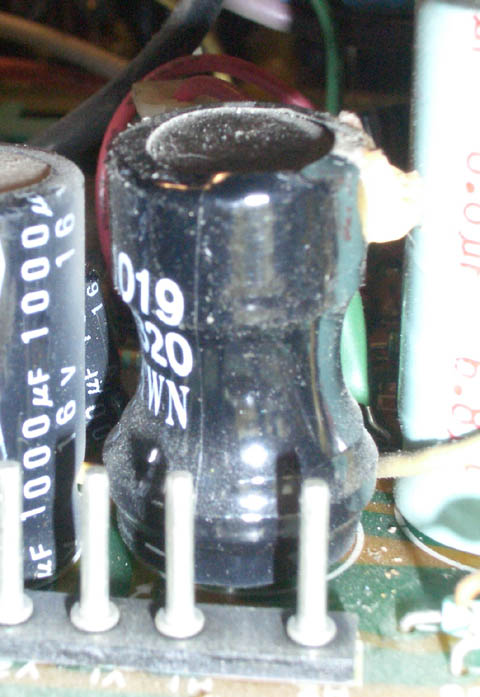
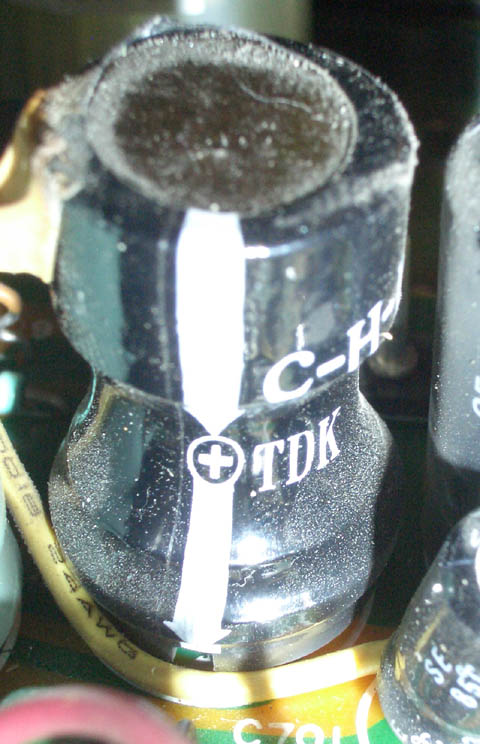
So I'm cleaning out the Ergo 201 terminal I mentioned earlier (and
preparing to do a cap kit on it since it needs it) and I've run across
something that looks kind of like an electrolytic capacitor on a diet.
I'm unable to identify it and I feel like an idiot :). At any rate, it
appears to be leaking something so I'd like to replace it, once I can
figure out what it is. Wish I had a schematic for this thing.
Here's a couple of pictures of it:
http://yahozna.dyndns.org/scratch/mystery-1.jpghttp://yahozna.dyndns.org/scratch/mystery-2.jpg
Any ideas? The only markings on it are:
1019
8320
TWN
on one side, and
C-H-L
TDK
on the other.
The positive terminal is labeled (which is the opposite of most
capacitors I've seen...)
Any thoughts?
As always, thanks...
- Josh
Usually, when I need a template for a DB25, DE9, or whatever,
I just dig in the junk box for an old PC-type serial bracket.
You know, from back in the day when the serial ports were
in one of the blank spots for empty card slots, instead of
being on the motherboard itself?
Naturally, I'd prefer a punch myself, but as everyone agrees,
they are kind of pricey. Fortunately, I've never really needed
one that often, that I couldn't deal with using a nibbling tool.
Depending on how you're planning on mounting it, the hole
may or may not need to be perfect.
If you're putting the D-connector BEHIND the panel / chassis,
then you'll want a nice, neat opening.
Although it's not as pretty, you can cut a rectangular opening
with a screw-hole on each side, and mount the flanged portion
of the D-sub on the OUTSIDE of the chassis. If you're careful,
the metal frame of the D-sub will cover up any imperfections
in the size/shape of the opening.
And lastly, the "down and dirty method" is to cut a 3" x 1/2"
rectangular opening, and use one of the afore-mentioned
PC brackets from behind for mounting.
I know. . . not pretty, but sometimes handy when working on a
chassis with existing knock-outs/holes which need covering anyway.
T
I just found a box of about 15: 8 inch floppies
32 sectors (hard sectored) Double Sided Single Density.
Some are TDK F1-H
Any takers?
I'm in Elizabeth (central) NJ: they're free if you can pick them up!
Hi Alain!
I have a lot of document describing the Exorcizer, with complete drawings,
software, firmware... I still have a complete machine (a wrapped clone, i
designed in this old time! two versions: one with 64k cmos RAM, and one 64k
with DynRam) I knew very well 6800, 6300, 6801, 6301, ... In that time i
created a real time emulator for these uP.
But the system is old and needs to be restored. (I have a lot of spare
parts, including 4 8" floppy mechanisms) . I intend to publish the story of
this home brew computer, but i need time... (CPU, terminal, graphic printer,
digital cassette, floppies, magnetic card reader B7400, Eprom prog)
This machine is aslo able to run original OS9 with a 6809/6309 cpu. I have
doc, 8" floppies, listings... too much matter... that needs to be sorted.
Follow-up in french? Still in Bordeaux?
Have a nice day!
JMP
Full text of the message, although the listing also contains a scan of a
manual cover:
My dad bought & used the 4051 series computers for many, many years, and
accumulated several 4051 computers, peripherals, etc. He bought his
first one in 1976, it was an amazing computer! Believe it or not, he was
still programming the beast until about 3 years ago. So several of these
computers still work. These things are RARE as hen's teeth now, and he
has a lot of parts, even a screen for one that is new-old-stock still in
the box (this is the computer that had the cool vector graphics
screen!). I don't have pictures yet, but will get some. I want $2000
bucks for the whole collection of stuff. great find for a
collector/tinkerer, as these don't show up very often. cash only, no checks.
http://austin.craigslist.org/sys/604555003.html
As the URL says, this is in Austin, Texas. $2000 seems kinda rich to
me, but maybe to someone on this list it is worth it. I watch austin
craigslist frequently and vintage computer gear doesn't show up all that
often.
I am not the seller; I don't know the seller; do your own vetting.
Sorry, I'm not available to pick this up and ship it to a non-local
buyer. Contents may settle during shipping. Your mileage may vary.
On Tue, 11 Mar 2008 15:24:53 -0400 (EDT), der Mouse wrote:
> I'm looking for D-shell hole punches, for DB and DE shells, and
> possibly DA as well - Greenlee is the name I know, but I daresay
> others
> make them too.
[...]
>
> Any suggestions?
I've gone a bit of different route than the use of punches and
nibblers - the former being too expensive for an occasional job and
the latter too much of a pain. I use a spiral cutter and a template.
I picked up a cheap spiral cutter from my neighborhood China Town
store and modified it by adding a template follower to the head. I
generate the template on a cad program, expand it twice needed and
print onto card stock which I then hand cut. I use this template to
cut the final template in plastic. Drill a hole at the cut-out site,
clamp the template on the target piece and cut away. You should
ensure that you get a metal cutter if you are doing steel or aluminum
(aluminium). I found that taking two steps to generate the template
results in a much better result.
My cutter was bought on sale for under US$ 20 for a one-off job and
kept around and modified when I ran into a situation that needed a
odd shape cut-out. A good cutter will run under US$ 75 and the bits
are on the order of 5-10. I've used it to do D-holes for BNCs and
power cords, connectors, as well as many other openings such as for
fans.
CRC
ok, been meaning to actually run something more than the little assembly
test apps on my HPs. How do folks bootstrap systems?
I've got 2 working HPs (HP-2108A and HP-2112A) and HS-TERMINAL (ie
HP-12531B) and I can get lights to light up with a 2400 baud connection
and this snippit running:
0001* set to TTY I/O number
0002 00011 SC EQU 11B
0004 00040 ORG 40B
0005 00040 106700 LOOP CLC 0 Turn off I/O interrupt system
0006 00041 060051 LDA TTYIO Load A-register with control word
0007 00042 102611 OTA SC Output control word
0008 00043 103711 STC SC,C Set control, clear flag
0009 00044 102311 WAIT SFS SC Wait for flag
0010 00045 024044 JMP WAIT Loop till ready
0011 00046 106511 LIB SC Input data word
0012 00047 106601 OTB 1 Output data word to switch register
0013 00050 024040 JMP LOOP Next char
0014 00051 160000 TTYIO OCT 160000 TTY input and print control word
LOOP 000040 01/0005 -- 01/0013
SC 000011 01/0002 -- 01/0007 01/0008 01/0009 01/0011
TTYIO 000051 01/0014 -- 01/0006
WAIT 000044 01/0009 -- 01/0010
4 symbols
14 lines assembled, 10 words generated
0 errors, 0 warnings
(also online as http://rikers.org/hp2100/ttyin.lst)
so what's next? Is there a tape loader for use over a 12531?
Also, I'm using a modified version of the perl assembler. I'd like to
actually use the native HP assembler under SIMH. The HP / CHM agreement
should allow for at least this much bootstrap information to be shared.
I'm happy to put up bootstrap instructions and tape images if someone
can provide them.
I don't have any other peripherals tested out yet. Not sure why my real
paper tape reader is not working yet. My paper tape punch is a long ways
>from working and it's not HP equipment anyway.
I've got tape images that work in SIMH like the HP-Basic. Just want to
see these work on real hardware by loading them over a serial line.
There are quite a few HP collectors out there. How do you folks boot up
your hardware? ok, I could get an HP-7970 9 track, but I don't have that
either. It would seem useful to be able to bootstrap any given tape over
serial. I know it's only 2400 baud, but just about every HP collector
should have the needed hardware. :)
Help me out!
PS: Some nice list owner promised to get me a CD full of stuff to get
started, but alas, I'm afraid my process is never getting scheduled.
Perhaps I need more of a real-time OS.
--
Tim Riker - http://Rikers.org/ - TimR at Debian.org
Embedded Linux Technologist - http://eLinux.org/
BZFlag maintainer - http://BZFlag.org/ - for fun!
-------------- Original message from Al Kossow <aek at bitsavers.org>: --------------
> CHM received a bunch of George Morrow's engineering documentation yesterday.
> Is there anything in particular from MD that hasn't already been scanned that
> people
> are looking for?
>
> There are a few odd things, like Adaptec IC data sheets, and the FDC-3
> schematics
> that I've found.
>
> 2 systems
Anything on the "Decision I" S100 system would be nice. I have not looked
lately. A few years back someone connected to his stash was going to send
me the info on these. Never did happen. They were a S100 bus system, but had
non standard things like serial IO on the mother board with lots of jumpers.
The Morrow portable. The one I have is just a Micro Decision in a Compaq
Portable type box with a built in monitor. a little smaller in size though .
- Jerry
On Sun, 9 Mar 2008, Andrew Lynch wrote:
> I think repairing old computers is just like any human endeavor - it is
> flawed and sometimes I follow incorrect logic and/or misdiagnose before
> finding and fixing the real broken part. Sometimes good parts get
> mistakenly identified as bad. That's life and if a part falls under
> suspicion I am likely to just replace it just to test the theory, right or
> wrong it gives information and vital clues. Anything labeled "suspect" is
> pulled aside and labeled as bad regardless.
> These parts are cheap and plentiful enough that if a few good ones get
> trashed in the process of fixing an old machine I consider it a worthy
> investment. Probably I am tossing some good parts occasionally but it is
> worth it time wise to take the chance and maybe find the root cause. Were
I
> more skilled technician maybe I could fault isolate with more precision
and
> just fix exactly what is broken but this is just a hobby and I do not have
> the time/experience to get more precise.
Never discard the old parts, nor charge the customer, until the actual
defect is found.
Any reason to NOT plug the suspect Z80 back in and see whether the
problems follow the chip v coming and going from other "random" acts?
-----REPLY-----
Hi Fred,
Yes, I agree. I always "tag and bag" discarded parts from vintage computers
I repair. "Tossing" was a poor choice of words. It means tossing them into
the box of tagged baggies of suspect/broken parts.
Since I am the owner I don't need to worry about charging anyone but I agree
with the sentiment.
Especially if this were a business I would not feel comfortable releasing
the system unless I had firm evidence of root cause and not some
coincidental fix.
However, that is the dilemma. How to establish what exactly is the root
cause without endangering the original piece of equipment? I would like
some independent verification if possible. Everytime you touch or make a
repair to an old computer there is a risk of unintended damage.
Yes, I could swap the questionable components back into the system but I am
very reluctant to "screw around with it" once it is working. I dislike
using the restored piece as test equipment.
Generally speaking, once it works reliably, I leave it alone until there is
reason to attempt more repairs. I have found it is very easy to
accidentally break things. That is why I rarely ever clean the boards or do
anything to them other than the bare minimum to make them work again.
One concern about swapping possible bad parts into a working system is that
they could induce another failure and start the repair cycle all over again.
What would be ideal is some sort of test equipment I could plug a bad part
into and check to see if it is good or not. I can do that with EPROMs and
apparently there are TTL chip testers like the TOP2049 which provide 74LSxxx
testing.
How do you test a LSI component like a Z80 CPU, PIO, DMA, or DART? Short of
plugging it back in and hoping it doesn't cause more problems.
I am an engineer by education and practice but self taught as a technician.
Sometimes I wish I had more experience in these matters or at least took
some coursework on how to diagnose and repair equipment.
Thanks for your advice!
Andrew Lynch
I'm looking for D-shell hole punches, for DB and DE shells, and
possibly DA as well - Greenlee is the name I know, but I daresay others
make them too. The major constraints: (a) the seller must ship to
Canada; (b) the seller must take phone or fax orders - I can tolerate
looking for things on the Web, but I will _not_ pay over the Web; (c)
they must be decent quality - no cheap knockoffs that break along about
the fifth time you use them (as Tony, I think, put it, I'm not rich
enough to buy cheap tools). There is no need to be especially fast to
use; if it takes a minute or two to position the pieces and crank a
bolt down with a wrench or something, that's OK.
Of course, I'd like them to be inexpensive too, but "inexpensive and
not cheap" is a combination I don't really expect to find. If I'm
asking for a pony, I'd also want the vendor to be in Montreal or
Ottawa, but that's, well, asking for a pony. :)
Any suggestions?
/~\ The ASCII der Mouse
\ / Ribbon Campaign
X Against HTML mouse at rodents.montreal.qc.ca
/ \ Email! 7D C8 61 52 5D E7 2D 39 4E F1 31 3E E8 B3 27 4B
Well, my first guess would be an inductor of some sort;
TDK produces a line of inductors with that basic outline.
It looks like exposed enamel wire and wax on top.
Although I am confused by the outer covering,
which appears to be indicating polarity. . .
Bizarre. . .
T
|On 10 Mar 2008, at 19:27, pichotjm wrote:
|
|> hi,
|>
|> I spent my week-end to write a report on the restoration of the
|> early French computer ODP-505.
|
|Thanks JMP!
|
|That's a great looking machine. Where in France are you located?
|
|-Austin.I lives NW of Paris, close Rouen (20 km) in a small city named
'Pavilly' with http://maps.google.fr/maps type Pavilly and you will have the
location.I have a problem, to answer to messages. I don't know how to do it.
I just consult archives of the group, and there is no reply possibility.So i
need to open my OE and copy manualy, title and text... Is there a better
method? In France, collectors prefer to discuss in newsgroups
(fr.comp.ordinosaures)Have a nice day!JMP
Hi,
Someone sent me this yesterday and I thought it might be of interest
to the various 6502 enthusiasts on this list.
It's a PDF of the transistor schematic of the 6502 CPU. It's high
resolution and fairly detailed (includes annotations of the various
bits of the CPU).
I put it up on my website at: http://www.shiresoft.com/downloads/docs/6502.pdf
Have fun!
TTFN - Guy
> I've run across something that looks kind of like an
> electrolytic capacitor on a diet. I'm unable to
> identify it and I feel like an idiot :).
It's a polarised inductor. There will be a permanent
magnet on one end or the other of the core. Inductors
like this are often used in the linearity circuits in
monitors.
> At any rate, it appears to be leaking something so
> I'd like to replace it
That's probably just wax to damp any mechanical vibration
and stop it making noise. These inductors can often run
very hot but I wouldn't bother replacing it unless there
was evidence of the windings burning, which would destroy
the plastic outer.
Lee.
CHM received a bunch of George Morrow's engineering documentation yesterday.
Is there anything in particular from MD that hasn't already been scanned that people
are looking for?
There are a few odd things, like Adaptec IC data sheets, and the FDC-3 schematics
that I've found.
hello everyone ,
since a long time I have lots of motorola ,exorciser bus,boards:
I'd like to use them,I have looked on the web on several sites for
documentation and found nothing,
they are:
*motorola microsystems m68mmoia2,it includes :cpu 6800+clock,two pias,one
acia ,8 2012 rams ,sockets for rom
* one exorset floppy interface
*micro module 7 :4 serial lines.84dw6756x01
*another micromodule 1,with cpu+clock+2 pias ,no acia:84dw6200x01
*a debug2 oidw1708x01,test card .
* static ram 2 mex68 84 dw6714x01 fith 4 rows of 9 2141 rams
several of them may come from an exorciser ,I also have the backplane from
an exorciser ,as I am playing with 6800 cpu now (and other ones) any
information would be useful ,thanks very much best regards
a.nierveze
Hi all - I've got a line on this old AIX box, with the monitor, books,
etc (not sure about O/S media but I think that can be "found.") Any
opinions on it? Any historical significance ("first machine run
____," etc?)
It's cheap, but it will have to be shipped, which may not be cheap.
--
j
Hi,
I started a Google Groups mailing list and archive for the WaveMate
computers like the Bullet SBC.
If you are a current owner, former owner, or just plain interested please
check it out at:
http://groups.google.com/group/wavemate_computers
The archive contains lots of technical information like manuals, schematics,
boot disks images, files, pictures, etc.
There is a mailing list with some WaveMate Bullet owners to help answer
questions and help you restore your system.
Any contributions of WaveMate technical data, files, disk images, articles,
or experiences are greatly appreciated.
Please forward this message to any WaveMate owners who may be off list.
There appear to be very few WaveMate computers still in existence so it
would be nice to reach as many people as possible.
Thanks! Please contact me off list if you have any questions.
Andrew Lynch
Does anyone know where I can find a copy of C/nix that was published
by The Software Toolworks?
C/nix was a software toolkit that implemented a bunch of UNIX commands
like "cat", "ls", "grep", etc. for CP/M. I've looked in the usual
places, but no luck.
-Mardy
I found a PDF of the workshop manual for the Casio FZ-1 sampler online,
and rescued it from what seems to be a rather slow and flaky site.
Why mention it here? Well, the FZ-1 (and indeed the FZ-10m I'm
repairing) are at least 10 years old and probably nearer 20, and are an
example of an 8086-based device that's a) not a PC, and b) is capable of
running user-supplied code.
Tony - you'd probably like the manual. It details what the various
ASICs do pin-by-pin, and even includes about two pages on how dynamic
RAM works and why it's such a good idea.
Even if you're not into weird old musical equipment, it's probably worth
a read.
http://www.gjcp.net/~gordonjcp/FZ-1_Service-Manual.pdf - 60M, don't kill
my server.
Gordon
> From: "Bob Bradlee" <caveguy at sbcglobal.net>
>
>>> Wouldn't that imply that your system works off of a basis of 256
>>> degrees
>>> instead of 360?
>>>
>
>> In this case, 1/262144 of a circle as it was on an 18 bit computer,
>> but today you would probably use 32 bits. There's nothing special
>> about dividing a circle into 360 parts anyway, 420 would have allowed
>
>
> 2PI are Round!
> There are 2Pi radians in a circle, very few in the graphics world
> use interger degrees for anything other
> than human readable or heman generated I/O. A line is bounded by 2
> points or can be described as a
> angle and distance from a relitave point. While Arc's can be
> specified by a start, end, and center point,
> Curves are almost always specified in radians. Autodesk had an
> interesting bulge value.
>
> In the graphics world 2 pi are round and can represent an infinate
> number of angles, and truely not
> square :)
Yes of course this is generally true now that we have floating point
built into nearly every processor, but suppose you using say a Pic
chip to process navigational data, I don't think these have floating
point so fixed point would still be useful. For my work when
programming Microspot Interiors (http://www.microspot.co.uk/products/
interiorsPro/index.htm) I mainly use normalised vectors which I find
far better in 3D systems than angles from the axes, but it is horses
for courses. I also work on MacDraft (http://www.microspot.co.uk/
products/macdraft/index.htm) which is an old 2D program, which used
to store angles in fixed point degrees and I have changed to floating
point degrees, but without rewriting a lot of code and possibly
creating bugs, thats as far as I am going. There are issues using 2Pi
because of rounding errors. Usually you end up having tolerance
values. Without tolerances, if someone rotates something by 90
degrees four times, they don't QUITE get what they started with when
using 2PI, but with degrees, they do.
As for representing an infinite number of angles, don't be silly.
Especially if you are using tolerances.
Roger Holmes,
Technical Director, Microspot Ltd.
>By the way, the original wasn't written for Unix, though IIRC a ported
>version did appear in the games directory in one or two BSD releases.
>The original was written in BASIC in 1972-73, and the late Greg Yob (the
>author) wrote a piece about which is in the BASIC Computer Games books.
> My BASIC Games page has a machine-readable version at
>http://www.dunnington.u-net.com/public/basicgames/
>Pete Peter Turnbull
> Network Manager
> University of York
If anyone wants to play WUMPUS, I have it on my Wofford Witch system
online. Just go to my web site http://www.woffordwitch.com, and log
onto my system using the guest account 40,1. Once you've logged in,
you can run WUMPUS by typing
RUN GAME:WUMPUS
at the READY prompt. If you want to see the BASIC PLUS listing,
you can type
OLD GAME:WUMPUS
and then type
LIST
at the READY prompt.
This version is from the early-to-mid 1970s.
Ashley
http://www.woffordwitch.com
On 10 Mar 2008 at 12:00, Ed Thielen wrote:
> Greg Mansfield had KRONOS going, and shipping to some customers,
> - mostly educational - by the time I left.
> Greg was kind of a one man band - a bit of a Dilbert
> - a remarkably imaginative and productive individual -
Greg later left CDC (during the 1980's decline and fall) and went to
Cray. He was an active microcomputer addict and at the time, had a
pretty elaborate Compupro system, IIRC.
I had the pleasure of introducing Greg to the wonders of gelato; I've
lost contact with him over the years and am not aware of what he's up
to.
His compatriot in crime at Arden Hills, Dave Callender (sp?) was
quite a character in his own right. "Dr. Dave" maintained an active
interest in bats and had various specimens on display in his office.
Greg's work with MACE would not likely have attracted any notice at
CDC were it not for Dave.
I was once told (but don't know if it's accurate) that he was a
student of Harold Edgerton's and had suggested photographing bats
using Edgerton's strobe--whence the great photos of the bats of
Carlsbad Cavern originated. Perhaps someone can confirm this.
Cheers,
Chuck
> Date: Sun, 09 Mar 2008 14:50:55 -0400
Roy wondered about systems with various CPU options.
What CPU did the Jolt system use? Was there more than one CPU
option?
Does anyone still have one of these? (basically a stack of
interconnected PC boards)
Cheers,
Chuck
Hi,
I have been fixing an old WaveMate Bullet computer and have come across a
question I thought maybe the CCTALK mailing list could answer. I apologize
if this is an overly long post but it takes some explaining to get to the
real question.
When I bought this WMB machine it was completely dead. It had no response
at all and the Z80 CPU was completely static except for the clock input on
pin 6. I used my oscilloscope to debug the circuit. The PS checked out
fine.
On power up the floppy drive turned on and would seek to home but I think
was more a "nervous reflex" of the MB8877/SY1793 FDC powering up and being
selected rather than something the CPU was intentionally doing. No data was
being read from the disk drive with a known good working boot disk
installed.
After finding some illegal voltage values on the address bus and some other
fault isolation, I noticed that if I put my finger on the CPU, then it
briefly went into a flurry of activity before crashing again.
I isolated the illegal voltages on the address bus to just between two
chips. After touching CPU with my finger caused something to happen, I
suspected the CPU was bad or possibly a cold solder joint. As a starting
move, I replaced the Z80 with a new socket and new CPU and made sure all the
solder connections were good and thoroughly good.
The good news is on the next power up the WMB booted and seemed to work just
fine. However, I have two known good boot disks; the first is a partial
CP/M 2.2 system (boot tracks plus minimal generic OS utilities from Gaby's
site. It did not include any WMB specific tools like FORMAT) and the second
is a complete CP/M 3.0 customized for the WMB. I know both boot disks are
good since I have repaired another WMB and both disks work on that machine.
Here is where things start to get strange...
The CP/M 2.2 disk booted just fine. However, the known good CP/M 3.0 disks,
even ones written using the boot drive (to eliminate alignment issues, etc)
would "half boot" and crash just after printing some or all of the initial
boot message. CPMLDR would execute but apparently CCP never got properly
launched before crashing.
So I spent a couple of days searching for what I presumed to be a hardware
failure. The CPU seemed stuck in a polling loop and I could not find the
"broken" part. I ended up finding some strange voltage values on the PIO
and replaced it and a buffer chip but the strange boot behavior persisted.
The CP/M 3.0 disk still refused to boot.
I inspected the source for the CP/M 3.0 CBIOS and found what appeared to be
possible places where it was hanging. Since I had already replaced the CPU
with a socket and a new CPU I thought maybe the "new" CPU was having
problems during the "enable interrupts" command immediately prior to the
printing of the initial boot message.
Sure enough, I replaced the "new" CPU with another one and the problem went
away. The WMB now boots CP/M 2.2 and CP/M 3.0 from the boot disks like
nothing was ever wrong.
So to my actual question; how do I know that the CPU's were really bad and
it is not something else being tweaked during the "fixing"? I can see one
CPU failing and replacing it to fix the computer. However, finding TWO bad
CPUs in a row is just highly suspicious to me. Maybe there is a sneaky cold
solder joint someplace?
I think repairing old computers is just like any human endeavor - it is
flawed and sometimes I follow incorrect logic and/or misdiagnose before
finding and fixing the real broken part. Sometimes good parts get
mistakenly identified as bad. That's life and if a part falls under
suspicion I am likely to just replace it just to test the theory, right or
wrong it gives information and vital clues. Anything labeled "suspect" is
pulled aside and labeled as bad regardless.
These parts are cheap and plentiful enough that if a few good ones get
trashed in the process of fixing an old machine I consider it a worthy
investment. Probably I am tossing some good parts occasionally but it is
worth it time wise to take the chance and maybe find the root cause. Were I
more skilled technician maybe I could fault isolate with more precision and
just fix exactly what is broken but this is just a hobby and I do not have
the time/experience to get more precise.
What is bugging me in this case though is whether swapping the two CPUs is
actually fixing the REAL problem or just coincidentally doing *something*
which is the making it work but not actually fixing the underlying problem.
I am uncertain if my "repairs" are actually causal or coincidental. The
good news is in the end if the machine works reliably it doesn't matter all
that much but I'd sure like to know for certain what actually happened.
Is there some method to verify a Z80 CPU or PIO is actually bad or not? I
have seen 74LSxxx chip testers which apparently work pretty well but nothing
that can test a Z80 CPU or other LSI type chip.
Thanks in advance for any advice or constructive comments.
Andrew Lynch
hi,
I spent my week-end to write a report on the restoration of the early French
computer ODP-505. This computer is built with germanium transistors and has
a core memory.
I spent my monday to translate the job for you.
You will find the result here:
http://pichotjm.free.fr/Serel/ODP505/ODP505us.html
For curious people: you can visit the entire site with
http://pichotjm.free.fr/indexUS.html
Visting http://pichotjm.free.fr/ will gives quite the same, but in French.
More information can be found in French. You can find more pictures...
Enjoy!
JMP
Some of you are aware of a big snit over recent changes by Ebay. If you
aren't, the basic rundown is that beginning May 1, these changes take
place: 1) Sellers are no longer able to leave negative feedback. 2)
Final fees are hiked 67%. 3) Listing fees drop by a few cents. This is
annoying (I'd like to use stronger words) people greatly and another
boycott is planned soon. I'm pondering leaving Ebay if they keep this
abuse of their customers (ie me).
--
David Griffith
dgriffi at cs.csubak.edu
A: Because it fouls the order in which people normally read text.
Q: Why is top-posting such a bad thing?
A: Top-posting.
Q: What is the most annoying thing in e-mail?
I visited the (Henry) Ford Museum in Dearborn, MI this weekend - first time
in about a year. They had an interesting display on how technology affects
culture, starting out with books and magazines, running through radio and
television, up to personal computers in the 80's. They had a "typical
teenagers" room set up - complete with an Apple IIc, 9" screen, and
Imagewriter II. They also had an original Mac 128 or 512 behind glass, the
home Pong machine, and a selection of electronic games like Mattel Football,
the Tomy Tutor, the Wizard, and others. It was a neat display, if not a bit
limited in breadth.
The Ford used to have an awesome display of old telephone and telegraph
equipment, including a complete turn-of-the-last-century switchboard from a
small local exchange. They mothballed the whole thing, but the huge display
on aviation they replaced it with is pretty neat. They also had a large
antique steam engine operating on compressed air for a while. It's pretty
impressive seeing a 20' iron flywheel spinning using nothing but air.
> Message: 20
> Date: Sat, 8 Mar 2008 21:18:32 -0800
> From: "Rick Bensene" rickb at bensene.com
...
> Message-ID: B9639BAE3F34504E83FEEDD71D4AFB4615D8AB at mail.bensene.com
>
> The displays on the console were driven by a PPU (Peripheral Processing
> Unit), which were small scalar processors (actually, one processor
> multiplexed to appear as a number of independent CPUs), akin to small
> minicomputers (like a PDP-8), which operated out of shared sections of
> main memory. There was a PPU program that ran the display, generating
> it from data in a section of memory.
In SCOPE, PP # 10 was dedicated to this purpose -
Each time shared PP (using a common adder) had its own memory of
4 K 12 bit words. This reduced the traffic to main memory.
PP # 1 was normally assigned to monitor requests from the jobs
assigned to "control points". A job would place a request in
its relative memory location 0 for service by the system.
PP # 1 would monitor these requests and assign other
PPs to do the work, causing a PP to load a new program
if necessary.
I worked in CDC Special Systems from 1966 to 1971 -
We shipped a version of SCOPE modified to run "Time Critical"
which used modified code in PP #1 to guarantee user choice of
- analog and discrete inputs
- x milliseconds CPU time
- analog and discrete output
on a guaranteed time cycle -
This was the best in the world at the time for doing hybrid computing :-))
which unfortunately was on its way out :-((
A system program to calculate resources to see if
a new "time critical" user could be added to the running list.
> The displays were vector only, not raster.
Yes :-))
> There was dedicated hardware in the display console that did
> CDC character set (a 6-bit code) conversion to vector characters.
Not in any system we shipped, and we could run the "EYE"
and Northwestern University CHESS program with
another PP displaying the chess pieces in nice form
on the right hand scope.
The left hand scope being assigned to monitoring
activity at the normally 8 "control points",
showing activity and requests for operator intervention
such as mounting/removing tapes and printer(s) out of paper...
> Vector graphics were possible, within the limitations of the speed of
> the PPU.
Each PP had a 100 nano-second time sharing of the adder each 1 microsecond -
hence a relatively hard upper limit of 10 PPs with out a special
order for another 10 ( for customers such as Boeing).
On later 6x00-series systems, such as the CYBER-73, the PPUs
> ran fast enough to generate a nice looking all-vector chessboard on the
> left screen, and a text-based transcript of the moves on the right
> screen. There were also a number of other cute programs, one being a
> pair of eyes (one on each screen) which would look around and blink.
> The operating system was called KRONOS, and I clearly remember that the
> console command to run the "eye" program was "X.EYES".
Greg Mansfield had KRONOS going, and shipping to some customers,
- mostly educational - by the time I left.
Greg was kind of a one man band - a bit of a Dilbert
- a remarkably imaginative and productive individual -
I left CDC long before the CYBER-73
....
>
> Rick Bensene
> The Old Calculator Museum
> http://oldcalculatormuseum.com
Ed Thelen
I was searching for a 480z game on google when I got a result from
Whsmith (A book shop/Stationers over here in England). It still has a
couple of books for sale from 1985. So I started looking further it's
got a few C64 books, I then tried Vax. I hit the jackpot they have
quite a few books, they are a bit pricy and I wonder if they are still
in stock. When did WHSmith ever sell books like :
User Guide to Stepper Motor Control on the Hvl Vax 11/730 priced at
only 5 pounds
Vax/Vms Internals and Data Structures Version 5.2 priced at only 155 pounds
Have a look for yourself there might be some more gems on there.
http://www.whsmith.co.uk/CatalogAndSearch/SearchWithinCategory.aspx?gq=vax&…
Dan
From: Jim Leonard <trixter at oldskool.org>
> Roger Holmes wrote:
>
>> point, such as storing angles as a fraction of a circle, so that
>> if you
>> add/subtract two angles together you don't have to do mod 360 or
>> 2Pi as
>> it automatically overflows and gives you the correct answer. Not so
>>
>
> Wouldn't that imply that your system works off of a basis of 256
> degrees
> instead of 360?
>
In this case, 1/262144 of a circle as it was on an 18 bit computer,
but today you would probably use 32 bits. There's nothing special
about dividing a circle into 360 parts anyway, 420 would have allowed
division by all numbers up to 7, 840 up to 8, 2520 up to 10, 27720 up
to 12 etc but 360 has no great benefit until we started dividing the
day into 24 hours, which is also arbitrary.
Roger Holmes.
I have one of these things in the basement. It looks like it has a
parallel port (Centronics) and a serial port on it. It also has 'COPY'
and 'SEL' membrane style buttons on front, and a what looks like a
really weird connector with 10 pins arranged in a 'star like'
configuration on the end of a cable that is directly attached.
From my searching I'm guessing this is a parallel to serial (or
vice-versa) converter marketed by Brother for it's printers. Does
anybody have more details?
Pictures are up on eBay at the moment - there is a recent auction. Item
number is 360028045061 .
Thanks,
Mike
The Brother IF-50 is a parallel interface and buffer,
designed to turn certain Brother daisywheel typewriters
such as the Correctronic 60 (CE-60) into printers.
The interface draws power from the typewriter
via the round, right-angle connector. The connector
on the typewriter is typically found inside the cord-storage
compartment on the back of the typewriter.
The "Copy" button could be used to repeatedly print
data that was sent to the typewriter. So, if you were
using the typewriter to print return addresses on an
envelope for example, you would hit the copy button,
and print your information from the computer.
Then you would press the Copy button again,
and the information would be held in the buffer.
Then, every time you hit the Copy button after that,
it would send whatever was in the buffer to the typewriter.
It's was a cool gadget to have, since it was fairly inexpensive,
and you didn't have to have another bulky device sitting on
your desk.
Brother worked the idea from both angles;
for example, the HR15 daisywheel printer also had
a connector on it for an external (proprietary) keyboard.
I couldn't tell you if Brother had subsequently released
any typewriters that already had the printer port built in.
I hope this helped. . .
T
Date: Sun, 09 Mar 2008 10:22:31 +0000
> Does anyone know of a source for these kinds of round CRT tubes?
I seem to remember that CDC got theirs from a German supplier.
Cheers,
Chuck
> From: "Rick Bensene" <rickb at bensene.com>
> There was dedicated hardware in the display console that did CDC
> character set (a 6-bit code) conversion to vector characters. Vector
> graphics were possible, within the limitations of the speed of the PPU.
> On later 6x00-series systems, such as the CYBER-73, the PPUs ran fast
> enough to generate a nice looking all-vector chessboard on the left
> screen, and a text-based transcript of the moves on the right screen.
> There were also a number of other cute programs, one being a pair of eyes
> (one on each screen) which would look around and blink.
I think you probably mean the CYBER 173 PPU--the CYBER 7x PPUs were
essentially unchanged from the 6x00 series. 1 usec. cycle time. The
character generator, IIRC, was an interesting array of LRC circuits,
with the character size varied by simply increasing the amplitude of
the drive waveform. This led to odd-shaped large characters.
Chess was an oddball program. It was possible for a user program to
request control of the display from the operator. There were two
ways to do this. The first was to write your own display driver and
request the display channel from DSD (DSD monitored R.RCH and R.DCH
requests). An early version of chess I saw used a driver called (I
think) CHD for this.
There was also what was called the "T" display in DSD. This was a
display mode that allowed a user-mode CP program provide a list of
display directions in CM to be read by DSD. One of the directions
was "jump", so the user program could allow DSD to regenerate the
display without having to made additional system requests (which
would have been too slow). I saw a later version of CHESS that used
this method. The restriction on the T display was that it could
generate a display for one screen or the other, but not both
simultaneously.
There was a very popular "programmer's display" driver called DIS
that could attach to a control point and allow for job control entry,
exchange package display, and numerous dump formats as well as a
disassembler and CP breakpoint.
There was a keypunch simulator called O26 (note the alpha "o") to
allow the enterprising operator or programmer to generate a file of
card images. A very expensive keypunch, indeed.
> The operating > system was called KRONOS, and I clearly remember that
> the console command > to run the "eye" program was "X.EYES". > Some
> privileged users could > remotely fire off this EYES program from a
> terminal, and it'd make for a bit of a surprise, especially when we
> gave tours of the computer center to schoolchildren.
KRONOS was a direct descendent of MACE, an alternative OS for the
6x00 written largely by Dave Callender and Greg Mansfield as a
bootleg project at Arden Hills. Greg and Dave would visit the QA
floor and cable together a system to do development on late at night,
after the daytime shift had gone home. (MACE, if I remember
correctly, stood for "Mansfield's answer to Customer Engineering".
The "eye" display was part of every CE's deadstart (not "coldstart")
tape.
The "official" OS for the 6000 series was SCOPE--a system that was
located largely in the PPUs, and pretty much oriented toward batch
processing.
Pat might want to investigate Dave and Greg's contribution to the OS
that Purdue ran on their 6500 in the late 60's. I seem to recall
that it was largely MACE with a lot of OS functionality moved into
the CPMTR portion.
A cultural war broke out in CDC over the two systems. SCOPE was
pretty much a west coast Sunnyvale operation and KRONOS (i.e.
enhanced MACE) an Arden Hills affair. Things really got pitched when
PLATO elected to use KRONOS instead of SCOPE. The solution was to
offer both as renamed entities. SCOPE 3.4 was followed by NOS/BE 1.0
(BE for batch environment) and KRONOS became NOS 1.0. A lousy move
on the part of management, in my opinion and a huge duplication of
resources. I have no particular ax to grind here, as I was Sunnyvale
Ops, but Greg was a good friend, too.
This doesn't include the "special" operating systems such as TCM,
Zodiac, Rover, etc.
One very positive thing that I can say about MACE was that Dave
authored a set of fairly straightforward coding standards and adhered
to them. So MACE systems code was easy to read; SCOPE was an
agglutinative affiar with no particular coding standard being used
anywhere.
> I had the distinct privilege of being a systems operator on a Tektronix
> Cyber 73 (which was a derivative of the 6600).
The 73 was basically a 6400 with added goo, such as the Compare/Move
Unit; the 74 was basically a 6600 (wherein a CMU was not possible).
There was a Cyber 72, which was a slowed-down (via jumper) 6400. The
Cyber 76 was the follow-on to the 7600. This is from recollection,
but I'm pretty sure that I'm very close. The Cyber 7x's had the fake
wood-and-blue-glass look, while the 6000 series was dark grey and
beige-ish.
> The machine had an array of toggle switches called the "Coldstart Panel"
> in one of the CPU bays into which a small (I think it was something like
> twelve twelve-bit words) PPU bootstrap program could be toggled in. The
> system could be booted from one of the "washing machine" drives, which was
> the usual mode of startup, or from magtape.
You had an unusual shop. At Sunnyvale, deadstart was almost always
>from tape. The disk drives could be anything from the old 6603
Bryant disk, to a big 808 (4-spindle hydraulic positioner, bit-
parallel drive) to one of the "little" 844 removable pack drives.
I know--more than anyone asked for. But questions about old iron are
getting less frequent.
Cheers,
Chuck
> Date: Sat, 08 Mar 2008 16:50:10 -0800
> From: davis
> An apocryphal story I heard was that the graphics on the display are
> disk/?drum refreshed. If true, I assume you would need the better part of
> a CDC 6x00 to get anything out of it.
Aprocryphal, indeed--and completely without basis in reality. The
6602/6612 display was directly driven by a single 4Kword PPU with no
automatic refresh. If you generated a complex display, it tended to
flicker, as the PPU couldn't refresh in time. This also explains why
the graphics mode wasn't used more--it simply took too much time to
generate anything other than a simple display.
I speak as a writer of a DSD overlay or two.
Cheers,
Chuck
-------Original Message:
Date: Sat, 8 Mar 2008 14:09:17 -0800 (PST)
From: Fred Cisin <cisin at xenosoft.com>
Subject: Re: 6502 CPU schematics
> Which reminds me, does anybody else remember those machines that had
> multiple CPUs in them? Or the option of plugging different ones in?
Dimension 68000 was deliberately a multi-processor machine: 68000, 8088,
6502, Z80?
and, of course, we hafta mention Dec Rainbow and Eagle machines with 8088
and Z80
Basis? (Apple ][ copy) had Z80 +6502
at one point, somebody at Apple estimated that 20% of all Apple]['s had
Z80 softcards
There were alternate processor cards for PC, including Z80, 6502, 68000,
80386, . . .
---------Reply:
Don't forget Cromemco's DPU (68K & Z80), XPU (68010 & Z80) and
XXU (68020 & Z80 on I/O proc.)
m
Trying to re-create, at least on paper, a system I used in the early '90s.
Looking for docs for Chipcom ONline concentrator and NCS.
Anyone got?
Thanks,
Steve
>
>Subject: Re: 6502 CPU schematics
> From: Brent Hilpert <hilpert at cs.ubc.ca>
> Date: Sun, 09 Mar 2008 00:49:25 -0800
> To: General at priv-edtnaa06.telusplanet.net,
> "Discussion at priv-edtnaa06.telusplanet.net":On-Topic and Off-Topic Posts
> <cctalk at classiccmp.org>
>
>"Roy J. Tellason" wrote:
>>
>> There was one other company, though, and I still can't recall the name,
>> that tried unsuccessfully to market some system that would let you plug in
>> different CPU boards to run different software. I'm vaguely thinking of toy
>> company names, but somehow that doesn't quite seem right.
>
>Thinker Toys?
Digital Group.
Cromemco
Compupro (8085/8088, Z80, 68000, and x86 later versions).
There were more than a few that were not exclusively one cpu.
If anything S100 was the most diverse for CPUs other than
8080/8085/z80/8088/86/68000!
Allison
>(.. 30 years later I finally clue in the name was a play on 'tinker toys'.)
>
>> Time frame
>> would've been a little later than a bunch of this other stuff, maybe early
>> 1980s or so?
> Date: Sat, 08 Mar 2008 00:07:55 -0500
> From: "Roy J. Tellason"
> Which reminds me, does anybody else remember those machines that had
> multiple CPUs in them? Or the option of plugging different ones in?
> Seems to me real early on there were some mfrs trying to find as much
> compatibility as they could with pursuing options like that. I remember
> one Taiwanese-made clone of an Apple II that had a Z80 on the main board,
> and of course the c128 has that similar setup (though the way the hardware
> was structured the z80 effectively ran at something like 2.5MHz). I
> remember some other system where you could literally plug in different
> processors for different uses, but the brand name isn't coming to mind at
> the moment.
Extremely common in the S-100 world (think Godbout/Compupro,
Cromemco, etc.). Bill Godbout may have offered the widest range of
processor boards from a single manufacturer. Early on, there were
6502 S-100 boards, but not very popular.
There were other non S-100 vendors of optional CPU configurations.
Didn't The Digital Group offer a choice in their boxes?
Cheers,
Chuck
Here is an odd question for everyone. In a printed article, which
would be more accurate? "Apple ][", "Apple II", or "Apple 2"
Zane
--
| Zane H. Healy | UNIX Systems Administrator |
| healyzh at aracnet.com (primary) | OpenVMS Enthusiast |
| MONK::HEALYZH (DECnet) | Classic Computer Collector |
+----------------------------------+----------------------------+
| Empire of the Petal Throne and Traveller Role Playing, |
| PDP-10 Emulation and Zane's Computer Museum. |
| http://www.aracnet.com/~healyzh/ |
I know there was some interest in 1541-III PCB's recently. Vincent
Slyngstad and I have been discussing this since that time, and he has
done up schematic in Eagle CAD and has the initial board layout done
(actually three different versions using different SD Sockets). The
big difference between this and the original design is that it uses
through the hole parts wherever possible rather than surface mount
parts.
I'm trying to find out if anyone here will be interested in boards.
I have a design question or two for anyone that is interested.
Additionally, I'm looking for anyone familiar with SD Sockets, as
neither Vince nor I are, and a couple questions have come up on the
socket placement.
Information on the 1541-III can be found at the creator, Jan
Derogee's website http://jderogee.tripod.com/
Zane
--
| Zane H. Healy | UNIX Systems Administrator |
| healyzh at aracnet.com (primary) | OpenVMS Enthusiast |
| MONK::HEALYZH (DECnet) | Classic Computer Collector |
+----------------------------------+----------------------------+
| Empire of the Petal Throne and Traveller Role Playing, |
| PDP-10 Emulation and Zane's Computer Museum. |
| http://www.aracnet.com/~healyzh/ |
Hi list,
In Skegness, Lincs there is a company called Ramco who deal with
selling off military surplus via sealed-bid auctions.
I've bought from them before. The only thing to bear in mind is that
every item has a reserve, so it's not the case that if you bid ?1 and
no-one else bids, you win.
Now, on the latest tender list (
http://www.ramco.co.uk/tender-main.php ) the following appears:
328 PDP-11 DEC DATA SYSTEM
Unfortunately only some of the lots have a photo, and this one doesn't.
Everything they sell is in "as-is" condition, but a friend of mine
buys from them all the time and almost 100% of what he gets does work.
All the electrical/electronic gear I've ever bought worked.
Just a heads-up in case anyone wants to go check this out and/or buy it.
Ed.
http://ed-thelen.org/stories_tech.html#BIRDiE-Techie
--
Member of the toughest, meanest, deadliest, most unrelenting -- and
ablest -- form of life in this section of space, ?a critter that can
be killed but can't be tamed. ?--Robert A. Heinlein, "The Puppet Masters"
-
Information is more dangerous than cannon to a society ruled by lies. --James
M Dakin
I've acquired some scrap 14-in drive platters. They're scuffed up
(no real dings) and a touch corroded (more like stained), so I reckon
I'll have to remove the oxide coating and recoat them.
Any ideas how to remove the oxide coating, short of sanding? Should
I recoat with oxide, or would nickel plating be better? In the Olden
Days I understand they just painted the oxide goop on, perhaps
spinning the platters to smooth it out.
Also, the platters came as just bare disks, no spindles or hubs (or
whatever; I'm pretty hazy what the mechanics of these large drives
were). Any suggestions about finding or improvising a spindle/hub
for these puppies?
Unfortunately, the dimensions involved are a bit outside the capacity
of my wee Taig lathe :)
I've been scavenging VCR drum heads, and the bearings in these are
pretty high-class, so perhaps they might be a start. I don't think
the drum motor itself would have the grunt to turn a 14-in platter at
the required speed, not without rewinding the stator and replacing
the ferrite rotor magnets with Neodymium magnets. The folks who
rewind CD-ROM motors to power electric RC planes might have a few
tricks I could use.
-Bobby
The November 1975 issues of BYTE magazine has a seven page article comparing
the Motorola 6800 to the upcoming MOS Technology MCS6501 and MCS6502. The
article was written by Daniel Fylstra based on a visit to MOS Technology in
August 1975, a month before the announcement at WESCON.
I have scanned it and placed a copy on my web site. This is a searchable PDF
file (1880 KB). It would be nice if someone with a 6500 focused web site
wants to host this file. I also have 300 dpi tiff files and a 8.5 MB high
resolution PDF file of this article
http://www.swtpc.com/mholley/BYTE/Nov1975/Son_Of_Motorola.pdf
Here is an article from the Commodore site.
Electrical Engineering Times. August 25, 1975.
Does The Country Need A Good $20 Microprocessor?
http://www.commodore.ca/gallery/magazines/misc/mos_605x_team_eetimes_august…
Michael Holley
www.swtpc.com/mholley
> To woodelf...
>
> ...
> Soldering a few thousand of them 3 legged critters doesn't seem like
> that big of a job...compared to soldering 19,008 LEDs. : )
>
> When I said I wanted blinkin lights for an Alitar, I took myself
> seriously! : )
>
Wow. Do you mean to emulate the [i]image[/i] of an Altair front
panel? Um, that would be, what, a hardware virtual implementation?
Oy, my head hurts...
-Bobby
>I think I'll spam for the Midwest Gaming Classic, as last year's event
>had a significant classic computing component. I enclose the info
>for this year's show at the end of this month, as well as the
>description posted by a list member last year, and my last
>post-show memories.
>
>- John
Hi John, thanks. Yes, all the classic computing stuff is from my archive
every year (so's all the pre-NES console material). I'm a co-organizer
for the show, and I run the Museum area (huge hall). I post on here every
year normally asking for people to come and display, but it always gets
ignored. Maybe people think there's no room for retro-computing there
because of the name of the show (its always been equally dedicated to
classic computers, consoles, video-coin and pinball), or that there's to
many kids (average age is late 20's through 40's).
This year we will also have some of the Chicago Commodore show people
coming to display as well as a Tandy CoCo related area.
>
>Midwest Gaming Classic
>
>When:
>Saturday Mar 29, 2008
>at 10:00 AM
>
Actually, its that Saturday and Sunday (2 day show). 10-8 on Saturday,
and 10-5 on Sunday. 20,000 square feet (every bit of it used), and
usually pretty full of people (we had about 2400 in attendance over the 2
days last year).
>Where::
>Olympia Resort and Conference Center
>1350 Royale Mile Road
>Oconomowoc, Wisconsin|50 53066
>United States
And for those not familiar, this is just 45 minutes outside of Milwaukee.
Its a major resort in the area, so anyone coming from out of town, its a
great place for a family (or spouse). My wife is coming and using the
spa all weekend (was just $10 for the entire room to use it last year).
That's my payment for being able to do this for the whole weekend and her
dealing with all my "stuff" monopolizing things things during that time
(though she calls it something other than stuff). ;)
Marty
I'm have been trying (unsuccessfully) to locate documentation
for a Xyplex MX1710 TCP/IP LAT Gateway.
Naturally, I've tried the Xyplex website, which still has some
of the software, but the documentation they have listed
under the 1710 heading is generic access server information
for totally unrelated hardware; nothing 1710 specific.
I have also contacted Xyplex (MRV), and was told that
since it was no longer supported, they wouldn't do a
document search for me.
I'd be happy to pay reasonable scanning/copying/mailing fees.
Thanks in advance for your help !
T
From: Tony Duell <ard at p850ug1.demon.co.uk>
>Anyway, there were at least 3 command sets ued by HP -- Amigo (mostly used
>on older flippy drives), SS/80 (more modern floppies and small hard disks)
>and CS/80 (larger hard disks). I _think_ specifcations of all exist, I have
>some of the mon paper, or a poke around on http://www.hpmuseum.net/ may
>find something (for some odd reason this information is often included as
>an appendix to the boardswapper guides!).
If anyone is interested I wrote an HP-913x emulator which I have used very
successfully with my HP1630B logic analyser. Not the most elegant pieces of
code, but it does work! It behaves like an HP drive to the 1630 but stores
everything on my PC hard drive. It's a base Amigo emulatation and I only
included the functionality necassary to make it work, but the code's should
not be difficult to extend to SS/80 and CS/80. I can post the source for
someone to put it somewhere more accessible and permanent. Let me know.
Peter
Hi,
I wrote a Wikipedia page for the WaveMate Bullet. I think it is a
noteworthy historical computer but apparently the people at Wikipedia
disagree.
They have placed the "This article may not meet the general notability
guideline <http://en.wikipedia.org/wiki/Wikipedia:Notability> " tag on the
page. Apparently, this is a prelude to deletion as a non-relevant article.
http://en.wikipedia.org/wiki/WaveMate_Bullet
I will agree the WaveMate Bullet certainly isn't the most common vintage
computer and even my Wikipedia page stub isn't all that great.
However, there are ought to be *some* notation in the historical record of
this machine existing. Practically nothing on it exists on the internet.
If anyone has any pictures or reference material on the WaveMate Bullet and
would like to include it in the Wikipedia page, please either edit the page
or send it to me and I will include it.
It sure would be a shame to see this classic vintage CP/M disappear without
so much as minor footnote of it ever existing.
Thanks in advance for any help.
Andrew Lynch
PS, Don Maslin thought it was a note worthy machine and he even thought it
belonged in the top 150 most collectible vintage computers. Too bad he is
not here to defend it any longer.
> From: woodelf <bfranchuk at jetnet.ab.ca>
> Long live fixed point math. :)
> I can think at least one problem that I know that needs exact
> calculations
> and lots and lots of tiny numbers.
I used to write/maintain compilers for a language with fixed point
arithmetic built in (Coral 66). For some jobs much better than
floating point, such as storing angles as a fraction of a circle, so
that if you add/subtract two angles together you don't have to do mod
360 or 2Pi as it automatically overflows and gives you the correct
answer. Not so useful for describing spirals and helixes though.
Roger Holmes
Ex employee of Elliott Brothers (London) Ltd / Marconi Elliott
Avionic Systems Ltd / GEC Avionics in the 1970s
>
>Subject: Re: Q-bus to CF [was: IOmega]
> From: Gordon JC Pearce <gordonjcp at gjcp.net>
> Date: Thu, 28 Feb 2008 08:41:13 +0000
> To: "General Discussion: On-Topic and Off-Topic Posts" <cctalk at classiccmp.org>
>
>
>On Thu, 2008-02-28 at 00:19 -0500, tiggerlasv at aim.com wrote:
>>
>> I stopped holding my breath for creation of a Q-Bus IDE
>> controller a long time ago. While I like to think that I
>> do a reasonable job troubleshooting some problems,
>> I'm definitely not a hardware/software engineer.
>>
>> It would have been nice, but it makes more sense
>> these days to go Q-Bus to SATA. I would imagine
>> that it would be alot less hassle, and certainly alot less
>> real estate on the board, with the smaller connectors,
>> and fewer traces.
>
>Actually SATA is extremely exacting and needs unbelievably complicated
>controller chips.
>
>PATA, on the other hand, is just a fast parallel port. You can hook a
>CF card up to anything, even a microcontroller, with just a tiny amount
>of glue logic.
>
>> At any rate, back to the topic, Q-Bus to Compact Flash.
>>
>> If you can do Q-bus to Compact Flash, then you can do
>> Q-bus to IDE, because CF *is* an IDE interface.
>> Those wonderful CF to IDE adapter boards generally don't
>> have any circuitry on-board, except to drive status LED's.
>
>Exactly. Simply grafting a PATA interface onto a QBus card is trivial.
>Actually getting something that will either pretend to be an existing
>controller or writing a device driver for the operating system in use is
>much much harder.
>
>If you really wanted to push this forwards, write me some MSCP
>controller firmware for an Atmel microcontroller...
>
>> Right now, I have Compact flash / IDE on my Q-bus,
>> albeit in a round-about way.
>>
>> I have older CMD SCSI controllers (CQD-200's).
>>
>> Attached to those are ACard 7720U SCSI <> IDE adapters.
>> http://www.acard.com
>
>These seem to crop up on the various sampler mailing lists I'm on, as a
>way of using CF with older samplers which often have "funny" SCSI
>implementations.
>
>Gordon
Generally IDE and CF (compactflash) are the same interface and for
Qbus-11 fairly simple. It's been done, however, the problem is the
driver as bare IDE or CF is NOT MSCP not is it DL, DX, DY or RK
so a driver is needed and noone has apparently stepped up to do it.
I beleive its fairly straight forward work but never having done it
but having seen drivers like DD and DY They have a structure that
must be held to.
SCSI is actually harder to talk to than CF or IDE, I have done that
for CP/M and SCSI is a pain as you have to deal with the SCSI chips
and their particular protocal.
MSCP is a complex protocal whols primary job is to create a logical
abstraction hardware from the software and I don't think an atmel uP
is enough and definatly enough ram plus enough is not known to create
it(MSCP) from scratch.
Allison
Well, I did something really stupid this time. I had an old Atari 800
cartridge that had lost its label. I figured that maybe something
inside would tell me what kind of cartridge it was so I took it apart.
First, there was no marking on the PC board that gave any clue as to
what cartridge it was. But worse, I didn't pay enough attention to the
original orientation of the PC board inside the plastic housing so I
don't know how to put it together again. The circuit board has a big
blob of glue on the top of what I assume is a ROM chip. Does that side
of the PC board face the side of the plastic housing with the screw or
the other side? To make matters worse, I *found* the label for the
cartridge at the bottom of my box of old Atari stuff so I didn't
really need to take the cartridge apart after all. Can anyone give me
some advice about how to reassemble the cartridge with the circuit
board in the correct orientation?
Thanks!
David
My thanks to Glen Slick of Redmond. He was the first local responder, and the S-100 pile has been claimed.
Thanks also to the listmembers for putting up with my occasional ads.
Happy tweaking.
-=-=-=-=-=-=-=-=-=-=-=-
Bruce Lane, Owner & Head Hardware Heavy,
Blue Feather Technologies -- http://www.bluefeathertech.com
kyrrin (at) bluefeathertech do/t c=o=m
"Quid Malmborg in Plano..."