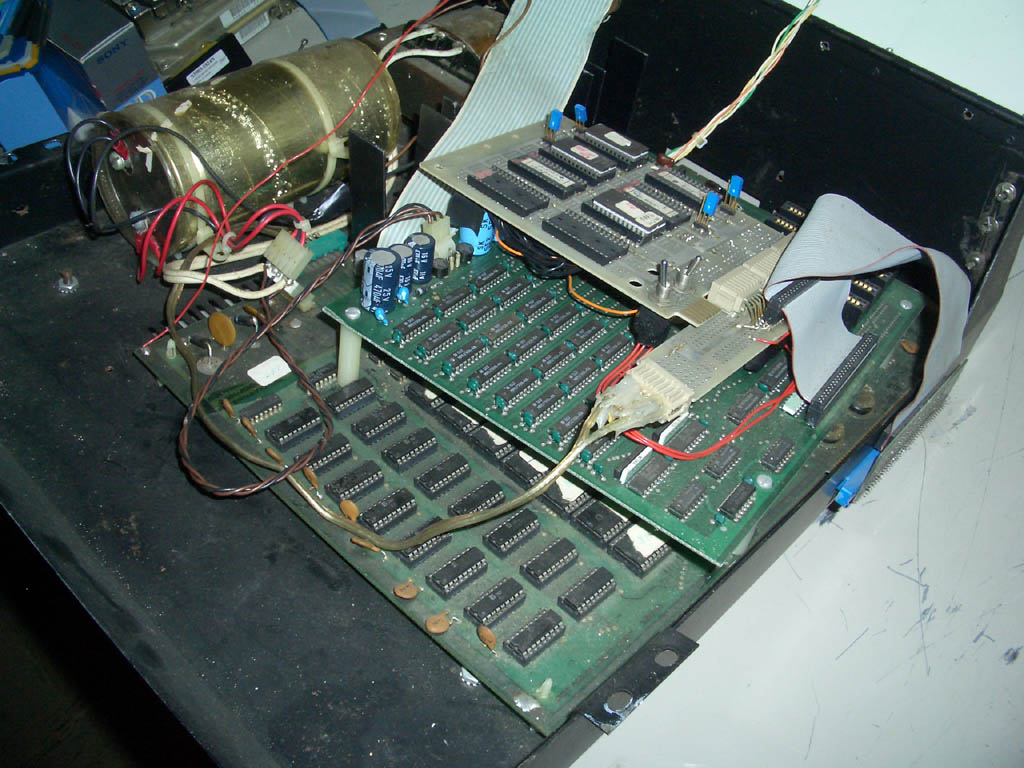
We have a thread for sightings of vintage computers
in film and TV right? I just spotted a nice IBM 360
installation in "The Girl Most Likely To...", a 1973
black comedy. Selectric console terminal, lots of
3420 tapes drives and a sorter painted blue. It's
the sorter that has a tiny (and technically inaccurate,
but who cares) role in the plot. It's a pretty fun
movie, written by Joan Rivers, and there are a whole
bunch of recognizable TV character actors of the era
in there. Got it on NetFlix.
I came across an application note and software on the Luminary Micro
site <http://www.luminarymicro.com/> implementing subject device. The
application note is the last one on the App Note page and the Software
Update page references the app note.
You can get a device with ethernet and three UARTS for a bit over US$
10 in singles - ARM Cortex processor.
CRC
----------Original Message:
Date: Mon, 19 May 2008 00:21:23 -0700
From: Josh Dersch <derschjo at msu.edu>
Subject: Capacitor values for original PET power supply?
Picked up an original PET 2001-8 awhile back that's been heavily (and I
do mean heavily) modified at various points in its history by someone
with very odd design aesthetics. (See pic at
http://yahozna.dyndns.org/scratch/hackedpet.jpg &
http://yahozna.dyndns.org/scratch/hackedpet2.jpg).
Various parts were hacked in and hot glued (!!) in place or just left to
dangle. When I got it everything was loose inside. There's an
Expandamem board and some homebrew job with some eproms and some hackery
connected to the internal cassette port. There are various switches on
the front and back that do who knows what. The keyboard & tape drive
have been replaced with a different keyboard, alas. (I'll leave finding
those two items for a later date...)
And the power supply's capacitor has been replaced with some huge
Sprague monstrosity larger than a pop can. Haven't even attempted to
power it up since the power supply wiring's all hanging loose and taped
together, but I'm afraid of that capacitor and I'd rather just return
this thing to more or less "original spec" and remove all of this extra
stuff.
Anyone know what the original power supply capacitor was for this
thing? I've found parts lists & schematics for the main PCB, video &
voltage regulator but none of them appear to list this. (I'd also be
interested in knowing the transformer specs & wiring, since I'm probably
going to have to rewire that...)
Thanks,
Josh
----------Reply:
Well, if it were mine I'd clean it up and figure out what's what and how to use
it instead of returning it to the boring "original" spec.
Don't know why you need to replace the cap or rewire the transformer, but
FWIW the original cap is 23,000 at 15; presumably it was increased to deal
with the increased current required by the extra boards. Don't know specs
for the transformer but it and the wiring look stock as far as I can see aside
>from being heavier than the original so I don't see why you'd need the specs.
FWIW, there should be 5 secondary terminals: 7 & 8 are the AC supply for
the monitor, 5 is ground, and 4 & 6 are the two ends of the 8-0-8 secondary.
The EPROMS may be interesting; there were a number of monitors, utilities
etc. supplied in EPROMs, and some disk/tape software packages also used
EPROMs for extra memory and copy protection; at least some of those
switches will be for selecting the EPROM to use. Dump 'em if you can;
they may be rare/useful.
If the keyboard isn't an obvious hack, i.e. if it fits the case and has the PET
graphics characters, it may be original; only the early models had the chiclet
keys and integrated tape drive.
mike
m
A friend of mine - freewheelin at cix dot co dot uk - wants to dispose
of an old PET:
[[
I've got a Commodore PET 8296 (http://tinyurl.com/3totud) and separate
dual disk drive (model 4040 - http://tinyurl.com/3k87vr), both non-working,
which are gathering dust in a corner of my office - if he wants them.
P&P might be rather enormous though, unless there's someone heading from
Wiltshire (near Stonehenge) to Shropshire who can take them on-board?
]]
Anyone interested? Free for the collection.
--
Liam Proven ? Profile: http://www.linkedin.com/in/liamproven
Email: lproven at cix.co.uk ? GMail/GoogleTalk/Orkut: lproven at gmail.com
Tel: +44 20-8685-0498 ? Cell: +44 7939-087884 ? Fax: + 44 870-9151419
AOL/AIM/iChat: liamproven at aol.com ? MSN/Messenger: lproven at hotmail.com
Yahoo: liamproven at yahoo.co.uk ? Skype: liamproven ? ICQ: 73187508
Just came across an interesting nascent site that should be of
interest to the group: "AllPinouts is a Web-based free content project
to collect and list all know pinouts." found at <http://www.allpinouts.org
>.
CRC
> Have they all been scanned and are on line?
Not scanned, but I have the original DEC-Document sources
(like LaTeX) and resulting postscripts and PDF's for RT-11
V5.6 and V5.7 up, e.g.:
http://www.trailing-edge.com/~shoppa/rt56manuals/s1523_pro.pdf
I'm similarly mystified by the previous post to this list looking
for scanned VMS documentation... the original PDF's (not scanned
but again through the DEC-Document->PS->PDF chain) are out
there on the web already.
Tim.
Picked up an original PET 2001-8 awhile back that's been heavily (and I
do mean heavily) modified at various points in its history by someone
with very odd design aesthetics. (See pic at
http://yahozna.dyndns.org/scratch/hackedpet.jpg &
http://yahozna.dyndns.org/scratch/hackedpet2.jpg).
Various parts were hacked in and hot glued (!!) in place or just left to
dangle. When I got it everything was loose inside. There's an
Expandamem board and some homebrew job with some eproms and some hackery
connected to the internal cassette port. There are various switches on
the front and back that do who knows what. The keyboard & tape drive
have been replaced with a different keyboard, alas. (I'll leave finding
those two items for a later date...)
And the power supply's capacitor has been replaced with some huge
Sprague monstrosity larger than a pop can. Haven't even attempted to
power it up since the power supply wiring's all hanging loose and taped
together, but I'm afraid of that capacitor and I'd rather just return
this thing to more or less "original spec" and remove all of this extra
stuff.
Anyone know what the original power supply capacitor was for this
thing? I've found parts lists & schematics for the main PCB, video &
voltage regulator but none of them appear to list this. (I'd also be
interested in knowing the transformer specs & wiring, since I'm probably
going to have to rewire that...)
Thanks,
Josh
Andrew wrote:
> I am interested in PAL / GAL programming and would
> like to buy a book on the subject. Does anyone have
> any recommendation(s)? Alternatively, there may
> be websites with PAL / GAL programming how to
> guides. Those would be useful
> too. I have a rough idea using PALASM but it has been
> a long time since I have used anything like it.
Since you mentioned it... and since this IS classiccmp...
The first version of PALASM I used was back in 1984 or 1985,
and it ran on a VAX and a PDP-11. If I recall correctly, it came as Fortran
source code and was from MMI, the big seller (at the time)
of PAL's. The MMI databooks of the era were very good at
convincing old stuck-in-the-mud-types like me that PAL's were
a huge improvement over discrete logic, showing how logic
equations map into blowing diodes, and blowing diodes
in a PAL results in exactly the function you wanted to begin with.
If I google for pages with MMI, PALASM, and Fortran, I see
several pages that would help you go this route.
As a practical matter, for a modern board, you'd probably
use gate arrays for all but the most straightforward decoding
to do it really modern.
Tim.
>
>Subject: Re: Emulation vs. "the real thing" was: Re: Minimal CP-M SBC design
> From: "Chuck Guzis" <cclist at sydex.com>
> Date: Mon, 19 May 2008 10:00:33 -0700
> To: cctalk at classiccmp.org
>
>Allison wrote:
>
>> Where it works, I want to emulate a PDP1, or replace a PDP-11. Where
>> it doesn't work so well is when I want to run VMS on a MicroVAX with
>> performance in the NVAX realm.
>
>As you stated, it depends upon what you want to do.
>
>22Nice was written in response to those, who, back in 1986 still had
>x80 CP/M systems and were looking to migrate to the PC. It was the
>answer to the question "...But how do I get my old <fill in the
>application name> to work>?" The goal was not emulation of a Z80/8080
>per se, but finding a way to make the transition to the MS-DOS world
>as seamless as possible. We didn't care about the
>Osborne/Kaypro/whatever experience or the CP/M experience, only how
>to get people going on a new platform. By and large, it worked
>pretty well, with no drivers, TSRs or knowledge about CP/M. You
>renamed your .COM files, ran GENCOM on them and you were off and
>running. The SUBMIT capability, for example, was deeemd superflous,
>as the MS-DOS BAT capability was better in just about every way and
>simple enough to adapt to. (The first versions of 22Nice ran on a
>Compupro 85/88 S-100 machine, but that's another story).
>
>22Disk was written solely as a way to get files to 22Nice. We'd
>considered just making the package read-only, but "in for a penny, in
>for a pound" thinking produced that bit of creeping featurism.
>
>To a CP/M purist, this approach (not providing an isolated emulated
>Z80 that you could load CP/M into) was probably heresy, but it worked
>well enough and accomplished the goal. The rise of better PC
>software eventually relegated 22Nice to the back burner, as that was
>seen as the ultimate objective.
Well not a purist. I've been using myz80 since around 94ish on PCs
for appliactions coding and other stuff. Sicne then I've added
Dave Dunfields Altair/Horizon Em,ulator that has a few things I use.
Also 22nice as well. However I didnt' ened it to port old z80 apps
to the PC I found enough PC stuff to do the same or better that I
didn't need that.
>I'd be lost without uC emulators today--they provide a convenient
>quick code check without the labor of trying to figure out what the
>heck is going on in that little block of plastic. But my reason for
>using an emulator there is very different from that of using 22Nice--
>I'm not interested in getting rid of the uC, but getting *to* it.
;) Like Blackfin or PIC.
>I'll use an emulator to satisfy my curiosity for hard-to-get old
>hardware. I've used the SIMH 1620 emulator to scratch an itch in my
>brain about some code I wrote 40+ years ago, but I would never
>confuse that with the actual experience of using a 1620 with the
>blinkenlights, parity checks, clackety console typewriter and
>glacially slow execution. Nor do I have the will or resources to
>resurrect or construct my own CADET. Nor do I want one in my office.
;) In somce ases MYz80 is far mroe capable or SIMH or any of the
many others as I can besitting anywhere running the sim on a small
laptop that I'd have any way rather than dragging my PX8 along as well.
>Sometimes, I'll use an emulator to figure out how some old piece of
>software worked, such as WPS-I on an old DECStation. The emulator in
>this case is better than the real thing, because I can modify the
>emulator code to show me what's happening internally. This would be
>at least very difficult on the real hardware--even if I really had it
>at hand.
Yes, it's a debugger and tool.
>This gets back to why I questioned the lack of diskette drives on a
>"real" Z80 design running CP/M. It seemed to me that if one is after
>an "experience" and is willing to go to considerable lengths to get
>it, that it should be as accurate and complete as possible. While 3D
>computer simulation of skydiving can be made to be very accurate,
>there's nothing like jumping out of a real aircraft for realism.
>Having noiseless, crashproof RAM-drives just wouldn't do it for me.
;) Having had noisy crash prone drives ( and still having many)
if I want to build to explore some part/hack of CP/M it's usually
not writing yafd (yet another floppy driver). CF allows me to
build and pay attention to other things that might be more hardware
and software intensive. Examples over the years is low DC power
systems, page mappers and the memory management software. Both
hard to do in a sim but the sim can help in creating the code.
>It all depends upon what your objective is.
It always do. ;)
Allison
>Cheers,
>Chuck
> Date: Mon, 19 May 2008 13:27:51 +0000
> From: Ethan Dicks
> I still build a lot of hobby projects with GALs (like PALs, but
> with much more flexible input and output configurations) - I
> don't think I've built a Spare Time Gizmos product yet that didn't
> have at least one 16V8 or 22V10. Gate Arrays might be handy for
> larger projects, but you can still pack a *lot* into a 20 or 24-pin
> GAL.
If someone were just starting out with GAL/PALs, wouldn't PEEL be the
best choice rather than fuse-programmed devices? At least you'd get
a second chance if you flubbed your first try--and they're basically
the same packaging.
Cheers,
Chuck
Hi,
While looking at the service manual for the Tektronix 4010/4010-1 and
4014/4014-1 terminals, I came up with an idea for creating a screen
capture card for them using the principles from the Tektronix 4631 hard
copy unit for the terminals. This would give you the ability to capture
a pixel image from the Tektronix terminal's display tube.
How many people would be interested in such a project?
--
"The Direct3D Graphics Pipeline" -- DirectX 9 draft available for download
<http://www.xmission.com/~legalize/book/download/index.html>
Legalize Adulthood! <http://blogs.xmission.com/legalize/>
Hi
I have hard copies of V4 and V5 RT-11 manuals. I'd like to keep the V5
manuals but I'd like to get rid of the V4 manuals.
Have they all been scanned and are on line? I looked on manx and
bitsavers and I found a few v4 manuals but not everything.
Should I figure out what I have which is not on line and scan that? Or am
I wasting my time?
For instance, I just scanned (as a test of 2 sided) AA-5285F-TC, which
is already online, but I can't find AA-K724A-TC (BASIC-11/RT-11
Installation and release notes, for V4 RT-11) so I assume that is not
scanned.
I just don't want to pitch these if they are not available (which is
hard to believe, as I think what I have is very common)
-brad
Allison wrote:
> Where it works, I want to emulate a PDP1, or replace a PDP-11. Where
> it doesn't work so well is when I want to run VMS on a MicroVAX with
> performance in the NVAX realm.
As you stated, it depends upon what you want to do.
22Nice was written in response to those, who, back in 1986 still had
x80 CP/M systems and were looking to migrate to the PC. It was the
answer to the question "...But how do I get my old <fill in the
application name> to work>?" The goal was not emulation of a Z80/8080
per se, but finding a way to make the transition to the MS-DOS world
as seamless as possible. We didn't care about the
Osborne/Kaypro/whatever experience or the CP/M experience, only how
to get people going on a new platform. By and large, it worked
pretty well, with no drivers, TSRs or knowledge about CP/M. You
renamed your .COM files, ran GENCOM on them and you were off and
running. The SUBMIT capability, for example, was deeemd superflous,
as the MS-DOS BAT capability was better in just about every way and
simple enough to adapt to. (The first versions of 22Nice ran on a
Compupro 85/88 S-100 machine, but that's another story).
22Disk was written solely as a way to get files to 22Nice. We'd
considered just making the package read-only, but "in for a penny, in
for a pound" thinking produced that bit of creeping featurism.
To a CP/M purist, this approach (not providing an isolated emulated
Z80 that you could load CP/M into) was probably heresy, but it worked
well enough and accomplished the goal. The rise of better PC
software eventually relegated 22Nice to the back burner, as that was
seen as the ultimate objective.
I'd be lost without uC emulators today--they provide a convenient
quick code check without the labor of trying to figure out what the
heck is going on in that little block of plastic. But my reason for
using an emulator there is very different from that of using 22Nice--
I'm not interested in getting rid of the uC, but getting *to* it.
I'll use an emulator to satisfy my curiosity for hard-to-get old
hardware. I've used the SIMH 1620 emulator to scratch an itch in my
brain about some code I wrote 40+ years ago, but I would never
confuse that with the actual experience of using a 1620 with the
blinkenlights, parity checks, clackety console typewriter and
glacially slow execution. Nor do I have the will or resources to
resurrect or construct my own CADET. Nor do I want one in my office.
Sometimes, I'll use an emulator to figure out how some old piece of
software worked, such as WPS-I on an old DECStation. The emulator in
this case is better than the real thing, because I can modify the
emulator code to show me what's happening internally. This would be
at least very difficult on the real hardware--even if I really had it
at hand.
This gets back to why I questioned the lack of diskette drives on a
"real" Z80 design running CP/M. It seemed to me that if one is after
an "experience" and is willing to go to considerable lengths to get
it, that it should be as accurate and complete as possible. While 3D
computer simulation of skydiving can be made to be very accurate,
there's nothing like jumping out of a real aircraft for realism.
Having noiseless, crashproof RAM-drives just wouldn't do it for me.
It all depends upon what your objective is.
Cheers,
Chuck
Mac collectors,
I was contacted by Kathy or Rick, who are moving from Maine
to North Carolina and would like to find a good home for their
Macintosh LC III and printer. Included are:
>Macintosh LC III
>StyleWriter
>MouseStick II
>
>I have the original system disks & manuals as well as the following
>software/games:
>
>Stellar 7
>PGA Tour Golf
>Word Muchers
>Where in the World is Carmen San Diego
>Kings Quest V
>Casino Game Pack
>Math Blaster
>
>Also have some user manuals: Norton Utilities, Mac for Dummies, SAM
>User Manual, 1001 Hints/Tips for Macs
They are willing to ship.
They can be contacted at kreaton(at)roadrunner.com for a
while, but that address will likely change (and it may take a few
weeks for the new one to appear). If you can't contact them there,
try me at mtapley(at)swri.edu and I'll do my best to forward the
message.
--
- Mark, 210-379-4635
-----------------------------------------------------------------------
Large Asteroids headed toward planets
inhabited by beings that don't have
technology adequate to stop them:
Think of it as Evolution in Fast-Forward.
An old client has requested help with hardware and software support for
some very old
PDP-11 systems running RT-11. The best solution may be to use E11
rather than fixing
some of the old hardware.
Another reason that using E11 would probably be the best solution is
that there may be
reports that take up to a day to produce using real DEC hardware. Since
my estimate
with E11 for a current 3 GHz CPU is about 100 times the speed of a
PDP-11/93, these
reports would take less than 30 minutes.
An RT-11 license will also need to be purchased. Does anyone have an
e-mail address
for Mentec? I contacted John Wilson a few weeks ago, but have not had a
response.
Sincerely yours,
Jerome Fine
Kenn, I saw you advice regarding the HO4952A software and the LIF floppy
format and as a hp4952A owner, I'm wondering if you know anywhere I could
get a copy of the utilities floppy?
Gordon Oliver
Australia
>
>Subject: Re: Minimal CP-M SBC design
> From: "Chuck Guzis" <cclist at sydex.com>
> Date: Sun, 18 May 2008 10:31:45 -0700
> To: cctalk at classiccmp.org
>
>> Date: Sun, 18 May 2008 10:09:45 +0100
>> From: Gordon JC Pearce
>
>> Aha, I disagree. You can't get at the innards of the 6120 at all,
>> because it's a chip. If you want to get at the innards of an emulator
>> then you can, although how accurately the emulator models the logic of
>> the -8 might be an issue (my emulator doesn't model it at all, but
>> largely does its own thing).
>
>I was going to reply along the same lines, but I felt it might not
>have convinced my audience. Back in the old days of 22Nice, we added
>an emulator feature that allowed a user to write his own port-mapping
>code and include it with each program, allowing each individual
>program to have its own simulated peripherals, if desired.
>
>This was no accident or a "feature for feature's sake". A customer
>was replacing a controller on a large piece of CNC machine tooling
>(they made trailers for large trucks). Communication with the
>machine was largely RS-232, so that was no problem with the PC, but
>the controller application directly manipulated a UARTs registers.
>We rolled an emulator overlay for the UART that functionally mapped
>the program's accesses to the PC's 8250-type UART. It worked right
>on the first try and the customer was happy for many years--and we
>changed not a byte of code in the original program, nor our basic
>product.
>
>That's the beauty of emulation--if the original box uses a bizarre
>interface or unobtainium chip, you can emulate it. MUCH easier than
>trying to do the same in hardware. Modern PCs tend to have
>sufficient excess horsepower that you can emulate just about any 80's
>era device without impacting performance.
That is the exact reverse case I was refering to. For that case and many
others like it I agree heartily. One of the "sims" I use is VMware under
Linux So I can run them crufy MS OSs without havignto invest hardware
on a daily basis. Doesn't hurt that I can also use it run a sim in
a sim like MyZ80 inside W98se on the fast Linux machine.
>But, as I've said, I felt that I wasn't going to sway the hard-bitten
>hardware folks. As you pointed out, the line between hardware and
>software is getting very blurry indeed. Cheap, fast,
>microcontrollers now give a new spin to tasks that would have
>normally been accomplished with a pile of discrete logic and can now
>be done with little more than software.
It works for me where it fits. If I want Z80 hardware no amount fo sim
will make me happy but at the same time I may use a sim to build code
for that Z80. As I've done it that way and in reverse and also to solve
the problem of hardware that is unobtaimium.
Where it works, I want to emulate a PDP1, or replace a PDP-11. Where
it doesn't work so well is when I want to run VMS on a MicroVAX with
performance in the NVAX realm.
Maybe time to chance the topic??? This is clearly outside the discussion
of how to make a minimalist CP/M system ( maybe even SBC).
Allison
I have one of these here with out a Keyboard. any one know which keyboards
can be used on it with out seeing smoke. Has a DIN connector
Of coarse I'm open to offers from any one that many have a keyboard also.............
Thanks, Jerry
>until you find that they want $5 for a PDF of a
>datasheet.
I have three large databook collections (including most of what
was at Haltek). I had offered them to CHM, but they've changed their
mind about wanting them, and they want the storage space back,
so I'm going to chop a subset and scan them at 600dpi over the next
few months. The duplicates will probably go up on eBay in 20-book lots.
The big problem will be their size and postprocessing them. I don't
know if Jay is going to want something this big on bitsavers.
I have a pair of TRS-80 DT-1 terminals that I've had for awhile and that
I don't think I'm ever going to use. I believe they work but I have not
done much with them aside from powering them up. They come with
dust-covers! (fancy!)
Free to whomever wants 'em. They're kinda large (about TRS-80 Model
III-sized) so I'd prefer not to ship, but if that's what it takes...
If there's no interest I'll probably drop them off at RE-PC in Tukwila,
WA in a week or so, maybe they'll find a happy buyer for them there :).
Thanks,
Josh
> Date: Mon, 12 May 2008 11:04:15 -0500
> From: Jim Leonard
> What I would love to test is Central Point Backup (PC Backup?) prior to
> version 6, which is the only version I had available to test. Versions
> prior to 6 are supposed to contain code that supports the Option Board I
> have in my 5160 for additional speed -- however, I'm not sure how much
> speedup I could expect, since some of the faster programs in the
> shootout must have been operating at a 1:1 intereave (I was writing all
> 40 tracks both sides in less than 30 seconds per disk; can it get any
> faster than that?).
I'll dig out the old FastBack and see if I've got an older CP backup--
I may well have.
If you're formatting then writing, then an OB might be faster, but
probably not when simply writing to a formatted diskette, assuming
that the sector layout is skewed appropriately to allow for seek and
head settling times.
In the bad old days of WD 17xx diskette controllers, we had a copy
program that formatted and wrote backup data in one pass, as long as
the data didn't have any of the "special" bytes that the WD chip
interprets differently during a format operation.
Cheers,
Chuck
> Date: Sun, 18 May 2008 10:09:45 +0100
> From: Gordon JC Pearce
> Aha, I disagree. You can't get at the innards of the 6120 at all,
> because it's a chip. If you want to get at the innards of an emulator
> then you can, although how accurately the emulator models the logic of
> the -8 might be an issue (my emulator doesn't model it at all, but
> largely does its own thing).
I was going to reply along the same lines, but I felt it might not
have convinced my audience. Back in the old days of 22Nice, we added
an emulator feature that allowed a user to write his own port-mapping
code and include it with each program, allowing each individual
program to have its own simulated peripherals, if desired.
This was no accident or a "feature for feature's sake". A customer
was replacing a controller on a large piece of CNC machine tooling
(they made trailers for large trucks). Communication with the
machine was largely RS-232, so that was no problem with the PC, but
the controller application directly manipulated a UARTs registers.
We rolled an emulator overlay for the UART that functionally mapped
the program's accesses to the PC's 8250-type UART. It worked right
on the first try and the customer was happy for many years--and we
changed not a byte of code in the original program, nor our basic
product.
That's the beauty of emulation--if the original box uses a bizarre
interface or unobtainium chip, you can emulate it. MUCH easier than
trying to do the same in hardware. Modern PCs tend to have
sufficient excess horsepower that you can emulate just about any 80's
era device without impacting performance.
But, as I've said, I felt that I wasn't going to sway the hard-bitten
hardware folks. As you pointed out, the line between hardware and
software is getting very blurry indeed. Cheap, fast,
microcontrollers now give a new spin to tasks that would have
normally been accomplished with a pile of discrete logic and can now
be done with little more than software.
Cheers,
Chuck
>
>Subject: Re: Minimal CP-M SBC design
> From: Gordon JC Pearce <gordonjcp at gjcp.net>
> Date: Sun, 18 May 2008 10:09:45 +0100
> To: "General Discussion: On-Topic and Off-Topic Posts" <cctalk at classiccmp.org>
>
>On Sun, 2008-05-11 at 16:25 -0400, Allison wrote:
>
>> Bob's SBC6120 is as close or better than a real 8e for playing with code.
>>
>> That s the point too. Emulation you just cant pay with wires or add
>> a parallel port.
>
>Aha, I disagree. You can't get at the innards of the 6120 at all,
>because it's a chip. If you want to get at the innards of an emulator
>then you can, although how accurately the emulator models the logic of
>the -8 might be an issue (my emulator doesn't model it at all, but
>largely does its own thing).
True, you can carry it with one hand and it does run os/8 rather than
os/278. If I want to be in the innards of a CPU I hav e a real pdp-8
and a decent scope. I've yet to see a emulator that can let me see
the r/m/w cycles of core on the scope.
But I can add ports to a SB6120.
If of course if you program a large CPLD or FPGA you can have your
software verion of the chip and you can even get at the innards with
your VHDL complier. No different from the 6120 as hardware but now you
can play in software.
Neither is wrong but if your designing a board that plug into a real
PDP-8 and is software interactive then for all cases if (software
emulation, parallel port kluge) sb6120, FPGA) our results will be
"simulation" and at best does not have the feel, or actual dynamics
of the electronic issues( termination, bus ringing, grounding and
so on).
>Adding a parallel port is easy - you've got one on your PC. Work out
>what you want to talk to the parallel port, and graft on a bit of code
>to do it. Dead easy.
Sorry doesn't work when you need 12 bits, or Data break and the
hardware is very code interactive.
>Need more ports, or a smart-ish peripheral? Get one of those
>microcontroller boards with a USB device port and a bunch of IO lines.
>The Arduino Diecimila looks pretty good for this, although having more
>than one UART would be nice. The UART talks to a generic USB-to-Serial
>chip (FTDI, for those interested) and you've got an assortment of
>digital IO, analogue input and PWM lines to play with, and a bunch of
>timers and things. It presents to the PC as a serial port, and you
>program it in C. I reckon with one of them and a bit of interfacing
>hardware (level shifters and latches, mainly) I could drive most PDP-8
>peripherals (if I had any).
If I wanted to build a PC for the task I'd use one. The original goal
was to emulate or simulate in software the unique hardware for the
pupose of writing new code that would run on the real (z80 powered)
thing with that unique hardware.
If I want to run an abstraction and I do on occasion then many of
the sims are great for that. Most sims allow for good many of the
available "peripherals" and thats fine if your running real
hardware the same way or wishing you could.
Allison
>
>Subject: Re: Minimal CP-M SBC design
> From: Ethan Dicks <ethan.dicks at usap.gov>
> Date: Sun, 11 May 2008 13:01:31 +0000
> To: "General Discussion: On-Topic and Off-Topic Posts" <cctalk at classiccmp.org>
> Cc: General at icecube.southpole.usap.gov,
> On-Topic Posts Only <cctech at classiccmp.org>
>
>On Sun, May 11, 2008 at 08:23:13AM -0400, Dave McGuire wrote:
>> Well I wasn't talking about a diskless system...only one in which
>> CP/M itself was in ROM.
>
>I personally find the idea intriguing, and I am about to cobble up
>a system from (nearly) scratch. I used Kaypros and the like, back
>in the day, and really won't miss floppies (not that there's an FDC
>chip within 3000 miles I could slap on this thing, anyway).
>
>I don't mind the idea of stuffing "the OS" in ROM vs loading off
>of removable media since I doubt I'll want to upgrade. I want to
>run a few CP/M-80 programs, and that's about it.
NOte It's not OS in rom, it's Rom as floppy replacement. CP/M load
process for floppy is a booter load system tracks to ram.. The rom
appaorach is booter loads system from ROM to ram. and once in ram
you can overlay, alter, patch, extend as desired.
>> >I still don't have the hang of this "vintage" thing yet, probably
>> >because I'm vintage myself. Please forgive my density...
>>
>> I often suffer from the same problem. I think very few of us, even
>> here, actually used stuff like CP/M and PDP-11s when they were
>> considered current technology.
>
>I was a kid when S-100 machines were "in", but, as came up earlier
>in this thread, I did hit the Osborne/Kaypro CP/M era.
When I was an adult S100 was introduced.
>I consider myself quite fortunate that I've gotten to program PDP-11s
>on two different jobs right at the tail end of their heyday (I was 18-20
>at the time). I also consider myself fortunate that I was working at
>a place that supported VAX/BSD customers in addition to our VAX/VMS
>customers, so I was able to pick up some UNIX skills nearly 25 years
>ago. When folks bandy about "All the World's a VAX", it really means
>something to me (I learned C from K&R on an 11/750 running 4.1BSD, so
>I _know_ how easy it is to write non-portable code).
>
>I do run things inemulation, but I also enjoy running things on real
>iron. Right now, I have a modern Elf within reach, as well as an
>SBC6120. The SBC6120 boots off of CF... no floppies, no 1/3 HP rotating
>media, but there's still a real 12-bit processor on the board. I don't
>consider that emulation in the slightest, even if my "disks" don't rotate.
>OTOH, I also have, at home, "real" PDP-8s with real DEC-made disks; they
>just aren't so portable as to be worth hauling down here. Same goes for
>a CP/M machine - I'm working on something smaller than a princess phone.
>Quite portable compared to an S-100 or an Osborne.
Bob's SBC6120 is as close or better than a real 8e for playing with code.
That s the point too. Emulation you just cant pay with wires or add
a parallel port.
>Just my take on why I mix classic CPUs with modern peripherals... runs
>the original software, weighs a lot less.
;) and it can be faster too. A 64K z80 system that has a 32mb CF will do
everthing the same as my S100 create with a Quantum D540(32mb) hard disk
only it cant cause back pain, it's about as fast and the CF based machine
can run on small batteries where the S100 crate can suck up a APS 1000VA
UPS in short order (that has two 12V 7AH gell cells or ~168WH of power).
Allison
>-ethan
>
>--
>Ethan Dicks, A-333-S Current South Pole Weather at 11-May-2008 at 12:40 Z
>South Pole Station
>PSC 468 Box 400 Temp -79.6 F (-62.0 C) Windchill -108.3 F (-77.9 C)
>APO AP 96598 Wind 5.8 kts Grid 42 Barometer 682.8 mb (10523 ft)
>
>Ethan.Dicks at usap.govhttp://penguincentral.com/penguincentral.html
> I'm not sure what's out there in the way of books that directly cover
> PALASM.
It's mostly covered in the data books and app notes.
The last version was PALASM 4 V1.5.
If you google for "PALASM 4 Ver 1.5 software manual"
you'll find the docs on it.
http://jason.sdsu.edu/minc/pls_man/e_palasm.pdf
looks reasonable as well.
PALASM is REALLY dumb. It essentially works at the fuse level.
Hi,
I am interested in PAL / GAL programming and would like to buy a book on the
subject. Does anyone have any recommendation(s)? Alternatively, there may
be websites with PAL / GAL programming how to guides. Those would be useful
too. I have a rough idea using PALASM but it has been a long time since I
have used anything like it.
The reason is as my neo vintage SBC design is nearing completion and I will
be ordering the PCBs soon, however, I am keeping an eye out to the next
version. I am severely space limited with the Eurocard format (160x100mm)
and I am investigating potential PAL/GAL implementation to free some board
space.
Any help is much appreciated. Thanks in advance.
Andrew Lynch
All,
I have all the pieces here to setup a Xerox 820 board with my Corvus
flat-cable drive except for the driver software. Does anyone have this or
have a notion of who might have it?
The interface box is rarer than hen's teeth, but I've come up with two of
them.
Steve
--
-------------Original Message:
Date: Tue, 6 May 2008 23:27:13 +0100 (BST)
From: ard at p850ug1.demon.co.uk (Tony Duell)
Subject: Re: Interconnecting classic computers
>
> Has anybody ever tried interfacing a modem to a cordless phone handset?
Are cordless phones truely full-duplex, or are they more like
loudspeaking phones whee a local voice input disables the speaker output?
That is not a problem for voice, of course, but it is for full-duplex modems.
> It shouldn't be too hard to use a C/L phone as the wireless link between two
> modems.
>
> I believe Tony also has a NetCommander which would let him select which
Actually I have 3 of them. One is the 16 port model (with 16 RS232
ports), the others are the fixed-configuration 6 RS232/4 Centronics models.
But they do not solce the cabling problem. Nor do they have enough ports
for all my classics...
-tony
-----------Reply:
Well, that gives you 25 ports; how many more do ya need? At one point we
had 4 computer ports feeding more than 200 terminals over a single connection.
Alternately, it would be trivial to build a remotely controlled one-to-many port
selector out of relays or solid state parts, and you could use the NetCommander
just for the units that need baud rate conversion.
Of course the NCs don't solve the cabling problem, that's why I mentioned the
cordless phone. But unless you want to manually plug the desired system in
every time or buy/make separate connecting links for every system, you'd
need some way of concentrating the systems into one connecting link.
Obviously not a solution you'd approve of, but two old laptops with RS-232
and wireless cards would easily solve the connection problem. Of course
we usually prefer lengthy discussions here instead of simple solutions...
mike
Out of curiosity, I went to torrentz.com and searched on "datasheet".
A couple of hits. One is a collection of datahseets from Elektor
that I haven't looked at (I'm on the wrong side of the pond to know
much about Elektor). About 230MB worth.
The other is a melange of various datasheets. Lots of op-amps, some
digital ICs, transistors and other bits and pieces. Rev. C of the
Kaypro service manual (Bitsavers has Rev. E). Information on a
Techtran diskette drive unit, some stuff on time standards. The gem,
IMOHO, is a two-file collection of Western Electric datasheets for
transistors, ICs, diodes and LEDs. Most look to be from about 1976
or earlier. It might be very useful to someone who needs to know,
for example, that the 18 pin DIP 146D is an integrated wait state
generator for the Bellmac-8 processor.
Unfortunately, these PDFs aren't indexed beyond general categories,
just sort of mixed all together.
Cheers,
Chuck
>Message: 10
>Date: Thu, 15 May 2008 12:22:39 -0400
>From: "Roy J. Tellason" <rtellason at verizon.net>
>Subject: Re: Osborne OCC1 problem
<snip>
>I wonder if anybody ever sold anything that plugged in there?
<snip>
There were adaptors for external monitors. The one I had was "Exmon" brand.
Bob
>Message: 1
>Date: Thu, 15 May 2008 09:13:42 +0100
>From: "Ade Vickers" <javickers at solutionengineers.com>
>Subject: RE: Osborne OCC1 problem
>Hi chaps,
>This is a kind of amalgamated response to all who have responded; thanks!
<snip>
Hi,
For the video pinouts, take a look at http://www.classiccmp.org/pipermail/cctalk/2001-July/176233.html.
To repeat part of that thread, the signals come from the bottom of the edge connector on the front panel and the shunt carries them to the top, where they go to a single inline connector that connects to the monitor. Looking at the edge connector from the front (numbered right to left, odd on top, even on the bottom), the signals are:
2 Ground
4 Brightness High
6 Brightness Low
8 Brightness Arm
10 Ground
12 Horizontal sync
14 +12V
16 Video out
18 Vertical sync
20 Ground
The shunt just connects the top contact to its mate on the bottom: 1 to 2, 3
to 4, etc.
There is/was a pdf of the Osborne 1 Technical Reference manual online. I don't have a link handy, but it has been posted before, so just search the archives.
Bob
On 15 May, 2008, at 23:04, cctalk-request at classiccmp.org wrote:
> PS: Also how may on this list still use mag tape
> with the vintage equipment?
I do, but my Ampex drives use analogue tape type spools rather than
the later 'industry standard' ones. They are half inch but ten track
not 7 or 9 and because of the smaller hole, with normal thickness
tape they got 3200 feet on a spool rather than 2400 feet. The machine
optionally used one inch or quarter inch analogue spools on different
decks, and the one inch transports ran at 150 inches per second.
Roger Holmes
Hi, just read your message about the Displaywriter. What I did to
exchange files was to send the information via modem on my Displaywtier
to my laptop's modem. It worked extremely well. Or I uploaded files to
Compuserve and then downloaded them. I would love to own Displaywriter
again.
-----------------------------------------
Under Florida law, e-mail addresses are public records. If you do
not want your e-mail address released in response to a public
records request, do not send electronic mail to this entity.
Instead, contact this office by phone or in writing.
> My preference for distributing large trees of files is
> rsync, since it's designed for that, and it lets you efficiently
> update an existing local copy with as little data transferred as
> possible -- which is great for things like Bitsavers that are
> constantly being added to.
Which is working quite well..
> so it certainly sounds like a worthwhile project to me. "Voltsavers"
The issue isn't who hosts it, but the bandwidth issues. There are hundreds
of data books, and they are running about 100mb each when scanned. It is
impractical for me to burst them into smaller chunks due to the time it
would take to do it. I've had little luck getting people to work on
postprocessing the scans in the past. Currently, about 1/3 of everything I
have scanned is on bitsavers.
It takes about a week to process what I can scan in a day.
On an average scanning day I can scan 5-10 thousand pages.
I've been scanning now for over 9 years (obviously, not every day)..
Because of the thinness of the paper used, a box of data books is over
10k pages.
This should give you an idea of the magnitude of work involved in scanning
a large databook collection..
Be careful when using broker websites for semiconductors.
In my search for some SMC UARTS, I've come across some sites
that appear to have "open registration" for posting inventories.
(i.e., anyone can supply an inventory list, and an e-mail address,
and they'll show up on the vendor search.)
(Recently digchip dot com )
After submitting a few RFQ's, I received replies from
a number of different "companies" (read: individuals)
that were highly suspect.
For example:
Generic e-mail addresses.
References to what are supposed to be their
"corporate" website, but are in fact unrelated.
Payment terms "T/T" (wire transfer) or Western Union.
I also received nearly identical quotes, from
two presumeably different companies. While this is
certainly possible, the verbage used was almost exact.
As with any other transaction. . . . "buyer beware".
As info. . . .
T
> Date: Thu, 15 May 2008 12:54:34 -0700 (PDT)
> From: "Eric Smith"
> Bittorrent doesn't help at all for things that only a few (less than
> about five) people are trying to download at the same time. FTP is
> generally *more* efficient than bittorrent for that.
Agreed. When you have a small community who have interest in a BT
file and most of the interested people have picked it up already, you
can grow whiskers waiting for a seed to emerge. I've seen some
rather pitiful begging on the 'net for a seed for such-and-such a
file.
Sometimes you do find a seed, but he's got his upload throttled down
to something like 3Kb/second. It'd be faster to get the file via
Aldis lamp.
The idea behind BT is utilizing the power of a mob, er "swarm".
Three isn't a swarm.
Cheers,
Chuck
> Date: Thu, 15 May 2008 17:40:28 +0100
> From: "Ade Vickers"
> Or, of course, I could bodge my universal power supply into powering the
> multimeter...... (don't dare suggest buying a battery! ;))
This reminds me of a question I've been meaning to ask the list.
I've got some old gear that take single D- or C-sized carbon-zinc
cells, usually as some sort of minimal-current supply. For example,
my VTVM uses one for its resistance function. (Sometimes a high-
impedance meter with a real needle is hard to beat).
I don't keep cells in this old stuff because I use it only
occasionally.
Is there such a thing as a long-life leakproof battery that I can
use? Silver-zinc perhaps?
Thanks,
Chuck
I finally got my selling spot this afternoon after about a 2 hour wait
in line (3303.) I must have missed any other selling spots except for
Patricks, but I'll check and drop by :). I have nothing classic computer
related this year, but I also should get a chance to look around!!!
On Thu, May 15, 2008 2:07 pm, Roy J. Tellason wrote:
>> > Case solved (I think). It seems to matter where I ground the
>> > probe. I
>> > pulled all of the boards out of the system, no change. I then
>> > grounded the
>> > probe to the middle finger of the voltage regulator on the board
>> > and the
>> > sine wave went away.
>>
>> The chassis may not be at digital ground.
>>
>> Also watch out for the middle lead of three-terminal (78xx/79xx)
>> voltage regulators...it's not unheard of to bring them up above
>> ground a bit with a voltage divider to make them operate at different
>> voltages.
>
> The _middle_ lead is not ground on the 79xx parts!
You're correct of course; I should've said "ground" lead.
-Dave
--
Dave McGuire
Port Charlotte, FL
>Does anybody know if the DEC8235 is the same as the National DM8235?
>
Doesn't look likely. The DM8230 isn't the same as the Signetics 8230.
The DEC82xx parts seem to be the Signetics 82xx parts.
>Mouser claims to be able to order NTE8235, but there's no order pending or
>delivery date. ($9.09 each.)
>
http://www.rselectronics.com/ seems to claim stock.
This company search says they have non NTE parts. I used them in 1999 to
get a part and the minimum order then was $50. http://www.hrent.com/inv.htm
Who knows what has changed since then, the search is using an outside site.
They also list the MM57109N from another message.
Post back if you do use them.
---------Original Message:
From: Dan Roganti <ragooman at comcast.net>
Subject: Re: DEC8235 and MM57109N ICs
Gordon JC Pearce wrote:
> Does anyone have the datasheet for an MM57109? How hard would it be to
> make a replacement, either with an FPGA or a microcontroller or
> something?
>
I've had no luck whatsoever in finding a datasheet for this part.
I've been searching online for a long time too.
I only have the programming info from old projects.
But I too like to get the complete datasheet to check everything.
I'm hoping the folks at Area51esg would have a lead on this.
=Dan
---------Reply:
Well, considering the MM57109 is a microprocessor, it's a little more
than just a data_sheet_ unless you only want the pinout & logic diagram.
It's one of the COPS family and should be in any NSC MOS databook of
the time; if you can't find it and Area51esg can't supply it, contact me
off-list and I'll try to find time to scan it, abt. 24 pages.
mike
... is tomorrow!
Is anyone planning on going this year?
I'll be there again, in spaces 3435/3436, and have a bunch of fun old
electronic and computer crap (including a few nice, fun, big UNIX
boxes).
Pat
--
Purdue University Research Computing --- http://www.rcac.purdue.edu/
The Computer Refuge --- http://computer-refuge.org
On 15 May 2008 at 12:00, cctalk-request at classiccmp.org wrote:
> Date: Thu, 15 May 2008 11:48:42 -0400
> From: Allison
> case ground may not be circuit ground... make sure the the probe ground
> is actually circuit ground.
>
> Many machines made the case RF ground and seperate from teh DC ground
> using capactiors (true for altair, NS* horizon, CCS, Compupro that I
> have).
That's my guess also. That 70v 60Hz signal probably doesn't
represent anything more than stray AC pickup by the case. Find the
real signal ground.
A couple of weeks ago, I was working on a friend's old Roland analog
synthesizer and discovered that there were *two* grounds on the thing-
-digital and analog. And they weren't the same. Neither one
corresponded to case ground or even the sleeve on the audio output
jacks. Fortunately, both grounds had labeled TPs on the PCBs.
Cheers,
Chuck
> Date: Tue, 13 May 2008 16:46:21 -0700 (PDT)
> From: Chris M
> off the cuff, if you're looking for one so you can
> interface an 8" drive to a pc, you might want to look
> at Dave Dunfield's info (don't ask me the url, just
> google "Dave's old computers" and you'll find it
> lickety-split). Unlikely every 8" drive will work, but
> many will I presume.
The CC II is a different beast from the CC IV and the generic PC-AT
style controller, using a plain-Jane uPD 765A with a different
convention for switching densities. It's basically the CCI without
the external drive connector (same PCB, just no connector). 22DISK,
Anadisk etc. support this controller during configuration.
If the OP wants to contact me off-list, I think I may have a CCII
that I'm willing to part with.
Cheers,
Chuck
Address Contents
000 000 000 000 000 000 000 000
000 000 000 001 000 000 000 000
000 000 000 010 000 000 000 000
000 000 000 010 000 000 000 000
-----Original Message-----
From: cctech-bounces at classiccmp.org
[mailto:cctech-bounces at classiccmp.org] On Behalf Of Mike Hatch
Sent: 14 May 2008 09:28
To: General Discussion: On-Topic Posts Only
Subject: Re: [personal] RE: PDP-8E diagnostic help needed
0-24 thats 0-16 Dec.
Don't know the 8's but that would suggest to me that 4 bits (1 chips
worth) are stuck somewhere leading to some address decoding ?. Does it
repeat higher up the addresses ?.
Mike.
----- Original Message -----
From: "Rod Smallwood" <RodSmallwood at mail.ediconsulting.co.uk>
To: "General Discussion: On-Topic Posts Only" <cctech at classiccmp.org>
Sent: Tuesday, May 13, 2008 8:44 AM
Subject: [personal] RE: PDP-8E diagnostic help needed
> Now that's interesting..
>
> I have a PDP-8/e as well. I can't store in locations 000 000 000 000
to
> 000 000 011 000 (0 - 24 Dec)
> Above is OK
>
>
> If somebody has an answer to your problem. They might know something
> about mune.
>
> Rod Smallwood
>
>
>
>
> -----Original Message-----
> From: cctech-bounces at classiccmp.org
> [mailto:cctech-bounces at classiccmp.org] On Behalf Of Mark G. Thomas
> Sent: 09 May 2008 16:36
> To: cctech at classiccmp.org
> Subject: PDP-8E diagnostic help needed
>
> Hi,
>
> I've got a PDP-8E which I've almost got working.
>
> Can anyone here help me figure out this remaining problem?
>
> As I examine memory, the address lights count up to 01111, then go
back
> to 00000, instead of 10000. I can manually enter an address higher
than
> 1111, but the 10000 and 100000 bits don't stick -- they go low, as
soon
> as I hit the examine switch to step to the next memory location.
>
> I can manually load an address 1000000 or 10000000, and hit examine to
> see 1000001, 1000010, 1000011, etc..., but once I reach 1001111, it's
> back to 1000000.
>
> It was recommended to me that it might be the carry between E52 and
E37,
> or the E38 input multiplexer for bit 7 (on M8300), so last night I
> socketed and replaced all three of those ICs, but I still see the same
> symptoms.
>
> I have extender boards, so can access M8300 during operation. I
measured
> the carry line between E52 and E37 go low when I reach 1111, but the
> light for line 10000 doesn't light on the front panel on the next
> address, and I see the data from memory location 0000, 0001, etc.
> repeated, displayed as I continue to step through memory locations, as
> described above.
>
> Of course, if someone has a spare M8300 they would be willing to sell
> me, that's another option.
>
> Mark
>
>
> --
> Mark G. Thomas (Mark at Misty.com)
> voice: 215-591-3695
> http://mail-cleaner.com/
>
>
>
>
>
Hi Chris,
I've just found your posts about the CPT 9000 computer/word processor you have. I worked for CPT Corp. from 1978 thru 1989 and was one of the principle software developers for the CPT 9000. It was CPT's last effort to combine their dedicated word processing software with the, at the time, new PC-AT 286 computers coming into the market. I have lots of the original software for the 9000, much of it I wrote.
Personally, I would be very interested in purchasing this CPT 9000 system. I have been searching for one for a long time. If this e-mail somehow finds you, please reply. I would be a very $$$ serious buyer.
Thanks,
Rich Jones
Metasoft, Inc.
Tried to power up a Sun 3/80 mainboard...
Inductor L0500 (right near the power input) (I assume this is an
inductor by the L0500
marking on the PCB) smoked.... (pink smoke no less)
Anyone familiar with the 3/80 to give an idea of why this might have smoked.
Board appears in excellent condition, no foreign objects on the board,
no sign of any
shorts that I can see.
Would like to rescue this board. If it was a PC I'd look for bulging
electrolytics...
Anyone got a schematic for the 3/80 ? (I've never seen any Sun schematics).
-- Curt
Eric wrote:
>The G888 sense amps are designed to oscillate when no input is present.
Thanks, Eric - I'm glad I asked. I wrote a little program to read the
tapes (only about three lines of code - all it has to do is set the "GO" bit
in the TD8E command register) and I find that one of the units does indeed
give a nice 30kHz square wave on the timing track while the tape is moving.
The other unit unfortunately still gives the bogus 400kHz oscillations no
matter what.
I'm guessing that must mean that either the R/W head or the relay card is
bad. I can test the relay card by swapping it with the other unit, but luck
being what it is it's probably the head.
Darn - I assume TU56 heads are unobtainable these days.
Thanks again,
Bob
Now that my TD8E is fixed (maybe - I'm keeping my fingers crossed here)
I'm having problems with the TU56 drive electronics. Nothing works, neither
the diagnostic (DHTDAB) nor the OS/8 drivers.
Poking around, I've discovered that the RTT ("Read Timing Track") output
>from the drive has a constant square wave of about 400kHz (2.5us period),
regardless of what the drive is doing. It's there whether no matter which
unit is selected, no matter whether any unit is selected, no matter whether
the tape is moving or stopped, and even if there's no tape on the drive at
all. This is from checking the RTT output from the drive right at the cable
connector on the TD8E with a scope.
If I understand the way the TU56 works, then this a) about 15x the
frequency I'd expect to see on the timing track and b) I wouldn't expect
there to be an output from the TT when the tape isn't moving. Am I right
that this is really screwed up, or do I just not understand how it works?
Thanks,
Bob
> Poking around, I've discovered that the RTT ("Read Timing Track") output
> from the drive has a constant square wave of about 400kHz
> Am I right
> that this is really screwed up, or do I just not understand how it works?
--
That's the way it works. It drops to the correct frequency when the tape
is moving.
TC-11's and 08's depend on this in the 'up to speed' circuit.
Now that's interesting..
I have a PDP-8/e as well. I can't store in locations 000 000 000 000 to
000 000 011 000 (0 - 24 Dec)
Above is OK
If somebody has an answer to your problem. They might know something
about mune.
Rod Smallwood
-----Original Message-----
From: cctech-bounces at classiccmp.org
[mailto:cctech-bounces at classiccmp.org] On Behalf Of Mark G. Thomas
Sent: 09 May 2008 16:36
To: cctech at classiccmp.org
Subject: PDP-8E diagnostic help needed
Hi,
I've got a PDP-8E which I've almost got working.
Can anyone here help me figure out this remaining problem?
As I examine memory, the address lights count up to 01111, then go back
to 00000, instead of 10000. I can manually enter an address higher than
1111, but the 10000 and 100000 bits don't stick -- they go low, as soon
as I hit the examine switch to step to the next memory location.
I can manually load an address 1000000 or 10000000, and hit examine to
see 1000001, 1000010, 1000011, etc..., but once I reach 1001111, it's
back to 1000000.
It was recommended to me that it might be the carry between E52 and E37,
or the E38 input multiplexer for bit 7 (on M8300), so last night I
socketed and replaced all three of those ICs, but I still see the same
symptoms.
I have extender boards, so can access M8300 during operation. I measured
the carry line between E52 and E37 go low when I reach 1111, but the
light for line 10000 doesn't light on the front panel on the next
address, and I see the data from memory location 0000, 0001, etc.
repeated, displayed as I continue to step through memory locations, as
described above.
Of course, if someone has a spare M8300 they would be willing to sell
me, that's another option.
Mark
--
Mark G. Thomas (Mark at Misty.com)
voice: 215-591-3695
http://mail-cleaner.com/
I'm inquiring to see if anyone has a spare 10/100 card for the Apple Network
Server line. This is different than the usual Power Macintosh 10/100 FAST
Ethernet card -- it resembles that card, but has two LEDs (IIRC) instead of
four. If you have one that you are willing to part with or deal over, please
contact me off list. It would go to a good home, namely my 500 and 700 systems
(the 500 is sending you this message, in fact, and has been my primary
production server since 1998).
--
------------------------------------ personal: http://www.cameronkaiser.com/ --
Cameron Kaiser * Floodgap Systems * www.floodgap.com * ckaiser at floodgap.com
-- All the sensitive [men] get eaten. -- "Ice Age" ----------------------------
The library is looking at a large collection of books, only one
slight problem, the seller won't back and ship. Local pickup isn't
really an option for us, as it's on the East Coast. Does anyone know
of any legit outfits that will show up at a storage unit, pack and
ship stuff?
I figure even though these aren't computer books (in this case) this
is close enough to on topic since there are those of us that have
problems like this with computer stuff.
Zane
--
| Zane H. Healy | UNIX Systems Administrator |
| healyzh at aracnet.com (primary) | OpenVMS Enthusiast |
| MONK::HEALYZH (DECnet) | Classic Computer Collector |
+----------------------------------+----------------------------+
| Empire of the Petal Throne and Traveller Role Playing, |
| PDP-10 Emulation and Zane's Computer Museum. |
| http://www.aracnet.com/~healyzh/ |
I have four Tandem T16/6530 terminals. Before I recycle them, is anyone
interested in one or more? I will want a minimal amount to cover
time/packing.
Contact me off-list if you're interested. You have until May 20 before
they get turned into iPods.
--
Sellam Ismail Vintage Computer Festival
------------------------------------------------------------------------------
International Man of Intrigue and Danger http://www.vintage.org
[ Old computing resources for business || Buy/Sell/Trade Vintage Computers ]
[ and academia at www.VintageTech.com || at http://marketplace.vintage.org ]
Dave writes:
> and IBM's current large-scale
> storage technology which is also called RAMAC, which stands for Raid
> Architecture with Multilevel Adaptive Cache.
Wow, that's a backronym I never would've dreamt up!
I once contracted at a place where in the memos they actually
wrote Dazdee and Raymack. And instead of ASCII they wrote ASC2 !
If I used any of the terms correctly they made me edit them
to the approved way... it was a pretty bizarre inbred culture there!
Tim.
Date: Mon, 12 May 2008 22:13:59 +0100 (BST)
From: Tony Duell
> Actually, I htink there's a smaller one. DIdn't at least one of the
> Soviet handheld computers (Elektronika MK85 or some such) have a
> PDP11-compatible CPU chip inside?
Yeah, I missed his classifying the handhelds under "calculators"
(he's got a great collection of calculators also). The wallet-sized
MK-87 uses the same PDP-11 clone chip.
BTW, the owner of the site has a great little project he worked out--
a terminal consisting of nothing more than an ATMega16 uC and RS232
level translators to produce a composite video signal (PAL) driving a
32x29 character display. Very clever:
http://rk86.com/frolov/vi_frs.htm
Includes source code and schematic.
Text is in Russian, but is quite readable translated by Google
language tools.
Cheers,
Chuck
> Date: Mon, 12 May 2008 22:11:52 -0400
> From: Dave McGuire
> Evan wrote:
> > Dave, are you not familiar with RAMAC?
>
> Yes I am, both the first RAMAC circa 1956 which stood for Random
> Access Method of Accounting and Control, and IBM's current large-scale
> storage technology which is also called RAMAC, which stands for Raid
> Architecture with Multilevel Adaptive Cache.
This reminds me of the Monty Python Cole Porter-"Anything Goes" skit.
:)
Cheers,
Chuck
> Message: 22
> Date: Mon, 12 May 2008 11:57:16 -0500
> From: "Jason T" <silent700 at gmail.com>
> Subject: Re: Another classic comp job
> To: "General Discussion: On-Topic and Off-Topic Posts"
> On Mon, May 12, 2008 at 10:31 AM, Evan Koblentz <evan at snarc.net>
> wrote:
>> Dave, are you not familiar with RAMAC?
>
>
> Could they really still have a running RAMAC?
>
Why not? Early computers were built to last, some still are but
competitive pressure means 'commodity' machines seem to be lucky to
last more than twice their (UK) legal one year warranty period.
My (1962) 1301 can even still read the magnetic tapes which were last
written in the 1970s and the drums still had the bootstrap program on
the write protected bands (of similar age) once we had got the timing
logic adjusted back to specification.
When designing something as revolutionary as RAMAC, they would over
engineer and only in later designs start paring things down. A few
revolutionary designs do of course have weak points and they either
don't make it past prototype stage or the market soon finds the
weakness and stops buying them.
Hey,
I have such a drive. During the upcoming weekend, I'll have
a look for the parts, you're interested in.
Kind regards,
Pierre
>
> On May 11, 2008, at 11:30 AM, Tony Duell wrote:
>
> > I don;'t have this drive, but I am conserned as to why it failed.
> > Presumably it carried too much current, but why?
>
> Tony;
>
> It's part of a voltage filter circuit, yes. It failed as a result of a
> short in a capacitor elsewhere in the circuit. I know what the
> capacitor's characteristics were, so it can be replaced. I do not know
> what the inductor's characteristics were; I need to find out before it
> can be replaced.
>
> ok
> bear
>
_________________________________________________________________________
In 5 Schritten zur eigenen Homepage. Jetzt Domain sichern und gestalten!
Nur 3,99 EUR/Monat! http://www.maildomain.web.de/?mc=021114
>Vincent Slyngstad wrote:
>Sourcing them is hard. Maybe a pull from some other board that's been
>designated "parts"? I looked at some boards I have (where some idiot
>shaved off all the metal from the edge connectors) but no 8235's there.
Same here - I already checked my collection of UNIBUS and OMNIBUS boards
(at least the ones I was willing to scrap) and no 8235s. I think there's a
couple on the M8330 PDP-8/E TG board, but I'm not willing to kill one of
those :-)
>Are you looking to repair a TD8E, specifically? Those look like simple
B/!A
>switches, activated by SDRD and SDRC instructions.
Yep, I've got a real TD8E to fix that has two bad 8235s on it. Both chips
have one output that's stuck low and right now I can't even plug the TD8E
into the machine - it hangs the OMNIBUS when you do. The board looks nice
and clean, though, so I'm hoping that's all that's wrong.
I did a little research and the 74xx TTL family has many AND-OR-INVERT
type gates (e.g. 7451, 74S64, etc) but even ignoring pinouts and output
drive capability, none of them are equivalent to the DEC8235. The DEC part
has active low inputs (it's really an "INVERT-AND-OR-INVERT" gate) that
nobody else seems to have, so replacing 'em with off the shelf parts would
take at least another chip.
Does anybody know if the DEC8235 is the same as the National DM8235? I
don't have a source for the DM8235 either, but at least that sounds easier
to find. The chips on my board look like they have National logos on them,
but they're house marked with the DEC part number. They're also stamped
"7419", but that's almost certainly a date code - a real 7419 is an inverter
of some kind.
Thanks,
Bob
>
>Subject: Re: Minimal CP-M SBC design
> From: Dave McGuire <mcguire at neurotica.com>
> Date: Sun, 11 May 2008 08:23:13 -0400
> To: General Discussion: On-Topic Posts Only <cctech at classiccmp.org>
>
>Chuck Guzis wrote:
>>> I dunno Chuck...the only reason more CP/M systems weren't ROM-
>>> resident back in the day was due to convention, not technical
>>> restrictions. I (personally) don't think there's anything
>>> non-"period" about ROM-ing CP/M.
>>
>> It's not the ROM-ing of CP/M that disturbs me, but rather the
>> "disklessness" of the thing. Wasn't the whole idea of CP/M
>> originally to give you something to manage files on your floppy
>> drives? I mean, that's what the bulk of the code in CP/M is for--
>> heaven knows, the support for other I/O is nothing to write home
>> about.
>>
>> If one wants to enjoy a "vintage" experience, what sense is there in
>> being diskless? At any rate, even something as simple as a WD1770-
>> type controller added to the design would give that capability with a
>> minimum of support "glue".
>>
>> Alternatively, one could stay diskless and add a sound-effects module
>> to emulate the "chunk" and "grrr" of a head-load and seek--and the
>> "thunk-click" of a drive door being opened and a floppy inserted.
>
> Well I wasn't talking about a diskless system...only one in which
>CP/M itself was in ROM.
When I mentioned it I wasn't running CP/M from rom which by the way
takes recoding of the CCP, BDOS and BIOS to make all the data areas
external. What I was refering to is simply booting it from a rom rather
than off the system tracks. The result of that is then ANY formatted disk
is a boot media and makes the system a bit more bullet proof as a
common fault (STILL) is trying to boot a nonsystem disk or worse having
a power glitch kill the system tracks.
When done that way CP/M is still in ram, can be overlayed, and even
patched. Boot from rom also solves the chicken/egg paradox as the
the system disk does not have to have data/programs.
>> I still don't have the hang of this "vintage" thing yet, probably
>> because I'm vintage myself. Please forgive my density...
>
> I often suffer from the same problem. I think very few of us, even
>here, actually used stuff like CP/M and PDP-11s when they were
>considered current technology.
Speak for yourself. I wish that were true. The first version of CP/M
I ran was 1.3 When it was available and 1.4 was much better and useful.
I had access to PDP-8 ion 1969 and PDP10 in 1971 and got my first PDP11
in 1980(still have it too!). PDP11 stopped being current in the 1990s
when DEC sold the tech and licenses. Up till then you could buy it new
and faster (and then from mentec for years after that).
Allison
>
> -Dave
>
>--
>Dave McGuire
>Port Charlotte, FL
>
>Subject: Re: Minimal CP-M SBC design
> From: Jules Richardson <jules.richardson99 at gmail.com>
> Date: Mon, 12 May 2008 12:05:54 -0500
> To: General Discussion: On-Topic and Off-Topic Posts <cctalk at classiccmp.org>
>
>Chuck Guzis wrote:
>> If one wants to enjoy a "vintage" experience, what sense is there in
>> being diskless? At any rate, even something as simple as a WD1770-
>> type controller added to the design would give that capability with a
>> minimum of support "glue".
>
>Agreed.
>
>> Alternatively, one could stay diskless and add a sound-effects module
>> to emulate the "chunk" and "grrr" of a head-load and seek--and the
>> "thunk-click" of a drive door being opened and a floppy inserted.
>
>And the high-pitched squeal of a disk shedding its coating in the drive...
>(maybe a dip-switch for "Wabash mode"? :-)
>
>Personally I'm all for adding to vintage systems (hard disks where none were
>originally supported, video additions etc.) if it makes the system a little
>easier for frequent use - but not at the expense of original features. Part of
>the 'experience' is being able to enjoy the system as it was originally used,
>after all. (Similarly, I'm in awe of emulator writers - but give me the
>original hardware any day...)
>
>cheers
>
>Jules
I run the other extreme. I had the experiences, all the gory ones too.
I still, Run Kaypro, AmproLB+, NS* horizon, CCS and Visual 1050 with real
disks of all sorts. So what I do is build now what I was wishing I could
build then whith parts that were unavailable then or frightenly expensive.
Things like megabyte sized ramdisks and romdisks, fast storage that can
beat the Teltek HDC and Q540 disk. It's about the code, the applications
and if possible as much performance as I ever had only it runs on a few
penlite cells. Most of all it's hacking hardware. I have many really
good emulators/simulators and theres nothing like running one of those
without brakes an a 2.4ghz dualcore to make one wish a real 100mhz++
Z80 really existed.
Haven't you ever used a SD Horizon with it's whopping 82K per disk and a
max of three drives and wondered what it would be like with three 8mb
drives that run at CPU speeds back then or even now? I have and I've
done it side by side! It's a kick to run a DBASE project that took
10 minutes to index on two floppies and see it done in a small fraction
of the time.
I not only open the envelope I punch holes in the corners. Back the I did
"what if.." and even now I still do "what if..".
Allison
Evan writes:
> One more data point: http://tinyurl.com/63uzvg -- see about 3/4
> down the story.
What's astonishing is that they refer to EMC's disk arrays as a
"cheap, new approach". Today, thirteen years after that
article, EMC is the poster child for marketing obsolete
way-overpriced technology through FUD intimidation!
I would argue that by the mid-90's EMC had fallen into
that trap.
Tim.
Evan asks:
> Could they really still have a running RAMAC?
At least in the early 90's IBM had rececycled RAMAC to mean a
specific RAID product of theirs. e.g. "RAMAC array DASD". I remember
a very large financial customer in the mid-90's being proud of having
bought a terabyte of disk storage (oh, sorry "a terabyte of RAMAC array DASD")
pretty much devoting an entire office building floor to it,
and now I can go down to Staples and buy a terabyte of disk for a couple
hours worth of paycheck.
Tim.
--- Brad Parker <brad at heeltoe.com> wrote:
>
>
> Ray Arachelian wrote:
> >
> >It's funny how they use CSMA/CA on this network instead of CSMA/CD, and
> >when ethernet came out, they continued to use the same protocol until
> >nearly modern days where they switched to encapsulating Appletalk
> >packets inside TCP/IP frames.
>
> In fairness it would be proper to separate the mac (physical) layer from
> the network layer.
>
> All the network layer needed was unreliable datagram delivery and
> broadcasts. Both Localtalk and Ethernet provide that.
>
> Collision detect was not really possible on localtalk, unlike ethernet.
> But I would argue that CA and CD are refinements which affect maximum
> utilization, not gross access to the wire. And both rely on an
> appropriate back-off algorithm to work correctly.
>
> (it's fun to go read the original AlohaNet papers and the DIX blue book
> for more on that subject)
>
> >I was almost like they were re-inventing Ethernet. :-)
>
> When Sidhu started on that project ethernet was still pretty nascent.
> And ethernet was thought of as too expensive and complex (which was
> true, I think, when concidering a classic macintosh).
>
> And at that time there were many many protocols-of-the-day. It wasn't
> clear at all which would be dominant. IPX, DecNet, TCP/IP, SNA, ISO ...
>
> >I suppose they
> >could have actually ran ethernet over phone cables, but probably someone
> >thought they had a better way to control collisions; perhaps they did.
>
> I think it was a cost issue. You can't beat the SCC's fm mode (and the
> internal pll). They added a little RTS 'beacon' to reserve the wire
> which was part of their 'collision avoidance' scheme. It worked pretty
> well if you dedicated a cpu to it.
>
> >Of course there was nothing but trouble with early Ethernet switches and
> >EtherTalk since they continued to use CSMA/CA for quite some time.
>
> I think that was a different problem; Appletalk V1 is very "chatty"
> and uses broadcasts a lot. Many early networks were bridged and
> this caused problems. I could go on and on, but localized broadcast
> based discovery protocols don't work well over long haul bridged
> networks, nor do broadcast based distance vector routing protocols
> (i.e. NBP and RTMP).
>
> heh. I once crashed (I kid you not) several hundred VAX's with a single
> NBP broadcast packet. Bridged networks are not my friend.
>
> >I guess there's nothing quite like the not invented here syndrome.
>
> Certainly some of that, but more in Appletalk v2 and than original
> Appletalk. To my mind the original appletalk was simple and elegant - a
> good fit for the system...
>
> -brad
>
>
AppleTalk (in its various forms (LocalTalk, EtherTalk, and even TokenTalk)
worked quite well for its INTENDED purpose. When Apple went from "Phase 1" to
"Phase 2", it was because they realized at the time that routing packets were
really clogging the system. The internal AppleTalk network Apple was using at
the time would be passing around routing information on an idle network for
over 10% of the traffic. It was simply getting out of hand. There was all
this traffic at odd hours in the late night/early morning. "Phase 2" helped
quite a bit as it narrowed down the traffic necessary to get the job done.
Apple's internal network had LOTS of zones in it (all over the world), and even
more nodes (they have lots of desks!). Before the earthquake every was always
running around trying to find out who unplugged what (usually several cubes
away under some desk). It was really bad. I was working on A/UX (Apple's Unix
at the time, pre Linux!) networking in the AppleTalk area, and the idea there
was to get printing to function (it did). Most of AppleTalk was a big push to
get "plug & play" to work, and lots of effort was expended to this goal. It
did work quite well, but if one was to administer a network, the "plug & play"
aspect was almost counter to good administrative practices. The largest
problem was naming. Plug & Play implied local naming, and good administrative
practices indicate a central naming scheme.
Oh, well. For the most part, Apple's networking was MUCH easier to use than
the others at the time, if they existed at all. I've even got a couple of PC's
connected to an AppleTalk server (there is code in Linux for it). If you want
to run an understandable networking under MS-DOS, AppleTalk for PC's isn't that
bad. A far sight easier than Novell's stuff (memory footprints aside).
I note that even today, network printers have AppleTalk in them, and will still
connect to ancient 68K based Macs (like my Quadra 840AV). No reason to change
what is quite functional!
Even today, networking seems to elicit "black magic" practices, but we are
getting better!
--
Sorry,
No signature at the moment.
____________________________________________________________________________________
Be a better friend, newshound, and
know-it-all with Yahoo! Mobile. Try it now. http://mobile.yahoo.com/;_ylt=Ahu06i62sR8HDtDypao8Wcj9tAcJ
> Date: Mon, 12 May 2008 01:13:55 -0700
> From: Don North
> I spent 15 years at Apple. My suspicion is Ron is probably still there.
I have a memory of Ron at IIT (this would be about 1967) talking to a
couple of older gentlemen visiting from Taiwan--in German. It's just
one of those incongruous things that you never forget.
Cheers,
Chuck
> Date: Sat, 10 May 2008 12:29:24 -0400
> From: Dave McGuire
> I dunno Chuck...the only reason more CP/M systems weren't ROM-
> resident back in the day was due to convention, not technical
> restrictions. I (personally) don't think there's anything
> non-"period" about ROM-ing CP/M.
It's not the ROM-ing of CP/M that disturbs me, but rather the
"disklessness" of the thing. Wasn't the whole idea of CP/M
originally to give you something to manage files on your floppy
drives? I mean, that's what the bulk of the code in CP/M is for--
heaven knows, the support for other I/O is nothing to write home
about.
If one wants to enjoy a "vintage" experience, what sense is there in
being diskless? At any rate, even something as simple as a WD1770-
type controller added to the design would give that capability with a
minimum of support "glue".
Alternatively, one could stay diskless and add a sound-effects module
to emulate the "chunk" and "grrr" of a head-load and seek--and the
"thunk-click" of a drive door being opened and a floppy inserted.
I still don't have the hang of this "vintage" thing yet, probably
because I'm vintage myself. Please forgive my density...
Cheers,
Chuck
> I spent 15 years at Apple. My suspicion is Ron is probably still there.
He was, the last I heard.
He's one of the senior system architects, like Dave Conroy, that you will
never hear anything about outside The Fruit.
> Date: Sun, 11 May 2008 22:35:36 -0500
> From: Jim Leonard
> If I missed an obvious one that runs on XT-class hardware, let me know.
I think I might have a couple to add to your list. I know I have an
earlier version of FastBack that *does* use a proprietary format. I
can shoot you a copy if you're interested.
Cheers,
Chuck
I'm getting the itch to get back to Z80 stuff.
Has anyone used the STD bus, or have any parts?
I have a few card cages and cards
but never enough I/O cards!
In the least, I was planning on using the STD bus
just for expansion cards to a single board computer.
-- Jeffrey Jonas
In "Broadcast News" during the big layoff scene there
is at least one clear shot of a 5150. I think it was
a dual floppy model.
Regards, Jim
____________________________________________________________________________________
Be a better friend, newshound, and
know-it-all with Yahoo! Mobile. Try it now. http://mobile.yahoo.com/;_ylt=Ahu06i62sR8HDtDypao8Wcj9tAcJ
> Date: Sun, 11 May 2008 16:25:18 -0700
> From: Al Kossow
> It was Sidhu, Ron Hochsprung, Larry Kenyon, and Alan Oppenheimer
>
> http://www.patentstorm.us/patents/4689786-fulltext.html
>
> Ron came up with the low-level stuff. He also did the PC Appletalk
> card and firmware (and tons of other stuff since then).
Would this be the same Ron Hochsprung who served as the computer
center manager at IIT in Chicago around 1967?
Cheers,
Chuck
Allison wrote:
> It would not be diskless only floppy less.
Er, I don't what to get into the subject of what a "disk" is, but
I'll concede that the beast would have secondary storage.
> IF you really want to enjoy the vintage experience you can include a
> floppy controller but be warned...They are a PAIN to use and program.
> The most important detail is the unless you include DMA (more parts)
> the cpu does all the heavy lifiting in real time and that requires
> tight code or some hardware tricks (more parts). It stops getting
> simple real fast. Then there are the various floppies with their
> interface quirks.
I disagree--I've been known to program a floppy controller or two in
my time and never found them particularly nasty--except for the
WD1781 which had a really annoying tendency to hang during some
operations. WD never fixed that--the 'B' part still had the problem
when they discontinued it. Our fix involved timing the operation and
then resetting the controller if it went out to lunch. So when the
PC came along when a drive-not-ready condition would cause the 8272
to hang, it seemed like old home week.
(Does anyone have a datasheet for the WD1781? I can't seem to locate
my copy anymore.)
A WD1770 is very easy program (as are most of the WD x7xx parts),
requires very little in the way of interface logic and can be
serviced with non-DMA data transfers, even on a 2MHz 8080. (Herb
Johnson has a good section on floppy transfer vs. CPU speed on his
retrotechnology.com site.) A 4MHz can easily handle DD 8" drives
without DMA, which should mean that HD 1.44MB drives should also
work. Don Tarbell's first 8" controller handled SD 8" on a 2MHz 8080
quite reliably.
The topic interested me at one time because I wondered if it was
possible to read DD 8" floppies without DMA with a 2MHz 8080. I
think it is, but you have to resort to some strange programming
tricks. I believe that Herb has my notes on this.
Cheers,
Chuck
Date: Sun, 11 May 2008 21:44:31 -0700 (PDT)
From: "Eric Smith"
> No, the MK-90 is smaller, and weighs only 0.7 kg:
>
> http://www.taswegian.com/MOSCOW/mk-90.html
>
> When I first heard of it I was skeptical of the claim that
> it used a PDP-11-compatible processor, but since then I've
> verified it by actually running my own PDP-11 code on one.
Hmmm. My guy has it listed under "calculators". But I think the MK
87 might even beat the MK-90:
http://www.leningrad.su/museum/show_calc.php?n=173
It's not clear that one can actually get to the CPU at a machine-
language level, however.
Cheers,
Chuck
Does anybody know of an equivalent or source for replacement DEC 8235 ICs?
They're AND-OR-INVERT gates used as bus drivers on the TD8E (and probably
other OMNIBUS boards).
Thanks,
Bob Armstrong
The question of which DOS-era floppy backup program was "best" has
always bothered me over the years, so today I spent the better part of
an afternoon satisfying my curiosity. (By "floppy backup program", I
mean programs that intelligently used high-speed DMA to format and write
backup data while the computer was doing other things in the background,
like reading from the hard disk and compressing the data.)
Results are here, for the curious:
http://www.oldskool.org/guides/dosbackupshootout
If I missed an obvious one that runs on XT-class hardware, let me know.
--
Jim Leonard (trixter at oldskool.org) http://www.oldskool.org/
Help our electronic games project: http://www.mobygames.com/
Or check out some trippy MindCandy at http://www.mindcandydvd.com/
A child borne of the home computer wars: http://trixter.wordpress.com/
Can somebody with a Miniscribe 6085 tell me the value (or at the very
least the color code) of the inductor near CR16, RP17, Q17, C59,
etc. ? (the actual location marking on my board is under the component).
It's at the edge of the board, toward the back of the drive. Mine is
charred and unreadable.
Thanks!
ok
bear
>>I was almost like they were re-inventing Ethernet. :-)
> When Sidhu started on that project ethernet was still pretty nascent.
It was Sidhu, Ron Hochsprung, Larry Kenyon, and Alan Oppenheimer
http://www.patentstorm.us/patents/4689786-fulltext.html
Ron came up with the low-level stuff. He also did the PC Appletalk
card and firmware (and tons of other stuff since then).
Ron also did AppleNet for Lisa.
>
>Subject: RE: Minimal CP-M SBC design
> From: "Barry Watzman" <Watzman at neo.rr.com>
> Date: Sun, 11 May 2008 11:16:18 -0400
> To: <cctech at classiccmp.org>
>
>RE: "1.4 really didn't even do a DISK bios, it was embedded in the bdos.
>the bios for 1.4 was only terminal, punch reader and printer IO. Yes, it
>was a pain to interface any new disk to it."
>
>Allison, that is simply not true. The diskette format (DPH and DBP) was
>imbedded in the BDOS, but the disk I/O was in the BIOS, more or less like
>2.x.
Right and sorta right.
When you get down to it thats nearly as bad. But your right the hardware
was tweekable but the hardware was always assumed to be 8" SSSD in the end.
Being able to easily alter the media dimensions (DPH and DPB) allowed for
larger media and more varied media.
Allison
>
>Subject: RE: Minimal CP-M SBC design
> From: "Chuck Guzis" <cclist at sydex.com>
> Date: Sun, 11 May 2008 10:24:57 -0700
> To: cctalk at classiccmp.org
>
>> Date: Sat, 10 May 2008 08:26:41 -0400
>> From: Allison
>
>
>> Do a A>:ASM BIGFIL.AAB and forget the disk in B: and you remember
>> why you hate that.
>
>Or doing "ASM BIGFIL.ASM" or even just "ASM". I got into the habit
>of using M80/L80 as soon as I got my hands on a copy. DRI assemblers
>(even RMAC) weren't any great shucks.
>
>> But then I wa an early adptor of hard disk and from late '80 on
>> had at least a 5mb drive to avoid that. Is that less authentic?
>> By the end of 1981 I'd built a system with romdisk and ramdisk
>> and no floppy or har disk. Was that authentic?
>
>I think I failed to make my point well enough. Almost all the people
>who worked with CP/M initially did so in the context of floppy disks.
>Someone attempting to duplicate that experience would get a less-than-
>authentic experience without that aspect, in much the same way one
>would be deprived of the experience of big mainframe iron without the
>machine room noise level. Could you get a true experience of running
>OS/360 without a card reader? An authentic experience consists of
>all aspects of the experience, not just the convenient or pleasant
>ones. Without the whole, one gets a "dude ranch" picture.
For the latter without the card reader you couls substitute the tape
or even first floppy based job feeds.
As to CP/M if you want the pain oops wrong disk grab an old PC and
dont use hard disk with DOS. IT's somthing that one likes to
forget quickly.
Floppies and CP/M the major issues were lack of space, not enough drives
and some cases systems that could crunch (on power off or power fail)
media left in drive (data lost). Authentic yes, get as much done NO.
Every ones had to learn those fast and after that it was part fo the
psyche and largely forgotten save for lack of space and not enough dives.
>> What is authentic? To me if the platform has 8080, 8085,
>> Z80, Z180/64180, Z280, or NSC800 it's running on real iron. Of
>> course if you have a Z380 or eZ80 in native mode or a NEC V20
>> in 8080 mode those may count too.
>
>No, one gets extra bugs with a V20 that the 8080 never had.
;) but they are Authentic.
>> 1.4 really didn't even do a DISK bios, it was embedded in the bdos.
>> the bios for 1.4 was only terminal, punch reader and printer IO.
>> Yes, it ws a pain to interface any new disk to it.
>
>Not according to my archives. While it's true that the 1.4 BIOS
>lacked the configurability of 2.0/2.2 (i.e. there were no DPBs, etc.
>to define your own disk format), it contained the disk access code
>(e.g. SELDSK, SETTRK, etc.) If you'd like, I can send you a copy of
>the CBIOS that came with my Tarbell controller, complete with
>Processor Technology video board driver (which I didn't use). It's
>remarkable in one aspect--it allows for simulated 2-drive operation
>on one drive by prompting for the A: or B: floppy when required.
>
I have 1.4 for 8" and NS* Horizon (still running!) and their
respective manuals. Your right I forgot that NS* created a
second level bios strictly for the terminal, printer, punch, reader
part of the interface. That part if the ihterface is very lightly
doumented in my Alteration Guide.
>CP/M 1.4 had the right idea--it supported only one diskette format,
>so if you had more than 250K of storage, you were pretty much forced
>to accommodate this by simulating multiple floppy drives. (Wasn't
>there an early system that used an IMI "shoebox" drive for the Apple
>II that simulated about 50 floppies?) Where things got out of hand
>is when DRI said "Roll your own" with no guidance as to disk format
>standards.
>
>> It is in 2.0 (deblocking). However their explanation is thin and
>> some of the fine details have to be infered by really reading the
>> code. It was very mysterious when I did it for the first time back
>> in '80 when I was working with a early sample 765 DD FDC. It was
>> later that Andy Johnson-Laird wrote The Programmers CP/M Handbook
>> which covers the subject in much greater detail and has two BIOS
>> exammples that are very commented.
>
>It's been years since I've chatted with Andy. My acquaintance with
>him began after his book, however and I hadn't even realized that
>he'd done anything with CP/M.
>
I'd say he write "the book" that explains things from both the
bios/systems perspective and the applicatiosn programmers eye view.
It's the book I refer everyone too after the Alteration Guide has
confused, narrowed and limited their view of what can be done.
I've always maintained that CP/M was a UI and filesystem mostly
and there was little it prevents and mostly allowed anything.
It did a far job of hardware abstraction and mostly kept out
of the way.
Allison
>Cheers,
>Chuck
>> I guess there's nothing quite like the not invented here syndrome.
>
> Certainly some of that, but more in Appletalk v2 and than original
> Appletalk. To my mind the original appletalk was simple and elegant
> - a
> good fit for the system...
At a company I worked at we looked at Ethernet at the time, and it
simply was
way too pricey compared to AppleTalk at the time. Phone wire was
cheap,
and the office spaces we had were already wired up for two phone
jacks, so
it simply was a matter of isolating the punch down blocks for which
jacks to use.
(Luckily the folks who wired up the spaces put all the even numbered
jacks
on the same blocks, odds on the others... ) For the cost of one
ethernet card
(for the one machine we had that actually could take one) we wired up
two
offices, probably a couple hundred machines. (Mostly Mac's of course...
but ultimately a few Caymen Gator boxes to bridge to the small ethernet
segments that supported our Sun boxes...which had ethernet built in..)
It was chatty, protocol wise, but a very cost effective way to network
things
at the time...
I've actually got a NEW in the box Farallon PhoneNet (which was yet
another name for it..)
Star Controller sitting here. (I tried to sell it on EBay recently
but apparently nobody has any
of these networks that I can find. ) It's about to go into the
recycler pile...
(if someone is interested, drop me a line...)
Earl
> Date: Sat, 10 May 2008 21:07:12 -0700
> From: dwight elvey
> The metal blades will dull quickly on fiberglass boards. The cutting
> disk will work but tend to gum up.
You can do a lot of damage with a Dremel, the big problem being that
it's hand-held. This is one case where I might be tempted to use a
jeweler's frame saw and use as many blades (they're very cheap) as
needed to get the job done. Alternatively, a small carbide bit in a
table-mounted router would do the job in a jiffy.
Personally, I'd just find out if the IC was available in PLCC.
Cheers,
Chuck
> Date: Sat, 10 May 2008 20:50:33 -0400
> From: "Roy J. Tellason"
> Oh, and these aren't STD bus, which is 56 pins rather than 22/44. :-)
Yeah, I know. My wondering was that there was an abundant common
source of small-profile cards that might be adapted to an 8-bit bus
and wondering if they were still common at all.
Although there are fewer pins, I do remember mounting a small "sub-
bus" in my MITS 8800 using these as a "cheap" expansion for little
peripheral projects where an S-100 card was overkill. I basically
brought the 8 bits of data and 8 bits of address out with the I/O
port handshaking lines to a card. Most peripherals don't need access
to RAM I/O space anyway.
Does anyone recall what the original application of the 22/44 cards
was? I suspect industrial control or maybe telco switching.
Cheers,
Chuck
> Date: Sat, 10 May 2008 08:26:41 -0400
> From: Allison
> Do a A>:ASM BIGFIL.AAB and forget the disk in B: and you remember
> why you hate that.
Or doing "ASM BIGFIL.ASM" or even just "ASM". I got into the habit
of using M80/L80 as soon as I got my hands on a copy. DRI assemblers
(even RMAC) weren't any great shucks.
> But then I wa an early adptor of hard disk and from late '80 on
> had at least a 5mb drive to avoid that. Is that less authentic?
> By the end of 1981 I'd built a system with romdisk and ramdisk
> and no floppy or har disk. Was that authentic?
I think I failed to make my point well enough. Almost all the people
who worked with CP/M initially did so in the context of floppy disks.
Someone attempting to duplicate that experience would get a less-than-
authentic experience without that aspect, in much the same way one
would be deprived of the experience of big mainframe iron without the
machine room noise level. Could you get a true experience of running
OS/360 without a card reader? An authentic experience consists of
all aspects of the experience, not just the convenient or pleasant
ones. Without the whole, one gets a "dude ranch" picture.
> What is authentic? To me if the platform has 8080, 8085,
> Z80, Z180/64180, Z280, or NSC800 it's running on real iron. Of
> course if you have a Z380 or eZ80 in native mode or a NEC V20
> in 8080 mode those may count too.
No, one gets extra bugs with a V20 that the 8080 never had.
> 1.4 really didn't even do a DISK bios, it was embedded in the bdos.
> the bios for 1.4 was only terminal, punch reader and printer IO.
> Yes, it ws a pain to interface any new disk to it.
Not according to my archives. While it's true that the 1.4 BIOS
lacked the configurability of 2.0/2.2 (i.e. there were no DPBs, etc.
to define your own disk format), it contained the disk access code
(e.g. SELDSK, SETTRK, etc.) If you'd like, I can send you a copy of
the CBIOS that came with my Tarbell controller, complete with
Processor Technology video board driver (which I didn't use). It's
remarkable in one aspect--it allows for simulated 2-drive operation
on one drive by prompting for the A: or B: floppy when required.
CP/M 1.4 had the right idea--it supported only one diskette format,
so if you had more than 250K of storage, you were pretty much forced
to accommodate this by simulating multiple floppy drives. (Wasn't
there an early system that used an IMI "shoebox" drive for the Apple
II that simulated about 50 floppies?) Where things got out of hand
is when DRI said "Roll your own" with no guidance as to disk format
standards.
> It is in 2.0 (deblocking). However their explanation is thin and
> some of the fine details have to be infered by really reading the
> code. It was very mysterious when I did it for the first time back
> in '80 when I was working with a early sample 765 DD FDC. It was
> later that Andy Johnson-Laird wrote The Programmers CP/M Handbook
> which covers the subject in much greater detail and has two BIOS
> exammples that are very commented.
It's been years since I've chatted with Andy. My acquaintance with
him began after his book, however and I hadn't even realized that
he'd done anything with CP/M.
Cheers,
Chuck
To all,
Found this while cleaning out some old S100 stuff.
A source listing for the 8080 Zapple Monitor from Computer Design Labs, Trenton, NJ
dated 1979 and 1980. Funny it is named the "Apple" monitor, I supposed maybe Apple
was not pursuing naming IP as it did later..
The listing is bound in a spiral type binding and I believe I purchased it sometime in
that time frame. I'm feeling a bit old now.... It is free (plus S&H) to the first to reply.
Dan, Butler, PA
RE: "1.4 really didn't even do a DISK bios, it was embedded in the bdos.
the bios for 1.4 was only terminal, punch reader and printer IO. Yes, it
was a pain to interface any new disk to it."
Allison, that is simply not true. The diskette format (DPH and DBP) was
imbedded in the BDOS, but the disk I/O was in the BIOS, more or less like
2.x.
>
>Subject: Re: RE: Minimal CP-M SBC design
> From: "Chuck Guzis" <cclist at sydex.com>
> Date: Fri, 09 May 2008 09:36:31 -0700
> To: cctalk at classiccmp.org
>
>> Date: Thu, 08 May 2008 07:50:46 -0400
>> From: Allison
>
>> I can make the boot process easier as you can plop the rom in
>> mappable space. The usual arguement is can you get a Z180
>> in a package most people are willing to deal with (64pin dip)?
>
>I wouldn't want to deal with the DIP as it's a "skinny" DIP with
>0.050 pin spacing, unlike, say, the 68K. While it probably makes
>little difference on a PCB, it requires an adapter if you're
>prototyping--and sockets are hard to find. It's easier to use the 68
>pin PLCC to keep the spacing--smaller footprint too.
Cant argue with that but many are put off by that and discard
playing with Z180.
>> The latter is the shadow rom many have refered to. I usualy do that.
>> And make the rom BIG so not only can I map it in when I want but also
>> access part of it (ROMDRIVE).
>
>I believe the Amstrad Joyce uses the printer controller to force the
>necessary boot code onto the Z80 bus. (Tony?) At least I've never
>seen a boot ROM on a Joyce PCB.
Ther are a lot of way s to stuff in code, the real trick is doing
with few parts as wirewrapping or other build strategies are labor
intensive and "kitting with a board" is cost sensitive.
>> There is no requriement to boot the system from "disk"
>> and making that change can make bring up simpler.
>
>But that's where the "authentic" aspect fails me. Why run a
>"vintage" CP/M system without the experience a disk drive gives you?
>You'll be deprived of the "BDOS Err on B:" messages. What fun is
>that?
Do a A>:ASM BIGFIL.AAB and forget the disk in B: and you remember
why you hate that.
But then I wa an early adptor of hard disk and from late '80 on
had at least a 5mb drive to avoid that. Is that less authentic?
By the end of 1981 I'd built a system with romdisk and ramdisk
and no floppy or har disk. Was that authentic?
What is authentic? To me if the platform has 8080, 8085,
Z80, Z180/64180, Z280, or NSC800 it's running on real iron. Of
course if you have a Z380 or eZ80 in native mode or a NEC V20
in 8080 mode those may count too.
But what about 68000 or Z8000 runing CP/M they exist too? The
problem there being they are file system compatable but neither
can ran any of the vast library of CP/M 80 code base.
>One might as well run an emulation program on a PeeCee. I wouldn't
>be at all surpised to find that someone's done it for the iPod Touch--
>there already exists a NEC 9801 emulator for that platform.
I'd argue that CP/M on an iPOD is not close to a useful experince.
For one without a keyboard the interaction is via GUI that could
never have existed back when on anything Z80. That falls into
cool hack catagory right up there with using a WRT54GL as a
wireless web server.
There are many emulators the classic ones and some really useful
ones too. I'd argue for playing with aps a SIM on PC is valid
enough. I'd also for hacking hardware a sim on PC is bogus. I
never figured out a way to simulate a board of random logic to
emulate a process control card adn plug that into a sim complete
with simulated stimulus. For me and I may be atypical I use both.
I use the PC with MyZ80 or Daveid Dunfields N*Horizon and of
course SIMH as software test platforms and even as portable
CP/M when I've forgotten to bring my PX-8. But I also use
those SIMs to build real platforms with 8085 or Z80. And there
is a different feel, real or perceived, to running on real iron
even if the iron is a 10mhz Z80 with 64k of ram and 512kb of ram
disk and 32mb of CF or my NS* Horizon built in '78 with a 32mb
hard disk, 5.25" floppy and 8" floppy.
>From a modern perspective, regardless of the hardware used be it
CF or a SA800 programming the BIOS is a mystery or stopper for
many as for all the people out there writing code few ever get
that close to the metal. That makes the real iron a challange.
>> Deblocking is not too mysterious. The real missing bit in the
>> Alteraion guide is how the BDOS telegraphs the need to preread
>> and when to skip it.
>
>Page 14, section 12 entitled "Sector Blocking and Deblocking" in the
>Alteration Guide covers it pretty well. I remember being relieved to
>find the information after I struggled with 1.4 not having any such
>mechanism. I don't think it was in 2.0 either, but I can check if
>anyone's curious.
>
1.4 really didn't even do a DISK bios, it was embedded in the bdos.
the bios for 1.4 was only terminal, punch reader and printer IO.
Yes, it ws a pain to interface any new disk to it.
It is in 2.0 (deblocking). However their explanation is thin and
some of the fine details have to be infered by really reading the
code. It was very mysterious when I did it for the first time back
in '80 when I was working with a early sample 765 DD FDC. It was
later that Andy Johnson-Laird wrote The Programmers CP/M Handbook
which covers the subject in much greater detail and has two BIOS
exammples that are very commented.
Allison
>Cheers,
>Chuck
Why not wait for the WiMax cards that are due out later this year? Allegedly they have a range of about 30 miles!
:)
Then most of us in the UK can interconnect our computers, hehe.
Regards,
Andrew B
aliensrcooluk at yahoo.co.uk
As I think most of you know, I have a fairly diverse collection of
classic computers (I suspect some others do too).
Quite often I need to transfer data between 2 machines. Maybe to
download a file from this PC, which I've in turn downloaded from a web
site, to run on one of the classics. Maybe to print out some listing from
a classic. Whatever.
My machines vary in size from the pocket computers up to machines that
it's not practical to move. They're scattered throughout a house. They
are, alas, not in a machine room. Most of the machines (and all the ones
I want to consider for this) have an RS232 port, either built-in or as an
option (which I have). Most of the machines run kermit. Or I can simply
print to the RS232 port on one machine and capture the incoming
characters on the other
So, I think the problem reduces to 'how to interconnect RS232 ports'. let
me add some constraints :
Must work over a distance longer than the RS232 spec allows (i.e. the
answer is probably not 'A long RS232 cable' :-)).
Prefereably no cables at all. One solution I've come up with is to use a
couple of line drivers and a long cable between them. A long cable that
my parents, or the cat, will get tangled up in :-(
No line-of-sight between the machines
Must work at 300 and 1200 baud. 110 and 9600 baud would be a bonus
I only need one pair of machines linked at a time. I don't need a
network. So if the solution involves a radio link, the fact that there's
only one channel available would not be a problem.
Must not make use of any flow control lines on the RS232 port, since some
of my machines don't support them.
Using classic, or at least repairable, hardwre is a bonus :-)
I said 'RS232'. I mean asynchronous serial, of course :-). If somebody
has a solution for TTL or 3.3V level serial ports, I can trivially
convert the signal levels
I've been looking at some of the license-exempt radio modules, but they
either are half-duplex or amke use of the flow control lines (typically
they buffer <n> bytes internally, then de-assert a flow control line
while they pack up that data and send it to the other end).
So far the best I've come up with is to link one machine to a palmtop
(HP95LX), then transfer the data to that, carry the palmtop to the other
machine and transdfer the data on. It's not ideal, but it does work.
Any other ideas?
-tony
From: Matthias Knoth <mknoth at earthlink.net>
> does anybody have information/source code/anything
> about the Zilog Zeus System? It is a System III Unix derivate
> running on a Z8001 16bit CPU
Gaaah, it's coming back to haunt me!
The NJ Computer Museum has a Zilog System 8000 model 21
what's probably running that!
One of my AT&T IS consulting assignments was running URTS
(Unix Regression Test Suite) on the SVR3 port
and examining the source code.
I'm unsure I have any of that on tape or printouts :-(
The comments were amusing such as the Z8000 CPU
forcing the Z80's "RETI" instruction
on the peripheral bus to reset the Z80 peripherals chips
interrupt daisy chain. The comments were something like
ld foo ; now watch my lips ...
mov bar ; RE-
ld baz ;
mov qux ; -TI
That's the first place I saw "deadbeef" as a magic number.
I really liked the System 8000 as a development system
since it had a firmware monitor that could be invoked
in case of a system crash to poke at the RAM.
I think that's where I learned how to repair the system
using the stand-alone bootable tapes such as
SASH: Stand Alone Shell,
and SADIE: the diagnostic tape.
When Exxon owned Zilog (around 1982), they had an office in
Rockefeller Center (NYC) for their office automation
featuring the Zilog System 8000 running Zeus.
Back then, breadbox sized Z8000 systems running Unix System III
were common, such as the Onyx, so the Unix manuals were all around
(Then 68k based systems took over, then Intel x86).
I like in an apartment, so I can't save 'em all :-(
From: Dave McGuire <mcguire at neurotica.com>
> I ran a Zilog System 8000 running Zeus daily
> for quite a while back in the late 1980s.
But did you get to peek into the kernel
or use the maintenance programs?
From: "Mark Davidson" <mdavidson1963 at gmail.com>
> I'd love to hear what people have as well...
> I remember "porting" an RM/COBOL system for a doctor's office
> from a CP/M system to ZEUS and loving the system.
> I've never seen any on the collector/used market
I remember seeing 2 on the back of an old pickup truck,
for sale, at the Trenton Computer Fest in the late 80s.
Talk about a fall from grace!
The only RM/COBOL I remember seeing was a manual for the NCR Tower,
but I was a firm Unix/C kinda guy by then.
-- Jeff Jonas
>
>Subject: RE: Minimal CP-M SBC design
> From: "Andrew Lynch" <lynchaj at yahoo.com>
> Date: Sat, 10 May 2008 14:43:26 -0400
> To: <cctalk at classiccmp.org>
>
>
>> Date: Sat, 10 May 2008 12:29:24 -0400
>> From: Dave McGuire
>
>> I dunno Chuck...the only reason more CP/M systems weren't ROM-
>> resident back in the day was due to convention, not technical
>> restrictions. I (personally) don't think there's anything
>> non-"period" about ROM-ing CP/M.
>
>It's not the ROM-ing of CP/M that disturbs me, but rather the
>"disklessness" of the thing. Wasn't the whole idea of CP/M
>originally to give you something to manage files on your floppy
>drives? I mean, that's what the bulk of the code in CP/M is for--
>heaven knows, the support for other I/O is nothing to write home
>about.
>
>If one wants to enjoy a "vintage" experience, what sense is there in
>being diskless? At any rate, even something as simple as a WD1770-
>type controller added to the design would give that capability with a
>minimum of support "glue".
>
>Alternatively, one could stay diskless and add a sound-effects module
>to emulate the "chunk" and "grrr" of a head-load and seek--and the
>"thunk-click" of a drive door being opened and a floppy inserted.
>
>I still don't have the hang of this "vintage" thing yet, probably
>because I'm vintage myself. Please forgive my density...
>
>Cheers,
>Chuck
>
>-----REPLY-----
>
>Hi Chuck,
>
>I hear what you are saying and agree there is something just very
>disconcerting about diskless CP/M computers. However, CP/M in the CBIOS is
>really just about block devices and the OS really could care less whether
>you attach a 8" SSSD floppy, a CF drive or a ROM. It is all the same to the
>BDOS.
>
>My goal here is to *eventually* allow expansion to include IDE and floppy
>drives. As a matter of fact, the CBIOS does support IDE hard disks already
>but requires the interface IO card and the ECB backplane to attach it to the
>SBC. I have an IDE hard disk with CP/M format and some programs on it.
>
>My goal with the SBC using ROM/RAM drives was to allow something minimal to
>operate as a SBC and have some functionality with the option to expand to as
>desired. I am trying for a modular, low cost approach with easy to build
>increments.
>
>Assuming I get this SBC respun and into manufacturing my next project is to
>redo my ECB backplane as a PCB. After that will be the disk IO board and
>bus debuggers which are also made from prototype boards.
>
>My Test Prototype home brew computer was built entirely with prototype
>boards and point to point wiring. It supported IDE drives and even had a
>NEC765 FDC circuit built in. I wrote some software but never got around to
>test the FDC part since the machine started experiencing reliability
>problems which I think trace back to poor grounding and power distribution
>issues. The new PCB SBC version seems much more solid than the prototype
>did.
You used it as it's one of the few you can still buy.
I happen to use that chip as I have them and was even supporting them back
years ago. But you know adding that chip with it's support nearly doubles
the chip count of a minimal CP/M engine.
A few areas I watch for. Sockets do not help reliability. Ground is never
ground enough. Bypass everything.
Allison
>The SBC is something which works but gives only limited functionality. If
>that is enough, people can stop there. If they want more they can plug it
>into the ECB backplane and add peripheral cards. So far only two peripheral
>cards exist; the disk IO card and the bus debugger. Hopefully more in the
>future. I have some ideas kicking around in my head but am concentrating on
>the SBC for now.
>
>Thanks and have a nice weekend!
>
>Andrew Lynch