I have seen the specs for input current for various power supplies.
Obviously, the higher the maximum output current, the higher the
rated input current.
I would like to buy a power supply that is about double the usual
capacity that I will need, but I am wondering how this choice
might affect the UPS up time when the street power fails?
If the load for two power supplies is the same, will the input current
be similar if the maximum output rating of one power supply is
double the other power supply, assuming that the load is within
the rating of the smaller power supply?
Sincerely yours,
Jerome Fine
--- On Wed, 5/27/09, Philip Pemberton <classiccmp at philpem.me.uk> wrote:
> You could probably reverse-engineer one with a multimeter
> in about 25 minutes. Remove all the jumpers, Set TURBO off,
> find all the lines that are high, repeat with TURBO on. From
> that you'll be able to figure out which pins are
> always-high, and which depend on the state of the TURBO
> input. Anything that stays low is a segment. If dealing with
> a common-anode display, reverse "high" and "low".
Man, I remember setting these up... but it's been a while. When they were new, of course, the cases came with little diagrams and instructions...
You should be able to figure it out with trial and error, it's really unlikely something could blow up. Just fiddle with jumpers until you get it to say either the speed of the computer, or "HI". Every one I've ever seen was set up like Philip described, where each of the seven segments could be on normally, on with turbo, or on all the time. Once you figure a couple of segments out the rest should be simple.
-Ian
> Date: Tue, 26 May 2009 13:28:12 -0700
> From: "Ed Thelen" <ed at ed-thelen.org>
>
> Congratulations on your purchase of your new IBM 026 keypunch ;-))
Thanks, though it isn't an 026 its an 029, the one with the squared
off case. I happen to have a jelly mould one, though it is an 836 with
all the extra bells and whistles like a programming patch panel in the
left side pedestal. Trouble is it does not work and it has about 3
times the number of relays as a standard 026 and I can't get circuit
diagrams for it. I found someone who could supply them for 100 dollars
but he wanted a cheque from a US clearing bank which of course I can't
do, and things went quiet when I asked about alternatives.
>
> Our IBM 1401 restoration operation has 4 IBM 026 keypunches restored
> to full operation
Aha! I am half of the ICT 1301 restoration project. About the same
age, the 1301 was announced 1959 and first shipped in 1962. The
project was started by BTM, the British Tabulating Machine company
which had just stupidly given up the rights to all IBM's patents
throughout the British Empire, which by then was shrinking fast.
I saw a picture of three of your guys standing around an online card
punch and I planned to send you a picture of the two of us standing
around our almost identical online card punch, though I'm sure the
electronics underneath are different. The relays and the two banks of
bakerlite cams are probably the same. Our has a ancient design of
board with a Z80? valve on it which powers down the motor if the
machine has not been used for a while. What oil do you use in your
Geneva gear box?
>
>
> Several notes:
> a) None of ours have a ferroresonant regulator.
> They are all as wired in
> http://www.ed-thelen.org/1401Project/026-KeypunchSchematic.pdf
> general area
> http://www.ed-thelen.org/1401Project/1401RestorationPage.html#Unit-Record-E…
I know it is slightly too modern for my 1301 but my new acquisition is
an 029 model C and there was an IBM Field Engineering manual in it. It
is not the more modern one with reed relays, it still has the IBM wire
relays used in the 026/836. Looking at the manual again it just says
model 29, but I always though they were called 029. Maybe I've got it
wrong, or maybe they were only called 029 in the UK.
>
>
> b) One or more of the electrolytic capacitors may need re-forming
> A symptom of the need is the immediate blowing of fuses when
> powering up.
> My favorite method is to place a 4 watt 115 volt tungsten bulb in
> series
> with the charging circuit to the capacitor. This reduces current
> and
> local heating in the capacitor to acceptable values while the
> electro-chemistry is taking place.
> http://ed-thelen.org/1401Project/Sched2005Jan.html
> see Wednesday January 19th
A four watt 115v bulb! Sourcing one of those locally might be tricky.
The machine was powered up in the states before shipment so I might be
lucky with this.
>
>
> c) Fortunately, 25L6 tubes are available on e-bay ;-))
Er, no valves in either the 29/029 or the 836. There were some in the
verifier.
>
>
> d) Two of the keypunches had an open hold coil in one of the relays.
> We couldn't find:
> - a replacement
> - a volunteer to rewind to solenoid
> so did a work-around including a 7 watt lamp as a current limiter.
> http://ed-thelen.org/1401Project/Sched2006December.html#13
OK, I might have a spare from the verifier.
>
>
>
> e) Strong suggestion: Unless you absolutely have to,
> don't mess with the print section.
> Getting it lined up again will drive you nutz.
> One of ours had run out of lubrication and
> the print wires would not move correctly -
> Bob Erickson, who fixes analog watches for fun, had a long
> "interesting" battle !!
Absolutely. Back in 1979 I made that mistake on the 836, I tried to
clean the print head with a rag pulled side to side - I bent all the
print wires and it never printed again, part of my reasons to buy the
29/029. Not that I've given up totally on the 836 but it is WAY down
the priority list. Highest priority is to get the check read brushes
on the online punch working 100% so I can use it to (slowly) read the
precious old cards I have without wrecking them so badly they can't be
manually read and re-punched on a keypunch.
>
>
> f) We "re-ink" our own ribbons - by re-oiling them, as there still
> seems to be enough "black" in 'em.
Very interesting.
>
>
> g) We have two people who have done most of the restoration on the
> four keypunches -
> Bob Erickson
> http://ed-thelen.org/1401Project/TeamBios.html#Erickson
> Joe Preston
> http://ed-thelen.org/1401Project/TeamBios.html#Preston
> They fixed 'em when they were working for IBM,
> Oh so many years ago :-))
> Please regard us a resourse of knowledge if you need help.
Thank you very very much.
>
>
> ...
>
>>
>> Looking through the parts list there is something I'd like the list's
>> opinion on. The diagram shows a transformer but the list says
>> "REGULATOR ASM, FERRORESONANT-60CPS 120VA" and a similar option for
>> 50Hz which of course I don't have. What are these for? Might they
>> work
>> at the wrong frequency? Will they be damaged or just not work? This
>> is
>> part of a 48v DC supply. Should I build a simple 48V supply myself or
>> even see what I can find in my verifier spares?
>
> The ferroresonant question has been correctly answered in another e-
> mail,
> Our IBM 1401s are "full of 'em" ;-))
> I did some experiments on one,
> they are surprisingly "stiff", ie good.
> Ours are rated at 133 volts nominal output
> Into a light load, the output stayed within 5%
> with inputs ranging from 85 volts to 220 volts :-))
Impressive! Not a transistor in sight either.
> According to "Solar" documentation -
> the output voltage will vary 1% for each 1% deviation of
> input frequency.
Hmm, so 10 Hz off of 60 means 10/60 so 16.667% x 48v = 8v so output
will be 40v instead of 48. For relay logic that doesn't sound too bad
to me but then I've never designed relay logic (except for model
railways when I was a boy).
>
>
> Good Fortune
> Ed Thelen
Thanks and good luck with the 1401 restoration.
Today I was in one of the fairly local 'pound shops' (for those across
the Pond, they're much the same as your 'dollar stores' -- they're shops
that sell everything for \pounds 1.00 per item). Anyway, one of the items
they were selling was a fairly nice brass doorbell pushbutton switch.
No, I have not decided to post somethign totally off-topic to this list.
The reason I mention it is that the brand name on said switch is
'Heath/Zenith', and the way they're written is very similar (I'd say
identical) to the old Heath/Zenith brand used on classic computers
On the pack (amongst other things) are the statements 'Should you require
it, Heath Senith offer a range of otther accessories and bell wire' (in
that one , the 'Heath Zenith' is in a normal font. And 'DESA UK LTD
www.desaeurope.com ... A division of Desa International Inc. The world's
largest doorchime company'
So is that what happened to the Heath and Zenith brand names :-(
-tony
As Tony suggested earlier, maybe a cord-mount receptacle
might be the easiest route to go.
Here is a (random) e-bay 20-Amp cord-mounted receptacle,
which takes varying sizes of "SO" (rubberized) cord. . .
http://cgi.ebay.com/ws/eBayISAPI.dll?ViewItem&item=170201407022
Someone had pointed out earlier that, if you're going to use
a box-mounted receptacle, that cutting out for a decora style
outlet would be the easiest, but I tend to disagree.
If you're only going to be plugging in ONE device,
then use an outlet like this. . . (Also a random e-bay item)
http://cgi.ebay.com/ws/eBayISAPI.dll?ViewItem&item=260376549688
It's much easier to cut out a single round hole. ;-)
After a year in storage, the Museum of Computing is delighted to announce
that it will be re-opening
in July 2009 in Swindon town centre. Our volunteers are now hard at work
transforming what was
previously retail units into one of the most exciting and original venues in
Swindon.
The museum will be located at 6-7 Theatre Square, an section of the town
that has been designated
a cultural area in Swindons regeneration plan.
For more information and to see the press release
http://www.sourcewire.com/releases/rel_display.php?relid=47892
We would like to thanks all our friends for their support and look forward
to welcoming you to the new museum.
If you would like to help in any way with the new museum we would be
delighted to hear from you.
Simon Webb
www.museum-of-computing.org.uk <http://www.museum-of-computing.org.uk/>
The IEZ-11 is a VMS driver for the SCSI 488/D box made by Iotech.
I have several of these and was wondering if anyone had the source for
this driver so I could use it with *ix instead.
Also, there is a 488/S box that is apparently compatible with Suns.
But that ain't classique.
Pat,
Is this the Pat Fitzpatrick ex SED? If so, happy 30th Anniversary Pat. We
graduated 30 yrs ago.
What have you been up to?
Dan
- - -( ~ ~ ~ ~ ~ ~)- - -
Dan Bobyn, P.Eng
Dan Bobyn Engineering Ltd
RF and Microwave Circuits Consulting
Ph/Fax 403.295.2708
Mobile 403.819.8464
www.dbrf.com
Hi,
Lately I've been writing down names I find in DEC maindec listings
(mostly pdp-11) and then using google and linkedin to try and track down
person. I suppose in some circles that makes me a stalker :-)
When if I find them I ask them my famous question (which I ask
everyone), "have any 9-tracks in your closet?"
Has anyone else taken on this task or found anything? I suppose I
should ask on comp.sys.dec also.
It looks like the diagnostic group did most of this work on a pdp-10,
both for the pdp-8 and the pdp-11. I'm hoping someone might have saved
a tape somewhere. It's happened before.
-brad
This is a request that appears from time to time in this and other lists.
Someone knows if DSM-11 (or DSM-15) know too as MUMPS is available ? I think
that Fred Van Kenpem put it available in one of its sites in some moment
during the past years but I lost the track of it.
Kind Regards
Sergio
Pontus Pihlgren <pontus at Update.UU.SE> wrote:
>>> >> A coworker still uses EDT, our boss jokingly said that we should give
>>> >> him a keyboard without the numpad, just to make him stop.
>> >
>> > Lots of people "still" use EDT. I'm not sure why one should feel
>> > compelled to stop.
>
> heh, I figured that "still uses" was the wrong phrasing to use on this
> list :)
Probably.
> One reason to stop is that it only runs on VMS (at least I think so, and
> I'm only counting modern systems here). The editor I use runs on VMS,
> *nix and windows, which is nice. Still I have learned a few other
> editors for systems that don't have my editor of choice installed.
Of course not. EDT runs just fine on both TOPS-20, RSX, RSTS/E and
probably something else that I'm forgetting... What's your definition of
"modern"? I think Unix is older than all of the above mentioned systems. :)
Johnny
--
Johnny Billquist || "I'm on a bus
|| on a psychedelic trip
email: bqt at softjar.se || Reading murder books
pdp is alive! || tryin' to stay hip" - B. Idol
Flipping through the manual for an Ithaca Audio IA-1100 video board, I
found this sentence, "Compatible with CP/M or Ithaca Audio's K3 Operating
System.". What was this K3? Google tells me absolutely nothing helpful.
--
David Griffith
dgriffi at cs.csubak.edu
A: Because it fouls the order in which people normally read text.
Q: Why is top-posting such a bad thing?
A: Top-posting.
Q: What is the most annoying thing in e-mail?
Raymond has (quantity 158) BYTEs (1978-1991) for sale - contact him if interested
------------------------------------------------------------------
Ray Schreiber
ray0603 at yahoo.com
------------------------------------------------------
These are not my BYTEs, contact Raymond if interested!
Steven Stengel
Hi,
(The first paragraph is OT so you can skip if you want)
I just rediscovered the world of trading cards, thanks to model Chanel Ryan. She recently mentioned that she had some Benchwarmer cards, so I just bought one of her cards on ebay, which reminded me of my Buffy & Angel cardsets. I have a full set of Buffy seasons 1-3 and recently bought one from season 7 on ebay.
Whilst cataloging the cards (I wanted to know whether I had any spares I can sell online - I have plenty of spares for Angel season 1 if anyone is interested!) I started to wonder whether there exists a set for classic computers. If not, has anyone thought of attempting to produce a trading card set... though I suspect a card set (so you have a full set from the start, rather than having to trade to get the full set (hence trade in brackets in the subject title)) would be a better idea.
I was initially thinking of a set of say 90 cards, with one or two cards per computer, but then got to thinking that with so many computer enthusiasts on here perhaps a set per computer would be feasible? I guess it depends how much info you have per computer.
I realise the market for such things wouldn't be hugely profitable, but it would be great for someone like myself that only knows alot of computers by name.
Does anyone have any comments / suggestions? It's purely an idea at this point, so no orders please!
Regards,
Andrew B
aliensrcooluk at yahoo.co.uk
On Mon May 25, Roger Holmes wrote:
> I have searched though eBay for normal US wall sockets and to
> my surprise cannot find them. I've tried all sorts of search terms
but
> obviously have not hit the right combination, unless there is some
law
> which prohibits them being sold retail or something like that.
Not too many folks out here refer to them as sockets anymore;
that term is typically reserved for light bulbs, though there is some
variation,
based on age, and geographical location.
Generally, people call them "outlets", but the NEMA terminology is
"receptacle".
Do an e-bay search on: +receptacle 20A 20 Amp (include the +
sign)
check-mark "include titles and descriptions" . . . and then sort by
price+shipping lowest first.
That should help you find what you're looking for. . .
schoedel at kw.igs.net wrote:
>>> > > Pfft. Both are for clueless newbies. The only editor is TECO.
>
> Of course vi is functionally similar to TECO, with the same "[count] command
> [argument ESC]" syntax; merely a few of the command names are different (It's
> those emacs guys that strayed far from the true path). Plus you get regular
> expressions.
Just realized I had to make another comment on this.
In TECO, the number before a command is not generally a count, but an
argument. Some commands use that as a count, while others use it for all
kind of stuff. It all depends on what makes most sense for the specific
command. If you really want a repeat, you'd better create a loop instead.
And in general, you don't have any arguments after a command, with a few
exceptions. So normally you just stack letters together, and they are
all separate commands.
(The commands that take an argument after the command that I can think
of are I (for insert, which inserts everything after the I, unless you
give a numeric argument, in which case it inserts the corresponding
byte) and O (for branching in a program, which takes a label string).
Oh, and all commands related to q-registers take the q-registername
after the command. (Hmm, there are probably one or two more, but I can't
remember them right now.)
Johnny
--
Johnny Billquist || "I'm on a bus
|| on a psychedelic trip
email: bqt at softjar.se || Reading murder books
pdp is alive! || tryin' to stay hip" - B. Idol
schoedel at kw.igs.net wrote:
>>>> > >> NOOO Actually .. The real holy war is
>>>> > >> VI vs EMACS :-)
>>> > >
>>> > > Pfft. Both are for clueless newbies. The only editor is TECO.
>
> Of course vi is functionally similar to TECO, with the same "[count] command
> [argument ESC]" syntax; merely a few of the command names are different (It's
> those emacs guys that strayed far from the true path). Plus you get regular
> expressions.
So, how do you write programs in vi???
Besides. Who needs regular expressions? In TECO, you can do more...
Need I say that I don't consider vi similar to TECO at all? Atleast
proper Emacs (not GNU-Emacs) still have TECO in the bottom.
Johnny
--
Johnny Billquist || "I'm on a bus
|| on a psychedelic trip
email: bqt at softjar.se || Reading murder books
pdp is alive! || tryin' to stay hip" - B. Idol
On the subject of Jones plugs, What about the smaller types? Some video equipment uses an 8 pin plug, but it's not very big, only about an inch wide and a half inch tall, two pins tall by four pins wide. This is used for RGB video on some stuff I have here, and it would be real handy to have the correct plug to fit it. Is this a jones plug?
-Ian
On Thu May 21 11:52:08, Ethan Dicks wrote -
> * In my experience, lots of people used to sit on BA-123s, especially
> people who were large enough that they should have known better.
While I do agree that they should not be used as seating,
they do make nice occasional tables, nightstands, and end tables. ;-)
T
Warren Wolfe <lists at databasics.us> wrote:
> Considering that many thousands if not millions of folks are happily
> using Windows and Microsoft apps 24/7 without any real problems,
> I think the fact that you and your clients are having such a different
> experience probably says more about you than Microsoft. Maybe you
> should try to find out what the problem actually is with your particular
> installations and fix it, instead of just complaining about Microsoft and
> rebooting twice a day; I don't think I or any of my clients would put up
> with that for very long.
This just begs for a short reply. (Sorry, I just can't resist...)
Show me a *single* site that is running Windows 24/7 without rebooting
several times a month, *minimum*.
Considering that Microsoft regularly sends updates that *require*
reboots, I doubt you can show me any.
So those thousands, if not millions, are just a myth. They don't exist.
But people have become too blind to the regular reboots to even notice.
But Microsoft certainly would like to get you to think that Windows is
that stable. And trying to surpress the voice of people who say that it
is not, is the first, and most important step in the propaganda wars.
And that is what is going on here. People are using all kind of
arguments to try and prove that Windows is stable.
And for the record, I don't see the bsod that often anymore. But I do
experience that after running XP for a week or so, it gets very slow,
and almost unusable. I *do* need to reboot it, to keep using it. But I
can't send a crash dump, because I don't get one. If someone could do an
analysis of what happens, and why, I'd be most happy. I've tried
registry tools to optimize that, I've tried disk defragmenting, tried
monitoring processes, memory usage, and what not. There are a (very)
large number of processes active after a while that I don't know exactly
what they do, but they sure look legitimate, and I've tried running any
number of antivirus programs and scanners without finding anything.
And I've also been in contact with Microsoft support in the past, who
have recommended reinstalling the system to get it back in shape.
The only good argument for surpression of this thread that I've seen is
that it really is off topic. But on the other hand, I do consider it an
important general service to the civilization to actually keep repeating
that Windows is a bad product, or otherwise the domination will become
total, and it's bad enough as it is. If people don't speak up against
it, Windows will win by default. So, you Windows advocates drop it
(after all, you started it), this thread will die the death it deserves.
You'll survive even if you loose this battle, since you appear to be
winning the war anyway.
Johnny
--
Johnny Billquist || "I'm on a bus
|| on a psychedelic trip
email: bqt at softjar.se || Reading murder books
pdp is alive! || tryin' to stay hip" - B. Idol
You wrote:
CDC installations were not power sequenced? Or just Teks?
All CDC drives were power sequenced. The DC would come up first but the AC for the spindle motors was sequenced via a special cable and later inside the logic cable and finally via the controller.
But educating many of the field and installation folks was difficult. It took time to sequence up properly and there is always someone who wants to do it faster.
By the way, Jay still hasn't approved my new ISP so I'm still not on the list.
Billy
-------------Original Message
Date: Mon, 25 May 2009 12:04:30 -0400
From: Dave McGuire <mcguire at neurotica.com>
Subject: Re: Is this slashdot or Classiccmp? Re: Microsoft bashing
On May 25, 2009, at 2:42 AM, M H Stein wrote:
> Considering that many thousands if not millions of folks are happily
> using Windows and Microsoft apps 24/7 without any real problems,
That's just the thing, though: They don't. Some 88% of all spam
today comes from Windows machines being remotely controlled without
the knowledge of their owners. I fight it every day (I run a few
large mail servers for people) and see the OS fingerprints.
Further, I've reloaded several Windows machines for people since
my social contacts around home have begun to branch out to include
nontechnical folk. At least a dozen machines over the past year.
The half-dozen Linux people and the two guys with Suns don't have any
problems at all.
So, I say with respect, please know what you're talking about
before making big sweeping statements like that.
-Dave
>
-----------Reply:
Really? You can't imagine that even as few as 1 in 1000 or so of the estimated
billion-plus computers out there (including probably quite a few million not even
connected to the Internet) could just quietly and reliably be using Windows and
MS apps day after day to process documents, update spreadsheets, manage
doctors' and dentists' appointments, issue invoices, print reports, exchange emails,
etc., etc. etc. without ever seeing a BSOD, rebooting or reinstalling Windows?
FWIW in my circle of friends and clients who look to me for advice and support it's
actually more like 8 out of ten, and 1.5 out of the remaining two are user-caused;
if any of my corporate clients' Windows servers and desktops were as unreliable
as some folks suggest, then heads would roll pretty quickly.
Sure, computers and software are not without problems, and Microsoft's
no doubt more than any other; spambots etc. are a PITA reality and in keeping
with today's mores of course it's Microsoft's fault for not making a foolproof lock,
and not the burglar's or the homeowner who didn't bother to lock the door.
Let's just say we see the world through different perspectives shaped by different
experiences...
m
Personally, I see this as having nothing to do with vintage computing. So why is is here?
Dont like the OS, dont use it. Keep your rants off here.
> Is this "bashing" Microsoft?? Personally, I see it as
> reporting.
>
>
> Warren
>
>
>
-------------Original Message:
Date: Mon, 25 May 2009 00:38:35 -1000
From: Warren Wolfe <lists at databasics.us>
Subject: Re: Is this slashdot or Classiccmp? Re: Microsoft bashing
<serious snippage>
... but I still don't get the reason for turning it personal. Not that
I'm very concerned -- I have a thick skin. But I am curious about WHY
things turn personal. Since I was not even addressing you, and then you
personally attack me, it's clear that THIS is the starting point for
personalizing an impersonal discussion. So... why?
Warren
-----------------Reply:
Sorry you took it personally and chose to reply the way you did, but hey,
my skin's also thick enough to withstand your sarcasm...
All I was saying is that I and perhaps even some others are not impressed
by statements like, "I've been in this business 25 years!" and "I could have
done a better job than Microsoft!" and perhaps that sort of breast-beating
doesn't help the credibility of your arguments.
And yeah, when I take my car to the dealership complaining about the
flickering lights and he says, "that's a problem with that model; it's crap.
Just pound on the dash every now and then," I'm inclined to go to another
dealer, especially since I have two friends with the same model who don't
have that problem.
If you actually took the time to find out why your systems are having problems
and posted that on a relevant forum that would be useful; as others said before
me, just the tired old "Microsoft software is crap and/or oughta be better" really
just wastes bandwidth (like this post of mine) and got old long ago.
Keep on rebooting and bashing as much as you like, with my blessings!
If you've got some more sarcasm to get rid of, see me off-list.
m
-----------------Original Message:
Date: Sun, 24 May 2009 14:59:56 -1000
From: Warren Wolfe <lists at databasics.us>
Subject: Re: Is this slashdot or Classiccmp? Re: Microsoft bashing
Josh Dersch wrote:
<snip>
.... if you have to reboot your XP machine 2x a day then I'd
suggest checking the hardware for faults.
Oh, dear. First, thanks for your attempt to assist. Well, at the risk
of compounding any potential trouble I might be in.... I DID test the
hardware... By running ... shall we say .... "other software" for
many months without problem. Also, I would point out that the same
behavior has been observed on other machines. And, finally, let me
point out that I have adopted a "twice a day" boot plan as prophylaxis
for O/S problems, not because I am HAVING problems twice a day.
Stepping gingerly,
Warren
----------------------------Reply:
Considering that many thousands if not millions of folks are happily
using Windows and Microsoft apps 24/7 without any real problems,
I think the fact that you and your clients are having such a different
experience probably says more about you than Microsoft. Maybe you
should try to find out what the problem actually is with your particular
installations and fix it, instead of just complaining about Microsoft and
rebooting twice a day; I don't think I or any of my clients would put up
with that for very long.
Writing an email program in BASIC 27 years ago hardly makes you an
expert in properly configuring a system today, any more than my wiring
IBM plugboards 45 years ago, and I don't think many folks here will be
inpressed by your "25 years PC experience" either. BTW, if you've been
around that long then you should know that dBase's history is not at all
your "every version better than the previous one" example of what MS
products should be; I'd say that dBase 4.0 was even worse than Vista,
relatively speaking...
You're "confused" because you KNOW that you could have done a better
job than Microsoft? Heh, I'm just amused... that's where you *really*
lose credibility...
m
ard at p850ug1.demon.co.uk (Tony Duell) wrote:
>> In general, when talking about DEC equipment, the answer to that
>> question is *always* no, for the simple fact that DEC didn't do hardware
>> flow control. Hardware flow control is actually against the RS-232 spec,
>> and DEC didn't abuse standards (unlike most other companies).
>
> This reminds me of a comment I made about the HP82164 (HPIL to RS232
> interface). That thing follows the RS232 standard to the letter (for
> example, it correctly handles the cotnrol lines in half duplex mode).
> It's just a pity that nobody else does :-). Getting it to work with some
> RS232 devices is 'interesting'..
Yeah. HP was actually the other company that actually seemed to read the
standard. I don't know of anyone else than DEC and HP that even tried to
actually follow the specs.
One could only wish companies had. Everything would have been soo much
easier in that case. Now almost everyone is confused when it comes to
serial communication, and it's not because it actually is difficult, but
people have just become so confused because they think it works one way
just because the equipment they have do it that way, and when coming to
any other equipment, nothing works the same way they are used to.
>> (And to make it clear: hardware flow control is definitely not possible
>> towards a PDP8)
>
> 'Nothing is impossible except skiing through a revolving door' :-)
>
> More seriously,. I would have thought you could make hardware
> modifications ot the serial interface PCB, possibly to gate ome of the
> ready signals with the flow control input. Or (in this case), detect the
> CR (or is it LF that's the problem?) and then hold the ready line
> deasseted either for enough time for the VT05 to complete its operation
> or until it gets some ecternal acknowledge signal.
>
> No, I am not suggesting this is a sensible solution to the problem,but it
> is _possible_
You are right of course. If you modify the hardware, you can always
solve the problem.
But it is probably a bit more complex than your suggestion above. But
yes, any can be done.
Johnny
--
Johnny Billquist || "I'm on a bus
|| on a psychedelic trip
email: bqt at softjar.se || Reading murder books
pdp is alive! || tryin' to stay hip" - B. Idol
Title says it all; rescued a Color Classic from Certain Doom, but the
motherboard is beyond repair (somehow it's all rusted and nasty while
the rest of the machine is clean as a whistle...)
Anyone have a working spare to part with (or know a good place to get
one cheap?)
Thanks as always...
Josh
> From: Dave McGuire <mcguire at neurotica.com>
>> After a long wait, and paying unexpectedly high fees to the freight
>> clearance company I finally have my hands on my 029 keypunch. To my
>> surprise it has an extra wide punching station which apparently is
>> an extra read head which allows it to be fed with ready-punched
>> cards and the text to be printed at the top of the card. An
>> interesting bonus. It uses the same wire relays which have been
>> discussed here recently, and fortunately I have a 303 ammunition
>> box full of spares including many of these from a verifier I broke
>> up some years ago which I kept for my 836 punch.
>
> Neat! Pics!!
The eBay pictures are here:
http://cgi.ebay.co.uk/ws/eBayISAPI.dll?ViewItem&ssPageName=STRK:MEWNX:IT&it…
or if that doesn't work just try item 290305495283
Or did you mean pictures of the 836 or the spares, or even the
ammunition box?
>
>
>> The rating plate shows .4kVA which is more than my Flexowriter
>> transformer can handle so I have ordered a modern yellow industrial
>> 110v socket so I can try it on a 3kVA transformer I have for an
>> angle grinder. I have searched though eBay for normal US wall
>> sockets and to my surprise cannot find them. I've tried all sorts
>> of search terms but obviously have not hit the right combination,
>> unless there is some law which prohibits them being sold retail or
>> something like that. Probably me being stupid.
>
> They're available everywhere here, and are cheap. I'm surprised
> that none are showing up on eBay...lots of smaller stores have good
> luck dumping overstocked items on eBay, so pretty much everything
> (new) shows up there sooner or later.
>
> -Dave
>
My first oscilloscope was a 40MHz valve model made by EMI.
All the scope probes were connected by UHF connectors, they were
reliable and I never had any problem with them.
Incidentally at first it confused me because the displayed signal went
through a long delay (hundreds of inductors) whilst the trigger did
not so I thought there must have been an earlier signal which
triggered the sweep until I read the manual and realised I was looking
at the entire rise of the signal which triggered the sweep. A lovely
bit of kit but, though I still have it, valves, nor any analogue
circuitry are in my repairing expertise.
It even has a 25MHz dual trace plug-in unit.
On Sunday 24 May 2009 21:08:50 cctalk-request at classiccmp.org wrote:
NOOO Actually ..
The real holy war is
VI vs EMACS :-)
> OK, little-endian v. big-endian.
--
Kindest Regards,
Fran Smith
CEO
"No Problems Only Solutions"
L.B. Network Consultants LLC.
Baltimore, Maryland
How rare are DEC LA30 terminals? I am looking to purchase an LA30
printer for my old PDPs. Let me know if you have one available.
[Note: this is for historical completeness; I have several newer
terminals/printers ;-)]
Thanks.
--barrym
On Sun, May 24, 2009 6:49 pm, Warren Wolfe wrote:
>>> I think "F" connectors are truly the worst.
>>
>> Horrible mechaniclaly, but I am told the RF performance is not that bad.
>> I've not tested it, though.
>
> Many years ago, I worked in a calibration lab, and after (actually)
> ranting about how crappy a connector an "F" type was, I tested one to
> make a point.... and the damned thing was very clean. Weird. And,
> they're very easy to put together, relative to BNCs, for example. That
> the electrical characteristics are almost identical to BNC connectors is
> something I still don't quite understand, although I believe the
> instruments... (all HP equip. <Grin>)
Wow, that's a big surprise. I do very little 75-ohm work, so I've never
swept one on an analyzer. Visualizing the geometry of an F connector,
it's hard to believe there aren't huge impedance problems everywhere.
-Dave
--
Dave McGuire
Port Charlotte, FL
Whilst I am not a fan of MS, or there products, I do believe you have missed atleast one version of windows - 2003. Was Windows XP really released in 2000? The reason I ask is that wasn't Windows 2000 released in 1999/2000 and then followed up very quickly with Windows ME (Millenium Edition)?
The computers at work were recently (summer 2008) upgraded to Windows 2003. The policy at might place is to upgrade the computers every 2 to 3 years, and usually with an Windows OS that's 3-5 years old.
Regards,
Andrew B
aliensrcooluk at yahoo.co.uk
--- On Sun, 24/5/09, Warren Wolfe <lists at databasics.us> wrote:
From: Warren Wolfe <lists at databasics.us>
Subject: Re: Is this slashdot or Classiccmp? Re: Microsoft bashing
To: "On-Topic and Off-Topic Posts" <cctalk at classiccmp.org>
Date: Sunday, 24 May, 2009, 1:19 PM
So, why is the same not happening with Windows?? Windows XP was released in, I believe, 2000, and the next version, Vista, wasn't released for SEVEN YEARS.? That is geologic ages in computer software years.? And, after seven years, Vista is the result?? There are MANY more computers now than in the early 1980s, and Microsoft has a MUCH bigger percentage of the market than Ashton-Tate ever dreamed of.? By all rights, Windows Vista should be software that approaches the borders of divinity.? Instead, each new release of Windows is like a beta test.? And, even if you give Microsoft a bye with Vista, after seven years and many millions of users, Windows XP should be utterly rock-stable.? HAH!
Warren
Longshot, to be sure...does anyone have a spare Heurikon VME532 board?
This is a VMEBus card with a National Semiconductor 32532, local cache
and 4MB RAM. I'm slowly porting NetBSD to it, and I have the only one
I've ever seen. I'd like to have a backup before I get too far down
the road.
KJ
>
> I mean, people here are talking about UHF connectors, the
> PL259s and SO239s, in a rather negative way.? Are they
> creating hardware rants?? I think not; what's YOUR
> opinion on that?
>
http://www.classiccmp.org/oldfaq.txt
2.8 Can I type obscenities about Microsoft in ALL CAPS!?!
(Or, in general, be unreasonable with reagard to advocacy posts?)
Check your anti-MS baggage at the door, please. For that matter, drop
any posts that serve only to perpetuate the holy wars.
------------------------------------------------------------------------
My opinion is that this is the etiquette that we agreed upon when we came here. I report, let everyone decide. Nuff Said.
I have, in paper form, a
420305239-001A, SC/MP Microprocessor Application Handbook, Feb 77
You can have it for free, on the sole condition that you scan it
and put it online. I'll even cover the cost of shipping from Sweden
to Germany.
/Lars
yea.. I'm sick of the this too..
You like your computer like a religion, fine.. Let other people have their religions too.
etslay opstay ethay icrosoftmay ashingbay okway?
>
>Subject: Re: Jones plugs, or similar sorts of plugs
> From: "bfranchuk at jetnet.ab.ca" <bfranchuk at jetnet.ab.ca>
> Date: Sun, 24 May 2009 10:58:20 -0600
> To: General Discussion: On-Topic and Off-Topic Posts <cctalk at classiccmp.org>
>
>Dave McGuire wrote:
>
>> They go by the same designation over here. They're one of the worst
>> connector designs I've ever seen. Not even suitable for VHF use, why on
>> earth someone named them "UHF" is quite beyond me. Have you ever put
>> one on a network analyzer? Bumps and reflections all over the place.
>
>If that is the connector I am thinking of ... UHF was 10MHZ+ ... it is that old.
>
>>> The BNC connecotr is a lot nicer.
>>
>> Twisting two pieces of wire together is a lot nicer than a PL259/SO239!
>>
>> -Dave
>
>No comment about RCA jacks ....
Ok, I've measured correctly installed UHF (PL259 and So239) and the impedence bump
is insignificant to low UHF. Their biggest weakness it they are not watertight.
Believe it or not RCA is good to UHF (500mhz tested) and it's weakness is
no built in retainer. It is good for chassis level interconnect to to 10-20W
level (at uhf).
Type BNC is very good to high uhf and beyond but power limited. Also you must use
the 50 or 75 ohm parts in the correct place. It is a constant impedence connector.
Type N is better at water tight and also higher power than BNC and handles
larger cables.
For UHF and higher SMA, SMC and relatives are prefered for lower power
interconnect.
Allison
Ian King <IanK at vulcan.com> wrote:
>
>> > -----Original Message-----
>> > From: cctalk-bounces at classiccmp.org [mailto:cctalk-
>> > bounces at classiccmp.org] On Behalf Of Dave McGuire
>> > Sent: Friday, May 22, 2009 12:56 PM
>> > To: General Discussion: On-Topic and Off-Topic Posts
>> > Subject: Re: Is this slashdot or Classiccmp? Re: Microsoft bashing
>> >
>> > On May 22, 2009, at 1:14 PM, Christian Liendo wrote:
>>> > > yea.. I'm sick of the this too..
>>> > >
>>> > > You like your computer like a religion, fine.. Let other people
>>> > > have their religions too.
>>> > >
>>> > >
>>> > > etslay opstay ethay icrosoftmay ashingbay okway?
>> >
>> > Sure thing. But let's make one thing clear: It's not a religion,
>> > as easy as it may be to dismiss it as such.
>> >
>> > -Dave
>
> Perhaps not, but the zeal borders on religious - and equally without factual basis. (No disrespect to any religion: the fundamental premise of any religion with which I'm familiar is faith, i.e. belief in that which is not proven.)
The problem that I see is that Microsoft advocates usually try to prove
that everyone else is wrong without ever considering if they have reason
for the bashing.
It's a gut reaction, which I'm sure Microsoft loves to see. It's like
unconditional buying in to the party line without any questions.
And it's mostly by people who actually have very actual experience with
anything else.
Not saying that this is true for you specifically, Ian. Just noting in
general...
> Fact: CERT reports just about as many exploits for Linux-derived systems as Windows (at least, that was the data I researched back when I was in grad school three or four years ago). There is a lot of argument (again, mostly rather zealous) about which OS has the more "serious" vulnerabilities, but in any event they ARE flaws.
And it's a sad day when people think that CERT is in any way related to
quality in any way. CERT first of all are only reporting potential
security problems, not quality problems. Second, CERT have had a
tendency to not even reveal problems that are reported until after they
have been fixed, which gives you both a skewed view, and also don't tell
you how much of a problem something really have been.
Third, as you note, just using the numbers from CERT don't even tell you
if this is a big or a small problem, so what do these numbers really
tell you???
Oh, and noone (I hope) is claiming that any OS is without flaws. It's
the design flaws that really upsets me (and others, I think).
> Fact: The most commonly seen causation for crashes in either Windows or Linux-derived operating systems is defective device drivers. Interestingly, the two operating systems approach this differently. Windows preemptively crashes: the logic is to return the machine to a known state. Linux tries to keep going, which may result in an inexplicable error later on. One can argue the merits of either approach, and I'm sure many do.
I don't know where you got that fact from, but anyway. Even assuming
that is true, you skip around some big problems here, such as the fact
that most people running Windows are doing so with privileges to install
a device driver straight away (it's usually connected with big problems
using Windows without having privileges), while you normally run without
the privilege of installing a device driver in most other systems.
However, defect device drivers are certainly a big problem.
But what I find to be a bigger problem in Windows are actually
incompatible DLL-files. All delivered from Microsoft. And all called the
same thing, but different versions. But some programs require one
version to work, while another program needs another version, and both
are incompatible with the other. So, what do I do then? And this will
not cause Windows to crash. But it's a mess anyway.
DLL hell ring a bell?
> Fact: I have a large box filled with 'Software Revision' release publications for RSX-11. (Hey look, I got it back to vintage systems!) Microsoft is not the first operating system vendor to issue patches and patches to patches and.... I'm not sure why it seems more "egregious" with one vendor than another - except that there is a tendency to bash "corporations", despite the fact that the majority of corporations are small, privately held companies.
Once more. No one is (I hope) claiming that there is a perfect OS
without problems. However, Microsoft seems to have just about any
problem any other OS had, and then invented a few new problems never
seen before.
And many of those are not something for CERT, or even crashes. Just
things that don't work as it should.
The concept of doing a reinstall of the OS every six to twelve months to
get the system back into shape is not something any other company that I
know of have as a concept. Neither the reboot every week.
The latter is becoming less of a problem though, as software updates
nowadays usually require you to reboot the system anyway, so you never
run systems long enough to get into the problems Windows seem to get
once it has been running for a month or so.
> Opinion: I thought Microsoft operating systems were getting better and better, until Vista. I hope they'll get it right with Windows 7 and get back on an upward trend. However, I will say that it wasn't just Vista, but also the poor quality of PC hardware (three motherboards in one year?) that drove me to Macs. I really like my PowerBook G4, not only for its convenience and reliability but also because it's dead sexy. I recently replaced my desktop (supporting four monitors) with two Dual G4s (each running two monitors and sharing the keyboard/mouse through Synergy). Function wins.
I agree. But the fact that seem to be getting better and better should
really be a warning bell, and not a proof of quality. If they could be
improving quality so much that it seems appearant for anyone using the
system, and to do that time and again, says that quality must have
started on a really low level. And do you really think that by doing a
few iterations, quality suddenly then is top notch?
And what happened with Vista?
> Disclosure: I worked for Microsoft for a dozen years. (I don't anymore.) When I worked at Microsoft, I did not like Vista and persisted in running XP on my company-issued laptop. In fact, for a while before I left I ran Ubuntu at home, until I grew weary of replacing not-inexpensive PC components and fighting compatibility issues (in a commoditized marketplace!). Now, since I don't work there anymore, no one bothers me about my PowerBook - since I've "taken off the collar", people have stopped expecting me to be an apologist - or seeing me as some kind of heretic. It's just a computer.
Ok. I'll make a disclosure as well. I hate Linux. I think it's a total
disaster. It's a bunch of clowns who hardly knows how to write an OS
sitting around hacking along as much as they can, and learning along the
way. Is that something I'd like to depend upon? No!
But I'd still pick Linux before windows if I have to. But not being
happy about it.
> These days, I've been spending a lot of my time on VMS on a VAX-11/780-5, using CMUIP as the networking layer. THAT will give you a sense of perspective. Hey, backups are done - I need to go finish reassembling this TU56 for a PDP-8/e.... -- Ian
And I spend time working on RSX, and even getting paid for it. And I'm
having a blast. Even though I know of a bunch of problems, bugs, and
security issues with the system. It is by no means bug free, but at
least most things work pretty much the way they are meant to, and the
systems have been chugging away for over 20 years without any major
issues. Security problems - yes. Performance problems - no.
I guess that from a CERT point of view, RSX would loose to Windows. But
I know of a few steel mills and paper mills that wouldn't be impressed
with Windows. Rebooting once a year is not an option. Especially not if
a few tons of hot steel is being processed right at that moment.
There. I'll stop my Windows bashing now, and pray that I'll be able to
keep working without having to deal with that OS. :-)
Johnny
--
Johnny Billquist || "I'm on a bus
|| on a psychedelic trip
email: bqt at softjar.se || Reading murder books
pdp is alive! || tryin' to stay hip" - B. Idol
> [ Video connector with pins like this
> :
>
> ? o o o???o
> ? o o o???o
> ]
Yeah - that's the plug I was referring to! I just recently picked up a nice 25" Mitsubishi television set that has one of these connectors on it for RGB, along with the usual composite video connectors. I also have several small monitors that use these plugs as well. If I can track down an inexpensive source of these connectors, it would be really handy to be able to use these monitors with other video sources, such as any number of old computers that use 15.75khz RGB video.
-Ian
Hi! Does anyone know of an available transformer suitable for making an
S-100 power supply? I need 120VAC input and 10VAC output and +/- 18VAC
outputs.
The best I solution I can find is two separate 80VA transformers; one
parallel 10VAC output and another 36VCT output which can be configured for
+/-18VAC outputs.
I would prefer a single transformer rather than dual transformers because
they are the most expensive part of a linear power supply.
I know Northstar and Vector Graphic used similar dual output transformers
but I cannot find anything like them after searching the usual vendors like
Digikey, Mouser, Jameco, etc. Even transformer manufacturers don't seem to
carry a stock product of this configuration although you can order custom
units.
Thanks in advance for any help. Your ideas greatly appreciated.
Thanks and have a nice day!
Andrew Lynch
Saw this while sightseeing on my tour of odd attractions in Oregon.
Not sure what model; it's older than an ASR 33. Has papertape punch,
very dirty.
Not sure how long it'll be there. Won't fit in my car...
Address is 64990 Deschutes Mkt Rd in Bend.
Just thought someone might be interested. I have a pic, but I'm
writing this from my phone so can't upload it yet :).
Josh
In case anyone else wants the measurements of the Jones plugs, the
sockets are 35mm by 78mm or in imperial, 1 3/8 by 3 1/16. The pin
orientations were as I described, alternate rows of horizontal and
vertical.
Roger Holmes.
>
> From: William Donzelli <wdonzelli at gmail.com>
>
>> Does anyone here have a any 40 pin Jones type plugs in their junk
>> boxes they
>> would be willing to sell?
>
> Can you provide a picture with dimensions? Jones plugs, especially the
> ones with large numbers of connections, come in various sizes and
> formats (big or small pin? 4 x 10 or 5 x 8? Which pins are keys?).
They are 4 by 10 pins. I think the left row of 10 are keyed vertical,
the next row horizontal, then vertical then horizontal, which would
stop you plugging in upside-down.
I can measure them properly at the weekend but I would estimate the
sockets are about 3 inches high and about an inch wide. I will get a
big torch and check the keying as well. The three sockets are labelled
T1, T2 and K and they were originally for connecting a cable to a BCD
encoded Friden Flexowriter which gave tape to card and card to tape
copying, with a printout made at the same time.
Thanks,
Roger Holmes.
Hi all,
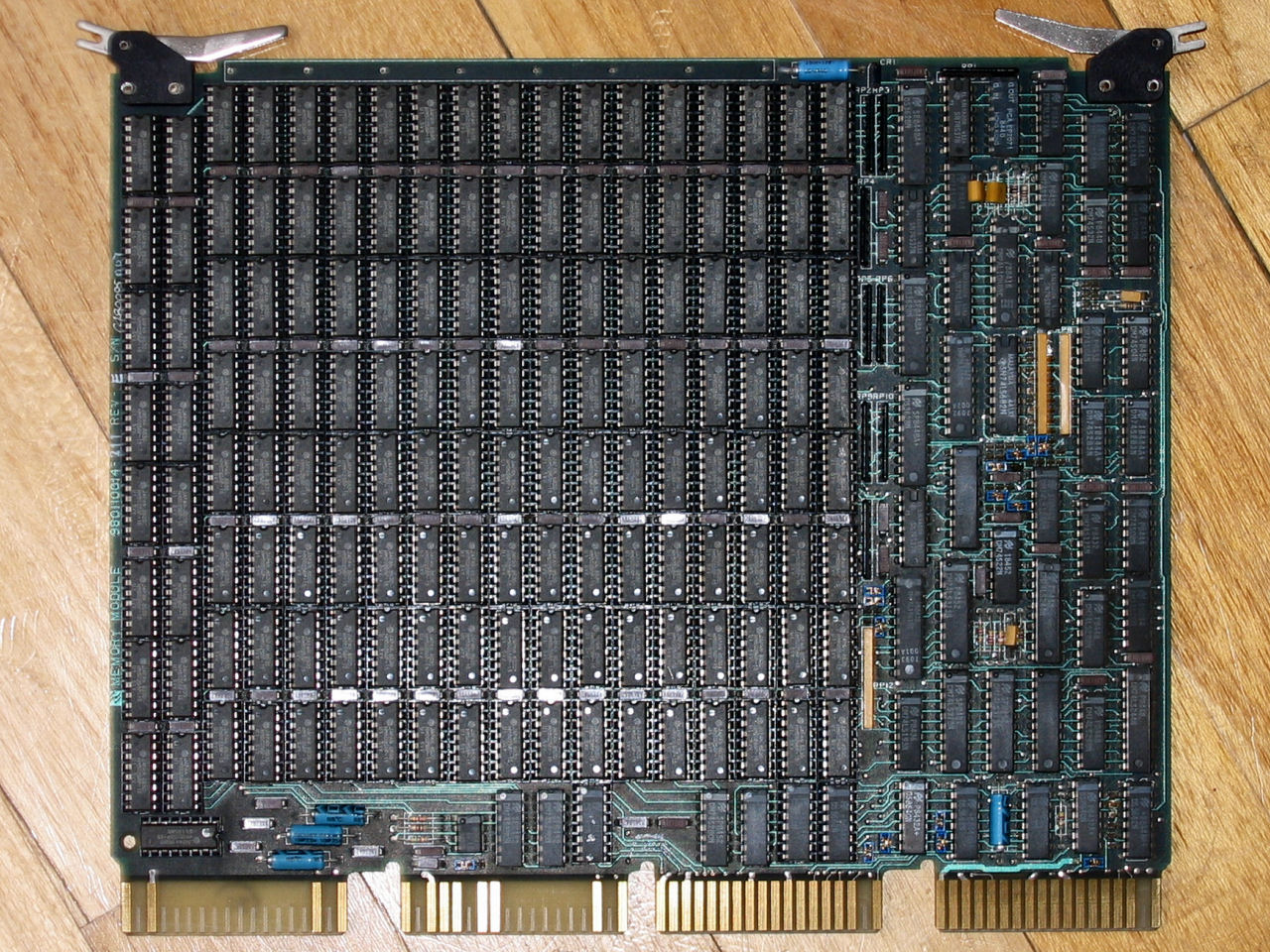
I'm looking for information on a National Semiconductor memory module
for Qbus PDP-11s. It is marked with 980110014-221 REV-E. I've uploaded
a photo of it here: http://www.cosam.org/images/nsc4m.jpg
I know it's a 4Mbyte (or thereabouts) card and it works fine with the
KDJ11-A (11/73) it came with. It however won't work with a KDJ11-B
(11/83) I picked up recently - the onboard diagnostic LEDs report 53,
which corresponds to memory address 0. The KDJ11-B does however work
fine with a MSV11-P. There are plenty of jumpers and wire wrap posts
on the NSC board but, as it's always worked in its original
configuration, I've never needed to figure out what the all did.
Any documentation or pointers much appreciated. Then again: if
anyone's got some PMI memory boards they don't need, I'm all ears!
Cheers,
--
Steve Maddison
http://www.cosam.org/
Well, not really. I'm giving up most of my electronics and computer
stuff, but while it's all been great fun, I'm nor all that sad about it.
As elegant as this stuff can be, I finally get to start riding again,
and I need the space (and cash of course!).
I'll be listing some of the high-dollar stuff on Ebay, but most of it
will go on VCM for free or peanuts. Details and pictures will come later;
this is just a high-level teaser.
If there's something you want, hit me off-list and we'll discuss.
HUGE points and discounts for local pickup or if I can drop it off at
Craters & Freighters.
DEC stuff:
PDP-11/84 - ethernet, TU80 interface, and a CMD SCSI adapter. IIRC,
1024KW memory. It's not been run since last summer because all the foam
went to dust during the winter and I haven't had time to clean it up.
PDP-11/84 chassis - untested
PDP-11/44 - actually 3 of them, one without a front panel. 2 were in
production up to 2003, none have been run since then. email for board
lists, but all have at least 512KW memory and some kind of storage.
PDP-11/04 - programmer's front panel, 32KW core, ALU board, VT220.
works from programmer's keypad, but I never got the bus grants sorted out.
Several Unibus epansion chassis.
3 TU80 tape drives. All tested working in 2007.
Alpha PC 164LX - 384MB, 533MHz proc, fully working. 300W Sparkle PSU
if you want it.
VAXStation 4000/90
VS4000/60 - I think I have 2 of these
Amiga stuff:
Several A500s w/ various ROM levels
A3000 with Cyberstorm 68060, Prometheus PCI board, 3.1 ROMs
lots of software in box
Atari
A couple of 520s and 1040s
Mega STE w/ 4MB and SCSI drive
Other:
A bunch of SGI R10000 Indigo^2s
Several R10K Octanes
133MHz BeBox with 4MB Matrox Millenium, 4GB disk, 192MB RAM, TV
tuner, and a lot of software. Excellent cosmetic condition.
Please let me know off-list if you want to nab any of that.
Also, unfortunately, past experience here dictates that I say this:
please don't be insulting. Although I don't expect to *get* it, I do have
a fair clue what each piece is worth.
Doc
Fair Radio has a rack with an HP1000 (a blinkenlights version) tucked
in the back. It is missing some cards, but in general looks pretty
nice. It was part of a larger specialized HP test set. The Dayton
crowd apparently was not too interested. I have no idea what price is
on the thing - probably an "ask".
Blatant plug, 'cuz I owe Phil a favor.
--
Will
Hi,
Seems I find a bit of time to pick up old chips again, namely, the
National SC/MP ISP8A-600N, aka INS 8060.
Datasheets are available, as well as a number of references from the
net. What I am looking for, though, is a copy
of publication 420305239-001A, SC/MP Microprocessor Application Handbook.
Does someone happen to have scans of this book?
Thanks in advance.
Holger
-----------Original Message:
Date: Fri, 22 May 2009 09:50:49 +0200
From: Johnny Billquist <bqt at softjar.se>
Subject: Re: Microsoft bashing
William Donzelli <wdonzelli at gmail.com> wrote:
>> > So predictable and not even mildly funny.
>
> Microsoft bashing stopped being funny about 10 years ago.
Ever considered that some people are bashing Microsoft for other reasons
than tryiong to be funny?
Such as: There are actually legitimate concerns about the quality of
their products.
And that deserves to be repeated, and pointed out time and time again,
even if some don't think it's funny. Because without bringing up the
actual problems, their products would probably be even more dominant,
even when the problems sometimes are really serious.
Now - some people claim that there are no problems any more. Good for
them. Others don't have the same experience/luck.
-------------Reply:
Sure: most people bash Microsoft to show that they're smarter than the
average (Microsoft) luser who needs to be *educated*; usually has the
opposite effect.
I don't see many actual specific problems brought up, but if someone
actually has some *useful* information then there are other forums for
that, just like there are forums for problems with software that's *not*
made by Bill's boys & girls.
m
FYI:
Pittsburgh Vintage Computer Exhibit,
Sun.Jun.7th,
Breezeshooters Hamfest
Just wanted to let you know about the exhibit I'm holding at the
Breezeshooters Hamfest next month, Sun.Jun.7th. We'll have a bunch of
early electronics, computers, and video games from the 60's, 70's and
early 80's on display - even some that you can play with. We'll have a
bigger display than last year with about 25 machines on display. If
anyone would like to bring anything for the exhibit, feel free to let me
know and I'll make room.
The Hamfest is the largest in the tristate area, also with 30acres of
flea market space--only $5 admission. We'll be located indoors in
bldg.2. The address is below
So if you're in the western Pennsylvania region, come out and shoot the
breeze.
Pics from last year.
http://picasaweb.google.com/ragooman/PittsburghVintageComputingExhibit2008
Breezeshooters Hamfest
Hours: 8:00am - 3:00pm
http://www.breezeshooters.net/
Butler Farm Show Grounds
627 Evans City Road, PA Rt. # 68
Butler, PA 16001
please pass this on to anyone you might know that's interested,
=Dan
--
[ = http://www2.applegate.org/~ragooman/ ]
When I attended the VCF 10.0, I talked to a guy with a booth at the show
who had ported CP/M to a Zilog debugging/programming cable (not
surprisingly, it has a Z80 inside). Any idea who this mystery CP/M
wizard might be and/or where his web-site is?
--Tim
Why don't you just down load GCC and install that?
--- On Fri, 5/22/09, SPC <spedraja at ono.com> wrote:
From: SPC <spedraja at ono.com>
Subject: Altos 686
To: "General Discussion: On-Topic and Off-Topic Posts" <cctalk at classiccmp.org>
Date: Friday, May 22, 2009, 7:51 AM
Hello. I have one Altos 686 with Xenix 3.2 in working state. I should like
to install on it one C compiler and eventually the Ryan-McFarland Cobol for
this platform if available.
I remember something about IMD image disks available in some place in the
Internet but I don't remember where.
All help is welcome
Kind Regards
Sergio
William Donzelli <wdonzelli at gmail.com> wrote:
>> > So predictable and not even mildly funny.
>
> Microsoft bashing stopped being funny about 10 years ago.
Ever considered that some people are bashing Microsoft for other reasons
than tryiong to be funny?
Such as: There are actually legitimate concerns about the quality of
their products.
And that deserves to be repeated, and pointed out time and time again,
even if some don't think it's funny. Because without bringing up the
actual problems, their products would probably be even more dominant,
even when the problems sometimes are really serious.
Now - some people claim that there are no problems any more. Good for
them. Others don't have the same experience/luck.
Johnny
--
Johnny Billquist || "I'm on a bus
|| on a psychedelic trip
email: bqt at softjar.se || Reading murder books
pdp is alive! || tryin' to stay hip" - B. Idol
I've been using this Vax 11/750 as a table for far too long. It lives in the collection, sure, amongst the PDP-11 and the Primes. But it really never gets plugged in, it just sits there with a couple terminals sitting on it, and occasionally providing me a place to lay out a manual or something. The machine works. But I can't do a bloody thing with it, because... I have no disk controller.
So - does anyone happen to have an extra Unibus SMD controller they would part with? I've got plenty of SMD drives - a couple of these Seagate Sabres would work real nice for this little Vaxling.
-Ian
Hi, All,
The Google has failed to illuminate me. I have a handful of what look
like 1970s 8-digit calculator modules with National Semiconductor
logos and 1975/1976 manufacturing dates. Both types of modules have
the 8-bubble plastic digit magnifiers common for LED calculators of
the era, but one has 6 digits-worth of diodes behind the plastic, and
the other 8 digits. Both have the same external profile and number of
off-board solder pads, but different numbers of pads going to places
under the epoxy blob that protects the IC. One of the modules just
has "650" in copper at the edge of the board, the other has M830
stamped in the same sort of ink/paint that has the NS logo and the mfg
date.
I know National Semi made lots of LED modules back in the day. I have
a few simple digits and was able to find docs on them without much of
a search. These are a puzzle. The ones with 8 digits installed are
very possibly calculator modules. I've never seen this sort of
display with only 6 digits out of 8 populated. I have no idea what
they are, but one tangental Google hit suggests they could be DVM
modules, but I supposed they could be clock modules or counter
modules.
If anyone would have a mid-1970s or perhaps early 1980s National
Semiconductor databook that covers LED displays, that might have some
info. I do not (I only have NS memory/logic books).
Thanks for any hints or tips,
-ethan
Philipp Hachtmann wrote:
> Lars Hamren schrieb:
>>> And FYI - did you mean ASR 35? I didn't think there was a KSR version of the
>>> 35, but I could be wrong.
>>
>> I have several Bulletins on the KSR and RO versions, so it does exist.
> Lars, you have SEEN my 35 KSR unit! It's the one in the staircase....
I probably did, but memory fails me. I will contact you off-list about it.
/Lars Hamr?n
For those of you with big datasheet collections, does anyone have
data for a Yamaha YM7109C? A pinout would be sufficient. 40 pin DIP-
-it seems to be some sort of DSP. Circa 1990.
TIA
--Chuck
Hi, Will,
I was chatting with one of our IBM service guys today who has been
with IBM for 13-14 years. I was describing the equipment that you
pulled about two years ago, but I couldn't remember the company name
(he was curious if he ever did any service there). Where was it?
Thanks,
-ethan
> And FYI - did you mean ASR 35? I didn't think there was a KSR version of the
> 35, but I could be wrong.
I have several Bulletins on the KSR and RO versions, so it does exist.
Also, the several of the 35 bulletins at bitsavers covers the KSR model,
not the ASR model.
/Lars Hamr?n
Thanks for posting a source for casters. I have a BA-123 that came to
me with one missing (but I think there is some bent metal on one or
more corners where the casters go)*. I should probably just get 2-4
casters and be ready to replace them all.
-ethan
* In my experience, lots of people used to sit on BA-123s, especially
people who were large enough that they should have known better.
Ethan Dicks <ethan.dicks at gmail.com> wrote:
> On Thu, May 21, 2009 at 9:06 AM, Tom Uban <uban at ubanproductions.com> wrote:
>>> >> I'll check the NPG jumpers -- here's a stupid question -- how do I find
>>> >> where they're supposed to be? ?I've looked all over for a simple diagram
>>> >> showing which pins are CA1 and CB1, but I'm not finding them...
>> >
>> > The backplane information is clearly described in the Peripherals Handbook.
>> > If you don't have a copy and you intend to work with these machines, then
>> > you need to get yourself a copy.
>
> Having worked with these machines a lot over the years, I can
> personally recommend having the right handbooks on hand when
> configuring things or diagnosing problems - it will save a lot of time
> and grief. Back in the day, we always had them and we used them
> frequently.
>
>> > The 'C' in CXX is the slot...
>
> Another way to see is to look at a dual-height Unibus grant card and
> note which pair of pins is shorted together on the "C" finger (the one
> that only has one pair of pins shorted, not the one that has 3 pairs
> of pins shorted). If you don't _have_ a dual-height grant card, you
> are going to have to get very familiar with where the NPR pins are
> because you are going to be wrapping and unwrapping that jumper on the
> backplane every time you insert or remove cards.
Those dual height grant cards are excellent for people who aren't overly
sure and experienced with this, since they are hard to insert the wrong
way as well. So you both can check which pins should be shorted, and you
don't have to fiddle with the NPG line. It is also not totally uncommon
for people to also insert the grant cards reversed...
But you don't need to remove the NPG wire every time you insert a card.
You only need to do it for cards that do DMA.
By the way, Tom Uban made a great ascii chart of a backplane slot. That
should be useful for lots of people who play with DEC equipment, for the
same notation is used on all older DEC backplanes, not only Unibus.
It's actually this backplane format that defines a flip chip. (Most
people errounosly seem to think that the bus grant cards are called flip
chip, they are just one example of a flip chip.)
Johnny
--
Johnny Billquist || "I'm on a bus
|| on a psychedelic trip
email: bqt at softjar.se || Reading murder books
pdp is alive! || tryin' to stay hip" - B. Idol
Hi, All,
I know I've mentioned this long-outstanding project before, but just
this week, I've had a couple of nudges towards getting it done...
First, Will Donzelli stopped by on his Eastward Progress to deliver
some PDP-8 gear to me, and in the process of showing him around my
Farm, I pointed out this ASR-33 w/110 bps modem in the pedestal.
Second, I just found the box of telephone parts with two pre-IC-era
touchtone keypads, one of which I'm positive I removed from the TTY
years ago when I was tearing it apart (in ignorance) to attempt to
remove the modem, etc., and make it a viable console TTY for my
(first) PDP-8/L.
So... what I still lack is proper documentation to know how to install
the TouchTone pads. I'm thinking it'll be much easier these days to
find a PDF than it ever would have to find real paper in the 1980s
when I bought the TTY at Dayton.
My question (for now) is... how I can tell which of these two keypads
is likely to be the right unit. They are superficially identical, but
one has 7 wires, the other 11 as follows...
Both: Green, Red, Black, White, Blue/White, Black/Orange, Red/Green
One: Purple, Blue, Orange, White/Green
There is what appears to be a date-code on the bobbin transformers on
the 7-wire pad of 3-77 vs 12-80 on the 11-wire pad. If that _is_ a
date code, I'd wager the 3-77 unit is from the ASR-33 simply because I
don't think I would have been able to pick up a 3-4-year-old ASR-33 at
Dayton for $35 or so, but I can believe that a 7-8-year-old unit could
have been that cheap. OTOH, I can see how a data device might need a
more complicated keypad (there appear to be additional levels of
switches compared to the simpler one, thus it suggests where the extra
4 wires are going).
I'm thinking that I probably just loosened the screw terminals in the
ASR-33 and removed the keypad to either get it out of the way or
because I thought I might recycle it into something else. Now, give
that I know there are differences other than the modem in the one TTY,
I'm probably unlikely to attempt to convert it to a 6-wire
console-capable TTY, and would like to restore the modem-equipped TTY
to its original functionality.
Does anyone on the list know of a good resource for 1970s-1980s
telephone techology that is available (i.e., not something that
Western Electric/Lucent is sitting on that's for internal use only)?
I have PDFs for the mechanical bits of an ASR-33; those have been
floating around for some time (and I have them on paper, too, that
came with my console-capable TTY). I lack any
modem-equipped-model-specific docs. Those would be most helpful, as I
could reinstall the TouchTone pad in a few minutes once I knew what
wires go where.
Thanks for any tips and pointers.
-ethan
Does anyone here have a any 40 pin Jones type plugs in their junk
boxes they would be willing to sell?
I have only just found out the name of these things, I've been looking
for a long time but not known how to describe them.
I now have a regular search on eBay but so far there have only been
small ones.
Roger.
P.S. they fit the sockets on my IBM 836 (like an 026 keypunch but with
I/O and plug programmable)
The BA123 casters have a rubber lining on either side of the caster;
I had the same deterioration on my BA123's. . . except I didn't find
out
until I had rolled one over a section of carpet in the house.
(That was fun to clean up. . . . not !)
Presumably, the rubber is for vibration deadening.
Since I didn't have a convenient source for them at the time,
I opted to make them less messy.
I just took a small flat-blade screwdriver,
and cored the rubber out from both sides
of each caster. Since it was already "leaking" out
>from all of the casters, I didn't have any "moral" issues with this.
Once the rubber is out, the casters are just plain ol' casters,
and they roll just fine.
More recently, additional research has revealed:
The casters were made by Shepherd casters (www.shepherdcasters.com).
I found a close replacement part -
Shepherd PSF50101BK has the same mounting pattern, and diameter.
Although it is a slightly different style, it should make an adequate
replacement.
A quick search turned up this:
http://www.apollocaster.com/store/index.php?main_page=product_info&cPath=71…
As info. . .
T
I was annoyed that there seemed to be no comprehensive DEC OSF/1 release
history info on the web (contrast the Wikipedia pages on Solaris or
HP-UX), so I decided to take a shot at it, adding the table to:
http://en.wikipedia.org/wiki/Tru64
The 4.0 and above stuff I was able to date by the release notes, but before
that I had to estimate based on old usenet posts, etc. Seeing as what gets
posted to Wikipedia automatically becomes fact, I wasn't totally thrilled
about doing that, but it's a start. The bummer is, if you look at:
http://web.archive.org/web/19990429061828/www.unix.digital.com
/faqs/publications/pub_page/doc_list.html
You can see that there used to be release notes up, but the archive must
not save postscript, and they don't seem to be around the web at all. If
anybody has the notes, or just figures he can do better, please edit the
wiki page. Some info on important 'letter' point releases would be great
too.
John Finigan
Has anyone replaced the casters on one of their BA123 enclosures? If
so any advice? My spare chassis has had dead casters for years. I
discovered yesterday as we started moving out of storage that my
beloved PDP-11/73's chassis has dead casters. :-( I'm not worried
about maintaining a "stock" unit, I want functionality.
Zane
--
| Zane H. Healy | UNIX Systems Administrator |
| healyzh at aracnet.com (primary) | OpenVMS Enthusiast |
| MONK::HEALYZH (DECnet) | Classic Computer Collector |
+----------------------------------+----------------------------+
| Empire of the Petal Throne and Traveller Role Playing, |
| PDP-10 Emulation and Zane's Computer Museum. |
| http://www.aracnet.com/~healyzh/ |
> -----Original Message-----
> From: Andrew Lynch [mailto:lynchaj at yahoo.com]
> Sent: Sunday, May 10, 2009 11:10 PM
> To: 'cctalk at classiccmp.org'
> Subject: S-100 prototyping board project
>
> Hi! As a compliment to the N8VEM S-100 backplane project, I am designing
> an S-100 card edge connector in KiCAD. As a demonstration I am including
> it in an S-100 prototyping board.
>
[snip]
>
> http://n8vem-sbc.pbworks.com/browse/#view=ViewFolder¶m=S100
>
> Thanks and have a nice day!
>
> Andrew Lynch
[AJL>]
Hi Just a quick update on the N8VEM S-100 project all of the N8VEM S-100
backplanes prototype PCBs are either shipped or committed. Test results are
trickling in and so far are fairly positive. Also, I made a small order of
N8VEM S-100 prototyping boards. Those should arrive in about three weeks.
Thanks to all who've helped out so far. I much appreciate your help and
hopefully this will make available some useful PCBs to the S-100 home
brew/vintage/classic computer community.
Once I am confident the boards are shown working or at least the faults
identified I will post the complete set of information on the N8VEM wiki so
that people can design their own using the KiCAD EDA. The key pieces of
information are the S-100 male and female card edge connector parts library
and the empty board template.
Thanks and have a nice day!
Andrew Lynch
Cameron Kaiser <spectre at floodgap.com> wrote:
>>>> > > > Hayes modems
>>> > >
>>> > > Just about all modems are Hayes compatible (and I think you can still buy
>>> > > dial-up modems...)
>> >
>> > AT commands are alive and well and in your mobile phone - how else do
>> > you talk to the radio stack?
>
> You're not pulling my leg, are you? That's actually pretty cool. Is it
> the same kind of command set, ATDT and all?
Yes.
Johnny
--
Johnny Billquist || "I'm on a bus
|| on a psychedelic trip
email: bqt at softjar.se || Reading murder books
pdp is alive! || tryin' to stay hip" - B. Idol
Hello all,
FYI&D, an article on MSN tech & gadgets describing "25
Computer products that refused to die".
http://tech.msn.com/howto/articlepcw.aspx?cp-documentid=19017036&page=1
The list is:
Dot-matrix printers
Hayes modems
Sony Minidiscs
Monochrome Displays
Hercules Graphics
PDA's (in favor of smarter cellphones)
Packard-Bell
Amiga
Floppy Disks
Zip disks
Z80 CPU's
dBase
NetScape
MS-DOS
Lotus 1-2-3
PageMaker
After Dark
Harvard Graphics
Alta Vista
Webvan
Compuserve
Prodigy
VCR+
Circuit City
Egghead
Not endorsing nor editorializing, though it could be fun;
just notifying y'all for whatever nostalgic value is there.
Apologies if this is a repeat post, I'm a bit behind on all
aspects of email.
--
- Mark 210-379-4635
-----------------------------------------------------------------------
Large Asteroids headed toward planets
inhabited by beings that don't have
technology adequate to stop them:
Think of it as Evolution in Fast-Forward.
--- On Tue, 5/19/09, 9000 VAX <vax9000 at gmail.com> wrote:
> Does it ring a bell?
>
I don't know. Does it have a bell to ring? Most computers used a speaker instead of a mechanical bell, but the ASR33 teletype has one, as does the Burroughs B80.
<grin>
Yeah... I dunno - I need a little more information to go on. A description would be nice. A picture even better. :)
-Ian
I see from the SpareTimeGizmos website
that they are contemplating adding an ethernet port,
with telnet capabilities. . .
It seems to me that if you're going to the trouble of
emulating a VT220, a DEC terminal, then you should
at least add support for LAT. ;-)
T
Exactly!!!
--- On Mon, 5/18/09, Bill Sudbrink <wh.sudbrink at verizon.net> wrote:
From: Bill Sudbrink <wh.sudbrink at verizon.net>
Subject: RE: IMSAI 8080 for sale....
To: "General Discussion: On-Topic and Off-Topic Posts" <cctalk at classiccmp.org>
Date: Monday, May 18, 2009, 7:44 PM
Golan Klinger wrote:
>
> http://cgi.ebay.com/ws/eBayISAPI.dll?ViewItem&item=180357914217
>
> Looks like that one was a steal.
No drives... Floppy controller clearly untested... No boot
or other floppy disks... The only verification of "works"
is that the lights changed when the seller played with the
switches.
>
>
>> Does anyone have a copy of the (DEC) MS11-M tech manual, EK-MS11M-TM?
>
> This section of fiche:
>
> http://bitsavers.vt100.net/pdf/dec/pdp11/xxdp/fiche_200dpi/0252_Index_81-06…
>
> suggests (on page 26 of 171) that the manual was available on fiche, as
> EP-MS11M-TM-001, dated May 1980, but I can't see it quickly in those
> available on Bitsavers.
Ah, that's a good idea, though. I'll check my fiche tank.
John
Hi John,
I looked in our company technical archive, and for this memory card it
does seem to look like there has not been a technical manual.
We have them for the other MS11 ones, but not for this one.
Regards,
Ed
> Does anyone have a copy of the (DEC) MS11-M tech manual, EK-MS11M-TM?
>
> Manx has pointers for the user guide and print set, but not the tech
> manual. I need more information than is present in those two
> documents.
>
> I'd be happy to scan the manual, if someone has it and can't scan.
> Or a scan would be great.
>
> Thanks,
>
> John
>
--
Certified : VCP 3.x, SCSI 3.x SCSA S10, SCNA S10
Does anyone have a copy of the (DEC) MS11-M tech manual, EK-MS11M-TM?
Manx has pointers for the user guide and print set, but not the tech
manual. I need more information than is present in those two
documents.
I'd be happy to scan the manual, if someone has it and can't scan.
Or a scan would be great.
Thanks,
John
Dave McGuire <mcguire at neurotica.com> wrote:
> On May 19, 2009, at 3:21 AM, Johnny Billquist wrote:
>>>> In general, when talking about DEC equipment, the answer to that
>>>> question is *always* no, for the simple fact that DEC didn't do
>>>> hardware flow control. Hardware flow control is actually against
>>>> the RS-232 spec, and DEC didn't abuse standards (unlike most
>>>> other companies).
>>> This reminds me of a comment I made about the HP82164 (HPIL to
>>> RS232 interface). That thing follows the RS232 standard to the
>>> letter (for example, it correctly handles the cotnrol lines in
>>> half duplex mode). It's just a pity that nobody else does :-).
>>> Getting it to work with some RS232 devices is 'interesting'..
>> Yeah. HP was actually the other company that actually seemed to
>> read the standard. I don't know of anyone else than DEC and HP that
>> even tried to actually follow the specs.
>> One could only wish companies had. Everything would have been soo
>> much easier in that case. Now almost everyone is confused when it
>> comes to serial communication, and it's not because it actually is
>> difficult, but people have just become so confused because they
>> think it works one way just because the equipment they have do it
>> that way, and when coming to any other equipment, nothing works the
>> same way they are used to.
>
> Well, you've got to admit that things would've been a whole lot
> easier if it weren't for the whole DTE/DCE fiasco.
While I must admit that I don't understand the point of having a
separate DTE and DCE, if companies had just followed the specs, it
wouldn't have been a problem anyway.
All DTEs male, and all DCEs female. Female to female cable, always
crossed (same with male to male, not that I'd expect many to hook a DCS
to a DCS, but anyway), and male to female cables always straight. How
easy it would have been.
And modem signaling are just signalling between a DTE and DCE, for
various situations.
But they could have defined just everything as DTEs, and made modems and
similar stuff really invisible, like cable extensions instead. Maybe
that would have made it easier for companies to get it right.
Johnny
--
Johnny Billquist || "I'm on a bus
|| on a psychedelic trip
email: bqt at softjar.se || Reading murder books
pdp is alive! || tryin' to stay hip" - B. Idol
An eBay seller is selling what appear to be vintage promotional
posters featuring the animal sculptures made out of computer parts
that Honeywell commissioned for a long-running ad campaign.
There are 17 different ones, with multiple copies (but not many) of
each.
http://shop.ebay.com/merchant/psobosik?_nkw=computer+poster
--Bill
Looking for a video cable for an SGI Indy Presenter Panel. My investigation
indicates that a 68-pin SCSI cable might actually fit this but I'm not sure
if it's wired straight-thru. Anyone have one they would part with, or would
be willing to check the pins for me, please let me know off list.
Thank you kindly :)
--
------------------------------------ personal: http://www.cameronkaiser.com/ --
Cameron Kaiser * Floodgap Systems * www.floodgap.com * ckaiser at floodgap.com
-- Mmmm, Windows user. Crunchy and good with ketchup. -- Dave McGuire ---------
> Date: Sat, 16 May 2009 22:26:55 -0700
> From: Josh Dersch <derschjo at mail.msu.edu>
> It's not battery corrosion -- the board is literally rusted, all over
> :). The battery's nasty too, but that's only a small part of what's
> wrong with it. I suppose I can soak it in something, maybe scrub it
> with a toothbrush and see if that helps at all, but it's pretty bad.
>
> As Cameron pointed out, there are other boards that will work with some
> modification, I'll keep my eyes out for those as well...
You might also post a WTB on the Trading Post forum of 68kmla.net. That's
where many of the die-hard 68K preservers hang out.
Jeff Walther
Lol!!!
I just checked e-bay for what is being asked of an IMSAI-8080 that is not fully tested, no floppy drives and from what I can tell only has one board
http://cgi.ebay.com/Vintage-IMSAI-8080-S100-Low-S-003878-NEC-8080A-Works_W0…
They are asking near $4000.00
So whomever takes my offer will be getting a gem for of a system at a bargain price of $2000.00
Anyway you have until Wednesday morning until I place it on e-bay.
Later people..
Michael Hart
Trader Kiosk
201-290-3796
michael at traderkiosk.com
imsaicollector at yahoo.com
I, the unwilling, was led by the unqualified, to do the unbelievable for so long with so little, that I attempted the impossible with nothing......"
--- On Mon, 5/18/09, Michael Hart <imsaicollector at yahoo.com> wrote:
From: Michael Hart <imsaicollector at yahoo.com>
Subject: IMSAI 8080 for sale....
To: "General Discussion: On-Topic and Off-Topic Posts" <cctalk at classiccmp.org>
Date: Monday, May 18, 2009, 3:00 PM
Hi all
?? Those of you who know me, know that I have a rule that basically make me attempt to get rid of stuff that I have not used after a certain period of time.
?? I have a second fully functional IMSAI-8080 (http://www.michael-george-hart.com/computerscience/imsai8080-z80.html) that has been sitting around doing nothing since completed my last IMSAI-8080 project (http://www.michael-george-hart.com/computerscience/imsai8080-8088.html)
?? Given my other S-100 projects, ALTAIR 8800b repair and restoration, and porting LINUX to my CS-250 I don't foresee really doing anything with this particular IMSAI-8080 for at least another year to two years maybe as much as three years from now.
?? I have had this IMSAI-8080 since 1996/1997, which I got from a Electronic parts/component store. The store used it to maintain their inventory along, mail, billing etc from about 1975/1976 until it simply stopped working. (That was the story told to me.) It sat in their store from the day it stopped working until I came across it in 1996/1997. I made some simple repairs to the memory and its been working since that time.
?? The only issue with it is there are some minor alignment problems with the between the floppy drives. Other than that the system has always booted without issue.
?? The person who purchase the system from me will get all the manuals for all the boards in the system and the floppy drives. Also to be included is the IMSAI-8080 Manual and a number of IMSAI-8080 period related fliers. I will be sending the 50 or so floppies that originally came with the system when I first took possession of it .
? Again this is a fully functional IMSAI-8080 in near mint condition.
http://www.michael-george-hart.com/image/s-100/imsai-1/dsc02565.jpghttp://www.michael-george-hart.com/image/s-100/imsai-1/dsc02567.jpghttp://www.michael-george-hart.com/image/s-100/imsai-1/dsc02572.jpg
I am looking to get $2000. If no one is interested I will put it on e-bay and see what the market tolerate. I think that my price is a good deal consider the crap that I see people paying $1600 to $2500 on e-bay for systems that don't even work or can boot into CP/M-80
I intend to place the system on e-bay Wednesday morning is no one here gives a my expected price.
Let me know if you are interested
Michael
Michael Hart
201-290-3796
michael.george.hart at gmail.com
PS.
?? The total weight is about 100lbs. I will probably have to ship everything I mentioned above in 5 different boxes. You pay for shipping cost.
If possible I would prefer whomever purchases the system come an pick it up the system so they can confirm the functionality to their satisfaction for themselves. I still don't trust UPS/FedEx or USPS for safely get the system no matter how well I pack the system.
I would agree if all you wanted to do was toggle the front panel switches.
--- On Mon, 5/18/09, Golan Klinger <gklinger at gmail.com> wrote:
From: Golan Klinger <gklinger at gmail.com>
Subject: Re: IMSAI 8080 for sale....
To: "General Discussion: On-Topic and Off-Topic Posts" <cctalk at classiccmp.org>
Date: Monday, May 18, 2009, 6:41 PM
http://cgi.ebay.com/ws/eBayISAPI.dll?ViewItem&item=180357914217
Looks like that one was a steal.
--
Golan Klinger <gklinger at gmail.com>
Dark is the suede that mows like a harvest.
Greetings:
I have just read this announce you have posted some time ago
http://www.classiccmp.org/pipermail/cctech/2003-March/012694.html, I know
it's very old, but I'm interested to buy one of your hard drives,
If you still have them, please contact with me.
PD. sorry for typos, my english is not very good.
>I suspect that it is impossible to rebuild OS/8 today. I would be
>surprised if OS/8 was actually maintained on a PDP-8. All of the
>diagnostic listing, for example, were generated using PAL10 on a PDP-10.
>
It is possible at least for parts of the OS78V4/DECMate version
See sysgen.tx for build information in files below. The BI files in
http://www.ibiblio.org/pub/academic/computer-science/history/pdp-8/os8/os78…
ftp://ftp.update.uu.se/pub/pdp8/pdp-8/os78/v4/
are batch files to build the system. I used it to build these images
http://www.pdp8online.com/images/images/os8/DECmate_I.shtml
when people couldn't find DECmate I disks. I never heard back if the
disks I made for people actually worked ok.
I remember is wasn't quite trouble free but so far I haven't found the disk
image I put everything on to build those rx02's. If you have problems email
me and I may either remember the problem or find the files I used to build.
These instructions/files should help in building earlier versions.
David Gesswein
http://www.pdp8online.com/ -- Run an old computer with blinkenlights
All,
I have a small pile of NIB DEC BC13J-08 cables with 1997 mfg dates on
the bags. They are DB25M w/pins 1-8+20 on one end, and RJ45 on the
other. I'm used to DEC MMJ cables, but not DEC RJ45 serial. Does
anyone know what these were used for originally? I googled for them,
of course, but found little hard info - mostly for-sale listings.
Thanks for shedding any light.
-ethan
I am seeking to replace floppy low-quality ring binders.
Where, preferrably in Europe, can I find good-quality binders:
- Standard US 3-hole
- "Fork" binders, not ring binders, se image.
- With wooden spine, or other rigid type that will not
bend or fall over.
http://www.sdu.se/computer-automation-museum/pub/gallery/3-hole-binder.jpg
/Lars Hamr?n
On Mon, May 18, 2009 at 4:34 PM, Mark Tapley <mtapley at swri.edu> wrote:
> Hello all,
> ? ? ? ?FYI&D, an article on MSN tech & gadgets describing "25 Computer
> products that refused to die".
>
> http://tech.msn.com/howto/articlepcw.aspx?cp-documentid=19017036&page=1
Nice.
> The list is:
.
.
.
> Floppy Disks
This section asks the question "Under what circumstances would you opt
for floppies over something like a $10 (or so) 4GB USB drive that
holds 2750 times as much data?"
Well... I would when I'm on a machine that doesn't _have_ USB and
can't have it equipped (like my Dell Latitude LM that only has PCMCIA,
not Cardbus... it's been running RedHat 9 since it was given to me in
2003. With 256MB of RAM and a 40GB disk, it's not a terrible laptop,
but I wouldn't try to run a recent browser on it, that's for sure).
.
.
.
> Compuserve
This section mentions "Wow" and calls it "a faux-AOL that the company
shuttered within months of its 1996 release -- I can?t believe that
anyone misses it or is looking for it.". I never used Wow, but when I
was working at AOL/CompuServe in 2001, I worked directly with some
folks who were part of the Wow launch a few years earlier. Their
comments were, um, uncharitable. Apparently few people liked it,
inside the company or out. I still have a couple of Wow mousepads,
the only useful remnant.
The article also says "For those of us who were CompuServe users back
when its user IDs consisted of lots of digits and a mysterious comma,
it?s a depressing fate." I haven't memorized my old PPN, but I do
have it in easy reach at home on the subscriber label of ancient
copies of "Online" magazine.
I'm glad I worked there (twice!), but it was sad to watch the
once-great CompuServe in the final stages of digestion by AOL.
-ethan
Chris Elmquist <chrise at pobox.com> wrote:
> I may have missed some facts earlier in this thread-- but does the system
> obey hardware flow control such as CTS? ie, if CTS is low, will it be
> blocked from transmitting? If that is obeyed by all of your OS and
> software, then it is not hard to build a microcontroller that would sit
> between the system and the terminal, adding the delays you need on <cr>
> while buffering for and hardware flow controlling back toward the PDP-8.
In general, when talking about DEC equipment, the answer to that
question is *always* no, for the simple fact that DEC didn't do hardware
flow control. Hardware flow control is actually against the RS-232 spec,
and DEC didn't abuse standards (unlike most other companies).
(And to make it clear: hardware flow control is definitely not possible
towards a PDP8)
Johnny
> Chris
>
>
> On Thursday (05/14/2009 at 03:04AM +0200), Philipp Hachtmann wrote:
>> > Hi,
>> >
>>> >> I completely mis-understood the source of your troubles.
>> > Oh.
>> > The VT05 terminal operates at speeds from 110 baud to 2400 baud,
>> > selectable with a rotary switch in the back (my unit is currently missing
>> > a counter ic to generate 110baud, but...).
>> > So far so good. The problem is, that when you want to operate the VT05 at
>> > speeds higher than 300 baud, you have to wait a certain amount of time
>> > after a line feed character or cursor positioning command. This is
>> > usually done by inserting zero fill characters (4 at 2400 baud) after the
>> > critical commands. If you don't obey this rule, the VT05 has not
>> > completed changing the line when you send the next character. This is a
>> > bit like a too slow cr on a teletype - funny but true.
>> > So my wish was to modify OS/8 so far that it generates those fill characters.
>> > The TTY: handler is also capable of correctly doing this for me. But many
>> > other programs - as the OS/8 keyboard monitor itself - use direct IO
>> > commands to read from and write to the terminal.
>> > So one would have to patch many programs. In case of the keyboard
>> > monitor, I don't know if there is any room left to put such a code in.
>> > And I don't know how to reassemble and correctly install a new keyboard
>> > monitor from scratch.
>> > So all I can do is to run the VT05 at 300 baud. Or get the advances
>> > serial interface (see other posting).
>> > Did this illustrate the problem?
>> >
>> > Best wishes,
>> > Philipp :-)
>> >
>> >
>> >
>> > --
>> > http://www.hachti.de
>
> -- Chris Elmquist
--
Johnny Billquist || "I'm on a bus
|| on a psychedelic trip
email: bqt at softjar.se || Reading murder books
pdp is alive! || tryin' to stay hip" - B. Idol
>
>Subject: S-100 power supply transformer
> From: "Andrew Lynch" <lynchaj at yahoo.com
<http://www.classiccmp.org/mailman/listinfo/cctalk> >
> Date: Sun, 17 May 2009 16:51:44 -0400
> To: <cctalk at classiccmp.org
<http://www.classiccmp.org/mailman/listinfo/cctalk> >
>
>Hi! Does anyone know of an available transformer suitable for making an
>S-100 power supply? I need 120VAC input and 10VAC output and +/- 18VAC
>outputs.
>
>The best I solution I can find is two separate 80VA transformers; one
>parallel 10VAC output and another 36VCT output which can be configured for
>+/-18VAC outputs.
Try closer to 8V RMS rectified that will be more depending on load.
Same to the other two. Look up the calulations and see. FYI you also
talking for the 8V line 60,000 to 150,000microfarads (at 15-25V) and
the other two more like 10,000 to 20,000 (at 30V min) microfarad
capacitors..
[snip]
-----REPLY-----
Hi Allison and the others that replied. Thanks for the information!
I am currently using a kludged S-100 power supply built from repurposed
SMPSUs. It works fine but involves three separate parts. I suppose if I
could find a +/-15V dual output unit I could combine two but what I have
works fine. However, I've never seen an off the shelf single unit SMPSU
that supports S-100 voltages that does not require adjustment. A
+7.5V/+15V/-15V or similar would be ideal but I've never seen one available.
Reusing SMPSUs works but each solution is essentially a custom installation.
Tweaking surplus ATX supplies sounds appealing but for most people screwing
around with SMPSUs is hazardous and unique to each type of power supply.
Generally, I stay out of the SMPSU chassis unless there is a really good
reason to be there.
I wrote up my plan for the S-100 linear power supply. It got rather long so
instead of posting a mini-manifesto on the list if you are interested you
can read it here:
http://n8vem-sbc.pbworks.com/f/S-100_linear_power_supply_plan.html
Any comments, suggestions, questions are appreciated.
Thanks in advance and have a nice day!
Andrew Lynch
Jay writes:
> I'm concerned if it might cause Tim issues. If he got excessive bandwidth
> charges, I will pay them, no questions asked. However, I am a bit concerned
> if this would cause a problem. Anyone who has signed up as a bitsavers
> mirror as been advised that they must make their mirror public, and they
> must be able to sustain a reasonable load (fair share) of bandwidth -
> otherwise they shouldn't be mirroring it (this is just meant to make it fair
> for everyone, including me). That's not to say that 1/2 the load is fair, it
> isn't. But a suprising number of people hit the bitsavers site and then
> select their favorite mirror, so I wouldn't think it would have made that
> much difference. Let me know if so.
I may have seen an uptick in net usage during that time (Friday and Saturday?),
but it was not severe. The pipe was at 100% for several hours... but it's
at 100% for several hours most any day anyways.
Nothing at all compared to being slashdotted :-)
Tim.