I have a pro-83 with the power supply. You can have it for postage. The
only thing wrong with it is one of the capacitors came off the board.
Bob Melville
250 941-4651
After 4 pacific
>
> Date: Tue, 13 Apr 2010 09:05:41 -0300
> From: "Alexandre Souza - Listas" <pu1bzz.listas at gmail.com>
>
> Next time, use kicad, diptrace or something useful. Eagle sux.
For Macintosh users Osmond PCB is very nice. I mention it only because
Macintosh based PCB layout software is thin on the ground so Mac users
might think there's nothing for their platform.
The fellow who developed Osmond seems to be quite a guy. At least, during
the years long (free) beta period he answered emailed questions about the
software quickly, clearly and friendly, and fixed bugs.
Jeff Walther
>
> From: "Chuck Guzis" <cclist at sydex.com>
>
>> I wonder if "chad" had origins with teletypes and paper tape, an
>> industry (telephone) separate from the punched card / data processing
>> industry way back when, and in which different terminology developed.
>
> Dunno, but either was fun to hide in a friend's drawer or light
> fixture. Paper tape punches were far nastier than the ones from
> punched cards.
Why nastier? The card ones are thicker (7 thou) and have sharp square corners. I think the first time I heard about them (in the UK) the card ones were called chads. It in a warning from our lecturer not to use them as confetti as he knew of a case of them getting into the bride's eye and she spent the next few hours in hospital because of them.
I think the holes were oblong so that the sideways on (row at a time) brushes of old IBM equipment could get through them easier. I don't think brushes would be able to read them a column at a time.
By the way, I have some 80 column cards punched with round holes, two holes for each oblong one, and they were described as 160 column cards.
Roger Holmes
> ------------------------------
>
> Message: 18
> Date: Sun, 11 Apr 2010 14:25:09 -0400 (EDT)
> From: Steven Hirsch <snhirsch at gmail.com>
> Subject: Memorex 102 20MB Hard disk
> To: Classic Computers Mailing List <cctech at classiccmp.org>
> Message-ID: <alpine.DEB.2.00.1004111405140.3802 at duo>
> Content-Type: TEXT/PLAIN; format=flowed; charset=US-ASCII
>
> Has anyone on the list seen or work with one of these? I received a
> Morrow M-20 8-inch hard disk along with my N* Horizon and found the
> Memorex 102 disk mechanism inside (what a beast!).
>
<snip>
I worked on the 101/102
See
http://www.bitsavers.org/pdf/memorex/disc/112-114.60-00_Memorex112_Fujitsu23
01_jan83.pdf for the Memorex 112 Technical Manual; the 112 is a later
version of the 102 and they probably have a lot in common. Paragraph 1.2.2
shows the typically current wave forms which should be the same.
According to the spec the start up current is 6A peak and 1.6A running. So
when running yr 10 ohm is only 1/4 watt and should be cool. The peak power
of less than 3.6 watts should only last a very short time as the motor comes
up to speed and it's back EMF lowers the current to the running current of
well under 1.6A (the running current supplies both the spindle motor and the
stepper motor). Again the figure shows a spindle motor start up current of
about 4.5A and the peak 6A occurs during stepping.
Good luck.
BTW, if you have an 102 documents I would really like a copy, personally or
at bitsavers.
Tom
I just discovered that Western Union's old telegram service isn't really
dead -- just sold to an outfit called "iTelegram". Never having really
looked at telegram services until now, I was wondering if anyone had any
information on what a same-day telegram cost way back when. Nowadays,
iTelegram does it for $45 + 88 cents a word.
--
David Griffith
dgriffi at cs.csubak.edu
A: Because it fouls the order in which people normally read text.
Q: Why is top-posting such a bad thing?
A: Top-posting.
Q: What is the most annoying thing in e-mail?
Anyone have a manual for these beasties? I'm looking for the print
codes for it. I've found some demo programs and a few of the print
codes on the web, but nothing complete.
On 4/11/10 6:37 AM, Rob Jarratt wrote:
> I have a faulty power supply in one of my VAXstation 4000 VLCs (clicks on
> and off more than once a second).
This failure mode of switching power supplies has been discussed here
before. What was the common cause of this, Tony? The startup resistor
or something, right?
-Dave
--
Dave McGuire
Port Charlotte, FL
-----------------Original Message:
Date: Sun, 11 Apr 2010 17:33:57 -0700
From: "Chuck Guzis" <cclist at sydex.com>
Subject: Re: Use mini CDR for equipment info?
On 11 Apr 2010 at 14:40, Dave McGuire wrote:
> I can't speak to the reliability of mini CDRs, but I can say that
> it seems like a whole lot less trouble to have a directory structure
> on a file server that's navigable by manufacturer and model number.
> I maintain about 26GB of documentation that way. I don't keep
> drivers or control software in there, but I could. Doing it the CDR
> way seems to me like it'd be more trouble than it's worth.
>
> Just a thought, no offense intended of course.
None taken. I find myself repeating things I've done 20 or more years
ago, forgetting that I've even done them--so locating the information
on a file server or in a paper file doesn't even occur to me. Then
there's the awful feeling you get when you find out that you've
already done something. But a CD-R stuck inside a cabinet might give
me a clue.
It's sort of like the situation a friend describes to me. He says
"Old age is great--I keep making new friends that I've known for 50
years..."
--Chuck
-----------------------Reply:
Oh, how I can identify with that... the other advantage is that you
can watch the same movies over and over and they're always new.
Re your docs: why not the best of both worlds, a label/postit/paper
inside the equipment with a reminder that you've been there before
and a pointer to where the machine-readable stuff can be found on
your server?
m
From: Joachim Thiemann
> Bummer. I'm not good at desoldering chips without potential damage
> to the board. Joe.
The easiest way to not damage the board is to cut the leads to the chip,
and then use a solder sucker to remove the solder in the hole along with
the remnants of the chip leads. Hopefully if one or more of the leads is
soldered to the ground plane, those pads used thermal isolation to
separate them from the ground plane.
Hi all,
I'm looking for details on a 4MByte QBus memory module made my
National Semiconductor. It doesn't have an NSxxx model number anywhere
on it, but is simply labeled 980110014-211. I've managed to work out
what many of the jumpers do, but a lot of them go straight into a
couple of PALs which I'd rather not need to reverse engineer. A manual
of some description would be nice although, failing that, even a
summary of the jumpers' functions would be great. Even a photo of a
similar module with a description of how it's set up would help at
this stage.
The main thing I need right now is how to configure the range of
addresses the module will respond to. It works fine on one machine
which has some memory on the CPU board, but another won't boot saying
that there's no memory at address zero.
Cheers,
--
Steve Maddison
http://www.cosam.org/
> From: ard at p850ug1.demon.co.uk (Tony Duell)
> I haev found it's impossible to predict the prices that things will
sell...
As a seller I look at the number of watchers:
- 0-9 likely to go for the starting price
- 10-15 likely to be one serious bidder, price tends to dribble up from
the starting price.
- 15+ war likely to be declared between multiple serious bidders and the
price can go ballistic.
A complete, untested PDP-11/10 system (eventually found my variac but too
late to fire up the system) sold for ~$100 from a $0.99 starting price. In
Australia just some of the parts and PCBs for a 1974 Electronics Australia
EDUC-8 microcomputer (contemporary of the MARK-8) has attracted a bid at the
$100 starting price while another auction for PCBs and some parts for a
reproduction MARK-8 has not attracted a bid. All can be explained by the
size and composition of the market. In Australia there are only a very
limited number of people in my city who have an interest in a PDP-11, the
MARK-8 is obscure and relatively unknown as Radio-Electronics magazine had
limited market penetration, while Electronics Australia's EDUC-8
project would have been seen by Australian professionals and enthusiasts
>from that era. So these auction prices are currently related to demand.
I'm in Australia and there can be category mismatches between the eBay.au
site and the rest of the world. So that what you an auction you think
should list into an equivalent category on eBay.com appears to just
disappear and searches will fail unless your buyers are searching only at
the top eBay level. Most eBay.com buyers appear to be unaware of this
limitation on searches.
Then there is the opposite of an eBay disaster where the object is just to
find homes for stuff. On eBay you don't have to wait for the end of a 7
day auction to sell something. When trying to find a home for something
oddball like a core memory system from a PDP-11/20 I'd be happy to accept a
$0.99 starting price bid from anybody who expresses the least interest. End
result is a happy buyer and you get the cost of the eBay listing fee
covered. Does surprise people who don't know this option of eBay,
plus this can upset people who expect to snipe an auction.
I have a faulty power supply in one of my VAXstation 4000 VLCs (clicks on
and off more than once a second). My worry is that I might have damaged it
by overloading it because I know it is not that powerful. I suspect I could
have overloaded it by putting in a disk that draws too much power (could
that do this kind of permanent damage?). Does anyone have any guidance on
what limit I should apply to the power a hard disk uses when considering
what disks to put in these machines?
Regards
Rob
All --
Does anyone have the source to the CompuPro Disk 1 format and copy
utilities? If they?re buried in a manual somewhere, I can?t find it. Any
pointers appreciated.
Thanks!
Rich
--
Rich Cini
Collector of Classic Computers
Build Master and lead engineer, Altair32 Emulator
http://www.altair32.comhttp://www.classiccmp.org/cini
One of the diskettes given to me has what looks to be support for running
the Morrow DJ controller under N*DOS.
Here's the equivalent of a README:
10!"LIST THIS PROGRAM"
20STOP
30 THIS SOFTWARE HAS A TIMING CONSTANT SET FOR
40 A Z80 N* HORIZON.
50 IF YOU HAVE A DIFFERENT SYSTEM THEN YOU
60 WILL NEED TO CALIBRATE THE TIMING CONSTANT.
70 PROCEED AS FOLLOWS\
80 1.COPY THE DOSCHG DISKETTE
90 2.POWER DOWN AND HOOKUP 8 INCH DRIVES AND CONTROLLER
100 3.BOOTUP YOUR OLD N* DOS
110 4.PUT COPY OF DOSCHG IN DRIVE 1
120 5.PUT AN 8INCH DISKETTE IN DRIVE 4
130 6. LF BASIC 2D00
140 7. JP 6519
150 8. SF BASIC 2D00
160 9. NOW BOOT THE DOSCHG
170 THE ABOVE PROCEDURE TIMES THE 8 INCH INDEX HOLE
180 IN THE DISKETTE FOR 1 REVOLUTION OF THE DISK
190 AND PLACES THE COUNT INTO THE SOFTWARE.
200THE NEW TIME CONSTANT IS AT 64E5 64E6
210FOR REL 5 8DIGIT BASIC.
220 DOSCHG IS NOT DESIGNED TO RUN UNDER THE TIMESHARE PROGRAMS
230THE TIMESHARE PROGRAMS INCLUDE THE 8 INCH DRIVERS.
240 AT THE END OF BASIC. THESE ROUTINES ARE USED
250 YOU MAY REPLACE THE DOS
260 ON THE DISK WITH ONE OF YOUR OWN BUT REMEMBER
270 TO USE RELEASE 5 DOS ONLY.
280 THE FILE BASIC IS 58 BLOCKS LONG BUT
290 AFTER BOOTUP BASIC ENDS AT 65CAH AND IS 56.7 BLOCKS LONG
300 THE OLD VERSION OF THIS SOFTWARE USED 3 BLOCKS IN
310 MORROW'S CONTROLLER RAM. REV 4 OF HIS BOARD WILL
320 NOT ALWAYS WORK WITH A PROGRAM IN THE CONTROLLER RAM
330 THE SOLUTION WAS TO MOVE THAT SOFTWARE TO THE END OF BASIC
340 YOU CAN USE THE MONITOR TO TEST THE CONTROLLER RAM
350 BY TM E400-E7FF 0
360 THE PROGRAM GCOPY COPIES 8 INCH TO 8 INCH DISKS COMPLETELY
370 THE DISK MUST HAVE THE SAME DENSITY AND NUMBER OF SIDES.
380 THE DENSITY IS SET BY THE PROGRAM 8INT. 8INT IS USED
390 TO INITIALIZE 8 INCH DISKS.
400 THE PROGRAM COPY IS USED TO COPY BY FILE FROM/TO ANY DISK.
410 LOAD AND RUN BASIC AS A PREREQUISITE TO RUNNING 8INT,COPY OR,
420 GCOPY. YOU MUST THEN GO BASIC, BYE, GO 8INT,COPY OR,GCOPY AND THEN
430 GOBASIC.
440 PGM1 IS USED ANYTIME YOU MAKE CHANGES TO BASIC AND
450 WANT TO SAVE BASIC ON THE DISK. THERE IS A JMP AT 2D00
460 WHICH MUST BE REWRITTEN BEFORE SAVING DOSCHG BASIC.
470 THE BASIC IS SET FOR 32K STARTING AT 2000.
Here's a directory listing:
DOS 4 12 D 0
BASIC 10 58 D 1 2D00
CF 39 6 D 1 2D00
CD 42 4 D 1 2D00
8INT 44 4 D 1 2D00
GCOPY 46 2 D 1 2D00
COPY 47 6 D 1 2D00
PGM1 50 8 D 2
INFO 54 8 D 2
CONTROL 58 4 D 2
TEST 60 4 D 2
TEST1 62 4 D 2
Does this ring any bells?
Steve
--
Thanks to Dave Dunfield's fine work, I have my Horizon system up and
running!
One thing still puzzles, me though: Is it possible to create and boot SD
diskettes on a DD system? When I boot at DD and bring up NST, it
cheerfully writes a SD diskette from an image. However, that image will
not boot. Should this work?
Next hurdle is getting the Morrow Disk Jockey 8" controller hooked in.
Some of the diskettes I received with the unit (none of which boot) have
Basic and ASM programs that look like they're intended as support for the
DJ controller. Without documentation, this is going to take a bit of
experimentation, I think.
Steve
--
>>> Next hurdle is getting the Morrow Disk Jockey 8" controller hooked
>>> in. Some of the diskettes I received with the unit (none of which
>>> boot) have Basic and ASM programs that look like they're intended as
>>> support for the DJ controller. Without documentation, this is going
>>> to take a bit of experimentation, I think.
>>>
>> Get docs as that will save a huge amount of time. They are likely on
>> Bitsavers or other archives.
>
> I have the Morrow Design docs, but the software discussed is all for
> CP/M. This box came with a bunch of BASIC and ASM programs that look
> like they are intended to patch N*DOS for the 8" controller. Cannot
> find anything out about them, though, thus the comment about trial and
> error.
>
> Steve
>
>
Memory says Morrow never bothered with NS*dos only CP/M but it tould be
iteretesting to see
otherwise.
Allison
********************************************
The COMPUPRO.ZIP file at Retroarchive (that Allison referenced in her next
msg) also includes some Morrow items. There is a formatdj.asm file for the
DJ/DMA controller that includes a NorthStar option. At least it's a start. I
didn't dig much deeper but there is definitely some more Morrow stuff there.
Jack
Philipp wrote:
...
And I got some RPR schematics from someone in the Netherlands last Sunday -
thanks again :-)
Would be cool if the schematics fit my RP02 and RP03 drives - at least a
little bit. I'll keep the stuff anyway. Perhaps there is some interest to
put that to Al?
Regards,
Philipp
http://www.hachti.de
------------------------------
The RP03 is an ISS drive and there will be little commonality in its
schematics with that of the RP02/RPR02. For example, the former servos on a
glass scale while the latter detents on a rack.
As I recall the 660-1 (RP02) was a relatively short run product since DEC
switched to the RP03. The Memorex 3660 (the IBM compatible version) was a
much longer lived product so it got the benefit of many design improvements
that were never in the 660-1. When Memorex refurbished a 3660 into a
660-1(refurb) I bet it got the benefit of all those improvements so it is
likely the schematics are similar but different in detail.
There is a 660-1 Maintenance Manual at bitsavers, no schematics. But the
maintenance manual has a list of all the signals in the back panel so if you
have the schematics that should be very helpful. Signals may have been
added or deleted but the signal names rarely changed as the design was
improved.
You ought to consider posting those RPR02 schematics at bitsavers.
Tom
> It's probably a laughable idea but... Is it possible to read LINCtapes
> with a TU56 and a TD8E
> DECTape controller? I could imagine that it's possible due to the simple
> design of the TD8E controller - most work is done in software...
>
Sort of. You will need to put an inverter in the timing track path (I
put it in the cable). Discussion from when I originally worked on this.
http://groups.google.com/group/alt.sys.pdp8/browse_thread/thread/64889d6346…
I was able to read some tapes but on the todo list is to build a better
reader since many of the tapes had too many errors.
http://www.pdp8online.com/images/
I can dig up the code I wrote if your interested but it will need some work
since it depended on the special interface board I made for the pdp-8 I have
online. Much of the work I did on the PC.
I can also give you the code the web site uses to display the tape contents.
I am trying to get rid of around 300 old magazines and journals for someone
I know. Included are about 200 "Proceedings of the IRE/IEEE" journals
varying in age from 1949 to 1970, as well as bound full-year journals from
1953, 1955, 1961, 1962 & 1963. Additionally, there are about 70 "R.F.
Design" Ranging from the late 1970s to the early 1990s, as well as 25
"Hewlett Packard Journal" from the early 1990s. Because the person who has
them does not want to give them away, I am trying to get $0.50 per 25
journals. They are located in Wall Township, New Jersey, and are for pickup
only.
Thanks
Joe
----------------Original Message:
Date: Mon, 5 Apr 2010 02:13:20 -0400
From: Ethan Dicks <ethan.dicks at gmail.com>
Subject: Anyone have an image of a Japanese PET chrgen ROM 901447-12?
Hi, All,
This has all been discussed over on the cbm-hackers list over the past
several months, but I've been fixing a couple of Static PET boards for
someone in Japan. The only thing that appears to be unique to one of
the boards is a 2316B in a Commodore-built 6540 adapter board (P/N
320076) and the 901447-12 ROM that's in it. There is no corresponding
ROM image on Zimmers.net (where the old funet archive lives), and this
ROM reads all zeros.
I have a photo of the keyboard layout for a Japanese chicklet PET, and
it doesn't happen to match the map of the Japanese C-64. One
interesting feature is a few Kanji characters mixed in with the
Katana, specifically, "4" maps to the Kanji for "year", "5" has
"month", and "6" has "day" - obviously for rendering dates easily.
There looks to be 51 Japanese glyphs total (all the Katakana
characters, the three Kanji, and a couple of other characters needed
to write sentences in Japanese). Given that the editor ROM is
identical to a standard European/US BASIC 1.0 PET, it seems likely
that the character drawn on the key would be the replacement in
"upper/lower case mode" for that particular symbol.
It seems likely I could reproduce the general contents of the ROM
following the keyboard map, but it would be great it someone out there
happened to have the real thing. I already know that nobody on the
cbm-hackers list has come forward with a copy, but I'm pretty sure
there are PET owners on this list who are not on cbm-hackers.
If anyone happens to have this ROM or ROM image, please share it with
the great repository at Zimmers.net.
Thank you,
-ethan
--------------------------------Reply: ----------------------------------------------------------
It would certainly be nice to find the 'official' ROM, but I thought that
the ROM that Philip (the owner of that PET on your bench) created
was pretty well complete and correct; it seems to match my Japanese
keyboard perfectly except for one character, and I suspect it's the key
that's wrong and not the CG.
Did you try that image and match it up to your Japanese chiclet
keyboard?
I've been playing with the idea of having all three (four?) character sets
available on screen at the same time, using the reverse video signal.
mike
I can say that Corvus PCs did indeed exist. I used one, and sold lots of them while working for Lawrence S. Epstein Associates in the 1980's.
There were other things Corvus that never got produced, this wasn't one of them.
Al
On Thu, 8 Apr 2010, Steven Hirsch wrote:
>
> On Thu, 8 Apr 2010, Curt @ Atari Museum wrote:
>
> >
> > Let me know if anyone has one of these or has seen one, I'm told these may
> > have been done by Tandon as they bought Corvus around 1987-1988 or so.
>
> Heh. You'll have to beat me to it...
>
> Seriously, though, are you sure this was ever actually manufactured? I
> have a bunch of glossy sales stuff from the early 90s that shows a number
> of Corvus items made of pure smoke and mirrors.
>
> Steve
TLC - tender loving care
The RP02 is a Memorex 660-1 OEM'ed to DEC who resold it as an RR02.
The RPR02 is made from a Memorex 3660 originally rented into the IBM
peripherals market, refurbished by Memorex into a Memorex 660-1 and then
OEM'ed to DEC who resold it as an RPR02 - the second R for refurbished
I'm probably going to bid for it.
Tom
------------------------------
Message: 11
Date: Fri, 09 Apr 2010 20:56:48 +0200
From: Philipp Hachtmann <hachti at hachti.de>
Subject: Re: DEC RPR02 on eBay
To: General Discussion: On-Topic and Off-Topic Posts
<cctalk at classiccmp.org>
Hu!
E. Groenenberg wrote:
> Indeed it is rare. A bit of TLC and it would definitely be a nice
> piece for any collection.
Ed....!
What is "TLC"?
And what is the difference between RP02 and RPR02? They look quite similar -
except the paint. And I
got some RPR schematics from someone in the Netherlands last Sunday - thanks
again :-)
Would be cool if the schematics fit my RP02 and RP03 drives - at least a
little bit. I'll keep the
stuff anyway. Perhaps there is some interest to put that to Al?
Regards,
Philipp
--
http://www.hachti.de
> http://www.merry-xmas.net/9track/
That is a CDC Keystone series drive. Can't really tell the model but I'd guess a 92181?
The DEC TU80 is a very close cousin.
It is natively "Formatted Pertec" interface, and I see the two 50 pin edge connectors for this on the back, but SCSI <-> Formatted Pertec converters do exist and there may be one bolted on the back somewhere.
Tim.
DEC RPR02 drive on eBay...This one really IS "RARE L@@K" etc. Two
days left as of the time of this writing, no bids, $100 opening bid,
in New Hampshire. Item #200457840777.
Beautiful device...wish I had a way to grab it. I hope someone
here gives it a good home.
(no association with seller, etc)
-Dave
--
Dave McGuire
Port Charlotte, FL
-------------Original Message:
Date: Wed, 31 Mar 2010 22:27:26 -0700
From: "Chuck Guzis" <cclist at sydex.com>
Subject: Re: Reading ancient paper digital media (was Re: Hamurabi
Focal source)
<snip>
>Watching the thing read at 1200 cards per minute is pretty impressive.
<snip>
--Chuck
------------Reply:
Watching one *jam* at 1200 cards per minute is even more impressive,
especially if the sensors are dirty or misadjusted (and *especially* if you
have to recreate the damaged cards manually)...
mike
I rescued this thing from a computer store in the area a couple years
ago, and I think it's time to pass it on. From what I was told and what
I can tell, this is a CDC 9-track SCSI tape drive that was removed from
it's original rack/chassis. At the time, this computer store used it to
do some data recovery on some 1980 census tapes from Chicago, and they
had rigged this to a more modern SCSI based PC to do so. So I don't
know what condition it is currently in, and no idea if it works still,
but it did before it was stashed away into storage from what I understand.
If you want it, I can ship it at your expense or more than happy to pass
it along any other means possible, it is located in the Chicagoland area.
Temporarily posted pictures at:
http://www.merry-xmas.net/9track/
Mike
Noticed eBay auction /#/380220354709 - some collection of HSJ50 bits and
what look suspiciously like some CI ports. Does an HSJ even have the
capability to support CI? I never really dealt with HSCs back in the
day, or the intelligent storage controllers from the BA35x era.
Anyway if it does support a CI interface, I thought it might be a
cheaper way for somebody with a larger VAX to get closer-to-modern
storage and much lower electric bills than using SDI or HSC options.
Doesn't do me much good for my 11/730, so go for it.
No connection to the seller, and no comment regarding the asking price...
Share and enjoy!
--Steve.
Hello,
I'm repairing my A1010 Amiga external floppy drive - the actual drive
works (tested by plugging it into the internal A500 floppy connector),
so the fault should be on the latch board inside; there are two chips,
a 74LS74 D Flip-Flop and one chip (also 14 pin) with number M53238P
preceded by the Mitsubishi logo. Given the required function, and
connections on the adapter board, I am 99% sure that it's a 74LS38
Quad NAND open-collector equivalent - but googling doesn't turn up a
datasheet, just a gazillion chinese parts vendors. Can someone just
confirm this in a cross-reference? Or a A1010 schematic? Or their own
drive?
Thanks,
Joe.
PS. Symptom is that the drive clicks but never spins. I've already
taken out the chips and replaced them - this time in sockets. So if
I'm wrong it's a simple matter of undoing the 20-odd screws yet again
(Verdammte Post mit deren entstoerregelungen von damals...) and
replacing the chip. I just want to double-check before plugging it
into the A500 again tonight.
--
Joachim Thiemann :: http://www.tsp.ece.mcgill.ca/~jthiem
Martin Goldberg <wgungfu at gmail.com> wrote:
> Someone from the IGDA-Preservation group is in the process of
> transferring old DEC game code printouts in to text files, and was
> wondering if any one from the list knew if there was a PDP5 emulator
> (as a bunch of this is PDP5 in origin)?
>
> He may also require assistance in checking some of the assembly, as
> the printouts and copies are not always clear enough to read
> accurately.
>
> Any help would be appreciated, and I'll pass the info on.
Depending on the code, it might be runnable on a PDP8.
The main differences between the PDP5 and PDP8, as far as I can
remember, is that the PDP5 keeps the PC at address 0, and stores the old
PC at address 1 when an interrupt happens, while the PDP8 have the PC as
a separate CPU registers, and stores the old PC at address 0 when an
interrupt occurs.
And some (combinations of) OPR instructions don't work on the PDP5. But
that should not be a problem if you just take the program to a PDP8.
So, unless the program in question needs interrupts, or play directly
with the PC, I believe it might run on a PDP8.
Johnny
Philipp Hachtmann <hachti at hachti.de> wrote:
> Hi folks,
>
> it's probably a laughable idea but... Is it possible to read LINCtapes with a TU56 and a TD8E
> DECTape controller? I could imagine that it's possible due to the simple design of the TD8E
> controller - most work is done in software...
Nothing laughable about it.
As far as I know, it should work just fine.
> I just stumbled across a few of those tapes with unknown content. I first thought that I got a
> DECTape which was wound to the wrong side. I just tried it out. The DECTape system seemed to
> recognize just something on the tape - as it "rewound" the tape just up to the "beginning". And
> then it was not able to read something, of course.
> Oh, it would be fine if LINCtape reading on TD8E was possible - and readily implemented...
>
> Best wishes,
>
> Philipp
>
>
> P.S.: I probably won't be able to give those tapes away without cleaning them... So offers to look
> at them for me are quite useless :-(
> If I do not find means to read the tapes, I'll degauss them. Or simply reformat them. Or both for a
> clean tape start. Most of it seems to be working data. And some obscure software I don't know (yet).
When you need to understand is that you can't use any "normal" software
to read them, and that include any device drivers.
The tapes are written in the other direction. And that's something the
device driver is involved in.
As far as I know, you can actually use any DECtape controller to
read/write the tapes, not just the TD8E. But the same problem applies to
all of them. You need a special device driver.
But apart from that, it should be pretty straight forward. You basically
do eveything the same way you would do with DECtapes, except you set the
transport direction inverted to what a DECtape would do for all operations.
DECtape and LINCtape are clever in the way they identify blocks though,
so that the block markers can be detected the same no matter which way
the transport is moving, which is why you seem to recognize the tapes
somehow.
(The tape markers were designed so that the fluxes would become the same
no matter which direction you read them.)
One last thing. It *might* be that you'll have to do some bitfiddling
after reading the tapes. A DECtape (and LINCtape) records only three
bits at a time. When reading forward, you read 4 rows to get all 12
bits. And of course, they get stuffed in a certain order. Reading in
reverse means you get groups of 3 bits possibly shuffled around, as well
as being inverted. Depending on the LINCtape format, and how the TD8E
reacts, things might end up just right, or might require the bit
fiddling. You'll have to experiment...
Johnny
Hi folks,
it's probably a laughable idea but... Is it possible to read LINCtapes with a TU56 and a TD8E
DECTape controller? I could imagine that it's possible due to the simple design of the TD8E
controller - most work is done in software...
I just stumbled across a few of those tapes with unknown content. I first thought that I got a
DECTape which was wound to the wrong side. I just tried it out. The DECTape system seemed to
recognize just something on the tape - as it "rewound" the tape just up to the "beginning". And
then it was not able to read something, of course.
Oh, it would be fine if LINCtape reading on TD8E was possible - and readily implemented...
Best wishes,
Philipp
P.S.: I probably won't be able to give those tapes away without cleaning them... So offers to look
at them for me are quite useless :-(
If I do not find means to read the tapes, I'll degauss them. Or simply reformat them. Or both for a
clean tape start. Most of it seems to be working data. And some obscure software I don't know (yet).
--
http://www.hachti.de
-----------------Original Message:
Date: Mon, 05 Apr 2010 16:28:58 -0700
From: Brent Hilpert <hilpert at cs.ubc.ca>
Subject: PET 4032 keyboard scanning problem / was Re: Anyone have an
image of a Japanese PET chrgen ROM 901447-12?
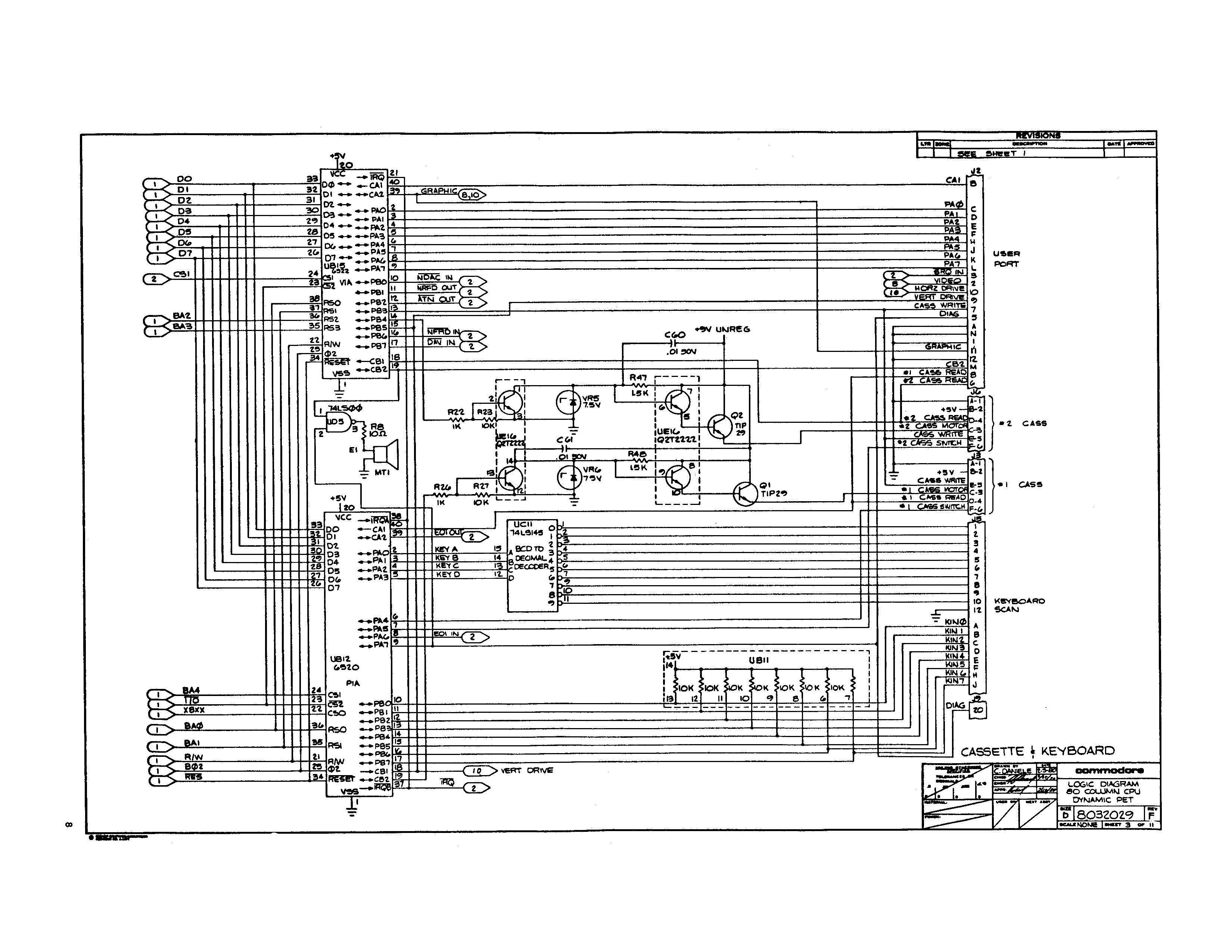
Speaking of early Commodore PETs, I have here a 4032 on which some of the keys
do not work. Some time ago I took a brief look at it and, as I recall,
concluded the problem was not the keyboard but rather something was messed up
with the scanning, something like not all columns/rows being scanned. I think
it was a 6821 or 6822 or some such doing the I/O, but the diagnosis was perhaps
more suggestive of something like a PROM bit failure causing the firmware
program to foreshorten the scan sequence.
Anyone have knowledge of a known failure mode of this sort with these machines?
--------------------Reply:
The most common problem is just oxidation and/or wear of the rubber 'contacts'
and the PCB grid; if you're lucky a good cleaning will clear it up, in case of bad
wear of the conductive pads you may have to recoat them with conductive paint
ot glue little pads of aluminum foil or aluminized mylar on to them.
Electronically they are a normal scanned matrix, driven by a 6520 PIA (UB12?)
and a muliplexer; if there is a problem there then it would most likely be with all
the keys in a certain row or column. I suppose it's possible, but I'd be very
surprised if it were a bad ROM.
Check the schematic and you should be able to jumper across the appropriate
keyboard lines to test all the rows and columns.
http://www.zimmers.net/anonftp/pub/cbm/schematics/computers/pet/8032/803202…
Someone from the IGDA-Preservation group is in the process of
transferring old DEC game code printouts in to text files, and was
wondering if any one from the list knew if there was a PDP5 emulator
(as a bunch of this is PDP5 in origin)?
He may also require assistance in checking some of the assembly, as
the printouts and copies are not always clear enough to read
accurately.
Any help would be appreciated, and I'll pass the info on.
Thanks!
Marty
As it is getting close to the date for the Dayton Hamvention, is anyone
on the list going to be at Dayton? My plan is to be there with two
selling spots (one to park in) and see what kind of "stuff" I can get
rid of. If we have a few people there, it might be fun to have a
Saturday night dinner at one of the local restaurants.
Hi, All,
I was cleaning out a pile of stuff left behind when one of my brothers
moved to California and ran across what looks like an IBM Aptiva 2142
Media Console - a pop-top CD-ROM and floppy box with a 50-pin cable
back to the main box...
http://www.systemsalchemy.org/howto/aptiva/intro.html
Formerly, there appears to have been a lot of Aptiva information at
http://wymette.home.att.net/aptiva.htm but the site is gone (I think
AT&T just stopped serving "home pages" recently) and archive.org isn't
pulling up anything on that old site at the moment.
Another referenced site was http://members.rogers.com/airchan/ (which
is available at
http://web.archive.org/web/20021213012640/http://members.rogers.com/airchan/)
happens to have had a pointer to the original IBM hardware manual -
http://web.archive.org/web/20021201092020/http://members.rogers.com/airchan…
which at least mentions how to dismantle the Media Console.
>From what I have been able to find, the CD-ROM drive in the media
console is an IDE unit not SCSI, so I _think_ that while the connector
may resemble a SCSI-1 cable (50-pin "Blue Ribbon" connector) it may
not carry SCSI signals. There was at least one reference I found to a
"host card" in the Aptiva that was not being described as a SCSI card,
but I couldn't find anything that states it definitely is or is not
SCSI.
I don't happen to have an Aptiva, but if someone out there does, I'd
rather it go to someone than get broken down for recycling at Free
Geek Columbus (which is where it will end up if it's unloved). I
would want 1.2X actual shipping cost from 43202 (box, packaging,
incidentals, etc). I see a number of places selling them for about
$30 plus S&H, but I doubt they are flying off the shelves at that
price.
Cheers,
-ethan
Nigel Williams <nigel.d.williams at gmail.com> wrote:
> More details and pictures here:
>
> www.retrocomputingtasmania.com/members/nw-retrocomputingtasmania-com/pdp-11…
>
> If anyone knows the part numbers for the KDJ11 CABKIT or front/rear
> plastic panels for the BA23 that would help me contact suppliers.
You know, Google is really simple to use...
A quick search on "pdp-11/93 cabkit" gave me CK-KDJ1E-KA.
Found, for instance, on
http://www.pacificgeek.com/productdetail.asp?ID=1932313.
(in turn from http://www.pacificgeek.com/showallitems_bb_list.asp?Code=CK)
You can probably find information on all other stuff you are looking for
by using Google as well. However, finding the actual items might be
another story.
I wish you luck, though.
> My aim is to run RSTS/E v10 on this machine so I am open to
> suggestions for the simplest path to this goal.
>
> I have a SBOX CQD223A/TM SCSI card which I would be willing to swap or
> sell for the QBUS variant or some other manageable RSTS/E compatible
> storage device.
That is a Qbus controller, I assume you know this?
The Sbox is just a question of handles, which can be removed.
Johnny
Another thing that works (but you have to be careful) is to use an xacto
knife to cut the leads using the uncut leads as a "stop". At the point
most of the leads are cut, you can use a standard cutter to clip the
last lead on each side.
(Still trying to figure out how this is related to chip equivalence.)
> If I slip, that would be no good... nevertheless, that's probably
> what I'll end up doing (the cutting, not the slipping part!)
>
> Joe.
I sent the DEC ROM info to the VT220 Font author, and he responded with
thanks and also wanted to know if anyone had PDP-11 CPU tests.
I noted he might want to join here, but I thought I'd start the ball
rolling on his request.
Jim
--
Jim Brain, Brain Innovations (X)
brain at jbrain.com
Dabbling in WWW, Embedded Systems, Old CBM computers, and Good Times!
Home: http://www.jbrain.com
>
> Date: Tue, 6 Apr 2010 19:54:27 +0100 (BST)
> From: ard at p850ug1.demon.co.uk (Tony Duell)
> I haev found it's impossible to predict the prices that things will sell
> for on E-bay. Several times I've seen things with an opening bid of
> perhaps $5. I've thoguht that it was a rare an interesting item and put
> in a bid of $100 for it (and ecpected it to go for a lot more), only to
> find I end up winning it for the opening bid. Conversely there have been
> times when I've thought 'nobody will want that' and put in a sensible (if
> somewhat low) bid, only to find it sells for much more.
Time also plays a part, as in, who happens to be looking for that type of
item and how many. What sells for very little one month may go for
hundreds a month later.
I designed and ran off some circuit boards for 16 MB Macintosh IIfx SIMMs
and offered sets of four (64 MB RAM total) on Ebay. The first set sold
for over $270. As one would expect, the price declined from there until
it went under $50 which was about what I felt was my minimum considering
the effort to assemble them. The second to last set sold for about $50
and the set that made me quit went for about $25.
Then I waited a month or two, offered them again with exactly the same
auction listing and the price was back up over $120.
It's like there's a customer-base refresh function at work or at least a
time variant demand function.
Jeff Walther
Hi folks,
could someone please explain me THIS?
http://cgi.ebay.de/ws/eBayISAPI.dll?ViewItem&item=190385486840
I don't sell on eBay very often. And from time to time I see people paying astronomical sums for
more or less junk. But this time it was me offering stuff - and what did I get? I have no clue who
would sell me a used RK05 disk pack in unknown condition for that price. But this was a new in a box
one....!
What did I do wrong?
Was it the winner of the auction who has 0 eBay points? There was absolutely no trace of fraud on my
side. I did neither bid with another account nor did I even ask someone to bid on my auctions to
drive up the price. That's what I got from it. I hope that the lucky 0 points high bidder on my pack
is someone who really exists...
Regards,
Philipp
--
http://www.hachti.de
A few weeks back I purchased a Tandberg TDC 4120 drive at a recycler.For
some reason I like collecting different tape drives and removable media,
maybe just incase I find media with data I want to restore.
Browsing ebay I found 6 new QIC 1000 tapes for it starting at $1 with $5
shipping "IMATION MAGNUS 46165 QIC 1000- 1.2 GB-B NEW" and put in a bid
thinking nobody uses this stuff anymore. With 30 minutes currently left it
has hit $117.50 and all the bids are users with 2000+ feedback. So are these
things that rare, or do people snag it up to keep the prices expensive for
corporate users who need tapes? I can't really see a company needing new
tapes (1.2GB) these days, drives maybe to restore files but not new tapes.
Philipp Hachtmann wrote:
> What did I do wrong?
When offered in an open market with asymmetrical information and indeterminatedesire, if an item sells for more than certain people on this list think itshould, the people who spent more are idiots/clueless/scum/damaging the vintagemarket.
When offered in an open market with asymmetrical information and indeterminatedesire, if an item sells for less than certain people on this list think itshould, the people who spent less are parasites/snipers/scum/damaging thevintage market.
This is a once a month or more thread. Seriously, do we really need to rehash it?
KJ
I may be asked to handle some Terak 8500-series "variable density"
floppies. The documentation isn't very specific about these and
since I don't have them in hand, I'm guessing that they're really
just FM+MFM and not actually zoned bit density floppies.
Do I assume correctly?
Thanks all,
Chuck
A more broad summary than the arstechnica one (which seems to harp on some points that I'm sure make sense to the arstechnica author but make no sense at all to me!) is in The Register:
http://www.channelregister.co.uk/2010/03/26/ibm_turbohercules_response/prin…
and on the patent issue:
http://www.theregister.co.uk/2010/04/06/ibm_hercules_project_patents/
A factoid I ignored or never knew until now: the 1956 consent decree's applicability seems to have expired in 2001 for IBM mainframe stuff. Wow. This is, for me, like finding out that Captain Kirk was engaged in a battle of wits with Opie's little brother. (I'm not making it up, it's true! Look up the cast for The Corbomite Maneuver.)
Tim.
More details and pictures here:
www.retrocomputingtasmania.com/members/nw-retrocomputingtasmania-com/pdp-11…
If anyone knows the part numbers for the KDJ11 CABKIT or front/rear
plastic panels for the BA23 that would help me contact suppliers.
My aim is to run RSTS/E v10 on this machine so I am open to
suggestions for the simplest path to this goal.
I have a SBOX CQD223A/TM SCSI card which I would be willing to swap or
sell for the QBUS variant or some other manageable RSTS/E compatible
storage device.
cheers,
nigel.
www.retroComputingTasmania.com
I finally put up pics:
http://ecloud.org/pics/Masscomp/
and got around to powering it up to see what would happen. I saw an
amber power light, a quick blink on the green "run" light, the fans
work, and the hard disk spins up, but I didn't see any output on the
serial port which I thought should've been the console. Supposed to
be a 68k-based Unix box. Apparently these were known for graphics,
but I don't see anything looking like video output (other than a
coverplate with video signals labeled) so maybe that's missing from
this one.
Manuals, disks and a tape will be included.
Anyway... if anyone wants it, it's free for pickup in Phoenix, AZ, and
if not, it's going to get scrapped pretty soon. My wife's been
nagging me to get it off the patio (clean, dry patio, out of the
weather) for years, and now there is a good chance we might be moving.
> could someone please explain me THIS?
> http://cgi.ebay.de/ws/eBayISAPI.dll?ViewItem&item=190385486840
I myself have put up something for sale that I was sure was "dear"
and "valuable" and "rare", and it got no bids at all. Obviously the rest
of the world didn't agree.
Certainly telling the whole broad world that what you have is rarer
then hen's teeth and ultra-desirable is a common ploy, so common that
it means little.
I'm guessing that the people who use RK05 packs have metric buttloads
of them and don't need anymore, new or not. Certainly that describes
the existing RK05 users I know of.
Tim.
On 3/31/10, Tony Duell <ard at p850ug1.demon.co.uk> wrote:
> OK... I was worried for a moment that somebdy had tried to archive paper
> tapes by scanning them a foot at a time on a flatbed scanner or something
> equally daft
I did that exact thing with punched cards as an experiment. I did not
(and still don't) have a punched card reader, but I have a
correspondence course in "Data Processing" I picked up at a thrift
store that came complete with blank coding forms and punch cards as
teaching aids for the homework.
I put the punchcard in a flatbed scanner with the unprinted side down
(the "back" side) with a dark backing sheet to contrast the holes. I
scanned it to a TIFF then converted it to a GIF and used Tom Boutell's
GD library to import it into a C application that did some simple
image transformations (edge detection, etc). I didn't complete the
code to the point of converting spots to bits, but I did scale and
locate the card in the scan area and was on the verge of writing the
code to check for holes when I got distracted and set it aside.
Making an 8 or 9 channel papertape reader from scratch is not an
impossible exercise (witness the ancient Byte article referenced here
every so often). Making a punchcard reader from scratch is a very
different level of effort, so back then I figured that it'd be easier
to use a flatbed scanner than try to make a 12-level reader and
mechanical feed system on my own. These days, though, with
inexpensive fabrication tools (access to laser cutters, home CNCs,
Makerbots, etc) it might _not_ be as hard to make a punchcard reader
>from scratch as it was 10 years ago.
-ethan
> From: Philipp Hachtmann <hachti at hachti.de>
> Subject: eBay disaster
>
> What did I do wrong?
Maybe you didn't use the right words in the title line. My ebay search terms do not include 'beyond', 'rare' or 'new', they are fine for the main description but the title is too precious for them. The words 'computer' and either 'classic' or 'old' or even 'vintage' for instance would have been more useful. Some ebayers might even have an exclusion for new items by using -new. I wish ebay would divide computers into decades or generations, I find it useless using eBay categories or I end looking through 90s, 80s and for me even 70s stuff for hours looking for probably just one computer item from the early 1960s, often none at all.
Roger Holmes
(owner of a 1962 mainframe)
Date: Mon, 5 Apr 2010 18:18:33 -0400
From: Ethan Dicks <ethan.dicks at gmail.com>
Subject: Re: Anyone have an image of a Japanese PET chrgen ROM
901447-12?
On 4/5/10, M H Stein <dm561 at torfree.net> wrote:
> ----------------Original Message:
>
> Date: Mon, 5 Apr 2010 02:13:20 -0400
> From: Ethan Dicks <ethan.dicks at gmail.com>
> Subject: Anyone have an image of a Japanese PET chrgen ROM 901447-12?
> It would certainly be nice to find the 'official' ROM, but I thought that
> the ROM that Philip (the owner of that PET on your bench) created
> was pretty well complete and correct; it seems to match my Japanese
> keyboard perfectly except for one character, and I suspect it's the key
> that's wrong and not the CG.
Why would the key be wrong?
*MS:
What I meant was that one of my keys might have been replaced;
the picture of the chiclet keyboard has a Yen symbol, the normal
graphic symbol and a Japanese character where the \ key usually
is, whereas my keyboard just has the normal \ and graphic symbol.
---
> Did you try that image and match it up to your Japanese chiclet
> keyboard?
I have not. If you could send me a copy of it off-list, that would be
appreciated. I don't seem to have it in the place I store such things
(though I do remember the conversation).
*MS:
I'll send you the binaries, character charts and pics of the keyboard
off-list.
---
> I've been playing with the idea of having all three (four?) character sets
> available on screen at the same time, using the reverse video signal.
How would that work? Obviously, you'd use some new means of toggling
upper bits on the CHRGEN ROM, but I don't get how the reverse video
signal would be the trigger... the upper bit on a PET character cell
inverts the data out of the bit shifter (unlike the C-64 where it's
just another address bit). I can see how you could steal that upper
bit and pipe it into A11 on a larger CHRGEN ROM, but how do you get 3
or 4 sets from one bit?
*MS:
As you know, PETS have two mutually exclusive sets, upper/lower case
or upper case/graphics; when you install the Japanese characters you
have to give up at least one of those half-sets and you can't for example
have Japanese characters and upper/lower Roman characters on the
same screen, not to mention graphics. I haven't looked at the older
PETs to see if/how it might be feasible, but the newer ones with a
CRT controller have provision for selecting an alternate character set
with one of the unused address lines, so I thought it might be easily
possible to use that somehow, perhaps even connecting it to the
reverse video signal so that the RVS on/off key would select the
alternate set on an individual character basis and allow mixing (e.g.)
Japanese, upper, lower and graphics characters, all on the same
screen instead of switching the mode of the whole screen with the
text/graphic poke.
mike
Did you do any market research before listing?
I have no idea what a new disk pack would be worth, but obviously not a
lot to the people who buy on ebay.
In checking past US auctions for the past 90 days, there were only five
listings and the highest price paid was about $15.00. On top of that,
each auction had very few buyers; that tells me NOT to start the listing
at one Euro. But the 15 Euros or so you got was still higher than
anything sold here in the US.
What did you expect (hope) it to sell for?
> could someone please explain me THIS?
> http://cgi.ebay.de/ws/eBayISAPI.dll?ViewItem&item=190385486840
>
> What did I do wrong?
>
> Regards,
>
> Philipp
Julie writes to me:
---------------------------------------------------------
"I have *three* NEC APC's: two mono, one color. There are manuals and operating system diskettes."
jhorn5555 at yahoo.com
---------------------------------------------------------
Contact her to get your very own NEC APC computer.
They have freaky-cool 8-inch floppy drives.
Gene wrote to me:
Contact Gene below if interested:
----------------------------------------------------
"I have a bunch of very old IBM software in original boxes that I would like to find a home for. I hate to throw them way when I know there must be those who would love to acquire them.
$5 each + shipping.
Ami Pro, Writing Assistant, Professional Write, Professional File, Professional Plan, QA3, Word Perfect and more
Contact Gene at:
ygehrich at yahoo.com
----------------------------------------------------
All,
I am working at bringing up a N* Horizon system and have some questions.
At present, I don't have any system software and am attempting to
determine basic functionality.
The box currently has a Z80-A CPU card, HRAM64 memory card and an MDS-AD3
hard-sectored floppy controller (others have been removed temporarily).
There are two built-in SA-400 SS 5.25" drives.
Other cards that came with the unit include a Compupro bus terminator, A
Morrow Disk Jockey 2D/B 8" controller and a Morrow HDCA-4A hard disk
controller. Unfortunately, the 8" Morrow hard disk emitted some magic
smoke at power up and I have not done any further troubleshooting yet.
Anyone know anything about Memorex 8" drive mechanisms?
At power up, the system tries to boot the first floppy drive, then gives
up after 10-15 seconds. I take this as a sign that some life exists.
Then, I connected a PC running ProComm Plus to the left serial port, but
cannot get any reponse or output there.
So, problem 1:
Where are baud rate settings documented? I can find pinouts for assigning
signals on the DB25 connector, but not a mention of baud rate.
Is it possible to obtain any sort of monitor prompt in the absence of a
booted system? Doesn't the floppy controller have some sort of ROM
monitor on-board?
Any tips for getting a terminal connection operational? I have played
with handshake signals a bit, and it sure looks like both parties have the
necessary lines in the necessary states for communication to occur.
Steve
--
Hi Everybody,
I received this request from a good friend lately:
> PS: do you happen to know anyone who has an original Ampro "Little
> Board"? I'd like a copy of the boot diskette for CP/M 2.2.
>
> It's the one with the Z80 and no SCSI? Not their later 8088 card. I
> acquired the earliest Z80 board recently, but with no CP/M diskette.
> While there are some Web archives with CP/M BIOS and ROM sources, for
> some reason they don't have the "boot code" sources.
Can anyone help?
I would also like to add the boot disk image to the archive as well.
Thanks,
Dave
--
dave09 (at) Dave Dunfield
dunfield (dot) Firmware development services & tools: www.dunfield.com
com Classic Computers: http://www.classiccmp.org/dunfield/
well, you got what you listed then. eBay is no way a guarantee of getting a good price. You wanted a better price? Then you needed to set a minimum or a reserve price. If it sold then great, if it didn't then keep it longer or lower your price. English only, fine. You already have decided that I don't know what I am doing. I have only been selling on eBay since the late nineteen-hundreds. You asked for ideas and then discounted them. What you did - didn't work.
Maybe you will be luckier next time.
regards, Steve Thatcher
BTW, missed the photo of an actual disk pack - It was buried farther down. The only thing I remembered from the listing was seeing a box and a comment about language.
-----Original Message-----
>From: Philipp Hachtmann <hachti at hachti.de>
>Sent: Apr 5, 2010 3:26 PM
>To: General Discussion at null, On-Topic and Off-Topic Posts <cctalk at classiccmp.org>, null at null
>Subject: Re: eBay disaster
>
>
>> I am assuming that you were hoping for a higher selling price...
>Yes, of course!
>
>> First of all, you should have set a reserve price on the auction or a minimum bid of what you
>> wanted to "at least" get from the auction.
>Puh.. A minimum is possible. But a reserve? I feel uncomfortable when I see this "reserve not met"
>thing in other auctions. So I don't really like that idea.
>
>> The buyer (whatever his rating) may have just signed
>> up.
>Yes. That's the reason why I refused to limit the group of people who are allowed to bid. If this
>should turn out to be a scam, I'll think different when it comes to further offers.
>
>> I think I would have included the native language write up rather than just in English.
>Oh, why? Because of my bad English? The chance to sell this kind of stuff to someone in Germany is
>quite a bit lower than selling it to elsewhere (i.e. US) in the world. So I decided to write in
>English only.
>
>> Second, sometimes just a picture of a box is just what a buyer gets. I would have taken pictures
>> of the box insides or even included a stock photo of what the disk pack is that is in the box.
>If you looked at the pictures I have put onto the auction you should have seen that I actually have
>photographed a pack lying on the box. Another one, of course. I did not want to open the box -
>opening the box would have spoiled the whole thing.
>
>
I am assuming that you were hoping for a higher selling price...
First of all, you should have set a reserve price on the auction or a minimum bid of what you wanted to "at least" get from the auction. The buyer (whatever his rating) may have just signed up. I think I would have included the native language write up rather than just in English.
Second, sometimes just a picture of a box is just what a buyer gets. I would have taken pictures of the box insides or even included a stock photo of what the disk pack is that is in the box.
just a couple of thoughts.
best regards, Steve Thatcher
-----Original Message-----
>From: Philipp Hachtmann <hachti at hachti.de>
>Sent: Apr 5, 2010 5:54 PM
>To: General Discussion at null, On-Topic and Off-Topic Posts <cctalk at classiccmp.org>, null at null
>Subject: eBay disaster
>
>Hi folks,
>
>could someone please explain me THIS?
>http://cgi.ebay.de/ws/eBayISAPI.dll?ViewItem&item=190385486840
>
>I don't sell on eBay very often. And from time to time I see people paying astronomical sums for
>more or less junk. But this time it was me offering stuff - and what did I get? I have no clue who
>would sell me a used RK05 disk pack in unknown condition for that price. But this was a new in a box
>one....!
>
>What did I do wrong?
>Was it the winner of the auction who has 0 eBay points? There was absolutely no trace of fraud on my
>side. I did neither bid with another account nor did I even ask someone to bid on my auctions to
>drive up the price. That's what I got from it. I hope that the lucky 0 points high bidder on my pack
>is someone who really exists...
>
>Regards,
>
>Philipp
>
>
>
>
>
>
>--
>http://www.hachti.de
Message: 16
Date: Mon, 5 Apr 2010 13:03:05 -0700 (PDT)
From: Fred Cisin <cisin at xenosoft.com>
Subject: Re: Paper drilling (was: Re: Making Hard Sector Floppies)
To: "General Discussion: On-Topic and Off-Topic Posts"
<cctalk at classiccmp.org>
Message-ID: <20100405125858.W18344 at shell.lmi.net>
Content-Type: TEXT/PLAIN; charset=US-ASCII
On Mon, 5 Apr 2010, Dave Woyciesjes wrote:
> > Well, when I was making a notepad (using the old pages from a
> > Dilbert desk calendar) I just clamped the paper between a piece
> > of 1/4" sheet wood and the circuit board backer; then used my
> > hand drill. Kept the clamps as close to the hole location as
> > possible.
>
> Congratulations
> You manufactured a paper drill.
Yep, hence my posting of what I'd done....
> Next time, . . .
> You'll find that a drill press is much more convenient if you
> need to do a bunch,...
Yes, it would've been, if I indeed had one in my shop.
> and that a hollow tubular drill bit (try
> a printer Binding Supplies company!) works much better than a
> standard helical drill bit.
See comment above...
Always one wise-ass in the bunch, isn't there? ;)
> > The circuit board I used, IIRC, as a backer was a ISA
> > riser card froman IBM PC300GL PC. Cut off all but one of
> > the card edge slots. Keeps the pads at a good angle for
> > use, and hanging... :)
>
> 'course now somebody will show up who is desperate for one of those
> boards, . . .
yeah, Murphy's law, ain't it?
--
--- Dave Woyciesjes
--- ICQ# 905818
--- AIM - woyciesjes
--- CompTIA A+ Certified IT Tech - http://certification.comptia.org/
--- HDI Certified Support Center Analyst - http://www.ThinkHDI.com/
Registered Linux user number 464583
"From there to here,
From here to there,
Funny things
are everywhere."
--- Dr. Seuss
Hi everybody,
I have a question, is there someone who can read for
me 2 separate 9 track tapes containing a brusys type backup onto
an image readable for SIMH?
Please contact me off list.
Thanks,
Ed
--
Dit is een HTML vrije email / This is an HTML free email.
From: Dave McGuire
On Apr 2, 2010, at 5:16 PM, Andrew Burton wrote:
> > I did a quick search online last night for "paper drill" and the
> > results seemed to be US specific. I have never been in a print
> > shop, so maybe they are common like you say. I will certainly
> > ask a few colleagues at work and see if they have heard of them.
>
>
> Well, there not being many other ways to make holes in
> inches-thick stacks of paper..
>
> -Dave
Well, when I was making a notepad (using the old pages from a Dilbert
desk calendar) I just clamped the paper between a piece of 1/4" sheet
wood and the circuit board backer; then used my hand drill. Kept the
clamps as close to the hole location as possible.
The circuit board I used, IIRC, as a backer was a ISA riser card from
an IBM PC300GL PC. Cut off all but one of the card edge slots. Keeps the
pads at a good angle for use, and hanging... :)
--
--- Dave Woyciesjes
--- ICQ# 905818
--- AIM - woyciesjes
--- CompTIA A+ Certified IT Tech - http://certification.comptia.org/
--- HDI Certified Support Center Analyst - http://www.ThinkHDI.com/
Registered Linux user number 464583
"From there to here,
From here to there,
Funny things
are everywhere."
--- Dr. Seuss
Hi, All,
This has all been discussed over on the cbm-hackers list over the past
several months, but I've been fixing a couple of Static PET boards for
someone in Japan. The only thing that appears to be unique to one of
the boards is a 2316B in a Commodore-built 6540 adapter board (P/N
320076) and the 901447-12 ROM that's in it. There is no corresponding
ROM image on Zimmers.net (where the old funet archive lives), and this
ROM reads all zeros.
I have a photo of the keyboard layout for a Japanese chicklet PET, and
it doesn't happen to match the map of the Japanese C-64. One
interesting feature is a few Kanji characters mixed in with the
Katana, specifically, "4" maps to the Kanji for "year", "5" has
"month", and "6" has "day" - obviously for rendering dates easily.
There looks to be 51 Japanese glyphs total (all the Katakana
characters, the three Kanji, and a couple of other characters needed
to write sentences in Japanese). Given that the editor ROM is
identical to a standard European/US BASIC 1.0 PET, it seems likely
that the character drawn on the key would be the replacement in
"upper/lower case mode" for that particular symbol.
It seems likely I could reproduce the general contents of the ROM
following the keyboard map, but it would be great it someone out there
happened to have the real thing. I already know that nobody on the
cbm-hackers list has come forward with a copy, but I'm pretty sure
there are PET owners on this list who are not on cbm-hackers.
If anyone happens to have this ROM or ROM image, please share it with
the great repository at Zimmers.net.
Thank you,
-ethan
Hi all --
I've spent the last couple nights searching in vain for the Northstar
Horizon boot disks a listmember produced for me a few years back. I
*swear* I had them in my hands not a month ago but now they are nowhere
to be found. I'm worried they may have fallen into a box that got recycled.
I've decided I want to get my Horizon running again now that I have a
bit more spare time (my other current project, a '54 Nash Metropolitan,
is now off to the body shop for some serious work) but I'm stuck without
bootable media or any way to make my own, so I can't do much with it at
the moment.
Can anyone do me a favor and make me a copy of a couple of Horizon boot
disks (CP/M or otherwise) for this machine? I have the MDS-AD3
double-density controller with a Shugart SA400 drive.
(As a related aside, is there *anywhere* one can get hard-sectored 5.25"
floppies these days?)
Thanks as always,
Josh
now that you mention IBM used the word "chips" then the rest of the industry would have to call it something else... They probably even copyrighted the name "chips" and good thing they didn't sue the TV guys when CHiPs was on TV.
-----Original Message-----
>From: Al Kossow <aek at bitsavers.org>
>Sent: Apr 5, 2010 9:49 AM
>To: General Discussion at null, On-Topic and Off-Topic Posts <cctalk at classiccmp.org>, null at null
>Subject: Re: chips (was Re: Reading ancient paper digital media (was Re: HamurabiFocal source))
>
>On 4/5/10 1:07 AM, Rod Smallwood wrote:
>
>>
>> As to punched cards I never heard the rectangular punchings referred to as
>> 'chips' on either side of the Atlantic.
>>
>
>I refer you, then, to most IBM punched card documentation on bitsavers.
>
>http://bitsavers.org/pdf/ibm/cardProc/22-8485-3_operGuide_Sep56.pdf
>page 13, for example:
>
>"Chip Box
> Slightly to the right of the machine, as you look at it from the rear,
> is a removable box, which is the receptacle for the punching chips as
> they are cut out. This box can be easily removed, when necessary, by
> lifting a catch that locks it into position. The chip box should be
> removed and emptied daily."
>
>
I just finished a project using stepper motors and a PIC processor to
drive the whole thing. Aside from defining the parameters (and debugging
my mistakes), it was pretty easy to do. I used a Ramsey Stepper Motor
driver kit to drive a 200 step/rev floppy disk drive motor along with a
16F84A PIC processor to control it, and it worked great.
Using a sharpie to just mark the hole location sounds like it would be
really easy to do. Anyone know the permissible hole tolerances on hard
sector floppies?
If using a laser, what power would be required to cut the holes and what
kind of laser? I currently have a 35W IR laser that could be more than a
bit dangerous without proper safety precautions ... I've kind of gotten
used to eyesight :)!
>> People have been known to make their own 5 1/4" hard-sectored disks. I don't
>> > remember the details, but the basic idea was to take a 5 1/4" disk drive to
>> > hold the disk, make an index wheel for the holes, add a hole punch, and then
>> > just add time.
>
> One thought I had was to take an old 5.25" floppy frame (say an
> SA400), replace the DC motor with a stepper, mount a floppy disc, then
> drive the rotation so many steps (you'd have to calculate/measure the
> pulley ratio), then punch the media. Simple stepper drivers are
> inexpensive to buy ($20, say) or make and easy to drive from a
> microcontroller or parallel port (or even 555, if you wanted to do it
> "old school"). It'd be even "better" to have a laser make the hole,
> but that's a lot of power to be squirting around - punches for mylar
> rarely make holes in someone's retina.
>
> If it's too tricky to mount the punch or die in the floppy frame, one
> could pulse the media around as required and dot the spot with a
> sharpie, then eject the floppy and punch the holes by hand.
>
> -ethan
I thought it would be better to wait until Sunday, April 4th since this
request
for help would otherwise be seen as an April fools joke. YES! I agree that
only hobby users might be interested enough to want these changes, let alone
use them. But it keeps me busy and challenged.
I have almost finished making changes to MACRO.SAV to fix some bugs and
display the year in four digits (1972 -> 2099). Along the way, I found that
MACRO.SAV and CREF.SAV assume that each other are on the SY: device
and .Chain back and forth when a cross-reference table is added to the
listing.
Now both MACRO.SAV and CREF.SAV are allowed to be on a device
different from SY: and from each other if the user so specifies.
All of the code has a simple solution under RT-11 and I presume there may
be a simple solution when run under RSTS/E. However, I have not run any
code under RSTS/E for 20 years and have no simple way of setting up a
system. My preference would be to run RSTS/E under SIMH with:
(a) Debug capability if possible
(b) No debug capability, but just run the program
(c) Have someone else run the program under RSTS/E and test it for me
in that order of priority. Has anyone a simple RSTS/E image that I can
download and run without modification to allow me to test the programs
myself under SIMH? That should keep everything legal for an RSTS/E
distribution that is allowed under SIMH. I would also need a few hints
on running, but probably very few.
Can anyone help? John Dundas has helped by providing a PDF of a
manual describing the RT-11 emulation under RSTS/E. This manual
provides some details of the RT-11 .Chain EMT request when used
under the RT-11 Real Time emulation under RSTS/E, but there are
conflicts with the documentation on the RT-11 side of the fence as
to the use of the PPN from RSTS/E during an RT-11 .Chain EMT
request. In particular, for some of the RT-11 documentation, the
5th word in the Chain Area starting at octal address 500 (i.e. at
octal location 510) is the RSTS/E PPN value for the file to be
.ChainED to while other definitions place a very different value
at octal location 510. Does anyone have an idea as to which
documentation is correct?
There may be some RSTS/E images at trailing edge. However, I
would appreciate something that is ready out of the can, so to speak,
as my focus is so narrow. Using RSTS/E is far from my goal. I just
want to have the modified MACRO.SAV and CREF.SAV pair
work under RSTS/E as well as RT-11, RTEM and TSX-Plus.
The manual
It may also be useful to test under any other RT-11 emulator. I
know of just one, but I can't remember who developed it.
Jerome Fine
I am looking for a data sheet (or at least a pinout) for an IC numbered
PIC900C. Despite the number, this is not a microcontroller, it's some
kind of power driver IC -- from the 'house code' on it, I suspect it's
little more than a transistor array, here [1] configured as a full-H driver
foo a motor. FWIW it's in a 'wide' 18 pin DIL package with a metal top
surface to attach to a heatsink.
I beleive it was made by Unitrode in the early 1980s. Alas the only
Unitrode data book I could find on the web was too early for it.
[1] On the 'servo' (notor control) board of an HP9144 tape drive.
-tony
I will have to do some digging on this. I used a PIC625 from Unitrode in designing a 12 to 5 volt switching regulator. It is a switch mode transistor with a flyback diode in it if I remember correctly. The device is a four pin can (smaller than a TO3 case). Just not sure if the 900 was in the same family.
best regards, Steve Thatcher
-----Original Message-----
>From: Tony Duell <ard at p850ug1.demon.co.uk>
>Sent: Apr 3, 2010 12:06 PM
>To: cctalk at classiccmp.org
>Subject: PIC900C
>
>I am looking for a data sheet (or at least a pinout) for an IC numbered
>PIC900C. Despite the number, this is not a microcontroller, it's some
>kind of power driver IC -- from the 'house code' on it, I suspect it's
>little more than a transistor array, here [1] configured as a full-H driver
>foo a motor. FWIW it's in a 'wide' 18 pin DIL package with a metal top
>surface to attach to a heatsink.
>
>I beleive it was made by Unitrode in the early 1980s. Alas the only
>Unitrode data book I could find on the web was too early for it.
>
>[1] On the 'servo' (notor control) board of an HP9144 tape drive.
>
>-tony
>
----------------Original Message:
Date: Thu, 01 Apr 2010 08:02:31 -0700
From: "Chuck Guzis" <cclist at sydex.com>
Subject: RE: Reading ancient paper digital media (was Re: Hamurabi
Focal source)
On 1 Apr 2010 at 0:17, Ian King wrote:
> Interestingly, the idea of a timing mechanism hosted on the medium
> itself never occurred to Herman Hollerith or his successors, which I
> guess speaks to their confidence in their engineering.
Not necessarily. If you look at Hollerith's card reader, it read the
entire card in parallel, using spring-loaded probes that would extend
through the card holes and touch a pool of mercury. No need for
clocking.
Serial card reading came later when the card was not manually read.
If you're going to automate card transport, then reading the card
serially actually is easier.
What was the proportion of readers that read colum-serial versus row-
serial? I believe the CDC 415 punch had its read station as 80
brushes, reading the card just punched row-wise.
--Chuck
--------------------Reply:
As a matter of fact reading the card 'sideways' was a basic principle
of the electro-mechanical punched card systems that (along with
card sales) were IBM's bread and butter until the mid-sixties.
With the exception of keypunches, paper tape converters etc. these
machines were 'clocked' through the 12 states (12,11,0-9); the (firmly
clamped) cards and various gears, relays, punches, type bars, etc.
were cycled through these 12 states in synchronized parallel unison,
much like most of the manual 'posting machines' with full row and
column keyboards that preceded and coexisted with them.
Timing diagrams looked much like the diagrams we're familiar with,
but they were usually calibrated in degrees of rotation of the master
camshaft instead of time.
Interesting to compare not only the architectures of then vs. now,
but the overall systems; a room full of various machines would be
more or less the equivalent of a fairly simple micro, each machine
(and operator in some cases) would be a programming algorithm
or an IC, the data path would be an actual real well-worn path where
cards would be carried from one machine to the next in the processing
sequence, patch boards would be EPROMs, etc. etc.
The hardware and documentation may be preserved, but I suspect
the design of the actual application systems, i.e. 'programs' where
procedures are in fact different physical machines, is becoming a
lost art.
Ah yes, I still have one of their "Don't Copy That Floppy" posters and I
*think* the VHS tape that was part of that campaign. Must be worth
millions by now :).
> The SPA ran their "Don't Copy That Floppy" campaign well into the mid-
> to-late 90s. Did anyone ever *really* pay $100K for owning a single
> illegal copy of "Where in the World is Carmen Sandiego" as their ads
> claimed?
>
> --Chuck
>
Kaye wrote to me:
"As well as software and docs, there's TI magazines, monitors, computers, peripheral memory boxes and cards, joysticks, printers, etc.."
None of it is terribly valuable - there are no TI-99/4 (non-A) systems.
It's all free if picked-up in person - it's too much work to mail.
e-mail her at
kaye67 at bresnan.net
if interested.
> From: M H Stein <dm561 at torfree.net>
> From: "Chuck Guzis" <cclist at sydex.com>
>
> As a matter of fact reading the card 'sideways' was a basic principle
> of the electro-mechanical punched card systems that (along with
> card sales) were IBM's bread and butter until the mid-sixties.
>
> With the exception of keypunches, paper tape converters etc. these
> machines were 'clocked' through the 12 states (12,11,0-9); the (firmly
> clamped) cards and various gears, relays, punches, type bars, etc.
> were cycled through these 12 states in synchronized parallel unison,
> much like most of the manual 'posting machines' with full row and
> column keyboards that preceded and coexisted with them.
>
> Timing diagrams looked much like the diagrams we're familiar with,
> but they were usually calibrated in degrees of rotation of the master
> camshaft instead of time.
The punch of my ICT1301 is an IBM design, originally built under licence by BTM (British Tabulating Machine co), which merged to form ICT. It clocks through the 12 states and a few more while the card is being fed. It mechanically pauses in the middle of each state by means of a Geneva mechanism. It has two camshafts with bakelite cams which operate contacts which controls the punch and signals the CPU when data is ready to be punched and check read. When one card is being punched the previous card is at the check reading station with 80 wire brush contacts. It does indeed have a timing diagram as you describe.
The main mechanism sits on a steel casting, and I'm told its the top part of an original Holerith design which had integral cast ball and claw feet. This plate is mounted on rubber bushes to a massive angle iron frame with the widest bit of copper earth braid I've ever seen. It operates at 100 cards per minute and the CPU has to feed it 80 bits of data for each row and reads 80 bits back from the previous card. Yes the interface is 80 bit parallel in each direction plus lots of control and status signals, 200 wires in total (8 cables of 25 cores each).
The manual tells programmers to avoid punching more than 60 columns in any row. How any programmer was supposed to avoid punching a card full of zeroes I don't know. I have punched fully laced cards with it no problem, and I have a complete spare mechanism anyway, which I'm thinking of linking to my Mac, though its a big project.
I've never been told that the card reader or line printer have any connection with IBM but I suppose it is possible. The reader is 600 cards a minute (80 column first) and the printer is a 600 lines per minute, 120 column drum printer (all the similar characters aligned not staggered) with a sprag mechanism which advances the paper. The card reader has a reject hopper and a main stacker. The main stacker turns the card around a big rubber drum and feeds it into slots in a pair or rollers which then turn and flip it out under the stack of cards already read.
Roger Holmes
It's my understanding that Ed Roberts was indeed instrumental in bringing
the microcomputer to the masses or at that time(mid-70's) to the
cognoscenti. His Altair 8800 was covered by technical magazines since 1972
or thereabouts. The Micro-soft empire owes its existence to MITS. Some
would say that Mr. Roberts never gained or received the recognition due or
deserved. Yet as far as this reader can determine he never sought it and his
devotion to medicine and patients in later years speaks volumes in a world
obsessed with 15 minutes of fame. Vain-glory seems not to have been part of
his character.
Murray--
I'm pondering putting an optical pickup in an old ADB mouse for use with
my Mac SE. I find lots of web pages describing making these old mice
optical, but all of them involve turning the mice into USB mice. So, is
anyone aware of an ADB mouse with an optical pickup?
--
David Griffith
dgriffi at cs.csubak.edu
A: Because it fouls the order in which people normally read text.
Q: Why is top-posting such a bad thing?
A: Top-posting.
Q: What is the most annoying thing in e-mail?
R
------Original Message------
From: Tony Duell
Sender: cctalk-bounces at classiccmp.org
To: cctalk at classiccmp.org
ReplyTo: General Discussion: On-Topic and Off-Topic Posts
Subject: Re: Servo tracks on SMD disk
Sent: 29 Mar 2010 19:14
>
> Hi Tony,
>
> > Based on my experiences with Pentina, I don't believe a cat makes a
> > unique sound...
> You're speaking of the individuality of a DOG! A cat makes miau! :-)
I am sure Pentina is a cat. And he certainly males many different noises...
>
> >
> > Anyway, I assume you know it's not headcrashing (which can make a noise
> > like a very angry cat). I think you'd know if that was the case...
> No crash. But I have to admit that I got the drive crashed a few years
> ago. After cleaning and using another pack it worked. I had 3 packs for it.
I assuem it has worked since the crash. Could the heads have been damaged
by the crash?
> At some point in history I got a bunch of packs. They were used with a
> somewhat dubious Nova clone system (DDC or DCC). They never really
> worked fine.
> A few months ago now the drive completely broke down: After having
> successfully used the machine for several hours and pausing for another
> few weeks, I ran into disaster: A mechanical buffer at the back of the
> head slide had changed to a sticky liquid and blocked the whole
> mechanism. That resulted in the heads staying on disk while the drive
> did an urgency spindown.
Hang on.. Are you saing the heads landed on the disk? And that the drive
hasn't worked properly since that? I really wonder if the heads have been
damaged.
> I disassembled the whole thing and cleaned away the mess as good as
> possible. I did not touch the head alignment. The heads stayed bolted to
> their slide and were taken aside as a whole block. I also took care for
> the heads not getting in contact.
> This week I reassembled the drive and tried it out. The cartridge that
> was in the drive during the disaster was far gone and runs with
> "pre-crash" noise.
> I realized that I had only the dubious packs. Some of them as I found
> out yesterday can be formatted by the Emulex SC02 controller's low level
> format routine, some stop shortly before the end (as I explained
> before). When I then try to use them, I can run "INIT/BADBLOCKS" under
> RT11 which says no bad blocks. Then when copying data in, I get write
> errors and bad blocks. Number increases. They stay and are in the system
> area most of the time. So I cannot use the packs :-(
> The whole procedure can be repeated using the low-level formatting
> routine and then RT11 INIT.
OK... The formatting routine must move the heads across the disk surface,
and it will read (but not write) the servo surface. Can you 'scope the
output of the srrvo preamplifier while it's doing this? See if the signal
changes in amplitude or whatever.
>
> That leads to the idea that there's something wrong about the data as well.
>
>
> > This sounds somewhat similar in concept to the CDC 'Phoenix' drive.
> > There's a separate servo surface for the remvoable pack (one servo, one
> > data), and the 3 fixed disks (1 servo, 5 data surfaces).
> Exactly.
But there are differences. I don't think there's any oil-filled damper on
the Phoenix.
>
> >
> > What do you mean by 'outer' tracks? Normally, I would take that to mean
> > ones closest to the edge of the disk, but it appears you mean ones neares
> > the spindle.
> Sorry, meant "inner", of course! I was tiredly writing in foreign English...
OK. I was just making sureI knew where the problem area was.
>
> > Do you have schematics and a 'scope?
> Yes. But... Sorry for saying that: That machine has a very very low
> priority in my project queue as it's something from the 80s. I currently
OK... Alas I suspect this is not going to be a quick fix.
> have enough older stuff to repair (RK05s, TU56s, PDP8/I, PDP8/Ls,
> Honeywell DDP-516 and H316 reconfiguration and testing, etc.). I just
> wanted to get it either working and back in the rack or out of the
> window (i.e. give it to someone else, NOT trashing it!).
>
> > What about any velocity
> > feedback signal?
> Speed might be worth a thought:
> - If running too slow, servo and d
Sent using BlackBerry? from Orange
On a not entirely unrelated note to my last email, does anybody know
where I can obtain the original Focal source code to the game
Hamurabi? I have a pdp-8e that I restored and have running Focal, but
I have been unsuccessful in finding this classic game (apart from
Ahl's Basic version.)
Thanks in advance,
Michael
Heard this on Radio 2 this morning, but it doesn't seem to be on the BBC
News website...
http://www.google.com/hostednews/ap/article/ALeqM5i88Z-XwxRcgbBtP_lHW_DJqyo…
> ATLANTA ? Dr. Henry Edward Roberts, a developer of an early personal
> computer that inspired Bill Gates to found Microsoft, died Thursday
> in Georgia. He was 68.
>
> Roberts, whose build-it-yourself kit concentrated thousands of
> dollars worth of computer capability in an affordable package,
> inspired Bill Gates and his childhood friend Paul Allen to come up
> with Microsoft in 1975 after they saw an article about the MITS
> Altair 8800 in Popular Electronics.
--
Phil.
philpem at philpem.me.uk
http://www.philpem.me.uk/
I'm going to be over in the UK, based in Bristol and then South Wales for the last two weeks of April.
Any recommendations of classic computer visits in the area would be appreciated. I'm mainly a DEC sort of person but will push the limits if required :-)
Huw Davies | e-mail: Huw.Davies at kerberos.davies.net.au
Melbourne | "If soccer was meant to be played in the
Australia | air, the sky would be painted green"
Hi all,
We in MARCH decided to sell off our minicomputers and refocus on newer
PC/WinTel history.
Here are some starting prices:
- Straight-8 - $10,000
- PDP-11/20 - $5,000
- IBM System/3 - $3,000
- IBM System/38 - $2,500
As for our Univac 1219, we just plan to scrap it.
Happy April 1. :)
Hello Bob,
I'm a 200lx user from Korea.
While I was searching for a HORIZONTAL READER for 200lx, luckily I'v come across your message which was written more than 1 year ago.
Will you please send me a copy of your reader program and source code?
I appreciate it. Thank you
Kyung.
Hi,
I have some trouble with a 14" removable SMD disk drive (Ampex DFR 996):
When it comes to the outer tracks it starts making noises like a cat and
recalibrates. Endlessly. With some disks I have it manages to crouch up
to the end, track by track with many retries. The problem seems to exist
with most of the packs I have. I played around with the head cables
while the heads are further outside. Seems to be no contact/strain
problem here. The drive seems to be working fine for the rest of the
surface. But having the end unusable makes the disks unusable for RT11
with its replacement tables. And if the drive doesn't even manage to
arrive at the end, RT11 won't even write a new directory to the disk.
The drive does not recalibrate on bad blocks. So the problem should be
in the servo system and nowhere else.
Does my problem sound familiar in any way?
Playing with the servo head amplifier gain adjustment did not help. In
fact I found out that there's a working range, and the original
adjustment was quite in the middle of that. So I kept it the way it was
adjusted. For real readjustment of the drive I'd need a disk exerciser
board, CE cartridge and some other special purpose bits. None of them
are available to me.
Another idea is that the servo data is decaying more quickly in the
center of the disk: The disk hub is held by a magnet in on the spindle.
The magnetic field and the mechanical shock while inserting the
cartridge could affect the disk. Or/and the problem could be caused by
thinner magnetic coating in the center (too close to the inner edge of
the coating?). Vague theses....
The disk drive also has a fixed disk with three disks and 5 data plus 1
servo surface. That works flawlessly.
Any comments?
If somebody can provide one or more known good and recently tested
cartridges, I'd be glad to give them a try. Packs are named CDC 1204.
Best wishes,
Philipp
-------------Original Message:
Message: 27
Date: Thu, 1 Apr 2010 00:39:06 -0400
From: Dave McGuire <mcguire at neurotica.com>
Subject: Re: Reading ancient paper digital media (was Re: Hamurabi
Focal source)
<snip>
> The way my reader (A Documation
> M200) does it is to move the card at constant speed using known-diamter
> rollers, then to detect the leading edge of the card (basically when the
> optical sensors g form all on to all off, then use that to produce an
> internal clock signal that should align with the centres of the columns
> (if you see what I mean) and us that to strobe the read logic.
What if the card slips?
-Dave
--------------Reply:
Some readers used a blade that caught the edge of the card and pushed
it through just as the parallel-read IBM EAMs had done in the old days;
no problem with slippage, it either fed correctly or jammed.
mike
Where would DEC Technical Reports prior to 1980 would be found - on the
web?
The following reference is one I've never sighted, thought it was
referenced (as unsighted in Ross William's 1993 Painless guide to CRC
posting).
Wecker, S (1974). "A Table-Lookup Algorithm for Software Computation of
Cyclic Redundancy Check (CRC)". Digital Equipment Corporation
memorandum.
or
Wecker, S., "A Table-Lookup Algorithm for Software Computation of Cyclic
Redundancy Check,"
Technical Note, Digital Equipment Corporation, January 1974.
HP has "heritage" DEC/Compaq Technical Reports 1981-2002 at
http://www.hpl.hp.com/techreports/Compaq-DEC/
but not earlier ones it seems.
Google books and scholar show references to the paper, other papers and
a book by Stuart Wecker in the 1970-80 period, but don't seem to give
links to DEC Technical reports or memoranda prior to 1980.
Google groups showed some people reminiscing about using the Stuart
Weckers algorithm in comp.lang.lisp.
I didn't see anything relevant in WorldCat or searching the Computer
History Museum collection, nor from a quick glance at BitSavers.
Suggestions or just ask HP?
I currently have my Amiga 500 hooked up to an old multisync monitor by
way of a DB23 female to DB9 male cable. The monitor port is labeled
"signal analog."
I've confirmed that my pinouts for the DB23 connector match this
http://l8r.net/technical/t-db23video.shtml
I'm now trying to attach my amiga to a standard LCD by way of chinese
scan converter bought from ebay.
http://cgi.ebay.com/ws/eBayISAPI.dll?ViewItem&item=250593765979&ssPageName=…
The resolution is typically 320 x 200 at 15.75khz for horizontal sync.
The scan converter claims to support this just fine.
I need a small adapter to bring the DB9M from this proprietary
DB23<->DB9 cable to the HD15 so it will interface to this board. I can
potentially hack together a cable, but I think these adapters, at one
time, were pretty popular.
Does anyone have one lying around that they wouldn't mind parting with?
Would this do the trick?
http://www.amazon.com/Female-HD15-Male-Adaptor-Molded/dp/B000I97FGA
Thanks
Keith
This owner wants to donate an Epson QX-10 to an interested collector:
> HI!
> My e-mail address is pb38sage at centurytel.net
> <mailto:pb38sage at centurytel.net>. I am writing this on a friends
> computer, so please reply to my address.
>
> I have a QX-10 Epson computer and all of the original software plus
> other software I purchased for it, Epson Lifeboat users magazines, etc.
>
> I hate to dump them at the recycle center if they are of any value to
> anyone. I would be willing to send for the cost of shipping (and
> might even be willing to send anyhow).
> I just can't bare to throw this all in the trash.
>
> Pauline Braymen
> pb38sage at centurytel.net <mailto:pb38sage at centurytel.net>
>
> Yes, my computer still works.
Fred Jan Kraan
I've obtained Sioemens 'Pocket Reader' (called a 'Reading Pen' in the
luser manual). This is a handheld 1-line scanner/OCR device. It's very
modern for me (the manual is copyright 1998) but I guess it's on-topic
here now. And it was cheap enough in a local charity shop...
It came with a cable to link it to a PC (3 conductor 2.5mm jack (phone)
plug at one end, DE9 socket at the other, the latter connects to a PC
serial port) and a disk of software alas for Windows...
Anyway, I have of course taken the thing apart. If yoy have one and want
to do this, you stat by ignoring all the safety warnings in the manual
(to be honest, there is no way this thing is goign to harm oyu unless you
try to swallow it!). Take off the battery cover and remove the batteries,
then undo the 4 TX6 screws on that side. Turn it over and lift off the
top case (the buttons are captive in the top case). Unplug the display
modeul (a stnadard 14-pin LCD text display I believe), then lift out th
roller assembly (this operates the mirocswithc when you press the 'pen'
down to scan a line of text and has the interrupter wheel to detect
motion along the paper). Unplug the read head (CCD and LEDs) from the
front edge of the main PCB. Free the batteryt contacts and lift the PCB out.
My first real suprsie is that I expected this thing to be based on an
ASIC, probabbly driect-on-board and expoxy capped. It isn't. It's all SMD
chips with numbers I recgnise. The smarts is an ADSP2816 DSP chip,
together with 1M*16 bits of mask ROM and a 29F040 flash ROM (to store the
scanned text I assume). A few TTL parts, a DC-DC comverter, a compartor
chip and an ERS232 buffer. Nothing really odd.
Anyway, the problem is that the software is for an OS I don't have or
wich to run. The manual doesn't give the seiral protocol (or even the
baud rate), does anyone know of a description of it, or any open-source
software that talks to this device?
-tony
Does anyone out there have some or all of the "Paper Tape System" tapes for the PDP-11/20? We have a couple of 11/20s with the basic 4kW installed, and I'd like to set up a machine to demonstrate the life of a paper-tape-based programmer. I'd be glad to cover your expenses for a copy or, if it's more convenient, pay shipping for you to loan them to us and we would make the copies. Or, if someone is aware of where images of these live that I haven't been able to uncover, I'd be grateful for a pointer.
Please feel free to contact me privately. Thanks! -- Ian
UNIX is user friendly. It's just selective about who its friends are.
Ian S. King, Sr. Vintage Systems Engineer
Living Computer Museum
A project of Vulcan, Inc.
http://www.livingcomputermuseum.org<http://www.livingcomputermuseum.com>
I have been teaching computer history at the U of Delaware for my 4th
semester, and there are a few practical items worth mentioning in this
discussion. I bring a (usually) working computer or device that I use for
demonstration purposes for each class. I only bring what I can fit in my
trunk, and carry on a collapse-able dolly. My classes are one hour and 15
minutes, there is not much time to set up and then vacate the room for the
next lecturer. It is therefore very important that I practice staging the
system before clas, and also carefully correograph the presentation in a
way that incorporates the equipment in a meaningful way, beyond the ooo aaa
factor. It is important to have a specific, targeted point to
demonstrate.
Use a laptop whenver you need a terminal , so that you can pipe the output
onto the overhead projecting device.
Sometimes I pick a student to start entering data (ie. toggle
switches/BASIC code, etc) in the beginning of the class so that by the time
we need the system it is ready for the demonstration. It is also kind of
like a cooking show; you bring two of something, one that is "pre-finished"
and other that is used for the demo so that you can show the end result of
a long process within a limited time frame.
One last thing, it is a courtesy when you're running something loud like a
teletype to ask the professor in the next class if the noise will disturb
the lecture!
It's like a mini vintage computer festival every class, sometimes I wish I
taught US History
Bill Degnan
> Date: Tue, 23 Mar 2010 19:14:13 -0500
> From: John Foust <jfoust at threedee.com>
> Subject: Re: Leaving computers on... (was Re: Disc analyser news
> update)
> To: <cctalk at classiccmp.org>
> Message-ID: <201003240014.o2O0EISH064655 at billY.EZWIND.NET>
> Content-Type: text/plain; charset="us-ascii"
>
> At 07:06 PM 3/23/2010, Dave McGuire wrote:
>> In my experience, on/off cycles kills equipment much faster than
>> long "on" times.
>
> Is that biased by the experience of failures that appear when
> equipment is powered-on?
I offer you this unscientific anecdote:
Yesterday, I rebooted an older Xeon box with 42 days' uptime to apply
updates, but it decided it didn't want to come back up afterward: no
POST, subsequent poweroff. I troubleshot briefly, and determined that
after working perfectly for over a month at a stretch (and 4 years
before that), it now refuses to POST unless you have half - any half -
of the RAM in the first two slots. No obvious signs of magic smoke
leakage. Coincidence? I suppose it's possible. I kinda wish I'd just
kept the old kernel, in any event. But with the price of energy in the
Netherlands, I wouldn't leave a system like that powered on for any
length of time if my employer weren't footing the bill for it!
Is there anybody here who keeps classic big(-ish) iron running 24x7?
I've been told a story of a burning PDP-11/34 which has somewhat put
me off any notion of leaving my -8s turned on when I'm not within
reach of a killswitch & fire extinguisher. :)
-js
> Message: 11
> Date: Mon, 29 Mar 2010 16:35:27 -0400
> From: Ethan Dicks <ethan.dicks at gmail.com>
> Subject: Re: Using vintage computers in the classroom
> To: "General Discussion: On-Topic and Off-Topic Posts"
> <cctalk at classiccmp.org>
> Message-ID:
> <f4eb766f1003291335j760a2a34s5139ef92e6320754 at mail.gmail.com>
> Content-Type: text/plain; charset=ISO-8859-1
>
> On Mon, Mar 29, 2010 at 4:14 PM, Ian King <IanK at vulcan.com> wrote:
>>> On Mon, Mar 29, 2010 at 3:25 PM, Ian King <IanK at vulcan.com> wrote:
>>>> We're still in our first steps, and haven't made a lot of use of
>>> vintage systems in the classroom (although I do like to bring along my
>>> PDP-8/f, just to demonstrate what a desktop computer looked like in
>>> 1970).
> .
>
> Sure, 10 years earlier, but there was something like that two years
> earlier, and perhaps 5-6 years earlier (the PDP-8/S, though I'm not
> sure what you could reasonable show off with a 4K tabletop unit since
> the TTY interface is external).
>
> Fiddly details aside, it's still cool to wheel in a "personal
> computer" from the era and watch the audience gape - I've done that
> with my -8/L.
>
> -ethan
I can't describe the reactions of those who visit my classic car show and then walk into a barn and find a five ton 1962 mainframe working away twirling tapes, reading and punching 80 column cards, reading and punching paper tape whilst making ghostly noises through its built in speaker. I should maybe give them ear defenders because its so noisy and I haven't even displayed the 600 line per minute printer working yet until I fix it. The heat and smell of hot electronics is a bit overpowering too. I have never worked out where the smell comes from, is it gas escaping from the components, the paxolin or the solder/flux. I know a lot comes from the magnetic tapes, we had a walk in safe full of tape where I worked once and when it was opened after a month or two locked up it made a hell of a stink, like Tutenkamen's tomb.
Good luck with the course. If you ever need a Apple Mac based simulator for a 1962 mainframe with an unusual architecture get in touch.
Roger Holmes.
Owner of ICT 1301 serial number 6, the first of at least 160 to leave the factory. The design was started in the late 1950s.
Pontus Pihlgren <pontus at Update.UU.SE> wrote:
> Hi All.
>
> I've become curious about the different DECTalk devices. There seems to
> have been a number of variants. The stand alone DTC01, a UNIBUS version
> and a PCI card version (DTC07).
>
> Do all these sound the same? Or are newer ones more advanced?
>
> The number (07) on the PCI version indicate that there has been at least
> seven versions, what are the others?
>
> And finally, does anyone have system over and would consider selling it?
> (DTC01 seems to be the simplest and is thus preferred)
As far as I know, there was never a Unibus version of DECtalk. The DTC01
was connected via a normal serial port, and could be used on any
machine. So DEC didn't really have a need to have a bus based card
developed (they did later, though.)
I played with one way back when I was working at DEC, around 1986. It
was fun, and you could make it do a lot (including sing). Quite
impressive for its day, and I'd say it is still definitely usable even
today. I've heard some better, but there are current products out there
which are worse than DECtalk was 25 years ago...
(Btw, Stephen Hawkings used a DECtalk for many many years... :-) )
A pretty good list with some small information is
http://www3.sympatico.ca/n.rieck/docs/openvms_notes_DECtalk.html
I don't know if a DTC02 ever existed, or what it might have been.
Johnny
Hello cctech community,
I am a computer science professor and an avid collector and restorer
of old computers, which I routinely use in my classes. (I am also a
long-time lurker on cctech, but haven't posted much yet, I'm afraid.)
I am interested in chatting with other professors and teachers who use
working demonstrations of vintage technology in their classes. I am
aware of many cases where professors have taught courses on computer
history, used pictures and simulations of vintage computers, or took
students on field trips to computer museums. However, I am
particularly interested in examples where professors bring actual
working vintage equipment into the classroom (like a pdp-11 or a
teletype machine) and tried to teach their students to operate it.
Has anybody on this list tried it or know of people who do it?
Thanks,
Michael Black
I have a bunch of very old IBM software in original boxes that I
would like to find a home for. I hate to throw them way when I know
there must be those who would love to acquire them. $5 each +
shipping. Contact me at ygehrich at yahoo.com.
Ami Pro, Writing Assistant, Professional Write, Professional File,
Professional Plan, QA3, Word Perfect and more