On 11/9/10, Tony Duell <ard at p850ug1.demon.co.uk> wrote:
> The cables are differnet betwene the RLs and the RK06/07 (the latter has
> all pins bet one (termintor power) connected
That rings a bell (term power).
> the former has rather fewer
> wired), but AFAIK the terminator is the same (it terminates all signal
> pins. I think at least one RL controller printset shows the exploded view
> of the terminators with 'First used on Option/Model : RK06' specified.
OK. That's a good detail to remember when setting up drives of either kind.
One handy bit of trivia if you happen to have spare Unit plugs from
the high numbers of an RK06/RK07 set is that they work in an RL01/RL02
if you mentally mask off 2^2 (i.e., an RK06/RK06 plug labelled "4" is
"0" on an RL01/RL02). It's the same sort of switch/bulb housing, but
one less bit going back to the electronics. We didn't do it often,
but sometimes we were short some of the numbers and we did have a
couple of RK07s and a drawer of random unit plugs.
-ethan
De writes:
>> I am looking for info on a Gandalf LDS120 modem, specifically the
>> serial port pinout.
> In the division of irrelevant to the original question, I thought these
> things were line drivers, not modems.
I always thought they got lumped into "short haul 4-wire modems".
They do have "DCD" lights on the front. I seem to recall that it's just
a light and doesn't actually assert any RS-232 pins. But they could just
be differential line drivers probably with isolation.
20+ years ago I'm sure I looked inside to see what's in there but I
can't recall. I always thought they did some simplistic and almost certainly
not Bell-standard FSK or PSK but
that was just my impression, no actual evidence to back that up.
Did the 4-wire screws on the back have labels of "+" and "-"?
That would be a point in favor of them being line drivers and not modems
(although some simple modems were in fact phase-sensitive).
We used them between serial concentrators on different floors or
between serial concentrators between nearby buildings.
I note that there's no Gandalf directory at bitsavers. Gandalf
certainly has a unique heritage not really being a "computer"
company in the usual sense but for so many of us it was the
gateway from terminal to the computer or between computers. I
get the impression they were far more common at large academic
institutions than at any commercial site.
Tim.
On 11/09/10 10:44, Roger Holmes<roger.holmes at microspot.co.uk> wrote:
>> > From: Johnny Billquist<bqt at softjar.se>
>> >
>> > Gah. I have no idea what PPU mean, nor PP.
> You're probably just not old enough.
That is definitely true here. :-)
> In the 50s the main processor was called the CPU (Central Processing Unit) to differentiate it from the various PPUs, (Peripheral Processing Units). The first machine I programmed, the IBM 7094 had a CPU and two PPUs, one to read cards and write the images to tape transports, which would then be switched over to the CPU to read, compile and execute the job and write the results back to another tape transport which then got switched to the other PPU which then transferred the tape image to a line printer.
Thanks. That explains it.
> Somehow now (when most peripherals have embedded processors which could be called PPUs) we seem to have stopped using the term.
Yeah. It might have gotten lost in the inbetween years when computers
were trying to get rid of, at the time, expensive peripherials (they
were expensive enough without being their own computer).
I only started playing with computers in those inbetween years. :-)
Johnny
Hi! Over the last couple of years several of us at N8VEM,
S100computers.com, and others have been building S-100 boards. This summer
we did a major update/respin cycle to the boards and made manufactured PCBs
for many builders. For a while it seemed to satisfy the demand for DIY
hobbyist S-100 PCBs but now the interest is starting to pick up again so I
thought I would send an update to any S-100 enthusiasts on CCTALK.
I will reorder/respin S-100 PCBs once the interest level gets to an
economically viable level for a group purchase. Normally that is around
25-30 PCBs I know builders want which makes a cost at $20 plus shipping per
PCB affordable for most builders. This compromise balance seems to work
well and we've produced several S-100 boards this way. Here are the boards
we've made so far:
S-100 regular prototyping board (some remaining)
S-100 buffered prototyping board (some remaining)
S-100 backplane (8 slot plus utility circuitry - one left)
S-100 IDE (hard drive, CD-ROM, CF, ATAPI, etc)
S-100 parallel ASCII keyboard (just received a new batch of respin
PCBs)
S-100 4MB SRAM (Flash, etc)
S-100 system monitor (similar to Jade Bus Probe but two PCB set -
one or two remain)
S-100 bus extender (with logic probe, indicator LEDs, etc)
S-100 EPROM (SRAM, EEPROM, Flash, etc)
S-100 IO (dual serial, USB, voice synthesis, etc)
S-100 PIC/RTC
All of these have gone through at least one or two internal prototype
iterations plus one or more manufactured PCB orders. Since we respin the
boards based on builder feedback obviously the later generations of boards
tend to be "cleaner" than the earlier ones. This is an all volunteer
amateur project so the builders *are* the developers, QA, testers, etc in
addition to using the boards.
There are four boards in active development and/or approaching manufactured
PCB stage
S-100 Z80 CPU (just ordered first batch of manufactured PCBs after
two rounds of prototype build and test)
S-100 Console IO (dual Propeller VGA, PS/2 keyboard, microSD,
Ethernet, etc - first iteration prototype boards ordered)
S-100 ZFDC intelligent floppy drive controller (Z80/WD2793 second
iteration prototype board imminent)
S-100 68K CPU (first iteration prototype boards ordered)
Please note the above boards no longer *planned* they are actual boards in
some form or another. There are several more in the planning stages but I
won't waste your time with those since those plans change often. All of the
schematics, PCB layouts, bill of materials, etc are available on either the
N8VEM wiki or S100Computers.com website including build instructions for the
most part.
These are noncommercial Do It Yourself (DIY) hobbyist PCBs. They are not
perfect nor is this a business. John's apt description from comp.os.cpm
captures it well "Andrew Lynch (at N8VEM) see
(http://n8vem-sbc.pbworks.com/) and I, are in the process of having a few
commercial quality S-100 cards made for ourselves. If others are interested
in obtaining a bare card, let Andrew or I know. Please note these would be
bare cards, a schematic and that's it. Building the board and implementing
CPM etc., you are on your own. This is not a project for first timers."
In other words, if you want to play along that's great but this is purely
"CAVEAT EMPTOR" and there are no assurances, guarantees, or warrantees on
any aspect of the boards.
Please this is offered as an information post to interested vintage/classic
computer hobbyists not an invitation for flames and pointless criticisms.
Please be courteous and keep those to yourself. As always, questions,
comments and *constructive* criticism welcome.
Thanks and have a nice day!
Andrew Lynch
I was recently given an Advin Systems PILOT-142 device programmer... but
of course no software with it.
I downloaded Advin's Captain v1.34 software for XP from their website,
where they claim support for the model -142 but after installing and
launching the software, it reports that it does not work with the
"revision" of my programmer.
There are no revision or series marks on the unit other than the PILOT-142
sticker above the power switch... so I don't know what makes it different.
Email to Advin says they have NO software that supports the -142 even
if their website says otherwise.
In any case, I'm looking for anyone that might have DOS or Win software
for this older beast. It would be a nice unit for burning 2716, 2732
and a number of old PALs that I would like to do.
Chris
--
Chris Elmquist
The leftover P112 parts have arrived in Portland. We're now working out
what more needs to be bought to make kits. There will be ten kits. This
means that if all the preorderers take one, the last one who put down for
a preorder will not get a kit. I think I've already refunded your money
anyhow. If one of the ten declines to take a kit, the will be offered to
you (you know who you are). I'll keep the list informed on further
developments.
--
David Griffith
dgriffi at cs.csubak.edu
A: Because it fouls the order in which people normally read text.
Q: Why is top-posting such a bad thing?
A: Top-posting.
Q: What is the most annoying thing in e-mail?
I am the new keeper of the PDP-11/34A that Jack Rubin rescued a while
ago and wrote about here,
http://decpicted.blogspot.com/2010/01/pdp-1134a-data-systems-design-dsd-880…
I took it on a road trip from Chicago back to St. Paul after VCFMW
in September.
I've been doing a lot of cleanup on it and finally got to the point
where I could power it on (just the CPU box) this weekend.
I think now I need to learn about Grant Continuity ;-)
There is a M9302 terminator installed in the last slot (left most when
looking from the front of the machine) and also an M9312 in slot 4
(amoungst the CPU and cache cards).
Two of the original boards are removed from the backplane... the DSD
808830 controller and the DILOG DU130 tape controller. They were in
slots 12 and 13.
I then also have an RL11 on hand but it is not currently installed in
the machine.
When I power up the machine, it immediately lights the RUN light on the
KY11-B programmer's console. No matter what I do from that console, I
cannot get it to exit RUN or print anything to the serial terminal.
However, if I remove the M9302 terminator (a trick I found on some web
page), then sure enough, I can HALT it, the RUN light goes out and I can
do CTRL+BOOT and the serial terminal will spring to life with a register
dump and the '@' prompt.
I'm pretty sure that my problem is the empty slots 12 and 13 where boards
used to be and should now have Grant Continuity cards installed instead...
but I am curious why pulling the M9302 makes it "work". What is the
mechanism at play there?
I also suspect that I may have to look at the backplane wiring for slots
12 and 13 to put back whatever DMA jumpering might have been modified for
the two cards that used to be there-- or, at least for one of them as
I can probably put the RL11 into one of those slots and it requires DMA.
Chris
--
Chris Elmquist
Just noticed a number of items like this one
http://cgi.ebay.co.uk/ws/eBayISAPI.dll?ViewItem&item=260689944041 appear on
eBay. These are strange listings. First I would be very surprised if Dell
refurbished vintage DEC stuff. Second it is listed as refurbished but is
also described as being in New condition. Has anyone ever dealt with this
seller? They seem to have good feedback. I wouldn't buy at that price in any
case, but just curious I suppose.
Regards
Rob
Hi all,
I recently acquired a SPARCengine 440, which is a CompactPCI form
factor SBC. I don't currently have a cPCI chassis in which to test
this thing. Normally I would just hang onto this and wait for a
chassis to present itself, but I would like to know if the card works
before spending resources on the chassis. Is there someone that would
be able to help me out with some testing? I think I could make it
worth your while.
Thanks,
-Jon
OK, this is seriously weird.
I have two Amstrad 3-inch disc drives: an EME-156, and an EME-231.
Both drives will spin up, select and generally "work". For varying
values of "work". On both, the "activity" (selected, whatever) LED is
stuck on at half-brightness, but switches to full brightness when the
drive is selected.
For reference: both drives are showing the exact same symptoms.
I can select the drive, spin the motor, and seek around the disc.
Writing seems to work (more or less) -- when WR GATE goes low, the coils
of the head are driven to ~10V with smaller positive and negative pulses
(sort of like an exponential curve, synchronised with the falling edge
of WRDATA). When WR GATE goes high again, the head voltage falls back to
about 2V.
When I try and read anything, the head shows no response whatsoever. No
pulses on either side of the head at any amplitude (measured with a 1:10
probe on a Tek TDS2024B). Similarly, RD DATA shows no pulses either,
except for a brief glitch (2.8us or so) when the drive is selected.
The drive controller ASIC also gets rather hot.. like, too hot to touch.
I've confirmed that the power is correct -- 12V and 5V have been applied
to the correct pins.
I'm using "new old stock" Amsoft discs which I bought from an ebay
seller. No idea if they're good or bad, but they arrived in
shrink-wrapped side-opening plastic boxes and were apparently "Made in
Japan."
My current suspects are:
- Discs. The discs aren't actually magnetically coated in any way, or
the coating has failed in some way. Catch is, I don't have a known-good
disc to test with.
- Heads. Dirty, out of alignment or otherwise completely pooched.
Can anyone suggest some things I could check, or are these drives likely
to be toast?
Thanks,
--
Phil.
classiccmp at philpem.me.uk
http://www.philpem.me.uk/
On 7 Nov 2010, at 18:00, cctalk-request at classiccmp.org wrote:
>
> Message: 7
> Date: Sat, 6 Nov 2010 21:15:55 +0000 (GMT)
> From: ard at p850ug1.demon.co.uk (Tony Duell)
> Subject: Re: Fragility in the floppy world (was Re: TRS-80 Model II
> Manuals)
> To: cctalk at classiccmp.org
> Message-ID: <m1PEq7C-000J48C at p850ug1>
> Content-Type: text/plain
>
>>>> Oh, go ahead... But I beleive that cucifixion has never been used as a
>>>>> suicide method.
>>>> No. I've tried it dozens of times; there's just no way you can hammer in
>>>> the last nail.
>> On Fri, 5 Nov 2010, Tony Duell wrote:
>>> I have this image of 4 of those butane-powered nailers used by builders
>>> suitably arranged nad with a remote triggger facility. You get your arms
>>> and legs in the right places, somehow press the switch and bang...
>>
>> You might be able to get away with one of the Sears "Nextec" cordless
>> electric hammers.
>
> Except that I am in the wrong country for this.
>
>>
>>> No I am NOT thinking of trying this.
>> So, the technique remains untested.
>
> Do you _really_ want me to try it?
Definitely not, for one thing you would not be able to report back the result of the test if successful, only if it failed.
A bit like testing the I/O instruction that a torpedo's processor issues to explode its charge, and the code it executes afterwards. The Q.A. department of course would insist that the absence of a detonator and charge might affect the result of the test so must be connected up.
We do get into some weird discussions don't we, like guns. What's next? Using classic computers for "sex and drugs and rock and roll"? World domination? Extermination of parasites? Building of DNA molecules to breed a super intelligent organism which will then decide to eliminate what it regards as parasites, the human race?
If you must go off at tangents, please at least change the subject line!
Roger Holmes
On 11/06/10 02:03, Brent Hilpert<hilpert at cs.ubc.ca> wrote:
> Flogging a dead horse perhaps, as I believe the discussion is simply a
> matter of differing definitions of the phrase "virtual memory", but
> let's try a different approach:
Nothing like flogging dead horses... :-)
> Suppose we have a machine which at the instruction level provides
> 32-bit addresses, that is, it presents a 32-bit address space (4GB) to
> the user. However, there is only 1 MB of physical RAM memory in the
> machine.
That is one scenario, but definitely not the only one. Part of the
problem is that people seems to want to limit them self to this
scenario, and of course, if you start at that end, then you will more or
less always end up in the same place you just do here. :-)
> Without trying to go through the whole history of OS development
> (leaving out things such as overlays, shared libs, etc.), and without
> accounting for memory required by the kernel/OS for simplicity,
> consider several scenarios:
>
> - 1. User addresses map directly to physical addresses.
> User address 0 is physical address 0. The user address space is
> obviously
> limited to 1MB or less of memory and the user will be aware of such
> if an
> attempt to address beyond that is made.
Yes. And if you have several processes, they are all aware of each
others memory space, and care must be taken that they do not wander
outside their own confinements and clobber things in the system
(including the OS). Programs must be written to be memory aware, and
either PIC, or else linked to run at a specific address, since there is
no virtual memory.
> - 2. We add an MMU to map addresses.
> Multiple user address spaces may exist and can be mapped to different
> areas in physical memory. User address 0 may or may not ref physical
> address 0.
> A user is still aware of a limited address space dictated by the 1MB
> of
> physical memory. The total of the user address spaces cannot exceed
> 1MB.
Indeed. And it can be an arbitrary lower limit than 1 MB as well. And at
this point, programs can be written to not be memory aware. All programs
can be written without consideration to what addresses they use. All can
be linked to start at the same address, and run in parallel. They are
not aware of, nor do they see other programs memory space. They can be
PIC, or position dependent. They can clobber all their memory, and the
system itself is not affected.
> - 3. We add swapping-to-disk.
> The system as a whole is no longer limited to 1MB of memory, there
> may be
> multiple user address spaces totalling more than 1MB of memory. Each
> user
> however, is still limited to a max of 1MB of address space, i.e.
> each user
> is still aware of the limited physical memory.
Right. Adding swap does nothing more than grow the capacity of the
system total. For a single process, it is invisible.
> - 4. We add address-faulting, demand-paging - whatever one wants to
> call it.
> The user address space is no longer limited by physical memory. The
> user can
> hit any address in their 32-bit space and (magically) find a valid
> memory
> location there. More physical memory can be added (or removed)
> 'underneath'
> the user(s) without their awareness.
Except, or course, the OS can still limit you to use less than 1 MB.
Adding paging does nothing for the individual program as such. It is
totally invisible. You might argue that it gives you the possibility to
use more memory than physically available, and that is true, but that is
at the discretion of the OS. To get more memory, you will need to call
the OS to request more memory, and the OS can allow or deny this
request. Same as in #2 above.
> By the nomenclature I grew up with or suffer under, the term "virtual
> memory" only applies in scenario 4, although "virtual addresses" could
> be said to have been introduced in scenario 2.
The difference between 2 and 4 is only that the OS *can* allow you to
use more memory in scenario 4, not that it necessarily will allow it.
> Or, scenario 4 was my understanding of the *commonly-agreed-upon
> application* of the phrase "virtual memory", although I would not argue
> that in a very general sense it may be applied to scenario 2 or 3.
The difference between 2, 3 and 4 is actually extremely vague. The only
actual difference is that the OS *can* allow you to use more memory. But
let's say that the OS will not. Does that suddenly mean that you don't
have virtual memory, even though it is indeed using page demand loading
and all that fancy stuff?
And this also totally ignores the scenario that exists under the PDP-11,
and which started this thread. What if you have more physical memory
than can be addressed by virtual memory?
That's a whole different ballgame, and is not covered by any of your
scenarios...
All in good spirit. :-)
Johnny
I spend some more time on the severely defective 8/L core stack I have.
First I repeated the diode checks and wielded out all diodes that were more than 40mV away from the .55 V forward voltage that seems to be standard. Total number of defective diodes : 29 . Still cannot figure out why so many diodes were dead/shorted.
Also repeated the inhibit / sense wire checks :
1 sense wire open.
1 sense wire high ohmic. ( 200 ohms )
1 inhibit wire high ohmic ( 250 ohms )
Normal value for sense / inhibit wires would be around 15 ohms.
I then opened the stack by cutting through 128 X/Y wires and removing 256 wire halves...
There were several old repairs, covered with some ceramic substance, luckily all on the edges of the core mats.
The high ohmic wires were due to this old repairs, after scrubbing off the ceramic stuff and resoldering the connection the high ohmic sense wire was restored to its nominal 15 ohm value.
I still have to fix the other wires, ( i.e. 512 wire halves to remove...) and reassemble the stack, but it looks like core memory repairs are possible by amateurs.
Material needed :
- high powered, but comfortable, microscope.
- SMD pencil soldering iron. The smallest I could find, and it was still too big.
- the smallest solder I could find, still way too big.
The other core stack, with the one single bit error, is still closed, but by swapping sense wire I was able to confirm that the error is indeed in the stack.
Jos Dreesen
While browsing on ebay lately I noticed CPU scrap going for quite a bit of money, for example:
http://cgi.ebay.com/1-lb-Lot-high-yield-CPU-gold-scrap-recovery-486-/220690…
Seems like 486 era chips (ceramic) are getting melted down for gold, and those poor PPros are going to be rare as dodo birds in a decade. Kind of makes me wonder if anything is going to be around from the 90's computer era in a dozen years.
How much of the earlier stuff was saved from melting because gold was only worth $350 an ounce in the booming 90's compared to $1390 in the current depression?
TZ
Hi all --
I've made a small bit of progress with my new Terak. The power supply
seems to be working fine, and after going over everything and cleaning
the old crumbly foam out, cleaning edge connectors, and reseating
everything it now gives the impression that it's trying to boot. (And
Al's been kind enough to send me a few images from the CHM, so I have
something to try and boot!)
However, I've never actually seen one of these in action before, so I
have no idea what the expected behavior actually is. I currently get
nothing on the display (the CRT is lighting up and if I turn the
brightness up I can see a raster, so I know it's at least minimally
functional) and I get no sounds from the speaker. The drive seeks back
to track 0, pauses for 1-2 seconds and then and seems to briefly access
the disk for another second. Then, nothing.
Can anyone who has used one of these before tell me if this is anywhere
close to expected behavior? Is it possible to get a serial console on
these (and is there anything like a PDP-11 ODT prompt?)
Thanks,
Josh
I am attempting to enhance a program which runs under RSTS/E, RTEM-11,
RT-11 and TSX-Plus. Thus far, I have managed to support these enhancements
for all but RTEM-11 due to the lack of documentation on RTEM-11. When
I requested help with supporting such programs under RSTS/E, John Dundas
provided a reference document which cleared up many questions.
Does anyone know of a document (and its link if it is on the internet,
especially
at bitsavers) which describes the support provided by RTEM-11 for programs
which also run under RT-11? From the comments that I have seen, the RT-11
operating system is run under RTEM-11 with special "hooks" to interface to
RTEM-11. If my understanding is correct, then all of the RT-11 EMT requests
supported by an RT11SJ monitor will also be available when running under
RTEM-11.
There are also two other specific questions that I suspect have a simple
answer:
(a) How much memory does a user program have which runs under RTEM-11?
My assumption is that a user program has approximately the same
size of
memory available when running under RTEM-11 as it would when running
under the RT11SJ monitor on a PDP-11 with 64 KBytes of physical
memory
which usually (when no additional device drivers are present)
ends up being
approximately 48 KBytes or an address range from 0 to about
120000 octal.
(b) Whereas RT-11 actively supports the ability of device drivers to be
LOADed
and UNLOADed at any time based on which devices are in active
use, RSTS/E
and TSX-Plus require the device drivers of any device that is
active to be
LOADed at all times. It would be an assumption on my part, but I
tend to
assume that under RTEM-11, any available devices are already LOADed
by the actual operating system that controls the CPU.
Specifically, if a user
program performs the .DStatus RT-11 EMT request for an available
device,
the 3rd word of the device driver information will always be
non-zero which
specifies that the device driver in question is always in memory
and that a
.Fetch RT-11 EMT request would be redundant.
Can anyone provide any documentation sources? If anyone knows the answer
to the approximate size of memory available to a user program running under
RTEM-11 and / or the answer concerning the LOADed status of a device driver,
it would be greatly appreciated.
Jerome Fine
On 11/06/10 02:03, ard at p850ug1.demon.co.uk (Tony Duell) wrote:
>
>>>>>> > >>> > > The Philips P800 series has the PC as a general register (register 0).
>>>>> > >> >
>>>>> > >> > Could you use it like any other register?
>>> > > There were some restrictions. I don't think you could shift it (at least
>>> > > ont on the P850). But for many instructions it was just another register.
>> >
>> > Cool. So you could add to it, index by it, and so on?
> I think so. I can't find my programemrs pocekt guide fo the machine at
> the momnet. But I am pretty sure that register 0 could often be used like
> any other register.
Ok. Nice.
> There is at least one oddity. There are no autoicrement/autodecrement
> adressing modes on the P800s. However, in some cases, if you use the PC
> in some instructions it is autoincrements. For example the 'immediate'
> addrtessign mode isessentialy a (PC) operation (i.e. take the word
> pointed to by register 0) and has that bit pattern. But for obvious
> reaosns the PC is autoincrements then.
The PDP-11 actually pulls that trick on a few addressing modes as well.
Addressing mode 6 and 7 autoincrement the register if it is the PC, but
not for other registers.
(So a thing like MOV FOO,R0 is encoded as
MOV x(PC),R0
.WORD .-FOO
and the PC should obviously be incremented again here, but x(Rn) does
not exist as a variant with autoincrement of the register.)
>>> > > I guess the P800 wasn't totally ortogonal but it was a lot more
>>> > > orthogonal than many other machines.
>> >
>> > Indeed sounds nice. When did the machine appear?
> My P850 CPU service manual is copyright 1972, which alas puts it after
> the PDP11, but I thoguht the series was around a bit before that.
Hmm. Maybe still a first for the PDP-11 then...? :-)
>>>>>> > >>> > > What do you mean by condition codes here?
>>>>> > >> >
>>>>> > >> > The four low bits of PSW.
>>> > > Err... I don;t think that's helpful. Quite a lot of machines with a
>>> > > status register have a 'low 4 bits' of it:-). But that doens't make them
>>> > > condition codes. Similarly uf you hapopen to implement the same
>>> > > functionality using other bits of a status registers, doesn't that make
>>> > > them condition codes?
>>> > >
>>> > > What I was asking was what fucntionality do you require of these
>>> > > condtiion codes other than there being conditional jumps on carry, zero, etc?
>> >
>> > Sorry. I was just being lazy, and trying to explain condition codes by
>> > referring to what they are on the PDP-11.
>> >
>> > To try and be more specific then: condition codes are bits that are
>> > set/reset as a result of operations performed by the processed, and upon
>> > which you can the make conditional branches/jumps on.
> Now the P800 has a very odd way of doing this. There is a 2 bit status
> registers. It is set differnet ways according to the results of some
> instructiuos (for example, an arithmetic instruciton will set it one way
> if the result is 0, a differnet way if there's a carry out, etc). I/O
> operations set it one way for device ready, another for certain errors, etc.
>
> The condtional branches have a 3-bit condition field. You can branch on
> the status beits being any particualr value (00, 01, 10, 11), them not
> being one of 3 values 9I forget which one is omitted) or 'always'
Sounds slightly different than the condition codes of the PDP-11 then,
but not really like the immediate test and do instructions like the
PDP-10. Closer to the PDP-11, it would seem.
Johnny
On 11/06/10 02:03, "Chuck Guzis"<cclist at sydex.com> wrote:
> On 5 Nov 2010 at 15:09, Brent Hilpert wrote:
>
>> > By the nomenclature I grew up with or suffer under, the term "virtual
>> > memory" only applies in scenario 4, although "virtual addresses" could
>> > be said to have been introduced in scenario 2.
> My original definition was that "virtual memory" was the ability of a
> system (hardware, software, whatever) to fool a program into thinking
> that there was more memory present than was physically the case.
>
> Johnny (and please forgive me if I got this wrong) tied it into the
> ability to present each user with a address space, such that two
> users could use the same address space, but have different data. Key
> was the claim that a system with more physical memory than the user
> could directly address still qualified as virtual memory.
>
> I don't tie virtual memory into paging or even to multi-tasking or
> multi-user, although I'll concede that paging is a way (albeit
> rather simple-minded) to implement it. The Burroughs B5000 didn't
> employ paging and yet I think few would argue that it did not
> implement virtual memory (and quite possibly the earliest commercial
> use of it).
Yeah, you got more more or less right. Virtual memory according to me
(well, I got the definition from DEC) is the appearance of memory that
is your "own" although you in fact are running on a system with many
processes running concurrently. You can do anything with your memory,
and it will not affect anyone else. It's like your own sandbox. You can
do anything in there.
Obviously, this is not really tied into paging, nor multi-tasking (you
can have this with just one process, still protecting the OS from you).
Obviously, I do not tie memory sizes on either end to what virtual
memory is. You know, things like overlays are actually a form of paging
as well, and is a solution to allow you to have more memory used than
physically exist in the computer, and yet it don't require virtual
memory to implement this. (Heck, I just came up with an example of
paging and memory sizes that is totally disconnected to virtual memory,
or page tables, or anything close to that.)
Johnny
http://classiccmp.org/pipermail/cctalk/2010-November/293791.html
>Hi Andrew.
> I am restoring a Northstar Horizion. Would any of your boards be
suitable
>substitutes for the original NS ones?
>
>
>Regards
>?
>Rod Smallwood
Hi Rod! Thanks!
The boards would likely work in a NorthStar Horizon as it is a fairly normal
S-100 system. The boards are designed to be strictly IEEE-696 compatible so
either they would work as is or require some minor adjustment.
They are not strict NorthStar replacement parts though. They would
compliment a NorthStar system nicely I think but it would depend on the
board and how you use it. It is hard to say without knowing your specific
application though.
Allison covered the topic pretty well in her commentary. My recommendation
is to check out S100computers.com and see the documentation on the boards
and see if this would interest you. There are a lot of photos,
explanations, and videos of the various boards in action.
http://classiccmp.org/pipermail/cctalk/2010-November/293798.html
[Alexandre Souza]
> Andrew, I'm **VERY** interesting in knowing more about S-100 boards.
How
>much would it cost?
>
The S100computers.com and N8VEM S-100 boards are an all volunteer amateur
run project. They are roughly at cost for the PCB manufacturing. They are
$20 per PCB with $3 shipping in the US and $6 shipping elsewhere. These are
group purchases of boards for hobbyists by other hobbyists.
I am not soliciting sales for the boards. What I am asking is if hobbyists
are interested in getting these boards to contact me and tell which ones
they want. I will order/reorder boards when the "waiting list" for any
given board gets large enough to warrant an order.
This is not a business as I am trying to organize a group buy of the boards.
John and I are ordering boards for ourselves anyway so I thought to offer to
the community if there were other interested hobbyists. There are about
50-60 S-100 builders on the private distribution list now.
All of the boards are documented at S100computers.com and the N8VEM wiki.
The design information for hardware, software, schematics, PCB layout, parts
list, build instructions, etc are freely available and posted online. If
you can't find it please ask and hopefully I'll update the website.
I hope this helps. Thanks and have a nice day!
Andrew Lynch
From: rdawson16 at hotmail.com
To: innfoclassics at gmail.com
Subject: RE: FFS Sun monitor
Date: Mon, 8 Nov 2010 16:50:16 -0600
Paxton's got the scopes too.
Its good to see stuff go to a good home.
Fellow packrats unite!
Randy
From: rdawson16 at hotmail.com
To: innfoclassics at gmail.com
Subject: RE: FFS Sun monitor
Date: Mon, 8 Nov 2010 16:24:07 -0600
Hi Paxton,
Its yours. Call me and we will arrange things. I need to leave here by 5PM tomorrow for a ham meeting...
I also have a couple of oscilloscopes, low end, probably 5 MHz bandwidth a Sencore and a Heathkit, 5 inch CRTs if anybody wants them.
Randy
503-352-4612
> Date: Mon, 8 Nov 2010 13:46:42 -0800
> Subject: Re: FFS Sun monitor
> From: innfoclassics at gmail.com
> To: rdawson16 at hotmail.com
>
> On Mon, Nov 8, 2010 at 1:54 AM, Randy Dawson <rdawson16 at hotmail.com> wrote:
> >
> > Its large and heavy 19" ...
> >
> > Works fine with vga at hi res,and has attached cables for the sun.
> >
> > Its going to the recycle unless you guys want it.
> >
> > Randy
> >
>
>
> Hi Randy,
>
> I am interested in the monitor. I have a couple of Sun boxes that do
> not have a monitor.
>
> I am in Eugene at the moment but going back to Astoria tomorrow, Tuesday.
>
> I could stop by tomorrow afternoon on my way through if it is still available.
>
> Paxton
>
>
>
> --
> Paxton Hoag
> Astoria, OR
> USA
On 11/05/10 19:13, "Chuck Guzis"<cclist at sydex.com> wrote:
> On 3 Nov 2010 at 20:47, Johnny Billquist wrote:
>
>> > Ok. So, a program would think it addressed a memory space, which was
>> > it's own, and the addresses it used would in no way related to the
>> > actual physical memory it ended up referring to. I'd call that virtual
>> > memory. Although, having to map the whole virtual memory as one chunk
>> > to physical memory makes it a little more work, end less flexible than
>> > having pages. And it pretty much prevents you from ever being able to
>> > share memory in a reasonable way between processes.
> Well, not really. I refer you to the CDC 7000 SCOPE 2 operating
> system. There's a users' manual on bitsavers, but I suspect the
> design notebooks have long vanished from the face of the earth--so
> there's no documentation on the innards.
I tried to find any manuals on bitsavers, but I can't see anything about
a CDC 7000 there...
But while I can see that doing shared memory would be possible even with
a single mapping between virtual and physical address space, it would
mean you need to copy data between different locations between each
context switch, which would be rather heavy.
> At any rate, the CDC 7600 OS people had a peculiar problem. On the
> 6000 series of machines, PPUs are free-range; they have access to all
> of memory and at the time (say, 1968), comprised most of the
> operating system--there was almost no CPU code involved. You'd stick
> a request into your own location 1 and PP 0 would see it and detail
> off the work to the rest of the PPs. Very cool--you never gave up
> control of the CPU unless it was to yield to the job scheduler.
Gah. I have no idea what PPU mean, nor PP.
But it sounds like what you describe now would not be virtual memory. If
each process have access to all of the memory, then you'd not have your
own address space. Instead you'd have to make sure you kept within your
bondaries. Hopefully the hardware can assist with that, but maybe not.
But that is still something else. It's basically just talking about
physical memory. But I might very well totally be misunderstanding
things here, since (as I said) I don't know what these acronyms really mean.
> But this wasn't possible on the 7600, as each PP was assigned its own
> hard-wired slot in CPU memory and was unable to access anything but
> that. So the 7600 PPs were detalled off to I/O only. (Now, I'd call
> that memory-mapped I/O--you want to to talk to a certain I/O
> processor, you communicate with it through a hardware-fixed location
> in memory.) Which left the CPU to handle OS tasks such as job
> scheduling and file management. A whole new can of worms, as SCM
> (the memory that a program could execute from was very fast, but
> somewhat limited).
To me, the difference between shared memory I/O and memory mapped I/O is
about how the notification comes across between the subsystems. Is the
slave triggered by a write to the memory, or does the slave poll the
memory location. If the slave polls the memory location, then I'd called
it a shared memory design. If the slave gets triggered by a write to the
memory, then I'd call it memory mapped I/O. And what you describe here
could further be called I/O channels, I think, in IBM speak. Basically,
separate processors running their own code, which can do limited kind of
stuff, mostly related to I/O functions for the main processor. Some of
these designs even allowed you to place the "program" to be run in
shared memory, and then kick off the I/O processor to do the work, and
it signalled back when it was done.
But I digress... :-)
> A small permanently-resident "kernel" to handle PP commination and
> task swapping was written, but job processing, file management, etc.
> was performed for each job with a sort of matryoushka doll setup of
> overlapping field lengths. In other words, a user program was
> completely enclosed within the record manager which was completely
> enclosed within a buffer manager which was completely enclosed within
> the job supervisor for that job. So all user memory was shared with
> successively higher privilege level tasks, differing only at what
> location their respective location 0s were assigned to physical
> memory.
Ah, yes. That is also shared memory between different processes, but in
a somewhat limited hierarchical way. You could for all OSes say that any
process is always sharing it's memory with the operating system. :-)
> The 7600 also had a bulk core "LCM" which couldn't be executed from,
> but served for swapping and data storage.
>
> As far as piecemeal swapping, I'll leave that for another time when I
> discuss the CDC Zodiac operating system (1970), something for which I
> suspect no documentation survives.
Sounds like fun...
Johnny
> I am looking for info on a Gandalf LDS120 modem, specifically the serial port pinout.
I recall it's just 2, 3, and 7, i.e. no hardware flow control, and
probably not even DTR/DSR. Now whether 2 and 3 have to be
swapped...well I always just tried it both ways until it worked :-)
And it's 4-wire leased line on the analog side, right? So no ring detect etc. either.
Tim.
The device [1] that's currently all over my bench has an empty 28 pin DIL
socket on one of the PCBs. It's alongside a 27C256 EPROM and 43256 RAM, and
has a similar pinout.
In fact the pinout is the standard JEDEC one for 28 pin memory devices
(with
A13 on pin 26, WE on pin 27, OE on pin 22, etc) with one exception. Pin 1
is
not A14, it appears to be an output, linked to an interrupt pin on the
80C85
that links to the aforementioned memory devices and this socket). Oh, and
to
an input port pin.
Any ideas? My first thoughts were an E2PROM or simular, with a ready output
on
pin 1, or a RTC/memory device with an interrupt output on pin 1, but I
can't
find any obviuos candidates.
[1] A telephone network simulator. OK, it's not a classic computer, but I
will
be using it to test and demonstrate classic computer modems, it's well over
10
years old, and contains 6 microprocessors...
-tony
--------------------------------------------------------------------
myhosting.com - Premium Microsoft? Windows? and Linux web and application
hosting - http://link.myhosting.com/myhosting
Date: Mon, 8 Nov 2010 08:28:03 -0800 (PST)
From: Cameron Kaiser <spectre at floodgap.com>
Subject: Re: Weird discussions, was Crucifixion (was Re: Fragility in
the floppy world (was Re: TRS-80 Model II Manuals))
> > I once dated a girl who was a DEC geek (she grew up
> > around PDPs), and she wanted to have, erm, "physical
> > relations" atop my VAX 8700.
>
> Now we know the "real" reason the Cray-1 was C-shaped.
>
> A whole new classification of computers!
>
> - if you can have physical relations inside it, it's
> a mainframe
> - if you can have physical relations on top of it,
> it's a mini-computer
>
> - if you can get involved with someone who would
> like to test those characteristics you're amazingly
> lucky
Dr Pepper -> keyboard
+++++++++++++++++++++++++++++++++++
Not to brag, but in my experience the Cray-1 would be much harder to find
(and maybe more desirable in the long run...)
> From: Dave McGuire <mcguire at neurotica.com>
>
>>> I'm not familiar with the B5000 implementation (did I miss it in the
>>> thread already?), but I did try to avoid restricting the def to that
>>> of paging.
>>
>> The B5000, circa 1961 was an amazing bit of equipment. Read about it
>> here, then compare with later systems.
>>
>> http://www.ajwm.net/amayer/papers/B5000.html
The above says the first delivery was in 1963. I believe that is the date which matters. Ideas and plans for computers are around for a long time before they come to fruition and can maybe be traced back for many years but the one date you can rely on is when a customer accepted a machine as working to its specification and paid for it.
According to:
http://www.chilton-computing.org.uk/acl/literature/news/1962.htm
the Ferranti Atlas was working at Manchester University in 1962. I understand it had virtual memory. I wouldn't have wanted to pay for the quarter megawatt electricity bill !
Tony Duell wrote:
> The classic case of that is a demountable hard disk with headcrash
> problem. It will damage any disk inserted into it, and those damaged disks
> will then casue headcrashes on any other drive they're tried im.
> Some indiots end up damaging every head and disk in the building..
That actually happened to a friend of mine years ago. He is/was far from
an idiot, just unlucky. The first headcrash was silent, so he did not
realize there had been one, put the pack in another drive, went on to
copy another pack and moved that one to a third drive. By that time, the
first pack had started to destroy the second drive, as witnessed by
nasty sounds coming from it. But by then it was too late, the other
drives started making nasty noises as well, and 60 heads and three packs
had been destroyed. DECs entire stock of replacement heads was exhausted
at once and they had to wait for a week while more heads were shipped in
and the techs worked repairing the drives. A whole department of
programmers was idle for a week.
And as I said, the damage wasn't noticeable until after a little while
when it was too late.
/Jonas
On Mon, Nov 08, 2010 at 11:38:56AM +0000, Peter Coghlan wrote:
> If it is not possible to save them all intact, I would be interested in some
> CPU and I/O boards and possibly the backplane and memory boards if someone near
> the machines is willing to extract boards and ship them to me in Ireland. I
> would of course pay for shipping plus a small bonus to you and to the person
> shipping them, whatever you think is appropriate.
I can ask, it seems to be a nice enough guy.
> As a matter of interest, do you have a ballpark price for shipping the
> machines intact?
A lowball estimate for _one_ machine to me in Uppsala from Lule? is 1300
SEK, but I suspect it will be closer to 2000 SEK. I'll leave conversion
as an exercise for the reader.
Regards,
Pontus
Hi
I'm guessing the chance is pretty slim, but if anyone in Lule? or close
by wants an AlphaServer 2100 pedistal there are three available for
free. They are on the way to the scrapper.
I would love to pick these up but they are to far away. If anyone near
Uppsala would like to share the shipping costs that would be a
possibility.
Regards,
Pontus.
Hi all -
Just got myself a Terak 8510/c workstation, in pretty decent shape. I'm
going over it, and preparing to power it up (after testing the power
supply). Anyone know any details about this particular model? (And
what technical differences there are between the /a and the /c?) There
appears to be a good amount of information about the 8510/a, but I can't
find a thing about the /c variant. The /c appears to be considerably
newer (mine dates from around 1982 and is branded Calcomp on the front),
seems to have replaced the single internal 8" drive with two half height
8" drives, and the keyboard and monitor are completely different.
A service manual would be extremely helpful -- a few of the
double-height QBus cards came loose during shipping and were banging
around and I'm not sure yet what the order is supposed to be (I guess
I'll have to figure out whether the backplane is serpentine or not...
shouldn't be too hard) and it'd be useful to know what the power supply
pinouts are so I can test the voltages.
And while I'm at it -- has anyone archived any Terak floppies? There's
nothing on Bitsavers and I can't find anything anywhere else. Be nice
to have some software to run on this thing after I get it running again :).
Thanks as always,
Josh
As seen on the CoCo list (hosted by MaltedMedia):
http://five.pairlist.net/pipermail/coco/2010-November/052008.html
In short: 2 each Gimix 6809 multiuser systems, SS-50 based.
These are quite rare critters, it would be a shame to see them go.
I put a reply on that list & will echo the sentiment here:
The systems are in Winnipeg, Manitoba, Canada. The owner says that
shipping might be possible to the US *if* they arrange their own Customs
brokerage. I'd be happy to help if I can, so even though I live in the
US, I'm in a border town (I can see Canada from my bedroom window) so
instead of dealing with Customs, if "the lucky rescuer" can arrange
shipping to (or near, lets say 50km) Sault Ste. Marie, Ontario, Canada,
I'll drive across the border, get the units, bring them into the US [1],
and then reship them from the local UPS depot to their destination. [2]
[1] As I'm fairly sure the units were made in the US, there *shouldn't*
be any duty -- If there's any sticker or documentation that states the
fact, that would be much easier to prove.
[2] I reserve the right to look at the units for a few minutes -- I
remember wanting one of these ever since I saw the ads in Rainbow &
HotCoCo... I'll be sure to wear a bib, just in case I drool... ;-)
It's much easier to deal with Customs in person, instead of "Hopefully
the correct documentation (but probably not) taped to a box (but
probably not) and waiting 2-3 weeks for Customs to actually find it (but
probably not)." ;-)
Winnipeg is about 13-14 hour drive (one way) from where I live, and my
pocketbook won't stop hemorrhaging until next February (and something
tells me Winnipeg in February ain't the most fun to drive...) so if this
were next June, I could prolly find the time (and the $300 in
gasoline/petrol) but he's indicated that his timeframe won't allow that.
Just tryin' to spread the word,
Roger "Merch" Merchberger
Well, this is more than a child?s dream. This THE child?s dream :D
Got today an Ozone with 1 proc, 768MB RAM and no hard disks
:))))))))))))))))))))))))))))))))))))))))))))))))))
It is working, I already downloaded the Irix install media and found some
36GB HDs that seems to fit :D
Just want to share it with you :D :D :D I?m so happy!!! It may be a toy, but
I ALWAYS wanted to have a SGI computer :D
I even got the original granite SGI keyboard. So bad I wasn?t able to find
the matching mouse :(
Now I just need to find a proper sled (at least one) for the hard disks. I
think I can order one from ebay.
W00T!!! I?ll play DOOM on that!!! :D :D :D
Uhuuuu! :D
Alexandre
(happy as a child on xmas with a brand new toy :D)
(photos soon, as soon as I have some free time)
Well, incluiding the HUGE pack of hardware I got today (and the SGI =D) I
got an A3311A SCSI hard drive enclosure from HP. How hard is it to find
drive sleds? It has three, a pair of 9,1GB drive and a 18GB drive. I want to
find at least four drive sleds (ideally 5) so I can put my 4 36GB drives on
it, and make it avaiable for the SGI, Ultra 60 or HP9000
BTW, is there such a thing like a SCSI selector, so I can direct the scsi
array for one computer or another?
Thanks
Alexandre
It was sold by Montgomery Ward, and I believe it is a repackaged RCA system
(uses the 1802). I have scans of literature if you want more info.
----- Original Message -----
From: "Bill Sudbrink" <wh.sudbrink at verizon.net>
To: <cctalk at classiccmp.org>
Sent: Saturday, November 06, 2010 6:03 PM
Subject: CyberVision 2000
> Hi,
>
>
>
> Anyone know anything about this computer? Google reveals almost nothing.
>
> According to an email I just received, it was sold in the mid 1970's in
> department
>
> stores around Washington, DC. Email claims before the TRS-80 and Apple
> II.
>
>
>
> Thanks,
>
> Bill
>
>
Hi,
Anyone know anything about this computer? Google reveals almost nothing.
According to an email I just received, it was sold in the mid 1970's in
department
stores around Washington, DC. Email claims before the TRS-80 and Apple II.
Thanks,
Bill
Hi guys,
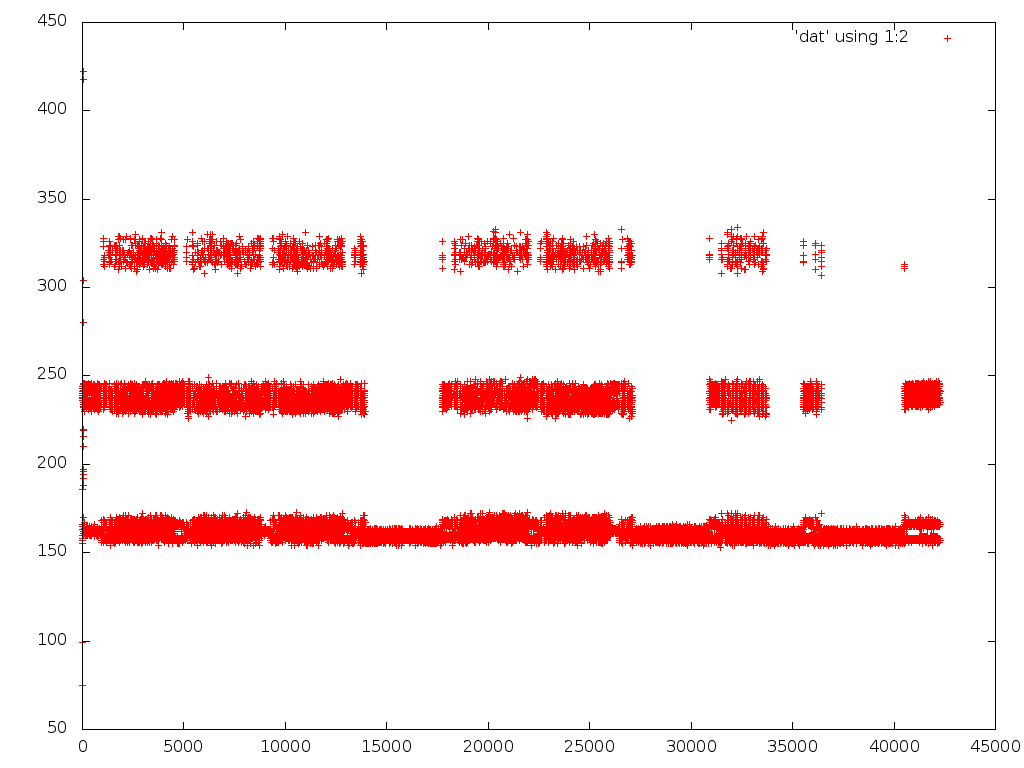
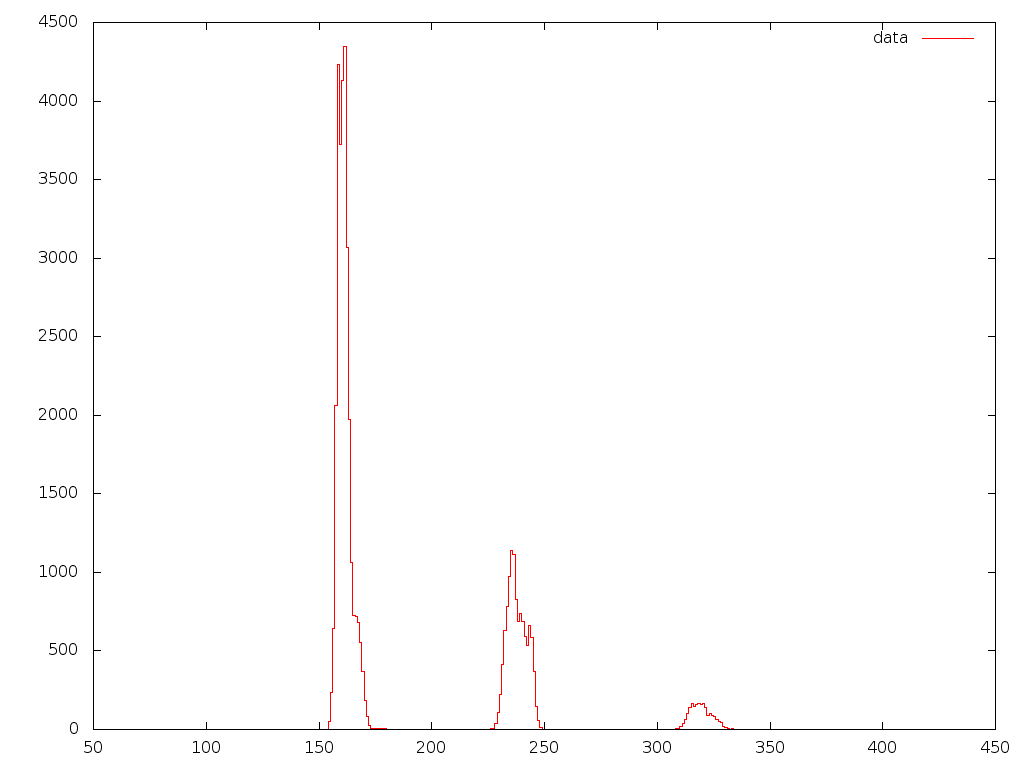
I have -- just this second -- got the standalone, single-board
DiscFerret hardware ("0I06") to image a disc. First, the proof:
Scatter plot:
http://www.discferret.com/temp/dat.scatter.png
Histogram:
http://www.discferret.com/temp/dat.histogram.png
Raw transition data, gzipped space-separated format. First column is
array index, second column is the timing value:
http://www.discferret.com/temp/dat.gz
Rawbinary track dump, gzipped. Most significant bit of each byte is the
status of the INDEX sensor (1=index detected). If (x&0x7f) = 0, then a
counter carry occurred -- the next byte should have 128 added to it.
Repeated counter-carries are allowed.:
http://www.discferret.com/temp/dat.bin.gz
MagScan analyser output for dat.bin:
http://www.discferret.com/temp/dat.magscan.txt
For those of you who have a copy of the sources to my Magdecode decoder
engine (I know I sent it to at least one person on-list...), the
Rawbinary dump should load straight into Magdecode. The space-separated
data can be loaded straight into Gnuplot (which is what I used to
produce the plots), and I suspect MATLAB and Octave can probably load it
too.
The image file was created from an old coverdisc from "PC Zone"
magazine, and is completely undated on the label. The volume label is
"PCZ_OCT_3" which suggests it's from October, with last-modified dates
in February and August 1993. It only covers Track Zero, which (if memory
serves) is the MBR, FAT and Root Directory. The disc is 720K DOS format,
sampled at 40MHz.
Other things to note:
- The hardware works fine at 80MHz, and possibly faster than that. It
should be possible to sample with enough resolution to image a 5Mbps MFM
hard disc.
- There are plenty of spare registers. The new PIC uses 8-bit
multiplexed addressing, which gives 256 register addresses. Only 16 are
in use at the moment (!)
- Write support isn't enabled yet. I need to port this across from
DiscRW and test it (and no doubt rewrite parts of it, as I did with the
reader engine).
Surprisingly, there are only a few minor issues on the 0I06 PCBs:
- C6 is missing a polarity marker. This is a non-issue, as one end
connects to the ground plane and the other quite obviously connects to
+5V.
- Some of the component pads are rather small (notably the inductors
and Schottky diodes in the power supply). This makes it hard to heat
both the pad and the component pin at the same time, and thus makes the
parts a bit of a pig to solder. I worked around this with a hot-air gun,
preheater and solder paste... later boards will have bigger pads.
- The power supply chip is a QFN with pads under the chip. The only
way to solder it down is to use a hot-air gun... unfortunately TI don't
make this chip in a more accessible package, and the only viable
alternative would have nearly doubled the size of the power supply.
Despite these issues, it's perfectly possible to assemble a 0I06 and
have it work perfectly, without any "green-wire" fixes. I'm impressed:
usually a first-spin board needs at least one track-cut and a couple of
green-wires :)
Now here's where you guys come in.
I really don't want to have boxes and boxes of unused boards and parts
hanging around, so I need to know how many people would like to buy a
DiscFerret. These would be available as:
- PCB only
- PCB with the power supply section assembled and tested
- Fully assembled and tested PCB
- Some other form -- feel free to make suggestions!
I'd appreciate it if anyone interested in buying a DiscFerret could
email me at philpem at philpem.me.uk, with one of the following in the
subject line (start, end, on its own, uppercase, lowercase -- anything
will do, my procmail rule is pretty lenient):
- "I want a PCB on its own" -- DISCFERRETBARE
- "I want a PCB with the PSU built and tested" -- DISCFERRETPSU
- "I want the whole thing ready-built" -- DISCFERRETBUILT
- "I want a DiscFerret in some other form" -- DISCFERRETOTHER
Thanks to everyone who has supported the project thus far -- your
thoughts, ideas, comments and criticisms have been very useful!
Now to get my reflow oven working and build some prototypes... :)
Thanks!
--
Phil.
classiccmp at philpem.me.uk
http://www.philpem.me.uk/
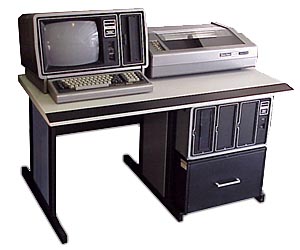
Thanks to the ever-useful JP Hindin, I've obtained a set of TRS-DOS
disks and other application disks for my TRS-80 Model II system, which
is the entire setup pictured here, plus a bit more:
http://oldcomputers.net/pics/TRS-80-II_table.JPG
It's been sitting, covered, pretty much since I obtained it, but now I
can try reviving it and actually seeing what it can do. I'm going to
tear into it and clean the drives and so forth, document what it has,
etc. and then boot 'er up and see what we can see.
I'm looking for a copy of the Technical Ref manual for it; despite
finding scans of the covers and so forth online, I'm unable to actually
locate one. In addition to that, if someone has a Shugart 8" Service
Manual, that might come in damned handy for making sure those are up to
speed as well.
Many thanks,
Nathan
--
-=-=-=-=-=-=-=-=-=-=-=-=-=-=-=-=-=-=-=-=-
Nathan Pralle, Computer Geek
Email: nathan at nathanpralle.com
Web: http://www.nathanpralle.com
Blog: http://www.philosyphia.com
Twitter: http://twitter.com/NathanPralle
-=-=-=-=-=-=-=-=-=-=-=-=-=-=-=-=-=-=-=-=-
Anyone interested in two MaxSpeed MaxStations? One is a SVGA MaxStation
and the other a VGA MaxStation. The SVGA version uses a PS2 kb connector,
the VGA version an AT kb connector. Sorry, no power supplies. These are
free, I'd prefer not to ship, but if I have no local takers then the buyer
to pay shipping costs. I'm in Austin TX. These will go to Goodwill if no
one is interested.
I'm in the very very early stages of shedding the majority of my
collection and this is just the start.
On 2010-11-01 00:02, "Chuck Guzis"<cclist at sydex.com> wrote:
> On 31 Oct 2010 at 11:37, Johnny Billquist wrote:
>
>> > The important question here - are the programs aware of the RA
>> > register, and can they change it? And can they address the full range
>> > of memory addresses as perceived by the program.
> No they aren't. Their memory exists from 0 to whatever the field
> length is, physically and continously. If they need more, a system
> request can expand their field length provided the system has
> sufficient physical memory to accommodate them. There is no way
> (absent perhaps a system request to get that information) for a
> program to know its real physical base address.
Ok. So, a program would think it addressed a memory space, which was
it's own, and the addresses it used would in no way related to the
actual physical memory it ended up referring to.
I'd call that virtual memory.
Although, having to map the whole virtual memory as one chunk to
physical memory makes it a little more work, end less flexible than
having pages. And it pretty much prevents you from ever being able to
share memory in a reasonable way between processes.
>> > Another word for swapping in and out?
> But much older and specific to the architecture and not done in
> pieces as a tranditional VM swap file would be.
Hmm. I don't think swapping is considered to be done in pieces today
either, although swapping is also a term that seems to be defined
differently depending on which OS we're talking about. Unix systems can
both page and swap. Swapping is throwing everything out to disk,
including some kernel structures for the process. Don't happen that
often nowadays... Paging is normally enough.
> I'll take the coward's way out and use the dictionary here:
>
> "1. Existing or resulting in essence or effect though not in actual
> fact, form, or name"
>
> So my definiton of "fooling the user into thinking he has more
> physical memory than he actually has" is certainly valid.
>
> And the VAX sense is also true, but only if one takes along with it
> the ability to over-commit memory space such that the amount of
> addressable memory (i.e. the sum of all users' memory) is greater
> than the physical memory present.
>
> A single task running on a VAX with at least as much physical memory
> as addressing space would not be using the virtual memory facility--
> every bit is reflected in the presence of real memory.
>
> But then, we fall on marshy ground again, when we consider the old
> "roll/swap" multiuser situation. I can run 8 jobs, each requiring
> 65K of memory on a system with 128K physical memory, simply by
> selecting when I give each a time slice and swapping/rolling them out
> as needed. So is that virtual?
Indeed. I remember (not so fondly) running on a PDP-11/70 back in the
80s. The machine was running RSTS/E V7, and the system allows max 63
jobs. We were at times actually 63 users running on that machine, and it
only have 1.5M of memory. It was swapping a lot, and things sometimes
went slow, but it worked perfectly fine. Seeing a machine today with
over 60 users is not common, and I'm not sure it would feel a single bit
more pleasant than the RSTS/E system I used back then...
And I'd still claim that the memory used by each process was definitely
virtual. And I'm willing to continue to fight for that view. Besides,
for the PDP-11, that is what DEC called it. :-)
Johnny
--
Johnny Billquist || "I'm on a bus
|| on a psychedelic trip
email: bqt at softjar.se || Reading murder books
pdp is alive! || tryin' to stay hip" - B. Idol
2010-11-05 23:42, Tom Gardner skrev:
>
> Good eyes!
>
> When I look more closely, it seems that the X and Y lines are under
> the center sections but no cores, ergo, 16 core mats. I'd like to see
> a real one to confirm.
>
> Tom
>
The reason I noticed is that I looked at a core memory board for a
PDP-10 just the other day, it had one half section with missing core. I
could take a picture if you like.
/P
The TEK 4051 is a Graphics Terminal with BASIC in ROM, It used the Motorola 6800 microprocessor. I did a Wikipedia article on the MC6800 and illustrated it with several old advertisements including the first M6800 ad and a Tektronix 4051 ad.
Here is the article
http://en.wikipedia.org/wiki/Motorola_6800
And here is the TEK 4051 ad.
http://commons.wikimedia.org/wiki/File:Tektronix_4051_ad_April_1976.jpg
Michael Holley
-----Original Message-----
From: cctalk-bounces at classiccmp.org [mailto:cctalk-bounces at classiccmp.org] On Behalf Of steve shumaker
Sent: Friday, November 05, 2010 2:37 PM
To: On-Topic and Off-Topic Posts
Subject: Tek 4051 in Austin
Tektronix 4051 functioning system??? Austin C/L #2043597225
looks in fair shape.? supposedly working...?? wants $150 cash and? pick up only
steve
No one seemed to notice this, but I thought I'd post it for Tony's
edification. It's a story in the October 7 EDN from the "Tales from
the Cube" back section and deals with solving a problem with the I/O
board of the HP9845:
http://bit.ly/cNwokC (it's a PDF)
Enjoy,
Chuck
On 11/5/10, Jules Richardson <jules.richardson99 at gmail.com> wrote:
> Dave McGuire wrote:
>> On 11/5/10 2:00 PM, Jules Richardson wrote:
>>> It's a bit more murky than that (albeit a related issue) because a lot
>>> of the bridge boards expect a vendor-specific command to tell them the
>>> drive geometry of the attached drive...
>>
>> MFM- or ESDI-to-SCSI bridge boards (Adaptec ACB-4000, Emulex MD21 if
>> memory serves) are weird to begin with...
>
> I think the Adaptec was one of the most sane boards out there
I do have some experience with a couple of them, primarily the ACB-4000
> IIRC it stores
> the drive geometry on block zero of the drive at format time, then at
> power-on fetches that block back and initialises itself with the loaded geometry.
That sounds somewhat familiar to me, but I wouldn't have been able to
have said that's what it did without looking it up first.
> I can't remember if it just hides the first block from the user, or hides the
> whole track.
I really can't remember that detail - been way too long, but if I had
to guess, I'd guess "block" since I have a fuzzy memory about some
detail about moving, say, an ST225 on and off an ACB-4000 and a
different kind of controller (an XT MFM card most likely, possibly a
WD WX-1 or Everex clone).
> I think the board responds to Inquiry, too (although it just returns "ACB
> 4000" rather than anything to do with the geometry of the attached drives)
That also sounds familiar (having played at the low-level back in my
early Amiga days).
> I've not played with the Emulex boards - I think the only ones I have are
> tape bridges rather than disk.
I have a couple of the Emulex bridging boards from the Sun-3/early
Sun-4 days, but I never had to set them up - they were black (beige,
really ;-) boxes to me. I just stuck them on a Sun box and don't
remember any special fiddling.
> The Xebec and Omti boards seemed reliable, but their SCSI implementations
> were
> a little lacking (one of them I think had the option of a user-supplied ROM
> with the expected disk geometry encoded into it, but it still wasn't "SCSI
> enough" to work with a modern system)
I think I tried to fiddle with an Omti board once but didn't achieve
enough success to use it. One reason I tried was it was a combo
hard-drive/floppy drive model. It would have been handy, but alas no.
It's likely I was running into one of those "almost-SCSI" problems
and lacked sufficient documentation.
Since I moved from PETs and C-64s and small DEC machines first to
Amigas and Macs, then much later to PCs, I was very happy when
embedded SCSI drives displaced all the Adaptec and Emulex and Xebec
and Omti boards - much easier to set up and move from environment to
environment.
-ethan
available for free + postage from 95006:
several partial years of the KayPro focus magazine "Profiles":
Dec/Jan 85 ?Dec 85 (full year)
Jan-Mar 86; Jul 86
Jun ?Jul 87; Sep ? Dec 87
Jan ? May 88
Note that these issues are all available as scanned docs (or will be
shortly) on Gene Buckle's site at www.retroarchive.org. But if you gotta
have an original....
I figured I'd offer them here before they get recycled. mags are in good
shape.
steve
On 2010-11-03 18:00, Ethan Dicks<ethan.dicks at gmail.com> wrote:
> On 11/3/10, B Degnan<billdeg at degnanco.com> wrote:
>> > Here are pictures from the system as I first got it, if it helps with
>> > the card order/comparison purposes. Note that some cards are not
>> > installed in the backplane.
>> > http://vintagecomputer.net/digital/pdp11-34a/before/
> Do you have packs for your RL01 drives? Hopefully the packs were
> removed and the heads locked for transport.
Good point. There is a transport lock for RL drivers, that should be in
place when transported, and which should be remembered to be moved out
of the way when used.
> An 11/34 w/RL01 is a nice little RT-11 system, though it'd be a bit
> cramped for 2.9BSD (both in terms of disk and RAM). You could
> probably also run an older version of RSX-11/M on it too. I think we
> ran something around RSX-11/M 4.0 or 4.1 on ours in the mid-1980s.
You can always get more disk. Easiest would just be an upgrade to RL02
drives...
Also, current RSX-11M would also be happy on that machine, assuming he
has the full 256K of memory.
Once more possibly disk space being an issue, though.
Johnny
--
Johnny Billquist || "I'm on a bus
|| on a psychedelic trip
email: bqt at softjar.se || Reading murder books
pdp is alive! || tryin' to stay hip" - B. Idol
On 2010-11-01 00:02, ard at p850ug1.demon.co.uk (Tony Duell) wrote:
>> > On 2010-10-30 01:12,ard at p850ug1.demon.co.uk (Tony Duell) wrote:
>> >
>>> > >
>>>>> > >> > I have not seen anyone comment any of the other things I listed as
>>>>> > >> > possible firsts on the PDP-11.
>>>>> > >> > Can anyone come up with an earlier machine that used condition codes?
>>>>> > >> > How about general registers with addressing modes, which is totally
>>>>> > >> > orthogonal? How about having the PC as a general register?
>>> > > The Philips P800 series has the PC as a general register (register 0).
>> >
>> > Could you use it like any other register?
> There were some restrictions. I don't think you could shift it (at least
> ont on the P850). But for many instructions it was just another register.
Cool. So you could add to it, index by it, and so on?
>>> > > There are 16 registers, some instructions can only use the first 8, others
>>> > > can use all 16. Addressing modes (simpler than the PDP11, I admit) are
>>> > > pretty much orthogonal.
>> >
>> > Sounds like the registers were atleast not as orthogonally used as on a
>> > PDP-11. If an instruction could take a register, it could take any
>> > register. And all addressing modes are valid (well, almost) anywhere.
> I think all P800 instructions that had addressing modes could use any
> addressing mode. Any instruction with 4-bit register fields could use any
> register. Any instruction with a 3 bit register field could use any of
> the first 8 registers. And IIRC, like the PDP11, the addressing modes
> commonly known as 'immediate' and 'absolute' were a couple of the other
> addressing modes with the register specified as 0 (=PC, of course).
>
> I guess the P800 wasn't totally ortogonal but it was a lot more
> orthogonal than many other machines.
Indeed sounds nice. When did the machine appear?
>>> > > What do you mean by condition codes here?
>> >
>> > The four low bits of PSW.
> Err... I don;t think that's helpful. Quite a lot of machines with a
> status register have a 'low 4 bits' of it:-). But that doens't make them
> condition codes. Similarly uf you hapopen to implement the same
> functionality using other bits of a status registers, doesn't that make
> them condition codes?
>
> What I was asking was what fucntionality do you require of these
> condtiion codes other than there being conditional jumps on carry, zero, etc?
Sorry. I was just being lazy, and trying to explain condition codes by
referring to what they are on the PDP-11.
To try and be more specific then: condition codes are bits that are
set/reset as a result of operations performed by the processed, and upon
which you can the make conditional branches/jumps on.
As opposed to, for example, a PDP-10, where you instead encoded the
condition within the instruction, along with a register to test upon.
Johnny
--
Johnny Billquist || "I'm on a bus
|| on a psychedelic trip
email: bqt at softjar.se || Reading murder books
pdp is alive! || tryin' to stay hip" - B. Idol
There are several pictures of an 8 KiWord H214 Memory Stack posted on the
Internet, for example, see
http://www.conservatique.com/_/rsrc/1251146207239/pdp/pdp-1105/H214-c...
<http://www.google.com/url?sa=D&q=http://www.conservatique.com/_/rsrc/125114
6207239/pdp/pdp-1105/H214-core-plane%3Fheight%3D167%26width%3D200&usg=AFQjCN
GgCgWQk-XDZ2griejhV44yO10CAQ>
At least one DEC manual describes the H214 as having "16 memory mats
arranged in a planar pattern" but the photo referenced above (and many
others) show 20 memory mats arranged in a two x ten planar pattern.
Two by ten is a very strange array for a machine that has a 16 bit word or
18 bits in one with the byte parity option.
Can anyone explain what is going on?
Tom
Note this is also posted to alt.sys.pdp11
<http://groups.google.com/group/alt.sys.pdp11>
On 2010-11-01 18:00, Ethan Dicks<ethan.dicks at gmail.com> wrote:
> On Sat, Oct 30, 2010 at 6:51 AM, Johnny Billquist<bqt at softjar.se> wrote:
>> > On 2010-10-30 01:12, Ethan Dicks<ethan.dicks at gmail.com> wrote:
>>> >> I know it works well enough in early Sun workstations and the AT&T
>>> >> Unix PC (3B1/7300), but I have no knowledge of any required
>>> >> workarounds due to possible bugs.
>> >
>> > Yes, the 68010 worked fine with demand paging. The 68000 did not.
>> > Neither of them implemented instructions restarts, though. As noted below,
>> > the 68010 did instuction suspension instead.
> Yes. I was previously unaware of the distinction but did know what
> the 68000 could not do that the 68010 could.
We were at the same level, then. :-)
>> > The "interesting" workarounds that I've hear of are actually 68000-related...
>> > Using their own designed MMU (there were none from Motorola for the 68000),
> What about the 68451? (we had one in a prototype product design in
> 1984/1985 that never made it to market)
>
> It wasn't terribly popular, but it did exist.
Tried to look it up on the net, and I'm unsure if it really was usable
on the 68K. It would appear that it did hit the market, and if you had a
68010 in combination with this chip, you could implement virtual memory,
since you could recover from page faults.
However, there were also third party MMUs competing with the Motorola
chip, which might explain why it was rather uncommon.
Performance wise, the 68010 in combination with the 68451 appear to not
have been that impressive.
>> > and a second CPU, Apollo made the primary CPU stall on a page fault, and the
>> > secondady CPU wake up. The secondary CPU could then do a page in...
> That sounds like the design of the Perkin-Elmer workstation I have -
> two 68000s, one for running the OS, one for paging.
I wouldn't be surprised to learn that SUN did something similar as well...
Johnny
--
Johnny Billquist || "I'm on a bus
|| on a psychedelic trip
email: bqt at softjar.se || Reading murder books
pdp is alive! || tryin' to stay hip" - B. Idol
Hi,
I still have :
An Octane
Sun Blade 2000
Dell Itanium blade (Heavy)
2 x Dual machine blade sparc machines
I hate to do this but if they are not claimed by Monday they will have
to be thrown out.
I have also found a processor card still in it it's box for a Vax
4000/500 if anyone is interested.
Dan
The remains ( mostly just the PCB's ) from an early Fairchild Sentry test system were junked today.
The PCB's are brimming with early ( 1974 datacodes ) Fairchild TTL ic's. ( (9xxx and 93xx )
Also ECL of course, but I don't do that !
Any worth looking for, in particular w.r.t. to keeping old PDP's running ?
Jos Dreesen
I posted not too long ago looking for a framebuffer driver that seemed to be missing from the Solaris distributions I have for my Voyager. Well, I finally opened up the machine and found something quite unexpected.
I had assumed (as had others, according to statements) that the color and monochrome components (screen and framebuffer) would be physically incompatible, so it would be impossible to mix and match. *Wrong!* In fact, I found I have a color framebuffer, which was talking to the monochrome screen. What's really strange is that OpenBoot seems to have created a new name - bwthree - to describe the framebuffer!
I don't suppose anyone has a monochrome framebuffer with which you might be willing to part company? Or perhaps a color screen? -- Ian
UNIX is user friendly. It's just selective about who its friends are.
Ian S. King, Sr. Vintage Systems Engineer
Vulcan, Inc.
http://www.livingcomputermuseum.org
Finally, you can run a PDP-11 on OS/2, even if you can't run OS/2 on
your PDP-11.
---------- Forwarded Message ----------
Subject: Ersatz-11 V6.0 PDP-11 emulator
Date: Wednesday 03 November 2010
From: John Wilson <wilson at dbit.com>
To: Info-PDP11 at dbit.com
...
- OS/2 version. "Finally!" I hear you say. OK I know
there isn't much overlap between the OS/2 crowd and
PDP-11 folks, or between the OS/2 crowd and anyone,
really -- but *I* like it better than Windows, so there.
YOU don't have to use it! OK OK, just let me breathe.
--
Purdue University Research Computing --- http://www.rcac.purdue.edu/
The Computer Refuge --- http://computer-refuge.org
Date: Wed, 3 Nov 2010 13:52:40 -0400
From: David Ryskalczyk <d235j.1 at gmail.com>
Subject: Re: Information about Tektronix 4107A/4109A graphic terminals
> A little OT but speaking of vintage Tek: I have a bunch of their Service
> Scope 'magazines' from the late 60's; can I assume that these exist
> elsewhere and I can dispose of them if and when?
>
> mike
>
Have you checked BAMA? http://bama.edebris.com/manuals/
I'd offer to scan them (I have an Epson GT-15000 scanner with ADF) but
an currently overloaded with DEC documentation to do.
--Dave
++++++++++++++++++++++++++++++++++++
Didn't see anything there, but it looks like they're available on CD, so no
sweat. Going to read 'em first anyway before I throw 'em out; some
still-relevant interesting tips in those old magazines.
mike
On 4 Nov 2010 at 9:39, Jerome H. Fine wrote:
> TI ASC???
TI's Advanced Scientific Computer. The only reason I was aware of
the ASC (and Burroughs' BSC) was because of some proprosal-writing I
did for ECMWF (European Centre for Medium-Range Weather Forecasting)
proposal. We didn't get the contract, but part of your "homework" was
to become familiar with competitors' products.
>From my often-faulty memory, the ASC was roughly based on the IBM
S/360 instruction architecture with a rather arcane (at least it
seemed so to me) vector box. 32 bit single-precison/64 bit double-
precision with the S/360 style (8+24, normalized to 4 bits) floating
point representation.
I just did a check and there's some stuff on Bitsavers on it.
However, I don't see anything on the BSC there.
When we talk today about selling thousands and millions of systems,
it was a very different world where vast amounts of money and
manpower were put into the hope of selling 10 systems worldwide.
One aspect of these supercomputers that's often overlooked is the
amount of R&D that goes into peripherals to keep these things fed.
TI had a special horizontal-spindle disk drive; STAR had some work
done on a super-speed drum and a very wide tape-used-as-movable drum
called SCROLL. I don't think that CDC's EBAM was ever considered for
STAR (maybe early on), though I do recall seeing a rack of EBAM units
sitting in the hall at ADL.
By then, Jim Thornton had moved on to other things and was trenching
around the parking lot at Arden Hills, burying coax for his 50Mbps
network experiments.
--Chuck
On 2010-10-29 19:00, "Chuck Guzis"<cclist at sydex.com> wrote:
> On 29 Oct 2010 at 0:11, Johnny Billquist wrote:
>
>> Next question: Does the VAX not have virtual memory any more now that
>> I've pointed this out? Or do you need to redefine virtual memory in
>> yet a new and strange way to exclude the PDP-11... :-D
>
> I think that using memory address spaces to qualify the "virtualness"
> of memory is following the wrong animal.
I think that virtual address space is intimately connected to virtual
memory, and you cannot have one without the other.
If your program vrites data to address 0, and reads it back, and get the
same data back, and another program on the same machine, at roughly the
same time, write to address 0, and reads the same data back, and that
data is different than the first programs data, then I'd say you have
virtual memory.
> I would define "virtual memory" as the ability to fool a program into
> thinking that it has more physical memory than is actually present.
> So, can a PDP-11 with 16K of memory appear to a program as if there
> were 32K present?
Certainly. If we just disregard that the code needed to implement this
thing might need more memory than 8K. The program that we intend to fool
must have atleast 8K of physical memory, to which we can read in and out
pages. With 16K that would leave just 8K for out demand paging software...
Well, actually, this is a bit too simplified. An instruction can
potentially refer to 4 pages, so we would need to be able to have four
pages to be able to fully fool a program. That would mean minimum 32K of
physical memory to use for the user program. And then some for your
kernel. But you'd probably be able to come in under 56K, while fooling
the program that is has 64K. With less than four pages, you could get
into a situation where mapping in one page means you have to map out
another, which the instruction refers to, and when you restart the
program you'll just get another page fault, ad infinitum... :-)
Johnny
--
Johnny Billquist || "I'm on a bus
|| on a psychedelic trip
email: bqt at softjar.se || Reading murder books
pdp is alive! || tryin' to stay hip" - B. Idol
Good morning / afternoon / evening people.
For long enough now my PDP 11/70 (decdatasystem 570) has sat around
without the side panels ('skins') or the lower front cover (the long,
usually blue panel with the air vents).
Can anybody assist with clothing this magnificent beast? I ask now because
I _had_ a 11/60 cabinet for this purpose reserved with a dealer, but they
scrapped it a few weeks ago (just when I wanted to collect it).
I'm in the UK by the way before people read too far. In the north
actually, but am very willing to travel for the right bits. Cash waiting,
if thats what you want.
According to the 11/60 document MP00166 (the 11/60 in this case being
housed in the same H9504 high-boy corporate cabinet), the part numbers are
as follows:
Side skins: H9504-CA
Front cover: H9504-Rx (x denotes the colour / logo config but I'm not
bothered... it can be resprayed)
If somebody had the whole cabinet, I have a trailer!!
The side panels can also be found on many expansion cabinets / tape
systems (for example they are used on my TS11) and, by the looks of it,
early VAX.
I'd be very appreciative if anybody can help me out. Condition is really
unimportant as I have a paint sprayshop handy.
Thanks in advance!
..Adam..
Was there ever such a thing as a 74x00 series LED driver that did proper hex
decoding and not simply BCD? I can't seem to find that there was.
The topic of why split octal was used on some early micro-computers came up
on a list. After doing a search for a TTL LED driver that does hex, the
answer is probably that there were no single chip option for hex displays.
Split octal was just easier.
This kind of joins in with the TIL311 discussion. It was a TTL compatible
hex display, but expensive at the time.
-chuck
Watts Humphrey, known as the "father of software quality testing" died a
few days ago. He was 83.
Watts was a keynote speaker at VCF East 5.0 (two years ago.) He worked
on the MOBIDIC ("Mobile Digital Computer") and on the Fieldata spec
(which became ASCII), and which both happened at the Army base that's
now our museum.
Favorite story that I enjoy telling: Watts explained how, when MOBIDIC
was finished and mounted in its 30-foot truck (late 1950s), the Army
insisted on testing it like any other military vehicle. So they drove
the computer-truck to the Aberdeen Proving Ground. On two test laps,
the computer itself came through with flying colors both times. Also on
both laps, the truck broke down!
Here are some obituaries:
Press release -- http://tinyurl.com/2fwdu27
Carnegie Mellon -- http://www.sei.cmu.edu/watts/
SD Times -- http://tinyurl.com/243shql*
*
Anyone out there have one of these? I have one of each, but one is
broken and has an incomplete set of ROMs (which appear to be one of
the early versions -- maybe 1.0!). I do have a complete set of version
8.2 ROMs, dated 1985.
Someone posted photos of a 4107A a while ago at
http://picasaweb.google.com/glen.slick/Tektronix4107A#5300179266366767714
.
The 4109A we have is fully intact, but the 4107A has front panel
damage. Also, we're not sure whether or not we have keyboards and
mice.
Any information, including owner's and service manuals, would be
greatly appreciated.
--Dave
On 11/3/10, B Degnan <billdeg at degnanco.com> wrote:
> I don't want to hijack this thread except to say that I too just got an
> 11/34 last week. I still need to clean it and learn more about what it
> was set to do, but I have a quick question about the front panel. My
> system has a flat front panel without the white cover cut out resembling
> a mirror image of the US State of Delaware on it's side. My system has
> a black front panel with a white rectangular frame around it instead.
> What is the origin of this variation?
I have never seen that mounting frame for the front panel, but perhaps
it's related to your "DEC DataSystem" cover panel.
Here's a photo I found googling around for "DEC Datasystem"
http://www.compuseum.at/portal/Computers/PDP1134/tabid/93/language/en-US/De…
> Here are pictures from the system as I first got it, if it helps with
> the card order/comparison purposes. Note that some cards are not
> installed in the backplane.
> http://vintagecomputer.net/digital/pdp11-34a/before/
Do you have packs for your RL01 drives? Hopefully the packs were
removed and the heads locked for transport.
An 11/34 w/RL01 is a nice little RT-11 system, though it'd be a bit
cramped for 2.9BSD (both in terms of disk and RAM). You could
probably also run an older version of RSX-11/M on it too. I think we
ran something around RSX-11/M 4.0 or 4.1 on ours in the mid-1980s.
-ethan
>
>
>> >
>> > I am the new keeper of the PDP-11/34A that Jack Rubin rescued a while
>> > ago and wrote about here,
>> >
>> > http://decpicted.blogspot.com/2010/01/pdp-1134a-data-systems-design-dsd-880…
>> >
>> > I took it on a road trip from Chicago back to St. Paul after VCFMW
>> > in September.
>> >
>> > I've been doing a lot of cleanup on it and finally got to the point
>> > where I could power it on (just the CPU box) this weekend.
>> >
>> > I think now I need to learn about Grant Continuity ;-)
>>
>
>
I look forward to reading more about this.
I don't want to hijack this thread except to say that I too just got an
11/34 last week. I still need to clean it and learn more about what it
was set to do, but I have a quick question about the front panel. My
system has a flat front panel without the white cover cut out resembling
a mirror image of the US State of Delaware on it's side. My system has
a black front panel with a white rectangular frame around it instead.
What is the origin of this variation?
Here are pictures from the system as I first got it, if it helps with
the card order/comparison purposes. Note that some cards are not
installed in the backplane.
http://vintagecomputer.net/digital/pdp11-34a/before/
Bill
Date: Wed, 3 Nov 2010 00:31:49 -0500
From: Randy Dawson <rdawson16 at hotmail.com>
Subject: RE: Information about Tektronix 4107A/4109A graphic terminals
Hi David,
Eiter I or Ed may be able to help - I know I have a few 4000 series manuals.
Ed runs VintageTek, a Tektronix museum here in Beaverton:
vintagetek.org
We are meeting Thursday for the bi-weekly run at the Tek Surplus store, I
ask to see what he has available.
Randy
+++++++++++++++++++++++++++++++++++++++++++++++
A little OT but speaking of vintage Tek: I have a bunch of their Service
Scope 'magazines' from the late 60's; can I assume that these exist
elsewhere and I can dispose of them if and when?
mike
> > I have never seen that mounting frame for the front panel, but perhaps
> > it's related to your "DEC DataSystem" cover panel.
>
> I've seen that sort of frame a couple of times; they were used in
> (possibly among other things) embedded applications. It's been a long
> time but I think I saw them in big GenRad board testers.
>
> > Here's a photo I found googling around for "DEC Datasystem"
> >
> >
http://www.compuseum.at/portal/Computers/PDP1134/tabid/93/language/en-US/Def
ault.aspx
>
> Hey, that looks just like the rack my 11/70 is in.
>
That could explain the original purpose of the 11/34 in my possession, the
rack that the system came in has a DEC DataSystem panel:
http://vintagecomputer.net/digital/pdp11-34a/before/2010-10-27_20-42-43_160.
jpg
Bill
> So they're 10 sector 5.25" floppies. Vector Graphic maybe?
>To the best of my recollection, the VGs were 16RH, not 10. To which end
>I asked Dwight if a 16 hole model might be feasible.
>De
The two Heathkit / Zenith HZ89s that I have both have hard-sectored 5.25? floppy drives. I successfully made some new disks up when I got them (circa 1991) by making a paper template from an original hard-sectored disk and punched holes in soft-sectored disks using a pencil. It worked but the disks are noisy due to ?burrs? around the holes catching on the sleeve inside the envelope.
Robin
Wondering if you still have a manual for the science fair 200 in one kit. I
have an old kit in great shape but no manual and I'd like to have it for
the kids. Thanks Pete. Pkamphues at gmail.com
The Nuclear Data ND 6600 was some sort of laboratory PDP-11 setup. I
have a terminal from such a system (very nice green keyboard). I'll
upload some pics this week.
However, while I was packing up the stuff I bought at the vendor's
store, I saw that he had the rest of the system and not just the one
terminal. Looks like a couple other terminals, some
characteristically PDP-11 enclosure boxes (2x floppies, some other
stuff, power enclosure). It looks like this stuff was meant to be
rack mounted, except for the terminals, because there's no typical DEC
enclosure like I would expect.
Googling doesn't turn up anything useful except the usual firewalled
citations from IEEE and ACM journals containing product announcements.
Does anyone know more about these systems? From the descriptions that
leak through google, it appears that it might have had some graphics
capability and that interests me quite a bit. I couldn't look at the
system close up because it was on a huge pile of stuff and I didn't
have time to dig it out.
--
"The Direct3D Graphics Pipeline" -- DirectX 9 draft available for download
<http://legalizeadulthood.wordpress.com/the-direct3d-graphics-pipeline/>
Legalize Adulthood! <http://legalizeadulthood.wordpress.com>
Hi guys,
I've just acquired a pair of 3-inch Amstrad floppy drives, apparently
>from a CPC (they're fitted with black faceplates). One is an EME-231,
the other is apparently an EME-156 (someone's blanked out the model
number with a Sharpie).
Problem is, the 156 has a snapped drive belt, and the 231 belt feels
REALLY loose.
(They also look like they've been stored in a dusty box for a few years,
but that's a problem for later...)
Does anyone have a couple of spare belts for these, or a lead on a
source who'll sell me a couple of them without wanting to charge me some
silly amount of postage on top?
Thanks,
--
Phil.
classiccmp at philpem.me.uk
http://www.philpem.me.uk/
Date: Tue, 02 Nov 2010 15:53:01 -0700
From: Al Kossow <aek at bitsavers.org>
Subject: Re: surplus source for MRA connectors?
On 11/2/10 3:14 PM, MikeS wrote:
> I'll see what there is.
>
Thanks!
The connectors were quite common at one point. I was frustrated when I ran
around to the
usual Bay Area surplus places and found almost no Winchester connectors or
pins
anywhere. There are almost none on eBay, either. Looking for a connector
there is a real
nightmare there, trying to guess how someone would list them.
++++++++++++++++++++++++++++++++++++++
Sorry, Al; found some Winchesters and some Continentals that look
compatible, but only 34, 50 and 75 contact versions, no 42s.
Hope Will has some for ya.
mike
> Looking for a connector there is a real
> nightmare there, trying to guess how someone would list them.
The very broad term for this style is "rack and panel". 50-way is an
industry standard (at least in my industry! We have them by the tens
of thousands) but I don't know about any multi-sourced 42-way.
Tim.
All,
I'm trying to evaluate a pile of large MFM hard drives for functionality.
I'm attaching them to a WD-1006V-MM2 controller and running Sprinrite 4
under DOS 6.0 (using a 486 EISA motherboard).
This works fine for drives with < 1024 cylinders, but I cannot seem to
remember (or figure out) how to surface-test drives with more cylinders
(e.g. Priam V185 with 1166).
How do folks on the list test these beasts? I've seen SCSI controllers
and ESDI controllers with CHS translation, but that feature does not seem
to be available on the MFM adapters.
Steve
--
Date: Tue, 02 Nov 2010 10:27:45 -0700
From: Al Kossow <aek at bitsavers.org>
Subject: surplus source for MRA connectors?
In particular, the MRA42P solder cup 42 pin "winchester" plug for
Diablo 31 disk drives.
parts scalpers are asking $75 ea, and have made web searching useless
looks like on-line surplus store catalogs have all but disappeared
++++++++++++++++++++++++++++++++++++++++++++++
Well, by one of those serendipitous coincidences only yesterday I was
looking at a rat's nest of cables including some with MRA connectors (mostly
only one gender of course, so not much use), wondering whether it was worth
cutting off the connectors and trying to get a few bucks for the copper or
whether to just toss it all into a dumpster somewhere. I'll see what there
is.
mike
Date: Tue, 02 Nov 2010 11:06:31 -0700
From: "Chuck Guzis" <cclist at sydex.com>
Subject: Re: TTL HEX LED driver chip
On 2 Nov 2010 at 13:33, MikeS wrote:
> There's that ubiquitous string instrument again (I guess if it were a
> girl's name it'd be in caps?), mysteriously in reference to a
> hexadecimal display this time...
I've long wondered if the Germans exclaim "Bratsche!"
--Chuck
(not giving in to repeating a very long list of viola jokes)
++++++++++++++++++++++++++++++++++++++
Well, it'd have to be "Bretscha", wouldn't it?
And for those who wonder why it's called a "Bratsche" or just need a viola
joke fix after that:
http://www.mit.edu/~jcb/viola-jokes.html
m
Date: Tue, 2 Nov 2010 14:22:48 -0400
From: Dan Roganti <ragooman at gmail.com>
Subject: Re: TTL HEX LED driver chip
On Tue, Nov 2, 2010 at 2:06 PM, Chuck Guzis <cclist at sydex.com> wrote:
> On 2 Nov 2010 at 13:33, MikeS wrote:
>
>> There's that ubiquitous string instrument again (I guess if it were a
>> girl's name it'd be in caps?), mysteriously in reference to a
>> hexadecimal display this time...
>
> I've long wondered if the Germans exclaim "Bratsche!"
>
> --Chuck
> (not giving in to repeating a very long list of viola jokes)
>
isn't this attributed to deep seeded oppression of diodes versus just a typo
;)
++++++++++++++++++++++++++++++++++++++++++++++++
Aw come on now, that's not fair!
I think I can speak for Chuck as well when I say unequivocally that although
we may have inadvertently stepped on and crushed (or exceeded the PIV of)
one or two we have never oppressed a single diode in our entire lives,
whether deep seededly (sic) or not; as a matter of fact I love the little
buggers, silicon or germanium, Schottky or not, high power or low power and
all powers in between, equally and without prejudice, and have assembled
many little teams of them in matrices on the outputs of a demux chip to
solve problems like this in a simple, straightforward, low power (and cheap)
way.
mike
In particular, the MRA42P solder cup 42 pin "winchester" plug for
Diablo 31 disk drives.
parts scalpers are asking $75 ea, and have made web searching useless
looks like on-line surplus store catalogs have all but disappeared
Date: Tue, 02 Nov 2010 06:36:07 -0700
From: "Chuck Guzis" <cclist at sydex.com>
Subject: Re: Amstrad 3in drive spares
>A word of caution here--observe that the 4-pin power connector looks
exactly like a standard 3.5" conector, but the +12 and +5 leads are
interchanged. If you try to use a power connector wired for a 3.5"
drive, you'll make magic smoke.
+++++++++++++++++++++++++++++
WHOA! Now that's a pretty harsh way of making sure folks only use your
proprietary drive...
Date: Tue, 2 Nov 2010 09:03:41 -0400
From: Dan Roganti <ragooman at gmail.com>
Subject: Re: TTL HEX LED driver chip
<snip>
>But I like the last solution even more, 2 chips, 74247, 74138, transistor
>inverter, a few diodes, viola !
++++++++++++++++++++++++++++++++++++++++++++
There's that ubiquitous string instrument again (I guess if it were a girl's
name it'd be in caps?), mysteriously in reference to a hexadecimal display
this time...
;-)
Haven't tried looking for this in a while, maybe one has shown up somewhere
AMS 315 14" 300mb winchester service manual (circa 1982) preferably with Trident
interface (SMD was more common)
I'll be putting up the product manual and brochure for it on bitsavers today
>So I have these 2 PDP-8/L core stacks I am trying to recover:
> Is there any realistic way of getting one fully functional stack out of
> these ?
>
I assume the 8/L core stack is the same as the 8/I. Its made up of 3 core
plane boards and the 2 diode boards. If you can figure out if one of
the planes in the really bad stack seems good you could swap it with the
other stack.
>One would be perfect, if bit 3 @ adr 0 would be alive...
>
If you haven't you may want to check memory current and strobe timing to see
if its totally dead or can be adjusted back to working.
On 2010-10-27 06:20, William Donzelli<wdonzelli at gmail.com> wrote:
>> > 1.> The PDP-11 was in architectural ways more important than the VAX, if
>> > ?> nothing else than just because the VAX was basically just extending the
>> > ?> PDP-11.
> Just to throw another question into the fire:
>
> Just how important was the PDP-11 or VAX-11/780 hardware architecture
> in the grand scheme of things? Did either machine really bring
> anything new to the table?
I honestly don't know.
The PDP-11 have been attributed with the common I/O and memory bus
(Unibus), with memory mapped I/O as well as the concept of condition
codes. Also the general registers with a nice set of addressing modes to
use on them. And we should probably not forget having the PC as just a
general register (although few, if any, picked that one up). So the
PDP-11 can be used as a accumulator-based machine, a memory-memory based
machine, or a stack based machine. It's possible to implement all
concepts found in architectures at that time easily on the PDP-11.
The basic PDP-11 architecture was deigned so that if an instruction took
an argument, any kind of argument was equally valid.
But as usual, the question is: was really the PDP-11 first with these
things, or can you find earlier examples?
Johnny
--
Johnny Billquist || "I'm on a bus
|| on a psychedelic trip
email: bqt at softjar.se || Reading murder books
pdp is alive! || tryin' to stay hip" - B. Idol
Date: Sun, 31 Oct 2010 14:22:35 -0400 (EDT)
From: "O. Sharp" <ohh at panix.com>
Subject: Re: Repairing core memories....
On Sun, 31 Oct 2010, Jos Dreesen wrote:
> So I have these 2 PDP-8/L core stacks I am trying to recover:
>
> One would be perfect, if bit 3 @ adr 0 would be alive...
> Although this is 99.99% OK, it is of course not good enough.
<snip>
I suspect I'm not the only one on the list who:
-thinks opening up a core-stack and repairing it is
theoretically possible;
-also thinks it would be a hell of a daunting project;
-is somewhat amazed at the dexterity and patience of the people
who originally hand-wired them at manufacture; and
-thinks pulling off a repair of a core-plane by rewiring it by
hand would give significant bragging rights. :)
-O.-
+++++++++++++++++++++++++++
Agreed ;-)
But if anybody does want to, I've got a small (220x16) MDS (Fabri-Tek) core
plane with an already damaged section, cut-off edge connectors etc. to
practice on; for even more fun I could even throw in a few of two different
sizes of raw cores...
mike
Trying to get back into the scanning groove - got shelves of manuals
that need to become bits instead of paper. These two aren't going to
burn up the Internets but they're now merged with the digital
infinite:
Land Innovation Site Computation and Design for HP 86/87:
http://chiclassiccomp.org/docs/index.php?dir=%2Fcomputing/LandInnovation
An unknown, unsourced disassembler dump of the SOL20 boot ROM:
http://chiclassiccomp.org/docs/index.php?dir=%2Fcomputing/ProcessorTechnolo…
Neither of these were original documents and were in somewhat bad
shape, so the originals are out the door. Other stuff I'm scanning I
will keep as relics, but most will be offered up (most for free) after
they're scanned.
-j
--
silent700.blogspot.com
Retrocomputing and collecting in the Chicago area:
http://chiclassiccomp.org
Hi
Can anyone provide:
1) The dimensions of the memory plane from the Type 738 Memory used in the
IBM 704 and other computers of its generation. There is an undimensioned
photo in Pugh's "Memories That Shaped An Industry" C 1984 (p.158) that makes
a 4 KiB plane look to be about 14 in by 7 in. A high quality photo would be
appreciated. I can send anyone a scan if they care.
2) A photo and dimensions of the M4I memory plane (that's M4eye not M4one)
that was used in the System 360 M65 and M70. The Computer History Museum
has an artifact identified as a, Magnetic Core Plane, IBM /360 Model 65,
http://www.computerhistory.org/collections/accession/102627815, but it looks
too small and too crude to be for those machines. I could be wrong so I
would appreciate someone who could verify the artifact or alternatively the
correct photo and dimensions. Pugh is unclear but he does imply a much
larger frame.
This is for a web exhibit I am preparing for the Computer History Museum
Any help would be appreciated.
Thanks
Tom
Hi,
I am on the lookout for a monitor something similar to a Phillips
cm3388 does anyone near London have one they would like to sell or
trade, or know of anywhere I could get one.
Thanks
Dan
So I have these 2 PDP-8/L core stacks I am trying to recover:
One would be perfect, if bit 3 @ adr 0 would be alive...
Although this is 99.99% OK, it is of course not good enough.
The other stack seems to be a total loss :
2 sense wires are open circuit, more than 20 select diodes shorted. Of course the further quality of the cores is unknown.
Is there any realistic way of getting one fully functional stack out of these ?
Removing a single core from the really bad stack to the almost OK stack would seems almost feasible to me, since address 0 is bound to be on a edge of a core mat.
Any ideas / suggestions ?
Jos
Hello,
As I still can't reach the classiccmp web site - are there mirrors anywhere?
(I have the same problem with bitsavers.org, luckily most mirrors works)
HAND
--
Regards,
Torfinn Ingolfsen
On 2010-10-30 01:12, Ethan Dicks<ethan.dicks at gmail.com> wrote:
> On Fri, Oct 29, 2010 at 2:26 PM, Brent Hilpert<hilpert at cs.ubc.ca> wrote:
>> > On 2010 Oct 29, at 10:39 AM, Ethan Dicks wrote:
>>> >>
>>> >> That all depends. ?Back in the day, what we did was not demand-paged
>>> >> virtual memory (something supported natively on the VAX and the 68010
>>> >> (but not effectively on the 68000)... (which is part of what
>>> >> distinguishes the 68010 from the 68000 - instruction restart).
>> >
>> > There have been a couple of indications it was the '10 that added the
>> > instruction restart, but was the implementation in the '10 bug-free?
> I know it works well enough in early Sun workstations and the AT&T
> Unix PC (3B1/7300), but I have no knowledge of any required
> workarounds due to possible bugs.
Yes, the 68010 worked fine with demand paging. The 68000 did not.
Neither of them implemented instructions restarts, though. As noted
below, the 68010 did instuction suspension instead.
The "interesting" workarounds that I've hear of are actually
68000-related. As the 68000 could not do instruction restarts, people
originally through you couldn't use it in demand paging systems.
However, I think it was Apollo (but it might have been some other
company) did come up with a solution.
The 68000 could not restart an instruction, nor suspend them and later
resume. However, you could stall the processor indefinitely.
Using their own designed MMU (there were none from Motorola for the
68000), and a second CPU, Apollo made the primary CPU stall on a page
fault, and the secondady CPU wake up. The secondary CPU could then do a
page in. Once the page was available, the primary CPU was allowed to
continue.
(One alternative version of the design that I heard was that the
secondary CPU would run in parallel with the primary, but slightly
behind, so that it could be interrupted before starting to execute the
instruction causing a page fault, and then you'd have the saved state
before the page fault in the secondary CPU, but I don't think that this
is a plausible design).
>> > I didn't deal with the problem directly, heard about it from some friends
>> > who were programming around it, and it would have been 1989, so long after
>> > the 00->10 transition. My recollection about the issue was there was a bug
>> > under certain conditions that was fixed in the next version, as distinct
>> > from a 'new feature', but perhaps it was just the way the problem was
>> > described to me or the way I understood what was being said.
> I have no memory of issues with instruction restart on the '10, but I
> didn't use that feature of the chip when I was doing embedded product
> development 20+ years ago (we only used it for the "loop mode"
> 1-instruction cache feature that allowed so-called "DBcc loops" to run
> ~50% faster due to not needing fetch cycles while in the loop).
>
> Could what you remember be something to do with "instruction restart"
> vs "instruction continuation"? (a distinction I was not making, but
> now that I've read this -
> http://www.easy68k.com/paulrsm/doc/dpbm68k1.htm - perhaps that's a
> better way to describe it).
They are two different things, yes. But they serve the same purpose.
It's just different ways of dealing with what to do after a page fault
(or any trap from which you want to recover).
The advantage of instruction continuation, especially with the 68010, is
that it didn't introduce any incompatibilities with the 68000. If you
had implemented instruction restarts instead, you would have had to
introduce a bunch of new registers in the CPU that kept track of partial
modifications done before the trap, so that you could undo them before
restarting the instruction. With instruction continuation, it's all
preserved internally in the CPU without exposing the software to
anything new.
Johnny
--
Johnny Billquist || "I'm on a bus
|| on a psychedelic trip
email: bqt at softjar.se || Reading murder books
pdp is alive! || tryin' to stay hip" - B. Idol
Can anyone provide an electronic copy (or link) to the DEC publication,
EK-M9312-TM-002 M9312 Bootstrap-Terminator Module Technical Manual? The
previous link at http://www.computer.museum.uq.edu.au/unfinished/ no longer
seems to work.
Thanks,
Jack
It's been a week since VCFMW and now we've got some galleries to
display! You can find them at vcfmw.org. I have video from the
abortive uStream broadcast that I still need to chop up (it made a
2.8gb .flv file!) but will post as soon as I can. I'm not at all
happy with the video or audio quality, so different methods will be
employed next year.
We still have a stock of shirts remaining. The design can be seen here:
http://picasaweb.google.com/Silent700/VCFMW50OfficialGraphics#5512512730455…
If anyone would like one, they are $15 incl. shipping in the US (talk
to me if you're international.) Here are the sizes we have left (you
can tell which we'll order more and less of next year :) Same yellow
design on black or Navy-Blue Gildan pre-shrunk cotton shirts:
Blue M: 2
Black M: 1
Black L: 11
Black XXL: 8
Blue XXL: 3
Blue XXXL: 2
Thanks and see you next year!
-j
Date: Sun, 31 Oct 2010 12:47:06 -0500
From: "MikeS" <dm561 at torfree.net>
Subject: Re: cctalk Digest, Vol 86, Issue 68
-----------------
Sorry about that (sending the digest); no idea how that got sent, will make
sure it doesn't happen again.
Humbly apologetic,
mike
On 2010-10-30 23:18, Brent Hilpert<hilpert at cs.ubc.ca> wrote:
> On 2010 Oct 30, at 12:34 PM, Dave McGuire wrote:
>
>> > On 10/30/10 1:08 PM, Chuck Guzis wrote:
>>> >> Aside from expanding program storage, the large addressing space was
>>> >> used to map file space (another type of "memory-mapped I/O"), so file
>>> >> access was actually performed through the paging hardware/software.
>>> >> That was kind of cool, as the STAR was a memory-to-memory vector
>>> >> machine, so you could use vector instructions on entire files, rather
>>> >> than have to issue reads and writes for pieces of a file.
>> >
>> > That functionality is in use all over the place today as mmap(),
>> > accessing files as if they were memory, pushing the read/write burden
>> > out into the VM system. It's extremely effective.
> I remember in the 80's (programming primarily on BSD (and VMS))
> thinking it would nice to have that functionality, how easy it would
> make a lot of file-access programming, and that it would be easy to add
> on a VM system. Of course, I was in ignorance of the prior histories
> such as the STAR that Chuck mentions. A few years later a friend would
> tell me about the new mmap function in unix.
This might very well be totally wrong, but I remember hearing about it
at the time, that Sun (who I believe was the ones to first implement
mmap()) bascially took the whole TOPS-20 concept and translated it to
Unix. A bit surprised no TOPS-20 hackers have spoken up yet... This was
around for a long time on the PDP-10 before this.
Not sure how it correlates timewise to CDC and the STAR though.
But no matter if Unix took it from TOPS-20 or not, there is no denying
that TOPS-20 had this a long time before it came to Unix.
>> > I'd not consider it to be "memory-mapped I/O" at all, though, in the
>> > context of "a processor reading and writing I/O ports". Sure, file
>> > I/O is a sort of I/O, and mmap() and similar techniques map that file
>> > I/O into the address space, but the context of this discussion...and
>> > indeed, most, it not all use of the term "memory-mapped I/O" doesn't
>> > refer to this sort of thing.
> Well, Chuck did say "a type of". If files are a form of abstracted disk
> I/O, then mmap is a form of abstracted memory-mapped I/O.
Memory mapped files are kindof neat, but it's not I/O at all in one way.
After all, all you do is just leave the actual I/O to the virtual memory
system instead of doing it yourself. So it's not that the I/O is done in
any different way, it's just initiated by someone else.
Johnny
--
Johnny Billquist || "I'm on a bus
|| on a psychedelic trip
email: bqt at softjar.se || Reading murder books
pdp is alive! || tryin' to stay hip" - B. Idol
Hi,
Please let me know any outcome of this project, I also have some stacks, 8/L
and 8/e of unknown condition and would be some day in the situation to start
repair.
Thanks a lot, and much success!!
With best regards
Gerhard
-----Urspr?ngliche Nachricht-----
Von: cctalk-bounces at classiccmp.org [mailto:cctalk-bounces at classiccmp.org] Im
Auftrag von cctalk-request at classiccmp.org
Gesendet: Sonntag, 31. Oktober 2010 19:37
An: cctalk at classiccmp.org
Betreff: cctalk Digest, Vol 86, Issue 71
Send cctalk mailing list submissions to
cctalk at classiccmp.org
To subscribe or unsubscribe via the World Wide Web, visit
http://www.classiccmp.org/mailman/listinfo/cctalk
or, via email, send a message with subject or body 'help' to
cctalk-request at classiccmp.org
You can reach the person managing the list at
cctalk-owner at classiccmp.org
When replying, please edit your Subject line so it is more specific
than "Re: Contents of cctalk digest..."
Today's Topics:
1. Re: Need to find parts 82S23 / 74S188 (Chuck Guzis)
2. Re: [OT]? Sun Ultra 60 (Zane H. Healy)
3. Re: Large geometry MFM drive testing (Chuck Guzis)
4. Re: [OT]? Sun Ultra 60 (Dave McGuire)
5. Re: [OT]? Sun Ultra 60 (Zane H. Healy)
6. Re: [OT]? Sun Ultra 60 (Alexandre Souza - Listas)
7. Re: [OT]? Sun Ultra 60 (Alexandre Souza - Listas)
8. Re: Need to find parts 82S23 / 74S188 (Alexandre Souza - Listas)
9. Re: CDC STAR was: Happy Birthday VAX 11/780 (influence of)
(Chuck Guzis)
10. Re: Need to find parts 82S23 / 74S188 (Eric Smith)
11. Re: cctalk Digest, Vol 86, Issue 68 (MikeS)
12. Re: Virtual memory (Johnny Billquist)
13. Re: Memory mapped I/O (Johnny Billquist)
14. Re: Repairing core memories.... (O. Sharp)
----------------------------------------------------------------------
Message: 1
Date: Sun, 31 Oct 2010 10:11:39 -0700
From: "Chuck Guzis" <cclist at sydex.com>
Subject: Re: Need to find parts 82S23 / 74S188
To: "General Discussion: On-Topic and Off-Topic Posts"
<cctalk at classiccmp.org>
Message-ID: <4CCD40DB.19611.F4760 at cclist.sydex.com>
Content-Type: text/plain; charset=ISO-8859-1
On 31 Oct 2010 at 8:28, Glen Slick wrote:
> On Sat, Oct 30, 2010 at 2:40 PM, Chuck Guzis <cclist at sydex.com> wrote:
> > > The bigger problem for me would be finding a programmer for these
> > things. ?I've got a mess of SN74S471s and no way to program them. >
>
> I have the Nat Semi DM74LS471 on the device list of my programmer, but
> not the SN74S471. Any chance the programming algorithms are the same?
They probably are. Somewhere in the history of TI part numbers, they
changed some of the bipolar memories from the SN74xxx part number to
TBPxxx. I can't recall which way my parts are labeled, but they're
471s under the hood.
--Chuck
------------------------------
Message: 2
Date: Sun, 31 Oct 2010 10:12:31 -0700
From: "Zane H. Healy" <healyzh at aracnet.com>
Subject: Re: [OT]? Sun Ultra 60
To: "General Discussion: On-Topic and Off-Topic Posts"
<cctalk at classiccmp.org>, General Discussion:
Message-ID: <p06240808c8f34f3401a1(a)[192.168.1.157]>
Content-Type: text/plain; charset="us-ascii" ; format="flowed"
At 12:06 PM -0400 10/31/10, Dave McGuire wrote:
>On 10/31/10 6:35 AM, Alexandre Souza - Listas wrote:
>>Hmmm, is an Ultra 60 offtopic? :o)
>
> WAY off-topic.
Some of us would debate that. I personally think the Ultra 2 and the
Ultra 60 as two of Sun's greatest machines. They're practical to
own, and take processors that will make them fairly useful. I'm also
pretty fond of Sparc 20's.
My Ultra 60 has dual 450Mhz CPU's, it's far more practical than my
SunBlade 1000 (to much electricity used, and heat generated). My
only problem is I've never gotten a Copper GigE card.
>>Just got one (eee!!!),
>
> Cool!
Agreed!
>>now what to do with that?
>
> Just about anything you can think of, except lots of floating point
math.
One comment, the older the OS the better, and OpenBSD is an option.
>>I could use a keyboard and mouse from Sun, since I have none :(
>
> Problem solved; I'll put a set in the box I'm packing up for you.
Cool! In the mean time plug in a serial terminal. The Ultra 60 is
one of the few Suns I've ever used a keyboard and mouse on, though I
typically used a PS/2 keyboard an mouse on mine. I have a Sun
adapter that allows that, and it works with a KVM. I've not gotten
any of my Sun HW set back up since we bought our house.
Sun HW and a couple SGI O2's are the only real exceptions to my rule
about not collecting UNIX HW. I used the Suns a lot as general
purpose workstations and servers at home. Either running Solaris, or
OpenBSD.
Zane
--
| Zane H. Healy | UNIX Systems Administrator |
| healyzh at aracnet.com | OpenVMS Enthusiast |
| | Photographer |
+----------------------------------+----------------------------+
| My flickr Photostream |
| http://www.flickr.com/photos/33848088 at N03/ |
------------------------------
Message: 3
Date: Sun, 31 Oct 2010 10:15:01 -0700
From: "Chuck Guzis" <cclist at sydex.com>
Subject: Re: Large geometry MFM drive testing
To: "General Discussion: On-Topic and Off-Topic Posts"
<cctalk at classiccmp.org>
Message-ID: <4CCD41A5.8728.125D5A at cclist.sydex.com>
Content-Type: text/plain; charset=US-ASCII
On 30 Oct 2010 at 15:06, Steven Hirsch wrote:
> All,
>
> I'm trying to evaluate a pile of large MFM hard drives for
> functionality. I'm attaching them to a WD-1006V-MM2 controller and
> running Sprinrite 4 under DOS 6.0 (using a 486 EISA motherboard).
>
> This works fine for drives with < 1024 cylinders, but I cannot seem to
> remember (or figure out) how to surface-test drives with more
> cylinders (e.g. Priam V185 with 1166).
The convention when the cylinder field overflows 10 bits is to use
the two high-order bits of the head field (that's why MFM, and for
that matter, IDE drives max out at 64 heads when non-LBA geometry is
used.).
--Chuck
------------------------------
Message: 4
Date: Sun, 31 Oct 2010 13:19:35 -0400
From: Dave McGuire <mcguire at neurotica.com>
Subject: Re: [OT]? Sun Ultra 60
To: General Discussion: On-Topic and Off-Topic Posts
<cctalk at classiccmp.org>
Message-ID: <4CCDA527.1050903 at neurotica.com>
Content-Type: text/plain; charset=ISO-8859-1; format=flowed
On 10/31/10 1:12 PM, Zane H. Healy wrote:
>>> Hmmm, is an Ultra 60 offtopic? :o)
>>
>> WAY off-topic.
>
> Some of us would debate that. I personally think the Ultra 2 and the
> Ultra 60 as two of Sun's greatest machines. They're practical to own,
> and take processors that will make them fairly useful.
I agree that they're two of their best designs. I just think that
machines which are still pretty common in production environments, built
around a modern architecture, are hardly "classic computers". That's all.
> I'm also pretty fond of Sparc 20's.
As am I.
>>> now what to do with that?
>>
>> Just about anything you can think of, except lots of floating point math.
>
> One comment, the older the OS the better, and OpenBSD is an option.
...unless you want to use it for real work of course. (referencing
"older", not OpenBSD)
-Dave
--
Dave McGuire
Port Charlotte, FL
------------------------------
Message: 5
Date: Sun, 31 Oct 2010 10:24:16 -0700
From: "Zane H. Healy" <healyzh at aracnet.com>
Subject: Re: [OT]? Sun Ultra 60
To: "General Discussion: On-Topic and Off-Topic Posts"
<cctalk at classiccmp.org>, General Discussion:
Message-ID: <p0624080bc8f35668b1fd(a)[192.168.1.157]>
Content-Type: text/plain; charset="us-ascii" ; format="flowed"
At 1:19 PM -0400 10/31/10, Dave McGuire wrote:
>>One comment, the older the OS the better, and OpenBSD is an option.
>
> ...unless you want to use it for real work of course.
>(referencing "older", not OpenBSD)
We have a production system still running Solaris 2.6 at work. I was
thinking along the lines of the older the OS, the less cruft, and the
better on the older hardware. For the past few years I've typically
run Solaris 8 at home, though I have Solaris 10 on the SunBlade 1000.
Zane
--
| Zane H. Healy | UNIX Systems Administrator |
| healyzh at aracnet.com | OpenVMS Enthusiast |
| | Photographer |
+----------------------------------+----------------------------+
| My flickr Photostream |
| http://www.flickr.com/photos/33848088 at N03/ |
------------------------------
Message: 6
Date: Sun, 31 Oct 2010 15:32:37 -0200
From: "Alexandre Souza - Listas" <pu1bzz.listas at gmail.com>
Subject: Re: [OT]? Sun Ultra 60
To: "General Discussion: On-Topic and Off-Topic Posts"
<cctalk at classiccmp.org>
Message-ID: <053701cb7924$22bebc20$6600a8c0 at portajara>
Content-Type: text/plain; format=flowed; charset="iso-8859-1";
reply-type=response
>> Hmmm, is an Ultra 60 offtopic? :o)
> WAY off-topic.
Sorry you all :o(
>> now what to do with that?
> Just about anything you can think of, except lots of floating point
> math.
I always wanted to run solaris, now I have a chance :oD Internet
navigation in a BIG computer :oD
>> I could use a keyboard and mouse from Sun, since I have none :(
> Problem solved; I'll put a set in the box I'm packing up for you.
W00T! :oD Thanks a lot, Dave! :oD
Since it is SO offtopic, I'll direct my other questions directly to you
------------------------------
Message: 7
Date: Sun, 31 Oct 2010 15:34:28 -0200
From: "Alexandre Souza - Listas" <pu1bzz.listas at gmail.com>
Subject: Re: [OT]? Sun Ultra 60
To: "General Discussion: On-Topic and Off-Topic Posts"
<cctalk at classiccmp.org>
Message-ID: <053801cb7924$2451b830$6600a8c0 at portajara>
Content-Type: text/plain; format=flowed; charset="iso-8859-1";
reply-type=response
> Sun HW and a couple SGI O2's are the only real exceptions to my rule about
> not collecting UNIX HW. I used the Suns a lot as general purpose
> workstations and servers at home. Either running Solaris, or OpenBSD.
My impossible dream is to get a SGI machine. Any of them. There is an
Ozone (or something like) in a surplus seller I know, but he asks just too
much money for it. Someday I'll get one :oD It is a pride and joy for me to
have a SGI machine on my desk :oD
------------------------------
Message: 8
Date: Sun, 31 Oct 2010 15:37:08 -0200
From: "Alexandre Souza - Listas" <pu1bzz.listas at gmail.com>
Subject: Re: Need to find parts 82S23 / 74S188
To: "General Discussion: On-Topic and Off-Topic Posts"
<cctalk at classiccmp.org>
Message-ID: <053901cb7924$25794840$6600a8c0 at portajara>
Content-Type: text/plain; format=flowed; charset="iso-8859-1";
reply-type=original
>I have the Nat Semi DM74LS471 on the device list of my programmer, but
>not the SN74S471. Any chance the programming algorithms are the same?
AFAIK the algorithm is the same, the only difference is in speed/fan out
------------------------------
Message: 9
Date: Sun, 31 Oct 2010 10:54:08 -0700
From: "Chuck Guzis" <cclist at sydex.com>
Subject: Re: CDC STAR was: Happy Birthday VAX 11/780 (influence of)
To: "General Discussion: On-Topic and Off-Topic Posts"
<cctalk at classiccmp.org>
Message-ID: <4CCD4AD0.28674.362B3F at cclist.sydex.com>
Content-Type: text/plain; charset=US-ASCII
On 31 Oct 2010 at 8:21, Jerome H. Fine wrote:
> Interesting!! I worked for CDC in Toronto from around 1972 to 1977 on
> the local PL-50 program. IIRC, the PL-50 was a much slower version of
> the STAR-100, but with the same instruction set. Initially, the goal
> was to write an operating system.
I was part of the Sunnyvale mafia and worked with quite a number of
your Canadian co-workers. Anil and I later partnered up on the
FORTRAN compiler for the ETA-10. You probably remember that the PL-
50/STAR-65 met an unfortunate fate at the hands of the corporate
"leave nothing behind" people. I witnessed firsthand, the
destruction of the two STAR-1B systems a couple of years later. It
wasn't pretty--a dumpster, bolt cutters and large hammers. I saved a
heatsink from the power supply--there wasn't much else left intact.
I begged to be allowed to take the ROS stack from one system, but no
such luck. The stations were removed and sent back to Arden Hills.
--
I'm going from memory on this one, but there's some STAR literature
on bitsavers if you want to check my facts.
256 registers of 64 bits; if halfword mode was selected, the lower
128 were doubled and the upper 128 were inaccessible. Many registers
had special meanings, including program status, cycle timer and a few
others.
Internally, memory was fetched 512 bits ("Super word" or "sword";
really 544 bits with ECC included) and the vector pipes were 128 bits
wide (2 single-precision results per cycle).
An odd machine in that scalar operations were most decidedly RISC in
attitude. For example, there were only load and store register-
memory operations and one had to use 2 instructions (EX and ELEN) to
enter a full 64-bit immediate constant into a register. No stack or
auto-increment/decremet per se; subroutine linkage was done with a
sort of S/360-style LM-STM combo "swap" instruction that
simultaneously stored and loaded any number of registers. The
machine architecture itself was basically 3-address, so instructions
were either 32 bits or 64 bits in length.
Before an ECO ("Rev. R") was installed on all systems, all registers
could also be addressed as the lower 256 words of user memory address
space. This hugely complicated instruction scheduling and so it was
determined that it wasn't needed.
I know you guys used the RED OS, but we had to use STAR-OS from LLL
as our base in Sunnyvale. It was basically a message-passing OS with
a controller started by the job scheduler, which could have as many
controllees as desired. You could send a message up the chain, one
level, or to the top or broadcast to all controllees. I recall that
the termination message content was the characters "ALL DONE".
Regarding paging, I saw my share of DEADBEEF codes (was the STAR OS
the first to use this failure code?). At some point we went from a
demand-paging algorithm to a working-set one, but the stuff that the
pager had to keep track of made the code a nightmare. Jim Smith
suffered a lot on that thing. It didn't help that we had to scavenge
time on the customer systems at LLL or hop the "noon balloon" out of
San Jose to use the system at ADL.
One thing that I never got to try on the 100 was seeing how long a
maximum-length packed BCD divide would take. Given that the byte
instruction field lengths were 16 bits, it meant either 65K or 131K
digits...
One memory I have is being sent to Arden Hills in January during the
OPEC oil embargo and settling in for the night in the machine room at
ADL because it was warmer than my room at the Ramada.
I"d love to find someone who spent time on the TI ASC to compare
notes...
--Chuck
------------------------------
Message: 10
Date: Sun, 31 Oct 2010 11:07:43 -0700
From: Eric Smith <eric at brouhaha.com>
Subject: Re: Need to find parts 82S23 / 74S188
To: General Discussion: On-Topic and Off-Topic Posts
<cctalk at classiccmp.org>
Message-ID: <4CCDB06F.9090905 at brouhaha.com>
Content-Type: text/plain; charset=ISO-8859-1; format=flowed
On 10/31/2010 10:11 AM, Chuck Guzis wrote:
> On 31 Oct 2010 at 8:28, Glen Slick wrote:
>
>
>> On Sat, Oct 30, 2010 at 2:40 PM, Chuck Guzis<cclist at sydex.com> wrote:
>>
>>>> The bigger problem for me would be finding a programmer for these
>>>>
>>> things. I've got a mess of SN74S471s and no way to program them.>
>>>
>> I have the Nat Semi DM74LS471 on the device list of my programmer, but
>> not the SN74S471. Any chance the programming algorithms are the same?
>>
> They probably are. Somewhere in the history of TI part numbers, they
> changed some of the bipolar memories from the SN74xxx part number to
> TBPxxx. I can't recall which way my parts are labeled, but they're
> 471s under the hood.
>
True, but it has absolutely *nothing* to do with whether a National
Semiconductor DM74LS471 uses the same programming algorithm and
electrical parameters as the SN74S471. They might, but it was not
uncommon for different vendors to have parts that did NOT program in the
same way. They often did their own designs, with different types of
fuses and materials, requiring different programming parameters.
Eric
------------------------------
Message: 11
Date: Sun, 31 Oct 2010 12:47:06 -0500
From: "MikeS" <dm561 at torfree.net>
Subject: Re: cctalk Digest, Vol 86, Issue 68
To: <cctalk at classiccmp.org>
Message-ID: <8021827792C6419AB1C1B7613E954423 at vl420mt>
Content-Type: text/plain; format=flowed; charset="iso-8859-1";
reply-type=original
----- Original Message -----
From: <cctalk-request at classiccmp.org>
To: <cctalk at classiccmp.org>
Sent: Saturday, October 30, 2010 4:18 PM
Subject: cctalk Digest, Vol 86, Issue 68
> Send cctalk mailing list submissions to
> cctalk at classiccmp.org
>
> To subscribe or unsubscribe via the World Wide Web, visit
> http://www.classiccmp.org/mailman/listinfo/cctalk
> or, via email, send a message with subject or body 'help' to
> cctalk-request at classiccmp.org
>
> You can reach the person managing the list at
> cctalk-owner at classiccmp.org
>
> When replying, please edit your Subject line so it is more specific
> than "Re: Contents of cctalk digest..."
>
>
> Today's Topics:
>
> 1. Re: Happy Birthday VAX 11/780 (influence of) (Chuck Guzis)
> 2. Re: TTL HEX LED driver chip (Chuck Guzis)
> 3. Re: TRS-80 Model II Manuals (Fred Jan Kraan)
> 4. Re: DiscFerret: First working hardware, firmware and
> microcode! (Philip Pemberton)
> 5. Re: TRS-80 Model II Manuals (Tony Duell)
> 6. Re: TRS-80 Model II Manuals (Chuck Guzis)
> 7. Re: DiscFerret: First working hardware, firmware and
> microcode! (Dave McGuire)
> 8. Re: Happy Birthday VAX 11/780 (influence of) (Dave McGuire)
> 9. Re: DiscFerret: First working hardware, firmware and
> microcode! (Philip Pemberton)
> 10. Re: TTL HEX LED driver chip (Brent Hilpert)
> 11. Re: Happy Birthday VAX 11/780 (influence of) (Brent Hilpert)
> 12. Fall cleaning, some small machines for free (Bob Rosenbloom)
> 13. Re: DiscFerret: First working hardware, firmware and
> microcode! (Chuck Guzis)
> 14. Need to find parts 82S23 / 74S188 (alan canning)
> 15. Re: Happy Birthday VAX 11/780 (influence of) (Chuck Guzis)
> 16. Re: DiscFerret: First working hardware, firmware and
> microcode! (Philip Pemberton)
> 17. Re: TTL HEX LED driver chip (Tony Duell)
> 18. Re: Nuclear Data ND 6600 (Tony Duell)
> 19. Re: TRS-80 Model II Manuals (Tony Duell)
> 20. Re: TTL HEX LED driver chip (Tony Duell)
> 21. Re: TTL HEX LED driver chip (Tony Duell)
> 22. Re: Wanted : Monitor Capable of TTL RGB (Tony Duell)
> 23. Re: I/O models (was RE: Happy Birthday VAX 11/780 (influence
> of)) (Tony Duell)
> 24. Re: Fall cleaning, some small machines for free (Brent Hilpert)
> 25. Re: Need to find parts 82S23 / 74S188 (ben)
> 26. Re: TRS-80 Model II Manuals (Geoffrey Reed)
> 27. Re: Need to find parts 82S23 / 74S188 (Tony Duell)
> 28. Re: Need to find parts 82S23 / 74S188 (Chuck Guzis)
>
>
> ----------------------------------------------------------------------
>
> Message: 1
> Date: Sat, 30 Oct 2010 10:08:19 -0700
> From: "Chuck Guzis" <cclist at sydex.com>
> Subject: Re: Happy Birthday VAX 11/780 (influence of)
> To: "General Discussion: On-Topic and Off-Topic Posts"
> <cctalk at classiccmp.org>
> Message-ID: <4CCBEE93.7369.1A49AC at cclist.sydex.com>
> Content-Type: text/plain; charset=US-ASCII
>
> On 29 Oct 2010 at 21:14, Johnny Billquist wrote:
>
>> If your program vrites data to address 0, and reads it back, and get
>> the same data back, and another program on the same machine, at
>> roughly the same time, write to address 0, and reads the same data
>> back, and that data is different than the first programs data, then
>> I'd say you have virtual memory.
>
> So, your definition ties virtual memory into multi-user access?
> That's not the way I learned it.
>
> Consider (again folks, I'm sorry for the reference) the CDC 6600
> (circa 1964). Every user is given a relocation address (called RA)
> and field length (FL) as a way of partitioning main memory. Each
> user's memory addressing space is kept isolated from every other's
> and this fits your definiton because one user's location X was
> different from every other user's location X and there was no way for
> a user to tell what his RA was; i.e. each user was safely "boxed in".
>
> That's not virtual memory by any stretch of the definition. Over-
> committing memory meant writing/reading the entire FL of a user to
> disk ("rollout" and "rollin").
>
> Now consider the STAR-100 (I think it would qualify as the first
> virtual memory machine of CDC), circa 1969. Every user got an
> addressing space of 48 bits, but the machine itself had only
> 512Kwords (64 bit) of physical storage. For production use, most of
> the time the system was run in single-user mode (kept thrashing down
> with large data sets). That fits my definition of VM because the
> user was fooled into thinking that there was more physical memory
> than there really was.
>
> Aside from expanding program storage, the large addressing space was
> used to map file space (another type of "memory-mapped I/O"), so file
> access was actually performed through the paging hardware/software.
> That was kind of cool, as the STAR was a memory-to-memory vector
> machine, so you could use vector instructions on entire files, rather
> than have to issue reads and writes for pieces of a file.
>
> So I think we differ considerably in our definitions.
>
> --Chuck
>
>
>
> ------------------------------
>
> Message: 2
> Date: Sat, 30 Oct 2010 10:21:07 -0700
> From: "Chuck Guzis" <cclist at sydex.com>
> Subject: Re: TTL HEX LED driver chip
> To: "General Discussion: On-Topic and Off-Topic Posts"
> <cctalk at classiccmp.org>
> Message-ID: <4CCBF193.19364.2603DF at cclist.sydex.com>
> Content-Type: text/plain; charset=US-ASCII
>
> On the same topic here, can anyone interpret the "state table" on the
> second page of the National DM74LS447 7-segment decoder datasheet?
>
> http://pdf1.alldatasheet.com/datasheet-
> pdf/view/149198/NSC/DM74LS447N.html
>
> I tend to think of state diagrams as belonging to things such as
> counters and don't have a clue as to what to make of the one
> furnished.
>
> --Chuck
>
>
>
>
>
> ------------------------------
>
> Message: 3
> Date: Sat, 30 Oct 2010 20:05:06 +0200
> From: Fred Jan Kraan <fjkraan at xs4all.nl>
> Subject: Re: TRS-80 Model II Manuals
> To: cctech at classiccmp.org
> Message-ID: <4CCC5E52.9000802 at xs4all.nl>
> Content-Type: text/plain; charset=ISO-8859-1; format=flowed
>
> Thanks to the ever-useful JP Hindin, I've obtained a set of TRS-DOS
>> disks and other application disks for my TRS-80 Model II system, which
>> is the entire setup pictured here, plus a bit more:
>>
>> http://oldcomputers.net/pics/TRS-80-II_table.JPG
>>
>> It's been sitting, covered, pretty much since I obtained it, but now I
>> can try reviving it and actually seeing what it can do. I'm going to
>> tear into it and clean the drives and so forth, document what it has,
>> etc. and then boot 'er up and see what we can see.
>>
>> I'm looking for a copy of the Technical Ref manual for it; despite
>> finding scans of the covers and so forth online, I'm unable to actually
>> locate one. In addition to that, if someone has a Shugart 8" Service
>> Manual, that might come in damned handy for making sure those are up to
>> speed as well.
>>
> See
>
http://electrickery.xs4all.nl/comp/mirror/trs-80_archives/Manuals/Hardware/M
odel_II_Technical_Reference_Manual_(1980)(Radio_Shack)(pdf).zip.
> The Shugart stuff should be included.
>
> Essential this is from a modified copy of the files that were available
> from http://www.trs-80.com/ (copied without permission).
>> Many thanks,
>>
>> Nathan
>>
>>
> Success,
>
> Fred Jan
>
> P.S. My own adventures with the Model II:
> http://www.xs4all.nl/~fjkraan/comp/trs80m2/
>
>
>
> ------------------------------
>
> Message: 4
> Date: Sat, 30 Oct 2010 19:35:32 +0100
> From: Philip Pemberton <classiccmp at philpem.me.uk>
> Subject: Re: DiscFerret: First working hardware, firmware and
> microcode!
> To: General Discussion: On-Topic and Off-Topic Posts
> <cctalk at classiccmp.org>
> Message-ID: <4CCC6574.8010103 at philpem.me.uk>
> Content-Type: text/plain; charset=UTF-8; format=flowed
>
> On 30/10/10 17:26, Al Kossow wrote:
>> If it's going to be an adapter, could you add holes for SA1000-style 8"
>> drives (50pin/20pin cabling)?
>
> I almost mistook that for a floppy drive until I looked it up on
> Bitsavers...!
>
> I can't see any real reason why SA1000 support couldn't be added to the
> bridge-board. Looks like the only changes required would be:
> - An oscillator to generate the 3.6866us +/- 0.1% timing clock
> (270982 to 271524Hz, nominal 271253Hz). Although I have no idea what
> standard crystal frequencies could be used to generate that signal. The
> FPGA's PLL might be persuaded to do it, though, I'll have to check.
> - Two jumpers to disconnect the Timing Clock from the ST412/506 Data
> connector when these are not in use (or maybe just a second connector?)
> - A 50-pin connector for the SA1000 control cable
>
> The extra cost probably isn't worth worrying about... though I might
> have to restrict drive selection to Drive 0 only in order to get enough
> I/O pins for head selection.
>
> Thanks,
> --
> Phil.
> classiccmp at philpem.me.uk
> http://www.philpem.me.uk/
>
>
> ------------------------------
>
> Message: 5
> Date: Sat, 30 Oct 2010 19:47:54 +0100 (BST)
> From: ard at p850ug1.demon.co.uk (Tony Duell)
> Subject: Re: TRS-80 Model II Manuals
> To: cctalk at classiccmp.org
> Message-ID: <m1PCGTE-000J3xC at p850ug1>
> Content-Type: text/plain
>
>> locate one. In addition to that, if someone has a Shugart 8" Service
>> Manual, that might come in damned handy for making sure those are up to
>> speed as well.
>
> ...And if they;'re not, it's most likelyto be the drive belt. Yes I know
> 'up to speed' wasn't meant to be taken literally, but that seemed too
> good to miss :-)
>
> More seriously, what model of Shugart8" drive? Are there not manuals for
> them on bitsavers?
>
> -tony
>
>
> ------------------------------
>
> Message: 6
> Date: Sat, 30 Oct 2010 11:55:03 -0700
> From: "Chuck Guzis" <cclist at sydex.com>
> Subject: Re: TRS-80 Model II Manuals
> To: "General Discussion: On-Topic and Off-Topic Posts"
> <cctalk at classiccmp.org>
> Message-ID: <4CCC0797.19723.7C011E at cclist.sydex.com>
> Content-Type: text/plain; charset=US-ASCII
>
> On 30 Oct 2010 at 19:47, Tony Duell wrote:
>
>> ...And if they;'re not, it's most likelyto be the drive belt. Yes I
>> know 'up to speed' wasn't meant to be taken literally, but that seemed
>> too good to miss :-)
>
> Well, he could have a 220V 50Hz model and be running it on 120V 60Hz
> (the motor will develop sufficient torque to spin the disk). I've
> made that mistake once. The results from the reverse would be
> "interesting"...
>
> --Chuck
>
>
>
> ------------------------------
>
> Message: 7
> Date: Sat, 30 Oct 2010 15:29:06 -0400
> From: Dave McGuire <mcguire at neurotica.com>
> Subject: Re: DiscFerret: First working hardware, firmware and
> microcode!
> To: General Discussion: On-Topic and Off-Topic Posts
> <cctalk at classiccmp.org>
> Message-ID: <4CCC7202.6050705 at neurotica.com>
> Content-Type: text/plain; charset=UTF-8; format=flowed
>
> On 10/30/10 2:35 PM, Philip Pemberton wrote:
>> I can't see any real reason why SA1000 support couldn't be added to the
>> bridge-board. Looks like the only changes required would be:
>> - An oscillator to generate the 3.6866us +/- 0.1% timing clock (270982
>> to 271524Hz, nominal 271253Hz). Although I have no idea what standard
>> crystal frequencies could be used to generate that signal. The FPGA's
>> PLL might be persuaded to do it, though, I'll have to check.
>
> You could stick a little AD9833 (or similar) DDS chip on there. It's
> overkill, but they're pretty cheap now, and you'll get the desired
> frequency spot-on.
>
> -Dave
>
> --
> Dave McGuire
> Port Charlotte, FL
>
>
> ------------------------------
>
> Message: 8
> Date: Sat, 30 Oct 2010 15:34:25 -0400
> From: Dave McGuire <mcguire at neurotica.com>
> Subject: Re: Happy Birthday VAX 11/780 (influence of)
> To: General Discussion: On-Topic and Off-Topic Posts
> <cctalk at classiccmp.org>
> Message-ID: <4CCC7341.1090704 at neurotica.com>
> Content-Type: text/plain; charset=ISO-8859-1; format=flowed
>
> On 10/30/10 1:08 PM, Chuck Guzis wrote:
>> Aside from expanding program storage, the large addressing space was
>> used to map file space (another type of "memory-mapped I/O"), so file
>> access was actually performed through the paging hardware/software.
>> That was kind of cool, as the STAR was a memory-to-memory vector
>> machine, so you could use vector instructions on entire files, rather
>> than have to issue reads and writes for pieces of a file.
>
> That functionality is in use all over the place today as mmap(),
> accessing files as if they were memory, pushing the read/write burden
> out into the VM system. It's extremely effective.
>
> I'd not consider it to be "memory-mapped I/O" at all, though, in the
> context of "a processor reading and writing I/O ports". Sure, file I/O
> is a sort of I/O, and mmap() and similar techniques map that file I/O
> into the address space, but the context of this discussion...and indeed,
> most, it not all use of the term "memory-mapped I/O" doesn't refer to
> this sort of thing.
>
> -Dave
>
> --
> Dave McGuire
> Port Charlotte, FL
>
>
> ------------------------------
>
> Message: 9
> Date: Sat, 30 Oct 2010 20:58:46 +0100
> From: Philip Pemberton <classiccmp at philpem.me.uk>
> Subject: Re: DiscFerret: First working hardware, firmware and
> microcode!
> To: General Discussion: On-Topic and Off-Topic Posts
> <cctalk at classiccmp.org>
> Message-ID: <4CCC78F6.9040004 at philpem.me.uk>
> Content-Type: text/plain; charset=UTF-8; format=flowed
>
> On 30/10/10 20:29, Dave McGuire wrote:
>> You could stick a little AD9833 (or similar) DDS chip on there. It's
>> overkill, but they're pretty cheap now, and you'll get the desired
>> frequency spot-on.
>
> ?8.25 each with no quantity discount is *not* cheap. The FPGA only costs
> a few quid more than that.
>
> Digikey have them for ?5.86, but that's still more than a crystal. I
> wonder how the host adapters for the SA1000s generated this clock
> frequency... it does seem somewhat odd.
>
> The other thing is, I'd be concerned about releasing hardware with
> SA1000 support without testing it on an actual drive. I'm willing to bet
> the chances of me finding a working SA1000 in 230V/50Hz configuration
> are somewhere between 'slim' and 'nil'.
>
> I'll guarantee ST506 support though, given that I've got an ST277R RLL
> drive and controller here. Just need an MFM controller for it, or the
> RLL code tables for the Seagate ST21R or ST22R controller (which IIRC
> uses an Adaptec AIC010 chip)...
>
> --
> Phil.
> classiccmp at philpem.me.uk
> http://www.philpem.me.uk/
>
>
> ------------------------------
>
> Message: 10
> Date: Sat, 30 Oct 2010 13:23:00 -0700
> From: Brent Hilpert <hilpert at cs.ubc.ca>
> Subject: Re: TTL HEX LED driver chip
> To: "General Discussion: On-Topic and Off-Topic Posts"
> <cctalk at classiccmp.org>
> Message-ID: <8534ab06c8e0281a7fcfc54d6a70efa5 at cs.ubc.ca>
> Content-Type: text/plain; charset=US-ASCII; format=flowed
>
> On 2010 Oct 30, at 10:21 AM, Chuck Guzis wrote:
>
>> On the same topic here, can anyone interpret the "state table" on the
>> second page of the National DM74LS447 7-segment decoder datasheet?
>>
>> http://pdf1.alldatasheet.com/datasheet-
>> pdf/view/149198/NSC/DM74LS447N.html
>>
>> I tend to think of state diagrams as belonging to things such as
>> counters and don't have a clue as to what to make of the one
>> furnished.
>
> It's obviously a state diagram for a decade counter, my guess is
> someone just screwed up making the datasheet and included the state
> diagram from some other device.
>
>
>
> ------------------------------
>
> Message: 11
> Date: Sat, 30 Oct 2010 13:36:50 -0700
> From: Brent Hilpert <hilpert at cs.ubc.ca>
> Subject: Re: Happy Birthday VAX 11/780 (influence of)
> To: "General Discussion: On-Topic and Off-Topic Posts"
> <cctalk at classiccmp.org>
> Message-ID: <d40186fd9ded72a101d654d9516da0f5 at cs.ubc.ca>
> Content-Type: text/plain; charset=US-ASCII; format=flowed
>
> On 2010 Oct 30, at 12:34 PM, Dave McGuire wrote:
>
>> On 10/30/10 1:08 PM, Chuck Guzis wrote:
>>> Aside from expanding program storage, the large addressing space was
>>> used to map file space (another type of "memory-mapped I/O"), so file
>>> access was actually performed through the paging hardware/software.
>>> That was kind of cool, as the STAR was a memory-to-memory vector
>>> machine, so you could use vector instructions on entire files, rather
>>> than have to issue reads and writes for pieces of a file.
>>
>> That functionality is in use all over the place today as mmap(),
>> accessing files as if they were memory, pushing the read/write burden
>> out into the VM system. It's extremely effective.
>
> I remember in the 80's (programming primarily on BSD (and VMS))
> thinking it would nice to have that functionality, how easy it would
> make a lot of file-access programming, and that it would be easy to add
> on a VM system. Of course, I was in ignorance of the prior histories
> such as the STAR that Chuck mentions. A few years later a friend would
> tell me about the new mmap function in unix.
>
>
>> I'd not consider it to be "memory-mapped I/O" at all, though, in the
>> context of "a processor reading and writing I/O ports". Sure, file
>> I/O is a sort of I/O, and mmap() and similar techniques map that file
>> I/O into the address space, but the context of this discussion...and
>> indeed, most, it not all use of the term "memory-mapped I/O" doesn't
>> refer to this sort of thing.
>
> Well, Chuck did say "a type of". If files are a form of abstracted disk
> I/O, then mmap is a form of abstracted memory-mapped I/O.
>
>
>
> ------------------------------
>
> Message: 12
> Date: Sat, 30 Oct 2010 13:36:53 -0700 (PDT)
> From: Bob Rosenbloom <bobalan at sbcglobal.net>
> Subject: Fall cleaning, some small machines for free
> To: "General Discussion: On-Topic and Off-Topic Posts"
> <cctalk at classiccmp.org>
> Message-ID: <960487.42595.qm at web80502.mail.mud.yahoo.com>
> Content-Type: text/plain; charset=us-ascii
>
>
> Fall cleaning!
>
> I have a bunch of old computers and some peripherals. Most are not tested
> and I expect they may need some work to become operational, though some
> may work correctly as-is. Anyway, I'm hoping to find people interested in
> restoring these systems.
>
> There are three Burroughs B25 systems, each has a processor box, disk box,
> monitor, keyboard, and power supply. There is one box of docs and
> diskettes and one, very dirty, printer.
> http://www.anifur.com/clist/misc-b1.jpg
> http://www.anifur.com/clist/misc-b2.jpg
> http://www.anifur.com/clist/misc-b3.jpg
> http://www.anifur.com/clist/misc-b4.jpg
>
> IBM convertible, an early laptop type system.
>
> A Computer Products portable, thermal, serial terminal.
> http://www.anifur.com/clist/misc-ptr.jpg
>
> A Radio Shack TRS-80 model I with expansion chassis and monitor. I believe
> this has a bad power supply.
> http://www.anifur.com/clist/misc-rs.jpg
>
> A NEC Spinwriter terminal. This is like a Diablo daisywheel terminal
> except the print element is a cylinder. I know this one needs work but
> does power up.
> http://www.anifur.com/clist/misc-spin.jpg
>
> Some kind of cartridge tape system. I think it's SCSI interfaced. I don't
> believe this has ever been used.
> http://www.anifur.com/clist/misc-tape.jpg
>
> A large flatbed scanner that I also believe is unused. It's SCSI
> interfaced. UMAX 3000.
> http://www.anifur.com/clist/misc-scanner.jpg
>
> Digitech RS-232 analyzer with manuals. This runs CP/M 86 but I don't have
> the boot disc for it. Does power up.
> http://www.anifur.com/clist/misc-anal.jpg
>
> Kaypro 2, powers up and ask for a system disk.
> http://www.anifur.com/clist/kaypro1.jpg
>
> Hitachi pen plotter. This has a parallel interface. It powers up and works
> from the front panel. Light weight.
> http://www.anifur.com/clist/hitachi1.jpg
>
> Panasonic NV-A960 VCR editing unit.
> http://www.anifur.com/clist/a960-1.jpg
>
> Nicolet Zeta 8A pen plotter. 8 pens. Also powers up and works from the
> front panel. Serial interface.
>
> All of these are located in the Santa Cruz, CA mountains, near the Bonny
> Doon airport. I can possibly bring something into Santa Clara where I
> work. Best to come visit and check them out here. I really don't want to
> ship anything as I just don't have the time or energy.
>
> Please rescue these before I scrap them, I really need the space and these
> are now outside, but covered under a Quonset hut.
>
> Bob
>
>
> ------------------------------
>
> Message: 13
> Date: Sat, 30 Oct 2010 13:39:13 -0700
> From: "Chuck Guzis" <cclist at sydex.com>
> Subject: Re: DiscFerret: First working hardware, firmware and
> microcode!
> To: "General Discussion: On-Topic and Off-Topic Posts"
> <cctalk at classiccmp.org>
> Message-ID: <4CCC2001.27472.DB6112 at cclist.sydex.com>
> Content-Type: text/plain; charset=US-ASCII
>
> On 30 Oct 2010 at 15:29, Dave McGuire wrote:
>
>> On 10/30/10 2:35 PM, Philip Pemberton wrote:
>> > I can't see any real reason why SA1000 support couldn't be added to
>> > the bridge-board. Looks like the only changes required would be: -
>> > An oscillator to generate the 3.6866us +/- 0.1% timing clock (270982
>> > to 271524Hz, nominal 271253Hz). Although I have no idea what
>> > standard crystal frequencies could be used to generate that signal.
>> > The FPGA's PLL might be persuaded to do it, though, I'll have to
>> > check.
>>
>> You could stick a little AD9833 (or similar) DDS chip on there.
>> It's
>> overkill, but they're pretty cheap now, and you'll get the desired
>> frequency spot-on.
>
> Also, aren't the read/write data signals on the SA1000 differential?
> Or do I have them confused with the ST506 interface?
>
> --Chuck
>
>
>
> ------------------------------
>
> Message: 14
> Date: Sat, 30 Oct 2010 13:52:12 -0700
> From: alan canning <scanning.cc at gmail.com>
> Subject: Need to find parts 82S23 / 74S188
> To: "General Discussion: On-Topic and Off-Topic Posts"
> <cctalk at classiccmp.org>
> Message-ID:
> <AANLkTinzHd-NW1yL2LFuNG1=1q7s3hKOdxe2VLr7uXLH at mail.gmail.com>
> Content-Type: text/plain; charset=ISO-8859-1
>
> Anybody no where to score some Sig 82S23 / Nat 74S188 parts ? I've tried
> all
> the usual suspects ( Ebay, local parts houses, Digikey, etc. ) with no
> joy.
> I believe this part was used on old S100 boards.
>
> Part also known as ( a.k.a. ) Fu 7111, AMD 27S18, MMI 6330, TI 18SA30 and
> Harris 7602. Need this part to fix an old computer controlled RF Power
> amplifier.
>
> Thanks for any and all help.
>
> Best regards, Steven
>
>
> ------------------------------
>
> Message: 15
> Date: Sat, 30 Oct 2010 13:54:40 -0700
> From: "Chuck Guzis" <cclist at sydex.com>
> Subject: Re: Happy Birthday VAX 11/780 (influence of)
> To: "General Discussion: On-Topic and Off-Topic Posts"
> <cctalk at classiccmp.org>
> Message-ID: <4CCC23A0.9876.E985BD at cclist.sydex.com>
> Content-Type: text/plain; charset=ISO-8859-1
>
> On 30 Oct 2010 at 15:34, Dave McGuire wrote:
>
>> I'd not consider it to be "memory-mapped I/O" at all, though, in
>> the
>> context of "a processor reading and writing I/O ports". Sure, file
>> I/O is a sort of I/O, and mmap() and similar techniques map that file
>> I/O into the address space, but the context of this discussion...and
>> indeed, most, it not all use of the term "memory-mapped I/O" doesn't
>> refer to this sort of thing.
>
> I'm sure and I'd never seriously call it "memory-mapped I/O"--but
> sometimes our world seems akin to that of Humpty-Dumpty: "When I use
> a word it means just what I choose it to mean--neither more nor less"
>
> Uh-oh, here comes another story...
>
> After I left CDC and the STAR project in 1977, my past came back to
> haunt me in the form of doing an optimizing FORTRAN for the ETA-10 in
> about 1983. We got a leased-line linkup to ETA in St. Paul and I
> asked what text editor they were using.
>
> Much to my surprise, it turned out to be the same editor I'd written
> for a lark around 1975 when the STAR had lots of really interesting
> byte string instructions and I could exploit file-mapped I/O to use
> them. Mind you, this was in the day of 16-line 1200 bps terminals.
>
> But the ETA-10 had none of those instructions, essentially having
> evolved out of the "everything but the kitchen sink CISC" state of
> mind of the original architecture. Some programmer had been detailed
> off to replace all of those cool vector instructions with their
> scalar equivalents!
>
> I was stunned and opined that with that way of thinking, the software
> end of the ETA project was doomed.
>
> --Chuck
>
>
>
> ------------------------------
>
> Message: 16
> Date: Sat, 30 Oct 2010 21:58:20 +0100
> From: Philip Pemberton <classiccmp at philpem.me.uk>
> Subject: Re: DiscFerret: First working hardware, firmware and
> microcode!
> To: General Discussion: On-Topic and Off-Topic Posts
> <cctalk at classiccmp.org>
> Message-ID: <4CCC86EC.8040906 at philpem.me.uk>
> Content-Type: text/plain; charset=ISO-8859-1; format=flowed
>
> On 30/10/10 21:39, Chuck Guzis wrote:
>> Also, aren't the read/write data signals on the SA1000 differential?
>> Or do I have them confused with the ST506 interface?
>
> They're both differential. It's just that the SA1000 expects you to feed
> it a reference clock signal. It doesn't have to be locked against
> write-data, it just has to be there, and be accurate to 0.1%...
>
> Assuming the OEM manual is accurate, of course.
>
> --
> Phil.
> classiccmp at philpem.me.uk
> http://www.philpem.me.uk/
>
>
> ------------------------------
>
> Message: 17
> Date: Sat, 30 Oct 2010 21:23:40 +0100 (BST)
> From: ard at p850ug1.demon.co.uk (Tony Duell)
> Subject: Re: TTL HEX LED driver chip
> To: cctalk at classiccmp.org
> Message-ID: <m1PCHxn-000J3xC at p850ug1>
> Content-Type: text/plain
>
>>
>> On 29 Oct 2010 at 22:10, Tony Duell wrote:
>>
>> > Anyother thought I had is to use a 7447 for the lower 8 or 10
>> > patterns (as it's designed to do!) and add logic for the higher ones.
>> > I don't know if that saves chips.
>>
>> The 7447 has a problem in that the "6" doesn't have the top crossbar,
>> so that it's indistinguishable from a "b". The '247 does include the
>> top segment when displaying '6', which is why I mentioned the 247 and
>> not 47.
>
> Yes, I should have remembered that...
>
>
>>
>> This brings to mind an ancient "fix" for the 47 "6" display--a
>> pulldown diode connected between segment "e" and segment "a"--in the
>
> Been there, done that :-)
>
>> display of 0-9 there is no time when segment "e" is active that
>> segment "a" isn't also active. The converse, however isn't true--and
>> this "fix" will mess up your display of "b" if you use the method
>> described previously to display 0-F.
>
> Of course. For 'b' you mmed the 'e' segment without the 'a' segment.
> That's what distinguishes it from '6'
>
>
>>
>> But if you allow diodes, then there's no reason not to use a 4-to-16
>> demux and a mess of diodes to do the decoding for 0-F, is there?
>
> while my original question didn't preclude the use of discrete
> components, and while I happly ageee that the odd diodes, pull-up
> resisotrs, etc can lead to interesting solutions, I do feel that such a
> diode matrix is outisde the spirit of the problem. After all, you could
> say it can be solved with no ICs at all, just lots of discrete
> transistors, etc. :-)
>
> -tony
>
>
> ------------------------------
>
> Message: 18
> Date: Sat, 30 Oct 2010 21:27:54 +0100 (BST)
> From: ard at p850ug1.demon.co.uk (Tony Duell)
> Subject: Re: Nuclear Data ND 6600
> To: cctalk at classiccmp.org
> Message-ID: <m1PCI1t-000J3yC at p850ug1>
> Content-Type: text/plain
>
>> eons ago at a TRW a friend bought a nice box that looked much like an
>> ADM3a with nice case, integrated CRT and keyboard, and gleefully gave
>> the guy selling it about $40 for it. This was in the day of $700
>> terminals new prices.
>>
>> It was a Vector graphics console. Unfortunately he had not looked at
>> the back, or thru the cracks, but it was a plastic case with a keyboard
>> and CRT inside, no PS, electronics or anything else. I suspect when he
>
> I am suprised there wasn't the standard driver circuits for the CRT (from
> composite vidoe, say). My guess is that there should have been, and they
> were msising.
>
>> moved east some years ago it got dumpstered, but it was about the same
>> sort of thing, no brains in the "terminal" but in the box.
>
> ICL did something similar. They had 'terminals' that consisted of encoded
> keyboards and composite monitors. The case was painted a horrible orange
> colour ... I think I still have one of the keyboards somewhere, but I
> mangaged to give the monitor away some years ago (thankfully...)
>
> -tony
>
>
> ------------------------------
>
> Message: 19
> Date: Sat, 30 Oct 2010 22:07:02 +0100 (BST)
> From: ard at p850ug1.demon.co.uk (Tony Duell)
> Subject: Re: TRS-80 Model II Manuals
> To: cctalk at classiccmp.org
> Message-ID: <m1PCIdm-000J4HC at p850ug1>
> Content-Type: text/plain
>
>>
>> On 30 Oct 2010 at 19:47, Tony Duell wrote:
>>
>> > ...And if they;'re not, it's most likelyto be the drive belt. Yes I
>> > know 'up to speed' wasn't meant to be taken literally, but that seemed
>> > too good to miss :-)
>>
>> Well, he could have a 220V 50Hz model and be running it on 120V 60Hz
>> (the motor will develop sufficient torque to spin the disk). I've
>> made that mistake once. The results from the reverse would be
>> "interesting"...
>
> Actaully, a lot of the 8" drives I have have 120V motors, but of course
> the right pulleys for 50Hz mains. They are run from an
> (auto)transformer, often the primary winding of the syatem mains
> transformer.
>
> So I suppose he could have something like that :-)
>
> -tony
>
>
> ------------------------------
>
> Message: 20
> Date: Sat, 30 Oct 2010 21:41:27 +0100 (BST)
> From: ard at p850ug1.demon.co.uk (Tony Duell)
> Subject: Re: TTL HEX LED driver chip
> To: cctalk at classiccmp.org
> Message-ID: <m1PCIF1-000J48C at p850ug1>
> Content-Type: text/plain
>
>>
>> On 2010 Oct 29, at 2:10 PM, Tony Duell wrote:
>> >
>> > For those who are wondeirng, the 'trivial' solution I mentioned uses 7
>> > off 74150 16-input multiplexers, one for each segment. You tie the
>> > inputs
>> > high low to determine if that segment is on or off for a given set fo 4
>> > input bits.
>> >
>> > After posing that, I thought of other solutions that make no
>> > assumptions
>> > about the segment patterns -- they always work. For example 7 off
>> > 74151 8
>> > input muxes and a single inverter (1/6 of a 7404) That has the
>> > advantage
>> > of automatically providing actrive high and active low outputs.
>>
>> That only gives you 8 patterns, not 16 .. ?
>
> Err, no. That's what the extra inverter is for.
>
> You know hos to use a 2^n input mux to make an arbitrary combinartorial
> function of n signals. Feed the n signals to the select inputs of the
> multiplexer and wire the 'data' inputs high or low as the truth table
> requires.
>
> But you can also yuse a 2^(n-1) input mux and maybe a single inverte, you
> connect n-1 of the input lines to the select inputs of the mux. And then
> for each of those combinations you consider the 2 truth table lines that
> apply (the last input, the one you've not used yet, of course
> distinguishes between the 2 lines in each pair). There are 4 possibilites
> :
> a) The output of the function is 0 in both cases (it doesn't depend on
> the last input at all) --> wire that input of thr mux to ground
>
> b) It's 1 in both cases -> wire the input to Vcc
>
> c) It's 0, 1 , it follows the last input in this case -> Wire that last
> input signal to the appropraite input of the multiplexer
>
> d) It's 1,0, it's the opposite of the last input. This is when you need
> that inverter. Invert the last input signal and wire the appropriate
> multiplexer input to the ouptu of the inverter.
>
> If oyu requre several functions of the same inputs (as here), you only
> need 1 ivnerter (assumeing there are no fan-out problems), since it's
> always thge same singal (say the 2^0 data input) you need to invert.
>
> Son yes, you can use 8 input multiplexers here (and 4 input ones if you
> only want to generate 6 or 8 patterns).
>
> Now, another silly aside...
>
> If you want to use a 2^(n-2) mux, you may need any or all of the 16
> possible functions of the last 2 inputs (you split up the truth table
> into sets of 4 lines, and see which function of the last 2 inputs gives
> the right paattern, of course). This makes it less useful :-). But it's
> made me think pof a chip that AFAIK never existed... If you think of those
> 16 possible functions of 2 inputs, then 4 of them are 'trivial' in the
> sense that you can produce them with no logic at all. Namely 'always 0',
> 'always 1', 'equal to the A input' and 'equal to the B input'. Which
> leaves 12 non-rtrivial ones/ Now that means there could have been a 16
> pin IC with 2 power pins, 2 inputs and 12 outputs, the 12 non-trivial
> functions of the 2 inputs. Use that witha 74150 for an arbitrary fucntion
> of 6 inputs...
>
> -tony
>
>
>
> ------------------------------
>
> Message: 21
> Date: Sat, 30 Oct 2010 21:44:22 +0100 (BST)
> From: ard at p850ug1.demon.co.uk (Tony Duell)
> Subject: Re: TTL HEX LED driver chip
> To: cctalk at classiccmp.org
> Message-ID: <m1PCIHq-000J49C at p850ug1>
> Content-Type: text/plain
>
>>
>> On 29 Oct 2010 at 16:13, Brent Hilpert wrote:
>>
>> > I too realised that halfway thru the exercise and went scrambling back
>> > to the databook to check on the 247.
>>
>> Another reason to lament the passing of the hardcopy databook. I
>> used to sit and read them cover-to-cover. Not really possible in
>
> Absolutely. Of cousre I've kept all my old paper databooks, and still
> read them from time to tieme.
>
> Yes, it's very useful being able to get data on just about any standard
> IC over the internet. But it's useful in a different way being able to
> flip through a data book, see what's available, etc. I've yet to find a
> manufacturer's site that lets me browse in the same way.
>
> -tony
>
>
> ------------------------------
>
> Message: 22
> Date: Sat, 30 Oct 2010 21:48:01 +0100 (BST)
> From: ard at p850ug1.demon.co.uk (Tony Duell)
> Subject: Re: Wanted : Monitor Capable of TTL RGB
> To: cctalk at classiccmp.org
> Message-ID: <m1PCILO-000J4AC at p850ug1>
> Content-Type: text/plain
>
>>
>> On 30/10/10 03:08, Dan Williams wrote:
>> > I am on the lookout for a monitor something similar to a Phillips
>> > cm3388 does anyone near London have one they would like to sell or
>> > trade, or know of anywhere I could get one.
>>
>> Surely you mean the CM8833?
>> Those were fairly extensively re-badged -- Acorn, for instance, sold a=20
>> variant of the CM8833 Mk.II as the AKF17.
>
> Is CM8833 a TTL-input monitor? I think it was available as an option,
> but most of them take analogue RGB on the SCART socket.
>
> Most of the time the SCART inputs, for all they're supposed to be 1V will
> stand TTL (the CM8833 ones certainly will). Or since they're terminated
> to ground through a 75 ohm resistor, connect a 300 Ohm (or so) resistor
> in series with each TTL signal. Done that many times :-)
>
> Is there any reason a TV with a SCART socket isn't suitable? Most, if not
> all, LCD and plasma TVs should haev RGB inputs on the SCART socket, for
> example.
>
> -tony
>
>
>
> ------------------------------
>
> Message: 23
> Date: Sat, 30 Oct 2010 21:52:09 +0100 (BST)
> From: ard at p850ug1.demon.co.uk (Tony Duell)
> Subject: Re: I/O models (was RE: Happy Birthday VAX 11/780 (influence
> of))
> To: cctalk at classiccmp.org
> Message-ID: <m1PCIPM-000J4BC at p850ug1>
> Content-Type: text/plain
>
>>
>> OK, it's fair to say that there's nothing that precludes memory-mapped
>> I/O =
>> in any machine (except perhaps physical memory architecture, although I
>> can=
>> 't think of an example). But port-mapped I/O machines had specific
>> instruc=
>
> The obvious problem would be if the memroy map is already totally full.
> If you've got a Z80 systme with 64K of memory, it would be perverse to
> try memory mapped I/O (you could have some kind of MMU, but why...).
> Similarky trying to emmeroy map any kind of I/O on a 2MByte PERQ would be
> an 'interesting' exercise...
>
> -tony
>
>
>
> ------------------------------
>
> Message: 24
> Date: Sat, 30 Oct 2010 14:09:44 -0700
> From: Brent Hilpert <hilpert at cs.ubc.ca>
> Subject: Re: Fall cleaning, some small machines for free
> To: "General Discussion: On-Topic and Off-Topic Posts"
> <cctalk at classiccmp.org>
> Message-ID: <981998b8f30737dece941bd3fc38a0c1 at cs.ubc.ca>
> Content-Type: text/plain; charset=US-ASCII; format=flowed
>
> On 2010 Oct 30, at 1:36 PM, Bob Rosenbloom wrote:
>>
>> Panasonic NV-A960 VCR editing unit.
>> http://www.anifur.com/clist/a960-1.jpg
>
> I dismantled one of these a few years ago, it contained an
> (NEC-branded) 8080, a whack of NEC 8255's (PIO), half-a dozen ceramic
> Fujitsu MB8516's (2K*8 EPROMS, 2716-like), all socketed, for anyone
> that might take an interest in such stuff.
>
>
>> All of these are located in the Santa Cruz, CA mountains, near the
>> Bonny Doon airport. I can possibly bring something into Santa Clara
>> where I work. Best to come visit and check them out here. I really
>> don't want to
>> ship anything as I just don't have the time or energy.
>>
>> Please rescue these before I scrap them, I really need the space and
>> these are now outside, but covered under a Quonset hut.
>>
>> Bob
>
>
>
> ------------------------------
>
> Message: 25
> Date: Sat, 30 Oct 2010 15:11:06 -0600
> From: ben <bfranchuk at jetnet.ab.ca>
> Subject: Re: Need to find parts 82S23 / 74S188
> To: General Discussion: On-Topic and Off-Topic Posts
> <cctalk at classiccmp.org>
> Message-ID: <4CCC89EA.1000405 at jetnet.ab.ca>
> Content-Type: text/plain; charset=ISO-8859-1; format=flowed
>
> looks for 74S188 with google
> http://www.futurlec.com/Memory/74S188pr.shtml
>
>
> ------------------------------
>
> Message: 26
> Date: Sat, 30 Oct 2010 14:17:16 -0700
> From: Geoffrey Reed <geoffr at zipcon.net>
> Subject: Re: TRS-80 Model II Manuals
> To: cctalk <cctalk at classiccmp.org>
> Message-ID: <C8F1D96C.2E65E%geoffr at zipcon.net>
> Content-Type: text/plain; charset="US-ASCII"
>
> Y'all are making me miss my tandy model 16 and 6000.
>
>
>
>
> ------------------------------
>
> Message: 27
> Date: Sat, 30 Oct 2010 22:21:08 +0100 (BST)
> From: ard at p850ug1.demon.co.uk (Tony Duell)
> Subject: Re: Need to find parts 82S23 / 74S188
> To: cctalk at classiccmp.org
> Message-ID: <m1PCIrQ-000J3xC at p850ug1>
> Content-Type: text/plain
>
>>
>> Anybody no where to score some Sig 82S23 / Nat 74S188 parts ? I've tried
>> all
>> the usual suspects ( Ebay, local parts houses, Digikey, etc. ) with no
>> joy.
>> I believe this part was used on old S100 boards.
>>
>> Part also known as ( a.k.a. ) Fu 7111, AMD 27S18, MMI 6330, TI 18SA30 and
>> Harris 7602. Need this part to fix an old computer controlled RF Power
>> amplifier.
>
> IIRC, this is a PROM, 32*8 I think. Do you have a copy of the data to
> program into it? A blank chip is not a lot of use to you otherwise...
>
> Also while all the derives you've mentioned are I think compatible when
> being read (that is, as they are normally used in the circuit), the
> programming algorithms are different for differnet manufacturers. You need
> to get one that your programmer can handle
>
> -tony
>
>
> ------------------------------
>
> Message: 28
> Date: Sat, 30 Oct 2010 14:18:38 -0700
> From: "Chuck Guzis" <cclist at sydex.com>
> Subject: Re: Need to find parts 82S23 / 74S188
> To: "General Discussion: On-Topic and Off-Topic Posts"
> <cctalk at classiccmp.org>
> Message-ID: <4CCC293E.2099.FF7864 at cclist.sydex.com>
> Content-Type: text/plain; charset=US-ASCII
>
> On 30 Oct 2010 at 13:52, alan canning wrote:
>
>> Anybody no where to score some Sig 82S23 / Nat 74S188 parts ? I've
>> tried all the usual suspects ( Ebay, local parts houses, Digikey, etc.
>> ) with no joy. I believe this part was used on old S100 boards.
>>
>> Part also known as ( a.k.a. ) Fu 7111, AMD 27S18, MMI 6330, TI 18SA30
>> and Harris 7602. Need this part to fix an old computer controlled RF
>> Power amplifier.
>
> If you'd like something a bit closer to home, you might try ACP--
> they're listing some IM5603s on eBay for $7.95 the each.
>
> --Chuck
>
>
>
> End of cctalk Digest, Vol 86, Issue 68
> **************************************
------------------------------
Message: 12
Date: Sun, 31 Oct 2010 11:37:47 +0100
From: Johnny Billquist <bqt at softjar.se>
Subject: Re: Virtual memory
To: cctalk at classiccmp.org
Message-ID: <4CCD46FB.6070304 at softjar.se>
Content-Type: text/plain; charset=ISO-8859-1; format=flowed
On 2010-10-30 23:18, "Chuck Guzis"<cclist at sydex.com> wrote:
>
> On 29 Oct 2010 at 21:14, Johnny Billquist wrote:
>
>> > If your program vrites data to address 0, and reads it back, and get
>> > the same data back, and another program on the same machine, at
>> > roughly the same time, write to address 0, and reads the same data
>> > back, and that data is different than the first programs data, then
>> > I'd say you have virtual memory.
> So, your definition ties virtual memory into multi-user access?
> That's not the way I learned it.
No no no. You miss my point. It don't directory tie in to multiuser
access. It's about presenting to you a memory which in reality does not
exist as you perceive it. As a follow on benefit of this is the fact
that you can have multiple instances at the same time. But that is not
the definition.
The definition is that you appear to have a linear space of memory that
maps the whole virtual address range, and that this memory is yours
alone. It is your own private memory. Just as a virtual machine is your
own private machine. No matter the fact that in reality, this is not the
case, and your memory (or machine) is just something running under the
control of an underlying operating system, which gives you this service.
> Consider (again folks, I'm sorry for the reference) the CDC 6600
> (circa 1964). Every user is given a relocation address (called RA)
> and field length (FL) as a way of partitioning main memory. Each
> user's memory addressing space is kept isolated from every other's
> and this fits your definiton because one user's location X was
> different from every other user's location X and there was no way for
> a user to tell what his RA was; i.e. each user was safely "boxed in".
The important question here - are the programs aware of the RA register,
and can they change it? And can they address the full range of memory
addresses as perceived by the program.
> That's not virtual memory by any stretch of the definition. Over-
> committing memory meant writing/reading the entire FL of a user to
> disk ("rollout" and "rollin").
Another word for swapping in and out?
Anyway, I'm not sure if this would qualify as virtual memory or not
without knowing a few more details. But it might very well be virtual
memory, as far as I can tell.
> Now consider the STAR-100 (I think it would qualify as the first
> virtual memory machine of CDC), circa 1969.
Defined by whom? CDC? Or you guys? ;-)
> Every user got an
> addressing space of 48 bits, but the machine itself had only
> 512Kwords (64 bit) of physical storage. For production use, most of
> the time the system was run in single-user mode (kept thrashing down
> with large data sets). That fits my definition of VM because the
> user was fooled into thinking that there was more physical memory
> than there really was.
You know, my definition and yours don't necessarily disagree on all
points. Both would define the VAX as having virtual memory (well, except
for the fact that yours might not, if you have a VAX with enough
physical memory). We just disagree about what when there is more
physical memory than you have virtual memory space. For you, that means
it can't be virtual memory. but for me it can.
For me, what is relevant is whether the program is presented with his
own private memory space, which contains all addresses he can address,
and where all those addresses are valid and working. A memory space
which he don't have to share with anyone else. That's what virtual
memory is, as opposed to physical memory, which you can point at, and
which all running code on a computer needs to live on. And that means
that the OS is always there. And possibly other processes as well. Using
the same addresses you are. If that means that you cannot have your own
memory for a specific address, then it's not virtual memory. But then
you probably aren't talking about virtual memory either, but physical
memory.
> Aside from expanding program storage, the large addressing space was
> used to map file space (another type of "memory-mapped I/O"), so file
> access was actually performed through the paging hardware/software.
> That was kind of cool, as the STAR was a memory-to-memory vector
> machine, so you could use vector instructions on entire files, rather
> than have to issue reads and writes for pieces of a file.
>
> So I think we differ considerably in our definitions.
On some parts, yes. So, do the VAX not have virtual memory? After all, I
can fill a VAX with more physical memory than you can address virtually.
Johnny
--
Johnny Billquist || "I'm on a bus
|| on a psychedelic trip
email: bqt at softjar.se || Reading murder books
pdp is alive! || tryin' to stay hip" - B. Idol
------------------------------
Message: 13
Date: Sun, 31 Oct 2010 11:47:53 +0100
From: Johnny Billquist <bqt at softjar.se>
Subject: Re: Memory mapped I/O
To: cctalk at classiccmp.org
Message-ID: <4CCD4959.8040105 at softjar.se>
Content-Type: text/plain; charset=ISO-8859-1; format=flowed
On 2010-10-30 23:18, Brent Hilpert<hilpert at cs.ubc.ca> wrote:
> On 2010 Oct 30, at 12:34 PM, Dave McGuire wrote:
>
>> > On 10/30/10 1:08 PM, Chuck Guzis wrote:
>>> >> Aside from expanding program storage, the large addressing space was
>>> >> used to map file space (another type of "memory-mapped I/O"), so
file
>>> >> access was actually performed through the paging hardware/software.
>>> >> That was kind of cool, as the STAR was a memory-to-memory vector
>>> >> machine, so you could use vector instructions on entire files,
rather
>>> >> than have to issue reads and writes for pieces of a file.
>> >
>> > That functionality is in use all over the place today as mmap(),
>> > accessing files as if they were memory, pushing the read/write burden
>> > out into the VM system. It's extremely effective.
> I remember in the 80's (programming primarily on BSD (and VMS))
> thinking it would nice to have that functionality, how easy it would
> make a lot of file-access programming, and that it would be easy to add
> on a VM system. Of course, I was in ignorance of the prior histories
> such as the STAR that Chuck mentions. A few years later a friend would
> tell me about the new mmap function in unix.
This might very well be totally wrong, but I remember hearing about it
at the time, that Sun (who I believe was the ones to first implement
mmap()) bascially took the whole TOPS-20 concept and translated it to
Unix. A bit surprised no TOPS-20 hackers have spoken up yet... This was
around for a long time on the PDP-10 before this.
Not sure how it correlates timewise to CDC and the STAR though.
But no matter if Unix took it from TOPS-20 or not, there is no denying
that TOPS-20 had this a long time before it came to Unix.
>> > I'd not consider it to be "memory-mapped I/O" at all, though, in
the
>> > context of "a processor reading and writing I/O ports". Sure, file
>> > I/O is a sort of I/O, and mmap() and similar techniques map that file
>> > I/O into the address space, but the context of this discussion...and
>> > indeed, most, it not all use of the term "memory-mapped I/O" doesn't
>> > refer to this sort of thing.
> Well, Chuck did say "a type of". If files are a form of abstracted disk
> I/O, then mmap is a form of abstracted memory-mapped I/O.
Memory mapped files are kindof neat, but it's not I/O at all in one way.
After all, all you do is just leave the actual I/O to the virtual memory
system instead of doing it yourself. So it's not that the I/O is done in
any different way, it's just initiated by someone else.
Johnny
--
Johnny Billquist || "I'm on a bus
|| on a psychedelic trip
email: bqt at softjar.se || Reading murder books
pdp is alive! || tryin' to stay hip" - B. Idol
------------------------------
Message: 14
Date: Sun, 31 Oct 2010 14:22:35 -0400 (EDT)
From: "O. Sharp" <ohh at panix.com>
Subject: Re: Repairing core memories....
To: "General Discussion: On-Topic and Off-Topic Posts"
<cctalk at classiccmp.org>
Message-ID: <Pine.NEB.4.64.1010311349420.17597 at panix3.panix.com>
Content-Type: TEXT/PLAIN; charset=US-ASCII; format=flowed
On Sun, 31 Oct 2010, Jos Dreesen wrote:
> So I have these 2 PDP-8/L core stacks I am trying to recover:
>
> One would be perfect, if bit 3 @ adr 0 would be alive...
> Although this is 99.99% OK, it is of course not good enough.
Just to mke sure I'm hearing you right: Are you saying one individual core
is 100% dead, and everything else is 100% okay? If so - if it's one
single, individual core which is broken - I'd suspect this is pretty much
irrepairable. The options would be to A) try to form/mold/create a new
ferrite core around the wires, which would be insanely difficult assuming
it could be done at all, or B) to unwire that plane of the core stack,
replace the broken ferrite core with a new one, and then rethread/rewire
it. That's extremely nontrivial work, I have to believe. But they were
originally threaded by hand, albeit by people with microscopes and _very_
good eye-hand coordination and sewing skills, so it's within the realm of
possibility.
If I've read you wrong, though, and the whole thing is working except
address 0 bit 3 is working _some_ of the time, that would be really good
news. :) You could try scoping out the sense amps and inhibit drivers
for bit 3 and see if they were just borderline to specifications,
something which might be just tweaky enough to affect one bit.
> The other stack seems to be a total loss :
> 2 sense wires are open circuit, more than 20 select diodes shorted. Of
> course the further quality of the cores is unknown.
Oddly enough, this one might be easier to deal with. Have you tracked down
where the sense wires go open-circuit? If they're failing at a
solder-joint near an outer edge, you could potentially repair them without
having to open up the whole damn stack. The diode replacement would likely
mean partially disassembling the stack assembly to gain access to both
sides of the diode PCB, but at least you're only having to dig in one
level.
O'course making those repairs might simply reveal more problems at the
core level. But you've gotta start somewhere, I s'pose. :)
> Is there any realistic way of getting one fully functional stack out of
these
> ?
>
> Removing a single core from the really bad stack to the almost OK stack
would
> seems almost feasible to me, since address 0 is bound to be on a edge of a
> core mat.
I suspect I'm not the only one on the list who:
-thinks opening up a core-stack and repairing it is
theoretically possible;
-also thinks it would be a hell of a daunting project;
-is somewhat amazed at the dexterity and patience of the people
who originally hand-wired them at manufacture; and
-thinks pulling off a repair of a core-plane by rewiring it by
hand would give significant bragging rights. :)
-O.-
End of cctalk Digest, Vol 86, Issue 71
**************************************