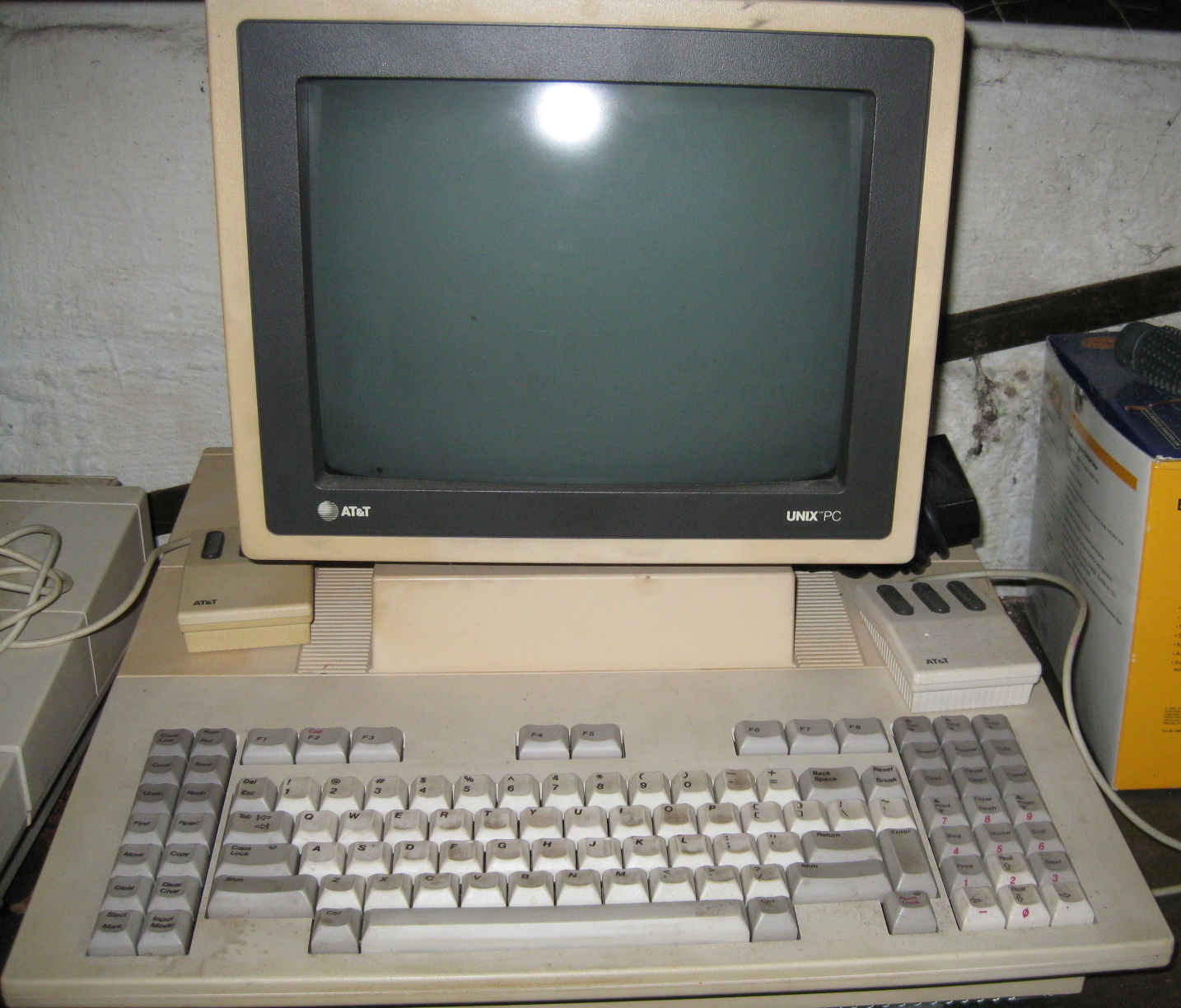
If you have any broken Apple Disk IIs lying around, don't trash them.
They appear to be excellent hosts for an all-in-one Discferret/Kryoflux
setup with two drives. More to come later.
--
David Griffith
dgriffi at cs.csubak.edu
A: Because it fouls the order in which people normally read text.
Q: Why is top-posting such a bad thing?
A: Top-posting.
Q: What is the most annoying thing in e-mail?
On Sun, Jun 24, 2012 at 4:04 PM, Tony Duell <ard at p850ug1.demon.co.uk> wrote:
> I might be able to help, though. I have a 'Polaroid Videopritner 4', for
> all Polaroid assured me they had never made such a beast... This is
> similar, but lower-reulotuon device, it displys TV-rate video on an
> internal CRT and photographs it.
>
> There's a colour fitler wheel (red, green, blue and a hole) so it cna
> print a colour inamge in 3 goes.
I have a similar device - two actually. The first one I got for free
or nearly free, with a Polaroid camera, and no control panel. The
second cost under $100 and had the control panel and a 35mm camera, so
between the two, I have one useful unit. The Polaroid film in
question was sold for medical uses, so was quite expensive even 20
years ago when one could buy it off the shelf ($50-$70 per cassette, I
was told).
Like your "Videoprinter 4", mine has a mono CRT and a color wheel.
AFAIK, it does *4* exposures - R, G, B, and "contrast" (no filter).
It takes in an EGA signal or NTSC video, and has onboard memory for
frame capture of live video. I've done some sample image grabbing
>from a movie on laserdisc, and for practical uses, I use to make title
slides with it, back when we used 35mm slide projectors for
presentations (I produced the slide content on an Amiga since that was
the easiest thing to use that I had on hand). Back when slide houses
charged several dollars each for presentation graphics, this was a
moderate-quality way of doing my own interstitials for slide shows for
the cost of one roll of ordinary 35mm slide film ($4-$5 for a roll of
Fuji E-6 ASA 100 film, $7-$8 for processing and mounting).
I haven't used it in years, but it was great 15+ years ago when I first got it.
-ethan
----- Original Message:
Date: Tue, 26 Jun 2012 09:22:01 -0400
From: David Riley <fraveydank at gmail.com>
On Jun 26, 2012, at 5:43 AM, David Brownlee wrote:
>> Does anyone know of any adaptors to fit a "modern" drive (be it IDE,
>> SCSI, ATA, CompactFlash etc) into a machine with an ST-506/412 interface?
> That... would be quite the task. The ST-506 and cousins directly output
> the raw flux transitions as their data, so you'd need an emulator which
> spit out the data as repeated cylinders, I believe. Trying to interpret
> incoming data as low-level formatting would be another matter entirely.
> You'd probably be better off emulating the interface to the drives (e.g.
> emulate an MFM controller).
-------- Reply:
The main problem I see is that while the ST506/412 interface is standard,
there are quite a few different interfaces between an MFM controller and
the various systems (S100, DEC, PC etc.) and there are probably as many
different formats as there are controllers, so you'd have to emulate quite
a few different controllers.
But I've always wondered (and this may be a silly question): if a controller
in a 4.7MHz PC can handle the data flow, why would it be so difficult to
basically just connect another (pseudo-)HDC to the target HDC instead
of a drive, i.e. effectively connecting two HDCs together back to back?
Host MFM HDC
|| ||
Data/Control bus
|| ||
'Reverse' MFM pseudo-HDC & uC
|||||||
ATA bus or equiv.
|||||||
IDE/CF/etc. drive.
Assuming that the chips are available it doesn't look too difficult to
effectively clone a WD HDC and let it pretend to be a drive.
What's the obvious flaw that I'm missing?
I have one. Pretty good relative condition overall. When I plugged it in oh 3 years ago, it actually *typed*, albeit very veeeeeery sloooooooow.
50$. From 07731. About 40 lbs. packed. Pictures upon request.
I've got an Emulex QD21 (Qbus ESDI controller) with a Rev. D firmware on
it. The later revisions of this card (Rev. E and later) shipped with a
much nicer firmware that included autoconfiguration, and a menu-driven
formatter and diagnostics package.
Does anyone happen to have a ROM image for Rev. E or later? I'd love
to upgrade my board.
-Seth
On 24 June 2012 22:52, Zane H. Healy <healyzh at aracnet.com> wrote (in part):
> At 10:44 PM -0400 6/24/12, David Riley wrote (in part):
>>
>> On Jun 24, 2012, at 7:23 PM, Fred Cisin wrote:
>>>>> ?"Art of Electronics" by Horowitz is GREAT, but it costs money.
>>> ?On Sun, 24 Jun 2012, David Riley wrote (in part):
[...]
>>> ?Really?
>>> ?Seriously, ?What am I doing wrong?
>>> ?Amazon has one copy of the 1982 edition for $176
>>> ?and no copies right now of the 1998 or 2011 editions.
[...]
> You might want to try www.abebooks.com, or Alibris (no, I didn't check).
International versions of the second edition are available for under $30.
Hi Folks,
I have an original IBM model B computer controlled typewriter witha lot of spares and maintenance manuals available for sale ortrade. This stuff is impossible to find. As used on the IBM 1620,DEC PDP-1 and many other computers of the era. Useful if you'remaintaining one of those or want to build a replica/simulator.
Respond to me directly as I'm not a member of this list.
Thanks, Erik
Hello Dr. Duell!
ard at p850ug1.demon.co.uk (Tony Duell) wrote:
> How comples is this controller board that's removed? Is it possible to
> recreate it, and thus covnert a normal Nikon camera to work with the
> film reocerder?
The board doesn't look overly complicated to me (there is a raster image on the page I linked to), all it has on it besides a DIP-16 IC is a resistor, a tantalum cap and another axial component which is obscured by wires in the pictures, possibly a (zener?) diode. The print on the IC is alas covered by a large sticker reading "IC# 7" that IME often indicates it is a custom-programmed part anyway.
> Alas (for you), the only Nikon I own has no electtornics in it at all.
> The only electrical part is the flash contact.
>
> -tony
If it has provisions for both a motor winder and an external shutter release, I'd suspect you'd find a way to interface it nevertheless, were you to try...
One more interesting question would be what kind of lens is required for the recorder application. IIRC there are no refractive optical elements inside the recorder stand as it is now, the CRT faceplate is in plain sight behind a cover glass and the selected filter. I can't measure the distance right now as the recorder is in storage, but I'd roughly estimate somewhere around 20-30cm to the camera seating plane.
Arno
--
Empfehlen Sie GMX DSL Ihren Freunden und Bekannten und wir
belohnen Sie mit bis zu 50,- Euro! https://freundschaftswerbung.gmx.de
Thanks, Glen,
Anyone know of a cheap gizmo that will program the Motorola MCM68766?
My programmer does not support it.
-----Original Message-----
From: Glen Slick [glen.slick at gmail.com]
Received: Saturday, 23 Jun 2012, 8:46pm
To: General Discussion: On-Topic and Off-Topic Posts [cctalk at classiccmp.org]
Subject: Re: Tektronix 4052 Firmware
Is the MCM68766 a compatible replacement EPROM?
Those are available for $8 each at www.unicornelectronics.com
Things have progressed nicely on Manx and I now have a reasonable UI
for adding new online documents to the system. I've also fixed some
bugs and added a few other minor features.
I'm inviting the cctalk community to beta test the changes and report
any issues using the tracker on the codeplex project page:
<http://manx.codeplex.com/WorkItem/Create>
You will need an account on codeplex to create issues. Creating an
account is free and you will not receive any spam.
The beta is hooked up to a separate database, so you can't break
anything in the current system.
Manx 2.0 beta:
<http://manx.classiccmp.org/test>
Login with these credentials:
email: demo at example.com
password: demonstratus
Try the URL Wizard to add new documents for existing sites, new sites,
or from mirrors known to manx of sites already known to manx.
Changes from Manx 1.0:
All users:
- RSS feed published of 200 most recently added documents
- Fixed problem with page title on details page
- Details page for a publication links company name to search of docs
for that company.
- About page updated
- Help page updated
- UTF-8 now handled properly throughout
Logged-in users:
- See table of known mirror data
- See table of known site data
- URL Wizard for adding documents
From a URL, try to figure out as much as possible, such as:
* part number
* document title
* document publication date
* company
* site owning document
* document format (PDF, etc.)
All fields can be edited if the wizard makes a poor guess from the
URL.
The wizard is able to guess most information if the URL is on bitsavers.
The wizard uses AJAX to obtain information from the database, so you
will need a JavaScript enabled web browser for the wizard to work
properly.
Some error checking has been done, but the wizard could probably use
additional checks and preventions against duplicate or badly formed
data.
There are no instructions on the Wizard page, but generally the idea
is that you start by pasting in the URL and tab from field to field
adjusting all the data as needed.
If any field contains invalid data, it's label will be changed to
red when you attempt to advance the wizard by clicking the button.
Please create issues in the tracker for anything you find!
--
"The Direct3D Graphics Pipeline" free book <http://tinyurl.com/d3d-pipeline>
The Computer Graphics Museum <http://computergraphicsmuseum.org>
The Terminals Wiki <http://terminals.classiccmp.org>
Legalize Adulthood! (my blog) <http://legalizeadulthood.wordpress.com>
Of the nine variants of KED developed by DEC, it seems
doubtful that either K52 or K62 are in use at this point.
I have mentioned in the past that a new variant, K42, which
now supports a VT420 with 48 lines is available. Inspection
of the code for K42 suggests that improvements can be made
with respect to the allocation of memory. In particular, while
K42.SAV is LINKed to execute under an Unmapped RT-11
Monitor, for versions of RT-11 which include VBGEXE, virtual
memory can be used under a Mapped Monitor. These same
improvements to K42 can also be added to K52 and K62 so
that if these variants are executed under a Mapped Monitor,
more efficient use can be made of the available memory. One
of the improvements can be an increase in the size of the cut
and paste buffer.
If no one still uses a VT52 or a VT62 terminal, then there does
not seem to be any point to including these improvements in
K52 and K62. Please respond if there is any interest to actually
use K52 or K62 under a Mapped RT-11 Monitor.
Jerome Fine
Hello, all,
I have a Tektronix 4052 Graphic Computer that I believe is in workable condition, but the old Mostek MK36xxx-series mask-programmed ROM that holds the operating firmware for the machine have failed, which is apparently a common occurrence for these devices. I have found numerous mention of these ROMs having been used in test equipment that "forget" after 10 to 15 years after production. I found the archive of 4052 firmware on Bitsavers, but am wondering if anyone out there has any suggestions as to what to do to replace the failed ROM with something of more current technology that will work. The firmware consists of 64K bytes of code. The Mostek ROMs are 24 pin devices, 5V supply, that use a clocked chip select signal, meaning that any replacement will have to emulate the clocking access scheme. There were Motorola-made programmable devices that could directly replace the Mostek parts, but these seem to be virtually unobtainable today..and even if I could find 8 of them, I don't have anything that could program them. Any other 8K x 8 ROM is in a 28 pin package, which would require some clumsy adapters to work. Along with the ROM itself, the 4052 had a unique ROMpatch implementation that allowed up to 48 ROM locations to be ''patched' in real time, and this involved a PLA device that did the address matching, and a fast bipolar ROM that contained that data to be substituted at the location to be patched. Duplicating the patched code could also prove to be very difficult. I am wondering if anyone out there may have run into the same situation with a 4052 and came up with a solution. Any help would be greatly appreciated.
Thanks,
Rick
I have a complete VT14 (except for possibly the cover screws) 14/30,
14/35, and a lot of options available for serious inquires. It was
going to be a project down the road, but I need to shorten my list due
to health issues,
Does any else out there have one, or even know of one?
Please feel free to contact me off list.
Thanks, Paul
This 9000/350 was Stan Sieler's, IIRC, and passed through an intermediary who
couldn't maintain space for it, so I ended up with it and I put it in storage
until I could get space myself. Now that I have space, Homer is resurrected.
It is a 9000/350 (25MHz '020 + '881), 16MB RAM, 670MB main drive, HP-UX 8.0.
And I still have 10b2 on my 10MBit backbone, so it plugged right in.
http://www.floodgap.com/iv/1572
Testing the CPU (Homer doll came with it)
http://www.floodgap.com/iv/1573
Self-test
http://www.floodgap.com/iv/1575
Bringing up HP-UX
http://www.floodgap.com/iv/1574
Old school X11 as God intended
http://www.floodgap.com/iv/1576
Obligatory rear shot
I figure Stan will enjoy seeing it's still out there and operational.
--
------------------------------------ personal: http://www.cameronkaiser.com/ --
Cameron Kaiser * Floodgap Systems * www.floodgap.com * ckaiser at floodgap.com
-- The best defense against logic is ignorance. -------------------------------
Hi.
I'm looking for any information related to Z80 CPU internals,
microcode, sequencer, etc.
Is it possible to rebuild it in Verilog/VHDL/TTL on breadboard with
all that undocumented instructions, etc?
Here is what I found so far about machine cycles, but obviously, it's
not enough:
http://www.msxarchive.nl/pub/msx/mirrors/msx2.com/zaks/z80prg02.htm
I am doing my once a decade or so clean up and sorting. I have found working
distribution diskettes of the shareware software PC-Write and PC-File. I
had to break-out a 5.25 inch drive to read these. My 2005 vintage XP machine
only support on drive at a time so I have to open the case and hook up the
5.25 inch drive.
I have transferred these disks to my network drive and have tested them on a
Windows 98 laptop. I also have Norton Utilities and various copies of DOS
going back to version 1.1. (Complete with packaging.) If there are any
vintage PC users here I can email copies of the disk contents. Is there a
program that makes an "ISO" type file of a bootable floppy?
http://commons.wikimedia.org/wiki/File:PC_Write_text_editor.png
Michael Holley
Andrew, Ive never seen its schematic, but the Apollo mobo I have is the most basic 030 Ive seen. Granted Ive really only gawked at Macs. Ill need to pull it out of storage. The only feature that stood out is a big ugly black chip that one might suspect was a mmu. It is a big mobo though. Maybe someone else can chime in.
----- Original Message:
Date: Wed, 20 Jun 2012 10:53:01 -0700
From: Al Kossow <aek at bitsavers.org>
On 6/20/12 10:44 AM, Stan Sieler wrote:
>> thanks for the kind offer! If Bob declines, I'll let you know.
> CHM is interested, since apparently we have one.
------ Reply:
Excellent; I assume that if they go to you there would be a way for someone
who might need one to get a physical copy?
m
Original Message:
Date: Tue, 19 Jun 2012 16:50:56 -0700
From: Stan Sieler <ss at allegro.com>
> hi,
> I found a box of paper tape software for an unknown computer (possibly a
> "L8" or "L8/9"?)
> ... and it's looking for a home (cost of mailing):
> If anyone can suggest what computer it's from, I'm curious!
> Stan
----- Reply:
Hi Stan,
Those are firmware and utility tapes for Burroughs series L8000 and L9000
computers, the predecessors of the B80 and B90 series and fairly rare since
they were dismissed as mere 'accounting machines' and not considered
collectible by purists and people without storage buildings:
http://www.picklesnet.com/burroughs/gallery/bpgltc.htm
Several museums have one and last I heard Bob Rosenbloom also had an L9000,
as well as an L5000; I imagine he would be delighted to have those tapes and
might even need one or two since I doubt that there are more than a handful
of those tapes left in the world and some of them are crucial to the
machine's operation.
If by any chance there are no other takers I'd gladly take care of them for
you and posterity.
m
Hi Klemens,
Re:
> We have working copies of these games: Keep on Drivin', Pong, Hacman
> and Space Invaders run on our hp 2648 with a 8080 processor, and we
> also have a version of Pong for hp 2644 with 8008 processor. Naturally
> we saved them on our ftp-server. I never tried to load them via the
> serial line, but would be interested to do that, because the cassettes
>
IIRC, we simply did the equivalent of "cat space.oct" or "cat pong.oct".
(It was from MPE, so it was probably: FCOPY FROM=space.oct;to=
)
I noticed in your README you mentioned overflowing the terminal at serial
speeds ... that's solved by using enq/ack pacing, a strap you can enable
on HP terminals (also called "flow control").
It's been awhile since I've used it, but I found a writeup here:
http://docs2.attachmate.com/verastream/vhi/7.1/en/index.jsp?topic=%2Fcom.at…
And, from Robelle's website at
http://www.robelle.com/smugbook/network.html we see:
ENQ/ACK is a proprietary method of flow control used on
Classic MPE V systems and is still built-in to most HP terminals
and enabled by default. The transmitter sends an ENQ (Enquiry, decimal 5,
Control-E) every 80 characters (or so). When the receiver is ready
for more data, it replies with an ACK (Acknowledge, decimal 6, Control-F).
If there is no reply in 10 seconds, MPE V resumes printing printing (Term Type 10).
If you disable ENQ/ACK on your terminal, you will see output interspersed with pauses.
MPE/iX and HP-UX normally use XON/XOFF Flow Control instead of ENQ/ACK.
So...you could have a little C program that loops:
while data left > 0
if >= 80 bytes then
write 80 bytes of data
write an ENQ (decimal 5)
read, waiting for an ACK (decimal 6)
(preferably with a timeout of a second or two, in case ENQ/ACK
isn't enabled on the terminal)
else
write remaining data
Stan
In 1993 or so I wrote some software to print images from my video frame
grabber to a HP LaserJet printer. I ordered the HP technical manuals for
PCL5; they were free with my LaserJet 4. The manuals weight 7 pounds and are
available for the cost of shipping. If no one wants them they are off to the
recycle bin.
HP LaserJet 4 and 4M Printers User's Manual
PostScript SIMM Technical Reference
PCL 5 Comparison Guide
Printer Job Language Technical Reference Manual
PCL 5 Printer Language Technical Reference Manual (3.5 pounds)
PCL 5 Printer Language Technical Quick Reference Guide
Michael Holley
Hello Folks,
the recent talk about film recorders here made me think it might be time to mention one of my "wish list" items here again, just in case somebody happened across it recently. I know this is going to be a long shot but here is:
I managed to secure an Agfa PCR II from University, but unfortunately it is missing the actual camera/optics/tubus assembly. The physical interface for it is a spare metal plate with two alignment holes and two thumbscrews on diagonally opposite corners, and a strange round 12-pin threaded connector for power and communication to the camera (shutter release, out-of-film signalling).
There are several options available (the most common being 35mm and Type 120), but either people don't know what they are (which makes them difficult to find) or they know it (which renders them unaffordable, cf. http://www.mops-computer.de/plson01_.htm )
The standard one seems to be the 35mm cartridge film module, a modified Nikon N6000 a.k.a. F-601M camera. If these do appear in the market, they are sometimes converted back to standard, which involves removing a small controller PCB and rejoining some wire ends, cf. http://photo.net/bboard/q-and-a-fetch-msg?topic_id=23&msg_id=001BtO .
Please let me know if you have any leads on such an item. TIA,
Arno Kletzander.
--
Empfehlen Sie GMX DSL Ihren Freunden und Bekannten und wir
belohnen Sie mit bis zu 50,- Euro! https://freundschaftswerbung.gmx.de
Hi folks,
I'd like to share with you my experiences, I made during March and April when most of the remaings of a big computer collection originally located in Aachen were thankfully mostly saved by the collectors in Germany.
In March, there had been a brief discussion about remainings of the Computer Computer Aachen, Germany. As far as I understood, a couple of years ago, most of the collection could be saved thanks to the CHM and a donation of SAP, who made shipping from Germany to California possible from a financial point of view. The collection is since then known as the "SAP collection" and stored at the CHM.Bits and pieces, the CHM left behind in a warehouse in Dortmund, "re-appeared" in March. A very motivated person, who got informed about the vintage systems, tried then to locate and contact the renter of this warehouse via the landlord (which had to be located and contacted as well). It turned out that the content stored in this warehouse had to be cleared within 2 month, as the warehouse was going to be sold. This was a pure coincindence and destiny here was on the side of all those, who'd like to save ancient comouting systems from being scrapped, as that person
actually tried to find collectors willing to save these remainings, as everything not saved would otherwise been scrapped.
An post in a Robotron systems online forum (Vintage computer manufacturer from eastern Germany) had been placed with images of the parts. First come, first serve was the philosophy in order to give away for free the bits and pieces to collectors, whoever wanted to save these.
I found the thread when I read about it here at classic-cmp, as another list member posted the information here and asked for information about and identification of the parts.
So during the last three months, I went to this place more than once in order to try to save as much of complete parts as possible, I could, with the focus to get them back to working condition one day.
During the first visit, other very nice collectors from eastern Germany were there as well. There was a very good atmosphere in trying to help each other to move heavy partsand cabinets around, to part with the bits in a fair way and to identify and estimate the conditions of these remainings.
These are the days I like when you can meet new people who share this passion about vintage computing and save systems together from being scrapped. And that's how I have been knowing the collectors community in Germany so far.
But for the first time, I also experienced different attitudes in this domain.
With time, the discussions in that robotron thread where marked by rough tones of a person who stated that the remaings left behind by the CHM in that warehouse where "rejects" and therefore not worth or at least not interesting being picked up because of probably being incomplete and he treated the person who discovered the whole thing and opened the thread as unfair, as he felt the systems were already rewarded to others under doubtful circumstances.
Another bad surprise, we had to face, was the behavior of a collector who was at the warehouse earlier than me and who took the opportunity to take with him two EAI 2000 analogue computers for somebody else, I originally was supposed to deliver to. The person in charge at the warehouse confound that guy with myself and asked him, if he was the one supposed to bring these machines to the person, who claimed interest in these. He said "yes" and took everything with him. Call it what you want, but that's seriously the first time, I face such nasty behaviour to put hands on vintage computers!
I'd say that the real condition of a big lot of machines can only be identified properly, when being on site. That's exactly what I did. I stated interest in some parts of which I knew for sure that I could store them savely, in case their condition was satisfactory enough to resurect them to working condition one day. I also tried to save things which should belong together.
Too bad, I was limited in space (the eternal problem). Otherwise I would have saved more. Anyway, the following could find a new home within "my walls".
two Honeywell Bull Datanet systems (on Level 66 basis), can be hopefully transformed to normal mini-computer with approriate software
Honeywell Bull reel tape drive with vacuum columns, complete (rebadged CDC tape unit, probably of type 669)
Honeywell Bull terminal and printer
Honeywell Bull disk drive (rebadged CDC BR3D4) with spare parts from another incomplete drive
Control Data 604 Tape Transport Unit, all logic boards missing
Control Data 854 Disk Drive, seems complete
Control Data 841 Multiple Disk Drive, saved complete electronics and one complete disk unit with its hydraulic actuator, had no space for the entire cabinet :(
Telefunken MDS-252 reel tape drive with vacuum columns, complete? (belonged to a TR-440 mainframe)
Telefunken TR-4 console, complete? (rebadged IBM typewriter)
Telefunken WSP-414 disk drive (rebadged CDS-drive) with concentrator-unit (complete) in order to connect up to eight drives to the TR-440 mainframe
Telefunken LSS-150 power supply of a Facit paper tape unit
DEC RP03, (ISS) with spare parts from another damaged and incomplete drive
Pertec reel tape drive, complete
NCR reel tape drive (rebadged CDC BW303 tape transport), one small PCB missing
Logic boards from a CDC 608 tape unit (according to the person who organised the give-away, nobody ever showed interest in taking the complete unit)
Unfortunately, I couldn't find documents online about all of these parts. So I'd kindly like to ask the list, if anybody has documents about the following ones, so that I could ask them in future, when I come to the point where I can start restoration of these:
- CDC 604 and BW303 tape drives, 854 disk drive and 841 multiple disk drive
- Honeywell Datanet (or Level 66 minis) documents and software
- Telefunken schematics
As you can see, I focused on peripherals, due to my particular interest in disk and reel tape drives. Maybe, a running Honeywell system can be obtained out of the stuff, I saved.
Let's see how much can be resurrected of these in the years to come. Biggest problem regarding the disc drives will certainly be the missing disk packs and the probable re-calibration of the disk and tape units. The disk packs, I got from there, were all coroded to such an extend that they are most probably useless.
The DEC RP03 drive came with two document binders containing schematics. Haven't seen them on bitsavers, yet, and will therefore scan them in near future.
Kind regards,
Pierre
-------------------------------------------------------------------------------
Pierre's collection of classic computers : http://classic-computing.dyndns.org/
Hi
This is a shameless plug for something I and the Update Computer Club
have been working on this spring and opened yesterday.
The exhibition "Three Tons of Minicomputers" at Museum Gustavianum in
Uppsala, Sweden.
We have collected computers primarily used by the university at some
point in time. Highlights include a Linc-8 and a DECSYSTEM-2060 with
peripherals.
Here are some pictures from the opening:
http://www.update.uu.se/~jeppe/tmp/vernissage/
I strongly recommend anyone nearby Uppsala this summer to take a swing
by Gustavianum. If you want a guided tour, let me know and we'll figure
something out.
It's only open for a few months, so don't wait to long.
Regards,
Pontus.
At 09:26 PM 6/15/2012, steven stengel wrote:
>I have used the Epson Workforce 645 - jammed a lot - I returned it.
>I now use the Fujitsu Scansnap S1500 to scan BYTE and other magazines.
>Works great, I love it - about $500 new.
Great device. Yes, designed for extensive use. And they sell the
consumables - cheap replacements for the pads and pick roller that
might wear out after 50K or 100K scans.
- John
There was a man in Kansas IIRC who had a bunch of Apollo stuff. I imagine it's long gone. If still available, please send me a private. I likely will be in that area w/i a month God willing. Never know what tomorrow will bring though.
?Come on Apollo gropies, I know you're out there. Let's be heard!
Hi
>From the N8VEM home brew computing project wiki front page:
The three 6809 standalone computer boards available in the Eurocard (160 x 100 mm) format; the 6809/6802/6502 host processor, its 6809/6802/6502 IO?mezzanine, and the 6809/6802/6502 bus bridge.? A redesign of the 6809 host processor board has been completed and the new version supports 6502 and 6802 CPUs in addition to the 6809.?
?
All Eurocard ECB?format PCBs are $20 plus shipping which is $2 per board in the US and typically $5 per board overseas.
?
http://n8vem-sbc.pbworks.com/w/page/4200908/FrontPage
?
There are PCBs for the 6x0x host processor and associated boards still available.? There was quite a bit of active development on this system a few months ago.
?
Thanks!
Andrew Lynch
?
?
--- On Wed, 6/20/12, Dave Wade <dave.g4ugm at gmail.com> wrote:
> From: Dave Wade <dave.g4ugm at gmail.com>
> Subject: Desiogns/Plans/Board Layouts for 6809 System
> To: "General Discussion: On-Topic and Off-Topic Posts" <cctalk at classiccmp.org>
> Date: Wednesday, June 20, 2012, 8:51 AM
> Well we have had all the fun with 68K
> designs, but I would really like
> to build a 6809 system. Any one know of a source for boards
> for a
> simple system with say Serial Port and Parallel Port and
> memory?
>
Well we have had all the fun with 68K designs, but I would really like
to build a 6809 system. Any one know of a source for boards for a
simple system with say Serial Port and Parallel Port and memory?
Hi Jecel and all
>Back in 2005 someone posted the sources for all the PALs, I looked at
>them, but didn't save a local copy. A quick search only showed the
>source for the TSM (timing state machine) circuit in
>
> > http://www.avrfreaks.net/index.php?name=PNphpBB2&file=viewtopic&t=26198
Kryten saved some of what you posted, but his website also is no more. I
sifted through archives, everything I could find as well as my own musings
are up on
http://www.retro.co.za/ccc/mac/ReverseEngineering/PALs.html
>I did a clean room implementation of the PALs in 1987 that was better
>(27% performance increase over the original) but don't have a copy of
>the sources (I do have access to a machine with the actual PALs with my
>design, however).
Let's hope you didn't blow the fuses -- if you can, read them and post the
results?
Thanks
W
For the past 5 years or so I have been collecting references on early 8-bit
microprocessors, with an emphasis on the Motorola MC6800. The best source is
trade magazines from the mid-1970s. I have a reasonable collection of
McGraw-Hill's Electronics and a few issues of Electronic Design and EDN. I
am old enough that I read all of these when they were new. I got a bunch
>from eBay and another bundle from Steven Stengel on this list. I have not
ventured over to the University of Washington yet, they have a good
collection. (I can scan my individual issues at home.)
Motorola did not chronicle their microprocessor development like Intel did.
MOS Technology has Chuck Peddle telling an alternate reality version of the
events. Chuck's enthusiastic promotion of the 6502 in 1975 was responsible
for its success and his story has improved with 35 years of retelling.
Rereading these magazines gives a better understanding of what really
happened. Did you know that the Motorola 6800 and Intel 8080 both had their
introductory articles in the April 18, 1974 issue of Electronics?
I have uploaded a selection of articles to my website.
http://www.swtpc.com/mholley/Microprocessors/Microprocessor_History.htm
There is one issue with a 6800 article that I have not found is the November
20, 1974 issue of EDN, "A very complete chip set joins the great
microprocessor race" starting on page 87. Has anyone got it?
I wrote the Motorola 6800 article on Wikipedia and just updated the MOS
Technology 6502 article.
Michael Holley
> From:?"Brad Parker" <brad at heeltoe.com>
> Date:?Mon, 18 Jun 2012 10:55:30 -0700
> Subject:?RE: emulated linux/bsd motorola 68k system?
>
> The code is pretty dense but also pretty complete. ?The sun-2 is 68010
> based. ?As I recall
>
> the sun-3 is 68020 based. ?I can't remember if there were any 68030
> based sun's.
>
> -brad
I helped Matt get the Sun-2/Sun-3 emulator working by doing countless
tests on my Sun 2/120.
I still have the 2/120.
The Sun 3/80, 3/460, and 3/470 are 68030 based. I have one of each.
--
Michael Thompson
I think it is anyway,.
http://www.ebay.com/itm/110897384303
Dec VT Lan 40 terminal. Appears that it might take PS2 kb and mouse,
and vga display. $75. Only mention because of the recent threads on
dec terminals and the like.
Jim
Original Message:
Date: Wed, 20 Jun 2012 10:44:04 -0700
From: Stan Sieler <ss at allegro.com>
Re:
>> Those are firmware and utility tapes for Burroughs series L8000 and L9000
>> computers, the predecessors of the B80 and B90 series and fairly rare
>> since
> I should have realized this...I arranged the donation of a working
> Burroughs L9000 to the Computer History Museum a few years ago (it had
> been in constant use until a month before the donation).
> Stan
---------
Heh, heh; yes indeed. As a matter of fact I believe the pictures on the
Pickles site of Betty and the L9000 that went to CHM originally came from
you (DVQ), and you and I exchanged a few emails about it at the time.
mike
>Those are the massive ones sittng horizontally on the PCB, right?
That is correct.
>there's a smaller can-type electrolytic on the output side.
Yes on the 7441 there are two small axial style electrolytic that stand
vertically on the PCB. These are small and cheap enough here to just
replace so I think I will do that.
>re suppliers
Yes we have RS Components here in NZ and they have a good range of parts
and generally the pricing is fairly reasonable. No freight charges on
internet orders even if they bring the stuff in from the US or UK.
Sometimes I wonder how they make money when I receive individually bagged
microcontrollers for a few $ each shipped from the US. Must be some margin
in there somewhere.
I did find
http://newzealand.rs-online.com/web/p/aluminium/2508858302/?searchTerm=2508…
which
meets the specs but is very expensive down here.
Based on your suggestion that 22000uf 50V would likely be OK I wonder if
the following part might be an alternative:
http://newzealand.rs-online.com/web/p/miscellaneous/2550081355/?searchTerm=…
Considerably cheaper down here.
Regards
Andrew
>
>Well we have had all the fun with 68K designs, but I would really like
>to build a 6809 system. Any one know of a source for boards for a
>simple system with say Serial Port and Parallel Port and memory?
Buy a color computer or a dragon. It's pretty much a clone of the appnote.
Otherwise, try Frank Wilson's design via http://koti.mbnet.fi/~atjs/mc6809/
(Because my design never worked right :-)
W
>
>Well we have had all the fun with 68K designs, but I would really like
>to build a 6809 system. Any one know of a source for boards for a
>simple system with say Serial Port and Parallel Port and memory?
Buy a color computer or a dragon. It's pretty much a clone of the appnote.
Otherwise, try Frank Wilson's design via http://koti.mbnet.fi/~atjs/mc6809/
(Because my design never worked right :-)
W
More shed cleaning. Unibus boards plus pdp11/23 and an complete pro350
seller tcp1022 (me). As always mention to me your a list member and I'll
throw in a goodie or two.
cheers
tom
> From:?Ola Hughson <f.helyanvy at gmail.com>
> Date:?Tue, 19 Jun 2012 00:57:56 +0200
> Subject:?Re: looking for Apollo systems and parts, and to interface w/other Apollo groupies
> Funny, because having an Apollo workstation is on my wishlist ;)
> http://ola.earfolds.com/computers/
>
> --
> Ola Hughson
There is a bunch of Apollo equipment at the Rhode Island Computer Museum.
You should visit, inventory it, and see what it will take to get some
of it running.
--
Michael Thompson
----- Original Message:
Date: Tue, 19 Jun 2012 22:26:36 -0400 (EDT)
From: Mouse <mouse at Rodents-Montreal.ORG>
>> Top posting has pretty much been the norm since at least the mid 90s
> Not here. Nor anywhere else I hang out.
> Nor, given the arrogance and rudeness it exhibits, anywhere I'd want to
> hang out.
----- Reply:
ROFL! Precious irony; was it intentional?
The only arrogance and rudeness I see in all this is from you and others
arrogantly telling people how they must write and rudely denigrating and
insulting anyone with a different opinion, while wasting everyone's time and
bandwidth with your inane posts.
If Jay wants to make and enforce such a rule, fine; your opinion doesn't
interest me.
I notice that none of you brave champions of the ancient Usenet traditions
had the courtesy to change the subject line, a far more serious 'crime' than
top-posting IMO as it forces the rest of us to wade through your posts on
the remote chance that one of you actually had something relevant to
contribute.
I also notice that probably around 10-20% or so of the *useful* posts here
are usually top-posted, but since they are from 'regulars' like Andrew, Dan,
etc. they don't merit your censure; apparently that's only for relative
newcomers?
And FWIW, other than in places like this with its focus on the old and
venerable ways, I also find top posting the norm 'out there', and far more
efficient than every time having to wade again through text I've already
read or written before, looking for the reply; I'm relieved that I won't
encounter you in any of those venues.
m
I am making progress testing the power supply for my 11/04 (BA11-K chassis)
and so far have worked through the power control box, transformer, fans and
the 15VDC regulator/Power Line monitor but have one question for the
group....
I am seeing in tolerance output voltages from the 15VDC regulator but I
haven't loaded tested it. Is this something I should do or if the unloaded
outputs are within tolerance then it is safe to use (once the other
regulators are done)?
No real technical info but a description of progress so far on
http://www.quicktrip.co.nz/jaqblog for those interested in a few pictures.
I am about the start on the H744 5VDC regulators.
Regards
Andrew
hi,
I found a box of paper tape software for an unknown
computer (possibly a "L8" or "L8/9"?)
... and it's looking for a home (cost of mailing):
The box is 8" by 8" by 1", with about 10 rolls of punched paper tape
of various roll size.
If anyone can suggest what computer it's from, I'm curious!
Box has a lot of writing on it:
----- front:
L8/9 FIRMWARES
FOR SALESMEN
NOTE
THIS IS A MASTER
TAPE AND IS NOT
TO BE CUT UP!
THE BOSS
---- back:
Contains:
2 - 2170-003-24 PPT INPUT ADDON
2 - 2170-004-24 PPT OUTPUT ADDON
2 - 2180-029-030 MEM ALLOCATOR
2 - 2180-022-01 MMR MEM DUMP
2 - 2180-005-02 SL3 PPT DUMP
2 - 2180-012-02 SL3 PPT DUMP
2 - 2170-010-26 DATA HANDLING ADD-ON
2 - 2180-006-02 PAPER TAPE READER LOAD
2 - 2100-001-28 L82 BASIC INTER.
2 - 2100-003-28 L86 BASIC INTER.
2 - 2100-004-28 L9 BASIC INTER.
...and about 20 more items.
Stan
Hi, All,
I've been discussing 1980s and 1990s IBM gear with a list member via
PM, and the need for modem eliminators has come up as a topic. I have
worked with a variety of older Black Box units back in the days when I
used Bisync comms every day, but looking around now, I see no
EIA/RS-232 units for sale on eBay and other places - it's all V.35 (at
multi-megabit speeds for CSU/DSU) and RS-422 and RS-530 (RS-422 on a
DB25). 25 years ago, it was common to want to attach sync devices
between 1200 and 56Kbps via RS-232 but not so much any more.
It's not hard to make a Sync Modem Eliminator - in its simplest form,
it's going to look at lot like an async null modem cable/box, but with
active clocking (normally generated by the DCE) on pins 15 and 17 on
both DB25s. There used to be a lot of baud rate generator chips, but
for a small range of speeds, a properly-sized crystal on a 4060
clock/counter chip, perhaps a D-flip-flop used as a divide-by-2 (to
square up the waveform and to shift which baud rate is "missing"
because one stage of the 4060 chain is not brought out to a pin), and
a 1488 to drive the clock to the DTE hardware.
Where it starts to get complicated is that commercial RS-232 SMEs also
had options to strap carrier detect and RTS/CTS, optional CTS
turnaround delays and more. There were lots of jumpers and
configuration often took some experimentation for a new set of
devices.
My question is, for those reading this that still use sync serial, is
it "worth" designing and sharing a simple SME that might not have all
the bells and whistles and user-configurable options, or is it "worth"
just keeping the design very simple (3 chips plus a multi-voltage PSU,
or multiple chips and a single-voltage PSU) and acknowledging that it
will only work for 80% of the cases out there?
It is, of course, easier to purchase than build, and there were once
large quantities of the "right device", but I think as comms speeds
have risen, not that many of these low-speed devices have survived,
and certainly nobody is attempting to empty a warehouse of them at the
moment.
It's also entirely possible that the demand for synchronous serial
comms over RS-232 lines is so small that the entire roster of
interested parties would fit on a very short bus, so please chime in
if you still use sync serial below 64kbps for anything. I'm curious
to know who does and what devices they have.
-ethan
Post on the _www.vintage-computer.com_ (http://www.vintage-computer.com)
site - that may be better & do a search for others who have posted on this
topic.
Good luck !
Frank
In a message dated 6/18/2012 9:55:21 A.M. Eastern Daylight Time,
james at slor.net writes:
Thought I'd try one more time. Anyone?
-----Original Message-----
From: James [mailto:james at slor.net]
Sent: Tuesday, June 05, 2012 12:41 PM
To: cctalk at classiccmp.org
Subject: Wanted: Original Kaypro 16 floppies
I've been looking for an original floppy disk set for my Kaypro 16 (not
16/2
or any others) for a while now. Anyone on this list have a set to part
with? Or, worst case, anyone have a set they could copy/image for me?
Thanks!
James
On Mon, Jun 18, 2012 at 7:58 PM, Camiel Vanderhoeven
<iamcamiel at gmail.com> wrote:
> So, it looks like the memory chip that controls bit 10 for addresses
> ending in 01 (binary) is at fault here. I'm going to do some wire
> tracing to find out which chip this might be...
Did my wire tracing, came up with the following picture of the board
(use a fixed-width font to view):
+-----------------------------------------------------------+
| 15 14 bit 1 0 |
| +u+ +u+ ................................. +u+ +u+ |
| | | | | | | | | |
| 0xxxx00 | | | | | | | | |
| +-+ +-+ +-+ +-+ |
| |
| +u+ +u+ +u+ +u+ |
| | | | | | | | | |
| 1xxxx00 | | | | | | | | |
| +-+ +-+ +-+ +-+ |
| |
| : : |
| : : |
| word : : |
| : : |
| : : |
| |
| +u+ +u+ +u+ +u+ |
| | | | | | | | | |
| 0xxxx11 | | | | | | | | |
| +-+ +-+ +-+ +-+ |
| |
| +u+ +u+ +u+ +u+ |
| | | | | | | | | |
| 1xxxx11 | | | | | | | | |
| +-+ +-+ ................................. +-+ +-+ |
| |
| |
| |
+-+ +---+ +-+
+-------------------------+ +-------------------------+
So at least I can now trace an error bit to a chip. However, I must
have damaged something in the process (believe me, I've been careful),
because for all addresses ending in xxxx10, the data reads back as
000000 now. I hooked up my logic analyzer, and found that data dis
written to the memory chips in this row correctly. The data read from
these chips is also correct. The data is then fed to a few 74153
4-to-1 MUXes. I checked the selection inputs to the MUXes, and these
are wrong for row 2. Now I need to see where those inputs came from...
To be continued...
Camiel.
> Subject: Re: emulated linux/bsd motorola 68k system?
> From: Al Kossow <aek at bitsavers.org>
> Date: Mon, June 18, 2012 10:33 am
> To: cctalk at classiccmp.org, Brad Parker <brad at heeltoe.com>
>
> >> Anyone know of a working emulator for a Motorola 68K system that works
> >> well enough to install either linux/bsd in?
>
> Brad Parker's version of the MIT Sun simulator may be able to boot BSD.
The sun2/sun3 simulator (tme) should boot netbsd out of the box.
http://people.csail.mit.edu/fredette/tme/
I have mods which will allow it boot early sun os version (sunos 2.0,
3.2 & 3.5).
Everything works except the ethernet on 3.5 - I need to fix that.
http://www.heeltoe.com/index.php?n=Retro.Sun2
(I miss my old sun-2 :-)
The code is pretty dense but also pretty complete. The sun-2 is 68010
based. As I recall
the sun-3 is 68020 based. I can't remember if there were any 68030
based sun's.
-brad
Hi Bruce,
I think I found the memory problem:
On Mon, Jun 18, 2012 at 7:07 PM, Bruce <Bruce at wild-hare.com> wrote:
> I'm confused. ?The VC (Virtual Console) works okay when you hit the reset
> button, but when the computer is powered on you do not get the
>
> OK
> !000000
> !
>
> indication? ?(...per Chapter 5, Computer Self-Test, page 23)
Correct. On power on I only get an "O". VC does not respond at that
point. Once I hit the reset button, I do get
O000000
!
The VC then responds as expected.
If I remove the memory board, the behavior is exactly the same, except
that every memory address reads back as 177777 of course.
Accumulators with and without memory board:
without - 177777 125252 076000 000701
with - 127252 125252 076041 000701
This lead me to suspect that the memory at word 41 was incorrect.
Memory locations 0 - 40 were 052525, 41, 45, 51 were 127252, 42 and up
(except those with the lowest bits being 01) were 125252.
So, it looks like the entire memory is written with 125252
(1010101010101010) first, then each word is first read, then written
with 052525 (0101010101010101).
Sure enough, when I wrote 125252 to word 41, it looked fine, but when
I wrote 052525 to word 1, it changed word 41 to 127252!
So, it looks like the memory chip that controls bit 10 for addresses
ending in 01 (binary) is at fault here. I'm going to do some wire
tracing to find out which chip this might be...
> The part numbers (005-xxxxxx-yy) are important when trying to determine the
> exact computer configuration as the same board may have different part
> numbers depending upon what chips are stuff onto the board (i.e. memory
> boards). ?If no 005 part number exists anywhere on the board the board
> artwork 107-xxxxxx-yy number may be used in extreme situations. ?I do not
> know of a 107 to 005 cross reference table but I could look at various
> in-house boards if needed.
Like I wrote, the CPU and Memory board only have part of the label
left, it looks like the actual part numbers have carefully been
clipped off. All that remains are the "E" numbers, which I presume are
a serial number. The numbers on the boards themselves read:
CPU: 10700094903/0 07 (last 07 is printed, rest of the number is copper)
Mem: 10700081303/03 (entire number copper)
> Also, the S/140, Nova 4/S, Nova 4/X could interchange boards (CPU and
> memory), so this system might not be a "true" Nova 4 - Eclipse boards could
> be used rather than Nova boards if a Field Engineering guy didn't have the
> "correct" parts. ?Nova/Eclipse CPU boards could be interchanged if the four
> (4) PROM "personality" chips were swapped.
Could that be the reason the part numbers have been removed?
Although I don't think it's likely; all the PROM chips are soldered on
(no sockets), so swapping wouldn't be all that easy. Plus, the
soldering on the PROM chips looks like it's untouched.
There are a few other areas of the main board that do show evidence of
repairs; the following parts seem to have been replaced at some point
(with approx. board locations):
- One of the IDM2901A bit slices has been replaced with an AM2901BDC @ AE11
- 74S241 @ X13
- 74LS38 @ E45
- 4 75451 drivers around E22
Thanks,
Camiel.
Has anyone (probably!) hacked together a PSU for a C64 using a PC PSU? How
close do the AC lines have to be to a 9V sine wave?
I've got someone offering me an unknown-condition C64/1541/1702 which is
missing its PSU (and possibly the cable between the drive and computer), so
if I do bite I'd be looking to do a quick hack just to see how operational
everything is before I go trying to find a genuine PSU from somewhere.
TBH, I'm not sure what my options are for getting software onto disk,
either - it's not clear whether the current owner has any media at all (I
get the impression that they've just unearthed the machine in storage, but
various bits that they once had have gone missing over the years). A quick
google seems to suggest that there are ways and means though, given that
I'd have a 1541 (if it works ;)
cheers
Jules
So I was digging around looking for one of these (an 8000-line
CRT-based film recorder, basically it's used to print digital photos
to photographic film), and I managed to find one being liquidated.
Unfortunately they will not ship, and I'm in Philadelphia, which is
rather far from Richmond. So if anyone wants to pick this up, feel
free - $20 or so is quite a deal, as this model can fetch $350 or so
on eBay.
http://www.govdeals.com/index.cfm?fa=Main.Item&itemid=18024&acctid=226
It hasn't sold the first time they listed it (at $35) so I don't
expect it to go for much. I'm willing to pay the cost, and for
shipping and the trouble, but if you're doing photographic stuff, by
all means use it. I just don't want to see it get dumped or recycled,
like most unsold surplus items end up.
Thanks!
--David Ryskalczyk
Thought I'd try one more time. Anyone?
-----Original Message-----
From: James [mailto:james at slor.net]
Sent: Tuesday, June 05, 2012 12:41 PM
To: cctalk at classiccmp.org
Subject: Wanted: Original Kaypro 16 floppies
I've been looking for an original floppy disk set for my Kaypro 16 (not 16/2
or any others) for a while now. Anyone on this list have a set to part
with? Or, worst case, anyone have a set they could copy/image for me?
Thanks!
James
On Sun, Jun 17, 2012 at 6:30 AM, Jay Jaeger <cube1 at charter.net> wrote:
> Update. I did just find some DG Doc, in the Nova 4 16 Slot Illustrated Parts
> Breakdown (016-000940-00) that I have.
>
> Curiously, for 120v, they show Hot going to Pin *** 4 ***, but the plug
> otherwise wired exactly as I described in my previous message. ?But, I think
> that is in error, and one should wire hot to pin ***3 *** for 120V.
>
> For 240V they show Hot going to pin 3, neutral to 9, and ground to 5 (and
> 6). ?For 240V the only interconnects they show are from 1 to 11 and from 4
> to 7 (as opposed to 4 to 8 for 120V). ?Again, I think that hot pin 3 is in
> error, and (probably) for 240V, one should wire hot to pin 4 BUT I HAVE NO
> WAY TO VERIFY THIS.
>
> HOWEVER, I did go back and re-verify what I wrote earlier on both my Nova/4
> and (now) my S/140 as well and both have pin 3 as HOT. ?All 120V of it.
>
> Other than that, the interconnections I described below match the doc. ?The
> only variance is between hot for 120v (I say pin 3, they say 4) and hot for
> 240v (they say pin 3).
>
> Go figure. ?(Unfortunately, I don't have power supply drawings that I can
> use to arbitrate).
Thanks Jay,
Using this, I was able to get the power supply going. All voltages
check out OK, so after some careful examination I've plugged in the
CPU board. The expected output on the console port is the "O" from
"OK"; the K isn't printed because there's no memory.
Powered it on, and after some twiddling with the console cable pinout
(weird one) yes, there's the "O".
Installed the memory board, powered it on again, and alas, still "O"
rather than "OK". The Field Engineer's Reference says that that means
a memory failure.
Of course, the memory board could be faulty, but it could also be a
matter of incorrect jumper settings on the memory board. I haven't
been able to find a description of these yet.
The board says "DGC BBU MEMORY", and contains 8 x 16 AM9016DPC ic's
(4116 equivalent). That makes it 128 16-bit kilowords of memory (no
parity or ECC, although there are 5 empty spots per row).
There are 6 jumper positions labeled 16,17,18,19,0 and 1; each can
have a jumper in the 0 or in the 1 position. My board has a jumper in
the "0" position for jumpers 16, 17 and 18. No jumpers in the other
three positions:
o o o o o o
1
o o o o o o
0 | | |
o o o o o o
16 17 18 19 0 1
Is anyone familiar with these?
Camiel
We have a Tandy DWP 220 printer complete with extra Daisy Wheels, cables & ribbon cartridges.
The printer is in mint condition. We?re moving to Hawaii soon and we are looking to clear out our closets...
Please respond if you or someone you know might be interested.
Regards,
Stu in K C
That?s Why They Call Me...
The Nudnik!!!
DEC VAX11/750 Diagnostic Tape Set http://r.ebay.com/zDS4ws
I own an (hitherto unrestored) VAX-11/750 and if someone with a working
TU58 can image these tapes, I might be persuaded to bid on these.
--Toby
Got some Original DEC Manuals in reasonable condition.
As I do not need them at the moment any interested can have them. These
Manuals have seen little use and slight yellowing on the covers. Inside
they're pretty unused and clean.
EK-PC380-OM-001 Professional 380 Owner's Manual
EK-T25QA-IN-001 M7605 Q-BUS KIT Installation Guide
EK-DZQ11-UG-001 DZQ11 Asynchronous Multiplexer User's Guide
EK-T25TD-IN-001 TK25 Tape Drive Installation Guide
EK-0TK25-UG-001 TK 25 Tape Drive Subsystem User Guide
If you want them all (or a single one), let me know your postal adress and
I'll let them fly out. I you want to give me something for them, it'd be
appreciated. But not needed.
Regards,
Wolfgang
--
Wolfgang Eichberger - OE5EWL
Operating System Collector
Blog: 5ewl.blogspot.com
Homepage: www.eichberger.org
Ahnenforschung / Genealogy: A(E)ichberger, B(P)ruckmayr Raum
Leonding/Alkoven/Eferding; Schmeisser Raum Attergau
I have an old project laying around that I just spent another two hours
on ..
It is an 1993 external parallel port attached CD-ROM. A company called
"Storage Devices Inc" made it, and IBM resold it. The model number is
SCD-683. There are some traces of it if you search the web, but not
much interesting. I have the drivers so that is not a problem.
The CD-ROM is a 1x SCSI unit that uses a caddy. There is a parallel to
SCSI bridge board in the enclosure based on the NCR 53C80 chipset, which
was well known back then. The CD-ROM does show up and talk when used on
an XT running PC DOS 3.3; it responds to commands like eject and it lets
me see its error counts using a utility program.
The problem is that it refuses to read any media that I give it. The
drive is very clean - I removed the top and had a look inside the
mechanism to be certain. It is a caddy loading model so I can't tell for
sure that the head has clear access but everything seems to be operating
freely. I'm using old pressed aluminum discs (OS/2 Warp) which should be
fine in any CD-ROM device. I have tried cleaning the heads with a
special CD that has the magic fibers on it, but nothing is helping. (I
even reached in gently with a Q-tip and isopropyl alcohol, but that did
not change anything.)
I'd like to see this thing run - it has a carry handle on the side!
Unless I come up with another idea to try the only way that is going to
happen is if I swap the drive out. The original drive is an IBM
CDRM00101 and the driver is looking for the ID string. So a drive swap
with a different SCSI drive will probably require patching the device
driver.
So, any ideas on what I can do to clean the head further? (It might just
be hopelessly out of alignment - I don't know the history of the drive.)
Mike
Announcing the Retrochallenge 2012 Summer Challenge
As usual the competition is open to all, so come and join us for a legitimized month of playing, hacking and blogging with/about your retrogear.
For those of you new to retrochallenge the philosophy is:
About RetroChallenge
In a nutshell, the RetroChallenge is a loosely disorganised gathering of RetroComputing enthusiasts who collectively do stuff with old computers for a month.
The event is very much open to interpretation... individuals set there own challenges, which can range from programming to multimedia work; hardware restoration to exploring legacy networking... or just plain dicking around. It really doesn't matter what you do, just so long as you do it.
While the RetroChallenge has its competitive side, it's not really a contest... it's more like global thermonuclear war ? everyone can play, but nobody really wins.
Come on... give it a go!
The summer retrochallenge runs for the month of July.
Register using the ENTER link at http://retrochallenge.org the Official Competition page
I just picked up the second batch of P800 stuff. The seller found some
more items that were meant to be part of the sale in the first place.
I also picked up a Nova 4 I bought off him too. Any pointers to Nova 4
documentation are extremely welcome.
The P800 stuff consisted of an extension cabinets with some cards,
some 8" floppies, and more X1215 disk packs.
Cards:
- 3 x MCU2
- 4 x AMA-8A
- HLVCUB
The HLVCUB is a card I haven't seen before. It's got two N8X300
microcontrollers on it, two SCN2652A serial controllers, and two
26-pin connectors. Looks like a hefty two-channel synchronous
communications card.
Floppies are labeled:
- "Tools : (LP) / IPL ADDR: 60C5 / Monitor: type (?)"
- "Rotterdam test system 29-03-'84"
- "T. Wilders / Test Software S.M. / BMEX0 in TSWCOM module / User:
BMEX Start: $RUN"
- "Very Special / Utilities R1.0 83-06-01 / P5011 / SYS / User: PRK300
/ ASG 1E0,DK,PRECDC"
- "Userid: TOOL Date 84.03.26 / :BASIC / Address of FL-Drives=03!!!"
- "CP101 83.11.25 / Userid: SYS"
- "RT Floppy"
- "$TDES"
- "Label: CP101 Date 84.01.10 / Userid: LUC"
- "RS740 MAGAZIJN / BASIC / RUN "I""
- "RS747 CARD CATALOG / BASIC I"
- "RS775 / CPU P857EB / EPS 811118"
- "RS776 / CP7R"
Disk packs are labeled:
- "CPU ISCOS 70 / 4022 250 0004.1 / PAB nr 8122 141 0470.1 / BD83"
- "Graphics 8P-A / 4022 226 3470.1 / PAB nr 8122 141 0286.1 / BD58"
- "VIP V12 / 4311 027 1629.1 / PAB nr 8122 141 0277.1 / BD51"
- "Ext Mem Mod 286 / 4022 226 2340.1 / PAB nr 8122 141 0456.1 / BD82"
- "DOM811 adr/02 intr/11 / terminal adr/10 intr/6 / update test
programs 27-09-84 / IPL/65C2"
- "X1216 IPL 63C2 / Test programs updare 85-12-18 / -DOM9 A/02 IT/10
FL/03 IT/11 / Userid: SDAPRO / s$$LOAD
- "LAB Backup"
- "TEST TP1 / R=0002"
- "FPPKENIA"
- 3 x PHILIPS unlabeled
- 2 x CDC unlabeled
- 1 x MEMOREX unlabeled
If anything sounds familiar, please let me know.
Cheers,
Camiel
Email decstuff at pdp8online.com to contact the seller. I was contacted
by someone looking to sell some DEC stuff. Looks like he's not trying to get
big $ for it so I'm passing it on. Wisconsin is too far for me.
> I also have some DEC equipment from the 11-03, 11-23 and one small VAX
> system. I have 2 LA120 printers, 2 LN03's laser printers, several H960
> cabinets, a couple of CDC 9762 67 Meg hard drives, and various
> Monitors and Interface boards. Are you or do you know of anyone interested
> in this equipment?
> I would like to move the equipment. One thought has been to scrap it;
> another to sell it. If someone has an interest, I would like them to get the
> equipment. Some of this equipment doesn't exist anymore. I would prefer to
> sell it but am very reasonable.
> The equipment is in Wisconsin and I would prefer that it would be picked up.
> I am not in a position to do any packing or shipping.
> The 11/73 system runs rt-11 with TSX. The Vax runs VMS.
I still have many many many large tomes and other printed material, including vintage docs, that needs to be committed to digital format. I'm always building something, and I gathered a hodge podge of materials in an attempt to fenagle my own document feeder (first thought I'd use a scanner or pair, later said screw that I'll just use a digital camera). Non destructive scanning isn't necessarily a whole lot more difficult in my estimation (using whatever curdled gray matter I have left), but who needs any more complexity then is necessary, so I opted for destructive scanning (where you rip the spine of the book apart and jam it in the mechanism). Then strolling through Target, I noticed the Epson Workforce 645 which allegedly can take a stack of 30 sheets and scan both sides. I'd prefer 30,000 sheets, but beggars can't always be choosers. So I bought it, but have yet to open it (my ethic states I shouldn't crack an item unless I'm somewhat positive I'll
keep it. I _rarely_ return something I open. It bothers me to). So I would just like to ask if any of you all have delved into this. A piddly 30 sheet document feeder still requires you to "be there", although I suppose I could catch up on twiddling my thumbs at least while I reduce oh 300 books to bits and bytes.
No the unit I already returned (unopened) wasnt designed for big batches or even longevity necessarily, but document feeding, the crux of the matter, is no feat. People have and I seem to recall there even being one commercial product that turned a copier into a document scanner. Accurate and reliable document feeders are often left on the side of the road.
an awful lot of it seems to get done despite youre experience in the industry (10 years ago? 20?). We had something maybe a Canon, at a job 8 years ago, often reliably taking print and even that skinny fanfold garbage simultaneously. Did it draw 2 pages in periodically, short of spending ~a grand, Im sure anything will. I would think an 80-90% percent success rate for a relatively short job (i.e not long term professional activity) would be tolerable. You can always manually redo those wayfaring missed pages. This forum has nearly nothing to do with anything professional. But anything, including hobbies warrants some patience. And dumping significant cash or having people tell you it cant be done otherwise doesnt make sense.
------------------------------
On Sat, Jun 16, 2012 10:51 AM PDT Dave McGuire wrote:
>On 06/16/2012 01:33 PM, Chris Tofu wrote:
>> No the unit I already returned (unopened) wasnt designed for big
>> batches or even longevity necessarily, but document feeding, the crux
>> of the matter, is no feat. People have and I seem to recall there
>> even being one commercial product that turned a copier into a
>> document scanner. Accurate and reliable document feeders are often
>> left on the side of the road.
>
> You haven't had to work on many of them, have you. ;) I worked on
>paper feed systems (Ziyad feeders for Canon CX engine-based laser
>printers, as well as the printers themselves) for several years when
>those printers were en vogue.
>
> That experience left me with the sincere hope that I never have to
>work on another paper-handling device again, as well as the insistence
>that any printer I own will be built to print all day, every day and
>likely end up being a two-man lift. (which they both are, HP 8100DN and
>8550DN)
>
> Yes, paper feeding is, in fact, a feat. Yes, it is done all over the
>place, and has been for many decades, but that doesn't make it any less
>a feat, nor does it make it any less failure-prone. Document feeding in
>particular is much harder, because (in comparison to printing) it
>suddenly matters if you pick up two sheets at once, and you can often
>bet that the paper is of less-than-straight-off-the-ream edge quality
>
> -Dave
>
>--
>Dave McGuire, AK4HZ
>New Kensington, PA
Luck isnt necessary. Ingenuity is.
------------------------------
On Sat, Jun 16, 2012 6:41 AM PDT Dave McGuire wrote:
>
> Good luck..
>
> -Dave
>
>On 06/16/2012 09:35 AM, Chris Tofu wrote:
>>
>> There at least exists the possibility it will. I also dont have 5-800$ to spend. W/o building something or using a consumes product, I have to do it by hand.
>> ------------------------------
>> On Fri, Jun 15, 2012 9:58 PM PDT Dave McGuire wrote:
>>
>> >On 06/15/2012 09:50 PM, Chris Tofu wrote:
>> > Not at all insulting you for your purchase, but we all know how crappy
>> > the consumer stuff is nowadays. I'd return it and put your money into
>> > something beefy that'll actually last through those books.
>> >
>> > C: I don't have time to shop around for some old monster. If I did I might.
>> >
>> > The right tool for this job, however is "some monster", whether old or
>> >new. Do you really think using a consumer-level scanner will save you
>> >time on this particular project? ;)
>> >
>> > -Dave
>> >
>> >--
>> >Dave McGuire, AK4HZ
>> >New Kensington, PA
>
>
>--
>Dave McGuire, AK4HZ
>New Kensington, PA
Ebay #170861205626
Perhaps someone at the CHM could ask Peter Samson if he knows about it?
Mike Loewen mloewen at cpumagic.scol.pa.us
Old Technology http://sturgeon.css.psu.edu/~mloewen/Oldtech/
There at least exists the possibility it will. I also dont have 5-800$ to spend. W/o building something or using a consumes product, I have to do it by hand.
------------------------------
On Fri, Jun 15, 2012 9:58 PM PDT Dave McGuire wrote:
>On 06/15/2012 09:50 PM, Chris Tofu wrote:
>> Not at all insulting you for your purchase, but we all know how crappy
>> the consumer stuff is nowadays. I'd return it and put your money into
>> something beefy that'll actually last through those books.
>>
>> C: I don't have time to shop around for some old monster. If I did I might.
>
> The right tool for this job, however is "some monster", whether old or
>new. Do you really think using a consumer-level scanner will save you
>time on this particular project? ;)
>
> -Dave
>
>--
>Dave McGuire, AK4HZ
>New Kensington, PA
Washington state surplus has a Large lot of Media up
for grabs. Mostly 9 track tapes but there is some 4477
disk packs in there.
this is a large lot. 7000 lbs
No info about being bulk erased
http://www.publicsurplus.com/sms/auction/view?auc=738159
-Jerry
Here's an update from the KryoFlux team and it's for sure the hottest
thing that I have been given the pleasure to reveal over the last
twelve months. The post is long, but we have been very productive. :)
You might have noticed it's gotten a bit quiet after adding write
support to KryoFlux last summer. The reason is that behind the scenes
the next big thing has been prepared. We always felt that the C64
community was lacking a format that would give them the opportunity to
feed raw data more or less reliably into emulation. It turned out that
G64 was in fact capable of working for an estimated 95% of all
scenarios out there, but implementation in many emulators is so bad
that things the format has to offer simply don't work in emulation.
It's been a while since we said we'd not touch G64 as G64 was "bad",
"not working" and "giving people a false impression about preserving
things". While we stand firm that G64 is not the grail of a
preservation format, we must apologise for being stubborn in regard to
supporting it. Gladly many of you were stubborn, too, requesting G64
being supported, which finally led to the decision to do it right and
correct things as needed.
We turned to?Pete Rittwage?and his?C64 Preservation Project. We in
fact?had been in touch for years and we were happy Pete shared the
vision we?had and decided to not let us have the fun on our own:?"I am
more than?happy to?help push technology forward. ?I knew the
limitations of what I was doing?with the old 1541 hardware and was
excited to hear that work was being?done on the 64 with Kryoflux. ?I
was glad to fill a gap until more?high-resolution disk imaging was
available."? While this is flattering, it?would be an understatement
to call Pete's work a gap filler - his NibTools?are very much
appreciated among the C64 community. Another helping hand came from
Robert McIntyre?who already had helped modifying 5.25" drives to allow
for one-pass dumping of flippy disks.?The following months were spent
on research and getting things done, which finally led to a few
conclusions:
a. C64 preservation is still possible today, but results largely
depend on media quality and storage.
b. About 90% of games can be imaged with a 1541, 95% can be imaged
with KryoFlux and the last 5% can be imaged with KryoFlux as well, but
representation will need a more sophisticated format like our own IPF.
c. Nearly all emulators are "broken" in regard to G64 image support.
While some will go beyond the limit of 7928 bytes per track (which
seems to be the maximum track size chosen by many programmers), some
even don't support half tracks. This protection technique utilises the
fact that the 1541 has a head designed for a 40 track drive, but
features a stepping mechanism that can address 80 tracks. VICE, the
most popular, has several flaws in the floppy support code which makes
it impossible to use such images unaltered.
If you take the time to read Pete's pages
(http://www.c64preservation.com/) you will find many details on how to
modify or alter images to make them work in emulation. While some
changes are needed because the 1541 alters data before handing it over
to the host computer (which means this also happens with other devices
that work directly with it) the other half of changes are needed to
work around flaws present in certain emulators.
We decided it would not make much sense to release KryoFlux with
capabilities that would go beyond those of the emulators around which
is why we decided to also update VICE and give it extended G64 support
to load many images properly without any user interaction.?While
Softpres' Istv?n F?bi?n worked on creating an intelligent conversion
algorithm for DTC that would transform stream data into meaningful G64
representations, Robert focussed on exorcising VICE and fix/add the
features needed to make the 1541 in VICE behave like the real device.
To give the emulation the precision needed to also run the most
advanced protection methods, the trio even delved into the schematics
and created a logic model that was verified shortly after by Pete by
writing special test files back to disk with modified versions of
Nibtools and then comparing results. The data was seen as predicted.
So, after many months of research and hard work, about 1,000 C64 games
dumped, and many many emails later, we are proud to present:
1. DTC with enhanced G64 export.?Rated in percent, the success should
be good for 85%. Please make sure to not toss your stream files (which
are mandatory for generating G64 files) - you might need them to fix
images that won't work when we release the next version. If you get an
error telling you there was a problem converting to G64 - be sure
there was and the image is bad. DTC will refuse to convert to G64
directly from a floppy disk. You must create STREAM files first, to
avoid unnecessary stress applied to the ageing medium. Please read the
manual (especially page 19 and 20) about how this new exciting feature
works.
2. PREVIEW version of VICE with enhanced G64 support.?This is our
special gift to the community, and we're sure many users will
appreciate it. You won't need a KryoFlux to benefit from it, many
images that are floating around and needed to be fixed will now work
right away. We'll hopefully be working with the VICE team to get our
updates included in the official sources, but until that happens?we'll
continue to provide a second fork (W32 build as of today, source code)
on our site which will have extended G64 support.?The new circuitry
simulation code allows VICE to read data recorded at a?certain bitcell
density to be read back at a different bitcell density.?e.g. data
recorded at 3.5us to be read back at 3.5us correctly as well?as get
the expected results when reading at say 3.25us timing setting. E.g.
all RapidLok protected titles rely on this to be working ?Please note
that this preview does not yet enable half-track support, which will
come in an update within the next month. Please see the README file
included with the builds for further limitations, this still is a
PREVIEW version.
Here is a picture of a game that for sure won't run on an unmodified
version of VICE: "Defender Of The Crown" by Cinemaware.
http://kryoflux.com/pics/dotc_raiding.jpg
It features?V-MAX! v2 protection and performs a precise density check
on the disk as?soon as the player goes raiding. This image will not
run in the current?official build of VICE. To give you a chance to try
this new feature,?the G64 for "Defender Of The Crown", courtesy of CW
Holdings, Inc., is?included with the VICE build on our website. The
new build of VICE will?also run many other G64 files now that did fail
before. If you ever?tried some of?the early Rainbow Arts or Magic
Bytes titles (so called?BetaSkip protection by MWS), like Giana
Sisters, Turrican or Blue Angel?69... all of these should work
flawlessly now.
All of the above is available as of today. Just head over to
http://www.kryoflux.com?and grab the download of your choice.
We'd love to hear your thoughts on this. Please visit our forums (
http://forum.kryoflux.com ) and let us know!
Kieron
The KryoFlux Team
In case anyone finds this of interest/amusement...
Retrocomputing with a VAMP stack: VAX, Apache, MySQL & PHP
What to do with a VAX workstation, based on an architecture first
released by Digital Equipment Corporation in 1977 and finally closed
out by Compaq at the end of the last millennium?
The obvious option would be to dig out an ancient copy of VMS, or
maybe an early UNIX tape, but what then? Could it run the latest
Apache or screen, and how will I be able to connect it to a native
IPv6 network (when we finally get there :) ?
As an alternative, lets see if a current OS and software can run on a
machine with an architecture older than some of the *parents* of
modern developers...
[continued at http://netbsd0.blogspot.co.uk/2012/06/retrocomputing-with-vamp-stack-vax.ht…
]
Is there a reference somewhere that tells me exactly the spec of various DEC
cables?
For example I think I need a BC13B (connects VCB02 to monitor, keyboard and
mouse), but I have a BC19S which *seems* identical. All I can find are
resellers that list part numbers, one or two name the cables, but don't give
the technical information that gives me any idea if these two are
interchangeable or not.
Thanks
Rob
If anyone owns an Apple-1, the peak of the bubble has arrived. Sell yours
NOW and then buy it back after the bubble bursts.
In the meantime, maybe buy a nice tulip to replace it.
--
Sellam Ismail VintageTech
------------------------------------------------------------------------------
International Man of Intrigue and Danger http://www.vintagetech.com
Whatsoever a man soweth, that shall he also reap...The truth is always simple.
I have looked through bitsavers and some other old vax manual repositories online and I haven't found a manual for the DEC VT1300. I did an installation and service manual for the VR320 monitors I have, but they only cover the display. I have worked out alot of details about the vt1300 system, and have gotten one working 100%, but haven't figured out what terminal emulation the terminal personality of the unit uses. It works 95% with the vax 3900 I have it attached to, but from time to time I see what I assume as vt100 control codes in the output stream. I assumed that that unit used vt100 emulation out of the box, and that the vax console would go this way as well, but perhaps I'm wrong. It could be that the vax is vt52 some other terminal type by default, or that the 1300 does vt102, or vt220...
Kevin
On 15 Jun 2012, at 09:14, jim s <jws at jwsss.com> wrote:
> Is there a place with a description of all that one needs to set up to
> get the vax cluster going? I'm thinking that my vmware system could
> host 4 to 8 linux boxes w/o a problem, but given the time I have to put
> into projects, I'd love to get pointers on where the best starting point
> is rather than a lot of hunting. I've got pretty good familiarity with
> all the bits a pieces, but the devil is usually in the details when you
> start to try to find all the parts. I'd certainly document what it
> takes to get it onto a multi vmware / simh system.
I'm working on it for RaspberryPi, the procedure, minus the part about
preparing the OS SDHC card, is likely to be similar.
> I've been doing some firewall testing with success on the setup, and if
> the traffic is routeable on the vmware virtual switches, I'd like to use
> this a another test of that.
Sounds like an unteresting project, it could really prove viable with
something like a 4-thread i3 or i5 and 4GB of RAM to share out between
the VMs. I'd probably run a SSD or high speed disk for the partitions
to maximise I/O speed.
--
Mark Benson
http://markbenson.org/bloghttp://twitter.com/MDBenson
Uses SIMH on a pair of Raspberry Pi boards. Pretty slick:
http://www.designspark.com/content/raspberry-pi-vax-cluster
g.
--
Proud owner of F-15C 80-0007
http://www.f15sim.com - The only one of its kind.
http://www.diy-cockpits.org/coll - Go Collimated or Go Home.
Some people collect things for a hobby. Geeks collect hobbies.
ScarletDME - The red hot Data Management Environment
A Multi-Value database for the masses, not the classes.
http://www.scarletdme.org - Get it _today_!
Buying desktop hardware and installing a server OS doesn't make a
server-class system any more than sitting in a puddle makes you a duck.
[Cipher in a.s.r]
Re: Microvax connecting from console (MMJ) to DB25(female) DCE port
>> I've even seen one device which powers down its transmitter unless
>> it sees at least one input pin being driven.
> Just to jump in...I don't know about machines,
> but at least one of the later MAX232 family chips can be configured to do this.
> It's a power-saving measure; it shuts down the charge pump.
> Note that this is not the "MAX232", but one of that family,
> which comprises upwards of thirty completely different chips now.
And someone mentioned another driver chip that can tri-state the drivers.
I once worked in an environment that kinda used that feature
to allow many RS232 devices to share one line.
It was a broadcast-mostly hub-network where clients could
send requests, but they were normally transmit-disabled.
It was collision NON-detect: lack of an ack implied a transmit collision.
Mfgrs such as Black Box also made MSU: Modem Sharing Unit.
The dumb ones just "or-ed" together the inputs.
The "smart" ones used a protocol for
multiplexing many serial ports to one.
I guess EIA-422 or 485 would be better suited for that,
but I suspect the network evolved
>from single point to point links to multidrop.
-- jeffj
You (Chuck) and Dave are speaking specifically of so called 100% clones. That I fully expect to be a given. That there exists the mechanism to default to a batch of code in a rom address is news to me though, even in a hundred percenter. But since there is so much compatibility amongst BASICS, as was mentioned recently, and given an empty socket (curious to know which mobos had them, probably few if any) or a board that would extend an existing socket, is it likely an IBM chip would work, even if you had to manually transfer execution.
Does any one have a pinout of the DB37 SCSI connector?
Might be what my old scanner has on it. Especially if all the ground pins
and shields line up.
Thanks!
I?ve completed a list of boards in the P800 haul:
CPU BOX 1 ? labeled P859
? CP7RA : 5111 199 62019 (P857R/A CPU for P858,P859)
? MCU3 : 5111 199 77442 (Paper tape, serial control unit (partially
populated))
? 2 x M128E : 5111 199 67592 (128Kx21 RAM)
? MCU2 : 5111 199 78181 (Line printer, card reader control unit)
? MTCU : 5111 199 72467 (Pertec 9 track magnetic tape control unit)
? 2 x M128ES : 5111 199 58622 (128Kx21 RAM)
? MCU3 : 5111 199 77444 (Paper tape, serial control unit (partially
populated))
? AMA-8A : 5111 199 75318 (Asynchronous line multiplexer)
? SLCU2 : 5111 199 69373 (Synchronous serial line control unit)
CPU BOX 2 ? labeled P859
? 2 x CP7RA : 5111 199 62019 (P857R/A CPU for P858,P859)
? M128E : 5111 199 67592 (128Kx21 RAM)
? MCU2 : 5111 199 78185 (Line printer, card reader control unit)
? MCU2 : 5111 199 78186 (Line printer, card reader control unit)
? MCU3 : 5111 199 77445 (Paper tape, serial control unit (partially
populated))
? BIGD : 5111 199 73289 (Big disk (40/80MB CDC) controller)
? BIGD2A : 5111 199 57852 (Big disk)
The weirdness of Box 2 is ? obviously ? a second CPU in the same box. This
can?t be right.
CPU BOX 3 ? labeled P859
? CP7R : 5111 199 67589 (P857R CPU for P858,P859)
? M128E : 5111 199 67593 (128Kx21 RAM)
? TIMER CARD : 4022 422 20091
? ? : 4522 107 62304
? CU-ADIOS : 8222 255 50942
Box 3 has three cards with part numbers in different series from the normal
5111 199 xxxxx
CPU BOX 4 ? unlabeled, P856 type M4M box
? 2 x CDD : 5111 199 78176
? CDD : 5111 199 78177
? CDD : 5111 199 78178
? 2 x MCU3 : 5111 199 78198 (Paper tape, serial control unit fully
populated))
? MMU : 5111 199 75183 (Memory Management Unit)
? GPC : 5111 199 79382 (Custom card)
Box 4 just looks wrong. I don?t know what the CDD cards are, but there
doesn?t appear to be a CPU or memory in there. However, there are P856 CPU?s
in the spare cards box, and I found references to the P856 being able to use
MOS memory as well as core, so all might not be lost here.
EXPANSION BOX ? E2 type (6 slots)
? BIGD2A : 5111 199 57852 (Big disk)
? MTCU : 5111 199 72467 (Pertec 9 track magnetic tape control unit)
? BIGD : 5111 199 59755 (Big disk (40/80MB CDC) controller)
? MTCU : 5111 199 72462 (Pertec 9 track magnetic tape control unit)
? 2 x MX : 5111 199 79335
CASSETTE BOX ? P833
? K7S2 : 5111 199 79329 (P833-152 Cassette Control Unit)
Combined with the spare M-format cards in the haul, the complete list of
boards is as follows:
? ? : 4522 107 62304
? AMA-8A : 5111 199 75318 (Asynchronous line multiplexer)
? BIGD : 5111 199 59755 (Big disk (40/80MB CDC) controller)
? BIGD : 5111 199 73289 (Big disk (40/80MB CDC) controller)
? 2 x BIGD2A : 5111 199 57852 (Big disk)
? 4 x CDD : 5111 199 7817X
? 2 x CP7R : 5111 199 67589 (P857R CPU for P858,P859)
? 3 x CP7RA : 5111 199 62019 (P857R/A CPU for P858,P859)
? CPB : 5111 199 74979 (P856 CPU)
? CPB : 5111 199 76227 (P856 CPU?)
? CPB / CP7B : 5111 199 63142 (P856 CPU?)
? CU-ADIOS : 8222 255 50942
? 4 x F1MB : 5111 199 6742X (modified for? 5.25" FDD)
? 3 x F1MB : 5111 199 67427 (8" Floppy disk controller)
? F1MBY : 5111 199 58742 (Floppy disk controller)
? FLDB : 5111 199 69667
? GPC : 5111 199 79382 (Custom card)
? 2 x IOP : 5111 199 73185 (I/O Processor)
? K7S2 : 5111 199 79329 (P833-152 Cassette Control Unit)
? 5 x M128E : 5111 199 6759X (128Kx21 RAM)
? 2 x M128ES : 5111 199 58622 (128Kx21 RAM)
? 3 x MCU2 : 5111 199 7818X (Line printer, card reader control unit)
? 5 x MCU3 : 5111 199 7744X (Paper tape, serial control unit (partially
populated))
? 2 x MCU3 : 5111 199 78198 (Paper tape, serial control unit fully
populated))
? MMU : 5111 199 75183 (Memory Management Unit)
? 3 x MTCU : 5111 199 7246X (Pertec 9 track magnetic tape control unit)
? 2 x MX : 5111 199 79335
? SLCU2 : 5111 199 69373 (Synchronous serial line control unit)
? TIMER CARD : 4022 422 20091
Looks like I should be able to get a few systems going with these parts.
There?s also a second box with spare cards, having different formats. Some
of these are double eurocard format, like those used in the P85xE systems.
There?s also a spare power supply for a P859 box, as well as a spare power
supply for a P856 box.
I?m interested in finding out more about the cards I couldn?t identify,
these are:
? ? : 4522 107 62304
? 4 x CDD : 5111 199 7817X
? FLDB : 5111 199 69667
? 2 x MX : 5111 199 79335
? TIMER CARD : 4022 422 20091
I?m hoping CDD means Cartridge Disc Drive, and that these are the
controllers for the X1215 disk drives.
The 2 8? floppy disk drives are CDC BR8A8A type, looks like they are 800KB
double sided, double density drives. They?re very dusty.
Cheers,
Camiel
just noticed my 3 rl02's i have ones a rl02a witch has a metal front panel
instead of plastic what els is different not seeing anything on a quick
google
Just acquired a PC 7300 and as I am cursed with always incomplete
keyboards would be interested if anyone has spare keycaps for it
please.
I am missing the letter C keycap and the Reset/Break keycap.
Example picture: http://upload.wikimedia.org/wikipedia/commons/e/e6/Att-3b1.JPG
I can offer VT100-style keycaps as a trade or paypal.
thanks,
nigel.
On 13 Jun 2012, at 14:40, Liam Proven <lproven at gmail.com> wrote:
> On 12 June 2012 14:06, Gene Buckle <geneb at deltasoft.com> wrote:
>> Uses SIMH on a pair of Raspberry Pi boards. Pretty slick:
>>
>> http://www.designspark.com/content/raspberry-pi-vax-cluster
>
> I thought that was pretty elite, as one might say, myself - and
> Tweeted it, where it's now spreading quite well.
I hope you tweet about mine, I will be blogging it as I go and posting
video hopefully so plenty of interest! :) Follow @DECtecInfo :)
Hopefully mine will have more nodes and will be rack-mountable with
ports to the outside world... maybe ;)
--
Mark Benson
http://markbenson.org/bloghttp://twitter.com/MDBenson
On 13 Jun 2012, at 14:26, Rod Smallwood <rodsmallwood at btconnect.com> wrote:
> Sheeesh!
To clarify, I'm not so much bitter that he 'got there first', just
that I couldn't do it yet because I only have 1 board. I'd have
started by now but I have no more boards. I am thinking about using my
Atom PC and VIA PC as nodes until I have more boards bu that's not
ideal, although I can run 2 nodes on the Atom.
I have a LOT of reading and learning to do before I can even start so
I can't exactly complain about him beating me to the post :P
--
Mark Benson
http://markbenson.org/bloghttp://twitter.com/MDBenson
Marklar was, of course, the Intel version of OS X which existed in Apple's
skunkworks after the apparent demise of Star Trek (classic OS on x86). I say
apparent, because this post, allegedly written by the wife of the chief
engineer, implies that Marklar rose from the ashes of Star Trek due to this
guy's efforts.
http://www.quora.com/Apple-Inc-2/How-does-Apple-keep-secrets-so-well/answer…
Not sure how true it is; perhaps Al Kossow knows.
--
------------------------------------ personal: http://www.cameronkaiser.com/ --
Cameron Kaiser * Floodgap Systems * www.floodgap.com * ckaiser at floodgap.com
-- Experience only makes you more interesting and marketable. -- Judy Blackburn
Down in Macon, GA my dad has a DEC that we would like to send to a good
home. He purchased this several years ago from a man in north
Georgia who said it spend the 1990s answering the phone at a utility
company. My dad kept it in his classroom while he was a high school
technology teacher, but now that he's no longer teaching it's gathering
dust on his carport.
There's a VAXstation 3, DECvoice unit, two hard drives, and a tape drive
in an enclosure on wheels. There's also a VT420 terminal. You'd need a
truck, ramp, and at least two strong people to load and unload this.
You can see some pictures of the equipment at
http://www.flickr.com/photos/puerexmachina/sets/72157622981044137/
Please pass this on to anyone you think might be interested!
--
All the best,
Brian Pitts
>> >> Seems excessive... I seem to recall you need log2(n) - 1 bits, which
>> >> would be 3 bits (32-bit ECC needs 4 bits).
>> > Doesn;t that assume the 'extra' bits are known to be correct. Those
>> > can be in error too (even if the'real' data bits are correct),
>>
>> No, it doesn't. See Wikipedia's Hamming code page (asking for SECDED
>> redirects to it) for a brief treatment of the subject, or any of many
>> more detailed treatments of coding theory for more.
>
> I am missing something here... The OP says that adding 3 bits to a 16 bit
> word is enough to be able to correct any single-bit error.
>
> Now, consider those 16 'real' data bits. If any single one is in error,
> that generates a new 16 bit word, and each of these much give the same
> output 16 bit word after error correction. So it would appear to me that
> there have to at least 17 possible input words (the 'correct' one, and
> the 16 wach with one bit fillped form the corrrect one) that give the
> same 16 bit output -- that is what is meant by correcting single bit erorr.
> And yet adding 3 bits only gives you 8 times as many possible data words,
> which doesn't seem enough.
The example I know, is the MK11 memory box.
ECC there is done at the single-error correction, double-error detection level on 32-bit words.
This takes 7 check bits.
I find the most satisfying illustration to be the MK11B print set, there's a very nice 11x17
page in large type, illustrating how all this is done with XOR gates. I find this much more digestible
than the usual mathematical equation stuff found in textbooks. That's a brilliant page.
It shows how to, by eye, to read the XOR gate outputs to identify the error syndrome uniquely,
with just a few words. Many fewer words than I used in this paragraph!!!!
If you didn't want double-error detection it would take 6 check bits per 32 bit word. Maybe
the implication that there is 3 check bits per 16 bit words, assumes single-bit correction
and the actual ECC logic is working on 32 bit words. If the ECC was working on 16 bit words,
it would take 5 check bits.
Tim.
Ill wager they must have been very illegal clones Diane. Do you remember anymore specifics? And with her statement I dare anyone to tell me the real early even vanilla clones arent collectible.
assuming an empty socket (IBM mobos typically have empty sockets), chances are if you dropped IBM roms into a clone mobo, while it may not boot into BASIC in the absence of a floppy or hard drive, would it work if you jumped to so and so?
>
> I was at a storage unit this evening, picking up yet another couple of
> free DEC machines. The guy unloading the machines also had a couple of
> teletypes. One was a pretty standard Model 43 (all plastic case).
> It had a 300 baud interface, not serial port. He said he knows it works
I am wondering jsut what a '300 baud interface' is if not a serial port.
It sounds like it might be a current loop interface. I thought the Model
43 had both that and RS232 as standrd, but it does depened on the PCB at
the very back, behind the PSU.
I _think_ that standard Model 43s can do 110 or 300 baud.
-tony
On 12 June 2012 16:54, Zane H. Healy <healyzh at aracnet.com> wrote:
>
> I rather wish they'd kill of HFS+, weren't there rumors of moving to ZFS a
> few years back?
I don't know what happened but I suspect it might have been something
to do with the Oracle takeover. This has caused problems with Java use
on Linux, for example. Oracle won't permit others to host the JVM in a
repository any more, for instance.
--
Liam Proven ? Profile: http://lproven.livejournal.com/profile
Email: lproven at cix.co.uk ? GMail/G+/Twitter/Flickr/Facebook: lproven
MSN: lproven at hotmail.com ? Skype/AIM/Yahoo/LinkedIn: liamproven
Tel: +44 20-8685-0498 ? Cell: +44 7939-087884
On Tue, Jun 12, 2012 at 11:54 AM, Zane H. Healy <healyzh at aracnet.com> wrote:
> I rather wish they'd kill of HFS+, weren't there rumors of moving to ZFS a
> few years back?
>
>
ZFS in OSX died due to SUNW->ORCL licensing changes, IIRC.
Oh no! Not another baud .vs.BPS.vs.data rate gentleman's argument!
But, What is a 300 Baud interface? Current loop maybe?
jim
Scott M wrote:
> I was at a storage unit this evening, picking up yet another couple of
> free DEC machines. The guy unloading the machines also had a couple of
> teletypes. One was a pretty standard Model 43 (all plastic case).
> It had a 300 baud interface, not serial port. He said he knows it works
> because he ran it to a computer at 300 baud that then converted the
> signal to serial so that it could communicate "normally". He said the
> 300 baud interface makes it more of a pain, but more cool at the same
> time. He is looking to unload it right away. The other teletype was
> all metal, built into a small table, had an Army Corps label, a tape
> read/writer?, a box of blank "new" paper tapes on spools about 5/8 inch
> wide. Also a second auxiliary? teletype unit was built into a very
> small adjacent table. This one had several "new" rolls of paper approx
> 12 inches wide. The secondary teletype had keys too, but I am thinking
> the primary with the paper tape was used for input and the secondary
> was used for output. The guy said it was used with the MARS system.
> There was an interface box too, probably to connect to a ham radio,
> but the radio was not present. The guy said he got it from a retired
> Air Force General who had kept it as a souvenir. He said he has all the
> original manuals that go with it at home. He said it is complete and
> reportedly working. The only thing wrong was some of the plastic covers
> on the individual keyboard keys had deteriorated and were loose.
> However considering the year, 1938, it was in remarkably good shape.
> The dry Colorado air is pretty easy on most equipment, and this was
> yet another example of that.
> He said cannot ship it because it is too heavy, but I know that places
> like "The UPS Store" can pickup, package, and ship items like this.
> There is a UPS Store nearby that might be able to do the job. (I had
> a 100+ lb IBM machine shipped this way a few years ago for about $200).
> Anyway, the guy is Matt. I am not going to post his email address, but
> if you want to contact him, email me and I will forward your email to
> him. I can also give you contact info for the nearby UPS Store. Matt
> took some pictures with his smartphone for me, and once he emails those,
> I will put them on a website.
>
> Scott
>
>
>
>
>
no??? What about on disk?
------------------------------
On Sat, Jun 9, 2012 5:07 PM PDT Curt Vendel wrote:
>Basic was never released on rom cartridge. Yes it was mentioned in marketing materials but was never developed onto rom
>
>
>
>Sent from my iPhone
>
>On Jun 9, 2012, at 5:50 PM, Chris Tofu <rampaginggreenhulk at yahoo.com> wrote:
>
>>
>> turns out none of my units work anymore. Short of pulling the roms... I may have the service docs. I know I have the marketing guide.
>
I was at a storage unit this evening, picking up yet another couple of
free DEC machines. The guy unloading the machines also had a couple of
teletypes. One was a pretty standard Model 43 (all plastic case).
It had a 300 baud interface, not serial port. He said he knows it works
because he ran it to a computer at 300 baud that then converted the
signal to serial so that it could communicate "normally". He said the
300 baud interface makes it more of a pain, but more cool at the same
time. He is looking to unload it right away. The other teletype was
all metal, built into a small table, had an Army Corps label, a tape
read/writer?, a box of blank "new" paper tapes on spools about 5/8 inch
wide. Also a second auxiliary? teletype unit was built into a very
small adjacent table. This one had several "new" rolls of paper approx
12 inches wide. The secondary teletype had keys too, but I am thinking
the primary with the paper tape was used for input and the secondary
was used for output. The guy said it was used with the MARS system.
There was an interface box too, probably to connect to a ham radio,
but the radio was not present. The guy said he got it from a retired
Air Force General who had kept it as a souvenir. He said he has all the
original manuals that go with it at home. He said it is complete and
reportedly working. The only thing wrong was some of the plastic covers
on the individual keyboard keys had deteriorated and were loose.
However considering the year, 1938, it was in remarkably good shape.
The dry Colorado air is pretty easy on most equipment, and this was
yet another example of that.
He said cannot ship it because it is too heavy, but I know that places
like "The UPS Store" can pickup, package, and ship items like this.
There is a UPS Store nearby that might be able to do the job. (I had
a 100+ lb IBM machine shipped this way a few years ago for about $200).
Anyway, the guy is Matt. I am not going to post his email address, but
if you want to contact him, email me and I will forward your email to
him. I can also give you contact info for the nearby UPS Store. Matt
took some pictures with his smartphone for me, and once he emails those,
I will put them on a website.
Scott