I just got my copy of the Core memory book. Very nice work.
I noticed there is what I think may be a mis-identified system in the
front. It shows an Apollo system of some sort, but identifies it as an
Apollo Guidance computer. I went back and forth a few times and
convinced myself it was wrong.
It is a very nice book. I've got a few of the systems photographed,
which is nice as well.
Jim
Classic Computer Fans,
My IBM 9406-270 came with an internal MLR1 tape drive. I recently acquired
a tape to test it with. I was able to initialize the tape and save/restore
a small test library without errors. I ran a read/write reliability test
and that failed. It said it was a 95% chance that it's a hardware problem
and a 5% chance it's a media problem. The drive is asking to be cleaned.
I'm hoping that it's a media problem or that the drive just needs to be
cleaned. Does anyone have an MLR/SLR cleaning cartridge and/or any MLR1
media to spare?
--
Kevin
http://www.RawFedDogs.nethttp://www.Lassie.xyzhttp://www.WacoAgilityGroup.org
Bruceville, TX
What's the definition of a legacy system? One that works!
Errare humanum est, ignoscere caninum.
Adam sent me this information, contact him below if interested in these "rare and valuable" systems:
================================================================================================
I have come across the following IBM system/23 models in good condition.
They were covered and stored in a clean attic since the mid-late 80's.
(1) 5322 - all-in-computer
(2) 5324 - modular computer
(2) 5242 - printer
(1) 5247 - external disk storage
(2) terminals - ???
We will probably store these until summer 2015 if we can't find a good home for them they might end up junked.
Adam Wheeler
adam at deluxedistributors.com
Upstate NY
=================================================================================================
VERY ODD BURROUGHS PHOTO...2 story pile of data binders...Pasadena?
http://www.smecc.org/burroughs.htm
go to bottom of page.. seems to be a 2 story pile of data binders...
is this Burroughs Pasadena?
who are these people? I think we have the whole Burroughs office lined
up!
this is from the Jack Aldridge collection at SMECC we finally got a
scanner
to scan larger negatives Ed Sharpe Archivist for SMECC email us please
we do not check the list all the time
So there's a PDP-8 for sale on eBay, and it's not up with a stupidly
massive BiN number, but an actual auction with a reasonable start price:
http://www.ebay.com/itm/231424380705
8's aren't my thing, but I'm sure someone here would be interested
in this...
Noel
> Looking at the 8 listing that started this, the thing I noticed was that it has the memory sense/inhibit board
> but not the address drivers or the core plane. I wonder if the latter is on somebody's wall :-(
>
> -tony
I think he's just quoting the card numbers from the handles. Looks as though the whole (3-card) stack is there OK.
Bob
OK, so somewhat weekly questions.
Back in the days of high speed line printers there was a characteristic of
drum style printers that made the output print style quite distinct. What
was this characteristic?
I don't miss the noise of those devices and it seemed like no matter how
careful you were when changing the ribbon you would smudge your hands.
Doug Ingraham
I have been trying to get my 2100 working. I have been using MOP to boot the
machine and try to install Ultrix, although this is not working for some
other reason at the moment. Until this morning, it was booting from MOP just
fine, but now it, after leaving the machine overnight and not doing anything
to it, I get this when I try to MOP boot:
Ultrixload - V4.5 Thu Sep 14 07:07:53 EDT 1995
Excptn: (vtr=NRML)
Excptn pc: 0x807001f8
Creg: 0x30000010(CE=3,EXC=RADE)
Sreg: 0x30000000(CU1,CU0,IPL=8)
Vaddr: 0xaaaaaafe
Sp: 0xa13fbba8
0xa13fbba8 : 0xaaaaaaaa 0x80701310 0xa0003b60 0x80700000
0xa13fbbb8 : 0xaaaaaaaa 0xaaaaaaaa 0xaaaaaaaa 0xaaaaaaaa
0xa13fbbc8 : 0xaaaaaaaa 0xaaaaaaaa 0xaaaaaaaa 0xaaaaaaaa
0xa13fbbd8 : 0xaaaaaaaa 0x80700048 0xa00039c8 0xaaaaaaaa
0xa13fbbe8 : 0xaaaaaaaa 0xaaaaaaaa 0xaaaaaaaa 0x00000000
0xa13fbbf8 : 0xaaaaaaaa 0xaaaaaaaa 0x00000001 0xa00039c8
exit(-1)
The really strange thing is that if I attach a CD-ROM drive and boot off
that first, then try the MOP boot after that, the MOP boot works! Before
anyone asks, I have other problems which mean it won't successfully install
Ultrix from the CD-ROM, and I am trying the MOP route because of this. The
CD-ROM problem is something to do with the block size, I know about the
block size jumper and have tried with the jumper installed and removed.
I have a workaround which is to connect the CD-ROM, boot off the CD-ROM, let
the CD-ROM installation fail, then unplug power from the CD-ROM and boot
>from MOP. But that is horrible, and wasn't necessary until this morning.
Any ideas?
Regards
Rob
I?m trying to find the high voltage power supply board for my old LaserJet IIp+ printer.
Several places claim to sell them, but as soon as you order, within a day or two, they are mysteriously ?out of stock, sorry for the error?.
A good used one would be fine.
thanks for any help.
-Charles
Okay, I think I've gotten the SIMH image thing straightened out--and
I've added a descriptive record after the EOM marker in the image. Just
like a regular tape block; i.e. 32-bit little-endian length before and
after the description. To retrieve, just to to the end of the file,
read the last 4 bytes as a record length and then back up and read that
much.
Same contents, FORTRAN 4.5; if anyone is interested, I have what
appears to be the 4.6 tape as well.
Attached file link follows.
I've linked 1 file to this email:
* SAMPLE1.ZIP (345 KB) hosted on Box:
https://app.box.com/s/hjamwz80ettlmr1kjsx8
As always, thanks much.
--Chuck
Hi!
Are there many people on here in the Portland Area? Anyone nearby have an IBM PC Server 500? Particularly, I'm looking for the foot, some drives, and the Fast/Wide Streaming RAID Adapter/A...
Thanks in advance!
-Ben
> From: Fred Cisin
> Maybe even create additional files, such as filename.JPG containing an
> image of the label.
Now that would probably be useful...
> The big problem with that is the requirement that the .INF file stay in
> proximity to the file containing the image of the data. Maybe STAPLE
> them together?
Put them all in a ZIP archive together. That archive could also include a
'readme.txt' file which explains what all the other files are, what their
format it, etc, etc.
Noel
For who always wanted an HP Integral, I got one for trade or sale.
It's equipped with the 1MB memory module and serial port module.
Trade is preferred, I'm looking for boards, pods and manuals for the HP
64000 system, HP2100 boards DMA option, Writable Control Store are also a
trade option.
The Integral works perfect, the drive is cleaned and lubricated, the only
thing is the printer flatcable I didn't test it.
It looks clean but consider it defective, they almost always are, if it's ok
it's your luck.
The Integral is located in the Netherlands, shipping over the big pond
should be about $100 (estimated).
Shipping within Europe about 40,- euro (estimated) local pickup is always
possible.
If interested please contact me off-list
-Rik
> From: Lyle Bickley <lbickley at bickleywest.com>
> If your browser doesn't support FTP, use regular FTP as follows:
> ftp bickleywest.com
Err:
ana-3>ftp bickleywest.com
ftp: bickleywest.com: Temporary failure in name resolution
ftp> exit
ana-3>host bickleywest.com
;; connection timed out; trying next origin
Host bickleywest.com not found: 3(NXDOMAIN)
ana-3>
Tried from another host, a long way away, using a different DNS resolver,
got the same result - could not resolve name.
(Sorry about the broadcast reply, all - but notice his email address... :-)
Noel
Any interest in a large, heavy printer? A friend of mine is moving his
office and has this in storage:
"Bedford System 75 printer. This is a Diablo mechanism
mounted on a roller stand with Bedford's own electronics
board on the back. It has an RS-232 interface."
Item is located in Colchester, VT. Free to a loving household!
Drop me a note if interested and I'll forward it.
Steve
--
Anybody happen to have drivers for an old MO optical jukebox by HP? Model Surestore 20XT. HP?s site doesn?t seem to have anything useful.
---
This email has been checked for viruses by Avast antivirus software.
http://www.avast.com
> From: Lyle Bickley
> I put a copy of the PDP-11/34 Cache manual - KK11-A.pdf on my website.
Hi, got it - thanks for making this available; perhaps not the most important
document out there, but for those with the hardware, fairly crucial!
And sorry about the false alarm; it did indeed work fine a couple of hours
later, once the DNS attack abated. Blasted crackers - they all need to be
given a course of the bastinado. And to think that some of these half-wits
think they are 'hackers'.... (blood boils).
Noel
> From: Lyle Bickley
> I put a copy of the PDP-11/34 Cache manual - KK11-A.pdf on my website.
Hi, got it - thanks for making this available; perhaps not the most important
document out there, but for those with the hardware, fairly crucial!
And sorry about the false alarm; it did indeed work fine a couple of hours
later, once the DNS attack abated. Blasted crackers - they all need to be
given a course of the bastinado. And to think that some of these half-wits
think they are 'hackers'.... (blood boils).
Noel
I have the following tubes (multiples of each). Looking for offers,
shipping from 61853. Please contact me off list.
There may be a few typos in here. I also have a variety of Z80 series chips
and maybe some Z8.
Thanks, Paul
MCM 4116AC25
MCM 41162N
MCM 511001AP80
74F373
D2127A10H
D2137
SN74S1898N
MK4104J-N
AM29C116DC
UM6116-2
HM 4716A-3
Hi, all, I'm looking for any/alldocumentation for the PDP-11/34A cache, the
KK11-A. (And no, it's not in the 11/34A print set!)
At least one document does exist, the KK11-A Cache Memory Technical Manual
(EK-KK11A-TM-001); this page references it:
http://www.pdp-11.nl/pdp11-34a/cpu/options/cache-info.html
but I can't find it online (well, someone's Flickr site has an image of one
page of it, but that's all).
The mention there of "cut the 'cache hit line' on the DD11-PK backplane" on
that web page (above) has me concerned! But in general I'd like to know more
about this board.
Noel
I've fixed a couple of keyboards using hobby shop track bed foam, but have
not been very happy with the "feel". That foam is considerably less
resilient than the material Keytronics used. After trying a number of
alternate materials, I have found something that is almost identical to
the original. Take a look at eBay #171549720453 for an example.
It's 5mm thick with an adhesive backing, sold for shoe inserts. I stuck
0.075" plastic sheet to the backing, then turned it over and used spray
adhesive for the aluminized mylar. Worked like a charm. Just finished
resurrecting a N* Advantage and the typing feel is (in my opinion) far
better than the last unit I did with track-bed foam (Corvus Concept).
Steve
--
Hi guys,
sometimes in the past I've reapired some OPUS 220 Terminals from
Esprit Systems Inc, Melville NY for an other company.
(I still have one left over that still works and I want to keep it for
my 11/83)
>From that time I still have new 3 Flyback Transformers here,
and now I have to repair another Terminal (some Siemens Device) where the
original FBT is sold out everywhere.
I'm now searching for the display schematic part with the FBT from the Opus
220 Terminal to look if I could transplant one from the new FBTs to the
Siemens Monitor.
Sure, I could do some reverse engeneering in the Opus Terminal but
hopefully one has what I need already?
Thanks in advance,
Holm
--
Technik Service u. Handel Tiffe, www.tsht.de, Holm Tiffe,
Freiberger Stra?e 42, 09600 Obersch?na, USt-Id: DE253710583
www.tsht.de, info at tsht.de, Fax +49 3731 74200, Mobil: 0172 8790 741
Hi all --
Subject line covers the basics; I have a nice looking Xylogics 472 but
someone has stolen the EPROM from it; anyone
a) Know what size EPROM goes in this socket (24-pin)
and/or
b) Have an image of its contents
So that I might replace it?
Thanks as always,
Josh
Hello all,
I have a Mac portable that refuses to even attempt to boot.
I get random junk on the screen that is different on every power up, no drive activity and no sound.
I am thinking the onboard surface mount electrolytics are due for replacement.
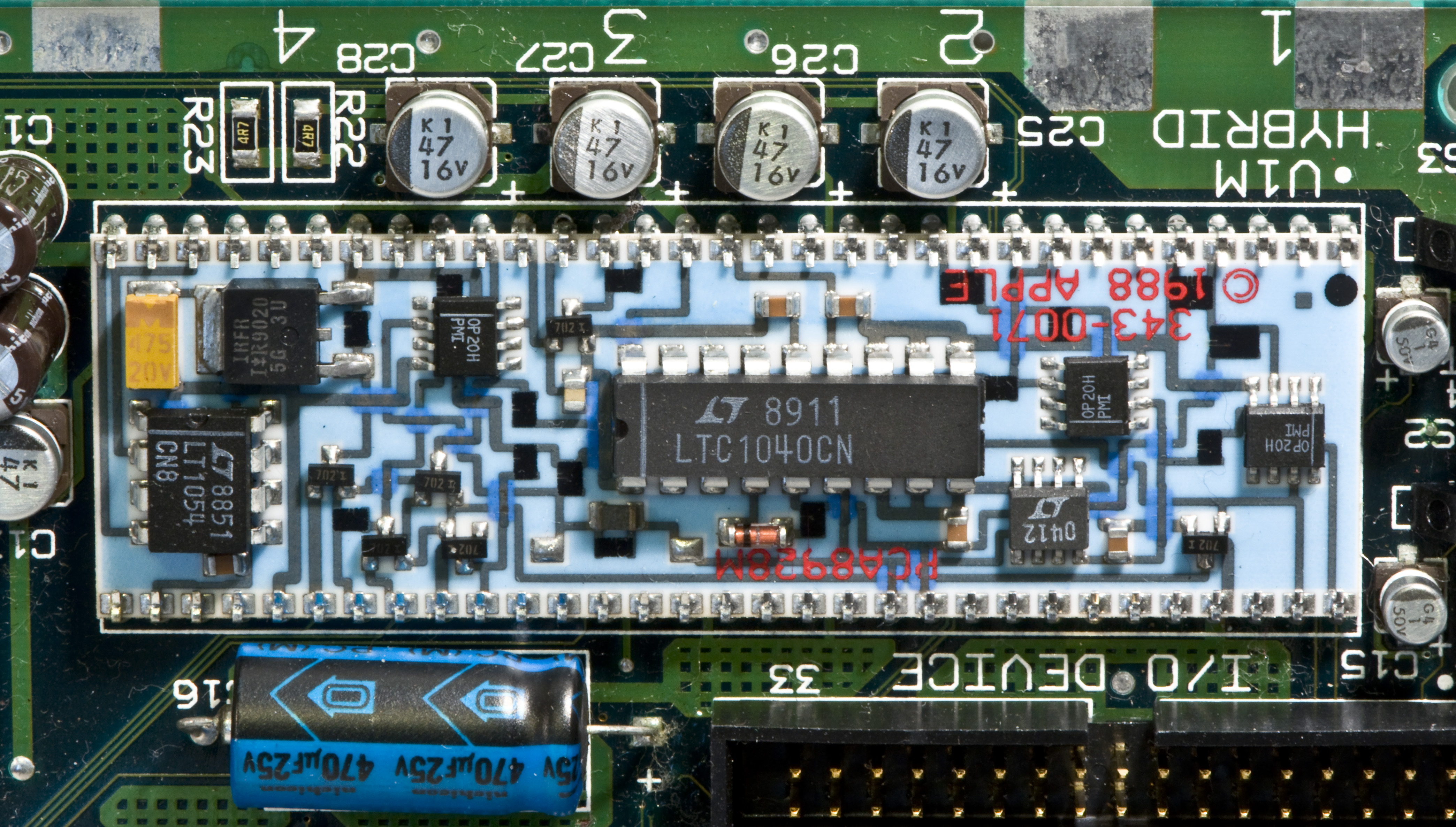
I was able to read the values off of most of the caps but I was not able to read the follow caps. C4, C5, C15 and C24.
Does anyone know what value those caps are?
Thanks,
Matt
Sent from my iPhone
This is rather off-topic, although I will be using said chassis punches for classic computer restoration
I am thinking of buying some chassis punches, in particular some of the ones for D connectors (and others).
One brand I can easily get in the UK is Greenlee. Am I right that that is a respected manufacturer of them?
Not cheap, but then I can't afford the cheap ones.
Also Greenlee do an accesory called the Quick-Draw or something, a handheld hydraulic device that fits
on said punches. It is darn expensive, but I want to know what advantages it gives. If it is just faster then I
am not interested. If it means I can cut thicker metal then I might be.
-tony
Back in 2007 Stan Barr posted a comment about a book that was pure computer
geek porn: "Core Memory" by Mark Richards & John Alderman. I thought it
would be a good stocking stuffer for myself from someone in the family. I
went looking on Amazon for it. The price is $172 for a new hardcover and
$78 for a used hardcover.
This is ridiculous. I thought it was only school books that were at totally
unreasonable prices.
Now, I can get the nook electronic version for $13.99 but this is a *coffee
table book*, something to be displayed. It's geek porn.
So then I went and looked at some other books that are niche. I enjoy
analog design and a Jim Williams book is always good. "The Art and Science
of Analog Design" which is about 15 years old is $50 in paperback.
I guess the printed page is dead. Gutenberg RIP.
Hello group
I'm toying with the idea of writing a simple word processing package along
the lines of Wordstar for my Retrochallenge 2015/01 entry.
I have used many word processing packages over the years on many machines
>from 8-bit machines to mainframes. Within the following bounds I'd love to
know the packages that have been the favourite of list members over the
years and why.
If I implement this I'd be looking to keep within the following bounds:
* text only - ideally support VT terminal 80x24 or 132x24/36/48 or DOS
80x25 display size.
* two printer drivers - text only and Epson LQ (or possibly IBM Proprinter)
* support small range of printer specific fonts
* support proportional text
So a little more than a text-editor but only enough to support simple
formatting and styles (bold, italic, underline for example).
Ideally I'd like to implement a clean, logical design without many 'bells
and whistles' concentrating on the core functionality.
Kind regards, Mark.
Okay, I've been working with my SCSI tape stuff and I'd like someone to
check a .TAP image on a VAX VMS SIMH setup. Less than a meg, but
verification would mean that I've got things right (or wrong).
Tape image (zipped) linked via Box.
--Chuck
I've linked 1 file to this email:
* sample.zip (345 KB) hosted on Box:
https://app.box.com/s/dy51vto78437bjciaaec
So there is a National Semiconfuctor 256KB QBUS memory card which has a
number of examples floating around for sale (e.g. eBay #370953707487), but
which has heretofore been un-identified: the only numbers/names/etc on it are
"PWB 551103882" and "PWA 980103882", which is what one usually finds them
listed under.
Well, it turns out that it's called an "NS23M", and a manual and print set
for it, previously un-available online, are now available here:
http://ana-3.lcs.mit.edu/~jnc/tech/pdp11/NS23M.pdf
Can people who maintain repositories (e.g. BitSavers) please include this in
their sites?
Sorry about the size of the file; the original scans were 300 dpi, which in
retrospect was probably a bit more than needed, but rather than throw away
resolution, I've left them in like that; repository maintainers may wish to
reduce the page images in resolution somewhat, to make the file a bit smaller.
And a very big 'Thank You' to Mr. Steve Burgess, who was nice enough to make
scans of a manual in his possession, and send them to me. If anyone finds this
manual useful, please make a small donation to a local animal charity!
Noel
On Sun, Dec 14, 2014 at 03:49:03AM -0600, cctalk-request at classiccmp.org wrote:
> Your membership in the mailing list cctalk has been disabled due to excessive
> bounces The last bounce received from you was dated 14-Dec-2014. You will
> not get any more messages from this list until you re-enable your membership.
> You will receive 3 more reminders like this before your membership in the
> list is deleted.
Is anybody else getting these messages? I've had a furkle through the mail
server logs and see no evidence of cctalk bounces.
I do hoever see bounces to *cctech*. I never subscribed to that list, the list
server ignores unsubscription requests, and so I instituted the reject policy
in a hope that the bounces would eventually cause unsubscription in the manner
described above and thus achieve the desired effect without further fuss.
Unfortunately, it wants to unsubscribe me from cctalk instead!
Jay, would you like me to take a look at your mail server configuration to find
out how the two lists have become intertwined in this broken manner? It's
probably just a trivial cut-and-paste error or dodgy symlink somewhere.
> From: John Rollins
> it doesn't appear to transmit data from the console port on the back. I
> have tried ... every conceivable switch setting on the PDP with nothing
> ...
> So when I power up, the LED display on the front counts down through
> the numbers and stops at 4. As near as I can tell, this is something of a
> good sign.
Should be; my User's+Maint Guide says that means "Dialog Mode: Waiting for
input".
> Short of spending an entire day disassembling half the machine and
> tracing every wire hoping to find something out of place, does anyone
> have any ideas on what may be happening here, or what to look for?
I asssume you've tried setting the baud rate with the switches on the CPU
card (in case the cable to the back panel is damaged - or, more likely, the
rotary baud select switch has a bad contact due to corrosion over time)?
If you have the parts, fabricating a substitute serial interface cable would
also be something to try.
The next step would normally be to disable the on-board serial interface, and
provide a substitute console interface, out on the bus. _Alas_, as far as I
can tell from reading the KDB11-B User's Guide (EK-KDJ1B-UG-001), there is no
way to disable the on-board serial interface.
AFAIK, the prints for the 11/84 (MP-02536/MP-01955) don't seem to be online.
I can't locate prints for the 11/83 (uses the same CPU board, I think)
either. So I can't check to make sure that it is in fact impossible to
disable the on-board serial interface.
And the other next step, to look at the serial output and see if it looks OK,
will be a little tricky without prints, although the KDB11-B User's Guide
does contain something about it, on pp. 5-38 to 5-41 (165-168 of the PDF).
Noel
So in function checking the PDP-11 now that the Series/1 is out of the basement and I have room to move the unit around and plug it in, I have discovered that it doesn't appear to transmit data from the console port on the back. I have tried two terminals(WY99) and two different PC's(Windows laptop with hardware serial port and a Mac with a USB adapter) with various software, a half dozen different cables, and every conceivable switch setting on the PDP with nothing to show for it aside from a lot of time spent the last couple of weekends.
So when I power up, the LED display on the front counts down through the numbers and stops at 4. As near as I can tell, this is something of a good sign. But nothing ever comes up on a connected terminal. Sometimes pressing keys on the terminal results in the RUN light turning off, other times it does nothing. This would seem to indicate that the PDP knows that something is trying to talk to it, but it is not sending data out.
Short of spending an entire day disassembling half the machine and tracing every wire hoping to find something out of place, does anyone have any ideas on what may be happening here, or what to look for?
------------
John Rollins | KD7BCY | http://www.kd7bcy.com
Ham-Mac mailing list http://mailman.qth.net
------------
I've been playing around with some SCSI tape drives and noticed
something peculiar--or not intuitive. Perhaps someone can explain it.
I'm doing a READ_6 (6 byte CDB) with the fixed bit 0 and a 65KB buffer.
So the sense data coming back returns the residual byte count, as it
should with the ILI bit set in the sense key.
So far, so good.
Now, when I come to a filenark, I'm expecting that the filemark bit (bit
7) will be set in the sense key. It doesn't happen, the result just
comes back as 0 bytes read and a normal (NO_SENSE) sense result. The
additional sense code and sense qualifier bytes are also 0.
Is this normal behavior? I'dve thought that the filemark bit would be
set in every case of a filemark being read. My X3T9 documents don't
mention this behavior, but maybe I missed something.
--Chuck
When I put my DEC Correspondent in storage, I'm sure it had all its keys.
When I pulled it out today, I found that it's missing the key in the far
bottom left. Does anyone have a wrecked Correspondent from which that key
can be extracted?
--
David Griffith
dgriffi at cs.csubak.edu
> Date: Sun, 14 Dec 2014 17:10:07 +0000 (WET)
> From: Peter Coghlan <cctalk at beyondthepale.ie>
<...>
> Many years after performing this somewhat less than useful task, my advice
> is:
> don't write your word processor in FORTRAN IV on an IBM S/370.
One of my earlier programming projects as a "professional" was to port the
WordMARC scientific word processing system to Apollo workstations (before
they were acquired by HP). This was all done in Fortran-77, which was
reasonably well supported on those systems, and included fairly
easy-to-access hooks to get at graphical functions. Because of the
software's heritage and fundamental design, though, it still ended up
looking like a fixed-font terminal application, although running in sizable
windows at least.
~~
Mark Moulding
> From: Pete Turnbull
> Actually, setting switch 1 (in the pack at E83, beside the LEDs) on
> should disable the console ... I can't remember if that's a hardware
> issue or a ROM function.
The manual (Section 2.2.2.4, EK-KDJ1B-UG-001 - thanks for the tip about that
section, Glen :-) sure makes it sound like it's in software: "Any input from
the console results in an error message to inform the user that the console
is disabled" - I doubt that functionality is implemented in the UART... :-)
Noel
I've been told that KTF11-AA chips are hard to find.. I saw this on eBay:
http://www.ebay.com/itm/111541083331
(I've bought from this seller before, their stuff has always worked.)
Noel
Have:
working K10
working HDD
Need:
Someone who cna install the OS onto the K10.
I have tried for some time, but it's not happening, and I think it's
time to call in some help. Anyone want some monetary compensation to
load a working copy of CP/M onto the drive I have?
JIm
--
Jim Brain
brain at jbrain.comwww.jbrain.com
Does anyone have instructions or a schematic (or a pointer to a URL)
on how to make a "hot wire" device to cut the PVA bond between a CRT
and its safety lens? What kind of power supply (how much power), "hot
wire," etc.?
I'd like to build one of these "hot wire" devices, *safely*.
Thanks,
Bob
Hi,
according to
http://www.megalextoria.com/usenet-archive/news021f2/b37/fa/info-mac/000016…
Bill Croft at Stanford developed an Ethernet to Apple LocalTalk gateway
that ran on the original SUN 68000 CPU board.
Unfortunately, I cannot find the files mentioned in that post on any info-mac
mirror (or somewhere else on the net):
"The beta release of our Stanford Ethernet - AppleTalk Gateway
(SEAGATE) is ready. On [SUMEX]<info-mac> the files are:
seagate.ms documentation in -ms format
seagate.hard the wirelist for the applebus interface
seagate.shar1 the main gateway sources (including the above doc's)
seagate.shar2 the ddt, dlq, testscc, and tftp subdirectories"
If you happen to have these lying around in a dusty corner, I would be happy
to obtain a copy.
According to Wikipedia, this code also was the basis for the commercial
Kinetics FastPath gateway product: http://en.wikipedia.org/wiki/FastPath
Best wishes,
Michael
I'm looking for a Sharp LM64C032 LCD (640x480, 16 color) as a replacement
for a Compaq Contura 3/25C (25MHz 386). I saw a few far-east sellers on
eBay with used displays, but they want over $100 for them which doesn't
seem too economical for a machine with a value of around $50 or so. Does
anyone happen to have one of these LCDs sitting around in their junk pile?
I recently pulled the machine from storage and was thinking of using it to
run my old parallel port interface EPROM programmer, but I can't do much
with it with a broken display. The sad part is I actually installed this
particular LCD for the original owner back in the early '90s, but
apparently it got broken sometime before he gave me the machine. (The
original panel failed electronically, and it is too bad I didn't keep it
back then since I could have scavenged it for parts now.)
May 1st, 1964 the Honeywell Electronic Data Processing Division Bala-Cynwyd
office sales team led by Stephen S. Berry (Sales Representative) and H.L.
Sweatt (Branch Sales Mgr) submitted their proposal to DuPont Company to
upgrade the Treasurer's Department computer system. DuPont had been running
an IBM 1401 system but they were looking to upgrade. Initial discussions
between the two companies appear to have been about the H-200 computer.
After assessing the needs of the Treasurer's Department, Honeywell is shown
to suggest that DuPont instead acquire a system comprising of combination
of H-800/1800, H-300, and components. For reference Honeywell also included
info about the H-200.
This proposal contains pricing and system configuration. It also contains a
comparison between the IBM 1401 and the Honeywell B-200. A nice set of
one-page product sheets about the H-200 line are included. This is an
excellent historic reference because it puts the systems in context, from
the Honeywell perspective.
PDF Set: http://vintagecomputer.net/browse_thread.cfm?id=589
Not sure where on BitSavers.org one would put this set as it covers
multiple systems as well as a compare contrast with IBM 1401.
-Bill
(apologies to those on the DecTec list, looking to widen the audience)
I am struggling to surmount a problem installing Ultrix 4.5 from a CD-ROM
onto a DECstation 2100 (MIPS)
After choosing the type of installation (basic or advanced) it tries to
offer the system disk selection. However, it keeps failing because it is
detecting the CD-ROM drive and saying it has an invalid block size. I can
hear it spin up the hard disk that I want to install on, so it should be
finding a suitable hard disk, but it looks like it keeps choking on the
CD-ROM drive. I can't tell if it is failing to see the hard disk properly,
but when I tried NetBSD on the same disk, and in the same machine, it is
fine, so the hard disk shouldn't be the problem.
Any ideas on how to resolve this?
Thanks
Rob
Ian King <isking at uw.edu> suggested:
<...>
> For low resource AND cognitive overhead, how about using either LaTeX or
> HTML tagging, which could then be interpreted in a simple mapping table
> for
> a given printer? By not implementing all of the bells and whistles of
> either syntax, one could create something that's lightweight and
> sufficiently expressive.
Or how about MarkDown? A combination of this (for in-line emphasis or font
changes) and perhaps some beginning-of-line dot-commands (like runoff, and
also in WordStar) would likely be adequately expressive (I've done entire
reference manuals using only MarkDown), easy to implement, and easy to parse
for formatted output (printed, HTML, or whatever).
~~
Mark Moulding
There's a nice LSI-11 brochure going on eBay:
http://www.ebay.com/itm/291318103446
It's got pictures of a lot of different kinds of cards (useful for ID
purposes), a modest amount of technical content, etc. Definitely worth
having if you're a PDP-11 collector, and can get it for not too much
(I already have one, don't need another... :-)
Noel
> From: drlegendre
> If you take a look at eBay Sold Items, in late September, a 276-190
> sold for $6 inclusive of US shipping. It only took one bid, so it seems
> like the competition isn't too tight.
If you decide to go for the one at TopLine, and want to make an offer that's
lower than the listed price, mention this (and give the item # for
reference). They're very business-like, and they want to move inventory, so
if something's only going for $X on the open market, they will cheerfully
take $X for it, even if they have it listed for $4X (unlike some eBay
sellers, who persist in listing things for $4X, and won't budge - with the
result that their stuff stays up forever, almost never selling).
Noel
Folks,
Any one got any of these Radio Shack boards lurking that they would sell and
ship to the UK? The 275-190 looks best, there is one on E-Bay now but at $20
plus $18 for shipping to the UK its getting very expensive..
. Actually looking at DigiKey that's cheap. $33 for a new board with no
shipping.
276-180
276-152
276-190
Or actually any thing with a 22/44 way 0.156" connector.
Dave
G4UGM
If anyone happens to have a spare Apple IIgs power supply that they'd
be willing to sell for lower than eBay prices, I could really use one.
On eBay, the power supply often sells for more than the whole
computer.
I will replace the failed capacitor in the power supply that I have,
but unfortunately when it smoked and burst, it got smelly resinous
crap all over the PCB, other components, and the inside of the power
supply case, so I'd prefer to put in another power supply than
constantly fill the house with fumes from this one.
Thanks!
Eric
> Hello group
> I'm toying with the idea of writing a simple word processing package
along
the lines of Wordstar for my Retrochallenge 2015/01 entry.
<snip> > So a little more than a text-editor but only enough to support
simple
formatting and styles (bold, italic, underline for example).
>
> Ideally I'd like to implement a clean, logical design without many
'bells
and whistles' concentrating on the core functionality.
Mark,
As a programmer I used to use QEDIT most of the time because it made it
easy to edit by column as well as row, mark/move text, easy keystroke
commands. The copy I have is saved as q.exe. It was better than notepad
and I continued to use it well past it's era. Still hard to edit by column
when your parsing text without being forced to use a spreadsheet program.
Sounds like you're talking more of a word processor though. So, I'd put in
my vote for something like IBM Personal Editor (PEDIT) which gave a person
a lot of functionality with little RAM overhead. I never really liked
WordStar or Word Perfect myself, but I used what I had available.
As far as formatting to the printer goes, I suggest you include the
capacity to enter printer codes manually so that you can use most any type
of printer that accepts them. I remember inserting codes into programs
that were used for a specific printer that way. If you have the manual and
given you're talking simple print capabilities you would not need to supply
drivers.
Bill
On Dec 12, 2014, at 11:00 AM, Chuck Guzis wrote;
> Subject: SCSI tape question
> Now, when I come to a filenark, I'm expecting that the filemark bit (bit
> 7) will be set in the sense key. It doesn't happen, the result just
> comes back as 0 bytes read and a normal (NO_SENSE) sense result. The
> additional sense code and sense qualifier bytes are also 0.
I wrote the SCSI tape drivers for the Unix based version of the NCAR Mass Storage System (MSS) Storage Manager servers, we moved a few petabytes of data through them. It made use of the SCSI generic interfaces of Irix, Solaris and Linux, but we couldn't trust the default OS tape drive driver behaviors would do the right thing for an archive.
You should be able to detect file mark indications in either the variable length or fixed block read modes. When the tape (or drive controller buffer position for those that perform buffering) is positioned at the file mark, you will get a check condition response to the issuance of the read command, then you (or the SCSI generic driver) issue the read sense command (immediately after the read, no other intervening commands!) and the file mark bit will be set in the sense buffer. For the generic SCSI devices, you can typically tell the driver to perform an auto sense for check condition responses. Just make sure you have properly told the driver where to put the sense data. I suppose a drive could have a manufacturer specific mode that could hide file marks, but I've never seen one. We did make use of manufacturer specific procedures to place the read head beyond the detected EOT mark so we could recover tapes that had been accidentally overwritten in the middle of recorded data.
> From: Sean Caron
> I can offer a seller endorsement; I've bought VAXen and VAX parts from
> them quite a few times and they ship quick & are easy to work with...
> they also are good about accepting reasonable offers on items. I have
> no clue who that individual is but they have a huge stash of neat stuff
> they are selling off...
Oh, ComUsed/TopLine! Yes, they are really quite good, along all axes. I deal
with them a great deal, it seems like I drive up to DC about once a month to
pick up large/heavy items from them! :-)
Their place is pretty amazing - it looks like something out of one of the
seedy backwaters from a William Gibson book; on the inside, it's stacked to
the rafters (literally!) with old stuff (albeit considerably better organized
than the typical Gibson gomi collector's :-).
Their business is buying and selling used computer stuff; e.g. they do a lot
of business in used printers. Much of the large amount of PDP-11/VAX/DEC stuff
they have/had came from the estate of a major DEC collector who died; somewhat
to their amazement, I think, they've found that it sells well! I have the
impression they've picked up other groups of stuff too, although none as large
as that.
They tend not to have complete systems of any size (some smallish LSI11's is
about it), they don't have a lot of room; but the prices are usually hard to
beat. Can definitely recommend them, along all axes.
Noel
On Fri, Oct 3, 2014 at 8:40 PM, Andrew Hoerter <amh at pobox.com> wrote:
> I've followed up off-list, so hopefully my additional issues will be
> available online at some point.
I'm happy to say that the issues Andrew sent to me a few weeks back
have made it through my scan queue, endured some archive.org index
weirdness and are now online. There are now 52 issues of Inside
Solaris to enjoy over your $holiday:
https://archive.org/search.php?query=collection%3Ainsidesolaris&sort=-date
(Some of the metadata was incomplete, causing them to present out of
order. I just fixed it but the changes haven't indexed yet...perhaps
soon...?)
-j
At 1247 AM 12/4/2014, Mark Wickens wrote:
>I would argue that only the original PDP-1 could rightly be called "the PDP"
Speaking of that pioneering machine, does anyone know if there are any plans by the CHM to try to make the MIT engineering prototype operable? I last saw it in use at MIT about 45 years ago, when it was housed adjacent to the TX-0 and the two were being used for speech synthesis experiments. From what I understand the operable machine on display at the CHM is a later C production version.
Dale H. Cook, GR / HP Collector, Roanoke/Lynchburg, VA
http://plymouthcolony.net/starcity/radios/index.html
> From: Pete Turnbull
> you are aware that although there's 2KW of code in there, it's accessed
> through a 256-byte (128 word) window in Bank 8 which has to be
> programmed via the PCR?
Yes, thanks.
> There are 18 error halts, listed in the BDV11 manual, which I expect is
> on bitsavers
The Technical Manual is, but not the User Manual (which may not exist, the TM
doesn't mention one); the TM doesn't cover the software (in the PROMs), just
the hardware.
> and on pp107-108 of the PDP-11 Microcomputer Interfaces Handbook 1980.
Ah, didn't know that - thanks, that's useful.
It's been a while since I looked at the BDV11 entry there; I was using the
BDV11 entry in the Microcomputer Products Handbook.
> The 25 error halts for the 11/23+ are listed on pp 611-613 of the
> Microcomputers and Memories Handbook 1982, and also on pp 47-49 of the
> PDP-11/23-PLUS System Manual (EK-1T23B-OP-001).
Ditto (useful).
> You've already discovered, I imagine, that there are gazillions of ways
> to set up and use the sockets on a BDV11
Yup.
Noel
Does anyone know of anything that documents the contents of the various BDV11
ROMs? In particular, I'm interested in learning what the various halt
locations imply.
Yes, I know, I could dump them, and disassemble them, but I'm hoping to avoid
all that hard work... :-)
There seem to be two different ROM sets; 23-046E2/23-045E2, which seem to be
an earlier set, as they only understand 56KB of memory; and a later set,
SG8326-339E2 and SG8330-340E2 (which might not be DEC standard, the numbers on
them are 'odd' - although they might be 23-339E2/23-340E2, the boot ROMs from
the 11/23+), which understand up to 4MB of memory.
(Interestingly, the latter set are on Intel D2716s, EPROMs, unlike the earlier
ones, which are plain PROMs.)
Thanks in advance for any help!
Noel
> From: William Donzelli
>> From: Brent Hilpert
>> All of which kind of emphasizes Roy's point of disruptive
>> technologies. So what are some candidates for the most-disruptive?
> Fiber optics completely shook up the "long lines" telecom industry.
> Continous casting completely shook up the steel industry. The diesel
> electric locomotive completely shook up the rail industry. And on and
> on...
Interesting topic, albeit somewhat off-topic for the list. (My apologies for
continuing it... :-)
Some disruptive technologies are subsets of others; e.g. transistors are in
some sense a subset of electrical (altough, as Chuck points out, they also
draw on materials science). And how far back do you want to go? The discovery
of metals certainly had a huge impact, albeit that it was many thousands of
years ago now!
But among the big ones for me are electricity, which almost has too many
subsets to count (e.g. long distance communication, starting with the
telegraph - read "The Victorian Internet" for a good look at how that changed
the world), the printing press (information technologies in general have
outside weight, since they affect so many other fields), the internal
combustion engine (which has physically re-shaped entire civilizations,
especially the US), with all its subset (e.g. the airplane)... too many to
think of, almost!
And it all started with sharp stones... :-)
> From: Chuck Guzis cclist at sydex.com
> And yet nobody seems to know about Lilienfeld.
I am somewhat ashamed to admit that before today, I had not (that I can
recall) heard of him. And I see there is no full-length book on him. A
hole waiting to be filled, as it were...
Noel
Hi
Andreas: I need to talk to you regarding the VAX. If there are
mailproblems on this end try pontus.pihlgren at gmail.com
If anyone else knows that Andreas can't be reached, Please let
me know.
/Pontus
On the back of Roe's question; didn't want to hijack his thread.
I was browsing eBay and came across this very unusual looking Unibus card
(?)
http://www.ebay.com/itm/Vintage-Computer-Memory-Digital-DEC-logo-1216988-bo…
I'm really curious what all those SIP hybrids are running down the one side
of the board. I see it's got no less than 8 74181 ALUs so I figure this has
got to be some kind of processor?
Perhaps a prototype or simply an obscure hop-up processor for Unibus
machines similar to some of which were marketed for Q-bus with i.e. MC68k,
NS 32k, MIPS CPUs (KN210), etc.
I tried to do a little research about i-con on the Web but I'm coming up
blank.
Anyone know what the heck this thing is? Just curious.
Thanks,
Sean
My advisor was given an old HP83000 IC tester a few years ago and I got
stuck with trying to figure out how to evaluate if it is worth trying to
set up.
To that end, I am investigating the HP C360 visualize workstation that came
with it.
It is booting, but there are entries in the fstab that imply that there
were more hard drives.
It came with this hard drive array: http://imgur.com/a/0JSZW
I am having trouble even identifying the make and model, let alone finding
some sort of manual.
Anyone got an idea of what is going on here and possibly where I can source
the correct cabling for it?
The workstation has 2 scsi busses, an ultrawide single ended and a narrow
single ended.
At 07:00 PM 12/10/2014, Kyle Owen wrote:
>Just picked up a 1960s TV-7D/U tube tester to check some of my tubes while I catalog them, but other days are spent tinkering with PDP-8/Es.
I own a Hickok 533 and a few other testers, as well as a GR vacuum tube bridge, to ride herd on many vacuum tubes stocked for many vacuum tube instruments and antique radios. I don't get as sophisticated as working with 8s (though I did care for a couple of pdp-8/m systems 30 years ago), I just wrangle some electronics with dedicated microprocessors from the 8080/8085/Z80 family.
Dale H. Cook, Roanoke/Lynchburg, VA
Osborne 1 / Kaypro 4-84 / Kaypro 1 / Amstrad PPC-640
http://plymouthcolony.net/starcity/radios/index.html
I just realized I haven't gotten a message from the list in over a month.
wondering if I got dropped or the list is down?
Paxton
--
Paxton Hoag
Astoria, OR
USA
I have had my PDP-8 (no letter) since around 1985. As part of the deal I
got a little over 200 DECtapes. Most of these are SCOTCH 3M branded in
cardboard boxes and not DEC branded DECtapes in the clear blue plastic
containers. I have been thinking about moving this data to a permanent
storage location so I wondered how much space this would require. Turns
out to be about 57 million bytes and that would be without bothering to do
any compression.
The trivia question is:
Approximately how many DECtapes will fit on a single one terabyte drive?
As there are several possible answers to this feel free to reply on the
list. I will give my answer in a few days.
Doug Ingraham
A Kenedy 9300 9 track tape drive, formatter, controller to emulate various
military drives, Univac 2049 (Canadian USQ-69 like terminal) and ZIP
emulator of tape drive may be available. The drive and terminal are large/heavy
so shiping isn't practical. If you just need parts for yours I may be able to
scavange. Its also possible that I won't be able to get anything. Equipment
is in Maryland near DC.
Contact me off list if you have interest.
Hi.
I went dumpster diving some time back. I saw an old "white box" 286
PeeCee with a MFM disk and a strange ISA card. I riped them out of the
box and took them home. I intended to reuse the MFM disk in my MicroVAX
2000. Then I noticed that the ISA card carries a IMST414 Transputer
chip. It looked to me like this PeeCee was the "head" of a bigger
Transputer system. (That I rescued out of that dumpster some years
back.) So I went back to that dumpster and pulled the other ISA cards
(disk, video, IO). I suspect that this ST-125 MFM disk contains some DOS
software to drive the ISA card with the Transputer. Plug all this stuff
into some generic old PeeCee and there you go...
The Transputer card is 8 Bit ISA full size. It has the T414, a bunch of
74TTL glue logic, 16 SIMM sockets, four populated, a button and a small,
round 5-pin connector on the slot bracket. It is labeled "Monoputer 2
v1.1 (C)Microway,Inc. 1988".
I am willing to ship this inside .eu for a reasonable "shipping and
handling fee". (Or in exchange to some SGI O2 RAM.) I don't wane make
money on this. I want this to go into good hands, ideally someone that
rescues and preserves any software from that MFM disk.
--
tsch??,
Jochen
On Monday, December 08, 2014 8:12 PM Fred Cisin [mailto:cisin at xenosoft.com]
<snip>
>In MS-DOS/PC-DOS 2.00 and above, FDISK reported hard disk capacity in
honest binary Megabytes of 1,048,576
I looked for but could not find a screenshot of very early PCDOS FDISKs, the
later ones I've found all include the statement 1 MB = 1,048,576 bytes so by
that time Microsoft and IBM were indeed "honest" unlike Apple. FWIW, The
MS-DOS Encyclopedia (c) 1988 which covers thru DOS 3.3 shows the "Display
Partition Data" option as giving capacity in the number of cylinders, not a
particularly useful measurement but not misleading. FORMAT and CHKDSK all
report in decimal digits without commas. Would like to see a screenshot for
an early FDISK Option 1 using binary prefixes before I concede that
Microsoft/IBM DOS used but did not disclose binary prefixes before Apple
<snip>
>WHAT missing 490 KB??!?
>I recall Seagate referring to the ST225 as "20 Megabyte" (~1985?) Unlike
some other manufacturers, they rounded DOWN, not UP, AND they did not use
excessive "significant digits".
>(That also gave them a lot more slack than their less scrupulous
competitors to cover bad sectors) ((In apthecary measures, there are THREE
Scruples in every DRAM!))
The published Seagate specification for ST225 that I have states the
formatted capacity = 21.4 MB comprising exactly 41,820 x 512 byte sectors =
21.411.840 bytes = 21.4 MB
BTW the reason I picked the ST225 as an example rather than the ST412 is
that Seagate specified the formatted ST412 with 32 x 256 byte sectors per
track giving precisely 10.0 MB (10.027008 MB). IBM in the PC chose to go
to 17 x 512 Bytes sectors per track thereby increasing the formatted
capacity to 10.7 MB or 10.4 MiB. So a Seagate ST412 used with any of the
several IBM PC compatible controllers actually had a dram more than Seagate
specified, but in both cases more than 10.0; confusing perhaps but no basis
for complaining. But they soon changed to 512 byte sectors and that dram
went away. I really don't think Seagate was any more scrupulous than its
competition in specifying its drives, as near as I can tell they rounded
off, but even if they rounded down it was in the third or higher digit so we
are talking about a relatively small number when compared to the confusion
caused by binary prefixes.
Tom
Hey,
I'm looking for a Sun-1 keyboard (between myself and another local
collector we have 3 Sun-1's but only 2 Sun-1 keyboards).
Does anyone happen to know anyone who might have and extra one they'd be
willing to sell?
Thanks.
Earl
This is a long shot, and an oddball request, but we're all hoarders
here, right?
I'm looking for "PC Connection" catalogs from 1989 through 1992. If
you have any, please drop me a line. I'd be happy to pay a few bucks
for each one, plus mailing costs of course.
-Seth
> Date: Sun, 7 Dec 2014 19:26:23 -0500
> From: Matt Patoray <mspproductions at gmail.com>>
> To: "cctalk at classiccmp.org" <cctalk at classiccmp.org>
> Subject: Recaping a Macintosh Portable
> Message-ID: <A1A9E821-368F-422D-AAE8-B0BF138AFF7F at gmail.com>
> Content-Type: text/plain; charset=us-ascii
>
> Hello all,
>
> I have a Mac portable that refuses to even attempt to boot.
>
> I get random junk on the screen that is different on every power up, no drive activity and no sound.
>
> I am thinking the onboard surface mount electrolytics are due for replacement.
>
> I was able to read the values off of most of the caps but I was not able to read the follow caps. C4, C5, C15 and C24.
>
> Does anyone know what value those caps are?
>
> Thanks,
>
> Matt
>
> Sent from my iPhone
I believe that those four caps are all G4 1 50v - there is a close-up picture of C15 and C24 (on right) here: http://regmedia.co.uk/2010/11/08/port_unknown_large.jpg
> From: Johnny Billquist
> If the MMU is off, you can consider the PAR registers as just plain ram.
Ooooh, very clever! Wouldn't work on a /40, of course, but on a /23 with
22-bit addressing, they are full width! Thanks for the tip!
Noel
I'm a bit late into the fray for this subject but '5 pins' does ring a bell. A 'link adapter port' which '... provides an interface to the outside world ... to allow the user to control an external network of Transputers ... has 5 lines (and a ground/grounds). The 5 lines are
NotReset
NotAnalyse
NotError
LinkIn
LinkOut
Doug.
> I'm trying to fix a broken MSV11-L card (M8059-KF). The symptom is that
> it always reads back with the 020 bit set, but otherwise appears to be
> fine.
> ...
> two octal 3-state-output latches (E57 and E64, an 'LS373 and an 'S373
> respectively).
> ...
> the two octal latches are both TI Malaysia parts (date code 8231)
> ...
> it's the data latch that's bad.
So, I seem to have discovered a plague! I had another failed QBUS memory card,
an MSV11-D this time (M8044-DB). It has the exact identical symptom, except
with a different bit - 02000 this time, instead of 020.
So, since the designs are very similar, I thought 'maybe another bad S373'.
Well, they aren't quite as similar as it thought, but the culprit is indeed
apparently ... a bad S373! (Although I have to caveat that; I suppose it
could be the bus transceiver it's connected to.. but the output is always
high, which make it seem like the the driver in the 'S373 has failed.)
Anyway, this time it's a National Semiconductor part, and from a very
different date code (7947). What is it with S373's? Is this just pure chance,
that two from different makers, quite a while apart in time, were the
culprit? Or is there some issue with S373's? (I note that MSV11-D's are
apparently notorious for failing; perhaps because they use S373's a lot?)
I do have another MSV11-D with a similar fault (the 01 bit this time); once I
get it fault-isolated, I'll report if it, too, is caused by an S373 failure.
It may take a while to get it fault-isolated, though - so far, I've been
writing two- or three- instruction loops which have the picked bit set in all
the words of the program! (Because I'm too lazy to write a longer program that
sets up the memory mapping so the program can run out of 'good' memory, only
poking the 'bad' memory to test it... :-) Also, it's kind of an fun
challenge... :-)
Noel
>On Saturday, December 06, 2014 8:21 PM Chuck Guzis wrote
>On 12/06/2014 06:55 PM, Noel Chiappa wrote:
>> From: Jerome H. Fine
>> I would point out that one reason that memory may have stayed with 2 **
>> 30 is that memory is usually produced and sold in multiples of 2 ** 30
>> these days
>>
>> Main memory has pretty much _always_ been sold in blocks that were
>> exact powers of two, for obvious reasons (at least, powers of two of
>> the word size of the machine in question)...
>Let's see; IBM 1620--basic memory size=20,000 digits, increments of
>20,000 digits up to 60,000. IBM 705, 7080,...
>What is curious is the marketing numbers used for the memory size. 65K,
131K, etc. I believe IBM was guilty of this in their S/360 marketing
literature.
>The numbers sound bigger.
>--Chuck
Welcome to the debate over who is responsible for the confusion in the use
of binary versus decimal prefixes; it has been going on at Wikipedia since
2001, see:
https://en.wikipedia.org/wiki/Binary_prefix and
https://en.wikipedia.org/wiki/Timeline_of_binary_prefixes
Actually I think IBM was fairly rigorous in using decimal prefixes, K
meaning 1,000, with annotation K=1024 when appropriate as in the Amdahl
article on S/360 architecture. I doubt if it had anything to do with
appearance. More importantly I am pretty sure that into the 1980s (perhaps
later) in its product literature, product specs and operating system
utilities IBM used decimal digits with no prefixes at all.
IMO the mess really started with Apple's Macintosh which reported memory and
disk capacity using K in a binary sense without any qualification. I can't
prove a negative, but I think no OS prior to the Mac OS used any prefixes at
all; they simply displayed or printed a decimal number to however many
digits necessary, sometimes without commas. It will be interesting to see
what this group recalls
If u think about it, mixing decimal digits with binary prefixes makes little
sense and probably has caused all sorts of problems and confusions such as
the infamous 1.44 MB FD. I've always wondered why the programmer at Apple
didn't use decimal prefixes and avoid all this nonsense. After all there
isn't a lot of difference in coding between a binary shift followed by a
decimal conversion as Apple did it and a decimal conversion followed by a
decimal shift.
Tom
It's Holiday Music Week on RetroBattlestations, where people submit videos of their old computers playing music! Play some music with your PDP on an AM radio, enter your favorite scores into Music Construction Set, or fire up a Christmas demo! You can choose any holiday music from the traditional or the not so traditional, but, in order to be eligible though, you have to submit a song that hasn't already been submitted.
There's prizes of vinyl stickers and reddit gold, but like most every challenge on RetroBattlestations, it's more about showing off your computers and that they still work. You can get more details here:
http://redd.it/2ogx2n
And for anyone that hasn't seen it before, here's a mashup of most of last year's entries playing Linus & Lucy.
http://youtu.be/aZOJQwVgRi4
--
Follow me on twitter: @FozzTexx
Check out my blog: http://insentricity.com
> From: Jerome H. Fine
> I would point out that one reason that memory may have stayed with 2 **
> 30 is that memory is usually produced and sold in multiples of 2 ** 30
> these days
Main memory has pretty much _always_ been sold in blocks that were exact
powers of two, for obvious reasons (at least, powers of two of the word size
of the machine in question)...
(Although occasionally, back when, one used to see things that were 1.5 times
a power of two, e.g. on a 16-bit machine, 12KB, 96KB, etc - physical and cost
constraints tended to produce those. I don't recall the last time I saw
something that wasn't a power of two - probably those 96KB jobs.)
With disk drives, on the other hand, one can get all sorts of arbitrary sizes,
produced by the number of cylinders, numbers of heads, etc, etc.
Noel
Anyone have any documentation on the RGS 008A? This is an early (1975)
microcomputer kit based on the 8008, and was reviewed in the first issue of
BYTE. Other than that article, there's not much information out there;
anyone happen to have the manuals (or anything else) and be willing to scan
them?
Thanks,
Josh
PS: When buying replacement chips, since many are NOS, which manufacturers
should be avoided, and which are good? I recall there was some discussion on
here a while back about the topic of which vendors seemed to have the most
problems with chips failing, but I can't find it (and a bit of Google
searching couldn't turn up anything on the topic - all my searches turned up
too much other stuff).
And should I always install the replacements in sockets, or is it OK to just
go ahead and solder them straight in? (The socket obviously doesn't cost
much, and I'm less likely to damage the chip installing it like that, and of
course if I get it in and it's U/S, it's easy to swap out from a socket, but
I'm wondering if the use of a socket has any downside, electrically.)
Again, thanks for any advice (and I won't be surprised if the last starts
the usual debate... :-)
Noel
Classic Computer Fans,
I made it through an i5 OS install on my 9406-270 plus installed various
products. I haven't done much past that other than switching the QCTLSBSD
system value from QBASE to QCTL and performing an IPL. I'm now able to
perform an unattended IPL and get from power on to a sign-on screen in just
under nine minutes.
Only one drive came up to choose from during the install process so
everything is installed on it. A WRKDSKSTS shows drive 1 at 33% and drive 0
unused. Is it possible to add drive 0 to the system at this point?
I'm not sure where to go from here. Some of the things I can think of that
I'm sure need to be done at some point:
- Learn how to apply PTFs
- Create some user profiles
- Configure and start TCP/IP
- Explore backup options in case I have to reinstall or restore every 69
days. I'd be surprised if the internal tape drive is functional.
- Learn all kinds of things I haven't even heard of yet
And I'm sure the list goes on and on. I'm open to suggestions.
--
Kevin
http://www.RawFedDogs.nethttp://www.Lassie.xyzhttp://www.WacoAgilityGroup.org
Bruceville, TX
What's the definition of a legacy system? One that works!
Errare humanum est, ignoscere caninum.
>-----Original Message-----
>From: Fred Cisin [mailto:cisin at xenosoft.com]
>Sent: Saturday, December 06, 2014 12:40 PM
>To: General Discussion: On-Topic and Off-Topic Posts
>Subject: Re: Weekly Classic Computer Trivia Question (20141205)
>>On Sat, 6 Dec 2014, Johnny Billquist wrote:
>> I should actually do my math before commenting. :-) It just happens,
>> that by a funny accident, 1440*1024 is actually 1,474,560.
>>
>> But still. The actual size of the floppy wasn't decided because you
>> pulled out 1440*1024, but because of the format of the darn thing.
>> 1.44MB is just the closest "nice" number you can come up with after
>> the fact as a way to talk about the capacity of the thing.
>>
>> It is not an exact number, but they seldom are, when we talk about
>> storage. People like to round things off, to make it easier to talk
about.
>It is NOT a "nice" number.
>Honest numbers would be either 1.47 or 1.4 There is no legitimate way to
come up with 1.44 unless you cheat and MIX powers of 10 and powers of 2.
__________________
It comes from a double capacity 720 KB FDD - which in this case are actually
KiB and not kB
However, in an incredible bit of marketing stupidity it was labeled 1.44 MB,
since 2*720 KB/1000 = 1.44 MB
Tom
Just checking a PSU in a MicroVAX 3100 Model 80. I am measuring about 10mV
ripple on the 5V supply and 20mV ripple on the 12V supply. Does that seem
reasonable?
I am not sure if it is a scope artefact, but there appear to be large spikes
at the top and bottom of each sawtooth. The machine appears to partially
work, it seems to be getting some errors during the memory test, but I don't
know if that is the spikes I am seeing or just a bad component somewhere.
Regards
Rob
>> From: Jon Elson
>> The 2V level sounds like maybe NO chip is driving that node. A shorted
>> output (or input) would likely pull one way or the other, 2V is about
>> the resting point of a TTL input.
> The way the two output data laches are wired, the output control on one
> is wired with the negation of the output control on the other, so one
> or the other ought to be trying to drive the line at all times. So
> perhaps the one that _should_ be driving the line normally is the bad
> one, then
After thinking about this tip for a few minutes, it dawned on me that there's
a simple way to see if the data latch is bad: read the CSR! That will try and
drive that line from the other latch. So I did, and ... I can read 0 from
that bit in the CSR! So it's the data latch that's bad.
Thanks for the tip!
Noel
> From: Jon Elson
>> the anomalous voltage I see (2V) is after the output (i.e. to the
>> QBUS) data latches, but before the bus transceiver
> Output from the memory chips? Well, then, you may have to replace them
> all, as one chip may be jamming the bus.
No, "after the output .. data latches", which are between the memory chips
and the bus transceiver.
> Do any of the affected driver chips run hotter than the others? That's
> the "finger test", you replace any anomalously hot chips first
That's a useful idea, thanks, I'll try that.
> The 2V level sounds like maybe NO chip is driving that node. A shorted
> output (or input) would likely pull one way or the other, 2V is about
> the resting point of a TTL input.
Ah, more useful info. The way the two output data laches are wired, the
output control on one is wired with the negation of the output control on the
other, so one or the other ought to be trying to drive the line at all times.
So perhaps the one that _should_ be driving the line normally is the bad one,
then (since it's clearly not...) Thanks for the tip!
Noel
> From: Jon Elson
> Power the system off for 10 minutes, then power on and read various
> locations. If data bit 4 shows 1's and 0's, then the reading is OK, and
> it is the writing path that is stuck.
I'm not sure this will work, as the anomalous voltage I see (2V) is after the
output (i.e. to the QBUS) data latches, but before the bus transceiver: i.e.
in the output (reading) path. So I know it's the output data path that has a
problem, not the input.
The only question is which of three chips on the output data path might be
the cause of the problem; one of the two three-state latches (one for memory
data, one for CSR data), or the bus transceiver. As far as I can tell, those
are the only three devices attached to that conductor (where I see the
constant 2V).
Noel
Hi, all, I'm trying to fix a broken MSV11-L card (M8059-KF). The symptom is
that it always reads back with the 020 bit set, but otherwise appears to be
fine. (E.g. you can write a number in 0, and a different number in 020, and
each reads back OK, with the exception that the 020 bit in each is always
set; i.e. the addressing is working fine, as is the QBUS generally.)
So poking around with my 'scope, I find that the latched D04 signal ("LAT D04
H") is always around 2V - not good! From the prints:
http://www.mainecoon.com/classiccmp/MSV11-L/MSV11-L%20FMPS%20MP01238%20(M80…
it appears to be generated on page 6 of the prints (page 10 of that file), as
the wired-or output of two octal 3-state-output latches (E57 and E64, an
'LS373 and an 'S373 respectively). The only place it appears to go is to the
quad bus transceiver (E62, an 8641), on page 2.
My question is: any guesses as to which of the three is causing this? Or do I
just have to start replacing them until I find the guilty party? :-) If so,
what's the best order to do so in? FWIW, the two octal latches are both TI
Malaysia parts (date code 8231), and the transceiver is a Motorola (date code
8249).
Thanks in advance for any help!
Noel
Hi All,
I have a couple of Shugart 810 drives I'd like to get working with an OSI system.? While swapping the drives around, I made some changes to the jumpers, but now I can't find the notes I made of the original configuration.? Does anyone have information on the function of the various jumpers on these drives?? I found some manuals online, but they don't seem to have the jumper info.
Any information would be most welcome!
Thanks,
Dave
I'm not sure I ever posted this publicly, never went out of my way to do so
in any case.
The HP Interex and HP 1000 Contributed Library website (I think it was
interex.org) went down quite a few years ago, and I managed to scarf a
complete copy of the site after the pending turnoff was announced but before
it went dark.
This content is all at http://www.classiccmp.org/interex
There are two folders: One is the proceedings, slideshows, etc. of all the
HP Interex meetings and the other is the entire HP CSL for HP1000.
As usual, please do not rape the content. If you need more than a few files
here and there please contact me off-list to arrange a hard drive swap, etc.
Best,
J
Not vintage stuff, but I thought I would offer them to the list first. I
have three of these caddies, marked 146.8 GB 10K Ultra320 SCSI. You can see
one here:
http://www.ebay.co.uk/itm/HP-404708-001-146GB-10K-3-5-SCSI-Ultra-320-Hard-Di
sk-Drive-in-ProLiant-Caddy-/251350220378 but bear in mind there is no disk,
just the caddy.
Located in the UK.
Regards
Rob
Hey folks,
I really need some cash and some space, so it's time for my Intel Intellec
MDS gear to find a new home. I inherited this kit some years ago, and know
almost nothing about it - in fact, I'm even confused as to the correct
model number; 'experts disagree', it's either an MDS-225 or MDS-800.
It's a large white cube, about 20" on a side, with a CRT, one 8" floppy and
a number of plug-in boards. There is also a blue Intel dual 8" drive, one
seriously heavy-duty keyboard, a few cables and a bevy of 8" floppy discs.
I also have an ICE pod for it, somewhere..
It has never been powered-up once since I've had it, though it was
apparently 'working fine' when retired sometime in the early-mid 1990s.
Cosmetics are very good, it's no ugly duckling by any stretch.
Photos will appear as I'm able to move it to a location with sufficient
light.
I did find this entry in the CSL1000 library to be of interest!
BAS200 - HP 2000F BASIC FOR DOS-M/DOS III
2001 X172Keywords: 99.5- 10 BASIC
So Hp2000/F was ported to DOS-M/DOS III? Wowsers.
J
> From: Sean Caron
> I was browsing eBay and came across this very unusual looking Unibus
> card
Yeah, I was wondering about that too. It looks like it has a ton of memory
over on that one side; I was thinking that perhaps it was an EUB memory card
with ECC, or something? Anyway, I decided not to mess with it (even if it is
pretty cheap - got enough fish to fry on my hands at the moment... :-).
Noel
About a year ago I posted about this; I have an HP 9830A upgraded with
an Infotek MX-30 processor upgrade (there's a nice writeup on this page:
http://www.hp9825.com/html/infotek.html), but I'm missing the RAM
boards. Thought I'd poll again just in case anyone has some, as
unlikely as that may be.
Alternately, if anyone needs an MX-30 board set (sans memory) for a
restoration, drop me a line and maybe we can work something out. Hate
to sit on this forever and never get anything working...
- Josh
Fellow Classic Computer Enthusiasts,
My 9406-270 has arrived. It was strapped to a small pallet with more bubble
wrap around it than I think I've ever seen before. Somehow the pallet just
fit in the back of my mini-van so the freight company was able to load it in
there with a fork lift.
I got it home and into my living room. It came without drives so I'm having
to start from scratch. I have two drives in slots one and two, and think I
have the twinax console connected correctly. It appears to IPL from CDROM
but I'm not getting anything on the console other than the cursor moving
>from the upper right corner of the screen to the upper left corner of the
screen after about twenty minutes of occasional CDROM activity. Does anyone
have any pointers for a newbie at installing OS/400, or whatever V5R4 is
called. I wish IBM would stop changing perfectly good OS and hardware
names.
--
Kevin
http://www.RawFedDogs.nethttp://www.Lassie.xyzhttp://www.WacoAgilityGroup.org
Bruceville, TX
What's the definition of a legacy system? One that works!
Errare humanum est, ignoscere caninum.