so, what is easier to read and write?
IF STRING1 = STRING2
or
if !(strncmp(string1,string2,10) {
I've rewritten cobol into C a few times when I was a big enthusiast of C
and the C code was longer and harder to maintain.
On 2/17/2015 1:29 PM, John Foust wrote:
> At 01:02 PM 2/17/2015, Ethan Dicks wrote:
>
>> What I read horrified me. How could anything be that mind-crushingly
>> verbose?
>>
> As compared to purposefully terse C one-liners? :-)
>
> - John
>
>
>
>
I reccived this message from Jose - they want to rent 1980s computers for a movie.?They are located near Montreal, I think.
Please respond below:
----------------------------------------------------------------------------------
I'm working on a feature film for Fox Entertainment, in Canada and we are looking for computers dating back to 1983.
Ii was wondering if renting some of them would interest you.
Thank you.
Best regards.
--
Jose Varela
jfvarela at me.com
514 756 5699
Fox Quebec Productions
1777, Carrie Derick, 3e etage, suite 311
Montreal, Quebec H3C 6G2
?514 613 5852?
I set up a poll to select a moderator to replace the inactive moderation
on the Catweasel group. I know the owner / creator is probably on here,
and I am doing this per Yahoo instructions to get rid of the spam.
I'm posting here briefly as I'm sure a lot have filtered out the group
due to the spam.
Here is the poll link:
https://groups.yahoo.com/neo/groups/catweasel/polls/poll/3206349?pollType=E…
The information about this is in a couple of messages on the Yahoo
groups site. This is partly an effort to salvage the Catweasel group
there, and partly an effort to see if Yahoo customer service follows
thru. So far they are communicating with me. I'll let you all know how
it goes.
I'll end the poll for a new moderator around the end of February, per
their suggestion.
Thanks
Jim
On Wed, Feb 18, 2015 at 08:06:14AM -0600, cctalk-request at classiccmp.org wrote:
> Your membership in the mailing list cctalk has been disabled due to excessive
> bounces The last bounce received from you was dated 18-Feb-2015. You will not
> get any more messages from this list until you re-enable your membership. You
> will receive 3 more reminders like this before your membership in the list is
> deleted.
These automatic unsubscriptions are getting tedious. I'm not bouncing cctalk
mail, but I *am* bouncing all mail from cctech since I never subscribed and the
list software has ignored all reasonable efforts to unsubscribe. Evidently
there's a misconfiguration somewhere that is linking the two lists like Siamese
twins.
I did drop Jay a line offering to look at and fix the configuration, but that
mail seems to have vanished into the void along with my cctech unsubscription
attempts.
So, is there any way to receve cctalk and not cctech?
I received this email from Mary - I myself have no personality LOL, perhaps you do?Please apply within:
From: Mary Abramson <Mary.abramson at nutopia.com>
My name is Mary Abramsonand I?m a Casting Producer at Nutopia.
Currently we?re looking for a couple of guys that areespecially passionate about vintage tech to host a new show. I?d love to speakwith you about this project if you?re interested.
Let?s set up a call, and thenpossibly a Skype interview. If not, please feel free to pass my contact info onto anyone you think might fit.?I?ve attached our companybio below, but please don?t hesitate to ask me any further questions. Lookingforward to hearing from you!?Sincerely,Mary
Mary Abramson
NY Casting Producermary.abramson at nutopia.com
Cell: (917) 969-1537?www.nutopia.com
On 14 February 2015 at 16:41, John Foust <jfoust at threedee.com> wrote:
> They consume about 18 watts and have claimed life expectancies
> in the 30,000 to 50,000 hour range.
But, is this the kind of life expectancy where they include the hours
when it's also powered off? Because that's what I have seen for some
early LED lights - 20,000 hours total lifetime if you used it only 2.5
hours a day.. the rest of the day was included in the life time claim.
Real life expectancy was thus only a bit more than 2000 hours, less
than three months, which turned out to be pretty accurate in practice.
In Sydney Australia. a PDP-11/03 (probably with an expansion chassis) and an
RX01 drive, all in a lowboy "desk" cabinet. All front panel covers present.
Cost details are not specific, but it appears to be "free to a good home".
Owner will not ship, so local pickup only.
If interested, please contact me off-list and I'll hook you up with the
owner.
Best,
J
I'm trying to upgrade my pdp11/23+. The new eeproms are 68766 24-pin 64kbit.
Like an idiot, I assumed my minipro 6 ltl USB programmer could handle these, but I was wrong.
Can anyone point me at a programmer that _can_ burn these?
Thanks!
Gary's pulling up a BBS pushed me onto a wave of nostalgia so I've been
digging through my old DOS archives of BBS software and the like that I
picked up years ago and I came to a question.
How did people set up multi-node BBS' back in the day?
I know you could run something like Desqview and run multiple copies on a
single system, and some BBS' (like TBBS) had built-in multitasking so it
handled multiple modems. And, of course, you could get fancy and run a
Novell network. Were there other ways of doing this?
I also saw a random mention of multi-node Commodore BBS'. Given Commodores
didn't network or multi-task, I'm curious if the author of the note was
mistaken, or if such things existed -- and then how did they work?
My thanks for helping with my flashback;
- JP
Indeed; given the choice I think I'd much rather
modify an old file-handling report-printing
business program written in COBOL than most other
languages...
I mean, what could be simpler and more
self-documenting:
http://www.google.com/doodles/grace-hoppers-107th-birthday
m
----- Original Message -----
From: "John Foust" <jfoust at threedee.com>
To: <cctalk at classiccmp.org>
Sent: Tuesday, February 17, 2015 4:29 PM
Subject: Re: Rich kids are into COBOL
> At 01:02 PM 2/17/2015, Ethan Dicks wrote:
>>What I read horrified me. How could anything be
>>that mind-crushingly
>>verbose?
>
> As compared to purposefully terse C one-liners?
> :-)
>
> - John
>
>
On Tue, Feb 17, 2015 at 4:29 PM, John Foust <jfoust at threedee.com> wrote:
> At 01:02 PM 2/17/2015, Ethan Dicks wrote:
>>What I read horrified me. How could anything be that mind-crushingly
>>verbose?
>
> As compared to purposefully terse C one-liners? :-)
Life is more than [0-9A-Z.,:;/#$%!*<>()_-+]
-ethan
At 01:02 PM 2/17/2015, Ethan Dicks wrote:
>What I read horrified me. How could anything be that mind-crushingly
>verbose?
As compared to purposefully terse C one-liners? :-)
- John
> From: Roe Peterson
> I've got a couple of kdf11s, but I have never been able to find the
> bulkhead panel for one.
Same here: that's why I posted that data; I figured people probably had
11/23+ boards that were 'unusable' because they didn't have the console
cabkit. "Not any more", in the immortal words of Inspector Clouseau! :-)
Noel
So the description of the SSR3 register in "Microcomputers and Memories"
(1982), on pg. 284, apparently has an error. It describes bit 5 as "enables
I/O mapping", but.... the QBUS 11's don't have any kind of I/O mapping that I
know of. Or am I confused?
Noel
All,
I have the SC-40 home safe and sound.
Before I go ANY further...I want to image the boot/microcode drives which
aren't 512-byte sectors. What's the best approach?
My options are a VAX netbooting VMS or netbooting NetBSD (install doable
for that one.)
Thanks!
--
Cory Smelosky
http://gewt.net Personal stuff
http://gimme-sympathy.org Projects
> From: Roe Peterson
> Really?
Really! :-)
I can see a crystal on the cabkit, and if you look at the interface spec
('Microcomputers and Memories', 1982, pg. 628), it's clear it must use the
External Clock for the baud rate to be switch selectable on the cabkit.
> I always assumed the rotary switches just replaced the 4 bits from the
> dipswitch.
That is the case for the KDJ11-B, which is why I assumed the same thing was
the situation with the 11/23+. But it's not...
> Where can I find a schematic?
Good question. I would assume in the 11/23+ print set, but I looked there, and
couldn't find it. Maybe that print set (MP01236) is just for the CPU board
itself, and there's some other print set for the larger system, including the
cables, but I can't immediately think what I should look for.
FWIW, the part number for the cabkit is 54-15422-01.
(I think the 54- prefix means 'assembly', but I'm not sure. I should collect
a list of all the DEC part prefixes - I looked, but there doesn't seem to be
one.)
Noel
Googleing for something else, I came across the museum of the Dutch
'Hoogovens' steel melting & manufacturing plant (now called Tata steel).
Apparently they have a PDP-5, a PDP-8s, a PDP-8e and a PDP-11/34 in their
collection & display. Pictures can be seen at
http://www.hoogovensmuseum.nl/collecties/computermuseum/
text is only in Dutch.
Apparently the PDP-5 was the first process-computer in the Netherlands
at that time (1965) and was used in the oxysteel division to analyse the
steel for quality & contamination using spectral analysis.
Ed
--
Dit is een HTML vrije email / This is an HTML free email.
Zeg NEE tegen de 'slimme' meter.
Kind of a long shot, but hey. I've had this trusty old Sparcbook 2 for
awhile now and I never did manage to track down any OS media for it.
It's currently running a variant of SunOS 4.1.2 and the old 2.5" SCSI
drives (plural) are still holding out, but I'd like to be able to revive
it when they finally do go to silicon heaven.
Anyone have anything for these machines? These are significantly
different from the later Sparcbooks (which are considerably more
Sun-compatible, hardware wise)...
Thanks!
Josh
MARCH's PERQ-1 is missing the keyboard and control tablet. Does anyone
have those that we could borrow, in order to bring up the system? We're
looking to work on it in June this year.
Hello,
As of late I've been looking for the following parts for the following SGI
systems:
- SGI Indigo?
o video-graphics flat/flexcables (very important, need it);
o IMPACT Video break-out cable;
o IMPACT Video stand-offs (10);
o IMPACT pull straps (3 sets, but 'just' 2 for HighIMPACT is
also
fine for me);
o IMPACT Video screws (10 also, but not as important);
o IMPACT "Digital Media CD" (... or if someone could tell me
what's on there).
- SGI O2
o blue optical (i.e. CD-ROM) drive bezel;
o black top lid;
o two or three disk sleds/brackets;
o analog A/V (AV1) module (not too important).
Interested to buy, but I have items to trade (compatible in/for SGI
O3000-series, for instance; like 10-Gbit Ethernet NICs).
Lastly, I'm located in the Netherlands. Thanks in advance.
Kind regards,
Marco
My HP 7970E mounting bracket is at the fabricator, so hopefully copies will
be ready soon. I'll keep the folks posted that asked for a bracket. That
means if anyone wanted a mounting bracket but didn't respond to my earlier
post, you need to let me know by end of day today. It is unlikely that
another run will be done in the future.
Separately - on the other side of the 7970E tape chassis are three metal
shims. They are normally attached with glue to the back lip of the chassis
edge where it mounts to the rack on the right side. I have noticed over time
that on some drives one or more of these shims have come off and been lost.
Another listmember (THANK YOU) fabricated a few of these shims. If you need
these, I have a few extra that are available for the cost of mailing (aka
$0.00). Once I run out of those few, perhaps the listmember that fabricated
them would be willing to make a few more if there is a need.
Best,
J
I don't understand the role of the M8162 "Port MUX A module" and M8163
"Port MUX B module" that the field-guide claims to be part of the MK11.
They aren't part of the MK11 as far as any documentation that I've read
regarding it. At least the M8162 has a pair of 20ma-style SLU connectors
on it, but no UARTs that I can see.
Do these modules really belong to the MKA11, rather than the MK11? Or to
something else entirely?
Is the MKA11 (which I can't find documented online) a revised MK11? The
field-guide seems to imply this given its entry for the M8164 which
basically reads like this:
M8158 MK11 U Address buffer module
M8159 MK11 U Data buffer module
M8160 MK11 U Control A module
M8161 MK11 U Control B module
M8162 MK11 U Port MUX A module
M8163 MK11 U Port MUX B module
M8164 MK11/MKA11 U Data buffer module (Replaces M8159)
It seems to me that something is incorrect in the field-guide, but none of
my researches have identified where the error is and what the right
answer(s) might be.
Anyone here have any experience/knowledge with/of the MKA11 and/or the
M8261/M8163?
Thank you,
paul
> From: Paul Birkel
> Note that 1170mP_Jul77_text.pdf also includes some additional MKA11
> information, and improved diagrams.
Umm, where is that? I just looked, couldn't find it online? (Clearly my
Google-fu is pretty weak... :-)
Noel
I have an older (dark grey) HP rack that has a front door on it. The top
2/3rds of the door is closed off metal (dark cream color). The bottom 1/3rd
is a dark brown/grey plastic vent. In the area that is vented, I'm missing
one of the vent/slotted panels to fully close it off. I used to have a 7900A
drive sticking through this opening, but no more (not in the current
configuration being built).
I'm building a machine to (hopefully) take to a VCF show, and would like to
obtain another one of those vent panels to properly fill up the opening.
Ideally, I'd like to buy/trade for one of those panels and keep it. But if
you have one that you don't want to let go of, I'd at least like to borrow
it for a few months for the show and then could return it.
Does anyone have one of these plastic vent panels?
Best,
J
I made an inventory of the defective TTL?s I have, other than I initially though there is a reasonable spread over types and brands.
Other than the NS DM7400 there are no types with an extensive failure rate.
The list talks for itself.
-Rik
Type
HP Number 1820-
Quantity
Brand
CER
Date
7495AN
1
Siemens
7417
8H08/74H08
1
??
PCF7427
93L00PC
1
7302
9N03/7403
1
Fairchild
7328
DM7400N
14
National Semiconductor
352,422,424,401,351,435,315,215
DM7403N
4
National Semiconductor
315
DM7404N
5
National Semiconductor
317,315
DM7408N
2
National Semiconductor
307
DM7410N
2
National Semiconductor
308,217
DM74121N
6
National Semiconductor
313,315,314
DM74195N
1
National Semiconductor
241
DM7420N
1
National Semiconductor
211
DM7432N
2
National Semiconductor
314,413
DM7474N
5
National Semiconductor
435,349
DM7493N
1
Texas Instruments
7252
DM7495N
2
National Semiconductor
242,241
DM74H00N
1
National Semiconductor
334
DM74H08N
1
National Semiconductor
229
DM74L00N
1
National Semiconductor
337
DM74L04N
3
National Semiconductor
313,351
DM74L10N
1
National Semiconductor
423
DM74L74N
1
National Semiconductor
316
DM74L86N
1
National Semiconductor
317
DM74LS373N
1
National Semiconductor
8005
N8885A
1
Signetics
7402
N8T20N
1048
1
Signetics
7915
SN7400J
1
Texas Instruments
7313
SN7400N
2
Texas Instruments
7405,7335
SN7402N
1
Texas Instruments
AS7419
SN7404N
3
Texas Instruments
7344,7402,AS7406
SN7406N
0471
1
Texas Instruments
8044S
SN7407N
0668
2
Texas Instruments
H7845,AS7414
SN74107N
2
Texas Instruments
7945B,7414
SN74121J
1
Texas Instruments
X
7326
SN74123N
0579
4
Texas Instruments
7406,8014
SN74155N
2
Texas Instruments
7222
SN7416N
1
Texas Instruments
AHA741
SN74191N
1
Texas Instruments
M7628
SN74193N
3
Texas Instruments
FF7606,FF7536
SN74193N
1
Texas Instruments
7516
SN7451N
1
Texas Instruments
7427
SN7474N
1
Texas Instruments
7339
SN7475N
1
Texas Instruments
7349
SN7493AN
1
Texas Instruments
7235
SN7493AN
1
Texas Instruments
AS7344
SN7495AN
4
Texas Instruments
BS7402,7227,7244
SN7495N
1
Texas Instruments
7401
SN7496N
1
Texas Instruments
M7331
SN74H00N
1
Texas Instruments
7135
SN74H01N
1
Texas Instruments
BS7423
SN74H01N
1
Texas Instruments
7252
SN74H04N
2
Texas Instruments
7527,AS7406
SN74H101N
2
Texas Instruments
7217,7336
SN74H108N
1
Texas Instruments
7205
SN74H40N
1
Texas Instruments
7510
SN74H74N
0512
1
Texas Instruments
7419
SN74L04N
2
National Semiconductor
218,313
SN74L42N
1
Texas Instruments
7312A
SN74LS00N
1
Texas Instruments
M7523
SN74LS03N
3
Texas Instruments
7945
SN74LS08N
1201
1
Texas Instruments
7801
SN74LS244N
1
Texas Instruments
8432B
SN74LS257AN
1438
1
Texas Instruments
7927B
SN74S04N
1
Texas Instruments
UK7949
SN74S374N
2
Texas Instruments
M7919X,F9022X
7400
0054
1
Motorola
7315
7410
0068
2
Motorola
7245,7443
7473
0075
1
National Semiconductor
217
7474
0077
2
National Semiconductor
212
74H08
0141
6
National Semiconductor
228,217,604,229,228
MC3001
0141
1
Motorola
7326
7404
0174
1
National Semiconductor
543
7405
0175
1
National Semiconductor
037M
7405
0175
1
National Semiconductor
947
MC3003 / 74H32
0205
1
Motorola
7513
74121
0261
1
Texas Instruments
7410
74121
0261
1
National Semiconductor
425
7403
0269
4
National Semiconductor
345,428
CA3028A
0306
1
National Semiconductor
413
7402
0328
2
National Semiconductor
527,532
7402
0328
1
Motorola
7248
74H00
0370
1
Motorola
7413
74H00
0370
1
Fairchild
7237
74H40
0376
1
Motorola
7334
74H04
0424
1
National Semiconductor
231
7408
0511
6
Fairchild
F7421,F7407,F7409,F7428
7413
0537
1
National Semiconductor
533
74L00
0583
1
National Semiconductor
521
74L02
0584
3
National Semiconductor
222,231
74L10
0587
1
National Semiconductor
514
74L30
0589
1
National Semiconductor
232
74L54
0591
1
National Semiconductor
521
74L74
0596
1
Fairchild
X
SL3459
74L86
0598
3
National Semiconductor
405
9322PC
0616
1
Fairchild
352
9322PC
0616
1
Fairchild
X
7221
9324PC
0706
1
Fairchild
7735
9328PC
0741
2
Fairchild
X
7240,7309
74C175
1562
2
Signetics
L147,B104
74C175
1562
1
National Semiconductor
011
-----Oorspronkelijk bericht-----
Van: "Kyle Owen" < <mailto:kylevowen at gmail.com> kylevowen at gmail.com>
Verzonden: ?11-?2-?2015 23:57
Aan: "General Discussion: On-Topic and Off-Topic Posts" <cctalk at classiccmp.org>
Onderwerp: Failed ICs and components
I am writing my master's thesis on accelerated life testing and would like
to get a collection of parts to decap and experiment on. What prompted my
study is a failed 7474 dual flip-flop in a PDP-8/E. As I later read (on
here, I believe) was that the 7474s seem to fail in higher number than
other 7400-series ICs. Is this because of a design flaw? I'm not sure
(yet), but would like to find out.
More recently, I saw a 680k 2W carbon resistor that read 1.3 meg out of
circuit. As it turns out, it was in a high voltage portion of the circuit,
and I suspect that electromigration caused its failure over time. Many of
you are probably already aware that carbon resistors tend to increase in
value as they age, though there are a few explanations too for that
behavior, as I understand it.
I would like to tie all of this together by researching older accelerated
life testing schemes, examine how those parts actually fared, and see how
current day models might be improved.
If anyone has a collection of dead ICs (preferably those that have died
inexplicably, and not by extreme overvoltage, for instance), I would like
to talk to you about getting a few. If they are 7474s from Texas
Instruments, ca. early 1970s, even better!
Thanks in advance,
Kyle
I have an LA12 that's mising the "DATA/TALK" key. Does anyone have or know of
a junked LA12 keyboard from which I can take that key? Failing that, would a
VT100 key physically fit? How about 3D-printing the key?
--
David Griffith
dave at 661.org
A: Because it fouls the order in which people normally read text.
Q: Why is top-posting such a bad thing?
A: Top-posting.
Q: What is the most annoying thing in e-mail?
I have an LA12 that's mising the "DATA/TALK" key. Does anyone have or
know of a junked LA12 keyboard from which I can take that key? Failing
that, would a VT100 key physically fit? How about 3D-printing the key?
--
David Griffith
dave at 661.org
A: Because it fouls the order in which people normally read text.
Q: Why is top-posting such a bad thing?
A: Top-posting.
Q: What is the most annoying thing in e-mail?
> From: Glen Slick
>> "jwsmobile" <jws at jwsss.com> wrote:
>> Mr. 544 feedback is being trolled by 0 and 1 feedback idiots.
> Ended at just under $23K USD
Interestingly, although the winning bidder was pushed up an extra 1K by one of
those feedback-1 trolls, there were a couple of real bidders right underneath
them. So that price is _basically_ real; three people all felt it was worth
roughly that.
It's so bizarre, the way some stuff is in such demand, and other stuff is
basically totally unwanted.
I told this guy:
http://www.ebay.com/itm/221685737714
there was no way he'd get that much for that set of cards, and he was like
'but some of this old computers stuff is going for a ton of money'. I was
like, 'For things which are in short supply, and in demand, yes; neither of
those is true of M8044/M8045's....' (Although for them, it's understandable;
there are plenty of higher-density QBUS memory cards going for not much.)
Noel
> Message: 27
> Date: Sun, 15 Feb 2015 15:24:13 +0000
> From: tony duell <ard at p850ug1.demon.co.uk>
> To: "General Discussion: On-Topic and Off-Topic Posts"
> <cctalk at classiccmp.org>
> Subject: RE: proper chemical / glue for 11/45 switch repair?
> Message-ID:
> <A8192EF71C5C4946A240D25EDC8F9448027B4533 at EXMBX16.thus.corp>
> Content-Type: text/plain; charset="us-ascii"
>
>
>> An -11 owner would be able to say for certain, but the old model
>> airplane solvent glue was methyl chloride. It's also in a lot paint
>> stripper as well. "Tenax" model glue is a name that comes to mind.
>
> In the UK, dichloromethane (same stuff) is sold under the brand name
> 'Plastic Weld', It is _by far_ the best way of mending plastics that it
> will
> disolve. And I think DEC front panel toggles fit into that category.
>
> That said, trying to glue the pivot pins back on to the toggle is going
> to be (IMHO) a waste of time. The area is just so small. Personally, I
> would
> drill through the toggle (make sure it's in the exact right direction) and
> put
> a metal pin through.
>
> -tony
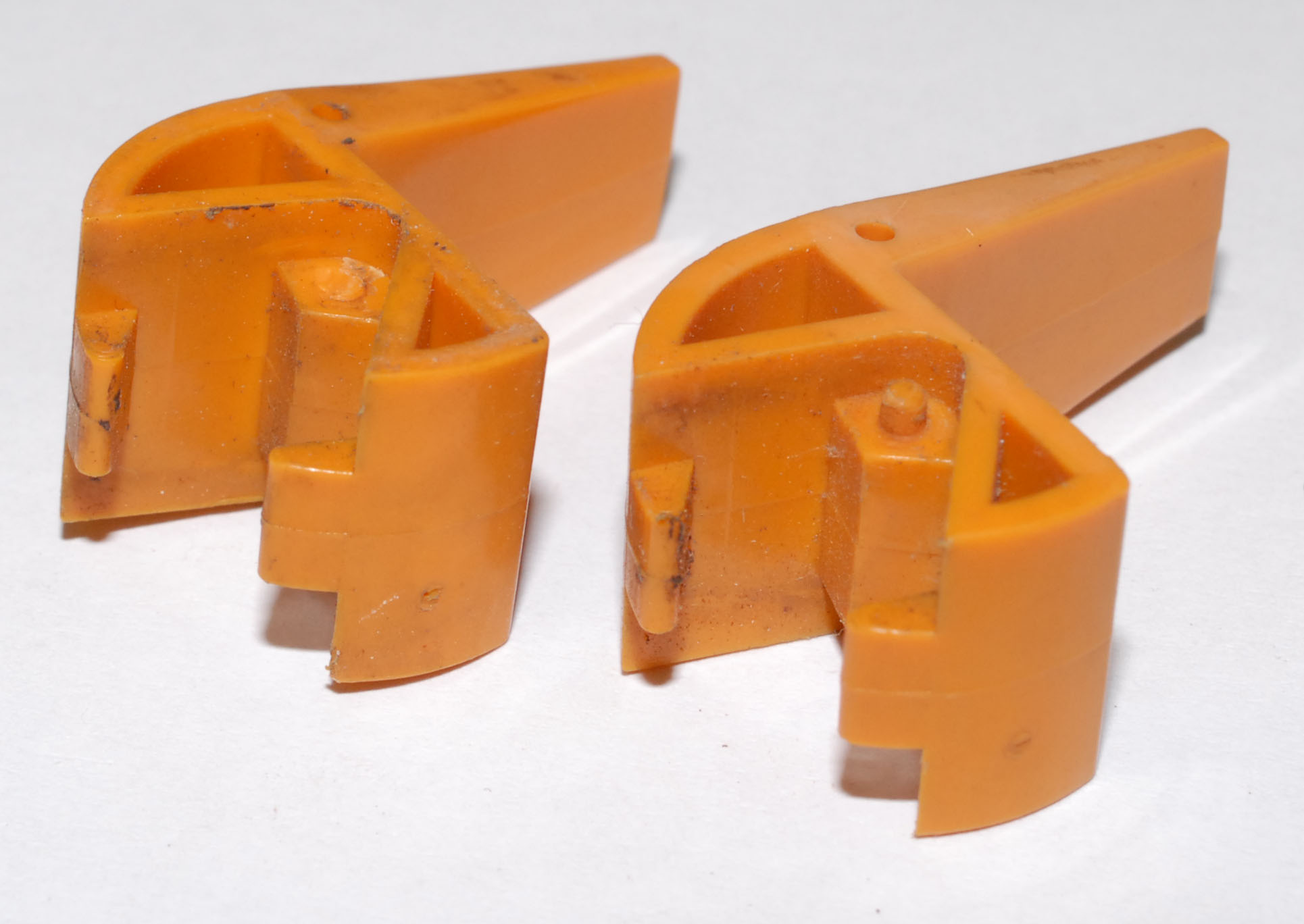
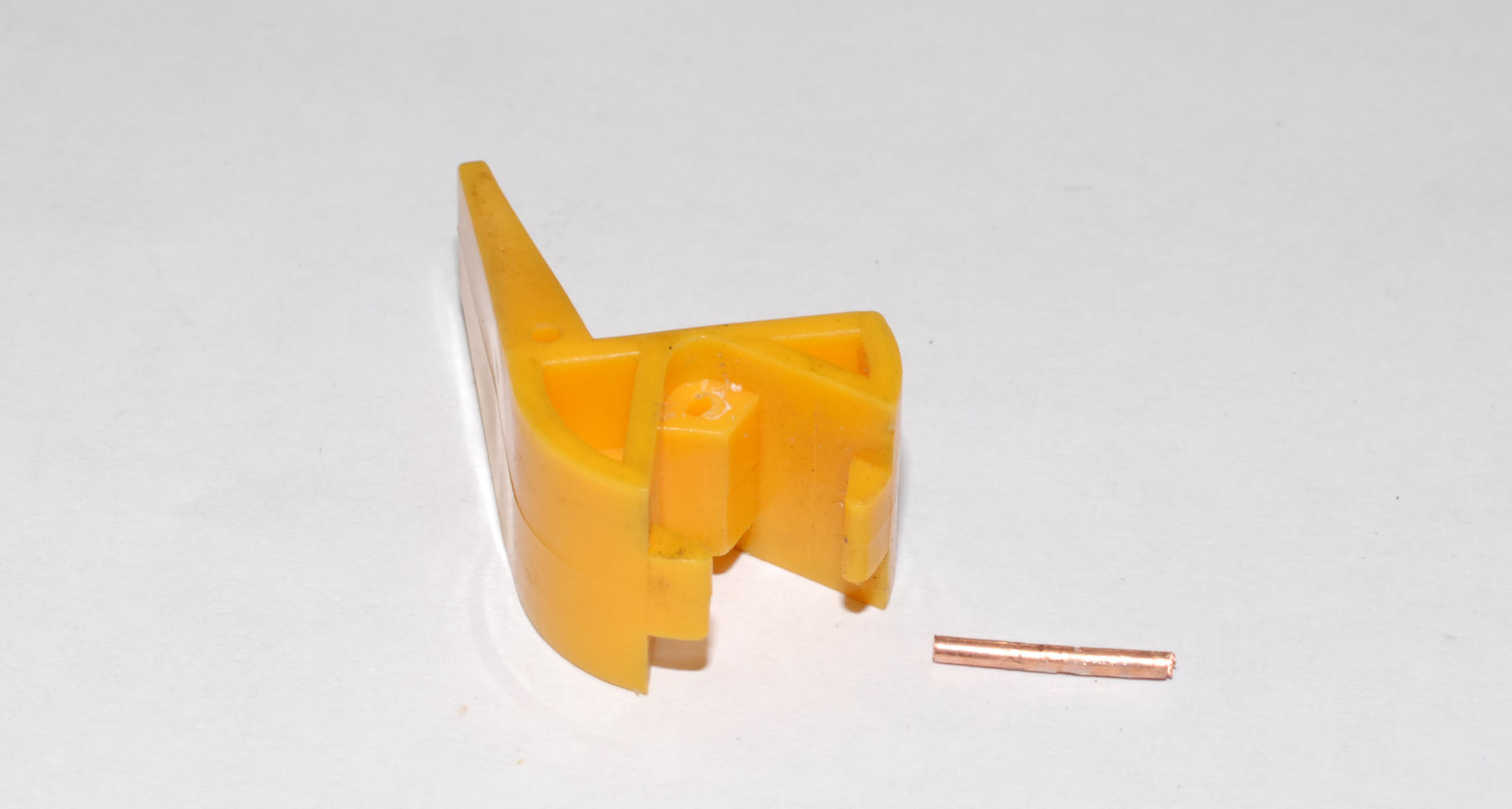
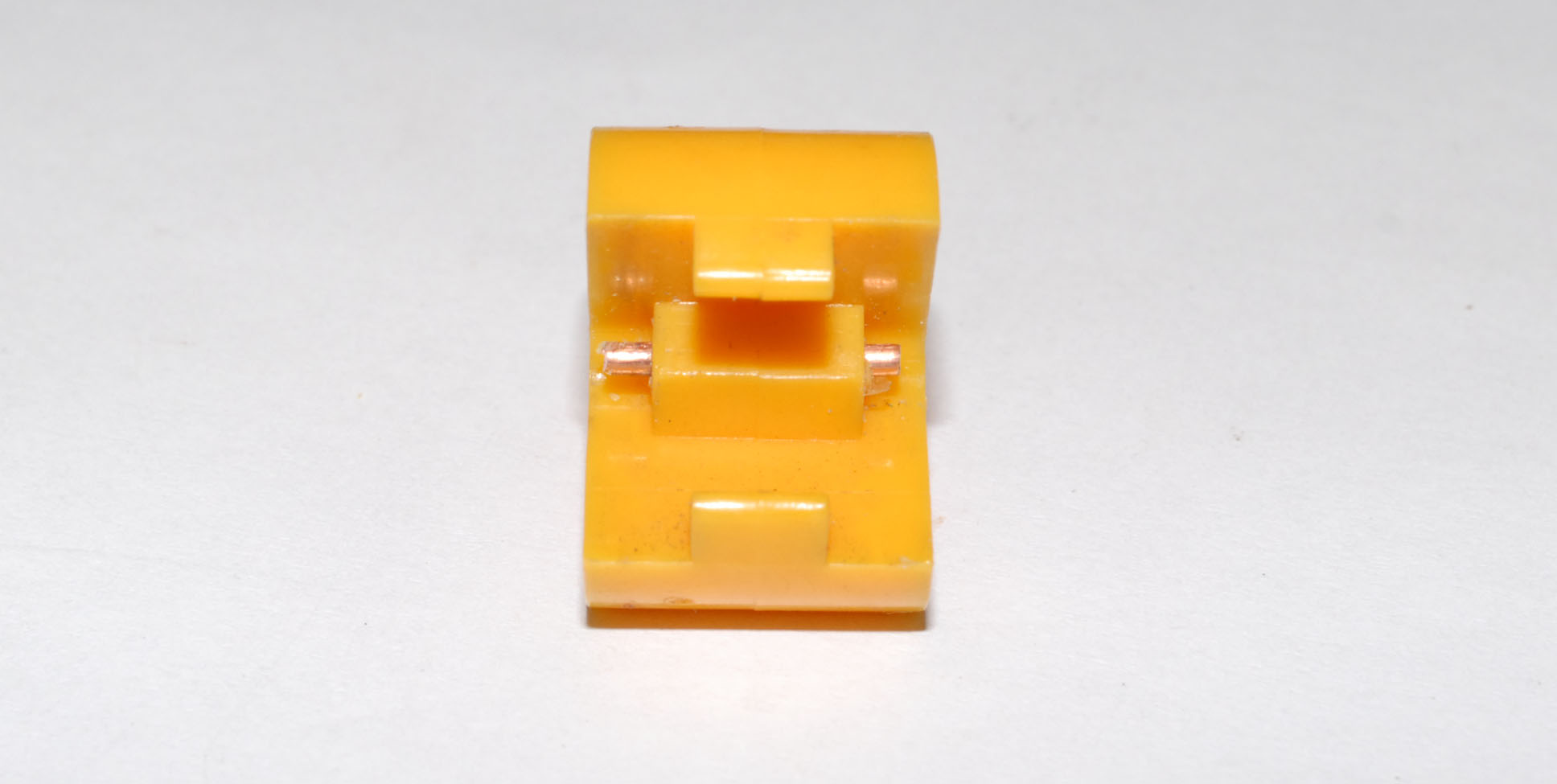
It has been done! I did it on my switches on the old 8/L.
http://www.abc80.net/zz/pdp8/DSC_9858.JPGhttp://www.abc80.net/zz/pdp8/DSC_9864.JPGhttp://www.abc80.net/zz/pdp8/DSC_9865.JPG
I used the core from a copper wire 1,5mm2 since the diameter turned out to
be perfect.
/Anders
On Feb 13, 2015 9:58 AM, "jwsmobile" <jws at jwsss.com> wrote:
>
>
> On 2/13/2015 8:01 AM, Geoffrey Oltmans wrote:
>>
>> I presume I can't be the only one watching this eBay auction in
disbelief.
>> I'm wondering if this is a museum or not. Presumably a private collector
>> would not have such deep pockets, but you never know!
>>
>> Over $13k USD and still a little less than 2 days to go!
>>
> Ultra-rare-Commodore-65-C65-DX64-prototype-working-serial-22
>
> http://www.ebay.com/itm//171673209321
>
> Mr. 544 feedback is being trolled by 0 and 1 feedback idiots. One has to
wonder.
>
> I wouldn't use this auction as a reference in an appraisal.
>
> Jim
Ended at just under $23K USD (?20,050)
Hi,
One of the bit flip switches on my 11/45 front panel is broken. It
snapped off cleanly at the pivot where the plastic meets the metal. The
remnants of the two little plastic switch handle leg tips are still there,
in the metal switch housing.
The fracture is clean and is such that they would fit perfectly back onto
the main hunk of the switch plastic, like new, if l could find the right
compound to get the pieces to re-meld into each other. I guess model
airplanes used to employ this sort of melding technique I'm describing in
their construction, right? But I have no idea of the chemistry involved --
whether pdp11 switch plastic is compatible with that sort of glue.
I don't think I want something that just adheres, non-porously to the
bits because that would interfere with the operation of the switch pivot
point and there's no room for inaccuracy / spurting glue gobs in there.
The fracture is essentially _at_ the pivot.
So my question: are these pdp11 switches the right sort of plastic for
this meld repair I'm describing? If so, what's the chemical that I'd need
to make this happen? Plain old model airplane glue?
thx
jake
Dear Friend,
I am writing this mail in confidence . I am looking for a trust worthy person and I decided to contact you because you and the deceased customer has the same surname.
My name Lee hao and I work in Private Banking Division of Bank of Communication Hong Kong and 9years ago I opened and managed account for an individual Ryan with a financial portfolio of USD$9,000,000.00(Nine Million United States Dollars)which he wished to invest and have spun around in the growing market in mainland China at that time.
we made various investment opportunities and this hide high return and with sometimes getting back return as high as %0.02 of funds total quarterly. This ran until last quarter in 2009 when he instructed me he had URGENT investments in Hong Kong which requires cash payment and that I liquidate funds principal(9M) and have monies available to him in Hong Kong which we did. We made contact with a reputable bank in Hong Kong at that time(Bank of China) and they agreed to receive the money for a fee and make cash available to our client. I went ahead with the transfer request and that was the end of it. However Bank of China send us memo end of 2010 informing us the money was not claim since that time and that they only inform us about this because after a certain amount of years and money not claim government confiscate money as unclaimed funds.
Further to this an enquiry was carried out and it was discovered that Ryan was involved in automobile accident in Chengdu, Sichuan Province Mainland China in 2010 and died as a result of his injuries sustained. on further enquiry we also discovered he died intestate without a known next of kin to the funds in Bank of China as his wife and only known relation had died some years earlier before making investment with my bank.
This is what I propose: Since you share the same last name as the late Ryan you stand in as next of kin and with my exclusive access to his file and the preparation of legal documents I make you the beneficiary to the funds in bank. I painstakingly work out all modality how this should work without no one get into trouble now or in the future when all concluded. I know this might be a bit heavy for you but trust me on this for you do not have to have known him for provided you have same last name and with the arrangement I have in place I assure you this would work. Nobody get hurt as this lifetime opportunity for me to secure a better future for my family as I retire soon and with all my years in the banking sector very little to show for.
Finally I do understand you may be skeptical about this considering the fact you do not know me and we not have previous dealing. Rest assure this is a known practice in the banking industry here in Hong Kong/mainland China as this happens every time the only other alternative is money revert back to the States enriching already wealthy corrupt government officers. I send you this letter not without a measure of fear as to the consequences of this if my actions are discovered and I beg you do not betray my confidence in this matter for I know nothing ventured is nothing gained. If you are able to render your genuine assistance please get back to me immediately via, email. I look forward to executing this business deal with you.
I ask that if you find no interest in this project that you should discard this mail. I ask that you do not be vindictive and destructive. If my offer is of no appeal to you, delete this message and forget I ever contacted you. Do not destroy my career because you do not approve of my proposal. You may not know this but people like me who have made tidy sums out of comparable situations run the whole private banking sector. I am not a criminal and what I do, I do not find against good conscience, this may be hard for you to understand, but the dynamics of my industry dictates that I make this move. Such opportunities only come ones' way once in a lifetime. I cannot let this chance pass me by, for once I find myself in total control of my destiny. These chances won?t pass me by. I ask that you do not destroy my chance, if you will not work with me let me know and let me move on with my life but do not destroy me. I am a family man and this is an opportunity to provide them with new opportunities. There is a reward for this project and it is a task well worth undertaking.
I await your response.
Best regards
Lee Hao
Email: leehao44 at hotmail.com <mailto:leehao44 at hotmail.com>
Forgive me if I missed earlier discussion, but has anybody
seen the
Imitation Game movie, ostensibly about Alan Turing?
There certainly were some real howlers in there, like the
bit where Turing
single handedly decides what info they would share with the
British
government, so as not to alert the Nazis that the Enigma
code was
broken!
Also, there is only one instance of the Bombe, while it is
pretty well
known they had a set of 350 of them at Ft. Meade running 24
hours
a day. And those were the NCR Bombes, running at 1800 RPM,
insted
of the one in the movie going clunk-clunk-clunk. Some other
papers
seem to indicate there were another 350 Bombes at Bletchley.
It only makes sense for there to be a big array of NCR
Bombes, not
the slow British-built ones, but
with all the ships being sunk, how could they be sure such a
shipment
could make it across the Atlantic? These things were
critical national
resources, so I just can't image the US shipped a batch of
them to
Britain. (Also, there is the security issue of how to keep
prying eyes
off the Bombes while being shipped.)
Also, they have Turing building the Bombe with his own
hands. Various
descriptions have hundreds of people at Bletchley wiring the
rotors and
doing much of the other work. The Bombe parts must have
been made
in machine shops across England.
At the end of the movie, they sort of imply by a confusing
flashback that
Turing tells the whole story of the code cracking work at
Bletchley to
the police officer. It is well documented that he never
revealed anything
to anybody about what he did there.
Any comments?
Jon
I've recently acquired a TC08 controller to interface a set of TU55 drives to my PDP-8/I. My 8/I has the earlier Negibus I/O configuration and the simplest (at least in terms of number of cards required) solution for interfacing is to convert the Posibus TC08 to a Negibus TC08N. This requires swapping out a few positive logic interface cards for the corresponding negative logic equivalents. I'm looking for the following cards and quantities:
M100 - qty 3
M102 - qty 2
M633 - qty 4
Please let me know off-list if you have any of these items available for sale or swap.
If you do have an M102 but don't want to get rid of it, I'd be very happy just to have clear photos of the card, front and back. Vince Slyngstad has already prepared Eagle layouts of the M100 and M633 but lacks adequate info to recreate the M102.
Thanks!
Jack
Being bitten by "vintage computer restoring" bug, I am long time looking for a reasonable condition PDP8, preferably a PDP8/L.?
Is there such a machine out there looking for a new home or can someone point me to a possible selling-place other than eBay? EBay has hardly any, and just a few weeks ago I unfortunately missed one.
Any help or hint is highly appreciated...
Hello all,
I'm looking for some good demonstration/fun software to run on my demo
RSX-11/M+ and RSTS/E systems.
I don't much mind what the software is so anything that can be
provided I'll probably find useful. In particular I'm looking for some
games. If it's of any consequence, I'm using RSX-11/M+ 4.6 BL87 and
RSTS/E 10.1-L.
Also, does anyone know if there's any other archives that have copies
of the RSTS/E and RSX-11 layered products than the Trailing Edge FTP?
(Particularly I'm interesting in getting DEC C on RSX-11/M+, but if I
recall correctly the tape image on the aforementioned archive is
corrupted. Also I'm looking for the WPS package for RSTS/E.)
Thank you to any who respond!
Regards,
Christian
--
Christian M. Gauger-Cosgrove
STCKON08DS0
Contact information available upon request.
I have often thought it would be cool to build a relay calculator, along the lines of Casio's relay calculators that they marketed for a time in the 1950's before it became clear that electronics were the way to go. They even made some scientific and programmable machines, but a basic four-function machine with an accumulating memory register would be enough.
Rick Bensene
The Old Calculator Museum
http://oldcalculator.com
Sent from my Android phone using TouchDown (www.nitrodesk.com)
I've been bouncing around the idea of building my own relay computer
* I have mostly inspired by the TIM project[1] and Harry Porter's Relay
Computer[2]
* I am looking at having a limited number registers like the 6502 or 6800
* the computer is going to be Harvard architecture based
I wondering have any of use done anything like this?
[1] http://www.northdownfarm.co.uk/rory/tim/
[2] http://web.cecs.pdx.edu/~harry/Relay/
> From: Jacob Ritorto
> My NASA EE buddy recommended working up an appropriate load from
> regular household lightbulbs. They won't light, naturally, but you can
> dial in your load by simply choosing certain wattages and doing the math.
Err, both tungsten and carbon filament incandescents have very different
resistance when hot (lit) and cold. To make it even more, they are of opposite
sign: with tungsten, the resistance increases as it heats up (a nice
stabilizing feedback), and with carbon, it goes the other way. So if you're
not running enough current to light the bulb, you can't use the printed watt
rating; you'll have to use an ohm-meter.
Noel
Mattis Lind from this forum sent me some failed National Semiconductor 74xx
series, plastic encapsulated. These were from an HP 98xx series calculator I
believe. He noticed than when they failed they failed open. I failed myself
to have the local National Semi people interested in looking at them, and I
just did some XRays to find out if something obvious had happened to the
wire bonds. Nothing we could see, but we didn't take enough close ups. I
want to take a look again, and if I don't find anything could send them on
to you if Mattis is OK with it.
Marc
> Darn! That sounded like a good collection. Alas, I know I haven't kept
> every bad IC either (except that one from the PDP-8/E...not really sure
why
> until now, I guess). But if you do find them, I could certainly use them.
On 14/02/15 11:02, Cory Heisterkamp wrote:
> Tom, any reason for choosing the Harvard architecture?
it may have some Modified Harvard architecture
the computer is NOT Stored-program based, it may have a small (128/256
byte) CPU styled cache
> I'm currently in the middle of a relay computer build so I'll toss in
my 2 cents.
> The most important thing I hit on early is to define the instruction set,
> work out a number of potential applications/uses on paper (or excel),
> and step through each instruction to make sure the machine is capable
enough.
> You'll probably discover a number of efficiency improvements you can
make to the hardware while doing so,
> and a few "hardware subroutines" worth adding.
> You can also baseline how long a program will take to run if you
settle on a clock rate, and determine if there's a better way to do it.
> Ultimately, relay computers are SLOW. Don't take 6 cycles to do what
could be accomplished with a couple extra relays and a single pulse.
> Well thought out HW and instructions will pay big dividends when the
soldering iron comes out. -Cory
good point, I am prototyping the computer design in software and
software in 6502 assembly
Sorry, this was accidentally sent before it was completed.
At 04:40 PM 2/13/2015, Tom Sparks wrote:
>I've been bouncing around the idea of building my own relay computer
I built a greatly scaled down version of Simon more than 50 years ago. See Chapter 3 in:
Edmund Callis Berkeley
Giant Brains, or Machines That Think
New York: John Wiley & Sons, Inc., 1949; Reprinted New York, Science Editions, Inc., 1961
Available in DejaVu format at:
https://ia600504.us.archive.org/17/items/GiantBrains/giant_brains.djvu
Dale H. Cook, GR / HP Collector, Roanoke/Lynchburg, VA
http://plymouthcolony.net/starcity/radios/index.html
On 14/02/15 09:52, Brent Hilpert wrote:
> On 2015-Feb-13, at 2:56 PM, Tom Sparks wrote:
>> On 14/02/15 08:20, Brent Hilpert wrote:
>>> On 2015-Feb-13, at 1:40 PM, Tom Sparks wrote:
<snipped>
> Just an opinion, but the Zusie / Z3 recreation ref'd by Pontus looks most interesting, if one wants to do an historical design vs. something novel.
my project is a what if?....
"1890 portable telegraph switching computer"
I am limiting myself to 1930's knowledge and ideas because they could
have be discovered early in time, but unpublished/lost/etc
I am welling to use modern versions to reduce the build time
> The Zusie site mentions the Z3 recreation in Germany.
> With a few recreations of the same machine there's the potential to benefit from community software development.
>
> The Zusie fellow sure was fortunate to obtain a large quantity of good relays at scrap prices.
> I've long been interested in building a relay computer but that's one of the stumbling blocks - relays new are so pricey today.
I noticed that with the relays
> Had in mind a physical implementation much like the Zusie, upright front-access 19" relay rack with an LED per relay to show state (and many blinkenlights).
>
I am writing my master's thesis on accelerated life testing and would like
to get a collection of parts to decap and experiment on. What prompted my
study is a failed 7474 dual flip-flop in a PDP-8/E. As I later read (on
here, I believe) was that the 7474s seem to fail in higher number than
other 7400-series ICs. Is this because of a design flaw? I'm not sure
(yet), but would like to find out.
More recently, I saw a 680k 2W carbon resistor that read 1.3 meg out of
circuit. As it turns out, it was in a high voltage portion of the circuit,
and I suspect that electromigration caused its failure over time. Many of
you are probably already aware that carbon resistors tend to increase in
value as they age, though there are a few explanations too for that
behavior, as I understand it.
I would like to tie all of this together by researching older accelerated
life testing schemes, examine how those parts actually fared, and see how
current day models might be improved.
If anyone has a collection of dead ICs (preferably those that have died
inexplicably, and not by extreme overvoltage, for instance), I would like
to talk to you about getting a few. If they are 7474s from Texas
Instruments, ca. early 1970s, even better!
Thanks in advance,
Kyle
I presume I can't be the only one watching this eBay auction in disbelief.
I'm wondering if this is a museum or not. Presumably a private collector
would not have such deep pockets, but you never know!
Over $13k USD and still a little less than 2 days to go!
http://www.ebay.com/itm/Ultra-rare-Commodore-65-C65-DX64-prototype-working-…
I have a friend with a large stash of DG boards which comes from a
collection of stuff he and his company had from supporting Novas. He has
just the stash of boards and would like to get a rig to test them with.
Ideally acquire, but from discussing what he wants to do he would
probably need a minimal set including power, and the front panel to run
tests. I wanted to locats contacts to put him in touch with that might
be able to help him, and you and he can discuss the best way to do what
he is after.
I don't know if he wants to sell / trade all of them, end up with a
working machine or what he may need to do, so he is flexible.
I'll put you in touch with him in whatever manner you feel comfortable with.
thanks
Jim
hello all,
I'm in the process of repairing our 101 but i hit a solid wall finding
out whats wrong with it. are there people with a working copy who could
do some measurements on their copy?
Unfortunately i have no schematic of the electronics, only the mechanics
and PSU.
I have made a crappy video of the scope trace of the delay line input
and i'm very interested in a video of a working machine's delay line. :-)
The video is here: http://youtu.be/llpwjGeldt0
and a partially repairlog is here:
https://hack42.nl/wiki/Repair_Olivetti_Programma_101
als scematics are welcome as well. :-)
--
Met vriendelijke Groet,
Simon Claessen
drukknop.nl
Long shot, but does anyone know of any available disk/tape/paper tape/ROM images for any of the Microdata machines (800/1600) or the relatives (Intertechnique Multi-8/Multi-4, MAI Basic Four BB-II)?
There?s a bit of documentation available - Bitsavers has a bit, and I have some MAI documentation that I?m in the process of scanning. I?m toying with the idea of emulating this machine, but I?m having difficulty locating any software for it.
Thanks in advance.
Ian
> From: Brent Hilpert
> Well, try removing W1 to isolate the output of the xtal oscillator E15
> from inverter input pin E4.4.
Thanks! Too late to try it today, but first thing tomorrow..
It seems like every time you answer one of my queries, I smack my forehead
and say 'That's an excellent idea! Why didn't _I_ think of that!?!?' :-)
> If you're not familiar with them, E15 is an integrated xtal oscillator,
> not just a crystal - the crystal and oscillator logic are both in that
> can
I'm not familiar, so thanks for the tip. Wonder where I'll find one if that's
what's bad... :-)
> Could also (with W1 removed) pull E4.4 hi/lo while watching the
> inverter output E4.16 to see if it responds correctly with the
> inversion.
Since it's a tri-state, I may need to hit the enable somehow. Oh, wait, I
see, it's hard-wired on via a pull-down. (I wonder why they needed a
pull-down? And I wonder what the test point is there for?) And I guess I need
like a 5K series pull-up resistor to +5, right? (Ground I can just tie
directly, right?)
Anyway, thanks again for the help - very, very useful.
Noel
> From: Eric Smith
> The memory controller does have a Unibus port, but the Fastbus memory
> modules are not on the Unibus any more than an RP04 disk drive is on
> the Unibus.
Ah, OK, I guess it all depends on exactly what one means by 'directly'... :-)
I was using it in a high-level architectural sense: there's a 1:1
correspondence between UNIBUS addresses and Fastbus memory addresses; a
UNIBUS read/write cycle completes immediately with the contents of that cell;
etc - all quite different from the RP0x example. IOW, at a very high level,
it looks like other 'memory on the UNIBUS'.
> To a first approximation, the two Unibuses are *always* jumpered
> together.
I seem to recall reading (don't remember where, it was a long time ago) of
some place that actually made use of the dual UNIBUS thing; they hung some
other PDP-11 (don't recall what kind) off UNIBUS B, and ran a primitive
multi-processor. It was some sort of high-speed data acquisition, or perhaps
a real-time simulator - something like that.
Anyone else know of any place that used the dual UNIBUS capability?
Noel
Hello cctalk'ers,
Hopefully this message won't offend anyone --- I recognize that I might,
and I apologize in advance if it does.
As many of you know, I've been in the vintage computing hobby for about
a decade. The first person I met was Sellam Ismail. He helped guide me
as a newb collector of handheld/pocket computers.
Somehow that led to me co-founding MARCH, publishing a 1,000-subscriber
newsletter for a few years, rescuing a mainframe here and there, making
the VCF East into a premier event, and becoming a "talking head"
everywhere from BBC Radio to the Wall Street Journal. (My personal site
is www.snarc.net if you really want to know more ... bring popcorn.)
Now I'm asking for some personal help from the community.
I'm trying something radical: crowd funding, so that I can finally
finish the decade-long project of writing my book about the history of
mobile computing.
You can imagine how frustrated I feel when telling my family "I'm in the
The Wall Street Journal!" but that I'm also dangerously under-employed
(having been spit out of the technical journalism field after 16 years).
It does not compute.
Please visit this link for more information:
http://fundrazr.com/campaigns/3wNcc.
Thank you,
- Evan
> From: Chuck Guzis
> Any more so, than, say, William Gardner Pfann?
Another name I didn't recognize - I knew there was someone who did zone
refining, and that it was critical, but didn't know the name.
> From: Jon Elson
> The XX system?? What's that?
You likely already know of this, just not under this name; here:
http://en.wikipedia.org/wiki/Double-Cross_System
Briefly, during WWII, the British ran the entire German espionage system in
the UK; initially, only for counter-intelligence purposes, but later on, to
actively feed the Germans disinformation.
> Another really great story is the X gerat, (X equipment in English)
> that sent narrow, high frequency radio beams over England.
For anyone who hasn't read it, I highly recommend R. V. Jones' book, "The
Wizard War" - it covers all the various navigation systems (on both sides),
and much more. I can also recommend "The Secret War", by Brian Johnson (the
companion book to a BBC series), which covers that, radar, the V-weapons,
code-breaking, and much more.
> From: Johnny Billquist
>> stored-program (in the sense of 'one memory holds both instructions
>> and data')
> What do you mean by "stored program" then?
Err... :-)
Noel
On Wed, 11 Feb 2015 18:04:58 -0500 (EST)
Cory Smelosky <b4 at gewt.net> wrote:
> On Wed, 11 Feb 2015, Roe Peterson wrote:
>
> >
> >
> >
> >
> >> On Feb 11, 2015, at 4:16 PM, Cory Smelosky <b4 at gewt.net> wrote:
> >>
> >>> On Wed, 11 Feb 2015, Al Kossow wrote:
> >>>
> >>>> On 2/11/15 1:56 PM, Cory Smelosky wrote:
> >>>> netbooting NetBSD (install doable for that one.)
> >>>
> >>> You'll need to put something together that can talk to the raw
> >>> scsi interface and issue your own read commands. Are they common
> >>> command set drives?
> >>
> >> Should be. I don't believe CompuServe did anything too silly.
> >
> > What, actually, is the blocksize? 1024 or ?
> >
>
> 576 or 2304.
The "scu" utility, which is available for both NT and linux
environments can change the blocksize - and scads of other parameters
on most SCSI disks. It's powerful enough that you can brick a drive
if you're not careful ;)
I used to buy NOS Tandem SCSI HDD dirt cheap because they had a weird
blocksize that would make Windows/Linux systems barf. I would then
use "scu" to change the blocksize parameter of the drive to 512 - and do
a low level format. Then I'd have a "standard" SCSI HDD for a fraction
of the price of a "standard" drive.
Of course you could change the blocksize of a drive to 576 - or
anything you wanted - and then do a low level format for that blocksize.
You can pickup scu for NT and linux (including help and summary pdfs)
by anonymous ftp to my website via certain browsers or:
ftp bickleywest.com
user: anonymous
password: your email address
cd scu
....
Regards,
Lyle
--
Bickley Consulting West Inc.
http://bickleywest.com
"Black holes are where God is dividing by zero"
On Wed, 11 Feb 2015, B Degnan wrote:
> > via trial and error, and a lot of reading. I believe that loading the
> > bootstrap manually is a must; one cannot use or create tapes
otherwise.
>
> Only if your drum memory loses its contents. I don't know if SIMH has a
> concept of non-volatile main storage (drum, core). And for the LGP-30,
all
> registers are non-volatile, too.
When I fire up the SIMH and check 6300 we have
00000000
If the bootstrap came pre-loaded the first instruction of bootstrap should
be in 6300 and read
10000000
so, no unless the bootstrap is somewhere other than where I think it should
be, memory is completely blank when SIMH is loaded.
> > In order to enter instructions into memory I first learned how to
translate
> > code from the various actual papertape sources, for example...
> >
> > "flexowriter entry"> 6300 P 0000'
> >
> > becomes
> >
> > sim> d -a 6300 10000000
>
> Urks, that's sick... but SIMH should offer the possibility to enter the
> mnemonics and addresses (or anything else since everything is mapped to
> its four bit code) like
> sim> d -a 3w00 p0000 (or d -a 6300 p0000
sim> d -a 3w00 p0000
Invalid argument
The SIMH *should* accept mnemonics ... Believe me I tried EVERYTHING ...
but unless there are hidden command switches you have to convert your code
to machine format. Scoured the entire C source code looking for clues.
:-)
<snip>
> sim> g 3w00
g is not a legal command. You have to tell SIMH to execute with a "SET CPU
[command]"
>
> Anyways, SIMH is not very well suited for machines like an LGP-30 where
> the user interaction with typewriter and console buttons for operation is
> imperative. The SIMH version does officially work, but it is not really
> user friendly in this case.
Tell me about it. I have written to the SIMH user group, so far I have not
received a reply with tips/testing done to verify "officially work"
boundaries.
> But the best would be if you use a drum image with 10.4 (the monitor)
> already loaded, i.e. save the memory contents to a file and reload it on
> the next incarnation of SIMH (there's a "START" drum containing 10.4 in
my
> simulator package, and an "ACT5" drum with preloaded ACT-V and
> subroutines, these may be usable in SIMH, but I don't know).
>
> > repertoire. The hardest part is finding ways to enter Flexowriter key
> > input via a modern keyboard, using SIMH commands.
>
> By using a simulator that offers the right frontend to the user (i.e.
keys
> and buttons as required by the machine operations) *g*
>
> Christian
Christian....I am going to keep at it and then script a bootstrap that will
load in SIMH, or convert tapes to SIMH format so they can be imported. I
can see why you did what you did with your simulator. Makes a lot of sense
to use function keys.
Here is the bootstrap I am working to complete. I need to find equivalents
to the Flexowriter commands, I have finished the memory insert commands,
please send suggestions if you have them.
sim> [first cpu fill c6300 in IR?]
sim> d -a 6300 10000000
sim> d -a 6301 01000000
sim> d -a 6302 11016305
sim> d -a 6303 10000000
sim> d -a 6304 01000000
here is where I need to experiment, the code below is my first attempt:
6305 (skip)
6306 10106300
6307 10000000
6308 01000000
6309 (skip O.G.W.C flexo keys, still need to convert)
6310 00016346
6311 11116326
6312 10106322
6313 00000000
6314 10100000
6322 10116313
6323 11006309
6324 11016346
6325 10106307
6326 000wwwwj (entered into by flexowr., need to convert)
6346 0gwc0000 (entered into by flexor, need to convert)
Bill
> From: Chuck Guzis
> The point is that a lot of people were responsible for the development
> of mechanical computation (I include electrical and electronic in this
> definition).
Just like the Internet... :-)
> In fact, it could be argued that the ball-and-disc integrator was more
> responsible for the eventual Allied victory in WWII than Turing's work
> was.
Sorry, are you referring to his work on computers, or his work in code-breaking
too? If this latter, I would have to disagree.
Respected military historians have suggested (of course, such alternative
history is always speculative, one can't prove it) that the code-breaking work
of the Allies shortened WWII by up to two years. I doubt mechanical
fire-control computers (which is the primary military use of ball-and-disc
integrators, as I understand it) had that significant an effect.
> From: Johnny Billquist
> And once more noone mentions Konrad Zuse, which in my mind beat them
> all
Well, two things. (And don't get me wrong, I admire Zuse and his work.)
First, Zuse's work didn't really have much impact. You may disagree, but my
sense is that if that bomb that destroyed the Z1 had gotten him too, the
post-WWII world would still look pretty much like the real one.
Second, his early machines (Z1-Z3) weren't stored-program (in the sense of
'one memory holds both instructions and data'). Yes, yes, I know the Z3 can
(with a monstrous kludge) be Turing-complete, but it still wasn't
stored-program - which to my mind, is _the_ key aspect of a real 'computer'.
Interestingly enough, Babbage's machines weren't stored-program either; they
had separate instruction and data tapes, like Zuse's (although they had
conditional branching, which the Z1-Z3 didn't). Turing's invention of thex
stored-program in 'On Computable Numbers' was really a fundamental leap.
Noel
> From: Jason T
> I have two 11/05s and one key .. The key is made by Chicago Lock Co.
> and is stamped "GRB2."
Perfect description of my 11/10 key. I'm now 99% sure they are all the same,
but I think I'll have one made, and sent to the person nearest me, for an
absolute confirmation, before I produce a cascade of them. (Plus to which the
store probably needs to order more blanks - I'm not sure they have that many
in stock! :-)
> I'd like two please.
Added you to my list.
Noel
> From: Chuck Guzis
> So what's special about "electronic" computers?
> Isn't this just a mere technological refinement? Logic gates can be
> electrical, electronic, pneumatic, hydraulic and photonic
There's a saying that a big enough quantitative difference becomes a
qualitative difference. So electronic computing devices, because of their
speed potential, are of a qualitatively different order than anything that
involves moving matter around... :-)
> In the game of firsts, where does Torres y Quevedo's "El Ajedrecista"
> fit in?
Alas, can't answer that - I've heard the name, but don't know much about his
machine.
> From: Jon Elson
> Atanasoff and Beqrry did a GREAT job, but it wasn't actually
> a "computer" by the Turing definition.
Which is why I described it as the first digital electronic computing
device... :-)
Interestingly, one could add 'binary' to that description. The ENIAC of
course wasn't, and I don't think COLOSSUS was either, in its counters, etc
(but would have to check - does anyone know/recall).
> all that was left were some drawings in a few binders. They published
> NOTHING about the machine itself, and it was largely unknown for
> DECADES!
> ...
> .. as far as I'm concerned, Atanasoff and Berry are a VERY interesting
> footnote in early computing, but didn't actually contribute directly to
> the development of computers.
Well, there was a lengthy report written, but it was never circulated publicly
because Atanasoff was trying to file a patent, and the patent attorney (IIRC)
advised them not to publish until the patent application was filed - which it
never was, with WWII starting. There was a contemporary press release about
the device, which resulted in local coverage only.
The whole thing did come within a hair's-breadth of winding up where Zuse's
work did - a curiousity which did not have much impact on the world - but for
one stroke of chance/luck: word of the machine somehow reached a man called
John W. Mauchly, who came out to visit Atanasoff and Berry in June 1941, and
spent almost a week there, talking with them, and studying the machine, and
their written material.
He later tried to claim that it was no big deal, and the ABC didn't really
affect his thinking much - but that won't wash, you don't spend nearly a week
intently studying something you think is irrelevant junk. (And Mauchly's
letters to Atanasoff, written shortly after the visit, make clear that he
was much taken with the ABC.)
It's clear there is a very significant link between the ABC and the ENIAC -
and the influence of the latter is clear.
Noel
Update on my attempts to bootstrap the SIMH Royal Precision Electronic
Computer model LGP-30.
I have been able to get through a lot more of the simulator-equivalent
processing steps to match the input of the bootstrap programs via the
native Flexowriter. I have been able to discover the syntax and basic I/O
via trial and error, and a lot of reading. I believe that loading the
bootstrap manually is a must; one cannot use or create tapes otherwise.
Most SIMH's have some kind of software guide, the LGP-30 has none. I don't
think this SIMH has the bootstrap pre-loaded. I am unaware of anyone who
is using the SIMH simulator, although I have seen two non-SIMH LGP-30
simulators. One is in German.
In order to enter instructions into memory I first learned how to translate
code from the various actual papertape sources, for example...
"flexowriter entry"> 6300 P 0000'
becomes
sim> d -a 6300 10000000
where 6300 = memory loc in drum memory, 1000 = P, 0000 = accumulator
address (?). You can't store a "P" or "p" in memory. You have to convert
to its Flexo binary equiv. Same goes for all instructions in the LGP-30
repertoire. The hardest part is finding ways to enter Flexowriter key
input via a modern keyboard, using SIMH commands.
It's all pretty slow going to patch together what I think would be a
workable bootstrap install process, but I expect to have to try a number of
variations before I get any response from the machine. I have a bootstrap
but the hard part if the Flexowriter emulation. Who knows, maybe I will be
able to contribute a software guide from all of this. I will document what
I find and post on my web site, vintagecomputer.net.
Bill
Happy New Year, all!
Has anyone here gone through the process of reparing leaky NiCd damage
to an A4000 motherboard? I _thought_ I had removed the battery some
time ago but puttering around today, I cracked open the case to find
the battery still there and some damage around U891 (a 74F245) and
U850 (Bank 3 DIMM socket). I have washed off the residue but I may
have to pull a DIMM socket to get access to the vias under it.
I know the general process, but I'm curious if anyone has done this
specifically to an A4000 board and has any tips. As I said, I'm
probably going to have to pull the DIMM socket to get to all the
damage.
Barring success from running a dozen or so repair wires, would anyone
happen to have a lead on an A4000 motherboard? Everything else in the
machine should be good, the Daughter Card, the CPU card, etc...
It's my only A4000, so I'd like to get it back up and running, or
replace it if necessary.
Thanks for any tips,
-ethan
> From: Noel Chiappa
> I'm about to go back for two more: does anyone else need one/any? If
> so, please let me know
One thing I need to check, before I get a whole stack made: does anyone know
for sure if all 11/05's and 11/10's use the same key? (This is a standard,
flat 'Yale'-type key, not the cylindrical key used in the 11/45's, etc.) The
two I have do, but they came from the same place, and so might have been
re-keyed to use the same key.
Thanks!
Noel
> From: Jon Elson
> How about John von Neumann? Geez, I think he really ranks above Turing,
> at least as far as building real machines.
This is unclear, for a whole host of reasons.
First, you should look at Turing's ACE. Designed by Turing, at about the same
time as the EDVAC, it spawned the Pilot ACE which was an important early
British computer (commercialized as the Deuce). This machine is too large a
topic to go into here, but may I suggest Copeland's admirable work on the
subject, "Alan Turing's Automatic Computing Engine" - among other interesting
aspects, he claims (and makes a good argument) that the ACE is RISC machine
(the first).
Turing was heavily involved in early computer work from the end of WWII until
his death (e.g. at the start of that period, he attended the Symposium on
Large Scale Digital Calculating Machinery at Hardvard in February, 1947).
Second, when assessing the relative important of the contributions of Turing
and von Neumann, there are a number of things to take into account.
First, one needs to be aware that he and Turing were close colleagues; before
WWII, Turing spent a year at Princeton working with von Neumann (who wanted
to hire Turing as his assistant, at the end of Turing's year there). During
WWII, Turing spent a long visit in the US (from November 1942 to March 1943),
during which he spent a lot of time at Bell Labs, where when not doing
war-work, he discussed computing machine with people there, including
Shannon. So Turing's ideas on stored program computing devices were well
known to von Neumann - who in fact seems to have always credited Turing with
the idea (see Copeland, "Turing", pp. 130-131).
Second, the 'EDVAC Report', despite the fact that it had only von Neumann's
name on it, in fact reported on a series of design discussions between he,
Eckert and Mauchly - and the latter two were rather annoyed that their
contributions were not adequately recognized in it. (Again, see Copeland,
"Turing", pp. 130-131 - although this point is treated at greater length in
other sources I don't have the time to track down.)
So von Neumann's _original_ contributions to computers may not be as big as
some think.
Noel
> From: Jon Elson
> such as to not evacuate Coventry when they knew it was next for getting
> blitzed.
Ah, this is alas an urban legend ('bogo-meme', to coin a nice neologism);
started, IIRC, by Winterbotham.
This has been demolished, by, among others, R. V. Jones, who was in a
position to know (as the recipient of Ultra material at the Air Ministry), in
his biographical work, "The Wizard War", pp. 147-151. He refers to evidence
given by John Martin (Churchill's secretary, who was with him in the car that
night), and John Colville (Assistant Private Secretary, who was on duty at 10
Downing St. that night). They are both quite clear that the target was
unknown before the raid started; Jones gives the details on why not.
> there are some descriptions that the actual wiring of the rotors was
> done AT Bletchley
I'd love to read about that - do you know/recall where you saw it?
> If a German spy was to get his hands on the drawings for even one
> (wired) rotor, they would have realized how thoroughly the British had
> penetrated the Enigma system
I am less certain of this. I seem to recall (alas, too busy to look it up,
unless someone's really interested) that the Germans had something of a
modern concept of code security, where it's assumed that the actual ciphering
machine is compromised, and security depends on the security of the keys.
Given the wide deployment of Enigma at the tactical level, the odds were good
that the machine itself had been compromised. So for them to have found out
that the British had the rotor wiring would not have been a big surprise, I
would expect.
However, had they gotten any kind of detailed description of the Bombe, it
would have not been that hard to work out that its use was to break into
Enigma. In that sense, the Bombe's overall design was in fact a bigger secret
than the fact that they had the rotor wiring.
And of course as a result of the XX system, the British were fairly sure that
there were no German spies in the UK at the time, anyway.
Noel
https://plus.google.com/photos/106111250846948401252/albums/6114301294379699
009?banner=pwa
I picked it up, new, at the recycler, thinking it was a drill bit, but it is
not. It is 13 cm long, and has a light or lens of some sort at the small
end. The large end is about 3/4". It appears to be made of stainless steel.
Engraved on it is QD90-6722. I added another pic, showing the larger end.
There is a lens of some sort inside, and light shines through to the lens at
the smaller end.
Cindy Croxton
> From: Lawrence Wilkinson
> If you're going to condense 5 years of military, academic and
> engineering development into a movie then things are going to suffer.
> I think they did a reasonably good job.
If the former's what they'd done, I'd agree.
(And I can think of historical movies that have done that, and still produced
a movie that was both very watchable, and reasonably accurate; e.g. in "The
Gathering Storm", they've made Ralph Wigram stand in for a bunch of people,
including him, who fed data to Churchill. I can live with that; too many
characters would just confuse the average viewer.)
But the Imitation Game writer(s) did a lot more than that. E.g. the whole
bogus 'Turing versus his Blimpian manager who wanted to shut his project
down' meme. That's completely bogus, 173 degrees out of phase with the truth,
and clearly added purely to give, well, I'm not sure what.
The thing is that what he and the others at BP (although he was primus inter
pares, there were others such as Welchman, Tutte, etc who made massive,
remarkable additions - and, as you point out, in the end it was an
industrial-scale enterprise) did was so amazing, and they had to struggle
against such difficulties, they didn't _need_ to 'sex up' the plot with that
kind of stupid cliche.
As far as I'm concerned, all those lame hackneyed plot elements just prove
that the script-writer(s) were distinctly third-rate - because if they were
actually any good, there's more than enough powerful material in Turing's
actual story to make a much, much better movie, without relying on that kind
of pathetic bilge.
Noel
> From: Chuck Guzis
> "the first electronic digital computer"
I think that's a bit of a stretch; the ABC wasn't really a computer (as we
think of them). As someone (forget the name) said, for those early machines,
if you add enough adjectives, each one is the first <something>.
Here's my list (in temporal order):
ABC - first electronic digital computing device
COLOSSUS - first large-scale electronic digital computing device heavily used
for actual work
ENIAC - first general-purpose electronic digital computing device
Manchester Baby - first operational stored-program computer
EDSAC - first stored-program computer heavily used for actual work
Noel
Folks;
Over time, I have accreted some assorted unusual hardware for PC and Macintosh, for which I lack the software to drive it. I know we have some terrific packrats on the list, so I'm shaking the tree, to see what might fall out.
* DuPont Imaging Systems MacBlitz NuBus RISC processor. Apparently this is a Clipper CPU which runs UNIX independently of the host Macintosh, with IPC of some description. Has its own ethernet and SCSI interfaces. The Googles know almost nothing about this.
* Vermont Microsystems Image Manager 1024 (IM-1024) 1024x800 PGC-compatible display adapter.
Supposedly there were AutoCAD, GEM, Windows 1.x and 2.x drivers at one time. I'd love to see any of them.
* Matrox "Space Machine" SM-1280 solid modeling graphics adapter. I'm not sure what kind of drivers were available; possibly it was just a set of development libraries for programming the board yourself.
* Matrox PG-1280 (and/or the Microchannel equivalent MC-1281) graphics accelerator. I'd love to see any DOS-era PC drivers, or the PRPQ that let this board work under AIX on an RT. Somebody on the VC Forum thought he had these installed on a running system, but I never heard any further news.
* Hercules Chrome TIGA (40 MHz TMS-34020) graphics accelerator. I have a Windows 3.1 driver for this, but I'm not sure the card is set up correctly. Mainly looking for documentation here.
* IBM 5364 S/36 PC SSP, MCODE, and/or DOS host software. Somebody on the list kindly sent me a disk image of just enough of the DOS host software to prove my 5364 runs, but it's not a complete install and is missing some features I wanted to enable (keyboard maps mainly, IIRC). In addition, without the MCODE floppies the system can't be reconfigured for the various communications options (bisync, SDLC, etc.) my host PC has installed.
Shoot, I thought there was something else, too. I guess I'll think of it eventually.
Anyone?
ok
bear.
--
until further notice
I am wondering if there were any magnetic tape filesystem?
I know that some micro you could give a name to your data/program on the
audio cassette and they had a catalogue feature
I also know about Linear Tape File System (LTFS)
Has anyone tried putting cp/m or fat filesystem on audio cassette?
> From: Jon Elson
> has anybody seen the Imitation Game movie, ostensibly about Alan Turing?
> ..
> Any comments?
I have, and I also have extensively studied both WWII codebreaking, and
Turing's life and work.
It's an OK movie, but as any kind of historical thing - fuhgeddaboutit. There
are so many 'errors' (changes) that it's basically impossible to list them
all. They ran about about one error/change per minute, throughout the whole
movie. It's more wrong than right, actually.
About the only thing that was absolutley accurate (other than the basic
concept, that Turing worked at BP and helped break German codes) was Joan
Clarke's soliloquy in his flat at the end of the movie, describing his
contribution to the world.
> Various descriptions have hundreds of people at Bletchley wiring the
> rotors and doing much of the other work. The Bombe parts must have been
> made in machine shops across England.
Hmm. The descriptions I've seen of their manufacture (e.g. Gordon Welchman,
"The Hut Six Story", pp. 138-141, Hugh Sebag-Montefiore, "Enigma: The Battle
for the Code", pp. 56-58) all indicate that the machines were manufactured by
British Tabulating Machines in their Letchworth factory (about half-way
between BP and Cambridge), and only came to BP once they were completed.
There was a lot of local sub-contracting of small sub-assemblies which didn't
require machining, though (see Welchman).
Noel
Most people posting in this thread have assumed that all Radio Shack stores were closing. That is not the case (at least for some time). Only about half of the company-owned stores are being closed. RS has published a list of the 1784 stores it wants to close: http://radioshackcorporation.com/pdfs/RS-Store-Closure-List_020415.pdf. Another 1750 stores will be taken over by Sprint for cell phone "store-within-stores" and about 1000 stores owned by franchisees are not part of the Chapter 11 bankruptcy proceedings. According to the Register (http://www.theregister.co.uk/2015/02/10/radioshack_store_axed/), the closings will take place by March 31. Two stores in downtown Chicago, near where I work, are on the list, so I will be watching them to see when they start selling off the merchandise.
Bob
I need to connect an external 8" floppy drive to the FDADAP card.
I've found two drives: NEC FD1165A and Shugart SA851. I have to buy ine
of them.
I'm about to choose the NEC one, since it doesn't need an AC power
source.
The Shugart SA851 is targeted 115 VAC, and I live in Europe.
Beside power supply questions, are there other reasons why I should
choose the Shugart? Hard sectored disk support? I only have to
read/write IBM S/36 and 5120 floppy disks...
Thanks!
--
Vincenzo (aka Supervinx)
--==ooOoo==--
My computer collection:
http://www.supervinx.com/Retrocomputer
--==ooOoo==--
You can reach me at:
www.supervinx.comwww.facebook.com/supervinxhttp://www.youtube.com/user/supervinxhttp://www.myspace.com/supervinx
> From: Paul Anderson
> it's not part of the 128 kw or 256 kb limit of the 45
Err, don't think so - that limit is in the addressing hardware in the CPU
as well as in the UNIBUS.
> From: Eric Smith
> The 11/45 (or 11/50, 11/55) Fastbus memory, whether MOS or bipolar, is
> not directly on either Unibus
Actually, my understanding is that it is on UNIBUS B (or 2), via a second port
to the memory; see this post:
http://www.classiccmp.org/pipermail/cctalk/2015-February/003460.html
which gave my understanding of how it works. And of course if you connect the
two UNIBI together, it's therefore directly on UNIBUS A (or 1), as well. I.e.
DMA devices can do transfers to/from it.
Noel
This is sort-of off-topic :
Does anyone have old-ish (1980s) Philips/Mullard/Signetics data books around. I am looking for a data
sheet (or at least a pinout) for the SAB3012 remote control receiver IC (no, I do not mean SAB3021). I can
find nothing on the web.
(It's only sort-of off-topic as the IC is used in an old Viewdata / Prestel set which I guess is classic
computing)
-tony
On Wed, Feb 4, 2015 at 9:37 AM, Doug Ingraham <dpi at dustyoldcomputers.com>
wrote:
> This time lets refer to some classic fictional computers used in movies.
> Everyone probably knows about the HAL 9000 used in the movie 2001 a Space
> Odyssey.
>
> What was the name of HAL's sister computer in the movie 2010 Odyssey two?
>
SAL 9000
> That was a warm up question. This one should be more difficult.
>
> What was the designation of the computer in the movie WarGames and what
> does it mean?
>
WOPR which stands for War Operation Plan Response.
And finally,
>
> As silly as it was the movie Hackers referred to the mainframe computer in
> the movie as a Gibson.
>
> Where did the term Gibson come from?
>
It is believed to be a reference to the author William Gibson who coined
the term Cyberpunk in his short story Burning Chrome (1982 Omni) and then
his novel Neuromancer (1984).
Hope you all enjoyed this one!
--
Doug Ingraham
PDP-8 SN 1175
I've discovered a local place that can create them, and just had one made, and
it worked fine. I'm about to go back for two more: does anyone else need
one/any? If so, please let me know (reply to me _only_, please - no need to
gunk up the list with that). They'll be $2 each, to cover costs only.
Noel
Hola,
According to this thread from BITD (
http://ana-3.lcs.mit.edu/~jnc/cctalk/1999-July/1414.html ), I have what
appears to be a Xylogics 650 sitting here in anti-static wrap, glistening
like brand new. Anyone have a manual? Tried replying to Dan, but no dice..
thx
jake
Did not see this come through so here it s again.
I have a rack full of RA81's, all Pass Rom base self test. If I try to spin
up one of the drives, It will start to spin up and then just stop. There are
no front panel lights that come on or codes on the terminal screen. all 3
drives do the same.
These are not connected to a controller, and the manual does not say this
is need.
The forth one has no drive and the motor seems to turn hard, is there a brake
on the motor ???
- what I'm I missing here
Thanks Jerry
Hi,
Man. I'm becoming concerned that I can't fit any of the significant
features that I want in my 11/45 without making uncomfortable sacrifices.
The first 25 slots are for an initial "unibus a" terminator, cpu,
floating point and memory, which, since I only have one bipolar matrix, is
an enormous waste of like ten slots (they're wired for weird voltage and
would presumably explode other boards installed there, right?).
So then there are three slots available at the end, 26, 27, 28 that are
also marked "non-standard voltage." I guess that means that putting normal
boards in there is right out, too. Anyway, the unibus out and bridge 9200
jumper that connects unibus a and unibus b are supposed to go there.
That's it for the main backplane.
The next three small backplanes are core. They take up the rest of the
chassis. I don't want to give up my core because core is cool, right?
So this means I've nowhere to put the hex boards I need to run.
I need to install more memory (planning to use MS11 (124KW M7891)),
ethernet, some sort of hex height SMD disk controller (SC21,etc.), possibly
an RL11, and a DZ11. That's at least four, maybe six hex-height boards I
need to accommodate.
I'm going to duck after asking this, but would it be at all feasible to
rewire the main 11/45 backplane to get rid of the weird voltages in those
bipolar slots so they'd accommodate normal boards like these?
Short of that, what can I do? I definitely don't want another chassis.
I guess I have to sacrifice my core to make way for a second "normal"
dd11-type backplane to house the modules I need to run. So sad.
<duck>
jake
> From: Tothwolf
> Before I forget again, did you check for +5V on pin 1 (enable) when you
> were testing your existing oscillator?
Wow. Never thought to try that. Then again, I don't look for +5V on your
average 74xxx when I'm debugging, either! :-) I mean, it's a trace, the
solder on the pin looks good, that's as far as I go, usually! And there's
nothing shown as connected to that pin on the circuit diagram.
So I looked, and... it's at ground (or floating). The only pin that has
anything is 14, at +5V (expected). But I looked online for some datasheets
for similar oscillators, and some of them say 'pin 1 - N/C'. Are yours
tri-state? (That's the enable pin on the tri-state ones.)
I suppose even if yours are tri-state, I can still use them; a quick ohmmeter
check shows that pin 1 isn't connected to either power or ground, so I can
probably tie it high (via a resistor, which in addition to being normal
practise, will prevent a major disaster in case I'm confused - a state I'm
often in :-).
Noel
So ..... Radio Shack is (more or less) finally dead.
There are still plenty of RS stores open for business. (Although I read
this morning that they're not getting new shipments, which makes them
essentially clearance stores.) Apparently the company is legally allowed
to close a maximum of 200 stores per year. Or something like that.
Horn-tooting: the Wall Street Journal interviewed me about RS back at
World Maker Faire last fall. They published the story online today and
it'll be in print tomorrow.
http://www.wsj.com/articles/strategic-confusion-put-radioshack-at-the-mercy…
Scroll aaaaaaaaaaaall the way down to the bottom. (LOL, yeah, I'm
important!)
> From: Jerome H. Fine
> for the PDP-11/83 (usually in a BA23 or a BA123), the backplane is
> wired so that the PMI memory is activated correctly WHEN the first
> memory board is in slot 1 and the CPU follows the memory boards.
That's an artifact of the way Qxx/CD backplanes, and PMI CPU cards, are
wired. (And you probably already knew this, but just to be explicit... :-)
For the backplanes, with few exceptions, pin nQm2 (where n is the slot #, Q
is C or D, m is A-V, in the DEC alphabet) is wired only to pin (n+1)Qm1 -
i.e. pin Qm1 is not wired through to all slots. In other words, the CD bus is
not carried _through_ a slot, only _between_ slots.
The PMI bus on the CPU is only wired to the top (i.e. 1) pins. So if you plug
a PMI CPU into a normal Q22/CD backplane, the only slot that receives the PMI
signals is the slot _before_ the CPU. Hence the requirement to plug memory
cards in _before_ the CPU when using a Q22/CD backplane for PMI.
The 11/84 backplane is different; per the backplane prints in
EK-PDP84-TM-PR2, the 1-side pins on the Q22/'CD' portion of the backplane
_are_ all bussed together.
(Note: from what I can see in the backplane prints in EK-PDP84-TM-PR2, none
of the other CD bus pins are bussed together; in particular, the staggered
connections from nCA1 to n+1CC1, nDA1 to n+1DC1, etc found in the real Qnn/CD
backplane don't seem to be there in the 11/84 backplane. So it's not _real_
Q22/CD - it's probably better to call that section of the 11/84 backplane
Q22/PMI. PMI _can_ run over a normal Q22/CD backplane, though.)
>> Would a KDJ11-A board even work in an 11/84 backplane?
> I meant the KDJ11-BD board or the M8190-AC.
> ...
> it seems reasonable to hope that the PDP-11/84 can also use the
> KDJ11-BD instead of the KDJ11-BF
Ah. My guess (having not looked at the 8190-AC in detail) is that to the
extent the M8190-AC implements PMI, it should work fine in an 11/84.
Noel
> From: Noel Chiappa
> (I suspect, but have yet to verify, that this is in part because bus
> grant lines are run directly from that slot to the UNIBUS adapter slot.)
So it turns out I was half-wrong, but half-right. I was paging through a copy
of EK-PDP84-TM-PR4 (PDP-11/84 Technical Manual) which I recently acquired: in
section 2.1.14 "Backplane (H9277-A)", pg. 2-6, the following sentence appears:
Bus signals BDMGI (pin AR2) and BIAKI (pin AM2) for slots 2 & 3 are jumpered
on the front of the backplane.
(This is not in any other version of EK-PDP84-TM, of which I have several.)
So I got out my spare 11/84 backplane, and sure enough there are two jumpers,
W1 and W2. The traces connected to them are, luckily, on the surface, so it's
possible to see where they go: one end runs to a trace connected from slot 1
to slot 2, and the other to a trace connected from slot 3 to slot 4.
EK-PDP84-TM-PR2 actually contains (pp. D-4 to D-8) prints for the backplane.
Unfortunately, they are very low-res, and only partially readable, but one
can see, on the bottom of the first print (D-4), the two jumpers. The
associated traces do indeed connect to AM2 (BIAKI), AN2 (BIAKO), AR2 (BDMGI)
and AS2 (BDMGO).
In other words, when the jumpers are in, the CPU's BIAKO/BDMGO pins are
connected directly to the UNIBUS adapter's BIAKI/BDMGI pins; when they are
out, those signals are routed through the two 'memory' slots, in the normal
QBUS manner.
What this strongly suggests to me is that those two slots _can_ function as
real QBUS slots. Otherwise, why arrange so that the grant lines can run
through them? I haven't examined all the other pins, to make sure they
contain the full set of QBUS signals - in part because I don't want to pore
over those poor images!
(Speaking of which, does anyone have a copy of either 11/84 Field
Maintainance Print Set - MP-01955 or MP-02536? Neither one seems to be online
- at least, as best I can tell, from some Googling, although others may have
better Google-fu than me - and it would be fabulous to have access to them.)
But I do strongly suspect they can function that way; at some point, when I
have an /84 running, I'll actually try them out. As to why DEC put this
capability in, and then didn't document it or use it - who knows? Maybe they
though it would introduce extra complixity in the user instructions, or
something.
Anyway, I think we are close to cracking this particular puzzle...
Noel
> From: Jerome H. Fine
> With regard to the MSV11-JD in the PDP-11/84, was this board placed
> after the KDJ11-AE board or before it?
After. The CPU _has_ to go in slot 1 on the 11/84 backplane. (I suspect, but
have yet to verify, that this is in part because bus grant lines are run
directly from that slot to the UNIBUS adapter slot.)
> Also, has anyone ever used a KDJ11-AC board with the 15 MHz crystal in
> the PDP-11/84 backplane? I can't see why it should not work, but just
> maybe the PDP-11/84 backplane and a simple KDJ11-AC board are not
> compatible.
Would a KDJ11-A board even work in an 11/84 backplane? It wouldn't (couldn't)
do the special PMI (actually, we ought to distinguish between 'QBUS PMI',
such as in the 11/83, and 'UNIBUS PMI', as in the 11/84; the second is a
superset of the first, I believe) protocol, so it wouldn't work with the
UNIBUS adapter.
See also Micronote #39, "Differences between KDJ11-A and KDJ11-B".
Noel
Another day, another project (the DAP will wait until I have the wiring
to support it...). This week a bunch of "Refurbished" Sharp PC-1600s
showed up on eBay for cheap and I snagged one; it arrived this evening.
It looks like the unit is effectively new-old-stock; it doesn't seem to
have been used since Sharp refurbished it back in the day -- it arrived
with the original Sharp-branded batteries in the compartment.
Amazingly, only one of the four batteries leaked, but only a tiny bit
and there's no obvious corrosion anywhere from it (whew).
The PC-1600 powers on and mostly behaves normally after an "All Reset"
but the keyboard is having trouble; here are the symptoms:
- Keys A-K on the 2nd row of the QWERTY section do not function ('L' does).
- The "Shift" key doesn't work properly -- hitting it doesn't cause the
"Shift" annunciator on the LCD to light up. However, it does seem to do
*something* in that if you hit Shift+another (working) key, nothing
happens at all (for example, Shift+5 should result in a left curly brace
but does nothing at all.).
- The "SML" key does not put the machine in lowercase mode, instead one
of the Kanji (i believe) annunciators gets toggled. This has no other
obvious effect (uppercase letters are still produced from the working
letter keys...)
- Hitting the "KB II/Click" key (farthest right under the LCD) turns
"Key Click" mode on even though Shift is not being depressed. (Or maybe
this is normal behavior -- I can't find this key described in the manual...)
Otherwise, the thing seems to be working OK, it'll calculate fine and I
can enter/run small programs (that don't use the home row for entry...)
I've found the Technical Drawing set here:
http://www.sharp-pc-1600.de/Schaltpl%8ane%20A3/Technical_Drawing_DINA3.pdf
which makes it obvious that the dead home-row keys are related to the
KIN3 line from the keyboard matrix; I note that the keyboard signals are
brought to the edge of the PCB and connected to a membrane layer which
contains additional circuitry, including what looks to be an IC that
does the keyboard decoding. My first guess would be dirty contact
between the PCB and this membrane (esp. since the lines in question are
close to a hole in the battery compartment where the aforementioned
30-year-old batteries were...) but I'm a bit nervous to disassemble and
clean this without knowing how it's held together. Anyone have any
experience here? Any tips?
Thanks as always,
Josh
> From: Henk Gooijen
> Maybe a few PALs have to be a faster version, but I do not expect that.
> The 15 MHz to 18 MHz is not that big of a difference.
I did wonder about that, but they boards use parts from a number of different
chip companies (both the PALs, and the PROMs), so since I don't know how to
read those parts for speed variants, I couldn't say.
> From: Johnny Billquist
> The 11/84 variant is pretty much a PMI bus all the way, but I seem to
> remember a couple of signals defined differently even in the 11/84
> compared to the 11/83.
If you run across where you saw that, I'd be curious. The 84's use is, as you
point out, different, since it includes the CPU<->UNIBUS adapter protocol for
UNIBUS cycles. But I would have assumed that it was a plain superset of the
83's (not that I have read much about 11/83's... :-).
> From: Jerome H. Fine
> The MSV11-JB (1 MB) and MSV11-JC (2 MB) are used in the PDP-11/84. The
> MSV11-JD (1 MB) and the MSV11-JE (2 MB) are used in the PDP-11/83.
Err, not sure this is correct: I got an 11/84 with an MSV11-JD in it. As
someone pointed out in a later message, the difference between the B/C and
D/E is that the B/C only work as PMI memories, their QBUS functionality has
some issues (IIRC, something to do with QBUS block transfers not working
correctly).
> In addition, for at least the PDP-11/83, the PMI memory must be placed
> into the backplane ahead of the CPU for the memory to function as PMI
> memory. That may be the only position allowed for the memory for the
> PDP-11/84.
The 11/84 backplane has two special Q22/CD slots after the processor slot
which the memory goes in, with the CD sections wired to through-connect the
PMI pins.
I have this sneaking suspicion that the Q22 portions of those two slots aren't
_real_ QBUS slots (so you can't plug a QBUS device into them if you aren't
using them for memory :-), because I suspect they didn't run BIAK and BDMG to
those slots, but rather piped them directly to the UNIBUS adapter slot. My
reasoning for that is that if you don't plug in a memory card in one of those
slots, you don't have to plug in a grant continuity card, so.... Anyway, I
have a spare 11/84 backplane, and one day I'll get around to poking at it with
an ohmmeter to verify that suspicion.
> I seem to remember that when two memory boards are used, they should be
> the same.
Really? That would surprise me.
Noel
Does anyone know why DEC would have MSV11-JC boards for use ONLY
with a PDP-11/84 and the MSV11-JE boards which could be used with
BOTH the PDP-11/83 and the PDP-11/84? It seems inconsistent.
>Glen Slick wrote:
>>On Wed, Feb 4, 2015 at 7:09 PM, Jerome H. Fine <jhfinedp3k at compsys.to> wrote:
>
>
>>Longer explanation: The PMI memory used in the PDP-11/84 is sufficiently
>>different
>>from the PMI memory used in the PDP-11/83 that the magic smoke might be
>>released
>>if the incorrect PMI memory is used. The MSV11-JB (1 MB) and MSV11-JC (2
>>MB)
>>are used in the PDP-11/84. The MSV11-JD (1 MB) and the MSV11-JE (2 MB) are
>>used in the PDP-11/83.
>>
>The MSV11-JD and MSV11-JE are documented as being compatible with both
>the PDP-11/84 and Q-bus systems. The documented restriction is that
>the MSV11-JB and MSV11-JC are only compatible with PDP-11/84 systems
>and incompatible with Q-bus systems.
>
>http://www.bitsavers.org/pdf/dec/qbus/oemMicronotes.pdf
>
>uNote # 028
>MSV11-Q/M/J MEMORY COMPARISONS
>
>MSV11-J
>-------
>The MSV11-J has four versions, the MSV11-JB and the MSV11-JC which are
>used in the PDP-11/84 UNIBUS systems and the MSV11-JD and the MSV11-JE
>are used in either the MicroPDP-11/83 Q-bus systems, or the PDP-11/84
>UNIBUS systems. All four modules use ECC memory for error correction,
>as well as using 256K bit MOS RAM parts on either a half for fully
>populated quad size module.
>
>NOTE:
>-----
>NONE OF THE FOUR MSV11-J MODULES CAN BE PLACED IN A Q/Q BACKPLANE
>SLOT. IF THIS IS ATTEMPTED PERMANENT DAMAGE WILL BE DONE TO THE BOARDS
>AND TO THE SYSTEM.
>
>The MSV11-JB (M8637-BA) is a half populated quad size PMI memory
>module containing 1MB of memory. The second version of the MSV11-J is
>the MSV11-JC (M8637-CA), this is a fully populated MSV11-JB quad size
>PMI memory module containing 2MB of memory. These two module can not
>be used in a Q-bus system due to gate array incompatibilities, and can
>only be used in the PDP-11/84 systems which use the UNIBUS/PMI bus
>interface (KTJ11-A). The third version of the MSV11-J is the MSV11-JD
>(M8637-DA) which is a half populated quad size PMI memory module
>containing 1MB of memory. The last version of the MSV11-J is the
>MSV11-JE, (M8637-EA) which is a fully populated MSV11-JD quad size PMI
>memory module containing 2MB of memory. These last two modules can be
>used with either the MicroPDP-11/83 system which uses the Q-bus/PMI
>bus interface or the PDP-11/84 system which was mentioned above.
>
>Although the MSV11-JD and MSV11-JE are PMI memories they can be used
>in two other Q-bus configurations.
>(more details follow...)
>
THANK YOU for the correction. After 20 years, the memory becomes
a bit hazy. Also, I have only the 2 boards which are both 2 MB, so there
must have been some confusion when I was told that a 1 MB and a 2 MB
board should not be combined. It is good to know that is also not true.
Does anyone know why DEC would have both MSV11-JC boards for use
only with a PDP-11/84 and MSV11-JE boards which could be used with
both the PDP-11/83 and the PDP-11/84?
I have never worked much with Unibus systems and never with a PDP-11/84.
Also, thank you for confirming that these memory boards MUST NOT be
used in a Q/Q backplane.
At one point, the MSV11-JE memory boards were equally priced with other
2 MB Qbus memory boards since most individuals thought they could be used
only as PMI memory. I have no idea what the current prices are.
Jerome Fine
So, I'm about to bring up an old 11/10, and step a) is going to be getting the
power supply up. So this means probably reconditioning some old electrolytics.
So my question is 'should I _always_ recondition old caps, or is there some
way to tell if they are still OK'?
E.g. if they check out OK on an ohmmeter (no dead shorts), and also on a ESR
meter, does that mean they are good to go? Or should I just always recondition
them?
I ask because this power supply (H750) seems to be a switching supply, and so
I can't use the simple VARIAC hack, I'm going to have to do each capacitor
individually. (For you experienced hardware guys, this is probably No Big
Deal, but I'm mildly terrified... :-)
Noel