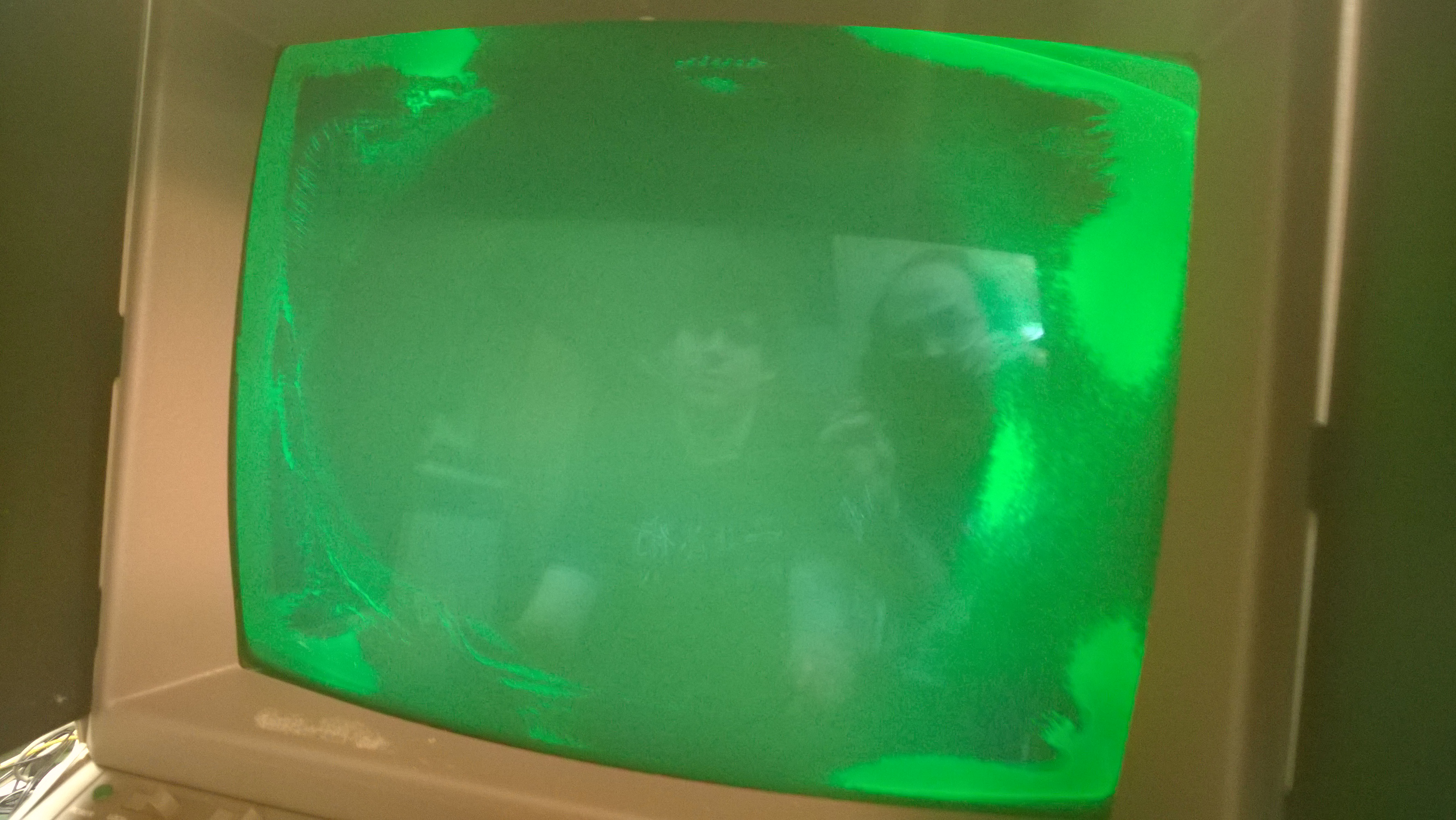
The other day my RD54 just stopped rotating, dead in its tracks, while it
was running. I guessed one of the motor control power transistors may have
failed. I assume they are the series of 6 chunky ones attached to a single
heatsink. I have desoldered them (en-masse) and tested them with a Peak
DCA55 tester, and they all appear to be working. Does anyone have any other
suggestions? Has anyone ever repaired an RD54 control board?
Regards
Rob
For those who don't know, Monash University (Melbourne Australia) has
had the chassis of a B7800 CPU sitting around under a stoir case, left
over from the days when a series of large Burroughs systems had been
in use there during the seventies.
I'm no expert on Burroughs systems, but from all the Internet based
trawling I've done over the years it appears that Burroughs had a
'scorched earth' policy, and systematically reclaimed and disposed of
all B5000 and onward family machines. At least to date, I haven't been
able to find any other surviving example of a B5000 family machine (or
major components). Naturally I'd be very happy to be proved wrong.
Unfortunately all cards and power supplies had been removed but it
still had the basic frame, backplane (very impressive in it's own
right) and two large front control panels all in place (also very
impressive).
(I've been told that the front panels were pulled prior to disposal).
Many of you will be familiar with Ralph Klimek and his amazing stories
of life as a technician with these machines.
He has some pictures of this particular frame, about mid way down this
page on his site:
http://users.monash.edu.au/~ralphk/burroughs.html
Because I live close by, I was dropping in every so often to check up
on both this frame, and a (smaller) VAX 11/780 sitting next to it.
Because the Uni has quite a decent vintage computer display in place
at it's Caulfied campus, I had felt comfortable that both machines
were safe.
On a relatively recent visit (a few months ago, late last year? I'm
not quite sure as life is a bit of a blur at present) I noticed that
both machines had gone, and that some renovations were taking place in
the building.
I felt that the machines must be safe but decided I should try and
make contact to be sure (working in ICT for so long, I should have
known not to trust an assumption),
A few days ago I got a note back saying that the Uni had requested the
builders to remove the B7800 chassis and dispose of it (the 11/780 was
moved to the Caufield collection).
Since then I've gone on a bit of a campaign to try and find out of the
machine might still be sitting somewhere with the builder (or their
sub-contracter). It's a very long shot, but in this case I think most
here on the list would agree it's worth it? Apparently the scrap metal
value would be quite low at the moment, and hopefully whoever has it
has been too busy to deal with disposal yet (a long shot, as I said).
I've managed to speak to numerous people both inside the Uni and the
builder, but have realised from them that my enquiries now need to be
pushed four ways - into two Schools within the Uni, and also two
service departments.?My problem is that I'm attempting to get a
startup software company off the ground, so time isn't something that
I've got any of, let trying to push my way through contacting people
within four different internal departments (and sitting through all
the on-hold music, call transfers & drop outs).
I don't think that the Uni wants this chassis at the end of the day.?
Is there anyone who can attack this at a higher level? I'm happy to
pass on relevant details to anyone who could help positively (I don't
want to cause unnecessary aggravation by posting everything here, the
people I've spoken to have already been as helpful as they can).
If it's true that it is possibly one of the last existing CPU frames
of the B5000 family, and if it went to one of the major Museums in the
US as a result, that would be a great outcome (if it still exists at
all).
Regards Evan
During approximately one and a half year I have been restoring a little
PDP-11/04 computer with a TU60 DECassette drive and a LA30P Decwriter. I
have followed the trail of Lou and got it to run CAPS-11 as well as
CAPS-11/BASIC.
It has been an interesting journey to repair it and actually trying to use
it give a glimpse of what it was like to develop software 40 years ago on a
minimalistic system like this. Since it only has 8kW of memory the BASIC
system uses overlays. It takes at least half a minute to load the runtime
environment when you hit the RUN command - and then half a minute to get
back to the editor again after running. Indeed patience demanding.
I put together a webpage:
http://www.datormuseum.se/computers/digital-equipment-corporation/pdp-11-04
and a short video when it runs: https://www.youtube.com/watch?v=EQsP444N5zQ
/Mattis
> I suppose that is possible, but not sure that would explain the dead stop, although I suppose it isn't impossible. I
Bad connections rarely do anything you expect :-)
> was nowhere near it when it happened. Do the signals I posted look right to you? Would you expect inconsistent
> triggering on the scope on just one of the FET outputs?
More seriously, have you tried swapping the FETs round to see if the dodgy signal goes with a particular
transistor?
-tony
> From: B Degnan
> I have one Altair turnkey (chassis only) and a bunch of DEC components
> available from a lot of computers I picked up the other day.
So I wound up with all the DEC gear from this (I gather the Altair is gone
too), but I'm not at all sure I want the System Industries hard drives. (I
assume there's at least one controller for them there, but all I know is
what's in Bill's posting. :-)
Is there anyone out there who'd be interested in them, if I decide I don't
want them? Free (basically) to a good home (although if you can't do a
pickup, we'd have to look into shipping).
Noel
> From: B Degnan
> I have one Altair turnkey (chassis only) and a bunch of DEC components
> available
It sounds like Bill's mailbox is exploding... :-) Apparently the DEC stuff
already has several people who are willing to take it.
Noel
From: Jochen Kunz <jkunz at unixag-kl.fh-kl.de>
> Similar: We had some Indigos in indogo color but with "CDC Cyber 910"
> (yes, CDC as Controll Data Corp.) printing at the Unix-AG.
Ha! Memories. I have a recycler friend who called me up one day having a
line on a st00pid number of "CDC computers" for dirt. He thought maybe he
could make a few dollars on machines from the Center for Disease Control.
I took a look and realized they were rebadged SGIs from Control Data,
workstations and servers. I hooked him up with some folks into that sort
of kink and he sold each one for about 15 times what he paid for them. I
bought a car and a really nice grill with what he kicked back to me for the
intel and the hookup. Good times.
Bob Brown wrote:
>Does anyone have experience with the hpdrive project?
I do. I use a small board NI PCI card. Like this one:
http://www.ebay.com/itm/National-Instruments-High-Performance-GPIB-interface
-for-PCI-Model-PCI-GPIB-/221231586346?pt=LH_DefaultDomain_0&hash=item33826e1
c2a
Works wonders.
>I'm wondering if the following card might work with it:
>http://www.ebay.com/itm/HP-Agilent-82350A-E2078A-PCI-GPIB-Interface-Card->/
351361191725?pt=LH_DefaultDomain_0&hash=item51cec24f2d
It won't. As you can see in the picture, it's based off the TI9914 which is
specifically excluded from the compatibility list. Search National
Instrument PCI-GPIB on eBay and there is a ton of these. The older large
ones are less expensive than the newer small ones.
Jay West wrote:
> I had read somewhere that most PCI cards did not [work].
They do. But you need an National Instrument card based off the chipsets
that Ansgar lists, because he wrote his driver for the NI chipset series. I
use the relatively recent (vintage 2002) small form factor NI GPIB PCI card.
Although he doesn't have it listed as tested, it is based off the TNT5004
chipset and works without any problems with his driver.
I have one Altair turnkey (chassis only) and a bunch of DEC components
available from a lot of computers I picked up the other day. I am looking
only to recover expenses (truck and gas) and I don't want much. These are
best for someone who has experience cleaning a "barn find" as this is where
I got these items. The real "cost" will be the time needed to take apart
these systems and clean thoroughly. I did not see evidence of any chewed
wires fortunately, just nests, some urine staining, seed storage, etc. All
of the computers were working maybe 20 years ago-ish but they have fallen
into neglect.
http://vintagecomputer.net/temp2/
Best offer for some/all, pick up only. Landenberg, PA. No I will not
deliver to VCF.
CONTACT ME HERE: http://vintagecomputer.net/contact.cfm
- PDP 11/34 #1 (no serial card but otherwise populated) *
- PDP 11/34 #2 (with Hard drives, racked, no serial card but otherwise
populated) *
- PDP 11/44 (mostly populated complete maybe) *
- Tall rack with RK05 ** and hard drive for DEC 11/34 #1
- Altair Turnkey, chassis only. *
asterisk key:
* items contains/contained a rodent nest.
** I tried but could not extend from rack, rails rusted?
NOTE - I will keep these items outside ready to be taken. They will be
tightly covered with a new tarp, the weather should be nice for a while.
That said, if you want these items held for an extended period I can't
guarantee that they'll stay dry forever. Act Now!
Bill
Amongst other things, I picked up a SGI Indigo2 system yesterday. It turned
out that it had the original packaging, and that it's an Impact 10000 machine.
For graphics however it has a four-board set; does anyone know what this
might be? Wikipedia talks about a three-board set for the Maximum Impact,
and fewer cards for lesser options, but I've not seen mention anywhere of a
machine using four (unless they're just not counting the analog output
board as part of the three?)
I'm not sure what it has for RAM; all of the sockets are filled. Someone
had scribbled 32MB and 1GB of disk on the box, but it has 2 x 4GB drives
fitted, so that's not necessarily correct.
I need to clean the dust out before I try powering up, but does anyone know
what a minimum config would be? Can I power up with no disks and
framebuffer, and expect to get a serial console? I'd like to not stress the
PSU (or risk the framebuffer cards) initially if possible - the previous
owner said they never ran it, although it was supposedly working when they
got it.
cheers
Jules
So I may have been a bit premature in my declaration earlier this week
that letting the 4014 warm up for a few minutes solves the storage problems.
For the time being, I have it hooked up to a Linux box (so I can 'cat'
various files at it and stare in awe as it draws random things) and it
seems to be performing flawlessly; everything works (including the
discrete plot extensions). But I've noticed that over time as I clear
the screen that garbage starts accruing around the edges of the screen
-- only the middle gets properly erased.
At first power-on, the area that gets cleared is a circle maybe 10" in
diameter; this increases slowly over time and if I let it run for 15-20
minutes *most* of the screen gets cleared but there's always a bit on
the edges that remains.
I went through the portions of the alignment procedure outlined in the
service manual related to storage, and all voltages were within a
percentage point or two even after all these years, so not much required
adjustment.
There are two adjustments for the Collimation that control the size and
shape of the flood that erases the screen; the service manual suggests
adjusting these until the flood covers the screen. Adjusting the pots
all the way counter-clockwise causes the flood to get *slightly* larger
and cover more of the screen, but it's still not enough.
From reading the circuit description for the erase circuits (starting
on page 5-82 of the service manual), I note that the duration of the
flood (as controlled by the Collimation circuits) is controlled by an RC
network and I suppose it's possible that one or more of the capacitors
is out of spec -- but I don't know if the length of the flood has
anything at all to do with the area it covers -- can anyone shed some
light on this?
I suppose it's more likely that the tube's just showing its age. I
suppose I should be happy it works as well as it does.
At any rate, if anyone has any insight here, I'd love to learn more...
- Josh
Having a poke around Wikipedia, I found the following interesting
detail in the 3278 entry:
"3278 terminals continued to be manufactured in Hortolandia, near
Campinas, Brazil as far as late 1980s, having its internals redesigned
by a local engineering team using modern CMOS technology, while
retaining its external look and feel."
That sounds right up my street. Anyone know any more? Ever seen one?
http://www.corestore.org
'No greater love hath a man than he lay down his life for his brother.
Not for millions, not for glory, not for fame.
For one person, in the dark, where no one will ever know or see.'
Dave wrote...
----
What is the symptom with the CRT? I think that was the achilles heel of the MDS. It usually was the connectors on the cable to the CRT control board. Some of the pins carry too much current and the heat made them go intermittent. The other problem that I found was on the control board inside of the CRT module. It was usually cold solder joints and a little touch up usually fixed it.
----
I'm in the midst of a classiccmp-related project with a deadline that will take many months, but eventually I'll get back to the MDS.
As I recall when I pulled out the mds a few months ago, half the time on powerup there was no crt display, and when it would come up, the diagnostic firmware indicated a problem with the crt control board. Sometimes during the powerup sequence the display would work but then go blank.
I also recall that maybe a year ago when I pulled it off the shelf, I could not find my diskettes for the system :( I know they were in the basement, but I looked for a couple days and could not find it. I'd gladly pay something reasonable for some 8" floppies with ISIS2, ASM, PLM, etc.
J
Does anyone have experience with the hpdrive project?
I'm wondering if the following card might work with it:
http://www.ebay.com/itm/HP-Agilent-82350A-E2078A-PCI-GPIB-Interface-Card-/3…
I'm not sure what chipset it uses, and I can't find info from the project page on whether the hp card will work.
thanks.
-Bob
Today I mailed off a couple HP 2100A/S front panel keys (they are the round
tubular "security key" type) to a fellow listmember in need. I thought I had
a whole box of them, but it turned out virtually all of those were DEC keys.
So I had 3 copies of the key made today (two for the listmember, one extra
for me). When I tested them before dropping them in the mail, 2 worked and 1
did not (of course, I sent off the 2 that worked to the listmember).
Since I have to go back to the locksmith to get the 1 key redone, I thought
I'd offer to get keys for the 2100A/S made for anyone that wants them. I
guess it is possible that your 2100A/S may use a different key, but at least
every 2100 I've come across uses the same key. The locksmith charges $8 per
key, and figure $2 bucks for shipping. I'll probably head back to the
locksmith Monday so if anyone is in need, let me know.
Please note - the keys for HP 1000 aka 21MX M/E/F are completely different
and not what I'm talking about here. Just the 2100A or 2100S. But I guess if
anyone needs keys for those, I can get some made as well. If it's for a 1000
or MX key, let me know if it's a M series (dual edge key, switch has standby
position) or E/F (single edge key, not a switch just a front door latch).
Best,
J
Does anyone want a copy?
It includes the Tandon TM-848-1E, TM848-2E operating and service manual and the Tandon TM501, TM502, TM503 OEM service manual.
Al, would you like a copy for bitsavers? If so, how to upload?
It is about 34 megabytes and 416 pages long.
It is already in PDF format. That's what my scanner produces.
Thanks,
Kelly
While sorting through some Unibus cards I've had on a dusty shelf for
years, I came across a strange card (picture at
https://www.flickr.com/photos/pnt103/17011635052/).
It has no maker's name, but what looks like a zigzag triple S logo near
the centre of the top edge, and the legends "2010-60", "2010-6001 C835"
and "EM PC" next to that.
Apart from 74LS series, it has the following noteworthy ICs:
10 x Texas 74S2472 PROMs on left
4 x 20-pin and 1 x 16-pin ICs look like PALs at lower right
2 x 74LS181 (4-bit ALU) near the centre, with
2 x AMD 27S03 (16x4-bit bipolar RAM) and 4 x AM2907 (quad bus xcvr)
2 x white ceramic gold-top ICs 93L422-DC (256x4 static RAM)
12.5MHz crystal
2 x 7439 (marked "SEL"), 2 x DS8837, 5 x DS8641
12 x 75452 (high current high speed dual-NAND peripheral drivers)
and a 50-pin 3M IDC connector and a 2x15-way edge connector on the top edge.
Any suggestions as to what it is or who made it?
Being a hex-height card but having only CDEF fingers, it's the exception
that proves the rule that all Unibus hex cards have all six sets of
contacts ;-)
--
Pete
Pete Turnbull
> From: Paul Koning
> The general rule of device drivers is to assume that the hardware is
> misbehaving, and double check everything.
Right, but it needs to _actively log_ when it has to fix something, otherwise
you wind up in the situation of the semi-famous old Multics problem where
(IIRC) the system was running slower and slower... finally someone looked at
the Disk DIM (driver) counters, and one drive was slowly failing, but the
industrial-strength recovery code in the Multics Disk DIM was masking the
problem (except for the performance degradation). The DIM was thereupon
modified to notify the operator if 'too many' retries had to be done 'too
often'.
Noel
Hey all,
Should be a bit less silent now I guess. ;)
Anyone here exceptionally familiar with the SC-40? I've completed imaging
the drive (just microcode and diags, someone want to finish reversing it
for use in klh10?) and doing the inspection (actually finished weeks ago
but got busy)
Now, I have a tape drive working and attached to it via SCSI...however now
I'm lacking info on how to actually do a tape bootstrap. ;)
http://i.imgur.com/gatos9o.jpg
--
Cory Smelosky
http://gewt.net Personal stuff
http://gimme-sympathy.org Projects
Here are some hex DEC compatible boards that I just found. If you wish to
make an offer, please contact me off list.
Thanks, Paul
ACT 10103-0, 10104 ON BACK
COMPUTER INTERFACE TECNOLOGY CM7819 =DZ11?
COMPUTER CONSOLES 34D01533
DATA PRODUCTS 257240, 257345 SERIAL INTERFACES
DPD FPPA-24132M03
PERTEC GCR/PE READ 107856-02,
GCR/PR READ 107861-01AN DEC # 29-23763-00
107866-01 DEC #
29-23769-00
SIMPACT ICP-1600
VERSATEC BIPOLAR ALGORITHM PROCESSOR 382441
I've checked Bitsavers. Computer Consoles Inc doesn't appear to have a
presence there, and there's nothing in the Harris or ICL sections (two
rebadgers). Anyone information you guys might have on this machine would be
much appreciated.
--
Thanks,
Kevin
I had written
----
TSIA
I?m in need of an owner?s manual (and ideally, a service manual as
well would be nice) for? a Northern Telecom Spectron D101. This is an RS232
serial datascope, basically a line monitor with some programmability
(displays in binary, hex, ascii, or octal; start tracking on certain
characters; substitute X string for Y string; etc.).
I?ve googled excessively with no results, and also reached out to AEK. Any
chance someone has one in their pile?
----
FYI, after posting the above I did yet another round of google searches and
this time a manual popped up as the very first search result. Odd. Manual
purchased, and I'll copy and send off to Al if he wants it for bitsavers.
J
> From: F. Ulivi
> I hope I'm not "offending" anyone in this forum by mentioning an
> emulator, it looks like you are mostly focused on real (vintage)
> hardware..
Absolutely not! Although we do indeed focus on vintage hardware, I think we
all understand how useful emulators can be, and many (most? all?) of us use
them as a useful partner to our old hardware. I certainly do! (If nothing
else, they tend to run a lot faster than the actual machines do! :-)
Noel
> From: Josh Dersch
> I finished restoring the 4014's power supply
So I'm curiuous; what exactly did you do, in restoring the supply? (Given
that you'd previously already turned the unit on, and discovered this
behaviour?) Just adjust voltages to spec, or more than that?
Noel
Hi all --
Picked up a Tektronix 4014-1 terminal. It's in pretty good shape, nice
and clean and it's in nearly-working condition except that the storage
behavior isn't quite right.
On power-up, write-through doesn't. (That is, characters don't get
stored to the tube.) Clearing the display via the RESET/PAGE key clears
a roughly elliptical region in the center of the display but leaves the
outer edges a mess. The cleared region stores characters properly. You
can see the overall effect here:
http://yahozna.dyndns.org/scratch/tek4014/clear.jpg
After a 2-3 minutes of warming up the area cleared by RESET/PAGE
increases. I haven't run the terminal long enough to see if it
eventually completely erases the screen (while the power supply appears
to be within tolerances, I still need to rebuild/reform it so I'm not
going to run it too long yet).
So far everything else seems to be functioning properly, the cursor
appears properly (and does not write through), input is accepted from
the keyboard, etc. I've been reading through the service manual on
Bitsavers and it describes a very in-depth alignment procedure which I'm
prepared to go through (once I've got the power supplies rebuilt) but I
thought I'd ask here if this problem rings any bells and if there's
anything I should immediately suspect or adjust. You guys know
everything :).
Thanks as always for the advice,
Josh
geneb wrote:
>So it looks like he made a little cap over the top - that's a very simple
>print. If you can get me dimensions I can print you a few.
Yep that's what I did:
https://www.youtube.com/watch?v=7IQKCiS0w2s
inspiring myself from Rick's drawing (thanks Rick). It's a very small part
though, not sure if you can print something that small accurately unless you
have a professional printer.
The cap I made was 6mm high, 9.6mm in diameter, with a cavity 3mm deep of
6.30mm diameter at the bottom for the capstan to go in. It required me to
reduce the original capstan diameter to the 6.30mm so it could fit in the
cavity though. That's what I was trying to avoid with my two alternate
proposals (for people that don't have a lathe...)
Speaking of which
>I want his lathe. :)
Mwahahaha. Nooooo. It's all miiiiine. Sadly they don't make them anymore, I
got one of the last ones.
- Marc
Does anyone know how to remove the side skins on an SGI Origin
(specifically a 2200 deskside cabinet). The manual mentions removal of the
top and front, but says that the sides are more tricky and to contact SGI
for the procedure.
I'd like to remove them as there's some minor paint splatter on them, which
would be much easier to deal with off the machine.
I see there's a screw at the bottom of the machine on the rear edge (much
like the one for the front which releases the front skin), but removing it
doesn't seem to let the rear plastic molding drop in the same way, and I
assume this needs to come off first.
cheers
Jules
From: Sean Caron <scaron at umich.edu>
> You are right, even the interactive performance of the R8K had me a bit
> taken aback...But I understand in its day it really flew on the FP codes;
Yup. The R8000 was pretty specifically designed to be a desktop super, for
some value of "super". And for 1995, it was pretty remarkable. It was the
first superscaler MIPS, and the dedicated FP unit was pretty much pushing
the envelope on single chip tech. But integer performance wasn't a
priority, and you could tell.
> I don't know if this claim was ever really substantiated in the real world
The MIPSPro compilers usually did a really good job of optimizing for the
R8000, and for the jobs it was designed for (non-vectorizable floating
point) it really flew (300ish MFLOPS...which for 1995 was nothing short of
amazing in a desktop).
I would note, however, that the common comparison to the Y/MP is pretty
much pure marketing. The Y/MP and the R8K were on-par for non-vector FP
problems, but as soon as the compiler could substantially vectorize the
problem, the Y/MP could be many times faster than the R8K for the same
codebase.
In the end, we found the R8K was a nice dev machine (due to a good bit of
source compatibility between the MIPSPro and Cray compilers), but not
generally cost effective, and pretty much outmatched all around by the R10k
and later.
> But it's a neat little oddball
Very.
KJ
I have a VAX 4000-300 that I want to pass on as I don't have room for it.
It is in a BA440 enclosure (marked VAX 4000-400). The CPU board had a
couple of problems, the levers that are used to push it into the slot have
been broken, however it will push into the slot OK and work. The onboard
Ethernet (SGEC) is also not working, but I have included a DESQA so you can
network it. It has 64MB of memory (2x 32MB). It also has a CXY08 board.
It does not have any disks because I want to keep the few DSSI disks I
have, however I will include two DSSI covers. You can still boot it as a
satellite of course. In fact I was toying with the idea of putting a
Raspberry Pi inside the enclosure with a crossover LAN cable and running if
off SIMH on that.
It is free, however I would appreciate a small donation, as it has cost me
money to collect it to save it from being dumped.
It is in the UK, in South Manchester. Although I am currently working a lot
in Coventry so could bring it to that area. I will also be at DEC Legacy in
Windermere 11-12 April, although I would prefer to leave room in my car for
the machines I want to exhibit, if possible.
Regards
Rob
More computer-esque things looking to be identified. Some of it military,
some of it not.
What might the paper tape reader have come out of?
The big circuit boards say "Harris" on them.
http://imgur.com/a/S7dyo
Thanks,
Kyle
> From: Lyle Bickley
> I have had packs on rare occasions which when I first obtained them had
> a few records which were unreadable - and a clean reformat made them
> 100% error free.
Err, I thought RL02 packs came pre-formatted (at least, the low-level stuff
like sector headers, etc), and could not be field re-formatted? Or are you
simply talking of a high-level re-format (i.e. the file system), which might
write all data blocks to zero or something, thereby getting rid of the
un-readable contents of such blocks?
> From: Mike Ross
> It's high time someone collated all the 'new hardware' projects out
> there ... should be a one-stop shop where info on all this stuff is
> held.
The obvious place to put it is on our Wiki, of course... (Hint, hint... :-)
Noel
I've gotten my RL-02 -> USB Mass Storage controller mostly working with a few residual gremlins. Specifically, I've noticed from my testing that I have good packs, ones that read out almost the same every time, and bad packs, ones where half the bits seem to be in different states every time I read them. I've left write support untested until I can solve this problem.
Right now, my working theory is that different controllers had slightly different timing characteristics, and I may need to adjust more of my DPLL parameters dynamically to deal with that (something I'd rather avoid). Of course, most of these packs haven't been put into a drive since the mid-80s, and there could be some bit rot going on.
As many of you have much more experience dealing with these drives than I do, my questions are:
- What type of long term reliability have people noticed from their RL02K packs?
- Is garbage data sometimes normal for certain packs until they are rewritten with ?fresh? data?
- Has anyone noticed pack compatibility problems between various computers/RL-02 controllers?
Thanks,
Christopher
> Date: Tue, 31 Mar 2015 06:20:04 -0500
> From: "Jay West" <jwest at classiccmp.org>
>
> So. two questions: What SHOULD the outer diameter of a good capstan roller
> be on that drive, and does anyone have other suggestions for how to make the
> capstan roller "taller"?
I would try gluing an extender piece on the end of the existing capstan roller, perhaps
using wood which is easy to shape. Once you wrap it with a piece or two of heat
shrink tubing, I would think that it would all stay in place.
> So the roller on my -85A tape drive is marginally ok [.]. While the
>second option would work, according to the video it "just barely makes the
>capstan roller contact the bottom portion of the tape capstan wheel". That
>concerns me, as if it's "barely making contact" I'm concerned that over
time
>this would wear the capstan roller motor shaft and perhaps wear down the
>wheel, not to mention potential vibration.
It doesn't wear the shaft, does not cause vibrations. But it eventually
wears out the edge of the rubber replacement you put over the capstan
(shrink tube or surgical tubing in my case). Eventually it fails and you
have to put a new one. Annoying.
> So. two questions: What SHOULD the outer diameter of a good capstan roller
> be on that drive
Dunno. If you have a semi good capstan, can you measure it? Apparently it's
not critical, since I got the tapes working OK with a thin shrink tube
coating as well as a thick surgical tube coating.
>does anyone have other suggestions for how to make the capstan roller
"taller"?
I can think of at least two solutions.
Solution one is to glue a metal or plastic "puck" of the same diameter as
the bare roller on top of it before recoating it. It's simpler than
machining the cap I show in my video, but you still need to have someone
machine a simple disk part on a lathe. That should be pretty cheap.
Solution two requires someone good at making rubber. It would be to cast a
rubber cap of the right diameter and thickness, and with a pocket on the
bottom so you can slip it or glue it over the existing bare capstan. So you
would not need to machine anything, just slip it over the bare capstan. If
anyone knows about an outfit that can do this, or can explain to me how to
cast rubber, let me know.
Marc
This talk of tape gear reminds me that some may not have seen the
availability in Wichita of some tape gear and the like I posted back in
July.
Such as StorageTek 9-track, Tandberg QIC, Exabyte 8mm, Xerox-branded 9
track, at least one working 3480, Avix UNIBUS tape controller boards,
etc. A couple of PDP 11/34s; you get the idea.
Contact
Shaun Halstead
Microfilm Services, Inc.
Wichita, Ks
(316) 269-2203
A friendly reminder for those who didn't get the memo about their TPS
reports VCF East X: it's happening soon! The show is April 17-19 at the
InfoAge Science Center in Wall, New Jersey. That's around 60 minutes
south of Manhattan and 90 minutes northeast of Philadelphia.
- Friday's schedule has 16 technical classes and a PDP-8 50th
anniversary ceremony.
- Saturday/Sunday's agenda has morning keynotes, two exhibit halls open
the rest of the day, the PDP-8 Pavilion, consignment, vendors, museum
tours, etc.
Tickets are available online and at the door.
http://vintage.org/2015/east/http://facebook.com/vcfeasthttp://twitter.com/vcfeast
Hope to see you there!
- Evan K.
We just sorted and shelved the following boards, most of which I will never
use. If you are interested in any or all, feel free to make an offer off
list.
There are a few non DEC ones I have to figure out yet, otherwise this
should be most of them.
If you need L boards not listed here, let me know. I have a friend who
has some.
Quantities available on most.
Thanks, Paul
F1002
F1003
F1004
F1005
F1006
F1007
F1008
F1009
F1010
F1013
F1021
L0007
L0008
L0104
L0107
L0108
L0109
L0115
L0217
L0225
M7463
M8238
M8286
M8287
M8288
M8289
M8373 X 14
M8574? I need to recheck part number on the last 2.
M8576?
Have a Burroughs B25-K2I keyboard for sale.
Best regards,
Ed Hogan
Unimetrix Corporation
20371 Lake Forest Drive
Suite A-7
Lake Forest, CA 92630
Phone: 949-215-2475 x101
Toll Free: 800-633-9955 x101
FAX: 949-215-2472
Email: ehogan at unimetrix.com
Web: www.unimetrix.com <http://www.unimetrix.com/>
THIS COMMUNICATION MAY CONTAIN CONFIDENTIAL AND/OR OTHERWISE PROPRIETARY
MATERIAL and is thus for use only by the intended recipient. If you received
this in error, please contact the sender and delete the e-mail and its
attachments from all computers.
> On Mar 31, 2015, at 4:00 PM, John Foust <jfoust at threedee.com> wrote:
>
> At 01:14 PM 3/30/2015, Paul Koning wrote:
>> I think iSCSI target support is now a standard Linux iSCSI feature. If not standard, at least reasonably mainstream. I haven???t tried it, but I see plenty of references to it on the Linux iSCSI mailing list.
>
> Are they running old tape devices on it?
Tape? Not that I know of. In principle iSCSI can handle tape, but I don?t know if it?s been done at all, never mind in Linux.
paul
Hey all --
I'm looking for an image of the EPROM on the CMD CDU-710/M or /TM UNIBUS
SCSI adapters. The 720s have been archived, but only the /T (tape only)
variants are imaged for the 710...
Anyone out there have one of these boards and be willing to dump the ROMs?
Thanks in advance,
Josh
> On Mar 30, 2015, at 1:23 PM, John Foust <jfoust at threedee.com> wrote:
>
> At 11:47 AM 3/27/2015, Liam Proven wrote:
>> On 27 March 2015 at 17:36, Bob Brown <bbrown at harpercollege.edu> wrote:
>>> Does anyone know if a usb --> scsi adapter might allow me to connect an hp 9-track tape drive (7980s) to a computer running windows-7?
>
> Hasn't someone somewhere created an iSCSI stack that would let
> an old PC run Linux and use an old SCSI card (of appropriate
> interface) to talk to old hardware, but speak to the
> new PC and new software over the network?
I think iSCSI target support is now a standard Linux iSCSI feature. If not standard, at least reasonably mainstream. I haven?t tried it, but I see plenty of references to it on the Linux iSCSI mailing list.
paul
Looking for offers on the subject item.
Best regards,
Ed Hogan
Unimetrix Corporation
20371 Lake Forest Drive
Suite A-7
Lake Forest, CA 92630
Phone: 949-215-2475 x101
Toll Free: 800-633-9955 x101
FAX: 949-215-2472
Email: ehogan at unimetrix.com
Web: www.unimetrix.com <http://www.unimetrix.com/>
THIS COMMUNICATION MAY CONTAIN CONFIDENTIAL AND/OR OTHERWISE PROPRIETARY
MATERIAL and is thus for use only by the intended recipient. If you received
this in error, please contact the sender and delete the e-mail and its
attachments from all computers.
Any idea what this came out of? I was thinking some fixed head hard drive,
but I'm not sure. It looks new. The coil resistance is about 4 ohms and
>from measuring it, seems to be center-tapped.
http://imgur.com/a/mHZS4
Thanks,
Kyle
> From: Al Kossow
> I have several of them.
Wow. I'm totally stunned! Do you have any 3-Mbit transceivers to go with them?
If you (or anyone) need, I can provide old code for an IP/PUP router to
connect a 3-Mbit Ethernet to a 10-Mbit (if you want to put, say, an Alto on
the Internet - not sure if they ever did a 10-Mbit card for the Altos). It
would need either a UNIBUS 11, or a QBUS 11 and a QBUS->UNIBUS converter. (The
DEC one is UNIBUS->QBUS, so would not help us.)
> Anyone still have Unibus Chaosnet cards?
Another rara avis! (I don't remember if they ever made any QBUS ones.)
Noel
> From: Rich Alderson
> SAIL .. did not use the MEIS (Massbus-Ethernet Interface Subsystem) for
> Ethernet connectivity, but rather a Unibus card from Xerox (apparently
> used to hook -11s to D-machines) which went into the front end 11/40 on
> the KL-10.
If this is the card I'm thinking of (we got two as part of the Xerox donation
of Altos, a Dover, etc to MIT, BITD), it's to a 3-MBit Experimental Ethernet,
not to a 10-MBit Ethernet, and so won't be much use unless you have something
else with a 3-MBit Ethernet (and of course you'd also need 3-MBit
transceivers, etc, etc).
And of courset those cards were made in very, very limited numbers; if any
survive to this day, I will be absolutely astonished.
If you have a pointer to the PDP-11 code, I can take a look at it and confirm
if it's a 3-MBit card. (The hardware packet header format is completely
different from that for a 10-MBit.)
Noel
I just got off the phone with a gent who has a 7,000 sq foot warehouse in
NJ. He has old ALR, Unisys, and Burroughs servers, terminals, keyboards,
and storage (9GB drives).
If you are interested, send him an email at ehogan at unimetrix.com. His name
is Ed Hogan.
Cindy Croxton
> From: Al Kossow
> There was a 10mb card Xerox made
[later]
> There never was a 10mb card.
??
> I would be interested in the code for an 11.
Alas, the CGW code online at MIT:
http://web.mit.edu/afs/net/project/cgw/
doesn't contain the PDP-11 version (or the Experimental Ethernet drivers,
etc). I have the hardcopy of the PDP-11 version, and somewhere on the MIT V6+
Unix tapes that I'm currently trying to excavate, there will be
machine-readable, but I've been trying to get to those for some months
now... too much else to do! :-( If you get to a point where you need it, let
me know, and if I don't already have it done, I'll move it up the priority
list.
Noel
At first I thought this was an April Fools prank pulled a day early, then I went and checked and found out that because 2015 is a leap year, March only had 29 days instead of the usual 31.
Tim.
Long story short: It turns out that SAIL, the DEC-1080 running WAITS at
the Stanford Artificial Intelligence Laboratory, did not use the MEIS
(Massbus-Ethernet Interface Subsystem) for Ethernet connectivity, but rather
a Unibus card from Xerox (apparently used to hook -11s to D-machines) which
went into the front end 11/40 on the KL-10.
So: Does anyone on the list have such a device, and are you willing to part
with it? Or to loan it for reverse engineering? Or do you know someone who
has one who does not read ClassicCmp?
Please contact me off-list. I've directed Outlook to set the Reply-to: field,
but who knows if it listens, or if the list software will leave it in place.
Thanks,
Rich
Rich Alderson
Sr. Systems Engineer
Living Computer Museum
2245 1st Ave S
Seattle, WA 98134
http://www.LivingComputerMuseum.org/
All ?
After a long time, I?m playing with this 1995-vintage DIY 32-bit OS called
MMYRTL by Rich Burgess. Does anyone have any experience with running and
building it? If so, could you ping me off-list. I have a quick question on
it.
Thanks!
Rich
--
Rich Cini
Collector of Classic Computers
Build Master and lead engineer, Altair32 Emulator
http://www.classiccmp.org/cinihttp://www.classiccmp.org/altair32
So the roller on my -85A tape drive is marginally ok, but finding the tapes
for that which work reliably is not really an option. So I was going to
attempt the conversion to make the drive use DC2000 tapes.
Marc - thanks for the great video of this process at
https://www.youtube.com/watch?v=7IQKCiS0w2s
The process basically involves making the capstan roller "taller". Marc's
approach is to use a lathe and fabricate a taller capstan roller and he
suggests using heat shrink tubing to make the capstan roller taller as an
alternative. I do not have a lathe, so the first option is out. While the
second option would work, according to the video it "just barely makes the
capstan roller contact the bottom portion of the tape capstan wheel". That
concerns me, as if it's "barely making contact" I'm concerned that over time
this would wear the capstan roller motor shaft and perhaps wear down the
wheel, not to mention potential vibration.
So. two questions: What SHOULD the outer diameter of a good capstan roller
be on that drive, and does anyone have other suggestions for how to make the
capstan roller "taller"?
J
Never mind, I asked for help in the series80 Yahoo group, and this is
actually the right package. My problem came from elsewhere (issues in making
an error-free 5.25 HP-formatted floppy, its fixed now). The disc image below
has both the HP86/87 and the HP83/85 versions on it. Works great, now my
HP85 can be a cute serial terminal. Thanks Jay W. for the pointer to the
software package, I had been trying to do this for a while.
Marc
>From: "Marc Verdiell" <marc.verdiell at gmail.com>
>Does anyone have a copy of the Data Communications Pac for the HP 83/85?
>It's a rather well done combo BASIC/Assembly package that turns your HP 85
>into a terminal emulator (Jay alerted me to it). This HP Computer Museum
>link claims this is it:
>http://www.hpmuseum.net/display_item.php?sw=9
>But when you download and extract the linked image it is actually the HP
>86/87 version. I haven't been able to locate the HP 83/85 version of that
>PAC.
>Marc
> From: Mike Ross
> That's a very interesting project. Do you have plans to make this
> thing available in some form once the bugs are out?
> [...]
You bet. I've kept component availability, manufacturability, and cost in mind from the beginning, which is why I've gone with a custom board instead of a mess of expensive development kits. Plus, I love designing new hardware, so I'm always looking for excuses to do it. The controller will need to mature a little before I let it loose on the world though.
Right now I have (mostly) working:
Block level access to the packs via USB Mass Storage (i.e. dd if=/dev/sdX of=/home/user/rl02.img)
SIMH image compatibility (attach rl0 /home/user/rl02.img)
SIMH real-time drive access (attach rl0 /dev/sdX). Yes, you can attach a real RL02 to SIMH transparently on linux (since everything is a file, even devices). I'm not sure what it would take on Windows.
Still to do:
Add more drive status probing (so you don't have to restart the controller board (powered over USB) if turning off the drive or changing packs)
Testing of write, allowing restoration of disk images or disk reformatting (FAT16 anyone?) (implemented, but untested until read problems are fixed)
Design the final board to plug into the external berg connector (that one might be tricky)
Integration of XXDP style RL02 diagnostics into the controller (but more friendly).
Bug fixes and loads more pack/drive combination compatibility testing.
Christopher
Hi,
Just a random couple of requests -- for a while I've been looking for a
replacement HP Apollo 735/125 PSU (pic attached). Or alternatively, a
schematic for this one so I can get an expert to repair it :)
Also - for testing QBus cards - I'm interested in a small standalone
backplane that I can power independently. Anyone have something they
want to get rid of?
(Pref North America for shipping reasons :)
Thanks
--Toby
Hi all,
Over the last months I scanned micro fiches with XXDP diagnostic program
listings.
These listings are essential for repairing PDP-11's (or enhancing SimH).
I digitized 330 listings from 452 fiches, with a total of 53545 document
pages.
Almost all of them should be new stuff.
The PDFs are ready for download now.
Until they appear at bitsavers.org, you can use my link:
ftp://u58104846-pub:open4you at ftp.j-hoppe.de
(Note the embedded user/password strings)
The scans come in two versions: "high quality" and "black&white":
The HQ version is gray level and contains a true image of the micro
fiches, after non-destructive contrast enhancement. It is the base for
further image processing.
Download path is ./fichescanner/hq/gh
The BW version is compressed to black & white and aggressively optimized
for size and letter quality. File sizes are 20x smaller than the HQ
version. Its intended for daily use and OCR, but for some very
problematic fiches textual information is lost.
Download path is ./fichescanner/bw/gh
And there is a background article on
http://retrocmp.com/projects/scanning-micro-fiches
describing the self-build automatic micro fiche scanner (video!)
Enjoy!
Joerg
This one is in the UK. I am not sure exactly where - waiting on further
response from the owner.
Description I initially received:
-----
PDP11/23, Microvax with a number of boards and a Uni-bus adapter, Q U back
plane plus some documentation.
The RX01 drives passed away many years ago but the main board I think I
still have.
Unfortunately the power supply is dead, and should take swimming lessons in
Maynard Mill pond.
-----
I then received a followup email with the following info:
-----
I {used to work at} a little company then called DEC.
This was a single system used for silicon testing as there is an IEEE bus
interface card.
-----
So this is interesting in that it has a unibus adapter, and an IEEE bus
interface card. And... may have actually been used within DEC (from what he
says above)?
Anyways, further information will not be available until after Easter (it's
being dug out and verified for parts and descriptions). If you're in the UK
and interested, please email me off-list.
Best,
J
I was exploring the idea of doing it without requiring an old PC w/SCSI card.
-Bob
-----Original Message-----
From: cctalk [mailto:cctalk-bounces at classiccmp.org] On Behalf Of John Foust
Sent: Monday, March 30, 2015 12:23 PM
To: cctalk at classiccmp.org
Subject: Re: USB --> SCSI
At 11:47 AM 3/27/2015, Liam Proven wrote:
>On 27 March 2015 at 17:36, Bob Brown <bbrown at harpercollege.edu> wrote:
>> Does anyone know if a usb --> scsi adapter might allow me to connect an hp 9-track tape drive (7980s) to a computer running windows-7?
Hasn't someone somewhere created an iSCSI stack that would let an old PC run Linux and use an old SCSI card (of appropriate
interface) to talk to old hardware, but speak to the new PC and new software over the network?
Is the end-goal running 'mt' and 'tar' within Cygwin under Windows?
If the goal requires talking to the Windows machine's filesystem, aren't there lots of ways to solve that from an old Linux machine?
This topic was covered in July 2014 and December 2012 if you check the archives.
- John
At 11:47 AM 3/27/2015, Liam Proven wrote:
>On 27 March 2015 at 17:36, Bob Brown <bbrown at harpercollege.edu> wrote:
>> Does anyone know if a usb --> scsi adapter might allow me to connect an hp 9-track tape drive (7980s) to a computer running windows-7?
Hasn't someone somewhere created an iSCSI stack that would let
an old PC run Linux and use an old SCSI card (of appropriate
interface) to talk to old hardware, but speak to the
new PC and new software over the network?
Is the end-goal running 'mt' and 'tar' within Cygwin under Windows?
If the goal requires talking to the Windows machine's filesystem,
aren't there lots of ways to solve that from an old Linux machine?
This topic was covered in July 2014 and December 2012 if you
check the archives.
- John
Does anyone have a copy of the Data Communications Pac for the HP 83/85?
It's a rather well done combo BASIC/Assembly package that turns your HP 85
into a terminal emulator (Jay alerted me to it). This HP Computer Museum
link claims this is it:
http://www.hpmuseum.net/display_item.php?sw=9
But when you download and extract the linked image it is actually the HP
86/87 version. I haven't been able to locate the HP 83/85 version of that
PAC.
Marc
Does anyone know if a usb --> scsi adapter might allow me to connect an hp 9-track tape drive (7980s) to a computer running windows-7?
Has anyone done it?
Any pointers (drivers etc)?
Thanks.
-Bob
I thought my latest little retrocomputing project might beof interest.?A few weeks ago, our accounting department trashed some oldequipment that had been in a closet sine the 70?s.? Because it was all fully depreciated long ago, the stuff wasup for grabs.? Most of it was junk,but they did have 5 HP 9100B calculators that seemed to be in pretty goodphysical shape.? These are from the1960?s, and are pretty huge for a calculator, by today?s standards.? I tried them all, and they all seemedto have some pretty weird behavior.?When you hit the ?+? key, it doesn?t wait for another number, butinstead adds the last row directly to the second row.? I suppose that?s why these have been out of commission allthese years.?
View image: Strange calculator behavior
| ? |
| ? | | ? | ? | ? | ? | ? |
| View image: Strange calculator behaviorhttp://postimg.org/image/rnyl9uexz/ Link copy to clipboard http://s23.postimg.org/otvfwecrv/Strange_calculator_behavior.jpg Direct Link copy to clipboard ? |
| |
| View on postimg.org | Preview by Yahoo |
| |
| ? |
I figured since they are free, I?d pick one up and find aproject for it.? They do have somepretty cool cases.? They had someprinters as well, off in a corner, but I was more interested in using thecalculator as the basis for some kind of retrocomputing project, and theprinters were not compatible with anything else, so I passed.?This weekend, while cleaning up the lab, I came across anold Jumptec PC104 form-factor board with a 486 processor and an add-on LCDcontroller.? I figured this couldbe the perfect ?upgrade? for the 9100B.?Luckily, the HP machine was very well designed, and easy todisassemble.? I was very easilyable to fit the PCM-104 stack, a power supply, screen, SD card, and HappyHacking keyboard.? Almost a perfectfit!!?View image: Out with the old, in with the new!!
| ? |
| ? | | ? | ? | ? | ? | ? |
| View image: Out with the old, in with the new!!http://postimg.org/image/6051lnp5z/ Link copy to clipboard http://s23.postimg.org/5am99aomj/Out_with_the_old_in_with_the_new.jpg Direct Link copy to clipb... |
| |
| View on postimg.org | Preview by Yahoo |
| |
| ? |
Of course, no retro-computer is complete without a properretro-operating system.? Here youcan see the project in near final shape, running windows 95Perhaps some time inthe future, I?ll upgrade this to a more modern processor, but for now, justpure retrocomputing goodness!
View image: Up and running, retro style!
| ? |
| ? | | ? | ? | ? | ? | ? |
| View image: Up and running, retro style!http://postimg.org/image/xm7t6c8iv/ Link copy to clipboard http://s23.postimg.org/ki28tngh7/Up_and_running_retro_style.jpg Direct Link copy to clipboard ? |
| |
| View on postimg.org | Preview by Yahoo |
| |
| ? |
?Future upgrades include:??????Laser-cutting or 3d-printing a proper faceplatefor the keyboard, and transplanting the keyboard PCB directly to the case.??????Adding some LED strip-lighting for a morestriking presentation.?Let me know what you think!?Dave
I have a TF85 I want to install into a BA440 enclosure. I took the mounting
rails from a TK70 and combined it with the small board from an RF drive
which has the DSSI cable and a power cable. I plugged the power cable into a
socket on a board attached to the drive. The drive itself has another power
socket. I assumed it was getting power from the socket on the board attached
to the drive, but when I power on the machine, the tape drive itself appears
not to get any power. Is there supposed to be a special board that goes into
the mounting that has *two* power cables?
I have tried to find documentation on this but have not been able to find
anything.
Thanks
Rob
I figured a goodly number of folks here would appreciate this:
http://hackaday.com/2015/03/26/hackaday-retro-edition-remaking-the-pdp-8i-w…
It's a clone of a PDP-8I front using modern parts and driven by Raspberry
Pi running SIMH.
--
David Griffith
dave at 661.org
A: Because it fouls the order in which people normally read text.
Q: Why is top-posting such a bad thing?
A: Top-posting.
Q: What is the most annoying thing in e-mail?
I have two Vishay Siliconix DG506AR Single 16Ch/Differential 8Ch CMOS
Analog Multiplexers free for shipping. I tried selling them on Ebay and
got no nibbles at all. These are white-ceramic with white lids. I found
them in a small box labeled as though they were free samples from Vishay.
The foam appears to have consumed a bit of the gold, but they should work
okay. See them in
https://www.flickr.com/photos/32548582 at N02/sets/72157647852420954/.
Note: I'm keeping that curious-looking paper tape punch.
--
David Griffith
dave at 661.org
A: Because it fouls the order in which people normally read text.
Q: Why is top-posting such a bad thing?
A: Top-posting.
Q: What is the most annoying thing in e-mail?
Hi,
I'm looking for someone in the UK with commercial experience of TRU64 UNIX,
preferably with ORACLE, if anyone can help, please let me know.
Regards
Jim.
I would like to find the front bezel for a HP RX2620. The one I have has the
tabs that hold it in place broken off. There is one on Ebay, but with
postage from the US it adds up. Does anyone have one in the UK that they are
willing to part with?
I also wouldn't mind finding an optical drive for this machine, they seem
pretty hard to find, so again, anyone have one to spare?
Thanks
Rob
I'm looking for a "Dual I/O cable assembly", DEC part number D-IA-7006289-0-0. This cable links a PDP-8/I with the KV8-I graphics display option to a VT01 display and an H306 joystick. All I know at this point is that the cable connects to the 8/I via a G778 interface card and terminates at the other end in a 25-pin Cannon connector for the display (actually a Tek 611 display monitor) and a 9-pin Amphenol connector for the joystick.
Does anyone have one of these display systems?
I would be happy to find the cable but short of that, it would be a big help to have more info on the G778 interface card so I can build a cable.
Thanks,
Jack
Hello,
I just received from a friend a Dilog SU723A, but I don't find any
documentation about it.
The board is rev.D and has two 50 pin connectors on top... which one
should be used?
From a quick look at the ICs on the PCB, I suspect one connector is for
single ended, the other for differential SCSI,
but I'm not sure about it...
Anybody has some info / manual / other ROM dumps? My ROM image is
available if somebody is interested on it.
As I suspect that the same board could support also SU726A, if would be
nice if somebody has ROMs and/or PLA
dumps, could be interesting in being able to switch between features.
Thanks
Andrea
So I've just upgraded several BDV11's to Q22 (new EPROMs to handle more than
256KB of memory, adding termination for BDAL18-21, etc). If anyone has a BDV11
they want to update, let me know, and I can lend a hand, e.g. sending you new
EPROMs, lists of jumpers to change, etc.
Noel
> From: Josh Dersch
> I've been reading through the service manual on Bitsavers
> From: Paul Koning
> A schematic or manual might give a clue, if one can be found.
> From: Jon Elson
> Have you checked bitsavers for a manual?
!! :-)
Noel
TSIA. I'm in need of an owner's manual (and ideally, a service manual as
well would be nice) for a Northern Telecom Spectron D101. This is an RS232
serial datascope, basically a line monitor with some programmability
(displays in binary, hex, ascii, or octal; start tracking on certain
characters; substitute X string for Y string; etc.).
I've googled excessively with no results, and also reached out to AEK. Any
chance someone has one in their pile?
Best,
J
I'm gradually restoring a Mac SE/30. Today I got a new PRAM battery and
installed it. There was no battery leakage, so I'm good there. The
machine seems to run just fine. The big problem now is that even though
nothing should be emitted from the speaker, I'm getting zips, buzzes, and
burbles from it depending on what the computer is doing at the time. I'm
quite sure the the sound circuitry is somehow picking up RF noise from the
system bus. What does this symptom indicate? Should I recap the whole
machine?
--
David Griffith
dave at 661.org
A: Because it fouls the order in which people normally read text.
Q: Why is top-posting such a bad thing?
A: Top-posting.
Q: What is the most annoying thing in e-mail?
By any chance does anyone have a line on the sets of metal drawers that
were used to store decks of punchcards? I know someone who's looking for
a bunch of them (ideally in/near New England, USA, but, whatever!).
Thanks,
John Wilson
The UC171 was a quantity one and is gone. Others are gone, but I still have
one or so left, plus a few goodies I'm just adding. Please contact me off
list. Any qty $10 shipping within US.
Paul
DILOG
DQ130
DQ686
Emulex
CS09
SC01
SC03
TU11
TU121
QD01
QD21
QD241
QT131
GTSC 304B DLV11-J?
SIGMA 400310
MATROX ELECTRONICS SYS QRGB-G/64
MATROX 80 QRGB-256
SPECTRA LOGIC 15/25
ABLE (ACT) 10067 LOOKS LIKE QUINEVERTOR
ABLE 10412 SAME
Please contact me off list if you are interested.
Thanks, Paul
That is a highly impressive autocoder implementation, and the article is an entertaining, yet deep and accurate technical overview of what makes the 1401 so special from a computer engineering point of view. One of the best short technical piece I've ever seen on the 1401. If the two machines work at the same time, I will certainly try to run it on one while making shorter demos on the second!
Marc
Sent from my iPad
> On Mar 24, 2015, at 10:00 AM, cctalk-request at classiccmp.org wrote:
>
> Re: Implementing the Mandelbrot set on an IBM 1401
I've been recovering old data from computers that I used many years ago,
the last effort was trying to recover the data from a hard disk that ran
a WFW 3.11 system. The problem was the disk could not be read on a
modern computer, so I recreated an old system and (very lucky for me)
ftp'd the data off the system after I found an ISA network card.
I have a couple of 4mm and 8mm tapes that contain data I want to
recover. The 4mm is DDS-1 and was written using tar on a SGI system in
1998. My questions are;
'What modern DAT tape drive will read this tape? How backward
compatible is this technology?'
This seems like an easy problem and intend to use a linux system to read
the tape.
The 8mm tapes were also written on an SGI system, however it was in 1994
and the IRIX Backup utility was used. IRIX 5 was probably used. Any ideas?
>From what I've been able to find, it was 50 years ago today
that the PDP-8 was officially launched. So Happy Birthday
to a machine that had such significant influence on so many
of us. And a big Thank You to all those who helped to create
it.
In recognition of this anniversary, the PDP-8/M restoration
I'm doing (on S/N 07082) reached the stage today where I
connected a terminal and was able to push characters in and
out of it. Even as I type this, it's running the print test program
>from the maintenance manual printing ASCII characters on
a terminal.
Happy PDP-8 Day, everyone!
BLS
It had a significant impact onsome of us. I remember in my high school
electronics class in '67 seeing/watching the teacher use/ demonstrate
it. I was hooked om computing ever since. Happy birthday indeed if
it's appropriate to wish an non-entity such!
Happy computing,
Murray :)
So one of my Tek 1240s had incredibly sticky buttons on the front panel
(basically, _all_ of them would stick, and have to be pried out manually). I
had _very_ good results with the following very simple procedure (which is
_not_ in the service manual :-) to totally cure the problem.
Your results may differ, since the problem may have different causes in other
cases; in mine, there was lot of fine dust in the keyboard area, and it
apparently had gotten into the button mechanism, which has a lot of sliding
parts with tight tolerances.
i) Remove the keyboard PCB: the Service Manual, Volume I (available online)
explains how to get the keyboard out - roll up the logic cage, and then you
can undo 4 small bolts, after which the keyboard just comes off. You will
also need to remove two flat cables. Next, remove the scroll button (usual
hex set screw holds it on the shaft), and then separate the cover from the
actual keyboard PCB by removing the four hex stand-off posts.
ii) Take the button assembly out of the PCB; it's just a press-fit, not glued
- just push on it from the solder side of the PCB (may need a fair amount of
force). The buttons consist of precisely 5 parts: the keytop, which comes
off/on easily (I usually remove them, but you could probably leave them on),
the housing, the shaft/actuator, a spring, and a gold-plated copper contact
bar (which connects two gold-plated contacts on the PCB, to form the switch).
iii) Immerse the button assembly in water, and _while immersed_, push the
shaft/actuator back and forth a number of times. If it's totally binding, and
won't come out at all, use a small object of some kind down the cylindrical
shaft to get it to go back and forth. If there is an air bubble trapped in the
cylindrical shaft, make sure to clear it - that shaft is one of the places
dirt can get and bind things up. Pretty soon it should operate completely
freely.
iv) Needless to say, dry thoroughly before replacing... :-)
In theory one could take the button assembly apart to clean it, but I'd be
_really_ worried I'd damage the contact, or something. I just left it all
together and dunked it in water, and that worked wonderfully.
For the 5 LED buttons, it's basically the same. The LEDs are _not_ glued into
the button assemblies, just inserted into the cylindrical shaft. _Carefully_
remove the LED from the shaft, and bend it back out of the way. Then proceed
as above.
Hope someone finds this useful! It's tedious, doing all 30 or so keys, but it
works well.
Noel
The Atlanta Historical Computing Society and the Computer Museum of America
has been planning a great celebration of the 50th birthday of the PDP-8,
40th of the Altair 8800, and 30th of the Amiga 1000 in Roswel, GA, for the
Vintage Computer Festival Southeast 3.0. However, we need your help in
exhibiting! Last year, we had about 400 people through the doors between
two days. We'd love for you to sign up and bring your hardware to show off
to the Atlanta community.
I'll be there with dueling PDP-8s (/E and /M) playing chess, as well as
taking turns playing Spacewar! on age-appropriate hardware. I'll also show
off my emulated version based around SimH. And that's just at my table!
Steve Lafferty has summed up (quite nicely) the signup process for those
who have not done it before. Check it out!
http://tronola.com/html/vcfse3_exhibitor_info.html
Here's the link on vintage.org as well:
http://www.vintage.org/2015/southeast/
If you have any questions, feel free to ask me.
Kyle Owen
Member, AHCS
I hope this is not too long story, but I'd like to start from beginning...
I was selling and donating my 80's computer collection away, because I really couldn't get anymore kicks of home computers (gateaway theory is right, Commodores are step to mainframes ...)
Anyways, I asked every buyer have they seen any thing big, old computers anywhere here in Finland. One guy gave hint of some truck sized IBM, which he had seen at his old job. He told it is probably going to scrap yard and he sent photo of it. I was stunned, FULL 1800 SYSTEM.
Next step was find boss who decide what is going to happen that IBM. I called him and asked how's IBM. Firstly he thought I'm gold digger. After some talk, he became convinced I'm real deal. Sadly, he told me that IBM is in their private museum, and not for sale or not planned to donate anywhere. But he invited me to see that IBM. I was little dissapointed, but better than nothing I thought.
After couple months, I went to there to see IBM. Boss had changed at that time, there was new guy. He also understand historical value of that big iron, no doubt it. We drove plant where that IBM was. When I see it, I was stunned. It was absolute spectacular! It was stood 30 years after service in dry and warm warehouse, same place where it installed early 70's. It have stood still almost long as I have wander this world! Time was stopped that room, it looks like we have got back to 80's on time machine. 2311 disk packs was left probably just where they are 30 years ago.
Here's pic: https://drive.google.com/open?id=0B_DR111cK6W-NnRINlhESk5aNUk&authuser=0
System contains 1801 CPU, 1803 additional core storage unit, 2841 drive adapter, couple 2311 hard drives, 1826 data adapter, 1443 printer, terminals, card readers/punches, etc... It is giant system!
Now comes twist to plot, this new boss suddenly asked: "When you could make pickup for this IBM?". I'm not that type guy, who can get be quiet that easy, but I could just stutter something like "I can pickup every you want". :D
So, I was so excited, own IBM 1800, that is just what I have always wanted, own mainframe :D (...360 would be even better but this would do the trick as well ;) We have not that much computers back 60's or 70's. like below 200 at 1970. So you can imagine how rare big iron is here and it is totally unlikely you could find anything this good at Finland these days.
**************
But now comes the problem. This IBM is in second floor. There is only (wide) staircase down to street level. So cabinets have to partly disassemble to light those "little" bit.
I would need some kind of document of wireharness and schematics, so I get it back together. Also good pictures inside of cabinets would help, so I know what is waiting me there. And by the way, what weights so much these units? CPU weights 907kg, why? Is power supplies so heavy or is there lead poured to structure ;) ?
I'm picking this up next week, at least small items, so I would need some good advices also. Rolling cabinets via stair case is not option ;)
Also any help to bring this back to life is welcome! Thaaaaaanks!
- Johannes ThelenFinland
Before microcomputers blog (Finnish) http://ennenmikrotietokoneita.blogspot.fi/
A classic case of Mac SE leaking electrolytic caps. Soon your sound will
disappear completely. Then your Mac SE/30 won't even boot. You can confirm
looking for shiny leaks traces around the caps. Very easy to take care of.
Replace all of them, as they will all go bad. But there aren't many of them,
I think I counted just 11. Most of them are of the 10 uF variety if I
remember. Surface mount with leads hidden underneath the caps, a bit
annoying to remove, but you can pretty much break them off the board
carefully. The leads should break off at the cap and stay attached on the
board. Then desolder the lead remnants and clean off the old solder with
copper wick until you get pristine pads. Clean any spilled electrolyte under
the caps thoroughly. Replace them with regular 10 uF ones - or whatever
value is needed. I used standard axial through holes ones, just soldered the
bent leads on the traces. It's even written on the board where the + go!
Thanks Steve Jobs. If I could attach pictures of the before and after, I
would... I can send them to you off line if you want. Actually I see your
email, I will.
Marc
On 20/03/2015 6:39 PM, <dave at 661.org> wrote:
> I'm gradually restoring a Mac SE/30. Today I got a new PRAM battery
> and installed it. There was no battery leakage, so I'm good there.
> The machine seems to run just fine. The big problem now is that even
> though nothing should be emitted from the speaker, I'm getting zips,
> buzzes, and burbles from it depending on what the computer is doing at
> the time. I'm quite sure the the sound circuitry is somehow picking
> up RF noise from the system bus. What does this symptom indicate?
> Should I recap the whole machine?
>
> David Griffith
> dave at 661.org
30 years after it was set by Dr Stephen Vickers.
An orchestra of a dozen -- networked! -- original ZX Spectrum
computers plays Mahler's 1st symphony.
A rather lovely 10min film:
https://www.youtube.com/watch?v=LxPXLIALJJI
--
Liam Proven ? Profile: http://lproven.livejournal.com/profile
Email: lproven at cix.co.uk ? GMail/G+/Twitter/Flickr/Facebook: lproven
MSN: lproven at hotmail.com ? Skype/AIM/Yahoo/LinkedIn: liamproven
Cell/Mobiles: +44 7939-087884 (UK) ? +420 702 829 053 (?R)
Hi All,
Long time reader, first time poster.
I am in need of some assistance in trying to revive an IBM 5100. It is a
Basic 32k version that was in rough shape. You can see pics here:
http://vintagecomputer.ca/ibm-5100-before/
I've been able to clean it up but when I fire it up I see a single "A" on
screen. I can't seem to get into any diagnostic modes. The single "A"
indicates an issue with the F2 Base I/O card. Some of the ICs do have some
rust on them but I'm wondering if it might be the "bridge connectors"
between the Base I/O and Controller (CPU) card. Are they directional or
can then be swapped or turned around? I may have not kept them in the
correct orientation but I don't see any mention in the Maintenance manual.
I, pretty much, need someone who has one to take a picture of the top of
their Base I/O and Controller cards.
Any help is much appreciated. If someone happens to know a common issue
that would make the "Bring up Program" stop at A, I'd love to hear about it.
Thanks in advance,
Santo
Hi, I acquited (with a Tek 1240 I recently got) a 1200C02 GPIB Comm Pack,
which I have no use for. Dunno if it works or not. Looking for a good home
for it - shipping plus whatever donation the receiver feels is appropriate.
Noel
Hi all,
I have a Problem Solver Systems (PSS) RAM65 card that I would like to get working in my IMSAI 8080, but I can not find any manuals for it online.
Does anyone on the list have a manual they could possibly scan for me.
Much thanks in advance.
Philip
> From: J?rg Hoppe
> Over the last months I scanned micro fiches with XXDP diagnostic
> program listings ... I digitized 330 listings from 452 fiches, with a
> total of 53545 document pages.
Wow! That is a fantastic job, and I'm sure they will be incredibly useful
to the community. Thank you! Thank you! Thank you!
Noel
Joerg,
On Sat, 21 Mar 2015 07:46:09 +0100
J?rg Hoppe <j_hoppe at t-online.de> wrote:
> Hi all,
>
> Over the last months I scanned micro fiches with XXDP diagnostic
> program listings.
> These listings are essential for repairing PDP-11's (or enhancing
> SimH). I digitized 330 listings from 452 fiches, with a total of
> 53545 document pages.
> Almost all of them should be new stuff.
--snip--
Great job. A serious "labor of love". Thanks a LOT!
Cheers,
Lyle
--
Bickley Consulting West Inc.
http://bickleywest.com
"Black holes are where God is dividing by zero"
There seems to be quite a few options for a boot disk for a K4+88 here:
http://www.retroarchive.org/maslin/disks/kpro/
The unit has a 81-232 ROM.
Gene (again, thanks), sent some disks, but the 81-232 one did not work.
I created a disk from one of the images on the site, and the unit boots
(yay!), but not sure if I am using the best image for the unit.
Any particular image I should use?
Also, any links to the '88 stuff for this unit?
Jim
--
Jim Brain
brain at jbrain.comwww.jbrain.com
Well, i desolder the LB1620... it has obvious signs of burning under
the chips and also on the pcb.
I saw the smoke coming from that place but I thought it came from one
of cap of 2700pf instead came from the chip.
The short circuit between +24vdc and the ground is gone out.
+24vdc go just at pin 4 of the LB1620.
+24vdc to R112 and the D102 Zener that is saved so from here to pins: 19, 2
and 12 of the LB1620 then it continue to pin 16 of the TC9142P.
The datasheet of this last one say that the power voltage would be between
5Vdc and 9,5Vdc. So would this say that the zenere has to be from
5 to 9 vdc? Have i to measure the exact voltage on pin 16 of the TC9142P
without the LB1620 and how have i to expect?
The LB1620 is smoked. What other components must be tested to ensure
that the new LB1620 can not be broken just fitted?
Thanks a lot.
E.
--------- Original Message --------
Da: "General Discussion: On-Topic Posts" <cctech at classiccmp.org>
To: "General Discussion: On-Topic Posts" <cctech at classiccmp.org>
Oggetto: Re: How to save two Mitsubishi M2896 drive (spindle motor smoked!)
Data: 02/03/15 04:20
Indeed, pin 4 (Vcc1) should be +24V, this is for the motor windings drive.
You need to look at pin 19 (Vcc2) of the LB1620 or the voltage across zener
D102.
Follow the pcb trace from the junction of R112 and D102, goes to pin 19,
looks like pins 9 & 2 as well, and on to supply the other ICs.
On 2015-Mar-01, at 1:38 PM, Enrico Lazzerini wrote:
>
> Mhmhm... i checked the pcb. The LB1620 pin 4 is wired to the pin on
which I
> think comes +24vdc... so... let me check what could happens before.
Could
> happens that is it broken something and it goes to this little pcb
+24vdc
> instead of 12-15vdc???
>
> I misured the voltage coming to this pcb and over there is +24VDC
> This explain well the why this pcb smoke and it is hot.
>
>
> Enrico
>
> -----Messaggio originale-----
> Da: cctech [mailto:cctech-bounces at classiccmp.org] Per conto di Brent
Hilpert
> Inviato: domenica 1 marzo 2015 22:08
> A: General Discussion: On-Topic Posts
> Oggetto: Re: How to save two Mitsubishi M2896 drive (spindle motor
smoked!)
>
>
> On 2015-Mar-01, at 9:56 AM, Enrico Lazzerini wrote:
>
>> Thanks Tony for your suggestions. What I means is:
>>
>> It happen in two distinct times every time when I used the drive
to read
>> through a PC with the software IMD to create images of floppy
disks 8 ".
> Not
>> having the correct power connectors i power the drives in this
way: + 5vdc
>> and ground coming by a PC power supply and +24vdc and ground from
a
> Chinese
>> power supply. I must have certainly reversed this last one even
for a few
>> seconds exchange +24vdc with the ground. Now both spindle motor
supplied
>> also with only +24vdc start smoking in the vicinity of the chip
LB1620 and
>> cause of cooling you can not touch it as hot it is. If I try to
measure
> the
>> resistance between pins +24vdc and ground of each spindle motor
drive i
> get
>> 1327ohm on FD0 while i measure 19ohm on the spindle motor drive
FD1. There
>> are no visible damage nor to the components nor the PCB wires.
>> In both pcbs anyway the chips LB1620 sunburnt from not being able
to keep
> a
>> finger on it.
>> I searched on ebay and the only place that has LB1620 seems to be:
>>
>
http://www.ebay.it/itm/LB1620-INTEGRATED-CIRCUIT-IC-BOX-74-/390955452872?pt=
>> LH_DefaultDomain_0&hash=item5b06c2c9c8
>>
>> The input's pins of the pcb are : +24vdc, ground, and the rest
could be a
>> control.
>>
>> The point is that I have no experience on these components.
>> Replace the chip could make it burn again for my inexperience.
>>
>
> I notice in one of the photos you have written 15V for the zener D102,
and
> on both boards they look like they have been replaced.
>
> D102 and R112 are a simple regulator to reduce the +24V down for the
chip
> supplies (looking at the photos to trace the circuit).
> +24 is otherwise used directly only for the motor windings, in part
via Vcc1
> on the LB1620.
>
> The LB1620 datasheet specifies the Vcc2 range for the 1620 to be only
8.5 to
> 14V, not 15V.
>
> Check the Vcc2/zener level to see whether the zeners are good and what
> voltage they are.
> I expect Vcc2 (and the zener V) is supposed to be 12V or 9V.
>
--
ZE-Light e ZE-Pro: servizi zimbra per caselle con dominio email.it, per tutti i dettagli
Clicca qui http://posta.email.it/caselle-di-posta-z-email-it/?utm_campaign=email_Zimbr…
Sponsor:
Idee regalo classiche o alternative? Trova l'offerta migliore in un click
Clicca qui: http://adv.email.it/cgi-bin/foclick.cgi?mid=13327&d=2-3