Ed reply - Jay - I did all that yeas ago... It did not smoke but it
also did not do much else.
LOOPBACK to... I need to find manuals and a system tapes probably.
Sure looks pretty though ( and better with a blue et head terminal
on top!)
I wish I had learned more about DG stuff. I had some folks that
had helped me when I was starting out in the business and when DG
stuff showed up or a local needed something usually I turned them over
to one of my friends. eventually I was even handing of DEC deals to
friendly people and just settled in on the HP stuff.
It worked well that way but I sure did not learn much abut DG
stuff!
Ed# _www.smecc.org_ (http://www.smecc.org)
In a message dated 9/22/2015 3:25:29 P.M. US Mountain Standard Time,
jwest at classiccmp.org writes:
ed sez -Pretty futile to restore until I have manuals and a load
tape if
needed in front of me.
----
jay sez- Not futile at all. Taking it apart, cleaning it up, replacing
anything
obviously bad, checking out the power supply.... all things you can likely
do without a manual. You could go a little further than that just by asking
a few questions here; folks are glad to help! Think of all the great stuff
you'd learn along the way!! You'd find manuals and tapes at some point I'm
sure!
Jay looking at - your flicker page I would say you have a mountain
of it! <grin!>
I see you have one of those small reel tape drives also like we do
in our s20... what is the interface on them? what BPI ? who actually
made them?
https://www.flickr.com/photos/131070638 at N02
In a message dated 9/22/2015 3:25:29 P.M. US Mountain Standard Time,
jwest at classiccmp.org writes:
----
Jay sez - Not sure what you're driving at there, but when I'm done... all
I will have
is one lonely rack :) Nothing wrong with that!
Not to mention, there's the "classiccmp law of attraction". Basically if
you
get just part of a machine, the rest will suddenly start appearing :)
This was posted on another list, I thought that others on this list would be interested.
Sent from my iPhone
Begin forwarded message:
> From: "Dave McGuire Mcguire at neurotica.com [midatlanticretro]" <midatlanticretro at yahoogroups.com>
> Date: September 22, 2015 at 10:44:52 PM EDT
> To: "midatlanticretro at yahoogroups.com" <midatlanticretro at yahoogroups.com>
> Subject: [midatlanticretro] Announcement
> Reply-To: midatlanticretro at yahoogroups.com
>
>
> Some of you are aware that I've been pursuing a long-term project of
> constructing a museum in the Pittsburgh area.
>
> I am proud to announce that we have hit a major milestone: We have
> set a date for the first public opening. The Large Scale Systems
> Museum will open its doors to the public on Saturday, October 17th,
> just under one month from now.
>
> This is to be a one-day provisional opening coinciding with an event
> here in town. We may decide to open the museum regularly on a sparse
> schedule afterward, or it may wait awhile, depending on how things go
> on the 17th. The renovation work is ongoing, so it won't be perfect,
> but we think it'll be good. A great deal of progress has been made
> here in the past several months.
>
> Many of the Really Big Computers here will be running and
> demonstrated on a rotation throughout the day.
>
> The event in town is a large "block party" of sorts that will
> encompass much of the downtown area. A few highlights:
>
> - A fancy department store that was located on this block decades
> ago will re-open in their old store location to show off vintage
> wedding gowns, and some people who purchased their gowns there in the
> past will bring them back to show them off.
>
> - A local winery will set up a wine tasting.
>
> - A soldering workshop.
>
> - A makerspace pop-up.
>
> - A beer garden!
>
> - The standard fare of food vendors, live bands, etc.
>
> There are two other "Big Deal" tie-ins that I'd like to announce:
>
> Big Deal #1: Many of you will remember my fiancee Autumn, who sold
> handmade vintage-computer-themed soaps at the most recent VCF-East.
> Her company, Apothecary Soap Company, will be opening its first store,
> here in town around the corner from our main building.
>
> Big Deal #2: While the details aren't yet finalized, C/PMuseum in
> downtown Pittsburgh, curated by Corey Little and Chris Little, will be
> relocating many of its exhibits, including some vintage game consoles,
> to a temporary exhibit space just a few buildings down from mine.
> Since C/PMuseum's primary focus is on microcomputers and the Large
> Scale Systems Museum's primary focus is on minicomputers and
> mainframes, so together we'll have great coverage of a range of genres.
>
> My building is at 924 4th Avenue, New Kensington, PA 15068, right in
> the middle of the block party area. New Kensington is about ten
> minutes' drive from the Allegheny Valley exit of the Pennsylvania
> Turnpike, Exit 48. It's a very easy area to reach, and there are a
> number of decent hotels nearby.
>
> I wish to extend an invitation to all of you to attend this event.
> It's on Saturday, October 17th, from noon to 8PM.
>
> Please feel free to forward this message to anyone whom you think
> might be interested.
>
> Thanks,
> -Dave
>
> - --
> Dave McGuire, AK4HZ
> New Kensington, PA
>
> __._,_.___
> Posted by: Dave McGuire <mcguire at neurotica.com>
> Reply via web post ? Reply to sender ? Reply to group ? Start a New Topic ? Messages in this topic (1)
> VISIT YOUR GROUP New Members 1
> ? Privacy ? Unsubscribe ? Terms of Use
> .
>
>
> __,_._,___
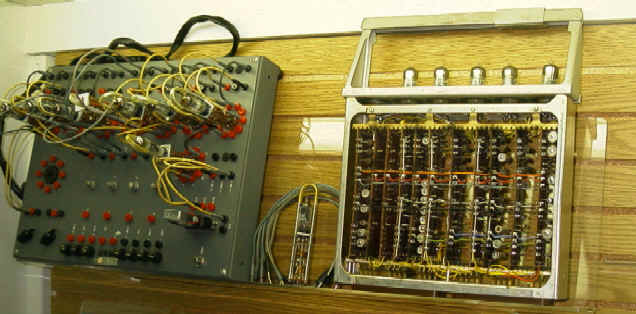
One thing first look at this and need more info on it and docs.
wish I had more info on this IBM tube type digital logic trainer
kit. comes in a wonderful fitted case with all kinds of plugable
units
see url http://www.smecc.org/wpe_files/wpe45.jpg
current project 3000/37 and micro 3000
Looking for more 3000 stuff both small and large ( cx, ser I,I ser
III etc.)
Pulled them all over to the media center where I could spread out and
work on them.
ok here is some of our stuff.
we are not exclusively a computer museum but we do have some <grin!>
Other areas are
scientific instruments,
radar and radar countermeasures adn other electronic warefare
radio and TV broadcasting,
Rural Electrification,
Tools of the journalist,
office automation 1800's forward.
Telecommunications for the Deaf and Hard of Hearing
and on and on
Some Minis
H 11 ( LSI-11 by DEC but in Heath packaging )
DEC PDP8 classsic sn/18
HP-2116b
HP-2000 access system (has 2 2100 in it)
HP3000/37 ( when it is in the building)
eclipse s20
need to clean and wedge in
Dec PDP 11/20
DEC PDP-8 S
NEXT cube, printer, monitor and all next-y related chachakies
who know what are in the other buildings
Micros...
Intel Intellect 8
Altairs
Imsais
many Comidore things
many R.S.
Heath h-8
Heath H-89
several osbornes
apples
sun-sparc
lots of single board computers
cobalt cube
next cube with all accs
a bunch of other ss
many many hp desktops and pcs
love the prtototype iHP Integral we have too
trainers and digital labs
IBM really early with tube type plugable units
DEC lab
Fabritec lab
wish I had more info on this IBM comes in a wonderful fitted case
with all kinds of plugable units
see url http://www.smecc.org/wpe_files/wpe45.jpg
In a message dated 9/22/2015 3:25:29 P.M. US Mountain Standard Time,
jwest at classiccmp.org writes:
Awesome. What minicomputer systems do you have on public display besides
the
DG? I'm glad to see more DG representation of course :)
----
This month's 'make computer work ' project is HP-3000 related.
----
I'm a bit of an HP fan ;) What's cooking 3K-related?
<EmilyLitella> Never Mind! </EmilyLitella>
I put the 32K SRAM board back in with the top four fields disabled. Sure
enough, OS/8 booted and MEM showed 16K, which confirms my recollection that
it will work with less than 32K.
Then my lights came on - I had made an elementary error... I had selected
the wrong MM8-AB 16K core board, the one that was jumpered for field 4-7.
So there wasn't any core in fields 0-3 which will "break" OS/8.
When I fired up the system with only the board jumpered for the LOW 16K
core, everything works as usual.
Sorry for the bandwidth...
-Charles
I was reading an article in Maximum PC, Nov. 2015, p.82 that got my
attention. It said: ?When the lower orders knew their place?? I wonder
if he means users of vintage computers? Just asking!
Happy computing.
Murray :)
One of the reasons I bought Vince's 32K SRAM board for my 8/A is because I
was having flakiness with my "real" core boards (two 16K and one 8K).
Now that OS/8 is running again, and my RL8A and two RL02's are as debugged
as they're going to get, I decided to experiment with the old core.
Put them back in the chassis and... the two 16K boards are now working
perfectly. I ran it for two long passes with DHKMAD (checkerboard
diagnostic) with no errors!
What's strange, though, is that OS/8 won't boot unless both 16K boards are
in the backplane. Then it does boot and a MEM shows "32K MEMORY!" as
expected.
Won't boot with 16K or 24K of boards, either.
I thought that only 12K was mandatory (at least that's what the Device
Extensions manual says for an RL01). Or is that something that's set up
during BUILD?... I don't see anything in the OS/8 manual and I know I had
OS/8 running with 16K and 24K previously.
-Charles
Does anyone have an LA36, LA120 or LAS12, LA34, LA100, or LA210
somewhere which they could dump the ROMs from?
Notes:
The LA36 uses several proms for its discrete cpu, and 2 character set
roms which I believe have an 'odd' pinout.
The LA120, one of the roms on the '2 rom version' is an 8k 2364 24 pin
chip which is a bit annoying to dump, since you either need a 2364->2764
24->28 pin adapter, or (better) a programmer which can dump MC68764 or
MC68766 24-pin 8k eproms (which have the same pinout as 2364). The other
rom on the 2 rom version is a 2k 2316 24 pin chip.
The oldest LA120 version uses 5 roms, all 2k 2316s. The code on the
5-rom version and the 2-rom version may very well be the same (the first
4 2k chips consolidated to one 8k chip), I'm not sure. Would be nice to
get dumps of both versions.
The LAS12 uses different code from the LA120 and to the best of my
knowledge all LAS12s use 2 roms, one 8k and one 2k.
LA34, theres at LEAST five firmware versions, almost certainly six, and
possibly as many as seven. There is also a special firmware for a 'rom
expansion' daughterboard.
The 1978 LA34 "54-13374" motherboard has a bizarre Intel i8355 mask
rom+io chip in it, plus a separate rom as well. (there are at least two
versions of said i8355+rom firmware). Dumping the i8355 is not for the
faint of heart, it would likely be easier to insert a 'dumping program'
eprom into the single rom's socket, and use the LA34's cpu to spit its
own rom contents out via serial.
The 1980 LA34 "54-13747" motherboard lacks the i8355 and uses 2 or 3
mask roms or eproms on it instead (and 74xx logic for the i/o). There
are at least three rom revisions for this, possibly four or five.
LA100 (AKA LW100)... I have no idea. There's definitely at least one rom
revision. Also to the best of my knowledge neither the maintenance print
set nor the technical manual for the LA100 are scanned (they certainly
don't appear at
http://bitsavers.trailing-edge.com/pdf/dec/terminal/la100/ ), which
makes it difficult to know.
--
Jonathan Gevaryahu
jgevaryahu at gmail.com
jgevaryahu at hotmail.com
Chuck wrote:
>
> For those wondering about the notion of an "optimizing" assembler, one
> has to realize that 650 instructions were executed from a drum and were of
> the "1+1" addressing type. Calculating the optimal address of the next
> instruction was very tedious and a perfect task for automatic optimization.
>
Many moons ago I did some programming on a process control computer made by 3M.
The machine was a 24-bit word, bit-serial, transistorized machine with drum as main memory. Each instruction contained both the operand address and the next instruction address (in block/track/sector numbers). Depending on the timing of the instruction, the optimal address for the operand and next instruction were calculated based on offsets given in the instruction set summary.
There were no index registers on this machine, only a single accumulator register (implemented as a shift-register). The only way you could do table operations or jumps based on evaluation of an expression was self-modifying code. However, this was tricky, if you wanted the code to run as efficiently as possible (minimizing waiting for rotation of the drum), you had to do optimization calculations as part of the self-modifying code. The other tricky part was the you had to be aware of track and sector numbers and properly deal with overflowing, e.g., max sector number was , IIRC, 30(octal) , so if you added 1 to the address, you'd have to clear the sector to zero, and add one to the track address, also being aware that the track number could overflow.
I learned a lot from that old machine.
Rick Bensene
The Old Calculator Museum
http://oldcalculatormuseum.com
would like to find blue dg et head looking terminal to go with small
eclipse
this thing is a beauty and has a tiny side by side reel to reel deck
just would be nice to have a terminal to display with it in the museum.
drop us a line offlinst...
ed sharpe archivist for smecc