>
> OK, so a couple years back, I wanted to have some chemistry fun with the kids.
> So, I got out the jump cables, clamped them onto some aluminum foil, stuffed
> the foil into test tubes, filled the tubes with water, inverted both of them
> in the same basin and sprinkled in a little salt, cranked up the car, and
> sure enough ? bubbles started evolving off the foil and collecting in the
> test tubes.
> Just as expected, one tube was filling with gas twice as fast as the other.
> Just as expected, when we held that tube over a candle, it went ?WHEEP? and
> got hot (the flame was barely visible).
>
> Um? the OP had a 12V supply, right? How *do* you keep from electrolyzing
> your coolant in this apparatus.
Firstly, don't add salt.
Secondly, the low resistance dummy load is going to soak up almost all of the
current, leaving very little to go through the much higher resistance water
resulting in very little gas production.
If the minute amount of gas produced is still a problem, you could electrically
insulate the dummy load from the water. However, this may also help to
thermally insulate from the water it which is not what you want.
>
> PS. this is a cool experiment but suitable cautions apply. The most subtle
> is: not too much salt, lest you start evolving chlorine gas instead of
> hydrogen. Flammable to explosive gasses, 12V sparks, etc. etc? be careful
> if you try to replicate this.
Also, beware of the danger of shorting the jump cables together, either
directly or via worn jewellery etc causing a large bang, melted terminals etc
and possible damage to kids, self and car. Consider using something like a
current limited bench power supply instead.
Regards,
Peter Coglan.
I received the email below, thought I'd pass it on...
-----
Dear J West,
I am writing to inform you about an article I have created about Quantum
Link, an online service that was available in the US & Canada from 1985 to
1994.
https://www.tinytickle.co.uk/quantum-link/
Quantum Link, originally available on the Commodore 64 computer, offered and
pioneered many of the features we are used to having on the modern internet,
such as e-mail, instant messagaing, shopping and chat rooms - to name a few.
Quantum Link also featured the ground breaking game Habitat by Lucasfilm's,
the first graphical massively multiplayer online game.
https://www.tinytickle.co.uk/quantum-link/#mmo
Q-Link was also made available on Apple & IBM compatible PCs from 1988.
I was wondering if you could add a link from your website (classiccmp.org)
to the piece to help spread knowledge of the influential, but now largely
forgotten, Quantum Link service. The article has proven popular on social
media, and I thought that it would be of interest to your readers. Any
mention you could make on social media would also be fantastic.
Any corrections, feedback or comments you may have on the piece would be
greatly appreciated, either by email or via the comments form on the webpage
itself.
Thanks for your time.
Kind Regards
David Wilding
(As previous post did not get through, again a repost)
Hi All,
I was contacted via the greenkeys list for my spare parts of the two
T100 telexes, but I think it should be possible to obtain them in the
states. Is there someone willing to part of their broken or otherwise
non/half functional T100 in the usa.
they need the parts for a movie.
--
Met vriendelijke Groet,
Simon Claessen
drukknop.nl
Greetings, all,
I have a contact in Erie, PA that has a piece of equipment that I need to get, but he is unwilling to ship it, and making a trip to his location to pick it up is pretty unlikely given time/expense.
If there is a ClassicCmp'er that lives nearby Erie, and would be willing to pick up, pack and ship (at my expense) this item to me, I would be willing to pay for time/effort expended in doing so.
The item is heavy, around 80 pounds. I could ship a very nice wooden crate to the packer who could use it to ship the item to me inside. All that would be necessary is to pick up the item, pack it securely in the crate, and take it to the closest UPS depot and drop it off to ship to me.
If there is anyone out there who might be willing, please contact me by private Email: rickb /at/ bensene /dot/ com
Thank you,
Rick Bensene
The Old Calculator Museum
http://oldcalculatormuseum.com
So I purchased what was told to me was an Eprom Programmer. It's called the Comstar Process Control Compiler.
With some digging, I am learning that this is a portable compiler that allows you to program larger industrial computers.
I found an article from 1975 that talks about the unit.
Development of a portable compiler for industrial microcomputer systems
http://www.computer.org/csdl/proceedings/afips/1975/5083/00/50830033.pdf
>From the article:
"THE PORTABLE PROCESS CONTROL COMPILER The process control compiler shown in Figure 6 is a small portable unit designed for programming the Comstar 4 Industrial Microcomputer System. The programming can be accomplished with high reliability even in field conditions. The PCL instructions are keyed in via the compiler keyboard, then converted into machine language and loaded into the PROM chip by the compiler. The input functions are displayed directly on a 32 character alpha-numeric plasma display, ensuring the user of a correct input. All keyed-in commands are stored in a buffer which can be verified with a key command. Up to 256 bytes of data or instructions can be entered. Data are compiled and can be dumped into a clean erased PROM chip. As an option, EIA or TTY outputs are available so the program can be printed out for future reference. A compiler can also edit, erase or program PROMS in machine language."
A company by the name of Warner & Swasey was an industrial machine company. They built all sorts of machines for industry. They had a sub division called Comstar which designed industrial computers The larger computers ran their own Process Control Language and so they developed this machine as a portable device to program the larger machines and then burn ROMs which then control the larger computers. The person I bought it from told me that the larger systems ran a chicken processing plant and that they used this system to program and troubleshot the system.
The unit runs on an Intel 4004 and is programmed using Comstar's Process Control Language.
I'm hoping someone would know more about this and can point me in the right direction..
I already checked Bit Savers
The only other article that seems to talk about this is "Micros can provide more flexibility for less money" Computerworld Sep 25, 1974, Page 28
(As previous post did not get through, again a repost)
Hi All,
I was contacted via the greenkeys list for my spare parts of the two
T100 telexes, but I think it should be possible to obtain them in the
states. Is there someone willing to part of their broken or otherwise
non/half functional T100 in the usa.
they need the parts for a movie.
--
Met vriendelijke Groet,
Simon Claessen
drukknop.nl
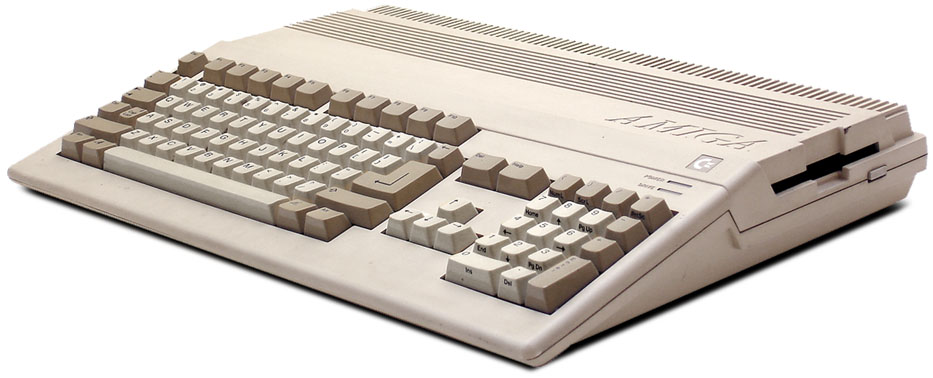
Is anyone interested in a Vic 20, Atari 800XL, or an Amiga? The Amiga
appears to be missing a couple of things. No AC adapters for any of them.
Complete key caps, no severe yellowing, no way to test. The Amiga resembles
this one: http://www.oldcomputers.net/pics/amiga500.jpg
Cindy
---
This email has been checked for viruses by Avast antivirus software.
https://www.avast.com/antivirus
I have a Sun machine with a 13W3 framebuffer output, which is connected
via a Monoprice VGA adapter to my LCD monitor. It works great, but the
ends of the standoff bolts without nuts come together where the VGA
cable meets the adapter; that is to say, the VGA cable's nuts are on the
far side of the shell from its male end, and the adapter's nuts are on
the far side of the shell from its female end.
I'm wondering what I can put between the two to keep the cable from
disconnecting from the adapter. Some searches seem to indicate I want
some 4x40 (or 4-40) female-female (coupling) nuts; does this seem
correct?
--
Eric Christopherson