> From: Guy Sotomayor
> Secondary chip marke[t] (only reputable vendors).
I'm a little more willing than Guy to troll in disreputable waters (I bought
1K DS8641's from a source in Hong Kong), so I have this:
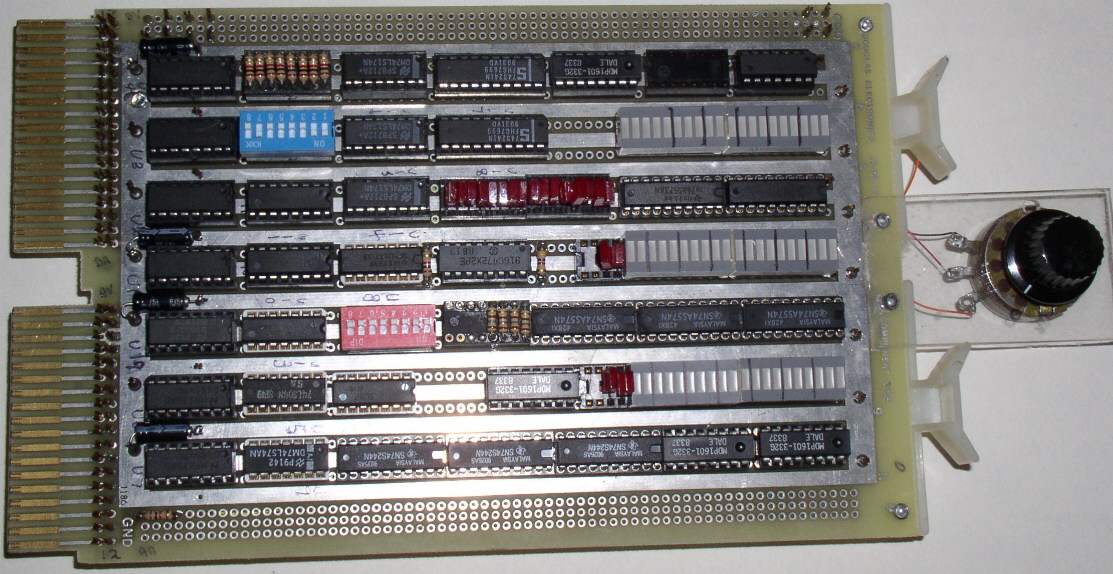
http://ana-3.lcs.mit.edu/~jnc/tech/QSIC/TestCardF.jpg
which has a bunch of special circuits on it to test chips to make sure they
meet specs; e.g. the large potentiometer is so I can vary the input voltage
to see where it switches from 0 to 1, etc.
> From: Paul Koning
> it would be odd to have one; I can't think of anyone who would expect a
> PDP11 to work with part of its devices powered down. For one thing, if
> the box with the terminator loses power
Forget the terminator - as Jon Elson also points out (his email appeared
while I was creating this one), any device which uses interrupts, if
un-powered, won't pass grants.
> From: allison
> Bottom line is someday there will be no DEC parts and what then? I
> reserve DEC parts for repairing defunct boards for new and unique build
> it would be a waste of scarce material.
For actual DEC interface IC's like DC003's, sure. Those are hyper-rare.
But DS8641's are available in the 10's of thousands, there's no earthly way
we could use them all on repairs. Yes, when they run out, we'll have a
problem - but I plan to cross than bridge _if_ and when we get to it.
Noel
Does anyone remember a subscription time sharing system called, I think, "game master".
It was at least available and marketed in the chicago area... possibly nationwide.
I just wonder if there is any info on what kind of system it ran on and any preserved info etc.
Thanks.
-Bob
Update: I've swapped the displays and drivers around, and the "tunnel"
effect seems to be a property of the panel and not drive electronics.
Perhaps they are all high-hour examples?
Anyone here an electroluminescent display expert?
>
>
> On Wednesday, July 20, 2016, Ian Finder <ian.finder at gmail.com> wrote:
>
>> No, I'm not convinced the EL repro isn't a driver electronics issue.
>>
>> I'm just a little confused about why the issue congregates at the edges
>> of the displays. Any ideas why that might be?
>>
>> I may try swapping the panels around this evening if I am feeling brave.
>>
>> On Wednesday, July 20, 2016, Brent Hilpert <hilpert at cs.ubc.ca> wrote:
>>
>>> On 2016-Jul-20, at 12:52 PM, Ian Finder wrote:
>>>
>>> > I have a few GRiD compass systems and some are suffering from massively
>>> > decreased contrast on the edges of the displays:
>>> >
>>> > [See the system on the left]
>>> > https://www.instagram.com/p/BIGGzUzgat-/?taken-by=tr1nitr0n
>>> >
>>> > [Or this one:]
>>> > http://www.ripstick.com/USCM/images/Grid_Compass_1101_
>>> Laptop_in_Box_002.jpg
>>> >
>>> > Meanwhile, other EL systems I have- like my HP integral PC- haven't
>>> > succumbed to this.
>>> >
>>> > I have seen similar issues on amLCD displays in my Tadpole, Toshiba and
>>> > other machines, so this is something we all may have to confront.
>>> >
>>> > -------
>>> >
>>> > I was wondering if the folks here had theories?
>>> >
>>> > I'm thinking moisture (or air) might be leaking in from the edges of
>>> the
>>> > glass panes, perhaps from a compromised seal- sorry for the silly
>>> picture
>>> > but you can see the composition of the display here:
>>> >
>>> > https://www.instagram.com/p/6BXaLBtSzd/?taken-by=tr1nitr0n
>>> >
>>> > Does anyone know how one might prevent this from progressing- storage
>>> tips?
>>> >
>>> > Could it be reversed?
>>> >
>>> > Better yet, does anyone have ideas on how to rapidly dehydrate the
>>> display?
>>> > Perhaps there is even a way to re-seal them.
>>> >
>>> > I think all two-glass-pane displays that don't have a vacuum may
>>> eventually
>>> > succumb to this.
>>> >
>>> > Perhaps it is just oxidation and not moisture, but I'd love to hear any
>>> > theories.
>>>
>>>
>>> Are you convinced this is a panel problem rather than a driver
>>> electronics problem?
>>>
>>> In one picture it looks like the sort of thing that happens when you
>>> have to turn up the brightness (for some types of display), resulting in
>>> partial illumination in other areas of the screen.
>>>
>>> I've never had opportunity to repair or work on EL flat-panel displays,
>>> I'm not familiar with the driving techniques and requirements, so this is
>>> just a query/guess. (I see it's an X/Y matrix drive scheme, but the
>>> voltages & timing & phasing I don't know about.)
>>>
>>>
>>
>> --
>> Ian Finder
>> (206) 395-MIPS
>> ian.finder at gmail.com
>>
>>
>
> --
> Ian Finder
> (206) 395-MIPS
> ian.finder at gmail.com
>
>
--
Ian Finder
(206) 395-MIPS
ian.finder at gmail.com
even with shipping across the pond a great deal if your system is
missing one!
Ed#
In a message dated 10/25/2016 3:15:40 P.M. US Mountain Standard Time,
linimon at lonesome.com writes:
If it were on this side of the pond I'll be all over that.
mcl
-------- Original Message --------
Subject: Need to archive: GRiD Compass Computer Operating System
Software
From: Ian Finder <ian.finder at gmail.com>
Date: Tue, October 25, 2016 7:08 pm
To: "cctalk at classiccmp.org" <cctalk at classiccmp.org>
Folks, there appears to be a large GRiD-sized hole where archived copies
of
the Compass Computer Operating System software should be.
...
--
Ian Finder
(206) 395-MIPS
ian.finder at gmail.com
>>
There's a fairly active GRiD list at
http://groups.yahoo.com/group/rugrid-laptop/
You may wish to cross-post there, or I can if you don't wish to join up.
Steve
Folks, there appears to be a large GRiD-sized hole where archived copies of
the Compass Computer Operating System software should be.
For those not aware, GRiD had an OS product that was quite advanced for the
time- with bitmapped graphics, multitasking, a beautiful forms-driven, UI,
etc.
Unfortunately, nothing but the basic OS seems to be preserved anywhere- no
add-on software, not even the utilities needed to format the hard drive.
This is a travesty- GRiD made something far more important than PC clone
machines, at one time.
*** I'm looking for leads on any software products mentioned below, or at
this URL:
http://www.1000bit.it/ad/bro/grid/GRID-1984-PriceList.pdf ***
I have been buying manuals for the express purpose of scanning, and have a
great deal of coverage, but am short on software.
I am not opposed to paying for any of this, nor shipping and returning the
original copies to the provider at my own expense.
I will certainly put all the images in Bitsavers, if Al is okay with that-
otherwise they will be made available through some other means.
Any leads on GRiD media is appreciated.
Thanks,
- Ian
GRiDWrite, Management Tools, GRiDVT100, and GRiDbasic have already been
preserved.
[35], [36] and [37-47] would be incredible to find.
REF PRODUCT MODEL VERSION NOTES
--- ------------------------- ----- ------- -----
18 GRiD-OS 110X/112X 29200 3.1.0.A [6]
19 GRiD-OS 113X 29210 3.1.5.D
20 GRiD-OS 110X/112X 29200 3.1.0.A
21 Management Tools 21100 3.1.0
22 GRiDMaster 21231 3.1.7
23 GRiDPaint 21214 3.1.5
24 GRiDWrite 21132 3.1.7
25 GRiDAccess 21212 3.1.7
26 GRiDPlan 3.1.5
27 GRiDPlan II 3.2.1
28 GRiDWrite 21132 3.1.7
29 GRiDVT100/Reformat 21191 3.2
30 GRiDVT100/Reformat 21191 3.1.5
31 GRiD3101/Reformat 21151 [7]
32 GRiD3101/Reformat 21151 3.1.5 [7]
33 GRiDTek4016 21228 36.9.4 [7]
34 GRiDTerm/Reformat 21141 3.1.5
35 GRiDTransfer/Partition 21210
36 GRiDRecord/Playback 3.1.5
37 C-86 23032 3.2.0
38 Pascal-86 23025 0.3.1 [1 COPY SOLD]
39 FORTRAN-86 23015 0.3.0
40 PL/M-86 23030 0.2.7
41 BASIC 3.1.0 [7], [1 COPY SOLD]
42 ASM-86 23031
43 GRiDDebug/Devel. Tools 29300 3.1.7
44 GRiDDebug/Devel. Tools 29300 3.0.0
45 GRiDTask II / Windows 21230 3.2
46 GRiDTask II 21230 3.1.7
47 GRiDTask 21230 3.1.7
48 ROM Builder 2.1.0 [7]
49 ROM: GRiD-OS System 112X 24100 3.1.0 [8]
50 ROM: GRiD-OS System 113X 24180 3.1.5 [8]
51 ROM: GRiD-OS Utilities 21400 3.1.0 [8]
52 ROM: GRiDMaster 3.1.7 [8]
53 ROM: GRiDVT100/Reformat 24150 3.2 [8]
54 ROM: GRiDWrite/Term/Refmt 24140 3.1.5 [8]
--
Ian Finder
(206) 395-MIPS
ian.finder at gmail.com
Friend of mine pointed this out to me, but I'm a software guy, don't have
any use for hardware. Maybe you guys would be interested.
http://www.ebay.co.uk/itm/DEC-PDP-15-console-panel-von-1970-/112179257620?h…
8 days left. I think he failed to sell it previously at 130 Euros so that
probably sets an upper limit on the auction price.
Graham
> I'll start with getting VTServer to run under V6 (my only Unix, don't
> have anything later :-)
So, I just got VTServer runnin under V6: it successfully loaded a memory
diagnostic from the 'server', into the 'client', using 'vtboot' on the
latter. (Both running on emulated machines, for the moment - I thought I'd
take all the hardware-related variables out of the equation, until I have the
software all running OK.)
It didn't require as much work on VTServer as I thought it might: I had to
convert the C to the V6 dialect (no '+=', etc), and some other small things
(e.g. convert the TTY setup code), but in general, it was pretty smooth and
painless.
Note that it won't run under vanilla V6, which does not provide 8-bit input
and output on serial lines. I had previously added 'LITIN' and 'LITOUT' modes
(8-bit input and output) to my V6; since the mode word in stty/gtty was
already full, I had to extend the device interface to support them. I didn't
add ioctl() or anything later, I did an upward-compatible extension to
stty/gtty. (I'm a real NIH guy. :-)
My only real problem in getting VTServer running was with LITIN; I did it
some while back, but had never actually tested it (I was only using LITOUT,
for my custom program to talk to PDP-11 consoles, which also did downloads,
so needed 8-bit output). So when I went to use it, it didn't work, and it was
a real stumper! But I did eventually figure out what the problem was (after
writing a custom program to reach into the kernel and dump the entire state
of a serial line), and get it working.
(I had taken the shortcut of not fully understanding how the kernel serial
line code worked, just tried to install point fixes. This turned out not to
work, because of a side-effect elsewhere in the code. Moral of the story: you
can't change the operation of a piece of software without complete
understanding of how it works...)
Is there any interest in all this? If so, I can put together a web page with
the V6-verion VTServer source, along with the modified V6 serial line stuff
(including a short description of the extended stty/gtty interface), etc.
> so if you turn up whatever you used to boot V6, it would probably still
> be useful.
So I guess my next step, if I don't hear shortly from someone who has
previously used VTServer to install V6, is to start on actually getting
a V6 file system created.
I'm still vacillating over whether it would be better to go V6-style (and
just transfer a complete, small existing V6 filesystem), or V7-style (and
get stand-alone 'mkfs', etc running with V6-format file systems). Anyone
have an opinion?
Noel