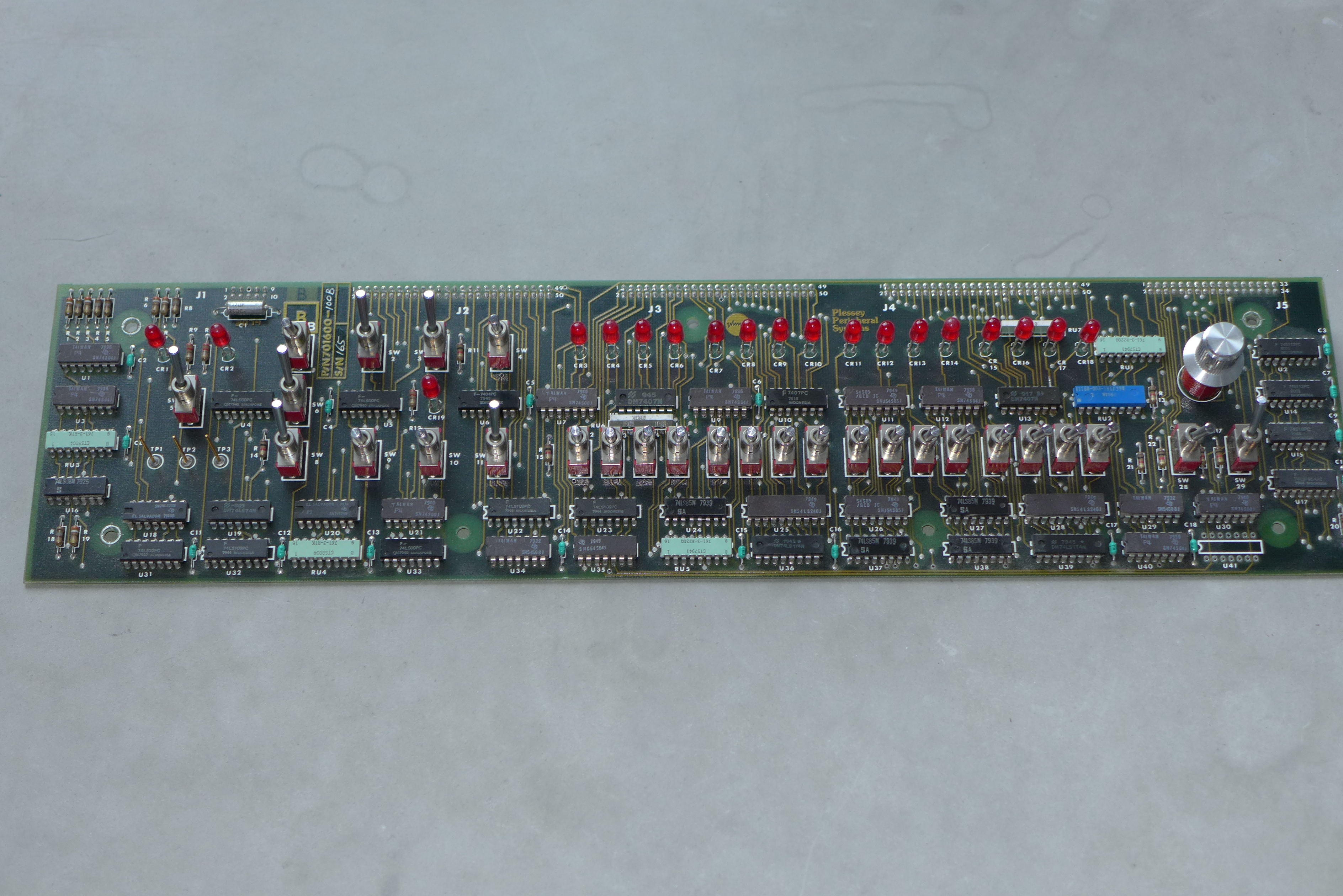
http://www.ebay.com/itm/361940854169
One of them does not seems to be at bitsavers.
The shipping is way to high to have them shipped to Sweden and scanned.
Maybe someone in the US would care to buy and scan it?
/Mattis
Re:
> From: Tony Aiuto <tony.aiuto at gmail.com>
> Subject: RIP: Daniel Bobrow
>
> http://www.legacy.com/obituaries/nytimes/obituary.
> aspx?n=daniel-bobrow&pid=184794881
I worked with Danny for about a year, around 1974, sometime after UCSD put
its B6700 onto the ARPAnet (we were something like the 35th computer).
The AI community needed a BBNLISP with more addressing space than a DEC-10
could provide, so they came to the king of virtual addressing: the
Burroughs.
We got the contract to implement BBNLISP, and Danny came to oversee.
I remember him typing on a terminal, linking UCSD to about 10 other
computers
on the ARPANET, finally linked back to us ... sending a message to himself.
He was demonstrating the lag time each computer added :)
IIRC, sometime during the project, BBNLISP was renamed INTERLISP. I still
have the wonderful manual, with the great artwork on the cover. Warren
Teitelman (the author) doesn't have his name on the cover. But, the bottom
portion has a guy is operating a meat grinder, with the input being the
letters of "reference manual" in random order, and the output being
"reference manual". Danny explained that Warren Teitelman hadn't gotten
the joke :)
Danny was funny, quick witted, friendly ... RIP.
Oh, UCSD LISP? About a week before we released it, DEC (or BBN?) had a
breakthrough and increased the addressability of their virtual memory,
obviating the need for our version :(
Stan Sieler
>
>
Your chance to use real DEC wall plates!!!
While going through boxes of stuff in the basement, I found a few cases of
DEC wall plates and Adirondack Wire and Cable AWC8100-14-W cables, both
sealed in factory bags.
There is no H # on the wall plates,but I recall seeing them in DEC sales
catalog
The cables look like RJ11 and I'll try to open one and measure it tomorrow.
Contact me off list if you are interested in making an offer. Shipping from
61853, and as many as you want $10 S&H in US.
Jay Herde, a viewer of my YouTube channel, contacted me to say that he has the following available that he would like to get rid of:
IBM System/3 Disk Concepts and Planning Guide.
IBM System/3 RPG II Disk File Processing Programmer's Guide.
IBM System/3 Models 8 and 10 Disk System Control Programming Reference Manual.
IBM System/32 Operator Training Student Text.
IBM System/32 Displayed Messages Guide.
He should be cc'ed above but I am not sure if his email we will make it through. Contact me off list if you are interested and I'll put you in touch with him.
Marc
I suspected that I could somehow get some music out of the SimH PDP-8
simulator for a while now, if I could only make it run real time and toggle
a GPIO pin fast enough say, on a Raspberry Pi. That may still be doable in
the future, but I also had a suspicion that I could generate music not in
real time.
I finally got around to trying out my idea last night. A few lines were
added to pdp8_cpu.c to spit out the elapsed instruction cycles every time a
CAF instruction is executed, the default "noise" instruction in the MUSIC.PA
program.
That's all I did to the simulator. I then ran MUSIC with a given .MU file
and watched as many integers are spit out onto the screen. These were
copied and pasted into a new text file and saved.
The rest of it is in a single C program that I cobbled together. It reads
in this new text file and generates a series of pulses as an array of
floats. Each interval is about 1.93 microseconds, which I calculated to be
the average number of pulses for the music program to be "in tune" with
A=440 Hz, plus or minus. This value is subject to change, particularly as
the notes get higher in frequency, but only by perhaps 6% or so from my
experiments. One detail to note is that per the recommendation of the
MUSIC.PA manual, these pulses are extended to roughly 6 microseconds, or
three time intervals in my program.
This array of floats is then downsampled use libsamplerate to 44.1 kHz
(from 1/1.93 microseconds, or roughly 520 kHz) and output to a canonical
WAV file, 16-bit single channel.
What do you know, it worked! Here's a sample:
https://www.youtube.com/watch?v=_urDcyluX9c
My code can be found here, for those interested:
https://github.com/drovak/music
Presumably, this technique could be used to generate music from any given
computer simulator.
Thanks,
Kyle
> From: Mattis Lind
> One of them does not seems to be at bitsavers.
That's on my list of items to get.
I have a page-feed scanner, so will easily be able to scan this (although
I'll have to get some instruction on exactly what incantation to use to
Acrobat to turn the TIFF's into a PDF; apparently "PDF/A", supposedly for
archival purposes, is apparently not in fact desirable for that).
Noel