Hi,
after my Micro PDP11/83 boots up, I like to connect a Digital VT420
to the console port. This worked approx. 10 years ago. Now when I
poweron the VT420 I get no message on the screen. The f3 key doesn't
give me the configuration menu.
Is it broken? Does it have some invalid configuration in NVRAM and
can be resetted?
I tried changing brightness and contrast, no change.
Is it normal that the right LED is always on? See the picture.
https://debug.openadk.org/pdp11/vt420.jpg
I tried with and without serial connection to another system.
Thanks for any advice,
Waldemar
>
> Date: Sun, 20 May 2018 18:04:00 -0400
> From: Ed Sharpe <couryhouse at aol.com>
> To: cctalk at classiccmp.org
> Subject: I ran across this strange modernistic? Data General ...odd?
> computer?
>
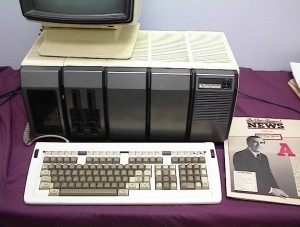
> While? in the warehouse I ran across this strange modernistic? Data
> General ...odd? computer?
> I do not remember buying it!? ?Ed#
> ?
> ?
> "https://www.smythretail.com/wp-content/uploads/2012/05/DG10_1-300x227.jpg
> "
>
>
The RICM has one, but it is not on the WWW site.
Michael Thompson
Sent SMECC Museum PROJECT needs to buy or trade for or beg for the HP hand Held (700 series? help?) that was phone and a computer.... the early ones and also the later Win CE ones.... also need ad materials promo videos... anything related to spice display up... please drop note off list to us. thanks Ed#
AOL Mobile Mail
G'day Zane -
Like every other computer system created, the Desktop Generation has its
own set of quirks and wonders. It was an interesting evolutionary
repackage of the microEclipse processor, but I never saw a customer or
user site actually using the Model 10's MS-DOS "compatibility feature".
The hardware consisted of modular metal frame chassis with snap-on
plastic covers. While great for manufacturing and cost control, the
delicate plastic cover retaining tabs were always breaking and the
covers would pull away from the chassis or just fall off. Only an
annoying cosmetic problem until you find that a "dead man's switch"
interlock was maintained by the power supply chassis front cover. Yes,
the power supply would always be cut off whenever the plastic cover
shifted, vibrated or fell off the chassis. Which happened often. (The
cheapest solution was the unintended, creative use of a ball point pen
combined with nerd engineering.)
Many OEMS delivered DG/RDOS- or AOS-based applications written in ICOBOL
or Business BASIC (i.e. NAPA). These were good systems for OEMs who had
previously developed software for DG - providing their application was
not disk-bound. DG eventually was forced to design and sell a parallel
I/O bus option to help improve disk performance... to the confusion of
customers previously told of the benefits of a serial I/O bus design.
The system was followed by the DG/500, which had a similar hardware
functional microEclipse-based design but enclosed in a then-familiar IBM
PC AT (desktop) form factor. This was the final unsuccessful attempt to
defend the low-end 16-bit Eclipse line from the PC onslaught.
-----
Bruce Ray
Wild Hare Computer Systems, Inc.
Boulder, Colorado USA
bkr at WildHareComputers.com
...preserving the Data General legacy: www.NovasAreForever.org
Message: 20
Date: Wed, 16 May 2018 20:40:04 -0700 (PDT)
From: Fred Cisin <cisin at xenosoft.com>
<snip>
>I remember an interview with Lee Felsenstein, in which he was asked how
>much a battery power unit for the upcoming Osborne would weigh. He
>reponded that the external DC connection was currently for use with a car.
>(Lee was driving a Honda Accord).
Sorry for the late reply, but I was travelling and needed to dig out the unit.
The lead-acid battery for the Osborne Powr-Pak(tm) I own weighs 3.59 kg.
Bob
>From: Al Kossow
> NASTRAN is available
That's a finite element modeling code, isn't it? (I guess it all depends on
what the OP meant by 'CAD'...)
Noel
> From: Randy Dawson
> For a while I have collected bits of legacy CAD
> ...
> My question is, did any of the source code for these systems
> .. ever make it out
Well, not quite what you're asking about, I think (it sounds like you're
interested in MechE CAD, not EE, even though SPICE was mentioned), but the
original Stanford SUDS is still available, I think.
> I know we are primarily a hardware group here, but where is the
> interest in the software discussed?
Is that a plaint ('how come we don't do software'), or a query ('where is
software discussed')? If the latter, it tends to be system specific, from
what I've seen - e.g. there's 'TUHS' for Unix, "its-hackers" for ITS, etc.
Noel
> From: Bob Smith
> 8110 for MOS memory, and 8120 for bipolar memory is what field guyde
> list says.
Well, the early bipolar MS11-C (1K boards) used the M8110 during early
production (see e.g. DEC-11-HMSAA-D-D, pg. 1-1), and apparently then switched
over to the M8120. I've only seen the later MS11-A bipolar (4K boards - dunno
why it's in reverse alpha order) associated with the M8120.
> I think the there was some change from special select parts and a move
> to schottky 74S series around the time of the 45/50 days.
I wondered that, but the MS11-C and MS11-A are the same speed (300 nsec);
although maybe the M8110 was a bit marginal, and component changes in the
M8120 made it more robust?
I guess I'll have to do it the hard way, and compare the ICs... :-(
> 11/40 was faster than 11/35, but if you changed a wire, they were the
> same.
I've heard of other manufacturers doing that, but I thought the /35 and /40
were identical, except for the number on the console inlay, and the sales
channel?
Noel