Noel Chiappa wrote:
> > It has been in use at STACKEN at least since the beginning of the 80ies
>
> I was meaning before that; somewhere in Scandanavia, I expect? Eh, not that
> important, I guess.
>From Finland. Sold used by DEC Sweden to Stacken, for 1 SEK (aound 20 cents
at that time).
> Noel
--Johnny
/\_/\
( *.* )
> ^ <
> From: Mattis Lind
>> Ah. I wonder where it came from originally?
> It has been in use at STACKEN at least since the beginning of the 80ies
I was meaning before that; somewhere in Scandanavia, I expect? Eh, not that
important, I guess.
>> And it's odd (to me, at least) to see TU56's on a KA10.
> It is TU55s as far as I can see.
Ah, I was confused by an aspect of the pictures on that page which I hadn't
noticed before! The fourth picture in that set:
https://mobile.twitter.com/LivingComputers/status/1102063746019549184/photo…
which is where I saw the TU56's (along with at least one TU55), shows a
different machine! I just assumed all four were of the KA, but the last shows
them in front of a KI.
Although one has to look carefully to notice that, though, as the size,
colours, etc are very similar; it thus looks _very_ similar to the KA in the
first ones.
I'd still love to find out if there are any other KA's left - does anyone
know of any?
Noel
In the Jan 78 issue of Byte magazine a series of articles titled "The Brains of Men and Machines" (also the issue title on the cover) started. EVERY single scan I can find on the web is missing pages 96 and 97, right in the middle of that article. They all (including archive.org) appear to be the same scan. Does anyone have an electronic copy of those pages or a paper copy they would be willing to scan for me?
Thanks,
Will
"He may look dumb but that's just a disguise."? -- Charlie Daniels
"The names of global variables should start with? ? // "? --?https://isocpp.org
torsdag 28 mars 2019 skrev Noel Chiappa <jnc at mercury.lcs.mit.edu>:
> > From: Mattis Lind
>
> > It is KATIA. Peter Lothbergs collection.
>
> Ah. I wonder where it came from originally?
It has been in use at STACKEN at least since the beginning of the 80ies
until maybe mid nineties. STACKEN is the computer club at KTH in Stockholm.
https://techworld.idg.se/2.2524/1.454545/the-stacken-story
I think that some pictures are from the big computer hall I visited when
studying at KTH. But it might be Collosal Cave Computing Center.
> That looks like a relatively 'new' one; the older KA10's had black panels.
> And it's odd (to me, at least) to see TU56's on a KA10.
It is TU55s as far as I can see.
>
> I wonder how many KA10's are left in the world? I have this vague memory
> that
> MIT-AI might have gone to Sweden, but I also have a memory that that was
> the
> plan, but some how it didn't happen?
/Mattis
>
> Noel
>
> From: Mattis Lind
> It is KATIA. Peter Lothbergs collection.
Ah. I wonder where it came from originally?
That looks like a relatively 'new' one; the older KA10's had black panels.
And it's odd (to me, at least) to see TU56's on a KA10.
I wonder how many KA10's are left in the world? I have this vague memory that
MIT-AI might have gone to Sweden, but I also have a memory that that was the
plan, but some how it didn't happen?
Noel
> From: Rick Bensene
> upstairs to the computer room and take some photos of the KA-10
Wow! That's a rara avis indeed; I wasn't sure there were any left. Does
anyone know where this one came from?
Noel
Folks,
I have been able to get the Sun 3/110 to boot using the SCSI2SD board as I
had
asked about earlier (if you want to see the details of what I did, I posted
to the
sun-rescue list...)
However, I can't seem to get more that 4mb to work in the 3/110 chassis (
the 2nd chassis I have is 240v, and so far that doesn't look like it's
switchable
for use in 115v land...)
I've tried the two 4mb boards I have ( both 501-1132 boards ) one has a
gouge in the ground plane but the bulk of the ground plane is intact and
one says Parity Error 3/17/16 ( not my writing, from the person I got it
from
) so I'm assuming that would work but generate an error, similar to
Clearpoint board I have that I can't figure out jumpers for. However I
can't get the machine to even boot with the boards in. In both cases the
lights on the CPU board all light up. Which indicates some form of reset.
I've checked the boards dip switches. They are set according to the FEH as
3 on U3118 and 4 on U3119. Jumper J3102 is jumped as well. I've tried them
with the VME Bus Px03 and Px04 both jumpered and unjumpered. Same results
in
all cases. I don't think it's a power issue, as the machine boots with 3
cards ( I.e. 8mb incompatible sun board or Clearpoint SNXRAM card, with SCSI
card in both cases ). I've tried with and without SCSI card. All same
results.
Soooo, question is, do I just have two bad 4mb cards? Am I missing some
setting? I don't see anything to set on CPU board.
If so anybody got memory cards they're willing to trade that would work in
a 3/110? I've got an 8mb 501-1102 or a 32mb 501-1254 32 mb card to trade,
memory wise. I am trying to build up 2 3/110 machines, so would like 2 4mb
boards at least. I've also got a 3/110 cpu board that has a blown cap to
replace but otherwise works, and a couple SMD drive controller boards. I
also
just realized I have a a Sun 2 VME SCSI board - ( 501-1149 * combo: 501-1045
"Sun-2" SCSI in 270-1059 6U/9U VME )
And of course if anybody has a spare 3/1xx power supply that is configured
for
115v also be interested in that. ( and another SCSI card with an external
connection would be useful )
Earl
Ok. Those are quite small. So you have one? Or those are not yours?
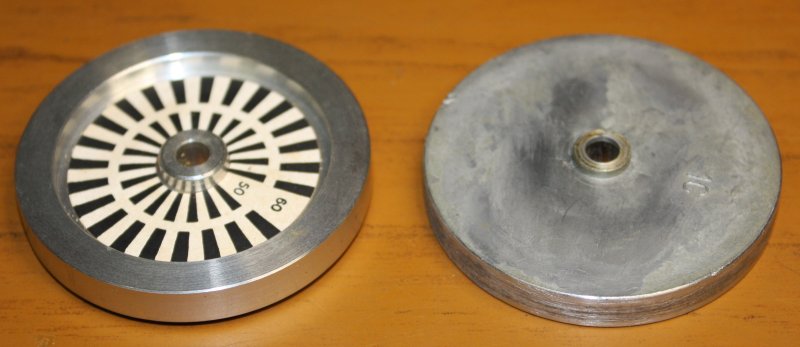
If you have one, and a way to accurately measure it, making more will be easy for anyone with a lathe.
I could do it, but surely you can find a machinist closer to home?
Guy
At 01:03 PM 10/11/2018 +0000, Riesen Thomas wrote:
>Guy,
>I am looking for small motor pulley ... see pic ...
>Regards
>Thomas
>
>-----Urspr?ngliche Nachricht-----
>Von: Guy Dunphy [mailto:guykd at optusnet.com.au]
>Gesendet: Samstag, 10. November 2018 13:25
>An: Riesen Thomas <thomas.riesen at predata.ch>; General Discussion: On-Topic and Off-Topic Posts <cctalk at classiccmp.org>
>Betreff: Re: 50Hz Pulley for 8" Floppy Drive Mitshubishi M2894-63B
>
>At 12:03 PM 10/11/2018 +0000, you wrote:
>>Hi all
>>
>>Any suggestions where to find two 50Hz-Pulleys for the 8" Floppy drive
>>Mitsubishi M2894-63B?
>>
>>If there also the appropriate ribbon gummies available, I would be very
>>happy.
>>
>>Regards
>>Thomas
>
>
>Do you know what they look like, and the dimensions?
>Because I have these. http://everist.org/pics/misc/IMG_1655_pulley_800.jpg
>
>_Maybe_ they were off Mitsubishi drives, not sure. Had them in a box of floppy drive related bits for a loooong time, and have no recollection of where they came from.
>These are 49.0 mm OD, hole 4.7 mm dia. And this is Australia, with 50Hz mains.
>
>Guy
>
>
>Attachment Converted: "f:\email\attach\Pully_8Zoll_02.jpg"
>
>Attachment Converted: "f:\email\attach\Pully_8Zoll_01.jpg"
>
I ran into an interesting problem. Eric Smith's copytape program assumes two tape marks in
a row is logical end of tape and stops reading.
I've had problems with this before with MPE store tapes, because
they put two file marks at the start of tape so I just keep reading until
I get 10 errors in a row. That also lets me read anything after a logical EOT on 1/2" tape.
Well.. CV is even weirder. One some CV software distribution carts EVERY file has two file marks between them.
I don't expect anyone to have to archive any of these, but I wanted to get this written
down somewhere.
Anyone know what 6502 macro assembler was used for the AIM-65 Monitor
ROM, as shown in the AIM-65 Monitor Program Listing manual, document
number 29650N36L ?
Some of it's identifying features are using .BYT and .WOR (or .WORD)
directives for declaring data, and .MACRO and .ENDM directives for
declaring macros. Use of the macro directives can be seen in the
RM65-5101 Floppy Disk Controller (FDC) Module User's Manual, document
number 29801N02
There are countless 6502 assemblers available now, the exercise here
is to identify the macro assembler that was used at the time. If it is
available to run now the goal would be to run it to assemble source
code exactly in the format that it used and produce identical listing
output. (Modifying the source code to be accepted by a different
assembler to produce identical binary output is not the goal of the
exercise).