Jules,
A while ago you posted that you had the manual and discs for a Compaq
SLT/286. Do you by chance still have them? If so does it include the
Supplemental Programs disc?
Thanks
James
"Shoppa, Tim" <tshoppa at wmata.com> wrote:
> "Walter F.J. Mueller" <w.f.j.mueller at gsi.de> wrote:
>>> Johnny Billquist <bqt at softjar.se> wrote:
>>> > I wasn't aware that any prototypes ever were produced and came as
>>> > far as being functional. I thought it was just paper work that
>>> > had bee done.
>>>
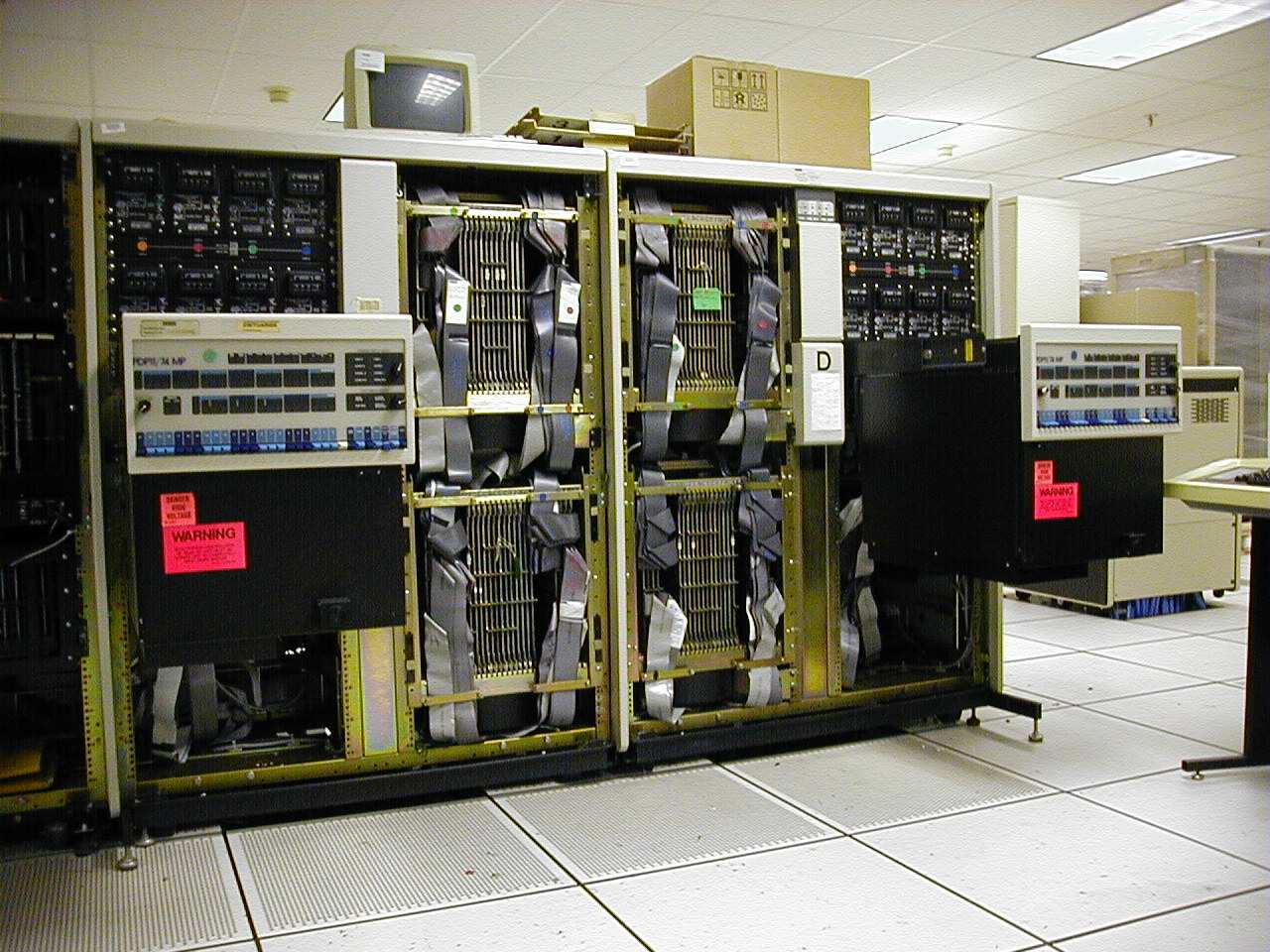
>>> The 11/74 wasn't marketed, as pointed out in this thread, but a
>>> few systems were build by DEC. A picture of such 11/74 system
>>> was made available by Tim Shoppa, see
>>>
>>> http://www.trailing-edge.com/~shoppa/1174Xopen.jpg
>>>
>>> You'll nicely see the four CPUs.
>
>> Yes, I know of these systems. However, that is not an 11/74 on that
>> picture, but an 11/70mP. There is a difference...
>> As pointed out, the 11/70mP was marketed as an 11/74, but it's a
>> different CPU.
>
>> The easiest way to see that this is a picture of an 11/70mP is by
>> looking at the lower rotary switch, which only have four positions, and
>> not eight (which the 11/74 have). So no CIS on this machine.
>
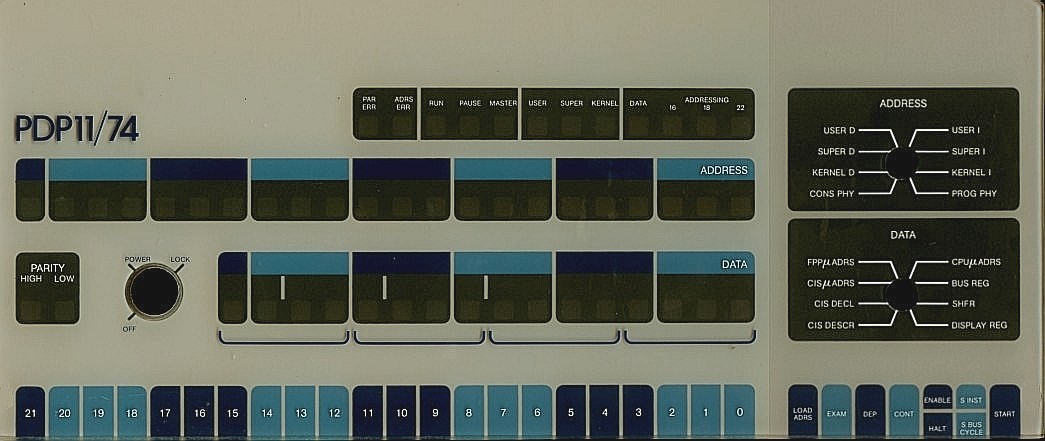
>> The only 11/74 picture I've seen so far is the silk screen panel picture
>> posted a few days ago. Unfortunately I've already forgotten the name
>> (I'm lousy with names, sorry) of the person who posted it, and who also
>> worked on the 11/74 CIS microcode.
>
>> The machine on that picture is probably CASTOR:: by the way.
>
> The people who work with/maintain CASTOR:: call it a 11/74, FWIW.
Yes, I know.
I'll reply to this one last time, and then I'll give up.
Don North reported that he had been a part of the team that had written
the CIS microcode for the 11/74 CPU.
I commented that I thought the 11/74 CPU had only been a paper product.
Don North also pointed out that marketing "stole" the 11/74 moniker for
the 11/70mP system.
Now, throughout this discussion, we need some way of separating what we
are talking about. DEC internal project papers seems like a good start.
There we have the 11/70mP, which is a modified 11/70 with just the
addition of the ASRB cache bypass and memory interlock, as well as the
cache bypass bit in the PDR, and a cache bypass bit and flush control in
the cache control CSR.
The 11/74 is a total redesign of the 11/70 CPU, with the same
modifications as the 11/70mP, but also the addition of the CIS, removal
of one Massbus, and redesign of a whole bunch of CPU boards, including
removing one clock signal not used, and the addition of new clock
signals and control signals required by the CIS.
I'm only talking CPUs here, not systems.
Another way to name them would perhaps be:
KB11-B - Old 11/70 CPU with synch FPP.
KB11-C - New 11/70 CPU with asynch FPP.
KB11-CM - MP modified KB11-C
KB11-E(?) - The new 11/74 CPU with asynch FPP and CIS.
I seem to remember reading somewhere that the 11/74 CPU were to be
called KB11-E, but I also have this nagging feeling that KB11-E might
have been the 11/44, or possibly the 11/60.
Now, as I myself pointed out, RSX regards the 11/70mP as an 11/74, and
that is also what the CPU identification code in RSX calls it.
But if we call this an 11/74, what shall we call the 11/70 with CIS?
So, for the purpose of this thread, I decided to go with Don Norths
naming, and call the 11/70 modified for multiprocessor operations the
11/70mP. If you look at the picture on your site, Tim, you'll also
notice that the text on the front panel actually says something like
"PDP-11/74 MP". (Not sure about the /74, but you definitely see the "MP"
part. (http://www.trailing-edge.com/~shoppa/1174Xopen.jpg)
Now, compare that to Don Norths picture of the 11/74 front panel:
http://www.ak6dn.com/stuff/1174.jpg.
> They never used the term "11/70mP" in front of me for sure. I would occasionally elicit comments about multiprocessing on 73's or 93's but it always came back to "our 11/74 does it THIS WAY" because that was the working example.
I'm not disagreeing with you, Tim. I'm just trying to point out that we
have two different CPUs here, one of which I thought was never made, but
Don actually claims that it did exist, even if just as one prototype.
The system was called an 11/74 everywhere, but for the purpose of this
discussion, we need to make a distinction between the CPUs.
> I'm not saying that "11/70mP" is wrong, indeed it's used in some of the drawings and memos to describe what was commonly called the 11/74.
Yes.
> CIS was real important to some DECcies circa late 70's for some Cobol requirement but coming from the real-time side none of us ever cared. We'd just run across machines that had this unneeded option.
Indeed. And the 11/70 don't have it, nor does the 11/74 systems that
ever were used.
CASTOR:: was 4 CPUs, by the way, while PHEANX:: was only 2, if I
remember right.
Johnny
Hello all,
This is just a short email to let the West Australian members know that
the Artifactory, Perth's very own Hackerspace (in the correct sense of
the word), has started hosting a regular, fortnightly event called
'Classic Computing Appreciation Night'. Several of our current members
have at least a passing interest in collecting, restoring and setting up
classic computers; as this event is being run in conjunction with our
'Circuit Hacking Mondays', there should also be at least one or two
people around to help with the troubleshooting and repair of your
favourite micro- or mini-computer.
The space's electronics facilities include several soldering stations
and CROs, PAL/SECAM/NTSC and analogue RGB monitors, a logic analyser and
an (E)EPROM programmer. Depending on the demand, there may also be a PC
capable of reading from, and writing to, most common 3.5" and 5.25"
floppy disk and tape formats; we also have a fairly respectable
collection of OS installation kits for many DEC, SUN, HP, SGI, IBM
RS/6000, Apple, Commodore and Amiga systems. And for the particularly
adventurous, the space also has a home-designed and built CNC milling
machine and a RepRap 3D printer that could be used to machine or
(literally) print replacement parts and panels.
The space is located in Mount Lawley, and all are welcome. Advice and
ideas are free; workshop use is free for members of the hackerspace, or
$10 waged/$5 unwaged. See
http://wiki.artifactory.org.au/doku.php?id=projects:classiccmp for more
details of the event, and http://hackerspaces.org and
http://en.wikipedia.org/wiki/Hackerspace for information about the
hackerspace movement in general.
Hope to see some of you there,
Peter
On JMon, 28 Jun 2010 22:15:57 +0100, Philip Pemberton <classiccmp at philpem.me.uk> wrote:
Having played with a the Canon II printer series scanners (the guts of both the Laserjet II and Apple Laserwriter II), some comments:
> Well, working backwards from DPI and print speed gives about 3MHz dot clock:
>
> 300DPI * 11 inches (paper height) * 3ppm = 9900 lines per minute
> (thus, the line rate is 9900Hz, or 9.9kHz)
> 9900lpm * 300 dots per line = 2.97e6
> (thus, the pixel rate is 2.97MHz)
Unless you are using the control board, the above calculation is moot: the scanner is a DC brushless motor - the speed is controlled by the input voltage. The control board closes a motor loop based on the feedback optical pulse and synchroniz(s)es the speed with the shift register clock. You can chose a clock rate to suit your system, build the motor control loop with a D/A, and set up logic to fire off at the right time based on the feedback optical pulse. If you are using the control board, all you have to do is feed the data in and the board will take care of the bit clocking. If you are generating the bit clock, you can determine your DPI. The II series uses a 6-sided mirror.
> Replacing the laser assembly might be "interesting", as will realigning
> the optics. My back-of-an-envelope calculations suggest I need a 0.085mm
> spot size to get to 300DPI:
>
> 300dpi = 300 dots per inch, or 1/300in per pixel
> 1/300 * 25.4mm/in = 0.0846667
>
> Focusing that will be.... "fun", especially with a 20mW blue diode
> laser... and I need to find a beam sensor that's sensitive to blue light.
The sensor on the board should work if you remove the red filter/attenuator on the input to the fibre optic cable. You might have to either increase the gain of the amp at the detector or place an attenuator in the optical chain. In any case, you should replace the red filter with a suitable pass filter to match your laser.
IIRC the laser is collimated to the desired spot size, i.e. the beam is parallel through the optical path - no focusing per se. However, going from red to blue will change the deflection characteristics of the optical path. You will probably see a narrower page at the same distance from the folding mirror and possibly some non-linearities. By changing the distance from the final mirror you should be able to control the page width. Non-linearities are a different matter.
>
> Seems like it should work... though designing a suitable
> constant-current controller with ~3MHz analog current modulation will be
> interesting. PWM would require ~768MHz modulation, so analog is the
> "easy way out", and beam power is roughly linear from the lasing
> threshold (30mA) up to 10mW (~40mA). Hmmm.
As mentioned above, you will have to control the motor voltage to sync with the bit oscillator to achieve the DPI. Also note that most laser diodes have a photodiode as part of the assembly and power is also in a control loop.
[...]
> So am I right in thinking it has some form of PLL to generate the pixel
> clock from the beam-detect (or motor tacho?) pulses?
Actually, you probably want to fix the bit rate (crystal oscillator) and control the motor speed so that you get n bit counts between laser pulses. It should be fairly easy to control to +/- 1 bit. Note that the number of bits will be greater than the dots you wish to generate in order to take care of margins.
>
> That's along the lines of what I was going to do... lock a fairly
> slow-loop PLL off the either the beam detect or the tacho (haven't
> decided which), then use the pulses from that to drive the clock input
> for the data shifter.
>
> It's like the CX-VDO all over again.... :)
Different problem...
>
> --
> Phil.
> classiccmp at philpem.me.uk
> http://www.philpem.me.uk/
I used two scanners a few year ago to make a far IR scanner. The first was a modified mirror wheel which slow scanned the vertical and the second was the horizontal scan. The optical output was fed to pyroelectric detector found in a motion detector with modified electronics. Fun toys.
CRC
> From: "Chuck Guzis" <cclist at sydex.com>
> Not all Northstar diskettes are HS. One of the models (Advantage?)
> isn't--and it's that format that the Microsolutions MatchPoint will
> read, not the others. It's been too long since I've seen the darned
> things...
I think the machine you are thinking of might be the N* Dimension. The Advantage
still uses 10-sector floppies.
I've never seen the Dimension but vintagemicros on Ebay was selling one a while
back and had a picture of it. Apparently it was MS-DOS compatible.
RodSmallwood" <rodsmallwood at btconnect.com> wrote:
> How difficult would it be to extend one of these FGPA PDP-11's to be put
> on a quad DEC board and be a plug in replacement for say an 11/93 or
> 11/94 CPU. (M8981-AA OR 11/91-BA)?
>
> Rod
Hi Rod,
possible and feasible, but requires three tasks to be addressed:
1. an adapter board is needed to connect the FPGA development
boards (holding the FPGA and memory) to the UNIBUS or QBUS.
Main active part of this adapter board are the bus transceiver
for UNIBUS or QBUS.
2. The UNIBUS or QBUS bus interface logic can be added to the
FPGA. Given that the system clock period is small compared
to typical times of these buses it is quite simple and
straight forward to implement such a bus interface.
3. the current w11a implementation doesn't support bus masters
on the I/O bus. DMA transfers from disk/tape devices are
currently emulated. Next versions of the FPGA implementation
however will add this functionality.
But keep in mind: the current FPGA implementation isn't tremendously
faster than a J11.
Walter
everyone gather round. No hard woods, only wiffle ball bats :)
anyone own/used to own 1? In the rare event someone has one or more toasted units, and willing to part with them, I'm interested. There's more then one way to skin a cat (PERISH THE THOUGHT!).
I'm off topic but I know there are a lot of laser printer enthusiests
here and hopefully someone that has been digilent about the firmware
for this printer... not to mention people who like fixing things.
Has anyone possibly kept older firmware versions for this printer around?
I have a Magicolor 2550 that I have been running for several years.
It always had a problem where it would fall off my network and I would
have to power cycle it to recover. Didn't matter if DHCP or static IP
was used... the ethernet would just go dead.
A few months ago, I decided to "fix" this and went looking for a
firmware upgrade. My firmware was orginal and there was a newer one,
many revisions advanced. So, I reflashed the printer. This fixed the
network problem however in trade, I got two new worse problems. Now,
the image on the paper is slightly rotated... about 5 degrees so that it
is no longer square to the paper. Additionally, the front panel keypad no
longer functions and if you press any key, the printer enters into a loop,
printing a menu page and you have to power cycle it to recover. Nice.
I absolutely put in the correct firmware for this printer model so Konica
apparently has some issues.
I've gotten no response from Konica support and so I am looking for someone
who may have archived older versions of firmware so that I can revert the
thing to something less hostile.
It was otherwise a really nice color laser printer and I _should_ have just
lived with the network problem.
Again, it's a Magicolor 2550EN. Not the "DN" model which does use a different
firmware image.
Thanks and I appreciate off-topic bandwidth.
Chris
--
Chris Elmquist