On 11/9/10, Tony Duell <ard at p850ug1.demon.co.uk> wrote:
> The cables are differnet betwene the RLs and the RK06/07 (the latter has
> all pins bet one (termintor power) connected
That rings a bell (term power).
> the former has rather fewer
> wired), but AFAIK the terminator is the same (it terminates all signal
> pins. I think at least one RL controller printset shows the exploded view
> of the terminators with 'First used on Option/Model : RK06' specified.
OK. That's a good detail to remember when setting up drives of either kind.
One handy bit of trivia if you happen to have spare Unit plugs from
the high numbers of an RK06/RK07 set is that they work in an RL01/RL02
if you mentally mask off 2^2 (i.e., an RK06/RK06 plug labelled "4" is
"0" on an RL01/RL02). It's the same sort of switch/bulb housing, but
one less bit going back to the electronics. We didn't do it often,
but sometimes we were short some of the numbers and we did have a
couple of RK07s and a drawer of random unit plugs.
-ethan
De writes:
>> I am looking for info on a Gandalf LDS120 modem, specifically the
>> serial port pinout.
> In the division of irrelevant to the original question, I thought these
> things were line drivers, not modems.
I always thought they got lumped into "short haul 4-wire modems".
They do have "DCD" lights on the front. I seem to recall that it's just
a light and doesn't actually assert any RS-232 pins. But they could just
be differential line drivers probably with isolation.
20+ years ago I'm sure I looked inside to see what's in there but I
can't recall. I always thought they did some simplistic and almost certainly
not Bell-standard FSK or PSK but
that was just my impression, no actual evidence to back that up.
Did the 4-wire screws on the back have labels of "+" and "-"?
That would be a point in favor of them being line drivers and not modems
(although some simple modems were in fact phase-sensitive).
We used them between serial concentrators on different floors or
between serial concentrators between nearby buildings.
I note that there's no Gandalf directory at bitsavers. Gandalf
certainly has a unique heritage not really being a "computer"
company in the usual sense but for so many of us it was the
gateway from terminal to the computer or between computers. I
get the impression they were far more common at large academic
institutions than at any commercial site.
Tim.
On 11/09/10 10:44, Roger Holmes<roger.holmes at microspot.co.uk> wrote:
>> > From: Johnny Billquist<bqt at softjar.se>
>> >
>> > Gah. I have no idea what PPU mean, nor PP.
> You're probably just not old enough.
That is definitely true here. :-)
> In the 50s the main processor was called the CPU (Central Processing Unit) to differentiate it from the various PPUs, (Peripheral Processing Units). The first machine I programmed, the IBM 7094 had a CPU and two PPUs, one to read cards and write the images to tape transports, which would then be switched over to the CPU to read, compile and execute the job and write the results back to another tape transport which then got switched to the other PPU which then transferred the tape image to a line printer.
Thanks. That explains it.
> Somehow now (when most peripherals have embedded processors which could be called PPUs) we seem to have stopped using the term.
Yeah. It might have gotten lost in the inbetween years when computers
were trying to get rid of, at the time, expensive peripherials (they
were expensive enough without being their own computer).
I only started playing with computers in those inbetween years. :-)
Johnny
Hi! Over the last couple of years several of us at N8VEM,
S100computers.com, and others have been building S-100 boards. This summer
we did a major update/respin cycle to the boards and made manufactured PCBs
for many builders. For a while it seemed to satisfy the demand for DIY
hobbyist S-100 PCBs but now the interest is starting to pick up again so I
thought I would send an update to any S-100 enthusiasts on CCTALK.
I will reorder/respin S-100 PCBs once the interest level gets to an
economically viable level for a group purchase. Normally that is around
25-30 PCBs I know builders want which makes a cost at $20 plus shipping per
PCB affordable for most builders. This compromise balance seems to work
well and we've produced several S-100 boards this way. Here are the boards
we've made so far:
S-100 regular prototyping board (some remaining)
S-100 buffered prototyping board (some remaining)
S-100 backplane (8 slot plus utility circuitry - one left)
S-100 IDE (hard drive, CD-ROM, CF, ATAPI, etc)
S-100 parallel ASCII keyboard (just received a new batch of respin
PCBs)
S-100 4MB SRAM (Flash, etc)
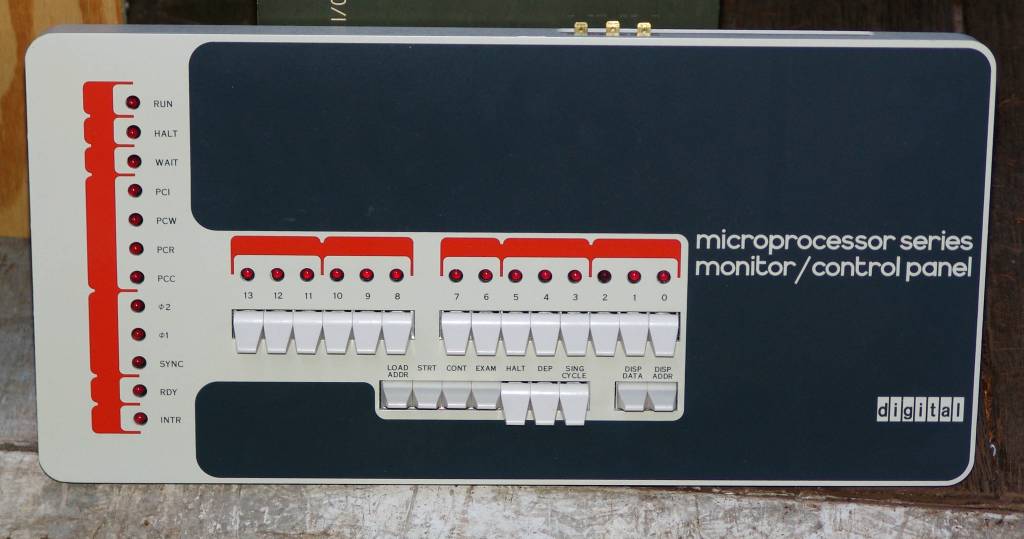
S-100 system monitor (similar to Jade Bus Probe but two PCB set -
one or two remain)
S-100 bus extender (with logic probe, indicator LEDs, etc)
S-100 EPROM (SRAM, EEPROM, Flash, etc)
S-100 IO (dual serial, USB, voice synthesis, etc)
S-100 PIC/RTC
All of these have gone through at least one or two internal prototype
iterations plus one or more manufactured PCB orders. Since we respin the
boards based on builder feedback obviously the later generations of boards
tend to be "cleaner" than the earlier ones. This is an all volunteer
amateur project so the builders *are* the developers, QA, testers, etc in
addition to using the boards.
There are four boards in active development and/or approaching manufactured
PCB stage
S-100 Z80 CPU (just ordered first batch of manufactured PCBs after
two rounds of prototype build and test)
S-100 Console IO (dual Propeller VGA, PS/2 keyboard, microSD,
Ethernet, etc - first iteration prototype boards ordered)
S-100 ZFDC intelligent floppy drive controller (Z80/WD2793 second
iteration prototype board imminent)
S-100 68K CPU (first iteration prototype boards ordered)
Please note the above boards no longer *planned* they are actual boards in
some form or another. There are several more in the planning stages but I
won't waste your time with those since those plans change often. All of the
schematics, PCB layouts, bill of materials, etc are available on either the
N8VEM wiki or S100Computers.com website including build instructions for the
most part.
These are noncommercial Do It Yourself (DIY) hobbyist PCBs. They are not
perfect nor is this a business. John's apt description from comp.os.cpm
captures it well "Andrew Lynch (at N8VEM) see
(http://n8vem-sbc.pbworks.com/) and I, are in the process of having a few
commercial quality S-100 cards made for ourselves. If others are interested
in obtaining a bare card, let Andrew or I know. Please note these would be
bare cards, a schematic and that's it. Building the board and implementing
CPM etc., you are on your own. This is not a project for first timers."
In other words, if you want to play along that's great but this is purely
"CAVEAT EMPTOR" and there are no assurances, guarantees, or warrantees on
any aspect of the boards.
Please this is offered as an information post to interested vintage/classic
computer hobbyists not an invitation for flames and pointless criticisms.
Please be courteous and keep those to yourself. As always, questions,
comments and *constructive* criticism welcome.
Thanks and have a nice day!
Andrew Lynch
I was recently given an Advin Systems PILOT-142 device programmer... but
of course no software with it.
I downloaded Advin's Captain v1.34 software for XP from their website,
where they claim support for the model -142 but after installing and
launching the software, it reports that it does not work with the
"revision" of my programmer.
There are no revision or series marks on the unit other than the PILOT-142
sticker above the power switch... so I don't know what makes it different.
Email to Advin says they have NO software that supports the -142 even
if their website says otherwise.
In any case, I'm looking for anyone that might have DOS or Win software
for this older beast. It would be a nice unit for burning 2716, 2732
and a number of old PALs that I would like to do.
Chris
--
Chris Elmquist