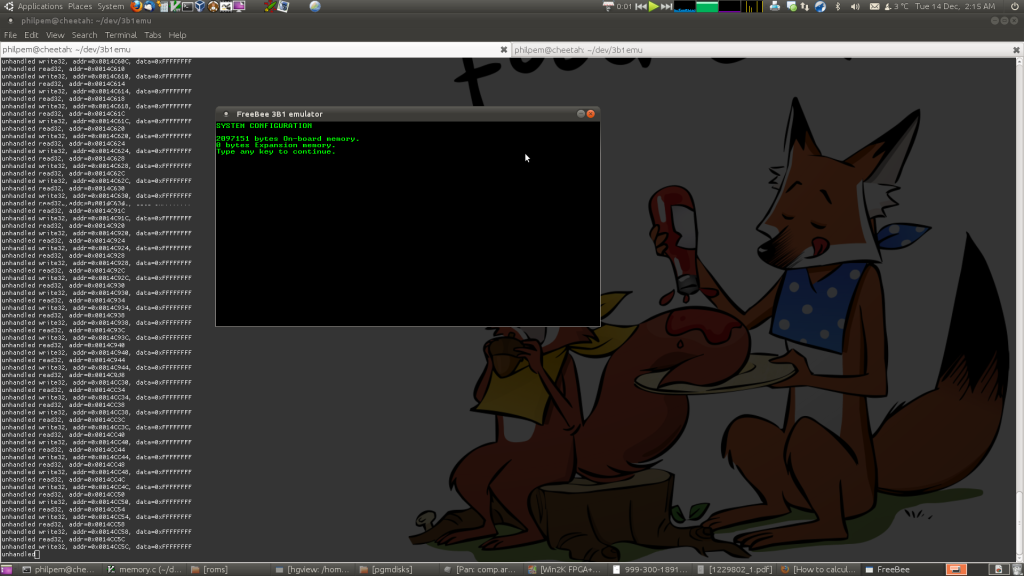
They say "A picture says a thousand words"... well, here's a screenshot
of the current version of FreeBee booting the System Loader and
Diagnostics disc for the 3B1:
http://i162.photobucket.com/albums/t242/philpem/Screenshot.png
And for those who don't believe anything unless they see it moving:
http://www.youtube.com/watch?v=Y0sRkJty6wo
:)
To make this work...
* Install the LibSDL (Simple DirectMedia Layer) development libraries,
and a C compiler. On Debian/Ubuntu, you want to 'apt-get install'
build-essential and libsdl*-dev. You'll also want make, sed, awk and
grep, which should auto-install when build-essential installs. On
Windows, you're on your own (though a homebuilt SDL and mingw32 should
work... in theory).
* Grab the FreeBee source code:
http://hg.philpem.me.uk/3b1emu/archive/tip.tar.bz2
And the ROM images:
http://philpem.me.uk/code/3b1emu/3b1_roms.zip
* Grab ImageDisk from Dave Dunfield's website, and the Version 3.51
Diagnostics Disk (.IMD file) from Bitsavers
* Use Dosemu, DOSBox, or a conveniently located DOS or Windows box to
convert the .IMD into a .BIN file:
IMDU 01_DIAGS.IMD 01_DIAGS.BIN /B
Copy the BIN file onto the Linux box.
* Untar the tarball, and cd into the directory it creates.
* make
* Copy the disc image in here, and rename it to 'discim'.
* Create a directory called 'roms', and unpack the 14C and 15C binaries
(.bin files) into there. Rename them to '14c.bin' and '15c.bin'
respectively.
* Run:
./freebee
* Watch the fun.
No, the keyboard isn't emulated (yet), no the hard drive isn't emulated
yet, and no, it doesn't boot past the RAM test screen... Keyboard is
next on the hitlist, followed by interrupts, masking and the
MMU/pagefault traps.
I'm looking for other folks to help out with this -- a reasonably
experienced 68K coder would be useful, or folks who know how the WD 1010
and 2797 Winchester and FDD controllers behave in 'real life'
(unfortunately I don't have a 2797 to breadboard with).
Enjoy!
--
Phil.
classiccmp at philpem.me.uk
http://www.philpem.me.uk/
I'm thinning down my collection and have a PDP 11/24 and
a VAX 3500 available - free but collecton only (UK).
The 11/24 could do with a clean, but it looks to be complete
and has the often missing power key as well. Internally there
are several cards.
The VAX 3500 is in a desk side pedestal style case. It has
wheels so can be moved. In nice condition cosmetically. No
idea what cards etc are installed.
Both units have never been powered up by me, and would need
to be carefully checked, etc before powering up. Given away as
is - for spares or repair.
Collection only. Contact me by email if interested.
Hi,
I just received some PCBs for a 6809, 6502, or 6802 computer. The ECB host
processor can either be a stand alone computer with the IO mezzanine board
Alternatively it be connected to the N8VEM backplane and rely on the N8VEM
SBC for IO or do both simultaneously.
The computer board supports 6809, 6802, or 6502 CPUs depending on builder
preference. You set configuration jumpers for the CPU you select.
The 6809 CPU configuration supports the CUBIX, the 6502 CPU supports DOS65,
and for 6802 and/or the 6809 there is a FLEX port in the works.
More information is available on the N8VEM mailing list and N8VEM wiki.
Please contact me if you have questions or comments.
Thanks and have a nice day!
Andrew Lynch
Hi Gang,
While surfing, I found a repository of NASA FORTRAN code from the NASA-COSMIC library.
Lots
of graphics in here as you could imagine, supporting Tektronix, PLOT10
and VT100 graphics terminals. As I know there are lots of geeks here, like me
still interested in this sort of stuff. I have attached a abstract
list of the code.
Let me know if you are interested in any of
this - it certainly has application or useful as learning material; for
example the calculation of satellite trajectories for us AMSAT ham guys.
You
can certainly Google yourself, but the download for me was a bit tricky
- requiring a linux box and the Subversion version control system.
How can I push it up to Bitsavers?
Randy
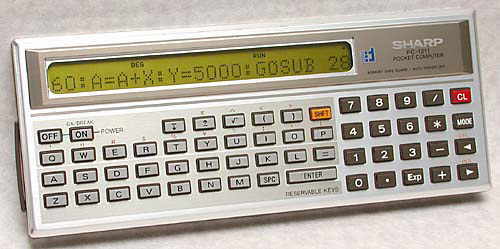
Interestingly enough, the Sharp PC-1211 (early basic programmable calculator) displays 'O' in a manner similar to what you describe. Zeros have no slash or other markings, but the 'O' has a notch in the upper right corner.
See http://www.vintagecalculators.com/assets/images/SharpPC1211_1.jpg for an example.
Josh
-----Original Message-----
From: Al Kossow
Sent: Thursday, December 16, 2010 2:52 PM
To: cctalk at classiccmp.org
Subject: Slashing the letter O (Was: Re: Service bureaus (Was: Tek 4051 firmware listing))
There was an attempt at establishing what can roughly be described as an upside down Q
for a slashed O. The only example I know of where someone used this are in line printer listings
>from SDS in the late 60's. I would have to do some serious digging in magazines to find who was
pushing this as a standard. They end up looking like misformed 8's.
It does terrible things to OCR.
Hi everybody,
I have two Sun UltraSPARC machined to be picked up: a Ultra 1 (512 M
RAM, with extra memory modules) and an Ultra 5 (also 512 M RAM). The
5 works for sure, runs NetBSD. These are for pick-up at McGill
University in Montreal, contact me off-list if you want them. There
might be a SS4 kicking around here as well to be gotten rid of.
Contact me off-list.
Joe.
--
Joachim Thiemann :: http://www.tsp.ece.mcgill.ca/~jthiem
Date: Tue, 14 Dec 2010 00:05:05 -0200
From: "Alexandre Souza - Listas" <pu1bzz.listas at gmail.com>
Subject: Re: apple Lisa2. One working!! - one to go?
> An example to ilustrate the talk: http://tabalabs.com.br/c64/sx
> +++++++++++++++++++++++++++++++++++++++++++++++
>
> Definitely interesting and somewhat relevant, but not quite the same
> thing; that deals with the common problem of replacing 24pin 8K 23xx type
> ROMs (or 68764/66 EPROMs) with a 27xx equivalent EPROM (with multiple
> images in this example), whereas Tony was talking about replacing a 2716
> with a larger 27xx EPROM, not quite the same thing or adapter.
Thanks Mike, but please, read again:
> An example to ILUSTRATE the talk: http://tabalabs.com.br/c64/sx
+++++++++++++++++++++++++++++++++++++++++++++++++
I've read it again, and I'd still say that although it's somewhat relevant
it's not what Tony was talking about.
Although the pictures and schematic illustrate the general idea of (badly)
making this *kind of* adapter (try reprogramming that EPROM ;-), I think it
would have been more useful to link to an illustration and schematic of what
Tony was actually talking about, i.e. adapting a 2716 (instead of a 2364).
You can buy those adapters for $5.00, by the way.
Am I missing something?