So, I thought it would nice to use a Multia as a wireless machine,
after all, it does have PCMCIA ports...
My first challenge was that it wouldn't boot. It would startup and
get to the cursor and then hang. A new battery was suggested. Rather
than use the Rayovac 840, I elected to get a 3 AAA cell holder from
Digikey. I replaced it and watched. Sure enough, it started to boot
and then put characters on the screen and hung. I powered it off and
on and it got further and then hung. Now it won't get that far at all
and complains (via 14 LED flashes) that the DRAM is bad. I removed 2
and that didn't work so swapped them and that didn't work.
It would make a nice doorstop, but otherwise what are the suggestions?
Couldn't find original sender:
> Except for a few very odd ones (e.g. hard drives which record analagoue
> singals such as analogue video [1]) every hard disk I've worked on has
> used both sides of all platters for something. Maybe not user data
> storage (for excample, it may contain servo information only), but there
> will be a head on it.
Because of the enormous pressure to reduce cost, single headed drives are very common. And have been for as long as I've been in the HDD industry. For example, current technology is 667 or 750 GB per platter with 1TB/platter due in next 12 months. Yet there is a demand for 250, 300 or 500 GB drives for ultra low cost drives. Especially in the consumer electronics market - for example, DVRs and security systems.
Taking out the cost of one head can save $2.50 to $5.00 of manufacturing cost. That is a big chunk of the $25 manufacturing cost typical of the very low end drives.
Servo data has been embedded in the data surface for many many years. Most current drives generate their own servo information. Current drives even have a different tpi for the servo versus the data track, even though they are on the same surface.
Billy Pettit
At 5:24 -0600 1/13/11, Josh wrote:
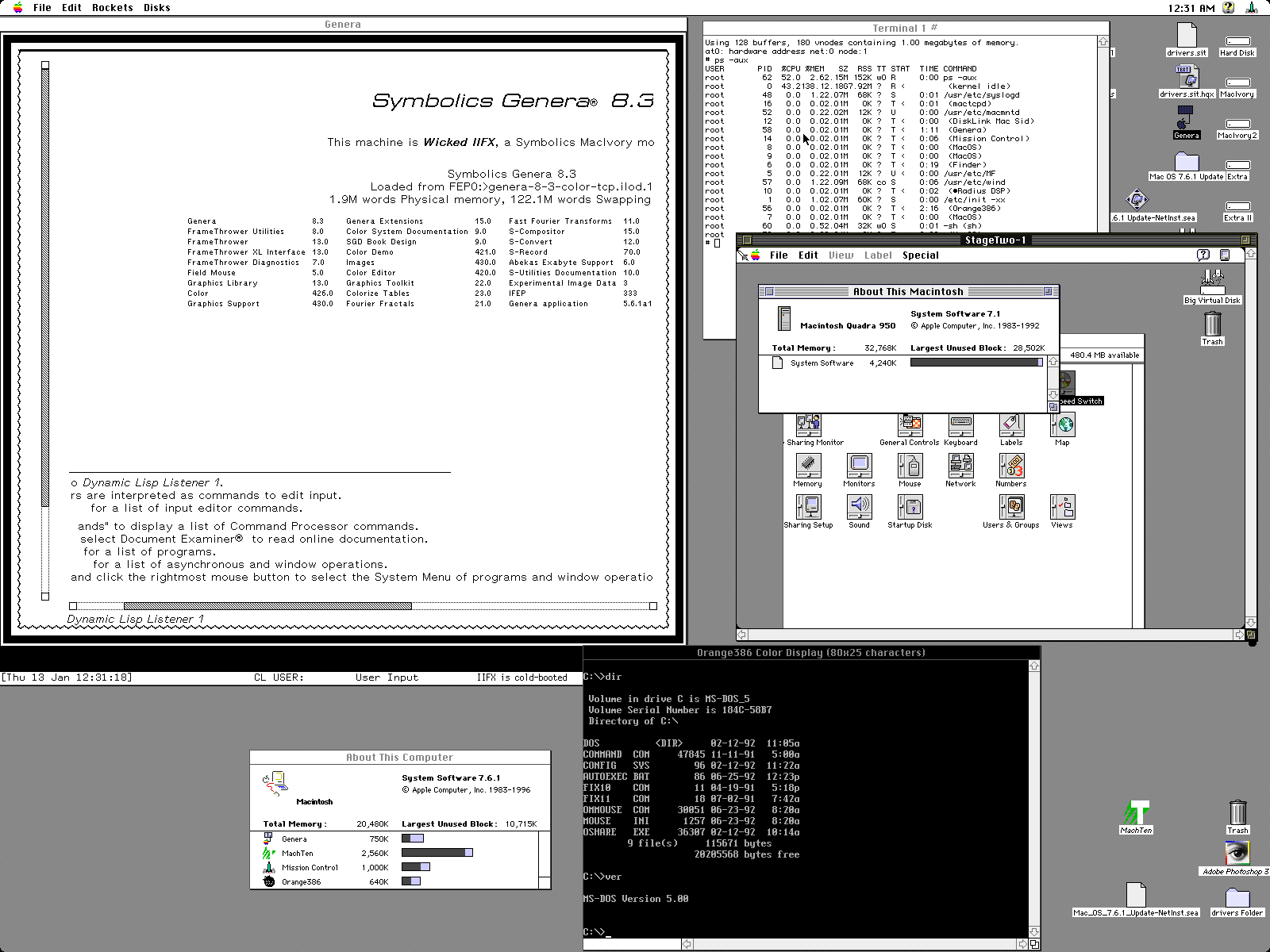
>Could I run these all at the same time in my trusty Macintosh IIfx?
>
>The answer: Yes. (warning, 1600x1200 image):
>http://yahozna.dyndns.org/scratch/random/5OS.png
>
That is so far beyond cool cool can't even see it any more! I'm
totally awe-struck! What a machine! What an idea!
How could you *possibly* have anything better to do than that?
--
- Mark 210-379-4635
-----------------------------------------------------------------------
Large Asteroids headed toward planets
inhabited by beings that don't have
technology adequate to stop them:
Think of it as Evolution in Fast-Forward.
>
>Anyway, some doofus managed to string fiber through the cabinet (one
>of the 9309 style cabinets, common with older big AS/400s and
>RS/6000s). For some reason, the decommissioned machine had to be
>removed during the day, but we were forbidden to touch the FDDI
>outside a 3 AM maintenance window. Several blades later...
>
>I'll tell you - IBM uses good steel.
>
Where did the dust end up?
On one memorable occasion, when we requested cable access between two of our
adjacent cabs, the data centre tech (without telling anyone) took an angle
grinder to the cab walls and showered our running equipment with fine steel
dust. Any mystery failures after that were blamed on dust getting sucked in
by fans and deposited on pcbs.
Regards,
Peter Coghlan.
> > Date: Thu, 13 Jan 2011 01:34:00 +0000
> > From: classiccmp at philpem.me.uk
> > To: cctalk at classiccmp.org
> > Subject: Disc drive READY output -- any standards?
> >
> > Hi guys,
> >
> > Is there a defined standard as to when the READY output on a
> > Shugart-type disc drive should go active?
<snip>
> > Thanks,
> > Phil.
> > classiccmp at philpem.me.uk
> > http://www.philpem.me.uk/
Having worked on a number of those HDDs and FDDs my recollection is the
"standard" for asserting READY was, at a minimum, that a disk was loaded and
the drive was "at speed." In some higher end HDDs I seem to recall that it
was not asserted until the heads were at TRACK 00 but I could be wrong.
Speed tolerance was pretty poor with ac motors and I think we just clocked a
retrigerable singleshot with index and required two (or more) indexes faster
than the timeout before we then asserted READY. There was probably a pot on
the singleshot and I suspect it was set to about 90% of nominal RPM for ac
motor drives and probably about 2% for dc motor drives.
The only real issues with motor speed not in range are writing out of
sector/track boundary (high speed) and read data recovery. With today's good
channels read data recover should not a problem over a wide speed range but
with the early primitive channels (e.g. "two time constant") this could be a
problem.
Tom
Hi! There is a community project at vintage-computer.com forums to convert
IDE drives to SCSI interface to support legacy computers like Amiga, Mac,
Atari, etc.
http://www.vintage-computer.com/vcforum/showthread.php?22906-SCSI-1-to-from-
IDE-drive-converter
The initial batch of prototype PCBs have arrived. Please contact me if
interested in working on the SCSI2IDE project.
Thanks and have a nice day!
Andrew Lynch
On 1/12/11 12:38 AM, Bill Sudbrink wrote:
...
> I hope you have enjoyed reading this,
> Bill Sudbrink, January 2011
I finally got a few minutes to sit down and read this. I VERY MUCH
enjoyed reading it, thank you for sharing this story!
-Dave
--
Dave McGuire
Port Charlotte, FL
I'm surprised that nobody has mentioned the most critical part of designing a data center: security.
The amount of money involved dictates that all details on a data center be closely guarded. Think about the income from ads for Google or selling music on iTunes. Or retailers like eBay or Amazon.
Thus information on data centers are the crown jewels for these companies. No way are they going to share this information. The secrecy has reached a point that they will not even acknowledge what country that many of these centers are in, let alone what building.
Most have reached the point the military took years ago: no hardware is ever returned to a vendor for repair. It is destroyed on site, never returned for warrenty.
Setting up a large data warehouse is a dark arcane science limited to a select few engineers. And the world of the cloud computing will take this secret keeping to another level of paranoia.
Billy Pettit
OK... today I discovered the real-time-clock on my 11/23+ was dead, so
TSX-Plus wouldn't run properly. I tracked it down to a bad LM339
comparator (inside the chassis power supply, of all places).
Miraculously, my local Radio Shack actually had one in stock and it is
now working again :)
The RL02 pack has RT-11 V4.00 and *two* versions of TSX-Plus on it.
The files with the expected .SAV suffix are version 5.0, but there
were also several .NEW files (including TSXMOD.NEW even though there
was no TSXMOD.SAV). When I run the new TSX-Plus it's version 6.16.
Unfortunately both versions are expecting a DL serial line card, not a
DH, and they are not interchangeable as far as drivers. And (of
course) LINDEF and DHVDEF are two of the short list of parameters that
cannot be patched via TSXMOD, but require regenerating the system :(
I was hoping to find the distribution files on the pack (such as
TSGEN.MAC) but no such luck. So it sounds like I need a new copy of
the TSX-Plus distro files... like the hobby-licensed 6.5 :)
Jerome H. Fine, would you please contact me offlist if you can help?
I've also emailed Lyle Bickley but I haven't seen him on the list in
quite a while.
thanks for any and all assistance.
-Charles