> From: Johnny Billquist
> If it comes as far as booting RSX as well as XXDP, there can't be
> anything seriously wrong with the CPU...
Yeah, I see your point, but why all the zeros, then? That's what I could't
work out.
Anyway, it should be really easy to make sure e.g. ASH, MUL and DIV are
working; it's vaguely plausible that one of them is broken. (Unix V6, I think,
might even boot even if MUL was broken. I know the bootstrap uses DIV, to
calculate the cylinder in the disk driver.) If not, cross that off the list,
and try the next thing... Which is?
Noel
Responding on-list to an off-list message, with permission...
On Jan 27, 2015, at 09:30 , Lou Ernst <louis.ernst at verizon.net> wrote:
> This is not silly. I think it can work. I had a similar idea about TU60 decassettes. My task was easier there though since the TU60 uses standard Philips compact cassette shells. The TU60 however has no capstan and uses the spindle motors to maintain tape temsion. It was designed by the same guy who designed dectape (TU55/56).
Using the spindle motors to maintain tape tension seems like a better scheme than that danged drive belt in my opinion. I recall reading somewhere online about the heroic measures that some engineers (at HP? Or was it 3M?) had to go to to get a DC-100A-like cartridge design working, involving lots of hard work in the areas of lubricants, surface finish, and how to make that drive belt by stretching out a small disc of plastic. My interpretation is that they had to apply heroic efforts to make a crappy design barely work. ;)
> Long story short, I was able to play TU60 cassettes in a good audio cassette deck and digitize the audio on a PC. I manipulated the audio file in Audacity. I was able to cut single data blocks and dump the blocks to a long .CSV file. I opened these in Excel and created intelligence in the spreadsheet to digest the audio samples back into the block data, even properly decoding the header and checking the checksum. The hardest work in the spreadsheet was tracking the bit boundaries due to the temporally varying bit-rate (no capstan in the real TU60).
Cool!
> At last I did not have to use this means of recovering data from TU60 cassettes. My real TU60/TA11 worked well enough to recover the data on the cassettes I was provided to recover. I developed that tape deck/digitizing method in case there were dropouts unrecoverable by the real TU60.
At least the real TU60 isn't hobbled by that dreadful cartridge design.
> Perhaps you can build a sort of open frame reel-to-reel deck to play and digitize the tu58 tapes.
That's what I'm thinking. While I could repeatedly use one or two good cartridge/belt assemblies with the guts of multiple tapes in order to image them in a TU58-XA transport, I don't relish the thought of repeatedly tinkering with the danged belt if I can come up with a better solution.
I found a specification that includes the magnetic track dimensions of the DECTAPE II on Al's site:
http://bitsavers.trailing-edge.com/pdf/dec/dectape/tu58/TU58_Engineering_Sp…
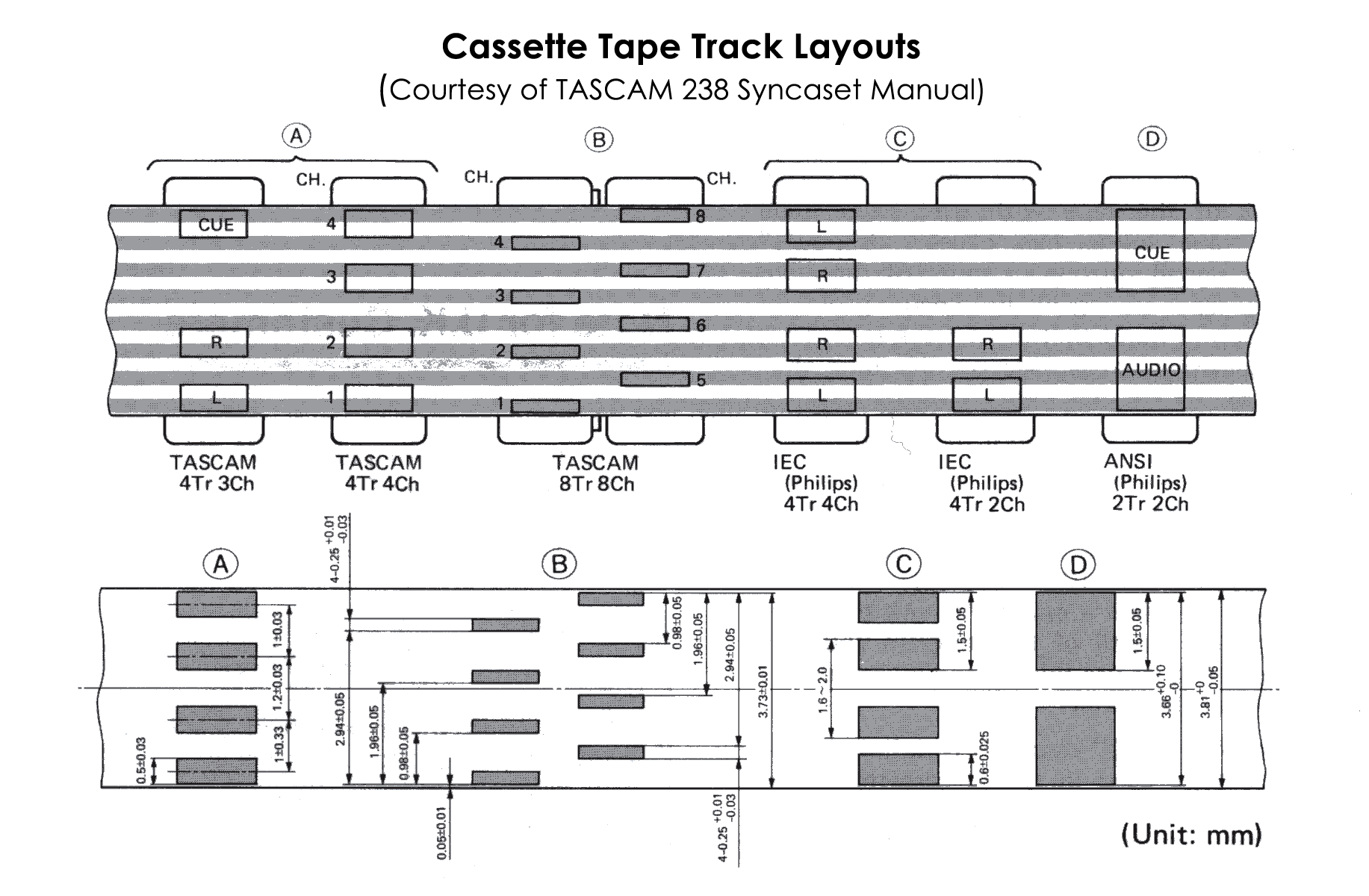
Also, I found a diagram showing track dimensions for various audio cassette formats here:
http://richardhess.com/notes/formats/magnetic-media/magnetic-tapes/analog-a…
in particular:
http://www.richardhess.com/tape/cass_trk_lrg.gif
Both the DECTAPE II media and standard audio cassette media are 0.15" (3.81mm) wide. DECTAPE II has two .057" (1.448mm) wide tracks, centered 0.046" (1.168mm) apart. Data density is 800 BPI, with 2400 flux reversals per inch. At standard read speed of 30 ips, that turns into bits in 41.7us increments and flux changes in 13.9us increments. The reels inside the cartridge will spin at around 380 to 800 RPM depending on how much tape is on them, if I still know how to do math. Or twice that at the scanning speed of 60 ips.
Just based on track geometry, it seems to me that it may be quite possible to read DECTAPE II media with the inner two tracks of a 4-track recorder head or auto-reversing stereo audio deck head. Or even with both tracks of a 2-track 2-channel head as shown in the diagram I found, though I don't know how common those are. 4-track recorders and auto-reversing stereo decks are pretty common, though.
Running the tape at a stable speed near 30 ips instead of 1-7/8 ips would be the hardest part, I think. My gut feeling is that a normal audio cassette capstan and pinch roller assembly may not work well at 16x normal speed, and I haven't seen references to any audio cassette tape applications that run the tape at controlled speeds that fast (rewind and fast-forward speeds may be that fast or faster, but those run the tape at unregulated speeds with the pinch roller disengaged).
I don't know if audio tape heads are electrically suitable for this application, but I think they might be since the flux change period is in the same ballpark as the AC bias frequency used in cassette recorders, so the head coils ought to respond ok at those higher frequencies (?).
I'm curious about what folks with deeper magnetic media experience than I have might think about this.
--
Mark J. Blair, NF6X <nf6x at nf6x.net>
http://www.nf6x.net/
> From: Johnny Billquist
> Is noone paying attention to the fact (and my previous comment) about
> using 0 for CSR and vector???
Err, no. :-)
But seriously, I'm a bit boggled that a diagnostic program would _not_ have
as default the 'standard' vector/address. So I'm kind of assuming that the
0's are somehow bug results.
> From: Jacob Ritorto
> I grabbed a set of pdp11/34a boards ... Can I plug them straight into
> this blackplane that's currently housing my misbehaving 11/34?
Yes, if the backplane is some flavour of DD11-P (I don't know of any
backplane that supports the 11/34 but not the 11/34A, but I only have direct
confirmatory documentation on the DD11-P, and it supports both).
My vague recollection is that one can use _either_ the M7265/M7266 (but as
paired set) _or_ the M8265/M8266 set, but you can't mix and match them. But
don't depend on that (I'm too tired to dig into this tonight, I'll do so
tomorrow).
> Backplane markings are very faded but seem to say dd11-pk.
Yeah, that's the 11/34 backplane (actually, the DD11-P part - the -PK is the
version with the wire harness to work in a BA11-L or BA11-K; the -PF is for
the BA11-F or BA11-P).
Noel
Could be something wrong with MUL, DIV, ASH, ASHC that may be used in the print
routine, but would not be used during basic OS operation. XXDP in particular is
designed to run on a very basic CPU so it does not normally use any optional
instructions.
I'd start with running the 11/34 CPU tests.
Don
-----Original Message-----
>From: Johnny Billquist <bqt at update.uu.se>
>Sent: Jan 27, 2015 2:42 PM
>To: cctalk at classiccmp.org
>Subject: Re: strange number corruption on pdp11/34
>
>On 2015-01-27 21:24, Noel Chiappa wrote:
>> > From: Jacob Ritorto
>>
>> > I'm getting all zeroes nearly any time there's supposed to be a large
>> > number output to my terminal.
>>
>> It sounds like the CPU may be too broken to run diagnostics. Why don't you
>> try writing some small programs to test various bits and pieces of the CPU
>> (e.g. add instructions, etc), and toggle them in, and try and find what's
>> busted that way? (Although for 'add', if the thing's that broken, I'm amazed
>> it even boots.)
>>
>> Here's an example:
>>
>> http://ana-3.lcs.mit.edu/~jnc/tech/pdp11/tests/print.s
>>
>> It's probably too long to toggle in, but you could steal pieces from it
>> and try them.
>>
>> I'd probably try out the shift and multiply instruction to start with; trying
>> to figure out what's probably not used during booting, but could be used
>> during number printing, those are two good bets.
>>
>> Anyway, there's no point to running diagnostics until you get that first
>> problem fixed.
>
>If it comes as far as booting RSX as well as XXDP, there can't be
>anything seriously wrong with the CPU...
>
> Johnny
>
>--
>Johnny Billquist || "I'm on a bus
> || on a psychedelic trip
>email: bqt at softjar.se || Reading murder books
>pdp is alive! || tryin' to stay hip" - B. Idol
> From: Jacob Ritorto
> I'm getting all zeroes nearly any time there's supposed to be a large
> number output to my terminal.
It sounds like the CPU may be too broken to run diagnostics. Why don't you
try writing some small programs to test various bits and pieces of the CPU
(e.g. add instructions, etc), and toggle them in, and try and find what's
busted that way? (Although for 'add', if the thing's that broken, I'm amazed
it even boots.)
Here's an example:
http://ana-3.lcs.mit.edu/~jnc/tech/pdp11/tests/print.s
It's probably too long to toggle in, but you could steal pieces from it
and try them.
I'd probably try out the shift and multiply instruction to start with; trying
to figure out what's probably not used during booting, but could be used
during number printing, those are two good bets.
Anyway, there's no point to running diagnostics until you get that first
problem fixed.
Noel
Hi huys,
a friend of mine informed me that he has an DEC RA81 drive available for
picup in Germany Weimar. Sorry picup onbly, the weight is 67 Kilograms.
The price is to be negotiated with my friend.
Mail me if you are interested, I'll forward mails to him.
Regard,s
Holm
--
Technik Service u. Handel Tiffe, www.tsht.de, Holm Tiffe,
Freiberger Stra?e 42, 09600 Obersch?na, USt-Id: DE253710583
www.tsht.de, info at tsht.de, Fax +49 3731 74200, Mobil: 0172 8790 741
Much to my chagrin, after passing the original deal (that ostensibly
included a VAX 8600) to a listmember - the owner emailed me to say that he
had incorrectly stated the exact equipment available in his original email
to me. There is no VAX 8600. Not wanting to miss-step again, I talked to him
at some length to make SURE that the following is a correct statement of the
equipment that he is trying to get rid of. I don't think he stated the
equipment incorrectly on purpose, I believe he just wasn't sure what he had.
This stuff is in Houston, TX. If someone wants to take over spearheading
this deal (I do not wish to) please email me off-list.
Here it is..
List of Equipment:
MicroVAX 3400 (details below)
6250 tape drive
DEC PC AXP 150
Alpha Station 200
8mm SCSI tape drive ???
8mm SCSI tape drive EXB-8500 (10 GB)
4mm SCSI tape drive Sony SDT-5000 (8 GB)
Tape drives are in external SCSI enclosures.
============================= MicroVAX 3400 DETAILS
===========================================
MS650-AA
Category: VAX Memory
Description: 8MB MEMORY BOARD FOR MV3300-MV3900/VAX 4200
BA213 Enclosure
Dimensions:27" H x 21" W x 17.8" D. Has castors
Bus details: Q-bus - 12 slots, All slots are Q/CD
Drive bays: Four full height 5.25 bays. One with front access.
Power supply: Dual 230W power supply w/ Line conditioning
Used in: MicroVAX 3400, VAXserver 3400, MicroVAX 3800 VAXserver
3800, factoryVAX-II
Last updated: 2000-02-01
Notes:Industrial box. Commonly referred to as a "skunk box",
expansion version is B213F and has slave power control input.
KA640-BA
MicroVax 3400, used with single user software
M7624-DA
VAX3400 CPU BD M7624-DL
CXY08-M
The CXY08 (M3119) is a Q-bus 8-port asynchronous serial adapter
with full modem control.
M3119-YA
Qbus DEC VAX M3119-YA Multiplexer Card, (Tape drive)
I just dumped and posted on my web site an 8008 (inverted) monitor ROM for
the Intellec/8. It starts at 3800H and came from 8 1702A's on an Intel IMM
6-26 Prom card. I don't think it's for the 8080 even though this PROM card
was used on both 8080 and 8008 Intellec's. I will post updates to this
thread, after I invert the code and check the actual instructions. Anyone
interested to check or use it before I do, be my guest -
http://vintagecomputer.net/browse_thread.cfm?id=595
Bill