Dear sirs,
Imagedisk is my savior, and I image all kind of disks I know with it :)
But now I got a pair of TRS-80 model III single-sided disks. How do I
image it using imagedisk? Can I use a double-sided floppy drive to image it?
Or do I need to put the single-sided drive on my PC? Please, help! :)
Thanks
Alexandre
---
Enviado do meu Apple IIGS (pq eu sou chique)
Meu site: http://www.tabalabs.com.br
Meu blog: http://tabajara-labs.blogspot.com
My soon to arrive HP 2112 has a 2102A memory controller and 3x 2102A cards
of 8k memory each. I suppose I could add more 2102As to fill it up the 5
remaining slots and bring it up to 64k. But the recently posted IO manual
says it can support way more - up to 1.28M. I'm not sure yet how the HP 1000
memory works. Can I put larger (>8k) capacity HP 1000 memory boards in there
to expand memory beyond 64k? Do I need to replace the memory controller with
one that matches the larger capacity cards then?
Marc
> From: Paul Koning
>> Right, but the very similar QBUS does have terminations (of a sort -
>> the rules for when you need terminations on QBUS extensions are so
>> complex that I don't really grok them yet) 'in the middle'
> That doesn't seem likely. ... the definition of 'termination' is
> something that you learn in EE 101 and are unlikely to forget.
I agree with your sentiments, _but_ all I know is that if you look at,
e.g. the 1982 'microcomputers and memories' handbook, pg. 251, you'l see a
three-backplane system, with terminations at the start _and_ end of the first
backplane (and also at the end of the third backplane).
I've seen other similar diagrams elsewhere, that's merely the first one I ran
across in a quick search for this post. Like I said, I cheerfully admit that I
don't really fully understand what's going on there in the analog domain, but
I've seen this in more than one place in the DEC QBUS multi-backplane
configuration instructions.
Noel
> From: John Wilson
> I chose the digital version of EE as my major precisely because I knew
> I'd flunk Fields and Waves. Transmission lines are black magic as far
> as I'm concerned!
I too have a hard time with analog in general, but transmission lines I seem
to be OK with.
The way I think about them is to model them as pipes, and the signal as a
sound (single pulse) sent down the pipe. Proper termination is like a piece
of cotton at the end of the pipe, it sucks up the sound and you don't get a
reflection. If you just cap off the end of the pipe (i.e. no termination),
the sound bounces, and you get an echo.
So if you have a small un-terminated branch, part of the pulse bounces off
the end, and comes back out, and then propogates both ways, so the original
pulse gets a messy trailer tacked on the back of it. Etc, etc.
I dunno how accurate this model of mine is, but it seems to work OK! :-)
Noel
> From: tony duell
> There are 3 40 pin Berg headers, one row of each appears to be ground
Ah, hadn't noticed that! But then again, I hadn't looked at them closely
yet! :-) Yes, they do connect to ground - all the UNIBUS ground pins are
ganged together, and connected to the A-row Berg pins on all 3 connectors.
So every other wire on the 40-conductor flat cables should be ground - that's
even better than the classic BC11A, where almost every other line is, from
what I can see, simply left floating (which is better than nothing, but not
as good as grounding them, is my understanding).
>> I was wondering if maybe the M9015 was an M9014 with termination
>> resistors, or something (the way the QBUS versions come with and with
>> termination)
> I would be very surprised. Unibus is normally terminated at the ends
> and not in the middle.
Right, but the very similar QBUS does have terminations (of a sort - the
rules for when you need terminations on QBUS extensions are so complex that I
don't really grok them yet) 'in the middle', so...
I just couldn't find out _anything_ about M9015's, so I was just guessing in
the dark. Real data gratefully received.
> From: John Wilson
> I was kind of assuming that there's some impedance-matching (etc.)
> problem with using ribbon cables for more than one hop.
Hmm. Well, I dunno; that may be beyond my (minimal :-) level of analog
expertise. I would have assumed that it's the _change_ from one impedance
level to another that's the issue (you can get a reflection off the
junction), so whether one's using long or short cables between a pair of
M9014's, it shouldn't be _that_ big a deal (modulo propagation delays, which
_are_ an issue with length). Perhaps someone else can opine?
But I hope we can do fairly long runs with the 40-conductor (aka BC05L-xx),
that could save us when we run out of BC11A's, if that strange Flexprint flat
white cable the BC11A uses is no longer available.
Noel
PS: From what I can see so far (done half the pins), the M9014 and M9042
do have an identical pinout on the Berg connectors.
> From: Alan Perry
> FYI, in my 750, the UNIBUS expansion has a L0010 in the main cabinet
> and a M9014 in the expansion cabinet.
> From: tony duell
> If it's any help I pulled an M9014 out of the Unibus Out slot of my
> 11/730. There's currently an M9302 in there.
Very interesting! Thanks for the data. This seems to indicate that the M9014
could function as either end of the cable.
I was wondering if maybe the M9015 was an M9014 with termination resistors,
or something (the way the QBUS versions come with and with termination), so
I tried to find a picture of one, but... I can't even find a picture! Has
anyone even seen an M9015?
>> I see 'three' different kinds of 'UNIBUS to cables' cards listed:
>> M9014 UNIBUS to 3 H854s
>> M9015 3 H854s to UNIBUS
>> M9031 UNIBUS to 3 3M cables for 11/74
>> M9042 UNIBUS to 3 H854, Dual
So I have compared an M9014 and an M9042; the former is a 'normal' height dual
module, the latter is a 'short' dual module. I suspect that they have the same
pinout on the Berg headers; I tried a couple of UNIBUS signals, and they led
to the same pin on the Bergs on the two different units.
If and when I get energetic I will make a complete pinout list for the two
units (I haven't been able to find any documentation on any of them online).
Some day I'll even try joining a BA11 to an -11 with a pair of M9014's, and
see if it does indeed work.
Also, does anyone out there with an 11/70 know what the M9031 is used for?
(I.e. does your system have one/more, and if so, where are they?)
Noel
Good info David. Thanks once more.
-------------
"J. David Bryan" <jdbryan at acm.org> said:
Subject: Re: HP 2113e Battery resistor
>I might put NiMH batteries instead....
That may not be advisable, given the continuous constant-current trickle
charger in the CPU power supply. The Panasonic "Nickel Metal Hydride
Technical Handbook" recommends charging for no more than 10-20 hours,
saying:
"The overcharging of nickel-metal hydride batteries, even by trickle
charging, causes a deterioration in the characteristics of the
batteries. To prevent overcharging by trickle charging or any other
charging method, the provision of a timer to regulate the total
charging time is recommended."
Panasonic's "Nickel Cadmium Batteries Technical Handbook," on the other
hand, says explicitly that continuous trickle charging for Ni-Cds is a
recommended charging method.
-- Dave
------------
Great save!
By the Way Evan I like the photo of that self contained Syston Donner
Analogue computer in your book!
Ed# _www.smecc.org_ (http://www.smecc.org)
In a message dated 6/22/2015 1:01:29 P.M. US Mountain Standard Time,
evan at snarc.net writes:
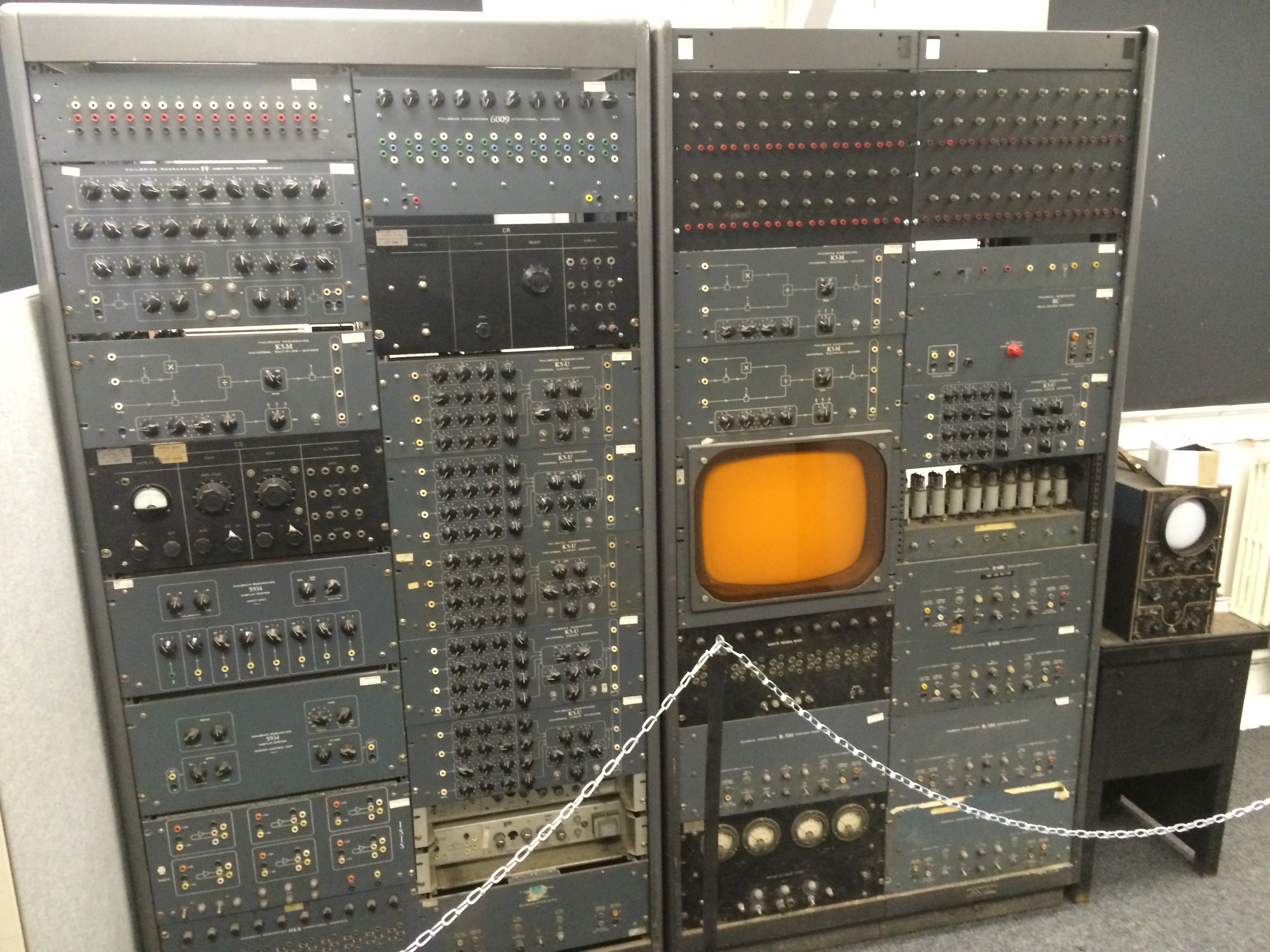
Here's a new picture of "George" -- aka the Philbrick analog computer
that MARCH rescued two months ago. It was used at M.I.T. from 1958-1970.
http://snarc.net/george.jpg
Hi all,
I could acquire *four* rotten PC05 Papertape Reader/Punches for PDP-11.
I'm now restoring them.
One of these is strange:
Normally, the feed hole (between data hole 3 and 4) is used to clock in
bits from the data holes.
But this very special PC05 does not have a phototransistor for the feed
hole, so the data clock signal must be generated by the stepper motor
driver.
Maybe it's a very old model: the READER CONTROL module is M705, not the
usual M7050. And there's no doc for it.
Does anybody has a FPMS with schematics for the M705 modul? Perhaps as
part of some PDP-8 doc?
Thanks,
Joerg