be aware there was a DEC terminal plant here in phx az late 70s early
80s
Ed Sharpe archivist for SMECC _www.smecc.org_ (http://www.smecc.org)
In a message dated 5/19/2015 9:53:59 P.M. US Mountain Standard Time,
ddsnyder at zoominternet.net writes:
The serial number can be broken into 3 areas...
The first two digits indicate the country of Manufacture
AY = Ayr, Scotland
BK = Germany
GA = Galway, Ireland
IQ = Somewhere else
NI = Salem, New Hampshire, USA
PC = Irvine, Scotland
KA = Kanata, Ontario, Canada
CX = Colorado Springs, CO, USA
WF = Westfield, MA, USA
AB = Albuquerque, NM, USA
The 3rd Digit indicates the year
7 = 1997 8 = 1998 9 = 1999 etc.
The 4th & 5th digits indicate the week of manufacture from
January.
01 = 1st week in January
12 = 12th week after January 1st (End of March)
20 = Mid April
For a rough calculate take 4 weeks to the month
The remaining digits indicate the run number.
00005 = The 5th one made at this plant
00100 = The 100th one made at this plant
>From the fog in my head...
Dan Snyder, Butler, PA
----- Original Message -----
From: "Jack Rubin" <j at ckrubin.us>
To: <cctalk at classiccmp.org>
Sent: Friday, May 01, 2015 5:25 PM
Subject: Place of manufacture for DEC equipment?
Is there a way to identify which DEC plant manufactured a specific piece
of
equipment? I'm certainly aware of the Maynard, Massachusetts label on my
equipment and I'm pretty sure I've seen DEC Kanata, Canada on flipchip
handles. Maybe even PR serial numbers on computers built in Puerto Rico.
Can anyone supply any more extensive and/or detailed information?
Thanks,
Jack
CASTOR:: was the M+ group?s 11/74 housed in it?s own machine room in ZK. Since the machine hardware could be relatively easily reconfigured, POLLUX:: was reserved for when the system was running as 2 independent nodes (3+1 or 2+2 CPUs). The DECnet group had a dual processor system with node name ELROND::.
I used CASTOR:: standalone a couple of times while debugging the MP changes to the DECnet kernel code until ELROND:: became stable. Eventually, ELROND:: became the timesharing system for the DECnet-RSX group.
The lack of cache-coherency and the limited work-arounds (cache-bypass or cache flushing) meant that all the DECnet kernel code, both drivers and protocol stack, ran with cache-bypass enabled on its data PDRs. So the networking code on an MP system had lower peak performance than on a normal 11/70 although you would never notice the difference in regular operation.
John.
Is there a way to identify which DEC plant manufactured a specific piece of equipment? I'm certainly aware of the Maynard, Massachusetts label on my equipment and I'm pretty sure I've seen DEC Kanata, Canada on flipchip handles. Maybe even PR serial numbers on computers built in Puerto Rico.
Can anyone supply any more extensive and/or detailed information?
Thanks,
Jack
http://blog.startupitalia.eu/p101-make-in-italy-de-sandre-olivetti-intervis…
There is a museum in Ivrea with the Programma 101 on display. I think
some of the photos from modern times were from there.
This article is related to a maker fair in Trieste. Please visit the
page for pictures and to give them page clicks, since I am archiving the
info here for the list.
Thanks
Jim
Google translated from article:
The engineer of the legendary P101: "Here are the secrets of the first
Pc of history"
The Mini Maker Faire Trieste meeting with the engineer De Sandre, one of
the creators of the program 101 Olivetti: the first personal computer
will be among the stars of the show to Make In italy Expo (from May 18).
Last October, in the Maker Faire Rome , was presented the exhibition "50
years of Italian innovations: from P101 to the first espresso machine
space". An exhibition, organized by the Foundation Make in Italy , which
now arrives in Milan Expo 2015. From today, in fact, can be seen, in an
expanded version of the original, in two locations in which it was
divided: Telecom Italian pavilion within the exhibition center in Rho
and the National Museum of Science and Technology of the Lombard capital.
The prototype of the P101 ( Program 101 ), recognized as the first
desktop computers in history, made ??his international debut at the
World Exhibition in Paris in 1965. The team, led by Pier Giorgio
Perotto, devised an instrument that had some features that still they
form the basis of any personal computer: CPU with discrete components,
RAM (magnetostrictive delay line), mass storage (magnetic card) and
serial printer to impact.
Within the team of Perotto was a young engineer, Giovanni De Sandre.
Matthew Tro?a met him at the second edition of the Mini Maker Faire
Trieste to talk with him about the success of the P101 (and many other
things).
The interview
How did your story with Olivetti?
I entered into Olivetti April 1, 1960, after the previous talks that had
established my eligibility in that company. I even received the head of
the laboratory at the time, the engineer Mario Tchu , who was the son of
a Chinese ambassador to Vatican. Tchu had specialized in the United
States, and this greatly pleased to Adriano Olivetti , who cast him in
his team. That time I had just graduated, fresh from Politecnico di
Milano, and you think, now my degree is equivalent to a degree in
electrical engineering, but at the time did not exist in this
formulation, so I got a degree in electrical engineering with a
"certificate studies of electronics. "
So she was received by engineer Tchu, who then assumed?
The engineer Tchu was a very friendly, helpful and friendly. He
explained all the activities of the laboratories, mostrandomeli one by
one and explaining with great patience and care that what took place in
those places. In the end I remember that I said, "then engineer, she is
interested in what more? One thing in production or in the project? "And
I said a little 'afraid' to me honestly like to work on projects ...".
Tchu then he asked again, "but she would like to work on the evolution
and improvement of our existing products or instead of entirely new
products?" And then I said that without wishing to presumptuous, I would
have loved work on projects entirely new.
The engineer Tchu picked up the phone, called the engineer Perotto and
said "dear engineer, I have here a person that suits her." That phrase
always decided for my professional future. I went well in the working
group of engineer Perotto, who was my direct responsibility even though
he was only a few years older than me. Perotto was a nice person, of
great culture and technical ability. He had a spontaneous orientation
toward the concrete. I was very lucky because I was thrust into an
almost idyllic. In the Olivetti corporate hierarchy was not seen as an
imposition, not weighed. The leaders were, but they respected because it
was natural respect. People were so influential that respect for them
was spontaneous. I found an atmosphere of great freedom, but also of
great involvement. If I had a problem it was enough to ask for help and
I was listening. My problems and my gaps I filled asking. I learned a
lot while I worked.
What he is initially occupied?
The first thing I worked were checks magnetic, which still bear the
bottom two spaces wider than three a little 'closer. The location of
these areas determines the reading code. The machine that read these
codes had designed Perotto and I was in charge of setting up, checking
its operation, and connecting it to an existing machine Olivetti. Within
six months I had accomplished something.
And then the P101 ...
Work began on the P101 with a deep study of the feasibility of the
product, initially purely theoretical. We wanted to create a car that
was not limited only to make four simple steps that already did with the
mechanical machines. Then produce mechanical machines cost 39,000 lire,
but then were sold to 390 thousand pounds. For Olivetti invest in this
product would not bring the expected revenue. We had to do something to
level a little 'higher. So we started working on the prototype of the P101.
We did not know that the machine had to create, in the sense that there
was still nothing like it on the market. However for me the bonds were
crystal clear: it had to be easy to use, accessible to a
non-professional user. Accessibility was to be the characteristic trait.
In the second place it had to be reduced in size. Finally it would cost
as little as possible. Led by engineer Perotto, then, we started working
on this electronic project. So the first thing to do was to decide the
type of memory to be installed in the machine. Of course we had the
opportunity to go to the store and choose from dozens of memories at our
disposal. In those years there were very few memories. In particular
there was the core memory , but was not good for the small size of our
future machine. The engineer Perotto I knew immediately, I'm a bit
'after. (Laughs) After a study of the type of memory to choose from we
focused on a type of memory of the past generation, which had been
abandoned by now (working memory was a magnetostrictive delay line ).
The technology of the time gave us memories that were not going to
respect the constraints that we had set, so we used the components of
the past, to make the "car of the future".
The revolutionary products as was the P101, they appreciate when they
are ready. Behind their implementation but there is always a big job.
How much have you been working on this project?
We got to work with his head down, day and night, often without
realizing that had arrived the weekend. In some periods there was no
agreement on Sunday as a day of rest. There were no arrears with whom to
spend the afternoon. All this does not remember it as a burden, but as
the most exciting period of my life. We had to finish first. I think
that needs to come first in some things, that does not mean overdoing
it, but engage and expend maximum to achieve their goals. Running behind
is far worse than through the air.
He never felt the weight of fatigue in what he did?
There was no concept of fatigue for us. It was completely overcome by
the interest that was for what we were doing. We felt a bit 'pioneers in
a world where we often designed parts of electronic circuits, but never
a car full. We proceeded by trial and error, but they hand it proceeded
increased experience.
Chapter Innovation
What about her?
Innovation has to have some unmet need. To return to my story, I believe
that the fact of working at P101, was not immediately something
innovative. For me initially was mainly a strong need. If I think back
to when the University did the calculations with the ruler with which
often was wrong, the idea that you could create a machine that would
help me with extreme speed and precision to make those calculations, for
me was the solution to my real need . Need to be put together with some
technical expertise required to carry out in practice his idea.
Innovation means want to go into the unexplored wilderness, hoping to
find an oasis, a solution but we were not ready, but we have done us.
Italy is a country still able to accept the technology?
When there is something really innovative, I do not know if Italy is the
best country in which to tell this innovation. From this point of view,
perhaps the United States is a country more ready mentally, more
pragmatic and more accustomed to understand the news. But this happens
only in the initial phase. Olivetti also initially was little more than
an island than the rest of the country. A lot of people did not even
know that there was this company.
But I believe that the issue on which we must reason is as follows.
Today the world has certainly changed and we are used to accept anything
new very easily. The challenge is to understand what, in this chaos of
new, really creates innovation, understood as making something useful
for our lives. What really affects our lives? That is, if what we invent
or we make an impact in a way that is not obvious, trivial, obvious,
then maybe other countries are more receptive, but Italy certainly not
least, because of quality products makes many as he wants. The important
thing, as I said, you know what, among the many new features, it's
really helpful to improve their lives.
He would redo everything you did?
Yes absolutely. Though I speak with hindsight. One can not always
project her life and does not know what may happen in the future.
Certainly more than the experience in Olivetti itself, I would like to
relive the spirit of those years, that basically was a spirit extremely
positive, optimistic, enthusiastic. From my experience I have learned
that critical is the commitment and self-criticism, that a little
'lacking nowadays. Innovation also means being confident, determined and
feed their inner spring. It helps a lot to be introduced in the
technology world, especially now that has become pervasive. Everything
comes from a right balance between a strong driving force and a large
capacity that criticism must regulate itself within us.
What did you learn from your experience?
That we must never stand still. But think of Steve Jobs! What has to do
what he did? It's not that he invented something. What made the
difference, however, was its continuity, his desire to fight, his steely
character, which allowed him to transform a company that was going to
fail in company we know today. What did Jobs? In fact did what many
others did, but of course with an attention to detail and some aspects
that have allowed him to make a difference. Today, companies ride the
wave for a couple of years and when they feel it is necessary to
reinvent itself give up and sit down. Steve Jobs? More than sitting!
That one had the pins under the seat which put him constantly on the
move. He never lies and never gave up, and certainly helped him a lot of
his character. Today we have to stay on the move, never sit down,
because innovation is moving.
16/05/2015
Matthew Tro?a & Alessandro Frau
RE: Token Ring
As said below, you can probably not worry too much about the
wiring impedance (etc.) for a small ring.
But you will still need a MAU or something like it.
The token ring adapters have a physical layer protocol for ring
insertion and token monitoring.
The power-up state for a station wire is a physical loopback and it
will try to successfully loop itself before inserting.
A copy of the newsgroup comp.dcom.lans.token-ring FAQ still lives at
http://www.networkuptime.com/faqs/token-ring/index.shtml
Connector pinouts and other info is in there. Stuff on Wikipedia too.
I had to dust off a few neurons to remember this stuff.
Dave.
I'm not reading this list consistently anymore... any direct
questions should be CCed to me.
On 5/18/2015 01:00 PM, cctech-request at classiccmp.org wrote:
>Date: Sun, 17 May 2015 12:58:20 -0400
>From: Sean Caron <scaron at umich.edu>
>To: "General Discussion: On-Topic and Off-Topic Posts"
> <cctalk at classiccmp.org>
>Cc: Sean Caron <scaron at umich.edu>
>Subject: Re: Weird stuff has a TI 810 (also if anyone has token ring
> wiring)
>Message-ID:
> <CAA43vkUJ7US+72OiYhEtrvOgM76u0tUv55wqAP65R21otLkbEg at mail.gmail.com>
>Content-Type: text/plain; charset=UTF-8
>
>I can tell you from firsthand experience that if you're just doing short
>little runs within a vintage computer room in your home or something like
>that, you can directly pin the 9-pin D-sub over to 8P8C and make short runs
>with common unshielded Cat V cable and it should work fine. I did this all
>the time when I was in high school to connect old MCA PS/2 machines with
>the IBM token ring adapters (9 pin D-sub) to various old 8P8C MAUs that I
>had acquired. I can't speak to dealing with those funky IBM connectors;
>never worked with those.
>
>Best,
>
>Sean
>
>
>On Sun, May 17, 2015 at 12:50 PM, Dave G4UGM <dave.g4ugm at gmail.com> wrote:
>
> >
> >
> > > -----Original Message-----
> > > From: cctalk [mailto:cctalk-bounces at classiccmp.org] On Behalf Of
> > jwsmobile
> > > Sent: 17 May 2015 16:30
> > > To: General at classiccmp.org; Discussion at classiccmp.org:On-Topic and Off-
> > > Topic Posts
> > > Subject: Weird stuff has a TI 810 (also if anyone has token ring wiring)
> > >
> > > There is a white cased TI 810 at Weird Stuff in the AS IS room. Probably
> > > cheap. Of course unknown condition.
> > >
> > > Got some very nice Token ring equipment from an IBM facility of some
> > sort.
> > > will be using for Hercules setups.
> > >
> > > I'll need some balun's for the RJ45 (ibm version) to the DB9 if anyone
> > has an
> > > idea of the hookup. I'd like to figure out if I can wire this w/o using
> > the token
> > > ring cables, since I have what appears to be a bridge unit. I'll have to
> > research
> > > that though.
> > >
> > > Thanks
> > > Jim
> >
> > Jim,
> > Is there a part number on the "bridge" unit? Typically the IBM units just
> > switch the stations it and out of the ring.
> > Dave
> >
> >
---
This email has been checked for viruses by Avast antivirus software.
http://www.avast.com
I've finished up things for a new release of Frotz, an extremely portable
Z-machine emulator (plays Infocom games). The Unix port is tested and
ready to go, but I don't have real DOS hardware in working order. Could I
get some people to try it out and let me know how it fares? It's compiled
with Turbo C++ 3.0 for 16-bit DOS. The zipfile is at
http://661.org/if/frotz244.zip. Source is at
https://github.com/DavidGriffith/frotz. Games are available at
http://ifarchive.org/ or https://661.org/if/ (some of my games).
--
David Griffith
dave at 661.org
A: Because it fouls the order in which people normally read text.
Q: Why is top-posting such a bad thing?
A: Top-posting.
Q: What is the most annoying thing in e-mail?
Hello!
The EPROMs are labeled 07595-18045 and 07595-18046. We suspect some
bits have toggled.
Can anyone do a dump for me? It's for the 7596A of our local
hackerspace.
Greets,
Martin
--
Martin Peters
martin.peters at news.uni-stuttgart.de
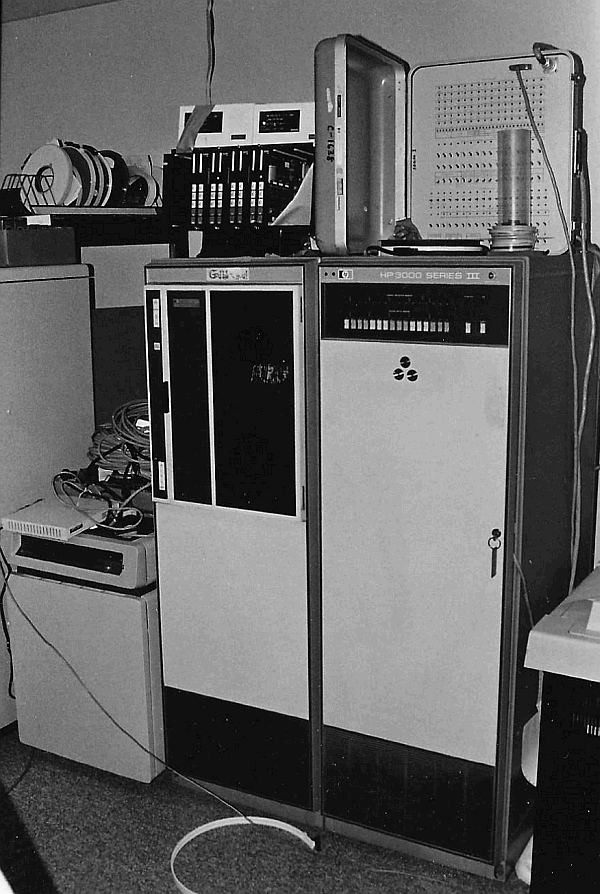
Johannes Thelen - and others... HP-3000 Series II? series II?? We
would pay handsomely for one.
We found our backup archive set of HP-3000 software - heh heh all
kinds of software including FORUM/3000 which was a multi user 100
seperate boards bulletin board, electronic mail, electronic poll and voting
system, multi user chat rooms...
( this was all pre Internet so it was way cool back then!
just gotta read the tapes.... amazed... this grouping of tapes
was an off site storage I had forgotten about and re found in the
back closet at the house... had not seen it in over 23 years..
I am really hot on getting e series II or II back to have one at
the SMECC museum here in Arizona as it was one of my favorite machines but
also we have the giant plug in front panel for it that shows all
registers that the customer engineer would bring out in a suit case to
really get down and dirty....
We have the series II and III interface board as well as the HP-3000 CX
series interface board which is a separate item.. see
http://www.smecc.org/hp/hewlet16_series_3_with_maint_panel.gif to see it hooked to
HP 3000 WACC-B from U Wisconsin
Used by Marlys Nelson - HP-3000 Programmer Extraordinaire! this photo
was shot after we even had retired the system was using a series 48
with 303 meg drives I kept in next to my desk and would test boards in
it.... When the panel was active on the III with users on it it was
fun to throw it into single step BEWRAHHAHHAHH!!!AA!!!
Ed Sharpe Archvisit for SMECC
In a message dated 5/18/2015 2:30:24 P.M. US Mountain Standard Time,
aek at bitsavers.org writes:
On 5/18/15 1:13 PM, Johannes Thelen wrote:
> the big one of this donate is HP3000 Series III! :D
>
Finding software for the Series II and III has been extremely difficult
so please try to find any that was associated with the machine.
Hello friends!
I just got another donate to my collection... It contains several items, but the big one of this donate is HP3000 Series III! :D
Do anyone know what it weights? This one have CPU with Option 200 rack (my best guess, like some expanded IO?). And is there wheels below racks?
Ps. IBM 1800 project is going further bit by bit, all gate doors and flat cabling is assembled back where they were. More coming about this later!
- Johannes ThelenFinland
Before microcomputers blog (Finnish) http://ennenmikrotietokoneita.blogspot.fi/
I'm looking for a tool to do a bunch of 3.5 floppy imaging using a linux
or a windows box.... Media is all early PC stuff. Any thoughts,
comments, tools of choice?
Is IMD the format of choice for these as well or is there something else
for the newer formats?
Steve
Hi
I'm about to go on a small road trip to pick up some computer gear. I'm
curious about what I'm actually getting :)
http://www.update.uu.se/~pontus/slask/L%C3%B6fberg-haul/
I know what the Siemens and IBM things are, but:
What system would the the Ampex Series 800B have been used with?
The Alfaskop terminals, are they 3270 compatible?
Regarding the huge stack of tapes, what should I look for in order to
identify what might be on them, is the "9270" label any clue?
I will leave the Esselte Scribona FD 20 behind, but I'm curious what it
is? I think it may have served use on an airport, printing boarding
passes or similar.
Regards,
Pontus.
There is a white cased TI 810 at Weird Stuff in the AS IS room. Probably
cheap. Of course unknown condition.
Got some very nice Token ring equipment from an IBM facility of some
sort. will be using for Hercules setups.
I'll need some balun's for the RJ45 (ibm version) to the DB9 if anyone
has an idea of the hookup. I'd like to figure out if I can wire this
w/o using the token ring cables, since I have what appears to be a
bridge unit. I'll have to research that though.
Thanks
Jim
> From: John Wilson
> Even if E11's mP feature is officially unsupported, it was a *crazy*
> amount of work
What made it so much work? (Just curious about the technical aspects...)
Noel
Thanks another million.
- Marc
>> Is the "HP 1000 M/E/F-Series Computers I/O Interfacing Guide"
>> (02109-90006 September 1980) available online somewhere?
>I thought I had sent it to Al some years ago, but it's not listed. In any
>case, I've posted it here:
> http://home.earthlink.net/~jdbryan/dropbox/02109-90006_Sep-1980.7z
> See chapter 5, pages 5-5 and 5-6.
> -- Dave
The only reason I guess is that they're bootable disks. Otherwise a simple filecopy is more than enough :)
-------- Messaggio originale --------
Da: Fred Cisin <cisin at xenosoft.com>
Data:17/05/2015 16:40 (GMT+01:00)
A: "General Discussion: On-Topic and Off-Topic Posts" <cctalk at classiccmp.org>
Oggetto: Re: 3.5 floppy imaging
> If they are just plain old dos format (DD or HD) dd under linux will do
IF they are just plain old DOS format (DD or HD), then COPY will do.
IF they are just plain old DOS format (DD or HD), then there is no reason
to "image"!
IF they are just plain old DOS format (DD or HD), then the files are all
that matters.
IF they are NOT just plain old DOS format (DD or HD), THEN there might be
reason to image, such as if they are some unknown and not understood
format, and the files can not be extracted, or there is reason to believe
that there is some form of information in the structure and format of the
disk that should be preserved, such as system tracks on CP/M disks, etc.
Or, if they are copy-protected, and stuff other than the files needs to be
preserved to be able to use the files.? 'Course then, your "imaging"
methods are not likely to work, anyway.
But, IF they are just plain old DOS format (DD or HD),
then there is NO information other than the file content on the disks.
If you format a 3.5" disk in a DOS/Windoze machine, and copy some file
onto it, . . .
Could you please explain to me WHY you would want an "image" of that disk?
Dan (the donor) brought more manuals, diags on paper tape, and his very
nice color oscilloscope. Dan's 'scope displays RMS, PTP, Average, and other
voltage values on the side of the trace window, so it makes power
measurements very easy.
After reading the manual and getting instructions from Warren, we found
that some of the misbehaving front panel was due to operator (me) error. The
Mode switch to change between LINC and 8 operation only has an effect after
you press the I/O Preset switch, so that is working correctly.
When you press I/O Preset the INST FIELD is set to 1 and the DATA FIELD is
set to 3. I though that this was wrong for an 8k machine. If you look at
the front panel you will see three bits and an additional 2 bits for the
INST FIELD and DATA FIELD. So part of this is for the 8 and all of it is
for the LINC, and it is working correctly.
We recabled the VR14 and TU56. The Local Forward and Reverse switches on
the TU56 do not get the correct behavior from the motors. The Line fuse on
the VR14 blew when we turned it on.
We will replace the fuse and try a slow power up with a Variac.
We received lots of comments on reforming the capacitors in the power
supply and strong recommendations from experts to just replace them. Since
new caps are a different physical size, and would cost about $250 we
decided to continue with reforming the originals. We measured the voltage
ripple on the backplanes near the power connectors.
- +5.0V = 5.01V, 200 mV PTP ripple
- +10.0V = 5.9V, 200 mV PTP ripple
- -15.0V = -14.2V, 800 mV PTP ripple
- -30.0V = -31.2V, 800 mV PTP ripple
The 800mV of ripple on the -30 is a sign that the caps in the power supply
were not working well, and is probably too noisy for the core to work. We
tried to measure the capacitance of the power supply capacitors using an
ancient, but very nice, GenRad capacitor meter, but unfortunately the caps
were too big to measure.
We thought that more power on time for the caps might improve their
behavior, so we started debugging the processor. We found that bits 4 and
11 in the Program Counter were always on.
We looked at the flip-flops on the M221 modules in the processor that make
up the PC register and they the contents matched what was loaded from the
console switches. We need to determine why the indicator lights on the
front panel do not exactly reflect the internal state of the registers in
the processor so we can continue debugging.
After running the system for about four hours the ripple on the -30V was
down to 180mV, so the capacitors are getting better. More run time will
hopefully reduce the ripple to an acceptable level. If not, we will have to
replace them.
--
Michael Thompson
one here but not cheap.
I was happy I got a diablo KSR
I can not even tell you how bad I used to lust after one of those in
1979......
http://www.omnidatasys.net/catalog/printers/texas-Instruments-ti-820-ksr
In a message dated 5/17/2015 12:19:45 P.M. US Mountain Standard Time,
jwest at classiccmp.org writes:
I am looking for a TI 820 or 825 KSR, if anyone has one in good shape with
all keys that they are willing to part with - sale or trade...
J
The 8041 has the same pinout as the Intel 8741 programmable. A Pro-Log M980
PROM Programmer with a PM 9054 personality module can read out the programs
inside.
I did a lot of Intel 8741 Development back in the day and even reverse
engineered the PIO in an Intel MDS-225. I have a MDS-225 now I'm getting
going from pieces.
Richard Main
+1 510-229-9711
Newark, CA USA
This just popped up today:
http://www.ebay.com/itm/LOT-OF-54-USED-VINTAGE-DEC-DIGITAL-COMPACTAPE-TK50-D
ATA-TAPE-CARTRIDGES-SOFTWARE-/221774909736?
It is a bit expensive in my view and shipping to the UK is too much, but I
thought there *might* be some old versions of DEC software on some of those
tapes. I thought of asking about the DEC software myself, but as I know I
wouldn't bid it wouldn't be right for me to ask. Anyone in the USA
interested enough to find out what historical DEC software there might be
and recover the tapes (if possible)?
Regards
Rob
I decided to put the 11/44 on Ebay for $1, no reserve. (currently at
$40.39).
New photos (what is on ebay plus what I took today after opening the
cabinet to see what is in there)
http://vintagecomputer.net/digital/PDP11-44_2nd/
Ebay listing
http://www.ebay.com/itm/Digital-PDP-11-44-/271869650084
Item is pickup only BUT If you can't pick it up but want to make
arrangements to have a shipping company come to pick it up, pack and ship,
I am happy to help but it's on you to make all of the arrangements. I am
available during the work day.
Location - Landenberg, PA which is about 40 minutes South/west of
Philadelphia, about 60 minutes North/east Baltimore, 10 miles or so from
I95 at the MD/Delaware border.
vintagecomputer.net/contact.cfm
Bill
The scrappers are here, clearing out the warehouse.
I saved a box of old DEC and HP boards.
First $100 plus about $35 UPS ground shipping takes them home (in CONUS).
I have no idea if any of them still work, but I pulled them from large
working cabinets I was required to destroy about 18 years ago.
Part numbers are:
M8061
97871 401-33692 Quad Cache qty 3
85-3438-02 Cache memory
M8059FH
M8048 qty 3
M8059FB
M8186 qty 3
Peritek Corporation DMA-Q
97871 MUX qty 5
5020477-01-DC1 Diceon 6A
M8016YB
HP boards:
C-2440-40 2443-9572
5181-5649 Rev A
98257-66524 98257A
33445-60002 A-2745-39
D2237-60001 (no CPU chips)
A1470-66521 16MB memory qty 2
Cindy Croxton
Electronics Plus
1613 Water Street
Kerrville, TX 78028
830-792-3400 phone
sales at elecplus.com
AOL IM elcpls
A correspondent just pointed me to a nice collection of photos of a (the?) 11/74 MP system:
http://oboguev.livejournal.com/2696291.html
I assume this is the one at DEC used by the RSX-11M+ group for their multiprocessor support work. As far as I know these didn?t become a product. I remember the name of the machine as ?Cerberus?, not sure what that label ?daemon? refers to. Maybe a DECnet node name?
paul