Several Qualstar 1054s that I have used an OEM bridge
board from NCR. Later drives used a Qualstar design.
Does anyone have the manual for the NCR board? No obvious
part number on them..
>
>
> Message: 5
> Date: Mon, 22 Jan 2007 10:12:03 -0700
> From: Richard <legalize at xmission.com>
> Subject: Re: Strange things found in a free SPARC 20
> To: "General Discussion: On-Topic and Off-Topic Posts"
> <cctalk at classiccmp.org>
> Message-ID: <E1H92iB-0006EE-00 at xmission.xmission.com>
>
>
> In article <45B4DDBC.5080303 at gmail.com>,
> Sridhar Ayengar <ploopster at gmail.com> writes:
>
>> [...] Did Sun ever make an
>> accelerated 24-bit card?
>
> Yes, they made a bunch of different 3D accelerators during the 90s
> (and most likely beyond, but I haven't been attending SIGGRAPH often
> enough to say for sure). Ironically, they didn't start making good 3D
> accelerators until they hired ex-Evans & Sutherland engineers. I can
> concur that working at E&S was good training in 3D! They really knew
> their engineering, its such a shame that marketing and management were
> utter failures.
> --
> "The Direct3D Graphics Pipeline" -- DirectX 9 draft available for
> download
> <http://www.xmission.com/~legalize/book/download/index.html>
>
> Legalize Adulthood! <http://blogs.xmission.com/legalize/>
>
There was, I believe, something that could be paired with a CG9 in the
Sun-3/early Sun-4 days. Ah yes, here it is: the GP2 graphics processor.
VME based, with Weitek engines.
Then there was the Leo/ZX option for SBUS.
Can't tell you anything about performance of either of these two.
With the introduction of the UPA bus things got better: Sun introduced
Creator/Creator3d and Elite3d. Of course, none of these graphics could
touch what SGI was putting out, but it was a valiant attempt. Creator3d
used the SPARC for geometry but had onboard Z-buffer calculations,
Elite3d had a full graphics pipeline but not much texture cache.
Can't say anything about the really off-topic stuff for the current
machines.
MSX machines were mainly home machines, no? I doubt
too many homies were buying 286s in 85-6. And is
MSX-dos? kinda like c/pm?
____________________________________________________________________________________
Be a PS3 game guru.
Get your game face on with the latest PS3 news and previews at Yahoo! Games.
http://videogames.yahoo.com/platform?platform=120121
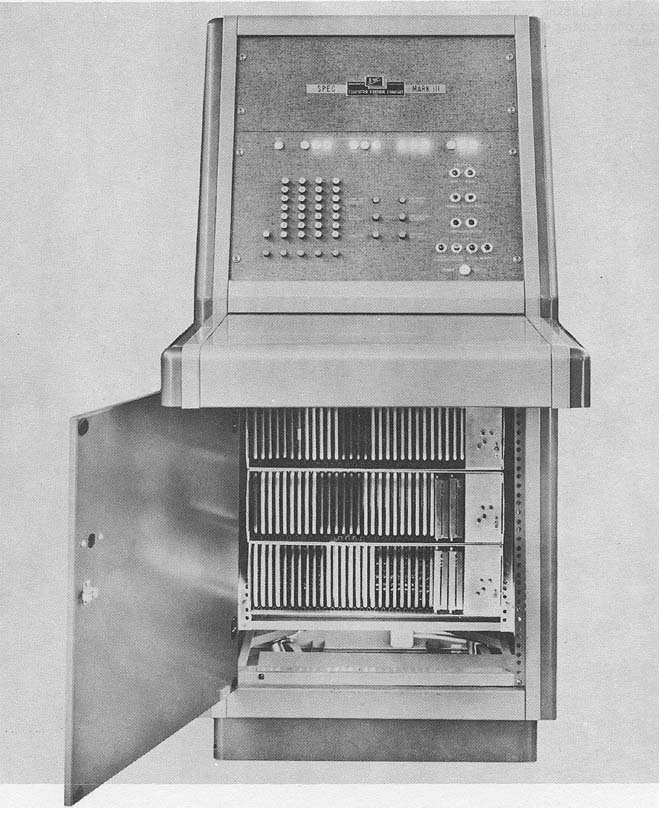
In the summer of 1961, I worked on a computer made by CCC (California
Computer Co. ?) It used a magneto-resistive delay line for main memory.
The model number was SPEC, which stood for Special Purpose Educational
Computer. It was aimed at computer training in the military (I was in the
Army at the time). It was a small sub-desk size computer, certainly not a
mini. Only had 128 words of meory.
I thought my memory was betraying me until I recently found a brochure that
has a poor picture of it. And I found one of my coding sheets from the
class. But that's all.
Does any one on the list have anything else? Would love to see more
pictures or a schematic. How about a manual?
Or even more basic - has anyone else even heard of it?
Billy
William Maddox wrote:
3C must have made several kinds of trainers. I have
a brochure for a large trainer with an oversized
front panel, as if it were deliberately enlarged to
allow a lecturer to present it to a classroom.
Unfortunately, it is only a brochure -- no manual
or schematics. I can scan it and send you a copy,
though.
--Bill
-----------------------------------------------
I'd love to have a scan of it. Even if it is a different model, it helps
bring back memories. after years of looking, I was beginning to doubt my
memories.
Billy
> Hi Robo,
>
> I saw an old email from you, do you still have any of the VLS96 emulators for sale? I want to
> start learning about this chip.
Could we change the list such that the replies to emails older than a year
don't get reposted to the list?
Clearly people don't realize that they are not replying to an individual when
they come upon some ancient message (ex. the recent posting directed to Don Maslin).
One of them is a Quantum Q280 and a couple of the other drives are
also made by Quantum.
These are drives that were accompanying the Eves but not attached
internally.
Doesn't that imply that these Eves have been upgraded to a SCSI bus
>from what the Lilith had?
--
"The Direct3D Graphics Pipeline" -- DirectX 9 draft available for download
<http://www.xmission.com/~legalize/book/download/index.html>
Legalize Adulthood! <http://blogs.xmission.com/legalize/>
Dear All,
I have a Epson Tractor Unit #8304 V that I would like to lose. It is
currently in Swindon UK. However it can be in Bristol, Bath, Oxford,
Cheltenham, Bletchley or London if required.
Unit is free. I am happy to put it in the post providing I get
reimbursed postage.
Thanks.
Simon
--
------------------------------------------------------------------------
"Well, an engineer is not concerned with the truth; that is left to
philosophers and theologians: the prime concern of an engineer is
the utility of the final product."
Lectures on the Electrical Properties of Materials, L.Solymar, D.Walsh
>Date: Mon, 22 Jan 2007 11:05:55 -0600
>From: "Jay West" <jwest at classiccmp.org>
>Subject: Re: OT Crimp tools & Cutter Re: DEC MMJ
>Sridhar wrote...
>> It's just a finer instrument. It does the same job.
>>
>> If you want to trim a lead flush to a surface, it's very difficult to do
>> with a pair of scissors.
>Ahhh this makes sense. Example... trimming the excess from an IDC type
>connector. This flush cutter would get right next to the wall of the
>connector as my scissors won't. Gotcha.
>Jay
-------------------
A sharp utility knife has always done that for me.
m
I just got in some LD-V1000 laserdisk players that are basically NOS units. The
LD-V1000 was used for a number of laserdisk games including Cinamatronics Space
Ace. They were powered up quite a few years ago and there is a sticker on each
one with the measured laser output (76 mW for the one in front of me.) While the
units themselves are pretty much prisitine, the boxes are in probably very good
condition and show signs of mice/rats having visited. $125.00 plus $10.00
packing and shipping from zipcode 93105. They will be shipped in another box 30"
x 24" x 12".
Each one will be tested to make sure it will play okay, and will be shipped with
the lens cap and a shipping screw of some sort (these had the shipping screw
removed, and I'm not sure yet exactly what they look like.) No paperwork except
the registration card on the outside of the box.
I suppose I'll be sorry for this, but I want to mention that one of the
hardest to find early 6502 systems just showed up on eBay: the PAiA 8700.
But it wasn't on the vintage list; it was on the music instrument category.
Most of these were built into keyboards. I've been looking for one of these
for 5 years and only seen 3 of tem on eBay. Always get outbid. Had to stop
bidding on this one at $93..
Anyway, if anyone else wants one for their collection, take a look at this:
110079964730
You can see the keyboard and the display in one picture. The description
gives it away.
So if you are looking for these, do a search pointed to midi keyboards or
PAiA.
Billy
----- Original Message -----
From: "Alexandre Souza" <>
To: "General Discussion: On-Topic Posts Only" <cctech at classiccmp.org>
Sent: Monday, January 22, 2007 5:50 AM
Subject: Re: Re: Re: Is MSX on topic?
>> which do you own? Are they easy (whatever that means)
>> to find?
>
> Almost all of them. Experts are very easy to spot here in pawn shops
> and "ferros velhos" (place where you sell scrap metal). Hotbits are more
> scarce but no one likes it, it is too easy to break, the internal PCBs are
> too fragile and almost all MSX hobbist likes to open his puter to mess
> around.
>
> Take a look at http://www.tabajara-labs.com.br and
> http://www.msxpro.com (both in portuguese but you can at least take a look
> at the figures, or use babelfish). There are many interesting photos of
> MSX.
>
> About my "collection", I have:
> - Some expert 1.0
> - Some expert 1.1
> - one Expert Plus
> - One expert DDPlus with pc power supply, floppy drive/controller,
> megaRAM, SCC chip, 2+ kit, 256K memory mapper and lots of small mods
> - Some hotbit (white model, 1.0/1.1)
> - NO black hotbits :(
> - Panasonic A1-WSX (2+, great puter)
> - Philips VG8235 (2.0)
>
> And lots of other brazilian puters non-related to MSX
which do you own? Are they easy (whatever that means)
to find?
--- cctalk-bounces at classiccmp.org
<alexandre-listas at e-secure.com.br> wrote:
> > there was at least one Brazilian made unit, with a
> > detachable keyboard. Ive heard a rumor to the
effect
> > that they were somewhat common in Mexico. Anyone?
>
> In Brazil there were:
> - Expert 1.0 (detachable kbd)
> - Expert 1.1 (same, different ROM)
> - Expert Plus (same, but black, different
innards
> - Expert DDPlus (same as plus, but with internal
floppy drive)
> - Hotbit 1.0 (white and gray)
> - Hotbit 1.1 (same, different ROM)
> - Hotbit "1.2" (black, but everything the same
as 1.0)
>
> They are somewhat common in argentina, but I
don't know about mexico.
> Ask me if you want to know something else
>
____________________________________________________________________________________
We won't tell. Get more on shows you hate to love
(and love to hate): Yahoo! TV's Guilty Pleasures list.
http://tv.yahoo.com/collections/265
I got these out of "Upgrading and Repairing PCs", 3rd ed., which is a
wonderful source of information on all sorts of PC-related gear.
In case others need them, I added the pinouts to WikiPedia.
--
"The Direct3D Graphics Pipeline" -- DirectX 9 draft available for download
<http://www.xmission.com/~legalize/book/download/index.html>
Legalize Adulthood! <http://blogs.xmission.com/legalize/>
> Two thoughts... SCSI IDs are send by a 1-of-N code on the data lines,
> so
> the fact that devices show up at the correct IDs means that the host
> can
> assert data lines.
That's similar to what I was thinking
>
> But 191 is 10111111 (hex BF) IIRC. Now that seems to be a significant
> bit
> pattern, particularly as bit 6 is the '0' -- your host adapater
> wouldn't
> happen to be device 6 on the SCIS bus, would it? (it's a common address
> for the host adapter). Do you have any idea what the 'Type' should be?
SGIs all have the SCSI host adaptor at SCSI ID 0. Generally, the PROM
matches known types to user-identifiable strings (e.g. SCSI Disk:
dksc(0,1); SCSI Tape: dksc(0,4))
I know that CD-ROM devices were not included in the PROM, and they
appear as
"Unknown SCSI type 5 / removable: SCSI (0,6)" [or whatever the address
is], which correlates to the decimal conversion of the "Perepheral
Device Type" field returned in byte 0 by the inquiry command
(CD-ROM=0x5).
I'm not sure where 0xBF is coming from- that doesn't look like a valid
type. So there must either be a spurious signal (or excessive skew) or
a bad host controller. It sounds like the 0xBF is being reported for
all types, including a tape drive (should be 0x1), ZIP, and something
else that I can't find in an email right now, but I think it was a MO.
bear made a suggestion that it might be a problem with the termpwr.
Hmm- he says he's already desoldered the 33C93A and put in a socket, so
I might just go ahead and scavenge another 33C93A from a board in the
garage and send it to him (the PI owner, not bear).
Jay Wrote .....
> Jerry wrote....
> > My Zebra says 2510 on the botton sticker if I remember correctly
> > has a 8" drive and a Qic Tape.
> Nice to know there's 2500's around still. I sold a lot of 'em :) However, in
> the entire history of General Automation's Zebra Pick line, I was pretty
> confident none were ever sold with 8" floppy (or floppies at all for that
> matter). How odd. I'd love to see a picture of this. The 2500's were
> tabletop machines, perhaps around 20 inches wide, 25 inches deep, 8 inches
> tall... had a creame/beige side & top (one piece) and a black plastic front.
> I seem to recall only two buttons on front, power and reset.
>
Thats it, Very Nice machine I ment a 8" Hard drive not a Floppy
> > Still Boots pick OS. I have
> > the same tape you have but did not know how to to use it.
> Are you sure it's a "dealer.sysgen" tape, and not just a tape that was MADE
> by a dealer.sysgen tape? I did see a lot of folks label the output of the
> dealer.sysgen account as a 'sysgen' tape which it really isn't. If you can
> boot off the tape (BOOT CT from executive), it's not a dealer.sysgen.
> Dealer.sysgen tapes were just account saves and useless without a machine
> already running. You could always put it in and do a "dummy SEL-RESTORE" and
> see what it pulls off.
>
Yes, It is The Dealer Tape. Label say
Zebra/Pick Operatiing System, Revison 3.3b, 750/1350/1750/3760
Version 53a00124a01-a, Dealer Sysgen Tape Qic 24 Format
Copyright 1980 Pick Systems with General Automation at the bottom
The problem I have with booting is that it has Disk errors
and I would guess it is no stable enough to make a bootable
tape if that is even possible.
Do you have any of the manuals on these or OS on how to
Make a tape ?? I would like to try and see if this tape
will even work. I was able to "DD" it with out errors
> > My machine model did not show up on the label of the tape either.
> I seem to recall there was something special/different about the QIC tape
> drives in the oldest zebras vs. all the later zebras... a different
> recording method or something making them bidirectionally incompatible. The
> sysgen account could create tapes for these machines, but only if the target
> machine was retrofitted with the newer style QIC drive. I'm sure the 2500
> was one of the old style drives normally. The 1750 could be either style.
> Everything else was the later style I believe.
>
The tape drive I have will Only write to a DC300A. it errors on
a DC600A
> Jay
>
>
Jerry
Jerry Wright
g-wright at att.net
Another long-distance e-troubleshooting quandary:
Machine: SGI Personal IRIS 4D/20 (WDC 33C93A SCSI, single channel)
All disks pop up as unknown type, for instance the main system disk
comes up under the PROM as
Unknown SCSI type 191 / removable: scsi (0,1)
drive settings:
-ID: 1
-Time monitoring is disabled
-Read-Ahead caching is enabled
-Normal operational mode
-LED active when drive connected to bus
-CHECK CONDITION posted (unit attention response)
-Unlimited 250ms, 128 retries (scsi time monitoring)
-SCSI-2(scsi level)
-SAVE DATA POINTER is issued for disconnection (message mode)
-CHECK CONDITION status not posted(error report at mode select
parameter rounding)
-0 (PER default value)
-Motor start on power up (motor start timing)
-Executed by IDD (scsi bus parity check)
-CHECK CONDITION status not posted (synchronous mode transfer rate)
-Disabled (OPEN 1.2 to 2.67MB/s)
-Power is supplied to the terminating resistor from the IDD and TERMPWR
pin. Power is also supplied to the TERMPWR pin from the IDD. (Pin 26 of
the interface) (scsi terminating power)
new SCSI cable tried, terminator known working, drive visible from a
different machine (Linux PC). The devices pop up at the proper SCSI
IDs, but all are misidentified as Type 191 (I suppose this is a decimal
representation of the hex SCSI identifier numbers.) Is this likely a
dead 33C93A or is there somewhere else to look?
P.S. - we love you, Tony- Don't leave.
> Thanks for that! No macs here but I can source one easily enough so will have
> to give that a go.
That was only the subroutine for dealing with disc reading. It's part of
a larger kludge I use for tape and disc reading.
The point was just to show what low-level scsi commands you need to send to
dump a disc.
Would make more sense to translate that to something that would work with the
generic SCSI driver under Linux.
IIRC the sound paraphenalia was the same or similar to
that used in the TI home computer.
--- cctalk-bounces at classiccmp.org
<julesrichardsonuk at yahoo.co.uk> wrote:
> Witchy wrote:
> >> I disagree on the "nothing new" part -- didn't it
come with an
> >> incredibly powerful music synthesizer as standard
equipment?
> >
> > Not that I remember, apart from the Yamaha CX5M
which was a dedicated
> > music machine with full size keyboard
>
> Yes, I thought MSXes were just based around some
common sound chip. Perhaps
> the AY-whatever-it-was as used in the later Sinclair
machines (and doubtless
> countless others).
>
>
>
____________________________________________________________________________________
Cheap talk?
Check out Yahoo! Messenger's low PC-to-Phone call rates.
http://voice.yahoo.com
>Date: Sat, 20 Jan 2007 10:40:02 -0500
>From: Brad Parker <brad at heeltoe.com>
>CRC wrote:
>>>
>>> good thing I saved that powerbook 145b :-)
>>
>>Probably too early to do any good...
>
>It has a scsi connector (I have the adapter) and 68040 (ec I think).
Retrospect 2 ran fine on my Mac IIci back in the day. Ah, here are
the "Minimum Requirements" off of the side panel on the box:
Macintosh Plus, Hard Disk
System 6.0.5 (2 MB RAM) or
System 7 (4 MB RAM)
So a PowerBook 145 should work fine. A PowerBook 100 should also work okay....
You might run into problems with a much later machine or OS and
Retrospect 2, although as someone mentioned, later versions of
Retrospect will probably read your older tapes just fine. I have a
vague memory that when I went to OS 8+ and started using a PCI based
Mac I had to upgrade my version of Retrospect, but I'm not certain
any more whether that upgrade was necessary or just something I
wanted to do--or maybe to get later tape drive support.
Anyway, this came up in my emailed saved search for Retrospect on
Ebay today
<http://cgi.ebay.com/ws/eBayISAPI.dll?ViewItem&item=230081470236&ssPageName=…>
which is a sealed version of Retrospect 2.0 with a $5 BIN and $5
shipping.
Again, as someone else mentioned, the tough part is going to be
coming up with a compatible (with your tape) working tape drive.
Also, once you have everything hooked up you'll need to run the
"Repair or Recreate a Storage Set" under the Tools menu. Under
Retrospect 2 that's a "Tools" sidebar icon and the selection is
"Repair/Recreate Catalog".
Presumably you no longer have the "Storage Set" file that Retrospect
created when it made the tape. So the first thing it will need to do
is to scan through the tape and recreate the storage set files for
that tape, I think. After that you'll be able to recover the
contents.
This always seemed like the most clunky aspect of Retrospect to me.
Presumably, if you've had a complete hard drive failure, the catalog
will be gone (absent multiple hard drives or server backup), so why
doesn't it store the catalog file at the end of the tape where it
could scan to the end and pick it up there instead of recreating the
thing from all the contents of the tape? Perhaps tape can't work
that way?
Ah well, anyway, there's a copy of R. 2.0 available and it should
work on any ancient Mac. They all had SCSI ports (except the very
early 128K and 512K and KE but they don't have 2 MB RAM anyway) You
just need to find a tape drive.
Oh, and OS 6.08 and 6.05 are free downloads from Apple, as well as
the version of 7 mentioned earlier, and any of those will work with
R. 2.0. So really, you just need a Mac old enough to run early
OSs, or find one with a later OS already on board or with OS media.
Jeff Walther
there was at least one Brazilian made unit, with a
detachable keyboard. Ive heard a rumor to the effect
that they were somewhat common in Mexico. Anyone?
--- cctalk-bounces at classiccmp.org
<ard at p850ug1.demon.co.uk> wrote:
> > Perhaps someone from Europe or Asia should chime
in on how the MSX
> > wave hit their corner of the planet. In the
States, it was barely a
> > whisper.
>
> They were not common in the UK as far as I remember,
most people over
> here had Spectrums or BBC micros.
>
> Based on the number of add-ons for them published as
projects in Elektor
> magazine, I would guess they were more common in the
Netherlands.
>
> -tony
____________________________________________________________________________________
Get your own web address.
Have a HUGE year through Yahoo! Small Business.
http://smallbusiness.yahoo.com/domains/?p=BESTDEAL
Hi
I was surfing on the internet and saw your interest in kaypro co-power 88.
I have a kaypro 10 and the co-power processorboard.
My problem is that I only have a loader for the 256 kb Ramdisk but not the loader for running Msdos2.11
Are you willing to mail me a copy of the software .
Thanks.
Jos
I've had a couple of WTF moments from SS20s. Best one was when I got a
retired SS20 that I cracked open to find one SM71 MBus CPU and one Dual Ross
100 MBus CPU. It had been in reliable production, as a 3 proc box, for a
couple of years with one 70MHz, 1MB cache CPU and 2 100MHz, 256KB cache
CPUs. Solaris reports that it's using all 3. That's some robust
architecture.
Digital archaeology of the microcomputer, 1974-1994
By Steven Goodwin <http://www.freesoftwaremagazine.com/user/39>
/Online on: 2007-01-05/
/(Or, how to prevent the Dark Ages of computing through free software)/
In a few years time, it will be impossible to study the history of home
computers since everything at the time was proprietary; both in terms of
the physical hardware, and all the software that ran upon it since most
of it is encumbered by software ?protection? to prevent copying.
To compound the problem, the hardware is dying (literally) and (being
proprietary) can?t be rebuilt in any equivalent manner. In some cases
the software is physically disintegrating too since, in the case of many
8-bit micros from the 1980?s, the storage medium was cassette tape; a
temperamental mechanism at the time, let alone now. It?s not that no
computer innovation took place in the 1980?s, just that none of it will
be recorded.
<snip>
http://www.freesoftwaremagazine.com/blogs/digital_archaeology_of_the_microc…
ah, charcoal gray, CX5. Models with or without the
synthesizer. What about in Canada?
--- cctalk-bounces at classiccmp.org <cisin at xenosoft.com>
wrote:
> It was a Yamaha, but I don't remember what model.
>
> On Sat, 20 Jan 2007, Chris M wrote:
>
> > which one?
> > --- cctalk-bounces at classiccmp.org
<cisin at xenosoft.com>
> > wrote:
> > > We bought an MSX machine from Mitchell Waite.
> > > They were trying to decide whether it would be
worth
> > it to publish an MSX
> > > book.
> > >
> > >
> > > --
> > > Grumpy Ol' Fred cisin at xenosoft.com
____________________________________________________________________________________
Don't get soaked. Take a quick peak at the forecast
with the Yahoo! Search weather shortcut.
http://tools.search.yahoo.com/shortcuts/#loc_weather
ah, charcoal gray, CX5. Models with or without the
synthesizer. What about in Canada?
____________________________________________________________________________________
TV dinner still cooling?
Check out "Tonight's Picks" on Yahoo! TV.
http://tv.yahoo.com/
which one?
--- cctalk-bounces at classiccmp.org <cisin at xenosoft.com>
wrote:
> We bought an MSX machine from Mitchell Waite.
> They were trying to decide whether it would be worth
it to publish an MSX
> book.
>
>
> --
> Grumpy Ol' Fred cisin at xenosoft.com
____________________________________________________________________________________
Looking for earth-friendly autos?
Browse Top Cars by "Green Rating" at Yahoo! Autos' Green Center.
http://autos.yahoo.com/green_center/
Please forgive me for the marginal off-topic nature of this post. The
machine in qurstion is an HP9820, which is, I think, a programmable
calculator (the distinction being that it has a key-per-function type of
keyboard, not a full alphanumeric one where you type out the keywords).
But anyway...
I'm working on an HP9220,. For those who know nothing about this series
of machines, its one of the few common-ish bit-serial procesors (and is
intereting for that reason alone). The processor has 2 accumulators (A
and B), program counter (P), current instruction (Q -- stands for
'qualifier,' I am told), extension (E -- only 4 bits wide), I/O, memory
address (M) and memory data (T) registers. It's microcoded (256 28 bit
words). Binary operations are done bit-serially, BCD operations (which
have to be between the A and T registers, with the result going into A)
are done 1 nybble at a time. The ALU is actually a pair of programmed
PROMs, not 'normal' logic. Oh, nnd to add to the fun, the memory system
uses some odd voltages. The ROMs are HP custom chips with chip select
lines that have to be driven to +12V (all other I/O line are TTL
compatible). THhe RAMs are Intel 1103 DRAMs, they're PMOS and use 16V
logic levels with a further 3V bius supply on top of that (so there are
+16V and +19V lines to the RAM boards).
Anyway, the fault was 'no display'. That is not a suprise. Since the
display is software-scanned, almost all the machine has to be working to
get a display.
Well, I started off checking the PSU lines (actually with all the logic
boards removed), they were all fine. Then it's worth knowing that the
clock board will run on its own. If you power up just the clock board,
you get a muclock pulse (microcode clock) for every 16 bitclock pulses
(shift register clocks). That was fine too.
Now there are 2 ways to procesed. The hard and sure way -- look at
various signals, work out what the machine is doing, compare to what it
should be doing, and figure out what must be causing the problem. And the
easy and uncertain way -- it's a bit-serial machine so just about
everything should be changing. If something is stuck, that's a likely
place to start looking.
The M and T register bits are brought out on a test connector on the
memory box. So I looked there. It turend out that M(15) down to M(12)
were all toggling, the remaining 12 M lines were all stuck low. Rememebr
the M register is a 16 bit shift register, loaded from the MSB end. And
it's built from 4 7495 chips. So it seemed 'obvious' that the chip that
handles bits 11..8 had failed. It wasn't accepting data, it was providing
0's to the next lower chip.
Getting a replacement was not easy, but I mamanged it. Soldering it in
was trivial (pin-through-hole on a very well-made PCB). But would you
believe the fault was the same. Of course I'd checked the clocks and mode
control line were getting to all the chips in the M register.
Puzzeled, I looked again and M(12). It was toggling alright, but when I
sampled it with a logic analyser, I found high time of the pulses was
only the bitclock pulse high-time width. Which clearly can't be right for
a shift register made up of D-types clcokced form bitclock. Moreover
M(12) as always low just before the active edge of bitclock. so the next
shift register in the chain would always clock in 0's.
Out came the most significant nybble of the M register, and it was
replaced with the ship I'd removed ffrom M(11)..M(8). And the machine
then sprang to life.
So be careful. A signal can appear to be doing the right thing but can
have nasty timing problems...
-tony
> I can put these on floppies or if you know of a known good RX01/RX02
> image for a DECmate I can use it.
We have orig distribs for OS78 V4 and some DEC apps at CHM. I'll see about
reading them.
TMK the only *commonly* found MSX unit here in the US
was the Yamaha CX5, and I have that but never used it.
An interesting topic thats mostly foreign here.
____________________________________________________________________________________
Want to start your own business?
Learn how on Yahoo! Small Business.
http://smallbusiness.yahoo.com/r-index
From: "Teo Zenios" <teoz at neo.rr.com>
> I was wondering what you people think about machines that have been
> used as a latrine by animals, do you clean them up or toss them?
Urine is very acidic (with acidity varying by type of animal), but by and
large it's just like any other acidic corrosive (smell notwithstanding). If
the damage isn't that bad, search the list archives for remediation. If
it's corroded the traces of the PCB, well, in theory you can patch it...you
make the call.
Almost any board that my cats manage to whiz on are usually totaled
> I hear rat excrement can carry some nasty deadly diseases.
Possibly, but you're probably thinking of mouse urine, which for certain
specific types of mice can carry hantavirus, at least in the Southwestern
US. Not good.
> OK, on closer look it appears as though these Eve drives might be
> ESDI/ST-506 and not SCSI. If they are ESDI, how could I archive them?
1) what were the drives connected to? If it is a custom controller you
either have to have enough knowledge about the machine to write a block
level dump program, or build something that can extract and then interpret
the data stream off of the disc. BTW, ST-506 is no easier than ESDI if you
are down at the bit level (other than the ESDI data separator was on the drive)
2) if it was a standard thing like a scsi to st506 or ESDI bridge board, things
are much easier. ESDI was new enough that bridge boards like the Emulex MD21
had inquiry commands so you can get the drive geometry. older boards require
the system to configure the board with that information, so you had to know
in advance what kind of drive is out there.
On Fri, 19 Jan 2007 19:18:17 -0500, Brad Parker <brad at heeltoe.com>
wrote:
> Someone approached me about some "prior art" and I am now looking at
> some 1/4" carts marked "quadra 950 retrospect 2.0 mac os" I made in
> the
> early 1990's.
>
> If somehow I could find a working 1/4" drive (scsi) and got it
> connected
> to a macintosh,
>
> Is there any hope I could find a copy of retrospect 2.0?
I have a couple of early copies of Retrospect - they are from 95 and
97, but don't label their version. I also have 4 and 5 available.
>
> anyone else ever try this?
You might want to find a SCSI tape deck that is currently supported
and then try a recent version (4 or 5) to attempt to read the tapes.
Dantz did a fairly good job of being able to read old backups with
current versions and I've pulled off some really old stuff when I was
using 4.
>
> it's probably hopeless, but it might be a fun ride. hard to say.
>
> good thing I saved that powerbook 145b :-)
Probably too early to do any good...
CRC
I agree. At least we're preserving some things. And we can! Experimenters
of the 8-bit era are a hardy bunch and there still are 'artifacts' from that
era still around. Will one be able to say the same thing about PCs of today
20 years down the road? Will they be worth preserving or saving from the
scrap heap, hardware and software and such.
Happy computing all!
Murrray--
> A couple of decades down the line I think we're going to have real problems -
> not just with computers, but with all sorts of modern gadgets
We don't even have to wait that long.
All of the consumer devices tied to backend services are a perfect example
of devices that are absolutely useless once a company fails. Unfortunately,
revenue models based on this model are on the increase.
I have a few 16/4 Token Ring ISA cards and an EISA 100Mb one that I want to test out in a few 486 systems I have to compare it to 10Mb Ethernet that I currently run. Anybody have a super cheap hub for sale I can use (these are the RJ45 type cables)?
Located in the US.
Also what is a good way to bridge Token Ring to Ethernet so that these 486 machines can use my router/cable modem?
ard at p850ug1.demon.co.uk (Tony Duell) wrote:
> > Well, as long as we're being petty, I tuned out your incessant (and often
> > off-topic) jabbering long before I unsubscribed.
>
> Is this view wildly held? If so, I'll stop posting. No point in wasting
> my time looking stuff up to post, and everybody else's time in reading
> useless information.
Let me just say that I for one enjoy reading Tony's postings. Sure
a few are not interesting to me, but I can skip them. I much admire the
technical insights in Tony's articles and the advice he so gladly
gives.
Keep up the good work Tony!
**vp
I thought I'd weigh in on the latest policy change on eBay. I didn't know
about the new change until someone e-mailed me about it. The only change
I've noticed recently is that one is not now allowed to randomly send a
message to another user with whom they have not done business, which leads
one to ask why they have the fucking contact link there in the first
place?
Through the years there have been these recurring bitch sessions over
eBay's increasingly idiotic policies. In the meantime, I and Patrick set
up an alternate for the computer collecting community that was tailored
for our specific needs and desires, taking into account all the bitching
and pissing and moaning over eBay's abominable system. We got the first
implementation off and running with big plans to expand it further, which
have yet to materialize, and I'll get into that in a second.
But first I want to take the time to congratulate the community for the
big fuck you they gave to the VCM. It has always been the intention that
we would start charging at some point for using it, but we never got to
that point. The usage was so minimal anyway that it didn't make sense to
start charging until we could get a reasonably active user base.
Granted, we could've done a lot more to promote and advertise the site,
but the CC list community here damn well knew about it and was constantly
reminded about it by myself and Marvin, and inspite of that the activity
just never materialized.
Patrick has since gone on to bigger and better things, having washed his
hands of the CC list and community at some point last year when he
couldn't take anymore of the petty bickering and flame wars that regularly
erupt (this is paraphrasing what he told to me). He turned the site and
its maintenance over to me and I've been running it solo ever since,
mostly just approving all the new accounts and handling the very rare
issues that crop up.
For the most part, the VCM has been there processing transactions (for
FREE) on autopilot, and running rather well considering. If it wasn't for
Marvin--who was fed up enough with eBay but, more importantly, savvy
enough to realize that the VCM is better for selling a lot of stuff,
especially when there are no listing fees--the VCM would effectively be
dead.
I know people are using it, because I see you swooping in and grabbing
some of the better stuff being offered for great prices (someone just
bought a nice IMSAI 8080 for around $1,200, which is a pretty good deal).
I buy a lot of stuff from Marvin, who is listing a lot of fantastic stuff
for extremely reasonable prices. There are other people regularly selling
there too and probably making a decent amount of money, COMMISSION FREE.
Now, getting back to the expansion of the system. I do still have a lot
of plans for the service, mainly in the area of making it a bit more
friendly in the interface. When we launched it we had a service that I
felt was superior to eBay's crap system. In the meantime, eBay used their
billions of dollars of capitalization to make their system easier to use,
integrated a lot of stuff, etc. Me, I'm still sitting on my IPO until the
next irrational dot.com boom, so my funds are limited, as is my time, as
is my ability to make any changes to the VCM since Patrick owns and
controls the server and wrote all the code (based on a system he'd already
designed for a past client of his). Now that Patrick is out of the
picture, I'm faced with having to port the entire system over to my own
server, which I would like to do so I can finally take it into Phase 2 and
beyond.
But quite frankly, why the fuck should I even bother? You guys don't use
it anyway. You keep using eBay, and you keep bitching about how stupid
they are and get all up in arms when they make yet another bone-headed
policy change, and there sits the VCM doing everything you want, allowing
you to communicate with whoever the hell you want without any over-bearing
surveillance system in place to make sure you aren't doing something
sneaky to deprive us of revenue, with the guys who built and run the
system completely available directly via e-mail for any suggestions,
complaints, praise(?) [hardly any, if you're wondering], and doing it
without asking you for one god damn penny.
So tell me, seriously, why should I bother moving forward with the VCM?
You want an alternative? It's already there, and I'd like to continue to
build on it and improve it and make it the premier place for trading in
old computers, a de facto replacement for eBay, like I originally
intended. But I'm certainly not going to waste my time unless people
actually decide to USE IT.
Is there a reason you don't use it? Is there something about the
interface you don't like? Is there one or two or three or five reasons
why you don't like it or don't want to use it? If so, why didn't you say
so? You could've always e-mailed either myself or Patrick, and like the
few people who did bother to give us feedback, your comments and
suggestions would've resulted in immediate changes to the system. Try
getting that from eBay. As O. Sharp pointed out, try even finding a
fucking way to communicate with eBay!! They make it nearly impossible for
you to get a hold of them because THEY DON'T GIVE A SHIT ABOUT YOU. They
just want you to buy shit from sellers to that they can get a cut of their
money and they want you to shut the fuck up.
I see now that I've been relegated to ranting about eBay it's time to
start winding this up. In conclusion, I'm quite serious about my queries.
The VCM has been out there for years and inspite of the lack of
advertising 1,881 people have managed to find it and sign up for an
account. Logically, that would make for a very strong and active user
base. As far as I can tell, about 1,800+ of them don't actually do
anything once they get an account. Why? Why didn't they spread the word
to other collectors and to sellers on eBay so that they could convince
them to sell their stuff on the VCM instead? I'll tell you one reason
why: sellers make more money on eBay. And that's fine. eBay is good for
making money selling crap. eBay is a crap market. The VCM is a
marketplace for the serious trade of vintage computers for serious vintage
computer collectors, hobbyists and afficionados.
If you want to buy/sell/trade crap, continue using eBay, and give them
your money and shut the fuck up because they don't care about you (only
your money). If you want an alternative that caters specifically to the
vintage computing community, use the VCM. Tell everyone you buy from
about it. Sell your fine vintage computers on it (sell your crap on
eBay). Use the god damn system. It's there and for the foreseeable
future, it's free. Use it or lose it.
In closing, many thanks to Marvin (whom I am also proud to count as a good
friend) for utilizing the VCM to its fullest, and congratulations for the
many thousands of dollars he's made COMMISSION FREE selling his stuff
there for the past several years, and congratulations to the other
sellers, and to the many people who have bought stuff in the simple and
relaxed environment that is the VCM. Marvin and the others are the ones
who deserve the credit for keeping it alive. YOU could be the one who
helps to make it THRIVE if you would just USE IT.
http://marketplace.vintage.org
or
http://www.vintagecomputermarketplace.com
Please direct any replies to me via e-mail. I am not subscribed to the
list and might not see any follow-ups you post.
--
Sellam Ismail Vintage Computer Festival
------------------------------------------------------------------------------
International Man of Intrigue and Danger http://www.vintage.org
[ Old computing resources for business || Buy/Sell/Trade Vintage Computers ]
[ and academia at www.VintageTech.com || at http://marketplace.vintage.org ]
Date: Fri, 19 Jan 2007 12:19:33 -0800 (PST)
From: Fred Cisin <cisin at xenosoft.com>
Subject: Re: Sanyo MBC 55x
On Fri, 19 Jan 2007, Rick Companje wrote:
>> Hello Don,
>> I just read your forum post from 2002 regarding a bootdisk image (MS-DOS
>> v2.11) for the Sanyo MBC 555.
>> Can you please send me a copy by email? I'm running 1.25. Do you know what
>> kind of software is available for this machine besides Basic, Wordstar and
>> Calcstar?
>Don Maslin is dead.
>There are no more bootdisks any more.
--------------------------------------------------
As a matter of fact, the post he's referring to is probably the exchange
between Don and myself in 08/02, when he was kind enough to send me that
image. Here's my chance to pass it on; I've sent it to Rick off-list.
Don is sorely missed...
mike
From: "Jay West" <jwest at classiccmp.org>
Subject: Re: eBay idiocy/vcf idiocy et. al.
>Please terminate this thread as of midnight 1/19/2007. Any posts pouring gas
>on the flames of this post after that time will result in 2 week ban from
>the list.
--------------------------------------------------------------
Thank you, Jay, for once again stepping in to calm the troubled waters
(i.e., settling down us unruly kiddies).
Interesting that Sellam started this, while chastising us for the "bitching"
that goes on here and which caused his VCM partner to leave...
But if his aim was to publicize VCM, I guess it worked.
mike
got a follow up email from the person that the jumper
list came from:
While working with this new CQD220A document I found an error where "W6-5" is listed twice, and
"W6-3" is skipped. Here is the original section:
--------------------------------------------------------------------------
W6-1 OUT Adaptive DMA enabled (F)
W6-2 OUT Adaptive DMA Dwell Time enabled (F)
W6-4 W6-5
IN IN 0.8-ms DMA dwell time
OUT IN 1.6-ms DMA dwell time
IN OUT 3.2-ms DMA dwell time
OUT OUT 6.4-ms DMA dwell time
W6-5 OUT Block mode DMA enabled (F)
--------------------------------------------------------------------------
I expect it should be something like this:
--------------------------------------------------------------------------
W6-1 OUT Adaptive DMA enabled (F)
W6-2 OUT Adaptive DMA Dwell Time enabled (F)
W6-3 W6-4
IN IN 0.8-ms DMA dwell time
OUT IN 1.6-ms DMA dwell time
IN OUT 3.2-ms DMA dwell time
OUT OUT 6.4-ms DMA dwell time
W6-5 OUT Block mode DMA enabled (F)
--------------------------------------------------------------------------
But I am not sure. My card had a jumper installed on W6-3, and I am thinking it set the DMA dwell
time to 3.2ms. Removing it, change to 6.4ms, seemed to help with a crashing problem.
* Brad Parker wrote:
Someone approached me about some "prior art" and I am now looking at
some 1/4" carts marked "quadra 950 retrospect 2.0 mac os" I made in the
early 1990's.
If somehow I could find a working 1/4" drive (scsi) and got it connected
to a macintosh,
Is there any hope I could find a copy of retrospect 2.0?
anyone else ever try this?
it's probably hopeless, but it might be a fun ride. hard to say.
good thing I saved that powerbook 145b :-)
-brad
------------------------------------------
Don't know if it helps or not, but I have a wheeled table in the garage with
an 8600 that I use for testing SCSI drives, peripherals. Was working last
time I fired it up. I used to use a 9500. It is still on the floor; was
working when I pulled it out. It's yours if you want it. (This is in
Pleasanton, California.)
I think I kept both systems at 8.6, since that was last of the good SCSI
support drivers.
(If any interest, write me off line: billy.pettit at wdc.com - only good on
week days. Weekends are for fun not computers!)
Billy
> The machines and common cards will be, but drivers and exotic
> hardware/software will be long gone. It is hard to find drivers for some
> things now let alone in 20 years.
So the question is what should be saved? Is there something about the
'exotic hardware/software' that is historically significant?
Was enough information released that you could actually do something with
the device in the future?